Year in Review 2019
HOPE FOR JUSTICE
2020
1
We exist to bring an end to modern slavery by preventing exploitation, rescuing victims, restoring lives and reforming society.
Names of victims and survivors have been changed throughout this document for their safety and privacy.
Hope for Justice has achieved the Platinum Seal of Transparency from GuideStar, the Excellence in Giving Transparency Certificate, and an Overall Score & Rating of 86.20 out of 100 from Charity Navigator. This puts us in the Highly Rated category for our Financial Performance and for our Accountability & Transparency.
2
YEAR IN REVIEW 2019/2020
Contents Foreword
4-5
Where We Work
6-7
Key Statistics and Trends
8-9
Our Freedom Wall and Survivor Stories
10-13
Key Successes This Year - In Detail
14-25
Structural Transformation and Reforming Society
26-31
Our Year - In Pictures
32-37
Slave-Free Alliance
38-41
Closing Statement
42
Hope for Justice USA P.O. Box 280365 Nashville, TN 37228 (+1) 615-356-0946 info.us@hopeforjustice.org HOPE FOR JUSTICE
3
Let me tell you one of my favorite moments from this year: it was reading the words of a child we had rescued, who later in their recovery told a member of our team at a Lighthouse:
“This exploitation must end.� 4
4
YEAR IN REVIEW 2019/2020
We believe in empowerment This has been a milestone year for Hope for Justice in more ways than one, and I want to bring your attention to one particular milestone: 102,803. That is how many children Hope for Justice has been able to reach through our projects and programs this year and it brings me so much pride. Being able to help more than one hundred thousand children in a single year is possible only because of an entire movement of people: supporters, donors, organizations, volunteers and an incredible staff. I have to say I love the time of year when we release our Year in Review – it’s a moment in the calendar where we can gather and reflect on what have been able to achieve, together, as an organization but also as a movement. The final result is just a snapshot of the true depth of change we have made. We have been busy expanding our preventative and community-based anti-trafficking work. We are doing everything we can to avoid and protect against family breakdown, economic desperation and the other circumstances that create conditions in which trafficking thrives. We LOVE being able to rescue victims of human trafficking, but for me true success comes when we prevent a boy, girl, man or woman from having to live through those dark days in the first place. As 2019-2020 drew to a close, Hope for Justice was affected by the coronavirus and the associated lockdowns and restrictions in many countries where we work. But we were determined that our work could not and must not stop. We put in place extraordinary measures to ensure we could continue to reach the vulnerable and care for those who needed it. Training went online; meetings went virtual; team members worked from home where possible – but the core work of preventing exploitation, rescuing victims, restoring lives and reforming society went on (and goes on as I write this). Let me tell you one more of my favorite moments this year: it was reading the words of a child we had rescued, who later in their recovery told a member of our team at the Lighthouse where they were living: “This exploitation must end.”
HOPE FOR JUSTICE
Now that is the sound of an empowered child who knows that human rights exist... who has a heartfelt sense of what’s right and what’s wrong... who is going to go back to their family and then go out into the world and declare those truths. It’s empowerment that goes beyond changing a single life – it’s about changing nations and changing the entire world. It’s the empowerment of EVERYONE which will one day create societies that are hostile to human trafficking and which will bring about the glorious goal we strive for: the end of this modernday slavery. At Hope for Justice, we share a celebration culture – as I often say, we Celebrate What We Want To Replicate! I hope you can celebrate with us as you read through this Year in Review for 2019-2020. Thank you so much.
Ben Cooley CEO, Hope for Justice
Key statistics 102,803
Children reached through our work
1,208
Children reintegrated into family settings
412,085
Meals served at our aftercare facilities
272
Modern slavery cases worked by our Hubs
20,686
People trained to respond effectively
1,867
Locks added to the Freedom Wall
5
Where We Work “Human trafficking is a global problem and we bring a global solution. We target our resources where they will have the most impact and help the most people. We want to create nations and societies hostile to trafficking – because what you tolerate, you will never change.” - Elaine Jones, International Operations Director, Hope for Justice
NORWAY
SCOTLAND ETHIOPIA
UGANDA ENGLAND & WALES CAMBODIA USA ZIMBABWE AUSTRALIA
66
YEAR IN REVIEW 2019/2020
Hope for Justice runs projects from more than 30 locations across five continents, with plans to expand further. Our areas of focus and work across the world include: Rescue Many of the countries where we work, including here in the USA, have specialist Hubs staffed by experienced investigators and community outreach teams. They work with law enforcement and other agencies to identify and locate victims of trafficking, build bridges of trust with them and remove them from exploitation. We act as an alternative pathway out of exploitation for victims too scared to engage directly with police, and we track down missing people (especially teenagers) who are thought to be at risk of falling prey to human traffickers. Intelligence gathered about those responsible is shared with law enforcement and prosecutors – many perpetrators have been convicted and jailed thanks to this work. In the USA, our investigators have years of combined experience working with prestigious organizations including the FBI and NCIS.
Training Expert trainers equip frontline professionals with the knowledge, skills and tools to identify modern slavery themselves and to respond effectively. We train law enforcement officers; local, state and federal agencies; healthcare workers, businesses and other non-profits, as well as concerned citizens. Many of our investigations begin thanks to someone we have trained reporting intelligence or a suspicion to our Hubs.
Community prevention Recent years have seen an increase in the impact of trafficking and children being drawn into sex work and domestic servitude. To combat this, we have been putting in place important preventative programs for families and communities, delivering strong anti-trafficking messages and helping to minimize the number of children forced to live on the street.
Outreach Outreach is at the heart of our work in the developing world. Our specialist teams engage with children and help keep them safe. We help children out of dangerous and vulnerable circumstances, especially those living alone on the streets, and encourage them to join our Lighthouse centers. This a journey of restoring the life of a child HOPE starts FOR JUSTICE
through safe shelter, counseling, educational opportunities, and fun activities. Our goal is to reintegrate children to their families, or to another safe family or community setting, and to offer continued support to bring about positive, long-term change in their lives.
Transitional care Our Lighthouses provide temporary care and support for vulnerable and exploited children, keeping them safe from the dangers of the streets or their previous circumstances as we work to assess their physical, mental and emotional health and their circumstances. We then work to safely transition them back to their families or to family-based care. Our Lighthouses also offer individual and group counseling and are complemented by our Shine Schools, where children receive catch-up education and life skills training. Older children and teenagers also get help with vocational training to develop skills for employment.
Family reintegration We work hard to return children home to a safe family environment and support families to prevent children separating from them again. We have built an international reputation through the work we are doing on family reintegration of street children, developing Standard Operating Procedures (SOPs), a training curriculum and toolkit. We are a core member of a group formulating global guidelines on reintegration of children.
Self-Help Groups Hope for Justice is using the Self-Help Group approach to help avoid family breakdown, which is a major risk factor in child trafficking. Our Groups economically empower and financially educate women and families to meet their basic short-term needs and cope with shocks to their livelihoods. In the longer term, women involved in the groups become economically secure and able to provide for their families’ needs. The Groups also provide education on child protection and antitrafficking. The overall impact is strong families and communities who are able to protect and care for children and prevent family separation.
7
Key statistics and trends Statistics refer to the period April 1st, 2019 to March 31st, 2020 Remember as you reflect on these incredible statistics and successes that behind every number is a REAL life, a real person with their own story. At Hope for Justice, we remind ourselves of this fact every day by looking at our Freedom Walls, which are a powerful visual illustration of the real life behind each statistic. You can see our Freedom Wall at our head office on the next page.
CHILDREN REACHED THROUGH OUR WORK:
2019 - 20
We reached more children than ever before in 2019-20, through outreach, in our Lighthouses, at child wellbeing clubs, or through a caregiver's participation in a Self-Help Group
102,803 2018 -19
71,953
2017 -18
2015 -16
23,874
37,000
2016 -17
25,987
CHILDREN REintegrated into family settings:
7,019 Unique interventions made by our ADVOCACY Team
Evidence shows children have better life outcomes when we can get them back to safe, caring families
11,742 Children whose caregiver 8 BENEFITTED from our programs
Our Community Prevention programs, including Self-Help Groups, empower women in the poorest communities and also their entire families
2016 -17
Some interventions are big and some are small, but each one has a profound impact on the future opportunities of a survivor of modern slavery
2018 -19
830 1,014
2015 -16
2017 -18
2019 - 20
790
954
1,208 YEAR IN REVIEW 2019/2020
Children helped through outreach services:
HUMAN TRAFFICKING CASES cases worked by our Hubs: 2016 -17
1,547
272
235 243 173
2017 -18
3,843 2018 -19
5,271 2019 - 20
5,597 2016 -17
People trained:
2016 -17
2019 - 20
378
211 2016 -17
210
2017 -18 2018 -19
232
10,807 12,234
2018 -19
20,686
2019 - 20
Women participating in our Self-Help Groups:
Trafficking prevention initiatives run by our Hubs:
71 2017 -18
2019 -20
Most referrals come to us from people we have trained
3,236 4,584
2017 -18
2018 -19
Potential cases referred to us:
Every person able to spot the signs of modern slavery and trained to respond effectively brings us a step closer to ending this crime
2015 -16
2017 -18
72 2018 -19
HOPE FOR JUSTICE
5,490
92
1,776 2019 - 20
Children served at a Lighthouse
The global network of Hope for Justice Lighthouses grew to 11 this year, each one a beacon of light, love and world-class aftercare for vulnerable and exploited children and victims of trafficking
9
1,867 Locks added to the Freedom Wall, April 2019 - March 2020
10
Every unlocked padlock represents a real life changed by our work!
YEAR IN REVIEW 2019/2020
HOPE FOR JUSTICE
11
Names and pictures changed to protect the identities of survivors
Names and pictures changed to protect the identities of survivors
Anita’s Story
Mathias’s Story
10-year-old rescued from sexual slavery A 10-year-old schoolgirl was rescued from a terrifying cycle of sexual abuse after people living nearby were trained to spot the signs by Hope for Justice. Anita became increasingly withdrawn and was in pain because of the abuse. Her plight was uncovered by neighbors in her rural Ugandan village who had been part of one of our community prevention programs that taught them how to recognize the indicators of exploitation. Police raided the house and brought Anita to a Hope for Justice Lighthouse – a safe haven for children who have been abused and exploited. A police chief at the Ugandan Children & Family Protection Unit said: “We have no facilities to shelter these vulnerable children and so Hope for Justice is the organization we depend on for their care and protection. We are incredibly thankful for everything that they are doing.”
One step, one life, closer to a world free from slavery We rescued Mathias after 18 brutal months of exploitation and control by traffickers. Mathias came to a city in central Norway with the promise of a job that was too good to refuse. But from May 2018, he was made a victim of systematic forced labor and controlled through threats and manipulation. He was made to live in overcrowded and filthy conditions. He told us: “I was fearful of going to the police, afraid that I would get into trouble. So I continued working long hours for little or no pay. But things only got worse.” Our investigators, working with partners, were able to intervene and rescue him this year. One investigator said: “Mathias expressed so much gratitude for getting the help he needed. This is one step, one life, closer to a world free from slavery.”
Thanks to trauma-informed care and psychotherapy, medical care for the injuries she sustained during the abuse, counseling, schooling, life skills and play with her new friends, life is so different for Anita now. She told our team: “I hope to become a doctor when I am older. I am glad I will never go back to that home.”
12
YEAR IN REVIEW 2019/2020
Names and pictures changed to protect the identities of survivors
Names and pictures changed to protect the identities of survivors
David’s Story
Dee’s Story
A place to call his own, for the first time A survivor of trafficking has his own place to live for the first time, after spending most of his life fending for himself on the streets and then trapped in the house of a human trafficker. As a child, David was forced to steal food to survive after he and his siblings were orphaned. He was brought to the UK after believing lies that were told to him, then coerced into forced labor for more than six years to pay back false ‘debts’ to his trafficker. David, who is in his 20s, now has his own place to live because of Hope for Justice’s expert case workers who spent a year fighting on his behalf. They had to deal with identity theft and other complex legal issues that would otherwise have prevented him from making a fresh start. “He was in absolute shock when he was given his own place to live,” a member of the Hope for Justice UK team said. “He could not believe he had a front door to open, let alone a home to go to. He kept pressing the doorbell, crossing the threshold, and then going back outside so he could come in and press the doorbell again. He just could not believe he was worthy of having his own place to live.”
HOPE FOR JUSTICE
A life saved from human trafficking in the USA 17-year-old Dee had been under the control of a trafficker but had managed to escape his clutches and get herself into a rehab program. She was getting clean of the drugs he had been using to control her. But he tracked her down there and made her leave with him. Hope for Justice was quickly brought in and our investigative efforts determined that she was driven south from Tennessee across state lines. Through careful work, our team (with decades’ worth of FBI, NCIS and local law enforcement expertise) found the motel she had been driven to. We managed to intervene to get her away from danger. Dee is now safe.
13
OUR KEY SUCCESSES THIS YEAR – IN DETAIL
Meals served at our aftercare centers 412,085 Globally, Hope for Justice served a huge number of children and young people at our Lighthouses and our Dream Home in 2019-20. For many of them, it is the first time in their lives they have had safe shelter and good-quality food.
About our Lighthouses
Our Lighthouses provide:
Hope for Justice has 11 Lighthouses, in Cambodia, Ethiopia and Uganda. Each serves hundreds of children each year who have been rescued from trafficking, from brothels, from forced child marriages or from the worst vulnerability to trafficking on the streets.
• • • • •
When it is safe to do so, we get children back to their families or safe family-based care. Lighthouses are staffed by Hope for Justice’s worldclass teachers, medics, counselors, guards, nurses, therapists, drivers, social workers and cooks to give these precious children everything they need to recover from their experiences in a place of safety and to build a brighter future for them.
14
• • • •
Safe shelter Trauma-informed care and counseling Good food Medical care Life skills, education and a space to learn and play in freedom Help for children to give evidence against their abusers to police and in court, to see justice done A place to make friends and enjoy arts, crafts and games Good clothing A place to share their story and be believed
YEAR IN REVIEW 2019/2020
8-year-old girl is living testimony of a life changed and set free from human trafficking A brave eight-year-old girl is embracing her new life after being freed from sexual exploitation. In May 2020, our latest intake into our Cambodia Lighthouse was Chaya. Below, our Lighthouse case manager shares the experience of meeting Chaya for the first time:
Rescued out of this hideous nightmare, Chaya is our latest intake into our Lighthouse here in Cambodia. Chaya means ‘Life’ and you can see her hand in the photo. She’s relishing being somewhere safe with regular food, clean clothes, a shower and a dry bed... but best of all, the chance to do some school lessons and be a ‘normal kid’ and play and learn with the other children. As our therapists and case managers work with her, we know she has only just begun her journey out of exploitation. But her enthusiasm to engage with all that is on offer at our Lighthouse gives us hope she has taken that first huge step. She is already a living testimony to a life changed. We can see the eventual end of slavery in this young and precious girl.
Safety, shelter and good food As part of International Day for Street Children 2020, some of the children who we look after created drawings showing where they feel safe. One child included in their drawing EVERY room in the Lighthouse where they are living:
“Hello. I’m eight years old. Is there school here?” Bright little eyes peer up enquiringly at me. I ask myself, how does this precious child remain so engaged and active after all she’s been through? The resilience of some children is mind-blowing. The timeframes are still a bit sketchy but we believe this little girl has been exploited and supervised into regular sexual exploitation by her own mother for possibly a year or more. It is hard to imagine how a mother can do this – but that is what the desperation and grip of drug addiction can do... especially once you lose everything and end up living on the street with a young child.
HOPE FOR JUSTICE
We are so proud that children feel safe and are safe in our care. Our number one priority is safety.
15
OUR KEY SUCCESSES THIS YEAR – IN DETAIL
Children reintegrated into family settings 1,208 Evidence shows children have better life outcomes when we can get them back to safe, caring families. Here are just a handful of the real lives represented by the above statistic.
Emotional reunion of 10-year-old girl with parents after horrifying experience in domestic slavery
wandering the alleyways in fear. Luckily he knew about Hope for Justice and brought her to one of our Lighthouses, where she received friendship, support, medical treatment, schooling and counseling.
When she was six years old, Selam moved to Addis Ababa, the capital of Ethiopia, to live with a wealthy relative who had promised her parents to provide for her every need. Being poor, and believing that this distant family member was offering their daughter the chance of a better life, they arranged for Selam to leave their rural village for the city.
She was shy at first, but when she realized she was finally safe and that adults could be trusted, she started opening up and participating in group activities.
But when Selam arrived, she was forced into domestic servitude. This young child, who should have been attending school and making friends, was instead forced to cook, clean and care for a baby. She was given scraps to eat, beaten for no reason and banned from leaving the house. Her childhood was taken away from her. After enduring this for several years, one day Selam saw an opportunity to escape and took it. But alone in a big city she did not know, she was so vulnerable on the streets. She was found by a police officer,
16
While this was going on, our specialists were working to trace her parents in the village where she was born. Once everyone was satisfied that it was safe, Selam was taken home. One member of our team who saw the reunion said: “Her mother couldn’t believe her eyes. She didn’t know her little girl had gone missing and couldn’t believe the relative would do something like this. Her parents were very emotional and relieved to have their daughter back with them. They said they were incredibly thankful for everything that Hope for Justice is doing.” Thanks to help from Hope for Justice, Selam is now able to start school.
YEAR IN REVIEW 2019/2020
Why we believe in reintegration, not institutionalization When looking after incredibly vulnerable and often traumatized children, there are ups and downs, hurdles and setbacks, but we keep working with those we support until they are ready for reintegration. That usually means the child being returned home, sometimes hundreds of miles from where they were found on the streets or in a situation of modern slavery. Other times, it means a new life with a safe foster family. If the beneficiary is older, and if it is appropriate, they can be reintegrated directly to the community to live independently, with good-quality work, new skills and reduced vulnerability.
‘I thought he was dead’ – Mother reunited with 13-year-old son A young scholar is able to live out his potential after being reunited with his family. Kaleb was found by an Outreach team at Hope for Justice who were searching the streets of the city of Addis Ababa. A kind-hearted passerby had taken 13-year-old Kaleb in for a night after finding him “terrified and anxious” at a bus terminal. He was brought to Canaan Lighthouse, where he received one-to-one psychotherapy and attended school classes while our team worked to trace his family members, hoping to get him safely home. After just two weeks at the Lighthouse, Kaleb was able to return to his family. When they saw him, they began crying and praising God that he was safe. Kaleb’s mother said: “I thought my boy was dead. I have not been able to sleep, I have been so worried about him. We were doing everything we could to find him. Even now, Kaleb’s older brother is in Addis Ababa trying to find him. Thank you so much Hope for Justice for bringing him home.” Our team worked with local officials to give the family parenting skills advice and training to lower the risk of family breakdown. Since he has been back at school, Kaleb is now the second highest achieving student in his class.
HOPE FOR JUSTICE
Some of those we support need intensive longterm therapy, residential aftercare and education. Immediate needs are assessed at our Lighthouses, which can provide crisis intervention, medical checks, trauma support and everything a young person needs in their first weeks after rescue or off the streets. We call them ‘Lighthouses’ because they provide a light in the darkness; a guiding beacon away from danger and into safety. Reintegration is probably the most difficult form of aftercare to achieve successfully. The realities of migration and globalization mean that returning children to their own families can be complex or impossible:
• We help children who have walked for weeks • People who do not know where they are from and have no address
• No identity documents • They come from places which lack the kind of
infrastructure which would help us investigate
• Sometimes they may have crossed borders, and there are also language issues
There is extensive evidence, including from our own programs, showing that reintegration achieves better long-term outcomes compared to institutionalization. Sometimes it is not possible – in cases of particularly complex needs, or when the child’s own parents were complicit in the trafficking and still present an ongoing danger to their safety, for example. But whenever we can, we invest in family-based care, and projects that successfully settle someone back into their community.
17
children reached
OUR KEY SUCCESSES THIS YEAR – IN DETAIL
Children reached through our work 102,803 Through Outreach activities, Community Prevention programs and direct provision at our Lighthouses, this year we reached and helped more beneficiaries than ever before.
Twelve children rescued from slum after being enslaved as acrobats A 12-year-old boy was one of a dozen children who were forced to work as traveling acrobats, made to work long hours, dancing in bars and performing open-air shows, often going without food. George grew up in extreme poverty with his grandmother – who was the sole carer for a further seven grandchildren – on an island on Lake Victoria in Uganda. When a stranger offered to educate George and train him to dance, his grandmother said yes in the hope of securing a better life for him. But George was transported to Kampala, forced to perform to earn money for his trafficker, and denied the education that had been promised. The group of boys and girls, aged four to 16, had to live together in one small room in horrendous conditions.
18
Somone who lived nearby who had been trained by Hope for Justice to spot the signs of human trafficking saw what was going on and alerted police. The trafficker was caught and arrested. All 12 children were rescued and brought to a Hope for Justice Lighthouse, where they got medical care, counseling, catch-up education and life skills. After a short period in hospital because of previously undiagnosed anemia, George was reunited with his grandmother. Hope for Justice is continuing to support George’s enrolment at school, and helping to develop his grandmother’s capacity to care for the other children in her household. A nurse at the Lighthouse is monitoring George’s condition through regular phone calls with the family. George hopes to one day become a teacher. He said to a member of Hope for Justice’s team: “Thank you so much for bringing me back home. I am happy to be with my grandmother again.”
YEAR IN REVIEW 2019/2020
Case study: the value of Child Wellbeing Clubs Bayana is 14 and has seen so many other children and teenagers leave their families to look for work based on promises made by brokers – many of them actually human traffickers. He also knows children who have run away from home to try to find a better life, because of poverty or abuse at home, or family breakdown for other reasons. Once, he was tempted to leave himself, thinking life in the city would be better. But fortunately he became part of a Child Wellbeing Club set up at his school by Hope for Justice. “It was then that my knowledge about my rights increased so much,” Bayana remembers. The club meets weekly, educating the whole school community on child rights, the benefits of education, the dangers they would face trying to live on the streets, and how to protect themselves from trafficking.
Bayana said: “I believe I have to be a good example to others. Now, not only am I no longer thinking about migrating to the city, I am preventing others from doing it. Because of the Club’s activity, we are now helping each other to stay in school and with our families. Now we understand that education is the way to have a better life in the future.” HOPE FOR JUSTICE
Case study: how Self-Help Groups empower families and protect children One way we help children at Hope for Justice is by empowering their parents or caregivers, educating them about trafficking and increasing their economic security to prevent family breakdown. One of the thousands of women empowered through our Self-Help Groups in 2019-20 was Nehimia Kebede, a mother-of-two who says she “could not have survived” without the group. The 29-year-old, whose husband is in prison, was trying to provide for their children alone. When one of our Community Development Workers invited her to join a new Self-Help Group we had set up in her Ethiopian village, she was hesitant. But with encouragement, hopeful of an improvement in her circumstances, she joined in and participated in the collaborative savings model. She began contributing herself and she applied for two loans, which had to be approved by other members. These loans gave her the opportunity to buy a cow, to develop a small business, and to improve her house. The money from the business meant she was able to repay the money to the group with no problems. With more money coming in, the household is less likely to be a target for traffickers. Nehimia said: “How could I survive, and even thrive as I am now, unless this Self-Help Group had been started in my area? I am very grateful for the key lessons that I have learned, for the training I have been given and for the discussions with other members of my community.”
19
cases worked
OUR KEY SUCCESSES THIS YEAR – IN DETAIL
Human trafficking cases worked by our Hubs 272 In the USA, UK and Norway, our highly trained investigators worked on a record number of trafficking cases this year. Some cases resulted in the rescue of many people and valuable intelligence being shared with law enforcement and prosecutors to ensure those responsible could be brought to justice. A few of our notable investigations and rescues are detailed on this page.
Six women rescued from illegal brothels in the USA
Two victims rescued and two people arrested in raid
In one of our biggest rescues during the year, we succeeded in freeing six women from two brothels that were disguised as massage parlors.
Two potential victims of modern slavery got vital support from Hope for Justice after being rescued during a police raid in Huddersfield, England, which was part of a co-ordinated series of operations across Europe, with other people rescued in Austria and Romania.
Our team identified via surveillance that the businesses were operating illegally during the COVID-19 pandemic, advertising commercial sex through social media sites and websites. The two brothels in Tennessee were raided and shut down, with six women in their 20s and 30s rescued and a series of arrests made. Our lead investigator on the case said: “We spent countless days conducting surveillance of these two premises and searching through trash to collect evidence which could then be handed over to law enforcement. We are very pleased the six women are now safe.” 20
We provided language support and independent advice for the victims as they were safeguarded at a Victim Reception Centre. Two people were arrested under the UK’s Modern Slavery Act. Steve Howard, Hubs Manager at Hope for Justice, said: “We are privileged to have been involved in this operation, and ultimately, in the rescue of these two women. We will be working to ensure their ongoing care and safety in the days, weeks and months ahead.” YEAR IN REVIEW 2019/2020
Twelve potential victims of sexual exploitation identified in the USA One of our major ongoing cases began when someone we had trained to spot the signs of human trafficking shared vital information with us, when they realized the significance of something they had seen. Four children – all under 18 – were interviewed by forensic psychologists working with Hope for Justice. Each gave evidence claiming they had been victims of sexual abuse.
Baby born into freedom
Hope for Justice has since identified a further eight potential victims, and our US Hub is now working alongside law enforcement and counsel to further investigate.
Heavily pregnant Mary and her husband James were trapped in a desperate situation of forced labor and debt bondage after being trafficked. Mary, who is in her 30s, and James, in his 40s, were tricked into leaving their home country with the promise of well-paid employment, accommodation, food and medical care. But when they arrived, they were told that they owed substantially more than they had agreed to. Their traffickers continued to raise the amount for no reason, threatening the couple and insisting they work for next-to-nothing to “pay off their debt”. Our Hub team in Norway were able to rescue the couple from exploitation and we have since been involved in their aftercare and practical support. Now they have welcomed their beautiful baby boy into the world – born into freedom and safety. James and Mary told our team: “We did not know what to do or where to turn. We are incredibly thankful for the help we have received.”
It was a joy for us to see this baby boy born into freedom, not slavery.
HOPE FOR JUSTICE
Case study: Lisa’s Story A woman whose trafficker plied her with drugs to keep her under his control as he sold her body is now safe, thanks to Hope for Justice. The man preyed on Lisa’s desperation because she had nowhere to live, saying she could live with him if she did the housework. But he began making her serve customers who were visiting the house to collect drugs. This escalated into forced sexual exploitation in the house, with the man collecting money from clients. Lisa told us she felt she had no choice, because of what she saw as her debts to this man for drugs, accommodation and food – even as he called her a “useless prostitute” and a “waste of a life”. Fortunately her circumstances were spotted by someone we had trained. Hope for Justice heard Lisa’s story and managed to get her away from this toxic and horrific situation and into a safe house, far away. Just two weeks later, her Hope for Justice case worker said: “Lisa is doing really well – she has totally turned her life around, adapted to her newfound freedom and is settling into a new area. She is embracing the fresh start we have been able to facilitate for her.”
21
Our key successes this year – in detail
Number of people trained to respond effectively 20,686 In 2019-20 we brought our world-class training to more people than ever before. We trained law enforcement personnel, healthcare workers, businesses, other non-profits, state and federal agencies and more. This is a key part of our ‘reforming society’ agenda, because we believe in structural transformation. We want entire corporate sectors, industries and nations trained to spot the signs, to protect themselves against trafficking and to know how to respond in a victim-centered way.
Tennessee police receive antitrafficking training In one of the biggest training events of the year, three hundred law enforcement officials were trained in how to spot the signs of human trafficking and how to respond.
Richard Schoeberl, our US Team Leader for investigations and training (pictued above), said: “It was gratifying to see so many people taking on board this practical guidance, which is designed to increase the number of victims who are identified and to improve the response, so that we rescue more of these vulnerable people as quickly as we can.”
Staff at Hope for Justice’s US hub in Nashville provided training for 250 Tennessee law enforcement leaders from more than 95 counties, as well as 50 Illinois state law enforcement leaders.
Since the training, our US Hub has received many referrals for investigative assistance in cases involving potential victims of trafficking, as well as requests to deliver further training throughout Tennessee.
In addition, 63 educators and 10 members of staff from another non-profit that helps female victims of sexual assault benefited from the coaching.
Training has also accelerated across the wider region and entire United States. Compared to 201819, we trained four times as many people this year.
22
YEAR IN REVIEW 2019/2020
The law means that from January 2022, hotels and motels that fail to provide this training cannot accept public funds for stays, events, or staterelated functions.
‘The training delivered is secondto-none’ says leading grocery chain Among the huge number of organizations to receive training from Hope for Justice and our wholly-owned social enterprise Slave-Free Alliance during 201920 was major British supermarket chain, Waitrose. We created a package for on-site training and resources for more than 40 distribution center managers working across 11 of the centers, which often make use of temporary and agency workers. Sam Ludlow Taylor, Ethical Trade Manager at Waitrose & Partners, said: “The training delivered by Slave-Free Alliance is second to none, and we’re hoping to work together to extend these lessons across more of our sites in the near future.” She said that by working with Hope for Justice, Waitrose is “able to benefit from access to experts in combatting organised crime, with practical experience of protecting organisations like ours against modern slavery and working to eradicate it from society.” One survey of business leaders has shown that 77% of them believe modern slavery is happening within their own supply chains.
New state law requires antitrafficking training for hotels Months of hard work during 2019-20 paid off shortly after the end of the financial year when the state of Iowa passed a bill into law that will ensure more hotels and motels provide their employees with human trafficking prevention training.
HOPE FOR JUSTICE
Hope for Justice’s Rocky Vest said: “I am extremely excited about the newly signed law that prioritizes human trafficking prevention training for hotels and motels statewide. This is a big win in the fight to end human trafficking in Iowa. Over 70% of trafficking happens in hotels and motels. The newly trained ‘eyes’ in Iowa’s hotels will lead to referrals for investigation, which will lead to recovering victims of modern slavery.” The legislative effort to get House File 2259 passed was spearheaded by Break the Cycle 200, now part of the Hope for Justice family.
Hope for Justice invited to give anti-trafficking advice to Norwegian government A highlight of 2019-20 for our ‘reforming society’ objective was when Norway’s Minister of International Development invited Hope for Justice to input on the country’s national strategy for tackling modern-day slavery. Our CEO Ben Cooley and Norway Director, Sondre Høysæter, joined the minister, Dag Inge Ulstein, in March 2020 to discuss how businesses can play their part in identifying and preventing exploitation, and protecting their supply chains against trafficking. The minister tweeted: “Excellent meeting with Ben Cooley, brother in arms in the fight to end modern slavery. Norway is a committed partner, setting up a development program. Important with support for research, digital ID, legislation and targeted interventions at country level.” Sondre Høysæter said: “A big part of Hope for Justice’s work involves collaborating with governments to create strategies and legislation that are needed to tackle the issue of modern day slavery around the world.” In May 2019, the minister visited one of Hope for Justice’s projects in Uganda, where he met with children and staff at a Lighthouse.
23
Victim support ‘instrumental’ in destroying UK’s largest modern slavery network Hope for Justice’s provision of victim support was “instrumental” in tearing down the UK’s largest human trafficking network, police have said in a new report that was made publicly available in spring 2020. Detective Superintendent Sheon Sturland, Unit Commander of the UK National Police Chiefs’ Council Modern Slavery Unit, said: “The victim support provided by Hope for Justice was instrumental in taking apart this organized crime network. The perseverance shown by Hope for Justice, to get the best outcome for all of the victims they supported, is testament to the outstanding work they do.”
24
YEAR IN REVIEW 2019/2020
Hope for Justice worked alongside West Midlands Police on the multi-year investigation, dubbed Operation Fort. Two trials that concluded in July 2019 saw eight gang members jailed, with a third trial expected in late 2020 or in 2021. The organized crime group lured vulnerable people from Poland to the UK with the promise of employment, money and accommodation. The Modern Slavery Police Transformation Unit’s new report, ‘Operation Fort: Safeguarding and MultiAgency Working’, identifies the strengths of our joint operation with police. Steve Howard, Hope for Justice’s Hubs Team Manager, said: “This organized crime gang exploited some of the most vulnerable people in society and profited from their misery. For some of the survivors, their recovery is still ongoing.” Police and Hope for Justice identified 92 victims in this investigation but believe there could have been as many as 400 people targeted. We supported more than 50 of those survivors as they bravely gave evidence during two trials, and many of these individuals are still being supported by Hope for Justice today. The police report reads: “In early 2015, it was one of Hope for Justice’s staff, working alongside a support worker – an advisor from a church group who had received training from the charity on spotting the signs of modern slavery – who first recognized there were victims in his area within the Polish community. They supported victims and attended the police station with them to speak with officers. Their support then continued throughout the operation, with more than 30 new victims coming forward during the busiest week.”
The debrief report states: “Hope for Justice identified there were extreme anxieties and misunderstandings for victims around reporting based on a mistrust of authority figures they were asked to engage with.” Traffickers may manipulate their victims by creating fear of others; there have been instances of traffickers dressing as police officers before raping a victim. Acts like this falsely convince a victim that the police cannot be trusted and should be feared. Hope for Justice supported victims on a court visit to familiarize them with the surroundings and help to reassure them ahead of giving evidence. We also advocated on behalf of victims to ensure that they could access the support they needed, particularly where there were language barriers. The report describes these interventions as “key” to keeping victims aware and informed. Superintendent Nick Dale, senior investigating officer on Operation Fort for West Midlands Police, said at the time of the second trial: “Operation Fort was the largest prosecution of its type in the UK. We were able to dismantle a large criminal network and prevent the exploitation of hundreds of victims. Without the tireless and dedicated work of Hope for Justice, we quite simply would not have been able to gain the trust of the victims, fully understand the criminal network, and achieve the result we did.” You can find out much more about Hope for Justice’s key role in this important case on our website – click News and search Operation Fort.
Many of the victims were forced to work long hours and given as little as 20 pounds ($25) a week by the traffickers, who pocketed the bulk of their pay. If they objected, they were beaten or threatened with violence. The trafficked workers were forced to live in cramped and rat-infested properties, while the gang members drove around in luxury cars and had control of 174 bank accounts in the names of some of those they exploited.
HOPE FOR JUSTICE
25
Making an Impact Through Structural Transformation and Reforming Society
Ugandan government endorses our pioneering study of children living on streets A major piece of research on the experiences of children living and working on the streets of Uganda, carried out by Hope for Justice, has been endorsed by the country’s government. The findings have been published in a report which brings together the children’s perspectives on their experiences and insights into their characteristics, as well as data. The report, entitled ‘Enumeration of Children on the Streets in Uganda across Four Locations: Iganga, Jinja, Mbale and Kampala’, will be officially launched by the government post-lockdown.
26
Florence Soyekwo, Uganda Country Director at Hope for Justice, said: “The publication and endorsement of this report is a milestone achievement. This is the first study of its kind to be conducted in Uganda using this methodology. “The endorsement from the Ugandan government on this work is significant because it adds authenticity to the findings and allows for a coordinated effort to combat child exploitation.” The study, which can be read in full on the Hope for Justice website, was funded by a private foundation and The Red Nose Day Fund.
YEAR IN REVIEW 2019/2020
Making an Impact Through Structural Transformation and Reforming Society
United Nations launch of Hope for Justice partner project are able to work with support providers like Hope for Justice to recognize and accommodate the unique circumstances faced by survivors of this crime, it will help clear a path for them towards a brighter future in mainstream work and society.
Hope for Justice is a key partner for a major initiative that was launched at the United Nations General Assembly in New York, aimed at making financial services more accessible for those who have been victims of trafficking. Survivors often find traffickers have hijacked their financial identity for money laundering or other criminal purposes, wrecking their credit record and increasing their risk of re-victimization. The Survivor Inclusion Initiative, part of the Finance Against Slavery & Trafficking (FAST) project, helps match survivors to basic financial services, such as current accounts and debit cards. This framework is designed for the use of financial institutions, regulators, governmental actors and other key stakeholders, including survivor support providers, such as Hope for Justice. Our UK Program Director attended the launch event, in New York, in September 2019. We strongly welcome this Initiative and the principle of eliminating the barriers that stand in the way of survivors of trafficking being able to reintegrate back into a normal life and to do the things that the rest of us take for granted. If financial institutions
HOPE FOR JUSTICE
In January 2020, experts from Hope for Justice addressed a large audience of banking professionals at an event all about the Survivor Inclusion Initiative. The event, at Barclays’ offices in London, was to inform and educate that bank’s staff and to make recommendations for improvements in policies and practices around how banks treat survivors. Laura Gautrey, one of Hope for Justice’s team of Independent Modern Slavery Advocates, who spoke at the panel session, said: “We were really pleased to share our frontline experiences working with survivors and their experiences in trying to access financial services that most of us take for granted. “Survivors often have complex needs and vulnerabilities as well as complicated financial histories because of their trafficking experience and linked issues such as debt, identity fraud and lack of paperwork. In the past, this has been very challenging and time-consuming, and held survivors back. Thanks to the Survivor Inclusion Initiative and the positive steps being taken by banks like Barclays, we are hopeful that recent progress continues to accelerate.” FAST members include Barclays, Bank of America, Bank of the West, BB&T, BMO Financial Group, Citi, Erste Bank, HSBC, LCNB National Bank, Scotiabank, US Bank and Wells Fargo. Hope for Justice was selected to participate because of our long experience as a survivor service provider organization.
27
Making an Impact Through Structural Transformation and Reforming Society
Cambodian Government welcomes Hope for Justice’s work helping children In February 2020, Country Director for Hope for Justice Cambodia, Maggie Crewes, signed an official agreement for another three years as an official partner of the Cambodian Government as we work to change lives and end slavery.
Touch Channy, director-general of the Ministry of Social Affairs, Veterans and Youth Rehabilitation technical department, said: “The ministry has always welcomed nongovernmental organizations who want to help those in need, especially children, to improve their lives.”
28
YEAR IN REVIEW 2019/2020
Making an Impact Through Structural Transformation and Reforming Society
Our major report on trafficking impacts of COVID-19 globally Hope for Justice has published an important new examination of the worldwide impacts caused by the coronavirus pandemic and associated lockdown for victims of human trafficking and the fight to end it. The report, called ‘COVID-19 and potential implications on human trafficking and other forms of modern slavery internationally’, was released shortly after the reporting period covered in this Year in Review, but before we went to press. It was shared with key stakeholders in the fight against trafficking, including in government, law enforcement, the non-profit anti-trafficking sector, academics and researchers, and major businesses.
The 18-page report explores the increased threat and vulnerability of individuals and communities, including access to state and non-state support structures and safeguarding mechanisms; the potential impact on the methods used by exploiters; the impact on the rule of law and law enforcement activities; and the potential risks for businesses. Hope for Justice Director of Legal Policy, Phillipa Roberts, said: “Now is the time to forward-plan and innovate – so we can continue to work to make all countries a hostile environment for those who exploit vulnerable people, while also addressing the health crisis.” The report examines the specific vulnerabilities faced by children during the pandemic, as well as child protection issues such as separation of children from caregivers, sexual violence (including sex trafficking), physical violence, child labor, social exclusion, and neglect and abandonment.
Nashville Predators’ support is game-changer for young people Hundreds of young people will be learning about how to spot the signs of human trafficking thanks to backing from the NHL’s Nashville Predators Foundation. Schoolchildren across Tennessee will receive training to recognize the signs of trafficking, what to do if they suspect it is happening and how to help others at risk. Hope for Justice has received a generous grant of $6,500 from the Preds foundation to enable staff to provide education and training. Hundreds of children are trafficked in the state every year, according to studies by the Tennessee Bureau of Investigation.
HOPE FOR JUSTICE
David Lord, US Partnerships Manager for Hope for Justice, said: “Human trafficking is a hidden crime in Tennessee and one we are determined to see the end of. Many members of the public, including teens, may often come across human trafficking in their day-to-day life without being aware of it.” The grant was part of the Foundation’s largest onetime donation to charitable organizations since it was established in 1998. The Foundation posted on Facebook: “It was our privilege to award $675,962 to a wide range of organizations working hard to do amazing things in our community!”
29
Making an Impact Through Structural Transformation and Reforming Society
Life-changing support towards sustainable future for family of girl trafficked for sex at age of 13 A deprived family received hands-on support from Hope for Justice which will ensure the longterm security of their child who was rescued from trafficking. The Chhour* family have been desperately trying to make ends meet through their family-run ‘recycling’ business. This involves collecting garbage by pushing a handcart through the dirty streets, going from house to house, and sorting it – bottles, tins, unsalvageable trash and anything re-saleable – as they go. Maggie Crewes, Hope for Justice’s Cambodia Country Director, said: “With no education and no other prospects, Mr. and Mrs. Chhour have had to turn to recycling as their main source of income, but this work has been unstable. Desperation led to them making a horrible mistake.” A broker offered the couple’s eldest daughter, Da, employment as a waitress at a restaurant in the capital, Phnom Penh, as well as covering her travel costs. But the ‘restaurant’ was a brothel – the family had been tricked. Da was trafficked and sexually abused and trapped in this nightmare for 18 months until she was identified as a victim and rescued. She was brought to Hope for Justice’s Lighthouse in Phnom Penh, where she received shelter, care, protection, counseling and other support, as well as
30
the opportunity to learn, play and make friends. She even began a placement at a beauty salon. However, at a pre-visit to her home in early 2020, prior to reintegrating Da with her family, Hope for Justice identified that her parents’ poverty would leave her vulnerable to re-trafficking. Her father’s pushcart had a broken axle. His income had dropped to almost nothing. His wife was also no longer able to supplement their income by using the cash earnings to buy and sell vegetables in the local villages. Their situation was grim and case managers were concerned that Da’s younger sister might be at risk. Hope for Justice’s specialist Client Empowerment Manager implemented a plan to buy a new pushcart for Da’s father and a bicycle for her mother, allowing her to get between villages to sell produce. These two very simple modes of transport will transform this family’s earning capacity. Now they will be able to pay rent, buy food, afford medical bills, keep their youngest daughter in school and provide for their whole family. Da will be able to live at home and continue her salon training. They are not at all wealthy, but they will at least be able to make ends meet, keep their daughters safe and look to the future with hope.
YEAR IN REVIEW 2019/2020
Making an Impact Through Structural Transformation and Reforming Society
Hope for Justice praised in United Nations Sustainable Development Goals update The unique work of Hope for Justice’s team of Independent Modern Slavery Advocates has been highlighted in the UK Government’s summary of progress towards the UN Sustainable Development Goals. In a case study, the UK Government says: “Hope for Justice’s Independent Modern Slavery Advocates (IMSA) program provides frontline specialist advocacy to victims of Modern Slavery enabling them to understand their rights and choices; access services; and ensure their voice is heard. This enhances the ability of victims to engage in criminal and civil justice processes, both of which are essential to securing justice for victims and creating a hostile environment for exploiters. Where victims accessed advocacy services, 100% were able to attend [court] and give evidence when requested.”
Hope for Justice has been a long-term supporter of the Global Goals, with a particular focus on the following three: 5.2 Eliminate all forms of violence against all women and girls in the public and private spheres, including trafficking and sexual and other types of exploitation 8.7 Take immediate and effective measures to eradicate forced labor, end modern slavery and human trafficking and secure the prohibition and elimination of the worst forms of child labor, including recruitment and use of child soldiers, and by 2025 end child labor in all its forms 16.2 End abuse, exploitation, trafficking and all forms of violence against and torture of children
Rescued victim of sex trafficking in therapy; two people charged A victim of sex trafficking is in recovery after being forced into prostitution against her will at a hotel in Nashville, TN. Our trained investigators were involved in the case alongside the city’s Metro Police. The 19-year-old female trafficking victim, who cannot be named for legal reasons, is receiving therapy following the abuse, which took place over a four-month period. She is safely back home with her family and accessing support. A member of the Hope for Justice team said: “Thankfully this vulnerable 19-year-old girl has been
HOPE FOR JUSTICE
rescued, and is now receiving specialist support to overcome the trauma she has faced.” A family member said: “She is doing remarkably well and attending weekly therapy sessions. We really appreciate everything that the Hope for Justice hub has done, and does for all victims of trafficking.” A man and a woman have been charged with trafficking for a commercial sex act. This crime is punishable by a maximum 30-year prison sentence.
31
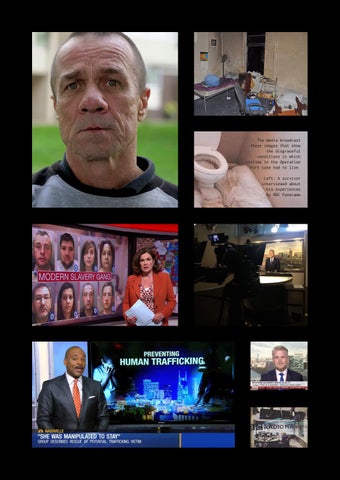
The media broadcast these images that show the disgraceful conditions in which victims in the Operation Fort case had to live. Left: A survivor interviewed about his experiences by BBC Panorama
32
YEAR IN REVIEW 2019/2020
In the Media Hope for Justice made more impact in the media this year than ever before. Our role in the smashing of the organized criminal gang at the center of the UK’s largest-ever trafficking case (see page 24-25) made global news headlines, including here in the USA. That was just one story that hit the headlines. Hope for Justice Co-Founder Natalie Grant (bottom left) and her husband Bernie Herms attracted a huge amount of attention to the anti-trafficking cause with their free online concert at the iconic Ryman Auditorium in Nashville. It has already been streamed more than a million times. Top left: Hope for Justice’s Adam Hewitt speaks with television reporters about spotting the signs of human trafficking
Fundraiser Gordon Miller being interviewed about his challenge to cycle through 10 cities in 10 days to raise money for our work.
Media teams cover Hope for Justice CEO Ben Cooley and Young Living’s Mary Young opening our newest Lighthouse in Uganda, September 2019. HOPE FOR JUSTICE
33
34
YEAR IN REVIEW 2019/2020
Movement Hope for Justice supporters went all out in the name of freedom this year, putting on a gigantic number of events, fundraising competitions and races during 2019-20. One of the biggest was the Team Freedom run in Florida (opposite page, bottom left) in Februrary 2020, with The JOY FM, which raised considerable funds for our lifechanging work. In October 2019, a group of brave climbers from Europe and the USA scaled Kilimanjaro as part of our latest Extreme Challenge (below), putting their bodies through an intense seven-day hike to the top of the world’s highest freestanding mountain, to raise money for the least, the last and the lost. We were proud to speak at a growing number of conferences, churches, workplaces, schools, community events and much more, educating the public about this crime and growing the antitrafficking movement. Businesses too got involved, with some now choosing to open their own Freedom Walls to mark their support (see opposite page, middle left, showing Hope for Justice’s Tim Nelson at the opening of one business’s own Freedom Wall).
HOPE FOR JUSTICE
35
Hope for Justice’s Neil Wain with US Ambassador to the UK, Woody Johnson, at an event in London in January 2020. We shared our expertise in preventative anti-trafficking work with the US Ambassador-at-Large to Monitor & Combat Trafficking in Persons, John Cotton Richmond, and other leaders in the anti-slavery sector.
36
YEAR IN REVIEW 2019/2020
Program As you have read in this Year in Review, our Programs teams around the world have achieved so much this year – including managing to help more than 100,000 children, by far the most beneficiaries we have ever served. We were proud to provide world-class services for our beneficiaries, both through residential aftercare and through outreach (see below and lower half of opposite page) We were invited to brief governments, ambassadors, law enforcement, business conferences and a wide variety of influential people, as part of one of our key aims: reforming society to bring an end to modern slavery forever. We have been influencing legislation, policy, national guidelines and business practice through our work, aiming to leave a legacy of structural transformation, creating nations hostile to human trafficking.
HOPE FOR JUSTICE
37
Supply Chains
Morrisons and Aldi among newest members of Slave-Free Alliance Two of the UK’s largest supermarket chains, Morrisons and Aldi UK & Ireland, have this year joined Slave-Free Alliance – Hope for Justice’s wholly owned business membership social enterprise that helps protect supply chains against modern slavery. Slave-Free Alliance now has more than 75 members, including eight listed on London’s FTSE 100 index and now our first member in the USA: fashion and apparel brand, Freedom Company. In some industry sectors, many of the most influential companies in the UK have signed up with SlaveFree Alliance. This includes utilities and waste management, with our members now including Biffa, Suez, Viridor, Wales & West Utilities, Scottish Power, Electricity North West, and Severn Trent. It is a similar story in the aviation sector, with members now including the companies that own and/or operate Aberdeen, East Midlands, Edinburgh, Glasgow, Liverpool John Lennon, London Stansted, Manchester and Southampton airports. Yodel and Hermes, two of the biggest players in UK home delivery and logistics, are members of Slave-Free Alliance. Slave-Free Alliance membership is open to companies of any size – some organizations have just a handful of employees or are effectively start-ups. Members benefit from expert advice on modern
38
slavery prevention, training, gap analysis, site assessments, risk management resources, and crisis response and investigations where concerns already exist. Because Slave-Free Alliance is a not-for-profit social enterprise, all profits from membership fees and services are reinvested into Hope for Justice’s work to prevent exploitation, rescue victims, restore lives and reform society, with the goal of ending slavery for good. Marc Stanton, Director of Slave-Free Alliance, said: “We’re delighted that Aldi and Morrisons are among those who have partnered with us this year to reinforce and further their modern slavery prevention efforts. We are particularly glad to see entire sector seeking to join up, because when it comes to preventing modern slavery and ensuring exploitative forced labor is stamped out, businesses should be co-operating, not competing. “We are planning to expand further in the USA this year, having had our first American member business sign up.” The team behind Slave-Free Alliance has expertise in organized crime prevention, including specialists with backgrounds in high-level policing, social work, law, and supply chain management. To find out more, or sign up to Slave-Free Alliance, call 615-356-0946. To book a phone consultation, email info@slavefreealliance.org
YEAR IN REVIEW 2019/2020
Supply Chains
What members say about Slave-Free Alliance “At Aldi, we are committed to operating with honesty and integrity, and making a positive impact on society. We are proud to be a member of SlaveFree Alliance, and look forward to strengthening and evolving our modern slavery strategy with their expert input.” - Fritz Walleczek, Managing Director of Corporate Responsibility, Aldi UK & Ireland “Slave-Free Alliance has been excellent since day one. They understand the challenges that large corporates face, tailoring their approach accordingly. Their expertise has been evidenced through their support with supplier threat assessments, employee training, and critical reviews of our policies and procedures. Access to expertise and resources available through membership is key in supporting our commitment to respecting human rights, and in particular to preventing modern slavery from taking place in our business and supply chain.” - Victor Riega, former Group CR Manager, Aviva
HOPE FOR JUSTICE
“We were keen to join Slave-Free Alliance in order to work with other like-minded companies to protect our local communities and those further afield that form part of our supply chain, playing our part in helping to eradicate slavery.” - Richard Bean, Head of Risk, Control & Assurance, Electricity North West “AstraZeneca is very pleased to be the first life sciences member of Slave-Free Alliance. We chose you for the hands-on experience in working with victims globally, for actively engaging with companies to assess their risk management frameworks and to advise on improvements. We see a great gain for our business to tap into the first hand, true global experience and knowledge that Slave-Free Alliance has as part of the bigger Hope for Justice umbrella. We’re looking forward to a great partnership and a very active dialogue.” - Jim Massey, VP Sustainability Strategy and Engagement, AstraZeneca
39
Supply Chains
UK’s largest human trafficking case shows ‘any of us’ could own products made by victims A review prompted by the dismantling of the largest modern slavery gang in UK history – a joint operation by Hope for Justice and West Midlands Police – has found that “any of us” could have purchased goods produced by victims of trafficking and that there is “no room for complacency.” Hope for Justice and West Midlands Police identified 92 victims as part of the investigation, dubbed Operation Fort, but believe there were as many as 400 in total (more on page 24-25). We continue to support many of the victims who bravely gave evidence during two trials, which culminated in July 2019 when eight members of the gang were sentenced to a combined 55 years for slavery, trafficking and money laundering offences. A further four people fled the UK in 2019 and are awaiting extradition to face trial. The victims, many of them with existing vulnerabilities, were recruited in Poland, and
40
brought to the UK with the promise of work and accommodation. But they were instead forced to live in squalid conditions, in rat-infested properties, often with no heating or hot water, no bed, and only scraps of out-of-date food for sustenance. They were put to work in factories, on farms and at recycling centers, to name a few. The gang routinely supplied victims to chains that supply goods to some of Europe’s biggest food retailers and home improvement stores. Some of the companies that were targeted have been supported by Hope for Justice’s not-for-profit social enterprise, Slave-Free Alliance. The landmark case prompted a review by Dame Sara Thornton, the UK’s Independent Anti-Slavery Commissioner, who said “slavery and trafficking are not confined to global supply chains. They are occurring in plain sight in the United Kingdom.”
YEAR IN REVIEW 2019/2020
Dame Sara has met with retail businesses to find out how the sector has been responding to Operation Fort. Following the case, she wrote to the CEOs of 15 large UK retailers who carried products made by suppliers where victims of modern slavery were forced to work, including Asda, B&Q, Homebase, M&S, Sainsbury’s, Tesco, Aldi and Morrisons. She informed them that they had a key role to play in “identifying and preventing exploitation” and asking what they were doing to ensure suppliers were not using slave labor. All of them responded. The review, ‘What businesses should learn from the UK’s largest anti-slavery prosecution’, sets out her findings. It stresses the importance of suppliers “working together in a shared endeavour” to respond to the issue of modern-day slavery. It states: “The eradication of labor exploitation should be integrated into long term strategy, be led from the top of an organisation, and inform the day-to-day activities of every department. Similarly,
HOPE FOR JUSTICE
those organisations at the top of supply chains bear a responsibility for supporting their suppliers into sustainable improvements.” Other recommendations include rewarding those who challenge wrongdoing; asking procurement teams to show evidence that the true costs of labor have been factored into goods and services; ensuring recruitment agencies carry out “more effective checks”; and for businesses to carry out unannounced audits. Dame Sara said in the review: “Modern slavery and human trafficking are egregious criminal offences and it is important that the perpetrators are brought to justice and that victims are supported. Cases such as Operation Fort send a strong message of the state’s resolve to pursue wrongdoing, however complex the investigation and prosecution.” More than one year on, Hope for Justice continues to support many of the victims with ongoing aftercare and advocacy, ensuring that they have continued access to accommodation, benefits and entitlements and helping them to secure settled status in the UK. There is a link to the full review on the Hope for Justice website.
41
Making the most efficient impact I also want to take this opportunity to assure you that as a Board exercising strategic oversight and governance, we remain determined that Hope for Justice makes the greatest possible impact with every generous donation we receive. We want our supporters, donors and prospective donors to know that we do not take their gifts lightly, nor take them for granted – we are committed to running our Programs efficiently and sustainably. We demand all of our frontline projects and support functions make best possible use of our finances, so donors can be confident their generosity is underpinned by rigorous stewardship and full accountability. This year, we further strengthened the Board of Hope for Justice with a number of carefully selected new members. I am delighted to welcome them. We are already seeing the benefit of their extensive experience, representing a complementary range of skillsets from a variety of successful backgrounds, each of which brings valuable insight and strategic direction to the Board.
As Chair of Hope for Justice globally, it’s a tremendous privilege and pleasure for me to commend the achievements showcased in this 2019-2020 Year in Review. And what a milestone year it has been. Whether through regular giving or a one-off contribution, it is the generosity of our supporters that empowers the work we do. The successes, results and, above all, the lives changed that you are reading about in this report have only been made possible and happened because of you. So, to each one of our many supporters, I’d like to convey our deepest, heartfelt thanks.
Fortunately, we as a Board know that the day-today running of Hope for Justice is in the hands of a top-quality Executive team, with not only passion and dedication to our shared cause, but also worldclass leadership and management rigor. They create and maintain a culture that strives for excellence in themselves and others. Thank you to the Executive team, to the entire staff of this organization and to the volunteers around the world who are doing such an admirable job in the face of a truly horrendous crime and dark circumstances. Together, we are changing lives and ending slavery. Peter Elson, Chair, Hope for Justice
Change Lives. End Slavery. 42
YEAR IN REVIEW 2019/2020
Protect Your Business Against Modern Slavery 615-356-0946 www.slavefreealliance.org info@slavefreealliance.org HOPE FOR JUSTICE
43
hopeforjustice.org
Hope for Justice USA P.O. Box 280365 Nashville, TN 37228 (+1) 615-356-0946 info.us@hopeforjustice.org
Hope for Justice is a 501(c)(3) not for profit organization