Homerton College Alumni Magazine

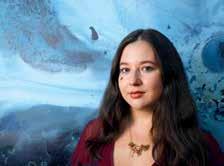
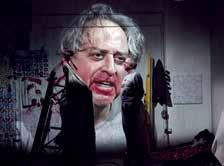
For Homerton’s 250th anniversary a couple of years ago, we commissioned an art installation, drawing on our archive, called ‘CARE: from periphery to centre’. This edition of the Homertonian shows on every page how ‘care’ threads through everything we do at Homerton.
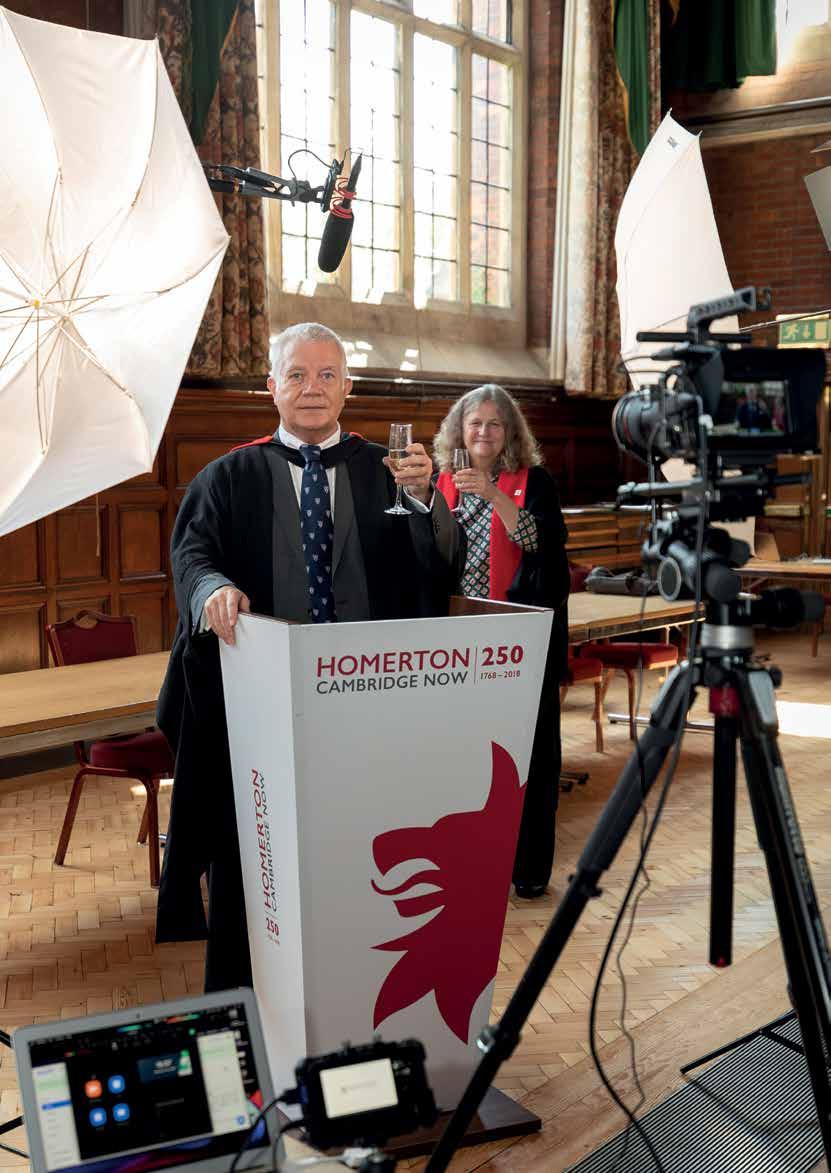
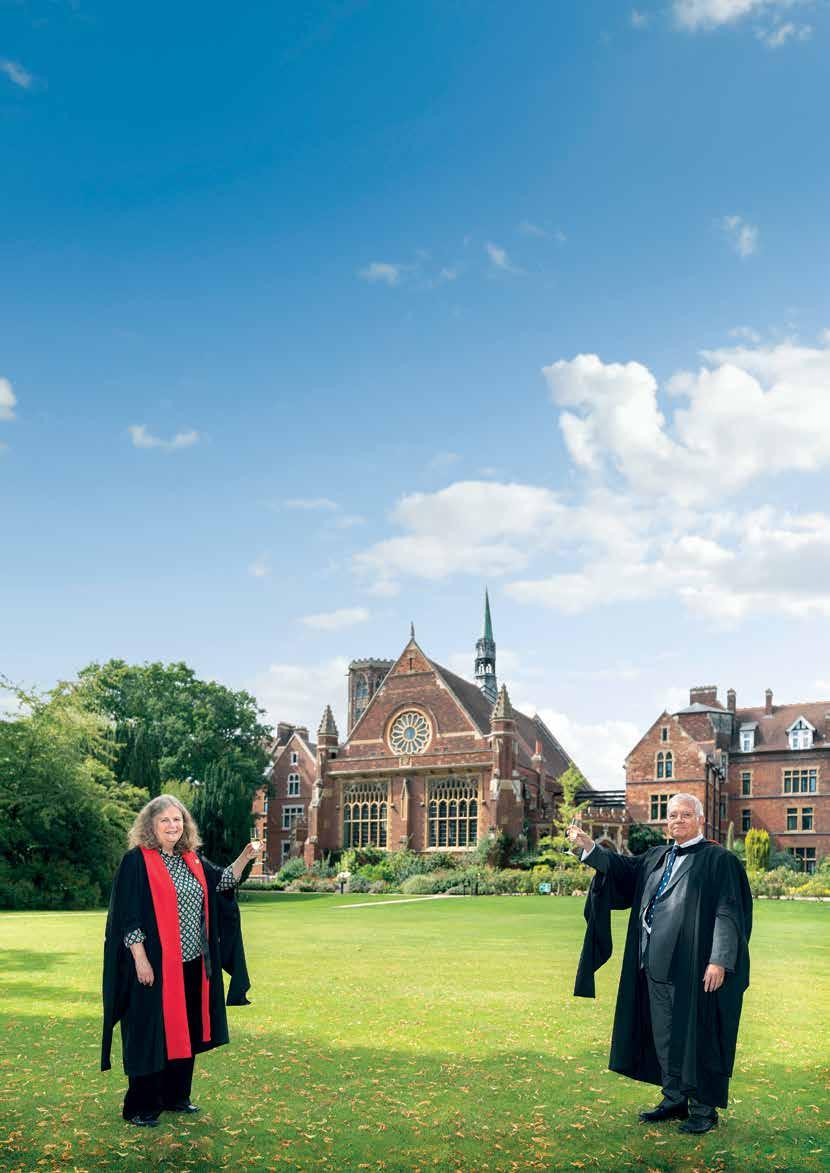
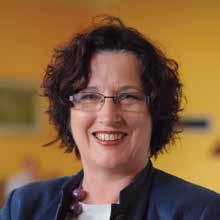
You can read it in the faces of the Principal and Senior Tutor on our front cover. As Penny said in her speech to the undergraduate leavers that day, “graduation day is always an emotional time for me, as I see all our students stepping out into the world transformed… what greater privilege for me than to be among such intelligent, talented young people.”
You can read here about how our Admissions Tutors show care in their selections; how two of our virologists, Julia and Ravi, show care in the investigation and diagnosis of Covid-19; how the whole College responded in the term after students left, to support them as they scattered. It has been easy to be proud of Homerton, and Homertonians, this year. Stay safe and take care of yourselves.
Matthew Moss Director of External Relations and Development
The Homertonian is Homerton College’s alumni magazine. It is published once a year. Contact us in the Development Office on Telephone 01223 747251 or Email alumni@homerton.cam.ac.uk with feedback, news or letters. All our publications are available to read online on the Homerton College website: www.homerton.cam.ac.uk/alumni/benefitsandevents.
Thank you to all of our contributors and to those who supplied images. The views expressed in this publication do not necessarily represent the views of Homerton College, Cambridge. Cover photograph: David Johnson. Design and print management: H2 Associates, Cambridge.
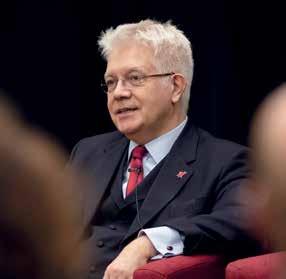
This particular introduction to The Homertonian was harder than usual to write, though you will be able to anticipate some of its content very easily. This is the year of plague, and it casts its shadow into every corner of life. Students are at the heart of what Homerton means, and we have had to learn how best to care for them in new ways and at great speed over these last few months. For students in normal times the College is a home from home, which means shared space and proximity, conversations in the Buttery and the Great Hall, friendships and fun - the closeness of a community. It is a cause of great sadness to me that these forms of proximity which until only a short time ago brought us all together in a daily reaffirmation of our identity as Homertonians are now, by a cruel irony, potential carriers of hidden threat. As I write it is the summer break, but when Michaelmas Term begins, we will all be working together across collegiate Cambridge on the conundrum of how to provide as joyful and creative a student experience as we can reasonably create, while keeping our students safe. The challenges are many, and will no doubt prove testing at points.
However, as is always the case, where there are challenges there are opportunities. There is also, even in this difficult time, much to celebrate. Our students performed better than ever in Finals in 2020, with no student achieving less than a 2:1, and over a third gaining a First class degree. We congratulate them on this fantastic achievement. Although the world in which they take their next steps will be harder
than usual to negotiate, a Cambridge degree is still the best passport to the future that they could possibly carry. We are in the process of scrutinising the Finalists’ results to see what we can learn. For example, this year there were no crammed exam halls, and the vagaries of the three-hour test were replaced by the opportunity to work remotely on longer assessed projects over which the students had more control. In the Arts subjects particularly, this looks to have been a contributing factor in the number of Firsts, and students have reported back in very positive terms about being truly able to give of their best, when given more time. And so the crisis has generated new forms of working which we will continue to develop and refine even when the pandemic itself has passed. I sit on the University’s Remote Learning and Teaching Task Force, which has brought academics and administrators together with encouraging results. In College our VicePrincipal Dr Louise Joy is taking the lead on technology-led learning – and, after all, as the most modern and progressive college, Homerton must be able to shine in this area.
So there are new possibilities for us to explore, and I am extremely grateful to the dedicated team of College Officers and others who have been working with great diligence and ingenuity to ensure that the welcome we give our new and returning students will balance stimulus with safety, and academic challenge with pastoral care. I am grateful too to the alumni who have been quick to see that students
from what were already precarious backgrounds and family circumstances will be disproportionately affected by the financial and other kinds of fallout from the pandemic. The College has itself taken a financial hit, chiefly through the loss of conference income. However this too presents an opportunity to review and where we are able, refresh our offering and our external partnerships. In terms of the Fellowship, we are all deeply proud of the tireless contribution which our academics, including much-quoted Professorial Fellow Ravi Gupta, are making in the battle against Covid.
This next year will no doubt have its poignant moments for me, as it will be my last as Principal. I am immensely proud of Homerton, and of all we have achieved over the years and continue to achieve as Homertonians. The College is more than its physical spaces. It stretches across the world and across decades, self-renewing, rich with tradition but always focussed on the new. Next month for example I will welcome our first Poet-in-Residence, Mariah Whelan, to the Alumni Weekend. Mariah’s post is funded by a generous gift from an alumna, the late Jacqueline Bardsley, some of whose contemporaries will be (in virtual form) present. If you will forgive me a bad pun, although next year will be my last, I will be, like my colleagues, busier than ever. In fact I think the year will Zoom by….
Professor Geoff Ward Principal
The news pages of this magazine are usually filled with guest lectures, concerts, choir tours and sporting achievements. This year, in their place have been endless hours of Zoom calls. Reminders still flash up on online calendars alerting us that today should have been Graduation, the Kate Pretty Lecture, the Boat Race, while we continue to interact via a screen from whichever corner of the house we have managed to commandeer. But while we may not have had the usual array of events, and the College has been empty of staff and students, it has not been short of news.
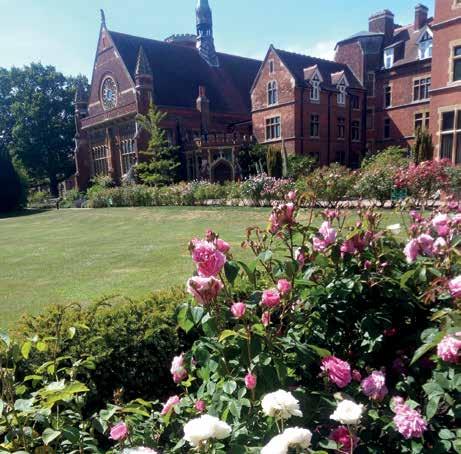
Homerton, along with the wider world, was thrown in March into a completely different version of 2020 than the year we had anticipated. It happened, like Hemingway’s bankruptcy: gradually, then suddenly. We went from drawnout discussions over whether the MA Graduation, scheduled for 28 March, would be able to go ahead, to confronting the unthinkable prospect of sending home hundreds of students in the middle of term.
The IT team worked frantically to provide access to remote working for whole departments which suddenly had to reconfigure their activities in order to work from home. The relative merits of Teams, Zoom and Google Hangouts were tried
out, and everyone’s devices began pinging with notifications on multiple platforms. We rapidly became experts on the interior design and bookshelf contents of our colleagues’ homes.
The Senior Tutor, Dr Penny Barton, and her team had to develop methods of providing a Cambridge-quality education to students scattered to their parents’ homes, connecting students to tutors for remote supervisions, and providing remote access to lectures and the library.
“Students and supervisors alike quickly adapted to working from their kitchens and bedrooms in that Zoom dance we are all now all too familiar with,” says Dr Barton. “The superimposed background
quickly took over from the more homely. I really take my hat off to our fantastic supervisors who juggled time zones and disparate groups with different internet connections whilst still looking after babies and home-schooling their children – providing an academic lifeline and sense of normaility for our students to look forward to.”
While the College was closed with immediate effect to the majority of staff and students from late March, roughly 60 students who were unable to go home hunkered down to spend their lockdown in Homerton. Grouped into “households” to ensure that no one was too isolated and enable them to support each other,
Professor Mary Dixon-Woods
they spent the spring and summer in a depleted College.
“Those not already in graduate accommodation were moved into Morley House and Harrison House where they had full kitchen facilities and could look after themselves,” says the Bursar, Deborah Griffin. “Towards the end of June we started to welcome back some postgraduates whose laboratories were opening, firstly either into quarantine or separate households, then into established households.”
This cohort of students sacrificed much of their Cambridge experience, from the significant rites of passage such as Graduation and the May Ball, to the dayto-day pleasures of sharing each other’s company, attending lectures, taking part in sport, music and drama, and enjoying what the city has to offer. In order to maintain a collegiate sense of community, from a distance, we launched two new blogs early in lockdown.
The Homersphere (homersphere. squarespace.com), made up of contributions from academic staff, aimed to recreate the capacity of College life to foster spontaneous exposure to ideas beyond the reading list. By luring the reader in with one story, but hoping to distract them with another, it replicates the chance stumbling upon new areas of interest which, in normal times, students might experience through a conversation in the bar or spotting a lecture poster on the railings. Fellow in Education Philip Stephenson has provided regular commentary on specific artworks from the Fitzwilliam Museum’s collection, in conjunction with the latest development in these pandemic times. Emeritus Fellow John Hopkins has offered musical playlists in a similar vein. But the blog has also included recent research, reflections and writing on topics both connected and unrelated to the circumstances in which we find ourselves.
In parallel with the Homersphere, LifeSpace (homertonlifespace.wordpress. com), launched by Catherine Snelson,
the College Counsellor, offered a lighter opportunity for students and staff to remain connected, through book reviews, pictures of pets, poetry and lifestyle articles. Both blogs tapped into the need, as the weeks without contact with the outside world ticked on, to remind ourselves that we are still part of a vibrant, varied and exciting academic community, and to share ideas within it.
Even emptied of students and staff, aspects of College life continued to tick over.
The gardening team, led by Helen Andre Cripps, worked throughout the tantalisingly beautiful spring to look after the grounds. The buttery continued to serve a limited menu to those staff and students who remained on site. The library team had the challenge of establishing, in a very short space of time, how to look after the needs of students revising and studying from home.
“It was a rapid and difficult few days to close the library when lockdown began, and arrange how staff might work from home,”
Senior Tutor Dr Penny Barton and Principal Professor Geoff Ward toast graduating students at a socially distanced celebration
says the Fellow Librarian, Liz Osman. “In two days we created the ‘Little College Library’ for those students remaining on site. It contained our wellbeing collection, including books on subjects as diverse as cookery, mindfulness and study skills. We also shelfpicked from both the adult and children’s literature sections in the hope there would be something to appeal to everyone.
Some members of library staff have been working from home through lockdown, supporting students remotely via email whilst they were completing dissertations and assessments. We’ve also been keeping in touch via social media. We’ve been planning how and when to re-open and are really looking forward to being able to start offering a physical library service again. We’re also giving thought to creating virtual inductions and other such adjustments to ensure new students can get all the information they need and also stay safe.”
But there were many roles, crucial in normal times, which simply weren’t needed. As the furlough scheme came into being, the Bursar and HR Manager found themselves needing to establish which staff would be taking up government support. Fortunately, the College was able to top up the furlough pay, ensuring that all permanent staff continued to receive their full salaries. Casual catering staff on short-term contracts received 80%, through government funding.
“We have furloughed quite a number of staff particularly those in catering and housekeeping who cannot work from home,” explains the Bursar. “Some teams such as Finance, Tutorial and IT have worked on the basis of having half the team on at any one time. Nearly everyone has worked from home and the IT team provided superb support to getting us all up and running on Zoom, Citrix, Teams etc . Managers have been keeping in touch with their teams and we are now bringing back people to prepare for the new term. Most people will be back by September and we are putting in measures to keep everyone as safe as possible. Our new HR Manager, Andra Hoole,
who joined on 2 January and Jim Morris, College Accountant, have got to grips with the Job Retention Scheme and ensured that our staff have been well communicated with and looked after during this difficult time.”
It was clear from early on that some students were likely to suffer financial hardship as a direct result of the pandemic. Some would not have the technology required to enable them to engage with remote lectures and supervisions. Others would not be able to take up planned work placements, missing out on necessary income. International students found themselves needing to buy flights home at the last minute. For some, their parents’ financial situation had changed, with a knock-on effect on what they were able to afford.
The Development Office was proactive in addressing this, launching a Covid-19 Emergency Hardship Fund in late March. Thanks to the huge generosity of our alumni, we raised over £40,000 in two months, which enabled us to respond to students’ needs as they arose. We are enormously grateful to all who donated for helping us to ensure that students were not economically disadvantaged by circumstances beyond their control.
As one Masters in Education student said: “The Hardship Grant has been hugely helpful during these difficult times. As a result of the pandemic, I lost a lot of additional work I had been relying on in order to pay my university fees. Furthermore, my mum has been furloughed for the past few months, so it became more difficult for her to help me financially. The Hardship Grant has eased the burden of paying the fees, therefore making it a much less stressful process.”
“These extra funds have been invaluable for helping our students with unexpected additional expenses in the current crisis,” agreed Dr Penny Barton, the Senior Tutor.
Subject to the advancement or retreat of the virus we hope to be able to welcome all students back on site in October, although social distancing guidance may mean that large-scale lectures and eating together are limited. But, with luck and planning, we should be able to move towards some degree of normality in the next academic year. We are enormously proud of how all our staff and students have responded to these extraordinary times, demonstrated most notably by the fact that this year’s academic results were the best we have ever had.
On 18 July, we hosted a virtual celebration for undergraduates and PGCE students who had completed their studies (an equivalent ceremony for postgraduate students is planned for September). Coming together via slightly unpredictable technology for speeches from the Principal and Senior Tutor and a shared toast was surprisingly moving, and it was good to have the opportunity to acknowledge the achievements of this ambitious and resilient cohort, our pandemic generation. As the Principal said in his speech:
“I’ve come to realise over the last few months in particular that Homerton is not just a place, it’s a sphere of interactions, a community, and that community endures whether or not we are physically in the same space.”
While administrative and teaching staff responded to the practical realities of the pandemic, Homerton researchers were quickly immersed in the characteristics of the virus itself.
Dr Julia Kenyon, Director of Studies in pre-clinical Medicine and Biological Natural Sciences, is a virologist whose usual focus is on HIV and dengue fever. When the University closed for nonCovid related research in late March, she could have continued working on her pre-existing projects from home, but felt compelled to redirect her attention.
“I had so many results in play, and a lot of work that wasn’t lab based, so I didn’t have to put anything on hold. But this is a virus that no one understood, and we were allowed to keep the lab open to explore it.”
Under normal circumstances, Julia and her team work on relatively self-contained projects, but the challenge of Covid-19 demanded their collaborative efforts.
“We’ve been looking at how the viral genome is structured. It’s the genetic code of the virus itself, but it’s also like a scaffold, holding different parts of the virus in place. It’s like a knot, rather than a line, and its structure changes during the viral life cycle. When we can visualise those structural changes, we can work out how the virus might be vulnerable to new drugs.”
When the first cases of Covid-19 began to be reported in China, Julia was quick to recognise the potential international threat.
“I remember saying to Penny (Barton, the Senior Tutor) in January, that we might be facing a pandemic, and could need to look at developing our online teaching sooner than we were planning to. But I didn’t think it would take over the UK as quickly as it did, as I thought we’d be more effective in responding to what was happening elsewhere.”
Looking ahead at when students return to College this autumn, there is a balance to be struck between Homerton’s responsibility to protect its community,
and the centrality of normal social interaction to the student experience.
“We need to recognise that quarantine and social distancing while trying to make friends isn’t a great mix. I’m very mindful of the fact that young people don’t bear the brunt of the illness and have really put their lives on hold. We need to make sure that the steps we ask them to take are necessary and effective.”
Academia can be, as Julia points out, “very niche”. Usually, she will be working on a highly specific aspect of the viral genome, and accepts that “the chances that what I’m doing at any given time will make a difference are vanishingly small, but collectively so many scientists are trying out so many ideas that one is likely to be successful.”
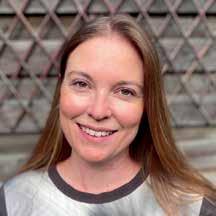
Dr Julia Kenyon
The difference at the moment is that “scientists worldwide have dropped their existing focus to work on Covid. It’s much more collaborative. It’s nice to feel you’re making a difference.”
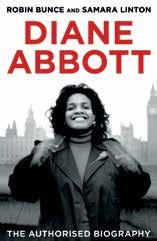
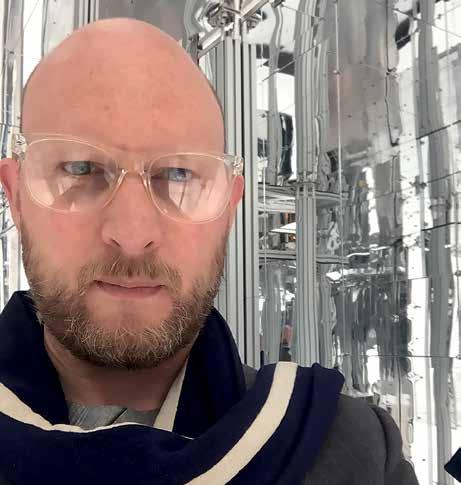
For Homerton Bye-Fellow in Politics, Dr Robin Bunce, lockdown provided a golden opportunity to complete the project which has defined his last three years: the authorised biography of Labour MP Diane Abbott.
Ibegan researching it just after the 2017 election – my entire life revolves around elections! It was then two years of research, and I started writing immediately after the 2019 election, before the results came out.”
Robin had previously written a book about Darcus Howe and the British Black Power movement (Darcus Howe: A Political Biography by Robin Bunce and Paul Field, published by Bloomsbury Academic in 2013). After Diane Abbott, a friend and supporter of Howe’s, wrote a favourable review of the biography, Robin asked her whether she would be open to being the subject of a similar book herself.
“I couldn’t have written it without her approval, as the whole project relied on the interviews and access that she was able to give me. Having her on side was essential to the project. The only downside is that it slightly limits who will agree to talk to you, as people who are likely to be critical know that the text will need to be approved by the subject. Having said that, Charles Clarke, who is not her biggest fan, gave me two hours.”
Robin met Diane every couple of months throughout his period of research, allowing him front row access to British politics during one of its most turbulent episodes in recent times.
“The book was written during the biggest constitutional crisis in living
memory, so a lot of interviews had to be put on hold when there were crucial Brexit votes going on. But that also gave me the extraordinary feeling of being at the centre of events as they were unfolding. I had so many great experiences – seeing Rory Stewart disco dancing in Central Lobby during the Tory leadership election was something I’ll never forget!”
Immersing yourself in another person’s life for three years is clearly both fascinating and slightly strange – Robin admits to having had such a “myopic” focus while writing the book that he once asked his wife “What’s Abbott doing today?” when referring to their teenage daughter. Her name, needless to say, is not Abbott. However, it has also left him with a lasting admiration for his subject’s commitment to her friendships and her principles.
“It’s rarely appreciated how much politics is about friendship and loyalty. There’s a huge affection between people who were part of the Black Sections movement, regardless of how their politics have diverged. Diane brought ideas from the 1970s black feminist movement to inform her politics, and in the past 10 years a new generation of black radical thinkers have picked up on them.”
Having begun writing in December 2019, in the immediate aftermath of the election, lockdown gave Robin the unexpected freedom to focus solely on completing the book, which was finished, appropriately, on 11 June 2020, the 33rd anniversary of Diane Abbott’s entry to parliament. Cowritten with the award-winning writer and researcher Dr Samara Linton, the book is scheduled to be published by Biteback publishers in mid-September.
The pandemic has had two major effects on the College’s finances. Firstly we lost a term’s residential and catering income. This means that we are forecasting a loss of around £800,000 for the financial year which ended on 30 June 2020. We normally budget to break even or make a small surplus. Secondly we have lost all conference and events business including our Homerton International Programme, this summer and for the rest of the year at least. This is forecast to affect this year’s finances 2020/21 by about £1.5 million. There are also additional costs to make the College as safe as possible and to ensure our students have the best experience that they can.
Our investments have, so far, performed comparatively well and we are looking at a total return for 2019/20 of about 3.0%. We have given rental discounts to some of our commercial tenants while they cope with pressures on their own businesses. With our Investment Committee we are monitoring cash flow, as we normally do. We are continuing with two major development projects (see below) and the funding for these is in place. We are fortunate that the College is in a robust financial situation which will allow us to navigate our way carefully through this crisis.
At the time of the lockdown, we had three major development projects underway. After a hiatus of three or four weeks, all sites returned to work with procedures in place to keep their staff safe.
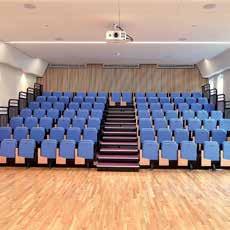
North Wing, which encompasses a new auditorium for 110 people, two large music practice rooms and 18 guest bedrooms, was only a week from completion when the lockdown happened. This has now been handed over, although supply difficulties are delaying some finishing touches. This will be a very useful space especially in current circumstances.
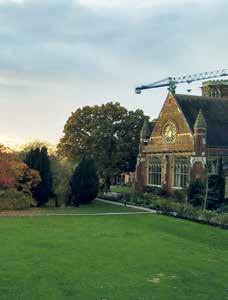
Work on the adjacent Paupers Walk during the building work has revealed the stone windows covered up in, we believe, 1932. We have decided to expose two of these, although they need quite a lot of work to repair the stone and bring them back to their full glory.
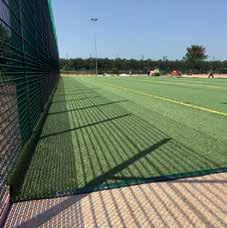
Development of the new sports fields being constructed with St Mary’s School off Long Road is continuing. The new pitches are due to be completed in August. This will provide flood-lit artificial surfaces for hockey, cricket nets, netball, tennis, rugby, football and high jump and long jump. Other sports such as lacrosse and American football will also be able to use the pitches. The construction of a Pavilion will commence in September. College students and the school will be able to use the pitches from September with portacabin toilets in place.
Construction of the new Dining Hall (with buttery, servery and kitchens) had started in February and is now well underway with piling and ground floor slab going in place. We now have another large crane above the College landscape! We are installing our second array of ground source heat pumps (GSHPs) this summer which will be under the lawns of the College. Completion of the building is scheduled for the end of 2021 – how I wish we had that extra space now!
With these projects underway we are now planning for a much-needed Porters’ Lodge within which we are planning to encompass a Children’s Literature Resource Centre and additional group study spaces. We are also planning for the re-purposing of the Great Hall and the area surrounding it to ensure we make this a well-used and beautiful space for the College.
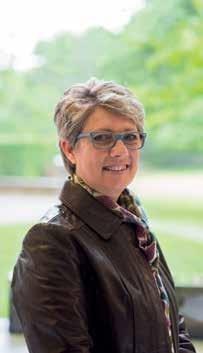
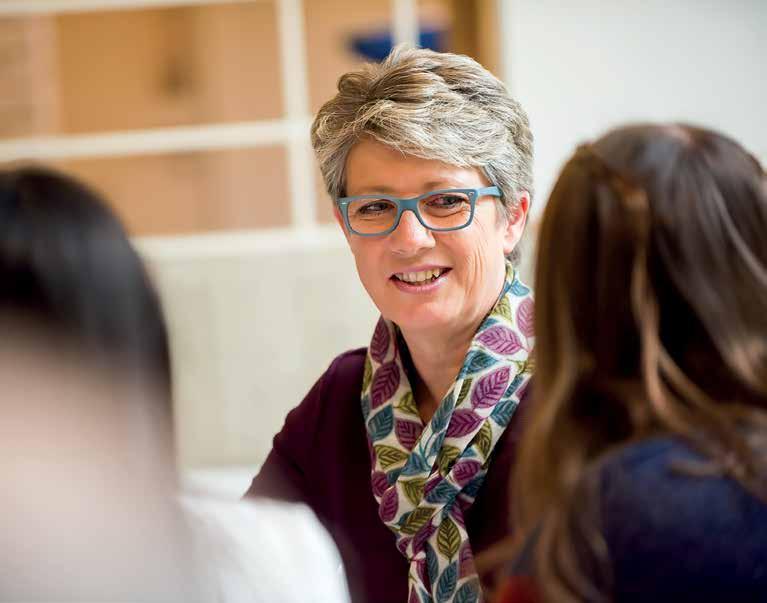
Dr Georgie Horrell is Director of Studies in Education and College Teaching Officer in Literatures in English and Education. In 2019 she also took on the role of Admissions Tutor.
How long have you been at Homerton?
I joined around 15 years ago, having just completed my PhD in postcolonial literatures (southern African writing) at New Hall (now Murray Edwards). I started by giving a small number of supervisions for the Education Tripos and teaching the Education Faculty’s International Literatures paper. I gradually took on more and more teaching, became a Tutor, Kate Pretty (Homerton Principal 1991–2013) offered me a Director of Studies role and eventually I became a Fellow. I sort of crept into Homerton life, step by step!
What do you think is special and unique about it as a College?
In my experience it has always been a wonderfully collegiate, supportive and empowering place to work – remarkably inclusive – where people are encouraged to be themselves.
Is teaching literature as part of the Education Tripos different from how you would approach it in an English degree?
Within the Education Tripos there has always been a strong strand of English, Drama and the Arts. The Tripos is wholly inter-disciplinary and many students end up thoroughly engrossed by the English and Drama elements, as well as by the sociological, historical and psychological aspects of the degree.
The approach to teaching literature on the Education Tripos is very similar to that for the English Tripos, but it sits in a different context. This means that some aspects of literary studies – like Children’s Literature for example – are foregrounded. While I’ve been at Homerton, the relationship between the College and the Faculty of Education has been through
an interesting, evolutionary process. Of course we still have the Children’s Literature Centre shared by the College and the Faculty.
This is your first year as Admissions Tutor. How does that fit with your other commitments?
As a Director of Studies, I’ve become increasingly inspired by ‘widening participation’. The best aspect of my job in academia has always been about working with students: I’ve always been very aware of the enormous privilege of hearing from extraordinary young minds, and I would like to think I have embraced the responsibility of playing a role in helping to shape their present and their future.
As I was thinking of applying for the Admissions Tutor role, I had a letter from a student saying how much it had meant to her during her interview that I had been kind. No one had encouraged her to apply; in fact she’d been actively discouraged by her parents and teachers: they had said that ‘girls like her didn’t come to Cambridge’. She reminded me that during her interview she’d asked me to explain a line in the poem we were discussing which she didn’t understand. Once I’d explained it, she just took off! This student finished her degree with a starred First for her final dissertation. Her letter confirmed for me that I wanted to be more directly involved in Admissions.
I absolutely relish being involved in so many aspects of College. This particular role allows me to explore ways that we might move towards improving equitable participation in higher education, and has enhanced the other roles I already had in College life. This August will be my first results day as Admissions Tutor and given that the ‘usual’ exams haven’t actually been taken, this will be baptism by very strange fire.
What are your current research interests?
Having recently worked on the Caribbean Poetry Project and led ZAPP, the South African Poetry Project, I’m now involved with a wonderful network of people interested in the ways children interact with poetry. I’m collaborating on an international project exploring poetry in performance.
I’m also interested in postcolonial ecocriticism in relation to children’s literature. I did my undergraduate degree in Cape Town, having (partly) grown up there, and also taught in South Africa before doing my PhD. I’ve been interested in looking at literatures in English from a postcolonial perspective for most of my academic career.
I particularly appreciate Homerton’s association with the Cambridge Children’s Literature Centre, and it’s exciting to have the opportunity to explore a wide range of
research interests in this way. I’m hoping to continue to play a role in building on the brilliant foundation put in place by Professor Morag Styles.
Students have been very responsive to the growth of the Black Lives Matter movement. Do you think there’s more that the College should be doing?
Yes. It is vital that we as a College actively address the concerns that the movement has raised again recently. For example, I’ve spent a year as the College Discrimination and Harassment Contact. It’s particularly important that we expand this role to include BAME representatives – indeed to have many more diverse voices across the College. Homerton is already a progressive, diverse and inclusive space – but together we can do more and we can do better in this regard.
Dr Georgie Horrell’s research interests are postcolonial and ecocritical approaches to children’s literature, as well as poetry for young people. Her publications include a co-edited anthology of Caribbean poetry for young people, Give the Ball to the Poet (Georgie Horrell, Aisha Spencer and Morag Styles, 2014) and articles on South African and Caribbean literature and Children’s Literature (amongst which: ‘Transgression and Transition’ in The Emergent Adult Ashgate, 2012).
When Kiran Millwood Hargrave completed her degree in Education with English and Drama in 2011, becoming a writer was not on her list of ambitions.
Although she had “always continued to read children’s books” and leapt at the opportunity to study children’s literature at Homerton, she had no intention of writing one herself, and instead contemplated a range of careers, from teaching to law.
Ichose Education with English and Drama for its broad coverage of interests,” she says now. “I did lots of acting and comedy while I was at Cambridge, but I knew I was too thin-skinned to make a career out of it. I thought for a while that I might teach, and I did take a temporary teaching role at The Leys school in Cambridge, but I didn’t have the skill or the skin for that either!”
Planning to undertake a law conversion course, she took a year out after graduation to work on her mental health, following a delayed reaction to a traumatic event in her first year.
“I had started writing some poetry as part of a project run by my Director of Studies, Dr Abigail Rokison, and I continued to write during that year out. I realised that Law was just something I was pursuing because it fitted my skill-set – I had no real passion for it. And meanwhile my partner (now husband) Tom, was making a living as an artist, and was very supportive of me seeing where writing could take me.”
Instead, she took a creative writing masters at Oxford which required her to experiment with fiction for the first time. The result was her first novel for children The Girl of Ink and Stars.
“I only wrote it because I had to for the course! I had no idea I was writing a children’s book to start with, and I certainly didn’t have that audience consciously in mind, but it became clear as it went on that that was what it was. Because I wrote it quite naively, I didn’t fixate on it being perfect. I just pushed on through, and learned on the job.”
The Girl of Ink and Stars was published in May 2017 and promptly won both the Waterstones Children’s Book Prize and the British Book Awards Children’s Book of the Year.
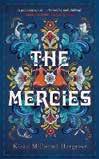
The Girl of Ink and Stars was followed by The Island at the End of Everything, which was shortlisted for the Blue Peter Book Award and the Costa Children’s Book Award. Her third book for children, The Way Past Winter, was the Blackwell’s Children’s Book of the Year in 2018.
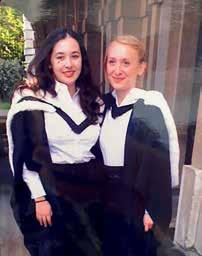
Graduating from Homerton, with Jessica Patterson (BA History, 2007)
“It genuinely never occurred to me it would win. I went to the Waterstones Awards ceremony with unbrushed hair, chipped nail varnish and borrowed lipstick, and was so star-struck by the other shortlisted authors that I brought all my books to be signed. When they announced my name I turned to look at my husband and he’d turned away to hide the tear in his eye, at which point I burst into tears too. We got married a few months later, so it was quite an emotional time.”
Instant success, as Kiran is the first to acknowledge, brings both privilege and challenge.
“I’ve been able to afford to write fulltime from the beginning because of the advances, and you can’t overstate the privilege that gives you. But once you’ve had some success you move the goal posts and continue to seek affirmation. I realised that what I had liked about the idea of Law is that you can be objectively good at it. Writing is so subjective, and people’s response to it is so mood based. I’ve been a judge on book awards myself, and a book that I hated on first reading I loved so much when I read it
In January 2018, Kiran came across a reproduction of an installation by the artist Louise Bourgeois, on the Norwegian island of Vardø, commemorating the 1621 execution of 91 people for witchcraft.
“I looked it up, and all I could find was a couple of paragraphs on Wikipedia about the storm in 1618, in which almost the entire male population of the island drowned, and the witch trials. There was nothing on the three years in between.”
Applying for creative writing courses, Kiran was initially drawn to a poetry course at St Andrews, taught by the poet Don Paterson. “I would have become a totally different person!” she laughs now. “ again in a different frame of mind that I fought for it to win. So with that in mind, you can’t attach any self-worth to prizes. All you can control is the writing.”
Haunted by the story, and by the absence of information, Kiran became increasingly convinced that this was the kernel of her next book.
“The structure was so perfect, right down to the fact that the storm happened on Christmas Eve. All my books start with a strong image, and this storm, which came out of nowhere and carried off all the men, was irresistible. I had to write it.”
Her agent having recently returned from maternity leave, they met for lunch and Kiran described the book which was forming in her head. With a pre-existing commitment to write her first work of Young Adult fiction, The Deathless Girls, she mooted the possibility of a novel based on the Vardø
witch trials the following year. Instead, her agent suggested she respond to her passion for the story by writing a first draft in time for the London Book Fair in March, just two months later.
“I wrote all day, and then as my agent was up at night breastfeeding, she would edit overnight, and I’d rewrite the next day. It gave me a breakdown – I wrote two other books that year and it was all a bit much. But I wrote it while it was really all I could think about, and I do think that it’s the best version it could be.”
The resulting novel, The Mercies, was the subject of a 13-way bidding war and described as “unquestionably the book of the 2018 Book Fair” by the Bookseller magazine. Telling the story of how the women of Vardø responded to the loss of their men, and were punished for their burgeoning independence with accusations of witchcraft, the book is compelling, sensuous and visceral. Kiran’s identification with the women, and fury at their treatment, shines through in her commitment to making their lives real, four centuries on.
“I visited the island twice, once on my own in summer and once with my husband in winter. In winter, which is when the women would have been ‘ducked’, to see whether they were witches, you would have had to break the sea ice. It was so cold that when Tom took his gloves off to take a photo, he couldn’t get them back on again. It made me so angry. I think all modern women feel some fascination with the women of the past who were accused of witchcraft just for displaying some degree of
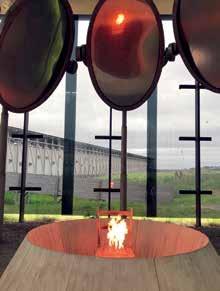
agency in their own lives. I’d always been interested in it. But this story found me at a time when it felt particularly pertinent, and I just wrote it in a frenzy.”
The Mercies was described as “among the best novels I’ve read in years” by the New York Times reviewer, and spent several weeks on The Times Bestseller list. 2020 had a packed schedule of literary festivals, speaking engagements and an international tour. Instead, Kiran has spent the spring and summer at home in Oxford with her husband and cat, walking by the river and conducting interviews via Zoom.
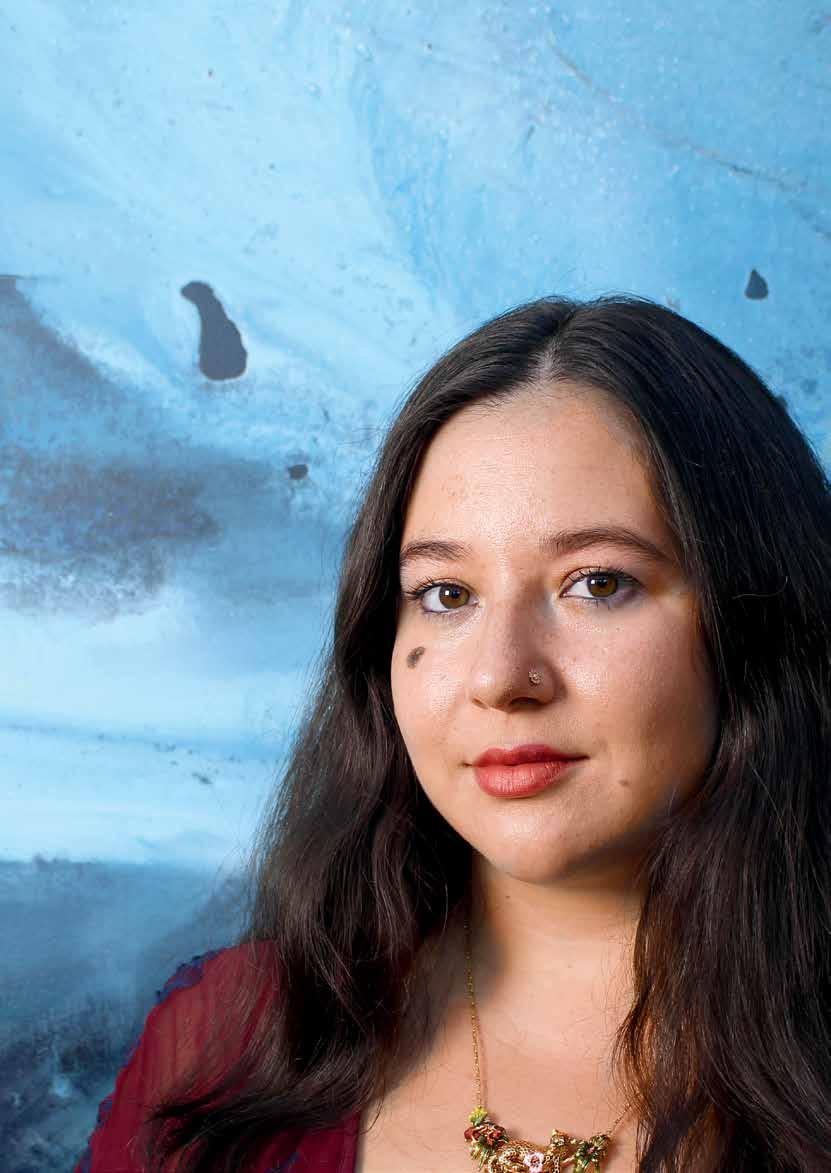
“It’s disappointing, of course – it would have been my first international tour and it’s hard to put all of that on hold. I’m very grateful for the technology which means most of it can still happen in some form – I’ve just done an interview for an Italian literary festival. I feel so sorry for debut authors, with all the bookshops closed and publicity events not happening. Everyone needs people to champion them at the beginning, and we all owe our careers to booksellers spreading the word. I’ve been very lucky.”
Vicky Dilnot (PGCE 2001–2) took over as the first Head of Nansledan School, built to serve the new Nansledan development on Duchy of Cornwall land outside Newquay, in September 2019.
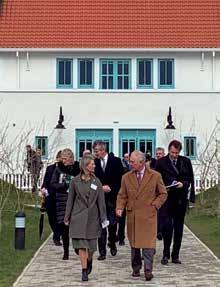
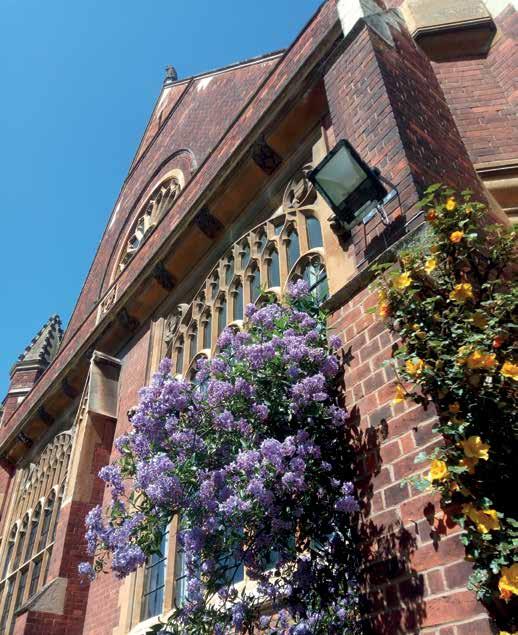
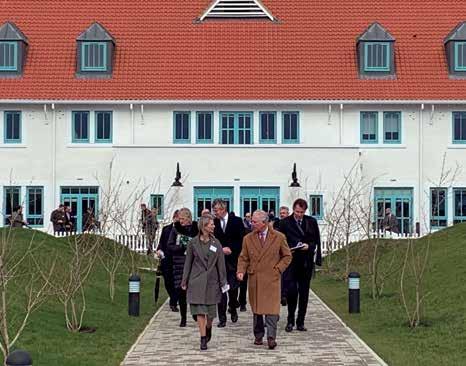
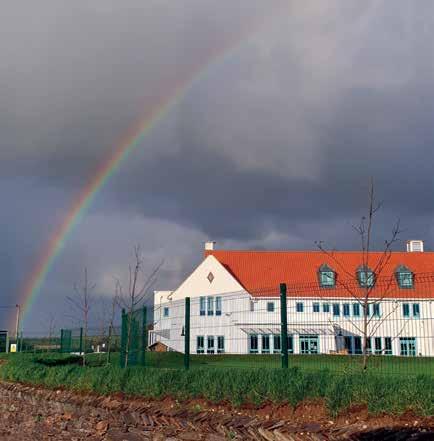
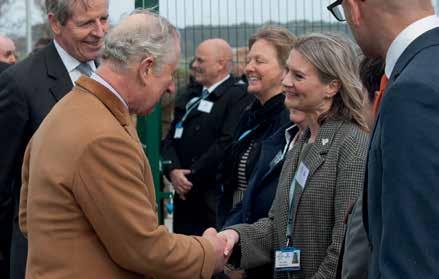
After a term and a half of establishing itself, winning awards for its design and welcoming a visit from HRH The Prince of Wales, the school found itself closed to most pupils in response to the pandemic.
You completed your PGCE at Homerton in 2002. What has your career trajectory been since then?
I initially did middle school training, specialising in Maths. I had previously done a psychology degree and had run activity groups for children with learning difficulties for years. I could not imagine not working with children in some capacity, and when I started teaching in primary schools, I fell in love with how creative you were able to be.
After several years of teaching, I worked for Nottinghamshire Council as a Primary Strategy Consultant, and then went back to school initially as Deputy Head and then a Headteacher of a Nottinghamshire primary.
We had been looking for an opportunity to move to Cornwall as a family, and it was the right time in terms of my husband’s work and our own children’s education, when I was offered the role of Head at Nansledan. It was a dream come true to lead a school from its infancy.
What is different about the school from what was previously available to families in the area?
Operated by the Aspire Academy Trust, it is the first new-build free school in Cornwall. As a result, we had the opportunity to look afresh at what the curriculum should provide. We aim to equip the children for the jobs of the future, nurturing intelligent, employable global citizens who demonstrate social competence, a desire for learning and respect for each other and the world around them. Through the STEAM (Science, Technology, Engineering, the Arts and Maths) curriculum, children are engaged in learning and research which is inquiry-based and has a purpose. A number of families who had previously chosen to homeschool their children were attracted by the curriculum.
The school was built to serve Nansledan, a newly developed extension to Newquay created on land owned by the Duchy of Cornwall. Sustainability is at the centre of the community development, which forces us to look at everything from first principles. Is it possible for a school to be plastic-free? Can we grow our own food? This focus on environmental concerns was also a big attraction for lots of families.
Were most of the places taken by children moving into the new development, or did you have a wider catchment area?
There are a huge number of houses going up and being filled with young families, but we’ve also had lots of interest from further afield. We opened with five classes last September, and quickly had to add another.
We initially just had one mixed Key Stage 2 class of 31 children, but it then became apparent that there was a local shortage of Year 5/6 spaces, so we created a Year 5/6 class.
Having opened with huge fanfare at the beginning of the year you were then, like every school, confronted with the extraordinary challenge of the pandemic. What happened, and how have you approached the problem of providing a remote education?
We had a week when we were shut completely, sending pupils home with suggested activities. We then became a key worker hub school, looking after the children of key workers from four separate local schools. From June, we then provided spaces exclusively for children of the Nansledan key worker families and had pupil numbers in the high 60s throughout.
We were lucky – because we’re part of Aspire, we had experts working on developing materials suitable for home learning, which we were able to personalise. But when it became clear that the situation was going to last for longer than a few weeks, we also developed our use of Google classrooms, which was much more reciprocal. However, some families don’t have the technology to allow their children online access, or parents are trying to work from home and need the family computer themselves. So, we had to provide a number of alternative offline activities as well. We also had teachers making phone calls to vulnerable families, or to children who weren’t otherwise engaging with school, to check that they were ok.
It’s obviously been a challenge, but we’re used to problem solving and we always knew it was going to be a year of change! We’ve got a fantastic team of staff who are committed to growing the school from the ground up. The Nansledan philosophy is “I’ll either find a way or make one.” We never thought ‘we can’t do this’ – we knew we could find a way.
What concerns do you have about the impact on this cohort of children, who have missed so much time in school?
It’s such an unknown impact. Whichever category they fall into, and whether they have been attending school or not, their world has been turned upside down. In terms of schooling, you have to put that to one side while we address everyone’s wellbeing and reconnect as a community. We’re a ‘Trauma Informed’ school, and everyone has been through
a form of trauma over the past few months. We will need to encourage children to talk about what they’ve been through before you think about filling the gaps in their learning.
But on the flip side, lots of them have learned lots of new skills. We’ve heard from pupils who are really excited because they’ve made spaghetti bolognaise for the first time, or grown some vegetables, or learned to ride a bike. For some, it’s been a really valuable time.
What do you think school will look like in September?
There will be a period of uncertainty for the area – Newquay airport is a big employer,
so the downturn in the aviation industry will have a big knock-on effect. It’s a deprived area which is very dependent on tourism, so lack of travel may slow down or accelerate families moving to Nansledan – we just don’t know.
We have to plan for a number of possibilities. As a new school we have a big intake across the board, not just in Reception. Usually we would be inviting those children in to visit, and organising home visits so that teachers can get to know their families. None of that can happen, so we’ll find alternative ways to ensure that they feel properly welcomed. The curriculum will have to adapt and respond to what the world looks like.
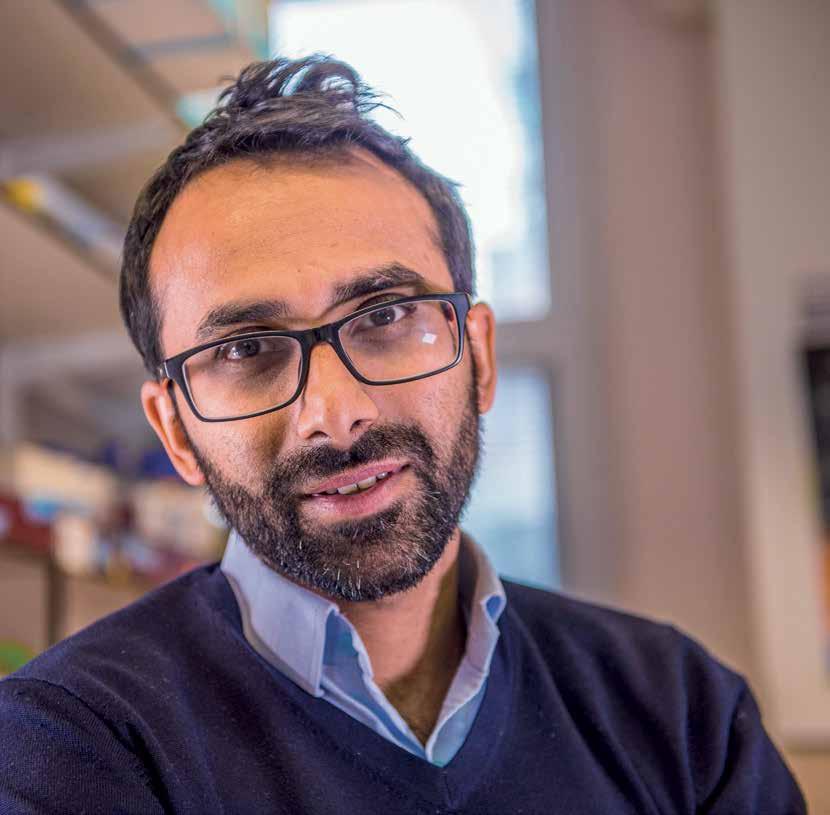
Professor Ravi Gupta joined Homerton as a Professorial Fellow in October 2019, in the wake of mass media interest.
Asthe scientist responsible for treating
‘The London Patient’ – the second ever case of a patient being effectively ‘cured’ of the HIV virus, 12 years after the first – he was in demand as an interviewee everywhere from Radio 4’s Today programme to the New York Times
In a profile on our website in March of this year, he discussed the challenges of HIV, as the London Patient revealed his identity in another wave of publicity.
Two weeks after the profile appeared, normal life had been put on hold in response to a different virus altogether.
“I went to Boston to present a paper on the London Patient, and the meeting was cancelled just after I arrived,” he says, recalling the speed with which things changed. “The United States was closing its borders just as I left.”
With the University shut down for all but Covid-related research, the focus of Ravi’s work rapidly switched to the new threat.
“When lockdown happened and things got very scary, we all thought ‘what can we do?’” he says. “Point of care testing came up immediately as something which needed to be made possible. I bumped into Helen Lee, CEO of a company called Diagnostics for the Real World, which had been making machines to monitor HIV via a finger prick test, and we began investigating whether we could use the same machine to test for Covid-19.”
Without a rapid and accurate test, hospitals were unable to identify infected asymptomatic patients. A single infected patient could spread the virus rapidly, allowing other patients and staff to take it home.
“The first thing in my mind was the need to be able to diagnose patients as they come in, both to avoid exposure and to speed up their discharge. We now have 20 testing machines in operation, which are being used in hospitals, prisons and care homes, and we hope to be able to roll them out more widely.”
While studying Medicine at Cambridge (his first College affiliation was to Downing), Ravi also took courses from the Human, Social and Political Sciences Tripos, and was fascinated by the juxtaposition of medicine and politics – a juxtaposition which has been highlighted by the varying national responses to the pandemic.
He then completed a Masters in Public Health at Harvard, before undertaking malaria research on the Thai/Burmese border. As a junior doctor he chose infectious diseases as his focus, working in Paris during the SARS outbreak, before completing a PhD in drug resistant HIV at UCL.
Now Professor of Clinical Microbiology and Wellcome Trust Senior Fellow in Clinical Science at Cambridge, Ravi moved to Cambridge last summer with his wife, a trainee surgeon at Addenbrooke’s, and their three small daughters.
While this year has been frightening, frustrating and alarming for all of us, for Ravi it’s hard to avoid the feeling that this, after all, is what he trained for.
“In a sense it’s very exciting. The whole world has shut down, but we’re this microcosm of activity and purpose. If we can’t deal with this and respond, we’re wasting our time.”
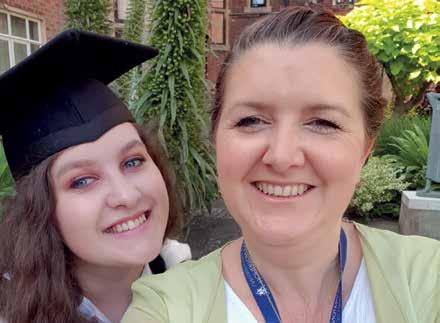
Homerton is unique among the Cambridge Colleges in that its Students Union President is a sabbatical role. A graduating student is elected in their final term, and remains in College for a further year, running the HUS (Homerton Union of Students). Supporting them is another uniquely Homertonian position, the HUS Office Manager, a role held for the past four years by Emma Themba.
9–10am
I drop my younger daughter at school before arriving at Homerton by 9am, when I’ll have a cup of tea and check my email. I’ll then tidy up the office, making sure the merchandise shop is in order and we’re ready for the day. The students sometimes leave it in a bit of a state overnight – so like the ‘HUS Mum’ that I am, I leave little ‘clean me’ notes on their abandoned plates and mugs!
Lydia, (the HUS President for 2019–20), will join me at some point between 9 and 10 to help get the office set up. I see a large part of the role as supporting her. The President ends up taking a lot of flack from other students, as they’re an obvious scapegoat for things they don’t like, and that can be really hard.
10am–12.30pm
The HUS office door opens at 10, and from then on it’s a constant stream of queries. It
might be students wanting to swap tickets to Formals, buy College merchandise, hire airbeds (if they’re having visitors), ask about the gym, wanting to book rooms or equipment, or to apply for money for a society. We also plan the Bops and themed Formals, organise the decorations and make sure we’ve bought everything in time.
Officially, my role is mainly financial. The HUS has a big budget, with a turnover of about £100,000 a year, and I need to keep the students in check and make sure they don’t spend it all on pizza! It’s about making sure there’s continuity in the financial auditing, with a new team of students taking over each year.
But in practice, I do end up being a shoulder to cry on. It’s not an official part of the job, it’s just a factor of building a rapport with the students, but it’s important. I also get mums at the start of term asking me to keep an eye on their children, though I
reassure the students that what happens at Homerton stays at Homerton! Jim (the College Accountant) is very good at resetting me back to the baseline of what the job is meant to be if I get too emotionally involved.
12.30–1pm
I love Homerton lunches – I’ve had to lay off them lately, I was putting on too much weight! They’re also an opportunity to get to know the staff in other departments, as I otherwise only really interact directly with students. Generally when I do work with staff I have to grovel all the time – if I’m not asking for money I’m apologising for something! So it helps to have lunchtime to build relationships with colleagues in my own right.
1–3pm
Having been in post for four years, with a new group of students each year, I do have to take a step back sometimes and remind them that it’s not my HUS, it’s theirs. It can be hard to sit back and watch something fail, and I will sometimes say “actually we tried that three years ago and it didn’t work.” But they have to make it their own, and make their own mistakes.
I didn’t go to university myself, and it’s been a real eye-opener in all sorts of ways. I love the people, the buildings and the camaraderie, as well as the gallows humour when things go wrong, and the thrill when we pull something together out of nothing and it really works.
I finish at 3pm to pick up my daughters from school. I work school-hours, and termtime only, which is a wonderful balance, and I’m fairly good at switching off from it all! I keep in touch with some of the HUS team though, particularly the presidents. They become like my extra kids – it’s a really close bond.
Right now these perspectives seem even more pertinent. The global pandemic demands that we live with almost daily significant changes, stretching the resources of our inner life and logistical competence. Equally, conversations about what kind of future might be possible - from ‘build back better’ to the function of leadership; to possibilities for moral imagination and social creativity; the ‘how will we be with each other’ questions – are sought out and urgent.
Changemakers was set up to help students and the Homerton community find better answers to these questions, even in the midst of a pandemic and possibly because of it. So, as of May 2020 Changemakers is an entirely virtual programme and will stay that way for the foreseeable future, available to all Homerton students in residence or not, and as operating conditions in College and the University vary depending on government advice at the time.
The core elements of Changemakers –workshops and residentials, termly seminars, a six-week self-study module, mentoring, a student ambassadors’ group, volunteering opportunities, change-initiative projects –are still happening. As is the research and collaboration that keeps the programme intellectually lively and challenging. We want to see more clearly what narratives of ‘Changemaking’ are most at work as the world moves towards, for example, new modes of social responsibility and disruption. And we want to envisage more powerfully (more usefully?) the elements of education essential for all if we are to survive the future. We’re working with academic colleagues across the world
Dr Alison Wood, Academic Director, Homerton Changemakers
At its core Changemakers is about, well, change. Dreaming of it. Prompting it. Working with others to build it. Seeing it all around us as a perpetual, natural state. Seeing it happen with or without us. Gaining wisdom about what to change, what not to change, what can be changed, what we’d rather not change...
– from Cambridge to California to Cape Town - and with Form the Future, the Tavistock Institute, Cambridge Sustainable Food Network and Cambridge Zero to offer resources and programmes for students.
Given the extraordinary nature of the times we have also decided to make some elements of the programme publicly available: online bitesize modules on selfleadership, systems thinking, and epistemic humility are planned for the autumn. We are also refocusing aspects of the programme to explicitly address some of the challenges prompted by remote-learning, distancing, and the difficulties of entering or returning

to Cambridge academic life after significant disruption. From Michaelmas 2020/21 a new suite of online materials will be available to help Homerton students approach their work in ways that are easier, less fraught, and more productive: modules on epistemic agility, quietude, anxiety and its roots, assumption checking, deliberate practice. The materials are organised to enhance both performance and personal stability. Things we each, and all, need.
Launched in 2019, Homerton Changemakers is a programme which sits alongside students’ academic degree, to enable them to develop skills and build the foundations essential for success.
In usual times, the Homerton College Music Society provides regular opportunities for musicians to polish their performance skills, and for students and staff to enjoy lunchtime musical respite.
Eager to ensure that this valuable aspect of College life was not lost in the hiatus of lockdown, HCMS arranged a remote performance competition.
“We had no idea how many people were likely to engage with it when everyone’s scattered, so we were delighted to get 13 entries,” says Director of Studies in Engineering Dr Miles Stopher, who co-ordinated the competition, edited the videos, and participated with his band, Nigel from Slough.
Submitted from home, the eclectic selection of performances ranged from Chopin to Ed Sheeran and provided a wonderful opportunity to feel connected to the Homerton community through music.
“Music has the ability to bring people together, even when they’re separated in time or space,” says Research Fellow in Music Dr Ross Cole, who judged the competition. “Performance and listening are therefore especially important at a time like this. I was looking for performers committed to their chosen idiom, bringing something new to these repertoires or traditions.”
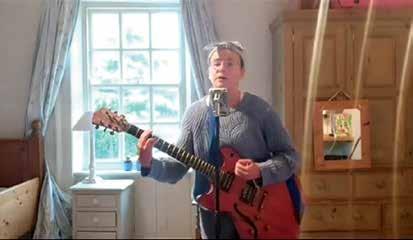
Georgie Deri, (Second Year, Education) won joint first prize for her original song, Wannabe, which she sang while accompanying herself on the guitar.
“Wannabe was inspired by the shifting role social media has had in our lives since lockdown,” she says. “The song touches on a few things; firstly the now unspoken expectation to remain constantly in touch and always online and how this has blurred the lines, maybe even changed, our perception of who we are in the ‘real’ world. Secondly, the simultaneous pressure to “be what you want to be” but also present yourself in a perfect and idealised way, feeling like a ‘wannabe’. I would like to thank HCMS for running this competition, allowing both performers and audience alike to enjoy and engage with a diverse range of music in these times when we need it most.”
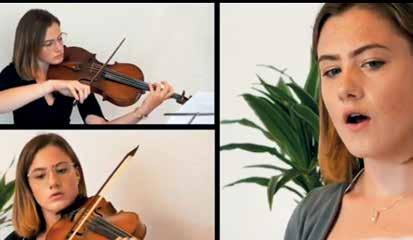
Joint first prize winner was First Year Music student Lizzie Robbings, who demonstrated both musical and technical wizardry by playing the violin, viola and vocal parts of Bach’s Jauchzet Gott in allen Landen.
“My choice of this particular cantata lies in the significant role it has played on
my musical journey,” Lizzie explains. “On first hearing this work sung on the radio by Emma Kirkby many years ago, I was greatly inspired to begin exploring other works by Bach, as well as other composers. This led to an increasing fascination in listening to and learning about music, contributing to my present studying of Music at Homerton. In this particular movement, Bach beautifully sets a chorale with a simple melody against the contrasting energetic activity of the strings; the soprano’s serenely confident declaration ‘Sei Lob und Preis mit Ehren Gott Vater, Sohn, Heiligem Geist!’ is heard above the string’s joyful dance.”
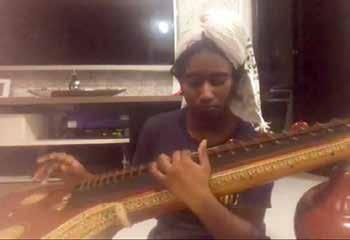
Second year Natural Scientist Swathi Nachiar Manivannan was the winner of the third place prize, for his improvisation of the Indian Carnatic Raga Sri
“Improvisation is a huge part of Indian Classical music, and is something that I’ve been working on more in the past few years,” he says. “With the ongoing Covid-19 pandemic, I haven’t really had the will to learn any new pieces or songs, and so when I’ve been practicing, I’ve been doing a lot more improvisation instead. This improvisation is loosely based on one of my favourite Carnatic pieces, the Pancharatna Kriti “Endaro Mahanubavulu” set to the Raga Sri.”
Homerton Director of Studies in Music, Dr Daniel Trocmé-Latter, commented:
“I’m delighted that, with the usual Homerton performance competition having to be cancelled, HCMS was so willing to jump in to fill the vacuum. It was inspiring to see such a variety of styles among the entries, too.”
HIGHLY-COMMENDED
Ollie Carr/Olivia Miller/Noah Poulson – Cherry Wine
Amelia Calladine – Allegro and Minuet for Two Flutes
Nadya Miryanova – Fantasie Impromptu
THIRD PLACE
Swathi Nachiar Manivannan – improvisation of the Carnatic Raga Sri
JOINT FIRST PRIZE
Georgie Deri – Wannabe
Lizzie Robbings – Jauchzet Gott in allen Landen
With no chapel on-site, Homerton enjoys a unique relationship with its neighbouring church, St John the Evangelist, Hills Road. Under normal circumstances, the Charter Choir sings a weekly Evensong at the church during term-time, while the organ scholars have access to the church instrument for practice and recitals.
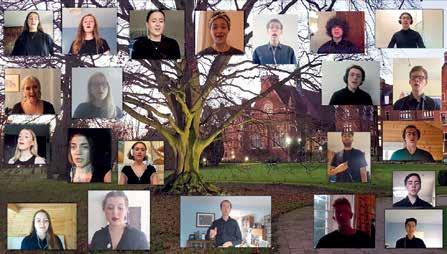
Sadly, with College and church both closed during lockdown, there has been little opportunity since March either for collective worship or for the choir to sing together. However, to mark the end of the academic year, a remote Evensong took place over YouTube. Choir members sang separately from their homes, their voices woven together by the Director of Music, Dr Daniel Trocmé-Latter. The Principal and Fellow Emerita Trish Maude contributed to the service from the church itself, which had just reopened, while students offered prayers and readings from a distance. Conducted by the Priestin-Charge, the Revd James Shakespeare, the service enabled students, Fellows, staff and alumni to mark the end of a unique academic year, in true 2020 fashion, separately and yet together.
As New York shut down in March, Sam Yates (BA English, 2002–5) was in the final week of directing the off-Broadway production of Paul Muldoon’s Incantata. The play premiered at 2018’s Galway International Arts Festival, before a run at Dublin’s Gate Theatre last September. While Covid-19 tore through the city and normal life ground to a halt, New Yorkers were still trying to buy tickets for the production, which eventually closed three days early.
When we speak two months later, Sam is at home on the south coast adjusting, like all of us, to a different pace of life. In that parallel, virus-free version of 2020, he should currently have been directing a Tennessee Williams play at the Hampstead Theatre. The production is on ice, waiting until having hundreds of people in close proximity for a live performance once again becomes thinkable.
“It’s pushed me into a more developmental phase,” he says. “I’ve had dozens of Zoom meetings, exploring the possibilities. In May I directed a live Zoom performance of a Tom Stoppard play called A Separate Piece, starring David Morrissey and Jenna Coleman, as a fundraiser for theatre workers who aren’t currently earning and for The Felix project, a charity which saves food that would otherwise go to waste and distributes it to those in need. The industry has been incredibly creative in its response.”
What long-term effect the pandemic and resultant lockdown will have on that industry remains to be seen.
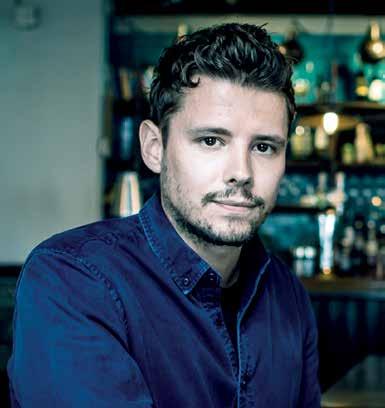
“The arts industry generates billions each year for the economy, but it doesn’t seem to be valued as a commodity and there has been very little talk as yet about supporting it. Drama at school is gradually being eroded from the curriculum. But live performance has a unique power that can’t be replicated on screen.”
Sam has vivid memories of his first impressions of Homerton in 2001, when he arrived for his interview.
“It was incredibly foggy, and there didn’t seem to be anyone around. We’d stayed at my Grandma’s near Grantham the night before, having driven down from Stockport, and we got lost so I was late. Steve Waters (then Head of Drama at Homerton, now Professor of Scriptwriting at UEA) was running a drama session as part of the interview process and I completely missed it. That wasn’t a great feeling.”
Having originally applied for Drama and English, Sam was offered a place to study English with Education Studies, but drama nevertheless found its way into his student experience.
“I was a bit resistant to the established institutions – I felt the ADC was just trying to copy London, though I can’t quite remember why I thought that was a bad thing. But I got involved in about 15 productions, made a couple of short films, took a production of Macbeth to the Edinburgh Festival, and formed a theatre company in my final year. I also spent my summers working as a broadcast assistant for the BBC, where I’d done work experience at 15 years old.”
In his third year, Sam got a call which almost changed the trajectory of his life. Toby Whale, then Head of Casting at the National Theatre, had spotted his picture on Spotlight, a website for actors to advertise their CV. He was casting the original production of Alan Bennett’s play The History Boys, and invited Sam to audition as an understudy.
“I had the audition and met Toby Whale, and the next step was to meet Nick Hytner, the director. But I was told that I should
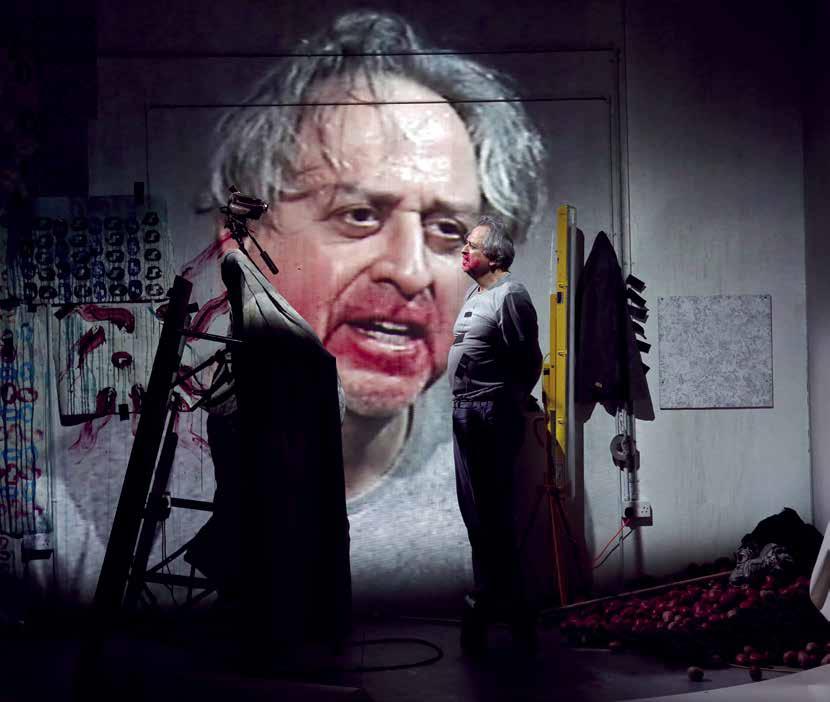
only do that if I was prepared to commit to the play if offered the part, which would mean dropping out of Homerton. So I turned it down.”
Instead he completed his degree, took a show to Edinburgh, and ended up as an understudy in the second cast of The History Boys a year later. Having initially thought he wanted to be an actor, Sam’s interest in directing was fostered by a series of mentors.
“I was lucky enough to have the opportunity to assist Phyllida Lloyd. She was so generous, protective, smart and interesting, and it was a wonderful introduction to directing. We had a week of development at the National Theatre Studio on Bryony Lavery’s adaptation of Wise Children with the most wonderful company of actors, some of whom are friends to
this day: Deborah Findlay, Jenny Galloway, Alex Jennings, Nicki Amuka-Bird, Paul Ritter and Kika Markham. Bryony became my “Patroness” and helped me get my first full assisting gig at Birmingham Rep with Rachel Kavanaugh.”
Getting into directing can rely on making personal connections with people in the industry, a pattern which Sam acknowledges can create barriers to entry.
“There’s a structure of first jobs being given by the artistic director, who will often engage someone they like, or, worse, recognise something of themselves in. So that can perpetuate the effect of similar sorts of people being offered jobs. And whether you’re able to afford to live in London can also be a huge factor – if you were born there, even better. But that doesn’t negate the fact that you have
to work hard either way. I am incredibly privileged as a white male who went to Cambridge. Before that, I went to a comprehensive school, I had no family in the industry, and hadn’t been to the theatre until I was 16. That was my map up to age 21.”
This time last year, Sam was directing Matthew Broderick and Elizabeth McGovern in Kenneth Lonergen’s Starry Messenger at the West End’s Wyndham Theatre, before preparing to take Incantata to Dublin. This year, by contrast, he is spending time with his partner, reading, writing, walking by the sea, re-watching Breaking Bad, cooking, and enjoying the silence. But he’s also exploring how to continue bringing the power of live performance to new audiences.
“We need to remind ourselves that pause doesn’t mean stop.”
How match-funded grants and the Tjeerd van Andel studentship are helping to attract the best possible PhD candidates to Homerton.
APhDis a significant commitment of time, focus and energies. It also comes at a considerable cost, from fees and living expenses to loss of earning capacity while studying. Candidates are therefore likely to apply to those Colleges which can offer the most financial support.
In the 2019-20 academic year, Homerton was able to offer matchfunded studentships to two PhD candidates undertaking research in the Arts or Humanities as part of the Open-Oxford-Cambridge AHRC Doctoral Training Partnership (OOC AHRC DTP).
“Fully-funded studentships like these are the gold standard for anyone wanting to undertake a PhD,” explains Dr Melanie Keene, Homerton’s Graduate Tutor. “Rather than relying on a patchwork of loans, savings, and small grants, students have guaranteed support for their research and maintenance costs, and have access to additional opportunities for training and networking. Jointly-funded schemes such as these make any donation go further, and the College’s involvement attracts a high calibre of postgraduate student who might otherwise be lured elsewhere.”
A hugely generous donation from former Principal Dr Kate Pretty, in memory of her late husband Professor Tjeerd van Andel, will provide studentships for one or two PhD candidates each year from autumn 2020.
“Philanthropy such as this allows us to invest in PhD students, bringing talented people to Homerton and enabling them to participate fully in our exciting research community.”
I work on the history of modern Britain. My thesis project is about the production of social knowledge in the late nineteenth and early twentieth centuries, or what I am calling ‘popular autoethnography’. In this period – the zenith of the British Empire –Britons were used to understanding foreign cultures and peoples through the lens of contemporary anthropology. I ask how ordinary people in Britain came to apply this anthropological or ethnographical lens to their own culture, and how indeed they came to imagine themselves as belonging to a ‘culture’ at all.
I try to show how something as seemingly fundamental as ‘everyday life’ came to be an object of enquiry, something that was not only lived but also studied, analysed, and discussed. For this, I look at a wide range of phenomena, including the Victorian craze for collecting rural folklore, the rise of community surveys via the Edwardian town planning movement, the birth of photojournalism, and early documentary broadcasting.
I am an OOC AHRC DTP-funded doctoral candidate researching artists’ moving image installations and their capacity for affect and experience. My research seeks to investigate the potential of such installations to function as sites for an experiential critique of the established discourse on contemporary media environments. I work at the intersection of media theory, contemporary art, philosophy and film studies.
Not having any previous experience with the collegiate university system I didn’t know which College to choose or what to expect from it. By leaving it to chance, or rather Homerton’s will, I was attracted to it because of its openness and trust in my project. Immediately after my arrival, I realised that this is a perfect place because of the diverse, friendly and caring environment that the College members try to create.
I applied for PhD funding via the OOC AHRC DTP, the main source of funding for graduate students in the humanities. I was delighted that Homerton was able to offer me a place through its match-funding scheme, and feel especially privileged to be among the first cohort of recipients of the scheme. There was much I didn’t know about Homerton before I arrived: the size and diversity of the graduate community; the programme of research suppers; the surprisingly excellent food! All have made my experience of grad life so far a happy one.
I was awarded a fees-only scholarship, so Homerton’s contribution was essential for me to be able to enter the PhD programme, which otherwise I would not have been able to do. It was the first time in my education path when I was allowed to focus only on studying, discovering and creating instead of dividing time between work and education, as I had done since I first came to the UK to study in 2010.
1 July 2019 – 30 June 2020
The Principal, Fellows, students and staff of Homerton College wish to thank alumni and friends who have generously made donations to the College over the last year. Every effort has been made to ensure this list is accurate; do contact us if you believe we have made an omission.
Mrs Margaret Kent
1943
Mrs Kathleen Hayward
1944
Miss Margaret Rishbeth
1946
Mrs Zoe Coombe
1947
Lady (Dorothy) Franklin
1947
Ms Christine Andrews
1948
Professor Joan Chandler
Mrs Jane Farley
Miss Elizabeth Rainsbury
1949
Mrs Mary Dowse
Mrs Coral Harrow
Mrs Molly Payne
1951
Mrs Sheila Duncan
Mrs Patricia Stockdale
1952
Mrs Shirley Haslam
1953
Miss Brenda Liddiard
Dr Alison Littlefair
Mrs Elizabeth Tunnicliffe
1954
Mrs Pauline Curtis
Mrs Carol Hammerton
Mrs Sheila Mackenzie
1955
Mrs Gwenda Ackroyd
Mrs Wendy Darr
Mrs Christine Grainge
The Revd Anthea Griggs
Mrs Gillian Hewin
Mrs Doreen Hobbs
Miss Gwendoline Lancaster (*)
Mrs Rachel Lewington
Mrs Jane Matthews
Mrs Rosemary Owens
Mrs Hazel Thornley
1956
Mrs Marguerite and Mr Norman Donkin
Mr Gordon Gaddes in memory of Mrs Pamela Gaddes
1957
Mrs Gillian Figures
Mrs Christine Lincoln
Mrs Alice Severs
Mrs Josephine Sutton
1958
Mrs Ann Banner
Mrs Christine and Mr Philip Carne
Mrs Angela Hulme
Mrs Vivien Ivell
Mrs Beryl Izzard
Mrs Wanda Kielbinska
Mrs Rachel Macdonald
Mrs Judy Manson
Mrs Patricia Stott
1963
Mrs Jean Addison-Fitch
The Revd Dr Anthea Cannell
Mrs Christine Macpherson
Mrs Erica Rigg
Mrs Kate Ryder
1964
Mrs Judith Brownlee
Mrs Elizabeth Maycock
Mrs Pamela and Dr Anthony Metcalfe
Mrs Sue Rescorla
Mrs Jill Taylor
Mrs Jane Woodford
1965
Mrs Lorna CordellSmith
Dr Tricia Cusack
Mrs Annie Illingworth
Mrs Dorothy Nicholls
1959
Mrs Pamela Dawson
Mrs Diana Hadaway
Mrs Ann Hamilton Herbert
Mrs Ann Hardie
Mrs Ruth Jerram
Mrs Diana Lucas
Mrs Annmarie Mackay
1960
Mrs Rosemary Allan
Lady (Gillian) Baker
Dr J. Norman Bardsley in memory of Mrs Jacqueline Bardsley
Mrs Patricia and Mr John Blythe
Mrs Sylvia Avgherinos MBE
Mrs Jean Clarke
Mrs Sue Dickinson
Mrs Jenifer Freeman
Mrs Rosemary Hill
Mrs Val Johnson
Mrs Christine Kershaw
Mrs Jennifer McKay
Mrs Christine Parkyn
Mrs Rosemary Rees
Mrs Jacqueline Swegen
1961
Mrs Marilyn Clare
Dr Olivia Craig
Mrs Joy Kohn
Mrs Susan Lovett
Mrs Jill Niblett
Mrs Caroline Sykes
Mrs Jean Thorman
1962
Mrs Diana Dalton
Mrs Lynn Dowson
Mrs Marion Foley
Mrs Carole Girdler
Mrs Carole Nolan
Miss Esme Partridge
1972
Mrs Ros Allwood
Ms Catherine Beavis
Mrs Sarah Flynn
Mrs Margaret Howell
Mrs Fiona and Mr Michael Karlin
Ms Anne Kennedy
Mrs Caroline Melrose
Mrs Valerie Mills
Mrs Penny Riley
Mrs Angela Swindell
Mrs Marilyn Thomas
Mrs Maureen and Mr Neil Weston
1973
Miss Stephanie Beardsworth
Mrs Dilys Murch
Mrs Denise Prosser
Mrs Sue Strassheim
Mrs Janet Webb
Mrs Dilys West
1966
Mrs Linda and Mr David Birtwhistle
Mrs Jean Carnall
Lady (Marilyn) Fersht
Mrs Margaret Funnell
Mrs Judy Martin-Jenkins
Mrs Margaret Robbie
Mrs Cheryl Trafford
1967
Mrs Marjorie Caie
Mrs Miriam France
Mrs Netti Smallbone
1968
Mrs Lesley Marriott
Mrs Lynne Parsons
Mrs Pemma SpencerChapman
Mrs Marilyn Stansfield
Mrs Alison Syner
Mrs Eithne Webster
1969
Mrs Anne Bambridge
Mrs Tricia Coombes
Dr Vicky McNeile
Mrs Anna Munro
Ms Anne Reyersbach
In memory of Ms Bridget Robinson
Mrs Sarah Taylor
1970
Ms Fiona Cook
The Revd Claire Heald
Mrs Mary McCosh
Mrs Denise Mitchell
Dr Roz Sendorek
Mrs Helen Wood
Mrs Mary Wyatt
1974
Mrs Jenny Little
Mrs Elizabeth Rose
Mrs Vera Sklaar
1975
Mrs Helen McRoberts
1976
Mrs Judy Clarke
Mrs Joan Gibson
Ms Jill Grimshaw
Ms Sarah Jacobs
Mr Tony Little
Mrs Ann Muston
Mrs Jo Newman
Mrs Alison Roberts
Mrs Zena Tinsley
1977
Miss Sheila Berry
Mrs Jane Bishop
Mrs Lalli Draper
Mrs Ann Jackman
Mrs Helen Mitchell
Mrs Jane Pearson
Mrs Patricia Poole
Mrs Lesley Thomas
1978
Mrs Vicki Addey
Mrs Marianne Billitt
Mrs Sandra Burmicz
Mrs Annette Cameron
Mrs Clare Danielian
1979
Mrs Lizzie Habashi
Mrs Amanda Renwick
Mrs Brenda Thompson
1980
Ms Victoria Brahm Schild
Mrs Jo Broughton
Mrs Sarah Holmes
1981
Miss Anna Chapple
Mrs Amanda Edwards
Mrs Cordelia Myers
Mrs Sarah Palmer
Mr Graeme Plunkett
1982
Mr Mark Hanley-Browne
Mr Brian Howarth
Ms Gek-Ling Lee
1983
Mrs Karen Miranthis
Miss Emma Rawson
1984
Ms Cathy Graham
Mr Peter Ventrella
1985
Dr Kirsty Byrne
Mrs Julia Harker
1986
Mrs Keren Cooke
Ms Nansi Ellis
Mrs Virginia Eves
Miss Samantha Taylor
1987
Mrs Alison Allen
Mrs Kim Chaplin
Mrs Michaela Khatib
Mrs Elizabeth McCaul
Mr James Thomson
1988
Mr Phil Coldicott
Mrs Katie Mayne
Mr Andrew McNeil
Mrs Sarah McWhinnie
Ms Phillipa Rushby
Ms Adrienne Saldana
Mr Giles Storch
Miss Jen Svrcek
Miss Lucy Bradley
Mr Carl Howarth
Mrs Penny Lee
Mrs Naomi Baynes
Mrs Nicole and Mr David L. Cohen
Mrs Karen George
Mrs Fiona Gruneberg
Mr Ian Hodgson
Mrs Sharon Holloway
Dr Susi Pinkus 1991
Mrs Joy Bensley
Mr David Chapman
Miss Helen Diggle
Mrs Claire Brooks
Mrs Mariclaire Buckley
Mr Simon Camby
Mr Patrick Derwent
Mrs Sarah Haines
Miss Caroline Mander
Mrs Diane Rawlins
Dr Steven Chapman
Mrs Helen Morgan
Mrs Torie TrueBhattacharyya
Mrs Emma Vyvyan
Ian Bettison
Mr Matt Buck
Mrs Amy McDonnell
Mr Alastair Chipp
Mrs Elisabeth Hackett
Dr Neil Hennessy
Mr Paul Jones
Mrs Denise Mieszkowski
Mrs Laura Penrose
Mrs Louisa Shipp
2000
Mrs Abby Deeks
Dr Tom Kitchen
Mrs Cheryl Smith 2001
Mrs Lesley-Anne and Mr Gareth Crooks
Miss Lidia Fesshazion
Mrs Amy Fleming
Mr James Frecknall
Mrs Catherine Kitchen
Mrs Nadine Lloyd
Mrs Kimberley Rayson
2002
Mrs Katy Coles
Dr James Croft
Mr Sam Farmer
Mr Sutherland Forsyth
Mrs Carys Gladdish
Mr David Lawrence
Mr Remi Moynihan
Miss Krista Pullan
Ms Alison Richman
Mr Tim Scott
Mrs Stephanie Shelmerdine
Mrs Rhiannon WynneLord
2003
Ms Susanna Bellino
Miss Amynah Bhanji
Mr Raymond Cilia
Mr Gregoire Hodder
Mrs Anne Howell
Mr Jonathan Levine
Mr Can Liang
Dr Feilong Liu
Mrs Elizabeth Mansfield
Mr Daniel Roberts
Mr Jean-Paul Skoczylas
Mr Tristan Stone
Mr John White
2004
Mrs Siobhan and Mr Adrian Cassidy
Mrs Emily Davies
Natasha Gray
Mr Richard Hopkins
Mr Ravi Raichura
2005
Dr Enyi Anosike
Miss Stephanie Baxter
Mr Nicholas Bebb
Mr Nick Clark
Mrs Lisa and Mr Fabio Galantini
Mrs Rebekah Perry
Dr Oliver Rupar
Ms Nadia Syed
Mrs Emma Turner
2006
Miss Aniko Adam
Dr Theresa Adenaike
Mr Andrew Blackburn
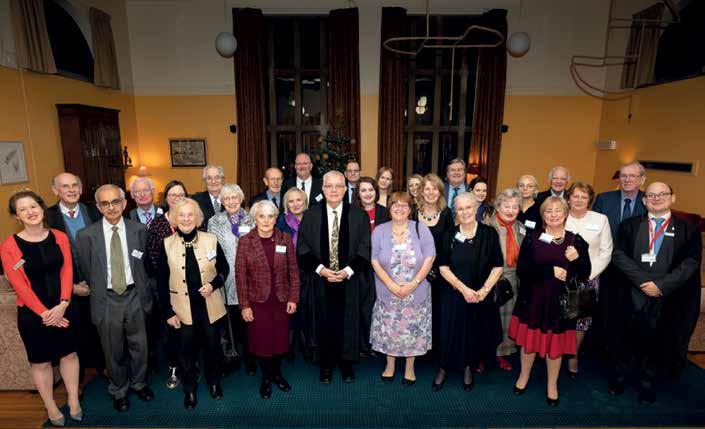
Mrs Liza de Uphaugh
Mr Thomas Dix
Miss Hannah Drew and Mr Luke Shepherd
Mr Vlad Hanzlik
Dr Joshua Jowitt
Mrs Dawn Pavey
2007
Mrs Claire Byrne
Mr Tom Horn
Mr John Keene
Miss Teresa Li
Mr Michael Lynch
Mr Joseph Randall-Carrick
Dr Matilda Stickley
2008
Mr Luke Clarke
Mrs Heather Coleman
Mr Michael George
Mr Matthew Linsell
Mr James Lugton
Ms Elaine Mo
Miss Amy Munro-Faure
Mr Ikenna Obiekwe
Mr Gershwinder Rai
Mr Kenichi Udagawa
2009
Mr Nigel Beckford
Mr Daniel Beresford
Ms Shruti Chaudhri and Mr Iain Cameron
Mr Jonny Edge
Dr Jack Euesden
Miss Christine James
Mr Christopher Morgan
Mr Michael Thorp
2010
Miss Emma Bowell
Mr Nahum Clements
Miss Alex Courage
Mr Richard Craven
Mr Gabrielius Glemza
Mr James Henderson
Mr Paul James
Miss Sian Jones
Miss Suzie LangdonShreeve
Mr Emmanouil Rodousakis
Mrs Jessica Taylor
Miss Yuanjia Yin
2011
Mr Jack Hooper
Mr Ted Levermore
Miss Abigail Thurgood-Buss
Mr Rune Webb
2012
Mr Joshua Cozens
Ms Louise Holyoak
Mr Tim Hubener
Dr Sylvester Juwe
Ms Samantha Kellow
Miss Danielle Poole
Mr Douglas Porter
2013
Mr Hachimi Maiga
Ms Sarah Tiffin
2014
Mr Nigel Ironside
Miss Raissah Kouame
Mr Vivek Saraswat
Mrs Andrea Saunders
2015
Mr Adam Dobson
Miss Sarah Witkowski-Baker
Dr Zamir Zulkefli
2016
Miss Mille Fjelldal
Friends of Homerton
Mrs Alexandra Annett
Dr Graham Arnold
Mrs Frances Barrett
Ms Caroline Bell
Dr William Brownlee
Miss Patricia Cooper
Mr David and Mrs Mandy Fletcher
Mr Peter Freeman
Mr Roger Green
Mr Andrew Gruneberg
Mr Terry Hardie
Dr Lesley Hendy
Ms Jess Jennings
Lady Barbara Judge CBE
Mr James and Mrs Leslie Lemonick
Mr Duncan Loweth
Mr Ian Mitchell
Mr Matthew Moss MVO
Mr Alan Newman
Mr George Pearson
Dr Kate Pretty CBE
Dr Peter Raby
Professor Steve Rennard
Ms Marilyn Tullys
Dr David Whitebread
Ms Rhiannon Williams
Ms Yukino Yamasaki
1768 Society
The 1768 Society recognises alumni and friends of Homerton who are regular donors to the College, making a gift of at least £17.68 a month.
Mrs Vicki Addey
Mrs Rosemary Allan
Dr Enyi Anosike
Ms Catherine Beavis
Miss Sheila Berry
Mr Ian Bettison
Mr Andrew Blackburn
Mr Matt Buck
Mrs Sandra Burmicz
Dr Kirsty Byrne
Mrs Marjorie Caie
Mr Simon Camby
Mrs Kim Chaplin
Dr Steven Chapman
Ms Shruti Chaudhri
Mr Nick Clark
Mrs Nicole and Mr David
L. Cohen
Mr Phil Coldicott
Mrs Heather Coleman
Miss Patricia Cooper
Mr Richard Craven
Mrs Pauline Curtis
Mrs Diana Dalton
Mrs Clare Danielian
Mr Patrick Derwent
Mrs Marguerite and Mr Norman Donkin
Mrs Lynn Dowson
Mrs Sheila Duncan
Mr Jonny Edge
Miss Mille Fjelldal
Mr Sutherland Forsyth
Mrs Miriam France
Mrs Karen George
Mrs Carole Girdler
Mrs Christine Grainge
Miss Natasha Gray
Mr Roger Green
Mrs Fiona Gruneberg
Mr Mark Hanley-Browne
Mrs Julia Harker
Dr Neil Hennessy
Mr Gregoire Hodder
Mr Ian Hodgson
Mr Richard Hopkins
Mr Tom Horn
Mr Brian Howarth
Mr Carl Howarth
Mrs Anne Howell
Ms Louise Holyoak
Mr Tim Hubener
Mrs Ann Jackman
Mr Paul James
Mr John Keene
Mr David Lawrence
Mr Jonathan Levine
Mr Can Liang
Mr Matthew Linsell
Mr Tony and Mrs Jenny Little
Mrs Susan Lovett
Mrs Diana Lucas
Mr Michael Lynch
Mrs Christine Macpherson
Mr Hachimi Maiga
Mrs Lesley Marriott
Mrs Jane Matthews
Mr Andrew McNeil
Mrs Helen McRoberts
Mrs Sarah McWhinnie
Mrs Karen Miranthis
Mrs Elaine Mo
Mr Matthew Boss MVO
Mr Remi Moynihan
Mrs Ann Muston
Mr Ikenna Obiekwe
Mr Douglas Porter
Mr Ravi Raichura
Mrs Diane Rawlins
Miss Emma Rawson
Mrs Rosemary Rees
Miss Gill Rogers
Mrs Elizabeth Rose
Mrs Kate Ryder
Mrs Andrea Saunders
Mr Luke Shepherd
Mrs Netti Smallbone
Mrs Cheryl Smith
Mr Tristan Stone
Mrs Jessica Taylor
Mrs Lesley Thomas
Mrs Brenda Thompson
Mr James Thomson
Mr Michael Thorp
Mr Rune Webb
Mrs Dilys West
Mr John White
2019
Dr David Whitebread
Ms Rhinnon Williams
Mrs Helen Wood
Cavendish Circle
The Cavendish Circle recognises alumni and friends of Homerton who make an annual gift of £1000 or more to the College.
Lady (Gillian) Baker
Dr J. Norman Bardsley
Ms Victoria Brahm Schild
Mrs Pamela Dawson
Mrs Annie Illingworth
Macaulay Circle
We are grateful to those who have indicated they intend to leave a gift to Homerton in their Will.
Miss Patricia Cooper
Mr Gordon Gaddes
Mrs Coral Harrow
Miss Gwendoline
Lancaster (*)
Mrs Karen Miranthis
Mrs Kate Ryder
Trusts and Corporations
Magna International Inc
Santander UK plc
The Plowright Charitable Trust
We are also very grateful to those friends and supporters who give up their valuable time in support of the College, those who have made gifts of artworks and books, and 46 donors who wish to remain anonymous.
As a lifelong member of Homerton and the University of Cambridge you are entitled to a number of benefits. You are very welcome to visit Homerton and use the College Library, Buttery and Bar, and to dine at Formal Hall. Subject to availability, you can also book overnight accommodation at preferential rates and book function rooms for private dinners and events. For more information email alumni@homerton.cam.ac.uk
You can take advantage of great deals at a number of Cambridge hotels, bars, restaurants and retailers by using your CAMCard (issued by the University). You will also receive automatic membership to the University Centre and free entrance into most of the Cambridge Colleges.
To request a CAMCard visit https://www.alumni.cam.ac.uk/benefits/camcard
http://www.homerton.cam.ac.uk/alumni/benefitsandevents
Visit the College website for full details of our alumni events, local branches and alumni benefits. You can read College publications online and update your contact details when you move house or job. You can also read about the College’s current fundraising priorities and make a donation to Homerton online.
By email
Have you been receiving our email newsletter? If you haven’t seen an eNewsletter recently, send us an email at alumni@homerton.cam.ac.uk to make sure we have your current contact details.


‘Like’ Homerton College on Facebook to keep up to date with what’s going on. Visit www.facebook.com/HomertonCollegeCambridge
Follow us for the latest news and updates @HomertonCollege
We are on Instagram. Check us out @homertoncollege
You can also connect with Homerton on LinkedIn. Simply search for ‘Homerton College’
Due to continuing restrictions on large gatherings, we will sadly be unable to host this year’s Alumni Reunion Weekend in person.
While we are hugely disappointed not to be able to invite you back to Homerton this time, we are putting together an exciting online programme and hope you will be able to join us for lectures, events and social get togethers in virtual form on the weekend of 26–27 September.
Please keep the date free, and we will be in touch with further details in the coming weeks.
HOMERTON COLLEGE UNIVERSITY OF CAMBRIDGE
Hills Road
Cambridge CB2 8PH
Tel: +44 (0)1223 747251
Email: alumni@homerton.cam.ac.uk
www.homerton.cam.ac.uk
Homerton College is a Registered Charity No. 1137497