HOMERTONIAN18
I hope you enjoy reading the 18th issue of our annual magazine. 2013/14 year has been a busy academic year for Homerton. Our new Head of House has now had time to settle in and is taking the College from strength to strength. Read more of Professor Ward’s Cambridge and New York experiences in his article opposite.
Elsewhere, Dr Michelle Oyen answers questions in our ‘Fellow in Focus’ article, and the Student Union representatives keep us informed of the sports and societies news, with the HUS sabbatical President writing of his experiences over the past year, before leaving for pastures new. In the words of William Feather (American Publisher and author – taking us nicely back to the American link) ‘Finishing a good book is like leaving a good friend’. We do hope you can take the time to open the book and re-read a chapter occasionally.
Nicola Burgess Development Officer – Communications and Events

The Homertonian is published once a year to keep members informed with College and alumni news. Do contact us in the Development and Roll Office: Telephone 01223 747280; Email roll@homerton.cam.ac.uk. All our publications are available to read online on the Homerton College website: http://www. homerton.cam.ac.uk/alumni/publications.
Thank you to all of our contributors and to those who supplied images. The views expressed in this newsletter do not necessarily represent the views of Homerton College, Cambridge. Cover photograph: Stephen Bond. Design and print management: H2 Associates, Cambridge. Editor: Nicola Burgess
PROFESSOR GEOFF WARD
Underground rivers, new bridges…
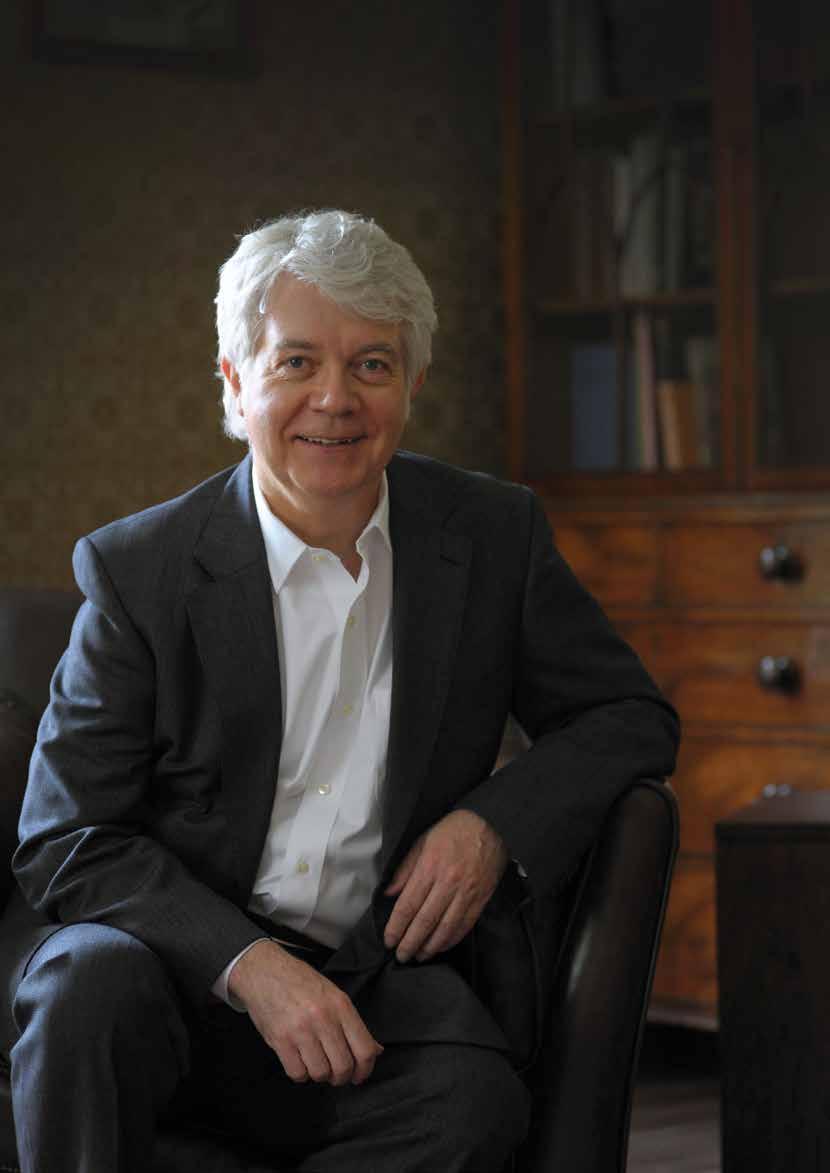
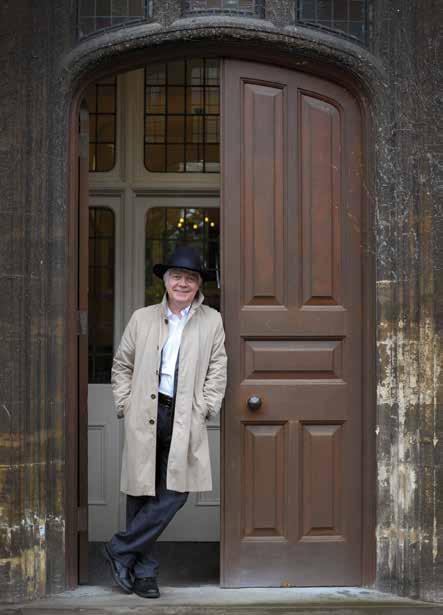
Professor Geoff Ward, Principal of Homerton since 1 October 2013, is a literary critic and poet. His scholarly focus is on American literature, modern poetry and the legacy of the Romantic movement, and his books include Statutes of Liberty (1993; revised edition 2000), the first study of the New York School of Poets, and The Writing of America (2002). He has written and presented programmes on American writers for BBC Radio 3. So when he was asked by Cambridge in America to give a lecture in New York in March 2014, his topic was perfectly matched to the location. The following text is a shortened version of the lecture.
New York, New York (and Cambridge)
Aone-time Mayor of New York, Ed Koch, remarked with a forgivable chauvinism that ‘anywhere west of the Hudson is just camping out’. While I’ve lived in Washington DC and travelled widely in the States, I do share that sense of something utterly, uniquely magnetic about Manhattan, the ‘mountainous island’ Frank O’Hara wrote about, the ‘canyons of steel’ that the other Frank, Sinatra, hymned. And likewise, moving from the Hudson to the Cam, while I’m aware that there are many other good universities in the UK, and I’ve worked in or had dealings with lots of them, none of them really comes close. I have some liking for Oxford (or at least for Harris Manchester College, who have kindly bestowed on me both an Honorary Fellowship, and a bicycle) but it was Cambridge that took me in when I was eighteen, and which, after a circuitous journey including Liverpool, Scotland, London plus stints in Japan and America, has taken me back again, this time as Principal of Homerton. Cambridge and New York, so utterly unalike, are alike in their Uniqueness, a uniqueness incarnated in the physical fabric of each city, like the stones of Venice or the pavements of Paris.
Beginnings
My love of American Literature didn’t quite start in Cambridge, but in Manchester in the North West of England where I grew up and where, in the late 1960s, I would spend hours in the one bookshop that sold poetry books imported from the US by, for example, Allen Ginsberg, whose incendiary poem Howl was still only a decade or so old at that point. Contemplating Howl, I got hooked, thinking it a new kind of poetry, which it was, and kind of wasn’t. I thought of Allen Ginsberg – denim, long hair, Old Testament beard when I got to Cambridge and read a book of poems published exactly one hundred years before Howl, Walt Whitman’s Leaves of Grass. Whitman looks out of the photograph, or daguerreotype, of the frontispiece long-haired, wearing denim, with an Old Testament beard. There was a direct connection from Whitman’s great Song of Myself to the Beat generation, poetic as well as presentational. American poetry, I was beginning to learn, had been revolutionary from the start.
Student days
But I wasn’t in America, in 1972 (though I was beginning to realize I would go there), I was in Cambridge. Who could teach me about all this poetry, and show me what to read next, and, important for a student studying English, how best to write about it? The short answer was a very tall person, a Fellow of Gonville and Caius College called Jeremy Prynne, who publishes his own poetry as JH Prynne, but who at this time gave a course of lectures each year called ‘Poetry & Language’. Jeremy was, and is, mildly terrifying. At eighteen years of age I wasn’t used to the concept of a lecture. Even less was I used to hearing lectures delivered as Jeremy’s were, without notes, and in completely formed, elegantly complex sentences and paragraphs entirely without the ums and ahs that the rest of us mortals resort to as linguistic props. And his lectures were difficult. And the poetry he lectured on was difficult. The first line from the first poem in the first collection by Prynne is ‘The whole thing it is, the difficult.’ I came to realize with hindsight that he was pitching his lectures above, but only just above, the cleverer heads in the room. He made you up your game. He is to this day the best-read person I’ve met, fluent in Chinese among other languages and able to converse with scientists of different disciplines.
Jeremy introduced me to many fascinating people including Nobel Prize-winning scientist Francis Crick, who, slightly improbably, was in Cambridge for a poetry reading by the American Beat poet Michael McClure. This would have been in 1976 or 77. I could see a certain affinity between Crick and McClure; with neither was it the easiest of tasks to get a word in, both were supremely self-confident, and both possessed a strong sense of the underlying interconnectedness of things. I left the party that followed the reading with Rupert Sheldrake, then a Fellow of my own College, Clare, and we agreed that we’d had an extraordinary evening, not simply in terms of listening to some powerful personalities but people who restored the possibility, generally considered lost, of conversation and shared understanding between and across the Arts and Sciences. As we walked out into the night I can
remember Rupert asking himself, me or the night air whether the poet Samuel Taylor Coleridge was the last person who had read everything – in other words whether Coleridge was the last figure, Prynne being the nearest contemporary analogue, who had sufficient reach to understand the scientific advances of his day fully alongside the literary and artistic endeavours of which he was a part, and moreover to see the affinities between them. This has stayed with me because it immediately became an important jigsaw piece in my sense of what a university, or a college, could be, on a good day.
Cambridge and Homerton – futures singular and plural
In Cambridge we wear gowns a lot and have high table in colleges where snuff is sometimes served, where grace is said or sung in Latin, where after pudding and before dessert you may be asked to change places, and the dinner isn’t any old dinner but sometimes has a name, my favourite thus far being the annual dinner at Caius called ‘The Commemoration of Dr Banthwaite’. All of this can be viewed as silly or stuffy as tradition always can be, but, importantly, the social side of things can also be a bridge across which you find yourself walking unexpectedly into a different understanding. As with poetry, the artifice actually helps. High table and the common-room do exactly have the potential to create common room, shared intellectual space, for poets and scientists and students and visitors to talk. I like Cambridge for the way it exposes my ignorance, but then points me to the bridge.
Cambridge is having one of its powersurges at the moment. The driver, as often in this place, is science. A billion-dollar investment is going into the area of South Cambridge where Homerton is situated. This is going to be the biggest biomedical campus in Europe, and biomedical and pharmaceutical companies will soon be springing up like mushrooms. I get asked as a literary specialist if I think science is crowding out the arts in Cambridge? I don’t think so, partly because as I hope my little talk has already made clear, I’d see science and poetry as engaged in parallel activities of world-interpretation. And as Principal of Homerton, not merely
the newest and the largest college in the University but the nearest to the biomedical campus, I can’t help but be excited by the new developments.
Criticism and comedy
Going back to the foundations of English as a discipline in Cambridge, another founder was IA (Ivor) Richards, author of the 1925 book Practical Criticism. To this day, students at Cambridge reading English take a part 2 paper called Practical Criticism, which entails walking into the room and finding an exam paper on which are printed several poems and pieces of fiction, with no author’s names or extra information whatsoever, and from any period or periods between the middle ages and the present day. You are then asked to analyse three of the questions, which are really texts not questions, over three hours. It is fiendishly difficult, unhistorical, unfair – what do you do if you recognize one of the poems? Fess up, or hold back? Supervisors have been answering that question for many decades now and their answers are all evasive. But having taught it as well as sat it, I can safely say that for some reason it works. However, my own experience of sitting the Practical Criticism exam in the summer of 1975 was bittersweet. Picture me if you will, finishing my exam paper and thinking I’d done pretty well, or as well as I could do, then idly turning the paper over with five minutes of the exam left to go, and feeling, suddenly, utter astonishment and chagrin. Freeze that picture and we’ll come back to it.
I had come to a realization by the time I took my Finals that I wanted to go on in academia and that I wanted to work on modern American poetry. Some of the poets I was working on were so obscure they weren’t even known widely in the USA, let alone Britain. I wanted to be the first person to write about poets like Frank O’Hara, James Schuyler, Ted Berrigan. I wanted to commend them, so that people would read them, because literary criticism as I practise it is always fundamentally positive and warm and not negative. ‘Criticism’ can be an unhelpful term, in my book. ‘Literary recommendation based on informed textual analysis’ would be my preferred if more klutzy description. In particular I had
become besotted, am still besotted, with a New York poet I have already mentioned, really the poet of New York, Frank O’Hara. He wasn’t well known outside New York, apart from in Cambridge, San Francisco and a few other places. An associate curator in the Museum of Modern Art at the time of his death, aged 40, in 1966, Frank O’Hara is also probably the funniest poet in English - which to me is no laughing matter. Ever since reading him I have asked my students to ask, of any writer they are reading, is this a comic writer, and if so in what way? And if the writer isn’t, then why are they choosing to withhold humour, which is after all one of the qualities, like compassion or consolation or trust, which we can give to each other. I’m not asking for shallow jokes, or the so-called ‘wit’ of Alexander Pope and the eighteenth century, which just bores me to death. But the really great writers –Shakespeare, Joyce, Beckett, Proust, Emily Dickinson – and among recent American writers Richard Ford, Thomas Pynchon, David Foster Wallace, John Ashbery – are subliminally, even when they’re not being overtly, funny. They persuade words to make life turn out comedically, to come out OK even in the teeth of tragedy, which is the genre to which our mortality ostensibly consigns us, and this I value. ‘Happiness’ wrote Frank O’Hara, ‘the least and best of human attainments’.
Bridges, loops and next steps
But I’m not getting up, I’m sitting in an exam room in Cambridge in 1975, sitting my finals, having taken the Practical Criticism paper and checked my answers, and I idly turn the booklet with the questions in it over, and on the back is one last text, one last poem, which I’d missed. It is a poem called ‘Sleeping on the Wing’, one of my favourite poems by Frank O’Hara. It would have been my best answer. But I missed it because I was sleeping on the wing. I didn’t see anything remotely comic about this at the time, but I do now.
In the end, not that there is such a placetime, ever, I came to New York and stayed for long spells in the Chelsea Hotel, slept on floors in the Lower East Side in the 70s and 80s when the ‘lower’ bit in lower-east-side seemed as much an existential and moral category as it was an urban designation, shopped in the Gotham Book Mart, now gone, drank cocktails in the King Cole bar in the St Regis, (unfortunately for wallet and waistline, still there).
So my tale is of two cities, and how dependent on both I’ve been, and how much they have shaped me. And most importantly, how Cambridge and New York have connected unexpectedly, in circuitous and underground ways that led to new connections. The poet I’ve published most on is the New York poet John Ashbery, but I first met him in Cambridge, in 1975. Life has been full of these loops, and bridges. There
Alumni Benefits
are colleges in Cambridge, splendid places, which, like some of the UK’s more imposing independent schools, leave an impression on the student which can sometimes be almost too powerful. There’s nothing sadder than meeting someone who feels the best time of their lives was at school or university. If the school or university are doing their job – and this is something we might talk about in question time – should they not be nudging their charges gently but firmly on, and out, projecting as well as protecting - and projecting students towards the best time of their lives. As Principal of Homerton (I say again, the newest and also largest college in the University), I want a student population which has the confidence to strike out, move on, risk, make the adventurous and not the easiest next step. Find those unexpected bridges I mentioned earlier.
Sowing the seeds of education, we should sow them ‘crooked in the furrow’ as John Ashbery has it, and not provide solid answers that worked yesterday for the zigzag lives our students will live tomorrow, moving beyond us. Although we do graduate from college, we don’t ever stop learning, and the moments of reflective hesitation this often entails might be one of our most useful gifts to the students whose future has sent them to teach us.
Geoff Ward Principal, Homerton College
As a lifelong member of Homerton and the University of Cambridge you are entitled to a number of benefits. You can visit Homerton and use our library, Dining Hall, Buttery and Bar. You can also book overnight accommodation at preferential rates, and you may be able to book function rooms for private events and dinners – both subject to availability.
You can take advantage of great deals at a growing number of Cambridge venues and retailers by using your CAMCard. Plus you will also receive automatic membership to the University Centre and free entrance into most of the Cambridge Colleges.
For further information regarding alumni benefits please email roll@homerton.cam.ac.uk
FELL O W IN F O CUS
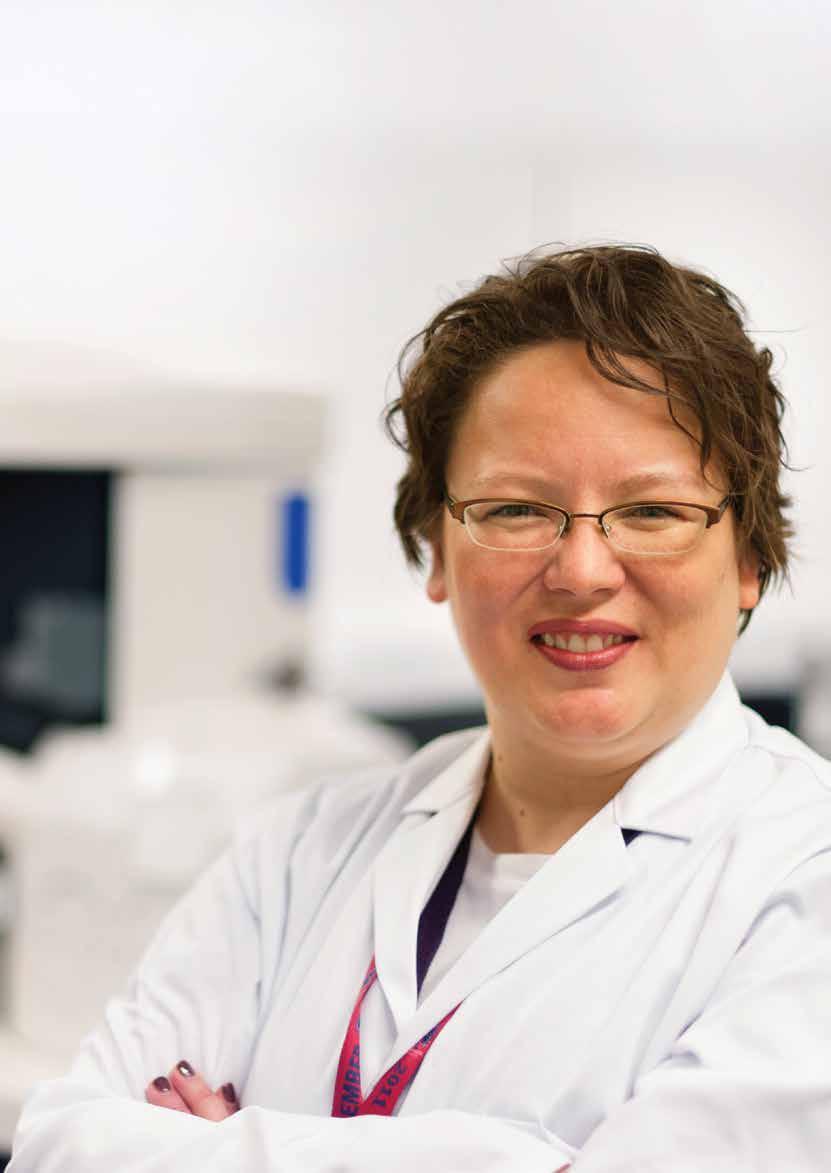
Interview with Michelle Oyen
Michelle L. Oyen is a Reader in Bioengineering in the Mechanics and Materials Division and the Bioengineering research group in the Cambridge University Engineering Department. She holds a B.S. degree in Materials Science and Engineering and an M.S. Degree in Engineering Mechanics, both from Michigan State University and a Ph.D. degree in Biophysical Sciences and Medical Physics from the University of Minnesota. She joined Cambridge in 2006 following an appointment as Research Scientist at the University of Virginia Center for Applied Biomechanics, and joined the Fellowship of Homerton College in 2012.

Can you tell us a bit about your background and what led you down the path you now follow?
I knew I wanted to be an engineer from the time I was ten years old, but I didn’t have a clear view of what sort of engineering I would do and what the career path would be. I probably would have told you twenty years ago that I was going to do a Bachelor’s degree in engineering, then get an MBA and go into technical management. Obviously that didn’t happen! I studied Materials Engineering as an undergraduate, and during that time I became interested in biomedical materials. I considered attending postgraduate medical school but instead found the field of bioengineering, and I have been in this field ever since. After finishing my PhD and a year of post-doctoral research in the USA, I came to Cambridge as a University Lecturer in 2006. I joined Homerton College as a Fellow in 2012.
What research projects are you involved in at the moment?
My research group is large – currently 15 people – and as such we have a diversity of ongoing research projects within the broad field of bioengineering, and particularly in the area of natural and biomimetic materials. We study the failure of tissues in diseases such as osteoarthritis, and work on replacement tissues for damaged parts using tissue engineering. We study materials in nature that are both mechanically robust and made under environmentally friendly conditions, and thus may be good for inspiring new paradigms in engineering materials. We use a wide variety of engineering techniques.
As a Director of Studies for Homerton, how do you motivate the students in your care?
I can’t personally motivate my students –their motivation has to come from within. But I can do many things to provide them support and resources to help them through their first year in the Cambridge Engineering Department. Most importantly, I’m available to talk to them about their career, about their academic progress, to suggest books and other resources to help them academically, and to help steer them in the right direction when they face challenges.
What would you like to achieve over the next five years?
My goals for the next few years are in many parts, reflecting the different facets of my job in teaching, research, and service. I would like to grow and expand bioengineering teaching within the Department of Engineering. I would like to have my research group perform worldclass bioengineering research that has great potential to influence human health. Finally, and most importantly for future generations, I would like to continue to work to promote engineering as an exciting career choice for young people in the UK, and in doing so, to promote Homerton as a great place to study engineering within Cambridge.
A VIEW FROM THE HUS
Francis Dearnley reports
H.G. Wells once said “human history is a race between education and catastrophe.”
Sometimes I think life in a Cambridge College is a bit like that, but the race plays out over months not centuries!
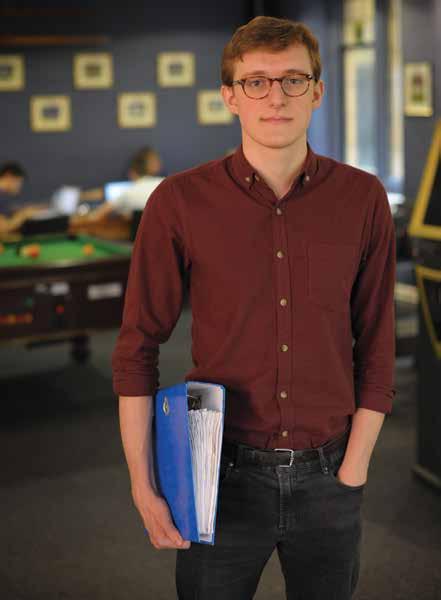
Francis
Dearnley
HUS President
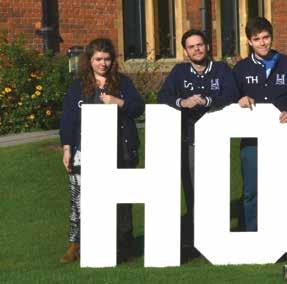
As sabbatical President of the HUS (Homerton Union of Students), one could say I tread the line between education and catastrophe closer than most – indeed, when I was elected last year one wise Fellow rather ominously remarked “your main role is to forecast disaster and avert it whenever possible.” Three years as a history undergraduate taught me the pitfalls of predicting the future, but having spent the last two terms in the role (with one more to go), I can testify to the partial truth of that statement. However, the job is so much more than that – and the support I have received from the College, and most importantly from my fifteen-strong team of extremely dedicated students, has made what could easily be a stressful year into the most enjoyable one I have spent during my time at Cambridge.
It is a job full of variety. In the weeks prior to Michaelmas much of our time was spent compiling a Freshers’ guide for new students, trying to think back to the sort of questions we were asking when we were in their shoes. Simultaneously we were preparing for what the HUS is arguably best known for – hosting large-scale events throughout the year. The most important of these – Freshers’ Week –is, as one would expect, an intensely busy period (you’re on your feet for the best part of seven days) and it takes weeks of preparation beforehand. Thankfully my support team and I had already had a trial run with the PGCE equivalent a couple of weeks before, and had received the kind encouragement of those former students we met at the Alumni Weekend in September, which was by the far the most pleasurable event I’ve had the fortune to be involved with. Later, in Lent, we would have Homerton’s now infamous
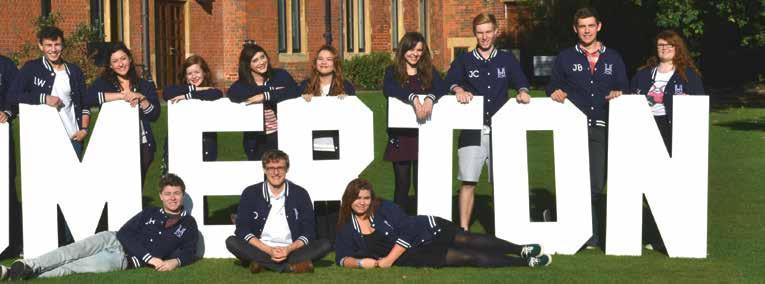
Harry Potter formals to stage, with the intense pressure that only selling £12,000 worth of tickets in 3 minutes can provide. Thankfully everything went well, in no small part thanks to the dedication of James Blake, Helena Blair, and Olivia Sinclair. The owls on the first night may have made rather a late appearance, but as one of the team joked, we can only hope to control one kingdom at a time!
Large-scale events aside, the day to day life of a student union might sound comparatively mundane. There is the office and shop to run, committee meetings to attend, emails to answer, and manifesto pledges to honour – but in many ways this is the most satisfying part of the job. Listening to student concerns and then negotiating with the relevant parties in College can be immensely rewarding, especially when working with members of the HUS team to compare thoughts and coordinate effort. We have had some notable victories this year, and I am hopeful that before the year is out we can achieve further success.
In this regard, I must also mention those members of my team who have coordinated and run very successful initiatives – in particular Stephanie Hobbs (Target & Access), who organised Homerton’s largest ever Shadowing Scheme this year, bringing students from all over the country to the College to experience student life for several days. Similarly I would like to thank Ellen Hurley (Academic Affairs & Liaison) for her efforts in the immensely hectic task of coordinating interviews for new students, Ruth Taylor (Services) for her absolute devotion to the storage room at the beginning and end of terms, Heather Halliwell (Communications) for
never missing a bulletin, Luke White (Societies) for keeping tabs on the College’s many talented students, Florrie Grigson (Environmental & Ethical Affairs) for single-handedly sparking our new relationship with Jimmy’s Night Shelter, and Anita Magee and Dimitrios Goumenos (Welfare) for their work behind the scenes, sometimes at all hours of the night. Equally, I am extremely grateful to Joshua Cozens (Sports) who has been the recipient of more messages from me than any person deserves, and yet remained stoically unmoved by the frustration it must have triggered. I also thank him for his assistance over the past few months in setting up the new College gym with the Bursar’s Office. Choosing the equipment, sorting out the cost, and then getting over 200 students inducted is no easy task. I apologise now for the days that students came into the office to find me distracted by gym-related issues. In this regard, I wish to extend my heartfelt thanks to Bobbie (the HUS’s Office Manager), who has not only been the voice of reason in times of stress for all of us, but is the rock that keeps the HUS a coherent and focused unit. I know I speak for my whole team when I say that, without her, we could not function to anywhere near the capacity that we do. Finally, my greatest thanks must go to Jack Hooper (Vice-President Internal), Jemma Stewart (Vice-President External), and Tim Hubener (Treasurer) for their dedication to their positions and for putting up with me. I wish all of my team the very best of luck for next year, and especially to those who have opted to serve on the HUS again.
I would like to end on a few observations from my years as a
Homerton student. I think I speak for every undergraduate when I say that one of the most exciting things about being at Homerton is a sense that its history is still being written. Its foundations may date back centuries, but unlike some of our fellow Colleges, there’s a unique energy about this place, and a common feeling amongst both staff and students that we’re only just getting started. It is wonderful to see so many Homertonians excelling in their fields – whether that be academically, treading the boards at the ADC, being grilled by Paxman on University Challenge, or by rowing in the Boat Race. Our College motto, Respice Finem, ‘look to the end’, has never rung truer than now.
Yet it would be very easy in my position to focus solely on where we are going, and in doing so to take everything the College has given me for granted. But I remember the first time I set foot here, at an open day which already seems a lifetime ago. I had walked around Cambridge and visited the imposing buttresses of St. John’s and Trinity, and the looming archways of Christ’s and Pembroke. Despite, or perhaps because of, their grandeur, they felt to me quite daunting places to enter. Yet, as soon as I made the journey up Hills Road to Homerton, I got a very different sense. I didn’t feel at all intimidated – I can still vividly remember the smiles of the students and staff, and the relative tranquillity of this place as it was that day. In a word, it felt homely. I still feel that, and I hope that all these years later, you do too.
‘Home’ is in our name after all.
Francis Dearnley
HUS President 2013–2014
SPORTS REPORT
Joshua Cozens reports
In the realm of sport, some seasons are ending and others just beginning. It has been a hectic year, with triumph and tragedy in equal measure.
InFootball, Guy Linch’s Homerton 1st’s (former goliaths of the Premier division) got off to a shaky start to the season due to a lack of players (as did the other three football teams in Homerton), and it seemed our highly successful footballing dynasty of recent times had been lost. However, fresh blood was swiftly found and a new spark overcame this lacklustre start to the campaign, and carried by a second wind the players managed to fight back to avoid relegation from the top flight after beating Caius 2–0 away and drawing 1–1 against top-end King’s. With a single fixture to be played against the almighty Fitzwilliam at their fortress, we can now safely say we are no longer the underdogs.
For the Women’s team captained by Simi Sandhu it has been a more comfortable season, with the team mounting a successful campaign in both the league and the cup, sitting comfortably in the top half of the table and making it to the semi-final of Cupper’s after a nail-biting penalty shoot-out. With the final fixture to be played, there is a consensus that they are the ones to watch.
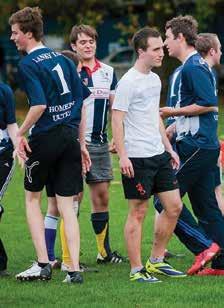
In Rugby, as unthreatening as they were prior to this season, Dharshan’s Vadivelu’s XV have evolved to become the strongest in many years and have become a formidable force to contend with. At the start of the year an additional 15 new players flooded in from all year groups, driving both the competition for a starting place and the standard to a new level. As such, this year they have been sitting comfortably at the top end of the table and have vastly improved (much like England this past year). It has also been a special year for Homerton
in terms of the Rugby Blues, with as many as eight Homertonians in the team, and five (Andy Abraham, Leo Buizza, Toby May, Charlie O’Sullivan, Huw Thomas) playing in the Varsity Rugby Match in December.
After numerous high rises in the Bumps in recent years, Homerton Boat Club are beginning to plateau after leap-frogging many clubs, and now they are in deeper waters progress is challenging. Undeterred however, the rowing captains continue to keep the crews on track for improvement, though the Men’s were unfortunately bumped down two positions from 6th to 8th in Lent Bumps. The Women’s 1st’s outdid themselves again, taking them from 6th to 3rd, now fighting hard for top-tier status.
In Tennis, new captains Matt Harris and Anna Hands have led a strong training regime through the previous two terms in preparation for the Easter season and they are looking to challenge the best teams in Cambridge. Their season will commence along with the return of the Wimbledonesque grass courts of Homerton. Similarly, our Badminton team – now headed by Kieran Hammond and Megan Pinches –have had a large intake this year of new players but a mixed bag of results, with both the firsts and seconds sitting comfortably mid-table. Next year they hope to push for promotion to a higher division.
Homerton’s Ultimate Frisbee team, led by Matt Chadwick, has arguably the greatest camaraderie of all teams and their high morale, and will to play for each other has allowed the team to perform consistently all season, making the cuppers final and dishing out some heavy 6+ score differences.
In Athletics, Homerton has upheld its strong commitment to the University team, with Chloë Beckett raising awareness and getting more athletes involved University-wide whilst performing well herself in the Varsity half-marathon, finishing 3rd. The University Cheerleading Society has only expanded on its success of last year, with Homerton still at its heart. Four students (Elloise Gordon, Ele Castelli, Harriet Keown, Eireann Attridge) all earned their Half-Blues this term from competing in (and winning) their second consecutive Varsity competition. Following that victory, the ‘Cougars’ were further awarded the title of Grand Champions of Varsity, having received the highest score of all the competing Varsity teams.
After a concentrated effort by the HUS teams of the past two years, Homerton’s gym has now opened with a big range of state-of-the-art equipment. It has already proved extremely popular, with over two hundred students signed up to use the space. Hopefully this fantastic College facility will strengthen both the mind and body of all who use it.
So, in conclusion, it must be said that Homerton sport has been thriving all year, with room for all to take part. Our students are regularly performing to a high stardard, but we are also active on a casual basis too, escaping from the onslaught of work in the process. It is this healthy balance between work and play, achievement and excellence, which defines us – and the future is bright for Homerton!
Joshua Cozens HUS JCR Sports Officer 2013–2014
CLASSICFM MUSIC TEACHER OF THE YEAR
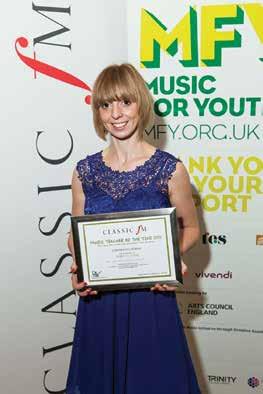
When I received the phone call from Classic FM saying that I had won the award for Secondary School Music Teacher of the Year I was in complete shock! I was overwhelmed when nominated by students, parents and teachers from my school but didn’t think, for one second, that anything would come of it.
Ialwayswanted to be a teacher. Perhaps like many Homertonians, my own school experiences helped to shape my dreams and future. I remember observing peers at school and wishing that there was something I could do to help them recognise and achieve their potential, it turned out later that music was the medium in which I would do this. Both my late Head of Year and PE teacher in particular were excellent, but it was their vested interest in me and helping me to become the best I possibly could be – just as my parents had brought me up! – that inspired and influenced me the most; they clearly prioritised Bex Lewis the person over ticking boxes and climbing league tables, and this personalised approach to education is something that I have strived to promote in the classroom ever since. As a student I wanted to help young people; to inspire them and to make a difference to the quality of their lives. I wanted to be an excellent teacher and that passion still drives me today!
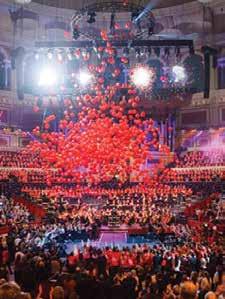
Below Awards Ceremony, Royal Albert Hall
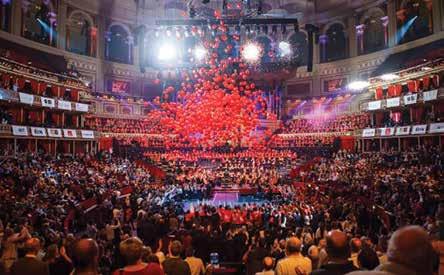
I am a proud Homertonian and whilst there embraced every opportunity to be involved in College, and University life. I played in orchestras; as a proud member of the Choral Exhibitioners; played for the University Football and Volleyball Teams; and still enjoy 90 minutes on the pitch (as an Alumni) for HCWFC each week. I was privileged to have been taught by John Finney, my hero! An inspirational man whose amazing thoughts on and approaches to education form the foundation of my teaching, and undoubtedly inspire and facilitate a clear passion for learning and music in my students.
I’m sure that all of these experiences have shaped my style and delivery in the classroom and am incredibly thankful to Homerton, the brilliant porters, the staff, and my peers for the role they have all played in my life.
The night at the Royal Albert Hall was like a dream. I felt like a celebrity as a chauffeur driven car picked me up at Kings Cross and drove me past the sights of London; then an evening in the box at the RAH with all the trimmings. A videoed interview with Tim Lahrou from Classic FM, before being presented with my award on stage by Karl Jenkins, whose music I love. Wow!
Rebecca Lewis
Homerton 2001–2005
THE ARTS
Homertonian Societies
Without exaggeration, this year has been one of the most active in recent memory in terms of extracurricular student activity. For some time now Homerton has been cementing its place in Cambridge as not only a hive for excellent in-house enterprise, but also as a College with the confidence to contribute its talents to the wider University. As we survey our successes this year we inevitably miss some students out, or only mention achievements in passing which warrant several hundred words themselves!
This is especially the case with drama over the past two terms, with many productions in the ADC and elsewhere starring large numbers of Homertonians. As such, it comes as no surprise that the new President of the CUADC (Cambridge University Amateur Dramatics Club) is one of us – David Stansby. And a special mention should go to Issey Penwarden, who codirected the five-star show Jerusalem, and also co-directed (with fellow Homertonian, Miranda Slade) one of the plays from Shoot Coward! as part of the Latin American series at Corpus Playroom.
Closer to home, our very own HATS (Homerton Amateur Theatre Society) has undergone something of a renaissance this year under the helm of a new committee of Homerton students led by Tania Clarke, starting with its huge success with God
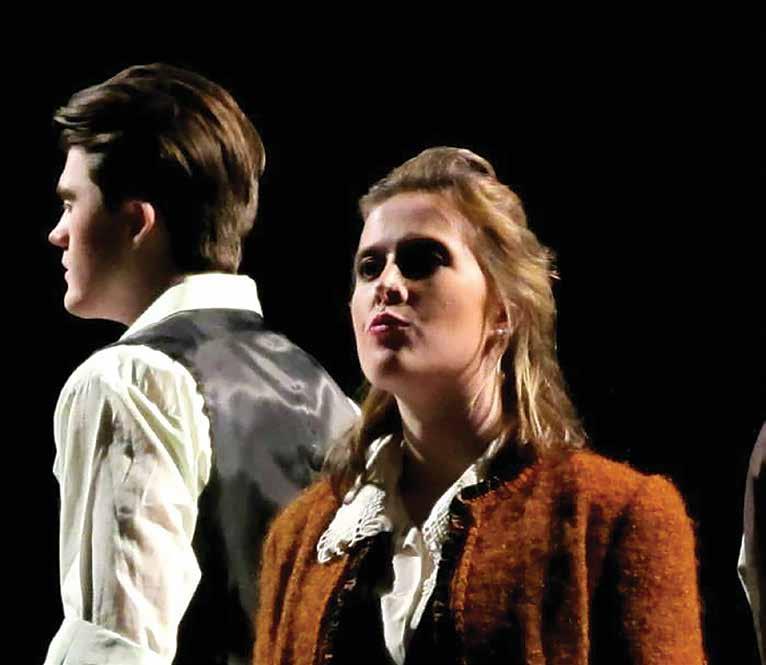
Some of the cast of HATS’s performing Animal Farm, directed by Tania Clarke
on Trial in Michaelmas. The production, adapted from Frank Cottrell Boyce’s televised play, centred on a group of Jewish men in Auschwitz who put God ‘on trial’ for seemingly breaking the covenant he made with the Jews. Reviews in the student press were glowing. One commentator called the performance an “incredibly powerful piece of theatre... emotionally moving and thoughtprovoking, but never insensitive in its depiction of intense suffering.” Further to this success, there was also a first-year production of Tom Stoppard’s classic tragicomedy Rosencrantz and Guildenstern Are Dead. More recently, HATS has also staged an ambitious interpretation of Orwell’s Animal Farm –with equally glowing reviews – as well as a production of Look Back in Anger It is one thing to achieve dramatic success in Cambridge and quite another to mirror
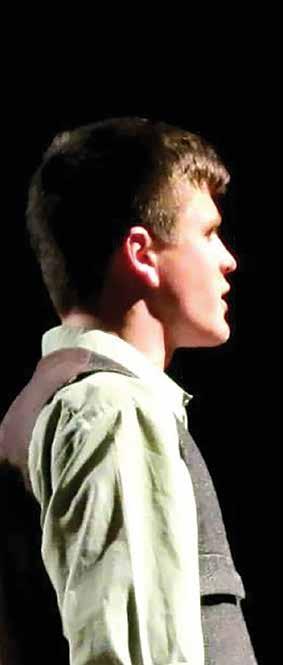
that success outside ‘the bubble’. However, this rare feat has been accomplished by the team behind Dippermouth, a new ambitious and outward-facing theatre company based in London, which sees many Homertonians in its ranks – including one of its Artistic Directors, Quentin Beroud, Homerton 2010–2013. They have staged a very successful first season, developed by and starring several extremely talented Homerton graduates, including Ellie Nunn and George Fouracres, both already represented by high-profile acting agencies. Recently the company has partnered with the English-Speaking Union to deliver the 2014 Performing Shakespeare programme to secondary school pupils, taking over from Shakespeare’s Globe – neatly disseminating two of Homerton’s great exports: excellence and education. Their second season will be announced shortly on their website (www.dippermouth.com).
In addition to the theatrical output of the College, this year has seen a concerted effort on behalf of the HUS and the College to build stronger ties with local and national charities. Florrie Grigson, HUS Environmental and Ethical Affairs Officer, has launched a successful initiative with Jimmy’s Night Shelter, a nearby charity for the homeless. We have also pioneered a means for students to donate leftover food supplies at the end of each term to good causes, as well as donating over £600 and £1000 respectively to charities from our annual Harry Potter Formals and Children in Need Auction. Further to this, one of our 3rd year students, Poppy Damon, was also the co-organiser of this year’s Cambridge Ethical Festival, which arranged numerous events last term across Cambridge to promote positive causes and initiatives.
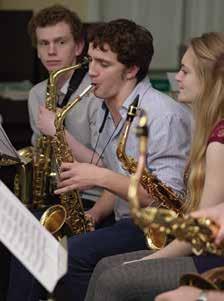
Musically, HCMS (Homerton College Music Society) has had a stellar year; this included recitals of Clementi, Tchaikovsky and Weber by 1st year Coleman Chan, and Mozart’s Oboe Quartet in F major by fellow fresher Nathalie Green-Buckley, with the Pirazzi Quartet. HCMS’s very own Outreach Advisor, Stefano Manca, presented a programme of Liszt and Wild on piano. The Lent Term concert featured HoJO (Homerton Jazz Orchestra), Homerton Singers, Homerton Orchestra, and the much loved Absolute Pandemonium. HoJO have also treated us with their new ‘Jazz in the Bar’ nights, filling the Griffin on several Tuesday and Saturday evenings.
Other societies at Homerton have also continued and expanded this year – including the Allotment Society led by Joscha Thiele, and the King’s Head Society, a popular discussion group named after the group who re-founded the College in the 18th century. The newly created Homerton Dance Society is creating a strong base with a variety of classes, with two Homertonians representing the University in the CU Dancesport Team, which won the National Intervarsity Dancesport Competition for the 3rd year in a row. Equally, the HUS’s two Women’s Officers (Miranda Slade and Isabelle Barber) hosted several popular events. The efforts of Homerton’s very own HUS LGBT (Lesbian, Gay, Bisexual and Transsexual) Officer, Russell Jones, also deserves a special mention, as he ensured that the College raised the LGBT flag on the 1st of February to mark the start of LGBT History Month – making Homerton the only College to do so. This coincided with several events staged in the College on the subject, including a discussion forum.
In summary therefore, it has been a golden year for societies at Homerton, and the future looks bright – already several students have been in touch about setting up more clubs in College. With this in mind, we can say with confidence that in terms of successful extracurricular activity, there are few places in Cambridge better than ours.
Luke White
HUS JCR Societies Officer 2013–2014
Francis Dearnley
HUS President
above HoJO perform at one of their ‘Jazz in the Bar’ evenings
photo courtesy of Calvin Wakeford
MY TIME IN NEPAL
10 students were once again awarded Pilkington Travel Grants made available from the Pilkington Trust. For more information on the Pilkington Travel Awards go to the Alumni pages of the website.
Harriet Flower tells her story
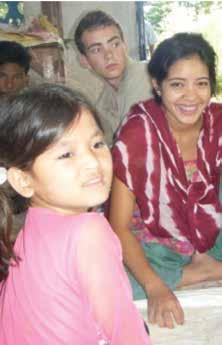
During the summer, I spent 6 weeks living at The Children’s Peace Home in the hot and dry plains of the Terai of southern Nepal, with 5 other volunteers from Cambridge and Durham universities. We became fully involved in life at CPH, working and playing in equal measure with the children, and teaching during the day at the nearby Hindu Vidyapeeth (HVP) school that they attend. My gratitude goes to the Pilkington Trust for enabling me to do this.
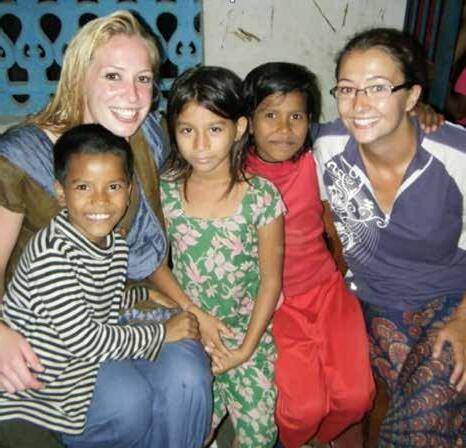
After a ten hour journey from Kathmandu, we stepped wearily off the bus to be greeted by five grinning boys sent as a vanguard from The Children’s Peace Home (CPH), all eagerly offering to carry our luggage (apparently unperturbed by the fact that our rucksacks were twice the size of most of them). After managing to sate their eagerness to help by handing them some small hand luggage, we set off on our way down a muddy track bordered by freshly planted paddy fields, our eyes drinking in the verdant landscape stretching away towards the distant hills that enclose the Dang valley. Twenty hot and dusty minutes later, we followed our guides through the gates of CPH in the tiny village of Parsa, which is home to 36 children who, for a variety of reasons, are not able to live with their families.
Immediately we were surrounded by a sea of smiling faces jostling to welcome us. Such was my introduction to the CPH family – and a family it certainly is.
above From left to right: Naomi Walker (another Cambridge volunteer), Arati, Anju, myself, and Jyoti
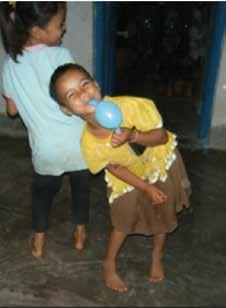
above right Satyata and Durga beside themselves with excitement when Sophie (a volunteer from Durham) produced some balloons!
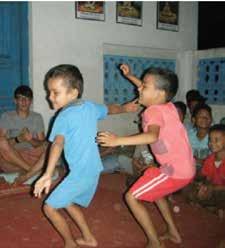
right Cecir and Minaj take to the Dance Floor at Prayer Time
I cannot overstate what an extraordinary place Bhola Nath Yogi (Founder and Headmaster) has created from a few acres of land amidst corn and rice fields. The children are healthy and appear as happy as any children I have come across, despite difficult and often tragic pasts. I was also struck by how self-reliant – and selfregulating – they are; more so, indeed, than any of their peers in other countries that I have come across. They treat each other as brothers and sisters, the older ones helping and instructing the younger ones with a level of care beyond the average biological sibling. Everyone plays their part in the day-to-day running of CPH, whether it be milking the buffalo, tilling and weeding the fields, or climbing the mango trees to bring down a huge haul of delicious, sweet fruit. All this is overseen by the wise and ever-alert eye of their headmaster who, besides encouraging them in their school work, manages to instruct them in moral and spiritual matters, as well as leading the dancing and singing at prayer-time!
Having worked with a number of other organisations that have similar agendas, it was a joy to discover what I believe to be a true success story. CPH seems to have achieved far and beyond anything else I have seen in terms of creating a safe and nurturing environment for its children, and providing a platform for them to reach for opportunities beyond finishing their schooling at HVP-Dang.
All the children at CPH are fully sponsored through HVP-UK to live there and to attend
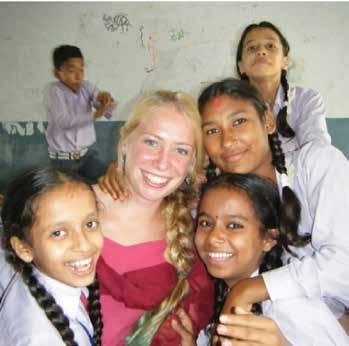
left Myself with some of the Class VI girls
right Sorting and cleaning this year’s rice harvest
HVP school. Since HVP is a private school, a certain amount more flexibility in teaching is afforded, though the syllabus and the textbooks are the same, which lie at the root of some of the problems we encountered whilst teaching at HVP. It was a significant learning curve for me, not only in terms of honing general teaching skills, but in adapting them to the idiosyncrasies of the Nepali education system, and to the needs of individual children. The first challenge I faced was trying to coax the children away from the standard method of rote learning, and to encourage them to think for themselves. It was easy to believe the children understood questions perfectly until one had received exactly the same answer – word for word (and with the same grammatical mistakes made in the textbook) – several times over, only to open the textbook and see they had simply regurgitated it. Inevitably some children were far more proficient at this method than others, which gave for some novel interpretations of the laws of science.
I found there was a huge range of abilities within classes – indeed there were a handful of children in each class who had no English at all (despite the fact that all the classes except Nepali are supposedly taught in English) – this was the case right up to Class 10 – whereas each class also had a few students who understood straight away and had completed the exercise or activity before I had finished reexplaining and translating the instructions. I quickly discovered the importance of
ensuring that every student contributed individually during class time; it was impossible to spot purely from homework who the struggling students were, since copying was rife (though some students – with admirable persistence – seemed to believe they could successfully deny it in the face of the evidence). The disparity in ability made it very difficult to plan lessons that would be productive for all class members. Slowly I developed methods of keeping all the children busy, and found that often the best way to encourage the more reticent members of the class into full participation was to disguise exercises as ‘games’; as soon as you write “boys vs. girls” on the board, there are 30 odd pairs of ears ready and attentive, regardless of any ‘fevers’ they may have been suffering from just a few moments earlier!
During my time in Dang, I learnt a great deal about teaching, about education and its social and economic impact, and about Nepali culture and people. I also developed my confidence in approaching new and varied situations with creativity and sensitivity. Finally, I had an enormous amount of fun and met some extraordinary and inspiring people, from the children who have directly or indirectly suffered at the hands of the Maoist insurgency, to members of the Yogi family who have dedicated their whole lives to education and social work.
Harriet Flower
Graduate in Archaeology and Anthropology, Homerton College
OFF TO OXFORD
I have been fascinated by human disease for as long as I can remember, and Natural Sciences has allowed me to study Pathology from Part IB onwards, specialising in Immunology, Microbiology and Parasitology for my final year.
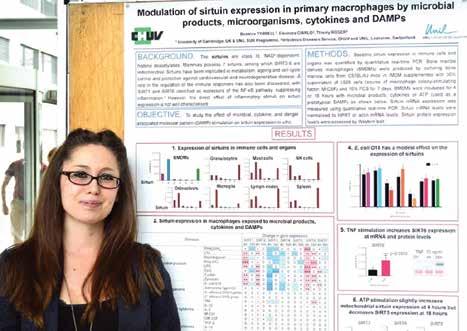
Interested in a career in research, I was selected as one of twenty students from across the world to attend the University of Lausanne (UNIL) Summer Undergraduate Research (SUR) Programme. I spent two months in Switzerland, joining the laboratory of Professor Thierry Calandra and Dr Thierry Roger to conduct an individual project into sirtuin enzyme activation in the innate immune response. The summer culminated in a poster symposium, where I presented my work to fellow students and scientists from UNIL. This was an invaluable opportunity, giving me a glimpse into life as a researcher. Returning to Cambridge, my Part II Pathology project in the Goodall group at the Department of Medicine has been a wonderful experience, investigating stress pathways in innate immune cells and discussing my results at lab meetings – and providing me with further encouragement to pursue this career.
We take a look at where one of our students will be going after Homerton.
My research experience and First class exam results set me in good stead for applying to PhD programmes, and following interviews, I received offers from Oxford, Cambridge and Imperial College. I have accepted a conditional offer as one of five students on the Infection, Immunology and Translational Medicine D.Phil. programme at the University of Oxford. Fully-funded by the Wellcome Trust, this prestigious fouryear programme allows me to complete a rotation year, spending time in three laboratories before choosing where to continue my work. It will provide an excellent foundation for a career in medical
research, in which I aspire to make valuable contributions towards understanding human disease.
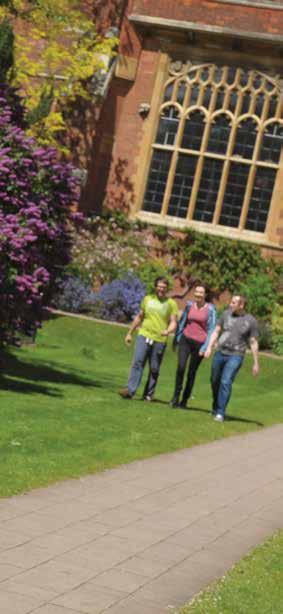
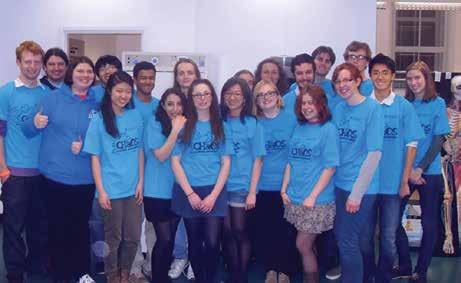
Throughout my degree I have been involved with the student-run science outreach organisation Cambridge Hands-On Science (CHaOS), initially as a demonstrator and then progressing through the committee. We run several events each year: principally Crash, Bang, Squelch! at the Cambridge Science Festival, a December Cambridgeshire Roadshow, and a 7-week Summer Roadshow, taking our hands-on experiments to schools, public venues and scout jamborees around Britain. My passion for increasing public engagement with and understanding of science is something which I hope to incorporate into my future career.
The support of Homerton College has been invaluable in achieving my goals so far: both professionally, through references and guidance from project supervisors and my Director of Studies, Dr Julia Kenyon, and financially through the support of the Cambridge Bursary. I will always remember my time at Homerton with happiness and as an excellent launch to my professional life.
BA (Hons) Natural Sciences student 2011–2014
Beatrice Tyrrell
Below The CHaOS Committee before Crash, Bang, Squelch! 2014
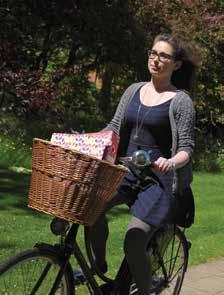
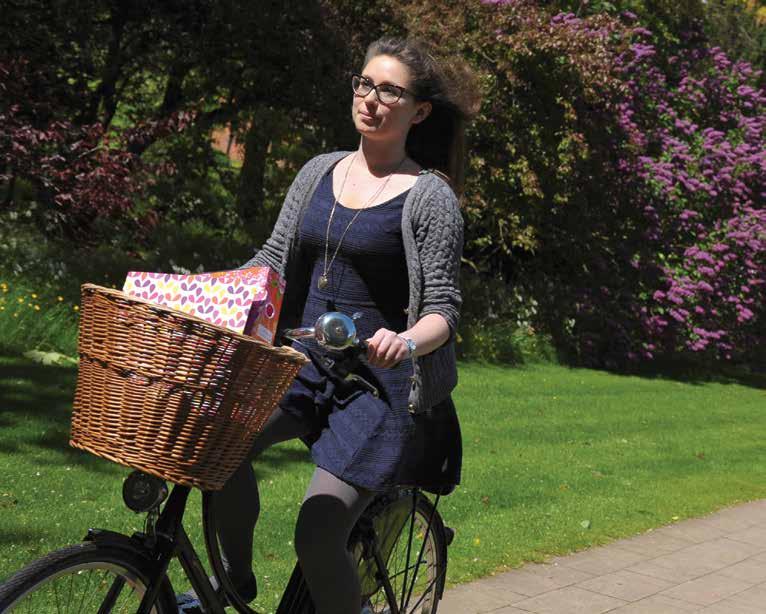
Main Beatrice breaking Homerton’s ‘no cycling in the grounds rule!’
Below Poster symposium following the UNIL SUR Programme
To build a strong house, you need good foundations. This is the same with life, and without the good foundations that Homerton gave me, I would never have had the courage and determination to succeed.
GOOD FOUNDATIONS
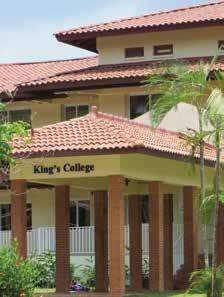
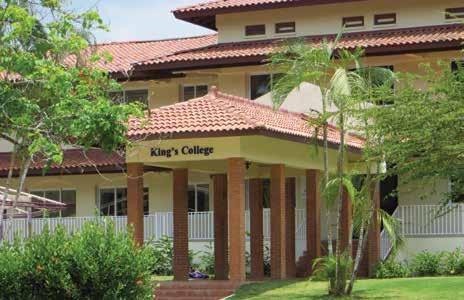
Twentyyears after graduation I am now the Head Teacher of King’s College, the British School of Panama. When graduating from Homerton I knew that life was going to be an adventure; I always wanted to teach internationally but I never expected to be a Head, or for that matter, live in Panama.
I began working for the King’s Group in 2005 in one of the three schools they have in Madrid. King’s Group has an excellent reputation and the chairman Sir Roger Fry was a founding member of COBIS and has worked with the DFE to promote British Education overseas. When, after 6 years with them, they offered me the opportunity to open the first British School in Panama, it was a real leap of faith for both parties; my faith in the company and a real belief in the project, and their faith in me that I could actually make these dreams a reality. I arrived here mid-July, 2012 with parents enrolling the children without the building being finished or the teachers arriving. This roller coaster continued right up to the Sunday night before the school opened when the electricity was at last connected and from that moment on the project has grown from strength to strength.
Looking back on the last 20 months I am inspired by all that we have achieved. I am inspired by my team and all of the work and dedication they give to make the school a success. I am inspired by the sharing and extra time and dedication that our teachers have with the Panamanian teachers from State schools in the training programme that we run to help raise English language teaching standards here in Panama. This runs in conjunction with the Ministry of Education and offers us a chance to really feel we are contributing to developing learning not only for our pupils, but for others as well. As teachers we are constant learners and the peer mentoring between British and Panamanian teachers offers amazing professional development for the team. I am inspired by the parents who believe in the quality of British education and entrust their children to us and wholeheartedly support the school and our community projects. But most of all I am inspired by our children. We opened with 47 children and now have 182 from 31 different nationalities. Their everyday effort and interest; their joy of learning and team spirit; their trials and tribulations and above all the
pride they show at belonging to our school inspires me on a daily basis.
King’s College Panama has a vision to offer first class education and to develop well rounded independent learners, and leading such a project is an amazing experience. Whether it is coping with the monsoon rain, or learning to cope with the Panamanian principle of “I’ll do it tomorrow”, I am proud to be part of the school. We don’t often give ourselves time to reflect and enjoy all we have achieved as there is still so much to be done, however when I do so, I realise how much I learnt in my time at Homerton and how much that experience has helped mould me in to the Head Teacher I have become.
Panama is an amazing country. It has a buzz about it and really is the new land of opportunity. Before coming here, all I knew of it was the canal, cigars and hats! This country is so much more and I feel honoured and privileged to be leading the first British School here.
Vanesa Whay
Homerton 1990–1994 www.kingscollege.com.pa
Above Kings College, Panama
CHARTER CHOIR
The Charter Choir is sounding better than ever this year: numbers are at an all-time high (20 singers, supported by two organ scholars), and there is room for a small amount of further expansion next year.
FORTHCOMING DATES
Tuesday 12th August, 5.30pm: Choral Evensong at St Patrick’s Cathedral, Dublin
Wednesday 13th August, 6pm: Choral Evensong at Christ Church Cathedral, Dublin
Thursday 14th August, 6pm: Choral Evensong at Christ Church Cathedral, Dublin
Saturday 16th August: Lunchtime concert at St Nicholas’s Church, Galway
Sunday 17th August, 11.15am: Choral Eucharist, St Patrick’s Cathedral, Dublin
Sunday 17th August, 3.15am: Choral Evensong, St Patrick’s Cathedral, Dublin
Saturday 27th September: Alumni reunion concert, Homerton College
Tuesday 14th October, 6.30pm: Freshers’ Evensong
Sunday 30th November, 6pm: Advent Carol Service
Tuesday 2nd December, 6.30pm: Homerton Carol Service
Forthe first time, the Choir sang at the Alumni Weekend at the end of September 2013. The short afternoon concert was well attended by visitors, and was an encouraging start to the academic year and to the singing career of the Choir’s ten new 1st-year members!
The main regular commitment of the Charter Choir continues to be weekly Choral Evensong at the Church of St John the Evangelist, Hills Road, but other performances regularly feature in the Choir’s itinerary. Highlights include a joint service with Magdalene College Choir in November 2013, a trip to Southwark Cathedral in February 2014, a “come-andsing” performance of Fauré’s Requiem in March 2014, and a trip to Norwich Cathedral in May 2014.
The tour to Croatia in July 2013 was a huge success, with concerts in four locations within the country’s Istrian peninsula. This summer, the Charter Choir will be touring Ireland, performing in Dublin and Galway, as well as recording our first CD, featuring music which traces Homerton’s development as an institution over the centuries. The CD should be available for purchase in time for Christmas, so watch this space!
Plans for next year include singing Evensong at St Edmundsbury Cathedral, and joint services with Fitzwilliam and Robinson College Choirs.
Alumni are always welcome at Charter Choir services and concerts. The Charter Choir website (www.homerton.cam. ac.uk/charterchoir) contains full details of sung services. The website also contains biographies, and details of tours and recordings.
Alumni can also follow the Charter Choir on their Facebook page, at www.facebook.com/homcharterchoir.
Dr Daniel Trocmé-Latter Fellow and Director of Music
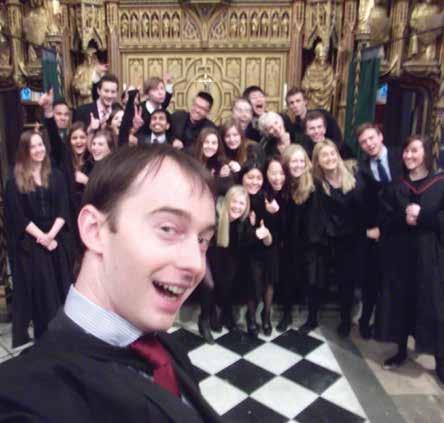
Above Selfie taken by Daniel using his phone
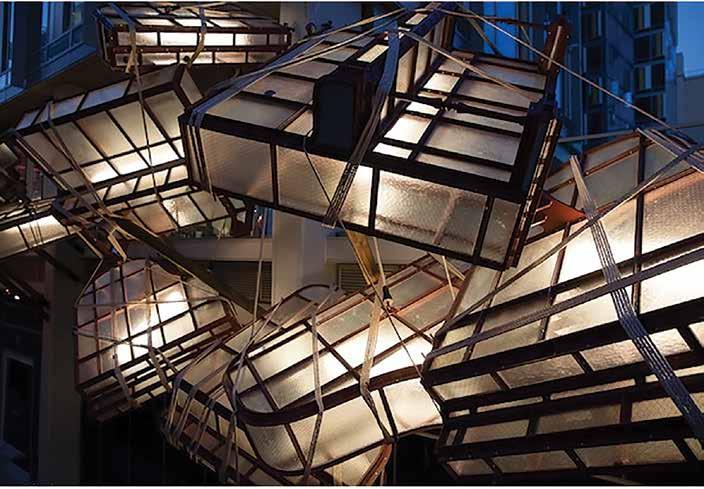
Image taken from www.metaphorm.org
Brian Goggin ((Homerton 1986 –1988) has been a sculptor, artist and whimsy technician since the early nineties, specialising in site specific installations that involve not only those in the artistic community but also city planners, philosophers, scientists and architects to create stunning pieces that interact with our everyday environment.
Brian was previously best known for the 1997 work ‘Defenestration’ which was created with the help of over a hundred volunteers in an abandoned tenement building in a run-down part of San Francisco. ‘Defenestration’ is now being de-commissioned but remained in place for more than fifteen years, with a major refurbishment in 2010. More detail on all of Brian’s works can be found here (http://www.metaphorm.org/works/)
His latest work is a collaboration with conceptual artist Dorka Keehn to create a permanent, site-specific installation in downtown San Francisco entitled ‘…
CARUSO’S DREAM
And My Room Still Rocks Like a Boat on the Sea (Caruso’s Dream)’, or ‘Caruso’s Dream’ for short. The sculptural and audio-visual work consists of a chorus of thirteen glass pianos suspended from an apartment building which light up in response to a recording of Enrico Caruso, the Italian tenor who achieved fame in the early twentieth century. The installation is inspired by Caruso’s experiences during the San Francisco earthquake of 1906, which traumatised him so much that he vowed never to return to the city.
Work started on the installation in 2012 and it was unveiled on 23 February 2014
with a procession of pianos through San Francisco. On arrival, the pianos became part of a carnival-like opening featuring a range of performers including thirteen pianists, five aerialists and a marching band. The unveiling was funded by the Kenneth Rainin Foundation and Black Rock Arts.
To find out more about ‘Caruso’s Dream’, or any of Brian’s other projects, you can visit Brian’s website (http://www.metaphorm.org/ portfolio/carusos-dream/) or follow him on Twitter (@BRIANJGOGGIN).
James Thomson Homerton 1987–1994
LIBRARY UPDATE
Over Christmas the Library was fortunate enough to be able to acquire a substantial collection of over 5000 children’s annuals (plus over 1500 children’s books), ranging in date from the 1870s right up to material from the 1970s. It is a very varied collection, with a lot of familiar titles, but also some shortlived and more unusual ones too. It is very exciting to be able to start planning to curate this collection, and open it up to students and researchers, both in Cambridge and beyond.

However, at present the collection is being stored offsite, as the Library does not have the space to absorb it. This has raised a wider issue about the Library’s special collections, and it is hoped that planning can begin for a separate resource centre to store the annuals and rare books, providing an attractive space for exhibitions, alongside study space for researchers. This will also ensure that events and researchers do not disturb students studying in the main Library.
With an ever growing student population, and increased use of online shopping the Porter’s regularly find themselves knee deep in parcels. It is hoped that as well as providing Homerton with a more prominent entrance on Hills Road, a larger Reception area will also be able to incorporate an archival space to house the growing collection of generous donations from our alumni. Plans are still very much in the early stages, but it is an exciting time for the future of Homerton Library, Archive and the Porter’s Lodge.
Liz Osman Librarian

Above An example of some of our illustrated children’s books
DONORS TO THE COLLEGE
1 March 2013 – 28 February 2014
The Principal and Fellows of Homerton College wish to thank all those alumni and friends who have generously made donations to the College over the last year. Every effort has been made to ensure the list is accurate; do contact us if you believe we have made an omission.
The College would in addition like to thank those who have made gifts of art works and books. We are also very grateful for those members who give up their valuable time in support of the Development and Roll Office.
Aniko Adam
Carolyn J Adams
Shama Akhtar
Elizabeth M Alden
Eileen Alexander
Roger Ali
Rosemary L Allan
Alison E Allen
Della A Allen
Sarah J Anderton
Christine Andrews
Hilary M Armfield
Jane L Arney
Eleanor J Ashworth
Beckie Askew-Coles
Lisa J Aspinall
Tamsin J Austoni
Gillian M Baker
Margaret G Baker
John N Ball
Laurence M Ball
Anne M Bambridge
Jacqueline Bardsley
Judy Barham
Caroline J Barker
Ann J Barnes
Bernice A Barton
Gayatri Basu
Judith H Baxter
Naomi A Baynes
Stephanie Beardsworth
Frances P Beauchamp
Kathryn E Beaumont
Gabrielle J Bell
Christopher W Bellamy
Valeria Benevolo Franca
Susan L Bennett
Elizabeth A Benning
Melanie J Benson
Sheila M Berry
Rosemary A Billett
Marianne J Billitt
Diane Bilson
Jane S Bishop
Elizabeth Black
Norma A Blamey
Lynette E Blanchford
Margaret Blott
Mavis J Blow
Patricia A Blythe
Alexandre P Boury
Marion R Bower
Alison C Box
Edward P Boydell
Ruth R Brass
Muriel Brewster
Ruth M Briant
Alison Brinklow
Margaret A Brockbank
Angela J Brooks
Wendy A Brown
Brenda H Brufal de Melgarejo
Brenda J Buchanan
Alison E Buck
Sandra E Burmicz
Robert P Burn
Denise E Burns
Paul C Burns
Jill C Burton
Erin L Butcher
Cathleen M Butler
Jacqueline A Butler
Kirsty N Byrne
Janet M Campbell
Margaret Campbell-Smith
Jean D Carnall
Christine Carne
Michael C Carr
Shirley H Cawthra
Maureen Champion
Kim C Chaplin
Steven B Chapman
Anna J Chapple
Jane A Charman
Shruti Chaudhri
Linda J Chesshire
Raymond C Cilia
Frances M Clare
Janet C Clark
Linda J Clark
Jean M Clarke
Julia C Clay
Frances O Clayton
Marilyn B Clements
Clare A Clouston
Laird Coby
Trudy Cockburn
Muriel Cole
Katherine L Coleman
Jean M Collins
Sally J Collins
Abbie L Connors Atkinson
Nancy J Cook
Eileen P Coombes
Christine Cooper
Patricia K Cooper
Simon M Cooper
Muriel K Cordell
Lorna Cordell-Smith
Alexandra K Courage
Mary J Coverdale
Olivia Craig
Helen M Crawford
Hilary J Crawforth
Lesley-Anne Crooks
Bernadette M Crossley
Margaret E Crowe
Sheila A Crowther
Maureen Cullimore
Mary L Cure-Freeman
Patricia Cusack
Lyndis P Dada
Kevin T D’Albert
Margaret B Dale
Michael J Dangerfield
Clare M Danielian
Judith Davidson
Julia B Davis
Anne L Day
Eliza M de Uphaugh
Anthony J Delany
Sylvia M Dibble
Elizabeth A Dickinson
Susan Dickinson
Susan M Dinnage
Gillian M Dirks
John N Dodsworth
Marguerite M Donkin
Lesley T Dover
Kathleen L Down
Mary L Dowse
Helen M Draper
Rosemary S Dray
Sheila A Duncan
Joan P Dunn
Wendy A Dunnett
Susan Durston
Janet Edgar
Amanda J Edwards
Elizabeth M Edwards
Jane E Edwards
Pamela Edwards
Charles C Ellison
Dorothy Elven
Florence I Evans
Tracey L Evans
Barbara Ewing
Janet K Farley
Wendy E Farmer
Valerie J Featherstone
Adrienne H Ferguson
Allessandra L Ferretti
Marilyn Fersht
Lidia Fesshazion
Denise E Few
Gillian E Figures
Michelle L Fisher
Jacqueline G Fleetwood
Amy V Fleming
David S Fletcher
Mike Flude
Sarah Flynn
Marion W Foley
Michael J Follen
Emma Forster
Ethel O Foster
Miriam France
Dorothy Franklin
Muriel Fraser
Jenifer A Freeman
Christine H Frost
Maureen R Frost
Jill Fuller
Margaret G Funnell
Pamela J Gaddes
Lisa M Galantini
Diana M Gallop
Gillian M Ganner
Wendy J Garforth
Pamela A Gentle
Margaret D Georgiadis
Joan H Gibson
Dilys M Gillett
Sarah E Gordon
Christine P Grainge
Judith M Grandage
John M Gray
Roger Green
Jennifer E Griffith
Jill M Grimshaw
Stephen Grounds
Fiona J Gruneberg
Pamela R GustavusJones
Elizabeth L Habashi
Diana Hadaway
Gaynor A Hall
Ann M Hamilton Herbert
Judith Hammond
Dorothy Hanley
Mark D Hanley-Browne
Elizabeth C Harding
Frances Hardy
Julia A Harker
Coral Harrow
Shirley D Haslam
Manjit K Hayre
Kathleen Hayward
Claire M Heald
Lesley M Hendy
Gillian M Hewin
Pauline M Hickey
Catherine J Hicks
Jill R Hicks
Susan C Hill
Lucy C Hilton
Doreen E Hobbs
Gregoire A Hodder
Ian C Hodgson
Julie A Hogg
Joan Hollinghurst
Patricia A Holmes
Pauline M Hood
Richard A Hopkins
Brian J Howarth
Carl B Howarth
Rosemary J Howells
Gillian E Hoyte Byrom
George Hubbard
Mary E Hughes
Leonie M Hyde
Emily Ikelle
Beryl A Izzard
Ann E Jackman
Joan F Jacobs
Amanda E James
Marion N Jenkins
Ruth E Jerram
Wendy A Jerred
Elizabeth C Jestica
Diane E Johnson
Katy M Johnson
Valerie A Johnson
Robert T Johnston
Paul R Jones
Tracey A Jones
Jane A Keating
Chloe J Kee
Wanda V Kielbinska
Catherine J King
Ann J Kirkby
Thomas E Kitchen
Audrey C Knighton
Debra E Knights
Judith A Knowles
Joy M Kohn
Martin Krawczyszyn
Gwendoline E Lancaster
Christine E Landels
Jillian Langley
Rosemary J Langlois
William E Lawrance
Margaret E Lawrence
Teresa Lea
Gek-Ling Lee
Lynn Lemar
Rachel I Lewington
Xiajuan Li
Chistine M Lincoln
Rachel J Linfield
Kathryn F Lodge
Cynthia Loudon
Susan M Lovett
Diana M Lucas
Michael Lynch
Janette S MacDonald
Rachel M Macdonald
Andreas C MacFarlane
Ann-Marie Mackay
Margaret S Mackie
(Deceased)
Christine W Macpherson
David A Male
Judy N Manson
Constance L Marriott
Pamela A Marshall
Audrey M Martin
Daniel A Martin
Sheila A Martin
Maria-Esther MartinezCantu
Judith O Martin-Jenkins
Jane R Matthews
Patricia M Maude
Elaine R Maunder
Margery W McCarthy
Julie M McCleery
Sharon A McClure
Susan McFarland
Robert G McGowan
Jennifer McKay
Pamela M McKellar
Elizabeth J McLean
Lucy McMahon
Victoria M McNeile
Elisabeth A McOwan
Sarah H McWhinnie
Patricia Mee
Pamela M Meeks
Anne Mellor
Margaret Meredith
Kerry A Merriam
Alison Mesher
Anthony R Metcalfe
Grahame B Miles
Trudi A Miles
Mary J Millan
Sheila A Miller
Mary E Mills
Rebecca L Millward
Carol F Milton
Helen M Mitchell
Robyn A Mitchell
Jill Moor
Denise P Moore
Ian H Morrison
Deborah Moss
Remi H Moynihan
Dilys E Murch
John Murrell
Louise M Mursell
Clare L Myers
Cordelia A Myers
Joanna M Newman
Priscilla M Newman
Dorothy M Nicholls
Annabel Nnochiri
Reg F Norman
Paul T Norris
Wendy E Oakley
Devin-Paul O’Brien
Julia B Olisa
Jove R Oliver
James V O’Neill
M R Orr
Sarah J Palmer
Evelyn P Parker
Janet Parkinson
Christine A Parkyn
Esme J Partridge
Ruth E Pavey
Catherine L Payne
Molly D Payne
Patricia A Pells
Augustine J Pereira
Eileen Perkins
Anne B Perrin
Yvonne M Pidgeon
Nicholas M Pillow
Moira E Pitchford
Nicola M Pitzey
Dinah G Player
Marion A Pogson
Rosemary A Pope
Elaine Pounder
Joan M Powell
Katharine B Pretty
Susan J Prideaux
Margaret Prince
Krista A Pullan
Helen P Pye
Sandra G Raban
Peter H Raby
Barbara M Raine
Elizabeth W Rainsbury
Joseph J Randall-Carrick
Holly E Ranger
Vera Ratcliffe
Diane M Rawlins
Sarah J Rawlins
Simon Ray
Valerie B Read
Karen W Ready
Rosemary A Rees
Susan Rescorla
Audrey Reynolds
Matthew J Reynolds
Dorothy Richardson
Ellen A Richardson
Erica R Rigg
Penelope M Riley
Vivien Rink
Margaret Rishbeth
Jane Rivers
Margaret C Robbie
Alison Roberts
Daniel W Roberts
Susan Rodford
Doreen G Rogers
Hayley Romain
E J Rose
Oliver J Rubens
Verity J Rudd
Philip J Rundall
Phillipa C Rushby
Jonathan Russ
Julia Sale
Gillian M Sallis
Claire E Salmon
Jean Salt
Helen R Sandle-Baker
Elizabeth R Sartain
David J Satterly
Sylvia M Saul
Ruth A Saunders
Patricia M Saxton
Shabiha Sayed
Ruth Seal
Rosslyn J Sendorek
Julie E Seplaki
Alice A Severs
Jyoti Shah
Denise E Shakespeare
Helen Shanks
Thomas Sharich
Margaret Sharman
Elisabeth J Shave
Jeanetta C Shaw
Sian M Shaw
Christopher A Shephard
Helen E Sheppard
Susan M Shippey
Annette Smallbone
Pamela Smart
Emma J Smith
Lauren Smith
Mary M Smith
Sheila M Smith
Anne Sparrowhawk
Muriel B Spencer
Annabelle L Spicer
Ellena M Spyrides
Vivien C Stableford
Violeta Stafford
Marilyn Stansfield
Sheila E Stephens
Doris Stephenson
Michael A Stephenson
Kay S Stevens
Anthea M Stewart
Susan J Stirrup
Patricia M Stockdale
Patricia K Stott
Barbara E Studd
Frances R Surridge
Josephine M Sutton
Jennifer D Svrcek
Jacqueline Swegen
Patricia A Swindlehurst
Caroline E Sykes
Lu Zheng Tan
Jill M Taylor
Joan M Taylor
Sarah Taylor
Paula M Tebay
Elizabeth L Thomas
Elizabeth S Thomas
Brenda J Thompson
Janice M Thompson
James D Thomson
Janet A Thomson
Philippa K Thomson
Marjorie Thorley
Hazel A Thornley
Zena P Tinsley
Lisa C Tiplady
Louisa M Tipler
Stephen P Tomkins
Elizabeth M Tomlinson
Cheryl A Trafford
Moira F Tredwell
Margaret D Trow
Victoria M TrueBhattacharyya
Christine Tubb
Ian M Tunnell
Elizabeth Tunnicliffe
Frances E Turner
Sergej Using
Janet E Valentine
Jennifer M Varley
Patricia J Veness
Peter J Ventrella
Rosemary M Viner
Tessa M Vivian
Joy E Voisey
Emma R Vyvyan
Mary-Louise Wadsworth
Rosemary M Wardle
Peter M Warner
Rachel Warner
Ann W Watson
Charlotte R Watson
Sally R Watson
Victor G Watson
Janet S Webb
Bridget E Weir
Joyce L Welch
Roberta S Wells
Dilys West
Jane E Westaby
Maureen P Weston
Maralyn Westwood
John J White
David Whitebread
Lois M Whittaker
Anthea W Wicks
Heather R Wilkinson
Anna M Williams
Eunice M Williams
Sally Williams
Madeleine F Willmer
Elizabeth A Wilson
Jennifer Wilson
Pamela A Wilson
Angela M Wimbush
Eileen Winter
Helen E Wood
Sally M Woodcock
Janet R Woodford
Angela J Woodruffe
Emma A Wright
Katie Wright
Di Wu
Rhiannon L Wynne
If you would like to join the many others who have given to College please complete the donation form on the reverse of the address sheet.
ANNUAL REUNION
Friday 26th to Saturday 27th September 2014
PROGRAMME
Friday 26th September
19.30 for 20.00 Dinner in the Great Hall
Saturday 27th September
Special Anniversary groups – meetings independently arranged.
09.30 – 10.30 Registration – Coffee available
10.30 – 12.00 Anniversary groups meet independently RSM AGM (drinks refreshments will be made available)
12.30 Lunch in the Great Hall
14.30 – 15.30 The Singing Scientist – Melanie Keene
Enlivened by performances, Dr Melanie Keene, Homerton Fellow, will survey private and public music-making to reveal how scientific songs have been written and performed as critical responses to new theories and technologies, as satirical lyrics to well-known tunes. Arguing that they have played a crucial role in composing the very idea of the scientist itself.
Tours of the College and Gardens
16.00 - 17.00 Charter Choir performance Tours of the College and Gardens
16.30 – 17.30 Tea – open to all attending
19.30 for 20.00 Saturday Dinner
We look forward to welcoming you back to College in September.
In addition, the library will be open from 2pm – 4pm where we plan to exhibit photographs from the archives.
Please make every effort to book early, this not only greatly assists the organisation and planning, but also increases the possibility of our being able to accommodate all who wish to attend. This year the bookings will be open from Tuesday 1st July 2014 until Monday 1st September 2014. Please ensure we receive your booking and payment within this period. Unfortunately, we cannot accept any bookings received after Monday 1st September.
We would encourage you to make your bookings online at https://www. eventbrite.co.uk/e/reunion-weekendtickets-11329832835. If you wish to book using the booking form please ensure your payment reaches us with the two month period. Bookings can also be made over the phone by calling 01223 747280 (card payment will be required with all phone bookings).
The University’s Alumni Festival will be held from 26th – 28th September 2014. A full programme of the University’s events can be obtained from:
Cambridge Alumni Relations Office (CARO) 1 Quayside
Bridge Street
Cambridge CB5 8AB
Tel: +44 (0)1223 332288
Email: contact@alumni.cam.ac.uk or visit: http://www.alumni.cam.ac.uk/