Emily Pettengill ’10
WALK AND TALK W
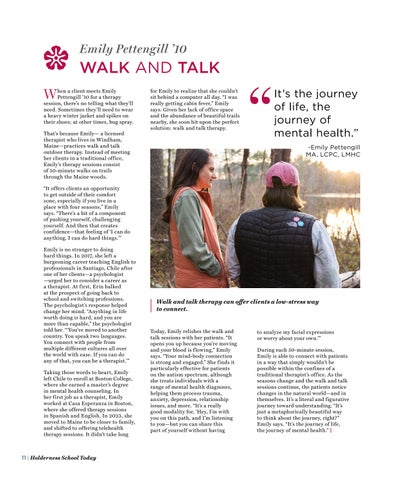
hen a client meets Emily Pettengill ’10 for a therapy session, there’s no telling what they’ll need. Sometimes they’ll need to wear a heavy winter jacket and spikes on their shoes; at other times, bug spray. That’s because Emily— a licensed therapist who lives in Windham, Maine—practices walk and talk outdoor therapy. Instead of meeting her clients in a traditional office, Emily’s therapy sessions consist of 50-minute walks on trails through the Maine woods.
for Emily to realize that she couldn’t sit behind a computer all day. “I was really getting cabin fever,” Emily says. Given her lack of office space and the abundance of beautiful trails nearby, she soon hit upon the perfect solution: walk and talk therapy.
“
It's the journey of life, the journey of mental health.” -Emily Pettengill MA, LCPC, LMHC
“It offers clients an opportunity to get outside of their comfort zone, especially if you live in a place with four seasons,” Emily says. “There’s a bit of a component of pushing yourself, challenging yourself. And then that creates confidence—that feeling of ‘I can do anything. I can do hard things.’” Emily is no stranger to doing hard things. In 2017, she left a burgeoning career teaching English to professionals in Santiago, Chile after one of her clients—a psychologist —urged her to consider a career as a therapist. At first, Erin balked at the prospect of going back to school and switching professions. The psychologist’s response helped change her mind. “Anything in life worth doing is hard, and you are more than capable,” the psychologist told her. “‘You’ve moved to another country. You speak two languages. You connect with people from multiple different cultures all over the world with ease. If you can do any of that, you can be a therapist.’” Taking those words to heart, Emily left Chile to enroll at Boston College, where she earned a master’s degree in mental health counseling. In her first job as a therapist, Emily worked at Casa Esperanza in Boston, where she offered therapy sessions in Spanish and English. In 2023, she moved to Maine to be closer to family, and shifted to offering telehealth therapy sessions. It didn’t take long
11 | Holderness School Today
Walk and talk therapy can offer clients a low-stress way to connect. Today, Emily relishes the walk and talk sessions with her patients. “It opens you up because you’re moving and your blood is f lowing,” Emily says. “Your mind-body connection is strong and engaged.” She finds it particularly effective for patients on the autism spectrum, although she treats individuals with a range of mental health diagnoses, helping them process trauma, anxiety, depression, relationship issues, and more. “It’s a really good modality for, ‘Hey, I’m with you on this path, and I’m listening to you—but you can share this part of yourself without having
to analyze my facial expressions or worry about your own.’” During each 50-minute session, Emily is able to connect with patients in a way that simply wouldn’t be possible within the confines of a traditional therapist’s office. As the seasons change and the walk and talk sessions continue, the patients notice changes in the natural world—and in themselves. It’s a literal and figurative journey toward understanding. “It’s just a metaphorically beautiful way to think about the journey, right?” Emily says. “It’s the journey of life, the journey of mental health.” |