I
f you happen to live in a small Alaskan village, chances are you’d have a hard time finding a doctor— or even a glass of clean water—if not for Mike Brubaker ’82 and the organization he works for, the Alaska Native Tribal Health Consortium (ANTHC). For the last 17 years, Mike has served as the Director of Community Environment and Health at ANTHC, a nonprofit consortium of Alaskan tribal health organizations. The ANTHC provides a wide array of healthcare services to Alaskans through training, health education, disease and injury prevention, and rural water and sewer construction. “Whether you’re Native or non-Native, you’re going to turn your tap on and the water is going to come from a water system run by the tribal health system,” Brubaker says. “Your solid waste is going to go out to a landfill that we built. When you need health care, you’re going to go to a clinic —and the services, whether you’re Native or non-Native, are provided by the tribal health system.” Within the ANTHC, Mike leads a department focused on performing community health impact assessments. “I have a team of about 20 here, and we basically try to understand what makes a community healthy,” Mike says. In an era of rising global temperatures— and with the Arctic warming at a much faster rate than the global average—there is plenty to assess. Mike’s work has brought him to rural towns and villages across the state, where he’s seen the impacts of climate change firsthand: how melting permafrost has damaged water pipes and health clinics; how the shifting migration patterns of animals have altered how people feed themselves; and how unprecedented, year-round wildfires have scorched the forests and tundra. “For the past 20 years, the biggest driver for health challenges in rural Alaska has been climate change,” Mike says. To help keep track of those changes, Mike started the Local Environmental Observer (LEO) Network, an online database where local observers across the Arctic - and now the world - report
“
We basically try to understand what makes a community healthy...” -Mike Brubaker ’82
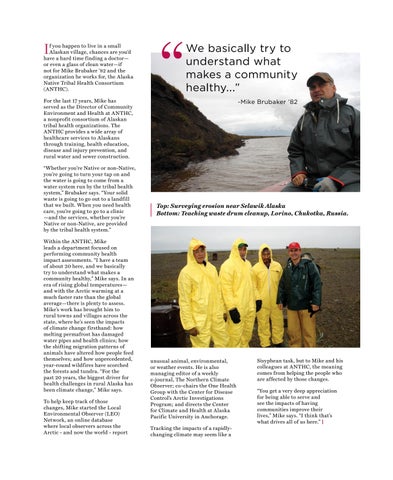
Top: Surveying erosion near Selawik Alaska Bottom: Teaching waste drum cleanup, Lorino, Chukotka, Russia.
unusual animal, environmental, or weather events. He is also managing editor of a weekly e-journal, The Northern Climate Observer; co-chairs the One Health Group with the Center for Disease Control’s Arctic Investigations Program; and directs the Center for Climate and Health at Alaska Pacific University in Anchorage. Tracking the impacts of a rapidlychanging climate may seem like a
Sisyphean task, but to Mike and his colleagues at ANTHC, the meaning comes from helping the people who are affected by those changes. “You get a very deep appreciation for being able to serve and see the impacts of having communities improve their lives,” Mike says. “I think that’s what drives all of us here.” |