Spring/Summer 2021 v New York’s Post-Pandemic Economy v What Next for Central American Refugees? v Revaluing Our Work Inside and Outside the Home v Russell Harrison: Work and Words v In Search of an Autonomous and Meaningful Work Life v Battling Bro Culture at Uber v If Truth Won’t Out, Break Down the Door
REGIONAL LABOR REVIEW
REGIONAL LABOR REVIEW Of the New York Metropolitan Area
Regional Labor Review
Editor-in-Chief Gregory DeFreitas
Editorial Board Debra Comer Niev Duffy Conrad Herold Sharryn Kasmir Oren Levin-Waldman Bhaswati Sengupta Marc Silver Lonnie Stevans Martha Weisel
Editorial Office Regional Labor Review Center for the Study of Labor and Democracy 200 Barnard Hall 104 Hofstra University Hempstead, NY 11549 Fax: 516-463-6519 Email: laborstudies@hofstra.edu
Regional Labor Review is published twice each year by the Center for the Study of Labor and Democracy at Hofstra University. The opinions and conclusions expressed in each article are the authors’ own and do not necessarily reflect those of the editors, the Center for the Study of Labor and Democracy, or Hofstra University. © 2021 by Center for the Study of Labor and Democracy, Hofstra University. All rights reserved. Requests to reprint articles from Regional Labor Review should be sent to the editorial office. No part of this publication may be reproduced without the consent of the Center for the Study of Labor and Democracy. RLR articles are indexed in the Alternative Press Index. SUBSCRIPTIONS: Annual Subscription Rates: In U.S.: $25 for individuals; $50 for institutions. For other countries: add $3 to cover postage. Correspondence regarding subscriptions should be addressed to the editorial office. A subscription form is on the last page of each issue. SUBMISSION OF ARTICLES: We welcome unsolicited contributions of original articles, interviews or book reviews, but we request that authors first send brief query letters or emails (250 words or less). Our primary focus is on the analysis of labor issues in the New York City/Long Island metropolitan area. All articles should be written in a clear, accessible style and kept to a length of 1000 - 7000 words. Email us a cover letter with your article as an attachment (formatted in Microsoft Word) to: laborstudies@hofstra.edu.
VOLUME 23
Spring/Summer 2021
New York’s Post-Pandemic Economy v by Gregory DeFreitas
p. 5
Latest Labor Market Indicators
p. 14
What Next for Central American Refugees? Undoing the Trump Administration Legacy v by Elise de Castillo
p. 16
SPECIAL SECTION: WORK & WORKING PEOPLE IN POPULAR CULTURE Russell Harrison: Work and Words v by Neil Donahue
p. 20
In Search of an Autonomous and Meaningful Work Life
p. 23
v by George Caffentzis
Revaluing Our Work Inside and Outside the Home v by Silvia Federici
p. 24
Battling Bro Culture at Uber v by Jessica Devous
p. 26
If Truth Won’t Out, Break Down the Door v by Emma Trombetta
p. 30
Calendar
p. 32
For detailed instructions, see our style sheet on the Internet at: http://www.hofstra.edu/cld. ISSN 1540-8426
3
THE CURRENT JOB OUTLOOK
New York’s Post-Pandemic Economy: Will Recovery Reshape Labor Prospects? by Gregory DeFreitas
A
s 2021 hits the mid-year mark, health and job gains have surged apace with public hopes of a new beginning. COVID-related deaths in the U.S. peaked this January at 26,000/week. Since then, half the population has received vaccinations and the weekly death rate has plunged by 90%. With growing confidence in public safety and relaxation of business restrictions have come increased signs of health in job markets. Thanks to many months of public health efforts and rising vaccination rates, the country was able to start blinking its way out of The Great Confinement in the first half of this year. Continued massive federal aid packages kept total incomes and spending from cratering. By gauging progress to date, at both the national and local levels, we may be better able to chart promising economic policy paths forward.
The COVID-19 pandemic shrank the national economy by 3.5% in 2020. That April, the national lockdown caused the official unemployment rate to nearly quintuple to 14.7% in April and the number of unemployed jobseekers quadrupled to 21 million – the biggest monthly increase in over 70 years of government records (Figure 1). That same month, the $2 trillion federal CARES aid began flowing, thereby preventing even worse joblessness, income loss and business failures. In the following months, as one state after another, sector by sector, gradually emerged from lockdowns, job growth resumed. By September, nearly 12 million jobs had been regained. But that was still barely half the jobs lost in April and the unemployment rate hovered at twice the pre-COVID level. With key parts of the CARES aid package about to expire at summer’s end, Congressional Democrats pushed for passage of the
Figure 1: Unemployment Rates in U.S., NYC & Long Island, 2020-2021(% monthly, seasonally adjusted)
4
5
The ARPA child benefits only last one year, but could slash child poverty nearly in half, according to a new Columbia University study.1 If made permanent, they would move the U.S. far closer to EU-style “family allowances and thus “have the makings of a policy revolution,” in the words of one poverty policy specialist.
Capitalist markets are supposed to signal deficient supply by pushing up the price of labor – the hourly wage. While some nominal wage increases have started in restaurants and other industries, overall these have still been too small and too counterbalanced by stagnant pay elsewhere to raise inflationadjusted wages (Figure 3). As of this April, the average hourly wage of non-supervisory production workers, after inflation adjustment, is 3.4% below its April 2020 level! Turning to wages per week: even with a 2.7% expansion of weekly hours of employment, real earnings per week also fell, from $882 per week down to $875 – a 0.8% decline.4
However, Republican opposition forced two key proposals to be dropped from the final law. One would have gradually raised the federal minimum wage – stuck at $7.25 for over a decade – to $15 per hour by 2025. The other would have set the Unemployment Insurance Supplement from the federal government at $600/week – restoring it to the level in the original 2020 CARES Act.
Figure 2: Unemployed Persons per Job Opening
HEROES Act. This would have extended through December the employer mandate for emergency paid sick leave and family medical leave; the $600 UI supplementary federal benefit as well as PUA coverage of the self-employed and gig workers; and the Paycheck Protection Program of business loans. Additional, controversial elements were: a second, one-time “recovery rebate” payment of up to $1200/adult; health insurance assistance for those laid off during the pandemic: federal aid to state & local governments & the US Postal Service to avoid layoffs and disruption of vital services; and a Heroes Fund to ensure that essential workers received hazard pay and child care assistance.
Once the new Biden administration took office in late January, it moved quickly to seek a more ambitious program to provide both broad stimulus and target more aid toward groups disproportionately harmed by the pandemic – particularly working mothers and lowincome African Americans, Hispanics and Native Americans. President Biden signed the $1.9 trillion American Rescue Plan Act (ARPA) into law in mid-March. Its provisions include: • Direct one-time payments to eligible households of up to $1400/ adult and $1400/child (phased out as income rises above a threshold level); • Unemployment Insurance Supplement of $300/week from the federal government, on top of state UI benefits, until Sept. 6, 2021; • Pandemic Unemployment Assistance, extending UI temporarily to freelancers and independent contractors; • Emergency Rental Assistance Program adds $25 billion to state/ local govt. funds to aid high-need households struggling with rent and utility bills; • Paycheck Protection Program (PPP) extended with another $7.25 billion in loans to small & medium-size businesses, plus taxexempt nonprofits; deadline for applications remained 3/31/2021. • Higher Educational assistance to colleges and universities (increased to $39.6 billion). • State & Local Fiscal Recovery Fund of $350 billion to state, local and tribal governments to cover pandemic-related public health and other costs, as well as to fund child care providers and improve infrastructure (including broadband access for lowerincome households); • Child Income Tax Credits extended to 93% of children and benefits increased to $300/child age 5 & under, $250/child ages 6-17. For example, a single mother with income under $112,000 raising two young children could qualify for $7,200/year (paid monthly, to ease cash flow), plus SNAP and Medicaid;
The Republican-led Senate killed the HEROES aid bill, arguing that its benefits would remove incentives for job search by unemployed workers just as the job market was rebounding. But, with no resumption of federal aid through the autumn, job growth slowed to a feeble 0.4% and the job deficit was still over 10 million by December. Late that month, Congress finally passed the $900 billion CARES-2 Act. It updated parts of the initial $2 trillion CARES Act by including among its main components: q Direct one-time payments to eligible households of up to $600/ adult and $600/child; • Unemployment Insurance Supplement of $300/week from the federal government, on top of state UI benefits; • Pandemic Unemployment Assistance, extending UI temporarily to freelancers and independent contractors; • Eviction Moratorium extended to February 28, 2021; • Child Care Providers supported by $10 billion of funding; • Expanded internet access for low-income communities via $50/ month subsidies for broadband expenses; • Paycheck Protection Program (PPP) extended with another $285 billion in loans to small & medium-size businesses; • Educational assistance to K-12 schools ($54 billion), colleges and universities ($23 billion). 6
If workers’ wages have not been rising rapidly, why has price inflation suddenly become a hot media topic? It’s true that the Consumer Price Index went up by 5% in May compared to 12-months earlier? That is mostly explained by a sharp rise in both vehicle and gasoline prices. The former was driven by a slowdown in major automakers’ production lines, caused by their supply shortages of car computing components made in Asian factories. The gas price jump seems largely due to two forces: first, increased commuting to newly reopened stores and workplaces. And second, a shocking ransomware shutdown of a major U.S. pipeline operator by a Russian hacking collective. The result: fuel shortages, a spike in gasoline prices, long lines of desperate car owners at gas stations from Texas up the East Coast, and chaos at airlines. The situation only eased once Colonial Pipeline paid millions in ransom. In early June, the US Justice Department announced it had seized much of the Bitcoin ransom from the hackers.
Worker Shortage or Wage Shortage? Republican critics, including those who voted last year for the $600/month federal UI supplement in the original CARES Act, refused to allow passage of the entire Biden rescue package if it included the same supplement level. Why? Their argument was based on claims that the economy was fast pulling out of the recession and employers were planning more hiring. The main government job vacancies survey did show a slight improvement in the ratio of jobless adult to job openings early this year, though it was still higher than pre-pandemic levels (Figure 2). Also, initial claims for unemployment insurance have been steadily dropping since early January. But conservatives insisted that higher UI benefits would be a disincentive for low-wage individuals to seek employment. Similar conservative claims were made to sink the HEROES aid bill last fall, inspiring a number of new empirical studies to test the UI-unemployment duration claim. Their findings so far fail to support such fears.2
With retail, leisure and hospitality industries facing more of a “wage shortage” than a worker shortage, the pandemic also has fully revealed their disadvantages in erratic scheduling, inadequate health insurance, sick leave or parental leave and often dangerous working conditions, worsened by aggressive customers ignoring mask and distancing standards. Little wonder that two-thirds of the unemployed now tell surveyors that they’ve “seriously considered” changing their field of work, according to a January Pew Research poll.5
In fact, the relatively low-wage leisure and hospitality sector, hardest hit by the 2020 recession has been recording the most rapid job growth this year. This runs directly counter to the argument that, the closer UI benefits rise to a worker’s expected earnings from work, the less likely that worker is to opt for a job over a government check. Nationwide from December to May, the all-industry job count has grown by 2.4 million (a 1.7% increase). Compare that with the 9.4% job growth in leisure and hospitality. And among teenagers, a traditional hiring target for that sector’s employers, labor force participation has risen and unemployment fallen more than for other age groups. African American teenagers’ unemployment rate – 35% in May 2020 – 12 months later has dropped to 12.1% – the lowest on record.3
Workers surviving the past year’s job hazards – most with no hazard pay supplements – may be responding to the continued weak real pay growth by demanding employers dig deeper in their wallets to sweeten starting pay. The New York Federal Reserve Bank’s Survey of Consumer Expectations has, since 2014, been asking a nationwide sample of household heads to reveal the lowest acceptable wage offer they’d demand to take a new job.6 The latest results show that both those with and without college degrees have raised their minimum “reservation wage” over the past 12 months (Figure 4). The same is true of both men and women, though the latter continue to experience a wide gender pay gap. (Figure 5).
Nonetheless, retailers and restaurants have been grabbing more media attention with complaints of a “worker shortage” leaving them with inadequate staffing. Such claims are having real consequences. Half the states – all Republican-led – have now ended distribution of federal supplemental benefits to their unemployed residents. Even though those extra funds cost each state’s treasury nothing and would otherwise run through September 6th !
Profitability is no excuse for the lack of hazard pay or benefits at some of the biggest firms in the country. A new Brookings study of the largest 13 retail giants found that, in 2020, their profits soared 40% and their share prices nearly as much. Yet, out of their
How do we really know if there’s a true “worker shortage?” The textbook economics answer is to first look at wage levels. 7
extra $16.7 billion in profits, they inched up the hourly pay of frontline workers by just +10% (+$1.11/hour, on average). In contrast to Amazon, CVS and Walmart’s extraordinary stinginess, Best Buy, Home Depot and Target all responded to the pandemic with hazard pay and a variety of benefit offerings.7
Figure 3: 2020-2021Changes in Real Hourly Wages (%)
months to narrow the sector’s 200,000 jobs deficit compared with pre-pandemic months. (For these and other industry figures, see the charts below in “Latest Trends in Key Labor Market Indicators: Mid-2021.“
travel abroad will remail depressed. This will, in turn, slow the NYC recovery. Slow growth and double-digit unemployment in the city may also constrain the recovery of Long Island, Westchester and other suburban areas partially dependent on the economy downtown. But their greater industrial diversification and attraction to new homebuyers fleeing the city have been proving valuable for recovery. The initial April 2020 lockdown shocked the unemployment rate up to nearly 18% on Long Island (seasonally adjusted; see Figure 1). But since then, the job rebound has pushed unemployment (at 5.9%) far below that in the city and close to the national average. As downtown, the fastest growth on the Island has come in leisure and hospitality, with 47,000 new jobs – 92% growth over the past 12 months. Over four out of five of these new jobs have been in restaurants and bars. A pandemic job deficit remains, though far smaller than in the city: As of this April, Long Island was 91,000 fewer jobs (-7%) short of its February 2020 total.
Other rapid employment gains have come in relatively smaller sectors of construction (+55.5%) and manufacturing (+40%). The 27% jump in retail positions is largely attributable to hiring at reopened clothing and department stores. Traditional job generators like the educational/health services sector showed less than half as rapid expansion. Though health and social assistance added 89,600 jobs, education hiring remained stagnant. The latter characterization also applies to both Wall Street and the information sector. And state government lost 2,500 positions, though was spared deeper cuts by the Biden administration’s new ARPA federal funding.
Even some far smaller businesses with far thinner profit margins are now reassessing their outdated employment policies. An example of employers now taking a “high-road” approach to hiring is Amanda Cohen, owner of an award-winning restaurant in New York City, who told the Guardian:8
Employment in the transportation, warehousing and utilities supersector (TWU) has been particularly dynamic, pulled in conflicting directions by the pandemic. The collapse of nearly all air travel and much office commuting led taxi owners to mothball their licensed cabs. So from 13,500 medallion taxis, the available number on the road is still down by nearly half. Uber, Lyft and other for-hire services also scaled back, forcing many former drivers to grab whatever alternative work they could find. As the lockdown was relaxed and more workers needed to resume commuting, they faced often dramatically higher for-hire ride rates. The result has been that essential workers and others still needing to commute have had to rely solely on public transit – which many were hoping to avoid as protection from infection.
“Over the course of the year, I reevaluated the business and realized that we have to start paying our employees more, and we have started offering them more Even before there were rumblings of a huge labor shortage, my goal had always been to change the Dirt Candy house model, to offer my employees a much better living wage, I have been offering them benefits, and offering them sort of all the extras and perks that you would get in a more standard office, like paid days off and more sick days than the ones that are regulated by the government.” Cohen said most of her employees received raises between $8 and $10 an hour, and they had no problem finding workers as restaurants began reopening this spring.
The spring labor market hemorrhaging ended last May with the addition of 20,000 net new jobs. From then through last December, the total job count rose by 304,300. So far this year through April, another 122,300 have been added. The positive take on this is that, on a 12-month April-to-April basis, there’s been a gain of 376,000 positions (+10%). But that progress still leaves the city with 550,000 fewer jobs (-11.8%) than last February just before the pandemic hit here. These job figures make New York’s far above-average unemployment rate understandable. In the city last spring, the seasonally adjusted jobless rate more than tripled to 14.2% in April. It then kept rising sharply to 18.3% in May, before peaking the next month at a recordshattering 20%. Despite falling to 12% by October, it plateaued for months thereafter. According to the latest April figures, the jobless rate of 11.4% in the city is still almost twice as high as that of nearby suburbs or the national average.
City & Suburbs New York City and Long Island – the early epicenter of the country’s pandemic – initially led the nation in infections and deaths from the coronavirus. In its first month, from mid-March to April 2020, the city’s lockdown caused a job plunge of -843,000,– an 18.3% decline. Three-fourth’s of NYC jobs lost were in mostly low-paid “face-to-face” industries, such as education, entertainment, hospitality, non-food retail, and restaurants. Industry-by-industry stats showed that no sector was unharmed, but the single largest monthly job loss was in the leisure and hospitality sector: closure of its bars, restaurants, cafes, hotels and unique cultural and entertainment facilities cost 317,600 jobs (67% of the entire industry group). And since new hotels were among some 118 building projects in the development/construction pipeline, that sector’s woes also caused large construction job losses.
Where is recent job growth coming from? The most rapidly growing sector since April 2020 has been leisure and hospitality. With few movie theaters, museums or other cultural institutions fully open and Broadway dark until at least the fall, the arts and entertainment subsector played no role in this. But new hiring at hotels drove the job count up by 95,000, a 59% increase over the 12 months through this April. At least as much growth will be needed in coming 8
Recovery Prospects & Proposals What does the near future hold for working people? Whether 2021 shows a speedy or gradual recovery depends on the course of the pandemic and the distribution of vaccines, as well as local and national political decisions. The $1.9 trillion American Rescue Plan, passed in mid-March, is only now beginning to buoy individual incomes, reopened businesses and state/local government budgets ripped apart by the virus’s public health and economic damage. GDP is now forecast to resume its pre-crisis trend, but job count may be depressed until 2023-24 [CBO] Much depends on the progress of vaccinations beyond the current 50% of the population and on the course the disease takes in coming months, as well as on how much if any of the ambitious Biden 2022 budget proposal squeeks through GOP opposition. The administration’s 2022 budget proposes a $6 trillion American Jobs Plan – including major new long-term investments upgrading US infrastructure and dramatically expanding federal aid for child care, universal pre-K, and community college financial aid. Among its main components are:
The main job alternative for unemployed drivers has been deliveries. With the public largely sheltering at home for months, Amazon rapidly scaled up its presence in the metro area. In addition to its first sprawling JFK8 warehouse in Staten Island, it is building a million-sq.-ft. facility in Queens and has bought or leased 12 New York City warehouses and another 14 in Long Island and New Jersey. The company’s rapid influx of thousands of desperate new workers has drawn fresh scrutiny to its lowwage, high-turnover, tightly monitored employment practices. According to one recent report, Black employees are 50% more likely to be fired than white coworkers — whether for productivity, misconduct or absenteeism. Union organizing drives have so far been no match for the company’s deep pockets and fierce unionbusting tactics, but are expected to multiply with its expansion in a union-friendly city.9
• Infrastructure plan: The budget outlines the president’s desired first year of investment in his American Jobs Plan, which seeks to fund improvements to roads, bridges, public transit and more with a total of $2.3 billion over eight years. • Families plan: The budget also addresses the other major spending proposal Biden has already rolled out, his American Families Plan, aimed at bolstering the United States’ social safety net by expanding access to education, reducing the cost of child care and supporting women in the work force. • How Biden would pay for it: Funding will mostly come by raising taxes on corporations and high earners, which would begin to shrink budget deficits in the 2030s. Administration officials have said tax increases would fully offset the jobs and families plans over the course of 15 years, which the budget request backs up. In the meantime, the budget deficit would remain above $1.3 trillion each year.
Going forward, the NYC Independent Budget Office (IBO) expects the city to end this year with a net job gain of +264,000 jobs, followed by another nearly 200,000 in 2022.10 But this will still replace only three-fourths of New York’s lost jobs. It may take until 2024 to see net job growth. Why is the city having a more protracted recovery than the nation? One reason is that New York depends far more than most cities on a robust leisure and hospitality sector, driven importantly by both domestic and higher-spending foreign visitors. So long as countries struggle with elevated viral infection rates and limited access to vaccinations, the ability and desire to 9
Most major economic forecasts, whether by government agencies or independent academics, now expect that 2021 will register faster recovery in real GDP than in employment. But even if the Biden administration plans manage to win passage, its predictions of subsequent economic growth have been cautiously in line with independent economic forecasts such as those of the Congressional Budget Office (CBO) and academic models: fairly strong growth through 2022 back to the pre-pandemic path of the 2010s (averaging 2.3%/ year). Followed by milder 1.8-2% growth rates the following year. Earlier this year, the CBO projected GDP growth of 3.7% in 2021.11 But that reflects in part the depth of decline last year. In 2021-25, the economy is expected to expand by a far more modest 2.6% annually.
Figure 4: Job Seekers' Reservation Wage, by Education (Lowest Acceptable Wage Offer)
Figure 5: Job Seekers' Reservation Wage, by Gender (Lowest Acceptable Wage Offer)
5 Long,
Heather, “It’s Not a ‘Labor Shortage.’ It’s a Great Reassessment of Work in America,” Washington Post (5/07/2021). 6 Federal Reserve Bank, Survey of Consumer Expectations (20142021). The SCE is a nationally representative, Internet-based survey of a rotating panel of approximately 1,300 household heads. Respondents participate in the panel for up to twelve months, with a roughly equal number rotating in and out of the panel each month. 7 Kinder, Molly, et al., “How the Biggest Retail Companies are Compensating Essentia; Workers during the COVID-19 Pandemic,” Brookings Report (11/2020): www.brookings.org. See also: Corkery, Michael & Sapna Maheshwari, “Virus Cases Rise, but Hazard Pay for Retail Workers Doesn’t,” NY Times (11/19/2020). 8 Sainato, Michael, “The Restaurants that are Tackling Labor Shortages: ‘We have to pay more,’ ” Guardian (6/09/2021). 9 Kantor, Jodi, et al., “Power and Peril: 5 Takeaways on Amazon’s Employment Machine,” NY Times (6/15/2021); Hayasaki, Erika, “Amazon’s Great Labor Awakening,” NY Times (2/18/2021). 10 N YC Independent Budget Office, "An Infusion of Federal Funds Boosts City's Bottom Line, As Vaccines Bring Optimism for Economic Recovery," Focus On the Executive Budget (May 2021): www.ibo.gov 11 Congressional Budget Office, Additional Information About the Economic Outlook: 2021 to 2031 (2/2021): www.cbo.gov.
And the Senate GOP in early June cut off debate on the Paycheck Fairness Bill. Passed by the Democratic majority in the House in April, the bill would combat pay discrimination against women and L.G.B.T.Q. workers by requiring employers to prove that pay disparities between men and women are job related. It would also strengthen the hand of plaintiffs using class-action lawsuits to battle pay discrimination. If Congressional Republicans keep blocking pro-worker proposals, some states and cities are taking the lead. This January, 22 states hiked their minimum wage levels – directly raising pay for nearly 7 million of the lowest-paid workers, as well as indirectly pressuring pay hikes for millions more middle-wage employees too. In New York City, where the “Fight for $15” was born and succeeded in pushing up the pay floor for low-wage workers, has now strengthened their job security as well. Working women account for about two-thirds of the city’s 66,000 fast-food sector employees – and roughly 90 percent are people of color. So they stand to benefit disproportionately from the City Council passage of a new bill that protects workers at large fast-food chains industry from being fired without a valid reason. An appeals process was also established over firings, based on arbitration. A companion bill requires fast food restaurants are also required to conduct layoffs according to worker seniority. Labor unions and other proponents argue that such industry-specific job protections could serve as a useful model for other metropolitan areas across the country.
Gregory DeFreitas is Professor of Economics at Hofstra University and Director, Center for the Study of Labor and Democracy.
Congressional Republicans have so far this year consistently blocked Democratic efforts to strengthen the job and earnings prospects of working families. In addition to opposing a long-overdue increase in the federal minimum wage and extension of s u p p l e m e n t a l unemployment benefits, Figs. 4-5 Source: Survey of Consumer Expectations (2013-2021). Federal Reserve Bank of New York (FRBNY). Republicans continue to militantly oppose the most important piece of labor payment. The bill would also close legal loopholes that allow legislation since the 1930s: the Protecting the Right to Organize employers to shirk tax and benefits obligations by misclassifying Act. (PRO). As in Canada, it would allow more workers to conduct their employees as “supervisors” and “independent contractors.” organizing campaigns and add penalties for companies that violate House Democrats passed the PRO Act on February 6th and workers’ rights. The act would also weaken so-called “Right-ToPresident Biden promised to sign it. But it faces diehard opposition Work” laws that now allow employees in a majority of states to by Senate Republicans and their leading corporate backers. freeload off union legal and bargaining services by skipping dues 10
REGIONAL LABOR REVIEW, vol. 23, no.2 (Spring/Summer 2021). © 2021 Center for the Study of Labor and Democracy, Hofstra University
NOTES 1 Center on Poverty & Social Policy, Columbia University, The Potential Poverty Reduction Effect of President-Elect Biden’s Economic Relief Proposal (Jan. 2021): www.cupop.org.; Jason DeParle, “In the Stimulus Bill: A Policy Revolution in Aid for Children,” NY Times (3/07/2021). 2 See the recent work of multiple U. of Chicago and JPMorgan Chase researchers: P. Ganong, et al., “Spending and Job Search Impacts of Expanded Unemployment Benefits: Evidence from Administrative Micro Data,” Becker Friedman Institute Working Paper (Feb. 2021): www.bfi.uchicago.edu. 3 US Bureau of Labor Statistics, The Employment Situation – May 2021 (June 2021): www.bls.gov. 4 US Bureau of Labor Statistics, Real Earnings – April 2021 (May 2021): www.bls.gov.
11
CALL FOR PAPERS
SAVE THE DATE !!! UNITED ASSOCIATION FOR
The Regional Labor Review, a refereed multidisciplinary journal now entering its 23rd year of publication, invites submissions of original articles on a range of subjects that we hope to explore in upcoming issues. These include the following:
P.O. Box 14655 • Portland, OR 97293-0655
v v v v v v v v v
LABOR EDUCATION
NATIONAL UALE CONFERENCE 2022 MAY 24-27, 2022 in CHICAGO Union, University & Community Educators Debate the Revival of American Labor Chicago, Illinois – on May 24-27, 2022 at the University of Illinois at Chicago, the premier North American Labor Education organization will bring together hundreds of scholars and activists from unions, universities and community organizations across the U.S. And Canada for its annual Conference. Over its four days next may, the UALE conference will feature lively roundtables, plenaries, workshops, music, film and engagement with the city’s social justice activism, past and present. It is a unique opportunity for many of north america’s leading labor activists and academics to share analyses, best practices and new approaches to bridging the borders that divide us and mobilizing growing numbers, young and older. Join the conversation and help spark new ones, about how worker solidarity within and across labor and other social movements can win dignity, decent wages and working conditions, and a powerful collective voice on the job and in society. Please look for more information soon in our monthly newsletter, on twitter #uale2022 and our
Website: www.Uale.Org.
How young workers are navigating New York’s pandemic labor market The Coronavirus Care Crisis: Work-family balance issues & paid leave policies Minimum wage and living wage policy impacts Immigrant workers: their impacts on local industries and on unionization Racial, ethnic, and gender inequalities in earnings and occupational status Workers with Disabilities: employment accessibility & discrimination case studies Case studies of workplace privacy issues & sexual harassment Labor Law: Recent court rulings, NLRB actions & cases with broad implications U nion organizing successes and failures: recent case studies of a specific industry or a large employer v L abor History of New York City & its metropolitan region in the 19th and/or 20th centuries We welcome articles on these issues in a national and international context, so long as they have some relevance to working New Yorkers. Articles should be 2,000-7,000 words in length and written in a clear style, without academic jargon, and accessible to a broad audience. All text, tables, charts, and references should be consistent with earlier issues of RLR (see our Style Sheet, available online at: www.hofstra.edu/cld). Email us a brief cover letter listing your full affiliation and a short article abstract, with your full article as an attachment [in a WORD-format file – not a pdf] to the email address below. Hardcopy manuscripts can only be returned if a self-addressed, stamped envelope is enclosed. Copyright can revert to author upon publication. Please send papers or article proposals to: laborstudies@hofstra.edu. For a sample of recent articles, email us for a free sample of our latest issue and visit our archive of past articles on the website: www.hofstra.edu/cld. Regional Labor Review 200 Barnard Hall 104 Hofstra University Hempstead, NY 11549
12
13
DATA FILE
Latest Trends in Key Labor Market Indicators: Mid-2021
Table 1: Number of Nonfarm Jobs: New York City, Long Island and All U.S., 2020-2021
(in thousands, not seasonally adjusted)
April 2021
March 2021
April 2020
March 2020
U.S.
144,412
143,315
130,411
NY State
8,864.0
8,767.4
4,603 1,228.0
NYC Long Island
NYC Job Changes by Industry: April 2020-April 2021 (in thousands of jobs, and % change)
April 2020-2021 Net Chg
% Chg
150,073
14,001
10.7
7,846.3
9,644.9
1,018
13.1
4,089.6
3,748.5
4,631.4
376
10.0
1,215.3
1,030.9
1,309.7
1979
19.1
Table 1 Source: Establishment survey data from US Department of Labor. Note that data reflect regular revi s ions by Dept. of Labor.
Table 2 Civilian Labor Force, Employment & Unemployment (in thousands, not seasonally adjusted)
Labor Force AREA
Employed
Unemployed
Unemp. Rate
April 2021
April 2020
April 2021
April 2020
April 2021
April 2020
April 2021
April 2020
U.S.
160,380
155,830
151,160
133,326
9,220
22,504
5.7%
14.4%
NYS
9,397.0
8,802
8,661
7,373
736.3
1,429.1
7.8
16.2
NYC
4,089.8
3,682.1
3,646.3
3,110.7
443.5
571.4
10.8
15.5
Bronx
617.6
550.5
525.0
448.6
92.6
101.9
15.0
18.5
1,204.3
1,083.3
1,071.0
913.5
133.3
169.8
11.1
15.7
902.1
797.4
827.3
705.5
74.8
91.9
8.3
11.5
1,143.6
1,050.9
1,022.0
872.0
121.6
178.9
10.6
17.0
221.6
200.0
200.4
171.1
21.2
28.9
9.5
14.5
1,439.2
1,373.3
1,361.7
1,132.3
77.5
241.0
5.4
17.5
Nassau Co.
687.9
653.0
651.0
541.2
36.9
111.8
5.4
17.1
Suffolk Co.
751.2
720.4
710.7
591.2
40.5
129.2
5.4
17.9
Brooklyn Manhattan Queens Staten Island LONG ISLAND
Long Island Job Changes by Industry: April 2020-April 2021 (in thousands of jobs & and change)
Table 2 Source: CPS household survey data from NYS Dept. of Labor. Data reflect thei r regular revi s ions .
14
15
IMMIGRATION POLICY
What Next for Central American Refugees? Undoing the Trump Administration Legacy By Elise de Castillo
I
think that in times like these, it’s so important to make sure we have a lot of people at the table and different voices in the immigration conversation. So it’s really encouraging to me as an immigrant advocate to see so many people who are interested today in a topic that is so relevant and fundamentally important for the future of our country.
Anyone practicing immigration law over the past four years has been living in a constant state of heightened anxiety, dealing with whiplash from all of the changes in policy, law and rules that have come down from the federal level, and the ensuing litigation that has paused those changes. As difficult as it has been for us as immigration practitioners it’s even more difficult for the clients that we serve. The Central American refugees who we represent are fleeing very real danger, violence and hardship in their countries. They are coming to this country to seek protection, as is their right under both US and international law, and for the past four years they have seen the doors to that protection summarily shut in their faces. So it has been very, very challenging for our community.
I’m Executive Director of CARECEN, the Central American Refugee Center on Long Island. For nearly 40 years, CARECEN has provided direct legal services, community education and advocacy to immigrants between our two offices in Hempstead and Brentwood. As our name indicates, our roots are very much in helping Central American refugees who are fleeing the region after civil wars in the northern triangle back in the 1980s. We’re still around to tell the tale, because we have been able to adapt our organization to the ever-changing needs of Long Island’s immigrant community.
One of the questions we often get asked is: “Well, why are you looking specifically at Central American refugees?” The answer is that, although Long Island’s immigrant community is very diverse in terms of the countries from which immigrants come, on Long Island the highest number of immigrants come from El Salvador and the other Central American countries are not far behind. So in terms of our local community, when we talk about refugees what we’re primarily talking about is folks from Central America.
We have clients from over 70 countries worldwide, but over the past seven years or so we really returned to our roots in that a large portion of our legal services are focused on representation for Central American refugees -- primarily children and adults with children who are fleeing Central America. That’s what I’m going to focus on today: what do current refugee issues look like in the context of our Long Island communities? And a big part of that is undoing the Trump Administration’s immigration legacy.
There’s a very key distinction that we need to make at the outset, between refugees and asylum seekers. Even if we sometimes use
these terms somewhat interchangeably, understand that there is a distinction – largely procedural – between the two.
had made that decision. She said that her mother realized that the trip to the United States is very dangerous, and that I faced a very high risk of being raped. She wanted to protect her daughter.
Refugees are individuals who apply for refugee status abroad, are granted protection while they are abroad, and enter the U.S. as refugees. The cap on the maximum number of refugees that can enter the United States in any given year is set by the President. There has been a big shift in refugee caps, over the course of the past 10 years or so, with numbers that averaged about 76,000 per year over the course of the Obama Administration. Trump cut that all the way down to 15,000 in October of last year. Now President Biden is looking to bring it back up. Asylum is granted while the person is inside the United States. Asylum status is granted either by an immigration judge or an asylum officer, depending on how it is that the person applied. Unlike refugees, there is no annual cap for asylees.
I’m talking about this almost a decade later, yet there are goosebumps all over my body, as I remember this moment. I think that any of us can put ourselves in the shoes of that mother and stop and think about what it would take for us to put our 15- yearold daughter in a position where we feel that she is likely to be raped. To me, it was very clear that this mother realized that the danger that that girl faced by remaining in El Salvador was greater than the danger of being raped. Again, not every Central American immigrant has the same story, but I think that the story of this young woman is very indicative of many of the stories that we hear on a daily basis, of the very real dangers that Central American immigrants do face and what motivates them to come to the United States. They’re looking for protection -- as this is their right under international and domestic law.
What does it take to become an asylee or refugee? The bar is extremely high – you don’t just come to United States and say: “I don’t want to go back to my country,” or “I’m afraid of returning to my country because it’s dangerous.” It’s actually very difficult to be granted either refugee or asylee status. Fundamentally, what a refugee or asylee has to prove in order to be granted their status is the same. And that is that a person has to show a well-founded fear of persecution based on one of five protected grounds which are: race, religion, nationality, membership in a particular social group or political opinion.
So, how did protections for refugees and asylum seekers change under the Trump administration? It’s not going to be a surprise to anyone to hear me say there was what can only be described as a systematic dismantling of the refugee and asylum systems. Given space constraints, I’m going to go through these really quickly. We could spend an entire week talking about all of this, but I’m going to give you what I think was referred to earlier as bites of the whole enchilada.
And what does this look like for the folks that we work with here and, more specifically, who are Central American refugees? The Central American refugees, with whom we work are largely families or children fleeing El Salvador Guatemala and Honduras, countries which are havens for gangs and violence. There is no immigrant monolith here – not all immigrant stories are the same, not all asylees and refugees are fleeing the same types of persecution. But I think that we can paint with a somewhat broad brush the scenario of folks from Central America. Because the experiences of many immigrants fleeing the northern triangle countries are very similar in terms of the dangers that they face, primarily from gang violence in their countries.
q There was a reduction in the number of refugee admissions to the U.S. – as I mentioned, in October of last year, Trump set the refugee cap at 15,000. This was a sharp decrease of tens of thousands from his predecessor. And the Trump administration created new procedural complications which slowed down and moved resources away from the refugee system, which made it more difficult for individuals abroad to access the system. q We also experienced a whole bevy of changes to policies, rules and practice which made applying for asylum and establishing eligibility for asylum and refugee status more difficult than ever. The Trump administration really decimated our humanitarian immigration system with a particular focus on asylees and refugees. q I think one of the most troubling things that we’ve seen over the past four years is the impact of prejudicial judicial appointments and judicial decisions. What this means is that, although immigration law is codified, it is also shaped by judicial decisions. Trump made judicial appointments both to immigration courts and to the Board of Immigration Appeals, our appellate body, that have dramatically limited eligibility for asylum. The problem here is that judicial decisions have long reaching implications. Judicial appointments are long-term appointments, so this isn’t something where President Biden will come in and all of the Trump appointees are going to quickly leave. They’re going to be part of our immigration court system for decades to come, and will continue to shape our asylum process, even under different more pro-immigrant administration.
I so clearly remember a moment, back in 2013, when I was working for the United Nations High Commissioner for Refugees as a consultant interviewing Central American children who had been detained by the U.S. government at the border and were in shelters in the United States waiting to be released to sponsors in the United States. We were trying to learn more about the push pull-factors – that is what motivates Central American immigrants, particularly Central American children to come to the United States.
Elise de Castillo (speaking center, in black). Photo credit: Central American Refugee Center
16
I was sitting across the table from this beautiful young girl from western El Salvador who was about 15 years old. And I remember that she said to me that, before she left for the United States, her mother took her to a local clinic where she received the birth control shot. And I asked this young girl why it is that her mother 17
q A nother one of the really challenging Judicial impacts over the past four years is that there’s a mechanism by which Attorneys General can refer certain cases to themselves for review. And we saw particularly former Attorney General Jeff Sessions refer a number of key precedential asylum cases to himself. Basically, he didn’t like that asylum seekers were granted a lot of protection under these cases. By referring these cases to himself, he was able to rewrite the decisions and dramatically changed eligibility for asylum for hundreds of thousands of potential asylees. I would argue this had a very particular negative impact on Central American asylum seekers. q Two policies that we’ve seen over the course of the past four years have been particularly horrendous. One is the Migrant “Protection” Protocols. I put the word “protection” in quotation marks because, in my opinion, this is more accurately described as the Migrant Persecution Protocols. It is what has been known as Trump’s “Remain in Mexico” policy. As you all now know, an individual has the right under law to come to the United States and apply for asylum. But under this so-called Migrant “Protection” Protocols (MPP), individuals at the border, were essentially turned back. That’s fine, they’re told: you can apply for asylum, but you have to do it on the other side of the border. You can imagine the implications of this. U.S. immigration attorneys are, by definition, on the US side of the border, so this policy limited asylum seekers’ ability to access counsel who can help defend them in their asylum claims. q We’ve seen that the defining factor in the vast majority of asylum cases is the access to counsel. So, if you’re denying immigrants their ability to access counsel on their claims, it is almost a foregone conclusion that their claims are not going to be successful. Beyond that it has forced migrants to remain in Mexico, some of them in camps and tent cities on the other side of the border. Others outside of these tent cities are forced to live in squalid and dangerous conditions in Mexico, for months and years. q A n additional policy that we saw in the past four years that has thankfully now gone defunct is the family separation policy. This was enacted back in 2017 as an intended deterrent to Central American migrants. What would happen is a parent with child would arrive at our southern border and the U.S. government would separate the parents from their children. The hope was that word of this was going to get back to Central America and that Central Americans would say: I would rather stay here and face this danger with my child next to me than seek protection in the US and have my child separated from me. Luckily, this policy has been ended, but over the life of the policy we saw more than 5500 children – some months-old babies – separated from their parents. As recently as last month, more than 620 of these parents still haven’t been reunited with their children.
But I’m ever the optimist, so let’s talk a little bit about the changes that we anticipate under the Biden administration. On his first day in office, President Biden unveiled the US Citizenship Act. The fact that he came in making immigration a front-burner issue did, I think, telegraph a very strong message.to the US populace and to the immigrant community that immigration will continue to be a priority for the Biden administration. If the U.S. Citizenship Act becomes law, it would provide protection to millions of undocumented immigrants in this country. We’ve also seen strengthening of humanitarian programs, such as protections for DREAMers and for the DACA program. As recently as Monday there was an expansion of what’s called Temporary Protected Status (TPS). As of mid-March, it will give Venezuelans who are currently in the United States the ability to live and work legally here for 18 months, with the possibility of extensions of the program. And President Biden has also signaled his intention to raise the annual refugee cap: going from 15,000 under Trump in late 2020 to a proposed cap over 60,000 per year under Biden.
I think this is one of those moments where we can celebrate the end to very detrimental, very anti-immigrant policies But we have to understand that the implications of these policies are very far reaching and will take years to undo. Some of them ultimately may not even be undoable.
I am ever the optimist and hope that under the Biden administration, the future is brighter for Central American refugees. However, it is going to take years to begin to undo the harm that has been done over the past four years. And, some of the harm will, I genuinely believe, be irreparable.
The end of the Migrant Protection Protocals program means immigrants who were enrolled in the MPP program are beginning to be processed into the United States as of about the 19th of February. This is going to have a very real impact on our communities here on Long Island because what this has done is created a group of approximately 25,000 immigrants who have been kept on the Mexican side of our southern border for months and even years. And now we’re having all 25,000 people processed in the United States over the course of the next few months.
I am hopeful that, little by little, we will get back to an immigration system that views immigrants as humans and values their economic and social contributions to our country. But again, this is so much more than just an immigration issue. This is an issue of politics. The elephant in the room is that this has become the core political issue in our country over the course of the past five years. And as long as it continues to be something that polarizes us as a country, it’s going to be difficult to be able to reach any sort of system that can bring us back to where it is that we want to be as a nation.
Elise de Castillo is Executive Director of the Central American Refugee Center (CARECEN). She holds a law degree from the Maurice A. Deane School of Law at Hofstra University, where she was a Dwight L. Greene Scholar and a post-graduate fellow at the Hofstra Asylum Clinic. Her interviews with migrant children were published by the U.N. High Commissioner for Refugee’s report: “Children on the Run”. REGIONAL LABOR REVIEW, vol. 23, no. 2 (Spring/Summer 2021). © 2021 Center for the Study of Labor and Democracy, Hofstra University.
The process is very disorganized and it’s really hard for us to gauge its effect. But looking at past immigration patterns, what we on Long Island anticipate is that over the next few weeks or months we could be seeing anywhere between 3,000 and 5,000 of these MPP arrivals coming to our communities. Think about the impact that has, and not just on the legal services community. These are immigrants coming with very real needs for food, for housing, for medical care and with a very particular set of needs around mental health services, and so this is something that our communities here are already starting to strategize around because we want to be able to proactively respond to the specific needs of MPP arrivals. And finally, the Biden administration is taking a very comprehensive look at the policies and practices that have been implemented over the course of the past four years. It just decided to stop pursuing litigation on the public charge rule. This is just one of many policies and practices that this administration is hopefully going to reverse, so we can return to a more humane immigration system, something that returns us to where we were prior to 2017, and hopefully improves upon it.
18
19
WORK & WORKING PEOPLE IN POPULAR CULTURE
Russell Harrison: Work and Words By Neil Donahue
R
ussell Harrison began teaching at Hofstra University in 1984. Over the next several decades, he taught in several programs and departments. Before completing his Ph.D. at SUNY-Buffalo, he had graduated from City College with a degree in English and minors in German and Classics, then got an M.A. in Comparative Literature from SUNY-Binghamton, all of which might explain why he found his way back then over to the Comparative Literatur department to hang out with me and George Greaney – the Germanist and the Classicist. It was part of what he trained to do!
a rising middle-class and ‘economic miracle,’ when the rather fantastical notion of a post-ideological, post-class society gained currency, so to speak. Russ’ interests ran ‘against the grain’ of his own contemporaries, and the title of his book on Bukowski “Against the American Dream” reflects the contrary stance of both the author Bukowski and the scholar Harrison. Though I didn’t know it at the time, our last meeting took place at a restaurant he was fond of in Brooklyn called Werkstatt, which literally means workshop or workplace, with an Austro-Czech menu and good beer, obviously. Though he was rather infirm in fall 2019, we ate and drank, talked and laughed, and he was in his element.
During his time at Hofstra, before I arrived in 1988, Russ had also lived abroad twice, both times for a year or more as a Fulbright Senior Lecturer on American literature, first at Palacky University in Olomouc in the Czech Republic (at the center of a Central European triangle of Prague, Kracow and Vienna), and then in Minsk, Belarus. His view from abroad gave him an unusually broad perspective on American literature, his main field, and led to his books on internationally popular American authors who were/are avidly read all over the world, but less often taught and researched, if at all, at American universities, like Charles Bukowski and Patricia Highsmith. In fact Russ wrote the very first scholarly-critical studies of their work. But his interests also ran toward German-language literature.
In his daily life, his bookish braininess seemed offset at times by a certain endearing obtuseness in practical matters [which I never quite understood, since he had grown up around a hardware store]; yet before his academic career, he had in fact also worked as a taxi driver in NYC and in a municipal bureaucracy. He sometimes seemed to combine a Candide-like sense of wonder at the world with a sophisticated theoretical acuity honed on the Frankfurt School of Critical Theory, on Theodor Adorno and Walter Benjamin. But also with the political convictions of Bernie Sanders, whose progressive politics he supported wholeheartedly – perhaps with an additional degree of conviction because his name was Bernie from Brooklyn and Burlington! For all his theoretical, political, economic and literary sophistication, Russ cultivated a kind of bemused analytical detachment even from his own circumstances, which makes in his autobiographical writings for wonderful and evocative reading, but also an edgy wit. Once early on in our friendship, when he first came to meet me at the German office I shared with several faculty at the time in Calkins Hall, he looked in and spotted on the wall a couple of pictures that had hung there for years and that I had studiously learned to ignore: the German flag and a boot with kittens in it. He saw at once a connection between kitty-cat kitsch and naïve nationalism, and commented: “Ah, unintellected emotion.” It was a funny and incisive remark, and I loved his use of the word intellect as an active transitive verb, indicating an action, -thought-, on an object, on life, as an inflection, not a reflection, and not just in scholarship, but all the time, and for Russ, especially through conversation. He was not against emotion, but I think he meant that it had to be fully formed and informed through understanding, and vice versa. For Russ, I think, the act of intellection elevated emotion; thought elevated feeling (and, conversely, feeling would animate and redeem abstract conceptual thinking); this dialectical interaction reinforced the core of human dignity and solidarity against whatever tried to diminish it, at work or in politics. In
Thus, shortly after I started at Hofstra 32 years ago, Russ came to one of my classes and asked to sit in as I taught post-World War II German-language literature, including Thomas Bernhard. Little did I know that he knew much more about that particular author than I did, and later would write an excellent book on Bernhard’s work. But that visit to my class started a conversation about German literature, language, politics and culture, and far beyond, that continued over the next 30 years. Among his favorite authors were American writer Charles Bukowski (born in Germany), Thomas Bernhard (Austrian), Bertolt Brecht, B. Traven, Walter Benjamin or even Eduard Bernstein (1850-1932, on Evolutionary Socialism). He seemed to have a preference for authors whose names started with B, perhaps only after studying in Binghamton and Buffalo and moving to Brooklyn, but seriously he read very widely, all over the alphabet and in all directions, even in German, with an eye toward relations of labor and the conditions of consciousness, and social class, and their economic underpinnings, especially in the workplace. That topic of labor relations, of economic relations, of work, had animated literature in the U.S. and Europe in the first decades of the 20th century up to WWII, but then also quickly faded to large extent in the postwar period of 20
other words, critical consciousness labors to protect that core in the Self and Others: criticism, literary and social critique, was in itself class-conscious labor, artisanal craft, for the sake of understanding and for the sake of others, but also as its own reward. And for Russ that included conversation, which explains why it was so enduringly fun and rewarding, interesting and enlightening to talk with him, and so unending. Thoughtful conversation about ideas was his mode of existence, an ongoing act of shared intellection, which now continues in his absence, while his voice remains alive and lively in his writing. Russ’ book on Charles Bukowski Against the American Dream (1994) was a landmark publication, as the first scholarly study of that popular American author with a readership in the U.S. and around the world, though not at American universities, where Buk, as he was known, never fit the genteel and formal models of postWWII literary consumption and criticism. Bukowski’s deadbeat anti-heroes of the dive bar and dead-end job pretty much deflate all high-minded pretensions of moral, spiritual, idealistic or humanistic uplift and edification with their crass concentration on labor and wages (or the refusal of both) in the work-a-day world. Bukowski’s carefully constructed but sparse sentences make him a sort of nextgeneration Hemingway of the workplace, that is, not of manly adventurism in exotic places, but rather of slacker detachment, of getting by and getting high on the margins of society between lousy jobs. When I once worked in the 8th St Barnes & Noble in Greenwich Village, while hanging out with wannabe writers and artists in the East Village and in Hoboken, we all knew that Bukowski enjoyed the status of the most shoplifted of all authors, which seemed to suggest that the books were both read and taken to heart. However, Bukowski’s apparently simple and unadorned prose gave rise to widespread half-baked imitations, which only underscored how deceptively difficult and disciplined it would be to actually write like Bukowski. Russ’s study demonstrated that fact at length for the first time and showed the critical depths beneath the assertive and insistent shallowness of Bukowski’s characters, and it’s no wonder that Bukowski’s own publisher, the famous Black Sparrow Press, agreed to publish Russ’ work, even though they as a rule did not -ever - publish literary criticism or scholarship. Russ’s meticulous close readings of Bukowski’s poetry and novels incorporate smoothly, even elegantly, broad literaryhistorical perspectives into far-reaching theoretical reflections and socio-historical contexts. Russ might telescope into his discussion of a scene in a mailroom at the post office or in a bar after work, apt citations of Karl Marx, Antonio Gramsci and Herbert Marcuse in order to develop an analysis of Bukowski’s implicit critiques of Taylorism, Fordism and post-WWII corporate management practices while advancing at the same time a comparison to Henry Miller’s sexism and the emerging contexts in the 1970s of the Vietnam War, civil rights protests and gender politics in Los Angeles. Through such adroit contextualizations, Russ opens depths of implication in the apparently empty egotistical behaviors and hapless interactions of Bukowski’s characters. If you look at some of the random online reviews of Russ’s study, it quickly becomes clear that Bukowski’s readership, in the tradition of
Russell Harrison. Photo credit: David Friedkin.
American anti-intellectualism, does not necessarily want or appreciate such depths of erudite interpretation applied to their favorite deadbeat anti-heroes! The desire for easy identification and superficial validation often, paradoxically, runs deep and runs counter to the demands of critical thinking or intellection (in Russ’s term). Yet precisely there, where the dynamics of class, of labor and compensation, of contestation and negotiation, are least apparent and most invisible, is where such abstractly theoretical and historical analysis is most required. In his book on Thomas Bernhard’s Comic Materialism: Class, Art and ‘Socialism’ in Post-War Austria (2012), Russ writes again against the grain of prior scholarship to reveal new depths of interpretation. The work of this brilliant Austrian satirist, with minimal plot or action, consists of extremely long, intricately imbricated and masterfully overwrought syntactical cascades of tirade and invective (usually against all things Austrian) that flow on for pages in compounding cadences that combine hilarious hyperbole with withering insights. In translation Bernhard’s work loses its main feature of Germanic syntax, always a challenge, but for Bernhard syntax figures as an extreme sport, like Alpine hanggliding in a sentence diagram. Yet even in the original, Bernhard’s relentless style of endless amplifications and interpolations, the very opposite of Bukowski’s laconic style, likewise conceals or distracts from the actual socio-historical contexts that the tirades address, and most scholarship on Bernhard has simply taken (or mistaken) that stunning style for the content. In contrast, Russ’s book excavates and illuminates the underlying political, historical and economic contexts, reading and delving between the lines, to explicate Bernhard’s commentary upon Austria’s Nazi past, its protracted failure to confront its fascist complicity, and then the convenient compromises of the so-called ‘democracy deficit’ in its postwar governments. Yet for all of his breadth of reading, and awareness of Central European authors and socio-economic thought, I don’t recall ever 21
WORK & WORKING PEOPLE IN POPULAR CULTURE talking to Russ about Franz Kafka, whose work would seem to fall right into Russ’s sweet spot of critical inquiry, but as far as I know he also never wrote anything about Kafka. That sweet spot seems to have been a blind spot for Russ, possibly because exactly during Russ’s formative years in the immediate postwar period, Kafka’s reputation emerged in tandem with philosophical existentialism and a sort of religio-mystical universalism that suited the postwar years, eager to escape historical entanglements, while the economy began to boom. Yet for a decade before his death in 1924 Kafka was a highly regarded labor lawyer at the Worker’s Accident Compensation insurance company in Prague, where he wrote detailed descriptions of industrial injuries and regularly visited factories and examined the conditions of labor first-hand. His best friend and first biographer Max Brod included some of his accident reports in his biography, the first, in 1937, but postwar scholarship fled into all other directions. Kafka’s most famous work, with which you’re all familiar, The Metamorphosis of 1915, describes Gregor Samsa who has turned into a ‘monstrous vermin’ or big bug and cannot get out of bed and thus cannot catch his train or report to work as a travelling salesman, whose boss then almost immediately shows up at his home to reprimand him.
Kafka’s work deserves a reading along the lines of Russ Harrison’s studies of Bukowski and Bernhard, surfacing the socio-economic and historical contexts; somehow Kafka seemed to escape Russ’s full attention (the name didn’t begin with B, so it was not to be, I guess). Yet he was aware of that affinity: in his brilliant book on Patricia Highsmith (1997), he makes a brief comparison of her work to Kafka and illuminates his own method of exploring in critically neglected or misunderstood popular authors “the contrast between surface simplicity and hidden complexity” (18). Russ’s work surfaces in fiction the ‘hidden complexities’ of class and labor in their historical settings and implications. Next semester, I’ll be teaching an Honors College Seminar on Kafka in World Literature that will bring this perspective into a focus on Kafka and his influence. For what it’s worth, though it’s not an official thing, that seminar, inspired by Russ’s work, will also be dedicated to my colleague Russ Harrison, scholar and friend.
Neil Donahue is a professor and former chair in Hofstra University’s Comparative Literature Dept. For the next 9 years, Neil served as Associate Dean of Honors College, and since July 2016 has been Vice Provost for Undergraduate Academic Affairs and Internationalization.
Though set in his room at home, the story reflects the dehumanizing effects of work and, if viewed from that angle, anticipates Willy Loman in Arthur Miller’s Death of a Salesman (1949). In fact, Gregor’s transformation enacts in full-body fashion Georg Lukacs’s notion of the “reification of consciousness” (or thingification of thinking, if you will) as a condition of industrial labor, the transformation of the worker into an object, a commodity, an estranged by-product of the mass-production process. Kafka’s Metamorphosis constitutes on one level a critique of Taylorism, that is, the work Principles of Scientific Management by American Frederick Winslow Taylor that came out in 1911 and revolutionized the industrial workplace worldwide by inserting the individual into an equation, a calculus of productivity over time, without regard for human needs, a notion later mocked in Charlie Chaplin’s film Modern Times (1936), where the hero suffers a nervous breakdown on the conveyor belt and gets pulled literally into the vast machinery of the plant while still manically trying to turn the bolts and perform his one assigned task on the conveyor belt. Yet Kafka’s critique of Taylorism was not recognized as such at the time, and hardly since: a gap persisted for many decades between interpretations of Kafka’s writing and his actual life and job. In the early 1980s, long before the collapse of the Berlin Wall and Iron Curtain, while studying in Germany, I got to visit Prague, where located the sites of Kafka’s life, including his office, where I met the man who worked there then, who gave me a tour but couldn’t otherwise provide much insight. Yet that visit to Prague grounded my understanding of Kafka’s work in his work (i.e. at the office) and historical moment. In the early 2000s, Kafka’s office writings from his job were at last published in German and then in English, finally bringing this aspect of his world more fully into view.
REGIONAL LABOR REVIEW, vol. 23, no.2 (Spring/Summer 2021). © 2021 Center for the Study of Labor and Democracy, Hofstra University
In Search of an Autonomous and Meaningful Work Life By George Caffentzis
Capitalism, through the imposition of alienating work activities whose only purposes is to make profit for the capitalists, destroys the possibility of a life that’s creative, self-determined and worth living. There were undoubtedly biographical reasons for this very strong feeling Russ had, present in all of his writings, that work in capitalism is the antithesis of life. At the beginning of his unpublished novel The Shop, dedicated to the life of his father as a shopkeeper, he quotes him saying that: “The only difference between this job and a prison is that here they let you out at six o'clock in the afternoon.” Russ complained that he never asked his father who the “they” were. George Caffentzis
In the novel, Russ tells us that his father passed his time in the shop reading books and was almost annoyed when customers came in – making money, despite himself. Russ struggled throughout his life not to repeat his father's destiny. Instead of only reading books, he wrote them and he taught them and he wrote about the great refusers of work like Charles Bukowski.
I
’d like to start by speaking from a place of biography. In 1965, I was a student at City College of New York, attending courses on the classic languages. It’s there that I first met Russell Harrison, who became my oldest friend. From that time on, we never lost touch with each other. What brought us together were shared intellectual, political interests and antagonisms, and also the fact that we both felt like outsiders: I coming from a Greek immigrant family and Russ from a Jewish family.
Against the American Dream, Russ’s main analytic work, is centered on the idea that, through mechanization and deskilling, work in America has become a totally meaningless activity. Henry Chinaski, the protagonist in Bukowski’s main novels, working at the post office in Factotum, is the embodiment of the alienated worker who is constantly striving to avoid giving his time to jobs that destroy people's lives and human relations.
Our relationship intensified in 1974, after an absence of several years, when I helped launching a political journal called Zero Work. The title expressed the idea, common in the Italian new left, that at the center of contemporary revolutionary politics, we must place our refusal to foster capitalistic development and the refusal of the capitalist organization of work.
Russ did his best to contribute to the making of a world where what we do is motivated by desire, rather than by the need for survival. I think that at Hofstra he came the closest to realizing his desire for work that has some meaning and is a rewarding activity. H prepared with passion his classes on Brecht, and often spoke about them. His death is a great loss to all of us.
This was a counter tendency to the traditional orthodox Marxist and communist idea that capitalist development is progressive –because, by increasing the productivity of labor it creates material foundations for the future communist society. The Italian new left rejected this view that had shaped the politics of the Communist Party in Italy and other communist parties around the world. It insisted on working class autonomy, that is, the idea that the working class has no interest in the development of capitalism nor in the parties of the left that made a historical compromise with capitalism.
George Caffentzis is an emeritus professor of philosophy at the University of Southern Maine. Among his many books and articlesy – on topics ranging from the death penalty, to peak oil, and the philosophy of money – are Clipped Coins, Abused Words, and Civil Government: John Locke’s Philosophy of Money; Exciting the Industry of Mankind: George Berkeley’s Philosophy of Money, and recently: In Letters of Blood and Fire: Work, Machines, and the Crisis of Capitalism.
Russ was extremely interested in this perspective and this refusal. And we had a lot of discussions of its implications that, in a way, continued until his death. He was especially interested in the concept of refusal of work, which resonated with his own critique of capitalist society.
22
xxxx
REGIONAL LABOR REVIEW, vol. 23, no.2 (Spring/Summer 2021). © 2021 Center for the Study of Labor and Democracy, Hofstra University
23
WORK & WORKING PEOPLE IN POPULAR CULTURE
Revaluing Our Work Inside and Outside the Home: Everyday Lives Ennobled in the Writings of Russell Harrison
for productive activity. He writes that: “Here Highsmith powerfully describes women's role in the social division of labor. And this understanding of what is involved in the life of a housewife makes Edith’s Diary Highsmith’s most feminist novel.”
By Silvia Federici
Russ only faulted Highsmith for painting Edith’s character as totally passive and completely accepting her enslavement to the service of men and subordination to them. But he quotes sympathetically Highsmith’s saying that: “Her profession as a housewife slowly, dreadfully kills Edith.” In other words, Russ understood that in capitalism, the subordination of all our activities to the process of capitalist accumulation affects every sphere, every aspect of our life, turning family relations, sexuality, love relations between men and women into work relations, into the relations of production. And this is what the feminist movement has made visible.
employers have benefitted from, because it has saved them billions of dollars which they would have had to spend to build the infrastructures, necessary to enable millions of people to show up every day at their respective workplaces. One of the tasks of our campaign was to make visible this work, to make it visible as work, to reject the idea that work takes place only in the factories or in the offices. We also objected to the idea that to have some economic autonomy, women have to go out and take a job, as some socialist feminists said we should do. It was important for us to recognize that we are already working at home, that this work at home is the pillar for every other work activity because it produces the workers, and it will not disappear if we take a waged job. I think that what has happened over the last four decades has demonstrated that our position was correct.
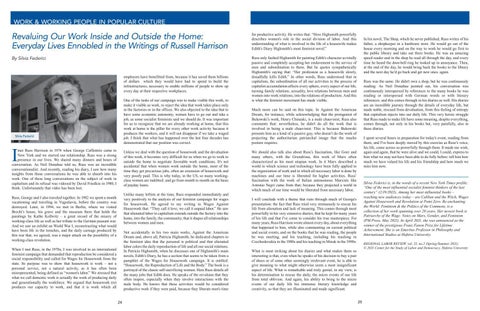
Silvia Federici
I
met Russ Harrison in 1974 when George Caffentzis came to New York and we started our relationship. Russ was a strong presence in our lives. We shared many dinners and hours of conversation. As Neil Donahue told us, Russ was an incredible conversationalist. And recently, reading his diary, I saw how many insights from those conversations he was able to absorb into his work. One of these long conversations on the subject of work in capitalism and its refusal was videoed by David Friedkin in 1980, I think. Unfortunately that video has been lost.
Unless we deal with the question of housework and the devaluation of this work, it becomes very difficult for us when we go to work to outside the home to negotiate favorable work conditions. It's not accidental that when women work outside the home, most of the time they get precarious jobs, often an extension of housework and very poorly paid. This is why today, in the US, so many workingclass women are indebted: and go from month to month on the basis of payday loans. Unlike many leftists at the time, Russ responded immediately and very positively to the analysis of our feminist campaign for wages for housework. He agreed to my writing in Wages Against Housework that: “They call it love; we call it unpaid labor.” He saw that alienated labor in capitalism extends outside the factory into the home, into the family, the community; that it shapes all relationships between women and men.
Russ, George and I also traveled together. In 1982 we spent a month vacationing and traveling in Yugoslavia, before the country was destroyed. Later, in 1994, we met in Berlin, where we visited Brecht’s house, his grave and the museum there that holds the paintings by Kathe Kollwitz – a great record of the misery of working-class life as well as her tribute to the German peasant war. And we saw an exhibit on World War I, reconstructing what would have been life in the trenches, and the daily carnage produced by this war that, we agreed, was a major attack on the possibility of a working-class revolution.
Not accidentally in his two main works, Against the American Dream and, above all, Patricia Highsmith, he dedicated chapters to the feminist idea that the personal is political and that alienated labor colors the daily reproduction of life and all our social relations. In Patricia Highsmith, when he discusses one of Highsmith’s main novels, Edith’s Diary, he has a section that seems to be taken from a pamphlet of the Wages for Housework campaign. It is entitled: “Housework, the Reproduction of Life and the Body.” The book is a portrayal of the classic self-sacrificing woman. Here Russ details all the many jobs that Edith does. He speaks of the revulsion that they often inspire, especially when they involve interactions with the male body. He knows that these activities would be considered productive work if they were paid, because they liberate men's time
When I met Russ, in the 1970s, I was involved in an international feminist campaign that demanded that reproduction be considered a social responsibility and called for Wages for Housework from the state. Its purpose was to show that housework is work – not a personal service, not a natural activity, as it has often been misrepresented, being defined as “women's labor.” We stressed that what we call domestic work is actually the work of producing daily and generationally the workforce. We argued that housework (re) produces our capacity to work, and that it is work which all
24
In his novel, The Shop, which he never published, Russ writes of his father, a shopkeeper in a hardware store. He would go out of the house every morning and on the way to work he would go first to the public library and take out three books. He was an amazing speed reader and in the shop he read all through the day, and every time he heard the door-bell ring he looked up in annoyance. Then, at the end of the day, he would bring back the books to the library and the next day he’d go back and get new ones. again. Russ was the same. He didn't own a shop, but he was continuously reading. As Neil Donahue pointed out, his conversation was continuously interspersed by references to the many books he was reading or interspersed with German words or with literary references. and this comes through in his diaries as well. His diaries are an incredible journey through the details of everyday life, but made noble, rescued from devaluation, from this feeling of entropy that capitalism injects into our daily life. This very heroic struggle that Russ made to make life have some meaning, despite everything, comes through, not only in his books but, very painfully, also in these diaries.
Much more can be said on this topic. In Against the American Dream, for instance, while acknowledging that the protagonist of Bukowski’s work, Henry Chinaski, is a male chauvinist, Russ also comments that: nevertheless, he didn't do all the work that is involved in being a male chauvinist. This is because Bukowski presents him as a kind of a passive guy, who doesn’t do the work of projecting the authoritarian patriarchal image that the macho posture requires.
I spent several hours in preparation for today's event, reading from them, and I've been deeply moved by this exercise as Russ’s voice, his life, come across so powerfully through them. It made me wish, again and again, that he were alive and we could, I could, express to him what we may not have been able to do fully before: tell him how much we have valued his life and his friendship and how much we miss him now.
We should also talk also about Russ’s fascination, like Gorz and many others, with the Grundrisse, this work of Marx often characterized as his most utopian work. In it Marx described a world in which science and technology have been fully applied to the organization of work and in which all necessary labor is done by machines and our time is liberated for higher activities. Russ’ fascination with the work of Italian autonomous Marxists like Antonio Negri came from that; because they projected a world in which much of our time would be liberated from necessary labor.
Silvia Federici is, in the words of a recent New York Times profile: “One of the most influential socialist feminist thinkers of the last century” (2/19/2021). Among her most influential books – reaching new audiences today – are Caliban and the Witch, Wages Against Housework and Revolution at Point Zero. Re-enchanting the World: Feminism & the Politics of the Commons, is a collection of her work spanning over 20 years. Her newest book is Patriarchy of the Wage: Notes on Marx, Gender, and Feminism (PM Press, May 2021). In April 2021, she was announced as the winner of the prestigious Franz Fanon Prize for Lifetime Achievement. She is an Emeritus Professor in Philosophy and International Studies at Hofstra University.
I will conclude with a theme that runs through much of George's presentation: the fact that Russ tried very strenuously to rescue his life from alienation and lack of meaning. This comes through most powerfully in his very extensive diaries, that he kept for many years of his life and that I've come to consider his true masterpiece. For many years, Russ Harrison wrote almost every day, about everything that happened to him, while also commenting on current political and social events, and on the books that he was reading, the people he was meeting, and his teaching, including his teaching in Czechoslovakia in the 1980s and his teaching in Minsk in the 1990s.
REGIONAL LABOR REVIEW, vol. 23, no.2 (Spring/Summer 2021). © 2021 Center for the Study of Labor and Democracy, Hofstra University
What is most striking about his diaries and what makes them so interesting is that, even when he speaks of his decision to buy a pair of shoes or of some other seemingly irrelevant event, he is able to give meaning to what might otherwise seem a most insignificant aspect of life. What is remarkable and truly genial, in my view, is his determination to rescue the daily, the micro events of our life from total oblivion. And again, his ability to bring to the micro events of our daily life his immense literary knowledge and creativity, so that they are illuminated and made significant. 25
BOOK REVIEW
Battling the Bro Culture at UBER Fowler, Susan. “Whistleblower: My Jouney to Silicon Valley and Fight for Justice at Uber.” (NY: Penguin Random House, 2020). Reviewed by Jessica Devous
I
n Susan Fowler’s autobiography Whistleblower: My Journey to Silicon Valley and Fight for Justice at Uber, she sheds light on the dysfunctional company culture at one of the fastest growing start-ups in Silicon Valley. She experienced sexual harassment and verbal abuse, retaliatory actions by colleagues, and gender-based discrimination at many companies in Silicon Valley. Speaking out against the vulgar and aggressive company culture at each software engineering job she had prior to working at Uber, she built her confidence to speak out about harassment based on gender, sexual preferences, and socioeconomic status. Supporting a community of women and minority workers in the tech industry, she advocated for justice at every stage, and persevered to tell her story publicly.
engineer, she was soon exposed to the discriminatory and sexist work environment from managers and coworkers. Overworked and underpaid, she decided to interview with Uber— her third company within a few years of graduating college. But her experience with sexist environments in the past stirred hesitance with Uber, even after she thoroughly researched the company for any cases of sexual harassment and discrimination. Finding no public stories that would hinder her acceptance for the job at Uber, Fowler accepted a position as a site reliability engineer. On her first day of work, her manager made sexual advances on her through the company’s chat. Uber quickly became just like all the other firms in Silicon Valley. Having learned at Penn to document every email, chat message, and comment made to her, she was in constant contact with HR, but her remarks were ignored as she was passed between different HR representatives. HR warned her that the manager who made sexual advances could retaliate by giving her negative performance reviews if she were to make a report against him, or she could avoid retaliatory actions by switching teams. Without much choice, she switched teams, but the harassment and discrimination as a female engineer followed her with every new project. Faced with almost daily occurrences of sexual advances and verbal abuse, her workplace anxiety heightened.
As a self-educated woman passionate about learning, she pursued a degree in STEM while continuing learning about philosophy, music, physics, and architecture in her free time. Fowler’s autobiography on the severe mistreatment of her and other women in Silicon Valley is well-documented. She composed a compilation of multiple sexual harassment incidents that occurred since her undergrad years at the University of Pennsylvania. Her story is not only for the public to become aware of the misconduct woman have witnessed, but also as an inspiration for those who continue to suffer from it. The sexual harassment she experienced, and her higher-up’s refusal to conduct investigations from each report is relevant to popular concern about the percentage of women who are silenced in similar incidents and do not receive justice.
But Fowler persisted and tried to form solidarity with other workers who experienced the same misconduct. She met other woman engineers with similar stories of sexual harassment at Uber. Like Fowler, women who experienced sexual harassment and wanted to file formal reports were also dismissed by HR, and no repercussions were taken against their abusers. Through every effort to report the abuse, they were disregarded by HR and a proper investigation was never issued, nor did the perpetrators ever receive punishment other than a stern warning. Due to these alleged claims, Fowler and her female and minority coworkers were never valued at Uber. Fowler, for example, was a top software engineer who mastered every technical challenge and published a textbook on software architecture as a model for other tech companies to utilize during her time at Uber. But the company never allowed her to live up to her potential. After multiple transfers in her department, retaliatory negative performance reviews by her male managers, and the company’s lack of action against her complaints, Fowler did not feel valued at Uber. After working with them for a year, she left Uber and moved on to become a founding editor for a financial services and software company, Stripe.
Growing up in poverty and having to home-school herself through primary and secondary school, Fowler had dreams larger than most of becoming a writer, architect, professional violinist, and student of philosophy, music, physics, and more. Her perseverance and passion for learning was already evident when, as a young teen, she was accepted into Arizona State University, and later into the University of Pennsylvania. At Penn, she pursued a bachelor’s in physics and philosophy, and master’s in philosophy. Working through her classes and research assistant positions, she faced her first incident in harassment and retaliation at Penn when she was held responsible for one of her peer’s mental health disorders. After she made many formal complaints to the university for failure to assist her in the Title IX process, she was stripped of her dual-degree program by the Dean of Students. Despite not receiving the education she long dreamed of, Fowler’s experience with coding landed her a job with tech startups Plaid and PubNub in Silicon Valley. However, as a female software
26
Despite leaving Uber, her suffering lingered and she faced an internal battle whether to be the woman to blow the whistle on the sexist, discriminatory, and hostile company culture, knowing she could face consequences and company threats and retaliation. She had been down this road too many times before, and it was finally time for someone to hear her story. She published an essay on her personal blog about every discriminatory incident connected to Uber, from the bias against women engineers and lower wages, to sexual advances and verbal abuse by company managers. Within six hours of publishing her story, her blog went viral and millions of people read it. Different media outlets immediately reached out to Fowler and her family members and friends, old college peers, and past coworkers to retrieve more information on the blog and her background. The New York Times even picked up her story and created an expose against Uber’s entire company culture, referencing to past incidents of assault, theft, and an infamous fraternity-like party Uber had with all employees in Vegas. With the negative media buzz, Uber launched an official investigation into the allegations. During the investigation, the rumors lingered for months about Fowler and she faced non-stop harassment from media personnel, was threatened online, and even stalked by private investigators hired by Uber.
journey of understanding how the real world unfolds, and it gets ugly. Through this emotional account of Fowler’s past to present experiences, she is highly persuasive in having the reader believe the trauma she withstood. Her evidence was very clear and indisputable, like the chat messages her colleague sent her and the altered reports from her department manager so his team could seem diverse with women engineers. Fowler held a ton of evidence against the other parties; keeping record of every email and message received. It was not until Fowler was in college that she realized higher powers in an organizational structure can halt her adamant determination and prevent her from succeeding. She refers to the organizational structure of Uber, where she would be sent through loops with different HR representatives, managers, and higher ups, and even the CEO and CFO, all who ignored her sexual harassment reports. It was not until she shattered the system by exposing Uber publicly that she found justice. Due to the structure she mentions and the power imbalance between HR and the workers, the Political Economy viewpoint is best characterized in her autobiography. The threats against her at Penn was the first incident Fowler experienced where she faced retaliation by the power structure of the school and the Dean of Students was in opposition of her academic goals.
From her childhood in Arizona to young adult career in Silicon Valley, Susan Fowler persevered through every incident of verbal and sexual abuse based on her gender, sexual identity, socioeconomic status, and education background. With each harassment allegation against her peers in college and her colleagues at each firm, she was always silenced by a higher power, whether that be the Dean of Students at Penn, or the CFO at Uber. The difficulties she endured trying to obtain justice against her abusers consumed her life both in and out of the work environment. It was not until she went public with her story and explicitly wrote her truth and unleashed the trauma, she so long endured; justice was finally served.
In addition to this, male coworkers continued to undermine her potential as a software engineer because she was a woman. Even though she continued to prove them wrong through every technical task thrown her way, like being given a different exam to test her coding abilities at Uber. That did not prevent the men in the office from making casual sexual remarks and belittling her performance. Though she received an education from an Ivy League college and had an abundant amount of research experience to support her resume, the male-oriented institutional organization embedded within each firm in Silicon Valley made it nearly impossible for Fowler and her fellow female co-workers to receive fair and equal treatment. The “boy’s club” status at each firm, where competitiveness and aggression arose in the work environment, the structure was designed against women and any other minority that did not encompass that attitude.
After the thorough investigation by Uber, lawyers confirmed all her claims against the company. The many allegations against the misogynist company culture was finally validated, and in the report, Uber was recommended to rebuild the company’s organizational structure, beginning with programs to monitor all employee harassment and discrimination claims. The shaming of Uber pressured the CEO at the time, Travis Kalanick, to step down, which he did a week after the report’s release. While Fowler did not receive a direct settlement from Uber, she did support a $10 million settlement filed in federal court for pay equity and harassment allegations for 487 women and minority Uber employees.
Through a Political Economy viewpoint, it almost seems like Fowler would be defeated in her position at Uber. The emotional trauma she experienced daily is enough for any women to have wished to remain invisible in the workplace. It was the inspiration that another woman’s story was kept in secret; another sexual harassment case was hidden by HR; another aspiring female engineer was dreaming of making it in Silicon Valley that propelled Fowler to break free from the feedback effect in the tech industry. It is disheartening to know she could not remain in the toxic industry within Silicon Valley, yet she gained the courage to speak out when all odds were against her. Her story during the rise of the #MeToo movement, and a time of political turmoil shook the political economy landscape surrounding gender-based discrimination.
Whistleblower is a compelling autobiography where Fowler shares a very private and personable part of her past. Through the emotion described in each abusive incident, the reader cannot help but to empathize with the prolonged history of sexual harassment and discrimination she had to endure, beginning at a young age. By beginning with her past leading up to her time at Uber, where the main storyline begins to develop, the reader feels as if they have known Fowler form a young age. We grow with Fowler on her own 27
As another component of Political Economy perspective, Fowler’s release of her blog story attracted other allies to her cause. In small ways, she received an abundant amount of support online, as women commented on her blog post how inspirational it was, and how it gave them the courage to face their own traumas. In bigger ways, it inspired woman working in Silicon Valley to speak out against their workplace abusers. A major venture capitalist, Justin Caldbeck, resigned six months after five women were inspired from Fowler to publicly claim sexual assault cases against him. There are many more stories like Fowler’s that were released, and it began a wave of support for women who could rise above the education and work norms superimposed by men, and break through the glass ceiling in every industry.
Jessica Devous is a senior Economics major at Hofstra University. \
Take the fast track to a professional career
REGIONAL LABOR REVIEW, vol. 23, no.2 (Spring/Summer 2021). © 2021 Center for the Study of Labor and Democracy, Hofstra University
Earn both a Hofstra B.A. and an M.B.A. in just five years – with big savings in time and tuition. Hofstra undergraduates may now enroll in a dual-degree program, combining their studies toward a Labor Studies B.A. degree with work toward a Master of Business Administration. The dual-degree program can be completed in five years. Qualified students who major in labor studies and who are admitted to the M.B.A. portion of the dual-degree program may substitute up to 14 semester hours of M.B.A.-level graduate course work for an equal number of hours of undergraduate courses toward the completion of the B.A. degree
Live every Monday 7-8 p.m. (EST) from NYC Join hosts Mimi Rosenberg & Ken Nash & guests. Subscribe or follow on Facebook [https://www.facebook.com/building.bridges.radio & Twitter [@BBridgeradio]. Website: https://www.buildingbridgesradio.org/
Five-year Dual-degree Program in Labor Studies (B.A.) and Business Administration (M.B.A.) For more information, please contact the Labor Studies Program at laborstudies@hofstra.edu or visit hofstra.edu/laborstudies
28
29
BOOK REVIEW
If Truth Won’t Out, Break Down the Door Catch and Kill: Lies, Spies, and a Conspiracy to Protect Predators, by Ronan Farrow (Little Brown & Co., 2019). Reviewed by Emma Trombetta
R
onan Farrow’s explosive reporting on sexual harassment in Hollywood shook the world when it first appeared in the New Yorker in 2017. In his newest book, Farrow continues to upend the system of serial predators, abuse of power, and the lengths to which these predators will go to cover their crimes. Catch and Kill, published in 2019, two years after Farrow’s article in the New Yorker, details the bravery of the women sources who stepped forward when they had everything to lose in order to expose crimes, coverups, and the institutionalization of sexual misconduct that for too long has been accepted as the norm.
the allegations by the book’s sources are often accompanied by corroboration and evidence, as well as put through an intense factchecking process to the standards of the New Yorker, which has one of the most rigorous vetting standards in journalism. Catch and Kill is the story of brave whistleblowers and the work those whistleblowers are doing to dismantle the system that silences women. The mass network of people who aid and abet predators, the complicit eyewitnesses, and the powerful people covering it all up are just some of the most shocking parts of this book. “It sends a message about who we are as a society, what we’ll overlook, who we’ll ignore, who matters and who doesn’t.” (33)
After attending college at age 11 and graduating at age 15, Ronan Farrow went on to Yale Law School and passed the New York State Bar. Before writing Catch and Kill, Farrow served at the State Department in the Office of the Special Representative for Afghanistan and Pakistan and authored his first book War on Peace: The End of Diplomacy and the Decline of American Influence. He also recently completed a PhD in political science from Oxford where he studied as a Rhodes Scholar. Farrow is currently a contributing writer for The New Yorker where his investigative reporting has won a Pulitzer Prize for public service, the National Magazine Award, and the George Polk Award.
Throughout the book, Farrow’s own bosses, including current NBC News President Noah Oppenheim and former NBC News chairman Andy Lack, actively suppress Farrow and his producing partner Rich McHugh’s reporting in an effort to keep the story from seeing the light of day. Former editor-in-chief at American Media Inc. Dylan Howard and the Enquirer inspire the title of the book with their pattern of buying stories exposing powerful men just to make sure they are never published. Men like the 45th president of the United State of America, according to Farrow. As revealed in Catch and Kill, countless lawyers are employed Harvey Weinstein to pressure survivors into signing non-disclosure agreements, burying their claims in exchange for payment. Employees from Weinstein’s own company come forward, in the book, to tell of the predatory pattern of behavior they witnessed from Weinstein and how some employees were even used to lure women in or keep them silent afterwards. Note, these institutions are not just upheld by abusers themselves; they are held up by every single person who allows the abusive behavior to continue without speaking out.
Catch and Kill is an extraordinary piece of investigative journalism that found the world when the world needed it most. Though the #MeToo movement began in 2006, it reignited the airways in 2017 following the allegations against Harvey Weinstein. This book is highly accessible and appeals to the general public because sexual harassment is an issue that plagues more than just Hollywood. Within the pages of Catch and Kill, sexual harassment is exposed in household name companies like NBC and beyond, and sexual harassment continues to be a prevalent issue in contemporary workplaces.
When I speak of these institutions, I am referring to the institutions of discrimination suggested in the Political Economy view of gender inequality. These are institutions that harbor predators with impunity and allow survivors to be silenced and facing the effects of their trauma alone. Not only are individual cases of sexual harassment and abuse a part of institutional discrimination, but the network of people complicit in those acts and covering up those acts as just as much a part of the problem. Even where there are not explicit instances of quid pro quo harassment, people turning the other cheek or actively covering things up create a hostile work environment for survivors. Acknowledging these institutions is the first step to eliminating them.
Throughout the investigation, Farrow is confronted by powerful people claiming he cannot report fairly on the sexual abuse claims against Weinstein due to the well-known allegations of sexual abuse made by Farrow’s sister, Dylan, against their father Woody Allen. It is also revealed that Allen, being a Hollywood director, has made movies in connection with Harvey Weinstein’s company. These facts are held against Farrow to try and quash his reporting, both by Farrow’s bosses at NBC and in a surreal comic book-villain manner by Weinstein himself who claimed, “you couldn’t save someone you love, and now you think you can save everyone.” Farrow, however, is extremely straightforward in his reporting, and 30
“For all the women, the incident had been gross, but unremarkable: they’d all come up in the business with this kind of behavior from men.” (175)
continue upending these institutions and spend each day battling against discrimination until it is truly evident that it is not just all men who are created equal, but everyone.
Other elements of Farrow’s investigation align with the Political Economy view as well. For example, like in many companies across the country, most of the positions of power in Hollywood are held by men. Most directors are men, most studio executives are men, and the highest paid actors on set are most often men. Women lack representation in positions of power and therefore new actresses and Hollywood admin struggle to find female mentors with whom they can connect.
Emma Trombetta is a senior with a dual major in Economics and Linguistics at Hofstra University. REGIONAL LABOR REVIEW, vol. 23, no.2 (Spring/Summer 2021). © 2021 Center for the Study of Labor and Democracy, Hofstra University
Another aspect of the Political Economy view of gender inequality is the existence of non-competitive economic forces. In Hollywood, Weinstein’s influence was ubiquitous. So much so that he essentially had a monopoly’s grip on the industry. For example, as reported in Catch and Kill, it took one call from Weinstein to prevent two of his alleged victims, who are actresses, from receiving parts in a big blockbuster movie. Peter Jackson is cited admitting that when he considered casting the two women, Weinstein “[told] us they were a nightmare to work with and we should avoid them at all costs.” (239) There were very few places in Hollywood in which Weinstein could not exert some sort of control. The sources in Catch and Kill face sexual harassment in their workplace, obstructions of justice when they do report, aggressive legal action in attempt to conceal their story, double agents leaking their information to their abuser, having to retraumatize themselves to explain their stories to reporters, those reporters then being suppressed by powerful people, their credibility tarnished in public by people working for their abuser, and the long-term trauma from being berated and blamed. It sounds unbelievable. Believe it. The evidence presented in Catch and Kill is overwhelming. From eyewitnesses to physical recordings of misconduct, Farrow puts to bed the framing that these stories are fabricated. After being pushed out of NBC news, Farrow finds a home for this reporting at the New Yorker, but it begs the question: how many other journalists tried to investigate this story but were suppressed by higher ups? One guess: it is more than the few mentioned in these pages. The truth is that no amount of exposure or legal repercussions will ever fully heal the trauma that these survivors experienced, which is why it is clear that this kind of behavior needs to be addressed and confronted before more women are victimized. “’We have all spent decades trying to put this thing behind us… You’re smart, you’re talented, you have so many other things you can do,’ I said. ‘But I can’t. Because it’s always there,’ she said” (190) This kind of abuse of power and gender inequality harms us all. Without these courageous sources and ceaseless investigative reporters like Farrow, we would not even know the extent of the damage caused by these institutions. The impetus is on us to 31
CALENDAR
Labor Studies at Hofstra University
Local & National Events: Spring-Summer 2021 March 10, 2021 – “Immigration Policy Priorities in 2021.” A free webinar featuring Elise deCastillo (Executive Director, Central American Refugee Program); Muzaffar Chishti (Director, Migration Policy Institute at NYU Law School); and Rosanna Perotti (Prof., Hofstra Political Science). Hofstra’s Labor Studies Program and the Center for Labor & Democracy organized this timely event, with valued co-sponsorship by the Latin American & Caribbean Studies Program, the Political Science Dept. and Center for Civic Engagement. For more information, visit: hofstra.edu/laborstudies or e-mail questions to laborstudies@hofstra.edu. April 16-18, 2021 – Labor Notes annual conference. Virtual event. For info., visit: www.labornotes.org. May 3, 2021 – “Work & Working People in Popular Culture.” A free webinar featuring Silvia Federici (author of Patriarchy of the Wage: Notes on Marx, Gender, and Feminism & Emerita Philosophy Prof, Hofstra); George Caffentzis, Emerita Philosophy Prof, U. of Southern Maine); Kathy Newman (English Prof, Carnegie-Mellon U.); Neil Donahue (Comparative Litt Prof, Hofstra); Mary Anne Trasciatti (Director of Labor Studies Program, Hofstra); and Lisa Merrill (Prof. of Writing Studies & Rhetoric, Hofstra). This Mayday celebration is dedicated to the life and work of the late Russell Harrison – a longtime faculty member in Writing Studies & Rhetoric & a cofounder of Hofstra’s Labor Studies Degree Program. This timely event was organized by Hofstra’s Labor Studies Program and the Center for Labor & Democracy, collaborating with our co-sponsors: the Latin American & Caribbean Studies Program, Honors College and the Writing Studies & Rhetoric Dept. For more information, visit: hofstra.edu/laborstudies or e-mail questions to laborstudies@hofstra.edu. May 24-27, 2021 – “Reimagining Worker Education to Transform the World” – the annual conference of the United Association for Labor Education (UALE). Virtual event with four days of lively roundtables, teaching demos, young activist presentations, music and cultural events. Sliding-scale admission fee, based on income. For info., visit: www.uale.org. June 5-8, 2021 – “A Transformational Moment? Work, Worker Power, and the Workplace in an Era of Division and Disruption,” 73rd Annual Meeting of Labor & Employment Relations Assoc. (LERA). Virtual event. For infomation visit www.leraweb.org.
RELEASE DATES FOR MONTHLY LABOR MARKET INDICATORS 2021 RELEASE DATE
NATIONAL U.S. Employment & Unemployment
REGIONAL
Job Openings & Turnover
Real Earnings
NYC/LI Metro Jobs Count
NYC/LI Metro Unemployment
APRIL
2
11
13
21
26
MAY
7
11
12
20
25
JUNE
4
8
10
17
22
JULY
2
7
13
15
20
AUGUST
6
9
11
19
24
SEPTEMBER
3
8
14
16
21
Sources: National Statistics – U.S. Bureau of Labor Statistics (BLS): The Employment Situation; Job Openings and Labor Turnover (JOLT); & Real Earning: http://www.bls.gov NY State and Local Statistics – NY State Dept. of Labor: Monthly Press Release. http://www.labor.state.ny.us. NOTE: If you know of upcoming labor-related meetings or conferences, collective bargaining contract expirations or renewals, or other events you would like considered for our next Calendar, please send us a brief description, together with the time, place, contact person, and their telephone number. Please email us at: laborstudies@hofstra.edu. 32
Earn a Hofstra University Certificate in Labor Studies The world of work is rapidly changing, as are modern relationships among workers, between workers and labor unions, and between labor and management. Labor Studies is an interdisciplinary program designed to offer students up-to-date understanding of today’s workplace in an international context. The valuable skills acquired will prove useful in careers in labor unions, government, labor law, education, and human resource management. The Hofstra Certificate in Labor Studies is a special, affordable offering designed for adults who are not presently enrolled as full-time degree-seeking Hofstra undergraduates, but who instead wish only to take 1 or 2 courses per semester in a focused program of study on labor-management relations, union organization and operations, and related legal and socioeconomic issues. The Certificate is granted after successful completion of 5 required courses (Introduction to Labor Studies; Legal Rights At Work; Collective Bargaining; & Labor Economics; Public Speaking) and 1 elective.
Advantages: v v v v
Outstanding courses taught by a distinguished full-time faculty Regularly scheduled late afternoon and evening undergraduate courses. Undergraduate B.A. degree credit option available for the normal tuition. Highly regarded specific training of value in many careers.
HOW to REGISTER REGISTRATION IS EASY: By Telephone: if you wish, you may register using a major credit card by calling: tel 516/463-7200; Email ce@hofstra.edu By Internet: download a reg. form from the web site: www.hofstra.edu/ce. Cost: Only for this special non-credit certificate, course tuition is just $450. Courses may be taken for credit at the standard rate. For information on the certificate program. For more information on the program, email laborstudies@hofstra.edu, or visit our website: www.hofstra.edu/laborstudies
33
SUBSCRIBE Please enter my subscription to the
104 Hofstra University, Hempstead, NY 11549
Regional Labor Review
5 One-Year Individual Subscription (2 issues), $25
5 One-Year Institutional Subscription (2 issues), $50
5 Two-Year Individual Subscription (4 issues), $50
5 Two-Year Institutional Subscription (4 issues), $100
Orders must be accompanied by a check in U.S. funds drawn on a U.S. bank payable to: Hofstra University – Labor Center. Foreign subscriptions: add $3 per issue. Name_____________________________________________________________________________________________ Address___________________________________________________________________________________________ City _________________________________ State ______________________ Zip Code___________________________ Telephone___________________________Fax ________________________E-mail _____________________________ Return to: Regional Labor Review, Center for Study of Labor & Democracy, 200 Barnard Hall, 104 Hofstra University, Hempstead, NY 11549.
SUPPORT I would like to help make possible more frequent issues of the Regional Labor Review (RLR) and support the other activities of the Center for the Study of Labor and Democracy. Enclosed is my tax-deductible contribution: ______ ______ ______ ______
Center for the Study of Labor and Democracy
$50-99 FRIEND $100-249 SUPPORTER — 1-year subscription to RLR + 1 year free admission to CLD events $250-499 SUSTAINING MEMBER — 2-year subscription to RLR + 2 years free admission to CLD events $500 + SPONSOR — 3-year subscription to RLR + 3 years free admission to CLD events
We also welcome bequests. To protect your privacy, we will never send donor information to marketers. Please make check in U.S. funds payable to: Hofstra University — Labor Center. Return to: Center for Study of Labor & Democracy, 200 Barnard Hall, 104 Hofstra University, Hempstead, NY 11549. Name_______________________________________________________________________________________________ Address_____________________________________________________________________________________________ City _______________________________________ State __________________ Zip Code__________________________ Telephone_______________________Fax ___________________________E-mail ________________________________
34
The Center for the Study of Labor & Democracy, publisher of the Regional Labor Review, is a research institute that aims to contribute to public education and debate about important labor issues. CLD pursues a distinctively interdisciplinary approach to labor problems and institutions, extending from the local Long Island and New York City labor markets to the national and global economies. This approach is designed to both inform and stimulate discussion of policy alternatives that promote sustainable improvements in living standards, fairness in economic opportunities, and democratic decision-making processes throughout the world. The Center’s Main Activities Include: v sponsorship of original research projects v designing and implementing surveys v organizing lectures, workshops, seminars, debates, and conferences v publication of the Regional Labor Review and a working papers series v hosting visiting international scholars v maintaining an active web site on the Internet: http://www.hofstra.edu/cld v serving as a resource center for and active liaison between students, researchers, community and labor organizations, employers, and government officials
Director & Research Associates Greg DeFreitas, (CLD Director), PhD in Economics, Columbia University. Debra Comer, PhD in Organizational Behavior, Yale University. Niev Duffy, PhD in Economics, New York University. Robert Guttmann, PhD in Economics, University of London. Sharryn Kasmir, PhD in Anthropology, City University of New York. Cheryl R. Lehman, PhD in Accounting, New York University. Martin Melkonian, MS in Economics, New School for Social Research. Bhaswati Sengupta, PhD in Economics, North Carolina State University Marc Silver, PhD in Sociology, Columbia University. Lonnie Stevans, PhD in Economics and Statistics, Oklahoma State University. Martha Weisel, JD, St. John’s University James Wiley, PhD in Geography, Rutgers University.
Board of Advisors Robert Archer, Senior Partner, Archer, Byington, Glennon & Levine Elaine Bernard, Director, Trade Union Program, Harvard University. Susan Borenstein, Executive Director, UI Appeal Board, NYS Dept. of Labor Roger Clayman, Executive Director, Long Island Federation of Labor (AFL-CIO) Benjamin Coriat, Director, CREI, University of Paris. Drucilla Cornell, Professor of Law and Political Science, Rutgers University. John Coverdale, Director, Nassau County, New York State United Teachers Robert Dow, Former Commissioner of Labor, Suffolk Co., NY John Durso, President, RWDSU/UFCW Local 338 & President, Long Island Federation of Labor (AFL-CIO) Nora Higgins, Regional Director, NYS Public Employees Federation Alexandra Howell, Employment Attorney & President, A.L.L.O.W. Nicholas LaMorte, Regional President, Civil Service Employees Association Adriana Marshall, Senior Fellow, National Research Council of Argentina, Buenos Aires. Ray Marshall, Former U.S. Secretary of Labor and University Professor, University of Texas. Lawrence Mishel, Former President, Economic Policy Institute, Washington, D.C. Leslie Rose, NYS United Teachers, Nassau County Center for the Cathy Ruckelshaus, Co-Director, National Employment Law Project Study of Labor & Democracy Cheryl Smyler-George, Executive Board, Women's Fund of Long Island 200 Barnard Hall, Mary Anne Trasciatti, Director, Labor Studies Program, Hofstra University 104 Hofstra University Edward Wolff, Professor of Economics, New York University. Hempstead, NY 11549 Michael Zweig, Emeritus Professor of Economics, SUNY Stony Brook Fax: 516-463-6519 Email: laborstudies@hofstra.edu Internet: http://www.hofstra.edu/cld
Regional Labor Review
Non-Profit Org. U.S. Postage PAID Hofstra University
Center for the Study of Labor and Democracy 200 Barnard Hall, 104 Hofstra University, Hempstead, NY 11549 ISSN 1540-8426
Regional Labor Review 89633:6/21