TESTING & MEASUREMENT
MEASURING THE INVISIBLE: WHY CHROMATE CONVERSION COATINGS STILL MATTER A metal surface can fail long before it looks worn. Corrosion begins at the atomic margins, where chemistry, not mechanics, determines lifespan. Chromate conversion coatings operate precisely in that hidden realm. Formed as films often thinner than a micron, they quietly govern durability, conductivity, and paint adhesion across vast swaths of manufactured hardware. Unlike deposited coatings, chromate conversion layers emerge from chemical transformation. When aluminum or zinc plated steel is immersed in a chromate bearing bath, the surface itself is converted into a complex oxide layer. That layer passivates the metal, improving corrosion resistance while preserving electrical conductivity and dimensional integrity. For fasteners, tools, and electronic components, especially those with tight tolerances, the advantages are decisive. For decades, these benefits were delivered primarily through hexavalent
chromium chemistry. Cr(VI) systems remain technically effective, but their toxicity has reshaped the regulatory landscape. Environmental and health directives such as RoHS and REACH have accelerated the industry’s transition toward trivalent chromium, Cr(III), passivates. These alternatives meet regulatory demands, but they narrow the margin for error. Protective performance depends sensitively on coating thickness, and variation of even a few nanometers can alter corrosion resistance or compromise conductivity. That sensitivity creates a metrology
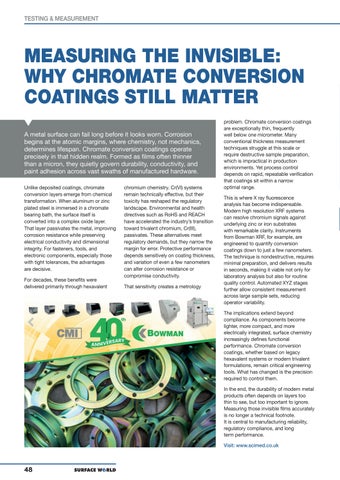
problem. Chromate conversion coatings are exceptionally thin, frequently well below one micrometer. Many conventional thickness measurement techniques struggle at this scale or require destructive sample preparation, which is impractical in production environments. Yet process control depends on rapid, repeatable verification that coatings sit within a narrow optimal range. This is where X ray fluorescence analysis has become indispensable. Modern high resolution XRF systems can resolve chromium signals against underlying zinc or iron substrates with remarkable clarity. Instruments from Bowman XRF, for example, are engineered to quantify conversion coatings down to just a few nanometers. The technique is nondestructive, requires minimal preparation, and delivers results in seconds, making it viable not only for laboratory analysis but also for routine quality control. Automated XYZ stages further allow consistent measurement across large sample sets, reducing operator variability. The implications extend beyond compliance. As components become lighter, more compact, and more electrically integrated, surface chemistry increasingly defines functional performance. Chromate conversion coatings, whether based on legacy hexavalent systems or modern trivalent formulations, remain critical engineering tools. What has changed is the precision required to control them. In the end, the durability of modern metal products often depends on layers too thin to see, but too important to ignore. Measuring those invisible films accurately is no longer a technical footnote. It is central to manufacturing reliability, regulatory compliance, and long term performance. Visit: www.scimed.co.uk
48