High-Profile Focus: Landscape Architecture and Civil Engineering
May 2022
19
From Adventure Playgrounds to The Modern Playscape
by Naomi Heller During World War II, metals were diverted to build war essentials. The manufacturing of playground equipment ceased and playgrounds fell into disrepair. Oddly, post-WWII bomb sites created opportunities for play, allowing children to experiment with lighting fires, building structures, and manipulating materials from demolished buildings. This free-
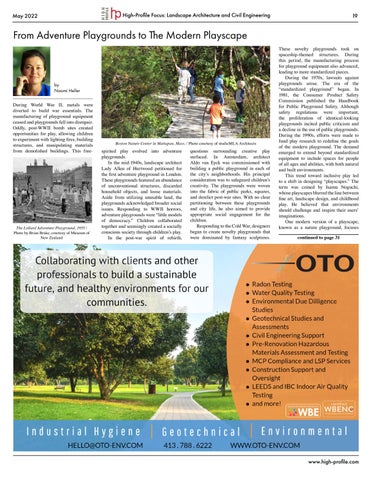
The Lollard Adventure Playground, 1955 / Photo by Brian Brake, courtesy of Museum of New Zealand
Boston Nature Center in Mattapan, Mass. / Photo courtesy of studioMLA Architects
spirited play evolved into adventure playgrounds. In the mid-1940s, landscape architect Lady Allen of Hurtwood petitioned for the first adventure playground in London. These playgrounds featured an abundance of unconventional structures, discarded household objects, and loose materials. Aside from utilizing unusable land, the playgrounds acknowledged broader social issues. Responding to WWII horrors, adventure playgrounds were “little models of democracy.” Children collaborated together and seemingly created a socially conscious society through children’s play. In the post-war spirit of rebirth,
questions surrounding creative play surfaced. In Amsterdam, architect Aldo van Eyck was commissioned with building a public playground in each of the city’s neighborhoods. His principal consideration was to safeguard children’s creativity. The playgrounds were woven into the fabric of public parks, squares, and derelict post-war sites. With no clear partitioning between these playgrounds and city life, he also aimed to provide appropriate social engagement for the children. Responding to the Cold War, designers began to create novelty playgrounds that were dominated by fantasy sculptures.
These novelty playgrounds took on spaceship-themed structures. During this period, the manufacturing process for playground equipment also advanced, leading to more standardized pieces. During the 1970s, lawsuits against playgrounds arose. The era of the “standardized playground” began. In 1981, the Consumer Product Safety Commission published the Handbook for Public Playground Safety. Although safety regulations were important, the proliferation of identical-looking playgrounds incited public criticism and a decline in the use of public playgrounds. During the 1990s, efforts were made to fund play research to redefine the goals of the modern playground. The demand emerged to extend beyond standardized equipment to include spaces for people of all ages and abilities, with both natural and built environments. This trend toward inclusive play led to a shift in designing “playscapes.” The term was coined by Isamu Noguchi, whose playscapes blurred the line between fine art, landscape design, and childhood play. He believed that environments should challenge and inspire their users’ imaginations. One modern version of a playscape, known as a nature playground, focuses continued to page 31
www.high-profile.com