May 2021
1
May 2021 Focus:
Landscape Architecture and Civil Engineering and Technology and Innovation
BVH Integrated Services and Towers|Golde Landscape Architects are designing a functional bioretention garden which will be the main landscape element for the Northwest Science Quad at UConn Storrs. / Rendering by Towers|Golde / Full story page 14
INDUSTRY EXPERT ARTICLES:
14
Scott P. Waitkus
14
Robert J. Golde
20
Tracy Lea Neff
Justin Rink
25
Jay Connolly
26
28
Marcy Stefura
30
Yvonne Alston
Jen Luoni
45
INSIDE THIS ISSUE:
Despite COVID, Nauset Completes Critical Building Upgrades Dellbrook|JKS Completes 10-Story High Rise WALLEN + daub Awards ERNA Memorial Grant Windover Construction Launches IDEA Bartlett Station Project Begins in Nubian Square BXP Commits to Carbon Neutral Brennan Consulting Underway on Education Projects
P.O. Box 7, Pembroke, MA 02359 Change Service Requested
Landscape Architects are our Best Defense against Climate Change by C. Ruane and J. Frey
www.high-profile.com
2
www.high-profile.com
May 2021
May 2021
3
Essential System Solutions for Your Building. Virtual Design & Construction Engineering Mechanical, Fire Protection & Electrical Construction HVAC Plumbing Pipe Fabrication Sheet Metal/Duct Design, Fabrication & Installation Service & Maintenance Building Control Automation
(401) 727-3500 See what we can do for your building.
www.ardenbuildingcompanies.com
www.high-profile.com
May 2021
4
Featuring:
On the Cover:
ADVERTISERS INDEX Abbot Restoration…........................................... 22 Allen & Major Associates Inc.…....................... 18 Alpine Environmental…..................................... 24 American Energy Management….................... 24 American Plumbing & Heating…........................ 2 Anderson Porter Design….................................48 Arden Building Companies…............................ 25 Arden Companies…............................................ 3 ASM-MA….........................................................30
A Walk in the Park at UConn
14
15
Landscape Architects are our Best Defense against Climate Change
24
Windover Construction Launches IDEA
Sections:
Barnes Building Management…....................... 34 BL Companies…................................................. 20 Boston Plasterers….............................................38 BSC Group….......................................................11
Publisher’s Message...................................6 Up-Front.......................................................7 Landscape Architecture and Civil Engineering.......................................12 Technology and Innovation.................... 20 Trends and Hot Topics................ 28, 40,45 J.E.D.I........................................................ 30 Life Science............................................... 33 Green........................................................ 34 Mixed-Use................................................ 36 Multi-Residential...................................... 37 Education.................................................. 41 Healthcare................................................ 42 Retail/Hospitality..................................... 44 Women In Construction........................... 46 Cannabis.................................................. 48 Northern New England.......................... 49 Awards...................................................... 50 People....................................................... 52 Calendar................................................... 54
BVH….................................................................. 14 Connecticut Temperature Controls …............... 28 Copley Wolff Design Group…......................... 16 Delphi Construction…........................................ 15 DEW…................................................................ 49 Dietz & Co.…...................................................... 20 Dimeo Construction Company…........................ 7 Eastern State Insurance Agency Inc.….............44 EBI Consulting….................................................30
WALLEN + daub Awards ERNA Memorial Grant
32
Bartlett Station Project Begins in Nubian Square
36
Energy Electrical Contractors…........................ 33 Genest….............................................................56 Great in Counters…...........................................40 H.F Lenz Company…......................................... 10
SUBSCRIBE ONLINE: www.High-Profile.com/subscribe
Hampshire Fire Protection….............................. 37 Heat & Frost Insulators Local 6…......................55 HP Next Issue….................................................. 54 IBEW 103…....................................................... 35 Ideal Concrete…................................................46 Interstate Electrical Services Corporation…..... 32 Jandris Block…................................................... 47
Wohlsen Works® in Connecticut
JCJ Architecture….............................................. 10 Jewett Construction…......................................... 37 JM Electrical Company…..................................45
Email news releases, advertising queries, articles, announcements, and calendar listings, to: editor@high-profile.com.
Kaydon…............................................................ 41 Kenney & Sams…............................................... 39 Lan-Tel….............................................................43 Lockheed Architectural Solutions…................... 17
FOUNDERS: Michael Barnes and Kathy Barnes PUBLISHER Anastasia Barnes EDITORS: Ralph Barnes and Marion Barnes EDITOR AND STAFF WRITER Emily Langner ACCOUNT EXECUTIVES: Elizabeth Finance, Mark Kelly, Betsy Gorman MEDIA MANAGER: Alisar Awwad 2321 Whitney Ave, Suite 101 Hamden, CT 06518 203-826-2192 WohlsenConstruction.com or contact Bob Labanara at blabanara@wohlsen.com • 203-710-0491
www.high-profile.com
ART DIRECTOR: Yvonne Lauzière, Stark Creative
Luchs Consulting Engineers….............................21 M.E. Obrien & Sons…....................................... 19 Marr Scaffolding…............................................ 27 Metro Walls …................................................... 49 Nauset Construction…....................................... 19 NEMCA….......................................................... 27 O’Reilly Talbot & Okun Assoc.….......................13 Panel-Eze….......................................................... 5 Rand Stonework…............................................. 22 RPF Environmental…............................................ 8 Siteline360…...................................................... 23 SL Chasse….........................................................31 Sprinkler Fitters 550…........................................51 Surety Bonds…..................................................... 6 Tecta America….................................................36 TFMoran…...........................................................12 Topaz Engineering….......................................... 42 Trimboard….........................................................12
P.O. Box 7, Pembroke, MA 02359 Express Delivery: 615 School Street, Pembroke, MA 02359 (781) 294-4530 | Fax: (781) 293-5821 editor@high-profile.com
Unilock….............................................................. 9 Warner/Larson…............................................... 16 Wausau Tile …................................................... 29 Weston & Sampson…........................................ 26 Wohlsen Construction…...................................... 4
May 2021
5
YOUR WALLS ARE READY Built to precision. Designed to last. Organized for smart, efficient installation. Panel-Eze has been leading the way in wall panelization for over 14 years, providing the cutting-edge wall prefabrication services and insights needed for you to work smarter, stay budget competitive, and create high-quality construction that lives up to your standards.
THE PANEL-EZE FACTORY EDGE
SMARTER, EASIER INSTALLATION
QUALITY THAT SPEAKS FOR ITSELF
estimating@panel-eze.com | 6 Britton Dr. | Bloomfield, CT | 860.308.2386 www.high-profile.com
May 2021
6
Publisher’s Message to be outside while creating a safe and healthy work environment, by designing outdoor conference rooms and meeting spaces. Could this be the new normal? Read more on page 12.
Anastasia Barnes I live in a great neighborhood. On my street, there are a lot of families with kids. It doesn’t matter the time of year or the kind of weather, the kids are outside. When I was a kid, my mom would tell my sister and me to “go outside and play, and don’t come home til the sun sets.” It was different then, of course, but the kids today would still rather be outside. In the past year our necessity for being indoors, communicating via Zoom calls, has further amplified our need to connect with nature. Suddenly, we’re noticing how large that red-breasted robin is that perches on the tree outside our home office, or maybe we’re spending more time sitting quietly and listening to the sound of the trees in the wind. It’s interesting to see that companies like Wollaston Development and SDI Architecture are responding to our need
Langone Park and Puopolo Playground with sea level rise defenses installed
Rendering of an outdoor conference room
This month’s focus on Landscape Architecture and Civil Engineering also highlights how some AEC industry professionals are taking responsibility and creating solutions to problems in urban areas, such as rising sea levels. Check out the story by Cheri Ruane and John Frey of Weston & Sampson on page 15. Other firms are finding creative ways to use material, waste, land and water-use initiatives to preserve ecosystems and optimize rainwater management. Be sure to read about what’s happening with a 13acre site at UConn Storrs on page 14.
Nowadays, a lot of these solutions are driven by the technology that is available to our industry, technology that seems to be ever-evolving. Rapid Design Visualization (RDV) technology, for example, allows designers and engineers new ways to collaborate and communicate more effectively. Luchs, out of Connecticut, is a perfect example of a firm that is benefitting from this kind of technology. Interstate Electrical Services Corp. has long been a proponent of trying new software/technology in-house and has found ways to streamline its processes and communication. Windover Construction recently teamed with three
different software companies to develop an adaptive industrial construction technique that fabricates telescopic studs from a digital model that can then be transported and adapted to any space. Read about all of these companies in our Technology & Innovation section on page 20.
Interstate uses the Trimble Robotic Total Station on many projects to scan, measure, and help determine layouts on job sites.
Our customers sleep soundly knowing that Tecta America has their buildings covered.
We can embrace and protect the natural world (if not save it) while utilizing technology. We just need a healthy balance. Let’s take a cue from the kids, get outside, and imagine the impossible. Only then will we see what is possible. Windover utilizes additive manufacturing technologies for historic preservation.
Founder’s Message
Michael Barnes
Commercial/Industrial Roofing • Sales and Service • 24/7 Emergency Service N. Billerica, MA 800-398-1380 Social icon
Rounded square Only use blue and/or white. For more details check out our Brand Guidelines.
Brockton, MA 866-583-9499
Portland, ME 207-878-1732
E. Hartford, CT 860-828-0380
Tecta America New England was formerly Delta Roofing
www.high-profile.com
Move over science and technology, a new boss is in town! It’s nature, and leading the way is the AEC industry in how we perceive the needs, ways and means of future living. I can remember when the belief was that we needed to bulldoze our way into the future. Today the message is very different. Like the title of the
Construction Institute’s article on page 18, “Nature is Our Way Forward,” progressive design and construction starts with partnering with nature instead of controlling it. The focus on designing and building sustainably is often taken for granted but I remember when this was not the case. In the ‘60s and ‘70s, most developers were perceived as the enemy of the environment, with the almighty dollar often being the only consideration. Today, they are at the top of the list in providing the solutions we need to preserve our planet. We are proud to represent the people and companies in the AEC industry, the heroes of our future, building today.
May 2021
7
Up-Front Construction Begins on Revolution Labs Boston – Greatland Realty Partners, a Boston-based real estate development firm, announced that construction has begun on Revolution Labs, a new 180,000sf life science lab building in Lexington, Mass. The development is available for lease and will feature purpose-built laboratory infrastructure, full service onsite amenities, and multi-functional outdoor spaces. Callahan Construction Managers is the general contractor for the project. Located at 1050 Waltham Street, the property is south of Route 2 in a walkable, mixed-use neighborhood with convenient access to Interstate 95 and less than 15 minutes from Cambridge. The Lexington/ Waltham area is well-positioned within the Massachusetts “Super Cluster,” housing some of the most prominent life science, pharmaceutical, and biotech companies in the country. JLL is serving as leasing agent for the property. “Revolution Labs has been specifically designed for the benefit of the end user, consistent with Greatland’s customerfocused philosophy,” said Phil Dorman, managing partner at Greatland. “Our experienced, multidisciplinary team has created an incredible new opportunity for
The Revolution Labs team from Greatland Realty Partners, Callahan Construction Managers, JLL, and SGA at a recent groundbreaking ceremony at the property / Photo by Nate Photogra
leading life science companies to expand their physical footprint in a market with extremely limited supply of existing lab space.” Designed by architecture firm SGA, the development will offer full lab infrastructure with extended clear heights, covered parking with a solar canopy and electric vehicle charging stations, shuttle service to the nearby Alewife MBTA station, an onsite cafe, fitness center,
bike share, bike storage, lockers and showers, lounge areas and meeting space, an amenity deck with a fire pit, sport court, and a connection to more than four miles of nature trails along the Western Greenway. The location also offers walkable access to retail such as Starbucks, Chipotle, and Panera Bread. In addition, the building has been designed to achieve WiredScore Wired Certification along
with both LEED and WELL goldlevel certifications for environmental sustainability and occupant health and wellbeing. The JLL team leasing the project includes Managing Directors Jason Fivek and Don Domoretsky, and Vice President Jordan Yarboro. The property is expected to be ready for occupancy in the third quarter of 2022.
For decades, the Dimeo team has been building up the residential sector of the Boston area and beyond. DCC has been committed to building sustainable and lasting spaces and looking back on all the work we have done makes us so eager for the future.
PA S T, P R E S E N T & F U T U R E … Maverick Gardens ‘08
Forest Hills ‘20
Old Colony Phase 3B & 3C Rendering ‘22
www.high-profile.com
8
High-Profile: Up-Front
May 2021
Joint Venture Brings Life Science Development to Boston Watertown, MA – The Davis Companies closed on a joint venture agreement with Boston Development Group (BDG) to co-develop 66 Galen Street, Phase 1 of a purpose-built Class A life science campus in Watertown. The campus will include more than 450,000sf of research and lab space in two buildings. Phase 1 will break ground in May. Planned in close collaboration with the town of Watertown, 66 Galen Street will address the growing need for quality life science space as short supply in Cambridge and Boston has prompted companies to search beyond traditional urban markets. Phase 1 will be a 224,106sf, class A, inner suburban lab building that will be LEED Gold certified upon completion. One of the distinguishing factors of the project is its significant upgrade of the public realm along the Galen Street corridor. Substantial transportation infrastructure improvements, including traffic signalization, lane widenings, dedicated bus lanes and sidewalks, will be completed with the project, and 40% of the site will be dedicated to parks and green spaces. Designed by Elkus Manfredi Architects, the building will include five private tenant outdoor spaces with panoramic views of the Charles River,
and high-end amenity spaces, including a fitness center, locker rooms with showers, a 45-space bike room, on-site retail/cafe space, a hotel-style building lobby, and ample indoor parking. “Given The Davis Companies’ success and experience in life science development, we are pleased to have the opportunity to partner with them on this project,” said Jodie Zussman, president of BDG. “The expertise of our two firms, along with the incredible work done
66 Galen Street rendering
to date by Elkus Manfredi Architects and John Moriarity & Associates, will ensure the future of 66 Galen Street as a destination for companies looking for thoughtfully designed lab facilities in a park-like setting.”
The project team for the new development also includes WSP, mechanical/ electrical/plumbing designers; McNamara & Salvia, structural engineers; VHB, site/ civil designers; Ground, landscape architect; and DENS Facility Services.
AGC MA Names Ferrante CEO representing contractors’ sigWellesley, MA – The Assonatory with 13 different union ciated General Contractors trades. of Massachusetts (AGC MA) During his time there, he board of directors announced launched a training and eduJohn Ferrante as the newly cation program and raised the appointed chief executive BTEA’s profile in government officer. Ferrante succeeds Bob relations and industry affairs Petrucelli who served as CEO on Beacon Hill. He simultafor the past 34 years. neously worked for the North/ For the last five years, John Ferrante East Roofing Contractors Ferrante has been the associate Association as the director of government executive director at the Building Trades and industry affairs. Employers’ Association which is an Ferrante began his duties on April 14. umbrella group of five trade associations
Ashland to Build Public Safety Complex Ashland, MA – CTA Construction Managers announced it will begin work on a new public safety complex for the town of Ashland. The company was awarded the contract with a low bid of $22 million for new construction of the planned 42,000sf facility. The project will create a steel-framed, three-story, 40-foot high building for Ashland police and fire with apparatus and sally port bays, detention cells and training areas for both departments. Public safety and town officials expect to reduce emergency response times because of the new facility’s central location at 1215 Union Street. HKT Architects of Charlestown is the architect on the project. Vertex Companies of Weymouth is the owners’ project manager. Total project cost is approximately $30.9 million
www.high-profile.com
Ashland public safety complex
including construction, engineering and architectural design work. The time frame is less than 18 months. “The site is a little bit complex with mostly ledge that will require significant blasting and rock removal. But its central location will serve the community well, and the Ashland police and fire departments will have first rate facilities upon completion of our work,” said CTA principal, Paul DuRoss.
May 2021
High-Profile: Up-Front
9
PROJECT Cambridge Discovery Park, Cambridge, MA. DESIGN Paul Finger Associates. PRODUCT Planks with Umbriano™ finish.
Your
CREATION Our
TEAMWORK Our team of Commercial Design Consultants are ready to support your next unit paving project from start to finish. Combine our technical expertise with a vast array of Unilock colors, shapes and textures, to bring your unique vision to life. Contact for samples, product information and Lunch & Learns. UNILOCK.COM | 1-800-UNILOCK
www.high-profile.com
High-Profile: Up-Front
10
May 2021
Weymouth Middle School Holds Topping Off Ceremony Boston – BOND Building Construction, Inc. (BOND Building), a building construction firm in the Northeast, has completed the structural steel work on the new Maria Weston Chapman Middle School in Weymouth, Mass. BOND Building celebrated this milestone alongside members of the school, elected officials, and community members at a topping off ceremony on April 7, at which the final steel beam was placed into position signifying the successful completion of the framing of the structure. The ceremony took place outside, with face coverings required and social distancing guidelines enforced. Chapman Middle School will host 1,470 students in grades 6-8. Designed by HMFH Architects, Inc., the $164 million, 252,170sf facility features three distinct academic wings which will surround centrally located exploratory labs. These labs will be built around the school’s ‘Town Square,” a central gathering area that functions as the dining facility. Wings to the west and south of the Town Square will house an auditorium, a central kitchen, administrative offices, music spaces, and a fully renovated gymnasium and fitness area. The project included the demolition of the former Maria Weston Chapman Middle School, originally built in 1961,
The BOND Building team at the topping off ceremony for Maria Weston Chapman Middle School (l-r): Mike West; Brendan O’Malley; James O’Brien; Tommy Lee; Joe Authier; Frank Hayes, president; Kyle Cataldo; Matt Hines; Serina Medeiros; Kristen Carroll; Dave Capaldo, director of public education; and Tony Bond, president and CEO
except for the gymnasium which will be fully renovated. The demolition, new construction, and renovation is taking place in close proximity to the surrounding neighborhood. While keeping safety at the forefront, BOND Building is also making sure to minimize disruption, implementing several construction mitigation strategies including noise mitigation and monitoring, dust control and monitoring, vibration monitoring, traffic management plans, and a community outreach and notification system.
Chapman Middle School topping off
STRUCTURAL, FIRE PROTECTION, PLUMBING, MECHANICAL+ ELECTRICAL ENGINEERING
Celebrating the 10th Anniversary of our Connecticut Office
martin luther king jr. campus - hartford breakthrough academy, hartford ct
HIGHER EDUCATION SPORTS+RECREATION
HEALTHCARE DATA CENTERS
SCIENCE+TECHNOLOGY K-12
helping institutions promote innovation and foster creativity jcj.com architecture planning interior design
MIDDLETOWN, CT
www.high-profile.com
HFLENZ.COM
860.316.2124
boston hartford new york las vegas phoenix san diego tulsa
for more information contact peter bachmann, aia - principal / institutional markets leader 646.597.5401 / pbachmann@jcj.com
High-Profile: Up-Front
May 2021
11
Wohlsen Celebrates 131 Years your general contractor bench is a good thing,” noted Labanara. “Wohlsen has arrived in Connecticut at the right time. We are thrilled to supply the market’s demand for an energized and experienced construction partner among an otherwise usual list of builders.” The team at Wohlsen has a strong background in senior living, education,
hospitality, healthcare, and corporate work. “Competition drives quality. Our completed projects throughout Fairfield County and our current work managing the new parking garage at Central Connecticut State University speak for themselves. We are excited at what the future holds for Wohlsen Construction in Connecticut,” commented Rubbo.
Antinozzi Announces Leadership Transition Mauro Rubbo
Hamden, CT – Wohlsen Construction, a construction management firm headquartered in Lancaster, Pa., recently celebrated its 131st anniversary. Wohlsen is an ENR Top 400 firm with over 300 employees in eight offices throughout the Mid-Atlantic and Northeast regions. The result since opening its Connecticut office in 2016 has been a steadily growing portfolio, which has triggered recognition among design, engineering, and construction professionals around the state. Connecticut native Mauro Rubbo is Wohlsen’s regional vice president and is responsible for charting the path forward, which includes priorities to elevate the brand in the local market and establish Wohlsen project teams as best-in-class builders. Rubbo said, “Our goal is to foster
long-term partnerships and generate repeat client satisfaction. We offer a unique combination of capacity and agility, which means we are supported by the strength of a regional builder yet perform with the flexibility of a local partner. Subcontractors enjoy working with Wohlsen which pays dividends toward the overall success of a project.” He added, “We are a merit-based shop. This advantage positions us to exceed expectations and deliver the highest quality project while using the most costefficient approach possible.” Joining the Wohlsen team is Director of Business Development Bob Labanara. “From a client’s perspective, whether a private developer, college or university, health network, senior living community, or private K-12 institution, deepening
(l-r) Michael Ayles, Michael LoSasso, Paul Antinozzi, and Paul Lisi Photo by Catherine Conroy Halstead
Bridgeport, CT – Paul Antinozzi, AIA announced that Antinozzi Associates, PC will now be led by firm principals Michael Ayles, FAIA, NCARB; Paul Lisi, AIA, BCEO; and Michael LoSasso, AIA, LEED|AP BD+C. Antinozzi will remain with the firm as principal emeritus while Ayles, Lisi,
Check out what’s happening at BSC!
and LoSasso take on the day-to-day management of the firm. This leadership transition positions Antinozzi Associates, in the post-COVID era, to build upon the success of its 65-year history and implement a strong succession plan for the coming years.
We are thrilled to welcome these leaders to support a new phase of BSC’s growth, building on our strong foundation and joining a team of talented individuals. SEAN O’BRIEN, CEO
Dori Ross DIRECTOR OF OPERATIONS
John Audi CHIEF FINANCIAL OFFICER
Becky Bozadjian DIRECTOR OF MARKETING & COMMUNICATIONS www.high-profile.com
High-Profile Focus: Landscape Architecture and Civil Engineering
12
May 2021
Focus: Landscape Architecture and Civil Engineering Landscaping and Architecture Trends Signify Continued Precautions and Restrictions Even as Vaccinations Increase and Pandemic Slowly Ends Submitted by Wollaston Development and SDI Architecture As vaccine roll-outs continue and scores of Americans are inoculated daily, life is slowly returning to normal. Massachusetts has entered Phase 4 of its reopening plan, increasing capacity at all venues and opening many shuttered entertainment and work destinations. Excited parents are preparing to send their children back to school full time, giving them the opportunity to return to their offices now that the hybrid homeschooling model comes to a close. Yet, even with this beacon of hope on the horizon, trends point to a continuation of the self-imposed restrictions that have become a way of life over the past year. Wollaston Development, a landscaping and masonry company, partnered with SDI Architecture to build outdoor conference rooms last year to assist offices in transitioning to work safely and efficiently outdoors. The two Boston-based companies have a front row seat to the changes that homeowners and business-
Rendering of an outdoor conference room
es are making to adapt to this return to normal, and they caution that even though people can go back to the office and enjoy a night on the town, many will continue to make their houses and properties their primary location for socialization, work
Millwork for Professionals Custom. Timely Delivery. Under Budget.
and entertainment. “With new mandates to get kids back to school, there is the thought that life will resume and parents will go back to the office, but that’s not necessarily the case,” said Ben Williams, owner
of SDI Architecture. “Both businesses and employees have made major, expensive renovations and they will not be abandoning these large investments. Work From Home will remain at the very least an option for many people in fields that allow for the choice. Businesses are well aware of the cost-saving benefits of employees working from home, with the office as a social space for meetings and group work. We are designing offices with less space for individual desks and more space for collaboration. Additionally, office footprints have shrunk as businesses anticipate much of their workforce to continue to work remotely.” According to NPR, more than 75% of homeowners did a home renovation project last year. Many homeowners have built home gyms, bars, lounge areas, work stations and updated their outdoor space to accommodate more aspects of life on one plot of land, often with a number of residents of varying ages. Popular outdoor modifications include eco-friendly patios, continued to page 18
Professional Services... Exceptional Results! Serving NH, MA & Northern New England since 1968
Landscape Architecture Design Projects
Exterior Millwork
Interior Millwork SUNRISE LABS PATIO SPACE ~ BEDFORD, NH
Custom Pergolas
Specialty Trim NBCU BOSTON MEDIA CENTER COURTYARD ~ NEEDHAM, MA
413-886-0142 :: www. trimboard.net www.high-profile.com
Voted BEST NH Engineering Fi 9 years runninrm g!
Contact: Robert Duval, PE, LEED AP–President or Michael Krzeminski, PLA–Landscape Architect TFMoran, Inc. Bedford, NH and Portsmouth, NH (603) 472-4488 www.t fmoran.com
May 2021
High-Profile Focus: Landscape Architecture and Civil Engineering
13
Brennan Consulting Underway on Education Projects Burlington, MA – Brennan Consulting, Inc. is currently underway on several elementary, middle and high school projects throughout the Commonwealth. “Our team creates value and brings commitment, innovation and state-ofthe-art technology to complex projects. It’s the foundation of our practice,” says Laureen Poulakis, president of Brennan Consulting. Brennan is providing preconstruction survey services, deformation monitoring, pile layout, steel erection surveys and construction surveys on several Commonwealth schools. Blasting and site prep are underway for the new Waltham High School at 554 Lexington Street in Waltham which has been dubbed the most expensive public high school project in Massachusetts history, coming in at $375 million. Increased enrollment and an aging infrastructure prompted the five-year design process. A new 414,800sf building, programmed to serve 1,830 students, broke ground in September 2020. Ledge, property line setbacks and environmental resources are some of the project’s recent hurdles. In all, the project is expected to open in fall of 2024. The Doherty Memorial High School replacement project in Worcester is 421,800sf and will serve 1,670 students at the existing school location on Highland Street. The current project is expected
Pentucket Regional Middle High School / Rendering courtesy of Dore & Whittier
to cost $293 million. Due to mechanical, electrical, building envelope and infrastructure issues, the existing 53-yearold building will be razed. Abutting parkland is a concern in the construction of the new school which is slated to open in the fall of 2024. Construction began in April 2020 on the 410,000sf Arlington High School project on the site of the existing school in Arlington, which is deteriorating and at capacity. Expected to open to students in the winter of 2022, the first building is slated for STEAM and performing arts. The completed design will cost $290 million, accommodate a total enrollment of 1,755 students, and is intended to be
fossil-fuel free. Construction completion is scheduled for 2024 with ongoing sitework into 2025. Slated to open for students in the fall of 2022, the Pentucket Regional Middle High School project in West Newbury serves the towns of Groveland, Merrimac and West Newbury. Site work and athletic fields are expected to finish in the summer of 2023. Designed to replace 70-year-old and 50-year-old buildings with imminent electrical, HVAC, foundation and infrastructure failures, the new complex totals 211,700sf, houses 965 students, and is expected to cost $146 million.
Waltham High School / Rendering courtesy of SMMA
www.high-profile.com
14
High-Profile Focus: Landscape Architecture and Civil Engineering
May 2021
A Walk in the Park at UConn
by Scott P. Waitkus and Robert J. Golde Come fall 2022, many students returning to UConn’s Storrs campus will enter via the Northwest Science Quad (NWSQ), where Science 1, a 198,000sf LEED Gold building, will be open for learning. It will be a pleasant walk through a woodland corridor full of indigenous shade trees and plants that attract pollinators. Most won’t know they’re strolling through a
View of what the Northwest Science Quad will look like from above once construction is completed
Low Impact Development (LID), SITEScertified landscape, a model of green infrastructure and restoration resulting from a highly orchestrated engineering and landscape effort. And that’s OK. That’s the point of deep integration. Borne out of UConn’s 2015 masterplan to position itself as a STEM education leader, the NWSQ unites UConn’s research expansion, academic vision, and culture of innovation with assertive sustainability goals. Identified within these goals are a range of material, waste, land and water-use initiatives that include preserving campus ecosystems and optimizing rainwater management. BVH and Towers|Golde had been consulting with UConn on these issues prior to joining Payette’s consulting team for Science 1. BVH updated the campus stormwater masterplan in 2016. This provided insight for how the overall system relates to the NWSQ, and included study of the Eagleville Brook watershed, which was not meeting water quality standards to support aquatic life. That needed to change. BVH had also examined utility and infrastructure issues for the NWSQ in a feasibility study, a good portion of which had us working alongside Towers|Golde, who was looking at how the utility corridors could best coincide
A functional bioretention garden has been intentionally designed to be the main landscape element of the new NW Science Quad. / Renderings by Towers|Golde
with walkways and roads to minimize impacts on the landscape. We were working in parallel to develop solutions that would facilitate stormwater capture and treatment. The upshot of this well-established familiarity, with each other and the site, is evident in the 13 acres of synergy between utilities, stormwater management, habitat restoration, architecture and site enhancement known as the Northwest Science Quad. These elements are so intertwined as to be all but inseparable, each dependent on the other for success, much the way any high-functioning ecosystem operates. Improved pedestrian access, aesthetics, and wildlife health are some of the big benefits of carefully designed bioretention elements, vegetated swales, subsurface infiltration and porous pavements. Integrating the engineering and landscape required close coordination on basin grading, shaping and elevations to achieve required volumes and allow
conveyance from one basin to another. This also applied to the design and shape of overflow weirs in order to provide adequate flow while also providing an appealingly natural feature. Soils and plants were selected to allow for some inundation in the basins, while also filtering water through the soil media. Pervious pavement in the parking lot was also key– all the water that would need to be directed somewhere else could now simply filter through into the ground. Through deep disciplinary integration and relentless coordination, BVH and Towers|Golde, together with Payette, developed a welcoming pathway through a vibrant woodland and waterway ecosystem that improves the Eagleville Brook watershed. For those walking along and interested, signage will explain many of these components. For others, it will simply be a walk in the park. Scott P. Waitkus, PE is vice president of BVH Integrated Services, P.C. and Robert J. Golde, PLA, FASLA is principal at Towers|Golde.
Interpretive signage will graphically demonstrate the environmental benefits of the bioretention garden.
www.high-profile.com
High-Profile Focus: Landscape Architecture and Civil Engineering
May 2021
15
Landscape Architects are our Best Defense against Climate Change by Cheri Ruane and John Frey There’s little argument that the impacts of climate change and sea level rise along our coasts are steadily becoming more frequent and intense. According to the National Oceanic and Atmospheric Administration (NOAA), global mean sea level has risen about 8 – 9 inches since 1880, with about a third of that coming in just the last 25 years. The rising water level is mostly due to a combination of meltwater from glaciers and ice sheets and thermal expansion of seawater as it warms. For example, in Boston in 2015, sea level rise in combination with a “king tide” created a tide that was two and a half feet higher than average, causing Boston Harbor to overtop seawalls with several inches of water in many areas, flooding walkways, parking lots, roads, and even some basements. If there had been a significant storm at the same time, the damage could have been much worse. Then, in January and March 2018, the city experienced its highest water levels during Nor’easters that coincided with king tides resulting in significant neighborhood flooding, property damage, and flooding of critical infrastructure including the subway system. At the same time, cities are experiencing higher
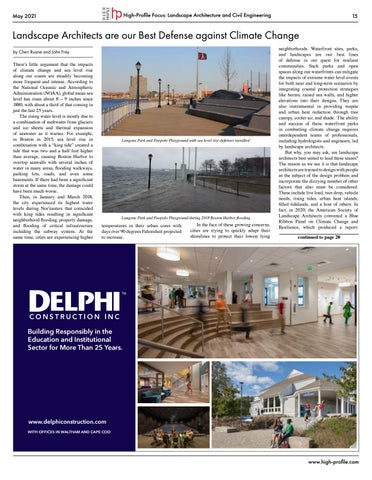
Langone Park and Puopolo Playground with sea level rise defenses installed
Langone Park and Puopolo Playground during 2018 Boston Harbor flooding
temperatures in their urban cores with days over 90 degrees Fahrenheit projected to increase.
In the face of these growing concerns, cities are trying to quickly adapt their shorelines to protect their lowest lying
neighborhoods. Waterfront sites, parks, and landscapes are our best lines of defense in our quest for resilient communities. Such parks and open spaces along our waterfronts can mitigate the impacts of extreme water level events for both near and long-term scenarios by integrating coastal protection strategies like berms, raised sea walls, and higher elevations into their designs. They are also instrumental in providing respite and urban heat reduction through tree canopy, cooler air, and shade. The ability and success of these waterfront parks in combatting climate change requires interdependent teams of professionals, including hydrologists and engineers, led by landscape architects. But why, you may ask, are landscape architects best suited to lead these teams? The reason as we see it is that landscape architects are trained to design with people as the subject of the design problem and incorporate the dizzying number of other factors that also must be considered. These include live load, rain drop, vehicle needs, rising tides, urban heat islands, filled tidelands, and a host of others. In fact, in 2020, the American Society of Landscape Architects convened a Blue Ribbon Panel on Climate Change and Resilience, which produced a report: continued to page 20
Building Responsibly in the Education and Institutional Sector for More Than 25 Years.
www.delphiconstruction.com WITH OFFICES IN WALTHAM AND CAPE COD
www.high-profile.com
High-Profile Focus: Landscape Architecture and Civil Engineering
16
May 2021
Allen & Major Provides Services for Multifamily Development
ALTA Clara at the Fells pool
ALTA Clara at the Fells / Photos courtesy of Wood Partners
Stoneham, MA – Spanning 20 years, Allen & Major Associates, Inc. (A&M) provided land survey; master planning; civil engineering; local, state, and federal permitting; landscape architectural design; and full construction support; for the project now known as ALTA Clara at the Fells, a 261-unit multi- family development located in Stoneham, adjacent to the Middlesex Fells Reservation. The project, initially called Lot “L” in the Langwood Commons Master Plan, was designed and permitted by Simpson
Housing, LLP. Wood Partners ultimately completed construction on the project after breaking ground in 2018. A&M utilized every in-house division for this project starting with the civil engineering team who crafted the master plan for the 40.7-acre lot. Formerly the campus of the Boston Regional Medical Center, the original permits acquired for the site included a Special Permit/Site Plan from the town of Stoneham planning board/board of selectman and a Notice of Intent (NOI)/Order of Conditions from
Stoneham Conservation Commission and MassDEP. A&M’s landscape division provided the resort-inspired landscape design which includes an onsite dog park, a zeroentrance heated saltwater pool, a cabana that features gas grills, a custom outdoor kitchen area, a bar, a TV watching area, outdoor showers, and restrooms. Extensive hardscape design includes stacked stone walls, stamped concrete, and herringbone pattern pavers scattered throughout. Exterior lounge areas with multiple fire features provide social spaces during the seasons. Contemporary site furnishings were carefully curated for functionality and durability as well as adding color that complements the extensive plantings including trees, evergreens, and native
perennials for multi-seasonal interest. Because of its proximity to the Middlesex Fells Reservation and Spot Pond, walking path connections were created for direct access to over 100 miles of hiking and mountain biking trails. Subsequent services to support the final build-out of the project included both civil construction documents and administration, and land survey preparation of ALTA plans, construction layout/stakeout, easement document preparation, and As-Built for Certificate of Compliance.
ALTA Clara at the Fells aerial view
Designing Innovative Playgrounds Healey Schoolyard
making places memorable
Somerville, MA
Coming in 2022!
ENVISIONING PEOPLE + PLACES Boston, MA | Richmond, VA
Copley Wolff Group STAYDesign CONNECTED! Landscape Architects & Plan ners
www.warnerlarson.com
w w w. c o p l e y - w o l ff . c o m www.high-profile.com
617 654 9000
High-Profile Focus: Landscape Architecture and Civil Engineering
May 2021
17
TFMoran Designs Outdoor Space for Sunrise Labs
Bedford, NH – The team at Sunrise Labs, a provider of product development solutions to medical device OEM’s, asked TFMoran’s landscape architects to help them incorporate some useful outdoor space into the programming of their existing office building in Bedford. The goal was to create a soothing outdoor patio as an alternative gathering area to accommodate meetings, lunches and other functions for approximately 50 people, while maintaining social distancing during the Covid-19 pandemic. “We started with a curvilinear ap-
Sunrise Labs patio
proach to the design, to soften the space and distinguish it from the straight lines of a traditional office layout,” explained Michael Krzeminski, PLA, TFMoran’s lead landscape architect. “The 2,500sf patio begins small at the entrance of the building and gradually widens as it flows out towards the shade of the forest edge southwest of the building. To enhance the natural feel of the space, the patio surface was created from stamped, colored concrete in a natural-slate Ashlar pattern.” Krzeminski continued, “Another
important design objective was to buffer the patio from adjacent roads and parking areas. A mixture of deciduous and evergreen trees, flowering shrubs, and perennials were placed along the outer curved edge to add seasonal color and privacy to the patio, and large granite benches lining the perimeter provide additional seating and help define the space. And to create a sense of identity, we used Sunrise’s company colors in the design, with bright orange tables filling the center of the patio, and a blue awning that will be installed for protection against sun and rain.”
Sunrise Labs landscape plan
TFMoran’s team of landscape architects worked closely with Sunrise Labs, Property Manager Riley Enterprises, and contractor JET Concrete of New Ipswich to get the new patio in place by the fall of 2020 so the employees of Sunrise Labs could begin to enjoy their new outdoor space as soon as possible. “The patio offers us a wonderful outdoor space to gather and appreciate the fresh air and trees that we are so fortunate to live among,” said Eric Soederberg, CEO of Sunrise Labs.
Athol High School Athol, MA
Announcing Lockheed Architectural Solutions! New and improved name, same core values & dedication to our customers Lockheed Window Corp. has changed its name to Lockheed Architectural Solutions
EMF Building at 120 Brookline St. Cambridge, MA
to reflect the massive and continuing growth and expansion of our team, our products, and our capabilities. As a company that is well-equipped to execute multimillion dollar fabrication and installation projects, with expertise in a vast range of products, Lockheed has become adept at so much more than just windows. Our new name, Lockheed Architectural Solutions, fully represents the depth and variety of our growing list of products and services.
Woburn Public Library Woburn, MA
Sunita Williams Elementary School Needham, MA
Safety
•
Quality
•
Innovation
•
Reliability
•
Cost-Efficiency
P.O. Box 166, Pascoag, RI 02859 • 800-537-3061 • lockheedsolutions.com www.high-profile.com
High-Profile Focus: Landscape Architecture and Civil Engineering
18
May 2021
Nature Is Our Way Forward Spring is in the air, and a feeling of change is on the horizon. As our gardens come to life, lawns need mowing, trees are budding, and we put the surprise April snow behind us, the words “resilient” and “nature” spark moments of refection and inquiry. In essence, we are experiencing a new growth as well, emerging from this past year with the confidence that in the right time, the moment we’re ready, we too will bloom. The definition of nature specifically excludes human creations. Instead, it is said to encompass the phenomena of the physical world in its entirety – plants, animals, mountains, oceans and stars – the natural world as it exists without human beings. This may be true, but as both ardent protectors of nature and professionals in the industry of designing and constructing buildings, we know there is another way. “Nature” could also be used to describe inherent features or characteristics – personality and behavior – and this is our key to unlocking buildings and human environments that live in
harmony with nature. What can we learn from the structure of plants? Or from the composition of ecosystems? What material properties will we uncover, and how can we share resources as symbiotic systems do? Fortunately, this concept is nothing new. Humans have been turning to the natural world for inspiration since the late nineteenth century, and arguably even earlier. We call this area of research “biophilia.” Through our study of the physical world, we discover more and more the impact of our presence in nature, both positive and negative. While research has shown the health benefits of humans and human environments connected to and engaged with nature, we have also seen the delicate balance of our buildings on climate and natural resources. There was a span of time when the disconnect between humans and nature was out of balance. With the scales tipped in favor of urban concrete jungles, there was an increase in habitat destruction, species extinction, pollution and other harmful emissions. Our health declined, and we suffered from chronic health conditions such as obesity, depression, anxiety and attention disorders. Children spent less time outdoors, and adults spent 90% of their time indoors. The syntax of
Allen & Major Associates, Inc. Civil Engineers | Land Surveyors | Landscape Architects
A&M Creates Value by Specializing in Landscape Architecture, and Engineering & Permitting Strategies that Advance our Client’s Vision, As Well As Their Bottom Line.
Any Project, Any Size, Call Us First. STAY CONNECTED Woburn, MA: (781) 935-6889 Lakeville, MA: (508) 923-1010 Manchester, NH: (603) 627-5500 Email: info@allenmajor.com
www.high-profile.com
www.allenmajor.com
by the CI Editorial Committee
“ To be human is to become visible while carrying what is hidden as a gift to others. To remember the other world in this world is to live in your true inheritance.”
– David Whyte
this narrative hopes this suffering is in our past, but the reality is that the United Nations projects that by 2050, 66% of the world’s population will live in urban environments. As we rebuild from the global health crisis of the COVID-19 pandemic, we are cognizant that health is paramount and our built environment plays a role.
We need to look to nature as our way forward. There are resilient strategies embedded within nature that can help us, and our planet, thrive. Let’s challenge the definition of nature by designing and building environments in harmony with the physical world and all its beauty. By doing so, we not only improve our health but we step fully into our human nature.
Landscaping and Architecture Trends continued from page 12
Rendering of an outdoor conference room
fire pits, and backyard kitchens complete with stovetops, grills and counter space. “Folks have invested a lot of resources into making their homes and properties a place to work productively and safely gather with friends, and that is not stopping. We are continuing to see more and more home upgrades of all sizes, from outdoor kitchens to plunge pool installations in preparation for the summer,” said Michael Pallone, owner of Wollaston Development. “These cooling pools are perfect for smaller yards, where there isn’t room for a full-sized pool. The word is getting out that there is so much you can do with your space, whatever the size.
After spending so much time at home, our views of what’s possible have morphed. It’s been wonderful to see the creative use of space that transforms a simple lawn into an oasis for the upcoming season.” While we aren’t out of the woods yet when it comes to the COVID-19 pandemic, the spring season is bringing renewed energy and joy to New England. After over a year of settling into the “new normal” and designing our spaces to reflect our new lifestyles, which for many has involved modifying their homes, Wollaston Development and SDI Architecture agree that many of these changes are here to stay.
May 2021
High-Profile Focus: Landscape Architecture and Civil Engineering
19
New England Business Unit Established Boston – BOND Civil & Utility Construction, Inc. has consolidated its Northern and Southern New England business units into one. As a part of the consolidation, the company announced the promotion of three individuals to new roles. “To effectively continue developing our business across New England, we have shored up our leadership to streamline engagement with clients, consolidate our resources, and allow business to flourish,” said Kane Cuddy, president. Christopher Decker has been promoted to senior vice president, New England. He has played instrumental roles since joining the firm in 2007. As project manager, he led many successful projects for academic infrastructure clients. In this new role, Decker Christopher Decker will be charged with providing direction for, sustaining, and expanding the New England business unit. Michael Moore has been promoted
to director of field operations, New England. He joined BOND in 2001 as a superintendent, building some of the company’s most complex projects. In this new role, Moore Michael Moore will lead and oversee all field operations in New England. Alan Watson has become vice president – project management, New England. He has been involved in several critical roles since joining the company in 2005. From 2006 to 2008, he led the company’s largest Alan Watson project in history, the Middletown to Norwalk project. In this new role, Watson will expand his leadership by providing guidance and direction to all project management teams in New England.
OptiRTC Launches New Website Boston – OptiRTC, a firm specializing in forecast-based control of distributed stormwater infrastructure through cloud-based solutions, has redesigned and relaunched a new website to provide a comprehensive, educational overview on how to create healthier communities and water supplies in the face of increasing threats of flooding across the country.
OptiRTC CEO, David Rubinstein, characterizes the company’s new website as “Opti reimagined,” adding that a key objective in upgrading the company’s website is to inform, educate and deliver outcome-focused content. “We are dedicated to delivering the outstanding environmental and economic outcomes that our communities deserve. Our world needs to move faster to succeed against the environmental challenges that face us, and technology helps us get there,” he says. “Our website shows how communities can achieve a healthier and safer environment.” OptiRTC worked with Bostonbased consulting firm, MAGE LLC, in
supervising the new site. Jeffrey S. Davis, chief marketing officer for Opti, says the site “shows the benefits of Opti technology through visuals, and illuminates the cost-effectiveness and benefits of the solutions.” Davis says, “Flooding is a big problem in America. The National Oceanic and Atmospheric Administration reported a record breaking 22 major weather events in 2020 totaling $95 billion in losses. Stormwater management represents one of the most pervasive environmental issues in the United States.” Davis notes that the need for information and these services is increasingly critical in light of today’s weather patterns. Due to shifts in the frequency, duration and intensity of rainfall events; increasing economic development; and urbanization cities; communities and businesses are faced with growing challenges around flood risk management, water quality, protection of property, and public health and safety. The benefits of stormwater management include water conservation, improved water quality, asset performance monitoring, erosion control, flood mitigation and combined sewer overflow mitigation. Visit https://optirtc.com/ to view OptiRTC’s new website.
Outdoor spaces are meant to be shared. We can have an intimate conversation with a friend or a loved one, or enjoy an event with a crowd of people, and feel just as connected. Outdoor spaces should be admired for their ability to bring us together in comfort. That should be the goal of the people who design them. As the exclusive DuMor Site Furnishings representative for the northeast U.S., O’Brien & Sons provides New England’s most experienced design team to assist you in making your vision a reality. Talk to us and discover why our customer relationships are as long-lasting as our installations. 800.835.0056 OBRIENANDSONS.COM
Gramstorff Park, Everett, MA
www.high-profile.com
High-Profile Focus: Technology and Innovation
20
May 2021
Focus: Technology and Innovation Overcoming Construction Logistics and Access Challenges Amid a Pandemic
by Tracy Lea Neff Over the last year the construction industry, like many other industries, has faced various impacts from the pandemic. One of the largest hurdles they have had to overcome is the lack of access to job sites. Around the world safety restrictions have been instituted, ranging from international lockdowns to limiting just two people to each freight elevator, which a year ago were shuttling dozens of construction workers in one cabin. This has required construction managers to find innovative solutions to move projects forward without incurring additional risks or delays. Integrating technology into the construction process has become a necessity for many construction teams to maintain communication with all parties, monitor
site progression, and complete various tasks typically done in person. Technology platforms like OpenSpace.ai provide 3D photo documentation capabilities allowing project teams and stakeholders to virtually track and tour job sites they’re not able to visit in person. Other apps offering virtual assistance like advanced calendaring, geo-locating and equipment tracking, have all helped to ensure seamless continuity over the past year. Outside of on-site challenges, access to commodities have caused issues with project progression. When foreign steel and lumber companies experienced supply chain shortages, many construction firms turned to domestic providers. As a result, understanding the global landscape with local market knowledge has been crucial when looking for and sourcing materials. Having local connections has enabled many construction jobs to continue with limited interruptions. Maintaining a strong client experience, even while incurring internal and external challenges is important. Just like with their internal teams, construction managers need to make sure their key stakeholders and decision makers are
DIETZ & COMPANY ARCHITECTS
DESIGN THAT LOOKS GOOD, DOES GOOD Shirley Meadows - Devens , MA
DIETZ
55 Frank B. Murray Street Suite 201 Springfield, MA 01103 (413) 733-6798 www.dietzarch.com
CO.
Architects
informed, comfortable, and satisfied through the process. Especially if teams are unable to visit site locations, finding work arounds, communicating, and reinforcing commitment is key. Through an integrated approach blending strategy and design with preconstruction and delivery, issues with access and other hurdles are resolved early on in the project. Combining these services into one process removes the risk of cost overrun, scheduling delays, and other risks. When construction is involved in the beginning, during the planning stages, potential issues can be communicated and minimized with a collaborative plan of attack. This enables teams to deliver projects more quickly without sacrificing quality. Especially during uncertain times, a seamless process and end-to-end experience can establish a long-standing partnership with clients. An example of leveraging technology and an end-to-end process to overcome significant Covid-19 hurdles is when Unispace managed a project in Canada for an American client, and both the project team and client were unable to
cross the border. The team had to get creative to move the project forward while keeping the client informed and satisfied. OpenSpace along with a streamlined communication across internal and external parties allowed Unispace to navigate the project completely remotely, without ever visiting the job site. This type of agile process is expected in the future as firms and their clients continue to navigate the evolving real estate landscape. Managing large commercial real estate projects nationally and globally requires a seamless approach enabled by workplace intelligence and technology to meet the pace of change. The pandemic has challenged construction and design executives to push the boundaries and expand their horizons to incorporate new tools and processes. By leveraging technology, knowing the local markets, and focusing on the client experience, all within an end-to-end approach, construction managers can complete projects successfully even under difficult circumstances. Tracy Lea Neff is operations director, Americas at Unispace.
Landscape Architects are our Best Defense continued from page 15
“Smart Policies for a Changing Climate.” The report sets out “core principles, key planning and design strategies, and public policies that will promote healthy, climate-smart, and resilient communities.” Waterfront parks and other public spaces, while serving as a tip-of-the-spear approach in our battle against sea level rise and urban heat, are also asked to be multi-functional, simultaneously serving as recreation areas, places of calm and relaxation, meeting spots, picnic areas, and much more. It is people that will be using these landscapes to commute, take their
DELIVERING VALUE TO CLIENTS IN THE BUILT ENVIRONMENT. For nearly 30 years, BL Companies has been an award-winning leader in delivering high-quality, integrated architecture, engineering, environmental, land surveying, planning and consulting services for land development, building design and infrastructure projects.
Employee owned. Client driven. BL Companies, Inc. 800.301.3077 | www.blcompanies.com Meriden, CT | Hartford, CT | Bridgeport, CT | Norwood, MA
www.high-profile.com
lunch breaks, meet with colleagues, and generally improve their quality of life. And it is landscape architects, with their focus on the users, that can rally the other engineering and science disciplines to meet the increasingly important demands placed on our waterfront public spaces.
To sum up, as we face an uncertain future for the redevelopment of our waterfronts, there’s one thing you can be sure of: Landscape architects will save the world! Cheri Ruane, FASLA is vice president and landscape architecture practice leader, and John Frey is landscape designer at Weston & Sampson.
High-Profile Focus: Technology and Innovation
May 2021
ADVERTORIAL
21
Interactive 3-D Design Visualization
Modern Technology for Better Project Communication, Collaboration, and Community Consensus A Little Background Luchs Consulting Engineers/DeCarlo & Doll Architects (Luchs) has been designing vertical and horizontal improvements to Connecticut’s cities and towns for over seven decades. As a Connecticut-grown small business, our staff is vested in the outcome of the work we do because we are an integral part of the communities we serve: We are property owners and commuters, we push strollers and ride bikes, our friends and families own businesses that sustain our local economies. What’s more, our office is located in an emerging TransitOriented Development district, so we understand firsthand the impact transportation design has on the social, economic, and environmental well-being of our communities. We also understand the challenges of communicating with a diverse group of stakeholders who have a wide variety of knowledge and interests. Communication, Collaboration, and Community Consensus Over the years, our work has taught us that effective communication, collaboration, and community consensus are critical to helping cities and towns maintain their unique character while improving the health, safety, and connectedness of their communities. Synthesizing all the relevant data into a cohesive, responsive, and community-supported design is where the art of design lies. To be successful, a design must be reflective of existing conditions, in compliance with regulations, in alignment with available funding, and most critically, have the support of the community behind it. In service of that, experts such as transportation engineers and streetscape architects, regulatory agencies, state and federal funding partners, as well as the community at
by Lynn DiGiovanni large, must work seamlessly together. This is where the Luchs team excels. Luchs specializes in providing interactive, 3-D virtual models of infrastructure designs using a unique Rapid Design Visualization technology system (RDV). From internal design coordination to public outreach, RDV allows for the seamless collaboration, presentation, and sharing of design options in an easy-to-understand visual format. Its unique interactive platform allows viewers to virtually navigate proposed design options on foot, on bike, or in a vehicle to better understand what proposed infrastructure changes will look and feel like. This is especially helpful during public information sessions. Bringing Projects to Life RDV superimposes alternate design models on existing conditions to make selection of the best project possible, and then brings the selected project to life. With the click of a mouse, users of the interactive 3-D software are able to freely navigate to any point within a project area. Scale images of cars, pedestrians and bicyclists, as well as pavement striping, curbs, medians, street lights, and other streetscape features enhance the virtual experience.
Image capture of 3D Design Visualization for the reconstruction of Route 34/Main Street (east view)
Image capture of 3D Design Visualization for Meriden Green, Meriden, Conn.
Image capture of 3D Design Visualization for the reconstruction of Route 34/Main Street, Derby, Conn. (west view)
Beyond immediate viewing, video clips of alternate designs can be easily shared through a variety of media via links to support project collaboration, coordination, and public outreach activities. Moving Forward without Interruption Remote collaboration has become a critical necessity in order to keep our cities and towns safely moving forward during the COVID-19 pandemic. The virtual format of RDV allows for the design process to continue without interruption. Technical collaboration, model viewing, and the communication so essential for planning and implementation is able to go on seamlessly despite the current need for virtual meetings and remote work environments. These capabilities will continue to be valuable as our communities adapt to a new way of doing business. RDV in action Using RDV, the Luchs team provided an interactive 3-D visualization model of the proposed reconstruction of Main
Street (Route 34) in downtown Derby, Conn. The model was used for remote project collaboration and public information sessions. Its user-friendly, interactive format was effective in illustrating how proposed infrastructure improvements would look and feel to pedestrians, bicyclists, and drivers while improving safety, traffic flow, and comfort for those moving in and around Main Street. The 3-D model included existing conditions and multiple design options. RDV was also essential in planning and public outreach activities for the Meriden Green project in Meriden, Conn. Before a shovel was in the ground, stakeholders had the opportunity to experience the proposed park and all its features from a variety of vantage points. Luchs and RDV. Using modern technology to design better communities… together. Lynn DiGiovanni is business development manager at Luchs Consulting Engineers/DeCarlo & Doll Architects.
www.high-profile.com
High-Profile Focus: Technology and Innovation
22
May 2021
Partnership Brings Prefab to Boston Abington, MA – KR Architecture & Interiors, an Abington-based architectural firm, has joined the Module Design Partner (MDP) program to bring modular, attainable, infill housing to Greater Boston. This new initiative, launched by the Pittsburgh-based prefab homebuilding company Module earlier this year, allows architects from various cities throughout the country to be trained on Module’s Zero Energy Ready Home product, and on using off-site construction as a delivery method. This program offers a new way for outside architects and Module to work together to bring more housing supply to markets in need. Architects in the program hail from Pennsylvania, New York, New Jersey, California, Utah, Massachusetts, and Washington. As a result of the program, Module will deliver its first home to a customer outside Pittsburgh later this year. Module uses off-site construction to produce well designed, energy-efficient,
highly functional homes that will last 100 years. “With the demand for housing, especially in urban areas, the Module solution promises to be a good one for our Krista Manna region,” said Krista Manna, principal at KR Architecture & Interiors. “KR Architecture and Interiors is pleased to partner with Module and help bring affordable and attainable housing to this market,” she said. “By onboarding Module Design Partners in other parts of the country, we can expand our impact beyond Pittsburgh, help those architect-partners diversify their customer-base, and put more Module homes in the hands of families looking for a sustainable solution for new construction,” said Brian Gaudio, CEO of Module.
New AI to Reduce GHG Emissions Submitted by Giatec
97 India Street • 3rd Floor, Portland Maine 04101 207-885-5277 • www.randstoneworks.com
For Masonry Restoration Abbot Meets the Most Demanding Challenges 35 Waumbeck Street,
Dorchester, MA
Whether repairing or restoring a commercial high rise, a residential condominium/apartment building, or anything in between, Abbot has the resources, expertise, and skills to meet the most demanding masonry challenges. Our dedicated team ge, MA et, Cambrid 25 First Stre of professionals will work with owners, property managers, engineers and architects to provide economical, effective masonry solutions in a responsive, timely manner. Contact us for a FREE survey. Brick and Stone Restoration Repointing and Recaulking Concrete Repair and Protection
617-445-0274
info@abbotbuilding.com www.abbotbuilding.com
Family owned since 1936. Now in our Fourth Generation. facebook.com/abbotbuilding
28 Allerton Street, Boston, MA 02119
www.high-profile.com
COVID-19 Compliant HIC#166212
On the verge of a global summit aimed at reducing Greenhouse Gases (GHG), Giatec, an innovator for building more sustainable concrete, announced a strategy based on a new artificial intelligence (AI) tool to cut at least 400 million tons annually of GHG emissions, the equivalent of taking 110 million cars off the road. Every year, 20 billion tons (10 billion cubic yards) of concrete is produced globally, making it the number one product created by humans. This translates to approximately two billion tons of GHG emissions. Giatec believes its strategy can reduce CO2 emissions by up to 20% by getting the construction industry to accept new ways to design concrete mixes. After three years and well over $3 million in research efforts, Giatec launched SmartMix, the world’s first webbased AI program that applies millions of data points worldwide: the richest concrete dataset assembled. The data comes from embedded wireless sensors developed by Giatec. SmartMix analyzes all the variables for a project’s specifications and creates the best mix to reduce cement use and still meet performance expectations. Cement is the “glue” that holds together the ingredients of concrete. Nearly a pound of CO2 is produced for every pound of cement made. That accounts for approximately 8% of global GHG emissions. The strategy is laid out by Aali Alizadeh, co-founder and CTO of Giatec: “Our goal is to revolutionize the concrete industry. Our vast database with millions of data points enables SmartMix to make
accurate decisions, optimizing costs and the environmental impact of concrete.” Giatec is leading the way with the following: extending the SmartMix AI program that calculates the ideal amount of cement and chemical additives for any mix specifications and reduces CO2 emissions; innovating smart sensors which provide decisionmaking data, digitalizing the industry to help save time, money, and tons of concrete waste; mobilizing the brightest minds in sustainable construction at Giatec’s annual Net Zero Construction Conference; educating the industry with an ever-growing resource library aimed at teaching advanced concrete techniques; and planting one tree for every product order shipped worldwide to offset the impact of GHG emissions. There will be an expected surge in concrete production over the next few years as post-COVID recovery plans take place including new infrastructure work. Giatec believes now is the time to start making changes that reduce GHG emissions of concrete production.
May 2021
High-Profile Focus: Multi-Residential
We bridge the gap between you and new building technologies.
23
With an in-depth knowledge of the building industry, Siteline360 (formerly called Makepeace 3D Scanning) understands the potential issues during the design and build phases of a project. That’s why we focus on the strategic adoption of technologies and services that will give your business an advantage over the competition. Our 3D scanning, BIM conversion, CAD conversion, and BIM coordination services, individually and collectively, contribute to the success of any project. Implementing them early will save you time and frustration by eliminating mistakes and increasing communication and collaboration. We make the technology entry point easier for you so you can be more profitable. Contact us today to discuss your project needs. 617.782.3800 | sales@siteline360.com www.siteline360.com/contact-us www.high-profile.com
High-Profile Focus: Technology and Innovation
24
May 2021
Windover Construction Launches IDEA Beverly, MA – Windover Construction recently launched Innovations for Design, Engineering, and Automation (IDEA), a consulting platform optimizing the use of BIM, drones, robotics, and other rapidly evolving technologies. IDEA provides tech-first, real-time solutions to every project challenge, streamlining decision making and transforming the construction, design, and engineering process.
“Rather than focusing on one solution, we’ve perfected the art of collaboration among existing and emerging technologies.” - Stuart Meurer, president and CEO of Windover Construction Recently, Windover partnered with Autodesk, Howick, and StrucSoft to develop an adaptive industrial construction technique that can fabricate telescopic studs from a digital model and be easily transported and adapted to any space. Whether it is a 100-year-old building with various ceiling heights (as was the building Windover renovated in the first use of this telescopic stud technology), a life science lab needing
to transform to meet the needs of the industry, or an office building needing to enclose an open-floor layout, this fusion of technology will be ideal for renovating existing spaces. Similarly, Windover is pioneering advancements in additive manufacturing that are transforming the way the industry
American Energy Management
Building Automation Experts
AEM buildings are more comfortable, energy efficient, and virtually effortless to operate. With the right solution the benefits of building automation are endless. Let American Energy Management design a custom solution just right for you.
508-480-8200 | Westborough, MA
aemsolutions.com
www.high-profile.com
Windover utilizes additive manufacturing technologies for historic preservation.
approaches historical restoration projects. For clients wanting to restore centuriesold elements of historical buildings, Windover and IDEA have utilized additive manufacturing to combine technologies like laser scanning, 3D printing, laser cutting, automation, and robotics to provide highly accurate, durable replicas
that will withstand the next century. In an industry with a shortage of skilled labor, additive manufacturing can fill the gap while still exacting the same quality with a fraction of the time, cost, and materials required of traditional methods. For construction clients as well as design and engineering partners nationally, Windover’s IDEA platform combines strategic counsel with access to a broad spectrum of emerging technology capabilities including 4D planning, digital prefabrication, virtual and mixed-reality, laser scanning, automation, drone surveys, optimized MEP-BIM coordination, and additive manufacturing. “Windover’s dedication to building at the speed of innovation is what truly sets us apart from other firms,” said Stuart Meurer, president and CEO of Windover Construction. “Rather than focusing on one solution, we’ve perfected the art of collaboration among existing and emerging technologies. IDEA redefines the possibilities to advance the architectural, engineering and construction industry while providing our clients and partners with the opportunity to mitigate risk, increase efficiencies and bring their forward-thinking visions to life.”
High-Profile Focus: Technology and Innovation
May 2021
25
How Cutting-edge Technology Streamlines Interstate’s Most Complex Projects been streamlined. From design review to marking-up contracts, to keeping documents organized and accessible from anywhere, Bluebeam has been essential in helping Interstate work as efficiently as possible and follow the lean methodology that guides the company.
by Justin Rink At Interstate, we’ve recognized for years that technology has been revolutionizing the construction industry. As a company, we have been at the forefront of the latest innovations and have adopted some of the most advanced software and hardware to help deliver the highest quality service efficiently. But along with these innovations comes added complexity: project timelines have shrunk, logistics are more complicated, and the coordination it takes for various departments and companies to work seamlessly together throughout a project lifecycle is monumental. As a pioneer of exploring new systems and technologies and implementing them into our day-to-day operations, Interstate was one of the first contractors in New England to mechanize the estimating process. Using a remote model, the basic estimation data was formatted and sent via teletype to a central location where
Interstate has custom-built a number of mobile workstations to deploy on jobsites that can display, edit, and update coordinated 3D drawings.
implementations. In terms of the hardware we use to facilitate 3D modeling work, nothing has been more useful than the Trimble Total Robotic System. We use this equipment on nearly every job because it allows for comprehensive clash detection and extremely precise location mapping. It takes the guesswork out of placing components, equipment, and conduit, etc. Beyond the tools we physically need on our job sites, Interstate constantly refreshes its processes and the software we use throughout the company. For example, Interstate recently began implementing Bluebeam software and as a result, a lot of our operations have
the actual calculations were run, and a completed estimate was then returned to us in the same manner. The process has changed a lot since then. One of the most important tools that revolutionized the engineering side of construction in recent memory is Building Information Modeling (BIM) and the use of 3D design and visualization tools like Autodesk Revit and ManufactON. BIM models allow electrical engineers to visualize the complete electrical installation prior to beginning work. For projects that use BIM, the drawings can be invaluable tools for upfront coordination and clash detection of the various service vendors, ensuring cohesive and quick
Interstate uses the Trimble Robotic Total Station on many projects to scan, measure, and help determine layouts on job sites.
UL Certified Prefabrication, 3D modeling, and the other software and tools we use – like Bluebeam – help streamline operations and reduce the amount of work that happens physically onsite. This translates to cleaner job sites, reduced timelines, and more flexibility. Today, these are all invaluable tools as construction timelines are condensed and budgets are stricter. Justin Rink is regional manager at Interstate Electrical Services Corporation.
Our family of companies encompass a wide range of services for your building’s essential systems. From new construction, retro-fits, and upgrades to service and maintenance, we are your one-stop solution. Mechanical
•
Fire Protection
•
Electrical
•
Sheet Metal
•
Service & Maintenance
•
Building Automation Control
SEE WHAT WE CAN DO FOR YOUR BUILDING. www.ardenbuildingcompanies.com Serving CT • MA • RI
401-727-3500 www.high-profile.com
High-Profile Focus: Technology and Innovation
26
May 2021
Aligning Innovation with Construction Project Delivery
by Jay Connolly Recently, I had the pleasure of speaking at a MassRobotics conference on innovation in construction. Representing the fifth generation of family leadership at Connolly Brothers, I know that our construction management firm would not still be thriving after 140 years without strategically embracing innovation over that span. While I do not hold a crystal ball as to the next breakthrough in construction, I believe some recent innovative construction solutions hold lessons for those now engaged in developing the next tools of the trades. One of the best recent examples of innovation in construction is precision welding in pre-fabrication, where the steady arm of a mechanized, programmed welding device holds an advantage over a human arm, at least when it comes to standardized tasks. We have also seen significant innovation in surveying and inspections, such as the meteoric rise of
neighborhoods
campus
robotic total stations, which enable more efficient target aiming and lock while reducing user fatigue. We adopted these tools earlier than most, and now all our subcontractors use them as well. For surveying and inspection at heights, we have also begun to see increasing usage of aerial drones, which can often capture images or perform simple tasks in high-elevation situations while reducing risk. In fact, Connolly Brothers will provide a pilot project test site for one such manufacturer, Human Dynamics, which aims to make work at heights safer, more efficient, and less resource-intensive.
One of the best recent examples of innovation in construction is precision welding in pre-fabrication, where the steady arm of a mechanized, programmed welding device holds an advantage over a human arm, at least when it comes to standardized tasks. waterfront
The adoption of the technologies above may offer some important takeaways for those involved in delivering innovative construction solutions. First, each of these innovations was designed for non-controlled, non-standardized construction environments; each innovation was clearly well-tested in a variety of field situations. Next, these innovations overcame skepticism among practitioners by demonstrating their safety, efficiency, and ease of labor. Few are likely to promote an innovation that makes their job obsolete, but many are interested in tools that make their work easier, faster, and less dangerous. Future innovations may find greater uptake if paired with easily accessible training opportunities. This allows experts to retain their status with the introduction of a new method or procedure. Tasks that take place in difficult areas – be it at great heights or under water – are excellent candidates for construction innovation, as are highfatigue or “backbreaking” tasks. For innovators, then, one of the best pieces of advice I could share is one of the most simple: Talk to people in the trades and find out what tasks they want to get rid of. This will give you valuable insight into whether your proposed solution will be met with applause or jeers.
playgrounds
urban spaces
In addition to keeping practitioners such as myself informed as to what may be coming next, this opportunity to connect and communicate is one reason that events like MassRobotics’ Robotics in Construction conference are so valuable. When those producing solutions and those delivering projects are in sync, our customers, employees, and entire field benefits. Jay Connolly is president of Connolly Brothers, Inc., a construction management firm serving private commercial, industrial, and institutional clients.
campus & rec
multi-use paths
transform your environment design, engineering & environmental services for public and private entities
■ ■ ■ ■ ■
800.SAMPSON . westonandsampson.com Offices along the East Coast an employee-owned company
www.high-profile.com
master planning landscape architecture climate resiliency services site/civil engineering environmental consulting
■ ■ ■ ■ ■
energy & sustainability services facility & aquatics design gis & mapping construction services operations & maintenance
High-Profile Focus: Technology and Innovation
May 2021
ADVERTORIAL
27
Put Marr Elevators to the Test Marr Crane & Rigging’s (MC&R) fleet of construction elevators is in historically high demand in the Greater Boston area as general contractors and subcontractors seek the most efficient and effective ways to navigate and access jobsites. Construction elevators, also known as construction hoists or personnel and material hoists, allow for the easy transfer of personnel and materials to all floors during the construction of a building. MC&R’s fleet consists of two types of elevators that offer variable benefits to customers: Alimak and Champion. MC&R’s elevator fleet largely consists of state-of-the-art Alimak elevators which are known for their productivity with industry-leading high speeds and low energy consumption. These features make them particularly well-suited for work on taller buildings where attention to time and labor costs is critical. Alimaks are available in single or double configurations, have a maximum capacity of 7,000 pounds per car, are 16 ft. 4 in. long and move at a high speed of 300 ft/min. Currently, these elevators are in use on many new construction projects including Ink Block in the South End for Cranshaw
Marr installed twin Alimak elevators for John Moriarty & Associates at NorthPoint’s Building “G” in Cambridge.
Construction and at the NorthPoint Development in Cambridge for John Moriarty & Associates. Importantly, Alimaks can be configured in a variety of ways to accommodate tight urban site conditions. Champion elevators use a traditional counterweighted system and are the preferred choice of some Boston-area contractors. Available in single or double car configurations, Champion elevators offer per car
Promoting the Mechanical Contracting Industry for over
130
capacities of up to 7,000 pounds and extension capabilities of up to 17 feet long. MC&R’s “Champs” are currently in use at Truman Apartments in Cambridge for Shawmut Design & Construction, the Kenmore Building in Kenmore Square for Related Beal, and at multiple sites on the NorthPoint campus in Cambridge for Consigli Construction and John Moriarty & Associates. At NorthPoint’s Building
“H,” Consigli Construction requested a Champion elevator with extensions to accommodate the transfer of a 15 foot long panel, an especially large, fabricated material that belongs to a unitized curtainwall system. An integral part of The Marr Companies, Marr Crane & Rigging has elevated the services provided in the construction elevator business through its turnkey approach which involves a few key features: in-house engineering services for elevator layout and design solutions; fast and convenient inspections due to Marr’s long-standing relationships with state and local municipalities; elevator installation and dismantling performed 100% by Marr labor, including all trucking and the operation of support equipment; equipment maintenance performed for the life of the project by MC&R’s experienced service team; and oversight by Marr’s Safety Department. This familiarity dramatically increases efficiency and furthers good safety practices. MC&R’s method of delivery is a costeffective, strategic way for navigating both straightforward and complex elevator installations for local general contracting customers.
Construction Hoists
Years
Mechanical Contractors Association
New England MCA
We offer membership within the Mechanical Contractors Association, Mechanical Service Contractors Association, and the National Certified Pipe Welding Bureau. We support our member contractors through our educational seminars, labor and government relations, industry news and marketing. Committed to the future of our industry, we sponsor MCA student chapter at Wentworth Institute of Technology in Boston. Our affiliation with the Mechanical Contractors Association of America and our strong, cooperative relationship with the United Association enable us to offer our members numerous opportunities to build lasting, beneficial relationships with peers while acquiring the business knowledge and tools to keep their company successful. 617.405.4221 www.nemca.org @NewEnglandMCA
Bill Lederman 774.244.7724 billlederman@marrcrane -rigging.com www.high-profile.com
May 2021
28
Trends and Hot Topics
Thoughts on Memory Care Design
by Marcy Stefura The Alzheimer’s Association states that over six million Americans of all ages are currently living with some form of dementia. That number keeps growing. Though the pandemic has effectively hit the “pause” button on the demand for residential facilities for the memory impaired, it is certain to increase in postpandemic times. Transitioning from a life of independence to a senior living community is not easy. A successful residence provides occupants with a sense of normalcy, comfort and security. The challenges of designing for seniors are augmented when addressing the needs of people living with memory loss. They often have trouble understanding visual images and spatial relationships; are unable to perform
familiar, everyday tasks; and experience difficulty in verbal communication. Working with Bechtel Frank Erickson Architects, Stefura Associates had a recent opportunity to meet these challenges. The team was hired by Benchmark Senior Living, a provider of senior housing and care in the Northeast. The charge: to design a state-of-the art, stand-alone memory care residence where the thoughtfully designed environment would support and enhance the lives of its residents. Adelaide of Newton Centre is located on the historic campus of a theological school. This 61-resident memory care facility repurposes an existing masonry structure, integrating it with a two-story addition. The repurposed masonry structure contains public spaces: the main entry lobby, offices, cafe, commercial kitchen, salon, medical suite, brain gym and physical exercise area. The addition serves as the residence wing and is centered on an exterior courtyard. The residence wing features a wide corridor that loops around the central outdoor courtyard. It connects residents to common spaces such as living rooms, dining areas and activity rooms that
Truly Integrated Buildings Systems with Open Technologies
CTC Building Solutions is an innovative leader in building automation solutions, from design and installation to service and maintenance.
CTC
Adelaide of Newton Centre Dining area
form “neighborhoods,” rather like beads on a necklace. Interactive elements including crossword puzzles and musical instruments are placed to draw residents along the path. The outdoor courtyard includes gardens and can be used for resident programs and large-scale community events. The “neighborhood” zones with access to safe outdoor spaces has helped staff meet the challenges of the day. Biophilic principles, so important to our collective well-being, are followed with generous views of the outdoors, access to the landscaped courtyard and the lush green wall in the cafe. These connections help allay anxiety common in those living with memory loss. Plenty of daylight throughout the facility cues residents as to the time of day, mitigating circadian rhythm disruption. Supplementing natural daylight, carefully designed lighting systems provide gentle general illumination while controlling glare, contrast perception, and sundowning, all problematic for those with memory loss. Adelaide embodies current
understanding of designing for those suffering from memory loss. The project was awarded the SHN Architecture and Design Award in 2019, and in 2020, the BSA Award for Healthcare Facilities Design.
Allow CTC to help you connect people with intelligent building solutions for Better Health, Better Spaces and Better Efficiencies
Building Solutions (800) 890-2022 www.cttempcontrols.com Courtyard
www.high-profile.com
Cafe
The project team included Stefura Associates, interior design; Bechtel Frank Erickson Architects, architecture; Stantec, landscape design; and photography by Eric Roth Photography. Marcy Stefura, IIDA is principal at Stefura Associates.
May 2021
ADVERTORIAL
29
Roof Deck Pavers and Wind Uplift Is your Project Tested and does it Meet the New Building Codes? Why are we Discussing Wind? With all that we’ve been through the last year, one thing is for sure: People are looking for more space and whenever possible, outdoor space. This has caused property owners and their design teams, no matter how big or small, to try and use every possible square foot of their property to maximize their lifestyles. There are endless possibilities for adding space to properties, but none more than roof decks, balconies and “walkout” plaza spaces. However, by using these new spaces, it means having to meet new building codes and specifically one “tricky” element in all scopes with roofs, above grade decks, or plaza areas: wind uplift. High wind readings does not mean you need a Lok-down system, and low wind uplift doesn’t mean you do not need a Lok-down system. The highest wind uplift is at corners of roofs with roof perimeters being the next highest areas. The field of the roof sees the lowest uplift forces from wind. Example: Corners will see 2.5 to 3.0 times the uplift force experienced in the field while perimeters will see 1.5 to 2.0 times the field.
by Michael McBride Knowing the wind speed will not automatically give you the wind uplift pressures your deck will experience. A wind study will need to be done on the building and its surroundings. The wind study will give you the information needed to make an informed decision on what products to use on the roof deck. A“Lok-Down Wind Uplift Resistance System” keeps rooftop decks safe from hurricane-condition wind speeds. The architect/designer has to comply with the International Building Code (IBC) for the building design. • ANSI/SPRI RP-4 2013 (RP-4) is the wind design standard for ballasted single ply roofing systems, as the basis for designing aggregate and
paver-ballasted single ply membrane systems. • (RP-4) is based on ASCE 7-10, minimum design loads for buildings and other structures; limits the use of RP-4 compliant ballasted roofs to building 150 feet high and lower. • IBC 2018’s section 1504.8 surface and ballast materials in hurricaneprone regions and table 1504.8 maximum allowable mean roof height permitted for a buildings with aggregate on the roof in areas outside a hurricane-prone region further limit aggregate usage based on a building’s mean roof height, nominal design wind speed (Vasd) and exposure category. ANSI Spri RP 4 – New Codes Pavers fall under Section 3.3.2: Paver #2 Ballast as a special “concrete pavers minimum 22 psf; or approved interlocking, beveled, doweled or contour fit; lightweight pavers (minimum 10 psf) when documented or demonstrated as equivalent.” Pavers weighing less than 22 psf must be fully adhered to the roof and not on pedestals. Wausau Tile has completed independent test results on its new hidden Lok Down Paver system with Florida Product Approval- NOA (A Mi-
ami-Date Notice of Acceptance (NOA) is a local product approval to meet the code criteria in the High Velocity Hurricane Zone (HVHZ) as defined by the Florida Building Codes (FBC)). Don’t limit yourself when it comes to roof top pavers. Wausau Tile’s Hidden Lok-Down is available with any of our H-Series or V-Series pavers, allowing you a full range of colors, textures, sizes and thicknesses to choose from to fit your business, university, hospitality or retail needs. With easy installation and all of the durability and strength that you’ve come to expect from Wausau Tile, our Hidden Lok-Down is the perfect choice for any roof plaza, parking garage, pitched surface or roof terrace. Similar to our Lok-Down System, we have proven safety standards that help make the most of your rooftop spaces without limiting space or security. With a reduced visibility of the system for a more aesthetic paver installation, the Hidden Lok-Down System is designed to resist wind uplift in paver installations, tested to withstand -240 pounds of uplift pressure. Michael McBride is the New England architectural manager for Wausau Tile.
Wind Uplift – Roof Deck Pavers DOES YOUR PROJECT MEET THE NEW BUILDING CODES? H
Wausau Tile “Hidden” Lok Down System GAME CHANGER! Tested per Miami Dade County Protocol TAS 114-95, Appendix “D” Installation details achieving 240 PSF uplift pressures!
Mike McBride • Wausau Tile New England Architectural Reps michmcbride@hotmail.com • 617-901-9982 www.high-profile.com
May 2021
30
J.E.D.I.
HP’s new J.E.D.I. section is designed to highlight the people, companies and organizations that are implementing principles to further justice, equity, diversity and inclusion in their workplaces and communities.
The Benefits of DEI in AEC
by Yvonne Alston With a worldwide spotlight on racial reckonings, gender pay gaps and related social issues, diversity, equity and inclusion (commonly referred to as DEI) has become a hot topic and focus of organizations across the globe. Historically, the architecture, engineering and construction (AEC) industry has remained, let’s just say, a less than diverse arena. The U.S. Bureau of Labor Statistics reports that women account for less than 30% of architects and Blacks only about 7%. In engineering, 16% of civil engineers are women and 3.9% are Black. A recent Autodesk article indicates that only 20% of engineers are disabled [persons]. The lack of diversity and inclusion and the issue of racism in the industry has begun to make headlines. So, it’s
important that AEC firms prioritize DEI within their organizations to benefit their workforce, better reflect the multicultural clients and communities they serve, and recognize how DEI positively impacts their reputation. In addition to these advantages, reputable studies report that organizations often realize increased creativity and problem-solving capacities; outperformance of non-diverse competitors in profitability; attraction and retention of diverse, top talent; expansion opportunities in new markets; and greater resiliency in economic turbulence. Just ask Dan Titus, CEO of HRP Associates, an environmental consultancy headquartered in Farmington, Conn. Seeking to build a more equitable and inclusive workforce of the future, HRP partnered with Indelible Impressions Consulting, LLC, a DEI strategy firm also based in Connecticut. “The world is changing for the better and the marketplace is pushing our industry to reflect those changes,” notes Titus. “Of course, change is never easy. That’s why we sought and partnered with a DEI firm that has the skills to help transform our
culture, and a kind and steady hand to guide us along the journey.” When undertaking a DEI program, partnering with a third party consultant can be extremely beneficial. With an objective lens and a strategic viewpoint, consultants can help organizations identify and address their barriers and help evolve their workforce to grow and thrive. And that’s exactly what HRP and its consultant were able to do: assess and analyze HRP’s culture; pinpoint its growth opportunities; employ strategic tactics to advance its justice, equity, diversity and inclusion (JEDI) education and goals; and begin policy reformation efforts. A holistic approach DEI program can help organizations not only attain their long-term culture objectives and goals but
also realize transformations along the way. At the midpoint of its 2021 DEI program, HRP is already seeing the benefits including more open communication and positive behavior changes at various levels of the organization and enthusiasm toward its newly established JEDI program. Armed with new tools and resources, HRP is excited about its future as a more diverse, equitable, and inclusive AEC firm and hopes to be an example for the industry. Titus says, “Making this investment, especially during the pandemic, was a challenge. But I can say with confidence that this partnership was among our best uses of resources this past year. I would do it again in a heartbeat.” Yvonne Alston is founder and principal of Indelible Impressions Consulting, LLC.
Parker Named Chair of Diversity Board she said. “Because of my job, I Boston – The Institute of Real was able to pull my family out Estate Management (IREM) of poverty, and I wanted to do Boston Metropolitan Chapter what I could to help other young No. 4 announced that Kimberly folks like myself.” Parker, CPM, C21P, COS, who Along with committee has served as the chapter’s Diversity, Equity, and Inclusion members Pietrina “Patty” (DEI) Committee chairperson Staples and Ka-Ling Flynn, over the last several years, was Parker started attending career fairs and visiting community recently named chairperson Kimberly Parker colleges and high schools to talk about of the national organization’s Diversity a career in property management. They Advisory Board. The position became made connections with teachers and official at the beginning of the year. professors, and asked their fellow IREM Parker, who is a senior property Boston members to share job openings, manager for the Abrams Management which they then passed along to potential Company, originally joined IREM just candidates. over three years ago. Soon after, she Currently, Parker is collaborating joined the chapter’s DEI committee, and with other organizations throughout the took on the role of chair. commonwealth to rework a minority Parker found inspiration for various training program for property managers, committee initiatives based on her own experience. “I realized that my career had something she says she hopes to eventually be able to expand to the national level. allowed me to turn my situation around,”
ASM is the state’s leading association for specialty contractors.
photo by Scott Blake
Since 1950 we have represented companies of all trades, large and small, union and open shop, who work on major building projects across the commonwealth, in both the public and private sector.
www.high-profile.com
Visit us at www.associatedsubs.com to join.
High-Profile: J.E.D.I.
May 2021
31
Wayne J. Griffin Electric Encourages Women to Take the Driver’s Seat by Rashida Williams Wayne J. Griffin Electric, Inc. upholds high standards for employees and encourages each person to be in the driver’s seat of his or her career. For women who have chosen careers in construction, this approach aims to inspire everyone to pursue her own ambition. For over four decades and throughout all levels of the company, women have played an important role. Griffin Electric remains committed to offering talented women the tools needed to chart their own course. Through its free in-house Apprenticeship Training Program, Griffin has prepared many for rewarding careers in the electrical trade. The program is accredited by NCCER and designated as an approved training site by the U.S. Department of Veterans Affairs. Throughout the school year, classroom and hands-on instruction takes place in 27,500sf of dedicated training space that is part of Griffin’s headquarters in Holliston, Mass., and on-site at each of the company’s regional offices in the Southeast. In addition to 600 hours of classroom instruction, Griffin’s apprentices benefit from on-the-job learning, where they earn excellent wages and benefits while gaining 8,000 hours of
For more than 25 years, Griffin Electric has prepared many for rewarding careers in the electrical trade through its free, in-house Apprenticeship Training Program.
practical field experience under licensed journeyperson supervision. At Griffin Electric, women dedicated to their craft who also possess willingness to take on greater challenges have opportunities to advance in various capacities and leadership roles. Those who have come through the Apprenticeship Training Program have grown with the company and even advance into foreperson, estimating, and project management positions. “I believe
in making an investment in people,” says Wayne Griffin, president. “Women are leaders in life. If someone has the character and personal drive to strive for excellence, it’s in the best interest of the company to make sure they succeed.” Through offering personal and professional development programs, the company proudly supports employees through various phases of their career growth. Dozens have taken advantage of the company’s associate degree partnership with Wentworth Institute of Technology in Boston. Griffin Electric covers up to 70% of tuition costs for the degree that enables accepted graduates of Griffin’s Apprenticeship Training Program to further their education. Recruiting, hiring, and training are key to Griffin Electric’s success, and the company knows how critical outreach and maintaining close ties to the community is. Students have many options for their future and the company takes pride in building awareness for young women that there is no universal approach in planning for their career. Griffin Electric works with schools and organizations to educate women in particular that the apprenticeship pathway is a viable career choice. A long-term member of the Griffin team working as a mechanic in the Southeast region said, “My first interest
in construction started because I had to support four small children on my own. Working as an electrician is empowering. My children are proud to tell their friends about my occupation.” The company is pleased to provide current and prospective employees with more than just a job, but also a fulfilling career. Having the knowledge and skill to deliver superior, safe, quality workmanship is what clients and project partners ultimately value. When it comes to results, regardless of the scope of a project, Griffin women get it done. Rashida Williams is marketing manager at Wayne J. Griffin Electric, Inc.
Griffin upholds high standards for all its employees and encourages each person to be in the driver’s seat of their career.
Structural Steel | Miscellaneous Metals | Fabrica�on | Erec�on www.slchassesteelfab.com Email: info@slchassesteelfab.com
Ph: 603-886-3436 Fax: 603-881-9953
AISC Cer�fied Fabricator & Erector
Proud Members of:
8 Chris�ne Drive, Hudson, NH 03051
www.high-profile.com
High-Profile: J.E.D.I.
32
May 2021
WALLEN + daub Awards ERNA Memorial Grant Submitted by WALLEN + daub For most creative professionals, there is an understanding that craft comes at a cost. However, many people do not have a generous benefactor to help fund those needs that can positively impact a career. Attending conferences, paying for exams, or professional membership fees can feel impossible while avoiding the “starving artist” stigma. In an effort to pay it forward for the next generation of brilliant creatives, WALLEN + daub launched the ERNA Memorial Grant in 2019.
WALLEN + daub is an organization that provides engagement and empowerment to students and professionals
www.high-profile.com
Dariel Levan
Tobi Ashiru
through a nexus of educational items and events. It is a resource for building intellectual infrastructure in design, STEM and creative industries. Returning for its second year and in partnership with Studio For, PJA Architecture and Novus Architecture, the grant was expanded to fund the ambitions of two recipients. Fauzia Khanani of Studio For said, “As we know, the field of architecture is not well-regarded for its compensation rates, especially when it comes to emerging professionals. Having experienced this, I’ve always felt strongly about paying it forward when I had the means to help up and coming students and young architects. The ERNA Grant is a program committed to this, so Studio For was immediately onboard when we learned about it from Danei Cesario, WALLEN + daub’s founder.”
The ERNA Memorial Grant seeks to elevate, retain, nurture and assist its awardees in the amount of $1,333 for professional development. Out of dozens of applicants, the awarded recipients are Dariel Levan and Tobi Ashiru. Levan is a soon-to-be graduate of the City College of New York, where he will earn his bachelor’s in architecture this spring. Additionally, he is an intern at KPF’s New York City office, where he says that the balance of practical work outside of university curriculum helps to mold him into a better designer and person. Levan plans on using his award toward educational travel and exam fees. Among the things he learned in this past year were how to use a drawing tablet, a total game-changer for painting in the digital space; that pre-work morning runs are enjoyable and beneficial; and the importance of maintaining relationships. Ashiru is a West Coast-based designer, business owner and University of Southern California graduate. At the beginning of the COVID-19 pandemic, she started a business, Poché Design Studio, with a fellow USC alum. Through Poché, Ashiru and her partner create quality multimedia graphics that cater to
millennials, focusing on the black female experience. The ERNA grant will allow her to invest in production of Poché’s products, training, and development. Among the lessons Ashiru has learned this year are: Don’t be afraid to start, the universe will always conspire in your favor; confidently take up space; and constantly create great work and it will speak for you in rooms you haven’t stepped in yet. This year’s ERNA grant awards were possible because of WALLEN + daub’s commitment to collaboration. Aligning with other organizations to educate, engage and empower in a global, interdisciplinary way allows WALLEN + daub to foster diversity of thought, inclusion of varied experiences and equity of opportunities. “As a second-generation architect, I have seen firsthand what access to a mentor and professional development can mean to an emerging professional,” said Christian Jordan, AIA, principal of PJA Architecture. “In proudly supporting the ERNA Memorial Grant, it is our hope that future architects can use the award to create agency over their futures and passionately follow their dreams.”
May 2021
33
Life Science PNF Filed for South Boston Neighborhood Boston – Marcus Partners, a real estate investment, management and development firm, filed a Project Notification Form (PNF) for Parcels O and P in the Raymond L. Flynn Marine Park (RLFMP) in the South Boston Waterfront neighborhood. The new life science campus spans two buildings totaling 228,000sf. Ginkgo Bioworks, the organism company, has signed a lease for 150,000sf as the anchor tenant for the project. At Parcel O, Marcus Partners is planning a new state-of-the-art 219,000sf life science building. An adaptive reuse of an existing steel manufacturing building at Parcel P will become a 9,000sf amenity building for the campus’ users. The new building design is a modern interpretation of the district’s industrial vernacular, aiming to celebrate the RLFMP’s industrial ecosystem while offering a forward-looking expression. The adaptive reuse of the existing steel manufacturing building works to further enhance the industrial character of the neighborhood. “Ginkgo Bioworks is a leader in the field of biology and we are pleased to be working with them to expand
Rendering by SGA/DREAM Collaborative
their existing footprint in the Raymond L. Flynn Marine Park,” said Marcus Partners principal, Levi Reilly. “This initial lease validates our belief in the continued demand for state-of-the-art life science space alongside peer companies in the heart of a thriving cluster.” Currently, demolition is proposed for Q4 2021 with a construction start in Q1 2022. The project aims to deliver in 2024. Marcus Partners is one of the first development firms to join the city’s Climate Resiliency Infrastructure Fund, and the project is designed to achieve LEED Gold certification by an architectural joint venture between SGA and DREAM Collaborative. Construction will be managed by John Moriarty & Associates in a joint venture with a Minority or Women-Owned Business Enterprise.
Life Science Campus Begins Construction Boston – IQHQ, Inc., a life sciences real estate development company, and co-developer Meredith Management, announced the start of construction on the $1 billion Fenway Center development, a state-of-the-art life science campus that will anchor a growing life science district between Kenmore Square and the Longwood Medical and Academic Area. The project will be situated on an air rights deck over the Massachusetts Turnpike connecting the Beacon Street and Brookline Avenue bridges at the western gateway to Boston, and it will dramatically improve pedestrian connections between the Longwood Medical Area and the Audubon Circle, Fenway, Kenmore Square, Boston University and Back Bay neighborhoods. Once completed, the LEED Gold certified Fenway Center will include a new two-tower, interconnected life science campus. It is adjacent to BOWER, a new 312-unit luxury apartment complex that contains 38,000sf of amenityoriented retail, the Lansdowne MBTA Commuter Rail Station, Fenway Park and the Lansdowne Entertainment District. The project design, which was approved by the City of Boston last year, features more than 960,000sf of lifescience buildings with approximately 10,000sf of ground floor retail along Brookline Avenue and Beacon Street,
Fenway Center rendering - plaza view
along with an automated garage that will be accessible from both buildings. Fenway Center will also feature approximately 1.6 acres of landscaped green space that will be called Life Science Park: A Monument to Life Sciences and Public Health. The park will connect Brookline Avenue, Lansdowne Station and Beacon Street, and it will feature art and exhibition spaces dedicated to the history, achievements, heroes and consequential impacts of the life sciences and public health sectors. The space will include a large plaza and a roughly 700-foot-long public pedestrian walkway. The private investment in Fenway continued to page 40
Our electrical experts are ready to
help with your Commercial Electrical needs throughout New England.
www.high-profile.com
May 2021
34
Green Report Predicts the State of Plastics Sustainability The following are excerpts from a recent report by Lux Research. Future projections of a circular economy emphasize that a combination of recycled and bio-based resources will serve as a feedstock for plastic needs. However, in order for that idealistic future to be realized, there must be a major investment in new technologies, including advanced recycling tech and bio-based plastic capacity. In its new report, “The Sustainable Plastics Roadmap: Recycling, Bioplastics, and Alternatives,” Lux Research forecasts the adoption of conventional and advanced recycling, bio-based plastics, and alternative materials and quantifies the impact of bans and other regulations to predict the future of sustainable plastics. Single-use plastics are particularly in the crosshairs with consumers and regulators, and companies across a wide range of industries are trying to deploy sustainable solutions. Both companies that produce plastics and those that use them in their products need to understand the outlook for sustainable plastics
Photo Credit: Pro Con, Inc. Marketing Dept
.
Alpha Flying – Pease Air Force Base
and alternatives in order to prepare their strategy. Lux’s new report explores the combined impact of new technologies and approaches on the six major commodity plastics – polyethylene terephthalate (PET), high-density polypropylene
Raymond J. Borque Arena at Endicott College – Beverly, MA
Put the BARNES Advantage to work on your next project! Canton Ice House, Ice Arena – Canton, MA
Brewster Ambulance – Weymouth, MA
Fed Ex Distribution Center – Johnston, RI
Engineered Steel Building Systems • Steel Fabricators – Structural and Misc Iron Metal Wall Panel Systems – Foam Insulated • Metal Standing Seam and Architectural Roofing Professional Steel Erectors and Installers • Complete Steel Packages Supplied and Installed Design-Build Professionals prepared to meet with your team
P.O. Box 890159 | Weymouth, MA 02189 | Phone: 781-337-5277 Sales@barnesbuildings.com | www.barnesbuildings.com
www.high-profile.com
(HDPE), polyvinyl chloride (PVC), low-density polyethylene (LDPE), polypropylene (PP), and polystyrene (PS) – focusing on the impact of four major types of threats to conventional
plastics production: recycling, bio-based polymers, legislation, and alternative materials like paper and metal. “A combination of negative consumer sentiment about plastics, regulation, and a global focus on sustainability have combined to push the issue of plastics sustainability to the fore,” explains Anthony Schiavo, research director at Lux. “In 2030, 15% of plastics will be sustainable, fueled primarily by a tripling of global plastics recycling along with strong regulatory action that bans the most problematic types of plastic products.” He adds, “Major practical challenges, like the difficulty of waste collection and sorting and the unprofitability of pyrolysis, will still remain in 2030. Companies that move quickly to build their own sustainable supply chains will find success, while those that wait for the ecosystem to fix these problems will be left behind.” To view the report, visit www. luxresearchinc.com.
BXP Commits to Carbon Neutral Boston – Boston Properties, Inc. (BXP), a national developer, owner, and manager of Class A office properties, announced several milestones that reinforce the company’s longstanding focus on environmental, social, and governance (ESG) issues. As part of its 2020 ESG report, the company announced it has: • Committed to achieving carbon-neutral operations by 2025. Approximately one-third of its total carbon reduction is expected to be the result of energy conservation and more efficient operations. The company will develop onsite renewable energy systems, offsite renewable energy procurement, and voluntarily transition to 100% renewable green tariffs and community choice aggregation programs. In addition, it will study and strive to replace onsite gas-fired systems at the end of useful life. To the extent it is necessary, remaining emissions will be offset during the transition to carbon-free energy. • Established a sustainability committee of its board of directors to increase board oversight of sustainability issues. • Launched a diversity & inclusion committee with the mission of promoting diversity, equity, inclusion, and transparency. • Earned a 2020 Best in Building Health award and has completed Fitwel’s
Viral Response Module enterprise certification. “ Focusing on ESG is both the right and smart thing for us to do,” said Owen Thomas, CEO, BXP. “The important role of real estate companies in addressing the climate crisis and the opportunities for BXP to provide leadership has never been more evident. Today’s announcement reinforces our ongoing dedication to advancing our efforts in the areas where we can have the greatest impact including energy use, carbon neutrality, climate resilience, diversity and inclusion, health security, and community engagement.”
May 2021
35
Powering a Sustainable Future The COVID-19 pandemic has forced us to see our world from a new perspective, reminding us that our planet is smaller than we think and that its future depends on a transition to clean energy.
IBEW Local 103 and NECA Greater Boston electrical contractors are leading the way. At our Joint Apprentice Training Center in Boston, our diverse, skilled apprentices receive the highest level of training in Massachusetts on the most cutting-edge clean energy technology, including solar energy, wind energy, ice cooling systems, battery storage and more.
Contact us about your next project: ThePowerProfessionals.com | 617-436-3710
LOCAL 103
IBEW
www.high-profile.com
May 2021
36
Mixed-Use Bartlett Station Project Begins in Roxbury’s Nubian Square Boston - Construction has started on 60 new, mixed-income apartment homes at Bartlett Station in Roxbury, which will conclude the first phase of the five-phase redevelopment of the former MBTA Bartlett Bus Yard in Nubian Square. The new apartments currently being constructed at Bartlett Station Building A will join a 60-unit, mixed-income rental apartment building and a 16-unit condominium building that were completed on the site in 2019. The nonprofit Nuestra Comunidad Development Corporation and Windale Developers, Inc. are partnering to redevelop the formerly vacant, eight-acre brownfield site into approximately 380 new homes for working families, including 166 homes for purchase, 214 apartments and 30,000sf of commercial space. The transformation of the former bus yard will occur over five phases. The development project is anticipated to generate approximately 100 retail jobs and 900 construction jobs, with 60% of the jobs going to workers of color. The general contractor is NEI General Contracting. The architect is Davis Square Architects, and the management agent
Bartlett Station
will be WinnCompanies. Construction is expected to be completed in November 2022. “Bartlett Station is a major component of the revitalization of the Nubian Square area, and this transaction involved a
unique partnership with Boston Medical Center that will result in the BMC providing important supportive services for some of the residents with disabilities,”
said Chrystal Kornegay, MassHousing executive director. “This project is a prime example of the good we can do for the residents of Boston when we work together as partners to develop new affordable homes and create jobs, and I want to thank every person who helped make this important milestone possible,” said Mayor Kim Janey. Building A will contain 12 onebedroom apartments, 34 two-bedroom apartments and 14 three-bedroom apartments. The new building will also feature approximately 10,000sf of retail and community space. The new housing is being delivered through a broad array of financing sources including, MassHousing, the Mass. Department of Housing and Community Development (DHCD), the City of Boston, Boston Medical Center, and tax credit equity from an allocation of federal and state Low Income Housing Tax Credits.
Former Daily Item Bldg. Gets Financing
Rendering of the redeveloped former Daily Item building at 38-54 Exchange Street in Lynn
Lynn, MA – MassDevelopment has partnered with Newburyport Bank to provide ARC Realty Management LLC, owner of the vacant former Daily Item building at 38-54 Exchange Street in Lynn, with $6,650,000 in loan financing to support conversion of the property into a mixed-use development. BuildAR Group, Inc. is the general contractor for the project. “ARC Realty Management will provide 31 unique apartments and additional retail space as part of the
www.high-profile.com
ongoing revitalization of the downtown area. This project aligns perfectly with our mission of financing projects which continue to improve the communities in which we do business,” said Mitch Marcus, senior VP of commercial lending at Newburyport Bank. The building was formerly owned by the Daily Item newspaper, and featured a first-floor printing press and upper-floor newsroom and management offices. It has been vacant since 2014.
May 2021
37
Multi-Residential BPDA Approves New Developments
120-122 Hancock Street
Boston – At the April meeting, the Boston Planning & Development Agency (BPDA) board of directors approved two new development projects and two Notice of Project Changes (NPC). As part of the ongoing work to implement the goals identified by the community in PLAN: Nubian Square, the board also voted to tentatively designate NUBA as the development team for Parcel 8, an approximately 47,000sf parcel of vacant, publicly-owned land on Melnea Cass Boulevard and bounded by Washington Street and Harrison
Avenue in Roxbury’s Nubian Square. NUBA’s proposal to create a 105,000sf development with approximately 102 residential units, including over 88 income-restricted, and 4,000sf dedicated for a National Center for Afro American Arts satellite museum was selected. The development team meets the BPDA’s diversity and inclusion criteria, and the project will now move into the Article 80 review process. The development at 120-122 Hancock Street moves forward on city-owned land, bringing 15 income-restricted units
Mildred Hailey – Phase One development
to Dorchester. The four-story, 20,500sf fully affordable residential development will create 50 new jobs. The project will include nine on-site parking spaces, and will construct pedestrian and public realm improvements along Hancock Street. The first phase of redevelopment of the Mildred Hailey Apartments responds to a Request for Proposals (RFP) issued by the Boston Housing Authority (BHA). The project will replace 253 existing public housing units and construct 420 new income-restricted rental units at a range of income levels. The project
will also construct a new Anna Mae Cole Community Center and Anna Mae Cole outdoor plaza. It will create 1,000 construction jobs. In addition to the new projects, the BPDA board approved NPC’s for the final phase of the Old Colony BHA redevelopment project, which will reconstruct 208 income-restricted public housing units in South Boston, and for 4755 LaGrange Street in Downtown, which will convert 176 residential units from rental to homeownership.
Sales • Design • Installation • Inspections • 24/7/365 Service
Reynolds’ Subaru - Lyme, CT
Bill Dube Ford Toyota- Dover, NH
www.hampshirefire.com Monarch School of New England - Rochester, NH
- Industrial, Manufacturing and Warehouseing Facilities - Educational, Institutional and Medical Facilities - Athletic and Recreational Facilities - Financial Institutions - Auto Dealerships - Retail Centers - Non-Profits
Main Office 8 North Wentworth Ave Londonderry, NH 03053 603.432.8221 603.434.3194 f
Service Department 55 Harvey Road Londonderry, NH 03053 603.432.8221 603.434.8128 f
Upper Valley Office 104 Etna Road Lebanon, NH 03766 603.448.5461 603.448.7334 f
Monadnock Office 277 Old Homestead Hwy Swanzey, NH 03446 603.358.6736 603.358.6832 f
WWW.JEWETTCONSTRUCTION.COM www.high-profile.com
High-Profile: Multi-Residential
38
Dakota Partners Awarded Tax Credits
May 2021
Roxbury Condos Completed
For Cedar Pointe Multifamily Development
Cedar Pointe rendering
Newington, CT – Dakota Partners has been awarded $1,982,271 in tax credits for Cedar Pointe in Newington. This transit-oriented apartment development is located near a newly constructed CTfastrack station and helps fulfill the town’s desire to create more mixed use and affordable housing in the surrounding area. Newington currently has less than 10% affordable housing, so this community will fill a critical void for residents who might otherwise be priced out of the area. Cedar Pointe consists of 108 units of multifamily housing, which will be constructed in two phases. For this first phase, Dakota Partners will construct 72 units within two, three-story garden style buildings and a community building. The
units will consist of a mix of one- and two-bedroom apartments and will be built to Passive House standards. Benefits of living in a Passive House community include savings in monthly utility bills from reduced energy use, high indoor air quality due to excellent ventilation, and a sound-proof home due to air tightness and heavy insulation. The property is listed as a Connecticut brownfield and previously contained an auto dealership, which created an environmental situation that will be mitigated before the apartments are built. All original buildings have been demolished and the site is currently vacant and ready for development. Construction is scheduled to start in early fall 2021.
Boston Plasterers’& Plasterers’ & Cement Cement Masons Local 534 serving: serving: MA, NH, ME ME & VT VT, Boston America’s Oldest Building and Construction Trades Trades International Union Since 1864 America’s Oldest Building and Construction International Union Our trained and skilled craftsmen are just a phone call away. Since 1864 We offer responsible, highly qualifi and competent Ourreliable, trained and skilled craftsmen are ed just a phone call personnel. away. State certifireliable, ed apprenticeship andhighly training program. OSHA certified membership. We offer responsible, qualified and competent personnel, state We are and committed quality and performance. certified apprenticeship trainingtoprogram. OSHA certified membership. We and performance. Sub Contractors are committed to quality Plasterers:
Concrete Cutting SubA1 Contractors A1 Angelini ConcretePlastering Cutting Angelini AustinPlastering Ornamental, Inc. Austin Inc. BackOrnamental Bay Concrete Back Bay Concrete Bidgood Associates Bidgood Alloc. Cavalieri Construction Cape Cod Plastering Century Drywall Cavalieri Const. Cooper Plastering Century Drywall East CoastSpray Fireproofi ng Components Fireproofing GM &C Concrete Construction D& Concrete & G Plaster, EIFS, & Drywall, Inc. EastGCoast Fireproofing F.C.F. Concrete Floors H. Carr & Son G& G Plaster & Plaster EIFS Island Lath & H. Carr Son J.R.J.&Construction Island & Plaster J.L.Lath Marshall J.R.J. Construction Liberty Construction Services, LLC John L. Ciman & Son J.L.MacKay MarshallConstruction Services Marguerite Concrete, Inc. M.L. McDonald Co. M. L. McDonald Co. Mailoux Bros. Construction NewConst. England Decks Mecca Corp. New England Decks New England Finish Systems Polcari Plasterworks, Inc.Inc. Ricmor Construction, Ricmor S & FConstruction, Concrete Inc. S &Select F Concrete Spray Systems Stafford Construction Silverback Construction
www.high-profile.com
E.I.F.S. Plasterers: Fireproofing Veneer Plaster Historical Restoration & Preservation Venetian Polished Plaster Ornamental Plaster Three coat conventional Plaster Portland Cement (Stucco) Ornamental Plaster Three Coat Conventional Plaster Historical Restoration & Preservation Veneer Plaster E.I.F.S. Venetian Polished Plaster Portland Cement (Stucco) Cement Masons: Fireproofing Flatwork Cement Masons: Sidewalks Flatwork PoolSidewalks Decks Decorative Concrete Overlays Pool Decks Stamped Concrete Decorative Concrete Overlays Concrete Repair & Restoration Stamped Concrete Epoxy, Seamless and & Composition Concrete Repair Restoration Flooring *and much more* Epoxy, Seamless and Composition Flooring *and much more*
For More Information Please Call For more information please call Peter Stracuzzi, Jr. Industry Analyst Peter Stracuzzi, Jr. Industry Analyst Office: 617-825-5200 • Cell: 617-750-0896 Office: (617)825-5200 • Cell: (617)750-0896 Website: www.opcmialocal534.org Boston Plasterers & Cement Masons Local 534
2451 Washington Street / Photos by Bruce T. Martin Photography
Boston – Construction is complete at 2451 Washington Street, a four-story condominium development that sits at Dudley Street and Guild Row’s prominent corner. The new development offers 16 homes featuring a mix of bedroom sizes at both market and affordable prices in Roxbury’s Nubian Square. Amenities include a parking garage, community room, outdoor space, balconies, and energyefficient features. To provide a range of homeownership and asset-building opportunities in the Roxbury community, 2451 Washington Street was developed in partnership with the City of Boston and Carpenter & Company through the city’s inclusionary development policy. Other partners include the Plymouth Rock Assurance Foundation, Boston Private, and DREAM Collaborative. The new homes complement other community investments, including Madison Park Development Corporation’s (MPDC) plan for additional for-sale homes at 75 Dudley Street, the nearby B-2 police station, the recently improved Roxbury Branch of the Boston Public Library, and Nuestra Comunidad’s Bartlett Station project. “The project brings affordable and
2451 Washington Street interior
market-rate homeownership units to the heart of Nubian Square in a modern building design with open floor plans that feel like home. The project represents a small but impactful step to creating greater economic equity in Boston, and contributes to making Nubian Square a more livable, walkable, and thriving community,” says Greg Minott, DREAM Collaborative managing principal. In November 2018, Madison Park Development launched its Pilot FirstTime Home Buyer Program for residents living in MPDC homes. The mission of the program is to educate residents and prepare them for the homebuying process. The organization aims to provide an equitable pathway for families who want to participate in a healthy and stable community by building assets and creating generational wealth through homeownership.
Triumph Modular Announces Partnership Littleton, MA – Triumph Modular announced it is joining with Boston area design firms, Winslow Architects Inc. and GreenStaxx, to make housing more accessible using modular housing systems and fast-tracking the way it is designed and built. Team members from Triumph Modular, GreenStaxx, and Winslow Architects have spent years planning the units and the process, and understanding all elements of modular construction. Representatives of the companies say modular construction can offer benefits over traditional stick-built construction methods, including a faster and more efficient design process, predictable costs, and a safer, controlled manufacturing environment. The modular housing can be finished to the owner’s design.
Using a proprietary modular system and a repetitive team approach, the firms aim to make a long-lasting contribution to affordable housing and student housing in New England. The team has worked for over three years on its latest student housing plans, also teaming up with KBS Manufacturing in Oxford, Maine, its choice as the manufacturer of the modular units. Triumph Modular anchors the team with over 20 years of contracting with owners in pursuit of accelerated, high-performing construction. GreenStaxx, specializing in prefabrication, is the “product designer” of efficient and highly sustainable modular units. Winslow Architects brings over 38 years of experience as a project architect for the design and construction of multifamily housing.
High-Profile: Multi-Residential
May 2021
39
Dellbrook|JKS Completes 10-Story High Rise
The Caldwell
Lynn, MA – New England construction management firm, Dellbrook|JKS, has completed The Caldwell, a 10-story, 250,000sf multi-family high rise with The Procopio Companies and architects DMS Design llc. This is Dellbrook|JKS’ tallest completed project to date. The Caldwell used a cast-in-place concrete foundation and podium along with the Infinity System which panelized load-bearing metal stud framing for the structure. With LEED Platinum status, sustainability was a primary focus of The Caldwell which features rooftop gardens, on-site solar power production, and an energy-efficient automated stacker parking system.
The sixth floor club room is one of the many communal amenity spaces featured throughout The Caldwell.
“The Caldwell was the architect’s, owner’s, and general contractor’s first high-rise and Infinity structure, said
The club room is one of the communal amenity spaces featured throughout The Caldwell.
Dellbrook|JKS project manager, Tim Dann. “It provided a list of new challenges which we used as an opportunity to build a strong, collaborative, and communicative team. We carried this team mentality throughout the project with a single goal in mind: to provide an incredible product for the end users. The open communication, willingness to collaborate, and relationships built with The Procopio Companies and DMS helped drive the success of The Caldwell.” The 259-unit development has studio, one-bedroom, one-bedroom plus den, and two-bedroom options with walk-in closets, floor-to-ceiling windows, and
energy efficient appliances. “The Caldwell, between its location in Lynn’s art district and proximity to transit, to its sustainable features and high-end finishes, is an attractive option for tenants in Greater Boston who are already moving in,” said Michael Procopio, vice president, development of The Procopio Companies. “We are grateful for the partnership of Dellbrook|JKS, DMS Design llc, CIT Bank, NA, Square Mile Capital, and the city of Lynn, which allowed our vision of creating a smart, large-scale transit-oriented residential experience to come to life.”
Bedrooms at the Caldwell offer views of some of the many murals painted in downtown Lynn’s art district.
Bond Helps Preserve Affordable Housing
Construction Law Rendering of Cambridge Housing Authority’s planned renovation of Truman Apartments
Cambridge, MA – MassDevelopment has issued an $18.7 million tax-exempt bond on behalf of Truman Apartments, LLC, an affiliate of the Cambridge Housing Authority, which will use bond proceeds to buy, renovate, and equip the Harry S. Truman Apartments. The 59-unit affordable rental housing facility at 25 8th St. in Cambridge serves seniors and disabled individuals. In addition to the tax-exempt bond, MassDevelopment assisted the Mass. Department of Housing and Community Development with the approval of federal low-income housing tax credits, which will provide approximately $13.8 million in equity for the project. Boston Private Bank purchased the bond. “This project represents the continuation of a longstanding partnership
with the Cambridge Housing Authority as it works to create and preserve affordable housing options in an increasingly expensive city, demonstrating how MassDevelopment’s tax-exempt financing opportunities can create real impacts and outcomes for communities in the Commonwealth,” said MassDevelopment president and CEO, Dan Rivera. The Harry S. Truman Apartments include 59 one-bedroom apartments, community space, a common kitchen, common laundry, and office and maintenance spaces. Planned renovations to the facility include updating mechanical, electrical, plumbing, and envelope systems. It is part of the U.S. Department of Housing and Urban Development’s (HUD) Section 18 Disposition program.
Employment Law Business Litigation
Helping evaluate potential areas of vulnerability, execute risk management strategy, and prepare each case as trial lawyers.
www.KSlegal.com
BOSTON • 617-722-6045 Old City Hall 45 School Street, Boston, MA
METROWEST • 508-490-8500 Reservoir Corporate Center 144 Turnpike Road, Southborough, MA
www.high-profile.com
May 2021
40
Trends and Hot Topics
Despite COVID, Nauset Completes Critical Building Upgrades by Ben Goldfarb When the pandemic first hit last year, life as we knew it was brought to a near standstill, as much of the population took necessary precautions to avoid contracting and spreading the virus. In our industry, outdoor projects were able to resume relatively quickly but work on interior projects, particularly those within occupied residential communities, presented far more complex challenges. One such project was a pair of condominium buildings within Cabot Estate Condominiums, one of Boston’s premier luxury gated communities. Originally built in the 1980s, the aging HVAC system was overdue for modernization. The condo association selected an energy-efficient, state-of-theart Daikin HVAC system, complete with an app that allows residents to access heating and cooling controls within their units via a tablet or smartphone. Outside work included the removal of existing heat pumps and the installation of new systems, but the interior work presented the real coordination challenge.
Working in occupied environments always requires additional safety protocols and practices that minimize disruption to building occupants and commercial activity, but those protocols increased in importance as the pandemic began taking its toll. The interior work required access to each of the 48 condominiums in order to replace the control panels located in the utility closets of each unit. Since the installation of the new compressors and HVAC units required the old system to be completely shut down, a temporary cooling tower was utilized to provide conditioned air in each unit while the existing system was taken down and new compressors and HVAC units were brought on-line. Each compressor services 4-5 units and had to remain shut down until each individual unit was tied in, tested, and fired up. Further compounding the COVID-19 safety challenges was the relative age of the condominium owners which skews to an older, and therefore more vulnerable, demographic. This extra sensitive working environment made Nauset’s strict adherence to COVID-19 safety
Cabot Estate Condominiums
measures mission-critical and key to the projects’ overall success. In addition to a third-party safety consultant, Nauset employed a dedicated full-time COVID-19 site safety officer whose sole responsibility was to monitor the project site for safety compliance including sanitizing work areas, enforcing the donning of masks and other PPE, and social distancing. Access to the individual units was coordinated and prescheduled on a per unit basis through the owner’s property manager, Dannin Management Corporation, making communication and agility key team attributes to successfully achieve the compressed project schedule. While working within residential units or common areas, workers installed ZipWall plastic barriers typically used as dust barriers for interior construction to partition work areas off from occupied spaces. The ZipWalls also doubled as a preventative barrier to reduce the possible transmission of COVID-19. During the project there were no reported cases of COVID-19 among Nauset employees or its subcontracting partners.
Newly Installed HVAC units at Cabot Estate Condominiums / Photo by Nauset Construction
Working in occupied settings, particularly during a pandemic, presents a unique set of construction challenges. However, maintaining a heightened awareness and implementation of proper safety protocols can go a long way to help ensure a safe environment. Ben Goldfarb is the vice president overseeing Nauset Construction’s business development, marketing and administrative operations.
Life Science Campus Begins Construction continued from page 33
Fenway Center rendering – view to the north
Center will generate an estimated $3 billion in economic impact over the 99year lease term. The project will create 2,000 construction jobs, 3,000 permanent new jobs and will generate more than $15 million in new annual tax revenues for the city of Boston.
www.high-profile.com
Construction of the 90,000sf air rights deck over the Mass Pike between Beacon Street and Brookline Avenue will take approximately 24 months to complete. Construction of the Fenway Center life science buildings on top of the deck will be completed in early 2025.
May 2021
41
Education UMass to Build New Research Facility
We Make The Complex Simple UMass Medical School’s education and research building / Renderings courtesy of ARC/ Architectural Resources Cambridge and ZGF
Boston – Shawmut Design and Construction, a national construction management firm, announced that it has been selected to build the University of Massachusetts Medical School’s new education and research building, in partnership with architecture firms ARC/Architectural Resources Cambridge and ZGF, as well as the UMass Building Authority.
The nine-story, 350,000sf biomedical research and education facility will support laboratory research growth and acceleration into new therapeutics for some of the most challenging diseases. The complex will feature program space for a projected 77 principal investigators; an FDA-compliant manufacturing facility for clinical trial therapeutics; research space, including wet labs, benches, exhaust hood alcoves, linear equipment rooms, and environmental areas; administrative offices; collaboration spaces; and conference rooms. Designed to meet ambitious sustain-
ability goals, including targeting LEED Gold certification with aspirations to net zero energy use, the building’s architecture integrates high-performance systems with a double-skin facade and geothermal heat pumps. The interior design emphasizes natural daylighting and transparency, active circulation, and generous social and interaction spaces to foster a productive, healthy environment for discovery and innovation. Slated to open in 2023, the new building will connect the Lazare Research Building and the Albert Sherman Center on the second level through a new system of sky bridges while also completing the west face of the campus green. Once open, the complex will house the Horae Gene Therapy Center; departments of neurological surgery, neurology, and neurobiology; the program in molecular medicine; and a new program in human genetics and evolutionary biology; among others.
Leading the industry in advanced building technology services: • • • • • • • •
Access Control Audio/Visual Building Automation Design/Installation Fiber Optic Intrusion Detection Systems Video Surveillance Voice & Data
www.kaydonit.com 290 Pine Street, Canton, MA • (781) 728-4100 • sales@kaydonit.com www.high-profile.com
May 2021
42
Healthcare
Dellbrook|JKS Begins Medical Ctr. Demo
SLAM Designs Expanded ER Department Denver – The S/L/A/M Collaborative (SLAM), formerly CBRE | Heery Design Group, in partnership with Mt. San Rafael Hospital in Trinidad, Colo., recently completed renovations to the new $25 million, 8,900sf, two-story emergency room department (ED) addition, as part of an overall 31,000sf renovation project designed to improve the delivery of care for the community and modernize the hospital’s image and brand. SLAM’s design team completed both exterior and interior facility upgrades, following the hospital’s last modernization initiative in 1972. The building’s exterior combines metal panel cladding, stucco, and curtain wall, with accents of the region’s indigenous Colorado sandstone. On approach to the front entry is a garden that includes a meandering stone path with strategically placed and locally sourced boulders and a few native trees, shrubs, grasses, and other plantings. The interior architecture of the new emergency department was designed with safety in mind for patients, visitors, and staff. The emergency room department and imaging services are located on the first floor, where site-lines were maximized for visual control from all
A new patient room in the patient care unit of the emergency room department at Mt. San Rafael Hospital / Photo by Bob Soman Photography
corners of the department. Throughout the hospital corridors, many spaces were designed to complement and serve as a backdrop for artwork by local artists. The second floor is home to an expanded 14-bed patient care unit, along with a new central plant. An increase in capacity of the patient rooms went from 205sf to 290sf, providing enhanced views of the outdoors and to better accommodate visits from family members. Spaces throughout the department are closely linked to ensure ease of patient transport between the ER and radiology, for example, which is now condensed into one area. Also new are an Inova Emergency Medical Associates triage room and consultation rooms for meetings between patients’ families and physicians.
Former Quincy Medical Center demolition
Quincy, MA – New England construction management firm, Dellbrook|JKS, has begun demolition work on the former Quincy Medical Center at 114 Whitwell Street, alongside owner FoxRock Properties and architect Arrowstreet. The demolition will be completed in three phases and remove roughly 345,000sf of vacant and functionally obsolete buildings. Phase one will include the eastern portion of the property; phase two will be the western side, which includes the former emergency department; and phase three will be the tall middle portion. Demolition work is expected to be completed by the end of July. Shortly
thereafter, ground-up construction of four new buildings, which will include a total of 465 multi-family residential units, will begin. The 19,500sf historic Administration Building will be preserved and transformed into an adaptive reuse structure with amenity spaces and a new addition. “We’re excited to execute a demolition of this scale in our own backyard while also preserving a major architectural landmark of Quincy in the Administration Building,” said Dellbrook|JKS project manager, Tim Dann. “This site has a lot of history, so incorporating elements of the former structure with the new construction is going to create a wonderful final product.”
Let TOPAZ Transform Your Office and Improve Your Efficiency. We offer award winning products for printing, copying and scanning your small format office documents and wide format CAD and graphics.
ENGINEERING SUPPLY, INC 35 Pond Park Road, Hingham, MA 1.781.749.8687
www.high-profile.com
For over 41 Years, the Trusted Choice of Architects, Engineers and CAD Departments Throughout New England. 1.800.255.8012 • www.topazeng.com • sales@topazeng.com
May 2021 Camera Solutions IP/Analog
43
LAN-TEL Communications... Greater Boston’s Quality Connection For a Secure Future.
Thermal Imaging Video Management System Solutions Wireless Transmission Solutions Video Analytics
Access Control Personal Identification Panic Alarms
Visitor Management Systems Gate Control Biometrics / Facial Recognition Intrusion Detection Solutions Mass Notification Solutions Employee Duress Security Systems Gunshot Detection
When it comes to quality solutions in security systems and IT infrastructure, the region’s leading facility owners, managers, and general contractors turn to LAN-TEL Communications, Inc. SECURITY SYSTEM SOLUTIONS Partnering with the world’s leading security manufacturers, LAN-TEL delivers innovative and proven security systems customized to each client’s needs. IP Camera Solutions / Thermal Imaging
Video Management Systems / Wireless Transmission
Video Analytics / Access Control / Personal Identification Panic Alarms / Visitor Management Systems
Gate Control / Biometrics / Facial Recognition
Intrusion Detection / Mass Notification Systems
SERVING DIVERSE MARKETS IN GREATER BOSTON AND EASTERN NEW ENGLAND • Airports • Educational Facilities • Hospitals & Skilled Nursing Facilities • Commercial Facilities • Corporate Offices • Law Enforcement • Municipalities • Public Facilities • Public Safety • Financial Institutions • Law Firms • Houses of Worship • Cannabis Facilities
Employee Duress Security Systems / Gunshot Detection
Now is the time to build a secure future.
Contact LAN-TEL Director of Security John Grennon – jgrennon@lan-tel.com or Director of IT Mike French – mfrench@lan-tel.com
800 551-8599 • (781) 551-8599 • CRITICALRESPONSE@LAN-TEL.com • www.lan-tel.com 1400 Providence Highway, Building 3, Suite 3100, Norwood, MA 02062
www.high-profile.com
May 2021
44
Retail/Hospitality Kaplan to Build New Craft Brewery
Boston – Kaplan Construction, a WBE general contractor and construction management firm providing comprehensive building programs across Greater Boston, announced that it has been hired by Castle Island Brewing Company to perform a 9,500sf fit out at 10 Old Colony Avenue in South Boston to house a craft brewery, slated to open this summer. Castle Island Brewing is the 10th largest brewery in Massachusetts in a ranking by total 2020 beer production, according to the Boston Business Journal.
Castle Island Brewing / Renderings courtesy of Joe the Architect
Located within an existing industrial building, the South Boston location will feature a 4,000sf main tasting room with seating for 220 people, a retail area, and a 1,900sf private event space which can accommodate up to 140 people. A quarter of Castle Island’s new space will be reserved for the brewing operations, including a brewhouse and seven 10-barrel tanks. A large focal wall will be made from wood and metal and feature the Castle Island Brewing Company logo. The building is a turn-of-the-century high-bay manufacturing space with 15-to-
18-foot ceiling heights, industrial beams, and exposed concrete. Kaplan will cut out a section of the existing exterior wall and install a new overhead door to create a seamless indoor/outdoor experience and maximize natural light. In addition to removing a series of interior overhead doors, Kaplan will demolish existing walls at the front of the building to make room for tap room seating and new bathrooms. Two existing glass garage doors will remain to provide access to an outdoor patio for brewery patrons. At the start of construction, Kaplan uncovered several unanticipated existing conditions in the century-old building including numerous underground obstructions, such as abandoned concrete structures, construction debris from past projects, and layers of old concrete slabs;
and deterioration of the original bathroom plumbing, requiring a full replacement. National Development, along with AEW Capital Management on behalf of one of its funds, acquired the property bordered by Old Colony Ave., West Seventh Street and D Street in 2019 from the former owners of the Cole Hersee Company. National Development will undertake base building improvements to the former industrial buildings to repurpose them to retail ready. The redevelopment of Cole Hersee will provide space for an additional eight to ten restaurant and retail operators in a new ground floor. The project team also includes Joe the Architect, architect; BLW Engineers, MEP/FP engineer; and Souza True & Partners, structural engineer.
New Starbucks Opens in Somerset Insurance
Bonds
Employee Benefits
Risk Management
INSURANCE ANDSURETY SURETY BONDS FOR INSURANCE AND AND BONDS FOR INSURANCE SURETY BONDS FOR General Contractors
Building Owners and Managers Building Owners and Managers TradeProperty Subcontractors Building Developers Property Developers Generaland Contractors Owners Managers General Contractors Trade Subcontractors Property Developers Trade Subcontractors
Property Liability Insurance Property and Liability Insurance Propertyand and Liability Insurance Coastal Coastal Property Insurance Coastal Property Insurance Builders Risk Insurance Builders Builders Insurance SuretyRisk Bonds Surety Bonds
Surety Bonds
Somerset’s Starbucks location
Somerset, MA – A Starbucks coffee shop is now located on Route 6 next to the new Proud Partners with Fairfield by Marriott and across from Executive President the Home Depot and KFC restaurant in ExecutiveVice Vice President Somerset. The new Starbucks is part of Eastern States Insurance Agency, Inc. Building Owners and Managers Property and Liability Insurance a 14.3-acre commercial site development Eastern States Insurance Agency, Inc. Property Developers Property Eastern States InsuranceCoastal Agency, Inc. Insurance known as Fairfield Commons. The coffee General Contractors Builders Risk Insurance Trade Subcontractors Surety Bonds 50 Prospect Street | Waltham, Massachusetts 02453 | (781) 642-9000 | (781) 647-3670 fax | esia.com shop is located in a new building with three other commercial style spaces ProudPartners Partners with Proud with 50 Prospect Street50| Prospect Waltham,Street Massachusetts | (781) 642-9000 | (781) 647-3670 fax | esia.com Oscar B. Johnson which are currently being marketed. | Waltham,02453 Massachusetts 02453 Executive Vice President Marc Landry, president of High (781) 642-9000 | (781) 647-3670 fax | esia.com Road Hospitality and owner of Fairfield Eastern States Insurance Agency, Inc. Commons, says the development is being Oscar B. Johnson Oscar Vice B. Johnson Executive President OscarSURETY B. Johnson INSURANCE AND BONDS FOR
Proud Partners with
50 Prospect Street | Waltham, Massachusetts 02453 | (781) 642-9000 | (781) 647-3670 fax | esia.com
www.high-profile.com
modeled on Forbes Crossing in Foxboro, which includes a Hampton Inn & Suites, a Starbucks, a mixture of restaurants, and a health club. High Road Hospitality teamed with DiPrete Engineering, Studio 401 Architects, Bentley Builders, and William Anthony Construction, to design and construct the new Starbucks. DiPrete Engineering provided site engineering, permitting, and surveying services for the project
May 2021
45
Trends and Hot Topics
Repositioning Buildings: How Design Build Identifies True Impact
by Jen Luoni Understanding the gamut of possibilities for repositioning extends beyond the limits of a piece of paper. To properly assess a building’s construction, each component must be understood from the perspective of multiple parties. MEP systems, exterior facades and rooves are factors to be analyzed both individually and as a collective contribution to design. Recently Dacon assessed the feasibility of putting a lab within a former office building. While seemingly straightforward at first glance, it became an in-depth project in repositioning. Findings
Municipal: Many projects will proceed with design before understanding clearly what is allowed by the town and zoning. A
change in use can trigger hearings, adding parking and be subject to negation or a special variance. In this instance the use of a lab is closely related to an office use as the code views it, but in other cases it is not easy. Additionally, parking allotment varies widely. For example warehouses require minimal spaces, but to convert it into an office would triple the parking requirement. Building: Lab spaces tend to have less demand for exterior glass and walls that are insulated correctly to help properly maintain required lab environments. Too much glass or lack of properly insulated walls can impact the usability of the space. Additionally, an office tenant has low demand for receiving and shipping needs, so packages can be handled easily at the reception. However a lab has higher demands and often a loading dock is required to receive and ship equipment/ products which poses an incremental cost to the project. Mechanical Systems: Office HVAC systems need to be adjusted for labs to accommodate stricter environments spanning increased air flow to additional ventilation. Supplementing or swapping
out equipment is not the only item to consider. New units can entail structural work and added power loads to the building.
building’s water requirement is focused on toilet cores, break rooms and janitors’ closets. Labs necessitate sinks, eyewashes and emergency showers. At times, purified water is necessary. The subsequent water demand increases sewer loads and added piping installed. Fire Protection Systems: If a building has a sufficient sprinkler system it tends to have the least impact on repositioning, however if the building is not currently sprinklered or the lab requires a higher hazard use due to chemical exposure the impact can be significant. Relevance
Electrical Systems: Electrical service is most often designed by use. Typically, offices have low demand primarily to service HVAC equipment, lighting and computers. Lab electrical loads can be double that of offices. Additionally, as LED lighting becomes a predominant choice, this must be factored in. Backup generators are another concern, as lab tests must remain undisturbed in power outages. Plumbing Systems: A standard office
While the factors listed above can be identified to a certain degree, it takes expertise from each trade’s building component to delineate both impact and cost for the project. Repositioning buildings, particularly for labs, requires true feasibility merging architecture, engineering, estimating and construction means/methods. Collective reference is the best way to obtain an optimal financial and design outcome. Jen Luoni is director of operations – architecture at Dacon Corporation.
x
www.high-profile.com
May 2021
46
Women in Construction IESC Recognizes Women in Construction by Luiza Mills The construction industry has changed immensely over the past couple decades, but its reputation has, so far, lagged behind. Outdated impressions of hard labor, backbreaking work, and physical stress still linger and, though there are aspects of the industry that still involve demanding work, many people – including women – don’t realize that a career in construction can look very much like a career in technology or professional services. In honor of Women in Construction Month, Interstate Electrical Services (IESC), an electrical contactor in North Billerica, Mass., is working to change these preconceived notions, in part, by acknowledging the talented women who contribute to making the company what it is today: the largest electrical services merit shop in New England. Ashley Pagan, licensed journeyman electrician, spends her work days studying construction drawings, installing electrical components, repairing existing electrical equipment, and ensuring that her work is of the highest quality and
Ashley Pagan
Lisa Snell
fully compliant with all state and local codes. As Ashley knows, a career in the electrical trade is drastically different than it was just a couple decades ago thanks to technological advances and prefabrication. “It’s a creative profession,” she says. “You get to see the results of your work for years to come, and every day is an opportunity to improve your mind and learn new skills.” A true jack of all trades, Lisa Snell, an administrative assistant at Interstate, handles client service requests, field service schedules, billing and invoicing, project estimates, and much more. Lisa works closely with state and municipal agencies to acquire and approve requisite electrical permits, and she schedules fire alarm inspections at client facilities.
PAVERS BY IDEAL
Kelly Gallagher
Kelley Kilbride
Lisa says that Interstate “believed in me enough to hire me for this position and has given me opportunities to grow. I believe in the company, their values, and the way they treat their employees.” An apprentice currently in year three of her journey to become a licensed electrician, Kelly Gallagher works alongside Interstate’s electricians and receives valuable on-the-job training. But Kelly didn’t always know the trades were her calling. “I was raised to believe that a rich and rewarding career begins with a college diploma,” she says. “And I tried to conform to that vision. But after drifting for years through several colleges and various degree programs, I knew it was time for something different. It can be frustrating to look back and realize I could have started on this career path 15 years earlier, but I needed the struggle. If my journey was easy, I would probably take it for granted. I am so grateful to be here now doing something I truly love and learning from everybody I work with.” After earning her associate’s degree in business management, Kelley Kilbride, accounting assistant, began her career
in the healthcare industry. But when a job opportunity became available at Interstate, Kelley made the leap to the construction industry and she hasn’t looked back. Allisyn Mowrey At Interstate, Kelley oversees the complete payroll cycle, including time collection, and ensures proper HSA and 401k reporting through final certified payroll reporting. “Interstate has energized my career,” Kelley says. “The company saw my potential and provided me with outstanding mentoring and opportunities that enabled me to grow and elevate my role and responsibilities. The journey from where I started at Interstate to where I am today is incredible.” Allisyn Mowrey, fourth year electrical apprentice, always knew she wanted to work with her hands, and not at a desk. “I love the outdoors and don’t mind working in more open construction sites,” says Allisyn. “I’ve been working toward my goal of becoming a licensed electrician for the past three years. I’d say the best advice I can give to anyone considering a career as a licensed electrician is this: Just do it! It is four years of hard but rewarding work, and once you gain the experience and skills to pass the license exam, you have that for the rest of your life.” Luiza Mills is vice president of human resources at Interstate Electrical Services.
Turner Celebrates Women in Construction Aqua-Bric® with Yankee Cobble Circle Pak
The Solution to Stormwater Runoff is Right Under Your Feet Aqua-Bric,® Eco-Stone,® Andover Collection™ & 5511™
Ideal permeable pavers offer built-in technology - the pavement and base act as a stormwater treatment system that reduces or eliminates runoff to mitigate pollutants and improve water quality. ■ ■ ■ ■
High-strength 8000 psi pavement ■ Doesn’t require annual vacuuming Freeze-thaw and snow-plow safe ■ Qualifies for LEED® credits ADA compliant - firm, stable, slip-resistant Cost competitive to conventional pavements
Ideal Concrete Block Co.
S I N C E 1 9 23
Waltham & Westford, MA www.PaversbyIdeal.com ■ info@IdealConcreteBlock.com
C A L L 1 - 8 0 0 - 2 4 - I D E A L F O R A P E R M E A B L E LU N C H & L E A R N
www.high-profile.com
Boston – Turner Construction Company announced its first series of Tradeswomen Luncheons to celebrate women in the construction industry. Four Turner jobsites hosted socially distanced luncheons for tradeswomen in 2021. These events took place at the WS Development’s Seaport Block L4 Tower, MITIMCO’s projects in Kendall Square, and Wellesley College’s Science Center Renovation and Expansion. Each luncheon event focused on understanding and promoting physical, psychological and emotional safety for tradeswomen within the industry. “During the luncheon, it was apparent to me that we have come a long way in our industry but we still have a long way to go,” said Maureen Kirkpatrick, Turner vice president and operations manager. “My biggest takeaway is that the women really want to have an inclusive environment where they are given opportunities to learn their trade and be treated fairly. The
issues facing women in this industry are different than those of men; they have additional obstacles to overcome. It’s important that we make sure there is an advocate and a safe place for women to go on-site, and that they know who or where that is at all times.” The luncheons, hosted by Turner project managers, Carrie Borges Patricio and Ali Callahan, and Meghan Petruzziello, project safety manager, provided an opportunity for tradeswomen to get to know each other and have a safe place to share experiences and concerns. The Turner team is continuing efforts to take more intentional and actionable steps and offer specific training to the workforce to ensure a safe and equitable work environment. Representatives of the firm say the team looks forward to expanding on the series and planning other similar events in collaboration with their clients.
May 2021
47
Product B
TM
Breakthrough Technology Lowers Embodied Carbon in Concrete Masonry Units and Veneers CarbonX technology lowers carbon in CMU by up to 50%
Breakthrough Technology
Lowers Embodied Carbon in Concrete Masonry Units and Veneers
CarbonX™ Technology
Answering a Market Answering a Market NeedNeed
Implemented during the manufacturing process, CarbonX technology reduces embodied carbon in two ways:
In response to the overwhelming desire of In response to the overwhelming desire of designers to lower greenhouse gas emissions designers to lower greenhouse gas emission in the built environment, the Concrete Products Group, a group of market leaders in the in the built environment, theconcrete Concrete Produ products industry, has developed a technology Group, a CMU group of market – the CarbonX technology – to leaders lower the in the concr embodied carbon of concrete masonry units a technolog products industry, has developed (CMU) and select veneers.
CO2
– the CarbonX CMU technology — to lower th
embodied carbon of various concrete masonr
Why Concrete Masonry Units? units (CMU) and select veneers.
Concrete Masonry Units are one of the most versati le products the construction industry. During the in manufacturing process, use of th They can provide the structure of a building, or CMU technology can CarbonX be the veneer system with options lowers such as the embod splitcarbon and ground polished andto weathered in face, a CMU by up 50%, compared wi (textured) polished and sculptured units.
Jandris turns 100! Lowered
Consumption
Technology increases the reactivity of the cement paste and other raw materials so that less cement can be used.
Increased
Sequestration
Heightened reactivity increases the rate of ambient carbon sequestration during and following the manufacturing process.
industry average mix design. With verified EP
showing the lowered GWP, designers will h
Advantages new options to meet their targets, such as
Design flexibility Architecture 2030 Challenge. Lower initial and lifetime costs Lower maintenance requirements Safer structure: fire resistance, blast and bullet resistance That’s right, we’ve made it 100 years with 4resiliency: generations. Still local, still • High protects from high wind events and tornadoes, floods and hurricanes For more The CarbonX family technology is owned and operated, and still going strong! We’ve begun our • Long lasting and durable brought to you by the Concrete information contact: Energy efficiency: duecarbon to their heat Products Group (CPG), a100 group years by focusing on lowering • next our embodied bycapacity, cement mass walls off er thermal storage and aid with of regional market leaders in the Heidi Jandris Advantages concrete product industry. CPG is the passive a structure in our reduction and increased carbon sequestration. All survivability of this isof reflected Technical Services organized to provide consistent, • Sound insulating properties: STC ratings 40-63 ◆ Design flexibility top-quality products to regional heidi@jandris.com • Plus: environmental impact benefits with the product specific EPDs. and national customers. Overview ◆ Lower and lifetime costs (978) 632-0089 introducti on initial of CarbonX technology. • • • •
Why Concrete Masonry Units?
Concrete Masonry Units are one of the most versatile
◆
products in the construction industry. They can provide
◆
Lower maintenance requirements
Safer structure: fire resistance, blast and bullet resistance .com | www.jandrisblock 01440 MA MA Gardner, 632-0089 | | 202 (978) 978.632.0089 202High HIGHStreet, STREET, GARDNER, 01440 | WWW.JANDRISBLOCK.COM the structure of a building as single wythe walls or by ◆ High resiliency: protectswww.high-profile.com from high wind events providing a strong back up wall for many types of veneers. and tornadoes, floods and hurricanes Jandris-100 Years.indd 1 3/26/20 4:08 PM
Concrete masonry walls can even be the veneer system
◆
Long lasting and durable
May 2021
48
Cannabis Cutting-Edge Cannabis Construction
by Parker Snyder In recent years, demand for cannabis has soared, expanding the need for grow and cultivation greenhouses, vertically integrated facilities, and dispensaries. This cutting-edge industry requires equally as innovative design and construction solutions. Grow operations, production processes, space ratios, as well as permitting and zoning requirements are all elements that should be explored in the earliest stages of construction to ensure that a cannabis facility is designed and constructed in the most functional and cost-effective manner. Partnering with an experienced contractor that is actively engaged throughout the project will result in a superior finished product and the very best customer experience. With experience building cannabis cultivation, process, distribution, and
ARCO cannabis cultivation facility under construction
retail facilities nationwide, ARCO is expertly capable of providing valuedriven solutions for our customers’ needs. For instance, we are currently constructing a cultivation facility featuring a climate-controlled greenhouse with an integrated horticultural control and dehumidification system that allows for automated, programmable activation of lighting, HVAC, light deprivation, roof vents, irrigation components, etc. Whether it’s a new, state-of-the-art grow facility or the conversion of an existing space into a medical marijuana dispensary, ARCO’s team of experts have the knowledge and experience to bring our cannabis
875 Main Street, 2nd Floor, Cambridge 617.354.2501 | www.andersonporter.com
www.high-profile.com
clients’ ideal facility to life, regardless of complexity or scale. Cannabis facilities each require unique specifications, and understanding the processes of crop growth, cultivation, extraction, post-processing, consumables
manufacturing, and quality assurance testing is essential to designing an efficient facility. Improper ratios of space, irrational flow, and a flawed system design can adversely impact overall productivity and efficiency. Design factors such as the number of plants per square foot, height of plants at harvest, and irrigation methods should all be considered. Additionally, grow room conditioning plays a major role in the mechanical design of a facility. Whether or not a space has CO2 supplementation or natural ventilation, the type of lighting on the canopy, and the number of grow room tiers can all affect the functionality, design, and budget of a cannabis facility. Collaboration between the design team, continued to page 52
Bridgewater Cannabis Facility Completed Bridgewater, MA – Dacon Corporation has completed construction of a 23,500sf facility for Theory Wellness, an East Coast cannabis brand with operations in Maine and Massachusetts. From seed to sale, Theory cultivates small-batch, craft cannabis for recreational and medical customers in Massachusetts that is produced in its Bridgewater facility. It offers approximately 60 inhouse products spanning flowers, edibles, concentrates, extracts, tinctures and topicals to supply its retail stores in Great Barrington, Chicopee and Bridgewater. The new facility was created in response to evolving business needs in the form of product innovation and development. The most recent innovation, Hi5, is a cannabis-infused seltzer that offers a controllable new way to consume cannabis. These innovations are supported by a futuristic facility designed by Dacon. “Versus other facilities I’ve been through, Dacon’s work balances masterful technology with functional usage of the space that’s aimed at generating best-inclass results,” says Thomas Winstanley, VP of marketing for Theory. The facility encompasses all of the growing needs of a modern cannabis brand. It was developed with a range of cultivation rooms that accommodate both flowering and vegetative plants. All are uniquely designed to ensure consistent environmental light cycles, humidity controls, modern indoor agricultural watering and nutrient delivery systems. Within the same facility lies a modern extraction laboratory for concentrates, a production area for edibles that includes a premium chocolate line, and a custom space for the automated canning line to produce Hi5. Says Winstanley, “The level of sophistication necessary requires
Theory Wellness’ new cannabis cultivation facility
a symphony of technology. We took the opportunity to create a new facility that combined a breadth of learnings around manufacturing and cultivation, consumer product demand and emerging technology.” Kevin Quinn, Dacon’s CEO, shares, “With their high-performance culture, Theory is committed to the science of cannabis to offer its clients optimal expertise, attention and product intelligence. Their dedication to premium standards, environmentalism and social equity is a unique reflection of both business values and attributes of success.”
May 2021
49
Northern New England DEW Welcomes New Hires Manchester, NH – DEW Construction announced that Dakota Stender has joined the firm as a project manager, and Michael (Mike) Lambert has been hired as a civil estimator. Stender will manage the business side of projects, including subcontractors, the procurement process, overall schedule, cost control, change management, project accounting and disbursement. He will ensure that project and clients’ goals are met. Stender joins the firm from the Bread Loaf Corporation in Middlebury, Vt. where he was a project manager since 2015. Lambert will work out of DEW’s
Dakota Stender
Michael Lambert
Manchester office. He most recently worked for WL French Excavating Corp. and prior to that he was a civil estimator with Consigli Construction working on projects that ranged from $50,000 to $25 million.
Making our client’s vision a reality.
TFMoran Personnel Announcements Bedford, NH – Michael Krzeminski, PLA was recently recognized for 25 years of service as a valued member of TFMoran’s Landscape Architecture department. He joined TFMoran in 1995 as an assistant land planner/designer. Now, as head of TFM’s Landscape Architecture Department, he is also licensed in Massachusetts and Maine. As a key member of the TFMoran land development team, Krzeminski works closely with civil engineers from initial stages through project completion, and he is widely recognized for his high-quality master plans for mixed-use development of large tracts of land. TFMoran also announced that Cheryl Smith has joined the firm as office manager for the Seacoast
New Hampshire Army National Guard Pembroke Readiness Center and Annex Pembroke, NH Photo by Ryan Bent Photography
BUILDING WHAT MATTERS MOST DEWconstruction.com Michael Krzeminski
Cheryl Smith
Williston, VT
Keene, NH
Manchester, NH
Division in Portsmouth. Smith has an Associate of Science degree in applied plant science from the University of New Hampshire in Durham. She has over 30 years of experience in business and operations management, having held various managerial positions for seacoast area businesses prior to joining TFMoran.
ABC NH/VT Promotes Landon Partnership Initiative (SPI). SPI Concord, NH – Associated is an industry-driven statewide Builders and Contractors New initiative to help businesses Hampshire/Vermont Chapter address their workforce needs, (ABC) has announced the while also helping workers promotion of Jennifer Landon to prepare for and advance in vice president of education and careers in construction. workforce development. “With Jennifer’s deep Landon has been with the understanding of the workforce ABC since 2017, previously Jennifer Landon shortage and expertise holding the position of director developing career pathways, she will of education and workforce development. In her new role, Landon will continue work toward developing a robust initiative to lead the education and workforce focused on creating and implementing efforts of the ABC and will take on pathways to career advancement, training, the new responsibility of serving as and employment within the construction advisor for the Construction Sector sector,” said ABC president, Joshua Reap.
Share your news and announcements. Send an email to editor@high-profile.com.
www.high-profile.com
May 2021
50
Awards Kaplan Construction Earns Awards
Boston University Children’s Center / Photos by Robyn Ivy
Boston – Kaplan Construction, a certified Women’s Business Enterprise (WBE) general contractor and construction management firm, was ranked on Associated Builders and Contractors (ABC) national 2021 Top Performers list, which is published as a supplement to Construction Executive magazine and recognizes ABC member contractors in safety, quality, diversity, project excellence, and special designations, ranked by work hours. Kaplan also made the Top General Contractors up to $50 million and the Top Performers with Special Designations lists. Kaplan achieved Diamond level in the ABC’s STEP Safety Management System, meaning the company is 655% safer than the industry average. “Making sure our employees return home safe and sound every night is a top priority at our company. The ABC’s Step Safety Management Program is the gold standard in construction, and we are proud to have achieved an ABC safety award for the past
four years,” said Nathan Peck, president of Kaplan Construction. Kaplan also announced its work on the Boston University (BU) Children’s Center in Brookline, Mass. has earned a national Excellence in Construction Pyramid Award, presented during the ABC Convention 2021 in Grapevine, Texas, on March 10. “The BU Children’s Center involved a complicated renovation of a 115-yearold historic mansion and construction of a new addition in a dense residential neighborhood. The project was technically demanding and there was no shortage of surprises along the way. We are honored to be recognized for our work with this Excellence in Construction Award,” said Peck. Kaplan completed renovations to an existing 17,000sf Tudor revival house and the construction of a 3,000sf addition to create an expanded Children’s Center for BU at 10 Lenox Street. Designed
ACE Mentor Program Awards Scholarships Boston – ACE Mentor Program of Greater Boston has awarded a record-high $168,000 in scholarships to 27 seniors enrolled in ACE’s 2020-2021 program. The free after-school program is run by design and construction professionals with the goal of encouraging high school students to pursue careers in the architecture, construction and engineering industries. Due to COVID-19 restrictions, this year the entire program was held completely virtual. With more support from donors, sponsors, and partners than ever before, the fundraised money helps provide financial assistance to a select number of graduating seniors as they continue to pursue their education at the collegiate level. The scholarships vary in amount from
www.high-profile.com
$1,000 – $13,000 each. This year, all of the program’s sponsors contributed to a scholarship for a student. The sponsored scholarship donors include Consigli Construction, Prellwitz Chilinski Associates, Simpson Gumpertz & Heger, Superior Plumbing, ARUP, PIDC Construction, and D.A. Bosworth Company. As a result of the knowledge and experience received during their tenure in the ACE Mentor of Greater Boston program, many graduating seniors have plans to continue their education by attending college and majoring in architecture, mechanical engineering, business management, civil engineering and mathematics, to name a few.
Boston University Children’s Center
by studioMLA Architects, the project integrated 21st century technology and sustainability through high-performance building systems, healthy materials, and indoor environments, while at the same time respecting the historical integrity
of the original mansion. Targeting LEED Gold certification, the full-time early childhood education program can now accommodate 92 children across seven classrooms and began welcoming families in August 2020.
Munger Construction Recognized
The Lee Company Building 2
Branford, CT – Pat Munger Construction Company, Inc. has been named to Varco Pruden’s 2021 Hall of Fame for its American Polyfilm project, rated best in the Warehousing category, and for The Lee Company Building 2 project, rated winner in the Retrofit category. A VP pre-engineered steel building designed by Terry Architecture provides American Polyfilm, a Branford manufacturer, with a new 27,400sf facility, most of which is dedicated to warehousing but also provides office space, a two-story lean-to mezzanine and a separate structure to house the entire site’s utilities. The building features panel rib walls, continuous beam framing, single slope galvalume roof and below eave canopies above the overhead doors. Munger completed construction in December 2020. The Lee Company, a Westbrook manufacturer, hired Munger to renew
American Polyfilm
Building 2 into a 26,000sf meeting and training center. The retrofit, designed by architect Tom Gribbon, was completed in August 2020. The original manufacturing facility was leveled to its main frames and its secondary framing roof purlins and wall girts were replaced. The renovated facility features ThermalClad wall panels along with a single slope galvalume roof. Also added were large moveable partitions that enable space flexibility for training, meetings, catering and dining, and a high-performance audio/visual system.
May 2021
51
SPRINKLER FITTERS LOCAL 550 Installing, Inspecting and Maintaining Fire Protection Systems Since 1916
sprinklerfitters550.org • 617-323-0474
Our sprinkler fitters learn their craft at our unrivaled Education Center, making them among the best trained in our industry. Our fitters and apprentices stand ready to tackle any sprinkler job that you put in front of them. Your project, big or small, will be done by our well-trained professionals, on-time and on-budget - safely, reliably and proudly.
Service work? No problem, our fitters hone their skills at our Training Center, not on YOUR JOBSITE! SPRINKLER FITTERS LOCAL 550 46 ROCKLAND STREET BOSTON, MA 02132 617-323-0474 PHONE 617-323-1373 FAX www.sprinklerfitters550.org
• FIRE SAFETY LAWS • COMMERCIAL / RESIDENTIAL • DESIGN / INSTALLATION / INSPECTION / REPAIR • FM200 / INERGEN • LICENSED & INSURED CONTRACTORS • 24 HOUR EMERGENCY SERVICE www.high-profile.com
NE_Inside Front Cover_Sprinkler Fitters & Local Union 500.indd 1
3/25/19 11:57 AM
May 2021
52
People
Wohlsen Hires Labanara, Promotes Herrman
ReArch Properties Hires Biama South Burlington, VT – ReArch Properties brand. Company recently welcomed Biama works in tandem with Michael Biama to the team as the ReArch Company’s construction director of property management business development team, of& leasing for ReArch Properties. fering clients property manageBiama is responsible for ment services post-construction. growing ReArch’s development He manages all current contracts and property management for ReArch Properties tenants portfolio. He spearheads all and leases various development Biama business development efforts properties, including Technology Park in and works closely with the marketing South Burlington. department to grow the ReArch
Phase Zero Design Welcomes Dziob Simsbury, CT – Phase Zero Design recently welcomed Jessica Dziob to its architecture and interior design firm. Dziob is taking on the role of business development manager. This position is a first of its kind for the Simsbury-based company. With almost 20 years of experience in retail banking
and financial services, Dziob brings a wealth of experience developing and maintaining business relationships. Having held roles in management, business development, sales, and marketing, she will play a vital role in the firm’s continued dedication to strengthening Dziob client relationships.
Hunt Registered Landscape Architect Boston – Warner Larson announced that Emily Hunt is now a registered landscape architect in Massachusetts. With over five years of professional experience, Hunt is currently working on several parks and school campus projects, including the long-awaited $5.5 million Healey Schoolyard in Somerville and the Stoneham High School. Hunt
Cutting-Edge Cannabis Construction continued from page 48
contractor, civil engineers, and equipment vendors in a project’s early stages is key to avoiding potentially costly and timeconsuming change orders throughout construction. Creating a stable, controlled environment that can produce repeatable results is one of the most important elements of cannabis construction. Cultivation and vertically integrated facilities must be precisely controlled for humidity, lighting, airflow, and temperature to prevent mold or mildew growth or pest infestation. Facility systems such as lighting, electrical service, and HVAC are also important elements to consider, and it is critical to evaluate options and standards associated with these systems. For example, in addition to the appropriate lighting type for efficiency and effectiveness, proper design and layout must be considered
www.high-profile.com
to avoid plants getting too much or not enough light. Cannabis grow and cultivation greenhouses and vertically integrated facilities require thoughtful design, so it is essential to partner with an experienced team that understands the nuances of space ratios, proper ventilation, and so much more. The design-build process removes the risk of overspending on design and construction by providing clients with a firm price proposal and yields an average overall delivery speed 33% faster than that of traditional planand-spec construction. This project delivery method produces the most advanced, high-tech, and cost-effective cannabis facilities in the industry. Parker Snyder is director of business development for ARCO National Construction New England.
Hamden, CT – Wohlsen Construction Company announced the hiring of Bob Labanara as director of business development, and the promotion of Erik Herrman from project manager to director of project planning and scheduling. In his new role, Labanara will foster client relations and pursue new opportunities as Wohlsen continues to grow in the Connecticut region. Prior to entering the AEC industry, he was a lobbyist in the state capitol for nearly 15 years. He also led business development efforts and oversaw project pursuits for construction projects throughout Connecticut and New York. In his new role, Herrman will play a
Labanara
Herrman
central role in the development, update, management, and reporting of project schedules across all regions. He will be responsible for the continued improvement of Wohlsen’s construction scheduling strategy. Herrman joined Wohlsen as a project engineer in 2015.
Shaffert Joins Bowdoin Worcester, MA – Bowdoin He brings more than 35 years Construction announced that of construction experience with Rod Shaffert has joined the a comprehensive background firm as vice president/project building academic, medical, corexecutive to lead its Worcester porate, industrial, senior living, office and growth initiatives in residential, and retail facilities. central Massachusetts. Shaffert is a past-president Shaffert’s duties include cliand current board member for ent advocacy, business developthe Design Build Institute of Shaffert ment, pre-construction oversight, America – New England Region and is construction operations support, and a corporator of the YMCA of Central assurance of customer satisfaction and Massachusetts. retention.
Weston & Sampson Welcomes Two Boston – Weston & Sampson, an interdisciplinary design, engineering, and environmental services firm, recently welcomed Johnathan Law as a senior project manager in its Boston design studio, and Brett Seamans as a senior landscape architect in its Rocky Hill, Conn. design studio. Law has over 19 years of experience on a range of streetscape, university campus planning, and open space improvement projects that merge his design and technical expertise. He has completed numerous master planning design projects through his relationships with both private developers and local architects.
Law
Seamans
Seamans’ experience includes project management as an urban designer, nonprofit arts manager, graphic designer, and historic preservationist, with a particular area of interest and expertise in transforming challenging sites into valued cultural and ecological places.
DiPrete Welcomes Burnett Cranston, RI – DiPrete planning through permitting and Engineering announced it hired construction. Gregg Burnett as vice president Prior to joining DiPrete, of the firm. Burnett worked for GreenbergBurnett joined the team Farrow as the civil department in February, and has over 20 manager and before that, as a years of experience in the civil project engineer for Brassard engineering industry integrating Design and Samiotes Consulinfrastructure needs and strategic tants in Massachusetts. His focus Burnett permitting requirements on has been on commercial, residential, and a broad range and scale of projects, institutional sectors. from site selection and conceptual land
High-Profile: People
May 2021
53
Two Join IESC’s Co-op Program
DPS Group Adds Senior Project Managers
North Billerica, MA – Two local vocational school students are the latest to join the co-op program at Interstate Electrical Services Corporation (IESC): Cody Flint of Chelmsford and Jackson Dallas Mark of Westminster. Flint, who is currently a senior at Nashoba Valley Technical High School, says that when he was offered the chance at a co-op position at Interstate at its UL-certified prefabrication facility in Tewksbury, he jumped at the opportunity to work under licensed electricians. “I love working with my hands and feel that electrical technology allows me to do that while at the same time providing the intellectual challenges that I find so stimulating.” Interstate brought on Mark, a grad-
Boston – DPS Group, a privately-owned, global engineering, procurement, construction management and validation (EPCMV) firm serving high-tech process industries, announced that John Doring and Bill Rochelle have joined the company as senior project managers reporting to the director of project management, Matt Hubbs. Doring and Rochelle will plan and organize all architectural and engineering functions specific to their respective projects, coordinate interaction between project teams and clients, and provide guidance on technical resource loading. Doring has over 35 years of experience in project management and construction management across multiple industries,
Flint
Dallas Mark
uating senior at Montachusett Regional Vocational Technical School, in a co-op position working in the company’s prefabrication Operations Center as a 3D detailer. In his role in the detailing group, he leverages his computer savvy and familiarity with 3D design applications, contributing to the detailing process using software like Autodesk Revit.
Margulies Perruzzi Adds Chan Boston – Margulies Perruzzi also provide support during the (MP), a New England construction observation phase. architectural and interior design With 18 years of experience, firm, announced that Alvin Chan has worked on numerous Chan has joined the firm as an academic and high-performance architectural designer in the labs such as Pfizer, Broad Science Studio. Institute, and cleanrooms at Reporting to Imran Khan, the Massachusetts Institute of AIA, LEED AP, associate prinTechnology (MIT). In addition Chan cipal, Chan will be responsible to programming and planning, for drawing and document production his responsibilities included test fits and throughout all design phases. He will daily interaction with clients.
Timberline Hires Davis to ensure thorough project Canton, MA – Timberline evaluation and identification of Construction Corporation (Timcritical resources to successfully berline) recently welcomed Jim complete construction. Davis, LEED AP as director of Davis joins Timberline preconstruction services. most recently from Cushman In his new role, Davis will focus on providing an exceptional & Wakefield where he was vice level of service for Timberline’s president/project management director in Boston. He has partclients early in their process of Davis nered with owners and design evaluating options, budget and teams, bringing extensive project manthe constructability of their upcoming agement, construction, procurement and projects. He will draw upon his 15 estimating experience to the team. years of experience representing owners
Gordon & Rees Bolsters Team in Northeast Boston – Tasia Perkins and Shaun Loughlin recently joined Gordon Rees Scully Mansukhani as construction attorneys. Perkins is an associate with the construction practice group in the Hartford office. Her practice focuses on construction and surety law, business litigation, and the negotiation of all types of construction contracts. Loughlin is an associate in the firm’s Boston office and is a member of the construction practice group, representing both design professionals and contractors in complex disputes. “Tasia and Shaun are great additions
Perkins
Loughlin
to the firm’s construction practice group and will assist us in our efforts to continue expanding the group through the northeastern United States,” said Jay Gregory, managing partner of the Boston office.
Doring
Rochelle
including pharmaceutical and biopharmaceutical, chemical, industrial, and healthcare. Rochelle has over 25 years of experience leading large, crossfunctional capital projects, and delivering project commitments that meet customer expectations in the chemical and pharmaceutical industries.
Suffolk Welcomes Two Boston – Suffolk, a builder and real estate enterprise, announced it has hired Patrick Brophy as the senior director of external affairs in the Northeast, and Wan Li Zhu as the managing director of Suffolk Technologies, the firm’s venture capital arm that invests in technology startups transforming the built world. Brophy will be responsible for building and expanding key relationships in the local government and business communities. Prior to his role at Suffolk, he was a 26-year veteran of Boston city government and served in administrations for Boston Mayors Menino, Walsh and Janey. In 2015, Mayor Martin Walsh appointed him to serve the City of Boston as his chief of operations. Zhu will be responsible for Suffolk’s
Brophy
Li Zhu
investment and partnership activities that accelerate industry-wide adoption of breakthrough innovations. He is a founding advisor to Suffolk Technologies and worked closely with Jit Kee Chin, Suffolk chief data and innovation officer, and the Suffolk executive team since 2019 to establish the venture capital arm. Prior to his work at Suffolk Technologies, Zhu was a partner at Fairhaven Capital.
Curry joins GNCB Old Saybrook, CT – GNCB Consulting Engineers, P.C. welcomed Thomas Curry, Jr., PE, SE to the team in the position of senior engineer. He joins the firm with eight years of experience in the design of low-rise, mid-rise, and highrise building structures.
Curry, Jr.
Projects include design and construction inspections for the Riverview Cinemas & Playhouse in Southbury, construction administration for the Pearl Harbor Memorial Bridge in New Haven, and the design of the 69-story Harborside 8 residential tower in Jersey City, N.J.
Delphi Promotes Dettenrieder Waltham, MA – Delphi Constructo joining the executive team. tion president, Keith Shaw, anShe brings more than 15 years nounced the promotion of Lindsay of construction industry experiDettenrieder to the role of director ence, having held positions with of finance at the multi-market Shawmut, Trinity, and Tocci. construction management firm. “We could not be more She will play a key role in pleased to officially welcome human resources with overall Lindsay to Delphi’s executive responsibility for management of team. She has more than disDettenrieder the company’s H.R. policies and tinguished herself as a leader, not only benefits as well as spearheading talent in the work she has done here at Delphi acquisition and hiring. but throughout her career on the financial Dettenrieder joined Delphi Construcside of construction,” Shaw said. tion in 2018 and served as controller prior
www.high-profile.com
May 2021
54
Calendar PWC CT
SMPS CT
IIDA NE
ICSC
May 4 at 5:30 PM Repurposing Retail & Industrial in Southern New England With imagination, planning and research, existing retail and industrial properties can be redeveloped into spaces for entirely new uses. This session will look at the top trends in repurposing, what to expect over the next 5-10 years in New England, and more.
May 12 at 4:00 PM The 2021 Golden Gala – Marketing Communications Awards SMPS CT will recognize excellence in marketing communications by professional services firms in the AEC industry for their exemplary marketing projects, campaigns, and materials.
May 25 - 26 RECon Digital RECon Digital is the only virtual global gathering for retail and real estate professionals. In this new interactive environment, leading developers, owners, brokers and retailers will be able to conduct business and build their networks on one high-touch online platform.
BSA
May 14 at 2:00 PM 2021 State Of The Healthcare Market In responding to the COVID-19 crisis, hospitals and healthcare providers across the world have faced unprecedented challenges as they continue to provide care while also keeping patients safe. This panel discussion is about the state of the healthcare industry and how AEC partners can help weather the storm.
May 18 at 12:00 PM Set Yourself Apart: Strategies for Connecting with Clients The last year has had a tremendous impact on how designers identify and select new products. This session will address how to take advantage of these shifts. Whether you are a sales rep or an interior designer marketing your services, this event will provide you with the information you need to help set yourself apart from the competition.
May 11 at 8:15 AM Engine of Change – Winthrop Center: The New Global Class A Standard The BSA Client Conversation Series spotlights clients with not only their projects but their strategies for managing change through development and investment during these complex times. Conversations will provide insight into the capabilities and skills clients look for when selecting a design team.
SMPS NNE
Next Issue June
PWC Philadelphia May 18 at 5:30 PM Owning Your Voice: Identifying Your Inclusive Behaviors and How to Bring Them Into Your Workplace Are you looking for new ideas or strategies for working with others on your job? Do you want to understand your staff or peers amidst the changes happening in the workplace? Participants will take a 20-minute assessment prior to the workshop. The Inclusive Behavior Inventory assessment will be discussed and participants will engage in a discussion to help them understand and use the report in the workplace.
AIA CT May 19 at 4:00 PM Emerging Professionals Community Are you recently licensed? Are you pursuing licensure? Are you an architecture student? All are welcome to the Emerging Professionals community. Monthly meetings are held to discuss issues related to our community, coordinate volunteer opportunities, and plan networking events.
SCUP June 2 at 3:00 PM Climate Friendly Cooling Pledge and New Regulations Affecting Campuses: Opportunities and Implications This webinar will feature experts on integrating refrigerant management best practices into student and staff initiatives, legislation impacting HVAC equipment, buying options for sustainable technologies, and leaders on programmatic responses.
SMPS Boston June 17 at 5:00 PM 2021 Virtual Awards Gala Join SMPS for their roaring 20’s themed virtual awards ceremony as they celebrate the Boston AEC firms and professionals who represent the best in marketing communications.
Construction Institute June 17 at 5:00 PM Back Together Again Social Join the Construction Institute in celebrating 2021 by gathering for the Back Together Again Social. Network and mingle face-to-face with a small group of your colleagues.
Due to the coronavirus pandemic, industry events have been cancelled or postponed. Most of these events are either virtual events or webinars. For more information about these events, visit high-profile.com/events SLAM, a national A/E/C firm, has recently completed phase three of the Doylestown Health Cardiovascular and Critical Care Pavilion, led by the Philadelphia design studio. The fit-out project adds 32 universal intensive care/ intermediate care rooms on the 3rd floor.
Healthcare Facilities HP’s next issue will focus on Healthcare Facilities. Share your news, projects, and perspectives in one of the most popular issues of the year! DEADLINE: ARTICLE SUBMISSIONS AND AD RESERVATIONS ARE DUE MAY 24 To submit news or an article e-mail: editor@high-profile.com Advertising rates and information e-mail: ads@high-profile.com
www.high-profile.com
781-294-4530 high-profile.com/subscribe
May 2021
55
HEAT & FROST
INSULATORS LOCAL 6
ENERGY CONSERVATION SPECIALISTS • Save money • Conserve energy • Reduce your carbon footprint • Protect your investment
FREE Call us for a
Mechanical System Energy Audit (Heating, Cooling, Process Piping, Manufacturing)
844-84-GOGREEN - Insulators6.org - 617-436-4666
www.high-profile.com
May 2021
56
Genest Manchester Stone & Omni Block
Architectural Building & Landscape Products For over 90 years Genest has been manufacturing high quality architectural concrete products including a wide variety of CMUs. We work closely with architects and construction companies throughout New England to provide custom colors, shapes and finishes such as Ground Face, Shot Blast & Satin Weathered.
Genest Architectural Brick: A concrete masonry product that is available as either structural load-bearing or veneer units. This architectural brick offers the aesthetic beauty of brick with all the advantages and value of concrete masonry. Genest Manchester Stone:
Genest Tidewater Paving Stones installed to be a permeable system.
Larger size block that lends strength, style and a bold look of traditional architecture when used as base course banding or for large scale projects. Combine various textures and colors for unlimited design versatility that today’s architectural projects demand.
Manchester Stone
Genest Paving Stones: Choose from a variety of high-quality
Maine-made paving stones also available in custom colors and finishes. From traditional cobblestone looks to large modern clean styles, Genest paving stones will complete the look of any outdoor area. Ask about our permeable pavers that act as an excellent way to control water runoff.
REQUEST YOUR GENEST ARCHITECTURAL SAMPLE KIT TODAY!
Tidewater Stone installed as a Permable Pavers Genest Tidewater permeable system.
www.high-profile.com
CALL 1-800-649-4773 EXT. 115
info@genest-concrete.com • www.GenestConcrete.com