Annual Green Supplement
December 2021
13
Solar Hot Water and Multi-Family Housing in Massachusetts
by John Moore Solar Hot Water (SHW) systems were made very popular in the 1970s during the oil crisis when Jimmy Carter installed a system at the White House, demonstrating an efficient way to reduce fuel use. Since then, thousands of systems have been installed, and with today’s focus on sustainability, SHW systems are again an efficient answer to help reduce burning of fossil fuels. Engineers and installers now focus on non-pressurized “drainback” systems, built to last 20-30 years and requiring much less maintenance than older pressurized systems. The Preservation of Affordable Housing (POAH) is a large developer, owner and operator of more than 12,000 affordable homes in eleven states and the District of Columbia. One of their core values is sustainability: “investing in energy efficient and environmentally sustainable buildings not only to reduce operating costs, but because it’s the responsible thing to do.” Their staff
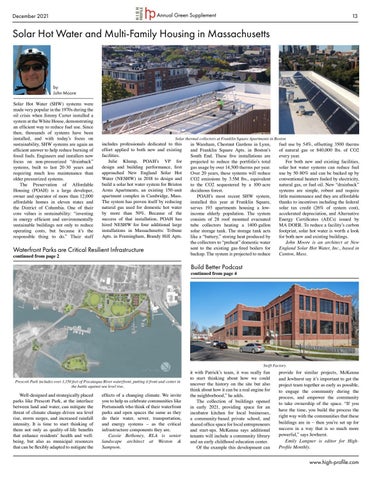
Solar thermal collectors at Franklin Square Apartments in Boston
includes professionals dedicated to this effort applied to both new and existing facilities. Julie Klump, POAH’s VP for design and building performance, first approached New England Solar Hot Water (NESHW) in 2018 to design and build a solar hot water system for Briston Arms Apartments, an existing 150-unit apartment complex in Cambridge, Mass. The system has proven itself by reducing natural gas used for domestic hot water by more than 50%. Because of the success of that installation, POAH has hired NESHW for four additional large installations in Massachusetts: Tribune Apts. in Framingham, Brandy Hill Apts.
Waterfront Parks are Critical Resilient Infrastructure continued from page 2
in Wareham, Chestnut Gardens in Lynn, and Franklin Square Apts. in Boston’s South End. These five installations are projected to reduce the portfolio’s total gas usage by over 14,500 therms per year. Over 20 years, these systems will reduce CO2 emissions by 3.5M lbs., equivalent to the CO2 sequestered by a 100-acre deciduous forest. POAH’s most recent SHW system, installed this year at Franklin Square, serves 193 apartments housing a lowincome elderly population. The system consists of 28 roof mounted evacuated tube collectors heating a 1400-gallon solar storage tank. The storage tank acts like a “battery,” storing heat produced by the collectors to “preheat” domestic water sent to the existing gas-fired boilers for backup. The system is projected to reduce
fuel use by 54%, offsetting 3500 therms of natural gas or 840,000 lbs. of CO2 every year. For both new and existing facilities, solar hot water systems can reduce fuel use by 50-80% and can be backed up by conventional heaters fueled by electricity, natural gas, or fuel oil. New “drainback” systems are simple, robust and require little maintenance and they are affordable thanks to incentives including the federal solar tax credit (26% of system cost), accelerated depreciation, and Alternative Energy Certificates (AECs) issued by MA DOER. To reduce a facility’s carbon footprint, solar hot water is worth a look for both new and existing buildings. John Moore is an architect at New England Solar Hot Water, Inc., based in Canton, Mass.
Build Better Podcast continued from page 4
Swift Factory
Prescott Park includes over 1,150 feet of Piscataqua River waterfront, putting it front and center in the battle against sea level rise.
Well-designed and strategically placed parks like Prescott Park, at the interface between land and water, can mitigate the threat of climate change-driven sea level rise, storm surges, and increased rainfall intensity. It is time to start thinking of them not only as quality-of-life benefits that enhance residents’ health and wellbeing, but also as municipal resources that can be flexibly adapted to mitigate the
effects of a changing climate. We invite you to help us celebrate communities like Portsmouth who think of their waterfront parks and open spaces the same as they do their water, sewer, transportation, and energy systems – as the critical infrastructure components they are. Cassie Bethoney, RLA is senior landscape architect at Weston & Sampson.
it with Patrick’s team, it was really fun to start thinking about how we could uncover the history on the site but also think about how it can be a real engine for the neighborhood,” he adds. The collection of buildings opened in early 2021, providing space for an incubator kitchen for local businesses, a community-based private school, and shared office space for local entrepreneurs and start-ups. McKenna says additional tenants will include a community library and an early childhood education center. Of the example this development can
provide for similar projects, McKenna and Jewhurst say it’s important to get the project team together as early as possible, to engage the community during the process, and empower the community to take ownership of the space. “If you have the time, you build the process the right way with the communities that these buildings are in – then you’re set up for success in a way that is so much more powerful,” says Jewhurst. Emily Langner is editor for HighProfile Monthly.
www.high-profile.com