November 2025
37
Trends and Hot Topics
HP Interviews Douglas DiCerbo of Sentry Hill Financial Advisors and tax efficient transfer of generational wealth. We are part of Northwestern Mutual’s Private Client Group. As such we have access to additional talent in the forms of CPAs and attorneys who can help construct a detailed, sophisticated and tax efficient financial plan for our clients.
Anastasia Barnes, publisher of HighProfile Monthly, recently caught up with Douglas DiCerbo, partner and wealth management advisor at Sentry Hill Financial Advisors, a Northwestern Mutual Private Client Group. DiCerbo works with high-net-worth clients across various industries.
AB: Specifically in the AEC industry, what qualities or mindset do you look for in a client, and how do you partner with them to achieve long-term financial goals?
Anastasia Barnes: What are the key financial challenges construction owners face today, and how does your team help them navigate these complexities? Douglas DiCerbo: Business owners face similar challenges (with some nuances) today as they ever have. Tariffs are an added cost of doing business that could have a potential impact to their bottom line and, eventually, money is left to either transfer to the next generation or take out to use towards retirement. However, the core financial planning needs remain the same. We get various questions from clients, such as: • How can I mitigate taxes on distribution of assets or transfer of ownership? • How do I save for retirement outside of the business? • How can I manage a smooth business succession plan? • How can I “equalize the estate” if some children are in the business and some aren’t? • How should I plan for a “black swan” or unexpected event that could impact my business and/or personal life? AB: What trends are you seeing in wealth management and financial planning that specifically impact business owners in construction and real estate development?
Douglas DiCerbo
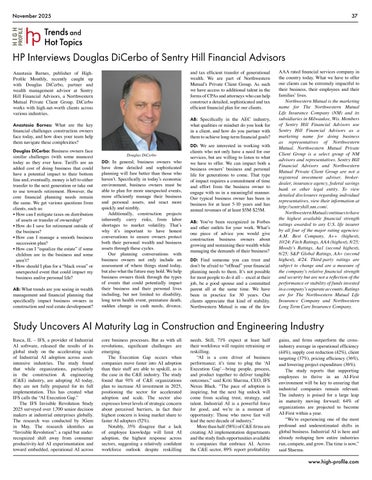
DD: In general, business owners who have done detailed and sophisticated planning will fare better than those who haven’t. Specifically in today’s economic environment, business owners must be able to plan for more unexpected events, more efficiently manage their business and personal assets, and react more quickly and nimbly. Additionally, construction projects inherently carry risks, from labor shortages to market volatility. That’s why it’s important to have honest conversations to ensure owners protect both their personal wealth and business assets through these cycles. Our planning conversations with business owners not only include an assessment of where things stand today, but also what the future may hold. We help business owners think through the types of events that could potentially impact their business and their personal lives including, but not limited to: disability, long term health event, premature death, sudden change in cash needs, divorce,
DD: We are interested in working with clients who not only have a need for our services, but are willing to listen to what we have to offer. We can impact both a business owners’ business and personal life for generations to come. That type of impact requires a commitment of time and effort from the business owner to engage with us in a meaningful manner. Our typical business owner has been in business for at least 5-10 years and has annual revenues of at least $5M-$25M. AB: You’ve been recognized in Forbes and other outlets for your work. What’s one piece of advice you would give construction business owners about growing and sustaining their wealth while managing the demands of their business? DD: Find someone you can trust and don’t be afraid to “offload” your financial planning needs to them. It’s not possible for most people to do it all – excel at their job, be a good spouse and a committed parent all at the same time. We have been in practice for 30 years. Our clients appreciate that kind of stability. Northwestern Mutual is one of the few
AAA rated financial services company in the country today. What we have to offer our clients can be extremely impactful to their business, their employees and their families’ lives. Northwestern Mutual is the marketing name for The Northwestern Mutual Life Insurance Company (NM) and its subsidiaries in Milwaukee, Wis. Members of Sentry Hill Financial Advisors use Sentry Hill Financial Advisors as a marketing name for doing business as representatives of Northwestern Mutual. Northwestern Mutual Private Client Group is a select group of NM advisors and representatives. Sentry Hill Financial Advisors and Northwestern Mutual Private Client Group are not a registered investment adviser, brokerdealer, insurance agency, federal savings bank or other legal entity. To view detailed disclosures regarding individual representatives, view their information at http://sentryhill.nm.com/. Northwestern Mutual continues to have the highest available financial strength ratings awarded to any U.S. life insurer by all four of the major rating agencies: A.M. Best Company, A++ (highest), 10/24; Fitch Ratings, AAA (highest), 8/25; Moody’s Ratings, Aa1 (second highest), 6/25; S&P Global Ratings, AA+ (second highest), 4/24. Third-party ratings are subject to change and are a measure of the company’s relative financial strength and security but are not a reflection of the performance or stability of funds invested in a company’s separate accounts. Ratings are for The Northwestern Mutual Life Insurance Company and Northwestern Long Term Care Insurance Company.
Study Uncovers AI Maturity Lag in Construction and Engineering Industry Itasca, IL – IFS, a provider of Industrial AI software, released the results of its global study on the accelerating scale of Industrial AI adoption across assetintensive industries. The study found that while organizations, particularly in the construction & engineering (C&E) industry, are adopting AI today, they are not fully prepared for its full implementation. This has created what IFS calls the “AI Execution Gap.” The IFS Invisible Revolution Study 2025 surveyed over 1,700 senior decision makers at industrial enterprises globally. The research was conducted by 3Gem in May. The research identifies an “Invisible Revolution”: a rapid but underrecognized shift away from consumer productivity-led AI experimentation and toward embedded, operational AI across
core business processes. But as with all revolutions, significant challenges are emerging. The Execution Gap occurs when companies move faster into AI adoption than their staff are able to upskill, as is the case in the C&E industry. The study found that 91% of C&E organizations plan to increase AI investment in 2025, positioning the sector for accelerated adoption and scale. The sector also expresses lower levels of strategic concern about perceived barriers, in fact their highest concern is losing market share to faster AI adopters (52%). Notably, 35% disagree that a lack of employee knowledge will limit AI adoption, the highest response across sectors, suggesting a relatively confident workforce outlook despite reskilling
needs. Still, 71% expect at least half their workforce will require retraining or reskilling. “AI is a core driver of business performance; it’s time to plug the ‘AI Execution Gap’—bring people, process, and product together to deliver tangible outcomes,” said Kriti Sharma, CEO, IFS Nexus Black. “The pace of adoption is inspiring, but the next big unlock will come from scaling trust, strategy, and talent. Industrial AI is a powerful force for good, and we’re in a moment of opportunity: Those who move fast will lead the next decade of industry.” More than half (58%) of C&E firms are creating AI implementation departments and the study finds opportunities available to companies that embrace AI. Across the C&E sector, 89% report profitability
gains, and firms outperform the crossindustry average in operational efficiency (44%), supply cost reduction (42%), client targeting (37%), pricing efficiency (36%), and lowering project expenditure (36%). The study reports that supporting employees to thrive in an AI-First environment will be key to ensuring that industrial companies remain relevant. The industry is poised for a large leap in maturity moving forward; 64% of organizations are projected to become AI-First within a year. “We’re experiencing one of the most profound and underestimated shifts in global business. Industrial AI is here and already reshaping how entire industries run, compete, and grow. The time is now,” said Sharma.
www.high-profile.com