High-Profile Focus: Schools and Institutions
18
March 2025
Future-Proofing Campus Mobility
By Mike Parkin and Nat Greir As college campuses evolve, so do the ways students, faculty, and staff move around them. Urbanization, sustainability commitments, and shifting commute patterns are reshaping transportation needs, requiring universities to rethink traditional approaches. While expanding bike lands and adding shuttles are helpful, the real game-changer lies in technology. From real-time transit tracking to predictive analytics, advanced mobility solutions are key to creating smarter, more efficient campuses. A Changing Transportation Landscape
In the wake of the COVID-19 pandemic, hybrid schedules and flexible learning have transformed commuting habits. Parking demand has become less predictable, bus ridership fluctuates, and micromobility options like e-scooters and bikes are becoming more popular. With
As part of Duke University’s Climate Action Plan and commitment to a carbon-neutral institution, the university partnered with VHB to develop a Sustainable EV Fleet Infrastructure Plan to reduce campus vehicle emissions.
transportation accounting for nearly 20% of student expenses, affordability remains a concern, as well. Some institutions have capped fees to ease financial burdens, but this often strains budgets in other areas. At the same time, sustainability goals are driving the push for cleaner transportation. Many universities
are committing to carbon neutrality, expanding EV charging networks, and promoting alternative transit options. But these changes present new challenges: How do campuses integrate new infrastructure while managing assets? How can they maintain accessibility for all users, confirming seamless navigation for those with mobility challenges?
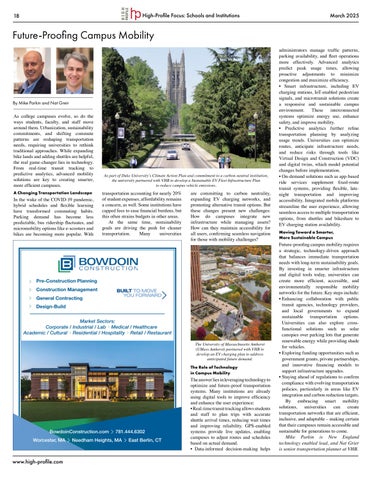
Pre-Construction Planning Construction Management General Contracting Design-Build Market Sectors: Corporate / Industrial / Lab Medical / Healthcare Academic / Cultural Residential / Hospitality Retail / Restaurant The University of Massachusetts Amherst (UMass Amherst) partnered with VHB to develop an EV charging plan to address anticipated future demand.
The Role of Technology in Campus Mobility
BowdoinConstruction.com Worcester, MA
www.high-profile.com
781.444.6302
Needham Heights, MA
East Berlin, CT
The answer lies in leveraging technology to optimize and future-proof transportation systems. Many institutions are already using digital tools to improve efficiency and enhance the user experience: • Real-time transit tracking allows students and staff to plan trips with accurate shuttle arrival times, reducing wait times and improving reliability. GPS-enabled systems provide live updates, enabling campuses to adjust routes and schedules based on actual demand. • Data-informed decision-making helps
administrators manage traffic patterns, parking availability, and fleet operations more effectively. Advanced analytics predict peak usage times, allowing proactive adjustments to minimize congestion and maximize efficiency. • Smart infrastructure, including EV charging stations, IoT-enabled pedestrian signals, and microtransit solutions create a responsive and sustainable campus environment. These interconnected systems optimize energy use, enhance safety, and improve mobility. • Predictive analytics further refine transportation planning by analyzing usage trends. Universities can optimize routes, anticipate infrastructure needs, and reduce risks through tools like Virtual Design and Construction (VDC) and digital twins, which model potential changes before implementation. • On-demand solutions such as app-based ride services supplement fixed-route transit systems, providing flexible, latenight transportation and improving accessibility. Integrated mobile platforms streamline the user experience, allowing seamless access to multiple transportation options, from shuttles and bikeshare to EV charging station availability. Moving Toward a Smarter, More Sustainable Campus
Future-proofing campus mobility requires a strategic, technology-driven approach that balances immediate transportation needs with long-term sustainability goals. By investing in smarter infrastructure and digital tools today, universities can create more efficient, accessible, and environmentally responsible mobility networks for the future. Key steps include: • Enhancing collaboration with public transit agencies, technology providers, and local governments to expand sustainable transportation options. Universities can also explore crossfunctional solutions such as solar canopies over parking lots that generate renewable energy while providing shade for vehicles. • Exploring funding opportunities such as government grants, private partnerships, and innovative financing models to support infrastructure upgrades. • Staying ahead of regulations to confirm compliance with evolving transportation policies, particularly in areas like EV integration and carbon reduction targets. By embracing smart mobility solutions, universities can create transportation networks that are efficient, inclusive, and adaptable – making certain that their campuses remain accessible and sustainable for generations to come. Mike Parkin is New England technology enabled lead, and Nat Grier is senior transportation planner at VHB.