U
ndoubtedly, the rumors that the War might soon end were on the mind of Mary Councill as she began to go about her morning chores in the spring of 1865. Soldiers were beginning to appear in town, many not on official leave, bringing with them stories of the hardships endured by the men in gray in the trenches around Petersburg. Times were just as hard in Boone and the surrounding countryside. Even as Mary sought to care for her family, a new home guard company was organizing in Boone. There were rumors that Jim Hartley’s gang of deserters and Unionists was on the prowl once again. There was some type of commotion on the other end of town, and Mary headed for the door to see what was going on. As she stepped out onto her porch, a scattering of shots rang out, and the bullets slammed into the wooden frame around the door. Mary quickly retreated inside, shaken, but unharmed. After four years, the Civil War had come in earnest to Watauga County. Almost four years before, a different crowd had gathered on the streets of Boone. Local farmer Harvey Davis was in town the same day as George N. Folk, the former general assemblyman who had resigned his seat in order to come home and raise a company for the war. Harvey recalled in his diary that Folk gave a “some-what fiery speech,” at the end of whicha call was made for volunteers. Manymen stepped up, including Harvey. After several weeks of drills, with ample public banquets, the company was off to the war, becoming members of the First North Carolina Cavalry. Rumors abounded on the supposed Unionist sentiment of Watauga County. One newspaper article stated that 500 local men were ready to cross over the mountains into Tennessee and join the Federal army. Just the opposite was actually true. In September 1861, two more companies, two hundred more men, voluntarily enlisted in the Confederate army. These enlistees included one local Native American, Larkin Oxentine, and two free persons of color: Franklin Cousins and his brother, William Henry Cousins. In November, these two companies became members of the Thirty-seventh North Carolina Troops,
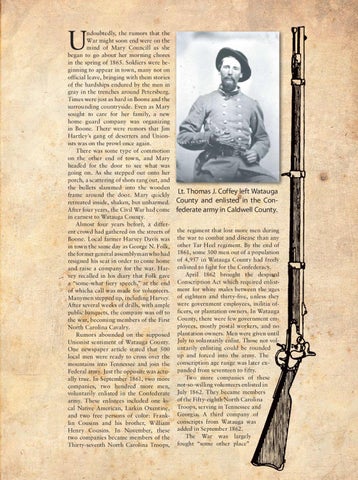
Lt. Thomas J. Coffey left Watauga County and enlisted in the Confederate army in Caldwell County. the regiment that lost more men during the war to combat and disease than any other Tar Heel regiment. By the end of 1861, some 300 men out of a population of 4,957 in Watauga County had freely enlisted to fight for the Confederacy. April 1862 brought the despised Conscription Act which required enlistment for white males between the ages of eighteen and thirty-five, unless they were government employees, militia officers, or plantation owners. In Watauga County, there were few government employees, mostly postal workers, and no plantation owners. Men were given until July to voluntarily enlist. Those not voluntarily enlisting could be rounded up and forced into the army. The conscription age range was later expanded from seventeen to fifty. Two more companies of these not-so-willing volunteers enlisted in July 1862. They became members of the Fifty-eighth North Carolina Troops, serving in Tennessee and Georgia. A third company of conscripts from Watauga was added in September 1862. The War was largely fought “some other place”
June 2012
High Country Magazine
47