4UPDATE THE TOWNS THAT BUILT PRECINCT 4 Explore historic areas of Precinct 4 and the events, people, and places shaping our communities. Page 15
INSPIRING INNOVATION
Page 4
TELL ME ABOUT THE GOOD OLE DAYS
Page 20
STAYING CONNECTED TO THE COMMUNITY
Page 22
SPRING/SUMMER ISSUE 2021
Harris County Precinct 4
Commissioner R. Jack Cagle
FEATURES
2
THE STORIES TREES TELL:
Unrooting the Past
15
4 6 10 12 18 19
Inspiring Innovation
20 22 26
Tell Me About the Good Ole Days
THE TOWNS THAT BUILT PRECINCT 4
Coming Soon To A Park Near You Precinct 4’s Top Historical Markers Keeping Precinct 4 Beautiful Meet Jones Park's New Director Partnering for Success on Major Road Projects Staying Connected to the Community Online Communities Head Offline and Into Nature
Precinct4Update Spring/Summer 2021 Precinct4Update is a biannual magazine available to residents free of charge featuring Harris County Precinct 4’s various events and activities, volunteer opportunities, project updates, news, and much more.
Contact www.hcp4.net 713-274-4050 14444 Holderrieth Road Tomball 77377
Writing Joan Gould Crystal Simmons Taelor Smith Kaci Woodrome
Editing Joe Stinebaker
Design Grace Diaz
Cover photo by Crystal Simmons
4Happenings
online!
NatureFest AT JONES PARK Page 5
Want to know what’s happening in Precinct 4? Sign up to receive our quarterly calendar! Follow the link below to subscribe online. www.hcp4.net/ subscribe
Due to precautions related to Coronavirus (COVID-19), some programs and activities may be curtailed, postponed, or canceled. Please check with the appropriate venues before making plans.
Harris County Precinct 4
Commissioner R. Jack Cagle
WINTER ISSUE 2021
FOLLOW US!
printed on recycled paper
@hcprecinct4
Sign up
A message from
COMMISSIONER R. JACK CAGLE
M
any areas of Precinct 4 feature quirky shops, attractions, and downtown buildings steeped in history. In this issue of Precinct4Update, we dive into the past to examine the events, people, and places shaping our communities. Our cover story, "The Towns that Built Precinct 4," uncovers the history of old towns Spring, Tomball, and Humble and shares why these areas remain beneficial today. Our roots help define us, and trees have some of the deepest. I'm proud to announce that the Texas A&M Forest Service officially designated Precinct 4's Kissing Tree as a “Famous Tree of Texas,” an honor few trees in the state enjoy. To verify its history, your Precinct 4 team completed a rigorous approval process last year, tracing the tree's history back 170 years to Herman Strack, a founder of the Klein community. We share what we uncovered in "The Stories Trees Tell" and shed light on how trees provide a connection to the past. This issue also spotlights some of our community members bringing back old-fashioned fun in "Tell Me About the Good Ole Days." From record collecting to crafting to gardening, some of these old-fashioned hobbies have found younger new crowds. Read about a grandparent sharing her love of gardening with her grandchildren and a record collector who explains why records still hold a place in his heart. Community building serves as another resonating theme in this issue. In "Staying Connected to the Community," we highlight five of the most active local organizations helping us connect. These groups provide educational and recreational opportunities for individuals and groups interested in the outdoors and nature, with topics ranging from butterflies to hiking to gardening. What community would be complete without parks? Precinct 4 has more than 3,800 acres of parkland to keep you occupied all season long – and it continues to grow. We recently broke ground on Alabonson Park, a new facility in Spring Branch that will include international soccer fields, trails, and sports fields. Plans also include expanding Kickerillo-Mischer Preserve and updating facilities at Mercer Botanic Gardens. Learn more about these improvements and more in "Coming Soon to a Park Near You."
Our roads remain a critical indicator of our community's strength. When they are littered and full of potholes, it tells us we need to improve. As your commissioner, I take great pride in the beauty of your roadways and remain dedicated to ensuring your roads never fall below our high standards. I encourage you to read "Keeping Precinct 4 Beautiful" and "Partnering for Success" to learn more about how Precinct 4 keeps your roads beautiful. If you enjoy this publication, I invite you to submit article ideas, important community projects, and other newsworthy events and issues to our editor and communications director, Joe Stinebaker, at jstinebaker@hcp4.net. With your help, we hope to tailor Precinct4Update to reflect your needs and interests because it truly is "for you."
R. Jack Cagle
1
The Stories Trees Tell:
Unrooting the Past story by Crystal Simmons
P
recinct 4's Kissing Tree looms large off T.C. Jester Boulevard and Louetta Road. With its gnarled, moss-covered branches, the ancient oak looks like it belongs on a stately, centuries-old campus instead of a busy intersection near a gas station. Although this humble home may not seem important at first, it's what makes Kissing Tree unique. The oak's roots go back more than 170 years to Prussian immigrant Herman Strack. A successful blacksmith, cattle owner, and business owner, Strack immigrated to the Klein area in 1848 and accumulated an estimated 1,445 acres over his lifetime. Family records show a large oak tree, believed to be the Kissing Tree, marked Strack's homestead and blacksmith shop.
As the area grew, family members sold off land. When the community had a need, the Stracks provided. Businesses, housing developments, roads, and other community amenities – like Strack Intermediate School and the Strack Family Cemetery – now sit on land sold or donated by the Strack family. Emil and Mary Strack Theiss eventually inherited the old Strack property where the tree grew and opened a farm. Julie Haggard, their niece and Herman Strack's great-great-granddaughter, recalled playing under the tree as a child with her sister, Marjorie, in the early 1950s. "As a child, I passed by the tree daily as I walked to Kuykendahl and Louetta, where the bus picked me up," she says. "There was no bus service on Louetta, as the road was gravel." The community looked much different back then. Instead of developments and convenience stores, Haggard remembers mossy forests and farmland. She considers Kissing Tree a remnant of that time. "The old tradition was to make Easter nests for the kids out of the tree moss," she says. "There was moss 2
Precinct4Update Spring/Summer 2021
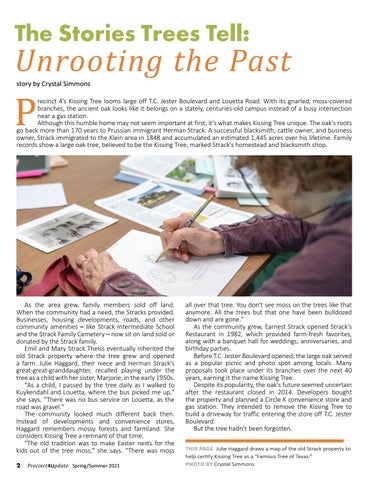
all over that tree. You don't see moss on the trees like that anymore. All the trees but that one have been bulldozed down and are gone." As the community grew, Earnest Strack opened Strack's Restaurant in 1982, which provided farm-fresh favorites, along with a banquet hall for weddings, anniversaries, and birthday parties. Before T.C. Jester Boulevard opened, the large oak served as a popular picnic and photo spot among locals. Many proposals took place under its branches over the next 40 years, earning it the name Kissing Tree. Despite its popularity, the oak's future seemed uncertain after the restaurant closed in 2014. Developers bought the property and planned a Circle K convenience store and gas station. They intended to remove the Kissing Tree to build a driveway for traffic entering the store off T.C. Jester Boulevard. But the tree hadn’t been forgotten. THIS PAGE Julie Haggard draws a map of the old Strack property to help certify Kissing Tree as a "Famous Tree of Texas." PHOTO BY Crystal Simmons
"...the Kissing Tree is a beautiful reminder of what the area once was before development." Public outcry and a letter-writing campaign by Klein Oak High School students, civic associations, municipal utility districts, the Houston Northwest Chamber of Commerce, and others earned the tree a reprieve, and an agreement between Circle K and Precinct 4 Commissioner R. Jack Cagle sealed the tree's fate. Circle K agreed to leave the tree after Precinct 4 pledged to alter the median so vehicles on both sides of T.C. Jester could access the store. Cagle then had the county purchase the property and opened Kissing Tree Park in 2017. The decision prompted arborist Laura Medick to explore Kissing Tree's history and incorporate it into Precinct 4's Legacy Trees Project, a program that preserves the genetic data of historical trees across Texas. She worked with Haggard in 2019 to record details linking the tree to the Strack family. Thanks to Haggard's account and records from the Strack family history book, the Texas A&M Forest Service designated Kissing Tree a "Famous Tree of Texas" in April 2020, adding the tree to others across Texas that have witnessed historical periods and events. Medick also began growing saplings from Kissing Tree's acorns. As the saplings matured, she planted them in public parks and donated them to nonprofits. She now hopes to share and preserve Kissing Tree's history with the public
through educational signage and historical tree donations in neighborhoods across the precinct. In a ceremony early last year, she even planted three Kissing Tree saplings in Terranova West, not far from Kissing Tree. Haggard also received a sapling from Medick recognizing the Strack family's contributions. "Our community and the surrounding property were all owned by the Strack family at one time," says Tom Lovell, the Terranova West MUD board president. "Family members still live in and near our community. As the area grows and green spaces disappear, especially along Louetta Road, the Kissing Tree is a beautiful reminder of what the area once was before development." Haggard continues to live on the family property where she was born, not far from the mother oak and Terranova West. Although the area has changed, Haggard views Kissing Tree as a reminder of the people who shaped the community. "It is a very large, live tribute to the hard-working men and women who sacrificed so much to come to this country," she wrote in a letter thanking Cagle. "They left their families knowing they would never see them again so that they could give their children and future generations a better life. That is us." THIS PAGE (LEFT TO RIGHT) Kissing Tree's branches support a rich habitat of moss and ferns. By Crystal Simmons. A Kissing Tree sapling grows in Terranova West, not far from the mother oak. By Odalys Sivils. For more information, visit www.hcp4.net/legacytrees.
3
Inspiring Innovation story by Taelor Smith
T
he COVID-19 pandemic has affected families across the world in many ways. In Harris County, community groups and organizations have modified programs and developed new ways to serve residents who are struggling financially or emotionally. Residents now have access to quality programs and safe recreational activities to help them cope with the pandemic.
$18 million from federal CARES Act funding for the housing program
CARES ACT AND THE COUNTY When the state and county implemented stay-atapproximately home orders, it affected jobs, schools, families and • Permanent Housing social lives. As a result, Congress passed the CARES Act • Mental Health to provide economic relief for those in need. Programs With the loss of jobs, some families found it challenging to pay bills and feared losing their homes. • Community will receive assistance The CARES Act helped ensure some security for Partnerships for homelessness. families through such organizations as the Coalition • And more for the Homeless. “The Coalition for the Homeless was proud to work with Harris County and the City of Houston to develop the plan for the Community COVID Housing Program,” says the coalition’s communications director, Catherine Villarreal. Villarreal said the assistance would help approximately 5,000 people experiencing homelessness in the next two years. Harris County has allocated $18 million from its federal CARES Act funding for the housing program. Service agencies will use this money to provide permanent housing, diversion from temporary shelters, and mental health case management programs. For instance, short-term rental assistance and services are available through the Rapid Re-Housing program to approximately 1,700 people who may become homeless due to the pandemic. Another program provides temporary shelter for approximately 1,000 chronically homeless people who will be diverted into permanent housing. Additionally, a new diversion program will help approximately 2,000 people maintain or regain housing to avoid entering emergency shelters. Partnerships with groups like the Coalition for the Homeless have ensured a more stable environment that helps in many other areas. “Up until this point, the anti-poverty systems have largely been responding to the immediate needs of people impacted by COVID,” says Villarreal. “We’ve had eviction moratoriums, financial assistance funds set up, etc. When people have access to safe, affordable housing, their mental and physical health improves for a number of reasons. They are no longer exposed to the outdoor elements, their levels of stress are drastically reduced, (and) they are better able to receive regular, preventive health care and access to medication.” The pandemic also exposed a gaping hole in the region’s educational system. While many students have easy access to home computers, laptops, and Wi-Fi, many of their schoolmates do not. CARES Act funding helped area school districts provide resources for thousands of students to continue learning at home through the Digital Access Program. Four school districts within Precinct 4 received personal computer devices and hotspots for students who needed them.
5,000 people
4
Precinct4Update Spring/Summer 2021
{
Area charter schools, such as KIPP and YES Prep, received devices through the programs as well. The technology was distributed throughout the fall semester and in January, when students returned from their holiday break. Operation Connectivity devices were distributed with 75% supported funding from the state. Project 10 Million is an effort led by T-Mobile that is supported by donations from H-E-B and Unilever to provide hotspots for students. By partnering with T-Mobile, funding from Harris County ensures unlimited monthly data coverage for the hotspot devices under this program. PROJECT 10 MILLION AND OPERATION CONNECTIVITY Devices
Hotspots
Laptops
52,100
20,083
16,800 10,083
Aldine ISD
9,700
5,297 5,297
5,000
4,350
Spring ISD
humble ISD
NEW WAY TO PLAY Harris County Precinct 4 has always encouraged community involvement through its monthly programs and events. To continue providing programs through the pandemic, staff members found creative ways to incorporate social-distancing guidelines. Thinking outside the box and shifting perspectives allowed employees to create safer ways for residents to gather and learn.
“We have reached a larger audience by hosting many programs virtually, and we hope to make this an ongoing part of our programming,” says Perez. Known for its uniquely themed luncheons and senior bus trips, Precinct 4 Encore restructured many programs and events to include social-distancing guidelines. The monthly luncheons to which community friends came to eat, dance, and experience fellowship became drive-thru events, allowing participants to pick up a meal, take photos, and have a good time – all while staying in their cars. Encore also created virtual experiences for residents to enjoy from home, including online trivia and concerts to virtual trips around the area.
Spring branch isd
4,379
tomball ISD
“Participation has been great for both virtual and drive-thru events,” says Kathy Perez, of Precinct 4 Encore. “The community centers are seeing the largest turnout for their drive-thru events, averaging around 60-80 participants per event. Our special events that we’ve held virtually had higher viewership. The most successful event was our 'Here Comes the Sun Summer Concert', with 8,200 views.” Encore programs have become a welcome outlet for seniors craving social connection and recreation. “With this new style of programs, we’ve noticed that friends will watch our virtual programs together and share with others who may not even live in Precinct 4,” says Perez. “For many participants, our programs are still the only means of being entertained and staying engaged with the community. We have reached a larger audience by hosting many programs virtually, and we hope to make this an ongoing part of our programming.”
For a more in-depth look at how CARES Act funding is allocated across Harris County, visit bit.ly/update-cares-act.
5
COMING SOON
T O A PA R K N E A R YO U story by Taelor Smith
6
Precinct4Update Spring/Summer 2021
W
ith nearly 50 parks and enough green space to cover more than a quarter of Manhattan island, Harris County Precinct 4 has no shortage of opportunities to learn, explore, and build memories. Since opening its first park, Precinct 4 has become known for creating unique recreational spaces along Spring and Cypress creeks. To keep up with the region’s growing needs, as well as its ever-changing and sometimes hostile environment, Precinct 4 continues to upgrade and expand its park system so visitors will always have a place to enjoy the outdoors.
MERCER’S MAJOR CHANGES Filled with themed gardens and one-of-a-kind plants and flowers, Mercer Botanic Gardens is one of Harris County’s most popular outdoor spaces. Its annual plant sales never fail to draw a crowd, and its changing color gardens make Mercer an excellent attraction year-round. Unfortunately, flooding has always been a challenge for Mercer. During most floods, the gardens incurred only light damage and recovered within a few months. Hurricane Harvey changed that. Harvey's massive devastation in 2017 still has staff members working to restore the grounds to their former glory. There’s hope, though, that a master plan will launch Mercer into a new era. “The first phase of the master plan is building the new greenhouses and creating the flood basin area,” says Chris Ludwig, Mercer’s director. “If we stay on completion schedule [for the greenhouses], we’ll be done by July or August 2021.”
Other improvements include changes to the Forrest Floor, an area along the creek just past the Tropical Garden. Ludwig says Mercer will install retaining or low-seating walls and update the irrigation system. Staff have planted the crinum lily collection at Storey Lake and will soon plant a new collection of Louisiana irises around the lake. Ludwig says other changes will come as the park is evaluated. “Going through the gardens to take a look helps determine what will be updated,” he says. “We just updated the Tropical Garden, the Children’s Garden, and the Shakespeare Garden.”
OPPOSITE PAGE (TOP CENTER AND RIGHT) Precinct 4 plans to connect Kickerillo-Mischer Preserve Trails to KMP South and other areas along the Cypress Creek Greenway. (MIDDLE LEFT) Mercer's newly renovated Creekside Ramble. (BOTTOM LEFT) Precinct 4's latest park project, Alabonson Park, is under development. PHOTOS BY Crystal Simmons and Grace Diaz
7
CONNECTING TO KICKERILLO Kickerillo-Mischer Preserve is a gem hidden in plain sight, nestled in bustling Vintage Park, near the intersection of Highway 249 and Chasewood Park Drive. Cypress Creek and Marshall Lake are the preserve’s centerpieces, providing a scenic backdrop for hikers, bikers, and joggers to enjoy the trails. The land adjacent to the preserve is set to undergo significant changes that will enhance the area by providing new amenities and connecting to nearby parks and recreational spaces. Recent changes to the addition, known as KMP South, include a new playground, a repaved entry point, a parking lot, and a picnic area. Once it is complete, visitors can enter KMP South from Highway 249. “We’re getting ready to add a major trail project,” says Dennis Johnston, Precinct 4’s parks director. “It will go under 249, along the north side of Cypress Creek. A critical aspect of that is it connects the YMCA pond along [KMP] South, headed east.” The Cypress Creek Greenway Trail expansion project will also connect to the 100 Acre Wood Preserve, which is popular with local mountain bikers. Precinct 4 is working closely with the Harris County Flood Control District, which owns property near the 100 Acre Wood Preserve, to provide more parking and facilities. Johnston says he plans to get the expansion project to bid in the first quarter of this year. KMP director Rose Belzung Holmes says she looks forward to seeing the plans become reality. “These plans have been in the works,” says Holmes. “It’s taking a while because of land acquisition. The county has been able to complete the Spring Creek Greenway Trail a lot quicker because most of the land was undeveloped. It was easier to gain easement access or purchase the land outright. The land along Cypress Creek is more developed with businesses and homes, so it takes a bit more procedural work to gain the easement access needed for trail installation.”
8
Precinct4Update Spring/Summer 2021
Plans also include linking Lone Star College-University Park to the Hewlett-Packard business park, which will give visitors access to the Cypress Creek Greenway Trail as far west as Jones Road near Faulkey Gulley. Development is taking place throughout the area, which is expected to draw more visitors to the Kickerillo-Mischer Preserve. Holmes says additional improvements will be needed as more visitors take advantage of the preserve.
“We are requesting to add another covered picnic area so that we can have another site for people to use,” she says. “At some point, we’re going to have an additional restroom facility closer to the west end of the preserve.” KMP will also one day include a nature center, but it is not an immediate project. More planning and surveying are needed to prevent flooding before breaking ground. THIS PAGE (TOP TO BOTTOM) View of the YMCA lake from the trails. KMP South's playground area. PHOTO BY Grace Diaz.
ABOVE Vice Consul of the State of Qatar Khalid Al Sulaiti, Houston City Council member Amy Peck, Commissioner R. Jack Cagle, and Matthew Fougerat of TPWD break ground at the Alabonson Park ribbon cutting event in October 2020. PHOTO BY Crystal Simmons.
LATEST PARK JOINS PRECINCT 4 One of the latest parks to be added to Precinct 4 is Alabonson Park. This $6 million project is possible thanks to the financial contributions of the Texas Parks & Wildlife Department and the Qatar Harvey Fund. “Commissioner [Cagle] was approached by the Near Northwest Management District about the property that was sitting unused,” shared Johnston. “The City of Houston owned the land, but wouldn’t develop it. We wrote a grant for a $1 million match to get the project up and running.” Alabonson Park will feature a football field, an international-sized soccer field, two practice soccer fields, two softball fields, a playground, and a pollinator garden. There will also be a trail enclosing the park. The project is to be completed by March 2022. Before breaking ground on Alabonson Park, Precinct 4 completed Champion Forest Park in 2018, which is only a few blocks away from KMP. Precinct 4 plans to connect the Cypress Creek Greenway Trail to the park and add a canoe launch for visitors to access Cypress Creek. These are just a few park projects Precinct 4 has planned over the next few years. As long as there is a need, Precinct 4 will continue to provide unique and alternative recreational spaces for all residents and visitors.
As long as there is a need, Precinct 4 will continue to provide unique and alternative recreational spaces for all residents and visitors.
For a full list of parks and their various amenities, visit Precinct 4’s website at www.hcp4.net/parks. 9
Precinct 4’s
Top Historical Markers compiled by Kaci Woodrome
2. WUNSCHE BROTHERS SALOON & HOTEL Location: 103 Midway St., Spring 77373. GPS: Latitude: 30° 04.768’. Longitude: 95° 25.052’.
1. BAYOU BEND
Location: 6003 Memorial Drive, Houston 77007. GPS: Latitude: 29° 45.540’. Longitude: 95° 25.307’.
Bayou Bend consists of an American heritage collection displayed in a mansion built in 1927 by William Hogg (1875-1930), Ima Hogg (18821975), Michael Hogg (1885-1941), and Thomas Hogg (1887-1949), the four children of the first native Texas governor, James Stephen (Jim) Hogg (1851-1906) and Sarah Ann (Stinson). William (Will) Hogg was an attorney and businessman who originated student loan programs in numerous Texas colleges. He served as chairman of the Board of Regents at the University of Texas from 1914 to 1916 and developed River Oaks where Buffalo Bayou makes a noted bend. Michael (Mike) Hogg was a Texas legislator from 1927 to 1931 who joined his sister in establishing the Hogg Foundation for Mental Health at the University of Texas. Miss Ima Hogg founded the Houston Symphony in 1913 and the Child Guidance Center of Houston in 1929. Additionally, she served on the Houston School Board from 1943 to 1949. Devoted to education and preservation, Ima Hogg provided Varner-Hogg Plantation State Historic Site in West Columbia and Winedale Historical Center in Fayette County. Miss Hogg and her brothers used their home, set on 14 acres of natural beauty and developed gardens, to house paintings and American memorabilia, which entertained national and international personages. The Hogg collection spans three centuries from about 1620 to 1870, containing several thousand objects installed in 28 period room settings. In 1957, Miss Hogg donated Bayou Bend and its treasures to the Museum of Fine Arts, Houston. Ticket prices range from $6 to $13 and can be purchased at www.mfah.org. 10
Precinct4Update Spring/Summer 2021
1902
The Wunsches, one of Spring's earliest families who immigrated from Germany in 1846, constructed this building in 1902. The Wunsche Bros. Saloon and Hotel, later known as the Spring Cafe, was built to accommodate railroad workers and has served as a community gathering place throughout the town’s history. The structure, which exhibits typical turn-of-the-century commercial detailing, is Spring's oldest existing commercial building on its original site. It was recorded as a Texas Historic Landmark in 1984. 3. KOHRVILLE COMMUNITY Location: 18202 Theiss Mail Road, Klein 77379. GPS: Latitude: 30° 01.789’. Longitude: 95° 32.589’.
In the 1870s, former slaves from Alabama and Mississippi settled on Cypress Creek near a store owned by German immigrants Agnes and Paulin Kohrmann, where Paulin served as postmaster. The Kohrville community centered on the farming, ranching, and lumber industries. In the early 1900s, a cotton gin and sawmill were present, and Agnes Kohrmann ran the general store that served a reported population of 50 residents. By 1911, the post office had been discontinued and mail was being delivered from Hufsmith. When area schools consolidated, Kohrville became part of Klein Independent School District and offered education for white and black students. In the late 1940s, Klein ISD financed a new school for the community. An architect, probably Alfred C. Finn, designed the new schoolhouse, which was later moved to the current site. The school district was desegregated in the 1960s. Kohrville and neighboring communities are now part of the ever-growing Houston suburbs. The Kohrville community was designated as a Texas Historical landmark in 2003.
4. LAMBRECHT’S ARTESIAN WELL Location: Business F.M. 1960 (First Street) at North Houston Avenue, Humble 77338. GPS: Latitude: 30.00.107’. Longitude: 95. 15.305’.
An oil well drilled at this site in 1912 yielded not oil, but free-flowing artesian water. The following year, German native Nick Lambrecht (1855-1920) purchased the property. Lambrecht served as justice of the peace and mayor during Humble's oil boom days in the early 20th century. In 1904, he installed a water system to meet the needs of the many oil field workers who came to town. Lambrecht's artesian well was used to supply water to bathhouses and piped to nearby homes. In earlier years, water had been hauled to town in barrels on horse-drawn wagons. 5. OLD TOWN SPRING
Location: 403 Main St., Spring 77373. GPS: Latitude: 30° 04.733’. Longitude: 95° 25.327’.
Initially a farming community supported by sugar cane and cotton crops, Spring was platted by the Houston & Great Northern Railroad in 1873. That same year, Callahan Pickette became the town's first postmaster. Spring served as the commercial center for the surrounding area during the early 1900s and a focal point for German settlers including Carl Wunsche, who was instrumental in the town's development. A new rail line reached Spring in the early 20th century, and the addition of a roundhouse and railway shops created an import rail center for the growing community. Developer R.l. Robinson subdivided land south of the original town and the commercial area shifted to accommodate the rail junction. Railroads facilitated the development of the lumber industry, which boasted large and small mills during the boom era of lumber production. With the boom came new businesses, including hotels, saloons, an opera house, gambling houses, a hospital, and a bank. In 1907, residents established the Spring Independent School District. The loss of the roundhouse and the onset of Prohibition led to a decline in population. Ultimately, the saloons, hotels, and other rail-supported businesses closed in the 1920s. The dwindling community persisted, however, creating a volunteer fire department in the 1950s and sustaining the Spring ISD, which integrated in the mid-1960s. As the population began to grow again in the early 1970s, many new businesses opened, including a variety of specialty shops. Spring continues to attract new residents and businesses but retains its unique identity as a town with a strong German heritage and its link to early history. The town of Spring was designated as a Texas Historical landmark in 2003.
6. GRIFFIN MEMORIAL HOUSE Location: 510 N. Pine St., Tomball 77375. GPS: Latitude: 30° 05.939’. Longitude: 95° 37.176’.
Tip: At the corner of Pine Street and Epps Street across from the Tomball Museum.
Built about 1860 by Eugene Pillot, son of early Harris County settler Claude Nicholas Pillot, who became an outstanding builder in the Texas coastal region after learning the trade from his father. The original site of the house, near the Atascocita Trail route and south of Willow Creek, was often visited by General Sam Houston. The family of John B. Griffin owned the house from 1920 to 1995. Mrs. Ruth Griffin McCourt gave the home to the Spring Creek County Historical Association in 1965 in memory of her father, Edmond B. Griffin. The Griffin Memorial House was recorded as a Texas Historic Landmark in 1969.
41 HISTORICAL LANDMARKS IN PRECINCT 4!
For more information about other historical sites in Precinct 4, please visit www.hcp4.net/historicalmarkers. 11
Keeping Precinct 4 Beautiful T story by Crystal Simmons
here's a famous stretch of Highway 290 so spectacularly beautiful that even harried motorists eager to reach their destinations sometimes pause for a photo or two, helpless against the allure of bluebonnets on a sunny day. Less than 100 miles to the east in Harris County, motorists discard fast food bags and dirty diapers at stoplights. Couches sit at dead ends, tires and buckets of paint stack up among scraps of old food containers, and cigarette butts peek out between blades of grass.
"The easiest way to tackle litter is to find out who is responsible for maintaining your area," Stinsman says. With years of waste piling up and new litter accumulating daily, addressing litter may seem overwhelming for those unfamiliar with local and state government. The good news is that residents have the tools to fight back against blight. According to Elizabeth Stinsman, the director of Precinct 4's Community Assistance Department, the first step is knowing who to call for service. "The easiest way to tackle litter is to find out who is responsible for maintaining your area," Stinsman says. "We invite residents concerned with litter to reach out to the Community Assistance Department. If we don't maintain the area, we'll help them find the appropriate contact." Responsible parties in Harris County may include commissioners in precincts 1, 2, 3, or 4, the Texas Department of Transportation (TxDOT), the Harris County Toll Road Authority, or a private entity. Even when the proper agency is on the job, keeping streets clean still requires massive amounts of time and money, especially in the sprawling Greater Houston area. 12
Precinct4Update Spring/Summer 2021
ABOVE A Precinct 4 staff member cleans up Spears Road near Veterans Memorial, a litter hotspot.
Across the state, TxDOT maintains more than 79,000 miles of highways and farm-to-market and ranch-to-market roads, including the heavily trafficked and much-maligned FM 1960. With such a large area to cover, litter cleanup on state roads isn't cheap, costing more than $47 million in 2019. Highways in the Greater Houston area are also among the most polluted in the state. "In 2020, Interstate 610, Interstate 10, and Interstate 45 have required the most money spent for cleanup,"
says Becky Ozuna, the campaign coordinator with the Don't Mess with Texas program. "This is directly linked to the high volume of traffic that traverses these roadways." At the county level, Precinct 4's Road & Bridge Department maintains more than 2,628 miles of roadways. The toll road authority maintains another 128 miles. Both agencies are out removing litter every day. "We always remove trash before mowing, so roads are serviced about every four to six weeks," says Freddie Jebousek, the general superintendent for Precinct 4's Road & Bridge Department. "But also, if a constituent reports an abundance of trash in a particular location, we send a crew to pick it up." Despite regular cleanup, some areas remain litter hotspots. "We'll go through and mow Spears Road and have it all nice and pretty. And the next day – there's trash again," says Jebousek. "It's the same situation with Veterans Memorial and Antoine." Jebousek explains that crews see the most litter in densely populated areas near busy thoroughfares and intersections. He says fast-food containers, drinks, and cigarette butts are some of the most common items that people throw.
FIGHTING BACK
Some residents have taken a grassroots approach to litter control, starting with extra maintenance and beautification. According to a 2009 Keep America Beautiful study, communities with low rates of visible litter, well-maintained streets and sidewalks, attractive plants, flowers, trees, and attractive infrastructure saw less garbage than other neighborhoods.
"Just seeing that the area is well cared for may be enough to deter some litterers," says Schlattman. Barbara Schlattman, a Champions resident, noticed a change in her community when she helped establish the Green Medians Joint Powers Board along FM 1960 eight years ago. Schlattman brought together 14 water district boards who agreed to beautify 9 miles of medians along FM 1960, from Mills Road to I-45. Members paid for landscaping, water, and weekly maintenance, including trash cleanup. Despite being one of the area's most heavily trafficked roadways, the area today remains nearly free of visible litter, she says. "Just seeing that the area is well cared for may be enough to deter some litterers," says Schlattman.
Road adoption programs are also popular across the state. Groups commit to keeping a roadway clean for at least one year and conduct quarterly cleanups through programs like Precinct 4's Adopt A County Mile program or TxDOT's Adopt-A-Highway program. With some effort, residents can clean up their communities and help make Precinct 4 a beautiful place to live. Though the road may be difficult, Schlattman believes the result is worth the effort. "I feel like everyone deserves to be surrounded by beauty," she says. "After we finished the green medians project, I encouraged people to go back to their subdivisions and try to beautify their neighborhoods. Many of them really are beautifully maintained."
KEEP TEXAS BEAUTIFUL Keep Texas Beautiful gives residents the tools to clean up their communities. It offers free cleaning supplies and resources for organizing cleanups. Interested individuals or groups can download resources or browse upcoming cleanup events at www.ktb.org. Motorists and concerned residents can also report litter to each agency directly.
CONTACT TXDOT
713-802-5000 Submit concerns online: www.txdot.gov/contact-us/form.html Twitter: txdothouston Instagram: TxDOTHouston Facebook: txdothouston ________________________
FOR OTHER CONCERNS, CONTACT HARRIS COUNTY PRECINCT 4'S COMMUNITY ASSISTANCE DEPARTMENT 832-927-4444 cadir@hcp4.net Submit concerns online: www.hcp4.net/cad/assistance
13
(LEFT TOP AND BOTTOM) A couple enjoys ice cream on the patio of a local creamery. Visitors pick out candy at Emmy's Sweet Shoppe in historic Old Town Spring.
14
Precinct4Update Spring/Summer 2021
(RIGHT) Shops in Old Town Spring.
Old Town Spring• Tomball• Humble•
The Towns
THAT BUILT PRECINCT 4 story by Joan Gould photos by Crystal Simmons
M
uch of the Greater Houston area’s growth and success stems from the days of farming, lumber, railroad, and oil. Today, many of the “old towns” in Precinct 4 have transformed into bustling destinations for tourists and locals with specialty shops, quaint restaurants, and festivals that give a nod to that past. Nestled within sprawling towns, businesses housed in 100-year-old buildings offer a few moments of nostalgia and a unique economic benefit as they draw hundreds of thousands of visitors each year.
15
Old Town Spring
Old Town Tomball
Spring’s history dates back to the early 19th century, when the French and Spanish traded with the local Akokisa tribe. German settlers arrived shortly after and, by the end of the 1800s, Spring was a busy railroad hub. The early 1900s brought the oil boom and the Great Depression. The railroad roundhouse moved to Houston and, as with most of the country, economic growth slowed in Spring. The oil boom of the late 1960s and Old Town 1970s revived the local economy, and Spring now an influx of businesses returned to what now is called Old Town Spring. boasts more Property owners restored old shops than 140 and homes to house new ventures. businesses. Near the intersection of Spring Cypress and Hardy roads, Old Town Spring now boasts more than 140 businesses, including retail shops, restaurants, art galleries, beauty services, and churches. Ursula Sledge, a Spring Preservation League board member and owner of The German Gift House, says she was a regular customer at the gift shop in Old Town Spring. When she heard 12 years ago that the owner was interested in selling, she jumped at the chance to own the business. “I love it because it feels a little European,” Sledge says about Old Town Spring. “There are unique shops; everybody has different things. Everything goes at a slower pace, and it’s not so hectic. Slow in a positive sense, because life can be so stressful.” The Spring Preservation League is a merchant organization dedicated to promoting Old Town Spring and attracting visitors. The group works closely with the Spring Improvement District to host festivals like the annual Texas Crawfish Festival and Home for the Holidays, now in its 41st year. “As a shop owner, I think everyone should be involved in decorating the town and be part of the decision making,” Sledge says. “It’s really a joyful atmosphere.”
Tomball, known as Peck when it was established, also has roots as a railroad boomtown in the early 1900s. Thomas Tough Henry Ball, a lawyer and mayor of times go Huntsville, encouraged the Trinity and away. Brazos Valley Railroad to lay its tracks Tough through the area, providing easier people access to the port. The new railroads brought prosperity do not, and job growth to the area and the ability to move goods efficiently. The Hillegeist people of Peck honored Thomas Henry Ball by renaming the town Tom Ball. says. Eventually, the post office combined the two words, and Tom Ball became Tomball. “Our history is like a road map,” says Bruce Hillegeist, a lifelong resident of Tomball and president of the Greater Tomball Area Chamber of Commerce. “You need to know where you’ve been to know where you’re going.” Magnolia Oil, which later became Humble Oil, discovered oil in Tomball in 1933, further contributing to its economic growth. The population of Tomball expanded after the railroad and oil booms. Prominent businesses like the grocery store, the post office, and the bank moved west of what is now considered Old Town Tomball, a six-block area centered on West Main Street, between the railroad tracks at North and South Elm streets and North and South Pine streets. Hillegeist says this left much of the town sitting vacant until the rise in popularity of antique shops. Today, Old Town Tomball is a hot spot for restaurants, retail shops, and antiques. “We have easy, convenient access to the interstates, the port, and the airport, which makes people and businesses give Tomball a second look,” Hillegeist says.
16
Precinct4Update Spring/Summer 2021
THIS PAGE (LEFT TO RIGHT ) Simply Texas Gourmet Food in Old Town Spring sports bold colors and classic landscaping. Every-Bellies restaurant near the Tomball Depot.
“We’re all about jobs and prosperity and economic development. We want the greater Tomball area to be the place of choice for people, for businesses to live, work, play, and worship.” Hillegeist says that even with Tomball’s development, the town stays true to its motto: “Hometown with a Heart,” with friendly people and a sense of community built by bringing people together with festivals, local shopping, and excellent schools and businesses. Many of Tomball’s festivals and activities, including the semi-annual German Festival, were canceled in 2020 because of COVID-19. “Tough times go away. Tough people do not,” Hillegeist says. “We’re going to be stronger, and we’re going to come back in a big way.”
Historic Downtown Humble Tomball’s approach to growth, economic development, and community engagement has been so successful that other cities, like Humble, seek to emulate it in attracting visitors to their historic downtown areas. Gwen Key Willis, the chair of the Humble Beautification Committee, says Humble reached out to marketing teams from Tomball and Friendswood to gain insight on how to entice visitors and local shoppers to the downtown Humble area, which is at the beginning stages of a revitalization initiative. The early settlement of Humble began in the late 1820s, when a member of Stephen F. Austin’s colony, Davis Harris, received the area’s first land grant. An oil discovery in the early 1900s put Humble on the map. Humble Oil Company was soon founded and later purchased by Standard Oil Co., eventually becoming part of ExxonMobil. Though much of Humble moved on to other industries after the oil boom, its history remains rooted in the oil boom days. The annual Good Oil Days Festival, in its 41st year, commemorates Humble’s settlers and oilfield history. More recent revitalization projects like the Charles Bender Performing Arts Center and the newly opened Humble Museum invite visitors to learn and explore Humble’s origins. Willis purchased an office on Main Street for her real estate business in 2010. She quickly began volunteering with the committee, which works closely with the Humble City Council. “Our goal is to identify things in the community that may need to be upgraded or put to better use,” Willis says. “We also recently started a revitalization initiative to get the business owners input on what they would like to see in the downtown area.” Willis says many of the committee members are lifetime residents of Humble and have a wealth of knowledge of the city. Some members, including Willis, are also board members of the newly reopened Humble Museum. Willis says they are committed to keeping Humble’s history alive by preserving landmarks like the Humble Cemetery and
ABOVE Humble Museum grand opening.
Lambrecht’s Artesian Well, a water spring discovered while drilling for oil in 1912. New festivals and events like the Music on Main free concert series and a newly added sip-and-stroll during Good Oil Days are innovative ways to engage the community, Willis says. These events also provide Main Street business owners opportunities to visit with the public. “We’ve got some great places to visit and see,” Willis says. “We’re trying to get all these people that have an interest in the City of Humble to work together and offer opportunities for people to visit and see what we have to offer.” Next time you’re enjoying a day of shopping or dining in one of these “old towns,” stop by the museums to learn a little more about the history and origins of the towns that built Precinct 4.
Visit Spring Historical Museum Oldtownspring.com 403 Main St. Spring 77373 Tomball Museum Center Tomballmuseumcenter.com 510 N. Pine St. Tomball 77375 Humble Museum Humblemuseum.com 601 Higgins St. Humble 77338 17
Me N
k’s r
es Par n o J et Direc t w o e
ABOUT FUN FACTS • Joined the staff at Jones Park in 2016 as an education program coordinator. • Became the director at Jones Park in the fall of 2020. • Holds a bachelor’s degree in marine science from Texas A&M University at Galveston. • Enjoys playing tennis, going to the gym, and spending time in the water. Most of all, he loves traveling with his family to discover new places and experiences together.
JASON NAIVAR
FAVORITE PROGRAMS
• Jason wanted to be a marine biologist since he was a young kid. After college, he became a marine biologist, science educator, and maintenance scuba diver at the Houston Downtown Aquarium. • In 10 years and more than 2,500 hours of diving with sharks, stingrays, eels, and large fish, he was only bitten once.
WHAT’S NEW AT JONES PARK?
• Fishing’s Future-First Catch Center events
• Newly rebuilt cabin at the Redbud Hill Homestead
• Fish of Spring Creek
• Rebuilt and rethatched Akokisa Village structures
• Native American Heritage Day
• Resurfaced picnic loop and playground trails
• Texas Master Naturalist: Aquatics Lab Training
What can Jones Park Visitors Look Forward To? • Exciting and interactive nature and history programs that will appeal to all age groups. • Trail resurfacing on all west park trails, including Palmetto, Cypress Boardwalk, and Magnolia trails. • Upgraded reptile enclosure for our animal ambassador, Lucky the Burmese Python. • Clearing areas of invasive species to promote the growth of native plants and animals. For more information about Jones Park, please visit www.hcp4.net/jones. 18
Precinct4Update Spring/Summer 2021
Partnering for Success on Major Road Projects story by Taelor Smith
R
esidents and visitors to Precinct 4 routinely cover the area’s 2,700 miles of roads each day, occasionally encountering potholes, downed traffic signs or other problems. The road to fix those problems, though, often begins when a resident submits a request to Precinct 4’s Community Assistance Department. “The need [for upgraded roadways] comes out of the constituents finding the issues,” says Landon Reed, the assistant director of community outreach at Precinct 4. “When a request is made, it is always investigated.” Though many issues are small and routine, like adding stop signs or filling potholes, some require more attention. Capital improvement projects are those that require a significant financial investment, such as extending, widening, or upgrading a major thoroughfare. These projects can create opportunities for partnerships between Precinct 4 and other entities. “It is Commissioner (R. Jack) Cagle’s desire to leverage Precinct 4’s mobility funds by seeking partnerships with entities that would have a vested interest in a capital project being implemented,” says Pamela Rocchi, the director of Precinct 4’s Capital Improvement Projects division (CIP). “We have a longstanding policy of seeking partnerships with other jurisdictions and stakeholders as capital improvement projects are developed.” Precinct 4 frequently partners with such agencies as the Texas Department of Transportation, Montgomery County, other Harris County precincts, the Harris County Flood Control District, municipalities, local utility districts, water authorities, school districts, homeowners associations, and others. When attempting to partner on capital improvement projects, CIP first identifies potential stakeholders. The CIP agency coordinator then reaches out to determine those stakeholders’ interest, develops rapport, and ensures the participating entity is updated on a project’s progress. Once a capital project concludes, maintenance reverts to the jurisdiction to which the entity belongs. Precinct 4 has exercised these partnerships in a few recent projects. The Louetta Road project now underway is a joint effort between Harris County precincts 3 and 4. This project will connect the precincts with a bridge over Little Cypress Creek between Stablewood Farms Drive and Telge Road, providing another route between Highway 290 and Interstate 45. The cost of the $8.8 million project will be
split between the precincts, and the project is scheduled to conclude by March 2022. Precinct 4 also worked with the Champions Municipal Utility District to upgrade Champions Drive between FM 1960 and Cypress Creek to a two-lane concrete road with drainage improvements and new landscaping. Project development began in 2018, and construction ended in July, in time for the 2020 U.S. Women’s Open Golf Tournament to be held at the Champions Golf Course in December. Harris County provided $10 million, and Champions MUD contributed $4.5 million. “Projects with multi-jurisdiction boundaries are more challenging to pursue, since it takes a combination of need, community interest, and funding availability for the respective entities to move forward,” explains Rocchi. But it is Precinct 4’s Community Assistance and Road & Bridge departments that handle roadway needs that can be fixed relatively quickly and easily. A crosswalk at a roundabout intersection garnered many complaints, although it was technically “safe” under state regulations. However, when crews assessed the crosswalk, they discovered it was dangerous for students walking to and from a nearby school. Reed noticed an unfinished sidewalk near the area, realized The Woodlands Township covered costs for sidewalks and contacted officials there to create an alternative crosswalk. Precinct 4’s Road & Bridge Department added a culvert for a crossover to a nearby ditch and provided striping along the path, and Tomball ISD rerouted the student entrance to the school. “Within six weeks, the three [entities] were able to partner together to provide a new crosswalk. We then put out a statement through the HOA advising parents and students to use the new, safer crosswalk,” says Reed.
Residents can continue to keep roads safe by reporting issues or suggestions. Requests that can be solved quickly, such as potholes, downed trees, and signal light outages are typically completed within 24 hours. Precinct 4 residents can submit a maintenance request at www.hcp4.net/assistance. 19
TELL ME ABOUT THE GOOD OLE DAYS story by Kaci Woodrome and photo by Grace Diaz
T
he “good ole days” – times when things were done differently and usually remembered as better than the present. Of course, the good ole days look a little different for everyone. But there are a few favorite hobbies and activities that are timeless, spanning generations despite the ebb and flow of societal trends and the digital age. What makes certain pastimes everlasting? The people who share their passions with others. For Nell Shepherd and her husband, TJ, college sweethearts who met 57 years ago, it’s important to spend time outdoors and find teachable moments in nature with their children and grandchildren. “The main thing I love doing with them is gardening,” Nell Shepherd says. "The kids have a chance to explain to me how a plant grows. They will go to the extent of telling me about photosynthesis, and about hummingbirds, and about nature. Those are things that I don’t think they would be interested in had we not brought it up.” Years ago, the Shepherds planted a tree with one of their grandsons. At the time, the tree was not much taller than he was, but now it’s three times his size. “He asks about the tree all the time. That’s something he’ll take with him the rest of his life,” Nell says. Nell inherited her love of gardening from her mother. She now grows enough peppers, tomatoes, mustard greens, and kale to share with neighbors and friends at Precinct 4’s Big Stone Lodge. The Shepherds, who have 16 grandchildren and great grandchildren ranging in age from one to 28, also believe in teaching their family about the importance of volunteering. “We have a garden in Old Town Spring Heights – it’s called a prayer garden that was dedicated last year for that community – so I have them go down there and help me to clean that up,” Nell says. While sharing their love of the outdoors and community involvement with their family is a top priority for the Shepherds, they also want to pass down “lifelong skills that they can use once they mature and get their own place,” TJ says. 20
Precinct4Update Spring/Summer 2021
“Instead of getting gifts that they’ll discard, introduce them to the importance of handling their money,” TJ says. “Let’s take this dollar and see if there’s any way that you can invest it.” Longtime Humble resident David DeFord has devoted much of his life to collecting and selling vinyl records, comics, glassware, pottery, and antiques. He owned a small shop in Humble for more than 20 years and operated out of various antique malls throughout the Houston area.
In many cases, the popularity of collectibles changes over time. “It’s a good hobby and a good investment because a lot of people still invest in old records – a lot of collectors and people who are into music like me.” His deep love for collections and history began when DeFord was growing up with his grandparents, who owned a small grocery store. “Back in the late ‘40s and ‘50s, I used to collect soda water bottles. And then at that time, I was collecting comic books, and I’d trade and sell comics. And we used to sell bubble gum cards and baseball cards,” DeFord says. In many cases, the popularity of collectibles changes over time. As demand fluctuates, production of the collectibles is impacted too. For example, vinyl records have transformed significantly from their debut in the 19th century. Although people have created music for more than 35,000 years, the ability to record and play back music is relatively new. The Victrola, the first record player available commercially, was only introduced in the late 1800s. As technology advanced, so did vinyl record design. Initially, records were played at 78 revolutions per minute. They later slowed the speed to 33 1/3 RPM and increased the size of the records to 10 inches and then 12 inches to allow more songs on each side for “long play” - or “LP,” as they are commonly known.
“My mother worked for a record person here in Houston that used to go around to warehouses and buy 78 (RPM) records when they were converting from the 78 style to the album style – this is from about ‘54 to about ’56 or ’57,” DeFord says. His interest in collecting vinyl records gained momentum when he later inherited a collection from his father, who sold records in Tampa, Fla., in the ‘60s and ‘70s. With the popularity of compact discs, many record producers sold their record presses. However, the way music is enjoyed has come full circle. There was a resurgence in vinyl records starting around 2000 that continues today. “Now they’re redoing all the older records and repressing them into newer records,” DeFord says. Kate Schultz has experience with crafts and other activities that have also had their highs and lows over the years. With technology reigning over the digital age, hobbies like knitting, crocheting, quilting, and gardening seemed lackluster. But many of these “old fashioned” activities are becoming more attractive to younger generations – especially now, with many social activities scaled back due to COVID-19 concerns. “I grew up on a farm in Pennsylvania, and we were organic before there was such a word,” Schultz says. “When winter was coming, we didn’t have to worry about food, because we canned everything, and we had our own beef because we raised cattle. We’d make our own bread. My mom even made butter and cottage cheese. We wanted for nothing.” Schultz has enjoyed sharing her love of crafts, gardening, and canning with her family and friends over the years. Schultz enjoys spending time at Precinct 4’s Southwell Community Building with ladies who work on their own projects – some knitting, crocheting, or quilting – and share patterns and ideas with
each other. She’s also taught these skills to her grandchildren because “we need to at least expose them to these crafts or they will become lost,” she says. Whether picking apples for apple butter or apple cider or gathering elderberries to make elderberry juice to ward off colds, Schultz always involves her family during a harvest at her childhood home. “I really love it there with the children, because you more or less have their undivided attention. They’re not on a device. And they become interested in what you’re doing. I garden and can, and my great-grandson came to visit this summer, and they were so excited because we had a big harvest of zucchini, yellow squash, and tomatoes,” Schultz says. “I’ve always thought that it was so important that they didn’t think food just magically appeared at the grocery store.”
“I feel we should always be in the process of learning something,” Schultz says. Schultz and her husband – whom she met while performing music – play instruments, volunteered at Jones Park as reenactors, share an affinity for collecting hobbies, and inspire others to always learn something new – even if it’s a little old fashioned. “I feel we should always be in the process of learning something,” she says. “I think maybe we sometimes inspire people without knowing it. We never know when something we have said might make a difference on down the line. You might not see it straightaway, you know, but later it will.”
21
Staying Connected to the Community story and photos by Crystal Simmons
22
Precinct4Update Spring/Summer 2021
I
f 2020 was the year of waiting, then 2021 might be the year of making up for lost time. Many people traded in friends, family, and vibrant social lives last year for a harsh new pandemic-imposed reality at home. But as the year progressed, many began searching for new ways to get out and connect. Now, with the dawning of the new year, many community groups stand ready to answer that need. Harris County is full of outdoor recreational groups and nonprofits helping residents ignite their passions and make the most of their communities. Here are five of the most active: BAYOU LAND CONSERVANCY Nature lovers longing to learn more about the outdoors and conservation will enjoy the educational programs and hands-on volunteer opportunities offered by the Bayou Land Conservancy (BLC). This nonprofit preserves land for flood control, water quality, and wildlife, and offers outdoor events, environmental education, and volunteer opportunities for children and adults. Participants can go birding, take nature walks or attend cleanups, invasive species removal workdays, and trail maintenance events. "We work to connect our community to the outdoors by providing the Spring Creek Nature Trail, trails along Cypress Creek and Little Cypress Creek..." says Martinez One of the best ways to get involved with the organization is through the Spring Creek Greenway Ambassador program. Offered in spring and fall, this free adult education course includes five three-hour classes that prepare participants for monitoring BLC preserves and assuming leadership roles. "You get to learn about local ecology, how to build and maintain trails, and you can visit BLC preserves," says Conservation Director Becky Martinez. "More than anything, it's a program that connects folks to the wild areas along Spring Creek and lets them meet other outdoorsy people." BLC volunteers also build and maintain natural surface trails on its preserves. Those who like staying active and exploring new areas are encouraged to become trail stewards. "We work to connect our community to the outdoors by providing the Spring Creek Nature Trail, trails along Cypress Creek and Little Cypress Creek, and those in the 100 Acre Woods Preserve," says Martinez. "These are unpaved trails through natural areas that are great for walking, hiking, and birding." BLC's 14-mile Spring Creek Nature Trail offers four trailheads and unparalleled access to ponds, wetlands, and forests, including a connection to Precinct 4's Burroughs Park. Martinez encourages guests to visit them online before visiting to download a map and free audio tour with information on local ecology, wildlife, history, and land conservation.
Additionally, BLC works closely with Precinct 4 to bring more outdoor education programs to the public. When meeting in person, we host our ambassador class orientation at Big Stone Lodge and host environmental education events at Kickerillo-Mischer Preserve," she says. "We have worked with the Trails As Parks folks on nature walks and water activities, as well as partnered with Jesse H. Jones Park & Nature Center during NatureFest and other events." Learn more at www.bayoulandconservancy.org. SPRING CREEK EDUCATION SOCIETY AND THE MONARCH PROJECT EDUCATIONAL INITIATIVE Featuring interactive educational programs and volunteer opportunities, the Spring Creek Education Society and the Monarch Project Educational Initiative are perfect for lifelong learners who want to understand the science and ecology behind Spring Creek's natural phenomena and preserve its natural beauty. Students of all ages don't just learn about nature; they experience it in the field. Topics include forestry, water quality, greenhouse education, gardening, pedology (the study of soil), and a robust monarch butterfly educational initiative. Most butterfly education activities occur at the Butterfly and Hummingbird Garden at Precinct 4's Dennis Johnston Park. This certified Monarch Waystation offers visitors a place to study monarchs and other pollinators in their natural habitat and to learn pollinator plant care. Participants can research and contribute to scientific data through the organization's Monarch Butterfly Research and Conservation Citizen Science Group. Group members meet monthly at Dennis Johnston Park from March through October and submit their findings to organizations, including the Monarch Larva Monitoring Project, Monarch Health, Monarch Watch, and Journey North. "We host biannual spring and fall monarch migration events, which serve as extensive outreach and public education events," says Jennifer Godwin-Wyer, the director of the Monarch Project Educational Initiative. "At those events, we recruit citizen scientists who learn how to tag monarchs, test for OE (ophryocystis elektroscirrha, a parasite that infects and kills monarchs), participate in native plantings, and learn about monarch and pollinator conservation."
The society also offers K-12 public education programs, summer student internships, volunteer opportunities, and scholarships through the educational initiative. Students interested in volunteering through the educational initiative can receive recognition for their work by earning the President's Volunteer Service Award and the Congressional Award in Voluntary Public Service. The organization is small, so participants have plenty of chances to make an impact. Volunteer opportunities are available to adults and youths, and events and programs are free. "During COVID-19, many of our volunteers are helping to cultivate and grow native milkweed at home, which will be planted in the butterfly garden at Dennis Johnston Park," says Godwin-Wyer. "Our volunteers also help in the greenhouse or help maintain the gardens by planting, weeding, and mulching or replenishing rocked pathways." For more information, visit www.MonarchPEI.org. THIS PAGE (TOP TO BOTTOM) The Spring Creek Nature Trail in Tomball leads to a variety of wetland habitats. Visitors admire the flowers at Dennis Johnston Park's Hummingbird and Butterfly Garden, built by the Spring Creek Education Society. OPPOSITE PAGE David Nock, a Bayou Land Conservancy volunteer, looks for birds along the Spring Creek Nature Trail.
23
PLANTMEET HOUSTON -THE GREATER HOUSTON GULF COAST PLANT SWAP Plantmeet Houston is a group of plant lovers that gets together to give away or swap plants, cuttings, bulbs, and seeds. It is the oldest organized plant swap in Texas, with members trading plants for more than 21 years. "Members swap plants and seeds, eat, and talk shop," said Wolford. Plant swaps began in the 1990s, when a group of gardeners that had been swapping plants through the mail decided to meet in person. The group started a Facebook page in 2011 that has helped it grow to more than 2,000 members. Members meet at Mercer Botanic Gardens in Humble every spring and fall. "Members swap plants and seeds, eat, and talk shop," says group founder Jennifer Wolford. "After everyone is full and swapped out, they go across the street and tour the gardens. No money is exchanged for plants, and nothing is sold. It's all about sharing and/or swapping for something that you want to add to the yard. Everyone is welcome. We are really one big plant family, and it is like a reunion every time we meet."
HOUSTON WOMEN'S HIKING GROUP Launched in 2016 by Bridgette Mongeon, Houston Women's Hiking Group is a private Facebook group of women who want to explore the outdoors with others. "We have members of all hiking levels, and they are very supportive," says Mongeon. "There is usually a hike almost every day of the week." Members are encouraged to create hiking events or join others and share their experiences. Hikes occur at parks across the region, including in Humble, Tomball, Katy, North Houston, Spring, Conroe, and the Clear Lake area. Popular destinations in Precinct 4 include the 100 Acre Woods Preserve and Mercer Botanic Gardens. "Houston Women's Hiking page is set up so that if you live in a certain area and want to hike, you can start by posting that," says Mongeon. "See what type of interest you get. If you receive enough, you may want to create an event." The group offers beginner recovery hikes, all-women camping trips, pet-friendly walks, and "all hikes" open to male hikers who know a member. Mongeon is also working on an annual member picnic once COVID-19 is contained. "We have members of all hiking levels, and they are very supportive," says Mongeon. 24
Precinct4Update Spring/Summer 2021
NATURE AND ECLECTIC OUTDOORS Nature and Eclectic Outdoors (NEO) started in 2013 on Meetup.com as a small group of nature enthusiasts that enjoyed gathering for outdoor activities. Since then, it has grown into a 5,500-member nonprofit offering outdoor activities, volunteer opportunities, and philanthropic programs. "We have a core group of members who regularly participate in activities, lead events, and volunteer in various NEO programs," says Jennifer Boley, NEO's director. "Some members rotate in and out of activities as their schedules permit. Others stay members of NEO to learn about outdoor and nature-related hobbies and venues they may like to explore on their own." Boley says the group hosts large-scale community events and provides one-on-one activities for more than 2,000 people per year, like nature walks, hiking, camping, backpacking, kayaking, fishing, and astronomy. Besides outdoor events and activities, NEO also offers several special initiatives for children and those with special needs. Wilderness Kids works with schools to host environmental education field trips and camps in state and national parks. "This program promotes park and nature equity as a tool to fight health disparities in underserved communities," says Boley. Healthy Outdoor Communities expands on the Wilderness Kids program to include families and community members. This initiative works to bring nature and the outdoors to urban communities. Group members work with partner institutions to teach children and families about their local parks and green spaces, teaching them outdoor skills and hobbies, health and nutrition education, literacy programs, and life-skills training. "This program promotes park and nature equity as a tool to fight health disparities in underserved communities," says Boley. "We also have programs that specifically serve veterans and people with special needs. We even have a program that teaches schools and organizations how to develop gardening programs and create and certify Monarch Waystation pollinator gardens, including how to harvest butterfly eggs, raise the caterpillars, and safely release the adult butterflies." For more information, visit www.neoproject.org. THIS PAGE (TOP TO BOTTOM) David Nock shows Jordana Fatur a nature app while taking a break along the Spring Creek Nature Trail. A view from the Spring Creek Nature Trail. OPPOSITE PAGE (TOP TO BOTTOM) Lantana grows at Mercer Botanic Gardens. Sloane Wadsworth, a member of Houston Women's Hiking Group, leads a group of hikers at Mercer Botanic Gardens.
25
ONLINE COMMUNITIES
HEAD OFFLINE AND INTO NATURE story by Crystal Simmons
W
hen Sloane "Texas" Wadsworth found herself without friends or extended family in a new city last August, she did what many modern adults do: she consulted the internet. What she found was a growing group of female hikers eager to show off their city. Members of the Houston Women's Hiking Group on Facebook meet at parks and trails across the Greater Houston region, share photos of beautiful hiking locations, and plan camping trips. For Wadsworth, it was a perfect fit. "As a nature photographer, I wanted to know where all the pretty trails were and connect with like-minded people," she says. A native of Arlington, Texas, Wadsworth moved to Colorado in the late 2000s and fell in love with the land. By 2011, she had fully embraced hiking and the outdoors. "I could spend every day on a hiking trail," she says. "In Colorado, I hiked at an elevation of 11,000 feet. It took a lot out of me, but I realized that's what I wanted to do my entire life." Her life changed drastically after she and her husband moved to Massachusetts so he could complete his master’s degree. They lived there a year before her husband received a job offer in Houston. Happy to return to Texas, Wadsworth spent the next two months making connections. "I wish I had done that in Massachusetts," she says. "I hardly met anyone – and then COVID-19 happened. I felt isolated. I was there a year, and I only did two hikes." Wadsworth is one of many Texans finding fulfillment in online communities. 26
Precinct4Update Spring/Summer 2021
Despite concerns a decade ago about social media contributing to isolation and depression, many online communities exist to bring people together. According to a 2020 study by Global Web Index, the percentage of internet users who engage with online communities on vlogs, blogs, and platforms like Reddit, Nextdoor, Meetup. com, and Facebook has grown from 72% in 2017 to 76% in 2019. Groups are also more diverse, with interests ranging from Christmas decorations and dogs to poker and plants.
72%
76%
Online communities growth 2017 – 2019.
Global Web Index, 2020
Findings from Global Web Index also showed that 66% of online community users join groups to connect with others who have similar interests. Such is the case for Wadsworth. Houston Women’s Hiking Group not only helped her meet fellow hikers, but it also helped her meet hikers who hiked at her pace. "I hike a little slower than most people," she explains.
THIS PAGE (TOP TO BOTTOM) Wadsworth, a nature photographer, snaps a photo along the trail. Photo courtesy of Sloane "Texas" Wadsworth. Cypress trees grow in the arboretum at Mercer Botanic Gardens. Photo courtesy of Sloane "Texas" Wadsworth. OPPOSITE PAGE (TOP TO BOTTOM) Sloane Wadsworth leads a Women's Restorative Hike at Mercer Botanic Gardens. Photo by Christy Jones. Water lily at Mercer Botanic Gardens. Photo courtesy of Sloane "Texas" Wadsworth.
27
Early on, Wadsworth made the mistake of hiking with the wrong group. "They hiked so fast. I was looking at my feet the whole time," says Wadsworth. "It's not enjoyable. I felt bad. Not only is it intimidating, I felt like I was holding them back and frustrating them." The experience prompted her to begin looking for hikes that fit her needs. She eventually stumbled upon a post from Christy Jones, the volunteer and education coordinator assistant at Mercer Botanic Gardens, recruiting leaders for the Women's Restorative Hike. The program immediately captured her interest. Designed for those new to hiking or recovering, the hikes focus on reflection and the enjoyment of nature rather than rigor. "I figured I'd do these slower hikes and cap them at 5 miles so more people who are just beginning can enjoy the outdoors without feeling intimidated," says Wadsworth. Already familiar with Mercer’s terrain, Wadsworth was eager to explore more of the gardens. "I was one of the first people to volunteer and ended up leading the first Women's Restorative Hike," she says. "It was a way for me to connect with the community because I'm so new. Houston is such a huge city. I didn't want to feel so isolated." With more than 2,000 members, Houston Women’s Hiking Group is one of the most active hiking groups, with new adventures almost every day. If Wadsworth can't find an event, she creates her own. She says other members are now doing the same. "These groups are the perfect way to stay involved in the community and get to know people that live near you," she says. "I tell beginners to get out and hike at their own pace. Find those ladies that hike at your pace and get together and enjoy yourself."
"It was a way for me to connect with the community because I'm so new. Houston is such a huge city. I didn't want to feel so isolated," said Wadsworth.
THIS PAGE (LEFT TO RIGHT) A butterfly ginger at Mercer Botanic Gardens. Wadsworth poses along the trail. Photo courtesy of Sloane "Texas" Wadsworth.
28
Precinct4Update Spring/Summer 2021
20 th
Anniversary
OP RY
HARRIS COUNTY PRECINCT 4
Friday, August 13, 6:30 p.m. Humble Civic Center For more information: www.hcp4.net/encore/opry
SHOP MERCER! The Mercer Society offers online plant sales throughout the year to support Mercer Botanic Gardens and stay tuned for in-person plant sales later in the year.
Visit www.themercersociety.org for upcoming plant sales and events! 29
Harris County Precinct 4
PRESORTED STANDARD U.S. POSTAGE PAID N. HOUSTON TX PERMIT NO 257
Commissioner R. Jack Cagle
Follow us!
@HCPRECINCT4
Events News Follow your favorite parks on Facebook too! @JESSEHJONESPARK @KICKERILLOMISCHERPRESERVE @MERCERBOTANICGARDENS
30
Precinct4Update Spring/Summer 2021
Learning