
an lumber companies shipped large quantities of softwood lumber to the U.S. even as U.S. demand for softwood lumber was weakening. The unrelenting supply of Canadian lumber in the face of that declining demand further drove down prices, leading to large losses at both U.S. and Canadian firms. Had Canadian firms responded to market realities responsibly, their current antidumping and countervailing duty margins would be much lower.
—The increase in U.S. home prices is unrelated to the price of softwood lumber. Lumber accounts for a very small share of the sales price of a newly constructed home (typically 1-2%) and, regardless, lumber prices are currently low by historical standards and have not kept pace with inflation.
—Canadian politicians are going to great lengths to tout Canada’s potential to increase exports of softwood lumber to other markets, particularly in Asia. They have also attempted to showcase efforts to build more Canadian housing domestically. But the fact is that weak demand for Canadian lumber in international markets
and in Canada has led to increased reliance on the U.S. market, and increasing unused capacity that is uniquely destabilizing for the U.S. lumber market.
U.S. lumber production capacity has increased by more than 8 billion BF since 2016 when the current antidumping and countervailing duty cases began, with U.S. producers supplying more than 36 billion additional board feet of American-made lumber to build American homes.
“The true aim of the U.S. trade remedy measures and the Section 232 tariff is to enable the U.S. lumber industry to grow to its potential without market-disrupting surges of imported lumber,” states Zoltan van Heyningen, Executive Director of the U.S. Lumber Coalition. “Eight years of enforcing AD and CVD laws have already demonstrated that U.S. producers are prepared to capitalize on that opportunity.
“U.S. annual softwood lumber capacity increased by approximately 8 billion board feet from 2015 to July 2025. The Section 232 tariffs implemented by President Trump also have the potential to accelerate U.S. capacity expansions by cre-
ating additional pressure on Canada to reduce its excess capacity. Another decade of growth at this rate would enable the U.S. industry to achieve a capacity level sufficient to meet U.S. consumption needs in a typical year. The time has come for Canada to right-size its lumber industry consistent with market realities.”
The lengthy statement from the Coalition followed a report in December from the Coalition addressing Canada’s massive excess lumber capacity sustained by billions of dollars of government subsidies, and the impact, as an example, on the state of Maine and the nearby Canadian region, resulting in Canadian border mills operating at two shifts while forcing U.S. mills in Maine to operate at one shift.
“For decades Maine softwood sawmills have been forced to reduce capacity and run their mills on single shifts due to subsidized and unfairly dumped Canadian lumber imports. To add insult to injury, many of these Quebec mills exist within one mile of the Maine border. They suck sawlogs from our state, convert it to lumber in Quebec, and dump it back into Maine and New England,”

states Jason Brochu, Co-President of Pleasant River Lumber Co.
“Maine mills are in the process of ramping up production to offset these dumped and unfairly traded Canadian imports, thanks to President Trump’s focus on enforcing our trade laws as well as his additional tariff measure to grow U.S. lumber production. Maine lumber mills are modern and efficient and Maine forestry workers are ready for the chal-
lenge. Shifts can immediately be added to produce an additional 200+ million board feet of lumber in Maine from Maine logs.”
Chinook Forest Partners finalized its acquisition of Brookings, Ore. based
South Coast Lumber and Pacific Wood Laminates.
Chinook Forest Partners is a forestland investment manager located in southwest Oregon. The acquisition includes a sawmill, veneer mill and specialty wood products operation, along with 104,000 acres of premium coastal forest
“This transition reflects our shared values and mutual respect,” says Mike Beckley, CEO and President of South Coast and a third-generation of the Fallert family. “Chinook understands what matters most: our people, our land, and our community. We are confident they will honor the legacy the Fallert family has built over four generations, while helping South Coast reach new levels of growth and opportunity.”
“South Coast is an exceptional organization—built over generations and guided by a team with deep expertise and vision,” says Chinook Forest Partners CEO Scott Marshall. “Our approach is rooted in long-term management: investing in people, operations, and communities to ensure these assets thrive for generations. This acquisition reinforces our commitment to sustainable forestry and positions Chinook as a differentiated partner to our investors.”
Founded in 2018, Chinook Forest Partners maintains an executive team with more than 100 years of combined experience in natural resource investment.
Weyerhaeuser Co. and Aymium entered a memorandum of understanding (MOU) to partner to produce and sell 1.5 million tons of sustainable biocarbon annually for use in metals production. As an initial stage of this partnership, the companies have formed a joint venture —TerraForge Biocarbon Solutions—to build a jointly owned facility adjacent Weyerhaeuser’s sawmill in McComb, Miss., which will convert wood fiber into biocarbon through a combustion-free, low-emissions process.
The companies will secure long-term biocarbon sales agreements and identify sites to construct multiple new production facilities across the Weyerhaeuser footprint over the next five years, which will include Aymium’s proprietary technology for producing and supplying biocarbon products globally.
At full scale, the platform of operating

facilities will have the potential to convert more than 7 million tons of wood fiber—provided exclusively by Weyerhaeuser—to deliver 1.5 million tons of metallurgical-grade biocarbon annually as a drop-in replacement for coal in iron, steel, silicon, ferro-alloys and other metals production.
Aymium has generated a significant global sales pipeline based on years of trials with leading global metals produc-
ers. The company claims its products are engineered to immediately replace coal and coke without the need for capital investment or process modification, and with superior carbon levels, energy value, handling and environmental attributes to coal.
“This partnership combines our renewable fiber resources and supply chain expertise with Aymium’s innovative technology and experience,” says Devin

Stockfish, president and CEO of Weyerhaeuser. “It represents a major step forward in growing the scale and impact of our Climate Solutions business, and it’s also a key part of our broader accelerated growth strategy through 2030. When the McComb facility comes online in 2027, it’s going to generate new demand for fiber in the region—supporting our McComb operations and local Timberlands teams—while creating more great jobs in the community. It’s a model we look forward to replicating across our footprint.”
“The reliability, scale of sustainable supply and forestland expertise of Weyerhaeuser provide unmatched sourcing security of our main raw material to support expansion,” adds James Mennell, CEO of Aymium. “Through this partnership we will significantly grow our manufacturing capacity to produce biocarbon as an immediately scalable, renewable replacement for coal and coke, while delivering differentiated value for our customers.”
The initial project includes construction of a new manufacturing facility that will house two biocarbon processors to transform wood fiber through a combustion-free, low-emissions process into metallurgical-grade biocarbon.
Mississippi Development Authority is providing assistance through the Mississippi Flexible Tax Incentive, or MFLEX, program. MDA also is providing assistance with infrastructure improvements. Pike County is assisting with the project as well.
TerraForge Biocarbon Solutions expects to complete the project and fill jobs by 2027.
Aymium operates four large production facilities in North America and is headquartered in Minnesota. Aymium’s current investors include Sandton Capital, Bedrock Industries, Steel Dynamics, Rio Tinto, Nippon Steel Trading, and Hokuriku Electric Power Co.



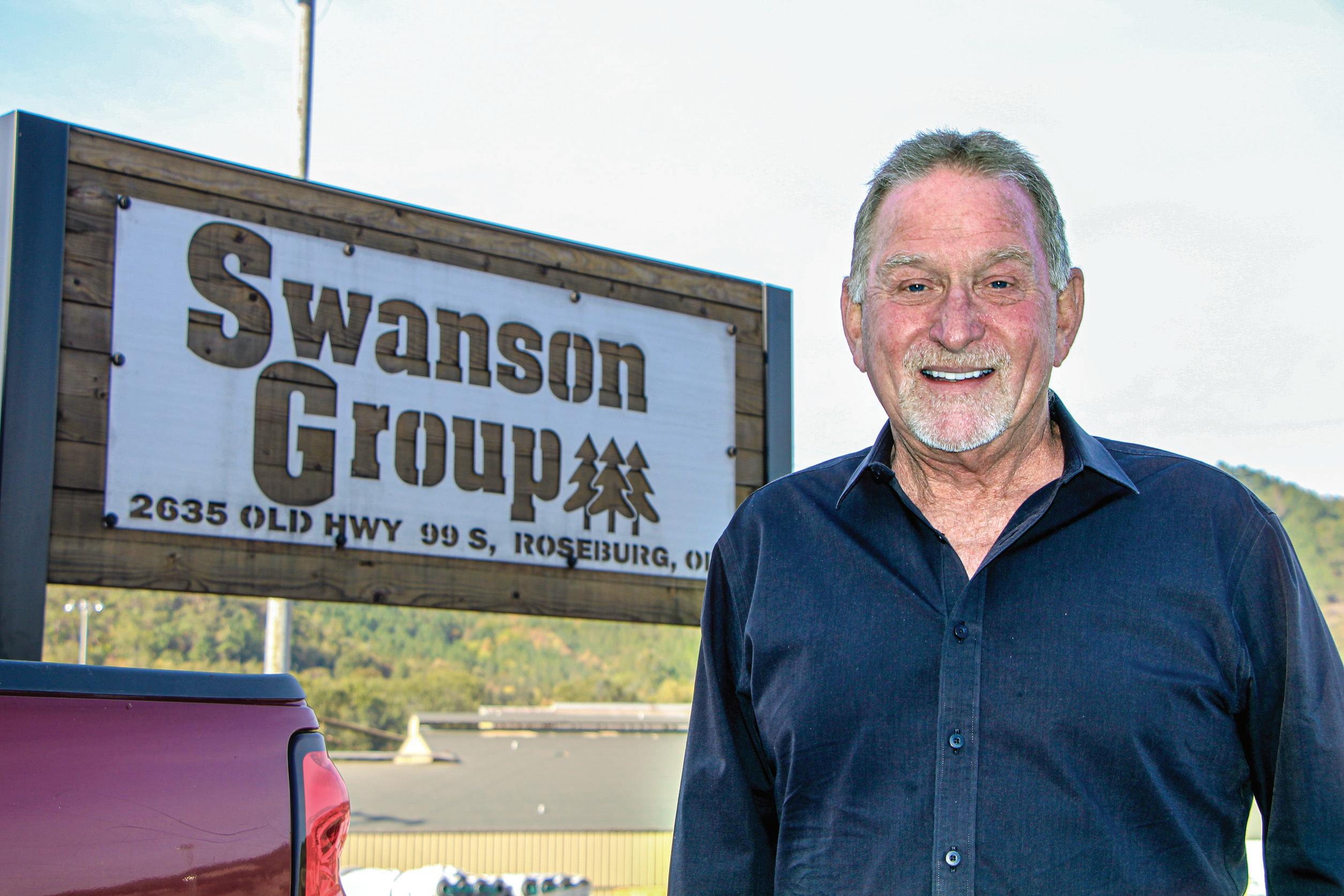
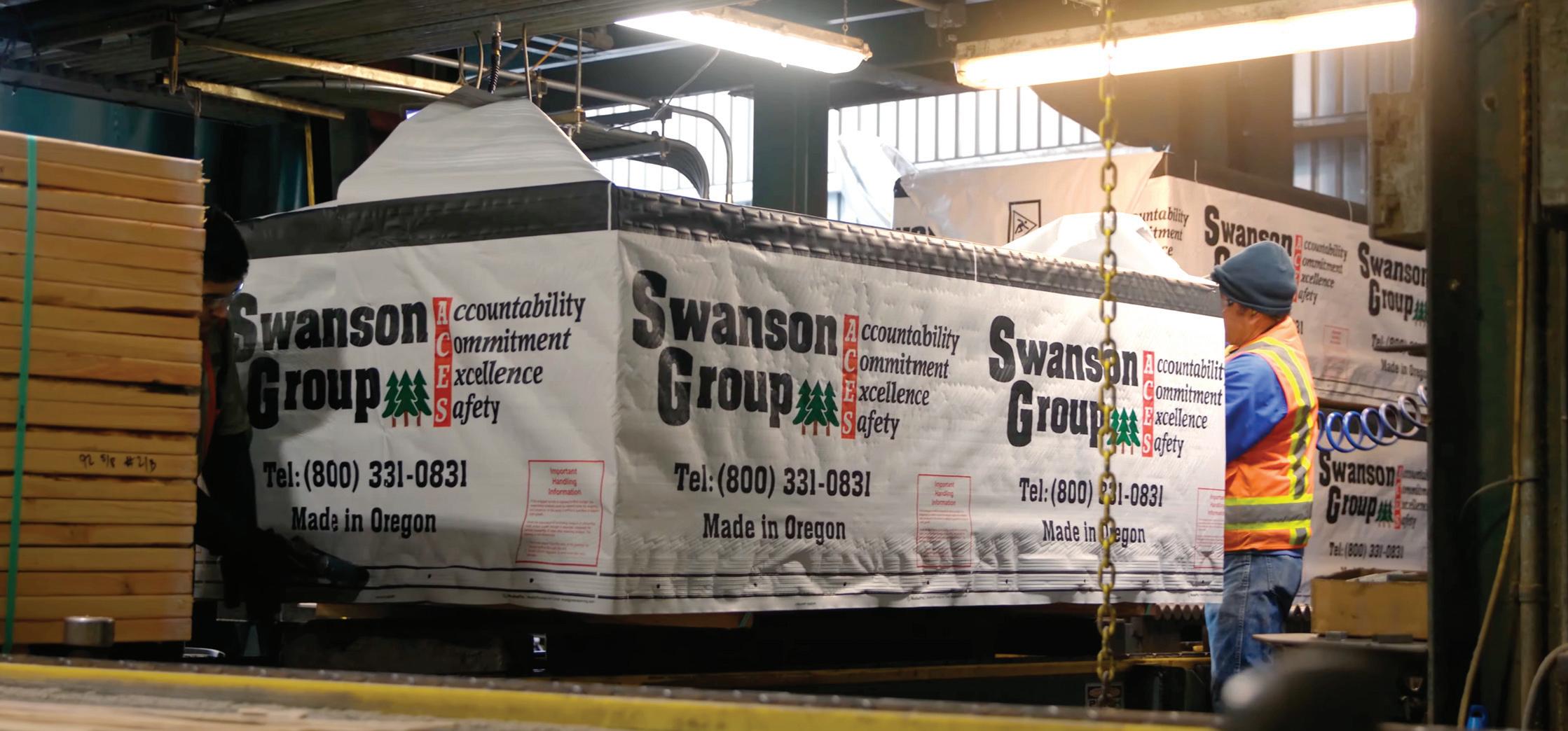
Steve’s story begins a little later, in 1951, when his father, Dean, an uncle and a family friend purchased and began operating a small sawmill in Glendale, Ore. The mill was an early adopter of small log utilization in the 1960s, and in 1973 the brothers built a new mill in Noti, Swanson-Superior Lumber.
The company made a major and visionary move in 1992, when it acquired Gregory Forest Products in Glendale, which included a veneer and plywood plant and put the business in the veneerbased panel industry for the first time.
The acquisition kicked off a decadeplus of expansion for Swanson that included the 1995 founding of Superior Helicopter, an aviation division that special-
By the late 1990s the organization had become a family of businesses: Superior Lumber, Superior Plywood and Superior Helicopter in Glendale, and SwansonSuperior Forest Products in Noti. In 2001 the company was reorganized when Swanson Group was formed: Superior Lumber and Swanson Superior were merged to form Swanson Group. Superior Helicopter became Swanson Group Aviation and Superior Plywood became a division of Swanson Group. Additional operations that were acquired became LLCs owned by Swanson Group (Sun Studs, Glide Lumber, etc.).
Subsequent Swanson Group acquisitions led to growth and strategic positioning for the company. Purchasing Sun
200MMBF of additional lumber volume.
The Glide Lumber acquisition in 2005 suffered from poor timing as a sawmill in need of investment with the Great Recession looming just over the time horizon. The facility east of Roseburg in the Cascade foothills was closed in 2008.
Meanwhile, acquisitions in the panel industry positioned the company as a major player in the specialty and commodity plywood markets.
In 2007 Swanson Group acquired McKenzie Forest Products in Springfield, an established plywood producer. Swanson improved the facility and had doubled production there when a disastrous fire in spring 2014 completely destroyed the plant.
ing assets with its established business and major MDO panel market share made Swanson an instant player in the premium overlay plywood market.
One setback occurred in 2019 with the closure of the Glendale sawmill, the company’s original manufacturing facility. Located in an area with mostly public timber, the mill had become increasingly difficult to source with unreliable federal timber supply.
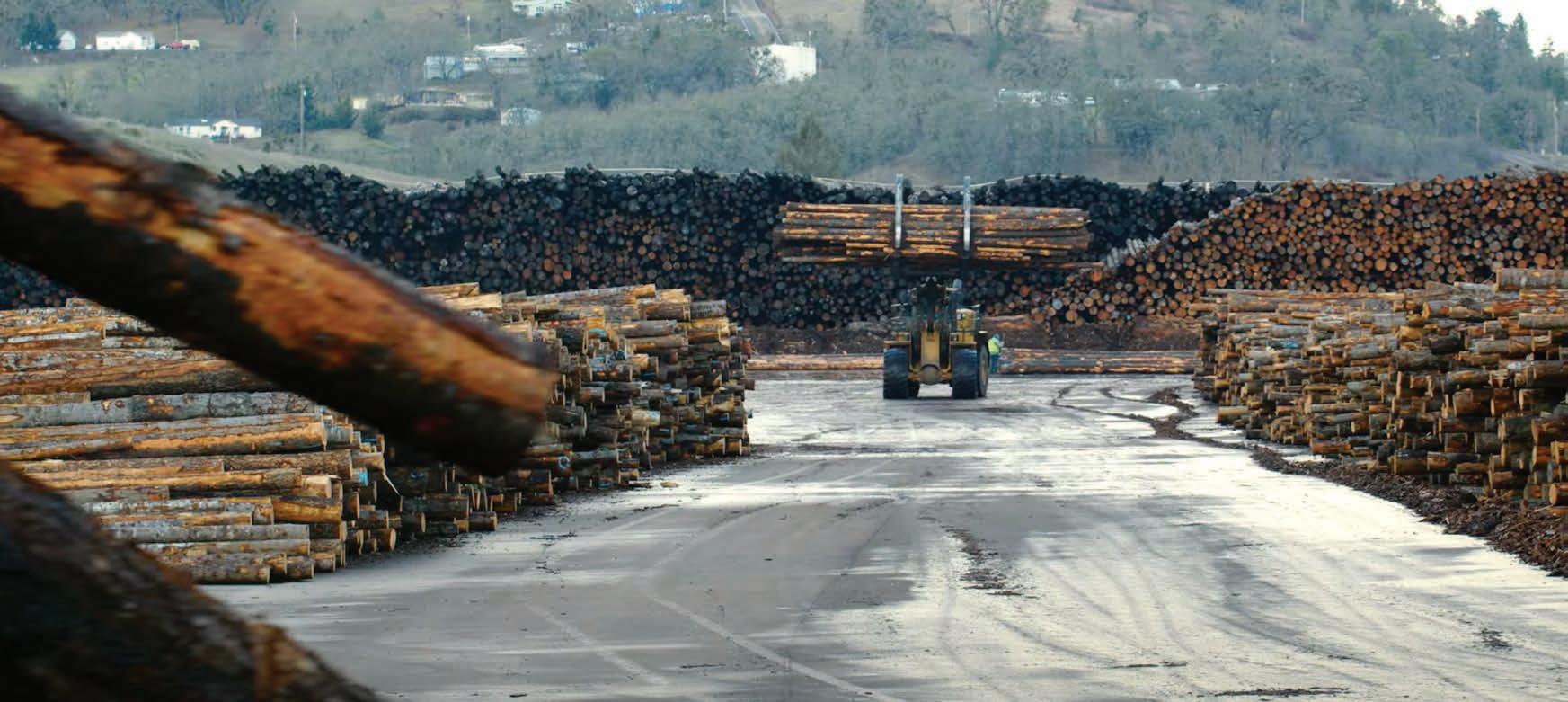
Much of the production was transferred to the Roseburg sawmill. (The company moved its offices to a newly renovated office at the Roseburg sawmill in 2022). Today, Swanson Group operates the sawmill at Roseburg, specialty plywood plant in Springfield and commodity plywood plant in Glendale.
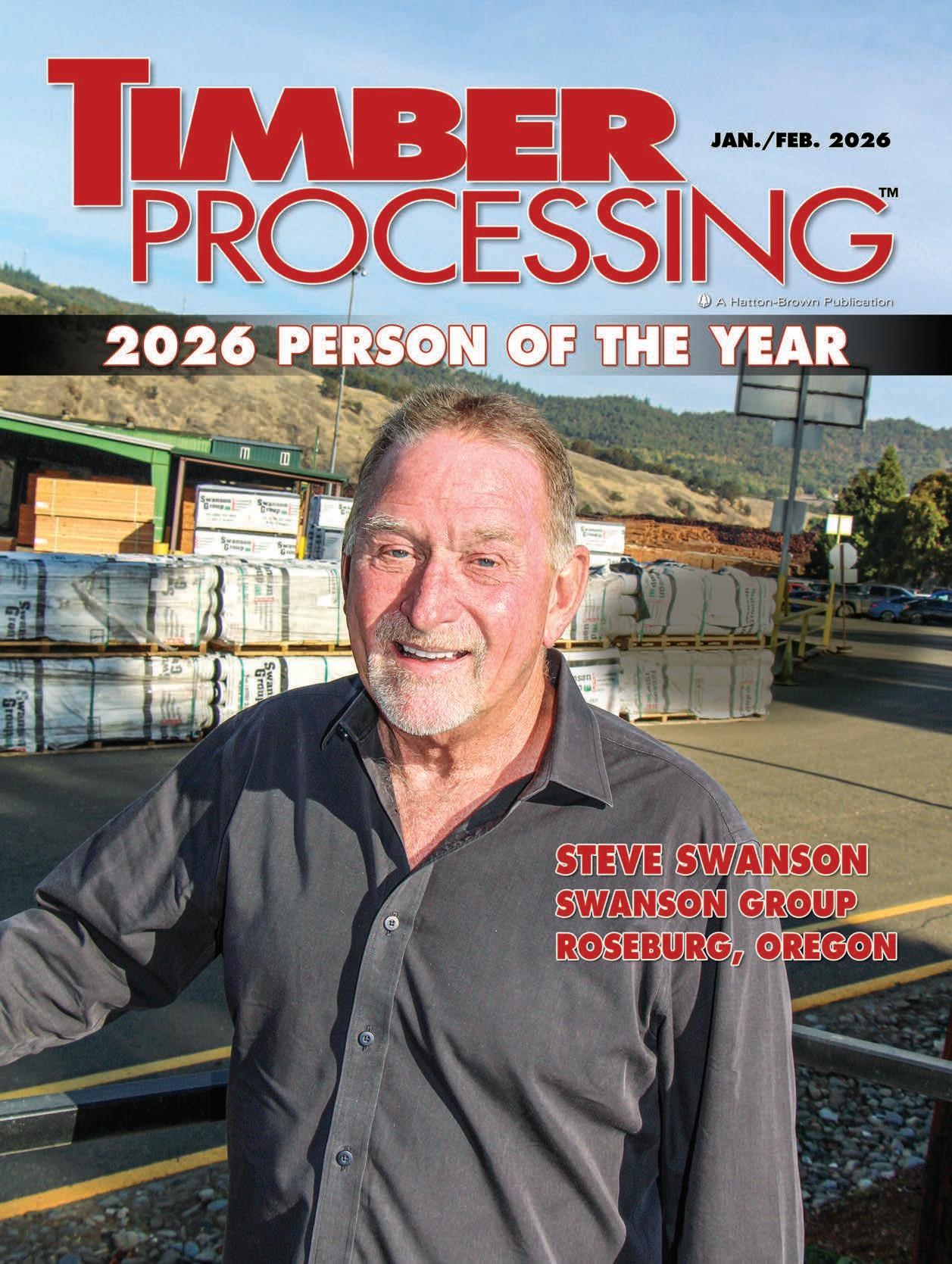
To say Steve Swanson has been “involved” with industry’s efforts to ensure fair trade with non-U.S. lumber importers is a massive understatement: He and his company have been deeply involved from the start in the early 1980s when the Coalition for Fair Lumber Imports was formed. Swanson served as Chairman for what is now the U.S. Lumber Coalition from 2000-2012; he remained as a board member through 2022; and he’s just begun another term as Chairman this year.
In fact, this past December if you vis-
and Executive Director Zoltan van Heyningen, “Under Steve Swanson’s leadership of the U.S. Lumber Coalition, the organization implemented structural changes that yielded today’s organization. These changes sharpened the focus of the organization to better address Canada’s unfair trade practices using all available tools under U.S. law.”
The group has had solid success with recent trade law cases that have led to increased U.S. lumber production, including an additional 10% tariff on Canadian lumber imports levied last year. “The Coalition has been able to produce unprecedented results for its membership via the organization’s most successful set of trade cases under the U.S. trade laws, all at the lowest cost levels since the organization’s establishment in the mid1980s,” van Heyningen adds.
Swanson emphasizes that constant vigilance is required to ensure that trade laws are enforced. He adds that the tariffs in place aren’t punitive: “It simply offsets the unfair trade practices that go on.”
He cites recent Canadian government activities like a guaranteed loan program and outright bailout of a major pulp and paper producer that in effect constitute sawmill subsidies. “You have to be able to work with our government to incentivize them to do what they need to do because a lot of times they don’t really know,” Swanson says.
“If you’re the U.S. trade representative
services at one time, this was a new one: Looking for a solution to residual utilization after Roseburg Forest Products closed its huge particleboard plant in nearby Dillard that was a big fiber destination, Swanson Group founded and started up Dean Resources, a wood fuel pellet mill, in fall 2025.
Located in tiny Oakland, Ore. just north of Roseburg, Dean Resources is one part of a larger project. Swanson Group is working with Southport Lumber in Coos Bay, Ore., which was having similar residual issues and has built its own pellet mill. Together, Southport and Swanson have formed Oregon Pellet Mills, a state-of-the-art new pellet export facility at the Port of Coos Bay.
The projects were designed to solve residual issues for the two lumber producers, but the overall operation has plenty of upside depending on how Asian, primarily Japan, pellet markets and fossil fuel reduction policies develop.
The turnkey pellet mill from supplier Prodesa could easily be expanded to double production if needed. “We sized (the pellet mill) to cover our production, but ultimately we could ship other people’s pellets as well,” Swanson says.


or someone in Commerce, you’re not really looking for fights,” he continues. “Someone has to bring it to their attention that an industry that’s vital to the nation is being severely impacted. That’s the real job of the coalition.”
Swanson believes the additional 10% is appropriate—and maybe just a starting point. “My hope is we can get the government to increase that to continue to offset unfair trade,” he says. “If they want loan guarantees they can pay for it in tariffs.”
In a Swanson Group history video on the company’s web site, Steve Swanson describes the early years of his involvement with the company, since age 17 working summers and school breaks, then joining the company full-time as an accountant after leaving college in 1977.
Swanson became general manager of the one-mill company in 1989, and in a few years began a growth spurt through acquisitions that lasted much of 1990s and developed into a completely different and diversified company at the millennium turn. He became President of the company in 2001.
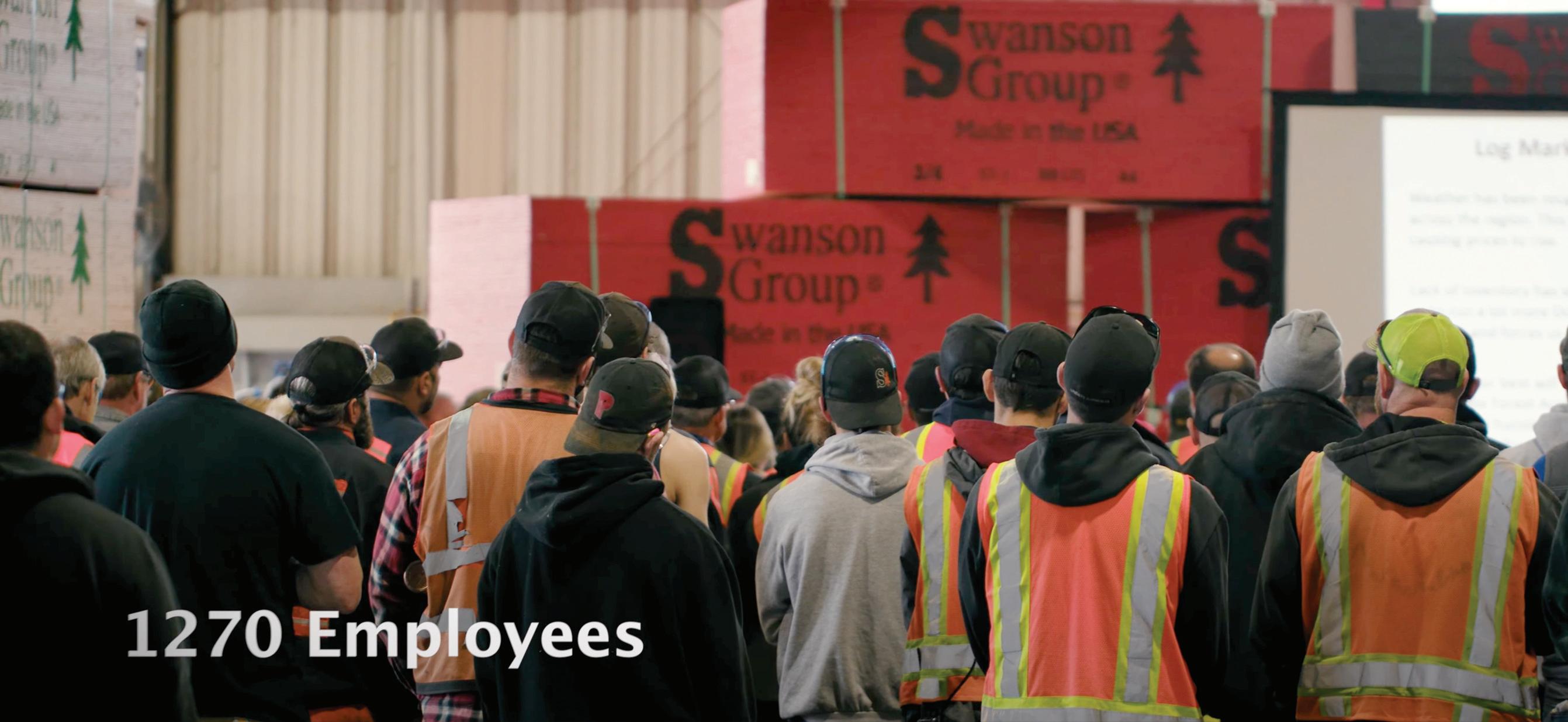
In the video, Swanson says he’s proud to be able to provide family wage jobs that are the backbone of rural communities, and the company has a history of supporting its work force.
“When times are tough we ask employees to help us out, and when times are good we give it all back,” he says in the video. “There’s not a single meeting either good news or bad news that I didn’t get in front of every single employee and deliver that
message, and that’s part of my commitment and my family’s commitment to our workforce.”
Swanson adds that it’s an ongoing goal to develop a strong, family-oriented work culture where employees can feel proud and want to be part of the Swanson family.
The focus on building a business with a family culture that includes a bright future is an objective Swanson has worked to achieve as he’s reached the latter stage of his career. Noting that his father and uncle wanted the company to last as long as it could under family ownership, Swanson says that’s been one of his biggest goals the past decade: “How do I make sure the company survives beyond me?”
Turns out the answer was in the office next door in his son, Chris, named President of Swanson Group in April 2025. Swanson says he’s known he




needed to make the move, but he wasn’t ready until last year.
“Chris has been here since college, he’s got 25 years in, and he’s been ready for a while,” Swanson says. Starting in sales and marketing, “He’s been involved in every facet of the business,” Swanson adds, and that includes managing the Glendale sawmill, heading up the Springfield plywood plant project and startup and also managing the new facility for a while and also serving as COO.
“He’s well-rounded and has lots of ex-
It’s an ongoing goal to develop a strong, family-oriented work culture where employees can feel proud and want to be part of the Swanson family.
perience to move this thing forward,” Swanson says.
Another way Swanson has positioned the company for the future was to consolidate ownership of Swanson Group. He took the opportunity afforded by the unprecedented profitability during the pandemic price run-ups in 2021-22 to reward long-term shareholders and transfer ownership to Chris, Steve’s sister Linda Rondeau, a small family trust—and Steve retained “a small fraction, just enough that I can still call myself an owner,” he says.
In addition, he also used the extra revenue to help “financially insulate” the company by paying off all debt and “really cleaning up the balance sheet.”
Looking ahead, Swanson says the company’s production facilities are in as good a shape as they’ve ever been.
“We’re in great shape, company-wide. No matter the conditions we’ve faced, we’ve always maintained and kept up the mills to the utmost.”
Swanson says he’s excited abut the transition and he looks forward to Chris’ leadership and continuing to help where he can as CEO and Chairman.
He’s also excited about seeing his efforts come to fruition, and a new generation of leadership that will take Swanson Group to its 100th anniversary, emphasizing: “My father and his brother wanted this company to go as many generations as it could, and you have to be very proactive to make that happen.”
For Steve Swanson and a career dedication to family, community and industry, proactive is the definitely the word. TP

After upgrading its sawmill a few years ago, Dempsey Wood Products discovered that its production, which is heavy to timbers, was outpacing the planer mill and needed to address the bottleneck. But the planing facility had no room for expansion in any direction. It was virtually landlocked, tucked between a railroad and the swamps of South Carolina’s Lowcountry.
Dempsey Wood Products is a secondgeneration, family-owned operation located in Orangeburg, SC. While the company itself was established in 1988, the Dempsey family’s involvement in sawmilling spans nearly a century.
Parker Dempsey, current president of Dempsey Wood Products, is a fourthgeneration sawmiller. His great grandfather started with a portable sawmill in the 1940s and grew the business into multi-site sawmill and chip mill operations before selling to Stone Container in the early 1980s.
Parker’s father, Ronald Dempsey, started Dempsey Wood Products in 1988 at the same location where the mill currently operates.
DWP has served the Southeast pine and hardwood market for decades, supplying chips for paper production, kiln-dried pine, domestic hardwood, and pallet lumber, as well as landscaping mulch. The mill primarily processes timbers and 5⁄4 decking, with a smaller percentage of dimensional lumber.
In 2022, PalletOne, Inc., acquired a 50% equity stake in Dempsey Wood Products. The industrial lumber Dempsey produces is a key product for pallet manufacturing and has been in short supply as larger mills shift away from that product mix.
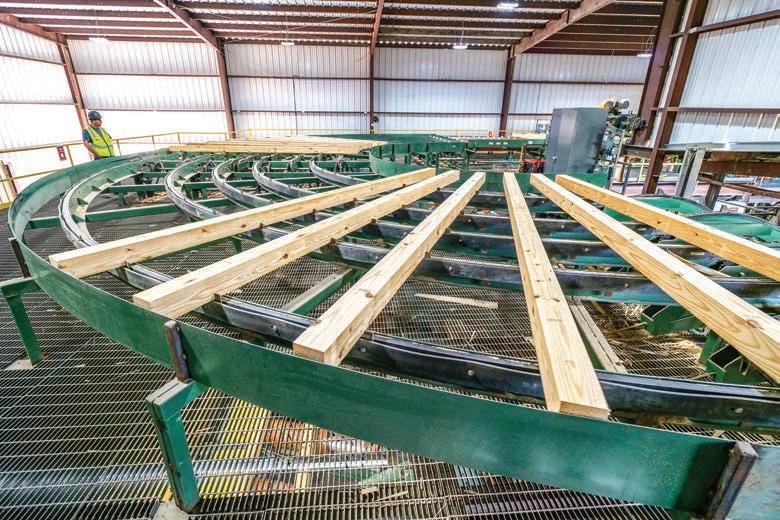
Mill leadership contacted equipment and technology supplier USNR, which devised a unique plan that called for an unconventional layout, including two 90°
transfers making a 180° u-turn to fit the line within the existing footprint.
“It’s impressive that USNR was willing to get away from the cookie cutter design. A lot of competitors would not do that,” Dempsey says. “In retrofit situations no mill ever has enough real estate.”
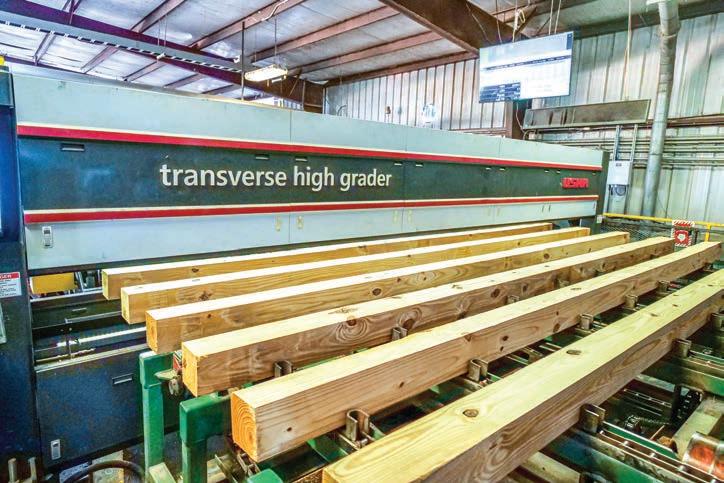
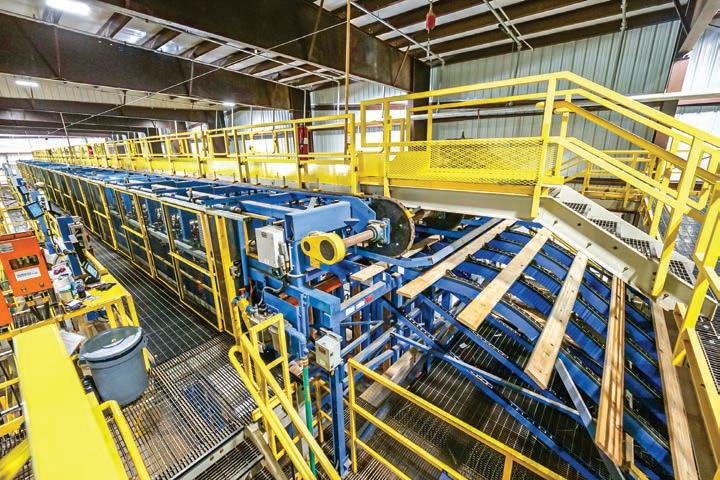
At the heart of the project is the Transverse High Grader (THG) automated grading system along with a 20-bin sorter that has allowed Dempsey Wood Products to broaden its product mix, increase production, and improve grade— all without increasing planer speed or labor.
Timbers from the sawmill are dried with USNR’s Counter Flow kiln, then forklifted onto a used USNR tilt hoist that Dempsey acquired from a nearby mill. Pieces are then unstacked and planed.
Planed timbers exit the planer onto an extended slow-down belt that conveys them over to the grading line and drops them into the flow.
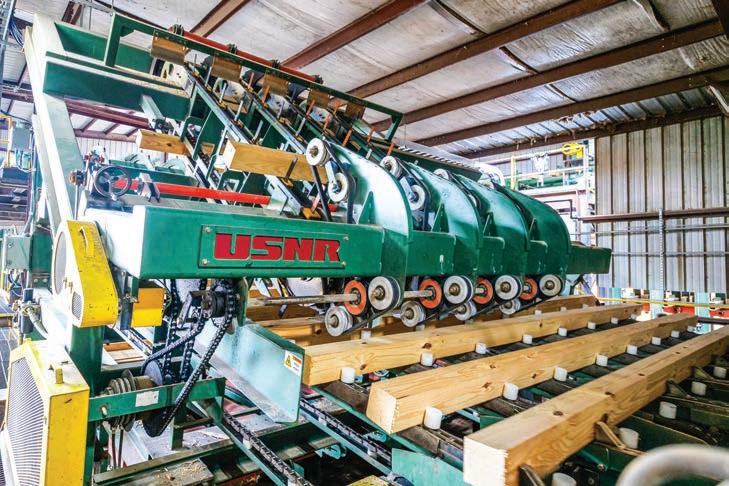
USNR designed a specialized drop transfer specifically for this application to achieve a fast and effective 90° directional change. Pieces are fed into lugs by a Revolver lug loader and sent to the THG for automated grading.
A Multi-Track Fence even-ends the material and a Clamshell trimmer processes
trim solutions generated by the THG.
“It’s one thing to do something on paper and there are genuine concerns any time you turn 90 degrees in a sawmilling operation, but we have a lot of that here and don’t have many problems,” Dempsey says. “It’s impressive.”
“Dempsey now produces a significant volume of cut-n-twos,” confirms Tracey Mitchell, USNR account manager who oversaw the project.
When there is a cut-n-two solution, half of the piece remains in the same lug space, and the other half is diverted up a recirculation elevator, allowing time for the system to create an empty lug space. The diverted half then come back down and fills the empty lug space that was created for it and continues in the flow.
In the planer mill, trimmed timbers travel up an incline and make a 180° turn toward the 20-bin pusher lug sorter which is positioned parallel to the grading line.
“The sorter with the recirculation tower was a huge hit. Graders were having to hand pull, and for every piece that is handpulled, with cut-n-two, it becomes two pieces,” says Michael Gulley, Dempsey GM of operations. This configuration provides an opportunity to make two shortlength boards from one low-value longerlength board, without sacrificing line speeds or throughput volumes.”
USNR’s cut-n-two design allows both halves of the board to remain in the same lug space, so the line is able to run at a consistent speed while cutting longer products. As a result, Dempsey Wood Products was able to expand from a 12 ft. mill to producing 16 ft. lumber.
curves in grading, trimming, handling and cut-n-twos,” Gulley says.
The SYP producer primarily serves markets for 8- to 12-ft. products because they sell to treaters that sell to box stores, including fence posts and items that are put in the back of a pickup truck. The 16 ft. capability gives them the option to broaden that. And being able to cut a 16 ft. board in two, at a high volume to produce two 8 ft. boards, is a game changer for the mill.
“We hardly run 8-foot in the sawmill anymore. Most of our 8-foot lengths come from cutting a 16-foot board in two,” Dempsey says.
Dempsey has enjoyed a production increase of four feet per piece because of
automated grader reconfiguration.
Ironically, Dempsey’s grade on 5⁄4 in. and 6 in. boards initially went down because the THG detects details a manual grader normally wouldn’t see, like the smallest bit of skip dressing. The 5⁄4 decking product has strict limits on skip dressing.
“It’s tight, so that actually hurt us a little bit on grade, but then again, we could get in trouble if we allowed that skip dressing,” Dempsey explains. “It has since gotten balanced out so it’s no longer a problem. We didn’t quite have the uptick that most people get from the auto-grader, not because of the autograder itself, just because of the products we run.”
The THG has allowed Dempsey to run faster with consistent reliability. They run minimum-wane products in both the sawmill and the planer mill, which didn’t leave much room to improve their grade on the 5⁄4 decking product.
Mitchell adds, “This has probably been one of the most interesting projects I’ve been involved with; it’s not your standard setup. It was a real challenge. It’s amazing what this mill does. I’m impressed every time I see it run.”
Dempsey says part of the reason USNR was selected for the planer mill expansion was its ability to think unconventionally to solve the challenge at hand.
“We don’t do much ordinary around here,” he says. “With the maze we have here, I was afraid it would be a nightmare, but it was probably the smoothest startup we have ever had.” TP
Article previously appeared in USNR’s Millwide Insider newsletter, and has been edited by Timber Processing. Photos from USNR.
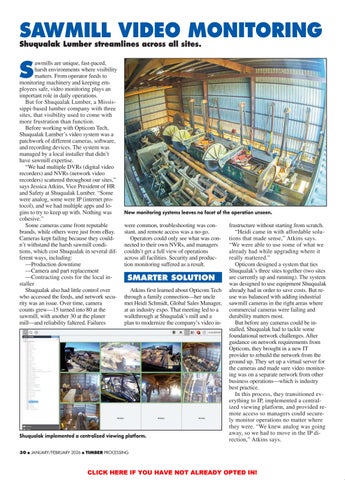
Sawmills are unique, fast-paced, harsh environments where visibility matters. From operator feeds to monitoring machinery and keeping employees safe, video monitoring plays an important role in daily operations.
But for Shuqualak Lumber, a Mississippi-based lumber company with three sites, that visibility used to come with more frustration than function.
Before working with Opticom Tech, Shuqualak Lumber’s video system was a patchwork of different cameras, software, and recording devices. The system was managed by a local installer that didn’t have sawmill expertise.
“We had multiple DVRs (digital video recorders) and NVRs (network video recorders) scattered throughout our sites,” says Jessica Atkins, Vice President of HR and Safety at Shuqualak Lumber. “Some were analog, some were IP (internet protocol), and we had multiple apps and logins to try to keep up with. Nothing was cohesive.”
Some cameras came from reputable brands, while others were just from eBay. Cameras kept failing because they couldn’t withstand the harsh sawmill conditions, which cost Shuqualak in several different ways, including:
—Production downtime
—Camera and part replacement
—Contracting costs for the local installer
Shuqualak also had little control over who accessed the feeds, and network security was an issue. Over time, camera counts grew—15 turned into 80 at the sawmill, with another 30 at the planer mill—and reliability faltered. Failures
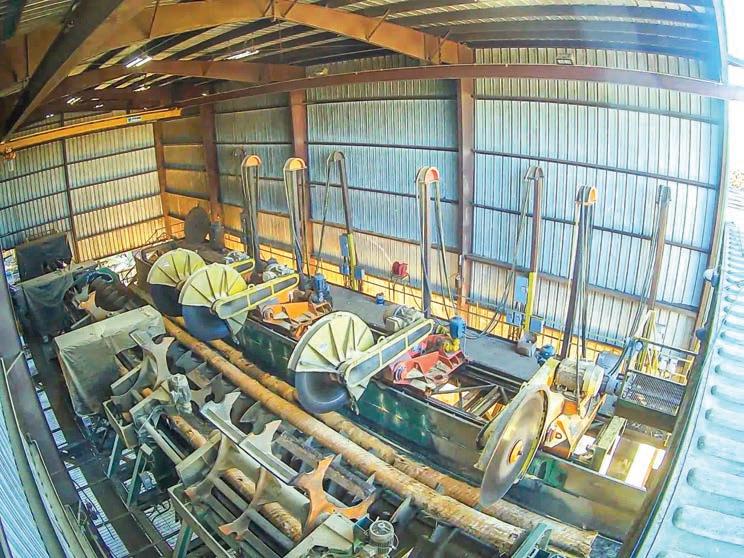
New monitoring systems leaves no facet of the operation unseen.
were common, troubleshooting was constant, and remote access was a no-go. Operators could only see what was connected to their own NVRs, and managers couldn’t get a full view of operations across all facilities. Security and production monitoring suffered as a result.
Atkins first learned about Opticom Tech through a family connection—her uncle met Heidi Schmidt, Global Sales Manager, at an industry expo. That meeting led to a walkthrough at Shuqualak’s mill and a plan to modernize the company’s video in-
frastructure without starting from scratch.
“Heidi came in with affordable solutions that made sense,” Atkins says. “We were able to use some of what we already had while upgrading where it really mattered.”
Opticom designed a system that ties Shuqualak’s three sites together (two sites are currently up and running). The system was designed to use equipment Shuqualak already had in order to save costs. But reuse was balanced with adding industrial sawmill cameras in the right areas where commercial cameras were failing and durability matters most.
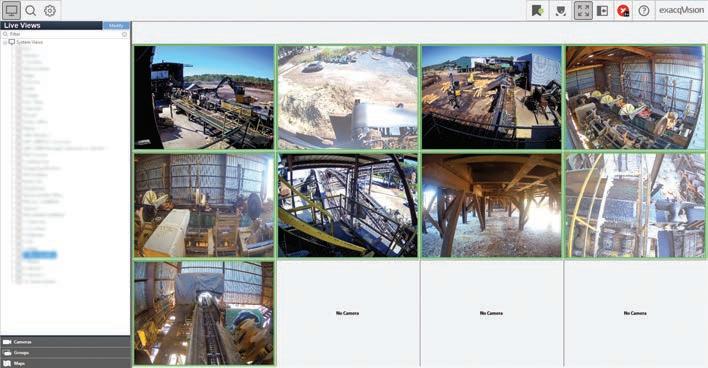
But before any cameras could be installed, Shuqualak had to tackle some foundational network challenges. After guidance on network requirements from Opticom, they brought in a new IT provider to rebuild the network from the ground up. They set up a virtual server for the cameras and made sure video monitoring was on a separate network from other business operations—which is industry best practice.
In this process, they transitioned everything to IP, implemented a centralized viewing platform, and provided remote access so managers could securely monitor operations no matter where they were. “We knew analog was going away, so we had to move in the IP direction,” Atkins says.
Today, Shuqualak Lumber runs approximately 116 cameras companywide. The new setup has drastically improved reliability, image clarity, and ease of use— without disrupting production during installation.
The unified system also brings new visibility across sites. Managers can review footage from any location to analyze production issues or confirm safety procedures.
“There was a production incident and we were able to go back and see exactly what went wrong,” Atkins says. “We have control over who can access the recordings, and we’re now able to export and share clips as needed.”
Opticom also offloaded technical support and maintenance from Shuqualak’s local installer, who had been billing hourly, to bring it in-house. “Opticom has trained us to do most of our own technical support and maintenance onsite,” Atkins adds.
Now, when they have an issue, they’re not paying someone to chase it down. “The system stability and doing troubleshooting ourselves makes a huge difference,” Atkins says. “Our downtime— and our ongoing and contracting costs— have gone down.”
Atkins says working with a provider that understands sawmills made all the difference. “Heidi knew exactly the kind of environment we’re in and the personalities we work with,” she says. “She focused on simplicity and production efficiency—which is exactly what we needed.”
The partnership also gave Shuqualak confidence that their system could evolve without major overhauls or integration hassles. “We like that everything worked together,” Atkins adds. “We never want to get to the point where one vendor controls all of our cameras, so Opticom’s focus on integration with other products was really important.”
For a company that once juggled multiple systems, apps, and unreliable cameras, the transformation has been significant. Now, Shuqualak Lumber can see every corner of their operation clearly— and focus on running the mill, not on managing its monitoring system.
What began as a fragmented, unreliable camera system has become a cohesive, sawmill-tough
solution that gives Shuqualak Lumber complete control and confidence in their video monitoring.
By partnering with Opticom Tech, Shuqualak overcame chronic camera failures, costly downtime, and a disjointed network—without having to start from scratch. With a unified IP-based network, centralized remote viewing, and training, they’ve turned a once frustrating system into a reliable, more cost-effective operational tool.

Vetter Becomes CEO Of RPM
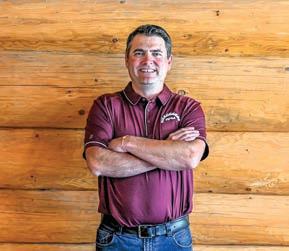
Real Performance Machinery (RPM) announced a reorganization of its executive leadership team. Richard Vetter, one of the company’s founding members and Chief Technology Officer (CTO) since 2023, assumes the role of Chief Executive Officer (CEO). He will guide RPM’s overall strategy, operations, and long-term vision, drawing on his deep background in technology development and his commitment to advancing the company’s engineering capabilities.
Shawn Guibergia, RPM’s previous CEO and a driving force behind the company since its inception, will transition to the role of Founder. In this capacity, he will continue to provide strategic insight and mentorship while stepping back from day-to-day operations to focus on new product development and return to the hands-on engineering work that has shaped RPM’s identity.
“This transition marks an exciting new chapter for RPM,” Guibergia comments. “Richard has been instrumental in shaping our technological edge, and I have full confidence in his ability to propel us forward. I’m thrilled to remain deeply connected as Founder and contribute to the legacy we’ve built together.”
Vetter adds, “I’m honored to step into the CEO role at this pivotal time. Shawn’s decades of machine design experience have fundamentally reshaped how sawmilling can be done, driving innovations that reduce maintenance, boost productivity, and elevate lumber quality. Under his leadership, RPM has built a strong foundation rooted in practical engineering and forward-thinking design. I look forward to continuing that momentum with our talented team and delivering even greater value to our customers and stakeholders.”
This reorganization reflects RPM’s commitment to adaptability and excellence, ensuring the company remains at the forefront of sawmill equipment innovation. “The entire RPM team extends its gratitude to Shawn for his leadership and welcomes Richard as he steps into his expanded role.”
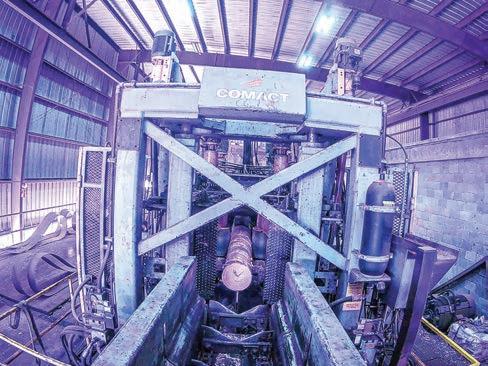
Comact announced a major equipment and technology sale to Niagara Sawmilling Co. of Invercargill, New Zealand. The large-scale modernization project will significantly enhance Niagara’s production capabilities and strengthen operational performance.
“We are excited to move forward with this new sawmill in partnership with Comact. The technology and expertise they bring will allow us to significantly enhance reliability, efficiency, and fiber optimization across our operations. This investment represents an important step in strengthening our mill for the long term,” comments Ross Richardson, CEO of Niagara.
Executed in close collaboration with Lakeland Steel, Comact’s key partner in New Zealand and Australia, the project reflects a shared commitment to delivering cutting-edge technologies supported by strong local expertise.
This brownfield project includes the supply of an entirely new log infeed equipped with a Versa Ring debarker. The primary breakdown will feature a Hybrid Sawline combining triple profiling, circular saws, a splitting module and a 7 ft. CETEC bandmill, followed downstream by a dual-profiling CPG (canter profiler gang).
The mill will also include a complete trimmer line equipped with an AI-powered TrimExpert optimizer. Additionally, the new installation will be equipped with a suite of Smart Vision systems deployed throughout the process, along with full integration of the sawmill into the OPER8 industrial IoT platform.
“This project is a strong example of what our partnership with Comact is designed to deliver: world-class technologies backed by local execution. Niagara is a respected operator in New Zealand, and we are proud to support the engineering, fabrication, and installation needed,” says Cory Leatherland, General Manager of Lakeland Steel.
Equipment delivery is scheduled for late 2026, followed by commissioning in 2027.
John King Chains Group is celebrating its 100th anniversary in 2026. Established in Leeds, England in 1926, the enterprise
began by producing plain pedestal bearings for coal mining pit tubs. Expansion came with the rapid mechanization of the collieries and the need for chain conveying equipment.
The business has evolved through a century of change while remaining focused on engineering excellence and long-term value.
Remaining a family-owned, private business after 100 years is a point of pride for the Group. This independence allows for long-term decision-making, consistency of values, and continued investment in capability, quality, and customer support.
“Our people remain central to the success of the business. A continued focus on leadership development, operational capability, and collaboration across the Group strengthens our foundations and positions the company well for the future,” according to a company statement.
Reaching a century in business is a testament to resilience, adaptability, and shared values. “As we begin this landmark year, we do so with confidence, ambition, and a clear commitment to continued progress.”
The company recently announced the opening of its new facility in South Africa, marking an important step in John King Chain Group’s continued investment in the region and strengthening its long-term commitment to the South African market.
“We are proud to support local businesses, contribute to the regional supply chain and play our part in the South African economy.”

Jartek, based in Lahti, Finland, has founded Jartek US Inc. in the United States and Les Entreprises Jartek Canada Inc. in Canada. The new subsidiaries provide a solid operational base for serving customers across North America and demonstrate Jartek’s longterm commitment to the North American market.
Through establishing local presence, Jartek continues to develop its global operations by strengthening its international footprint and enabling closer customer co-
operation and more efficient project execution throughout North America.
To further support regional sales activities, Jartek has appointed Jeroen Hinnen as Sales Manager for North America. Hinnen has more than two decades of experience in the wood industry and heavy industrial machinery, with a strong background in international sales and customer-oriented project delivery.
“A strong local presence and experienced professionals are essential to operating successfully on a global scale. By establishing subsidiaries in the U.S. and Canada and appointing a dedicated sales manager for North America, we are better positioned to support customers throughout these regions,” says Jartek CEO Juho Luoranen.
Jartek already has active projects in North America. A thermal modification kiln has been sold to Arbor Wood and is in the installation phase. In addition, a project with Western Forest Products is ongoing, with delivery and installation scheduled for May 2026.
“I am pleased to join Jartek at a time when concrete projects are already underway in North America. Jartek’s strong technical expertise and customer-focused approach provide a solid foundation for supporting customers in the region,” Hinnen says.
collect her prize. Greeted by Managing Director Martin McVicar and members of the marketing team, Farrell enjoyed a factory tour before being presented with the key to her brand-new multidirectional, electric counterbalance forklift.
Before departing, Farrell joined hundreds of Combilift employees for a final photo beside the 100,000th truck. “This milestone reflects the dedication, skill and
commitment of our entire team, whose efforts continue to drive our growth as we look ahead to 2026,” according to a company statement.
On December 19 Combilift presented a €100,000 cheque to UNICEF, handed over to Owen Buckley and Michaela Plunkett of UNICEF by McVicar at the annual Combilift Christmas party in the Hillgrove Hotel & Spa, Monaghan.
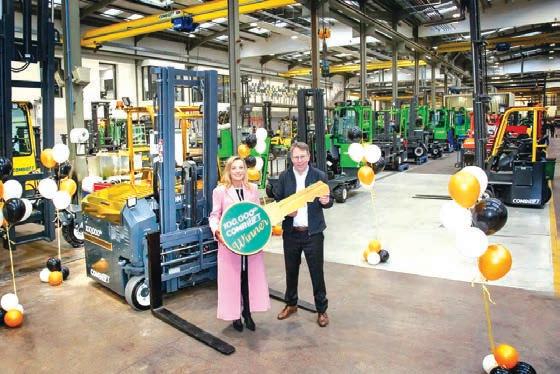
The Combilift Fundraiser in support of UNICEF has officially come to an end. Total tickets purchased, for a chance to win the 100,000th Combilift truck, raised more than €56,000 with Combilift proudly topping up that amount to bring the total donated to €100,000.
Congratulations go to winner Kareen Farrell. She recently visited manufacturing headquarters in Monaghan, Ireland to

Burton Mill Solutions has acquired Southern Saw & Wood, based in Hamburg, Ark. Southern Saw & Wood specializes in reconditioning small- and large-diameter saws, chipper knives, guides, cutting tool design and solutions, and offers convenient pickup and delivery services.
This acquisition enhances Burton’s technical capabilities and strengthens its ability to provide exceptional service to primary wood producers. By integrating Southern Saw & Wood’s expertise into Burton’s network, Burton is expanding its comprehensive cutting tool reconditioning services and reinforcing its commitment to new product and process development for the wood processing industry.
Mark Burchell and his team will remain in place to ensure continuity of service and quality for customers. Additionally, Southern Saw & Wood’s operations will be relocated to Burton’s larger, stateof-the-art facility in West Monroe, La.
“We are thrilled to welcome Southern Saw & Wood to the Burton family,” com-
ments Eddie Collins, Vice President of Reconditioning and Sales, US South at Burton Mill Solutions. “Their specialized skills and dedication to quality align perfectly with our mission to deliver superior solutions that help our customers find success in challenging market conditions.”
“I’m excited to join Burton Mill Solutions and be part of a team that’s setting the standard in saw services and technical support,” adds Burchell, owner of Southern Saw & Wood. “I look forward to helping grow our offerings and expand our reach in the region.”
Southern Saw & Wood will complement Burton’s existing network of saw and knife reconditioning service centers across North America, ensuring faster turnaround times and improved regional support.
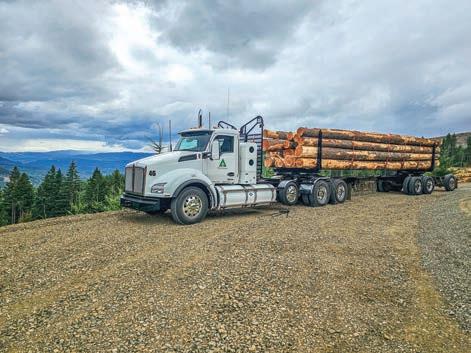
Earlier this summer, Weyerhaeuser rolled out its first fleet of renewable natural gas (RNG) log trucks, powered by Cummins 500 HP, 15 L natural gas en-
gines, in Goshen, Ore.
“We’re always looking for ways to reduce costs, cut emissions and strengthen the resilience of our operations,” says Gary Romine, Oregon transportation manager. “The timing and technology finally lined up to make RNG viable for log hauling, and we’re excited to see where that gets us.”
Simultaneously, Weyerhaeuser partnered with Fix Infrastructure, which tapped into a nearby Northwest Natural Gas pipeline and built a dedicated fueling station at the Goshen truck shop. The result was a scalable system that keeps trucks on the road all day with minimal disruption.


“This is the first time we’ve had the horsepower, the infrastructure and the economics all in one place,” Romine says. “And even for sites without a pipeline, compressed natural gas could be delivered by trailer and hooked up to a compressor plant, so this model can be replicated in remote locations, too.”
Weyerhaeuser purchased 10 RNG trucks. The goal is to scale up to 70 trucks at Goshen, representing nearly its entire fleet. Weyerhaeuser says it plans to look at expanding into other locations nearby, like Longview, Wash.
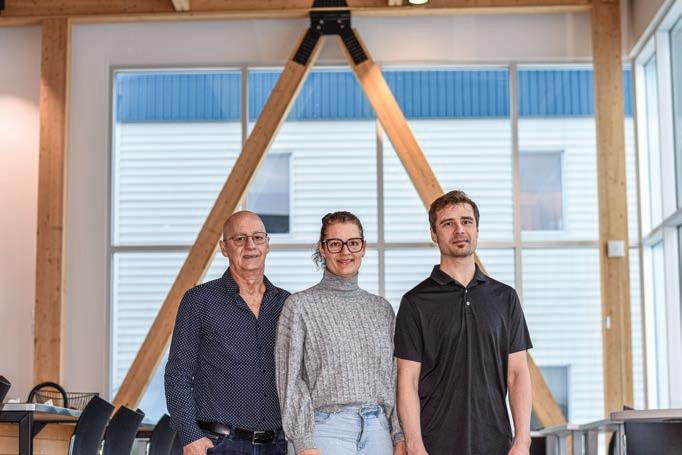
“I think we’ll prove the trucks out with this first 10, then continue scaling it up,” Romine adds. “Ultimately, RNG could extend beyond timber hauling into other parts of our business.”
Les Produits Gilbert announced the passing of its founder, Sylvain Gilbert, and confirmed the continued leadership of his children, Audrey and Frank.
A visionary entrepreneur and an influ-
ential figure in the industry both in Canada and abroad, for more than 40 years, Sylvain Gilbert dedicated himself to building a company firmly rooted in the Saguenay–Lac-Saint-Jean region while expanding its reach worldwide through innovation, engineering excellence, and bold ideas. His intelligence, instinct, and determination helped establish Les Produits Gilbert as a global reference in product innovation and industrial performance.
Beyond his professional achievements, Gilbert was a man of great passion—devoted to his family, committed to his business, and deeply enthusiastic about aviation. He faced his final battle with cancer with the same strength, discipline, and resolve that defined his life.
Ensuring the long-term continuity of the company he built was of paramount importance to Gilbert. Over the past three years, he worked closely with his children to prepare a thoughtful and structured transition of leadership.
That transition becomes fully effective as Audrey and Frank Gilbert, who have been active members of the company for many years, officially continue their father’s mission, values, and vision.
“We are deeply honored to carry forward what he created. Our father instilled in us the boldness, precision, and passion that define Les Produits Gilbert. We will continue to innovate, to develop worldclass products, and to create high-quality jobs in our region,” comments Audrey and Frank.

Jartek has signed an agreement to supply a thermal modification kiln to Western Forest Products, with installation scheduled for May 2026.
The kiln will support Western Forest Products’ plans to expand its thermally modified wood offering, with a strong focus on consistent product quality and
efficient production. The solution delivered by Jartek is specifically designed to meet Western Forest Products’ production requirements.
Jeroen Hinnen, Sales Manager North America at Jartek, highlights the importance of the project for the company:
“This project is particularly exciting for us at Jartek, as it represents one of our first thermal modification projects in this region. Partnering with Western Forest
Products allows us to demonstrate how our customizable technology can support local market needs and long-term production goals.”
The project also aligns closely with Western Forest Products’ five-year vision to expand manufacturing capacity, improve fiber utilization, and add value to lower-grade materials—while fostering mutually beneficial partnerships to grow domestic demand.
Jartek’s thermal modification technology is designed to deliver flexibility, precise process control, and long-term reliability. This project reflects Jartek’s continued focus on providing customized solutions that meet the evolving needs of companies looking to enter or expand within the wood thermal modification market.
MPE Partners along with its portfolio company, Webster Industries, announced the closing of its acquisition of Renold plc, a leading designer, engineer, manufacturer, and supplier of premium, high specification industrial chain and torque transmission products.
With manufacturing facilities located across North America, Europe, and AsiaPacific, Renold supplies a diverse base of global customers in more than 100 countries across a broad range of industrial power transmission applications. Renold’s products are critical to end-users’ operating environments wherever materials are lifted, moved, rotated, or conveyed and are used in end markets such as manufactured products, material handling, construction, transportation, food and beverage, energy, forestry, and agriculture.
The transformative combination of Webster and Renold creates a marketleading chain and power transmission products platform with premium brands by expanding product offering, diversifying end markets and geographic footprint, and unlocking commercial opportunities. The acquisition represents a strategic step forward in Webster’s long-term vision to build the global leader in automation, material handling, and power transmission solutions.
Following the acquisition, both Webster and Renold will continue to operate out of their current manufacturing facilities, with no changes to day-to-day business operations. The combined platform will be headquartered in the U.S.


IWT-Moldrup reports multiple treating installations throughout the U.S., including in South Dakota, Montana, Idaho, Washington and Georgia.
The South Dakota treater wanted to double capacity and installed a new compact IWT-Moldrup plant alongside an existing plant. A Montana-based company chose the large modern IWT-Moldrup
treatment plan to cope with new CCA rules and has production sites in Montana and Idaho. The plant is equipped with a hands-off operation and includes hold down clamps to prevent the wood from floating during the processing and avoiding use of chains and lashing of the timber. The capacity of the plant is more than 15MBF of roundwood per charge and can handle poles up to 50 ft. in length.
The Georgia facility operates Moldrup’s fully automatic material handling
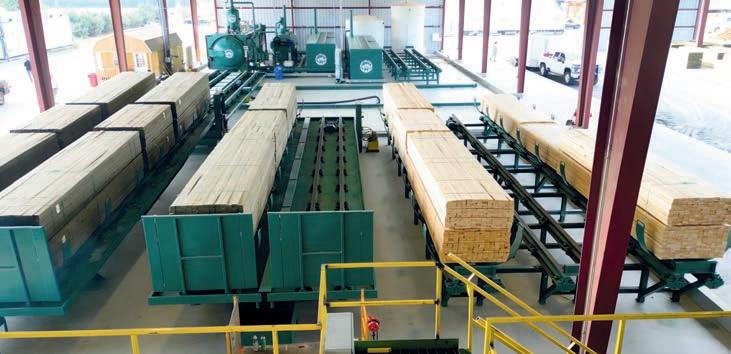

system for up to eight charges per work shift. The plant is state-of-the-art and includes a new flushing system to automatically clean the system when changing from one type of preservative to another. The yearly capacity exceeds 20MMBF in a one shift operation.
The Washington facility operates two lines with an annual capacity of up to 80MMBF.
Resource Management Service, LLC (RMS), a timberland investment management organization, has announced the development of the RMS Ecosystem Integrity Index (EII), a measurement tool designed to track and quantify biodiversity changes across RMS’s timberland portfolio in the Southern U.S. Its methodology is adaptable to other U.S. regions.
The index was designed specifically for working forests where trees are actively harvested and replanted for commercial timber production while support-

ing conservation objectives through practices like prescribed burning, wildlife habitat enhancements and maintenance of streamside and riparian areas.
As part of a pilot study, RMS will apply the index across more than 440,000 acres of RMS-managed U.S. South forestlands, covering eight states and multiple ecoregions. The project’s scale will enable meaningful biodiversity measurement while providing insights
that can inform both property-level management decisions and portfolio-wide conservation strategies.
The index produces a composite score that tracks how ecosystem integrity is changing over time. It does this by:
—Evaluating three ecological dimensions: ecosystem structure, composition and function.
—Applying four measures to assess ecosystem condition: forest structure,

wetland and riparian area integrity, species assemblage and connectedness.
—Tracking species diversity among birds, reptiles and amphibians with plans to incorporate aquatic species in 2026.
—Tracking the conservation value of rare, threatened and endangered species present.
“Investors need quantifiable impact measurements, not just anecdotal conservation stories,” says Alex Hinson, RMS President and CEO. “Biodiversity is complex and can’t be reduced to a single number like carbon, but that doesn’t mean we can’t measure it rigorously.”
Boise Cascade announced that CEO Nate Jorgensen plans to retire effective March 2, to be succeeded by current COO Jeff Strom. Jorgensen will continue to serve as a director on the company’s board after his retirement. The company does not plan to backfill the chief operating officer role after the transition.
“This is a planned transition and part of the company’s deliberate and longterm succession planning process to en-
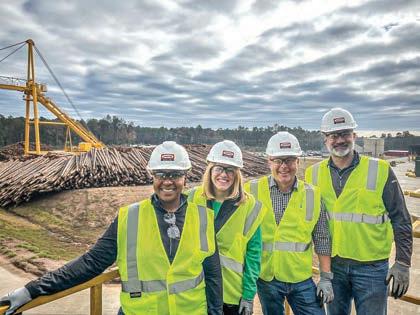
Canfor Southern Pine welcomed one of its longstanding partners, BNSF Railway, to Canfor’s state-of-the-art Axis Sawmill in Alabama for a site tour and business update. Canfor has partnered with BNSF on both sides of the border for decades. As the largest freight railroad in the U.S., BNSF transports products from Canfor’s Canadian operations to Western U.S. markets and acts as a key gateway partner for all Canfor Southern Pine divisions. The visit was an opportunity to showcase Canfor’s end-to-end process, discuss growth plans, and highlight how the upcoming rail spur at Axis will improve efficiency and reduce costs.
sure stability and continued momentum in our strategy and operations,” comments Tom Carlile, Chair of Boise Cascade’s board. “On behalf of the entire board of directors, I extend our gratitude to Nate Jorgensen for his outstanding leadership. Nate has led with steadfast integrity and remarkable vision for the last six years, guiding the company through a global pandemic and tremendous growth. The positive impact of his leadership will extend far beyond his tenure as CEO.”
Carlile adds, “Our board is equally confident in Jeff Strom and his leadership and experience, which spans over 34 years in our industry. As chief operating officer, Jeff has successfully driven to further leverage our integrated model, and he has been instrumental in driving operational excellence and customer focus across the company.”
Strom has been in the building materials industry for more than 34 years. He joined Boise Cascade in 2006 and has served in several key roles and progressive leadership positions during his 19 years with the company.
American Wood Council (AWC) announced the election of West Fraser President and CEO Sean McLaren as the new Board Chair for a two-year term. McLaren will be joined by SmartLam CEO Derek Ratchford, who was elected First Vice Chair, and PotlatchDeltic’s Vice President of Wood Products, Ashlee Cribb, who was elected Second Vice Chair. The terms became effective January 1, 2026.
Along with electing a new Chair and Vice Chairs, three new members of the Board were elected. Will Lampe, President and CEO of Lampe and Malphrus Lumber, will represent the Lumber Segment. Craig Sichling of LP Building Solutions will represent the Structural Panel Segment. Charles McRae, owner of Rex Lumber, will sit on the Environmental Committee.
The full AWC Board includes: Sean McLaren (West Fraser), Derek Ratchford (SmartLam), Ashlee Cribb (PotlatchDeltic), Ricky Stanley (TR Miller
Mill), Marc Brinkmeyer (Idaho Forest Group), Furman Brodie (Charles Ingram Lumber), Brian Chaney (Weyerhaeuser), George Emmerson (Sierra Pacific Industries), Jim Enright (Pacific Woodtech), Stuart Gray (Roseburg Forest Products), Rick Jeffery (Canadian Wood Council), Nate Jorgensen (Boise Cascade), Stephen Mackie (Canfor Southern Pine), Fritz Mason (Georgia-Pacific), Andrew Miller (Stimson Lumber), Cade Warner (Westervelt), Will Lampe (Lampe and Malphrus Lumber), Craig Sichling (LP Building Solutions), and Charles McRae (Rex Lumber).
Kalesnikoff announced that, effective January 1, Chris Kalesnikoff became President and CEO and Krystle Seed became Chief Financial and Strategic Services Officer of Kalesnikoff Lumber Co. and Kalesnikoff Mass Timber Inc., formally evolving to the fourth generation of family leadership.
Ken Kalesnikoff, previous President


CEO, will turn his full-time attention to industry advocacy and will remain a Principal and a Director of Kalesnikoff’s external Advisory Board.
“I am incredibly proud of Chris and Krystle’s accomplishments, as well as the entire Kalesnikoff team’s, in transitioning the company from a sawmill and lumber focus to one of North America’s leading mass timber companies and now North America’s first fully integrated mass timber modular offering,” Ken Kalesnikoff comments. “Given global economic challenges impacting the forestry sector, and Kalesnikoff’s recent success, this felt like the right time to focus on supporting our industry and to make way for this next generation of leaders.”
Kalesnikoff has operated for more than 85 years, and opened its first mass timber facility in 2020 in South Slocan, which has been expanded twice; and launched North American’s first modular mass timber facility in Castlegar in June. Both facilities use timber from the company’s sawmill operation in Thrums, making Kalesnikoff one of only a hand-
ful of fully integrated mass timber facilities in Canada and the U.S.
A precedent-setting milestone was marked in Tilleda, Wis. with the launch of a chip mill owned and operated by a logger cooperative—a major step forward for collaboration and sustainability in the forest products industry.
The new facility was acquired by Timber Professionals Cooperation Enterprises (TPCE), a co-op founded five years ago to strengthen the long-term viability of logging and trucking businesses across the region. The group, composed of loggers and haulers, collectively raised $418,000 to purchase the mill and have future plans to expand its concept.
“Because it’s the first of its kind in the country, there were a lot of hoops we had to go through to figure out what it all looked like legally and logistically,” TPCE President Dennis Schoeneck says. Initially, the mill will produce primary chips for a nearby pulp mill, but TPCE

has broader ambitions for its 50-acre site. “In the long run, we have a lot of goals with our 50 acres,” Laura Delaney, TPCE’s liaison, says. “As a cooperative, we want to expand into producing different products beyond pulp chips.”
The new chip mill represents not only a win for Wisconsin’s timber economy but also a blueprint for how logger coops nationwide can build stronger, more resilient markets in the years ahead.
Following up on the Trump Administration’s emphasis on more timber production from federal lands, the Bureau of Land Management in Oregon and Washington wrapped up fiscal year 2025 with increased timber sale output. Across Oregon and Washington, the BLM exceeded its annual goal and offered 15% more timber than in fiscal year 2024. In total, BLM Oregon/Washington sold 241MMBF for $67,049,012 from October 2024 through September 2025.
“This year’s timber efforts show

what the BLM can achieve,” says Barry Bushue, BLM Oregon/Washington State Director. “Next year, the BLM is offering even more timber, which means supporting more rural

jobs and improving forest health.”
In fiscal year 2025 the BLM facilitated the harvest of 250MMBF of timber valued at nearly $66 million, a 7% increase in harvest volume and 9% more in revenue than fiscal year 2024. These harvests include sales that were purchased over the previous four years, reflecting years of work with purchasers and operators in the community.
In western Oregon, the BLM manages 2.4 million acres of some of the most productive forests in the world, and is committed to supplying a reliable, secure, and resilient domestic supply of timber.
Revenue from timber sold on BLM lands is shared between the U.S. Treasury and 18 western Oregon counties. This funding provides local communities with the means to provide a wide variety of city and county services.
Bioleum Corp., which develops and commercializes technologies that convert lignocellulosic biomass into low-carbon fuels and refinery intermediates, has acquired Hexas Biomass Inc., a leader in the development and deployment of purposegrown energy crops and biomaterials.
Hexas has developed a portfolio of proprietary intellectual properties for the propagation, production, harvesting, and processing of purpose-grown crops with proven annual yields exceeding 25 to 30 dry metric tons per acre, or about four to seven times the yields of traditional forestry species. Hexas’ crops are specifically designed to thrive in diverse environments, including marginal and underutilized lands. These crops enhance the agricultural ecosystem without disrupting or competing with food production.
The combination of Bioleum’s high yield refining platform and Hexas’ high yield purpose-grown crops enables the production of more than 100 barrels of biofuel per acre of biomass production per year. The production of Hexas’ purpose-grown crops transforms marginal agricultural lands into perpetual “drop-in sedimentary oilfields” with the potential to dramatically boost domestic energy independence and expand rural economies using regenerative agricultural practices.

Courizon Partners, a private equity firm specializing in middle market industrial and consumer businesses, announced its acquisition of AirBurners, a leader in air curtain burner systems used for disposal of wood and vegetative waste across the U.S. and more than 30 international markets.
Courizon has named Darin Clause as CEO of AirBurners. Brian O’Connor, founder and long-time CEO of AirBurners, will transition into the role of Chief Technology Officer.
“AirBurners is uniquely positioned to solve an urgent and growing need as operators seek cleaner, safer, and more costeffective ways to process wood and



• Hickory, Sycamore, Beech, Gum & Elm • Custom Cut Timbers: Long lengths and wide widths Sales/Service: 336-746-5419 336-746-6177 (Fax) • www.kepleyfrank.us Buyers & Wholesalers Next closing: July 6,
We produce quality 4/4 - 8/4 Appalachian hardwoods
• Red Oak, White Oak, Poplar • Green Lumber: Air Dried, Kiln Dried Timbers & Crossties
AIR-O-FLOW profiled and FLAT Kiln Sticks–Custom made to your specifications using

Send your ad information on a separate sheet of paper, or send via email, and we will typeset it for you for FREE.

Beasley Forest Products, Inc. P.O. Box 788 Hazlehurst, GA 31539 beasleyforestproducts.com
Manufactures Kiln-Dried 4/4 Red and White Oak, Poplar, Ash and Cypress
Contact: Linwood Truitt
Phone (912) 253-9000 / Fax: (912) 375-9541 Linwood.Truitt@beasleygroup.com
Pallet components, X-ties, Timbers and Crane Mats
Contact: Ray Turner Phone (912) 253-9001 / Fax: (912) 375-9541 Ray.Turner@beasleygroup.com

HAROLD WHITE LUMBER, INC. MANUFACTUREROFFINEAPPALACHIANHARDWOODS (606) 784-7573 • Fax: (606) 784-2624 www.haroldwhitelumber.com
Ray White Domestic & Export Sales rwhite@haroldwhitelumber.com Cell:
Please be sure to include appropriate contact information so we may contact you for questions and payment.
Make sure to send any artwork that should be included in your ad. It should be a good-quality print or high resolution logo. We will fax or email you a proof before final print for your approval.


Executive – Managerial – Technical - Sales JOHN GANDEE & ASSOCIATES, INC
Importers and Distributors of Tropical Hardwood Kiln Sticks
Importers and Distributors of Tropical Hardwood Kiln Sticks
“The lowest cost per cycle”
“The lowest cost per cycle”

Recruiting and Staffing
Ashley Wright
Ashley@TopWoodJobs.com www.TopWoodJobs.com (803) 905-1298 3779
Contingency or Retained Search Depending on Circumstances / Needs “Your Success Is Our Business” Serving the Wood Products and Building Materials Industries For more than 32 years. 512-795-4244
Call or Email me anytime! john@johngandee.com www.johngandee.com Austin, Texas 3220
GW Industries www.gwi.us.com
GW Industries www.gwi.us.com
Dennis Krueger Jackie Paolo
866-771-5040 866-504-9095 greenwoodimportsllc@gmail.com jackie@gwi.us.com
Dennis Krueger Jackie Paolo 866-771-5040 866-504-9095 greenwoodimportsllc@gmail.com jackie@gwi.us.com 127

vegetative waste,” says Evan LePatner, Founder and Managing Partner of Courizon. “Brian has built an extraordinary company over these past 27 years, and we are excited to partner with him and Darin to strengthen and dramatically scale the business.”
Registration is now available for the 2026 Western Wood Products Assn. (WWPA) Annual Meeting to be held at the Hotel Indigo in Vancouver, Wash. on April 12-14.
To register for the event visit the WWPA website—www.wwpa.org. To reserve a room visit the Hotel Indigo website.
The meeting kicks off Sunday
April 13, has a full day of events including the Master Lumberman Awards. A complete agenda is available at the online registration site.
Attendees of the WWPA meeting can enjoy exclusive discounts at local restaurants and retailers by using the “Show Your Badge” discount phone app offered by the Visit Vancouver Washington organization.
For questions about the Annual Meeting email: wwpa@ejpevents.com.
Following recent fire seasons where the Oregon Dept. of Forestry ran out of money fighting fires and had to seek emergency funding, Oregon took a major step in 2025 year toward longterm forest wildfire mitigation with the passage of HB 3940. For the first time, Oregon’s Legislature and governor committed a sustained funding source for wildfire mitigation and landscape resiliency, recognizing that an ounce of prevention (or in this case mitigation) is worth a pound of cure.
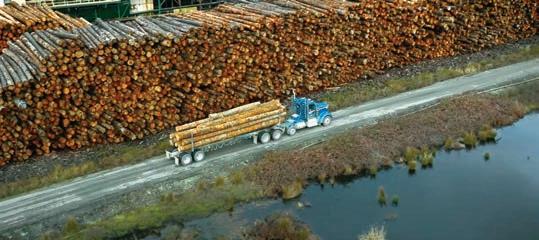
Studies estimate that every $1 invested in forest fire mitigation can avoid roughly $35 in future wildfire suppression costs. About $43 million is projected to be generated for forest fuel reduction and mitigation work per biennium—from Oregon state government, paid by interest on Oregon’s Rainy Day Fund and a new tax on oral nicotine pouches.
Until now, Oregon government has primarily invested in suppression, not mitigation. HB 3940 starts to change that.
In a report in the December 2025 Mainline publication, Amanda SullivanAstor, Forest Policy Manager for Associated Oregon Loggers, notes that “The challenge ahead is deciding what ‘resilience’ looks like on the ground, and how we put this new funding to work in a way that is measurable, accountable and effective.
“The bottom line is that none of the state’s resilience goals will be met without a skilled, available workforce and healthy markets,” she says. “AOL members are central to that reality. Our operators, truckers, reforestation crews, and mill workers are the ones turning plans on paper into work on the ground.”
4-8— Appalachian Hardwood Manufacturers annual meeting, The Naples Grande, Naples, Fla. Call 336-885-8315; visit appalachianhardwood.org.
18-20—SLMA 2026 Spring Meeting & Expo, Sandestin Golf and Beach Resort, Miramar Beach, Fla. Call 504-443-4464; visit slma.org.
25-27—Hardwood Manufacturers Assn. National Conference & Expo, Hyatt Regency, Jacksonville, Fla. Call 412-244-0440; visit hmamembers.org.
7-9—American Forest Resource Council annual meeting, Skamania Lodge, Stevenson, Wash. Call 503-222-9505; visit amforest.org.
7-9—Kentucky Forest Industries Assn. annual meeting, Downtown Hilton, Lexington, Ky. Call 502-695-3979; visit kfia.org.
12-14—Western Wood Products Assn. annual meeting, Hotel Indigo, Vancouver, Wash. Call 503-224-3930; visit wwpa.org.
14-15— Wood Bioenergy Conference & Expo, Omni Atlanta Hotel at Centennial Park, Ga. Call 334-834-1170; visit bioenergyshow.com.
16-17—Panel & Engineered Lumber International Conference & Expo (PELICE), Omni Atlanta Hotel at Centennial Park, Atlanta, Ga. Call 334-834-1170; visit pelice-expo.com.
17-18— East Coast Sawmilling and Logging Exposition, Meadow Event Park, Doswell, Va. Call 804-737-5625; visit exporichmond.com.
21-23—Dubai Woodshow, Dubai World Trade Centre, Dubai, United Arab Emirates. Call +971 4 39 23232; visit dubaiwoodshow.com.
26-30—American Wood Protection Assn. annual meeting, Emabssy Suites/Doubletree Downtown, Asheville, NC. Call 205-733-4077; visit awpa.com.
29-May 1—2026 Virginia Forestry Summit, Hilton Norfolk The Main, Norfolk, Va. Call 804-278-8733; visit vaforestry.org.
1-2—Northeastern Forest Products Equipment Expo (Loggers’ Expo), Champlain Valley Exposition, Essex Junction, Vt. Call 315-369-3078; visit northernlogger.com.
9-12—Xylexpo, FieraMilano-Rho Fairgrounds, Fieramilano, Italy. Phone +39-02-89210200; Visit xylexpo.com.
22-26—SLMA Annual Conference, Grand Hotel Golf Resort & Spa, Fairhope, Ala. Call 504-443-4464; visit slma.org.
25-28—IWF 2026, Georgia World Congress Center,
Ga. Call 404-693-8333; visit iwfatlanta.com.