6 Dean’s Report 2014 I 2015
KIM VAN SAVAGE
Associate director for human resources at the New England Primate Research Center, she has dedicated her career to fostering positive work environments.
Executive Education. For decision makers in fields aligned with medical science, such as executives in health care or biomedical companies, HMS is developing education programs designed to impart the information and insights these leaders need to be successful. We also are exploring courses for professionals in nonmedical fields, such as finance, law, intellectual property and patents, to help guide professionals in work that relates to medical science. Program in Medical Education
Continuing our long tradition of preparing students to meet the challenges of the next era in medicine, the Program in Medical Education is in the final stages of redesigning the MD curriculum—to be known as the Pathways curriculum. Over the past three years more than 100 HMS faculty and staff, led originally by Jules Dienstag, the Carl W. Walter Professor of Medicine and former dean for medical education, have participated in the redesign, which was overseen by a faculty task force. The Pathways curriculum will more fully integrate basic science with clinical medicine and will introduce curricular content in more developmentally appropriate time frames, employing new pedagogical techniques and incorporating educational technologies that enhance teaching and learning. Beginning in August 2015, many concepts now presented in the first two years will be combined in a 14-month curriculum that begins with foundational courses addressing the basics of anatomy, cellular and molecular biology, genetics, immunology, pharmacol-
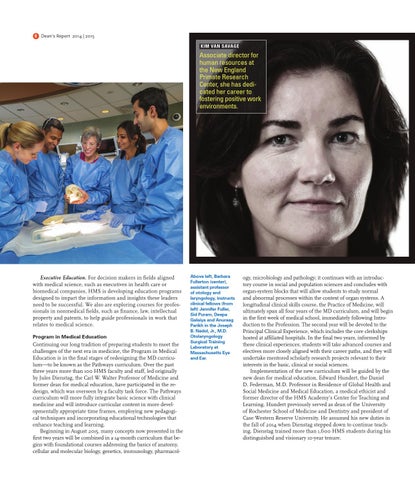
Above left, Barbara Fullerton (center), assistant professor of otology and laryngology, instructs clinical fellows (from left) Jennifer Fuller, Sid Puram, Deepa Galaiya and Anuraag Parikh in the Joseph B. Nadol, Jr., M.D. Otolaryngology Surgical Training Laboratory at Massachusetts Eye and Ear.
ogy, microbiology and pathology; it continues with an introductory course in social and population sciences and concludes with organ-system blocks that will allow students to study normal and abnormal processes within the context of organ systems. A longitudinal clinical skills course, the Practice of Medicine, will ultimately span all four years of the MD curriculum, and will begin in the first week of medical school, immediately following Introduction to the Profession. The second year will be devoted to the Principal Clinical Experience, which includes the core clerkships hosted at affiliated hospitals. In the final two years, informed by these clinical experiences, students will take advanced courses and electives more closely aligned with their career paths, and they will undertake mentored scholarly research projects relevant to their interests in the basic, clinical or social sciences. Implementation of the new curriculum will be guided by the new dean for medical education, Edward Hundert, the Daniel D. Federman, M.D. Professor in Residence of Global Health and Social Medicine and Medical Education, a medical ethicist and former director of the HMS Academy’s Center for Teaching and Learning. Hundert previously served as dean of the University of Rochester School of Medicine and Dentistry and president of Case Western Reserve University. He assumed his new duties in the fall of 2014 when Dienstag stepped down to continue teaching. Dienstag trained more than 1,600 HMS students during his distinguished and visionary 10-year tenure.