001_PB_FEB26.qxd_Layout 1 08/01/2026 16:21 Page 1
FRE E TO
THE TRA DE
Professional BUILDING ■ PLASTERING ■ PLUMBING ■ ROOFING ■ CARPENTRY ■ PAINTING AND DECORATING ■ THE BUSINESS MAGAZINE FOR THE BUILDING INDUSTRY
FEBRUARY 2026
NEW BUILD & PROPERTY DEVELOPMENT SETTING UP HOUSE
TOOLS, FIXINGS & WORKWEAR ANOTHER TOOL FOR THE TOOLBOX A TUFFX INFINITY ROOFLIGHT IS INSTALLED ON A JOB IN THE WEST MIDLANDS
PB.PMM page and ad grid_Layout 1 09/12/2025 15:05 Page 4
003_PB_FEB26.qxd_Layout 1 08/01/2026 16:23 Page 1
contents FEBRUARY 2026 VOL. 48 NO02
@PB_mag
pbweekly.co.uk
@probuilderonline
www.youtube.com/ProBuilderMag
@probuildermag
Professional Builder, Regal House, Regal Way, Watford, Herts, WD24 4YF.
REGULARS 7 Editor’s Viewpoint 8 News 51 The Doctor’s Advice
44
28 TOOLS, FIXING & WORKWEAR
18 NEW BUILD & PROPERTY DEVELOPMENT
14 TuffX’s high-performance, hassle-free rooflights 16 Geberit’s space-saving wallhung toilets 18 Grant UK: Capitalising on the demand for heat pumps 20 Improving airtightness with Talon 22 VELUX on the importance of daylight, ventilation and deliverability in homes 24 Tibby Singh reviews Knauf UK’s plasterboard and Brio 18WF boards 26 How waterless traps support space in modern homes
28 Carhartt on its range of jackets and their suitability 30 Makita discusses vibration and dust 32 ForgeFix’s “Screw Prostate Cancer” campaign 34 Catching up with the EasySlabber tool’s inventor 37 How KNIPEX UK is refining everyday kit 40 Jefferson Tools explains why the mitre saw deserves more attention
42 uvex on the importance of impact protection 44 Festool’s brand new cordless plunge-cut saw VEHICLES & PLANT
46 Looking at KGM’S Musso EV GENERAL BUILDING
49 Marley’s advice for weatherproof roofing 50 NEW PRODUCTS
46
I
PROFESSIONAL BUILDER FEBRUARY 2026 3
004_PB_FEB26.qxd_Layout 1 08/01/2026 16:23 Page 1
NOW LIVE!
Professional BUILDING ■ PLASTERING ■ PLUMBING ■ ROOFING ■ CARPENTRY ■ PAINTING AND DECORATING ■
t s a c d Po
IF THEY ARE TALKING WE ARE LISTENING! Professional
Podcast
AND YOU CAN TOO, AS WE CATCH UP WITH SOME OF THE CONSTRUCTION INDUSTRY’S MOST INTERESTING AND KNOWLEDGEABLE CHARACTERS ON THE NEW GROUND BREAKING PROFESSIONAL BUILDER PODCAST WITH LEE JONES AND EDWARD KELLY. LEARN A NEW BUSINESS SKILL OR FINE TUNE AN OLD ONE FROM THE GUYS AND GIRLS AT THE SHARP END, WHO HAVE BEEN THERE, DONE IT AND GOT THE PB T-SHIRT TO BOOT!
LISTEN NOW ON YOUR PODCAST PLATFORM OF CHOICE Listen on
Listen on
Listen on
Listen on
Google Podcasts
Apple Podcasts
Amazon Podcasts
Spotify Podcasts
OR CLICK HERE TO VISIT: WWW.RDR.LINK/BBX132
PB.PMM page and ad grid_Layout 1 22/09/2025 12:53 Page 1
PB.PMM page and ad grid_Layout 1 28/08/2025 11:35 Page 1
007_PB_FEB26.qxd_009_PB_FEB04 08/01/2026 16:24 Page 7
Total Average Net Distribution 123,849 July 2024 – June 2025
viewpoint
EDITOR LEE JONES EMAIL: ljones@hamerville.co.uk ASSISTANT EDITOR EDWARD KELLY EMAIL: ekelly@hamerville.co.uk MEDIA ASSISTANT LUKE CUNEEN EMAIL: lcuneem@hamerville.co.uk GROUP ADVERTISEMENT MANAGER CRAIG JOWSEY TEL: 07900 248102 EMAIL: craig@hamerville.co.uk NORTHERN ADVERTISEMENT MANAGER IAN DUFF MOBILE: 07810 353525 EMAIL: probuilder@sky.com GRAPHIC DESIGNER DONNA BOOTH GROUP PRODUCTION MANAGER CAROL PADGETT DIGITAL MANAGER JASMINE SMITH EMAIL: jsmith@hamerville.co.uk DIGITAL ASSISTANT LYDIA MCFARLANE EMAIL: lmcfarlane@hamerville.co.uk DISTRIBUTION MANAGER KARL CLARK PRINTED BY PCP TELFORD PUBLISHED BY HAMERVILLE MEDIA GROUP Regal House, Regal Way, Watford, Herts WD24 4YF Tel: (01923) 237799 Fax: (01923) 246901 Email: pb@hamerville.co.uk
Professional Builder is a business magazine for firms and individuals involved in all aspects of the building industry. It is available nationally – free to the trade through leading builders’ merchant outlets. © 2026 To be removed from this magazine’s circulation, please call 01923 237799 or email circulation@hamerville.co.uk. Subscriptions to Professional Builder are available at the following rates: UK: 1 year (11 issues) – £30.00 post paid Europe & Overseas: 1 year (11 issues) – £70.00 post paid Airmail: 1 year (11 issues) – £99.00 post paid
MIND THE GAP Did you know that small housebuilders’ the Government’s planning reforms can share of new homes sits at just 9%? A help diversify the market and boost the startling figure when compared to the number of small developers. 40% share they had in the 1980s. This The decline of small housebuilders has comes from the Federation of Master been years in the making, with Builders (FMB); longstanding champions increasingly complex planning restrictions, of the small builder, which launched its difficulty buying land and more. Is it too 2025 Small Housebuilders’ Survey at its optimistic to say that these days could Winter Parliamentary Reception at the soon be behind us? tail end of last year. At the FMB’s Parliamentary Reception, Speaking on the decline, Brian Berry, Baroness Taylor of Stevenage, Chief Executive of the FMB said, “This Parliamentary Under Secretary of State for decline is not just bad for local house Housing and Local Government, builders, it is bad for consumer choice, it is announced that the Government has bad for the range of design being made launched changes to the National Planning available, and it is bad in terms of Policy Framework. delivery”. “We’ve simplified planning for sites Indeed, delivery is the elephant in the under 9 homes. Such developments now room here. At a time where the benefit from faster decisions by expert Government is pledging to have 1.5 million planning officers with streamlined homes built by 2029, it’s impossible for biodiversity net gain requirements,” the volume builders to maintain their 92% Baroness Taylor said. share and still hit this target. The She outlined additional measures possibility of it isn’t the only factor either. including £48 million to support Britain was built by builders, and the recruitment and training of planners, charm of walking down a street and selling more of Homes England’s land in seeing a range of small-only sales, and a different houses risks £700 million extension to The FMB’s survey being pulled away. the Home Building Fund. The FMB’s survey “We recognise the revealed significant revealed significant challenges you face,” the barriers for small barriers for small Minister said. “Planning housebuilders, with two- delays, regulatory housebuilders, with twothirds of respondents burdens, a lack of thirds of respondents reporting they are unable suitable sites and access reporting they are to pursue sites due to to finance you need to unable to pursue sites anticipated Section 106 grow and invest, these costs, and over a third have hindered SME due to anticipated stating the process for builders to do what you Section 106 costs, and obtaining planning do best.” permission is getting While we’re yet to see over a third stating the worse. the huge uptake in process for obtaining And yet, despite these spades in ground that challenges there remains planning permission is were anticipated when a Blitz-like spirit among this Labour Government getting worse. small housebuilders. The took power and survey of 169 announced a host of housebuilders found that 73% anticipate reforms, the industry consensus seems to robust buyer demand, 69% are planning to be that this time is fast approaching. So for increase their workforce, and 68% believe now, let’s just keep calm and carry on.
I
PROFESSIONAL BUILDER FEBRUARY 2026 7
008_PB_FEB26.qxd_011_PB_MAR04 08/01/2026 16:25 Page 8
News Professional Builder
email your news to us at pb@hamerville.co.uk Tel 01923 237799
A NEW HOPE Optimism for small housebuilders despite challenges A survey for small housebuilders which was launched by the Federation of Master Builders (FMB) has found that most are extremely optimistic about their future, with around 73% expecting robust buyer demand and many others looking to increase their workforce. The newfound optimism for small housebuilders comes at a time when the UK government has pledged to build around 1.5 million new homes by the end of its first term, a feat that ministers have said will require the help and expertise of both small and medium-sized housebuilders to accomplish. Brian Berry, Chief Executive of the FMB, highlighted ongoing concerns about the decline of small housebuilders, noting that their share of new homes has fallen dramatically from 40% in the 1980s to just 9% today. “This decline is not just bad for local house builders, it is bad
for consumer choice, it is bad for the range of design being made available, and it is bad in terms of delivery,” Berry said. FOR MORE DETAILS VISIT: WWW.RDR.LINK/BBX002
‘BRIGHTON’ THE PLACE UP
End of 15-year project to help preserve ‘Brighton’s cathedral’ St. Peter’s Church in Brighton has been fully restored after it had previously fallen into serious disrepair. Construction firm DBR called on the expertise of hundreds of craftsmen to fully renovate the building, with the work being phased over 15 years to align with National Lottery funding. Adrian Attwood, Executive Director and Chairman of DBR, commented: “After 15 years of working on St. Peter’s Church, it is fantastic to see the scaffold finally coming down. It reveals the incredible hard work and skill of the DBR Southern team and gives this wonderful façade back to my hometown of Brighton.” FOR MORE DETAILS VISIT: WWW.RDR.LINK/BBX003
TRAINING ON TRACK
Mayor signs historic training agreement
Liverpool Mayor Steve Rotherham has signed a historic training agreement that will help tackle the shortage of construction workers in the city. The agreement will see the Combined Authority (CA) collaborate with the Construction Industry Training Board (CITB) to train an estimated 9,000 extra construction workers for the city, with the partnership being the first under the CITB’s new national initiative to create a Construction Skills Ecosystem across England. Commenting on the scheme, CITB Chief Executive Tim Bacon said that “This agreement marks a major step forward in aligning national and regional priorities to meet the construction sector’s needs.” FOR MORE DETAILS VISIT: WWW.RDR.LINK/BBX004
I
8 FEBRUARY 2026 PROFESSIONAL BUILDER
PUMP ACTION
£1,000 in rewards for Daikin heat pump installs Daikin has launched a limited-time installer incentive, giving accredited Sustainable Home Network installers the opportunity to earn £1,000 in rewards every time they install and register a qualifying Daikin Altherma High Temperature heat pump. Running until 31st March 2026, the promotion applies to eligible high temperature models purchased via a Sustainable Home Centre or merchant partner. Installations must be registered via the company’s ‘Stand By Me’ portal during the promotional period to qualify. FOR MORE DETAILS VISIT: WWW.RDR.LINK/BBX005
008_PB_FEB26.qxd_011_PB_MAR04 08/01/2026 16:25 Page 9
‘BREW’ KNEW?
Homeowners less likely to offer hot beverage to builders Research by the Federation of Master Builders (FMB) shows around 42 per cent of homeowners don’t offer their builder a brew while on the job. This further shows that the likelihood of a builder being offered a brew depends on the age of the customer, with older homeowners between the ages of 55 and 65 and over being much more likely to offer a brew compared to their younger Gen Z counterparts. FOR MORE DETAILS VISIT: WWW.RDR.LINK/BBX006
DIGGING IT
Electric micro excavator a hit with new owner A mini electric excavator is being praised by its new owners, Wetherby Tool and Plant Hire, due to its effective and environmentally friendly features. The JCB 8008E CTS is a new micro excavator that shares the same body and structure as the 8008 CTS but produces zero carbon emissions thanks to an electric motor. According to plant owner Scott Fletcher, “We bought the JCB 8008E CTS after receiving a number of enquiries from customers about electric diggers for working inside buildings. We’ve been very impressed with the new model.” FOR MORE DETAILS VISIT: WWW.RDR.LINK/BBX007
THE NEXT GENERATION
New scheme helps train future workforce Forterra is partnering with NHBC to help train the next generation of housebuilders so that they are equipped and ready for modern energy and construction standards. With the majority of UK
construction workers now close to retirement, it is vital that new apprentices are trained to be able to operate in an energy efficient and low-carbon future.
HOUSE OF ‘FUND’
The programme is a combination of classroom and site based learning, leading to a National Vocational Qualification (NVQ), which is quickly becoming the new industry standard. NHBC Lichfield training manager said of the programme that “we’re showing apprentices that accuracy, care and attention make for better homes, with fewer defects, reduced waste and greater reliability for homeowners.” FOR MORE DETAILS VISIT: WWW.RDR.LINK/BBX008
SAFETY SCARE
Funding secured to tackle NEETs
BSIF warning as online marketplace scrutiny intensifies
The Department of Education is helping to support young adults going into the construction sector by awarding over £994k in Adult Skills Fund money to the West Yorkshire Combined Authority (WYCA) for educational institutions to offer construction skills training. The project manager for Bradford College, which received around 50% of the funds, John Wells, said that “Regionally, we have a significant issue with construction skills gaps, but also with ‘NEETs’ (individuals not in education, employment, or training). The aim of this funding, therefore, is to boost construction worker numbers and help achieve national housebuilding targets, while getting more adults into work.”
The British Safety Industry Federation (BSIF) has warned both suppliers and © Wisut / Adobe Stock buyers of PPE to urgently review their stocks due to recent evidence drawn from BSIF 2025 product testing that unsafe and non-compliant PPE is widespread, particularly in the online marketplace. With new legal changes fast approaching, it is urged that employers take extra care to ensure that the equipment they are using is up to the right standards.
FOR MORE DETAILS VISIT: WWW.RDR.LINK/BBX009
FOR MORE DETAILS VISIT: WWW.RDR.LINK/BBX010
I
PROFESSIONAL BUILDER FEBRUARY 2026 9
010_PB_FEB26_Layout 1 08/01/2026 16:29 Page 10
Professional
We give our verdict on new products in our unique site tests, but now we want to give you the chance to try them – AND KEEP THEM – for yourself! All you have to do to enter the free draws is simply just type in www.rdr.link followed by the unique code.
! L L A R O F E E FR 20
X ROLLS OF MASKING TAPE
FROGTAPE SHURTAPE With new packaging created from environmentally responsible FSC certified paper board, that can easily be recycled when finished, and a longer 55m length, FrogTape Multi-Surface Painter’s Tape still features our unique Paintblock Technology, helping decorators have the confidence to tackle any indoor painting project. Enter now for a chance to win one of 20 rolls. FOR YOUR CHANCE TO WIN VISIT: WWW.RDR.LINK/BBX011
5
10
X PACKS OF FIXINGS
SURE GRIPS HEAVY DUTY PLASTERBOARD FIXINGS Designed and invented by a working carpenter, Sure Grips are the latest answer to fixing to plasterboard. Perfect for all kinds of brackets, these green little helpers are discreet but strong. Without any complicated mechanism, these fixings just push right in and only require a 10mm hole. They are suitable for any 4.0mm or 4.5mm gauge woodscrew and winner of the 2025 Professional Builder Top Products Innovation Award Winner. Drill it. Tap it. And you’re done! FOR YOUR CHANCE TO WIN VISIT: WWW.RDR.LINK/BBX012
X TOOL BUCKETS
HULTAFORS Win one of five Hultafors Tool Buckets, an ergonomic, heavy-duty bucket made from robust PP plastic for carrying tools and site essentials. The shaped rear side improves comfort against the body, even when fully loaded, while the upright-parking handle and stackable design with internal measuring scale add extra on -site practicality. Enter using the link below. You’d be a ‘tool’ not to! FOR YOUR CHANCE TO WIN VISIT: WWW.RDR.LINK/BBX013
Easy to Enter! It’s now easier than ever before to enter the competitions on our website. We’ve collected all the competitions on one handy page, meaning you only have to enter your details once! www.rdr.link/BBX014 I
10 FEBRUARY 2026 PROFESSIONAL BUILDER
Professional
TOP PRODUCT AWARD 202 5
PB.PMM page and ad grid_Layout 1 05/01/2026 09:41 Page 1
PB.PMM page and ad grid_Layout 1 05/01/2026 09:43 Page 1
PB.PMM page and ad grid_Layout 1 05/01/2026 09:44 Page 2
014_PB_FEB26.qxd_Layout 1 08/01/2026 16:30 Page 14
new build & property development
SKY’S THE LIMIT
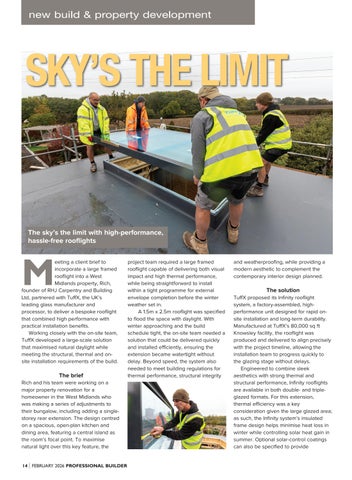
The sky’s the limit with high-performance, hassle-free rooflights eeting a client brief to incorporate a large framed rooflight into a West Midlands property, Rich, founder of RHJ Carpentry and Building Ltd, partnered with TuffX, the UK’s leading glass manufacturer and processor, to deliver a bespoke rooflight that combined high performance with practical installation benefits. Working closely with the on-site team, TuffX developed a large-scale solution that maximised natural daylight while meeting the structural, thermal and onsite installation requirements of the build.
M
The brief Rich and his team were working on a major property renovation for a homeowner in the West Midlands who was making a series of adjustments to their bungalow, including adding a singlestorey rear extension. The design centred on a spacious, open-plan kitchen and dining area, featuring a central island as the room’s focal point. To maximise natural light over this key feature, the
I
14 FEBRUARY 2026 PROFESSIONAL BUILDER
project team required a large framed rooflight capable of delivering both visual impact and high thermal performance, while being straightforward to install within a tight programme for external envelope completion before the winter weather set in. A 1.5m x 2.5m rooflight was specified to flood the space with daylight. With winter approaching and the build schedule tight, the on-site team needed a solution that could be delivered quickly and installed efficiently, ensuring the extension became watertight without delay. Beyond speed, the system also needed to meet building regulations for thermal performance, structural integrity
and weatherproofing, while providing a modern aesthetic to complement the contemporary interior design planned.
The solution TuffX proposed its Infinity rooflight system, a factory-assembled, highperformance unit designed for rapid onsite installation and long-term durability. Manufactured at TuffX’s 80,000 sq ft Knowsley facility, the rooflight was produced and delivered to align precisely with the project timeline, allowing the installation team to progress quickly to the glazing stage without delays. Engineered to combine sleek aesthetics with strong thermal and structural performance, Infinity rooflights are available in both double- and tripleglazed formats. For this extension, thermal efficiency was a key consideration given the large glazed area; as such, the Infinity system’s insulated frame design helps minimise heat loss in winter while controlling solar heat gain in summer. Optional solar-control coatings can also be specified to provide
014_PB_FEB26.qxd_Layout 1 08/01/2026 16:30 Page 15
additional protection. The aluminium frame is powder-coated to the client’s specification, providing long-lasting durability and low maintenance, while ensuring the rooflight complements other external features. The glazing options also include enhanced acoustic performance, reducing external noise and improving the comfort of interior spaces.
Installation efficiency The Infinity system’s design makes it installer-friendly. Delivered as a single, complete unit, the rooflight can be lifted, positioned and secured in place quickly, reducing on-site time and limiting the potential for errors. For this project, installation began with the construction of a timber upstand with a minimum 5° pitch to ensure efficient water runoff. Final measurements were then confirmed when placing the order. Once the rooflight was on-site and had been safely lifted onto the roof, a continuous bead of silicone was applied around the upstand to create a secure, weatherproof seal. Then, the powdercoated aluminium frame was lowered into place and fixed, completing the installation with minimal disruption. Infinity rooflights are designed for hassle-free installation, which enabled Rich and the team to create a watertight structure on schedule and for internal works to proceed as planned.
Performance delivered The completed rooflight created a striking architectural feature both externally and internally, while delivering practical daylighting benefits for the kitchen and dining area. TuffX’s double-glazed Infinity units also achieve centre pane U-values of 1.2 W/m²K, with the triple-glazed option reaching 0.7 W/m²K, offering up to 30% improved performance over standard double glazing. In addition, the system provides enhanced acoustic performance, reducing external noise and helping
maintain a comfortable indoor environment year-round. This project highlights how TuffX’s Infinity rooflights combine aesthetics, thermal and structural performance and installation efficiency, helping contractors and the wider supply chain deliver highquality results on time and to specification. By providing factoryassembled units with flexible specification options, TuffX enables professional builders to meet client expectations while simplifying on-site installation - a win-win.
Rich, founder of RHJ Carpentry and Building Ltd, said: “I choose the TuffX Infinity range because I know I’ll always receive a quality product, and my latest framed flatglass installation was no exception. The size requirements for this skylight meant I needed to run through the details with the customer service team, who helped confirm that my upstand aperture was correct and ensured the unit was manufactured precisely to my specifications. Their knowledge gives me complete confidence before I even get to site. “The product itself is incredibly straightforward to install, which makes a real difference when you’re managing tight project schedules. When the skylight arrives, the delivery drivers are equally professional - respectful of my team’s needs and never rushing to drop off at their own convenience, which is rare in this industry. I’ll continue using Infinity products for all my flat-glass projects because I know both my customers and I will be delighted with the end result every time.”
FOR FURTHER INFORMATION ABOUT TUFFX’S INFINITY PRODUCT RANGE, VISIT WWW.RDR.LINK/BBX015
I
PROFESSIONAL BUILDER FEBRUARY 2026 15
016_PB_FEB26.qxd_Layout 1 08/01/2026 16:31 Page 16
new build & property development
SPACE SAVERS Why wall-hung toilets are becoming the go-to for space-conscious design s UK bathrooms get smaller, homeowners are searching for ways to create a sense of openness and calm. Sonia De Gioia, Sales Director of Showrooms for Geberit, explores the benefits of wallhung WCs – lifting the toilet from the floor to open up space in the bathroom. An interesting conflict is becoming increasingly evident in UK homes. While bathrooms are generally getting smaller in new properties, demand from homeowners and occupiers for luxurious bathroom spaces is on the rise. Innovation in bathroom products and
A
I
16 FEBRUARY 2026 PROFESSIONAL BUILDER
space design has arguably never been more important. Rising property prices, higher demand and the trend towards apartments and city living have impacted the size of bathroom spaces. Yet for homeowners, the role of the bathroom changing. Once designed primarily for speed and convenience, today the bathroom is far more than a purely functional space. Instead, it’s often regarded as a personal sanctuary – a space to unwind and switch off from the pressures of modern living, inspired by stylish designs from the hotel sector. In the search for space-conscious design, builders are turning to wall-hung toilets – stylish, flexible and easy to install with the support of advanced installation systems. These fixtures lift the toilet from the floor, open up visual space and support easier cleaning - benefits that appear to resonate widely, with 83% of existing users recommending them to others, according to research from Geberit. The same poll also shows that 85% of homeowners value a more open and spacious bathroom, while nearly half (43%) associate wall-hung toilets with
“modern, premium bathroom design” and “space-saving aesthetics.”
Flexible installation Wall-hung toilets don’t just open up the floor space, they also overcome common challenges around space, hygiene and installation. All with more affordable solutions and increased design choices too.
016_PB_FEB26.qxd_Layout 1 08/01/2026 16:31 Page 17
“The fixtures lift the toilet from the floor, open up visual space and support easier cleaning - benefits that appear to resonate widely” Crucially, wall-hung WCs allow pipework and the cistern to be concealed behind the wall by using pre-wall frame systems such as Geberit Duofix, while lifting the toilet’s footprint off the floor creates an added illusion of space. They can be easily installed in tricky spots too, such as under a window, in a narrow wall duct or under a sloping ceiling where closed coupled toilets could not be placed, for added flexibility in placement. Gone are the days of complex installations for wall-hung toilets. Quick and affordable pre-wall frame systems combine with clever developments such as concealed fixings and the position of water inlets, for example, which make life easier for installers. Servicing and access to the cistern is made easy via the flush plate. These benefits are all evident in the Geberit Duofix Alpha range of universal installation elements, designed for drywall construction. The installation system is available in three heights, each with effortless handling and single-person installation, plus a range of on-trend flush plate finishes – all combining to make it quicker and easier to install wall-hung WCs. For some projects, there’s also an option to spec up to the wall-hung AquaClean Alba wall-hung shower toilet, offering all the benefits of an elegant and effective shower toilet for just a small extra cost compared to a conventional toilet. In the search for hotel-style sanctuary, shower toilets can make a real statement – combining spray functionality and remote control operation with all the style and simplistic design of a modern WC. As bathrooms continue to evolve from purely practical spaces into places of sanctuary, solutions that maximise space without compromising on style will only grow in importance. Wall-hung WCs, supported by smart, installer-friendly frame systems, offer a simple yet transformative way to achieve the sense of openness that so many homeowners now expect - a future-ready option that meets the demands of modern living. FOR MORE INFORMATION ON GEBERIT VISIT WWW.RDR.LINK/BBX016
018_PB_FEB26_Layout 1 08/01/2026 17:04 Page 18
new build & property development
Andy Smith, National Sales Manager at Grant UK, explains how, with the right training and support, the rising demand for heat pumps is a great opportunity for companies who are ready to adapt
HEAT PUMP KNOW-HOW
W
hether it’s a refurb, an extension or a full newbuild project, the move away from fossil fuels is gradually influencing homeownersand changing the conversations builders and heating eengineers are having on site. Air source heat pumps (ASHPs) are becoming a choice for homeowners who want a more efficient and sustainable heating system. The Government’s financial incentives, such as the Boiler Upgrade Scheme in England and Wales, are also making the transition more affordable. Almost a quarter of all UK greenhouse gas emissions come from heating buildings. If we want to cut those emissions, we need to reduce our reliance on fossil fuels. Air source heat pumps are a great way to achieve this. In brief, the units extract the heat energy within the outdoor air and convert it into useable energy to heat homes. The technology has been around for years and can offer a high-performing, reliable option that suits a wide variety of properties. Heat pumps are often perfectly suited to new builds as their constructon can complement the operation of the heating system, such as the integration of underfloor heating, and high levels of roof and wall insulation to reduce heat loss. The introduction of the Future Homes Standard will grow the use of heat pumps in new build properties as this legislation
I
18 FEBRUARY 2026 PROFESSIONAL BUILDER
requires new homes to have low carbon heating systems, like air source heat pumps. Heat pumps are not just for new builds though. Many older homes are also suitable, provided the system is correctly designed. Grant’s Aerona heat pumps have been successfully installed in numerous existing properties as a replacement for fossil-fuel boilers, so there is a growing retrofit market for installers willing to broaden their skillset.
Training For many builders and heating engineers, the barrier to entering the heat pump market can be confidence. Grant UK provides several ways to build knowledge, gain practical experience and transition smoothly into heat pump installation. Grant UK’s Training Academy offers a range of courses that support heat pump installation which can be delivered by the Grant Team at centres throughout England, Scotland and Wales. The Aerona³ Air Source Heat Pump course for example, includes everything installers need to know about the Aerona³ R32 range. A blend of practical training and theory covers construction, operation, wiring, controller settings, installation requirements and commissioning. It gives installers a solid grounding in how the system works and what to look out for during an installation. Those wanting to work with the nextgeneration Aerona 290 heat pumps can take a dedicated course focused on this range. The R290 is slightly different because it uses R290 refrigerant which has a much lower global warming
018_PB_FEB26_Layout 1 12/01/2026 15:52 Page 19
potential than R32. These heat pumps also have specific design considerations, handling procedures and installation practices, all of which are covered in the training to ensure installers can work with the technology confidently and safely. The course also covers setup of the Grant Aerona Smart Controller, helping installers understand how to optimise performance. If attending a course in-person is not possible, there is also the option of the Grant eLearning Academy. This online platform lets installers train at their own pace, with modules ranging from introductory overviews to full installer courses for both the Aerona³ and Aerona 290 systems.
Start With Grant To make the step into heat pumps even easier, Grant also offers an initiative designed specifically for oil and gas installers who are new to heat pumps and want structured, supported hands-on experience with this low carbon technology. You may be, or have, a registered gas engineer in your business. If so, then this scheme offers a way into heat pumps like no other. In partnership with Nesta, the Start With Grant scheme gives oil and gas boiler installers a fully funded heat pump system to fit in their own home. The package includes an Aerona 290 air source heat pump up to 12kW, a Grant hot water cylinder up to 210 litres, 50 litre volumiser, Aerona Smart Controller and an installation kit. But the support extends far beyond supplying products; hands-on training, design assistance, 7-year guarantee, commissioning carried out by a Grant engineer, support with MCS certification for their heat pump installation and a £1,500 payment towards installation costs. It is important to highlight that eligibility criteria and Scheme Terms and Conditions apply. The idea is that by installing a heat pump at home, installers get real-world experience that no classroom can match. Installers will learn how the system behaves across the seasons, how the controls operate and what can realistically be expected in terms of comfort and efficiency. This first-hand knowledge in turn makes it far easier to discuss heat pumps confidently with customers. For builders and heating engineers looking to expand their services, heat pumps offer one of the strongest growth opportunities in the sector with demand rising across both new builds and retrofit projects. With clear training pathways, hands-on support and a scheme that helps installers gain real experience in their own homes, Grant UK provides a practical route into the heat pump market. For businesses wanting to stay competitive as the industry changes, now is the time to get ready. FOR MORE INFORMATION ON THE TRAINING GRANT OFFERS VISIT WWW.RDR.LINK/BBX017 FOR MORE INFORMATION ON THE START WITH GRANT SCHEME VISIT WWW.RDR.LINK/BBX018
020_PB_FEB26.qxd_Layout 1 08/01/2026 16:33 Page 20
new build & property development
PERFORMING SEAL Airtightness is one of the simplest ways to improve energy efficiency. With tighter rules ahead, Mike Morris at Talon explains why sealing around pipes and flues matters more than ever he UK’s Future Homes Standard (FHS) is edging closer. It proposes that every new home must meet the new requirements and raises expectations for energy efficiency, from better airtightness and insulation to lowcarbon heating and reduced heat loss. In the energy efficiency arena, there are high-profile features such as heat pumps, solar PV and smarter heating controls. But alongside the headline technologies sits something quieter: airtightness. It’s one of the smallest details in a new build, but still one of the most important. Airtightness sits firmly within the fabricfirst approach which aims to make homes as efficient as possible before relying on mechanical systems. If a building is well insulated but full of unintended gaps, warm air simply escapes and cold air finds its way in. The heating system then has to work harder which means higher energy use, higher bills and higher emissions, precisely the problems the FHS is designed to reduce. Improving airtightness has clear benefits. Close up the gaps and the home becomes easier to heat, occupants feel warmer at lower temperatures and the risk of interstitial condensation (where moist air escapes into the structure and
T
I
20 FEBRUARY 2026 PROFESSIONAL BUILDER
condenses inside the fabric) drops significantly. Left unchecked, that moisture can lead to hidden damp, mould and structural damage over time. One of the most common sources of air leakage is also one of the simplest: holes drilled for pipework or flues. Every new home has plenty of these and unless they are sealed properly, each becomes a direct pathway for heat loss. It’s why the 2022 update to Part L of the Building Regulations made airtightness around pipes and flues a requirement not a recommendation.
Changing methods Traditionally, sealing around pipes meant using mortar, foam or silicone all of which did the job quickly enough but had their issues. Mortar cracks and weathers; foam shrinks and discolours; silicone can peel away or degrade over time. None of them offers a reliable long-term air seal. There are also practical concerns. For boiler flues, applying mortar or silicone externally often means working at height adding risk, time and cost. Trying to achieve a neat, consistent finish is also a big challenge. These older methods simply don’t
align with the updates to Part L and the tighter standards and closer scrutiny that came with it. Instead, installers must now use pipe seals or grommets and provide photographic evidence for the SAP assessor as part of the BREL report. If those photos don’t demonstrate compliance, the project can face delays, retesting or even remedial work. On a busy site with dozens of trades involved, that can quickly become costly. Talon’s PipeSnug and FlueSnug products were developed to offer a simple, all-in-one solution, giving installers a clean, quick and reliable way to meet airtightness requirements. PipeSnug, available in 32mm, 40mm and 110mm sizes, sits neatly can be used in standard
020_PB_FEB26_Layout 1 12/01/2026 15:53 Page 21
core-drilled holes and forms an immediate air seal. It’s available in black, white and grey so blends with a range of finishes and the fitting is consistent, tidy and doesn’t degrade like foam or mortar. FlueSnug was developed for boiler flues. The FS5 version, designed for retrofitting into 5-inch boiler flue openings, fits directly into a 127mm core hole and works with all 100mm flues. It solves a long-running headache for installers by allowing the new flue to align with the old hole so there is no need for any extra drilling, while still achieving an airtight finish. They make compliance straightforward; their distinctive, consistent finish allows Building Control officers and SAP assessors to recognise them instantly in photos, reducing the risk of queries or delays when signing off the BREL report. Both PipeSnug and FlueSnug take seconds to be fitted and can be installed from inside the property, which is a major safety benefit. FlueSnug (bar the FS5) is flexible enough to be pushed through the hole and rigid enough to snap back to the exterior surface: no ladders, no scaffolding, no weather delays. PipeSnug and FlueSnug are UV resistant, robust and designed to hold their seal without cracking or shrinking. Airtightness is about attention to detail. It’s about finding every gap, every penetration, every small opening where air might escape and filling them. As the Future Homes Standard moves closer, small details like pipe and flue penetrations become big contributors to energy performance. With products like PipeSnug and FlueSnug, installers and housebuilders have a simple, compliant and durable way to get those details right and build homes that live up to the standards ahead. FOR MORE INFORMATION ON TALON VISIT WWW.RDR.LINK/BBX019
022_PB_FEB26.qxd_Layout 1 08/01/2026 16:36 Page 22
new build & property development
BETTER ‘GLAZE’ AHEAD
Future Homes, Real Homes: VELUX explains why daylight, ventilation and deliverability must sit at the heart of UK new build reset he Future Homes Standard (FHS) promises to make every new home “zerocarbon ready” through lowcarbon heat and higher fabric efficiency. However, after 5 years of consultations, interim lifts and evolving metrics, the sector is still working against a backdrop of uncertainty. With the Governments formal response to the 2023 consultation now expected in early 2026, developers and housebuilders are trying to navigate all the potential aspects of legislation and ensure they are ‘oven ready’ for the FHS
T I
22 FEBRUARY 2026 PROFESSIONAL BUILDER
or as oven ready as they can be. This has placed particular pressure on building fabric elements that are difficult to retrofit or alter later in the build programme. Openings in the envelope — notably doors, windows and roof constructions — are coming under
increased scrutiny as thermal performance thresholds tighten and overheating risk becomes more central to compliance discussions. One emerging issue is the continued use of traditional and GRP dormers. While widely adopted across the sector, many
022_PB_FEB26.qxd_Layout 1 08/01/2026 16:36 Page 23
GRP dormer systems are now being reassessed against future thermal performance expectations, alongside wider concerns around tolerances, weather dependency during installation and supply chain reliability. For some housebuilders, these challenges are already impacting programme certainty and site productivity. As a result, both national and SME developers are reviewing alternative approaches that can deliver equivalent or improved internal space while offering greater confidence on thermal performance and buildability. VELUX has therefore seen a significant increase in housebuilders exploring the removal of conventional dormers with alternative roof-based solutions, including VELUX mini and full dormer systems that integrate multiple roof windows within a highly insulated kerb system. From a technical perspective, these approaches offer improved U-values, greater daylight provision and enhanced natural ventilation potential, while also helping to mitigate some of the installation and tolerance issues associated with traditional dormer construction.
Indoor comfort For builders carrying out due diligence, daylighting and indoor comfort have become important considerations alongside regulatory compliance. Higher levels of natural light and controllable ventilation contribute not only to occupant wellbeing, but also to overheating mitigation strategies — an area expected to carry greater weight as the FHS evolves. From a delivery standpoint, VELUX has noticed that solutions that are quicker to install, less weather-dependent and more predictable on site are gaining traction, particularly as labour availability and programme risk continue to challenge the sector. As the Future Homes Standard moves from consultation to implementation, the sector should resist the temptation to chase minimums and instead design for maximum everyday quality. The industry therefore faces a choice: design to minimum thresholds, or use the transition period to improve everyday performance and liveability. By treating the roof as an
active part of the building envelope — supporting energy efficiency, ventilation and occupant comfort — housebuilders can address compliance, carbon and quality in parallel. For the new-build sector, the reset demanded by the FHS is not only about meeting new regulations, but about delivering homes that perform better in practice, are easier to build consistently, and meet the rising expectations of future homeowners At VELUX we’ve spent decades testing how daylight and natural ventilation shape
health and wellbeing for both people and the buildings we live and work in. The lesson is consistent: people thrive in spaces with abundant, controllable light and fresh air. The work we do with developers across the UK highlights how technical solutions that align performance, buildability and internal environment quality can help the sector navigate the challenges of the new-build reset with greater confidence. FOR MORE INFORMATION ON VELUX VISIT WWW.RDR.LINK/BBX020
I
PROFESSIONAL BUILDER FEBRUARY 2026 23
024_PB_FEB26.qxd_Layout 1 08/01/2026 16:37 Page 24
new build & property development
SOUND JOB Professional Builder’s Tibby Singh gets hands on and reviews Knauf UK’s Plasterboard and Brio 18WF Boards
nauf UK needs no introduction and is one of the leading manufacturers of gypsum-based building materials in the UK. It is also one of the largest independent building materials manufacturers in the world and provides plasterboard, finishes, metal sections, flooring, insulating laminates, drywall accessories and more. On the project we’ve recently been working on, we previously used Knauf Insulation products, as in our other review featured in the January issue. We are now using some Knauf UK materials from the floor to the walls and the ceiling. The main purpose on the project was to improve the acoustic and thermal properties, so it was great to know that Knauf ‘quiet’ literally cover all areas. Starting from the bottom we used the Knauf Brio 18WF Boards on the floor which offers excellent acoustic performance with minimum impact on the construction height. This is a Gypsum
K
I
24 FEBRUARY 2026 PROFESSIONAL BUILDER
flooring panel with a pre-bonded wood fibre layer. This helps reduce the transmission of noise between floors which is why it’s used in hotels and apartments. wThe Brio is available in two thicknesses, 28mm and 33mm, with both boasting a 10mm wood fibre layer. These are very easy to install and even possible for an avid DIYer to complete the job from start to finish. Before installing, a Brio edge strip should be placed around the perimeter which helps with expansion and contraction. The panels are easy to cut by hand or with a plunge saw with the correct blade and you’d also need to wear appropriate PPE. They fit together smoothly and quickly with a little bit of Knauf glue on the lap joints and once screwed together they create a solid floor. Effectively it’s a floating floor so you would need to make sure the substrate is relatively flat. I do like the attention to detail as there’s a printed line on the boards, so you know exactly where to screw, which saves time measuring. For the ceiling we used the Knauf XPS Laminate Plus Insulated Plasterboard. This is a 9.5mm standard plasterboard with insulation attached to the back. This is convenient as it means both items can be installed at the same time and offers enhances thermal performance. Tapered edge boards are available which gives an
option for direct finish or plaster finish. It can also be dot and dabbed, and with a built-in vapour barrier it gives superior vapour resistance. This can prevent the moist air travelling through the building and potentially condensing, which can cause problems down the line. The insulation is ideal for use in new builds and refurbishment works and is available
024_PB_FEB26.qxd_Layout 1 08/01/2026 16:37 Page 25
Tibby Singh – www.TibbySingh.com
“These Knauf UK boards paired perfectly with the previously used Knauf insulation products to achieve the desired outcome, which can be described as a sound job!”
in 27mm, 35mm, 40mm, 45mm and 55mm thicknesses. Finally, on the walls we choose to use Knauf’s Soundshield plasterboard which is blue in colour, making them easy to identify. These are designed to improve the acoustic performance. Its high mass and tuned core helps absorb sound energy, giving enhanced acoustic performance to drywall systems. It’s designed for use in areas where sound reduction is of particular importance and for us it was the party wall. It achieves 40db Rw without the need for additional insulation, which can save insulation costs on site. 40db is equivalent to a quiet library sound. These Knauf UK boards paired perfectly with the previously used Knauf insulation products to achieve the desired outcome, which can be described as a sound job!
FOR MORE INFORMATION ON KNAUF UK VISIT WWW.RDR.LINK/BBX021
I
PROFESSIONAL BUILDER FEBRUARY 2026 25
026_PB_FEB26_Layout 1 08/01/2026 16:39 Page 26
new build & property development
THE SPACE RACE Steve Skeldon, Above Ground Product Manager at Wavin explores how waterless traps support space in modern homes
rom vanity units in bathrooms, to under the sink storage in tighter kitchens, plumbing systems need to be more compact. While the traditional water-seal trap has served the industry for decades, the emergence of waterless traps offers a practical way to reclaim space taken up by previous systems. Traditional water traps rely on a retained water seal to prevent the ingress of sewer gases from entering habitable rooms. In most domestic systems, this arrangement takes the form of a U-bend or P-trap. The curved shape makes the fitting more prone to blockages from food waste, hair, and oil build-up, but can also create spatial challenges on modern developments. There is also the issue of maintenance and occupant experience. A water seal only works if it remains intact. Infrequent use, siphonage, evaporation, or even temperature changes can cause the trap to dry out, breaking the seal and allowing odours to enter the room. Modern waterless traps, like Wavin’s
F
I
26 FEBRUARY 2026 PROFESSIONAL BUILDER
Osma HepvO, replace the traditional water seal with a self-sealing membrane that performs the same function of preventing odours and gases from entering occupied spaces, without relying on standing water. The flexible silicone membrane opens to allow water through and closes afterwards to form a reliable space-saving airtight seal which isn’t compromised by evaporation, siphonage or movement. One of the key advantages of waterless traps is they allow greater design flexibility and space efficiency thanks to its in-line space. The new and improved Osma HepvO waterless trap ensures installations are simpler and quicker to complete with the latest version featuring smoother, modern lines and clearly marked directional flow arrows, helping installers align fittings more easily. The compact design allows the unit to be installed vertically or horizontally, making it ideal for confined spaces such as behind pedestal basins, within slimline kitchen units, or beneath baths. In each case, the trap’s streamlined design helps overcome the space constraints that often complicate installation. For example, when used under a bath, it eliminates the need to cut into the floor to accommodate the bend of a traditional U- or P-trap. Similarly, in kitchen or bathroom cabinetry, its slim shape frees up valuable storage space - an important benefit in smaller homes and apartments. For builders, this flexibility supports more adaptable layouts and a cleaner overall aesthetic without compromising drainage performance. Waterless traps also provide consistent odour protection with minimal maintenance. The self-closing membrane remains sealed when not in use, maintaining a reliable barrier even after long periods of inactivity.
In addition, the membrane design helps to stabilise pressure within the waste system, reducing the gurgling sounds often associated with traditional traps under negative pressure. Removing the stagnant water also means there is less opportunity for biofilm or residue to accumulate, improving overall hygiene and reducing the need for cleaning or servicing.
Looking forward Waterless trap systems like HepVO demonstrate how small changes in specification can enhance both the build and the end-user experience. They provide valuable design flexibility for modern cabinetry layout, without reliance on water seals, and reduce the likelihood of odour-related maintenance issues. As building footprints tighten and expectations of quality continue to rise, these technologies illustrate how thoughtful product selection can quietly improve both construction efficiency and long-term occupant satisfaction. FOR MORE DETAILS ON WAVIN’S HEPVO WATERLESS TRAP, PLEASE VISIT WWW.RDR.LINK/BBX022
PB.PMM page and ad grid_Layout 1 05/01/2026 09:49 Page 1
028_PB_FEB26.qxd_Layout 1 08/01/2026 16:40 Page 28
tools, fixings & workwear
Whether its waterproofing, sweat fighting or flexible tech, understanding the range of technologies that go into today’s work coats will help you choose the perfect jacket for the job, says Carhartt’s Nick Poulson ackets are a popular purchase at this time of year. But while you go into a store knowing you need a reliable outer layer, you might be less certain about what different labels or features on the jackets actually mean. There is a range of different designs and technologies that can be found in our jackets so knowing what each one offers makes it far easier pick the coat that will meet your needs.
J
REQUIRED!
Keep dry Waterproofing is important for obvious reasons, but not all waterproofing is the same. Some waterproof jackets can leave you damp and cold after a few hours, not necessarily because the waterproofing isn’t working, but because the layer isn’t breathable. A jacket that blocks rain but traps sweat quickly becomes uncomfortable, especially on physical
I
JACKET
28 FEBRUARY 2026 PROFESSIONAL BUILDER
028_PB_FEB26.qxd_Layout 1 08/01/2026 16:41 Page 29
jobs where body heat builds up. Carhartt’s Storm Defender™ is designed to keep out heavy rain but at the same time, lets vapour escape so the wearer stays dry from the weather but doesn’t get cold and clammy from sweat on the skin. Storm Defender™ is used in several jackets in the Carhartt range, including the Loose Fit Heavyweight Jacket which also has practical details such as a roll-away hood, storm flaps and an adjustable droptail hem. These features help prevent water creeping in at the points where movement opens up small gaps. If you want something versatile and easier to pack, the Monterey Jacket offers the same waterproofing but is much lighter. It is fully seam-sealed, has weather-resistant zips and can be packed away into its own pocket, making it ideal for changeable days.
Carhartt’s Force Winnipeg Jacket is a great allrounder. It’s lightweight but sturdy with a waterrepellent shell, wind resistance, tapered seams and incorporates Rugged Flex™ for added stretch. work in mind. They use rugged duck fabrics that stand up to daily wear and have reliable insulation to keep you snug and warm.
Stretch Flexibility is another topic when it comes to choosing a jacket: one that restricts reaching, climbing or lifting quickly becomes frustrating. Rugged Flex™ is designed to address this issue by building stretch into the material. It’s especially useful in tough fabrics like duck canvas which is really robust and comfortable but can feel stiff when new. Rugged Flex™ helps the jacket move with the wearer rather than against them so is ideal for anyone spending the day on ladders, bending and crouching or carrying materials. The Duck Chore Coat is a good example; it combines Rugged Flex™ stretch with wind resistance so is warm and flexible and because it’s a loose fit, it works well over layers too. Full Swing™ gives plenty of flexibility too but works in a different way. It’s not a technology but is instead a design developed with the Carhartt Crew, a group of working testers. Instead of adding stretch throughout, Full Swing™ changes the cut of a jacket to provide extra room where the body naturally needs it, particularly across the shoulders and arms. This reduces strain during repetitive tasks or long days of physical work. The Bartlett Active Jac uses both Full Swing™ and Rugged Flex™ together with insulation and a quilted lining, making it suitable for colder conditions where mobility still matters.
Layers
Hard work For those likely to work up a sweat even in the cold weather, Carhartt Force™ is ideal. This technology wicks moisture away from the skin, prevents odours and helps the material dry quickly, keeping the wearer more comfortable across long, physical days. Carhartt’s Force Winnipeg Jacket is a great all-rounder. It’s lightweight but sturdy with a waterrepellent shell, wind resistance, tapered seams and incorporates Rugged Flex™ for added stretch. While some in the trade focus entirely on performance, others want something that balances warmth, comfort and a sense of personal style. The Montana range sits comfortably in this space. These jackets and vests take inspiration from Western workwear but are built with the practical needs of cold-weather site
The Montana Duck Insulated Jacket keeps you warm even in freezing conditions and includes Rugged Flex™ for easy movement. For those who prefer to layer up, the Montana Duck Vest provides core warmth without sleeves so you get solid weather protection with less bulk. The Montana Active Jackets are very warm but come with striking knit panels created by designer Bethany Yellowtail, giving the jackets a distinctive look. They include Wind Fighter™ technology to reduce draughts and insulated duck canvas for dependable warmth. Out on site there is such a wide range of roles, so being able to match the differing technologies to the type of work you do make it far easier to choose the right top layer. If you’re constantly exposed to the elements, you’ll appreciate Storm Defender™. If you’re constantly moving between different tasks and positions throughout the day, you will benefit from Rugged Flex™ or Full Swing™. If you’re likely to be in and out and need layers for warmth, you might lean towards the Montana Vest. The breadth of jacket technologies available means there is something suitable for almost every type of job. TO VIEW THE CARHARTT RANGE VISIT WWW.RDR.LINK/BBX024
I
PROFESSIONAL BUILDER FEBRUARY 2026 29
030_PB_FEB26.qxd_Layout 1 08/01/2026 16:41 Page 30
tools, fixings & workwear
Power tools have long played a pivotal role in achieving efficiency and improving overall safety in the construction sector. However, there are some potential, and often overlooked, health risks. Here, Kevin Brannigan, Marketing Manager at Makita, looks at the issues of vibration and dust, before explaining how trade professionals can help to keep themselves as safe as possible
The vibration situation No matter the size of the motor or its power output, every power tool will inevitably generate some vibration. These vibrations aren’t inherently dangerous, but exposure from frequent and prolonged power tool usage increases the chances of developing health issues such as Hand Arm Vibration Syndrome (HAVS). A catchall term, HAVS includes more widely known conditions such as Carpal Tunnel Syndrome and Vibration White Finger, which occur because of damage to the nerves and blood vessels. The British Safety Council lists some of the potential effects of HAVS as tingling or numbness in the fingers, hands or arms, pain or discomfort in the hands and wrists or a reduced grip strength. First of all, if you are purchasing a new tool, it is advisable to check the stated vibration level from the manufacturer before you buy to help reduce the risk from the outset. Many manufacturers actively take steps to reduce vibration, such as the as the Anti Vibration Technology (AVT) found in many Makita tools. This feature helps to absorb vibrations from the tool before they are transferred to the user, enabling professionals to work for longer on tasks traditionally associated with high levels of vibration. Then to check you are not being exposed to potentially dangerous levels
I
HIDDEN RISKS
30 FEBRUARY 2026 PROFESSIONAL BUILDER
of vibration, you can calculate the Exposure Limit Value, which Heath & Safety England represents as a maximum of 400 points that must not be exceeded in a week. Your value can be calculated by finding the vibration output of the tool you are using, squaring it and then multiplying that result by two.
Addressing dust is a must Exposure to dust can irritate both your skin and eyes, but it poses a particular risk if breathed in. Dust from drilling and other processes is categorised in two different ways.
Inhalable dust is made up of visible particles that can be inhaled and deposited in the respiratory tract. Although these particles may cause irritation, they are usually large enough to be cleared from the body naturally. Respirable dust is more dangerous because it is made up of much finer particles that are often undetectable to the human eye. These dust particles can penetrate deep into the lungs and cause permanent damage. One example of this is Respirable Crystalline Silica (RCS), which is generated when drilling or cutting stone such as sandstone, brick
030_PB_FEB26.qxd_Layout 1 08/01/2026 16:42 Page 31
and concrete. When inhaled, these particles irritate the lungs, which leads to swelling and scarring, reducing the function of the lungs. Exposure to RCS can lead to silicosis, Chronis Obstructive Pulmonary Disease (COPD) and even forms of cancer. As such, it is vital to use effective dust extraction. You must be aware that there is no safe level of exposure, so trade professionals must always use an extractor with at least a class M rating or above for work that produces RCS, and the same applies for applications where operators are cutting or sanding timber products, which can be carcinogenic if they are inhaled. That said, an extractor should also be supplemented with Respiratory Protective Equipment (RPE), with an Assigned Minimum Protection Factor (APF) of 20, or FFP3. It is also advisable to look for tools and extractors that work together to streamline and simplify the dust extraction process. Features that automatically engage the extractor when the tool is
triggered are ideal as you then do not need to remember to activate it separately. Makita, for example, now offers its Auto-Start Wireless System (AWS), which uses Bluetooth to link cordless tools to extraction units. Cordless dust extractors are also a great innovation that alleviate the need to find a power source on a busy site, ensuring that no matter where you are working – you can keep yourself protected from harmful dust particles. Remember – never underestimate the
potential risk of exposure to dust and excessive vibration to your long-term health. Awareness is the first step, but it is imperative that trade professionals then actively seek out power tools with the right safety features and adopt ways of working that will help to reduce the risk wherever possible. TO FIND OUT MORE ABOUT THE MAKITA PRODUCTS THAT CAN ENHANCE SAFETY ON SITE, HEAD TO WWW.RDR.LINK/BBX025
032_PB_FEB26.qxd_Layout 1 08/01/2026 16:43 Page 32
tools, fixings & workwear
FORGING AHEAD ForgeFix launches major ‘Screw Prostate Cancer’ campaign – and you can do your bit with Spectre
orgeFix, one of the UK’s leading suppliers of fixings and fasteners, has kicked off a landmark year with the launch of its nationwide ‘Screw Prostate Cancer’ campaign – an initiative that aims to raise £100,000 and drive 100,000 men to complete Prostate Cancer UK’s online risk checker. With construction remaining one of the most male-dominated sectors in the UK, ForgeFix is using its reach and influence to directly target the demographic most impacted by late prostate cancer diagnoses.
F
A three-pronged boost for the Spectre brand At the heart of ForgeFix’s latest campaign is Spectre - the high-performance, exceptional-value fixings brand that has become a staple among trade users. The company recently unveiled three new Spectre ranges, each designed to address emerging needs in the construction and DIY markets.
Spectre Long – tackling new regulations head-on Changes in insulation requirements have driven demand for longer, regulationfriendly fixings. The new Spectre Long screws are ForgeFix’s direct answer, delivering the brand’s hallmark quality in extended lengths designed to make compliance more straightforward. 6.0 gauge screws: 180–240mm 8.0 gauge screws: 180–280mm New head options: TimberFix now available in both wafer head and flat head
• • •
For installers working with deeper insulation materials, these new lengths remove the guesswork and provide a reliable, high-performance solution crafted with the same precision engineering that the Spectre name is known for.
Spectre Stainless Steel – built on customer demand ForgeFix has also introduced its new Spectre A2 Stainless Steel range, developed directly in response to
I
32 FEBRUARY 2026 PROFESSIONAL BUILDER
merchant and contractor feedback. Users wanted ultra-high-quality stainless steel fixings but at a price point that didn’t put them out of reach - and the new A2 line delivers exactly that. Corrosion-resistant, durable and competitively priced, Spectre A2 is aimed at outdoor construction, landscaping projects, coastal applications, and anywhere reliability in harsh conditions is non-negotiable.
Spectre Collated Nails – entering a new market In a strategic step into fresh territory, ForgeFix has launched Spectre Collated Nails, offering a full range of non-gasassisted nailing solutions. As the market moves steadily away from gas systems, this new entry positions Spectre as a brand ready to evolve with the industry. To support merchants introducing the line, ForgeFix has created tailored pointof-sale packs alongside digital toolkits – ensuring stockists can promote the range with confidence and end users can quickly understand the benefits.
032_PB_FEB26.qxd_Layout 1 08/01/2026 16:44 Page 33
A campaign with real impact: ‘Screw Prostate Cancer’ While these recent Spectre expansions strengthen ForgeFix’s product offering, the company’s new charity initiative gives the brand a powerful purpose beyond the trade counter. The ‘Screw Prostate Cancer’ campaign is already turning heads across the industry. Partnering with Prostate Cancer UK, ForgeFix is mobilising its merchant network, customers and end users to help tackle one of the most pressing men’s health issues.
How the campaign works A bespoke promotional Spectre case has been created and is now available to buy from builders’ merchants nationwide. Every product and point-of-sale display features a QR code linking directly to Prostate Cancer UK’s quick and simple online risk checker. The aim is clear: get 100,000 men to check their risk – something that takes just 30 seconds but could save a life. ForgeFix is further strengthening its commitment through financial support, donating £2 to Prostate Cancer UK for every Spectre ‘Screw Prostate Cancer’ case sold and contributing 1% of all Spectre brand screw sales through 2026 to the campaign. To further support its fundraising efforts, two ForgeFix runners will take on four marathons across the four nations of the UK, while wearing bespoke screw-shaped running suits. They’re not just running for charity - they’re aiming for a world record for the fastest marathon dressed as a tool.
Why it matters to the trade Prostate cancer is the most common cancer in men, yet early detection transforms outcomes. The construction sector – overwhelmingly male, often busy, often reluctant to seek medical advice – represents a vital audience. ForgeFix’s Managing Director, Paul Swift, explains, “Everybody knows somebody who has been affected by cancer, and our Screw Prostate Cancer campaign is a way of raising awareness and funds that could make a meaningful difference to the lives of our colleagues, customers, family and friends.”
How you can get involved Supporting the campaign is straightforward: 1. Buy Spectre products, including the special edition ‘Screw Prostate Cancer’ case - each purchase directly raises funds. 2. Scan the QR code on product packaging or POS displays and complete the risk checker. 3. Encourage colleagues, friends and family in the trade to do the same. 4. Follow the campaign as ForgeFix attempts its marathon world-record challenges. With Spectre’s expanded range offering more choice, better performance and greater value than ever, there has never been a better time for users to pick up Spectre products - and there has never been a more important reason to do it. FOR MORE INFORMATION ON THE CAMPAIGN VISIT WWW.RDR.LINK/BBX026
034_PB_FEB26.qxd_Layout 1 08/01/2026 16:45 Page 34
tools, fixings & workwear
TAKING IT EASY
Professional Builder gets on site with Richard Mcintosh and his tool invention, the EasySlabber
ived in experience is to thank for the latest industry-grown invention we’re spotlighting: the EasySlabber. As the name would suggest, it’s here to make slabbing easy as possible. This is something its inventor Richard Mcintosh should know a thing or two about, with over 30 years of experience in groundworks, ladnscaping and laying patios. The EasySlabber’s concept is simple but smart. The tool is made up of an assembled metal frame and handle with an adjustable screed blade. Simply lay your first slab, set the tool to the thickness of the slabs you’re using (it has preset notches for slabs between 20 and 50mm thick or a free-flow system for anything out of the ordinary) and then level off your sand/ cement mixture by running the tool
L
Inventor Richard Mcintosh
over the slab you’ve just laid. The blade will screed your next slab position, based off the one you’ve just ran it over. It’ll be screeded to the thickness of the slab plus a 3mm tap down allowance. With that, you just need to pop the next slab down, tap it in and on to the next!
Getting on site We met Richard at a HarperCrewe new build site he was working on in Stoke Orchard as part of Touchstone Groundworks. It’s a nicely sized development with a mixture of 2,3- & 4bedroom sustainable houses. It was here that Richard and two of his team, Leon
Thomas and Kieran Keatley, gave us a demo of the tool in action, laying the patios for the new builds on the site. “All you need to do is lay your first slab and that’s it, you don’t have to be kneeling down or anything.” Leon Thomas explains. “It only gets easier the more you do it. It’s not a heavy tool, no more than a muddy shovel. It’s been a life saver for me and Kieran.” Slab laying is normally a two-man job, using the EasySlabber removes the need for a second. At under 60 seconds a slab, the proof is in the pudding, and Richard’s team completed a full patio in a matter of minutes. Richard describes the benefit, “A good slab layer might be able to keep up with that, I know I could. But the thing is you won’t do it every day, you won’t do it every week, you won’t do it every month, year after year. You won’t be as fresh at the end of the month as you were at the start. These guys will do it with ease.”
Avoiding physical stress
Leon Thomas (L) with Richard Mcintosh (R)
I
34 FEBRUARY 2026 PROFESSIONAL BUILDER
Richard makes a good point, and the tool is by no means a cumbersome heavy item, with a design that doesn’t rely on lifting at all but rather pushing or pulling. At a time where our workforce is getting older and there’s more pressure to work faster, the EasySlabber is designed to allow you to work smarter, not harder. That extra efficiency allows garden work to be completed quicker and with less manpower, meaning more time to earn on
034_PB_FEB26.qxd_Layout 1 08/01/2026 16:46 Page 35
the next job or spend with loved ones in comfort and not too sore after a day’s work. The long-term damage of manual labour is no joke and there’s little point in scrambling around on your hands and knees in wet cement all day if you can avoid it.
Easy to learn The user-friendly benefits of the EasySlabber aren’t just seen by those more experienced in the trade. Richard explains the invention wasn’t just to make his life easier. “About 25 years ago I invented it, I was just doing back gardens for myself as a young lad in my 20’s. I’d get some mates that weren’t professional slab layers and had never done it before. I’d set the first slab, show them how to use it and while they’d be laying one patio, I’d be doing another garden.” In fact, Richard has been taking his invention to colleges and showing students as young as 14 how to use it, DIYers can even use it too.
Easy to use The easy-to-use nature of the EasySlabber extends beyond just its
screeding operation. With over 25 years since its inception, Richard has had a lot of time perfecting it, with the tool patented and developed to a high standard with UK manufacturing partner, Nortech Engineering & Automation Ltd. For assembly, it’s all tightened by hand. The sand that’s loaded in the handle for weight can be emptied for lighter transportation and the EasySlabber comes with a bag that can also fit your shovel, tape and trowel. The tool can also have its handle on the other side
depending on which way you need to screed and can be used without the handle completely if you don’t want to walk on certain slabs yet. As Richard puts it, when paired with a tool like a slab lifter, “Health and safetywise, it’s keeping you up, you’re not bent over all day kneeling in wet sand. EasySlabber does what it says on the tin.” FOR MORE INFORMATION ON THE EASYSLABBER VISIT WWW.RDR.LINK/BBX027
PB.PMM page grid_Layout 1 04/08/2025 10:14 Page 1
037_PB_FEB26.qxd_Layout 1 08/01/2026 16:46 Page 37
tools, fixings & workwear
A HELPING HAND Comfort, safety and flexibility are shaping today’s hand tools. KNIPEX UK’s Product & Technical Support, Jason Cunningham, takes a closer look at how the company is refining everyday kit for busy building sites and tools are a staple on every building site. From the initial build through to the last snagging jobs, there’s always a set within arm’s reach, used dozens of times a day. The importance of a good toolkit hasn’t changed, but what builders expect from it has. As sites get busier and safety standards tighten, tools are being designed to work harder in the hand, feel easier to use and adapt to different jobs through add-on accessories. It’s not about replacing what the trade relies on but about refining it so everyday tools are more comfortable, safer to use and better suited to the realities of site life.
H
Fatigue A big focus right now is preventing fatigue. Trades don’t want tools that leave wrists aching or fingers stiff by the end of the day. The expectation is that tools should be easy to use, helping you get more done rather than slowing you down. Pliers are a good example. They’re often picked up without thinking and used for all sorts of jobs, from cutting cable and gripping fixings to bending or pulling materials into place. A decent pair needs to cope with a bit of everything and it needs to do it comfortably. The KNIPEX High Leverage Combination Pliers have been specifically designed to reduce fatigue. They have improved leverage through the joint so the effort needed for cutting and gripping is around 35% less than traditional designs. Over the course of a full day, that reduction in effort really shows, with less strain on the hand, better control and a more consistent feel, even when the pliers are being used time and again. The cutting edges are also hardened to cope
with thicker cables and the jaws grip both flat and round materials securely so there’s no compromise on performance. Size plays its part too. At 180mm, these pliers are easy to carry in a pocket or on a belt, which suits trades who are constantly on the move. Multi-component handles mean these pliers are really comfortable to use too; they sit naturally in the hand and provide a solid grip without digging in.
Risks Working at height is also having a big influence on how tools are used and stored. Everyone on site knows the risks and the figures back it up: falls from height remain the leading cause of fatal workplace accidents in the UK, with the Health and Safety Executive reporting that more than a quarter of worker deaths in 2024/25 were due to falls. Construction accounts for a significant share of that number so practical safety measures matter. But it’s not only the risk of a person falling that needs to be considered when working above ground. A dropped tool is also a serious hazard: it can slow a job down, badly damage equipment or worse, seriously injure someone below. Tool tethering is a simple but effective way to reduce this risk when working at height. KNIPEX’s Tethering System Set is designed to keep tools safe but without getting in the way of the work. A stretchable fabric lanyard attaches to
I
PROFESSIONAL BUILDER FEBRUARY 2026 37
037_PB_FEB26.qxd_Layout 1 08/01/2026 16:46 Page 38
tools, fixings & workwear
tools with a tether point or a tethered tool clip, then clips onto a belt, bag or fixed point. The lanyard gives enough reach to work comfortably but if a tool slips, it doesn’t go far. Once it’s attached it’s easy to forget it’s even there which is exactly how safety equipment should be. Many KNIPEX tools are now available in a tethered option, with a small attachment point built into the end of the handle known as KNIPEXtend. Tools fitted with comfort handles can also take a tethered tool clip via the KNIPEXtend interface, making it easy to add tethering where it’s needed without swapping the tool itself. KNIPEX also has tool bags designed specifically for working at height that follow the same practical thinking. The KNIPEX Tool Bag for working at heights keeps tools organised and secure, even when access is tight. It has 11 steel Drings, eight for attaching tethered tools and three for fixing the bag to climbing equipment. There are also external retaining clips for cordless power tools and multiple internal elastic loops to keep everything in place.
Mark your tools Personalisation is another small but useful trend shaping hand tool accessories. On shared sites, tools can quickly get mixed together, especially when several trades are working side by side. ColourCode Clips come in a range of five different colours and are a quick and straightforward way to mark tools or group them by task (red for cutting, blue for gripping for example). It means a quick look into a tool bag can be enough to grab the right tool first time and because the clips attach through the KNIPEXtend interface, tools can be adapted without permanent changes. Taken together, these developments show how hand tools are adapting to real site conditions. Builders still want tools that are tough and reliable but there’s now more emphasis on comfort, organisation and safety. From highleverage pliers to tethering and smarter storage, today’s hand tools are designed to fit into the rhythm of site life and make your day go that bit more smoothly. TO VIEW THE FULL KNIPEX RANGE VISIT WWW.RDR.LINK/BBX028
I
38 FEBRUARY 2026 PROFESSIONAL BUILDER
PB.PMM page and ad grid_Layout 1 05/01/2026 09:51 Page 1
040_PB_FEB26.qxd_Layout 1 08/01/2026 16:47 Page 40
tools, fixings & workwear
WHAT’S THE ‘MITRE’? Darren Binns at Jefferson Tools explores why the trusty mitre saw deserves more attention and what today’s models offer builders on busy sites
itre saws don’t tend to get much glory. They sit on the stand, do their job and only get noticed when something goes wrong. But you probably rely on them more than you realise. Whether it’s cutting studwork, trimming skirting, fitting roof battens or shaping composite decking, the Mitre saw quietly determines how clean, square and consistent your work looks. For a tool that influences so much of the final finish, it’s surprisingly easy to overlook. Mitre saws fall into different groups. A standard compound saw mitres left and right but only bevels one way. A sliding compound mitre saw adds rails so the saw can slide back and forth across the wood giving a much wider cutting capacity. A sliding dual-compound lets you bevel both left and right, which
M
speeds up repeat cuts and reduces how often you flip the workpiece. When choosing a Mitre saw, cutting capacity is usually the first thing to look at. A 12” mitre saw is ideal for dealing with wider boards, deeper trims or tall vertical cuts. It suits a stand or bench setup and offers the biggest overall capacity. A 10” mitre saw gives plenty of reach for most first and second fix work while keeping weight and bulk down. A compact mitre saw prioritises portability and is perfect
I
40 FEBRUARY 2026 PROFESSIONAL BUILDER
for smaller base, architrave and trim work where space is tight. Blade choice is one of the quickest ways to sharpen accuracy without changing the saw itself. Most builders stick with the blade that came fitted but that can be a compromise. Tooth count, kerf width and hook angle all change how a blade behaves. Higher-tooth, thin-kerf blades give a cleaner shoulder on hardwood trims and prefinished mouldings while a lower-tooth, more aggressive
040_PB_FEB26.qxd_Layout 1 08/01/2026 16:48 Page 41
profile clears material faster on framing or decking. Keeping a couple of purposepicked TCT blades in the van stops you forcing one blade to do every job. Mitre saws generally start up in one of two ways: a standard instant-start motor which jumps straight to full speed the moment you pull the trigger, or a soft-start system which brings the blade up to speed more gradually. The standard setup is cheaper and perfectly serviceable, but that instant surge can twist the saw as it kicks into life, which is the last thing you want when you’re working on delicate trims or cutting in a finished room. A soft-start motor takes the sting out of that moment. The smoother ramp-up makes the saw far easier to control, helps the blade settle cleanly into the work and reduces strain on your hands, shoulders and wrists during a long run of cuts. It’s also kinder to the motor and drive components since they’re not hit with full load every time you power up. This can mean smoother running and longer service life, particularly on saws that get used hard and often. Despite their size, Mitre saws get dragged around more than most tools so weight and carry points make a real difference and the stand itself matters too. A good stand sets up quickly with proper quick-release mounts, has extending beam lengths that give solid support to long timbers and uses rollers that actually track the work instead of sagging under it. Height adjustments should be simple, not a wrestling match, and the frame needs enough load capacity to feel secure rather than springy. Other features to look for include good dust extraction which keeps the cut line clear and maintains a cleaner workspace, which clients always notice. You want consistent mitre and bevel settings that don’t loosen with repeated use. Clear scale markings, solid detents and rails that stay true make alignment far easier, especially when you’re moving quickly. Jefferson Tools’ sliding Mitre saws are built to give you reach, control and consistency. The 10” and 12” models offer the reach for larger sections while still delivering the accuracy required for finishing work. Their soft-start motors and
“The quick-release mounts speed up setup, the extending rollers support longer timbers with confidence and the overall build feels stable rather than spindly.”
smooth-slide assemblies help maintain control throughout the cut and the dualbevel function suits builders who jump between different angles all day. A class II laser line keeps alignment quick, especially in low-light or cramped areas and the integrated dust extraction keeps your working area clear. Jefferson Tools’ universal stand also reflects how trades actually use their saws. The quick-release mounts speed up setup, the extending rollers support longer timbers with confidence and the overall build feels stable rather than spindly. Jefferson Tools’ TCT blades cover the everyday needs of site work with a mix of tooth counts, kerf widths and profiles that suit everything from quick framing cuts to fine finishing. They’re supplied with the right bore sizes and bushings so they’ll fit
most saws and the range includes options for timber, composites and non-ferrous materials, making it easy to keep the right blade on hand for whatever turns up on the job. A Mitre saw may not draw much attention on site it has a big impact on accuracy and workflow. When capacity, control and blade selection are well matched to the job, cuts become more consistent and setups run with less friction. It’s a reminder that the right combination of saw, stand and blades can shape the pace and finish of everyday work.
FOR MORE INFORMATION ON JEFFERSON TOOLS AND TO DOWNLOAD THE LATEST CATALOGUE VISIT WWW.RDR.LINK/BBX029
I
PROFESSIONAL BUILDER FEBRUARY 2026 41
042_PB_FEB26.qxd_Layout 1 08/01/2026 16:48 Page 42
tools, fixings & workwear
STOP THE ‘KNOCK’! Clair Weston, Head of Marketing at uvex explains why builders can’t ignore impact protection any longer
and injuries remain one of the most common problems on UK building sites. While cut protection has come a long way in recent years, another serious risk is often overlooked: impact injuries, the knocks, crushes and pinches that happen when a hand ends up in the wrong place at the wrong time. Anyone who has trapped a finger between blocks or caught a knuckle on steelwork knows how painful these injuries can be. They often lead to days or even weeks away from work and, in some cases, leave workers with lasting problems that affect their grip strength and movement. Yet impact hazards are rarely highlighted in risk assessments, and many tradespeople still rely on gloves designed mainly for cuts, not crush protection. The truth is that impact injuries don’t just affect high-risk roles. They happen during routine, everyday tasks carried out by almost every trade. Moving bricks and blocks, carrying tools, guiding materials into place, using breakers or nail guns, hammering fixings, or working in tight mechanical spaces all bring a real chance of sudden impact. These moments are unpredictable, and even a relatively small knock can cause significant bruising or swelling. A slightly heavier blow can easily lead to fractures or tendon damage. What makes these injuries so problematic is how quickly they occur — often faster than a worker can react. One reason impact injuries continue to
H
I
42 FEBRUARY 2026 PROFESSIONAL BUILDER
fly under the radar is the long-standing reputation of impact-resistant gloves. Older designs were bulky, stiff and uncomfortable. They often featured a single, hard protector across the knuckles, which limited movement and made it difficult to handle materials or use tools with precision. On a busy site, where dexterity is essential, gloves that get in the way simply don’t stay on for long. As a result, many workers chose not to wear them, and impact protection came to be seen as unnecessary unless you were doing extremely heavy-duty work. Thankfully, this is no longer the case. Modern impact gloves are very different from those early designs, thanks to major advances in materials, glove ergonomics and manufacturing techniques. Today’s impact gloves are lighter, more flexible and far more breathable. Instead of relying on one rigid pad, the back-of-hand protection is split into small, articulated sections that move naturally with the fingers and knuckles. This means workers can grip, adjust and position materials with the same ease they would expect from a standard cut-resistant glove, but with far greater protection against knocks and crushes. A strong example of how far the technology has come is the uvex HexArmor Helix 3014IMP. This glove uses uvex’s innovative i2 impact protection
system, made up of small hexagonal pads that flex easily and allow air to circulate. This avoids the stiffness and heat build-up that used to make impact gloves uncomfortable. Alongside its impact protection, the glove also offers Cut Level F performance, which is the highest cut rating under EN 388, in a fine, 18-gauge liner that feels close and comfortable on the hand. Soft, advanced yarns help reduce hand fatigue, while a sandy nitrile coating provides a secure grip in dry, wet or oily conditions. The glove is also touchscreen compatible, making it practical for increasingly digital site workflows, and it incorporates recycled nylon, reflecting the growing focus on sustainability in PPE choices. Understanding the safety standards behind impact gloves can help builders and site managers choose the right level of protection. In the UK, EN 388 is the main standard, but its impact test only covers the knuckles and provides a simple pass or fail result. The ISEA 138 standard goes further by testing both knuckles and fingers — the areas where most impact injuries happen — and rating gloves from Level 1 to Level 3 based on performance. The Helix® 3014IMP achieves Level 2, showing strong allround impact protection. Impact injuries remain a major cause of downtime across the construction industry, but they don’t have to be. Modern impact gloves are light, flexible, breathable and practical for everyday use, which means workers are much more likely to wear them consistently. For tradespeople, upgrading hand protection is a simple but highly effective step toward reducing injuries and keeping projects moving safely and efficiently. FOR MORE INFORMATION ON UVEX’S IMPACT PROTECTION VISIT WWW.RDR.LINK/BBX030
PB.PMM page and ad grid_Layout 1 05/01/2026 13:32 Page 2
044_PB_FEB26.qxd_Layout 1 08/01/2026 16:49 Page 44
tools, fixings & workwear
TAKING THE PLUNGE
Mobility meets power and safety: introducing the TSC 55 KS Cordless Plunge-Cut Saw from Festool or more than 40 years, Festool has been synonymous with precision and quality in plungecut saws. With the launch of the new TSC 55 KS cordless plunge-cut saw, the German tool manufacturer is once again redefining standards for professional users who demand accuracy, mobility and safety. Whether on-site or in the workshop, the TSC 55 KS combines compact design, robust performance and innovative safety features to deliver exceptional results. “The TSC 55 KS is our response to the growing demands of the trade. It brings together mobility, power and safety in one compact system – the ideal tool for carpenters and joiners who strive for excellence every day,” says Boris Seyfried, Product Manager at Festool.
F
making it easy to handle and perfect for precise cuts even in tight spaces. It’s ready for immediate use with just one battery pack, while the second can charge in parallel – ensuring uninterrupted workflow. Its streamlined design allows flush cutting against walls and seamless operation on guide rails, giving professionals the freedom to work efficiently without compromise.
electronics and an 8.0 Ah Li-HighPower battery pack. This combination guarantees outstanding cutting performance and endurance. Specially engineered 1.6 mm thin-cutting blades reduce energy consumption, extend battery life and produce clean, precise cuts – ideal for demanding timber construction and interior finishing tasks.
Power That Lasts
Safety is paramount, and Festool’s new sensor-based KickbackStop sets a benchmark. In the event of kickback, the system reacts faster than the blink of an
Safety First: KickbackStop Compact, Lightweight and Ready to Go Designed for maximum flexibility, the TSC 55 KS is remarkably light and slim,
I
44 FEBRUARY 2026 PROFESSIONAL BUILDER
At the heart of the TSC 55 KS is a brushless EC-TEC motor delivering up to 5,200 rpm, paired with intelligent
044_PB_FEB26.qxd_Layout 1 08/01/2026 16:49 Page 45
eye, stopping the blade instantly. This innovation not only protects the workpiece but also significantly reduces the risk of injury, giving professionals peace of mind on every job.
A Complete System for Every Challenge The TSC 55 KS integrates seamlessly into Festool’s comprehensive accessory ecosystem. Guide rails, angle stops and saw tables ensure accuracy and efficiency without rework. New additions include the LM-TS/TSC light module, providing perfect visibility at the cutting line even in poor lighting, and the SB/2-TSC/HKC dust collection bag, enabling mobile, low-dust operation without a dust extractor. Its clever folding mechanism allows easy transport in the Systainer and quick setup with a single movement. Both accessories will be available from January 2026 and are compatible with all Festool plunge-cut saws. For added convenience, the lockable angled nozzle offers flexibility when using a dust extractor, allowing users to choose between a fixed position or full 360° rotation.
Smart Connectivity The Festool app keeps you in control, displaying battery status, motor temperature and KickbackStop functionality at a glance. Software updates via the app ensure your tool remains future ready. Weighing just 3.5 kg, the TSC 55 KS is as versatile as it is powerful – whether on the roof, the f loor or in the workshop. Available from March 2026 as a basic version or with a guide rail, this saw is set to become an essential companion for professionals who value precision, mobility and safety.
DISCOVER MORE AT WWW.RDR.LINK/BBX031
046_PB_FEB26.qxd_Layout 1 08/01/2026 16:50 Page 46
vehicles & plant
CHARGING AHEAD Professional Builder checks out KGM’s electric pick-up truck, the Musso EV
hen working on site, it is important to have a vehicle that is tough enough to endure all kinds of hardships and challenges, while also giving you the flexibility to adjust it to your liking, getting you from A to B quickly and safely. Sure, a typical van may do, but in order to ensure you get the job done properly, you have to make sure you have the right vehicle to do it. KGM’s new electric pick-up truck, the Musso EV,
W
is named after the Korean word for a rhinoceros, and for good reason. This vehicle is the combination of decades of KGM’s commercial car manufacturing experience and is easily the most technologically sophisticated, durable and efficient car that the pick-up expert has ever made. The Musso, while being an electric vehicle, sacrifices none of its efficiency or durability and is a pure pickup truck that is able to operate and drive smoothly whether you’re in a rural area or in the city.
Its design In terms of its design, the Musso is out to make a statement as a clearly unique pick-up truck that is able to command a clear presence wherever it goes. With a sculpted front bonnet and large bumper, distinctive C-pillar structure to the side, and a bold tailgate with practical steps added for loading and unloading, the Musso is able to distinguish itself clearly from any other vehicle on the road, with design features that directly link back to
I
46 FEBRUARY 2026 PROFESSIONAL BUILDER
its KGM heritage. This is also reflected in its interior design, where practicality is combined with extreme comfort and flexibility in order to get the best of both worlds. Its interior design has a full panoramic display which is easy to view and includes integrated navigation as well. Its double D-cut steering wheel offers enhanced grip and control, and the simple ‘shift-by-wire’ toggle switch allows you to easily flick through various automatic gears, allowing you to go from park, neutral and drive with the simple touch of your finger. Apart from that, its interior design has an excellent ventilation system, including fully adjustable seating which is heated for both the front and rear — a perfect feature for the weather this time of year.
Key features As well as its incredibly unique and practical design, the Musso includes several key features. The truck’s cargo bed at the back is incredibly spacious and offers more width than previous Musso
046_PB_FEB26.qxd_Layout 1 08/01/2026 16:50 Page 47
“Its interior design has a full panoramic display which is easy to view and includes integrated navigation as well.” models and competitors like the Ford range, being strong enough to carry around 690kg of weight, meaning that transporting tools and materials safely and securely can be done with ease. The pick-up truck also uses a unique 3-in-1 EV drive system that helps to quickly and efficiently convert electrical power into real-time speed and acceleration. This EV drive is further assisted by the Musso’s AWD (all-wheel drive), which helps the truck adjust its steering and reintroduce torque when a slip may occur, while also helping with the vehicle’s traction and braking as well. Combined, these two features offer an unprecedented level of control for the user, ensuring you are able to accelerate quickly and effectively while also maintaining clear control of the truck. For situations where you are carrying a lot of cargo, and where the weight distribution of most pick-ups would usually be disturbed, the Musso has its own self-levelling system, where the car’s suspension literally pumps itself and
raises the truck’s rear axle to compensate for its current load. Once this extra weight is gone, the rear axle is able to return to its normal position, helping the vehicle maintain a constant level state.
Charging With most electric vehicles, the biggest deterrent to getting one is that traditionally many EVs take far longer to charge compared to their petrol and diesel counterparts. This means that while EVs on the whole are more efficient, costeffective and environmentally friendly, they often struggle to compete with the simple refuelling process of petrol and diesel cars. The Musso EV solves this
problem with its charging system, having many features that make it stand out compared to other EVs. Not only is it extremely quick to charge, taking only half an hour using a typical 300kW charger that you can find at most EV charging stations, but the Musso EV also has features such as the ability to preheat your battery so that it charges faster, or even schedule when it charges so that when you are charging at home it doesn’t waste electricity, helping you to save energy.
Its safety Finally, as well as all these other attributes, the Musso is probably the safest vehicle the company has ever produced. The vehicle has a Driving Monitor System (DMS) and steering assist that are able to alert the driver to threats on the road and initiate emergency braking when needed. The Musso is even able to help the driver change lanes automatically and can detect things like speed signs, which it can then alert the driver to.
“The pick-up truck also uses a unique 3-in-1 EV drive system that helps to quickly and efficiently convert electrical power into real-time speed and acceleration.”
FOR MORE INFORMATION ON THE KGM MUSSO EV VISIT WWW.RDR.LINK/BBX032
I
PROFESSIONAL BUILDER FEBRUARY 2026 47
PB TF - FEB26_Layout 1 16/12/2025 11:05 Page 1
THE HANDS-ON TRADESHOW BUILT FOR THE TRADE
PROFESSIONAL BUILDER
TOOLFAIR 2026
FEATURING
Professional
LIVE!
1000’S OF SHOW DEALS ON TOP BRAND TOOLS ● LIVE DEMOS ● FREE CPD SEMINARS ● FREE ENTRY ● FREE PARKING ● FREE PROFESSIONAL BUILDER T-SHIRT ● FREE BACON ROLL
FORTHCOMING SHOWS:
BOLTON ARENA
ALEXANDRA PALACE
WESTPOINT
5TH & 6TH MARCH 2026
26TH & 27TH MARCH 2026
23RD & 24TH APRIL 2026
BOLTON
LONDON
EXETER
REGISTER FOR FREE AT WWW.TOOLFAIR.INFO
049_PB_FEB26_Layout 1 08/01/2026 16:52 Page 49
NO.31 IN THE SERIES
ROOFING
RAIN CHECK Kevin Taylor, Training & Technical Support Manager at Marley, outlines the key considerations to ensure the roof is fit to face all weathers
Storm Claudia’s and Storm Bram’s recent destruction across England and Wales acts as a stark reminder that the roof structure is a vital component of a property’s protection against the impact of adverse weather. It is therefore vital to maximise its integrity and long-term performance by ensuring installations meet current British Standards. As winter sets in, we will experience more challenging weather conditions that can test the robustness and performance of roofing structures. Strong winds, heavy downfalls, plunging temperatures and even snowfall will, unfortunately, expose any weakness in a roof. This applies to both newly installed and existing roofs. But by ensuring installation meets current British Standards, together with some simple ongoing maintenance checks, the roof will be best positioned to provide the expected protection whatever the weather.
Standards for roof structures The best way to always ensure the ongoing integrity of the roof and be assured it can deal effectively with problematic weather is to ensure the installation meets the requirements of two important British Standards; BS 5534 for Slating and Tiling for pitched roofs and vertical cladding – Code of Practice and BS 8612 for Dry Fix ridge, hip and verge systems for slating and tiling – Specification. Fixing roof components to BS 5534 requirements and manufacturer’s instructions where applicable, will help to ensure pitched roofs are as secure and as resistant to water ingress as possible. By
working to these standards, those in charge of the roof install can have confidence the finished installation will stand up to extreme weather and free of defects, which can lead to costly repairs. BS 5534 offers guidance on best practice for roof installations including batten selection, the various methods of fixing, wind uplift formulas and how to calculate fixing specifications. It is also helpful to remember that while installing the roof to the British Standard is not a requirement in law, it can be upheld in court if necessary and most third-party warranty providers will only cover a building if installation is to the relevant British Standards. Even where no formal contract exists, the standards set out good practice guidance on how a roof should be installed and if a problem occurs, the responsibility falls on the installer to explain why they have deviated from the guidance. BS 8612 covers the test specifications and tests for dry fix ridge, hip and verge systems, highlighting the importance of choosing a high-quality dry fix system and making sure it is installed correctly to the manufacturer’s instructions. Not all dry fix systems offer the same levels of weather resistance and durability, which is precisely why the BS 8612 standard was created and why it should be adhered to. The standard includes a series of tests to prove product compliance, and it is
also referred to in BS 5534. This means that for the roofing work to conform to BS 5534, BS 8612 products must be used. The tests include ‘pull off’ tests to measure the system’s resistance to wind loads and other forces, as well as tests to monitor performance in heavy rainfall.
Protecting existing roofs When it comes to making sure existing roofs continue to perform as they should and they can deal effectively with winter weather, some simple maintenance tips can be beneficial. They include: Assessing the roof for any broken or missing tiles and damage around the ridge and hip areas. If remedial action is needed ensure it is undertaken before the worst of the winter weather arrives. Checking for defects in mortar and fixing it to help the roof’s overall performance. Viewing all gutters to clear leaf fall and other debris that can accumulate over the Autumn needs removing. Ensuring downpipes and hoppers are clear to allow water to flow away effectively. Looking at other areas on the roof such as valleys where water could build up if blocked.
• • • • •
FOR MORE INFORMATION, VISIT MARLEY’S WEBSITE AT WWW.RDR.LINK/BBX033
I
PROFESSIONAL BUILDER FEBRUARY 2026 49
PB.PMM page and ad grid_Layout 1 12/01/2026 16:11 Page 2
general building product round-up
EFFICIENT SHOWER TRAY
HIGH-END UNDERLAY RANGE A range of environmentally friendly wooden and laminate underlays has been announced by Roberts. The range is made from recycled UK XSP foam and incredibly flexible, with options to cover every subfloor. The underlay comes in a number of thicknesses from 2.5mm to 5mm with each iteration offering different advantages, from superior underfloor heating fitting to best-in-class floor levelling and sound absorption. GET MORE DETAILS AT: WWW.RDR.LINK/BBX034
TILE CUTTER QEP has launched its XTC63 and XTC900 Vitrex® Xstream Trade manual tile cutters. Designed to be extremely accurate and reliable, these cutters offer tilers the ability to easily snap tiles without the risk of them breaking by effectively using the already proven two-step Push and Snap system, perfect for controlled snapping of tiles. The cutters are suitable for use on both ceramic and porcelain tiles up to 13mm thick. GET MORE DETAILS AT: WWW.RDR.LINK/BBX036
The first UK manufactured shower tray incorporating energy-saving waste water heat recovery for showers (WWHRS) technology is now available. Introducing the Recoup HeatDeck™, a shower tray using Mira Showers’ Flight technology integrated with a high-performance Recoup copper heat exchanger. Head of Technical at Recoup Energy Solutions says: “Our new energy-saving HeatDeck shower tray will integrate with any shower incorporating a thermostatic mixing valve (TMV) or Mira Showers’ Heatloop™ electric shower. As electric showers are not usually compatible with WWHRS, this combination is an industry game changer.” GET MORE DETAILS AT: WWW.RDR.LINK/BBX035
CORDLESS CUT-OFF MACHINE STIHL’s TSA 500 cut-off machine can cut through composite, stone, structural steel and metal materials of up to 125mm in thickness, using its 16”/350mm cutting wheel powered by two AP 500 S batteries. With a consistent power time of 20-40 minutes, it is comparable to petrol alternatives. It also boasts a magnetic filter and is IPX 4-rated. GET MORE DETAILS AT: WWW.RDR.LINK/BBX037
ADVERTISEMENT INDEX Here is a useful summary of all the adverts that appear in this issue of Professional Builder. Each is listed with its page number and a direct URL that will get you straight to the relevant online information Buckbootz .......................................................................... (page 31) www.rdr.link/BBX120
Paslode .............................................................................. (page 43) www.rdr.link/BBX130
Eclisse UK Ltd .................................................................... (page 17) www.rdr.link/BBX121
PBWEEKLY.CO.UK ........................................................ (back cover) www.rdr.link/BBX131
Estimators.com .................................................................... (page 5) www.rdr.link/BBX122
Podcast ................................................................................ (page 4) www.rdr.link/BBX132
Helly Hansen UK Ltd ........................................................ (page 36) www.rdr.link/BBX123
Project Estimator ................................................................ (page 6) www.rdr.link/BBX133
Hultafors Group UK Ltd .................................................... (page 33) www.rdr.link/BBX124
Rocket Door Frames ........................................................ (page 35) www.rdr.link/BBX134
KGM Motors UK Ltd .......................................... (inside front cover) www.rdr.link/BBX125
Thunderbolt........................................................................ (page 45) www.rdr.link/BBX135
Made for Trade .................................................................... (page 11) www.rdr.link/BBX126
Toolfair ................................................................................ (page 48) www.rdr.link/BBX136
Made for Trade ............................................................ (pages 12,13) www.rdr.link/BBX127
TuffX Processed Glass ...................................................... (page 19) www.rdr.link/BBX137
Makita (UK) Ltd .................................................................. (page 39) www.rdr.link/BBX128
TuffX Processed Glass ...................................................... (page 21) www.rdr.link/BBX138
Marley Ltd ............................................................................(page 27) www.rdr.link/BBX129
051_PB_FEB26.qxd_Layout 1 08/01/2026 16:57 Page 51
GOOD HEALTH NO. 73 NAFLD
LIVER TROUBLE THIS MONTH, GP ALICE FITZGIBBON COVERS NON-ALCOHOLIC FATTY LIVER DISEASE (NAFLD) This month we are going to talk about liver disease. Specifically, a condition called Non-Alcoholic Fatty Liver Disease (NAFLD). Many people have never heard of NAFLD until they find out they have it. It is often picked up when there are changes in the blood tests that check liver function, which you might have checked for several reasons if you have been unwell. NAFLD is often, but not exclusively, related to being overweight or obese and in the UK, it is estimated that 1 in 3 of us will have the early stages of this disease. So what exactly is it? NAFLD is a liver disease related to a build-up of fat within the liver. A normal, healthy liver should contain little or no fat. We know that having high levels of fat in the liver is linked with diabetes, high blood pressure and kidney disease. If you have diabetes and NAFLD, your chances of developing heart disease also increase. This is why early recognition of this condition is important – if it is recognised it can be managed and hopefully prevented from progressing into the more serious stages of the disease. NAFLD has four stages of progression. The higher the stage the more serious the damage to the liver is becoming. The four stages are: Stage 1: Simple fatty liver - a build-up of mainly harmless fat in the liver. It may be picked up on an ultrasound scan you are having for another reason or show up on blood tests as slightly abnormal liver function. Stage 2: Non-Alcoholic Steatohepatitis (NASH) - this occurs when the fatty liver becomes inflamed. Stage 3: Fibrosis - the inflamed liver begins to become scarred within its tissue and around blood vessels but can still function normally. Stage 4: Cirrhosis- the scarred liver shrinks and stops working properly, normally after years of inflammation. This can lead to liver failure and liver cancer.
• • • •
diabetes or high cholesterol, being aged over 50 and being a smoker. Some people do develop NAFLD without any of these risk factors though and it has even been seen in children. A small proportion of people with early NAFLD will go on to develop the more serious stages of NASH, fibrosis and cirrhosis. This may happen over a number of years. By this stage some symptoms may appear. These include: Extreme tiredness Stomach ache in the right upper side of your tummy Feeling weak Unexplained weight loss Jaundice (yellowing of the skin), all over itch and swelling of the hands and feet (called oedema) may occur if the liver starts to fail.
• • • • •
“Early recognition of this condition is important – if it is recognised it can be managed and hopefully prevented from progressing into the more serious stages of the disease.” NAFLD as a condition may have no symptoms that present early on. You might have no idea you have it. Several risk factors increase the risk and these include being overweight or obese, having high blood pressure, type 2
NAFLD is be diagnosed on blood tests followed by ultrasound scans. The results of these can be used to determine what stage someone has, and if they are at risk of progression. Sometimes further tests, such as a specialised scan called a fibroscan or a liver biopsy (when a sample of liver tissue is taken with a needle for further examination) may be needed to get more information about the state of the liver. If you are diagnosed with NAFLD you will be followed up to keep an eye on your liver function and to monitor for any changes. So how can we best look after our liver health? No surprise this is the same as many other conditions we have covered! Having a healthy lifestyle is the keylosing weight if needed, eating a balanced diet, exercising, reducing alcohol intake, stopping smoking, and ensuring other conditions like high blood pressure, diabetes and high cholesterol are well controlled will all help keep damage from fatty liver to a minimum. FOR MORE INFORMATION ON NAFLD VISIT WWW.RDR.LINK/BBX038
I
PROFESSIONAL BUILDER FEBRUARY 2026 51
052_PB_FEB26.qxd_Layout 1 08/01/2026 16:59 Page 52
HOT ON THE SCENE Professional Builder is excited to announce the launch of Professional Builder Weekly a brand-new mobile first digital platform designed with the UK’s trades in mind.
Simple & practical Working in the construction industry often means being on the move a lot. The trades are out and about, not sat at a desk behind a computer screen. That means that when it’s time for a break, or you’ve got a spare 5 minutes when you get to a job too early, the main thing you’ll have to hand in the van to pass the time is your phone (or perhaps even the latest issue of Professional Builder!). It’s with this scenario in mind that we’ve cooked up PB Weekly: a digital platform that is designed specifically for those who want to consume their content quickly, visually and on the move. It is a scrollable, fast, video rich, editorially-led mobile experience.
Features at a glance ✓ New exciting competitions and giveaways each week ✓ Videos of tool reviews, product tests and more ✓ Brand new entirely fresh and up-todate feed every 7 days ✓ Viewable anytime, anywhere ✓ Questions and polls
Being user-friendly was incredibly important when designing this new platform. There are few things as irritating as trying to navigate something incredibly complicated on your phone. As such, PB Weekly is laid out simply and clearly. It’s easy to read, with no pinching and zooming required and presented in a straightforward, sensical manner that boasts scroll-and-go layout, bitesized, fast-loading content. Those who sign up will be treated to a scrollable feed of content that’s been hand picked by the Professional Builder team to be worthwhile and interesting. It’s quick, easy and visual and works wherever you do – be that in the van, on site, or during a tea break.
SO, IF YOU’RE NOT ALREADY RECEIVING PB WEEKLY, WHY NOT SIGN UP AT PBWEEKLY.CO.UK AND JOIN THE 120,000 UK TRADESPEOPLE ALREADY MAKING THE MOST OF IT.