An education specialist shares his view on GUE training
DECO & STAGE TANKS
All about the key ingredient in technical diving
EDITOR’S LETTER
Go slow!
On page 26 in this issue of Quest, learning specialist Ulrik Juul Christensen brings us his view on GUEs educational approach. Reading it made me think of a couple of parallels between diving and music.
My background as a musician and music educator made me realize that diving and music have something in common: both require consistent practice to excel. To become proficient, one must not only master theoretical concepts but also develop precision motor skills.
When it comes to mastering motor skills, it’s crucial to recognize that every action we take with our bodies is essentially practice, whether it’s correct or not. For instance, if I attempt to learn a piece of music by playing it quickly, but incorrectly 99 times before finally getting it right on the 100th attempt, my muscle memory will retain all the wrong passes. This is a wasted effort because I would have to repeat the correct version at least 100 more times to achieve balance and erase the incorrect movements from my memory.
To optimize our practice, we should start slowly and deliberately, ensuring that every movement is correct from the outset. This allows our bodies to learn and remember only the correct motions, making our practice more effective and efficient.
During my studies at the Copenhagen Conservatory, my sight-reading teacher instilled in us an invaluable lesson: “Nothing is so slow that you can’t reduce the tempo.” To help us master complex sheet music, he encouraged us to practice at an extremely slow pace until we could play flawlessly. Only then were we permitted to gradually increase the tempo while ensuring that every pass remained perfect. By starting slow and building up gradually, we trained our eye-hand coordination and muscle memory to execute the music accurately, allowing us to develop the skill to perform at higher speeds. This approach taught me the importance of patience and perseverance in achieving mastery of any skill.
One reason why GUE classes place a significant emphasis on dry runs is that it enables the instructor to teach skills in a controlled environment. By slowly walking through the movements of the skill, the instructor can emphasize the correct sequence and execution, while minimizing the influence of external factors such as stress or communication difficulties. Dry runs provide an opportunity for students to practice the skill at a slower pace, master the fundamentals, and make corrections without the added pressure of being underwater. As a result, when it’s time to apply the skill in a real-world situation, students are better equipped to handle the task confidently and safely.
The key to mastery is slow and deliberate practice. By taking the time to practice each movement correctly from the outset, you’ll develop the muscle memory and coordination necessary to excel. So, next time you’re learning a new skill, don’t rush it—go slow, and you’ll be amazed at how quickly you progress!
Dive safe and have fun!
Jesper Kjøller Editor-in-Chief jk@gue.com
Quest
Editor-in-chief
// Jesper Kjøller
Editorial panel
// Michael Menduno
// Amanda White
Design and layout
// Jesper Kjøller
Copy editing
// Pat Jablonski
// Kady Smith
Writers
// Dorota Czerny
// Brad Beskin
// Ulrik Juul Christensen
// Jesper Kjøller
// Kirill Egorov
// Ally Landes
// Dan Mackay
// Daniel Riordan
// Fred Devos
// Todd Kincaid
// Chris Le Maillot
// Jarrod Jablonski
Photographers
// Nicholas Samaras
// Kirill Egorov
// Olga Martinelli
// Dorota Czerny
// Jesper Kjøller
// Bori Bennett
// Ulrik Juul Christensen
// Ocean Reef Group
// Julian Műhlenhaus
// Derk Remmers
// Jacob Mehr
// Petr Polach
// Derk Remmers
IN THIS ISSUE
6
QC CORNER // RISK MANAGEMENT
The GUE EDGE predive procedure could be considered a risk management exercise, but it may not be enough for more complex or challenging missions.
12 26 38
ANTARCTICA // THE END OF THE WORLD
Embark on a thrilling expedition to the southernmost continent of Antarctica with GUE Vice President Dorota Czerny as your guide. This awe-inspiring adventure aboard the expedition vessel Ortelius promises to take you to the end of the world, where the spirit of exploration still thrives and human impact is minimized.
WHY GUE?
Renowned education specialist Ulrik Juul Christensen, known for his successful career in developing learning technology, recently participated in GUE classes and worked with education teams. An avid diver, Christensen reflects on his GUE experience and shares his thoughts on the training methodology.
PORTFOLIO // NICHOLAS SAMARAS
He is an award-winning U/W photographer who captures the sea’s beauty with a unique aesthetic and unwavering commitment to his craft. His passion and dedication have earned him numerous awards.
42
NEMO’S GARDEN
Entrepreneurs are making underwater crop cultivation a reality. Initially an experiment to grow basil underwater in Italy, it now cultivates over 100 fruits, vegetables, and flowers. The project is eco-friendly and sustainable, with potential for eco-tourism, and fish and seaweed farming.
50
STAGE & DECO TANKS
Extra cylinders are essential in technical diving for extending dive time and accelerating decompression. Understanding proper configuration, selection criteria, and handling protocols is the key.
PROPULSION & COMMUNICATION
For cave divers, proper propulsion techniques and clear communication are vital skills. These can help avoid silt, debris, and ecosystem damage, and maintain good team communication.
GUE’S RISK MANAGEMENT MANUAL
A WORK IN PROGRESS
The GUE EDGE predive procedure manages risks for simpler dives, ensuring team safety and mission efficiency.
PHOTO OLGA MARTINELLI
Although the GUE EDGE predive procedure could be considered a risk management exercise, it may not be enough for more complex or challenging missions. The forthcoming Risk Management Manual goes further and provides a framework that divers can use to minimize risks and plan appropriate responses to situations that may arise. The manual—written by GUE’s Quality Assurance Manager, Brad Beskin—aims to increase the certainty of success for diving expeditions and to reduce the potential harm to stakeholders and the environment.
Each GUE diver is intimately familiar with GUE EDGE. We dutifully work through each letter in the acronym before each dive, reciting in detail everything from the contents of our pockets to the hierarchy of our team and the plan in our heads. See Dimitris Fifis’s article, “The GUE Predive Sequence,” InDepth (July 2, 2020).
GUE’s predive sequence is, at its core, a risk management exercise. Through it, our teams identify and inventory risk and then ascribe strategies and solutions that manage that risk to a tenable minimum. For example, the sequence identifies the risk of omitted equipment and forces the divers to check the most commonly missed parts of setup: hoses connected, inflators snug, straps fastened, and pockets full.
For most dives, thinking about GUE EDGE from an academic risk perspective is unnecessary and overly complex. But, as we venture farther, deeper, and longer into the water, a robust (both practical and academic) understanding of risk management becomes necessary. That is,
dynamic GUE explorers must understand how to adapt our risk management framework to novel missions in an effort to reduce error and ensure success.
There is much talk throughout GUE of both our burgeoning Project Diver curriculum as well as the forthcoming Level 3 programs. To be certain, diving that occupies the frontier of GUE’s endeavors must embrace the most robust risk management planning—that which takes GUE EDGE to an extreme that correlates with the environments, logistics, and other risks involved.
Devastating consequences
Risk management failures can lead to preventable loss, including extreme outcomes such as injury or death. But, even in a less sensational context, planning failures can have devastating impacts on projects and Level 3 dives. For example, poor risk assessment can lead to a miscalculation of the impact of certain risks on the project and, therefore, a miscalculation of the project’s needs for extra time and/or resources to address the risk if it occurs. Consider the project that miscalculates the impact of a
storm on diving visibility and thereby loses six days of diving instead of three. The impact of this miscalculation may be amplified if the team has not allowed for the possibility of weather-related interruptions. This error may even impact the amount of fresh water, food, batteries, fuel, and other consumables the team requires each day. While no one may be harmed by this planning failure, the project may very well fail. This failure may be mostly inconvenient, but it may also compromise developing relationships with other entities that have relied upon the commitment of project leaders.
Positive results
Proper planning can also support project success by eliminating (or minimizing) deviations from the project plan and avoiding negative surprises along the way. It can help to generate buy-in on the part of all project participants and stakeholders, and it can serve as a powerful team-building tool at the early stages of project development.
Effective risk management involves identifying potential hazards and taking action to prevent them from setting off a chain reaction.
To these ends, GUE’s forthcoming Risk Management Manual provides a robust framework GUE divers can use in managing risk. The manual is principally designed for projects and Level 3 endeavors in that it embraces the broader array of risks this kind of diving may encounter. However, it will be a helpful tool for any GUE diver in understanding and managing the risks they face—even on routine recreational-level dives.
The manual’s framework focuses on helping GUE divers develop creative strategies to minimize risks and plan for appropriate responses to situations that may arise. This framework should enable any GUE diver—but particularly GUE’s Project Divers and Level 3 divers—to inventory, assess, and manage the risks they face. In doing so, project managers should be able to increase the certainty of their project’s success, both in the metrics they have crafted for project outcomes and in the reduction of any potential harm to stakeholders and the environment.
Deliverables
The manual prescribes two key deliverables for any project: The Risk Management Plan (“RMP”) and Crisis Response Plan (“CRP”). These deliverables are critical to the divers’ success and the safety of all participants. The manual discusses them at length, including the rationale behind them and the process of developing them.
The key components to the framework should be familiar to anyone with a background in risk management practices.
Divers first engage in a comprehensive stakeholder analysis, which attempts to incorporate the viewpoints of the project’s key participants, interested parties, benefactors, beneficiaries, and any other party involved. A comprehensive stakeholder analysis (at least, one conducted for the purposes of risk management) lists the risk factors that each stakeholder (or stakeholder group) creates or prioritizes. It captures the goals and potential pitfalls associated with all groups interested in the endeavor. While seemingly mundane, stakeholder analysis can be critical to project success.
The local cave diving community had explored the cave system at length some time ago, but no one had produced a proper survey. So, we set out to do so. While we tried to be clear with our objectives, the locals were initially somewhat hostile to our project because they thought we intended to take credit for their hard work.
So, we took several steps to emphasize that our survey project rested on their exploration—for example, we listed them on the masthead of the survey as contributors. We could not have completed the survey project without their help, so these minor gestures were ultimately essential to our success.
– John Kendall, Sardinia Project
The team then conducts a comprehensive risk inventory based on the stakeholder analysis findings. This goes well beyond goals, unified team, equipment, and the other components of GUE EDGE. For example, a project manager may need to weigh the risks associated with
surface transportation for the team. The project may require strict safety standards (e.g., wearing seatbelts and abiding by speed limits) for all participants. As such, project management should avoid at all costs any form of transportation that it deems unsafe (e.g., rental scooters or mopeds, utility vehicles without roll bars, riding in the back of a pickup truck).
I remember thinking we might lose the entire team during our Britannic ‘99 Project—not from diving risks—but because bad-weather days found a team of overly energetic divers racing around the island on mopeds with sharp turns and steep drops.
– Jarrod Jablonski, Britannic, 1999.
Examples like this add character and context to the manual; they help the team understand the importance of preparing a comprehensive inventory.
The team then evaluates its risk inventory with an eye toward probability, impact, and severity. For example, while a shark attack is certainly a risk to certain projects (that is, while highly unlikely, the occurrence is technically uncertain), and a shark attack can cause extreme harm to project participants, sharks likely do not warrant as much analysis as weather and other environmental risks because of the low probability of an attack. However, if the project is focused on immersive ichthyology, where divers will regularly find themselves face-toface with sharks, then perhaps shark attack is one of the more critical risks to assess for that project.
Ultimately, the risk management process entails the elimination of untenable risks, the acceptance of risks that fail to rise to a certain probability and/or severity, and the minimization of risks’ probability and/or severity.
Matrix
To that end, the team must then draft the risk management plan, which applies a series of strategies to manage each risk. This is most readily presented in a matrix format, but divers should feel free to express their plan in the
As the complexity of a dive mission increases, so do the variables at play, making robust risk management all the more necessary.
Brad Beskin
Brad Beskin has been diving actively for approximately twenty-eight years. He first became involved with GUE by taking Fundamentals in 2002, and then Cave 1 with Tamara Kendal in 2003.
He is now a proud GUE DPV Cave diver and is looking forward to undertaking
the GUE technical curriculum in 2023. When he is not diving, he earn his living as a civil litigator in Austin, Texas, and he also finds time to act as Director of Quality Control and the Chair of the Quality Control Board for Global Underwater Explorers.
PHOTO DERK REMMERS
format that most readily meets their needs. Importantly, the entire team must be engaged in the RMP and understand it before the endeavor begins.
Finally, the team must look at the most probable, impactful, and/or severe risks, and develop the crisis response plan (CRP) to guide the team should such risks materialize.
Importantly, this framework is designed to operate in coordination with key GUE materials.
• It is not a discussion of decision-making, team dynamics, or error analysis, as this is covered in depth by related aspects of the Project Diver curriculum.
• It is not an in-depth guide to project management, which is covered at great length by other project diver course components, the GUE Documentation Diver course materials, and other GUE training materials.
• It is not a deep dive into risks specific to diving physics and physiology, which are covered in all GUE courses.
The Risk Management Manual will complement these key texts and enhance divers’ overall capacity. Just as the GUE Fundamentals diver assesses and manages risks on every dive, so too must the GUE Level 3 diver and/or project manager assess and manage risks—both for themselves and for their team. While each diver remains the master of their own risk tolerance, team leadership must provide a comprehensive means by which each team member can evaluate those risks for themselves. The manual contains additional resources to guide divers in the creation of a comprehensive set of plans. These include a legal liability primer, a detailed discussion of insurance resources, example policies and procedures, a primer on financial risk management (including management of tax exemption), and a series of case studies from familiar GUE projects.
Some assembly required
The manual’s formulaic approach must be adapted to any project or Level 3 dive by apply-
“The manual’s framework focuses on helping GUE
divers develop creative strategies to minimize risks and plan for appropriate responses to situations that may arise.
ing the team’s own experience, knowledge, and research. To be certain, the framework requires those customized inputs to do any heavy lifting on the divers’ behalf. Project management and team leadership must integrate the process into their endeavors seamlessly—both its planning and execution—so that it permeates all aspects. From surface support and logistics to the lead exploration diver, all must understand the risk management and crisis response plans.
There are no viable shortcuts in risk management that lead to desirable outcomes. To that end, the manual’s framework is not a checklist. Yes, GUE divers love their checklists, but this framework works best in concert with a diver’s own critical analysis and customized, creative solutions. Each dive carries its own unique set of risk factors, and a thorough assessment must be conducted for each individual endeavor. Failing to do so may be detrimental to the dive’s outcomes and its participants.
Finally, this framework is not a comprehensive manual for managing risk or responding to a crisis. While the manual attempts to provide colorful examples, there are countless scenarios a project may encounter that are not specifically addressed. The manual is not intended to be— nor could it possibly be—a comprehensive index of all possible risks a team must consider.
Disclaimer: As has been stated before and will be repeated throughout the manual, nothing contained herein or in GUE’s forthcoming Risk Management Manual is intended to constitute or should be construed as legal advice or advice in the procurement of insurance.
ANTARCTICA
JOURNEY
ANTARCTICA
JOURNEY TO THE END OF THE WORLD
Embark on a thrilling expedition to the southernmost continent of Antarctica with GUE Vice President Dorota Czerny as your guide. This awe-inspiring adventure aboard the expedition vessel Ortelius promises to take you to the end of the world, where the spirit of exploration still thrives and human impact is minimized. The journey to Antarctica involves crossing the treacherous Drake Passage, which can be challenging. However, with rigorous safety protocols in place, passengers can rest assured that their safety is a top priority.
In recent years, the number of tourists visiting Antarctica has increased, but it is still a relatively small number compared to other destinations.
The tall bow of the expedition vessel Ortelius towers above the pier. In the late afternoon, as the sun slowly sets, the sky becomes a brilliant gold and a cold wind is picking up. It finally hits me: “This is actually happening! I am going on an adventure far, far away.” We are in Ushuaia, at the end of the world in Argentina’s Tierra Del Fuego, an archipelago shared by Chile and Argentina at South America’s southernmost tip. It’s known for its dramatic landscape of snowy mountains, glaciers, tundra, and wind-sculpted trees. Its main island, Isla Grande, is home to the Argentine resort town of Ushuaia. Sometimes called “the End of the World,” Ushuaia is a gateway to Antarctica to the south. The sturdy ship will soon leave port to bring us to the most faraway place on the planet: Antarctica.
Antarctica is breathtakingly magnificent and is the remaining continent where human impact is minimized, even though the spirit of exploration is alive and well. It is no one’s land—or everyone’s land—as the nations decided it would be an international land. As such, it is kept in the most pristine condition possible. The Antarctic Treaty of 1959 aimed to demilitarize Antarctica; to establish it as a zone free of nuclear tests or radioactive waste; to ensure that it was used for peaceful purposes only; to promote international scientific cooperation; and to set aside disputes over territorial sovereignty.
Despite its desolation, Antarctica is becoming a trendy tourist destination. More and bigger cruise ships are traveling across the Drake Passage, ferrying hundreds of passengers who want to experience the last frontier. Luckily, the tour operators who run trips and expeditions to Antarctica have agreed on a set of policies and
The Ortelius can accommodate up to 116 passengers and has a crew of around 40. It is icestrengthened, which allows it to visit remote locations in the polar regions.
PHOTO DOROTA CZERNY
Iceberg diving is an advanced activity due to the extreme temperatures and potential hazards such as unpredictable ice movements.
rules that all operators must abide by. They seek to protect the continent from human impact, and they make every effort to prevent any activity that could influence the pristine and sensitive balance of the Antarctic environment. Both the International Association of Antarctica Tour Operators (IAATO) and the Association of Arctic Expedition Cruise Operators (AECO) cooperate with the United Nations to create awareness campaigns, inform all visitors about the fragility of this environment, and bring attention to the importance of safeguarding it. All visits to Antarctica should follow the Antarctic Treaty, its protocol on environmental protection, and relevant measures and resolutions adopted at Antarctic Treaty Consultative Meetings (ATCM). Any visitors who intend to set foot on the continent must first disinfect
and decontaminate all items that may come in direct physical contact with the environment, e.g., boots, gloves, all external layers of clothing, tripods, camera bags, backpacks, hiking gear, and dive gear. Every particle, tiny seed, clump of soil, piece of plant, or any other substance is brushed off, vacuumed away, and meticulously cleaned. Contamination and the introduction of invasive species to the fragile continent must be rigorously guarded against in order to protect the sensitive balance in Antarctica.
Taking the trip with Oceanwide
Oceanwide Expeditions specializes in polar trips and was recently awarded the honor of the best polar expedition tour operator. Having originated in the Netherlands with a home harbor in Vliss-
“If the weather allows, passengers can enjoy venturing to the outside decks to take in the magnificent views of the sunset, albatrosses gracefully flying past the ship, and the vastness of the horizon.
ingen, they own four sturdy ice-rated vessels deployed in both polar regions (Arctic and Antarctic) depending on the season, i.e., wherever it is currently summer. The ships all bear the names of Dutch polar explorers—Hondius, Plancius, Janssonius, and Ortelius
Oceanwide prides itself on organizing expeditions with elements of exploration, discovery, and learning. Visitors can enjoy landings, kayaking, overnight camping, trekking, rigid inflatable boat (RIB) cruises, snorkelling, and scuba diving. The Oceanwide experience is quite the opposite from those on big cruises, where visitors only experience the beauty of Antarctica while staying on board throughout the journey, protected from the polar elements and separated from the direct experience of its uniqueness.
On board the ships, there is always an international crew of experienced expedition leaders and guides who are knowledgeable about the environment and the wildlife, not only in Antarctica, but also while crossing the Drake Passage. But what is exceptional and notable is their fervid regard for the polar continents. They dedicate their lives to sharing knowledge, building awareness, educating, providing safe experiences, and protecting this environment. They come from all backgrounds and countries, have unique expertise, and are so eager to share their knowledge that questions always lead to long conversations and discussions. The guides range from a young generation of enthusiastic scientists in their 20s to well-seasoned experts in their 70s.
“The water temperature is an obvious limitation, and hypothermia is a realistic concern.
The shapes and oddly structured surfaces of the icebergs create
a surreal and otherworldly environment that is truly unforgettable.
From vibrant kelp fields in a variety of colors to spongeand kelp-covered walls, the scenery is awe-inspiring.
Crossing the Drake
The two-day crossing of the Drake Passage can be cool (smooth as a lake) or cool (rough as hell). But with every hour sailing south, we are traveling farther away from not only everyday conveniences but also the safety net of the modern world—mobile connections, hospitals, pharmacies, and emergency services. Before the engines even start, the first briefing on the ship is about safety. Any breach that results in an accident will mean turning the ship around and sailing back—immediately and without negotiations. This briefing produces the profound realization that any twisted ankle on the stairs or any accidental fall—either on the outdoor decks or in a cabin—resulting in injury will mean the end of the trip for all 120 passengers on board. Everyone is personally responsible for their own safety and for following the protocols. Boring? Not at all—just responsible.
As the crossing continues, the days are filled with lectures on wildlife, icebergs, the environment, and the history of Antarctic exploration. Each day ends with a daily recap before dinner, summarizing all we have done, learned, and achieved, and, most importantly, reviewing the weather forecast for the next twelve hours. If the weather allows, passengers can enjoy venturing to the outside decks to take in the magnificent views of the sunset, albatrosses gracefully flying past the ship, and the vastness of the horizon. But, the most unforgettable moment is when you hear an excited announcement on the intercom: “We have our first iceberg on the port side. Tomorrow we wake up in Antarctica.”
A day in the Antarctic
“Good morning, good morning, good morning.”
The soft voice of our expedition leader, Sara Jenner, woke everyone up over the intercom. “Today is Saturday, the 7th of January, and we are just arriving in Orne Harbour. It is a chilly 3 °C/37 °F outside, with overcast skies and rain. Breakfast will be served in 30 minutes. Stand by for the announcement of our first landing of the day.” The wake-up announcement was a daily routine. And no one really minded that the wake-up time was at 6 am, 5 am, or 4:30 am, as the sun was nearly always up. Sarah taught us the most import-
The underwater scenery in Antarctica is breathtaking and ever-changing, offering a diverse range of aquatic life and environments to explore.
ant thing about each day’s expedition, and her guidance was often applicable to life beyond the Antarctic. “We take the days here one by one, even half day by half day. We never know what will happen next—weather can change, the wind might pick up, and ice may float into the bay on the landing side. If something breaks, or an accident happens, we will need to turn around. Therefore we use the time now in the best way we can. Never assume you will have the same opportunity tomorrow; it is now or maybe never.”
The whole passenger group was divided into different activities—people who did only landings, a group of kayakers, snorkelers, and scuba divers. Each group could participate in their activities twice daily if (and only if) the conditions were favorable. The landings usually lasted two to three hours, and everyone was reminded that every activity could be called off due to weather
conditions. Before each landing, the expedition crew got into zodiacs, checked the landing sites, and reported whether it was safe to proceed. Then, whoever wanted to go ashore was prompted to make their way to the gangways, board the zodiacs, and head off for adventures on land. Divers, however, had a different schedule, since we could both dive and do landings afterwards, being conveniently dressed in a drysuit and warm undergarments.
Diving the Antarctic
The expedition’s diving team was led by Henrik Enckell, an experienced dive instructor and rebreather instructor trainer. He was one of the first to bring tourists diving in Antarctica. He has not only tremendous experience diving in the polar regions but is also cool-headed, realistic, safe, and open to adventures. His team consist-
ed of three additional guides—Roman, Peter, and Arne. Their main job was not actually guiding divers in the water but making sure we were dropped in good spots and, most importantly, picked up! No one wanted to drift in 2 °C/35 °F water for longer than absolutely necessary or be cut off from the group by a floating iceberg.
None of the Oceanwide vessels is specifically designed for diving, so gear and setup are arranged trip-by-trip if divers are on board. The changing area was in a helicopter hangar on the top deck, where all the drysuits and undergarments had a chance to dry and the divers were protected from the environment. After being assembled, the dive gear was stored in the dive zodiacs.
At the beginning of each day, the expedition leader evaluated conditions for the planned expedition; Sara always had the last word. Once
she gave everyone the final “go,” we dressed (careful not to forget any of our precious thermal layers), waited to lower our four diving zodiacs into the water (with the gear already in them), then boarded and cruised to the dive site. Those sites were not set in stone, as the exact location depended on the weather and ice conditions on the surface. The maximum recommended depth for dives was 18 m/60 ft, and the dive time at around 30 minutes, and all were done on single 12 L tanks. While one may think these dives are short, we were limited by a few factors. The water temperature is an obvious limitation, and hypothermia is a realistic concern. But the main risks were associated with Antarctica’s very dynamic surface conditions: a massive ice floe could unexpectedly drift over the divers (obstructing their ascent without warning), or icebergs and ice blocks could drift
and separate the divers from the zodiacs. The remoteness of the area also played a role in conservatism—any dive injury (like DCS) would mean turning the ship around and at least a three-day trip back to Ushuaia (in the best case scenario).
The underwater scenery was ever-changing— from kelp fields teaming with colors to spongeand kelp-covered walls and whale skeletons in Whalers Bay at Deception Island. The most spectacular were the iceberg dives, where the brilliant aquamarine blue of the dense ice is captivating; the shapes and oddly structured surfaces create an unforgettable experience. We also managed to dive twice in Foyn Harbor. On this site, the whaling-processing shipwreck of the Governoren lies at rest, mainly submerged, but with some of the ship visible above the surface.
How are the polar bears?
While there are no polar bears in Antarctica (they live in Arctic polar regions), the Antarctic has another symbolic creature—the penguin. In the areas we visited, we mainly saw Chinstrap, Gentoo, and Adelie penguins. They are cute, funny birds, but the trip busted some myths about penguins. The penguin colonies are vast, loud, and … smelly. Penguins may have white bellies, but only after they take the plunge and wash off the colony residues.
In terms of marine mammals, we encountered Weddell seals, young elephant seals, many Antarctic minke whales, and humpbacks. Our experiences with the whales are unforgettable, as we could hear them breathing from afar, which allowed us to spot them not by sight
Dorota Czerny
but by hearing them breathe, especially in the silence and calm of the Antarctic, which are profound.
All of those encounters were above water. Only a few lucky divers saw a leopard seal briefly (very briefly!) underwater and then just a glimpse of diving penguins (as they are extremely quick and rare to catch underwater).
Are you bipolar?
The adventure in Antarctica slowly came to an end as the shores of the Beagle Channel closed in and the setting sun painted pale pinks, violets, and oranges in the sky. The port of Ushuaia grew closer. Faith Ortins, the founder of BlueGreen Expeditions, says: “After visiting one of the Earth’s Poles, you become unbalanced. The other Pole is calling you in, and you feel that you are incomplete. And when you get to the other Pole, then you become “bi-Polar.” You are at peace—balanced again. Until the call of polar adventures returns. And then you just have to go.”
Am I “bipolar”? Not yet. But I am still in awe of the power and the magnificence of this place, as well as the peacefulness and tranquillity. I felt spellbound by the pristine white slopes and the brilliant aquamarine icebergs, as well as the sound of ice-shelf calving. I was mesmerized by white clouds atop snowy white mountains making it impossible to tell where the land ended and the sky began!
The silence was broken only by whales surfacing to breathe in the distance and the soft rippling of water rushing along the ship’s bow as we glided calmly along the shores of the last continent: Antarctica.
Dorota Czerny is a highly experienced diver who fell in love with the ocean in 1996. She transitioned from teaching at a university to teaching scuba diving due to her passion for the sport. As Vice President of Global Underwater Explorers, she is highly skilled in technical, cave, and rebreather diving, and is dedicated to developing the organization’s
educational component. Her focus is on creating a new generation of explorers and young scientists with GUE’s NextGen Scholarship program. Dorota’s dedication to diving education extends beyond her work with GUE as she actively explores caves and wrecks around the world.
“
They are cute, funny birds, but the trip busted some myths about penguins. The penguin colonies are vast, loud, and … smelly. Penguins may have white bellies, but only after they take the plunge and wash off the colony residues.
PHOTO
WHY GUE?
– GUE’s approach to education may
GUE?
may be the most world’s most sophisticated
When evaluated by an educational specialist, training methodology met all the necessary requirements.
Ulrik Juul Christensen, a renowned Danish MD, serial entrepreneur, and education specialist, has had a remarkably successful career in codifying how humans learn and developing learning technology. Besides his professional achievements, he is also an avid diver. Recently, he had the opportunity to participate in GUE classes and work with GUE education teams. In this reflection, he describes his GUE experience and shares his thoughts on GUE’s training methodology.
PHOTO BORI BENNETT
InFebruary 2014, on a bitterly cold evening in Boston, after eight months of intense negotiations, my team and I were selling our company—the company that had solved one of the most complex problems in education: How to use computers intelligently to help learners learn on their own. It was a bittersweet moment because this was a business that I had built with my dear friends over the previous eight years. Many of us, in fact, had worked together since the early 90s when we built the software for the first advanced patient simulators. Together we had also built the first technologies to allow computers to intelligently debrief learners after simulated scenarios. In many ways, this had been the first-generation personalized learning technologies. We then made the second and third generations of adaptive and personalized learning at McGraw Hill while retaining the core infrastructure that we used four years later to make the fourth-generation platforms for multidimensional learning, including skills and character development. All our work had been based on research into why people fail to perform in various situations–more importantly, research in and development of methods of learning that actually work.
Multidimensional learning
Instead of celebrating the transaction, my wife and I had a quiet dinner with Professor Nader Rifai—my wife’s new boss at Boston Children’s Hospital and Harvard Medical School. Together we were going to start a project that my colleagues at McGraw Hill and I had deemed impossible. Rifai’s dedication to solving an unsolvable educational challenge was why we moved to Boston. He was one of the most influential people in laboratory medicine. As the editor-in-chief of the high-impact journal Clinical Chemistry and the lead author of the textbook bible of laboratory medicine, Tietz, Rifai already had a powerful platform to change how people in laboratory medicine learn. Eight years later, we had accomplished the mission. In 2023, more than 110 top experts in the world have contributed to one of the largest de novo development projects in education.
Together with the rest of the team, we had effectively found a way to reduce the time to achieve proficiency and to secure better longterm retention. The technology and approach are the backbones of some of the largest and most critical education programs. The American Heart Association certifies millions of healthcare professionals and emergency personnel yearly using these methods. Emergency care is an excellent example of a critically important
Ulrik Juul Christensen polishing his valve drill skills on a dive in Bonaire.
PHOTO
“ Because diving is such a potpourri of skills, knowledge, and character development, I also use diving as a petri dish for learning experimentation and R&D.
Knowledge
“What we know and understand”
Interdisciplinarity
Traditional (i.e., Mathematics) Modern (i.e., Entrepreneurship) Themes (i.e., Global Literacy)
Skills
“How we use what we know”
Creativity Critical Thinking Communication Collaboration
Education curricula must adapt to the demands of a modern world by modernizing the four dimensions of Knowledge, Skills, Character, and Meta-Learning. This ensures learners are equipped with the necessary tools to succeed.
GRAPHIC
phenomenon: It is not just knowledge or skills. The most powerful learning environments are profoundly multidimensional. The four-dimensional learning model developed by the Center for Curriculum Redesign provides a simple overview of the relevant dimensions.
Diving as a learning lab
How does all this relate to diving and the world of Global Underwater Explorers? For context, at the time I was introduced to GUE, my family and I had been diving for around twenty years. My wife and I are both avid dive instructors and technical and CCR divers. Both of our grown daughters are divemasters with several hundred dives. Because diving is such a potpourri of skills, knowledge, and character development, I also use diving as a petri dish for learning experimentation and R&D. Together with my R&D team at Area9 Lyceum, I have developed several groundbreaking technologies based on my research project on how to learn fish identification. This led to technologies that are not specific to diving and are integrated into all our products today.
Area9’s reputation with some of the largest learning players (US Army, The American Heart Association, NEJM Group—just to mention a few) earned me access to the leadership of the two largest diving certification agencies. Even though we bring commercial experience in terms of improving learning outcomes and financials for our partners, I have to date failed to convince any of them that learning science, learning engineering, and cutting-edge learning technology should be part of their future.
Hospitality
In July 2021, my family and I had been on Bonaire only a few days when we met Mr. G, GUE instructor and the manager of the tech department at Buddy Dive. I had taught my 71-year-old father to dive earlier that summer, and I was excited to explore Bonaire for the first time and continue this unique journey with him. We expected to only pick up supplies, but Mr. G’s attitude struck me. The Colombian with the long gray ponytail suggested, “Why don’t we find a classroom and sit down to discuss your plans
During their visit to Bonaire, Mr. G convincingly introduced Ulrik and his family to GUE’s approach.
for the next two weeks?” We spent more than an hour. When we had identified easy dive spots for my father’s weak knee, Mr. G asked, “Why not dive here, from Buddy Dive?” This invitation was partly due to the general hospitality of Bonaire, and of Buddy Dive in particular. More importantly, this was a small glimpse into something central to GUE: profound engagement with and commitment to the people around you. In fact, the atmosphere Mr. G created and the engagement and enthusiasm he exuded were like nothing I had ever experienced during my entire diving life at that point.
Best learning experience
The next day, we were waiting on the My Buddy dive boat. Our CCRs were ready to go, and the proud Colombian with the ponytail came walking up with his odd-looking rebreather—valves up and everything. In the water, it was clear that Mr. G was an excellent diver. After having
PHOTO ULRIK JUUL CHRISTENSEN
Bonaire is home to Area9’s diving support and research center managed by Mr. G and his team.
studied the power of deliberate learning and the value of debriefings for more than two decades, I have made it a habit when diving—or otherwise working—with great people to at least ask, “What can we do better next time?” Mr. G usually answered that things were great and that we were great divers. However, after a few days, he asked softly, “Why do you use those big carabiners?” We had picked up that habit in Costa Rica, where we were often diving in bad visibility. The carabiners generated a lot of noise, and Mr. G told us why cave divers don’t like them and that they are called suicide hooks. This was the first of many small nuggets of wisdom we received before my wife and I took the GUE Fundamentals course a year later. That course was, beyond any doubt, one of the best learning experiences I have ever had. I later learned that while I think the world of Mr. G—to the extent that I have invested a small fortune in our new tech diving support and learning research center in
Bonaire—he is not alone. In fact, he represents a community of GUE instructors with similar characteristics, and this is not a coincidence. I will come back to what I believe GUE is doing differently. Let’s first talk about the why.
The why
In the fall of 2022, I interviewed Jarrod Jablonski about the origin of GUE and of his journey to this most impressive learning engineering. The interview was for a book about “learning that works”—or “mastery” learning—that I am writing with my good friend and best-selling author, Tony Wagner. I have studied high-performance, high-reliability training environments for my entire career, and there is a direct correlation between how likely you or somebody close to you is to die and the quality of the learning engineering. Jablonski’s story confirmed that. The formative period of cave and exploration diving represents a stark contrast between the inherent
PHOTO ULRIK JUUL CHRISTENSEN
risks involved and the conscious decision not to engage in an activity as potentially hazardous as extreme diving.
It is different from the risks involved in surgeries. Surgery is often imperative, and the benefit is immediately obvious. I attended medical school during the conflict between the Bosnian Serb military forces and the United Nations Protection Force, including Danish combat units. Soldiers would present with severe injuries after explosions, injuries for which there were no surgical procedures validated by double-blinded, randomized controlled studies. There were no alternatives to innovative surgical solutions on the spot because the consequences of doing nothing outweighs the risks involved.
“I like to explain masterybased learning as learning that works. GUE’s educational approach is extraordinary in this respect.
Dry runs improve muscle memory. This builds neural pathways for instinctive performance.
an imperative, although we can probably agree that it is a choice. This is likely the reason why GUE training is one of the most stellar examples of integrating learning science. In the early days of aviation and the training of pilots, there was a similar period of safety and dedication to education. Many of the methods and much of the science used in GUE, as well as healthcare and other high-performance, high-reliability environments, comes from aviation. My recent experience and research indicate that as aviation has gotten safer, aviation has also gotten somewhat complacent and maybe has not evolved as fast as it could have, or maybe not at all.
Core concepts
I am perfectly aware that many in the GUE community consider cave and exploration diving
The second reason why I think that GUE has been more assertive in adaptive learning sci-
PHOTO BORI BENNETT
ence and has engineered an impressive approach to learning is the inherent team aspect of exploration diving. It has predominantly been a team effort from the beginning of the modern era of exploration diving. Hence, there is an imperative to implement methods from team research and to groom healthy team cultures and character traits.
So what is it that makes the GUE education stand out so much? I have had the privilege of several months of work with GUE education teams to discuss and architect the education of the future. That has further confirmed my preliminary understanding of what GUE is doing that is profoundly different from almost any other organization I have come across. I believe that it can be distilled into four core concepts that characterize GUE’s education:
1. It is truly mastery-based
2. It is team-based
3. It is multidimensional and based on a deep understanding of human factors
4. It is agile
Mastery and team
The first thing that stands out when you take part in a GUE course is that it is truly mastery-based. You are not taking your mask off only once while kneeling on the bottom. You must learn all skills, including taking your mask off, while neutrally buoyant and not moving in the water. You must learn a skill like this to the level of automaticity—or mastery— so you can do it while both back-kicking and also monitoring your depth. This approach transpires through all the further training and learning and is a crisp contrast to the frequent sight of a new diver who finally takes their mask off under great drama to finalize their open water certification. I like to explain mastery-based learning as learning that works. GUE’s educational approach is extraordinary in this respect.
The second thing that caused my jaw to drop was when my Fundamentals instructor explained that not only was it permitted to get help doing a skill from your buddy, but it was even encouraged. Talk about taking team training to the next level! Every man and his dog in
Team-based learning is supported by studies showing that helping others can lead to better retention and improved performance.
PHOTO BORI BENNETT
“Learning
to work as a team while learning is not diluting the final mastery. In fact, the learning might take place at a much deeper level. A recent study showed that helping others significantly improves the mentor’s own performance.
the traditional educational world would freak out over the risk that with teammate assistance, you might not know if a Fundamentals student really can do something well enough. To me this is a brilliant example of how to get the person helping to shape situational awareness and team skills. GUE is already protected against the potential weak performance standards through the mastery-based approach, so this is a small stroke of a genius in my opinion. Learning to work as a team while learning is not diluting the final mastery. In fact, the learning might take place at a much deeper level. A recent study showed that helping others significantly improves the mentor’s own performance. This example is just one of many instances of GUE’s pervasive appreciation of the importance of human factors. It is central from prejump monitoring of each other’s gear and minimum gas calculations for the team (not for you personally) to the more designated situational awareness training.
Human factors and agility
I have built thousands of training programs over more than two decades. The human factors approach at GUE is present at all levels. I have been working with GUE and the teams designing the next generation of educational programs for less than a year, but the dedication to personal character building, continuous learning, and constructive discourse is truly impressive.
PHOTO JONO ALLEN
The final point that I want to highlight is more tacit in the GUE community’s identity. The value of this trait is most likely vastly undervalued, but only because I believe that the contribution of such an amazing educational program has been monumental. This trait is agility. I appreciate that there is a long history with many conflicts of opinions and dogmatic fights. I believe that one of the most important treasures that GUE is harboring is agility. However, this is diametrically opposed to many outsiders’ views of GUEtrained divers and instructors, including ones that I have met around the world.
GUE has often been portrayed as dogmatic—almost to the level of religious zeal—about diving safely: the gear, team diving, gas mixes, and the no-smoking edict. I disagree with this portrayal. I have personally worked on hundreds of higher education programs, many where there was no real justification for why a particular thing was included in the curriculum ahead of something else. In my experience working with the GUE educational designers, I have found that an impressive percentage of the GUE curricula is rock solid in these justifications of why. Most importantly, if we get to something for which there is no good explanation, the willingness to change to something we can justify is simply off the charts. The contrast between the outside world’s perception of GUE and the reality of it— where there truly are no holy cows—is almost absurd.
Ulrik remembers his Fundamentals course with Mr. G as one of the best learning experiences he ever had.
Ulrik Juul Christensen
Ulrik Juul Christensen is a Danish entrepreneur, educator, avid scuba diver, CCR diver, underwater photographer, and instructor. He is the CEO of Area9 Lyceum, which has been pioneering personalized learning platforms that use adaptive technology to shape learning to individual learners. With his background as a medical doctor, he has spent three decades in human
factors, simulation, and debriefing research as well as high impact/ high stakes learning. More than 50 million learners from middle school to physicians have been using Area9’s platforms. Christensen serves on the boards of several companies and organizations, including the Technical University of Denmark (DTU).
www.area9lyceum.com
PHOTO ULRIK JUUL CHRISTENSEN
NICHOLAS SAMARAS
Decorated and published
Meet Nicholas Samaras, an award-winning underwater photographer who is deeply passionate about and intensely dedicated to capturing the beauty of the sea and its creatures. With a unique aesthetic and an unwavering commitment to his craft, Nicholas has established himself as a prominent figure in both Greek and international photography circles.
From a young age, Nicholas showed a remarkable talent for capturing stunning images beneath the waves. His insatiable thirst for knowledge, honed through his role as a creative director in advertising and academic studies, has helped him develop a distinctive, recognizable style.
TITLE The cave LOCATION Paxos Island, Greece
CAMERA Canon EOS 5D Mark II
HOUSING SEA&SEA MDX 5D II
LENS Canon EF 8-15mm F/4L
Fisheye USM
EXPOSURE 1/40 sec, f/7,1, ISO 125
FLASH Natural light
Since 2006, Nicholas has amassed an impressive collection of international awards, including the Festival Mondial De L’Image Sous Marine, Scuba Diving Magazine International Annual Contest, Our World Underwater International Underwater Photography and Video Competition, G.D.T. European Wildlife Photographer of the Year, Ocean Photography Awards, Memorial Maria Luisa, Fondation Prince Albert de Monaco, SIENA International Photo Awards, and many more.
Nicholas has also contributed to National Geographic, BBC Wildlife, Scuba Diving (USA), Australasia Scuba Diving, Asian Diver, Through the LENS, Discovery Channel, Plongez, Tec Review, and many other diving and photography publications.
www.underwater-photography.gr
LOCATION Chalkidiki, Greece
CAMERA Canon EOS 5D Mark II
HOUSING SEA&SEA MDX 5D II
LENS Canon EF 8-15mm F/4L
Fisheye USM
EXPOSURE 1/80 sec, f/13, ISO 125
FLASH 2 x Retra
TITLE Raja radula ray
LOCATION Abu Nuhas, Red Sea, Egypt
CAMERA Canon EOS 5D Mark II
HOUSING SEA&SEA MDX 5D II
LENS Canon EF 8-15mm F/4L Fisheye USM
EXPOSURE 1/50 sec, f/4,5, ISO 100
FLASH Natural light
TITLE Giannis D
TITLE The angler, Lophius piscatorius
LOCATION Chalkidiki, Greece
CAMERA Canon EOS 5D Mark II
HOUSING SEA&SEA MDX 5D II
LENS Canon EF 8-15mm F/4L Fisheye USM
EXPOSURE 1/40 sec, f/20, ISO 320
FLASH 2 x Retra
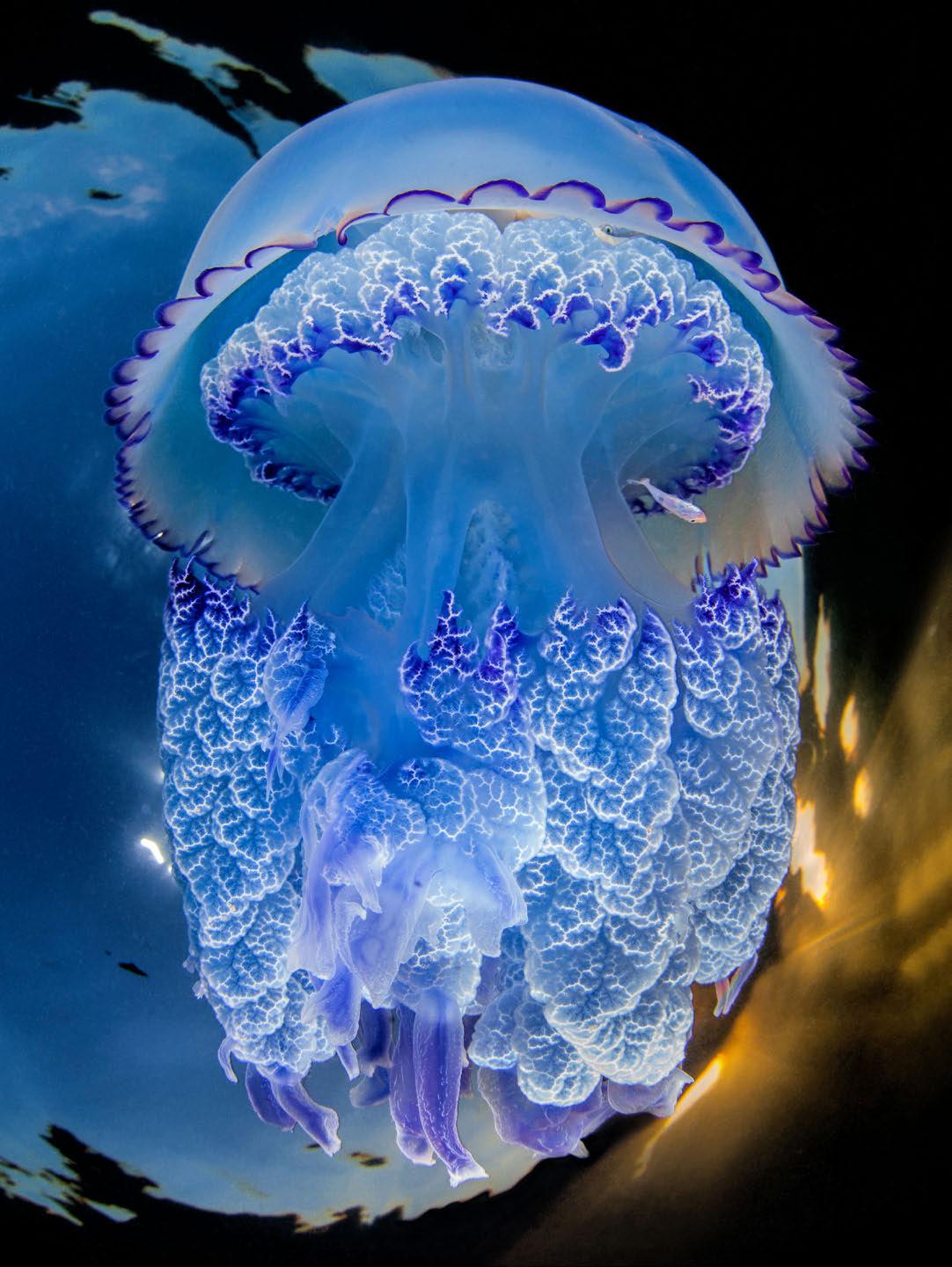
TITLE Pelagia noctiluca jellyfish
LOCATION Chalkidiki, Greece
CAMERA Canon EOS 5D Mark IV
HOUSING SEA&SEA MDX 5D IV
LENS Canon EF 8-15mm F/4L Fisheye USM
EXPOSURE 1/160 sec, f/18, ISO 160
FLASH 2 x Retra
TITLE The workshop of Chrisoula K
LOCATION Abu Nuhas, Red Sea, Egypt
CAMERA Canon EOS 5D Mark IV
HOUSING SEA&SEA MDX 5D IV
LENS Canon EF 8-15mm F/4L Fisheye USM
EXPOSURE 1/40 sec, f/16, ISO 3200
FLASH 2 x Retra
TITLE A world of hidden wonders
LOCATION Red Sea, Egypt
CAMERA Canon EOS 5D Mark IV
HOUSING SEA&SEA MDX 5D IV
LENS Canon EF 8-15mm F/4L Fisheye USM
EXPOSURE 1/80 sec, f/8, ISO 320
FLASH 2 x Retra
TITLE Rizostoma pulmo jellyfish
LOCATION Katerini, Greece
CAMERA Canon EOS 5D Mark II
HOUSING SEA&SEA MDX 5D II
LENS Canon EF 8-15mm F/4L Fisheye USM
EXPOSURE 1/100 sec, f/13, ISO 320 FLASH 2 x Retra
NEMO’S GARDEN
TEXT ALLY LANDES
PHOTOS OCEAN REEF GROUP & NEMO’S GARDEN BY OCEAN REEF
Entrepreneurs are turning the far-fetched idea of underwater crop cultivation into a reality.
GARDEN – Could divers become the future’s farmers?
The idea of cultivating food crops underwater may seem far-fetched, but a pioneering team of innovative entrepreneurs are making it a reality. In 2012, the team launched an experiment to grow basil underwater off the coast of Noli, Italy, using transparent biospheres filled with air and fixed at different depths. Today, the underwater greenhouse project, known as Nemo's Garden, has expanded to over 100 different fruits, vegetables, herbs, and flowers, and is being explored for potential applications in eco-tourism, fish farming, and seaweed farming, among others. With a focus on sustainability and eco-friendliness, the project aims to provide a natural alternative to traditional agriculture and eliminate the use of pesticides while creating a closed ecosystem protected from parasites.
Imagine cultivating food crops underwater. The concept was born in 2012 off the coast of Noli, Italy, by mastermind Sergio Gamberini, founder of the OceanReefGroup. During a conversation with friends, the passionate diver and avid gardener was inspired to marry both. There are regions in the world not ideal for agriculture, but what about coastal areas, or countries with bodies of freshwater? So, he asked the question, “Why not try to grow basil underwater?” And thus, the experiment began. After some initial research, Gamberini, an innovative entrepreneur, invested his own funds into the start-up. With the help of his team at Ocean Reef, six 6 m/20 ft tall transparent biospheres were sunk to the bottom of the sea,
filled with approximately 2,000 litres of air, and fixed at different depths between 6-10 m/2030 ft. To access the contents of the biospheres, the diving farmers have a step grid where they can stand up with half their bodies inside the pods while they tend to the crops while the other half of their bodies are outside.
Underwater greenhouse
The goal behind the project is to be self-sustainable and provide an economically viable, eco-friendly alternative form of agriculture. With the use of renewable energy from the sun and desalinated sea water, the microclimatic and thermal conditions inside the biospheres are the optimal environments for crop growth. No soil is used; instead, it is a hydroponic culture in which
The underwater biosphere domes are anchored to the ocean floor with sturdy chains.
A nutrient-rich solution is used to deliver water and minerals directly to the roots of the plants.
the plants are grown in a controlled environment using nutrient-rich solution to deliver water and minerals to their roots.
With the difference in temperatures between the air inside the pod and that of the water around it, water at the bottom of the biosphere evaporates to easily condensate to the internal surface area, sustaining the growing crops. Each biosphere is equipped with sensors for CO2, O2, humidity, air temperature, and sunlight. The external water temperature is regularly checked at both the shallower and deeper biospheres through a control tower equipped with five monitors and a laptop that enables the team to communicate with each other through an intercom. It is the near-constant sea temperature between day and night that creates the ideal growing conditions for the crops. With the setup devised, there is no need for LED lighting, power, or temperature regulating tools that are used in regular greenhouse systems on land.
Basil was the project’s first crop, and by 2015 they had produced green basil and red basil, five other herbs, four different lettuces, tomatoes, courgettes, green beans, peas, flowers, aloe vera, and mushrooms to name just a few in the ongoing experimental process. Through trial and error, the biospheres were upgraded, and their number increased, thus resulting in today’s fruitful underwater habitats. This underwater oasis now grows over 100 different fruits, vegetables, herbs, and flowers.
Closed ecosystem
Other companies interested in the science of growing food underwater have adopted similar projects to see what plants grown underwater could unveil in the future. Plants have been grown in experiments for cosmetics and pharmaceutical products, turning the biospheres into underwater labs. Some companies are looking into other possible biosphere uses—for eco-tourism, fish farming, seaweed farming, and more.
The crops thrive due to the consistent sea temperature, which provides ideal growing conditions.
The crops are grown in a controlled hydroponic environment, without the use of soil.
The biospheres are strict ecological environments that are somewhat difficult to disrupt, and this underwater greenhouse project could make pesticides obsolete; the closed ecosystem within the biospheres is protected from parasites, eliminating the need for these compounds. While the plants are supplied with essential, naturally-occurring nutrients via hydroponic solutions, further research is being conducted on the possibilities of producing natural fertilizers from algae found in the underwater farming environments.
In 2021, Nemo’s Garden partnered with Siemens, one of the world’s leading technology companies, which is providing support, studying, modelling, and improving the technology of Nemo’s Garden and finalizing its industrialization as a sustainable food alternative for the world.
Progress on this collaboration will be shared on Nemo’s Garden’s website. If you would like to learn more about the project, further info can be found at www.nemosgarden.com.
“
The biospheres are strict ecological environments that are somewhat difficult to disrupt, and this underwater greenhouse project could make pesticides obsolete.
STAGE & DECO TANKS
THIS ARTICLE SERIES IS BASED ON THE GUE PUBLICATION
DRESS FOR SUCCESS BY DAN MACKAY
ADDITIONAL TEXT BY JESPER KJØLLER
PHOTOS DERK REMMERS & JESPER KJØLLER
Using multiple tanks with different gases can decrease decompression time, but it also adds complexity and risk to the dive.
PHOTO DERK REMMERS
– Essentials of the GUE equipment configuration
Using extra cylinders to extend dive time or to accelerate decompression is fundamental to technical diving. In fact, the presence of extra tanks is essential to the definition of technical diving: diving in ceiling/overhead environments and breathing multiple gases during the dive.
To ensure a safe and effective dive, it’s important to understand the proper configuration of the extra tanks, the selection criteria for size and material, and the proper protocols for handling stage and deco tanks.
Terminology
There are a few different names for compressed gas cylinders that are not worn on the back, so let’s clarify some terminology. These containers are commonly referred to as cylinders, tanks, or bottles. In this text, we will use the term “tank” to refer to all of them. When we add a prefix to “tank,” it becomes a bit more complicated. We encounter terms such as stage tanks, decompression (or deco) tanks, sling tanks, sidemount tanks, pony-tanks, and bailout tanks. We also have argon tanks or suit inflation tanks. For now, we’ll focus on stage and deco tanks. Stage tanks are primarily intended to extend bottom time by providing an extra volume of gas. Typically, a stage tank will contain the same gas mixture as the back gas for that dive. On the other hand, deco tanks contain gas
mixtures specifically designed to accelerate decompression. The contents of a deco tank will vary depending on the depth and duration of the planned decompression stops.
In short, a stage tank provides longer bottom time, while a deco tank is used to reduce decompression time. Although some people use the terms “stage tank” and “deco tank” interchangeably, they have distinct purposes. For the sake of simplicity, we will use the term “stage tank” throughout the rest of this article. The configuration and markings of these tanks are the same, so this simplification is justified.
Material and sizes
Typical stage tanks are usually 40cf or 80cf aluminum tanks. An alternative option is the 7 L tank, which falls between the two sizes. Aluminum tanks are preferred for stage use because they have superior buoyancy characteristics. When empty, they are positively buoyant and will float up and out of the way, and when full, they are slightly negative, which helps them stay in the proper position. In contrast, steel tanks should be avoided for stage use because they are very negative when empty and even more so when full. Using steel stage tanks as part of a weighting strategy can cause a diver to become dangerously over-weighted. If a diver loses or is forced to let go of a steel tank, they may become dangerously light, making it challenging to maintain mandatory decompression stops or exit a cave.
The ideal size of a stage tank depends on the gas requirements of the dive. For bottom gas, a large S80 or its equivalent is usually preferred. However, for shorter decompression times, smaller tanks are easier to carry. In a situation where multiple stage tanks are required, stages of different sizes can be deployed. For example, a diver might use an S80 tank for the bottom stage, an S80 tank filled to 50%, and an S40 tank filled to 100% for decompression stops. By selecting appropriate tank sizes, divers can optimize their gas supply for the dive while minimizing the weight and bulk of their equipment.
Stage rigging
The purpose of the stage kit is to attach two bolt snaps to the stage tank and to define the ideal distance between the attachment points. The stage kit also provides a way to stow the stage regulator when it is not in use.
There are a number of stage rigging kits available from several different manufacturers, but the job can be just as easily accomplished using locally purchased materials. The nice part of the factory kits is that they have all the necessary hardware in one easily assembled package.
The hose clamp end and its tightening device require special attention. They must be covered by either plastic or nylon tubing to prevent sharp edges to perforate drysuits or cut other equipment.
Factory stage kits provide all the necessary hardware in one package, saving time and effort.
Take special care that the bottom retainer loop is below the hose clamp. This placement reduces the possibility of the bottom bolt snap getting threaded through the loop of hose that is left at the bottom of the tank, thus making proper deployment practically impossible.
It is important to ensure that the stickers and markings on a tank are relevant and accurate to avoid confusion and potential safety hazards. The only relevant stickers are the mandatory MOD and analysis stickers (and VIP sticker, where required) and the optional name sticker. It is important to remove all other extraneous stickers and markings from the tank. Decals saying NITROX or any irrelevant information can be misleading and confusing.
Get a grip
It is important to handle a stage tank properly to ensure safety and prevent damage. Gripping the garden hose on the stage kit is a bad habit and should be discouraged. It is not a handle, and holding it as such can cause the hose clamp to slide and negatively affect the positioning of the tank during the dive. Instead, the stage should be handled either by gripping the valve or using the bolt snaps on each end of the stage kit. This will help ensure that the tank is secure and in the correct position during the dive.
THE TANK AS A WATCH FACE
Proper placement of all elements on a stage tank is crucial for executing the gas switch procedure outlined in the GUE SOP and taught in GUE courses such as Tech 1, Cave 2, and Rec 3. To ensure consistency and accuracy, the stage kit, stage regulator, and related stickers must be positioned correctly in relation to the tank valve. When looking at the tank from above, imagine a clock face with the valve opening at 12 o’clock. The stage kit and regulator should be placed at this position. MOD stickers are positioned at 3 and 9 o’clock just below the shoulder of the tank so they are readable from both sides. Be careful not to mount the stickers upside down as the tank will hang with the valve pointing upwards. MOD stickers indicate the Maximum Operating Depth of the tank and only consist of a number, such as “21” indicating a 50% decompression
gas breathable from 21 m/70 ft. The only exception is the 100% oxygen tank, which has a “6” (metric) or “20” (imperial) plus the word “oxygen” written on it.
The analysis sticker should be placed at 3 o’clock where it is readable by the diver carrying the tank. A name sticker can also be added to identify the ownership of the tank, which is helpful on a dive boat or during filling. In a cave diving scenario where multiple tanks may be staged during entry, it aids in quickly identifying the tanks on exit. The name sticker is irrelevant when the stage is mounted on the diver, so it is placed at 6 o’clock where it is out of sight. A visual inspection sticker (VIP) is mandatory in some areas. That should also be placed at 6 o’clock since the VIP information is completely unnecessary during the dive.
10 TIPS FOR STAGE USE
While there are more detailed protocols for stage and deco tank use that are taught and practiced in various GUE classes, we can touch upon some of the basic principles for managing stage and deco tankes here.
1. ENSURE that the bottom bolt snap pigtail is not threaded through the loop of the hose left at the bottom of the tank.
2. PRACTICE stowing the stage regulator neatly after use.
3. ALWAYS get confirmation from a teammate before switching gas.
4. PRESSURIZE the stage, but leave it closed during the dive.
5. INCLUDE the stage tank(s) in your flow checks.
6. CAPTURE the mouthpiece under the regulator hose to keep it in place.
7. PUT your finger in the loop of the bolt snap when handling the tanks.
8. ALWAYS carry stages on the left side or on a leash between the legs to keep the right side clear for long hose deployment.
9. CHECK the SPG and hoses for leaks or damage, and replace or repair them as necessary.
10. VERIFY that the all stage tanks are properly labeled with clearly visible and correctly placed MOD information before the dive.
Carry stages on the left side or use a leash between the legs to keep the right side clear for the long hose deployment,
To prevent the regulator from dangling or moving around, the mouthpiece is secured under the regulator hose.
PHOTO DERK REMMERS
PHOTO GUE ARCHIVE
The retaining rubber bands on the stage kit hold the stage regulator in place when it is not deployed. However, they can be hard to grip when they are sitting snug against the tank. To make it easier to stow the stage regulator hose after use, the upper rubber band should be placed on top of the hose. This creates a space that allows a thumb to get a grip underneath. The lower rubber band should sit under the hose clamp and under the pigtail.
Take special care that the bottom bolt snap pigtail is not threaded through the loop of the hose that is left at the bottom of the tank, thus making proper deployment practically impossible. This is also something other team members should look out for and call attention to during routine situational checks during the dive.
Divers and support crew should be trained to handle the equipment correctly to prevent damage and ensure that it is in good working condition for future dives. Explain the proper handling and why gripping the hose is not a good idea.
Stage regulators
On a Tech 1 dive, for example, you are likely to spend an equal amount of time breathing from your stage regulator and the primary back gas regulator attached to your twinset. Also, the gas in your decompression tank will likely be denser than your helium based back gas. So, do not make the mistake of thinking that your stage regu-
lator could be of lesser quality. Don’t grab any old retired first and second stage you happen to have lying around. You need a high-performance regulator with good breathing characteristics, just as you do on your back gas.
To set up the stage regulator, use a submersible pressure gauge (SPG) attached to the first stage with a short high-pressure (HP) hose. The SPG is tied back with cave line to keep it in place and ensure easy readability when mounted on the tank. The second stage is connected to a 100 cm/40 in low-pressure (LP) hose, which is attached to an LP port on the first stage. It’s important to note that the stage regulator should not be mounted with a bungee necklace (as on a backup regulator or bolt snap on a long hose) as it’s essential for team members to be able to identify which tank they’re breathing from.
For rebreather divers, an inflation hose or whip may be added to allow onboard gas to be fed into the loop in case of a gas failure in the primary gas delivery systems.
While not necessary, a desirable feature is a first stage with a swivel turret that allows the LP hose to route upward more naturally when deployed and to be stowed sition when not in use. Before the dive, the stage regulator is folded in two and run through the retainer loops to keep it securely
It is essential to use a highquality stage regulator with optimal breathing performance, just like the one you use for your primary gas supply.
CAVE DIVING PROPULSION COMMUNICATION
TEXT FROM THE GUE PUBLICATION DEEP INTO CAVE DIVING WITH CONTRIBUTIONS FROM KIRILL EGOROV, JARROD JABLONSKI, DANIEL RIORDAN, FRED DEVOS, TODD KINCAID, & CHRIS LE MAILLOT
PHOTOS KIRILL EGOROV, JACOB MEHR & PETR POLACH
& COMMUNICATION
Mastering proper propulsion techniques is one of the most critical skills for cave divers. These skills can be vital in avoiding silt and debris and minimizing damage to the cave ecosystem. In addition to proper propulsion, paramount among cave divers is clear communication. These two skills can make all the difference in ensuring a safe and successful dive.
Fragile cave decorations in silty environments demand cautious propulsion techniques.
PROPULSION
WHEN DIVERS CONSIDER TRAINING IN AN overhead environment, many are anxious about reductions in visibility; however, with proper technique, divers can usually control the factors that cause visibility loss. Most sediments mainly accumulate on the floor of a conduit, with a relatively minor collection taking place along the sides. Therefore, as long as a dive team maintains a good feet-up posture and exercises reasonable buoyancy control, they are usually able to maintain good visibility.
Some shipwreck and cave passages are particularly susceptible to diver movement and exhaust bubbles, but most areas can be kept clean with good technique. Errant fin kicks, erratic hand movements, or poor trim can rapidly reduce visibility and are the primary causes of silty conditions; however, a continuous guideline ensures that divers are able to exit safely regardless of visibility.
Proper and modified flutter kick
Open water divers are instructed to use a strong flutter kick, focusing on kicking from the hips with straight knees. While this kick does produce a great deal of power, it also produces significant downward turbulence, as the thrust from this kick is directed from the end of the fins toward the floor. In sediment-filled areas, this turbulence will disturb the bottom and reduce visibility. To avoid this, overhead divers are taught to adjust the style of this kick. A “proper” flutter kick uses a strong leg kick while keeping the legs as horizontal as possible during kicking. This kick has exceptional power and greatly reduces the downward thrust that causes sediment disturbance. The “modified” flutter kick is a similar
but less aggressive kick compared to the proper flutter. During these kicks, the legs are bent at the knees. By kicking from the knee, the water can be directed upward, where it is much less likely to disturb any sediment. When executing this kick, a diver’s torso should be flat, in a head-down position, forcing the fins upward. Like most propulsion techniques, this kick can be used with a varying degree of force. In areas that contain easily disturbed sediments, divers should move slowly and kick lightly, being careful to force the water upward. In very silty regions, divers should propel themselves by kicking carefully with their ankles.
Frog and modified frog kick
“Errant fin kicks, erratic hand movements, or poor trim can rapidly reduce visibility and are the primary causes of silty conditions.
The frog kick is a particularly effective method of controlling the direction of divers’ thrust. The frog kick resembles the kicking action of a surface breaststroke. Its greatest benefit is that it eliminates the vertical component of a flutter kick cycle. While the modified flutter is generally effective, it maintains a vertical kicking movement and requires that divers exercise greater control over their kicking style. The frog kick can be used as a fairly powerful kick in high-flow conditions or curtailed—”modified”— in low-flow areas with easily disturbed sediments. The frog and modified frog kicks allow greater control of water movement. They direct water up and back rather than down, and they usually create less silt than alternative propulsion methods.
Backward kick
The backward kick is somewhat like a reverse frog kick, allowing divers to back away from a given position. It is also extremely useful
The frog kicks offers a significant advantage over the flutter kick by removing the vertical component of the leg movement during the kick cycle.
PHOTO JACOB MEHR
The pull-and-glide technique is taken to extreme levels when divers have to squeeze through narrow restrictions.
during positioning, while filming, and while holding stable against an opposing current. The backward kick requires some practice to reach mastery, but the ability to move backward without any hand or extraneous movement is perhaps one of the more valuable skills divers can learn.
Helicopter turn
Divers accomplish the helicopter turn by using a frog kick with one leg and a backward kick with the opposing leg. By alternating these kicks, the diver creates a spinning motion and can turn in place.
By executing this maneuver, divers can turn within a small area and do so without disturbing bottom conditions. Helicopter turns are critical for proper positioning and for managing turns within the small confines of some caves or shipwrecks.
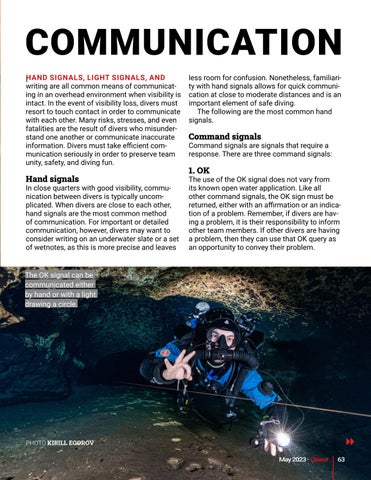
Pull-and-glide
Historically, divers in a variety of areas have utilized the pull-and-glide technique. However, as cave diving has increased in popularity, pulland-glide began to produce significant wear and tear in caves. To pull-and-glide, divers pull on a protrusion as they kick, and then glide for a short period. The glide is then followed by another pull and kick. In low-flow areas where gliding is especially unnecessary, swimming or using a diver propulsion vehicle is a better, less destructive option.
In high-flow areas where forward motion is difficult, limited contact with the cave can assist progress. Most high-flow caves have large, stable protrusions, and selective contact with these projections greatly limits the likelihood of damage. However, divers should always strive to limit their contact with the cave and avoid touching fragile or decorated areas.
PHOTO KIRILL EGOROV
COMMUNICATION
t
HAND SIGNALS, LIGHT SIGNALS, AND writing are all common means of communicating in an overhead environment when visibility is intact. In the event of visibility loss, divers must resort to touch contact in order to communicate with each other. Many risks, stresses, and even fatalities are the result of divers who misunderstand one another or communicate inaccurate information. Divers must take efficient communication seriously in order to preserve team unity, safety, and diving fun.
Hand signals
In close quarters with good visibility, communication between divers is typically uncomplicated. When divers are close to each other, hand signals are the most common method of communication. For important or detailed communication, however, divers may want to consider writing on an underwater slate or a set of wetnotes, as this is more precise and leaves
The OK signal can be communicated either by hand or with a light drawing a circle.
less room for confusion. Nonetheless, familiarity with hand signals allows for quick communication at close to moderate distances and is an important element of safe diving.
The following are the most common hand signals.
Command signals
Command signals are signals that require a response. There are three command signals:
1. OK
The use of the OK signal does not vary from its known open water application. Like all other command signals, the OK sign must be returned, either with an affirmation or an indication of a problem. Remember, if divers are having a problem, it is their responsibility to inform other team members. If other divers are having a problem, then they can use that OK query as an opportunity to convey their problem.
PHOTO KIRILL EGOROV
To indicate bubbles, divers repeatedly move their index finger towards their thumb in a gesture that increases in distance to represent larger bubbles.
2. Stop/hold
Failure to properly recognize and acknowledge the stop or hold command can be very dangerous. Misunderstandings relating to the hold command have resulted in several confusing situations and at least one fatality. The stop command is communicated with a closed fist. The open palm signal commonly used by the open water community will often be understood but is less commonly used than the closed fist. It is crucial that this command be returned, as miscommunication could easily lead to team separation.
3. Exit
When communicating that a dive is being terminated, divers must be especially clear. Dives can be terminated for any reason: because team members have reached thirds; because they are uncomfortable, cold, or sick; or because they simply no longer want to be in the overhead. The moment the exit signal is given, everyone is required to respond in kind and begin to exit the overhead. To reduce confusion, most divers use the ascend
signal (thumb up) from the open water community, as it is easily recognized and leads to a quick response. Some divers use a less urgent turn signal by pointing the index finger upward and rotating it in a circular fashion. This turn signal occasionally creates confusion and is, therefore, best used in less time-sensitive situations.
For example, a diver may use this signal as an open-ended suggestion to turn, even though no real limitation has been reached. The common thumb-up sign is the best option when the team has reached some limit of their penetration, such as in the case when team members have used up 1/3 of their gas supply. The proper response to the exit signal is a confirming exit signal from every member of the team.
OTHER COMMON HAND SIGNALS
1. Out of gas
Out of gas is signaled by drawing the hand across the throat. Obviously, this signal demands immediate attention. Upon receiving
PHOTOS
The signal for “look,” “see,” or “watch” is made by pointing two fingers towards the eyes.
this emergency signal, team members should prepare to donate gas while quickly approaching the out-of-gas diver. Divers using lights can signal team members with a very rapid light signal, shortening any delay in their response.
2. Silt
Disturbing bottom sediments (often called silt) can be indicated by rubbing the thumb across the ends of one’s fingers while holding the hand in a palm-down position. A diver may opt to use this signal to communicate to team members that they are disturbing the bottom, or to warn the team of a particularly susceptible area. Silting is nearly always the result of poor technique and, with practice, can be all but eliminated. Divers should call their team members’ attention to poor technique in order to reduce silt and to communicate the need for improved anti-silting technique.
3. Light is on
Divers should periodically look at other team members to verify that their equipment is in
place and to determine whether there are any irregularities present; for example, bubbles or an activated reserve light. A repetitive signal in which divers alternately spread wide the five fingers of their hand and then close them into a fist is used to indicate that a dive buddy’s reserve light is burning. In practice, it is often more efficient to simply turn off the light for that diver. If the diver is confused by this action, or if one is unable to reach the light, then the “light is on” signal becomes useful.
4. Safety stop
It is recommended that on all dives, regardless of decompression obligation, divers execute minimum decompression stops. Safety or deco stops can be indicated in several ways. One commonly used sign is to hold a fist with a raised pinky finger in front of oneself. Another popular method is to hold out an open hand with the palm down and motion parallel to the ground back and forth from the chest in a repetitive fashion, indicating a stop or leveling off point.
5. Low on gas
If divers are at their turn pressure, they could use the exit or “call the dive” sign in conjunction with the low-on-gas sign. This sign is the most important part of this communication but indicating a low-on-gas situation can prepare divers for future trouble. Divers may choose to communicate to the team that they are low on air with the conventional arm across the chest sign. However, if divers are trying to indicate that they have reached their turning pressure, then the thumb-up or exit sign is preferred.
6. Line
The middle finger crossed over the index finger is commonly used to represent the line. Divers may communicate more specific information about the line with signals used in conjunction with this signal, including:
a. Line Entanglement: the line sign done with the hand moving in a figure eight pattern
b. Tie-off or Placement: the line sign pointed downward and rotating
c. Reeling in the Line: the line sign moved in a circular pattern mimicking the action of winding a reel
d. Cutting the Line: fingers moved in a cutting action alternated with the line sign.
7. Bubbles
In order to indicate the presence of bubbles, divers hold out one hand and bring the index finger down to the thumb in a repetitive motion with the amount of distance increasing to indicate larger bubbles. With this signal, divers can easily tell a dive buddy about a bubbling hose or regulator. Bubbles coming from divers’ valve-regulator orifice often indicate the need for maintenance and/or repair.
Light signals
In dark, overhead environments, light signals are extremely important because they allow
divers to easily get one another’s attention and to communicate effectively over large distances. Even in close quarters, light signals can be preferable to hand signals, because hand signals can be awkward, especially if divers are not facing one another. Today, many open water divers are realizing how lights can simplify communication and enrich the dive. Thus, divers will frequently choose light signals over hand signals because they are easy to see, more efficient to use, and effective at much greater distances. The following are some common light signals.
OK
A slowly circling light indicates “OK” and can be used to ask divers if they are OK, or as an answer to a question. Avoid shining the light in someone’s eyes. Generally, pointing the light at the ground and drawing a circle with the beam is sufficient for communication and prevents blinding another team member.
Attention vs. emergency
Rapid light signals indicate a problem and demand immediate attention. A purposeful sideto-side or up-and-down motion with one’s light indicates attention. A rapid light signal denotes an emergency. In a real emergency, divers should move the light rapidly from side to side (or up and down) until their signals bring assistance. Once the signaled divers turn, the light should be diverted so as not to blind them. The attention gesture is a far more common signal. Indeed, a gas failure is the most likely cause for the emergency signal; therefore, its use should prepare the responding divers for the impending gas-sharing episode. Erratic light signals should be avoided unless a diver is truly in need of immediate assistance since careless flashing movements can be an irritation to surrounding divers and may desensitize one to emergency signals where needed. NEXT TIME: DIVE PLANNING – PART 1
GUE PREMIUM DIVE CENTERS
Base1 – Sardinia, Italy
www.baseone.it
Deep Dive Dubai – Dubai, UAE
www.deepdivedubai.com
Dive Centre Bondi – Bondi, NSW, Australia
www.divebondi.com.au
Duikcentrum de Aalscholvers – Tilburg, Netherlands