

Presentations
Book 2 of 2


6th Marianas History C onference
Presentations

Healing History through Science
By Joanne E. Eakin and Rosalind L. Hunter-Anderson
Remembering the Language of Mollusk Collecting
By Judith R. Amesbury and Angelina Pangelinan
"Chinchuli:" An Evil That Has No End?
By Michael Richard Clement, Jr.
History and Identity in the Mariana Islands
By David Atienza
The Origin of CHamoru/Spanish/English Trilingual Education on Guam
By Malia A. Ramirez
Overcoming Colonial Legacies
The
Digital Reconstruction of the Palacio de Gobierno of the Mariana Islands as an Opportunity for Nation
Building
By Dr. Carlos Madrid Associate Professor of Spanish Pacific History University of Guam and Hagåtña Restoration & Redevelopment Authority
Abstract: This presentation explores the digital reconstruction of the Palacio de Gobierno, the former government residence and offices of the colonial government of the Mariana Islands and Guam. Despite the lack of visual documentation, we delve into the process of determining the building's interior, including room usage, the private and public wings, and the furniture it once housed.
Utilizing enhanced reality, the BISITA App recreates historical scenarios, including the fully reconstructed city of Hagåtña as it appeared in the 1890s, paving the way for the detailed recreation of the Government Palace. This digital representation of history offers a new approach to understanding the past, complementing traditional methods such as stage presentations and literature. By embracing digital means, we overcome the challenges posed by colonial legacies and contribute to nation building. The reconstruction of the Palacio de Gobierno serves as a catalyst for a deeper appreciation of our cultural heritage. It fosters a deeper comprehension of history, facilitating the development of a cohesive and informed society. Join us in exploring this remarkable journey and the transformative potential of digital technology in re-presenting history.
Presentation Recording


Carlos Madrid Alvarez-Piñer, born in Spain in 1976, holds a PhD cum laude in Contemporary History from Universidad Complutense de Madrid. He is Director of Research and Associate Professor of Spanish Pacific History at the Micronesian Area Research Center of the University of Guam. He has conducted research projects about Micronesia, Spain, and the Philippines since 1996, and has given lectures at the University of the Philippines, Keio University of Japan, University of Guam, and in the Diplomatic School of Madrid.
From 2014 to 2018 he was the Director of Instituto Cervantes de Manila. In 2005 and 2006, he was co-founder and editor-in-chief of Filipiniana.net. Dr. Madrid specializes in management of cultural resources, documentary research, and popularization of history. He participated in the exhibit Biba Chamoru! Cultura e Identidad en las Islas Marianas, in Museo Nacional de Antropologia de Madrid in 2021, and curated the exhibits Seraphico: The Franciscan Missionaries in the Aurora region, on permanent display in Museo de Baler in Aurora Province, Philippines; and the exhibit Belau na Sebangiol at the Belau National Museum in 2005. He is the author of Beyond Distances (Northern Mariana Islands Governor’s Humanities Award 2008) and editor of the fourth edition of the book Philippine Cartography by Carlos Quirino. Among the books he has authored, the most celebrated is The World of the Manila-Acapulco Galleons (Vibal Publishing).

Effectiveness of 2020 Airborne Lidar for Identifying Archaeological Sites and Features on Guåhan (Guam)
By Andrea Jalandoni, Boyd Dixon, Maria Kottermair, and Victor Hara Torres Griffith University, AU; Cardno GS and SEARCH, GU; University of Queensland, AU; and Independent Archaeologist, GU
Abstract: Guåhan (Guam), part of the Mariana Islands in the western Pacific, has an archaeological record spanning almost four millennia. In this seminal academic paper on the use of lidar for archaeological investigation on Guåhan, we determined which known sites can be visually detected to explore the effectiveness of lidar in this context. Several archaeological site types and features from the Latte, Spanish, and Modern Periods were examined using high-resolution 2020 airborne lidar. We generated the most commonly used digital elevation models (DEMs), which are digital terrain models (DTMs) and digital surface models (DSMs), and visualised them as a hillshade. Lidar proved effective for identifying all the Modern Period sites and most of the Latte and Spanish Period sites, although some features remained obscure. Major challenges and limitations of using lidar on Guåhan were vegetation, site size, and visual ambiguities. While this study used conventional lidar derivatives, it exposed the potential to find more archaeological sites by applying more complex lidar processing techniques in the future. The benefits of lidar are of great interest to the local community, especially the Indigenous CHamoru/Chamorro, interested in non-destructive ways to assist their cultural heritage management.
Presentation Recording

This presentation was originally published in the Journal of Computer Applications in Archaeology. Download the original article here.
Introduction
Guåhan (Guam) is an Unincorporated United States (US) territory and the southernmost of the Mariana Islands located in the western Pacific (Figure 1). The northern part of the island is an uplifted limestone plateau with mostly limestone forest, while the southern part has rolling hills of volcanic origin with ravine forests and savanna grasslands. Typical for tropical areas, the vegetation is lush with a dense canopy and understory.
The CHamoru are the Indigenous people of the Mariana Islands and are thought to have inhabited this region for at least 3500 years (Carson 2014a). The archaeology of Guåhan is divided into the time periods of Pre-Latte (1500 BC–800 AD), Latte (800–1521 AD), Spanish (1521–1898), and Modern (1898–Present), which mark the cultural shifts of the CHamoru.

Figure 1. Map of the Mariana Islands and detailed map of Guåhan with sampled archaeological sites.
During the Latte Period, CHamoru people lived in villages all over the island and the most recognized remnant of this lifestyle are the latte, megalithic stone habitation structures (Figure 2). Latte are the unifying symbol the CHamoru people consider as a fundamental part of their present-day cultural identity. The presence of latte on Guåhan and the Northern Marianas is ‘proclaiming resilience in the face of centuries of colonialization, the massive destruction of WWII, and on-going globalization’ (Dixon, Bulgrin & Kottermair 2021: 39). Unfortunately, most latte sites have been disturbed, destroyed or left to dereliction. The cultural importance of the latte was the primary motivation to use lidar to find and preserve more unrecorded latte and other archaeological sites and features on Guåhan.

Figure 2. Top: Historic depiction of latte (Freycinet 1825). Bottom: Andrea Jalandoni providing scale for House of Taga Latte (left); Latte near Fena Lake exposed during a recent wildfire (right).
Jalandoni et al. • Effectiveness of 2020 Airborne Lidar
Initial Spanish interest in the Mariana Islands after 1521 waned when they realized that they did not contain the spices and riches they sought in Southeast Asia. Fray Diego Luis de San Vitores only established a small Jesuit mission on Guåhan in 1668. Within a short time, ‘…Spanish demands to abandon prominent elements of traditional culture and adopt imposed beliefs, institutions, and behavior’ (Montón-Subías & Dixon 2021:3) met with increasing CHamoru resistance. The Spanish Reducción of traditional CHamoru communities in the late 1600s and early 1700s then saw many former habitation sites and villages forcibly abandoned and their inhabitants consolidated into a few southern Guåhan villages under Spanish observation and indoctrination (Jalandoni 2011a).
In 1898 at the end of the Spanish-American War, the American Naval administration of the island began economic development of Guåhan and acculturation of the CHamoru people until World War II (WWII) and Japanese occupation. Inland villages fell into disuse or were only sporadically visited during early twentieth century agricultural activities, and later destroyed during post-WWII military construction and commercial economic development.
Today, there remains much disagreement on Guåhan between the military and Indigenous community because of the condemnation of CHamoru land and the destruction of prehistoric habitation and burial sites for military infrastructure (Dixon, Jalandoni & Kottermair 2022). In this context, there was a call in 2020 from the Guåhan Legislature to investigate non-destructive techniques to discover and preserve cultural sites (Kaur 2020). Therefore, in this research we explore a remote sensing technique that could be used to help better facilitate archaeological research and historic preservation on Guåhan.
Lidar (light detection and ranging) is a non-invasive remote sensing technique that works by sending out laser pulses and calculating the return time from surface reflections. This results in a point cloud with each point having a X, Y, Z location that represents the surface. The laser can penetrate a tree canopy the same way sunlight does, thereby also able to capture features on the ground below. However, the laser cannot penetrate areas where light is impeded from reaching the ground, such as buildings or extremely thick ground cover. The differences in collection methods change the perspective of the scanner, therefore ‘airborne lidar’ refers to lidar collected from an airplane, ‘terrestrial lidar’ is collected from the ground, ‘drone lidar’ is collected from a drone, and ‘satellite lidar’ is collected from a satellite. The individual points are post-processed and classified using algorithms to determine ground points and other classes like vegetation and water.
The classified point cloud can then be used to generate a digital terrain model (DTM) and a digital surface model (DSM), which are both a type of digital elevation model (DEM). These models are displayed in grid pattern with each grid or cell representing a single elevation value. A DTM only uses the ground points and shows the bare earth without any features, such as buildings or vegetation. In contrast, a DSM includes all features and shows the highest elevation value within a grid cell. In airborne lidar, the government agency or contractor usually supplies a post-processed point cloud and derivative products, like a DTM. Unfortunately, the resulting lidar-derived products are sometimes not suited for archaeological investigation and will require reprocessing (Lozić & Štular 2021).
In addition to being non-destructive, another benefit of airborne lidar is cost-effectiveness. Once the data is collected, usually by a government agency, the analysis can be done from an office. Fieldwork is one of the most expensive components of archaeological research, so when more analysis can be done from the office and reduce time in the field, it can reduce overall project costs (Jalandoni & May 2020; Jalandoni, Zhang & Zaidi 2022). Airborne lidar can also encourage citizen science participation as in the UK where volunteers and amateur archaeologists confined at home during the Covid-19 pandemic found dozens of archaeological sites
using lidar-generated images (Fox 2020). Lidar is sometimes featured in mainstream media for highlighting exciting discoveries and fostering public interest in previously unknown aspects of their archaeological cultural heritage. Its potential use in locating latte stones, ‘a significant symbol and treasured birthright to contemporary CHamoru’ (Taitano & Liston 2021: 1), is especially appreciated when perceived as under threat by military construction and commercial development today.
Airborne lidar has proved useful in various contexts worldwide for archaeological research (for Mesoamerica: Chase et al. 2012; Europe: Bewley, Crutchley & Shell 2005; Asia: Evans & Fletcher 2015; and Australia: Davies, Turnbull & Lawrence 2016). However, there has been limited application of airborne lidar in the Small Island Developing States (SIDS) of the Pacific due to their remote geography and associated challenges. Airborne lidar has only been used in the archaeological contexts of the Pacific SIDS in American Samoa (Quintus, Day & Smith 2017), Tonga (Burley & Freeland 2022; Freeland et al. 2016; Parton et al. 2018), Vanuatu (Bedford, Siméoni & Lebot 2018), and Pohnpei (Comer et al. 2019). In American Samoa, Vanuatu, and Pohnpei the lidar data revealed land modifications indicative of a complex irrigated cultivation system and agriculture production, while in Tonga defensive structures and pigeon trapping mounds were identified.
In the Mariana Islands, lidar has been previously used in unpublished reports. On Guåhan, lidar was found to be less effective in discerning small-scale latte habitations and pre-WWII water cisterns in disturbed and vegetated contexts but has had some utility in identifying larger concentrations of concrete features and bomb craters in a post-WWII Seabee encampment (Dixon et al. 2017). On Tinian, lidar was effective in identifying large-scale WWII and post-war era military infrastructure and landscape modifications such as the historic American West Field (Gilmore et al. 2018). A paleo-terrain model was created to show an ancient shoreline of Guåhan during higher sea levels (Carson 2014b), but it was not mentioned whether lidar was used.
The novelty of this research, besides being the first academic archaeological investigation of using lidar on Guåhan, is that we explored multiple site types from multiple time periods unlike previous published research in Pacific SIDS that investigated a single site type. While not comprehensive, it is a thorough investigation of the use of lidar to explore the variety of Guåhan’s rich archaeological landscape.
The aim of this research was to determine whether the available airborne lidar was suitable for the identification of archaeological sites and features on Guåhan. Primarily we looked for latte (stone pillar structures), but we were also interested in finding agricultural terraces, gigao (fish weirs), and water wells; Spanish Period roads, bridges, structures, and forts; and Modern Period examples of WWII gun positions, bomb craters, developments, and fuel tank berms (Figure 1). The results can lead to better informed field surveys both in planning stages by targeting potential resources and upon discovery by enhancing documentation of previously unrecognised sites or poorly documented prehistoric habitation and land use sites such as those found in the southern Guåhan uplands. Lidar can also provide more accurate metrics of a site, especially for larger sites where field measurements might be difficult due to its size, obstructing vegetation, or unfavourable terrain.
Testing whether known archaeological sites on Guåhan are visible on the most commonly used lidar derivates, DSM and DTM, has helped to determine what site types can potentially be located using lidar. All the Modern Period sites were identified, as well as most of the Latte and Spanish Period sites. In the discussion we segregated which sites were best detected on which derivative, elaborated on challenges and limitations, and expounded on the research potential to find more archaeological sites. As more archaeologists and the community, both CHamoru and Guamanian, become familiar with lidar and what it can offer, this study encourages further exploration to potentially identify additional historic and prehistoric sites.
Table 1. Feature confidence definitions for the lidar-derived products.
Rating Confidence Definition
0 None No feature is visible.
1 Low A feature is visible, but the shape is not clearly defined or possibly an anomaly of lidar data.
2 Medium A feature is visibly detected but incomplete or indeterminate whether natural or anthropogenic.
3 High A feature is clearly visible and is verified either by expert knowledge or ground-truthing.
Methodology
Method
Topobathymetric airborne lidar data was acquired for the island of Guåhan by the National Geodetic Survey between January and July 2020 as part of a national shoreline survey. The data meets the United States Geological Survey Quality Level 1 standard which requires at least eight points per square meter or two points per square meter for bathymetry and a vertical accuracy of less than 0.15 meters. Island-wide lidar data was also acquired in 2007 and 2012, however, at a lower point density. We downloaded the classified point cloud in LAZ format and the DTM from the National Oceanic and Atmospheric Administration’s Digital Coast Data Access Viewer (NOAA 2021). It should be noted that the point cloud was classified only at a basic level meaning that many points remain unclassified including those representing vegetation. Also, the DTM was not detailed enough for this archaeological study.
Therefore, we further processed the LAZ files using Blue Marble Geographics Global Mapper® Pro v.24.0.
A 1-meter-resolution topobathymetric digital terrain model (DTM), which is the most used lidar-derived product, was created using only ground [ASPRS class 2] and submerged topography [40] points. Similarly, a 1-meter resolution digital surface model (DSM) was created using all points except points pre-classified as noise [7] and water surface [41, 42]. Binning, using the minimum and maximum values, was the interpolation grid method used to generate the DTM and DSM, respectively. All other settings were default settings. Since a single latte feature is often under one meter in diameter, we generated a 0.25-meter resolution DSM and DTM to capture them. We then created a modified DSM (mDSM) that excluded points over three meters so that the latte features under tree canopy would be visible.
For facilitating visualization and interpretation, we created a hillshade of each lidar-derived product. The original DEM provides more detailed information but it is harder to visualise than the hillshade. While there are numerous visualization techniques, such as sky view factor and openness to name a few (Štular et al. 2012; Yokoyama, Shirasawa & Pike 2002), we used hillshade because it is the most common technique readily available in a GIS software.
High-resolution aerial imagery (US Navy 2017) was also used to visualise the archaeological features and compare results with the 2020 lidar. However, conditions such as vegetation, water level (tide), and construction may have changed between collection of 2017 aerial imagery and 2020 airborne lidar. Since we were working on known archaeological sites under varying states of vegetation and preservation, we attempted to find the best visualisation of the site on available imagery. If the 2017 aerial imagery was insufficient, we cross-referenced archival Google Earth satellite imagery and historical photographs, maps, and artwork from our collections.
Next, archaeological data was compiled from the records of the authors and imported into ArcGIS Pro 2.9.0 by Esri along with aerial imagery from 2017. Initially, we only selected features of interest where the exact location was known, but many of the records had only approximate locations. Each selected feature was investigated in the aerial imagery and the lidar-derived layers to determine which features could be detected in which reference layer.
A feature confidence level (adapted from Lozić & Štular 2021) was then assigned to categorize the suitability of lidar at identifying archaeological sites on Guåhan (Table 1). However, since we used ideal examples, the confidence level we determined is the highest that we expect for a particular site type using default parameters for the various DEMs.
Sampling
The archaeology of Guåhan is known from local knowledge and grey literature more than from academic publications. Therefore, this project required intimate archaeological knowledge and local technical expertise for site selection. The sites selected were based on the authors combined archaeological and GIS experience on the island of over 100 years. We aimed at sampling a variety of sites from all time periods across the island. Considering all the sites included in this study, only the archaeology of Fort Soledad (Driver & Brunal-Perry 1994) has been academically published, while some of the Litekyan (Ritidian) water wells are mentioned in passing (Carson et al. 2014).
Pre-Latte Period archaeological sites are only identifiable by subsurface investigation or small artifacts like a cache of pre-latte ceramics or marine shell ornaments. Unfortunately, there are no associated surface features or land modifications of appropriate size for lidar detection that are definitively pre-latte. As a result, this study covered only a sampling of Latte, Spanish, and Modern period archaeological sites that have potential for being visible on the lidar.
Latte Period
For Latte Period sites we sampled latte, gigao, wells, and agricultural terraces. The latte stone forms are unique to the Mariana Islands (Morgan 1988). Latte are stone columns with a cup-shaped capstone in two parallel rows of pillars (Figure 2). The number of paired sets vary between six and fourteen. These megaliths come in various sizes, the tallest known is House of Taga on Tinian where the remaining column stands 4.6 m tall (Figure 2), while the As Nieves quarry on Rota reveals other attempts at erecting large latte (Russell 1998). The majority appear to have been around 1 m tall. They are found mostly on the presently inhabited islands of Guåhan, Saipan, Luta (Rota), and Tinian, but are also recorded on Aguiguan and Pagan plus smaller mostly uninhabited northern islands today (Athens 2011). The locations of some of these structures were recorded in historical Spanish accounts but were not always accurate due to name changes or the foreigner’s poor understanding of the complex geography (Jalandoni 2011b). Even where previous archaeological surveys recorded Latte Period structures, the positional data is often inaccurate due to the use of low-accuracy GPS receivers and thick canopy cover resulting in GPS signal error or steep terrain masking the location on a small-scale topographic map or aerial photograph.
For this study we investigated two repositioned latte sets, Senator Angel Leon Guerrero Santos Latte Stone Memorial Park in Hagåtña often referred to as the Latte Stone Park and a latte monument near the Nikko hotel in Tumon, because these sets were reconstructed from previous archaeological settings and located in public areas. They are the ideal examples of what a latte set would have looked like without its a-frame structure resting on top during the Latte Period and their location is known and easily verifiable.
Other Latte Period archaeological sites potentially recognizable on lidar include gigao or coral stone fish weirs, traps, and pens in coastal bays and estuaries (Dixon, Gilda & Mangieri 2012); agricultural terraces with stone walls on inland slopes (Highness & Leap 1992; Dixon, Schaefer & McCurdy 2010); and traditional hand-dug freshwater wells in coastal settings (Carson et al. 2014). For gigao or fish weirs, we chose Abo Cove because of their visibility from the shoreline (Gosser et al. 2004). Then we examined the northern coastal lowlands of
Litekyan, Haputo, Jinapsan, and Tarague sites for reported wells. Finally, we inspected the Sigua drainage for reported agricultural terraces (pers. comm. David Defant, July 2022).
Spanish Period
As a result of Reducción, most of the inhabitants on Guåhan were clustered into towns that the Spaniards developed. Archaeological sites from this period include rural forts, bridges, roads or bull-cart paths, ovens or kilns, rock-lined wells or water courses, wetland ponds with ditches or dikes, small churches or chapels, and public buildings such as schools (Tomonari-Tuggle et al. 2018). The largest structures or ruins remain visible and include the Plaza de España in Hagåtña, Fort Nuestra Señora de la Soledåd (Fort Soledad) in Humåtak, and Talaifak Bridge in rural Hågat. Many have been restored in the last 25 years by the Guam Preservation Trust, a non-profit, public corporation.
Some less widely known are rural colonial features including wooden plank roads of the Camino Real near Atantano’, rural domed "Spanish" ovens, later water cisterns, and hilltop bonfire lookouts or Vigía for incoming ships (Madrid 2014). Due to their size and poor preservation, these archaeological features are more challenging for lidar identification and not included in this study.
When the Manila Galleons from Acapulco ceased their yearly visits to Guåhan in 1815, so too did the yearly influx of imported products and livestock, hence many rural church and clergy farms and properties were often abandoned. By WWII, Japanese and American bombing and then reconstruction of the colonial capitol of Hagåtña and the port in Apra Harbor destroyed most Spanish colonial remnants of urban Guåhan, often placing the footprint of the historic past beyond the reach of lidar.
For Spanish Period sites we sampled a road, bridge, structural complex, and fort. The road-cut next to Asan Point ridge was sampled because it is hypothesized to have been a part of the Camino Real used during the Spanish Period, before modification by the US military to construct Route 1 Marine Corps Drive in 1944–45. This segment of the Camino Real from Hagåtña to Piti and Apra Harbor passing between two cliff faces is portrayed in painted images from visiting European artists in the early 1800s (Tomonari-Tuggle et al. 2018). For Spanish colonial architecture, we sampled reconstructed Talaifak Bridge, Plaza de España, and Fort Soledad because they are prominent landmarks in guided tours and local history.
Modern Period
Archaeological remains from historic American to modern times included in this lidar study reflect a conscious shift from European to American and Asian colonial institutions and values, both socio-economic and increasingly geo-political. After 1898, Apra Harbor and Sumay hosted not only the port of Guåhan with coal and later fuel oil storage, but a Pan-American clipper hotel for visitors in route from Hawaii to Asia, telegraph cables that tied Guåhan to world events, and barracks for the US Marines. Foundations of these abandoned communication and trade sites in Apra Harbor are often recognizable to lidar but overgrown. In contrast, foundations of Hagåtña that grew from a sleepy colonial outpost to a growing commercial hub providing goods and services to CHamorus and the first American territorial military dependents are largely undetectable today due to the destruction during WWII and subsequent development in modern times.
Sites and features related to WWII include those of the Japanese military from 1941–1944, such as anti-aircraft positions and concrete fortified bunker entrances or tunnels. However, they were often buried or destroyed by 1944 to post-war American construction of expanded naval and air force bases and the rebuilding of wardevastated areas and new urban communities. Beginning in the late 1960s, infrastructure like new roads, power,
public water, and telecommunication utilities were built to improve the lives and health of the local community outside of Hagåtña.
For Modern Period archaeological features, we sampled gun positions, bomb craters, developments, and fuel tanks. We first looked for WWII Japanese anti-aircraft positions within the USDA Brown Tree Snake Pen in Anderson Air Force Base (AAFB). Past field surveys have recorded that three features were C-shaped facing opposing directions, constructed of stone and soil-filled 50-gallon drums, and covered in soil excavated from a shallow depression (Dixon et al. 2010). Next, we looked for bomb craters in shallow waters off the coastal areas below Orote Point at the entrance of Apra Harbor. There was a Japanese airfield on Orote Point and the area is known to have been under attack by the American Army Air Corps in 1944 (Dixon, Jones & Nelson 2017). Third, we explored abandoned American military hospitals and later housing developments in Harmon. In 1945, the 137th Army Hospital was constructed in the area for the invasion of mainland Japan, as shown on the Fifth Naval Construction Brigade Area Allocations map (Pacific National Historic Park Guam 1992). By the 1950s, American military housing development of tents, wooden houses, or metal Quonset huts on concrete pads in the same general location of Harmon (Craft & Byerly 2019) had been destroyed by typhoons or later removed. Finally, we looked for abandoned fuel tank berms on the ridgetops above Sasa Bay. The earliest WWII Sasa Bay fuel tanks are no longer present although some berms remain (Dixon et al. 1999).
Results
The results of evaluating the visibility of archaeological sites included in this study from aerial imagery and lidarderived products are summarised in Table 2. For every site we indicated whether it is visible in the 2017 aerial imagery, its confidence level and resolution in the DTM, DSM, and mDSM derived from the 2020 airborne lidar. It should be stressed that the confidence level refers to the hillshade of the DEMs and not the DEMs themselves.
Table 2. Summary table of archaeological sites and their evaluated visibility in the 2017 aerial imagery and the confidence level of identifying the site in the DTM, DSM, and mDSM derived from the 2020 airborne lidar. The resolution of the lidar-derived DEM is also shown. (nd = not determined).
Airborne Lidar

Figure 3. Two sample latte sites, the Hagåtña Latte Stone Park and the Tumon Latte Memorial, as shown on imagery and various lidar filtering methods visualised as a hillshade: aerial imagery from 2017, digital terrain model, digital surface model (DSM), and a modified DSM with points over 3 m above ground excluded. The lidar-derived digital elevation models have a cell resolution of 0.25 m.
Latte Period
Hagåtña and Tumon Latte
The latte at Hagåtña Latte Stone Park were not visible on the imagery because they were completely obfuscated by large trees. The latte set at Tumon Latte Memorial was partially visible on the imagery and DSM, where vegetation did not obscure it. After filtering points over three meters in the mDSM, the foliage of the large trees was removed and both latte sets were visible with a feature confidence of 3 (Figure 3). No features were detected in the DTM because the points representing the latte were filtered out during the DTM creation. It should be noted that this ideal condition of upright latte in perfect alignment is unlikely in the natural settings of latte today because they are usually overgrown and fallen over.
Abo Cove gigao (fish weirs)
The gigao in the Abo Cove wetlands were visible on imagery but not visible on any of the lidar-derived products resulting in a feature confidence of 0 (Figure 4). The gigao remains are not in good condition to begin with and are increasingly being covered by mangroves off the shoreline. Their piled rather than stacked coral walls are too low, eroded, and partially submerged at high tide to be distinguished from the water and noise on the former reef flat.
Northern coastal wells
The traditional water wells in the northern coastal areas of Litekyan, Haputo, Jinapsan, and Tarague were not visible on the imagery because they are obscured by vegetation. However, they were clearly visible on the DTM with a feature confidence of 2 and 3 since not all wells have been field-verified (Figure 4). Several circular depressions are in linear alignments within or behind back-dune depressions, which is the ideal location for a well to access the shallow freshwater aquifer. In addition, they are in coastal areas such as Litekyan in the northern plateau that were not targeted for invasion by the Americans during WWII. And we know from
early historical records and archaeological evidence that coastal villages on the northern plateau were densely inhabited during the Latte Period. We were able to identify ten wells at Litekyan, three at Haputo, at least five at Jinapsan, and six at Tarague. However, the number of traditional versus later historic wells is not conclusive until it is verified through ground-truthing and archival research.
Sigua agricultural terraces
The walls of the agricultural terraces in the Sigua drainage were not visible on the 2017 aerial imagery but visible on the DTM with a feature confidence of 2 (Figure 4). The walls Were also partially visible on the 2020 Google Earth imagery. They are in an area on broad slopes above the Sigua River. The terraces appear as four wide and roughly parallel alignments, described as made of stone. Each appear perpendicular to the slope in an orientation that might facilitate drainage into each other and then the river during seasonal rains.

Figure 4. Archaeological features from the Latte Period showing the 2017 aerial imagery on the left and the associated lidar-derived digital terrain model and digital surface model on the right, visualised as hillshades. Sites include the Abo Cove gigao, Litekyan wells, and the Sigua agricultural terraces and walls.
Spanish Period
The Asan Camino Real road-cut, not to be mistaken for the adjacent modern Route 1, was not visible on the imagery (Figure 5). A feature was visible on the DTM but not clearly defined resulting in a confidence level of 1. Talaifak Bridge was restored in 2013 and was visible on imagery but the DTM had a feature confidence of 1 and DSM confidence level of 0 because it cannot be differentiated from its surrounding. The Plaza de España was easily visible on imagery and DSM with a feature confidence of 3. Features, such as buildings, walls, and pathways restored after WWII, can be detected on the DTM with a feature confidence of 2. As expected, Fort Soledad was large enough and in open space to be visible on imagery. Both the DTM and DSM have a feature confidence of 2 because of the clearly visible land modification (levelling the hilltop). However, the structures are filtered out in the DTM and inconclusive in the DSM.

Figure 5. Archaeological features from the Spanish Period showing the 2017 aerial imagery on the left and the associated lidar-derived digital terrain model and digital surface model on the right, visualised as hillshades. Sites include Asan road, Talaifak Bridge, Plaza de España, and Fort Soledad.
Modern Period
The three Japanese anti-aircraft defensive berms were not visible in the imagery but were recognized on the DTM on the AAFB plateau with a feature confidence of 2 (Figure 6). WWII American bomb craters on the coast below Orote Point were not visible on the imagery but noted in the DTM with a feature confidence of 3. The Harmon housing development was not visible on the imagery but the roads in a grid pattern were recognizable on the DTM with a feature confidence of 3. The WWII Sasa Bay fuel tank circular berms were not visible on the imagery, but easily detectable on the DTM with a feature confidence of 3.

Figure 6. Archaeological features from the Modern Period showing the 2017 aerial imagery on the left and the associated lidar-derived digital terrain model and digital surface model on the right, visualised as hillshades. Sites include Anderson Air Force Base gun position berms, Orote bomb craters, Harmon housing development, and Sasa Bay fuel tank berms.
Discussion
Which Archaeological Sites on Guåhan were Detected Using Lidar?
The motivation for this paper was to determine which archaeological sites on Guåhan can be detected using lidar. Apart from the Abo Cove gigao, Talaifak Bridge, and Asan road-cut, we were able to detect all archaeological sites sampled using lidar-derived products with medium or high confidence.
Digital terrain model (DTM)
The DTM was beneficial for detecting land modifications to the ground surface where the feature was classified as ground points and not filtered out. Generally, the algorithms applied to classify ground versus non-ground points filter out structures and vegetation. As a result, archaeological built-up features, like latte, cannot be detected in the DTM.
For Latte Period sites, the northern coastal water wells offer one of the clearest examples of the advantage of using a DTM because they were distinctly visible. Water wells are significant as an indication of Latte Period habitation and a substantial labour investment, using only shell and stone tools, normally associated with village level occupation. A field survey of the water wells may incorrectly record their location and dimensions (depth and width) or fail to see them entirely. A lidar survey can likely identify all wells, accurately map their locations, and systematically record their dimensions. Of course, the results of the lidar survey will need to be groundtruthed.
For Spanish Period sites, the DTM was the preferred method for identifying large-scale land modifications that were undertaken in preparation for building major structures such as forts. For example, Fort Soledad was only identifiable on the DTM because of the levelled hilltop and anthropogenic shape. Similarly, only the structural footprint left by the walls and land modifications of the Plaza España helped in their detection.
For Modern Period sites, the DTM proved particularly useful for detecting the geometrically shaped remnants of the AAFB anti-aircraft gun positions, Orote bomb craters, Harmon housing development, and Sasa Bay fuel tank berms that were not visible in the imagery.
Digital surface model (DSM) and modified digital surface model (mDSM)
The DSM was beneficial for detecting some archaeological structures; however, these were also visible on the imagery. Since the DSM was created using the maximum elevation within a grid cell it showed whatever was at a higher elevation, which could either be the archaeological feature or vegetation if it was covering the archaeological feature. Similarly, the visibility of an archaeological site on imagery is often also limited by vegetation. For example, the dense tree canopy at Tumon Latte Memorial obscured some latte features on both the DSM and imagery.
The mDSM solved the issue of vegetation obscuring the feature by excluding points in the DEM creation that exceed a certain height above ground. Our mDSM excluded all points above three meters, filtering out the parts of the tree that exceeded that height. This approach worked well in our two sampled latte sites since the features were below the foliage of the tree.
One benefit of using DSM or mDSM over imagery that should be noted is for measuring heights of features. In contrast to imagery, which is only visual, the DSM also provides elevation information. The ability to measure height from a desktop can be especially useful in small developing island states where access to sites can be difficult.
Other factors that affect the detection of archaeological features in the lidar are whether they are intact, have a distinct pattern, distinctive vegetation, and a measurable degree of land alteration. For example, if an archaeological wall is intact, then it is easy to identify during pedestrian surveys but also in lidar surveys. If a feature has a distinct pattern such as a circular fuel tank berm or rectangular foundation, that can also help its detection.
Challenges and Limitations
A general challenge we identified in using lidar for detecting archaeological sites is the vegetation on Guåhan. Archaeological features are often intermingled with vegetation, especially in the dense tropical forests or savanna grass areas, making it difficult to use height above ground as a filtering technique. The mDSM we created was effective at revealing the latte sites but only because they were obscured by dense canopy with no understory. However, many latte sets, particular in the middle of the island, are surrounded by swordgrass (Miscanthus floridulus). If vegetation was classified in the point cloud, it could be used as a filter. Other methods may need to be tested and some of these are explored in the next section.
Three archaeological sites in our investigation had specific challenges: Abo Cove gigao, Talaifak bridge, and Asan road-cut. The Abo Cove gigao and Talaifak bridge were visible only in the aerial imagery and not the lidarderived products. A possible explanation for the gigao is that the walls were submerged during data capture and high sediment content in the water created noise that obfuscated the feature. Therefore, in some circumstances low relief archaeological features may be easier to detect on imagery than lidar if they are not covered by vegetation and have contrasting colours. A possible solution would be using the intensity values of the lidar to potentially reveal the feature.
The Talaifak Bridge was not visible on the DTM because the points that represent the bridge were nonground points. It was also not visible on the DSM because it was indistinguishable from the features around it. However, using the actual elevation grid rather than the hillshade or both layers combined might help in differentiating the feature. We could not detect the historic Asan road, just parts of the road-cut at the top of the ridge, because of major modifications to the landscape when the northern end of the limestone ridge was quarried to build Route 1. However, the land modification is clearly visible in the DTM.
As noted earlier, one major limitation of lidar is that the features of the site need to be of a certain size and arrangement, therefore precluding any Pre-Latte Period sites because they are mostly subsurface or too small. This limit applies to smaller sites from other time periods as well, such as ceramic scatters that are considered sites and prehistoric burials on Guåhan. Also, some of the detected site types sampled were in near ideal condition in terms of structural integrity, arrangement, and surrounding vegetation. Many others might not be as easily detected in their more natural condition.
Finally, there is also the ambiguity in differentiating features with a similar appearance in Guåhan’s archaeology. For example, there are visual parallels between double-alignment trails and agricultural terraces or some bedrock outcrops, hand-dug wells and bomb craters, and fish weir walls with post-war coastal modifications. Our rationale for distinguishing bomb craters from hand-dug wells demonstrated how essential it is to know the context of the site and stressed the importance of local knowledge. Lidar can be useful, but it is just one tool among other archaeological techniques. If a site detected on lidar cannot be corroborated using existing archaeological documentation or local knowledge, it needs to be verified with field visits.
Research Potential: How Can We Find More Archaeological Sites with Lidar?
Using the latte sites, we identified that changing the resolution, visualisation, and algorithm parameters of the DEM can improve detection of this site type. These strategies can be applied to other site types to also improve their specific detection.
A potential next step is to reclassify the point cloud to remove vegetation and other surface features to create a digital feature model (DFM). A DFM is a DTM that includes archaeological features and other structures that are not necessarily ground points (Pingel, Clarke & Ford 2015; Lozić & Štular 2021). Additional sites, both known and unknown, should be detected more easily on the DFM leading to a higher feature confidence level. Machine learning can also be used to facilitate classification. For example, knowing that latte sets are on average in pairs of six to ten can help in their classification. Then further modelling, such as Bayesian statistics, can be employed to predict new sites.
The visibility of the Asan road-cut, the paths at Plaza de España, and the remaining roads of the post-WWII military housing and hospital development in Harmon offer some potential for using lidar to detect more Spanish roads. It could be especially useful for identifying the Camino Real from Hagåtña to Humåtak in the hill above Asan Park to the port of Piti and former elevated passages around Atantano Marsh (pers. comm. Anthony Alvarez, Sept 2022).
Finally, this work can be expanded to finding archaeological sites in Saipan, Rota, Tinian, and other Mariana Islands that have available lidar data and in some cases very different historical trajectories involving German and Japanese presence for decades before WWII.
Conclusion
The purpose of this research was to ascertain the effectiveness of using lidar for finding archaeological sites on Guåhan from different time periods. Using either DTM or DSM, the two most widely used lidar-derived products, we were able to detect archaeological features from the Latte Period, Spanish Period, and Modern Period. Modern Period sites and many of the larger Spanish Period sites are known from the military and historical records. However, finding Latte Period sites are where lidar can provide a unique source of data. While there are historical data on these archaeological sites, they can be unreliable and the verifiable accuracy of site locations in the field is low.
While we focused here on the default lidar-derived products most archaeologist will have access to, future research can extract more information from the lidar data using more complex settings. Still, this work serves as the foundation to eventually build an integrated multi-scale interpretation of archaeological features in the prehistoric and historic landscape by combining environmental factors, structured expert knowledge, and the automation of archaeological feature detection and extraction that can lead to more archaeological sites being discovered.
Development for the global tourism industry and military expansion have led to archaeological sites disappearing under new or renovated structures, underscoring the importance of lidar in planning for the future now. By finding more effective ways to identify archaeological sites and their environmental settings, this project has demonstrated the potential use of lidar to improve archaeological research before construction to benefit CHamoru cultural heritage. Furthermore, this work has been encouraged by the CHamoru people interested in non-invasive methods for identifying and preserving their cultural heritage.
Acknowledgements
The authors would like to acknowledge the advice of several colleagues, including David DeFant, Blaž Miklavič, Mike Carson, Jolie Liston, Wakako Higuchi, Lon Bulgrin, Ross Winans, Sama Low-Choy, Olympia Terral, James Oelke Farley, and Anthony Alvarez. The anonymous reviewers are thanked for their constructive criticism that greatly improved the manuscript. This research was funded by a 2020 Griffith University Postdoctoral Fellowship and a 2020 Australian Academy of the Humanities Travelling Fellowship.
References
Athens, S.
2011 Latte Period Occupation of Pagan and Sarigan, Northern Mariana Islands Journal of Coastal and Island Archaeology, 6: 314-330.
Bedford, S., Siméoni, P. and Lebot, V.
2018 The anthropogenic transformation of an island landscape: Evidence for agricultural development revealed by LiDAR on the island of Efate, Central Vanuatu, South‐West Pacific Archaeology in Oceania, 53(1): 1-14.
Bewley, RH, Crutchley, SP and Shell, CA
2005 New light on an ancient landscape: lidar survey in the Stonehenge World Heritage Site Antiquity, 79(305): 636647.
Burley, D. and Freeland, T.
2022 Lidar, the Chiefly Sport of Pigeon Snaring, and Political Theater in the Polynesian Kingdom of Tonga. The SAA Archaeological Record, 22(3): 31-38.
Carson, M.
2014a First Settlement of Remote Oceania Earliest Sites in the Mariana Islands Springer, NY. 2014b Paleo-Terrain Research: Finding the First Settlement Sites of Remote Oceania . Geoarchaeology, 29: 268-275.
Carson, M., Dixon, B., Peterson, J. and Jalandoni, A.
2014 Site Definitions in a Complex Archaeological Landscape: An Example at Ritidian, Guam. In: Carson, M (ed.), Guam’s Hidden Gem: Archaeological and historical studies at Ritidian, 2663: 105-111. British Archaeological Review International Series.
Chase, AF, Chase, DZ, Fisher, CT, Leisz, SJ and Weishampel, JF
2012 Geospatial revolution and remote sensing LiDAR in Mesoamerican archaeology. Proceedings of the National Academy of Sciences, 109(32): 12916-12921.
Comer, DC, Comer, JA, Dumitru, IA, Ayres, WS, Levin, MJ, Seikel, KA and Harrower, MJ
2019 Airborne LiDAR Reveals a Vast Archaeological Landscape at the Nan Madol World Heritage Site Remote Sensing, 11(18): 2152.
Craft, C. and Byerly, D.
2019 Final—Phase I Archaeological Inventory Survey of Lot 5010-1NEW-NEW for Guam Power Authority New Power Generator Project. Guam: Kleinfelder Inc.
Davies, P., Turnbull, J. and Lawrence, S.
2016 Remote sensing landscapes of water management on the Victorian goldfields, Australia Journal of Archaeological Science, 76: 48-55.
Dixon, B., Athens, S., Welch, D., Ward, J., Mangieri, T. and Rieth, T.
1999 Archaeological Inventory Survey of the Sasa Valley and Tenjo Vista Fuel Tank Farms, Piti District, Territory of Guam, Mariana Islands. Honolulu: IARII.
Dixon, B., Bulgrin, L. and Kottermair, M.
2021 Latte Period Cultural Heritage in the Commonwealth of the Northern Mariana Islands. In: I estoria-ta Guam, the Mariana Islands and Chamorro Culture An exhibition of "Let’s turn around the world" Official Program of the Fifth Centenary of the First Round the World, pp. 37-46. Madrid: Museo Nacional de Antropologia.
Dixon, B., Gilda, L. and Mangieri, T.
2012 Archaeological Identification of Stone Fish Weirs Mentioned to Freycinet in 1819 on the Island of Guam. Journal of Pacific History, 48(4): 349-368.
Dixon, B., Jalandoni, A. and Kottermair, M.
2022 Traditional places in conflict and their historic context: Ritidian, Guam. Archaeological Perspectives on Conflict and Warfare in Australia and the Pacific, 54: 89-105.
Dixon, B., Jones, R. and Nelson, I.
2017 Archaeological Monitoring in Support of Remedial Investigation at Orote Point (Spanish Steps) Trap and Skeet Range, Naval Base Guam. Prepared for: AECOM Technical Services, Inc. Honolulu, Hawaii, Prepared by TEC, Guam.
Dixon, B., Rudolph, T., Jones, R., Welch, D. and Nelson, I.
2017 Archaeological Data Recovery in Support of the J-011B Utilities and Site Improvements at Naval Base Guam Telecommunications Site, Guam. Cardno, Guam.
Dixon, B., Schaefer, R. and McCurdy, T.
2010 Traditional Farming Innovations during the Spanish and Philippine Contact Period on Northern Guam. Philippine Quarterly of Culture & Society, 38(4): 291-321.
Dixon, B., Walker, S., Schaefer, R., Whippy, J. and Walker, C.
2010 Archaeological Investigations Conducted in the Territory of Guam Supporting the Joint Guam Build-up Environmental Impact Statement: Threshold Report No. 3. Prepared for Department of the Navy Naval Facilities Engineering Command, Pacific Pearl Harbor, Hawai'i. Prepared by TEC, Guam.
Driver, M. and Brunal-Perry, O.
1994 Architectural Sketches of the Spanish Era Forts of Guam from the Holdings of the Servicio Historico Militar, Madrid. MARC, Mangilao, Guam.
Evans, D. and Fletcher, R.
2015 The landscape of Angkor Wat redefined. Antiquity, 89(348): 1402-1419.
Fox, A.
2020 Amateur Archaeologists Studying Aerial Maps of the U.K. Spot Dozens of Hidden Historical Structures. Smithsonian Magazine. Last accessed 25 May 2020
Freeland, T, Brandon, H, Burley, DV, Clark, G and Knudby, A
2016 Automated Feature Extraction for Prospection and Analysis of Monumental Earthworks from Aerial LiDAR in the Kingdom of Tonga . Journal of Archaeological Science, 69: 64-74.
Freycinet, LC
1825 Voyage autor du monde par ordre du Roi, sur les corvettes de sa Majesté l’Uranie et La Physicienne, pendant les années 1817–1820. Paris: Chez Pillet Aîné, Imprimeur-libraire, 1.
Gilmore, K., Leclerc, E., Hille, P., Kurashina, H. and Carucci, J.
2018 Illuminating the Obscure: Using Legacy LiDAR Data to Define and Interpret a WWII Airfield on the Island of Tinian, Commonwealth of the Northern Mariana Islands (CNMI). Society for American Archaeology Conference Presentation in Washington DC, 11-15 April.
Gosser, D., Dixon, B., Gilda, L. and Torres, T.
2004 Cultural Resources Survey and Limited Subsurface Excavations at Naval Ordnance Annex and Waterfront Annex, Territory of Guam. AMEC/Ogden Environmental and Energy Services Co., Inc., Honolulu.
Highness, D. and Leap, L.
1992 Archaeological Inventory Survey Sigua Community Development Yona Municipality Territory of Guam. Prepared by PRHI, Guam.
Jalandoni, A.
2011a Casa real or not real? A Jesuit mission house in Guam. Unpublished Master Thesis from the University of the Philippines. Manuscript on file, Micronesian Area Research Center, University of Guam, Mangilao.
2011b The Casa Real site in Ritidian, northern Guam: A historical context. Philippine Quarterly of Culture and Society, 39(1): 27-53.
Jalandoni, A. and May, SK
2020 How 3D models (photogrammetry) of rock art can improve recording veracity: a case study from Kakadu National Park, Australia . Australian Archaeology, 86(2): 137-146.
Jalandoni, A., Zhang, Y. and Zaidi, NA
2022 On the use of Machine Learning methods in rock art research with application to automatic painted rock art identification Journal of Archaeological Science, 144: 105629.
Kaur, A.
2020 Senator calls for halt to buildup construction after three more burials disturbed. Pacific Daily News. 22 July. Last accessed 22 July 2020.
Lozić, E. and Štular, B.
2021 Documentation of archaeology-specific workflow for airborne LiDAR data processing . Geosciences, 11(1): 26.
Madrid, C.
2014 Vigía: The Network of Lookout Points in Spanish Guam. Pacific Asia Inquiry, Volume 5, Number 1, Fall. Mangilao, Guam: Richard Flores Taitano Micronesian Area Research Center.
Montón-Subías, S. and Dixon, B.
2021 Margins are central: identity and indigenous resistance to colonial globalization in Guam World Archaeology, 53(3): 419-434.
Morgan, W.
1988 Prehistoric Architecture in Micronesia. Austin, Texas: University of Texas Press.
National Oceanic and Atmospheric Administration (NOAA)
2021 2020 NOAA NGS Topobathy Lidar: Guam. Digital Coast Data Access Viewer. Charleston, SC: NOAA Office for Coastal Management. Last accessed Jul 19, 2021.
Parton, P., Clark, G., Reepmeyer, C. and Burley, D.
2018 The field of war: Lidar identification of earthwork defences on Tongatapu Island, Kingdom of Tonga. Journal of Pacific Archaeology, 9(1): 11-24.
Pacific National Historic Park Guam
1992 Fifth Naval Construction Brigade Area Allocations Map, 1945, No. 99.
Pingel, TJ, Clarke, K. and Ford, A.
2015 Bonemapping: A LiDAR processing and visualization technique in support of archaeology under the canopy. Cartography and Geographic Information Science, 42(sup1): 18-26.
Quintus, S., Day, SS and Smith, NJ
2017 The efficacy and analytical importance of manual feature extraction using lidar datasets Advances in Archaeological Practice, 5(4): 351-364.
Russell, S.
1998 Tiempon I Manmofo`ona: Ancient Chamorro Culture and History of the Northern Mariana Islands. Micronesian Archaeological Survey Report 32, Saipan: CNMI Division of Historic Preservation.
Štular, B., Kokalj, Ž., Oštir, K. and Nuninger, L.
2012 Visualization of lidar-derived relief models for detection of archaeological features Journal of Archaeological Science, 39(11): 3354-3360.
Taitano, KM and Liston, J.
2021 Latte in the Marianas by the Community for the Community. Published by The Latte in the Marianas: Art, Icon, and Archaeology Project. Guam.
Tomonari-Tuggle, M., Rieth, T., Tuggle, D., Bell, M. and Knecht, D.
2018 A synthesis of archaeological inventory and evaluation efforts on the island of Guam. Volume II: AD 1521-1950. Prepared by International Archaeology LLC, Honolulu.
US Navy
2017 High-resolution ortho-corrected aerial imagery of Guam. Collected by Hawai'i Resource Mapping. Hawai'i: Hawai'i International Environmental Services, Inc., 2016-2017.
Yokoyama, R., Shirasawa, M. and Pike, RJ
2002 Visualizing topography by openness: A new application of image processing to digital elevation models. Photogrammetric Engineering and Remote Sensing, 68(3): 257-266.
Dr. Andrea Jalandoni is a pioneering digital archaeologist specializing in rock art recording and enhancement using photogrammetry and other remote sensing techniques including lidar and unmanned aerial systems. She has almost 20 years of archaeological experience in Australia, Southeast Asia, and Micronesia working on some of the most famous World Heritage Sites like Kakadu National Park (Australia), Niah Cave (Malaysia), and Nan Madol (Pohnpei).
Andrea is a Senior Research Fellow at Griffith University affiliated with the Place, Evolution, and Rock Art Heritage Unit, Griffith Centre for Social and Cultural Research, and Australian Research Centre for Human Evolution.
Co-authors
Maria Kottermair
Remote Sensing Research Centre, University of Queensland, AU
Boyd Dixon Cardno GS and SEARCH, GU
Victor Hara Torres Independent Archaeologist, GU

Exploring the Sexual Wounds of Spanish Colonization in Tåno Låguas yan Gåni (the Mariana Islands) during the Late 17th Century
By Enrique Moral de Eusebio Universitat Autònoma de Barcelona/Universitat Pompeu Fabra
Abstract: At first, CHamoru/Chamorro communities welcomed with hospitality the Jesuits who settled on the shores of Tåno’ Låguas yan Gåni (the Mariana Islands) in June 1668. However, the evangelizing ambitions of the newcomers, which sought to disrupt most of CHamoru lifeways (including sexuality), soon led to armed conflicts between both populations. The aim of this paper is to explore the role that sexual encounters, practices, and beliefs played in these conflicts, which, following archaeologist Barbara L. Voss, will be partially understood as ethnosexual conflicts. I examine how certain institutions linked to sexuality were at the center of these confrontations, such as the guma’ ulitao or the practice of repudiation between CHamoru couples, as well as the Christian sacrament of indissoluble marriage and the Jesuit schools as the new spaces of (sexual) socialization for the CHamoru youth. Finally, my hypothesis is that these conflicts opened a first sexual wound in the CHamoru communities, which were stripped of their traditional sexual practices and beliefs, as well as they led to deeper wounds (such as sexual violence) during the subsequent period known as La Reducción.
Presentation Recording

Presentation slides on the following page.
Presentation Slides


de Eusebio • Exploring the Sexual Wounds of Spanish Colonization


de Eusebio • Exploring the Sexual Wounds of Spanish


de Eusebio • Exploring the Sexual Wounds of Spanish Colonization

Iam Enrique Moral de Eusebio, an archaeologist and anthropologist from Madrid, Spain. Since January 2023, I work as a post-doctoral researcher at the Institut d’Història de la Ciència (iHC) of the Universitat Autònoma de Barcelona. I completed my doctoral training at the Universitat Pompeu Fabra (Barcelona), with a thesis entitled "Sexual (Mis)Encounters in the Mariana Islands: Tracing Sexuality in Spanish Policies and CHamoru Responses to Contact and Colonization, 1521-1769."
My research explores the role that sexuality and sexual encounters played in the Spanish colonisation of Tåno’ Låguas yan Gåni during the 17th and 18th centuries. Following feminist and decolonial authors, and combining methodologies from Ethnohistory, Historical Archaeology and Cultural History, my work focuses on the (ethno)sexual conflicts, resistances, and violence derived from the clash of two different sexual epistemologies: that of the indigenous communities and that of the colonisers.
Emotional Wounds Carved in Space
The Impact of Spanish Colonization on CHamoru/Chamorro Spatiality
By Yvonne Rocío Ramírez Corredor PhD Student, Universitat Pompeu Fabra
Abstract: This paper explores the ways in which space was constructed, organized, and lived during the Spanish colonial period in the Mariana Islands. I will specifically focus on the ontological and emotional impact that the new colonial order had on the inhabitants of the archipelago during the seventeenth and eighteenth centuries. In this context, the purpose of my historical research is to highlight the importance of space in the colonization process at the material and relational level. I start from the premise that the colonial organization of space that we know as "La Reducción" implied a series of actions such as the forced relocation of the Indigenous population, both within the islands and between the islands themselves. This process of forced relocation caused a great ontological disorientation to the CHamoru/Chamorro communities, regarding their lifeways and social organization in their own territory. The wounds of uprooting, carved in the relationship between people and the natural and cultural landscape of the islands, as well as in their ways-of-being in the mountains and in the sea, also implied new forms of resilience and cultural resistance expressed in space, many of them enduring to this day in the spirit and identity of the CHamoru people.
Presentation Recording

Presentation slides on the following page.
Presentation Slides


Ramírez Corredor


Ramírez Corredor


Ramírez

Ramírez Corredor


Ramírez Corredor

Yvonne R. Ramirez Corredor is an Anthropology graduate from National University of Colombia, MA in Archaeology from the National Museum of the Federal University of Rio de Janeiro and MA in History of Science from Autonomous University of Barcelona. She is currently a student in PhD History program at Pompeu Fabra University. She is also interested in the changes and continuities in the construction of colonial spaces associated to the incorporation of Guam and the Mariana Islands (western Pacific) to the colonial network of the Spanish Empire, encompassing broader topics related to materialities, heritage, gender, ethnicity, and colonialism.

Contrasting Healways
Colonization by Pathologization and Resistance through CHamoru Healing during the Spanish Colonization of Tåno’ Låguas Yan Gåni
By Matilde Carbajo PhD Candidate, La Caixa INPHINIT Fellow, Universitat Pompeu Fabra
Abstract: During the Early Modern period, the Pacific saw significant encounters between different healing paradigms. In Tåno’ Låguas yan Gåni, about it meant the juxtaposition of Latte CHamoru/Chamorro healways, rooted in Indigenous practices and beliefs, and Colonial perspectives on illness, healing and therapeutic relationships, which were mostly influenced by Christian ideas of the world. The establishment of a Catholic mission in the archipelago, after 1668, interlaced Indigenous and Colonial healways with the power dynamics of colonialism. Healing processes were either instrumentalized as vehicles of colonization or acquired new meanings as ways of resistance. In this contribution, I explore different strategies of colonization by medical means, such as the pathologization of Indigenous resistance, the attempt to replace local kinship collective dynamics of healing with the assistance of the missionaries, or the enforced Christianization of local spiritual healing practices. During the Spanish colonization of Tåno’ Låguas yan Gåni, CHamoru healways were not only a means of providing physical health and spiritual relief but also served as acts of preservation of CHamoru identities.
Presentation Recording

Presentation slides on the following page.
Presentation Slides


Matilde Carbajo is an Archaeologist and Cultural Anthropologist. She is a La Caixa Fellow-PhD candidate of the Department of Humanities at Pompeu Fabra University (Spain), where she also lectures. Her current research looks at Indigenous healing systems and medical knowledge transmission, with a focus on the Mariana Islands before and during Spanish colonization. Other research interests include ethnomedicine, ethnobotany, and heritage management.

I Manmalingu na Songsong Lagu
Archaeology at Mågua’ and Sabånan Fadang
By Cacilie Craft Pacific Program Manager Kleinfelder Inc.
Abstract: Kleinfelder, Inc. (KLF) has been conducting archaeological investigations associated with the new construction of Marine Corps Base Camp Blaz (MCBCB) for the last ca. 4 years. This work has included archaeological survey, subsurface testing, data recovery, burial recording, and monitoring of construction. During this time, KLF has encountered substantial evidence of PreContact to late Historic Period use of the plateau by indigenous communities, particularly within the areas of Mågua’ and Sabånan Fadang. Fieldwork is now complete and KLF is commencing the robust laboratory and reporting efforts. This presentation provides a brief contextual overview of KLF’s archaeological investigations at Mågua’ and Sabånan Fadang. This includes a presentation of map figures to provide locational context as well as an overview of findings and research objectives. The history of land use within what is now Marine Corps Base Camp Blaz will also be reviewed, beginning with two concentrations of Pre-Contact activity on the plateau through historical ranching to World War II conflict and subsequent military ownership.
Presentation Recording


Cacilie "Cecilia" Craft is the Pacific Program Manager and Principal Investigator for Kleinfelder, Inc. (KLF) (formerly known as GANDA). She conducts and manages cultural resources management projects throughout the Pacific Region, focusing on the Marianas and Hawai'i. She spent her formative years in southern Guam and has since worked extensively throughout the Marianas as an archaeologist. She is currently focused on training and mentoring the next generation of Marianas archaeologists.
Listening for Hinemlo, Sounds of Rice, and Healing in the Marianas
By Andrew Gumataotao and Donald Mendiola Researcher, Georg-August Universität Göttingen; and Yo’åmti/Classroom Teacher PSS–CCLHS, Åmut Natibu
Abstract: Medicinal practices of the Marianas have long persisted throughout generations however, due to overwhelming environmental transformations such as deforestation due to military activities and tensions between federal conservation efforts that are at odds with indigenous perspectives, both knowledge practices and the land itself are increasingly at risk more than ever before. Up until recently, little attention has been placed in terms of how sonic traces in chant and ceremony converge at the nexus between efforts to perpetuate traditional healing practices and protecting land as ancestor. Today, community members are increasingly placing more value on resurgences in ceremonial protocol grounded in Chamorro/CHamoru understandings and relationships to place in response to concurrent projects that are forcing the disappearance of limestone forests which are primary areas with which to make such medicines. Following the conference theme "Healing from the Wounds of History", this panel seeks to situate how modalities such as sound, chant and indigenous spiritualities are important for healing. Andrew Gumataotao will present his fieldwork experiences that began amid the dire dilemma during the Covid Pandemic while working towards how music and sound-based practices are crucial for healing in the Marianas. To listen to how healing contours can potentially sound like, this panel will listen attentively to the sonic traces of Lålai Få’i linking it to storied pasts and current initiatives to reconnect intimately to and further create stewardship land. In conversation with Saina Frances Manibusan Sablan, and Hohomlu’ Tun Donald Mendiola, we will endeavor to connect more broadly to the wider realm of medicine and healing, aiming to give critical commentary on healing practices in the Marianas both in the sonic and medicining materialities.
Presentation Recording


Andrew Gumataotao is a CHamoru from the village of Hagåtña in Guåhan (Guam). He is a former East-West Fellow (2018-2020) and MA graduate in Ethnomusicology (2021) from the University of Hawai'i at Mānoa. Prior to graduate school, he was teaching CHamoru language, culture and music in the Guam Public School System. He has taught at Guam’s CHamoru Immersion School, Hurao Academy and received his undergraduate education at the University of Guam in Music and CHamoru Studies (2016).
As a vocalist, Andrew has performed in various venues throughout Guam’s nightclubs, restaurants and bars most notably with CHamoru-jazz pianist Patrick Palomo. He has worked alongside Palomo, Shannon Mcmanus, Jonathan Glaser, and sound engineer Ed Ulloa producing two albums to date with the group Tradewinds. Andrew has also worked extensively with Nihi indigenous Media, a local non Profit that produces Micronesian indigenous educational content and Media specifically geared towards indigenous youth from various parts of the Micronesian region. A staunch advocate for indigenous rights and CHamoru self-determination, Andrew has testified at the United Nations Political and Decolonization Fourth Committee. He has also performed several times for Independent Guåhan’s Na’lå’la’ Songs of Freedom Concert. Andrew has participated in many community-based projects. His most recent project entitled, "Tåhdong Marianas" is one in which he along with Aaron Santos, Lawrence Lizama, and Samantha Barnett interweave the stories of musicians and cultural practitioners across the Marianas Archipelago. Andrew now works as a PhD researcher at GeorgAugust Universität Göttingen Germany under a ERC project called SoundKnowledge, Alternative Epistemologies in the Western Pacific Island Worlds.

Donald Benavente Mendiola, a native of Saipan, Northern Mariana Islands, is a highly esteemed Suruhuånu/Yo’åmte (Traditional Healer), Master Weaver, Fa’fa’någue’n kuttura yan lenguahi (Chamorro language and heritage expert/ teacher), and author of Åmot Chamorro: A Historical Snapshot of the CNMI’s Medicinal Herbs and Shrubs
Siñot Mendiola’s journey as a Suruhuånu began at the age of eight under the guidance of his grandmother, Tan Ana Mendiola. These early teachings, focused at first on identifying various types of local medicinal plants, led to the acquisition of practical and spiritual healing knowledge and skills bequeathed to him by over 30 elders from across the Marianas Archipelago. He attributes his gifts for healing to God and serves the afflicted on a daily basis through various herbal remedies, massage, and processes for revealing and releasing spiritual wounds and traumas.
Siñot Mendiola’s role as a teacher for more than 30 years in the CNMI Public School System’s Chamorro and Carolinian Language and Heritage Studies program has yielded numerous positive outcomes, including winning performances by his students at the University of Guam’s CHamoru Language Competitions. He continues to share his language and cultural expertise in the CNMI and throughout the region in convening such as the Pacific Islands Bilingual Bicultural Association conferences, Festival of Pacific Arts & Culture, and Håya Foundation Åmot Conferences. He is a contributing member of the CNMI Dictionary Revision Committee, a certified translator/interpreter for the CNMI courts and legislature, and Vice Chair of the CNMI’s Chamorro and Carolinian Language Policy Commission.
Siñot Mendiola has been recognized for his knowledge in traditional healing, weaving, and Chamorro language with the Regional Heritage Award by the Consortium for Pacific Arts and Culture, a CNMI House of Representatives Resolution, a CNMI Senate Resolution, a CNMI Governor’s Humanities Award, and a CNMI PSS Teacher.
Humanizing War Histories
Japanese Names in the Asan Bay Overlook Memorial Wall
By Maria Cynthia Barriga Assistant Professor, Waseda University
Abstract: The presentation centers on the Japanese locals included in Guam’s Asan Bay Overlook Memorial Wall with the aim of humanizing racialized war histories. To situate the study, the presentation first shows the challenge in Guam’s war historiography. Since the 1980s, CHamoru/Chamorro studies has critiqued the US Liberation grand narrative, particularly its portrayal of CHamorus as passive loyal subjects. Despite this historiographical development, however, "The Japanese Enemy" remains to be a racial trope from which Guam’s Japanese locals have often needed to dissociate themselves. To address this problem, the presentation zooms in on the Japanese names in Guam’s war memorial for Americans and CHamorus who died and suffered during the war against Japan. By searching for these Japanese names in prewar sources, oral histories, and other contemporary war memorials, the presentation reveals their humanity as well as their inclusion in the island community on the eve of the war, the immediate postwar, and even today. In juxtaposing the "Japanese Enemy" trope in war narratives and the plurality of Guam’s Japanese locals, I wish to invite the audience to rethink how war experiences are narrated and how their narratives can make enemies of fellow locals in the island community.
Presentation Recording

Presenter’s note: Work- in-progress. Do not cite.
Select references on the following page.
Select References
Ballendorf, Dirk Anthony
1998 ‘Guam Military Action in World War II’. In Guam History: Perspectives Volume 1, edited by Lee Carter, William Wuerch, and Rosa Roberto Carter, 219-238. Guam: Micronesian Area Research Center, University of Guam.
Barriga, Maria Cynthia
2021 ‘The Japanese in Postwar Guam: Towards a Reconciliation’. Pacific Asia Inquiry: Multidisciplinary Perspectives 12: 272-301.
2018 ‘Toward an Interconnected Pacific: An Historiography of Guam in Japan’. Pacific Asia Inquiry: Multidisciplinary Perspectives 9, no. 1: 21-35.
Bevacqua, Michael Lujan
2016 ‘Afterword: The Uprising at Atate’. In The Massacre at Atate, by Jose M. Torres, 97-142. Guam: University of Guam Press.
Bevacqua, Michael Lujan, and Victoria Lola Leon Guerrero
2015 ‘Guest Editor’s Introduction: New Perspectives on Chamorro Self-Determination’. Micronesian Educator: A Journal of Research and Practice on Education in Guam and Micronesia: v-ix.
Camacho, Keith
2011 Cultures of Commemoration: The Politics of War, Memory, and History in the Mariana Islands. Hawaii: University of Hawaii Press.
2008 ‘The Politics of Indigenous Collaboration: The Role of Chamorro Interpreters in Japan’s Empire, 1914-1945’. The Journal of Pacific History 43, no. 2: 207-222.
Census Bureau
1941 Guam: Population [and] Agriculture. Washington: United States Printing Office.
Diaz, Vicente
2001 ‘Deliberating "Liberation Day": Identity, History, Memory, and War in Guam’. In Perilous Memories: The Asia-Pacific War(s), edited by Takashi Fujitani, Geoffrey White, and Lisa Yoneyama, 155-180. London: Duke University Press.
1994 ‘Simply Chamorro: Telling Tales of Demise and Survival in Guam’. The Contemporary Pacific 6, no. 1: 29-58.
Farrell, Don A.
1984 The Pictorial History of Guam: Liberation – 1944. Tinian: Micronesian Publications.
Guam Recorder
April 1927 – November 1941. Micronesian Area Research Center, University of Guam, Guam.
Higuchi, Wakako
1998 ‘A History of Pre-war Japanese Residents of Guam’. In Guam History: Perspectives Volume 1, edited by Lee Carter, William Wuerch, and Rosa Roberto Carter, 141-180. Guam: Micronesian Area Research Center, University of Guam.
Imaizumi, Yumiko
2014 ‘Taiheiyō no "chiiki" keisei to Nihon: Nihon no Nan’yō guntō tōchi kara kangaeru’ [Japan Creates the Pacific Region: The Japanese Administration of Nan’yō Guntō]. In Iwanami Kōza Nihon Rekishi Dai-20 Kan Chiiki-ron (Teema Kan-1) [Iwanami’s Japanese History Volume 20 Regional Discourses (Theme 1)], edited by Tōru Ōtsu et al, 263-294. Tokyo: Iwanami Shoten.
JRM Guam
2015 ‘Island Images: Asan Bay Overlook Memorial Wall’. YouTube, 23 January.
Monnig, Laurel Anne
2007 ‘"Proving Chamorro": Indigenous Narratives on Race, Identity, and Decolonization on Guam’. PhD diss., University of Illinois, Urbana, Illinois.
Nakajima, Hiroshi (1941-1945)
MSS 2340, Micronesian Area Research Center, University of Guam, Guam.
National Archives
2022 ‘Official 1940 Census Website’. Guam. Last accessed 23 January.
National Parks Service
2018 ‘Asan Bay Overlook’. Last updated 17 January.
Olano, Miguel Angel
1949 Diary of a Bishop: Since the Invasion of Guam—World War II. Manila: UST Press.
Owings, Kathleen, ed.
1981 The War Years on Guam: Narratives of the Chamorro Experience. Micronesian Area Research Center, University of Guam, Mangilao, Guam.
Palomo, Tony
1984 An Island in Agony. Privately published.
Rogers, Robert 1995 Destiny’s Landfall: A History of Guam. Hawaii: University of Hawaii Press.
Sanchez, Pedro
1979 Uncle Sam, Please Come Back to Guam. Tamuning: Pacific Island Publishing Company.
Shinohara, Samueru
1963 ‘Guamu-tō ni sunde rokujūnen’ [Living in Guam for 60 years]. Ronsō: 62-74.
Studies of the Chamorro. 2919 ‘!LIVE! Day 1 of the 4th Annual Marianas History Conference: One Archipelago, Many Stories’. Facebook, 31 August.
‘War Claims of Carlos San Nicholas Takano’ MSS 510, Reel 5 Folder III-A, Micronesian Area Research Center, University of Guam, Guam.

Maria Cynthia "Jaja" Barriga is an assistant professor at Waseda University and holds a PhD in International Studies. Her research on the history of Guam’s Japanese locals is part of a larger study on people’s plural identities in global localities. Specifically, she juxtaposes experiences in Guam and Davao (in southern Philippines) during the 1940s when the region saw successive and violent imperial transitions. In doing so, she advances a local perspective to regional academic discourses on the overlapping US and Japanese imperialism, Japanese diaspora, Philippine national history, and CHamoru history. Her purpose for joining the 6th Marianas History Conference is to receive feedback and improve her work. For comments, please email her at jaja.barriga@gmail.com
The Tinian North Field National Historic Landmark
By Don A. Farrell Scholar, Northern Marianas Humanities Council
Abstract: In 1984, the people of the Commonwealth of the Northern Mariana Islands petitioned the National Park Service (NPS) for a National Park to be established at the Tinian North Field Complex. The submission was approved by the National Park Service, but was declined by the United States Navy, stating that they might need to use the area for training purposes in the future. The NPS subsequently designated the area a National Historic Landmark.
During the 60th Anniversary of the invasion and capture of Tinian, 2004, the Mayor of Tinian excavated the atomic bomb loading pits at North Field. Comparing photographs from Record Group 77, US National Archives, to the interior structure of the pits, it became obvious that both bombs were loaded from the same pit. This contradicted the interpretive signs at the pits, as created by the National Park Service, and began the quest to revisit the history of the Tinian North Field National Historic Landmark and make corrections to the boundaries and the list of historic sites, as necessary.
Thanks to a grant from the National Park Service, a new nomination packet for designating the Tinian North Field as a National Historic Landmark has been completed by the Northern Marianas Humanities Council. The purpose of this paper is to document the status of a project developed by the Humanities Council to expand the boundaries of Tinian North Field National Historic Landmark and develop and install interpretive waysides to mark the historical significance of at least 20 sites within these boundaries.
Presentation Recording

During the political status negotiations between the United States and the people of the Northern Mariana Islands (1971-1975), President Richard Nixon appointed US Ambassador Franklin Haydn Williams as his personal representative to the Micronesian Political Status negotiations. Williams had served as a naval aviator during World War II and participated in the air evacuation of US prisoners of war held by the Japanese. Williams infused the creation of the American Memorial Park, Saipan, into the Covenant to Establish a Commonwealth of the Northern Mariana Islands in Political Union with the United States ("Covenant"). He wanted to ensure that all the men and women who died in the battles for Saipan and Tinian, including the Chamorros/CHamorus and Carolinians, were adequately and appropriately memorialized for all posterity. Over 5,000 names are inscribed on a memorial which was dedicated June 15, 1994, during the 50th anniversary of the invasion of Saipan.
At this time, the Marianas District of the TTPI wanted political status talks separate from the rest of the TTPI. In 1971, the Department of Defense became concerned when President Nixon decided to return Okinawa to Japan. The island was being used by the United States Air Force to make bombing strikes at Vietnam, Laos, and Cambodia. If Okinawa was to be returned, then DOD insisted it would need a fallback base for the B-29s. North Field, Tinian, was their choice. With that, President Nixon authorized Williams to conduct separate political status negotiations with the Northern Mariana Islands.
In 1983, a lease agreement covering these lands was signed and the US Department of Defense assumed control and possession over the northern two-thirds of Tinian. The lease agreement is for 50 years, with a renewal option for an additional 50 years.
In 1984, the people of the Commonwealth of the Northern Mariana Islands petitioned the National Park Service for a National Park to be established at the Tinian North Field Complex. The submission was declined by the United States Navy, stating that they might need to use the area for training purposes in the future. The designation as a national historic landmark by the Secretary of the Interior in 1985 determined the national significance of the historic World War II resources connected with North Field.
On June 5, 2000, the Superintendent, Pacific Islands Support Office, National Park Service sent a letter to Admiral Thomas B. Fargo, CINCPACFLT, inquiring as to whether the US still has long-term strategic needs for North Field Tinian and its immediate environs that would preclude its consideration for use as a national historical park. In a letter dated July 26, 2000, Admiral Fargo replied, stating that the Navy’s long-term strategic needs were to continue using the North Field area for military training and that this use precluded its consideration for use as a national historical park.
On August 23, 2000, the Superintendent, War in the Pacific National Historical Park and the Ranger in Charge at American Memorial met with the Chief of Staff, COMNAVMAR to discuss the feasibility study for North Field Tinian. At the meeting, COMNAVMAR stated they would not be interested in NPS pursuing a feasibility study for North Field to become a unit of the national park system.
United States Department of the Interior National Park Service, 2001
Thanks to a grant from the Northern Mariana Humanities Council, I was able to recover all of Record Group 77, the Tinian Atomic Bomb Files, from the National Archives and Record Administration branch at College Park, Maryland. It is apparent that the individual that did the original work for the application for a National Park status for North Field in 1984 did not have access to these documents. That is why the atomic bomb
assembly buildings, and several other significant historic sites were not included in the original boundaries for the Tinian North Field National Historic Landmark.
During the 60th Anniversary of the invasion and capture of Tinian, 2004, the Mayor of Tinian excavated the atomic bomb loading pits at North Field. Comparing photographs from Record Group 77, US National Archives, to the interior structure of the pits, it became obvious that both bombs were loaded from the same pit. This contradicted the interpretive signs at the pits, as created by the National Park Service, and began the quest to revisit the history of the Tinian North Field National Historic Landmark and make corrections to the boundaries and the list of historic sites, as necessary.
To correct the errors in the original designation, the Superintendent for the National Park Service, Barbara Alberti, suggested I participate in a webinar conducted on November 10, 2020, titled Battlefield Preservation Planning Grants: 2021 Program Overview. The National Parks Service informed us that making corrections would require a completely new application for National Historic Landmark be completed and submitted.
Thanks to a grant from the National Park Service, a new nomination packet for designating the Tinian North Field as a National Historic Landmark was sent to me. I then asked the Northern Marianas Huminites Council to be the administrator for the grant, with me as the scholar. Leo Pangelinan, Executive Director of the Council, accepted the responsibility and recruited an excellent group of project reviewers, including: archaeologists, Boyd Dixon, Dave Tuggle, and Duane Colt Denfeld, and historians Wakako Higuchi, Jessica Jordan, and Imaizumi Hosei, and a specialist in Lidar mapping, Robbie Green.
The purpose of this paper is to document the status of a project developed by the Humanities Council to expand the boundaries of Tinian North Field National Historic Landmark, and develop and install interpretive waysides to mark the historical significance of at least 20 sites within these boundaries (United States Department of the Interior – National Park Service, 2001. SPECIAL STUDY NORTH FIELD HISTORIC DISTRICT: Tinian, Commonwealth of the Northern Mariana Islands).
Historic Sites and NHL
Note: The Military Leased Lands (MLA) is divided into the Exclusive Military Use Area (EMUA), which measures approximately 7,577 acres (ac) (3,066 hectare [ha]), located in the north, and the Lease Back Area (LBA), which measures approximately 7,770 ac (3,145 ha), centrally located on the island. A key characteristic of the MLA is it provides the largest maneuver area for field training in the Marianas. Primarily forested areas in the MLA serve as a realistic combat environment for jungle maneuvers. The EMUA is the primary training area, and civilian access is sometimes prohibited during exercises, except Voice of America relay station staff. The LBA is used primarily for cattle grazing. Boundaries between the land use areas are not secured, except around the Voice of America (VOA) relay station (From 2015 Integrated Cultural Resource Management Plan).
Below is a list of significant sites within the new NHL boundaries as recommended by the Northern Marianas Humanities Council. Sites are regarded as significant if they possess integrity and if they meet at least one of the following four criteria:
1. They are associated with events that have made a significant contribution to the broad patterns of our history.
2. They are associated with the lives of persons significant in our past.
3. They embody the distinctive characteristics of a type, period, or method of construction or they represent the work of a master, or they possess high artistic values, or they represent a significant and distinguishable entity whose components may lack individual distinction.
4. And, they have yielded, or may be likely to yield, information important in prehistory or history.
The Boundary of the NHL includes the western coast of Tinian from the 8th Avenue Roundabout (due west to the ocean) north along the coast (to include the American Cemetery) to a point about 100 yards north of the Assembly Building No. 3 berm, to the ocean. From there, the northern boundary follows a straight line to the nearest point on Lennox Avenue, now the western part of Route 203, to Old Boston Post Road, then south along route 203 to the Broadway Roundabout. The southern boundary then is a direct line from the Broadway Roundabout to the 8th Avenue Roundabout, including the small road from the Broadway Roundabout to its intersection with Dykeman Road, including the 13th Seabee/509th Composite Group camp.
Below are descriptions of both the contiguous and the non-contiguous sites that contributed to National Historic Landmark.
Contiguous sites with the NHL used for conventional warfare:
1. The 8th Avenue Roundabout (NHL-1) [Longitude: 145.614789, Latitude: 15.0658729] NATIONAL HISTORIC LANDMARK NOMINATION NPS Form 10-934 (Rev. 12-2015) OMB Control No. 1024-0276 (Exp. 01/31/2019) Tinian North Field National Historic Landmark Page 36 United States Department of the Interior, National Park Service National Historic Landmarks Nomination Form. The 8th Avenue boulevard was one of the two primary conduits for traffic of all nature moving between Sanhalom Harbor in the south to North Field. As with Broadway, 8th Avenue was a boulevard, with one way traffic on each lane, expediting traffic to and from North Field. In particular, personnel living in the 313th Wing camps on the west side of Tinian used the circle when going to or coming home from work, along with Seabees hauling coral or loads of bombs. There are five intersections in the roundabout: 8th Avenue coming from the south, Riverside Drive from the southwest, 125th Street heading east to the 13th NCB/509th Composite Group camp, Riverside Drive heading to Unai Chulu, and the short road to the American Cemetery.
2. The American Cemetery (NHL-2) [Longitude: 145.614202, Latitude: 15.0683198] After Tinian was declared secure on August 1, 1944, cemeteries were created for the 2nd Marine Division and one for the 4th Marine Division. After that, a new cemetery was created just west of the 8th Avenue Roundabout for all the men – Army Air Force and Seabees primarily – who died on Tinian. It was called the American Cemetery. All 627 bodies were exhumed in 1947 and returned to the mainland, while a few were reburied at the Punchbowl, Diamond Head, Honolulu. The attached compilation of photographs, depicts the American Cemetery before the bodies were exhumed and returned to the United States in 1947. In particular they show the altar, the flagpole, and a distinctive wall constructed from rock and concrete.
3. 13th NCB/509th Composite Group camp, including the "4 Helmets Memorial" (NHL-3) [Longitude: 145.616704, Latitude: 15.0646188] Naval Construction Battalion 13 arrived on Tinian on October 24, 1944, attached to 30th Naval Construction Regiment, 6th Naval Construction Brigade. They established a camp on the south side of 125th Street near the 8th Avenue Roundabout (NCB 13 Log, 6th NCB files, Seabee Archives, Port Hueneme, California). As with the rest of the regiment, they were assigned to complete the B-29 runways at North Field. At the time, many Japanese soldiers remained hiding in the Japanese Hagoi Farm District sugarcane fields and the deep limestone forest that lined the cliff line just south of the North Field area, below Mt. Lasso. During those early months, four Seabees from the 13th were
killed by snipers. The 13th NCB created a small memorial to those fallen Seabees, mounting their helmets on steel posts. That monument remains in place today. When the 13th moved forward to Okinawa on June 7, 1945, their camp was taken over by the 509th Composite Group, the specially trained team responsible for transporting and dropping the atomic bombs over Japan an end to World War II. Because of the change from a Seabee camp to an Army Air Force camp, some new buildings were constructed within the camp, in particular an air operations building. Elements of the 509th lived in the camp, riding in trucks to their aircraft for both training and active combat missions. The 509th remained in the camp on Tinian until early November, when they were allowed to fly home. Key historic sites within the camp, remain in place today, including the 4-Helmets monument and the oval rock garden with flagpole created by the 13th NCB. The Chulu area contains several significant sites.
4. Unai Chulu latte site (NHL-4) [Longitude: 145.61595, Latitude: 15.0706863] Unai Chulu, meaning Chulu Beach, is one of the earliest known human settlements in the Mariana Islands (Welch and Bodner, 1993). Unai Chulu gets its name from the ancient Chamorro tradition of chenchulu fishing [NATIONAL HISTORIC LANDMARK NOMINATION NPS Form 10-934 (Rev. 12-2015) OMB Control No. 1024-0276 (Exp. 01/31/2019) Tinian North Field National Historic Landmark Page 37 United States Department of the Interior, National Park Service National Historic Landmarks Nomination Form]. As featured in the accompanying photo files, chenchulu fishing refers to a family using a hand-made fiber gill net to catch small fish that reproduce in the lagoon between Chulu beach and the reef. When pulled ashore, members of the family pulled the small fish from the net and shared them among family members. It produced high protein food for the village, especially for babies. A 1996 study conducted by Jimenez et al. confirms occupation of the area between 3,400- and 2,900- years BP (1450 and 950 BC). Carson and Kurashina (2012) confirmed that the Pre-Latte period at Unai Chulu dates from the time of initial settlement circa 2300 to 1500 BC to approximately AD 1000. Thus, Unai Chulu provides the best evidence for Pre-Latte occupation from the Early through Late Unai Phases (Welch and Tuggle 2008:39). This site is unique for its early dates of occupation in addition to distinct strata representative of all major cultural phases of development in Tinian Pre-Contact history. These strata changes correlated with changes in the sea level, gradually decreasing by about six feet. Thompson (1945) estimated that Tinian’s population had probably reached 7,000 by the time of the earliest Spanish contacts with the island, around AD 1600. Unai Chulu meets criteria for nomination to the National Register of Historic Places, each of which are significant in their own right.
5. The White Beach landings: Unai Chulu and Unai Babu (NHL-5) [Longitude: 145.615876, Latitude: 15.0721533] The "White Beach" landing plan for the American capture of Tinian during World War II set a new standard in the evolution of amphibious warfare. Admiral Turner’s plan featured a landing at the long sandy beach fronting Tinian Town. The problem was that the same men who had just survived a frontal attack on Saipan (32% casualties on the first day in some units), would rather not do it again on Tinian. Credit is due to Admiral Harry Hill for listening to his Marines, and his Seabees, and for fighting for a better plan. Within days, the Seabees invented a portable ramp system that would extend the beachhead along the fringing reef, utilizing a vehicle they called the Doodlebug. A Doodlebug was an amphibious landing tractor, with a portable ramp mounted on its hull. The rails for the ramp were made from I-Beams scrounged from the Saipan sugar factory, and the cross-members were made from railroad ties. The landing was divided in half, with one battalion of the 4th Marine Division landing on White Beach I, Unai Babui, and another battalion on Unai Chulu, White Beach II, to the south. Thanks to the successful fake landing at Tinian Town, by early afternoon on Jig Day, July 24, the entire 4th Marine Division was ashore. By late afternoon one battalion of the 2nd Marine Division had returned from the fake landing in the south and was ashore, dug in for the night defense. Because only 124 casualties were taken during the landing, the event was labeled by Lt. Gen. Holland Smith, USMC, as "the perfect amphibious operation."
6. Unai Chulu bunkers (NHL-6) Unai Chulu Bunker – South [Longitude: 145.614887, Latitude: 15.0707228] Unai Chulu Bunker – North [Longitude: 145.616521, Latitude: 15.0725307] The Imperial Japanese Navy began reinforcing Tinian after the American capture of the Marshall Islands in 1943 [NATIONAL HISTORIC LANDMARK NOMINATION NPS Form 10-934 (Rev. 12-2015) OMB Control No. 1024-0276 (Exp. 01/31/2019) Tinian North Field National Historic Landmark Page 38 United States Department of the Interior, National Park Service National Historic Landmarks Nomination Form]. Fortunately for the US Marines that would land on Tinian, many of the Japanese ships bound to Tinian with supplies and men were sunk by the American submarine fleet. The Japanese did manage to install two 75mm Type 94 guns in bunkers at the northern and southern ends of the beach, creating enfilading fire against the landing forces. A careful look at the northern bunker reveals that the rails for the NKK railroad were used instead of steel reinforcing bars, demonstrating the lack of proper supplies for constructing defensive installations.
7. Hagoi (NHL-7) A pond of fresh water, hagoi in Chamorro, it is actually a surface water stand, creating a lake-like swamp that was and remains an important migratory bird reproduction site. Hagoi was vital to the survival of the original migrant population to Tinian some 4,000 years ago according to the most recent archaeological studies. After the Spanish transported Mexican Longhorn cattle to Tinian in the mid-1700s, they grazed in the area around Hagoi. These cattle became a key food supply for the Spanish garrison on Guam. When the Germans took control of the Northern Mariana Islands, Tun Pedro'n "Lasso" Dela Cruz was hired to manage the cattle herd on Tinian to provide protein for the people of Saipan. The Japanese maintained Dela Cruz as manager of the herd. The Mt. Lasso Shrine was named after Tun Pedro – the Mt. Lasso shrine – built by the farmers in the Chulu farming district. One must ask the question: Why was a Japanese Shinto shrine built to rally the Japanese civilian population behind the concept of the Japanese Greater East Asia Co-prosperity Sphere, named after a Catholic Chamorro? During the Japanese administration, this fresh water source provided water for West Hagoi Village, the Hagoi Airdrome, and East Hagoi Village. After the island was captured, it became the primary source of purified water for the American Garrison and Camp Chulu, the Tinian refugee camp. East Hagoi Village was a major farming community village with a railroad turning station. Here, farmers from the Hagoi Farming District had access to a company store, a small medical clinic, an elementary school, and other small-town amenities. West Hagoi Village contained houses for comfort girls, as well as prostitutes, as prostitution was legal in Japan and its possessions at this time.
8. Lennox Avenue (Perimeter Road) (NHL-8) [Longitude: 145.653469, Latitude: 15.0683243] Lennox Avenue runs parallel to the western edge of the National Historic Landmark, around the northern end of North Field, then down the eastern coast, and was used by all units working at North Field for access to the runways and the various service camps.
9. North Field, Runways, especially Able (NHL-9) Runway Able [Longitude: 145.650283, Latitude: 15.0774199] Hagoi Airfield (or Airfield No. 1), completed in 1939 or early 1940, was built by Imperial Japanese naval construction battalions and convict labor, and included a 4,750-foot-long runway with a parking apron (Site 370), the Air Administration and radio facility building, the Air Operations building, a bomb-proof powerplant, an elaborate drainage system, barracks, and cisterns, air-raid shelters, ammunition and fuel storage bunkers, and steel hangars (Denfeld 1997:104). NATIONAL HISTORIC LANDMARK NOMINATION NPS Form 10-934 (Rev. 12-2015) OMB Control No. 1024-0276 (Exp. 01/31/2019) Tinian North Field National Historic Landmark Page 39 United States Department of the Interior, National Park Service National Historic Landmarks Nomination Form. After its capture, the 30th Naval Construction Regiment lengthened the runway to 8,500 feet. It became Runway Able. A Seabee was any member of one of the Naval Construction Battalions of the civilian engineering corps of the US Navy. Eventually, Able was paved 250 feet wide, with another 100 feet of hardpacked coral on both sides to allow
aircraft that could not finish the takeoff to be moved out of the way so others could take off. During their first missions, the runway was used by B-29s from the 313th Wing. It was later used by Enola Gay for the mission to Hiroshima and by Bockscar for the mission to Nagasaki.
10. Imperial Japanese Navy Headquarters Building, Japanese 1st Naval Air Fleet (NHL-10) [Longitude: 145.632203, Latitude: 15.0806095] The two-story Headquarters building for the Imperial Japanese Navy on Tinian was constructed in 1939-1940 as part of the Hagoi Airdrome. Manuel Lizama "Lasso" Dela Cruz, son of Tun Pedro'n "Lasso", who worked on the construction as a young man, described the headquarters building as "ornately decorated" with teak, mahogany, and inlaid ebony woods. On the first floor was a cold storage facility for meats and vegetables, toilet facilities, and an admiral’s heated bathtub. On the second floor was the admiral’s quarters and a communication room with emergency power generators. Immediately before the February 23, 1945 raid on Tinian by R. Adm. Mitscher’s Task Force 58, V. Adm. Kakuji Kakuta, commanding the Imperial Japanese Navy’s First Air Fleet, took office in the headquarters building. Immediately behind the headquarters building is a trail though Hagoi Airfield, passing several Japanese buildings including the airfield power plant. In front of the headquarters building is a tarmac where incoming Japanese aircraft were parked for inspection before being shipped to Japanese naval air bases to the south. Tie-downs for aircraft are seen as small clumps of grass. Around the perimeter are monuments erected by veterans from several American units, including the 504th, 505th, 509th, and 6th Bomb Groups, as well as one to the 67th Seabees and two for the 2nd and 4th Marine Divisions.
11. Japanese-American Air Control Building (NHL-11) [Longitude: 145.634023, Latitude: 15.0797297] This building with an air control tower was constructed by the Japanese as part of Hagoi Airfield in 1939-1940. When R. Adm. Marc Mitscher made his attack on the islands in February 1945, his flyboys destroyed the tower on the Air Control Building. When the Seabees landed, they rebuilt the tower and it was then used as the main air control tower for North Field.
12. Hagoi Airdrome facilities (NHL-12) [Longitude: 145.63298, Latitude: 15.0796577] The Imperial Japanese Navy began construction of a 4,750-foot airfield runway on northern Tinian in 1939. When finished, the airfield included steel hangars, an operations building, the First Air Fleet headquarters building, a bomb-proof power plant, barracks, and air raid shelters. NATIONAL HISTORIC LANDMARK NOMINATION NPS Form 10-934 (Rev. 12-2015) OMB Control No. 1024-0276 (Exp. 01/31/2019) Tinian North Field National Historic Landmark Page 40 United States Department of the Interior, National Park Service National Historic Landmarks Nomination Form. V. Adm. Chuichi Nagumo took command of the First Air Fleet upon its inauguration in April 1941 (Peattie, Mark A. Sunburst: The Rise of Japanese Naval Air Power, 1909-1941. Naval Institute Press: Annapolis, 2001, p. 151.) At the time, the First Air Fleet was the "single most powerful agglomeration of naval air power in the world" (Evans, David C., and Mark Peattie, Kaigun: Strategy, Tactics and Technology in the Japanese Imperial Navy, 1887-1941. Naval Institute Press: Annapolis, 1997, p. 349). When America began its offensive campaign in the Pacific, Japan began constructing more airfields in the Pacific, and specifically on Tinian. Four runways were identified: Dai-ichi Hikojo #1; Dai-hi Hikojo #2; Dai-san Hikojo #3; and Dai-jan Hikojo #4. (Personal correspondence with Dr. Wakako Higuchi.) On July 1, 1943, V. Adm. Kakuji Kakuta was assigned command of the First Air Fleet, which included all land-based naval aircraft units located throughout the Philippines and Japanese-held islands in the Central Pacific. The Tinian airfield was designed as a depot and airfield to launch attacks against the US Pacific Fleet if and when it approached the Marianas. The airfield was used to stage land-based aircraft coming from the home islands and headed to Chuuk and other Central Pacific bases. On February 20, 1944, the 1st Air Fleet Headquarters was placed under the command of V. Adm. Kakuji Kakuta (Denfeld, Duane D. Hold the Marianas: The Japanese Defense of the Islands. White Mane Publishing: Shippensburg, PA, 1997, p. 105; Prefer, Nathan N. Battle for Tinian: Vital Stepping Stone in America’s War Against Japan. Casemate: Philadelphia, 2012, p. 19; Peattie, Mark. Nan’yo: The Rise
and Fall of the Japanese in Micronesia, 1885 – 1945. University of Hawaii Press, Honolulu 1988, p. 284; Ugaki, Matome. Fading Victory: The Diary of Admiral Matome Ugaki, 1941-1945. University of Pittsburgh Press, Pittsburgh, PA, 1991, p. 349). Kakuji lost the majority of his aircraft only two days after his arrival when Admiral Marc Mitscher raided the Marianas. By April 1944, the 1st Air Fleet had been cut down to only 250 land-based planes. By June 18, as the Battle of the Philippine Sea unfolded, according to the Naval General Staff, Kakuta had only 156 planes to commit to the decisive battle (Evans, David C. (Ed). The Japanese Navy in World War II: In the Words of Former Japanese Naval Officers, Second edition. Naval Institute Press: Annapolis, 1986, p. 317). Under Kakuta’s direction, many of the remaining aircraft units participated in the Battle of the Philippine Sea in June 1944 but were unable to play a decisive role, suffering further heavy losses. Kakuta was in command of the Tinian Airfield when the island was invaded on July 24, 1944. By then, Kakuta had no aircraft left to command. The final fate of Admiral Kakuta is unknown.
13. Japanese fuel drum storage bunker (NHL-13) [Longitude: 145.637364, Latitude: 15.0817521] This underground bunker was built by the Japanese to protect their fuel supply from American pilots. It is actually dug into the side of a coral bluff. On the day after the invasion, as the Americans were digging in, somehow, the bunker caught fire, exploded, and caused the Marines to pull back and dig new foxholes for the night. Construction of this underground bunker was unique, designed to take advantage of the coral substrate on Tinian.
14. 20th Air Force Service Group facilities/ The American B-29 Service Apron Shop and Barracks (NHL-14)
[Longitude: 145.640552, Latitude: 15.0804954] The US Army Air Force North Service Group facility areas, including the 77th Air Service Group, began arriving at Tinian on December 28, 1944, as an essential component of the 313th Bombardment Wing. The 534th Engineering and 576th Materiel Squadron came ashore, moved to the area at Northeast corner of North Field, just east of the Service Center service apron. Supplies and equipment were unloaded, sorted, and distributed to Squadrons. Service operations began. Guard duty and necessary detail work was accomplished. NATIONAL HISTORIC LANDMARK NOMINATION NPS Form 10-934 (Rev. 12-2015) OMB Control No. 1024-0276 (Exp. 01/31/2019) Tinian North Field National Historic Landmark Page 41 United States Department of the Interior, National Park Service National Historic Landmarks Nomination Form. On January 15, 1945, B-29s of the four bomb groups within the 313th Bombardment Wing began arriving at North Field. By the end of January, they had accomplished their immediate objective of setting up "house-keeping" and establishing a service center to keep the wing’s B-29s aloft over Japan. Five squadron areas were set up with, trees planted, foxholes dug, theater constructed, motor pool in efficient service, utilities section functioning, and all sections organized and operating. This work was accomplished despite Japanese air raids. Critical servicing included changing tires and engines, patching holes in the planes from enemy aircraft fire or flak, and fundamental mechanical services. The coral surface of the runways wore out tires quickly (Dilli and Haun 1991:16-17; Denfeld 1983:35).
15. Broadway Roundabout (NHL-15) [Longitude: 145.639352, Latitude: 15.0553876] As with the 8th Avenue Roundabout, the Broadway Roundabout controlled traffic from five different roads entering the circle: Broadway Boulevard from the south, Old Boston Post Road heading north, and two small, unnamed roads leading west, one to the intersection of Dykeman Road and Lennox Avenue, one leading to the 13th Naval Construction Camp/509th Composite Group Camp, and one on the opposite side of the circle leading to the 67th Naval Construction Battalion Camp. It should be noted that the names of the roads are obviously from Manhattan Island, but had nothing to do with the Manhattan Project. Capt. Paul J. Halloran, USN, CEC, Officer in Charge of the 5th Naval Construction Brigade, happened to be from New York City. As the Seabee in charge of reconstructing Tinian for the American war effort, Halloran exercised his authority to name the roads on Tinian after the roads in his home town. The shrine inside the Broadway Roundabout is not Japanese-built, although parts of it were. The shrine was constructed by Seabees
immediately after the Japanese surrender, September 2, 1945. The Seabees who remained on Tinian at that time decided to build a memorial to all the men – both Japanese and American – who had died in the battle for Tinian. The Japanese lanterns and Torii were salvaged from a shrine in Marpo Valley. The Japanese garden was designed by a Seabee. The blocks for the garden walls were cut from coral. It is the first memorial built in the Pacific after the end of the war.
16. 1st Ordnance Squadron facility (NHL-16) [Longitude: 145.636211, Latitude: 15.091306] In order to perform the assembly of the atom bombs in the field, Maj. Gen. Leslie Groves, CO of the Manhattan Project, created the First Technical Detachment, separate from the 509th Composite Group and subject to his direction within the Office of the Secretary of War. At about the same time, Capt. "Deak" Parsons, USN, Deputy Director of the Los Alamos Laboratory, created Project Alberta, utilizing men from the First Technical Detachment and scientists from Los Alamos. The Detachment was the administrative, security, and housing organization for the approximately 100 men in the Project Alberta team. Working in the 1st Ordnance Squadron compound on Tinian, the technicians and scientists would receive parts for the bombs, do subassemblies, manufacture parts and tools, and assemble test bombs, the atom bombs, as well as Pumpkins. Pumpkins were copies of the plutonium-based, implosion-type bomb without nuclear material, but filled with 6,300 pounds of high explosive Composition B filler, used for training the 509th combat crews. The advanced team from the 1st Ordnance Squadron arrived on Tinian in June 1945 and found their compound surrounded by a double barbed wire fence and well-guarded. Among the seven large Quonset huts [NATIONAL
HISTORIC LANDMARK NOMINATION
NPS Form 10-934 (Rev. 122015) OMB Control No. 1024-0276 (Exp. 01/31/2019) Tinian North Field National Historic Landmark Page 42 United States Department of the Interior, National Park Service National Historic Landmarks Nomination Form] within the compound were four air-conditioned 20’ x 48’ steel arch-ribbed buildings of the type normally used in the navy for bomb sight repair: two for the fusing team, one for the atom bomb electrical detonator team, and one for the pit and observation teams. Other buildings within the 1st Ordnance compound would be used as a headquarters building, five warehouses, including a tool crib, and one bomb pre-assembly building.
17. Atom Bomb Assembly Buildings 1, 2, and 3 (NHL-17) Atomic Bomb Assembly Area 1 – South [Longitude: 145.634257, Latitude: 15.0896969] Atomic Bomb Assembly Area 2 – Center [Longitude: 145.636175, Latitude: 15.0920421] Atomic Bomb Assembly Area 3 – North [Longitude: 145.638054, Latitude: 15.0941159] Tinian was supplied with the materials for three air-conditioned 20’ x 70’ atomic bomb assembly buildings. The atom bomb assembly buildings were an integral part of the Project Alberta effort to assemble atom bombs in the field. Atomic Bomb Assembly Building No. 1 was for the assembly of the Little Boy, uranium-based, gun-type atom bomb. There would be only one of this type atom bomb because of the difficulties faced in separating the active U-235 from the common ore, U-238. It had already been decided that the uranium bomb would be used without testing. Atom Bomb Assembly Buildings No. 2 and No. 3 were used for the Fat Man, plutonium-based, implosion type bomb. As many of these bombs would be assembled on Tinian and dropped on Japan as necessary to force Japan to surrender. The first Fat Man atom bomb was assembled in Building No. 3. Building No. 2 had been used for final assembly of Pumpkins, the Fat Man look-alikes.
18. Atom Bomb Loading Pits (NHL-18) Loading Pit Center [Longitude: 145.634473, Latitude: 15.0835596] The 509th Composite Group did their training at Wendover Airbase, Utah. There, they discovered that the bombs were so big and the B-29 was built so low to the ground that the bombs could not be loaded in the traditional manner. The bomb had to be put into a pit, the B-29 backed over the pit, then the bomb had to be pushed up into the bomb bay. Just in case something happened to the hydraulic lift in one, and for practice missions with Pumpkins, construction crews built two pits on Tinian. The new plans called for pits that were 126 inches wide, 240 inches long and 80 inches deep. They were two feet longer and 9 inches
deeper than on the original plans (NARA, RG 77, Box 20). On July 20, 1945 the 509th Composite Group began flying Pumpkin familiarization and training missions to Japan. For these missions, both atom bomb loading pits would have been utilized. These missions were designed to give experience to the 509th bomb crews, most of which had never seen combat, with moderate levels of flak. Altogether, 80 such missions were flown by the fifteen B-29s in the 509th Composite Group against oil refineries and industrial complexes in Japan, and another 21 on secondary objectives and targets of opportunity.
Non-contiguous sites:
19. Mt. Lasso Homing Beacon (NHL-19) [Longitude: 145.627774, Latitude: 15.0417865] NATIONAL HISTORIC LANDMARK NOMINATION NPS Form 10-934 (Rev. 12-2015) OMB Control No. 1024-0276 (Exp. 01/31/2019) Tinian North Field National Historic Landmark Page 43 United States Department of the Interior, National Park Service National Historic Landmarks Nomination Form. Early in 1945, the 107th Naval Construction Battalion volunteered to dismantle a 200-foot-tall radio tower on Saipan and reinstall it on the high point of Tinian, Mount Lasso, utilizing a large concrete tripod. The purpose of the tower was to be used by B-29 pilots after dropping their bomb loads and turning south to find their way home to Tinian. This homing beacon was critical for B-29s that were short on fuel, or had wounded on board.
20. 374th Army Hospital on Mt. Lasso (NHL-20) [Longitude: 145.623617, Latitude: 15.0439989] The 374th Army Hospital was established at Mt. Lasso for the benefit of the airmen who were wounded during missions to Japan, or during a crash take-off or crash-landing. It also accepted patients from the naval construction battalions who were doing dangerous work at various sites on Tinian, including being shot by snipers. With future needs in mind, the hospital was designed for 1,000 beds. In February and March 1945, the 374th Hospital received wounded from Iwo Jima, then in April and May they received wounded from Okinawa. They were preparing to receive wounded from the invasion of Japan, when the atom bombs were dropped and the Japanese surrendered.
21. Japanese Radar Station and the High Ground (NHL-21) [Longitude: 145.627774, Latitude: 15.0417865] Mt. Lasso is the second highest point on Tinian, with the high ground on Kastiyu Plateau to the south is a few feet higher. During the battle for Saipan, this high ground was used by the Japanese to observe the battle as it progressed. During the invasion of Tinian, Mt. Lasso was the command are for Col. Ogata, with the 1st Battalion, 135th Infantry, a mobile counter attack force. On July 26, in the face of the Marine advance, Ogata abandoned his lookout post. Not long after, Brig. Gen. Merritt A. Edson, assistant division commander of the 2d Marine Division, stood at the same site and watched his troops moving down the east coast of Tinian.
History of North Field, Tinian
From June 11 to August 1, 1944, the entire island of Tinian – from the invasion beaches in the north to Suicide Cliff in the south was one great battlefield, the outcome of which would have significant impacts on the Pacific War. From August 2, 1944 to September 2, 1945, from the construction of airfields in the north to the harbor in the south, everything and everyone on Tinian was focused on making B-29 operations successful, hoping that a combination of aerial bombardment of industrial cities and aerial mining of key Japanese ports might prevent a bloody invasion of Japan and a door-to-door fight all along the road to Tokyo.
Pre-history of the North Field Area
Although Tinian Island is best known for its role in the Manhattan Project, it’s 4,000-year-old-legacy underlies its modern history.
According to the latest archeological assessments, the first humans stepped ashore on what would become known as Tinian some 3,500 years ago. Arriving from the central Philippines, according to most archaeologists, they discovered plentiful food and water. Perhaps one of the oldest original habitation sites in the Mariana Islands was Unai Chulu on northwestern Tinian. The sea level was much higher than it is today, creating a habitat for mangrove swamps and delicious oysters. Over the next 3,000 years the population flourished, even as the sea levels began receding. The swamps dried up and the mangroves died off, leaving behind valleys of rich soil and a water lens reaching the surface in some locations. The people who adapted and survived called themselves Chamorro.
As the Chamorro civilization advanced on Tinian, clans built a new form of house. As it evolved, the Chamorro cut and shaped vertical pillars (haligi) from coral flats. Then they cut and shaped hemispheric capstones (tasa). Together, they formed a latte stone. Aligned into rows of three to six, the Chamorro clan then assembled a house on top of the latte stones. Despite recent human use of Unai Chulu, a set of these stones are found at the south end of beach, even today.
This latte site was closed to the public in the (early 1995) after the Tinian mayor’s office pulled an amphibious landing craft out of the sand near Unai Chulu and moved it to the 8th Avenue Roundabout as a tourist attraction, but without approval from the Historic Preservation Office. The order has expired (US Navy vs Mayor Herman Manglona, Mayor of Tinian).
In the settlement of the court case brought by the US Navy against the Office of the Mayor of Tinian, the Mayor’s Office agreed to "maintain, manage and control the roadways in the Tinian lease area, the 'Tinian Historic Interpretive Trail'" through the Japanese Hagoi Airfield area, and an extensive list of historic sites designated in appendix A of the court decree, including the latte site at the south end of Unai Chulu.
The Spanish Administration of Tinian
The Portuguese explorer Admiral Ferdinand Magellan discovered Guam, Rota, and Saipan in 1526. However, the islands were not claimed by Spain until Miguel Legaspi, sailing from Acapulco, rediscovered the islands in 1565. Three years later, Legaspi’s grandson established the Manila Galleon trading route, using Gold from Spanish colonies in Mexico and Silver from Peru. When necessary, the annual galleon would stop at Guam in route from Acapulco to Manila for provisions. The first actual Spanish colony was not established until 1668, when the priest Diego Luis de Sanvitores deboarded a west-bound galleon with Catholic priests and a small military contingent. The following year, a church was established on Tinian along the beach at Sanholom, a small bay on the south end of the island. Foreign diseases and the Chamorro resistance led to the depopulation of Tinian. By 1700, all the islands north of Rota were virtually uninhabited again, including Tinian. The latte site at Unai Chulu stands as a silent memory of the vigorous population that had once thrived there.
In the mid-1700s, the Spanish governor of the Marianas planted Mexican longhorns on Tinian. These tough cattle adapted and developed into a considerable herd. During the spring months, when the wind was correct, the governor of the Marianas would send a small boat with several men to slaughter Tinian beef, dry it, then bring it back to Guam to feed to the Spanish military garrison there.
Tinian remained effectively uninhabited until 1869 when a British ship owner named George Johnston brought 3-400 Carolinians to Tinian to farm the lands and work the cattle, which he then sold on Guam. Johnston died in a boating accident in 1679, the ranch declined, and in 1890 the Carolinians moved to Saipan, primarily to Tanapag Village.
The German Administration
In 1898 a confident United States of America went to war against Spain, winning "A Splendid Little War" (Freidel, Frank. The Splendid Little War. Boston: Little, Brown and Company, 1958.) and acquiring its first overseas possessions; Puerto Rico, Guam, and the Philippines. Hawaii and American Samoa were acquired by joint resolution of Congress. Because America took only Guam out of Spanish Micronesia, Germany purchased all the rest, including the Northern Mariana Islands, for $5 million.
Georg Fritz, the first German District Officer for the Northern Marianas established the German Administration of the Northern Mariana Islands. Fritz found the islands in disarray caused by overpopulation by a unit of Macabebe Filipino soldiers who had been loyal to Spain during the Spanish-American War and had been assigned as the last Spanish government in the Marianas. During their stay on Saipan, they consumed much of the Tinian cattle herd. Fritz then hired a Chamorro named Pedro Salas Dela Cruz who had migrated to Saipan from Guam to escape anti-Catholic US Navy rule on Guam. Tun Pedro knew how to catch wild cows with a foot lasso. Fritz hired him to manage the cattle herd on Tinian on the southern slope of what is now called Mt. Lasso. Once a month, Fritz would send a small boat to Lamlam Beach, north of Unai Chulu, to pick up slaughtered cattle and pigs to feed the people of Saipan.
With the objective being economic gain to make the colony self-supporting, Fritz chose to develop the islands into copra producers, a product already familiar to other German colonies in the Asia-Pacific region. By 1906, coconut plantations in the German Northern Mariana Islands reached maturity and were producing significant crops of copra. Unfortunately, a super-typhoon struck the islands in 1907, destroying the coconut plantation and ending Germany’s dream of an economic prosperity in the Northern Mariana Islands.
The Germans also experimented with kapok, a tree that produces pods of water-resistant fibers used in the manufacture of life jackets, as well as honey. Although the German colony would soon come to an end, the kapok tree took hold and can still be found near the Hagoi swamp, not far from Unai Chulu.
The Japanese Administration of the NMI
In 1914, when World War I broke out in Europe, Japan joined the war in accordance with their treaty with England. The Imperial Japanese Navy quickly seized German Micronesia, including Tinian, as well as the German colony at Tsingtao. During the war years, the Japanese established a military government under the Imperial Japanese Navy. It was a benevolent administration, hoping to gain the confidence of the people of Saipan and official control over the Marianas at wars’ end. Pedro’n "Lasso" Dela Cruz was retained by the Japanese government to continue managing the cattle at the northern end of Tinian.
Because Japan supported the Allies from the beginning of World War I by sending destroyers to the Mediterranean to defend British shipping against German U-boats, the postwar League of Nations granted Japan a Class C mandate to manage all of what had been German Micronesia, including the Northern Mariana Islands (Burkman, Thomas W. Japan and the League of Nations: Empire and World Order, 1914-1938. Honolulu, University of Hawai'i Press, 2008). The Japanese created a new civil government for the Northern Mariana Islands, while Guamanians continued to live under US Navy rule.
In 1921, Japan began developing a sugar industry on Saipan. The Nan’yō Kōhatsu Kabushiki Kaisha (NKKK) Corporation was established by Haruji Matsue in 1921. It became financially secure by 1924. Commonly referred to as the "Kohatsu", the "NKK," or "Nanko", they soon developed a sugar industry on Tinian. Five plantations were created on Tinian, four for tenant farmers and one at the northern end of the island run directly by the company. Farming villages developed in the northern district called East Hagoi and West Hagoi,
one on each side of the Hagoi swamp. A narrow-gauge railroad was built around Tinian to bring the sugarcane from the northern farmlands to the factory at Sanhalom Bay (Okinawans and the Nanyo Gunto: Tinian. Number 9 in a series produced by the Okinawa Department of Education in Naha). Because Tinian is relatively flat, operations became exceedingly successful, with two sugar processing factories and two alcohol distilleries.
Japan expanded further into Asia in 1931, invading China’s Manchurian province. Because Japan was castigated by England and the United States for the Manchurian invasion, and because both England and the United States refused to adopt a policy of equality among nations, Japan withdrew from the League of Nations.
Japan’s withdrawal from the League of Nations became effective the end of 1936. The Imperial Japanese Army invaded southern China on July 7, 1937. China surprised Japan and the world by not capitulating. Chinese Nationalists under Chiang Kai-shek and Chinese Communists under Mao Zedong allied against the Japanese and stalled the Imperial Japanese Army in a protracted war of attrition. The Imperial Japanese Navy decided to build an airbase on Northern Tinian, identified as "J" Rikujo Kichi (Hikojo) Airfield No. 1.
To unify their nation for war, in 1938 Japan adopted Shintoism as the national religion and encouraged their colonies to build Shinto shrines, such as the six shrines built on Tinian.
The profitable sugarcane fields on the northern end of Tinian gave way to military development in December 1939. The Imperial Japanese Navy built Hagoi Airfield near Ushi Point, the northern tip of Tinian, with a 4,750-foot runway. Its primary purpose was to transfer new aircraft arriving from Japan to other bases in the Pacific area, and ultimately to attack the American fleet if and when it advanced toward the Marianas. Tinian Kokuhichi (Tinian Air Base) No. 1 in Hagoi District, was almost completed by early 1940, thanks to work performed by prisoner battalions that had arrived at Tinian to work on airfield development (Denfeld, D. Colt. Hold the Marianas: The Japanese Defense of the Islands. White Maine Publishing Company: Shippensburg, Pennsylvania, 1997, pp. 102, 104.; Peattie, Mark R. Nan’yo: The Rise and Fall of the Japanese in Micronesia, 1885-1945. University of Hawaii Press: Honolulu,1898, p. 253; Tuggle, Dave. The Archaeological Landscape of Japanese-Era Tinian, Mariana Islands, Pan-Japan: The International Journal of the Japanese Diaspora, 2015, Vol. 11, No. 2, p. 8).
By 1941, sites for three additional airbases had been identified on Tinian: Tinian Dai-ichi Hikojo (#2), Dai-san Hikojo (#3), and Da-yon Hikojo (#4) (personal correspondence Jessica Jordan, Assistant Professor of Regional and Cultural Studies – Asia, US Air Force Culture & Language Center, Maxwell AFB, AL 36112; Dave Tuggle, archeologist; Boyd Dixon, archeologist; Ymiko Imaisumi, Faculty of Intercultural Communication, Hosei University, 17-1, Fujimi, 2-Chome, Chiyoda-ku, Tokyo Japan, 102-8160; Denfeld, D. Colt. Hold the Marianas: The Japanese Defense of the Mariana Island. White Mane Publishing Company, 1997, p. 7, map on page 108; Alexander, Joseph H. Col. USMC (Ret). Storm Landings: Epic Amphibious Battles in the Central Pacific. Naval Institute Press: Annapolis, 1997, p. 81; Prefer, Nathan. The Battle for Tinian: Vital Steppingstone in America’s War Against Japan. Philadelphia: Casemate, 2012, p. 25, 55).
World War II
In September 1943, Imperial General Headquarters established an "absolute national defensive sphere" that stretched from the Bonin Islands to New Guinea to Burma. At that time, even before losing the important battles at the Ellice Islands and the Gilbert Islands (Tarawa), the Imperial High Command stated: "The Mariana Islands are Japan’s final defensive line. Loss of these islands signifies Japan’s surrender (quoted in Shaw et al. Shaw, Henry I, Bernard Nalty, Edwin T. Turnbladh. History of the US Marine Corps Operations in World War II. Historical Branch, G-3 Division, Headquarters, US Marine Corps, 1966, p. 442)." This view was echoed
by Combined Fleet Admiral Soemu Toyoda (Admiral Koga’s successor) in May1944, and again in June; the Marianas were seen as critical to Japan’s national survival.
Capt. Mitsuo Fuchida, now senior staff officer, 1st Air Fleet, and V. Adm. Chuichi Nagumo, who had commanded the Japanese fleet at Pearl Harbor, visited the Marianas in October 1943. Fuchida recommended construction of ten new airbases on Saipan, Tinian, Guam, and Rota (Denfeld, D. Colt. Hold the Marianas: The Japanese Defense of the Mariana Island. White Mane Publishing Company, 1997, p. 12).
Up until this time, ninety-five percent of Tinian’s thirty-nine square miles was under cultivation, most of it planted in sugarcane, the rest in cotton, melons, and vegetables. An extensive system of narrow-gauge railroads circuited the island, bringing sugarcane from the fields to the factory. Concerned that some of the Chamorros on Tinian might have lingering feelings for America, as did the Guamanians, all the Chamorros on Tinian were forced to move to either Rota or Saipan.
By 1944, there were some 18,000 Okinawans, Koreans, and Japanese from the Home Islands living on Tinian, with no indigenous population. Some 3,000 to 5,000 of the civilians on Tinian who could beg, borrow, or buy a ticket left for Japan.
By the summer of 1944, Tinian’s naval and army garrisons amounted to 8,350 personnel. The principal defensive unit was the 4,000-man 50th Infantry Regiment, Commanded by Col. Keishi Ogata. Naval Air personnel amounted to 2,100. The 56th Naval Guard Force of 1,100 men manned coastal defense and antiaircraft guns. Another 1,000 men composed the 233rd Construction Battalion. Capt. Goichi Oya commanded the naval forces, even though V. Adm. Kakuji Kakuta, commander of the First Air Division, was the senior naval officer present. When Kakuta arrived at Tinian in February 1944, Hagoi Airfield was designated the 1st Naval Air Fleet Headquarters. It included steel hangars, an operations building, air headquarters, bomb-proof power plant, barracks, and air raid shelters. (Denfeld, Hold the Marianas, p. 104; Hough, Frank O. The Island War: The United States Marine Corps in the Pacific. Philadelphia: J. B. Lippincott, 1947, pp. 254-255).
America’s Decision to Capture the Mariana Islands
The decision to capture the Marianas was difficult. England and the United States shared responsibility for planning World War II after Pearl Harbor. They had to ration materials of war as they were manufactured. There was never enough for both the Atlantic and the Pacific theaters. The "Defeat Germany First" policy, established in the March 29, 1941, report of the ABC-1 conference, left the Pacific on the defensive until the American victories at Midway and Guadalcanal.
Little did the powers that be know that the fate of the Pacific War would be decided on an island called Tinian, code-named "Papacy" by Dr. J. Robert Oppenheimer (Farrell, Don A. Atomic Bomb Island: Tinian, the Last Stage of the Manhattan Project, and the Dropping of the Atomic Bombs on Japan in World War II. Stackpole Books: Guilford, Connecticut, p. 123: Farrell, Tinian and The Bomb: Project Alberta and Operation Centerboard. Tinian: Micronesian Productions, 2018, p. 133).
Admiral Ernest J. King, Commander-in-Chief, United States Navy, stated at the Casablanca Conference, January 1943, "The Marianas are the key of the situation because of their location on the Japanese line of communications." The American Joint Chiefs of Staff supported King’s plan to the degree that the Marianas might be a target "after the fall of Rabaul, seizure and occupation of the Gilberts, the Marshalls, and the Carolines through Truk. 'The Combined American-British Chiefs of Staff accepted in principle a Central Pacific Offensive,' proceeding to the Philippines via the Marshalls, Carolines, and Marianas (Crowl, Campaign
in the Marianas, p. 7; Hoffman, Saipan, p. 14; Morrison, New Guinea to the Marianas, p. 5; Shaw, Henry I, Bernard Nalty, Edwin T. Turnbladh. History of the US Marine Corps Operations in World War II. Historical Branch, G-3 Division, Headquarters, US Marine Corps, 1966, p. 231)."
In November 1943, the Anglo-American Chiefs of Staff began discussing the proper use of the new B-29 Superfortress. General Arnold stated that the giant bomber "would have an immediate and marked effect upon the Japanese and if delivered in sufficient quantities, would undoubtedly go far to shorten the war (Quoted in Shaw, History of Marine Corps Operations, p. 232)."
On March 12, 1944, the invasion of the Marianas was scheduled for June 15, 1944. In making their final decision, the "major factor that influenced American planners was the need for bases from which B-29s could bomb the Japanese homeland (Shaw, History of Marine Corps Operations, p. 236)." On March 20, Nimitz issued a joint staff study for Operation Forager, the invasion of the Marianas. "The Combined American-British Chiefs of Staff accepted in principle a Central Pacific Offensive," proceeding to the Philippines via the Marshalls, Carolines. On March 28, Nimitz issued a directive allotting the forces and ordering the definitive plans to be drawn up (Morrison, Samuel Elliot. History of the United States Naval Operations in World War II, Vol. VIII, New Guinea and the Marianas. New York: Little Brown and Company, 1953, p. 158).
The plan to invade, capture, and reconstruct Tinian, Operation Tattersalls, became Phase III of Operation Forager, the plan to capture the Mariana Islands. Admiral Turner, commander of landing forces, set D-Day, Saipan (Operation Tearaway) for June 15. W-Day Guam (Operation Stevedore) for June 18, and J-Day Tinian (Operation Tattersalls) would be determined according to events on Saipan (Morrison, New Guinea and the Marianas, p. 160).
Under the overall command of Admiral Chester W. Nimitz at Pearl Harbor, Admiral Raymond A. Spruance led the Fifth Fleet toward the Marianas. V. Adm. Richmond K. Turner, as commander of the Joint Expeditionary Force, was responsible for both the Northern Attack Force (Task Force 52, Saipan and Tinian) and the Southern Attack Force (Task Force 53, Guam). By the time the of the Tinian invasion, Turner had relinquished direct control of the Northern Attack Force to R. Adm. Harry W. Hill. Lt. Gen. Holland M. Smith, USMC (still in command of Expeditionary Troops), was at Guam with Admiral Turner. Maj. Gen. Harry Schmidt, USMC, had recently taken over the Fifth Amphibious Corps which consisted of his old command the battlehardened 4th Marine Division, now under Maj. Gen. Clifton B. Cates, and the experienced 2nd Marine Division, still commanded by Maj. Gen. Thomas E. "Terrible Tommy" Watson. Both divisions had fought throughout the Saipan campaign and had continued to mop up that island until their departure for Tinian.
Following a raid on Palau, Admiral Spruance ordered R. Adm. Marc Mitscher’s fast carrier task force to strike the Marianas. As described in the United States Strategic Bombing Survey (USSBS): "The carrier task force which attacked the Marianas on 22 February struck the center of the new Japanese defense line in the Pacific at the very time the enemy was making strenuous efforts to reinforce it (1946:195)." Although detected by reconnaissance aircraft 420 miles east of Saipan, Admiral Marc Mitscher’s Task Force 58 fought its way through a night-long series of attacks launched by the Japanese 1st Air Fleet’s land-based aircraft and commenced launching the first of a day’s strikes the next morning. One hundred twenty aircraft, the entire strength of that portion of the Japanese First Air Fleet in the Marianas, were destroyed. The destruction of the advanced echelon of the First Air Fleet was a severe blow to the air organization upon which Japan was depending heavily for the defense of the Marianas and Western Carolines.
Although they destroyed many Japanese aircraft and ships, as well as the radar station atop Mt. Lasso and the tower atop the Air Control Bldg. at Hagoi Airfield, their primary mission was to gather photographic intelligence on Japanese defensive installations. From the photographs they collected, planners at Pearl Harbor created a map of Tinian that showed the four identified Japanese airfields, which they numbered sequentially from north to south as airfields 1, 2, 3 and 4, different from the numbering system used by the Japanese.
Operation Forager Begins; Saipan Captured
The pre-invasion aerial attack on the Marianas began on June 11, 1944. The battlefleet began the pre-invasion bombardment of Guam, Tinian, and Saipan on June 13. This attack reduced Japanese air strength in the Marianas to near zero; air superiority was achieved.
The 2nd and 4th Marine Divisions, supported by elements of the 18th and 121st Naval Construction
Battalions, landed along the beautiful, white sandy beaches on Saipan’s southern shoreline against heavy resistance on June 15. Discovering that there were twice as many Japanese defenders on Saipan than expected and that the Imperial Japanese Navy Mobil Fleet was approaching the Marianas, Admiral Spruance ordered Admiral Turner to land the 27th Army Infantry Battalion, thus far held in floating reserve, and postponed the invasions of Tinian and Guam indefinitely. On the July18, Spruance moved all unnecessary shipping out of harm’s way, while he took the 5th Fleet to sea to meet Admiral Jisaburo Ozawa and the Imperial Japanese Navy Mobile Fleet in the Battle of the Philippine Sea. After shooting down nearly 400 Japanese aircraft, Admiral Mitscher chased down the retreating Japanese fleet, sinking three carriers. Back at Saipan, General Holland Smith pushed his troops forward. Spruance rescheduled the invasion of Guam for July 21 and Tinian for July 24. Saipan was finally declared secure on July 9.
The battle for Saipan cost the United States more than 3,188 killed, 13,099 wounded and 326 missing in action. Known enemy dead were recorded as 23,811 (Shaw, Central Pacific Drive, p. 346.) General Smith called the battle for Saipan, "the decisive battle of the Pacific offensive."
The Invasion and Capture of Tinian
By mid-July, no fewer than fifteen battalions of field artillery on southern Saipan under command of Brig. Gen. Arthur M. Harper, US Army, XXIV Corps Artillery had begun pounding northern Tinian. Naval ships, which had begun bombarding Tinian on June 13, intensified their firing, virtually demolishing Tinian Town.
The Army’s P-47 fighters and B-24 Liberator bombers operating out of Saipan joined the attack on Tinian. On July 22, General Schmidt ordered Col. Lewis Sanders P-47s to make the first organic use of napalm in combat on White Beaches 1 and 2. Sanders sent two squadrons of P-47 Thunderbolts to Tinian and seared the area behind the landing beaches with napalm, burning out the sugarcane field and underbrush and depriving the Japanese defenders of cover (Brooks, Victor. Hell is Upon Us: D-Day in the Pacific, June – August 1944. De Capo Press, 2005, pp. 241; Denfeld, Hold the Marianas, p. 111; Prefer, Battle for Tinian, p. 59).
On Jig Day-minus one, July 23, US Army Air Forces and naval aviators from carriers off-shore, US Army and USMC field artillery, and naval gunfire blasted Tinian in preparation for the next day’s invasion.
The Marines of the 2nd and 4th Marine Divisions that had just survived a horrific landing in the face of the enemy on Saipan did not want to do it again on Tinian. A new plan was proposed by Col. Evans Fordyce Carlson (of "Carlson’s Raiders" fame), now with the 4th Marine Division. According to the new plan, the 2nd Marine Division would conduct a fake landing at Tinian Town, while the 4th Marine Division made a simultaneous shore-to-shore invasion from southern Saipan to northern Tinian, landing on two tiny beaches
called White Beaches 1 and 2. Admiral Richmond Kelly Turner, commander of landing forces, resisted this plan until convinced by Admiral Harry Hill and General Holland (Howlin’ Mad) Smith that, with help from the Seabees, it could work (Prefer, Nathan N. The Battle for Tinian: Vital Steppingstone in America’s War Against Japan. Philadelphia: Casemate, 2012).
Vindicating Carlson’s plan, the landing was almost unopposed at 8:30 am, July 24, 1944. That afternoon and evening, the Japanese employed their standard tactic of attempting to destroy the enemy at the beach. This fatal effort cost some 2,000 Japanese lives, out of the total 8,000-some on island. The Marines and Seabees who landed that day were well-pleased with their commanders, with only 15 Americans killed and with 225 wounded on invasion day Tinian (Brooks, Hell is Upon Us, p. 250). The Japanese were not happy. The invasion of Tinian was eventually heralded as "the perfect amphibious invasion."
The "Perfect amphibious invasion"
Having chosen an intelligent approach to the invasion of Tinian, rather than the pure blunt force that resulted in nearly 3,000 casualties suffered on June 15 at Saipan, the 2nd Marine Division with elements of the 18th Naval Construction Battalion (NCB) conducted a fake landing at the long sandy beaches in front of Tinian Town on the morning of July 24, 1944 (not July 23 as stated in documents created at Pearl Harbor). The feint was not without casualties. "The battleship Colorado, light cruiser Cleveland, and destroyers Ramey and Norman Scott shelled and destroyed Tinian Town (Denfeld, Hold the Marianas, p. 116). A Japanese battery of three 6-inch guns concealed in a cave opened fire and scored 22 direct hits on Colorado and the destroyer Norman Scott. Both ships were forced to withdraw and a total of 53 sailors and Marines were killed and 207 wounded.
That same day, July 24, the Japanese on Tinian received word of Tojo’s removal from office. "We heard the story about the shift in the Cabinet (Premier Hideki Tojo and his entire staff resigned on July 18, 1944) and an order to complete the 4th Airfield (inland from Tinian town) by the 28th. It raised our morale to expect our planes. All the platoon rejoiced to the news (quoted in Denfeld, Hold the Marianas, p. 112)."
In line with Japanese standard operating procedures, the Japanese soldiers and sailors defending northern Tinian were called south for the standard defense at the beach. Meanwhile, at 7:47 am, on July 24, 1944, the 4th Marine Division with elements of the 121st Naval Construction Battalion conducted a shore-to-shore invasion of White Beach 1 (Unai Babui) and White Beach 2 (Unai Chulu) on northwestern Tinian. The Marines encountered two 75mm Type 94 guns at White Beach 1. At White Beach 2, Unai Chulu, the Marines had to contend with two 37mm Type 94 guns at both ends of the beach (Denfeld, Hold the Marianas, p. 109, 116).
By the time the Japanese understood what was happening, it was too late. The Marines of the 24th Regiment, 4th Marine Division, were streaming ashore in 500 LVTs and 130 DUKWs (amphibious trucks) and the Seabees were widening the beachhead and opening a road toward Hagoi Airfield (often mistakenly referred to as Ushi Point Airfield). The Seabee effort was made easier by the pre-invasion use of napalm (Alexander, Col. Joseph H. USMC (Ret). Storm Landings: Epic Amphibious Battels in the Central Pacific. Annapolis: Naval Institute Press, 1997, p. 82).
One can only wonder what the Marines thought of the ancient Chamorro latte stones they encountered at the southern end of White Beach 2, not far from a Japanese bunker. The earliest visitors to Tinian had arrived at Chulu between 1489-1447 BC (Carson, Mike T. First Settlement of Remote Oceania: Earliest Sites in the Mariana Islands. Springer: New York 2014, p. 35.) The latte stones at Unai Chulu were constructed about 1,000 AD, at about the same time as the giant latte stones at House of Taga in Tinian Town.
By that evening, the entire 4th Marine Division, the assault elements of the 121st NCB, and one battalion of the 2nd Marine Division were ashore and dug in on Tinian (Prefer, Nathan N. The Battle for Tinian: Vital Steppingstone in America’s War Against Japan. Philadelphia: Casemate, 2012). A total of 15,659 combat Marines who had landed on two handfuls of sand in less than twelve hours proved the wisdom of the White Beach landings (Hoffman, The Seizure of Tinian, p. 59).
Of note, because of decision in favor of the risky landing at White Beaches, the total American casualties for the battle of Tinian amounted to 389 killed and 1,816 wounded (Books, Hell Is Upon Us, p. 245; Hoffman, Seizure of Tinian, p. 59, 122; Prefer, Battle for Tinian, p. 201, says 328 killed, 1,151 wounded, for 1,899, total including naval personnel).
Counterattack
The 4th Marine Division dug in along a 3,000-yard-wide beachhead, 24th Marine on the left (north), 25th Marines in the center, and the 23rd Marines on the right (south). Beginning at 2:00 am, July 25, Col. Ogata’s forces began a counterattack to drive the enemy into the sea. In the north, some 600 naval troops from Hagoi Airfield engaged in a firefight with the 24th Marines, striking hardest at the extreme left near the coastline.
Ogata’s crack infantry troops assaulted the center of the Marine lines near the boundary of the 24th and 25th Regiments. The first attack was thrown back, but the Japanese regrouped and pressed forward again. About 200 of them broke through the lines. Half headed toward the Marine’s artillery position near the beach. The artillerymen picked up their machine guns and, aided by a company from the 8th Marines, wiped out the attackers.
The 23rd Marines on the south faced an attack from a combined infantry-tank force. Five light tanks, nearly half of Ogata’s armor strength, rumbled up the coastal road. All five were destroyed by Marine fire but not before three of them broke through the 23rd’s front. Japanese infantry continued to fight desperately but, by dawn, the attack exhausted itself. Although more fighting lay ahead, General Cates concluded that his division had broken the enemy’s back in its first night ashore on Tinian (G-3, fourth Marine Division, Operations report, Tinian, US Marine Corps, World War II Records, Washington National Record Center, Suitland, MD. Hereinafter cited as WNRC).
Tinian Secured
The 25th Regiment was the first to face the sheer cliff face of Mount Maga. Reinforced by the 23rd Marines, the 25th held the hill and dug in for the night. By the following morning, half of Hagoi airfield was within Marine Corps lines.
On July 25. the 8th Regiment, 2nd Division, worked its way east, entering the remains of West Hagoi Village before reaching the airfield and the air strip. Meanwhile, the 24th and 25th Marines, 4th Marine Division, struck out to the southeast and east along the coast, and the 23rd attacked to the southwest, towards Faibus San Hilo Point.
The next day, July 26, the 2nd Division moved through the 4th Division to the east const, then turned south. On the west, the 4th Division captured Mt. Lasso, the high ground in the north, without a fight (Denfeld, Hold the Marianas, p. 120). Meanwhile, the assault teams from the 18th and 121st Seabees advanced to Hagoi Airfield. Aerial photography had revealed four aircraft runways on Japanese-held Tinian. Two runways named Airfield 1 and Airfield 3, each about 4,750 feet long, were located at Hagoi. Guarded by their Marine Corps
counterparts, the Seabees drove bull dozers onto the airfield to fill potholes on the American-side of the O-1 Line.
Capt. Paul J. Halloran, CEC, Officer in Charge, 6th Naval Construction Battalion, left Saipan at 11:00 am on July 26 and established an advance command post ashore for the 121st. With only eight trucks, nine bulldozers, and two tandem rollers, the Seabees were able to fill bomb craters in the captured Japanese airfield and establish a "Shanty Town" headquarters by 5:00 pm that afternoon. That day they also had 2,500 feet of the bomb-pocked strip cleared to 150 feet wide and were ready to receive small planes. By the following morning, they had a full 4,700 feet of functional runway. A P-47 pilot flying forward support missions saw the opportunity and became the first to land at what was now called North Field, Strip No. 1, at 7:05 am on the 28th. Immediately, cargo planes of all types, but especially C-47s, began shuttling concentrated food supplies to Tinian and evacuating some 300 wounded over the next twenty-four hours (NCBR-6, Box 3).
After dark, the Marines and Seabees watched, amazed by a fire that started between their position and the far end of the airfield. Suddenly, a large, underground Japanese fuel and oil dump exploded and burned with a vengeance. The Marines were forced to leave their newly dug foxholes, move back a hundred yards or so, and then dig new foxholes. It would be another sleepless night on Tinian (Prefer, Battle of Tinian, p. 108).
On July 28 a typhoon swept past Tinian, chasing both the Americans and the Japanese into whatever shelter they could find and making life generally miserable for everyone. Fortunately, the men and essential supplies had been moved ashore (Spooner, Maj. Rick, USMC Ret. The Sprit of Semper Fidelis: Reflections from the Bottom of an Old Canteen Cup. Williamstown, Jew Jersey: Phillips Publications, 2007, p. 251).
On July 31, 100,000 C-rations were delivered to North Field by C-47 from Saipan. The air route from Saipan to Tinian was dubbed, "the world’s shortest airfield-to-airfield ride (Larson, George A. The Road to Tinian: The Story of the 135th USNCB, self-published, 1988, p. 49; Larson, George A. A Seabee’s Story: Tinian and Okinawa, B-29s and the Air War against Japan. Bennington, Vermont: Merriam Press, 2012, p. 158).
Eventually, sixteen different coral (limestone) pits were made available for all the jobs of the twelve different Seabee battalions that would serve on Tinian. Haul roads were created following the shortest practicable route from pit to destination. These were rated as high-speed roads on which normal traffic was 35 mph. Only vehicles with special signs were permitted on these roads, and traffic was controlled by construction force police stationed at principal intersections. At No. 16, the largest coral pit on Tinian, as many as 275 dump trucks carried coral to their assigned worksite daily. A spirit of competition developed among the battalions by recording the quantities hauled. The haul road to the airstrip became something of a race track. During the six weeks it took them to build North Field Strip No. 1, Seabees drove 900,000 truck miles carrying 700,000 cubic yards of earth and coral. Drivers needed occasional rests to give their kidneys a break from bouncing along unpaved dirt roads.
The 121st would eventually become the "lead battalion" among four that would work on Strip No. 1, later to be known as Runway Able. As their equipment was landed, Halloran diversified the Seabees’ tasks to include road repair, new road construction, special roads for cleated vehicles, clearing cane fields for camp sites, preliminary surveys, and repairing shelled buildings for Island Command’s temporary headquarters—all while under fire.
When 300 Japanese and Korean civilians were discovered huddled at the corner of what would become 100th Street and 8th Avenue, Lt. Johnson, 18th Seabees civil patrol leader, did his best to scrounge tarps to give them some protection from the rain. They were in pretty bad shape, having survived under an air, land, and sea
barrage for five weeks. Shortly, the site for the refugee camp was identified. And the Seabees moved the civilians south to the remnants of the bombed-out prewar, agricultural village of Chulu.
Resistance was light as the Marines advanced southward, indicating that the Japanese were withdrawing. On July 30, the 24th Regiment entered the wrecked and deserted Tinian Town. Beyond the town, an oblong-shaped plateau locally known as Kastiyu, with a 580-foot-high peak elevation, formed the southern and southeastern end of Tinian. In the center, a twisting switch-back road along the cliff line led to the top of the tree-covered plateau. A vertical cliff dropped into the sea of the eastern side. The slopes became more gentle at the southwest end of the plateau where they formed three distinct terraces. The Japanese prepared to make this high ground their last stand.
In the morning of July 31, an American naval and aerial bombardment blasted the plateau with 684 tons of explosives. Following the bombardment, the 2nd Division moved forward on the left toward the base of the cliff, encountering sniper fire as it advanced. Large numbers of civilians began surrendering, interfering with the Marines’ progress. In the afternoon, elements of the 8th Regiment reached the top of the plateau via a the heavily defended road. During the night the Japanese attempted, in vain, to cut the road; and before dawn, August 1, 750 of them made a banzai attack on the Marines on the plateau. An hour-long firefight resulted in 74 casualties in the 8th Regiment and 200 dead Japanese.
During July 31, the 4th Division also succeeded in placing Marines on the plateau. Meanwhile, a wide gap had developed between the two divisions, a gap the Japanese were not able to exploit. The division expanded its hold on the plateau and reconnoitered the terraces on the ocean side. Progress was again slowed by crowds of Japanese and Korean civilians emerging from caves to surrender. Some, however, preferred suicide. At 6:55 pm, August 1, Lt. Gen. Harry Schmidt announced that Tinian had been secured (Brooks, Hell Is Upon Us, p. 262).
The NCB 18 continued to work establishing Camp Chulu and the 121st continued working on Strip No. 1 at what would become North Field. The cost of victory over Tinian was minimal, thanks to the unique landing plan that had been developed between the Navy and its Marines and Seabees. Admiral Spruance later wrote of the Tinian invasion, stating "In my opinion, the Tinian operation was probably the most brilliantly conceived and executed operation in World War II (Prefer, The Battle for Tinian, p. 11)."
According to naval historian Samuel Elliot Morrison, "The capture of Tinian was perfectly planned and almost faultlessly executed by the same Marine and naval units that had won the decision at Saipan (Morrison, Samuel Elliot. History of the United States Naval Operations in World War II, Vol. VIII, New Guinea and the Marianas, New York: Little Brown and Company, 1953, p. 351)."
General Holland Smith said the battle for Tinian was "the perfect amphibious operation in the Pacific War (Smith, Holland and Percy Finch. Coral and Brass. New York: Random House. 1969, p. 201)." The reason he gave for the success: "The unprecedented degree of coordination between all services throughout. This was based on all-around cooperation and understanding and cemented by mutual respect and confidence, which has developed through a series of operations and has welded one experienced team from many varying elements (Dyer, V. Adm. George Carroll, USN. The Amphibians Came to Conquer: The Story of Admiral Richmond Kelly Turner. Washington, 1969., Vol. 2, p. 965)."
After the war, Prince Higashikuni, commander in chief of Japan’s Home-Defense Command, said, "We had nothing in Japan that we could use against such a weapon [the B-29]. From the point of view of the Home Defense Command, we felt that the war was lost and said so (Morrison, Wilber H. Point of No Return: The
Story of the 20th Air Force. New York: Times Books, 1979, p. 207)." It is unfortunate that the Japanese civilian and top military leadership were incapable of forcing the issue. Because of their recalcitrance, primarily from the Japanese military leadership, hundreds of thousands of their countrymen would die unnecessarily.
The Miracle of Construction
Once in American hands, Tinian’s topography provided US Seabees with a superb platform for constructing B-29 runways. The airfield called North Field eventually became the largest airfield in the world. From North Field’s four runways, some 200 B-29 Superfortresses destroyed Japan’s petroleum supplies, industrial plants, and coastal shipping lanes. Finally, the atom bombs, designed at Los Alamos and assembled at North Field, were loaded aboard the B-29s Enola Gay and Bockscar at North Field and flown to Hiroshima and Nagasaki, thus bringing World War II to a sudden, climactic end, changing forever the course of world events.
The 121st Seabees continued repairing and extending the Japanese runway at Hagoi Airfield, while the 18th Seabees began patrolling for refugees.
Anchoring in front of Tinian Town the day Tinian was declared secure was the 92nd NCB, who became responsible for "port operations." There was no dock at Tinian, so all cargo was transported from ships anchored offshore and carried to the beach (now known as Jones Beach) in LCTs, where they were unloaded, the cargo stacked to one side for pick-up, and work began unloading the next ship.
Cdr. James Rex Ritter, Officer in Charge, 107th NCB, arrived on Tinian the first of September. His Seabees arrived on September 12 aboard three LSTs (Ritter, Templin, Jonathan, Captain, USN. From Texas to Tinian and Tokyo Bay: The Memoirs of Captain J. R. Ritter, Seabee Commander During the Pacific War, 1942-1945 They were unloaded at "LST Beach." now known as Tachogna Beach. These were well-experienced Seabees, having served at Tarawa and Kwajalein before coming to Tinian (Jonathan Templin Ritter, Editor). Number 17 in the North Texas Military Biography and Memoir Series, Denton: Texas: University of North Texas Press, 2019, p. 124-125).
On October 26, Maj. Gen. James Underhill, USMC, the Tinian Island Commander, warned Capt. Halloran of the pending arrival of the personnel and equipment for the Army hospital. The Mount Lasso-Mount Maga ridge had been chosen as the site for the 374th Army Hospital. It would serve not only the 313th Army Air Forces Wing, but also wounded who would be received from Iwo Jima, Okinawa, and, eventually, Japan.
The Japanese runway at Hagoi called Airfield No. 1 on the first maps, became the basis for what the Seabees called Strip No. 1, later renamed runway 1, and finally Runway Able, the most northerly of the four runways that would be constructed at North Field. Despite problems caused by monsoon rains, the lack of equipment and manpower, and the delay caused by the prolonged capture of Saipan, the 6th Brigade had Strip No. 1 sufficiently completed for the 1st planes of the 505th Bomb Group, 313th Bomb Wing, to begin arriving on December 21,1944.
What had been called Airfield No. 3, and eventually became Runway No. 3 of North Field, was completed sufficiently to receive B-29s only two weeks later. Strip 2, between runways 1 and 3, would be in operation on February 27. At the time, the 313th Wing was composed of 12,000 personnel and 180 aircraft. By war’s end, there would be 265 B-29s on North Field.
To speed delivery of goods and material to North Field, the Seabees immediately began cutting a road up the hill just to the north of Tinian Town that would connect directly to North Field. It would eventually become a
two-lane boulevard named "Broadway" by Capt. Halloran, who hailed from New York City. On the west side of the island, they built another boulevard running north and south named 8th Avenue. At the North Field end of both boulevards, they built a roundabout that allowed traffic to merge and exit to other intersecting roads. Both boulevards were one-way on both sides, one for north-bound traffic and the other for south-bound traffic. This allowed the Seabee construction trucks and Army Air Force personnel to get where they needed to go as quickly as possible. Time was the critical factor. The longer the war lasted, the more Americans would die.
The Army Air Forces Take Command
With the Marines having finished their job on Tinian and Army Air Force units arriving, a new Island Commander was assigned to Tinian, Brig. Gen. Frederick von Harten Kimble, USAAF, 7th Air Force. Early on the morning of December 21, General Kimble was at North Field with Capt. Halloran, Officer in Charge, 6th Naval Construction Brigade, to greet the first B-29s to arrive at Tinian. The men of the 13th NCB, the "Black Cat" Battalion, who had never seen a giant Superfortress up close, had to be chased off the runway to make way for the B-29s. They sat astride their equipment, or stood with their buddies nearby, cheering and waving as Purple Shaft, ser. no. 42-24802, 505th Bomb Group, 313th Bomb Wing, piloted by Lt. Warren Aylsworth, approached Strip No. 1. It was part of a three-plane formation that included Indian Maid, piloted by Maj. Julian Dendy, and Deaner Boy, with Capt. Dean Forburger at the wheel. Both Indian Maid and Deaner Boy would later be lost in combat.
As the giant silver bird landed and parked, Seabees from the 13th Battalion swarmed all around the aircraft. There was no holding them back. They had never seen such a monster. It was the reason why they had been "bustin’ their buns" in the Tinian heat and humidity, day and night, for the last three months. Their pain and suffering were forgotten at the sight of those two huge bomb bays ready to carry the war from Tinian to Japan. Somewhat out of control, dozens of men climbed on the plane’s huge wings and sat down, creating a photo that would never be forgotten.
A Seabee then approached Capt. Halloran and suggested that the 13th "adopt" the B-29 and its crew. Halloran thought it was a great idea. Their big Black Cat logo, in a fighting pose, was painted on the bomber by Peter J. Pietraszek (Huie, William Bradford. From Omaha to Okinawa: The Story of the Seabees. Annapolis: Naval Institute Press, 1945, page 101).
In relating this event to V. Adm. Ben Moreell, the "King ‘Bee,'" Halloran said: . . . the 13th’s seal was painted on the plane, and within a few days there were others. Finally, the Wing Commander suggested that we also have a 6th Brigade seal. Now it develops that we will have a B-29 named for each battalion, one for each of the three regiments, and one for the brigade. This is developing a very healthy and natural relationship with the resultant interchange of thoughts on flying and construction between the individuals who are involved in the over-all picture. I have encouraged this because I think it has a very beneficial effect on both elements.
Halloran proudly sent Admiral Moreell a list of all the CB units on Tinian that were participating in the "adopt a plane" program with the 313th Wing, along with a story written by Louis C. Higdon, CSK Overseas Correspondent, in which he quoted the pilot and commander of the Superfortress Black Cat, "We are proud to have the 13th’s emblem on our plane."
This created a true sense of camaraderie between the Seabees and the airmen. "It was not unusual to see Seabees who had already worked ten hours going back to the field on their time off to wait for these ships to return from Japan—to ‘sweat them in’ and to welcome the crews back to the base."
The 313th Bombardment Wing had been activated as part of the 21st Bomber Command, 20th Air Force, on April 23, 1944. Now, with only the minimum of flight hours under their belts, these young flyboys were about to come of age. They would follow Col. John H. "Skippy" Davies, their commanding officer, and Col. Birrell Walsh, his deputy, into combat.
By December 27, forty-seven hard stands were usable at North Field Strip No. 1 when now-Brig. Gen. Davies arrived from the States. The ground echelon of the 9th Bomb Group arrived on December 28, and began constructing their encampment. They were welcomed to Tinian that evening by none other than Tokyo Rose (Smith, Lawrence S. 9th Bombardment Group (VH) History (1st, 5th and 99th Squadrons): A B-29 Superfortress Unit in World War II. Princeton, NJ: 9th Bomb Group Associations, 1995; LeMay, Curtis E. Superfortress: The Story of the B-29 and American Air Power. New York: McGraw-Hill, 1988, p. 106; Marshall, Chester (ed). The Global Twentieth: An Anthology of the 20th AF in WWII, Vol. I., p. 169).
Both the 38th and 112th NCBs arrived on December 29, bringing the 30th Regiment (9th, 38th, 110th, and 112th Battalions) to full strength—about 4,500 men. The entire regiment then joined the 67th NCB lead battalion at North Field Strip No. 3. The B-29 Flagship, piloted by Capt. Wayne A. Gustafson, became the first B-29 to land at North Field Strip No. 3 and was immediately adopted by the 6th Brigade, thereafter carrying the brigade’s insignia into combat. Another aircraft became the 30th NCR B-29, featuring the 13th, 67th, 121st and 135th NCB patch.
Now, the entire 30th NCR, with the 135th NCB (newly arrived) as the lead battalion for this runway, put its full effort into completing the last of the four runways at North Field. On one occasion, the 135th drilled almost 4,000 charge holes. To speed up operation, they detonated them simultaneously—six-and-a-half tons of dynamite. Engineers thought the wiring would not allow all the charges to go off at once. But, just in case, nearby B-29s were moved. When "Fire in the hole!" was sounded, the explosion knocked Seabees to the ground. B-29s bounced on their hardstands. Pieces of coral penetrated the fuselage of some B-29s. The 135th never again set off that much dynamite in a single explosion (Larson, The Road to Tinian, p. 111).
On February 4, a total of 129 B-29s from the 73rd Bomb Wing on Saipan and 313th Bomb Wing on Tinian participated in their first joint mission The target was Kobe, Japan.
The Homing Beacon and the 374th Army Hospital
Early in 1945, the 107th NCB volunteered to dismantle a 200-foot-tall radio tower on Saipan and reinstall it on the high point of Tinian, Mount Lasso, to be used as a homing beacon for B-29s. They dismantled and reerected the tower on a large concrete tripod. Ritter noted that, "The job was treacherous and took all the rigging skills we could find in our battalion. On completion we received many plaudits for doing a difficult job. All the top brass on the island joined in the commissioning ceremony (Ritter, From Texas to Tinian, p. 133)."
Almost daily, around 11:00 am, landing lights of the planes that had left about 9:00 pm the evening before could be seen in the distance. Then more and more were sighted. The planes from the 73rd landed at Saipan, while those from the 313th proceeded to Tinian. Just as with takeoff, friends gathered around North Field, always hoping that all planes would make it home and land safely.
Along the cliff line near the homing beacon tower, immediately adjacent to the AAF hospital and looking out over North Field, the Seabees built a bench along the north-facing cliff. Here, the medics could sit and watch the B-29s "riding the beam" home. Some planes would be flying lower and slower than the others, undoubtedly damaged, perhaps with wounded on board. No matter how hard friends and medics cheered on these "wounded birds", some crash landed. If a plane crashed, the medics would walk to the hospital and prepare for the wounded to arrive—if there were survivors. They did their best with burn victims, but many ended up in the American Cemetery, not far from the 13th Seabee camp.
With the 374th Station Hospital scheduled to become fully operational on March 1, Island Command ordered on February 20 that, "after 1 March 1945, all Army patients, both ground and air force, requiring hospitalization, shall be transferred to the 374th Station Hospital. The US Naval Base Hospital Number 19 will hospitalize all patients from the Naval Forces, including Merchant Marine and Coast Guard." This was done to allow the 374th to begin receiving battle casualties coming in from Iwo Jima via plane or hospital ship (NCBR6, Box 7, Seabee Archives).
The US Army 374th Hospital with Col. Edwin J. Cathell (MC) as commanding officer, was commissioned on May 1. It had twenty-eight doctors from all branches of medicine and surgery. Twenty-nine Navy nurses reported for duty at the hospital on January 20, 1945. The 135th Seabees were sent to the site, where they assembled many of the 20-foot x 40-foot Quonset huts, as well as a large morgue and crematorium. That same day, a request was made for the construction of an officers’ club. Navy nurses were officers. The officers club arose with amazing rapidity (Larson, George A. A Seabee’s Story: Tinian and Okinawa, B-29s and the Air War Against Japan. Merriam Press: Bennington, Vermont, p. 92; NCBR-6, Box 2, Seabee Archives).
The Manhattan Project Comes to Tinian
On January 19, 1945, Dr. J. Robert Oppenheimer, Scientific Director of the Los Alamos Laboratory, advised Maj. Gen. Leslie Groves, US Army Corps of Engineers, commander of the Manhattan Project, that he was confident his team could complete one uranium-based bomb and one plutonium-based bomb by August 1. That led Groves to dispatch Cdr. Richard Ashworth, USN, an ordnance expert, to Guam. His mission was to advise Admiral Chester Nimitz, Commander-in-Chief, Pacific Ocean Areas, on the status of the atom bomb project, and find a site on Saipan, Tinian, or Guam where the necessary atomic bomb facilities could be constructed (RG-77, National Archives, Box20; Farrell, Don A. Tinian and The Bomb, Micronesian Productions: Tinian, CNMI, 201, p. 62; Farrell, Atomic Bomb Island, p. 60; Frederick L. Ashworth essay, in Krauss, Robert and Amelia. The 509th Remembered: A History of the 509th Composite Group as told by the Veterans that Dropped the Atomic Bombs on Japan. Buchanan, MI: Self-published, 2007, 509th Remembered, p. 15-20).
Ashworth arrived on Guam on February 10, just nine days before the invasion of Iwo Jima. Nimitz was busy, to say the least. Nevertheless, Ashworth was given entry because of a letter he was carrying from Admiral King, Commander-in-Chief, US Navy, addressed personally to Nimitz. In that letter, King stated, "It is expected that a new weapon will be ready in August of this year for use against Japan by the 20th Air Force . . . I desire that you make available to Commander Ashworth such intelligence data as applies to the utilization of the new weapon (Campbell, Richard H. Silverplate Bombers: a History and Registry of the Enola Gay and the Other B-29s Configured to Carry Atomic Bombs. McFarland & Company, Inc., Jefferson, North Carolina, 2005, p. 44).
Ashworth then flew to Tinian where he met with Brig. Gen. Frederick von Harten Kimble, who showed him North Field. Back on Guam, Ashworth drew a circle on a map of North Field, Tinian, and asked permission to put his base of operations there, to which Nimitz agreed. Back in Washington, DC, Ashworth made a pitch for Tinian to be their forward base of operations. Saipan was so busy with the 73rd Wing using only two runways,
there was no space for the 509th Composite Group. Guam had only begun work on B-29 runway construction. Tinian was 100 miles closer to the target than Guam, B-29 operations were well underway, and there was sufficient room for anther B-29 group. On February 24, Brig. Gen. Lauris Norstad, 20th Air Force, agreed. Tinian would be America’s launchpad for atomic warfare.
The decision was made that rather than assemble the bombs at Los Alamos and fly the completed bomb to Tinian for a connecting flight to Japan, the bombs would be assembled on Tinian. That created the problem of moving civilian scientists and technicians to a combat zone. Groves estimated that about seventy-five men would be in the group, of whom thirty or forty would be commissioned officers, approximately ten enlisted technicians, and the balance would be civilian scientists and technicians. He suggested that they create a special service organization in the office of the Secretary of War, Henry Stimson. The next day, the 1st Technical Service Detachment was officially activated. Separate from the 509th, the Detachment was the administrative, security and housing organization for Project Alberta.
To facilitate the move to Tinian, in March Capt. Deak Parsons, USN, Deputy Director Los Alamos Laboratory, created another new division of the Manhattan Project, code-named Project Alberta. It would include those scientists and technicians from Los Alamos and Wendover who would move to Tinian to prepare the bombs for the atomic strike missions. Dr. Norman Ramsey became Parsons’ deputy for scientific and technical matters. Cdr. Ashworth was operations officer and military alternate for Capt. Parsons. "By the end of March Parsons and Ramsey had completed the plans for what Parsons described as the most complex technical operation every conducted overseas by American armed forces (Christman, Al. Target Hiroshima: Deak Parsons and the Creation of the Atomic Bomb. Annapolis: Naval Institute Press, 1998)."
Parsons had already created the 1st Technical Detachment, composed of military personnel who had been employed as assistants to the civilian scientists. The 1st Ordnance Squadron was then formed for the purpose of bringing the 1st Technical Detachment and the Project Alberta team overseas (Krauss, R. and A. Krauss. The 509th Remembered: A History of the 509th Composite Group as Told by the Veterans that Dropped the Atomic Bombs on Japan. Buchanan, MI, 509th Press, 2007, p. 2).
B-29 Fire Bombing and Mine Laying Missions
Maj. Gen. Curtis E. LeMay, who took command of the 21st Bomber Command on January 20, decided to conduct a nighttime incendiary raid to test its effectiveness. On February 25, Superforts lifted off at Saipan, Tinian, and the new North Field on Guam enroute to Tokyo. The test proved most effective. Almost 30,000 of Tokyo’s buildings were destroyed. In March, the 21st Bomber Command began a series of incendiary attacks on a number of Japanese cities. Tinian’s B-29’s participated in all of them. The first field order for the new incendiary campaign went out to the wing commanders on March 8. The target was 10 square miles in the center of Tokyo. The objective: obliterate it.
The 313th Wing prepared 121 aircraft, of which 110 took to the air about 6:30 pm and joined up with the 73rd just north of Saipan. The 6th Bomb Group sent thirty-two B-29s. Enkindle 5 carried M19 cluster bombs (Pirate’s Log, p. 32). Twenty-seven B-29s from the 505th Group became airborne, one being a Super Dumbo for homing signals (505th Group Records, Tom Morris.)
By 7:17 pm, 325 Superfortresses from Saipan, Tinian, and Guam, the largest force to date, were in the air and headed to Tokyo. According to a flight engineer’s mission report, the low-altitude cruise was extremely satisfactory. The waning crescent moon made it a lovely flight until they ran into occasional bad weather. The pathfinders marked their given targets at 12:15 am Of the 325 B-29s launched, 279 advanced toward their
targets at between 4,900 and 9,200 feet. As per mission orders, they fanned out to spread the fire (Schaffer, Ronald. Wings of Judgement: American Bombing in World War II. New York: Oxford University Press, 1985, p. 130; Tillman, Barrett. Whirlwind: The Air War Against Japan 1942-1945. New York: Simon and Schuster, 2010, p. 147).
Nearly 16 square miles of Tokyo had been burned out, including 18 percent of the industrial area. Over a million residents had already left town, but some six million remained. An estimated 750,000 workers lived in 12 square miles of low-income housing and family-operated businesses (Tillman, Whirlwind, p. 147).
According to police records, 267,171 buildings were destroyed (about one-fourth of the total in Tokyo), and 1,008,005 persons were rendered homeless. The official toll of casualties listed 83,793 dead and 40,918 wounded—the highest one-day death toll of any single day’s action of the war, including the later atomic bombing of Hiroshima. It took over three weeks to clean out all the bodies. By mid-June, Japan’s six most important industrial cities lay in ruins. In seventeen major incendiary attacks, 6,960 B-29s dropped 41,592 tons of bombs with few losses to themselves (LeMay, Superfortress, p. 122; Craven, Wesley Frank, and James Lea Cate. The Army Air Forces in World War II, Vol. Five, The Pacific: Matterhorn to Nagasaki, June 1944 – August 1945. Kings Port, Tennessee: The University of Chicago Press, 1953, pp 614-677).
Manhattan Project Construction Begins
Col. Elmer E. Kirkpatrick, Jr., US Army Corps of Engineers, General Groves’ "go to" guy on the Manhattan Project, landed on Guam on Friday morning, March 31, 1945, wearing Army Air Forces shoulder patches. His primary responsibility was to construct the fourteen buildings for bomb assembly, shops, and storage as well as explosive magazines and the loading pits.
Arriving at Admiral Nimitz’s headquarters, he, like Ashworth, had a personally addressed letter for Nimitz from King. At 3:00 that afternoon, Kirkpatrick handed Nimitz the letter that Admiral King had signed and dated March 22nd. In it, Fleet Admiral Ernest J. King detailed the plan for the "Overseas Shipment of Components of Special Bombs for 509th Composite Group, 20th Air Force." Nimitz then sent Kirkpatrick to see General Curtis E. Lemay, Commanding General, 21st Bomber Command, Guam (Rhodes, Richard. The Making of the Atomic Bomb. New York: Simon and Schuster, 1986, p. 679).
General LeMay took Col. Kirkpatrick to Tinian personally. Once on Tinian, LeMay took Kirkpatrick to meet General James Davies, commanding officer of the 313th Bomb Wing on North Field, to which the 509th Composite Group would eventually be assigned.
From Davies’ office, Kirkpatrick and LeMay drove south on Broadway, passed 86th Street, passed several busy Seabee camps, finally arriving at Island Command Headquarters located on East 46th Street. It was a very nice wooden house, replete with bedrooms, bathrooms, showers, and a kitchen. There lived and worked Brig. Gen. Frederick von Harten Kimble, Commanding Officer, Tinian Army Garrison, Task Group 10.12, 7th Air Force. According to Kirkpatrick, "Gen. LeMay introduced the general problem, told the other officers what my [cover] mission was and then suggested that I live with Island Command for a while." Kimble agreed, and Kirkpatrick unpacked his bags.
Kirkpatrick’s orders gave his project the highest priority over all other construction projects (except hospital construction). Capt. Halloran assigned the 67th NCB, then working at North Field, to accomplish Kirkpatrick’s tasks.
Kirkpatrick and LeMay reviewed the Tinian construction requirements with LeMay’s air engineers. He advised LeMay that before he left the states, commanders had authorized the construction of several special use buildings at the Tinian base. They commissioned four air-conditioned 20’ x 48’ steel arch-ribbed buildings of the type normally used in the navy for bomb sight repair: two for the fusing team, one for the electrical detonator team, and one for the pit and observation teams. Inyokern supplied the materials for three airconditioned 20’ x 70’ assembly buildings. Commanders sanctioned five 40’ x 100’ steel buildings of the same type as used for a modification shop, three 10’ x 10’ x 5’ magazines, seven 20’ x’ 70’ x 10’ magazines, and two special loading pits equipped with hydraulic lifts for loading bombs into the aircraft. "Materials for equipping the buildings and for handling heavy equipment in assembly, tools, scientific instruments, and general supplies were all included in special kits prepared by the different groups (Ramsey, History of Project A, p. 5).
Kirkpatrick returned to Guam on April 5th to dig up some materials and to get authority for the work he had already mapped out. At the suggestion of General Leavey, Kirkpatrick wrote a letter to LeMay, in which he requested the construction and materials he needed. Unfortunately, LeMay was gone. So, he got his new friend, General Kissner, to sign it, then General Hale of "AFFPOA," Army Air Forces, Pacific Ocean Areas. Moving through the chain of command, he then took it to V. Adm. Hoover, Commanding Officer, Forward Areas–he was the man in charge of all construction in Nimitz’s area–who signed it before noon on the 6th and sent it on to Nimitz for final approval. Nimitz’s chief of staff, Admiral McMorris, approved Kirkpatrick’s draft for Nimitz’ signature. The letter stated: "this project will be given the highest priority and the essential material listed in paragraph 4 of the basic letter will be supplied from available stocks in the Marianas at the earliest possible date and delivered to the Island Commander, Tinian for this construction (RG 77, Box 21). This letter finally made it to Capt. Halloran, who assigned the jobs to the 67th Naval Construction Battalion.
First thing the next morning, Leavey flew to Saipan with Kirkpatrick to enforce the order. It read, in part, "The following special facilities with equipment are to be constructed at Tinian in connection with this project." Construction crews were to build eight 40’ x 100’ buildings and seventeen other buildings (for the 1st Ordnance Squadron, Special) along with "2 special hardstands". Loading crews would ship whatever supplies Saipan had on hand and that Kirkpatrick needed to Tinian ASAP to arrive no later than June 1st. A new project suddenly appeared on the Seabee construction priority list, AAF Special Project #1, the code name for the Manhattan Project on Tinian (NCBR-6, Box 2).
On April 21st, Kirkpatrick received the new set of dimensions for the bomb loading pits. Construction crews built two pits on Tinian, just in case something happened to the hydraulic lift in one, and for practice missions with Pumpkins. The new plans called for pits that were 126 inches wide, 240 inches long and 80 inches deep (RG 77, Box 20).
On April 8, the 67th Seabees, under the supervision of Col. Kirkpatrick, began constructing the 1st Ordnance Squadron area, aka the "high tech area." They were also building two bomb loading pits and three bomb assembly buildings. To the Seabees, the high-tech area was only a group of Quonset huts. However, questions arose when the area was surrounded by a double barbed-wire fence guarded by Marines with submachine guns. The Seabees would not know what these facilities were for until August 6, by which time the 67th would be encamped at Eniwetok, in the Marshall Islands.
Following his visit to Guam and Tinian, Kirkpatrick returned to Washington, DC to brief General Groves, then on to Los Alamos. There, he was handed copies of the planned schedule for shipping construction materials to Tinian. The first shipment was scheduled to arrive at Tinian by the end of May. In the shipment were the Pumpkins the 509th would need for training their non-combat experienced crews. Each of these bombs, using a
casing identical to the Fat Man, plutonium-based bomb, was filled with 6,300 pounds of high explosive. Each of the fifteen crews in the 509th would have to complete three missions to Japan, flying solo, drop their bomb on a pre-identified target, and return home alone to qualify for the "hot" mission.
The 313th Wing already had 158 B-29s at North Field, Tinian, and Maj. Gen. LeMay had ordered the number of hardstands at North Field increased to 240 to accommodate replacement aircraft and the 509th Composite Group. The more B-29s he had on the ground, the more he could get into the air. Capt. Halloran assigned the hardstand construction to the 13th NCB (Craven and Cate, Craven, Wesley Frank and James Lea Cate. The Army Air Forces in World War II, Vol. Five, The Pacific: Matterhorn to Nagasaki, June 1944 – August 1945. Kings Port, Tennessee: The University of Chicago Press, 1953, p. 519; 313th BW report, March 1945; AFRA Reel C0141, p. 1393/1968).
In a report dated April 25, construction of North Field Strip No. 4 was underway, as well as asphalting of No. 3. Nos. 1, 2, and 3 were being widened to 500 feet. They were using every piece of equipment they had: 570 dump trucks, 200 cargo trucks, 173 earth scrapers, 160 tractor/bulldozers, and sixty patrol graders. Maintenance shops in the 72nd and 78th Service Groups operated round the clock repairing the 313th B-29s. The 135th adopted the B-29 Wolf Pack. The plane was later shot down with all crewmen lost (Larson, A Seabee’s Story, p. 214-215).
North Field’s Runway No. 4 was completed on May 5. Besides the four 8,500-foot runways, North Field also now included 11 miles of taxiways, 260 hardstands for the B-29s (including those for the 509th), two service aprons, 173 Quonset huts, and l92 steel arch-ribbed buildings (Halloran, Commodore P. J, CEC, Construction of Superfortress Bases on Tinian Island in the Marianas. Seabee Archives, 6th NCB; Larson, The Road to Tinian, p. 111; Marshall, The Global Twentieth: An Anthology of the 20th AF in WWII, Volume III. Global Press: Memphis, Tennessee, 1988, p. 43).
Operation Starvation: Airborne Mining of Strategic Japanese Harbors and Waterways
One of the oldest ways to win wars was to lay siege to the enemy’s fortresses, cutting off their food and water supplies, thus weakening their will to continue the war and forcing them to sue for peace. The US submarine fleet began this process shortly after Pearl Harbor by sinking Japanese ships coming to and going from the Home Islands. It was a dangerous business, using old boats and dysfunctional torpedoes, while attempting to elude modern Japanese destroyers in the hands of well-trained, veteran Japanese crews with high-quality depth charges. Many American submarines did not return from a patrol to the Bungo Straits, separating Kyushu and Shikoku.
On the advice of experts, Nimitz suggested to the Joint Chiefs of Staff (Arnold in particular) that laying aerial mines in key waterways was a "strategic" objective. The B-29 was the right plane for the job. LeMay felt that mining was a tactical rather than a strategic job. But, when Arnold backed Nimitz’s plan before the JCS, LeMay had no choice. It would turn out to be one of Arnold’s best decisions of the war and one well executed by LeMay’s Superfortresses, particularly those on Tinian.
AAF Maj. Gen. George Stratemeyer, persuaded General Henry "Hap" Arnold to allow Twentieth Air Force B-29s to begin mining strategic Japanese ports. Reassigned to Nimitz’s staff, Veth wrote the first detailed plan for mining Japan’s inner zone. This gained the admiral’s support and became the model for subsequent operations (313th BW report, March 1945, AFRA Reel C0141, p. 1393/1968p. 10). On January 23, LeMay submitted his own mining plan to Washington and issued a directive to the 313th Bomb Wing, whose planes were equipped with the latest AN/APQ-13 radar navigation and bombing units, to "prepare for minelaying operations to areas of immediate strategic and tactical importance to Japan." Eight A-6 super-sonic bombing
trainers were set up in a Quonset hut on Tinian where navigators from each bomb group were allotted two hours per day to practice radar-mining procedures.
LeMay’s new plan called for the 313th to lay 1,500 mines per month, establishing an airborne siege of Japan. In LeMay’s opinion, if they wanted the effort to have an effect on the Japanese population, they needed to get as many mines dropped in critical locations as quickly as possible. They were hopeful that Starvation would literally starve both Japan’s industry and population sufficiently to weaken the nation’s will to continue the war. "The plan had three objectives: To prevent raw materials and food from reaching Japan, to prevent the supply and deployment of Japanese military forces from north to south, and to disrupt marine transportation within the Inland Sea (Chilstrom, John S., Major, USAF. Mines Away! The Significance of US Army Air Forces Minelaying in World War II. Air University Press, 1993, p. 23; Tactical Mission Report, Report of Operations, May 27, 1945. 313th Headquarters to Headquarters 21st Bomber Command, dated May 19, 1945, p. 1)."
The directive for Mining Mission No. 1 was issued on March 11, 1945. Tactical planning was carried out by the 313th Bomb Wing. All aircraft would proceed to the targets individually. Twenty-four aircraft from the 505th Bomb Group would mine the western entrance to the Shimonoseki Straits at an altitude of 5,000 feet. This group would be followed by twenty aircraft from the 504th Bomb Group. The 9th Bomb Group would send thirty-one aircraft to the eastern end of the straits. Mining Mission No. 1 would be the longest flown by the 313th to date, with a total distance of 3,300 miles—close to their limit.
A mine assembly building was constructed at North Field. The bombers made their first attack between March 27 and April 1. Over 100 Superforts laid 1,500 mines in Shimonoseki Strait between Kyushu and Honshu Islands. Japanese anti-aircraft fire destroyed three of the planes. By the end of April, eighteen Japanese ships had been sunk and shipping in general was disrupted. Mines forced the great battleship; Yamato, heading a task force during the battle for Okinawa, to put to sea via Bungo Strait, thus leading to her destruction. In May alone, mines sank 85 ships. US submarines, aircraft, and the 313th Wing’s mines combined to force Japan to close most of its ports to shipping by the end of July. Japan lost 478,000 tons of shipping in that month. In addition, the 313th Wing dropped millions of leaflets urging the Japanese people to surrender before starving.
On their second mining mission, flown on the night of March 30-31, eighty-five aircraft from the 313th completed mining the Shimonoseki Straits and blockaded the approach to the port of Sasebo and the southern approach to the harbors of Kure and Hiroshima. One Superfortress was lost.
They used a new type of mine that was sensitive to pressure changes caused by waves from a passing ship. They also had a magnetic sensor that would ignore pressure changes unless accompanied by a magnetic field change. The mine was unsweepable, since the Japanese could not detect it. Of the ninety-seven aircraft airborne, eightyeight mined primary areas. The planes dropped 668 mines in primary minefields. No aircraft were lost on this mission. Similar mines were dropped in Nagoya Bay on May 5, while the 9th Bomb Group mined Tokyo Bay, Ise Bay, and the Inland Sea (Duncan, Robert C., PhD. America’s Use of Sea Mines. United States Government Printing Office, Washington, 1962, p. 122).
Beginning in June, LeMay ordered Davies to have one bomb group focus on laying mines. The rest of his air power would focus on strategic bombing. Davies assigned Starvation missions to Lt. Col. Charles M. Eisenhart’s 505th Bomb Group. They flew fourteen missions between June 7 and July 3, planting 3,542 mines during 404 sorties. By war’s end, Tinian’s B-29s had dropped over 12,000 mines (the majority of these in the Shimonoseki Straits), sinking half of all the tonnage losses suffered by the Japanese merchant marine during the entire war.
During the final phase of Starvation (July 9 through August 14, 1945), B-29s used the new runway at Iwo Jima for refueling on the way home, thus extending their effective range to 3,675 miles, increasing their mine loads, and putting all of Japan under a nearly complete blockade. The bombers maintained the minefields in the Shimonoseki Straits and the ports of northwest Honshu and Kyushu. Mining the Korean harbors at Pusan, Masan, Wonsan. Hungnam, and Chongjin blockaded the bulk of enemy shipping moving from the Asiatic mainland to Japan. In eight missions from July 9 to Aug 14, traffic through the Shimonoseki Straits was reduced by 90 percent. "It is doubtful that any effort in World War II returned such a dramatic strategic effect for such a relatively trivial investment of resources as did the aerial mine laying campaign against Japan (Frank, Richard B. Downfall: The End of the Imperial Japanese Empire. New York: Random House, 1999., p. 77; quoted in Kozak, Warren. LeMay: The Life and Wars of General Curtis LeMay. Regnery Publishing: Washington, DC, 2009, p. 238)."
Seabees: Job Well Done
V. Adm. Moreell wrote a "Dear Paul" letter to Capt. Halloran on May 10, commenting on a commendation letter from Brig. Gen. Davies on the 6th Brigade’s work on Tinian. "I am writing to tell you how pleased I am to receive such fine reports for the accomplishments of the officers and men of the Sixth. You are doing a splendid job, and we’re proud of you . . . I have every faith and confidence in you, and know that the high morale of the Sixth will continue. Keep up the good work!"
Altogether, some 15,000 Seabees had arrived on Tinian. They had driven 570 dump trucks and 200 cargo trucks, 173 pans, 160 tractors and bulldozers, and sixty patrol graders to complete the six B-29 runways (including two at West Field) and one naval air base on Tinian. They operated eighty power shovels, a dozen 12-ton rooters, forty-eight rollers, ninety drills, five well-drilling rigs, forty water wagons, seventy welders, and assorted cranes and other pieces of heavy equipment. Seabees had built several hundred acres of bomb storage revetments in two major dumps—one central bomb dump near North Field, and the other on the east side of Pena Plateau (Masalog Dump). These included water-proof fuse lockers and small arms magazines. Seabees had built some 125 miles of hard surfaced coral roads, of which 50 miles were blacktopped for use by heavy trucks, even during the rainy season. North Field contained four mile-and-a-half-long runways, eleven miles of taxiways, 265 hardstands, two service areas, 173 Quonset huts, and ninety-two other buildings. West field had two B-29 runways, two shorter runways, 18 miles of taxiways, four service aprons, 361 hardstands, and more than 675 buildings. Surely, these men had miraculously transformed an island (Castillo, Edmund, Commander, USN, (Ret). The Seabees of World War II. 2nd Ed. New York: Random House, 2010, p. 128-9).
Men in the 121st NCB were awarded twenty-nine Bronze Stars (one posthumously) for their actions on Saipan and Tinian—the most awarded to any single Seabee unit. Kimble told the Seabees that they had made a "magnificent contribution to the war in the Pacific."
The 509th Composite Group Arrives on Tinian
The advance air echelon of the 509th Composite Group (the 393rd Bomb Squadron, formerly part of the 504th Bomb Group) flew wide-eyed into North Field on May 18, 1945. Of interest, the 393rd parked near their old chums in the 504th Bomb Group at North Field (Harry H. George essay in Krauss, 509th Remembered, p. 86). The 313th Bomb Wing and the 58th Bomb Wing at West Field were busy flying missions to Japan. "The drone of B-29s was constant, including those returning with critical damage. We watched some crews bail out in parachutes (Grill I. Patrick essay in Krauss, 509th Remembered, p. 93)." It was an eye-opener for the men of 509th who had never seen so many B-29s in one place, much less the pace General LeMay had set for them. There wasn’t a day that planes did not crash on take-off, fail to return home, or crash on landing.
According to James F. Van Pelt, Navigator with the 509th, "Our camp was situated on the northwest side of the island, approximately 300 yards from the waterfront. It had been a Seabee camp consisting of Quonset huts and tents. The flying officers of our group had about seven of these huts in which they and three crews all lived together. Between our camp area and the ocean was the American graveyard which was kept in perfect condition. No mother need fear her son’s grave would be mistreated in any US cemetery. The casualty rate for flying crews was so great they had to keep 15 graves open at all times. A disheartening sight to pass every time you went on a mission (Krauss, 509th Remerged, p. 189).
The 509th Ground echelon arrived at Tinian aboard the Cape Victory on May 29. Arriving earlier than anticipated, they moved into pup tents on Broadway Boulevard.
On June 11, 1945 – one year to the day after the initial air strike on Tinian – the first of the 509th special B-29s landed on Tinian: Jabbit III, Top Secret, and Strange Cargo. The balance of the fifteen arrived by midJune. First to land was Jabit III, 44-27303, Maj. John A. Wilson, commander; followed by Strange Cargo, 44-27300 with Capt. Joseph E. Westover in command; and, finally, Top Secret, 44-27302, with Capt. Charles F. McKnight at the controls (Campbell, Silverplate Bombers, p. 26). Unlike other arriving B-29s, the 509th’s birds were guarded immediately upon arrival. No one was allowed inside them, much to the chagrin of 313th Wing maintenance personnel. As the aircrews left their ships, they boarded a truck for the ride to the temporary 509th headquarters, and the ground crews stepped forward to begin a meticulous 100-hour engine overhaul on each Silverplate.
The 13th NCB had moved forward the 1,767-man 509th Composite Group headed by Col. Paul W. Tibbets, Jr., began moving into the abandoned camp at 125th Street and 8th Avenue, adjacent to Riverside Drive in Manhattan, the environs of Columbia University where Enrico Fermi and Leo Szilard had identified secondary neutrons from fission: the wheel can come full circle. "The guards there had strict orders to shoot anybody who attempted to get too close." When Brig. Gen. James (Skippy) Davies, commander of the 313th Wing attempted to approach a 509th plane, the guard threatened to shoot him. By July 8, the entire 509th Composite Group had relocated into the 13th Seabee Camp. This was to be their camp for the duration of the war. They set about preparing for action (Coffee, Thomas M. Iron Eagle: The Turbulent Life of General Curtis LeMay. New York: Avon Books, p. 175; Paul Metro essay, Krauss, 509th Remembered, p. 142; Rhodes, Making of the Bomb, p. 681; Walker, S. Shockwave: Countdown to Hiroshima. New York: Harper Collins, 2005, quoted in Kelley, Cynthia A. (Ed). The Manhattan Project: The Birth of the Atomic Bomb in the Words of its Creators, Eyewitnesses, and Historians. Black Dog and Leventhal Publishers; New York, 2007, p. 323).
They quickly discovered that the American Cemetery was close to their camp. "The casualty rate for the flying crews was so great, graves registration personnel had to keep fifteen of these graves open at all times. It was a disheartening sight to pass every time you went on a mission," wrote Navigator James F. Van Pelt, Jr. (Krauss, 509th Remembered, p. 189).
On June 20, Kirkpatrick was informed that the 1st Technical Service detachment (TSD), would be moving to Tinian. The TSD had grown to ten technical officers, forty-three SED enlisted men, forty-six civilian technicians, and one medical officer. They would be responsible for assembling the atomic bombs. Capt. Deak Parsons, USN, deputy to Oppenheimer at Los Alamos, was their commander. Dr. Norman Ramsey was the chief physicist (RG 77, Box 21). Meanwhile, 509th pilots practiced their special flying techniques (only Tibbets knew why), mostly over Japanese-held Rota Island and Truk Atoll.
Tibbets, Ashworth, and a majority of the Project Alberta advance team left Los Alamos on June 17 and arrived at Tinian on Saturday June 23 in a C-54 belonging to the 320th Troop Carrier Squadron. The 320th had been created to maintain air communications between Manhattan Project sites and Tinian. For operational efficiency, it was operated by Air Transport Command. A standard flight from Wendover, Utah, to Tinian was seventy flight hours, with stops at Hamilton Field near San Francisco, Hickam Field on O’ahu, Johnston Island, Kwajalein, and Tinian. Pilots flew the mission twice a month, but more often as the atomic strike missions approached (Krauss, 509th Remembered, p. 97).
The advanced Project Alberta team moved into their assigned compound within the 509th camp. Kirkpatrick met them and took them to the 1st Ordnance Squadron compound. They found the compound fenced in and well-guarded.
Next, they visited the Assembly Building Area. Each of the three buildings would be air conditioned, shielded on the three leeward sides by a U-shaped berm about twenty-five feet high, with five machine gun emplacements on the top of the berm. There was no berm on the side towards the sea.
By July 1, the 67th Naval Construction Battalion completed construction of Assembly Building No. 1, as promised, and the members of Project Alberta team moved the Little Boy assembly equipment out of the 1st Ordnance warehouse and organized it. This was the one to be used for assembling the Little Boy uraniumbased bomb. On July 7th, the Seabees completed the Atomic Bomb Loading Pits and the Assembly Buildings. The team moved the Fat Man assembly equipment into Assembly Building #3, the furthest north of the three buildings they built. The Project Alberta team aimed to continue the test drop program and to make practice missions against enemy targets before the real strike missions (Russ, Harlow W., Project Alberta: The Preparation of Atomic Bombs for Use in World War II, p. 45).
At about this time, LeMay received a message from Washington advising him not to bomb Kyoto, Hiroshima, Kokura, or Niigata (he was not told that these were the proposed atomic targets). The list would change again before the first atomic mission. These targets were to remain relatively untouched so that, after the atom bombs were dropped, scientists would be able to judge the power of the bomb.
The Trinity Test
Although Dr. Oppenheimer had concluded long before that the uranium-based, gun-type bomb – Little Boy –would not be tested, but that the plutonium-based, implosion-type bomb – Fat Man would have to be tested. For this, the Trinity test was created. It will go down as the greatest science fair project in history.
The naked "gadget", without a bomb casing, was placed inside a small tin shed on top of a 100-foot forestry tower far out in the New Mexico desert. Wires from the gadget to the "On" switch ran for 10,000 yards to a small concrete bunker. The weather was drizzling rain with lightning and thunder on the morning of July 16. Everyone had to wait. Dr. Oppenheimer could not leave the "gadget" unattended on top of the tower without somebody babysitting it. Dr. Don Horning agreed to keep an eye on the electrical systems within the gadget through the night, alone. It is doubtful he got a moment’s sleep, as lighting cracked around the area and rain pounded against the bare tin shack.
At 5:29:45 am on July 16, 1945, the plutonium-based, implosion-type, atom bomb exploded at the Alamogordo Testing Grounds in New Mexico, the first nuclear explosion in history. The intense years of work by the scientists and technicians at Los Alamos paid off. Now, the scientists and General Groves knew they would have two bombs ready to use, one shortly after the other, that would, hopefully, shock the Japanese into surrender
(Christman, Al. Target Hiroshima: Deak Parsons and The Creation of the Atomic Bomb. Naval Institute Press: Annapolis, 1998, p. 171).
Lawrence H. Johnston, Project Alberta Team, remembered the move to Tinian after Trinity: "On July 20, we had our boxes of equipment boarded on one of the C-54 twin engine Green Hornet airplanes. We flew to Wendover. . . where we were processed for our mission. We took off all our clothes and were issued standard military gear: and standard military identification cards. . . On Tinian they gave us a nice air-conditioned Quonset hut in which we could work on our instruments. . . at one end of the hut was stored the plutonium core for the bomb. It was kept in a cast aluminum close fitting case with a thermometer sticking out of the top. . . A guard was posted 24 hours a day to watch that box, only the guards had no idea why it was so important. They were freaked out when they found out later the little box, they had been guarding was the active part of the bomb that could destroy a city (Krauss, 509th Remembered, p. 108, 111)."
Two Green Hornets landed on Tinian carrying the core of the Project Alberta physics team. Among them were Dr. Norman Ramsey, head of the scientific team; Drs. Luis Alvarez, Roger Warner, Henry Linschitz, Robert Serber, Arthur B. Machen, and Nora Asley; and doctoral candidate Lawrence H. Johnston. The third Green Hornet landed on July 28 with Los Alamos scientist Raemer Schreiber and the plutonium core for the Fat Man in a small magnesium carrying case. To comply with the Geneva Convention, these illustrious scientists had "volunteered" for the Army just before leaving Los Alamos. Lawrence Johnston became a captain in the USAAF. Dr. Alvarez became a colonel. Both were issued uniforms which, of course, did not fit. They stuffed their civilian clothes and wallets into bags, which, without any explanation, were ominously shipped to their next of kin.
That same day, July 20, the 509th began flying Pumpkin familiarization and training missions to Japan using Pumpkins, mock-ups of the Fat Man implosion bomb, loaded with 6,300 pounds of high explosive.
Cdr. Richard "Dick" Ashworth had returned to Tinian, where he would remain for the duration, along with his administrative assistant, Ens. Donald F. Mastick. With him came four members of the Project Alberta team who immediately went to work in the 1st Ordnance Area, opening boxes and checking on the condition of the Little Boy and Fat Man parts.
By July 23 Assembly Building #1 was completed. This building would be used for assembling the Little Boy uranium-based bomb.
On July 24, LeMay assigned the 509th ten Pumpkin missions to Ogaki, Fukushima, Niihama, Kobe, Otsu, and Yokkiaichi for the same day. Each crew gained more experience at finding a designated target over a long distance and dropping a Pumpkin from 30,000 feet onto an identified target. Some crews got their first taste of flying through flak. All planes returned to base successfully. Reconnaissance aircraft visited each site and reported results to both LeMay and Tibbets.
President Truman, Prime Minister Churchill, and Generalissimo Chiang Kai-shek issued an ultimatum to Japan on July 26: "We call upon the Government of Japan to proclaim now the unconditional surrender of all the Japanese armed forces, and to provide proper and adequate assurances of their good faith in such action. The alternative for Japan is prompt and utter destruction (Farrell, Tinian and The Bomb; Ferrell, R. H. (Ed.) Harry S. Truman and the Bomb: A Documentary History. Worland, Wyoming: High Plains Publishers, 1996, p. 39; Mee, C. L., Jr. Meeting at Potsdam. New York: Evans and Co., 1975, p. 265).
That same day, July 26, the heavy cruiser USS Indianapolis arrived at Tinian bearing the casing for one atom bomb and the Uranium 235 projectile for the bomb. Both were taken directly to Assembly Building #1 under a heavily armed guard. The newly refurbished cruiser had set a new trans-Pacific speed record, San Francisco to Tinian in only 10 days. Too large to enter the harbor, the Indianapolis anchored about one half mile offshore for about an hour while the Indianapolis’ crew unloaded the 15-foot-long, 10,000-pound crate containing the Little Boy body onto the deck of a Landing Craft Tank (LCT). Then, men struggled down the rope ladder that dangled over the side of the great cruiser, and manhandled a canister containing the projectile slug of Uranium-235. Their cargo was then taken under heavy guard directly to the bomb assembly building, where the ‘hot’ cargo was stored. The Indianapolis remained at the Tinian anchorage less than an hour, then steamed to Guam for a day’s rest for the crew (RG-77, Box 19). All the rest of the parts for Little Boy and Fat Man were shipped to Tinian by air.
Again, that busy day, July 26, Dr. Raemer Schreiber, a young Los Alamos physicist, boarded one of two Air Transport Command C-54s standing by at Kirtland Field, Albuquerque. The other would fly empty. As with all duplicative procedures in the Manhattan Project operations, an empty plane would fly along just in case mechanical problems grounded the primary. It seemed pretty shabby to the men sitting around the terminal waiting for a ride to the Pacific to watch an empty passenger/cargo aircraft fly in and fly out empty. Little did they know that this cargo delivery was perhaps the most valuable in ATC history.
Just like the suitcase that had been delivered to Alamogordo for the Trinity test, chained to Schreiber’s wrist was a suitcase containing two hemispheres of gold-wrapped plutonium for a Fat Man bomb. Schreiber sat with the suitcase for the entire trip. They passed by a tropical storm and had to strap down the suitcase, making Schreiber’s flight even more miserable (Walker, S. Shockwave: Countdown to Hiroshima. New York: Harper Collins, 2005, p. 152-3).
Capt. Parsons oversaw a complete dress rehearsal for the Little Boy mission on July 31, this time with Tibbets at the controls. The L-6 test bomb was now loaded into the as-yet-unnamed Enola Gay, aircraft 44-86292. Tibbets flew it to Iwo Jima. The Great Artiste (with Sweeney as pilot) and Necessary Evil (Marquardt) accompanied him, as they would on the day of the first drop (L-Day). Other members of the Project Alberta team had flown to Iwo ahead of time and were prepared to transfer the bomb from Enola Gay to a standby B-29 sitting on a special hardstand with a bomb pit specially built to load atom bombs. After completing the rendezvous at Iwo Jima, the trio of Silverplate flew back to Tinian and dropped the L-6 test bomb within sight of the island (Campbell, Silverplate Bombers, p. 46).
Standing outside Assembly Building No. 1 on the northwest corner of Tinian were R. Adm. Purnell, the Navy representative to the Manhattan Project, Kirkpatrick, and Dr. Robert Warner with binoculars to observe the test drop. They were frustrated when the bomb release mechanism failed on the first pass. Then, on the second pass, the bomb released properly; and they held their collective breath as the little black body fell from Enola Gay and raced earthward. They saw the puff of smoke, indicating that the complicated electrical circuit had completed the firing sequence at the correct altitude—about 2,000 feet. All exhaled and breathed deeply. They saw the bomb hit the water and were fascinated to hear the continuing roar of the fallen bomb for several seconds, much as with thunder following lightning. Except for the hang up with the release system, the Little Boy Team declared the L-6 test a complete success in all respects. The next Little Boy drop would be "no drill."
With the weather over Hiroshima predicted to be clear, General LeMay ordered the 509th to drop Little Boy on August 6. On the morning of August 5, the decision was made to arm Little Boy after Enola Gay was airborne and away from the island. The Project Alberta team then began the process of loading Little Boy into Enola Gay.
In the closely guarded Assembly Building No. 1, the five-ton bomb was hoisted off its cradle, moved out the front door, and lowered onto a specially designed trailer. Shortly after noon, the driver of a military issue utility truck pulled the trailer down the half mile, dusty coral road to the loading pit area. The loading team placed steel rails across the nine-foot-deep pit. The loading team then bullied the trailer onto the rails and pushed it over the center of the pit. The hydraulic lift that crews installed in the pit rose up and lifted the trailer off the rails. They removed the rails, rotated the trailer 90 degrees, and then lowered it into the pit. Flight crews then backed up Enola Gay, Silverplate Bomber No. 82, until the bomb bay was precisely above the pit about 3:00 pm. The crew in the pit detached the bomb from the trailer, and hoisted it up into the bomb bay. There, members of the loading team attached the cables that held the bomb in place for its ride to Hiroshima. A crew member taxied the plane to its hard stand where the final testing of the unit was completed (Ramsey, History of Project A, p. 6).
Enola Gay left Tinian from Runway Able, the former Strip No. 1, at 2:45 am, flying the perfect plane in perfect weather with the perfect team, Little Boy exploded over Hiroshima at 9:15:17 am, August 6, 1945, Hiroshima time (Krauss, 509th Remembered, p. 163). Enola Gay touched down on Runway Charlie, formerly Strip No. 3, Tinian, at 2:58 pm, Tinian time. Shortly after the pilot of Enola Gay, Col. Paul Tibbets, Jr., climbed out of the aircraft, General Carl Spaatz, US Army Air Forces, pinned the Distinguished Service Cross onto his chest. Back in Hiroshima, approximately 80,000 people were dead or mortally wounded; 62,000 buildings were destroyed.
Unfortunately, the Japanese did not surrender immediately. Beginning on the morning of August 7, the Fat Man team began the final assembly of F31 in Assembly Building No. 3, loading it from the same pit used for loading Little Boy, during the afternoon of August 8. With the weather turning bad, a non-combat tested crew, and a problematic plane—Bockscar—the mission was far more difficult than the milk run experienced by Enola Gay. After an hour’s delay, Maj. Charles Sweeney, pilot of Bockscar, lifted off Runway Able at 3:47 am on August 9, and turned north. When they finally arrived at their primary target, Kokura, they found it covered with smoke and haze. Pilot Charles Sweeney was forced to head to the secondary target, Nagasaki.
Meanwhile, at 0100 that morning, Manchuria time, the Soviet Union invaded Manchuria, intent on getting into Japan before the Japanese could surrender.
Finally, at 12:02 pm, Fat Man exploded over Nagasaki (Coster-Mullen, John. Atom Bombs: The Top Secret Inside Story of Little Boy and Fat Man. 1996. Self-published, p. 77; Krauss, 509th Remembered, p. 163, says 11:58 drop). Low on fuel, Sweeney made a beeline for Yontan Airfield, Okinawa. They did not have enough fuel to make it to Iwo Jima. Bockscar touched down hard at Yontan at 1:51 pm. After a brief meeting with General Jimmy Doolittle, now commanding the 8th Air Force on Okinawa, Cdr. Ashworth was able to send a message to Tinian telling them that they had successfully dropped the bomb on Nagasaki. They did not touch down on Tinian until 11:06 (Campbell, Silverplate Bombers, p. 34). No movie cameras. No special dinner party. It was a debriefing with medical alcohol, then the unofficial debriefing at the officers club, finally hitting the sack at 3:45 am, exactly 24 hours after taking off.
The following morning, they awoke to the news that Japan had offered to surrender. "The Japanese Government are ready to accept the terms enumerated in the joint declaration which was issued at Potsdam on July 26th, 1945 (Stoff, Michael B, Jonathan F. Fanton, and R. Hal Williams (Eds). The Manhattan Project: A Documentary Introduction to the Atomic Age. Philadelphia: Temple University Press, 1991, p. 246)."
Mission accomplished, from North Field, Tinian.
Presentation Slides


Farrell
Tinian North Field National
Landmark


Farrell • Tinian North Field


Farrell • Tinian North Field National
Landmark
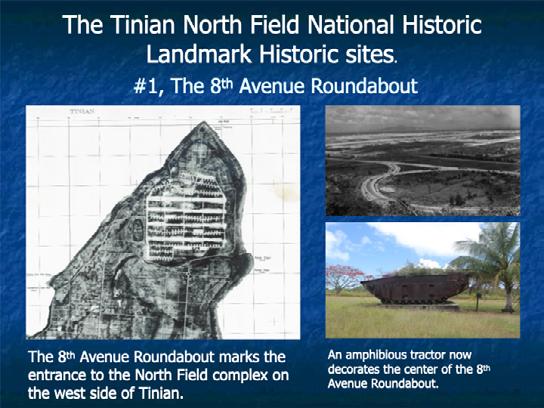

Farrell • Tinian North Field


Farrell • Tinian North Field National
Landmark


Farrell • Tinian North Field


Farrell • Tinian North Field National
Landmark


Farrell • Tinian North Field


Tinian North Field


Farrell • Tinian North Field


Farrell • Tinian North Field National
Landmark


Farrell • Tinian North Field


Farrell • Tinian North Field National
Landmark

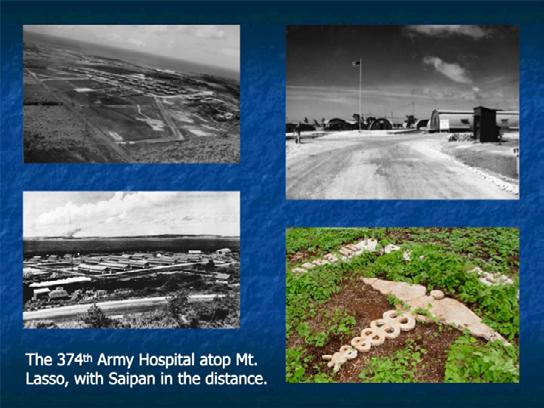
Farrell • Tinian North Field

Don A. Farrell came to Guam from California as a teacher in 1977. He taught at Inalåhan Junior High and John F. Kennedy High School. Three years later, in 1980, he switched careers to become a public relations officer for the Guam Legislature. He was the chief of staff to the Speaker of the Guam Legislature, Carl Gutierrez, from 1982 to 1986. He also became a Mariana Islands historian publishing several books about the islands. He most recently published a textbook on Marianas History from ancient times through the Spanish era and is currently working on another book, "The Tinian Atomic Bomb Files: Declassified." Farrell moved to Tinian in 1987 where he continues to do historical research, write, and teach.

Humanity in War
Guy Gabaldon at the Battle of Saipan
By Ron McNinch Chair, Public Administration and Legal Studies Division University of Guam
Abstract: This paper and presentation will cover the Guy Gabaldon story. As a part of the USMC force securing Saipan, Gabaldon rescued hundreds of civilians and combatants from the battle lines to safety. Details of Gabaldon’s early life and the formative aspects of his youth will be discussed to explain how and why Gabaldon was able to accomplish his good deeds.
Presentation Recording


Dr. Ron McNinch has been a college professor since 1988 and he has worked at the University of Guam since 1996. He taught for three years at the Huangpu Military Academy in Taiwan and three years as the assistant commandant of Georgia Military College. He enlisted in the infantry in the Georgia Army National Guard and was commissioned in 1984.
In the last 26 years, McNinch has conducted scores of studies on public opinion in Guam and the CNMI. He is well known to the community and in 2009, he was honored by being named a Distinguished Professor of Guam.
Indigenous Rights: A Pathway to End American Second-Class Citizenship
By William J. Fife III and Beylul Solomon1 Associate Professor of Social Sciences and Fine Arts; and Associate Professor of Education for Rehabilitation and Human Services Concentration, Northern Marianas College
Abstract: Nearly 4 million American residents in US territories are second-class citizens, lacking individual and collective voting rights and burdened with other gross socioeconomic and healthcare disparities. These disparities affect many honorable veterans that suffer from physical and mental injuries due to fighting for rights they themselves do not possess. The Insular Cases, self-determination, and critical race theory are current hot topics in Washington DC. Out of the five US territories, only Guam, Puerto Rico, and the US Virgin Islands fully supported a resolution denouncing the systemically racist Insular Cases at a Congressional hearing in 2021. Even Trump-appointed Supreme Court of the United States ("SCOTUS") Justice Gorsuch called for the end of the Insular Cases in 2022. The Commonwealth of the Northern Mariana Islands ("CNMI") and American Samoa had reservations about fully supporting the resolution due to concerns regarding cultural survival. Legislative solutions to address the prejudiced language in the Insular Cases and the overall nature of second-class citizenship in US territories, which would require statehood to remain American, have yet to materialize. Implementing the United Nations Declaration of the Rights of Indigenous Peoples ("UNDRIP") through local and federal legislation could be a consensus-based solution to not only replace the Insular Cases but also overturn what this Article will refer to as the Discovery Cases – rulings linked with Johnson v. M’Intosh, which include the Insular Cases. Indigenous rights protections could also provide interest toward statehood for the CNMI, as well as potential reunification with Guåhan. UNDRIP-based legislation could end Pacific territories’ concerns regarding closer integration with the US by ensuring Indigenous rights and simultaneously laying a foundation to end second-class citizenship in America.
This presentation was originally published in The Southern California Review of Law and Social Justice (RLSJ). Download the original article here.
Introducing the Issue of American Second-Class Citizenship
Struggles for fundamental rights are gaining momentum in America, especially in American lands existing outside of statehood. Washington DC, Puerto Rico, and Guåhan (officially known as "Guam" in the present day, but this paper will use the Indigenous term "Guåhan") are all exercising their right of self-determination through community-based dialogues and referendums alongside legislative efforts for potential statehood and voting rights.2 The movement to end second-class citizenship in America is ramping up. One of the remaining racist legacies of the "separate but equal" Plessy-era SCOTUS rulings from the early 1900s are the Insular
1 This article would not be possible without the scholarship, advocacy, and inspiration from the late, great Dr. Haunani Kay Trask and her sister, Miliani Trask, former CNMI Rep. Jacinta Kaipat, Emma and Pete Perez of 500 Sails, Dr. Roxanne Dunbar-Ortiz, Dr. Michael Bevacqua, Robert J. Miller, and Robert A. Williams. Special thanks to the people of British Columbia and all of Canada for their boldness in legislating UNDRIP at the local and federal levels while showing that a new, post-colonial world that respects Indigenous peoples is possible.
2 Susan K. Serrano, Elevating the Perspectives of U.S. Territorial Peoples: Why the Insular Cases Should Be Taught in Law School, 21 J. GENDER RACE & JUST. 395, 395–458 (2018); Gabriela Miranda, Decades-long Debates Surrounding D.C., Puerto Rico and Guam Statehood Have Been Reignited. What’s the Best Option?, USA TODAY (Apr. 30, 2021, 4:16 PM).
Cases. 3 The "Insular Cases" are a collective series of SCOTUS rulings in response to litigation arising from newly acquired territories of the "American empire"4 in the aftermath of the Spanish-American War of 1898. They include Downes v. Bidwell, which enshrined, to varying degrees, second-class citizenship in American territories. Second-class citizenship applies to millions of residents of US territories that are US citizens (or "nationals" in the case of American Samoa) but do not have the right to vote for the President, do not have representation in the US Senate, have non-voting representation in the US House of Representatives, receive lower federal funding relative to states, and have stark poverty and health disparities.5 The tentacles of US imperialism and the Insular Cases’ reach even includes the human rights black hole6 of Guantanamo Bay in Cuba, whose origins also date back to the Spanish-American War of 1898.7 In addition to Guantanamo Bay, Cuba, the war created the US territories of Guåhan, the Philippines, and Puerto Rico.8
As awareness of the Insular Cases and demands for legislative solutions continues to grow, any conversation about reforming systemic racism is not credible without also including the foundational Doctrine of Discoverybased cases. President Jefferson, as well as other Founding Fathers, recognized the Doctrine of Discovery against Indigenous land rights and implemented an American version called "Manifest Destiny" for westward "expansion" with the Louisiana Purchase and the Lewis and Clark expeditions.9 The basis for the international law of colonialism, the "Doctrine of Discovery" was integrated into America legally in 1823 with the seminal property law case that all US attorneys read about in law school: Johnson v. M’Intosh ("M’Intosh").10 M’Intosh essentially legalized land theft11 and thus the eventual genocide of Indigenous peoples through the religiouslyauthorized Doctrine of Discovery (that is, an arbitrary logic that other White Europeans had taken land before, thus making it incontestable).12 The "Doctrine of Discovery" is a collective of papal bulls (Vatican-based authorizations) that provided the framework for European empires declaring ownership of land from nonChristian peoples on the basis of their religious beliefs. Starting with M’Intosh, the Doctrine of Discovery was incorporated into American law, and used by other nations such as Canada.13 From the Northwest Ordinance of 178714 and continuing through today, the US, as an "American empire," dexterously (or conveniently) chose which international laws it would select, such as ignoring the Royal Proclamation of 1763, which protected Indigenous land rights west of the thirteen colonies,15 and implementing the Doctrine of Discovery.16 Neither M’Intosh nor the Insular Cases are currently possible without the Vatican-based Doctrine of Discovery, so the
3 Joseph Blocher & Mitu Gulati, Puerto Rico and the Right of Accession, 43 YALE J. INT’L L. 229, 240 (2018).
4 Downes v. Bidwell, 182 U.S. 244 (1901).
5 D.C., Puerto Rico, and the U.S. Territories, ROCKTHEVOTE (Nov. 24, 2021).
6 Andrew Kent, Boumediene, Munaf, and the Supreme Court’s Misreading of the Insular Cases, 97 Iowa L. Rev. 101 (2011).
7 Id
8 The Spanish-American War, 1898, OFFICE OF THE HISTORIAN (last visited Nov. 23, 2021).
9 Robert J. Miller, American Indians, the Doctrine of Discovery, and Manifest Destiny, 11 WYO. L. REV. 329, 329-49 (2011) [hereinafter American Indians].
10 Robert J. Miller, The Doctrine of Discovery: The International Law of Colonialism, 5 INDIGENOUS PEOPLES’ J. L. CULTURE & RESISTANCE 35, 37-38 (2019) [hereinafter Doctrine of Discovery]. This article refers to Johnson v. M'Intosh as "McIntosh," although it is commonly referred to as "McIntosh"; Johnson v. M’Intosh, 21 U.S. 543 (1823).
11 Justin Farrell et al., Effects of Land Dispossession and Forced Migration on Indigenous Peoples in North America, 374 SCI. (2021).
12 The Doctrine of Discovery, 1493, GILDER LEHRMAN INST. OF AM. HIST. (last visited Oct. 11, 2021).
13 Blake A. Watson, The Impact of the American Doctrine of Discovery on Native Land Rights in Australia, Canada, and New Zealand, 34 SEATTLE U. L. REV. 507 (2011).
14 Northwest Ordinance (1787), NAT’L ARCHIVES (last updated May 10, 2022).
15 Jesse Greenspan, How the Proclamation of 1763 Sparked the American Revolution, HIST. (Oct. 7, 2013).
16 Erin Blakemore, This 500 Year-Old Catholic Decree Encouraged Colonization. Will the Pope Revoke It?, NAT’L GEOGRAPHIC (July 22, 2022).
Insular Cases are in reality just a subset of Doctrine of Discovery-based case law, which we will later describe as the "Discovery Cases" (M’Intosh-related cases & the Insular Cases combined).17
These examples of active case law have varying impacts on populations living in US territories. The Insular Cases impact all US territories. The Discovery Cases, along with the Equal Protection Clause, specifically impact Indigenous peoples living in US territories who fear that closer union with the US would destroy their culture through the loss of Indigenous land rights. One of the most notorious Insular Cases, Downes v. Bidwell, references M’Intosh three times and "discovery" nine times.18 Denouncing the Insular Cases alone would address symptoms and not root causes. To adequately discuss the Insular Cases requires a new classification and terminology – a broader scope to include the Insular Cases and all other cases based on the Doctrine of Discovery under the larger umbrella term of what we call the "Discovery Cases." This could result in rooting out the arguably unconstitutional religious authorization of the Doctrine of Discovery from the American legal system. The Doctrine of Discovery is the foundation for international law with regard to the dispossession of Indigenous land rights. If the Founding Fathers had no issue using international law to dispossess Indigenous peoples, then international law can be used today as a remedy, such as legislatively implementing the United Nations Declaration on the Rights of Indigenous Peoples (UNDRIP).
United Nations Declaration on the Rights of Indigenous Peoples (UNDRIP)
UNDRIP is the most comprehensive international Indigenous rights instrument,19 covering a wide range of issues that recognize the traumatic histories and living legacies of colonialism.20 It contains forty-six articles that address all aspects of human rights, including culture, environment, language, education, and health. A main component of UNDRIP that is stated several times throughout the Declaration is the importance of Indigenous peoples’ land rights. Article 26 of UNDRIP states, "Indigenous peoples have the right to the lands, territories and resources which they have traditionally owned, occupied or otherwise used or acquired . . . have the right to own, use, develop and control the lands, territories and resources that they possess by reason of traditional ownership or other traditional occupation or use, as well as those which they have otherwise acquired . . . [and] States shall give legal recognition and protection to these lands, territories and resources. Such recognition shall be conducted with due respect to the customs, traditions and land tenure systems of the indigenous peoples concerned."21 UNDRIP has a diverse track record with many different Indigenous peoples and governments and includes a variety of mechanisms to utilize via the United Nations.22 Indigenous rights are international human rights23 – they do not threaten non-Indigenous peoples’ rights. Indigenous rights are not beneficial exclusively for Indigenous peoples; everyone can benefit from a diversity of cultures. Humanity suffers when entire cultures and languages become extinct – whether they are Indigenous or not. The Discovery Cases are a White supremacist stain on the American judicial system and continue the destructive legacies of genocidal colonialism through the present day, especially for Indigenous peoples. Indigenous land rights, such as Article 12 of the CNMI Constitution, which stipulates that only people of "Northern Marianas Descent" can own
17 See Downes v. Bidwell, 182 U.S. 244 at 281 (1901).
18 See Downes v. Bidwell, 182 U.S. 244 at 281, 300, 301, 303, 304, 306-08, 311, 369 (1901).
19 United Nations Declaration on the Rights of Indigenous Peoples, U.N. (last visited Oct. 2, 2021); G.A. Res. 61/295, Declaration on the Rights of Indigenous Peoples (Sept. 13, 2007).
20 About the Declaration, IMPLEMENTATION PROJECT (last visited Nov. 23, 2021).
21 United Nations Declaration on the Rights of Indigenous Peoples, supra note 19.
22 Expert Mechanism on the Rights of Indigenous Peoples, OFFICE HIGH COMM’R FOR HUM. RTS. (last visited Nov. 23, 2021).
23 OHCHR and Indigenous Peoples, OFFICE HIGH COMM’R FOR HUM. RTS. (last visited Nov. 23, 2021).
land, should not have to rely on the Insular Cases in order to exist as an unincorporated territory.24 UNDRIPbased legislation could be an alternative solution to these issues.
UNDRIP is currently legally unenforceable in the US, although it could provide persuasive support in domestic courts. Enforceability requires the implementation of UNDRIP-based legislation. This can happen at both the local and federal levels. The strongest international example of implementation is Bolivia,25 which incorporated Indigenous rights into their national constitution.26 Be that as it may, this comparative analysis focuses on local and federal UNDRIP-based legislative actions in Canada that would be in the realm of comparability for a US territory such as the CNMI and the US at the federal level. If the US Congress were to legislate UNDRIP-based laws similar to Canada, this would establish protections for Indigenous cultural survival that eliminate territorial concerns regarding closer political union with the US – whether it be citizenship, reunification, or statehood.
Implementing Indigenous Rights
In an age of relative progress in gender and sexual equality, concepts of feminism27 and LGBTQ+28 rights find roots in ancient Indigenous culture. The status of matrilineal or matriarchy-based cultures is core to many Indigenous peoples, including the Indigenous Chamorro/CHamoru people of the CNMI. Historically, the Chamorro people had both Maga’lahi male chiefs and female Maga’haga chiefs,29 and their cosmological origin story involves equally powerful brother and sister bonds.30 Maga’lahi and Maga’haga denoted the highestranking position in a clan for Chamorro people, and women held control over resources such as land rights and favorable divorce outcomes.31Two of the most prominent Indigenous rights advocates in recent history are the Trask sisters of Hawaii. The late Professor Emerita at the University of Hawaii, Dr. Haunani Kay Trask, wrote extensively on the value of UNDRIP.32 Dr. Trasks’ sister, attorney Miliani Trask, is a co-drafter of UNDRIP33 and the first elected leader of Ka Lahui Hawaii 34 Artist and former CNMI Representative Cinta Kaipat, one of the first CNMI Chamorro-Refaluwasch females to obtain her Juris Doctor, is an example of a modern-day Maga’haga that continues to engage in art and advocacy for Indigenous rights, especially for her homeland of the Northern Islands that include the volcanic island of Pagan.35 If an Indigenous Renaissance is possible, listening to the voices of Indigenous female leadership could be a wise strategy worthy of consideration.
Finally, if there were willing and interested parties, legislative implementation of UNDRIP could lay the groundwork for statehood, as Indigenous peoples in US territories could be more agreeable to closer political union with the US if cultural safeguards are in place. Statehood is the only available way for territories to remain
24 N. Mar. I. CONST. art. XII, § 1, 3, 4.
25 Corrine Tansowny, An UNDRIP in the Bucket? The Potential Impact of BC’s Adoption of the United Nations Declaration on the Rights of Indigenous People, MCGILL J. SUSTAINABLE DEV. L. (last visited Sept. 18, 2022).
26 Stephanie Wood & Emma McIntosh, Indigenous Rights: How Bolivia Got Ahead of Canada, CAN.’S NAT’L OBSERVER (Dec. 8, 2019).
27 HAUNANI-KAY TRASK, EROS AND POWER: THE PROMISE OF FEMINIST THEORY (1986).
28 Lana Sue I. Ka‘opua et al., Addressing Risk and Reluctance at the Nexus of HIV and Anal Cancer Screening, 17 HEALTH PROMOTION PRAC. 21, 21-30 (2016).
29 Kelly G. Marsh, Maga’håga: Highest Ranking Daughter, GUAMPEDIA (last updated May 19, 2021).
30 Celeste Perez, Fo’na: Mother of the Chamorro People, GUAMPEDIA (last updated Dec. 20, 2022).
31 Tanya M. Champaco Mendiola, Women’s Roles, GUAMPEDIA (last updated Jan. 7, 2023).
32 HAUNANI-KAY TRASK, FROM A NATIVE DAUGHTER: COLONIALISM AND SOVEREIGNTY IN Hawai'i 61 (U. of Haw. Rev. ed. 1999).
33 Testimony of Mililani B. Trask: In Support of Joseph Kualii Lindsey Camara, DEP’T LAND & NAT. RES. (Oct. 2, 2016).
34 Noe Wong-Wilson, A Conversation with Mililani Trask, 17 CONTEMP. PAC. 142, 142-156 (2005).
35 US Sued Over Military Plans for Marianas Islands, RNZ (July 29, 2016, 3:05 PM).
American, obtain individual and collective voting rights, and end second-class citizenship.36 The recent "For the People Act"37 would be a step in the right direction in creating a congressional task force to address territorial voting rights.38 If cultural land rights for the Indigenous peoples of the CNMI exist at the federal level, then reunification would be a compelling argument for consolidation into statehood. Reunification efforts between Guåhan and the CNMI have failed in the past in vastly different circumstances,39 but that does not mean failure in modern times. Chamorros were partitioned and separated, played off each other, and used to work against their own people by multiple colonialists, especially most recently under the Japanese occupation pre-World War II. Consider the environment that created the divisions between Guåhan and CNMI Chamorros to this day:
When a Guam Chamorro commits an indiscretion against the Japanese, he gets one lash. On the other hand, when a Saipan Chamorro commits an indiscretion, he gets 10 lashes. The reason for this is that a Guam Chamorro was not raised by the Japanese and thus may be expected to commit an indiscretion. However, a Saipan Chamorro was raised by the Japanese and is not supposed to commit an indiscretion.
Steve Limtiaco, World War II Deepened Rift Between Guam, Saipan CHamorus
All historic and current intra-Marianas tension arguably would not exist but for genocidal colonialism and partition.40 Furthermore, implementing UNDRIP puts citizenship and statehood on the table for American Samoa as well, since federal UNDRIP law would protect cultural rights and alleviate Indigenous cultural survival fears.41 If all territories felt like their Indigenous rights were legally protected, there would likely be a unanimous condemnation of the Insular Cases. With unanimity, a consensus could move forward with actions that address systemic racism and repeal the Insular Cases as well as all of the additional Discovery Cases, which would address the roots of today’s second-class citizenship in America.
Although UNDRIP-based legislation at the federal level may for a time be improbable, the hypothetical is possible, considering both the Republican and Democratic parties are strong in the Marianas and thus have bipartisan appeal in Washington , DC The people of the Marianas are currently marketing material for the Republican party in the sense that they show that the GOP is not just a "White" political party. The first gubernatorial endorsement for then-candidate Donald Trump in the 2016 presidential campaign was Indigenous Republican Governor Ralph Torres of the CNMI.42 Statehood for the Marianas should appeal to both major political parties. Ideally, if the CNMI led with UNDRIP-based legislation, and if Congress also legislated Indigenous rights, the CNMI and Guåhan could pursue statehood together. There is no ending second-class citizenship without full voting rights, which requires statehood. Indigenous rights-based legislation could be the key to addressing disparities and synthesizing international human rights law with US foreign and domestic policy while ending second-class citizenship in US territories.
36 The Constitution of the United States: A Transcription, NAT’L ARCHIVES (last updated Aug. 16, 2022).
37 For The People Act of 2021, H.R. 1, 117th Cong. § 3 (2021).
38 Annotated Guide to the For the People Act of 2021, BRENNAN CTR. FOR JUST. (Jan. 20, 2021).
39 Don Farrell, History of Efforts to Reunify the Mariana Islands, GUAMPEDIA (last updated Oct. 13, 2019).
40 Gina E. Taitano, CHamorus: A People Divided, GUAMPEDIA (last updated May 24, 2022).
41 Robert Barnes, Supreme Court Won’t Take Case Raising Past Rulings Denounced as Racist, WASH. POST (Oct. 17, 2022, 12:27 PM).
42 Gaynor Dumat-ol Daleno, CNMI Governor Ralph Torres Endorses Trump Ahead of Caucus, PAC. DAILY NEWS (Mar. 15, 2016), .
Discovery Cases and the Roots of American Second-Class Citizenship
Along with the institution of slavery and female disenfranchisement in coverture,43 the roots of American second-class citizenship began immediately upon debasement from colonized to colonizer. These roots reside in American "Manifest Destiny"44 colonialism of Indigenous lands from "sea to shining sea" to create "incorporated territories" that would gain first-class citizenship upon obtaining statehood.45 The Insular Cases go further by racist judicial fiat in creating "unincorporated" territories – mostly non-White territories not on a track for statehood that can thereby exist outside the full application of the Constitution in seemingly perpetual inequality. Fortunately for both the CNMI and US, the US federal law referred to as the Covenant created the CNMI-US political integration and can be amended through mutual consent (or unilaterally by the US federal government).46 The Covenant agreement arguably makes the CNMI the most empowered of the territories, although they still lack essential voting rights and equal access to all three branches of government – just like all other US territories.47
While the CNMI "agreed" to the Covenant and thereby "agreed" to be treated as second-class citizens, the circumstances in which that took place must be critically contemplated. Second-class citizenship that included Indigenous land rights and limited self-government at the time was commonly considered a tremendous improvement after hundreds of years of brutal genocidal colonialism, World War II-based bombing causing the destruction of their islands, followed by years of internment camps under the US. The CNMI Founding Fathers48 deserve credit for a deal that included Indigenous land rights protections after surviving centuries of occupation by colonizers that did not allow them the freedom to move about and utilize their lands as they saw fit. However, the journey for true self- determination does not have to end in inequality. These CNMI foundational leaders were wise to leave open the ability to amend the Covenant so that the CNMI could continue decolonization for greater self-determination in the future.
If the people want out of second-class citizenship and wish to remain American, the CNMI needs to pursue statehood. If the CNMI alone without Guåhan were to pursue statehood, and if the Northwest Ordinance of 1787’s minimum population requirement of 60,000 or more to be eligible for statehood is still in effect for "incorporated territories" transitioning out of "unincorporated" status, then the CNMI would have to wait until its population of approximately 47,000 increases.49 If they reunified with Guåhan and pursued statehood together, they would have a combined population of over 200,000 and gain immediate eligibility. Recent Census data revealed a shocking 12% drop in the CNMI population since 2010, so reunification might be even more crucial than ever if the CNMI desires political equality for its people.50
However, second-class citizenship in America will still exist even with voting rights as long as systemic racism remains alive and well in case law. Perhaps the two most infamously racist SCOTUS collections of active case law are Johnson v. M’Intosh and Downes v. Bidwell, and it is no surprise that they are intimately connected.
43 Marylynn Salmon, The Legal Status of Women, 1776-1830, GILDER LEHRMAN INST. OF AM. HIST. (last visited Nov. 23, 2021).
44 Andrew C. Isenberg & Thomas Richards, Jr., Alternative Wests: Rethinking Manifest Destiny, 86 PAC. HIST. REV. 4, 4-17 (2017).
45 1789: The Northwest Ordinance Guarantees Tribal Land Rights, NATIVE VOICES (last visited Nov. 23, 2021).
46 S. Rep. No. 110-324 (2008); Covenant, COMMONWEALTH L. REV. COMM’N (last visited Nov. 23, 2021).
47 Northern Mariana Islands v. Atalig, 723 F.2d 682, 691 n.28 (9th Cir. 1984).
48 Edward DLG Pangelinan, The Legacy of the Commonwealth’s Founding Fathers to Our People, SAIPAN TRIB. (Sept. 22, 2020).
49 Northwest Ordinance (1787), NAT’L ARCHIVES (last updated May 10, 2022).
50 Emmanuel T. Erediano, Census: NMI Population Down 12%, MARIANAS VARIETY (Oct. 29, 2021).
Many people are familiar with the Insular Cases thanks to recent civil rights advocacy51 as well as pop culture.52 However, lesser known and far more shockingly racist are the original cases based on the Doctrine of Discovery, which includes the 1823 foundational American property law case of M’Intosh and its progeny. The case of Johnson v. M’Intosh, 53 a dispute between two White men regarding ownership rights to Indigenous lands, is a Supreme Court ruling that removed ownership of land from Native American tribes and put it in the hands of the US federal government based on Vatican authority and religious superiority.
If the abhorrent Insular Cases need to be discarded into the dustbin of history, M’Intosh demands equal scrutiny. M’Intosh’s arguable First Amendment violations of freedom of religion would today be considered modern-day war crimes of land theft and genocide. A potential legal justification for SCOTUS to overturn these bigoted Discovery Cases could rely on the argument that any religious "decree" justifying land theft is an unconstitutional violation of the First Amendment. Implementation of UNDRIP could provide the congressional action that SCOTUS and territories alike demand to resolve the Insular Cases issue.
Reforms between the US federal government and "non-states" are actively moving forward with proposed statehood for Washington, DC and decolonization with self-determination considerations for Puerto Rico and Guåhan that may also include statehood.54 Other US territories, like the CNMI and American Samoa, have largely been outside this conversation due to concerns about cultural extinction under greater integration with the US.55 Thus, Indigenous rights legislation with a national action plan is a creative endeavor to address solutions not only to a post-Discovery Cases world, but also to pave the foundation for US territories to potentially become states while safeguarding cultural survival. SCOTUS has the power to undo the historic White supremacist embarrassment of the Discovery Cases: " (I)t is [the Supreme] Court's prerogative alone to overrule one of its precedents."56 The US Congress has similar discretionary power to do the same with the admission of new states, and Indigenous rights legislation could be the harmonizing nexus for these two branches of government to ameliorate American systemic racism. "Congress’s exercise of its express constitutional authority to decide to admit a new state is a classic political question, which courts are highly unlikely to interfere with, let alone attempt to bar."57
Global protest movements demanding an end to police brutality show the time is ripe to address systemic racism. For example, the Paris Climate Accords and the Iran nuclear deal did not survive the Trump presidency,58 but it is a credit to his administration that the US commitment to UNDRIP remained unspoiled. Current President Biden served as the Vice President in President Obama’s administration when the US became a Signatory to UNDRIP.59 The Declaration has been proudly endorsed by the current Department of Interior Secretary Deb Haaland, the first Native American in a presidential cabinet.60 Bold Indigenous rights-
51 U.S. Citizens Defend Democracy, Can't Vote for President, EQUALLY AM. BLOG, (last visited Oct. 11, 2021).
52 LastWeekTonight, U.S. Territories: Last Week Tonight with John Oliver (HBO), YOUTUBE (Mar. 8, 2015).
53 Johnson v. M’Intosh, 21 U.S. 543, 572, 574-77 (1823).
54 Sahil Kapur, Letter to Congressional Leaders on Constitutionality of Statehood for Washington D.C., May 2021, SCRIBD (May 2021); Puerto Rico Self-Determination Act of 2021, S. 865, 117th Cong. (2021); " USA Has Not Supported Self-Determination for the Chamorro People of Guam" Say UN Experts, UNREPRESENTED NATIONS & PEOPLES ORG. (Mar. 30, 2021).
55 Anita Hofschneider, The US Supreme Court’s Decision Not to Hear American Samoa Citizenship Case Gets Mixed Reaction, HONOLULU CIV. BEAT (Oct. 18, 2022).
56 State Oil Co. v. Khan, 522 U.S. 3, 20 (1997).
57 Kapur, supra note 54, at 11.
58 Statement by President Trump on the Paris Climate Accord, TRUMP WHITE HOUSE ARCHIVE (June 1, 2017); President Donald J. Trump is Ending United States Participation in an Unacceptable Iran Deal, TRUMP WHITE HOUSE ARCHIVE (May 8, 2018).
59 Announcement of U.S. Support for the United Nations Declaration on the Rights of Indigenous Peoples, U.S. DEP’T OF STATE (Jan. 12, 2011).
60 Remarks by Secretary of the Interior Deb Haaland at the UN Permanent Forum on Indigenous Issues, U.S. MISSION TO U.N. (Apr. 19, 2021).
based legislation at the local (CNMI), regional (Guåhan, American Samoa), and federal levels (US Congress) would incorporate international human rights law (Indigenous rights) with US foreign and domestic policy (UNDRIP). America may be late to implementing UNDRIP, but it can and should legislate Indigenous rights that address legacies of genocidal colonialism, systemic racism, and provide a pathway to end second-class citizenship in its territories. Prior to discussing the legal implications of the Discovery Cases and how UNDRIPbased legislation could be implemented in a US territory like the CNMI, it is necessary to review the CNMI’s colonial history and the resulting impact it has had on the islands and people.
Territorial Focus: CNMI Historical Background
The Spaniards would have done better to remain in their own country. We have no need of their help to live happily. Satisfied with what our islands furnish us, we desire nothing. The knowledge which they have given us has only increased our needs and stimulated our desires…They dare to take away our liberty, which should be dearer to us than life itself . . . .
The Spaniards reproach us because of our poverty, ignorance and lack of industry. But if we are poor, as they tell us, then what do they search for? If they didn’t have need of us, they would not expose themselves to so many perils and make such efforts to establish themselves in our midst. For what purpose do they teach us except to make us adopt their customs, to subject us to their laws, and to remove the precious liberty left to us by our ancestors? In a word, they try to make us unhappy in the hope of an ephemeral happiness which can be enjoyed only after death.
They treat our history as fable and fiction. Haven’t we the same right concerning that which they teach us as incontestable truths? They exploit our simplicity and good faith. All their skill is directed towards tricking us; all their knowledge tends only to make us unhappy. If we are ignorant and blind, as they would have us believe, it is because we have learned their evil plans too late and have allowed them to settle here.
Let us not lose courage in the presence of our misfortunes. They are only a handful. We can easily defeat them. Even though we don’t have their deadly weapons which spread destruction all over, we can overcome them by our large numbers. We are stronger than we think! We can quickly free ourselves from these foreigners! We must regain our former freedom!61
Chamorro Maga’lahi Chief Hurao
The Commonwealth of the Northern Mariana Islands (CNMI) is the geo-strategic westernmost US territory of fourteen islands, immediately north of Guåhan,62 and is closer to China than California. Most Americans probably do not know that the CNMI even exists, let alone that it is a part of America,63 yet it plays a major role in the US military’s "Pivot to Asia" amongst hyper-tensions with China.64
61 Victoria-Lola Leon Guerrero & Nicholas Yamashita Quinata, Hurao, GUAMPEDIA (last updated May 22, 2021).
62 Commonwealth of the Northern Mariana Islands, U.S. DEP’T INTERIOR (last visited Nov. 23, 2021).
63 Claire Hansen, Poll Finds Americans Don’t Know Puerto Ricans Are Citizens, U.S. NEWS (Sept. 26, 2017).
64 Patsy Widakuswara, US-China Tensions Rising Over Trade, Taiwan, VOICE OF AMERICA (Oct. 6, 2021).
The Chamorro people accomplished great feats such as leading the first Remote Oceania65 culture and settlement at least 3,500 years ago with megalithic latte stone structures, 66 ancient cave art,67 and fast Indigenous Sakman sailboats (also known as "flying proas").68 They also had their own cosmology,69 calendar,70 and astronomy,71 along with pescatarian diets,72 water-based lifestyles,73 and a matrilineal-based culture. The destructive legacies of nearly 500 years of war, disease, and forced acculturation by genocidal colonialism, first under the Spanish, then German and Japanese, before the arrival of the Americans, left a wake of disparities for Indigenous peoples. A range of roots for inequities in the Marianas include second-class citizenship status74 with unequal access to all three branches of government via the lack of individual and collective voting rights,75 health care funding brinkmanship,76 and historic systematic efforts to push the Chamorro language to extinction.77
Although there are CNMI constitutional laws recognizing Indigenous land rights such as Article 12,78 UNDRIP-based legislation could build on that foundation to expand the field of laws beyond just one Indigenous issue. Article 12 of the CNMI Constitution preserves land rights for Indigenous peoples having Northern Marianas descent. Currently, the combined twenty-nine percent minority population of Indigenous peoples overwhelmingly dominate local electoral politics. The CNMI’s Indigenous cultural survival may initially seem secure. Yet, with diminishing native language fluency and discussion to destroy perhaps one of the most important domestic Indigenous rights laws in America by discarding Article 1279, cultural survival is indeed under threat.
Before the 17th century Spanish "Reduccion" system of genocidal colonialism in what is now called the "Marianas" archipelago of Guåhan and the CNMI, the islands were all one united home to the Indigenous Chamorro people. The Indigenous Chamorros fought and resisted arguably one of the most powerful nations on earth at the time–Spain–for thirty years of "divide and conquer" warfare. The violence and disease at the hands of the Spanish resulted in the decimation of the Chamorro population by at least eighty to ninety
65 Jeremy Choin et al., Genomic Insights into Population History and Biological Adaptation in Oceania, 592 NATURE 583, 583-589 (2021).
66 Rosalind L. Hunter-Anderson, Latte, GUAMPEDIA (last updated Dec. 21, 2019).
67 Dominica Tolentino, Ancient CHamoru Cave Art, GUAMPEDIA (last updated May 2, 2022).
68 Michael Lujan Bevacqua, Agad’na: Canoe Builders, GUAMPEDIA, (last updated July 14, 2022).
69 Brandon L. Cruz, Rediscovering Fo’na and Pontan, GUAMPEDIA, (Apr. 27, 2022).
70 Shannon J. Murphy, Ancient CHamoru Calendar, GUAMPEDIA, (last updated May 22, 2022).
71 Rosina C. Iping, The Astronomical Significance of Ancient Chamorro Cave Paintings, 31 AM. ASTRONOMICAL SOC’Y 671 (1999).
72 Marilyn C. Salas & Dominica Tolentino, Ancient CHamoru Food and Diet, GUAMPEDIA (last updated June 21, 2022).
73 Carlos Madrid, Early European Observations of CHamorus, GUAMPEDIA (last updated June 20, 2022).
74 Steve Limtiaco, Biden: ‘There Can Be No Second-Class Citizens’, PAC. DAILY NEWS (June 8, 2021).
75 Maria Murriel, Millions of Americans Can’t Vote for President Because of Where They Live, THE WORLD (Nov. 1, 2016, 2:45 PM).
76 See Esther L. Muña, Devastating Decisions Loom for the Territories if Congress Does Not Act by Sept. 30, THE HILL (Sept. 14, 2021, 3:45 PM) ("There is a need for a permanent solution to ensure equitable financing and access to health services for individuals living in U.S. territories, on par with states."); see also Joshua Santos, Medicaid ‘Fiscal Cliff’ Averted, SAIPAN TRIB. (Sept. 20, 2021) ("Delegate Gregorio Kilili C. Sablan (Ind-MP) announced Saturday that the federal government will allocate $64 million for the CNMI’s Medicaid program in fiscal year 2022, averting a looming ‘fiscal cliff’ that would have meant a loss of $55.1 million for the CNMI’s Medicaid program come Oct. 1, 2021."); Orlando Rodríguez-Vilá et al., Healthcare Disparities Affecting Americans in the US Territories: A Century-Old Dilemma, 130 AM. J. MED. e39, e39-e42 (2017).
77 See Anita Hofschneider, The Fight to Save CHamoru, a Language the US Military Tried to Destroy, THE GUARDIAN (Feb. 12, 2020, 4:00 PM), ("Although there’s little data about how many people still speak CHamoru, it’s clear the language is vulnerable."); Johanna Salinas, A Dying Language, PAC. ISLAND TIMES (Aug. 6, 2018), [ https://perma.cc/C5CH- GP76]; Michael R. Clement, Jr., English and Chamorro Language Policies, GUAMPEDIA (last updated Nov. 9, 2022).
78 N. Mar. I. Const. art. XII, § 4.
79 K-Andreas Evarose Limol, Senate President Shelves Proposal to Amend Article 12, MARIANAS VARIETY (last updated May 19, 2021).
percent.80 Surviving Chamorro people were forced to endure a "convert-or-die" colonial mindset, with benefits and privileges going to "good Christians" but never full freedom.81 Although now partitioned since the conclusion of the Spanish-American War of 1898, the Indigenous peoples of Guåhan and the CNMI still share deep-rooted familial and cultural bonds that are undermined by legacies of division.
Studies suggest a strong cultural identity correlates with positive health outcomes.82 Alternatively, disconnection from Indigenous culture can result in greater negative health outcomes.83 A strong culture would presumably be a united one. Several attempts to reunite the archipelago separated by colonialists were unsuccessful in the past.84 Reunification would be a great catalyst to pursue statehood together, as the US has denied Guåhan the right of self-determination by maintaining Guåhan as a "non-self-governing territory." The United States can be labeled a "colonizer" because it still has territories on the list of the UN’s Non-Self-Governing Territories, such as Guåhan, American Samoa, and the US Virgin Islands. The CNMI is not on the list following its integration into the US via the federal law of the Covenant, even though they are treated as second-class citizens without voting rights. This democratic purgatory in which an area is not technically a colony, but also not fully free with equal voting rights, provides a spectrum of outcomes for the CNMI.85 The Indigenous peoples of the Marianas deserve the right to decolonize in a way of their choosing; independence, free association, and integration are the main options.86
Political union with the US evolved during the late 1970s after decades of United Nations "Trust Territory" status following World War II, yet CNMI residents still cannot vote for the President of the United States (POTUS), and their US Congressional delegate87 cannot vote in Washington , DC To complete the trinity of three branches of government, the current judge of the highest court of the CNMI is Indigenous but was appointed by the POTUS and confirmed by the US Senate, not by CNMI Americans. If the Chamorros of Guåhan want to integrate into the US, reunification and statehood with the CNMI would make the strongest argument to end second-class citizenship in the Marianas.
Local and federal UNDRIP-based legislation could maintain current agreements regarding Indigenous land rights in the territories and preserve cultural survival for future generations with increased political equality. If the Indigenous peoples of the CNMI and Guåhan want to not only reunite, but also remain with the US, UNDRIP-based legislation is an ideal version of what statehood in the US could look like for Indigenous peoples currently in territories. This would at least bring the Marianas out of second- class citizenship.
80 Nicholas J. Goetzfridt, Spanish Response to CHamoru Depopulation, GUAMPEDIA (last updated Apr. 26, 2022).
81 Jillette Leon-Guerrero, Forzado System and the Mariana Islands, GUAMPEDIA (last updated Dec. 1, 2022); Tony Palomo, History of Democracy in Guam, GUAMPEDIA (last modified Nov. 16, 2022).
82 Lisa Wexler, The Importance of Identity, History, and Culture in the Wellbeing of Indigenous Youth, 2 J. HIST. CHILD. & YOUTH 267, 267-276 (2009).
83 Id.; Lucas Trout et al., Beyond Two Worlds: Identity Narratives and the Aspirational Futures of Alaska Native Youth, 55 TRANSCULTURAL PSYCHIATRY 800 (2018).
84 Doris Flores Brooks, Guam, CNMI Unification Needs a Fresh Look, GUAM DAILY POST (May 27, 2021).
85 David J. McGuire et al., Voting Rights in U.S. Territories, U.S. COMM’N C.R. (Oct. 4, 2021).
86 United Nations and Decolonization, UNITED NATIONS (last visited Nov. 23, 2021).
87 Delegate Gregorio Kilili Camacho Sablan, CONGRESS.GOV (last visited Nov. 23, 2021).
The Rules of American Second-Class Citizenship
America has unfinished business in reconciling relationships with Indigenous peoples. In 1963, Martin Luther King, Jr. summed up the injustices suffered by Indigenous peoples in his book Why We Can’t Wait:
Our nation was born in genocide when it embraced the doctrine that the original American, the Indian, was an inferior race. Even before there were large numbers of Negroes on our shores, the scar of racial hatred had already disfigured colonial society. From the sixteenth century forward, blood flowed in battles of racial supremacy. We are perhaps the only nation which tried as a matter of national policy to wipe its indigenous population. Moreover, we elevated that tragic experience into a noble crusade. Indeed, even today we have not permitted ourselves to reject or to feel remorse for this shameful episode. Our literature, our films, our drama, our folklore all exalt it.
Martin Luther King, Jr., Why We Can’t Wait
Along with the US Constitutional Indian Commerce Clause88 and Territorial plenary powers, the Discovery Cases define the dominant role of the American legal landscape of federal relationships with Indigenous peoples. Many legal horrors for Native Americans flowed from these foundations, including the Indian Removal Act,89 Dawes Act,90 Homestead Act,91 and Indian Civilization Fund Act of 1819.92 These laws worked towards land dispossession of Indigenous peoples and financed Christian institutions to enforce cultural genocide within Indian Residential Boarding Schools. Current SCOTUS rulings have shown an inclination towards greater recognition of Indigenous rights,93 making it plausible for the passage of Indigenous rights legislation and the legislative-judicial consummation for the legal denunciation of the Discovery Cases.
Implementing UNDRIP principles within the US is not a completely novel idea. The Navajo Nation has utilized UNDRIP in several ways,94 and the Pawnee Nation recently implemented UNDRIP into their tribal government.95 Although Indigenous groups in the CNMI are not classified as "Native American Tribes,"96 Native American tribes and the CNMI’s Chamorros and Refaluwasch are all Indigenous peoples, and all are federally governed through the Department of Interior.97 Native Americans’ and the Chamorros’ first-contact stories with Europeans share a common denominator in the Doctrine of Discovery authorizing the eventual genocide, forced labor, and land theft of their ancestors. The indignity from legacies of the Doctrine of Discovery is kept alive today under M’Intosh and other active Discovery Cases.
88 Natsu Taylor Saito, Asserting Plenary Power Over the "Other": Indians, Immigrants, Colonial Subjects, and Why U.S. Jurisprudence Needs to Incorporate International Law, 20 YALE L. & POL’Y REV. 427 (2002).
89 Indian Removal Act: Primary Documents in American History, LIBR. CONG. (last visited Nov. 23, 2021).
90 The Dawes Act, NAT'L PARK SERV. (last updated July 9, 2021).
91 Lee Ann Potter & Wynell Schamel, The Homestead Act of 1862, 61 SOC. EDUC. 359, 359-364 (1997).
92 On This Day - Mar 03, 1819: Congress Creates Fund to "Civilize" Native American People, EQUAL JUST. INITIATIVE (last visited Nov. 23, 2021).
93 Brett Milano, Landmark SCOTUS Ruling Affirms Native American Rights in Oklahoma and Bodes Well for Tribal Rights Going Forward, Says Robert Anderson, HARV. L. TODAY (July 14, 2020).
94 U.N. DRIP, NAVAJO NATION HUM. RTS. COMM’N (last visited Oct. 2, 2021); Community Information: Navajo Nation Human Rights Commission to Host Public Meeting Addressing How Navajo and Native Students are Treated, NAVAJO-HOPI OBSERVER (Oct. 22, 2019, 12:47 PM).
95 Pawnee Nation Passes Landmark "Pawnee Nation Declaration on the Rights of Indigenous Peoples Act", IMPLEMENTATION PROJECT (last visited Dec. 12, 2022).
96 Tribal Nations & the United States: An Introduction, NAT’L CONG. OF AM. INDIANS (Feb. 2020).
97 Office of Insular Affairs, U.S. DEP’T OF INTERIOR (last visited Dec. 10, 2022).
Aligning advocacy goals for all Indigenous peoples within the US requires greater collaboration between Indigenous Pacific Islanders and Native Americans. Enhanced solidarity between the political leadership of the CNMI and Guåhan is also critical. The CNMI political leadership remains for the most part publicly silent, as ancient Chamorro sacred sites in Guåhan, such as Litekyan ("Ritidian"), are under threat of further destruction from the current US military live-fire weapons testing build- up.98 The sacred sites in Guåhan are also sacred to CNMI Chamorros, as nearly all Chamorros were forced through the crucible of Guåhan post- ethnic cleansing of most of the Marianas Archipelago.99 Similarly, the leadership in Guåhan were also relatively publicly silent as the US military previously planned to controversially turn the islands of Tinian and Pagan in the CNMI into live-fire weapons testing zones, bases, and airports; all sources of irreversible environmental pollution.100 There are other examples contributing to ongoing second-class citizenship in US territories. Regular exclusion from "Indigenous" designations and collaborations,101 such as the erasure of Indigenous Chamorros, Refaluwasch, and Samoans from Indigenous Peoples Day celebrations,102 demean the sacrifices of Chamorro, Refaluwasch, and Samoan military veterans. Absent recognition,103 it is easier for Americans to be unaware that the US even possesses Pacific territories, let alone oppresses Indigenous peoples by denying voting rights to all and citizenship to some.104
Constitutional plenary powers give Congress complete control over both territories and Indigenous peoples in the US105 M’Intosh begins the historic line of Discovery Cases that enforce religious authorization for "Conquest" and "Discovery" which enabled global genocide that legalized land theft from Indigenous peoples and the enslavement of African people.106 The series of Insular Cases107 made it legal to enforce further indignities of political inequality within US territories.108 The US-CNMI Covenant makes the CNMI unique as a US territory, whereas other current territories were mostly acquired either by military conquest (Puerto Rico and Guåhan) or purchase (US Virgin Islands). However, this came at a great cost to the CNMI’s Indigenous peoples, as nearly a quarter109 of their combined population died during the American onslaught.110 The period between World War II and the creation of the Commonwealth included years of internment camps and over ten years without self-determination and freedom of movement for the Indigenous peoples of the CNMI. The Covenant
98 Anumita Kaur, Buildup Projects in Full Swing; Prutehi Litekyan Appeals to United Nations, MONTGOMERY ADVERTISER (Aug. 6, 2020, 11:17 AM).
99 Bryan Manabat, Court Affirms Dismissal of Lawsuit Against DOD, Navy, GUAM DAILY POST (Sept. 22, 2020).
100 Toxic "Forever Chemicals" Found in Groundwater Near More U.S. Military Bases, CBS NEWS (Aug. 31, 2021, 2:01 PM); Meghann Myers, Here’s the Latest Count of Suspected Bases with Toxic "Forever Chemicals" in the Water, MIL. TIMES (Apr. 6, 2020).
101 Our View: Indigenous Proclamation Overlooks People of the Marianas, PAC. DAILY NEWS (Oct. 11, 2021).
102 Joseph R. Biden Jr., A Proclamation on Indigenous Peoples’ Day, 2021, THE WHITE HOUSE (Oct. 8, 2021).
103 Subcommittee for Indigenous Peoples of the United States, NAT’L RES. COMM. (last visited Nov. 23, 2021) (The subcommittee only addresses issues facing Native Americans, Alaskan Natives, and Native Hawaiians).
104 Deb Haaland, Deb Haaland: ‘Moving Forward on Priorities for Indian Country’, INDIAN COUNTRY TODAY (Oct. 6, 2021).
105 Saito, supra note 88; Joseph E. Horey, The Right of Self-Government in the Commonwealth of the Northern Mariana Islands, 4 ASIAN-PAC. L. & POL’Y J. 180, 181-245 (2003); Matthew L.M. Fletcher, A Short History of Indian Law in the Supreme Court, 40 HUM. RTS. MAG. (Oct. 1, 2014).
106 American Indians, supra note 9; Doctrine of Discovery, supra note 10; Blake A. Watson, The Impact of the American Doctrine of Discovery on Native Land Rights in Australia, Canada, and New Zealand, 34 SEATTLE U. L. REV. 507 (2011).
107 Juan R. Torruella, Ruling America's Colonies: The Insular Cases, 32 YALE L. & POL’Y REV. 57, 57-95 (2013) (discussing the constitutional validity of the United States-Puerto Rico colonial relationship); Neil Weare, Why the Insular Cases Must Become the Next Plessy, HARV. L. REV. BLOG (Mar. 28, 2018).
108 Juan R. Torruella, The Insular Cases: The Establishment of a Regime of Political Apartheid, 29 U. PA. J. INT'L L. 283, 283-347 (2007) (discussing the link between politics and Supreme Court decisions in the context of the Insular Cases).
109 Erwin Encinares, 932 Chamorros, Carolinians Perished During WWII, SAIPAN TRIB. (June 7, 2019).
110 Battle of Saipan, NAT’L PARK SERV. (last updated June 25, 2021).
was not a negotiation between equal parties and thus arguably subjected to "undue influence" in contracting,111 even if the people of the CNMI desired a union with the US and it was supported by the UN. The above requires a general review of how plenary powers and SCOTUS rulings affect the CNMI.
US Constitutional Plenary Powers
We in Congress must stay vigilant and keep up the fight to protect the franchise, especially for communities of color. . . . . And as members of the Indian Affairs Committee, we owe a particular duty to American Indians, Alaska Natives, and Native Hawaiians to ensure their votes are counted, not discounted. Because voting is sacred. And Native votes matter.
US Senator, Brian Schatz (D-Hawai'i), Chairman of the Senate Committee on Indian Affairs
Senator Schatz’s speech notably leaves out Indigenous American Chamorros, Refaluwasch, and Samoans. The US Constitutional plenary powers require statehood for voting rights, and territories are not states. This leaves nearly four million Americans residing in US territories without "sacred voting rights" which Senator Schatz references in his speech above. Worse still is the incorporated versus unincorporated divide: incorporated territories are at least on a track to statehood, while unincorporated territories remain in political purgatory sans voting rights. The Commonwealth is an unincorporated US territory, exercising self- determination with integration into America and limited self-governance including Indigenous land rights, but it is treated relatively similarly as all other US territories in lacking individual and collective voting rights. However, the Covenant allows for amendments, so the CNMI could pursue incorporated status for statehood, or anything else.112 The Indigenous peoples of the CNMI were put in a unique position relative to other Indigenous groups colonized in the United States, because they submitted to US sovereignty while keeping a hundred percent of their ancestral lands. However, context is critical, and the review of how and why anyone would "agree" to second-class citizenship in potential perpetuity is required.
Arguments have been made that the US-CNMI Covenant was made pursuant to plenary presidential treaty powers and not territorial plenary powers.113 Article II Section 2 of the Treaty Power in the Constitution reads, "[The President] shall have Power, by and with the Advice and Consent of the Senate, to make Treaties, provided two thirds of the Senators present concur . . ."114 Strong arguments deem the CNMI and the Covenant products of plenary treaty power, and not territorial plenary powers, because the CNMI was not technically a US jurisdiction before becoming a territory.115 Self-determination via integration with the US "liberated" the CNMI from Japanese colonialism, even though the Americans had no plans on leaving after World War II. Either way, the CNMI is still a self-governing unincorporated territory, and with any potential future pursuit of statehood, plenary powers could enable a new agreement to end second-class citizenship.
Congressional plenary powers116 over Indigenous "Indian Tribes" are derived from the US Constitution, Article I Section 8: "To regulate Commerce with foreign Nations, and among the several States, and with the Indian
111 Mary Joy Quinn, Defining Undue Influence, 35 BIFOCAL 72, 72-75 (2014).
112 Covenant, supra note 46.
113 Horey, supra note 105.
114 U.S. CONST. art. II, § 2, cl. 2.
115 Horey, supra note 105.
116 Plenary Power, LEGAL INFO. INST. (last visited Nov. 21, 2021).
Tribes ."117 However, the CNMI’s Indigenous peoples are not technically "Tribal."118 Territorial plenary powers over territories reside in Article IV Section 3: "The Congress shall have Power to dispose of and make all needful Rules and Regulations respecting the Territory or other Property belonging to the United States; and nothing in this Constitution shall be so construed as to Prejudice any Claims of the United States, or of any particular State."119 Although arguments have been made that the CNMI was formed under treaty plenary power, this ambiguity on which type of plenary power it falls under contributes to the Commonwealth’s ultimate status as being "far from clear."120 Plenary powers provide Congress with the highest authority over Indigenous affairs in "Tribal" America. It also gives Congress the ability to sever ties with any territory as it pleases. That would put the CNMI in a precarious legal standing with the US federal government if the Covenant were dependent upon territorial plenary powers like other territories. Alternatively, if the Covenant is dependent upon plenary treaty powers, then the CNMI is in a less volatile situation. That there are even debates about which kind of plenary power is responsible for the Covenant makes the situation for the CNMI’s Indigenous populations potentially unstable.121 The Covenant mandates that any change to the integration must have mutual consent between the CNMI and the US (although the US can also act unilaterally). The Covenant provides some level of security for the CNMI to remain a non-state territory, rather than facing a threat similar to fellow territory Puerto Rico when former President Trump threatened to barter Puerto Rico for Greenland.122 Further research is required for a political and economic cost-benefit analysis weighing the status quo versus statehood (assuming legal preservation of Indigenous land rights).123
Indigenous peoples in the CNMI had been ravaged to varying degrees by three different colonizers for centuries before the devastation of World War II. Few places experienced the devastation of bombs, infrastructure destruction, and Indigenous population loss like Saipan did during World War II. Thus, the CNMI was desperate for support. Due to these circumstances, it is no surprise that the CNMI joined the US voluntarily and did so without the benefits of voting rights.124
Some arguments are made that remaining a territory has tax benefits.125 It is difficult to argue that federal income tax exemptions for the territory benefits anyone other than the wealthy minority. Over half of the CNMI population live below the federal poverty line and would not pay much, if any, federal income tax.126 If the CNMI were a state and had representatives and senators voting on legislation in Washington, DC, political horse- trading could lead to more funding and resources for the Indigenous peoples living with harsh disparities which could outweigh arguments that taxes from statehood could be economically harmful.
A 2021 Congressional hearing that included legal experts, law and history professors, and members of Congress, featured debate and discussion of a proposed Resolution denouncing the Insular Cases. 127 However, American
117 U.S. CONST. art. I, § 8, cl. 3.
118 25 C.F.R. § 83.1 (2022) Federal regulations specifically define "Tribal" as belonging to Native American tribes.
119 U.S. CONST. art. IV, § 3.
120 Wabol v Villacrusis, 908 F.2d 411 n.18 (9th Cir. 1990).
121 Horey, supra note 105.
122 Nicole Acevedo, Trump Was Serious About Trading Hurricane-Stricken Puerto Rico for Greenland, Ex-DHS Official Says, NBC NEWS (Aug. 19, 2020, 3:56 PM).
123 Territory Gets Less Than Any State in Competitive Programs, PUERTO RICO 51ST (Feb. 25, 2015).
124 Marianas Pol. Status Comm’n, Position Paper Regarding the Future Political Status of the Mariana Islands, N. MAR. I. HUMAN. COUNCIL, (May 10, 1973).
125 Covenant, supra note 46; Tax Policy and U.S. Territories: Overview and Issues for Congress, CONG. RES. SERV. (last updated Oct. 7, 2016).
126 HIES 2016 Population, CNMI DEP’T. OF COM. (last visited Nov. 21, 2021).
127 House Natural Resources Committee Democrats, Full Committee Hearing - Insular Cases Resolution, YOUTUBE (May 12, 2021).
Samoa would not agree to the Resolution. Many American Samoan people fear a loss of cultural land rights due to belief that the Insular Cases provide protection of those land rights through the unincorporated territory status.128 None of the experts at the hearing provided solutions to this conflict, instead only offering general responses like "this is just a first step" and "Congress needs to find legislative fixes."129
A potential solution to the abhorrent Insular Cases, and the Discovery Cases in general, is UNDRIP-based legislation that includes land right protections for Indigenous peoples. If a federal UNDRIP-based law became a reality, and the CNMI desired statehood (with or without Guåhan), the authority would be under state admissions-based plenary powers.130
If the US were to follow Canada’s lead with local and then federal UNDRIP-based laws, this could help address the concerns of Indigenous peoples in the CNMI and other territories who desire closer integration with the US Territories like American Samoa could then potentially support a resolution denouncing the racist Insular Cases, because they know their cultural rights are protected at the federal level. Political power through individual and collective voting rights and additional resources to address socioeconomic and health care disparities could be revolutionary for the CNMI.
As the Indigenous peoples of Guåhan go through public and community-wide dialogue regarding their own self-determination,131 reunification is on the table, if they desire integration via statehood instead of independence or free association.132 Partition is perhaps the worst living legacy of genocidal colonialism in the Marianas because it continues to divide a once-united Chamorro people and culture that otherwise thrived together for millennia. Decolonization through reunification could strengthen any advocacy for statehood. Perhaps using a decolonized name different from the "Marianas" that is not an insulting reference to a European royal that held power during the genocide of the Chamorros could be a good place to start.133
If the Marianas were to reunify into US statehood, their two voting US Senators could be decisive power brokers in a split Senate, not unlike the leveraging power of Senators Joe Manchin and Kyrsten Sinema over the 2021 budget discussions in Congress.134 Guåhan and the CNMI both have relatively equal number of Republican and Democratic politicians; combined, they could be a crucial swing vote that is partial to both agendas. This could bring enormous benefits to the people of the Marianas in terms of political power. If the CNMI leads with local UNDRIP-based legislation, including an open-invite to reunify with Guåhan, it would be an exemplary display of Indigenous diplomacy for peace and harmony – the essence of "Inafa’maolek."135 Inafa’maolek in Chamorro literally means "to make good" but is more aptly used to describe their cultural philosophy that emphasizes harmonious relationships between each other and nature.
128 Amata’s Statement on Supreme Court Declining Fitisemanu Case, CONGRESSWOMAN AUMUA AMATA COLEMAN RADEWAGEN (Oct. 17, 2022).
129 House Natural Resources Committee Democrats, supra note 127.
130 U.S. CONST. art. IV, § 3.
131 Patricia L.G. Taimanglo, The Chamorro People of Guam, AM. PSYCH. ASS’N (Aug. 2010).
132 United Nations and Decolonization, supra note 86.
133 History of the Northern Mariana Islands, ENCYC. BRITANNICA (last visited Oct. 11, 2021).
134 Eliza Collins & Kristina Peterson, Kyrsten Sinema is Enigma at Center of Democrats’ Spending Talks, WALL ST. J. (Sept. 26, 2021, 9:00 AM).
135 Lilli Perez-Iyechad, Inafa’maolek: Striving for Harmony, GUAMPEDIA. Fife & Solomon • Indigenous Rights: A Pathway
The Doctrine of Discovery & M'Intosh
They make us go every day to their churches to pray, and if we do not learn their prayers, either they scold us, or punish us. They teach our children their own way, so that they would rather disobey their parents than to [disobey] anything their teachers tell them. A short time ago, these boys dragged [the body of] one of our relatives, because he had not wanted to become a Christian when they killed him; this they did just to please their teachers. These are [supposed to be] the best among the Spaniards, who came to our lands only to teach us the way to Heaven, as they claim, as if all our ancestors had not discovered it, and only they know it, as if they were wiser than ourselves, to know what our ancestors did not know.
Chamorro Maga’lahi Chief Agualin
To have an appreciation for the impact of the Discovery Cases requires a brief explanation of the time period and justification used to enact those laws. During Iberian global colonialism in the early 1500s, the Spanish announced upon arrival to non-Christian lands that those who did not convert to Christianity and subject themselves to Spanish rule would suffer grave consequences:
But if you do not do this [(convert & submit)], and maliciously make delay in it, I certify to you that, with the help of God, we shall powerfully enter into your country, and shall make war against you in all ways and manners that we can, and shall subject you to the yoke and obedience of the Church and of their highnesses; we shall take you, and your wives, and your children, and shall make slaves of them, and as such shall sell and dispose of them as their highnesses may command; and we shall take away your goods, and shall do you all the mischief and damage that we can, as to vassals who do not obey, and refuse to receive their lord, and resist and contradict him: and we protest that the deaths and losses which shall accrue from this are your fault, and not that of their highnesses, or ours, nor of these cavaliers who come with us.
El Requerimiento
The above Spanish "El Requerimiento of 1513" was a part of the first legal code for Spanish action in the Americas,136 and eventually led to a caste system based on whiteness of skin color,137 thus paving the way for the global visible and invisible legacies of White supremacy that we experience today.138 Even after conversion, Indigenous peoples like the Chamorros were still under Spanish forced labor systems.139 Forced labor systems like Encomienda, Repartimiento, and Forzado allowed Conquistadors to capitalize upon the Indigenous people they colonized.140 In the Marianas, Indigenous laborers were forced to work for the profit of their Spanish overlords in a form of Forzado, in addition to enforced religious worship.141 The Spanish ethnically cleansed the Chamorros from most islands to Guåhan and burned down their fleet of ingenious Sakman sailboats which adversely altered the interconnectedness of the Chamorro to their most critical cultural foundation of waterbased lifestyles. Due to denied freedom of movement, cultural genocide, enforced labor, religious conversion,
136 AD 1513: El Requierimento: Spain Demands Subservience, NATIVE VOICES (last visited Oct. 11, 2021).
137 Lesson Summary: The Spanish Empire, KHAN ACAD. (last visited Nov. 21, 2021).
138 The Casta System, COLL. WOOSTER (May 4, 2020).
139 Carl Wise & David Wheat, The Spanish and New World Slavery, LOWCOUNTRY DIGIT. HIST. INITIATIVE (Feb. 2014).
140 Encomienda, ENCYC. BRITANNICA (June 20, 1998) (last updated Apr. 10, 2019); Repartimiento, ENCYC. BRITANNICA, (last updated Jan. 25, 2016).
141 Leon-Guerrero, supra note 81.
and near extinction from population collapse, the Chamorros became open-air prisoners in their own land for hundreds of years, with only minor positions of authority.
Black, Indigenous, and People of Color alliance-building between various solidarity movements is a logical pairing, as their respective plights share the same origin. The Iberian trans-Atlantic slave trade accelerated due to the declining global population of enslaved Indigenous peoples.142 Global Indigenous peoples were not the only people forced to convert to Christianity; enslaved Africans were as well.143 The trans-Atlantic slave trade and forced-labor systems’ roots reside among the series of Doctrine of Discovery papal bulls. Horrifically, the Vatican authorized eternal slavery for Africans, global Indigenous peoples, and any other "non- Christian."144 The Vatican-created 1455 "Romanus Pontifex" papal bull by Pope Nicholas V authorized the following:145
. . . invade, search out, capture, vanquish, and subdue all Saracens and pagans whatsoever, and other enemies of Christ wheresoever placed, and the kingdoms, dukedoms, principalities, dominions, possessions, and all movable and immovable goods whatsoever held and possessed by them and to reduce their persons to perpetual slavery.
Pope Alexander VI, a Spaniard previously known as Rodrigo Borja,146 is arguably the most singularly responsible person for European-based genocidal colonialism. The founder of modern political philosophy, Machiavelli,147 was a contemporary of Pope Alexander VI148 and penned the iconic book "The Prince" on the Pope’s son, Cesare Borja.149 "Borja" continues to be a prominent surname of Chamorros in the Marianas post- Spanish invasion. Pope Alexander VI deemed that non-Christian lands and peoples could be invaded and occupied forever according to the following Discovery Doctrine papal bull called "Inter Caetera" the year after Columbus’ "discovery" of the "new world": 150 . . . [I]n our times especially the Catholic faith and the Christian religion be exalted and be everywhere increased and spread, that the health of souls be cared for and that barbarous nations be overthrown and brought to the faith itself . . . .[Y]ou have purposed with the favor of divine clemency to bring under your sway the said mainlands and islands with their residents and inhabitants and to bring them to the Catholic faith . . . . . . . [B]y the authority of Almighty God conferred upon us in blessed Peter and of the vicarship of Jesus Christ, which we hold on earth, do by tenor of these presents, should any of said islands have been found by your envoys and captains, give, grant, and assign to you and your heirs and successors, kings of Castile and Leon, forever, together with all their dominions, cities, camps, places, and villages, and all rights, jurisdictions, and appurtenances, all islands and mainlands found and to be found, discovered and to be discovered. . . .
142 PAUL FARMER, FEVERS, FEUDS, AND DIAMONDS: EBOLA AND THE RAVAGES OF HISTORY, 196 (2020); David Wheat, Iberian Roots of the Transatlantic Slave Trade, 1440- 1640, GILDER LEHRMAN INST. AM. HIST. (last visited Nov. 21, 2021).
143 Juan Siliezar, Slavery Alongside Christianity, HARV. GAZETTE (Jan. 7, 2019).
144 Romanus Pontifex: (Granting the Portuguese a Perpetual Monopoly in Trade with Africa) January 8, 1455, Papal Encyclicals Online (2017).
145 Id.; Carl Wise & David Wheat, Pope Nicolas V and the Portuguese Slave Trade,LOWCOUNTRY DIGIT. HIST. INITIATIVE (Feb. 2014).
146 Alexander VI, ENCYC.. BRITANNICA (last updated Oct. 28, 2022).
147 Cary Nederman, Niccolo Machiavelli, STAN. ENCYC. OF PHIL (Sept. 13, 2005).
148 Daniel Pellerin, Machiavelli’s Best Fiend, 27 HIST. POL. THOUGHT 1, 1 (2006).
149 Robert P. Harrison, What Can You Learn from Machiavelli?, YALE INSIGHTS (Jan. 1, 2011).
150 Inter Caetera, PAPAL ENCYCLICALS ONLINE (last visited Nov. 3, 2022).
Fife & Solomon • Indigenous Rights: A Pathway
This acknowledges "divine clemency" to engage in genocidal colonialism, forced conversion, and enslavement forever in the name of God, Jesus, Saint Peter, and "discovery" – all of which created the current foundation of international law and American property rights.151 Even though Spain eventually withdrew the Spanish Requirement of 1513,152 genocidal actions continued. The Vatican eventually denounced the enslavement of Indigenous peoples153 but did not act to stop it, either. They did make time for the Inquisition and punishments for the "heresy" of scientific luminaries such as Bruno,154 Copernicus,155 and Galileo156 – but not for the Spanish Habsburg family157 who were also responsible for one of history’s greatest global genocide.158 This included the genocidal Reduccion159 against the Chamorro people for hundreds of years.
Refaluwasch peoples, suffering from natural disasters in the Spanish- occupied "Caroline Islands," immigrated as climate refugees to the Marianas with Spanish permission.160 This makes the "Northern Marianas Descent" distinction unique as having two different Indigenous peoples, which is at times contentious due to the fact that Chamorros predated Refaluwasch peoples by thousands of years and had no agency to consent when Spain gave away their ancestral land.161 Be that as it may, Inafa’maolek, which translates to harmonious relationships with each other and nature, reigns supreme as Chamorro-Refaluwasch relations as a combined CNMI minority are generally strong, having much more in common than what divides them. Symbolism in the CNMI flag, intermarriage between Indigenous groups, Chamorro-Refaluwasch joint canoe- building and sailing projects, and other efforts generally enhance harmonious communal bonds.
At the end of the Spanish-American War in 1898, Spain partitioned the Mariana Islands and Guåhan was taken by the United States.162 The islands now known as the CNMI were sold to Germany, followed by Japanese control from 1914-1944.163 The Vatican’s Doctrine of Discovery and Spanish genocidal colonialism caused the Chamorro people to suffer devastating losses to their population.164 The survival of the Chamorro people demonstrates incredible resiliency in the face of hundreds of years of historic and intergenerational trauma.165 The actions by the Vatican and the Spanish consequently led to the denial of the Chamorro’s right to selfdetermination for about 450 out of the past 500 years.166
151 Id
152 ROBERT A. WILLIAMS, JR., THE AMERICAN INDIAN IN WESTERN LEGAL THOUGHT: THE DISCOURSES OF CONQUEST 93 (1990).
153 AD 1537: Pope Paul III Opposes Enslaving Native Peoples, NATIVE VOICES (last visited Nov. 21, 2021).
154 Giordano Bruno, ENCYC. BRITANNICA (last updated Feb. 13, 2022).
155 Maurice A. Finocchiaro, 400 Years Ago the Catholic Church Prohibited Copernicanism, ORIGINS (Feb. 2016).
156 Galileo is Accused of Heresy, HIST. (Nov. 13, 2009).
157 Gonzalo Alvarez, et al., The Role of Inbreeding in the Extinction of a European Royal Dynasty, 4 PLOS ONE e5174 (2009).
158 Hispaniola, YALE U. GENOCIDE STUD. PROGRAM (last visited Dec. 10, 2022); DAVID ROCK, The Colonial Era and its Aftermath, 1492-1870, in THE SOUTH AMERICA HANDBOOK 3 (Patrick Heenan & Monique Lamontagne eds., 2002); DAVID M. CROWE, WAR CRIMES, GENOCIDE, AND JUSTICE: A GLOBAL HIST. 54 (2014).
159 Goetzfridt, supra note 80.
160 People, NAT’L PARK SERV. (last updated Feb. 20, 2019).
161 Nicholas J. Goetzfridt, Carolinians on Guam, GUAMPEDIA (last updated Jan. 7, 2023).
162 Becky Little, How the United States Ended Up with Guam, HIST. (Aug. 9, 2017).
163 Don Farrell, Partition of the Marianas, GUAMPEDIA (last updated Jan. 12, 2023).
164 Sara Mar, The Trauma of Colonization, PUB. HEALTH POST (May 18, 2021).
165 Patricia L.G. Taimanglo, The Chamorro People of Guam, AM. PSYCH. ASS’N (Aug. 2010).
166 Katy June-Friesen, Scott Russell of the Northern Mariana Islands, 35 HUMANITIES (2014).
If the Insular Cases depend upon M’Intosh, and M’Intosh depends upon the Vatican-based Doctrine of Discovery, then these laws based on a series of religious decrees are in dire need of review. These Iberian actions of land theft and slavery became international law by having Vatican approval through the Doctrine of Discovery. Strikingly, the Vatican has yet to apologize for the Doctrine of Discovery.167
The power of the Pope still maintains global reach as US President Biden went to the Vatican in 2021 to symbolically "kiss the ring."168 The Vatican is worth unknown billions of dollars169 and allegedly owns over 5,000 properties170 worldwide; thus, they have assets to review claims of reparations171 stemming from their role in global genocidal colonialism and slavery. The current climate crisis is arguably a result of colonial resource extraction from Indigenous lands – a direct link to the Vatican-authorized Doctrine of Discovery, which makes reparation claims even more compelling.172
The global visible and invisible Iberian legacies of the Doctrine of Discovery that are now embedded into American law through the Discovery Cases contribute to vast disparities and pain for many Indigenous peoples, including Chamorros. Particularly painful for the Chamorros is the fact that the same Doctrine of Discovery that authorized the eventual genocide, land theft, and forced labor of their ancestors has come back to systemically rule over their lands in the form of the American Discovery Cases. M’Intosh does not impact the CNMI directly with regards to land rights. However, it does impact the CNMI directly via the Insular Cases, as well as suffering the insult of inclusion in a system that relies upon the authorization of the genocide of their ancestors. Chamorro cosmological worldview has a circular concept of history called "Mo’na" – the idea that time and history do not move forward linearly but always come back to the same point – which is sadly apropos in describing the Doctrine of Discovery in the Marianas.173
The foundation of America’s true "original sin"174 of genocidal colonialism resides in the religiously-authorized Doctrine of Discovery — which provided the religious as well as legal foundation for institutional slavery. This Doctrine essentially became international property law175 as the foundation for the existence of not just the US, but also Canada, New Zealand, and Australia.176 Implementing Indigenous rights-based legislation is a possible solution for tearing down White supremacist ideology based in arguably unconstitutional religiously-authorized and arbitrary judicial doctrines that comprise the Discovery Cases. 177 In 1823 Johnson v. M’Intosh was accepted unanimously and endorsed as recently as 2005178 by the Supreme Court of the United States. If the US is honest about addressing systemic racism, cases based on the Doctrine should not be allowed to stand today.
167 Blakemore, supra note 16.
168 CNN, Joe Biden and Pope Francis Talk for 90 Minutes in a Symbolic Meeting for America’s Second Catholic President, 9NEWS (Oct. 30, 2021, 12:29 AM).
169 Philip Pullella, Vatican Releases Financial Figures, Promises Transparency, REUTERS (Oct. 1, 2020, 4:37 AM).
170 Joe Walsh, Vatican Owns Over 5,000 Properties Worldwide, It Reveals in First Disclosures on Its Real Estate Holdings, FORBES (July 24, 2021, 1:05 PM).
171 Mariama Diallo, Reparations: Can Money Absolve the Sins of the Past?, VOICE OF AM. (July 9, 2021, 2:29 AM).
172 Māori Climate Activist Tells COP26 Challenge Modern ‘Colonial Project’ or Be Complicit in Death, RNZ (Nov. 1, 2021, 3:17 PM).
173 Michael Lujan Bevacqua, Mo’na: Circular Concept of History, GUAMPEDIA (last updated May 19, 2021).
174 Annette Gordon-Reed, America’s Original Sin: Slavery and the Legacy of White Supremacy, FOREIGN AFFS. (Jan./Feb. 2018).
175 Doctrine of Discovery, supra note 10.
176 Indigenous Title and the Doctrine of Discovery, INDIGENOUS CORP. TRAINING INC. (Jan. 26, 2020).
177 Horey, supra note 105.
178 City of Sherrill v. Oneida Indian Nation of N. Y., 544 U.S. 197 (2005).
& Solomon
Indigenous Rights: A Pathway
There would be no "United States of America" without historic land dispossession,179 and the Doctrine of Discovery is the keystone for M’Intosh’s existence and subsequent continental invasion.180 Without Precedent by Professor Joel Richard Paul discusses the link between the American Revolution and the greed for more stolen Indigenous land.181 The Royal Proclamation of 1763 by England’s King George III ordered no more invasion and land theft of Indigenous peoples beyond the thirteen colonies, and this was a major, yet largely undiscussed, catalyst for the American Revolutionary War.182 This Royal Proclamation recognized Indigenous land rights and sovereignty, which conflicted with the American colonial insurrectionists intent on getting rich from stolen land west of the Appalachian Mountains. Destroying any obstacle in their ambition for Indigenous lands by any means necessary is a major cornerstone of how the United States exists today. Thirteen years after the Royal Proclamation of 1763, the revolutionaries of the thirteen colonies issued the American Declaration of Independence,183 which included White supremacist ideology in listing grievances against England’s King George III: "He has excited domestic insurrections amongst us, and has endeavoured to bring on the inhabitants of our frontiers, the merciless Indian Savages, whose known rule of warfare, is an undistinguished destruction of all ages, sexes and conditions."184
The Declaration’s primary drafter was Thomas Jefferson. By offering freedom to enslaved peoples of the revolutionaries,185 the British "excited domestic insurrections" and unleashed the fury of White slave owners, such as Thomas Jefferson, George Washington, John Marshall, and other notable figures of foundational American history.186 This provides further evidence of American systemic racism and links the plight of enslaved Africans and Indigenous peoples through the dispossession of their lands and their forced, uncompensated labor.187 The Indigenous peoples’ stolen land, acquired through invasion and conquest, was used to pay off soldiers fighting for land speculators like George Washington before he became the nation’s first president.188 Unsurprisingly, George Washington obtained his wealth through stolen land and peoples he had inherited and acquired from invasion and conquest.189
Furthermore, the connection between Washington and Chief Justice Marshall casts doubt over the judicial fiat by Marshall since he was previously in Washington’s army at Valley Forge.190 Chief Justice Marshall’s father surveyed Indigenous land to parcel out two hundred acres to enlisted men, while officers were given even more. 191 Be that as it may, conflict of interest was apparently a non-issue, as Marshall (considered by many to be
179 Donald L. Fixico, Documenting Indigenous Dispossession, 374 SCI. 536, 536-537 (2021).
180 1823: Supreme Court Rules American Indians Do Not Own Land, NATIVE VOICES (last visited Dec. 10, 2022).
181 JOEL RICHARD PAUL, WITHOUT PRECEDENT: CHIEF JUSTICE JOHN MARSHALL AND HIS TIMES (2018).
182 Jeffrey Ostler, The Shameful Final Grievance of the Declaration of Independence, THE ATLANTIC (Feb. 8, 2020); Greenspan, supra note 15.
183 Declaration of Independence: A Transcription, NAT’L ARCHIVES (last updated June 8, 2022).
184 Id.; Ostler, supra note 182.
185 Lord Dunmore’s Proclamation, 1775, GILDER LEHRMAN INST. AM. HIST. (last visited Nov. 21, 2021). Lord Dunmore proclaimed that African slaves could get their freedom by joining forces with the British against the Americans.
186 Lord Dunmore’s Proclamation, 1775, DOC. BANK OF VA. (last visited Dec. 10, 2022); From George Washington to Lieutenant Colonel Joseph Reed, 15 December 1775, NAT’L ARCHIVES (last visited Dec. 10, 2022); 1 ALBERT J. BEVERIDGE, THE LIFE OF JOHN MARSHALL 77-78 (2012).
187 Moyers & Company, American Indians Confront "Savage Anxieties", BILL MOYERS (Dec. 26, 2014); Kelundra Smith, Emory Unpacks History of Slavery and Dispossession, EMORY U. (Sept. 28, 2021); Alan Gallay, Indian Slavery in the Americas, GILDER LEHRMAN INST. AM. HIST. (last visited Nov. 21, 2021).
188 Edward Redmond, Washington as Land Speculator, LIBR. OF CONG. (last visited Dec. 1, 2022).
189 Conotocarious, MOUNT VERNON (last visited Dec. 10, 2022); John Washington, Burgess from Westmoreland County, JAMESTOWNE SOC’Y (June 12, 2019).
190 William M. S. Rasmussen, A Connected Legacy: John Marshall and George Washington, VA. MUSEUM HIST. & CULT. (2019).
191 PAUL, supra note 181, at 398.
the greatest US Supreme Court Chief Justice) did not recuse himself from America’s foundational property law case that eliminated Indigenous peoples’ land rights throughout the continent. Wealthy, White land speculators enriched themselves from waging war and subsequent land theft and made it legal to do so by judicial fiat in arguably the most significant property law case: Johnson v. M’Intosh 192
The Doctrine of Discovery and M’Intosh occupy a unique space in the realm of international law; several nations use this religiously-based justification for Indigenous land theft in establishing domestic property law while simultaneously ignoring the many human rights violations those laws have created (i.e. genocide, religious persecution, and land theft).193 According to the United Nations, "conquests" – including other actions such as land appropriation and forced relocation – by Euro-American invaders would qualify as war crimes if they happened today.194 Ironically, that was the rationale utilized by the US in waging the first Gulf War against Saddam Hussein-to stop Iraq’s invasion of "conquest" in Kuwait.195 It is important to highlight that the M’Intosh legacy between the United States government and Indigenous land rights is not just an archaic ruling from the 1800s. Liberal icon Justice Ruth Bader Ginsburg cited the Doctrine of Discovery in City of Sherrill v. Oneida Indian Nation as justification for land theft as recently as 2005.196 Given the relatively recent activity in the Discovery Cases world,197 it is not unreasonable to fear that M’Intosh and its progeny could challenge any acknowledged land rights of Indigenous peoples in US territories, if they were to seek statehood without UNDRIP- based legislation already in place.
The US government's track record of dealing with Indigenous peoples warrants examination.198 The American footprint in Oceania has disturbing origins. Some patterns worth addressing include the kidnapping of the Indigenous Queen Lili’uokalani and the "annexation" of Hawaii,199 treating Micronesians as guinea pigs during the nuclear weapons testing in the Marshall Islands,200 legacies of military sexual assaults in Okinawa,201 and now military destruction of sacred sites in Guåhan.202 The CNMI should take US history into account when engaging in CNMI Constitutional Conventions and any other discussions (i.e. 902 talks)203 between the local and federal US governments. Enhanced Indigenous rights may also be of importance for any potential land dispute or case of eminent domain by the US federal government against the CNMI and their limited, sacred lands.204
192 Johnson v. M’Intosh, 21 U.S. 543 (1823).
193 Roger Merino, The Land of Nations: Indigenous Struggles for Property and Territory in International Law, 115 AJIL UNBOUND 129, 129-134 (2021).
194 War Crimes, UNITED NATIONS (last visited Oct. 11, 2021).
195 Iraqi Aggression in the Persian Gulf, U.S. DIPLOMATIC MISSION TO GERMANY (Aug. 2008).
196 City of Sherrill v. Oneida Indian Nation, 544 U.S. 197, 203 (2005).
197 Id.; 1823: Supreme Court Rules American Indians Do Not Own Land, NATIVE VOICES (last visited Sept. 15, 2022).
198 Susanne Rust, How the U.S. Betrayed the Marshall Islands, Kindling the Next Nuclear Disaster, L.A. TIMES (Nov. 10, 2019).
199 American Masters, Queen Lili`uokalani - The First and Last Queen of Hawai'i, PBS (July 1, 2020).
200 Susanne Rust, Rep. Katie Porter Presses Biden Team on Marshall Islands Nuclear Waste, Gets Few Answers, L.A. TIMES (Oct. 22, 2021, 4:00 AM); Peter Cohen, Bikini’s Tragic Heritage, IN THESE TIMES (Sept. 15, 2010).
201 EMMA CHANLETT-AVERY & IAN E. RINEHART, CONG. RSCH. SERV., R42645, U.S. MILITARY PRESENCE IN OKINAWA AND FUTENMA BASE CONTROVERSY (2014); Mika Kuniyoshi, Okinawa Women Document U.S. Military Sex Crimes in Book, ASAHI SHIMBUN (Oct. 22, 2020, 6:58 PM).
202 Manny Cruz, Community Calls for End to Military Destruction of Environment, Cultural Sites, PAC. DAILY NEWS (Nov. 3, 2018).
203 Federal Relations, CNMI OFFICE OF GOVERNOR (last visited Dec. 10, 2022) Section 902 of the CNMI Covenant states that both the U.S. and CNMI government will hold regular consultation meetings on issues that might affect their relationship.
204 Chris Gelardi & Sophia Perez, ‘This Isn’t Your Island’: Why Northern Mariana Islanders Are Facing Down the US Military, THE NATION
Re-examining international law and foundational US property law is essential when denouncing legal precedents based on White supremacy. Although Chief Justice Marshall was considered "sympathetic" to Native Americans and had some progressive stances for the time period,205 his language in M’Intosh includes the following spliced examples of colonialist ideology regarding Indigenous peoples:
. . . inferior race of people. . . . They maintain, as all others have maintained, that discovery gave an exclusive right to extinguish the Indian title of occupancy, either by purchase or by conquest . . . find some excuse, if not justification, in the character and habits of the people whose rights have been wrested from them . . . Frequent and bloody wars, in which the whites were not always the aggressors, unavoidably ensued. European policy, numbers, and skill prevailed. As the white population advanced, that of the Indians necessarily receded . . . . However extravagant the pretension of converting the discovery of an inhabited country into conquest may appear; if the principle has been asserted in the first instance, and afterwards sustained; if a country has been acquired and held under it; if the propertyt of the great mass of the community originates in it, it becomes the law of the land, and cannot be questioned.
Chief Justice Marshall, Johnson v. M’Intosh, 21 US 543 (1823)
Further evidence of active American systemic racism built on Vatican decrees led to the terrorism of, and subsequent disparate impacts on, Indigenous peoples for centuries. Justice John Marshall, one of the most influential Supreme Court Justices, hypocritically cast Indigenous peoples as "savages" despite having spent decades upholding the Constitution, a document that was significantly based on Indigenous wisdom and governance. 206 As Benjamin Franklin acknowledged in 1751, "It would be a very strange Thing, if six Nations of ignorant Savages [sic] should be capable of forming a Scheme for such a Union, and be able to execute it in such a Manner as that it has subsisted Ages, and appears indissoluble; and yet a like Union should be impractical for ten or a Dozen English Colonies. . . ."207
Professor Robert Williams’ book Savage Anxieties: The Invention of Western Civilization208 describes the three-thousand-year-old historical mythology based on the concept of "savagery," and is evident in both the Declaration of Independence and M’Intosh’s usage of the term "savage."209 Famously symbolized on the US dollar bill210 by the bald eagle clutching thirteen arrows,211 federalism’s concept of sharing power and states’ rights for strength are based on the Iroquois "Great Law of Peace,"212 which provided the answer to the failed Articles of Confederation in which states were more like sovereign nations.213 The American "Founding Fathers" incorporated fundamental concepts such as federalism and separation of powers with checks and balances into (June 12, 2019); 48 U.S.C. §1801; Covenant art. VIII, § 806.
205 PAUL, supra note 181.
206 American Indian, supra note 9, at 32-56
207 Livia Gershon, The Native American Roots of the U.S. Constitution, JSTOR DAILY (Sept. 15, 2021).
208 ROBERT A. WILLIAMS, JR., SAVAGE ANXIETIES: THE INVENTION OF WESTERN CIVILIZATION (2012).
209 Declaration of Independence: A Transcription, supra note 183; Johnson v. M’Intosh, 21 U.S. 543 (1823).
210 The Colors of Independence, PIMA CNTY. PUB. LIBR. (July 1, 2021).
211 Steven Paul McSloy, Border Wars: Haudenosaunee Lands and Federalism, 46 BUFF L. REV. 1041, 1041-1059 (1998).
212 Tony Tekaroniake Evans, How the Iroquois Confederacy Was Formed, HIST. (Nov. 8, 2021).
213 Articles of Confederation: Primary Documents in American History, LIBR. OF CONG. (last visited Dec. 12, 2022)
the Constitution from the wisdom of the Iroquois Confederacy214 yet slandered Indigenous peoples as "savages" to justify their profiteering from invasion and land theft.
M’Intosh’s systemic racism continues to be the basis for the current law of the land, as the "Discovery Cases" paradoxically dispossessed Indigenous peoples throughout the US (Guåhan to Hawaii to the continent),215 yet provides the "unincorporated" space to protect Indigenous land rights in the CNMI via the Insular Cases. 216 All of the above is why it is necessary to understand why and how the Insular Cases exist – in order to overrule the Discovery Cases root and stem, and replace them with Indigenous rights-based legislation as a solution to second-class citizenship.
The Relationship Between the CNMI and the Insular Cases
Land is the only significant asset of the Commonwealth people and "is the basis of family organization is the islands. It traditionally passes from generation to generation creating family identity and contributing to the economic wellbeing of family members And we must be mindful also that the preservation of local culture and land is more than mere desideratum — it is a solemn and binding undertaking memorialized in the Trusteeship Agreement Circuit Judges Cecil F. Poole et al., Wabol v. Villacrusis, 908 F.2d 411, 422-433 (9th Cir. 1990).
The CNMI’s relationship with the Insular Cases is complicated. To start with, legal scholars differ on how many different cases should be classified as Insular Cases. 217 Classification of the Insular Cases initially began with six cases and is now perhaps in the dozens.218 Furthermore, cases like Downes v. Bidwell discussed below provide additional examples of systemic racism. Nevertheless, the Insular Cases created space to protect Indigenous land rights, as mentioned above in the Wabol v. Villacrusis quote.219 Some argue that the CNMI and its Indigenous land rights could not exist without the Insular Cases, which requires analysis to see how they are connected to determine potential alternatives if these cases were to be struck down.
The Insular Cases began in the early 1900s after the Spanish- American War that resulted in Guåhan, Puerto Rico, and the Philippines becoming territories under US control.220 Although the Insular Cases origins were decades before the CNMI became a US territory, these infamously racist series of rulings govern the political inequality between the US federal government and all territories. It is no coincidence that the vast majority of peoples in US territories are non-White while dealing with the harsh realities of second-class citizenship.221
214 American Indian, supra note 9
215 AD 1513, supra note 136
216 Christina D. Ponsa-Kraus, The Insular Cases Run Amok: Against Constitutional Exceptionalism in the Territories, 131 YALE L.J. 2390-2758 (2022).
217 PEDRO A. MALAVET, AMERICA’S COLONY: THE POLITICAL AND CULTURAL CONFLICT BETWEEN THE UNITED STATES AND PUERTO RICO (2004).
218 Efrén Rivera-Ramos, The Legal Construction of American Colonialism: An Inquiry into the Constitutive Force of Law 158 (1996) (Ph.D. dissertation, Univ. Coll. London) (ProQuest).
219 Wabol v. Villacrusis, 908 F.2d 411, 422-423 (9th Cir. 1990).
220 Lana Birbrair, The Insular Cases: Constitutional Experts Assess the Status of Territories Acquired in the Spanish–American War (Video), HARV. L. TODAY (Mar. 18, 2014).
221 Karl Widerquist, The Case for Five New States, OPENDEMOCRACY (May 5, 2021, 11:08 AM).
Perhaps the most substantial evidence that the Insular Cases are just a subset of what we call the Discovery Cases resides within Downes v. Bidwell: 222
If those possessions are inhabited by alien races, differing from us in religion, customs, laws, methods of taxation, and modes of thought, the administration of government and justice, according to Anglo-Saxon principles, may for a time be impossible. Take a case of discovery. Citizens of the United States discover an unknown island, peopled with an uncivilized race, yet rich in soil, and valuable to the United States for commercial and strategic reasons. Clearly, by the law of nations, the right to strategy such acquisition and thus to acquire the territory would pertain to the government of the United States.
These quotes show examples in active case law of how, once again, the judicial fiat-based Discovery Cases uphold White supremacy and are embedded into American institutions. The priority requirement is addressed up front: "alien races" were not considered White. The second point – "differing from us in religion" – is perplexing for an educated SCOTUS bench since religion should not have anything to do with governance. Additionally, the vast majority of territories seized after the Spanish- American War from the Caribbean to the Pacific were reduced into varying degrees of forced labor, even after conversion into Catholicism for hundreds of years. As stated previously, Downes not only cites M’Intosh, but references Discovery nine times throughout the ruling.223The Discovery Cases are intimately connected.
These shameful rulings that reduce territories to "alien races" are not only current legal authority; they continue to be citations argued at the US Supreme Court by both of the recent Obama and Trump presidential administrations.224 However, recent advancements such as the 2020 Democratic National Committee advocate for progressive voting reform with the territories.225 President Biden speaks for legislative solutions and an end to second-class citizenship in the US, yet his Department of Justice argues in court to maintain the Insular Cases 226 Even if budget talks might include permanent solutions to federal funding programs which would dramatically address funding disparities in US territories,227 those solutions will not end second-class citizenship without addressing disenfranchisement. Only statehood can deliver full voting rights.228
It is preposterous to continue treating Americans living in US territories as second-class citizens. Territorial residents have among the highest enlistment rates in the entire country.229 Unfortunately, those disproportionately high rates of enlistment most likely reflect the exploitation of violent poverty230 in the territories.231 Further compounding this tragedy, absent the additional "health care brinkmanship" lobbying by
222 Downes v. Bidwell, 182 U.S. 244, 287 (1901).
223 Id.
224 Pema Levy, The Obama Administration is Using Racist Court Rulings to Deny Citizenship to 55,000 People, MOTHER JONES (May 27, 2016); Adriel I. Cepeda Derieux & Neil C. Weare, After Aurelius: What Future for the Insular Cases?, 130 YALE L. J. 284 (2020).
225 Restoring and Strengthening Our Democracy, DEMOCRATIC NAT’L COMM. (last visited Oct. 11, 2021).
226 Phill Leon Guerrero, ‘No Second-Class Citizens’: Biden Breaks with Justice in SSI Case, GUAM DAILY POST (June 15, 2021).
227 SSI and Medicaid Expansion for U.S. Territories Included in Build Back Better Draft Text, EQUALLY AM. (Oct. 28, 2021).
228 Neil Weare, Biden Made a Promise to End Discrimination Against Puerto Ricans. He’s About to Break it., SLATE (Oct. 18, 2021, 11:55 AM).
229 U.S. Citizens Defend Democracy, Can't Vote for President, supra note 51.; Insular Areas, NAT. RES. COMM. (Feb. 2020).
230 Violence & Socioeconomic Status, AM. PSYCH. ASS’N. (last visited Nov. 21, 2021).
231 Patrick T. McCormick, Volunteers and Incentives: Buying the Bodies of the Poor, 27 J. SOC’Y CHRISTIAN ETHICS 27, 77 (2007); Thousands of US Military Families Live in Poverty, VOA (Oct. 29, 2009, 8:10 AM).
non-voting territorial delegates to Washington, DC, is that these US veterans do not get the proper health care they deserve for conditions like PTSD and depression.232
The Insular Cases created, by judicial fiat, a new territorial status alongside "incorporated:" an "unincorporated" status for second-class citizenship to continue in potential perpetuity, whereas "incorporated" territories have pathways to statehood and voting rights.233 The sole "incorporated" territory of the US, Palmyra Atoll, has no permanent residents.234 Ironically, it is this "unincorporated" status for the CNMI that allows for Indigenous land rights.235 Until legislative reform becomes reality, the Insular Cases concretize second-class citizenship status for American citizens and nationals (i.e., people living in American Samoa)236 to varying degrees among the territories.237
Even if the CNMI Covenant with the US is deemed as dependent upon the Insular Cases238 or that the Insular Cases protects Indigenous culture,239 that does not mean that the Covenant or Article 12 in the CNMI could not exist without the Insular Cases. US plenary powers are such that Congress can legislate new laws to govern the territories in a more equitable manner. The CNMI could continue the Covenant with the US under new legislation from US Congressional plenary powers or mutually agreed upon amendments to the Covenant via 902 Consultations.240
Other arguments discuss that statehood may have to include categorizing the CNMI’s Indigenous peoples as having "Native American/Tribal Nations Status" in order to create "reservations"241 that protect their land. Indigenous peoples of the CNMI and other US territories have good reason to avoid the "Tribal" status with "reservations" to protect Indigenous lands; they would become subjected to the violent history of the Bureau of Indian Affairs (BIA). The BIA supported "Kill the Indian, Save the Man" boarding schools242 which essentially kidnapped Indigenous children and sent them to forced labor acculturation death camps. These "schools" promoted the "twin goals of cultural assimilation and territorial dispossession of Indigenous peoples through the forced removal and relocation of their children."243 To avoid having to go through the "Tribal" process, which could be worse than the CNMI laws currently in place, UNDRIP-based legislation at the federal level would create protections for Indigenous peoples–a broader and more encompassing system than just "Tribal."
Guåhan currently allows for private property purchase for non- Indigenous populations,244 so if the CNMI and Guåhan reunited into statehood, there could be Indigenous and non-Indigenous land ownership within
232 Natalie Bareis & Briana Mezuk, The Relationship Between Childhood Poverty, Military Service, and Later Life Depression Among Men: Evidence from the Health and Retirement Study, 206 J. AFFECTIVE DISORDERS 1, 1-2, 7 (2016).
233 Torruella, supra note 108.
234 Palmyra Atoll, OFFICE OF INSULAR AFFS. (last visited Dec. 10, 2022).
235 Wabol v Villacrusis, 898 F.2d 1381 (9th Cir. 1990).
236 Harv. L. Rev. Assoc., Developments in the Law: The U.S. Territories, 130 HARV. L. REV. 1616, 1680 (2017).
237 Eric Bellone, Century-Old Racist US Supreme Court Cases Still Rule Over Millions of Americans, THE CONVERSATION (Oct. 5, 2021, 8:26 AM) (updated May 2, 2022, 5:22 PM).
238 Horey, supra note 105.
239 Rose C. Villazor, Commentary, Problematizing the Protection of Culture and the Insular Cases, 131 HARV. L. REV. F. 127, 130 (2018).
240 Anita Hofschneider, More Political Power for the Marianas?, HONOLULU CIV. BEAT (Dec. 15, 2016).
241 Phill Leon Guerrero, US, International Officials Decry Insular Cases, MARIANAS VARIETY (May 7, 2021); Villazor, supra note 239.
242 Past, CARLISLE INDIAN SCH. PROJECT (last visited Nov. 21, 2021).
243 Press Release, Department of the Interior Releases Investigative Report, Outlines Next Steps in Federal Indian Boarding School Initiative, U.S. DEP’T INTERIOR (May 11, 2022).
244 Guam Shouldn’t Copy CNMI’s Land Ownership Restriction, GUAM DAILY POST (Oct. 5, 2018).
a new state of the Union. Chamorro self-determination efforts in the Marianas could continue together into statehood, as decolonization and self- determination do not only mean independence or free association. There is a symbiotic relationship between the Marianas and the US; however, statehood would be required for the Marianas to continue this relationship if the CNMI also wants to eliminate second-class citizenship. An argument could be made that Article 12 of the CNMI Constitution, which protects Indigenous land rights, would violate the Equal Protections Clause or other federal protections for property rights, if the CNMI were to become a US state.245 Equal Protection-related arguments against the constitutionality of Article 12 say that it is a "race-based" law.246 Critical analysis regarding what defines an "Indigenous" person has more so to do with one’s "relationship to land," which can be interpreted as a political designation, and not necessarily race.247
For example, the CNMI has two Northern Marianas Descent (NMD) peoples: Chamorro and "Carolinian" (Refaluwasch).248 Although both groups have "Indigenous land rights" via Article 12 as NMDs, not all "Carolinians" in the world have land rights to the CNMI. Their relationship to the land is the determinative factor – not their race. Race is a factor, but not the definitive element. Section 4 of Article 12 states that those who qualify as a person of "Northern Marianas Descent" require "at least some" Indigenous ancestry, but the critical requirement is residency prior to 1950.249 Not all Carolinians in the world have Indigenous land rights in the CNMI unless they have ancestry in the CNMI prior to 1950,250 which makes the determinative factor a political decision, not race-based. Hypothetically, this would mean that someone that is ninety-nine percent non-NMD, but also has at least one percent NMD ancestry, would be eligible to purchase land in the CNMI, which is hardly discriminatory to other Americans. Therefore, it could be argued that Indigenous land rights are fundamental rights and should be safeguarded akin to "protected classes,"251 not subjected to race-based legal analysis as it is not inherently racial discrimination, as discussed by Professor Rose Villazor in Davis v. Guam and in her testimony before the Full Committee Hearing on the Insular Cases Resolution.252
If Indigeneity is a protected class with fundamental land rights and not predominantly race-based in order to survive strict scrutiny, the Rice and Davis standards regarding voting rights and race-based analysis would not apply and could co-exist with Indigenous land rights.253 Had Rice and Davis ruled otherwise, Americans would be disenfranchised, which is inherently unconstitutional. Voting rights and Indigenous land rights are both fundamental rights. Protecting politically-based and fundamental Indigenous land rights would not take away any American’s right to buy and sell property; Americans could still buy and sell real estate, except for where they already cannot, such as public lands and Native American reservations. Even if such a practice was considered racially discriminatory, restorative justice and maintaining agreements involving Indigenous land
245 42 U.S.C.S. § 1982; Harv. L. Rev. Assoc., Developments in the Law, supra note 235.
246 Villazor, supra note 239; Rose Cuison Villazor, Blood Quantum Land Laws and the Race Versus Political Identity Dilemma, 96 CAL. L. REV. 801 (2008) [hereinafter Blood Quantum].
247 Matt Ford, The Supreme Court Could Save Tribal Sovereignty—or Demolish It, NEW REPUBLIC (Oct. 6, 2021).
248 N. Mar. I. Const. art. XII, § 4. "Carolinian" is a colonial term for the Indigenous Refaluwasch people. The CNMI Constitution uses the term Carolinian, although native speakers refer to themselves as Refaluwasch. Since this sentence references the CNMI Constitution, "Carolinian" is used here. Id
249 Id
250 Id
251 Meghan Droste, What Are "Protected Classes"?, SUBSCRIPT L. (June 22, 2020).
252 Davis v. Guam: Ninth Circuit Holds That Guam’s Plebiscite Law Violates Fifteenth Amendment, 133 HARV. L. REV. 683 (2019); House Natural Resources Committee Democrats, supra note 127.
253 Rice v. Cayetano, 528 U.S. 495, 520 (2000); Davis v. Guam, 932 F.3d 822, 832 (9th Cir. 2019).
rights such as Article 12, could also equally merit necessary exemptions given the CNMI’s experience with the historic crime of genocidal colonialism.254
To survive the Equal Protection clause’s strict scrutiny,255 three questions need to be addressed: is the law narrowly tailored, is it necessary, and is it of compelling state interest?256 The implementation of local and federal UNDRIP-based legislation could be narrowly tailored to honor existing Indigenous fundamental land rights agreements, laws, or treaties in US states, territories, and reservations. The legislation is necessary to continue existing legal agreements ("Treaties shall be the supreme law of the land"257) in a post-Discovery Cases world, where Indigenous fundamental rights (or the lack thereof) are not reliant upon racist case law. Finally, national security and economic concerns are a compelling state interest to maintain US jurisdiction over the military’s Marianas-based "tip of the spear" during its larger "pivot to Asia."258
Arguments have also been made in the CNMI that lowering blood quantum requirements have called into question "connections to the land" and "direct/long-term benefits."259 It is misguided for anyone to argue that having a high "blood quantum" requirement increases Indigenous peoples’ rights to their lands. Blood quantum has a horrible history for Indigenous people that is still alive and well today. It is a requirement not currently burdened upon any other race. Blood quantum requirements go hand in hand with the racist "one-drop rule" demanding that if an American had "at least some" Black blood, even though they looked White, they were still considered Black.260 It is no coincidence that both blood quantum261 and one-drop262 requirements are products of White supremacy embedded into America’s institutions. It is a credit to the CNMI for amending Article 12 to lower this blood quantum requirement to "at least some" NMD ancestry, which inherently de-emphasizes the role of race with the focus squarely on the political relationship to the land.263 Now, Indigenous peoples have greater freedom to choose who they marry.
Maintaining a twenty-five percent blood quantum threshold arguably threatened long-term Northern Marianas Descent ownership, and perhaps extinction. People needing to meet a certain "blood quantum requirement" on a construct like "race" is grossly unscientific and ethically wrong.264 This highlights the political and non-racial elements of defining "Indigenous" as primarily a relationship to land and not a "racial" threat to constitutional equal protection. Blood quantum requirements in US history are rooted in systemically racist land dispossession policies265 against Indigenous peoples and ultimately for the profit of mostly "White supremacist genocidal land thieves."266 The concept of blood quantum levels originated in the 1700s by White settlers "as a way of limiting
254 Melinda Meng, Decolonizing Law Through Restorative Justice, HARV. INT’L REV. (Oct. 19, 2020, 9:00 AM); Horey, supra note 105.
255 Reva Siegel, Why Equal Protection No Longer Protects: The Evolving Forms of Status- Enforcing State Action, 49 STAN. L. REV 1111, 1138-1141 (1997).
256 Strict Scrutiny, LEGAL INFO. INST. (last visited Nov. 21, 2021).
257 U.S. CONST. art. VI.
258 Michael Lujan Bevacqua, Guam: Protests at the Tip of America’s Spear, 116 S. ATL. Q. 174 (2017); Kenneth G. Lieberthal, The American Pivot to Asia, BROOKINGS (Dec. 21, 2011).
259 Blood Quantum, supra note 246; House Natural Resources Committee Democrats, supra note 127.
260 David A. Hollinger, One Drop & One Hate, 134 DAEDALUS 18 (Winter 2005).
261 Maya Harmon, Blood Quantum and the White Gatekeeping of Native American Identity, CAL. L REV. BLOG (Apr. 2021).
262 Christine B. Hickman, The Devil and the One Drop Rule: Racial Categories, African Americans, and the U.S. Census, 95 MICH. L. REV. 1161 (1997).
263 N. Mar. I. Const. art. XII, § 4.
264 ROBERT WALD SUSSMAN, THE MYTH OF RACE: THE TROUBLING PERSISTENCE OF AN UNSCIENTIFIC IDEA (2016); Elizabeth Kolbert, There’s No Scientific Basis for Race - It’s a Made-Up Label, NAT’L GEOGRAPHIC (Mar. 12, 2018).
265 The Dawes Act, supra note 90.
266 ROXANNE DUNBAR-ORTIZ, NOT "A NATION OF IMMIGRANTS": SETTLER COLONIALISM, WHITE SUPREMACY, AND Fife & Solomon • Indigenous Rights: A Pathway
the rights of Native people."267 Dehumanizing blood quantum requirements essentially demand a limited gene pool reproduction that could actually result in drastic drops in Indigenous populations.268 "At least some" ancestry269 is relatively easy to chronicle and maintain and allows cultural fluidity while preserving documented connections to Indigenous identity through lands and people in the CNMI.
In her testimony, Professor Villazor stated that extending long-term leases "might" lessen the importance of land to CNMI’s Indigenous peoples.270 Counter arguments can be made that extending long-term leases for Northern Marianas Descent land ownership actually strengthens connections to the land and provides short and long-term benefits. Extending a long-term lease by any number of years is just an arbitrary number; it does not change the ultimate element of "ownership." Whether a long-term lease is one, ten, or a hundred years, owners still receive "direct- benefit" through rental income to build capital and capacity into prosperity while maintaining land ownership and cultural survival.271 From an ownership and cultural perspective, this would not "loosen the fit," nor would it weaken the compelling government interest and strict scrutiny of Equal Protection law.272
The CNMI currently depends upon the Insular Cases to exist as an "unincorporated" territory of the US, along with the space to have legislative and judicial support for CNMI Constitution Article 12. American Samoan arguments to uphold the racist Insular Cases exist mainly because some believe closer constitutional equal protection scrutiny might challenge culture and land rights.273 Congress has the power to implement Indigenous rights legislation as a political solution to override race-based equal protection concerns, and allow for territories to escape second-class citizenship with voting rights. During his line of questioning at a congressional hearing in March 2021, Delegate Kilili called for the need to explore "alternative legal theories or even new law to protect culture and tradition."274 Recommendations for legislating Indigenous rights to address the above issues are discussed below.
Aplication of Indigenous Rights
Legislating Indigenous Rights
It is one of the happy incidents of the federal system that a single courageous State may, if its citizens choose, serve as a laboratory; and try novel social and economic experiments without risk to the rest of the country.
Justice Brandeis, New State Ice Co. v. Liebmann, 285 US 262, 311 (1932).
Although claims of systemic racism create heated debates regarding the ability to change the system from within, addressing issues through the legal system has appeal given that the US Constitution is rooted in A HISTORY OF ERASURE AND EXCLUSION (2021); Emily A. Haozous et al., Blood Politics, Ethnic Identity, and Racial Misclassification Among American Indians and Alaska Natives, 2014 J. ENV’T PUB. HEALTH 1 (2014).
267 Blood Quantum and Sovereignty: A Guide, NATIVE GOVERNANCE CTR. (last visited Dec. 10, 2022).
268 Harmon, supra note 261.
269 N. Mar. I. CONST. art. XII, § 4.
270 House Natural Resources Committee Democrats, supra note 127.
271 Id
272 Id
273 Hofschneider, supra note 55.
274 House Natural Resources Committee Democrats, supra note 127.
Indigenous wisdom275 and traditions that are nearly a thousand years old.276 Another Indigenous-based legal instrument, UNDRIP, has the potential to be used as a vehicle to systematically address past atrocities and current disparities.277 Implementing UNDRIP-based legislation through US Constitutional-based legal means could synthesize these two Indigenous- inspired legal instruments for an Indigenous Renaissance. Canada and New Zealand have gone beyond minimal signatory status and legislated bold Indigenous rights laws with the global principles of UNDRIP.278 The time is ripe for America to join the global movement.
Indigenous rights are international human rights,279 and UNDRIP has been implemented in various ways throughout the world in more than a decade of existence.280 Recognizing the importance of reconciliation and advancing relationships with Indigenous peoples led Canada’s government to recently enact UNDRIP-based legislation at the federal level.281 British Columbia in Canada legislated UNDRIP at the local level first, which provides the best example that is most comparable with the current US- CNMI relationship since British Columbia is a province of Canada – Canada’s version of a US state.282 The next section discusses how Canada achieved this goal at local and federal levels to inculcate the point that legislating Indigenous rights in American society is more than reverie. Utilizing a universally recognized UN Declaration to create Indigenous- based legislation provides a potential vehicle for reimagining a diverse society.
UNDRIP Implementation in Canada
Although US and Canadian laws have their differences, both are Western Democracies with similar origin stories comprising varying degrees of genocidal colonialism.283 Both have Doctrine of Discovery justifications embedded into current law.284 Both Canada and the US are former British colonies themselves, and both have horrific histories with their Indigenous peoples.285 Becoming signatories to UNDRIP was a major step forward for both countries attempting to reconcile their relationships with Indigenous peoples. Canada has implemented UNDRIP-based legislation at the local and federal levels, while the US has yet to do so at either level.
Although Indigenous peoples in Canada have suffered from colonial abuses286 and varying degrees of forced assimilation,287 British Columbia’s UNDRIP-inspired legislation (Bill 41) has not only provided a space for
275 H.R. Con. Res. 331, 110th Cong. (1988).
276 Terri Hansen, How the Iroquois Great Law of Peace Shaped U.S. Democracy, PBS (last updated Dec. 17, 2018, 7:48 AM); Becky Little, The Native American Government That Inspired the US Constitution, HIST. (Nov. 9, 2020).
277 Roxanne Dunbar-Ortiz, Columbus Day Helped Italians Become ‘White,’ Roxanne Dunbar- Ortiz Explains, TEEN VOGUE (Oct. 8, 2021); Teresa Wright, How Canada’s UNDRIP Bill was Strengthened to Reject ‘Racist’ Doctrine of Discovery, CTV NEWS (June 19, 2021, 4:04 AM).
278 Ashley Westerman, Should Rivers Have Same Legal Rights as Humans? A Growing Number of Voices Say Yes, NPR (Aug. 3, 2019, 8:02 AM); Hannah White, Indigenous Peoples, the International Trend Toward Legal Personhood for Nature, and the United States, 43 AM. INDIAN L. REV. 129, 148-151, 164-165 (2018); United Nations Declaration on the Rights of Indigenous Peoples, U. ALBERTA (last visited Dec. 10, 2022).
279 Human Rights, UNITED NATIONS (last visited Nov. 20, 2021).
280 Kristen Carpenter & Alexey Tsykarev, Indigenous Peoples and Diplomacy on the World Stage, 115 AM. J. INT’L L. UNBOUND, 118, 118–22 (2021); Approaches in Other Countries, THE IMPLEMENTATION PROJECT (last visited Nov. 20, 2021).
281 Implementing the United Nations Declaration on the Rights of Indigenous Peoples Act, GOV’T OF CANADA (last updated Sep. 13, 2022).
282 Kim Rutledge et al., Province, NAT’L GEOGRAPHIC (last updated May 19, 2022).
283 Nancy Chen, Indigenous Americans Call for Justice Over Residential Schools, CBS NEWS (July 20, 2021, 8:19 PM); DAVID E. STANNARD, AMERICAN HOLOCAUST: THE CONQUEST OF THE NEW WORLD (1992).
284 Selena Zhao, A Progressive Facade: Comparing the U.S. and Canada’s Treatment of Indigenous Peoples, HARV. POL. REV. (Jan. 22, 2021).
285 David MacDonald, Canada's Blind Spot on Recognizing Genocide, U.S. NEWS & WORLD REP. (June 4, 2021); 1993: President Clinton Apologizes For 1893 Overthrow of Hawaiian Monarchy, NATIVE VOICES (last visited Oct. 11, 2021).
286 Frances D’Emilio, Pope OKs Canada Trip to Help Healing with Indigenous Peoples, AP NEWS (Oct. 27, 2021).
287 Holly Honderich, Why Canada is Mourning the Deaths of Hundreds of Children, BBC NEWS (July 15, 2021). Fife & Solomon • Indigenous Rights: A Pathway
healing intergenerational trauma, but also for cultural identity building with a government action plan.288 Bill 41 includes the entire 46 articles of UNDRIP and additionally creates a government action plan that provides guidance on the best path to implement UNDRIP standards throughout the British Columbia government. Unsurprisingly, the local and federal bills are not without controversy; First Nations sovereignty groups have justifiably argued that the accepting both the provincial and federal bills is accepting subordination to Canadian law and genocidal Doctrine of Discovery legal justifications.289
British Columbia’s blueprint, imperfect as it may be, adds to the growing international precedent for attempting to address legacies of colonial legal architecture. Canada, like the US, is the modern-day inheritor of genocidal colonialism and land theft of Indigenous peoples — even Adolph Hitler modeled his genocidal plans for Eurasia on North America’s treatment of Indigenous peoples.290Truth and reconciliation291 in Canada facilitated the legal space to implement UNDRIP-based legislation to remedy the harms of genocidal colonialism. Bill 41 attempts to harmonize diverse cultures while advancing Indigenous rights, recognizing that strengthening international human rights law is good for everyone, not just for Indigenous peoples.292As a minority group of voters in Canada, Indigenous peoples successfully influenced White legislative majorities to implement Indigenous rights at the local and federal levels.293 The genuine catharsis was evident in news reports during the legislative process; several people present of all races were visibly moved with tears of joy and disbelief.294 These types of "truth and reconciliation" actions have a relatively successful global track record. South Africa’s Truth and Reconciliation experience after the apartheid era led by Nelson Mandela and Bishop Desmond Tutu helped foster recognition of historic and current hardships between all of the parties.295 Similarly, the Pope recently apologized for Vatican atrocities to Indigenous peoples in Canada.296 Perhaps a similar "truth and reconciliation" effort is also needed in the Marianas and the US
This type of local and federal legislation in Canada could be possible for the CNMI and the US or any other jurisdiction that desires advancements to harmonize diverse cultures into a healthy community. A similar bill in the CNMI could strengthen existing minority Indigenous culture at the local level and could provide a more balanced legal ground to settle any potential future disputes at the local or federal level.297 The support of UNDRIP by the US government essentially makes it US foreign and domestic policy (with the usual exceptions that strive to maintain federal hierarchical superiority).298 Legislating an international human rights instrument
288 Sarah Plank, First Annual Report on Declaration on the Rights of Indigenous Peoples Act Released, BC GOV NEWS (June 30, 2020, 2:00 PM); Declaration on the Rights of Indigenous Peoples Act Action Plan: 2022-2027, BC MINISTRY OF INDIGENOUS RELS. AND RECONCILIATION (2022).
289 Veronica Martisius, Bill C-15 Implementing UNDRIP: What Should This Mean for the First Nations, Inuit and the Métis in Relationship to Canada?, B.C. C. L. ASS’N (May 20, 2021).
290 Robert J. Miller, Nazi Germany and American Indians, INDIAN COUNTRY TODAY (Aug. 14, 2019).
291 Truth and Reconciliation Commission of Canada, GOV’T CANADA (last modified June 11, 2021).
292 Athena Bonneau, Racism at Root of Indigenous Knowledge Being Ignored in Academia Says UBC Professor, APTN NAT’L NEWS (Jan. 31, 2021).
293 D’Emilio, supra note 286.
294 B.C. Ministry of Indigenous Rels. and Reconciliation, A New Path Forward, BRITISH COLUMBIA (last visited Nov. 20, 2021).
295 Welcome to the Official Truth and Reconciliation Website, S. AFR. TRUTH & RECONCILIATION COMM'N (last visited Nov. 24, 2021); Mary Kay Magistad, South Africa’s Imperfect Progress, 20 Years After the Truth & Reconciliation Commission, THE WORLD (Apr. 6, 2017, 1:45 AM).
296 Elisabetta Povoledo & Ian Austen, ‘I Feel Shame’ Pope Apologizes to Indigenous People of Canada, N.Y. TIMES (Apr. 1, 2022).
297 Fawn Sharp & Matthew Randazzo V, Washington State Tribal Coalition Passes Unprecedented Climate Change Bill, Puts Consent Instead of Consultation into Law, INDIANZ (May 21, 2021).
298 Letter from Jason R. Mack, U.S. Deputy Permanent Rep., United Nations Hum. Rts. Council, to Office of the High Comm'r for Hum. Rts. (Mar. 8, 2018) (on file with Office of the High Comm’r for Hum. Rts,); Free, Prior, & Informed Consent, THE IMPLEMENTATION PROJECT (last visited Nov. 20, 2021).
at local and federal levels would give the CNMI and the US common ground in terms of recognizing Indigenous rights.299
Implications of Indigenous Rights Legislation in the CNMI
. . . [T]he incorporation of international law into US jurisprudence is the most promising way to ensure the end of genocidal and ecocidal policies and practices, the adherence to existing treaties, the return of unceded land, and the implementation of political self-determination.
Professor Natsu Taylor Saito
Predicting what statehood or reunification would look like in the Marianas goes beyond individual and collective voting rights, equity and equality in health care, and additional federal funding. Local CNMI Indigenous visionaries are the ones who will creatively develop what future looks best for themselves. If statehood is the only path available for voting rights, then that is the only currently available road to end secondclass citizenship in the US, barring a constitutional amendment to allow territories the right to vote. This article explores the first step on this pathway to statehood by providing hypothetical ideas for implementing the CNMI’s version of UNDRIP-based legislation ("CNMI-DRIP").
Political equality, cultural survival, and reunification are not the only possible implications of Indigenous rights implementation. Impacts of CNMI-DRIP legislation in the CNMI and the US could be tremendous, depending upon what a government action plan would look like. The CNMI could also implement UNDRIP-based legislation without an action plan or reflect any points related to reunification, statehood, or denouncement of the "Discovery Cases," and it would still be an incredible advancement for Indigenous rights. However, this article explores possibilities that come with a government action plan, reunification, and statehood. Improved health and academic outcomes and decreased disparities in the CNMI are also potential results of emphasizing an "Inafa’maolek" action plan.300 There are infinite ways to imagine how the CNMI could locally apply their own government action plan that respects and celebrates local Indigenous culture.301 For example, in the CNMI, several areas of desperate need include: energy independence, health disparities, and cultural survival. These examples are not exhaustive of all the issues but highlight how Indigenous-based legislation could address some of these key areas of grave concern.
Addressing Energy Independence
Directives at the CNMI hospital arising from fossil-fuels dependence and "life or death" decision-making due to utility debt have not only come about as a result of systematic disparities in health care funding for US territories302 but also due to the failure to harness renewable energy. Indigenous cultures have been stewards of nature for millennia, and environmentalism is core to Indigenous cultures everywhere.303 Renewable energy continues the Inafa’maolek tradition of eco-friendly approaches to society. Environmentalism in the modern era requires green energy. The fossil fuel era has been unkind to healthcare in the CNMI. The CNMI hospital (CHCC) and the local utilities company (CUC) made recent headlines over the issue of tens of millions of
299 Nick Martin, Jay Inslee and the American Desire to Put Tribes in their Place, NEW REPUBLIC (May 27, 2021).
300 BEYLUL SOLOMON & WILLIAM J. FIFE, III, Indigenous Rights: A Vehicle to Address Mental Health and Academic Outcomes in the CNMI, in LEARNING AND RECONCILIATION THROUGH INDIGENOUS EDUCATION IN OCEANIA 17 (Perry Pangelinan & Troy McVey eds., 2021).
301 UHM ICAP, Miliani Trask, YOUTUBE (June 29, 2012).
302 Joshua Santos, ‘Life-Or-Death Decisions’ Loom, SAIPAN TRIB. (Sept. 17, 2021).
303 Monica Coc Magnusson, Securing Land Tenure for Indigenous Peoples Directly Combats Climate Change, CULTURAL SURVIVAL (Oct. 27, 2021). Fife & Solomon • Indigenous Rights: A Pathway
dollars of debt from utility bills.304 The monopolistic "non-profit" CNMI utility company305 threatened the only hospital with shutting off their power if the hospital did not pay their power bills. It is incredibly discouraging to think that in the richest country in the world, the only hospital serving a local population would be threatened with power outages by a utility company for outstanding debt.
The combined CNMI government, CHCC, and Public School System utility bill debt to CUC is nearly $50 million dollars.306 That is relatively significant, considering the 2022 CNMI government budget was only $103 million (not including federal COVID-19 ARPA relief funds).307 The fossil fuel-related debt in combination with systemic disparities in federal health care funding are the roots of real-time pain for local Indigenouspeoples in the CNMI, and likely require legislative solutions. The hospital308 and the public school system309 recently made ground on renewable energy, and will likely reap said benefits, but without a system-wide divorce from fossil fuels as a source of energy, the people of the CNMI will continue to suffer the consequences. Relieving debt and freeing up future resources by immediately investing in renewable energy could provide tens of millions of dollars in savings for the CNMI over the next ten years, especially considering that CNMI is a tropical island with an abundance of sunshine and wind.310
An Inafa’maolek action plan could direct all public or private organizations requesting money from the CNMI government to show how they are maximizing space or available concrete roofing to transition to energy independence in order to continue receiving funding. Since the CNMI is included in an archipelago of Micronesia in the Pacific Ocean that has tropical weather and sunshine, investing in solar panels and storage batteries for all government buildings with concrete rooftops would reduce the government’s monthly power bills, help pay down their debts, and reallocate previously budgeted resources that would normally go towards utilities payments. These savings would be equivalent to a new revenue source and help an economy that is overly reliant upon tourism and federal funding.311
Tesla’s Solar City recently revolutionized fellow US territory American Samoa with solar power and battery storage, and the CNMI could develop similar public-private partnerships to gain energy independence to free up millions of dollars per year in utility liabilities.312 This emphasis on green energy aligns with Indigenous environmental values and could provide a potential example of government action plan priorities. Decolonization can take infinite forms, and it does not mean that Indigenous peoples have to revert to precolonial infrastructure, especially when those frameworks are eco-friendly. As the first Indigenous peoples of
304 Miguled, Official: CHCC Has to Choose Between Paying CUC or Providing Health Care, MARIANAS VARIETY (Dec. 16, 2020).
305 Emmanuel T. Erediano, Report: CUC Spent $66.5 Million in FY 2021, MARIANAS VARIETY (Nov. 8, 2021).
306 Bryan Manabat, CUC Mulls CHCC Request to Pay Lower Rate, GUAM DAILY POST (Nov. 14, 2020); Rates and Tariffs, COMMONWEALTH UTILS. CORP. (last visited Nov. 20, 2021); Junhan B. Todino, PSS Pays $2.7M to CUC for Unpaid Utilities Charges, GUAM DAILY POST (Jan. 11, 2017); Emmanuel T. Erediano, CUC Asks for Funds to Pay Overdue Gov't Utility Bills, GUAM DAILY POST (Mar. 12, 2020).
307 Ferdie De La Torre, $103.3M Budget is Now Law, SAIPAN TRIB. (Oct. 1, 2021).
308 Variety News Staff, CHCC: Phase 1 of Solar Power Project is Complete, MARIANAS VARIETY (Sept. 7, 2020).
309 Emmanuel T. Erediano, PSS Launches Solar Energy System, MARIANAS VARIETY (Oct. 8, 2021).
310 Ralph D.L.G. Torres, Governor’s Budget Proposal Fiscal Year 2021 Commonwealth of the Northern Mariana Islands (Apr. 1, 2020); Variety News Staff, Administration to Help CHCC Pay Utility Bills, MARIANAS VARIETY (Sept. 6, 2020).
311 K-Andrea E. Limol, Reduction in Force, MARIANAS VARIETY (Feb. 10, 2021).
312 Daniel Lin, How a Pacific Island Changed from Diesel to 100% Solar Power, NAT’L GEOGRAPHIC (Feb. 23, 2017); Decolonization and Radical Indigenous Futures, STAN. SOC. INNOVATION REV. (last visited Nov. 20, 2021); Nick Tilsen, Building Indigenous Power and Investing in Indigenous Self-Determination, STAN. SOC. INNOVATION REV. (Jan. 28, 2021).
the Remote Pacific, Ancient Chamorros mastered green transportation and the energy of wind power with their asymmetrical flying proas. Inafa’maolek action plans that focus on green energy combine the best of all worlds.
Addressing Health Disparities
Nearly eighty percent of all CNMI suicides from 2014-2019 were from Indigenous populations.313 It is important to emphasize again that the combined Indigenous peoples only amount to about twenty nine percent of the entire CNMI population.314 In fact, Pacific Islanders as a whole have the highest rates of suicides in the world.315 This highlights just one of the many health care disparities in the CNMI, especially for Indigenous populations, and most specifically the Chamorro people. Historic and intergenerational trauma from genocidal colonialism around the world show this disparity is not limited to the CNMI316 and is common in Indigenous societies that experienced cultural genocide and forced assimilation.317
Furthermore, non-communicable diseases (NCDs) such as heart disease, stroke, and diabetes are the leading cause of death in the CNMI.318 Diabetes and obesity ravage many of the CNMI’s Indigenous peoples.319 A 2019 report from the primary provider of healthcare services reported that eighty-three percent of CNMI Indigenous residents are overweight or obese, with twenty-five percent of Chamorro adults and twenty-one percent of Refaluwasch adults having diabetes.320 This data should be considered in the context that NCDs were practically non-existent in pre-contact pescatarian Indigenous communities in the CNMI. A dramatic and forced shift in lifestyle over the centuries has resulted in negative health outcomes that can no longer be ignored.
During the Spanish occupation, the Spanish burned down nearly all of the Chamorro Sakman sailboats, an action akin to the genocide of the buffalo during Manifest Destiny and the invasion of the American West,321 as both the Sakman and buffalo were central to Indigenous peoples’ ways of life.322 These horrific actions by the Spanish also include the Chamorro version of the "Trail of Tears" when most Chamorros from what is now the CNMI were ethnically cleansed and forced to relocate to Guåhan. Ethnic cleansing323 took starbased navigators of the vast Pacific Ocean, and essentially land-locked them away to centuries of "open-air imprisonment," religious enslavement, and forced labor.324 Genocidal colonialism drove Chamorros away from their traditional water-based lifestyles and pescatarian diets,325 to now include meat-based diets and Western
313 Junhan B. Todino, Community Guidance Center Shares Data on Suicides, MARIANAS VARIETY (Sept. 7, 2022).
314 Northern Mariana Islands, WORLD FACTBOOK (last updated Nov. 16, 2021).
315 Heather Booth, Pacific Island Suicide in Comparative Perspective, 31 J. BIOSOCIAL SCI 433, 433-448 (1999); Suicide Rate in Pacific Islands Among Highest in the World, PAC. ISLANDS REPORT (Aug. 15, 2014, 12:00 AM); Hannah Martin, Study: Pacific Youth More at Risk of Suicide Than Any Other Group, STUFF (Apr. 28, 2017, 2:00 AM).
316 Martha Henriques, Can the Legacy of Trauma Be Passed Down the Generations?, BBC (Mar. 26, 2019) (explaining intergenerational trauma); Linda Nahulu et al., Stress & Trauma Toolkit for Treating Indigenous People in a Changing Political and Social Environment, AM. PSYCHIATRIC ASS’N (last visited Nov. 20, 2021).
317 Amy Bombay et al., The Intergenerational Effects of Indian Residential Schools: Implications for the Concept of Historical Trauma, 51 TRANSCULTURAL PSYCHIATRY 320, 320-338 (2014); Laurence J. Kirmayer, et al., Rethinking Historical Trauma, 51 TRANSCULTURAL PSYCHIATRY 299, 299-319 (2014).
318 Northern Mariana Islands, INST. FOR HEALTH METRICS & EVALUATION (last visited Nov. 20, 2021).
319 Henry M. Ichiho, et al., An Assessment of Non-Communicable Diseases, Diabetes, and Related Risk Factors in the Commonwealth of the Northern Mariana Islands: A Systems Perspective, 72 HAW. J. MED. PUB. HEALTH 19 (2013).
320 The Commonwealth Healthcare Corp., About the Northern Mariana Islands, CONGRESS.GOV (last updated Mar. 2019).
321 Gilbert King, Where the Buffalo No Longer Roamed, SMITHSONIAN MAG. (July 17, 2012).
322 Historic Context - The Chamorro Flying Proa, 500 SAILS (last visited Dec. 10, 2022); King, supra note 321.
323 Michael Lujan Bevacqua, Transmission of Christianity into CHamoru Culture, GUAMPEDIA (last updated July 6, 2021).
324 Leon-Guerrero, supra note 81.
325 Marilyn C. Salas & Dominica Tolentino, Ancient CHamoru Food and Diet, GUAMPEDIA (last updated June 21, 2022).
processed foods that resulted in the adverse health outcomes we see today. Further research is also required to understand possible epigenetic impacts (i.e. how a person’s environment and behaviors affect gene expression) that historical trauma over hundreds of years has had on the Indigenous peoples of the CNMI. Did the horrific violence and abuse the Chamorros survived carry on to future generations through behavioral and genetic influences (i.e. "intergenerational trauma")?326 Epigenetic impact or not, the good news is that the answer to solving intergenerational trauma is the same as the root cause: environmental or external change,327 which for Indigenous peoples could mean continuing decolonization. This could be achieved even through deeper integration with American UNDRIP-based legislation.
Addressing Cultural Survival
For thousands of years, independent Indigenous peoples thrived with impressive STEM-based accomplishments, only to be stripped of their personal identities and involuntarily given foreign names, their cultural identities reformed over hundreds of years through forced acculturation. Respecting the growing scientific literature on the importance of cultural identity and language, the need to decolonize names and places should be seriously considered by the CNMI in an Inafa’maolek government action plan. It has been argued that language is the greatest human innovation328 as well as a critical component of what defines a culture.329 To decolonize from a 500-year history that includes linguistic imposition and acculturation from multiple invaders, dramatic efforts need to be made to save the endangered Chamorro language.330 As Ngugi wa Thiong’o discussed, Indigenous languages are absolutely essential to culture and communication and are thus a critical component in the decolonization process.331
Indigenous peoples and their languages are repositories of ancient wisdom332 that are increasingly relevant in the realm of resource management.333 To quote the late Dr. Haunani-Kay Trask, "Human diversity ensures biodiversity,"334 and humanity needs Indigenous environmental wisdom now more than ever. Since language and culture are inherently intertwined, without knowledge of language, it is impossible to fully understand a culture.335 To address these issues, Inafa’maolek government action plans could require all schools that receive government funding offer Indigenous-based curriculum, as well as require Indigenous languages displayed on all public signage along with English, as it supports cultural identity building for the entire community.336
326 Rachel Yehuda & Amy Lehrner, Intergenerational Transmission of Trauma Effects: Putative Role of Epigenetic Mechanisms, 17 WORLD PSYCHIATRY 243, 243-257 (2018); Alastair L. Bitsóí, Survivors See a Link Between Indigenous Boarding Schools’ Harsh Discipline and Later Domestic Violence, SALT LAKE TRIB. (Oct. 25, 2021, 5:00 AM).
327 Yehuda & Lehrner, supra note 326.
328 Salikoko S. Mufwene, Language Could Be Humankind’s Most Impressive Technological Invention, THE CONVERSATION (Sept. 15, 2016, 6:31 PM).
329 SOLOMON & FIFE, supra note 300.
330 Johanna Salinas, A Dying Language, PAC. ISLAND TIMES (Aug. 6, 2018).
331 NGŪGĪ WA THIONG’O, DECOLONIZING THE MIND: THE POLITICS OF LANGUAGE IN AFRICAN LITERATURE (James Currey et al. eds., 2011).
332 Nicole Mortillaro, ‘We Come from the Stars’: How Indigenous Peoples are Taking Back Astronomy, CBC (Mar. 30, 2019).
333 Linda Etchart, The Role of Indigenous Peoples in Combating Climate Change, 3 PALGRAVE COMMC’NS 17085 (2017); Khin Htet Pyone, Indigenous Knowledge in Natural Resource Management: Integrating Local Perspectives into Conservation Strategies, YALE ENV’T REV. (Sept. 24, 2019).
334 Trask, supra note 32.
335 K-Andrea Evarose Limol, NMI Launches ‘Hafa Adai and Tirow Pledge’, MARIANAS VARIETY (May 31, 2021).
336 Solomon & Fife, supra note 300.
Everyone can benefit from multilingual development,337 and seeing local Indigenous languages on all government signage could enhance all CNMI residents in learning additional languages. Furthermore, all public schools offering Indigenous-based curriculum338 with local languages in addition to English would ensure that all students were learning these skills for enrichment. To further strengthen commitment to this course of action of enhanced language learning, the Indigenous peoples of the CNMI could also add to it by recognizing the probable roots of Chamorro civilization – from what is now called the Philippines,339 and include the predominant Filipino language (Tagalog) in aspects within an Inafa’maolek government action plan, whether offered as a language in schools, public signage, etc. This would not just be a symbolic nod to likely Chamorro origins but would also recognize the largest ethnic demographic in the CNMI – Filipinos.340 This has the potential of being a unifying act of solidarity bridging potentially five thousand years or more of history and current realities among Indigenous Chamorros and Filipinos through the vehicle of Indigenous rights and Inafa’maolek principles of harmonious relationships.341
Decolonizing names and places have many examples to choose from; the name of the islands of Luta in the CNMI has been mangled into "Rota," and the island of Guåhan is now known as "Guam." Guåhan has begun the process of changing village names to their Indigenous language.342 Perhaps one of the most striking examples of the bastardization of the Chamorro language comes in the form of the word "matapang." Most people in the Marianas use "matapang" as a derogatory adjective to describe someone’s looks or actions, as if they are mad or nasty. The true history is that "matapang" was actually a person – a Chamorro Maga’lahi Chief who fought to resist Spanish domination of what later came to be known as the Marianas. Maga’lahi Matapang,343 along with another chief, Maga’lahi Hurao, killed the man remembered for bringing Christianity to the Marianas: Father Diego Luis de San Vitores.344 San Vitores allegedly baptized Matapang’s daughter without his consent, which enraged Matapang as disease from the Spanish was already impacting the Indigenous Chamorro and he did not want his children exposed. The Vatican would beatify Vitores, a so-called "martyr," into sainthood in 1985,345 while Matapang devolved from "Resistance Leader" to a derogatory adjective.346 Interestingly in Tagalog, the main language of the Philippines and where the ancient Chamorros likely migrated from to the Marianas, matapang can mean "courageous, powerful, or bold."347
The emerging scientific area of historical and intergenerational trauma is most closely linked to the longstanding effects of genocidal colonialism and Indigenous disparities seen today.348 Genocide, land theft, forced labor, forced relocation, forced religious conversion, partitioning the islands and peoples are not the only historical traumas. The environmental insults for Indigenous peoples come in many lasting forms: the terms "Marianas," "Carolinian," and "Filipino" are rooted in the identities of their Spanish colonial masters. These names are
337 Jared Diamond, The Benefits of Multilingualism, 330 SCI. 332, 332-333 (2010); Gaia Vince, The Amazing Benefits of Being Bilingual, BBC (Aug. 12, 2016).
338 PAULO FREIRE, PEDAGOGY OF THE OPPRESSED (Myra B. Ramos trans., 2000).
339 Irina Pugach et al., Ancient DNA From Guam and the Peopling of the Pacific, 118 PROC. NAT’L ACAD. SCI. (2021).
340 Northern Mariana Islands, supra note 312
341 Patricia L. G. Taimanglo, The Chamorro People of Guam, AM. PSYCH. ASS’N (Aug. 2010).
342 Anne Wen, ‘It Restores My Soul’: Pandemic Offers Unexpected Boon to Guam Indigenous Language Learners, THE GUARDIAN (Sept. 15, 2021, 2:00 PM).
343 Victoria-Lola Leon Guerrero and Nicholas Yamashita Quinata, Matå’pang: Matapang, GUAMPEDIA (last updated July 21, 2022).
344 Tom Rochford, Blessed Diego Luis De San Vitores, JESUITS (last visited Nov. 20, 2021).
345 Tanya M. Champaco Mendiola, Father Diego Luis de San Vitores, GUAMPEDIA (last updated July 8, 2021).
346 Michael L. Bevacqua, Matå’pang: Evolution of the Term, GUAMPEDIA (last updated Apr. 27, 2022).
347 Matapang, TAGALOG DICTIONARY (last visited Nov. 20, 2021).
348 Nahulu, supra note 316.
Fife & Solomon • Indigenous Rights: A Pathway
everywhere, yet "invisible."349 Queen Mariana was one of the main powers of Spain during most of the 30-year war of Chamorro resistance, while the Carolinian islands are named for King Charles/Carlos II (also known as "The Bewitched").350
King Charles II was Queen Mariana’s son. Both were descendants of King Philip II, the Spanish king who engaged in encomienda-based colonialism of Indigenous peoples in the islands now named after him: "the Philippines." King Philip II, Queen Mariana, and Charles II are just three of the notorious Spanish Habsburg family that were responsible for one of the greatest genocides in human history during the "Age of Discovery." Chamorros, Refaluwasch, and Filipinos – a combined majority of the CNMI population – identify themselves through a single family that is responsible for the genocidal colonialism of their own ancestors. Knowing one’s cultural history is critical towards having a strong cultural identity. Thus identifying oneself or islands after the individuals who colonized one’s ancestors and who represent such a violent and painful history is worth reconsidering.
Cultural identity can further be enhanced by institutionalizing Chamorro and Refaluwasch traditional STEMbased practices such as sailing and canoe building,351 astronomy,352 megalithic stone quarrying and engineering into local public school curricula through project-based learning.353 Local non-governmental organizations, such as 500 Sails, promote and teach swimming, fishing, and sailing with Indigenous Chamorro "Sakman" sailboats, and are now expanding their fleet to also include Refaluwasch-designed sailboats for relationship building between diverse Indigenous cultures.354 Yet sadly these Indigenous practices are continuously threatened by the pollution-fueled climate crisis which endangers Indigenous people’s way of life disproportionately in devastating ways. 355 Light pollution also threatens their star-based navigation and astronomical knowledge.356 The Spanish themselves documented that the Sakman sailboats were among the fastest in the world and also remarked on the impressive swimming skills of Chamorros.357 One of Magellan’s crew noted of the Chamorro Sakman speed that "many small sails approached the ship sailing so swiftly they appeared to be flying."358
The STEM-based achievements of geometric megalithic latte stones and the asymmetrical "flying proa" Sakman sailboats still mystify historians and scientists as to how these were accomplished hundreds if not thousands of years before power tools. An Indigenous cultural renaissance re- connecting Chamorros and Refaluwasch peoples with sailing and swimming lifestyles provides the potential for strengthening cultural identity with the added bonus of improving positive health outcomes, such as diabetes and obesity.359 It was recently announced that a collaboration of various stakeholders will establish a Cultural Maritime Training Center with the purpose
349 Paul Collis & Jen Webb, The Visible and Invisible: Legacies of Violence in Contemporary Australian Aboriginal Contexts, 38 J. AUSTL. STUD. 490, 490-503 (2014).
350 Mihaela D. Turliuc et al., Hydrocephalus of King Charles II of Spain, the Bewitched King, 81 EUR. NEUROL. 76, 76-78 (2019).
351 Indigenous Knowledge and Knowledge Transmission, UNESCO (last visited Nov. 20, 2021).
352 A Lesson from a Micronesian Navigator to His Hawaiian Apprentice: Life Lessons For All, MICRONESIAN BLOG (Oct. 31, 2021).
353 SOLOMON & FIFE, supra note 300.
354 500 SAILS (last visited Nov. 21, 2021).
355 Indigenous Peoples Disproportionately Impacted by Climate Change, Systematically Targeted for Defending Freedoms, Speakers Tell Permanent Forum, UNITED NATIONS (Apr. 18, 2018).
356 Nikita Amir, Light Pollution Threatens Millennia-Old Indigenous Navigation Methods, DISCOVER MAG. (Oct. 27, 2021, 1:00 PM).
357 Historic Context - The Chamorro Flying Proa, 500 SAILS (last visited Nov. 20, 2021).
358 Nicholas J. Goetzfridt, Proa and Navigation, GUAMPEDIA (last updated Apr. 27, 2022).
359 Sarah MacLean et al., Health and Wellbeing Outcomes of Programs for Indigenous Australians that Include Strategies to Enable the Expression of Cultural Identities: A Systematic Review, 23 AUSTL. J. PRIMARY HEALTH 309, 309-318 (2017).
of providing training on traditional sailing, canoe construction, and navigation skills, which is tremendous news for integrating traditional technology with modern careers.360
Continued institutionalization in the K-12 public school system with Indigenous-based curriculum and community stakeholder collaborations could prove to be pivotal. Indigenous peoples returning to waterbased lifestyles of swimming, fishing, and sailing could help alleviate devastating non-communicable disease disparities, in a culturally relevant way that also enhances cultural identity. There would be no Chamorro or indeed any Pacific-based cultures sans sailing, which makes it a keystone feature to all Indigenous peoples of Oceania. Indigenous-based curriculum decolonizes the mind, and these approaches could turn the tide of suicide disparities as well as enhance academic performance.361 Some public school system Cooperative Education program students362 are reaping the benefits from this type of curriculum. Project-based learning is essentially Indigenous- based education: hands-on, rigorous, and relevant. All learners can benefit from Indigenous-based curriculum, in addition to learning about local history and languages even if one is non-native in the public school system. Embracing a community-wide cultural education campaign would likely improve economic activity, as tourists like to experience cultural authenticity, which would assist in greater global understanding of Chamorro-Refaluwasch cultural identity and history.
Increased and insensitive militarization also threatens cultural survival in the Marianas. As stated earlier, the geopolitical value of having the CNMI and Guåhan creating the "Tip of the Spear" in the American military’s Pivot to Asia strategy is enormous. In the 1945 words of V. Adm. George D. Murray, Commander of the Naval Air Forces of the Mariana Islands: "Military control of these islands is essential...The economic development and administration of relatively few native inhabitants should be subordinate to the real purpose for which these islands are held."363
The US military’s Pivot to Asia makes the CNMI and Guåhan prime geopolitical territory364 and thus invaluable to US national security interests.365 Furthermore, the CNMI faces several challenges that make it dependent on US support (i.e., history of genocidal occupation, World War II devastation, numerous catastrophic super-typhoons, and COVID-19). It could prove costly for the US if a pathway to statehood is denied to the people of the Marianas and perpetual second-class citizenship is imposed. The US would likely go to great lengths to prevent breaking off the "tip of the spear" and having the CNMI enter into the Chinese orbit.
The thought of a Chinese air force base on the island of Tinian in the CNMI, just miles away from the increasing military footprint on Guåhan, would be of monumental concern to the Pentagon. This possibility could spark another Cuban Missile Crisis-type nightmare. As China-Taiwan tensions rise along with potential US involvement, the geo-strategic position of the Marianas are as important as ever.366 A figurative "doubleedged sword" instead of a "tip of the spear," the Marianas are in the "second island chain,"367 which makes
360 500 Sails, NMC, IAO, CCVI to Develop Maritime Training Center, N. MARIANAS COLL. (Oct. 24, 2021).
361 Joshua Santos, Expansion Plans on the Horizon for 500 Sails, SAIPAN TRIB. (May 27, 2021); SOLOMON & FIFE, supra note 300.
362 Iva Maurin, PSS Co-Op Students Learn to Build Canoes with 500 Sails, SAIPAN TRIB. (Oct. 24, 2019).
363 Frank Quimby, Fortress Guåhån: Chamorro Nationalism, Regional Economic Integration and US Defence Interests Shape Guam’s Recent History, 46 J. PAC. HIST. 357, 357-380 (2011).
364 Lieberthal, supra note 258; Bevacqua, supra note 258.
365 Mark E. Manyin et al., Pivot to the Pacific? The Obama Administration’s "Rebalancing" Toward Asia, CONG. RSCH. SERV. (Mar. 28, 2012); Marian Faa & Prianka Srinivasan, Pentagon Pushes for Pacific Missile Defence Site to Counter China’s Threat to the US, ABC NEWS (Mar. 18, 2021 7:07 PM).
366 Jon Schwarz, We’ve All Pretended About Taiwan for 72 Years. It May Not Work any Longer, THE INTERCEPT (Nov. 5, 2021, 8:10 AM).
367 Derek Grossman, America is Betting Big on the Second Island Chain, THE DIPLOMAT (Sept. 5, 2020).
them potential shark bait as the military version of a "sacrifice zone,"368 not unlike the then-US territory of the Philippines and Guåhan during the attack on Hawaii’s Pearl Harbor during World War II.369 Neither party wants to end the relationship, but the unequal dynamics leave the CNMI at a disadvantage. That vulnerability manifests itself in ways that hamstring the CNMI’s ability to advocate for their rights and issues, as a politically powerless territory.
In order to prevent the CNMI from entering into an adversarial orbit with China370 – currently a huge source of income for the CNMI's tourism industry371 – the chances are strong that the US would agree to individual and collective voting rights and the preservation of Article 12 for Americans in the CNMI in a potential statehood campaign.372 America risks further loss of Pacific allies373 if perceived acts of disrespect continue, as shown during recent Compact negotiations with freely associated states.374 If Native American reservations can exist with protected land rights in America, and their Indigenous peoples can vote, the same can be true of all peoples in US Territories. People of color in the CNMI, Puerto Rico, and all territories deserve laws that are not systemically racist, and Indigenous peoples deserve land rights that are not dependent upon White supremacy, as provided by the Insular Cases under the larger Discovery Cases umbrella.
All these examples of current issues in the CNMI could be addressed through legislation that includes a "Renewability & Wellness" government action plan based on Indigenous "Inafa’maolek" values that focus on utilizing renewable energy (environmentalism) and traditional Indigenous culture (water-based lifestyles). UNDRIP-inspired legislation could have a ripple effect throughout the Indigenous society by embracing native languages, practices, and spaces for creative cultural identity building. The legal beauty of this theoretical framework is its compatibility with all existing major legal frameworks between the US and the CNMI — the US Constitution, the US-CNMI Covenant, and the CNMI Constitution — thus minimizing any legal conflict or opposition. Local legislation could build upon existing local Indigenous rights laws such as Article 12 of the CNMI Constitution and ensure cultural survival. This would provide the crucial first step towards federal legislation, just as British Columbia led before the rest of Canada followed.
Implementation of legislation that shares similar language as British Columbia’s Bill 41 in the CNMI would not just build international legal precedent with almost 400 million global Indigenous peoples, but also provide the freedom to create their own government action plans in accordance with their own respective issues/solutions, capacities, and resources. The British Columbia bill’s flexible language creates space for a CNMI adoption that would not require the same Canadian standards to apply to the CNMI. This action would also continue growing global solidarity and recognition of Indigenous rights law as international human rights law. Although cultures evolve over time, laws should be flexible to not only allow for change, but also protect Indigenous practices that may be declining or have changed altogether. Many of these cultural changes were forced upon Indigenous peoples over the course of hundreds of years, including religious practices and languages. Space must
368 Matt Tuzel, Making the Case for Increased US Basing in the Pacific, THE DIPLOMAT (Nov. 28, 2019); Adrienne Matei, What Are ‘Sacrifice Zones’ and Why Do Some Americans Live in Them?, THE GUARDIAN (Nov. 16, 2021, 6:18 AM).
369 Democracy Now!, "How to Hide an Empire": Daniel Immerwahr on the History of the Greater United States, YOUTUBE (Mar. 5, 2019).
370 Matthew Campbell, A Chinese Casino Has Conquered a Piece of America, BLOOMBERG (Feb. 15, 2018, 10:00 AM).
371 Yuan Zhi (Owen) Ou, The Northern Marianas Islands: US Territory, China-Dependent, THE DIPLOMAT (Sept. 25, 2021).
372 U.S. CONST. art. IV, § 3, cl. 1.
373 Derek Grossman & Michael S. Chase, Maintaining the U.S. Edge in the Freely Associated States, THE RAND BLOG (Sept. 3, 2019).
374 Mar-Vic Cagurangan, US Slammed for Assigning ‘Desk Officers’ to Renegotiate Compacts with FAS, PAC. ISLAND TIMES (Nov. 3, 2021).
be protected for decolonization and cultural revitalization in areas that may be unpopular now but could be saved for future generations that desire a return to their ancestral roots.375
This space should also include protecting cultural survival based on the relationship with ancestral lands over supposed American private land ownership rights that were founded on the genocide and dispossession of Indigenous peoples’ land. Recent proposed local legislation to amend Article 12 and allow land ownership by foreigners alarmed the Indigenous peoples of the CNMI.376 They demanded that the proposed amendment to Article 12 be removed and their efforts proved victorious, as the legislation is no longer active.377 This does not mean future efforts by Indigenous, Asian, or other ethnicities might have different outcomes due to the radically changing population demographics. The largest population center of the CNMI islands is Saipan, which is only less than 15 miles long and has just under 50,000 people.378 It would not take long for wealthy foreigners to swoop into the CNMI and gentrify the island by exploiting that legal loophole if Article 12 is removed. How can a culture survive without its language and land?
The possibilities are endless on how UNDRIP-based legislation could be utilized to address the injustices brought about by the historical and on- going legacies of the Doctrine of Discovery. Implementation could inspire other types of bold actions rooted in genocidal colonialism like pursuing reparation claims against Spanish royal or government interests, government, or even the Vatican.379 The Spanish sold the CNMI along with other lands for nearly $4.5 million in 1899,380 which would be about $141.21 million adjusted for current inflation. In 2021, the Spanish Royal Navy had the financial wealth and audacity to sail a classic warship into Guåhan on the recent 500-year anniversary of Magellan’s bloody first stop in the Pacific.381 Actual receipts could be a starting place to work from in making reparation claims. For a people ironically referred to as "Ladrones" ("Thieves") by the Spanish who stole the Marianas islands382 for themselves, reparations could be a financial remedy and reconciliation effort for the survivors of colonial genocide, and critically, to discourage future atrocities.383
Conclusion
UNDRIP-based legislation can be a medium to begin the process of healing via shared community-building that recognizes Indigenous rights as international human rights law.384 Legitimate arguments of sovereignty from Indigenous peoples around the world should be evaluated on a case- by-case basis, as Indigenous peoples have the right for self-determination that allows them to maintain sovereignty or submit to another Sovereign. Indigenous peoples exercising their right of self-determination via integration with the United States deserve their rights to be respected and enforceable. If the US is honest about their foreign and domestic policy,
375 Joe Taitano, Ancestors and Artifacts: Johnny Siguenza Recalls His History with the Taotaomo’na, PAC. DAILY NEWS (Oct. 31, 2021).
376 K-Andrea Evarose Limol, Millennials Voice Concerns About Proposal to Amend Article 12, MARIANAS VARIETY (Apr. 23, 2021).
377 K-Andrea Evarose Limol, Senate President Shelves Proposal to Amend Article 12, MARIANAS VARIETY (May 19, 2021).
378 Emmanuel T. Erediano, Census: NMI Population Down 12%, MARIANAS VARIETY (Oct. 29, 2021).
379 Jordan Williams, Jesuits to Raise $100 Million For Descendants of Slaves, THE HILL (Mar. 16, 2021, 7:00 PM).
380 Don Farrell, History of Efforts to Reunify the Mariana Islands, GUAMPEDIA (last updated May 14, 2022).
381 Matthew M. Burke, Spanish Navy Ship Stops in Guam, Marking 500 Years Since Magellan- Elcano Circumnavigation, STARS & STRIPES (Mar. 1, 2021); Carlos Madrid, Ferdinand Magellan, GUAMPEDIA (last updated June 20, 2022).
382 Richard J. Shell, The Ladrones Population, 36 J. PAC. HIST. 225, 225-236 (2001).
383 Douglas Haynes, Reparations Matter: Accountability Begins with Understanding, FORBES (Feb. 2, 2021, 11:14 AM); Allen J. Davis, An Historical Timeline of Reparations Payments made from 1783 Through 2022 by the United States Government, States, Cities, Religious Institutions, Universities, Corporations, and Communities, U. MASS. AMHERST LIBR. (last updated June 28, 2022).
384 Negiel Bigpond & Sam Brownback, Opinion: It’s Long Past Time for Our Country to Apologize Publicly for What it Did to Native People, WASH. POST (July 6, 2021, 7:06 PM).
Fife & Solomon • Indigenous Rights: A Pathway
implementation and enforcement of those purportedly supported policies for Indigenous rights is the logical next step. Strengthening Indigenous culture at a higher level of the public sphere benefits the entire community by enhancing international human rights law as well as cultural survival, and this could be pivotal for the CNMI. All of the above, with legal protections at the local antd federal levels with UNDRIP-based legislation, could be used as a pathway to reunification, statehood, and a solution to end second-class citizenship in US territories, while ensuring cultural survival.385
Applying UNDRIP-based legislative approaches could be a creative vehicle to give the CNMI and other Indigenous-based US territories unanimous support to denounce the Insular Cases. If there is unanimity against the Insular Cases, US territories could move forward together to end second-class citizenship for nearly 4 million Americans by implementing UNDRIP-based legislation and offering statehood to any US territory that wishes to remain American. Poetic justice would have the Marianas reunify into statehood together if the Indigenous people desire to do so. Indigenous rights legislation could also create a foundation to additionally discard all Discovery Cases. Cultural survival increases with Indigenous rights legislation, as Indigenous peoples are still under attack from exploitative powers.386 In a world of increasing instability from the climate crisis, war and potential nuclear annihilation, pandemics, etc., an Indigenous Renaissance could help the CNMI remain independently sustainable,387 if need be, thus ensuring self-determination. The Indigenous Chamorro blessed the CNMI with a wonderful legacy: an Inafa’maolek blueprint for a harmonious way of life with each other and nature.
If Indigenous rights are implemented at the federal level, statehood is the ticket for the CNMI out of secondclass citizenship and territorial purgatory. Reunification could also bring enhanced cultural identity for the Indigenous peoples of the Marianas. UNDRIP-based legislation at the local and federal levels could create legally protected space for a culturally- enriched society. For America to end second-class citizenship, equitizing further integration, independence, or free association must be on the table for US territories. If America wants to keep their geo-strategic positioning during the Pivot to Asia, this would require federal protections for Indigenous cultural rights, which could catalyze Indigenous territories’ interest in statehood. Finally, ending second-class citizenship in US territories can embrace diversity and reduce socioeconomic and healthcare disparities, thereby ensuring cultural survival for Indigenous peoples. If states and territories are laboratories for democracy, the CNMI could be an influential domino in implementing UNDRIP in the US and ending second-class citizenship in the process.
385 American Indians, supra note 9.
386 Nina Lakhani, ‘A Continuation of Colonialism’: Indigenous Activists Say Their Voices Are Missing at Cop26, THE GUARDIAN (Nov. 3, 2021 2:00 AM).
387 Indigenous Knowledge and Climate Change, UNESCO (last visited Nov. 21, 2021).
Presentation Slides


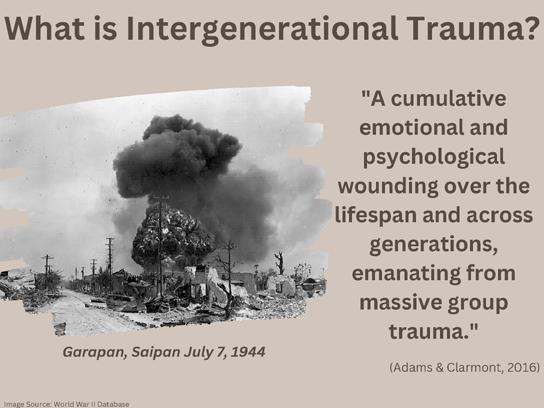


Dr. Beylul Solomon has been an Associate Professor at the Northern Marianas College under the School of Education’s Rehabilitation and Human Services concentration since 2016. She received her PhD in Developmental Psychology from Yeshiva University, NY in 2009 and has spent over 9 years teaching in the Micronesian region of the Pacific, specifically in the Republic of the Marshall Islands and the Commonwealth of the Northern Mariana Islands (CNMI). Dr. Solomon has several years of experience teaching and conducting research, and has authored numerous publications and presentations. One of her most recent work focuses on implementing Indigenous rights legislation and utilizing Indigenous knowledge to improve the mental health and academic outcome of youth in the CNMI. This work resulted in her receiving the CNMI Governor’s Humanities Award in research and publication in 2022. Dr. Solomon has a passion for developing underrepresented students to become mental health professionals and scientific researchers.

William J. Fife III, received his BS in Public Affairs from Indiana University, his MA in International Relations from the University of Indianapolis, and his JD from Florida Coastal School of Law. For 12 years, Fife has engaged in public service for Indigenous peoples of the Pacific with the US Peace Corps in the Kingdom of Tonga, Micronesian Legal Services Corporation in the Marshall Islands and the CNMI, and with the CNMI Public School System at Kagman High School and Northern Marianas College. Fife has Bar memberships with the Supreme Court and Federal District Courts of the State of Indiana, the Republic of the Marshall Islands, and the Commonwealth of the Northern Mariana Islands (all inactive and in good standing). He has a passion for human rights advocacy, intrepid travels, Grateful Dead music, chess, and exploring the mysteries of history.
Rethinking "Village" and "Community" in Ancient CHamoru Society
By Dr. Boyd Dixon and Aja Reyes Archaeologist, Stantec, and SEARCH; and Marine Biologist, Field Scientist, and GISAnalyst
Abstract: The profession of archaeology, as practiced in Guam and the Northern Mariana Islands, is challenged to define the nature and limits of the traditional Latte Period CHamoru/Chamorro "village" as used in public discourse today. Today, it appears many villages are recognized by extended families and their long-term neighbors who have occupied one locally defined landscape over generations. The contemporary term "community" is therefore proposed here instead of village when referring to a broader range of Latte Period archaeological sites and associated activities such as ceramic manufacture presumably integrated especially during times of shared need and celebration.
Presentation Recording

Introduction to Ancient CHamoru Society
The profession of archaeology, as practiced in Guam and the Northern Mariana Islands, is challenged to define the nature and limits of the traditional Latte Period CHamoru "village" as used in public discourse today. This is not surprising since villages in Guam are not generally defined on modern island maps, only municipalities. Today, it appears villages are recognized by extended families and their long-term neighbors who have occupied one particular geographically defined landscape over generations, and many are focused on their Catholic church and the yearly events that revolve around them.
The contemporary term "community" is therefore used here instead of village when referring to a broader range of Latte Period archaeological sites often associated with a wider set of CHamoru placenames, some perhaps shared by other communities in northern or southern Guam. In this paper, selected archaeological sites representing particular communities of coastal "villages" and farming "zones" on the northern plateau of
Guam, will be compared to communities with coastal fish weirs and with inland villages with rock art caves in the southern uplands and in the Northern Mariana Islands to discuss the archaeological evidence of community integration in CHamoru society by the first arrival of Spanish settlers.
The beginnings of CHamoru society existed long before the seven centuries of the Latte Period and were preceded by over two thousand years of cultural development on Guam and the largest of the Northern Mariana Islands (Figure 1). These Pre-Latte sites (so called because they lack latte stones) are today dispersed widely throughout the islands of Guam, Tinian, Saipan, and somewhat later on Rota between approximately 1500 BC – AD 1000 (Carson 2018; Dixon et al. 2022; Reith et al. 2021).
This early integration suggests that certain shared activities of subsistence and perhaps ritual were deliberately maintained over many generations by interrelated families and clans or lineages. By AD 1000, many inhabitants moved either seaward or inland with a more terrestrial based subsistence strategy that evolved into a system to share/barter/trade with their coastal neighbors and families – in other words, the roots of what we identify today as the traditional CHamoru "community". Resource sharing concepts that persist into modern CHamoru culture include the philosophy and practice of reciprocity known as (chenchule) and of well-being (inafamaolek) where supplies, money and/or labor are provided to support family-gathering events (e.g., weddings, rosaries and funerals), or circumstances that would make resources scarce (e.g., typhoons, drought, natural disasters, economic crisis).

Figure1. Latte Period Sites on Guam, Islands in the Marianas Archipelago. (Source: Jackie Schaefer)
The Development of Latte Period Communities
Between approximately AD 800 and 1521, Latte Period CHamoru inhabitants of Guam and the Northern Mariana Islands shared a distinctive expression of Micronesian culture. Variations between communities on each of the islands of the Marianas did exist in the archaeological record and are especially notable in domestic architecture, subsistence activities, rock art, settlement patterns, and interment rituals. Community labor appears to have been reorganized around the construction of the iconic latte stone habitations found across the Marianas Archipelago. A later focus upon agricultural and aquaculture expansion is also evident perhaps associated with European contact after 1521 (Dixon and Schaefer 2014).
Archaeological evidence at larger latte settlements suggests feasting and gift-giving were likely involved during such periodic construction events and at certain burials (Dixon and Dega 2024, in prep). At the large Chamorro village of Anaguan on the west central coast of Saipan, some burials found between former latte habitations contained grave goods such as slingstones, basalt adzes, spondylus shell beads, and one ceramic vessel with small child burial (Dega et al. 2020), suggesting different modes of shared community affirmation. Plaiting and later weaving of clothing, foot ware, hats, matting, and basketry using native vegetation (Monton-Subias 2022) is another likely source of perishable gifts rarely encountered in pre-Contact archaeological contexts.
After sporadic Spanish contact between 1521 and 1668, especially with certain CHamoru communities in and around Tomhom (Tumon) and Hagåtña (Agana), Jesuit missionaries observed that "despite the lack of centralized political power, the Marianas Archipelago displayed a common cultural unity. All the inhabitants of the island-chain spoke a common language, CHamoru, a member of the Austronesian language family. Other strong cultural features were its matrilineal system, affording considerable authority to women, its young men’s houses in the village, the practice of marriage outside the clan, and the intense trading activity of the society throughout the years" (Hezel and Atienza 2021:136).
During the ensuing early Spanish Colonial era of La Reducción circa AD 1700, "In the partidos – villages – one could easily find chiefs and principals from different clans and levels forced to live together in only one village after the reduction" (Atienza 2014:32). In rural areas of Guam, however, resistance to Spanish entanglement was evident in the archaeology of resilience beyond the reach of surveillance by Spanish authorities (Perez Hattori 2004:16), including the persistence of native land use and subsistence activities with family customs well into the early twentieth century. This practice still in existence today in the form of lanchos "…emphasized the longevity of cultural memory encoded in land use practices from pre- Contact to Colonial times even in the face of sustained Colonial enculturation" (Dixon et al. 2020:90).
In this paper, it is the material expression of these cultural traits today recognized as Latte Period archaeological sites that will be used to define CHamoru communities, before and after the first arrival of Spanish missionaries and their Philippine lay helpers (Dixon et al. 2010). A sample of other unique site types in Saipan, Tinian, Rota, and Pagan is then presented (Figure 2) in a discussion of the implied structural integration of CHamoru Latte Period communities across the Mariana Islands during the Latte Period. In particular, coastal villages such as Achugao (San Roque) and Litekyan (Ritidian) and farming zones at Caiguat on the northern plateau of Guam (see Figure 1) will be compared to coastal fish weirs at Laguas and Abo with inland villages at Maagas and rock art caves at Mahlac in the southern Guam uplands.

The Archaeological Sites with Latte Period Communities in Guam and the NMI
The islands north of Guam, which make up the current CNMI, are the location of some of the most dramatic outliers of the expression of megalithic Latte architecture and rock art caves in the archipelago (Russell 1998). Perhaps the earliest example of Latte Period cultural heritage and likely multi-community use recorded in the Marianas Archipelago is Kalabera Cave (see Figure 2A), containing human burial remains and white painted images including a man in a canoe and headless anthropomorphic figures (Jalandoni et al. 2016). The tallest latte set in the Mariana Islands is on Tinian and stands 16 meters high (see Figure 2B), named after the famous maga'lahi or leader who is believed to have buried his beloved daughter inside a cavity in one of the tasas. The largest latte set that was ever quarried but never erected is the As Nieves quarry on Rota (Lizama et al. 1981), where nine columns and seven capstones even larger than Taga House on Tinian were carved and removal begun before the quarry was abandoned (see Figure 2C), perhaps due to the inadequacy of the limestone used to craft the huge stones or a social event untold.
On Pagan (Dotte-Sarout 2020), well to the north of the largest islands already mentioned, part of the Latte Period cultural landscape included small boulder lusongs for pounding plant foods and much larger boulders with multiple depressions believed to be used for grinding medicinal herbs. Both white and black sand beaches with small coral reefs contain a ready supply of fish (see Figure 2), plus orange Spondylus shells used in polished necklaces and pendants (Dixon et al. 2021) to adorn the living and the ancestors.
Figure 2. CNMI Latte Period Sites: A. Kalabera Cave on Saipan, B. Taga House on Tinian, C. As Nieves on Rota, D. Regussa Beach on Pagan with Gilbert Borja and John Castro. (Source: Dixon et al. 2021)
Guam, although larger than the northern islands and the site of many and significant latte sites, is noticeably absent from this list of largest and most unusual latte sites. Perhaps the smaller size of the Northern Mariana Islands led to more intensive intra-island and community competition, or it may be an expression of cultural differences shared between each other. Indeed in 1602, Fray Juan Pobre who jumped ship on Rota noted "During the year, they get together at special times or for festive occasions. These gatherings include not just the people of a particular village, but those of others as well…" (Driver 1993:18).

Latte Period Artifacts in Guam and the NMI
Latte Period artifacts of pottery, stone, and shell (Figure 3) such as found in the Afetna Village on Saipan (Dixon et al. 2019) were encountered in and around CHamoru villages with burials and wider communities on all islands of the Marianas Archipelago. Volcanogenic basalt and andesite were favored for large lusongs or mortars as well as smaller tools, such as adzes, chisels, gouges, and pounders, which were used at home or in the forest on a daily basis. Chert, including chalcedony, were used for expedient and knapped cutting, drilling, and incising tools. Marine shells of various species were modified for tools and ornamentation. Tridacna shells were used to create adzes and gouges for woodworking, Isognomen for fishhooks, and Cypraea shells for octopus lures. Spondylus was used to create delicate beads and other jewelry/ornamentation that were worn regularly for ceremonies (Garcia 2004 [1683]:170-171) and adorned the dead for burial (Amesbury and Walth 2016). Slingstones of polished coral and fossilized limestone were used in combat and hunting or adorning burials, while spearpoints of human leg bones were used in combat and sometimes found in buried victims. Local clay pottery with volcanic sand temper was likely manufactured by "communities of practice" (Miller-Moore et al. 2021) or groups of female potters in each village and transported to forests, fields, and caves for daily or ritual uses, including burial offerings.
Figure 3. Afetna Village Latte Artifacts on Saipan: A. Basalt Adze, B. Polished Coral Slingstones, C. Tridacna Shell Adzes, D. Type B Ceramic Rim Sherds, E. Spondylus Beads both Sides, F. Human Bone Spear Point both Sides. (Source: Dixon et al. 2019)
Organic materials break down rapidly in tropical climates. Therefore, they are rarely recorded in archaeological studies. Examples of organic artifacts include woven artifacts, such as mats, textiles, marine or aquatic traps, baskets, ornamentation and hats, canoes, and structural supports or frames. Organic source materials in the Mariana Islands may have included plant materials, such as Pandanus, Cocos, bamboo (Monton-Subias and Dixon 2021). The uses included to store venerated ancestors’ crania in the rafters of the house, hats for the sun and rain, mats to sit or sleep on, sails for canoes, siding for homes, sandals for tired feet, and minimal clothing. Wooden spears, paddles, musical instruments, digging sticks, coconut shredders, and handles for stone and shell tools were likely kept close to hand at home and in nearby workshops or distant fields. Nets for fishing were probably woven from pandanus and dried around the canoe sheds while rope and twine could be made from vines growing in the garden or in nearby forests.

Latte Period Coastal Villages in Northern Guam
Latte Period inhabitants living in coastal villages and larger communities such as Litekyan at the time of Spanish contact beginning in 1521 built A-frame wooden pole and thatch houses on top of parallel sets of latte stones (Figure 4), generally consisting of limestone columns or haligi and coral or limestone capstones or tasa (Figure 5). Archaeological evidence and early historic archival documents suggest that latte buildings served various related functions such as family housing, canoe storage and maintenance, household food production, ancestor veneration, and burials (Carson et al. 2014, Dixon et al. 2006, Reinman 1977, Thompson 1940). Today, latte stones on Guam and across the Mariana Islands are one of the most distinguishable aspects of CHamoru culture (Carson 2018; Dixon et al. 2021), a symbol by which the native people of the islands identify themselves and the strength of their society 500 years after first European contact. The association of latte stones with burials is not absolute in the archaeological record, however, since there are latte sets without burials and burials without latte sets.
Figure 4. Litekyan Latte Village: Two Latte Sets and Archaeological Excavations. (Source: Bayman et al. 2012)
Archaeological field schools in 2008 and 2009 led by the University of Guam, the Universitat Pompeu Fabra, and the University of Hawai'i at Litekyan, excavated two adjacent latte sets located on the west side of the Latte village (Bayman et al. 2012), and demonstrated different but interrelated domestic activities during the early Contact period (CE 1521-1668). Both latte houses had their own task specialties, and both activity areas were probably gender specific. Females in one structure likely concentrated on ceramic production (Miller-Moore et al. 2021) and food processing plus the making of marine shell and imported glass bead ornaments. Males in the other structure likely concentrated on making fishing gear using iron nails and stone tools for woodworking tasks. It should be noted, however, that no archaeological evidence of gender separation during family habitation was noted in excavations of these or other latte sets dating prior to 1668 (Carson 2017). In fact, when two clergy attempted to burn down a structure associated with single males and females or guma' uritao, the community burned down the church, schools, and mission house in 1675 (Jalandoni 2011).

Figure 5. Litekyan Latte Village: A. Beach View to the Southeast, B. Latte Set and Cobble Features, C. Haligi Column Supporting Latte House, D. Natural Rock Shelter with Cooking Features. (Source: Courtesy of Mike Carson; Dixon et al. 2011)

6. Caiguat Latte Period Farming Site: Partial Latte Set and Agricultural Features. (Source: Dixon et al. 2015)
Latte Period Inland Farming in Northern Guam
Inland farming and forest collection sites such as Caiguat (Figure 6) on the northern plateau of Guam consisted of communities of relatively small latte set habitations and lusongs or mortars for grinding and processing foods and herbal medicines (Figure 7) spaced around fields often distant from coastal villages. Such sites today also consist of agricultural clearing features such as stone walls or piles and burned rock ovens or hearths across large and productive soil areas, sometimes with burials underneath or nearby the occasional latte sets (Dixon et al. 2015). Broken or reused stone tools including basalt adzes or axes for clearing forest or fields, and pounding and grinding tools for processing breadfruit, yams, and taro were found on the surface, plus low mounds of firecracked limestone rocks raked out of earth ovens in use during the harvesting and preparation of forest fruits and field crops (Moore 2015).
In discussions with former UOG president Dr. Robert Underwood, it is hypothesized that CHamoru practitioners of traditional "…agriculture in the latte period were [sic] aware of the need to supplement the nutrients of the soil on the limestone plateau… [and they did not] just plant what could grow and avoided planting food items which could not grow" (Underwood personal communication 2022). Farming techniques that might supplement nutrients could include dry season burning of weeds or turning over harvested plant remains into the soil, and the planting of root crops in small circles or piles of stone with their rotting leaves and organically enriched soils to trap rain and maintain a warm temperature during the growing season. Dryland Marianas rice and tubers such as taro might require the reworking of moist soil in shallow depressions for repeated planting (Dixon et al. 2011). Denser forest plots could be cleared for a few seasons with subsurface features maintained to prepare crops such as yams or arrowroot for transport to more distant villages and their communities (Moore 2015), until the soil was depleted and left to grow back in weeds and shrubs.
Figure
Similar techniques might suffice to maintain household gardens where soil or sand mounds might be used as planting areas that could be watered from home, while tending groves of useful trees some grown in the garden (Safford 2009 [1905]:143) and medicinal herbs in the cliff lines nearby. Until European Contact after 1521, pests such as deer, pigs, and rats or many insects and imported crop diseases would not have been a primary concern to farmers.

Latte Period Inland Villages in Southern Guam
In contrast to extensive coastal communities such as Litekyan in northern Guam, large inland villages such as Maagas (Figure 8) in the well-watered southern uplands of Guam might have had 30 or more roughly contiguous latte structures (Figure 9) on ridgetops overlooking springs and rivers with arable soils. Several of the largest latte sets had a lusong at one end as noted elsewhere in the Marianas (Dixon et al. 2006:65) suggesting the agricultural productivity of small karst lakes and permanent rivers nearby. While burials were presumed to be associated with larger latte structures and their families or clans, none were encountered during minimal testing. Portions of this rugged landscape are comprised of a pocket of large karst sinkholes with marshy interiors completely surrounded by volcanic ridges with Latte Period sites. This large latte site is also close to Lost River Cave, so was previously named because the stream Tole Yu’us (or "Bridge of God" in the CHamoru language) disappears into an arched limestone cavern nearby, only to bubble up downstream from the Fena Reservoir where it joins the Maagas River which drains this unique environment.
Figure 7. Caiguat Latte Period Farming Site: A. Lusong Mortar, B. Stone Clearing Pile, C. Stone Clearing Wall, D. Partial Latte Set Alignment. (Source: Dixon et al. 2015)
The quality of finishing on Latte pillars and capstones varied with size of each latte set at Maagas (Dixon and Gilda 2011) and between each neighboring community, with the smaller latte houses generally consisting of crudely shaped and finished slabs of limestone, while the larger latte sets consisted of well- shaped and finished slabs, generally trapezoidal in shape. The difference in shape and denseness of the pillars and capstones was likely determined to some extent by the availability of construction materials. With the weight and size of wooden superstructures, heavier and larger sized A-frame houses perhaps necessitated a greater homogeneity in building materials supporting them, with the added consideration of stability during earthquakes and typhoons. The social consciousness or esthetic tastes of the inhabitants may also have figured in these observed differences in pillars and capstones, as might be the variation inherent in differing functions such as habitations, guma' uritao for single males, and perhaps other gender related domestic activities. It is also likely that differences existed between communities in their wooden houses set upon these lattes, including their exterior detail in carpentry, roofing trim and pitch, ladders and doorways, exterior "furniture" such as lusongs, and an appreciation of their view plane.

Figure 8. Maagas Latte Village: Six-Pair Latte Set with Haligi, Tasas, and Archaeological Excavations. (Source: Dixon and Gilda 2011)

Figure 9. Maagas Latte Village: A. Upright Haligi, B. Fallen Haligi and Tasa, C. Repositioned Haligi and Tasa Upright, D. Latte Set after Clearing. (Source: Dixon and Gilda 2011)
Latte Period Rock Art Caves in Southern Guam
Latte Period or earlier use of Mahlac Cave by one or more communities in this karst landscape of upland southern Guam was not far from Maagas Village and involved the painting of pictographs in several panels on rock walls (Figure 10). The cavern is also known locally as Bird Cave (Gosser et al. 2004), perhaps once supporting the hunting of cave swallows or harvesting of their eggs and nests. Mahlac Cave contains one of the largest and most complex corpuses of rock art in the Marianas (Hunter-Anderson 2017, 2021), with white headless human-like figures and more complex red anthropomorphic figures with multiple appendages, plus several figures not recorded elsewhere in the islands (Figure 11). In addition, the cave contained fairly dense scatters of Latte pottery on the surface near the two entrances to the cave, and excavation during the previous recording of the site yielded two Latte Period radiocarbon dates.
The density of pictographs and the unique figures represented at Mahlac Cave suggest the large cavern may have been the scene for group rituals repeated over centuries, at least during the Latte Period. Two latte sets were also present on the small lakeshore below Mahlac Cave, in an area otherwise far removed from permanent habitations, suggesting a resident caretaker family or lineage claim to the cave above. Another hypothesis is that many rock art sites were "often situated near boundaries (both geographical and spiritual) that were periodically crossed by groups of individuals who would have recognized – if sometimes ignored – the function and content of these symbols" (Hunter-Anderson et al. 2001:213) as marking prehistoric sociopolitical boundaries or buffer zones. Caves with rock art also sometimes had burials perhaps placed to show respect to their ancestors or I man-aniti (Cabrera and Tudela 2004).


Dixon & Reyes • Rethinking "Village" and "Community"
Figure 10. Mahlac Cave: Pictograph Panel. (Source: Gosser et al. 2004 ; illustrated by Jackie Schaefer)
Figure 11. Mahlac Cave: A. Entrance, B. Headless Figures, C. Anthropomorphic Figures, D. Undetermined Figure. (Source: Gosser et al. 2004)
Latte Period Fish Weirs or Gigao in Southern Guam
Archaeological survey in the mangroves along the edge of Inner and Outer Apra Harbor on the mid-west coastline of Guam (Figure 12) recorded two complexes of low-walled coral enclosures called gigao and scattered latte sets with discarded Latte Period pottery and marine shells on marshy shore (Dixon et al. 2013:357, Figure 4), presumably belonging to two fishing communities with ties to inland villages. Walls on the coral shelf and mangrove mudflats extended beyond the low tide area near freshwater seeps (Figure 13), and likely served to divert and trap lagoon fish captured with talaya (throw net), lagua’ (pocket net), or chenchulu (surround net) (Amesbury 2012) at the mouths of the Laguas and Abo estuaries. The walled enclosures were composed of irregularly shaped, medium to large coral heads, removed from inside the enclosures and piled directly on the tidally inundated coral substrate without the aid of mortar or fill. While some stacking was evident, the walls were very porous and today attract mangrove growth due to their stability and entrapment of sediment from the small estuaries flowing into the features.
The outer walls of the roughly rectangular shaped enclosures measured approximately 3 meters wide and under 1 meter tall, accounting for some collapse after years of abandonment and typhoon damage, while some of the inner walls were less substantial. Many of the walls did not reach the modern shoreline during high tide, and much of their interiors were exposed with mud skipper fish and bivalve shells during low tide. Controlled excavation adjacent to one of these complexes yielded late Latte Period pottery and wood charcoal radiocarbon dated with a Bayesian calibration to AD 1645-1725 (Dixon et al. 2012). This date is well after Ferdinand Magellan’s arrival in 1521 and roughly contemporaneous with the first arrival of Spanish priests to settle Guam in 1668, or visits by Carolinians to Guam in the early 1700s (de Freycinet 2003:209).

Figure 12. Laguas Latte Period Gigao: Coral Walled Fish Weirs, Latte Stones, and Artifact Scatters. (Source: Dixon et al. 2012)

(Source: Dixon et al. 2012)
CHamoru Community Integration in the Latte Period and Today
Today, Latte Period cultural heritage binds CHamoru people and their communities on Guam and the Northern Mariana Islands together just as securely as does the internet or international flights to and from the rest of the world. One aspect of CHamoru culture likely beginning in the Latte Period that continues to bind modern communities is feasting, today for religious holidays or family life events and referred to as "fiestas" (Department of CHamoru Affairs 2003:41). The building of large stone latte sets before Magellan arrived in 1521 obviously required the labor of many individuals and some with special knowledge; stone quarrying, latte carving, carpentry, labor organization, and the ability to feed large numbers of people for several days at a time. These social events also required special knowledge: the farming of food from land and sea, the cooking of meals in ovens and hearth features, the pounding of taro and yams in basalt lusongs, the manufacture of large ceramic vessels for storage and serving, and the social grace and good will to perpetuate mutually beneficial relationships over multiple generations.
Another aspect of community integration probably associated with Latte Period feasting may be seen in the commonality of particular ceramic production and decorative techniques (Miller-Moore et al. 2021; Moore 1994, 1996), suggesting that coordinating certain tasks would have been greatly facilitated by skilled artisans teaching others such techniques within and between villages (Dixon et al. 2022). This relative uniformity in CHamoru Latte ceramic production may also be interpreted in terms of Practice Theory. "Communities of ceramic practice seem to reflect an underlying tendency of household potters to conform to the existing practices of the neighboring potters with whom they interacted most regularly, or whose pots they saw or used
Figure 13. Laguas Latte Period Gigao: A. Abo Cove Wall, B. Laguas Estuary Wall, C. Shoreline Wall, D. Shoreline Artifact Scatter.
routinely." In fact, "even profound linguistic differences between neighboring polities, villages, or families did not necessarily hinder the kinds of interaction that led to increasing similarity of ceramic practice" (Worth 2017:146).
One archaeological example of an integration event within such communities of ceramic practice has been proposed by Darlene Moore during the Latte Period, with her identification of "presentation vessels" at the inland site of Magua' in North Finegayan. "If presentation vessels were used during certain social events rather than for everyday meals, it could be inferred that the site’s occupants hosted gatherings that may have included people from other settlements. Hosting social events could indicate that the site had more status than some of the other Latte Period sites in the project area" (Moore, in Dixon et al. 2016:5-128, Vol. 1). Another island SE Asia example of such integrative events termed "competitive feasting" (Junker 2000:313) may have been associated with prestige good exchange to formalize marriage alliances between growing Latte Period communities in the Mariana Islands, likely involving the gifting of decorated ceramics and shell ornaments or more distant crafts and exotic raw materials or stone tools in exchange for familial obligations.
Such inter-community relationships are hinted at in the Spanish Jesuit Fray Lopez de Alonso 1676 map, where some site names are duplicated in coastal and inland zones (Madrid 2016). Today, many traditional CHamoru families are integrated with each other by the values of Kostumbren CHamoru (Department of CHamoru Affairs 2003:23) including chenchule (gifting) and inafamauleg (making right) that also still serve to integrate CHamoru communities at fiestas and in major life events. And an observation based on early Spanish Colonial writings of Jesuits and their lay helpers in Guam and Rota asserts that "The most important values in indigenous pre-Hispanic communities are Chechulu (redistribution), Mamalao (shame), and the opposite ones" (David Atienza, personal communication 2022).
Rethinking CHamoru Villages and Communities
What is important to remember from this study of archaeological sites in Guam and the Northern Mariana Islands by 1521 is that CHamoru Latte Period communities and their larger island societies had maintained and preserved their cultural values and traditions over many more centuries. This level of integration within each village and its wider community and between neighboring communities was therefore quite successful. It thereby enabled CHamorus to access forests, arable soils, and terrestrial birds in the uplands while exploiting marine and near-shore resources that could then be shared with extended families. This safety net or talaya (a traditional fishing term) presumably evolved to deal with seasonal excess or periodic shortfalls in rain and available foods, so was all the more important after the demands of Spanish contact and then settlement.
Dr. David Atienza, Associate Professor at the University of Guam (UOG) when questioned about the nature of CHamoru communities in the Mariana Islands at European Contact, postulates that "the community was likely structured through matrilineal ties along the whole archipelago, which was successful due to its north- south situation to minimize the impact of typhoons and other calamities... we can [also] clearly see in the sources the integration during the resistance (warriors) and the protection that some clans gave fugitives from one island to another" (Atienza, personal communication 2022). However, in evaluating letters written to Spain by Jesuit missionaries in Guam or upon their return to Mexico, "Solidarity among clan members was considerable, but so was the rivalry that existed between leaders such as Hurao, Quipuha…" (Coello de la Rosa and Atienza 2020:20).
On the northern Guam plateau, large coastal villages such as Litekyan were presumably integrated by clan solidarity and shared rivalry with other coastal communities such as Urunao and Jinapsan, together likely maintaining traditionally farmed planting areas on the plateau such as Caiguat and Sabanan Fadang with smaller latte clusters such as Magua (Bayman et al. 2020) for generations. Today, these plateau areas are reflected archaeologically in clusters of artifacts with Latte Period ceramics and lusongs plus stone or shell tools, both on the surface and in subsurface cooking ovens and midden disposal features. The presence of burial clusters or individuals in areas with no apparent latte structural remains suggests a new model of Guam’s northern plateau subsistence and settlement previously unrecognized (Craft et al. 2023). These sites are sometimes situated where feasible near slightly depressed areas of relatively deep clay loam soils, termed sagua in CHamoru. They also appear to be situated generally about a half-day walk from the coast and often near the remains of late historic to modern lanchos (Monton-Subias and Dixon 2021) some with concrete water cisterns and/or beehive ovens or hotnu, and a few with evidence of WWII era Japanese straggler use. Besides these newly recognized northern plateau farming communities, large coastal villages in northern Guam were also sustained by access to freshwater caves or hand-dug wells, such as noted in recent lidar images of the site of Litekyan (Jalandoni et al. 2022).
In the southern Guam uplands with a more dendritic settlement pattern, community integration was maintained between inland villages such as Maagas, situated above the web of permanent rivers flowing from springs deep in the Fena Basin, down winding trails to their sister villages on the coast. Such communities were likely sanctified by communal rituals perhaps performed at rock art and burial sites such as Mahlac Cave, also situated in the permanently watered uplands. Yet another example of community integration in southern coastal Guam was reflected in coral or stone fish weirs or gigao in the Laguas and Abo estuaries and surrounding villages around Apra Harbor. Such sites presumably fed farmers and their families in upland fields and villages and even seasonal visitors from afar after Spanish contact in 1521 and into Spanish settlement in 1668 (Dixon et al. 2010). The presence of large heavy andesite and basalt lusongs from the southern volcanic uplands located at northern inland plateau sites such as Caiguat also indicates Latte Period community integration on Guam and in the NMI was likely a relationship intended to last generations, even after European contact and into La Reduccion.
Conclusions
In conclusion, thanks in large part to the sustained efforts of Kleinfelder on the northern Guam Plateau (Craft et al. 2023), the suggested use of the contemporary term "community" by the profession of archaeology to help integrate the material expressions and limits of the traditional and historic Latte Period CHamoru "village" has been introduced into public discourse on Guampedia today. Moreover, their work indicates that "It is arguable that many of the indigenous societies of the Americas [and the Mariana Islands] persisted as historically continuous descendant people… because they shaped the colonial situation into a context for perpetuating their own lives and communities through countless small acts, some even seeming to be acts of compliance…" (Sheptak 2010:149).
Acknowledgements
The above observations, however biased, could only have been made by the co-authors having benefitted from years of shared knowledge and laughs with a cherished community of CHamorus and friends on Guam and many Mariana islands during two careers. Most recently these che’lu include David Atienza, James Bamba, Lon Bulgrin, Mike Carson, John Castro, Cacilie Craft, Don Farrell, Deborah Fleming, Anne Perez Hattori, Jolie Liston, Jacy Moore-Miller, Darlene Moore, Scott Russell, Jackie and Rick Schaefer, Christina Spellman, Robert Underwood, and colleagues at Stantec, SEARCH, ABERIGUA, and GRAS.
References
Amesbury, JR
2012 Traditional Fishing on Guam. Guam Preservation Trust, Guam.
Amesbury, JR, and C. Walth
2016 Who Wears the Beads? 2,000 Years of Ornaments from an Archaeological Site on Guam. Guam Preservation Trust, Guam.
Atienza, D.
2014 Priests, Mayors and Indigenous Offices: Indigenous Agency and Adaptive Resistance In the Mariana Islands (1681 -1758). Pacific Asia Inquiry 5(1):31-48.
Bayman, J., B. Dixon, S. Monton-Subias, and N. Moragas Segura
2020 Colonial Surveillance, Lancho, and the Perpetuation of Intangible Cultural Heritage in Guam, Mariana Islands. In The Global Spanish Empire: Five Hundred Years of Place Making and Pluralism. By C. Beaule and J. Douglass, pp. 222-241. The University of Arizona Press, Tucson.
Cabrera, G., and H. Tudela
2004 Conversations with I-Man-Aniti: Interpretation of discoveries of the rock art in the Northern Marianas Islands. Micronesian Journal of the Humanities and Social Sciences 5:42-52.
Carson, M.
2017 Rediscovering Heritage through Artefacts, Sites, and Landscapes: Translating a 3500-year Record at Ritidian, Guam. Access Archaeology, Oxford.
2018 Archaeology of Pacific Oceania Inhabiting a Sea of Islands. Routledge Taylor & Francis Group, London.
Carson, M., B. Dixon, J. Peterson, and A. Jalandoni
2014 Site Definitions in a Complex Archaeological Landscape: An Example at Ritidian, Guam. In British Archaeological Review International Series 2663:105-111.
Carson, M., and H. Hung
2017 Substantive evidence of initial habitation in the remote Pacific: Archaeological discoveries at Unai Bapot in Saipan, Mariana Islands. Access Archaeology, Oxford.
Coello de la Rosa, A., and D. Atienza
2020 Scars of Faith Jesuit Letters from the Mariana Islands (1668-1684). Institute of Jesuit Sources, Boston College, Boston.
Craft, C., A. Dugan, J. Eakin, J. Ligow, J. Moore-Miller, A. Pangelinan, M. Phelps, C. Spellman, C. Young 2023 I Manmalingu na Songsong Lagu. 6th Annual Marianas History Conference / Guampedia, Saipan.
De Freycinet, L.
2003 An Account of the Corvette L’Uranie’s Sojourn at the Mariana Islands, 1819. Occasional Historical Papers No. 13, CNMI Division of Historic Preservation, Saipan.
Dega, M., D. Perzinski, and J. Ferrugia
2017 The Latte Village of Garapan: Archaeological Data Recovery Saipan Commonwealth of the Northern Mariana Islands. Prepared by Scientific Consulting Services, Inc. Honolulu.
Department of CHamoru Affairs
2003 CHamoru Heritage A Sense of Place. CHamoru Family, Traditions and Culture, pg. 23. Fiestas, pg. 41. Research, Publications and Training Division, Guam.
Dixon, B., L. Bulgrin, and M. Kottermair
2021 Latte Period Cultural Heritage in the Commonwealth of the Northern Mariana Islands. In I estoria- ta Guam, the Mariana Islands and CHamoru Culture An exhibition of "Let’s turn around the world" Official Program of the Fifth Centenary of the First Round the World, pp. 37-46. Museo Nacional de Antropologia, Madrid.
Dixon, B., and M. Dega
2024 Feasting and Gift Giving in the Pre-Contact and Spanish Colonial Mariana Islands of Micronesia. Manuscript in preparation by authors.
Dixon, B., M. Dega, D. Moore, and JR Amesbury
2022 The Early Pre-Latte Period Site of San Roque on Saipan (1500-1100 B.C). Journal of Island & Coastal Archaeology.
Dixon, B., and L. Gilda
2011 A Comparison of an Inland Latte Period Community to Coastal Settlement Patterns Observed on Southern Guam. People and Culture of Oceania 27:65-86.
Dixon, B., L. Gilda, and T. Mangieri
2012 Archaeological Identification of Stone Fish Weirs Mentioned to Freycinet in 1819 on the Island of Guam. Journal of Pacific History (48) 4:349-368.
Dixon, B., A. Jalandoni, E. Lash, and R. Schaefer
2015 Proposed Guam and CNMI Military Relocation 2012 Roadmap Adjustments SEIS. Volume I Potential Indirect Impact Area In-Fill Cultural Resources Study Narrative. Cardno, Guam.
Dixon, B., T. Mangieri, E. McDowell, K. Paraso, and T. Reith
2006 Latte Period Domestic Household Activities and Disposal Patterns on the Micronesian Island of Tinian, CNMI. Micronesica 39(1):55-71.
Dixon, B., and R. Schaefer
2014 Reconstructing Cultural Landscapes for the Latte Period Settlement of Ritidian: A Hypothetical Model in Northern Guam. In M. Carson, British Archaeological Review International Series 2663:64-73.
Dixon, B., R. Schaefer, and T. McCurdy
2010 Traditional Farming Innovations during the Spanish and Philippine Contact Period on Northern Guam. Philippine Quarterly of Culture & Society 38(4):291-321.
Dixon, B., S. Walker, M. Golabi, and H. Manner
2011 Two Possible Latte Period Agricultural Sites in Northern Guam: Their Soils, Plants, and Interpretations. Micronesica Special Supplement 8 42(1/2):216-266.
Dixon, B., C. Walth, K. Mowrer, and D. Welch
2019 Afetna Point, Saipan: Archaeological Investigations of a Latte Period Village and Historic Context in the Commonwealth of the Northern Mariana Islands. ArchaeoPress Access Archaeology, Oxford.
Dixon, B., D. Welch, L. Bulgrin, and M. Horrocks
2020 Traditional Land Use and Resistance to Spanish Colonial Entanglement: Archaeological Evidence on Guam. Asian Perspectives, 59(1):61-100.
Dixon, B., D. Welch, T. Rudolph, and I. Nelson (with contributions by Darlene Moore and Judy Amesbury)
2016 Archaeological Data Recovery in Support of the J-001B Utilities and Site Improvements at Naval Base Guam Telecommunications Site, Guam. Volume 1: Narrative. Cardno, Guam.
Dotte-Sarout, E.
2020 The first archaeological explorations of the Mariana Islands and the tireless Alfred Marche. In E. Dotte-Sarout, F. Valentin, A. DiPiazza, and M. Spriggs. Pour une histoire de la préhistoire océanienne /For a History of Prehistory in Oceania (Bilingual edition). Pacific-credo Publications, Marseille.
Driver, M.
1993 The Account of Fray Juan Pobre’s Residence in the Marianas 1602. Micronesian Area Research Center University of Guam, Mangilao.
García, F., SJ
2004 [1683] The life and martyrdom of the venerable Father Diego Luis De San Vitores, S.J. MARC Monograph Series No. 3. University of Guam Press, Guam.
Gosser, D., B. Dixon, L. Gilda, and T. Torres
2004 Final Cultural Resources Survey and Limited Subsurface Excavations at Naval Ordnance Annex and Waterfront Annex, Territory of Guam. AMEC / Ogden Environmental and Energy Services Co., Inc., Honolulu.
Hezel, F., and D. Atienza
2021 The CHamoru Village of Guam After Resettlement The New and the Old. 5th Marianas History Conference, Guampedia, P. 135-167.
Hunter-Anderson, R.
2017 A Study of Mahlac Pictograph Cave Images. Guam Preservation Trust, funded by the U.S. Navy, Guam.
2021 When the European Old World Met the CHamoru Old World in 1521: An Archaeological Perspective from Guam's Latte Period. In I estoria-ta Guam, the Mariana Islands and CHamoru Culture An exhibition of "Let’s turn around the world" Official Program of the Fifth Centenary of the First Round the World, pp. 47-56, Museo Nacional de Antropologia, Madrid.
Hunter-Anderson, R., B. Dixon, and T. Mangieri
2001 Draft Final Report of A Cultural Resources Survey of Five Navy Guam Land Use Parcels, Territory of Guam. Micronesian Archaeological Research Services, Inc. and International Archaeological Research Institute Inc., Honolulu.
Jalandoni, A.
2011 The Casa Real site in Ritidian, Northern Guam: A historical context. Philippine Quarterly of Culture and Society 39:27–53.
Jalandoni, A., B. Dixon, and A. Viloudaki
2016 Archaeological Monitoring Report, Kalabera Cave Improvement Project Kalabera Cave, Saipan, CNMI. ARCGEO, Saipan.
Jalandoni, A., M. Kottermair, B. Dixon, and V. Torres
2022 Effectiveness of 2020 airborne lidar for identifying archaeological sites and features on Guåhan (Guam). Journal of Computer Applications in Archaeology, 5(1): 255-270.
Junker, L.
2000 Raiding, Trading, and Feasting: The Political Economy of Philippine Chiefdoms. Ateneo de Manila University Press, Manila.
Lizama, A., M. Montvel-Cohen, and D. Moore
1981 The As Nieves Quarry and Tatgua Site, Rota, M.I. Latte: Occasional Papers in Anthropology and Historic Preservation, P. 1-33. Guam Territorial Archaeology Laboratory, Historic Preservations Section, Department of Parks and Recreation.
Madrid, C.
2016 Spanish Map of Guam, 1676. In Mo’na: Our Pasts Before Us, 22nd Annual Pacific History Conference, University of Guam, Mangilao.
Miller-Moore, J., D. Moore, and J. Bayman
2021 Gendered Households and Ceramic Assemblage Formation in the Mariana Islands, Western Pacific. Asian Perspectives Vol. 60(1):178-196.
Monton-Subias, S.
2022 La Nueva Normalidad: Cambios y Continuidades en la Cotidianeidad Chamorra Durante la Mision Jesuita (Guam, 1668-1769). In Espana y Las Islas Marianas Una Historia Compartida. Editado por Carlos Madrid, David Atienza, y Carlos Martinez, pg. 285-312. Universidad Nacional de Educacion a Distancia, Madrid.
Montón-Subías, S., and B. Dixon
2021 Guam and the Archaeologies of Colonial Intervention and Indigenous Identity. World Archaeology. Moore, D.
1994 Prehistoric Ceramics. In Archaeology in Manenggon Hills, Yona, Guam, Vol. III, Results of Analyses, Rosalind L. Hunter-Anderson (editor), pp. 3.1-3.71. Prepared for MDI Guam Corporation, Yona, Guam. Micronesian Archaeological Research Services, Guam.
1996 Pottery Analysis. In The Legacy of Tarague Embayment and Its Inhabitants, Andersen AFB, Guam, by Jolie Liston, pp. 160-186. Prepared for 36 CES/CEV, Unit 14007, Environmental Flight, Andersen Air Force Base, Guam. International Archaeological Research Institute, Inc., Honolulu.
2015 Foodways in the Mariana Islands: A look at the Pre-Contact period. Journal of Indo-Pacific Archaeology 27:49–58.
Perez Hattori, A.
2004 Colonial Dis-ease: US Navy Health Policies and the CHamorus of Guam, 3454 – 3563. Pacific Islands Monograph Series &+. Honolulu: University of Hawai'i Press.
Reinman, F.
1977 An Archaeological Survey and Preliminary Test Excavations on the Island of Guam, Mariana Islands, 1965–1966. Miscellaneous Publications 1. Micronesian Area Research Center, University of Guam, Mangilao.
Reith, T., R. DiNapoli, and HD Tuggle.
2021 Chronologies for the initial human settlement of Micronesia. In Ancient Micronesia, ed. by S. Fitzpatrick, in prep.
Russell, S.
1998 Tiempon I Manomofo’ona: Ancient CHamoru Culture and History of the Northern Marianas Islands. Micronesian Archaeological Survey Report 32. CNMI Division of Historic Preservation, Saipan.
Safford, W.
2009 [1905] Useful Plants of Guam. Published by Jillette Leon-Guerrero/Guamology Publishing, Agana Heights.
Sheptak, R., R. Joyce, and K. Blaisdell-Sloan
2010 Pragmatic Choices, Colonial Lives: Resistance, Ambivalence, and Appropriation in Northern Honduras. In Matthew Liebmann and Melissa Murphy, Enduring Conquests Rethinking the Archaeology of Resistance to Spanish Colonialism in the Americas, pg. 149-172. SAR Press, Santa Fe.
Thompson, L.
1940 The Function of Latte in the Marianas. Journal of the Polynesian Society 49:447-465.
Worth, J.
2017 What’s in a Phase? Disentangling Communities of Practice from Communities of Identity in Southeastern North America. In Gregory Waselkov and Marvin Smith, editors, Forging Southeastern Identities, pp. 117-156. The University of Alabama Press, Tuscaloosa.
Dr. Boyd Dixon is senior archaeologist for Stantec GS and SEARCH in Guam and the NMI and lives in Chalan Pago with his boonie dog. With over 35 years of archaeological experience in the Mariana Islands, Hawai'i, and the Asian-Pacific rim his research interests embrace the many people, places, and stories shared with him. In 2019, Boyd received the Northern Marianas Humanities Council Governor’s Humanities Award for Lifetime Achievement in the Humanities.
Co-presenter
Aja Reyes
Marine Biologist, Field Scientist, GIS Analyst, Guam

Healing History through Science
How Ancient and Modern DNA Analysis Confirms Chamorro Authenticity in the Mariana Islands
By Joanne E. Eakin and Rosalind L. Hunter-Anderson Independent Researchers
Abstract: The origins of the indigenous people of the Marianas have been obscured by the inaccurate writing of history that lacks a scientific perspective. This failing has led to the hurtful denial of Chamorro/CHamoru ethnic authenticity and legitimacy. Our paper shows how this intergenerational wound can be healed, in part, through the study of ancient and modern DNA from the Marianas. Here we present strong evidence from Guam and Saipan that points to Chamorro origins in the east-central islands of Indonesia, and to a remarkable continuity in both biological heritage and social practices between the first permanent settlers of the Mariana Islands 2800 years ago and present-day Chamorros. We also present new information about ancient migration streams into this region, family relationships, and lifestyle, obtained by way of advanced DNA analysis, which demonstrates the healing power of science to affirm Chamorro indigeneity and ethnic authenticity in a fraught political context.
Presentation Recording

Introduction
Marianas' archaeologists who focus on the prehistoric record apply a variety of field and laboratory techniques to learn about past human activities from material remains left by people without written records. Unlike modern historians, whose data are gleaned from inspection of written texts, we have a different method to decode the non-verbal material record of the human past: closely study the archaeological facts of interest, discern any relevant patterns in these observations, propose a model that best accounts for the patterns within
an anthropological frame of reference, test the model against relevant independent facts, and finally, retain the models that best fit the known facts.
After decades of modern research by Pacific archaeologists and others into the topic of human arrival in the Pacific islands including the Marianas, we now can state with confidence that the oldest archaeological sites in Remote Oceania are in Guam, Tinian, Rota, and Saipan and were first occupied about c. 3300 years ago (Rieth and Athens 2017; Petchey and Clark 2020). These sites are relatively rare (10 are known) and have been found deeply buried on former beaches near reef flats that had formed since sea level had dropped from its mid-Holocene highstand (Carson 2013). The sparse faunal assemblages at these sites indicate a mobile, marineoriented way of life, not a settled agricultural one, and the kinds of artifacts – mainly pottery and marine shell ornaments – show active social connections and participation in the vast trading networks of Island Southeast Asia. The pattern formed by these facts corrects past interpretive errors, for example, that the first Marianas people were rice agriculturalists from the northern Philippines, as maintained by Hung et al. (2011) but see Winter et al. (2012; Clark and Winter 2011), or that the Marianas grasslands were created by humans by 4300 years ago (Athens and Ward 2004; Athens et al. 2004). This claim was based on incorrectly interpreted patterns of pollen frequencies and other microscopic particles in paleo-sediment cores. Since the oldest sites were created only about 3300 years ago, the human causation hypothesis cannot be true; for a realistic interpretation of these paleo-sediment data see Hunter-Anderson (2009). Factual and interpretive errors persist in popular media accounts (e.g., Herman 2017) but are not perpetuated in modern textbooks and histories (e.g., Rogers 1995; Russell 1998; Rainbird 2004).
Previous comparative analyses of the DNA of modern Pacific Islanders and Asian populations suggested the origins of ancestral Chamorros lay in Island Southeast Asia (Vilar et al. 2013). Additional support for a Southeast Asian origin comes from ancient DNA studies that show that ancient and present-day Chamorros harbor the same maternal and paternal haplogroups as modern islanders in Southeast Asia (Liu et al. 2022; Pugach et al. 2021).
Study Background
In 2015, in collaboration with Drs. Ron Pinhasi and David Reich at the University of Vienna and Harvard Medical School, respectively, we embarked on a study of ancient DNA from the Naton Beach site on Guam. Two distinct populations had been recognized during the excavations and laboratory analyses: one group of people lived during the Latte Period, from about 1000 years ago, and the other people lived at the site during the Late Unai, or Transitional Pre-Latte, Period, from about 2500 years ago. The Late Unai burials contrasted with the Latte burials in skeletal morphology, pathology, and mortuary practices. With information obtained during this study, we revised and expanded the previous chronology of the prehistoric occupation of the Marianas proposed by Hunter-Anderson and Moore (2001).
Table 1. Expanded Marianas Chronology with Chamorro Term
Defined by Spoehr 1957 Defined by HunterAnderson and Moore 2001 Years Before Present (BP) CHamoru Terms English Meaning
Early Unai 3500-3000
Pre-Latte
Manhålom i Mantatasi
The ocean voyagers came and went Middle Unai 3000-2500
Late Unai 2500-1600
Mañåga i Mantatasi
Huyong 1600-1000 Manhåttalom
Latte Latte 1000-500 Manmanhåtsa Latte
The ocean voyagers stayed and established their homeland
They settled further inland
They became latte builders
Table 1 presents an expanded sequence of prehistoric cultural phases in the Marianas. We consulted Chamorro language experts Drs. Rosa S. Palomo and Laura MT Souder, who provided Chamorro descriptive terms for the cultural periods that were established archaeologically. For the Early and Middle Unai Periods, when a marine foraging adaptive system is manifested in the oldest Marianas sites, the Chamorro descriptive phrase is ‘the ocean voyagers came and went.’ The Late Unai Period is described as ‘the ocean voyagers stayed and established their homeland.’ The Huyong Period was described as a time when ‘they moved inland to utilize different resources’, and for the Latte Period the phrase is ‘the people became latte builders’.
At Naton, the Unai graves were found deep in culturally sterile white sand, over a meter below the darker, culturally enriched soils of the Latte Period. Unai burials exhibited a consistency in burial position compared to the more varied positions of the Latte Period interments: 96% of the Unai burials were in a fully extended, supine position while 56% of the Latte Period burials were found in that position (Figure 1).

The Unai burials had a larger quantity and greater variety of grave goods (valuables) compared to the Latte burials at the site (Figure 2). The total number of Unai valuables, mainly tiny beads, bracelets, and other marine shell ornaments was 1,599. Just 94 valuables, generally of different materials, were found among the Latte burials.

Figure 1. Unai burials in white sand (L), Latte burials in dark sand (R); note the separation of the Unai individuals vs. the juxtaposed Latte individuals. (Photo Defant and Eakin 2006)
Figure 2. Unai individual in situ showing a necklace of Anadara beads and a pearl oyster shell (after Walth 2016 Vol I: Fib. 9.8).

Figure 3. Comparing Unai (L) and Latte (R) crania; note the more robust Latte cranium. (L photo: J. Eakin, R photo: L. Guerrero)
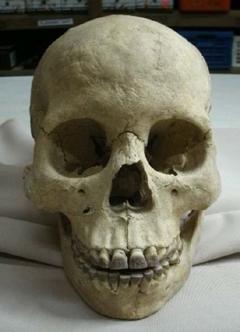
The bones of the Unai population were noticeably more gracile than those of the Latte individuals (Figure 3). The Latte population increases in bone size, incidence and types of dental wear, and changes in the locations of activity-related degenerative joint disease all suggest significant behavioral and biological changes had occurred in the Latte Period.
Betel nut staining of teeth was ubiquitous among Latte adult individuals but not among the Unai. Another difference was the tradition of cross-hatched teeth found only during the Latte Period (Figure 4).
Another significant difference between Unai and Latte at Naton was the kinds of diseases expressed in the skeletal remains. For example, treponemal infection – yaws – was not identified in the Unai population but was common in Latte individuals.
We began the search for explanations for these population-level differences at Naton by asking, were the two populations different because they from different parent populations? Or were the Unai people biologically ancestral to the Latte people, despite the many physical differences? Are present-day Chamorros related only to the Latte people? Or are Chamorros related to neither group, Unai and Latte, instead being a "replacement population" as some have contended? Ancient DNA analysis provided surprising answers, some of which we presented at the previous Marianas History Conference 2021. We present additional findings below.
Figure 4. Betel nut staining and cross-hatching on teeth of a Latte Period male (after Walth 2016 Vol 2: Fig. 9.5).

Late Holocene Sea Level Decline and Human Entry into Western Micronesia
About 4000 years ago, sea level in western Micronesia (Figure 5) began to decline from its mid-Holocene peak about 6000 years ago (Dickinson 2000). Based on recent archaeological research, marine foragers from Island Southeast Asia reached the Marianas by 3300 years ago, visiting the southern islands intermittently. In Palau’s rock islands marine foragers were occupying fishing camps in rock shelters by 3000 years ago (Fitzpatrick and Nelson 2008). Continuing sea level decline widened Marianas shorelines where trees and root crops could be cultivated, and by 2600 years ago, permanent settlements of the Late Unai, were established along the coasts of the southern Marianas. Their pottery and artifacts reflect a mixed economy of farming and fishing, and a new cooking method (Moore and Hunter-Anderson 1999).
Elsewhere in Micronesia, marine foragers began to exploit the abundant reef systems of Yap, Chuuk, Pohnpei and Kosrae, where the oldest sites have been dated to about 2000 years ago. The pottery at these sites suggests these people were connected to social systems in northern Melanesia, known by archaeologists as Lapita (Kirch 1997).
By 1000 years ago, sea level had stabilized in western Micronesia; the Carolinian coral atolls and islands had emerged, soon to be occupied by fisher-farmer groups from Melanesia. Under favorable climatic conditions of the Little Climatic Optimum, regional populations grew, and complex socio-political organizations developed, which connected people on a regional scale. Settlement patterns in the volcanic islands included a variety of coastal and inland locations, and megalithic architecture was widespread. In the Marianas, stone structures called latte manifest this southeast Asian tradition, and the Latte Period agricultural repertory expanded to include betel nut and hybrid forms of breadfruit. Upland rice, a crop unique within the Pacific islands, was an important ritual element (Driver 1988; Hunter-Anderson et al. 1995). It is unknown which variety of Oryza sativa, indica or japonica, was cultivated, as it has been identified only from husk impressions in pottery.

5. Micronesia and Adjacent Regions (adapted from WHO Regional Office for the Western Pacific 2009).
Figure
When we started this project, the prevailing settlement model held that the oldest Marianas sites were created at least 3500 years ago by rice farmers who sailed directly across the Pacific from the northern Philippines (Hung et al 2011; Carson 2013). An inaccurate inference from this scenario is that modern Chamorros are essentially derived Filipinos. Eighteenth century Spanish censuses had distinguished between native and mixed race Chamorros, "neo- Chamorros" (Rogers 1995), introducing the notion that the truly indigenous Marianas population was "swamped" out of existence by other groups during Spanish colonial times. This myth has long been countered with facts by anthropological studies of Chamorro demography and biology (Underwood 1973, 1976); however, harmful accusations that modern Chamorros harbor no indigenous ancestry persist (Herman 2017). Historians of colonialism and its myriad effects on Pacific Islanders’ sense of authenticity have created a vibrant counter-literature on this topic since the 1980s (e.g., Underwood 1985; Perez 1997; Monnig 2007; Mushynsky et al. 2022).
Our theory proposes that the earliest people in the Marianas were mobile marine foragers from Island Southeast Asia—small groups of "sea nomads" or "sea gypsies" (Sather 2006; Bellina et al. 2021) who expanded their territory into western Micronesia about 3300 years ago. Their occasional forays into the southern Marianas were to harvest the uncontested reefs for materials that could be transformed into trade items to exchange with their land partners. We suggest that the Unai burials at Naton represent the descendants of these first people, who were already familiar with the changing Marianas shorelines. They opted out of the marine foraging niche in Island Southeast Asia, and permanently settled in the Marianas where it was now possible to support themselves by fishing, gathering, and cultivating crops.
A possible reason for this adaptive shift was the loss of trading partners in Island Southeast Asia. New alliances and trading networks involved the exchange of iron objects (Beaumont et al. 2020), and the shell ornaments and other products offered by marine foraging groups were no longer valued. In this model, marine foraging was a losing proposition for the Early Unai people, and settling permanently in the Marianas was a realistic alternative. Declining sea level had widened coastal margins, and new kinds of shoreline habitats were developing. In embayments like Tumon Bay, small areas of arable soils suitable for imported root crops and tree cultivation were now available for settlement. In about 500 years, the Early Unai mobile marine foragers had become the Late Unai fisher-farmers, some of whom lived and died at Naton Beach.
The Marianas Ancient DNA Project
The unusual graves at the Naton Beach excavations in 2006 provided the impetus for the Marianas Ancient DNA Project. To begin our ancient DNA study, we coordinated with community groups and government agencies on Guam and Saipan to obtain permission and gain their trust to conduct this research. When studying human skeletal remains, their ethical treatment is a major consideration. Because they are considered ancestral to present-day islanders, it is important to treat the remains with sensitivity and cause minimal disturbance.
Ancient DNA can become extremely degraded in hot, moist tropical environments. Formerly, large pieces of bone were required for successful DNA retrieval, which caused significant destruction of the samples. Further, the amounts of DNA obtained were low, and preservation of DNA was often poor. A major breakthrough was the discovery by researchers at the University of Vienna that the petrous portion of the temporal bone is a reliable DNA source (Pinhasi et al. 2015). The researchers developed laboratory techniques that allow the recovery of DNA from fragile, ancient skeletal remains with minimal destruction of the sample.
The petrous portion of the temporal bone (Figure 6) houses the middle and inner ear. Using modern techniques, DNA is recovered from the petrous bone by targeting the cochlea. The cochlea, situated deep inside the hard, protective petrous bone, is the optimal site to retrieve ancient DNA since it is less subject to deterioration and
damage. The densest bone in the body, the petrous remains strong and protective even under adverse burial conditions. The scientists in Vienna developed methods to collect a very small amount of cochlear bone (Figure 7). Each sample of cochlear bone is powdered, processed for analysis, and sent to a specialized lab where the DNA fragments are decoded and transformed into genetic sequence data. Geneticists then analyze and compare these sequences to those of other populations. In this way, ancient, historical, and contemporary relationships can be discerned.
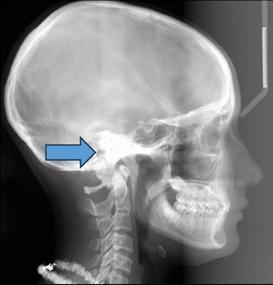

Samples from the Naton Beach site and the Haputo site in Guam and from the Anaguan site in Saipan were processed and analyzed by our collaborators in Vienna and Boston (Figure 8). The favorable results from this analysis enabled an ambitious regional study of Micronesian population history. In that study (Liu et al. 2022), the DNA of 109 individuals (2800 to 300 BP) from the Unai and Latte periods in Guam, including published data from two individuals (Pugach et al. 2021) were analyzed along with the DNA of 46 (600 to 200 BP) Latte Period individuals from Saipan and 11 (500 to 300 BP) Isohkelekel Phase individuals from Na Island and Nan Madol in Pohnpei. Modern DNA from 112 individuals from Guam, Palau, Pohnpei, and Chuuk formed an important part of the study along with published data from 95 prehistoric and 1642 present-day individuals.
Migration Streams
A migration stream is composed of individuals who shared genetic lineages. This study detected five prehistoric migration streams that entered the western Pacific, four of them prior to 1700 years ago and one about 1000 years ago (Figure 9).
The abbreviation, FRO, refers to First Remote Oceanians, those who participated in the first three prehistoric migration streams entering Micronesia before 2800 years ago and no later than 1700 years ago.
M1 lineage, FROMarianas, was identified by DNA from Naton Unai individuals. Analysis revealed a homogeneous ancestry. A thousand years later, Guam and Saipan Latte Period people derived ~85% of their ancestry from the same source, harboring the same mitochondrial haplogroups E1 and E2. Modern Chamorros share the same maternally inherited lineages and they derive their East Asian ancestry from the earliest inhabitants of the Mariana Islands. These findings exhibit remarkable genetic continuity throughout the prehistoric record and into modern times.
Figure 7. Laboratory processing of ancient DNA sample. (Photo: O. Cheronet)
Figure 6. The petrous bone in the human skull. (Photo: O. Cheronet)


Figure 8. Ancient DNA sampling locations in Guam and Saipan.
Figure 9. Five streams of migration into Micronesia (Liu et al. 2022).
M2 Lineage, FROPalau, is a previously unknown lineage that came to Palau before 2400 years ago. It was inferred from whole genome analysis of present-day Palauans; at the time of this study, we had no ancient DNA from Palau. The M2 migration stream might be represented archaeologically at the few known fishing camps in Palau’s rock islands.
The regional study determined that Latte people derived ~15% of their genetic ancestry from the M2 FROPalau migration stream. Geneticists estimate that the M2 lineage admixed with M1 FROMarianas between 2400 and 1700 years ago, some 45 to 50 generations before the Latte Period began. Where and how this ancient admixture occurred is unknown, but we are hopeful that when ancient DNA from Palau is analyzed, we will be able to more precisely date this event.
M3, FROSouthwestPacific, was previously identified from Lapita samples in Vanuatu and Tonga. The M3 migration stream into Micronesia began before 2100 years ago. Our study inferred genetic homogeneity in central Micronesia. M3 is a better single source proxy for the primary First Remote Oceanian ancestry in central Micronesia, including Pohnpei and Kosrae. M1 FROMarianas is older and found only in western Micronesia.
The M4 and M5 migration streams began east of Island Southeast Asia, in northern New Guinea and Polynesia. M4 is Lineage: PapuanNewGuinea. Our study inferred dates of admixture between FROSouthwestPacific and Lineage: PapuanNewGuinea in Chuuk and Pohnpei at 2100 to 1800 years ago. The population history of the central high islands of the Carolines is different from western Micronesia.
M5 Polynesia, the most recent prehistoric migration stream identified to date, flowed from Polynesia into central Micronesia to populate the so-called "Polynesian Outliers" such as Nukuoro and Kapingamarangi in Pohnpei state. M5 Polynesia pertains to the older, transient occupation of these atolls c. 1000 to 700 years ago. We do not yet have ancient DNA from the atolls and raised coral islands of central and eastern Micronesia. However, the estimated date for M5 Polynesia matches well the geological record of ~1000-year-old emergence of the coralline Carolines (Dickinson 2009).
The precise geographic area from which M1 emerged is unclear. The Marianas archaeological record and the genetic dominance of the E1 and E2 haplogroups lead us to believe that an origin in Island Southeast Asia/Wallacea region is likely and supports previous inferences in studies of modern maternally inherited DNA (Hill et al. 2007), which found that the origins of these ancient haplogroups were in Wallacea, not Taiwan, as implied by historical linguistics models of Marianas settlement (e.g., Blust 2019; Hung et al. 2011).
Figure 10. Possible M1 route into northwestern Micronesia (adapted from Clark and Winter 2019: Fig. 2.1).

Key Findings from Whole Genome Analysis
Whole genome analysis showed strong genetic continuity between Unai and Latte populations at Naton Beach. Unai individuals expressed homogeneity in paternally inherited Y-DNA, which implies the Naton Unai male ancestry was derived from the same geographic region rather than from several areas.
Mitochondrial DNA in both Unai and Latte populations was homogeneous, which implies the consistent practice of matrilocality, a post-marital residence pattern in which wives stay home and husbands come to live with their wives’ family. Matrilocality is widespread in Micronesia and is often associated with matrilineal inheritance (Sudo 1985; Jordan et al. 2009).
Whole genome analysis yielded accurate estimates of family relationships up to third degree relatives. The state of preservation of DNA determined to what extent these relationships could be discovered. At Naton on Guam, the DNA of 28 Unai individuals could be analyzed; we identified four families, each with two members, including one pair with a first-degree relationship, and three pairs with second- or third-degree relationships.
Among 75 Latte individuals at Naton, whole genome analysis identified seven families. We found three pairs of individuals with mother-daughter relationships and three pairs who had a father-son relationship. Four pairs were siblings, and three pairs had unspecified first-degree relationships. In addition, 82 pairs of Latte Individuals had second- or third-degree relationships—grandparents, uncles, aunts, cousins. These detailed results indicate better DNA preservation among the Latte individuals than the DNA of the Unai people, most likely due to a shorter time in the ground.
Among 46 individuals from Anaguan, six families were identified, with two to six members in each. A family of five included a mother and her two sons. Two other individuals had a mother-son relationship, and there were two families with pairs of siblings. Also identified were 15 pairs of individuals with second- or third-degree relationships—grandparents and grandchildren, aunts, uncles, and cousins.
C-14 Dates and Stable Isotopes Analysis
Project samples yielding analyzable DNA are all directly radiocarbon-dated to pinpoint more accurately the age at death of the individuals studied and provide an estimate of how long the site was occupied (Table 2). At Naton, the Unai dates show that interment at the site began about 2700 years ago and continued for 220 years, approximately eight generations. Except for one individual dated to 1500 years ago, the cemetery apparently was unused until 700 years ago. What happened during the seventeen centuries between Unai and Latte use of the Naton burial area? Did people abandon Naton Beach entirely or just shift the customary location of burials elsewhere at the site? Unfortunately, we cannot answer this question easily because the rest of the site was destroyed during construction of the hotel in the 1970s, and the number of individuals dated is limited.
Table 2. Radiocarbon dating of individuals at Naton Beach. Period C14 Date Range
Unai 2742 +/-9 - 2420 +/-43 yrs BP
Isolated 1565 +/- 39 yrs BP
Latte 708 +/-16 - 318 +/-61 yrs BP
Analysis of the ratios of stable isotopes of Carbon and Nitrogen from data produced during the radiocarbon dating process are used to estimate the dietary proportions of land and marine foods consumed by an individual. In our study, a large proportion of the diets of both Unai and Latte individuals was terrestrial food while marine resources were a comparatively minor dietary component (Table 3). This finding indicates that from
the beginning of permanent settlement, from Late Unai to Late Latte times, the subsistence system involved agriculture supplemented by nearshore and pelagic species. Stable isotope analysis of Saipan Latte individuals found a similar dietary pattern.
Table 3. Dietary variation among Unai and Latte groups.
SI SIGNATURES
(s.d. .35)
(s.d. .85)
(s.d. .56)
At the whole population level, the Saipan Latte people at Anaguan and Guam Latte people at Naton are comparable using C:N ratios. Latte females had lower delta N% than males in both collections (Table 4). That pattern could indicate females did not have access to the same amount of marine protein as the males. Between Unai females and males, the same distinction is evident as in the Latte populations (Table 5). On average, Unai males consumed more marine protein than the females.
Table 4. Dietary variation, Latte males and females.
SAIPAN LATTE FEMALES n=7 MALES n=7
delta C% -18.4 (s.d. .6) -18.5 (s.d. .6) delta N% 9.4 (s.d. 1) 10.0 (s.d. .9)
GUAM LATTE FEMALES n=11 MALES n=8
delta C% -18.7 (s.d. .8)
(s.d. .1)
Table 5. Dietary variation, Unai males and females.
GUAM UNAI FEMALES n=8 MALES n=9
delta C% -17.2 (s.d. .89) -17.2 (s.d. .95)
delta N% 10.4 (s.d. .87) 10.0 (s.d. .68)
(s.d. .1)
(s.d. 1.1)
Summary of Findings from Phase 1
Radiocarbon dating of the DNA samples corresponded closely with dates from archaeological investigations. This enabled further refinement of the Marianas prehistoric occupation sequence.
Stable isotope analysis of Unai and Latte Period populations revealed a consistent dependence on plant foods, supplemented by marine protein.
The DNA data contradict origin models based on historical linguistics, which propose that the first Marianas people were rice agriculturalists from the northern Philippines. The analysis of Unai and Latte individuals’ DNA showed no direct prehistoric connections to the Philippines. We have offered an alternative model that better accounts for the archaeological data and provides the adaptive context for the Unai people’s transition from marine foraging to permanent settlement, and it is supported independently by ancient DNA analysis.
Whole genome analysis showed that the Unai and Latte maternally inherited lineages originated in Eastern Indonesia/Wallacea. Despite their differences in appearance and custom and the centuries-long occupation gap at Naton, the Unai population included the direct ancestors of the Latte Period population who lived there much later in time. More than 90% of the Unai maternally inherited DNA belongs to the most common lineages present in modern Chamorro DNA. The Chamorro people, whose ancient history had all but been erased by mistaken notions of overwhelming Asian and European immigrants, have been in the Marianas from the beginning.
Phase 2: Palau, Guam, and CNMI Studies and Expectations
In February of 2023, 37 samples were collected on Palau from four sites, including two burial caves. Geneticists estimate that the FROMarianas lineage mixed with the FROPalau lineage between 2400 and 1700 years ago, 45 to 50 generations before the Latte Period. Also in February, we collected 34 additional samples from Latte Period individuals from the Naton site for the purpose of more intensive determination of relatedness of individuals. Also collected were 11 samples from excavations at Camp Blas on Andersen Air Force Base, whose analysis could illuminate patterns of relationship between inland and coastal villages and between different regions of Guam. In August, we collected 262 DNA samples from skeletal collections housed at the CNMI historic preservation offices on Saipan, Tinian, and Rota. In all, 294 new DNA samples were collected in 2023.
Phase 2 of the project will significantly expand the genetic data previously obtained from the Anaguan Site on Saipan and from three Guam sites: Naton Beach, Haputo, and Ritidian Beach Cave. By sampling DNA from sites in Palau and additional locations in the CNMI, we hope to reveal in greater detail the regional migration patterns and biological relationships among the indigenous people who have lived in western Micronesia for thousands of years.
Challenges for the Next Generation of Researchers
Archaeological observations consist of the attributes of artifacts and human-made features found on and in the ground. We also cautiously use the findings of partner sciences such as pollen analysis of paleo-sediment cores, marine geology and petrography, studies of the layers of mineral deposits in caves (speleothems), growth rings in fossil corals and other environmental indicators. The findings of these and other sciences help archaeologists to better imagine the adaptive challenges faced by ancestral Chamorros and to better interpret the technical and social responses to these challenges.
Powerful new tools like ancient DNA analysis and other advanced laboratory techniques helped us solve a scientific puzzle. It began when an archaeologist experienced in Marianas osteology was brushing the sand from an ancient human skull at the Naton Beach site. The shape and condition of the bones and teeth of that person looked very different from Latte Period people, and more of these unusual burials were found at the site. In the laboratory, their differences were systematically described, and the data compared with known prehistoric burials from the Latte Period. Yes, they really were different in appearance. Who were these people, and where did they come from? Were they related to the Latte people? Ancient DNA analysis solved this puzzle, and it provided an effective antidote to the poison of inaccurate beliefs about Chamorro biological and cultural heritage.
The Marianas DNA project presents another research challenge: to better document the Huyong Period (about 1500 to 1000 years ago). During this little-known period, the genetic analysis showed, there had been close contacts between Chamorros and Palauans, a legacy retained in modern Chamorro DNA. A radiocarbon-dated image in a limestone cave was painted during the Huyong Period, a time that archaeological surveys indicate there was a major settlement expansion into Guam’s interior. Were the Palauans involved in these changes? Analysis of the samples collected in 2023 may hold some clues.
Our message to future students of Marianas prehistory is that science advances from trying to explain observations that don’t fit, that don’t meet expectations from previous models and the experience of others. We encourage you to master the facts and skills required to conduct archaeological research and to report your findings. Even more importantly, cultivate your curiosity so that you recognize facts that conflict with established theories and narratives. The new descriptive and analytical tools are powerful, and more are sure to come; use them wisely.
References
Athens, JS and JV Ward
2004 Holocene vegetation, savanna origins and human settlement of Guam. Records of the Australian Museum, Supplement 29:15-30.
Athens, JS, MF Dega, and JV Ward
2004 Austronesian colonization of the Mariana Islands: the paleoenvironmental evidence. Bulletin of the Indo-Pacific Prehistory Association 24: 21-21.
Beaumont, Phillip, Sue O’Connor, and Mathieu Leclerc
2020 Early Metal Age Pottery from Fatu Aki Anik Knua, Timor-Leste and the Appearance of Ceramics in the Wallacean Islands. Journal of Indo-Pacific Archaeology 44: 113-141.
Bellina, B., R. Blench, and J-C. Galipaud
2021 Sea nomadism from the past to the present. In Sea Nomads of Southeast Asia: From the Past to the Present: 1-27.
Blust, R.
2019 The Austronesian homeland and dispersal. Annual Review of Linguistics 5: 417- 434.
Carson, MT
2013 First Settlement of Remote Oceania: Earliest Sites in the Mariana Islands. Vol. 1. Springer Science & Business Media.
Clark, GR, and O. Winter
2019 The ceramic trail: Evaluating the Marianas and Lapita West Pacific connection. In Bedford, S., and Spriggs, M. (Eds). Debating Lapita: Distribution, Chronology, Society and Subsistence (Vol. 52). ANU Press: 37-60.
Dickinson, WR
2000 Hydro-isostatic and tectonic influences on emergent Holocene paleoshorelines in the Mariana Islands, western Pacific Ocean. Journal of Coastal Research, pp. 735-746.
2009 Pacific atoll living: How long already and until when? GSA Today 19, no. 3: 4-10.
Driver, MG
1988 Fray Juan Pobre de Zamora: hitherto unpublished accounts of his residence in the Mariana Islands. The Journal of Pacific History 23, no. 1: 86-94.
Fitzpatrick, SM, and GC Nelson
2008 From limestone caves to concrete graves: 3000 years of mortuary practice in the Palauan archipelago, Micronesia. International Journal of Osteoarchaeology, 18(5), 439-457.
Herman, G.
2017 A Brief, 500-Year History of Guam Smithsonian Magazine August 15, 2017. Accessed 12-12-2023
Hill, C., Soares, P., Mormina, M., Macaulay, V., Clarke, D., Blumbach, PB, ... & Richards, M.
2007 A mitochondrial stratigraphy for island southeast Asia. American Journal of Human Genetics, 80(1), 29-43.
Hung, HC, Carson, MT, Bellwood, P., Campos, FZ, Piper, PJ, Dizon, E., ... & Chi, Z.
2011 The first settlement of Remote Oceania: the Philippines to the Marianas. Antiquity, 85(329), 909- 926.
Hunter-Anderson, RL
2009 Savanna anthropogenesis in the Mariana Islands, Micronesia: re‐interpreting the palaeoenvironmental data. Archaeology in Oceania 44.3: 125-141.
2013 Niche dynamics in late-Holocene ISEA and the Mariana Islands, Micronesia. Paper presented at the 78th Annual Meeting of the Society for American Archaeology, April 3-7, 2013, Honolulu.
Hunter-Anderson, RL and DR Moore
2001 The Marianas pottery sequence revisited. Unpublished paper prepared for the Ceramic Tradition Workshop, International Symposium on Austronesian Cultures: Issues Related to Taiwan, Dec. 8-12, 2001, Institute of Linguistics, Academia Sinica, Taipei, Taiwan.
Hunter-Anderson, RL, Thompson, GB, and Moore, DR
1995 Rice as a prehistoric valuable in the Mariana Islands, Micronesia. Asian Perspectives, 69-89.
Jordan, FM, D. Gray, SJ Greenhill, and R. Mace
2009 Matrilocal residence is ancestral in Austronesian societies. Proceedings. Biol. Sci. 276, 1957–1964.
Kirch, PV
1997 The Lapita Peoples: Ancestors of the Oceanic World: The Peoples of South-East Asia and the Pacific. Oxford: Blackwell Publishers Ltd.
Liu, YC, Hunter-Anderson, R., Cheronet, O., Eakin, J., Camacho, F., Pietrusewsky, M., and Reich, D.
2022 Ancient DNA reveals five streams of migration into Micronesia and matrilocality in early Pacific seafarers. Science, 377(6601), 72-79.
Monnig, LA
2007 "Proving Chamorro": Indigenous Narratives of Race, Identity, and Decolonization on Guam." Unpublished doctoral dissertation, Univ. of Illinois Urbana-Champaign.
Moore, DR, and Hunter-Anderson, RL
1999 Pots and pans in the intermediate Pre-Latte (2500- 1600 bp), Mariana islands, Micronesia. In The Pacific from 500-2000 BP, J-C Galipaud and I. Lilley (Eds.), 487-503.
Mushynsky, J., McKinnon, J., Cabrera, G., and Tudela, H.
2022 The foundation of island identity: Chamorro maritime practices and resistance in the Commonwealth of the Northern Mariana Islands. AlterNative: An International Journal of Indigenous Peoples, 18(2), 299-312.
Perez, Michael Peter
1997 The dialectic of indigenous identity in the wake of colonialism: The case of Chamorros of Guam. Unpublished doctoral dissertation, Univ. of California, Riverside.
Petchey, F., and Clark, G.
2021 Clarifying the age of initial settlement Horizon in the Mariana Islands and the Impact of Hard Water: A response to Carson (2020). Radiocarbon, 63(3), 905-913.
Pinhasi, R., Fernandes, D., Sirak, K., Novak, M., Connell, S., Alpaslan-Roodenberg, S., ... & Hofreiter, M.
2015 Optimal ancient DNA yields from the inner ear part of the human petrous bone. PloS One, 10(6), e0129102.
Pugach, I., Hübner, A., Hung, HC, Meyer, M., Carson, MT, & Stoneking, M.
2021 Ancient DNA from Guam and the peopling of the Pacific. Proceedings of the National Academy of Sciences, 118(1), e2022112118.
Rainbird, P.
2004 The Archaeology of Micronesia. Cambridge Univ. Press, New York.
Rieth, TM, and Athens, JS
2019 Late Holocene human expansion into Near and Remote Oceania: A Bayesian model of the chronologies of the Mariana Islands and Bismarck Archipelago. Journal of Island and Coastal Archaeology, 14(1), 5-16.
Rogers, RF
1995 Destiny’s Landfall:A History of Guam. Univ. Of Hawaii Press, Honolulu.
Russell, S.
1998 Ancient Chamorro Culture and History of the Northern Mariana Islands Micronesian Archaeological Survey. Report No. 32, Division of Historic Preservation, Saipan.
Sather, C.
2006 Sea nomads and rainforest hunter-gatherers: Foraging adaptations in the Indo- Malaysian Archipelago. In The Austronesians: Historical and Comparative Perspectives, P. Bellwood, J.J. Fox, and D. Tryon (Eds). Canberra: ANU E Press.
Sudo, K-I.
1984 Social organization and types of sea tenure in Micronesia. Senri Ethnol. Stud. 17, 203–230 (1984).
Underwood, JH
1973 Population history of Guam: Context of microevolution. Micronesica 9.1: 11-44.
1976 The native origins of the neo-Chamorros of the Mariana Islands. Micronesica, 12(2), 203-209.
Underwood, RA
1985 Excursions into inauthenticity: the Chamorros of Guam. Pacific Viewpoint 26.1: 160-184.
Vilar, MG, Chan, CW, Santos, DR, Lynch, D., Spathis, R., Garruto, RM, and Lum, JK
2013 The origins and genetic distinctiveness of the Chamorros of the Marianas Islands: An mtDNA perspective. American Journal of Human Biology, 25(1), 116-122.
Walth, C.
2016a Archaeological Investigations at the Naton Beach Site, Tumon Bay, Guam, Vol. 1. Archaeological Monitoring, Data Recovery, Burial Recovery, and Artifact Analysis. Report No. 13-504 SWCA Environmental Consultants, Albuquerque.
2016b Archaeological Investigations at the Naton Beach Site, Tumon Bay, Guam, Vol. 2. Osteological Analysis of theHuman Remains. Report No. 13-504 SWCA Environmental Consultants, Albuquerque.
WHO
2009 WHO Western Pacific | World Health Organization. Accessed 1-12-2022.
Winter, O.
2015 Colonisation of the Marianas Islands: Affinities and differences between ISEA and Pacific cultures in the 1st millennium BC. Unpublished doctoral thesis, The Australian National University, Canberra.
Winter, O., Clark, G., Anderson, A. and Lindahl, A.
2012 Austronesian sailing to the northern Marianas, a comment on Hung et al. (2011). Antiquity 86(333), 898-910.


Joanne Eakin, MA, is an archaeologist and osteologist who has worked with state and federal agencies, academic institutions, and cultural resources management firms in the US Southwest and the Pacific region. Ms. Eakin began conducting bioarcheological research in the western Pacific in 1991. Her work includes skeletal inventories and analyses of large populations on Guam and the CNMI, recovery of WWII Japanese and American remains from the Battle of Tarawa in Kiribati and the US invasion of Saipan, and DNA research into the early population history of Micronesia. While conducting the initial skeletal assessments at the Guam Naton Beach site in 2007, Ms. Eakin documented the mortuary and physical variations between the Latte and Late Unai populations.
Dr. Rosalind Hunter-Anderson came to Micronesia in 1980 to study Yapese settlement patterns from an ethno-archaeological perspective. This field experience that led to an enduring interest in the prehistory and ethnology of the region. At the University of Guam, Hunter-Anderson pursued field studies on fresh water customs and organized the first Micronesian Archaeology Conference in 1987; the proceedings were published in 1990 as a special issue of the journal Micronesica. Under an National Science Foundation (NSF) fellowship at University of California, Irvine in 1989 she completed an archival study of traditional Micronesian farming systems and produced a documentary film about women in science. In 1990 she joined Guam archaeologists Darlene Moore, Judy Amesbury, and Eleanor Wells to form Micronesian Archaeological Research Services, conducting a variety of archaeological projects focused on the Marianas during the 1990s and early 2000s. Hunter-Anderson also produced a weekly public radio show, "Island Archaeology" and continued to present her work locally, internationally, and in scholarly journals. Her latest project, generously supported by the Guam Preservation Trust and National Geographic, is a multi-disciplinary study of ancient CHamoru burial populations and Micronesian population history with osteologist Joanne Eakin and geneticists David Reich, Harvard Medical School and Ron Pinhasi, Univ. of Vienna. Hunter-Anderson and husband, Yigal Zan, moved to New Mexico in 2006, where she continues to work on a book that reframes Micronesian archaeology as a collaborative science.
Healing the Wounds of History
Remembering the Language of Mollusk Collecting
By Judith R. Amesbury and Angelina Pangelinan Senior faunal analyst and Archaeologist Kleinfelder
Abstract: This presentation reports on a project funded by Humanities Guåhan (Guam Humanities Council) to collect Chamorro/CHamoru names of mollusks and other invertebrates. The names were collected from elderly Chamorro speakers. The informants provided other information about mollusk collecting as well. The project helps to heal two wounds of history: 1) During the Spanish colonization, Chamorro society was changed from a seafaring society to an agricultural society; 2) During the American colonization, the used of Chamorro language was limited. By writing information about the collection of mollusks and other invertebrates, this project made a record of a part of the history and culture of Chamorro people.
Presentation Recording

Presentation slides on the following page.
Presentation Slides


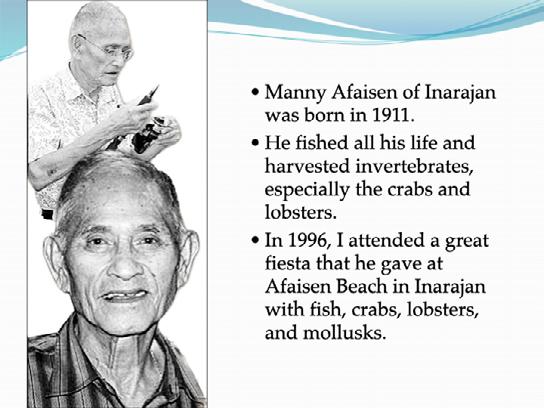


Pangelinan


Remembering the Language of Mollusk


Remembering the Language of Mollusk


Remembering the Language of Mollusk


Remembering the Language of Mollusk






Judy Amesbury majored in Anthropology at the University of Arizona. She has done archaeology in the Pacific for more than 40 years. She and her colleagues were the founders and directors of Micronesian Archaeological Research Services. Amesbury has been the author or co-author of more than 100 archaeological reports on Guam, Saipan, Tinian, and Rota. Most recently she has worked as the senior faunal analyst for Kleinfelder, Inc. (KLF) on Guam.
Angelina Pangelinan is an indigenous CHamoru archaeologist from Guåhan, currently working with Kleinfelder, Inc. (KLF). She is currently building her experience in shell analysis. She has a BA in Anthropology from the University of Guam.
"Chinchuli:" An Evil That Has No End?
Chamorro Reciprocal Exchange System during the time of Governor Felipe de la Corte (1855-1866)
By Michael Richard Clement, Jr. University of Guam
Abstract: In 1853, Spain’s tenuous hold on the Western Pacific was vulnerable to aggression from much stronger rival imperial powers. In response, the Governor General of the Philippines appointed the unusually well qualified Lieutenant‐Colonel Felipe de la Corte y Ruano Calderon to the governorship of the tiny province of the Mariana Islands. The reform minded governor spent 11 years on Guam persistently studying the island and its people as he developed plans for reform and modernization. Among his numerous observations was that at least in his mind, the indigenous Chamorro/CHamoru reciprocal exchange system known as "chinchuli" was extremely inefficient and was a primary obstacle to progress. This presentation rereads Governor de la Corte’s bitter, but also very detailed and informative complaints about the Chamorro culture of the time. A case is made that de la Corte’s reports provide incredible insights into the way the indigenous population of the island was able to maintain an autonomous identity despite nearly 200 years of colonial domination up that point in history. But also, that de la Corte’s reports are still relevant today as 21st century Chamorros, and other Pacific peoples, continue to negotiate tensions between communal obligations and the cultural structures of the modern world.
Presentation Recording

Presentaiton slides on the following page
Presentation Slides


Clement • "Chinchuli"

Dr. Michael R. Clement, Jr. is a father of four and an Associate Professor of History at the University of Guam. In addition to teaching a variety of classes in Micronesian and World History, Clement is the current Chair of UOG's Micronesian Studies Program. Clement’s scholarship is rooted in his lifelong interest in the history and culture of the island of Guam, the place where he has spent most of his life since he moved there as a young boy in 1983. His 2011 University of Hawaii PhD dissertation "Kustumbre, Modernity and Resistance: The Subaltern Narrative in Chamorro Language Music" looked at several hundred years of Indigenous Chamorro cultural history through the lens of Chamorro language songs. More recently, Clement has turned his attention to the broader processes of cultural transformation with an emphasis on the relationship between culture, class, and race in the Spanish colonial system.
History and Identity in the Mariana Islands
Narratives and Tropes of the Seventeenth Century Encounter
By David Atienza Associate Professor in Anthropology University of Guam
Abstract: We narrate identities, so they require verb tense and historical contexts where the plot occurs and develops. Like liquid in a container, every story adapts to the main ideological structures of its contemporary historical context. Therefore, speaking about identities is speaking about ideology, history, and the novel. This presentation analyzes some "historical tropes" developed in the last decades that strongly influenced the construction of identities in the Mariana Islands. These tropes had affected the interpretation of the encounter between CHamoru/Chamorro and non-CHamoru people in the Seventeenth Century, and therefore the self-construction of identities.
Presentation Recording


David Atienza received a PhD in Anthropology from the Complutense University of Madrid in 2006. He has taught history, philosophy, anthropology, and applied linguistics at different institutions and universities in Spain and Guam. His main works are focused on Cultural Identity Processes and historical Anthropology. Currently, he is professor of anthropology and professor in the Master in Micronesian Studies at the University of Guam. Some of his publications include: (With Alexander Coello de la Rosa) The Scars of Faith: Letters and Documents of the Mariana Islands’ Jesuit Missionaries and Martyrs (Institute for Advanced Jesuit Studies – Boston College, 2020), (With David García-Ramos) La construcción de la identidad en tiempos de crisis. El papel de la violencia y la religión [The construction of identity in times of crisis. The role of violence and religión] (Barcelona, AnthroposSiglo XXI, 2017) or Viaje e identidad. La génesis de le elite kichwa-otavalena en España. [Travel and Identity. The Genesis of the Kichwa-Otavalean Elite in Spain] (Ed. Abya Yala, Quito, 2009).
The Origin of CHamoru/Spanish/English Trilingual Education on Guam
By Malia A. Ramirez Historian Self / Researcher / CHamoru Studies
Presentation Recording

Presentaion slides on the following page.
Presentation Slides




Iam Malia "Toni" Ramirez born on June 13, 1951. Of CHamoru heritage, I Tano'hu" (my homeland) is Guåhan (Guam) in the Mariana Islands. My parents are Florencio Torres Ramirez and Josefina Sablan Leon Guerrero. From their marriage, ten (10) children were born. I am the second to the youngest.
I am a traditional CHamoru scholar. Although I studied under a "Western Academic" system in Guam, Hawaii, and California, I did not avail my knowledge of what is CHamoru through western ideologies. Rather, I availed and obtained my knowledge from my CHamoru "Saina" (Elders).
CHamoru Oral histories are the foundation of my knowledge and writings. One (1) is CHamoru proverbs, "Los Ehemplus CHamoritus." In addition, my writings from CHamoru language, history, culture, name places and genealogies are rooted in CHamoru oral histories. Several of my researches have been published. I produced several travelling historical exhibits on Marianas History.
At age seventy-two (72), I began at the age of nine (9) years old to read in CHamoru through the CHamoru "Nobenas" (Novenas). In a few years, I well versed in the early CHamoru writings.
From 1957 to 1969 in Guam, my total educational background was based upon the American Educational System. Unjustifiable and without reason, my early education was completely devoid of my cultural heritage.
I faced the "Race of Time." I knew at an early age that if I did not "Ekunguk" (Listen Intensely) the words of my "Saina," much of CHamoru heritage would be loss. On a mission, I devoted over sixty-two (62) years of my life on CHamoru studies. A Journey of a Lifetime!
Finally, I am indebted to all my CHamoru "Saina" who guided me graciously and unselfishly through my CHamoru journey. I am an instrument of their voices. "Ekunguk!"
