

Overview
Book 1 of 2




6th Marianas History C onference
Overview


Welcoming Remarks
By Conference Steering Committee Co-Chairs

Håfa adai and Tirow!
The Marianas History Conference is a biannual gathering inspired by community leaders from both Guåhan and the Northern Mariana Islands and focused on sharing and deepening our collective knowledge of the history and experiences of the people of all the Mariana Islands.
The ethos of our conference can be found in the original theme first established for this conference in 2012: One Archipelago, Many Stories. By declaring that we are all a part of “one archipelago” we create a space in our minds for thinking and learning about how these islands and her people are interconnected. We allow ourselves to explore and examine how and why our environment, way of life and past experiences are shaped by common themes, interests, and needs. We imagine working together to solve problems we’ve created for ourselves and even problems that wash up on our shores.
The history and people of our archipelago are defined by “many stories” as there are an infinite number of narratives about our past that exists
and have yet to be revealed. For the people of the Marianas, including those that live in diaspora communities around the world, the stories that seem to matter most are those that give insights to who we are. The Marianas History Conference strives to be all-inclusive in its selection of speakers and topics to ensure representation of diverse interests and perspectives from everywhere. This is not an easy task and it takes a dedicated group representing both our jurisdictions, respect for differences in opinions, and an honest assessment to make things work.
Throughout Marianas history, whether in times of war or peace, good health or famine and disease, the peoples and islands of this archipelago have navigated forward. But the echoes of the past, the wounds that became scars, the moments that became stories told from one generation to the next, are important to reflect on. Like åmot that needs healthy plants, special care, and knowledge of the past to be effective, an understanding of history that is carefully formed and respectfully gathered helps to heal wounds and clear the path for new possibilities.
Our goals for this conference were to facilitate healthy discourse, share new knowledge, cultivate the wisdom from within our islands, and engage in a constructive process of unpacking our theme, Healing the Wounds of History. Historic research, analysis, and interpretations are presented in this all-inclusive conference as it demonstrates a collective effort toward the integration of shared histories and memories across the archipelago. While all historical topics related to the Marianas are welcome, attention will be paid to Marianas’ healing practices; health care issues; the prevalence of diseases that have plagued our islands; sources of environmental contamination; and all sources of historical division in need of remedy, including the separation of Guåhan from the rest of the Marianas. The design is in many ways one for the ages–a creative way to present history.
We want to take this opportunity to recognize the core members of the Marianas History Conference Steering Committee for their commitment to planning and organizing this gathering: Anne Hattori, Michael Clement, Lola Leon Guerrero, Carlos Madrid, Rita Nauta, Joe Quinata, Amanda Blas, Kimberlee Kihleng, Leeani Villagomez, and Galvin Guerrero. We are especially grateful for our Gineftåo Na Nina’i (“giving generously”) conference sponsor, Northern Marianas Humanities Council; our Guinaiya Na Nina’i
(“giving with love”) sponsors Humanities Guåhan and Guam Preservation Trust; and our Dinaña Na Nina’i (“giving together”) sponsor, the University of Guam. Other financial sponsors that deserve recognition and appreciation include Atkins Kroll, BankPacific, TRM Architects, Guma Architects, Herman’s Modern Bakery, Edward Arriola, and Hiro Kurashina of Guam. We also extend our appreciation for the videography and livestreaming support provided by our planning partner, Northern Marianas College; and Guampedia for ensuring all conference proceedings and video recordings are published and accessible online.
It is with great privilege to conduct the Marianas History Conference on the ancestral homelands of the Chamorro people. We encourage you to reflect on this and the displacement and harm embedded in the history and people of these islands. We also honor and recognize the Carolinian people of the Marianas who, for more than 200 years now, have joined the Chamorro people of the Northern Mariana Islands in stewarding these lands and the well-being of our community. We express our deep gratitude for their foundational work in coming together as one people to negotiate the terms of a Covenant to establish the Commonwealth of the Northern Mariana Islands in Political Union with the United States with all the rights, privileges, and opportunities thereof.
Si Yu’us ma’åsi’ and Olomwaay!
Leo Pangelinan
6th Marianas History Conference Co-Chair Northern Marianas Humanities Council
Dr. Lawrence Camacho
6th Marianas History Conference Co-Chair University of Guam


Schedule of Presentations
Crowne Plaza Resort Saipan, Commonwealth of the Northern Mariana Islands September 1 - 3, 2023
FRIDAY, SEPTEMBER 1, 2023
TIME SESSION LOCATION
2:00 pm Registration Hibiscus Hall
6:00 pm Welcoming Remarks
6:15 pm Traditional Blessing
6:20 pm Dinner
7:00 pm Keynote Address Donald B. Mendiola
SATURDAY, SEPTEMBER 2, 2023
7:30 am AM Refreshments Hibiscus Hall
8:00 am Registration
8:15 am Announcements
8:20 am Welcoming Remarks Shelly Lowe, NEH Chair
8:25 am Keynote Address Pale’ Eric Forbes, OFM Cap
9:20 am Reconstructing History Hibiscus Hall through Technology Overcoming Colonial Legacies. The Digital Reconstruction of the Palacio de Gobierno of the Mariana Islands as an Opportunity for Nation Building By Carlos Madrid

SATURDAY, SEPTEMBER 2, 2023
TIME SESSION LOCATION
The Guam Rock Art Study and 3D Technology
By Andrea Jalandoni, Boyd Dixon, Aja Reyes, Maria Kottermair, and Victor Hara Torres
The Effectiveness of Lidar for Archaeological Investigations
By Andrea Jalandoni, Maria Kottermair, Boyd Dixon, and Victor Hara Torres
Contemporary CNMI Azucena Room
Chamorro Language and Beliefs
By Angelina Fitial
Gi Talo gi Hålom Tåsi (In the Middle of the Sea): An Exploration of Teaching “Place” in the Mariånas Archipelago
By Chellette Mina A. San Nicolas
Kombetsa Dinana Islas Sinahi gi San Lichan yan San Kattan
By William Torres
Workshop/Round Table

Tour Desk Room
I Hinasson i Nina’huyong Matao: (A Theory of) Creating MataoMatao Creativity to Heal from Epistemicide
By Dakota Camacho
10:45 am CHamoru Everyday Lives under Hibiscus Hall
Spanish Colonialism
Exploring the Sexual Wounds of Spanish Colonization in Tåno Låguas yan Gåni (the Mariana Islands) during the Late 17th Century
By Enrique Moral de Eusebio
Emotional Wounds Carved in the Space: The Impact of Spanish Colonization on CHamoru/Chamorro Spatiality
By Yvonne Rocío Ramírez Corredor
Contrasting Healways: Colonization by Pathologization and Resistance through CHamoru healing during the Spanish Colonization of the Tåno’ Låguas yan Gåni
By Matilde Carbajo
12:00 pm Lunch (Hosted) Hibiscus Hall
I Manmalingu na Songsong Lagu Azucena Room
By Cacilie Craft, Chase Young, Angelina Pangelinan, Joanne Eakin, Alea Dugan, Jacy Moore Miller, Mikhael Phelps, Christina Spellman, and Jenaleigh Ligow
SATURDAY, SEPTEMBER 2, 2023
TIME SESSION LOCATION
Storytelling of the Marianas Tour Desk Room
Adibina Adibina. Riddle Me Back to My Nana’s Youth
By Ray Barcinas and Carlos Madrid
“We Drank Our Tears:” Promoting the Agency of Students as Storytellers of History
By Galvin Deleon Guerrero

1:10 pm
2:35 pm
Listening for Hinemlo, Sounds of Rice Hibiscus Hall and Healing in the Marianas
By Andrew Gumataotao and Donald B. Mendiola
Micronesian Studies Program Azucena Room
Student Panel
By Mary Therese F. Cruz, Jesus Lujan, Muturawan Choay, and Nolan Flores
An Apprenticeship for Traditional Tour Desk Room Healers? Can We Make It Work in An Institution Using a Cultural Lens?
By Tricia Lizama
America in the Marianas Azucena Room
The First and Last United States Consul to Guam: Samuel Masters and Manifest Destiny in the Pacific, 1853-1856
By Christopher Rasmussen
Woman’s Labor, Culture and Politics in the Northern Mariana Islands during the American Occupation
By Ayuko Takeda
Restor(y)ing the Bones: Strategies for Meaningful Consultation
By Nic Santos
Remembering the War Hibiscus Hall
Humanizing War Histories: Japanese Names at the Asan Bay
Overlook Memorial Wall
By Maria Cynthia Barriga
Tinian North Field Complex National Historic Landmark Application: A Status Report
By Don A. Farrell
Humanity in War: Guy Gabaldon at the Battle of Saipan
By Ron McNinch
SATURDAY, SEPTEMBER 2, 2023
TIME SESSION LOCATION
Workshop/Round Table
Stories from Gani

Tour Desk Room
By Leila Staffler, Donald Mendiola, Sheila Babauta, and Keli Tenorio
4:00 pm Postcolonial Perspectives Hibiscus Hall
Traditional Austronesian Seafaring in Postcolonial Contexts: Knowledge, Nationality, and Maritime Resistance
By Hunter Fine
Preserving the Politics of Knowledge: A Developing Ethnography on Historic Preservation in Guåhan
By Kyle Riordan
I Manmalingu na Songsong Lagu
By Cacilie Craft, Chase Young, Angelina Pangelinan, Joanne Eakin, Alea Dugan, Jacy Moore Miller, Mikhael Phelps, Christina Spellman, and Jenaleigh Ligow
Paths to Healing Azucena Room
Indigenous Rights: A Pathway to End American Second Class Citizenship
By Beylul Solomon and William Fife
Legend Has It: Guam’s Suicide Epidemic, its Contributing Factors, and its Potential Solutions
By Lincoln Budasi
Workshop/Round Table
Tour Desk Room
Learning CHamoru/Chamorro: Healing the Wounds of History
By Gerhard Schwab and Manuel Flores Borja
5:30 pm Experiential Learning Session Crowne Plaza Resort
500 Sails Sailing & Traditional Navigation Saipan Beach Side
By Milton Coleman, Jr.
6:00 pm Reimagining the Marianas Hibiscus Hall
An Evening with Humanities Guåhan and Northern Marianas Humanities Council
By Leo Pangelinan, Catherine Perry, Bryan Manabat, Beth Demapan, Elfrie Koshiba, Kimberlee Kihleng, Nedine Songeni, and Charissa Manibusan
Experiential Learning Session
American Memorial
Premiere of Attituyi I Åmot-Ta Park Visitor’s Theater
SUNDAY, SEPTEMBER 3, 2023
TIME SESSION LOCATION
7:30 am AM Refreshments Hibiscus Hall
8:00 am Registration
8:25 am Scientific Study of the Past Hibiscus Hall
Rethinking ‘Village’ and ‘Community’ in Ancient Chamorro Society
By Boyd Dixon and Aja Reyes
Healing History through Science: Ancient and Modern DNA Analysis Confirms Chamorro Authenticity in the Mariana Islands
By Joanne E. Eakin and Rosalind L. Hunter-Anderson
Healing the Wounds of History: Remembering the Language of Mollusk Collecting
By Judith R. Amesbury and Angelina Pangelinan
Workshop/Round Table

Tour Desk Room
Bringing Teachers of the US Territories Together to Ensure Their Stories Are Told in History
By Karen Guerrero
Wartime and Women: An Oral Azucena Room Histories Project
By Jovannalyn Mafnas and Brooke Nevitt
9:50 am Spanish Era Culture and Identity Hibiscus Hall
Chenchule ‘An Evil That Has No End?:’ Chamorro Reciprocal Exchange System during the Time of Governor Felipe de la Corte (1855-1866)
By Michael Richard Clement, Jr.
History and Identity in the Mariana Islands: Narratives and Tropes of the 17th Century Encounter
By David Atienza
The Origin of CHamoru/Spanish/English Trilingual Education on Guam
By Malia A. Ramirez
Revisioning the Guam Museum Azucena Room
By Kelly G. Marsh-Taitano, Michael Bevacqua, and Charlene Flores
SUNDAY, SEPTEMBER 3, 2023
TIME SESSION LOCATION
Workshop/Round Table
Tour Desk Room ACHO Marianas: Stone Slinging throughout the Mariana Islands and our Global Diaspora, Past, Present, and Future
By Roman Dela Cruz
11:15 am Healing the Wounds of World War II Tour Desk Room Through Education: Transformative Programs by Pacific Historic Parks
By Makaelah Blas, Jaclyn Balajadia, and Jovannalyn Mafnas
Echoes of Our Saina Azucena Room
By Kelly G. Marsh-Taitano and Edward Leon Guerrero
Film Screening: Island Time Hibiscus Hall
By Sylvia Frain and Sheila Babauta
12:20 pm Closing Remarks Hibiscus Hall
12:30 pm Lunch (On Your Own)
1:30 pm Experiential Learning Session
Ta’na’homlo I Tano yan I Tasi (åmot walk)
By Moneka De Oro and Sheila Babauta
Experiential Learning Session
Garapan Heritage Trail
By Northern Marianas Humanities Council (Roberto Santos, Naomi Tudela, and Leeani Villagomez)
Experiential Learning Session
Marianas Experience Exhibit DFS T-Galleria
By Leo Pangelinan


Sponsors


Edward A. Alvarez Hiro Kurashina
Conference Overview
By Guampedia

Since 2011, the Marianas History Conference (MHC) has been held every two years and is now the most prominent gathering of historians, scholars, students and researchers interested in the history, society and culture of the Mariana Islands. With the overarching theme of “One Archipelago, Many Stories,” the MHC provides a space for people of varying educational backgrounds, research interests and disciplines, hailing from different cultural, academic and political institutions to come together and share knowledge, active scholarship and research, past experiences and, of course, food and friendship.
The 6th Marianas History Conference convened on September 1 through September 3, 2024, at the Crowne Plaza Resort in Garapan, Saipan, CNMI. The theme for this 6th MHC, “Healing the Wounds of History,” focused on healing practices in the Mariana Islands, health care issues, and sources of historical division in need of remedy. The 5th MHC, held during the throes of the COVID-19 pandemic, reminded the conference organizers of the value of healing and learning to move forward by looking to lessons from the past. The Mariana Islands have endured many historical wounds caused by events, attitudes or policies that have been disruptive, painful, traumatic, divisive or violent, with impacts that cross generations. The wounds from colonialism and displacement, diseases, war, and the military buildup, have left physical and emotional scars on the people and the lands of the Marianas. But while scars are reminders of pain and suffering, they also represent stories of healing, resilience and strength.
When scars form after an injury, the new skin may have a different quality or texture from the surrounding area. Some scars will fade over time, others can be covered up artificially, while others are difficult to hide and may still hurt. The theme of “Healing the Wounds of History” calls for reflection on past traumas that continue
to affect the Marianas, and to reframe or rethink the wounds to find ways that advance healing and that would allow us to move forward. Perhaps similarly, healing wounds of history may also result in new beginnings, changes in quality of life and increased understanding among people, even if the pain (or reminders of the pain) are still there. As Co-Chairs Leo Pangelinan (Northern Marianas Humanities Council) and Dr. Lawrence Camacho (University of Guam) state, the goals of the conference were “to facilitate healthy discourse, share new knowledge, cultivate the wisdom from within our islands,” and provide “a creative way to present history.”
More than 40 presentations covering research in areas of archaeology, history, culture, arts and society, were shared by students and seasoned scholars from institutions on Guam, CNMI, United States, the Philippines, Japan, Spain, Germany and Australia. Conference audiences appreciated the diversity of speakers and subjects; the postconference survey included in these proceedings provide insights on how the presentations were received and suggestions for improving the MHC for the future. In addition, the conference marked the passing of the mantle back to Guam to host the 7th Marianas History Conference in 2025.
Each day began with a session in the Crowne Plaza’s Hibiscus Hall. Day One featured welcoming remarks by the Conference Co-Chairs, Leo Pangelinan and Dr. Lawrence Camacho, and a keynote address by Siñot Donald Mendiola, a respected yo’åmti (traditional healer), Chamorro translator and educator from Saipan. Speaking in Chamorro, Siñot Mendiola recounted his incredible life journey as a healer and emphasized that healing the wounds of colonization in the Marianas truly needs to come from a place of forgiveness and faith. Day Two began with a special video message from National Endowment for the Humanities Chairwoman Shelley Lowe, who reminded participants to acknowledge this
is OUR history to tell in our words and from our perspectives and that the process of healing should be a community endeavor, not an individual one. Pale’ Eric Forbes, a Capuchin priest with an avid interest and skill in historical research and writing about Guam and the Marianas, delivered the second keynote. Always thought-provoking, Pale’ Eric challenged participants to look critically at how we understand our Chamorro identity, that there has never been only one way to be “Chamorro,” and it is these differences that add color to the “Common Chamorro experience.” But this common experience is becoming more fractured--from individual choices, external forces and the failure to acknowledge the voices of our elders who, arguably, knew more about being Chamorro than most other Chamorros today. Though the future is unknown, looking to the past and learning from experience opens a path forward to new possibilities.
The other conference sessions ran concurrently in the Crowne Plaza’s Azucena Hall and Hibiscus Hall, with Workshop/Round Tables in the Tour Desk Room. Presentations within sessions were grouped mostly according to connections between time periods, themes or subject matter, followed by Q&A and further discussion with audiences. Each presentation focused on the challenge of healing the wounds of history by offering new approaches or technologies to examine the past. Issues of knowledge preservation, language and identity, the impacts of colonialism and Chamorro resistance, advancing indigenous rights, using scientific methods and innovative technologies as part of historical inquiry presented at this year’s conference provided a rich variety of topics for engagement and discussion. The “Experiential Learning Sessions,” as well, offered opportunities to go out into the community to learn something new, such as seafaring on an actual canoe, or identifying various plants used for traditional healing, or taking a walking tour of some of Garapan’s heritage sites. The conference closed with a healing circle, a blessing by Siñot Mendiola, and remarks by Dr. Camacho.
Throughout the conference’s history, Guampedia has been there, participating in the organization and development of the conference every two years, alongside organizers from the NMI Humanities Council, the Micronesian Area Research Center, the Guam Preservation Trust and the University of Guam. After every successful conference, Guampedia has produced the conference proceedings—compiling the papers, presentation slides and photographs of each session and making them accessible to the general public through the Guampedia website. The proceedings not only provide a tangible record of the wealth of scholarly work being pursued in the Marianas, they are available for the benefit of other researchers, teachers or students and have inspired further work in the region, especially by indigenous scholars.
All the participants who presented at the conference were invited to share their written presentations to be published in these proceedings, but only a handful of papers are included here. We understand that conferences are often used by researchers to share different stages of their work or to bounce around ideas with their colleagues and that they may prefer to prepare them instead for publication in edited journals or books. Nevertheless, the materials presented here include the papers made available to us, as well as presentation slides and embedded links to video recordings so the reader may view the various sessions/presentations. This will help make much of the conference accessible to everyone, especially those who were unable to attend.
The Guampedia team would like to thank our colleagues at the NMI Humanities Council, the Northern Marianas College and other friends in Saipan, and the University of Guam for helping provide the information on presenters and abstracts. Thank you, also, to the presenters whose scholarship and hard work are an inspiration to us all; and to all the sponsors whose generous support made the 6th Marianas History Conference possible.
6th Marianas History C onference
Moments


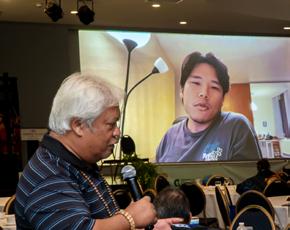


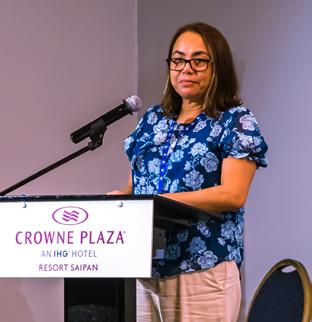


Keynote Address
By Siñot Donald Mendiola Yo’åmti/Classroom Teacher PSS—CCLHS, Åmut Natibu

Donald Benavente Mendiola, a native of Saipan, Northern Mariana Islands, is a highly esteemed Suruhuånu/Yo’åmte (Traditional Healer), Master Weaver, Fa’fa’någue’n kuttura yan lenguahi (Chamorro language and heritage expert/teacher), and author of Åmot Chamorro: A Historical Snapshot of the CNMI’s Medicinal Herbs and Shrubs.
Siñot Mendiola’s journey as a Suruhuånu began at the age of eight under the guidance of his grandmother, Tan Ana Mendiola. These early teachings, focused at first on identifying various types of local medicinal plants, led to the acquisition of practical and spiritual healing knowledge and skills bequeathed to him by over 30 elders from across the Marianas Archipelago. He attributes his gifts for healing to God and serves the afflicted on a daily basis through various herbal remedies, massage, and processes for revealing and releasing spiritual wounds and traumas.
Siñot Mendiola’s role as a teacher for more than 30 years in the CNMI Public School System’s Chamorro and Carolinian Language and Heritage Studies program has yielded numerous positive outcomes, including winning performances by his students at the University of Guam’s CHamoru Language Competitions. He continues to share his language and cultural expertise in the CNMI and throughout the region in convenings such as the Pacific Islands Bilingual Bicultural Association conferences, Festival of Pacific Arts & Culture, and Håya Foundation Åmot Conferences. He is a contributing member of the CNMI
Dictionary Revision Committee, a certified translator/interpreter for the CNMI courts and legislature, and Vice Chair of the CNMI’s Chamorro and Carolinian Language Policy Commission.

Siñot Mendiola has been recognized for his knowledge in traditional healing, weaving, and Chamorro language with the Regional Heritage Award by the Consortium for Pacific Arts and Culture, a CNMI House of Representatives Resolution, a CNMI Senate Resolution, a CNMI Governor’s Humanities Award, and a CNMI PSS Teacher of the Year award. In 2022, he was awarded the Honorary Degree of Master of Micronesian Traditional Knowledge from the University of Guam in recognition of a lifetime of service to the preservation and advancement of traditional practices as a Yo’åmte (Traditional Healer), Master Weaver, and Fa’Fa’nague (Teacher) of Chamorro language.
It is with great honor that we welcome Siñot Donald Mendiola as a keynote speaker at the 2023 Marianas History Conference. His vast knowledge, coupled with his genuine passion for preserving the cultural heritage of the Marianas, will undoubtedly enlighten and inspire attendees as we explore the rich history and traditions of our islands.
Keynote Address
By Pale’ Eric Forbes, OFM Cap Priest/Historian, Guam
Presentation Recording

Påle’ Eric was born on Guam in 1962 and was raised in the village of Sinajaña. His father was IrishAmerican and his mother was Chamorro from the familian Kitå’an (Perez Torres). He grew up biculturally as his Chamorro grandmother and her several siblings all had a hand in raising Påle’. He is ma poksai biha and knew his Chamorro hymns and prayers before he was ten years old. From his grandmother and grandaunts/uncle he learned many stories about pre-war life and the Japanese Occupation, which began his life-long interest in everything Chamorro, from history to language and everything in between.
After graduating from Father Dueñas Memorial School in 1980, he began university studies at the University of Guam, Saint Joseph’s College in Mountain View, California and San Francisco State University where he earned his BA in History in 1984. He picked up basic Spanish speaking skills along the way. He then entered the Capuchin Franciscan Order on Guam in 1984. While studying theology in Berkeley, California, he came across the archival documents of the first Protestant mission on Guam and wrote his first historical work, The Origins of Protestantism on Guam, combining that research with other documents he came across before that, as well as his interviews with the late Reverend Joaquin Sablan and others.
He was ordained a priest in 1990 and spent three years in San Roque parish in Saipan, where his Chamorro speaking skills improved. He returned to Guam in 1994 and has remained since, working in many priestly ministries but continuing his interest in all things Chamorro. He has taken advantage of his yearly opportunities to travel for either work or leisure and has researched in archives in Spain, Rome, Germany, the United States and the Philippines. His ability to work with documents in Spanish, Latin and Italian has been a big asset. Interviewing mañaina (elders) is always a top priority, and from all four main Mariana islands (Guam, Luta, Tinian, and Saipan). From all this, he has written books and articles and produced a DVD documentary, I Am Chamorro. He is an unofficial “chaplain” of the California Chamorro community and dedicates one month a year to being with them for fiestas, Masses, hospital visits, and presentations. He also maintains a Chamorro blog for the last 12 years with 2.2 million visits from all over the world called paleric.

He hopes to die with his last words being in Chamorro.
Reimagining the Marianas
An Evening with Humanities Guåhan and Northern Marianas Humanities Council
By Humanities Guåhan and Northern Marianas Humanities Council

Held on September 2, 2023, in the Hibiscus Hall, Reimagining the Marianas was a sponsored dinner and conversation with facilitators from Humanities Guahan and the Northern Marianas Humanities Council. The event centered on cultural identity, resilience, and healing. Using the civic reflection conversation model, participants observed three live performances and then broke out into small groups to discuss the values and choices that shape us.
Performance 1
Simiyan Marianas performed an interpretive dance to the Chamorro song, “Rainan i Tasi” (“Queen of the Sea”). “Rainan i Tasi” recounts a Chamorro folk tale of how a young girl (Sirena) transforms into a mermaid as a consequence of disobeying her mother.
Performance 2
Charissa Manibusan of Humanities Guåhan read “A Pre-Occupied Life: the Love Story of Rosa Mendiola Atalig and Isiahs Hocog Atalig,” a story she wrote based on an interview she conducted with her grandmother. Charissa sings “Bai Hu Tattiyi” throughout her reading, a song composed by Bobbie Tainatongo.
Performance 3
The Olomwaay Band performed a Carolinian (Refalúwasch) song entitled, “Falúw Kkaa Efang” (“Northern Islands”), composed by siblings Gus, Ken, and Cinta Kaipat. “Falúw Kkaa Efang” is widely regarded as an anthem for Gåni or the islands North of Saipan in the Marianas Islands. The song speaks to a longing among former residents of Gåni to return to their home islands and a general concern for the preservation of its natural resources in the face of threats from external forces.
Presenter Directory
Name Institution Affiliation
Amesbury, Judith R.
Kleinfelder, Inc.
Email Address
judy.amesbury@gmail.com
Atienza, David University of Guam datienza@triton.uog.edu
Barriga, Maria Cynthia Waseda University jaja.barriga@gmail.com
Blas, Makaelah Pacific Historic Parks mblas@pacifichistoricparks.org
Budasi, Lincoln – lincoln.budasi@gmail.com
Camacho, Dakota Gi Matan Guma’ dakotacamacho@gmail.com
Carbajo, Matilde Pompeu Fabra University matilde.carbajo@upf.edu
Cepeda, Jeremy University of Guam & Gi Matan Guma’ jeremycepeda84@gmail.com
Clement Jr, Michael Richard University of Guam mclement@triton.uog.edu
Coleman Jun 500 Sails jcoleman@500sails.org
Craft Cacilie Kleinfelder, Inc. ccraft@kleinfelder.com
de Eusebio, Enrique Moral Universitat Autònoma de Barcelona/ Universitat Pompeu Fabra enrique.moral@upf.edu
De Oro, Moneka Lemmai Loves (Micronesia Climate Change Alliance and OCW 670) moneka@mccalliance.org
Dela Cruz, Roman TheEffect thefokaieffect@gmail.com
Deleon Guerrero, Galvin Northern Marianas College galvin.deleonguerrero@marianas.edu Dixon, Boyd Stantecgs boyd.dixon@stantecgs.com
Eakin, Joanne Independent Researcher jeeakin@gmail.com
Farrell, Don A.
Northern Marianas Humanities Council donfarrelltinian@gmail.com
Fife, William Northern Marianas College william.iii.fife@marianas.edu
Fine, Hunter University of Guam fineh@triton.uog.edu
Fitial, Angelina CNMI Public School System angelina.fitial@cnmipss.org
Frain, Sylvia Fåha Digital Media sylviacfrain@gmail.com Guerrero, Karen ASU GeoCivics Project karen.guerrero@asu.edu
Gumataotaotao, Andrew Georg-August Universität Göttingen andrewpaulmantanona.gumataotao. uni-goettingen.de
Hunter-Anderson, Rosalind Independent Researcher –
Jalandoni, Andrea Griffith University a.jalandoni@griffith.edu.au
Kottermair, Maria Geospatial Scientist, Micronesia –
Lizama, Tricia A. University of Guam tlizama@triton.uog.edu
Madrid, Carlos University of Guam madridc@triton.uog.edu
Mafnas, Jovannalyn American Memorial Park jmafnas@pacifichistoricparks.org
Marsh-Taitano, Kelly G. Guam Museum & Guam Cultural Repository kmarsh@triton.uog.edu
Ayuda Foundation manamko2manhoben@gmail.com
McNinch, Ron University of Guam mcninchr@triton.uog.edu
McVey, Troy University of Guam Theatre tmcvey@triton.uog.edu
Nevitt, Brooke
National Park Service brooke_nevitt@nps.gov
Pangelinan, Angelina Kleinfelder, Inc. apangelinan@kleinfelder.com
Name Institution Affiliation
Email Address
Pangelinan, Leo Northern Marianas Humanities Council leop@nmhcouncil.org
Raigetal, H. Larry
University of Guam/ MARC larry@waagey.org
Ramirez, Malia A. Self / Researcher / CHamoru Studies anthony.ramirez@dpr.guam.gov
Ramírez Corredor, Yvonne Rocío Universitat Pompeu Fabra yvonnerocio.ramirez@upf.edu
Rasmussen, Christopher University of Guam rasmussenc@triton.uog.edu
Reyes, Aja Marine Biologist –
Riordan, Kyle The Ohio State University riordan.26@osu.edu
San Nicolas, Chellette Mina A. Gonzaga University csannicolas@zagmail.gonzaga.edu
Santos, Nic independent researcher/writer nicsantos.guahan@gmail.com
Schwab, Gerhard
Solomon, Beylul
University of Guam gerhardschwab@triton.uog.edu
Northern Marianas College william.iii.fife@marianas.edu
Staffler, Leila Filmmaker, Cultural Advocate haveia@gmail.com
Takeda, Ayuko
University of California, Irvine takedaa@uci.edu
Torres, Victor Hara Independent Archaeologist –
Torres, William Private Sector councilspngani@gmail.com
Yusi, Kate L.
University of Guam yusik@triton.uog
Survey Responses
Marianas History Conference Evaluation 2023
By University of Guam Global Learning and Engagement (GLE) Department
Respondents: 63
Survey questions
1. How did you learn about the Marianas History Conference (check all that apply) - Checkbox. 63 Response

Other responses
“Work”
“A post in my Fino’ CHamoru WhatsApp group” “From Leo Pangelinan” “Professor William J. Fife III”
2. Which days did you attend (check all that apply) - Checkbox. 63 Response
“College Professor” “Nmc class” “Website search” “MCCA/Lemmai loves”

3. Did you attend in-person or virtually? - Multiple choice. 63 Response

4. Please rate your level of satisfaction with the Conference Venue - Linear scale. 63 responses

5. Please rate your level of satisfaction with the Registration Process - Linear scale. 63 responses

6. Please rate your level of satisfaction with the Use of Whova App - Linear scale. 63 responses

7. Please rate your level of satisfaction with the Keynote Speakers - Linear scale. 63 responses

8. Please rate your level of satisfaction with the sessions you attended. - Linear scale. 63 responses

9. Please rate your level of satisfaction with the Organization of Conference Activities - Linear scale. 63 responses

10. Please rate your level of satisfaction with the Communication by Organizers - Linear scale. 63 responses

11. Please rate your level of satisfaction with the Overall Accessibility - Linear scale. 63 responses

12. Please rate your level of satisfaction with the Overall Conference - Linear scale. 63 responses

13. How would you like to attend your next MHC?
Multiple choice.

14. What did you like most about the conference?
Free Responses
“The Presentations and presenters.”
“Everything! Week planned and executed.”
“The key note speakers and the experiential topics. Thank you 500 sails for the once in a lifetime experience on a real island crafted canoe.”
“Keynote speakers”
“Things I didn’t know and now I know”
“Keynote speaker”
“Hearing from younger presentors”
“All the very interesting and thought provoking presenations.”
“The different presenters discussing an array of topics regarding the Marianas.”
“I loved how everyone had their own topics and gave everyone a much more better understanding to what they find in Our Islands-like artifacts, the cultural diversity, the importance of our waters, and how the U.S affects our Islands as a whole. It has never been so easy to accept that what happened in the past greatly impacted us today based on the decisions our former leaders made.”
“Increased knowledge about the Marianas! Met interesting and knowledgeable locals at the conference!”
“Reimagining the Marianas session”
“The speakers were great and overall conference is great!”
“Pale Eric’s speech.”
“Listening to all the presentations”
“The community, sessions, and experiences”
“Great lineup of speakers. Great energy and vibes. Beautiful experiential sessions. Amut walk was amazing.”
“Señot Donald Mendiola’s teaching and words of wisdom. Pale Eric had a very good speech too.”
“Meeting new people who have the same mission and vision of our history and the many stories to be shared and bring into the conference.”
“Content was top notch interesting And Meeting old friends and making new ones is the cream on top”
15. What did you like least about the conference?
Free Responses
“Started late and technology difficulties.”
“None.”
“I couldn’t register hybrid. Also, I couldn’t reserve a seat for the canoe and the dinner, although I could have made them both. No digital pay option at registration.”
“Registration”
“Some speakers were not that clear”
“Seemed like more emphasis on Guam than CNMI”
“The fact that it was hard to attend all presentations. I will have to go back to recordings.”
“The registration process. It was a complete hassle. Also, the disorganization of information in regards towards the scheduling of lectures and workshops. It should be concise as to how long each session would take, considering some sessions took longer or was too short compared to others.”
“Everything was great, the people who were in charge at the registration were Smooth as well as the people conducting the program. I applaud the tech people for ensuring that the presentations were all set for the key note speakers.”
“It’s pity that I couldn’t understand local Chamorro languages….. Needed subtitles or short translations in English for some presentations.”
“Keep speakers within their time.”
“Sometimes speakers are being rush to complete their presentations.”
“Technical issues and some biased presenters. The Whova app wasn’t the easiest to use and I’m not sure why the detailed agenda was not available prior to registration. Also, I’m not sure why there were no presentations by any Carolinian community members.”
“No comment”
“Nothing - but would suggest changing this to what challenges if any did you face at the conference”
“Method of payment is not great. Not a fan of emailing my credit card information (not secure). Registration online seemed to take a while to receive receipt of my submission. Venue was so cold in the rooms. I didn’t like how some presenters ended up in “panel” style sessions and their time was cut so short. Tech issues were pretty bad and cut into time.”
“IT techs need to be more knowledgeable with their techs.”
“Some technology difficulties and the delay of presentation”
“The technical challenges but that’s understood. Also, having the food set up in the main presentation hall not conducive to listening especially the soft speakers; the F&B; staff were just too noisy with handling of cutlery and dishes.”
“Late starts, time management.”
16. Please share one important takeaway from the conference. Free Responses
“Different presenters yet they still includes the main topic “The Marianas”.”
“A lot of preservation of the culture and language.”
“We share many of the same thoughts, ideas, and wonderings.”
“Accept Language changes”
“Interesting”
“Must have more conferences like this”
“That it is good to hear differing opinions abot subjects you thought you knew about.”
“The fact that the presenters took an educative effort to report their thesis in a scientifically-reviewed manner.”
“One important takeaway from the conference was the presentation that Dr. Solomon and Mr. Fife had on “Indigenous Rights: A pathway to end American Second Class Citizenship.” Indigenous Rights can help eliminate this by promoting equality, respect, and recognition for Native communities, fostering a more inclusive and just society for all.”
“Appreciation for local culture and history!”
“Making deeper and more meaning conversations in order to connect and understand others.”
“Learning about cultural values”
“Learned much and met friends that you’ve worked with or collaborated in the past.”
“Each island of the Mariana archipelago are significantly different from each other.”
“The conference is important to the ppl of Guam and CNMI”
“Connections with educators and orgs I will keep in touch with”
“The desire to unite as one Marianas is really strong and powerful and people are so hopeful that we can move in this direction. This conference and the theme of healing is right on that path.”
“I met a lot of new friends.”
“Our stories and our history has been continued to be heard and we as people still feel strongly to preserve it with love.”
“Want to to see even stronger collaboration between UOG, NMC, NMHC, and HG!”
17. Is there anything else you’d like to share about the event?
Free Responses
“Its really nice on how they did their research so well and broke it down to make sure we would understand them what they are presenting.”
“Talks on healing by other speakers and the engagement of the participants was awesome.”
“Thank you for the opportunity and thanks to all the presenters and organizations that made this event possible.”
“Awesome conference!”
“Highly satisfying”
“Thank u”
“Thank you to all the organizers, presentors, and participants for making this a good conference.”
“Overall, for a Marianas’ History Conference, it’s disappointing that the Refaluwasch community never had a significant participation and presence in an official capacity. It would’ve been appreciative and fair to include them as an integral component to indigenous history. This exclusion feels a bit deliberate.”
“I enjoyed all the key note speakers that I was able to attend to on the second day. This should be more open to students of all levels because this was a great experience for me. I believe that the Marianas Historical Event should have another one wher its mainly all schools and students. There should at least one session where students can engage in an activity.”
“I would like to participate in the future seminars and conferences. Please include me for your future mailing list. Thank you so much for organizing great education conference!”
“It was a great event. Looking forward to tye next. Thank you all! It was a great learning experience.”
“I wanted to see read the presentations with papers to learn more in-depth.”
“There was some mention of “un Marianas” but there was no presentation or discussion on this interpretation. One Marianas means different things for everyone. I also recommend a tech run for each presentation.”
“Meeting people”
“Thank you! This was a very memorable conference!”
“Keep up the great job !!!”
“None”
“Looking forward to the day when the MHC conference could be hosted in Luta or Tinian ”
“Have time keeping be on time. Eat and sleep times were compromised because of late finishes. Consider the health of attendees, especially if they are elders with this. Or those who are disabled. The elders might not leave early because of the culture of being humble.”
“None.”
