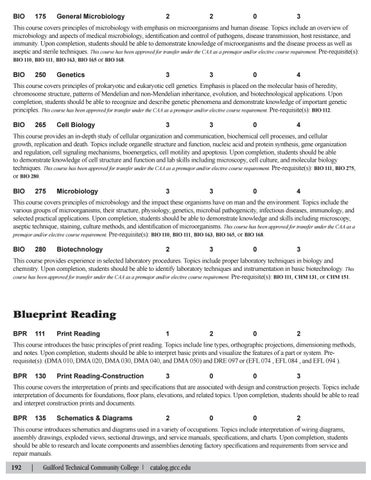
BIO 175 General Microbiology 2 2 0 3 This course covers principles of microbiology with emphasis on microorganisms and human disease. Topics include an overview of microbiology and aspects of medical microbiology, identification and control of pathogens, disease transmission, host resistance, and immunity. Upon completion, students should be able to demonstrate knowledge of microorganisms and the disease process as well as aseptic and sterile techniques. This course has been approved for transfer under the CAA as a premajor and/or elective course requirement. Pre-requisite(s): BIO 110, BIO 111, BIO 163, BIO 165 or BIO 168. BIO 250 Genetics 3 3 0 4 This course covers principles of prokaryotic and eukaryotic cell genetics. Emphasis is placed on the molecular basis of heredity, chromosome structure, patterns of Mendelian and non-Mendelian inheritance, evolution, and biotechnological applications. Upon completion, students should be able to recognize and describe genetic phenomena and demonstrate knowledge of important genetic principles. This course has been approved for transfer under the CAA as a premajor and/or elective course requirement. Pre-requisite(s): BIO 112. BIO 265 Cell Biology 3 3 0 4 This course provides an in-depth study of cellular organization and communication, biochemical cell processes, and cellular growth, replication and death. Topics include organelle structure and function, nucleic acid and protein synthesis, gene organization and regulation, cell signaling mechanisms, bioenergetics, cell motility and apoptosis. Upon completion, students should be able to demonstrate knowledge of cell structure and function and lab skills including microscopy, cell culture, and molecular biology techniques. This course has been approved for transfer under the CAA as a premajor and/or elective course requirement. Pre-requisite(s): BIO 111, BIO 275, or BIO 280. BIO 275 Microbiology 3 3 0 4 This course covers principles of microbiology and the impact these organisms have on man and the environment. Topics include the various groups of microorganisms, their structure, physiology, genetics, microbial pathogenicity, infectious diseases, immunology, and selected practical applications. Upon completion, students should be able to demonstrate knowledge and skills including microscopy, aseptic technique, staining, culture methods, and identification of microorganisms. This course has been approved for transfer under the CAA as a premajor and/or elective course requirement. Pre-requisite(s): BIO 110, BIO 111, BIO 163, BIO 165, or BIO 168. BIO 280 Biotechnology 2 3 0 3 This course provides experience in selected laboratory procedures. Topics include proper laboratory techniques in biology and chemistry. Upon completion, students should be able to identify laboratory techniques and instrumentation in basic biotechnology. This course has been approved for transfer under the CAA as a premajor and/or elective course requirement. Pre-requisite(s): BIO 111, CHM 131, or CHM 151.
Blueprint Reading BPR 111 Print Reading 1 2 0 2 This course introduces the basic principles of print reading. Topics include line types, orthographic projections, dimensioning methods, and notes. Upon completion, students should be able to interpret basic prints and visualize the features of a part or system. Prerequisite(s): (DMA 010, DMA 020, DMA 030, DMA 040, and DMA 050) and DRE 097 or (EFL 074 , EFL 084 , and EFL 094 ). BPR 130 Print Reading-Construction 3 0 0 3 This course covers the interpretation of prints and specifications that are associated with design and construction projects. Topics include interpretation of documents for foundations, floor plans, elevations, and related topics. Upon completion, students should be able to read and interpret construction prints and documents. BPR 135
Schematics & Diagrams
2
0
0
2
This course introduces schematics and diagrams used in a variety of occupations. Topics include interpretation of wiring diagrams, assembly drawings, exploded views, sectional drawings, and service manuals, specifications, and charts. Upon completion, students should be able to research and locate components and assemblies denoting factory specifications and requirements from service and repair manuals.
192
|
Guilford Technical Community College | catalog.gtcc.edu