Families & Porcupines
FAMILIES & PORCUPINES A Chapel Talk by Dola Davis Hamilton Stemberg, Trustee and Parent 1998 and 2010 January 25, 2008
T
oday is nostalgic for me because it is the day before my last as a trustee of this School. However, I will still proudly have Will in attendance, just as his brother Rylan was here and in this Chapel 10 years ago when I gave my first talk at this podium. I asked Rylan for his advice given this occasion and given his experience of having been here in the audience. Rylan told me, “Whatever you do, keep it short and they will love you.” I must admit it is difficult as a parent with a son in this audience to address you. First and foremost, it is my duty not to embarrass my son, any of my sons, by what I say here. Secondly, is it extremely hard to avoid it because I know that my very presence before you must in some way do so. That is second nature in the relationships of adolescents and their parents—embarrassment. While we parents still view you adoringly as children, you yourselves are growing apart in body and mind from being children, yearning for more independence and believing that we could not possibly understand who you are and what you want. This is the essence of the natural transition for parents and children as they grow apart from each other.
the Internet if you have not heard it before. It is a poem written by Max Ehrmann over 55 years ago in 1952. In fact, that was the year I was born. When I first read it, I realized I could not pass on thoughts that were truer, better said or more everlasting in meaning. That is the essence of great literature. It never dies, remaining timeless, inspirational, spanning many generations. The words and phrases also take on new and deeper meaning as we age and reread them. I keep this poem on my bulletin board and I hope that if you do not have it, you copy or print this poem, entitled, “Desiderata”, and keep it and refer to it during your years here at Groton and beyond.
“ Words and phrases also take on new and deeper meaning as we age and reread them.” There is a species of porcupine whose need for each other parallels that of the pulling and pushing of parent and child. These porcupines like to cuddle for warmth and comfort. However, they need to constantly readjust their closeness to each other. If they get too close they risk pricking each other, and if too far away they lose the warmth from each other. Such is the dilemma for the parent adolescent relationship. In thinking about speaking today, I remembered a poem I sent my three sons. I must now confess to the tendency to email them perhaps too many words of wisdom as one of my embarrassments. And, while not being terribly original, sharing that poem with you today accomplishes both of my objectives—not sticking my foot in my mouth with too many of my own words, yet sharing something worthwhile. You can find it in the library or on
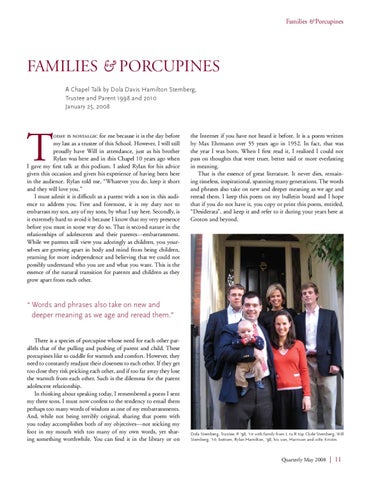
Dola Stemberg, Trustee, P ’98, ’10 with family from L to R top Clyde Stemberg, Will Stemberg, ’10; bottom, Rylan Hamilton, ’98, his son, Harrison and wife, Kristin.
Quarterly May 2008
| 11