BLOCKCHAIN AND NFTs 2021 IN REVIEW 107 AN ILMC PUBLICATION | JANUARY 2022 | £25 | €25
INDUSTRY PROS ON 2022 AND THE ROAD AHEAD
ILMC
2
iq-mag.net
ILMC
Magazine
3
IQ107 CONTENTS
INDUSTRY PROS ON 2022 AND THE ROAD AHEAD
34
24
18
8 NEWS
FEATURES
COMMENT AND COLUMNS
8 10
18
16
Index In Brief The main headlines over the last month Analysis Key stories and news analysis from around the live music world
2021: The Year in Review IQ looks back at the trends, deals, events and, of course, the Covid restrictions that made the headlines during 2021 Leading the Way Industry leaders from around the world share their thoughts on the state of the business as we move into a new year Working on the Chain Gang As decision makers examine ways in which to maximise profit margins, blockchain technology is finding more and more users across the music business
Stage to Screen Wayne Forte details the process behind producing his critically acclaimed Mad Dogs & Englishmen documentary Losing Control Richard Davies urges the industry to adopt a more strategic approach in its efforts to beat ticket touts Your Shout What was your best live moment of 2021?
24
17
34
42
Magazine
5
NEW BEGINNINGS (HOPEFULLY)
I
When I first thought about writing this issue’s column, I took a look back at what I’d penned for the first issue last year. It had the headline, ‘New Year, New Variants’ and stated, “the [start] of the year has seen negative news story after demoralising statistic [and] a more infectious corona variant being dumped on us, and the general mood cowering under even darker clouds.” It really does feel like Groundhog Day. However, in saying that, anecdotal evidence seems to suggest that the Omicron variant of Covid-19 is not as destructive to the human body as the Alpha, Beta, Gamma, Delta, Epsilon, Zeta, Theta, Mu, or R.1. variants. Yeah, I didn’t know there were that many either, but it’s heartening to see that they’re no longer being labelled geographically (remember when Delta was known as the Indian variant?), which always seemed unnecessarily divisive to me. Scientific evidence has been slow to back up the hopes that Omicron is a milder version of the virus, meaning that many governments around the world have reintroduced draconian measures that have effectively shut down live music once again. But I’m wearing my rose-tinted glasses and supping from a glass that is very much half full, so I believe that not only is there light at the end of the tunnel, but the tour bus we’re travelling on is accelerating toward the light, and the great recovery is set to begin in earnest. Unfortunately, that hasn’t happened in time to allow Eurosonic Noorderslag to take place in-person, and, as you will learn on page 11, we’ve taken the decision to reschedule ILMC from early March to late April, in the belief that international travel will be easier by then. And with the UK government already relaxing pre-departure test rules and quarantine regimes for visitors, fingers crossed it will just be a matter of time before others follow suit. There will, of course, be challenging times ahead, but confidence is definitely returning, as the executives who participate in our Leading the Way interviews attest on page 24. One silver lining in the Covid cloud has been the extra thinking space that we’ve all had throughout the pandemic to evaluate our lives, both personally and professionally – the benefits of which are being felt by the pioneers who are developing products and services based on blockchain technology (page 34). And for anyone who had to furlough or who simply took some time off during 2021, our news team has compiled a helpful review of the past 12 months (page 18) to remind you of the various deals and events that made the headlines, as well as paying tribute to some of the characters we lost during the year.
ISSUE 107 LIVE MUSIC INTELLIGENCE IQ Magazine Unit 31 Tileyard Road London, N7 9AH info@iq-mag.net www.iq-mag.net Tel: +44 (0)20 3743 0300 Twitter: @iq_mag Publisher ILMC and Suspicious Marketing Editor Gordon Masson News Editor James Hanley Staff Writer Lisa Henderson Advertising Manager Steve Woollett Design Rather Nice Design Sub Editor Michael Muldoon Head of Digital Ben Delger Contributors Richard Davies, Wayne Forte Editorial Contact Gordon Masson gordon@iq-mag.net Tel: +44 (0)20 3743 0303 Advertising Contact Steve Woollett steve@iq-mag.net Tel: +44 (0)20 3743 0304 ISSN 2633-0636
Magazine
7
IN BRIEF INDEX The concert business digest
Tomorrowland is granted a permit for a third festival weekend in 2022, which will help to recoup lost revenue from two fallow years. Police investigate the fatal stabbing of Drakeo the Ruler at the Once Upon a Time in LA music festival. Coachella is granted a temporary restraining order against Live Nation in its trademark infringement lawsuit over a rival music event called Coachella Day One 22. Germany’s Event Management Forum presents a series of demands to government amid concerns no major tours will be able to take place in the first half of next year. UK government announces new financial support for businesses in response to the spread of the Omicron variant, which has been criticised as inadequate by live music trade bodies. Saudi Arabia’s Soundstorm festival pulls in huge crowds from around the world, according to promoter MDLBeast.
8
iq-mag.net
An exclusive live-stream performance by Westlife, broadcast by Tencent’s Weixin across China, pulls in almost 28 million viewers. US Congress writes to Live Nation to demand answers over the Astroworld tragedy. Olivier Darbois is re-elected as president of French live music industry association Prodiss. Coachella Music Festival and producer Goldenvoice sue Live Nation for trademark infringement over Coachella Day One 22, which is advertised on Ticketmaster. Harry Styles is named as 2021’s top worldwide ticket seller, while the Rolling Stones had the highest-grossing tour, according to Pollstar’s year-end rankings. Veteran agent Adam Brill joins Wasserman Music as VP, fairs & festivals. Live audio tech service Mixhalo raises $24million (€21m) in a series-B funding round.
The Music Venue Trust warns that the UK’s grassroots circuit is on the brink of collapse in the wake of fresh government restrictions. The Dutch government announces €84.5m in emergency funding after extending Covid restrictions until mid-January. The number of concerts held in Saudi Arabia each year is set to rise by up to 600% on pre-pandemic levels, according to the kingdom’s assistant minister for tourism. Ticketmaster expands its presence in Latin America with new operations in Mexico and Chile. AEG-owned ticketer AXS announces the appointment of Jay Sietsema as general manager for its Swedish operation. UK-based music company ATC plans to float on London’s Aquis Stock Exchange after raising £4.2m (€5m) in its initial public offer. Ticketmaster Australia unveils a new integration enabling fans to check-in and verify vaccination status upon entry to a venue.
The UK live industry is contending with up to 50% audience no shows and widespread cancellations due to Omicron, a snap industry survey shows. Angus Baskerville, the longstanding 13 Artists director and booking agent, moves to new independent agency Pure from 1 January 2022. Korea’s first-ever metaverse gig, the K-Vibe Concert, is staged by the Ministry of Culture, Sports and Tourism and the Korea Tourism Organization. Travis Scott is reportedly involved in an initiative to put new festival safety protocols in place following the Astroworld disaster. Primavera Sound announces its first Chilean edition, a coproduction with Rock Stgo, from 7-13 November 2022. Vaccine passports and facemasks are required in order to attend concerts in England as part of tougher restrictions unveiled by the government in response to the Omicron variant.
In Brief
Europe’s biggest ever K-Pop festival is announced for Frankfurt, Germany, in 2022. UTA confirms the appointment of Matthew Morgan as co-head of the agency’s Nashville office as part of a series of hires. Vision:2025 launches a consultation for a music industry Green Code of Conduct to provide clear minimum environmental standards for all UK outdoor events. National Arenas Association chair Lucy Noble outlines the implications of the UK government’s “Plan B” measures for live music. Live Nation launches a joint venture with Duke Concept to copromote African artists in the US. The Netherlands’ Woo Hah! hiphop festival joins forces with US festival organiser Rolling Loud. AEG Presents reveals Justin Bieber’s 2022/23 Justice world tour is on track to sell more than one million tickets. Support schemes are extended for the live event sectors in Sweden and Denmark in response to the latest coronavirus restrictions. TikTok unveils a hub of new and existing tools that will enable creators to monetise their shortform videos. ASM Global names 30-year veteran Chris Bray as its new EVP of European operations.
Creative Artists Agency promotes veteran music agents Bruno del Granado and Jeff Krones to leadership positions.
In Germany, CTS Eventim acquires regional ticketing providers in the Rhineland region, Kölnticket and Bonnticket.
A new traffic-light system comes into effect in New Zealand, determining the fate of the country’s festival season.
Ticket touts Peter Hunter and David Smith are sentenced to a combined six-and-a-half years in prison following a landmark court case.
Germany’s national and regional leaders move to ban unvaccinated people from much of public life, including live music venues.
ASM Global-managed Arena Oberhausen in Germany is to be renamed after 20 years as the König-Pilsener-Arena.
Goldenvoice brings back one of its earliest festivals, US-based event This Ain’t No Picnic.
Live Nation New Zealand links up with Dunedin Venues and local promoter Common People to launch Fortune Festival.
Oak View Group announces Bristol Street Motors as a founding partner of the Co-op Live Arena, opening in Manchester in 2023. A total of 275 Astroworld lawsuits, representing more than 1,250 people, are set to be consolidated into a single case. Vince Power Music Group announces AXS as its official ticketing partner for all its London venues after inking a new five-year deal. Eurosonic Noorderslag in Groningen, Netherlands, moves entirely online in response to the government’s latest Covid-19 measures. Foo Fighters axe a 2022 tour date due to the venue’s “refusal to agree to the band’s Covid safety measures.”
FKP Scorpio wins an injunction preventing Viagogo from offering ‘worthless’ tickets for Ed Sheeran concerts. Primavera Sound announces headliners Arctic Monkeys, Nine Inch Nails and Lorde for the firstever US edition. Live Nation announces the completion of its previously announced acquisition of Mexico’s Ocesa Entretenimiento. Australia’s Mushroom Group splits from booking firm The Harbour Agency. Travis Scott requests to be dismissed from multiple lawsuits he is named in relating to the Astroworld disaster. Primavera Sound announces Brazil and Argentina legs for 2022, after confirming Los Angeles and Chile spin-offs.
Madison Square Garden Entertainment announces that it will be taking its custom camera technology – being developed for its MSG Sphere venue – to space. Jim King warns the industry to be careful with thinking that the pent-up demand seen in early summer 2021 will remain. UK government doubles the emergency funding for arts, culture and heritage organisations made available through the Culture Recovery Fund to £60m (€72m). ASM Global appoints Nate Whitman as chief strategy officer. TEG appoints impresario Randy Phillips to the board of directors. Semmel Concerts sets up its own booking department under the name SCE Artists & Events. The Global Crowd Management Alliance, a not-for-profit group bringing together crowd managers, organisations, businesses and academics, is launched. Freight Minds, a new freight forwarding company for live events, is established. SSE Arena, Wembley boss John Drury predicts it could be at least 2024 before the arena business gets back to a “normal” calendar. Agent Steve Strange is remembered at London’s O2 Academy Brixton.
Magazine
9
Analysis
OMICRON RESTRICTIONS SWEEP EUROPE
K
ey European markets have tightened restrictions on live music in the battle to combat the Omicron variant of coronavirus, leading concerts to effectively grind to a halt in many territories. After Germany’s so-called 2G rule (genesen for recovered in the past six months and geimpft for vaccinated) was extended to cover the whole country, measures were strengthened further on 28 December, with the closure of clubs and discos and sporting events held behind closed doors. The predicament led Germany’s Event Management Forum (EMF) to raise concerns that no major tours will be able to take place in the first half of 2022, as LiveKomm chair Axel Ballreich warned it would be a long road back for the industry to return to its former glory. “A time like the one we experienced in 2018 and 2019 has moved very, very far away,” said
10
iq-mag.net
Ballreich, speaking at a press conference. “It will take a few years of development work.” The EMF alliance, which consists of five major organisations, including live music associations BDKV and LiveKomm, is calling for a tailored support scheme for the sector to run until the end of 2022 as a precursor to a five-year recovery plan for 2023 to 2028. It is also requesting a special representative for the industry in politics.
“If an economic sector is so badly affected by an economic crisis, a comprehensive special programme tailored to specific needs is required in order to save its economic survival,” said BDKV president Jens Michow. “Such a programme must then run until the end of 2022.” In Belgium, music venues have shuttered and all indoor mass events are prohibited until at least 28 January. For outdoor events, social
“People’s safety and access to our concerts is of the utmost importance to us and we feel that is something we can’t ensure at these large indoor shows.” Wolf Alice
Analysis distancing must be maintained and masks are required. Indoor events in France are currently limited to 2,000 capacity and outdoor gatherings are restricted to 5,000, while nightclubs will remain closed until further notice. Portugal, Poland, Scotland, Wales, and Northern Ireland have also moved to close nightclubs, while all events are banned in the Netherlands until at least mid-January. In England, however, the government has taken a different course to the rest of the UK and extended its Plan B measures for a further three weeks until 26 January. As part of the rules, concert-goers require vaccine passports and facemasks in order to gain entry to gigs. The introduction of a negative lateral flow test in the certification scheme followed extended lobbying by the sector to include the measure in any new restrictions. “It’s a huge undertaking, a huge cost, and it also impacts on customer service,” National Arenas Association chair Lucy Noble told IQ. “But I think we can get over all of that; I’m mostly worried about the impact on ticket sales.” A snap industry survey, conducted by LIVE, showed that the UK live industry was contending with up to 50% audience no shows and wide-
spread cancellations due to Omicron. The survey found that 70% of organisers were forced to cancel shows due to take place in the second week of December. A smattering of concerts around Christmas by the likes of Gary Barlow, Stereophonics, The Libertines, and The Charlatans were cancelled or postponed due to band or crew members testing positive for Covid, and Wolf Alice opted to reschedule their January 2022 UK tour. “As the Covid pandemic seems to be getting worse, and with an overwhelming number of daily cases, it feels like a particularly volatile time to go ahead with such a large tour,” the band said in a statement. “People’s safety and access to our concerts is of the utmost importance to us and we feel that is something we can’t ensure at these large indoor shows.” Despite the “rapidly” rising number of hospital admissions, the government heeded calls from the travel industry and eased rules on testing for people travelling to England. As of 7 January, fully vaccinated travellers are no longer required to take pre-departure tests and are permitted to take a lateral flow test, rather than a more expensive PCR test, on day two of arrival. In Sweden, indoor events with between 20 and
500 attendees must now be seated, with vaccination certificates and social distancing required for events with more than 500 participants. Elsewhere in Scandinavia, in Denmark, the events sector has called for clarification from the authorities over Covid measures, with current restrictions due to expire on 16 January. Music venues and other indoor cultural institutions were ordered to close their doors last month but are still awaiting word on what happens next. “We hope and believe that we will return to normal after the current restrictions, but everyone should have the opportunity to prepare for what happens if the infection situation does not allow a phasing out of the restrictions,” said Esben Marcher, head of secretariat at national live music association Dansk Live. “Several venues have found that the public is reluctant to buy tickets for concerts that are set to take place on the other side of the restrictions. The picture is very different across the country, but in many places the drop in ticket sales has been quite marked. And it only gets worse with the current situation. “Overall, this calls for the need for a recovery effort to be taken very seriously from a political point of view.”
dropped its requirement for a pre-departure test for anyone travelling to Britain, provided they are vaccinated against the virus. "We're clearly still living in unusual times, but by delaying ILMC slightly, we can ensure that this year’s edition of the conference is as packed and productive as ever," says ILMC head Greg Parmley. Enthusiasm for the new dates is shared by the event's key partners and supporters who have all backed the decision. “Live Nation are proud to sponsor ILMC, and we look forward to seeing everyone on the conference’s new 2022 dates in late April,” says John Reid, president, Live Na-
tion EMEA. Detlef Kornett, executive board member, CMO and international business affairs at DEAG, says, “This move, at this time, is the right one and will ensure this year’s ILMC is a fantastic edition. All at DEAG are looking forward to seeing everyone in-person in late April.” This year’s Arthur Awards ceremony, which will take place during ILMC’s ‘Great Indoors’ Gala Dinner, will move to Thursday, 28 April. Hosted by CAA’s Emma Banks, the live music industry’s Oscar-equivalents remain at the Sheraton Park Lane Hotel.
ILMC RESCHEDULES TO APRIL
A
s the Omicron variant of Covid-19 continues, the organisers of the International Live Music Conference (ILMC) have moved the event to 26-29 April 2022. The conference will take place at its longstanding home, the Royal Garden Hotel in Kensington, London, which reopens in April following an extensive refurbishment. While it appears that the current Omicron wave will be relatively short-lived, feedback from delegates around the world suggests that many governments are planning to revise their travel rules at the change of the seasons in March, meaning that the likes of lateral flow and PCR tests for flying could soon be relaxed. Indeed, at press time, the UK government
Magazine
11
Analysis
ASTROWORLD FALLOUT CONTINUES
T
he fallout from the deadly Astroworld festival continues as the US Congress has demanded answers from Live Nation over the tragedy. Ten people, aged between nine and 27, died and hundreds of others were injured following a crowd crush during Travis Scott’s headline set at the 5 November event at Houston’s NRG Park, promoted by Live
Nation and its ScoreMore subsidiary. In an open letter addressed to LN president and CEO Michael Rapino, the committee on oversight and reform has requested information “regarding the roles and responsibilities for Astroworld Festival, security planning for the event, and the steps Live Nation Entertainment took after being made aware that law enforcement had declared the event a ‘mass casualty event’.”
FESTIVALS EXPAND FOR 2022
T
his year’s international festival calendar is to gain a multitude of new events, extended editions and revived festivals as the business bids to make up for lost time. Tomorrowland (Belgium), Primavera (Spain), Rock en Seine (France), Mad Cool (Spain), Standon Calling (UK), InMusic (Croatia) and Summer Breeze (Germany) are among existing festivals to be extended in 2022 – in some cases by entire weekends. Meanwhile, promoters including FKP Scorpio, Goldenvoice, Primavera, Live Nation, and DreamHaus have marked brand new festivals, and Slipknot are taking their Knotfest brand to Germany as the industry gears up for its first proper summer season since 2019. AEG Presents’ Rock en Seine (ReS) has swelled to a four-day format and will be headlined by Stromae, Tame Impala and Nick Cave & The Bad Seeds from 25–28 August in Domaine
12
iq-mag.net
National de Saint-Cloud. Jim King, AEG’s CEO of European Festivals, explained the company has paused its pre-pandemic plans for new events in favour of focusing on rejuvenating established festivals. “The challenge, like with many long-standing events, was that we needed to reset what the event stood for and what we wanted to say to fans, artists, media, and sponsors,” he told IQ. “We just feel that the new format offers a more
“Recent reports raise serious concerns about whether your company took adequate steps to ensure the safety of the 50,000 concertgoers who attended Astroworld Festival,” reads the letter, signed by members of the committee. “For instance, reports indicate that security and medical staff were inexperienced or ill-equipped to deal with mass injuries. Some attendees stated that the placement of barricades made it difficult to escape. Experts have stated that Astroworld Festival organisers failed to heed warning signs.” Criminal investigations into the disaster are ongoing. Live Nation, its ScoreMore subsidiary and NRG Park owner Harris County Sports and Convention Corporation have denied all allegations, while Scott has requested to be dismissed from lawsuits he's named in relating to the case. Scott, who is accused of negligence, among other claims, is named in most of the 300 suits filed in Harris County, but a representative for the rapper has said Scott “is not legally liable” for the tragedy.
compelling commercial framework and one that aligns with the modern festival industry landscape, which has changed a great deal over the last 20 years. ReS needed to reflect these changes. “More days means we get to work with more artists, and that’s another great reason to expand. Plus, Paris is one of the most accessible and culturally vibrant cities in the world. We felt that we had the opportunity to reflect that and widen the appeal of the festival to more fans.” King also addressed concerns regarding market saturation and issued a warning to the industry to be careful with thinking that the pent-up demand seen in early summer 2021 will remain. “I have some caution over 2022 and the concern remains that the industry has reacted, in some areas, by oversupplying the market with rescheduled tours sitting on top of new tours, which now sit very closely to summer festival periods,” he added. “The industry needs to pause and reflect on how many tickets it feels can be sold in 2022 and 2023 and then react and plan accordingly. The problem is that our industry has a problem saying no.”
“Paris is one of the most accessible and culturally vibrant cities in the world. We felt that we had the opportunity to reflect that and widen the appeal of the festival to more fans.” Jim King | AEG’s CEO of European Festivals
Analysis
ILMC 2022 The Arthur Awards Nominees Melvin
BENN
Festival Organiser’s Organiser
Caroline & John
GIDDINGS
Kim
Phil
The Promoters’ Promoter
The Unsung Hero
Sophie
Katie
BLOEM BOWDERY LOBL
Festival Organiser’s Organiser
The Promoters’ Promoter
Most Professional Professional
Cat
Dan
Sarah
The People’s Assistant
Tomorrow’s New Boss
MUNRO ROBERTS VEEPS The Winner Techs It All
14
iq-mag.net
MOORE SLATER The Golden Ticketer
Analysis
CONGRATULATIONS to all nominees
THANK YOU
to all teams for the incredible work carried out this year Here’s to a successful 2022 for everyone!
Magazine
15
Comment
Stage to Screen Entourage Talent founder and owner Wayne Forte is one of the producers of new documentary/concert film Learning To Live Together: The Return of Mad Dogs and Englishmen, which charts the 2015 reunion of the legendary band. Here, the ILMC stalwart reveals how the electrifying project came to pass…
T
he original plan was to perform a special event show at the Lockn’ Festival in Arrington, Virginia. The idea was to have the band perform a Tedeschi Trucks Band set one day, and a special collaborative show with another well-known artist the other day. We reached out to Joe Cocker to front the band, performing a Mad Dogs & Englishmen set. Getting Joe to sit in with the band for a few songs is something we had tried to do on a number of occasions, with no prior success. We were then told that we would have an answer from the Cocker camp in a short while. A few months later, it was announced that he had passed away. The band, manager, festival promoter and I decided to move ahead with the plan as a tribute to Joe Cocker, with the idea of finding someone to take his place. After months of searching high and low, there was no one that could do that so we then decided to use various ‘guests’ and have Susan Tedeschi sing some of the songs as well. We began enlisting various guests – Chris Robinson of the Black Crowes, Dave Mason to sing Feelin’ Alright, Warren Haynes, Jon Bell from Widespread Panic, etc. However, when the promoter asked if it would be alright to reach out to Leon Russell, who had supported Tedeschi Trucks Band on occasion that’s when the floodgates began to open. I was and am a big fan of Mad Dogs & Englishmen and Leon Russell – it seemed we could create something big. I suggested he see if Rita Coolidge was still working, if he could find Claudia Lennear, who I had heard was retired, and contact Chris Stainton, who Derek [Trucks] had played with when he toured with Eric Clapton. Before we knew it, we had 12 of the original Mad Dogs, along with the 12-piece Tedeschi Trucks Band! I originally suggested to the band’s manager that we film the show just in case something magical happens. Unfortunately, the cost of doing so on that scale and on short notice was prohibitive. We scrambled to try and get it organised and
then settled for two remote handhelds and the footage from the festival live-stream, which the festival producer agreed to allow us to have, with certain provisos, in the hope that we could do something special with it. It started out as a live concert film/DVD but blossomed into the actual feature length result through the vision of the director, who put together the outline to tell the story. The biggest challenge was raising the funds – all of which was done independently by me and the band’s manager, my co-producer – with some assistance from the director. We initially tried making a deal with various streaming and video-on-demand services but none quite understood the vision. Meanwhile, we have already had some fantastic reviews and a number of accolades from independent film festivals. The actual project took six years from the end of the festival show until we were able to screen the finished product. The second tallest mountain to climb was getting all the clearances/licence for the archival footage and music involved. There are 64-plus songs and loads of archival footage throughout. There are too many scenes to single out as my favourite. Having said that, I think the end is very powerful. We have been booking it into independent cinemas here in the US and quite a few have already booked return screenings. Our ultimate goal is to have it seen by as many people as possible. In the words of Susan Tedeschi, we need to tell the story so people know... We are currently looking to make an individual or a worldwide streaming/VOD deal to make it available to the masses. I have been very pleased with the reaction to the film so far. However, I set high bars for myself and everything I do. Therefore, enough is never enough! And again, it is about having as many people as possible see it. There was a lot of love that went into its creation! I have been having conversations regarding other potential film projects, though it is way too soon to discuss.
“The biggest challenge was raising the funds – all of which was done independently”
16
iq-mag.net
Comment
Losing Control The secondary ticketing debate has understandably taken a backseat during the pandemic, but it isn’t going away any time soon. Here, Richard Davies, founder of face value or less ticket marketplace, Twickets, brings us up to speed on the state of play…
P
re-pandemic, the campaign against online ticket touting had become headline news. Unrelenting industry pressure and political scrutiny had undoubtedly paid dividends, with secondary platforms shamed into overhauling the worst of their exploitative practices. And, perhaps most encouragingly of all, the primary industry has taken big steps towards embracing the concept of capped ticket resale. The UK demonstrated a viable way forward: regulate the market, improve transparency, and then fulfil consumer demand through fair resale. I’m not claiming things are perfect, but we’re in an infinitely better place than we were six years ago when Twickets first launched. It’s certainly been gratifying to see the industry adopt the same capped model. Meanwhile, artists performing in the UK now have the power to take preventative actions to stop fans being ripped off, while offering the benefits of safe and secure resale. The move to mobile-only tickets should accelerate these changes. I’m really excited about it. Goodbye secondary ticketing. Hello ticket resale. The size and scope of this market should not be underestimated. At some point, all gig-goers will buy tickets for an event only for life to get in the way, forcing a change in plans. In the current climate, a well-executed resale policy is arguably more essential than ever. In 2019, Twickets attracted over 3 million unique users and ticketed more than 25,000 events. Whereas the likes of Viagogo and StubHub provide a shop front for large-scale ticket touts, Twickets has attracted a fan community of deep-seated music lovers. Over 60% of our transactions are made within the last week before a show takes place. Twickets’ users are typically looking for a last-minute opportunity to attend a sold-out show or for a nearby event at an attractive price, helping fill venues, and keep the customer happy. The downtime from Covid-19 has also provided an important opportunity for Twickets to innovate. For example, through our service we now actively promote last-minute tickets available in a user’s immediate vicinity. In addition we allow buyers to make an offer on that inventory rather than
seeing tickets go to waste. Both features help our users, and it’s already having a major impact. During Q4, the number of transactions on Twickets was 30% up on the same period in 2019, and we’re only at the start of a full return to live events. This unique focus as a dedicated capped resale marketplace explains why we continue to be the most effective resale option out there for genuine fans. Unfortunately, we still see capped resale in some quarters being treated as something of an afterthought. Either it’s communicated poorly, the terms are overly restrictive (it’s pretty essential to give fans an option to sell for less than they paid), or, in some cases, the function is turned off until a show is sold out. Locking consumers into a closed proprietary mobile platform with unreasonable terms is not a “resale solution.” Despite it only impacting 3-4% of total inventory, in some quarters there still appears to be a fear of resale cannibalising primary sales or undermining primary prices. Frankly, we have to get over this obsession with control. The fundamental purpose of a marketplace like Twickets is to offer the customer an improved service – to proactively help them sell a ticket quickly and efficiently, and to get someone else into the show. As a byproduct of that process, by keeping the distribution of tickets between genuine fans, we also diminish exploitative “secondary ticketing” and lay the foundations for repeat business. It’s ethically sound, and it’s commercially sound too. I know there are many in the primary market who understand this, and have seen the benefits of partnering with us; and it was extremely heartening to see someone like Live Nation’s Michael Rapino advocate for more open systems of resale that put the wishes of artists and customers first. We need to see these philosophies put into practice. For the sake of all our future business, now is not the time to row back on resale. We need to function collaboratively, and provide a workable, flexible, scalable, fit-for-purpose solution – ensuring it’s a permanent component of the UK’s live music landscape, reinforcing our gigs and festivals as the best – and best-attended – in the world.
Magazine
17
2021 In Review
IN REVIEW ’s news team takes a look at some of the trends, deals and events that shaped the business during the past 12 months, as well as remembering some of the individuals that we lost...
18
iq-mag.net
COVID
A
fter the lost year that was 2020, live music made its tentative return from the Covid crisis in 2021. But the cautious optimism of the spring and summer was replaced with further uncertainty by the winter, as the emergence of the more contagious Omicron variant presented further obstacles on the industry’s road to recovery. January began in depressingly familiar fashion, with the cancellation of the in-person edition of the Baloise Session Swiss concert series, followed by the UK’s Glastonbury festival. Several of Germany’s biggest festivals including Rock am Ring, Rock im Park, Hurricane, and Southside were called off for the second year running, while other high-profile events such as Austria’s Rock Werchter, Spain’s Sónar, and Switzerland’s OpenAir St. Gallen and Paléo also fell by the wayside. Nevertheless, the UK biz witnessed a shortterm boom in consumer confidence in February, triggered by prime minister Boris Johnson’s
2021 In Review announcement that all lockdown measures should be lifted in England from 21 June (later delayed by four weeks) – theoretically allowing large outdoor events such as festivals to take place with no restrictions. Further encouraging news came from results of the first pilot events held as part of the UK’s Events Research Programme (ERP), which included the Sefton Park Pilot music festival, the BRIT Awards, and a 10,000-capacity Download camping festival organised by Festival Republic. Results of a test concert at the Accor Arena in France in May, organised by live music association Prodiss and Paris hospital AP-HP under the banner Ambition Live Again, also showed that attending a concert is not associated with an increased risk of transmission when certain hygiene and testing protocols are followed. Other test concerts were held across the continent, from Germany and Spain to the Netherlands and Luxembourg. French festivals were limited to 5,000 capacity, but major UK festivals such as Reading & Leeds, TRNSMT, and Isle of Wight were permitted to go ahead as planned and concerts of all sizes resumed but not without their complications.
MERGERS & ACQUISITIONS
2
021 saw a number of blockbuster acquisitions and mergers take place across the industry, changing the landscape of the ticketing, agency, and promotions sectors. Ending nearly a year of speculation, Paradigm Talent Agency in March confirmed it had reached an agreement to sell its music business in North America to Casey Wasserman’s Wasserman group. The deal saw Wasserman take over Paradigm’s profitable music assets. With thousands of acts on its roster, the Beverly Hillsbased agency represents the likes of Coldplay, Shawn Mendes, Billie Eilish, and Ed Sheeran for North America. Terms of the deal were not disclosed by Paradigm. In a further consolidation of the agency landscape, Creative Artists Agency (CAA) and ICM Partners joined forces in a landmark merger – financial terms of which were not disclosed. ICM brought to CAA a global roster of artists in film, television, music, comedy, theatre, games, politics, and podcasting. Music clients include Chaka Khan, Buddy Guy, and Chris Rock. The agreement between CAA and ICM took place in September, which proved to be a bumper month for acquisitions and mergers. A week prior to the CAA-ICM deal, Dutch promoter ID&T signed a partnership agreement with leading live organisation Providence Equity-backed Superstruct. According to the announcement, the deal helped steer ID&T into “a safe haven” after a tough year and a half. Financial terms of the partnership have not been disclosed, but it has been revealed that the founders and senior management of the ID&T Group have become shareholders in Superstruct. ID&T’s portfolio includes Mysteryland, Defqon.1, Awakenings,
Industry representatives in the UK, as well as the Netherlands, France, New Zealand, and the United States sounded the alarm over staffing shortages across large parts of the economy. Promoters also reported the number of no-shows at concerts to be far higher than usual, with the rate hitting up to 50% in the first few weeks back. Vaccine passports or proof of a negative test or immunity from a previous Covid infection became standard for gaining admission to gigs in many territories, while countries such as the Netherlands, Norway, France, Austria, Germany, Australia, and New Zealand introduced insurance schemes for live music. However, the British government’s £750million (€897m) insurance scheme for live events – launched in August following months of campaigning by live music industry bodies – was widely criticised for its limited cover and 5% premium. However, as a new Covid wave swept Europe in November, followed by the detection and spread of the Omicron variant, restrictions were reintroduced across the board, leaving the touring business, once again, with as many questions as answers going into 2022.
and Milkshake. It is also the parent company of organisations such as Q-dance, ID&T Events, and Monumental (Awakenings). September also saw Viagogo sell its StubHub business outside of North America (including the UK) to investment firm Digital Fuel Capital LLC for an undisclosed sum. The sale was approved by the UK’s Competition and Markets Authority (CMA) and completed on 3 September, after secondary ticketing giant Viagogo was forced to sell its international business due to competition concerns. Viagogo acquired eBay’s ticketing division StubHub for $4.05billion (€3.57bn) in cash in February 2020. According to the CMA, a merger between the two companies would have resulted in a substantial lessening of competition in the secondary ticketing market, leading to higher prices and limited options for fans. Viagogo assuaged competition concerns by proposing the “divestment to an upfront buyer of StubHub’s European and certain other international legal entities.” The sale of StubHub International to Digital Fuel Capital now brings the merger investigation to a close, says the CMA. Live Nation closed a historic year for landmark deals with the completion of its previously announced acquisition of Ocesa Entretenimiento – the third-largest promoter in the world and the parent company of Ticketmaster Mexico. The $444million (€391m) deal gives Live Nation a 51% stake in one of its largest competitors, which dominates the Latin American market. The entertainment giant originally agreed to buy 51% of Ocesa for over $400m (€352m) in summer 2019 but pulled out of the deal in May last year, before resuming the acquisition in September.
Magazine
19
2021 In Review
Brexit
BREXIT W
hile Covid once again dominated the touring conversation in 2021, the controversy around Brexit rumbled on. The post-Brexit trade deal, which was agreed upon by the United Kingdom and the European Union, came into effect on 31 December 2020 – fourand-a-half years after the UK voted to leave the EU in a referendum and almost a year after the UK officially left. The year began with a war of words between the British government and the EU. In response to a report claiming UK negotiators had knocked back an offer from the EU for visa-free touring, a UK government spokesperson told IQ it was actually the EU that insisted on travel restrictions for musicians – saying Britain supported, “ambitious arrangements for performers and artists to
20
iq-mag.net
be able to work and tour across Europe.” The EU, however, disputed that version of events, and claimed the UK rejected special travel rights for artists and musicians proposed by EU negotiators. While insisting its offer to the EU to reopen negotiations still stood, the British government shifted to negotiation on a bilateral basis with individual EU countries in a bid to break the deadlock. In August, it announced that all but eight EU member states confirmed that British artists would not need visas or work permits when European touring resumed. According to The Department for Digital, Culture, Media and Sport, the governments of Austria, Belgium, the Czech Republic, Denmark, Estonia, Finland, France, Germany, Hungary, the Republic of Ireland, Italy, Latvia, Lithuania, Luxembourg, the Netherlands, Poland,
Slovakia, Slovenia, and Sweden all confirmed that British artists will not need a visa or work permit when entering those countries to undertake “short-term” tours (up to a maximum of three months). Absent from the list were major touring markets such as Spain and Portugal, as well as Greece, Croatia, Romania, Malta, Cyprus, and Bulgaria. But November saw a significant breakthrough when, after months of lobbying from live music trade bodies, it was confirmed that British artists would no longer need a visa when entering Spain for a short-term tour. Spain, the fifth-largest live music market in the world, had posed the most costly and complicated visa application process in the EU for artists looking to travel for short-term work. Previously, artists and their promoters have been required to file applications for short-term
2021 In Review
TRAGEDY IN TEXAS
C
visas entirely in Spanish, provide a host of itinerary details before knowing whether the tour could go ahead, and give proof of applicant earnings of up to nearly £1,000 (€1,200) before ever having left the country. Touring artists and their production teams were also required to wait for over a month for a decision, making long-term scheduling impossible. The seminal change followed months of dedicated work from live music industry trade body LIVE; the Association for British Orchestras (ABO) and their Spanish counterpart, APM Musicales; as well as Live Nation Spain. LIVE is continuing to lobby the government to work with individual EU nations to tackle the problem of visas and permits, prioritising the seven member states with the most urgent issues, such as Croatia. Five-and-a-half years since the UK voted leave, uncertainty remains.
oncert safety was put back under the microscope after ten people died and hundreds were injured after a crowd surge at Travis Scott’s Astroworld Festival in Houston, Texas. More than 300 people were treated by medics following the incident on the opening night of the scheduled two-day, 50,000-capacity event at NRG Park, promoted by Live Nation and its Austin-based ScoreMore subsidiary. Although a “mass casualty incident” was triggered at 9.38pm, Scott continued performing until completing his headline set at around 10.15pm. All ten victims were aged between nine and 27. “We are doing everything we can to get the families and fans the answers and support they deserve,” said Live Nation president and CEO Michael Rapino in his sole public statement since the 5 November disaster took place. Hundreds of lawsuits totaling more than $2billion (€1.8bn) have been filed on behalf of concert-goers against Scott, Live Nation, ScoreMore and other parties, all of whom deny all allegations. “Nearly every petition alleges the same or similar common fact questions related to the alleged negligence – such as failures of safety and security rules; crowd control and emergency response measures; and failures to provide adequate security, supervision, training, and care,” read a filing with the Texas Supreme Court, which requested that 275 Astroworld suits representing more than 1,250 people be consolidated into a single case. While investigations are still ongoing, Houston police chief Troy Finner declared: “Those who need to be held accountable will be held accountable.” The US Congress committee on oversight and reform has written an open letter to Live Nation, asking for information “regarding the roles and responsibilities for Astroworld Festival, security planning for the event, and the steps Live Nation Entertainment took after being made aware that law enforcement had declared the event a ‘mass casualty event.’” “We are deeply saddened by the deaths that occurred at Astroworld Festival and are committed to investigating what went wrong to inform possible reforms that could prevent future tragedies,” concludes the letter, which was addressed to Rapino. The Texas Task Force On Concert Safety was also formed, led by Texas Music Office director Brendon Anthony, which will hold roundtable discussions to “analyse concert safety and develop ways to enhance security at live music events” in the state, which will then form the basis of a report of recommendations and strategies. The disaster evoked memories of previous concert tragedies. Eleven people died in a crush at a gig by The Who at Riverfront Coliseum in Cincinnati, Ohio, in 1979, while two people were killed at a Guns N’ Roses performance at the UK’s Monsters of Rock festival in 1988, and three people died at an AC/ DC concert at The Salt Palace in Salt Lake City in 1991. More recently, nine people died at Pearl Jam’s 2000 headline show at Denmark’s Roskilde Festival, and 21 people died and more than 650 were injured in a July 2010 crush in a tunnel that served as the sole entrance to the Love Parade festival in Duisburg, Germany.
Magazine
21
2021 In Review
GONE BUT NOT FORGOTTEN…
The live music industry lost some of its best known and most loved figures during 2021.
I
n January, Global Infusion Group and its well-known subsidiary Eat to the Beat lost its founder and CEO, Tony Laurenson, when he passed away, suddenly, at home. Laurenson had spent more than four decades in the catering industry and was instrumental in making Eat to the Beat a forerunner in the business. In March, Frontier Touring founder Michael Gudinski, described as “the heart of Australian music,” passed away aged 68. The sudden passing of Gudinski – who died in his sleep at his home in Melbourne – sent a shockwave through the industry in Australia and beyond. He founded record label and music publisher Mushroom Group at the age of 20 in 1972. Mushroom went on to become Australia’s largest homegrown entertainment company, adding booking agency, merchandise, film/TV production, and concert promotion services. Frontier Touring, founded in 1979, remains Australia’s largest tour promoter, having worked with artists including Ed Sheeran, Kylie Minogue, and the Rolling Stones. Later in March, Jenny Dunster, former president of the UK’s Entertainment Agents’ Association, passed away following a battle with cancer. She was 71. Born in Sheffield, Dunster began her career as a dancer, but later worked as an agent for the likes of Razzamatazz, LJD Presentations, Leisure Services Agency, before launching Whatever Artists Management with husband Ray Millar. In 2003, Dunster became the first female
22
iq-mag.net
president of the Entertainment Agents’ Association, while a second presidential term followed from 2013–15 Also in March, concert organiser Márton Brády, the founder and leader of ShowTime Budapest and Ticket Express, died of coronavirus complications, at the age of 54. Brády began his career working for smaller companies as an organiser of international concerts. In 1994, he founded international concert agency ShowTime Budapest with Austrian partners, and debuted with the Rolling Stones’ first ever show in Hungary in 1995, held at Népstadion. Brády also founded Ticket Express agency in the mid-1990s, becoming one of the leaders of the cultural ticket-sale market in Hungary. Since the mid-1990s, Brády’s company has promoted hundreds of international acts (Bon Jovi, Eric Clapton, and Mike Oldfield among others), alongside more than 1,000 Hungarian acts. Production manager Richard Young, died in April, aged 47, after being diagnosed with cancer. Best known for his work with Radiohead and Adele, he also worked with the likes of Pink, Nine Inch Nails, Dido, Duran Duran, Will Young, Lorde and The Script. In May, tour manager Craig Duffy and his partner Sue Parmiter died in a car crash in the UK. Confirming their deaths, Duran Duran’s former publicist Gerard Franklin told Devon Live: “Craig was without question one of the best tour managers in the music business.” The father of two, who was undergoing treatment for throat
cancer, worked on numerous tours for the likes of Blur, Duran Duran, and Gorillaz. In July, Theresa Velasquez, who was a senior vice president of strategic partnerships at Live Nation, lost her life in a tragic apartment block collapse in Miami. She began her career in music as a nightclub DJ in Miami Beach and built a reputation that allowed her to tour internationally as a DJ and producer, later teaming with Grammy-nominated DJ Hector Fonseca to start a music label, Audio4Play. The industry was hit with another bombshell in September with the passing of legendary agent Steve Strange, whose roster included the likes of Coldplay, Eminem, Queens of the Stone Age, Jimmy Eat World, The Charlatans, Maximo Park, Feeder, and Snow Patrol. A stalwart in the industry, Strange worked at companies including the Bron Agency, Big Rock Inc, Prestige Artists, Forward Artist Booking, Solo, and Fair Warning/Wasted Talent. It was at the latter Strange met Ian Huffam and Jeff Craft, who along with Scott Thomas and Martin Horne became the five founders of X-ray Touring in 2005, which fast became one of the UK’s most respected booking agencies. And, in October, Mick Griffiths, veteran agent and founder of live music booking agency Art & Industry, also passed away. He formed the London-based agency in 2010 after working as an agent at Asgard for 30 years. During his career, Griffiths worked with artists including Mogwai, Ocean Colour Scene, The Go! Team, and Julian Cope.cer.
2021 In Review
Magazine
23
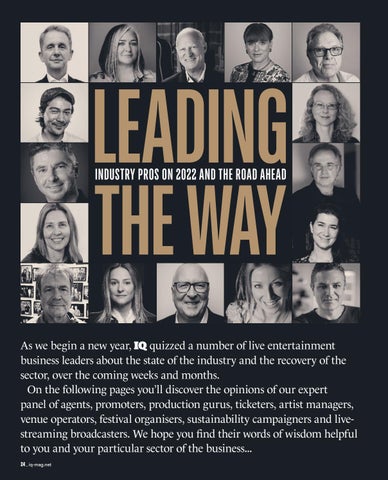
INDUSTRY PROS ON 2022 AND THE ROAD AHEAD
As we begin a new year, quizzed a number of live entertainment business leaders about the state of the industry and the recovery of the sector, over the coming weeks and months. On the following pages you’ll discover the opinions of our expert panel of agents, promoters, production gurus, ticketers, artist managers, venue operators, festival organisers, sustainability campaigners and livestreaming broadcasters. We hope you find their words of wisdom helpful to you and your particular sector of the business... 24
iq-mag.net
Leading The Way_Feature
EMMA BANKS CO-HEAD, CREATIVE ARTISTS AGENCY
What are the expectations of your artist clients as the touring circuits reopen? They are hoping to be able to get back on the road and play their music/read their poems/perform their stories to crowds who feel safe and excited to be out of their homes. They understand it might be a bumpy road, not only with Covid still being very much with us but also finally being able to see in real time how Brexit has impacted on touring and what problems we all may encounter. Everyone wants to get back to ‘normal,’ where a singer can crowd surf, where artists can hang out with their fans at the merch table or the backstage door, and where they feel confident that the tour they set out on will continue to the end with no issue. Whether we can achieve this is going to be questionable but touring prior to the Omicron variant arriving was running pretty smoothly in the countries that it was allowed, and we are lucky to have touring teams and promoter teams who have put a huge amount of work into making sure everyone both front of house and backstage are as safe as they can be. There has been an unprecedented spirit of cooperation across the industry during the pandemic. How can we ensure such collaborative efforts continue to improve lobbying for live music around the world? I think everyone has seen the benefit (see my earlier answer), and so as long as we can all agree a way to continue to fund the trade body (which
RON BENSION PRESIDENT & CEO, ASM GLOBAL
Are there any protocols developed because of Covid that you think will be here to stay even if the virus disappears? The need to ensure safety, security, and consumer confidence in venues. We’re particularly proud of our Venue Shield proprietary programme, industry-leading reopening protocol that ensures the facilities are clean and certified at the highest standards for the safety and health of our co-workers, clients, and guests. Additionally, some of the service changes on the F&B around pre-ordering, cashless, quick serve, etc., have been accelerated and will surely be here to stay. Are there any ways in which you have seen audience expectation changing since 2019? Much is still in transition, but what never changes is the need to provide the best experience possible. That’s what ASM Global is committed to. Do you imagine that industry consolidation will increase or decrease as markets around the world reopen for business? This is no different than any other industry
benefits absolutely everyone in the live space), I think it will continue with no issue. Some years we may not need to do so much together, but clearly having a voice in the places of power is important for our business to thrive. What are your predictions for business as we roll into 2022? As I sit here today [pre-Christmas], the UK has recorded its highest daily number of Covid cases since the pandemic began, and it looks like that is a record that will be broken daily for a while. This has inevitably got to mean that we are going to have a rocky end to 2021 and probably a rockier start to 2022 while we find out if this is a dangerous variant or something that takes people off work but not into hospital. Clearly, the continuing lockdowns in various European markets are bad for business, and even when venues are allowed to remain open, we are seeing a high level of absence at shows, where people are no longer feeling confident to go out. So business is going to be tough because we are going to lose more shows, and that is bad for everyone. I assume that as the population gets vaccinated with a third shot, we will then see case numbers reduce and can get back to the place we have been in the last few months, with shows happening and everyone out and about again. We will get through this, but it will be tricky for a while longer, and the 2022 bounce back looks like it is going to take longer than we hoped.
where there is consolidation and then break up. That said, what we have learned at ASM is that our scale has great value to our clients from a business intelligence and content-leverage perspective; but we know that our real strength is the laser-focused local operators that are best-inclass and totally dedicated to delivering revenues and results to their venues, clients, and employees at the facility-level where the rubber meets the road. What are your predictions for business as we roll into 2022? We’re optimistic; we put ourselves in a position to hit the ground running in ‘22 with new revenue teams, technology, a focus on actionable marketing programmes, and a new team of skilled professionals in these areas, as well as content acquisition and sponsorships. Through inventive thought and hard work, the power of ASM is to continue to redefine and elevate the live entertainment experience, which is one of the great joys of millions and millions throughout the globe. Magazine
25
Feature_Leading The Way
PHIL BOWDERY
LUCY DICKINS
EXECUTIVE PRESIDENT OF TOURING, LIVE NATION / CHAIRMAN, THE CONCERT PROMOTERS’ ASSOCIATION
CO-HEAD OF MUSIC, WME
What was the toughest decision you and/or your company had to make during the pandemic? With my Concert Promoters’ Association hat on, I think the answer has to be the decisions we made right at the beginning of the pandemic when we didn’t know what was in store, and we had to start moving shows in huge numbers. Decisions about moving artists’ dates had to be made very quickly with little or no information, at a time when everything was so uncertain – it has to be the biggest challenge the live sector has ever faced together, and I’m pleased to say that, for the most part, we all pulled together. Despite the challenges, your company announced some major deals during the pandemic. What are your hopes for these investments as the industry returns to business? Our hope and belief is that the live sector has a hugely strong future. One of the things that was made clear to us all over the last two years is that gathering with others is an irreplaceable experience and one that fans and artists alike have missed, maybe more than they thought they would. The 2022 calendar appears to be oversaturated. Where do you see potential problems arising for tours and festivals? 2022 is definitely going to be a busy year, but that’s to be expected when you look at the fan demand out there. After the two years we’ve just gone through, being busy is a nice problem to have. What are your predictions for business as we roll into 2022? I think we’ve all learnt that the industry stands ready to deal with any bumps in the road, and the calendar looks great well into 2022 and 2023, so whatever comes our way, I think 2022 is going to be a bumper year, and I can’t wait.
26
iq-mag.net
The 2022 calendar appears to be oversaturated. Where do you see potential problems arising for tours and festivals? Planning and rerouting tours is a potential challenge for 2022 with the uncertainty of restrictions and lockdowns due to the continuous cycle of new variants, but being mindful of the dominos that we experienced and managed in 2020 and 2021 is an illustrative lesson of how we plan to deal with them in 2022. What has been your biggest highlight of 2021? I would say it’s been the comradery I’ve seen from our team. It’s never been higher, and I’m so proud of what we have all achieved. Obviously, the Adele comeback was super exciting; Dave selling out all his shows in a flash, as well as watching lots of our new talent – Olivia Rodrigo smashing records to Mustafa the Poet selling out multiple nights in London. There were actually many highlights! What are your predictions for business as we roll into 2022? The pandemic fatigue will lead to full recovery of the live industry, but it will come with its ups and downs. It’s certainly going to be a crowded marketplace. There is a huge backlog of touring due to the amount of new artists we have been breaking through and also the artists that have released multiple projects in the world where being on the road was halted. I also think we’ll see more traditional songs/ artist albums return. We are already beginning to see this with a few big artists, as during the pandemic there were far less collaborations. TikTok is definitely having a moment with more artists using the platform, but I think we’ll see a rise in other mediums over time. The metaverse has already made its mark on the music industry. I think we will see more in 2022. Roblox and Fortnite have millions of daily active users who have been living the avatar life for some time. I’m slowly getting my head around it all!
Leading The Way_Feature
MICHAEL HOSKING MANAGING DIRECTOR, MIDAS PROMOTIONS
How long do you think it will take for the industry to get back to 2019 levels of activity? I’m guessing that following the ‘dead cat bounce’ it will be five or six years before attending two concerts a month will be back on the agenda for most people – especially those who’ve not earned and saved on full salaries these past two years. I hope I’m WRONG! What are the biggest challenges – and opportunities – you foresee for the industry in the next 12 months? The ever-changing face of this pandemic – Omicron has dealt the industry another crushing
many of the sales cycles sit on top of each other and in many cases, also sit on top of the festivals that the artist is also appearing on. Ultimately, tour and festival announcements need to be carefully coordinated, but if an artist normally sells 5,000 tickets in a market per cycle, then packaging 10,000 or more tickets around a festival play all in the same market in one year is going to be a challenge, and some artists and events will suffer. At some point, there is likely to be fatigue between fans and certain artists, resulting in some shows/events experiencing lower sales and/or higher non-attendance. If not managed, then for some artists and events, 2022 has a risk of being a hangover from the pandemic rather than the strong return the industry needs.
JIM KING CEO, EUROPEAN FESTIVALS, AEG PRESENTS The 2022 calendar appears to be oversaturated. Where do you see potential problems arising for tours and festivals? There are an ever-increasing number of headline tours rescheduled from 2020/2021 into 2022, and
There have been some innovative events during the pandemic. Are there any in particular that have impressed you? It’s the development of those innovations away from the pandemic live events that interest me. Fans interacting through virtual experiences in metaverse style-environments that sit alongside the physical event will continue to grow in culture and sport, and the live music industry needs to be at the forefront of this. It doesn’t have to be a choice, and one doesn’t weaken or seek to replace the other. Are there any ways in which you have seen audience expectations changing since 2019? The success of those festivals that managed to op-
blow – and not just ours! Industry pals from Africa had booked holidays in Thailand this Christmas, only for Omicron to disrupt them totally. A sound engineer of mine flew from Switzerland to Denmark to see his ailing mother. When Omicron hit, he headed straight to the airport to return to Switzerland before borders were closed. When he landed later that day, he discovered that in mid-flight, the border had been closed, so he faced a mandatory quarantine. His mother passed whilst he was in quarantine, and he couldn’t get back. Just two of countless challenges. Opportunities are few and far between – perhaps the opportunity to try and understand Blockchain, cryptocurrencies and NFTs? What are your predictions for business as we roll into 2022? Another fruitless first three quarters in Asia but hoping that we can have some shows in the final quarter of 2022… as long as we don’t get hit by the Oh-My-God! variant.
erate at the end of summer 2021 was very heartening, but we must be careful. The emergence from multiple lockdowns created a unique demand that is unlikely to repeat in the same way. Fans will expect more in 2022 than they accepted in 2021. We will see an increasing upturn in expectation from fans as the year plays out and they have been to more and more shows, and there will be a need for the industry to up its game to keep fans attending and buying more tickets in the later part of the year. This should apply some positive pressure on artists to deliver new and exciting productions and on promoters to hit the highest possible delivery on customer services and fan experiences at their venues and festivals. What are your expectations for business in 2022? There are many great tours and festivals planned for 2022, but we still have some hurdles in front of us. A heavily impacted Q1 will create further rescheduling of tours. This followed by ongoing uncertainty about the different operating requirements in different territories will put pressure on some international touring schedules, which have to commit financially much earlier than others. Overall, I am positive for the summer. AEG has a fantastic series of festivals on sale with amazing headliners, but the ball is in our court to deliver great fan experiences, and with the volume of shows in play, fans will not respond favourably if their expectations are not being met. Magazine
27
Feature_Leading The Way
“[Artists] understand it might be a bumpy road, not only with Covid still being very much with us but also finally being able to see in real time how Brexit has impacted on touring and what problems we all may encounter.” Emma Banks | CAA
“2022 is definitely going to be a busy year, but that’s to be expected when you look at the fan demand out there. After the two years we’ve just gone through, being busy is a nice problem to have.” Phil Bowdery | Live Nation
“The reduction in capacities at events that I’ve been to have made those events a more enjoyable experience. I think there is food for thought there.” Teresa Moore | AGF
“If our business is anything, it is resilient. We will plough through this storm, adapt, and prosper.” Phil Rodriguez | Move Concerts
“We have learned how to look outside of traditional live touring to find other exciting new opportunities to expand our artists’ footprints.” Neil Warnock | UTA
“Our sector is made up of dedicated, resilient people who will do everything they can to persevere. Things are tough, but over 900 venues are still here, and we will continue to work collectively to support each other and tackle longand short-term challenges” Beverly Whitrick | MVT
28
iq-mag.net
JESSICA KORAVOS CO-CHAIRPERSON, OAK VIEW GROUP Oak View Group opened buildings in both New York and Seattle during the past few months. Has the experience of those projects provided any lessons that you can use to improve future arena developments? Every arena that we complete and open is, of course, a huge learning opportunity for the project coming up next. Each of our buildings is designed and built in very specific local circumstances: Climate Pledge Arena in Seattle includes a significant subterranean element to preserve its heritage roof structure, and the UBS Arena in Long Island, New York, is designed to complement the adjacent Victorian structure of the Belmont racetrack. However, there are many design elements, technology decisions and sustainability strategies that each building can learn from past projects. At Oak View Group, we are especially proud of our arena bowl and hospitality designs, which are bringing fans closer to the action than ever before, as well as our industry-leading energy conservation systems. When Co-op Live opens in Manchester in 2023, it will be the best of many worlds. Are there any protocols that were developed because of Covid that you think will be here to stay even if the virus disappears? Public health considerations will remain embedded in our thinking around any new buildings and operations, alongside security. We will continue to see app-based entry protocols, contactless concession areas, antiviral and antibacterial material choices, and more intensive cleaning protocols. These are positive developments that are important in future-proofing our spaces and providing a safe experience for our guests. What are your predictions for business as we roll into 2022? I hope that Omicron rapidly spreads through a mostly vaccinated population at a swift rate with relatively mild outcomes. I also hope that we are through it by the end of the winter to allow businesses to recover. Importantly, we will only be able to recover if the government rescinds remaining restrictions and advice to ‘exercise caution’ in a timely and decisive manner. Recovery also relies on the UK being a good neighbour and a good global citizen. I very much hope that all this will come to pass in 2022.
Leading The Way_Feature
TERESA MOORE
CLAIRE O’NEILL
DIRECTOR, A GREENER FESTIVAL
FOUNDER, GREEN EVENTS & INNOVATIONS CONFERENCE
A Greener Festival is now providing certification to other sectors. Do you think the pandemic pause on business has prompted decision makers to question their green credentials? Definitely. The pause allowed for time to think and reflect about their own businesses but, more than this, different sectors of the industry have recognised that they are part of the bigger live ecosystem and need to work together in a much more joined-up way to tackle climate change and the industry’s environmental impact. I believe this is a real sea change prompted by the time out during the pandemic, with COP26 the focal point for change. In my mind, it has undoubtedly speeded up progress, and the launch of Live Green and the Beyond Zero declaration felt like a genuine collaboration across the industry. And for us, suddenly, a huge demand by the industry for our new AGF A Greener Arena and Greener Touring certification.
Is sustainability in danger of being swept under the carpet in the race to get back to business? It is a foolish danger. Racing to get back to a business model that was unsustainable and has at most eight years of operability left would be a shortsighted failure of our industry. I have faith that we won’t sweep ourselves under the carpet with a lack of vision. The good news is there is a tsunami of inspired, positive, and powerful actors in the industry pushing sustainability to the front and centre of our rebuild. I am extremely confident that we will build a better future.
There have been some innovative events created during the pandemic to work with certain restrictions. Are there any that have particularly impressed you? I’ve noticed design playing a bigger part in the measures taken to provide more sustainable options and communicate the issues. To be totally honest, the reduction in capacities at events that I’ve been to have made those events a more enjoyable experience. I think there is food for thought there. Also design seems to be playing a bigger role in encouraging more sustainable practices. I saw a really great design for a water station at one event, which got around the Covid worries, encouraged water conservation, looked great, and was just dead easy to use. No more leaky standpipes. What are your predictions for the festival sector as we roll into 2022? We know that everyone wants the live experience, so that desire and demand hasn’t gone away. I do think we will see a greener live experience in 2022 as festivals put the commitments they have made into practice. So here’s to a greener, brighter 2022.
What has been your biggest highlight in 2021? There are so many. I think leading sustainability actions on the first arena tour to come back after the pandemic, with extremely positive results! Watch this space. And thank you to Kilimanjaro, UTA, Raw Power, The O2 and Jamal Chalabi of the TPG, for walking the talk straight out of the gates of the prolonged touring lockdown. What are your predictions for business as we roll into 2022? We need to be extremely mindful and proactive in protecting the wellbeing of ourselves and each other. The workload is immense, and we’re all a little bit rusty around the edges. When we are no longer stressed out, environmental best practice will be more easy to achieve. So long as we’re permitted, there will be a great upturn in attendance to gigs, festivals, and events of all kinds. This will help us to recover financially, but also gives us back the incredibly important platform that we can use to influence important and urgent societal changes for deeper connection, acceptance and care – for ourselves, each other, and the environment we are a part of. Let’s make 2022 the year that we step up to our responsibility and power as agents of change.
Magazine
29
Feature_Leading The Way
PHIL RODRIGUEZ CEO, MOVE CONCERTS How long do you think it will take for the industry to get back to 2019 levels of activity? Honestly… who knows? I’m an optimist by nature and would like to think that if we all got out
of bed and said, “Let’s get on with life,” we could get back to normal relatively fast, but reality now is different than in 2019, isn’t it? Our industry has very little control over factors that impact us… at best. We now live in a world where an outbreak of anything anywhere on the planet is augmented by a 24-hour news cycle and governments reimpose restrictions overnight in the name of extra caution… It’s tough to get a firm footing. It’s like walking on egg shells. And this scenario doesn’t help to calm the waters to readdress cancelation insurance, routings, etc. The vaccine was the holy grail. But then it wasn’t. Then it was the booster. Then it’s the omicron. I watch in shock at what is happening in Australia, New Zealand, Austria, etc. How do we and when do we, as a business and society, climb off that ledge? It’s tough to predict when we’ll get back to 2019 levels. That said, it is now clear that Covid will remain with us as an endemic disease, but we now know how to deal with it, with not only the vaccines but many other protocols that we now know also work, such as monoclonal antibody treatment, vitamins, etc. Enough with the fear and missing out on the most precious thing we have… our limited time in this life. Let’s get on with it! Are there opportunities within your geographical reach to entice artists, while other territories remain closed for touring?
ALEXANDER RUOFF CHIEF OPERATING OFFICER, CTS EVENTIM What are the two biggest lessons that we should take away from the experience of the pandemic? If we didn’t know it already, the pandemic has highlighted how important community and shared experiences are. The absence of live entertainment is just one of many examples that has made this painfully clear to us. With a great and motivated team, it is not only possible to steer through a crisis that was unimaginable two years ago [but] great opportunities can also be identified and exploited. How long do you think it will take for the industry to get back to 2019 levels of activity?
30
iq-mag.net
Absolutely. I do not foresee anything similar to what is happening in Europe or Australia with new lockdowns, etc, happening in our region. Simply put, the countries in our part of the world cannot afford more lockdowns or restrictions. The social cost will be too high. And Latin people want to go out and enjoy life. Basta!!! We will be 100% open for business by March 2022, and all our shows in general are selling strong. What’s been your biggest highlight in 2021? We’ve had two major highlights: 1. The success we’re beginning to have with an artist we signed in October 2020 – Tiago PZK. He’s growing on a daily basis. It’s very exciting. 2 The amazing job our partner and managing director in Puerto Rico, Alejandro Pabón, is doing in that market. PR opened for concerts this past August and Alejandro has been hitting goals with every shot. He has built a strong reputation in the market and has developed alliances that have expanded our line-up of concerts. I am very proud of his work. What are your predictions for business as we roll into 2022? If our business is anything, it is resilient. We will plough through this storm, adapt, and prosper. 2022 will be, I hope, the final mile through this storm that started in March 2020. I’m sure there will be more curve balls ahead, but we will all be better prepared and wiser.
We had thought that this would be the case in 2021. But the virus has taught us that it is unpredictable. Do you imagine that industry consolidation will increase or decrease as markets around the world reopen for business? It can be assumed that the crisis will tend to promote consolidation in the industry. We’ve seen and heard about some hefty ticket price increases because of the Covid effect. What do you think the short-term and long-term impacts will be on the industry? If costs remain persistently high due to increased requirements for access and hygiene measures, and for suppliers, this will also have an impact on ticket prices in the longer term. What are your predictions for business as we roll into 2022? We are confident for the summer. How the rest of the year will develop is not predictable from today’s perspective.
Leading The Way_Feature
RIC SALMON
JUSTIN SWEETING
CEO, DRIIFT
CO-FOUNDER, CLOCKENFLAP
There may well be fans who are reluctant to return to live events. How can the industry exploit live-streaming technology to keep these people engaged? Technology will have a large part to do with ensuring people remain engaged in this new format, but perhaps more importantly it comes down to artistry and creativity. Frankly, we’ve seen too many shows that just aren’t good enough. These events, these online experiences, can be so much more. At Driift, we’ve taken a really high level of curation and artistry to the shows we’ve produced and delivered over the last 18 months, and, ultimately, I think that’s what’s driven our momentum and success.
What are the two biggest lessons that we should take away from the experience of the pandemic? That it is both dynamic and endemic and so isn’t going to just disappear any time.
What level of inquiries are you getting for live-stream events in 2022? Steady. Managers and artists are rightly focused on getting their businesses back up and running, and that, of course, means looking at all types of activity. But the word ‘live-stream’ has quickly become part of the common lexicon, and we’re seeing people come to us talking about album campaigns and tours happening in 9-12 months and wanting to do a live-stream within that window. I think the question has to be: why wouldn’t you add this type of activity to your plans alongside traditional shows, releases, and promo? What are your predictions for business as we roll into 2022? Broadly speaking, like all of us, I want to see our industry bounce back and thrive. And largely, I believe it will but with a few more bumps in the road. It’s hugely important that businesses, large or small, push themselves, innovate, diversify, and grow. At our group of companies (ATC/Driift), we’re coming out of the last 18 months a more diverse, more exciting, and better organised business, and feel well setup for whatever the coming years have to throw at us.
Are there opportunities within your geographical reach to entice artists while other territories remain closed for touring? Yes, well, if an artist is up for spending quarantine time, there’s a captured market available! Otherwise, a challenge we face across Asia as a region is that different countries are opening up at different times and rates with different requirements. Outside of traditional touring we’ve been working on projects via other channels like Clockenflap XR, which is coming soon, and like everyone and their brother, doing some deep-dive exploration and work into the NFT world. What’s been your biggest highlight in 2021? Seeing what live returns can look like in real life and that it is possible to hold events, both large and small, within a pandemic if the suitable precautions and steps are taken. What are your predictions for business as we roll into 2022? Stop. Start. Stop. Start. The stuttering groundhog day roundabout continues. I just hope we can get the proper opportunity to show that not only can events take place, in many senses, they’re actually the safest places to be in the city with testing and precautions in place.
Magazine
31
Feature_Leading The Way
FRUZSINA SZÉP MD SUPERBLOOM / BOARD MEMBER, YOUROPE
What are the two biggest lessons that we should take away from the experience of the pandemic? How fragile we are as humans, and how fragile our industry is. Self-reflection is such a great thing. And being thankful for what we have because now we know how much we can lose, how fast, and how that feels; health-, private- and business-wise. What are the biggest challenges facing the festival business in the year ahead? We have to gain back the trust of our fans and the sponsors to be again a predictable industry. We have to come back in full-capacity, and the main restrictions have to disappear in the longer term in order to promote again in a normal and trustful way.
OLIVIER TOTH CEO, ROCKHAL / PRESIDENT, EUROPEAN ARENAS ASSO-
CIATION (EAA)
Are there any protocols developed because of Covid that you think will be here to stay even if the virus disappears? Arenas are all about safety – we cannot host the events we do without putting safety at the core of all our operations – however, the pandemic has highlighted the need for very visible and heightened safety measures, which has led to a new set of safety protocols. Some of these protocols are now legal requirements and some are expected by stakeholders – we call these Mandatory Expectation or MX. Throughout the pandemic, our arenas have been incorporating MX into their digital journeys, not only to comply with legal requirements, which are ever-changing but also to enhance the live event journey and create confidence with all stakeholders – artists, players, staff, partners, fans, and visitors. I think we must accept Covid-19 is not going to go away, and as we learn to live with the virus so must we continue to adopt and integrate extra safety measures into the live event journey as seamlessly and painlessly as possible. The pandemic has prompted venue operators to look for new forms of content to fill dates. Are there any of these sectors that you think will be here to stay? The lack of unified operating protocols, and the existence of border controls affecting freedom of movement across Europe and beyond is making it very difficult for international tours, big and small, to take place, and as a result, we are seeing a rise in bookings of domestic artists as well as cross-border activity. Also, just before the pandemic broke, the EAA launched Europact, an initiative designed
32
iq-mag.net
Are there any ways in which you have seen audience expectations changing since 2019? Yes, absolutely. The audience is much more careful [about] where they go, what they buy, when, and for which event. What are your predictions for the European festival sector as we roll into 2022? It is like going on your first date: there is this kind of special excitement in the air. I feel confident in the festival summer 2022, and I know that many of my dear brothers and sisters in the festival family feel the same.
to create a branded live performance space dedicated to showcasing emerging talent across its member arenas. The objective of this pilot scheme is for it to evolve into an established and recognised platform with a longer-term goal of sharing artists across the arenas to help boost new European repertoire. The current situation is at least allowing both established and new domestic talent to get out and perform, and we would hope that these domestic acts will eventually get a chance to travel at least across their closest borders in the near future as we work together to create shared protocols and travel requirements. What are your predictions for business as we roll into 2022? We are taking a lot of bookings, but we are also expecting to see many postponements as we face new threats such as new variants and spikes in new cases. 2022 is going to be another tough year, and we are not expecting to see significant recovery until 2023. In terms of industry support, progress has been made thanks to the efforts of organisations such as GESAC and the work we have been doing at the EAA on awareness campaigns and intelligence gathering, but we are not out of the woods yet. The 2% of the recovery package to be dedicated to the culture sector and the published EU guidelines on reopening protocols are a start, but we still have a long way to go. In order for our industry to recover, we are going to need a coordinated re-opening effort that is adopted by all member states across Europe and applied to all those venues wanting to attract international tours and get back to hosting a wide mix of high-quality, full-capacity, safe live events.
Leading The Way_Feature
NEIL WARNOCK
BEVERLEY WHITRICK
GLOBAL HEAD OF TOURING, UNITED TALENT AGENCY
STRATEGIC DIRECTOR, MUSIC VENUE TRUST
What new skills do you think agents have acquired during the pandemic that can enhance the careers of their clients going forward? We have learned how to look outside of traditional live touring to find other exciting new opportunities to expand our artists’ footprints. There are many creative ways to ensure that clients’ music and artistry stay in front of their existing fans and to introduce them to new audiences via podcasts, live-streamed shows, merchandise offers, and more.
Are there any ways that the industry as a whole can better support the grassroots side of the business? Music Venue Trust has said for several years that grassroots music venues are the research and development department of the music industry. Normally, an industry invests in its own R&D, but the mechanism is still not in place for the money made in the top part of the UK music industry to be reinvested in the development of grassroots talent. In addition, the last couple of years have shown us that the recorded and publishing side of the industry operates at an ever increasing remove from the live side. If we all work with the same artists, why isn’t there a more joined-up commitment to developing future talent?
How have you handled the situation for new acts and artists without the usual avenues for them to perform and build their fanbases? In addition to finding the previously mentioned creative opportunities, we try to book live shows wherever they are allowed, as they are very important for media and fans alike. What are your predictions for business as we roll into 2022? The first three months of 2022 may be chaotic. The new variant has sent yet another curve ball through the whole of our live industry. We had hoped that the end of 2021 would see the start of a new normality in 2022. However, I’m hopeful that by April we’ll be back to business, and the business will be huge. Music lovers everywhere want to come back to shows. We will have bursting box offices, and I look forward to a massive festival season from late May onwards throughout the world.
How many enquiries have you had from other countries about establishing something similar to MVT? International links have always been important to MVT, and we have established relationships with associations across the world. Few have the focus on grassroots music venues that we have, but we often share our work and discuss commonality with colleagues in other countries. We hope to hold an online International Venues Day in 2022 to develop the network further, with the eventual aspiration of holding an in-person international version of our established national networking event. What are your predictions for the grassroots venues sector as we roll into 2022? Our sector is made up of dedicated, resilient people who will do everything they can to persevere. Things are tough, but over 900 venues are still here, and we will continue to work collectively to support each other and tackle long- and short-term challenges. If we can fix some of the things that make the finances so precarious – business rates, VAT on tickets, ownership of the buildings – then our venues can get on with presenting amazing shows, connecting audiences with new artists, and providing vital spaces for the development of new music. Magazine
33
WORKING ON THE CHAIN GANG
NFTs_Feature
The pandemic pause has allowed businesses around the world to take time to explore the benefits that new technology can offer, and as the live entertainment industry moves back into gear, the advantages that blockchain can deliver appear to be front and centre. Gordon Masson reports.
T
here have not been too many positive stories to come out of the last two years, but the non-fungible token (NFT) phenomena and the revenues it can deliver certainly piqued the interest of artists and corporations alike. As one of the range of products and services that are made possible by blockchain, NFTs have quickly become commonplace, while another application for the transparent digital ledger to quickly emerge has been in ticketing – which itself is embracing NFTs in the form of collectible tickets, as well as a way in which to offer interaction between events/artists and fans. Noting that the prolonged pause on activities caused by Covid has allowed decision makers to take a closer look at blockchain, Olivier Biggs, marketer for GET Protocol, says, “it definitely has given everyone a chance to re-evaluate their business and consider how future-proof their approach is. We’ve certainly seen a lot of inbound curiosity around NFT capabilities from both newcomers and veterans within the events industry. It’s clear to most that there are lasting benefits offered by NFT ticketing that transcend any short-term hype cycle. Ticketing is the per-
fect vessel for this innovation.” Beat Hive founder, Josh Pamplin, agrees, “It’s definitely been a pivotal moment for change, especially for people trying to future-proof creative and in-person industries,” he says. “However, the changes brought about by the pandemic also caused many content creators to realise that direct connections with fans is a great way to support themselves without the need to involve big corporations. In this way, I think that music creators are becoming key decision makers in the industry.” Straddling both the blockchain ticketing and NFT sectors, Biggs is well placed to explain the intricacies of the technology. “By registering a ticket on a public blockchain, you achieve transparent ownership for all to see,” he says. “When a ticket is minted as an NFT, it becomes an asset you can interact with and actually place in the hands of your attendees to unlock functionalities never before seen in the event industry.” He adds, “When a ticket or ticket transaction is registered on the blockchain it is visible only through a hash (standard bit of code). When it is minted as an NFT, depending on the file type, Magazine
35
Feature_NFTs
“The news is full of stories about ticket touts ruining the fan experience and revenue model of events all around our industry. The more blockchain is deployed the more we can control this” Stathis Mitskas | ComeTogether
it becomes a token for which it is possible to ascribe specific behavioural conditions and perks.” While NFTs have made the big headlines over the past year, those in the blockchain ticketing business have been quietly working away to highlight the benefits of transparency that the online ledgers can provide. Indeed, Stathis Mitskas, co-founder/chief revenue officer of ComeTogether, has also found some positives from Covid’s live music shutdown. “Prior to the pandemic the use of blockchain was really a new, novel topic that many organisers didn’t yet understand or view as a solution for their needs,” he observes. “With time to reflect on the future and innovations, this topic has now become something that is highly marketed, well understood, and deployed throughout the music (and all live events) industry. “Across many industries, we’ve seen a strong uptick in new technologies being introduced as organisations had the time to consider their ‘nice to have’ projects during the break. I guess you could say this was the one silver lining in this horrible time.” And that has certainly been the experience for Luca Ziche, senior sales manager for SecuTix, who tells IQ, “The switch to mobile ticketing necessitated by the pandemic introduced blockchain for the first time to many live event organisers. When looking for a contactless ticketing solution, they’ve found that digital ticketing based on blockchain solves not only the health and safety challenges they face, but it also addresses issues around fraud and security. “There are mobile solutions that simply offer a PDF ticket visualiser. But they don’t offer the traceability that a secure mobile ticket using blockchain does. Mobile ticketing-based blockchain provides full ticket control and traceability. As the tickets are completely traceable, blockchain ticketing removes the risk of counterfeit tickets and makes it easy for fans to transfer or resell tickets securely. The latter is more important than ever now, for example, if someone suddenly can’t attend because they need to quarantine.”
36
iq-mag.net
State-of-the-art Functionality
As just one of the many new technologies that has been trying to find a foothold in live entertainment over the past decade, blockchain developers have, until now, been marketing their wares to an industry that was often too busy to give them proper attention. But with the pressure very much on efficiency and improving bottom-line revenues as businesses plan for the future, the Internet-based tech and its proponents are finally finding new clients. “We eliminate fraud, boost security, help clients connect better with fans, and take audience experiences to the next level,” says Ziche of the ticketing services SecuTix offer. “We do this by delivering unique encrypted and completely traceable tickets into a mobile wallet. This helps the organiser better understand and digitally engage with audiences, provide a great fan experience, and guarantee safe venue operations.” ComeTogether’s corporate tagline is: Blockchain ticketing to unlock new revenue from secondary markets and NFTs, while improving fan experience. “What this means in layman’s terms is basically three things,” Mitskas says. “1 – blockchain: Our solution is based on blockchain, which means the solution is secure, the users’ data is secure, the tickets cannot be faked. “2 – new revenue streams: Event organisers can access revenue streams that are new for them. If they decide to allow resale of their tickets, this can be done safely through our app within the parameters for pricing set by the organiser. They can also share in this revenue. Non-fungible tokens or NFTs can be offered via the app to provide exclusive event collectibles that can be resold in the future to create royalty revenues. “3 – the fan experience: We improve fan experience by always ensuring that tickets are the real thing. There is zero chance of getting to the event and finding out you have a fraudulent ticket. Resale rules provided by the event organisers ensure that tickets are not resold at exorbitant
prices as tickets can’t be transferred outside of the blockchain. NFT collectibles also increase fan engagement giving fans an extra incentive to go to an event to redeem exclusive NFTs and through gamification and contests.” That ability for ticketing operations to also offer clients NFTs is being heavily pushed by Biggs and GET Protocol. “We allow our users to issue NFT tickets and tap into the added value of innovative tech without facing any complexity,” he explains. “This hassle-free experience makes it easy for event organisers or ticketers that use our protocol to enjoy the benefits that we designed our tickets around: for starters, this entails direct engagement with fans without relying on social media algorithms; retaining complete power and revenue with regards to the secondary market; and knowing exactly who owns your tickets.” Pamplin, meanwhile, is keen to promote the benefits of NFTs for artists. “Beat Hive’s vision is to bring equality back to the music industry,” says Pamplin. “At present music is as accessible as it’s ever been. This is great for listeners but has meant that the value of music has diminished to the point where most artists struggle to earn a
NFTs_Feature living wage. Without means to support themselves, more and more musicians are having to turn away from the music industry, meaning that we are risking a creativity drought where diversity of music shrinks.” Developing a solution for that dilemma, Pamplin states, “Beat Hive is a decentralised, online marketplace, where users can buy, sell, and exchange music NFTs. Music creators, venues and event organisers who sell their NFTs via our marketplace will keep 95% of their sales profit and can set their percentage of any resales. “We are one of the first companies in the digital world setting out to democratise the music industry. By offering creators increased shares of their music profits, we are enabling creators to keep on creating. We provide a secure space where unique content, tickets or music can be safely stored and sold with maximum transparency for both fans, creators, and organisations.” As part of its business model, Beat Hive’s community wallet takes 2.5% from every transaction on the platform to support projects that users can propose and vote on to fund further creativity. “We are also working on launching
our ‘Powered by Beat Hive’ project in the New Year, [which will be] an active team of consultants offering a helping hand to clients who want to navigate our platform and this new technology, while still ensuring that every client keeps 95% of their revenue.”
Research & Development
While the live events industry has been crippled throughout much of the past two years, those in the emerging blockchain world have been working tirelessly to ensure that the products and services they offer will be fit for purpose to address business needs as and when venues, concerts, and festivals start to re-emerge from the pandemic fog. “Essentially, research and development is a continuous state for us – we are constantly building out features and concepts for the future,” proclaims Biggs. “During the pandemic, we have turned every ticket we issue into a NFT collectible, as well as allowed existing ticketing companies to issue ‘digital twin’ NFTs of their current ticket inventory. As of late, the topics of innovation range from generative NFT art-
works to channelling the power of decentralised finance (or DeFi) to allow for artists and creators to pre-finance their own events without having to rely on predatory loans from third parties.” “As a team, Beat Hive’s pandemic research was split into two main areas,” Pamplin tells IQ. “The first was working meticulously to understand the many journeys of music creators, at all levels and in all situations. This is so that Beat Hive’s vision can be aligned with all creators, and we can support the needs of as many as we can, especially as this space is constantly evolving. “The second was a long journey of designing and developing our platform. We wanted to utilise blockchain technology as best we could while simultaneously making it as user friendly as possible and always focussing on our goal of bringing equality to the industry.” And Pamplin believes that Beat Hive’s inhouse experience, coupled with its desire to bring in outside experts to bolster its knowledge base, puts the company in an ideal position to help the live music industry with its recovery. “Our research team has a competitive edge: a strong foundation and in-person understanding
Magazine
37
Feature_NFTs
“Throughout 2022 we will continue to see an uptake of digital wallets that can hold NFTs and cryptocurrency” Josh Pamplin | Beat Hive
of the challenges involved in supporting yourself as an artist,” says Pamplin. “Our team has lots of experience in many different areas of the music industry: performing live; producing records; graphic design; audio and visual engineering; managing music studios; publishing/licencing; and event management. We have an awesome team of blockchain developers and external partners we consult with too.” As a relatively new tool for ticketing companies to exploit, blockchain’s capabilities are generating exciting possibilities for the industry to tap into. On SecuTix’s R&D efforts, Ziche reveals that the company’s TIXNGO product has evolved in two distinct ways.
WWW.TIXNGO . IO
38
iq-mag.net
“Firstly, we developed our fan engagement capabilities with dedicated push notifications and a questionnaire that allow the organiser to communicate with fans simply and quickly, plus get their feedback,” says Ziche. “During the pandemic, organisers have learnt that events can change quickly – new safety protocols, change of date, introduction of timeslot entries – so it’s imperative that they can communicate swiftly and directly to the ticketholder. Push notifications are an effective way to achieve this as they have a higher rate of cut through than the traditional email. “Secondly, we introduced TIXNGO Covid Pass Early Check-In, [which is] a fast-lane capability. It works in a similar way to boarding an aeroplane; a few days before the event, the
ticketholder will receive a notification on their smartphone with instructions on how to upload their Covid Pass. The system will then validate the document, checking it against the name on the ticket and allowing the user to gain priority access at the event. “For ticketholders, it means a better pre-event customer experience, and for the event organizer it means lower staff costs as the fast lane doesn’t increase operational costs, smoother operations to meet health protocols, and protection of customers’ health data.” Meanwhile, Mitskas says ComeTogether has used the pandemic period well by developing new products he believes the industry will benefit from in its drive to return to normality – including the seemingly inevitable development of NFT tickets and collectibles. “We used our blockchain development in place for digital ticketing as a foundation for new offers given the lack of live events,” explains Mitskas. “The first additional product we developed was the BackTogether app: a Covid-19 digital certificate that shows the current Covid-19 status – vaccine, recovered or test. Additionally, the person who actually attended an event can be verified in the case that Covid-19 tracing needs to be conducted. This effort was focused on the safe restart of events.” He continues, “The second product we devel-
The secured mobile blockchain ticketing solution from SECUTIX, which helps event organisers eliminate fraud, boost operations and improve audiences’ experience.
NFTs_Feature In Brief
Everton Football Club is just one of many sports operations that are using SecuTix services
SECURE MOBILE BLOCKCHAIN TICKETING
WWW. TI XNGO . I O
Feature_NFTs
ComeTogether ticket QR codes can be simply scanned at venue access points
oped was the NFT collectibles app, UniqTogether. Collecting tickets and other event memorabilia has always been a part of going to events. We bring this to the digital world. It works in conjunction with digital ticketing or standalone and includes a marketplace for future resale. The ticket can be an NFT, with artwork and even dynamic content (eg the setlist) but we can also create NFTs linked to the live event with images, video highlights, fan-generated content, and exclusive artist content for event attendees.”
A Bright Future
The growing adoption of blockchain ticketing, NFTs, and the likes of blockchain-based royalties applications in the wider music industry are building the foundations for what could become a multibillion dollar sector in the years to come. Central to blockchain’s appeal is its transparency, allowing people to track transactions at every stage and to see how money is genuinely shared between the various rights holders. Sharing his belief that blockchain will continue to become more prevalent in ticketing solutions, Mitskas says, “The news is full of stories about ticket touts ruining the fan experience and revenue model of events all around our industry. The more blockchain is deployed the more we can control this. “Blockchain enables the industry to create new marketing programmes, such as NFT collectibles, to drive stronger fan engagement and ongoing revenues. During 2021, we saw incredible NFT success stories where NFT music was auctioned at very high prices; but these scenarios were only applicable to a wealthy audience. Our vision is that NFTs become something available
40
iq-mag.net
to everyone at every price point.” Mitskas continues, “We envision a future where multiple ticketing vendors (or other stakeholders) will have the incentive to participate in a ticketing public blockchain network. This would result in a collaborative ticketing economy built on a public blockchain that allows for vendors to cross borders to increase their revenue and ticketing market share. How would this work? Imagine a ticketing vendor in England who wanted to include events taking place in Greece in their portfolio of tickets available for sale.” Looking toward the future, Pamplin says Beat Hive is predicting huge growth. “We are incredibly excited for what’s in store for the music industry. Much of what we predicted back in October 2020 has happened, and we are expecting much of the same moving into 2022. One particular standout is an increase of public adoption and awareness for blockchain itself.” Pamplin predicts, “Throughout 2022 we will continue to see an uptake of digital wallets that can hold NFTs and cryptocurrency. This will enable the live events sector to use blockchain more in everyday life. Live online performances can become more profitable for the creators using NFTs, and when the time is right, we have some wonderful ideas on how we can team up with venues and event organisers. “We also have to talk about the Metaverse! It sounds crazy, but we do believe it will supplement the live event industry in years to come. We have some land in a metaverse, and it would be silly of us to let you know all our plans for it, but we are keeping a close eye on the metaverse/ event space and looking forward to sharing more news with you throughout 2022.”
For his part, SecuTix executive Ziche contends that many people will turn to blockchain technology to fulfil tasks that traditional ticketing providers have been unable to deliver. “Many in the event industry have had bad experiences with the legacy ticketing players,” states Ziche. “The trust in their ability to solve the transparency and fair exchange equation has been eroded. We are now seeing some large sports rights holders and music artists pushing for action to protect their true fans and allowing them to buy a ticket at a fair price thanks to blockchain. A perfect example of this is SECUTIX’s use of blockchain for Ed Sheeran’s 2022 tour in Europe to combat ticket fraud.” And Ziche tells IQ that while there are obstacles to overcome, the sector has been preparing itself for a full-scale assault, post-pandemic. “The building blocks have been coming to maturity in 2021 and solutions like our own TIXNGO is already embracing those new capabilities and applying them to ticketing. For example, leveraging blockchain smart contracts to regulate secondary market transactions, generate new revenue stream for organisations, and create a trusted resale experience for fans.” Indeed, GET Protocol’s Biggs concludes that the current wave of blockchain operations is merely the start of a new commercial marketplace that he insists will grow exponentially in the years ahead. “At the risk of coming across slightly biased, I feel it is safe to say that we have only seen the first iterations in a lot of revolutionary blockchain-based applications,” says Biggs. “From our own NFT ticketing applications to the enormous potential of metaverse events, the drastic increase in people building within this corner of the industry illustrates the fact that we have truly only seen the tip of the iceberg.”
CONTRIBUTORS
OLIVIER BIGGS | GET PROTOCOL STATHIS MITSKAS | COMETOGETHER JOSH PAMPLIN | BEAT HIVE LUCA ZICHE | SECUTIX
Your Shout
What was your best live moment of 2021?
TOP SHOUT
I promoted the Foo Fighters in Fairbanks, Alaska, on 21 August 2021. Not only had they not had a major show in the city since Covid, it was the first major arena rock show in the market in nine years. The town did not have t-shirt concert security, so we got help from the military base down the road, The town had one rigger, so we flew in eight additional riggers from the States. The police call for the show was to be six, but Fairbanks as a city only has 12 policeman total and could not make that work, so we called the towns around them and got our police from the north pole (not joking at all). Production had to be driven in from days away as concert sound and light of this scale just did not exist in the market. The venue team had never put on a concert before, but we talked them through it all and pulled together to make it happen. The show required proof of a vaccine or a negative test. The vaccine rate in Fairbanks was very low, and the number of tests in the market did not meet the demand, so we set up a free testing site at the venue for 24 hours leading into the show. Seeing the band on stage for soundcheck was a major milestone in my life and career, only to be topped by the fans’ faces when finally seeing a world-class rock band on stage in their town as the house went to black, and Dave and the boys brought the house down for well over three hours. The fans had been touched by the rock gods, and the band had felt it, too, not only promising to return but also spreading the word to other bands that the good people of Alaska have earned more great rock & roll, and they need to come play for these amazing fans. I was blessed to be in the room that night, as it was a reminder of how great live music is. Dan Steinberg | Emporium Presents
42
iq-mag.net
The Carlson Center in Fairbanks, Alaska, hosted Foo Fighters in August 2021
When Frank Turner walked on the stage at Clapham Grand on 19 July. After 438 days of silence. I don’t think it would be possible to explain all the emotions that went through my head in words. Mark Davyd | Music Venue Trust Kings of Convenience matinee show at Royal Festival Hall, 26 September: a warm Sunday afternoon on the South Bank; first of two shows. A large percentage of the crowd had travelled to London from around the UK and Europe. This was the band’s first major show in years, and it was sublime. Rob Challice | Paradigm I can only reply self-centredly as it was mostly a bleak year in terms of concerts (not other things). It was [early December] performing in Mexico City in the courtyard of the Vernacular Institute to 50 or so arty types. I think I channelled all the fury that lingers inside me following two years of absurd struggle. Nick Hobbs | Charmenko
Your Shout
It was 26 June 2021 – the first concert at the Berlin Waldbühne, with the Berlin Philharmonic Orchestra’s end-of-season concert 2021: 6,500 people – full joy! Peter Schwenkow | Deutsche Entertainment AG Does an impromptu concert for two by a Spanish folk singer and his partner, in a beautiful cortijo near Granada [Spain], on a hot summer evening in July count? It was pretty special! Or do you mean a concert of a more “traditional” kind? I’m still waiting for one of those… Gill Park | MGR Touring The wildly positive Lusitanian artist Sara Tavares visited our Ancient Theatre Plovdiv earlier this year. The last time her band had performed was in 2019, and it was again at a show that I promoted at club Joy Station. When they arrived in Bulgaria, the faces of Sara and the band were like the faces of the people you want to see when you’ve come out the other side of a long and dark tunnel (not dissimilar to the one Andy Dufresne crosses in The Shawshank Redemption). When Sara stepped onto the stage, the emotion that overtook the audience spilled over to the band and to us behind the stage. It was an electrifying and joyous occasion. We all had “something in our eye.” Boyan Robert Pinter | Panharmony.net Genesis finally taking to the stage in Birmingham, 18 months after they rehearsed. John Giddings | Solo Agency A private show of a close friend, in front of ten invited people/friends, where he presented tracks he’s written and recorded over a year, mostly at home, and will likely never be released. This reminded me, once again at its purest, what my job as agent and manager is all about: the music, art, and working with good human beings. Kai Lehmann | Cabin Artists My best live music moment in 2021 must be OMD playing at indigo at The O2. We were still running socially distanced shows, and we had about 400 attendees in rather than a full house. It was my first ‘post-pandemic’ show at ‘my’ venue, which was already exciting enough. But I will forever remember the moment the house lights went down, the band’s intro started, and how loud and excited the crowd was when the band stepped on stage. It felt like a full house, the adrenaline and excitement was palpable. I felt it in my stomach, and couldn’t help crying tears of
joy! I will always keep that moment with me. Angela Curiello | indigo at The O2 H.E.R. at New York’s Apollo Theater. It was a private show hosted by Sirius XM and Pandora Small Stage series and was magical. The vibe of the soulful audience in the 1,500-seat venue, located in Harlem, was an incredible two-hour-plus groove. One of the non-musical highlights was when she mentioned the last time she performed at the venue, for the weekly talent show Showtime at The Apollo, when she was the age of nine! The November concert was certainly a homecoming in many ways, following the strange year (or two) we’ve had. Brian Kabatznick | Oak View Group My best musical moment was attending the first live show, following the shutdown, for one of my clients. Even though it was an outdoor ‘drive-in’, socially distanced, limited-capacity event in a fairground, with limited production, it signalled that we could eventually get back to (somewhat) normality. Wayne Forte | Entourage Talent
My best live music moment was during Music & Media in Tampere, Finland. The entire Music & Media team had worked its ass off to be able to bring the entire Finnish music sector and a large amount of internationals together – 550 people in total – safely, responsibly, and sustainably, even if there were simply horrible difficulties and risks in doing so. At the very same time, we had the most incredible piece of music ever created, Verdi’s Requiem, at the main auditorium. It was sold out for two shows at 2,000 capacity and 320 people on stage. I handpicked six people from the Industry Awards Gala and took them to witness Verdi in the VIP section, and we saw the magnificent ending, Dies Irae, with a 200-strong choir, four international top-notch soloists, and a 100-strong full symphony orchestra. I was not the only one who was moved: every single music industry head honcho was in tears. For all of us, it really felt like an interpretation of everything we all have felt and gone through in the past two years: “The day of wrath, […] that day will break up the world into ash. Lord, grant us all rest. Amen.” Paulina Ahokas | Tampere Hall Magazine
43
An epic adventure to explore uncharted territory and new frontiers
Shaping the new international live music business
G
FI
V
E
REGISTRATION NOW OPEN 34.ilmc.com/register
S A T H TA R E R D LO E R O LO H NN Y C H D H O A AT H O T L IO H N E N L H ,
LONDON | 26–29 APRIL 2022
Daring expedition made by possible by… THE ARTHUR AWARDS
FEATURES
PL ATI N U M
ASSOCIATION
GOLD
S I LVE R
MEDIA
ASSOCIATE
SERVICES