K
A Story of Units®
Part–Part–Total LEARN ▸ Module 2 ▸ Two- and Three-Dimensional Shapes
Student
Talking Tool I Can Share My Thinking
My drawing shows . . . . I did it this way because . . . . I think
I Can Agree or Disagree
because . . . .
I agree because . . . . I disagree because . . . . I did it a different way. I . . . .
I Can Ask Questions
How did you . . . ? Why did you . . . ? Can you explain . . . ?
I Can Say It Again
I heard you say . . . . said . . . . Can you say it another way?
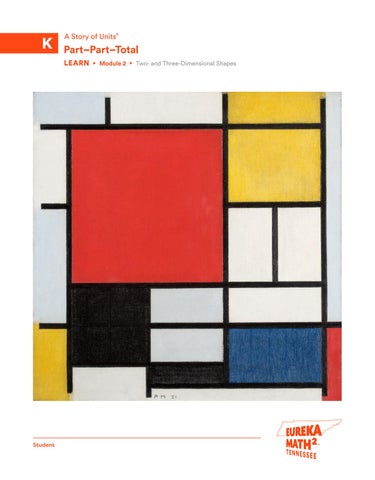
What does this painting have to do with math? Piet Mondrian reduced his subjects to colorful geometric shapes. In this painting, bold, black horizontal and vertical lines frame the colorful squares and rectangles in red, black, yellow, and more. Do any of the shapes seem similar? Do you notice that the smaller shapes are added together to create bigger shapes? How many shapes do you see in total? On the cover Composition with Large Red Plane, Yellow, Black, Gray and Blue, 1921 Piet Mondrian, Dutch, 1872–1944 Oil on canvas Kunstmuseum Den Haag, The Hague, Netherlands Piet Mondrian (1872–1944), Composition with Large Red Plane, Yellow, Black, Gray and Blue, 1921. Oil on canvas. Kunstmuseum Den Haag, The Hague, Netherlands. Image copyright © Kunstmuseum Den Haag. Image credit: Bridgeman Images
Great Minds® is the creator of Eureka Math®, Wit & Wisdom®, Alexandria Plan™, and PhD Science®. Published by Great Minds PBC. greatminds.org Copyright © 2022 Great Minds PBC. All rights reserved. No part of this work may be reproduced or used in any form or by any means—graphic, electronic, or mechanical, including photocopying or information storage and retrieval systems—without written permission from the copyright holder. Printed in the USA 1 2 3 4 5 6 7 8 9 10 XXX 25 24 23 22 21 ISBN 978-1-63898-485-6
A Story of Units®
Part–Part–Total ▸ K LEARN
1 Module
2 3 4 5 6
Counting and Cardinality
Two- and Three-Dimensional Shapes
Comparison
Composition and Decomposition
Addition and Subtraction
Place Value Foundations
EUREKA MATH2 Tennessee Edition
K ▸ M2
Contents Two- and Three-Dimensional Shapes Topic A . . . . . . . . . . . . . . . . . . . . . . . . . . . . . . . . . . 5
Topic B
Analyze and Name Two-Dimensional Shapes
Analyze and Name Three-Dimensional Shapes
Lesson 1. . . . . . . . . . . . . . . . . . . . . . . . . . . . . . . . . . . . .
Lesson 6 . . . . . . . . . . . . . . . . . . . . . . . . . . . . . . . . . . . .
This lesson appears only in the Teach book.
This lesson appears only in the Teach book.
Lesson 2 . . . . . . . . . . . . . . . . . . . . . . . . . . . . . . . . . . . 9
Lesson 7 . . . . . . . . . . . . . . . . . . . . . . . . . . . . . . . . . . 41
Classify shapes as triangles or nontriangles.
Name solid shapes and discuss their attributes.
Lesson 3 . . . . . . . . . . . . . . . . . . . . . . . . . . . . . . . . . . 13 Classify shapes as circles, hexagons, or neither.
Lesson 4 . . . . . . . . . . . . . . . . . . . . . . . . . . . . . . . . . . 19 Classify shapes as rectangles or nonrectangles, with square rectangles as a special case.
. . . . . . . . . . . . . . . . . . . . . . . . . . . . . . . . . 33
Lesson 8 . . . . . . . . . . . . . . . . . . . . . . . . . . . . . . . . . . 43 Classify solid shapes based on the ways they can be moved. Lesson 9 . . . . . . . . . . . . . . . . . . . . . . . . . . . . . . . . . . 45 Match solid shapes to their two-dimensional faces.
Lesson 5 . . . . . . . . . . . . . . . . . . . . . . . . . . . . . . . . . . 27 Communicate the position of flat shapes by using position words.
2
© Great Minds PBC •
This document is the confidential information of Great Minds PBC provided solely for review purposes which may not be reproduced or distributed. All rights reserved.
EUREKA MATH2 Tennessee Edition
K ▸ M2
Topic C . . . . . . . . . . . . . . . . . . . . . . . . . . . . . . . . . 47
Resources
Construct Shapes
Credits . . . . . . . . . . . . . . . . . . . . . . . . . . . . . . . . . . . 63
Lesson 10 . . . . . . . . . . . . . . . . . . . . . . . . . . . . . . . . . 51 Construct a circle.
Acknowledgments . . . . . . . . . . . . . . . . . . . . . . . . 64
Lesson 11 . . . . . . . . . . . . . . . . . . . . . . . . . . . . . . . . . . . . This lesson appears only in the Teach book.
Lesson 12 . . . . . . . . . . . . . . . . . . . . . . . . . . . . . . . . . . . This lesson appears only in the Teach book. Lesson 13 . . . . . . . . . . . . . . . . . . . . . . . . . . . . . . . . . 53 Draw flat shapes. Lesson 14 . . . . . . . . . . . . . . . . . . . . . . . . . . . . . . . . . 55 Compose flat shapes. Lesson 15 . . . . . . . . . . . . . . . . . . . . . . . . . . . . . . . . . . . This lesson appears only in the Teach book. Lesson 16 . . . . . . . . . . . . . . . . . . . . . . . . . . . . . . . . . 61 Organize, count, and represent a collection of objects.
© Great Minds PBC •
This document is the confidential information of Great Minds PBC provided solely for review purposes which may not be reproduced or distributed. All rights reserved.
3
Module 2 Topic A
FAMILY MATH Analyze and Name Two-Dimensional Shapes Dear Families,
Students are learning to recognize and describe two-dimensional, or flat, shapes, including by using the number of straight sides and corners a shape has. Students also learn that triangles, rectangles, squares, hexagons, and circles are all closed, or have no gaps. These defining attributes are then used to sort figures into categories of examples and nonexamples. For example, “I know this is a triangle because it has 3 straight sides and 3 corners. This one is not a triangle because 1 side is curved.” Students also practice using position words by listening to directions and placing shapes above, below, behind, in front of, next to, or on top of an object.
Words We
Triangles
Not Triangles
Are Learning describe triangle rectangle circle square hexagon
A student touches and counts each corner and side of a triangle.
A student decides whether a shape has all the features of a triangle.
A student listens to directions and uses acquired understanding of position words to place shapes.
At-Home Activities Activity Idea 1 Almost or Exactly Like Shape Search Cut out the five flat shape cards. Ask your child to choose any card and to look around the room for something that is exactly like that shape. Then ask your child to find something that is almost like that shape. Have your child share why their object is exactly or almost like that shape. Now, you take a turn and share why it is exactly or almost like that shape. For example: An exact rectangle: a picture frame, a television screen, a door. An almost rectangle: a pillow, a toaster, a sandwich.
Activity Idea 2 Where Is It? Use the shape cards to play “Where Is It?” Ask your child to close their eyes. When their eyes are closed, hide one of the cards near or on a toy and give clues as to where the shape is. For example, “The square is next to your teddy bear.” Encourage your child to use the clues to find the shape. Then ask your child to choose a card and hide it while you close your eyes. © Great Minds PBC •
This document is the confidential information of Great Minds PBC provided solely for review purposes which may not be reproduced or distributed. All rights reserved.
5
EUREKA MATH2 Tennessee Edition
K ▸ M2 ▸ TA
What Makes an Exact Shape? Students learn these features for each shape.
No straight sides and no corners Perfectly round, like a wheel
3 straight sides 3 corners
4 straight sides 4 corners 2 sides go straight up and down A special type of rectangle 4 straight sides all the same size 4 corners
6 straight sides 6 corners
6
FA M I LY M AT H ▸ Module 2 ▸ Topic A
© Great Minds PBC •
This document is the confidential information of Great Minds PBC provided solely for review purposes which may not be reproduced or distributed. All rights reserved.
EUREKA MATH2 Tennessee Edition
K ▸ M2 ▸ TA
Flat Shapes My 5 Shapes Circle Triangle Square Rectangle Hexagon Cut cards apart.
© Great Minds PBC •
This document is the confidential information of Great Minds PBC provided solely for review purposes which may not be reproduced or distributed. All rights reserved.
Module 2 ▸ Topic A ▸
FA M I LY M AT H
7
EUREKA MATH2 Tennessee Edition
K ▸ M2 ▸ TA ▸ Lesson 2
2
Name Trace the triangle. Count the corners.
corners
Trace the triangles.
© Great Minds PBC •
This document is the confidential information of Great Minds PBC provided solely for review purposes which may not be reproduced or distributed. All rights reserved.
9
EUREKA MATH2 Tennessee Edition
K ▸ M2 ▸ TA ▸ Lesson 2
Color the triangles. Cross off anything that is not a triangle.
10
PROBLEM SET
© Great Minds PBC •
This document is the confidential information of Great Minds PBC provided solely for review purposes which may not be reproduced or distributed. All rights reserved.
EUREKA MATH2 Tennessee Edition
Hexagons
© Great Minds PBC •
K ▸ M2 ▸ TA ▸ Lesson 3 ▸ Hexagon and Circle Sort
Circles
This document is the confidential information of Great Minds PBC provided solely for review purposes which may not be reproduced or distributed. All rights reserved.
Not Hexagons or Circles
11
EUREKA MATH2 Tennessee Edition
© Great Minds PBC •
This document is the confidential information of Great Minds PBC provided solely for review purposes which may not be reproduced or distributed. All rights reserved.
K ▸ M2 ▸ TA ▸ Lesson 3 ▸ Sorting Cards
13
EUREKA MATH2 Tennessee Edition
K ▸ M2 ▸ TA ▸ Lesson 3
3
Name Trace the circle. Count the corners.
corners
Trace the circles.
© Great Minds PBC •
This document is the confidential information of Great Minds PBC provided solely for review purposes which may not be reproduced or distributed. All rights reserved.
15
EUREKA MATH2 Tennessee Edition
K ▸ M2 ▸ TA ▸ Lesson 3
Color the circles. Cross off anything that is not a circle.
16
PROBLEM SET
© Great Minds PBC •
This document is the confidential information of Great Minds PBC provided solely for review purposes which may not be reproduced or distributed. All rights reserved.
EUREKA MATH2 Tennessee Edition
K ▸ M2 ▸ TA ▸ Lesson 3
Trace the hexagon. Count the corners.
corners
Trace the hexagons.
© Great Minds PBC •
This document is the confidential information of Great Minds PBC provided solely for review purposes which may not be reproduced or distributed. All rights reserved.
PROBLEM SET
17
EUREKA MATH2 Tennessee Edition
K ▸ M2 ▸ TA ▸ Lesson 3
Color the hexagons. Cross off anything that is not a hexagon.
18
PROBLEM SET
© Great Minds PBC •
This document is the confidential information of Great Minds PBC provided solely for review purposes which may not be reproduced or distributed. All rights reserved.
EUREKA MATH2 Tennessee Edition
© Great Minds PBC •
This document is the confidential information of Great Minds PBC provided solely for review purposes which may not be reproduced or distributed. All rights reserved.
K ▸ M2 ▸ TA ▸ Lesson 4 ▸ Triangles
19
EUREKA MATH2 Tennessee Edition
Rectangles
K ▸ M2 ▸ TA ▸ Lesson 4 ▸ Rectangle Sort
Not Rectangles
Square Rectangles
© Great Minds PBC •
This document is the confidential information of Great Minds PBC provided solely for review purposes which may not be reproduced or distributed. All rights reserved.
21
EUREKA MATH2 Tennessee Edition
© Great Minds PBC •
This document is the confidential information of Great Minds PBC provided solely for review purposes which may not be reproduced or distributed. All rights reserved.
K ▸ M2 ▸ TA ▸ Lesson 4 ▸ Rectangle Sort
23
EUREKA MATH2 Tennessee Edition
K ▸ M2 ▸ TA ▸ Lesson 4
4
Name Trace the rectangle. Count the corners.
corners Trace the rectangles.
© Great Minds PBC •
This document is the confidential information of Great Minds PBC provided solely for review purposes which may not be reproduced or distributed. All rights reserved.
25
EUREKA MATH2 Tennessee Edition
K ▸ M2 ▸ TA ▸ Lesson 4
Color the rectangles. Cross off anything that is not a rectangle.
26
PROBLEM SET
© Great Minds PBC •
This document is the confidential information of Great Minds PBC provided solely for review purposes which may not be reproduced or distributed. All rights reserved.
EUREKA MATH2 Tennessee Edition
© Great Minds PBC •
This document is the confidential information of Great Minds PBC provided solely for review purposes which may not be reproduced or distributed. All rights reserved.
K ▸ M2 ▸ TA ▸ Lesson 5 ▸ Rectangles
27
EUREKA MATH2 Tennessee Edition
© Great Minds PBC •
This document is the confidential information of Great Minds PBC provided solely for review purposes which may not be reproduced or distributed. All rights reserved.
K ▸ M2 ▸ TA ▸ Lesson 5 ▸ Duck
29
EUREKA MATH2 Tennessee Edition
K ▸ M2 ▸ TA ▸ Lesson 5
5
Name
Simon Says Shapes
© Great Minds PBC •
This document is the confidential information of Great Minds PBC provided solely for review purposes which may not be reproduced or distributed. All rights reserved.
31
Module 2 Topic B
FAMILY MATH Analyze and Name Three-Dimensional Shapes Dear Families,
Your child is learning to describe three-dimensional, or solid, shapes. This includes learning to distinguish between flat and solid shapes, naming the shapes, and counting faces, edges, and corners. In class, students use their own words as well as math language to describe the features of solid shapes. They begin to match solid shapes to the flat shapes that they see in them.
Words We Are Learning flat shape solid shape pyramid sphere cube cone rectangular prism cylinder
A student sorts by flat and solid shapes and then matches a number to each group.
A student looks at a group of objects and finds the solid shapes that they resemble.
At-Home Activities Activity Idea 1 Almost or Exactly Like Shape Search Cut out the six solid shape cards. Ask your child to pick a card and to look for an object that is almost like that shape. Then ask your child to find an object that is exactly like that shape. Have your child share why the object is exactly or almost like that shape. Now you take a turn and share why it is exactly or almost like that shape. For example: Exactly like a sphere: a baseball, a soccer ball. Almost like a sphere: a pair of socks rolled up, a blueberry, a piece of puffed cereal.
Activity Idea 2 Find Another One Use the real-world solid shape cards to play this game. Start by shuffling the cards and spreading them out picture side down. Take turns picking up two cards at a time to see if
© Great Minds PBC •
This document is the confidential information of Great Minds PBC provided solely for review purposes which may not be reproduced or distributed. All rights reserved.
33
EUREKA MATH2 Tennessee Edition
K ▸ M2 ▸ TB
they show the same type of solid shape. This game uses only the cylinder, rectangular prism, and sphere. If the cards match the same solid shape, you keep them. If they don’t match, put them back facedown. Describe why the photos match or do not by using language about the features. For example: If you choose the photos of the book and box on your turn, you might say, “These are rectangular prisms. They both have 6 faces and 8 corners.”
What Makes a Solid Shape? Students learn these features for each shape.
CYLINDER 2 round or circle faces No corners Smooth around middle Looks like a can CONE 1 round or circle face 1 tip
SPHERE No edges or faces No corners or tips Rolls like a ball
34
FA M I LY M AT H ▸ Module 2 ▸ Topic B
© Great Minds PBC •
This document is the confidential information of Great Minds PBC provided solely for review purposes which may not be reproduced or distributed. All rights reserved.
EUREKA MATH2 Tennessee Edition
K ▸ M2 ▸ TB
PYRAMID 1 square face 4 corners 4 triangle faces 1 tip (can be called a corner)
RECTANGULAR PRISM 6 faces that are all rectangles (2 are square rectangles in these examples) 12 edges 8 corners Looks like a brick CUBE 6 square faces 12 edges the same size 8 corners Looks like a box
© Great Minds PBC •
This document is the confidential information of Great Minds PBC provided solely for review purposes which may not be reproduced or distributed. All rights reserved.
Module 2 ▸ Topic B ▸
FA M I LY M AT H
35
EUREKA MATH2 Tennessee Edition
K ▸ M2 ▸ TB
Solid Shapes
© Great Minds PBC •
This document is the confidential information of Great Minds PBC provided solely for review purposes which may not be reproduced or distributed. All rights reserved.
Module 2 ▸ Topic B ▸
FA M I LY M AT H
37
EUREKA MATH2 Tennessee Edition
K ▸ M2 ▸ TB
Real-World Solid Shapes
© Great Minds PBC •
This document is the confidential information of Great Minds PBC provided solely for review purposes which may not be reproduced or distributed. All rights reserved.
Module 2 ▸ Topic B ▸
FA M I LY M AT H
39
EUREKA MATH2 Tennessee Edition
© Great Minds PBC •
This document is the confidential information of Great Minds PBC provided solely for review purposes which may not be reproduced or distributed. All rights reserved.
K ▸ M2 ▸ TB ▸ 5-Group
41
EUREKA MATH2 Tennessee Edition
K ▸ M2 ▸ TB ▸ Lesson 8
8
Name Circle the shape if it rolls, slides, or stacks. Cross it out if it does not.
Roll
© Great Minds PBC •
Slide
This document is the confidential information of Great Minds PBC provided solely for review purposes which may not be reproduced or distributed. All rights reserved.
Stack
43
EUREKA MATH2 Tennessee Edition
K ▸ M2 ▸ TB ▸ Lesson 9 ▸ Farm
Circle any solid shapes that match the brown mud prints.
© Great Minds PBC •
This document is the confidential information of Great Minds PBC provided solely for review purposes which may not be reproduced or distributed. All rights reserved.
45
EUREKA MATH2 Tennessee Edition
K ▸ M2 ▸ TB ▸ Lesson 9 ▸ Farm
46
© Great Minds PBC •
This document is the confidential information of Great Minds PBC provided solely for review purposes which may not be reproduced or distributed. All rights reserved.
Module 2 Topic C
FAMILY MATH Construct Shapes Dear Families,
Your child is working to apply what they have learned about flat and solid shapes to create models of shapes by using materials such as clay and straws. The act of making shapes helps children understand the most important features of the shapes. They also discover how one shape can help build a different shape, and they explore how shapes can fit together like a puzzle.
K ▸ M2 ▸ TC ▸ Lesson 14
EUREKA MATH2
Fill in the puzzles.
Students build models of 5-sided flat shapes with straws or craft sticks.
58
Students build models of solid shapes by using straws and clay.
PROBLEM SET
Copyright © Great Minds PBC
Students create two new shapes by using 1 hexagon and 2 rhombuses.
At-Home Activities Activity Idea 1 Shape Builder Invite your child to explore household materials to build a shape. Consider using toothpicks or building blocks for shapes with straight sides. Your child can use string or cooked spaghetti to explore shapes with curved sides. Consider asking, “What is the name of that shape? How do you know?” For an extra challenge, give your child clues to build a specific shape. For example, “Here is the clue. The shape I’m thinking of has 4 sides and 4 corners. Can you build it?”
Activity Idea 2 Make a Silly Face Use the empty pumpkin shapes to play this game. Start by drawing one shape at a time on the pumpkin from the choices at the top. Try to use as many different shapes as possible at least once. You can combine the shapes to make new ones. This isn’t meant to be a a contest but an opportunity to have creative fun with your child. © Great Minds PBC •
This document is the confidential information of Great Minds PBC provided solely for review purposes which may not be reproduced or distributed. All rights reserved.
47
EUREKA MATH2 Tennessee Edition
K ▸ M2 ▸ TC
So Many Ways to Make a Flat Shape Students put shapes together and try to see how many different ways they can make a new shape. This is an added challenge because the outline of the shape is shown and students have to manipulate the shapes while staying within the boundary of the new shape.
RHOMBUS 2 triangles
TRAPEZOID 1 triangle and 1 rhombus 3 triangles
HEXAGON 2 triangles and 2 rhombuses 6 triangles 3 triangles and 1 trapezoid 2 trapezoids 3 rhombuses
48
FA M I LY M AT H ▸ Module 2 ▸ Topic C
© Great Minds PBC •
This document is the confidential information of Great Minds PBC provided solely for review purposes which may not be reproduced or distributed. All rights reserved.
EUREKA MATH2 Tennessee Edition
K ▸ M2 ▸ TC
Activity Idea 2: Make a Silly Face Use these shapes to draw a face on the pumpkins.
© Great Minds PBC •
This document is the confidential information of Great Minds PBC provided solely for review purposes which may not be reproduced or distributed. All rights reserved.
Module 2 ▸ Topic C ▸
FA M I LY M AT H
49
K ▸ M2 ▸ TC ▸ Lesson 10 ▸ Circle or Not?
Circle or Not?
EUREKA MATH2 Tennessee Edition
© Great Minds PBC •
This document is the confidential information of Great Minds PBC provided solely for review purposes which may not be reproduced or distributed. All rights reserved.
51
EUREKA MATH2 Tennessee Edition
K ▸ M2 ▸ TC ▸ Lesson 13
13
Name Trace.
© Great Minds PBC •
This document is the confidential information of Great Minds PBC provided solely for review purposes which may not be reproduced or distributed. All rights reserved.
53
EUREKA MATH2 Tennessee Edition
K ▸ M2 ▸ TC ▸ Lesson 13
54
LESSON
© Great Minds PBC •
This document is the confidential information of Great Minds PBC provided solely for review purposes which may not be reproduced or distributed. All rights reserved.
EUREKA MATH2 Tennessee Edition
Scoreboard
K ▸ M2 ▸ TC ▸ Lesson 14 ▸ Scoreboard
© Great Minds PBC •
This document is the confidential information of Great Minds PBC provided solely for review purposes which may not be reproduced or distributed. All rights reserved.
55
EUREKA MATH2 Tennessee Edition
K ▸ M2 ▸ TC ▸ Lesson 14
14
Name Fill in the puzzles.
© Great Minds PBC •
This document is the confidential information of Great Minds PBC provided solely for review purposes which may not be reproduced or distributed. All rights reserved.
57
EUREKA MATH2 Tennessee Edition
K ▸ M2 ▸ TC ▸ Lesson 14
Fill in the puzzles.
58
PROBLEM SET
© Great Minds PBC •
This document is the confidential information of Great Minds PBC provided solely for review purposes which may not be reproduced or distributed. All rights reserved.
EUREKA MATH2 Tennessee Edition
K ▸ M2 ▸ TC ▸ Lesson 14
Fill in the puzzles.
© Great Minds PBC •
This document is the confidential information of Great Minds PBC provided solely for review purposes which may not be reproduced or distributed. All rights reserved.
PROBLEM SET
59
EUREKA MATH2 Tennessee Edition
K ▸ M2 ▸ TC ▸ Lesson 16
16
Name Draw your collection to show how you counted.
© Great Minds PBC •
This document is the confidential information of Great Minds PBC provided solely for review purposes which may not be reproduced or distributed. All rights reserved.
61
EUREKA MATH2 Tennessee Edition
K ▸ M2
Credits Great Minds® has made every effort to obtain permission for the reprinting of all copyrighted material. If any owner of copyrighted material is not acknowledged herein, please contact Great Minds for proper acknowledgment in all future editions and reprints of this module. Cover, Piet Mondrian (1872–1944), Composition with Large Red Plane, Yellow, Black, Gray and Blue, 1921. Oil on canvas. Kunstmuseum Den Haag, The Hague, Netherlands. Image copyright © Kunstmuseum Den Haag. Image credit: Bridgeman Images; All other images are the property of Great Minds.
© Great Minds PBC •
This document is the confidential information of Great Minds PBC provided solely for review purposes which may not be reproduced or distributed. All rights reserved.
63
EUREKA MATH2 Tennessee Edition
K ▸ M2
Acknowledgments Leslie S. Arceneaux, Beth Barnes, Christine Bell, Lauren Brown, Dawn Burns, Karla Childs, Dr. Hazel Coltharp, Mary Christensen-Cooper, Cheri DeBusk, Stephanie DeGiulio, Jill Diniz, Brittany duPont, Melissa Elias, Lacy Endo-Peery, Krysta Gibbs, Melanie Gutierrez, Eddie Hampton, Rachel Hylton, Travis Jones, Kelly Kagamas Tomkies, Amanda Kaplan, Jennifer Koepp Neeley, Liz Krisher, Courtney Lowe, Ben McCarty, Kate McGill Austin, Cristina Metcalf, Ashley Meyer, Melissa Mink, Katie Moore, Bruce Myers, Marya Myers, Maximilian Peiler-Burrows, Shelley Petre, Carolyn Potts, John Reynolds, Meri Robie-Craven, Robyn Sorenson, Julie Stoehr, Mary Swanson, James Tanton, Julia Tessler, Philippa Walker Trevor Barnes, Brianna Bemel, Lisa Buckley, Adam Cardais, Christina Cooper, Natasha Curtis, Jessica Dahl, Brandon Dawley, Delsena Draper, Sandy Engelman, Tamara Estrada, Soudea Forbes, Jen Forbus, Reba Frederics, Liz Gabbard, Diana Ghazzawi, Lisa Giddens-White, Laurie Gonsoulin, Nathan Hall, Cassie Hart, Marcela Hernandez, Rachel Hirsh, Abbi Hoerst, Libby Howard, Amy Kanjuka, Ashley Kelley, Lisa King, Sarah Kopec, Drew Krepp, Crystal Love, Maya Márquez, Siena Mazero, Cindy Medici, Ivonne Mercado, Sandra Mercado, Brian Methe, Patricia Mickelberry, Mary-Lise Nazaire, Corinne Newbegin, Max Oosterbaan, Tamara Otto, Christine Palmtag, Andy Peterson, Lizette Porras, Karen Rollhauser, Neela Roy, Gina Schenck, Amy Schoon, Aaron Shields, Leigh Sterten, Mary Sudul, Lisa Sweeney, Samuel Weyand, Dave White, Charmaine Whitman, Nicole Williams, Glenda Wisenburn-Burke, Howard Yaffe
64
© Great Minds PBC •
This document is the confidential information of Great Minds PBC provided solely for review purposes which may not be reproduced or distributed. All rights reserved.
Talking Tool I Can Share My Thinking
My drawing shows . . . . I did it this way because . . . . I think
I Can Agree or Disagree
because . . . .
I agree because . . . . I disagree because . . . . I did it a different way. I . . . .
I Can Ask Questions
How did you . . . ? Why did you . . . ? Can you explain . . . ?
I Can Say It Again
I heard you say . . . . said . . . . Can you say it another way?
© Great Minds PBC •
This document is the confidential information of Great Minds PBC provided solely for review purposes which may not be reproduced or distributed. All rights reserved.
MATH IS EVERYWHERE Do you want to compare how fast you and your friends can run? Or estimate how many bees are in a hive? Or calculate your batting average? Math lies behind so many of life’s wonders, puzzles, and plans. From ancient times to today, we have used math to construct pyramids, sail the seas, build skyscrapers—and even send spacecraft to Mars. Fueled by your curiosity to understand the world, math will propel you down any path you choose. Ready to get started?
Module 1 Counting and Cardinality Module 2 Two- and Three-Dimensional Shapes Module 3 Comparison Module 4 Composition and Decomposition Module 5 Addition and Subtraction Module 6 Place Value Foundations
What does this painting have to do with math? Piet Mondrian reduced his subjects into colorful geometric shapes. In this painting bold, black horizontal and vertical lines frame the colorful squares and rectangles in red, black, yellow, and more. Do any of the shapes seem similar? Do you notice that the smaller shapes are added together to create the bigger shape? How many shapes do you see in total? On the cover Composition with Large Red Plane, Yellow, Black, Gray and Blue, 1921 Piet Mondrian, Dutch, 1872–1944 Oil on canvas Kunstmuseum Den Haag, The Hague, Netherlands Piet Mondrian, Composition with Large Red Plane, Yellow, Black, Gray and Blue, 1921, Kunstmuseum Den Haag, The Hague, Netherlands. Image credit: Bridgeman Images
ISBN 978-1-63898-485-6
9
781638 984856