SCIENCE LOGBOOK
MODULE 1
Weather and Climate
3
LEVEL
Great Minds® is the creator of Eureka Math®, Wit & Wisdom®, Alexandria Plan™, and PhD Science™. Copyright © 2019 Great Minds®. Published by Great Minds. greatminds.org ISBN 978-1-64054-656-1 10
9
8 7
6 5
v1.0 Printed in the USA
4 3
2
1
LEVEL 3 MODULE 1
Weather and Climate
Contents Module Question Log ���������������������������������������������������������������� 1 Lesson 1 Activity Guide: Notice and Wonder ������������������������������� 3 Lesson 2 Activity Guide: 1900 Galveston Hurricane �������������������� 5 Lesson 4 Activity Guide: Describing Weather ����������������������������� 7 Lesson 5 Activity Guide A: Cloud Cover ���������������������������������������� 13 Lesson 5 Activity Guide B: Wind Speed ������������������������������������������ 15 Lesson 6 Activity Guide: Reading a Thermometer ������������������������ 17 Lesson 7 Activity Guide: Weather Graph Stations �������������������� 19 Lesson 8 Activity Guide: Graphing Weather Data ��������������������� 21 Lesson 9 Activity Guide: Describing Seasons ��������������������������� 27 Copyright © 2019 Great Minds®
iii
Level 3 ▸ Module 1 ▸ Contents
PhD SCIENCE™
Lesson 10 Activity Guide: Conceptual Checkpoint �������������������� 29 Lesson 11 Activity Guide: Analyze Historical Data �������������������� 31 Lesson 12 Activity Guide A: Frayer Model �������������������������������� 33 Lesson 12 Activity Guide B: Climate Description ��������������������� 35 Lesson 13 Activity Guide: Analyze Climate Data ���������������������� 37 Lesson 14 Activity Guide: Climate Zone Analysis ���������������������� 39 Lesson 15 Activity Guide: Conceptual Checkpoint ������������������� 41 Lesson 16 Activity Guide: Identify Weather Hazards ����������������� 43 Lesson 17 Activity Guide A: Compare Severe Weather Events ����������������������������������������������������������������������� 45 Lesson 17 Activity Guide B: Rate Severe Weather Events ���������� 47 Lesson 18 Activity Guide: Weather Hazard Solutions ���������������� 49 Lesson 19 Activity Guide: Hurricane Frequency Map ��������������� 51 Lesson 20 Activity Guide A: Conceptual Checkpoint ����������������� 53 Lesson 20 Activity Guide B: Severe Weather Patterns ��������������� 55 Lesson 21 Activity Guide: Engineering Design Process ������������� 57 Lesson 22 Activity Guide: Engineering Challenge ��������������������� 59 Lesson 24 Activity Guide: Engineering Challenge Rubric ���������� 67
iv
Copyright © 2019 Great Minds®
PhD SCIENCE™
Level 3 ▸ Module 1 ▸ Contents
Lesson 27 Activity Guide A: Key Terms about Weather, Climate, and Weather Hazards ���������������������������������� 69 Lesson 27 Activity Guide B: Weather and Climate �������������������� 73 Lesson 27 Activity Guide C: Collaborative Conversation Strategies ������������������������������������������������������������������������������� 75 Acknowledgments ������������������������������������������������������������������� 79
Copyright © 2019 Great Minds®
v
PhD SCIENCE™
Level 3 ▸ Module 1 ▸ Module Question Log
Name: LEVEL 3 MODULE 1
Module Question Log As your class agrees on the Essential Question and Phenomenon Questions, record them here.
Copyright © 2019 Great Minds®
1
Level 3 ▸ Module 1 ▸ Module Question Log
2
PhD SCIENCE™
Copyright © 2019 Great Minds®
PhD SCIENCE™
Level 3 ▸ Module 1 ▸ Lesson 1 ▸ Activity Guide
Name: LESSON 1 ACTIVITY GUIDE
Notice and Wonder St. John’s Church Photographs Record what you notice and wonder. I Notice
Copyright © 2019 Great Minds®
I Wonder
3
Level 3 ▸ Module 1 ▸ Lesson 1 ▸ Activity Guide
PhD SCIENCE™
Additional Questions about Galveston Record questions you still have and what else you want to know about the 1900 Galveston storm.
4
Copyright © 2019 Great Minds®
PhD SCIENCE™
Level 3 ▸ Module 1 ▸ Lesson 2 ▸ Activity Guide
Name: LESSON 2 ACTIVITY GUIDE
1900 Galveston Hurricane Draw a model that shows what happens during a hurricane to cause the destruction of buildings, such as St. John’s church.
Before
After
Provide an explanation for your model.
Copyright © 2019 Great Minds®
5
Level 3 ▸ Module 1 ▸ Lesson 2 ▸ Activity Guide
PhD SCIENCE™
Compare your model with a classmate’s. Record similarities and differences between your models. Similarities
6
Differences
Copyright © 2019 Great Minds®
PhD SCIENCE™
Level 3 ▸ Module 1 ▸ Lesson 4 ▸ Activity Guide
Name: LESSON 4 ACTIVITY GUIDE
Describing Weather What is the weather like outside right now?
What was the weather like when you came to school this morning?
Copyright © 2019 Great Minds®
7
Level 3 ▸ Module 1 ▸ Lesson 4 ▸ Activity Guide
PhD SCIENCE™
List anything you think helps describe weather.
Use the four main categories of weather conditions to revise your description of what the weather is like outside right now.
8
Copyright © 2019 Great Minds®
Weather Condition Date: __________ Time: __________
Time: __________
________________
________________ Date: __________
Day of the Week
Day of the Week
Copyright © 2019 Great Minds®
Time: __________
Date: __________
________________
Day of the Week
Time: __________
Date: __________
________________
Day of the Week
Time: __________
Date: __________
________________
Day of the Week
PhD SCIENCE™ Level 3 ▸ Module 1 ▸ Lesson 4 ▸ Activity Guide
Weather Data Table: Week 1
9
10
Weather Condition
Day of the Week ________________ Date: __________ Time: __________
Day of the Week ________________ Date: __________ Time: __________
Time: __________
Date: __________
________________
Day of the Week
Time: __________
Date: __________
________________
Day of the Week
Time: __________
Date: __________
________________
Day of the Week
Level 3 ▸ Module 1 ▸ Lesson 4 ▸ Activity Guide PhD SCIENCE™
Weather Data Table: Week 2
Copyright © 2019 Great Minds®
Weather Condition
Copyright © 2019 Great Minds®
Date: __________ Time: __________
Time: __________
________________
________________ Date: __________
Day of the Week
Day of the Week
Time: __________
Date: __________
________________
Day of the Week
Time: __________
Date: __________
________________
Day of the Week
Time: __________
Date: __________
________________
Day of the Week
PhD SCIENCE™ Level 3 ▸ Module 1 ▸ Lesson 4 ▸ Activity Guide
Weather Data Table: Week 3
11
PhD SCIENCE™
Level 3 ▸ Module 1 ▸ Lesson 5 ▸ Activity Guide A
Name: LESSON 5 ACTIVITY GUIDE A
Cloud Cover
Record the categories your class will use to describe cloud cover.
Copyright © 2019 Great Minds®
13
PhD SCIENCE™
Level 3 ▸ Module 1 ▸ Lesson 5 ▸ Activity Guide B
Name: LESSON 5 ACTIVITY GUIDE B
Wind Speed
Wind Speed Observations Record observations about each video. Pay close attention to how the tree in each video moves. Video
Observations
1
2
3
Copyright © 2019 Great Minds®
15
Level 3 ▸ Module 1 ▸ Lesson 5 ▸ Activity Guide B
PhD SCIENCE™
Wind Speed Categories Record the categories your class will use to describe wind speed.
16
Copyright © 2019 Great Minds®
PhD SCIENCE™
Level 3 ▸ Module 1 ▸ Lesson 6 ▸ Activity Guide
Name: LESSON 6 ACTIVITY GUIDE
Reading a Thermometer Classroom Temperature The temperature is _____.
Ice Water Temperature The temperature is _____.
Copyright © 2019 Great Minds®
17
PhD SCIENCE™
Level 3 ▸ Module 1 ▸ Lesson 7 ▸ Activity Guide
Name: LESSON 7 ACTIVITY GUIDE
Weather Graph Stations Read the directions at each station carefully.
Station 2 How does the minimum temperature change throughout the month?
What is the lowest temperature on the graph?
What is the highest temperature on the graph?
Copyright © 2019 Great Minds®
19
Level 3 ▸ Module 1 ▸ Lesson 7 ▸ Activity Guide
PhD SCIENCE™
Station 3 How does the amount of precipitation change throughout the month?
How many days had precipitation?
Which day had the most precipitation?
20
Copyright © 2019 Great Minds®
PhD SCIENCE™
Level 3 ▸ Module 1 ▸ Lesson 8 ▸ Activity Guide
Name: LESSON 8 ACTIVITY GUIDE
Graphing Weather Data Average Temperature Graph Graph the average temperature for your group’s month. Use a blue pencil or marker to fill in the bar on the graph.
0
Copyright © 2019 Great Minds®
21
Level 3 ▸ Module 1 ▸ Lesson 8 ▸ Activity Guide
PhD SCIENCE™
Total Precipitation Graph Graph the total precipitation that occurred during your group’s month. Use a green pencil or marker to fill in the bar on the graph.
0
Copyright © 2019 Great Minds®
23
PhD SCIENCE™
Level 3 ▸ Module 1 ▸ Lesson 8 ▸ Activity Guide
Record what you notice about the average temperature and amount of precipitation throughout the year.
How did average temperature change throughout the year?
Copyright © 2019 Great Minds®
How did amount of precipitation change throughout the year?
25
PhD SCIENCE™
Level 3 ▸ Module 1 ▸ Lesson 9 ▸ Activity Guide
Name: LESSON 9 ACTIVITY GUIDE
Describing Seasons Write down the months you think belong in each season. Winter
Copyright © 2019 Great Minds®
Spring
Summer
Fall
27
Level 3 ▸ Module 1 ▸ Lesson 9 ▸ Activity Guide
PhD SCIENCE™
Record the weather conditions for each season.
Season Winter
Lowest and Highest Average Monthly Temperature
Seasonal Trend
Lowest: Highest:
Spring
Lowest: Highest:
Summer
Lowest: Highest:
Fall
Lowest: Highest:
Total Yearly Precipitation
28
Seasonal Trend
Copyright © 2019 Great Minds®
PhD SCIENCE™
Level 3 ▸ Module 1 ▸ Lesson 10 ▸ Activity Guide
Name: LESSON 10 ACTIVITY GUIDE
Conceptual Checkpoint Record the weather conditions for each season.
Season Winter
Lowest and Highest Average Monthly Temperature
Seasonal Trend
Lowest: Highest:
Spring
Lowest: Highest:
Summer
Lowest: Highest:
Fall
Lowest: Highest:
Total Yearly Precipitation
Copyright © 2019 Great Minds®
Seasonal Trend
29
PhD SCIENCE™
Level 3 ▸ Module 1 ▸ Lesson 11 ▸ Activity Guide
Name: LESSON 11 ACTIVITY GUIDE
Analyze Historical Data Record the weather conditions for each season.
Season Winter
Lowest and Highest Average Monthly Temperature
Seasonal Pattern
Lowest: Highest:
Spring
Lowest: Highest:
Summer
Lowest: Highest:
Fall
Lowest: Highest:
Lowest and Highest Total Yearly Precipitation
Seasonal Pattern
Lowest: Highest:
Copyright © 2019 Great Minds®
31
PhD SCIENCE™
Level 3 ▸ Module 1 ▸ Lesson 12 ▸ Activity Guide A
Name: LESSON 12 ACTIVITY GUIDE A
Frayer Model Definition
Characteristics
Climate
Examples
Copyright © 2019 Great Minds®
Nonexamples
33
PhD SCIENCE™
Level 3 ▸ Module 1 ▸ Lesson 12 ▸ Activity Guide B
Name: LESSON 12 ACTIVITY GUIDE B
Climate Description Record a description of your location’s climate.
Copyright © 2019 Great Minds®
35
PhD SCIENCE™
Level 3 ▸ Module 1 ▸ Lesson 13 ▸ Activity Guide
Name: LESSON 13 ACTIVITY GUIDE
Analyze Climate Data Record the weather conditions for each season. City: ____________________________________________
Season Winter
Lowest and Highest Average Monthly Temperature
Seasonal Pattern
Lowest: Highest:
Spring
Lowest: Highest:
Summer
Lowest: Highest:
Fall
Lowest: Highest:
Lowest and Highest Total Yearly Precipitation
Seasonal Pattern
Lowest: Highest:
Copyright © 2019 Great Minds®
37
PhD SCIENCE™
Level 3 ▸ Module 1 ▸ Lesson 14 ▸ Activity Guide
Name: LESSON 14 ACTIVITY GUIDE
Climate Zone Analysis Use the climate data to match each city to its climate zone. Location
Copyright © 2019 Great Minds®
Climate Zone
Evidence
39
PhD SCIENCE™
Level 3 ▸ Module 1 ▸ Lesson 15 ▸ Activity Guide
Name: LESSON 15 ACTIVITY GUIDE
Conceptual Checkpoint Respond to the questions posed by your teacher.
Copyright © 2019 Great Minds®
41
Level 3 ▸ Module 1 ▸ Lesson 15 ▸ Activity Guide
42
PhD SCIENCE™
Copyright © 2019 Great Minds®
Level 3 ▸ Module 1 ▸ Lesson 16 ▸ Activity Guide
PhD SCIENCE™
Name: LESSON 16 ACTIVITY GUIDE
Identify Weather Hazards Observe the photographs for your assigned type of severe weather. Then record any weather hazards you notice and the effects of those hazards. Type of Severe Weather
Copyright © 2019 Great Minds®
Weather Hazards
Effects of Hazards
43
PhD SCIENCE™
Level 3 ▸ Module 1 ▸ Lesson 17 ▸ Activity Guide A
Name: LESSON 17 ACTIVITY GUIDE A
Compare Severe Weather Events Use words or pictures to describe the kind of information a scientist might use to compare one hurricane to another.
Copyright © 2019 Great Minds®
45
PhD SCIENCE™
Level 3 ▸ Module 1 ▸ Lesson 17 ▸ Activity Guide B
Name: LESSON 17 ACTIVITY GUIDE B
Rate Severe Weather Events Record the type of severe weather you are reading about. Record the name of the scale scientists use to measure that type of severe weather. Type of Severe Weather: ________________ Name of Scale: __________________________ Record each rating on the scale. Then describe the effects of weather hazards for each rating. Rating on Scale
Copyright © 2019 Great Minds®
Effects of Hazards
47
PhD SCIENCE™
Level 3 ▸ Module 1 ▸ Lesson 18 ▸ Activity Guide
Name: LESSON 18 ACTIVITY GUIDE
Weather Hazard Solutions Why do people design weather hazard solutions if the solutions cannot stop severe weather from happening?
Copyright © 2019 Great Minds®
49
PhD SCIENCE™
Level 3 ▸ Module 1 ▸ Lesson 19 ▸ Activity Guide
Name: LESSON 19 ACTIVITY GUIDE
Hurricane Frequency Map Record what you notice and wonder. I Notice
Copyright © 2019 Great Minds®
I Wonder
51
PhD SCIENCE™
Level 3 ▸ Module 1 ▸ Lesson 20 ▸ Activity Guide A
Name: LESSON 20 ACTIVITY GUIDE A
Conceptual Checkpoint Respond to the question posed by your teacher.
Copyright © 2019 Great Minds®
53
Level 3 ▸ Module 1 ▸ Lesson 20 ▸ Activity Guide A
54
PhD SCIENCE™
Copyright © 2019 Great Minds®
PhD SCIENCE™
Level 3 ▸ Module 1 ▸ Lesson 20 ▸ Activity Guide B
Name: LESSON 20 ACTIVITY GUIDE B
Severe Weather Patterns How can people predict severe weather?
Copyright © 2019 Great Minds®
55
PhD SCIENCE™
Level 3 ▸ Module 1 ▸ Lesson 21 ▸ Activity Guide
Name: LESSON 21 ACTIVITY GUIDE
Engineering Design Process Ask
Imagine
Plan Improve
Create
Share
Copyright © 2019 Great Minds®
57
PhD SCIENCE™
Level 3 ▸ Module 1 ▸ Lesson 22 ▸ Activity Guide
Name: Group: LESSON 22 ACTIVITY GUIDE
Engineering Challenge Ask: Define the problem. Problem: Criteria
Copyright © 2019 Great Minds®
Constraints
59
Level 3 ▸ Module 1 ▸ Lesson 22 ▸ Activity Guide
PhD SCIENCE™
Imagine: Brainstorm and record ideas with your group.
60
Copyright © 2019 Great Minds®
PhD SCIENCE™
Level 3 ▸ Module 1 ▸ Lesson 22 ▸ Activity Guide
Plan: Create a diagram of your design. In the diagram, label all materials you will need to build your prototype. View from Above
Copyright © 2019 Great Minds®
Seawall Shape
61
Level 3 ▸ Module 1 ▸ Lesson 22 ▸ Activity Guide
PhD SCIENCE™
Create: Work with your group to build your prototype. Test how it works and record your evaluation below. What works well?
What needs improvement?
62
Copyright © 2019 Great Minds®
PhD SCIENCE™
Level 3 ▸ Module 1 ▸ Lesson 22 ▸ Activity Guide
Improve: Work with your group to plan improvements for a new version of your prototype. What would you change? How do you predict those changes would affect your prototype?
Copyright © 2019 Great Minds®
63
Level 3 ▸ Module 1 ▸ Lesson 22 ▸ Activity Guide
PhD SCIENCE™
Share: Work with your group to plan your presentation. Include details from your activity guide, including your final diagram and your prototype.
64
Copyright © 2019 Great Minds®
PhD SCIENCE™
Level 3 ▸ Module 1 ▸ Lesson 22 ▸ Activity Guide
Final Diagram: Create a final diagram of your design to share during your presentation. In the diagram, label the parts of the design that protect the community and prevent flooding.
Copyright © 2019 Great Minds®
65
PhD SCIENCE™
Level 3 ▸ Module 1 ▸ Lesson 24 ▸ Activity Guide
Name: LESSON 24 ACTIVITY GUIDE
Engineering Challenge Rubric 3 2 1 Your (Meets (Partially (Does Not presentation Expectations) Meets Yet Meet should answer these questions Expectations) Expectations) or meet the criteria listed. Did flooding occur in the community? How do you know?
Does not accurately state whether flooding occurred
Accurately states whether flooding occurred
Accurately states whether flooding occurred and explains reasoning
Was your seawall successful? How do you know?
Does not accurately describe test results
Accurately describes test results
Accurately describes test results and explains reasoning
Copyright © 2019 Great Minds®
67
Level 3 ▸ Module 1 ▸ Lesson 24 ▸ Activity Guide
PhD SCIENCE™
3 2 1 Your (Meets (Partially (Does Not presentation Expectations) Meets Yet Meet should answer these questions Expectations) Expectations) or meet the criteria listed.
68
What improvements did you brainstorm for your prototype? Why did you choose those improvements?
Does not state ideas for improvement
States ideas for improvement but does not explain reasoning
States ideas for improvement and explains why those changes would make the design more successful
All group members play a role in the presentation.
Information presented by only a few group members
Information presented by most group members
Information presented by all group members
Copyright © 2019 Great Minds®
PhD SCIENCE™
Level 3 ▸ Module 1 ▸ Lesson 27 ▸ Activity Guide A
Name: LESSON 27 ACTIVITY GUIDE A
Key Terms about Weather, Climate, and Weather Hazards Cut out the key terms about weather, climate, and weather hazards.
Weather conditions
Meteorologist
Precipitation
Season
Climate
Severe weather
Temperature
Weather hazard
Hurricane
Seawall
Flood
Storm surge
Copyright © 2019 Great Minds®
69
PhD SCIENCE™
Level 3 ▸ Module 1 ▸ Lesson 27 ▸ Activity Guide A
Map Create a relationship map in the space below. Arrange the terms, draw arrows (or other symbols), and write words to show the relationship between the terms. Glue the terms to the paper once you have finalized your map.
Copyright © 2019 Great Minds®
71
PhD SCIENCE™
Level 3 ▸ Module 1 ▸ Lesson 27 ▸ Activity Guide B
Name: LESSON 27 ACTIVITY GUIDE B
Weather and Climate Essential Question: How can we prevent a storm from becoming a disaster?
Copyright © 2019 Great Minds®
73
PhD SCIENCE™
Level 3 ▸ Module 1 ▸ Lesson 27 ▸ Activity Guide C
Name: LESSON 27 ACTIVITY GUIDE C
Collaborative Conversation Strategies Choose one or two strategies with sample sentence frames that you want to use in the Socratic Seminar. Circle them or cut them out. Make a connection between ideas.
Explain your thinking. I think that because _____.
That idea relates to _____.
Add to what someone else says. I agree with _____, and I’d like to add _____.
Offer an example to support your own or someone else’s idea. An example of that is _____.
I like that idea because _____.
Copyright © 2019 Great Minds®
75
PhD SCIENCE™
Give a different viewpoint. I politely disagree with _____ because _____. That’s a good point, but I think _____.
Level 3 ▸ Module 1 ▸ Lesson 27 ▸ Activity Guide C
Ask a question to clarify someone else’s idea. I have a question about _____. In other words, are you saying _____?
Refocus the conversation on the question or purpose.
Elaborate on an idea to explain why it is important.
I’d like to go back to what _____ said about _____.
That idea is important because _____.
Let’s go back to the question (or idea) that _____. Encourage someone to tell more about their ideas.
Summarize the conversation.
The idea that _____ is interesting. Can you say more about that?
The big idea seems to be _____. What can we conclude from _____?
Copyright © 2019 Great Minds®
77
Level 3 ▸ Module 1 ▸ Acknowledgments
PhD SCIENCE™
Acknowledgments Great Minds Staff The following writers, editors, reviewers, and support staff contributed to the development of this curriculum: Kelly Alsup, Peggy Archambault, Brian Aycock, Robin Blackshire, David Blair, Thomas Brasdefer, Sharon Buckby, Adrienne Burgess, Adam Cardais, Lauren Chapalee, Christina Cooper, Jessica Dahl, Laurie Delgatto-Whitten, Jill Diniz, Soudea Forbes, Sarah Francis, Liz Gabbard, Laurie Gonsoulin, Pamela Goodner, Margaret Goodner, Kristen Gray, Nathan Hall, Libby Howard, Daniel Hoyt, Ben Hutchins, Anne Ireland, Rebecca Johnson, Mary Jones, Andrew Krepp, Chloe Lewelling, Scott Loper, Crystal Love, Maya Marquez, Siena Mazero, Stacie McClintock, Cindy Medici, Patricia Mickelberry, Lynne Munson, Marya Myers, Mary-Lise Nazaire, Tamara Otto, Sarah Oyler, Meagan Palamara, Andy Peterson, Eden Plantz, Judy Plazyk, Brianna Reilly, Kristen Riedel, Neela Roy, Kim Rudolph, Michelle Schaut, Amy Schoon, Colleen Sheeron, Aaron Shields, Rachel Stack, Isaac Stauffer, Leigh Sterten, Annie Tete, Melissa Thompson, Nicole Vick, Amanda Vitello, Todd Ware, Samuel Weyand, Amy Wierzbicki, Nicole Williams, Erin Wilson, and Cat Zarate
Colleagues and Contributors We are grateful for the many educators, writers, and subject-matter experts who made this program possible. Cindy Abel, Nina Barcelli, Emily Beaver, Ranell Blue, Andrew Chen, Jason Crean, Arthur Eisenkraft, Lily Eisermann, Carolyn Findler, Jill Henry, Fran Hess, Mandy Hockenbrock, Brenna Leveille, Fred Myers, Jim O’Malley, Kristin Rademaker, Vicki Saxton, Stephanie Schoembs, Ed Six, Mike Taglienti, Juliana Texley, Elizabeth Thompson, Kelsey Toomey, Meg Van Dyke, and Jason Zimba
Pilot Program Contributors The following contributors provided invaluable insight and guidance for PhD Science: ▪▪ Champlain Elementary • Burlington, VT
▪▪ JI Watson Elementary • Iowa, LA
▪▪ Country Heights Elementary • Owensboro, KY
▪▪ Lakewood Elementary School • Paris, TN
▪▪ Edison Elementary • Morton Grove, IL
▪▪ Oak View Elementary • Bolingbrook, IL
▪▪ Foothill Knolls STEM Academy • Upland, CA
▪▪ Propel Montour • Pittsburgh, PA
▪▪ FT Burns Elementary • Owensboro, KY
▪▪ Propel Pitcairn • Pitcairn, PA
▪▪ Harrelson School • Puryear, TN
▪▪ RC Hill Elementary • Romeoville, IL
▪▪ Henry School • Henry, TN
▪▪ STEM3 Academy • North Hollywood, CA
▪▪ Irene King Elementary • Romeoville, IL
▪▪ Taylor Park School • Freeport, IL
▪▪ Jamie McGee Elementary • Bolingbrook, IL
▪▪ TH Watkins Elementary • Lake Charles, LA
Copyright © 2019 Great Minds®
79
SCIENCE LOGBOOK
How can we best protect ourselves from weather hazards? Explore the devastating Galveston, Texas, hurricane of 1900 through firsthand accounts and photos of the destruction. Then learn how to collect and analyze local weather data to make accurate predictions. Use your new knowledge to design a structure to reduce the impact of storm surge. Scientists make precise observations, study the past, and question deeply as they try to explain how or why phenomena occur. As you build scientific knowledge about weather, climate, survivability, traits, forces, and motion, ask yourself How does my new knowledge help me understand the science behind these phenomena?
LEVEL 3 MODULES 1. Weather and Climate
3. Traits
2. Survival
4. Forces and Motion
Great Minds® brings teachers and scholars together to craft exemplary instructional materials that inspire joy in teaching and learning. PhD Science®, Eureka Math®, and our English curriculum Wit & Wisdom® all give teachers what they need to take students beyond rote learning to provide a deeper, more complete understanding of the sciences, mathematics, and the humanities.
MODULE 1
Weather and Climate
3
LEVEL
ON THE COVER
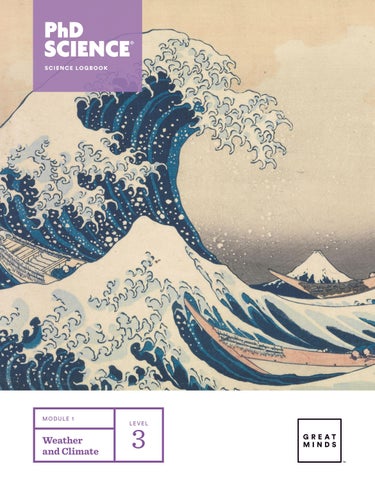
Under the Wave off Kanagawa, 1830–1832 Katsushika Hokusai, Japanese, 1760–1849 Polychrome woodblock print; ink and color on paper The Metropolitan Museum of Art, New York, NY, USA Front and back covers, Katsushika Hokusai (1760–1849), detail of Under the Wave off Kanagawa (Kanagawa-oki nami-ura), also known as the Great Wave, from the series Thirty-Six Views of Mount Fuji (Fugaku sanjûrokkei), Japan, Edo period (1615–1868), ca. 1830–32. Polychrome woodblock print; ink and color on paper, 10 1/8 x 14 15/16 in. (25.7 x 37.9 cm). The Metropolitan Museum of Art, H. O. Havemeyer Collection, bequest of Mrs. H. O. Havemeyer, 1929 (JP1847). Image copyright © The Metropolitan Museum of Art. Image source: Art Resource, NY