4
A Story of Units®
Fractional Units TEACH ▸ Module 1 ▸ Place Value Concepts for Addition and Subtraction
EM2_0401TE_MO.indd 9
25-Aug-21 1:28:30 PM
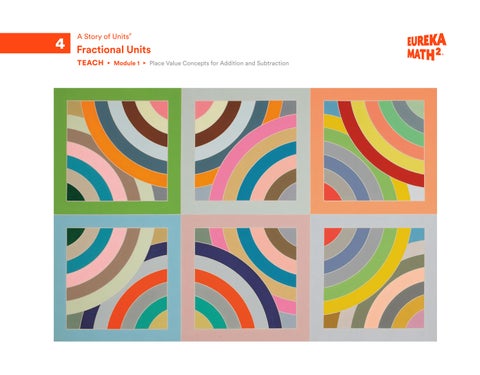
What does this painting have to do with math? American abstract painter Frank Stella used a compass to make brightly colored curved shapes in this painting. Each square in this grid includes an arc that is part of a design of semicircles that look like rainbows. When Stella placed these rainbow patterns together, they formed circles. What fraction of a circle is shown in each square? On the cover Tahkt-I-Sulayman Variation II, 1969 Frank Stella, American, born 1936 Acrylic on canvas Minneapolis Institute of Art, Minneapolis, MN, USA Frank Stella (b. 1936), Tahkt-I-Sulayman Variation II, 1969, acrylic on canvas. Minneapolis Institute of Art, MN. Gift of Bruce B. Dayton/Bridgeman Images. © 2020 Frank Stella/Artists Rights Society (ARS), New York
EM2_NA-B_E_G04_M01_cover_page_TE_97173.indd 1
22/11/22 10:17 AM
Great Minds® is the creator of Eureka Math®, Wit & Wisdom®, Alexandria Plan™, and PhD Science®. Published by Great Minds PBC. greatminds.org © 2021 Great Minds PBC. All rights reserved. No part of this work may be reproduced or used in any form or by any means—graphic, electronic, or mechanical, including photocopying or information storage and retrieval systems—without written permission from the copyright holder. Where expressly indicated, teachers may copy pages solely for use by students in their classrooms. Printed in the USA B-Print 1 2 3 4 5 6 7 8 9 10 XXX 25 24 23 22 21 ISBN 978-1-64497-173-4
EM2_NA-B_E_G04_M01_title_page_TE_97173.indd 2
22/11/22 10:40 AM
A Story of Units®
Fractional Units ▸ 4 TEACH Module
EM2_NA-B_E_G04_M01_title_page_TE_97173.indd 1
1 2 3 4 5 6
Place Value Concepts for Addition and Subtraction
Place Value Concepts for Multiplication and Division
Multiplication and Division of Multi-Digit Numbers
Foundations for Fraction Operations
Place Value Concepts for Decimal Fractions
Angle Measurements and Plane Figures
22/11/22 10:40 AM
Before This Module
Overview
Grade 3 Module 1
Place Value Concepts for Addition and Subtraction
In grade 3 module 1, students build a conceptual understanding of multiplication as a number of equal groups (e.g., 4 × 3 = 12 can be interpreted as 4 groups of 3 is 12).
Topic A
Grade 3 Module 2 In grade 3 module 2, students compose and decompose metric measurement units and relate them to place value units up to 1 thousand. They use place value understanding and the vertical number line to round two- and three-digit numbers. Grade 3 students also add and subtract two- and three-digit numbers by using a variety of strategies, including the standard algorithm.
Multiplication as Multiplicative Comparison Students identify, represent, 4 and interpret multiplicative 28 is 7 times as many as 4. 28 = 7 × 4 comparisons in patterns, tape diagrams, multiplication 28 equations, measurements, and units of money. They describe the relationship between quantities as times as much as or use other language as applicable to a given context (e.g., times as many as, times as long as, and times as heavy as). Students use multiplication or division to find an unknown quantity in a comparison.
Topic B Place Value and Comparison Within 1,000,000 Students name the place value units of 56,348 ten thousand, hundred thousand, and million. They recognize the multiplicative 50,000 + 6,000 + 300 + 40 + 8 relationship between place value fifty-six thousand, three hundred forty-eight units—the value of a digit in one place 56 thousands 3 hundreds 4 tens 8 ones is ten times as much as the value of the same digit in the place to its right. Students write and compare numbers with up to 6 digits in standard, expanded, word, and unit forms.
2
EM2_0401TE_MO.indd 2
Copyright © Great Minds PBC
25-Aug-21 1:28:28 PM
EUREKA MATH2 4 ▸ M1
Topic C
After This Module
Rounding Multi-Digit Whole Numbers Students name multi-digit numbers in unit form in different ways by using smaller units (e.g., 245,000 as 24 ten thousands 5 thousands or 245 thousands), and they find 1 more or 1 less of a given unit in preparation for rounding on a vertical number line. Students round four-digit, five-digit, and six-digit numbers to the nearest thousand, ten thousand, and hundred thousand. They determine an appropriate rounding strategy to make useful estimates for a given context.
700,000 = 7 hundred thousands
Grade 5 Modules 1 and 4 In grade 5 modules 1 and 4, students extend
650,000 = 6 hundred thousands 5 ten thousands
the work of grade 4 by adding, subtracting,
634,243
rounding, and comparing multi-digit numbers
600,000 = 6 hundred thousands
634,243 ≈ 600,000
with digits to the thousandths place. Students recognize that the value of a digit in one
__
place is 1 of what it represents in the place 10
to its left.
Topic D Multi-Digit Whole Number Addition and Subtraction Students build fluency with addition and subtraction of numbers of up to 6 digits by using the standard algorithm. They add and subtract to solve two-step and multi-step word problems. The Read–Draw–Write process is used to help students make sense of the problem and find a solution path. Throughout the topic, students round to estimate the sum or difference and check the reasonableness of their answers.
Topic E Metric Measurement Conversion Tables Students use multiplicative comparisons to describe the relative sizes of metric units of length (kilometers, meters, centimeters), × mass (kilograms, grams), and liquid volume (liters, milliliters). They express larger units in terms of smaller units and complete conversion tables. Students add and subtract mixed unit measurements. Copyright © Great Minds PBC
EM2_0401TE_MO.indd 3
3
25-Aug-21 1:28:29 PM
Contents Place Value Concepts for Addition and Subtraction Why . . . . . . . . . . . . . . . . . . . . . . . . . . . . . . . . . . . . . . . . . . . . . . . . . . . . . . . 6 Achievement Descriptors: Overview. . . . . . . . . . . . . . . . . . . . . 10 Topic A . . . . . . . . . . . . . . . . . . . . . . . . . . . . . . . . . . . . . . . . . . . . . . . . . . . 13 Multiplication as Multiplicative Comparison Lesson 1 . . . . . . . . . . . . . . . . . . . . . . . . . . . . . . . . . . . . . . . . . . . . . . . . . . . . 16 Interpret multiplication as multiplicative comparison.
Lesson 2. . . . . . . . . . . . . . . . . . . . . . . . . . . . . . . . . . . . . . . . . . . . . . . . . . . . 40 Solve multiplicative comparison problems with unknowns in various positions.
Lesson 3. . . . . . . . . . . . . . . . . . . . . . . . . . . . . . . . . . . . . . . . . . . . . . . . . . . . 58 Describe relationships between measurements by using multiplicative comparison.
Lesson 4. . . . . . . . . . . . . . . . . . . . . . . . . . . . . . . . . . . . . . . . . . . . . . . . . . . . 76
Lesson 7. . . . . . . . . . . . . . . . . . . . . . . . . . . . . . . . . . . . . . . . . . . . . . . . . . . 160 Write numbers to 1,000,000 in unit form and expanded form by using place value structure.
Lesson 8. . . . . . . . . . . . . . . . . . . . . . . . . . . . . . . . . . . . . . . . . . . . . . . . . . . 180 Write numbers to 1,000,000 in standard form and word form. Lesson 9. . . . . . . . . . . . . . . . . . . . . . . . . . . . . . . . . . . . . . . . . . . . . . . . . . . 200 Compare numbers within 1,000,000 by using >, =, and < .
Topic C . . . . . . . . . . . . . . . . . . . . . . . . . . . . . . . . . . . . . . . . . . . . . . . . . . 219 Rounding Multi-Digit Whole Numbers Lesson 10. . . . . . . . . . . . . . . . . . . . . . . . . . . . . . . . . . . . . . . . . . . . . . . . . . 222 Name numbers by using place value understanding.
Lesson 11. . . . . . . . . . . . . . . . . . . . . . . . . . . . . . . . . . . . . . . . . . . . . . . . . . 256 Find 1, 10, and 100 thousand more than and less than a given number.
Represent the composition of larger units of money by using multiplicative comparison.
Lesson 12 . . . . . . . . . . . . . . . . . . . . . . . . . . . . . . . . . . . . . . . . . . . . . . . . . . 278
Topic B . . . . . . . . . . . . . . . . . . . . . . . . . . . . . . . . . . . . . . . . . . . . . . . . . . . 95 Place Value and Comparison Within 1,000,000
Lesson 13 . . . . . . . . . . . . . . . . . . . . . . . . . . . . . . . . . . . . . . . . . . . . . . . . . . 294
Lesson 5. . . . . . . . . . . . . . . . . . . . . . . . . . . . . . . . . . . . . . . . . . . . . . . . . . . . 98 Organize, count, and represent a collection of objects.
Lesson 6. . . . . . . . . . . . . . . . . . . . . . . . . . . . . . . . . . . . . . . . . . . . . . . . . . . 140 Demonstrate that a digit represents 10 times the value of what it represents in the place to its right.
4
EM2_0401TE_MO.indd 4
Round to the nearest thousand. Round to the nearest ten thousand and hundred thousand.
Lesson 14. . . . . . . . . . . . . . . . . . . . . . . . . . . . . . . . . . . . . . . . . . . . . . . . . . 310 Round multi-digit numbers to any place.
Lesson 15 . . . . . . . . . . . . . . . . . . . . . . . . . . . . . . . . . . . . . . . . . . . . . . . . . . 324 Apply estimation to real-world situations by using rounding.
Copyright © Great Minds PBC
25-Aug-21 1:28:29 PM
EUREKA MATH2 4 ▸ M1
Topic D . . . . . . . . . . . . . . . . . . . . . . . . . . . . . . . . . . . . . . . . . . . . . . . . . . 340 Multi-Digit Whole Number Addition and Subtraction
Topic E. . . . . . . . . . . . . . . . . . . . . . . . . . . . . . . . . . . . . . . . . . . . . . . . . . . 465 Metric Measurement Conversion Tables
Lesson 16. . . . . . . . . . . . . . . . . . . . . . . . . . . . . . . . . . . . . . . . . . . . . . . . . . 346
Lesson 23. . . . . . . . . . . . . . . . . . . . . . . . . . . . . . . . . . . . . . . . . . . . . . . . . . 468
Add by using the standard algorithm.
Express metric measurements of length in terms of smaller units.
Lesson 17 . . . . . . . . . . . . . . . . . . . . . . . . . . . . . . . . . . . . . . . . . . . . . . . . . . 364
Lesson 24. . . . . . . . . . . . . . . . . . . . . . . . . . . . . . . . . . . . . . . . . . . . . . . . . . 488
Solve multi-step addition word problems by using the standard algorithm.
Express metric measurements of mass and liquid volume in terms of smaller units.
Lesson 18. . . . . . . . . . . . . . . . . . . . . . . . . . . . . . . . . . . . . . . . . . . . . . . . . . 380
Resources
Subtract by using the standard algorithm, decomposing larger units once.
Lesson 19. . . . . . . . . . . . . . . . . . . . . . . . . . . . . . . . . . . . . . . . . . . . . . . . . . 398 Subtract by using the standard algorithm, decomposing larger units up to 3 times.
Standards . . . . . . . . . . . . . . . . . . . . . . . . . . . . . . . . . . . . . . . . . . . . . . . . . 506 Achievement Descriptors: Proficiency Indicators . . . . . . . . . . . . . . . 508 Terminology . . . . . . . . . . . . . . . . . . . . . . . . . . . . . . . . . . . . . . . . . . . . . . . 520
Lesson 20. . . . . . . . . . . . . . . . . . . . . . . . . . . . . . . . . . . . . . . . . . . . . . . . . . 414
Math Past . . . . . . . . . . . . . . . . . . . . . . . . . . . . . . . . . . . . . . . . . . . . . . . . . 522
Subtract by using the standard algorithm, decomposing larger units multiple times.
Materials . . . . . . . . . . . . . . . . . . . . . . . . . . . . . . . . . . . . . . . . . . . . . . . . . . 526
Lesson 21 . . . . . . . . . . . . . . . . . . . . . . . . . . . . . . . . . . . . . . . . . . . . . . . . . . 430
Works Cited . . . . . . . . . . . . . . . . . . . . . . . . . . . . . . . . . . . . . . . . . . . . . . . 528
Solve two-step word problems by using addition and subtraction.
Lesson 22. . . . . . . . . . . . . . . . . . . . . . . . . . . . . . . . . . . . . . . . . . . . . . . . . . 448 Solve multi-step word problems by using addition and subtraction.
Copyright © Great Minds PBC
EM2_0401TE_MO.indd 5
Credits. . . . . . . . . . . . . . . . . . . . . . . . . . . . . . . . . . . . . . . . . . . . . . . . . . . . 530 Acknowledgments. . . . . . . . . . . . . . . . . . . . . . . . . . . . . . . . . . . . . . . . . . 531
5
25-Aug-21 1:28:29 PM
Why Place Value Concepts for Addition and Subtraction Why does the place value module begin with a topic on multiplicative comparisons? Beginning with multiplicative comparison enables students to build on their prior knowledge of multiplication from grade 3 and provides a foundation upon which students can explore the relationships between numbers and place value units. This placement also activates grade 3 knowledge of multiplication and division facts within 100 and provides students with opportunities to continue building fluency with the facts in preparation for multiplication and division in modules 2 and 3.
Figure A
Figure L
Figure B
Figure M
Figure C
Figure N
Figure D
Figure O
Students are familiar with additive comparison—relating numbers in terms of how many more or how many less. Multiplicative comparison—relating numbers as times as many—is a new way to compare numbers. Students use multiplicative comparison throughout the year to relate measurement units, whole numbers, and fractions. This important relationship between factors, where one factor tells how much larger the product is compared to the other factor, is foundational to ratios and proportional relationships in later grades. Taking time to develop this understanding across the grade 4 modules sets students up for success with interpreting multiplication as scaling in grade 5 and applying or finding a scale factor in scale drawings, dilations, and similar figures.
6
EM2_0401TE_MO.indd 6
Copyright © Great Minds PBC
25-Aug-21 1:28:29 PM
EUREKA MATH2 4 ▸ M1
Why is the vertical number line used for rounding numbers? The vertical number line is used to help support conceptual understanding of rounding. In grade 3, students first see the vertical number line as an extension of reading a vertical measurement scale. Using the context of temperature, students identify the tens (i.e., benchmarks) between which a temperature falls, the halfway mark between the benchmark temperatures, and the benchmark temperature the actual temperature is closer to. Students then generalize to round numbers to the nearest ten and hundred.
740,000 = 740 thousands 739,625 739,500 = 739 thousands 5 hundreds
739,000 = 739 thousands
In grade 4, students round numbers with up to 739,625 ≈ 740,000 6 digits to any place. They continue to use the vertical number line as a supportive model. Labeling the benchmark numbers and halfway tick mark in both standard form and unit form helps emphasize the unit to which a number is being rounded. This way, the place values line up vertically, helping students see the relationship between the numbers. The pictorial support of the vertical number line when rounding is eventually removed, but the conceptual understanding of place value remains as students round mentally. These experiences with the vertical number line prepare students for representing ratios with vertical double number lines and graphing pairs of values in the coordinate plane.
Copyright © Great Minds PBC
EM2_0401TE_MO.indd 7
7
25-Aug-21 1:28:29 PM
EUREKA MATH2
4 ▸ M1
Why are metric units of measurement addressed in this module? When are customary units of measurement addressed? Work with metric units of length, mass, and liquid volume in topic E provides an opportunity for students to apply their place value understanding to a measurement context. Students convert metric units that have relationships involving hundreds (e.g., meters to centimeters) and thousands (e.g., kilograms to grams). They apply multi-digit addition and subtraction strategies, including the standard algorithm, to add and subtract mixed-unit measurements. Introducing metric units in module 1 also provides the opportunity to use the units in word problem contexts throughout the rest of the year.
Kilograms
Grams
1
1,000
2
2,000
5
5,000
12
12,000
583
583,000
Customary units are included within modules 2 and 3 because the relative sizes of customary units of measurement do not align with the place value unit structure. Customary units of length are addressed in module 2 when students work with two-digit multiplication, area, and perimeter. Additionally, units of time and customary units of weight and liquid volume are addressed in module 3 alongside multiplication and problem solving.
8
EM2_0401TE_MO.indd 8
Copyright © Great Minds PBC
25-Aug-21 1:28:30 PM
EM2_0401TE_MO.indd 9
25-Aug-21 1:28:30 PM
Achievement Descriptors: Overview Place Value Concepts for Addition and Subtraction Achievement Descriptors (ADs) are standards-aligned descriptions that detail what students should know and be able to do based on the instruction. ADs are written by using portions of various standards to form a clear, concise description of the work covered in each module. Each module has its own set of ADs, and the number of ADs varies by module. Taken together, the sets of module-level ADs describe what students should accomplish by the end of the year. ADs and their proficiency indicators support teachers with interpreting student work on • informal classroom observations, • data from other lesson-embedded formative assessments, • Exit Tickets, • Topic Quizzes, and • Module Assessments. This module contains the twelve ADs listed.
10
EM2_0401TE_AD_overview.indd 10
Copyright © Great Minds PBC
1/27/2021 1:57:39 PM
EUREKA MATH2 4 ▸ M1
4.Mod1.AD1
4.Mod1.AD2
4.Mod1.AD3
4.Mod1.AD4
Create two comparison statements, given a multiplication equation.
Write multiplicative comparison statements as multiplication equations.
Solve word problems involving multiplicative comparison by using multiplication or division within 100.
Assess reasonableness of estimates when using rounding as an estimation strategy.
4.OA.A.1
4.OA.A.1
4.OA.A.3
4.OA.A.2
4.Mod1.AD5
4.Mod1.AD6
4.Mod1.AD7
4.Mod1.AD8
Solve multi-step word problems by using addition and subtraction, represent these problems by using equations, and assess the reasonableness of the answers.
Explain the relationship between a digit in a multi-digit whole number and the same digit in the place to the right.
Read and write multi-digit whole numbers in unit, standard, word, and expanded form.
Compare two whole numbers by using >, =, or <.
4.OA.A.3
4.NBT.A.2
4.NBT.A.1
4.NBT.A.2
4.Mod1.AD9
4.Mod1.AD10
4.Mod1.AD11
4.Mod1.AD12
Round multi-digit whole numbers.
Add and subtract multi-digit whole numbers by using the standard algorithm.
Express larger units in terms of a smaller unit within the metric system in a table.
Solve addition and subtraction word problems that require expressing measurements of larger units in terms of given smaller units.
4.NBT.B.4
4.MD.A.1
4.NBT.A.3
Copyright © Great Minds PBC
EM2_0401TE_AD_overview.indd 11
4.MD.A.2
11
1/27/2021 1:57:39 PM
EUREKA MATH2
4 ▸ M1
The first page of each lesson identifies the ADs aligned with that lesson. Each AD may have up to three indicators, each aligned to a proficiency category (i.e., Partially Proficient, Proficient, Highly Proficient). While every AD has an indicator to describe Proficient performance, only select ADs have an indicator for Partially Proficient and/or Highly Proficient performance. An example of one of these ADs, along with its proficiency indicators, is shown here for reference. The complete set of this module’s ADs with proficiency indicators can be found in the Achievement Descriptors: Proficiency Indicators resource. ADs have the following parts: • AD Code: The code indicates the grade level and the module number and then lists the ADs in no particular order. For example, the first AD for grade 4 module 1 is coded as 4.Mod1.AD1. • AD Language: The language is crafted from standards and concisely describes what will be assessed. • AD Indicators: The indicators describe the precise expectations of the AD for the given proficiency category. • Related Standard: This identifies the standard or parts of standards from the Common Core State Standards that the AD addresses.
AD Code: Grade.Module.AD# AD Language Achievement Descriptors: Proficiency Indicators
4.Mod1.AD1 Create two comparison statements, given a multiplication equation.
Related Standard
RELATED CCSSM
4.OA.A.1 Interpret a multiplication equation as a comparison, e.g., interpret 35 = 5 × 7 as a statement that 35 is 5 times as many as 7 and 7 times as many as 5. Represent verbal statements of multiplicative comparisons as multiplication equations.
Partially Proficient
Proficient
Create a comparison statement, given a multiplication equation.
Create two comparison statements, given a multiplication equation.
Fill in the blanks to complete a statement that represents the equation 35 = 5 × 7.
Fill in the blanks to complete two statements that represent the equation 35 = 5 × 7.
is
12
EM2_0401TE_AD_overview.indd 12
times as much as
.
Highly Proficient
AD Indicators
is
times as much as
.
is
times as much as
.
Copyright © Great Minds PBC
1/27/2021 1:57:40 PM
Topic A Multiplication as Multiplicative Comparison In topic A, students use models and multiplicative comparison language to represent multiplicative relationships. In prior grades, students compare quantities through additive comparison where one quantity is more than or less than another quantity and use addition or subtraction to find the unknown quantity or difference. Multiplicative comparison presents a new way to relate quantities. Students recognize that a figure in a number or shape pattern does not increase by the same amount each time. Rather, the increase is a result of multiplying by the same factor each time. Students use visual models, including tape diagrams, as tools to demonstrate the multiplicative relationship between quantities. Once they understand the multiplicative relationship, students find an unknown quantity by using multiplication or division. Multiplicative comparison gives students another way to interpret multiplication. For example, they see 15 = 3 × 5 as 15 is 3 times as many as 5. This interpretation of multiplication is foundational throughout grade 4 as students describe place value relationships, identify multiples of whole numbers and fractions, and convert measurement units. It also prepares students for multiplication as scaling in grade 5. Students apply multiplicative comparison to the contexts of measurements and units of money. They interpret and represent a variety of measurement comparisons and use language specific to the contexts such as times as long as, times as heavy as, and times as far as. Students also compare units of money—pennies, dimes, and dollars—by using times as much as relationships. Students recognize similarities between place value units and the relationship of increasing units of money (i.e., each increasing unit from pennies to dimes to dollars is 10 times as much as the previous unit). In topic B, students use multiplicative comparisons to relate place value units up to 1,000,000.
Copyright © Great Minds PBC
EM2_0401TE_A_TO.indd 13
13
1/26/2021 5:32:34 PM
EUREKA MATH2
4 ▸ M1 ▸ TA
Progression of Lessons Lesson 2
Lesson 3
Interpret multiplication as multiplicative comparison.
Solve multiplicative comparison problems with unknowns in various positions.
Describe relationships between measurements by using multiplicative comparison.
8
9
10
11
12
13
14
15
1 12 11
10 9 8
7 4
5
6
7 6 4 3
3
11
0 CM 1
2
Amy’s Tower
12
12
EM2_0401TE_A_TO.indd 14
0 CM 1
2
11
14
I can use the relationship between multiplication and division to help me solve a multiplicative comparison problem where the factor or product is unknown. I can draw a tape diagram to identify the known and unknown information and then use multiplication or division to find the unknown.
10
10
5
9
9
I notice that some shape and number patterns have rules that use addition and some have rules that use multiplication. I can describe the multiplication patterns by using times as many. For example, I can read a multiplication equation such as 16 = 2 × 8 as 16 is 2 times as many as 8.
8
8
?
7
7
13
14
15
6
...
6
?
1
Lesson 1
Gabe’s Tower
I can use language such as times as long as and times as heavy as to describe how measurements are related. Tape diagrams and pictures of objects with measurement tools such as scales, rulers, and beakers can show the relationships between different measurements. I can describe the relationships by using words and equations.
Copyright © Great Minds PBC
1/26/2021 5:32:35 PM
EUREKA MATH2 4 ▸ M1 ▸ TA
Lesson 4 Represent the composition of larger units of money by using multiplicative comparison. dollars
dimes
pennies
10¢
The relationship between pennies, dimes, and dollars is like the relationship between place value units. I can use multiplicative comparison to relate units of money. For example, 1 dime is worth 10 times as much as 1 penny.
Copyright © Great Minds PBC
EM2_0401TE_A_TO.indd 15
15
1/26/2021 5:32:38 PM
1
LESSON 1
Interpret multiplication as multiplicative comparison.
EUREKA MATH2
4 ▸ M1 ▸ TA ▸ Lesson 1
Name
1
Date
Draw a model to represent the statement. Then complete the equation.
15 is 3 times as many as 5. Sample:
3
×
Students create a pattern by using a multiplication rule. They learn how to use the language of times as many to describe the relationship between the number of objects in consecutive figures in a multiplicative pattern. Students also write multiplication equations and draw tape diagrams to represent multiplicative comparison situations.
5
Key Questions
5
• How can you describe a multiplication relationship between numbers?
5
5
• How can multiplication equations and tape diagrams represent times as many situations?
15 15 =
Lesson at a Glance
5
Achievement Descriptors 4.Mod1.AD1 Create two comparison statements, given
a multiplication equation. (4.OA.A.1) 4.Mod1.AD2 Write multiplicative comparison statements
as multiplication equations. (4.OA.A.1) 4.Mod1.AD3 Solve word problems involving multiplicative comparison
by using multiplication or division within 100. (4.OA.A.2)
Copyright © Great Minds PBC
15
Copyright © Great Minds PBC
EM2_0401TE_A_L01.indd 16
25-Aug-21 1:44:21 PM
EUREKA MATH2 4 ▸ M1 ▸ TA ▸ Lesson 1
Agenda
Materials
Lesson Preparation
Fluency 10 min
Teacher
Launch 5 min
• Sticky notes (5)
Print or copy and cut out Multiplicative Comparison Match Cards.
Learn 35 min
• Multiplicative Comparison Match Cards (in the teacher edition)
• Multiplication and Times as Many • Multiplicative Comparison and Tape Diagrams • Multiplicative Comparison Match • Problem Set
Land 10 min
• Computer or device* • Projection device* • Teach book*
Students • Sticky notes (5 per student pair) • Dry-erase marker* • Learn book* • Pencil* • Personal whiteboard* • Personal whiteboard eraser* * These materials are only listed in lesson 1. Ready these materials for every lesson in this module.
Copyright © Great Minds PBC
EM2_0401TE_A_L01.indd 17
17
25-Aug-21 1:44:21 PM
EUREKA MATH2
4 ▸ M1 ▸ TA ▸ Lesson 1
Fluency
10
Choral Response: Multiply and Divide Whole Numbers Students find a product or quotient to prepare for multiplicative patterns and multiplicative comparisons. After asking each question, wait until most students raise their hands, and then signal for students to respond. Raise your hand when you know the answer to each question. Wait for my signal to say the answer.
10
Display the multiplication equation and question.
=2×5
What is 2 groups of 5?
What is 2 groups of 5?
10
=3×7
=4×8
=6×7
=8×5
=7×9
Display the division equation and question.
6 is 2 groups of what?
6÷2=
3
3
6 is 2 groups of what?
Display the quotient. Repeat the process with the following sequence:
18
EM2_0401TE_A_L01.indd 18
Teach the procedure by using general knowledge questions. • What grade are you in?
• What is your teacher’s name?
Repeat the process with the following sequence:
14 ÷ 2 =
Use hand signals to introduce a procedure for answering choral response questions. For example, cup your hand around your ear for listen, lift your finger to your temple for think, and raise your own hand to remind students to raise theirs.
• What is the name of our school?
Display the product.
=2×9
Teacher Note
15 ÷ 3 =
27 ÷ 3 =
24 ÷ 4 =
Teacher Note Establish a signal (e.g., show me your boards) to introduce a procedure for showing whiteboard exchange responses. Practice with basic computations until students are accustomed to the procedure. • What is 2 × 3? • What is 10 ÷ 5?
45 ÷ 5 =
48 ÷ 6 =
Establish a procedure for providing feedback on whiteboard exchanges. Consider circulating to give hand signals—thumbs-up or try again.
Copyright © Great Minds PBC
25-Aug-21 1:44:22 PM
EUREKA MATH2 4 ▸ M1 ▸ TA ▸ Lesson 1
Whiteboard Exchange: Interpreting Tape Diagrams Students write and complete an equation to represent a tape diagram to prepare for similar work with multiplicative comparisons.
Teacher Note
After each prompt for a written response, give students time to work. When most students are ready, signal for students to show their whiteboards. Provide immediate and specific feedback. If students need to revise, briefly return to validate their corrections.
Validate all correct responses that may not be displayed on the image. For example, students may write 12 = 2 × 6 as a correct equation to represent the tape diagram.
Display the tape diagram. What does the tape diagram show? Tell your partner.
?
Provide time for students to think and share with their partners. The total is unknown. There are 2 equal parts. Each part has a value of 6.
Language Support
6
6
Consider using strategic, flexible grouping throughout the module.
2 × 6 = 12
Write and complete a multiplication equation to represent the tape diagram.
• Pair students who have different levels of mathematical proficiency.
Display the sample equation.
• Pair students who have different levels of English language proficiency.
Repeat the process with the following sequence:
9
9
9
3 × 9 = 27
Copyright © Great Minds PBC
EM2_0401TE_A_L01.indd 19
• Join pairs of students to form small groups of four.
?
? 7
7
7
? 3 × 7 = 21
8
8
8
? 4 × 8 = 32
8
6
6
6
? 4 × 6 = 24
6
8
8
8
8
5 × 8 = 40
8
As applicable, complement any of these groupings by pairing students who speak the same native language.
19
25-Aug-21 1:44:22 PM
EUREKA MATH2
4 ▸ M1 ▸ TA ▸ Lesson 1
Launch
5
Students examine and describe additive and multiplicative shape patterns. Direct students to problems 1 and 2 in their books and chorally read the directions. Write a rule for each pattern. 1.
Teacher Note In grade 3, students use the term pattern to describe the relationship between numbers in input–output tables. Pattern: Divide the input by 8
Figure A
Figure B
Input
Output
72
9
56
7
40
5
32
4
16
2
Figure C In this lesson, pattern refers to a collection of figures that follow a rule. A rule describes the relationship between consecutive figures in the pattern.
Figure D
Rule:
20
EM2_0401TE_A_L01.indd 20
Add 3
Copyright © Great Minds PBC
25-Aug-21 1:44:23 PM
EUREKA MATH2 4 ▸ M1 ▸ TA ▸ Lesson 1
Invite students to turn and talk about the shape pattern and try to identify how each figure is different from the one before it. What is the relationship between the number of squares in figure B and the number of squares in figure A? Figure B has 3 more squares than figure A.
UDL: Representation Consider annotating the figures to emphasize the patterns as students describe how each figure is different from the one before it.
There are twice as many squares in figure B than in figure A. Is that same relationship true for the number of squares in figure C compared to figure B? Figure D compared to figure C? How do you know? Yes, there are 3 more squares in figure C than in figure B, and there are 3 more squares in figure D than in figure C. No, there are not twice as many squares in figure C compared to figure B or figure D compared to figure C.
Figure A
Figure B
Figure L
Figure M
Figure C
Figure N
Figure D
Figure O
Which relationship tells you how each figure in the shape pattern changes in the same way? Each figure has 3 more squares than the figure before it.
3 squares are added each time. Add a column of 3 squares The rule for the pattern is add 3. If you know the rule, you can make more figures in the shape pattern. The rule tells how you can make the next figure. Direct students to write the rule for the pattern in problem 1 in their books. Invite students to turn and talk about how knowing the rule can help them figure out how many squares would be in figure E. If the pattern continues, how many squares would be in figure E? How do you know? There would be 15 squares in figure E. I followed the rule. I added 3 more to the number of squares in figure D.
Copyright © Great Minds PBC
EM2_0401TE_A_L01.indd 21
21
25-Aug-21 1:44:23 PM
EUREKA MATH2
4 ▸ M1 ▸ TA ▸ Lesson 1
Direct students to the pattern in problem 2. 2.
Language Support
Figure L Figure M Figure N
The term figure has multiple meanings in mathematics and everyday life. In this lesson, figure refers to a collection of objects or shapes in a pattern. Consider using pictures to highlight some different meanings of figure. • Figures A, B, and C are part of a shape pattern.
Figure O Rule: Multiply by 2 Invite students to turn and talk about the shape pattern and try to identify how each figure is different from the one before it.
Figure A
Figure B
Figure C
• A cube and a triangle are examples of geometric figures.
What is the relationship between the number of circles in figure M and the number of circles in figure L? Figure M has 2 more circles than figure L. It’s a double. Figure M has double the number of circles as figure L.
• Gabe figures out the answer to the problem.
Is that same relationship true for the number of circles in figure N compared to figure M? How do you know? No, it’s not true because figure N has 4 more circles than figure M, not 2 more. Yes, there are double the number of circles in figure N than figure M, so 2 × 4 = 8. The relationship is different from the relationship in problem 1, so the rule can’t be add 2. Invite students to think–pair–share about the rule. It’s multiply by 2, so 2 × 2 = 4. It’s double, so 2 × 2 = 4.
22
EM2_0401TE_A_L01.indd 22
Copyright © Great Minds PBC
25-Aug-21 1:44:24 PM
EUREKA MATH2 4 ▸ M1 ▸ TA ▸ Lesson 1
Is the same relationship true for the number of circles in figure O compared to figure N? How do you know? Yes. 2 × 8 = 16. What is the rule for this shape pattern? Multiply by 2 Direct students to write the rule for the pattern in problem 2. Invite students to turn and talk about how knowing the rule can help them figure out how many circles would be in the next figure. If the pattern continues, how many circles would be in the next figure? How do you know? There would be 32 circles in the next figure because I multiply the number of circles in figure O by 2.
2 × 16 = 32. I can just think about it as 16 + 16 = 32. Transition to the next segment by framing the work. Today, we will learn how to describe a relationship between numbers by using multiplication.
Learn
35
Multiplication and Times as Many Materials—T/S: Sticky notes
Students use sticky notes and multiplicative patterns to relate multiplication to times as many. Pair students and give each pair five sticky notes.
Copyright © Great Minds PBC
EM2_0401TE_A_L01.indd 23
Teacher Note In this lesson, the multiplication equation is consistently written with the total first, followed by the equal sign and the multiplicative comparison expression. The first factor indicates how many of the second factor is represented in the relationship. This order allows students to see the connection between the times as many language and the multiplication equation.
3=3×1 3 is 3 times as many as 1.
23
25-Aug-21 1:44:24 PM
EUREKA MATH2
4 ▸ M1 ▸ TA ▸ Lesson 1
Direct partner A to place a sticky note on their whiteboard. Direct partner B to place 2 sticky notes below partner A’s sticky note. How many sticky notes does partner A have? Partner B? What multiplication equation represents the relationship between partner B’s and partner A’s sticky notes?
Partner A
Partner B
2=2×1 Write the equation 2 = 2 × 1. Point to each number as you ask the following questions. What does the product, 2, represent? It’s the number of sticky notes partner B has. What does the first factor, 2, represent? It’s the number we multiplied partner A’s sticky notes by to get the number of sticky notes partner B has. What does the second factor, 1, represent? It’s the number of sticky notes partner A has. We can say that partner B has 2 times as many sticky notes as partner A. 2 is 2 times as many as 1. Write the statements below the equation. Invite students to turn and talk about how the equation and statements represent the relationship between partner B’s and partner A’s sticky notes. Use a similar process for partner B to represent 3 and 4 times as many sticky notes as partner A.
24
EM2_0401TE_A_L01.indd 24
×
Partner A Partner B ×
Copyright © Great Minds PBC
25-Aug-21 1:44:25 PM
EUREKA MATH2 4 ▸ M1 ▸ TA ▸ Lesson 1
Direct students to their books and chorally read the directions for problem 3. Invite students to complete problem 3 with their partners by recording how they represented 4 times as many. Draw sticky notes to represent 4 times as many. Then fill in the blanks. 3. Partner A
UDL: Representation Consider using different-colored highlighters in the equation and statements to help students make connections between the various representations.
Partner A
Partner A
Partner A
Partner B
Partner B Partner B Partner B
×
4
=
4 4
Partner B has
4
is
×
4
1 times as many sticky notes as partner A.
times as many as
1
.
Invite students to think–pair–share about why we can use times as many to describe the relationship between the number of sticky notes partners A and B have. When we read the multiplication equation, we say 4 times. Using the word times is another way to show multiplication. To get the number of sticky notes partner B has, we multiply the number of sticky notes partner A has by 4. A word we use when we multiply is times, so we can use 4 times to show how they are related.
Copyright © Great Minds PBC
EM2_0401TE_A_L01.indd 25
25
25-Aug-21 1:44:25 PM
EUREKA MATH2
4 ▸ M1 ▸ TA ▸ Lesson 1
Direct partners to write the number 4 on each sticky note. What is the total value of the numbers on partner A’s sticky note? Partner B’s? What multiplication equation represents the relationship between the total value of the numbers on partner B’s sticky notes compared to the value of the number on partner A’s sticky note?
Partner A
4
Partner B
4
4
4
4
16 = 4 × 4 Write the equation. How did changing the value of each sticky note to 4 change the equation 4 = 4 × 1? It’s still 4 times as many, but we started with 4 instead of 1 and the total is 16 instead of 4. Direct students to problems 4–6. Invite students to complete problems 4–6 with their partners. Use the pictures to fill in the blanks. 4.
Partner A
4
Partner B
4
4
4
16
=
4
×
16
is
4
times as many as
26
EM2_0401TE_A_L01.indd 26
4
4 4
.
Copyright © Great Minds PBC
25-Aug-21 1:44:26 PM
EUREKA MATH2 4 ▸ M1 ▸ TA ▸ Lesson 1
5.
6.
Partner A
7
Partner B
7
7
7
28
=
4
×
28
is
4
times as many as
Partner A
9
Partner B
9
7
7
9
7
9
36
=
4
×
36
is
4
times as many as
.
9
9 9
.
What do you notice about the relationship between the total value of partner B’s sticky notes and partner A’s sticky notes in problems 3 through 6? The relationship is the same in all the problems. The relationship is 4 times as many. The total value of the numbers on partner B’s sticky notes is always 4 times as many as the value of partner A’s sticky note. Invite students to turn and talk about how multiplication and times as many are related.
Copyright © Great Minds PBC
EM2_0401TE_A_L01.indd 27
27
25-Aug-21 1:44:26 PM
EUREKA MATH2
4 ▸ M1 ▸ TA ▸ Lesson 1
Multiplicative Comparison and Tape Diagrams Students draw and interpret tape diagrams that represent multiplicative comparisons.
Teacher Note
A
In grade 3, students use a variation of brackets when drawing tape diagrams. This variation enables students to label the tape without the added complexity of drawing the brackets. In grade 4, students see tape diagrams labeled with brackets but continue to draw arms. Students may transition to drawing brackets as they are ready.
B
Students might draw the following tape diagrams to represent the multiplicative relationships.
Direct students to problem 7 and chorally read the directions. 7. Draw a tape diagram to represent 36 is 4 times as many as 9. Then complete the equation.
9
36 36
=
4
×
9
A
9
B
9
9 A
36
How can we use the picture in problem 6 to help us draw a tape diagram to represent 36 is 4 times as many as 9?
B
36
The picture shows that 36 is 4 times as many as 9.
36
36
We can use the value of partner A’s and partner B’s sticky notes to help us draw a tape diagram.
B
9
B
What can we draw to represent partner A’s sticky note?
A
9
A
We can draw 1 unit of 9.
9
9
9
Model drawing and labeling a tape with 1 unit of 9. Label the tape with the letter A. Direct students to do the same. What can we draw to represent partner B’s sticky notes? We can draw 4 units of 9.
28
EM2_0401TE_A_L01.indd 28
Copyright © Great Minds PBC
25-Aug-21 1:44:26 PM
EUREKA MATH2 4 ▸ M1 ▸ TA ▸ Lesson 1
Model drawing a tape with 4 units of 9 and label it with the letter B. Direct students to do the same. What is the total of 4 units of 9?
36 Model labeling 36 as the total for B. Direct students to do the same. How can you tell that each unit in B has a value of 9 even though I didn’t label each unit? We know that A has a value of 9 and each unit in B is the same size as the unit in A, so each unit in B has the same value as the unit in A. Invite students to think–pair–share about how the tape diagram shows that 36 is 4 times as many as 9. There is 1 unit of 9 in A, and B shows that 4 units of 9 make 36. There are 4 times as many units of 9 in B than in A, and the total for B is 36. Invite students to complete the equation in their books. Direct students to problems 8–10. Chorally read the directions. Use the tape diagram to fill in the blanks. Then complete the equation and statement. 8.
6
Promoting the Standards for Mathematical Practice Students look for and make use of structure (MP7) when they see the tape diagram as being composed of units and relate this to a multiplication equation and multiplicative comparison situation. Ask the following questions to promote MP7: • How can what you know about the tape diagram help you write a multiplication equation using 30 and 6?
30 30
=
5
×
30
is
5
times as many as
Copyright © Great Minds PBC
EM2_0401TE_A_L01.indd 29
6 6
.
• How are the tape diagram and the times as many statement related? How can that help you write a multiplication equation?
29
25-Aug-21 1:44:27 PM
EUREKA MATH2
4 ▸ M1 ▸ TA ▸ Lesson 1
What do you notice about the tape diagram in problem 8? There is 1 unit of 6 and 5 units of 6. The total for the 5 units of 6 is 30. What multiplication equation represents the relationship between 30 and 6?
30 = 5 × 6 How can you use times as many to describe the relationship between 6 and 30?
30 is 5 times as many as 6. Invite students to complete problem 8. Use a similar process to complete problems 9 and 10.
8
9.
32 32
=
4
×
32
is
4
times as many as
30
EM2_0401TE_A_L01.indd 30
8 8
.
Copyright © Great Minds PBC
25-Aug-21 1:44:27 PM
EUREKA MATH2 4 ▸ M1 ▸ TA ▸ Lesson 1
10.
7
42 42
=
6
×
7
42
is
6
times as many as
7
.
Invite students to turn and talk about how they can use tape diagrams and multiplication equations to represent times as many relationships.
Multiplicative Comparison Match Materials—T: Multiplicative Comparison Match Cards
Students match various representations of multiplicative comparison situations. Distribute one Multiplicative Comparison Match card to each student. Direct students to move around the room to find other students with cards that match the multiplicative situation on their card. Students should look for a tape diagram, a statement that uses the phrase times as many, and a multiplication equation that all represent the same multiplicative comparison.
Copyright © Great Minds PBC
EM2_0401TE_A_L01.indd 31
31
25-Aug-21 1:44:27 PM
EUREKA MATH2
4 ▸ M1 ▸ TA ▸ Lesson 1
Example matching cards:
Teacher Note
4 28 is 7 times as many as 4.
28 = 7 × 4
28 Students should form groups of three once they have found their matches. Use the following prompts to engage groups in a discussion about their matching cards: • How do you know each card represents the same situation? • How are the representations on each card similar? • How are the representations on each card different? As time allows, shuffle the cards, redistribute them, and invite students to repeat the activity with a new card.
Problem Set Differentiate the set by selecting problems for students to finish independently within the timeframe. Problems are organized from simple to complex.
The 24 Multiplicative Comparison Match cards are designed to result in eight groups with three matches in each group. Each group should contain a tape diagram, a times as many statement, and a multiplication equation. If you have more or fewer than 24 students in your class, consider using one of the following modifications to ensure that all students have at least one match. • Reduce the number of cards used by removing a tape diagram, times as many statement, or equation from sets of matching cards. • Reduce the number of cards used by removing entire matching sets. • Give some students more than one card but be sure the cards belong to a matching set. • Create a shape pattern card for each matching set to allow more than 24 students to participate. The following is an example shape pattern for 28 = 7 × 4:
Figure R
Figure S
32
EM2_0401TE_A_L01.indd 32
Copyright © Great Minds PBC
25-Aug-21 1:44:28 PM
EUREKA MATH2 4 ▸ M1 ▸ TA ▸ Lesson 1
Land
10
Debrief 5 min Objective: Interpret multiplication as multiplicative comparison. Display the pattern that contains figures L through O and facilitate a discussion about using times as many to describe multiplication.
Figure L
Teacher Note
Figure M Earlier, we determined that the rule for this pattern was multiply by 2. How can you describe the relationship between the number of circles in figure M and the Figure N number of circles in figure L?
We can say that there are 2 times as many circles in figure M than in figure L.
Students might describe the relationship between the number of circles in each figure in the pattern as twice as many instead of 2 times as many. Recognize that this is a valid way to describe the relationship, but facilitate a conversation about the convention of using times as many language.
Figure O
How can you use a multiplication equation to represent the relationship between the number of circles in figure N compared to figure M?
8=2×4
4
How can you use a model to represent the relationship between the number of circles in figure N compared to figure M? I could draw a tape diagram to show 1 unit of 4 to represent the number of circles in figure M. Then I could draw 2 units of 4 to represent the number of circles in figure N. I could draw a tape diagram with 1 unit of 4 and 2 units of 4 to show that 8 is 2 times as many as 4.
M N
8
Exit Ticket 5 min Provide up to 5 minutes for students to complete the Exit Ticket. It is possible to gather formative data even if some students do not complete every problem.
Copyright © Great Minds PBC
EM2_0401TE_A_L01.indd 33
33
25-Aug-21 1:44:28 PM
EUREKA MATH2
4 ▸ M1 ▸ TA ▸ Lesson 1
Sample Solutions Expect to see varied solution paths. Accept accurate responses, reasonable explanations, and equivalent answers for all student work.
EUREKA MATH2
4 ▸ M1 ▸ TA ▸ Lesson 1
Name
1
Date
EUREKA MATH2
4 ▸ M1 ▸ TA ▸ Lesson 1
Complete the statement and equation to match the tape diagram. 2.
5
1. Liz draws circles by using this rule: Multiply the number of circles by 2.
5
5
5
5
20 is
4
times as many as 5.
20
=
4
×5
6
is
3
times as many as 2.
6
=
3
×
60
is
6
times as many as
60
=
6
×
20
Figure A
Figure B
Figure C
Figure D
a. How many circles should Liz draw for figure D? How do you know?
3.
Liz should draw 40 circles because 2 × 20 = 40.
2
2
2
6
b. Complete the statements and equation to match the figures.
2 times as many circles There are in figure B than in figure A.
There are 2 times as many circles in figure C than in figure B.
10
is
2
times as many as 5.
20
is
2
times as many as 10.
10
=
2
×5
20
=
2
× 10
4.
10 10
.
10
60
Copyright © Great Minds PBC
34
EM2_0401TE_A_L01.indd 34
11
12
PROBLEM SET
Copyright © Great Minds PBC
Copyright © Great Minds PBC
25-Aug-21 1:44:29 PM
EUREKA MATH2 4 ▸ M1 ▸ TA ▸ Lesson 1
EUREKA MATH2
4 ▸ M1 ▸ TA ▸ Lesson 1
Draw tape diagrams to represent each statement. Then complete the equation.
EUREKA MATH2
4 ▸ M1 ▸ TA ▸ Lesson 1
7. 5 times as many as 3 is 15.
5. 12 is 3 times as many as 4.
3
4
15 5
12 12 =
3
×
3
=
15
×4 8. 6 times as many as 8 is 48.
8
6. 28 is 4 times as many as 7.
7
48 6
4
×
=
48
There are 72 chairs in the cafeteria.
7
Copyright © Great Minds PBC
Copyright © Great Minds PBC
EM2_0401TE_A_L01.indd 35
8
9. There are 9 tables in the cafeteria. There are 8 times as many chairs as tables. How many chairs are in the cafeteria?
28 28 =
×
PROBLEM SET
13
14
PROBLEM SET
Copyright © Great Minds PBC
35
25-Aug-21 1:44:30 PM
EUREKA MATH2
4 ▸ M1 ▸ TA ▸ Lesson 1 ▸ Multiplicative Comparison Match Cards
5
10is 2 times as many as 5 .
10 = 2 × 5
18is 3 times as many as 6 .
18 = 3 × 6
20is 4 times as many as 5 .
20 = 4 × 5
10
6
18
5
20
36
This page may be reproduced for classroom use only.
EM2_0401TE_A_L01_multiplicative_comparison_match_cards.indd 36
Copyright © Great Minds PBC
1/26/2021 10:10:00 AM
EUREKA MATH2 4 ▸ M1 ▸ TA ▸ Lesson 1 ▸ Multiplicative Comparison Match Cards
3
15is 5 times as many as 3 .
15 = 5 × 3
28is 7 times as many as 4 .
28 = 7 × 4
56is 8 times as many as 7 .
56 = 8 × 7
15
4
28
7
56
Copyright © Great Minds PBC
EM2_0401TE_A_L01_multiplicative_comparison_match_cards.indd 37
This page may be reproduced for classroom use only.
37
1/26/2021 10:10:00 AM
EUREKA MATH2
4 ▸ M1 ▸ TA ▸ Lesson 1 ▸ Multiplicative Comparison Match Cards
6
54is 9 times as many as 6 .
54 = 9 × 6
70is 1 0times as many as 7 .
7 0 = 10 × 7
54
7
70
38
This page may be reproduced for classroom use only.
EM2_0401TE_A_L01_multiplicative_comparison_match_cards.indd 38
Copyright © Great Minds PBC
1/26/2021 10:10:00 AM
EM2_0401TE_A_L01_multiplicative_comparison_match_cards.indd 39
1/26/2021 10:10:00 AM
2
LESSON 2
Solve multiplicative comparison problems with unknowns in various positions.
EUREKA MATH2
4 ▸ M1 ▸ TA ▸ Lesson 2
Name
Date
2
Fill in the blanks to make true statements. Write an equation to show how you found each unknown. 1.
32
is 4 times as many as 8.
32 = 4 × 8
2. 30 is
5
Students use sticky notes, equations, and tape diagrams to represent multiplicative comparison problems with unknowns in various positions. They make decisions about when and how to use multiplication or division to solve multiplicative comparison problems. Students relate multiplication with an unknown factor to divide when solving multiplicative comparison problems.
Key Questions
times as many as 6.
30 = 5 × 6
3. 63 is 9 times as many as
Lesson at a Glance
• How do you decide when to multiply or divide to solve times as many problems? 7
• How can thinking about multiplication with an unknown factor help you solve times as many problems?
.
63 = 9 × 7
Achievement Descriptors 4.Mod1.AD1 Create two comparison statements, given
a multiplication equation. (4.OA.A.1) 4.Mod1.AD2 Write multiplicative comparison statements
as multiplication equations. (4.OA.A.1) 4.Mod1.AD3 Solve word problems involving multiplicative comparison
by using multiplication or division within 100. (4.OA.A.2)
Copyright © Great Minds PBC
21
Copyright © Great Minds PBC
EM2_0401TE_A_L02.indd 40
25-Aug-21 2:03:07 PM
EUREKA MATH2 4 ▸ M1 ▸ TA ▸ Lesson 2
Agenda
Materials
Lesson Preparation
Fluency 10 min
Teacher
None
Launch 5 min
• None
Learn 35 min
Students
• Model Multiplicative Comparison Problems
• Sticky notes (15 per student pair)
• Find a Way • Multiplicative Comparison in Context • Problem Set
Land 10 min
Copyright © Great Minds PBC
EM2_0401TE_A_L02.indd 41
41
25-Aug-21 2:03:07 PM
EUREKA MATH2
4 ▸ M1 ▸ TA ▸ Lesson 2
Fluency
10
Counting the Math Way by Ones Students construct a number line with their fingers while counting aloud to develop familiarity with counting the math way. Let’s count the math way. Face the students and direct them to mirror you. Show a fist with your right hand, palm facing out. Show me your left hand. Make a fist like me. That’s 0 (see image below). Now, raise your right pinkie. Show me your left pinkie. That’s 1.
0
42
EM2_0401TE_A_L02.indd 42
1
2
3
4
5
Teacher Note Around the world, numbers are represented on hands in many ways. Counting the math way has the mathematical advantage of progressing from left to right without interruption, just like the number line. Counting the math way also demonstrates the magnitude of the number as students observe and feel the quantity increase as they count forward.
Student view of your hands
Students, whether they're looking at their own hands or your hands, will see a left-to-right progression. The progression from one finger to the next mimics the number line. To you, the progression will appear in reverse.
Student view of student’s hands
Students begin to use this method in kindergarten and will continue to use it through grade 5 to model place value concepts and perform operations with whole numbers and decimal fractions.
Copyright © Great Minds PBC
25-Aug-21 2:03:08 PM
EUREKA MATH2 4 ▸ M1 ▸ TA ▸ Lesson 2
Let’s put up the very next finger. Raise your right ring finger; students raise their left ring finger (see image). That’s 2. Put up the next finger. 3 Close it up! (close hands) Let’s count the math way to 5. Have students count the math way to 5 while you model the math way on your own fingers. Show me 6. Demonstrate by extending your left thumb. Let’s count the math way to 10. Have students count the math way to 10 while you model the math way on your own fingers.
6
7
8
9
10
Offer more practice counting the math way to 10. Show the math way on your own fingers but do not count aloud.
Copyright © Great Minds PBC
EM2_0401TE_A_L02.indd 43
43
25-Aug-21 2:03:11 PM
EUREKA MATH2
4 ▸ M1 ▸ TA ▸ Lesson 2
Choral Response: Multiply and Divide Whole Numbers Students find a product or quotient to prepare for multiplicative comparisons with unknowns in various positions. After asking each question, wait until most students raise their hands, and then signal for students to respond. Raise your hand when you know the answer to each question. Wait for my signal to say the answer. Display the multiplication equation and question.
16
What is 2 times as many as 8?
16
=2×8
What is 2 times as many as 8?
Display the product.
Teacher Note The multiplication and division equations in this activity use different questions than those posed during the same activity in lesson 1. Using a variety of questions allows students to discover different ways of thinking about equations. Multiplication Equations • •
Repeat the process with the following sequence:
= 2 × 8 → What is 2 groups of 8? = 2 × 8 → What is 2 times as many as 8?
Division Equations • 8÷2=
=3×6
=4×9
=5×6
=6×9
• 8÷2=
→ 8 is 2 groups of what?
→ How many twos are in 8?
Display the division equation and question. How many twos are in 8?
8÷2=
4
4
How many twos are in 8?
Display the quotient. Repeat the process with the following sequence:
24 ÷ 3 =
44
EM2_0401TE_A_L02.indd 44
20 ÷ 4 =
28 ÷ 4 =
35 ÷ 5 =
Copyright © Great Minds PBC
27-Aug-21 10:45:45 AM
EUREKA MATH2 4 ▸ M1 ▸ TA ▸ Lesson 2
Whiteboard Exchange: Interpreting Tape Diagrams Students write and complete an equation to represent a tape diagram to prepare for similar work with multiplicative comparisons. After asking each question, wait until most students raise their hands, and then signal for students to respond. Raise your hand when you know the answer to each question. Wait for my signal to say the answer. Display the tape diagram. What is the total?
4
12 Does the tape diagram show the number of groups or the size of each group?
4
4
12 12 ÷ 3 = 4
Number of groups After each prompt for a written response, give students time to work. When most students are ready, signal for them to show their whiteboards. Provide immediate and specific feedback. If students need to revise, briefly return to validate their corrections. Write and complete a division equation to represent the tape diagram where the quotient is the size of each group. Display the equation. Repeat the process with the following sequence:
45 6
6
6
6
24 24 ÷ 4 = 6
Copyright © Great Minds PBC
EM2_0401TE_A_L02.indd 45
7
7
7
7
35 35 ÷ 5 = 7
7
5
... ? groups 45 ÷ 5 = 9
56 7
Teacher Note During the sequence where the size of each group is known, prompt students by saying, “Write and complete a division equation to represent the tape diagram where the quotient is the number of groups.”
... ? groups 56 ÷ 7 = 8
45
27-Aug-21 2:44:16 PM
EUREKA MATH2
4 ▸ M1 ▸ TA ▸ Lesson 2
Launch
UDL: Action & Expression
5
Students describe multiplicative patterns by using equations and times as many statements. Display the picture of figure A and the label for figure B. Figure A is the first figure in a shape pattern. Each figure in the pattern has 3 times as many rectangles as the figure before it.
Figure A
Figure B
Consider providing tiles or other manipulatives for students to use to build the multiplicative patterns. As students use manipulatives to build figure B, direct them to use times as many language to describe the relationship between the number of shapes in figures A and B.
Figure A
Invite students to work with a partner to find out how many rectangles should be in figure B.
Figure B
2 is 1 times as many as 2.
How many rectangles should be in figure B? How do you know? There should be 6 rectangles in figure B. Figure A has 2 rectangles, and 6 is 3 times as many as 2. What multiplication equation represents the relationship between the number of rectangles in figures A and B?
6=3×2
Figure A
Display the picture of figures A and B.
Figure B
4 is 2 times as many as 2.
Invite students to confirm that there are 6 rectangles in figure B.
Figure A
Figure B
Figure A
Figure B
6 is 3 times as many as 2.
46
EM2_0401TE_A_L02.indd 46
Copyright © Great Minds PBC
25-Aug-21 2:03:13 PM
EUREKA MATH2 4 ▸ M1 ▸ TA ▸ Lesson 2
Display the label for figure E and the picture of figure F. Figure F is the second figure in a shape pattern. Each figure in the pattern has 4 times as many hexagons as the figure before it. Direct partners to determine how many hexagons should be in figure E. How many hexagons should be in figure E? How do you know? There should be 2 hexagons in figure E. Figure F has 8 hexagons, which is 4 times as many as the number of hexagons in figure E. We thought about 4 times what number equals 8 and 4 × 2 = 8. Figure E should have 2 hexagons. We divided the number of hexagons in figure F by 4, and 8 ÷ 4 = 2. Display the picture of figures E and F.
Teacher Note
Figure E
Figure F
Invite students to confirm that there are 2 hexagons in figure E. Direct students to think–pair–share about the similarities and differences in finding the number of rectangles in figure B and the number of hexagons in figure E with their strategy.
5 times as many as 8 is
?
Figure E
Figure F
We have to think about what is known and unknown to determine whether we can multiply or divide when thinking about the language times as many. Transition to the next segment by framing the work. Today, we will use multiplication and division to solve problems and practice using the language times as many. Copyright © Great Minds PBC
EM2_0401TE_A_L02.indd 47
?
instead of
Both patterns have a times as many rule, so we used multiplication to think about the number of shapes in each figure. Even though both patterns have a times as many rule, we used multiplication for the rectangle pattern and division for the hexagon pattern.
In this lesson, students learn that times as many language can represent either multiplication or division, depending on what is unknown. Some students may want to represent an unknown total problem as
is 5 times as many as 8.
Although this is not incorrect, the multiplicative comparison language is consistently presented in the lesson as is many as
times as .
This consistency allows students to understand what each number in the statement represents. It also supports students as they determine whether they should multiply or divide to find the unknown number.
47
25-Aug-21 2:03:13 PM
EUREKA MATH2
4 ▸ M1 ▸ TA ▸ Lesson 2
Learn
35
Model Multiplicative Comparison Problems
Differentiation: Support
Materials—S: Sticky notes
Students represent various multiplicative comparison situations with sticky notes, tape diagrams, and equations.
Students might figure out right away that the unknown is 40 and ask for more sticky notes to represent the problem. Consider using the following prompts to support students as they represent the problem:
Pair students and distribute the sticky notes. Write the problem:
?
is 5 times as many as 8.
• What is the unit? (Prompt students to represent the unit of 8 on 1 sticky note.)
Invite partners to use the sticky notes to represent the problem on their whiteboards. Circulate as students work and use the following questions to advance their thinking:
• How many times is it being repeated? (Prompt students to use times as many language as they place each of the 5 sticky notes.)
• What unit is being multiplied? By what? How do you know? • How can you represent units of 8 with the sticky notes? • What is unknown? • How can you show the relationship between 8 and the unknown?
8
• How did you use the sticky notes to represent the problem?
8
We used 1 sticky note to represent 8. Then we used 5 sticky notes labeled with 8 to show that the unknown number is 5 times as many as 8.
8
• Where do you see the value of the unknown? (Prompt students to see 40 equals 5 units of 8.)
8
8
Consider charting the three multiplicative comparison problem statements. Include the written format with the corresponding equations and add them to the chart as the class discusses each problem.
How does your tape diagram show the unit that is being repeated?
48
EM2_0401TE_A_L02.indd 48
8 UDL: Representation
Invite partners to draw a tape diagram and write an equation to represent the problem.
8 is the unit being repeated because there are 5 units of 8.
8
?
? ?=5×8
? ?
÷
?
÷
?
? ?
Copyright © Great Minds PBC
25-Aug-21 2:03:14 PM
EUREKA MATH2 4 ▸ M1 ▸ TA ▸ Lesson 2
How does your tape diagram show how many times the unit is repeated?
Teacher Note
The unit is repeated 5 times because there are 5 units of 8. What is the value of the unknown? How do you know?
In grade 3, students represent division as multiplication with an unknown factor. This understanding can assist students as they interpret multiplicative comparison statements as division. Students might not automatically know that 18 ÷ 3 = 6. Thinking about the problem as 18 = 3 × can help students find the value of the unknown.
40 because 40 = 5 × 8. Use times as many to describe the relationship between 40 and 8.
40 is 5 times as many as 8. Direct students to use sticky notes, a tape diagram, and an equation to represent the problem:
18 is 3 times as many as
?
.
How does your tape diagram show what is unknown? We wrote a question mark in each unit in the tape diagram to show that we don’t know what unit is being repeated.
? Teacher Note
?
How does your tape diagram show how many times the unit is repeated? The unit is being repeated 3 times because there are 3 units of the unknown that equal 18.
?
?
?
18
24
What equation did you write to represent the problem? Why?
3
We wrote 18 ÷ 3 = ? because our tape diagram shows that we know the total and the number of units, but we don’t know the value of each unit. How can you use a multiplication equation with an unknown factor to think about this problem? We could use 18 = 3 × ? to think about the problem.
In grade 3, students use ellipses in tape diagrams to represent an unknown number of groups. They draw and label 1 unit. Then they draw arms and write n groups to indicate the number of groups is unknown.
. . . n groups groups
18 18 ÷ 3 = ? 18 = 3 × ?
Without the ellipses, the unknown is an unknown part, instead of an unknown number of groups.
24
3
Copyright © Great Minds PBC
EM2_0401TE_A_L02.indd 49
a
49
25-Aug-21 2:03:15 PM
EUREKA MATH2
4 ▸ M1 ▸ TA ▸ Lesson 2
What is the value of the unknown? How do you know?
Language Support
The value is 6 because 18 = 3 × 6. The value is 6 because 18 ÷ 3 = 6.
Consider labeling a division equation, multiplication with an unknown factor equation, and multiplicative comparison statement to clarify the meaning of each number. Gesture to or label the unknown factor in each example.
Use times as many to describe the relationship between 18 and 6.
18 is 3 times as many as 6. Write the problem:
28 is
?
times as many as 7.
Invite partners to use the sticky notes to represent the problem. Regather the class as you start to hear students wonder how to use the sticky notes to represent the problem.
÷
What did you notice when you tried to use the sticky notes to represent the problem? The times as many relationship is unknown. We can use one sticky note labeled with 7, but we don’t know how many sticky notes to use to model 28. Let’s see how we can use a tape diagram to represent this problem. Demonstrate drawing a tape to show the known unit of 7 and the known total of 28. Then draw 1 unit of 7 in the tape that represents 28. Draw an ellipsis to indicate that the unit repeats. Draw a bracket and write ? times as many to indicate the unknown is how many of the unit equals 28. Direct students to do the same on their whiteboards.
×
How does your tape diagram show the unit that is being repeated?
...
7 is the unit being repeated because there is a unit of 7
in each tape.
How does your tape diagram show that we don’t know the number of times the unit is repeated? There is only 1 unit of 7 in the tape that represents 28. The question mark represents that we don’t know how many units of 7 there are.
50
EM2_0401TE_A_L02.indd 50
? ÷
?
?
Copyright © Great Minds PBC
25-Aug-21 2:03:15 PM
EUREKA MATH2 4 ▸ M1 ▸ TA ▸ Lesson 2
Invite partners to write an equation and find the unknown.
Promoting the Standards for Mathematical Practice
What equation did you write to represent the problem? Why? I wrote 28 ÷ 7 = ? because the tape diagram shows that we know the total and the unit being repeated, but we don’t know how many times the unit is repeated.
Students make use of structure (MP7) when they use tape diagrams and write equations to represent multiplicative comparison situations with an unknown in various positions and notice similarities between the tape diagrams and the equations.
How can you use a multiplication equation with an unknown factor to think about this problem?
28 = ? × 7 What is the value of the unknown? How do you know? The value is 4 because 28 ÷ 7 = 4.
Ask the following questions to promote MP7:
The value is 4 because there are 4 sevens in 28.
• How can you use what the tape diagram and the equation have in common to help you find the unknown in a multiplicative comparison problem?
The value is 4 because 28 = 4 × 7. Use times as many to describe the relationship between 28 and 7.
28 is 4 times as many as 7. Display the multiplicative comparison statements. Invite students to think–pair–share about the similarities and differences between the three types of times as many problems. They are all times as many problems, but the unknown is different in each statement.
• How are the following multiplication comparison statements related?
a.
?
is 5 times as many as 8.
b. 18 is 3 times as many as c. 28 is
?
?
times as many as 7.
18 is 3 times as many as
.
28 is
?
?
.
times as many as 7.
• How can you use what these statements have in common to find the unknowns?
In problem (a), the total is unknown. In problem (b), the unit being repeated is unknown. In problem (c), how many times the unit is repeated is unknown.
Copyright © Great Minds PBC
EM2_0401TE_A_L02.indd 51
51
25-Aug-21 2:03:16 PM
EUREKA MATH2
4 ▸ M1 ▸ TA ▸ Lesson 2
Find a Way Students decide how to solve multiplicative comparison problems with unknowns in various positions. Let’s complete an activity called Multiply or Divide. Display the problem:
35 is 5 times as many as
?
.
Invite students to decide whether they would use multiplication or division to find the unknown. Direct students to write a multiplication or division symbol on their whiteboards and place the whiteboards facedown. Use a signal to indicate when students should turn their whiteboards over to reveal their choices. Invite a student who chose division and a student who chose multiplication to share their thinking. I chose division because I know the total is 35, which is 5 times as many as the unknown. 35 ÷ 5 = ? is a way I can think about the problem. I chose multiplication because I know the total is 35, which is 5 times as many as the unknown. I can think about the problem as 35 = 5 × ?.
Teacher Note Whether interpreting the statements as multiplication or division, students may use a variety of strategies to find the value of the unknown. Strategies include the following: • Repeated addition • Skip-counting • Thinking about the multiplicative comparison statement: How many are in ? • Using a known fact to help with an unknown fact: finding the product of 6 and 7, for example, by starting from 5 sevens is 35 and adding 1 more seven to make 42
Invite students to find the value of the unknown and compare their answer to a partner’s answer. Repeat the process with the following problems:
? 36 is
is 6 times as many as 7.
?
times as many as 4.
Invite students to turn and talk about how they decide when to use multiplication or division to solve times as many problems.
52
EM2_0401TE_A_L02.indd 52
Copyright © Great Minds PBC
25-Aug-21 2:03:16 PM
EUREKA MATH2 4 ▸ M1 ▸ TA ▸ Lesson 2
Multiplicative Comparison in Context Students model and solve a multiplicative comparison word problem with a smaller unknown. Display the problem: Jayla reads 4 times as many books as Ray. Jayla reads 24 books. How many books does Ray read? Read the problem chorally with the class. Let’s use the Read–Draw–Write process to solve the problem. What is known? The number of books Jayla reads The relationship between the number of books Jayla reads and the number of books Ray reads is 4 times as many. What is unknown? The number of books Ray reads
r
Who reads more books? How do you know? Jayla reads more because she reads 4 times as many books as Ray. Invite students to work with a partner to draw a tape diagram to represent the problem. Direct students to use a letter to represent the unknown. How does your tape diagram help you think about how you could solve the problem? The tape diagram shows the total number of books Jayla reads is 24 and there are 4 equal parts. I can divide 24 by 4 to find out how many books Ray reads. I can see that the total number of books Jayla reads is 24 and there are 4 equal parts, so I can think about 4 times what number equals 24.
Copyright © Great Minds PBC
EM2_0401TE_A_L02.indd 53
Read–Draw–Write (RDW) Read the problem all the way through. Then reread a chunk at a time. As you reread, ask yourself, “Can I draw something?” and then “What can I draw?” Draw to represent the problem as you reread. Add to or revise your drawing as you uncover new information or discover what is unknown. As you draw, label what is known and what is unknown. When you finish rereading and drawing, ask yourself, “What does my drawing show me?” Let your drawing help you find a way to solve. Write number sentences or equations to represent your thinking. Solve. Then use your solution to write a statement that answers the original question.
Ray Jayla 24 24 ÷ 4 = r
24 = 4 × r
r=6 Ray reads 6 books.
53
25-Aug-21 2:03:16 PM
4 ▸ M1 ▸ TA ▸ Lesson 2
EUREKA MATH2
Invite students to work with a partner to • write an equation with a letter to represent the unknown, • find the unknown, and • write a solution statement. How many books does Ray read? Ray reads 6 books. We said that Jayla reads more books. Does your answer for how many books Ray reads make sense? How do you know? Yes, it makes sense. Ray reads 6 books, and 4 times as many as that is 24, so Jayla reads 24 books. Invite students to turn and talk about how using tape diagrams to represent problems with times as many can help them choose a strategy to determine the unknown.
Problem Set Differentiate the set by selecting problems for students to finish independently within the timeframe. Problems are organized from simple to complex.
54
EM2_0401TE_A_L02.indd 54
Copyright © Great Minds PBC
25-Aug-21 2:03:16 PM
EUREKA MATH2 4 ▸ M1 ▸ TA ▸ Lesson 2
Land
10
Debrief 5 min Objective: Solve multiplicative comparison problems with unknowns in various positions. Display the multiplicative comparison statements. Facilitate a discussion about when to use multiplication or division to solve multiplicative comparison problems.
a. 35 is 5 times as many as b.
?
c. 36 is
?
.
is 6 times as many as 7. ?
times as many as 4.
When we completed Multiply or Divide, the activity with times as many problems, how did you decide when to multiply and when to divide? I thought about the unknown information. When I don’t know the total, I multiply. When I don’t know the unit that is being repeated or how many times the unit is repeated, I divide.
UDL: Action & Expression Consider reserving time for students to monitor their own learning. Pose questions that encourage them to reflect on the strategies they use to solve multiplicative comparison problems. • When you solve times as many problems, what strategies do you use to find the unknown? • Is there a different strategy you would like to try that you think would work well? Why?
Can you use multiplication to solve all the times as many problems from Multiply or Divide? Why? Yes, you can use multiplication with an unknown factor to think about problems (a) and (c) instead of using division. Can you use division to solve all the times as many problems from Multiply or Divide? Why? You can use division to solve problems (a) and (c), but to use division to solve problem (b), you would have to think about what number divided by 6 equals 7. I would use division to solve problems (a) and (c) but not problem (b). I would just multiply 6 times 7.
Exit Ticket 5 min Provide up to 5 minutes for students to complete the Exit Ticket. It is possible to gather formative data even if some students do not complete every problem.
Copyright © Great Minds PBC
EM2_0401TE_A_L02.indd 55
55
27-Aug-21 5:05:11 PM
EUREKA MATH2
4 ▸ M1 ▸ TA ▸ Lesson 2
Sample Solutions Expect to see varied solution paths. Accept accurate responses, reasonable explanations, and equivalent answers for all student work.
EUREKA MATH2
4 ▸ M1 ▸ TA ▸ Lesson 2
Name
2
Date
EUREKA MATH2
4 ▸ M1 ▸ TA ▸ Lesson 2
Draw a tape diagram to represent each statement. Then write an equation to find the unknown and complete the statement.
Use the tape diagrams to complete the statement and equations. 1.
6
18 18
4.
16
is 2 times as many as 8.
8
is 3 times as many as 6.
=3×6
20 is 4 times as many as 20 ÷ 4 =
5
.
20 = 4 ×
5
.
27
16 = 2 × 8
?
9
?
?
?
2.
5. 27 is 3 times as many as
27 ÷ 3 = 9
5 6. 35 is
5
times as many as 7.
7
20 35 3.
9
72 is
8
72 ÷ 9 =
times as many as 9.
7
? times as many
72 9
...
8 35 ÷ 7 = 5
...
72 =
8
×9
? times as many Copyright © Great Minds PBC
56
EM2_0401TE_A_L02.indd 56
17
18
PROBLEM SET
Copyright © Great Minds PBC
Copyright © Great Minds PBC
25-Aug-21 2:03:18 PM
EUREKA MATH2 4 ▸ M1 ▸ TA ▸ Lesson 2
EUREKA MATH2
4 ▸ M1 ▸ TA ▸ Lesson 2
4 ▸ M1 ▸ TA ▸ Lesson 2
EUREKA MATH2
Use the Read–Draw–Write process to solve each problem.
7. Ivan draws a tape diagram to represent a statement with an unknown.
8. Mia scores 3 times as many points as Shen during a basketball game. Mia scores 21 points. How many points does Shen score?
?
21 ÷ 3 = 7 Shen scores 7 points.
48 a. Circle the statement that Ivan’s tape diagram represents.
48 is ?
?
times as many as 8.
is 6 times as many as 8.
48 is 6 times as many as
?
.
b. Explain how Ivan’s tape diagram represents the statement you circled in part (a).
9. Adam picks 9 apples. His mom picks 54 apples. Adam says, “My mom picked 7 times as many apples as I did.” Do you agree with Adam? Why?
48 is the product. There are 6 units or 6 times as many as a number to get to the
No, I disagree with Adam. 7 times as many as 9 is 63. Adam’s mom did not pick 63 apples.
product of 48.
c. Write an equation to represent Ivan’s tape diagram.
48 ÷ 6 = 8
Copyright © Great Minds PBC
Copyright © Great Minds PBC
EM2_0401TE_A_L02.indd 57
PROBLEM SET
19
20
PROBLEM SET
Copyright © Great Minds PBC
57
25-Aug-21 2:03:19 PM
3
LESSON 3
Describe relationships between measurements by using multiplicative comparison.
EUREKA MATH2
4 ▸ M1 ▸ TA ▸ Lesson 3
Name
3
Date
Use the Read–Draw–Write process to solve the problem. Casey’s dog weighs 3 times as much as Luke’s dog. Luke’s dog weighs 8 kilograms. How much does Casey’s dog weigh?
• How can you describe the relationship between measurements by using multiplication?
Luke’s dog
8
8
8
Achievement Descriptors
24 3 × 8 kg = 24 kg Casey’s dog weighs
24
Students use a variety of familiar measurement contexts to determine the multiplicative relationship between two measurements. They describe the multiplicative comparison between measurements by using language appropriate for the context.
Key Question
8
Casey’s dog
Lesson at a Glance
4.Mod1.AD1 Create two comparison statements, given
kilograms.
a multiplication equation. (4.OA.A.1) 4.Mod1.AD2 Write multiplicative comparison statements
as multiplication equations. (4.OA.A.1) 4.Mod1.AD3 Solve word problems involving multiplicative comparison
by using multiplication or division within 100. (4.OA.A.2)
Copyright © Great Minds PBC
27
Copyright © Great Minds PBC
EM2_0401TE_A_L03.indd 58
26-Aug-21 11:57:45 AM
EUREKA MATH2 4 ▸ M1 ▸ TA ▸ Lesson 3
Agenda
Materials
Lesson Preparation
Fluency 10 min
Teacher
None
Launch 5 min
• None
Learn 35 min
Students
• Times as Heavy and Times as Much
• None
• Times as Tall, Times as Long, and Times as Wide • Multiplicative Measurement in Context • Problem Set
Land 10 min
Copyright © Great Minds PBC
EM2_0401TE_A_L03.indd 59
59
26-Aug-21 11:57:45 AM
EUREKA MATH2
4 ▸ M1 ▸ TA ▸ Lesson 3
Fluency
10
Counting the Math Way by Ones and Tens Students construct a number line with their fingers while counting aloud and model compositions to prepare for place value concepts beginning in lesson 5. For each skip-count, show the math way on your own fingers while students count, but do not count aloud. Let’s count the math way. Each finger represents 1. Have students count the math way by ones from 0 to 10. We can bundle 10 ones to make 1 ten. (Clasp hands together.) Ask students to model bundling 10 ones to make 1 ten by clasping their hands together. Now let’s count the math way by tens. Each finger represents 10. Student View of Your Hands 0
10
20
30
40
50
60
70
80
90
100
Student View of Student’s Hands
Have students count the math way by tens from 0 to 100. We can bundle 10 tens to make 1 hundred. (Clasp hands together.) Ask students to model bundling 10 tens to make 1 hundred by clasping their hands together.
60
EM2_0401TE_A_L03.indd 60
Copyright © Great Minds PBC
26-Aug-21 11:57:47 AM
EUREKA MATH2 4 ▸ M1 ▸ TA ▸ Lesson 3
Choral Response: Read the Measurement Scales Students read a measurement scale to determine a weight or liquid volume to prepare for connecting multiplicative comparisons and measurement units. After asking each question, wait until most students raise their hands, and then signal for students to respond. Raise your hand when you know the answer to each question. Wait for my signal to say the answer. Display the picture of the frog on a platform scale. Read the scale. What is the weight of the frog in grams?
Teacher Note
18 grams 0
0
30 g
30 g
15
15
18 g
3g
Display the answer. What is the weight of the caterpillar in grams?
During the sequence in which the measurement tool changes, adjust the questions to match the context. For example, ask the following questions:
3 grams Display the answer.
• What is the liquid volume of container A in milliliters?
Repeat the process with the following sequence: 1 11
12
1 12 11
10 9
10 9
8
8
40 7
10
5 4 2 0 CM 1
2 0 CM 1
3 cm
12
EM2_0401TE_A_L03.indd 61
12
Copyright © Great Minds PBC
9 mL
11
11
0 mL
3
3
4
5
10
10 mL
6
10
7
20
6
20
10
30
9
9
30
45 mL
8
40 mL
7
50 mL
8
40
Container B 50 mL
7
Container A 50 mL
• What is the height of the eraser in centimeters?
12 cm 61
26-Aug-21 11:57:47 AM
EUREKA MATH2
4 ▸ M1 ▸ TA ▸ Lesson 3
Choral Response: Multiply by Multiples of 10 Students multiply a one-digit number by a multiple of 10 in unit and standard form to maintain fluency with the skill from grade 3. After asking each question, wait until most students raise their hands, and then signal for students to respond. Raise your hand when you know the answer to each question. Wait for my signal to say the answer. Display 2 × 2 tens =
tens.
2 times 2 tens is how many tens? 4 tens Display the product: 4 tens. Display the equation: 2 × 20 =
.
2 × 2 tens = 4 tens
Say the product.
2 × 20 = 40
Display the product: 40. Repeat the process with the following sequence:
2 × 4 tens = 8 tens 3 × 4 tens = 12 tens 3 × 6 tens = 18 tens 4 tens × 4 = 16 tens 2 × 40 = 80
3 × 40 = 120
3 × 60 = 180
40 × 4 = 160
6 tens × 4 = 24 tens 2 tens × 5 = 10 tens 7 tens × 5 = 35 tens 60 × 4 = 240
62
EM2_0401TE_A_L03.indd 62
20 × 5 = 100
70 × 5 = 350
Copyright © Great Minds PBC
26-Aug-21 11:57:48 AM
EUREKA MATH2 4 ▸ M1 ▸ TA ▸ Lesson 3
Launch
5
Students use multiplication to compare the weights of two objects and the liquid volumes in two containers.
UDL: Representation
Display the picture of the scissors and the pencil on the scales.
Consider using actual items throughout the lesson instead of the provided images. For example, use scales and classroom objects to demonstrate the multiplicative relationship between the weights of two objects. Be sure to weigh the objects ahead of time to ensure their weights have a multiplicative relationship.
Invite students to work with a partner to read and record the weight of each object. 0
How much do the scissors weigh? The pencil?
40 30
42 grams
0
50 g
10
50 g
40
20
30
10 20
7 grams Invite students to work with a partner to write a multiplication equation that represents the relationship between the weights of the scissors and the pencil. What multiplication equation represents the relationship between the weight of the scissors and the weight of the pencil?
42 = 6 × 7 Display the picture of containers A and B. Invite students to work with a partner to read and record the liquid volume of the water in each container. What is the liquid volume of the water in container A? Container B?
42 milliliters
Container A 50 mL
Container B 50 mL
40 40 mL
50 mL 40
30
30
20
20
10
10
10 mL
0 mL
7 milliliters
Copyright © Great Minds PBC
EM2_0401TE_A_L03.indd 63
63
26-Aug-21 11:57:48 AM
EUREKA MATH2
4 ▸ M1 ▸ TA ▸ Lesson 3
Invite students to work with a partner to write a multiplication equation that represents the relationship between the liquid volumes of the water in containers A and B. What multiplication equation represents the relationship between the liquid volume of the water in containers A and B?
42 = 6 × 7 Display the multiplicative comparison statement along with the scales, containers, and multiplication equations. Invite students to think–pair–share about which measurement context is represented by the times as many statement. It could be both the weights and the liquid volumes because the multiplication equations are the same.
42 is 6 times as many as 7.
0 40
0
50 g 10 30
40
20
30
Container A 50 mL
50 g 10
42 = 6 × 7
20
Container B 50 mL
40 40 mL
50 mL 40
30
30
20
20
42 = 6 × 7 10 mL
We don’t know which 10 10 one it represents 0 mL because there aren’t any measurement units in the statement or any other way to tell us if it’s the weights or the liquid volumes. Transition to the next segment by framing the work. Today, we will learn how to describe measurements that are related through multiplication.
64
EM2_0401TE_A_L03.indd 64
Copyright © Great Minds PBC
26-Aug-21 11:57:48 AM
EUREKA MATH2 4 ▸ M1 ▸ TA ▸ Lesson 3
Learn
35
Times as Heavy and Times as Much Students determine and describe multiplicative relationships with weight, liquid volume, and capacity. Display the picture of the scales with the multiplication equation. Invite students to work with a partner to write another multiplication equation that represents the relationship between the weight of the scissors and the weight of the pencil. Direct students to include grams in their equations.
42 = 6 × 7
0
0
50 g 10 40
50 g
30
40
20
30
10
20
What multiplication equation represents the relationship between the weight of the scissors and the weight of the pencil?
42 g = 6 × 7 g Display the equation 42 = 6 × 7, the multiplicative comparison statement, and the multiplication equation with grams. How are the equations similar? Different?
42 = 6 × 7 42 g = 6 × 7 g 42 is 6 times as many as 7.
They both have the same numbers. They both show how 42 is related to 7. One has the unit of grams, and the other one only has numbers.
Copyright © Great Minds PBC
EM2_0401TE_A_L03.indd 65
65
26-Aug-21 11:57:49 AM
EUREKA MATH2
4 ▸ M1 ▸ TA ▸ Lesson 3
To represent the relationship between the weight of the scissors and the weight of the pencil, we say that the scissors are 6 times as heavy as the pencil. Display the multiplicative comparison statement. Invite students to think–pair–share about how the two statements are similar and different.
42 = 6 × 7
42 g = 6 × 7 g
42 is 6 times as many as 7.
The scissors are 6 times as heavy as the pencil.
They both say 6 times. One uses only numbers and the other one uses a number and the names of the objects. Language Support
One says times as many and the other says times as heavy. The one that says times as heavy helps us know that weight was measured.
To support students with the various measurement contexts, consider including an image of each context on the anchor chart.
Create an anchor chart that has the measurement context in one column and the multiplicative comparison language in another column. Add weight and times as heavy to the chart. Continue to add to the chart as students work with different measurement contexts. Display the picture of containers A and B. Invite students to work with a partner to write another multiplication equation that represents the relationship between the liquid volume of the water in containers A and B. Direct students to include milliliters in their equations. What multiplication equation represents the relationship between the liquid volume of the water in containers A and B?
0
40
Container A 50 mL
30
Container B 50 mL
40
20
50 mL 40
40 mL 30
30
20
20
42 = 6 × 7
50 mL 40
10 mL 10
50 g 10
30
10 20
0 mL 10
42 mL = 6 × 7 mL
66
EM2_0401TE_A_L03.indd 66
Copyright © Great Minds PBC
9/6/2021 12:10:47 PM
EUREKA MATH2 4 ▸ M1 ▸ TA ▸ Lesson 3
Write the multiplicative comparison sentence frame: Container A has
times as
water as container B.
Invite students to work with a partner to complete the sentence frame. Allow time for students to try to figure out what word completes the second blank. Gather the class back together and complete the sentence frame by writing 6 and much. Why do you think we say times as much instead of times as many? We wouldn’t say that container A has 6 times as many as container B. That doesn’t tell us what was measured. When we say 6 times as much water in container A as in container B, we know liquid volume was measured. Add liquid volume and times as much to the anchor chart. Use a similar process to compare the capacities of containers Y and Z.
100 mL = 2 × 50 mL Container Y can hold as container Z.
90 70
2
times as much
Invite students to turn and talk about when they would use times as heavy or times as much to describe the relationship between measurements.
EM2_0401TE_A_L03.indd 67
Teacher Note
100 mL 80
Add capacity and times as much to the anchor chart.
Copyright © Great Minds PBC
Container Y
60
Container Z
50
50 mL
40
40
30
30
20
20
10
10
In grade 3, students formalize their understanding of liquid volume and capacity. They learn that liquid volume is the amount of space a liquid takes up and capacity is the amount of liquid a container can hold. Consider using the images of containers A, B, Y, and Z to review the difference between liquid volume and capacity.
67
26-Aug-21 11:57:50 AM
EUREKA MATH2
4 ▸ M1 ▸ TA ▸ Lesson 3
Times as Tall, Times as Long, and Times as Wide Students determine and describe multiplicative relationships with height, length, and width.
1 15 14 12 8
9
10
11
13
15 14 13 12 11
10 9 8
7 3
4
5
6
7 6 5 3
4
• What does the first factor in the equation 15 cm = 3 × 5 cm tell you about the relationship between the measurements?
11
2
cm = Amy’s tower is
0 CM 1
2
Amy’s Tower
• How does a tape diagram represent the relationship between measurements?
12
12
0 CM 1
• What does the relationship between measurements tell you about the multiplication equation?
10
11
Why do you think we say times as tall instead of times as many?
Ask the following questions to promote MP2:
9
10
Amy’s tower is 3 times as tall as Gabe’s tower.
Students reason quantitatively and abstractly (MP2) as they discuss the sentence frame and the multiplicative equation and relate them to what is being measured. They do the same when using a tape diagram to represent a relationship between measurements.
8
9
15 cm = 3 × 5 cm
7
8
Call a number, 1 through 3. Have the student assigned to that number share their group’s findings.
6
7
Give students 1 minute to complete the multiplication equation and the sentence frame. Remind students that any one of them could be the spokesperson for the group, so they should all be prepared to answer.
6
Display the picture of the towers, rulers, multiplication equation, and sentence frame.
1
Use the Numbered Heads routine. Organize students into groups of three and assign each student a number, 1 through 3.
Promoting the Standards for Mathematical Practice
Gabe’s Tower ×
Language Support
cm times as
as Gabe’s tower.
Consider asking students to use the Say It Again section of the Talking Tool as they prepare to share their groups’ findings with the class.
We wouldn’t say, “Amy’s tower is 3 times as many as Gabe’s tower.” That doesn’t tell us what was measured. When we say times as tall, we know the height was measured. Add height and times as tall to the anchor chart. Repeat the Numbered Heads routine for the length and width examples. 68
EM2_0401TE_A_L03.indd 68
Copyright © Great Minds PBC
26-Aug-21 11:57:50 AM
EUREKA MATH2 4 ▸ M1 ▸ TA ▸ Lesson 3
Call a number, 1 through 3. Have the student assigned to that number share their group’s findings.
28 cm
7 cm Rectangle L
28 cm = 4 × 7 cm Rectangle K is 4 times as long as rectangle L.
cm = Rectangle K
×
Rectangle K is
cm times as
as rectangle L.
Why do you think we say times as long instead of times as many? “Rectangle K is 4 times as many as rectangle L” doesn’t tell us what was measured. When we say times as long, we know the length was measured. Call a number, 1 through 3. Have the student assigned to that number share their group’s findings.
3 cm Rectangle L 21 cm
21 cm = 7 × 3 cm
cm = Rectangle K
Rectangle K is
×
cm times as
as rectangle L.
Rectangle K is 7 times as wide as rectangle L. Why do you think we say times as wide instead of times as many? “Rectangle K is 7 times as many as rectangle L” doesn’t tell us what was measured. When we say times as wide, we know the width was measured. Add length and times as long and width and times as wide to the anchor chart. Invite students to turn and talk about when they would use times as tall, long, or wide to describe the relationship between measurements.
Copyright © Great Minds PBC
EM2_0401TE_A_L03.indd 69
69
27-Aug-21 1:19:49 PM
EUREKA MATH2
4 ▸ M1 ▸ TA ▸ Lesson 3
Multiplicative Measurement in Context Students solve a multiplicative comparison word problem with an unknown multiplicative relationship. Display the problem: This week Casey runs 8 kilometers and Robin runs 40 kilometers. How many times as far as Casey does Robin run? What is known? How far Casey runs How far Robin runs What is unknown? The relationship between the distances that Robin and Casey run Invite students to work with a partner to draw a tape diagram and write an equation to represent the problem. Direct students to use a letter to represent the unknown. Invite one or two students to share their work. How does your tape diagram help you think about how you could solve the problem? The tape diagram shows that Robin runs 40 kilometers and Casey runs 8 kilometers. I need to figure out how many eights are in 40. I can divide 40 by 8. What is 40 ÷ 8?
5
8 Casey 40 Robin
...
8
r times as far r = 40 ÷ 8 r=5
What does 5 represent in this problem? It tells the relationship between the distances Robin and Casey run. It tells that Robin runs 5 times as far as Casey.
70
EM2_0401TE_A_L03.indd 70
Differentiation: Challenge Challenge students to think of other multiplicative comparison contexts that are better described by a statement that refers to the measurement. Encourage students to think about how the context drives the multiplicative comparison language. Consider adding these contexts to the anchor chart. Examples of contexts for measurement and comparison students might think of include: • time; times as long • area; times as big • money; times as much
Copyright © Great Minds PBC
26-Aug-21 11:57:51 AM
EUREKA MATH2 4 ▸ M1 ▸ TA ▸ Lesson 3
Write the solution statement and invite students to work with a partner to write an equation with units to represent the statement. What multiplication equation represents the times as far statement?
40 km = 5 x 8 km
40 km = 5 × 8 km Add distance and times as far to the anchor chart. Invite students to turn and talk about when they would use times as far to describe the relationship between measurements.
Problem Set Differentiate the set by selecting problems for students to finish independently within the timeframe. Problems are organized from simple to complex.
Land
10
UDL: Action & Expression Consider displaying the anchor chart for students to refer to as they work on the Problem Set. Invite students to use the anchor chart as a word bank to complete the multiplicative comparison statements in the Problem Set.
Debrief 5 min Objective: Describe relationships between measurements by using multiplicative comparison. Display multiplicative comparison statements from the previous two lessons and from today’s lesson.
12 is 3 times as many as 4. Amy’s tower is 3 times as tall as Gabe’s tower. 40 is 5 times as many as 8. The scissors are 6 times as heavy as the pencil. 18 is 3 times as many as 6. Rectangle K is 4 times as long as Rectangle L.
Copyright © Great Minds PBC
EM2_0401TE_A_L03.indd 71
71
9/6/2021 12:12:48 PM
4 ▸ M1 ▸ TA ▸ Lesson 3
EUREKA MATH2
Facilitate a class discussion about using context to determine how to describe the multiplicative comparison. How are these statements similar? Different? All the statements show how the numbers or measurements are related by multiplication. The times as many statements give us more information because we can see all three numbers. The times as tall, heavy, and long statements only tell us how the measurements are related by multiplication. We don’t know the heights, weights, or lengths of the objects. Is it helpful to use times as many to describe measurements that are related through multiplication? Explain. It still shows how the numbers are related through multiplication, but we don’t know what was measured. No, it’s not helpful to use times as many because it doesn’t give us enough information about the measurements. We can’t tell what was measured. How do you determine how to describe measurements that are related through multiplication? You have to think about what is being measured and what makes sense with that measurement. I think about the measurements and times as (blank) . I think about what word would relate to the measurements.
Exit Ticket 5 min Provide up to 5 minutes for students to complete the Exit Ticket. It is possible to gather formative data even if some students do not complete every problem.
72
EM2_0401TE_A_L03.indd 72
Copyright © Great Minds PBC
26-Aug-21 11:57:52 AM
EUREKA MATH2 4 ▸ M1 ▸ TA ▸ Lesson 3
Sample Solutions Expect to see varied solution paths. Accept accurate responses, reasonable explanations, and equivalent answers for all student work.
2.
16
17
18
5
15
18
19
20 21
19
20 21
4
14
17
22
23
22
23
22
23
3
6
13
16
24
25
24
25
24
25
24
25
2
12
15
20 21
23
26
27
28
26
27
28
26
27
28
26
27
28
1
7
9
8
10
9
11
10
12
11
12
24
11
14
19
22
29
30
29
30
29
30
29
30
Inch
10
8
EM2_0401TE_A_L03.indd 73
9
13
7
Copyright © Great Minds PBC
23
cm =
12
6
Copyright © Great Minds PBC
8
centimeters
The caterpillar is 3 times as
9
11
18
5
g
7
10
17
20 21
4
9
6
9
16
19
3
g=5×
5
8
15
18
2
12
9 45
7
14
17
1
4
6
13
16
Inch
11
as the marker.
10
heavy
3
5
9
The paint is 5 times as
4
12
8
grams
3
11
15
7
45
10
14
6
grams
9
centimeters
13
5
9
2
8
12
4
0 CM 1
7
11
3
20
2
6
10
2
0 CM 1
5
9
1
12
30
20
10
3
8
Inch
11
30
0 50 g
40
10
4
7
10
0 50 g
3
6
9
2
5
8
0 CM 1
40
4
7
1.
3
6
2
5
0 CM 1
Record each measurement. Then complete the statement and the equation.
4
3
3
Date
2
Name
EUREKA MATH2
4 ▸ M1 ▸ TA ▸ Lesson 3
1
4 ▸ M1 ▸ TA ▸ Lesson 3
Inch
EUREKA MATH2
3
PROBLEM SET
×
3
long
as the ant.
cm
Copyright © Great Minds PBC
73
26-Aug-21 11:57:53 AM
EUREKA MATH2
4 ▸ M1 ▸ TA ▸ Lesson 3
EUREKA MATH2
3.
4 ▸ M1 ▸ TA ▸ Lesson 3
Container A
Use the Read–Draw–Write process to solve each problem.
Container B
50 mL
50 mL
40 mL
40 mL
30 mL
30 mL
20 mL
5. Carla and Luke draw rectangles. The width of Luke’s rectangle is 3 centimeters. Carla’s rectangle is 4 times as wide as Luke’s rectangle. What is the width of Carla’s rectangle? 30 mL
10 mL
4 × 3 = 12 The width of Carla’s rectangle is 12 centimeters.
20 mL
20 mL
10 mL
EUREKA MATH2
4 ▸ M1 ▸ TA ▸ Lesson 3
10 mL 0 mL
7
4
Container B has
28
28
milliliters
mL =
4
milliliters 6. Fish tank A has 6 times as much water as fish tank B. There are 42 liters of water in fish tank A. How many liters of water are in fish tank B?
times as much water as container A.
×
7
42 ÷ 6 = 7
mL
There are 7 liters of water in fish tank B.
4. The tape diagram represents the heights of the library and the school.
5m Library 7. Eva weighs her dog and her cat. Her dog weighs 32 kilograms and her cat weighs 4 kilograms. How many times as heavy as Eva’s cat is her dog?
15 m School
5
...
32 ÷ 4 = 8 Eva’s dog is 8 times as heavy as her cat.
? times as tall How many times as tall as the library is the school? Complete the equation and the comparison statement.
15 ÷ 5 =
3
The school is
Copyright © Great Minds PBC
74
EM2_0401TE_A_L03.indd 74
3
times as
tall
as the library.
PROBLEM SET
25
26
PROBLEM SET
Copyright © Great Minds PBC
Copyright © Great Minds PBC
26-Aug-21 11:57:53 AM
EM2_0401TE_A_L03.indd 75
26-Aug-21 11:57:53 AM
4
LESSON 4
Represent the composition of larger units of money by using multiplicative comparison.
EUREKA MATH2
4 ▸ M1 ▸ TA ▸ Lesson 4
Name
4
Date
Jayla and Miss Diaz draw on charts to show the relationship between the values of a dime and a penny. Use the charts to help you answer parts (a) and (b). Jayla’s Chart dollars
dimes
Miss Diaz’s Chart pennies
dollars
dimes
×
Lesson at a Glance Students bundle coins to make larger units of money by using a chart similar to a place value chart. They represent the composition of larger units of money with multiplicative comparison statements and multiplication equations. Students draw tape diagrams to represent multiplicative comparison word problems.
Key Questions
pennies
• How is composing units of money similar to composing place value units?
10
10¢ 10 ¢
• How can we use multiplication to describe the relationship between different units of money? a. What is similar about the charts?
Achievement Descriptors
They both show that 1 dime is worth 10 times as much as 1 penny. b. What is different about the charts? Jayla’s chart shows the coins. Miss Diaz’s chart uses dots and multiplication to represent the relationship between the values of the coins.
4.Mod1.AD1 Create two comparison statements, given
a multiplication equation. (4.OA.A.1) 4.Mod1.AD2 Write multiplicative comparison statements
as multiplication equations. (4.OA.A.1) 4.Mod1.AD3 Solve word problems involving multiplicative comparison
by using multiplication or division within 100. (4.OA.A.2)
Copyright © Great Minds PBC
37
Copyright © Great Minds PBC
EM2_0401TE_A_L04.indd 76
26-Aug-21 12:44:02 PM
EUREKA MATH2 4 ▸ M1 ▸ TA ▸ Lesson 4
Agenda
Materials
Lesson Preparation
Fluency 10 min
Teacher
None
Launch 5 min
• None
Learn 35 min
Students
• Compose New Units
• None
• Represent New Units with a Tape Diagram • Problem Set
Land 10 min
Copyright © Great Minds PBC
EM2_0401TE_A_L04.indd 77
77
26-Aug-21 12:44:02 PM
EUREKA MATH2
4 ▸ M1 ▸ TA ▸ Lesson 4
Fluency
10
Counting the Math Way by Ones, Tens, and Hundreds Students construct a number line with their fingers while counting aloud and model compositions to prepare for place value concepts. For each skip-count, show the math way on your own fingers while students count, but do not count aloud. Let’s count the math way. Each finger represents 1. Student View of Your Hand Student View of Student’s Hand
0
1
2
3
4
5
6
7
8
9
10
Have students count the math way by ones from 0 to 10. What larger unit can we make with these 10 ones?
1 ten We can bundle 10 ones to make 1 ten. (Clasp hands together.) Ask students to model bundling 10 ones by clasping their hands together. Repeat the process by using the following sequence:
Count the math way by tens from 0 to 100, bundling 10 tens to make 1 hundred.
78
EM2_0401TE_A_L04.indd 78
Count the math way by hundreds from 0 to 1,000, bundling 10 hundreds to make 1 thousand.
Copyright © Great Minds PBC
9/6/2021 12:18:03 PM
EUREKA MATH2 4 ▸ M1 ▸ TA ▸ Lesson 4
Choral Response: Read the Measurement Scales Students read a measurement scale to determine a weight or liquid volume and complete a multiplicative statement to develop an understanding of multiplicative comparisons and measurement units. After asking each question, wait until most students raise their hands, and then signal for students to respond. Raise your hand when you know the answer to each question. Wait for my signal to say the answer.
0
Display the whistle and the light bulb on the platform scales.
30
10 20
The light bulb is
50 g
40 30
10 g
Read the scale. What is the weight of the whistle in grams?
10 grams
0
50 g
40
10 20
30 g 3
times as heavy as the whistle.
Display the answer. What is the weight of the light bulb in grams?
30 grams
Copyright © Great Minds PBC
EM2_0401TE_A_L04.indd 79
79
26-Aug-21 12:44:04 PM
EUREKA MATH2
4 ▸ M1 ▸ TA ▸ Lesson 4
Display the answer, then the sentence frame. How would you complete the statement to represent the relationship between the weights of the whistle and the light bulb? Whisper your idea to your partner. Provide time for students to think and share with their partner. On my signal, complete the statement as you read it aloud. The light bulb is 3 times as heavy as the whistle. Display the answer. Repeat the process with the following sequence: Container B
80 mL
10 mL
Container A has 8
80
EM2_0401TE_A_L04.indd 80
times as many milliliters of water as container B.
0 CM 1
12
10
2
3
11
20
10
7
8
9
10
8
9
10
11
12
11
12
13
14
15
14
15
7 cm
4
5
10
30
20
6
6
7
9
30
5
8
40
4
13
7
50
40
3
6
60
50
2
12
60
0 CM 1
11
70
10
80
70
9
90
80
8
100 mL
90
7
100 mL
6
Container A
14 cm
The marker is 2 times as
long
as the lip balm.
Copyright © Great Minds PBC
27-Aug-21 1:22:20 PM
EUREKA MATH2 4 ▸ M1 ▸ TA ▸ Lesson 4
Choral Response: Multiply by Multiples of 10 Students multiply a one-digit number by a multiple of 10 to maintain fluency with the skill from grade 3. Display 2 × 30 =
.
What is the product? Raise your hand when you know. Wait until most students raise their hands, and then signal for students to respond.
2 × 30 =
60
Display the product: 60. Repeat the process with the following sequence:
3 × 30 = 90
4 × 50 = 200
5 × 50 = 250
120 = 60 × 2
150 = 50 × 3
320 = 80 × 4
300 = 60 × 5
70 × 2 = 140
210 = 3 × 70
80 × 2 = 160
270 = 3 × 90
90 × 5 = 450
Copyright © Great Minds PBC
EM2_0401TE_A_L04.indd 81
81
26-Aug-21 12:44:05 PM
EUREKA MATH2
4 ▸ M1 ▸ TA ▸ Lesson 4
Launch
5
Students see the relationship between place value units and the values of pennies, dimes, and dollars. Display the picture of the mixed set of dollars, dimes, and pennies. Amy dumps all the money out of her piggy bank. What do you notice? The money is all mixed up. She has dollars, dimes, and pennies. What do you wonder? I wonder how many dollars, dimes, and pennies she has. I wonder how much money she has in all. Amy uses a chart to organize her money. Display the picture of the chart with dollars, dimes, and pennies.
dollars
dimes
pennies
100¢
10¢
1¢
dollars
dimes
pennies
What is the value of each penny? Each dime? Each dollar in cents?
1 cent 10 cents 100 cents Display the picture of the chart with the value above each heading. Invite students to work with a partner to determine how much money Amy has. Direct students to record the total amount in cents. In cents, how much money does Amy have?
386 cents 82
EM2_0401TE_A_L04.indd 82
Copyright © Great Minds PBC
26-Aug-21 12:44:25 PM
EUREKA MATH2 4 ▸ M1 ▸ TA ▸ Lesson 4
Display the picture of the place value chart with Amy’s chart. Invite students to think–pair–share about the similarities and differences between Amy’s chart and the place value chart.
100¢
10¢
1¢
dollars
dimes
pennies
The context of money is used throughout the lesson, along with the terminology of value and worth. Consider creating a chart that displays a picture of a penny, dime, and dollar bill along with their names and value or worth.
They both show 5-groups. Amy’s chart shows the pictures of money, but the place value chart shows dots. They show similar amounts. Ones have a value of 1 and pennies have a value of 1¢. Tens have a value of 10 and dimes have a value of 10¢. Hundreds have a value of 100 and dollars have a value of 100¢. The units are different.
Language Support
picture
hundreds
tens
ones
They both show 386, but Amy’s chart shows 386 cents. When can you compose, or make, a larger unit on the place value chart?
name
penny dime
dollar
value
1 cent 1¢ 10 cents 10¢ 100 cents 100¢ 1 dollar $1
When there are 10 ones, you can make 1 ten. When there are 10 tens, you can make 1 hundred. When you have 10 of a smaller unit, you can make 1 of the next larger unit. You compose a larger unit on the place value chart when you bundle 10 of one unit to make 1 of the next unit. Invite students to turn and talk to a partner about whether they think new units are composed the same way on Amy’s chart. Transition to the next segment by framing the work. Today, we will compose larger units of money and use multiplication to show how the units are related.
Copyright © Great Minds PBC
EM2_0401TE_A_L04.indd 83
83
26-Aug-21 12:44:39 PM
EUREKA MATH2
4 ▸ M1 ▸ TA ▸ Lesson 4
Learn
35
Compose New Units Students use multiplicative comparison to represent the relationship between units of money. Direct students to problem 1 in their books. Read the problem chorally with the class. 1. Bundle pennies to show how to compose a larger unit.
dollars
dimes
pennies
Differentiation: Support If students need support making the connection between the value of 10 pennies and the value of 1 dime, have them label the images of the pennies with their value.
dollars
dimes
1¢ 1¢ 1¢ 1¢ 1¢ 1¢ 1¢ 1¢ 1¢ 1¢
10¢
How many pennies do you see in the chart?
pennies
UDL: Action & Expression
10 What is the value of 10 pennies?
10 cents Can we bundle pennies to compose a larger unit? How do you know?
Consider providing actual pennies, dimes, and dollar bills to support students in composing to make larger units. Students can physically trade 10 pennies for 1 dime and 10 dimes for 1 dollar.
Yes. I know we can bundle 10 pennies to make 1 dime because I know the value of 10 pennies is the same as the value of 1 dime.
84
EM2_0401TE_A_L04.indd 84
Copyright © Great Minds PBC
26-Aug-21 12:44:53 PM
EUREKA MATH2 4 ▸ M1 ▸ TA ▸ Lesson 4
Circle the 10 pennies, draw an arrow to the dimes column, and draw a dime in the dimes column. Direct students to do the same in their books.
dollars
dimes
pennies
Invite students to turn and talk about how composing 10 pennies to make 1 dime is similar to composing 10 ones to make 1 ten. Let’s use multiplication to show the relationship between the values of 1 penny and 1 dime. Direct students to problem 2 and read it chorally with the class.
Teacher Note When drawing dimes and 1-dollar bills on the chart, students include the number and the unit. To represent a dime, they write 10¢ and to represent a 1-dollar bill, they write $1. If they recorded the number without the unit, it could change the total value of the representation, especially with dimes. For example, if students wrote 10 in the dimes column without the cent symbol, it might be interpreted as 10 dimes.
2. Complete the chart to show how to use multiplication to compose a larger unit.
dollars
dimes
×
pennies
10
Complete the statement and multiplication equations to show how you composed a larger unit.
1 dime is worth
10
1 dime =
× 1 penny
10¢ =
10 10
times as much as 1 penny.
× 1¢
UDL: Representation In grade 3, students use × 10 with an arrow on the place value chart to represent multiplying by multiples of 10. In this lesson, they use a similar notation to represent multiplying by 10. Explicit cueing helps students focus on the important information, which is the relationship between units.
tens
ones
× 10
How is the chart in problem 2 different from the chart in problem 1? It only shows 1 penny. There is a dot instead of a picture of a penny. There’s an arrow with a multiplication symbol and a blank above it.
Copyright © Great Minds PBC
EM2_0401TE_A_L04.indd 85
85
26-Aug-21 12:45:01 PM
EUREKA MATH2
4 ▸ M1 ▸ TA ▸ Lesson 4
The chart in problem 2 shows that we can use multiplication to compose a larger unit. What can we multiply the value of 1 penny by to equal the value of 1 dime?
Teacher Note
We can multiply by 10 because 10 pennies have the same value as 1 dime. We have 1 penny and 10 pennies have the same value as 1 dime, so we can multiply by 10 because 10 × 1 = 10. Direct students to complete the chart by writing 10 in the blank and drawing a dot in the dimes column. How does the chart show how the values of 1 penny and 1 dime are related by multiplication?
In Launch, students refer to the value of a 1-dollar bill as 100¢. This helps them see the connection between units of money and place value units. In Learn and on the Problem Set, students record the value of a 1-dollar bill as $1. This helps them see that sometimes when you multiply by 10, you can compose a larger unit.
It shows that 1 dime is worth 10 times as much 1 penny. The chart shows that 1 dime is worth 10 times as much as 1 penny. Let’s complete the statement and equations that describe this relationship. Invite students to work with a partner to complete problem 2. Use a similar process for problems 3 and 4. 3. Bundle dimes to show how to compose a larger unit.
dollars $1
dimes
pennies
Promoting the Standards for Mathematical Practice Students make use of structure (MP7) when they use Amy’s (money) chart and relate it to the place value chart. They do the same when bundling units to make a larger unit and relating these units to a multiplicative comparison statement and a multiplication equation. Ask the following questions to promote MP7: • How are the money chart and the place value chart related? How can that help you write a multiplication equation to show the relationship between the values of 1 penny and 1 dime? • How can you use what the money chart and the place value chart have in common to help you find the unknown in the equation 1 dollar =
86
EM2_0401TE_A_L04.indd 86
× 1 dime?
Copyright © Great Minds PBC
26-Aug-21 12:45:08 PM
EUREKA MATH2 4 ▸ M1 ▸ TA ▸ Lesson 4
4. Complete the chart to show how to use multiplication to compose a larger unit.
dollars
×
dimes
pennies
10
Complete the statement and multiplication equations to show how you composed a larger unit.
1 dollar is worth
10
1 dollar =
10
× 1 dime
$1 =
× 10¢
10
times as much as 1 dime.
Write the equations from problems 2 and 4.
1 dime = 10 × 1 penny 1 dollar = 10 × 1 dime Invite students to think–pair–share about the similarities and differences between the equations. They both show times 10. The numbers are the same in both equations, but the units are different. They both show how to use multiplication to compose new units.
Represent New Units with a Tape Diagram Students draw tape diagrams to represent the multiplicative relationships between units of money.
Differentiation: Challenge Ask students to think about multiplicative relationships between other coins and bills. Include examples of composing 10 to make larger units and nonexamples where composing 10 does not make a larger unit. This will allow students to see the connection between the values of certain units of money (1¢, 10¢, $1, $10, $100) and place value units (1s, 10s, 100s). The nonexamples allow students to see that the patterns in the base-ten place value system do not apply in all contexts. • Can the value of 10 nickels represent a different unit of money? 10 quarters? • What bill is worth 10 times as much as $1? $10?
Read problem 5 chorally with the class.
Copyright © Great Minds PBC
EM2_0401TE_A_L04.indd 87
87
26-Aug-21 12:45:09 PM
EUREKA MATH2
4 ▸ M1 ▸ TA ▸ Lesson 4
Use the Read–Draw–Write process to solve the problem. 5. Ivan and Zara play a game with money. Ivan hides 2 coins. He gives Zara the following clues. One of the coins is a penny. The other coin is worth 10 times as much as the penny. What is the other coin?
1¢ or 1 penny
m m = 10 × 1¢ 10¢ = 10 × 1¢ m = 10¢ The other coin is a dime. What is the problem about? A game with coins What information is given in the problem? Ivan has 1 penny. We also know that the value of the other coin is 10 times as much as the value of the penny. What is unknown?
¢
We don’t know the other coin that Ivan is hiding. Let’s draw a tape diagram to represent the coins. What can we draw to represent the penny? We can draw 1 unit of 1¢.
88
EM2_0401TE_A_L04.indd 88
Copyright © Great Minds PBC
26-Aug-21 12:45:09 PM
EUREKA MATH2 4 ▸ M1 ▸ TA ▸ Lesson 4
Draw 1 unit of 1¢ and label it as 1¢ or 1 penny. Direct students to do the same in their books. What can we draw to represent the other coin? We can draw 10 units of 1¢. Draw 10 units of 1¢ and label the unknown value with the letter m. Direct students to do the same. Invite students to work with a partner to write a multiplication equation that represents the tape diagram. Direct students to start the equation with the unknown. What multiplication equation represents the tape diagram?
m = 10 × 1¢ What is the total value of 10 units of 1¢? How do you know? The total value is 10 cents because 10¢ = 10 × 1¢. Is the value of the unknown, 10¢, the answer to the question in the problem? How do you know? No, the question is asking what the other coin is, not the coin’s value. How does knowing the value of the other coin help you identify that coin? We can think about a coin that is worth 10¢. What other coin is Ivan hiding? How do you know? It’s a dime because the total value of the other coin is 10¢ and a dime is worth 10¢. Direct students to write a statement to answer the question. Invite students to turn and talk about how the tape diagram and multiplication equation show that 1 dime is worth 10 times as much as 1 penny. Use a similar process for problem 6.
Copyright © Great Minds PBC
EM2_0401TE_A_L04.indd 89
89
26-Aug-21 12:45:09 PM
EUREKA MATH2
4 ▸ M1 ▸ TA ▸ Lesson 4
Use the Read–Draw–Write process to solve the problem. 6. Eva and Gabe both find money. Eva finds 1 dime. Gabe says, “The bill I found is worth 10 times as much as your dime.” What bill did Gabe find?
10¢ or 1 dime
p p = 10 × 10¢ 100¢ = 10 × 10¢ p = 100¢ $1 = 10 × 10¢ Gabe found a 1-dollar bill. Invite students to turn and talk about how the tape diagram and multiplication equation show that the value of 1 dollar is 10 times as much as the value of 1 dime.
Problem Set Differentiate the set by selecting problems for students to finish independently within the timeframe. Problems are organized from simple to complex.
90
EM2_0401TE_A_L04.indd 90
Copyright © Great Minds PBC
26-Aug-21 12:45:09 PM
EUREKA MATH2 4 ▸ M1 ▸ TA ▸ Lesson 4
Land
10
Debrief 5 min Objective: Represent the composition of larger units of money by using multiplicative comparison. Facilitate a class discussion about multiplicative comparison and composing new units of money. How can pennies, dimes, and dollars be composed like place value units of ones, tens, and hundreds? When you have 10 pennies, you can make 1 dime. That’s just like when you have 10 ones and you can make 1 ten. When you have 10 dimes, you can make $1. That’s just like when you have 10 tens and you can make 1 hundred. How can we use multiplication to describe the relationship between different units of money?
1 dime is worth 10 times as much as 1 penny. 10¢ = 10 × 1¢ 1 dollar is worth 10 times as much as 1 dime. $1 = 10 × 10¢
Exit Ticket 5 min Provide up to 5 minutes for students to complete the Exit Ticket. It is possible to gather formative data even if some students do not complete every problem.
Copyright © Great Minds PBC
EM2_0401TE_A_L04.indd 91
91
26-Aug-21 12:45:10 PM
EUREKA MATH2
4 ▸ M1 ▸ TA ▸ Lesson 4
Sample Solutions Expect to see varied solution paths. Accept accurate responses, reasonable explanations, and equivalent answers for all student work.
EUREKA MATH2
4 ▸ M1 ▸ TA ▸ Lesson 4
Name
4
Date
EUREKA MATH2
4 ▸ M1 ▸ TA ▸ Lesson 4
Label the tape diagrams. Then complete the statements and equations.
1
5.
¢ or
1
penny
Bundle coins to make a new unit. Then complete the statement and equations. 1.
dollars
dimes
pennies
2.
dollars
dimes
pennies
$1
10¢
10 1 dime is worth 1 dime =
1 dime is worth as 1 penny. 1 dime = 10¢ =
10
10
10
1 dollar is worth as 1 dime.
times as much
1 dollar =
× 1 penny
$1 =
× 1¢
10
10
10
times as much
× 1 dime
10
10
dime
penny
.
¢ has the same value as
1
dollar
times as much as 1
× 1 penny
10¢ =
10
× 1¢
10
¢ or
1
6.
1
¢ has the same value as
dime
× 10¢
Complete the charts to show how to make a new unit. Then complete the statements and equations. 3.
dollars
dimes
dime is worth as 1 penny.
1
dime 10
¢=
Copyright © Great Minds PBC
92
EM2_0401TE_A_L04.indd 92
10
= 10
4.
dollars
10
×
1
pennies
10
×
times as much
× 1 penny
× 1¢
dimes
pennies
100
10
1
dollar is worth as 1 dime.
1
dollar =
$
1
=
10 10
10
times as much
× 1 dime
1
dollar
is worth 10 times as much as 1
1
dollar = 10 × 1
dime
$
1
¢
= 10 ×
10
dime
.
× 10¢
33
34
PROBLEM SET
Copyright © Great Minds PBC
Copyright © Great Minds PBC
26-Aug-21 12:45:33 PM
EUREKA MATH2 4 ▸ M1 ▸ TA ▸ Lesson 4
EUREKA MATH2
4 ▸ M1 ▸ TA ▸ Lesson 4
7. James says that since 1 dime is worth 10 times as much as 1 penny, 3 dimes must be worth 10 times as much as 3 pennies. Do you agree with James? Why? Yes, I agree with James. 10 = 10 × 1 and 30 = 10 × 3.
Copyright © Great Minds PBC
Copyright © Great Minds PBC
EM2_0401TE_A_L04.indd 93
PROBLEM SET
35
93
26-Aug-21 12:45:34 PM
EM2_0401TE_A_L04.indd 94
26-Aug-21 12:45:34 PM
Topic B Place Value and Comparison Within 1,000,000 In topic B, students relate their previous experiences with place value up to 1,000 to help them name and compare numbers up to 1,000,000 in different forms. The topic opens with students counting a collection of bills with denominations from $1 to $100,000 with totals primarily in the hundred thousands. Counting large amounts of money introduces students to place value units beyond the thousands in a familiar context and serves as a formative assessment of students’ understanding of larger place value units and of application of place value patterns. Students name the units of ten thousands, hundred thousands, and millions and use the place value chart to help organize and count their collections. They continue to use the place value chart as a tool throughout the topic. Students apply their learning from topic A to recognize the multiplicative relationship between place value units. They write statements and equations to represent the value of a digit in one place as ten times as much as the value of the same digit in the place to its right. Students use place value disks to represent numbers with up to six digits. They use the value of each digit to express numbers in unit form and in expanded form. Students use the patterns on the place value chart to see that hundreds, tens, and ones are repeated. Focusing on each place value grouping (i.e., period) and placing commas to separate each grouping helps students express numbers in standard form and name numbers in word form. All the work with place value then enables students to compare numbers up to 1,000,000 in any form. In topic C, students apply their understanding of place value and comparison to round numbers to any place value.
Copyright © Great Minds PBC
EM2_0401TE_B_TO.indd 95
95
26-Aug-21 12:49:54 PM
EUREKA MATH2
4 ▸ M1 ▸ TB
Progression of Lessons Lesson 5
Lesson 6
Lesson 7
Organize, count, and represent a collection of objects.
Demonstrate that a digit represents 10 times the value of what it represents in the place to its right.
Write numbers to 1,000,000 in unit form and expanded form by using place value structure.
100,000
10,000
thousands 1,000
hundreds 100
tens 10
ones 1
hundreds
tens
ones ×
I can use what I already know about place value to help me count a collection with values greater than 1 thousand. I can group like units, bundle groups of 10, and use a place value chart to organize the groups. Patterns in place value units help me name ten thousands, hundred thousands, and millions.
96
EM2_0401TE_B_TO.indd 96
I can describe the relationship between two place value units by using times as much. For example, 1 ten is 10 times as much as 1 one. That helps me see that the value of a digit in one place on the place value chart is 10 times as much as the value of the digit if it were in the place to its right. I can represent the relationship by using a place value chart.
×
I can represent numbers by using place value disks and arranging them in columns. The arrangement of the disks helps me express numbers in unit form and in expanded form and helps me see the value of each digit. I can name place value units in a number up to 1,000,000.
Copyright © Great Minds PBC
9/6/2021 4:47:29 PM
EUREKA MATH2 4 ▸ M1 ▸ TB
Lesson 8
Lesson 9
Write numbers to 1,000,000 in standard form and word form.
Compare numbers within 1,000,000 by using >, =, and <.
hundred thousands
ten thousands
thousands
hundreds
tens
ones
millions
hundred ten thousands hundreds thousands thousands
tens
ones
315,642 three hundred fifteen thousand, six hundred forty-two
I can represent numbers by using a place value chart. Repeating patterns in the place value chart helps me group place value units by periods and write numbers in standard form with commas. The patterns also help me say and write the numbers in word form.
Copyright © Great Minds PBC
EM2_0401TE_B_TO.indd 97
I can compare and order numbers up to 1,000,000 by looking at the value of the digits in each number. If the largest place value unit is different, the number with the larger unit is greater. If the largest place value unit is the same, the values of the digits in that place help me compare the numbers. If the value of the digits in that place is also the same, I need to compare more units.
97
26-Aug-21 12:49:57 PM
5
LESSON 5
Organize, count, and represent a collection of objects.
EUREKA MATH2
Name
4 ▸ M1 ▸ TB ▸ Lesson 5
Date
5
1. What strategy did you use to count? How did it help you? We used a place value chart. It helped us keep everything organized and count how many of each place value there was.
Lesson at a Glance Students begin their work with place values beyond thousands by counting a collection of objects. Students decide how to organize, count, and represent the objects. Then students examine the work of others and discuss efficient organizing and counting strategies as a class. This lesson formalizes the terms ten thousand, hundred thousand, and million. Use classroom observations and classwork to analyze student thinking after the lesson. The Exit Ticket for this lesson serves as an opportunity for students to reflect on their counting strategies.
Key Questions • What strategies can you use to help you count your collection? 2. Explain another student’s strategy. What did you like about it?
• What place value patterns help you name larger units?
Amy and Luke bundled and then used multiplication and addition. I liked that they found a pattern in the multiplication to help them.
Achievement Descriptor 4.Mod1.AD7 Read and write multi-digit whole numbers in unit,
standard, word, and expanded form. (4.NBT.A.2)
Copyright © Great Minds PBC
47
Copyright © Great Minds PBC
EM2_0401TE_B_L05.indd 98
26-Aug-21 12:57:49 PM
EUREKA MATH2 4 ▸ M1 ▸ TB ▸ Lesson 5
Agenda
Materials
Lesson Preparation
Fluency 5 min
Teacher
Launch 5 min
• Money Counting Collection (in the teacher edition)
• Print or copy Money Counting Collection and cut out the collections of paper money. Prepare enough collections for one per student pair and one for the teacher.
Learn 40 min • Organize, Count, and Record • Share, Compare, and Connect • Name Larger Place Value Units • Problem Set
Land 10 min
Copyright © Great Minds PBC
EM2_0401TE_B_L05.indd 99
Students • Partial Place Value Chart to Millions (in the student book) • Organizational tools
• Consider whether to remove Partial Place Value Chart to Millions from the student books in advance or to have students remove it during the lesson. • Provide tools for students to choose from to help organize their counts. Tools may include cups, paper clips, whiteboards, bags, rubber bands, or graph paper.
99
26-Aug-21 12:57:49 PM
EUREKA MATH2
4 ▸ M1 ▸ TB ▸ Lesson 5
Fluency
5
Choral Response: Rename Place Value Units Students use unit form to identify a two- or three-digit number modeled with place value disks and rename ones or tens to build place value understanding. After asking each question, wait until most students raise their hands, and then signal for students to respond. Raise your hand when you know the answer to each question. Wait for my signal to say the answer. Display the 10 ones disks on the chart.
10 ones = 1 ten
How many ones are on the chart? Say the answer in unit form.
10 ones Display 10 ones =
Teacher Note
ten. Consider having place value disks available for students during this activity.
10 ones are equal to how many tens? 1 ten Display the answer and the disks bundled as a ten on the chart. Repeat the process with the following sequence:
11 ones = 1 ten 1 one
14 ones = 1 ten 4 ones
15 ones = 1 ten 5 ones
18 ones = 1 ten 8 ones
10 tens = 1 hundred
11 tens = 1 hundred 1 ten
13 tens = 1 hundred 3 tens
15 tens = 1 hundred 5 tens
19 tens = 1 hundred 9 tens
100
EM2_0401TE_B_L05.indd 100
Copyright © Great Minds PBC
26-Aug-21 12:57:50 PM
EUREKA MATH2 4 ▸ M1 ▸ TB ▸ Lesson 5
Launch
5
Students examine charts and discuss composing place value units. Introduce the Which One Doesn’t Belong? routine. Display the picture of the four charts.
A
B 100s
10s
1s
thousands hundreds
tens
ones
Language Support
C
D hundreds
tens
ones
Invite students to study the picture of the charts. Give students 1 minute to find a category in which three of the items belong, but a fourth item does not. When time is up, invite students to explain their chosen categories and to defend why one item does not fit. Highlight responses that emphasize reasoning about place value units, about composing units, and about place value representations. Ask questions that invite students to use precise language, to make connections, and to ask questions of their own.
Copyright © Great Minds PBC
EM2_0401TE_B_L05.indd 101
The terms rename, bundle, and exchange are familiar terms from previous grades. These terms are used to describe the composition and decomposition of one unit to another. Although the terms can be used flexibly and often interchangeably, rename is usually used to indicate that a number is being described in different units. The terms unbundle and bundle help students think about what happens when a larger unit is exchanged for smaller units (i.e., are unbundled) or smaller units are exchanged for a larger unit (i.e., are bundled). Exchange tends to be used when students use concrete place value disks and physically exchange 1 of a larger unit for 10
of a smaller unit or 10 of a smaller unit for 1 of a larger unit. Exchange is also used as an auditory cue to remind students of the removal and placement of the units.
Consider supporting the terms rename and bundle by writing labeled examples of each as the terms come up in the lesson.
101
26-Aug-21 12:57:51 PM
EUREKA MATH2
4 ▸ M1 ▸ TB ▸ Lesson 5
Sample questions: Which one doesn’t belong? Chart A does not belong because the units are written with numbers instead of words. Chart C does not belong because the rest of the charts are labeled with the units and that one isn’t. The disks are labeled with 1. Chart B does not belong because it has thousands and the rest of the charts only go to hundreds. Chart D does not belong because there are fewer than 10 hundreds and the rest of the charts have more than 10 of a unit. How many more hundreds does chart D need to rename to the next largest unit? How do you know?
1 more because that would be 10 hundreds, which could be renamed as 1 thousand. What larger unit can be composed with 10 ones? 10 tens?
Teacher Note Consider supporting students with renaming by using yourself as an analogy. Consider telling a series such as, “My name is Carla Diaz. My students call me Miss Diaz. My friends call me Carla. All of these names represent me, but a different version of my name is used at different times, depending on the situation.” Another example is that 13 tens can be renamed as 1 hundred 3 tens or 130 ones, depending on the situation, but all three represent the same amount.
1 ten 1 hundred How can the ones in chart C be renamed as tens and ones? They can be renamed as 1 ten 5 ones. How can the tens in chart A be renamed as hundreds and tens? They can be renamed as 1 hundred 3 tens. Invite students to turn and talk about how they think the thousands in chart B can be renamed. Transition to the next segment by framing the work. Today, we will count by using our place value understanding to find the amount of money in a collection when the total amount is greater than 1 thousand and then record the ways that we organize and then count the money.
102
EM2_0401TE_B_L05.indd 102
Copyright © Great Minds PBC
26-Aug-21 12:57:51 PM
EUREKA MATH2 4 ▸ M1 ▸ TB ▸ Lesson 5
Learn
40
Organize, Count, and Record Materials—S: Money Counting Collection, organizational tools, Partial Place Value Chart to Millions
Students use self-selected strategies to organize and count a collection and to record their process. Partner students and distribute a counting collection to each pair. Direct students to the recording page in their books. Briefly orient students to the materials and procedure for the counting collection activity: • Partners will collaborate to count a collection. • Partners will make their own recordings to show how they counted. • Partners may use the place value chart and other organizational tools. Organizational tools may include readily available classroom items such as cups, paper clips, and whiteboards. Before they begin to count, invite partners to work together to estimate how many dollars are in their collection. Have partners write their estimates. Then encourage partners to talk about how they will organize their collection to count. Invite students to select organizational tools they would like to use, with the understanding that the tools may be exchanged as students refine their plans. Ask partners to begin counting their collections. Circulate and notice how students engage in the following behaviors: Organize: Strategies may include grouping bills of the same unit, making groups of 10 of the same unit, organizing bills on the place value chart, and writing expressions or equations. Students may also organize their collections by using attributes that do not support counting efficiently, such as mixing units to make equal groups of bills.
Teacher Note The counting collections vary in levels of complexity. Partner students and intentionally assign each pair a counting collection. • Counting collection 1 does not require composing units. • Counting collections 2 and 3 require composing units in 1 place value. • Counting collection 4 requires composing units in 2 place values. • Counting collection 5 requires composing units in 3 place values. • Counting collection 6 requires composing units in 3 place values to make a number in the millions.
UDL: Action & Expression Consider using sticky notes to create a flexible place value chart. This will allow students to organize their bills without the spatial constraints of a traditional place value chart. To further support students, consider using a copier to enlarge the pictures of the bills in each counting collection. hundred ten thousands millions thousands thousands 1,000 1,000,000 100,000 10,000
hundreds 100
tens 10
ones 1
Count: Students may count subgroups and then add to find the total, or they may use a place value chart and write the digits that represent the number of each unit. Other students may use a combination of multiplication and addition to find the total. Copyright © Great Minds PBC
EM2_0401TE_B_L05.indd 103
103
26-Aug-21 12:57:54 PM
4 ▸ M1 ▸ TB ▸ Lesson 5
Record: Recordings may include drawings, numbers, expressions, equations, and written explanations. Circulate and use questions and prompts such as the following to assess and advance student thinking: • Show and tell me what you did. • How can you organize your collection to make it easier for you to count? • How does the way you organized your collection make it easier for you to count? • How did you keep track of what you already counted and what you still needed to count? • How did you name the larger units? Why? • How did you know how to write your total? • How close was your estimate to your actual count? Select two or three pairs of students to share their counting work in the next segment. Also, if possible, take pictures to show the class in the next segment. As partners share, consider displaying their recordings alongside the counting collections so students can see the written representation that corresponds to each collection.
EUREKA MATH2
Promoting the Standards for Mathematical Practice Students use appropriate tools strategically (MP5) when they choose organizing and counting strategies to count a collection of money. Ask the following questions to promote MP5: • Can you use a place value chart to help organize your collection and then count your collection? • How can you estimate the total of your collection? Does your estimate seem reasonable?
Tell the class that the samples show possible strategies and explain that they demonstrate • organizing bills by units on the place value chart and drawing a place value chart to record the total amount in collection 1, • organizing bills on the place value chart and bundling and renaming units with collection 6, and • organizing bills by units to bundle and rename groups of 10 of a unit and using multiplication and addition with collection 4.
104
EM2_0401TE_B_L05.indd 104
Copyright © Great Minds PBC
26-Aug-21 12:57:54 PM
EUREKA MATH2 4 ▸ M1 ▸ TB ▸ Lesson 5
Use a Place Value Chart to Organize the Bills and to Record the Total 100,000
10,000
thousands 1,000
hundreds 100
tens 10
ones 1
100,000
10,000
1,000
100
10
1
6
4
2,
5
3
7
Organize on a Place Value Chart to Bundle and to Rename Units 1,000,000
100,000
10,000
thousands hundreds 100 1,000
tens 10
1,000,000
100,000
10,000
1,000
100
10
1
1
13 3
5 6
15 5
3 4
12 2
7
ones 1
1,365,427
Copyright © Great Minds PBC
EM2_0401TE_B_L05.indd 105
105
26-Aug-21 12:58:02 PM
EUREKA MATH2
4 ▸ M1 ▸ TB ▸ Lesson 5
Bundle and Rename Units, and Then Multiply and Add
6 of 100,000 6 X 100,000 = 600,000 4 of 10,000 4 X 10,000 = 40,000 3 of 1,000 3 X 1,000 = 3,000 3 of 100 3 X 100 = 300 1 of 10 1 X 10 = 10 2 of 1 2 X 1 = 2
106
EM2_0401TE_B_L05.indd 106
6 0 0 , 00 000 0 4 0 , 00 000 0 3 , 00 000 0 300 30 0 10 2 + 64 3, 3 1 2
Copyright © Great Minds PBC
27-Aug-21 6:23:47 PM
EUREKA MATH2 4 ▸ M1 ▸ TB ▸ Lesson 5
For this counting collection, I am partners with We are counting
. .
We think they have a value of
.
Teacher Note Plan what students should do when they finish counting their collections and recording how they counted:
This is how we organized and counted the collection:
• try another way to organize and count; • swap collections with another student pair and count to confirm the total; • explain their recording method to another pair; or • clean up and get another collection.
Teacher Note
We counted
altogether.
This is an equation that describes how we counted.
Self-Reflection
Consider providing time for partners who worked with the same counting collection to informally compare strategies before the whole class discussion. Invite students who finish early to count another collection and to record their strategies.
Write one thing that worked well for you and your partner. Explain why it worked well. Bundling when we had 10 of a unit was helpful because then we could rename to the next largest unit. That helped us find the total. Write one challenge you had. How did you work through the challenge? We were not sure what some of the place value units were. We used the numbers on the bills to help us label the place value chart. Copyright © Great Minds PBC
EM2_0401TE_B_L05.indd 107
UDL: Action & Expression Consider reserving time for the class to engage in discussion after partners have completed the self-reflection questions. Development of metacognitive strategies may support students in understanding how they learn best and help them self-monitor their progress.
107
26-Aug-21 12:58:06 PM
EUREKA MATH2
4 ▸ M1 ▸ TB ▸ Lesson 5
Share, Compare, and Connect
Teacher Note
Students discuss strategies for organizing and compare their efficiency. Gather the class to view the selected work samples and lead a discussion. Invite the selected pairs to share their counting processes. The following dialogue models a sample discussion. Use a Place Value Chart to Organize the Bills and to Record the Total (Liz and Pablo’s Way) EUREKA MATH2
100,000
10,000
thousands 1,000
hundreds 100
tens 10
ones 1
4 ▸ M1 ▸ TB ▸ Lesson 5
5
Liz Name
For this counting collection, I am partners with Pablo We are counting bills
100,000
10,000
We think they have a value of $700,000
thousands 1,000
.
. hundreds 100
tens 10
.
ones 1
Language Support
This is how we organized and counted the collection:
100,000
10,000
1,000
100
10
They used a place value chart. 6
4
2,
100,000 100,000
10,000 10,000
1,000 1,000
100 100
10 10
11
100,000
10,000
1,000
100
10
1
6
4
2,
5
3
7
1
Examine Liz and Pablo’s work. How did they organize their bills?
We counted $642,537
altogether.
This is an equation that describes how we counted.
5
They organized their bills in 5-groups.
3
7
The placement of commas in large numbers appears formally in lesson 8. Consider modeling accurate usage of the comma. It is not necessary that students use the comma in this lesson.
600,000 + 40,000 + 2,000 + 500 + 30 + 7 = 642,537 Copyright © Great Minds PBC
41
Students may be able to record the total value of their counting collections without correctly saying the number. Consider allowing the Share, Compare, and Connect section to flow naturally without emphasizing the correct way to name the larger place value units. In the next segment, students learn how to say each place value unit, label the units on a place value chart, and relate the place values to each other.
Liz and Pablo, why did you decide to use a place value chart? We saw that the dollar amounts were like the place values. The chart helped us organize and count how many of each place value we had. Can you tell us how you knew what to write on the unlabeled parts of the place value chart? We used the bills to help us. We knew to the thousands place and then copied the numbers on the other bills to label the other places.
Teacher Note Identifying the value of a digit based on its place value appears formally in lesson 9. It is not necessary that students identify the value of individual digits in this lesson.
How did you determine the total value of your bills? We drew a place value chart and then drew dots to represent the number of bills in each place. Then we wrote the number below each place value. Did Liz and Pablo have to bundle any units? How do you know? No. They didn’t have 10 or more in any place value. 108
EM2_0401TE_B_L05.indd 108
Copyright © Great Minds PBC
9/6/2021 4:50:00 PM
EUREKA MATH2 4 ▸ M1 ▸ TB ▸ Lesson 5
Invite students to turn and talk about the similarities and differences between their own work and Liz and Pablo’s work. Organize on a Place Value Chart to Bundle and to Rename Units (David and Eva’s Way) EUREKA MATH2
1,000,000
100,000
10,000
thousands hundreds 100 1,000
tens 10
ones 1
4 ▸ M1 ▸ TB ▸ Lesson 5
5
David Name 1,000,000
100,000
10,000
thousands hundreds 1,000 100
tens 10
For this counting collection, I am partners with Eva
ones 1
.
We are counting bills
.
We think they have a value of 1,000,000 dollars
.
This is how we organized and counted the collection:
1,000,000 1,000,000
100,000 100,000
10,000 10,000
1,000,000
100,000
1
13 3
1,000 100 thousands hundreds 1,000 100
10 tens 10
10,000
1,000
100
10
1
5 6
15 5
3 4
12 2
7
1 ones 1
1,365,427
100,000 1,000 are 100there 10 tens 1 Examine1,000,000 David and Eva’s10,000 work. Why in the 1 13 5 15 3 12 7 hundreds place? 3
6
5
4
They bundled 10 tens to make 1 hundred.
2
We counted 1,365,427 dollars
altogether.
This is an equation that describes how we counted.
1,000,000 + 300,000 + 60,000 + 5,000 + 400 + 20 + 7 = 1,365,427 Copyright © Great Minds PBC
41
1,365,427
David and Eva, can you tell us how you used the place value chart to organize your bills? We put like units in each place value and when we had 10 of a unit we knew we could bundle to rename as 1 of the next largest unit. How did you find the total? We drew each bill and then wrote the total number we had of each bill. We showed the bundling by crossing off when there were more than 10 of a unit and adding 1 more to the next largest unit. Then we found the total by writing how many of each unit we had. How did you know how to complete the place value chart labels? We saw a pattern. It went 1, 10, and 100. Then we thought that repeats in the thousands: 1 thousand, 10 thousand, and 100 thousand. Look at David and Eva’s place value chart. What do you think the relationship is between thousands and ten thousands? You can bundle 10 thousands to compose 1 ten thousand. It’s similar to the relationship between ones and tens. It takes 10 ones to compose 1 ten. Copyright © Great Minds PBC
EM2_0401TE_B_L05.indd 109
109
9/6/2021 5:10:11 PM
EUREKA MATH2
4 ▸ M1 ▸ TB ▸ Lesson 5
Invite students to turn and talk about the similarities and differences between their own work and David and Eva’s work. Bundle and Rename Units, and Then Multiply and Add (Amy and Luke’s Way) Examine Amy and Luke’s work. How did they organize their bills? They put like units together. It looks like they bundled 10 of a smaller unit to rename as 1 of a larger unit. Amy and Luke, can you tell us how you found the total?
EUREKA MATH2
4 ▸ M1 ▸ TB ▸ Lesson 5
6 of 100,000 5 6 X 100,000 = 600,000 Amy
Name
For this counting collection, I am partners with Luke We are counting bills
.
.
4 of 10,000 4 X 10,000 = 40,000 We think they have a value of $650,000
.
This is how we organized and counted the collection:
6 of 100,000 6 X 100,000 = 600,000 4 of 10,000 4 X 10,000 = 40,000
3 of 1,000 3 X 1,000 = 3,000 3 of 1,000 3 X 1,000 = 3,000
3 of 100 3 X 100 = 300 6 0 0 , 00 000 0 4 0 , 00 000 10 of 10 3 , 00 000 0 300 30 0 1 X 10 = 10 10 22 of 1 + 64 3, 3 1 2 2 X 1 = 2
3 of 100 3 X 100 = 300 We counted $643,312
1 of 10 1 X 10 = 10 This is an equation that describes how we counted.
600,000 + 40,000 + 3,000 + 300 + 10 + 2 = 643,312 Copyright © Great Minds PBC
We counted how 2 of 1 many bills of each 2 X 1 = 2 unit we had. Then we multiplied to find the amount for each unit. We added the amounts for each unit to find the total.
6 0 0 , 00 000 0 4 0 , 00 000 0 3 , 00 000 0 300 30 0 10 2 + 64 3, 3 1 2
altogether.
6 0 0 , 00 000 0 4 0 , 00 000 0 3 , 00 000 0 300 30 0 10 2 + 64 3, 3 1 2 41
How did you know how to multiply the larger units? We started with the ones and tens because we know how to multiply those units. Then we used skip-counting for the hundreds and thousands. After that, we saw a pattern and used that to help us multiply the other units. 4 × 10 thousands is like 4 × 10, but with different units. Why does Amy and Luke’s work show 3 × 100 when they actually had
13 hundred-dollar bills?
They bundled 10 hundreds and renamed them as 1 thousand. Then there were 3 hundreds. Invite students to turn and talk about the similarities and differences between their own work and Amy and Luke’s work. 110
EM2_0401TE_B_L05.indd 110
Teacher Note As students count, they exhibit different levels of sophistication in their counting strategies. Select students to share their work so that students with less sophisticated counting strategies have an opportunity to hear new ideas. If time allows, encourage students to count their collections a second time by using a strategy they heard from another group.
Copyright © Great Minds PBC
9/6/2021 4:49:28 PM
EUREKA MATH2 4 ▸ M1 ▸ TB ▸ Lesson 5
Name Larger Place Value Units Materials—S: Partial Place Value Chart to Millions
Students use what they know about ones, tens, hundreds, and thousands to name larger place value units. Direct students to the Partial Place Value Chart to Millions. Invite them to start in the ones place and continue the patterns in naming and numbering to complete the place value headings. Consider a sequence such as the following. How many ones do we bundle to compose 1 ten? How many tens do we bundle to compose 1 hundred? How many hundreds do we bundle to compose 1 thousand?
UDL: Representation Consider using highlighters to emphasize the patterns in the place value chart. Use different colors to demonstrate the repetition of ones, tens, and hundreds. Although students in grade 4 work with numbers to 1,000,000, extending the place value chart can help students see that the pattern continues.
Show a bundle of ten $1,000 bills and one $10,000 bill. When we bundle 10 thousands, what is the name of the unit?
thousands
hundreds
tens
ones
1,000
100
10
1
1 ten thousand 10 thousands can be bundled and renamed as 1 ten thousand. Direct students to write the label on their place value charts in word and in standard form for ten thousands. Show a bundle of ten $10,000 bills and one $100,000 bill. When we bundle 10 tens, we compose 1 hundred. What is the name of the unit when we bundle 10 ten thousands?
1 hundred thousand 10 ten thousands can be bundled and renamed as 1 hundred thousand. Direct students to label the place value chart in word and in standard form for hundred thousands.
Copyright © Great Minds PBC
EM2_0401TE_B_L05.indd 111
Language Support As students start to write and say larger numbers, consider making connections between familiar units and the unfamiliar, larger units. Write 13 and ask students to say the number. Then write 13,000 and ask students to say the number. Repeat the process with numbers in the hundreds and in the hundred thousands.
111
26-Aug-21 12:58:14 PM
EUREKA MATH2
4 ▸ M1 ▸ TB ▸ Lesson 5
Teacher Note
Show a bundle of 10 hundred thousand–dollar bills and invite students to turn and talk about what they think comes after the hundred-thousands place.
10 hundred thousands can
be bundled and renamed as 1 million.
millions
hundred ten thousands thousands thousands 1,000
hundreds
tens
ones
100
10
1
Direct students to write the label on the place value chart in word and in standard form for millions. Invite students to turn and talk about patterns they see repeating on the place value chart and whether they think those patterns will continue.
In grade 3, students primarily work with numbers up to 1,000. One optional lesson at the end of grade 3 extends place value to the millions. In grade 4, students work with numbers to 1,000,000. Encourage students to use the patterns in the place value names and in standard form of the numbers to help students name the larger numbers as they count.
Problem Set Differentiate the set by selecting problems for students to finish independently within the timeframe. Problems are organized from simple to complex.
Land
10
Debrief 5 min Objective: Organize, count, and represent a collection of objects. Use the following prompts to guide a discussion about how the organization of a collection helps students find the total. What were you successful with when counting? What strategies helped you count your collection? Thinking about ones, tens, and hundreds helped me count by thousands, ten thousands, and hundred thousands. Bundling 10 of one unit for 1 of the next larger unit helped me find the total. I looked for patterns and then used the patterns to help count the larger units.
112
EM2_0401TE_B_L05.indd 112
Copyright © Great Minds PBC
26-Aug-21 12:58:15 PM
EUREKA MATH2 4 ▸ M1 ▸ TB ▸ Lesson 5
What did you find challenging about counting? It was challenging to combine different place values into one total. The numbers were very large with a lot of place values. I have not used numbers that big before. When representing your collection, did you discover a new relationship between place value units? No, the relationship is the same. 10 of a smaller unit makes 1 of the next unit, so I used the relationship of ones, tens, and hundreds to name new units such as ten thousands and hundred thousands. No, the relationship that 10 of a smaller unit makes 1 of the next larger unit still works. What place value patterns help you name larger units? One, ten, and hundred repeat in each group: ones, tens, hundreds, and then thousands, ten thousands, and hundred thousands. Thousands, ten thousands, and hundred thousands all have thousands in their names. That pattern is the same with millions. It would be millions, ten millions, and hundred millions.
Exit Ticket 5 min Provide up to 5 minutes for students to complete the Exit Ticket. It is possible to gather formative data even if some students do not complete every problem.
Copyright © Great Minds PBC
EM2_0401TE_B_L05.indd 113
113
26-Aug-21 12:58:15 PM
EUREKA MATH2
4 ▸ M1 ▸ TB ▸ Lesson 5
Sample Solutions Expect to see varied solution paths. Accept accurate responses, reasonable explanations, and equivalent answers for all student work.
EUREKA MATH2
4 ▸ M1 ▸ TB ▸ Lesson 5
Name
5
Date
7. Write the correct unit names on the place value chart.
millions
Use the place value disks to help you complete the equation. 1.
2.
1
ten = 10 ones
3.
1
hundred = 10 tens
1
ten thousand = 10 thousands
EUREKA MATH2
4 ▸ M1 ▸ TB ▸ Lesson 5
hundred thousands
ten thousands
thousands
hundreds
tens
ones
4.
1
thousand
= 10 hundreds
5.
6.
1
hundred thousand
Copyright © Great Minds PBC
114
EM2_0401TE_B_L05.indd 114
= 10 ten thousands
1
million
= 10 hundred thousands
45
46
PROBLEM SET
Copyright © Great Minds PBC
Copyright © Great Minds PBC
26-Aug-21 12:58:16 PM
Collection 1
EUREKA MATH2 4 ▸ M1 ▸ TB ▸ Lesson 5 ▸ Money Counting Collection
Copyright © Great Minds PBC
EM2_0401TE_B_L05_money_counting_collection.indd 115
This page may be reproduced for classroom use only.
115
1/26/2021 5:34:44 PM
EUREKA MATH2
Collection 1
4 ▸ M1 ▸ TB ▸ Lesson 5 ▸ Money Counting Collection
116
This page may be reproduced for classroom use only.
EM2_0401TE_B_L05_money_counting_collection.indd 116
Copyright © Great Minds PBC
1/26/2021 5:34:45 PM
Collection 1
EUREKA MATH2 4 ▸ M1 ▸ TB ▸ Lesson 5 ▸ Money Counting Collection
Copyright © Great Minds PBC
EM2_0401TE_B_L05_money_counting_collection.indd 117
This page may be reproduced for classroom use only.
117
1/26/2021 5:34:46 PM
EUREKA MATH2
Collection 2
4 ▸ M1 ▸ TB ▸ Lesson 5 ▸ Money Counting Collection
118
This page may be reproduced for classroom use only.
EM2_0401TE_B_L05_money_counting_collection.indd 118
Copyright © Great Minds PBC
1/26/2021 5:34:48 PM
Collection 2
EUREKA MATH2 4 ▸ M1 ▸ TB ▸ Lesson 5 ▸ Money Counting Collection
Copyright © Great Minds PBC
EM2_0401TE_B_L05_money_counting_collection.indd 119
This page may be reproduced for classroom use only.
119
1/26/2021 5:34:49 PM
EUREKA MATH2
Collection 2
4 ▸ M1 ▸ TB ▸ Lesson 5 ▸ Money Counting Collection
120
This page may be reproduced for classroom use only.
EM2_0401TE_B_L05_money_counting_collection.indd 120
Copyright © Great Minds PBC
1/26/2021 5:34:51 PM
Collection 3
EUREKA MATH2 4 ▸ M1 ▸ TB ▸ Lesson 5 ▸ Money Counting Collection
Copyright © Great Minds PBC
EM2_0401TE_B_L05_money_counting_collection.indd 121
This page may be reproduced for classroom use only.
121
1/26/2021 5:34:52 PM
EUREKA MATH2
Collection 3
4 ▸ M1 ▸ TB ▸ Lesson 5 ▸ Money Counting Collection
122
This page may be reproduced for classroom use only.
EM2_0401TE_B_L05_money_counting_collection.indd 122
Copyright © Great Minds PBC
1/26/2021 5:34:54 PM
Collection 3
EUREKA MATH2 4 ▸ M1 ▸ TB ▸ Lesson 5 ▸ Money Counting Collection
Copyright © Great Minds PBC
EM2_0401TE_B_L05_money_counting_collection.indd 123
This page may be reproduced for classroom use only.
123
1/26/2021 5:34:55 PM
EUREKA MATH2
Collection 4
4 ▸ M1 ▸ TB ▸ Lesson 5 ▸ Money Counting Collection
124
This page may be reproduced for classroom use only.
EM2_0401TE_B_L05_money_counting_collection.indd 124
Copyright © Great Minds PBC
1/26/2021 5:34:57 PM
Collection 4
EUREKA MATH2 4 ▸ M1 ▸ TB ▸ Lesson 5 ▸ Money Counting Collection
Copyright © Great Minds PBC
EM2_0401TE_B_L05_money_counting_collection.indd 125
This page may be reproduced for classroom use only.
125
1/26/2021 5:34:58 PM
EUREKA MATH2
Collection 4
4 ▸ M1 ▸ TB ▸ Lesson 5 ▸ Money Counting Collection
126
This page may be reproduced for classroom use only.
EM2_0401TE_B_L05_money_counting_collection.indd 126
Copyright © Great Minds PBC
1/26/2021 5:35:00 PM
Collection 4
EUREKA MATH2 4 ▸ M1 ▸ TB ▸ Lesson 5 ▸ Money Counting Collection
Copyright © Great Minds PBC
EM2_0401TE_B_L05_money_counting_collection.indd 127
This page may be reproduced for classroom use only.
127
1/26/2021 5:35:01 PM
EUREKA MATH2
Collection 5
4 ▸ M1 ▸ TB ▸ Lesson 5 ▸ Money Counting Collection
128
This page may be reproduced for classroom use only.
EM2_0401TE_B_L05_money_counting_collection.indd 128
Copyright © Great Minds PBC
1/26/2021 5:35:01 PM
Collection 5
EUREKA MATH2 4 ▸ M1 ▸ TB ▸ Lesson 5 ▸ Money Counting Collection
Copyright © Great Minds PBC
EM2_0401TE_B_L05_money_counting_collection.indd 129
This page may be reproduced for classroom use only.
129
1/26/2021 5:35:03 PM
EUREKA MATH2
Collection 5
4 ▸ M1 ▸ TB ▸ Lesson 5 ▸ Money Counting Collection
130
This page may be reproduced for classroom use only.
EM2_0401TE_B_L05_money_counting_collection.indd 130
Copyright © Great Minds PBC
1/26/2021 5:35:04 PM
Collection 5
EUREKA MATH2 4 ▸ M1 ▸ TB ▸ Lesson 5 ▸ Money Counting Collection
Copyright © Great Minds PBC
EM2_0401TE_B_L05_money_counting_collection.indd 131
This page may be reproduced for classroom use only.
131
1/26/2021 5:35:06 PM
EUREKA MATH2
Collection 5
4 ▸ M1 ▸ TB ▸ Lesson 5 ▸ Money Counting Collection
132
This page may be reproduced for classroom use only.
EM2_0401TE_B_L05_money_counting_collection.indd 132
Copyright © Great Minds PBC
1/26/2021 5:35:07 PM
Collection 6
EUREKA MATH2 4 ▸ M1 ▸ TB ▸ Lesson 5 ▸ Money Counting Collection
Copyright © Great Minds PBC
EM2_0401TE_B_L05_money_counting_collection.indd 133
This page may be reproduced for classroom use only.
133
1/26/2021 5:35:09 PM
EUREKA MATH2
Collection 6
4 ▸ M1 ▸ TB ▸ Lesson 5 ▸ Money Counting Collection
134
This page may be reproduced for classroom use only.
EM2_0401TE_B_L05_money_counting_collection.indd 134
Copyright © Great Minds PBC
1/26/2021 5:35:10 PM
Collection 6
EUREKA MATH2 4 ▸ M1 ▸ TB ▸ Lesson 5 ▸ Money Counting Collection
Copyright © Great Minds PBC
EM2_0401TE_B_L05_money_counting_collection.indd 135
This page may be reproduced for classroom use only.
135
1/26/2021 5:35:12 PM
EUREKA MATH2
Collection 6
4 ▸ M1 ▸ TB ▸ Lesson 5 ▸ Money Counting Collection
136
This page may be reproduced for classroom use only.
EM2_0401TE_B_L05_money_counting_collection.indd 136
Copyright © Great Minds PBC
1/26/2021 5:35:13 PM
Collection 6
EUREKA MATH2 4 ▸ M1 ▸ TB ▸ Lesson 5 ▸ Money Counting Collection
Copyright © Great Minds PBC
EM2_0401TE_B_L05_money_counting_collection.indd 137
This page may be reproduced for classroom use only.
137
1/26/2021 5:35:14 PM
EUREKA MATH2
Collection 6
4 ▸ M1 ▸ TB ▸ Lesson 5 ▸ Money Counting Collection
138
This page may be reproduced for classroom use only.
EM2_0401TE_B_L05_money_counting_collection.indd 138
Copyright © Great Minds PBC
1/26/2021 5:35:15 PM
EM2_0401TE_B_L05_money_counting_collection.indd 139
1/26/2021 5:35:15 PM
6
LESSON 6
Demonstrate that a digit represents 10 times the value of what it represents in the place to its right.
EUREKA MATH2
4 ▸ M1 ▸ TB ▸ Lesson 6
Name
Date
6
a. Fill in the blank to make a true statement.
1 ten thousand is
10
times as much as 1 thousand.
Lesson at a Glance Students use the place value chart to identify patterns in the values when units are multiplied and divided by ten. They describe the 10 times as much relationship between the value of a unit and the unit to its right with words and equations.
Key Questions
b. Explain how you know your answer is correct. I can regroup 10 thousands for 1 ten thousand, so that means 1 ten thousand is 10 times as much as 1 thousand.
• How is a place value unit related to the unit to its right? • How are multiplying units by ten and dividing units by ten similar and different?
Achievement Descriptors 4.Mod1.AD1 Create two comparison statements, given
a multiplication equation. (4.OA.A.1) 4.Mod1.AD2 Write multiplicative comparison statements
as multiplication equations. (4.OA.A.1) 4.Mod1.AD6 Explain the relationship between a digit in a multi-digit
whole number and the same digit in the place to the right. (4.NBT.A.1)
Copyright © Great Minds PBC
59
Copyright © Great Minds PBC
EM2_0401TE_B_L06.indd 140
26-Aug-21 2:14:14 PM
EUREKA MATH2 4 ▸ M1 ▸ TB ▸ Lesson 6
Agenda
Materials
Lesson Preparation
Fluency 10 min
Teacher
Launch 5 min
• 10 Times as Much Chart (in the teacher edition)
Consider whether to remove 10 Times as Much Chart from the student books and place inside whiteboards in advance or to have students prepare them during the lesson.
Learn 35 min • Use Words to Describe Place Value Relationships • Use Multiplication to Describe Place Value Relationships
Students • Sticky note • 10 Times as Much Chart (in the student book)
• Use Division to Describe Place Value Relationships • Problem Set
Land 10 min
Copyright © Great Minds PBC
EM2_0401TE_B_L06.indd 141
141
26-Aug-21 2:14:14 PM
EUREKA MATH2
4 ▸ M1 ▸ TB ▸ Lesson 6
Fluency
10
Counting the Math Way by Thousands and Ten Thousands Students construct a number line with their fingers while counting aloud and model compositions to develop fluency with counting within 100,000. For each skip-count, show the math way on your own fingers while students count, but do not count aloud.
Teacher Note
Let’s count the math way by thousands. Each finger represents 1,000. Have students count the math way by thousands from 0 to 10,000. What larger unit can we make with 10 thousands?
1 ten thousand We can bundle 10 thousands to make 1 ten thousand. (Clasp hands together.)
Keep the pace of the count slow but steady. Remember to listen to student responses and be mindful of errors, hesitation, and lack of full class participation. If needed, adjust the tempo or sequence of numbers.
Ask students to model bundling 10 thousands by clasping their hands together. Repeat the process, having students count the math way by ten thousands from 0 to 100,000. Bundle the 10 ten thousands to make 1 hundred thousand by clasping hands together.
Choral Response: Rename Place Value Units Students use unit form to identify a three- or four-digit number modeled with place value disks and rename tens or hundreds to build place value understanding. After asking each question, wait until most students raise their hands, and then signal for students to respond. Raise your hand when you know the answer to each question. Wait for my signal to say the answer.
10 tens = 1 hundred
Display the 10 tens disks on the chart. How many tens are on the chart? Say the answer in unit form.
10 tens 142
EM2_0401TE_B_L06.indd 142
Copyright © Great Minds PBC
26-Aug-21 2:14:14 PM
EUREKA MATH2 4 ▸ M1 ▸ TB ▸ Lesson 6
Display 10 tens =
hundred
10 tens are equal to how many hundreds? 1 hundred Display the answer and the disks bundled as a hundred on the chart. Repeat the process with the following sequence:
12 tens = 1 hundred 2 tens
14 tens = 1 hundred 4 tens
16 tens = 1 hundred 6 tens
18 tens = 1 hundred 8 tens
10 hundreds = 1 thousand
11 hundreds = 1 thousand 1 hundred
13 hundreds = 1 thousand 3 hundreds
15 hundreds = 1 thousand 5 hundreds
19 hundreds = 1 thousand 9 hundreds
Copyright © Great Minds PBC
EM2_0401TE_B_L06.indd 143
143
26-Aug-21 2:14:15 PM
EUREKA MATH2
4 ▸ M1 ▸ TB ▸ Lesson 6
Choral Response: 10 Times as Much Students find a product and then describe a multiplication equation by using 10 times as much to prepare for using the place value chart to identify patterns. Display 10 × 2 =
.
What is the product? Raise your hand when you know. Wait until most students raise their hands, and then signal for students to respond.
20 Display the product and sentence frame. When I give the signal, say the complete statement. Ready?
10 times as much as 2 is 20.
10 × 2 = 20 10 times as much as 2 is 20 .
Repeat the process with the following sequence:
10 × 3
10 × 5
Launch
10 × 10
10 × 9
10 × 1
10 × 8
10 × 6
10 × 4
10 × 7
5
Materials—S: Sticky note
Students apply 10 times as much thinking by drawing dots to recognize the magnitude of 1 million. Display the picture of 10,000 dots. What do you notice? There are 10 rows of 10 small squares, or 100 squares. Each small square has dots. There are 10 rows of 10 dots in each small square.
144
EM2_0401TE_B_L06.indd 144
Copyright © Great Minds PBC
26-Aug-21 2:14:16 PM
EUREKA MATH2 4 ▸ M1 ▸ TB ▸ Lesson 6
What do you wonder? How many dots are there? Why are they arranged like a grid? Let’s recreate the picture and find out how many dots there are. Give each student one sticky note and invite the students to draw one dot in the upper left corner. There is a pattern of tens in the picture. We already drew 1 dot. How could we make a row with 10 times as many dots as 1 dot?
Differentiation: Support
Draw a row of 10 dots. Direct students to draw 9 more dots to make a row of 10 equally spaced dots across the top of the sticky note. We have 1 row of 10 dots. How could we show 10 times as many dots as 10 dots? Draw 10 total rows of 10 dots. Direct students to draw 9 more equally spaced rows of dots on the sticky note, making 10 total rows.
Because 1 dot is already on the sticky note and students draw 9 more dots, they may need support in seeing 10 times as many as the original amount. Consider engaging students in a touch and count activity. Touch each dot in the first row while chorally reciting, “1 times as many, 2 times as many, 3 times as many, etc.” Repeat for each row of 10 dots.
How many dots are on the sticky note?
100 dots Refer students back to the picture of 10,000 dots and zoom in on one square of 100 dots. How does the sticky note relate to the picture? The sticky note is 1 small square in the picture. There are 100 dots in each small square and 100 dots on our sticky note.
Differentiation: Challenge Consider challenging students by inviting them to record an equation each time they draw 10 times as many dots.
10 × 1 = 10 10 × 10 = 100
Copyright © Great Minds PBC
EM2_0401TE_B_L06.indd 145
145
26-Aug-21 2:14:17 PM
EUREKA MATH2
4 ▸ M1 ▸ TB ▸ Lesson 6
Demonstrate using times as many language to compare the number of dots with a statement such as the following.
10 times as many as 1 dot is 10 dots. And 10 times as many as 10 dots is 100 dots. We each have a sticky note with 100 dots. How could we use our sticky notes to show 10 times as many as 100 dots? We could group 10 sticky notes together. Gather students’ sticky notes and display 10 in a row.
The row is 10 times as many as 100 dots. How many total dots are there?
10 hundreds or 1,000 dots How could we show 10 times as many as 1,000 dots? We could make 10 rows of 10 sticky notes. Invite students to think–pair–share about how many dots would be in 10 rows of sticky notes. That would be 10 rows of 1 thousand, or 10 thousands. That would be 10,000 dots. Direct students back to the picture of dots. How many dots are in the picture?
Teacher Note
10,000 dots Invite students to turn and talk about what 10 times as many dots as there are in the picture would look like and what amount that would be. It would take a lot of sticky notes to keep finding 10 times as many dots. The numbers are increasing quickly, and we need a more efficient way to show them. 146
EM2_0401TE_B_L06.indd 146
When referring to the dots on the sticky note, 10 times as many is used because the dots are a countable object. Later, when an amount is not easily countable 10 times as much is used (e.g., 50 is 10 times as much as 5). Sometimes a more precise word is used, such as 10 times as long.
Copyright © Great Minds PBC
26-Aug-21 2:14:18 PM
EUREKA MATH2 4 ▸ M1 ▸ TB ▸ Lesson 6
Transition to the next segment by framing the work. Today, we will identify patterns with numbers on a place value chart and use 10 times as much to describe the relationship.
Learn
35
Use Words to Describe Place Value Relationships Materials—T/S: 10 Times as Much Chart
Students use 10 times as much to describe the relationship between place value units. Direct students to remove 10 Times as Much Chart from their books and insert it into their whiteboards. Let’s see what happens on the place value chart when we find 10 times as much as a place value unit. Draw 1 one represented by 1 dot in the ones place. Direct students to do the same. How can we show 10 times as many ones as 1 one? Draw a total of 10 ones. Draw 9 more dots to represent a total of 10 ones on the place value chart, as students do the same. What new unit can we make with 10 ones?
1 ten
Copyright © Great Minds PBC
EM2_0401TE_B_L06.indd 147
Differentiation: Support Before drawing dots on the place value chart to represent place value disks, consider demonstrating with actual place value disks. Display 1 one in an unlabeled chart and then build 10 times as many ones as 1 one. Bundle and rename the 10 ones as 1 ten. Repeat to demonstrate larger place values.
147
26-Aug-21 2:14:18 PM
EUREKA MATH2
4 ▸ M1 ▸ TB ▸ Lesson 6
Rename the 10 ones as 1 ten by circling, or bundling, the 10 ones and drawing an arrow to the tens place. Draw a dot to represent 1 ten and say the following. We bundle and rename the 10 ones as 1 ten. Invite students to show the bundling and renaming on their charts and to complete the first sentence frame.
10 times as much as 1 one is 1 what? How
can we see that on the place value chart?
millions
hundred thousands
ten thousands
thousands
hundreds
tens
ones
10 times as much as 1 one is 1
.
10 times as much as 1 ten is 1
.
10 times as much as 1 hundred is 1
.
10 times as much as 1 thousand is 1
.
10 times as much as 1 ten thousand is 1
.
10 times as much as 1 hundred thousand is 1
.
It is 1 ten. 10 times as much as 1 one is 10 ones, which is equal to 1 ten. Erase the 10 ones so that only the 1 ten remains on the place value chart.
Teacher Note
Let’s find 10 times as much as 1 ten. How can we show 10 times as many tens as 1 ten? Show 10 dots in the tens place
The process of repeatedly drawing 10 of one place value unit and bundling them to make 1 of the next larger unit is intentional to support students in seeing that the place value pattern with familiar units of ones, tens, and hundreds continues as we move into the thousands. As needed, refer to this process to support students who need a more pictorial experience than the shifting of digits on the place value chart.
Draw 9 more dots to represent a total of 10 tens on the place value chart. Invite students to show 10 tens on their place value charts. What new unit can we make with 10 tens?
1 hundred Rename the 10 tens as 1 hundred by circling, or bundling, the 10 tens and drawing an arrow to the hundreds place. Draw a dot to represent 1 hundred and say the following. We bundle and rename the 10 tens as 1 hundred. Invite students to show the bundling and renaming on their charts and to complete the second sentence frame.
10 times as much as 1 ten is 1 what? How
millions
hundred thousands
ten thousands
thousands
hundreds
tens
ones
10 times as much as 1 one is 1
.
10 times as much as 1 ten is 1
.
10 times as much as 1 hundred is 1
.
10 times as much as 1 thousand is 1
.
10 times as much as 1 ten thousand is 1
.
10 times as much as 1 hundred thousand is 1
.
can we see that on the place value chart? It is 1 hundred. 10 times as much as 1 ten is 10 tens. I see that 10 tens can be bundled to make 1 hundred. 148
EM2_0401TE_B_L06.indd 148
Copyright © Great Minds PBC
26-Aug-21 2:14:19 PM
EUREKA MATH2 4 ▸ M1 ▸ TB ▸ Lesson 6
Erase the bundled tens and repeat the process for each place value unit up to 1 million. Invite students to think–pair–share about what happens when finding 10 times as much as each place value unit. Every time we have 10 times as much as a unit, we can rename it as 1 of the next larger unit. We shift one place to the left on the place value chart every time.
Use Multiplication to Describe Place Value Relationships
Language Support Consider displaying sentence frames for students to refer to when describing place value relationships. A corresponding equation can also support students with the meaning and ordering of the statement.
10 times as much as 10 ×
Materials—T: 10 Times as Much Chart
Students use multiplication on the place value chart, unit form, and standard form to demonstrate place value relationships.
is
.
is 10 times as much as
.
=
= 10 ×
Direct students to problem 1 in their books. Write the statement: 10 times as much as 1 one. Teacher Note
Draw and record 10 times as much. 1.
ten thousands
thousands
× 10
hundreds
× 10
tens
× 10
× 10
ones
10 × 1 thousand = 1 ten thousand
10 × 1 hundred = 1 thousand
10 × 1 ten = 1 hundred
10 × 1 one = 1 ten
10 × 1,000 = 10,000
10 × 100 = 1,000
10 × 10 = 100
10 × 1 = 10
In grade 3, students used × 10 with an arrow on the place value chart to represent multiplying by multiples of 10. In this lesson, they use a similar notation to represent multiplying by ten. An arrow with ÷ 10 in the opposite direction on the place value chart is used to represent dividing by ten.
Representing numbers to show 10 times as many by drawing dots and then bundling and renaming may take a long time. We can represent the process more efficiently by drawing 1 dot and then labeling the arrow to represent the multiplication.
Copyright © Great Minds PBC
EM2_0401TE_B_L06.indd 149
149
26-Aug-21 2:14:20 PM
EUREKA MATH2
4 ▸ M1 ▸ TB ▸ Lesson 6
Draw a unit of 1 and use an arrow with × 10 to show the unit shifting to the next place value on the chart as you ask the following.
hundreds
tens
ones
Teacher Note The Place Value Multiplier interactive supports students by using a place value chart to multiply by ten.
What is 10 times as much as 1 one?
1 ten Invite students to show the recording in their books.
Consider allowing students to experiment with the tool individually or demonstrating the activity for the whole class.
Let’s record our thinking by using an equation in unit form. What unit is 10 times as much as 1 one?
10 × 1 one = 1 ten Now let’s record our thinking by using an equation in standard form. What is 10 × 1?
10 × 1 = 10 Repeat the process for each place value unit. Draw to represent the multiplication on the place value chart and record it in unit form and in standard form. Invite students to turn and talk about how one place value unit is related to the unit to its right. Direct students to problem 2. 2.
ten thousands
thousands
× 10
hundreds
× 10
tens
× 10
× 10
ones
10 × 2 thousands = 2 ten thousands
10 × 2 hundreds = 2 thousands
10 × 2 tens = 2 hundreds
10 × 2 ones = 2 tens
10 × 2,000 = 20,000
10 × 200 = 2,000
10 × 20 = 200
10 × 2 = 20
UDL: Representation When multiplying 2 units by ten, consider drawing out the 2 groups of 10 on the place value chart. Start with 2 ones and then, within the ones column, show 10 times as many as 2 ones. Bundle and rename each group of 10 ones to emphasize the movement on the place value chart.
tens
ones
How is problem 2 different from problem 1? We are finding 10 times as much as 2 of a unit instead of 1 of a unit. 150
EM2_0401TE_B_L06.indd 150
Copyright © Great Minds PBC
26-Aug-21 2:14:20 PM
EUREKA MATH2 4 ▸ M1 ▸ TB ▸ Lesson 6
Invite students to think–pair–share about how finding 10 times as much as 2 ones might be similar to or different from finding 10 times as much as 1 one.
Language Support
I think it’s similar because if you draw both ones, they each become a ten. It is a little different because you would find 10 times as much as 1 one twice. I think it will make 2 tens because if I think about it in standard form it is 10 × 2 = 20. Guide students in completing the drawing and equations to show that 10 times as much as 2 ones is 2 tens.
hundreds
tens
ones
Invite students to work with a partner to complete the chart and equations. How is 10 times as much as 2 units similar to and different from 10 times as much as 1 unit? There are 2 units in every place value instead of 1 unit. Direct students to problem 3.
ten thousands
thousands
× 10 9 10 × 9,000 = 90,000
9
hundreds
× 10
9
10 × 900 = 9,000
tens
× 10
ones
9
10 × 90 = 900
× 10
Promoting the Standards for Mathematical Practice When students repeatedly multiply by 10 and recognize a digit in one place represents 10 times the value it represents in the place to its right, they are looking for and expressing regularity in repeated reasoning (MP8).
The 2 units still shift one place value to the left each time you multiply by 10.
3.
Consider directing students to the Agree or Disagree section of the Talking Tool to support them in discussing the similarities and differences in finding 10 times as much with their partner and the class.
Ask the following questions to promote MP8:
9
• What patterns do you notice when you multiply a number of units by 10? How can that help you find 10 × 6 thousands or 10 × 6 ten thousands?
10 × 9 = 90
• What is the same about the relationship between the value in any one place and the value of the place to its right?
Let’s use the digit 9 instead of drawing dots. Record 10 times as much as 9 ones with a digit in the ones place and an arrow with × 10 as students do the same.
Copyright © Great Minds PBC
EM2_0401TE_B_L06.indd 151
hundreds
tens
ones
151
26-Aug-21 2:14:21 PM
EUREKA MATH2
4 ▸ M1 ▸ TB ▸ Lesson 6
Direct students to work with a partner to complete the chart and equations. What did you notice as you worked? Every time we multiply by 10, the 9 shifts to the left on the place value chart. The value of the 9 is increasing as it shifts places in the place value chart and in the number. Invite students to turn and talk about what happens when you multiply place value units by ten.
Use Division to Describe Place Value Relationships Students use unknown factor equations to divide place value units by 10. Invite students to refer to problem 3 throughout the following sequence to find the unknown factor.
Teacher Note When multiplying by ten, avoid teaching tricks such as adding zero to the product. This misconception does not support a deep understanding of place value and is not sustainable in later grades when students are multiplying decimals by ten.
9 × 10 = 90 0.9 × 10 = 9 0.09 × 10 = 0.9 In grade 3, students learned that when a number is multiplied by ten, the digits in the number shift to the left on the place value chart. This understanding applies to whole numbers and decimals.
Write the sentence frame and equation:
9 thousands is 10 times as much as 9
.
9,000 = 10 × How could we apply what we just did to find the unknown factor? The unknown factor is 900 because we know 10 × 900 = 9,000. I can see on the chart that 9,000 is 10 times as much as 900. Complete the statement and equation by writing 9 hundreds in the statement and 900 in the equation.
Teacher Note In grade 5, students extend their understanding of dividing by ten and shifting on the place value chart to recognizing the value of a digit as being
__1 of what it 10
represents in the unit to the left.
What operation can we use to find an unknown factor? Division What division equation can we write to represent how we found the unknown factor?
9,000 ÷ 10 = 900 Write 9,000 ÷ 10 = 900.
152
EM2_0401TE_B_L06.indd 152
Copyright © Great Minds PBC
26-Aug-21 2:14:22 PM
EUREKA MATH2 4 ▸ M1 ▸ TB ▸ Lesson 6
Direct students to problem 4. 4.
ten thousands
9
÷ 10
thousands
9
÷ 10
hundreds
tens
÷ 10
9
9
ones
÷ 10
9
90,000 = 10 × 9,000
9,000 = 10 ×
900
900 = 10 ×
90
90 = 10 ×
9
90,000 ÷ 10 = 9,000
9,000 ÷ 10 =
900
900 ÷ 10 =
90
90 ÷ 10 =
9
Let’s see what division looks like on the place value chart. Invite students to show 90,000 with a 9 in the ten thousands place.
ten thousands thousands
hundreds
÷
What is 9 ten thousands ÷ 10? 10 times what is 90,000?
9,000 When we divide 9 ten thousands by ten, what place value does the 9 shift to? The thousands place Draw the shifting of the 9 with an arrow and ÷ 10. Direct students to do the same in their books and to complete the equations. Starting with 9 ten thousands, how does the 9 shift on the place value chart when finding the unknown factor, or the quotient? It shifts to the right one place value. It shifts to the thousands place. In problem 3, each time we found 10 times as much as a smaller unit, the 9 shifted one place to the left on the place value chart. When we just found 90,000 ÷ 10, the 9 shifted one place to the right on the place value chart. I wonder if this is true every time we divide by ten.
Copyright © Great Minds PBC
EM2_0401TE_B_L06.indd 153
153
26-Aug-21 2:14:22 PM
4 ▸ M1 ▸ TB ▸ Lesson 6
EUREKA MATH2
To find 9,000 ÷ 10, let’s think about an unknown factor. Ten times what is 9,000?
900 Direct students to complete the equation: 9,000 = 10 × 900. What is the related division equation?
9,000 ÷ 10 = 900 Direct students to complete the equation: 9,000 ÷ 10 = 900. What place value does the 9 shift to when 9 thousands are divided by ten? The 9 shifts to the hundreds place. Draw an arrow labeled with ÷ 10 and a 9 in the hundreds place. Invite students to do the same. Repeat the process. Use the unknown factor equation to complete the division equation and to show the digit shifting to the right in place value each time. What did you notice each time we divided by ten? Every time we divided by ten, the 9 shifted to the right one place value. The value of the 9 is decreasing as it shifts places in the place value chart and in the number. Invite students to turn and talk about how multiplying units by ten and dividing units by ten are similar and different.
Problem Set Differentiate the set by selecting problems for students to finish independently within the timeframe. Problems are organized from simple to complex.
154
EM2_0401TE_B_L06.indd 154
Copyright © Great Minds PBC
26-Aug-21 2:14:22 PM
EUREKA MATH2 4 ▸ M1 ▸ TB ▸ Lesson 6
Land
10
Debrief 5 min Objective: Demonstrate that a digit represents 10 times the value of what it represents in the place to its right. Initiate a class discussion by using the following prompts. Encourage students to restate their classmates’ responses in their own words. How is a place value unit related to the unit to its right? Any place value unit has a value of 10 times as much as the unit to its right. What do you think 10 times as much as 10 thousand is? How do you know? I think it’s 1 hundred thousand. There is a pattern. 10 times as much as 1 is 1 ten. 10 times as much as 1 thousand is 1 ten thousand. So 10 times as much as 1 ten thousand is 1 hundred thousand.
UDL: Representation Consider supporting students with a multisensory experience when debriefing how 10 times as much relates to place value units. Make place value disks available for students to model their interpretations of the times as much language. As the class discusses, illustrate the students’ thinking on a place value chart. ten thousands hundreds thousands
tens
ones
What do you think 10 times as much as 1 million is? How do you know?
10 times as much as 1 million is 10 millions. We can rename that as 1 ten million. We can use the pattern and shift 1 million one place to the left to get 1 ten million. When we multiply 6 tens by 10, what happens to the value of the 6?
10 times as much as 6 tens is 6 hundreds. If we represent the multiplication on the place value chart, the digit 6 would shift one place to the left, from tens to hundreds. How are multiplying units by ten and dividing units by ten similar and different?
hundred tens thousands hundreds thousands thousands
tens
ones
Multiplying a place value unit by ten shifts the value of the digit to the left one place value. Dividing by ten does the opposite and shifts the value of the digit to the right one place value.
Exit Ticket 5 min Provide up to 5 minutes for students to complete the Exit Ticket. It is possible to gather formative data even if some students do not complete every problem.
Copyright © Great Minds PBC
EM2_0401TE_B_L06.indd 155
155
26-Aug-21 2:14:23 PM
EUREKA MATH2
4 ▸ M1 ▸ TB ▸ Lesson 6
Sample Solutions Expect to see varied solution paths. Accept accurate responses, reasonable explanations, and equivalent answers for all student work.
EUREKA MATH2
4 ▸ M1 ▸ TB ▸ Lesson 6
Name
6
Date
Use the place value chart to complete the statements and equations. 5.
thousands
hundreds
2.
10
tens
10 × 1 = 10 times as much as 1 one is 10 × 1 =
3.
1
1
10 times as much as 1 ten is
ten.
ten
10 × 1 ten =
10
10 × 10 =
4.
1,000
1
1
7.
Copyright © Great Minds PBC
156
EM2_0401TE_B_L06.indd 156
tens
ones
1
10 times as much as 1 ten is 1
.
1
thousands
hundreds
tens
ones
hundred .
100
1 hundred is 10 times as much as 1
one .
× 10
10 × 1 thousand = 10 × 1,000 =
ten
10 × 10 =
10 = 10 ×
10,000
10 × 1 hundred = 10 × 100 = 1,000
hundreds
× 10
10
1 ten is 10 times as much as 1
100
10 times as much as 1 thousand is 1 ten thousand.
thousand
hundred.
hundred
10 times as much as 1 hundred is 1 thousand. 1
thousands
100
10 times as much as 1 one is 1
10 × 1 one =
6.
ones
× 10
Bundle 10 disks to make a new unit. Then complete the statement and equations. 1.
EUREKA MATH2
4 ▸ M1 ▸ TB ▸ Lesson 6
8.
100 = 10 ×
10
thousands
hundreds
tens
ten
.
ones
× 10
10 times as much as 3 tens is 3 hundreds .
10 times as much as 8 hundreds is 8 thousands .
10 × 30 =
10 × 800 = 8,000
300
ten thousand
10,000
53
54
3 hundreds is 10 times as much as 3 tens .
8 thousands is 10 times as much as 8 hundreds .
300 = 10 ×
8,000 = 10 ×
30
PROBLEM SET
800
Copyright © Great Minds PBC
Copyright © Great Minds PBC
26-Aug-21 2:14:24 PM
EUREKA MATH2 4 ▸ M1 ▸ TB ▸ Lesson 6
EUREKA MATH2
4 ▸ M1 ▸ TB ▸ Lesson 6
Use the place value chart to complete the equation. 9.
ten thousands
thousands
hundreds
tens
ones
10.
Complete each statement by drawing a line to the correct value. ten thousands
11.
ten thousands
1
thousands
10,000 ÷ 10 =
hundreds
tens
ones
÷ 10
50 ÷ 10 =
5
Copyright © Great Minds PBC
Copyright © Great Minds PBC
EM2_0401TE_B_L06.indd 157
thousands
hundreds
tens
ones
÷ 10
÷ 10
10 ÷ 10 =
12.
EUREKA MATH2
4 ▸ M1 ▸ TB ▸ Lesson 6
ten thousands
thousands
1,000
hundreds
tens
13.
2 thousands is 10 times as much as
14.
2 tens ÷ 10 =
15.
10 times as much as 2 ones is
16.
10 × 4 ones =
17.
4 tens is 10 times as much as
18.
4,000 ÷ 10 =
.
2 ones
2 tens
.
2 hundreds
ones
÷ 10
70,000 ÷ 10 =
4 ones
7,000
PROBLEM SET
55
56
PROBLEM SET
.
4 tens
4 hundreds
Copyright © Great Minds PBC
157
26-Aug-21 2:14:26 PM
EUREKA MATH2
4 ▸ M1 ▸ TB ▸ Lesson 6
EUREKA MATH2
4 ▸ M1 ▸ TB ▸ Lesson 6
Use the Read–Draw–Write process to solve the problem. 19. In the morning, there is $700 in the cash register. At the end of the day, 10 times as much money is in the cash register. a. How much money is in the cash register at the end of the day?
10 × 700 = 7,000 At the end of the day, $7,000 is in the cash register.
b. Explain your thinking.
10 times as much as 7 hundreds is 7 thousands.
Copyright © Great Minds PBC
158
EM2_0401TE_B_L06.indd 158
PROBLEM SET
57
Copyright © Great Minds PBC
26-Aug-21 2:14:26 PM
EUREKA MATH2 4 ▸ M1 ▸ TB ▸ Lesson 6 ▸ 10 Times as Much Chart
millions
hundred thousands
ten thousands
thousands
hundreds
tens
ones
10 times as much as 1 one is 1
.
10 times as much as 1 ten is 1
.
10 times as much as 1 hundred is 1
.
10 times as much as 1 thousand is 1
.
10 times as much as 1 ten thousand is 1
.
10 times as much as 1 hundred thousand is 1
.
Copyright © Great Minds PBC
EM2_0401TE_B_L06_place_value_chart_to_millions.indd 159
This page may be reproduced for classroom use only.
159
1/26/2021 12:39:41 PM
7
LESSON 7
Write numbers to 1,000,000 in unit form and expanded form by using place value structure.
EUREKA MATH2
Name
4 ▸ M1 ▸ TB ▸ Lesson 7
Date
7
Write the number 26,518 in expanded form in two different ways.
20,000 + 6,000 + 500 + 10 + 8 (2 × 10,000) + (6 × 1,000) + (5 × 100) + (1 × 10) + (8 × 1)
Lesson at a Glance Students use unit form to express numbers that are represented with place value disks and are drawn on the place value chart. They examine and record numbers in expanded form in two different ways. This lesson introduces the term express.
Key Questions • What makes representing numbers by using place value disks different from representing them in unit form? • How are unit form and expanded form similar to and different from standard form?
Achievement Descriptor 4.Mod1.AD7 Read and write multi-digit whole numbers in unit,
standard, word, and expanded form. (4.NBT.A.2)
Copyright © Great Minds PBC
69
Copyright © Great Minds PBC
EM2_0401TE_B_L07.indd 160
26-Aug-21 2:15:45 PM
EUREKA MATH2 4 ▸ M1 ▸ TB ▸ Lesson 7
Agenda
Materials
Lesson Preparation
Fluency 10 min
Teacher
• Gather 6 different-colored markers.
Launch 5 min
• Markers (6)
• Gather at least 4 hundred thousands disks, 3 ten thousands disks, 6 thousands disks, 4 hundreds disks, 3 tens disks, and 7 ones disks for each student and the teacher.
Learn 35 min • Numbers up to 1 Million in Unit Form • Numbers up to 1 Million in Expanded Form
• Place value disks set
Students • Place value disks set
• Problem Set
Land 10 min
Copyright © Great Minds PBC
EM2_0401TE_B_L07.indd 161
161
26-Aug-21 2:15:45 PM
EUREKA MATH2
4 ▸ M1 ▸ TB ▸ Lesson 7
Fluency
10
Choral Response: 10 Times as Much Students find a product and then describe a multiplication equation by using 10 times as much to prepare for using the place value chart to identify patterns. Display 20 = 10 ×
.
What is the unknown factor? Raise your hand when you know. Wait until most students raise their hands, and then signal for students to respond.
2 Display the unknown factor and sentence frame. When I give the signal, say the complete statement. Ready?
20 = 10 × 20
2
is 10 times as much as
2
.
20 is 10 times as much as 2. Repeat the process with the following sequence:
30 = 10 ×
50 = 10 ×
90 = 10 ×
60 = 10 ×
70 = 10 ×
80 = 10 ×
100 = 10 ×
10 = 10 ×
162
EM2_0401TE_B_L07.indd 162
40 = 10 ×
Copyright © Great Minds PBC
26-Aug-21 2:15:46 PM
EUREKA MATH2 4 ▸ M1 ▸ TB ▸ Lesson 7
Counting the Math Way by Ten Thousands and Hundred Thousands Students construct a number line with their fingers while counting aloud and model compositions to develop fluency with counting within 1,000,000. For each skip-count, show the math way on your own fingers while students count, but do not count aloud. Let’s count the math way by ten thousands. Each finger represents 10,000. Have students count the math way by ten thousands from 0 to 100,000. What larger unit can we make with 10 ten thousands?
1 hundred thousand We can bundle 10 ten thousands to make 1 hundred thousand. (Clasp hands together.) Ask students to model bundling 10 ten thousands by clasping their hands together. Repeat the process, having students count the math way by hundred thousands from 0 to 1,000,000. Bundle the 10 hundred thousands to make 1 million by clasping hands together.
Copyright © Great Minds PBC
EM2_0401TE_B_L07.indd 163
163
26-Aug-21 2:15:46 PM
EUREKA MATH2
4 ▸ M1 ▸ TB ▸ Lesson 7
Whiteboard Exchange: Unit to Standard Form Students write the standard form of a two- or three-digit number given in unit form to prepare for writing numbers within 1,000,000. Display 1 ten 7 ones =
.
When I give the signal, read the number shown in unit form. Ready?
1 ten 7 ones
1 ten 7 ones =
17
Write the number in standard form. Give students time to work. When most students are ready, signal for students to show their whiteboards. Provide immediate and specific feedback. If students need to revise, briefly return to validate their corrections. Display the answer. Repeat the process with the following sequence:
8 tens =
9 tens 1 one = 91
1 hundred 5 tens 2 ones =
152
5 hundreds 5 tens = 550
164
EM2_0401TE_B_L07.indd 164
80
10 tens = 100
3 hundreds 7 tens 4 ones = 374
4 hundreds 3 tens = 430
2 hundreds 7 ones = 207
6 hundreds 1 one = 601
Copyright © Great Minds PBC
26-Aug-21 2:15:47 PM
EUREKA MATH2 4 ▸ M1 ▸ TB ▸ Lesson 7
Launch
5
Materials—T: Markers
Students skip-count and use place value language to describe patterns in the count. Gather the class for a choral count. Tell students they will skip-count by two thousands, starting at 80,000. Invite students to think silently about what the next number after 80,000 will be and to give a silent signal to indicate they are ready to begin counting aloud. Begin the count at 80,000. Direct students to count together slowly. As students count, record the count vertically, starting a new column for every new multiple of 10,000. Leave space around each number to record patterns and connections students notice after the count.
Teacher Note Planning how to record the choral count is essential to drawing out patterns and big ideas. Choral counts may be recorded in different ways to support students in thinking flexibly about the repeating patterns and to highlight specific concepts. As students count and explain patterns, use different-colored markers to annotate and highlight the different observations.
Pause after 94,000. Draw a box with a colored marker to outline a space for the last number in the column. What do you think the last number in this column will be? How do you know?
98,000 because the last number in the column before was 88,000. Now we are counting the 90 thousands. Continue the count. Pause after 98,000. Invite students to turn and talk about what the next number will be and to give a silent signal to indicate they are ready to continue counting. Continue the count. Pause after 102,000. Copyright © Great Minds PBC
EM2_0401TE_B_L07.indd 165
165
26-Aug-21 2:15:47 PM
EUREKA MATH2
4 ▸ M1 ▸ TB ▸ Lesson 7
How did the numbers just change in the count? How did you know to make that change?
Teacher Note
The numbers are in the hundred thousands now. If we were counting by twos we would count 98, 100, 102. This is similar, just with thousands. Finish the count at 122,000. Facilitate a discussion by using questions such as the following to elicit student observations about the numbers. Encourage students to use place value language when sharing. Listen for patterns and connections between the numbers down the columns and across the rows. As students share, annotate the list of numbers to highlight the patterns and connections they notice. Consider using different colors and symbols such as underlines, circles, and arrows to differentiate the observations. • What patterns do you notice? • What repeats in the count? What stays the same? • Why are all the numbers of thousands even? • How is counting by two thousands similar to and different from counting by twos? Counting by two thousands is like counting by twos, just with a different unit. I wonder if what we know about smaller numbers can also help us represent larger numbers in different ways.
Consider asking students additional questions about their counting processes and strategies. • How do the patterns help you figure out what number comes next? • Is there another strategy for finding the next number? • Is there someone who changed their mind about what number would come next? Explain your thinking to the class.
Language Support Consider providing sentence frames or starters such as the following to support students as they notice patterns in the count. • I notice the digit in the thousands place . • I notice the numbers in each column . • I notice that the first number in each column . • I notice that each number in a row
.
Transition to the next segment by framing the work. Today, we will use place value understanding to represent numbers in unit form and expanded form.
166
EM2_0401TE_B_L07.indd 166
Copyright © Great Minds PBC
26-Aug-21 2:15:48 PM
EUREKA MATH2 4 ▸ M1 ▸ TB ▸ Lesson 7
Learn
35
Numbers up to 1 Million in Unit Form Materials—T/S: Disks
Students represent numbers by using place value disks and then write and say the numbers in unit form. Write 35,427. Invite students to sort their place value disks into groups by unit and to turn and talk about the value of each unit. Then direct students to work with a partner to represent 35,427 by using their disks and placing them on their desks. Circulate as students work, providing support as needed. Consider the following questions to advance student thinking: • What is the largest place value in the number? How do you know?
Teacher Note Using place value disks and drawing dots to represent numbers of up to three digits and naming numbers of up to three digits by using standard, unit, and expanded form are familiar to students from their work in earlier grades. This lesson extends that work by representing numbers of up to seven digits.
• How many ten thousands are there? Thousands? Hundreds? Tens? Ones? • How did you arrange your disks? Why? After students are finished, direct them to use a dry-erase marker to write the digits that represent the number of place value disks for each place value. What is the relationship between the number of disks for each place value and the digits you wrote? They are the same number. For example, there are 3 ten thousands disks and the number has 3 ten thousands. Let’s say the number in unit form. Use your disks to help you. Direct students to point to each digit, starting with 3 ten thousands and chorally say the number in unit form.
3 ten thousands 5 thousands 4 hundreds 2 tens 7 ones Invite students to turn and talk about how place value disks help them say the number in unit form.
Copyright © Great Minds PBC
EM2_0401TE_B_L07.indd 167
Teacher Note If students need support saying the number in unit form, consider asking how many there are of each unit and then saying the entire number in unit form. Use a sequence such as the following questions and direction. • How many ten thousands? (3 ten thousands) • How many thousands? (5 thousands) • How many hundreds? (4 hundreds) • How many tens? (2 tens) • How many ones? (7 ones) • Then direct students to point to each digit and chorally say the number in unit form.
167
26-Aug-21 2:15:49 PM
EUREKA MATH2
4 ▸ M1 ▸ TB ▸ Lesson 7
Write 416,034. Direct students to work with a partner to represent 416,034 by using their disks. Circulate as students work, providing support as needed. Watch for students who pause when they see the 0 in the hundreds place. In addition to the previous advancing questions, consider asking the following questions: • How is 0 hundreds represented? Why? Encourage students to leave space between the thousands and tens disks to represent the hundreds.
Differentiation: Support Support students in understanding why it is important to represent each place value with a digit when writing a number by presenting an example using familiar units. For example, display 2 hundreds and 3 ones. Ask students what number is represented by the disks. Write the number 203. Ask students what the 0 in the number represents. Then ask students what happens to the number if the 0 tens is not represented.
Direct students to use a dry-erase marker to write the digits that represent the number of place value disks for each place value. When we represent a number by using digits, we need to represent each place value with a digit. What digit do we use to represent the number of hundreds? Invite students to think–pair–share about what would happen to the number if 0 hundreds were not represented. The number would change. There would be a digit missing. Instead of being 416,034, it would be 41,634. The number wouldn’t make sense. Let’s say the number in unit form. Use your disks to help you. Direct students to point to each digit, starting with 4 hundred thousands, and chorally say the number in unit form.
4 hundred thousands 1 ten thousand 6 thousands 0 hundreds 3 tens 4 ones Direct students to problem 1 in their books and read the problem chorally with the class.
168
EM2_0401TE_B_L07.indd 168
Copyright © Great Minds PBC
26-Aug-21 2:15:50 PM
EUREKA MATH2 4 ▸ M1 ▸ TB ▸ Lesson 7
Draw dots in the place value chart to represent the number. Then fill in the blanks to identify how many of each unit. 1. 270,364 millions
hundred thousands
ten thousands
thousands
hundreds
2
7
0
3
6
4
hundreds
tens
ones
hundred thousands
ten thousands
thousands
tens
ones
When expressing a number in standard form, each digit represents an amount (a value) based on its location or place; but in unit form, the amount of each unit is indicated by its name and how many of that unit. Therefore, in unit form, it is not necessary to say that there are 0 of a particular unit; however, it is necessary to include 0 as a placeholder in standard form. This subtle difference can present a challenge for students. Consider including all place values when stating unit form even if there are 0 of a given place value. As students become more comfortable with expressing larger numbers in unit form and standard form, discuss the necessity of including the 0.
Promoting the Standards for Mathematical Practice
2. 1,056,230 millions
Teacher Note
hundred thousands
ten thousands
thousands
hundreds
tens
ones
Students look for and make use of structure (MP7) as they apply their understanding of the relationship between place value, standard form, unit form, and expanded form to express numbers using unit and expanded form. Ask the following questions to promote MP7:
1 million
Copyright © Great Minds PBC
EM2_0401TE_B_L07.indd 169
0 hundred thousands
5 ten thousands
6 thousands
2
3
0
hundreds
tens
ones
• How does what you know about place value help you express 270,364 in unit form? • How are unit and expanded form related? How can that help you express 270,364 in expanded form?
169
26-Aug-21 2:15:51 PM
EUREKA MATH2
4 ▸ M1 ▸ TB ▸ Lesson 7
Invite students to work with a partner to draw dots in the place value chart to represent 270,364. Then invite them to fill in the blanks to identify the number of units for each place value. Write 270,364. This number is expressed, or written, in standard form. Let’s think about the place value unit of each digit and express the number in unit form. We’ll start with the largest unit. Direct the class to chorally say the number in unit form.
2 hundred thousands 7 ten thousands 0 thousands 3 hundreds 6 tens 4 ones Invite students to work with a partner to complete problem 2. Direct the class to chorally say the number in unit form.
Language Support This segment introduces the term express. Consider previewing the meaning of the term before students are asked to express a number in unit form. Students may have used the term in other ways, such as the express lane or expressing an emotion or idea. Explain that in math we can express, or represent, numbers in different forms. Consider activating their prior knowledge by asking what forms they have used previously to represent numbers (e.g., unit, expanded, standard, or word).
1 million 0 hundred thousands 5 ten thousands 6 thousands 2 hundreds 3 tens 0 ones Invite students to think–pair–share about how unit form helps show the value of each digit in a number. Unit form helps us know how many of each place value unit are in a number. Unit form helps us use the correct names for each digit. Invite students to turn and talk to compare unit form with standard form.
170
EM2_0401TE_B_L07.indd 170
Copyright © Great Minds PBC
26-Aug-21 2:15:51 PM
EUREKA MATH2 4 ▸ M1 ▸ TB ▸ Lesson 7
Numbers up to 1 Million in Expanded Form Students compare two different ways to express a number in expanded form and relate them to place value. Display the picture 270,364 of 270,364 written Shen’s Way: 200,000 + 70,000 + 300 + 60 + 4 in expanded form Carla’s Way: (2 × 100,000) + (7 × 10,000) + (3 × 100) + (6 × 10) + (4 × 1) in two different ways. Use the Five Framing Questions routine to invite students to analyze the two work samples.
Notice and Wonder In problem 1, we represented 270,364 in unit form. Shen and Carla represented 270,364 in another way. They each wrote the number by using expanded form. What do you notice about this work? From your observations, what do you wonder? In Shen’s way, I see addition. In Carla’s way, I see multiplication and addition. Both Carla and Shen used the digits 2, 7, 3, 6, 4, and 0. Carla also used the digit 1. I wonder why Carla used multiplication. I wonder if both ways really represent the same number.
Organize What steps did these students take? How do you know? Shen started with the largest place value unit. It’s like when we use unit form. There are 2 hundred thousands, but he wrote it with digits, 200,000. Then he wrote 7 ten thousands with digits, 70,000. He kept doing that for all the place value units except for 0 thousands. He added all of the numbers together. Carla started with the largest place value unit. There are 2 hundred thousands, but she wrote it with multiplication. It’s like when we use place value disks. It would be 2 disks of 100,000 or 2 × 100,000. She did that for all the place value units except for 0 thousands. She used parentheses to show each place value and added them together. Advance the discussion to focus on expanded form and encourage student thinking that makes connections between expanded form and place value. Copyright © Great Minds PBC
EM2_0401TE_B_L07.indd 171
171
26-Aug-21 2:15:51 PM
4 ▸ M1 ▸ TB ▸ Lesson 7
EUREKA MATH2
Reveal Let’s focus on how each expanded form is written. What is similar about the two ways? What is different? The products of Carla’s expressions are the numbers that Shen wrote in his way. 2 groups of 100,000 is the same amount as 200,000. Shen’s way shows the total amount of each unit. Carla’s way shows you how many of each place value unit there are. I notice Shen and Carla did not include any thousands in their expanded form. Why do you think that is? There are 0 thousands in the thousands place. They added all the numbers together. If they wrote 0 thousands, it would be like adding 0 and that won’t change the number. The number is still the same. So maybe they don’t have to write 0 thousands. The value of 0 thousands is 0. We don’t need to include 0 of a unit in expanded form because it doesn’t change the value of the number. What does that tell us about including 0 of a unit in unit form? We don’t need to include 0 of a unit in unit form either because it doesn’t change the value of the number.
Distill How is each expanded form related to the number written in standard form? Each digit in standard form, except 0, is represented in both expanded forms. There is a 0 in the thousands place in standard form. There are no thousands in Shen’s way and no groups of thousands in Carla’s way.
Know How is place value understanding helpful when writing a number in expanded form? I can think of a number as being composed of place value units. Expanded form helps me show the parts of the number.
172
EM2_0401TE_B_L07.indd 172
Copyright © Great Minds PBC
26-Aug-21 2:15:52 PM
EUREKA MATH2 4 ▸ M1 ▸ TB ▸ Lesson 7
Direct students to problem 3. Invite them to turn and talk about the place value of each digit of the number.
UDL: Action & Expression
Express each number in expanded form in two ways. 3. 83,015
80,000 +
3,000
(
× 10,000) + (
8
+
10
+ 3
5 × 1,000) + (
1
× 10) + (
5
)+(
×
× 1)
4. 620,409
600,000 (
6
+
20,000
+
× 100,000 ) + (
2
400
+
× 10,000 ) + (
Consider supporting students by offering a place value chart. Encourage students to write each digit of the number in its corresponding place value on the chart before expressing the number in expanded form. Then ask a question such as “What number does the 8 in the ten thousands place represent?”
9 4
×
100
9
1
Guide students to use place value reasoning to complete problem 3 by expressing 83,015 in expanded form and expanded form with multiplication. Consider using the following sample sequence. Write 83,015. Ask the following questions. As students respond to the questions, write the value of each digit. When expressing a number in expanded form, we usually begin with the digit in the largest place value. What digit should we begin with? How many ten thousands are there?
8 because it is in the ten thousands place. It represents 8 ten thousands, or 80,000. What place value unit is next? How many thousands are there? The next place value unit is thousands. There are 3 thousands, or 3,000.
)
Teacher Note The parentheses in expanded form are helpful for seeing each grouping; however, they are not necessary for accurately recording the expression.
Differentiation: Support To support students in writing expanded form, consider inviting them to use place value disks. Representing the number with disks can help them see how the number is composed from each unit.
What place value unit comes next? How many hundreds are there? The next place value unit is hundreds. There are 0 hundreds. What place value units are left? How many of each unit are there? The place value units left are tens and ones. There is 1 ten, or 10, and 5 ones, or 5. How can we show that the parts go together to make the total number? We can add them. Copyright © Great Minds PBC
EM2_0401TE_B_L07.indd 173
173
26-Aug-21 2:15:52 PM
4 ▸ M1 ▸ TB ▸ Lesson 7
EUREKA MATH2
Direct students back to problem 3. Invite them to turn and talk about the expression that starts with 80,000 and why there are only three blanks instead of four. Listen for students to say that there are 0 hundreds and 0 hundreds has a value of 0, which won’t change the sum.
0 hundreds has a value of 0. We don’t need to include 0 of a unit in expanded form because it doesn’t change the value of the number.
Invite students to complete the expression by writing 3,000, 10, and 5 in the blanks. Then invite them to work with a partner to fill in the blanks to express each addend by using multiplication. Direct students to complete problem 4. Circulate and provide support as needed. Invite students to turn and talk about how expanded form and standard form are similar and different.
Problem Set Differentiate the set by selecting problems for students to finish independently within the timeframe. Problems are organized from simple to complex.
Land
10
Debrief 5 min Objective: Write numbers to 1,000,000 in unit form and expanded form by using place value structure. Facilitate a discussion that emphasizes place value in large numbers and unit and expanded forms. What is similar about using place value disks or unit form? Both show what each digit in a number represents. They allow us to see the parts that make up a number. 174
EM2_0401TE_B_L07.indd 174
Copyright © Great Minds PBC
26-Aug-21 2:15:53 PM
EUREKA MATH2 4 ▸ M1 ▸ TB ▸ Lesson 7
What makes representing numbers by using place value disks different from representing them in unit form? The place value disks show how many of each place value unit there are in a number. I can see and count them. Unit form is different because it just shows what each digit represents in the number. For example, in 234,067, the digit 4 represents 4 thousand. How are unit form and expanded form similar to and different from standard form? All three forms show what each digit in a number represents. Unit form uses digits and words. Expanded form shows how the parts compose the total. Standard form shows the digits in their place values in a number. Both unit form and expanded form decompose the number into separate place value units. When there is 0 of a given place value unit in a number, in what form must the 0 be represented? Explain. It must be represented in standard form because each digit in a number holds a place value. If you don’t include the 0, it changes the number because the place values of the other digits change.
Exit Ticket 5 min Provide up to 5 minutes for students to complete the Exit Ticket. It is possible to gather formative data even if some students do not complete every problem.
Copyright © Great Minds PBC
EM2_0401TE_B_L07.indd 175
175
26-Aug-21 2:15:53 PM
EUREKA MATH2
4 ▸ M1 ▸ TB ▸ Lesson 7
Sample Solutions Expect to see varied solution paths. Accept accurate responses, reasonable explanations, and equivalent answers for all student work.
EUREKA MATH2
4 ▸ M1 ▸ TB ▸ Lesson 7
Name
7
Date
EUREKA MATH2
4 ▸ M1 ▸ TB ▸ Lesson 7
3.
Count the number of place value disks in each column of the chart. Write the number at the bottom of the column. Then fill in the blanks to write the unit form of the number represented in the chart. The first one has been started for you. 1.
10
1
2
3
7
5
0
4
1 1
3 3
2
5 2
thousands
hundreds
tens
2.
hundred thousands tens
4
3
ten thousands
7
thousands
5
hundreds
6
2
8
ones
4.
3 5
2 0
3
ones
1
1
4 4
2 ten thousands
Copyright © Great Minds PBC
176
EM2_0401TE_B_L07.indd 176
2 2
thousands
6 2
1 hundreds
6
tens
1
4
1
million
6
hundreds
0
4
1
hundred thousands
2
tens
8
0
ten thousands
1
thousand
ones
one 63
64
PROBLEM SET
Copyright © Great Minds PBC
Copyright © Great Minds PBC
26-Aug-21 2:15:54 PM
EUREKA MATH2 4 ▸ M1 ▸ TB ▸ Lesson 7
EUREKA MATH2
4 ▸ M1 ▸ TB ▸ Lesson 7
8.
Use the numbers on the place value chart to complete the expanded form. 5.
millions
hundred thousands
ten thousands
thousands
hundreds
tens
ones
3
1
8
5
EUREKA MATH2
4 ▸ M1 ▸ TB ▸ Lesson 7
millions
hundred thousands
ten thousands
thousands
hundreds
tens
ones
2
4
0
6
0
2
200,000 + 40,000 + 600 + 2
Expanded form: Expanded form: 3,000 +
100
+
80
+
5
Fill in the blanks to write each number in expanded form in two ways. 6.
millions
hundred thousands
Expanded form:
40,000
ten thousands
thousands
hundreds
tens
ones
4
9
0
1
7
+ 9,000 +
10
+
Standard Form 9. 4,923
Expanded Form
4,000 + (4 ×
millions
10. 63,485
hundred thousands
ten thousands
thousands
hundreds
tens
ones
7
0
2
9
4
3
Copyright © Great Minds PBC
Copyright © Great Minds PBC
EM2_0401TE_B_L07.indd 177
2,000
+
900
3 3
× 1)
60,000
+ 3,000 + 400 +
80
+5
6
× 10,000) + (3 ×
1,000
+ (4 × 100) + (8 × 10) + (5 ×
11. 10,604
10,000 + (1 ×
12. 871,507 Expanded form: 700,000 +
+ 20 +
) + (9 × 100) + (2 × 10) + (
7 (
7.
900
1,000
+
40
+
3
PROBLEM SET
600
10,000 ) + (
1
)
+4 6
× 100) + (4 ×
1
)
800,000 + 70,000 + 1,000 + 500 + 7 (8 × 100,000) + (7 × 10,000) + (1 × 1,000) + (5 × 100) + (7 × 1)
65
66
PROBLEM SET
Copyright © Great Minds PBC
177
26-Aug-21 2:15:55 PM
EUREKA MATH2
4 ▸ M1 ▸ TB ▸ Lesson 7
EUREKA MATH2
13. Miss Diaz buys a fishing boat. The picture shows the amount of money she pays. Pablo says the number of dollars is
4 ▸ M1 ▸ TB ▸ Lesson 7
$10,000 $10,000 $10,000
30,000 + 5,000 + 40.
Amy says the number of dollars is 30 ten thousands 5 hundreds 4 tens.
$100 $10 $100 $10 $100 $10 $100 $10 $100
Who is correct? Who made a mistake? Explain your thinking. Both Pablo and Amy made a mistake. Miss Diaz’s fishing boat costs $30,540. Pablo should say
30,000 + 500 + 40. Amy should say 3 ten thousands 5 hundreds 4 tens.
Copyright © Great Minds PBC
178
EM2_0401TE_B_L07.indd 178
PROBLEM SET
67
Copyright © Great Minds PBC
26-Aug-21 2:15:55 PM
EM2_0401TE_B_L07.indd 179
26-Aug-21 2:15:55 PM
8
LESSON 8
Write numbers to 1,000,000 in standard form and word form.
EUREKA MATH2
4 ▸ M1 ▸ TB ▸ Lesson 8
Name
8
Date
Complete the table. Use commas in both standard form and word form.
Lesson at a Glance Students relate patterns in the place value chart to the use of commas in standard form and word form. They then write numbers in standard form and word form. Given numbers in expanded form, students write the numbers in standard form and word form. This lesson introduces the term billion.
Standard Form
Unit Form
Word Form
9,304
9 thousands 3 hundreds 4 ones
Nine thousand, three hundred four
Key Questions
62,789
6 ten thousands 2 thousands 7 hundreds 8 tens 9 ones
Sixty-two thousand, seven hundred eighty-nine
• Why do we represent numbers in different ways? • How do patterns in the place value chart help us represent numbers in different ways?
Achievement Descriptor 4.Mod1.AD7 Read and write multi-digit whole numbers in unit,
standard, word, and expanded form. (4.NBT.A.2)
Copyright © Great Minds PBC
77
Copyright © Great Minds PBC
EM2_0401TE_B_L08.indd 180
26-Aug-21 1:01:13 PM
EUREKA MATH2 4 ▸ M1 ▸ TB ▸ Lesson 8
Agenda
Materials
Lesson Preparation
Fluency 10 min
Teacher
• Review the Math Past resource.
Launch 10 min
• Place value cards, to millions
Learn 30 min
• Place Value Chart to Millions (in the teacher edition)
• Consider whether to remove Place Value Chart to Millions from the student books and place inside whiteboards in advance or to have students prepare them during the lesson.
• Commas in Standard and Word Forms • Write Numbers in Standard and Word Forms • Expanded Form to Standard and Word Forms
Students • Place Value Chart to Millions (in the student book)
• Problem Set
Land 10 min
Copyright © Great Minds PBC
EM2_0401TE_B_L08.indd 181
181
26-Aug-21 1:01:13 PM
EUREKA MATH2
4 ▸ M1 ▸ TB ▸ Lesson 8
Fluency
10
Whiteboard Exchange: Word to Standard Form Students write the standard form of a two- or three-digit number given in word form to prepare for writing numbers. Display twenty-seven =
.
When I give the signal, read the number shown in word form. Ready? Twenty-seven
twenty-seven =
Write the number in standard form.
27
Give students time to work. When most students are ready, signal for students to show their whiteboards. Provide immediate and specific feedback. If students need to revise, briefly return to validate their corrections. Display the answer. Repeat the process with the following sequence:
fifty-one
seventy
ninety
one hundred sixty-two three hundred eighteen four hundred thirty
seven hundred forty 182
EM2_0401TE_B_L08.indd 182
two hundred five
nine hundred nine Copyright © Great Minds PBC
26-Aug-21 1:01:13 PM
EUREKA MATH2 4 ▸ M1 ▸ TB ▸ Lesson 8
Whiteboard Exchange: Place Value Students identify a place value and the value of a digit in a three- or four-digit number and then write the number in expanded form to build place value understanding. After asking each question, wait until most students raise their hands, and then signal for students to respond. Raise your hand when you know the answer to each question. Wait for my signal to say the answer. Display 137. When I give the signal, read the number shown. Ready?
137
137
100 + 30 + 7
What digit is in the tens place?
3 Display the 3 underlined. What is the value of the 3 in this number?
30 Write 137 in expanded form. Give students time to work. When most students are ready, signal for students to show their whiteboards. Provide immediate and specific feedback. If students need to revise, briefly return to validate their corrections. Display the number in expanded form: 100 + 30 + 7. Repeat the process with the following sequence:
1,274
Copyright © Great Minds PBC
EM2_0401TE_B_L08.indd 183
3,482
7,860
5,902
183
26-Aug-21 1:01:14 PM
EUREKA MATH2
4 ▸ M1 ▸ TB ▸ Lesson 8
Launch
10
Materials—T: Cards
Students relate numbers expressed in Egyptian hieroglyphics to numbers in expanded form. Display the Egyptian hieroglyphic numerals. Explain that ancient Egyptians used hieroglyphs to write numbers and each hieroglyph has the value shown.
Math Past The Math Past resource includes further explanation of each hieroglyph and more information about how Egyptians used hieroglyphs to represent numbers.
1,000,000
100,000 10,000 1,000
100 10 1
Invite students to think–pair–share about how Egyptian numerals and our numerals are similar and different. We use digits. The Egyptians use different symbols. Some look like pictures. The Egyptians have one symbol to represent a large number like 100,000. We use more digits in our large numbers. Display the number 3,152 by using Egyptian hieroglyphics along with the key that indicates the value of each symbol. Give partners 1 minute to find the value of the number represented by the hieroglyphs.
1,000,000 100,000 10,000 1,000 100 10 1
Circulate as they work and look for students to record addition expressions, similar to expanded form.
184
EM2_0401TE_B_L08.indd 184
Copyright © Great Minds PBC
26-Aug-21 1:01:14 PM
EUREKA MATH2 4 ▸ M1 ▸ TB ▸ Lesson 8
Facilitate a class discussion. Invite a pair 1,000 + 1,000 + 1,000 + 100 + 10 + 10 + 10 + 10 + 10 + 1 + 1 to share their work with the whole group. 3,000 + 100 + 50 + 2 Ask questions such as the following to highlight thinking that relates their work 3,152 to expanded form: • Where do you see different units in the work? How does that relate to the Egyptian hieroglyphs that represent the number? • Where in the work do you see expressions similar to expanded form? • How would we write 3,152 in expanded form? How is that similar to and different from the way ancient Egyptians wrote a number? Invite four students to hold place value cards representing 8,425 in expanded form. Invite students to think–pair–share about how the cards show a number differently than the Egyptians would show it. The cards use zeros to show each digit’s place value. The Egyptians use a different symbol for a different place value.
8,000
20
400
5
Just 4 digits shows 8,000. The Egyptians would show 8 symbols of 1,000. Direct the students to hold the cards together to show the number in standard form. What number is shown?
8
4
22
55
8,425
Copyright © Great Minds PBC
EM2_0401TE_B_L08.indd 185
185
26-Aug-21 1:01:15 PM
EUREKA MATH2
4 ▸ M1 ▸ TB ▸ Lesson 8
Ask the students to separate the cards back into expanded form and move to display the cards in a different order. The Egyptian symbols have the same meaning no matter what order they are written in. If we write expanded form in a different order, is it still the same amount? How do you know?
20
400
5
8,000
It is still the same amount. It’s the same values, just in a different order. What happens if we write the digits in a different order? That would be a different value because then the digits would be in different place values. When we express numbers in standard form, the order of the digits matters. Each digit’s place tells us its value. This helps us name and say the number. Transition to the next segment by framing the work. Today, we will express numbers in different forms to name and write them correctly.
Learn
Teacher Note
30
Commas in Standard and Word Forms Students relate comma use to patterns in the place value chart and identify the role of commas in standard and word forms. Display the number 1000000000 without commas. Invite students to notice and wonder about how to say the number.
186
EM2_0401TE_B_L08.indd 186
1000000000
A number name for a number is the English word or words for a number. For example, the number name for 214 is two hundred fourteen. When we name a number, that generally means either reading a number silently to ourselves, stating the number out loud by using words, or writing the number by using words (i.e., word form). In the lesson, read, say, and write are used to specify how to name the number.
Copyright © Great Minds PBC
26-Aug-21 1:01:15 PM
EUREKA MATH2 4 ▸ M1 ▸ TB ▸ Lesson 8
What do you notice? It’s a large number with a lot of zeros. There aren’t any commas in the number. The only digit that isn’t a zero is a 1. What do you wonder? What number is that? How do you say it? What are the names of all those place values? Could we put commas in the number somewhere? How would you read the number by using words? If you aren’t sure, what else do you need to know? I’m not sure. There are a lot of zeros. The number is 1 of some unit. I need to know what place value the 1 is in. Display the number
1,000,000,000 in a
shaded place value chart extended to billions.
billions
hundred millions
ten millions
millions
hundred thousands
ten thousands
thousands
hundreds
tens
ones
1,
0
0
0,
0
0
0,
0
0
0
Invite students to turn and talk about what they notice about the number and the place value chart. How can representing the number in the place value chart help us read the number? The 1 is in the billions place and zeros are in all the other places. I know it’s 1 billion. If the 1 was in the millions place and the rest of the places were zeros, I would read the number as 1 million. So this number must be 1 billion. The number is 1 billion. The billions place is the next place value on the chart after the hundred millions place. What patterns do you notice in the names of the units on the place value chart? The word thousands is repeated in a group of 3. The word millions is also repeated in a group of 3. Each group of 3 repeats ten and hundred in the name.
Copyright © Great Minds PBC
EM2_0401TE_B_L08.indd 187
Language Support The term billion is introduced to support students in noticing patterns and recognizing periods in the place value chart. Grade 4 expectations go up to 1 million.
187
26-Aug-21 1:01:16 PM
EUREKA MATH2
4 ▸ M1 ▸ TB ▸ Lesson 8
The place value grouping of 3 repeating units is called a period. On this place value chart, the shading shows the ones period, the thousands period, the millions period, and the beginning of the billions period. Display the picture of the place value chart with the ones period, thousands period, and millions period labeled.
millions period
thousands period
ones period
billions
hundred millions
ten millions
millions
hundred thousands
ten thousands
thousands
hundreds
tens
ones
1,
0
0
0,
0
0
0,
0
0
0
What do you notice about the placement of the commas on the place value chart?
Language Support Students may need support with the multiple meaning word period. A period is a grouping of 3 repeating place value units. Contrast the mathematical use of period with the punctuation mark written in a sentence or a class period.
Teacher Note
The commas separate groups of 3 digits. They separate the periods. The commas match the shading. They come between the ones and thousands period, between the thousands and millions period, and between the millions and billions period.
The value of a digit in the standard form of a number is sometimes referred to by its unit (e.g., millions) and sometimes by its place (e.g., millions place).
Let’s look for similar patterns and relationships in another number. Display the picture of 315,642 represented on a place value chart and written in standard form and word form. This number is drawn on the place value chart and written in standard form and word form.
hundred thousands
ten thousands
thousands
hundreds
tens
ones
315,642 three hundred fifteen thousand, six hundred forty-two
Read the word form of the number chorally as a class.
Teacher Note A hyphen is used in numbers from twenty-one to ninety-nine. While including the hyphen does not impact the value of the written quantity, it is a writing convention. Consider encouraging students to use it accurately.
How are the three ways of expressing the number similar and different? All three forms represent the same amount: One is on the place value chart, one is in standard form, and one is in word form. The number of dots shown on the place value chart matches the digits in the number. Some of the words in word form, such as hundred and thousand, are also on the place value chart.
188
EM2_0401TE_B_L08.indd 188
Copyright © Great Minds PBC
26-Aug-21 1:01:16 PM
EUREKA MATH2 4 ▸ M1 ▸ TB ▸ Lesson 8
Not all the place value unit names are in the word form. The standard form and word form both have a comma. Where is the comma in the standard form and the word form? How does that help us make sense of the number? The comma comes between the ones period and the thousands period in the number. The comma helps us separate the periods. In standard form, we see 315 in the thousands period to the left of the comma. In word form, we say three hundred fifteen thousand. The comma helps remind us about place value. In standard form, we see 642 to the right of the comma. In word form, we say six hundred forty-two. The comma helps us break the number up into groups. Could we write this number in word form as three hundred fifteen, six hundred forty-two? Why?
UDL: Representation Consider presenting the information in another format. Use the place value cards to show that 315 has a value of 300,000 + 10,000 + 5,000, not 300 + 10 + 5.
We can’t write it that way because it leaves out the thousands. To the left of the comma is not just 315, it’s 315 thousands.
300,000
Invite students to turn and talk about how a comma in the standard form of a number helps them say the number in word form.
10,000 5,000 600 40 2
Write Numbers in Standard and Word Forms Teacher Note
Materials—T/S: Place Value Chart to Millions
Students group thousands to write numbers in word form and standard form. Write the number 1894 on Place Value Chart to Millions.
millions
hundred thousands
ten thousands
thousands
hundreds
Invite students to remove Place Value Chart to Millions from their books, insert it into their whiteboards, and record 1894. Then have students turn and talk about where to place any commas in the number.
Copyright © Great Minds PBC
EM2_0401TE_B_L08.indd 189
tens
ones
To support students in writing numbers in standard form, a place value chart is used throughout the lesson. Students express a number in standard form by writing the digits on the place value chart. This scaffold helps them keep track of the place value of each digit, see where commas should be placed, and read the number. Consider removing the scaffold of the place value chart as students are ready.
189
26-Aug-21 1:01:16 PM
EUREKA MATH2
4 ▸ M1 ▸ TB ▸ Lesson 8
Where did you place the comma in the number? How do you know it belongs there? The comma goes between the 1 and the 8 because the 1 is in the thousands place. The comma separates the thousands from the hundreds, tens, and ones. How do we read the number? One thousand, eight hundred ninety-four Record the number in word form below the place value chart as students share.
millions
hundred thousands
ten thousands
thousands
hundreds
tens
ones
The way we read or say a number out loud uses the same words we write for word form.
Teacher Note Students should read and write numbers without using the word and. For example, 245 is read as two hundred forty-five, not two hundred and forty-five. Saying and signals a fractional amount such as in the number 200.45 (e.g., two hundred and forty-five hundredths). Stressing the correct convention of reading and writing whole numbers can help reduce the need to do so in the future.
Invite students to write the number in word form under their place value charts. Let’s change the number by writing a 6 in the ten thousands place. Invite students to record 6 ten thousands on the place value chart and then turn and talk about the new number in word form. We see 61 grouped in the thousands period and 894 grouped in the ones period. The comma helps us separate the periods. Direct students to point to the digits in the thousands period and the digits in the ones period and to ensure there is a comma separating them. When we read this number, do we say sixty thousand one thousand, eight hundred ninety-four? Or do we say sixty-one thousand, eight hundred ninety-four? How do you know?
millions
hundred thousands
ten thousands
thousands
hundreds
tens
Language Support Consider creating an anchor chart to support students in writing and spelling numbers in word form. Make the chart accessible for students to refer to as they work. Helpful words include: • one, ten, hundred, thousand
ones
• two, three, … , nine • eleven, twelve, … , nineteen • twenty, thirty, … , ninety
We don’t say sixty thousand one thousand. Saying thousand twice sounds strange. We say sixty-one thousand because those are all the thousands in the thousands period, to the left of the comma.
190
EM2_0401TE_B_L08.indd 190
Copyright © Great Minds PBC
26-Aug-21 1:01:17 PM
EUREKA MATH2 4 ▸ M1 ▸ TB ▸ Lesson 8
When we read a number in word form, we look at each period, or place value grouping. In this number, we group all the thousands together and say them as a total number of thousands. The comma helps us see the groupings. Write the word form of 61,894 by changing one thousand to sixty-one thousand and invite students to do the same. Read the number in word form chorally as a class. Let’s change the number again. This time we’ll change the word form first. Change the word form from sixty-one thousand to two hundred sixty-one thousand. Point to the word form as you ask the following questions. What is the new number? Two hundred sixty-one thousand, eight hundred ninety-four How should we change the number represented on the place value chart to match the word form? How do you know?
millions
hundred thousands
ten thousands
thousands
hundreds
tens
ones
Write 2 in the hundred thousands place. The word form says there are two hundred sixty-one thousands, so we need 261 in the thousands period. Invite students to write 261,894 in standard form and in word form. Then read the number chorally as a class. Invite students to turn and talk about which parts of the number stayed the same and which were different when the number was changed. Write the number 10367 without a comma. Give partners 1 minute to place the comma and write the number in standard form on the place value chart and in word form.
Copyright © Great Minds PBC
EM2_0401TE_B_L08.indd 191
Differentiation: Challenge Invite students to randomly select 12 place value disks to create a number. Direct them to organize the disks by place value unit and then write the corresponding number in standard form and word form.
191
26-Aug-21 1:01:18 PM
EUREKA MATH2
4 ▸ M1 ▸ TB ▸ Lesson 8
How do we read the number? Ten thousand, three hundred sixty-seven. Write 103,67 with the comma in the wrong place. Invite students to think–pair–share about what mistake a student made when writing the number. The comma is between the hundreds and tens. It should be between the hundreds and thousands.
Teacher Note The use of commas in numbers to separate place value groupings is a convention used in some countries, including the United States, to make numbers easier to read. Other countries use a period or space instead of commas.
The comma makes me think I should read the number as 103 thousand, but it’s really 10 thousand. The comma made a group of 3 digits starting from the left side of the number. It should start from the right side of the number to group ones, tens, and hundreds first. Commas are placed in numbers to help us read them. It’s important that commas are in the correct place in a number. It’s not helpful when commas are in the wrong place. Invite students to turn and talk about how to write the number in word form.
Expanded Form to Standard and Word Forms Students use place value to write numbers expressed in expanded form in standard form. Introduce the Critique a Flawed Response routine and display the picture of the word form and the chart. Direct students to the word form and the three ways the number is expressed in the chart.
three hundred one thousand twenty-five
Language Support
Expanded Form Standard Form Place Value Disks Consider clarifying the terms for the different number forms. Create and display a chart as each form is used.
300,000 + 1,000 + 20 + 5
Give students 1 minute to identify which way of expressing the number is incorrect. Invite students to share. 192
EM2_0401TE_B_L08.indd 192
Copyright © Great Minds PBC
26-Aug-21 1:01:18 PM
EUREKA MATH2 4 ▸ M1 ▸ TB ▸ Lesson 8
The standard form has the correct digits, but some are in the wrong places.
Promoting the Standards for Mathematical Practice
The 3 in standard form should not be in the thousands place. The 1 in standard form should not be in the hundreds place. Give students 1 minute to correctly express 301,025 in standard form based on their own understanding. Encourage students to use the place value chart. Circulate and identify a student to share their thinking. Purposefully choose work that allows for rich discussion about place value.
millions
hundred thousands
ten thousands
thousands
hundreds
tens
ones
3
0
1,
0
2
5
When students identify an error made in a sample response and then correct the error after listening to the explanations of classmates, they are constructing viable arguments and critiquing the reasoning of others (MP3). Ask the following questions to promote MP3:
Then facilitate a class discussion. Invite a student to share their solution with the whole group. Lead the class to consensus about how best to correct the flawed response.
• Is your choice of the incorrect form a guess? How do you know for sure?
Instead of 3 in the thousands place, it should be in the hundred thousands place.
• Has another student corrected the form properly? How do you know?
The 1 should be in the thousands place, not the hundreds place. The number needs more zeros. There should be a 0 in the ten thousands place because there are no ten thousands in the expanded form. And a 0 goes in the hundreds place because there are no hundreds in the expanded form. The comma should be to the right of the 1, between the thousands and hundreds. Write 40,000 + 800 + 1 below the place value chart and have students do the same. Give partners 1 minute to use the place value chart to represent the number in standard form on the chart and in word form.
millions
hundred thousands
ten thousands
thousands
hundreds
tens
ones
4
0,
8
0
1
40,000 + 800 + 1
forty thousand, eight hundred one
How did you know how to write the number in standard form? We started with the numbers in expanded form: 4 in the ten thousands place, 8 in the hundreds place, and 1 in the ones place. We wrote a 0 in the thousands place and the tens place to complete the number.
Copyright © Great Minds PBC
EM2_0401TE_B_L08.indd 193
Differentiation: Support Consider using expanded form and unit form to support students in writing numbers in word form. To highlight the grouping of thousands in word form, give students an amount in expanded form and ask them to use only thousands and write it in unit form (e.g., 300,000 + 40,000 + 2,000 = 300 thousand + 40 thousand + 2 thousand). Then students can combine the thousands and see 342 thousand.
193
26-Aug-21 1:01:19 PM
EUREKA MATH2
4 ▸ M1 ▸ TB ▸ Lesson 8
How did the comma help you write the number in word form? We wrote the comma between 0 thousands and 8 hundreds. The comma helped us see there were 40 thousands so we could write forty thousand, eight hundred one. Give students another number expressed in expanded form and invite them to write the number in standard form and word form without the place value chart. Consider numbers such as the following: • 800,000 + 10,000 + 5,000 • 60,000 + 20 + 4 Invite students to turn and talk about how they can use the expanded form of a number to write the number in standard form and word form.
Differentiation: Support Consider having students represent the number by using place value cards before writing the number in standard form. Students can also continue to use the expanded form to write the digits in the place value chart before writing the number in standard form, if needed.
Problem Set Differentiate the set by selecting problems for students to finish independently within the timeframe. Problems are organized from simple to complex.
Land
10
Debrief 5 min Objective: Write numbers to 1,000,000 in standard form and word form. Use the following prompts to guide a discussion about representing numbers in various forms. Display the number in different forms. Invite students to refer to the representations to support their responses to the following questions.
194
EM2_0401TE_B_L08.indd 194
56,348 50,000 + 6,000 + 300 + 40 + 8 fifty-six thousand, three hundred forty-eight
56 thousands 3 hundreds 4 tens 8 ones
Copyright © Great Minds PBC
26-Aug-21 1:01:19 PM
EUREKA MATH2 4 ▸ M1 ▸ TB ▸ Lesson 8
Why do we represent numbers in different ways? We use standard form when we want to write a number the way that we usually see them written. Expanded form helps us see the value of each digit in the number. It also helps us decompose the number into each unit. Word form is helpful if someone doesn’t know how to read or say a number. We can write the number in word form to help them. Unit form is sort of like expanded form. We use it to see the value of each unit. We can use unit form in different ways to show how we can rename numbers. That is helpful when we are rounding numbers. How do patterns in the place value chart help us represent numbers in different ways? Patterns that repeat, such as ones, tens, and hundreds in each period, help us know how to read the number and where to put the comma in standard form. The comma between the thousands period and ones period helps us write the number in word form. We can say the thousands together.
Exit Ticket 5 min Provide up to 5 minutes for students to complete the Exit Ticket. It is possible to gather formative data even if some students do not complete every problem.
Copyright © Great Minds PBC
EM2_0401TE_B_L08.indd 195
195
26-Aug-21 1:01:19 PM
EUREKA MATH2
4 ▸ M1 ▸ TB ▸ Lesson 8
Sample Solutions Expect to see varied solution paths. Accept accurate responses, reasonable explanations, and equivalent answers for all student work.
EUREKA MATH2
4 ▸ M1 ▸ TB ▸ Lesson 8
Name
8
Date
Fill in the blank to make a true number sentence. 8. 1,000 + 400 + 60 + 2 =
Express the following numbers in standard form by using commas. 1. 4168
4,168
2. 72035
72,035
3. 183119
183,119
4. 6455007
6,455,007
5. 29301248
29,301,248
EUREKA MATH2
4 ▸ M1 ▸ TB ▸ Lesson 8
9. 400,000 + 10.
35,061
7,000
1,462 + 900 + 8 = 407, 908
= 35 thousands + 6 tens + 1 one
11. 920,902 = 900,000 + 900 + 2 +
20,000
Express each number in standard form. 12. 1 ten thousand 4 thousands 8 tens
14,080
13. 2 hundred thousands 6 thousands 9 hundreds 3 ones
206,903
14. Sixty-one thousand, forty-eight
61,048
15. Five hundred thousand, five hundred five
500,505
Use the place value disks on each chart to complete the table. Chart
Expanded Form
Standard Form
6.
1,000 + 400 + 50 + 3
1,453 Express each number in word form. 16. 3,627
Three thousand, six hundred twenty-seven
17. 84,100
Eighty-four thousand, one hundred
7.
30,000 + 5,000 + 40 + 1
Copyright © Great Minds PBC
196
EM2_0401TE_B_L08.indd 196
35,041
73
74
PROBLEM SET
Copyright © Great Minds PBC
Copyright © Great Minds PBC
26-Aug-21 1:01:20 PM
EUREKA MATH2 4 ▸ M1 ▸ TB ▸ Lesson 8
EUREKA MATH2
4 ▸ M1 ▸ TB ▸ Lesson 8
18. 570,016
Five hundred seventy thousand, sixteen
19. 900,509
Nine hundred thousand, five hundred nine
20. Mrs. Smith sees a home for sale. Use pictures, numbers, or words to express the cost of the home in two other ways. Sample: Three hundred ninety-six thousand dollars
300,000 + 90,000 + 6,000
Copyright © Great Minds PBC
Copyright © Great Minds PBC
EM2_0401TE_B_L08.indd 197
FOR
SALE $396,000
PROBLEM SET
75
197
26-Aug-21 1:01:20 PM
EUREKA MATH2
4 ▸ M1 ▸ TB ▸ Lesson 8 ▸ Place Value Chart to Millions
millions
198
hundred thousands
ten thousands
This page may be reproduced for classroom use only.
EM2_0401TE_B_L08_place_value_chart_to_millions.indd 198
thousands
hundreds
tens
ones
Copyright © Great Minds PBC
1/26/2021 12:54:44 PM
EM2_0401TE_B_L08_place_value_chart_to_millions.indd 199
1/26/2021 12:54:44 PM
9
LESSON 9
Compare numbers within 1,000,000 by using >, =, and <.
EUREKA MATH2
4 ▸ M1 ▸ TB ▸ Lesson 9
Name
Date
9
Compare the numbers by using >, =, or <. Explain how you know.
510,304
>
501,304
Both numbers have 5 hundred thousands. 510,304 has 1 ten thousand. 501,304 has 0 ten thousands, so 510,304 > 501,304.
Lesson at a Glance Students reason about place value units and the value of the digits in two numbers to compare numbers within 1,000,000. Students compare numbers in different forms and order more than two numbers.
Key Questions • How are units important when comparing numbers? • How are digits important when comparing numbers?
Achievement Descriptor 4.Mod1.AD8 Compare two whole numbers by using >, =, or <. (4.NBT.A.2)
Copyright © Great Minds PBC
87
Copyright © Great Minds PBC
EM2_0401TE_B_L09.indd 200
26-Aug-21 1:03:24 PM
EUREKA MATH2 4 ▸ M1 ▸ TB ▸ Lesson 9
Agenda
Materials
Lesson Preparation
Fluency 15 min
Teacher
Launch 5 min
• Place Value Chart to Millions (in the teacher edition)
Consider whether to remove Place Value Chart to Millions from the student books and place inside personal whiteboards in advance or to have students prepare them during the lesson.
Learn 30 min • Compare Units • Compare Values of Digits • Compare Numbers in Different Forms
Students • Place Value Chart to Millions (in the student book)
• Order Numbers • Problem Set
Land 10 min
Copyright © Great Minds PBC
EM2_0401TE_B_L09.indd 201
201
26-Aug-21 1:03:24 PM
EUREKA MATH2
4 ▸ M1 ▸ TB ▸ Lesson 9
Fluency
15
Choral Response: Rename Place Value Units Students use unit form to identify a multi-digit number represented with place value disks and rename units to build place value understanding within 1,000,000. After asking each question, wait until most students raise their hands, and then signal for students to respond. Raise your hand when you know the answer to each question. Wait for my signal to say the answer. Display the 10 hundreds disks on the chart. How many hundreds are on the chart? Say the answer in unit form.
10 hundreds = 1 thousand
10 hundreds Display 10 hundreds =
thousand.
10 hundreds is equal to how many thousands? 1 thousand Display the answer and the disks bundled as a thousand on the chart.
202
EM2_0401TE_B_L09.indd 202
Copyright © Great Minds PBC
26-Aug-21 1:03:25 PM
EUREKA MATH2 4 ▸ M1 ▸ TB ▸ Lesson 9
Repeat the process with the following sequence:
12 hundreds = 1 thousand 2 hundreds
10 thousands = 1 ten thousand
13 thousands = 1 ten thousand 3 thousands
10 ten thousands = 1 hundred thousand
14 ten thousands = 1 hundred thousand 4 ten thousands
10 hundred thousands = 1 million
15 hundred thousands = 1 million 5 hundred thousands
Copyright © Great Minds PBC
EM2_0401TE_B_L09.indd 203
203
27-Aug-21 1:28:46 PM
EUREKA MATH2
4 ▸ M1 ▸ TB ▸ Lesson 9
Whiteboard Exchange: Place Value Students identify a place value and the value of a digit in a multi-digit number and then write the number in expanded form to build place value understanding. After asking each question, wait until most students raise their hands, and then signal for students to respond. Raise your hand when you know the answer to each question. Wait for my signal to say the answer. Display 3,249. When I give the signal, read the number shown. Ready?
3,249 What digit is in the thousands place?
3
3,249 3,000 + 200 + 40 + 9
Display the 3 underlined. What is the value of the 3 in this number?
3,000 Write 3,249 in expanded form. Give students time to work. When most students are ready, signal for students to show their whiteboards. Provide immediate and specific feedback. If students need to revise, briefly return to validate their corrections. Display the number in expanded form: 3,000 + 200 + 40 + 9.
204
EM2_0401TE_B_L09.indd 204
Copyright © Great Minds PBC
26-Aug-21 1:03:25 PM
EUREKA MATH2 4 ▸ M1 ▸ TB ▸ Lesson 9
Repeat the process with the following sequence:
27,536
41,782
64,810
590,904
Whiteboard Exchange: Unit to Standard Form Students write the standard form of a multi-digit number given in unit form to develop familiarity with writing numbers. Display 1 thousand 9 hundreds 4 tens 3 ones =
.
When I give the signal, read the number shown in unit form. Ready?
1 thousand 9 hundreds 4 tens 3 ones Write the number in standard form.
1 thousand 9 hundreds 4 tens 3 ones = 1,943
Give students time to work. When most students are ready, signal for students to show their whiteboards. Provide immediate and specific feedback. If students need to revise, briefly return to validate their corrections. Display the answer. Repeat the process with the following sequence: 2 thousands 5 hundreds 3 tens 1 one = 2,531
7 thousands 3 hundreds 8 tens = 7,380
3 thousands 6 hundreds 1 ten = 3,610
4 thousands 8 hundreds 5 ones = 4,805
5 thousands 7 hundreds 2 ones = 5,702
9 thousands 4 tens 6 ones = 9,046
6 thousands 1 ten 4 ones = 6,014
8 thousands 8 ones = 8,008
9 thousands 6 tens = 9,060
Copyright © Great Minds PBC
EM2_0401TE_B_L09.indd 205
205
26-Aug-21 1:03:26 PM
EUREKA MATH2
4 ▸ M1 ▸ TB ▸ Lesson 9
Launch
5
Students identify real-world situations that require comparing numbers. Present the following question and use the Math Chat routine to engage students in mathematical discourse. Is it colder where I live or where my friend lives? What do we need to know to be able to answer the question? The temperature where I live The temperature where my friend lives Which number is smaller What place values will the numbers that help us answer this question probably have? Tens and ones Repeat the process for the following questions: • Which store has a better price for a new computer? • Which team won the game? • Did more people go to the football game or the basketball game? Give students 1 minute of silent think time to brainstorm additional questions that require comparing numbers to find the answer. Have students give a silent signal to indicate they are finished. Have students discuss their thinking with a partner. Circulate and listen as they talk. Identify a few students to share their thinking. Purposely choose situations that allow for rich discussion about comparing and ordering numbers in real-world situations. Then facilitate a class discussion. Invite students to share their thinking with the whole group and record their reasoning. Ask questions that invite students to make connections and encourage them to ask questions of their own. Transition to the next segment by framing the work. Today, we will compare numbers up to 1,000,000. 206
EM2_0401TE_B_L09.indd 206
Teacher Note The strategies used in this lesson to compare numbers are strategies that also apply to larger or smaller numbers. Consider changing the examples used within Learn to different numbers if your math standards reach beyond numbers within 1,000,000 or if you wish to differentiate for students who would benefit from practice with smaller numbers.
Copyright © Great Minds PBC
26-Aug-21 1:03:26 PM
EUREKA MATH2 4 ▸ M1 ▸ TB ▸ Lesson 9
Learn
30
Compare Units
Language Support
Materials—T/S: Place Value Chart to Millions
Students compare two numbers by using place value units. Direct students to remove Place Value Chart to Millions and insert it into their whiteboards.
Consider providing sentence frames for students to refer to when making comparative statements.
Write 16,300 and 1,650.
•
Invite students to think–pair–share about which number is greater.
16,300 is greater because 16 thousands is more than 1 thousand.
because
is greater than .
because
is less than .
•
16,300 is greater because 16,300 has 1 ten thousand. That is a larger unit than 1 thousand, the largest unit in 1,650.
Include the comparison symbols above the words greater and less so students connect the symbol to the meaning.
How might the place value chart be helpful in comparing these numbers? The place value chart helps line up the digits by place value to compare the units. It can show us that 16,300 is the only number that goes up to the ten thousands place. Write 16,300 and 1,650 on the place value chart as students do the same.
hundred ten millions thousands thousands thousands hundreds
Write sentence frames for students to complete. Have students complete the sentences. As they say each sentence, record the comparison by using the greater than or less than symbol. Draw students’ attention to the symbol and the phrase it represents.
16,300 is greater than 1,650.
tens
ones
Teacher Note Emphasize the difference in the value of the digits instead of the number of digits when comparing numbers like 16,300 and 1,650. This will help prevent a misconception when students begin comparing decimal numbers since, for example, 0.01 is not greater than 0.1 even though it has more digits.
1,650 is less than 16,300. Direct students to write two statements for the numbers 16,300 and 1,650 by using comparison symbols under the place value chart.
Copyright © Great Minds PBC
EM2_0401TE_B_L09.indd 207
207
26-Aug-21 1:03:27 PM
EUREKA MATH2
4 ▸ M1 ▸ TB ▸ Lesson 9
Write 41,000 and 5,000. Could we think about the place value units in the numbers and compare them without the place value chart? How could we compare 41,000 and 5,000?
41,000 is greater than 5,000 because 5,000 does not have any ten thousands in the number. The 4 in 41,000 is in the ten thousands place. The 5 in 5,000 is in the thousands place. Ten thousands are greater than thousands, so 41,000 is greater than 5,000.
41,000 > 5,000 5,000 < 41,000
Direct students to write two statements for the numbers 41,000 and 5,000 by using the comparison symbols. Repeat the process for 72,399 and 811,004. Invite students to turn and talk about how place value units can help them compare the sizes of numbers.
72,399 < 811,004 811,004 > 72,399
Compare Values of Digits Students compare two numbers by using the value of the digits. Write 32,084 and 41,063 on the place value chart.
millions
hundred thousands
ten thousands
thousands
hundreds
tens
ones
Can we compare these numbers just by looking to see which one has the largest unit? Why? No. Both numbers have the same largest unit—ten thousands. Invite students to think–pair–share about another way to compare the numbers. I think about all the thousands in the number. I see 32 thousands and 41 thousands. I know 32 is less than 41 so 32 thousands is less than 41 thousands. The place value chart helps me just look at the digit in the ten thousands place of each number. I see 3 ten thousands and 4 ten thousands. I know 4 ten thousands is greater.
208
EM2_0401TE_B_L09.indd 208
Copyright © Great Minds PBC
26-Aug-21 1:03:28 PM
EUREKA MATH2 4 ▸ M1 ▸ TB ▸ Lesson 9
When the largest unit in two numbers is the same, we can compare the two numbers by comparing the value of the digit in the largest unit. Have partners voice comparison statements by using greater than or less than. Direct students to use a symbol to complete the statement under the place value chart: 32,084 41,063. How do the values in the thousands, hundreds, tens, and ones places of the numbers compare?
2,084 is greater than 1,063. The hundreds has the same value of 0, but the other units have a greater value in the number 32,084. Invite students to think–pair–share about why 41,063 is greater than 32,084 even though the value of the digits in the thousands, tens, and ones place in 32,084 are greater than in 41,063.
32,084 is not greater because 3 ten thousands is still less than 4 ten thousands. 32,084 is not greater because tens and ones are smaller units than ten thousands and
Differentiation: Challenge
Are there any digits we could change in the thousands, hundreds, tens, or ones places of 32,084 to make the number greater than 41,063? How do you know?
To challenge students, invite them to rearrange the digits in 32,084 to create a number greater than 41,063.
the other number has more ten thousands.
No. Ten thousands is the largest unit. No digit in a smaller unit will have a value greater than a digit in the ten thousands. No, the only way to make 32,084 greater than 41,063 is to add more ten thousands. Invite students to turn and talk about how the value of the units can help them when comparing numbers.
Copyright © Great Minds PBC
EM2_0401TE_B_L09.indd 209
209
26-Aug-21 1:03:28 PM
EUREKA MATH2
4 ▸ M1 ▸ TB ▸ Lesson 9
Write 461,003 436,100 below the place value chart. Have students do the same.
millions
hundred thousands
ten thousands
thousands
hundreds
tens
ones
What makes these numbers different from the other numbers we have compared? Both numbers have hundred thousands. The digit in the largest place value is the same in both numbers. Does looking at the largest unit help us compare these two numbers? Why? No, because both numbers have the same digit in the hundred thousands place.
UDL: Representation Consider activating students’ prior knowledge of comparisons by grouping thousands together in unit form for students to compare. For example, students can use their prior knowledge of comparing three-digit numbers to compare the thousands in each number when they are rewritten in the following manner:
461 thousands 3 ones
Since the largest unit is the same, what unit should we compare next?
436 thousands 1 hundred
The unit with the next largest value—ten thousands Let’s compare the value of the digits in the ten thousands place. Which number has the greater value in the ten thousands?
461,003 What comparison statements can we make using the phrases greater than and less than?
461,003 is greater than 436,100. 436,100 is less than 461,003. Direct students to use a symbol to complete the statement: 461,003
436,100.
Did you use the place value chart to help you compare the numbers? Why? I did not use the place value chart to compare the numbers. I could compare the value of the digits in the hundred thousands and ten thousands places without writing the numbers on the place value chart. I wrote the numbers on the place value chart. It helped me to see the place values of each digit and made it easier for me to compare the numbers because they were stacked. Invite students to turn and talk about how to compare numbers when the value of the digit in the greatest place value is the same in both numbers.
210
EM2_NA-B_E_G04_M01_B_L09_TE_97173.indd 210
Copyright © Great Minds PBC
07/11/22 3:02 PM
EUREKA MATH2 4 ▸ M1 ▸ TB ▸ Lesson 9
Compare Numbers in Different Forms Students compare two numbers expressed in different forms. Write 300,000 + 20,000 + 500 + 7
325,017.
How is this comparison different from previous comparisons? One of the numbers is expressed in expanded form. It seems like it might be more difficult to compare the numbers since they are in different forms. The numbers look different, so I can’t look and compare as easily. Invite students to think–pair–share about how to simplify the problem and compare the numbers. We could write the digits of each number on the place value chart. We could express the number in expanded form in standard form. We could express the number in standard form in expanded form.
Promoting the Standards for Mathematical Practice When students compare numbers expressed in different forms, they are attending to precision (MP6). Ask the following questions to promote MP6:
Which number is greater? How do you know?
• What details are important to think about when comparing 406 thousands 135 ones to 406,135?
325,017 is greater. I wrote both numbers on the place value chart and I saw both numbers had 3 hundred thousands and 2 ten thousands. 325,017 has 5 thousands which is greater than the 0 thousands in the other number.
• Where might you make mistakes when comparing a number expressed in expanded form to a number expressed in standard form?
Give partners 1 minute to choose a strategy and compare the two numbers.
I wrote both numbers in standard form. I saw that the digits in the hundred thousands and ten thousands were the same, but the number of thousands was different. 325,017 is greater than 320,507. How did your strategy help you simplify the problem? The place value chart helped me organize both numbers and compare each digit. I wrote both numbers in standard form. That helped me compare the place value units and digits in each number without having to think about two different forms. Repeat the process for 406 thousands 135 ones and 406,135. Invite students to turn and talk about how to compare two numbers in any form.
Copyright © Great Minds PBC
EM2_0401TE_B_L09.indd 211
Teacher Note Support students in understanding that when two numbers have the same digits and the digits have the same values the numbers are equal.
406 thousands 135 ones = 406,135
211
26-Aug-21 1:03:29 PM
EUREKA MATH2
4 ▸ M1 ▸ TB ▸ Lesson 9
Order Numbers Students compare and order four numbers. Write the digits: 3, 9, 1, 4, 2 Invite students to work with a partner to use the digits to create four different five-digit numbers. Each number should include each digit. Then direct partners to list the numbers in order from least to greatest. Circulate as students work. Provide support as needed and observe their strategies. Watch for students who compare by writing the numbers on the place value chart, compare by starting with the greatest units, and compare pairs of numbers one at a time. Consider questions such as the following to support students as they work: • What is the largest place value unit in each number? • If the values are the same in the largest place value, what can you compare next? Facilitate a class discussion. Invite students to share their ordered list of numbers. As students share, ask questions such as the following:
Differentiation: Support Consider supporting students by previewing the phrase from least to greatest. Invite students to define least and greatest. Then present them with a list of numbers ordered from least to greatest. Ask them to describe the numbers. Consider the following questions: • What word describes the first number in the list? • What word describes the last number in the list? • How does each number compare to the number before it? After it?
• Which number in the list is the smallest? How do you know? • Which number in the list is the largest? How do you know? • What was your strategy for ordering the numbers? Repeat the process with a new list of digits. Invite students to turn and talk about how ordering more than two numbers is similar to and different from comparing two numbers.
Problem Set Differentiate the set by selecting problems for students to finish independently within the timeframe. Problems are organized from simple to complex.
212
EM2_0401TE_B_L09.indd 212
Copyright © Great Minds PBC
26-Aug-21 1:03:29 PM
EUREKA MATH2 4 ▸ M1 ▸ TB ▸ Lesson 9
Land
10
Debrief 5 min Objective: Compare numbers within 1,000,000 by using >, =, and <. Use the following prompts to guide a discussion about place value and comparing numbers. Write 51,034 and 510,034 with the 5 and 1 aligned as shown. Casey says these two numbers are equal because they both start with 51 and have most of the same digits. Do you agree or disagree? Why? I disagree. The 5 has a different value in each number. 5 hundred thousands is greater than 5 ten thousands, so 510,034 > 51,034.
510,034 has larger units than 51,034. How could you use ten times as much to compare the value of the 5 in the two numbers? The value of the 1?
5 hundred thousands is ten times as much as 5 ten thousands. 1 ten thousand is ten times as much as 1 thousand. How are units important when comparing numbers?
Differentiation: Challenge Have partners play a game in which the objective is to create a larger or smaller six-digit number than their partner’s number by using numbers rolled on a die or numbers on number cards. Students should choose the objective before starting play. To play, students take turns rolling a die or drawing a number card. On their turn, each student rolls a die or draws a card and then decides where to place the digit in their number. Students may pass one time if they get a digit they don’t want to use. Once a digit is placed, it cannot be moved. The game continues until both students have completed their six-digit number. Students then compare their numbers to determine which number is greater and which number is less.
I can look at the place value units when comparing two numbers. The number that has the largest unit is the larger number. For example, if one number has hundred thousands, it will be greater than a number with only ten thousands. How are digits important when comparing numbers? If both numbers have the same largest place value unit, then I can think about the value of the digits. For example, the largest unit in 51,047 and 43,972 is ten thousands, but 51,047 has 5 ten thousands and 43,972 only has 4 ten thousands, so 51,047 is greater.
Copyright © Great Minds PBC
EM2_0401TE_B_L09.indd 213
213
26-Aug-21 1:03:30 PM
4 ▸ M1 ▸ TB ▸ Lesson 9
EUREKA MATH2
Exit Ticket 5 min Provide up to 5 minutes for students to complete the Exit Ticket. It is possible to gather formative data even if some students do not complete every problem.
214
EM2_0401TE_B_L09.indd 214
Copyright © Great Minds PBC
26-Aug-21 1:03:30 PM
EUREKA MATH2 4 ▸ M1 ▸ TB ▸ Lesson 9
Sample Solutions Expect to see varied solution paths. Accept accurate responses, reasonable explanations, and equivalent answers for all student work.
EUREKA MATH2
4 ▸ M1 ▸ TB ▸ Lesson 9
Name
9
Date
EUREKA MATH2
4 ▸ M1 ▸ TB ▸ Lesson 9
Write the value of each digit. 6.
5,
1
8
4
7
7.
2,
0
4
9
Write the value of the digit 8 for each number.
800
1. 5,813
2. 58,267
9
4
8,000
40
80 80
3. 12,984
4. 839,415
800,000
0
100
2,000
5,000
70,000 5. Use problems 1–4 for parts (a) and (b). a. In which number is the value of the 8 ten times as much as the value of the 8 in 368? Circle your answer.
5,813
58,267
12,984
Fill in the blanks to make the statement true.
839,415
8. In 6,274, the value of the digit 6 is
6,000
.
b. Explain your thinking.
80 is ten times as much as 8.
9. In 91,307, the digit
9
is in the ten thousands place.
10. In 520,841, the digit in the hundreds place is place is
Copyright © Great Minds PBC
Copyright © Great Minds PBC
EM2_0401TE_B_L09.indd 215
81
82
5
8
and the digit in the hundred thousands
.
PROBLEM SET
Copyright © Great Minds PBC
215
26-Aug-21 1:03:31 PM
EUREKA MATH2
4 ▸ M1 ▸ TB ▸ Lesson 9
EUREKA MATH2
4 ▸ M1 ▸ TB ▸ Lesson 9
15. 17,209
Represent each number with digits on the place value chart. Then circle the number that is greater. 11.
12.
hundred ten thousands hundreds thousands thousands
millions
5
13.
6
8
5
3,685
4
1
6
2
4,162
tens
ones
0
2
7
3
500,273
5
9
3
7
2
59,372
tens
ones
17,200
0 ones, so 17,209 is greater than 17,200.
0
hundred ten thousands hundreds thousands thousands
millions
ones
>
The value of the digits in both numbers is the same except for the ones. 9 ones is more than
3
hundred ten thousands hundreds thousands thousands
millions
tens
EUREKA MATH2
4 ▸ M1 ▸ TB ▸ Lesson 9
Use >, =, or < to compare the numbers.
8
4
0
7
9
0
840,790
8
4
0
9
7
0
840,970
16. 7,613
<
8,210
17. 2,351
<
2,513
18. 49,071
>
9,999
19. 38,014
<
38,104
20. 635,240
>
635,090
21. 500,661
<
501,007
Use >, =, or < to compare the numbers. Explain your thinking. 14. 5,813
<
10,300
22. 5 thousands 9 tens 3 ones
5 thousands is less than 10 thousands. So 5,813 is less than 10,300.
24. 910,091
Copyright © Great Minds PBC
216
EM2_0401TE_B_L09.indd 216
PROBLEM SET
83
84
>
=
5,093
ninety-one thousand, ninety-one
PROBLEM SET
23. 20,000 + 8,000 + 40 + 6
25. 170,052
<
>
20,846
170 thousands 52 tens
Copyright © Great Minds PBC
Copyright © Great Minds PBC
26-Aug-21 1:03:31 PM
EUREKA MATH2 4 ▸ M1 ▸ TB ▸ Lesson 9
EUREKA MATH2
4 ▸ M1 ▸ TB ▸ Lesson 9
Arrange the numbers from least to greatest. 26. 16,832, 26,081, 26,108, 16,283
16,283 ,
16,832 ,
26,081 ,
26,108
27. 704,129, 710,009, 800,100, 704,219
704,129 , 704,219 , 710,009 , 800,100
28. Robin has $8,615 in the bank. Deepa has $8,061 in the bank. Who has more money in the bank? Explain how you know. Robin has more money in the bank. There are 8 thousands in both amounts, so I compared the hundreds. 6 hundreds is more than 0 hundreds, so 8,615 is greater than 8,061.
29. Miss Wong asks her students to compare 37,605 and 37,065. Jayla says 37,605 is less than 37,065. Ray says 37,065 is less than 37,605. Who is correct? Explain how you know. Ray is correct. There are 37 thousands in both numbers, so they could compare the hundreds.
0 hundreds is less than 6 hundreds. So 37,065 is less than 37,605.
Copyright © Great Minds PBC
Copyright © Great Minds PBC
EM2_0401TE_B_L09.indd 217
PROBLEM SET
85
217
26-Aug-21 1:03:31 PM
EUREKA MATH2
4 ▸ M1 ▸ TB ▸ Lesson 9 ▸ Place Value Chart to Millions
millions
218
hundred thousands
ten thousands
This page may be reproduced for classroom use only.
EM2_0401TE_B_L09_place_value_chart_to_millions.indd 218
thousands
hundreds
tens
ones
Copyright © Great Minds PBC
1/26/2021 1:02:42 PM
Topic C Rounding Multi-Digit Whole Numbers In topic C, students use place value understanding to round numbers of up to six digits to any place value and apply estimation to real-world contexts. The topic begins with lessons that support conceptual understanding of rounding. Students name multi-digit numbers in unit form in different ways by using smaller units, and they find 1 thousand, 10 thousand, and 100 thousand more than or less than a number. Naming numbers in different ways enables students to isolate the place value to which they are rounding and to name a number in terms of that unit. Finding 1 more of the unit helps students identify the two benchmarks a number lies between on the number line. For example, naming 15,300 as 15 thousands 3 hundreds supports students in rounding to the nearest thousand. They see that 15,300 has 15 thousands and is, therefore, between 15 thousands and 16 thousands. Students round four-digit, five-digit, and six-digit numbers, as applicable, to the nearest thousand, ten thousand, and hundred thousand by using a vertical number line. They label the number line with two benchmark numbers and the number that is halfway between them. Comparing the number they are rounding to a halfway tick mark helps students plot the number and identify the closest benchmark. Students see that the same reasoning they used in grade 3 to round numbers to the nearest ten and hundred applies to larger numbers and rounding to any place value. The topic culminates with the application of rounding to different contexts. Students decide which place value to round to, and they determine whether it makes sense to round to the nearest or next benchmark. Rounding to the next benchmark can result in an estimate greater than the actual amount and may be useful in a context such as estimating a cost. Rounding to the nearest benchmark may be more useful in contexts where the estimation doesn’t affect another outcome, such as saying that a city with a population of 26,100 has a population of about 26,000. In topic D, students round to assess the reasonableness of their answers when adding and subtracting and when solving word problems.
Copyright © Great Minds PBC
EM2_0401TE_C_TO.indd 219
219
26-Aug-21 1:05:39 PM
EUREKA MATH2
4 ▸ M1 ▸ TC
Progression of Lessons Lesson 10
Lesson 11
Lesson 12
Name numbers by using place value understanding.
Find 1, 10, and 100 thousand more than and less than a given number.
Round to the nearest thousand.
thousands
thousands
thousands
hundreds
tens
ones
42
1
5
hundreds
tens
ones
421
5
tens
ones
hundreds
4,215 I can use unit form to name numbers in various ways. The place value chart helps me see the value of the digits and how I can name the number by using different units.
220
EM2_0401TE_C_TO.indd 220
Pattern B
25,617
26,617
18,000 = 18 thousands
27,617
I can express 1 thousand, 1 ten thousand, or 1 hundred thousand more than or less than a number by using disks on a place value chart, by using unit form, by using an equation, or by writing a statement. I can recognize and complete number patterns in a sequence by determining which place value unit changes and whether it increases or decreases.
17,500 = 17 thousands 5 hundreds 17,423
17,000 = 17 thousands
17,423 ≈ 17,000
Vertical number lines can help me see how to round numbers. When I round a number to the nearest thousand, I label the number of thousands in the number, 1 thousand more, and halfway between them. I use the halfway tick mark to help me plot the number and then identify the benchmark number it is closest to.
Copyright © Great Minds PBC
26-Aug-21 1:05:39 PM
EUREKA MATH2 4 ▸ M1 ▸ TC
Lesson 13
Lesson 14
Lesson 15
Round to the nearest ten thousand and hundred thousand.
Round multi-digit numbers to any place.
Apply estimation to real-world situations by using rounding.
≈
The reasoning that I use to round numbers to the nearest thousand can help me round numbers to the nearest ten thousand or hundred thousand. I can plot a number between 2 ten thousands or 2 hundred thousands on a vertical number line and then identify the benchmark number it is closest to.
Copyright © Great Minds PBC
EM2_0401TE_C_TO.indd 221
≈ ≈ ≈ ≈ I can use place value understanding to help me round a number to any place value without using a number line. I round numbers to a place value that is helpful to the context and simpler to understand. For example, if 19,798 people attended a basketball game, you could say that about 20,000 people attended the game instead of 19,800 people attended the game.
30
50
70
25
45 44
65
21 20
40
62 60
21 ≈ 20
44 ≈ 40
62 ≈ 60
20 + 40 + 60 = 120 20 + 50 + 60 = 130 To make an estimate for a situation, I decide which place value is the most useful to round to for the context. For some contexts, such as money, I round numbers to the next benchmark instead of to the nearest benchmark.
221
26-Aug-21 1:05:40 PM
10
LESSON 10
Name numbers by using place value understanding.
EUREKA MATH2
Name
4 ▸ M1 ▸ TC ▸ Lesson 10
Date
10
Think about the number 2,437. a. Which choice does not represent 2,437?
Lesson at a Glance Students use a place value chart and patterns to rename a number in unit form in multiple ways. Students also use unit form to rename a given number in multiple ways.
Key Questions
A. 2 thousands 4 hundreds 3 tens 7 ones B. 24 hundreds 3 tens 7 ones
• How can a place value chart help us rename numbers?
C. 24 tens 37 ones
• What strategies can we use to rename numbers in unit form?
D. 2,437 ones b. Explain how you know. Choice C says 24 tens and 37 ones, so it represents the number 277. There are 24 hundreds and 37 ones in 2,437.
Achievement Descriptor 4.Mod1.AD7 Read and write multi-digit whole numbers in unit,
standard, word, and expanded form. (4.NBT.A.2)
Copyright © Great Minds PBC
95
Copyright © Great Minds PBC
EM2_0401TE_C_L10.indd 222
26-Aug-21 1:08:13 PM
EUREKA MATH2 4 ▸ M1 ▸ TC ▸ Lesson 10
Agenda
Materials
Lesson Preparation
Fluency 10 min
Teacher
Launch 5 min
• Paper Money (in the teacher edition)
• Copy or print Paper Money for student use in Launch.
Learn 35 min
• Envelopes (6)
• Use the Place Value Chart to Rename
Students
• Use Unit Form to Rename
• Envelope with bills (1 per student group)
• How Many Ways?
• Prepare Paper Money by cutting out the paper money for groups A through F and putting each group’s money in an envelope. Prepare one envelope for each group of 4 students.
• Problem Set
Land 10 min
Copyright © Great Minds PBC
EM2_0401TE_C_L10.indd 223
223
26-Aug-21 1:08:13 PM
EUREKA MATH2
4 ▸ M1 ▸ TC ▸ Lesson 10
Fluency
10
Whiteboard Exchange: 1, 10, and 100 More Students identify a number represented with place value disks and determine 1, 10, and 100 more to prepare for finding 1, 10, and 100 thousand more than a given number beginning in lesson 11. Display the number 136 represented with place value disks on the chart. What number is represented with the place value disks? Raise your hand when you know. Wait until most students raise their hands, and then signal for students to respond.
1 more than 136
136
is
137 .
136 + 1 = 137
Display the statement 1 more than is . When I give the signal, say the complete statement. Ready?
1 more than 136 is 137. Display the completed statement and then show an additional ones disk. Write an equation to show what is 1 more than 136. Give students time to work. When most students are ready, signal for students to show their whiteboards. Provide immediate and specific feedback. If students need to revise, briefly return to validate their corrections.
224
EM2_0401TE_C_L10.indd 224
Copyright © Great Minds PBC
26-Aug-21 1:08:13 PM
EUREKA MATH2 4 ▸ M1 ▸ TC ▸ Lesson 10
Display the sample equation and then show 136 with place value disks. Display the statement 10 more than is . When I give the signal, say the complete statement. Ready?
10 more than
136 is
146 .
136 + 10 = 146 100
10 more than 136 is 146. Display the completed statement and then show an additional tens disk. Write an equation to show what is 10 more than 136. Display the sample equation and then show 136 with place value disks. Display the statement 100 more than is . When I give the signal, say the complete statement. Ready?
100 more than 136 is
236 .
136 + 100 = 236
100 more than 136 is 236. Display the completed statement and then show an additional hundreds disk. Write an equation to show what is 100 more than 136. Display the sample equation. Repeat the process with 279 and 491.
Copyright © Great Minds PBC
EM2_0401TE_C_L10.indd 225
225
26-Aug-21 1:08:14 PM
EUREKA MATH2
4 ▸ M1 ▸ TC ▸ Lesson 10
Choral Response: Round to the Nearest Ten Students round a two-digit or three-digit number to the nearest ten to prepare for rounding multi-digit numbers beginning in lesson 12. Display 19 ≈
.
What is 19 when rounded to the nearest ten? Raise your hand when you know.
Wait until most students raise their hands, and then signal for students to respond.
19 ≈
UDL: Representation To bridge understanding from grade 3 and to support students, consider using the following series of questions while drawing a vertical number line:
20
20
20 Display the rounded value.
10
Repeat the process with the following sequence: • How many tens are in 19?
42
87
126
155
703
• What is 1 more ten? • What is halfway between 1 ten and 2 tens? • Is 19 greater than or less than the halfway point? • Which ten is 19 closer to?
226
EM2_0401TE_C_L10.indd 226
Copyright © Great Minds PBC
26-Aug-21 1:08:15 PM
EUREKA MATH2 4 ▸ M1 ▸ TC ▸ Lesson 10
Beep Counting by Hundreds Students complete a pattern to prepare for finding 1, 10, and 100 thousand more than and less than a given number beginning in lesson 11. Invite students to participate in Beep Counting. Listen carefully as I count on or count back by hundreds. I will replace one of the numbers with the word beep. Raise your hand when you know the beep number. Ready? Display the sequence 100, 200,
.
Teacher Note
100, 200, beep Wait until most students raise their hands, and then signal for students to respond.
100, 200,
300 Display the answer.
243 , 343
300, 200,
Copyright © Great Minds PBC
EM2_0401TE_C_L10.indd 227
100
200
8, 108, 208
1,
245,
288, 188,
145 , 45
Consider adding an additional number to the sequence or writing the sequence of numbers vertically to strengthen place value connections.
100
Repeat the process with the following sequence:
143,
300
101 , 201
88
207,
107 , 7
227
26-Aug-21 1:08:15 PM
EUREKA MATH2
4 ▸ M1 ▸ TC ▸ Lesson 10
Launch
5
Materials—S: Envelope with bills
Students use money as a context to understand that different representations can equal the same total. Organize students into groups of four and distribute one envelope of money to each group. Give 2 minutes for groups to figure out how much money and how many of each type of bill they have. Invite each group to share their findings. As each group shares, record the total amount of money and the number of each type of bill.
Group
Total
Number of $100 Bills
Number of $10 Bills
Number of $1 Bills
2
1
5
21
5
A
$215
B
$215
C
$215
2
D
$215
1
11
5
E
$215
1
10
15
F
$215
1
9
25
15
Teacher Note Consider giving each group a chart so they can record their total and the other groups’ totals as they share.
Group
Total
Number Number of of $100 Bills $10 Bills
Number of $1 Bills
A B C D E F
What do you notice? Everyone has $215. We all have the same amount of money, but we have different bills. There are a lot of different ways to make $215.
228
EM2_0401TE_C_L10.indd 228
Copyright © Great Minds PBC
26-Aug-21 1:08:15 PM
EUREKA MATH2 4 ▸ M1 ▸ TC ▸ Lesson 10
Use group D’s bills to chorally count and to find the total with the class. Start counting with the largest unit and place each unit in a separate pile. Count with me. (Place each bill as the students count.)
$100, $110, $120, $130, $140, $150, $160, $170, $180, $190, $200 When there are enough bills to compose a larger unit, make a pile of 10 and pause the counting to emphasize that unit. Place the remaining $10 bill in a new pile when you resume counting. Then create another pile as you count the $1 bills.
$210, $211, $212, $213, $214, $215 Why do you think I have two different piles for the $10 bills? When we counted, you made a new pile after we said $200. We had enough $10 bills to make another hundred. You made another pile with the extra $10 bill. The piles show us that the $10 bills make $100 and $10. I can rename the value of ten $10 bills as $100. How is that similar to renaming 10 tens as 1 hundred? It takes ten $10 bills to compose a larger unit, just like it takes 10 tens to compose a larger unit.
Language Support The term rename is used throughout the lesson to refer to naming a number in a different way. Consider using the prefix and root word to help students understand what it means to rename. The prefix re- means again. When we rename a number, we name it again in a different way.
Invite students to turn and talk about whether they could rename the number 215 in different ways as they did with $215. Transition to the next segment by framing the work. Today, we will use what we know about place value to rename numbers.
Copyright © Great Minds PBC
EM2_0401TE_C_L10.indd 229
229
26-Aug-21 1:08:18 PM
EUREKA MATH2
4 ▸ M1 ▸ TC ▸ Lesson 10
Learn
35
Teacher Note
Use the Place Value Chart to Rename Students use a place value chart and unit form to rename a four-digit number. Direct students to problem 1 in their books and read it chorally with the class. 1. Rename 4,215 in different ways. thousands
hundreds
tens
ones
4
2
1
5
a. b. c. d.
4
thousands
2
hundreds
1
ten
5
ones
42
hundreds
1
ten
5
ones
421
tens
5
ones
4,215 ones
Let’s name 4,215 in unit form by starting with the largest unit. What is the largest unit in 4,215?
Students have an opportunity to rename numbers in a variety of ways. The focus of the lesson is to name numbers flexibly in ways that support rounding. For example, naming 4,215 as 42 hundreds 1 ten 5 ones supports students in rounding to the nearest hundred (i.e., students identify that there are 42 hundreds in 4,215). Validate all correct ways students rename 4,215 and then guide students to rename in a way that prepares them for rounding. For example, if students rename 4,215 as 41 hundreds 10 tens 15 ones, validate that as a correct way to rename 4,215. Then ask the following questions: • How can you rename 4,215 by using the greatest number of hundreds? (42 hundreds) • If there are 42 hundreds in 4,215, how many tens are there? (1 ten) • If there are 42 hundreds 1 ten in 4,215, how many ones are there? (5 ones)
Thousands Direct students to work with a partner to complete problem 1(a). Invite one or two students to share their answers.
230
EM2_0401TE_C_L10.indd 230
Copyright © Great Minds PBC
26-Aug-21 1:08:19 PM
EUREKA MATH2 4 ▸ M1 ▸ TC ▸ Lesson 10
Direct students to problem 1(b).
Differentiation: Support
What do you notice about the unit form in problem 1(b)? There aren’t any thousands.
Consider showing the renaming on a place value chart with smaller numbers. Show 123 with disks on a place value chart by using 1 hundred 2 tens 3 ones and by using 12 tens 3 ones. Have students notice that the digit from the larger unit joins the next smaller unit. Then show the numbers with digits and have students notice that the decomposition is similar.
It has ones, tens, and hundreds like problem 1(a), but no thousands. The number of hundreds is different between problem 1(a) and 1(b). How many hundreds are in the hundreds place in 4,215?
2 Does that mean that there are only 2 hundreds in the number 4,215? How do you know? Yes. There are only 2 hundreds in the hundreds place. If we name the thousands, hundreds, tens, and ones separately there are only 2 hundreds. No. If we don’t name the thousands, we have to think about the thousands as hundreds. How many hundreds are in 1 thousand? 4 thousands?
10 hundreds 40 hundreds When we rename 4 thousands as 40 hundreds, how many hundreds can we say are in 4,215?
42 hundreds because there are already 2 hundreds in the hundreds place 42 hundreds because 40 hundreds + 2 hundreds = 42 hundreds Let’s use the place value chart to help us think about how many hundreds are in 4,215. Display the place value chart with 42 hundreds 1 ten 5 ones. What do you notice about this place value chart compared to the place value chart in your books? It shows that we rename the 4 thousands as 40 hundreds. This place value chart shows that we can rename 4 thousands 2 hundreds as 42 hundreds.
Copyright © Great Minds PBC
EM2_0401TE_C_L10.indd 231
thousands
hundreds
tens
ones
42
1
5
231
26-Aug-21 1:08:19 PM
EUREKA MATH2
4 ▸ M1 ▸ TC ▸ Lesson 10
Invite students to turn and talk about the value of the number that is represented on the place value chart. We renamed the thousands as hundreds. Now the digit 4 represents 40 hundreds, which is the same amount as 4 thousands. So the value of the number is still 4,215. Direct students to complete problem 1(b). Invite one or two students to share their answers. Use a similar process to complete problems 1(c) and 1(d). thousands
hundreds
tens
ones
421
5
thousands hundreds
tens
ones
4,215
UDL: Representation Consider highlighting the largest place value unit that is used to rename the number. Circle all the digits starting from the left until you reach the digit in the highlighted place value unit. Invite students to read the circled digits followed by the highlighted unit. Continue reading the remaining numbers in unit form. This emphasizes that 4,215 can be renamed in different ways, but the value of the number stays the same.
The directions for problem 1 told us to rename 4,215 in different ways. How do you know that the unit form in problems 1(a) through 1(d) all represent 4,215? We used the place value chart each time and always started with 4,215. We just thought about it as different units. We decomposed larger units for smaller units, but the value of the number stays the same. If we composed the smaller units for larger units, we would have 4 thousands, 2 hundreds, 1 ten, and 5 ones. It’s kind of like the money from earlier. We had different bills, but they all equaled the same amount. Now we have different numbers of each unit, but they all equal 4,215. Invite students to think–pair–share about the patterns they notice as 4,215 was renamed by using fewer place value units each time. In problem 1(a), we started with the largest place value unit, thousands. There is one digit in each column. It’s like if we wrote the number in standard form. Each time we used fewer units, we had to unbundle more units. When we represented 4,215 starting with hundreds, we unbundled the thousands into hundreds. We renamed the number as 42 hundreds 1 ten 5 ones.
232
EM2_0401TE_C_L10.indd 232
Copyright © Great Minds PBC
26-Aug-21 1:08:20 PM
EUREKA MATH2 4 ▸ M1 ▸ TC ▸ Lesson 10
When we represented 4,215 starting with tens, we unbundled the thousands and hundreds into tens. We renamed the number as 421 tens 5 ones.
Teacher Note
When we represented 4,215 with just ones, we unbundled thousands, hundreds, and tens into ones. We renamed the number as 4,215 ones.
Use Unit Form to Rename
• Renaming 4 thousands 2 hundreds as
Students use place value understanding to rename five-digit and six-digit numbers in unit form.
42 thousands, instead of 42 hundreds, by incorrectly composing smaller units into larger units.
Direct students to problem 2 and read it chorally with the class.
• Renaming 4 thousands 2 hundreds as 6 hundreds, instead of 42 hundreds, by adding the digits 4 and 2.
2. Rename 23,048 in different ways. a.
2
ten thousands
b.
3
thousands
0
hundreds
4
tens
8
ones
23
thousands
0
hundreds
4
tens
8
ones
230 hundreds
4
tens
8
ones
2,304 tens
8
ones
c. d. e.
How is problem 2 different from problem 1? The number has a value in the ten thousands instead of the thousands. There is no place value chart.
As students think about renaming numbers by using a place value chart, look for the following misconceptions:
23,048 ones
When students rename incorrectly, consider directing them back to the original number by using digits or place value disks. Ask, “Does the way you renamed the number change the value of the number?” The important understanding is that when we rename numbers, we decompose larger units into smaller units without changing the value of the number.
Differentiation: Support As needed, provide a place value chart for students to use as they rename numbers.
We rename this number in five ways instead of four ways. What is the largest place value unit in 23,048? Ten thousands
Copyright © Great Minds PBC
EM2_0401TE_C_L10.indd 233
233
26-Aug-21 1:08:20 PM
4 ▸ M1 ▸ TC ▸ Lesson 10
EUREKA MATH2
Invite students to work with a partner to complete problem 2(a). What is the largest unit we use to rename 23,048 in problem 2(b)? Thousands How can we rename the number without using a place value chart? I can decompose and rename 2 ten thousands as 20 thousands.
20 thousands + 3 thousands = 23 thousands
Sometimes saying the number helps us rename it. I hear 23 thousands when I say twenty-three thousand, forty-eight. Invite students to work with a partner to complete problem 2(b). Invite one or two students to share their answers. Use a similar process to complete problems 2(c)–2(e). Write 23,048 and then beneath it write 230 thousands 48 ones. Does 230 thousands 48 ones have the same value as 23,048? How do you know? No, it does not have the same value. 230 thousands has the same value as 230,000. That is already larger than the original number, so it can’t be right. No, you renamed the thousands wrong. There are only 23 thousands in 23,048.
234
EM2_0401TE_C_L10.indd 234
Copyright © Great Minds PBC
26-Aug-21 1:08:21 PM
EUREKA MATH2 4 ▸ M1 ▸ TC ▸ Lesson 10
Direct students to problem 3 and read it chorally with the class. 3. Rename 847,520 in different ways. Sample: a.
84
ten thousands
7
thousands
5
hundreds
2
tens
0
ones
b.
83
ten thousands
17
thousands
5
hundreds
2
tens
0
ones
c.
847 thousands
5
hundreds
2
tens
0
ones
d.
846 thousands
15
hundreds
2
tens
0
ones
What do you notice about problems 3(a) and 3(b)? One of the numbers is given. They have the same units. What is the total number of ten thousands in 847,520?
84 ten thousands Is that how many ten thousands are in problem 3(b)? Invite students to think–pair–share about how 847,520 can be renamed by using 83 ten thousands instead of 84 ten thousands. We can decompose 1 ten thousand into 10 thousands. That would make 83 ten thousands 17 thousands.
84 ten thousands can be renamed as 83 ten thousands 10 thousands.
Copyright © Great Minds PBC
EM2_0401TE_C_L10.indd 235
235
26-Aug-21 1:08:21 PM
EUREKA MATH2
4 ▸ M1 ▸ TC ▸ Lesson 10
Invite partners to complete problems 3(a)–3(d). Circulate as partners work and use the following prompts to guide their thinking: • What is the largest unit in 847,520? What is the largest unit you are using to rename 847,520? • How does the way you say the number help you think about how many thousands are in 847,520? • How many thousands are in the thousands place? How many thousands are in 847,520? • How can you rename the number by using fewer than 847 thousands? • Can you decompose other units? Which units? How can you decompose them? • How do you know the way you renamed does not change the value of the number? Invite students to turn and talk about the strategies they can use to rename numbers in unit form.
Differentiation: Challenge Consider challenging students to rename 1,000,000 instead of renaming the number given in problem 4.
Promoting the Standards for Mathematical Practice When students repeatedly rename a number in different ways they are looking for and expressing regularity in repeated reasoning (MP8). Ask the following questions to promote MP8:
How Many Ways? Students use unit form to rename a given number in as many ways as they can. Direct students to problem 4 and read it chorally with the class. 4. Use unit form to rename 905,438 in different ways.
• What is the same about your reasoning when you rename 905,438 in different ways? • What patterns do you notice as you repeatedly rename 905,438 by using fewer units?
Sample:
9 hundred thousands 5 thousands 4 hundreds 3 tens 8 ones
Teacher Note
90 ten thousands 5 thousands 4 hundreds 3 tens 8 ones 905 thousands 4 hundreds 3 tens 8 ones 9,054 hundreds 3 tens 8 ones 90,543 tens 8 ones 905,438 ones
The sample student responses for problem 4 rename 905,438 by using fewer units each time, which follows the format of problems 1–3. Other acceptable responses include, but are not limited to, the following: • 900 thousands 54 hundreds 3 tens 8 ones
How is this problem different from the other problems we completed today?
• 905 thousands 4 hundreds 38 ones
It tells us to rename the number. It doesn’t tell us which units to use.
• 905 thousands 43 tens 8 ones
236
EM2_0401TE_C_L10.indd 236
Copyright © Great Minds PBC
26-Aug-21 1:08:21 PM
EUREKA MATH2 4 ▸ M1 ▸ TC ▸ Lesson 10
Invite students to work with a partner to use unit form to rename 905,438 in as many ways as they can. Give partners 2 minutes to work. Circulate and identify a few students to share their work. Select work that follows the unit form patterns students used today and work that shows other ways to use unit form to represent 905,438. Display sample work that demonstrates multiple ways to rename 905,438. Using Unit-Form Patterns (David’s Way) 9 hundred thousands 5 thousands 4 hundreds 3 tens 8 ones 90 ten thousands 5 thousands 4 hundreds 3 tens 8 ones 905 thousands 4 hundreds 3 tens 8 ones 9,054 hundreds 3 tens 8 ones 90,543 tens 8 ones 905,438 ones
Language Support Consider inviting students to use the Talking Tool as they work with a partner to rename 905,438. • The Share Your Thinking section can assist students with sharing their ideas about how to rename the number. • The Ask for Reasoning section can assist students with forming questions to clarify their partner’s thinking.
Renaming in a Variety of Ways (Amy’s Way) 905 thousands 4 hundreds 3 tens 8 ones 905 thousands 4 hundreds 38 ones 905 thousands 43 tens 8 ones 905 thousands 438 ones 905 thousands 4 hundreds 2 tens 18 ones 905 thousands 3 hundreds 13 tens 8 ones
Use the following prompts to guide a discussion about the work samples: • What is similar about the work samples? What is different? • Which work sample follows the patterns we used today to rename numbers? How do you know? • Are all the unit form representations in both work samples equal to 905,438? How do you know? • What questions do you have about each work sample?
Problem Set
Teacher Note The sample student work shows how to rename 905,438 by using unit-form patterns (i.e., David’s Way) and by using unit form to rename in a variety of ways (i.e., Amy’s Way). Look for similar work from your students. Consider displaying student work side by side to allow students to compare the work samples. If your students do not produce work similar to Amy’s way, choose one or two pieces of work to share and highlight how it shows progress toward the goal of this lesson. Then display the work samples provided in the lesson. Consider presenting the work by saying, “This is how other students renamed 905,438.”
Differentiate the set by selecting problems for students to finish independently within the timeframe. Problems are organized from simple to complex.
Copyright © Great Minds PBC
EM2_0401TE_C_L10.indd 237
237
26-Aug-21 1:08:22 PM
4 ▸ M1 ▸ TC ▸ Lesson 10
Land
EUREKA MATH2
10
Debrief 5 min Objective: Name numbers by using place value understanding. Use the following prompts to guide a discussion about using unit form to rename a number. How can a place value chart help us rename numbers? We can represent the number on a place value chart and see the place value of each digit. Then we can think about the units we want to use to rename the number. We can use a place value chart to show how we can decompose and rename larger units as smaller units. What strategies can you use to rename numbers? I can think about decomposing larger units into smaller units. Sometimes saying the number helps me hear the units. I can rename 1 or more of a larger unit as smaller units. I can rename many units as a smaller unit. I can rename hundreds and tens as ones. I can rename in different ways as long as the value of the number stays the same.
Exit Ticket 5 min Provide up to 5 minutes for students to complete the Exit Ticket. It is possible to gather formative data even if some students do not complete every problem.
238
EM2_0401TE_C_L10.indd 238
Copyright © Great Minds PBC
26-Aug-21 1:08:22 PM
EUREKA MATH2 4 ▸ M1 ▸ TC ▸ Lesson 10
Sample Solutions Expect to see varied solution paths. Accept accurate responses, reasonable explanations, and equivalent answers for all student work.
EUREKA MATH2
4 ▸ M1 ▸ TC ▸ Lesson 10
Name
10
Date
EUREKA MATH2
4 ▸ M1 ▸ TC ▸ Lesson 10
3. Rename 73,905 in different ways.
7
ten thousands
1. Represent 1,315 on the place value chart to match the given unit form.
3
thousands
9
hundreds
0
tens
5
ones
73
thousands
9
hundreds
0
tens
5
ones
739
hundreds
0
tens
5
ones
tens
5
ones
73,905
ones
a. 1 thousand 3 hundreds 1 ten 5 ones thousands
hundreds
tens
ones
7,390
Write the answer for each question.
b. 13 hundreds 1 ten 5 ones thousands
4. How many thousands are in the thousands place in 83,106? hundreds
tens
3
ones
thousands
5. How many thousands are in 83,106?
83
2. Rename 4,628 in different ways.
4
thousands
6
hundreds
2
tens
8
ones
46
hundreds
2
tens
8
ones
462
tens
8
ones
4,628
6. How many ten thousands are in the ten thousands place in 251,472?
5
ones
Copyright © Great Minds PBC
EM2_0401TE_C_L10.indd 239
ten thousands
7. How many ten thousands are in 251,472?
25
Copyright © Great Minds PBC
thousands
91
92
ten thousands
PROBLEM SET
Copyright © Great Minds PBC
239
26-Aug-21 1:08:23 PM
EUREKA MATH2
4 ▸ M1 ▸ TC ▸ Lesson 10
EUREKA MATH2
4 ▸ M1 ▸ TC ▸ Lesson 10
8. Oka wants to represent 12,751 on a place value chart. Write two different ways Oka can show the number. Sample:
1 ten thousand 2 thousands 7 hundreds 5 tens 1 one 12 thousands 7 hundreds 5 tens 1 one
Find the mystery number and write it in standard form. Explain your thinking with pictures, numbers, or words. 9. I have 6 ones, 550 thousands, and 12 hundreds. What number am I?
551,206 6 + 550,000 + 1,200 = 551,206
10. I have 11 thousands, 8 ten thousands, 36 ones, and 9 hundreds. What number am I?
91,936 11,000 + 80,000 + 36 + 900 = 91,936
Copyright © Great Minds PBC
240
EM2_0401TE_C_L10.indd 240
PROBLEM SET
93
Copyright © Great Minds PBC
26-Aug-21 1:08:23 PM
Group A
EUREKA MATH2 4 ▸ M1 ▸ TC ▸ Lesson 10 ▸ Paper Money
Copyright © Great Minds PBC
EM2_0401TE_C_L10_paper_money.indd 241
This page may be reproduced for classroom use only.
241
1/26/2021 5:36:30 PM
EUREKA MATH2
Group B
4 ▸ M1 ▸ TC ▸ Lesson 10 ▸ Paper Money
242
This page may be reproduced for classroom use only.
EM2_0401TE_C_L10_paper_money.indd 242
Copyright © Great Minds PBC
1/26/2021 5:36:32 PM
Group B
EUREKA MATH2 4 ▸ M1 ▸ TC ▸ Lesson 10 ▸ Paper Money
Copyright © Great Minds PBC
EM2_0401TE_C_L10_paper_money.indd 243
This page may be reproduced for classroom use only.
243
1/26/2021 5:36:33 PM
EUREKA MATH2
Group B
4 ▸ M1 ▸ TC ▸ Lesson 10 ▸ Paper Money
244
This page may be reproduced for classroom use only.
EM2_0401TE_C_L10_paper_money.indd 244
Copyright © Great Minds PBC
1/26/2021 5:36:34 PM
Group C
EUREKA MATH2 4 ▸ M1 ▸ TC ▸ Lesson 10 ▸ Paper Money
Copyright © Great Minds PBC
EM2_0401TE_C_L10_paper_money.indd 245
This page may be reproduced for classroom use only.
245
1/26/2021 5:36:35 PM
EUREKA MATH2
Group C
4 ▸ M1 ▸ TC ▸ Lesson 10 ▸ Paper Money
246
This page may be reproduced for classroom use only.
EM2_0401TE_C_L10_paper_money.indd 246
Copyright © Great Minds PBC
1/26/2021 5:36:36 PM
Group D
EUREKA MATH2 4 ▸ M1 ▸ TC ▸ Lesson 10 ▸ Paper Money
Copyright © Great Minds PBC
EM2_0401TE_C_L10_paper_money.indd 247
This page may be reproduced for classroom use only.
247
1/26/2021 5:36:37 PM
EUREKA MATH2
Group D
4 ▸ M1 ▸ TC ▸ Lesson 10 ▸ Paper Money
248
This page may be reproduced for classroom use only.
EM2_0401TE_C_L10_paper_money.indd 248
Copyright © Great Minds PBC
1/26/2021 5:36:38 PM
Group E
EUREKA MATH2 4 ▸ M1 ▸ TC ▸ Lesson 10 ▸ Paper Money
Copyright © Great Minds PBC
EM2_0401TE_C_L10_paper_money.indd 249
This page may be reproduced for classroom use only.
249
1/26/2021 5:36:39 PM
EUREKA MATH2
Group E
4 ▸ M1 ▸ TC ▸ Lesson 10 ▸ Paper Money
250
This page may be reproduced for classroom use only.
EM2_0401TE_C_L10_paper_money.indd 250
Copyright © Great Minds PBC
1/26/2021 5:36:40 PM
Group E
EUREKA MATH2 4 ▸ M1 ▸ TC ▸ Lesson 10 ▸ Paper Money
Copyright © Great Minds PBC
EM2_0401TE_C_L10_paper_money.indd 251
This page may be reproduced for classroom use only.
251
1/26/2021 5:36:41 PM
EUREKA MATH2
Group F
4 ▸ M1 ▸ TC ▸ Lesson 10 ▸ Paper Money
252
This page may be reproduced for classroom use only.
EM2_0401TE_C_L10_paper_money.indd 252
Copyright © Great Minds PBC
1/26/2021 5:36:42 PM
Group F
EUREKA MATH2 4 ▸ M1 ▸ TC ▸ Lesson 10 ▸ Paper Money
Copyright © Great Minds PBC
EM2_0401TE_C_L10_paper_money.indd 253
This page may be reproduced for classroom use only.
253
1/26/2021 5:36:43 PM
EUREKA MATH2
Group F
4 ▸ M1 ▸ TC ▸ Lesson 10 ▸ Paper Money
254
This page may be reproduced for classroom use only.
EM2_0401TE_C_L10_paper_money.indd 254
Copyright © Great Minds PBC
2/5/2021 11:39:20 AM
EM2_0401TE_C_L10_paper_money.indd 255
1/26/2021 5:36:45 PM
11
LESSON 11
Find 1, 10, and 100 thousand more than and less than a given number.
EUREKA MATH2
4 ▸ M1 ▸ TC ▸ Lesson 11
Name
11
Date
Complete each statement. 1. 1,000 more than 341,268 is
342,268
2. 100,000 less than 753,722 is
653,722
. .
• What strategies can you use to find 1 thousand, 10 thousand, and 100 thousand more than or less than a number?
3. Rule: Add 1,000
24,500
25,500
26,500
27,500
639,015
629,015
619,015
609,015
• How can you determine and apply rules in number patterns?
4. Rule: Subtract 10,000
649,015
Students use a place value chart and unit form to find 1 thousand, 10 thousand, and 100 thousand more than and less than a number. They write statements and equations to represent more than and less than. Students also determine the rule for a number pattern and use that rule to find the unknown numbers in the pattern.
Key Questions
Use the rule to complete each number pattern.
23,500
Lesson at a Glance
Achievement Descriptor 4.Mod1.AD7 Read and write multi-digit whole numbers in unit,
standard, word, and expanded form. (4.NBT.A.2)
Copyright © Great Minds PBC
103
Copyright © Great Minds PBC
EM2_0401TE_C_L11.indd 256
26-Aug-21 1:14:48 PM
EUREKA MATH2 4 ▸ M1 ▸ TC ▸ Lesson 11
Agenda
Materials
Lesson Preparation
Fluency 10 min
Teacher
Launch 5 min
• Place Value Chart to Millions (in the teacher edition)
• Prepare a seven-column chart large enough for the place value disks. Consider using a large sheet of paper, drawing lines with a dry-erase marker on a desk, or using a space without lines.
Learn 35 min • More Than a Given Number • Less Than a Given Number • Number Patterns • Problem Set
Land 10 min
Copyright © Great Minds PBC
EM2_0401TE_C_L11.indd 257
• Place value disks set
Students • Place Value Chart to Millions (in the student book)
• Gather at least 9 hundred thousands disks, 10 ten thousands disks, 5 thousands disks, 5 hundreds disks, 8 tens disks, and 2 ones disks. • Consider whether to remove Place Value Chart to Millions from the student book and place inside whiteboards in advance or to have students prepare them during the lesson.
257
26-Aug-21 1:14:49 PM
EUREKA MATH2
4 ▸ M1 ▸ TC ▸ Lesson 11
Fluency
10
Whiteboard Exchange: 1, 10, and 100 Less Students identify a number represented with place value disks and determine 1, 10, and 100 less to prepare for finding 1, 10, and 100 thousand less than a given number. Display the number 792 represented with place value disks on the chart. What number is represented with the place value disks? Raise your hand when you know. Wait until most students raise their hands, and then signal for students to respond.
792
1 less than
792
is
791 .
792 − 1 = 791
Display the statement 1 less than is . When I give the signal, say the complete statement. Ready?
1 less than 792 is 791. Display the completed statement and then show a ones disk removed. Write an equation to show what is
1 less than 792.
Give students time to work. When most students are ready, signal for students to show their whiteboards. Provide immediate and specific feedback. If students need to revise, briefly return to validate their corrections.
258
EM2_0401TE_C_L11.indd 258
Copyright © Great Minds PBC
26-Aug-21 1:14:49 PM
EUREKA MATH2 4 ▸ M1 ▸ TC ▸ Lesson 11
Display the sample equation and then show 792 with place value disks. Display the statement 10 less than is . When I give the signal, say the complete statement. Ready?
10 less than 792 is 782. Display the completed statement and then show a tens disk removed.
10 less than
792
is 782 .
792 − 10 = 782 100 100 100 100
100
100
100
Write an equation to show what is 10 less than 792. Display the sample equation and then show
792 with place value disks.
Display the statement 100 less than is .
100 less than
792
is 692 .
792 − 100 = 692
When I give the signal, say the complete statement. Ready?
100 less than 792 is 692. Display the completed statement and then a hundreds disk removed. Write an equation to show what is 100 less than 792. Repeat the process with 604 and 110.
Copyright © Great Minds PBC
EM2_0401TE_C_L11.indd 259
259
26-Aug-21 1:14:50 PM
EUREKA MATH2
4 ▸ M1 ▸ TC ▸ Lesson 11
Choral Response: Round to the Nearest Hundred Students round a three- or four-digit number to the nearest hundred to prepare for rounding multi-digit numbers beginning in lesson 12. Display 361 ≈
.
What is 361 when rounded to the nearest hundred? Raise your hand when you know.
Wait until most students raise their hands, and then signal for students to respond.
361 ≈
400
400 Display the rounded value. Repeat the process with the following sequence:
128
750
1,509
1,667
1,835
Beep Counting by Hundreds Students complete a pattern to prepare for finding 1, 10, and 100 thousand more and less than a given number. Invite students to participate in Beep Counting. Listen carefully as I count on or count back by hundreds. I will replace one of the numbers with the word beep. Raise your hand when you know the beep number. Ready? Display the sequence 400, 500,
400, 500,
600
.
400, 500, beep Wait until most students raise their hands, and then signal for students to respond.
600 260
EM2_0401TE_C_L11.indd 260
Copyright © Great Minds PBC
26-Aug-21 1:14:50 PM
EUREKA MATH2 4 ▸ M1 ▸ TC ▸ Lesson 11
Show the answer. Repeat the process with the following sequence:
543,
643 , 743
900, 800,
Launch
700
108 , 208, 308
545,
445 , 345
5
, 105, 205
288 , 188, 88
207 , 107, 7
5
Students examine place value charts to determine relationships between numbers. Display the place value chart that shows 8 hundreds.
thousands hundreds
tens
ones
What number is represented on the place value chart?
800
Copyright © Great Minds PBC
EM2_0401TE_C_L11.indd 261
261
26-Aug-21 1:14:51 PM
EUREKA MATH2
4 ▸ M1 ▸ TC ▸ Lesson 11
Display the picture of place value charts A, B, and C. These place value charts show how other numbers are related to 800.
Place Value Chart A thousands hundreds
tens
ones
× 10
Invite students to turn and talk to a partner about the numbers that are represented on place value charts A, B, and C. Display the three statements that show how 800 is related to the numbers on the place value charts.
Place Value Chart B thousands hundreds
tens
ones
Direct partners to determine which statement matches each place value chart. Invite one or two students to share how they matched each statement to a chart. Place value chart A shows 8,000 is 10 times as much as 800. It shows 8 hundreds multiplied by 10, which equals 8,000.
Consider using the following sequence to help students make connections between familiar units. Place a disk to show 100. Add a 1 hundred disk. Have students complete these sentence frames:
Place Value Chart C thousands hundreds
tens
ones
Place value chart B shows 1 hundred less than 800 is 700. There are 8 hundreds and 1 hundred is crossed off. There are 7 hundreds left.
is
less than
. .
• Show 100 and add 1 hundred.
1 hundred less than 800 is 700.
• Show 400 and add 1 hundred.
8,000 is 10 times as much as 800.
• Show 420 and add 1 hundred.
1 hundred more than 800 is 900.
• Show 429 and add 1 hundred.
Today, we will use what we know about place value to find numbers that are a given amount more than and less than a number.
EM2_0401TE_C_L11.indd 262
more than
Repeat the process with the following sequence:
Transition to the next segment by framing the work.
262
is
Write an equation to match.
Place value chart C shows 1 hundred more than 800 is 900. There are 8 hundreds and 1 more hundred. There are 9 hundreds. Invite students to turn and talk about the differences between representing times as much as, more than, or less than a number on a place value chart.
Differentiation: Support
• Show 400 thousands and add 1 thousand. • Show 420 thousands and add 1 thousand. • Show 429 thousands and add 1 thousand.
Copyright © Great Minds PBC
26-Aug-21 1:14:51 PM
EUREKA MATH2 4 ▸ M1 ▸ TC ▸ Lesson 11
Learn
35
More Than a Given Number Materials—T: Disks
Students write statements and equations to represent 100 thousand, 10 thousand, and 1 thousand more than a given number. Display the place value disks on the chart to show 7 hundred thousands, 9 ten thousands, 4 thousands, 5 hundreds, 8 tens, and 2 ones. Invite students to name the number that is represented. Write the number in standard form, and direct students to do the same. Place another hundred thousands disk on the chart. Invite students to name the new number that is represented. Write the number in standard form, and direct students to do the same. How did we change 794,582 to make 894,582? We added a hundred thousands disk. Write the statement 100 thousand more than 794,582 is 894,582. How does this statement describe what happened with the place value disks? We started with 794,582 and added 100 thousand to make 894,582. Let’s write an equation to represent the statement.
Copyright © Great Minds PBC
EM2_0401TE_C_L11.indd 263
263
26-Aug-21 1:14:52 PM
EUREKA MATH2
4 ▸ M1 ▸ TC ▸ Lesson 11
Invite students to work with a partner to write an equation that represents the statement. Circulate as students work and select pairs to share their work. Look for equations that use addition to represent 100 thousand more than 794,582. Invite the selected pairs to share their work. As pairs share, ask them to explain why they wrote an addition equation to represent the statement. Write the equation. Underline 794,582 and 894,582. Point to the numbers as you say the following sequence. Look at the original number and the new number. What do you notice? The digits are the same in both numbers except for the digit in the hundred thousands. Our disks now represent 894,582. How can I show 10 thousand more? Put another ten thousands disk on the ten thousands place.
Differentiation: Support Consider using the following questions to guide partners as they write an equation to represent 100,000 more than 794,582 is 894,582. • What number did we start with? • What happened to change that number to a different number? • Should we represent that change with addition or subtraction? How do you know? • What new number is represented now?
Place another ten thousands disk on the place value chart. Invite students to think–pair–share about what number is represented.
904,582. There are 10 ten thousands, which can be composed to make 1 hundred thousand. 904,582. The thousands, tens, hundreds, and ones stay the same. The ten thousands and hundred thousands are different.
8 hundred thousands 10 ten thousands has the same value as 9 hundred thousands 0 ten thousands.
Teacher Note If pairs write the equation
100,000 + 794,582 = 894,582, facilitate a brief discussion about the equations. Because addition is commutative, both equations are accurate, but 794,582 + 100,000 = 894,582 aligns with the situation. If students do not write the equation in this order, consider introducing the equation yourself and facilitating the discussion.
We can compose 1 hundred thousand because now there are 10 ten thousands. Exchange the 10 ten thousands disks for 1 hundred thousands disk. How did we change 894,582 to make 904,582? We added another ten thousands disk. Then we composed a new unit because we had 10 ten thousands. 264
EM2_0401TE_C_L11.indd 264
Copyright © Great Minds PBC
26-Aug-21 1:14:53 PM
EUREKA MATH2 4 ▸ M1 ▸ TC ▸ Lesson 11
Write the sentence frame and equation. thousand more than 894,582 is
UDL: Representation
.
+ 10,000 = Invite students to work with a partner to complete the sentence frame and equation. Invite one or two pairs to share their completed statement and equation. Write the completed statement and equation.
Consider highlighting the ten thousands in each number. This can assist students as they use unit form to represent the ten thousands in the numbers.
Invite students to turn and talk about how many ten thousands are in 894,582. Write 89 ten thousands. What is 1 more ten thousand?
90 ten thousands Write 90 ten thousands. Invite students to turn and talk about how the place value disks and unit form can be used to find 10 thousand more than a number.
100
100
100
Let’s use the place value disks to find 1 thousand more than 904,582.
100
than
• Write an equation to represent the statement. • Discuss the similarities and differences between the digits in the numbers.
EM2_0401TE_C_L11.indd 265
.
• Provide one of the knowns:
1 thousand more than 904,582 is 905,582. 904,582 + 1,000 = 905,582
1 thousand more than is
. or thousand more than 904,582
904 thousands 905 thousands
• Use unit form to describe the thousands in each number.
Copyright © Great Minds PBC
• Provide all the known information:
1 thousand more than 904,582 is
Invite partners to do the following.
thousand more is .
Consider using the following scaffolds to support the use of the sentence frame.
100
Place another thousands disk on the chart.
• Complete the sentence frame:
Differentiation: Support
is
.
• Provide none of the known information: thousand more than is
.
265
26-Aug-21 1:14:54 PM
EUREKA MATH2
4 ▸ M1 ▸ TC ▸ Lesson 11
794,582 + 100,000 = 894,582 79 89
Display the equations that represent 100 thousand, 10 thousand, and 1 thousand more. Invite students to turn and talk about how they can determine which digits will change when they find 100 thousand, 10 thousand, and 1 thousand more than a number. Circulate and listen as they talk. Listen for thinking that includes reasoning such as the following:
Differentiation: Challenge
894 + 10,000 = 90 904,582 894,582 904,582 04, + 1,000 = 905,582 05,
• Unless the digit is 9, only the digit in the place value that you are adding 1 more of increases by 1.
Consider challenging students to find 100 thousand more than 905,582. Invite them to write a statement and an equation that represent 100 thousand more than 905,582. Encourage students to use unit form to think about how adding 1 hundred thousand changes the number.
• When you add 1 more to a unit that already has 9, you can compose a new unit. When you compose a new unit, more digits change. • Using unit form helps me think about which digits change. 89 ten thousands and 1 more ten thousand equals 90 ten thousands. 904 thousands and 1 more thousand equals 905 thousands.
Less Than a Given Number Materials—T/S: Place Value Chart to Millions Teacher Note
Students use the place value chart, statements, and equations to represent 100 thousand, 10 thousand, and 1 thousand less than a given number. Direct students to insert Place Value Chart to Millions in their whiteboards.
millions
hundred thousands
ten thousands
Draw on the place value chart to represent 310,793. Direct students to do the same.
thousands
hundreds
tens
ones
When subtracting on a drawn place value chart, cross off the drawn disks to represent subtraction rather than erasing them. Crossing off the disks preserves the original number as a record of the work. Some students may benefit from transitioning from removing concrete disks to erasing drawn disks to crossing off drawn disks.
How can I use the place value chart to show 100 thousand less than 310,793? You can cross off 1 hundred thousand.
266
EM2_0401TE_C_L11.indd 266
Copyright © Great Minds PBC
26-Aug-21 1:14:54 PM
EUREKA MATH2 4 ▸ M1 ▸ TC ▸ Lesson 11
Cross off 1 hundred thousand. Invite students to do the same and to name the new number that is represented. Write the number in standard form.
millions
hundred thousands
ten thousands
thousands
hundreds
tens
ones
Language Support When students see the statement 100 thousand less than 310,793 is 210,793, they might incorrectly write the equation as 100,000 − 310,793 = 210,793. Try connecting the language with smaller numbers such as 1 less than 3 or 100 less than 300. Then use the following sequence to help students write the correct equation:
Display the sentence frame thousand less than is . Direct students to work with a partner to complete the sentence frame. Invite one or two pairs to share their completed statement. Write the completed statement.
• What number in the statement represents the total? Start the equation:
Let’s write an equation to represent the statement.
310,793
Direct students to work with a partner to write an equation that represents the statement. Circulate as students work and select pairs to share their work. Look for equations that use subtraction to represent 100 thousand less than 310,793.
• What number in the statement represents how much we are subtracting? Continue the equation:
310,793 − 100,000
Invite the selected pairs to share their work. As pairs share, ask them to explain why they wrote a subtraction equation to represent the statement. Write the equation. Underline 310,793 and 210,793. Point to the numbers as you say the following.
–
• What number in the statement represents the difference? Complete the equation:
310,793 − 100,000 = 210,793
Look at the original number and the new number. What do you notice? The digits are the same in both numbers except for the digits in the hundred thousands. Direct students to work with a partner to find 10 thousand less than 210,793.
millions
hundred thousands
ten thousands
thousands
hundreds
tens
ones
Direct partners to do the following: • Erase the crossed-off 1 hundred thousand so the place value chart shows 210,793. Copyright © Great Minds PBC
EM2_0401TE_C_L11.indd 267
267
26-Aug-21 1:14:55 PM
EUREKA MATH2
4 ▸ M1 ▸ TC ▸ Lesson 11
• Use the place value chart to represent 10 thousand less.
millions
hundred thousands
ten thousands
thousands
hundreds
tens
ones
• Complete the sentence frame thousand less than is . • Write an equation to represent the statement. • Discuss the similarities and differences between the digits in the numbers. • Use unit form to describe the ten thousands in each number. Invite students to turn and talk about how the place value chart and unit form can be used to find 10 thousand less than a number. Direct students to erase the crossed-off ten thousand.
millions
10 thousand less than 210,793 is 200,793 200,793.. 210,793 – 10,000 = 200,793 21 ten thousands 20 ten thousands hundred thousands
ten thousands
thousands
hundreds
tens
ones
Our place value chart now shows 200,793. Invite students to think–pair–share about how they can show 1 thousand less. There are 0 thousands in the thousands place. We need to decompose so we have thousands in the thousands place. We need to decompose 1 hundred thousand into 10 ten thousands. Then we can decompose 1 ten thousand into 10 thousands. We need to rename 1 hundred thousand as 9 ten thousands 10 thousands.
268
EM2_0401TE_C_L11.indd 268
Copyright © Great Minds PBC
26-Aug-21 1:14:56 PM
EUREKA MATH2 4 ▸ M1 ▸ TC ▸ Lesson 11
Decompose 1 hundred thousand into 10 ten thousands and then decompose 1 ten thousand into 10 thousands. Cross off 1 thousand. Direct students to show the regrouping on their charts and to name the number that is represented. Write 199,793 and direct students to do the same.
millions
hundred thousands
ten thousands
thousands
hundreds
tens
ones
Display the sentence frame and equation. thousand less than
−
is
.
=
Direct students to work with a partner to complete the sentence frame and equation. Invite one or two students to share their completed statement and equation. Write the completed statement and equation. Look at the original number and the new number. What do you notice? The digits are the same in both numbers except the digits in the hundred thousands, ten thousands, and thousands. What unit did we subtract from 200,793? Thousands How many thousands are in 200,793?
200 thousands Write 200 thousands in unit form. What is 1 thousand less?
199 thousands Write 199 thousands.
Copyright © Great Minds PBC
EM2_0401TE_C_L11.indd 269
269
26-Aug-21 1:14:57 PM
EUREKA MATH2
4 ▸ M1 ▸ TC ▸ Lesson 11
How can you use unit form to find 1 thousand less than a number? I can use unit form to think about the number of thousands in a number and then think about what 1 thousand less would be. It’s like thinking about 1 less than a number but including the unit of thousands. I know that 1 less than 200 is 199. So I also know that 1 thousand less than 200 thousands is 199 thousands. Display the equations that represent 100 thousand, 10 thousand, and 1 thousand less. Invite students to think–pair–share about how they can determine which digits will change when they find 100 thousand, 10 thousand, and 1 thousand less than a number.
31 310,793 – 100,000 = 21 210,793 210 200 210,793 – 10,000 = 200,793 200,793 – 1,000 = 199, 200, 199,793
When you don’t need to decompose a unit, only the digit in the place value that you are finding 1 less of changes.
UDL: Representation Consider creating an anchor chart that helps students make the connection between finding more than and less than a number and addition and subtraction rules for number patterns.
Sometimes you need to decompose to find 1 less. When you decompose units, the digits involved in the decomposition change too. Using a larger unit, like the total number of thousands, can help me see which digits change.
Number Patterns Students determine rules for number patterns and use those rules to find the unknown numbers in a pattern.
Pattern A
721,015 711,015
681,015
Display patterns A and B. Which number pattern follows the rule add 1,000? How do you know?
25,617 Pattern B, because the numbers go from 25 thousands to 26 thousands to 27 thousands: The pattern goes up by 1 thousand each time.
270
EM2_0401TE_C_L11.indd 270
Pattern B
26,617
27,617
Copyright © Great Minds PBC
26-Aug-21 1:14:57 PM
EUREKA MATH2 4 ▸ M1 ▸ TC ▸ Lesson 11
Direct students to work with a partner to find the unknown numbers in pattern B. What are the unknown numbers in the pattern?
28,617 and 29,617 Invite students to think–pair–share about how they can determine the rule for pattern A. We looked at the digits in the first two numbers and noticed that the digit in the ten thousands place is different. It changes from 2 to 1. So we think the rule is to subtract 1 ten thousand.
Promoting the Standards for Mathematical Practice
The rule is to subtract 10,000 because the numbers go down by 1 ten thousand each time.
As students determine the rule for a number pattern and use the rule to complete the pattern, they are making sense of problems and persevering in solving them (MP1).
The rule is to subtract 10,000 because the numbers go from 72 ten thousands to 71 ten thousands. It is 1 ten thousand less each time. Direct students to work with a partner to find the unknown numbers in pattern A. What are the unknown two numbers in the pattern? How do you know? The unknown numbers are 701,015 and 691,015. I thought about unit form. 1 ten thousand less than 71 ten thousands is 70 ten thousands. 1 ten thousand less than 70 ten thousands is 69 ten thousands. The unknown numbers are 701,015 and 691,015. I used the last number in the pattern and thought about 1 ten thousand more instead of less. 1 ten thousand more than 68 ten thousands is 69 ten thousands. 1 ten thousand more than 69 ten thousands is 70 ten thousands.
Direct students to work with a partner to identify the rule for each pattern and to find the unknown numbers in the pattern.
Copyright © Great Minds PBC
EM2_0401TE_C_L11.indd 271
• What can you figure out about the rule by looking at what is given in the number pattern? • Does your rule make sense for the number pattern? If not, is there something else you can try?
Pattern C
As time allows, display patterns C and D.
Invite students to turn and talk about the strategies they can use to determine the rule for a number pattern and how they can use the rule to complete the pattern.
Ask the following questions to promote MP1:
605,263 705,263
905,263
Pattern D
300,741
298,741 297,741
271
26-Aug-21 1:14:58 PM
4 ▸ M1 ▸ TC ▸ Lesson 11
EUREKA MATH2
Problem Set Differentiate the set by selecting problems for students to finish independently within the timeframe. Problems are organized from simple to complex.
Land
10
Debrief 5 min Objective: Find 1, 10, and 100 thousand more than and less than a given number. Use the following prompts to guide a discussion about using place value to find more than or less than a number and to find rules for number patterns. How did we represent and find 1 thousand, 10 thousand, and 100 thousand more or less than a number? We used disks and drawings on a place value chart. We wrote a statement and an equation. We used unit form. Sometimes we thought about only the unit, and sometimes we thought of several units at the same time. How can you use place value to think about which digits change when you find more than or less than a number? Changing the digit in the place value that I’m adding or subtracting helps me think about which digits change. Sometimes just one digit changes. Sometimes more than one digit changes. Thinking about composing or decomposing units helps me know which digits change. Using different unit forms helps me think about which digits change.
272
EM2_0401TE_C_L11.indd 272
Copyright © Great Minds PBC
26-Aug-21 1:14:58 PM
EUREKA MATH2 4 ▸ M1 ▸ TC ▸ Lesson 11
How do you determine and apply rules in a number pattern? I look at the numbers in the pattern and think about which digits stay the same and which digits change. If the digits increase, I add. If the digits decrease, I subtract. I find the units that are different in each number in the pattern and I use unit form to figure out the rule. Sometimes I read the pattern by starting with the last number in the pattern. That works well if the rule is to subtract and the units decompose.
Exit Ticket 5 min Provide up to 5 minutes for students to complete the Exit Ticket. It is possible to gather formative data even if some students do not complete every problem.
Copyright © Great Minds PBC
EM2_0401TE_C_L11.indd 273
273
26-Aug-21 1:14:58 PM
EUREKA MATH2
4 ▸ M1 ▸ TC ▸ Lesson 11
Sample Solutions Expect to see varied solution paths. Accept accurate responses, reasonable explanations, and equivalent answers for all student work.
EUREKA MATH2
4 ▸ M1 ▸ TC ▸ Lesson 11
Name
11
Date
EUREKA MATH2
4 ▸ M1 ▸ TC ▸ Lesson 11
Complete each statement and equation. 3. 1,000 more than 82,764 is
Draw or cross out disks on the chart to match the statement. Then complete the statement.
82,764 + 1,000 =
83,764
.
4.
83,764
61,093
is 10,000 more than 51,093.
61,093
= 51,093 + 10,000
479,018
is 100,000 less than 579,018.
479,018
= 579,018 − 100,000
1.
5. 10,000 less than 60,230 is
60,230 − 10,000 =
1 thousand more than 74,236 is
75,236
50,230
.
6.
50,230
.
Use the rule to complete the number pattern. 7. Rule: Add 1,000 2.
68,381
69,381
70,381
71,381
72,381
811,049
801,049
791,049
781,049
8. Rule: Subtract 10,000
821,049 1 ten thousand less than 850,314 is
Copyright © Great Minds PBC
274
EM2_0401TE_C_L11.indd 274
840,314
.
99
100
PROBLEM SET
Copyright © Great Minds PBC
Copyright © Great Minds PBC
26-Aug-21 1:14:59 PM
EUREKA MATH2 4 ▸ M1 ▸ TC ▸ Lesson 11
EUREKA MATH2
4 ▸ M1 ▸ TC ▸ Lesson 11
Use the Read–Draw–Write process to solve each problem.
Complete the number pattern. 9.
14,293
EUREKA MATH2
4 ▸ M1 ▸ TC ▸ Lesson 11
15,293
16,293
17,293
14. 359,286 people attended a music festival this year. That amount is 100,000 more people than last year. How many people attended the music festival last year?
18,293
359,286 − 100,000 = 259,286 259,286 people attended the music festival last year.
10.
11.
850,187
750,187
650,187
550,187
450,187
6,405
7,405
8,405
9,405
10,405 15. Casey completes the pattern below by using this rule: Subtract 100,000. Explain Casey’s error.
392,201 12.
122,017
112,017
102,017
92,017
82,017
382,201
372,201
362,201
Casey used the rule subtract 10,000 in his pattern. The digit in the ten thousands place is decreasing by 1 ten thousand.
13. What is the rule for problem 12? Explain how you found the rule. The rule is to subtract 10,000. I looked at 112,017 and 92,017. The ten thousands place was different by 2 ten thousands. An unknown number is between them, so I need to subtract 10,000.
Copyright © Great Minds PBC
Copyright © Great Minds PBC
EM2_0401TE_C_L11.indd 275
PROBLEM SET
101
102
PROBLEM SET
Copyright © Great Minds PBC
275
26-Aug-21 1:14:59 PM
EUREKA MATH2
4 ▸ M1 ▸ TC ▸ Lesson 11 ▸ Place Value Chart to Millions
millions
276
hundred thousands
ten thousands
This page may be reproduced for classroom use only.
EM2_0401TE_C_L11_place_value_chart_to_millions.indd 276
thousands
hundreds
tens
ones
Copyright © Great Minds PBC
1/27/2021 2:16:28 PM
EM2_0401TE_C_L11_place_value_chart_to_millions.indd 277
1/27/2021 2:16:28 PM
12
LESSON 12
Round to the nearest thousand.
EUREKA MATH2
4 ▸ M1 ▸ TC ▸ Lesson 12
Name
12
Date
Round to the nearest thousand. Draw a vertical number line to show your thinking. 1. 6,215 ≈
6,000
7,000
2. 14,805 ≈
15,000
• What information is needed when rounding a number to the nearest thousand?
14,500
• How can thinking about a number in unit form help you when rounding numbers?
6,215 6,000
Students round four-digit, five-digit, and six-digit numbers to the nearest thousand by using a number line. They consider whether the number is more or less than halfway between two thousands or close to one of the thousands to determine how to round.
Key Questions
15,000 14,805
6,500
Lesson at a Glance
14,000
Achievement Descriptor 4.Mod1.AD9 Round multi-digit whole numbers. (4.NBT.A.3)
Copyright © Great Minds PBC
109
Copyright © Great Minds PBC
EM2_0401TE_C_L12.indd 278
26-Aug-21 1:22:08 PM
EUREKA MATH2 4 ▸ M1 ▸ TC ▸ Lesson 12
Agenda
Materials
Lesson Preparation
Fluency 10 min
Teacher
None
Launch 5 min
• None
Learn 35 min
Students
• Use the Halfway Point to Round to the Nearest Thousand
• None
• Use Proximity to a Thousand to Round to the Nearest Thousand • Regroup to a New Unit to Round • Problem Set
Land 10 min
Copyright © Great Minds PBC
EM2_0401TE_C_L12.indd 279
279
26-Aug-21 1:22:08 PM
EUREKA MATH2
4 ▸ M1 ▸ TC ▸ Lesson 12
Fluency
10
Whiteboard Exchange: Add within 1,000 Students add within 1,000 to prepare for adding multi-digit whole numbers by using the standard algorithm in topic D. Display 314 + 263 =
.
Teacher Note
Complete the equation. Give students time to work. When most students are ready, signal for students to show their whiteboards. Provide immediate and specific feedback. If students need to revise, briefly return to validate their corrections.
314 + 263 =
577
Consider using this fluency as an opportunity to formatively assess student proficiency of addition within 1,000. Explicit instruction on multi-digit whole number addition and subtraction with the standard algorithm begins in topic D.
Display the answer. Repeat the process with the following sequence:
476 + 356 = 832
280
EM2_0401TE_C_L12.indd 280
473 + 329 = 802
127 + 399 = 526
Before they begin adding, encourage students to think flexibly about what strategy may be most efficient based on the numbers in the problem.
298 + 524 = 822
609 + 293 = 902
Copyright © Great Minds PBC
26-Aug-21 1:22:08 PM
EUREKA MATH2 4 ▸ M1 ▸ TC ▸ Lesson 12
Whiteboard Exchange: Place Value Students determine how many thousands are in a number and then find 1,000 more to build place value understanding within 1,000,000. After asking each question, wait for most students to raise their hands, and then signal for students to respond. Raise your hand when you know the answer to each question. Wait for my signal to say the answer. Display 45,123. How many thousands are in the thousands place?
5 thousands Display the 5 underlined and then remove the underline. How many thousands are in 45,123?
45 thousands Display 45 underlined, then remove the underline. After each prompt for a written response, give students time to work. When most students are ready, signal for students to show their whiteboards. Provide immediate and specific feedback. If students need to revise, briefly return to validate their corrections. Write an equation to show what is 1,000 more than 45,123.
45,123 45,123 + 1,000 = 46,123
Display the sample equation. Repeat the process with the following sequence:
382,006
Copyright © Great Minds PBC
EM2_0401TE_C_L12.indd 281
29,407
509,314
281
26-Aug-21 1:22:09 PM
EUREKA MATH2
4 ▸ M1 ▸ TC ▸ Lesson 12
Launch
5
Students consider the purpose of rounding in a real-world context. Display the map and statement about a man planning to run across the United States. What do you notice?
Luke plans to run about 3,000 miles from coast to coast.
I notice it says about 3,000 miles. That doesn’t sound exact. I notice it doesn’t say exactly where he will start or finish. I notice that sounds like a long distance to run.
Language Support
What do you wonder? I wonder where he will start and finish. I wonder exactly how many miles he will run. I wonder how long it will take. Point to the ends of the route on the map as you say the following statements and questions: It is 2,909 miles between San Francisco, California, and New York, New York. Why do you think it says roughly 3,000 miles instead of 2,909 miles? It’s simpler to read the number 3,000.
3,000 is close to 2,909. The cities weren’t named, so they wouldn’t be able to give an exact number.
282
EM2_0401TE_C_L12.indd 282
Consider co-creating and posting a list of reasons numbers are rounded to support students’ understanding of the word rounding. Include the words about and estimate to help students when they encounter these words in problems or directions. We round when we • need to find about how much something is, • are estimating instead of finding an exact amount, or • want to create a simpler number that is close to the original number.
Copyright © Great Minds PBC
26-Aug-21 1:22:11 PM
EUREKA MATH2 4 ▸ M1 ▸ TC ▸ Lesson 12
How do you know 2,909 is close to 3,000?
9 hundreds is close to the next thousand. It’s only about 90 away from 3,000.
2,909 is just a little less than 3,000. The distance is rounded to 3,000 miles, which is a benchmark number that is close to the exact distance. Transition to the next segment by framing the work. Today, we will round numbers to the nearest thousand.
Learn
35
Use the Halfway Point to Round to the Nearest Thousand Students round related four-digit, five-digit, and six-digit numbers to the nearest thousand by using the halfway point on a number line. Display a horizontal number line labeled from 0 to 10,000 with intervals of 1,000.
0
1,000 2,000 3,000 4,000 5,000 6,000 7,000 8,000 9,000 10,000
How many thousands are in 2,909?
2 thousands What is 1 more thousand than 2,000?
3 thousands Between what two thousands is 2,909?
2 thousand and 3 thousand Repeat the sequence for 8,258, 1,089, and 7,611. Copyright © Great Minds PBC
EM2_0401TE_C_L12.indd 283
Teacher Note Although 2,909 arguably falls between many thousands, when rounding we mean the two thousands that 2,909 falls immediately between (i.e., the two thousands that are nearest to 2,909). The same thinking applies throughout the lesson and module.
283
26-Aug-21 1:22:11 PM
EUREKA MATH2
4 ▸ M1 ▸ TC ▸ Lesson 12
Let’s focus on the part of the number line from 7,000 to 8,000 and plot 7,611 to help us round it to the nearest thousand. We’ll use a vertical number line so we can line up the place value units in the numbers. Draw a vertical number line with 7,000 and 8,000 in standard and unit forms. Include a tick mark for halfway but do not label it. Write 7,611 below the number line. Direct students to do the same.
UDL: Action & Expression Consider lessening the fine motor demands of the task by providing a vertical number line template. Include the beginning, halfway, and ending tick marks on the template.
Invite students to think–pair–share about what number is halfway between 7,000 and 8,000 and how they know. I know it is 7 thousands 5 hundreds because 5 hundred is half of 1 thousand. I know it is 75 hundreds because 7,000 is the same amount as 70 hundreds and 8,000 is the same amount as 80 hundreds. 75 hundreds is halfway between 70 hundreds and 80 hundreds. Label the halfway tick mark in standard and unit forms. Direct students to do the same. Point to 7,000 on the number line and slowly move your finger up. Ask the class to stop you when you reach the point where 7,611 belongs. Plot and label the point. You stopped me just above the halfway tick mark,
7,500. How did you know to stop me there?
7,611 is just past 7,500. It’s only 1 hundred and a little bit more.
Which thousand is 7,611 closest to? How do you know?
8,000 7,611 is past the halfway tick mark of 7,500, so it’s closer to 8,000.
≈
7,611 is only about 400 away from 8,000, but it’s about 600 away from 7,000. Since 8,000 is the nearest thousand to 7,611, we say 7,611 rounds to 8,000. Let’s write a statement to show 7,611 rounds to 8,000.
284
EM2_0401TE_C_L12.indd 284
Copyright © Great Minds PBC
26-Aug-21 1:22:11 PM
EUREKA MATH2 4 ▸ M1 ▸ TC ▸ Lesson 12
Write the statement 7,611 ≈ 8,000. Point to the approximately equal symbol and explain that it is similar to the equal sign but is used to show that two numbers are about equal, not exactly equal. Direct students to complete the statement.
Invite students to work with a partner to plot 7,439 on the same number line and round it to the nearest thousand. Circulate as students work and provide support as necessary. Invite students to think–pair–share about what is similar and different about rounding
7,611 and 7,439 to the nearest thousand.
Both numbers are between 7 thousands and 8 thousands.
7,439 is nearer to 7,000. 7,611 is nearer to 8,000. 7,439 is less than halfway between the two thousands. 7,611 is greater than halfway between the two thousands.
Language Support The symbol ≈ is familiar from grade 3. As a reference, pair the symbol with written words. Contrast the meaning of the symbol ≈ with the meaning of the equal sign.
3,117 ≈ 3,000
3,117 is about 3,000. 3,117 = 3,117 3,117 is equal to 3,117.
Leave the number line from 7,000 to 8,000 visible. Write 17,423 and say the following statement: Let’s round 17,423 to the nearest thousand. Invite students to think–pair–share about how the number line can help them round 17,423 to the nearest thousand.
17,423 has 7 thousands. We can use a number line from 17 thousands to 18 thousands instead of 7 thousands to 8 thousands. Halfway is 17 thousands 5 hundreds instead of 7 thousands 5 hundreds. Invite students to work with a partner to draw a number line to plot 17,423 and round it to the nearest thousand. Circulate as students work and provide support as needed by asking questions such as the following: • How many thousands are in 17,423? • What is 1 more thousand than 17 thousand? • What is halfway between 17 thousand and 18 thousand? How do you know? • How do we write 17 thousand and 18 thousand in standard form? • What is halfway between 17,000 and 18,000? How do you know? • Where do we plot 17,423? • Which thousand is 17,423 closer to? • What statement do we write to show 17,423 rounded to the nearest thousand? Copyright © Great Minds PBC
EM2_0401TE_C_L12.indd 285
285
26-Aug-21 1:22:12 PM
EUREKA MATH2
4 ▸ M1 ▸ TC ▸ Lesson 12
Which thousand does 17,423 round to? How did the halfway tick mark help you?
17,423 rounds to 17,000 because it is less than halfway to 18,000. The halfway tick mark is 17 thousands 5 hundreds. The number only has 4 hundreds.
Write 7,439 ≈ 7,000 and 17,423 ≈ 17,000.
How is the way we rounded these two numbers similar?
≈ ≈
We thought about how many thousands are in the numbers and what the next thousand would be. We found which thousand each number is closest to. We rounded both numbers to the nearest thousand. Both numbers round to the thousand that is the same as the number of thousands in the numbers because they are not past halfway to the next thousand. Write 317,500. How many thousands are in 317,500?
317 thousands What is 1 more thousand than 317,000?
318 thousands Between what two thousands is 317,500?
317 thousand and 318 thousand Invite students to work with a partner to draw a number line to plot 317,500.
Teacher Note Round up and round down are phrases often associated with rounding. Sometimes they refer to the direction in which to move on a number line (e.g., 73 rounds down to 70). Sometimes the phrase round up refers to increasing the value of the rounded unit (e.g., the 7 in 78 rounds up to 8). Redirect these phrases with place value language such as the following: • What thousand is 4,400 closest to? • 4,400 is closer to 4 thousands than 5 thousands.
Which thousand is 317,500 nearest? Neither; it’s in the middle. Use this opportunity to provide the convention for rounding numbers that are halfway between the benchmark numbers, in this case thousands. Because 317,500 is halfway, or in the middle, it isn’t closer to 317,000 or 318,000. The rule we use when a number is halfway between two benchmark numbers is to round to the higher one, so 317,500 rounds to 318,000.
Direct students to write the statement: 317,500 ≈ 318,000.
286
EM2_0401TE_C_L12.indd 286
Teacher Note Although there are different conventions for how to round numbers that are exactly halfway between benchmark numbers, the convention used is to round to the next unit (e.g., 317,500 rounds to 318,000).
Copyright © Great Minds PBC
26-Aug-21 1:22:13 PM
EUREKA MATH2 4 ▸ M1 ▸ TC ▸ Lesson 12
Display the picture of the complete number lines and statements. Invite students to turn and talk about how the halfway tick mark helps them round a number when using a number line.
8,000 = 8 thousands
18,000 = 18 thousands
318,000 = 318 thousands
7,500 = 7 thousands 5 hundreds
17,500 = 17 thousands 5 hundreds 17,423
317,500 = 317 thousands 5 hundreds
7,000 = 7 thousands
17,000 = 17 thousands
317,000 = 317 thousands
7,611 ≈ 8,000
17,423 ≈ 17,000
317,500 ≈ 318,000
7,611
Use Proximity to a Thousand to Round to the Nearest Thousand Students round a five-digit and a six-digit number to the nearest thousand using the proximity of the number to the beginning or ending tick mark on a number line. Write 27,090. Invite students to work with a partner to draw a number line to help them round 27,090 to the nearest thousand. How did you label the tick marks? Why? We started the number line at 27,000 because there are 27 thousands in 27,090. We ended the number line at 28,000 because 1 more thousand is 28 thousands.
28,000 = 28 thousands
27,500 = 27 thousands 5 hundreds 27,090 27,000 = 27 thousands
27,090 ≈ 27,000 Copyright © Great Minds PBC
EM2_0401TE_C_L12.indd 287
287
26-Aug-21 1:22:13 PM
4 ▸ M1 ▸ TC ▸ Lesson 12
EUREKA MATH2
Invite students to plot 27,090. Did you use the halfway tick mark to help you plot the number? Why? No. The number was not close to the halfway tick mark. I could tell the number was closest to 27,000 because it’s only 90 away from 27,000. Sometimes we use the halfway tick mark and other times we can use other strategies, like when the number we are rounding is close to the benchmark number. How do you know 27,090 is closer to 27,000? It’s only about 100 more than 27,000 but about 900 less than 28,000. What is 27,090 rounded to the nearest thousand?
27,000
Invite students to write the statement: 27,090 ≈ 27,000.
Repeat the process to round 465,910 to the nearest thousand. Listen for students to recognize that 465,910 is less than 100 from 466,000 and is further from 465,000. Invite students to turn and talk about different ways to determine which thousand to round a number to.
Regroup to a New Unit to Round
Promoting the Standards for Mathematical Practice
Students regroup thousands to ten thousands when rounding to the nearest thousand.
Students attend to precision (MP6) as they regroup thousands to ten thousands when rounding to the nearest thousand.
Present the problem:
Ask the following questions to promote MP6:
Robin is writing a news article about her town. The town’s population is 739,625. She wants to round 739,625 to the nearest thousand to make it simpler to read. What number should Robin round the population to?
• What details are important to think about when rounding 739,625 to the nearest thousand?
What is the problem asking us to do?
• Where might you make an error when rounding 739,625 to the nearest thousand?
Round 739,625 to the nearest thousand
288
EM2_0401TE_C_L12.indd 288
Copyright © Great Minds PBC
26-Aug-21 1:22:13 PM
EUREKA MATH2 4 ▸ M1 ▸ TC ▸ Lesson 12
Direct students to work with a partner to draw a number line to help them round 739,625 to the nearest thousand. Invite students to think–pair–share about how the unit form of the benchmark numbers and the number that is halfway can help them round the number. There are 739 thousands in 739,625. 1 more thousand is 740 thousands. 739,625 is more than halfway, so it is closer to 740,000. Unit form helped me see if there are more or less than 739 thousands 5 hundreds. In 739,625, there are 739 thousands 6 hundreds, which is 1 hundred more than halfway.
740,000 = 740 thousands 739,625 739,500 = 739 thousands 5 hundreds
739,000 = 739 thousands
739,625 ≈ 740,000
Write 99,387. Direct students to work with a partner to draw a number line to round 99,387 to the nearest thousand. How did you decide how to label the beginning and ending tick marks of the number line? The number has 99 thousands in it. The next thousand is 1 more thousand, or
100 thousands.
What is 99,387 rounded to the nearest thousand? How do you know? It is 99,000 because the number is less than 99,500, the halfway mark. It is 99,000 because it’s only 387 away from 99,000. It’s about 600 away from 100,000. Invite students to turn and talk about how a number line can be helpful when rounding a number.
Problem Set Differentiate the set by selecting problems for students to finish independently within the timeframe. Problems are organized from simple to complex.
Copyright © Great Minds PBC
EM2_0401TE_C_L12.indd 289
289
26-Aug-21 1:22:14 PM
4 ▸ M1 ▸ TC ▸ Lesson 12
Land
EUREKA MATH2
10
Debrief 5 min Objective: Round to the nearest thousand. Initiate a class discussion by using the prompts below. Encourage students to restate their classmates’ responses in their own words. What information do we need when we are rounding a number to the nearest thousand? Why? We need to know the number of thousands in the number, the number that is 1 more thousand than the number, and which thousand the number is closer to. When we mark the numbers on a number line, it helps us to see if the number we are rounding is closer to the beginning or ending tick mark. The number halfway between the thousands is important. If the number is past halfway, we know to round to the next thousand. If the number is not past halfway, we know to round to the number of thousands in the number. How can thinking about a number in unit form help you when rounding numbers? Unit form helps me to think about the unit we are rounding a number to. If we are rounding to the thousands, we can name the number of thousands in a number and then know how to label the beginning tick mark on a number line. Halfway is 5 of the next smaller unit, so I can mark halfway between the thousands as that many thousands 5 hundreds. Unit form helps me break apart the number being rounded and the numbers on the number line to help determine which thousand the number is closest to.
290
EM2_0401TE_C_L12.indd 290
Copyright © Great Minds PBC
26-Aug-21 1:22:14 PM
EUREKA MATH2 4 ▸ M1 ▸ TC ▸ Lesson 12
How do you know how to label the beginning and ending tick marks of the number line? I think about the two thousands the number is between. I see how many thousands are in the number. That becomes the beginning tick mark and then I add 1 more thousand for the ending tick mark.
Exit Ticket 5 min Provide up to 5 minutes for students to complete the Exit Ticket. It is possible to gather formative data even if some students do not complete every problem.
Copyright © Great Minds PBC
EM2_0401TE_C_L12.indd 291
291
26-Aug-21 1:22:14 PM
EUREKA MATH2
4 ▸ M1 ▸ TC ▸ Lesson 12
Sample Solutions Expect to see varied solution paths. Accept accurate responses, reasonable explanations, and equivalent answers for all student work.
EUREKA MATH2
4 ▸ M1 ▸ TC ▸ Lesson 12
Name
12
Date
5. 189,735 ≈ 190,000
190,000 = 190 thousands
Round to the nearest thousand. Show your thinking on the number line. The first one is started for you. 1. 2,400 ≈
2,000
2. 7,380 ≈
7,000
3,000 = 3 thousands
8,000 = 8 thousands
2,500 = 2 thousands 5 hundreds 2,400
7,500 = 7 thousands 5 hundreds 7,380
2,000 = 2 thousands
7,000 = 7 thousands
EUREKA MATH2
4 ▸ M1 ▸ TC ▸ Lesson 12
6. 503,500 ≈ 504,000
504,000 = 504 thousands
189,735 189,500 = 189 thousands 5 hundreds
503,500 = 503 thousands 5 hundreds
189,000 = 189 thousands
503,000 = 503 thousands
Round to the nearest thousand. Draw a number line to show your thinking. 3. 12,603 ≈
13,000
13,000 = 13 thousands
EM2_0401TE_C_L12.indd 292
7. 99,631 ≈ 100,000
59,000
8. 475,582 ≈ 476,000
100,000 = 100 thousands
476,000 = 476 thousands
99,631 99,500 = 99 thousands 5 hundreds
475,582 475,500 = 475 thousands 5 hundreds
99,000 = 99 thousands
475,000 = 475 thousands
60,000 = 60 thousands
12,603 12,500 = 12 thousands 5 hundreds
59,500 = 59 thousands 5 hundreds
12,000 = 12 thousands
59,099 59,000 = 59 thousands
Copyright © Great Minds PBC
292
4. 59,099 ≈
105
106
PROBLEM SET
Copyright © Great Minds PBC
Copyright © Great Minds PBC
26-Aug-21 1:22:16 PM
EUREKA MATH2 4 ▸ M1 ▸ TC ▸ Lesson 12
EUREKA MATH2
4 ▸ M1 ▸ TC ▸ Lesson 12
9. The Toy Company made 344,499 toys last year. To the nearest thousand, about how many toys did they make?
344,499 ≈ 344,000
The Toy Company made about 344,000 toys last year.
10. Mr. Davis buys 55,555 kilograms of gravel. He asks Shen and Zara to round the weight to the nearest thousand. Shen says 60,000 kilograms. Zara says 56,000 kilograms. Who is correct? Explain your thinking. Zara is correct because 55,555 ≈ 56,000. 55,555 is past the midpoint of 55,500, so we round to the next thousand. The answer is 56,000.
Copyright © Great Minds PBC
Copyright © Great Minds PBC
EM2_0401TE_C_L12.indd 293
PROBLEM SET
107
293
26-Aug-21 1:22:16 PM
13
LESSON 13
Round to the nearest ten thousand and hundred thousand.
EUREKA MATH2
4 ▸ M1 ▸ TC ▸ Lesson 13
Name
13
Date
Round to the nearest ten thousand. Draw a vertical number line to show your thinking. a. 51,578 ≈
50,000
b. 35,124 ≈
40,000
Students use a number line to round five-digit and six-digit numbers to the nearest ten thousand. They round six-digit numbers to the nearest hundred thousand.
Key Question • How is rounding to the nearest ten thousand or hundred thousand similar to rounding to the nearest ten or hundred?
60,000 = 6 ten thousands
40,000 = 4 ten thousands
55,000 = 5 ten thousands 5 thousands
35,124 35,000 = 3 ten thousands 5 thousands
51,578 50,000 = 5 ten thousands
30,000 = 3 ten thousands
Copyright © Great Minds PBC
Lesson at a Glance
Achievement Descriptor 4.Mod1.AD9 Round multi-digit whole numbers. (4.NBT.A.3)
115
Copyright © Great Minds PBC
EM2_0401TE_C_L13.indd 294
26-Aug-21 1:27:14 PM
EUREKA MATH2 4 ▸ M1 ▸ TC ▸ Lesson 13
Agenda
Materials
Lesson Preparation
Fluency 10 min
Teacher
None
Launch 5 min
• None
Learn 35 min
Students
• Round Five-Digit Numbers to the Nearest Ten Thousand
• None
• Round Six-Digit Numbers to the Nearest Ten Thousand • Round Six-Digit Numbers to the Nearest Hundred Thousand • Problem Set
Land 10 min
Copyright © Great Minds PBC
EM2_0401TE_C_L13.indd 295
295
26-Aug-21 1:27:14 PM
EUREKA MATH2
4 ▸ M1 ▸ TC ▸ Lesson 13
Fluency
10
Whiteboard Exchange: Subtract within 1,000 Students subtract within 1,000 to prepare for subtracting multi-digit whole numbers by using the standard algorithm in topic D. Display 859 − 218 =
. Teacher Note
Complete the equation. Give students time to work. When most students are ready, signal for students to show their whiteboards. Provide immediate and specific feedback. If students need to revise, briefly return to validate their corrections.
859 − 218 =
641
Consider using this fluency as an opportunity to formatively assess student proficiency with subtraction within 1,000.
Display the answer. Repeat the process with the following sequence:
904 − 533 = 371
804 − 355 = 449
673 − 199 = 474
635 − 198 = 437
700 − 366 = 334
Whiteboard Exchange: Place Value Students determine how many ten thousands are in a number then find 10,000 more to build place value understanding. After asking each question, wait until most students raise their hands, and then signal for students to respond. Raise your hand when you know the answer to each question. Wait for my signal to say the answer.
296
EM2_0401TE_C_L13.indd 296
Copyright © Great Minds PBC
26-Aug-21 1:27:14 PM
EUREKA MATH2 4 ▸ M1 ▸ TC ▸ Lesson 13
Display 173,428. How many ten thousands are in the ten thousands place?
7 ten thousands Display the 7 underlined and then remove the underline. How many ten thousands are in 173,428?
17 ten thousands Display 17 underlined and then remove the underline. Write an equation to show what is 10,000 more than 173,428. Give students time to work. When most students are ready, signal for students to show their whiteboards. Provide immediate and specific feedback. If students need to revise, briefly return to validate their corrections.
173,428 173,428 + 10,000 = 183,428
Display the equation. Repeat the process with the following sequence:
209,251
Copyright © Great Minds PBC
EM2_0401TE_C_L13.indd 297
499,106
1,652,004
297
26-Aug-21 1:27:15 PM
EUREKA MATH2
4 ▸ M1 ▸ TC ▸ Lesson 13
Launch
5
Students estimate the capacity of a stadium to relate rounding to the nearest thousand to rounding to the nearest ten thousand. Display the picture of the baseball stadium.
Language Support Consider activating prior knowledge by discussing student experiences with stadiums before presenting the image of the baseball stadium. Relate to a nearby college or professional sports stadium or stadiums students are likely to have seen on television.
There are 48,114 seats in the stadium. Display the student work samples. Use the Five Framing Questions routine to invite students to analyze the estimates. Jayla and Adam both rounded the number of seats in the stadium.
Notice and Wonder What do you notice? From your observations, what do you wonder? They used different numbers on their number lines. I wonder why Jayla used thousands and Adam used ten thousands.
Jayla’s Way
Adam’s Way
49,000 = 49 thousands
50,000 = 5 ten thousands
48,500 = 48 thousands 5 hundreds
45,000 = 4 ten thousands 5 thousands
48,114 48,000 = 48 thousands
40,000 = 4 ten thousands
48,114 ≈ 48,000
48,114 ≈ 50,000
48,114
In Jayla’s way, 48,114 is less than halfway, but in Adam’s way, it is more than halfway. I wonder how the same number can be more than halfway and less than halfway. Jayla’s rounded number has ten thousands and thousands, but Adam’s only has ten thousands. I wonder why Jayla’s rounded number has thousands and Adam’s does not.
298
EM2_0401TE_C_L13.indd 298
Copyright © Great Minds PBC
26-Aug-21 1:27:18 PM
EUREKA MATH2 4 ▸ M1 ▸ TC ▸ Lesson 13
Organize How did Jayla and Adam round the numbers? How do you know? Jayla rounded to the nearest thousand. Her beginning and ending tick marks are labeled with numbers written as thousands. I think Adam rounded to the nearest ten thousand. His beginning and ending tick marks are labeled with numbers written as ten thousands. Advance the discussion to focus on thinking about the halfway mark and encourage student thinking that makes connections to the place value to which the number is rounded.
Reveal Let’s focus on using the number line to think about the halfway mark. Where do you see that in this work?
48,114 is less than halfway between 48 thousands and 49 thousands. It is closer to 48,000. 48,114 is more than halfway between 40 thousands and 50 thousands. It is closer to 50,000. Distill How does rounding a number to different place values change the way you think about the halfway mark? No matter what the place value I am rounding to, I still think about what number is halfway between the two benchmark numbers and if the number I am rounding is more than halfway or less than halfway. Rounding to a different place value can change whether the number I am rounding is more than halfway or less than halfway between the benchmark numbers.
Copyright © Great Minds PBC
EM2_0401TE_C_L13.indd 299
299
26-Aug-21 1:27:18 PM
EUREKA MATH2
4 ▸ M1 ▸ TC ▸ Lesson 13
Know How is thinking about the halfway mark helpful when rounding numbers to different place values? Thinking about whether the number is more than halfway or less than halfway helps me round, no matter what place value I am rounding the number to. Every place value we have rounded to has 5 of a unit as the halfway mark. I know that halfway is 5 of the next smaller unit, so that is helpful with these larger numbers. Transition to the next segment by framing the work. Today, we will round numbers to the nearest ten thousand and hundred thousand.
Learn
35
Round Five-Digit Numbers to the Nearest Ten Thousand Students use what they know about rounding two-digit numbers to the nearest ten to round five-digit numbers to the nearest ten thousand. Write 72 and direct students to work with a partner to use a number line to round 72 to the nearest ten. Why did you label the beginning tick mark 70, or 7 tens, and the ending tick mark 80, or 8 tens? There are 7 tens in 72. 1 more ten is 8 tens. Write 72,000. Invite students to think–pair–share about how the unit forms of 72 and 72,000 are similar and different.
80 = 8 tens 75 = 7 tens 5 ones 72 70 = 7 tens
There are 72 of some unit in each number, but the units are different. There are 72 ones in 72 and 72 thousands in 72,000.
72 ≈ 70
There are 7 tens 2 ones in 72 and 7 ten thousands 2 thousands in 72,000. 300
EM2_0401TE_C_L13.indd 300
Copyright © Great Minds PBC
26-Aug-21 1:27:18 PM
EUREKA MATH2 4 ▸ M1 ▸ TC ▸ Lesson 13
Write 72,114 and draw a number line with beginning, halfway, and ending tick marks. Let’s round 72,114 to the nearest ten thousand. How many ten thousands are in 72,114?
7 ten thousands What is 1 more ten thousand than 7 ten thousands?
8 ten thousands Label the beginning and ending tick marks in standard form and unit form and direct students to do the same. Invite students to think–pair–share about what number is halfway between 70,000 and 80,000 and how they know. Since 75 is halfway between 70 and 80, 75 thousands is halfway between 70 thousands and 80 thousands.
7 ten thousands 5 thousands because 5 thousands is half of 1 ten thousand
≈
Label the halfway tick mark in standard and unit forms. Direct students to do the same by having one student in each pair erase the labels on their number line, work with their partner to plot 72,114, and round 72,114 to the nearest ten thousand. How is the number line helpful when rounding 72,114 to the nearest ten thousand? The number line shows that 72,114 is closer to 70,000 because it is less than 75,000. How did thinking about the tens in 72 help you round 72,114? I thought of 72 thousands like 72. The nearest ten to 72 is 7 tens. So the nearest ten thousand to 72,114 is 7 ten thousands.
Write 72,114 ≈ 70,000 and direct students to do the same.
Copyright © Great Minds PBC
EM2_0401TE_C_L13.indd 301
301
26-Aug-21 1:27:19 PM
EUREKA MATH2
4 ▸ M1 ▸ TC ▸ Lesson 13
Invite students to work with a partner to draw a number line to plot 86,045 and round it to the nearest ten thousand. Circulate as students work and provide support as needed by asking questions such as the following: • How many ten thousands are in 86,045? • What is 1 more ten thousand than 8 ten thousands? • What is halfway between 8 ten thousands and 9 ten thousands? • How do we write 8 ten thousands and 9 ten thousands in standard form? • What is halfway between 80,000 and 90,000? How do you know? • Where do we plot 86,045? • Which ten thousand is 86,045 closer to? • What statement do we write to show 86,045 rounded to the nearest ten thousand?
UDL: Representation Consider presenting the number line in another format. Invite student volunteers to form a human number line for the class. Have two students each record 1 of the ten thousands benchmark numbers on their whiteboards and hold them up as the beginning and ending tick marks of a number line. Invite a third student to hold up the value that represents halfway. Then invite the class to help position one more student on the number line that represents the number being rounded.
Invite students to turn and talk about how rounding to the nearest ten and the nearest ten thousand are similar and different. 80,000
85,000
86,045
90,000
Round Six-Digit Numbers to the Nearest Ten Thousand Students use unit form and the halfway mark on a number line to round six-digit numbers to the nearest ten thousand. Write 186,045 and draw a number line with beginning, halfway, and ending tick marks. Let’s round 186,045 to the nearest ten thousand. How many ten thousands are in 186,045?
Differentiation: Support
18 ten thousands What is 18 ten thousands in standard form? Label the beginning tick mark with 180,000 and 18 ten thousands. What is 1 more ten thousand than 18 ten thousands in unit form? In standard form?
19 ten thousands
≈
To support students in setting up the number line to round six-digit numbers to the nearest ten thousand, begin by drawing a number line to round a number to the nearest ten. For example, before rounding 186,045 to the nearest ten thousand, round 186 to the nearest ten. Focus on the place value relationships.
190,000 302
EM2_0401TE_C_L13.indd 302
Copyright © Great Minds PBC
26-Aug-21 1:27:19 PM
EUREKA MATH2 4 ▸ M1 ▸ TC ▸ Lesson 13
Label the ending tick mark with 190,000 and 19 ten thousands. Invite students to think–pair–share about what number is halfway between 180,000 and
190,000 and how they know.
Since 185 is halfway between 180 and 190, 185 thousand is halfway between 180 thousand and 190 thousand.
18 ten thousands 5 thousands because 5 thousands is half of 1 ten thousand Halfway is always 5 of the next smaller unit. Since we’re rounding to ten thousands, it’s 5 thousands. So halfway is 18 ten thousands 5 thousands. Label the halfway tick mark with 185,000 and direct students to do the same and work with their partner to plot 186,045 and round it to the nearest ten thousand. What is 186,045 rounded to the nearest ten thousand? How do you know? It is 190,000 because 186,045 is greater than halfway. It is closer to 190,000.
Write 186,045 ≈ 190,000 and direct students to do the same.
Invite students to turn and talk about how rounding 86,045 and 186,045 to the nearest ten thousand are similar and different. Invite students to work with a partner to draw a number line to plot 634,921 and round it to the nearest ten thousand. Circulate as students work and provide support as needed by asking questions such as the following: • How many ten thousands are in 634,921?
Promoting the Standards for Mathematical Practice
• What is halfway between 63 ten thousands and 64 ten thousands?
When students round a six-digit number to the nearest ten thousand they are attending to precision (MP6).
• How do we write 63 ten thousands and 64 ten thousands in standard form?
Ask the following questions to promote MP6:
• What is 1 more ten thousand than 63 ten thousands?
• What is halfway between 630,000 and 640,000? How do you know? • Where do we plot 634,921? • Which ten thousand is 634,921 closer to? • What statement do we write to show 634,921 rounded to the nearest ten thousand? What is 634,200 rounded to the nearest ten thousand? How do you know?
• When rounding 634,921 to the nearest ten thousand, what steps do you need to be extra careful with? • Where might you make an error when rounding 634,921 to the nearest ten thousand?
It is 630,000 because 634,200 is closer to 630,000 than 640,000. It is less than 635,000. Copyright © Great Minds PBC
EM2_0401TE_C_L13.indd 303
303
26-Aug-21 1:27:20 PM
EUREKA MATH2
4 ▸ M1 ▸ TC ▸ Lesson 13
Invite students to turn and talk about how they find which 2 ten thousands the number they are rounding is between.
Round Six-Digit Numbers to the Nearest Hundred Thousand Students use a number line to round six-digit numbers to the nearest hundred thousand. Display the rounding statements. Invite students to think–pair–share about what patterns they notice.
546 rounded to the nearest hundred is 500. 3,942 rounded to the nearest thousand is 4,000. 21,080 rounded to the nearest ten thousand is 20,000.
Whatever place value we round to has a digit that is not 0.
The digits to the right of the place value we round to are all 0. When the place value we are rounding to is the largest place value in the number, that digit is not 0 and the rest of the digits are 0. Display the final statement. Invite students to use the patterns they noticed to complete the statement and explain their reasoning.
634,243 rounded to the nearest hundred thousand is
.
The hundred thousands place is the largest place value in 634,243, so only the hundred thousands place will not have a zero in it. Write 634,243. Invite students to work with a partner to round 634,243 to the nearest hundred thousand. Circulate as students work and provide support as needed. What is 634,243 rounded to the nearest hundred thousand? How do you know? It is 600,000 because it is less than the halfway mark. It is closer to 600,000. 304
EM2_0401TE_C_L13.indd 304
700,000 = 7 hundred thousands
650,000 = 6 hundred thousands 5 ten thousands 634,243 600,000 = 6 hundred thousands
634,243 ≈ 600,000 Copyright © Great Minds PBC
26-Aug-21 1:27:20 PM
EUREKA MATH2 4 ▸ M1 ▸ TC ▸ Lesson 13
Direct partners to round 908,899 to the nearest hundred thousand. Provide support to students by using questions similar to those used earlier in the lesson. Invite students to turn and talk about how to round a six-digit number to the nearest hundred thousand.
Problem Set Differentiate the set by selecting problems for students to finish independently within the timeframe. Problems are organized from simple to complex.
Land
10
Debrief 5 min Objective: Round to the nearest ten thousand and hundred thousand. Initiate a class discussion by using the prompts below. Encourage students to restate their classmates’ responses in their own words. How is rounding to the nearest ten thousand or hundred thousand similar to rounding to the nearest ten or hundred? We can use the number line for rounding the smaller numbers to the nearest ten or hundred to help label the number line for the larger numbers. There is a pattern of ones, tens, and hundreds on the place value chart for each place value grouping, such as thousands and millions. So I can use what I know about rounding to the nearest hundred to help me round to the nearest hundred thousand. To round a five-digit number to the nearest ten thousand, I think of the number in unit form. I can use what I know about rounding to the nearest ten and apply it to rounding to the nearest ten thousand.
Copyright © Great Minds PBC
EM2_0401TE_C_L13.indd 305
305
26-Aug-21 1:27:20 PM
4 ▸ M1 ▸ TC ▸ Lesson 13
EUREKA MATH2
How does a number line help us round five-digit and six-digit numbers to the nearest ten thousand or hundred thousand? A number line helps show if the number is either greater than or less than the number at the halfway mark or if it is closer to the beginning or ending tick mark. The number line helps us organize the information we need to round because the numbers are so large. The place values of the digits and unit form are lined up when we label the number line and it helps me see how close the number is to the beginning or ending tick mark. Why would we want to round a five-digit or six-digit number to the nearest ten thousand or hundred thousand instead of the nearest ten or hundred? If we round a five-digit or six-digit number to the tens or hundreds, it doesn’t change the number very much, so the rounding isn’t very helpful. When we round to the nearest ten thousand or hundred thousand, we end up with simpler numbers that have mostly zeros.
Exit Ticket 5 min Provide up to 5 minutes for students to complete the Exit Ticket. It is possible to gather formative data even if some students do not complete every problem.
306
EM2_0401TE_C_L13.indd 306
Copyright © Great Minds PBC
26-Aug-21 1:27:20 PM
EUREKA MATH2 4 ▸ M1 ▸ TC ▸ Lesson 13
Sample Solutions Expect to see varied solution paths. Accept accurate responses, reasonable explanations, and equivalent answers for all student work.
EUREKA MATH2
4 ▸ M1 ▸ TC ▸ Lesson 13
Name
13
Date
1. 62,012 ≈
60,000
70,000 = 7 ten thousands
2. 37,159 ≈
Round to the nearest hundred thousand. Use the number line to show your thinking. The first one is started for you. 5. 340,762 ≈ 300,000
Round to the nearest ten thousand. Show your thinking on the number line. The first one is started for you.
EUREKA MATH2
4 ▸ M1 ▸ TC ▸ Lesson 13
40,000
40,000 = 4 ten thousands
6. 549,999 ≈ 500,000
400,000 = 4 hundred thousands
600,000 = 6 hundred thousands
350,000 = 3 hundred thousands 5 ten thousands 340,762
550,000 = 5 hundred thousands 5 ten thousands 549,999
300,000 = 3 hundred thousands
500,000 = 5 hundred thousands
37,159 65,000 = 6 ten thousands 5 thousands
35,000 = 3 ten thousands 5 thousands
62,012 60,000 = 6 ten thousands
3. 155,401 ≈ 160,000
4. 809,253 ≈ 810,000
8. 995,246 ≈ 1,000,000
100,000 = 1 hundred thousand 92,103
1,000,000 = 10 hundred thousands 995,246
160,000 = 16 ten thousands
810,000 = 81 ten thousands 809,253
50,000 = 5 ten thousands
950,000 = 9 hundred thousands 5 ten thousands
155,401 155,000 = 15 ten thousands 5 thousands
805,000 = 80 ten thousands 5 thousands
0 = 0 hundred thousands
900,000 = 9 hundred thousands
150,000 = 15 ten thousands
800,000 = 80 ten thousands
Copyright © Great Minds PBC
Copyright © Great Minds PBC
EM2_0401TE_C_L13.indd 307
7. 92,103 ≈ 100,000
30,000 = 3 ten thousands
111
112
PROBLEM SET
Copyright © Great Minds PBC
307
26-Aug-21 1:27:22 PM
EUREKA MATH2
4 ▸ M1 ▸ TC ▸ Lesson 13
EUREKA MATH2
4 ▸ M1 ▸ TC ▸ Lesson 13
9. 899,604 people live in Sun City. About how many people live in Sun City? Round to the nearest ten thousand.
899,604 ≈ 900,000
About 900,000 people live in Sun City.
10. Mr. Lopez writes a number. He asks three students to round it to the nearest hundred thousand.
976,831
Liz
Adam
Carla
900,000
1,000,000
980,000
a. Which student correctly rounded the number to the nearest hundred thousand? Explain how you know. Adam rounded the number correctly. 976,831 is between 9 hundred thousands and 10 hundred thousands. 976,831 is past the halfway point of 9 hundred thousands 5 ten thousands, so it rounds to 10 hundred thousands or 1,000,000.
b. Circle the mistakes and explain what the other students did that was incorrect. Liz rounded the number to 900,000 instead of to 1,000,000. Carla rounded the number to the nearest ten thousand instead of the nearest hundred thousand.
Copyright © Great Minds PBC
308
EM2_0401TE_C_L13.indd 308
PROBLEM SET
113
Copyright © Great Minds PBC
26-Aug-21 1:27:22 PM
EM2_0401TE_C_L13.indd 309
26-Aug-21 1:27:22 PM
14
LESSON 14
Round multi-digit numbers to any place.
EUREKA MATH2
4 ▸ M1 ▸ TC ▸ Lesson 14
Name
14
Date
Round 764,903 to the given place.
Number
Rounded to the Nearest Thousand
Rounded to the Nearest Ten Thousand
Rounded to the Nearest Hundred Thousand
764,903
765,000
760,000
800,000
Lesson at a Glance Students use their experiences with rounding on a vertical number line to round a number with up to six digits to any place value. They reason about how to round without using a number line by relying on place value units, unit form, and the distance of a number from benchmark numbers. Discussions about the usefulness of rounding to any place prepare students for applying rounding to real-world contexts.
Key Questions • How can we use place value reasoning to round numbers without using a number line? • What is useful about rounding numbers to various place values?
Achievement Descriptor 4.Mod1.AD9 Round multi-digit whole numbers. (4.NBT.A.3)
Copyright © Great Minds PBC
127
Copyright © Great Minds PBC
EM2_0401TE_C_L14.indd 310
26-Aug-21 1:33:42 PM
EUREKA MATH2 4 ▸ M1 ▸ TC ▸ Lesson 14
Agenda
Materials
Lesson Preparation
Fluency 15 min
Teacher
Launch 5 min
• Prepared signs
• Consider tearing out the Sprint pages in advance of the lesson.
Learn 30 min
Students
• Round by Using Place Value Understanding
• 1, 10, 100, and 1,000 More or Less Sprint (in the student book)
• Round Numbers in a Useful Way • Problem Set
• Prepare three signs—one that says Nearest Ten Thousand, one that says Nearest Thousand, and one that says Nearest Hundred. Hang the signs up in three different locations in the classroom.
Land 10 min
Copyright © Great Minds PBC
EM2_0401TE_C_L14.indd 311
311
26-Aug-21 1:33:42 PM
EUREKA MATH2
4 ▸ M1 ▸ TC ▸ Lesson 14
Fluency
15
Sprint: 1, 10, 100, and 1,000 More or Less Materials—S: EUREKA MATH21, 10, 100, and 1,000 More or Less Sprint
4 ▸ M1 ▸ Sprint ▸ 1, 10, 100, and 1,000 More or Less
Students determine 1, 10, 100, or 1,000 more or less to build place value understanding within 1,000,000.
Sprint
Have students read the instructions and complete the sample problems.
Write the sum or difference. 1.
260 + 1 =
261
2.
260 − 10 =
250
3.
260 + 100 =
360
Direct students to Sprint A. Frame the task: I do not expect you to finish. Do as many problems as you can, your personal best. Take your mark. Get set. Think! Time students for 1 minute on Sprint A. Stop! Underline the last problem you did. I’m going to read the answers. As I read the answers, call out “Yes!” if you got it correct. If you made a mistake, circle the answer. Read the answers to Sprint A quickly and energetically. Count the number you got correct and write the number at the top of the page. This is your personal goal for Sprint B.
312
EM2_0401TE_C_L14.indd 312
Copyright © Great Minds PBC
26-Aug-21 1:33:42 PM
EUREKA MATH2 4 ▸ M1 ▸ TC ▸ Lesson 14
Celebrate students’ effort and success. Provide about 2 minutes to allow students to complete more problems or to analyze and discuss patterns in Sprint A. If students are provided time to complete more problems on Sprint A, reread the answers but do not have them alter their personal goals. Lead students in one fast-paced and one slow-paced counting activity, each with a stretch or physical movement. Point to the number you got correct on Sprint A. Remember this is your personal goal for Sprint B.
Teacher Note Consider asking the following questions to discuss the patterns in Sprint A: • What patterns do you notice in problems 1–12? 13–21? 1–21? • Draw a box around problems 4, 7, 11, 17, and 19. What do you notice?
Direct students to Sprint B. Take your mark. Get set. Improve! Time students for 1 minute on Sprint B. Stop! Underline the last problem you did. I’m going to read the answers. As I read the answers, call out “Yes!” if you got it correct. If you made a mistake, circle the answer. Read the answers to Sprint B quickly and energetically.
Teacher Note Count forward by tens from 149 to 249 for the fast-paced counting activity. Count backward by tens from 254 to 154 for the slow-paced counting activity.
Count the number you got correct and write the number at the top of the page. Determine your improvement score and write the number at the top of the page. Celebrate students’ improvement.
Copyright © Great Minds PBC
EM2_0401TE_C_L14.indd 313
313
26-Aug-21 1:33:43 PM
EUREKA MATH2
4 ▸ M1 ▸ TC ▸ Lesson 14
Launch
5
Students round one number to multiple place values on a number line and identify real-world situations in which the rounded numbers may be useful. Open and display the Rounding on a Vertical Number Line digital interactive. Use the interactive to round 28,173 to the nearest ten thousand. What is 28,173 rounded to the nearest ten thousand?
30,000 How does 28,173 compare to the value of the rounded number?
28,173 is less than 30,000. It’s smaller by almost 2,000. Invite students to record the original number and rounded number on their whiteboards. Have them underline the place value that is being rounded in both the original number and the rounded number. Repeat the process to round 28,173 to the nearest thousand, hundred, and ten.
28,173 ≈ 30,000 28,173 ≈ 28,000 28,173 ≈ 28,200 28,173 ≈ 28,170
Display the situations and statements. Invite students to think–pair–share about which place it makes the most sense for them to round to for the given situation and why.
The number of library books checked out this year The number of people at a concert
2̲8,173 ≈ 3̲0,000 28̲,173 ≈ 28̲,000 28,1̲73 ≈ 28,2̲00
The number of cookies a bakery sells each month Rounding to the 28,17̲3 ≈ 28,17̲0 nearest hundred makes sense for the number of library books checked out this year. The librarian does not need an exact answer to tell the principal, but she needs to be pretty close.
314
EM2_0401TE_C_L14.indd 314
Copyright © Great Minds PBC
26-Aug-21 1:33:43 PM
EUREKA MATH2 4 ▸ M1 ▸ TC ▸ Lesson 14
Rounding to the nearest ten thousand or thousand makes sense for the number of people at a concert because we just need an idea of how many people were there and it does not need to be very exact. Rounding to the nearest hundred makes sense for the number of cookies a bakery sells each month so they can plan for buying ingredients next month. Having different options for rounding numbers can be useful when sharing information. Transition to the next segment by framing the work. Today, we will round numbers to many different place values.
Learn
30
Promoting the Standards for Mathematical Practice When students round a six-digit number to multiple place values, they are looking for and expressing regularity in repeated reasoning (MP8). Ask the following questions to promote MP8: • What is similar about how you round 870,215 to the nearest ten thousand and to the nearest hundred thousand? • What patterns do you notice when rounding 870,215 to any nearest place? How can that help you round effectively?
Round by Using Place Value Understanding Students think about a number line to round a six-digit number to multiple place values.
UDL: Representation
Pair students and prepare them to round a number to multiple place values without using a number line.
If students need additional scaffolding to prepare them for rounding by using mental math, allow them to draw a number line as needed and encourage slowly decreasing the amount of information plotted on the number line. Students may also find success recording the numbers vertically and aligning place value units without using the number line.
Let’s round to the nearest hundred thousand without using a number line. Invite students to think–pair–share about how to round a number to the hundred thousands. Listen for and highlight the following strategies, especially those that focus on place value: • Identify how many hundred thousands are in the number. Then think about the number that is 1 hundred thousand more. Mark those as the beginning and ending tick marks on a number line. • Name the number halfway between the 2 hundred thousands and mark it with a tick mark.
900,000
900,000 870,215
• Think about the placement of the number and plot it on the number line. • Use the beginning, halfway, and ending tick marks to determine whether the number is closer to the number of hundred thousands in the number or to 1 hundred thousand more. Write the number 870,215. Direct students to problem 1 in their books. Copyright © Great Minds PBC
EM2_0401TE_C_L14.indd 315
800,000
800,000
315
26-Aug-21 1:33:44 PM
EUREKA MATH2
4 ▸ M1 ▸ TC ▸ Lesson 14
Think about a number line. What do we know about the number 870,215 to be able to round it to the nearest hundred thousand? It has 8 hundred thousands and 1 more hundred thousand is 9 hundred thousand.
870,215 is between 800,000 and 900,000. 870,215 is greater than the halfway mark of 850,000, so it is closer to 900,000. 870,215 is about 70,000 away from 800,000 and is only about 30,000 away from 900,000. What is 870,215 rounded to the nearest hundred thousand?
900,000 Invite students to record their response to problem 1(a) in their books. Guide students to complete problems 1(b) and 1(c) by using a similar sequence of thinking about a number line and by using place value understanding. 1. Round 870,215 to each given place value.
870,215 ≈
a. Nearest hundred thousand
870,215 ≈
900,000
b. Nearest ten thousand
870,215 ≈
870,000
c. Nearest thousand
870,000
What do you notice about 870,215 rounded to the nearest ten thousand and the nearest thousand? It’s the same answer both times, 870,000.
Differentiation: Support Consider supporting and scaffolding practice by providing students with a place value chart. Invite students to write 870,215 on their place value chart and use the place value chart to rename the number in various unit forms. hundred thousands
ten thousands
thousands
hundreds
tens
ones
8
7
0
2
1
5
8 hundred thousands 7 ten thousands 2 hundreds 1 ten 5 ones hundred thousands
Why is that? It’s because there are 0 thousands. When we round to the nearest ten thousand, it rounds to 870,000 and the number in the thousands place does not change. When we round to the nearest thousand, the number in the thousands place stays a 0 because 870,215 is closer to 870,000 than 871,000.
ten thousands
thousands
hundreds
tens
ones
87
0
2
1
5
87 ten thousands 2 hundreds 1 ten 5 ones hundred thousands
ten thousands
thousands
hundreds
tens
ones
870
2
1
5
870 thousands 2 hundreds 1 ten 5 ones
Invite students to turn and talk about how thinking about a number line can help to round a number. 316
EM2_0401TE_C_L14.indd 316
Copyright © Great Minds PBC
26-Aug-21 1:33:44 PM
EUREKA MATH2 4 ▸ M1 ▸ TC ▸ Lesson 14
Round Numbers in a Useful Way Materials—T: Signs
Students identify and justify their choice for rounding a five-digit number to a place value in a given context. Direct students to complete problem 2 with a partner. 2. Round 97,513 to each given place value.
97,513 ≈
a. Nearest ten thousand
97,513 ≈
100,000
b. Nearest thousand
97,513 ≈
98,000
c. Nearest hundred
97,500
Introduce the Take a Stand routine to the class. Draw students’ attention to the signs hanging in the classroom that say Nearest Ten Thousand, Nearest Thousand, and Nearest Hundred (see Lesson Preparation). Direct students to problem 3(a). Have students read the problem and think about how they would round the number 97,513 for the given situation. Invite students to stand beside the sign that best describes their thinking. 3. A stadium has 97,513 seats.
UDL: Action & Expression Support students in monitoring their own progress by encouraging them to engage in self-questioning as they round the numbers. Emphasize the importance of adjusting strategies or changing course if a strategy is not working. Model using a think-aloud while asking questions such as the following: • Do I need to draw a number line, or can I imagine a number line? • Is my strategy efficient? • Should I do anything differently?
Language Support Consider asking students to use the Agree or Disagree section of the Talking Tool to support them in restating their classmates’ reasoning and in asking questions.
a. About how many seats does the stadium have? Sample: 97,500 b. What place value unit did you choose for rounding? Explain. I rounded to the nearest hundred because if I need to know how many people can go to the game, the number needs to be close.
Copyright © Great Minds PBC
EM2_0401TE_C_L14.indd 317
317
26-Aug-21 1:33:45 PM
4 ▸ M1 ▸ TC ▸ Lesson 14
EUREKA MATH2
When all students are standing near a sign, allow 2 minutes for groups to discuss the reasons they chose that sign. Then call on each group to share reasons for their selection. Encourage students who change their minds during the discussion to join a different group. Invite students to partner with a group member to complete problem 3(b). Invite students to return to their seats. As a class, reflect on choosing a place value for rounding. When we round numbers, sometimes it makes sense to round to a larger place value and sometimes it makes sense to round to a smaller place value. It depends on the problem. We think about the problem before deciding how to round. Have students turn and talk about which place value for rounding 97,513 they would choose and why if it were the cost for a new school playground.
Problem Set Differentiate the set by selecting problems for students to finish independently within the timeframe. Problems are organized from simple to complex.
Land
10
Debrief 5 min Objective: Round multi-digit numbers to any place. Gather the class with their Problem Sets and facilitate a discussion about rounding numbers to different place values without using a number line. What is useful about rounding numbers to various place values? If you round to the largest unit, the number might have a lot of zeros. That can make a number easier to read or think about. It is useful to round to a few place values and then decide which number is most useful for the given situation. 318
EM2_0401TE_C_L14.indd 318
Copyright © Great Minds PBC
26-Aug-21 1:33:45 PM
EUREKA MATH2 4 ▸ M1 ▸ TC ▸ Lesson 14
How can we use place value reasoning to round numbers without using a number line? We can think about how we would use a number line to help us round and use the same strategies without using a number line. We can picture the number line in our minds. We can think about the number of the unit we are rounding to and the number that is 1 unit more. We can still picture the halfway mark in our minds and use it to help determine whether the number we are rounding is more or less than halfway to the next benchmark number. We can think about which benchmark number is closer to the number we are rounding.
Exit Ticket 5 min Provide up to 5 minutes for students to complete the Exit Ticket. It is possible to gather formative data even if some students do not complete every problem.
Copyright © Great Minds PBC
EM2_0401TE_C_L14.indd 319
319
26-Aug-21 1:33:45 PM
EUREKA MATH2
4 ▸ M1 ▸ TC ▸ Lesson 14
Sample Solutions Expect to see varied solution paths. Accept accurate responses, reasonable explanations, and equivalent answers for all student work.
EUREKA MATH2
4 ▸ M1 ▸ Sprint ▸ 1, 10, 100, and 1,000 More or Less
A
B
Number Correct:
5+1=
Number Correct: Improvement:
Write the sum or difference.
Write the sum or difference. 1.
EUREKA MATH2
4 ▸ M1 ▸ Sprint ▸ 1, 10, 100, and 1,000 More or Less
6
23.
499 + 1 =
500
1.
4+1=
5
23.
399 + 1 =
400
2.
5 + 10 =
15
24.
499 − 1 =
498
2.
4 + 10 =
14
24.
399 − 1 =
398
3.
5 + 100 =
105
25.
499 + 10 =
509
3.
4 + 100 =
104
25.
399 + 10 =
409
4.
59 + 1 =
60
26.
499 − 10 =
489
4.
49 + 1 =
50
26.
399 − 10 =
389
5.
59 + 10 =
69
27.
499 + 100 =
599
5.
49 + 10 =
59
27.
399 + 100 =
499
6.
59 + 100 =
159
28.
499 − 100 =
399
6.
49 + 100 =
149
28.
399 − 100 =
299
7.
509 + 1 =
510
29.
999 + 1 =
1,000
7.
409 + 1 =
410
29.
999 + 1 =
1,000
8.
509 + 10 =
519
30.
999 − 1 =
998
8.
409 + 10 =
419
30.
999 − 1 =
998
9.
509 + 100 =
609
31.
999 + 10 =
1,009
9.
409 + 100 =
509
31.
999 + 10 =
1,009
10.
591 + 1 =
592
32.
999 − 10 =
989
10.
491 + 1 =
492
32.
999 − 10 =
989
11.
591 + 10 =
601
33.
999 + 100 =
1,099
11.
491 + 10 =
501
33.
999 + 100 =
1,099
12.
591 + 100 =
691
34.
999 − 100 =
899
12.
491 + 100 =
591
34.
999 − 100 =
899
13.
894 − 1 =
893
35.
25 + 1 =
26
13.
794 − 1 =
793
35.
24 + 1 =
25
14.
894 − 10 =
884
36.
25 − 1 =
24
14.
794 − 10 =
784
36.
24 − 1 =
23
15.
894 − 100 =
794
37.
7,938 + 100 =
8,038
15.
794 − 100 =
694
37.
6,938 + 100 =
7,038
16.
804 − 1 =
803
38.
7,938 − 100 =
7,838
16.
704 − 1 =
703
38.
6,938 − 100 =
6,838
17.
804 − 10 =
794
39.
7,938 + 1,000 =
8,938
17.
704 − 10 =
694
39.
6,938 + 1,000 =
7,938
18.
804 − 100 =
704
40.
7,938 − 1,000 =
6,938
18.
704 − 100 =
604
40.
6,938 − 1,000 =
5,938
19.
810 − 1 =
809
41.
9,999 + 1,000 =
10,999
19.
710 − 1 =
709
41.
9,999 + 1,000 =
10,999
20.
810 − 10 =
800
42.
9,999 − 1,000 =
8,999
20.
710 − 10 =
700
42.
9,999 − 1,000 =
8,999
21.
810 − 100 =
710
43.
29,999 + 1,000 =
30,999
21.
710 − 100 =
610
43.
19,999 + 1,000 =
20,999
22.
710 − 100 =
610
44.
29,999 − 1,000 =
28,999
22.
610 − 100 =
510
44.
19,999 − 1,000 =
18,999
118
320
EM2_0401TE_C_L14.indd 320
Copyright © Great Minds PBC
120
Copyright © Great Minds PBC
Copyright © Great Minds PBC
26-Aug-21 1:33:46 PM
EUREKA MATH2 4 ▸ M1 ▸ TC ▸ Lesson 14
EUREKA MATH2
4 ▸ M1 ▸ TC ▸ Lesson 14
Name
Date
14
EUREKA MATH2
4 ▸ M1 ▸ TC ▸ Lesson 14
2. 262,048 a.
Nearest thousand
b.
Nearest ten thousand
Round each number to the given place. Show your thinking on a number line. 1. 123,400 a.
200,000 = 2 hundred thousands
270,000 = 27 ten thousands
262,500 = 262 thousands 5 hundreds
265,000 = 26 ten thousands 5 thousands 262,048
262,048 262,000 = 262 thousands
150,000 = 1 hundred thousand 5 ten thousands
260,000 = 26 ten thousands
262,048 ≈ 262,000
123,400 100,000 = 1 hundred thousand 123,400 ≈ 100,000 b.
263,000 = 263 thousands
Nearest hundred thousand
262,048 ≈ 260,000
3. 99,909 a.
Nearest ten thousand
130,000 = 13 ten thousands
125,000 = 12 ten thousands 5 thousands
Nearest thousand
b.
Nearest ten thousand
100,000 = 100 thousands 99,909
100,000 = 10 ten thousands 99,909
99,500 = 99 thousands 5 hundreds
95,000 = 9 ten thousands 5 thousands
99,000 = 99 thousands
90,000 = 9 ten thousands
99,909 ≈ 100,000
99,909 ≈ 100,000
123,400 120,000 = 12 ten thousands 123,400 ≈ 120,000 Copyright © Great Minds PBC
Copyright © Great Minds PBC
EM2_0401TE_C_L14.indd 321
123
124
PROBLEM SET
Copyright © Great Minds PBC
321
26-Aug-21 1:33:47 PM
EUREKA MATH2
4 ▸ M1 ▸ TC ▸ Lesson 14
EUREKA MATH2
4 ▸ M1 ▸ TC ▸ Lesson 14
11. Miss Diaz thinks of a number. She asks four students to determine the number. She tells them that the number is the lowest possible number that rounds to 40,000.
Round the numbers to the given place. 4. 53,604
5. 489,025
Nearest hundred thousand 100,000
Nearest ten thousand
50,000
EUREKA MATH2
4 ▸ M1 ▸ TC ▸ Lesson 14
Nearest hundred thousand 500,000
Nearest ten thousand
Mia
David
Oka
Pablo
39,999
33,500
35,000
44,999
Who is correct? Explain your answer.
490,000
Oka is correct. 35,000 rounds to 40,000. Her number is the lowest possible number that rounds to 40,000 because the number before it is 34,999, which rounds to 30,000. David’s number does Nearest thousand
54,000
489,000
Nearest thousand
not round to 40,000. Mia and Pablo chose numbers that round to 40,000, but their numbers are greater than Oka’s number.
Write True or False for each statement. If you choose False, then write the correct rounded number. True or False
Correct Rounded Number
6. 4,509 rounded to the nearest thousand is 4,000.
False
5,000
7. 17,360 rounded to the nearest thousand is 20,000.
False
17,000
8. 34,911 rounded to the nearest ten thousand is 30,000.
True
9. 628,903 rounded to the nearest ten thousand is 630,000.
True
10. 554,207 rounded to the nearest hundred thousand is 500,000.
False
Statement
Copyright © Great Minds PBC
322
EM2_0401TE_C_L14.indd 322
600,000
PROBLEM SET
125
126
PROBLEM SET
Copyright © Great Minds PBC
Copyright © Great Minds PBC
9/6/2021 2:43:16 PM
EM2_0401TE_C_L14.indd 323
26-Aug-21 1:33:47 PM
15
LESSON 15
Apply estimation to real-world situations by using rounding.
EUREKA MATH2
Name
4 ▸ M1 ▸ TC ▸ Lesson 15
Date
15
Mr. Lopez plans to buy snacks for his students. He has 24 students in his first class, 18 students in his second class, and 23 students in his third class. Estimate how many snacks Mr. Lopez should buy. Explain how you estimated and why.
Lesson at a Glance Students estimate multiple solutions to problems by rounding in more than one way. They think about how rounding to different place values or rounding in an unconventional way makes estimates more or less useful in context. This lesson introduces the term justify.
Key Questions
30 + 20 + 30 = 80 Mr. Lopez should buy about 80 snacks. I estimated by rounding each number to the next ten. This way, there will be more snacks than needed. If Mr. Lopez rounds to the nearest ten instead, he may not buy enough snacks for each student to have one.
• Why are rounding conventions sometimes changed? • How can we justify our estimation strategy?
Achievement Descriptors 4.Mod1.AD4 Assess reasonableness of estimates when using rounding
as an estimation strategy. (4.OA.A.3) 4.Mod1.AD9 Round multi-digit whole numbers. (4.NBT.A.3)
Copyright © Great Minds PBC
133
Copyright © Great Minds PBC
EM2_0401TE_C_L15.indd 324
26-Aug-21 1:37:17 PM
EUREKA MATH2 4 ▸ M1 ▸ TC ▸ Lesson 15
Agenda
Materials
Lesson Preparation
Fluency 10 min
Teacher
None
Launch 5 min
• None
Learn 35 min
Students
• Round to Make Reasonable Estimates
• None
• Estimate by Rounding in a Different Way • Useful Estimates with Money • Problem Set
Land 10 min
Copyright © Great Minds PBC
EM2_0401TE_C_L15.indd 325
325
26-Aug-21 1:37:17 PM
EUREKA MATH2
4 ▸ M1 ▸ TC ▸ Lesson 15
Fluency
10
Whiteboard Exchange: Add and Subtract Within 1,000 Students add or subtract within 1,000 to prepare for adding and subtracting multi-digit whole numbers by using the standard algorithm in topic D. Display 357 + 261 =
.
357 + 261 =
Complete the equation.
618
Teacher Note Consider using this fluency as an opportunity to formatively assess student proficiency of addition and subtraction within 1,000.
Give students time to work. When most students are ready, signal for students to show their whiteboards. Provide immediate and specific feedback. If students need to revise, briefly return to validate their corrections. Display the answer. Repeat the process with the following sequence:
197+ 538 = 735
326
EM2_0401TE_C_L15.indd 326
708 + 249 = 957
457 − 282 = 175
638 − 196 = 442
901 − 479 = 422
Copyright © Great Minds PBC
26-Aug-21 1:37:17 PM
EUREKA MATH2 4 ▸ M1 ▸ TC ▸ Lesson 15
Whiteboard Exchange: Place Value Students determine how many hundred thousands are in a number and then find 100,000 more to build place value understanding. After asking each question, wait until most students raise their hands, and then signal for students to respond. Raise your hand when you know the answer to each question. Wait for my signal to say the answer. Display 1,173,428. How many hundred thousands are in the hundred thousands place?
1 hundred thousand Display the 1 underlined and then remove the underline. How many hundred thousands are in 1,173,428?
11 hundred thousands
1,173,428
Display 11 underlined and then remove the underline. Write an equation to show what is 100,000 more than 1,173,428.
1,173,428 + 100,000 = 1,273,428
Give students time to work. When most students are ready, signal for students to show their whiteboards. Provide immediate and specific feedback. If students need to revise, briefly return to validate their corrections. Display the equation. Repeat the process with the following sequence:
1,209,251
Copyright © Great Minds PBC
EM2_0401TE_C_L15.indd 327
2,008,364
1,949,106
327
26-Aug-21 1:37:18 PM
EUREKA MATH2
4 ▸ M1 ▸ TC ▸ Lesson 15
Launch
5
Students analyze an underestimated solution. Display and chorally read the word problem.
UDL: Engagement
Mia’s aunt wants to buy three items at the store. The prices of the items are $21, $44, and $62. Mia estimates the cost of the three items. Then Mia’s aunt takes $120 to the store to purchase the three items.
30
50
70
25
45 44
65
21 20
40
62 60
21 ≈ 20
44 ≈ 40
62 ≈ 60
Display the picture of Mia’s work. Use the Five Framing Questions routine to invite students to analyze how Mia rounds to estimate the amount of money that her aunt should take to the store.
Notice and Wonder What do you notice about Mia’s work? From your observations, what do you wonder? I notice that she rounds each of the prices to the nearest ten.
Consider promoting relevance by adding details to the shopping trip that are relatable to and engaging for students. Ask students to provide ideas about why Mia’s aunt is shopping and what items she might purchase.
20 + 40 + 60 = 120
She adds the rounded prices to estimate the total cost. The estimated cost is how much money her aunt brings to the store. I wonder what the actual cost of the items is. I wonder why she didn’t show the dollar signs in her work. I wonder why she rounded each price instead of adding them to find the actual cost.
Organize What steps did Mia take? How do you know? She drew a number line to round each price to the nearest ten. She added the tens together to get $120. 328
EM2_0401TE_C_L15.indd 328
Copyright © Great Minds PBC
26-Aug-21 1:37:18 PM
EUREKA MATH2 4 ▸ M1 ▸ TC ▸ Lesson 15
Advance the discussion to focus on the conventions of rounding and to encourage student thinking that makes connections to underestimating the total price.
Reveal Direct students to work with a partner to determine the actual cost of the three items. Let’s focus on what we know about rounding to the nearest ten. Did rounding to the nearest ten help Mia accurately determine how much money her aunt needed to purchase the items? No, her aunt needs $7 more. No, Mia estimated too low because all the prices were higher than the rounded numbers.
Distill Mia rounded each price to the nearest ten, but that did not help her determine how much money her aunt needed to take to the store. How does this change the way you think about estimating? It makes me think that sometimes rounding could tell us the wrong information. It makes me think there must have been another way for Mia to think about this problem.
Know What can we think about when we round numbers to find an estimate? We can think about whether our estimate is too low when we round to a certain place in the numbers. We can pay attention to the rounded numbers. If no numbers round to the next ten, the estimate will be lower than the actual total. Transition to the next segment by framing the work. Today, we will think critically about using rounding conventions, or the way we usually round, when rounding and estimating in real-world situations.
Copyright © Great Minds PBC
EM2_0401TE_C_L15.indd 329
329
26-Aug-21 1:37:18 PM
EUREKA MATH2
4 ▸ M1 ▸ TC ▸ Lesson 15
Learn
35
Round to Make Reasonable Estimates Students evaluate the usefulness of rounding to the nearest ten and hundred and justify an estimate for a given context. Display the student work and have students determine the strategy. Mia revises her estimate. What is different? Even though 44 is closer to 40, she rounds to the next ten instead and changes 40 to 50. When she adds the rounded prices this time, it shows that maybe her aunt should have taken more money to the store to buy the three items. Invite students to think–pair–share about how Mia can use this experience to help make her estimates more reasonable in the future. Mia can notice that if all the rounded prices are lower than the actual prices, then her aunt will have to take more money with her. Mia might be able to round only some of the prices so that the total is more accurate.
30
50
70
25
45 44
65
21 20
40
62 60
21 ≈ 20
44 ≈ 40
62 ≈ 60
20 + 40 + 60 = 120 20 + 50 + 60 = 130
I wonder what Mia will do if some prices round higher and some prices round lower.
Teacher Note Support students in differentiating between rounding to the nearest and rounding to the next by pointing to each number line in the picture that shows Mia’s revised work and by making a verbal statement. For example, say, “44 rounded to the nearest ten is 40 and 44 rounded to the next ten is 50.”
Sometimes we have to carefully examine our work when we round numbers to estimate. It might require us to change how we round. Mia rounded to the next ten. That means she didn’t follow our regular rules, or conventions, for rounding. Even though 44 is closer to 40, she rounded to the next ten, 50, because that helped her with her estimate.
330
EM2_0401TE_C_L15.indd 330
Copyright © Great Minds PBC
26-Aug-21 1:37:19 PM
EUREKA MATH2 4 ▸ M1 ▸ TC ▸ Lesson 15
Present the situation: Miss Wong needs to set up chairs in rows of 10 for 123 people. She rounds 123 to estimate how many rows she needs. Display a number line showing 123 rounded to the nearest hundred. If Miss Wong estimates by rounding to the nearest hundred and sets up 100 chairs, how does that compare to the 123 people who need chairs? There will be fewer chairs than people.
23 people will not have a chair.
200 150 123 100
Display a number line showing 123 rounded to the next hundred.
Teacher Note Consider using the Rounding on the Vertical Number Line digital interactive throughout the lesson to quickly display rounding results when deciding on a place value and a unit to round to.
If Miss Wong estimates by rounding to the next hundred and sets up
200 chairs, how does that compare to the 123 people who need chairs? There will be 77 extra chairs. There will be a lot more chairs than they need. Display a number line showing 123 rounded to the nearest ten. If Miss Wong estimates by rounding to the nearest ten and sets up 120 chairs, how does that compare to the 123 people who need chairs? There still won’t be enough chairs because there are still more people than chairs. There will be 3 fewer chairs than what is needed. The estimate will be closer to what is needed, but it’s still not enough.
200 150 123 100
130 125 123 120
Copyright © Great Minds PBC
EM2_0401TE_C_L15.indd 331
331
26-Aug-21 1:37:19 PM
EUREKA MATH2
4 ▸ M1 ▸ TC ▸ Lesson 15
Display a number line showing 123 rounded to the next ten. If Miss Wong estimates by rounding to the next ten and sets up 130 chairs, how does that compare to the 123 people who need chairs? There will be more chairs than people. There will be 7 extra chairs. Invite students to think–pair–share about why, in this situation, it might be useful to estimate having more chairs than are needed.
130 125 123
Differentiation: Challenge
120
There might be more people who need a chair than what they planned. Everyone needs a chair. It is okay to have extra chairs. There are only 7 extra chairs if she rounds to the next ten. It is not too many extra.
Consider challenging students to think of their own situation, similar to setting up chairs, in which choosing the unit to round to impacts the outcome of the problem. Invite students to share their situations and discuss how rounding to a different unit impacts the outcome.
If she rounds to the next hundred, there will be way too many chairs. Now that we have examined four different ways to round in this situation, choose whether you would round 123 to the nearest ten or hundred or to the next ten or hundred. Then justify, or defend, your choice. Invite two or three students to share, one at a time, whether they would round the number of chairs to the nearest ten or hundred or to the next ten or hundred and why. Invite students to turn and talk about how the situation affected the way they chose to round. Rounding helps us make estimates. Estimates are not always exact. Sometimes estimates are useful; sometimes they are not. Depending on the situation, we can decide the most useful way to round.
Estimate by Rounding in a Different Way
Language Support This segment introduces justify. Consider previewing the meaning of the term before students share their reasoning for rounding to the nearest ten or hundred. Use an imaginary scenario where the class is trying to justify earning a reward, such as extra recess time, to engage students. Ask students what they would do to justify the reward. Listen for responses that include giving detailed evidence, giving examples, and using persuasive language.
Students round to place value units other than the nearest unit to make a useful estimate for a given real-world situation. Present the problem:
934,242 people visited a museum last year. Will rounding last year’s number of visitors to the nearest ten thousand give a useful estimate for the number of visitors next year? Why?
332
EM2_0401TE_C_L15.indd 332
Copyright © Great Minds PBC
26-Aug-21 1:37:20 PM
EUREKA MATH2 4 ▸ M1 ▸ TC ▸ Lesson 15
Invite students to round the number to the nearest ten thousand to estimate the number of visitors for next year. Record a solution from one student. Is the estimate more than or less than the actual number?
≈
The estimate is less than the actual number. Do you think it is useful for the museum to estimate that they will have fewer visitors next year than this year? Why? I do not think it is useful because they may not order enough supplies, such as tickets or maps. I think it is useful because then they might be happy to have more visitors than they expected. Tell students that each year the museum has had more visitors than the year before. Invite students to think–pair–share about whether they think rounding to the nearest ten thousand will still give a useful estimate if attendance continues to increase. If attendance keeps going up, we should round to the next ten thousand. Just as we saw in the example with the chairs, in some situations, rounding to the nearest benchmark, such as the nearest ten thousand, does not give us a useful estimate. Sometimes we need to round to a higher number or a lower number instead.
Useful Estimates with Money Students revise their rounding to make useful estimates involving money.
Promoting the Standards for Mathematical Practice Students construct viable arguments and critique the reasoning of others (MP3) when they explore rounding to a place value unit other than the nearest unit. Ask the following questions to promote MP3: • Why does rounding 934,242 to the nearest thousand or nearest ten thousand not give a good estimate for the number of visitors next year? • How would you change rounding 934,242 to the nearest unit to better estimate the number of visitors next year?
Teacher Note When students end up with an estimate that is not useful, help them avoid a common tendency to find the exact answer first and then round. Support students in rounding to a different place value or choosing a unit other than the nearest unit.
Present the problem: A school wants to raise $500 to plant a garden. They raise $176 in week 1, $167 in week 2, and $145 in week 3. Estimate to see if they have met their goal.
Copyright © Great Minds PBC
EM2_0401TE_C_L15.indd 333
333
26-Aug-21 1:37:20 PM
EUREKA MATH2
4 ▸ M1 ▸ TC ▸ Lesson 15
Pair students and invite them to estimate the total amount raised by rounding. Direct partner A to round the amount raised each week to the nearest hundred and partner B to round the amount raised each week to the nearest ten.
Partner A
Partner B
$176 ≈ $ 200 $167 ≈ $ 200 $145 ≈ $ 100 $200 + $ 200 + $ 100 = $ 500
$176 ≈ $ 180 $167 ≈ $ 170 $145 ≈ $ 150 $180 + $ 170 + $ 150 = $ 500
Based on your estimate, did the school meet their goal? I rounded to the nearest hundred. The estimated total is $500. I estimate that they met their goal. I rounded to the nearest ten. The estimated total is $500. I estimate that they met their goal. Direct students to compare the actual amount raised each week to the amounts that they determined by rounding. Invite them to turn and talk about what they notice. What do you notice about the amounts raised each week and about the amounts that you found when you rounded? Most numbers rounded to a number higher than what they actually raised. For each week’s amount, the nearest ten was higher than the actual amount raised. For the amount raised each week, the nearest hundred was higher than the actual amount for two of the weeks and lower than the actual amount for one week. What does that tell you about the total estimate and about whether the school met their goal? Maybe they didn’t meet their goal. Even though my estimated total was $500, most of the amounts rounded to a number greater than the actual amounts, so the amount they raised might be less than $500. I rounded to the nearest ten and each estimated amount was higher than the actual amount. That makes it look like they raised more than they did.
334
EM2_0401TE_C_L15.indd 334
Copyright © Great Minds PBC
26-Aug-21 1:37:20 PM
EUREKA MATH2 4 ▸ M1 ▸ TC ▸ Lesson 15
Invite students to find the actual amount of money raised. Did the school meet their goal? No. They only raised $488. When we round to find an estimate, we need to think about what happens to the numbers when they are rounded. If the numbers all round to benchmarks that are lower than the numbers or all round to benchmarks that are higher than the numbers, our estimate is affected. If some numbers round to a lower number and some to a higher number, our estimate is affected too.
$1 7 6 $1 6 7 +$ 1 4 5 1 1 $488
Justify whether your estimate is useful in this situation. My estimate was not useful. It showed that the school met their goal, but they did not. How can we be flexible with rounding to make sure our estimates are useful? We can notice if we are always rounding the amounts to higher or lower numbers to see if our estimate will be greater than or less than the actual total. Maybe we can round some numbers to the nearest ten and some numbers to the nearest hundred. We can round all the numbers to the same place value but round some to a higher value and some to a lower value to get closer to the actual number. Invite students to turn and talk about how they can determine whether their estimates involving money are greater than or less than the actual amounts and whether their estimates are helpful.
Problem Set Differentiate the set by selecting problems for students to finish independently within the timeframe. Problems are organized from simple to complex.
Copyright © Great Minds PBC
EM2_0401TE_C_L15.indd 335
335
26-Aug-21 1:37:21 PM
4 ▸ M1 ▸ TC ▸ Lesson 15
Land
EUREKA MATH2
10
Debrief 5 min Objective: Apply estimation to real-world situations by using rounding. Use the following prompts to guide a discussion about how to round to make helpful estimates in real-world contexts. What makes an estimate a useful estimate in different situations? Sometimes an estimate is useful when it is higher than the actual amount, so you make sure you have enough of something, like chairs for people or money for items. Sometimes an estimate is useful when it is lower than the actual amount, like when you are trying to figure out how much more you need to work to meet your goal. Why are rounding conventions, or rules, sometimes changed? We might round differently to make sure our estimate is useful. Sometimes estimating by rounding to the nearest benchmark does not give us the information we need, so we might choose to round differently. The situation might require us to change how we round to make sure, for example, we have enough money at the store. How can we justify our estimation strategy? We can explain why it makes sense to estimate too much or too little based on the situation.
Exit Ticket 5 min Provide up to 5 minutes for students to complete the Exit Ticket. It is possible to gather formative data even if some students do not complete every problem.
336
EM2_0401TE_C_L15.indd 336
Copyright © Great Minds PBC
26-Aug-21 1:37:21 PM
EUREKA MATH2 4 ▸ M1 ▸ TC ▸ Lesson 15
Sample Solutions Expect to see varied solution paths. Accept accurate responses, reasonable explanations, and equivalent answers for all student work.
EUREKA MATH2
4 ▸ M1 ▸ TC ▸ Lesson 15
Name
Date
15
EUREKA MATH2
4 ▸ M1 ▸ TC ▸ Lesson 15
3. Gabe has $70. He wants to buy a book bag that costs $34, a book that costs $19, and a calculator that costs $24. a. Gabe estimates the total cost of all three items by rounding each price to the nearest ten. What is his estimate?
1. Company A needs to order computers for 7,165 people. It rounds 7,165 to the nearest hundred to estimate how many computers to order. Will there be enough computers for each person to get 1 computer? Explain.
30 + 20 + 20 = 70
7,165 ≈ 7,200
Gabe’s estimate is $70.
There will be enough computers because 7,165 rounded to the nearest hundred is 7,200. There will be extra computers because the rounded amount is more than the amount needed.
b. Gabe thinks he has enough money. What is the actual total cost of the three items?
34 + 19 + 24 = 77 The actual total cost of the three items is $77.
2. Eva’s swimming pool has a capacity of 9,327 gallons. Eva’s parents each round the number of gallons needed to fill the pool.
c. Does Gabe have enough money? No, Gabe does not have enough money.
Her dad rounds to the nearest thousand and her mom rounds to the nearest hundred. Whose estimate is more accurate? Explain. Eva’s dad rounded 9,327 to 9,000. Eva’s mom rounded 9,327 to 9,300. Her mom’s estimate is more accurate because 9,327 is only 27 away from 9,300, but it is 327 away from 9,000.
d. To make sure he has enough money, what strategy could Gabe use to estimate? Gabe could round the price for each item to the next ten to make sure he has enough money to buy the items. $34 is about $40. $19 is about $20. $24 is about $30. The total estimated cost is $90.
Copyright © Great Minds PBC
Copyright © Great Minds PBC
EM2_0401TE_C_L15.indd 337
129
130
PROBLEM SET
Copyright © Great Minds PBC
337
26-Aug-21 1:37:21 PM
EUREKA MATH2
4 ▸ M1 ▸ TC ▸ Lesson 15
EUREKA MATH2
4 ▸ M1 ▸ TC ▸ Lesson 15
4. Amy will win a prize if she sells 300 boxes of cookies. She sells 51 boxes in January and 104 boxes in February. Should Amy round to the nearest hundred or nearest ten to estimate the number of boxes she still needs to sell? Explain. Round to the nearest hundred
51 ≈ 100
104 ≈ 100
100 + 100 = 200 300 − 200 = 100 Round to the nearest ten
51 ≈ 50
104 ≈ 100
50 + 100 = 150 300 − 150 = 150 Amy should round to the nearest ten so that her estimates are closer to the actual amounts. If she rounds to the nearest hundred, she will get 200 for an estimate for the number of boxes sold. 200 is much higher than the actual amount, so she might think she only has to sell 100 more boxes when she really has to sell about 150 more.
Copyright © Great Minds PBC
338
EM2_0401TE_C_L15.indd 338
PROBLEM SET
131
Copyright © Great Minds PBC
26-Aug-21 1:37:22 PM
EM2_0401TE_C_L15.indd 339
26-Aug-21 1:37:22 PM
Topic D Multi-Digit Whole Number Addition and Subtraction In topic D, students build fluency with addition and subtraction of multi-digit numbers by using the standard algorithm, and they solve multi-step word problems. Use of the standard algorithm for addition and subtraction is familiar to students from their work with two-digit and three-digit numbers in grades 2 and 3. Topic D extends that learning as students generalize and build fluency with the algorithm to add and subtract numbers within 1,000,000. The topic begins with addition. Students build conceptual understanding by using concrete place value disks and pictorial representations of numbers on a place value chart to add like units, regrouping as necessary. Students use vertical form to record the algorithm. They add like units, rename groups of 10 as larger units, and indicate the renamed units by writing them below the addends. Students estimate sums before adding by rounding each addend and finding their totals. They use their estimates to check their final answers for reasonableness. Students add to solve two-step and multi-step word problems. Concrete place value disks and pictorial representations of numbers on a place value chart are also used to build conceptual understanding of subtraction. Students begin by subtracting multi-digit numbers that require just one renaming of units and then build to problems that require more than one renaming. Students use vertical form to record the algorithm. They rename units across the number, as necessary, to get the total ready to subtract and then subtract like units. Students continue to use rounding to estimate and check the reasonableness of their answers. Students also use addition to check their answers, providing another opportunity to see the relationship between addition and subtraction and to practice using the standard algorithm.
340
EM2_0401TE_D_TO.indd 340
Copyright © Great Minds PBC
26-Aug-21 1:40:08 PM
EUREKA MATH2 4 ▸ M1 ▸ TD
The Read–Draw–Write process is used throughout the topic. Students solve two-step and multi-step word problems by using addition and subtraction. They draw tape diagrams to help them interpret and make sense of the problems and to determine what operation or operations to use. They write equations with a letter for the unknown, make an estimate, then solve and check their answer. In topic E, students use their place value understanding to convert metric measurement units from larger units to smaller units and to add and subtract measurements of length, mass, and liquid volume.
Copyright © Great Minds PBC
EM2_0401TE_D_TO.indd 341
341
26-Aug-21 1:40:08 PM
EUREKA MATH2
4 ▸ M1 ▸ TD
Progression of Lessons Lesson 16
Lesson 17
Lesson 18
Add by using the standard algorithm.
Solve multi-step addition word problems by using the standard algorithm.
Subtract by using the standard algorithm, decomposing larger units once.
millions
hundred ten thousands hundreds thousands thousands
tens
ones
hundred thousands
ten thousands
thousands
hundreds
tens
ones
’ ’ ’
I can add numbers with up to six digits by using the standard algorithm for addition. Tools such as place value disks and the place value chart can help me to understand how numbers are added. I add like units in vertical form and rename 10 of a smaller unit as 1 of the next larger unit. Rounding to estimate the sum before I add helps me determine whether my answer is reasonable.
342
EM2_0401TE_D_TO.indd 342
The Read–Draw–Write process can help me find the solution path for word problems, including problems with 2 or 3 steps. I can draw a tape diagram to make sense about what is known and unknown in the problem. I write equations with a letter for the unknown, estimate the sum, then check the reasonableness of my answer.
I can subtract numbers with up to 6 digits by using the standard algorithm for subtraction. Before I subtract, I make an estimate. Then I make sure that I am ready to subtract in each place. I look across the number and rename 1 of a larger unit for 10 of a smaller unit. Then I subtract. I compare my answer to my estimate and check my answer with addition. Tools such as place value disks and the place value chart can help me to understand how to regroup and subtract.
Copyright © Great Minds PBC
27-Aug-21 5:20:31 PM
EUREKA MATH2 4 ▸ M1 ▸ TD
Lesson 19
Lesson 20
Lesson 21
Subtract by using the standard algorithm, decomposing larger units up to 3 times.
Subtract by using the standard algorithm, decomposing larger units multiple times.
Solve two-step word problems by using addition and subtraction.
1,000,000 - 700,000 = 300,000 0 9 9 9 9 9 10
1,000,000 - 723,418 276,582 Sometimes I have to rename more than 1 unit to get ready to subtract. I can still use the standard algorithm, and the place value chart can help me make sense of how I rename when using vertical form. Checking my answer by comparing it to my estimate and by using addition is a helpful way for me to tell if I renamed and subtracted correctly.
Copyright © Great Minds PBC
EM2_0401TE_D_TO.indd 343
723,418 + 1 276,582 1 11 1 1 1,000,000
When I subtract, the standard algorithm works for any numbers. I repeat the process and rename units as many times as I need. There is more than one way to show the renaming when I subtract across zeros. I can choose the way that is most efficient for me.
Sometimes I use more than one operation to solve word problems. Representing two-step word problems with a tape diagram can help me to see which part to solve first and what operations to use. I write equations with a letter for the unknown, estimate and find the answer, and then check the reasonableness of my answer.
343
26-Aug-21 1:40:09 PM
EUREKA MATH2
4 ▸ M1 ▸ TD
Lesson 22 Solve multi-step word problems by using addition and subtraction.
?
?
There is more than one way to solve a word problem. When I draw tape diagrams to represent word problems, I can look at the sizes of the tapes and use the relationships to more efficiently solve the problems. I might find a way to solve the problem that I wouldn’t see if I didn’t draw the tape diagram. I estimate the unknown and then decide what operations to use and find the answer. My estimate helps me check my answer.
344
EM2_0401TE_D_TO.indd 344
Copyright © Great Minds PBC
26-Aug-21 1:40:10 PM
EM2_0401TE_D_TO.indd 345
26-Aug-21 1:40:10 PM
16
LESSON 16
Add by using the standard algorithm.
EUREKA MATH2
4 ▸ M1 ▸ TD ▸ Lesson 16
Name
Date
16
Add by using the standard algorithm. 1.
+
5,
9
8
3
2,
0
9
7
8,
0
8
0
1
1
1
Lesson at a Glance Students use place value understanding to add numbers with up to six digits. They use vertical form to record the steps of the standard algorithm. Students use estimation to assess the reasonableness of their answers.
Key Questions • What models can we use to represent the standard algorithm? • How does place value help us use the standard algorithm?
2
2.
+ 2
3,
6
0
7
2,
3
0
7
5,
9
1
4
1
Achievement Descriptors 4.Mod1.AD4 Assess reasonableness of estimates when using rounding
as an estimation strategy. (4.OA.A.3) 4.Mod1.AD10 Add and subtract multi-digit whole numbers by using
the standard algorithm. (4.NBT.B.4) 3. 524,726 + 96,415
5 2 4,7 2 6 + 9 6,4 1 5 1 1 1 1 6 2 1,1 4 1
Copyright © Great Minds PBC
139
Copyright © Great Minds PBC
EM2_0401TE_D_L16.indd 346
26-Aug-21 1:51:24 PM
EUREKA MATH2 4 ▸ M1 ▸ TD ▸ Lesson 16
Agenda
Materials
Lesson Preparation
Fluency 15 min
Teacher
Launch 5 min
• Place value disks set
Learn 30 min
• Place Value Chart to Millions (in the teacher edition)
• Consider whether to remove Place Value Chart to Millions from the student books and place inside whiteboards in advance or to have students prepare them during the lesson.
• Add by Using Place Value Disks and Vertical Form • Add by Using Place Value Drawings and Vertical Form • Solve an Addition Word Problem • Problem Set
Students • Place value disks set • Place Value Chart to Millions (in the student book)
• Gather at least 1 ten thousands disk, 10 thousands disks, 5 hundreds disks, 7 tens disks, and 12 ones disks per student and teacher.
Land 10 min
Copyright © Great Minds PBC
EM2_0401TE_D_L16.indd 347
347
26-Aug-21 1:51:25 PM
EUREKA MATH2
4 ▸ M1 ▸ TD ▸ Lesson 16
Fluency
15
Whiteboard Exchange: Interpret Tape Diagrams Students write an equation to represent a tape diagram with an unknown total to prepare for solving addition word problems. Display the tape diagram.
a
What does the tape diagram show? Tell your partner. Provide time for students to think and share with their partners. The total is unknown. The parts are 1,398 and 524.
1,398
524
1,398 + 524 = a
Write an equation to represent the tape diagram.
Give students time to work. When most students are ready, signal for students to show their whiteboards. Provide immediate and specific feedback. If students need to revise, briefly return to validate their corrections. Display the sample equation.
7,509
348
EM2_0401TE_D_L16.indd 348
A student may write the total and parts in a different order. For example, a = 524 + 1,398 may be used to represent the first tape diagram in the sequence.
524
n 58,003
6,273
429
3,005
w w = 4,627 + 2,099
Validate all correct equations that may not be displayed in the image.
1,398
c 2,099
Throughout the topic, this activity is limited to asking students to interpret tape diagrams by writing equations. Students are not expected to complete the equations.
a
Repeat the process with the following sequence:
4,627
Teacher Note
714 95,963
821,070 d
7,509 + 58,003 = c
6,273 + 429 + 3,005 = n
d = 714 + 95,963 + 821,070
Copyright © Great Minds PBC
26-Aug-21 1:51:25 PM
EUREKA MATH2 4 ▸ M1 ▸ TD ▸ Lesson 16
Whiteboard Exchange: Estimate Sums Students estimate a sum within 1,000 to prepare for using estimation to assess the reasonableness of an answer. Display 469 + 228 = m. How could you round each addend to help you estimate the sum? Whisper your idea to your partner. Provide time for students to share with their partners.
469 + 228 = m 500 + 200 = 700
I could round 469 to 500 and round 228 to 200. I could round 469 to 470 and round 228 to 230. Write an equation that shows an estimated sum and how you rounded both addends.
Teacher Note Throughout the topic, this activity is limited to asking students to estimate sums by rounding. Students are not expected to complete the equations. Providing time for students to whisper their rounding ideas is intended to help students focus on rounding. It is not necessary to prompt them to whisper their ideas each time.
Teacher Note
Give students time to work. When most students are ready, signal for students to show their whiteboards. Provide immediate and specific feedback. If students need to revise, briefly return to validate their corrections. Display the sample equation. Repeat the process with the following sequence:
Sample estimates are shown, but all valid estimates should be accepted. For example, instead of rounding 469 + 228 to 500 + 200 students may use one of the following equations.
470 + 230 = 700 470 + 200 = 670
187 + 686 = c
288 + 436 = f
176 + 589 = a
309 + 59 = k
45 + 768 = g
500 + 230 = 730 Encourage students to think flexibly about how they choose to round numbers in each problem. Students may choose to round each number to a different place value.
Copyright © Great Minds PBC
EM2_0401TE_D_L16.indd 349
349
26-Aug-21 1:51:26 PM
EUREKA MATH2
4 ▸ M1 ▸ TD ▸ Lesson 16
Choral Response: Add in Unit Form Students add ones, tens, or hundreds in unit form and say 1 unit more to prepare for adding multi-digit whole numbers by using the standard algorithm. After asking each question, wait until most students raise their hands, and then signal for students to respond. Raise your hand when you know the answer to each question. Wait for my signal to say the answer. Display 6 ones + 2 ones =
.
Teacher Note
What is 6 ones + 2 ones?
8 ones
6 ones + 2 ones = 8 ones
Display the answer.
.
Display 6 ones + 2 ones + 1 one =
6 ones + 2 ones + 1 one = 9 ones
How much is 1 more unit of one?
9 ones
Consider asking students to rename units that exceed 9. For example, 6 ones + 5 ones = 1 ten 1 one. Remember to change the question “How much is 1 more unit of ?” as the unit changes to tens or hundreds.
Display the answer. Repeat the process with the following sequence:
350
EM2_0401TE_D_L16.indd 350
6 ones + 5 ones
3 tens + 5 tens
5 hundreds + 2 hundreds
5 hundreds + 7 hundreds
3 tens + 9 tens
Copyright © Great Minds PBC
26-Aug-21 1:51:26 PM
EUREKA MATH2 4 ▸ M1 ▸ TD ▸ Lesson 16
Launch
5
Students examine estimated solutions to addition word problems. Present this problem: Last May, the school cafeteria served 236 veggie burgers and 872 hamburgers. Ivan says they served over 1,000 burgers altogether. Do you agree? Why? Direct students to work with a partner to answer the questions. Prompt one partner to estimate the total number of burgers served to answer the questions and prompt the other student to find the exact total to answer the questions. Invite partners to compare their answers and share their thinking. Do you agree or disagree with Ivan? Why? I agree because 236 + 872 = 1,108. 1,108 is more than 1,000. I agree because when I rounded to the nearest hundred and added 2 hundreds and 9 hundreds, I got 11 hundreds. 11 hundreds is more than 10 hundreds, or 1 thousand. I agree. There are 2 hundreds in 236 and 8 hundreds in 872. 2 hundreds + 8 hundreds = 10 hundreds. The actual numbers also have tens and ones, so I know the total is more than 1,000. Present this problem: Last year, the school cafeteria served 2,129 veggie burgers and 8,443 hamburgers. Ivan says they served more than 10,000 burgers altogether. Do you agree? Why? Invite students to work with a partner to answer the questions. Prompt both partners to use estimation to answer the questions. Listen for students to round the numbers to the nearest thousand and to consider place value as they add the rounded numbers. Do you agree or disagree with Ivan? Why? I agree because when I round to the nearest thousand and add 2 thousands and 8 thousands, I get 10 thousands. The actual numbers are more than the rounded numbers, so the total will be more than 10 thousands.
Copyright © Great Minds PBC
EM2_0401TE_D_L16.indd 351
351
26-Aug-21 1:51:26 PM
EUREKA MATH2
4 ▸ M1 ▸ TD ▸ Lesson 16
Display the student work. Ivan added the exact numbers together. What do you notice about his work?
8,443 + 2,129 = 10,572 8,443 +
2,000
10,443 +
100
10,543 +
20
10,563 +
9
10,572
The exact total is more than 10,000. Ivan was correct that they cooked more than 10,000 burgers altogether. He used the arrow way and added each unit one at a time. Invite students to think–pair–share about how Ivan’s strategy for adding 8,443 and 2,129 and their strategy for adding 236 and 872 are similar and different. We used vertical form, but Ivan used the arrow way. We added the numbers 1 unit at a time like Ivan did; he just had more units to add than we did. When we add numbers with larger place value units, we still need to add like units together. How can Ivan use his estimate to see if his answer is reasonable for the actual number of burgers served? He can compare 10,000 to the actual answer. If the two numbers are close, he knows his answer is probably reasonable and could be correct. Is Ivan’s answer reasonable? How do you know? Yes. 10,572 is close to 10,000. Let’s see how to use what we know about place value and addition to help us add larger numbers. Transition to the next segment by framing the work. Today, we will round to estimate a sum and add multi-digit whole numbers by using place value understanding.
352
EM2_0401TE_D_L16.indd 352
Copyright © Great Minds PBC
26-Aug-21 1:51:27 PM
EUREKA MATH2 4 ▸ M1 ▸ TD ▸ Lesson 16
Learn
30
Add by Using Place Value Disks and Vertical Form
Teacher Note
Materials—T: Disks
Students use place value disks to add five-digit numbers with two renamings. Invite students to work with a partner. Direct partner A to draw a five-column chart on their desk with a dry-erase marker. Direct partner B to prepare a whiteboard for recording. Present the first part of the problem from Launch: Last year, the school cafeteria served 2,129 veggie burgers and 8,443 hamburgers. Model the problem with place value disks and record as students do the same. Consider using the following sequence. Let’s use another strategy to find the total number of burgers the cafeteria served. First, let’s represent each number with place value disks. What disks should we use to represent the number of veggie burgers served? Use disks to represent 2,129. Let’s use more disks to represent the number of hamburgers served.
Students may create a chart on their desks by using the backs of 12-inch rulers to show the partitions between columns.
Teacher Note Adding and subtracting by using 5-group columns and 5-group rows is familiar from previous grade levels. Use of these arrangements when modeling with place value disks and when representing numbers on the chart aids in organization and supports students in recognizing the numbers. These arrangements also enable students to efficiently show regroupings, to see how many more to make 10, and to see if there are enough to subtract.
What disks should we use? Place the disks for 8,443 below the disks for 2,129.
UDL: Action & Expression
Write the addition problem we represented. Write 2,129 + 8,443 in vertical form. Point to the disks in the ones column as you say the following sequence.
Copyright © Great Minds PBC
EM2_0401TE_D_L16.indd 353
Consider supporting students in organizing problems in vertical form. Provide students with Place Value Chart to Millions in a whiteboard to set up the addition problem and to help them align the digits in the correct place values.
353
26-Aug-21 1:51:27 PM
EUREKA MATH2
4 ▸ M1 ▸ TD ▸ Lesson 16
Let’s add. What is 9 ones + 3 ones?
12 ones Can we make a new unit? How? Yes. 12 ones is 1 ten 2 ones. Let’s exchange disks. Remove 10 ones disks and place 1 tens disk below the other tens disks. Let’s show how we write this in vertical form. Write the 1 ten on the line in the tens place and write 2 below the line in the ones place. Point to the disks in the tens column as you ask the following question. What is 2 tens + 4 tens + 1 ten? Record the sum in vertical form. Repeat for the hundreds column. Point to the disks in the thousands column as you ask the following questions. What is 2 thousands + 8 thousands?
10 thousands
Teacher Note Regrouping on the line, called new groups below, instead of regrouping above the numbers supports conceptual understanding. For example, when finding 2,129 + 8,443, students can see 12 ones as 1 ten 2 ones and write the digits in one fluid motion from largest unit to smallest unit, placing the 1 ten on the line first and then the 2 ones below the line in the ones place. This notation keeps the digits in proximity and helps reduce the likelihood of a student reversing the order of the numbers when recording the regrouping, which is a common error. Furthermore, when adding the digits in each column, students see and add the digits of the addends first and then add the regrouped 1 last instead of adding the regrouped 1 to an addend first and having to mentally remember the sum before adding the other addend.
Can we make a new unit? How? Yes. 10 thousands is 1 ten thousand 0 thousands. Let’s exchange disks. Remove 10 thousands disks and place 1 ten thousands disk in the column to the left of the thousands disks. Now let’s record it in vertical form. Write a 1 on the line in the ten thousands place to represent 1 ten thousand and write 0 below the line in the thousands place.
Teacher Note To help students gain conceptual understanding of addition, emphasize unit language throughout the process. This will help students understand that each column has its own place value.
How many ten thousands do we have? Finish recording the sum.
354
EM2_0401TE_D_L16.indd 354
Copyright © Great Minds PBC
26-Aug-21 1:51:28 PM
EUREKA MATH2 4 ▸ M1 ▸ TD ▸ Lesson 16
Read the completed equation.
2,129 + 8,443 = 10,572 How many burgers did the cafeteria serve in all? Earlier, we agreed with Ivan, who estimated that over 10,000 burgers were sold. Is the actual number of burgers reasonable compared to our estimate? Yes, our answer is reasonable. 10,572 is close to 10,000. Invite students to think–pair–share about how adding the ones was similar to and different from adding the thousands. In both place values, we renamed a group of 10 as the next place value. We renamed ones as tens and thousands as ten thousands. We bundled 10 disks and exchanged for 1 disk in the next place value. We recorded the new group in a similar way with vertical form.
Add by Using Place Value Drawings and Vertical Form Materials—T/S: Place Value Chart to Millions
Students draw to represent place value disks and use the standard algorithm to add five-digit and six-digit numbers with multiple regroupings. Invite students to remove Place Value Chart to Millions from their books and insert it into their personal whiteboards.
Language Support The terms exchange, bundle, and rename are familiar terms from grade 2 and grade 3. They are used to describe the composition, decomposition, or both composition and decomposition of one unit to another. Although the terms can be used flexibly and often interchangeably, exchange tends to be used when students use concrete place value disks and physically exchange 1 of a larger unit for 10 of a smaller unit or 10 of a smaller unit for 1 of a larger unit. It is also used as an auditory cue to remind students of the removal and placement of the units. The terms bundle and unbundle help students think about exchanging units but is primarily used with other physical manipulatives, such as popsicle sticks in grade 2. The term rename is used to indicate that part of a number is described in different units. Consider supporting the terms exchange and rename by writing down labeled examples of each as they come up in the lesson.
Write 182,419 + 53,670 horizontally. Let’s add 182,419 and 53,670. This time, we will use the place value chart to represent each addend by drawing dots to represent place value disks. Let’s make an estimate before we add. What do you notice about the values of each addend? One addend has digits up to the hundred thousands place. The other addend has digits up to the ten thousands place.
Copyright © Great Minds PBC
EM2_0401TE_D_L16.indd 355
Teacher Note Although it is not necessary to show the regrouping in the largest place value when recording addition in vertical form, the regrouping is shown initially to reinforce that 10 of a smaller unit makes a larger unit.
355
26-Aug-21 1:51:29 PM
EUREKA MATH2
4 ▸ M1 ▸ TD ▸ Lesson 16
Guide students to round each number to its largest place value. Write the addition problem with the rounded numbers as students write in the space under the place value chart. To find 200 thousands + 50 thousands we can think about 200 + 50. What is 200 + 50?
250 So what is 200 thousands + 50 thousands?
250 thousands 250,000
millions
hundred ten thousands hundreds thousands thousands
tens
ones
Write the problem in vertical form in the space under the place value chart as students record on their whiteboards.
Teacher Note If students need additional practice adding with the place value disks before transitioning to drawing representations of the disks in the next segment, consider repeating the sequence with 24,092 + 57,135.
Teacher Note The Addition on the Place Value Chart interactive allows students to represent addition on the place value chart alongside the vertical form.
Direct students to represent 182,419 with dots on the place value chart. Then direct them to represent 53,670.
Consider allowing students to experiment with the tool individually or demonstrate using the tool to model addition on the place value chart instead of drawing the disks.
Guide students through the addition by using the place value chart and vertical form with the following sequence. Direct students to record on their place value chart and in vertical form as you model. Let’s add. What is 9 ones + 0 ones? What is 1 ten + 7 tens?
millions
hundred ten thousands hundreds thousands thousands
tens
ones
What is
4 hundreds + 6 hundreds? We see 10 hundreds on the place value chart. Can we make a larger unit? How can we rename 10 hundreds?
10 hundreds is 1 thousand 0 hundreds.
356
EM2_0401TE_D_L16.indd 356
Copyright © Great Minds PBC
26-Aug-21 1:51:29 PM
EUREKA MATH2 4 ▸ M1 ▸ TD ▸ Lesson 16
On the place value chart, bundle 10 hundreds by circling. Draw an arrow to the thousands place and draw 1 thousand. Record 1 on the line in the thousands column and 0 below the line in the hundreds column in vertical form. What is 2 thousands + 3 thousands + 1 thousand?
millions
hundred ten thousands hundreds thousands thousands
tens
ones
What is 8 ten thousands + 5 ten thousands? We see 13 ten thousands on the place value chart. How can we rename 13 ten thousands? Bundle 10 ten thousands by circling. Draw an arrow to the hundred thousands place and draw 1 hundred thousand. Record 1 on the line in the hundred thousands column and 3 below the line in the ten thousands column in vertical form. What is 1 hundred thousand + 1 hundred thousand? Record 2 below the line in the hundred thousands column in vertical form. Read the completed equation.
182,419 + 53,670 = 236,089 Direct students to compare the exact answer to their estimates to assess reasonableness. Invite students to think–pair–share about how using place value disks or drawing on a place value chart and bundling to make a larger unit matches the steps of the standard algorithm. Ask questions that invite students to make connections between the representations and encourage them to ask questions of their own. How are building with disks and drawing on the place value chart similar? They both show the addends. You can combine each unit step-by-step to find the sum.
Copyright © Great Minds PBC
EM2_0401TE_D_L16.indd 357
Teacher Note If students need additional practice adding by drawing on the place value chart before transitioning to the word problem in the next segment, consider repeating the sequence with 217,096 + 695,426.
357
26-Aug-21 1:51:30 PM
EUREKA MATH2
4 ▸ M1 ▸ TD ▸ Lesson 16
You can regroup 10 of 1 unit with both. In one, you exchange disks, and in the other you draw to show the exchange. When we write the addition problem vertically and add the digits in each place value one step at a time, we are using the standard algorithm. How are the steps on the place value chart similar to the steps of the standard algorithm for addition?
Language Support Before drawing the tape diagram, consider drawing and labeling a picture representing Saturn and its moons to support students with the context.
Both start with the smallest unit and move to the largest unit. Both require regrouping 10 of a unit. Both help find the sum, one as disks and one as a number. We add like units, such as tens and tens or hundreds and hundreds.
Solve an Addition Word Problem Students use the standard algorithm to solve a word problem involving six-digit addends. Guide students through the Read–Draw–Write process to make sense of and solve the following problem. Mimas and Titan are two of Saturn’s moons. Mimas is about 115,277 miles away from Saturn. Titan is about 643,933 more miles away from Saturn than Mimas. How far is Titan from Saturn? As you chorally read and make sense of the problem, draw a tape diagram. Direct students do the same on their whiteboards. Label the knowns and unknown.
Promoting the Standards for Mathematical Practice Students model with mathematics (MP4) when they use tape diagrams and equations to determine how far Titan is from Saturn. Ask the following questions to promote MP4: • How do you represent the key ideas in the moons of Saturn problem on your tape diagram? • How can you simplify the problem to help estimate the distance from Saturn to Titan?
We can draw a tape diagram to represent the problem. What do we know? The distance from Saturn to Mimas and the distance from Mimas to Titan What is unknown? The unknown is the distance from Saturn to Titan. 358
EM2_0401TE_D_L16.indd 358
Copyright © Great Minds PBC
26-Aug-21 1:51:30 PM
EUREKA MATH2 4 ▸ M1 ▸ TD ▸ Lesson 16
Let’s use the letter d to represent the unknown on the tape diagram and in our equation. What equation can we write to represent the problem?
115,277 + 643,933 = d Provide 2 minutes for students to work with a partner to estimate a sum, record the problem in vertical form, and find the sum by using the steps of the standard algorithm. What value did you find for d, the unknown?
759,210 We can record that as d = 759,210. Direct students to write a solution statement.
Teacher Note If further support with the Read–Draw–Write process is needed, consider a sequence such as the following: • Read the problem, stopping after Mimas’s distance from Saturn. • Prompt students to draw and label the first portion of the tape diagram by asking them what they can draw to represent that part of the problem.
Invite students to turn and talk about how they know their answers are reasonable.
• Repeat with the sentence that gives Titan’s distance from Saturn.
Problem Set
• Then read the question, ask students where that is represented on the tape diagram, and label the unknown with a letter.
Differentiate the set by selecting problems for students to finish independently within the timeframe. Problems are organized from simple to complex. Teacher Note Several problems in the Problem Set are written horizontally to provide students practice with aligning the digits by place value. That, along with adding like units column by column and regrouping as necessary, demonstrates mastery of the standard algorithm for addition. Allow time for students to build mastery of the standard algorithm with these larger units and look for use of simplifying strategies that may be more effective than the standard algorithm.
Copyright © Great Minds PBC
EM2_0401TE_D_L16.indd 359
359
26-Aug-21 1:51:30 PM
4 ▸ M1 ▸ TD ▸ Lesson 16
Land
EUREKA MATH2
10
Debrief 5 min Objective: Add by using the standard algorithm. Facilitate a discussion that emphasizes how place value supports addition of multi-digit numbers by using the standard algorithm. What models can we use to represent the standard algorithm? We can use place value disks or a place value chart. How is regrouping shown with disks or on the place value chart? With disks, we exchange 10 of 1 unit for 1 of the next unit. With dots, we circle a group of 10 and draw 1 new unit. On the place value chart, we show regrouping by circling groups of 10 of a unit, drawing an arrow to the next place value, and drawing 1 new unit in the next place value. How is regrouping shown in vertical form? We show regrouping by writing the digit that represents the new unit on the line in the next place value column. When we have 12 ones, we record it as 1 ten on the line in the tens place and 2 ones beneath the line in the ones place. How does place value help us use the standard algorithm? Place value tells us which digits to add together. Place value helps us make new units when we need to rename a group of 10.
Exit Ticket 5 min Provide up to 5 minutes for students to complete the Exit Ticket. It is possible to gather formative data even if some students do not complete every problem.
360
EM2_0401TE_D_L16.indd 360
Copyright © Great Minds PBC
26-Aug-21 1:51:31 PM
EUREKA MATH2 4 ▸ M1 ▸ TD ▸ Lesson 16
Sample Solutions Expect to see varied solution paths. Accept accurate responses, reasonable explanations, and equivalent answers for all student work.
EUREKA MATH2
4 ▸ M1 ▸ TD ▸ Lesson 16
Name
16
Date
EUREKA MATH2
4 ▸ M1 ▸ TD ▸ Lesson 16
Use the Read–Draw–Write process to solve each problem. 13. At a fair, 5,862 tickets were sold on Saturday. 3,977 tickets were sold on Sunday. How many total tickets were sold on the two days?
Add by using the standard algorithm. 1.
5,
2
1
2
3
6
7
5,
5
7
9
5,
2
1
2
2,
3
9
2
7,
6
0
4
+
4.
+
1
2.
+
3.
5,
2
1
2
1,
3
6
7
6,
5
7
9
8,
2
1
5
2,
3
9
2
0,
6
0
7
5.
+ 1
1
+
6.
5,862 + 3,977 = 9,839
5,
2
1
5
1,
3
6
7
6,
5
8
2
1
3,
2
6
8
3,
5
7
3
6,
8
4
1
+ 1
1
1
1
9,839 total tickets were sold on the two days.
14. Deepa and Ivan are playing a video game. Deepa scores 108,572 points and Ivan scores 86,029 points. How many points do they score altogether?
108,572 + 86,029 = 194,601 They score 194,601 points altogether.
7. 73,097 + 5,047
7 3,0 9 7 + 5,0 4 7 1 1 7 8,1 4 4
8. 24,697 + 81,950
2 4,6 9 7 + 8 1,9 5 0 1 1 1 0 6,6 4 7
9. 633,912 + 267,334
6 3 3,9 1 2 + 2 6 7,3 3 4 1 1 1 9 0 1,2 4 6
15. A national park had 496,625 visitors in June. There were 220,837 more visitors in July than in June. How many visitors did the park have in July?
10. 426 + 264 + 642
426 264 + 642 1 1 1,3 3 2
Copyright © Great Minds PBC
Copyright © Great Minds PBC
EM2_0401TE_D_L16.indd 361
11. 2,063 + 5,820 + 2,207
2,0 6 3 5,8 2 0 + 2,2 0 7 1 1 1 0,0 9 0
496,625 + 220,837 = 717,462
12. 47,194 + 5,265 + 531,576
The park had 717,462 visitors in July.
4 7,1 9 4 5,2 6 5 + 5 3 1,5 7 6 1 1 2 1 5 8 4,0 3 5
137
138
PROBLEM SET
Copyright © Great Minds PBC
361
26-Aug-21 1:51:33 PM
EUREKA MATH2
4 ▸ M1 ▸ TD ▸ Lesson 16 ▸ Place Value Chart to Millions
millions
362
hundred thousands
ten thousands
This page may be reproduced for classroom use only.
EM2_0401TE_D_L16_place_value_chart_to_millions.indd 362
thousands
hundreds
tens
ones
Copyright © Great Minds PBC
1/27/2021 2:25:40 PM
EM2_0401TE_D_L16_place_value_chart_to_millions.indd 363
1/27/2021 2:25:40 PM
17
LESSON 17
Solve multi-step addition word problems by using the standard algorithm.
EUREKA MATH2
4 ▸ M1 ▸ TD ▸ Lesson 17
Name
17
Date
Use the Read–Draw–Write process to solve the problem. An ice cream company sold their product and earned money. •
They earned $7,228 in January.
•
They earned $2,999 more in February than in January.
•
They earned the same amount in March as they did in February.
7,228
February
7,228
Students draw and use tape diagrams to make sense of two-step and multi-step addition word problems. They estimate, write an equation by using a letter to represent the unknown, solve the problem, and assess the reasonableness of their solution.
Key Questions • How does a tape diagram help us make sense of a multi-step addition problem?
How much money did the ice cream company earn altogether? Is your answer reasonable? Explain.
January
Lesson at a Glance
2,999
• Why is it helpful to estimate an answer before solving a word problem?
d
Achievement Descriptors
March
4.Mod1.AD5 Solve multi-step word problems by using addition and
subtraction, represent these problems by using equations, and assess the reasonableness of the answers. (4.OA.A.3)
7,228 + 7,228 + 2,999 + 7,228 + 2,999 = d Estimate: 7,000 + 7,000 + 3,000 + 7,000 + 3,000 = 27,000
7,2 2 8 1 0,2 2 7 + 1 0,2 2 7 2 2 7,6 8 2
7,2 2 8 + 2,9 9 9 1 1 1 1 0,2 2 7
4.Mod1.AD10 Add and subtract multi-digit whole numbers by using
the standard algorithm. (4.NBT.B.4)
7,228 + 7,228 + 2,999 + 7,228 + 2,999 = 27,682 d = 27,682 The ice cream company earned $27,682 altogether. My answer is reasonable because my total of $27,682 is close to my estimate of $27,000.
Copyright © Great Minds PBC
147
Copyright © Great Minds PBC
EM2_0401TE_D_L17.indd 364
26-Aug-21 1:56:46 PM
EUREKA MATH2 4 ▸ M1 ▸ TD ▸ Lesson 17
Agenda
Materials
Lesson Preparation
Fluency 10 min
Teacher
None
Launch 5 min
• None
Learn 35 min
Students
• Two-Step Addition Word Problems
• None
• Multi-Step Addition Word Problem • Problem Set
Land 10 min
Copyright © Great Minds PBC
EM2_0401TE_D_L17.indd 365
365
26-Aug-21 1:56:46 PM
EUREKA MATH2
4 ▸ M1 ▸ TD ▸ Lesson 17
Fluency
10
Beep Counting by Thousands Students complete a pattern to build fluency with finding 1 thousand more and less than a given number from topic C. Invite students to participate in Beep Counting. Listen carefully as I count on and count back by thousands. I will replace one of the numbers with the word beep. Raise your hand when you know the beep number. Ready? Display the sequence 4,000, 5,000, beep.
4,000, 5,000, beep
4,000
5,000
6,000
Wait until most students raise their hands, and then signal for students to respond.
6,000 Display the answer. Repeat the process with the following sequence:
7,146 8,146 9,146
78 1,078 2,078
3 1,003 2,003
9,000 8,000 7,000
6,213 5,213 4,213
2,056 1,056 56
366
EM2_0401TE_D_L17.indd 366
2,004 1,004 4
Copyright © Great Minds PBC
26-Aug-21 1:56:46 PM
EUREKA MATH2 4 ▸ M1 ▸ TD ▸ Lesson 17
Whiteboard Exchange: Interpret Tape Diagrams Students write an equation to represent a tape diagram with an unknown part to prepare for solving subtraction word problems beginning in lesson 18. Display the tape diagram.
1,398
What does the tape diagram show? Tell your partner. Provide time for students to think and share with their partners.
Teacher Note
524
a
The total is 1,398. One part is unknown and the other part is 524.
1,398 – 524 = a
Write an equation to represent the tape diagram. Give students time to work. When most students are ready, signal for students to show their whiteboards. Provide immediate and specific feedback. If students need to revise, briefly return to validate their corrections.
Validate all correct equations that may not be displayed on the image. A student may choose to write an addition equation with an unknown addend or a subtraction equation with an unknown total. For example, 1,398 = 524 + a may be used to represent the first tape diagram in the sequence.
1,398
Display the sample equation.
a
Repeat the process with the following sequence:
58,003 w
2,099
7,509
69,273 c
n
38,005
4,627 w = 4,627 − 2,099
Copyright © Great Minds PBC
EM2_0401TE_D_L17.indd 367
524
95,963
d 821,070
7,509 + c = 58,003
n + 38,005 = 69,273
d = 821,070 − 95,963
367
26-Aug-21 1:56:47 PM
EUREKA MATH2
4 ▸ M1 ▸ TD ▸ Lesson 17
Whiteboard Exchange: Add in Unit and Standard Form Students add thousands or ten thousands in unit form and standard form to develop fluency with adding multi-digit whole numbers by using the standard algorithm. Display 5 thousands + 3 thousands =
.
When I give the signal, say the sum in unit form. Ready?
8 thousands Display the answer. Write the equation in standard form. Give students time to work. When most students are ready, signal for students to show their whiteboards. Provide immediate and specific feedback. If students need to revise, briefly return to validate their corrections.
5 thousands + 3 thousands = 8 thousands 5,000 + 3,000 = 8,000
Display the answer. Repeat the process with the following sequence:
6 thousands + 5 thousands =
2 ten thousands + 4 ten thousands =
6,000 + 5,000 = 11,000
20,000 + 40,000 = 60,000
7 ten thousands + 8 ten thousands = 70,000 + 80,000 = 150,000
368
EM2_0401TE_D_L17.indd 368
Copyright © Great Minds PBC
26-Aug-21 1:56:47 PM
EUREKA MATH2 4 ▸ M1 ▸ TD ▸ Lesson 17
Launch
5
Students interpret a tape diagram that does not have numbers. Display the tape diagram that does not have numbers. Language Support
What do you notice? There is a tape diagram that represents lilies and roses. There is a tape representing lilies and a tape representing roses. The roses tape is longer than the lilies tape.
Lilies
Roses
Part of the roses tape is the same length as the lilies tape. There are no knowns or unknowns labeled.
Consider supporting students in discussing the tape diagram by providing a word bank of words and phrases commonly found in comparison word problems. Consider phrases such as the following: • more than, greater than, longer than • less than, fewer than, shorter than
What do you wonder? What amounts do the tapes represent? How many lilies are there? How many roses are there? What are we trying to figure out? If we had the numbers we needed, what questions could we answer with this tape diagram? How many lilies are there? How many roses are there? How many more roses than lilies are there? How many fewer lilies than roses are there? How many total flowers are there? If we knew the number of lilies, what else would we need to know to find the number of roses? We would need to know how many more roses than lilies there are. We would need to know the total number of flowers. Copyright © Great Minds PBC
EM2_0401TE_D_L17.indd 369
369
26-Aug-21 1:56:48 PM
EUREKA MATH2
4 ▸ M1 ▸ TD ▸ Lesson 17
What could we do to find the total number of flowers? We could add the number of lilies and roses together. We could add the number of lilies twice and then add how many more roses than lilies there are. Transition to the next segment by framing the work. Today, we will use tape diagrams to help us solve multi-step word problems.
Learn
35
Two-Step Addition Word Problems Students use the Read–Draw–Write process to solve two-step addition word problems and assess the reasonableness of their answers. Direct students to problem 1 in their books. Read the problem chorally. Use the Read–Draw–Write process to solve the problem. 1. A flower shop sold 14,976 lilies in one year. They sold 7,488 more roses than lilies that year. How many flowers did the shop sell altogether?
Lilies
Roses 14,976 + 14,976 + 7,488 = 37,440 The flower shop sold 37,440 flowers. 370
EM2_0401TE_D_L17.indd 370
Copyright © Great Minds PBC
26-Aug-21 1:56:48 PM
EUREKA MATH2 4 ▸ M1 ▸ TD ▸ Lesson 17
Reread the first sentence and ask the question. Can we label something on the tape diagram? What can we label? We can label the lilies tape with 14,976. Label the tape and direct students to do the same. Then reread the second sentence and ask following questions. Can we label something? What can we label? We can label the part of the roses tape that is longer than the lilies tape. We can label it 7,488.
Lilies
Roses
Label the diagram and direct students to do the same. Point to the part of the roses tape that is not labeled. What can we label the other part of the roses tape? How do you know? We can label the other part 14,976. It is the same amount as the number of lilies sold.
UDL: Representation Consider highlighting the critical feature of an additive comparison tape diagram, which is the repeating part of both tapes. Invite students to trace the part of each tape that represents 14,976—the number of lilies—with their pencils or highlighters. Ask them how they know each part represents the same amount. Encourage students to represent the equal parts as the same size when they draw their own tape diagrams.
Lilies Roses
The number of roses sold is the number of lilies sold plus some more. Label the unlabeled part of the roses tape and direct students to do the same. Then reread the question in the problem and ask the following questions. What is the unknown in the problem? How many flowers the shop sold altogether Where is the unknown represented in the tape diagram? The total of both tapes together Model drawing a bracket to the right of both tapes and label it with a letter for the unknown.
Copyright © Great Minds PBC
EM2_0401TE_D_L17.indd 371
371
27-Aug-21 10:51:12 AM
EUREKA MATH2
4 ▸ M1 ▸ TD ▸ Lesson 17
Invite students to label the unknown with a letter and to think–pair–share about what the labeled tape diagram shows about how to solve the problem. We can add the two parts to find the number of roses and then add the number of lilies. We can add the number of lilies twice and then add the additional roses. We can add all 3 addends at once: the number of lilies 2 times and the number of additional roses. Before we solve, let’s round each number to the nearest thousand and add the parts together to estimate the sum. Provide 1 minute for students to estimate the total number of flowers. What is your estimate? How do you know? My estimate is about 37,000 flowers. I rounded each number and found 15,000 + 15,000 + 7,000. Provide 2 minutes for partners to write one or more equations with a letter for the unknown, solve the problem, and write a solution statement. In your equation used for estimating and the equation with a letter for the unknown, you added 3 addends together in a single step. But you solved the problem in 2 steps. Can you explain your thinking?
Some students may have difficulty conceptualizing two-step and multi-step problems. Consider presenting the problem with smaller numbers first. Have students make sense of the problem and represent the problem with a tape diagram. Then invite them to replace the smaller numbers with the larger numbers in the problem. Consider a problem such as the following: A flower shop sold 290 lilies in one year. They sold 100 more roses than lilies that year. How many flowers did the shop sell altogether?
15,000 + 7,000 + 15,000 = 37,000 1 4, 9 7 6 + 1 7,488 1 1 1 2 2,4 6 4
2 2, 4 6 4 + 1 41 , 91 71 6 3 7, 4 4 0
14,976 + 7,488 + 14,976 = f The shop sold 37,440 flowers.
I used parentheses to show the addends for the roses in the equation. But when I solved, I broke the problem into 2 steps so that I didn’t have to keep track of 3 addends and regrouping at the same time. What is your solution statement?
Differentiation: Support
Teacher Note The work samples in this lesson each show one possible way that a given problem can be solved. For example, students may solve the flower problem by using two steps as shown in the work sample or by using one step as shown: 1 5,0 0 0 + 1 5,0 0 0 + 7,0 0 0 = 37,0 0 0 14,976 + 14,976 + 7,488 = f f = 37,4 4 0 Th e s h o p sol d 37,4 4 0 f l owers.
1 4,9 7 6 1 4,9 7 6 + 7 , 4 88 1 2
2 2
37 , 4 40
The shop sold 37,440 flowers last year.
372
EM2_0401TE_D_L17.indd 372
Copyright © Great Minds PBC
26-Aug-21 1:56:49 PM
EUREKA MATH2 4 ▸ M1 ▸ TD ▸ Lesson 17
Is the answer reasonable? Is it close to the estimate? It is reasonable. It is not very far from the estimate. The answer is about 500 more than the estimate. That makes sense because we rounded the number of additional roses to 7,000, which is about 500 less than the actual number. Invite students to turn and talk about how the tape diagram represents the solution to the word problem. Direct students to problem 2. Provide 2 minutes for partners to read the problem and draw and label a tape diagram to represent the problem. Use the Read–Draw–Write process to solve the problem. 2. On Saturday, 125,649 more packages were delivered than were delivered on Sunday. On Sunday, 293,848 packages were delivered. How many packages were delivered on both days combined?
293,848 + 125,649 + 293,848 = 713,345 713,345 packages were delivered on both days combined.
293,848
Select one student’s tape diagram to display and discuss it with a sequence of questions, such as the following.
Saturday
What does this drawing show us?
Sunday
125,649 w
To find the number of packages 293,848 delivered on Saturday, we need to add the two parts together. Then we need to add the total from Saturday to the amount from Sunday to find the combined total. We can add the three parts—the two for Saturday and also Sunday’s part—at once to find the total, w. What can we estimate for the total number of packages delivered on both days combined?
300,000 + 100,000 + 300,000 = 700,000
Copyright © Great Minds PBC
EM2_0401TE_D_L17.indd 373
373
26-Aug-21 1:56:49 PM
EUREKA MATH2
4 ▸ M1 ▸ TD ▸ Lesson 17
Provide 2 minutes for partners to write one or more equations with a letter for the unknown, solve the problem, and write a solution statement. What did you write as a solution statement?
713,345 packages were delivered on both days combined.
300,000 + 100,000 + 300,000 = 700,000 (293,848 + 125,649) + 293,848 = w 2 9 3, 8 4 8 + 1 2 5,6 4 9 1
1
1
4 1 9 ,4 9 7
4 1 9 ,4 9 7 + 21 91 31 , 81 41 8 w = 7 1 3 ,3 4 5 7 1 3,3 4 5
713,345 packages were delivered on both days combined.
Is your answer reasonable? Why? The answer is reasonable. It would round to 700,000 and that is the same as my estimate. Invite students to turn and talk about how they see the solution path in the tape diagram.
Multi-Step Addition Word Problem Students use the Read–Draw–Write process to solve a multi-step problem and assess the reasonableness of their answer. Play the Shoe Factory video. If necessary, replay the video and ask students to note any details.
Teacher Note
Give students 1 minute to turn and talk about what they noticed. Engage students in a brief conversation about the video. Discuss student observations and any relevant questions they have. Guide the conversation to problem 3. Consider the following possible sequence. What do you notice?
This is the first use of a context video. It is shown before a related word problem to build familiarity and engagement with the context. It also allows students to visualize and discuss the situation before they are asked to interpret it mathematically.
I see a factory making shoes. I see 3 different kinds of shoes. I see a lot of boxes of shoes.
374
EM2_0401TE_D_L17.indd 374
Copyright © Great Minds PBC
26-Aug-21 1:56:50 PM
EUREKA MATH2 4 ▸ M1 ▸ TD ▸ Lesson 17
What do you wonder? How many pairs of each type of shoes did the factory make? How many pairs of shoes did the factory make altogether? There are many mathematical questions we could ask. Let’s use what we saw in the video to help us understand and solve a word problem. Direct students to problem 3. Read the problem chorally. How does this problem seem different from the other problems we have solved today? There are 3 different things—men’s shoes, women’s shoes, and children’s shoes. The other problems only had 2 different things. There are 3 parts instead of just 2. Use the Read–Draw–Write process to solve the problem. 3. A shoe factory made 218,050 pairs of men’s shoes. The factory made 83,960 more pairs of women’s shoes than men’s shoes. They also made 74,308 more pairs of children’s shoes than men’s shoes. How many pairs of shoes did the factory make altogether?
218,050 + 83,960 = 302,010 218,050 + 74,308 = 292,358 218,050 + 302,010 + 292,358 = 812,418 The factory made 812,418 pairs of shoes. Guide students to reread the problem. Pause with each piece of information and direct students to represent the new information in the tape diagram. Repeat this process until the entire problem is represented.
Copyright © Great Minds PBC
EM2_0401TE_D_L17.indd 375
Promoting the Standards for Mathematical Practice Students reason abstractly and quantitatively (MP2) as they use tape diagrams to represent information about the number of pairs of men’s, women’s, and children’s shoes. Ask the following questions to promote MP2: • What do the tape diagrams represent in the shoe problem? • How do the tape diagrams show the relationship between the number of pairs of women’s or children’s shoes and the number of pairs of men’s shoes?
375
26-Aug-21 1:56:50 PM
EUREKA MATH2
4 ▸ M1 ▸ TD ▸ Lesson 17
How is this tape diagram similar to and different from the others we have drawn today? There are three tapes instead of two. The tape for the women’s shoes and the tape for the children’s shoes are split into two parts. One part is the same length as the length of the tape for the men’s shoes. There is an additional length added onto two of the tapes. We are still finding the total of all the tapes. Guide students to make an estimate of the answer.
218,050 Men’s
83,960 p
Women’s Children’s 74,308
200,000 + 200,000 + 100,000 + 200,000 + 100,000 = 800,000 218,050 + (218,050 + 83,960) + (218,050 + 74,308) = p 2 1 8 , 05 0 + 8 3, 96 0
2 1 8 , 050 + 7 4 , 3 08
30 2, 01 0
2 9 2 , 3 58
1 1 1
1
1
2 1 8 , 050 30 2 , 0 1 0 + 2 9 2 , 35 8 1 1
1
8 1 2 , 41 8
p = 8 1 2,4 1 8 The factory made 812,418 pairs of shoes.
Provide 3 minutes for partners to write one or more equations with a letter for the unknown, solve the problem, and write a solution statement. Select one student to share their work. As they share, use questions such as the following to support the class in interpreting the work: • How is each part of the problem represented in the tape diagram? • How does the tape diagram show the steps of the solution path? • Is the answer reasonable? Why? Invite students to turn and talk about how the tape diagram helped them solve a multi-step problem.
Problem Set Differentiate the set by selecting problems for students to finish independently within the timeframe. Problems are organized from simple to complex. 376
EM2_0401TE_D_L17.indd 376
Copyright © Great Minds PBC
26-Aug-21 1:56:50 PM
EUREKA MATH2 4 ▸ M1 ▸ TD ▸ Lesson 17
Land
10
Debrief 5 min Objective: Solve multi-step addition word problems by using the standard algorithm. Facilitate a discussion that emphasizes how tape diagrams can represent multi-step addition problems. How does a tape diagram help us make sense of a multi-step addition problem? It shows what is known and unknown. It shows how the parts of the problem are related. It helps me make sure that all the information from the problem is represented in my plan for a solution. It shows what parts need to be added together. It lets me see if there is a way to solve the problem efficiently. Tape diagrams help me see a solution path and how I might round each part to find an estimate. Why is it helpful to estimate an answer before solving a word problem? There can be a lot of parts to a problem and estimating can help us to make sense of the problem. The estimate can help us to see if we made a mistake. If our answer is very different from our estimate, we need to go back to find the error. Sometimes the error was in estimating. Sometimes the error was in finding the answer to the problem.
Exit Ticket 5 min Provide up to 5 minutes for students to complete the Exit Ticket. It is possible to gather formative data even if some students do not complete every problem.
Copyright © Great Minds PBC
EM2_0401TE_D_L17.indd 377
377
26-Aug-21 1:56:51 PM
EUREKA MATH2
4 ▸ M1 ▸ TD ▸ Lesson 17
Sample Solutions Expect to see varied solution paths. Accept accurate responses, reasonable explanations, and equivalent answers for all student work.
EUREKA MATH2
Name
4 ▸ M1 ▸ TD ▸ Lesson 17
Date
17
EUREKA MATH2
4 ▸ M1 ▸ TD ▸ Lesson 17
2. A museum has 273 Spanish stamps. It has 829 more French stamps than Spanish stamps. It has 605 Italian stamps. a. About how many stamps does the museum have from all three countries?
Use the Read–Draw–Write process to solve each problem.
Round each number to the nearest hundred to find your estimate.
1. A fish market sold 1,618 tunas. They sold 857 more salmon than tuna.
300 + (300 + 800) + 600 = 2,000
a. About how many fish did the fish market sell?
The museum has about 2,000 stamps from all three countries.
Estimate by rounding each number to the nearest hundred before adding.
1,600 + 900 = 2,500 1,600 + 2,500 = 4,100 The fish market sold about 4,100 fish.
b. Exactly how many stamps does the museum have from all three countries?
273 + (273 + 829) + 605 = 1,980
b. Exactly how many fish did the fish market sell altogether?
The museum has exactly 1,980 stamps from all three countries.
1,618 + (1,618 + 857) = 4,093 The fish market sold exactly 4,093 fish.
c. Is your answer reasonable? Compare your estimate from part (a) to your answer from part (b).
c. Determine whether your answer in part (b) is reasonable. Use your estimate from part (a) to explain.
Explain your reasoning. Yes, my answer is reasonable. In part (a), I estimated the answer by rounding each number to the nearest hundred before adding. My estimate was 4,100 fish. When I added the actual amounts, my answer was 4,093 fish. 4,093 is very close to 4,100.
Copyright © Great Minds PBC
378
EM2_0401TE_D_L17.indd 378
143
Yes, my answer is reasonable. In part (a), I estimated the answer by rounding each number to the nearest hundred before adding. My estimate was 2,000 stamps. When I added the actual amounts, my answer was 1,980 stamps. 1,980 is very close to 2,000.
144
PROBLEM SET
Copyright © Great Minds PBC
Copyright © Great Minds PBC
26-Aug-21 1:56:52 PM
EUREKA MATH2 4 ▸ M1 ▸ TD ▸ Lesson 17
EUREKA MATH2
4 ▸ M1 ▸ TD ▸ Lesson 17
4. Casey has 3,746 baseball cards. Jayla has 1,578 more baseball cards than Casey.
3. A national park had 17,842 visitors in December 2019.
Zara has 1,096 more baseball cards than Casey. How many baseball cards do they have altogether?
There were 9,002 more visitors in December 2018 than in December 2019. How many visitors did the park have in December 2018 and 2019 combined? Is your answer reasonable? Explain.
Is your answer reasonable? Explain.
20,000 + 10,000 = 30,000
4,000 + 2,000 = 6,000
20,000 + 30,000 = 50,000
4,000 + 1,000 = 5,000 4,000 + 6,000 + 5,000 = 15,000
17,842 + 9,002 = 26,844
3,746 + 1,578 = 5,324
17,842 + 26,844 = 44,686
3,746 + 1,096 = 4,842
The park had 44,686 visitors in December 2018 and 2019 combined.
3,746 + 5,324 + 4,842 = 13,912
Yes, my answer is reasonable. I estimated the answer by rounding each number to the nearest ten thousand before adding. My estimate was 50,000 people. When I added the actual amounts, my answer was 44,686 people. 44,686 is close to 50,000.
Copyright © Great Minds PBC
Copyright © Great Minds PBC
EM2_0401TE_D_L17.indd 379
EUREKA MATH2
4 ▸ M1 ▸ TD ▸ Lesson 17
PROBLEM SET
145
They have 13,912 baseball cards altogether. Yes, my answer is reasonable. I estimated the answer by rounding each number to the nearest thousand before adding. My estimate was 15,000 baseball cards. When I added the actual amounts, my answer was 13,912 baseball cards. 13,912 is close to 15,000.
146
PROBLEM SET
Copyright © Great Minds PBC
379
26-Aug-21 1:56:52 PM
18
LESSON 18
Subtract by using the standard algorithm, decomposing larger units once.
EUREKA MATH2
4 ▸ M1 ▸ TD ▸ Lesson 18
Name
Date
18
Subtract by using the standard algorithm. 1
15
2,
1
7
1
2,
0
8
8
4, 2
1.
−
5
Lesson at a Glance Students use place value understanding to subtract numbers with values up to the hundred thousands. They use vertical form to record the steps of the standard algorithm. Students use both estimation and addition to check their work.
9
Key Questions • How is place value applied in the standard algorithm for subtraction?
2
14
4
2
1
1,
5
1
0
1
1,
9
1
2
2
2.
–
3,
• Why are estimation and addition useful when subtracting multi-digit numbers?
2
Achievement Descriptor 4.Mod1.AD10 Add and subtract multi-digit whole numbers by using
the standard algorithm. (4.NBT.B.4) 3. 73,658 − 8,052 6 13
7 3,6 5 8 – 8,0 5 2 6 5,6 0 6
Copyright © Great Minds PBC
153
Copyright © Great Minds PBC
EM2_0401TE_D_L18.indd 380
26-Aug-21 3:56:28 PM
EUREKA MATH2 4 ▸ M1 ▸ TD ▸ Lesson 18
Agenda
Materials
Lesson Preparation
Fluency 10 min
Teacher
Launch 5 min
• Place value disks set
Learn 35 min
• Place Value Chart to Hundred Thousands (in the teacher edition)
• Gather at least 3 thousands disks, 4 hundreds disks, 12 tens disks, and 5 ones disks per student and teacher.
• Subtract by Using Place Value Disks and the Standard Algorithm
Students
• Add to Check Subtraction
• Place value disks set
• Solve a Subtraction Word Problem
• Place Value Chart to Hundred Thousands (in the student book)
• Problem Set
• Consider whether to remove Place Value Chart to Hundred Thousands from the student books and place it inside whiteboards in advance or to have students prepare it during the lesson.
Land 10 min
Copyright © Great Minds PBC
EM2_0401TE_D_L18.indd 381
381
26-Aug-21 3:56:28 PM
EUREKA MATH2
4 ▸ M1 ▸ TD ▸ Lesson 18
Fluency
10
Beep Counting by Ten Thousands Students complete a pattern to build fluency with finding 1 ten thousand more and less than a given number from topic C. Invite students to participate in Beep Counting. Listen carefully as I count on and count back by ten thousands. I will replace one of the numbers with the word beep. Raise your hand when you know the beep number. Ready? Display the sequence 47,000, 57,000, beep.
47,000, 57,000, beep Wait until most students raise their hands, and then signal for students to respond.
47,000
57,000
67,000
67,000 Display the answer. Repeat the process with the following sequence:
73,146 83,146 93,146
3,875 13,875 23,875
623 10,623 20,623
64,213 54,213 44,213
21,926 11,926 1,926
20,417 10,417 417
382
EM2_0401TE_D_L18.indd 382
89,000 79,000 69,000
Copyright © Great Minds PBC
26-Aug-21 3:56:28 PM
EUREKA MATH2 4 ▸ M1 ▸ TD ▸ Lesson 18
Whiteboard Exchange: Estimate Differences Students estimate a difference within 1,000 to build fluency with using estimation to assess the reasonableness of an answer. Display 619 − 188 = d. How could you round each number to help you estimate the difference? Whisper your idea to your partner. Provide time for students to share with their partners. I could round 619 to 600 and round 188 to 200. I could round 619 to 620 and round 188 to 200.
619 ‒ 188 = d
Write an equation that shows an estimated difference and how you rounded both numbers.
620 ‒ 200 = 420
Give students time to work. When most students are ready, signal for students to show their whiteboards. Provide immediate and specific feedback. If students need to revise, briefly return to validate their corrections. Display the sample equation. Repeat the process with the following sequence:
862 − 575 = k
Copyright © Great Minds PBC
EM2_0401TE_D_L18.indd 383
512 − 185 = h
854 − 477 = j
309 − 59 = a
768 − 43 = g
383
26-Aug-21 3:56:29 PM
EUREKA MATH2
4 ▸ M1 ▸ TD ▸ Lesson 18
Whiteboard Exchange: Subtract in Unit and Standard Form Students subtract ones, tens, or hundreds in unit form and standard form to prepare for subtracting multi-digit whole numbers by using the standard algorithm. Display 6 ones − 4 ones =
.
When I give the signal, say the difference in unit form. Ready?
2 ones
6 ones ‒ 4 ones = 2 ones 6‒4=2
Display the answer. Write the equation in standard form. Give students time to work. When most students are ready, signal for students to show their whiteboards. Provide immediate and specific feedback. If students need to revise, briefly return to validate their corrections. Display the answer. Repeat the process with the following sequence:
16 ones ‒ 9 ones =
4 tens ‒ 2 tens =
14 tens ‒ 8 tens =
16 ‒ 9 = 7
40 ‒ 20 = 20
140 ‒ 80 = 60
5 hundreds ‒ 3 hundreds =
15 hundreds ‒ 7 hundreds =
500 ‒ 300 = 200
1,500 ‒ 700 = 800
384
EM2_0401TE_D_L18.indd 384
Copyright © Great Minds PBC
26-Aug-21 3:56:29 PM
EUREKA MATH2 4 ▸ M1 ▸ TD ▸ Lesson 18
Launch
5
Students identify strategies to use to subtract and determine whether similar strategies can be applied when subtracting with larger numbers. Display the picture of the subtraction expressions and use the Math Chat routine to engage students in mathematical discourse. Give students 1 minute of silent think time to determine how they would find the difference in each problem. Have students give a silent signal to indicate they are finished.
A. 475 − 253 B. 900 − 490 C. 744 − 378 D. 840 − 599
Have students discuss their thinking with a partner. Circulate and listen as they talk. Identify a few students to share their thinking. Purposely choose ideas that allow for rich discussion about connections between strategies. Then facilitate a class discussion. Invite students to share their thinking with the whole group.
Teacher Note The intent is for students to examine the numbers in each subtraction expression to determine which strategy they could use to subtract. There is no expectation for the students to find the differences. In grades 2 and 3, students use the following simplifying strategies for subtraction: • Subtract like units • Take from a ten • Take from a hundred • Compensation
I would subtract like units for problem A. I would subtract 90 from 100 and then subtract 400 from 800 for problem B. I would count up for problem B. I would use vertical form to rename tens and ones for problem C. I would add 1 to each number and then subtract for problem D. I would subtract 600 in problem D instead of 599 and then I would add 1 to the difference.
Copyright © Great Minds PBC
EM2_0401TE_D_L18.indd 385
385
26-Aug-21 3:56:29 PM
EUREKA MATH2
4 ▸ M1 ▸ TD ▸ Lesson 18
Display the picture of the original subtraction expressions, alongside similar expressions with larger numbers. Invite students to turn and talk about whether they could use similar strategies to subtract with the larger numbers. Point to problems W–Z. Is there a problem where you would use vertical form to subtract? Why? Yes, problem W because there are a lot of like units to keep track of. Yes, problem Y because I cannot think of a strategy that would help me subtract in my head.
A. 475 − 253
W. 8,475 − 6,253
B. 900 − 490
X. 900,000 − 490,000
C. 744 − 378
Y. 60,744 − 23,378
D. 840 − 599
Z. 84,000 − 59,900
Transition to the next segment by framing the work. Today, we will use a place value chart and vertical form to subtract.
Learn
35
Subtract by Using Place Value Disks and the Standard Algorithm Materials—T/S: Disks
Students use place value disks and the standard algorithm to subtract. Invite students to work with a partner. Direct partner A to draw a six-column chart on their desk with a dry-erase marker. Direct partner B to prepare a whiteboard for recording. Draw a chart for your use in a location visible to students. Write 3,425 − 1,263 horizontally. Let’s use place value disks and vertical form to subtract. Before we subtract, let’s make an estimate for the difference. 386
EM2_0401TE_D_L18.indd 386
Copyright © Great Minds PBC
26-Aug-21 3:56:30 PM
EUREKA MATH2 4 ▸ M1 ▸ TD ▸ Lesson 18
Guide students to determine a reasonable estimate for the difference by rounding the total and part to the nearest thousand. Direct students to work with their partners to use place value disks to represent 3,425 and write 3,425 − 1,263 in vertical form on their whiteboards. Guide students through the subtraction with the following sequence. Let’s get the problem ready to subtract by looking at the numbers in each place value. Are we ready to subtract in the ones place? Yes. 5 ones is more than 3 ones. Are we ready to subtract in the tens place? No. 2 tens is less than 6 tens.
Teacher Note Students often want to place disks for both the minuend (the total) and the subtrahend (the number being subtracted) on their charts. They are remembering how they used the place value model for addition. For subtraction, it is essential that only the minuend is placed on the chart. To prevent the misconception that both the minuend and the subtrahend need to be represented, draw a number bond and place the minuend in the total and the subtrahend in the part. Clarify that 1,263 is part of 3,425 and that we are finding the unknown part by taking 1,263 out of 3,425. For additional support, use 34 − 12 or 3 − 1 to model the concept.
What can we exchange for more tens? We can exchange 1 hundred for 10 tens. Take 1 hundreds disk and exchange it for 10 tens disks. Place the tens in 5-group rows. Exchange 1 hundred for 10 tens. We need to show this in vertical form. How many hundreds do we have now? How many tens? Show the renaming in vertical form.
Copyright © Great Minds PBC
EM2_0401TE_D_L18.indd 387
Teacher Note After exchanging a larger unit for a smaller unit, the word now is intentionally used instead of left. Asking the question, “How many hundreds do we have left?” could lead to the misconception that some hundreds were subtracted instead of exchanged for tens.
387
26-Aug-21 3:56:31 PM
EUREKA MATH2
4 ▸ M1 ▸ TD ▸ Lesson 18
Invite students to turn and talk about how renaming 4 hundreds 2 tens as 3 hundreds 12 tens does not change the total. Are we ready to subtract in the tens place? Yes. 12 tens is more than 6 tens. Are we ready to subtract in the hundreds place? Yes. 3 hundreds is more than 2 hundreds. Are we ready to subtract in the thousands place? Yes. 3 thousands is more than 1 thousand. Now we’re ready to subtract. How many ones are we subtracting? Remove 3 ones disks. How many ones are left? Let’s show that in vertical form. What is 5 ones − 3 ones? Write 2 ones. How many tens are we subtracting? Remove 6 tens disks. How many tens are left? Let’s show that in vertical form. What is 12 tens − 6 tens? Write 6 tens. Use a similar sequence of questions and prompts for the remaining place values.
Teacher Note
Read the completed equation.
3,425 − 1,263 = 2,162 Compare the actual difference to the estimated difference to assess reasonableness. Invite students to turn and talk about the similarities and differences between subtracting on the place value chart and recording the subtraction by using vertical form.
388
EM2_0401TE_D_L18.indd 388
If students need additional practice subtracting with the place value disks before transitioning to drawing the disks in the next segment, consider repeating the sequence with 32,524 − 19,012.
Copyright © Great Minds PBC
26-Aug-21 3:56:31 PM
EUREKA MATH2 4 ▸ M1 ▸ TD ▸ Lesson 18
Add to Check Subtraction
Differentiation: Support
Materials—T/S: Place Value Chart to Hundred Thousands
Students represent place value disks on the place value chart by drawing, record the subtraction with vertical form, and use addition to check answers. Direct students to remove Place Value Chart to Hundred Thousands from their books and place it in their whiteboards. Present 304,637 − 182,423 horizontally.
Consider providing place value disks for students to use to continue modeling subtraction. The use of the place value disks can help students make the connection between the concrete model and the abstract representation of vertical form.
Invite students to write the problem in vertical form and estimate the difference. Let’s draw dots on a place value chart to represent place value disks. What number do we need to represent on the place value chart?
hundred thousands
ten thousands
thousands
hundreds
tens
ones
The Subtraction on the Place Value Chart interactive allows students to represent subtraction on the place value chart alongside the vertical form.
Invite students to draw dots to represent 304,637 on their place value charts. Consider using the following sequence to guide students in regrouping and renaming all necessary units before subtracting. Direct students to complete the work on their place value charts as you model. Are we ready to subtract in the ones place? Tens place? Hundreds place? Thousands place? Ten thousands place?
hundred thousands
Teacher Note
Consider allowing students to experiment with the tool individually or demonstrate using the tool to model subtraction on the place value chart instead of drawing the disks.
ten thousands
thousands
hundreds
tens
ones
How can we rename for more ten thousands? Demonstrate regrouping 1 hundred thousand into 10 ten thousands on the place value chart by crossing off 1 hundred thousand, drawing an arrow from the hundred thousands to the ten thousands column, and drawing 10 ten thousands.
Copyright © Great Minds PBC
EM2_0401TE_D_L18.indd 389
389
26-Aug-21 3:56:31 PM
EUREKA MATH2
4 ▸ M1 ▸ TD ▸ Lesson 18
How many hundred thousands do we have now? Ten thousands? Model writing the renaming in vertical form. Now we are ready to subtract. Demonstrate subtracting 3 ones by crossing them off on the place value chart. Confirm that 7 ones − 3 ones = 4 ones in vertical form matches the remaining ones on the place value chart.
hundred thousands
ten thousands
thousands
hundreds
tens
ones
Consider directing students to write the number of units left in each place after subtracting. This assists students in making the connection between the work on the place value chart and the subtraction in vertical form.
Continue the process for subtracting 2 tens, 4 hundreds, 2 thousands, 8 ten thousands, and 1 hundred thousand. Use unit form to support student understanding of the standard algorithm and its relationship to place value. Then compare the actual difference to the estimate to assess reasonableness. Display the picture of the sample work for
304,637 − 182,423.
Gabe made an error when he subtracted. Work with a partner to identify Gabe’s error. Give partners 1 minute to identify the error. Invite students to share. Gabe renamed incorrectly.
UDL: Representation
hundred thousands
ten thousands
thousands
hundreds
tens
ones
1
2
2,
2
1
4
Gabe’s Way
304,637 – 182,423 = 112,214 300,000 – 200,000 = 100,000 2 9
304,637 - 182,423 1 1 2,2 1 4
Gabe renamed 3 hundred thousands 0 ten thousands as 2 hundred thousands 9 ten thousands, which is not correct.
Gabe should have renamed 3 hundred thousands 0 ten thousands as 2 hundred thousands 10 ten thousands. Did Gabe’s estimate help him see that his answer is incorrect? Why? No. It did not because his estimate is 100,000 and his actual answer is 112,214, which is about 100,000. 390
EM2_0401TE_D_L18.indd 390
Copyright © Great Minds PBC
26-Aug-21 3:56:32 PM
EUREKA MATH2 4 ▸ M1 ▸ TD ▸ Lesson 18
What’s another strategy Gabe can use to check his work? He can add 112,214 and 182,423. If he adds correctly, he will know his answer is incorrect because the total will not be 304,637. After we determine that our answer is reasonable, we can use addition to check our work.
Casey’s Way
Display the next work sample for 304,637 − 182,423. Casey made an error when she subtracted. Work with a partner to identify Casey’s error. Give partners 1 minute to identify the error. Invite students to share. Casey subtracted incorrectly. 2 hundred thousands minus 1 hundred thousand is 1 hundred thousand.
304,637 – 182,423 = 222,214 300,000 – 200,000 = 100,000 2 10
304,637 - 182,423 2 2 2,2 1 4
Does Casey’s estimate help her see that her answer is incorrect? Why? Yes, because her actual answer is 222,214, which is not very close to her estimate of 100,000 Is Casey ready to check her work with addition? Why? No, because her estimate and actual answer are not very close Direct students to look at their actual answers and estimates for 304,637 − 182,423. Are we ready to check our work with addition? How do you know? Yes, because our actual answer is close to our estimate. Invite students to find the sum of 182,423 and 122,214 to check their answers for 304,637 − 182,423.
Copyright © Great Minds PBC
EM2_0401TE_D_L18.indd 391
182,423
+ 11 2 2 , 2 14 304,637
Differentiation: Challenge Consider asking students to estimate the difference by rounding to different place values. Invite students to determine which estimate is closest to the actual difference. Ask students why, when they subtract numbers in the hundred thousands, it might not be efficient to round to smaller place values like tens, hundreds, and thousands.
391
26-Aug-21 3:56:33 PM
EUREKA MATH2
4 ▸ M1 ▸ TD ▸ Lesson 18
Invite partners to use the standard algorithm to find 732,489 − 508,231.
700,000 – 500,000 = 200,000 2 12
7 3 2,4 89
Direct partners to
- 5 08,2 3 1
• round to estimate the difference,
2 2 4,2 5 8
• record the standard algorithm in vertical form,
5 0 8, 2 3 1
+ 2 21 4, 2 58
7 3 2, 489
• use their estimate to assess the reasonableness of their answer, and • use addition to check their work.
UDL: Action & Expression Consider providing grid paper for students to use to record the subtraction with vertical form. The squares in the grid support students as they line up the digits by place value. 2 12
Invite students to turn and talk about when estimates and addition can be used to check subtraction.
7 3 2,48 9 – 5 0 8,2 3 1 2 2 4,2 5 8
Solve a Subtraction Word Problem Students draw to represent and use the standard algorithm to solve a subtraction word problem.
Promoting the Standards for Mathematical Practice
Present the problem:
74,026 people go to the state fair. There are 53,814 adults and the rest are children.
How many children are at the fair?
74,026
Direct students to work with a partner to use the Read–Draw–Write process to solve the problem.
53,814
Ask the following questions to promote MP6:
C
Use the following questions to advance student thinking:
70,000 – 50,000 = 20,000
• Can you draw something to represent this problem? What can you draw?
74,026 – 53,814 20,212
• What else can you draw?
392
EM2_0401TE_D_L18.indd 392
3 10
53,814 20 20, + 1 ,21 2 74,026
Students attend to precision (MP6) when they find 74,026 − 53,814 by using the standard algorithm.
74,026 - 53,814 = C
C = 20,212
• When renaming larger units to smaller units while using the standard algorithm to find 74,026 − 53,814, what do you need to be extra careful with? Why? • Where might you make an error when using the standard algorithm to find 74,026 − 53,814?
There are 20,2 1 2 children at the fair.
Copyright © Great Minds PBC
26-Aug-21 3:56:33 PM
EUREKA MATH2 4 ▸ M1 ▸ TD ▸ Lesson 18
• What part of the tape diagram represents the unknown? What letter can you use to represent the unknown?
Language Support
• What operation will you use to find the solution? Why? • What is a reasonable estimate for the difference? • Are you ready to subtract? Do you need to rename? Where? • What does the number 74,026 represent in the problem? 53,814? 20,212? • What solution statement can you write?
Operation is a familiar term from grade 3. Consider supporting students in their use of the term by listing the operations (i.e., addition, subtraction, multiplication, and division) when you ask which operation they will use to find the solution.
• Is the actual difference you found reasonable based on your estimate? • How can you check your solution with addition? Invite one or two students to share their work.
Problem Set Differentiate the set by selecting problems for students to finish independently within the timeframe. Problems are organized from simple to complex.
Copyright © Great Minds PBC
EM2_0401TE_D_L18.indd 393
393
26-Aug-21 3:56:34 PM
4 ▸ M1 ▸ TD ▸ Lesson 18
Land
EUREKA MATH2
10
Debrief 5 min Objective: Subtract by using the standard algorithm, decomposing larger units once. Use the following prompts to guide a discussion about using the standard algorithm to subtract. How is place value applied in the standard algorithm for subtraction? When we subtract, we think about place value units. We subtract like units—ones from ones, tens from tens, and so on. We keep doing that process for all place values. When we do not have enough to subtract, we rename a larger unit for 10 of a smaller unit. Why are estimation and addition useful when subtracting numbers? Estimation and addition help me check my work. I can estimate the difference and then use the estimation to see if my actual answer makes sense. If my answer and the estimate are close, then I can add the parts to make sure they equal the total. If my estimate and the answer are not close, then I check to see if I made a mistake before I use addition to check my answer. I can add my answer to the part I subtracted to see if I get the total. If I do not get the total, I know that I made a mistake somewhere.
Exit Ticket 5 min Provide up to 5 minutes for students to complete the Exit Ticket. It is possible to gather formative data even if some students do not complete every problem.
394
EM2_0401TE_D_L18.indd 394
Copyright © Great Minds PBC
26-Aug-21 3:56:34 PM
EUREKA MATH2 4 ▸ M1 ▸ TD ▸ Lesson 18
Sample Solutions Expect to see varied solution paths. Accept accurate responses, reasonable explanations, and equivalent answers for all student work.
EUREKA MATH2
4 ▸ M1 ▸ TD ▸ Lesson 18
Name
18
Date
4 ▸ M1 ▸ TD ▸ Lesson 18
EUREKA MATH2
Use the Read–Draw–Write process to solve each problem. 10. The sum of two numbers is 25,286. One number is 4,983. What is the other number?
25,286 − 4,983 = 20,303
Subtract by using the standard algorithm. 2.
1.
–
8,
6
3
6
4,
6
0
2
4,
0
3
4
3.
–
1
8,
6
3
6
1
4,
6
0
2
4,
0
3
4
–
1
14
7,
6
2
4
5,
5
1
8
2,
1
0
6
The other number is 20,303.
11. Mount Everest is the highest mountain on Earth. It has a height of 29,029 feet. Denali is the highest mountain in the United States. It has a height of 20,310 feet. How many feet higher than Denali is Mount Everest? 4.
5, – 5,
5.
6
12
7
2
4
5
3
4
1
9
0
7. 34,750 − 25,740 2 14
3 4,7 5 0 – 2 5,7 4 0 9,0 1 0
Copyright © Great Minds PBC
Copyright © Great Minds PBC
EM2_0401TE_D_L18.indd 395
6.
5
10
7,
6
0
5
8
0
7,
0
2
0
–
8. 541,837 − 204,717 3 11
5 4 1,8 3 7 – 2 0 4,7 1 7 3 3 7,1 2 0
0 –
6
10
7,
0
29,029 − 20,310 = 8,719 2
Mount Everest is 8,719 feet higher than Denali.
6
4,
5
0
2
2,
5
2
4
12. There are 105,894 people at a football game. 31,792 of them are children and the rest are adults. How many adults are at the football game?
9. 319,926 − 222,506
105,894 − 31,792 = 74,102
2 11
3 1 9,9 2 6 – 2 2 2,5 0 6 9 7,4 2 0
74,102 adults are at the football game.
151
152
PROBLEM SET
Copyright © Great Minds PBC
395
26-Aug-21 3:56:35 PM
EUREKA MATH2
4 ▸ M1 ▸ TD ▸ Lesson 18 ▸ Place Value Chart to Hundred Thousands
hundred thousands
396
ten thousands
This page may be reproduced for classroom use only.
EM2_0401TE_D_L18_place_value_chart_to_hundred_thousands.indd 396
thousands
hundreds
tens
ones
Copyright © Great Minds PBC
1/26/2021 3:43:16 PM
EM2_0401TE_D_L18_place_value_chart_to_hundred_thousands.indd 397
1/26/2021 3:43:16 PM
19
LESSON 19
Subtract by using the standard algorithm, decomposing larger units up to 3 times.
EUREKA MATH2
4 ▸ M1 ▸ TD ▸ Lesson 19
Name
Date
19
Subtract by using the standard algorithm.
1
1.
– 1
8
12 2
14 4
10
5,
7
6
1
3,
5
8
9
9,
3
5
2. 32,480 − 2,546
0
11 2 1 14 7 10
3 2,4 8 0 – 2,5 4 6 2 9,9 3 4
Lesson at a Glance Students make a drawing to represent place value disks on a place value chart. They use their place value drawings to regroup up to 3 times to subtract. Students relate the work of renaming units and subtracting by using the standard algorithm on the place value chart to the work of renaming units and subtracting by using the standard algorithm in vertical form.
Key Questions • Why can we use what we know about subtracting with smaller numbers to help us subtract with larger numbers?
Use the Read–Draw–Write process to solve the problem.
• How is recording in vertical form useful?
3. A donut shop sold 1,232 donuts in one day. 876 of the donuts were sold in the morning. How many donuts were sold during the rest of the day?
876
Achievement Descriptor
d
4.Mod1.AD10 Add and subtract multi-digit whole numbers by using
1,232
the standard algorithm. (4.NBT.B.4)
Estimate: 1,200 − 900 = 300
d = 1,232 − 876 d = 356 11 12 0 1 2 12
1,2 3 2 – 876 356
The donut shop sold 356 donuts during the rest of the day.
Copyright © Great Minds PBC
165
Copyright © Great Minds PBC
EM2_0401TE_D_L19.indd 398
26-Aug-21 2:36:26 PM
EUREKA MATH2 4 ▸ M1 ▸ TD ▸ Lesson 19
Agenda
Materials
Lesson Preparation
Fluency 15 min
Teacher
Launch 5 min
• Place Value Chart to Hundred Thousands (in the teacher edition)
• Consider tearing out the Sprint pages in advance of the lesson.
Learn 30 min • Subtract by Using Place Value Drawings and the Standard Algorithm • Subtract by Using the Standard Algorithm • Solve a Subtraction Word Problem
Students • Add in Standard Form Sprint (in the student book) • Place Value Chart to Hundred Thousands (in the student book)
• Consider whether to remove Place Value Chart to Hundred Thousands from the student books and place inside whiteboards in advance or to have students prepare them during the lesson.
• Problem Set
Land 10 min
Copyright © Great Minds PBC
EM2_0401TE_D_L19.indd 399
399
26-Aug-21 2:36:26 PM
EUREKA MATH2
4 ▸ M1 ▸ TD ▸ Lesson 19
Fluency
15
Sprint: Add in Standard Form 2 in Standard Form Sprint Materials—S: Add EUREKA MATH
4 ▸ M1 ▸ Sprint ▸ Add in Standard Form
Students add numbers within 1,000,000 in standard form to develop fluency with adding multi-digit whole numbers by using the standard algorithm.
Sprint
Have students read the instructions and complete the sample problems.
Write the sum. 1.
300 + 500
800
2.
30,000 + 20,000
50,000
Direct students to Sprint A. Frame the task: I do not expect you to finish. Do as many problems as you can, your personal best. Take your mark. Get set. Think! Time students for 1 minute on Sprint A. Stop! Underline the last problem you did. I’m going to read the answers. As I read the answers, call out “Yes!” if you got it correct. If you made a mistake, circle the answer. Read the answers to Sprint A quickly and energetically. Count the number you got correct and write the number at the top of the page. This is your personal goal for Sprint B. Celebrate students’ effort and success. Provide about 2 minutes to allow students to complete more problems or to analyze and discuss patterns in Sprint A. If students are provided time to complete more problems on Sprint A, reread the answers but do not have them alter their personal goals. 400
EM2_0401TE_D_L19.indd 400
Teacher Note Consider asking the following questions to discuss the patterns in Sprint A: • What do you notice about problems 1–12? • Draw a box around problems 3, 7, 11, 15, and 20. How do these problems compare?
Copyright © Great Minds PBC
26-Aug-21 2:36:27 PM
EUREKA MATH2 4 ▸ M1 ▸ TD ▸ Lesson 19
Lead students in one fast-paced and one slow-paced counting activity, each with a stretch or physical movement. Point to the number you got correct on Sprint A. Remember this is your personal goal for Sprint B. Direct students to Sprint B.
Teacher Note Count forward by ten thousands from 50,000 to 150,000 for the fast-paced counting activity. Count backward by thousands from 15,000 to 5,000 for the slow-paced counting activity.
Take your mark. Get set. Improve! Time students for 1 minute on Sprint B. Stop! Underline the last problem you did. I’m going to read the answers. As I read the answers, call out “Yes!” if you got it correct. If you made a mistake, circle the answer. Read the answers to Sprint B quickly and energetically. Count the number you got correct and write the number at the top of the page. Determine your improvement score and write the number at the top of the page. Celebrate students’ improvement.
Launch
5
Students determine how the process used to subtract three-digit numbers can be applied to subtracting with larger numbers. Write 612 − 437 horizontally. Invite students to work with a partner to use vertical form to subtract. Invite one or two students to share their work. What units did you rename to get ready to subtract? We renamed 1 ten as 10 ones and 1 hundred as 10 tens.
Copyright © Great Minds PBC
EM2_0401TE_D_L19.indd 401
10 5 0 12
61 2 –437
175 401
26-Aug-21 2:36:28 PM
EUREKA MATH2
4 ▸ M1 ▸ TD ▸ Lesson 19
Display the picture of the sequence of subtraction problems. How do you see our original problem, 612 − 437, in each new problem?
A.
6,1 2 8 – 4,3 7 5
B.
C.
6 1,2 8 9 – 4 3,7 5 6
6 1 2,8 9 4 – 4 3 7,5 6 0
The same digits are in each problem, but they represent different units. Invite students to think–pair–share about which units need to be renamed in problems A–C to get ready to subtract. In problem A, 1 hundred needs to be renamed as 10 tens and 1 thousand needs to be renamed as 10 hundreds. In problem B, 1 thousand needs to be renamed as 10 hundreds and 1 ten thousand needs to be renamed as 10 thousands. In problem C, 1 ten thousand needs to be renamed as 10 thousands and 1 hundred thousand needs to be renamed as 10 ten thousands. Draw a box around the renaming of 612 as 5 hundreds 10 tens 12 ones in the original problem. Look at how we recorded the renaming in 612 − 437. How would the recording of the renaming look in problems A through C?
10 5 0 12
61 2 –437 175
It would look similar because you are renaming 1 of a larger unit for 10 of a smaller unit.
It would look similar because they are the same digits, but it would represent different units. Display the picture of problems A, B, and C with the renaming boxed. We can use what we 10 know about renaming A. 5 0 12 6,1 2 8 more than once with – 4,3 7 5 smaller numbers to help us rename more than once with larger numbers.
B.
10 5 0 12
6 1,2 8 9 – 4 3,7 5 6
C.
10 5 0 12
6 1 2,8 9 4 – 4 3 7,5 6 0
Transition to the next segment by framing the work. Today, we will rename more than once when we subtract and use vertical form to record our thinking. 402
EM2_0401TE_D_L19.indd 402
Copyright © Great Minds PBC
26-Aug-21 2:36:28 PM
EUREKA MATH2 4 ▸ M1 ▸ TD ▸ Lesson 19
Learn
30
Subtract by Using Place Value Drawings and the Standard Algorithm Materials—T/S: Place Value Chart to Hundred Thousands
Students make a drawing to represent disks on the place value chart and record the subtraction with vertical form.
Teacher Note
Write 8,267 − 5,481 horizontally.
The Subtraction on the Place Value Chart interactive allows students to represent subtraction on the place value chart alongside the vertical form.
Direct students to remove Place Value Chart to Hundred Thousands from their books and place it in their whiteboards.
hundred thousands
ten thousands
thousands
hundreds
tens
ones
Invite students to write the problem in vertical form and estimate the difference. Let’s draw dots on a place value chart to represent place value disks. What number do we need to represent on the place value chart? Invite students to draw dots to represent 8,267 on their place value charts. Consider using the following sequence to guide students in regrouping and renaming all necessary units before subtracting. Direct students to complete the work on their place value charts as you model.
Consider allowing students to experiment with the tool individually or demonstrate by using the tool to model subtraction on the place value chart instead of drawing the disks.
UDL: Action & Expression Consider printing the place value chart on grid paper. The squares can support students as they draw dots to represent place value disks. hundred thousands
ten thousands
thousands
hundreds
tens
ones
Are we ready to subtract in the ones place? Are we ready to subtract in the tens place? How can we rename for more tens?
Copyright © Great Minds PBC
EM2_0401TE_D_L19.indd 403
403
26-Aug-21 2:36:29 PM
EUREKA MATH2
4 ▸ M1 ▸ TD ▸ Lesson 19
Demonstrate regrouping 1 hundred into 10 tens on the place value chart by crossing off 1 hundred, drawing an arrow from the hundreds to the tens column, and drawing 10 tens.
hundred thousands
ten thousands
thousands
hundreds
tens
ones
ten thousands
thousands
hundreds
tens
ones
How many hundreds do we have now? Tens? Model writing the renaming in vertical form. Are we ready to subtract in the hundreds place? How can we rename for more hundreds? Demonstrate regrouping 1 thousand into 10 hundreds on the place value chart by crossing off 1 thousand, drawing an arrow from the thousands to the hundreds column, and drawing 10 hundreds.
hundred thousands
How many thousands do we have now? Hundreds? Model writing the renaming in vertical form. Are we ready to subtract in the thousands place? Now we are ready to subtract.
404
EM2_0401TE_D_L19.indd 404
Copyright © Great Minds PBC
26-Aug-21 2:36:29 PM
EUREKA MATH2 4 ▸ M1 ▸ TD ▸ Lesson 19
Demonstrate subtracting 1 one by crossing it off on the place value chart. Confirm that 7 ones − 1 one = 6 ones in vertical form matches the remaining ones on the place value chart.
hundred thousands
ten thousands
thousands
hundreds
tens
ones
tens
ones
Continue the process for subtracting 8 tens, 4 hundreds, and 5 thousands. Use unit form to support student understanding of the standard algorithm and its relationship to place value. Then compare the difference to the estimate to assess reasonableness. Direct students to check their work with addition. Use a similar sequence to find 62,409 − 7,362.
hundred thousands
ten thousands
thousands
hundreds
Invite students to turn and talk about how the place value chart and vertical form show that they renamed more than once.
Copyright © Great Minds PBC
EM2_0401TE_D_L19.indd 405
405
26-Aug-21 2:36:30 PM
EUREKA MATH2
4 ▸ M1 ▸ TD ▸ Lesson 19
Subtract by Using the Standard Algorithm Students use vertical form to represent renaming 3 times when subtracting with the standard algorithm. Write 803,415 − 461,973 horizontally. Invite students to write the problem in vertical form and estimate the difference. Consider using the following sequence to guide students in renaming all necessary units before subtracting. Are we ready to subtract in the ones place? Are we ready to subtract in the tens place? How can we rename for more tens?
Differentiation: Support Consider providing the place value chart for students so they can draw dots to model the subtraction. The goal is for students to become fluent with using the standard algorithm, but students must first develop a conceptual understanding of regrouping units to subtract. As students draw dots on the place value chart to subtract, support them in making the connection between the pictorial representation and the vertical form.
Demonstrate renaming 4 hundreds 1 ten as 3 hundreds 11 tens. How many hundreds do we have now? Tens?
Language Support
Are we ready to subtract in the hundreds place? Consider displaying the following questions to guide students as they use vertical form to record the standard algorithm:
How can we rename for more hundreds? Demonstrate renaming 3 thousands 3 hundreds as 2 thousands 13 hundreds. Repeat the process for the remaining place value units. Now we are ready to subtract. Direct students to complete the subtraction problem, use their estimates to assess the reasonableness of their answers, and use addition to check their work. Invite one or two students to share their work. As time allows, use a similar sequence to find 265,034 − 37,819 and 643,205 − 210,867.
EM2_0401TE_D_L19.indd 406
place?
• Where can I rename for more
?
• How many
8 0 3, 4 1 5
- 4 6 1 ,9 7 3
3 4 1 ,4 4 2
4 6 1,9 973
+ 3 4 1 ,4 442
do I have now?
Direct students to repeat this sequence of questions for each place value unit as they get ready to subtract with vertical form.
8 0 3,4 1 5
Invite students to turn and talk about all the renaming that is done before subtracting.
406
• Am I ready to subtract in the
Teacher Note Students are familiar with renaming across a zero from grade 3. Students rename across multiple zeros in lesson 20.
Copyright © Great Minds PBC
26-Aug-21 2:36:30 PM
EUREKA MATH2 4 ▸ M1 ▸ TD ▸ Lesson 19
Solve a Subtraction Word Problem Students draw a tape diagram and use the standard algorithm to solve a subtraction word problem. Present the problem: Adam logs 140,326 steps in two weeks. He logs 71,083 steps the first week. How many steps does he log the second week?
Promoting the Standards for Mathematical Practice
Direct students to work with a partner to use the Read–Draw–Write process to solve the problem.
As students solve subtraction word problems, estimate to assess the reasonableness of their answers, and use addition to check their work, they are making sense of problems and persevering in solving them (MP1).
Use the following questions to advance student thinking:
Ask the following questions to promote MP1:
• Can you draw something to represent this problem? What can you draw? • What else can you draw? • What part of the tape diagram represents the unknown? What letter can you use to represent the unknown? • What operation will you use to find the solution? Why? • What is a reasonable estimate for the difference?
• What are some things you can do to start finding how many steps Adam logged the second week?
140,326 w
71,083
140,326 - 71,083 = w
• Does your answer make sense? Why?
140,000 - 70,000 = 70,000 13 0 3 10 2 12
140,326 - 7 1 , 0 83 69, 243
71,083 +1 61 9 , 2 4 3 1 1 4 0, 3 2 6
w = 6 9, 2 4 3
Adam logs 69,243 steps in the second week.
• Are you ready to subtract? Do you need to rename? Where? • What does the number 140,326 represent in the problem? 71,083? 69,243? • What solution statement can you write? • Is the actual difference you found reasonable based on your estimate? • How can you check your solution with addition? Invite one or two students to share their work.
Copyright © Great Minds PBC
EM2_0401TE_D_L19.indd 407
407
26-Aug-21 2:36:31 PM
EUREKA MATH2
4 ▸ M1 ▸ TD ▸ Lesson 19
Problem Set Differentiate the set by selecting problems for students to finish independently within the timeframe. Problems are organized from simple to complex.
Land
10
Debrief 5 min Objective: Subtract by using the standard algorithm, decomposing larger units up to 3 times. Use the following prompts to guide a discussion about using place value and the standard algorithm to rename units more than once when subtracting. Display a problem from today’s lesson and the vertical form of one problem from the previous lesson. Look at the two problems. How is the process of subtracting similar? How is it different? We can rename units when we do not have enough to subtract in both problems.
3 12
3,4 2 5
- 1 ,2 6 3 2 ,1 6 2
13 7 10 2 3 11
8 0 3,4 1 5
-4 6 1 ,9 7 3 3 4 1 ,4 42
When we rename units, we rename 1 of a larger unit for 10 of a smaller unit. We need to do this once in one problem and three times in the other problem. Why can we use what we know about subtracting with smaller numbers to help us subtract with larger numbers? The process is the same; it is just the units that change. We rename units in the same way. A larger unit is the same amount as 10 of a smaller unit.
408
EM2_0401TE_D_L19.indd 408
Copyright © Great Minds PBC
26-Aug-21 2:36:31 PM
EUREKA MATH2 4 ▸ M1 ▸ TD ▸ Lesson 19
How is recording in vertical form useful? It helps me to keep track of renaming units. I can see which units need to be renamed, and then I can see how many of each unit I have. It helps me to see if I am ready to subtract. I can picture what the problem would look like on the place value chart. Recording in vertical form is a similar process. Using digits is more efficient than drawing dots.
Exit Ticket 5 min Provide up to 5 minutes for students to complete the Exit Ticket. It is possible to gather formative data even if some students do not complete every problem.
Copyright © Great Minds PBC
EM2_0401TE_D_L19.indd 409
409
26-Aug-21 2:36:31 PM
EUREKA MATH2
4 ▸ M1 ▸ TD ▸ Lesson 19
Sample Solutions Expect to see varied solution paths. Accept accurate responses, reasonable explanations, and equivalent answers for all student work.
EUREKA MATH2
4 ▸ M1 ▸ Sprint ▸ Add in Standard Form
A
EUREKA MATH2
4 ▸ M1 ▸ Sprint ▸ Add in Standard Form
B
Number Correct:
Write the sum.
Number Correct: Improvement:
Write the sum.
1.
1+2
3
23.
100 + 200
2.
2+4
6
24.
1,000 + 4,000
3.
3+6
9
25.
10,000 + 60,000
1.
1+1
2
23.
5,000
2.
2+3
5
24.
1,000 + 3,000
4,000
70,000
3.
3+6
9
25.
10,000 + 50,000
60,000
300
100 + 100
200
4.
4+6
10
26.
100,000 + 800,000
900,000
4.
4+6
10
26.
100,000 + 700,000
800,000
5.
10 + 30
40
27.
700 + 200
900
5.
10 + 20
30
27.
600 + 200
800
6.
20 + 50
70
28.
5,000 + 2,000
7,000
6.
20 + 40
60
28.
4,000 + 2,000
6,000
7.
30 + 60
90
29.
30,000 + 20,000
50,000
7.
30 + 60
90
29.
20,000 + 20,000
40,000
8.
40 + 60
100
30.
600,000 + 200,000
800,000
8.
40 + 60
100
30.
500,000 + 200,000
700,000
9.
100 + 200
300
31.
300 + 700
1,000
9.
100 + 100
200
31.
700 + 300
1,000
10.
200 + 400
600
32.
7,000 + 3,000
10,000
10.
200 + 300
500
32.
3,000 + 7,000
10,000
11.
300 + 600
900
33.
30,000 + 70,000
100,000
11.
300 + 600
900
33.
70,000 + 30,000
100,000
12.
400 + 600
1,000
34.
700,000 + 300,000
1,000,000
12.
400 + 600
1,000
34.
300,000 + 700,000
1,000,000
13.
1,000 + 3,000
4,000
35.
10 + 20
30
13.
1,000 + 2,000
3,000
35.
10 + 10
20
14.
2,000 + 5,000
7,000
36.
10 + 30
40
14.
2,000 + 4,000
6,000
36.
10 + 20
30
15.
3,000 + 6,000
9,000
37.
90 + 10
100
15.
3,000 + 6,000
9,000
37.
90 + 10
100
16.
4,000 + 6,000
10,000
38.
90 + 30
120
16.
4,000 + 6,000
10,000
38.
90 + 20
110
17.
5,000 + 5,000
10,000
39.
200 + 800
1,000
17.
5,000 + 5,000
10,000
39.
200 + 800
1,000
18.
10,000 + 20,000
30,000
40.
500 + 800
1,300
18.
10,000 + 10,000
20,000
40.
400 + 800
1,200
19.
20,000 + 40,000
60,000
41.
6,000 + 4,000
10,000
19.
20,000 + 30,000
50,000
41.
6,000 + 4,000
10,000
20.
30,000 + 60,000
90,000
42.
6,000 + 8,000
14,000
20.
30,000 + 60,000
90,000
42.
6,000 + 7,000
13,000
21.
40,000 + 60,000
100,000
43.
500,000 + 500,000
1,000,000
21.
40,000 + 60,000
100,000
43.
500,000 + 500,000
1,000,000
22.
50,000 + 50,000
100,000
44.
500,000 + 700,000
1,200,000
22.
50,000 + 50,000
100,000
44.
500,000 + 600,000
1,100,000
156
410
EM2_0401TE_D_L19.indd 410
Copyright © Great Minds PBC
158
Copyright © Great Minds PBC
Copyright © Great Minds PBC
26-Aug-21 2:36:32 PM
EUREKA MATH2 4 ▸ M1 ▸ TD ▸ Lesson 19
EUREKA MATH2
4 ▸ M1 ▸ TD ▸ Lesson 19
Name
19
Date
4 ▸ M1 ▸ TD ▸ Lesson 19
EUREKA MATH2
Use the Read–Draw–Write process to solve each problem. 10. What number must be added to 7,918 to result in a sum of 14,739?
14,739 − 7,918 = 6,821
Subtract by using the standard algorithm. 2.
1.
–
4
17
3,
5
7
0
2,
4
9
0
1,
0
8
0
4.
–
4
17
3,
5
7
0
2,
5
9
0
9
8
0
5
18
6
13
6,
8
7
3
4,
9
0
4
1,
9
6
9
2
–
16
4
6
10
3,
5
7
0
2,
5
9
2
9
7
8
15 5
18
9
6,
8
7
4
8,
9
0
0
4
7,
9
7
3
0
13
3
10
17
1
3
5,
4
0
7
4
1,
1
1
8
9
4,
2
8
9
8
–
5.
14 2
6,821 must be added to 7,918 to result in a sum of 14,739.
3.
14
6.
9 – 9
3
9
–
11. Building A is 1,776 feet tall. Building B is 2,717 feet tall. How many feet taller is building B than building A?
7. 135,070 − 41,118 0 13 4 10 6 10
1 3 5,0 7 0 – 4 1,1 1 8 9 3,9 5 2
Copyright © Great Minds PBC
Copyright © Great Minds PBC
EM2_0401TE_D_L19.indd 411
8. 96,873 − 49,904 15 8 5 18 6 13
9 6,8 7 3 – 4 9,9 0 4 4 6,9 6 9
2,717 − 1,776 = 941
9. 135,007 − 131,118
Building B is 941 feet taller than building A.
9 9 4 1010 17
1 3 5,0 0 7 – 1 3 1,1 1 8 3,8 8 9
161
162
PROBLEM SET
Copyright © Great Minds PBC
411
26-Aug-21 2:36:33 PM
EUREKA MATH2
4 ▸ M1 ▸ TD ▸ Lesson 19
EUREKA MATH2
4 ▸ M1 ▸ TD ▸ Lesson 19
12. Mr. Endo’s company earned $79,075 in its first year. His company earned $305,608 in its second year. How much more money did Mr. Endo’s company earn in the second year than in the first year?
$305,608 − $79,075 = $226,533 Mr. Endo’s company earned $226,533 more in the second year than in the first year.
Copyright © Great Minds PBC
412
EM2_0401TE_D_L19.indd 412
PROBLEM SET
163
Copyright © Great Minds PBC
26-Aug-21 2:36:33 PM
EUREKA MATH2 4 ▸ M1 ▸ TD ▸ Lesson 19 ▸ Place Value Chart to Hundred Thousands
hundred thousands
Copyright © Great Minds PBC
EM2_0401TE_D_L19_place_value_chart_to_hundred_thousands.indd 413
ten thousands
thousands
hundreds
tens
ones
This page may be reproduced for classroom use only.
413
1/26/2021 3:54:17 PM
20
LESSON 20
Subtract by using the standard algorithm, decomposing larger units multiple times.
EUREKA MATH2
4 ▸ M1 ▸ TD ▸ Lesson 20
Name
Date
20
1. Subtract.
956,204 − 780,169 8 15
Lesson at a Glance Students use place value drawings and vertical form to help them regroup and rename units multiple times to subtract. They also use simplifying strategies to subtract across multiple zeros.
Key Questions
9 1 10 14
9 5 6,2 0 4 – 7 8 0,1 6 9 1 7 6,0 3 5
• How can you use what you already know about renaming units to subtract numbers with many renamings?
176,035
• What are efficient strategies for subtracting from a total that has many zeros?
Achievement Descriptor Use the Read–Draw–Write process to solve the problem. 2. A construction company is building a brick school. 100,000 bricks were delivered. The company uses 15,631 bricks during the first day. How many bricks are left?
4.Mod1.AD10 Add and subtract multi-digit whole numbers by using
the standard algorithm. (4.NBT.B.4)
n
15,631
100,000 Estimate: 100,000 − 16,000 = 84,000
100,000 − 15,631 = n 84,369 = n 0 9 9 9 9 10
–
1 0 0,0 0 0 1 5,6 3 1 8 4,3 6 9
84,369 bricks are left.
Copyright © Great Minds PBC
173
Copyright © Great Minds PBC
EM2_0401TE_D_L20.indd 414
26-Aug-21 2:41:09 PM
EUREKA MATH2 4 ▸ M1 ▸ TD ▸ Lesson 20
Agenda
Materials
Lesson Preparation
Fluency 10 min
Teacher
Launch 5 min
• Place Value Chart to Millions (in the teacher edition)
Consider whether to remove Place Value Chart to Millions from the student books and place inside the whiteboards in advance or to have students prepare them during the lesson.
Learn 35 min • Subtract by Using Place Value Drawings and the Standard Algorithm • Rename Across Zero
Students • Place Value Chart to Millions (in the student book)
• Problem Set
Land 10 min
Copyright © Great Minds PBC
EM2_0401TE_D_L20.indd 415
415
26-Aug-21 2:41:09 PM
EUREKA MATH2
4 ▸ M1 ▸ TD ▸ Lesson 20
Fluency
10
Whiteboard Exchange: Compare Numbers Students use symbols to compare two multi-digit numbers in standard form to build fluency with comparing numbers from topic B. Display the numbers 7,685 and 8,162. Write a number sentence by using the greater than, equal, or less than symbol to compare the two values. Give students time to work. When most students are ready, signal for students to show their whiteboards. Provide immediate and specific feedback. If students need to revise, briefly return to validate their corrections. Display the number sentence.
Teacher Note
When I give the signal, say the number sentence starting with 7,685. Ready?
7,685 is less than 8,162. When I give the signal, say the number sentence starting with 8,162. Ready?
7,685 < 8,162
8,162 is greater than 7,685.
Students may hesitate when saying the number sentence starting with the number on the right. Consider using your finger to point to 8,162, and then slide it to the left as students say the inequality.
Repeat the process with the following sequence:
9,804 = 9,804
3,196 < 3,273
6,550 > 6,505
27,038 > 13,820
48,623 < 48,759
90,601 < 90,610
279,056 < 279,065
708,431 > 708,341
416
EM2_0401TE_D_L20.indd 416
Copyright © Great Minds PBC
26-Aug-21 2:41:10 PM
EUREKA MATH2 4 ▸ M1 ▸ TD ▸ Lesson 20
Beep Counting by Hundred Thousands Students complete a pattern to build fluency with finding 1 hundred thousand more and less than a given number from topic C. Invite students to participate in Beep Counting. Listen carefully as I count on and count back by hundred thousands. I will replace one of the numbers with the word beep. Raise your hand when you know the beep number. Ready? Display the sequence 473,000, 573,000, beep.
473,000, 573,000, beep Wait until most students raise their hands, and then signal for students to respond.
473,000 573,000 673,000
673,000 Display the answer. Repeat the process with the following sequence:
735,146 835,146 935,146
63,875 163,875 263,875
9.623 109,623 209,623
849,000 749,000 649,000
567,213 467,213 367,213
218,926 118,926 18,926
Copyright © Great Minds PBC
EM2_0401TE_D_L20.indd 417
209,417 109,417 9,417
417
26-Aug-21 2:41:10 PM
EUREKA MATH2
4 ▸ M1 ▸ TD ▸ Lesson 20
Whiteboard Exchange: Subtract in Unit and Standard Form Students subtract thousands or ten thousands in unit form and standard form to develop fluency with subtracting multi-digit whole numbers by using the standard algorithm. Display 5 thousands − 3 thousands =
.
When I give the signal, say the difference in unit form. Ready?
2 thousands Display the answer. Write the equation in standard form.
5 thousands – 3 thousands = 2 thousands
Give students time to work. When most students are ready, signal for students to show their whiteboards. Provide immediate and specific feedback. If students need to revise, briefly return to validate their corrections.
5,000 – 3,000 = 2,000
Display the answer. Repeat the process with the following sequence:
15 thousands – 6 thousands
7 ten thousands – 4 ten thousands
17 ten thousands – 8 ten thousands
15,000 – 6,000 = 9,000
70,000 – 40,000 = 30,000
170,000 – 80,000 = 90,000
418
EM2_0401TE_D_L20.indd 418
Copyright © Great Minds PBC
26-Aug-21 2:41:10 PM
EUREKA MATH2 4 ▸ M1 ▸ TD ▸ Lesson 20
Launch
5
Students examine subtraction problems to determine which problem requires renaming the most units. Display the picture of subtraction problems A, B, and C.
A.
4 6 2,5 8 1 – 1 3 4,2 6 7
B.
4 6 2,5 8 1 – 7 8,6 9 4
C.
4 6 2,5 8 1 2 – 0 6 ,9 8 0
What is similar about all three subtraction problems? They all start with the same amount. They all have the same total. They all require renaming units to get ready to subtract. What is different about all three subtraction problems? The part being subtracted is different. What helps us determine whether we need to rename units? Looking at all the digits in each number and asking if we are ready to subtract. Looking at the digits in each place value unit to see if we have enough in each unit to subtract. Invite students to turn and talk about which problem they think requires renaming the most units to get ready to subtract.
Copyright © Great Minds PBC
EM2_0401TE_D_L20.indd 419
419
26-Aug-21 2:41:11 PM
EUREKA MATH2
4 ▸ M1 ▸ TD ▸ Lesson 20
Display the picture of subtraction problems A, B, and C with their solutions.
A.
5 12
7 11
4 6 2,5 8 1 – 1 3 4,2 6 7 3 2 8,3 1 4
B.
15 11 14 17 3 5 1 4 7 11
4 6 2,5 8 1 – 7 8,6 9 4 3 8 3,8 8 7
C.
11 5 1 15
4 6 2,5 8 1 – 2 0 6,9 8 0 2 5 5,6 0 1
Which problem requires renaming the most units to get ready to subtract? Problem B because all the units have to be renamed Transition to the next segment by framing the work. Today, we will subtract by using the standard algorithm to rename units in more than two places.
Learn
35
Subtract by Using Place Value Drawings and the Standard Algorithm Materials—T/S: Place Value Chart to Millions
Students draw to represent disks on the place value chart and record the subtraction with vertical form. Invite students to remove Place Value Chart to Millions from their books and insert it into their whiteboards. Write 353,671 − 69,792 horizontally. Invite students to write the problem in vertical form and estimate the difference. Let’s draw dots on a place value chart to represent place value disks. What number do we need to represent on the place value chart?
420
EM2_0401TE_D_L20.indd 420
Copyright © Great Minds PBC
26-Aug-21 2:41:11 PM
EUREKA MATH2 4 ▸ M1 ▸ TD ▸ Lesson 20
Invite students to draw dots to represent 353,671 on their place value charts.
Language Support
Are we ready to subtract in the ones place? How can we rename for more ones? Demonstrate regrouping 1 ten into 10 ones on the place value chart by crossing off 1 ten, drawing an arrow from the tens to the ones column, and drawing 10 ones.
millions
hundred ten thousands thousands
thousands
hundreds
tens
ones
Consider providing a template with labels for the place value chart, the estimate, vertical form, and checking with addition. This will help students make the connection between the spoken words, the printed words, and which model is connected to those words. Place Value Chart: millions
hundred thousands
ten thousands
thousands
hundreds
tens
ones
How many tens do we have now? Ones? Model writing the renaming in vertical form.
Estimate:
Vertical form:
Addition:
Continue with this sequence to guide students in regrouping and renaming all units as needed to get ready to subtract. Now we are ready to subtract. How many ones are we subtracting? Demonstrate subtracting 2 ones by crossing them off on the place value chart. Confirm that 11 ones − 2 ones = 9 ones in vertical form matches the remaining ones on the place value chart. Continue the process for subtracting 9 tens, 7 hundreds, 9 thousands, and 6 ten thousands. Use unit form to support student understanding of the standard algorithm and its relationship to place value. Then compare the difference to the estimate to assess reasonableness. Direct students to check their work with addition. Invite students to turn and talk about how they can regroup and rename units many times on a place value chart and by using vertical form.
Copyright © Great Minds PBC
EM2_0401TE_D_L20.indd 421
421
26-Aug-21 2:41:12 PM
EUREKA MATH2
4 ▸ M1 ▸ TD ▸ Lesson 20
Invite students to use the standard algorithm and vertical form to find 427,020 − 268,152 and 201,631 − 2,758. Students should estimate each difference and check their work with addition.
400,000 - 300,000 = 100,000 11 16 9 11 3 1 6 10 1 10
42 7,0 2 0 - 2 68, 1 5 2 1 58, 86 8
26 8 , 1 5 2 8 , 86 8 + 11 5 1 1 1 1 42 7 , 0 2 0
200,000 - 3,000 = 197,000 9 10 15 12 1 10 0 5 2 11
201,631 2 , 7 58 1 98 , 8 7 3
Differentiation: Challenge As students use the standard algorithm to subtract, consider pausing them as they work and inviting partners to switch whiteboards. Each student
198,87 3 8 + 1 1 21 , 71 5 1 20 1 , 6 3 1
Rename Across Zero Students use a place value chart and the standard algorithm to rename across zeros in multiple place value units. Write 100,000 − 53,624 horizontally. How is this subtraction problem different from the ones you just did? This total has a lot of zeros.
• examines their partner’s work, • corrects any errors, • figures out whether they are ready to subtract, • regroups and renames the remaining units to get ready to subtract, and • subtracts. Examining and continuing their partner’s work enables students to demonstrate a deep understanding of the standard algorithm. Consider having students stop and exchange whiteboards more than once while working on the same problem. Partners may choose to use different-colored markers to record their work.
Invite students to write the problem in vertical form and estimate the difference. Consider guiding students to use unit form to estimate the difference: 100 thousands – 50 thousands = 50 thousands. Let’s draw dots on a place value chart to represent place value disks. What number do we need to represent on the place value chart? Invite students to draw 1 dot in the hundred thousands place on their place value charts. Direct students to complete the work on their place value charts as you model. Are we ready to subtract in the ones place? We usually regroup and rename 1 ten for 10 more ones. What do you notice about the tens place? Hundreds place? Thousands place? Ten thousands place?
422
EM2_0401TE_D_L20.indd 422
Copyright © Great Minds PBC
26-Aug-21 2:41:12 PM
EUREKA MATH2 4 ▸ M1 ▸ TD ▸ Lesson 20
To rename for more ones, we need to regroup and rename 1 hundred thousand.
millions
hundred thousands
ten thousands
thousands
hundreds
tens
ones
If students are not ready to subtract across 5 zeros, consider using the following sequence to scaffold renaming across multiple zeros. Invite students to make connections between each problem, so they can apply similar strategies when working with larger numbers. Choose which problem to start with based on your students’ strengths and needs.
Demonstrate regrouping 1 hundred thousand into 10 ten thousands on the place value chart. Model writing the renaming in vertical form. Continue regrouping on the place value chart and renaming in vertical form with the remaining units. After regrouping and renaming each unit, ask students if they are ready to subtract.
Differentiation: Support
• 100 − 53 = • 1,000 − 536 = • 10,000 − 5,362 = millions
hundred thousands
ten thousands
thousands
hundreds
tens
When they are ready to subtract, invite students to subtract on the place value chart and in vertical form. Read the completed equation.
100,000 − 53,624 = 46,376 Direct students to use their estimate to assess the reasonableness of their answers and use addition to check their work. Invite students to turn and talk about what pattern they notice when recording the renaming of units in vertical form.
ones
Promoting the Standards for Mathematical Practice When students rename across zeros by using the standard algorithm, they are making use of structure in repeated reasoning (MP7). Ask the following questions to promote MP7: • How can what you know about decomposing larger units to smaller units help you when using the standard algorithm to find 100,000 − 53,624? • How is finding 100,000 − 53,624 similar to other differences you have found when using the standard algorithm?
I wonder whether we could use a simplifying strategy to find 100,000 − 53,624.
Copyright © Great Minds PBC
EM2_0401TE_D_L20.indd 423
423
26-Aug-21 2:41:13 PM
EUREKA MATH2
4 ▸ M1 ▸ TD ▸ Lesson 20
Invite students to work with a partner to use a different strategy to find 100,000 − 53,624. Circulate and observe as students work. Identify a few students to share their simplifying strategy. Purposefully choose work that highlights multiple simplifying strategies and allows for rich discussion about connections between strategies. Then facilitate a class discussion. Invite students to share their thinking with the whole group. As students discuss, highlight thinking that shows why students chose their strategies.
UDL: Representation Consider activating prior knowledge about simplifying strategies by displaying a chart with the name of the strategy along with a grade 3 example of the strategy.
Ask questions that invite students to make connections and encourage them to ask questions of their own. The student work samples shown demonstrate some possible strategies: Compensation
100,000 - 53,624 = 46,376 - 1
- 1
99,999 - 53,623 = 46,376 Count on by Using the Arrow Way
100,000 - 53,624 = 46,376 53,624
+ 76
Rename All at Once 0 9 9 9 9 10
100,000
53,624 ,624 - 53 46,376 46 ,376
424
EM2_0401TE_D_L20.indd 424
53,700
+ 300
54,000
+ 46,000
100,000
Unit Thinking: Rename 10,000 tens 0 ones as 9,999 tens 10 ones 9 9 9 9 10
100,000 - 53,624 46,376
Teacher Note The sample student work shows strategies students may use. Look for similar work from your students and encourage discussion about each strategy. If your students do not produce similar work, select one or two work samples from the lesson that would best advance student thinking. Consider presenting the work by saying, “This is a simplifying strategy another student used. What do you think this student did?” Copyright © Great Minds PBC
26-Aug-21 2:41:14 PM
EUREKA MATH2 4 ▸ M1 ▸ TD ▸ Lesson 20
Write subtraction problems Y and Z. Invite students to turn and talk about whether these same strategies can be used to subtract in problems Y and Z. Direct students to use either the standard algorithm or a simplifying strategy to find the differences for problems Y and Z. Students should estimate each difference and check their work with addition.
800,000 - 600,000 = 200,000 7 9 9 9 9 10
800,000 - 582,657 2 1 7 ,343
582 , 6 5 7 + 21 11 71 , 343 1 1 8 00,000
Y. 800,000 − 582,657 Z. 1,000,000 − 723,418
1,000,000 - 700,000 = 300,000 0 9 9 9 9 9 10
1,000,000 3,4 41 8 - 723, 276, 582
723,418
276 6 ,582 + 1 27 1 11 1 1
1,000,0 1,000, 000
Invite students to turn and talk about which strategy they prefer when subtracting from a number with many zeros.
Problem Set Differentiate the set by selecting problems for students to finish independently within the timeframe. Problems are organized from simple to complex.
Copyright © Great Minds PBC
EM2_0401TE_D_L20.indd 425
425
26-Aug-21 2:41:14 PM
4 ▸ M1 ▸ TD ▸ Lesson 20
Land
EUREKA MATH2
10
Debrief 5 min Objective: Subtract by using the standard algorithm, decomposing larger units multiple times. Use the following prompts to guide a discussion about renaming units when subtracting. How can you use what you already know about renaming units to subtract numbers with many renamings? When we rename a larger unit, we rename 1 of the larger unit for 10 of a smaller unit. With many renamings, we use the same process. We just have to rename more times. Thinking about place value helps me to keep track of the units that I rename. What are efficient strategies for subtracting from a total that has many zeros? We can use the standard algorithm and record the renamings by using vertical form. We can rename units until we have enough units in each place value to subtract. We can use compensation to change each number, so we do not have to rename units. We can think about unit form to rename units. For example, we can think about 1 million as 100,000 tens. Then we can think about 1 fewer ten to rename quickly. We can rename all at once. Instead of renaming the zeros as 10, we can rename them as 9.
Exit Ticket 5 min Provide up to 5 minutes for students to complete the Exit Ticket. It is possible to gather formative data even if some students do not complete every problem.
426
EM2_0401TE_D_L20.indd 426
Copyright © Great Minds PBC
26-Aug-21 2:41:14 PM
EUREKA MATH2 4 ▸ M1 ▸ TD ▸ Lesson 20
Sample Solutions Expect to see varied solution paths. Accept accurate responses, reasonable explanations, and equivalent answers for all student work.
EUREKA MATH2
4 ▸ M1 ▸ TD ▸ Lesson 20
Name
20
Date
4 ▸ M1 ▸ TD ▸ Lesson 20
EUREKA MATH2
Use the Read–Draw–Write process to solve each problem. 9. A school raised $17,852 during its fall fundraiser and $35,106 during its spring fundraiser. How much more money did the school raise in the spring than in the fall?
Subtract by using the standard algorithm. 1.
2.
9
10
16
0
10
0
6
17
1
0
1,
7
7
–
9
3.
0
1,
7
9
0
9,
9
8
0
0
10
0
6
17
1
0
1,
7
7
–
4.
The school raised $17,254 more in the spring than in the fall.
0
9,
8
9
0
9
1,
8
8
0
16
14
12
15
2
4
2
16
6
11
2
4
2
5
6
3
5
3,
6
7
1
3
5
3,
6
7
1
5
5,
7
0
2
8
5,
9
8
6
9
7,
9
6
9
6
7,
6
8
5
5.
– 2
6
9
10
6
4
16
7
0
0,
7
5
6
6
9
3,
6
6
8
7,
0
8
8
Copyright © Great Minds PBC
Copyright © Great Minds PBC
10. Robin’s website had 439,028 visitors. Luke’s website had 500,903 visitors. How many more visitors did Luke’s website have than Robin’s?
500,903 − 439,028 = 61,875
–
6
9
9
9
9
7
0
0,
0
0
0
6
9
3,
6
6
8
6,
3
3
2
10
Luke’s website had 61,875 more visitors than Robin’s website.
8. 1,000,000 − 693,600
9 9 0 10 10 10
1, 0 0 0,0 0 0 6 9 3,0 0 0 3 0 7,0 0 0
11
6.
14
7. 1,000,000 − 693,000
EM2_0401TE_D_L20.indd 427
16
12
2
–
10
14
–
–
$35,106 − $17,852 = $17,254
9
0
–
9 9 9 10
1, 0 0 0 ,0 0 0 6 9 3,6 0 0 3 0 6,4 0 0
169
170
PROBLEM SET
Copyright © Great Minds PBC
427
26-Aug-21 2:41:16 PM
EUREKA MATH2
4 ▸ M1 ▸ TD ▸ Lesson 20
EUREKA MATH2
4 ▸ M1 ▸ TD ▸ Lesson 20
11. A book company sells 306,428 copies of a new book. The company’s goal is to sell 1 million copies. How many more copies does the company need to sell to reach the goal?
1,000,000 − 306,428 = 693,572 The company needs to sell 693,572 more books to reach the goal.
Copyright © Great Minds PBC
428
EM2_0401TE_D_L20.indd 428
PROBLEM SET
171
Copyright © Great Minds PBC
26-Aug-21 2:41:16 PM
EUREKA MATH2 4 ▸ M1 ▸ TD ▸ Lesson 20 ▸ Place Value Chart to Millions
millions
Copyright © Great Minds PBC
EM2_0401TE_D_L20_place_value_chart_to_millions.indd 429
hundred thousands
ten thousands
thousands
hundreds
tens
ones
This page may be reproduced for classroom use only.
429
1/26/2021 4:29:30 PM
21
LESSON 21
Solve two-step word problems by using addition and subtraction.
EUREKA MATH2
4 ▸ M1 ▸ TD ▸ Lesson 21
Name
Date
21
Use the Read–Draw–Write process to solve the problem. A company sold 74,002 pillows last week. They sold 15,235 pillows on Monday. They sold 14,827 pillows on Tuesday.
14,827
Students draw tape diagrams to represent two-step word problems. They use an estimate to assess the reasonableness of their answers. After working independently to solve each problem, students share their work by comparing and connecting solution strategies.
Key Questions
How many pillows did they sell during the rest of the week?
15,235
Lesson at a Glance
• How can tape diagrams help you determine how to solve a word problem?
p 74,002
• How can you use an estimate to determine whether your answer is reasonable when solving two-step word problems?
Estimate: 15,000 + 15,000 = 30,000
74,000 − 30,000 = 44,000 15,235 + 14,827 = 30,062
Achievement Descriptors
1 5,2 3 5 + 1 4,8 2 7 1 1 1 3 0,0 6 2
4.Mod1.AD5 Solve multi-step word problems by using addition and
subtraction, represent these problems by using equations, and assess the reasonableness of the answers. (4.OA.A.3)
74,002 − 30,062 = p 9 3 10 10
7 4,0 0 2 – 3 0,0 6 2 4 3,9 4 0
4.Mod1.AD10 Add and subtract multi-digit whole numbers by using
the standard algorithm. (4.NBT.B.4)
43,940 = p The company sold 43,940 pillows during the rest of the week.
Copyright © Great Minds PBC
179
Copyright © Great Minds PBC
EM2_0401TE_D_L21.indd 430
26-Aug-21 2:46:59 PM
EUREKA MATH2 4 ▸ M1 ▸ TD ▸ Lesson 21
Agenda
Materials
Lesson Preparation
Fluency 10 min
Teacher
None
Launch 5 min
• None
Learn 35 min
Students
• Two-Step Take Apart Word Problem
• None
• Two-Step Comparison Word Problem • Share, Compare, and Connect • Problem Set
Land 10 min
Copyright © Great Minds PBC
EM2_0401TE_D_L21.indd 431
431
26-Aug-21 2:46:59 PM
EUREKA MATH2
4 ▸ M1 ▸ TD ▸ Lesson 21
Fluency
10
Whiteboard Exchange: Compare Numbers Students use symbols to compare two multi-digit numbers in different forms to build fluency with comparing numbers from topic B. Display the numbers 4,685 and five thousand, three hundred twenty-one. Write a number sentence using the greater than, equal, or less than symbol to compare the two values. Write both numbers in standard form before comparing. Give students time to work. When most students are ready, signal for students to show their whiteboards. Provide immediate and specific feedback. If students need to revise, briefly return to validate their corrections. Display the number sentence. When I give the signal, say the number sentence starting with 4,685. Ready?
4,685 is less than 5,321.
4,685 < five thousand, three hundred twenty-one
When I give the signal, say the number sentence starting with 5,321. Ready?
5,321 is greater than 4,685.
432
EM2_0401TE_D_L21.indd 432
Copyright © Great Minds PBC
26-Aug-21 2:46:59 PM
EUREKA MATH2 4 ▸ M1 ▸ TD ▸ Lesson 21
Repeat the process with the following sequence:
7,840 = 7,000 + 800 + 40
6,000 + 500 + 50 > 6,505
three thousand, two hundred thirty-seven < 3,273
48 thousands 623 ones < 48,759
27,038 > 7 thousands 38 ones
fifty thousand, six < 50,000 + 6,000
Whiteboard Exchange: Estimate Sums and Differences Students estimate a sum or difference within 1,000,000 to develop fluency with using estimation to assess the reasonableness of an answer. Display 3,469 + 5,228 = m. How could you round each number to help you estimate the sum? Whisper your idea to your partner. Provide time for students to share with their partners. I could round 3,469 to 3,000 and round 5,228 to 5,000. I could round 3,469 to 3,500 and round 5,228 to 5,200.
3,469 + 5,228 = m 3,000 + 5,000 = 8,000
Write an equation that shows an estimated sum and how you rounded both numbers. Give students time to work. When most students are ready, signal for students to show their whiteboards. Provide immediate and specific feedback. If students need to revise, briefly return to validate their corrections.
Copyright © Great Minds PBC
EM2_0401TE_D_L21.indd 433
433
26-Aug-21 2:47:00 PM
EUREKA MATH2
4 ▸ M1 ▸ TD ▸ Lesson 21
Display the sample equation. Repeat the process with the following sequence:
92,187 + 47,686 = c
6,288 + 38,436 = f
Launch
5
7,619 − 2,188 = d
88,512 − 42,185 = h
10,862 − 3,575 = k
Students draw and use a tape diagram to determine what is unknown in a word problem. Tell students that you are going to present a word problem one part at a time. Invite them to think about the information that each part of the problem provides. Display the first sentence in the word problem. Luke earned 50,000 points altogether on 3 levels of a game. What can you draw to represent how many points Luke earned in all? A tape diagram and label it with 50,000 Invite students to draw and label a tape diagram.
50,000
UDL: Representation Consider using a number line to assist students as they draw and label their tape diagrams. The number line can help them see the relationship between 50,000 and 16,784. Label 0 and 50,000. Then ask students to help you find the number that is halfway between 0 thousands and 50 thousands. Slide your finger along the number line and ask students to tell you to stop when your finger is about where 16,784 is located. Relate the number line to the tape diagram.
Display the next sentence in the word problem. Luke earned 16,784 points on level 1. How can you change or add to your tape diagram to represent how many points Luke earned on level 1? We can draw a part in the tape diagram and label it with 16,784.
434
EM2_0401TE_D_L21.indd 434
Copyright © Great Minds PBC
26-Aug-21 2:47:01 PM
EUREKA MATH2 4 ▸ M1 ▸ TD ▸ Lesson 21
Will that part be about half, less than half, or more than half of the total, 50,000? How do you know? It will be less than half because 25,000 is half of 50,000. 16,784 is less than 25,000.
50,000
Invite students to draw and label the part in their tape diagrams. Display the next sentence in the word problem.
16,784
He earned 19,247 points on level 2. How can you change or add to your tape diagram to represent how many points Luke earned on level 2? We can draw another part in the tape diagram and label it with 19,247. How can you use the part you drew to represent 16,784 to help you draw the part to represent 19,247?
50,000
The part that represents 19,247 will be a little bigger than the part that represents 16,784 because 19,247 is greater than 16,784. Invite students to draw and label the part in their tape diagrams.
16,784
19,247
Look at your tape diagram. What do you think we are trying to determine in this problem? How do you know? We are trying to find how many points Luke earned on level 3. We know that he earns 50,000 points on 3 levels. Our tape shows that we know how many points he earned on levels 1 and 2. We do not know how many points he earned on level 3.
Copyright © Great Minds PBC
EM2_0401TE_D_L21.indd 435
435
26-Aug-21 2:47:01 PM
EUREKA MATH2
4 ▸ M1 ▸ TD ▸ Lesson 21
Display the next sentence in the word problem.
Teacher Note
How many points did Luke earn on level 3?
50,000
We need to find how many points Luke earned on level 3. Let’s label that with a letter.
Students will solve this problem during Learn. The discussion in Launch should focus on using a tape diagram to
Direct students to label the unknown with p. Was your tape diagram helpful when determining what was unknown in this problem? Why?
• model what is known,
16,784
19,247
p
Yes. I could see what was known and that helped me think about what was unknown.
• identify what is unknown, and • find a possible solution path to determine the value of the unknown.
Yes. I knew the total and two parts, but my tape showed that the third part was unknown. Yes. The total and two parts were labeled, but the third part was not labeled. That helped me see that we were trying to figure out how many points he earned on level 3. Invite students to think–pair–share about how they can use their tape diagrams to determine how to find how many points Luke earned on level 3. I would add the parts that are known and then subtract them from the total. I would subtract the points Luke earned on level 1 from the total. Then I would subtract the points he earned on level 2 from the difference of the total and level 1. Your tape diagram helped you think about the unknown and determine how to solve the problem. Transition to the next segment by framing the work. Today, we will draw tape diagrams to make sense of and solve two-step word problems.
436
EM2_0401TE_D_L21.indd 436
Copyright © Great Minds PBC
26-Aug-21 2:47:02 PM
EUREKA MATH2 4 ▸ M1 ▸ TD ▸ Lesson 21
Learn
Teacher Note
35
Two-Step Take Apart Word Problem Students solve a two-step word problem and use an estimate to assess the reasonableness of their answers. Let’s estimate how many points Luke earned on level 3. What can we do first? We can estimate the total number of points Luke earned on levels 1 and 2. Invite students to round the number of points earned on levels 1 and 2 to the nearest thousand and add to determine the estimated total. Invite one or two students to share their estimates.
17,000 + 19,000 = 36,000
In any given word problem, estimation strategies will differ. Accept all reasonable estimates. Students who choose to solve the problem by subtracting twice instead of adding and then subtracting will use a different process to estimate the solution.
50,000 – 17,000 = 33,000 33,000 – 19,000 = 14,000
Now what should we find? The difference between the points he earned on all 3 levels and the estimated total number of points he earned on levels 1 and 2
50,000 – 36,000 = 14,000
Do we need to round the number of points he earned altogether on 3 levels? Why? No. It is 50 thousands, so it would not round to a different thousand. It is already a benchmark number since there are zero hundreds, tens, or ones in 50,000. Invite students to subtract to determine the estimated difference. Invite one or two students to share their estimates.
Copyright © Great Minds PBC
EM2_0401TE_D_L21.indd 437
Teacher Note As students complete word problems, expect to see variation in student drawings, equations, solution paths, and solution statements. The unknowns can be represented in different ways. Students may choose to use question marks, letters, or a combination of the two to represent more than one unknown. Encourage reasonable equations and the use of parentheses, as applicable, to show how numbers are grouped. Students will learn more about the order of operations and writing complex equations in grade 6.
437
26-Aug-21 2:47:02 PM
EUREKA MATH2
4 ▸ M1 ▸ TD ▸ Lesson 21
Give students 2 minutes to finish solving the problem. Direct students to
50,000
• write an equation, using the letter p for the unknown, • solve the problem, and
16,784
• write a solution statement. Consider inviting one or two students to share their solution strategies. Purposely choose work that allows for rich discussion about simplifying strategies and using vertical form to represent the standard algorithm. The student work samples demonstrate compensation, renaming all at once, and renaming one at a time.
1 9,247
+ 11 6,784 1 1 1 36,031
19,247
p
50,000 50,00 0 - 36,031 36,031 = p 4 9 9 9 10
50,0 0 0 - 3 6, 03 1 1 3 , 9 69
p = 13,969
Luke earned 13,969 points on level 3.
Compensation
Renaming All at Once
Renaming One at a Time
50,000 – 36,031
4 9 9 9 10
9 9 9 4 10 10 10 10
– 1
– 1
4 9 ,999 – 36,030
50,000 - 36,0 31 1 3,9 69
50,000 36,0 31 13,969
4 9,9 99 –36,0 30 1 3,9 6 9 As the students share, consider using the following prompts to elicit their thinking and clarify why they chose the strategy they used to subtract: • What strategy did you use to subtract? Why? • How do you determine which strategy to use when you subtract? • What does 13,969 represent? • Is that a reasonable answer based on our estimate? Why? Invite students to turn and talk about the similarities and differences between their subtraction strategies and the strategies their classmates shared. 438
EM2_0401TE_D_L21.indd 438
Copyright © Great Minds PBC
26-Aug-21 2:47:04 PM
EUREKA MATH2 4 ▸ M1 ▸ TD ▸ Lesson 21
Two-Step Comparison Word Problem Students solve a two-step word problem by using self-selected representations and strategies. Display the word problem and chorally read it with the class. Mia is a bus driver. She drives 196,000 miles in two years.
Differentiation: Support Consider breaking the problem into two distinct parts. Invite students to draw tape diagrams to represent each part in the word problem. • Part (a): Find the number of miles Mia drives in year 2.
196,000
She drives 100,723 miles in year 1. How many fewer miles does Mia drive in year 2? Invite students to use the Read–Draw–Write process to solve the problem. Direct students to estimate how many fewer miles Mia drives in year 2 before they determine the actual answer. Circulate and observe student work. Use the following questions to advance student thinking: • What can you draw to represent the number of miles she drives in year 1? Year 2? • Which tape should be longer? How do you know? • How can you represent the total number of miles she drives?
y
100,723
• Part (b): Find the difference between the number of miles Mia drives in years 1 and 2. 100,723 Year 1 Year 2
95,277
m
• Where is the unknown represented in the tape diagram? • What letter can you use to represent the unknown? • What operations will you use to find the solution? Why?
Promoting the Standards for Mathematical Practice
• What solution statement can you write? Select two or three students to share in the next segment. Purposely choose work that allows for rich discussion about using efficient subtraction strategies and using the tape diagram in different ways to find a solution. The student work samples shown demonstrate using simplifying strategies to subtract and using the relationship between the parts and the total to determine the difference.
When students draw tape diagrams to represent information about the miles Mia has driven, they are modeling with mathematics (MP4). Ask the following questions to promote MP4: • What key ideas about the miles that Mia has driven do you need to make sure you include in your tape diagram? • How can you simplify the problem to help estimate how many fewer miles Mia drives in year 2?
Copyright © Great Minds PBC
EM2_0401TE_D_L21.indd 439
439
26-Aug-21 2:47:04 PM
EUREKA MATH2
4 ▸ M1 ▸ TD ▸ Lesson 21
Find Two Unknowns: Use Compensation and Rename All at Once to Subtract
Find One Unknown: Think of Same-Size Units and Subtract from the Total
196,000 – 100,000 = 96,000
100,000 + 100,000 = 200,000
100,000 – 96,000 = 4,000
100,723
200,000 – 196,000 = 4,000
100,723
Year 1
Year 1 196,000
196,000 Year 2 m
? 196,000 – 100,723 = ? 196,000 100,77 2 3 – 100,
m
Year 2
– 1 – 1
? = 95,277
100,723
m = 100,723 – 95,277
195,999 – 100,722 95,277
11 9 10 6 1 13
100,723 5,2777 – 9 5,27 5,446
m = 5,446
100,723 + 100,723 1 20 1,446
201,446 – 196,000 = m
1 9 11
201 ,446 – 1 96,000 5,446
m = 5,446
Teacher Note The sample student work shows common responses. Look for similar work from your students and encourage authentic conversations about the key concepts. If your students do not produce similar work, choose one or two pieces of their work to share and highlight how it shows progress toward the goal of this lesson. Then select one work sample from the lesson that would best advance student thinking. Consider presenting the work by saying, “This is how another student solved the problem. What do you think this student did?”
Mia drives 5,446 fewer miles in year 2.
Mia drives 5,446 fewer miles in year 2.
Share, Compare, and Connect Students compare solution strategies and reason about connections. Gather the class and invite the students you identified in the previous segment to share their solutions one at a time. As each student shares, ask questions to elicit their thinking and clarify the strategies they used to subtract. Ask the class questions to help students make connections between the demonstrated solutions and their own work. Encourage students to ask questions of their own.
440
EM2_0401TE_D_L21.indd 440
Copyright © Great Minds PBC
26-Aug-21 2:47:04 PM
EUREKA MATH2 4 ▸ M1 ▸ TD ▸ Lesson 21
Find Two Unknowns: Use Compensation and Rename All at Once to Subtract (Pablo’s Way) Examine Pablo’s work. How did he represent the problem? He drew a comparison tape diagram where one tape represents the miles in year 1 and the other tape represents the miles in year 2.
196,000 – 100,000 = 96,000 100,723 Year 1
196,000 Year 2
Pablo, how did you choose your first equation? I looked at the tape diagram and saw I could find the miles in year 2 by subtracting 100,723 from 196,000. What strategy did Pablo use to find out how many miles Mia drives in year 2? He used compensation. He took 1 away from both 196,000 and 100,723 to get 195,999 − 100,722.
100,000 – 96,000 = 4,000
m
? 196,000 – 100,723 = ? 196,000 100,77 2 3 – 100,
– 1 – 1
? = 95,277
m = 100,723 – 95,277
195,999 – 100,722 95,277
11 9 10 6 1 13
100,723 5,2777 – 9 5,27 5,446
m = 5,446
Mia drives 5,446 fewer miles in year 2.
Pablo, how did you choose your second equation? I looked at the tape diagram and saw I could find how many fewer miles she drives in year 2 by subtracting the miles in year 2 from the miles in year 1.
m = 100,723 − 95,277
How did Pablo find out how many fewer miles Mia drives in year 2? He used the standard algorithm to subtract and recorded his work in vertical form. It looks like he renamed 10 ten thousands as 9 ten thousands 10 thousands all at once. He renamed the ones, tens, and hundreds one at a time.
Copyright © Great Minds PBC
EM2_0401TE_D_L21.indd 441
Language Support Consider inviting students to use the Talking Tool as they share their work, ask questions about their classmates’ work, and compare their work to their classmates’ work. • The Share Your Thinking section can assist students with sharing their solution paths and subtraction strategies. • The Ask for Reasoning section can assist students with forming questions. • The Say It Again section can assist students when asking for clarification about solution paths and subtraction strategies.
441
26-Aug-21 2:47:05 PM
EUREKA MATH2
4 ▸ M1 ▸ TD ▸ Lesson 21
Pablo, how do you know your answer is reasonable? My estimate is 4,000 and my actual answer is 5,466. They are a little far apart, but I think it makes sense because we are working with large numbers. If I had rounded to a smaller place value, I think the estimate and actual answer would be even closer. Invite students to turn and talk about the similarities and differences between Pablo’s work and their work. Find One Unknown: Think of Same-Size Units and Subtract from the Total (Robin’s Way) Examine Robin’s work. How did she represent the problem? She drew a comparison tape diagram where one tape represents the miles in year 1 and the other tape represents the miles in year 2.
100,000 + 100,000 = 200,000 100,723 Year 1
196,000
I looked at the tape diagram and saw that I could think about the miles Mia drives in years 1 and 2 as the same unit, 100,723. So I added 100,723 and 100,723.
442
EM2_0401TE_D_L21.indd 442
m
Year 2
She drew a dotted line to help show how year 1 and year 2 were related. Robin, how did you choose your first equation?
200,000 – 196,000 = 4,000
100,723
100,723 + 100,723 1 20 1,446
201,446 – 196,000 = m
1 9 11
201 ,446 – 1 96,000 5,446
m = 5,446
Mia drives 5,446 fewer miles in year 2.
Copyright © Great Minds PBC
26-Aug-21 2:47:05 PM
EUREKA MATH2 4 ▸ M1 ▸ TD ▸ Lesson 21
What does 201,446 represent in Robin’s work? It is the sum of 2 units of 100,723. It is how many miles Mia drives in 2 years if she drives the same number of miles each year. Robin, tell us how you chose your second equation. I knew if Mia drives the same number of miles in years 1 and 2, she would drive a total of 201,446 miles. The actual total number of miles she drives is 196,000. I subtracted the actual total from the total that I got, which tells me the difference between the number of miles Mia drives in years 1 and 2. What do you notice about Robin’s estimate compared to Pablo’s estimate? They are the same number. They used different strategies, but they both have the same estimate, 4,000. Invite students to turn and talk about the similarities and differences between Pablo’s work, Robin’s work, and their own work.
Problem Set Differentiate the set by selecting problems for students to finish independently within the timeframe. Problems are organized from simple to complex.
Copyright © Great Minds PBC
EM2_0401TE_D_L21.indd 443
443
26-Aug-21 2:47:05 PM
EUREKA MATH2
4 ▸ M1 ▸ TD ▸ Lesson 21
Land
10
Debrief 5 min Objective: Solve two-step word problems by using addition and subtraction. Use the following prompts to facilitate a discussion focused on tape diagrams and using estimates to assess the reasonableness of answers. Display the tape diagrams from the word problems about Luke’s points and Mia’s miles.
50,000
How did your tape diagrams help you determine a solution path for the problem about Luke’s points? Mia’s miles? I used my tape diagrams to think about the known and unknown information in each problem. For Luke’s points, the tape shows that I know the total and two parts. I can add the known parts and subtract from the total to find the unknown part.
16,784
19,247
p
100,723 Year 1 196,000 Year 2
m For Mia’s miles, the tape diagram ? shows that I know the total and one part. I can subtract the known part from the total to figure out the unknown part. Then I can subtract one part from the other part to figure out the unknown difference of the two parts.
444
EM2_0401TE_D_L21.indd 444
Copyright © Great Minds PBC
26-Aug-21 2:47:05 PM
EUREKA MATH2 4 ▸ M1 ▸ TD ▸ Lesson 21
How can you use an estimate to determine whether your answer is reasonable when solving two-step word problems? I can estimate both steps in the word problem. Then when I have the actual solution, I look at my estimate to see if they’re close. If my estimate and actual solution are not very close, I can estimate again with a smaller place value. If my estimate and solution are still not close, I may have made an error and should check all my work. In Luke’s problem, our estimate and actual answer were close, so I knew my answer was probably correct. In Mia’s problem, the estimate and actual were not as close, but the answer was still reasonable and probably correct too. Consider using problem 2 in the Problem Set as another example of how the place value to which you round can impact how close the estimate is to the actual answer and how reasonable the answer seems.
Exit Ticket 5 min Provide up to 5 minutes for students to complete the Exit Ticket. It is possible to gather formative data even if some students do not complete every problem.
Copyright © Great Minds PBC
EM2_0401TE_D_L21.indd 445
445
26-Aug-21 2:47:05 PM
EUREKA MATH2
4 ▸ M1 ▸ TD ▸ Lesson 21
Sample Solutions Expect to see varied solution paths. Accept accurate responses, reasonable explanations, and equivalent answers for all student work.
EUREKA MATH2
Name
4 ▸ M1 ▸ TD ▸ Lesson 21
Date
21
EUREKA MATH2
4 ▸ M1 ▸ TD ▸ Lesson 21
2. In June, a farmer sold 342,651 liters of milk. In July, the farmer sold 113,110 fewer liters than in June. a. Estimate the total number of liters of milk the farmer sold in June and July. Round each value to the nearest hundred thousand.
Use the Read–Draw–Write process to solve each problem. 1. A farmer sold 16,308 pounds of corn on Monday.
300,000 − 100,000 = 200,000
She sold 27,062 pounds of corn on Tuesday.
300,000 + 200,000 = 500,000
She sold some more corn on Wednesday.
The farmer sold about 500,000 liters of milk in June and July.
In all, she sold 73,940 pounds of corn. a. Estimate the number of pounds of corn the farmer sold on Wednesday. Round each value to the nearest thousand.
16,000 + 27,000 = 43,000 74,000 − 43,000 = 31,000
b. How many total liters of milk did the farmer sell in June and July?
The farmer sold about 31,000 pounds of corn on Wednesday.
342,651 − 113,110 = 229,541 342,651 + 229,541 = 572,192 The farmer sold 572,192 liters of milk in June and July.
b. Find the number of pounds of corn the farmer sold on Wednesday.
16,308 + 27,062 = 43,370 73,940 − 43,370 = 30,570 The farmer sold 30,570 pounds of corn on Wednesday.
c. Is your answer reasonable? Use your estimate from part (a) to explain. My answer of 572,192 liters of milk is a little far from my estimate of 500,000 liters, but I know if I round to a smaller unit, my estimate would be more exact and nearer to the actual answer. I would get 570,000 liters if I round to the nearest ten thousand, and that is close to 572,192 liters.
c. Is your answer reasonable? Use your estimate from part (a) to explain. Yes, my answer of 30,570 pounds of corn is reasonable. 30,570 pounds of corn rounded to the nearest thousand is 31,000 pounds of corn, which is my estimate.
Copyright © Great Minds PBC
446
EM2_0401TE_D_L21.indd 446
175
176
PROBLEM SET
Copyright © Great Minds PBC
Copyright © Great Minds PBC
26-Aug-21 2:47:06 PM
EUREKA MATH2 4 ▸ M1 ▸ TD ▸ Lesson 21
EUREKA MATH2
4 ▸ M1 ▸ TD ▸ Lesson 21
4. A shirt company made a total of 300,000 shirts on Monday and Tuesday.
3. A tuna fishing company’s boat costs $316,875. It costs $95,300 more than the catfish company’s boat.
On Monday, the company made 141,284 shirts.
What is the combined cost of the tuna company’s boat and the catfish company’s boat?
How many more shirts did the company make on Tuesday than on Monday?
Is your answer reasonable? Explain.
Is your answer reasonable? Explain.
$316,875 − $95,300 = $221,575
300,000 − 141,284 = 158,716
$316,875 + $221,575 = $538,450
158,716 − 141,284 = 17,432
The total cost of the tuna company’s boat and the catfish company’s boat is $538,450.
The company made 17,432 more shirts on Tuesday than on Monday.
My answer is reasonable because my estimate is $500,000, which is close to $538,450.
My answer is reasonable because my estimate is 18,000, which is close to 17,432.
Copyright © Great Minds PBC
Copyright © Great Minds PBC
EM2_0401TE_D_L21.indd 447
EUREKA MATH2
4 ▸ M1 ▸ TD ▸ Lesson 21
PROBLEM SET
177
178
PROBLEM SET
Copyright © Great Minds PBC
447
26-Aug-21 2:47:06 PM
22
LESSON 22
Solve multi-step word problems by using addition and subtraction.
EUREKA MATH2
4 ▸ M1 ▸ TD ▸ Lesson 22
Name
22
Date
Use the Read–Draw–Write process to solve the problem. Park A covers an area of 3,837 square kilometers.
• How can tape diagrams help us organize the information in multi-step word problems?
Park C is 2,108 square kilometers larger than Park A. What is the total area of all three parks? Is your answer reasonable? Explain.
Park B:
• What helps us solve word problems efficiently?
3,837 1,954
?
Students use tape diagrams and solve word problems with three or more steps. Students analyze the efficiency of solution strategies and use estimation to determine whether answers are reasonable.
Key Questions
Park A is 1,954 square kilometers larger than Park B.
Park A:
Lesson at a Glance
Achievement Descriptors
k
4.Mod1.AD5 Solve multi-step word problems by using addition and Park C:
3,837
subtraction, represent these problems by using equations, and assess the reasonableness of the answers. (4.OA.A.3)
2,108
Estimate: 4,000 + 4,000 − 2,000 + 4,000 + 2,000 = 12,000
4.Mod1.AD10 Add and subtract multi-digit whole numbers by using
3,837 + 3,837 − 1,954 + 3,837 + 2,108 = k
the standard algorithm. (4.NBT.B.4)
11,665 = k
Park B 17 2 7 13
3,8 3 7 – 1,9 5 4 1,8 8 3
Park C
3,8 3 7 + 2,1 0 8 1 5,9 4 5
3,8 3 7 1,8 8 3 + 5,9 4 5 2 1 1 1 1,6 6 5
The total area of all three parks is 11,665 square kilometers. My answer is reasonable because my estimate is 12,000 square kilometers, which is close to the actual answer of 11,665 square kilometers.
Copyright © Great Minds PBC
187
Copyright © Great Minds PBC
EM2_0401TE_D_L22.indd 448
26-Aug-21 2:50:23 PM
EUREKA MATH2 4 ▸ M1 ▸ TD ▸ Lesson 22
Agenda
Materials
Lesson Preparation
Fluency 10 min
Teacher
None
Launch 5 min
• None
Learn 35 min
Students
• Three-Step Word Problem
• None
• Unknown Addend Word Problem • Share, Compare, and Connect • Problem Set
Land 10 min
Copyright © Great Minds PBC
EM2_0401TE_D_L22.indd 449
449
26-Aug-21 2:50:23 PM
EUREKA MATH2
4 ▸ M1 ▸ TD ▸ Lesson 22
Fluency
10
Whiteboard Exchange: Estimate Sums and Differences Students estimate a sum or difference within 1,000,000 to develop fluency with using estimation to assess the reasonableness of an answer. Display 37,469 + 51,228 = m. How could you round each number to help you estimate the sum? Whisper your idea to your partner. Provide time for students to share with their partners. I could round 37,469 to 40,000 and round 51,228 to 50,000. I could round 37,469 to 37,000 and round 51,228 to 51,000.
37,469 + 51,228 = m 40,000 + 50,000 = 90,000
Write an equation that shows an estimated sum and how you rounded both numbers. Give students time to work. When most students are ready, signal for students to show their whiteboards. Provide immediate and specific feedback. If students need to revise, briefly return to validate their corrections. Display the sample equation. Repeat the process with the following sequence:
692,187 + 247,686 = c
450
EM2_0401TE_D_L22.indd 450
86,288 + 538,436 = f
97,619 + 42,188 = d
718,512 + 152,185 = h
610,862 + 49,575 = k
Copyright © Great Minds PBC
26-Aug-21 2:50:24 PM
EUREKA MATH2 4 ▸ M1 ▸ TD ▸ Lesson 22
Whiteboard Exchange: Interpret Tape Diagrams Students write an equation to represent a tape diagram with an unknown part or total to prepare for solving addition and subtraction word problems. Display the tape diagram. What does the tape diagram show? Tell your partner. Provide time for students to think and share with their partners. Tape A has two parts, 1,398 and 524. Tape B has a value of 1,398, which is the same value as the first part of tape A. We know both parts of tape A, but not the total of tape A. The letter representing the unknown is the total of both tapes. Write an equation to represent the total of tapes A and B.
1,398
524
Tape A h Tape B 1,398 1,398 + 524 + 1,398 = h
Give students time to work. When most students are ready, signal for students to show their whiteboards. Provide immediate and specific feedback. If students need to revise, briefly return to validate their corrections. Display the sample equation and the total.
Copyright © Great Minds PBC
EM2_0401TE_D_L22.indd 451
451
26-Aug-21 2:50:24 PM
EUREKA MATH2
4 ▸ M1 ▸ TD ▸ Lesson 22
Repeat the process with the following sequence:
38,530
67,509
Tape A
Tape A 2,099
38,530
58,003
f
Tape B
d
Tape B 67,509 + 67,509 + 58,003 = d
38,530 + 38,530 + 2,099 = f
821,070 Tape A
12,597
95,963
23,601
w
g
Tape B 13,005 Tape C
40,000 40,000 = 12,597 + 23,601 + w
821,070 + 821,070 + 95,963 + 821,070 + 13,005 = g
452
EM2_0401TE_D_L22.indd 452
Copyright © Great Minds PBC
26-Aug-21 2:50:24 PM
EUREKA MATH2 4 ▸ M1 ▸ TD ▸ Lesson 22
Launch
5
Students use a tape diagram from a two-step word problem to represent a three-step word problem.
Teacher Note
Display the tape diagram with two tapes. Tell students that each tape represents the number of gallons of water in a pool. What information do we know from the tape diagram? The pool in the city park has 384,421 gallons of water. The pool at the high school has 12,672 fewer gallons of water.
384,421 City Park g High School ?
The situations in this lesson contain more than one unknown. For consistency, a letter is used to represent the unknown that answers the question in the problem. A question mark is used to represent the other unknowns that are found in the process of solving the problem.
12,672
What information is still unknown? How many gallons of water are in the high school pool The number of gallons of water in both pools combined is unknown. It is labeled with a g. Display the tape diagram with an additional tape. What is similar and different about this tape diagram? The tapes for city park and high school are still labeled with the same information. There is another tape for fitness club, and it is less than the other tapes. The number of gallons of water in the pool at the fitness club is also unknown.
UDL: Action & Expression
384,421 City Park High School
g ?
12,672
Consider supporting and scaffolding student practice by continuing to display the tape diagram with three tapes as an exemplar for problem 1.
Fitness Club ?
15,395
The total of all the tapes is still marked with a letter for the unknown.
Copyright © Great Minds PBC
EM2_0401TE_D_L22.indd 453
453
26-Aug-21 2:50:25 PM
4 ▸ M1 ▸ TD ▸ Lesson 22
EUREKA MATH2
The tapes for city park and high school are still the same. What else is known in this tape diagram? Fitness club is 15,395 less than high school. What information is unknown? The amount for high school and fitness club The total of all 3 pools What might you do to figure out the unknowns? We can subtract 12,672 from city park to find high school. Once we know high school, we can subtract 15,395 from high school to find fitness club. Once we know the number of gallons in each pool, we can add the number of gallons from all 3 pools together to find the total. Transition to the next segment by framing the work. Today, we will use tape diagrams to find the solution paths for multi-step word problems and to solve the problems by using addition and subtraction.
454
EM2_0401TE_D_L22.indd 454
Copyright © Great Minds PBC
26-Aug-21 2:50:25 PM
EUREKA MATH2 4 ▸ M1 ▸ TD ▸ Lesson 22
Learn
35
Three-Step Word Problem Students solve a three-step word problem by drawing a tape diagram, estimating an answer, and then finding an exact answer. Direct students to problem 1 in their books and chorally read it with the class. Use the Read–Draw–Write process to solve the problem. 1. A factory has rolls of wire. There is 10,650 feet of blue wire. There is 3,780 fewer feet of red wire than blue wire. There is 1,945 fewer feet of green wire than red wire. How much wire does the factory have altogether?
10,650 − 3,780 = 6,870 6,870 − 1,945 = 4,925 10,650 + 6,870 + 4,925 = 22,445 The factory has 22,445 feet of wire. Invite partners to work together to reread one sentence at a time and to draw a corresponding tape diagram. Circulate and consider supporting students as they work with questions such as the following:
Language Support
• What can you draw to represent the blue wire? The red wire? The green wire? • Which tape should be longer? Shorter? How do you know? • What is known? How can you label that? • Where is the unknown represented in the tape diagram? • What can you use to represent the unknown? • What did you see in the pool tape diagram that could help you draw this tape diagram? Copyright © Great Minds PBC
EM2_0401TE_D_L22.indd 455
Consider reducing the amount of language students see at one time. Invite them to cover the problem with their hand or a piece of paper and reveal one sentence at a time. They can reveal the next part after drawing to represent each portion of the problem.
455
26-Aug-21 2:50:25 PM
EUREKA MATH2
4 ▸ M1 ▸ TD ▸ Lesson 22
Ask one pair of students to share their tape diagram. Encourage students to use the Ask for Reasoning section of the Talking Tool to ask questions about their peers’ work. When drawing the tape for the red wire, did you compare it to another tape? Why? Yes, I read in the problem that the length of the red wire is 3,780 feet less than the length of the blue wire. I made the tape for the red wire shorter than the tape for the blue wire. Then I labeled the difference between the two tapes with 3,780.
10,650 Blue
Red
w 3,780
? Green
When drawing the tape for the green wire, how did you compare it to another tape? Why?
?
1,945
I saw in the problem that the length of the green wire was less than the length of the red wire. I made the tape for the green wire shorter than the tape for the red wire. I labeled the difference with 1,945. Let’s estimate the total length of wire in the factory. Invite students to record the estimate in their books as the class has a discussion. Guide students in rounding to estimate the length of the blue wire, the red wire, and then the green wire. Have them find the sum to estimate the total length of wire. What is our estimate for the length of all the wire? About 23,000 feet Give partners 2 minutes to finish solving the problem. Look for students to write equations with a letter for the unknown, to use an efficient computation strategy to find the sums and differences, and to write a solution statement. What is the total amount of wire?
22,445 feet Is that a reasonable answer based on our estimate? Why? It is reasonable. We estimated 23,000 and 22,445 is close to that.
456
EM2_0401TE_D_L22.indd 456
Copyright © Great Minds PBC
26-Aug-21 2:50:26 PM
EUREKA MATH2 4 ▸ M1 ▸ TD ▸ Lesson 22
Direct students to write their solution statement. Invite them to turn and talk about how their tape diagram helped them find the solution path to make an estimate and solve the problem.
Unknown Addend Word Problem Students solve a multi-step word problem with an unknown addend. Direct students to problem 2 and read it chorally with the class. Prompt students to use the Read–Draw–Write process to solve the problem. Use the Read–Draw–Write process to solve the problem. 2. A water park had 240,140 visitors in the spring. There were 81,394 more visitors in the summer than in the spring.
Promoting the Standards for Mathematical Practice Students reason abstractly and quantitatively (MP2) as they make connections between the tape diagram and the equations used to represent information about the number of water park visitors.
The water park is closed in the winter.
Ask the following questions to promote MP2:
There were 708,488 total visitors for the year.
• How does the tape diagram show the relationships between the number of park visitors in the spring, summer, and fall?
How many visitors were there in the fall?
240,140 + 81,394 = 321,534 240,140 + 321,534 = 561,674
• How does the tape diagram help you think about what equations to write?
708,488 − 561,674 = f There were 146,814 visitors in the fall. Circulate and observe as students work. Select two or three students to share their work in the next segment. Purposely choose work that allows for rich discussion about using efficient addition and subtraction strategies to find a solution. The student work samples shown demonstrate representing the problem by using similar tape diagrams and by using different strategies to find the number of visitors in the fall.
Copyright © Great Minds PBC
EM2_0401TE_D_L22.indd 457
457
26-Aug-21 2:50:26 PM
EUREKA MATH2
4 ▸ M1 ▸ TD ▸ Lesson 22
Unknown Addend
Organizing Related Numbers 240,140
240,140
Spring
Spring 240,140
240,140
81,394
Summer
708,488
Summer
708,488 f
f
Fall
Fall
240,140 + 240,140 + 81,394 + f = 708,488
240,000 + 81,000 = 321,000
240,000 + 240,000 + 81,000 = 561,000
240,000 + 321 ,000 = 561,000
708,000 – 561,000 = 147,000
2 4 0,1 4 0 2 4 0,1 4 0 + 8 1,3 9 4 1
81,394
1
5 6 1, 6 7 4
708,000 – 561,000 = 147,000 6 10 7 14
7 0 8 ,4 8 8
– 5 6 1 ,6 7 4 1 4 6 ,8 1 4 f = 1 4 6 ,8 1 4
There were 146,814 visitors in the fall.
240, 1 40 Summer 240, 1 40 + 8 1 ,39 4 + 321 ,534 1 1 5 61 ,67 4 3 2 1, 534
708,488 – 561,674 = f 610 7 14
708,488 – 56 1 ,674 146 , 8 14 f =146 , 8 14 Spring Summer
There were 146,814 visitors in the fall.
Share, Compare, and Connect Students compare solution strategies for problem 2 and reason about connections. Gather the class and invite the students you identified in the previous segment to share their solutions one at a time. As students share, ask questions to elicit their thinking and clarify the models they used to represent the problem. Ask the class questions to help students make connections between the demonstrated solutions and their own work. Encourage students to ask questions of their own. 458
EM2_0401TE_D_L22.indd 458
Copyright © Great Minds PBC
26-Aug-21 2:50:26 PM
EUREKA MATH2 4 ▸ M1 ▸ TD ▸ Lesson 22
Unknown Addend (Oka’s Way) Examine Oka’s work. How did she represent the problem? She drew tapes to represent each season in the order they were given in the problem. Oka, how did you know how long to make the tape that represents the number of visitors in the fall? I drew tapes to represent the number of visitors in spring and summer. I could see that the total of the two tapes was definitely more than 500,000. That meant the tape for fall was at most about 200,000, so I knew that it would be shorter in length than the other tapes. After I drew the tapes and wrote the equation, I made a more accurate estimate.
240,140
Spring 240,140
81,394
Summer
708,488 f
Fall 240,140 + 240,140 + 81,394 + f = 708,488 240,000 + 240,000 + 81,000 = 561,000 708,000 – 561,000 = 147,000
2 4 0,1 4 0 2 4 0,1 4 0 + 8 1,3 9 4 1
1
5 6 1, 6 7 4
6 10 7 14
7 0 8 ,4 8 8
– 5 6 1 ,6 7 4 1 4 6 ,8 1 4 f = 1 4 6 ,8 1 4
There were 146,814 visitors in the fall.
Oka, how did you write an unknown addend equation? I knew the total of the number of visitors from each season is the same amount as the total number of visitors for the year. I wrote an equation that added all the parts shown in the tape diagram and made it equal to the total. How did Oka find the unknown addend? She added all the addends she knew and subtracted that sum from the total. Invite students to turn and talk about the similarities and differences between Oka’s work and their work.
Copyright © Great Minds PBC
EM2_0401TE_D_L22.indd 459
459
26-Aug-21 2:50:27 PM
EUREKA MATH2
4 ▸ M1 ▸ TD ▸ Lesson 22
Organizing Related Numbers (James’s Way) Examine James’s work. How did he represent the problem? He drew tapes to represent each season in the order they were given in the problem. His tape diagram looks like Oka’s. James, how did you decide to add and subtract to find the total number of visitors? I already knew the number of visitors for spring, so I added to find the number of visitors for summer. Then I added the number of visitors for the spring and summer together. Then I subtracted the combined number of spring and summer visitors from the total number of visitors for the year.
240,140 Spring 240,140
81,394
Summer
708,488 f
Fall 240,000 + 81,000 = 321,000 240,000 + 321 ,000 = 561,000 708,000 – 561,000 = 147,000
240, 1 40 Summer 240, 1 40 + 8 1 ,39 4 + 321 ,534 1 1 5 61 ,67 4 3 2 1, 534
708,488 – 561,674 = f 610 7 14
708,488 – 56 1 ,674 146 , 8 14 f =146 , 8 14 Spring Summer
There were 146,814 visitors in the fall. James and Oka got the same estimate and found the same solution. Is their solution reasonable? How do you know? Yes. I know because 146,814 is close to the estimate of 147,000. Invite students to turn and talk about how Oka’s way and James’s way are the same or different from how they solved the problem.
Problem Set Differentiate the set by selecting problems for students to finish independently within the timeframe. Problems are organized from simple to complex.
460
EM2_0401TE_D_L22.indd 460
Copyright © Great Minds PBC
26-Aug-21 2:50:27 PM
EUREKA MATH2 4 ▸ M1 ▸ TD ▸ Lesson 22
Land
10
Debrief 5 min Objective: Solve multi-step word problems by using addition and subtraction. Gather the class with the Problem Set and facilitate a discussion about solving multi-step addition and subtraction problems. How did a tape diagram help you make sense of one of the problems in the Problem Set? In problem 1, comparing the tapes helped me see which numbers I needed to subtract. In problem 2, when some parts were listed together and some were listed separately, the tape diagram helped me draw and make sense of one part at a time. How can tape diagrams help us organize the information in multi-step word problems? We can read one part of the problem at a time and draw a tape diagram to represent the different amounts. That way we do not have to keep track mentally.
UDL: Action & Expression Consider reserving time for students to monitor and evaluate their progress. For example, prompt students to ask themselves the following questions: • Did I represent the entire problem in the tape diagram? • Did I show my thinking? • Will I use the same strategy to solve a similar problem next time? Why?
Drawing a tape for each part and labeling them helps us see the relationships between the parts and the total. The tape diagram can help us see which amounts are more than or less than each other. What helps us solve word problems efficiently? We can think about what we know and do not know and make a plan to solve the problem. We can use the tape diagram to find ways to group numbers efficiently.
Exit Ticket 5 min Provide up to 5 minutes for students to complete the Exit Ticket. It is possible to gather formative data even if some students do not complete every problem.
Copyright © Great Minds PBC
EM2_0401TE_D_L22.indd 461
461
26-Aug-21 2:50:27 PM
EUREKA MATH2
4 ▸ M1 ▸ TD ▸ Lesson 22
Sample Solutions Expect to see varied solution paths. Accept accurate responses, reasonable explanations, and equivalent answers for all student work.
EUREKA MATH2
Name
4 ▸ M1 ▸ TD ▸ Lesson 22
Date
22
4 ▸ M1 ▸ TD ▸ Lesson 22
EUREKA MATH2
2. A company sells 13,463 friendship cards and 8,029 get well cards. It sells 1,774 more wedding cards than get well cards.
Use the Read–Draw–Write process to solve each problem.
It sells 868 more thank you cards than friendship cards.
1. A school uses 52,540 sheets of white paper.
What was the total number of cards sold?
8,029 + 1,774 = 9,803
It uses 9,680 fewer sheets of blue paper than white paper.
13,463 + 868 = 14,331
It uses 18,900 fewer sheets of yellow paper than blue paper.
13,463 + 8,029 + 9,803 + 14,331 = 45,626
How many sheets of paper does the school use?
The total number of cards sold was 45,626.
52,540 − 9,680 = 42,860 42,860 − 18,900 = 23,960 52,540 + 42,860 + 23,960 = 119,360 The school uses 119,360 sheets of paper.
Copyright © Great Minds PBC
462
EM2_0401TE_D_L22.indd 462
183
184
PROBLEM SET
Copyright © Great Minds PBC
Copyright © Great Minds PBC
26-Aug-21 2:50:28 PM
EUREKA MATH2 4 ▸ M1 ▸ TD ▸ Lesson 22
EUREKA MATH2
4 ▸ M1 ▸ TD ▸ Lesson 22
3. A company has 3 locations. Location A has 29,785 employees. Location B has 2,089 fewer employees than location A. The company has 81,802 total employees. How many employees are at location C?
29,785 − 2,089 = 27,696 29,785 + 27,696 = 57,481 81,802 − 57,481 = 24,321 There are 24,321 employees at location C.
Copyright © Great Minds PBC
Copyright © Great Minds PBC
EM2_0401TE_D_L22.indd 463
PROBLEM SET
185
463
26-Aug-21 2:50:28 PM
EM2_0401TE_D_L22.indd 464
26-Aug-21 2:50:28 PM
Topic E Metric Measurement Conversion Tables In topic E, students express metric units of length, mass, and liquid volume in terms of smaller units and solve word problems that have measurement contexts. To begin the topic, students identify things that are 1 centimeter, 1 meter, and 1 kilometer long and use multiplicative comparisons to name the relative sizes of the units. For example, they describe the newly introduced unit of 1 kilometer as 1,000 times as long as the familiar unit of 1 meter and 1 meter as 100 times as long as the familiar unit of 1 centimeter. Students relate metric units to their work with place value units because the comparisons involve 1,000 and 100. They convert larger units to smaller units and complete conversion tables. Students also apply familiar simplifying strategies to add and subtract mixed unit measurements. Students end the topic with a lesson focused on metric units of mass and liquid volume. They compare the relative sizes of the familiar units of kilograms and grams and liters and milliliters and use multiplicative comparison to convert from larger units to smaller units. Students complete conversion tables and add and subtract mixed unit measurements. Students extend their work with measurement conversions to customary measurement units in modules 2 and 3. Metric measurement units are used within word problem contexts throughout the year.
Copyright © Great Minds PBC
EM2_0401TE_E_TO.indd 465
465
26-Aug-21 3:11:50 PM
EUREKA MATH2
4 ▸ M1 ▸ TE
Progression of Lessons Lesson 23
Lesson 24
Express metric measurements of length in terms of smaller units.
Express metric measurements of mass and liquid volume in terms of smaller units.
1 kilometer is 1,000 times as long as 1 meter, and 1 meter is 100 times as long as 1 centimeter. These
relationships are similar to some relationships between units on the place value chart. This helps me express measurements of larger units in terms of smaller units, complete conversion tables, add and subtract mixed unit measurements, and solve word problems.
466
EM2_0401TE_E_TO.indd 466
1 liter is 1,000 times as much as 1 milliliter, and 1 kilogram is 1,000 times as heavy as 1 gram. These conversions are similar to the relationship between thousands and ones on the place value chart. The strategies I used to work with metric units of length help me work with metric units of mass and liquid volume.
Copyright © Great Minds PBC
26-Aug-21 3:11:51 PM
EM2_0401TE_E_TO.indd 467
26-Aug-21 3:11:51 PM
23
LESSON 23
Express metric measurements of length in terms of smaller units.
EUREKA MATH2
4 ▸ M1 ▸ TE ▸ Lesson 23
Name
23
Date
1. Complete the conversion table. Meters
Centimeters
1
100
3
300
6
600
8
800
9
900
Students identify real-world examples of objects that have lengths of 1 centimeter, 1 meter, and 1 kilometer and use multiplicative comparison language to describe the relative size of the units. They express larger units in terms of smaller units, including mixed units, and add and subtract. This lesson formalizes the terms kilometer, convert, and mixed units.
Key Questions • How are centimeters and meters related? • How are meters and kilometers related?
Use the Read–Draw–Write process to solve the problem.
• How can we use what we know about place value to help us work with metric units?
2. Gabe hikes a trail that is 4 kilometers 578 meters long. The next day, he hikes a trail that is 3 kilometers 154 meters long. How far did Gabe hike altogether? 4 km 578 m
Lesson at a Glance
3 km 154 m
Achievement Descriptors 4.Mod1.AD11 Express larger units in terms of a smaller unit within the
h
metric system in a table. (4.MD.A.1)
Estimate: 4,000 m + 600 m + 3,000 m + 200 m = 7,800 m
4 km 578 m + 3 km 154 m = h
4.Mod1.AD12 Solve addition and subtraction word problems that
4 km 578 m = 4,578 m
require expressing measurements of larger units in terms of given smaller units. (4.MD.A.2)
3 km 154 m = 3,154 m 4,578 m + 3,154 m = h 4,5 7 8 + 3,1 5 4 1 1 7,7 3 2 7,732 = h Gabe hiked 7,732 meters altogether. Copyright © Great Minds PBC
193
Copyright © Great Minds PBC
EM2_0401TE_E_L23.indd 468
26-Aug-21 3:19:41 PM
EUREKA MATH2 4 ▸ M1 ▸ TE ▸ Lesson 23
Agenda
Materials
Lesson Preparation
Fluency 10 min
Teacher
None
Launch 5 min
• Ruler
Learn 35 min
• Meter stick
• Relative Size of Units
Students
• Express Length in Centimeters
• Ruler (1 per student group)
• Express Length in Kilometers
• Meter stick (1 per student group)
• Add and Subtract Mixed Units • Problem Set
Land 10 min
Copyright © Great Minds PBC
EM2_0401TE_E_L23.indd 469
469
26-Aug-21 3:19:41 PM
EUREKA MATH2
4 ▸ M1 ▸ TE ▸ Lesson 23
Fluency
10
Whiteboard Exchange: Elapsed Time Students tell time to the nearest minute, then determine the elapsed time to maintain fluency with solving problems involving time intervals from grade 3. After asking each question, wait until most students raise their hands, and then signal for students to respond. Display the clock showing 3:00. What time does the clock show? 3:00
3:00
Display the answer, then the clock showing 5:00.
5:00 2 hours
What time does the clock show? 5:00 Display the answer. Write the amount of time that has elapsed between 3:00 and 5:00.
Give students time to work. When most students are ready, signal for students to show their whiteboards. Provide immediate and specific feedback. If students need to revise, briefly return to validate their corrections. Show the answer. Repeat the process with the following sequence:
8:30
10:00
1 hour 30 minutes 470
EM2_0401TE_E_L23.indd 470
7:20
7:55
35 minutes
1:42
Teacher Note In grade 3, students use a variety of strategies to help determine an amount of elapsed time, including skip-counting on the clock face or writing start and end times on a number line and determining the intervals between them. Ask students to recall these strategies as needed. Validate all correct responses that may not be displayed. For example, a student may choose to write 2 hours as 120 minutes or 1 hour 30 minutes as 90 minutes.
1:57
15 minutes Copyright © Great Minds PBC
26-Aug-21 3:19:42 PM
EUREKA MATH2 4 ▸ M1 ▸ TE ▸ Lesson 23
Counting on the Number Line by Centimeters and Meters Students count by a unit of 10 or 100 centimeters, then rename centimeters as meters to prepare for expressing metric measurements of length in terms of smaller units. Display the meter stick. Use the meter stick to count forward and back by 10 centimeters to 100 centimeters. The first measurement you say is 0 centimeters. Ready? Show the arrow pointing to each measurement one at a time on the meter stick as students count.
Teacher Note
0 centimeters, 10 centimeters, … , 100 centimeters 100 centimeters, 90 centimeters, … , 0 centimeters Now count forward and back by 10 centimeters again. This time rename centimeters as meters when possible. The first measurement you say is 0 meters. Ready?
0 10 cm
20
30
40
50
60
70
80
90 100
80
90 100
Consider using a physical meter stick for the first part of the activity. Point to each measurement on the meter stick as students count forward and back.
Show the arrow pointing to each measurement one at a time on the meter stick as students count.
0 meters, 10 centimeters, … , 1 meter 1 meter, 90 centimeters, … , 0 meters
0 10 cm
20
30
40
50
60
70
1m
Copyright © Great Minds PBC
EM2_0401TE_E_L23.indd 471
471
26-Aug-21 3:19:42 PM
EUREKA MATH2
4 ▸ M1 ▸ TE ▸ Lesson 23
Display the number line with the meter stick between the first two tick marks. Now let’s start at 0 centimeters and count beyond 1 meter. Use the number line to count forward and back by 100 centimeters to 1,000 centimeters. The first measurement you say is 0 centimeters. Ready? Show each measurement one at a time on the number line as students count.
0 cm 100 cm 200 cm 300 cm 400 cm 500 cm 600 cm 700 cm 800 cm 900 cm 1,000 cm 0 10 cm
20
30
40
50
60
70
80
90 100
0 centimeters, 100 centimeters, … , 1,000 centimeters 1,000 centimeters, 900 centimeters, … , 0 centimeters Now count forward and back by 1 meter. The first measurement you say is 0 meters. Ready? Show each measurement one at a time on the number line as students count.
0 cm 100 cm 200 cm 300 cm 400 cm 500 cm 600 cm 700 cm 800 cm 900 cm 1,000 cm 0 10 cm
20
30
40
0m
50
60
70
80
90 100
1m
2m
3m
4m
5m
6m
7m
8m
9m
10 m
0 meters, 1 meter, … , 10 meters 10 meters, 9 meters, … , 0 meters
472
EM2_0401TE_E_L23.indd 472
Copyright © Great Minds PBC
26-Aug-21 3:19:43 PM
EUREKA MATH2 4 ▸ M1 ▸ TE ▸ Lesson 23
Launch
5
Materials—T/S: Ruler, meter stick
Students identify examples of objects that have lengths of 1 centimeter, 1 meter, and 1 kilometer. Put students into groups of three and distribute rulers. Invite students to turn and talk about the two scales on their rulers and the different sets of markings. What two measurement units are shown on the ruler? Centimeters and inches What differences between inches and centimeters do you notice? Inches are longer than centimeters. Each inch is partitioned into 16 parts. The centimeter side is also labeled with mm. Each centimeter is partitioned into 10 parts. The measurement unit of inches is part of the customary system. We use the customary system in the United States. Most other countries in the world use the metric system. The measurement unit of centimeters is part of the metric system. Let’s use the centimeter side of our rulers.
Copyright © Great Minds PBC
EM2_0401TE_E_L23.indd 473
473
26-Aug-21 3:19:43 PM
EUREKA MATH2
4 ▸ M1 ▸ TE ▸ Lesson 23
Direct students to point to the length of 1 centimeter on their rulers. Give groups 1 minute to use their rulers and find 1 or 2 measurements around the room that are about 1 centimeter long.
Consider supporting students in planning and strategizing prior to measuring. Provide time for partners to discuss the following questions:
Begin a three-column chart of metric units of length. Write the title and label the first column with a heading of 1 centimeter. Invite a few groups to share their findings. Add a sketch or brief description of their findings to the centimeter column. Hold up a meter stick and ask students to share what they know about it.
UDL: Action & Expression
• How can estimation help you decide what to measure? 0 1 cm
2
3
It looks like the centimeter scale from the ruler, but it is 100 centimeters long.
• What is your plan for sharing the ruler? • What is your plan for working efficiently? Reinforce the importance of planning prior to beginning a task.
It has a length of 1 meter, so we call it a meter stick. A meter is another unit used in the metric system. Distribute a meter stick to each group. Give groups 1 minute to use their meter sticks to find one or two measurements around the room that are about 1 meter long. Invite a few groups to share their findings. Label the second column with a heading of 1 meter and add their findings to this column. The third column is for another metric unit of length that we will learn today. Transition to the next segment by framing the work. Today, we will learn more about metric units of length and how to express these lengths by using different units.
474
EM2_NA-B_E_G04_M01_E_L23_TE_97173.indd 474
Copyright © Great Minds PBC
22/11/22 2:24 PM
EUREKA MATH2 4 ▸ M1 ▸ TE ▸ Lesson 23
Learn
35
Relative Size of Units Materials—T/S: Meter stick
Students relate the relative sizes of metric length units to the place value system. Invite groups to turn and talk about how many centimeters long their meter sticks are. Point at the beginning of the meter stick with your finger and invite students to do the same. Slide your finger slowly from 0 to 10 centimeters as you ask the following question. What distance is 10 times as long as 1 centimeter?
10 centimeters Draw a chart similar to a place value chart with three columns and label the 1 cm and 10 cm columns. Point at the beginning of the meter stick and slide your finger from 0 toward 100 centimeters as you ask the following question. What distance is 100 times as long as 1 centimeter?
100 centimeters or 1 meter Label the (1 m) 100 cm column. Draw a dot on the chart to represent 1 centimeter. How many times is a length of 1 centimeter used to measure a length of 1 meter?
100 times
Copyright © Great Minds PBC
EM2_0401TE_E_L23.indd 475
475
26-Aug-21 3:19:44 PM
EUREKA MATH2
4 ▸ M1 ▸ TE ▸ Lesson 23
Draw an arrow from the 1 cm dot to the 1 m column on the chart. Draw a dot in the 1 m column to represent 1 meter. Label the arrow × 100 to show the relationship between the units. We can say that 1 meter is 100 times as long as 1 centimeter. Say and write 1 meter is 100 times as long as 1 centimeter. What equation can we write to represent the statement?
×
1 m = 100 × 1 cm Say and write 1 m = 100 × 1 cm. The meter stick is 1 meter long. How many centimeters are the same length as 1 meter?
100 centimeters Say and write 1 meter = 100 centimeters. Direct students to the chart relating centimeters and meters. What type of chart have we used before that these charts might remind you of? Place value charts In the place value system, how do we rename 100 ones?
UDL: Representation The context video Running Meters and Kilometers is available to provide another format to illustrate the relationship between meters and kilometers. It may be used to remove language or cultural barriers and provide student engagement. Consider showing the video and facilitating a discussion about what students notice and wonder. This supports students in visualizing the situation before being asked to interpret it mathematically. Ask students how it feels to run 1 meter. Invite
1 hundred
students who have experience with running
In the metric measurement system, how do we rename 100 centimeters?
run 1 kilometer, or 2 and 1 laps on a track.
1 meter Invite students to turn and talk about how meters and centimeters are related.
longer distances to compare how it feels to
__ 2
Invite students to count the number of steps they take in 1 meter and estimate how many steps they take in 1 kilometer.
Draw a chart similar to a place value chart with 4 columns and label the 1 m column.
476
EM2_0401TE_E_L23.indd 476
Copyright © Great Minds PBC
26-Aug-21 3:19:45 PM
EUREKA MATH2 4 ▸ M1 ▸ TE ▸ Lesson 23
How many meter sticks could we line up end to end to show a distance that is 10 times as long as 1 meter?
10 meter sticks What is the length of 10 meter sticks? Label the 10 m column on the chart. How many meter sticks could we use to show a distance that is 100 times as long as 1 meter?
100 meter sticks What is the length of 100 meter sticks? Label the 100 m column on the chart. How many meter sticks could we use to show a distance 1,000 times as long as 1 meter? If we lined up 1,000 meter sticks end to end, the length would be 1,000 meters, or 1 kilometer. Kilometers are abbreviated as km. Label the (1 km) 1,000 m column. Draw a dot on the chart to represent 1 meter. Draw an arrow from the 1 m dot to the 1 km column. Draw a dot in the 1 km column to represent 1 kilometer. Label the arrow × 1,000 to show the relationship between the units.
Language Support Kilogram is a familiar unit from grade 3. Consider asking students where they have heard the prefix kilo- before and relate a kilometer to a kilogram: 1 kilogram equals 1,000 grams, so 1 kilometer equals 1,000 meters. Ask how many bytes are in 1 kilobyte.
We can say that 1 kilometer is 1,000 times as long as 1 meter. Say and write 1 kilometer is 1,000 times as long as 1 meter. What equation can we write to represent the statement?
×
1 km = 1,000 × 1 m Say and write 1 km = 1,000 × 1 m.
Copyright © Great Minds PBC
EM2_0401TE_E_L23.indd 477
477
26-Aug-21 3:19:45 PM
EUREKA MATH2
4 ▸ M1 ▸ TE ▸ Lesson 23
How many meters are the same length as 1 kilometer?
UDL: Engagement
1,000 meters Say and write 1 kilometer = 1,000 meters.
Consider promoting the relevance or value of metric units by relating them to real-world examples or familiar contexts outside of the classroom. Possible connections include the following:
Direct students to the chart relating meters and kilometers. How do we rename 1,000 ones?
1 thousand
• 5k or 10k running events
How do we rename 1,000 meters?
• Olympic track events (e.g., 100 m dash)
1 kilometer Invite students to turn and talk about how the metric system is similar to the place value system.
• Road signs near international borders • Elastic cord sizes (e.g., 1 mm thick) • Megabytes, gigabytes, and terabytes for digital information
Direct students to the three-column chart from the beginning of the lesson. The third column is for distances that are about 1 kilometer long.
1 kilometer is about the same distance as 4 times around a soccer field.
Relate 1 kilometer to the distance from the school to a local landmark that is about 1 kilometer away. Add this distance to the kilometer column of the chart.
0 1 cm
2
Teacher Note
3
1 kilometer is approximately equal to 0.62 miles.
Around 4 fields
Allow students to add any other familiar distances they estimate to be about 1 kilometer. Invite students to turn and talk about how kilometers and meters are related.
478
EM2_NA-B_E_G04_M01_E_L23_TE_97173.indd 478
Copyright © Great Minds PBC
22/11/22 2:24 PM
EUREKA MATH2 4 ▸ M1 ▸ TE ▸ Lesson 23
Express Length in Centimeters Materials—T: Meter sticks
Students express lengths given in meters and mixed units as a number of centimeters. Gather 4 meter sticks. When we use a different measurement unit to express the same distance, we convert the measurement to a different unit. Let’s use the meter sticks to help us convert the lengths in meters to centimeters. Invite students to begin a two-column table on their whiteboards to record the conversions. Label the columns with the abbreviations for meters and centimeters.
m
cm
1
100
Show 1 meter stick and ask the following question.
2
200
3
300
4
400
7
700
How many centimeters are in 1 meter?
100 Record the conversion in the table. Show 2 meter sticks end to end and ask the following question.
Language Support Consider relating the new term convert to students’ prior knowledge of expressing numbers in different forms. Ask students for examples of renaming with place value units and fractions.
How many centimeters are in 2 meters? How do you know?
200 centimeters. I know because there are 100 centimeters in each meter. It is 2 groups of 100 centimeters. It is 100 times as much as the number of meters. Repeat the process and have students record the conversions for 3 meters and 4 meters on the table. What do you notice in the table about expressing meters in centimeters? They are all hundreds. The number of meters is like the number of hundreds. As you add 1 more meter, you add 100 more centimeters.
Copyright © Great Minds PBC
EM2_0401TE_E_L23.indd 479
479
26-Aug-21 3:19:46 PM
EUREKA MATH2
4 ▸ M1 ▸ TE ▸ Lesson 23
Invite students to think–pair–share about how many centimeters are in 7 meters without using meter sticks.
700 centimeters because every meter is 100 centimeters, so it is 7 hundreds. 700 centimeters because 7 meters is 3 meters and 4 meters. 300 cm + 400 cm = 700 cm. After students record the conversion for 7 meters, direct them to the completed table. When we listed measurements in meters and converted them to centimeters, we created a conversion table. Invite students to turn and talk about the features of a conversion table.
Teacher Note Consider making the connection between mixed units and students’ prior experience with unit form. When we name a number in unit form, we use mixed units. For example, 306 is named as 3 hundreds 6 ones. The hundreds and ones are the units.
Use 2 meter sticks to demonstrate the total length of 1 m 50 cm. Write 1 m 50 cm =
cm. Point to 1 m 50 cm as you say the following.
When we name a number by using more than 1 unit, like meters and centimeters, we say it has mixed units. How can we convert, or rename, the mixed units of meters and centimeters in 1 meter 50 centimeters by using only centimeters? How do you know? It is 150 cm because 1 meter is 100 centimeters and 50 more centimeters makes 150 centimeters. Invite students to write and complete the equation on their whiteboards. Then write 3 m 6 cm =
cm.
Language Support Consider creating a two-column chart that has examples of mixed units and nonexamples. Give students a measurement and invite them to identify whether it is an example or nonexample of a mixed unit. Record the measurement in the appropriate column.
Invite students to work with a partner and complete the equation. What is the mixed unit measurement of 3 m 6 cm in centimeters? How do you know? It is 306 cm. We know 3 meters is 300 centimeters and 6 more centimeters is 306 centimeters. Invite students to turn and talk about how to express meters or mixed units of meters and centimeters as centimeters.
480
EM2_0401TE_E_L23.indd 480
Copyright © Great Minds PBC
26-Aug-21 3:19:47 PM
EUREKA MATH2 4 ▸ M1 ▸ TE ▸ Lesson 23
Express Length in Kilometers Students express lengths given in kilometers and mixed units as a number of meters. km
m
1
1,000
2
2,000
3
3,000
The meters are all in thousands.
4
4,000
The number of kilometers has the same digit as the number of thousands of meters.
8
8,000
Invite students to begin a conversion table on their whiteboards and label the columns with the abbreviations for kilometers and meters. Ask students to use what they know about 1 kilometer to convert 2, 3, and 4 kilometers to meters. What do you notice in the conversion table about expressing kilometers in meters?
As you add 1 more kilometer, you add 1,000 more meters. Invite students to think–pair–share about how to express 8 kilometers by using only meters. It is 8,000 meters because 8 kilometers is like 8 thousands.
8 kilometers is double the length of 4 kilometers. 4,000 meters doubled is 8,000 meters. It is 1,000 times as many as the number of kilometers. 8 × 1, 000 = 8, 000 Write the following: 1 km 342 m =
m
Promoting the Standards for Mathematical Practice Students look for and make use of structure (MP7) as they relate the relative size of metric measurements to place value and convert kilometers to meters. Ask the following questions to promote MP7: • How is the relationship between place value units and the relationship between meters and kilometers related? How can that help you convert from kilometers to meters? • How is expressing 1 kilometer 342 meters by using only meters similar to renaming 1 thousand 342 ones in unit form by using ones?
Invite students to work with a partner to complete the equation. What is the mixed unit measurement 1 km 342 m in meters? How do you know? We know 1 kilometer is 1,000 meters. 342 more meters is 1,342 meters. Repeat the process and have students express 4 km 61 m as meters. Invite students to turn and talk about how to express kilometers or mixed units of kilometers and meters as meters.
Copyright © Great Minds PBC
EM2_0401TE_E_L23.indd 481
481
26-Aug-21 3:19:47 PM
EUREKA MATH2
4 ▸ M1 ▸ TE ▸ Lesson 23
Add and Subtract Mixed Units Students use addition and subtraction strategies to add and subtract mixed unit measurements. Display the problem. Mr. Endo ran 3 km 540 m on Saturday. He ran 4 km 117 m on Sunday. How far did he run in all? Provide 1 minute for partners to make a drawing to represent the problem.
4 km 117 m
3 km 540 m
What equation can we write to represent the problem?
3 km 540 m + 4 km 117 m = d Provide 2 minutes for partners to find the total distance. Circulate as students work. Watch for students to combine like units, rename units, and use addition strategies.
d
Invite two students to share their addition strategies. Look for work samples that rename units or apply the addition strategy of adding like units. As each student shares, ask questions that elicit their thinking and that clarify the strategy used to add mixed units. Ask the class questions to make connections between the different solutions and their own work. Encourage students to ask questions of their own. Combining Like Units (David’s Way) How did you add the distances? I knew I could only add measurement units that are the same unit, so I added the kilometers together and the meters together. I left my answer in mixed units and got 7 kilometers 627 meters.
482
EM2_0401TE_E_L23.indd 482
3 km 540 m + 4 km 87 m = 7 km 627 m
3 4 + 7
5 40 +1 8 7 6 2 7
Mr. Endo ran 7 km 627 m in all.
Teacher Note Students worked with a variety of simplifying strategies for addition and subtraction in earlier grades. A sampling of these strategies is shown within the work samples.
Copyright © Great Minds PBC
26-Aug-21 3:19:47 PM
EUREKA MATH2 4 ▸ M1 ▸ TE ▸ Lesson 23
Rename as One Unit (Zara’s Way) Why did you express all the distances in meters? It was easier for me to keep track of the measurement units when they were all the same unit. This way I could just add two numbers to find the total. Invite students to turn and talk about how David’s way and Zara’s way are similar.
3 km 540 m + 4 km 87 m 3,540 m + 4,087 m = 7,627 m 3,540 + 4,087 1 7,627 7,6 27
Consider challenging students to express smaller units in terms of larger units.
Mr. Endo ran 7,627 m in all.
Repeat the process to have pairs solve the following problem and select two students to share their work.
How did you find the difference? I renamed the heights as centimeters. When I subtracted, I renamed 50 tens as 49 tens 10 ones. How did you know 5 m 2 cm is equal to 502 cm?
5 m 2 cm = 502 cm 3 m 84 cm = 384 cm
For example, invite them to express 7,627 m as 7 km 627 m. Another example is to ask students to find the difference between 5 m 2 cm and 3 m 84 cm by using mixed units and the arrow way. 3 m 84 cm + 16 cm 4 m + 1 m 5 m + 2 cm 5 m 2 cm
An apple tree is 3 m 84 cm tall. A cherry tree is 5 m 2 cm tall. How much taller is the cherry tree than the apple tree? Rename as One Unit (Amy’s Way)
Differentiation: Challenge
The cherry tree is 1 m 18 cm taller.
4 9 12
502 – 384 118
Grade 4 work is limited to the conversion of larger units to smaller units. Students convert from smaller units to larger units in grade 5.
The cherry tree is 118 cm taller than the apple tree.
I know 5 meters is equal to 500 centimeters. I added 500 centimeters and 2 centimeters to get 502 centimeters. Subtract and Regroup (Luke’s Way)
5 m 2 cm – 3 m 84 cm
Why did you decide to rename 5 meters 2 centimeters as 4 meters 102 centimeters?
4 m 102 cm – 3 m 84 cm
I wanted to subtract the same units. I did not have enough centimeters to subtract 84 from 2. So I renamed 1 meter as 100 centimeters.
Copyright © Great Minds PBC
EM2_0401TE_E_L23.indd 483
4 –3 1
9 12
102 – 84 18
The cherry tree is 1 m 18 cm taller.
483
26-Aug-21 3:19:48 PM
4 ▸ M1 ▸ TE ▸ Lesson 23
EUREKA MATH2
Invite students to turn and talk about how adding and subtracting metric units is like adding and subtracting whole numbers.
Problem Set Differentiate the set by selecting problems for students to finish independently within the timeframe. Problems are organized from simple to complex.
Land
10
Debrief 5 min Objective: Express metric measurements of length in terms of smaller units. Use the following prompts to facilitate a discussion about relationships between metric length units. How are centimeters and meters related?
1 meter is the same length as 100 centimeters. 1 meter is 100 times as long as 1 centimeter. How are meters and kilometers related?
1 kilometer is the same length as 1,000 meters. 1 kilometer is 1,000 times as long as 1 meter. How can we use what we know about place value to help us work with metric units? We can think of meters like hundreds of centimeters. 7 meters is 7 hundreds in centimeters. We can think of kilometers like thousands of meters. 7 kilometers is 7 thousands in meters.
484
EM2_0401TE_E_L23.indd 484
Copyright © Great Minds PBC
26-Aug-21 3:19:49 PM
EUREKA MATH2 4 ▸ M1 ▸ TE ▸ Lesson 23
What whole number addition and subtraction strategies can we use with mixed units? We can rename a larger unit as a smaller unit to get ready to subtract. We can add and subtract like units, such as centimeters with centimeters and meters with meters. We can think about the mixed units like unit form and add or subtract like units.
Exit Ticket 5 min Provide up to 5 minutes for students to complete the Exit Ticket. It is possible to gather formative data even if some students do not complete every problem.
Copyright © Great Minds PBC
EM2_0401TE_E_L23.indd 485
485
26-Aug-21 3:19:49 PM
EUREKA MATH2
4 ▸ M1 ▸ TE ▸ Lesson 23
Sample Solutions Expect to see varied solution paths. Accept accurate responses, reasonable explanations, and equivalent answers for all student work.
EUREKA MATH2
4 ▸ M1 ▸ TE ▸ Lesson 23
Name
23
Date
EUREKA MATH2
4 ▸ M1 ▸ TE ▸ Lesson 23
Convert. 5. 4 m =
400
cm
6. 14 m =
1,400
cm
7.
93,800
cm = 938 m
8. 6 km =
6,000
m
9. 16 km =
16,000
m
10.
527,000
m = 527 km
Use the charts to complete the statements and equations. 1.
(1 m) 100 cm
10 cm
1 cm
2.
(1 km) 1,000 m
100 m
× 100
1 meter is 100 as 1 centimeter. 1m=
100
1 meter =
× 1,000
1 kilometer is as 1 meter.
times as long
× 1 cm 100
1m
10 m
1 km =
centimeters
1,000
1 kilometer =
1,000
times as long
×1m 1,000
meters
11. 7 m 35 cm =
735
cm
12.
8,102
cm = 81 m 2 cm
13. 9 km 200 m =
9,200
m
14.
13,094
m = 13 km 94 m
Complete the conversion tables. 3.
Meters
Centimeters
1
Kilometers
Meters
100
1
1,000
2
200
2
2,000
5
500
4
4,000
8
800
7
7,000
9
900
10
10,000
Copyright © Great Minds PBC
486
EM2_0401TE_E_L23.indd 486
4.
Add or subtract.
15. 3 m 77 cm − 50 cm =
3 m 27 cm
17. 5 km 409 m + 2 km = 7 km 409 m
189
190
PROBLEM SET
16. 6 m 83 cm + 41 cm =
7 m 24 cm
18. 8 km 46 m − 300 m = 7 km 746 m
Copyright © Great Minds PBC
Copyright © Great Minds PBC
26-Aug-21 3:19:50 PM
EUREKA MATH2 4 ▸ M1 ▸ TE ▸ Lesson 23
EUREKA MATH2
4 ▸ M1 ▸ TE ▸ Lesson 23
4 ▸ M1 ▸ TE ▸ Lesson 23
EUREKA MATH2
21. Ray, Zara, and Shen run a combined distance of 10 kilometers. Ray runs 4,970 meters.
Use the Read–Draw–Write process to solve each problem.
Zara runs 3 kilometers 98 meters. How far does Shen run?
19. James is 138 centimeters tall. A giraffe is 4 meters 5 centimeters tall. How much taller is the giraffe than James?
3 km 98 m = 3,098 m
4 m 5 cm = 405 cm
4,970 m + 3,098 m = 8,068 m
405 cm − 138 cm = 267 cm
10 km = 10,000 m
The giraffe is 267 centimeters taller than James.
10,000 m − 8,068 m = 1,932 m Shen runs 1,932 meters.
20. Mrs. Smith has a red ribbon and a blue ribbon. The red ribbon is 9 meters 60 centimeters long. The blue ribbon is 264 centimeters long. What is the total length of both ribbons?
9 m 60 cm = 960 cm 960 cm + 264 cm = 1,224 cm The total length of both ribbons is 1,224 centimeters.
Copyright © Great Minds PBC
Copyright © Great Minds PBC
EM2_0401TE_E_L23.indd 487
PROBLEM SET
191
192
PROBLEM SET
Copyright © Great Minds PBC
487
26-Aug-21 3:19:50 PM
24
LESSON 24
Express metric measurements of mass and liquid volume in terms of smaller units.
EUREKA MATH2
4 ▸ M1 ▸ TE ▸ Lesson 24
Name
Date
24
EUREKA MATH2
4 ▸ M1 ▸ TE ▸ Lesson 24
Use the Read–Draw–Write process to solve the problem. 3. A watermelon weighs 8 kilograms 749 grams. Another watermelon weighs 10 kilograms 239 grams. What is the difference in weight between the two watermelons?
1. Complete the conversion table.
8 kg 749 g
Kilograms
Grams
3
3,000
12
12,000
27
27,000
Watermelon 1
w
Watermelon 2
10 kg 239 g Estimate: 10,200 − 8,700 = 1,500
10 kg 239 g − 8 kg 749 g = w 10,239 g − 8,749 g = w 1,490 = w 9 11 0 10 1 13
1 0,2 3 9 ̶ 8,7 4 9 1,4 9 0
2. Convert.
5 L 375 mL =
Copyright © Great Minds PBC
5,375
The difference in weight between the two watermelons is 1,490 grams.
mL
201
202
EXIT TICKET
Copyright © Great Minds PBC
Copyright © Great Minds PBC
EM2_0401TE_E_L24.indd 488
26-Aug-21 3:25:41 PM
EUREKA MATH2 4 ▸ M1 ▸ TE ▸ Lesson 24
Lesson at a Glance Students use real-world objects to compare relative sizes of grams, kilograms, liters, and milliliters. They rename larger units in terms of smaller units and add and subtract measurements expressed as mixed units.
Key Question • Why is thinking about place value helpful when working with metric units?
Achievement Descriptors 4.Mod1.AD11 Express larger units in terms of a smaller unit within the metric system in a
table. (4.MD.A.1) 4.Mod1.AD12 Solve addition and subtraction word problems that require expressing
measurements of larger units in terms of given smaller units. (4.MD.A.2)
Agenda
Materials
Lesson Preparation
Fluency 10 min
Teacher
None
Launch 5 min
• None
Learn 35 min
Students
• Relative Size of Units
• Colored pencil
• Express Liquid Volume in Milliliters • Express Mass in Grams • Addition and Subtraction Word Problems • Problem Set
Land 10 min
Copyright © Great Minds PBC
EM2_0401TE_E_L24.indd 489
489
26-Aug-21 3:25:41 PM
EUREKA MATH2
4 ▸ M1 ▸ TE ▸ Lesson 24
Fluency
10
Whiteboard Exchange: Elapsed Time Students tell time to the nearest minute, then determine the elapsed time to maintain fluency with solving problems involving time intervals from grade 3. After asking each question, wait until most students raise their hands, and then signal for students to respond. Display the clock showing 6:00. What time does the clock show? 6:00 Display the answer, then the clock showing 9:00.
6:00
What time does the clock show?
9:00 3 hours
9:00 Display the answer. Write the amount of time that has elapsed between 6:00 and 9:00.
Give students time to work. When most students are ready, signal for students to show their whiteboards. Provide immediate and specific feedback. If students need to revise, briefly return to validate their corrections. Display the answer. Repeat the process with the following sequence:
2:30
5:00
2 hours 30 minutes 490
EM2_0401TE_E_L24.indd 490
11:10
11:55
45 minutes
1:04
1:21
17 minutes Copyright © Great Minds PBC
26-Aug-21 3:25:41 PM
EUREKA MATH2 4 ▸ M1 ▸ TE ▸ Lesson 24
Counting on the Number Line by Grams and Kilograms Students count by a unit of 500 grams, then rename grams as kilograms to prepare for expressing metric measurements of mass in terms of smaller units. Display the number line. Use the number line to count forward and back by 500 grams to 3,000 grams. The first measurement you say is 0 grams. Ready? Display each measurement one at a time on the number line as students count.
0g
500 g 1,000 g 1,500 g 2,000 g 2,500 g 3,000 g
0g
500 g 1,000 g 1,500 g 2,000 g 2,500 g 3,000 g
0 kg
500 g
0 grams, 500 grams, 1,000 grams, … , 3,000 grams 3,000 grams, 2,500 grams, 2,000 grams, … , 0 grams Now count forward and back by 500 grams again. This time rename every 1,000 grams as a number of kilograms. The first measurement you say is 0 kilograms. Ready?
1 kg 1,500 g
2 kg 2,500 g
3 kg
Display each measurement one at a time on the number line as students count.
0 kilograms, 500 grams, 1 kilogram, … , 3 kilograms 3 kilograms, 2,500 grams, 2 kilograms, … , 0 kilograms
Copyright © Great Minds PBC
EM2_NA-B_E_G04_M01_E_L24_TE_97173.indd 491
491
07/11/22 3:12 PM
EUREKA MATH2
4 ▸ M1 ▸ TE ▸ Lesson 24
Counting on the Number Line by Milliliters and Liters Students count by a unit of 500 milliliters, then rename milliliters as liters to prepare for expressing metric measurements of liquid volume in terms of smaller units. Display the number line. Use the number line to count forward and back by 500 milliliters to 3,000 milliliters. The first measurement you say is 0 milliliters. Ready? Display each measurement one at a time on the number line as students count.
0 mL
500 mL 1,000 mL 1,500 mL 2,000 mL 2,500 mL 3,000 mL
0 milliliters, 500 milliliters, 1,000 milliliters, … , 3,000 milliliters 3,000 milliliters, 2,500 milliliters, 2,000 milliliters, … , 0 milliliters Now count forward and back by 500 milliliters again. This time rename every 1,000 milliliters as a number of liters. The first measurement you say is 0 liters. Ready? Display each measurement one at a time on the number line as students count.
0 liters, 500 milliliters, 1 liter, … , 3 liters 3 liters, 2,500 milliliters, 2 liters, … , 0 liters
492
EM2_0401TE_E_L24.indd 492
0 mL
500 mL 1,000 mL 1,500 mL 2,000 mL 2,500 mL 3,000 mL
0L
500 mL
1L
1,500 mL
2L
2,500 mL
3L
Copyright © Great Minds PBC
26-Aug-21 3:25:42 PM
EUREKA MATH2 4 ▸ M1 ▸ TE ▸ Lesson 24
Launch
5
Students compare the relative weights or liquid volumes of real-world objects. Display the picture of the book and the paper clip. Invite students to close their eyes and imagine holding a paper clip in one hand and a thick paperback book in the other hand. Ask students to focus on imagining and comparing the weight of each object.
Dictionary
• 1,000 paper clips and 1 paper clip,
times as heavy as the paper clip.
• 1,000 centimeter cubes and 1 centimeter cube, or
Record three to five student responses.
• 1 kilogram weight and 1 gram weight.
Display the picture of the water bottle and the syringe. Invite students to notice the amount of water in the bottle and the syringe. Ask students to estimate how they would complete the sentence: There is about the syringe.
Consider presenting the information in another format by using real-world objects that are available. Also, consider the following alternatives. To compare 1 kilogram to 1 gram, use
After students open their eyes, invite them to estimate how they would complete the sentence: The book is about
UDL: Representation
To compare 1 liter to 1 milliliter, use
Water
times as much water in the bottle as there is in
• a 1-liter bottle and the milliliter mark on a medicine cup or • 1 liter of water and 1 milliliter of water in graduated cylinders.
Record three to five student responses. The book is about 1,000 times as heavy as the paper clip. There is about 1,000 times as much water in the bottle as there is in the syringe. Invite students to turn and talk about how their estimates compare with the actual numbers. Transition to the next segment by framing the work. Today, we will express metric units of weight and liquid volume by using different units.
Copyright © Great Minds PBC
EM2_NA-B_E_G04_M01_E_L24_TE_97173.indd 493
493
07/11/22 3:13 PM
EUREKA MATH2
4 ▸ M1 ▸ TE ▸ Lesson 24
Learn
35
Relative Size of Units Students compare the relative sizes of metric units of mass and liquid volume. Display the picture of the book and the paper clip. The paper clip weighs 1 gram. We can also say that it has a mass of 1 gram.
Dictionary
The weight of the book is about 1 kilogram. We can also say that it has a mass of 1 kilogram. 1 kilogram has the same mass as 1,000 grams. Present the statement: 1 kilogram is as 1 gram.
times as heavy
Teacher Note The modules in grade 4 generally refer to metric weight rather than mass. Technically these are not equivalent, but the units can be used side by side if the object being measured stays on Earth and is subject to Earth’s gravity. If students have already been introduced to the distinction between weight and mass, it may be appropriate to use the word mass instead. This module focuses on metric measurements of mass, weight, and capacity. Standard units and unit conversion are taught in module 2.
How would you complete the statement?
1 kilogram is 1,000 times as heavy as 1 gram. Invite students to turn and talk about how grams and kilograms are similar to and different from meters and kilometers. Display the picture of the water bottle and the syringe. There are about 20 drops of water in the syringe. That is about the same amount as 1 milliliter. Milliliters are a metric unit used to measure liquid volume. Milliliters can tell us how much something holds. It can also tell us an amount of liquid volume, or how much liquid is in something.
Language Support
Water
Consider creating an anchor chart for the measurement units and their abbreviations. Include drawings or photographs of real-world objects with their approximate weights.
There is 1 liter of water in the bottle. 1,000 milliliters is the same amount as 1 liter. Invite students to think–pair–share about how they would use times as much as to relate 1 liter to 1 milliliter.
1 liter is 1,000 times as much as 1 milliliter. 494
EM2_0401TE_E_L24.indd 494
Copyright © Great Minds PBC
26-Aug-21 3:25:43 PM
EUREKA MATH2 4 ▸ M1 ▸ TE ▸ Lesson 24
Express Liquid Volume in Milliliters Materials—S: Colored pencil
Students shade a beaker to express liters and mixed units in milliliters. Direct students to problem 1 in their books. What do you notice about the scale on the beaker? It is measured in liters. It goes up to 3 liters. There are tick marks halfway between the liter tick marks. 1.
1 L = 1,000 mL
2.
1 L 500 mL = 1,500 mL
3,000 mL 2,800 mL
3L
2,500 mL 2,000 mL
2L
1,500 mL
3.
2 L = 2,000 mL
1,000 mL
1L
500 mL
4.
2 L 800 mL = 2,800 mL
Invite students to shade the beaker to 1 liter and to write the equivalent number of milliliters to the left of the tick mark. How many milliliters of water did you represent? How do you know? I represented 1,000 milliliters. 1 liter is equal to 1,000 milliliters. Direct students to turn and talk about how to label the tick marks that represent 2 liters and 3 liters with an equivalent number of milliliters and then to label the tick marks.
Copyright © Great Minds PBC
EM2_0401TE_E_L24.indd 495
495
26-Aug-21 3:25:43 PM
EUREKA MATH2
4 ▸ M1 ▸ TE ▸ Lesson 24
Invite students to think–pair–share about how to label the tick marks that are between the tick marks they have already labeled. Highlight connections between their previous experience with vertical number lines and halfway. Each tick mark represents halfway to the next liter, which is 500 mL. We can label them as 500 mL, 1,500 mL, and 2,500 mL. Each tick mark is halfway between the thousands. Direct students to complete problems 1–3. How can we estimate and shade to 2 L 800 mL? We can shade almost to 3 liters. It’s 200 milliliters less than 3 liters. We can shade past the halfway mark to 3 liters. It’s more than 2 L 500 mL. Invite students to shade to 2 L 800 mL. How many milliliters are shaded?
2,800 milliliters Direct students to complete problem 4. Invite students to turn and talk about how to express liters or mixed units of liters and milliliters as milliliters.
Express Mass in Grams Students express mass given in kilograms and mixed units as a number of grams. Introduce the Critique a Flawed Response routine and display the table.
kilograms
grams
1
1,000
12 kilograms is not equal to 1,200 grams.
2
2,000
583 kilograms is not equal to 5,830 grams.
5
5,000
12
1,200
583
5,830
Give students 1 minute to identify the errors in the table. Invite students to share.
Give students 1 minute to find the correct number of grams based on their own understanding. Circulate and identify a few students to share their thinking.
496
EM2_0401TE_E_L24.indd 496
Copyright © Great Minds PBC
26-Aug-21 3:25:44 PM
EUREKA MATH2 4 ▸ M1 ▸ TE ▸ Lesson 24
Purposefully guide the discussion to connections between place value and expressing kilograms in grams. There is a pattern. 1 kilogram is equal to 1,000 grams. 2 kilograms is equal to 2,000 grams. 5 kilograms is equal to 5,000 grams.
12 kilograms is not equal to 1,200 grams. 1,200 is similar to 12 hundreds. Kilograms are similar to thousands. 583 kilograms is not equal to 5,830 grams. The entire number of kilograms should be in the thousands, not just the 5. Then facilitate a class discussion. Invite students to share their solutions with the whole group. Lead the class to consensus about how best to correct the flawed response.
12 kilograms is equal to 12,000 grams. 583 kilograms is equal to 583,000 grams. Invite students to turn and talk about how to convert kilograms to grams. Direct students to problem 5 in their books. Give partners 1 minute to convert the mixed units to grams. Convert. 5.
6 kg 15 g = 6,015 g
How many grams are equal to 6 kg 15 g? How do you know?
It is 6,015 grams because 6 kilograms is equal to 6,000 grams and 15 more grams is equal to 6,015 grams. Why is the answer not 615 grams?
6 kilograms is not 600 grams; it is 6,000 grams. Invite students to turn and talk about how to express mixed units of mass as grams.
Copyright © Great Minds PBC
EM2_0401TE_E_L24.indd 497
497
26-Aug-21 3:25:44 PM
4 ▸ M1 ▸ TE ▸ Lesson 24
EUREKA MATH2
Addition and Subtraction Word Problems Students choose a strategy to add and subtract mixed metric units. Direct students to problem 6 in their books and read it chorally with the class. Prompt partners to use the Read–Draw–Write process to solve the problem. Allow students to select their own solution strategies, such as strategies that may be familiar from the previous lesson. Use the Read–Draw–Write process to solve the problem. 6. Mrs. Smith mixes iced tea and lemonade for a party. She combines 2,250 mL of iced tea with 1 L 750 mL of lemonade. How much iced tea and lemonade does she have altogether?
2,250 mL + 1 L 750 mL = 4,000 mL Mrs. Smith has 4,000 mL of iced tea and lemonade altogether. Give partners 2 minutes to find the total liquid volume. Circulate as students work. Identify two students to share their thinking. Purposely choose work that allows for rich discussion about connections between strategies. Then facilitate a class discussion. Invite students to share their thinking with the whole group. As students share, highlight thinking that shows the conversion of units and an addition strategy. Ask questions that invite students to make connections and encourage them to ask questions of their own.
498
EM2_0401TE_E_L24.indd 498
Copyright © Great Minds PBC
26-Aug-21 3:25:44 PM
EUREKA MATH2 4 ▸ M1 ▸ TE ▸ Lesson 24
Count On by Using the Arrow Way (Adam’s Way)
2,250 mL
1 L 750 mL
2,250 mL + 1 L 750 mL = d 2,250 mL + 1 L 750 mL 1,000 mL
d How did you decide to use the arrow way? After I renamed 1 liter as milliliters, I noticed the numbers were familiar to me and I could use mental math. I found groups of numbers that would add up to the next unit of thousands.
2,250
+ 750
3,000
750 mL
+ 1,000
4,000
d = 4,000 mL Mrs. Smith has 4,000 mL of iced tea and lemonade.
Rename as One Unit (Zara’s Way)
2,250 mL
1 L 750 mL
2,250 mL + 1 L 750 mL 1 L 750 mL = 1,750 mL 2, 2 5 0 7 5 0 + 1, 1 1 4, 0 0 0
d
Mrs. Smith has 4,000 mL. How did you add to find the total liquid volume? I saw that one addend was in milliliters and the other was in mixed units. I renamed the mixed units to milliliters so I could add milliliters to milliliters.
Copyright © Great Minds PBC
EM2_0401TE_E_L24.indd 499
499
26-Aug-21 3:25:45 PM
EUREKA MATH2
4 ▸ M1 ▸ TE ▸ Lesson 24
Invite students to turn and talk about how one of the shared strategies is similar to and different from their own. Repeat the process to have partners solve problem 7 and select two students to share their work. Use the Read–Draw–Write process to solve the problem. 7. A bag of dog food weighs 13 kg. Eva’s dog has already eaten 11 kg 75 g of the food. How many grams of dog food are left?
13 kg − 11 kg 75 g = 1,925 g There are 1,925 g of dog food left. As students share, ask them to explain their solution strategies. Highlight multiple strategies including those that show how 13 kg was decomposed into mixed units of kilograms and grams or how 13 kg was converted to grams to subtract. Decompose to Get More Grams (Carla’s Way)
13 kg
13 kg – 11 kg 75 g 12 kg 1,000 g 11 kg 75 g
11 kg 75 g
12 – 11 1
f
Promoting the Standards for Mathematical Practice Students use appropriate tools strategically (MP5) when they choose among decomposing or converting strategies to find how much dog food is left. Ask the following questions to promote MP5: • Why did you choose to convert all the measurements to grams? • Is a decomposing or converting strategy more efficient to use to find how much dog food is left? Why?
9 9 10
1,000 – 75 925
There is 1,925 g of dog food left. How did you decompose 13 kilograms? Why? I decomposed 13 kg into 12 kg and 1,000 g because I knew that 1 kilogram could be converted to 1,000 grams. I knew I needed to decompose 13 kg to get grams so I would have a like unit to subtract 75 grams.
500
EM2_0401TE_E_L24.indd 500
Copyright © Great Minds PBC
26-Aug-21 3:25:45 PM
EUREKA MATH2 4 ▸ M1 ▸ TE ▸ Lesson 24
You renamed to get a 1,000 so you could subtract 75. How could thinking about 1,000 in unit form help you subtract more efficiently? I could have renamed 1 thousand as 9 hundreds 9 tens 10 ones. Rename as One Unit (David’s Way)
13 kg
13 kg – 11 kg 75 g 2
11
13 - 11 = 2 11 kg 75 g
f
2 kg - 75 g 2,000 g - 75 g
99 1 10 1010 1010 10
2,000 – 75 1,925
There is 1,925 g left. How did you get to the expression 2 kg − 75 g? I saw that I was subtracting a lot of kilograms, so I subtracted all of the 11 kilograms first by decomposing 13 into 2 and 11. Why didn’t you then rename 2 kilograms into 1 kilogram and 1,000 grams so you could subtract 75 grams? It was easier for me to just think about the 2 kilograms as 2,000 grams so I could subtract. Invite students to turn and talk about how their adding and subtracting strategies were similar to and different from the strategies that were shared.
Problem Set Differentiate the set by selecting problems for students to finish independently within the timeframe. Problems are organized from simple to complex.
Copyright © Great Minds PBC
EM2_0401TE_E_L24.indd 501
501
26-Aug-21 3:25:46 PM
4 ▸ M1 ▸ TE ▸ Lesson 24
Land
EUREKA MATH2
10
Debrief 5 min Objective: Express metric measurements of mass and liquid volume in terms of smaller units. Use the following prompts to facilitate a discussion about metric unit conversion. Why is thinking about place value helpful when working with metric units? Place value uses 10 times as much to organize its units. 1 thousand is 1,000 times as much as 1 one. Metric measurement does the same thing. 1 kilogram is 1,000 times as much as 1 gram. I think about 1 gram, milliliter, or meter as being 1 one on the place value chart. 1 kilogram, 1 liter, or 1 kilometer is like 1 thousand on the place value chart. It is helpful because I can convert metric measurements by using place value patterns. I think about the pattern they have of × 100 or × 1,000. If I know 5 kilograms equals 5,000 grams, then I know 125 kilograms equals 125,000 grams.
Exit Ticket 5 min Provide up to 5 minutes for students to complete the Exit Ticket. It is possible to gather formative data even if some students do not complete every problem.
502
EM2_0401TE_E_L24.indd 502
Copyright © Great Minds PBC
26-Aug-21 3:25:46 PM
EUREKA MATH2 4 ▸ M1 ▸ TE ▸ Lesson 24
Sample Solutions Expect to see varied solution paths. Accept accurate responses, reasonable explanations, and equivalent answers for all student work.
EUREKA MATH2
4 ▸ M1 ▸ TE ▸ Lesson 24
Name
24
Date
EUREKA MATH2
4 ▸ M1 ▸ TE ▸ Lesson 24
Convert. 5. 49 kg 256 g =
49,256
g
6.
218,709 g = 218 kg 709 g
7. 21 L 73 mL =
21,073
mL
8.
505,006 mL = 505 L 6 mL
Use the charts to complete the statements and equations. 1.
(1 kg) 1,000 g
100 g
10 g
1g
2.
(1 L) 100 mL 1,000 mL
× 1,000
1 kilogram is as 1 gram. 1 kg =
1,000
1 kilogram =
10 mL
1 mL
× 1,000
1,000
1 liter is 1,000 as 1 milliliter.
times as heavy
×1g 1,000
1L=
1,000
1 liter =
grams
1,000
times as much
× 1 mL milliliters Add or subtract. 9. 4 kg 140 g + 3 kg =
7 kg 140 g
10. 8 L 57 mL − 11 mL =
8 L 46 mL
Complete the conversion tables. 3.
Kilograms
Grams
5
Liters
Milliliters
5,000
8
8,000
15
15,000
18
18,000
137
137,000
109
109,000
Copyright © Great Minds PBC
Copyright © Great Minds PBC
EM2_0401TE_E_L24.indd 503
4.
11. 10 kg 359 g + 7 kg 748 g = 18 kg 107 g
197
198
PROBLEM SET
12. 9 L 48 mL − 2 L 204 mL = 6 L 844 mL
Copyright © Great Minds PBC
503
26-Aug-21 3:25:47 PM
EUREKA MATH2
4 ▸ M1 ▸ TE ▸ Lesson 24
EUREKA MATH2
4 ▸ M1 ▸ TE ▸ Lesson 24
Use the Read–Draw–Write process to solve each problem. 13. The table shows the weights of 3 dogs. What is the difference in weight between the heaviest dog and lightest dog? Dog
Weight
Spot
24 kg 9 g
Duke
2,458 g
Teddy
24 kg 50 g
4 ▸ M1 ▸ TE ▸ Lesson 24
EUREKA MATH2
15. A baker has 50 kilograms of flour. He uses 19 kilograms 50 grams for cupcakes and 7,860 grams for pretzels. He uses the rest for bread. How much flour does the baker use for bread?
50 kg = 50,000 g 19 kg 50 g = 19,050 g 19,050 g + 7,860 g = 26,910 g 50,000 g − 26,910 g = 23,090 g The baker uses 23,090 grams of flour for bread.
24 kg 50 g = 24,050 g 24,050 g − 2,458 g = 21,592 g The difference in weight between the heaviest dog and lightest dog is 21,592 g.
14. Amy drinks 2 L 80 mL of water. She drinks 265 mL more than Oka. How much water does Oka drink?
2 L 80 mL = 2,080 mL 2,080 mL − 265 mL = 1,815 mL Oka drinks 1,815 mL of water.
Copyright © Great Minds PBC
504
EM2_0401TE_E_L24.indd 504
PROBLEM SET
199
200
PROBLEM SET
Copyright © Great Minds PBC
Copyright © Great Minds PBC
26-Aug-21 3:25:47 PM
EM2_0401TE_E_L24.indd 505
26-Aug-21 3:25:47 PM
Standards Module Content Standards Solve problems involving measurement and conversion of measurements from a larger unit to a smaller unit. 4.MD.A.1
Know relative sizes of measurement units within one system of units including km, m, cm; kg, g; lb, oz.; l, ml; hr, min, sec. Within a single system of measurement, express measurements in a larger unit in terms of a smaller unit. Record measurement equivalents in a two-column table. For example, know that 1 ft is 12 times as long as 1 in. Express the length of a 4 ft snake as 48 in. Generate a conversion table for feet and inches listing the number pairs (1, 12), (2, 24), (3, 36), …
4.MD.A.2
Use the four operations to solve word problems involving distances, intervals of time, liquid volumes, masses of objects, and money, including problems involving simple fractions or decimals, and problems that require expressing measurements given in a larger unit in terms of a smaller unit. Represent measurement quantities using diagrams such as number line diagrams that feature a measurement scale.
Generalize place value understanding for multi-digit whole numbers. 4.NBT.A.1 Recognize that in a multi-digit whole number, a digit in one place represents ten times what it represents in the place to its right. For example, recognize that 700 ÷ 70 = 10 by applying concepts of place value and division. 4.NBT.A.2 Read and write multi-digit whole numbers using base-ten numerals, number names, and expanded form. Compare two multi-digit numbers based on meanings of the digits in each place, using >, =, and < symbols to record the results of comparisons. 4.NBT.A.3 Use place value understanding to round multi-digit whole numbers to any place.
506
EM2_0401TE_standards_resource.indd 506
Copyright © Great Minds PBC
1/26/2021 5:11:31 PM
EUREKA MATH2 4 ▸ M1
Use place value understanding and properties of operations to perform multi-digit arithmetic. 4.NBT.B.4
Fluently add and subtract multi-digit whole numbers using the standard algorithm.
Use the four operations with whole numbers to solve problems. 4.OA.A.1
Interpret a multiplication equation as a comparison, e.g., interpret 35 = 5 × 7 as a statement that 35 is 5 times as many as 7 and 7 times as many as 5. Represent verbal statements of multiplicative comparisons as multiplication equations.
4.OA.A.2
Multiply or divide to solve word problems involving multiplicative comparison, e.g., by using drawings and equations with a symbol for the unknown number to represent the problem, distinguishing multiplicative comparison from additive comparison.1
4.OA.A.3
Solve multistep word problems posed with whole numbers and having whole-number answers using the four operations, including problems in which remainders must be interpreted. Represent these problems using equations with a letter standing for the unknown quantity. Assess the reasonableness of answers using mental computation and estimation strategies including rounding.
Standards for Mathematical Practice MP1
Make sense of problems and persevere in solving them.
MP2
Reason abstractly and quantitatively.
MP3
Construct viable arguments and critique the reasoning of others.
MP4
Model with mathematics.
MP5
Use appropriate tools strategically.
MP6
Attend to precision.
MP7
Look for and make use of structure.
MP8
Look for and express regularity in repeated reasoning.
1
See Glossary, Table 2.
Copyright © Great Minds PBC
EM2_0401TE_standards_resource.indd 507
507
1/26/2021 5:11:31 PM
Achievement Descriptors: Proficiency Indicators 4.Mod1.AD1 Create two comparison statements, given a multiplication equation. RELATED CCSSM
4.OA.A.1 Interpret a multiplication equation as a comparison, e.g., interpret 35 = 5 × 7 as a statement that 35 is 5 times as many as 7 and 7 times as many as 5. Represent verbal statements of multiplicative comparisons as multiplication equations.
Partially Proficient
Proficient
Create a comparison statement, given a multiplication equation.
Create two comparison statements, given a multiplication equation.
Fill in the blanks to complete a statement that represents the equation 35 = 5 × 7.
Fill in the blanks to complete two statements that represent the equation 35 = 5 × 7.
is
508
EM2_0401TE_AD_resource.indd 508
times as much as
.
Highly Proficient
is
times as much as
.
is
times as much as
.
Copyright © Great Minds PBC
1/26/2021 5:34:06 PM
EUREKA MATH2 4 ▸ M1
4.Mod1.AD2 Write multiplicative comparison statements as multiplication equations. RELATED CCSSM
4.OA.A.1 Interpret a multiplication equation as a comparison, e.g., interpret 35 = 5 × 7 as a statement that 35 is 5 times as many as 7 and 7 times as many as 5. Represent verbal statements of multiplicative comparisons as multiplication equations.
Partially Proficient Represent multiplicative comparisons with models. Draw a model to represent that 18 is 6 times as much as 3.
Copyright © Great Minds PBC
EM2_0401TE_AD_resource.indd 509
Proficient
Highly Proficient
Write multiplicative comparison statements as multiplication equations. Write an equation to represent that 18 is 6 times as much as 3.
509
1/26/2021 5:34:06 PM
EUREKA MATH2
4 ▸ M1
4.Mod1.AD3 Solve word problems involving multiplicative comparison by using multiplication or division within 100. RELATED CCSSM
4.OA.A.2 Multiply or divide to solve word problems involving multiplicative comparison, e.g., by using drawings and equations with a symbol for the unknown number to represent the problem, distinguishing multiplicative comparison from additive comparison.1
Partially Proficient
1
Proficient
Highly Proficient
Multiply or divide to solve word problems involving multiplicative comparison.
Multiply or divide to solve word problems involving multiplicative comparison and additive comparison.
Eva has 8 stickers. Adam has 4 times as many. How many stickers does Adam have?
Eva has 8 stickers. Adam has 4 times as many stickers as Eva. Gabe has 12 more stickers than Adam. How many stickers does Gabe have?
See [CCSSM] Glossary, Table 2.
510
EM2_0401TE_AD_resource.indd 510
Copyright © Great Minds PBC
1/26/2021 5:34:06 PM
EUREKA MATH2 4 ▸ M1
4.Mod1.AD4 Assess reasonableness of estimates when using rounding as an estimation strategy. RELATED CCSSM
4.OA.A.3 Solve multistep word problems posed with whole numbers and having whole-number answers using the four operations, including problems in which remainders must be interpreted. Represent these problems using equations with a letter standing for the unknown quantity. Assess the reasonableness of answers using mental computation and estimation strategies including rounding.
Partially Proficient Estimate by using rounding. On Saturday, a store makes $3,541. On Sunday, they make $1,178. Estimate the total amount of money the store made by rounding each value to the nearest hundred.
Proficient
Highly Proficient
Assess reasonableness of estimates when using rounding as an estimation strategy. A store has a goal of making $5,000 over the weekend. On Saturday, they make $3,541. On Sunday, they make $1,178. Part A Estimate the total amount of money the store made by rounding each value to the nearest thousand. Part B Estimate the total amount of money the store made by rounding each value to the nearest hundred. Part C How should the store round to estimate how much more money they need to make to meet their goal? Explain.
Copyright © Great Minds PBC
EM2_0401TE_AD_resource.indd 511
511
1/26/2021 5:34:06 PM
EUREKA MATH2
4 ▸ M1
4.Mod1.AD5 Solve multi-step word problems by using addition and subtraction, represent these problems by using
equations, and assess the reasonableness of the answers. RELATED CCSSM
4.OA.A.3 Solve multistep word problems posed with whole numbers and having whole-number answers using the four operations, including problems in which remainders must be interpreted. Represent these problems using equations with a letter standing for the unknown quantity. Assess the reasonableness of answers using mental computation and estimation strategies including rounding.
Partially Proficient
Proficient
Highly Proficient
Solve multi-step word problems by using addition and subtraction, represent these problems with an equation, and assess the reasonableness of the answers. On Monday, a farmer sold 28,196 pounds of potatoes. On Tuesday, he sold 18,023 pounds. On Wednesday, he sold some more. In all, he sold 62,409 pounds of potatoes. Part A Estimate the pounds of potatoes sold on Wednesday. Part B Write equations and solve to find p, the number of pounds of potatoes the farmer sold on Wednesday. Part C Is your answer reasonable? Explain.
512
EM2_0401TE_AD_resource.indd 512
Copyright © Great Minds PBC
1/26/2021 5:34:07 PM
EUREKA MATH2 4 ▸ M1
4.Mod1.AD6 Explain the relationship between a digit in a multi-digit whole number and the same digit in the place to the right. RELATED CCSSM
4.NBT.A.1 Recognize that in a multi-digit whole number, a digit in one place represents ten times what it represents in the place to its right. For example, recognize that 700 ÷ 70 = 10 by applying concepts of place value and division.
Partially Proficient
Proficient
Explain the relationship between a digit in a given place value and that same digit in the place value to the right.
Explain the relationship between a digit in a multidigit whole number and the same digit in the place to the right.
4 thousands is
times as much as 4 hundreds.
1, 6 6 4
The value of the underlined 6 is as the value of the circled 6.
Copyright © Great Minds PBC
EM2_0401TE_AD_resource.indd 513
Highly Proficient
times as much
513
1/26/2021 5:34:07 PM
EUREKA MATH2
4 ▸ M1
4.Mod1.AD7 Read and write multi-digit whole numbers in unit, standard, word, and expanded form. RELATED CCSSM
4.NBT.A.2 Read and write multi-digit whole numbers using base-ten numerals, number names, and expanded form. Compare two multi-digit numbers based on meanings of the digits in each place, using >, =, and < symbols to record the results of comparisons.
Partially Proficient
Proficient
Identify equivalent forms of multi-digit whole numbers written in unit, standard, word, and expanded form.
Read and write multi-digit whole numbers in unit, standard, word, and expanded form.
Which are equivalent to two hundred forty thousand, seven hundred thirteen? Choose the two correct answers.
Write the number 240,713 in expanded form.
Highly Proficient
A. 200,000 + 40,000 + 700 + 10 + 3 B. (2 × 100,000) + (4 × 10,000) + (7 × 100) + (3 × 1) C. 240,713 D. 2,400,713
514
EM2_0401TE_AD_resource.indd 514
Copyright © Great Minds PBC
1/26/2021 5:34:07 PM
EUREKA MATH2 4 ▸ M1
4.Mod1.AD8 Compare two whole numbers by using >, =, or <. RELATED CCSSM
4.NBT.A.2 Read and write multi-digit whole numbers using base-ten numerals, number names, and expanded form. Compare two multi-digit numbers based on meanings of the digits in each place, using >, =, and < symbols to record the results of comparisons.
Partially Proficient
Proficient
Compare two whole numbers by using >, =, or < when given a model. Use >, =, or < to compare.
124, 342 100,000
10,000
1,000
100
10
1
10,000
1,000
100
10
1
1,000
100
10
10,000
10
10,000
1,000
Copyright © Great Minds PBC
EM2_0401TE_AD_resource.indd 515
100,000
Compare two whole numbers by using >, =, or <.
Order sets of numbers.
Use >, =, or < to compare.
Order the set of numbers from least to greatest:
104, 000
142, 342 10,000
1,000
100
10
1
10,000
1,000
100
10
1
100
10
Highly Proficient
140, 000
438,152 483,152 438,512 348,512
1
10
515
1/26/2021 5:34:07 PM
EUREKA MATH2
4 ▸ M1
4.Mod1.AD9 Round multi-digit whole numbers. RELATED CCSSM
4.NBT.A.3 Use place value understanding to round multi-digit whole numbers to any place.
Partially Proficient
Proficient
Round multi-digit whole numbers to the greatest place.
Round multi-digit whole numbers to any place.
Round to the nearest ten thousand.
Round to the nearest hundred.
26,521
516
EM2_0401TE_AD_resource.indd 516
Highly Proficient
26,521
Copyright © Great Minds PBC
1/26/2021 5:34:07 PM
EUREKA MATH2 4 ▸ M1
4.Mod1.AD10 Add and subtract multi-digit whole numbers by using the standard algorithm. RELATED CCSSM
4.NBT.B.4 Fluently add and subtract multi-digit whole numbers using the standard algorithm.
Partially Proficient
Proficient
Highly Proficient
Add and subtract multi-digit whole numbers by using the standard algorithm without regrouping.
Add and subtract multi-digit whole numbers by using the standard algorithm with regrouping.
Analyze errors in the use of the algorithm for addition or subtraction.
Add.
Add.
James found 5,678 – 3,429. His work is shown. Explain his mistake.
+
1 2 6,5 2 1 5 1,1 3 7
Subtract.
3 4 6,5 4 7 5 6,6 7 8
‒
1 2 2,0 5 2 2 6,1 3 7
Subtract.
−
Copyright © Great Minds PBC
EM2_0401TE_AD_resource.indd 517
+
8 9 5,3 5 9 4 2,1 3 7
6 9
5,6 7 8 ‒ 3,4 2 9 2,2 4 0
517
1/26/2021 5:34:08 PM
EUREKA MATH2
4 ▸ M1
4.Mod1.AD11 Express larger units in terms of a smaller unit within the metric system in a table. RELATED CCSSM
4.MD.A.1 Know relative sizes of measurement units within one system of units including km, m, cm; kg, g; lb, oz; L, mL; hr, min, sec. Within a single system of measurement, express measurements in a larger unit in terms of a smaller unit. Record measurement equivalents in a two-column table. For example, know that 1 ft is 12 times as long as 1 in. Express the length of a 4 ft snake as 48 in. Generate a conversion table for feet and inches listing the number pairs (1, 12), (2, 24), (3, 36), …
Partially Proficient
Proficient
Highly Proficient
Know relative sizes of measurement units within the metric system.
Express a larger unit in terms of a smaller unit within the metric system in a table.
1 liter is ____ times as much as 1 milliliter.
Complete the table.
Liters
Milliliters
1 3 5 10 13
518
EM2_0401TE_AD_resource.indd 518
Copyright © Great Minds PBC
1/26/2021 5:34:08 PM
EUREKA MATH2 4 ▸ M1
4.Mod1.AD12 Solve addition and subtraction word problems that require expressing measurements of larger units in terms
of given smaller units. RELATED CCSSM
4.MD.A.2 Use the four operations to solve word problems involving distances, intervals of time, liquid volumes, masses of objects, and money, including problems involving simple fractions or decimals, and problems that require expressing measurements given in a larger unit in terms of a smaller unit. Represent measurement quantities using diagrams such as number line diagrams that feature a measurement scale.
Partially Proficient
Proficient
Highly Proficient
Solve addition and subtraction word problems that require expressing measurements of larger units in terms of given smaller units. Pablo has 1 liter of orange juice. Carla has 2 liters of orange juice. How many milliliters of orange juice do they have altogether?
Copyright © Great Minds PBC
EM2_0401TE_AD_resource.indd 519
519
1/26/2021 5:34:08 PM
Terminology The following terms are critical to the work of grade 4 module 1. This resource groups terms into categories called New, Familiar, and Academic Verbs. The lessons in this module incorporate terminology with the expectation that students work toward applying it during discussions and in writing. Items in the New category are discipline-specific words that are introduced to students in this module. These items include the definition, description, or illustration as it is presented to students. At times, this resource also includes italicized language for teachers that expands on the wording used with students. Items in the Familiar category are discipline-specific words introduced in prior modules or in previous grade levels. Items in the Academic Verbs category are high-utility terms that are used across disciplines. These terms come from a list of academic verbs that the curriculum strategically introduces at this grade level.
New billion A billion is a unit composed of 10 hundred millions. It also names a place in the place value system. A billion is a thousand millions. (Lesson 8)
520
EM2_0401TE_terminology_resource.indd 520
convert To convert is to express a measurement in one unit in terms of a different unit (i.e., a renaming of a unit). For example, 2 meters can be converted to 200 centimeters. (Lesson 23) ten thousand Ten thousand is a unit composed of 10 thousands. It also names a place in the place value system. (Lesson 5) hundred thousand Hundred thousand is a unit composed of 10 ten thousands. It also names a place in the place value system. (Lesson 5) kilometer A kilometer is a unit for measuring distance or length. A kilometer is 1,000 meters. A kilometer is about 2 and 1 half laps around an athletic track. (Lesson 23) million A million is a unit composed of 10 hundred thousands. It also names a place in the place value system. A million is a thousand thousands. (Lesson 5) mixed units Numbers that are named by using more than one type of unit have mixed units (e.g., 1 meter 75 centimeters). (Lesson 23)
Copyright © Great Minds PBC
9/11/2021 7:22:36 AM
EUREKA MATH2 4 ▸ M1
Familiar
rename
bundle
round
centimeter
standard algorithm
exchange
standard form
expanded form
unbundle
gram
unit form
kilogram
word form
liter mass meter milliliter regroup
Copyright © Great Minds PBC
EM2_0401TE_terminology_resource.indd 521
≈
Academic Verbs express justify
521
26-Aug-21 3:26:45 PM
Math Past Egyptian Hieroglyphic Numerals How did the ancient Egyptians represent numbers? Did they use a place value system like we do? How do hieroglyphic numerals compare to our modern number system? Are your students ready to meet the Egyptian hieroglyphic numerals? The Egyptians used symbols of familiar objects to represent numbers.
is a beautiful lotus flower.
is a bent finger. Does yours look like that, too?
is a polliwog. It’s almost a frog!
1 10 100 1,000 10,000 100,000
1,000,000
The Egyptian numeral is a stroke. It looks just like our 1.
is a cattle hobble. Don’t kick me, cow!
is a rope coil. Don’t tangle it up!
522
EM2_0401TE_math_past.indd 522
is an astonished man! One million is almost incomprehensible to him! Egyptians also used this symbol to represent their god Heh. We seem to have skipped over a lot of numerals! What are the Egyptian hieroglyphic numerals for 2, 3, 4, and so on? Well … once the Egyptians decided to use a stroke for 1, they just followed the pattern for repeating the symbol as shown.
1
2
3
4
5
6
7
8
9
Copyright © Great Minds PBC
1/26/2021 5:39:50 PM
EUREKA MATH2 4 ▸ M1
While we’re at it, here’s how the Egyptians made tens. Same idea.
10
20
30
40
50
60
70
80
90
Students can probably guess what the Egyptian numerals for multiple hundreds look like. Multiple rope coils! And multiple thousands? Multiple lotus flowers! The number 10 was clearly important to Egyptians, as it is to us. Our current number system, the Arabic numeral system, also uses a base 10. This may have originated from the convenience of counting to 10 on our fingers. One thing they did not have was a hieroglyphic numeral for zero! And they didn’t use positions—ones place, tens place, and so on, like we do today. A hieroglyphic numeral had the same value no matter where it was placed. For us, in comparison, the number 7 has three different values when we write the number 777: 700, 70, and 7. Ask students to describe the patterns the Egyptians used to repeat a particular hieroglyphic numeral one to nine times. What pattern did they use for the stroke? What pattern did they use for the cattle hobble? The pattern is the same when we compare 5–9 and 50–90 but different when we compare 1–4 and 10–40. The Egyptians didn’t have a hard-and-fast rule about how to form rows of numerals, as we can see from these actual Egyptian hieroglyphic numerals from 4,000 years ago.
Copyright © Great Minds PBC
EM2_0401TE_math_past.indd 523
This image shows part of a wall of Karnak Temple, in Luxor, Egypt. The stone is carved deeply with hieroglyphic numerals. We don’t know what they were counting, but it must have been very important to be chiseled into rock! Have your students work out the values in each separate block of the Karnak Temple carving. Most of the hieroglyphic numerals are cattle hobbles and strokes, but there is one rope coil! Also, have students locate where the number 6 is formed with two different arrangements of strokes. It seems that the Egyptians had an aesthetic sense of balance and tried to make rows of numerals have the same length. Alright, what number is this?
Students should identify each hieroglyphic numeral and add the values. Did everyone get 12,345? Now we are going to get tricky! What’s this number?
It’s the same 12,345 but all jumbled and hard to count! Guide students to understand that Egyptian hieroglyphic numerals had no “place value,” so the order didn’t matter. Even so, Egyptians wrote their hieroglyphic numerals in an orderly way, grouped from largest to smallest. They never would have written 12,345 in that scrambled-up manner! It might be informative for students to discuss how the Egyptian system compares with our base-10 system. The Egyptians could
523
1/26/2021 5:39:52 PM
4 ▸ M1
scramble their hieroglyphic numerals (though they didn’t) and have the same number. But if we scramble the digits of 12,345 into, say, 52,431, it becomes a totally different number. We use place values and the number zero to distinguish 5 from 500 and 500 from 50,000. We need that zero! The Egyptians didn’t need a special way to show 0 lotus flowers—they just didn’t write any.
524
EM2_0401TE_math_past.indd 524
EUREKA MATH2
The ancient Egyptians didn’t see the need to count beyond If you wanted to continue the hieroglyphic numeral system, though, what symbol would you choose for 10,000,000? Perhaps Heh standing on his “hehd”?
.
Copyright © Great Minds PBC
1/26/2021 5:39:52 PM
EM2_0401TE_math_past.indd 525
1/26/2021 5:39:52 PM
Materials The following materials are needed to implement this module. The suggested quantities are based on a class of 24 students and one teacher. 24
Colored pencils
25
Personal whiteboard erasers
25
Dry-erase markers
25
Eureka Math® place value disks set, ones to millions
6
Envelopes
1
Projection device
24
Learn books
25
Rulers
6
Markers
3
Sticky notes, pad
9
Meter sticks
1
Teach book
25
Pencils
1
Teacher computer or device
25
Personal whiteboards
Visit http://eurmath.link/materials to learn more.
526
EM2_0401TE_materials_resource.indd 526
Copyright © Great Minds PBC
1/26/2021 5:12:45 PM
EM2_0401TE_materials_resource.indd 527
1/26/2021 5:12:45 PM
Works Cited Boaler, Jo, Jen Munsen, and Cathy Williams. Mindset Mathematics: Visualizing and Investigating Big Ideas: Grade 3. San Francisco, CA: Jossey-Bass, 2018. Carpenter, Thomas P., Megan L. Franke, and Linda Levi. Thinking Mathematically: Integrating Arithmetic and Algebra in Elementary School. Portsmouth, NH: Heinemann, 2003. Carpenter, Thomas P., Megan L. Franke, Nicholas C. Johnson, Angela C. Turrou, and Anita A. Wager. Young Children's Mathematics: Cognitively Guided Instruction in Early Childhood Education. Portsmouth, NH: Heinemann, 2017. CAST. Universal Design for Learning Guidelines version 2.2. Retrieved from http://udlguidelines.cast.org, 2018. Clements, Douglas H. and Julie Sarama. Learning and Teaching Early Math: The Learning Trajectories Approach. New York: Routledge, 2014. Common Core Standards Writing Team. Progressions for the Common Core State Standards in Mathematics. Tucson, AZ: Institute for Mathematics and Education, University of Arizona, 2011–2015. https://www.math.arizona .edu/~ime/progressions/. Danielson, Christopher. Which One Doesn’t Belong?: A Teacher’s Guide. Portland, ME: Stenhouse, 2016. Danielson, Christopher. Which One Doesn’t Belong?: Playing with Shapes. Watertown, MA: Charlesbridge, 2019. Empson, Susan B. and Linda Levi. Extending Children's Mathematics: Fractions and Decimals. Portsmouth, NH: Heinemann, 2011.
528
EM2_0401TE_works_cited.indd 528
Flynn, Mike. Beyond Answers: Exploring Mathematical Practices with Young Children. Portsmouth, NH: Stenhouse, 2017. Fosnot, Catherine Twomey and Maarten Dolk. Young Mathematicians at Work: Constructing Number Sense, Addition, and Subtraction. Portsmouth, NH: Heinemann, 2001. Franke, Megan L., Elham Kazemi, and Angela Chan Turrou. Choral Counting and Counting Collections: Transforming the PreK-5 Math Classroom. Portsmouth, NH: Stenhouse, 2018. Hattie, John, Douglas Fisher, and Nancy Frey. Visible Learning for Mathematics, Grades K–12: What Works Best to Optimize Student Learning. Thousand Oaks, CA: Corwin Mathematics, 2017. Huinker, DeAnn and Victoria Bill. Taking Action: Implementing Effective Mathematics Teaching Practices. Kindergarten–Grade 5, edited by Margaret Smith. Reston, VA: National Council of Teachers of Mathematics, 2017. Kelemanik, Grace, Amy Lucenta, Susan Janssen Creighton, and Magdalene Lampert. Routines for Reasoning: Fostering the Mathematical Practices in All Students. Portsmouth, NH: Heinemann, 2016. Ma, Liping. Knowing and Teaching Elementary Mathematics: Teachers’ Understanding of Fundamental Mathematics in China and the United States. New York, NY: Routledge, 2010.
Copyright © Great Minds PBC
26-Aug-21 3:27:49 PM
EUREKA MATH2 4 ▸ M1
Millmore, Mark. “Egyptian Hieroglyphic Alphabet,” Discovering Ancient Egypt (blog), accessed July 13, 2020, https: //discoveringegypt.com/egyptian-hieroglyphic-writing /egyptian-hieroglyphic-alphabet/. Millmore, Mark. “Egyptians Mathematics Numbers Hieroglyphs,” Discovering Ancient Egypt (blog), accessed July 13, 2020, https://discoveringegypt.com/egyptian-hieroglyphicwriting/egyptian-mathematics-numbers-hieroglyphs/.
Shumway, Jessica F. Number Sense Routines: Building Mathematical Understanding Every Day in Grades 3–5. Portland, ME: Stenhouse Publishing, 2018. Smith, Margaret S. and Mary K. Stein. 5 Practices for Orchestrating Productive Mathematics Discussions, 2nd ed. Reston, VA: National Council of Teachers of Mathematics, 2018.
Millmore, Mark. “Karnak Temple,” Discovering Ancient Egypt (blog), accessed July 13, 2020, https://discoveringegypt.com /karnak-temple/.
Smith, Margaret S., Victoria Bill, and Miriam Gamoran Sherin. The 5 Practices in Practice: Successfully Orchestrating Mathematics Discussions in Your Elementary Classroom, 2nd ed. Thousand Oaks, CA: Corwin Mathematics; Reston, VA: National Council of Teachers of Mathematics, 2020.
National Council for Teachers of Mathematics, Developing an Essential Understanding of Multiplication and Division for Teaching Mathematics in Grades 3–5. Reston, VA: National Council for Teachers of Mathematics, 2011.
Van de Walle, John A., Karen S. Karp, LouAnn H. Lovin, and Jennifer M. Bay-Williams. Teaching Student-Centered Mathematics: Developmentally Appropriate Instruction for Grades 3–5, 3rd ed. New York: Pearson, 2018.
National Governors Association Center for Best Practices, Council of Chief State School Officers (NGA Center and CCSSO). Common Core State Standards for Mathematics. Washington, DC: National Governors Association Center for Best Practices, Council of Chief State School Officers, 2010.
Van de Walle, John A. Elementary and Middle School Mathematics: Teaching Developmentally. New York: Pearson, 2004.
Parker, Thomas and Scott Baldridge. Elementary Mathematics for Teachers. Okemos, MI: Sefton-Ash, 2004. Reimer, David. Count Like an Egyptian: A Hands-on Introduction to Ancient Mathematics (New Jersey: Princeton University Press: 2014), 1–3.
Copyright © Great Minds PBC
EM2_0401TE_works_cited.indd 529
Zwiers, Jeff, Jack Dieckmann, Sara Rutherford-Quach, Vinci Daro, Renae Skarin, Steven Weiss, and James Malamut. Principles for the Design of Mathematics Curricula: Promoting Language and Content Development. Retrieved from Stanford University, UL/SCALE website: http://ell.stanford.edu/content/mathematics-resources -additional-resources, 2017.
529
26-Aug-21 3:27:50 PM
Credits Great Minds® has made every effort to obtain permission for the reprinting of all copyrighted material. If any owner of copyrighted material is not acknowledged herein, please contact Great Minds for proper acknowledgment in all future editions and reprints of this module. Common Core State Standards for Mathematics© Copyright 2010 National Governors Association Center for Best Practices and Council of Chief State School Officers. All rights reserved.
Cover, Frank Stella (b. 1936), Tahkt-I-Sulayman Variation II, 1969, acrylic on canvas. Minneapolis Institute of Arts, MN. Gift of Bruce B. Dayton/Bridgeman Images. © 2020 Frank Stella/Artists Rights Society (ARS), New York; page 298, Visions of America, LLC/Alamy Stock Photo; page 522 (top left), Courtesy Antique Mystique, (bottom left), Dorling Kindersley Ltd/Alamy Stock Photo, (top right), Maoyunping/Shutterstock.com, (bottom right), Steve Byland/ Shutterstock.com; page 523, AntonIvanov/Shutterstock.com; All other images are the property of Great Minds.
All United States currency images Courtesy the United States Mint and the National Numismatic Collection, National Museum of American History. For a complete list of credits, visit http://eurmath.link /media-credits.
530
EM2_0401TE_credits.indd 530
Copyright © Great Minds PBC
2/5/2021 5:04:52 PM
Acknowledgments Kelly Alsup, Lisa Babcock, Adam Baker, Reshma P. Bell, Joseph T. Brennan, Leah Childers, Mary Christensen-Cooper, Jill Diniz, Janice Fan, Scott Farrar, Krysta Gibbs, Torrie K. Guzzetta, Kimberly Hager, Eddie Hampton, Andrea Hart, Rachel Hylton, Travis Jones, Liz Krisher, Courtney Lowe, Bobbe Maier, Ben McCarty, Ashley Meyer, Bruce Myers, Marya Myers, Victoria Peacock, Maximilian Peiler-Burrows, Marlene Pineda, Elizabeth Re, Jade Sanders, Deborah Schluben, Colleen Sheeron-Laurie, Jessica Sims, Tara Stewart, Mary Swanson, James Tanton, Julia Tessler, Jillian Utley, Saffron VanGalder, Rafael Velez, Jackie Wolford, Jim Wright, Jill Zintsmaster Trevor Barnes, Brianna Bemel, Adam Cardais, Christina Cooper, Natasha Curtis, Jessica Dahl, Brandon Dawley, Delsena Draper,
Copyright © Great Minds PBC
EM2_0401TE_acknowledgements.indd 531
Sandy Engelman, Tamara Estrada, Soudea Forbes, Jen Forbus, Reba Frederics, Liz Gabbard, Diana Ghazzawi, Lisa Giddens-White, Laurie Gonsoulin, Nathan Hall, Cassie Hart, Marcela Hernandez, Rachel Hirsh, Abbi Hoerst, Libby Howard, Amy Kanjuka, Ashley Kelley, Lisa King, Sarah Kopec, Drew Krepp, Crystal Love, Maya Márquez, Siena Mazero, Cindy Medici, Ivonne Mercado, Sandra Mercado, Brian Methe, Patricia Mickelberry, Mary-Lise Nazaire, Corinne Newbegin, Max Oosterbaan, Tamara Otto, Christine Palmtag, Andy Peterson, Lizette Porras, Karen Rollhauser, Neela Roy, Gina Schenck, Amy Schoon, Aaron Shields, Leigh Sterten, Mary Sudul, Lisa Sweeney, Samuel Weyand, Dave White, Charmaine Whitman, Nicole Williams, Glenda Wisenburn-Burke, Howard Yaffe
531
2/5/2021 12:18:21 PM
Exponentially Better Knowledge2 In our tradition of supporting teachers with everything they need to build student knowledge of mathematics deeply and coherently, Eureka Math2 provides tailored collections of videos and recommendations to serve new and experienced teachers alike. Digital2 With a seamlessly integrated digital experience, Eureka Math2 includes hundreds of clever illustrations, compelling videos, and digital interactives to spark discourse and wonder in your classroom. Accessible2 Created with all readers in mind, Eureka Math2 has been carefully designed to ensure struggling readers can access lessons, word problems, and more. Joy2 Together with your students, you will fall in love with math all over again—or for the first time—with Eureka Math2.
What does this painting have to do with math? American abstract painter Frank Stella used a compass to make brightly colored curved shapes in this painting. Each square in this grid includes an arc that is part of a design of semicircles that look like rainbows. When Stella placed these rainbow patterns together, they formed circles. What fraction of a circle is shown in each square? On the cover Tahkt-I-Sulayman Variation II, 1969 Frank Stella, American, born 1936 Acrylic on canvas Minneapolis Institute of Art, Minneapolis, MN, USA
ISBN 978-1-64497-173-4
9
781644 971734
Frank Stella (b. 1936), Tahkt-I-Sulayman Variation II, 1969, acrylic on canvas. Minneapolis Institute of Art, MN. Gift of Bruce B. Dayton/Bridgeman Images. © 2020 Frank Stella/Artists Rights Society (ARS), New York
Module 1 Place Value Concepts for Addition and Subtraction Module 2 Place Value Concepts for Multiplication and Division Module 3 Multiplication and Division of Multi-Digit Numbers Module 4 Foundations for Fraction Operations Module 5 Place Value Concepts for Decimal Fractions Module 6 Angle Measurements and Plane Figures