1
A Story of Units®
Units of Ten APPLY ▸ Module 1 ▸ Counting, Comparison, and Addition
Student
A Story of Units®
Units of Ten ▸ 1 APPLY
Module
1 2 3 4 5 6
Counting, Comparison, and Addition
Addition and Subtraction Relationships
Properties of Operations to Make Easier Problems
Comparison and Composition of Length Measurements
Place Value Concepts to Compare, Add, and Subtract
Attributes of Shapes · Advancing Place Value, Addition, and Subtraction
Great Minds® is the creator of Eureka Math®, Wit & Wisdom®, Alexandria Plan™, and PhD Science®. Published by Great Minds PBC. greatminds.org Copyright © 2022 Great Minds PBC. All rights reserved. No part of this work may be reproduced or used in any form or by any means—graphic, electronic, or mechanical, including photocopying or information storage and retrieval systems—without written permission from the copyright holder. Printed in the USA 1 2 3 4 5 6 7 8 9 10 XXX 25 24 23 22 21 ISBN 978-1-63898-520-4
EUREKA MATH2 Tennessee Edition
1 ▸ M1
Contents Counting, Comparison, and Addition Topic A. . . . . . . . . . . . . . . . . . . . . . . . . . . . . . . . . . 3
Lesson 9 . . . . . . . . . . . . . . . . . . . . . . . . . . . . . . . . . . 41
Count and Compare with Data
Count on from both parts and record part–total relationships.
Lesson 1. . . . . . . . . . . . . . . . . . . . . . . . . . . . . . . . . . . . 5 Organize to find how many and compare.
Lesson 2 . . . . . . . . . . . . . . . . . . . . . . . . . . . . . . . . . . . 9 Organize and represent data to compare two categories. Lesson 3 . . . . . . . . . . . . . . . . . . . . . . . . . . . . . . . . . . 13 Sort to represent and compare data with three categories.
Lesson 4 . . . . . . . . . . . . . . . . . . . . . . . . . . . . . . . . . . 19 Find the total number of data points and compare categories in a picture graph.
Lesson 10 . . . . . . . . . . . . . . . . . . . . . . . . . . . . . . . . . 47 Count on from 5 within a set. Lesson 11. . . . . . . . . . . . . . . . . . . . . . . . . . . . . . . . . . 51 See any part in a set and count on.
Lesson 12 . . . . . . . . . . . . . . . . . . . . . . . . . . . . . . . . . 55 Count on from 10 to find an unknown total.
Topic C. . . . . . . . . . . . . . . . . . . . . . . . . . . . . . . . . 59 Count On to Add
Organize and represent categorical data.
Lesson 13 . . . . . . . . . . . . . . . . . . . . . . . . . . . . . . . . . 61 Count on from an addend in add to with result unknown situations.
Lesson 6 . . . . . . . . . . . . . . . . . . . . . . . . . . . . . . . . . . 27
Lesson 14 . . . . . . . . . . . . . . . . . . . . . . . . . . . . . . . . . 65
Use tally marks to represent and compare data.
Count on to find the total of an addition expression.
Topic B . . . . . . . . . . . . . . . . . . . . . . . . . . . . . . . . . 31
Lesson 15 . . . . . . . . . . . . . . . . . . . . . . . . . . . . . . . . . 69 Use the commutative property to count on from the larger addend.
Lesson 5 . . . . . . . . . . . . . . . . . . . . . . . . . . . . . . . . . . 23
Count On from a Visible Part Lesson 7 . . . . . . . . . . . . . . . . . . . . . . . . . . . . . . . . . . 33 Count all or count on to solve put together with total unknown situations.
Lesson 8 . . . . . . . . . . . . . . . . . . . . . . . . . . . . . . . . . . 37 Count on from a known part and identify both parts in a total.
© Great Minds PBC •
This document is the confidential information of Great Minds PBC provided solely for review purposes which may not be reproduced or distributed. All rights reserved.
Lesson 16 . . . . . . . . . . . . . . . . . . . . . . . . . . . . . . . . . 73 Use the commutative property to find larger totals.
Lesson 17 . . . . . . . . . . . . . . . . . . . . . . . . . . . . . . . . . 77 Add 0 and 1 to any number.
1
EUREKA MATH2 Tennessee Edition
1 ▸ M1
Topic D . . . . . . . . . . . . . . . . . . . . . . . . . . . . . . . . . 81 Make the Same Total in Varied Ways Lesson 18 . . . . . . . . . . . . . . . . . . . . . . . . . . . . . . . . . 83 Determine whether number sentences are true or false.
Lesson 19 . . . . . . . . . . . . . . . . . . . . . . . . . . . . . . . . . 87 Reason about the meaning of the equal sign. Lesson 20. . . . . . . . . . . . . . . . . . . . . . . . . . . . . . . . . 91 Find all two-part expressions equal to 6. Lesson 21 . . . . . . . . . . . . . . . . . . . . . . . . . . . . . . . . . 95 Find all two-part expressions equal to 7 and 8. Lesson 22 . . . . . . . . . . . . . . . . . . . . . . . . . . . . . . . . . 99 Find all two-part expressions equal to 9 and 10. Lesson 23 . . . . . . . . . . . . . . . . . . . . . . . . . . . . . . . . 103 Find the totals of doubles +1 facts. Lesson 24. . . . . . . . . . . . . . . . . . . . . . . . . . . . . . . . 107 Use known facts to make easier problems. Lesson 25 . . . . . . . . . . . . . . . . . . . . . . . . . . . . . . . . 111 Organize, count, and record a collection of objects. Acknowledgments . . . . . . . . . . . . . . . . . . . . . . . 115
2
© Great Minds PBC •
This document is the confidential information of Great Minds PBC provided solely for review purposes which may not be reproduced or distributed. All rights reserved.
Module 1 Topic A
FAMILY MATH Count and Compare with Data Dear Family, Your student is using graphs to organize, represent, and interpret data. They collect data by counting various things. Then they represent, or show, the data in different graphs and charts. Your student is also interpreting graphs and charts by comparing the categories. They use the greater than (>) and less than (<) symbols to write comparison number sentences.
Key Terms and Symbols graph greater than symbol > less than symbol < represent
Graph
Picture Graph
Animals We See
Animals We See
2
2
7
7
2
2
There are more birds than squirrels. 7 is greater than 2. 7>2
There are fewer frogs than birds. 2 is less than 7. 2<7
Tally Chart Animals We See
2 7 2 The number of squirrels is the same as the number of frogs. 2 is equal to 2. 2=2
© Great Minds PBC •
This document is the confidential information of Great Minds PBC provided solely for review purposes which may not be reproduced or distributed. All rights reserved.
3
EUREKA MATH2 Tennessee Edition
1 ▸ M1 ▸ TA
At-Home Activities Organize and Compare Prepare a disorganized pile of two or three types of objects, like forks and spoons. Ask your student to predict whether there are more of one object or the other. Then, have your student line up the objects in separate rows and count the number in each row to check their prediction. Encourage your student to use comparison statements like the following examples to describe the relationship between the groups. •
“There are 4 spoons and 7 forks. 4 is less than 7. There are fewer spoons than forks.”
•
“There are 4 spoons and 4 forks. 4 is equal to 4. There is an equal number of forks and spoons.”
Make a Graph Collect data about objects around you, such as the number of buttons, pockets, and zippers on your clothing or your student’s clothing. Invite them to graph the data by creating a picture graph or tally chart. The graph can help your student to organize and compare the data. Help your student analyze the data by asking the following questions.
4
•
“How many buttons are on your clothes? How many pockets are on your clothes?”
•
“Do you have more buttons or more pockets? How do you know?”
FA M I LY M AT H ▸ Module 1 ▸ Topic A
© Great Minds PBC •
This document is the confidential information of Great Minds PBC provided solely for review purposes which may not be reproduced or distributed. All rights reserved.
EUREKA MATH2 Tennessee Edition
1 ▸ M1 ▸ TA ▸ Lesson 1
1
Name
1. Color to show how many hats.
1
2
3
4
5
6
7
8
9
10
I can mark the hats to help me count. There are 5 hats so I color to the number 5. 2. Color to show how many apples.
1
2
3
4
5
6
7
8
9
10
I can count the 4 apples.
2 1
3
I color to the number 4.
© Great Minds PBC •
This document is the confidential information of Great Minds PBC provided solely for review purposes which may not be reproduced or distributed. All rights reserved.
4
5
EUREKA MATH2 Tennessee Edition
1 ▸ M1 ▸ TA ▸ Lesson 1
3. Circle the number path that shows more. There are more hats than apples.
5 is greater than 4. I circle the number path that shows 5.
REMEMBER 4. There are 5 pencils in a cup.
I read the problem.
Tam takes 1 out. How many pencils are in the cup now?
I see 5 pencils in the cup. Tam takes 1 pencil out, so I cross off 1 pencil. I count 4 pencils in the cup now.
There are
6
4
P R ACT I C E PA R T N E R
pencils in the cup now.
© Great Minds PBC •
This document is the confidential information of Great Minds PBC provided solely for review purposes which may not be reproduced or distributed. All rights reserved.
EUREKA MATH2 Tennessee Edition
1 ▸ M1 ▸ TA ▸ Lesson 1
1
Name
1. Color to show how many bees.
1
2
3
4
5
6
7
8
9
10
5
6
7
8
9
10
Color to show how many ants.
1
2
3
4
Circle the number path that shows more. © Great Minds PBC •
This document is the confidential information of Great Minds PBC provided solely for review purposes which may not be reproduced or distributed. All rights reserved.
7
EUREKA MATH2 Tennessee Edition
1 ▸ M1 ▸ TA ▸ Lesson 1
REMEMBER 2. There are 9 bees. 4 fly away. How many bees are left?
There are
8
P R ACT I C E
bees left.
© Great Minds PBC •
This document is the confidential information of Great Minds PBC provided solely for review purposes which may not be reproduced or distributed. All rights reserved.
EUREKA MATH2 Tennessee Edition
1 ▸ M1 ▸ TA ▸ Lesson 2
2
Name
Write the totals.
Pets We Like
Totals
1 2 3 4 5 6 7 8 9 10 11 12 13 14 15
14
1 2 3 4 5 6 7 8 9 10 11 12 13 14 15
10
A graph is a way of organizing and representing, or showing, information so that we can ask and answer questions.
Circle what more people like.
This graph shows how many people like each pet.
Write two totals.
14
>
14 is the total for cats.
10
10 is the total for dogs.
greater than
The graph shows more people like cats. I circle the cat. I know 14 is greater than 10. 14 > 10
© Great Minds PBC •
This document is the confidential information of Great Minds PBC provided solely for review purposes which may not be reproduced or distributed. All rights reserved.
9
EUREKA MATH2 Tennessee Edition
1 ▸ M1 ▸ TA ▸ Lesson 2
2
Name
Write the totals.
Sports We Like
Totals
1 2 3 4 5 6 7 8 9 10 11 12 13 14 15 1 2 3 4 5 6 7 8 9 10 11 12 13 14 15 Circle what more people like.
Write two totals.
>
greater than
© Great Minds PBC •
This document is the confidential information of Great Minds PBC provided solely for review purposes which may not be reproduced or distributed. All rights reserved.
11
EUREKA MATH2 Tennessee Edition
1 ▸ M1 ▸ TA ▸ Lesson 3
3
Name
1. Color to show how many. Write the totals.
Animal Count
Totals
5 11 4
© Great Minds PBC •
This document is the confidential information of Great Minds PBC provided solely for review purposes which may not be reproduced or distributed. All rights reserved.
13
EUREKA MATH2 Tennessee Edition
1 ▸ M1 ▸ TA ▸ Lesson 3
I can count each animal. There are 5 ducks. There are 11 cats. There are 4 dogs. I color the graph and write the totals. Circle the true sentences. There are more
than
.
There are more
than
.
There are more
than
.
There are more cats than ducks.
There are more ducks than dogs.
The graph for cats has more shaded squares than the graph for ducks.
5 is greater than 4. 5>4
11 is greater than 5. 11 > 5
There are not more ducks than cats. I did not circle this one because it is not true. 14
P R ACT I C E PA R T N E R
© Great Minds PBC •
This document is the confidential information of Great Minds PBC provided solely for review purposes which may not be reproduced or distributed. All rights reserved.
EUREKA MATH2 Tennessee Edition
1 ▸ M1 ▸ TA ▸ Lesson 3
REMEMBER 2. Count up by ones. Write the numbers.
46
47
48
I start counting at 46. I count by ones. I count 46, 47, 48 and write the missing numbers.
© Great Minds PBC •
This document is the confidential information of Great Minds PBC provided solely for review purposes which may not be reproduced or distributed. All rights reserved.
P R ACT I C E PA R T N E R
15
EUREKA MATH2 Tennessee Edition
1 ▸ M1 ▸ TA ▸ Lesson 3
3
Name
1. Color to show how many. Write the totals.
Animal Count
Totals
Circle the true sentences. There are more There are more
There are more © Great Minds PBC •
than than
than
This document is the confidential information of Great Minds PBC provided solely for review purposes which may not be reproduced or distributed. All rights reserved.
. .
. 17
EUREKA MATH2 Tennessee Edition
1 ▸ M1 ▸ TA ▸ Lesson 3
REMEMBER 2. Count up by ones. Write the numbers.
36
18
P R ACT I C E
© Great Minds PBC •
This document is the confidential information of Great Minds PBC provided solely for review purposes which may not be reproduced or distributed. All rights reserved.
EUREKA MATH2 Tennessee Edition
1 ▸ M1 ▸ TA ▸ Lesson 4
4
Name
Write the totals.
Flowers We See
✓ ✓ ✓ ✓ ✓ ✓ ✓ ✓
Totals
8
✓ ✓ ✓
3
✓ ✓ ✓ ✓ ✓ ✓
17
There are
6 Each check mark means 1 flower.
flowers total.
I count the check marks and write the totals. I can count all the check marks to find the total number of flowers. There are 17 flowers.
Write two totals. Sample:
8
>
3
greater than
© Great Minds PBC •
This document is the confidential information of Great Minds PBC provided solely for review purposes which may not be reproduced or distributed. All rights reserved.
There are more sunflowers than roses. 8 is greater than 3.
19
EUREKA MATH2 Tennessee Edition
1 ▸ M1 ▸ TA ▸ Lesson 4
4
Name
Write the totals.
Animals We See
✓ ✓ ✓ ✓
Totals
✓ ✓ ✓ ✓ ✓ ✓ ✓ ✓ ✓ ✓ ✓ ✓ ✓
There are
animals total.
Write two totals.
=
equal to
© Great Minds PBC •
This document is the confidential information of Great Minds PBC provided solely for review purposes which may not be reproduced or distributed. All rights reserved.
21
EUREKA MATH2 Tennessee Edition
1 ▸ M1 ▸ TA ▸ Lesson 5
5
Name
REMEMBER
1. Circle 10 birds. Write the total.
16 I count and circle 10 birds. There are 10 birds in a group. 10 birds are one part. There are 6 birds in a group. 6 birds are the other part. 10
6 16
10 and 6 make ten 6, or 16.
© Great Minds PBC •
This document is the confidential information of Great Minds PBC provided solely for review purposes which may not be reproduced or distributed. All rights reserved.
23
EUREKA MATH2 Tennessee Edition
1 ▸ M1 ▸ TA ▸ Lesson 5
2. Count up by ones. Write the numbers.
17
18
19
20
21
22
I start counting by ones at 17. I write the numbers that come next. The numbers I write are 1 more than the number that came before.
24
P R ACT I C E PA R T N E R
© Great Minds PBC •
This document is the confidential information of Great Minds PBC provided solely for review purposes which may not be reproduced or distributed. All rights reserved.
EUREKA MATH2 Tennessee Edition
1 ▸ M1 ▸ TA ▸ Lesson 5
5
Name
REMEMBER
1. Circle 10 balls. Write the total.
2. Count up by ones. Write the numbers.
13
© Great Minds PBC •
This document is the confidential information of Great Minds PBC provided solely for review purposes which may not be reproduced or distributed. All rights reserved.
25
EUREKA MATH2 Tennessee Edition
1 ▸ M1 ▸ TA ▸ Lesson 6
6
Name
Write the totals.
Classes We Like
7 P.E.
5
Art
art
Fewer students like
than like
P.E.
I count all the tally marks starting at the group of 5. 5 67
I write the total. .
Write two totals.
5
<
7
less than I look at the chart. I see 7 students like P.E. and 5 students like art. 5 is less than 7.
© Great Minds PBC •
This document is the confidential information of Great Minds PBC provided solely for review purposes which may not be reproduced or distributed. All rights reserved.
27
EUREKA MATH2 Tennessee Edition
1 ▸ M1 ▸ TA ▸ Lesson 6
6
Name
Write the totals.
Pets We Have
Cats
Fish There are fewer
than
.
Write two totals.
<
less than
© Great Minds PBC •
This document is the confidential information of Great Minds PBC provided solely for review purposes which may not be reproduced or distributed. All rights reserved.
29
Module 1 Topic B
FAMILY MATH Count On from a Visible Part Dear Family,
Key Terms
Your student is practicing the addition strategy of counting on doubles from a known part to find the total. For example, the dice in unknown the images show two parts, 5 and 2. Rather than counting all the dots, they start with a part they know and count on from that number to find the total. As they count on, they may point to the dots or use their fingers to keep track of the counts. Starting with the larger part, such as 5, is more efficient, but your student discovers that counting on from either part results in the same total. Your student learns that the number we are trying to figure out is called the unknown, and that when both parts are the same number, they are called doubles.
Fiiiive, 6, 7
Twoooo, 3, 4, 5, 6, 7
5 dots are on one die. Count on 2 more dots.
2 dots are on one die. Count on 5 more dots.
5+2=7
2+5=7
At-Home Activities Let’s Count On Gather a set of 10 objects such as coins, marbles, or cups. Arrange the objects into two groups with an easily countable pattern, like dots on dice or dominoes. Ask your student to find the total by counting on by asking these questions. After your student has counted, note that the total stays the same no matter which group they started with. •
“How many objects are in this group?”
•
“Can you count on from that number to find the total of both groups?”
•
“What would change if you started counting with the other group?”
© Great Minds PBC •
This document is the confidential information of Great Minds PBC provided solely for review purposes which may not be reproduced or distributed. All rights reserved.
31
EUREKA MATH2 Tennessee Edition
1 ▸ M1 ▸ TB
Find Real-World Totals Look for opportunities to practice the count on strategy with your student, such as those in the following examples. Encourage your student to count on by using their fingers to keep track of the amount they add on.
32
•
“This new box of granola bars holds 10 bars. The open box in our cabinet still has some bars in it. Can you count on from 10 to find how many bars we have in all?”
•
“There are 5 cars in this parking lot and 3 empty spaces. Can you count on from 5 to find the total number of parking spaces in the parking lot?”
FA M I LY M AT H ▸ Module 1 ▸ Topic B
© Great Minds PBC •
This document is the confidential information of Great Minds PBC provided solely for review purposes which may not be reproduced or distributed. All rights reserved.
EUREKA MATH2 Tennessee Edition
1 ▸ M1 ▸ TB ▸ Lesson 7
7
Name
1. How many pencils in all? Show how you know.
5
3
I can count on from a part I know.
3
4 5
I draw to show a group of 3. Then I draw 2 more. I write numbers to show how I counted on.
© Great Minds PBC •
This document is the confidential information of Great Minds PBC provided solely for review purposes which may not be reproduced or distributed. All rights reserved.
33
EUREKA MATH2 Tennessee Edition
1 ▸ M1 ▸ TB ▸ Lesson 7
REMEMBER
2. Draw lines to make parts in the shape. Write how many parts. Sample:
There are
4
parts.
I know I can draw lines on the square to make parts. I can draw 1 or more lines. I draw 2 lines and count 4 parts.
34
P R ACT I C E PA R T N E R
© Great Minds PBC •
This document is the confidential information of Great Minds PBC provided solely for review purposes which may not be reproduced or distributed. All rights reserved.
EUREKA MATH2 Tennessee Edition
1 ▸ M1 ▸ TB ▸ Lesson 7
7
Name
1. How many forks in all? Show how you know.
5
2. How many apples in all? Show how you know.
4
© Great Minds PBC •
This document is the confidential information of Great Minds PBC provided solely for review purposes which may not be reproduced or distributed. All rights reserved.
35
EUREKA MATH2 Tennessee Edition
1 ▸ M1 ▸ TB ▸ Lesson 7
REMEMBER
3. Draw lines to make parts in the shape. Write how many parts.
There are
36
P R ACT I C E
© Great Minds PBC •
parts.
This document is the confidential information of Great Minds PBC provided solely for review purposes which may not be reproduced or distributed. All rights reserved.
EUREKA MATH2 Tennessee Edition
1 ▸ M1 ▸ TB ▸ Lesson 8
8
Name
Count on from a part.
I count on 2 from 6: Siiiix, 7, 8.
Fill in the number bond.
6
7 8
6 and 2 are the parts.
6
6
2
2
6 and 2 make 8. 8 is the total.
8
© Great Minds PBC •
This document is the confidential information of Great Minds PBC provided solely for review purposes which may not be reproduced or distributed. All rights reserved.
37
EUREKA MATH2 Tennessee Edition
1 ▸ M1 ▸ TB ▸ Lesson 8
PARTS 6
6
2
8
8 8
2
2
6
TOTAL I can use number bonds to show parts that make a total.
38
P R ACT I C E PA R T N E R
© Great Minds PBC •
This document is the confidential information of Great Minds PBC provided solely for review purposes which may not be reproduced or distributed. All rights reserved.
EUREKA MATH2 Tennessee Edition
1 ▸ M1 ▸ TB ▸ Lesson 8
8
Name
Count on from a part. Fill in the number bond.
© Great Minds PBC •
This document is the confidential information of Great Minds PBC provided solely for review purposes which may not be reproduced or distributed. All rights reserved.
39
EUREKA MATH2 Tennessee Edition
1 ▸ M1 ▸ TB ▸ Lesson 9
9
Name
1. Count on two ways.
5
Fill in the number bonds. Write the number sentences.
2 7
5+2=7 I can count on to find the total. 5
6 7
The dice show 5 and 2. These are the parts. 5
2
7 is the total. I write a number sentence to show 5 and 2 make 7.
© Great Minds PBC •
This document is the confidential information of Great Minds PBC provided solely for review purposes which may not be reproduced or distributed. All rights reserved.
41
EUREKA MATH2 Tennessee Edition
1 ▸ M1 ▸ TB ▸ Lesson 9
2
5 7
2+5=7 2 and 5 are still the parts in a different order.
I count on from the other part.
The total is still 7.
2
I write a number sentence to show 2 and 5 make 7.
4
3
5 7
6
When both parts are the same number, we call them doubles.
If we roll any of these doubles, we can only count on one way.
42
P R ACT I C E PA R T N E R
© Great Minds PBC •
This document is the confidential information of Great Minds PBC provided solely for review purposes which may not be reproduced or distributed. All rights reserved.
EUREKA MATH2 Tennessee Edition
1 ▸ M1 ▸ TB ▸ Lesson 9
REMEMBER 2. Sort in two different ways.
Fill in the number bonds.
3
4 7
5
2 7 I can sort another way.
I see 7 birds. I see 3 gray birds. I see 4 blue birds. 3 and 4 are the parts.
I see 2 birds on the ground. I see 5 birds in the sky. The parts are 2 and 5. The total is still 7.
7 is the total.
© Great Minds PBC •
This document is the confidential information of Great Minds PBC provided solely for review purposes which may not be reproduced or distributed. All rights reserved.
P R ACT I C E PA R T N E R
43
EUREKA MATH2 Tennessee Edition
1 ▸ M1 ▸ TB ▸ Lesson 9
9
Name
1. Count on two ways. Fill in the number bonds. Write the number sentences.
© Great Minds PBC •
This document is the confidential information of Great Minds PBC provided solely for review purposes which may not be reproduced or distributed. All rights reserved.
45
EUREKA MATH2 Tennessee Edition
1 ▸ M1 ▸ TB ▸ Lesson 9
REMEMBER 2. Sort in two ways. Fill in the number bonds.
46
P R ACT I C E
© Great Minds PBC •
This document is the confidential information of Great Minds PBC provided solely for review purposes which may not be reproduced or distributed. All rights reserved.
EUREKA MATH2 Tennessee Edition
1 ▸ M1 ▸ TB ▸ Lesson 10
10
Name
Circle 5 and count on.
Fill in the number bond.
5
3
Write the number sentence.
8 5+3=8
I circle 5 apples and count on 3 more. 5 5 and 3 are the parts. 8 is the total. 5
6 7 8
3 5 + 3 = 8 shows 5 and 3 make 8.
© Great Minds PBC •
This document is the confidential information of Great Minds PBC provided solely for review purposes which may not be reproduced or distributed. All rights reserved.
47
EUREKA MATH2 Tennessee Edition
1 ▸ M1 ▸ TB ▸ Lesson 10
10
Name
Circle 5 and count on.
Fill in the number bond. Write the number sentence.
© Great Minds PBC •
This document is the confidential information of Great Minds PBC provided solely for review purposes which may not be reproduced or distributed. All rights reserved.
49
EUREKA MATH2 Tennessee Edition
1 ▸ M1 ▸ TB ▸ Lesson 10
50
P R ACT I C E
© Great Minds PBC •
This document is the confidential information of Great Minds PBC provided solely for review purposes which may not be reproduced or distributed. All rights reserved.
EUREKA MATH2 Tennessee Edition
1 ▸ M1 ▸ TB ▸ Lesson 11
11
Name
1. Circle a part. Fill in the number bond. Write a number sentence. Sample:
5 5+3=8
3 8
I count on from the part I circled.
5
6 8
7
5 and 3 are the parts. 8 is the total.
© Great Minds PBC •
This document is the confidential information of Great Minds PBC provided solely for review purposes which may not be reproduced or distributed. All rights reserved.
51
EUREKA MATH2 Tennessee Edition
1 ▸ M1 ▸ TB ▸ Lesson 11
REMEMBER
2. There are 6 goats.
Some goats are on a rock.
I read the problem. 6 goats is the total. There could be 4 goats on a rock. I draw 4 dots. This is one part.
Some goats are not on a rock.
I need a total of 6 dots. I know that 4 and 2 are partners to 6.
Draw how the goats could look.
I draw 2 more dots to show the goats that are not on the rock. This is the other part.
Fill in the number bond.
Sample:
4 6 2
52
P R ACT I C E PA R T N E R
© Great Minds PBC •
This document is the confidential information of Great Minds PBC provided solely for review purposes which may not be reproduced or distributed. All rights reserved.
EUREKA MATH2 Tennessee Edition
1 ▸ M1 ▸ TB ▸ Lesson 11
11
Name
1. Circle a part. Fill in the number bond. Write the number sentence.
© Great Minds PBC •
This document is the confidential information of Great Minds PBC provided solely for review purposes which may not be reproduced or distributed. All rights reserved.
53
EUREKA MATH2 Tennessee Edition
1 ▸ M1 ▸ TB ▸ Lesson 11
REMEMBER
2. There are 7 squirrels.
Some are in the tree.
Some are on the grass.
Draw how the squirrels could look. Fill in the number bond.
54
P R ACT I C E
© Great Minds PBC •
This document is the confidential information of Great Minds PBC provided solely for review purposes which may not be reproduced or distributed. All rights reserved.
EUREKA MATH2 Tennessee Edition
1 ▸ M1 ▸ TB ▸ Lesson 12
12
Name
Count on from 10.
Fill in the number bond. Write the number sentence.
17
10 + 7 = 17
The parts I know are 10 and 7. I do not know the total. It is unknown. The unknown is a number we need to figure out. I can count on from 10 to find the total.
10
11 12 13 14 15
16 17
There are 17 dots total. I write a number sentence to show 10 and 7 make 17.
© Great Minds PBC •
This document is the confidential information of Great Minds PBC provided solely for review purposes which may not be reproduced or distributed. All rights reserved.
55
EUREKA MATH2 Tennessee Edition
1 ▸ M1 ▸ TB ▸ Lesson 12
12
Name
Count on from 10. Fill in the number bond. Write the number sentence.
4
© Great Minds PBC •
This document is the confidential information of Great Minds PBC provided solely for review purposes which may not be reproduced or distributed. All rights reserved.
57
Module 1 Topic C
FAMILY MATH Count On to Add Dear Family,
Key Terms
Your student is learning to find the total of an addition expression, such as 8 + 3. Your student counts on from a part to find the total just like they did when finding the total of a set of objects. They confirm that they can add in any order and come to recognize that counting on from the larger part is more efficient. When counting on, your student uses their fingers or a number path. They are also introduced to telling time on an analog clock. Your student will revisit telling time throughout the year.
9
3+8
expression hour hand minute hand o’clock
10 11
8
An expression is like a number sentence but there is no equal sign.
“Eiiiight, 9, 10, 11”
1 2 3 4 5 6 7 8 9 10 11 12 13 14 15 “I can start at 8 and hop 3 to find the total.”
When the longer minute hand is pointing to 12 and the shorter hour hand is pointing to 3, we say 3 o’clock.
© Great Minds PBC •
This document is the confidential information of Great Minds PBC provided solely for review purposes which may not be reproduced or distributed. All rights reserved.
59
EUREKA MATH2 Tennessee Edition
1 ▸ M1 ▸ TC
At-Home Activities More and Some More Look for opportunities to practice counting on during everyday situations such as when folding laundry, during a trip to the grocery store, or on a walk in the neighborhood. Consider the following examples. •
“I have 5 socks in this pile. Count on from 5 as you put some more socks in the pile.”
•
“I have 3 apples in the cart. Count on from 3 as you put more apples in the cart until we have 7 apples.”
•
“I see 4 mailboxes. Count on until you see 10 mailboxes.”
What Do You See? Take turns practicing adding numbers within 10 with your student. Use variations of animals to add different amounts together that make totals that are 10 or fewer. Consider the following examples. •
“I see 3 camels and 2 tigers. What 5 animals do you see?” (I see 4 lions and 1 tiger.)
•
“I see 2 seals and 5 monkeys. What 7 animals do you see?” (I see 4 bears and 3 penguins.)
•
“I see 6 elephants and 4 otters. What 10 animals do you see?” (I see 7 kangaroos and 3 rhinos.)
Consider taking turns going first so your student can determine the first combination of animals.
60
FA M I LY M AT H ▸ Module 1 ▸ Topic C
© Great Minds PBC •
This document is the confidential information of Great Minds PBC provided solely for review purposes which may not be reproduced or distributed. All rights reserved.
EUREKA MATH2 Tennessee Edition
1 ▸ M1 ▸ TC ▸ Lesson 13
13
Name
1. Count on.
5
5 bees are in the hive. 3 more bees fly into the hive. How many bees are in the hive now?
8
bees
I start with 5, then count on to find the total. 5 8 6
7
Fiiiive, 6, 7, 8. There are 8 bees total.
© Great Minds PBC •
This document is the confidential information of Great Minds PBC provided solely for review purposes which may not be reproduced or distributed. All rights reserved.
61
EUREKA MATH2 Tennessee Edition
1 ▸ M1 ▸ TC ▸ Lesson 13
REMEMBER 2. Count the parts and the total. There are 4 blue flowers and 2 white flowers. The total is 6. The parts are 4 and 2. Fill in the parts and the total.
62
6
is
4
and
2
6
=
4
+
2
P R ACT I C E PA R T N E R
.
© Great Minds PBC •
I fill in the sentence and the number sentence to show how the parts are added to make the total.
This document is the confidential information of Great Minds PBC provided solely for review purposes which may not be reproduced or distributed. All rights reserved.
EUREKA MATH2 Tennessee Edition
1 ▸ M1 ▸ TC ▸ Lesson 13
13
Name
1. Count on.
4
4 squirrels are in the tree. 3 more squirrels run up the tree. How many squirrels are in the tree now?
squirrels
6 bees are in the hive. 4 more bees fly into the hive. How many bees are in the hive now?
6
bees
© Great Minds PBC •
This document is the confidential information of Great Minds PBC provided solely for review purposes which may not be reproduced or distributed. All rights reserved.
63
EUREKA MATH2 Tennessee Edition
1 ▸ M1 ▸ TC ▸ Lesson 13
REMEMBER 2. Count the parts and the total.
Fill in the parts and the total.
64
P R ACT I C E
is
and
=
+
.
© Great Minds PBC •
This document is the confidential information of Great Minds PBC provided solely for review purposes which may not be reproduced or distributed. All rights reserved.
EUREKA MATH2 Tennessee Edition
1 ▸ M1 ▸ TC ▸ Lesson 14
14
Name
1. Add. Count on with your fingers.
4+2=
I hold up a fist to represent 4. I count on 2 more fingers.
6
4
2. Add.
2
6+4=
3
4
5
6
7
6
The total is 6.
Count on with the number path.
1
5
8
9
10
10
I circle 6 because it is the part I am starting with. I make 4 hops and land on 10. 10 is the total. 6 + 4 = 10 is a number sentence, but 6 + 4 is an expression. An expression is like a number sentence, but there is no equal sign.
© Great Minds PBC •
This document is the confidential information of Great Minds PBC provided solely for review purposes which may not be reproduced or distributed. All rights reserved.
65
EUREKA MATH2 Tennessee Edition
1 ▸ M1 ▸ TC ▸ Lesson 14
14
Name
1. Add. Count on with your fingers.
5+3=
4+3=
2. Add. Count on with the number path.
1 2 3 4 5 6 7 8 9 10
7+2= 1 2 3 4 5 6 7 8 9 10
3+6= 1 2 3 4 5 6 7 8 9 10
8+2= © Great Minds PBC •
This document is the confidential information of Great Minds PBC provided solely for review purposes which may not be reproduced or distributed. All rights reserved.
67
EUREKA MATH2 Tennessee Edition
1 ▸ M1 ▸ TC ▸ Lesson 15
15
Name
1. Circle the larger part. Count on. Fill in the number bond.
+2 1
2
3
4
5
4+2 =
6
2+4 =
6
6
7
8
9
2
10
4 6
It is easier to count from the larger part. 4 is larger than 2. I circle it. I can use the number path with my finger. I start at 4 and count on 2 more. I land on 6. So 4 + 2 and 2 + 4 equal 6. I fill in the number bond. 4 and 2 are the parts. The total is 6. © Great Minds PBC •
This document is the confidential information of Great Minds PBC provided solely for review purposes which may not be reproduced or distributed. All rights reserved.
69
EUREKA MATH2 Tennessee Edition
1 ▸ M1 ▸ TC ▸ Lesson 15
REMEMBER
2. Circle 10.
I count 10 acorns and circle them. I see a group of 10 acorns. I know 10 acorns is 10 ones. I count 5 acorns. I know that 5 acorns is 5 ones. I count 15 acorns in all.
Fill in the parts.
10
70
P R ACT I C E PA R T N E R
ones and
5
© Great Minds PBC •
ones
This document is the confidential information of Great Minds PBC provided solely for review purposes which may not be reproduced or distributed. All rights reserved.
EUREKA MATH2 Tennessee Edition
1 ▸ M1 ▸ TC ▸ Lesson 15
15
Name
1. Circle the larger part. Count on. Fill in the number bond.
1 2 3 4 5 6 7 8 9 10
© Great Minds PBC •
5+3
=
3+5
=
7+2
=
2+7
=
2+8
=
This document is the confidential information of Great Minds PBC provided solely for review purposes which may not be reproduced or distributed. All rights reserved.
71
EUREKA MATH2 Tennessee Edition
1 ▸ M1 ▸ TC ▸ Lesson 15
REMEMBER
2. Circle 10.
Fill in the parts.
ones and
72
P R ACT I C E
© Great Minds PBC •
ones
This document is the confidential information of Great Minds PBC provided solely for review purposes which may not be reproduced or distributed. All rights reserved.
EUREKA MATH2 Tennessee Edition
1 ▸ M1 ▸ TC ▸ Lesson 16
16
Name
Circle the larger part. Count on with your fingers or the number path.
1 2 3 4 5 6 7 8 9 10 11 12 13 14 15 16 17 18 19 20
8+5
=
13
5+8
=
13
It is easier to count on from the larger part. 8 is the larger part. I circle it. With my fingers or the number path, I start at 8 and count on 5. I end on 13, so the total is 13. 1 2 3 4 5 6 7 8 9 10 11 12 13 14 15 16 17 18 19 20
© Great Minds PBC •
This document is the confidential information of Great Minds PBC provided solely for review purposes which may not be reproduced or distributed. All rights reserved.
73
EUREKA MATH2 Tennessee Edition
1 ▸ M1 ▸ TC ▸ Lesson 16
16
Name
Circle the larger part. Count on with your fingers or the number path.
1 2 3 4 5 6 7 8 9 10 11 12 13 14 15 16 17 18 19 20
10 + 3
=
2 + 10
=
3 + 10
=
10 + 2
=
© Great Minds PBC •
=
4+8
9+6
=
=
8+4
6+9
=
This document is the confidential information of Great Minds PBC provided solely for review purposes which may not be reproduced or distributed. All rights reserved.
75
EUREKA MATH2 Tennessee Edition
1 ▸ M1 ▸ TC ▸ Lesson 17
17
Name
1. Add.
7+1=
8
12 + 0 =
12
7
=1+6
9
=0+9
When I add 1 to a number, I get the next number.
© Great Minds PBC •
This document is the confidential information of Great Minds PBC provided solely for review purposes which may not be reproduced or distributed. All rights reserved.
When I add 0 to a number, I get the same number.
77
EUREKA MATH2 Tennessee Edition
1 ▸ M1 ▸ TC ▸ Lesson 17
REMEMBER
2. 10 muffins are in the box. 3 muffins are out of the box. How many muffins are there in all? Fill in the number bond.
13 10
3
I count the muffins to find the total. I write 13 at the top of the number bond. The 10 muffins in the box are one part. I write 10 in the number bond. The 3 muffins out of the box are the other part. I write 3 in the number bond. 10 and 3 make 13.
78
P R ACT I C E PA R T N E R
© Great Minds PBC •
This document is the confidential information of Great Minds PBC provided solely for review purposes which may not be reproduced or distributed. All rights reserved.
EUREKA MATH2 Tennessee Edition
1 ▸ M1 ▸ TC ▸ Lesson 17
17
Name
1. Add.
5+1=
6+0=
9+1=
7+0=
© Great Minds PBC •
=0+8
=4+1
=1+9
= 0 + 14
This document is the confidential information of Great Minds PBC provided solely for review purposes which may not be reproduced or distributed. All rights reserved.
79
EUREKA MATH2 Tennessee Edition
1 ▸ M1 ▸ TC ▸ Lesson 17
REMEMBER
2. 10 apples are in a tree. 4 apples are in a basket. How many apples are there in all? Fill in the number bond.
80
P R ACT I C E
© Great Minds PBC •
This document is the confidential information of Great Minds PBC provided solely for review purposes which may not be reproduced or distributed. All rights reserved.
Module 1 Topic D
FAMILY MATH Make the Same Total in Varied Ways Dear Family,
Your student is learning about the meaning of the equal sign. They learn that an equal sign means that the expression or number on either side of the sign have the same total. This is important so your student doesn’t only think of the equal sign as a signal for an answer. Your student continues exploring different expressions with the same total by finding all of the ways to add two numbers to make any value from 0 to 10. They also build on their work with doubles facts to find the total of doubles +1 facts.
5+1=2+2+2 1+4
=
6
2+3
6
True
The cubes show that the totals on each side of the equal sign are the same.
2 + 5 = 3 +3 7
6
False
If the totals on each side of the equal sign are the same, the number sentence is true. If the totals on each side of the equal sign are not the same, the number sentence is false.
0+6 1+5 2+4 3+3 4+2
2+2= 4
2+3= 5 2 1 2+2+1=5
5+1 6+0 Color counters show all of the expressions that add to 6.
© Great Minds PBC •
This document is the confidential information of Great Minds PBC provided solely for review purposes which may not be reproduced or distributed. All rights reserved.
Thinking of a doubles fact and adding 1 is referred to as doubles +1 facts.
81
EUREKA MATH2 Tennessee Edition
1 ▸ M1 ▸ TD
At-Home Activities Number Names Look for or think of places or things common to you that have numbers in their names. Examples include the names of stores or roads. Then rename the place or thing you chose by breaking apart the number. For example, Route 9 can be renamed as Route 7 + 2, or the game four square can be renamed as 3 + 1 Square. See if you and your student can think of all the different combinations for the number.
Seeing Doubles +1 You and your student can look at magazines, picture books, or anywhere in daily life for images with things in sets of 2s, 3s, 4s, or 5s. Then take turns doubling the amounts you see and adding 1.
82
•
“I see 4 bananas in that bunch. Double that is 8 and 1 more is 9 bananas.”
•
“I see a bouquet of 5 flowers. Double that is 10 and 1 more is 11 flowers.”
FA M I LY M AT H ▸ Module 1 ▸ Topic D
© Great Minds PBC •
This document is the confidential information of Great Minds PBC provided solely for review purposes which may not be reproduced or distributed. All rights reserved.
EUREKA MATH2 Tennessee Edition
1 ▸ M1 ▸ TD ▸ Lesson 18
18
Name
Circle the number sentence if it is true. Draw an X on the number sentence if it is false.
1+2
=
2+1
The expressions on each side of the equal sign have the same totals. 1+2=2+1 3 3 3 equals 3, so the number sentence is true. I circle it.
5+1
=
2+3
The expressions on each side of the equal sign do not have the same total. 5+1=2+3 6 5 6 does not equal 5, so the number sentence is false. I draw an X on it.
© Great Minds PBC •
This document is the confidential information of Great Minds PBC provided solely for review purposes which may not be reproduced or distributed. All rights reserved.
83
EUREKA MATH2 Tennessee Edition
1 ▸ M1 ▸ TD ▸ Lesson 18
18
Name
Circle the number sentence if it is true. Draw an X on the number sentence if it is false.
2+2
=
3+1
4+1
5
=
1+3
2+0 = 0+2
© Great Minds PBC •
This document is the confidential information of Great Minds PBC provided solely for review purposes which may not be reproduced or distributed. All rights reserved.
=
3+1
85
EUREKA MATH2 Tennessee Edition
1 ▸ M1 ▸ TD ▸ Lesson 19
19
Name
1. Circle the number sentence if it is true. Draw an X on the number sentence if it is false.
2+2 = 0+4 4
4
6+3 = 9
The totals of the expressions on each side of the equal sign are the same, or equal, so the number sentence is true. I circle it.
1+4 5
The totals of the expressions on each side of the equal sign are not the same, or equal. 6+3=9 1+4=5 The number sentence is false. I draw an X on it.
© Great Minds PBC •
This document is the confidential information of Great Minds PBC provided solely for review purposes which may not be reproduced or distributed. All rights reserved.
87
EUREKA MATH2 Tennessee Edition
1 ▸ M1 ▸ TD ▸ Lesson 19
REMEMBER
2. Circle a part. Fill in the number bond. Write a number sentence. Sample:
3
5 8 5+3=8 I see 5 fish. That is one part. I see 3 more fish, That is the other part. I can count on 3 more from 5. Fiiiive, 6, 7, 8. 5 and 3 make 8.
88
P R ACT I C E PA R T N E R
© Great Minds PBC •
This document is the confidential information of Great Minds PBC provided solely for review purposes which may not be reproduced or distributed. All rights reserved.
EUREKA MATH2 Tennessee Edition
1 ▸ M1 ▸ TD ▸ Lesson 19
19
Name
1. Circle the number sentence if it is true. Draw an X on the number sentence if it is false.
7
6+1
= 5+2
=
7+1
4+2 = 3+4
8+2 = 2+8
© Great Minds PBC •
This document is the confidential information of Great Minds PBC provided solely for review purposes which may not be reproduced or distributed. All rights reserved.
89
EUREKA MATH2 Tennessee Edition
1 ▸ M1 ▸ TD ▸ Lesson 19
REMEMBER
2. Circle a part. Fill in the number bond. Write a number sentence.
90
P R ACT I C E
© Great Minds PBC •
This document is the confidential information of Great Minds PBC provided solely for review purposes which may not be reproduced or distributed. All rights reserved.
EUREKA MATH2 Tennessee Edition
1 ▸ M1 ▸ TD ▸ Lesson 20
20
Name
Show two ways to make 5. Sample:
5 3
2
3+2=5
4
1+4=5
5 1
I color some circles to show a part of 5. 3 2 I see 3 and 2 make 5. I fill in the parts of the number bond. I write a number sentence.
© Great Minds PBC •
This document is the confidential information of Great Minds PBC provided solely for review purposes which may not be reproduced or distributed. All rights reserved.
I show 5 a different way. I can color more or fewer circles this time. 1 4
I see 1 and 4 also make 5. I fill in the parts of the number bond.
I write a number sentence.
91
EUREKA MATH2 Tennessee Edition
1 ▸ M1 ▸ TD ▸ Lesson 20
20
Name
Show three ways to make 6.
6
6
6
© Great Minds PBC •
This document is the confidential information of Great Minds PBC provided solely for review purposes which may not be reproduced or distributed. All rights reserved.
93
EUREKA MATH2 Tennessee Edition
1 ▸ M1 ▸ TD ▸ Lesson 21
21
Name
1. Show two ways to make 6. Sample:
6 5
1
5+1=6
3
3+3=6
6 3
I color some circles to show a part of 6. 5
1
I see 5 and 1 make 6.
I can show a different way by coloring more or fewer circles.
3
3
I see 3 and 3 also make 6.
I fill in the parts of the number bond.
I fill in the parts of the number bond.
I write a number sentence to match.
I write a number sentence to match.
© Great Minds PBC •
This document is the confidential information of Great Minds PBC provided solely for review purposes which may not be reproduced or distributed. All rights reserved.
95
EUREKA MATH2 Tennessee Edition
1 ▸ M1 ▸ TD ▸ Lesson 21
REMEMBER 2. Circle.
The chicken is
Tall
Short
Heavy
I can draw a line to help me see that the endpoints start at the same place.
I see the cow sticks up more than the chicken. The chicken is short, not tall. The chicken is not heavy. I can pick up a chicken.
96
P R ACT I C E PA R T N E R
© Great Minds PBC •
This document is the confidential information of Great Minds PBC provided solely for review purposes which may not be reproduced or distributed. All rights reserved.
EUREKA MATH2 Tennessee Edition
1 ▸ M1 ▸ TD ▸ Lesson 21
21
Name
1. Show three ways to make 7.
7
7
7
© Great Minds PBC •
This document is the confidential information of Great Minds PBC provided solely for review purposes which may not be reproduced or distributed. All rights reserved.
97
EUREKA MATH2 Tennessee Edition
1 ▸ M1 ▸ TD ▸ Lesson 21
2. Show two ways to make 8.
8
8
REMEMBER
3. Circle.
The tree is
Tall Short Light 98
P R ACT I C E
© Great Minds PBC •
This document is the confidential information of Great Minds PBC provided solely for review purposes which may not be reproduced or distributed. All rights reserved.
EUREKA MATH2 Tennessee Edition
1 ▸ M1 ▸ TD ▸ Lesson 22
22
Name
Show two ways to make 8. Sample:
8 5
3
5+3=8
8
0+8=8
8 0
I can color some circles to show a part of 8. I see 5 and 3 make 8.
To show a different way, I can color more or fewer circles.
I leave all the circles white. I see 0 and 8 also make 8.
© Great Minds PBC •
This document is the confidential information of Great Minds PBC provided solely for review purposes which may not be reproduced or distributed. All rights reserved.
99
EUREKA MATH2 Tennessee Edition
1 ▸ M1 ▸ TD ▸ Lesson 22
22
Name
1. Show two ways to make 10.
10
10
© Great Minds PBC •
This document is the confidential information of Great Minds PBC provided solely for review purposes which may not be reproduced or distributed. All rights reserved.
101
EUREKA MATH2 Tennessee Edition
1 ▸ M1 ▸ TD ▸ Lesson 22
2. Show two ways to make 9.
9
9
9
102
P R ACT I C E
© Great Minds PBC •
This document is the confidential information of Great Minds PBC provided solely for review purposes which may not be reproduced or distributed. All rights reserved.
EUREKA MATH2 Tennessee Edition
1 ▸ M1 ▸ TD ▸ Lesson 23
23
Name
1. Add. Circle doubles that help you.
4+4 =
8
2. Add.
9
5 is 1 more than 4.
Show how you know.
4+5=
9
4+4+1=9 Doubles happen when both parts are the same number. 4 + 4 = 8 is a doubles fact I know! © Great Minds PBC •
4+5 =
This document is the confidential information of Great Minds PBC provided solely for review purposes which may not be reproduced or distributed. All rights reserved.
I can use the doubles fact, then add 1 more. 4+4=8 8+1=9 I can make a doubles + 1 problem by drawing a number bond to break 5 into 4 and 1.
4+ 5 = 9 4
1
4 + 4 + 1 has the same total as 4 + 5. 103
EUREKA MATH2 Tennessee Edition
1 ▸ M1 ▸ TD ▸ Lesson 23
REMEMBER 3. Draw more dots to make the number.
26
I see 2 groups of 10. That is 20. I can start at 20 and count on to 26. I draw a dot for each number. 21 22 23 24 25
10
104
P R ACT I C E PA R T N E R
20
© Great Minds PBC •
26
This document is the confidential information of Great Minds PBC provided solely for review purposes which may not be reproduced or distributed. All rights reserved.
EUREKA MATH2 Tennessee Edition
1 ▸ M1 ▸ TD ▸ Lesson 23
23
Name
1. Add. Circle doubles that help you.
3+3=
3+4=
5+5=
5+6=
© Great Minds PBC •
This document is the confidential information of Great Minds PBC provided solely for review purposes which may not be reproduced or distributed. All rights reserved.
105
EUREKA MATH2 Tennessee Edition
1 ▸ M1 ▸ TD ▸ Lesson 23
2. Add. Show how you know.
2+3=
REMEMBER 3. Draw more dots to make the number.
38
106
P R ACT I C E
© Great Minds PBC •
This document is the confidential information of Great Minds PBC provided solely for review purposes which may not be reproduced or distributed. All rights reserved.
EUREKA MATH2 Tennessee Edition
1 ▸ M1 ▸ TD ▸ Lesson 24
24
Name
1. Color the circles.
I color 6 circles then 8 circles. I circle the doubles fact, 6 + 6 = 12.
Circle doubles that help you.
I add 2 more. 12 and 2 make 14, so 6 + 8 = 14.
Write the total.
6+8=
14
2. Add. Show how you know.
7+6=
I can use a doubles fact to make this problem easier. I break 7 into 6 and 1.
13
7 + 6 1 6 6 + 6 + 1 = 13 6 + 6 = 12
12 + 1 = 13
© Great Minds PBC •
This document is the confidential information of Great Minds PBC provided solely for review purposes which may not be reproduced or distributed. All rights reserved.
107
EUREKA MATH2 Tennessee Edition
1 ▸ M1 ▸ TD ▸ Lesson 24
24
Name
1. Color the circles. Circle doubles that help you. Write the total.
4+3=
5+3=
2. Add. Show how you know.
2+3=
3+4=
5+3=
7+5=
© Great Minds PBC •
This document is the confidential information of Great Minds PBC provided solely for review purposes which may not be reproduced or distributed. All rights reserved.
109
EUREKA MATH2 Tennessee Edition
1 ▸ M1 ▸ TD ▸ Lesson 25
25
Name
REMEMBER
Circle 10. Write the total.
14
I count 10 boats. I count on from 10: Tennnn, 11, 12, 13, 14. There are 14 boats total.
© Great Minds PBC •
This document is the confidential information of Great Minds PBC provided solely for review purposes which may not be reproduced or distributed. All rights reserved.
111
EUREKA MATH2 Tennessee Edition
1 ▸ M1 ▸ TD ▸ Lesson 25
25
Name
REMEMBER
Circle 10. Write the total.
© Great Minds PBC •
This document is the confidential information of Great Minds PBC provided solely for review purposes which may not be reproduced or distributed. All rights reserved.
113
EUREKA MATH2 Tennessee Edition
1 ▸ M1
Acknowledgments Kelly Alsup, Leslie S. Arceneaux, Christine Bell, Joseph T. Brennan, Lauren Brown, Dawn Burns, Jasmine Calin, Mary Christensen-Cooper, Nicole Conforti, Cheri DeBusk, Stephanie DeGiulio, Jill Diniz, Brittany duPont, Melissa Elias, Lacy Endo-Peery, Janice Fan, Scott Farrar, Gail Fiddyment, Ryan Galloway, Krysta Gibbs, Melanie Gutierrez, Eddie Hampton, Tiffany Hill, Robert Hollister, Christine Hopkinson, Rachel Hylton, Travis Jones, Kelly Kagamas Tomkies, Amanda Kaplan, Liz Krisher, Ben McCarty, Maureen McNamara Jones, Cristina Metcalf, Ashley Meyer, Melissa Mink, Richard Monke, Bruce Myers, Marya Myers, Andrea Neophytou Hart, Kelley Padilla, Shelley Petre, Kim L. Pettig, Marlene Pineda, Carolyn Potts, Elizabeth Re, John Reynolds, Meri Robie-Craven, Jessica Sims, Robyn Sorenson, Marianne Strayton, Mary Swanson, James Tanton, Julia Tessler, Philippa Walker, Lisa Watts Lawton, MaryJo Wieland Trevor Barnes, Brianna Bemel, Adam Cardais, Christina Cooper, Natasha Curtis, Jessica Dahl, Brandon Dawley, Delsena Draper, Sandy Engelman, Tamara Estrada, Soudea Forbes, Jen Forbus, Reba Frederics, Liz Gabbard, Diana Ghazzawi, Lisa Giddens-White, Laurie Gonsoulin, Nathan Hall, Cassie Hart, Marcela Hernandez, Rachel Hirsh, Abbi Hoerst, Libby Howard, Amy Kanjuka, Ashley Kelley, Lisa King, Sarah Kopec, Drew Krepp, Crystal Love, Maya Márquez, Siena Mazero, Cindy Medici, Ivonne Mercado, Sandra Mercado, Brian Methe, Patricia Mickelberry, Mary-Lise Nazaire, Corinne Newbegin, Max Oosterbaan, Tamara Otto, Christine Palmtag, Andy Peterson, Lizette Porras, Karen Rollhauser, Neela Roy, Gina Schenck, Amy Schoon, Aaron Shields, Leigh Sterten, Mary Sudul, Lisa Sweeney, Samuel Weyand, Dave White, Charmaine Whitman, Nicole Williams, Glenda Wisenburn-Burke, Howard Yaffe
Credits For a complete list of credits, visit http://eurmath.link/media-credits
© Great Minds PBC •
This document is the confidential information of Great Minds PBC provided solely for review purposes which may not be reproduced or distributed. All rights reserved.
115
MATH IS EVERYWHERE Do you want to compare how fast you and your friends can run? Or estimate how many bees are in a hive? Or calculate your batting average? Math lies behind so many of life’s wonders, puzzles, and plans. From ancient times to today, we have used math to construct pyramids, sail the seas, build skyscrapers—and even send spacecraft to Mars. Fueled by your curiosity to understand the world, math will propel you down any path you choose. Ready to get started?
Module 1 Counting, Comparison, and Addition Module 2 Addition and Subtraction Relationships Module 3 Properties of Operations to Make Easier Problems Module 4 Comparison and Composition of Length Measurements Module 5 Place Value Concepts to Compare, Add, and Subtract Module 6 Attributes of Shapes • Advancing Place Value, Addition, and Subtraction
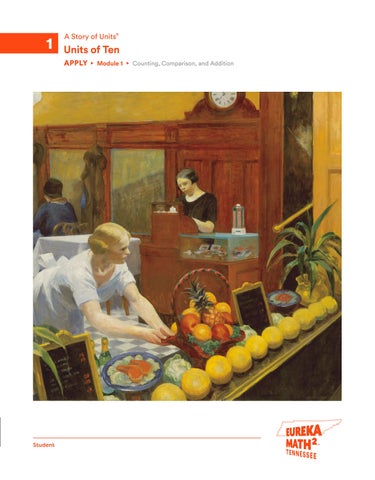
What does this painting have to do with math? American realist Edward Hopper painted ordinary people and places in ways that made viewers examine them more deeply. In this painting, we are in a restaurant, where a cashier and server are busily at work. What can you count here? If the server gave two of the yellow fruits to the guests at the table, how many would be left in the row? We will learn all about addition and subtraction within 10s in Units of Ten. On the cover Tables for Ladies, 1930 Edward Hopper, American, 1882–1967 Oil on canvas The Metropolitan Museum of Art, New York, NY, USA Edward Hopper (1882–1967), Tables for Ladies, 1930. Oil on canvas, H. 48 1/4, W. 60 1/4 in (122.6 x 153 cm). George A. Hearn Fund, 1931 (31.62). The Metropolitan Museum of Art. © 2020 Heirs of Josephine N. Hopper/Licensed by Artists Rights Society (ARS), NY. Photo credit: Image copyright © The Metropolitan Museum of Art. Image source: Art Resource, NY
ISBN 978-1-63898-520-4
9
781638 985204