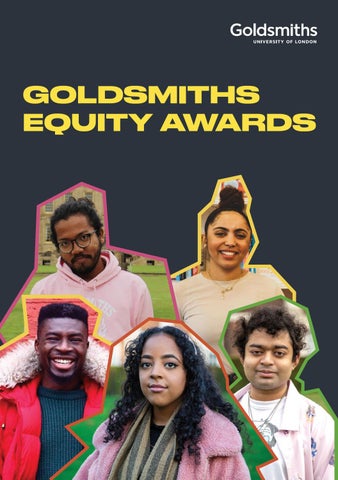
GOLDSMITHS EQUITY AWARDS
Communicators, connectors, collaborators, entrepreneurs, artists, teachers, community workers. People who bring energy, curiosity, ideas, action and optimism. People who build things, who want to make positive change and help others, who contribute to culture and to a stronger society. Goldsmiths is full of such people.
Levelling up Our complex world faces huge challenges. To address them we need educated, engaged and creative individuals. This is what a Goldsmiths education provides. Our disciplines explore what it is to be human and our students, colleagues and alumni care about contributing to society. Yet there is an Equity Gap in institutions across the country and at our College too. Society will only thrive when all people have a fair and equal chance of success in education. At Goldsmiths we will close the Gap by changing our culture and practices, and through financial support for students. Whilst we stand accountable for the former, we can only deliver the latter with your help.
Known throughout
Sir Steve McQueen CBE, artist, film-maker. Image: John Russo
Errollyn Wallen CBE, composer. Image: Sir Cam
Goldsmiths alumni have exerted huge influence on the cultural life of the UK and beyond. Here is a small selection of the many outstanding individuals who have received a Goldsmiths education. We want current generations of students to succeed so that they, too, can change the world, like our students of the past have done.
Fiona Rae RA, artist. Image: Dan Perfect
the world Goldsmiths College has a global reputation for our contribution to the arts, culture, and creative education, linked through the social, behavioural and computer sciences.
Zarina Bhimji, artist. Š Zarina Bhimji. All Rights Reserved, DACS/Artimage 2020. Photo: Ralf Hoedt
Liam Gillick, artist.
Dr Bernardine Evaristo MBE, author. Image: Jennie Scott
Lucy Caldwell, author. Image: Tom Routh
Yinka Shonibare MBE CBE RA, artist. Image: Marcus Leith
Dean Atta, poet. Image: Thomas Sammut
Nabilah Said, editor, playwright. Image: Erfendi Dhahlan
Sam Taylor-Johnson OBE, film-maker, photographer. Image: Brigitte Lacombe
Dennis Kelly, writer.
Rob and Josie da Bank, co-founders of Bestival.
Dame Mary Quant DBE, fashion designer. Image: John Adriaan
Sir Antony Gormley OBE RA, artist. Image: Stephen White
Adrian Sutton, composer.
“As a student of economics, I didn’t expect to be surrounded by music and art. There is an element of freedom and flexibility in the course that really appeals to me; I like how multidisciplinary it is. It caters to every aspect of a person. I like that Goldsmiths is diverse, in terms of demographics, as well as in its way of thinking.” Idowu A Isaac Ojo, BA Economics 2021
What is the Equity Gap at Goldsmiths? •
Black, Asian and Minority Ethnic* students receive fewer good degrees (i.e. a mid 2:1 and above) than White students – see bar chart below – and are more likely to drop out of their studies before completion of their degree.
•
In 2019, of 70 students who completed a higher research degree, only five were Black, 11 were South Asian and fewer than five were East Asian.
•
Of 95 professors at Goldsmiths, 14 are Black, Asian and Minority Ethnic.
* Language that combines different categories into one is problematic. The term Black, Asian, Minority Ethnic – “BAME” – erases differences between groups. However, we use it in this document for brevity to refer to the individuals from the groups below, all of whom are affected by the Equity Gap. White and Black Caribbean White and Black African White and Asian Any other Mixed / Multiple ethnic background Asian / Asian British, Indian, Pakistani, Bangladeshi, Chinese Any other Asian background Black / African / Caribbean / Black British African Caribbean Any other Black / African / Caribbean background Arab, White Gypsy or Irish Traveller
Percentage of students from different ethnic groups who received a good degree (2.1 or first) [Goldsmiths figures 2018] 90% White Students 83% Other (inc. Mixed) Students 68% Asian Students 65% Black Students
– White, Eurocentric curriculum University reading lists and library collections are published overwhelmingly in the Global North - this inevitably perpetuates a specific world view. Not only can this alienate swathes of classroom participants, but everyone is denied the intellectual richness that multiple perspectives bring. – Being in a minority group Academic self-confidence, preparedness, feelings of belonging and belief in one’s ability to succeed are powerfully important. These feelings are undermined by the threat of being stereotyped or conforming to a stereotype. This can be alienating. Why is there an Equity Gap?
Why is there – Racial discrimination Goldsmiths research* has found inappropriate racialised words and assumptions sometimes go unchecked in the classroom and beyond. Processes may also be insidiously racist: for example, extenuating circumstances rules rank the death of a parent as more severe than the death of a grandparent – which is not the case in all cultures. * Insider Outsider 2019; Identity and Impact Report 2020.
Lack of role models There are few BAME academics – this has an impact on how BAME students see themselves and their place in the academy. Those few BAME academics are often sought out by BAME students for mentoring – emotional labour that is not recognised or rewarded. – Access to resources BAME households in the UK are over twice as likely to live in poverty as their White counterparts (Social Metrics Commission, 2020). These demographics are reflected in our student body. Student loans do not cover all costs, and when parents cannot contribute, financial pressure can be extreme.
an Equity Gap? To ensure student success, we must: •
Acknowledge that Black, Asian and Minority Ethnic students face disadvantages
•
Remove the systemic barriers that these groups experience
•
Deliver intentional support to level the playing field
Why address the Equity Gap at Goldsmiths? Wider change in the world will come when there is a tipping point of individuals in positions of influence and leadership in our institutions and across our culture with the awareness and willingness to challenge racism. This starts with education, particularly at a university like Goldsmiths, where: •
Our student body is 50% Black, Asian and Minority Ethnic.
•
Our students are protesting against the status quo: in 2019 students in Goldsmiths AntiRacist Action (GARA) held a 137-day occupation demanding change. This action brought about an upsurge in anti-racist energy, and resulted in 18 commitments for change from the College.
•
Our graduates are influential. BAME students enabled to be successful will join our alumni in changing society.
Equity at Goldsmiths will advance equity in the world
“Minority voices are becoming louder and louder, and more and more are pursuing MAs and PhDs. You’ll get left behind if you don’t care for and support students of colour.” Atalaya Dorfield, MA Black British Literature 2020
“Funding provides a level playing field and enables others like me to go some way to achieving our aspirations; it is a tangible intervention towards correcting the awarding gap. So, as a Black academic, I was delighted to be awarded a paid studentship. Receiving funding opened doors for me that were closed or partially ajar and would have taken inordinate effort to open by myself.� Angelique Golding, MA Black British Literature 2020
How will we address the Equity Gap? Firstly removing institutional barriers to student success
Secondly tackling financial barriers to student success
Goldsmiths is taking a hard look at its campus culture and systems to build a more equityfocused approach.
Whilst Goldsmiths must remove institutional barriers, there is another major barrier: the financial one.
We must make change across many fronts: whilst there is plenty of good practice, all our academic programmes must be balanced and challenge orthodoxies wisely and inclusively; teaching must be sensitive to all participants in the classroom, acknowledging diversity of outlook and prior experience; processes must recognise – and cater for – difference; sometimes one size does not fit all.
Our data shows that 37%* of our Black, Asian and Minority Ethnic students are from the most deprived neighbourhoods in the UK. For these students, a lack of financial power compounds other barriers experienced as a result of racial identity.
We have set up a Racial Justice Board to oversee this work and hold the College to account. * 2018-19 figures for new undergraduate students at Goldsmiths based on Index of Mass Deprivation
Paying for an education is expensive Tuition fees for undergraduate programmes are ÂŁ9,250 per annum for a three- or four-year degree. This debt is deducted from pay, like tax, once graduates are in employment and earning above a threshold. Alongside tuition fee debt, students need to cover their living costs to survive in the here and now.
“As a student, you try to not think about how much debt you’re in. I can’t overstate the emotional impact of debt. Redistribution of wealth is so important. I come from a family that was always able to get by, and if there are parts of my experience that could have been helped by donations, I can’t imagine how much it would improve someone else’s experience.” India Chambers, MA Black British Literature 2020
Concerns about money undermine students’ ability to succeed Living costs for students who commute to Goldsmiths from Greater London (as the vast majority of our Black, Asian and Minority Ethnic students do) amount to c.£3,200 per academic year (for those paying rent, the figure is c.£10,000). Further student loans are usually available, but may not cover all costs. If families are unable to help with shortfalls, students must support themselves whilst studying. Many manage multiple part-time jobs. Inevitably this means less opportunity to participate in the intellectual, social and cultural aspects of university life, and can affect academic success.
“Not having to worry about budgeting would take a weight off your shoulders. You have to think and plan a few months ahead; you end up worrying about this way too much when you should be focusing on your studies. Financial support can take the pressure off, improve the student experience and make it much easier to focus on what you are learning.� Omar Khan, BSc Games Programming 2022
Financial awards help close the gap We know targeted financial support is part of the solution. A Goldsmiths Bursaries and Scholarships Evaluation, which looked at all our financial award recipients between 2012 and 2017, showed that Black, Asian and Minority Ethnic students who received a financial award were almost as likely as White students to receive a first class degree. The impact of a bursary on BAME students
White students
Control
25%
Awardees 29% 1st
BAME students
8%
25% 2:1 or below
Goldsmiths is funding some awards Goldsmiths will be offering 75 bursaries for Black, Asian and Minority Ethnic students from low-income backgrounds across three years from 2021. We would like to do more but the College has very limited budget; we have almost no endowment and nearly 80% of our annual operational budget is derived from students (mostly their tuition fees). This must cover all of the costs of running a worldclass university.
“Many BAME parents want their children to excel in their studies so there is a lot of pressure to succeed academically and beyond. By supporting these students, you will not only be helping the student as an individual but also their families who often share financial stressors. There is a lot of potential in students and the financial support will accelerate this potential even further.� Ayman Tanveer, BSc Psychology 2022
“As a student, the amount of time you can actually work is limited, so finding jobs is difficult; a lot of us have to do freelance or part-time work and earn a limited amount. Students who need to support themselves while studying have to work really long hours, which eats into the time they can spend studying and limits academic attainment.� Mohammed Ekram Miah, BSc Psychology 2021
But this is just a start What Goldsmiths can achieve alone will make a difference but, given the scale of the problem, we must do more. We have created this campaign to invite donors to join us to support many more low-income Black, Asian and Minority Ethnic students. We must build sustainable funds to address the Equity Gap. With your help we aim to create awards for immediate use and some endowments to support numerous cohorts of students over the long-term since this problem will require more than a quick-fix.
“I’ve never felt displaced, and that is one thing I really appreciate about Goldsmiths. Goldsmiths is a really safe space that has helped me both academically and professionally, as well as providing me with lots of resources and help with wellbeing and career advice.” Teguh Nurrohman, MA Black British Literature 2020
Donors can name an award with a minimum gift of £9,000 (£3,000 p.a. for three years) - in recognition of the donor or to honour someone else.
Building sustainable funds If we raise £3 million in philanthropy initially, through a mix of endowments* and gifts for immediate expenditure, we will support at least 164 undergraduate students in the short-term, and many more over the long-term.
1x £1m endowment
Funding for around 10 students annually
10x £100k endowments = £1,000,000
Funding for around 10 students annually
20x £27k gifts (£9k p.a.) = £540,000
Supporting 60 students in total, each gift funds three students for the three-year duration of their degree
51x £9k gifts (£3k p.a.) = £459,000
Supporting 51 students in total, each gift funds one student for the three-year duration of their degree
Many = £100,000
Collectively funds 33 £3k grants to support students
* What is an endowment? A gift intended to be invested so that it maintains both its value and generates an income that increases in real-terms – in perpetuity or at least for a minimum of ten years.
“The collective experience of being at university – the people you meet and the things you learn – that is invaluable. I would want people to be included in that and not feel like it’s not for them. Scholarships help with finances, but they don’t just offer practical support. You get a feeling of belonging if you have the support to excel at your studies – you feel like you’re supposed to be here.” Kamal Jones, BSc Computer Science 2020
Other ways to help Employability support
Postgraduate support
Internships, mentoring and placements play a hugely important role in supporting students to succeed – both during their studies and in their lives beyond.
We aspire to raise significant funds to support study at Master’s, doctoral and post-doctoral level, where there is significant underrepresentation of Black, Asian and Minority Ethnic scholars.
Through our GoldReach and Alumni Mentoring schemes we broaden horizons and offer advice and opportunities for students from under-represented backgrounds.
We would like to be able to offer Master’s and PhD awards in order to address this.
It is vital that we expand these programmes, which we can do with your help.
200 Master’s bursaries of £5,000 each.
£300,000 would allow us to create 100 internships calculated at London Living Wage.
£1 million of philanthropic funding would allow us to create:
OR 20 PhD studentships of £16,777 per annum for three years.
“Even the maximum amount of student finance doesn’t cover all living costs. Financial support would make a huge difference; it would help with groceries, transport, going out with friends. Supporting BAME students helps make the job market more diverse and can help women and people of colour to achieve higher positions in society. Even a small donation makes a big difference.” Jessica Delgado, LLB Law 2022
Thank you. Our vision is to achieve racial equity at Goldsmiths, to lead towards the wider change we want to see in the world. We will get there with the help and support of a community of donors who believe in this too.
For further information please contact: Alison Woolley, Director of Development & Alumni Relations Goldsmiths, University of London tel +44 (0)7595 062 744 a.woolley@gold.ac.uk development@gold.ac.uk
Bridget Riley CH CBE, Cataract 3 1967 PVA on canvas 221.9 x 222.9 cm British Council Collection © Bridget Riley 2020. All rights reserved
Your help will change lives
With thanks to Deep Fried Designs (Goldsmiths BA Design graduates 2020) for designing this brochure and to all our current students and alumni who agreed to be featured.
Goldsmiths is part of the University of London. We are proud to be located in South East London, in the Borough of Lewisham.