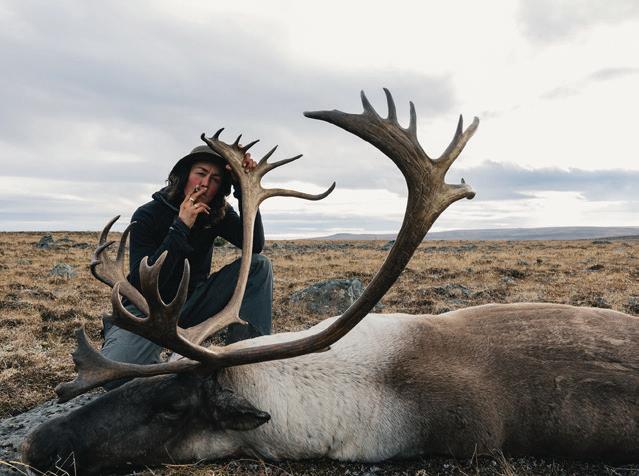
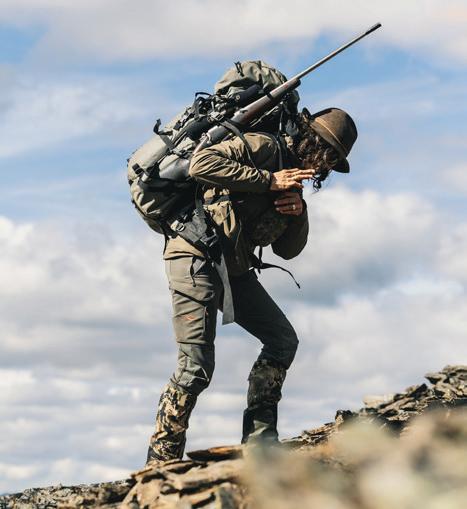
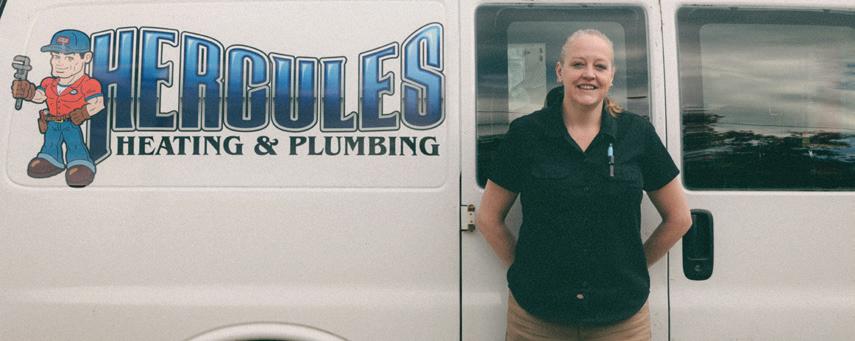
Fernie hunting guide Tanis Barkman loves her living and dodges death.
THE SUNSHINE CENSUS
Dečki Ljeta/Los Chicos de Verano
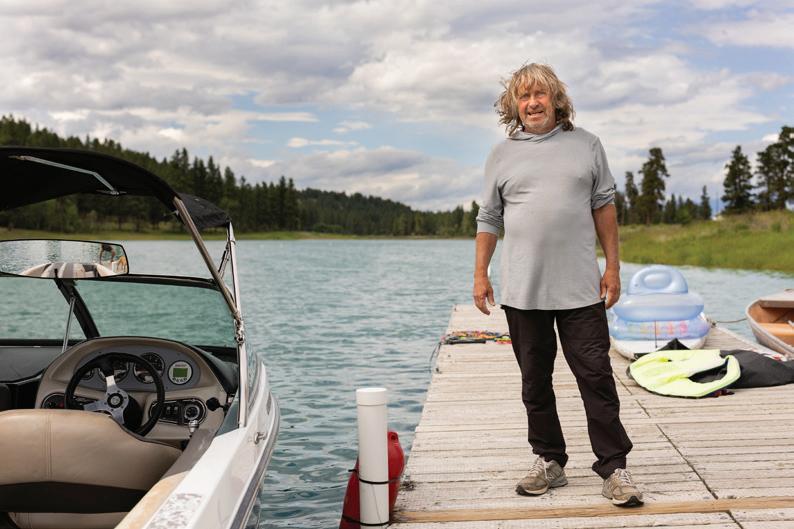
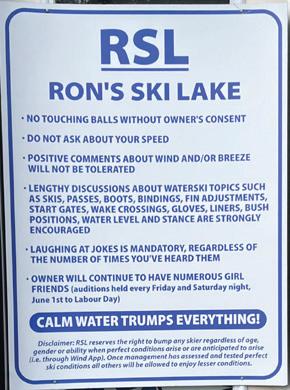
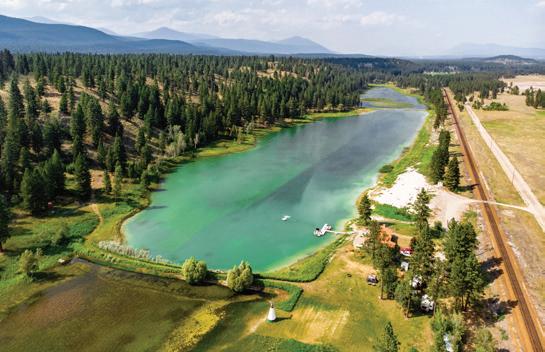
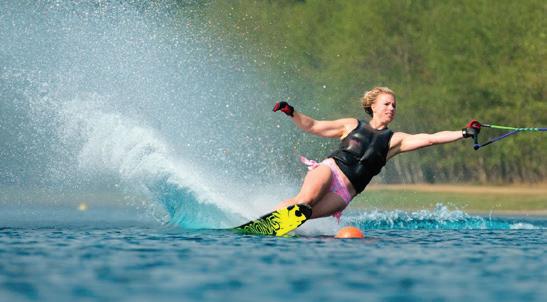
Ron’s Waterski Slough An Iconic Apple
BRISCO, BURG OF BIRDIES AND THE BUGS
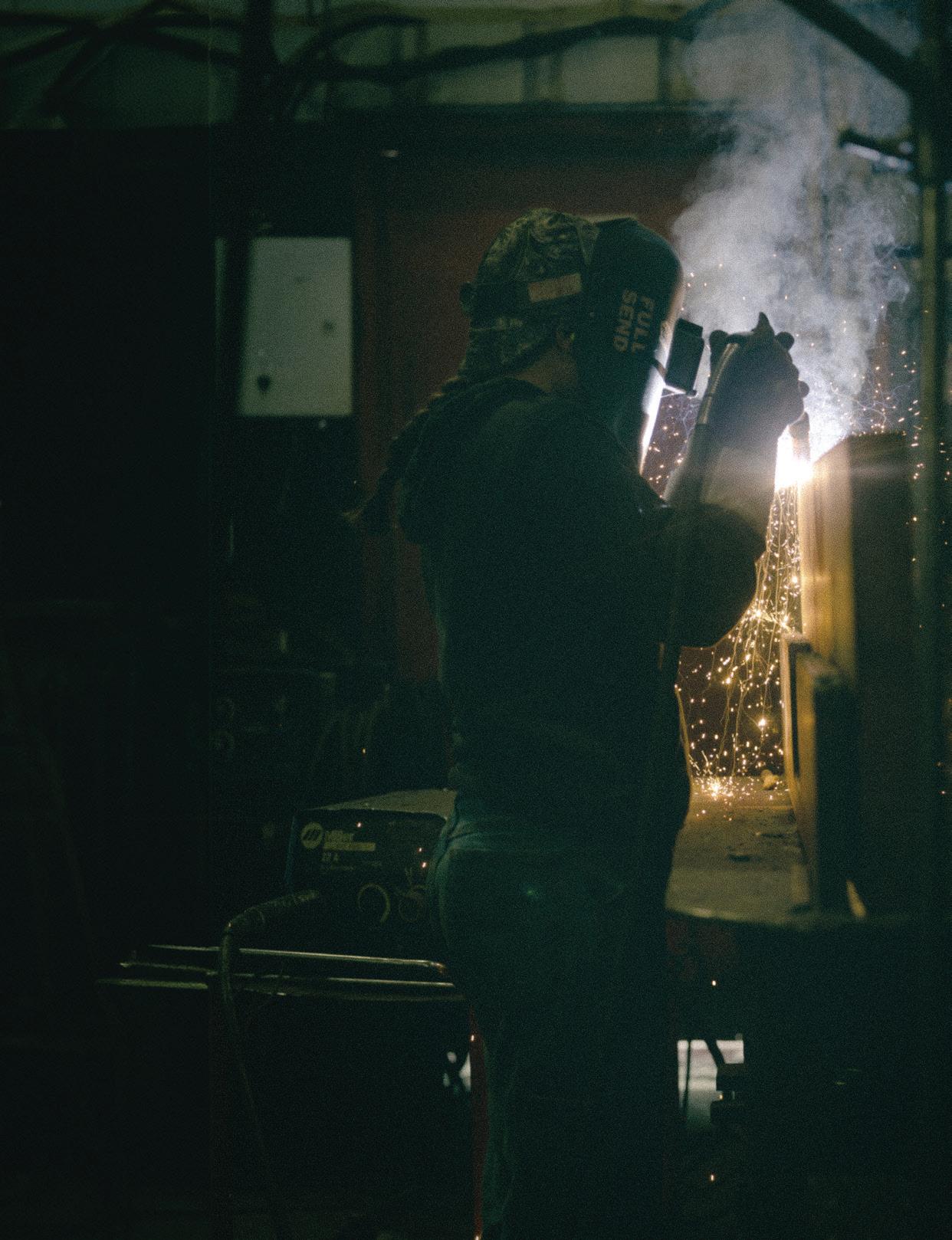
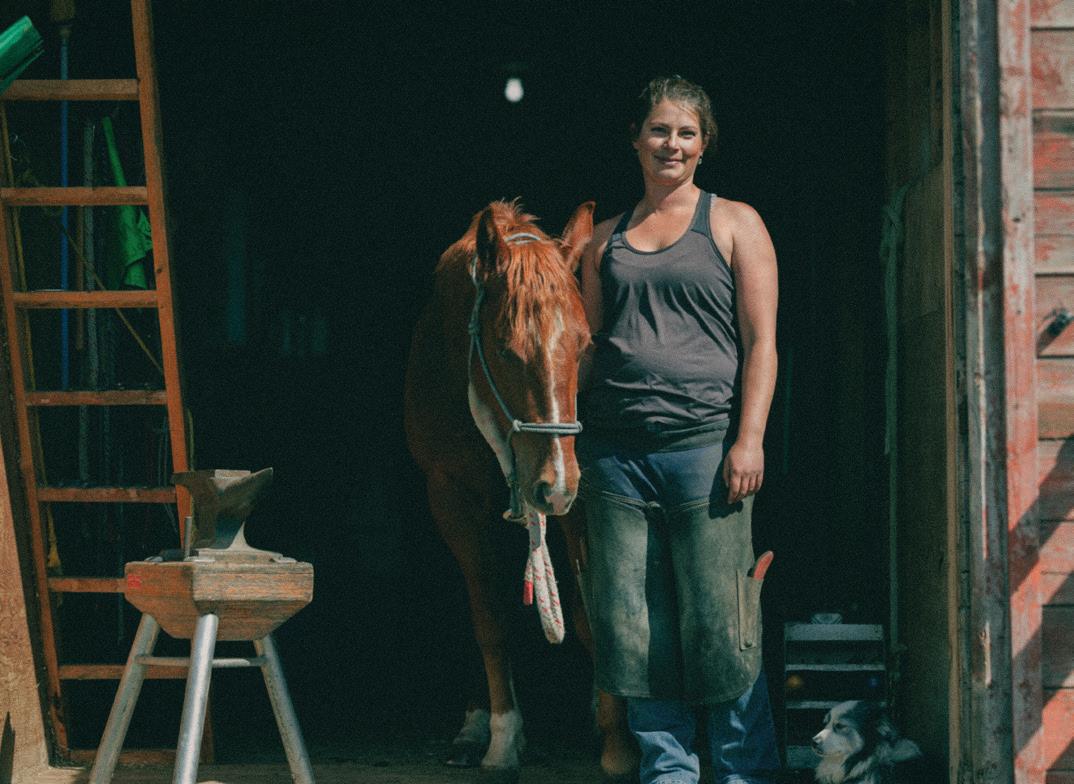
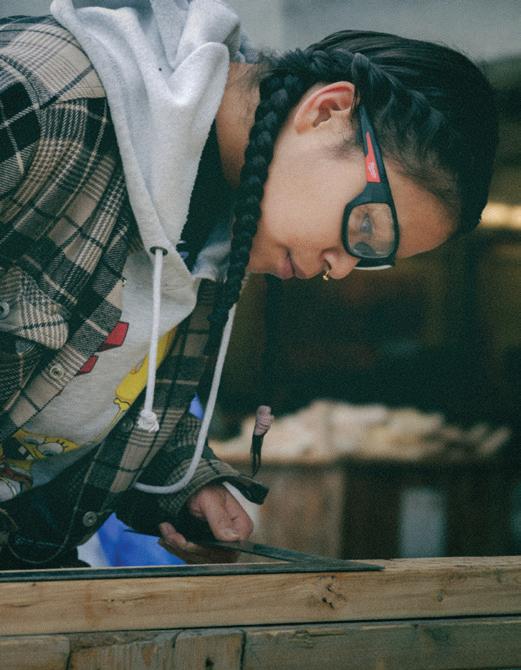
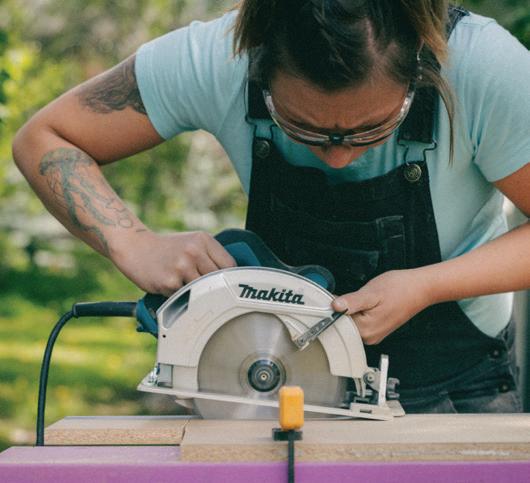
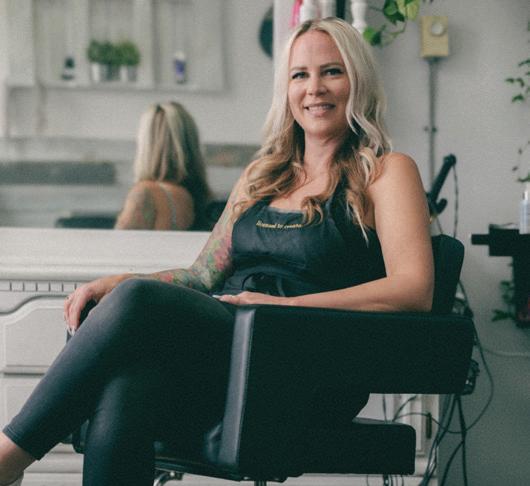
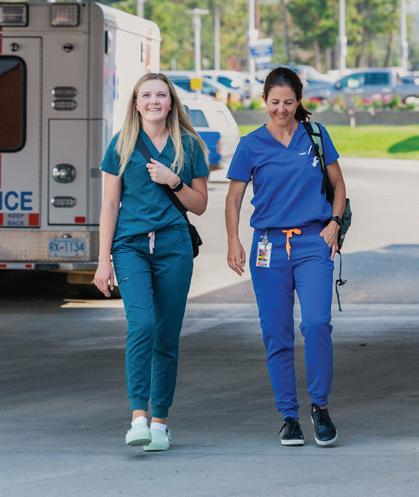
WOMEN IN TRADES
GOBBLESHEGONE
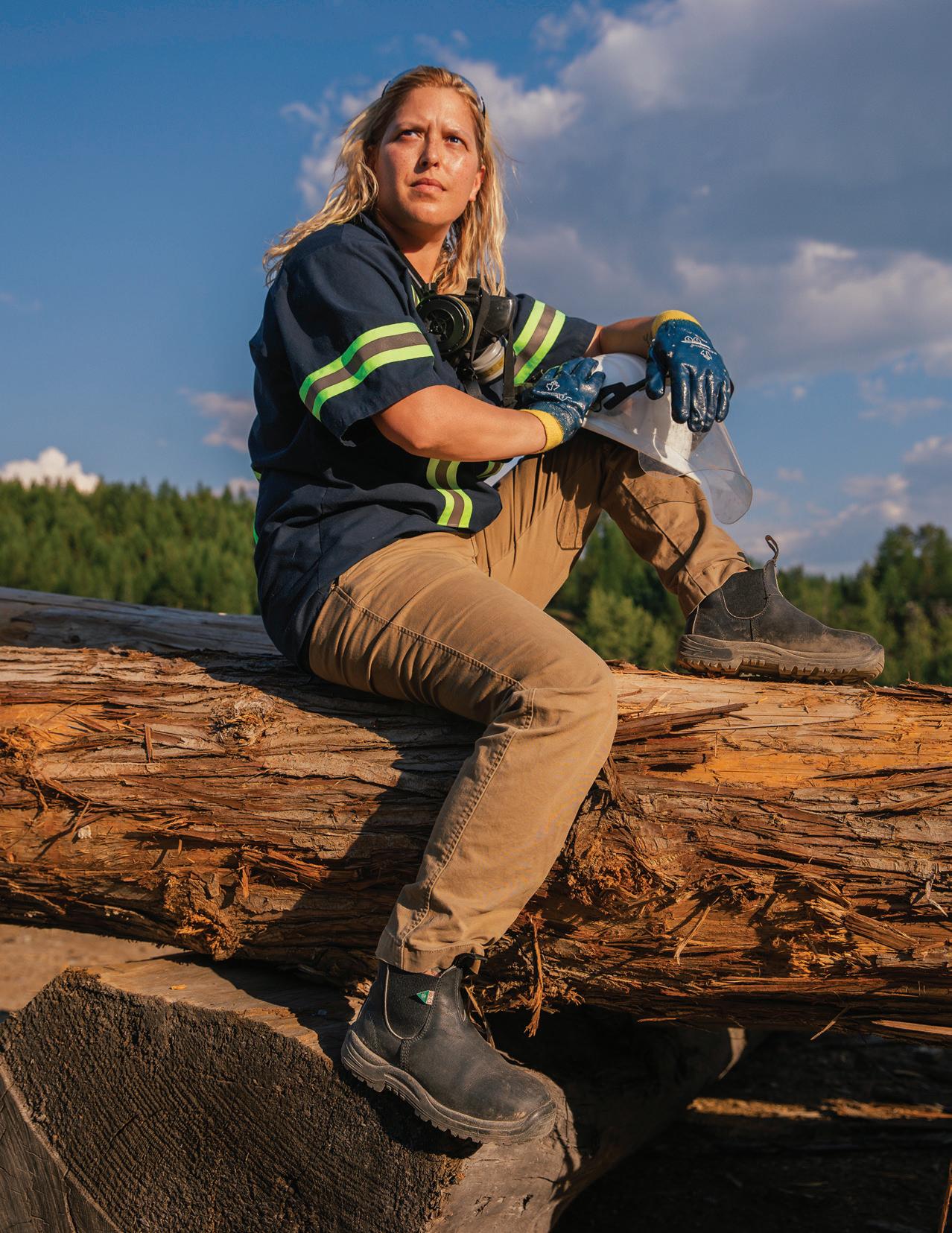
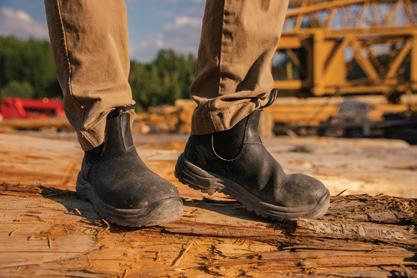
“I switched my work boots to Blundstones for the ease of getting them on,” says Jodie Wheeler, an East Kootenay local who’s worked in the pulp and paper industry for 15 years, working her way up to the first female digester operator at her mill. “These boots hold up better than most women’s work boots, and have great cushioning for being on cement all day.”
Mor tgages
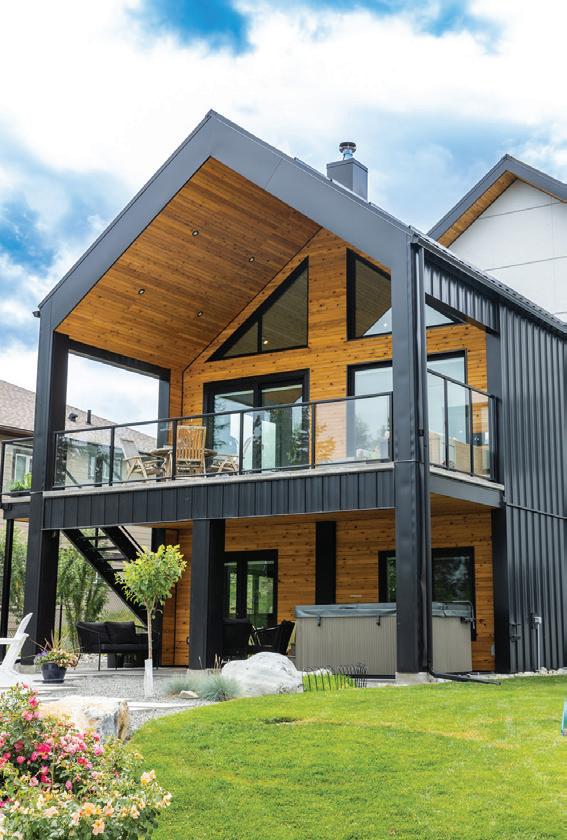
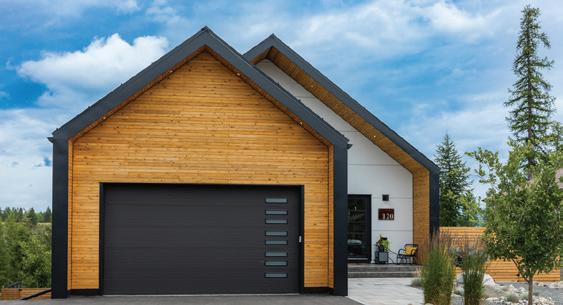
Offering award-winning custom homes in the East Kootenays.
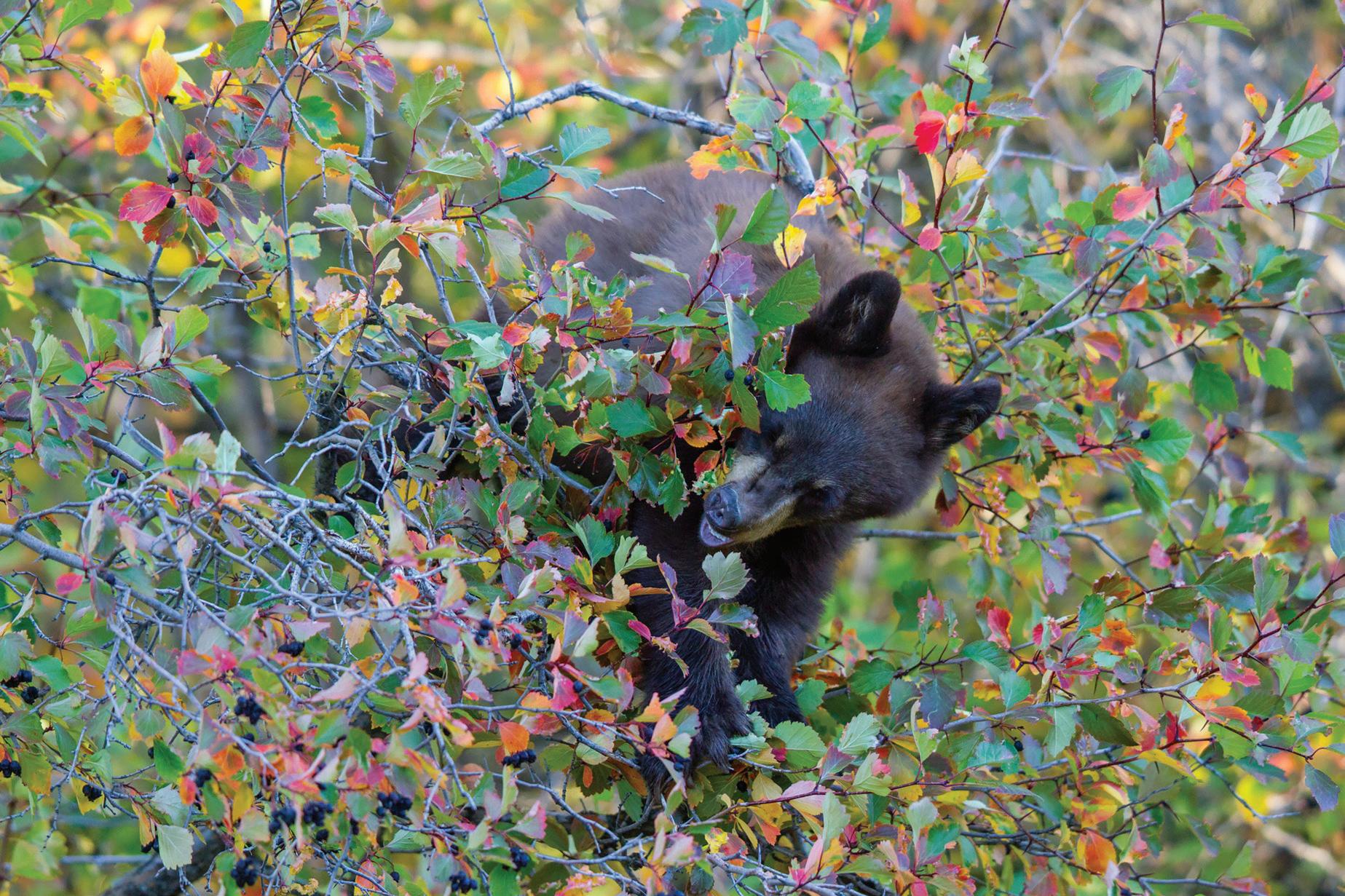
We are lucky to not get very many unwanted encounters with bears around Cranbrook. But we must still take the proper steps with handling garbage around our homes and businesses so we don’t create a problem.
And with the hot, dry and smokey summer we’ve had, we are already noticing increased bear activity. That means it is vital that you also properly manage your fruit trees to reduce the risk of unwanted wildlife encounters.
If you can’t manage your own trees, Wildsight has a great Apple Capture program. Learn more at https://wildsight.ca/branches/kimcran/.
STRENGTHENING THE PLACES WE LOVE
ph:
Colby Katzberg
ph: Mark Eleven
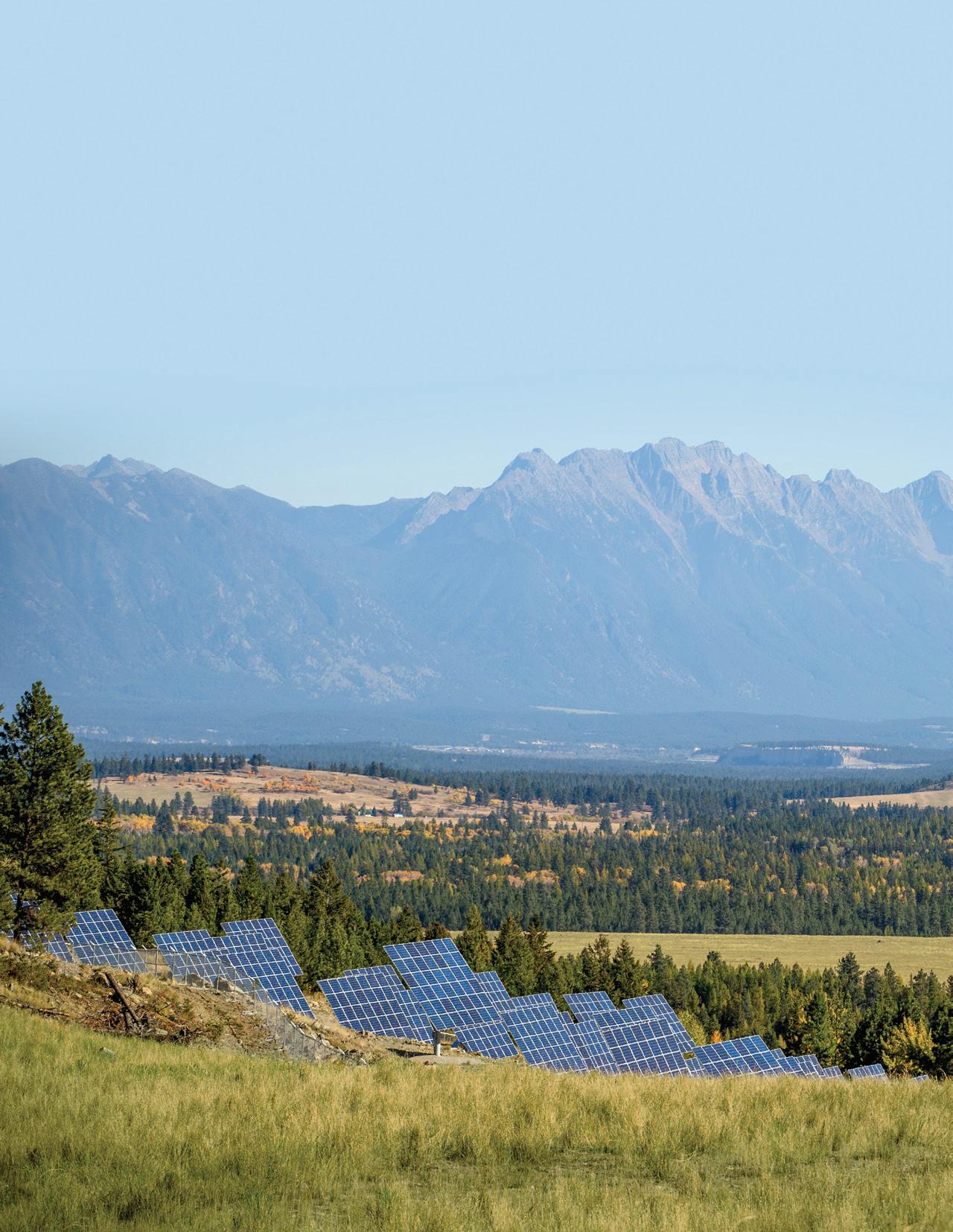
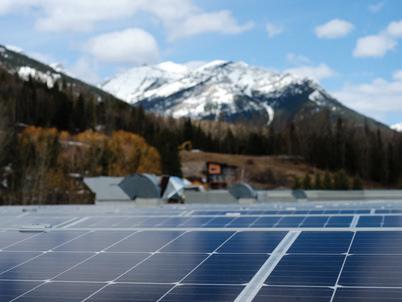
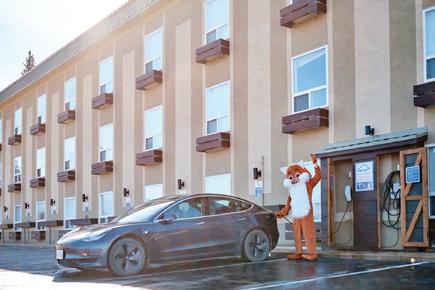
Climate change is a global risk that is directly influenced by human activity and requires decisive action. As part of Teck’s post-mining community investment in Kimberley, B.C., the Legacy Properties team continues to operate the Sun Mine, offsetting power needs at the Sullivan Mine while providing surplus energy back to the grid.
Learn more at teck.com/sustainability and teck.com/sullivan
Packing a Two-Four
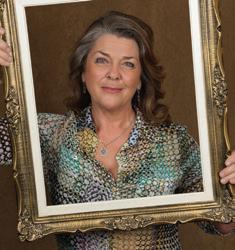
Fernie hunting guide
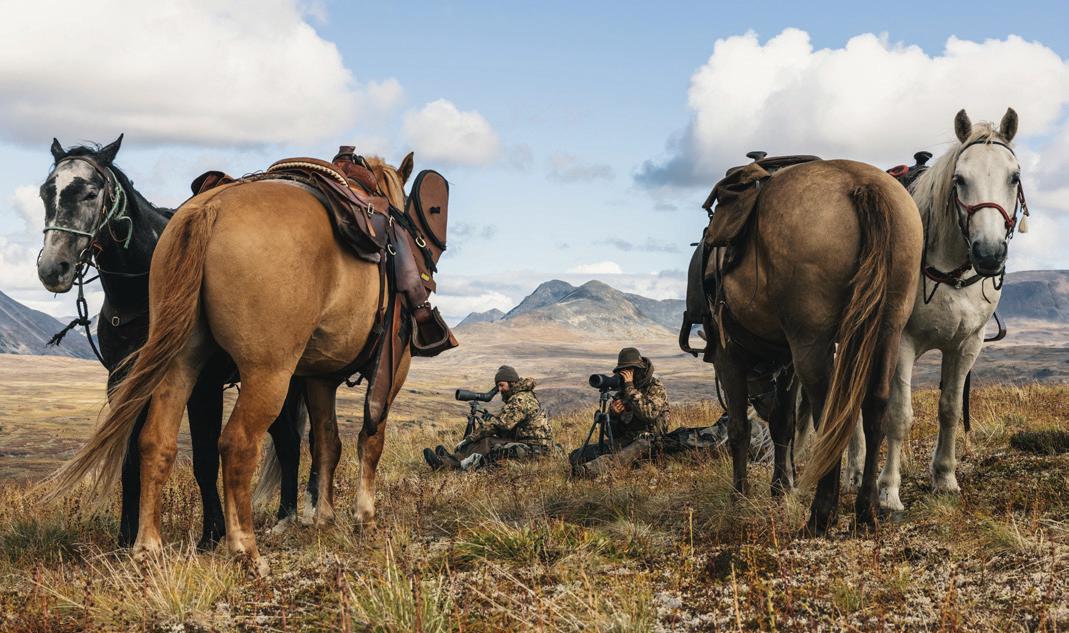
Tanis Barkman and partner Doran Carter — flanked by Gadget, Rusty, Dusty, and JD — scan for moose and caribou in Northern B.C.’s Cassiar Range. Barkman spoke with The Trench for this issue’s Q and Eh, page 16. Nick Marchiando
Photo
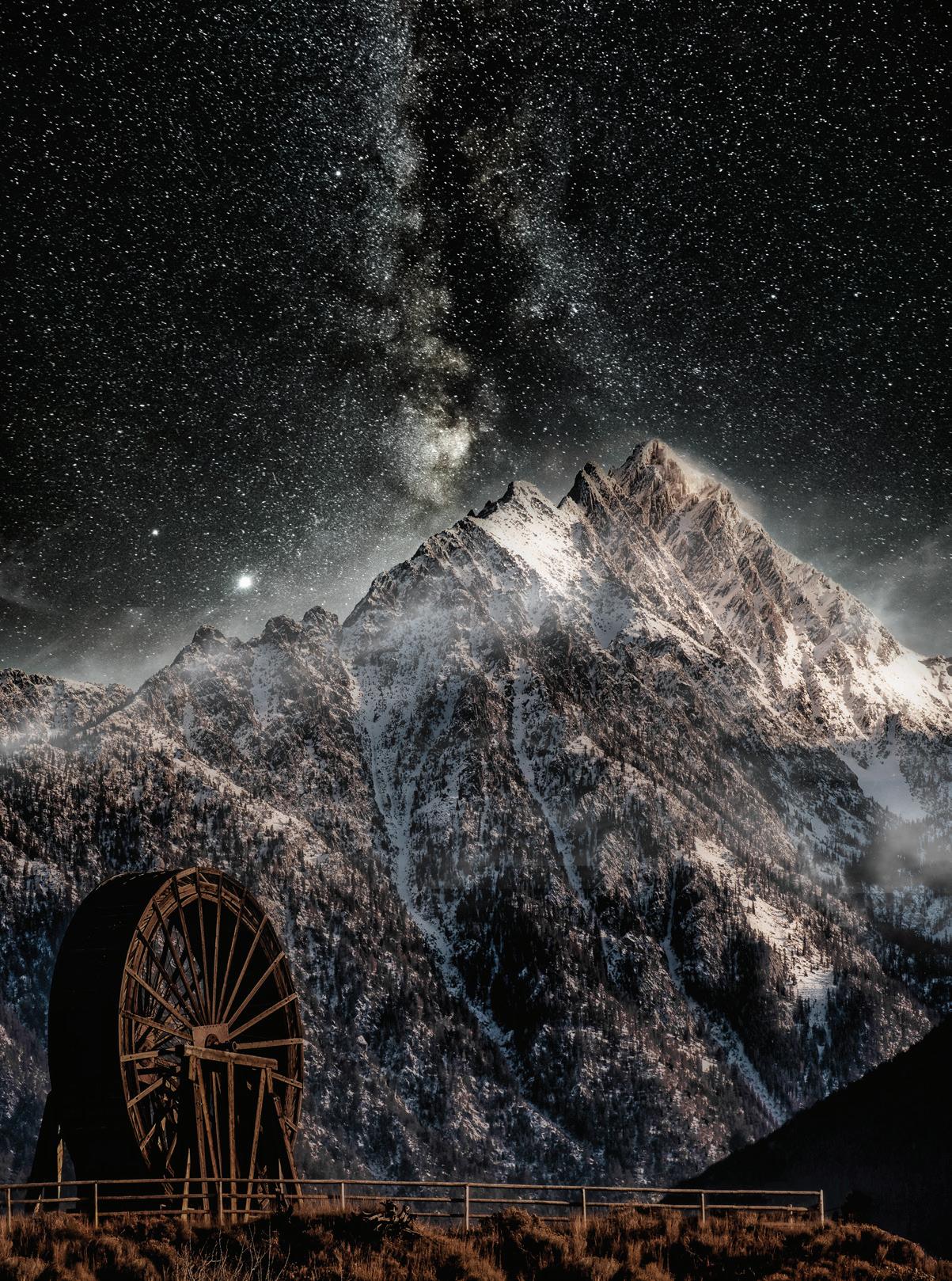
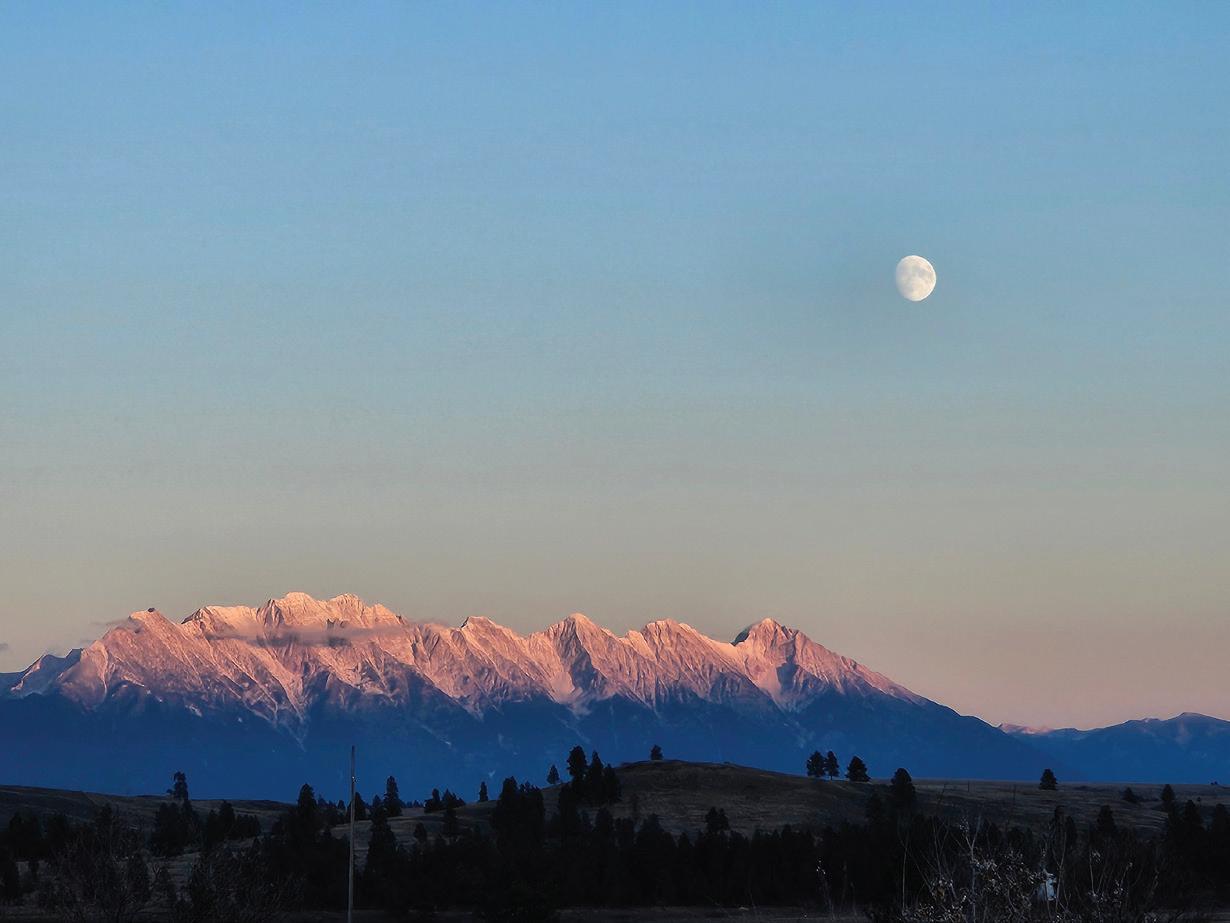
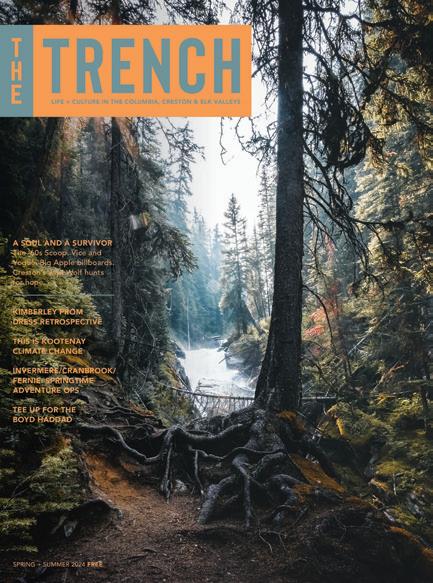
On the Cover Fisher Peak, towering at 2,846 metres (9,336 feet), and the 126-year-old Fort Steele Heritage Town water wheel, cloaked by an infinite cosmic backdrop. Cranbrook photographer Trevor Phillips captured the shot around midnight on a chilly fall evening last year. highlanderphotography.ca
14 ROUND UP
Pano pumps it up, an MP on the DL, ode to the volunteers.
16 Q AND EH
Fernie local and pseudocelebrity Tanis Barkman on her love to hunt, dodging death, and the art of swearing like a sailor.
18 DESTINATION
Welcome to Brisco. World famous. And not.
20 ADVENTURE
Four family-friendly hikes, and one big-as haul.
23 ARCHITECTURE
Invermere’s Bug Eye House. An homage to homestead and hippie architecture.
24 BUSINESS
Artificial Intelligence. Oxymoron or Overlord?
27 ODDITY
Swaggering East Kootenay wild turkey gangs are Alberta bound.
29 CULTURE
Cranbrook’s Ed Fest celebrates arts and music — and a wayward circus creature.
31 YOU FUNNY
Mosquitoes, East Kootenay and otherwise, are tough little pricks.
76 BIGGER PICTURE
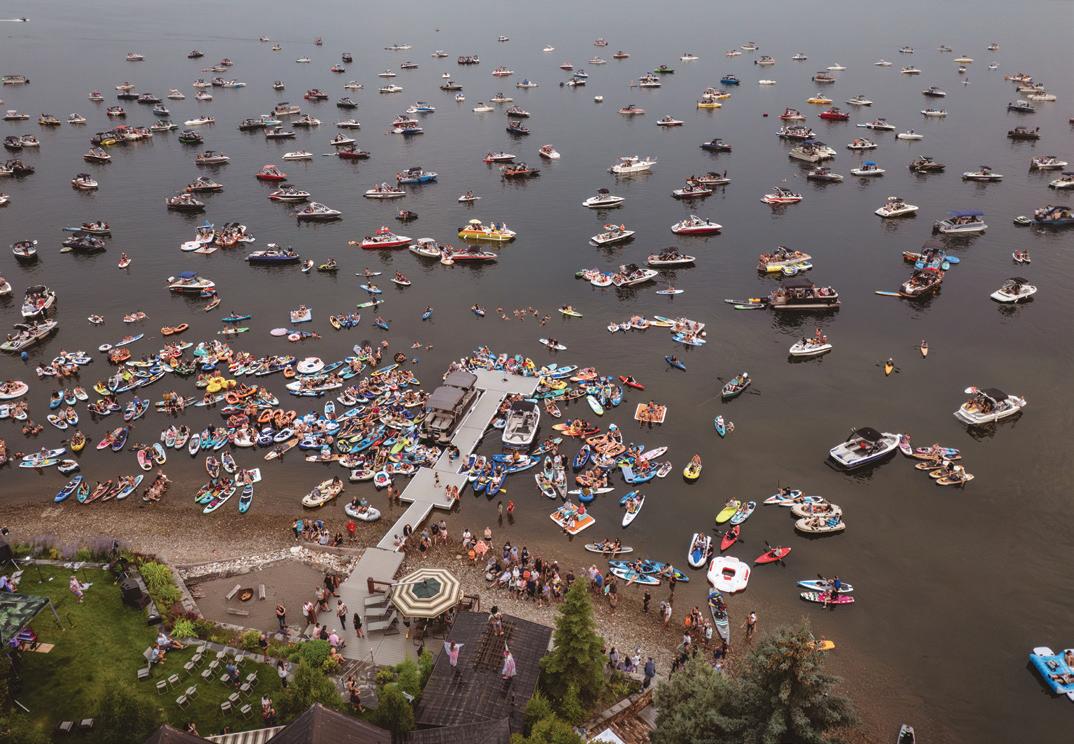
A fundraiser that floats everyone’s boat.
34
A CENSUS OF SUNSHINE
The sun. From 150 million kilometres away it powers the East Kootenay’s regional economic engines, local history immemorial, even your own heartbeat and mindset.
i. Juicy Details
ii. Wither & Knot
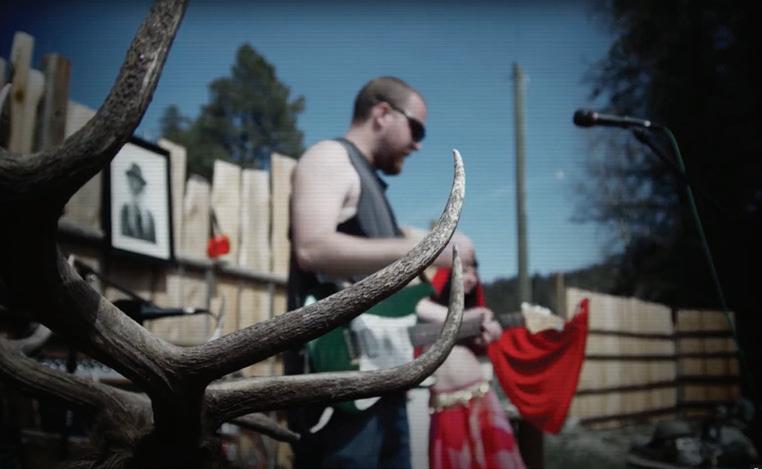
iii. Dečki Ljeta/Los Chicos de Verano
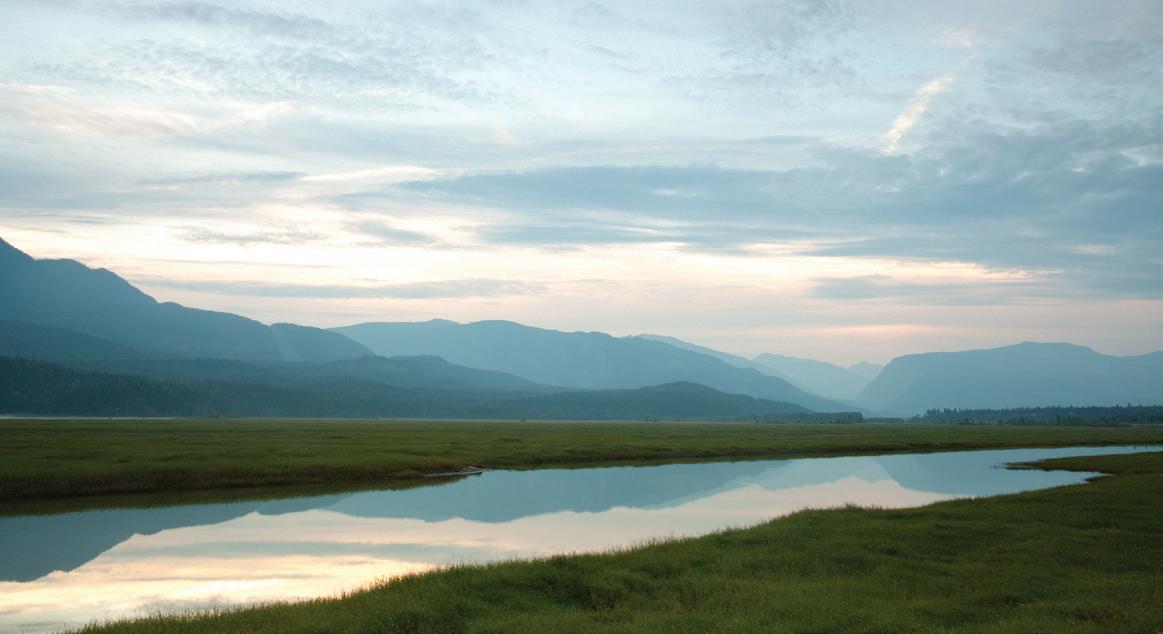
iv. Slough Ride
48
I. AM. KIMBERLIAN.
A tome to home, by 18-year-old Willa Honeyman.
50
THIS WOMAN’S WORK
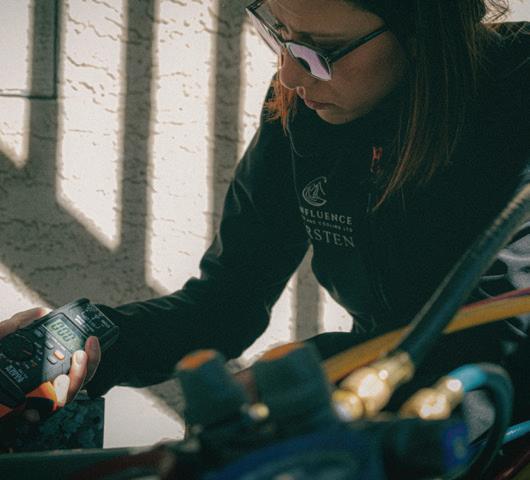
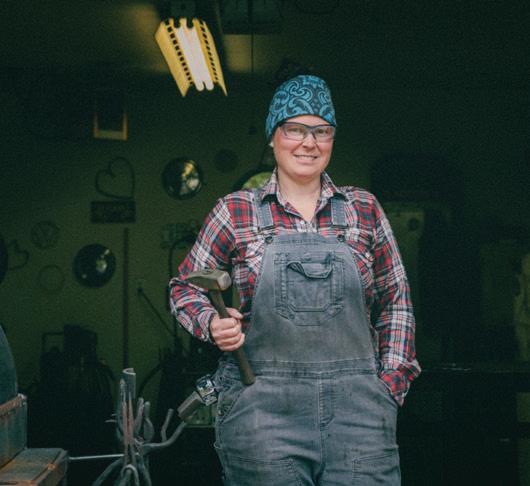
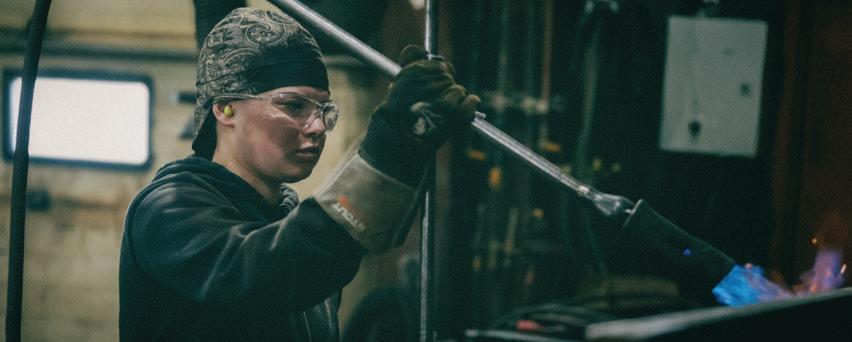
Carrying the torch, saw, and shears, sisters are more than making the grade in trades.
62
THE SKIN DEEP
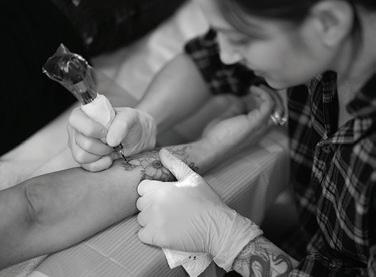
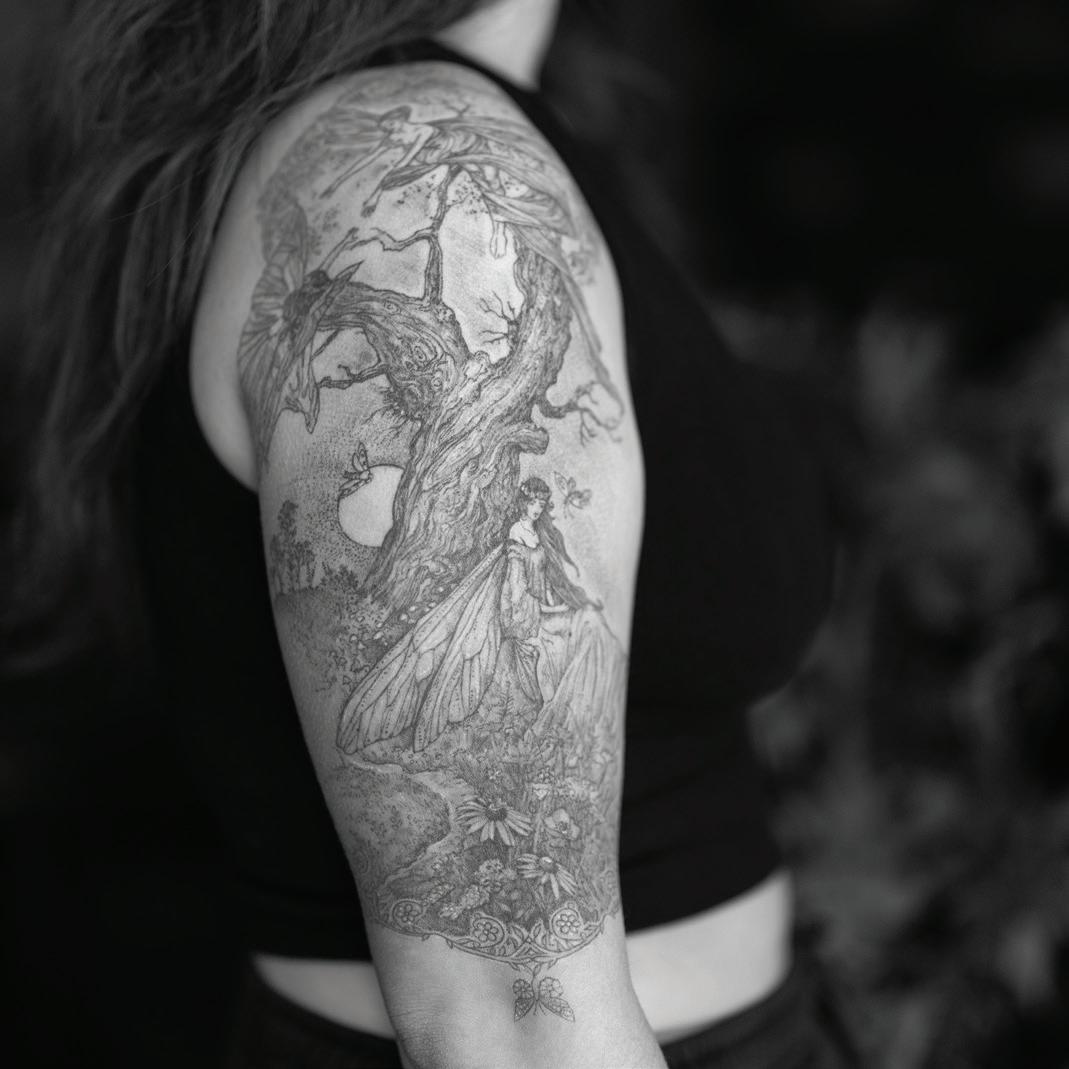
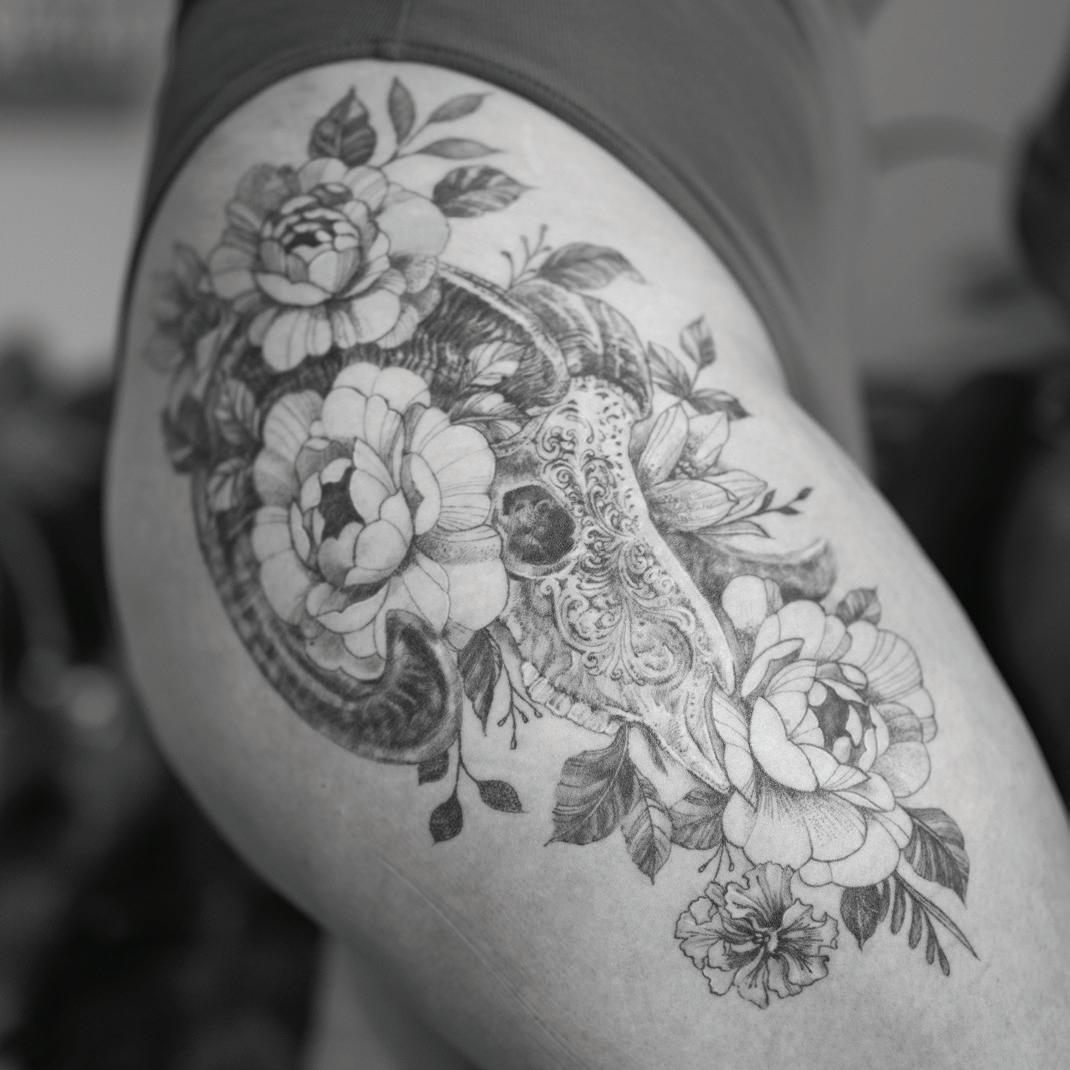
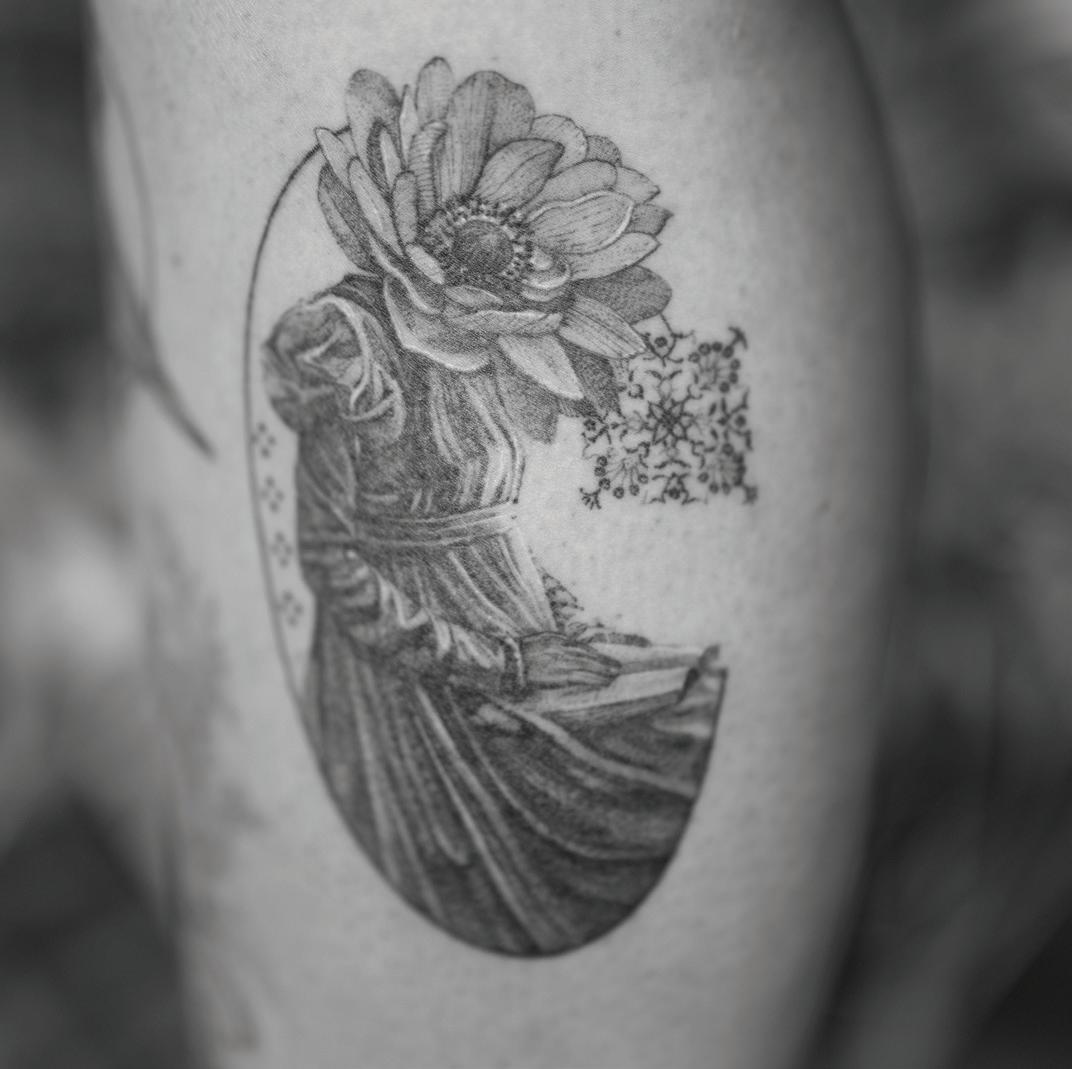
Inside the ink of artist Ellie Rubincam.
Meet Our ~
CONTRIBUTORS
BRIAN LAWRENCE
Hailing from Nelson B.C., Brian has spent over 25 years as a journalist and photographer. He was editor and publisher of the Creston Valley Advance for more than 13 of the 16 years he lived in Creston, as well as editor of I Love Creston magazine. He continues to write for several publications, including the Creston Valley Tourism Society, and in his free time, acts in and directs productions with Creston’s Footlighters Theatre Society.
KEVIN BROOKER
Although based in Calgary, Kevin has spent many of his best days in the Columbia Valley. As a lifetime freelance writer for publications like Outside, ESPN The Magazine, Powder, bike, Kootenay Mountain Culture, Surfer, and the Globe and Mail’s Report on Business, his professional goal has always been to amuse while informing. Kevin is so old that he’s shaken hands with Gordie Howe, Timothy Leary, and the Three Stooges — just not all at once.
WILLA HONEYMAN
Willa has lived most of her life in Kimberley and graduated from Selkirk Secondary in spring 2024. She plans to spend the next year working in Kimberley and saving up to backpack across Southeast Asia for five months before continuing her education. Willa’s reflective story on page 48 is her first published piece — and she looks forward to seeing where her interest in writing takes her.
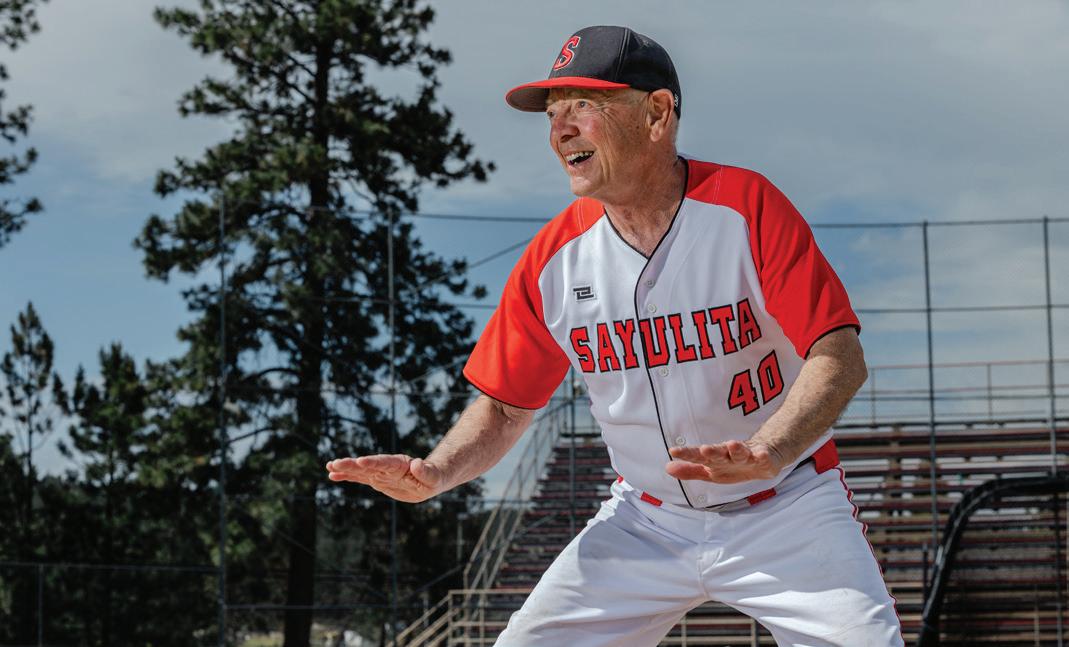
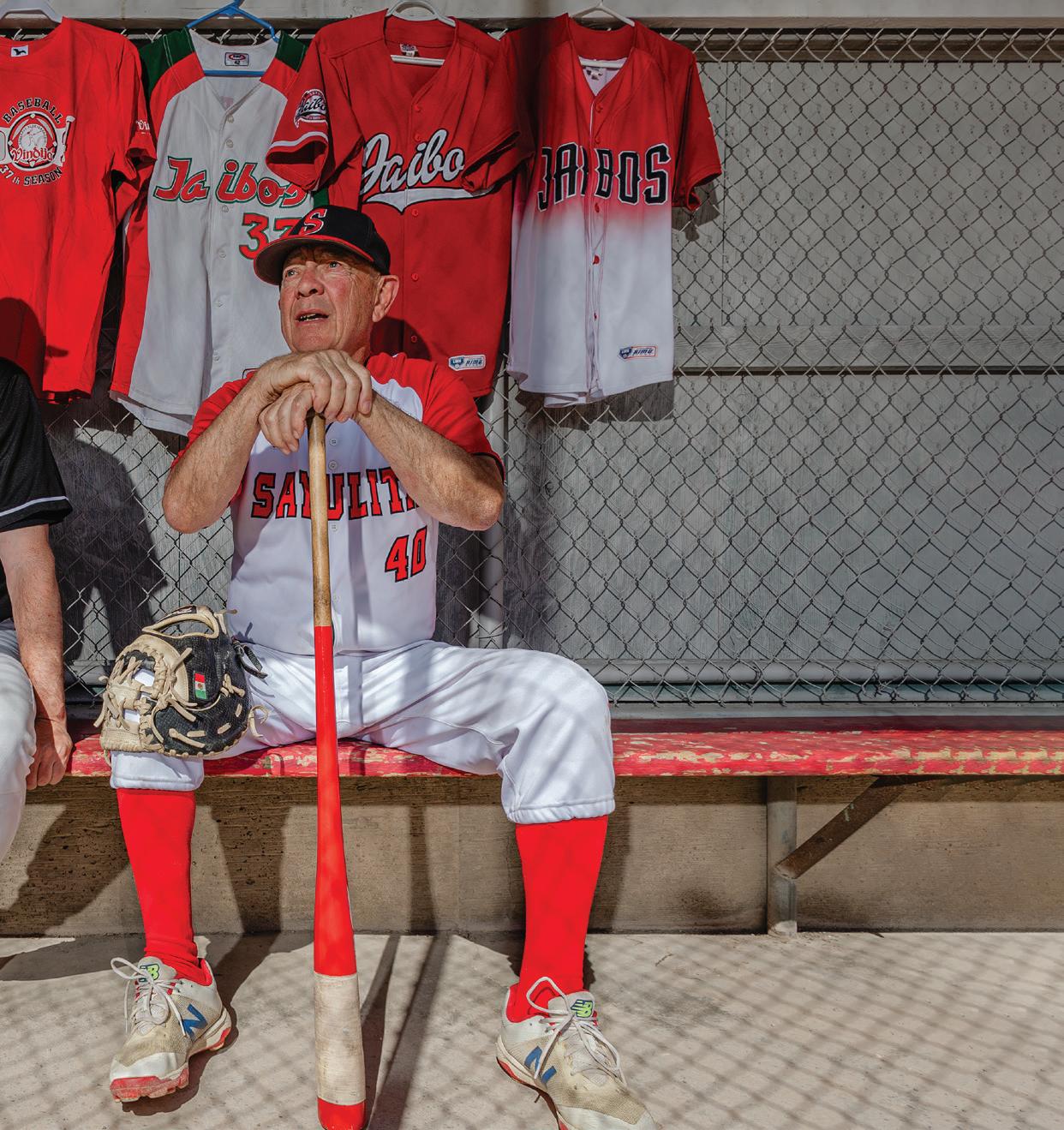
Ace of Base Creston baseball veteran Roger Tierney (above) and Cranbrook coach Paul Mrazek recount their international exploits with teams in Mexico, Croatia, and Germany in Dečki Ljeta/Los Chicos de Verano on page 40. Nicole Leclair Photo
GENERAL INQUIRIES darren@kootenaymedia.ca
Reproduction, in whole, or in part, is strictly prohibited. No part of this magazine may be reproduced or duplicated without the written permission of the publisher. All rights reserved on entire contents. THE TRENCH Magazine makes every effort to ensure the accuracy of the information it publishes and is not responsible for any consequences arising from errors or omissions. The opinions expressed in the articles are those of the authors.
THE TRENCH Magazine is published three times per year and is printed by Premier Printing in Winnipeg, MB.
THE TRENCH is published by: Kootenay Media 2024 Ltd.
PUBLISHER
Darren Davidson
EDITOR
Britt Bates
COPY EDITOR
Danette Polzin
ART DIRECTOR
Ashley Dodd
PRODUCTION DESIGN
Sarita Mielke
Janneke Guenther
ADVERTISING SALES
Alesha Thompson
DISTRIBUTION
Jesse Heinrichs
SOCIAL MEDIA
Danette Polzin
PUBLISHERS EMERITUS
Karen Vold
Grady Pasiechnyk
WRITERS
Dave Quinn
Jenny Bateman
Kevin Brooker
Jeff Pew
Willamena Honeyman
Sarah Stupar
Stephen Harris
Brian Lawrence
Jesse Heinrichs
Jacquie Moore
Danette Polzin
Darren Davidson
PHOTOGRAPHERS
Jenny Bateman
Pat Morrow
Jeff Pew
Mat Loyola
Nicole Leclair
Jesse Heinrichs
Brian Clarkson
Nick Marchiando
Mitch Winton
Travis Adams
Trevor Phillips
Diana Dearden
Kasha Ferguson
We gratefully acknowledge that we live and work on the traditional and unceded territory of the ɁamakɁis (Ktunaxa) and Secwepemcúl’ecw (Secwépemc), as well as the chosen home of the Métis people of B.C.
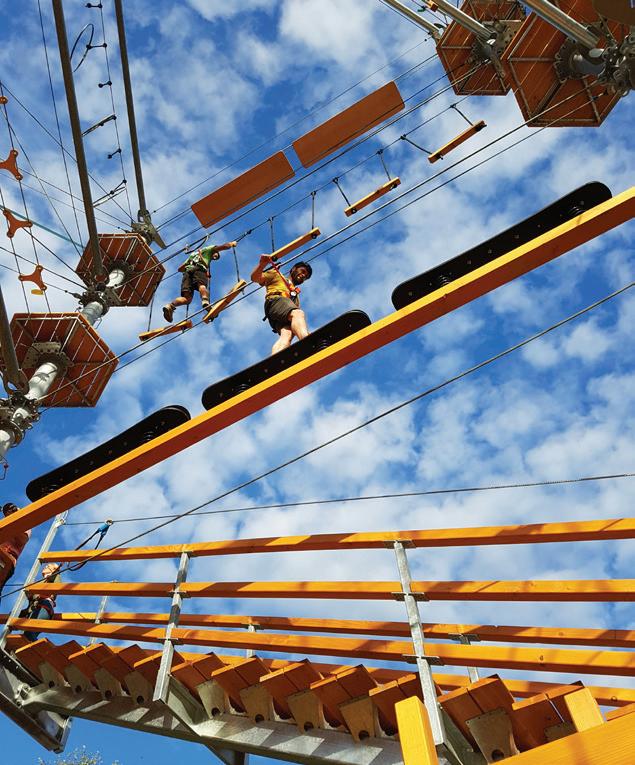
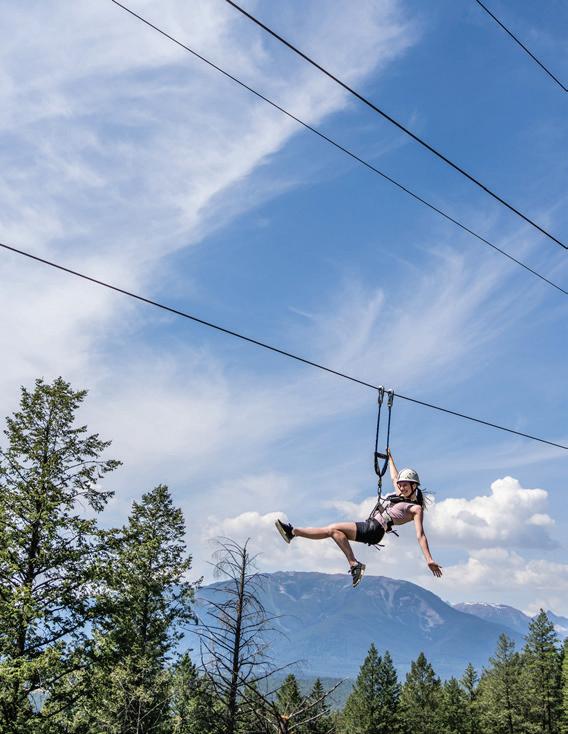
Hang ‘Em High — Panorama has spent $3.5 million on a four-story aerial adventure park and 171-vertical metre mountain coaster. Orders for new shoulder/summer-season attractions are now in fact booked years in advance due to global demand.
Pano pumps it up, an MP on the DL, ode to the volunteers
After a career spent policing the underworlds of drug trafficking, gang life, and precarious foreign governments, Kootenay Columbia MP Rob Morrison surely has a lifetime of salacious tales to share. But some will never see the light of day.
That includes his investigations into one of Parliament Hill’s biggest bombshells in decades. Allegations that China has undertaken sophisticated strategies to disrupt our elections, and Canadian democracy itself, were revealed in a Globe and Mail investigation in 2022. Since then, similar foreign interference charges have been levelled at nations including India and Russia.
Since 2019 Morrison has been one of 11 members assigned to the National Security and Intelligence Committee of Parliamentarians (NSICOP). What
can our man on The Hill say about the high-level political drama at hand? Nada.
“I signed a document that gives me top secret, and even higher level, security,” Morrison said during a June interview with Kootenay Coop Radio. “Even after I retire or resign, I still can not disclose anything I discussed or learned while on NSICOP.
I’m bound until I die.”
NSICOP is made up of four Liberals, two Conservatives including Morrison, a member of the Bloc, one NDP, and three senators.
The federal inquiry into the accusations will continue through the year.
For the second-term MP, a retired Mountie, and diplomat, the NSICOP role fits like a pistol in its holster. He served in the BC RCMP for 30 years, with assignments including undercover drug and gang investigations, before moving on to the
biggest of leagues. Amidst major military campaigns waged through the 2010s in Iraq, Syria, Afghanistan, and Pakistan, Morrison signed on with the feds for an intelligence and diplomacy portfolio based out of Islamabad.
Still on the East Kootenay political front, BC’ers go to the polls October 19. As of Trench Summer/Fall issue press time, here’s who’s thrown their trucker hats in the ring. In Kootenay East — incumbent Tom Shypitka (BC United), Pete Davis (Conservative Party of BC); in Columbia River/ Revelstoke — MLA Doug Clovechok (BC United) is packing it in, Scott McInnis (BC United) is running to replace him, Calvin Beauchesne (Greens), Jason Day (Conservative Party of BC); and to Nelson-Creston — incumbent Brittny
Anderson (BC NDP), Nicole Charlwood (Green Party of BC) and Coreen Mori (Independent).
Back when skis were too long and fake leather neckties too skinny, Steve Paccagnan, then just 20 years old, worked as a bellboy in what was a family-friendly and low-key B.C. ski hill known for moose in the middle of the run and uninhabited chalets eight months a year.
Forty years later, Paccagnan has been at the helm of Panorama’s local ownership group since 2013. Aiming to save the resort from major corporate takeover, a group of nine impassioned Pano homeowners, mostly from Calgary, stepped up and invested in their beloved hill, emotionally, and for certain, financially.
Over the past ten years, the ownership posse has
sunk $50 million into the resort all in the aim of bringing their ilk to the mountain year-round.
“People who have a connectivity with the mountains long for more to do, to keep that connection alive,” says Paccagnan. “The mountains will always be here,” he laughs, “the goal is to make sure you’re here as well.”
In what the GM/CEO promises will be multiple years of new investment, at a cost of $3.5 million, Pano has installed an Austrian-made 171-vertical metre mountain coaster, and a four-story aerial adventure park purchased in Squamish, replete with a suspended course of obstacles, zips, rope courses, and swinging bridges.
Having clocked hours at resorts in Quebec, Colorado, Japan, and nearby Kicking Horse Resort, the Vancouver-raised Paccagnan has
Photo Courtesy Panorama Resort
watched the resort business bloom well into shoulder and summer seasons to the point where off-winter development attractions have become a massive industry unto itself.
“On the summer side, the emerging product for the industry has been tremendous. There’s even a new trade magazine dedicated to summer attractions and products — they’re really innovative experiences.”
The new industry’s deliverables are now in fact booked years in advance due to global demand. Negotiations for Pano’s coaster and aerial park started five years ago.
“But,” Paccagnan warns, “you need to make sure you have the right mix.”
With myriad warmweather activties available on hill and nearby at Greywolf Golf Course and Toby Creek Adventures, the mix is mighty. On the books: a boutique 130-room hotel, the second phase of a $40 million, 52-townhome skiin/ski-out spread, and another multi-million dollar investment into the resort’s world-calibre snowmaking system.
Pano is one of the Columbia Valley’s biggest employers and draws. So for Panorama’s 200-yearround workers, and the near 1,000 who sign up for either summer or winter paycheques, the future looks fortuitous.
And for those who’ve loved the place for years — some enough to actually
Mr. Speaker... — In addition to his workload as Minister of Parliament for the 64,000 square-kilometre KootenayColumbia riding, MP Rob Morrison is also a member of the National Security and Intelligence Committee of Parliamentarians (NSICOP).
buy in as major shareholders — Paccagnan says, “You inherit the community you nurture.
While the future’s bright in one part of The Trench zone…the sky’s black in another. Not literally though. Fernie writer and rocker Shelby Knudsen’s grim thriller One Night Only (East Shore Books) takes readers on a journey alongside a character named Sky Black. She’s a down-on-her luck, hard-hustling musi-
cian close to fame, but not quite there. The eternal question the novel asks: How bad do you want it?
The tale leans on Knudsen’s years as a performer/songwriter with the East Kootenay trio Wild Honey, with fellow Cranbrook natives
Laura Cain and Jessica Niedermayer. One Night Only is Knudson’s third book, following Mountain Girl and The Devil Tree – Darren Davidson
Q AND EH
Ma’am of The Ram
Fernie long-timer and hunting sortacelebrity Tanis Barkman on veggies versus meat, dodging death, and the art of swearing like an effin’ pirate.
Some things you should know about Tanis Barkman: She rode her horse down Fernie’s main drag with two buddies a few years ago — and straight into a Starbucks drive-thru for a grande latte. Her favourite tool of the trade is a Tikka T-3 308 with a custom turret. She didn’t hunt when she met her partner. Now she does, very well. She also curses, her dad says “like she was raised by pirates and wolves.” While she’s garnered some fame in podcasts and magazines, and YouTube-liked worldwide — and has accumulated over 5,000 Instagram followers too — she prefers vast human-less backcountry adventure afforded her by her work, far off on the B.C./ Yukon border. A Fernie-er for 17 years and counting, Barkman is living a heck of a life. But just barely.
What’s your life like as a guide? You’re way out there. We’re gone from mid-July to October. Full remote for about 80 days. There’s not one lick of humans anywhere. I love it.
What are your clients like? They’ve got high expectations. And a lot of money. I was worried at first about what clients would be like. I envisioned a stereotypical rich boy, hard to please, aggressive. And
really it’s not like that at all. You bring them into an environment where they’re humbled right to their knees. You’re really their guardian. When the float plane flies away, you can see people saying, “Oh shit, that was our exit.”
One of your posts shows you with a freshly killed bighorn sheep, and there’s a caption you wrote. "Backwoods bliss expressed exponentiall. For those who see hunting as an unnecessary pastime — or worse, a blood sport — how do you explain its
How’d you end up going from vegetarian to meat-eater? I never really liked meat. I come from a place with hog farms, chicken farms. It didn’t sit well with me. We’ve stripped animals of any dignity. We artificially impregnate them, they live in crates, their babies are ripped away from them as soon as they’re born….but everyone wants ham for breakfast and chicken on their sandwich and
best. And moose heart. After about 50 days in the backcountry, if we get a moose, I love it. I guess I need the minerals.
Would you ever quit hunting? Would I be a wildlife photographer then? I don’t think I'd be as driven as a photographer as I am as a hunter. Something happens when you hunt. The intensity and the rush of being outwitted by an animal. It can be very cliffy, dangerous,
...IT’S STILL EMOTIONAL, AND I FEEL FOR THE ANIMAL. I THINK MOST HUNTERS DO. THEY WANT THE END TO TO BE PEACEFUL.
virtues? I understand the question. And I sympathize with that. I realize it’s hard for people to understand the effort and joy in hunting. It’s magnetizing. But hunting, like any culture, is very broad. There are some people who’re emotionless after a kill. Then there are other hunters, women and men, who cry. A hunt takes a lot of time, there’s a lot of suffering, a lot of emotions go into it. For me, it’s still emotional, and I feel for the animal. I think most hunters do. They want the end to be peaceful.
a steak for dinner. We’re trying to feed a few billion people.
But you enjoy wild meat now. What’s the difference? You’re killing one or two (wild animals) a year just for yourself, not slaughtering them. There’s tonnes of effort that’s gone into that. Tonnes of emotion. We butcher our own meat. It’s very special. There’s a story to every hunt and animal, and I remember a lot of the details. Now, I really enjoy the different textures and tastes. Moose, sheep, goat, caribou. Cougar meat is the
wild. It humbles you to be a part of that animal’s life.
You’re a career woman in a field full of men. What’s that like? I joke about it all the time. I’ve never been overly concerned about it. I’m a girl who grew up with two older brothers. My whole life I always thought I could do anything they did. We’re not having kids, but if I had a girl, I wouldn’t treat her like a girl. I’d treat her like a person.
One young woman who follows your feed posted this: "Is it too late to say that’s who I want to be
when I grow up?" How important is it for you to be a role model to other women? I wouldn’t say I intentionally ever focus on that. I don’t feel like I’m a role model. I’m happy and proud of the things I do, and if someone appreciates what I do and the effort I put in, I think that’s great. Hopefully they don’t hurt doing the things we do. (Laughing) You've garnered a heap of publicity from a horrible accident you survived in 2023. Where, and how, did that go down? It was the third week of November, way up high, on a premier bighorn sheep hunt. The ram had been killed. And we were waiting to take some (photos). Doran noticed a refrigerator-sized rock had broken loose from the cliff above…and it was tomahawking towards us. It shattered. Out of seven people, I’m the only one who got hit. We were insanely lucky. It sucked me down the mountain, in a chute, in a vacuum. Had I gone any farther, it would have drug me off a serious cliff. And when you came to a stop? I realized my foot was pretty creamed. It felt like a shotgun had blown it
Last Stand — Barkman on the last hunt of a two-month guiding season, during an October caribou harvest. “It was an epic hunt, a massive mission getting to the herd, and even crazier navigating our way back to camp in the dark,” she says. (Opposite page) Barkman carries a female client’s rifle during an early-August sheep hunt. Nick Marchiando Photos
off. Crazy pain load.
It was too late in the day for a helicopter and you opted to crawl out — literally. The boys taped my ankle up with a few sticks. I crawled for four or five hours over really hard, difficult ground. Snowy. Bleeding too much. When search and rescue from Sparwood and Elkford got there, everyone was clapping when I got into the ambulance. I gave them all the finger, and said "my journey starts now.’"
And the damage? Ruptured achilles tendon sheath. Anklebone broke in four, five screws in my talus, all the toes broke back. The surgeon said it was easier to tell which bones I didn’t break than the ones I did. It rocked me to my knees. I almost died. I’m very grateful about how it turned out.
How are you getting through it now? I thought I’d be back guiding this season, but it’s not happening. I’m seven-and-a half months in. The fact you didn’t die wears off. It’s a setback. It’s frustrating. But I tell myself that way worse things are happening to way better people.
Does swearing make a person a more effective communicator? I’d say not. It kind of downplays any form of intelligence. When people start swearing, they get less eloquent. But still, when I hear people saying something nice like "that’s dang tough’," I can’t help but think, "Just say it, say f***in'!"(Laughing)
You claim you’re a weird cat. Sean Penn, the actor, recently said social media and the digital realm are stripping us all, particularly younger generations, of diversity in behaviour and personality. What’s your advice for other weird cats out there? I’ve always been unconventional. I embrace that. I’m not just a hunting guide or backcountry girl. I do a lot of other things. Stay true to what’s in your heart. Don’t be afraid to let out anything you want. People can feel when you’re being genuine. I mean, why not?
– Darren Davidson
This interview has been edited for length, while ensuring original context.
Birdies and The Bugs
Highway diversion in recent years has frequently sent cross-Canada traffic south from Golden into what for most of those drivers is terra incognita. Once you pass metropolises like Nicholson and Parson, it gets quiet. Very quiet. There are vanishingly few tourist facilities and no giant photos of realtors’ heads. All it has is surpassing beauty, with exemplary wetlands and the dramatic peaks of Bugaboo Provincial Park beyond.
A textbook slice of the Rocky Mountain Trench, the stretch starting 20 kilometres north of Radium is the kind of place that finds you, not the other way around. I know this because of how the sub-hamlet of Brisco lured my wife, and eventually me. In 1971, her Texas college sweetheart drew a high draft number and started thinking about fleeing to Canada. He spotted a note on some hippie bulletin board that read simply, “Cheap Land in British Columbia.” The Briscoite answering the phone said, “I’ll be out of town, but the cabin’s open, just make
yourself comfortable and we’ll talk in the spring.” And with that cashless, trusting agreement she began a long relationship with one of the most little-known and vitally, old-timey spans of highway in southern B.C. Today Brisco proper is, well, almost exactly as it was then: a general store, a few gas pumps, a tiny chapel, and little else. True, the formerly Albertan McKergow family bought the store four years ago and has spruced it up some. But, as ever, you can still buy liquor, ammo, and a single lag bolt if that’s all you require.
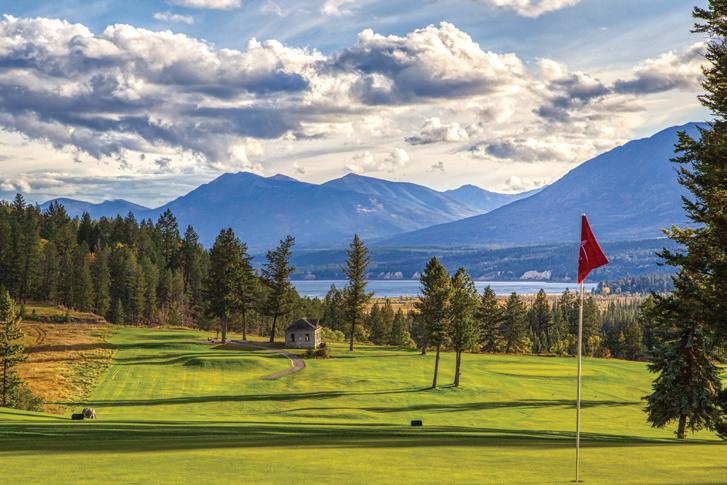
Brisco Trading Post.” Fancy. Just to the south, you’ll encounter the closest thing that the area has to a tourism megadevelopment: Spur Valley Golf Course and its related RV park. A family business now 40 years old, Brandon Csokonay is general manager. “Business is really good,” he reports happily. “Our RV park is fully booked for the season from Easter until Thanksgiving, and the waiting list for new seasonal renters is
seeking summer weather perfection, Csokonay notes that many are from Banff and Canmore.
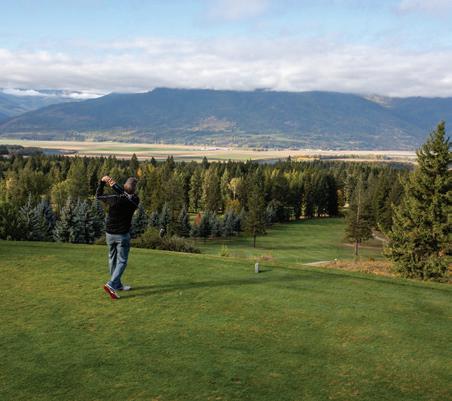
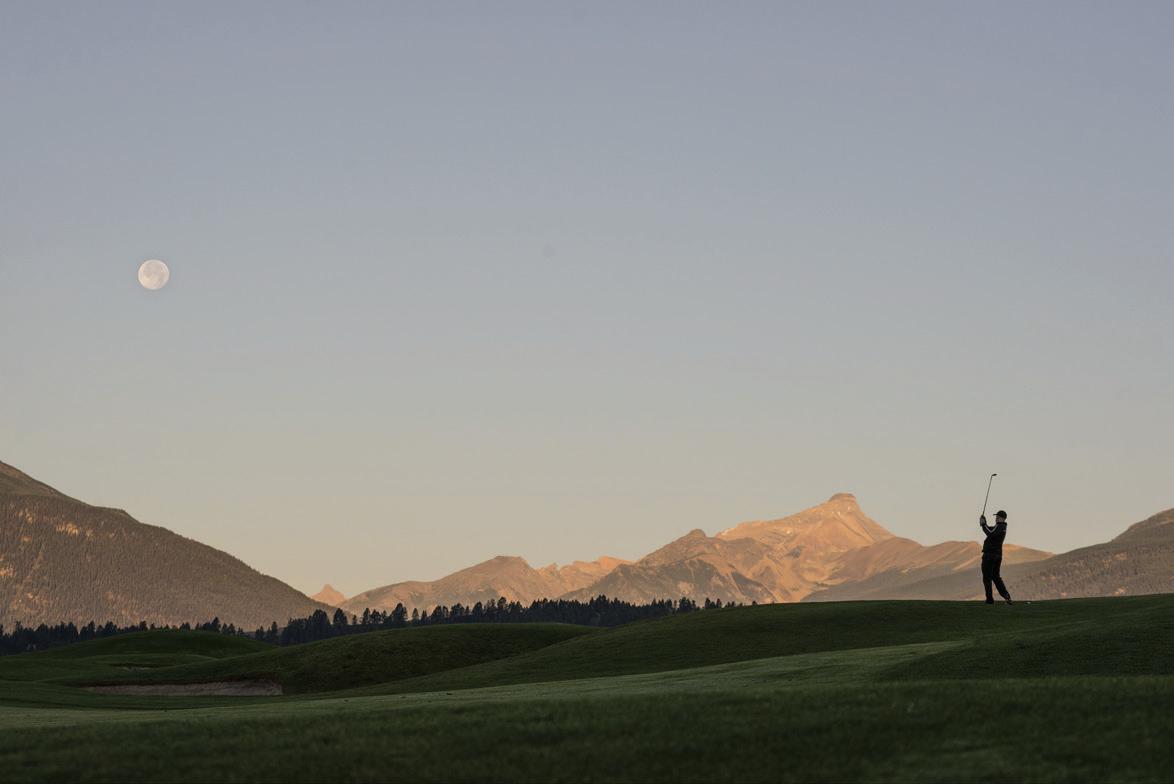
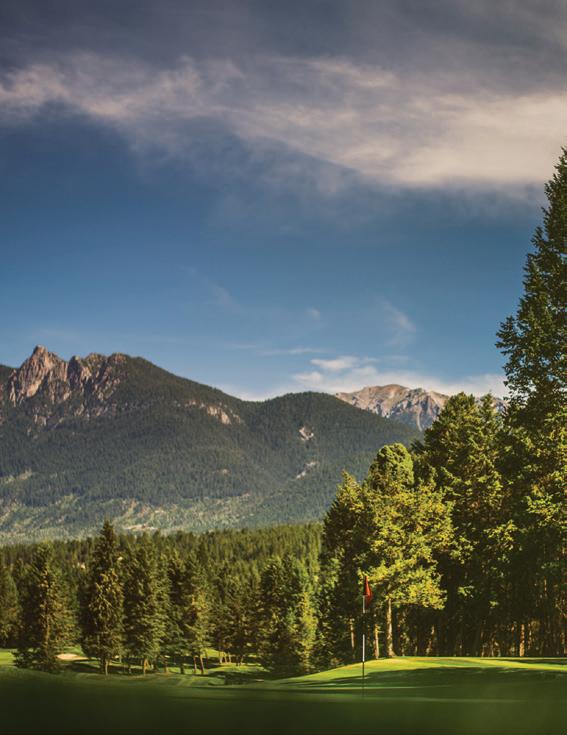
The golf course itself is a sporty, architecturally-designed nine-holer carved from mature forest, where the odd wolf and cougar have been known to wander through. Unsurprisingly, there are no plans to add another nine. “Spending just a couple hours on a golf course is the right amount for a lot of play-
AS FOR WORLD-CLASS TOURIST ATTRACTIONS IN THE REGION,
THEY ABSOLUTELY DO EXIST — BUT YOU’D NEVER GUESS IT BY MERELY PASSING THROUGH ON HIGHWAY 95.
“We’ve added homemade snacks, and we’ll probably move more into ice cream and fireworks,” says owner Corey McKergow, noting that Albertans can’t buy the latter back home. “We’ve also changed the name. We’re now the Downtown
massive.” Tucked out of sight in a steep ravine, the campsites — known affectionately as the Trailerhood — are shielded from both storms and Highway 95, not that it’s ever that busy, absent closures on the Trans-Canada. Among the Albertans
ers,” Csokonay affirms. Time management is even more relevant to another ninehole option nearby — the cute little Hilltop Par 3 — which was recently gifted with Spur Valley’s old rental clubs. It’s lovely to play and even lovelier to finish,
thanks to their locally-famous fruit pies baked fresh on premises.
Meanwhile, Spur Valley’s licensed clubhouse restaurant, The Cantina — run by a team of three Mexican chefs — is the nearest you will come to a bar on the entire 100-kilometre leg of the highway. “Unless you count the Edgewater Legion,” says Csokonay, although that’s not exactly a roadhouse.
As for world-class tourist attractions in the region, they absolutely do exist — but you’d never guess it by merely passing through. There is virtually no signage heralding the presence of the Columbia Wetlands, one of the continent’s longest and most ecologically diverse wetlands, and a birder’s paradise. Fortunately it’s accessible enough: this is a rare section of the upper Columbia River where you can easily paddle upstream in either a canoe or even on a paddleboard.
Considerably less evident,
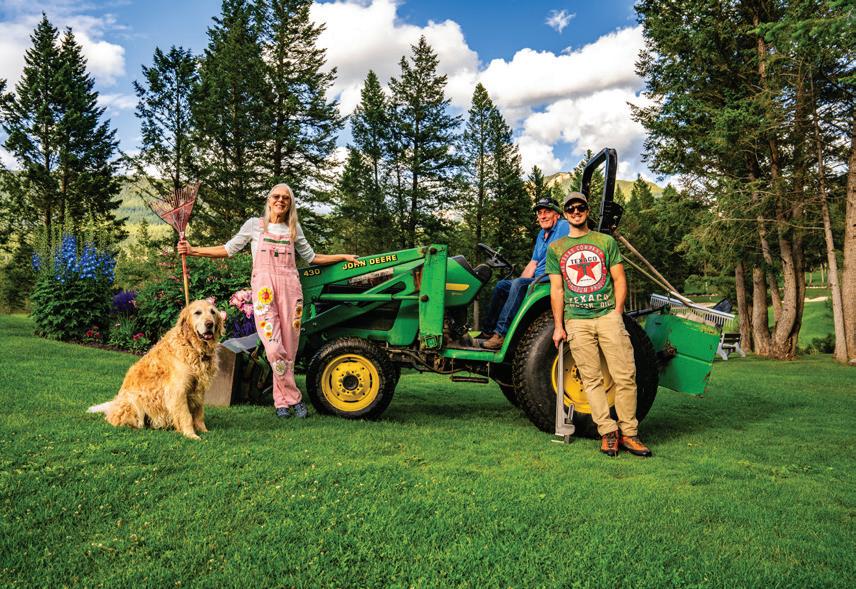
Tractors and Trailerhood — Spur Valley Golf Course and RV Park owners Audrey, Ron, and Brandon Csokonay, along with Comox the dog. The laidback nine-hole course is the closest thing the Brisco area has to a tourism megadevelopment.
Mat Loyola Photo
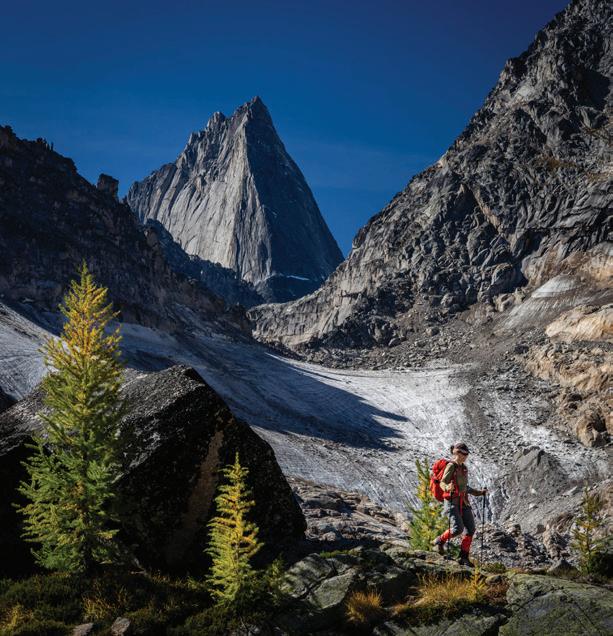
Buggin’ Out — Lena Armstrong descends beneath the northeast ridge of Bugaboo Spire, in Bugaboo Provincial Park, a bucket-lister for the world’s alpine climbers. Pat Morrow Photo
though, is the presence of a bucket list mecca for the world’s most sophisticated alpine climbers. The only clue you’ll see are adventure rigs with Utah and California plates turning off in Brisco at a sign marked “Bugaboo Provincial Park - 44 km.” The big draw is granite crack climbing to match vaunted Yosemite, but with an ultra-picturesque glacier setting unlike any other. The range was christened by Austrian-Canadian mountain guide Conrad Kain, who wrote after his 1916 first ascent of its signature spire, “We were nonplussed at the sight of a veritable bugaboo, which immediately suggested to
our minds the appropriateness of the name.”
The Bugs also happen to be the birthplace of commercial helicopter skiing, and the CMH staging helipad is still there, sitting discreetly next to the highway. Co-inventor of the sport Leo Grillmair lived to a ripe old age in Brisco, and many contemporary ski guides call the area home. But you can be darn sure about one thing: nobody goes around bragging about it.
–Kevin Brooker
Thanks givers
Four family-friendly hikes, and one big-as haul.
Many unsuspecting travelers have been led astray by Google Maps’ nefarious directions guiding them over Gray Creek Pass as a viable route between the east shore of Kootenay Lake and Kimberley. It might seem to be the obvious choice when looking at the map — but Google lies.
Daring explorers know that the pass is no small
endeavour. A keen sense of adventure, backcountry driving experience, and a properly-equipped vehicle are necessities. The 80+ kilometre scenic route consists of unpaved road offering bumps, ruts, washouts, and even overgrown trees that leave your vehicle with brand new Kootenay pinstripes. It makes a person wonder why this road was built here in the first place. In the 1950s, Cominco (now Teck) built a power line over Gray Creek Pass. Workers desired a shorter route between Riondel and Kimberley, and after much debate and construction, the Pass was completed in
the 90s. Although the powerline is now abandoned, the infamous Pass lives on. At 2,083 metres above sea level, it’s said to be one of the highest roads in Canada. And in 2017, the Pass officially became a part of the TransCanada Trail.
Open from July to October, Gray Creek Pass offers an outing over some of the most formidable forestry roads around, the opportunity to explore remote backcountry, and even some easy peak-bagging. Leave early, pack a lunch, and throw in your hiking boots because Thanksgiving Mountain is worth the short jaunt. In fact, few Kootenay peaks are ac-
cessed so easily.
Said to be nicknamed after the October holiday when many people visit for the yellowing larch populating the landscape, it’s a fairly easy, kid-friendly hike coming in at 3.5 kilometres return and 300 metres elevation gain. From Gray Creek, drive to the summit at 15 km and find pullover parking and an unmarked trailhead to the left. Look up and see Thanksgiving Mountain towering to the north. The trail begins with a gentle climb before becoming steeper. As you reach the bottom of a talus slope, there’s minor route-finding to the summit. On top, the
ridgeline offers a second, smaller summit and sweeping views over Kootenay Lake, Mt. Loki, and Sphinx Mountain (a more challenging summit, with over 11 kilometres of trail and nearly 1,000 metres gain).
Retrace your steps to the vehicle, enjoy the remaining ride, and once you hit pavement on the other side of the Pass, go for dinner in Kimberley, Cranbrook, or Creston, and head home on the highway to complete one impressive loop!
– Danette Polzin
JUMPING OFF GLIDERS’ POINT A LITTLE TOO ADVENTUROUS FOR YOU? DON'T WORRY: CRESTON'S SKIMMERHORN HAS TRAILS FOR YOUR 4X4, MOUNTAIN BIKE, HORSE, AND FEET, TOO.
More Whole-Family Adventures
Keen to get the family outdoors for more? Check out these exciting locales that are generally accessible for all ages.
Thompson Rim
Access: Mount Thompson FSR
Round Trip: 7+ km
Elevation Gain: 300 metres (cumulative)
Difficulty: Easy to Moderate
A challenging drive up steep switchbacks with a relatively easy hike along the impressive ridgeline of the Skimmerhorn Mountain that towers over Creston.
Lakit Lookout
Access: Wild Horse River FSR
Round Trip: 5 km
Elevation Gain: 480 metres
Difficulty: Moderate
Work well-worth the reward with some of the best views overlooking the trench. Note that the last 7.5 km of the access road (a left turn off Wild Horse) are steep, narrow, and not for the faint of heart.
Spineback
Access: via Island Lake Lodge
Round Trip: 7+ km
Elevation Gain: 530 metres
Difficulty: Moderate to Difficult
Begin in dense forest, and climb your way up through subalpine meadows and boulder fields populated by marmots, pikas, wildflowers, and fossils. At the top, marvel at majestic Rocky Mountain views, and even add the Goldilocks Loop.
Jumbo Pass
Access: Toby/Jumbo Creek FSR (from Invermere)
Round Trip: 10+ km
Elevation Gain: 670+ metres
Difficulty: Moderate to Difficult
Behold a reverent ecosystem filled with larch trees and jaw-dropping skylines contrasted by rugged peaks, glaciers, and icefields. Climb the extra 150 metres from the hut for an even better vantage point of the glaciated peaks, including Mount Macbeth and Lady Macbeth.
Know Before You Go: be prepared for no cell phone service, and for all elements and types of emergencies. Make sure your vehicle is equipped for forestry roads; have a radio in case of active logging; and check road, trail, weather, and wildfire conditions beforehand. Pack extra food and water (most of these trails do not have a water source), and respect all road and trail use guidelines.
Ever wondered if the drive over the Purcell’s Gray Creek Pass was quick, flat, and devoid of dust, rocks, and shoulder-season snowfall? Nope. Travis Adams Photo
Ever looked up at Creston’s flat-top Skimmerhorn Mountain and wondered if there was a cool hiking trail up there? Yup. Mitch Winton Photo
Portal Call
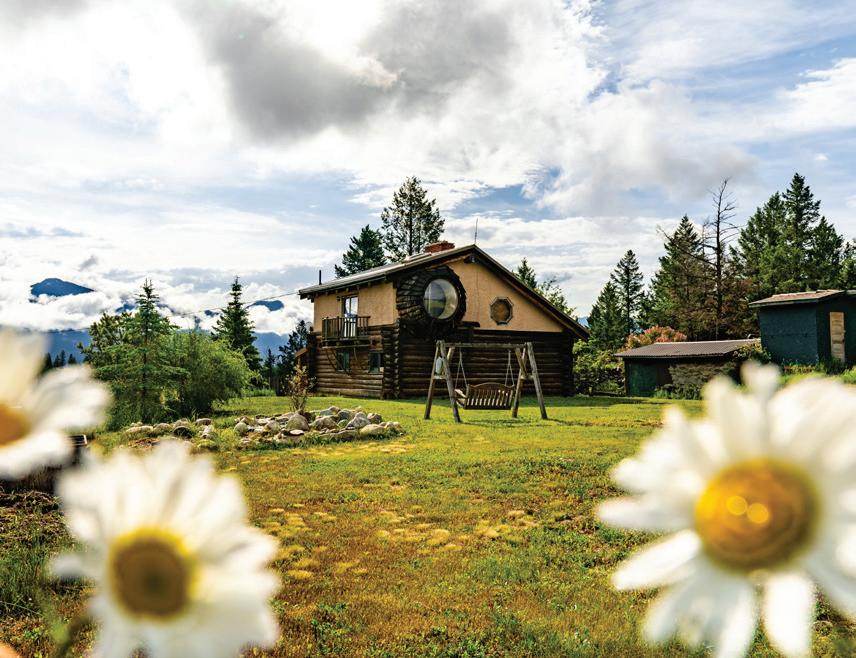
You may have never seen this eclectic log home on the road to Panorama Mountain Resort — but it’s probably seen you. And now, the iconic Columbia Valley house is looking toward a new chapter.
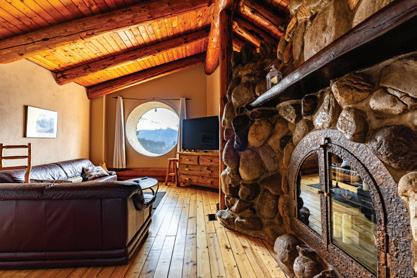
Built in the 1980s by a man named Barry Parker, the ‘Bug-Eye House,’ as it’s widely known, is located on two-and-a-half acres and is within walking distance from Lake Lillian near Invermere. Among the home’s many remarkable features, two round windows bulging from shingled sockets are perhaps the most unusual.
“Whatever Mr. Parker’s intention was with the windows he called ‘God’s eyes,’” says Stephanie O’Connor, the home’s current owner, "the view from them never fails to disappoint.”
Eye Eye — Whatever the original builder’s intention was with the windows he called ‘God’s eyes’, the current Bug Eye House owner says, “The view from them never fails to disappoint.” Mat Loyola Photos
For a half-century Invermere’s Bug Eye House has overseen the gateway to one of the Purcell’s most beloved high country valleys. And now, this homage to homestead and hippie architecture could be all yours.
House has been home to O’Connor for 12 years. While she’s excited to be starting her next chapter on Salt Spring Island, she’ll
“WE LOVE THE LAND, THE EPIC VIEWS, THE WARMTH OF THE HOUSE. AND WE ALWAYS LOVED WOWING PEOPLE WHEN THEY WALKED IN.”
house, currently listed for sale at just under $700,000.
Rented out as a vacation property for the past yearand-a-half, the Bug-Eye
Indeed, even a human-sized eye can appreciate the spectacular vista of the Toby Benchlands and the Rocky Mountains from the second-floor window. Those views are but one selling point of this two-bedroom, 1,500-square-foot
be a little heartbroken to bid the house adieu.
Purchased from the estate of her beloved friend Jane, the house seems to have
chosen O’Connor rather than the other way around.
“My kids had graduated high school, and my husband and I had bought a motorhome,” she explains. At about the time they were set to hit the road, O’Connor noticed a ‘sold’ sticker on her late friend’s home, which she described as “looking empty and sad” as it sat on the market for more than a year. A week later, O’Connor learned that the sale had fallen through. Coincidentally, both her boss and a friend had recently suggested she try to buy it.
The opportunity unearthed an old desire in O’Connor to live, she says, “in a more self-supported way on a rural property.” She and her husband bought the house, painted it, and updated a few things, including the floors, kitchen, and bathroom. They then moved into their new home where they even-
tually raised chickens and goats. “We loved it, all of it,” she says. “We love the land, the epic views, the warmth of the house. And we always loved wowing people when they walked in.” Certainly, the home’s eccentricities — a brick staircase and extensive stonework; kitchen archways and a wood-burning range; the eclectic collection of outbuildings — will appeal to potential buyers with an earthy aesthetic and creative flair. “It’s a house for someone special,” says O’Connor. Someone who, like her, might be dazzled by the sight of a full moon centered in the bug’s eye. “That happened one night,” she says, marvelling at the memory of it. “And it felt like there was an eye looking right at me.”
– Jacquie Moore
AI in the EK
Artificial Intelligence. Oxymoron or Overlord? Kootenay business instructor and political communications veteran Stephen Harris provides some insight into how the East Kootenay will win, lose, or draw now that AI has arrived.
Unless you’ve been ignoring the myriad of conversations online, in the news, and in the coffee shop, you know that artificial intelligence is quickly on the rise. Conflicting predictions about its future abound: is it the end of kids’ homework? A helpful timesaver for knowledge workers? The beginning of mass unemployment? Nothing but a cool, new tech to enjoy? For better or worse, one thing is certain: the rapidly-advancing technology is
bound to have an impact on individuals, businesses, and local economies across the East Kootenay.
The Digital Horse Has Left the Barn
Debates about whether AI should even exist are too little, too late. In just the past year, the amount invested in the technology it requires has exploded.
Microsoft alone is in partnership with OpenAI — the developer of market-leader ChatGPT — to the tune of
use. ChatGPT 4 has already passed — and outperforms about 90% of humans in — the Bar Exam, the U.S. Medical Licensing Exam, the Graduate Record Exam, and even the Advanced Sommelier Exam. It can ‘see’ and understand imagery, video, and more. You can take a picture of the
sionals won’t be replaced by AI — but those who use the technology might replace those who don’t.
Powered from home
Darren Brewer is the Economic Development Officer for the City of Cranbrook and he sees firsthand how artificial intelligence is re-
FOR BETTER OR WORSE, ONE THING IS CERTAIN: THE RAPIDLY-ADVANCING TECHNOLOGY IS
CERTAIN
TO HAVE AN IMPACT ON INDIVIDUALS, BUSINESSES, AND LOCAL ECONOMIES ACROSS THE EAST KOOTENAY.
inside of your fridge with your phone, and ChatGPT can analyze the photo and tell you what to make for dinner based on the ingredients it sees. Opportunity abounds.
shaping the economy in the region. “It’s bringing hightech, high-paying jobs that are complementary to our economy,” he says.
$110 billion. The race to build even better AI models is only superseded by the race of organizations adopting the tech. The ‘dotcom’ explosion in the late 90s may have been big — but this is exponentially bigger. So what does that mean for local businesses? It means that it’s time to adapt.
However smart you think AI is, it’s smarter than that Like most technology, the version you’re using today is the worst one you’ll ever
Afraid of losing your job? You might just get better at it instead. Marketing, accounting, law, computer programming, office administration, and dozens of other industries are being radically reformed by AI. Everyone wants to know: will jobs in those fields disappear? While some repetitive, lowskill tasks may be taken on by the new tech, the reality is that workers in these industries will simply become more efficient. AI can free up their time to do more important tasks that AI can’t do, like mentoring, developing relationships, and expanding markets. A joint research study from Harvard, MIT, and Wharton found that consultants using ChatGPT completed 12% more tasks 25% faster and with 40% higher quality. Ultimately, these profes-
For example, thanks to the data-processing power of AI, Brewer explains, the forestry industry can do things like measure slash piles or monitor forest health and wildfire threats more quickly, easily, and accurately than any human. “They’re using remote sensors, LiDAR, drones, and more to gather vast amounts of data and then they let AI crunch those numbers into meaningful information,” Brewer says.
As for that number crunching, data analysis is one of the most impressive capabilities of AI. This formidable task is powered by computer server farms and data centers — powerful collections of computers located in the same place — and Brewer is optimistic about the Cranbrook area’s opportunities to host these essential engines of AI.
“We’ve got huge amounts of renewable energy; flat, sunny land; an internation-
al airport; and strong partnerships with First Nations. This makes us a perfect and desirable location for data centres,” he says. “We want clusters of tech around these data centres: big pharma, aerospace, R&D. The investment is already happening.”
Meet your new personal assistant As for existing East Kootenay jobs outside the tech industry, how might AI streamline workloads? The strength and relevancy of the technology’s output is only as strong as the prompt it’s given — so let’s look at two examples of what local workers can ask of AI.
Say you’re a manager of an outdoor clothing and equip-
into our store.”
Or perhaps you own a plumbing company and from your start as a sole proprietor, you’ve grown into a corporation with 25 employees, and now it’s time to implement HR policies and procedures. Lawyers who do this kind of work charge hundreds of dollars per hour. ChatGPT Plus is $20 USD per month.
Prompt: “Act as an expert in British Columbia and Canadian labour and employment law, with knowledge of the B.C. Employment Standards Act. Create a human resources policy and procedure document covering all common HR issues typically encountered in a plumbing service company
WHILE SOME REPETITIVE, LOW-SKILL TASKS MAY BE TAKEN ON BY THE NEW TECH, THE REALIT Y IS THAT WORKERS IN MANY INDUSTRIES WILL SIMPLY BECOME MORE EFFICIENT.
ment retailer and you’re responsible for keeping the store’s Facebook page populated with engaging content. You know it’s important, but it gets left undone for weeks at a time. AI can create both the social media strategy and the content itself.
Prompt: “Act as an expert in social media marketing with knowledge of the outdoor clothing and equipment retail industry in the East Kootenay. Create a series of five Facebook posts about different styles of hiking boots for different types of hikes, focusing on the brands Asolo and Scarpa. Make the tone fun, friendly, and knowledgeable. Include a call-to-action in each that brings people
with 25 employees.”
Ultimately, artificial intelligence is here to stay. If your business is like most — operating with tight timelines, small margins, employee shortages, and unrelenting competition — then its advancement just might be your leading edge.
– Stephen Harris
Stephen Harris runs a Kootenay-based AI consulting firm, helping organizations and businesses integrate AI into their daily operations. Visit www. ai-launchpad.ca.
Photo: Kari Medig/Kootenay Rockies Tourism, Eagle Ranch Resort
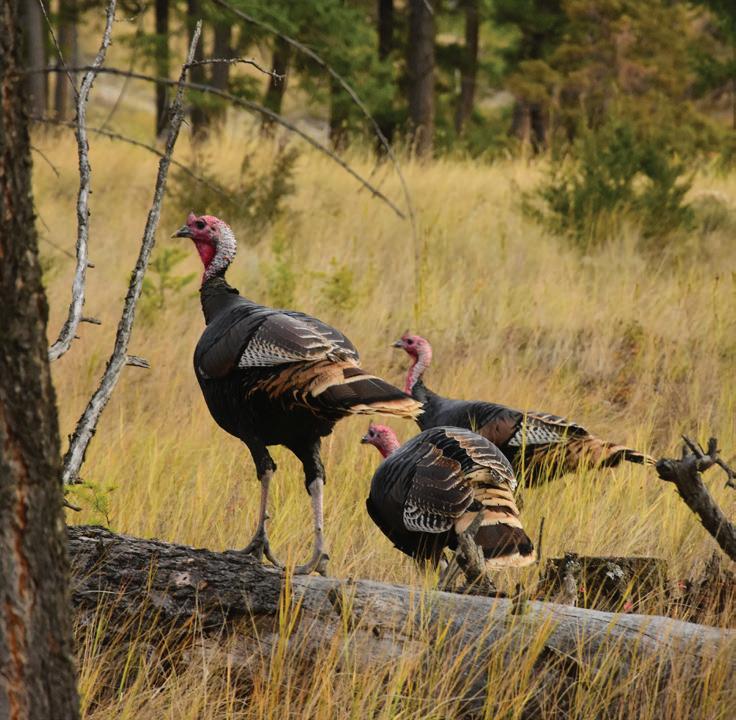
Meleagris gallopavo. Miscreants. Ne’er-do-wells. — Kimberley, Radium, Invermere, and Edgewater have all chipped in to ship ‘em out.
Jesse Heinrichs Photo
ODDITY
GobbleshegonE
With everyone’s favourite fall feast swaggering, East Kootenay’s wild turkey gangs are Alberta bound.
The collective noun for a group of turkeys, or at least the most widely accepted one, is a rafter. There are others too, such as a gobble or a raffle — but the town turkeys of Kimberley are more often aptly referred to as a gang or posse.
Although the latter two both express the right sentiment, it is perhaps the collective noun for another ground dweller, the emu, which is the most appropriate descriptor of all: a mob. Residents of Kimberley’s Chapman Camp and Lower Blarchmont neighbourhoods — where groups of several dozen turkeys are often seen wandering confidently — will understand.
Don’t be surprised this year, however, if the town feels a little less…fowl.
The number of turkeys in Kimberley grew to the point that, in 2022, the city collaborated with the Alberta Conservation Association (ACA) on a multi-year plan to trap
and translocate a portion of the local population to Southern Alberta.
Kimberley isn’t the only town in the Columbia Valley to participate in this translocation process: Radium, Invermere, and Edgewater have also chipped in their fair share of feathery friends.
is pre-baited for a period of time beforehand to allow the birds to acclimatize to it and recognize it as a food source.
The turkeys are then trapped in cohorts of ten or twenty, and then separated into individual boxes before being transported to their new homes. They are typi-
ten hang out where cattle are fed, scavenging on spent grain and other byproducts of the feed.
“You move them, but then they need to reproduce,” says Manzer, “so we’re trying to get to the point where we’re getting natural recruitment out of the birds.”
THE NUMBER OF TURKEYS IN KIMBERLEY GREW TO THE POINT THAT, IN 2022, THE CITY COLLABORATED WITH THE ALBERTA CONSERVATION ASSOCIATION ON A MULTI-YEAR PLAN TO TRAP AND TRANSLOCATE A PORTION OF THE LOCAL POPULATION TO SOUTHERN ALBERTA.
“The primary purpose is to establish a sustainable wild turkey population in Southwestern Alberta,” says Doug Manzer, the senior scientist and wildlife program manager with the ACA.
The type of trap used is called a Walk-in Box Trap, and it functions using a oneway door. The box trap is five feet tall, six feet long, and eight feet wide. The trap
cally released at a ranching operation that has agreed to host the birds in an effort to give them the best survival odds possible.
“Wild turkeys on the Alberta side, and honestly in a lot of places, are quite reliant over the winter months on some sort of food resource which is partly related to humans,” says Manzer. He explains that the turkeys of-
In total, the ACA has managed to trap 183 turkeys from Southeastern B.C. for the translocation effort.
The ACA has evidence of last year’s transplants nesting successfully, and with the previous winter being as mild as it was, they are feeling hopeful for another good nesting season.
Manzer couldn’t say with any degree of reliance specif-
ically why the turkeys have struggled in Southwestern Alberta, but he speculates that harsher winters are a contributing factor.
“Turkeys are susceptible to harsh winter conditions,” he explains. “A prolonged cold snap can really wreak havoc on a population.” The goal for the ACA is to get the region’s population to a level where it is sustainable even through a harsh winter.
“We want enough birds to survive that they can jumpstart the population again on their own,” he says.
With any luck, the hens of the Columbia Valley are hardy enough to do just that. Here’s to their poults — the poultry pioneers of the eastern slopes.
–Jesse Heinrichs
LEGACY PROJECTS
* Radium big horn sheep overpass
* Kicking Horse Canyon highway upgrades
* Three Valley Gap fencing
* Angel Flight East Kootenay $300,000 funding
* Emergency Services
SOC
* Avalanche Canada
$15 million funding
* Cherry Creek Falls Regional Park
As I reflect on these years of service, I can say that my heart is full. I am humbled. I truly am humbled to have been given this privilege. Being elected and serving as your representative is a team sport. There are so many people that I want to thank. By recognizing one however, there is the risk of missing many who have had such a profound impact on my life these past 12 plus years since I embarked on this journey. First and foremost, I want to thank my constituents. I made three promises in 2013: I’ll never lie to you, I’ll work my ass off for you, and the rest we’ll figure out together. And that’s exactly what we’ve done.
While in Victoria, I’ve been the Whip, Parliamentary Secretary to Premier Clark, Shadow Minister for Tourism, Arts, and Culture, Shadow Minister for Indigenous Relations and Reconciliation with Michael Lee, and Shadow Minister for the Columbia River Treaty, Columbia Basin Trust, and Columbia Power Corp. Additionally, Deputy Chair,
Saying farewell is so often bittersweet
Columbia River-Revelstoke MLA honoured, privileged, and grateful to have served his constituents.
member of the Select Standing Committee on Finance and Government Services, and Deputy Chair for the Special Committee to Appoint a Chief Electoral Officer. I’ve held some great portfolios and I’m so profoundly grateful for those experiences and the people that I worked beside.
I am excited for this next stage of my life’s journey and look forward to it. Since 2017, we have faced our fair share of issues and challenges: COVID, wildfires, wildlife protection, health care, affordability, safety, mental health and addiction, and the list goes on. It is a part of this job.
I remain concerned about the state of our province, our country, and the conflict and issues that are impacting even the smallest of our communities in Columbia River-Revelstoke. We are more diverse than ever and must work harder to find common values to unite us and create the type of communities and society that we want for future generations in Columbia River-Revel-
THE COLUMBIA RIVER-REVELSTOKE CONSTITUENCY IS THE SIZE OF SWITZERLAND.
stoke and British Columbia.
This has been something I have striven to do my entire career, and especially during my tenure as your MLA.
I look forward to continuing to serve until the October election and I will be working hard for our BC United Candidate, Kimberley educator Scott McInnis. He is an absolutely amazing
individual and is highly respected by his colleagues, students, and community alike. I hope you will join me in supporting Scott to be our next MLA. I am confident that he will serve you with dedication and heart.
– MLA Doug Clovechok
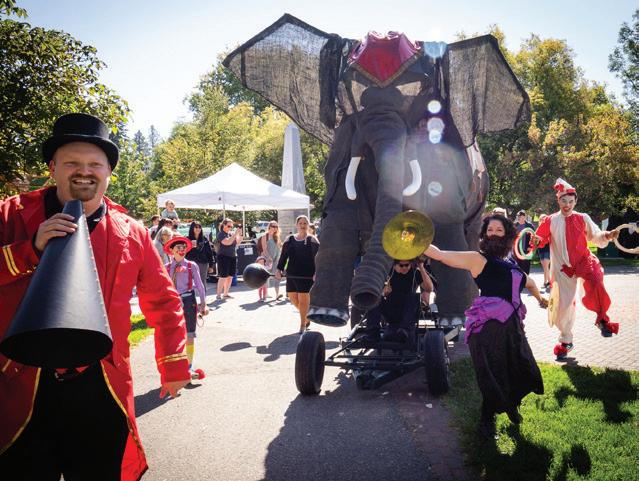
Clowning Around — Bohemian Misfits Productions, a Cranbrook-based group of street performance artists, bring their shenanigans and showmanship to this splendid September weekend. Brian Clarkson Photos
Party in the Park
Cranbrook’s Ed Fest is a celebration of local arts, music, and community — and a wayward circus creature.
In the late summer of 1926, a solitary and befuddled elephant wandered the hills of Cranbrook for nearly three weeks. Almost a century later, his legacy is still alive in the city — and, unexpectedly, it happens to help fuel a vibrant local arts scene.
Charlie Ed — later nicknamed Cranbrook Ed, or simply Ed — was one of three circus elephants to escape a travelling circus visiting the city. He was the only one of them to survive the adventure and evade his capture for weeks, and his escapade saw him crowned a local mascot before he boarded a train to catch up to the rest of the circus.
To pay homage to this iconic Cranbrook story, Marcel DuRoig — the local artist, performer, and puppeteer behind Bohemian Misfits Productions — created a life-sized, human-powered replica of Ed. It's a massive elephant puppet that can walk the streets of Cranbrook. In 2023, the stunning work was a central piece of art in the inaugural Ed Fest: a celebration of arts and music in Cranbrook.
“We wanted to create an event that’s about appreciating local artists and art as a whole,” says Bradley McCue, Events Associate at Key City
Theatre. The Theatre is a main organizer behind the event, and has partnered with Cranbrook Arts, Fisher Peak Performing Arts Society, the Cranbrook History Center, and the Junior Chamber International to bring the festival to life. The inaugural, day-long event in 2023 was such a success — with over 2,000 attendees — that the organizers decided
at noon and runs until 10 p.m. Saturday’s festivities coincide with the Cranbrook Farmers' Market, located adjacent to the park and, “We’ll have food trucks on-site all day and evening with lots of great options,” McCue says. “There will also be a beer garden with plenty of craft beers from local breweries.”
DuRoig — the artist be-
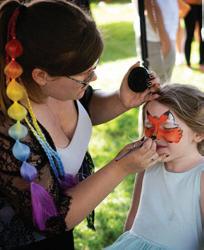
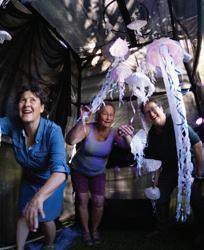
of other art installations throughout Rotary Park for visitors to discover and interact with too, including murals, light displays, sculptures, and more. “Last year we had beautiful poems, accompanied by illustrations, installed throughout the park for people to find,” McCue says. “And this year, Cranbrook Arts will have people create lanterns to
IT’S AN OPPORTUNITY TO DANCE THE EVENING AWAY TO LIVE MUSIC, EXPERIENCE INSPIRING ART AND CREATE SOME OF YOUR OWN, EAT FANTASTIC LOCAL FARE, AND EVEN LEARN MORE ABOUT ED THE ELEPHANT WHO STARTED IT ALL.
to expand it to a two-day format in September 2024.
The festival, happening at Rotary Park in downtown Cranbrook, kicks off on Friday, September 6th at 4 p.m. and runs until 10 p.m. The fun begins again on Saturday, September 7th
hind the Ed replica, which will be on-site again this year — will be contributing yet another enormous puppet to this year’s festival. “It’s quite different from the elephant,” McCue hints, “and it’s truly incredible.”
There will be plenty
light up and display.”
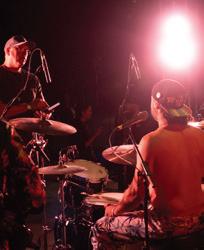
But Ed Fest isn’t only about visual art: music is an important focus for Ed Fest. Staggered performances across two different stages will feature an impressive lineup of artists. “There will be a community stage
where we’ll have artists from right here in the East Kootenay to show off some homegrown talent,” McCue explains, “as well as some bigger acts on the main stage.” Scheduled musical artists include Five Alarm Funk, Souls in Rhythm, Tonye Aganaba, Derina Harvey, and many others. Between opportunities to dance the evening away to live music, experience inspiring art and create some of your own, eat fantastic local fare, and even learn more about Ed, the elephant who started it all, thanks to a presentation from the Cranbrook History Center, Ed Fest is going to be a potently creative and wildly fun weekend for the family right in the heart of downtown Cranbrook.
“Ultimately, the goal of the festival isn’t only to show appreciation to local artists,” McCue says, “but to inspire others to engage with art in a meaningful way.”
Ed Fest happens on Friday, September 6 from 4 p.m. until 10 p.m., and Saturday, September 7 from noon until 10 p.m. at Rotary Park in Cranbrook.
– Britt Bates
CULTURE
The legends of Canada’s summer mosquitoes are told from coast to coast. From the East Kootenay, to the shores of Lake Winnipeg, to the northern bush in Labrador, everyone has their mosquito tales: bugs the size of birds, swarms thick enough to lose sight of children. Mosquitoes are one of the quintessential Canadian experiences.
Yet mosquitoes are actually a creature reviled globally. They’re found on every land mass except Antarctica and a few islands, such as Iceland. (Iceland is a country with its own dating app to warn prospective couples if they are related; surely a country one could easily marry into, if they wish to escape the dreaded skeeters for life.)
Not only are mosquitoes almost everywhere, but they have been so basically since the beginning of time. Fossil
what’s now called Canada for around 79 million years, and the oldest known mosquito fossil — two males entombed in amber, found in present-day Lebanon — is 130 million years old. In modern popular fiction, you may recall, the presence of mosquitoes on earth at the time of dinosaurs gave rise to the most insane theme park ever.
seems insurmountable, break it down into manageable chunks.” In many of these myths, a man-eating giant or demon torments a community, and when the villagers try to fight it, the villain refuses to remain dead. This enemy is finally cast into a fire, but the ashes of the body rise and become a swarm of mosquitoes. Now instead of dealing with a
BUGS THE SIZE OF BIRDS, SWARMS THICK ENOUGH TO LOSE SIGHT OF CHILDREN. MOSQUITOES ARE ONE OF THE QUINTESSENTIAL CANADIAN EXPERIENCES.
Mosquitoes have had plenty of representation in myth, art, and literature throughout time. Many ancient origin myths about mosquitoes — from Siberia to Central Asia to North America — can be likened to the advice, “When a task
* Only females bite. They can smell you from 50 meters away, fly four kilometres from their birthplace, drink their bodyweight in blood every meal, and live for 10 days max.
lethal giant bent on consuming humans in one bite, we must simply face the theft of our blood, five milligrams at a time.
When your BBQ is ruined by swarms of these beasts this summer, remember that you’re not suffering
YOU FUNNY
Itchy & Scratchy
The source of near madness in man, woman, and beast for 130 million years and counting, mosquitoes, East Kootenay and otherwise, are tough little pricks.
alone. The sheer volume of mosquitoes we encounter in the Canadian wilderness even inspired (nay, tortured) some of the earliest Europeans who wrote about Canada. The detail-oriented David Thompson, known around these parts for exploring the Columbia River, first arrived in Canada in 1784 and wrote of the mosquitoes he encountered near James Bay. He noted everything from the appearance of the bite to the effect it had on humans and animals (which was obviously suffering).
“Summer such as it is, comes at once, and with it myriads of tormenting Musketoes; the air is thick with them, there is no cessation day nor night of suffering from them,” Thompson wrote. “Smoke is no relief, they can stand more smoke than we can. All animals suffer from them, almost to madness. A chance gale of wind was a great relief;
and we were thankful for the cold weather that put an end to our sufferings.”
The suffering caused by mosquitoes also inspired the 1912 film How a Mosquito Operates by Winsor McCay, one of the earliest works of animation. Described by critics as “far ahead of its time” and “a mastery of the medium,” the story outlines the torment of a sleeping man by a giant mosquito. The film was a hit with audiences, who were described by The Detroit Times as “laughing until they cried.”
Some of the best art created has been as a result of the artist struggling with misery, so hopefully this summer the ceaseless attacks of the skeeters can inspire you. Perhaps a stained glass mosquito or a little ditty played on guitar are in order.
– Sarah Stupar
* Mosquitoes like some folks more than others based on their smell and hormone-mix, and prefer those in dark clothes — so dress in light colours and don’t wear perfume or cologne.
* Number of skeeter species: 3,000 (we get Aedes vexansfloodwater mosquitoes, which hatch in areas prone to late spring/ early summer flooding).
* RDEK skeeter control hotbeds: Skookumchuck, Ta Ta Creek, Wasa.
Super Powered: A Census of Sunshine
The sun. From 150 million kilometres away, it powers the East Kootenay’s regional economic engines, local history immemorial, even your own heartbeat and mindset. Six Trench writers squint skyward at the meaning of it all.
a, Helios, Surya, Sol Invictus, and Inti. All part of the global sun god dream team: supernatural beings that embody our fascination with that big glowing disc in the sky. Here in the Kootenays, twin lynx brothers were elevated to become Natanik, the Sun and k¢iǂmitiǂnukqa, the Moon. The near-universal presence of solar deities across the human cultural experience is tribute to the undeniable human fascination with our sun and its utter influence over everything. From our diurnal reality of day and night to the miracle that is photosynthesis, aurora borealis to ocean tides, the sun’s gifts are what brought life to the third rock from our sun. From a galactic perspective, we are in the ‘Goldilocks zone,’ neither too near nor too far, but just the right distance from the unfathomable nuclear reaction that is our sun.
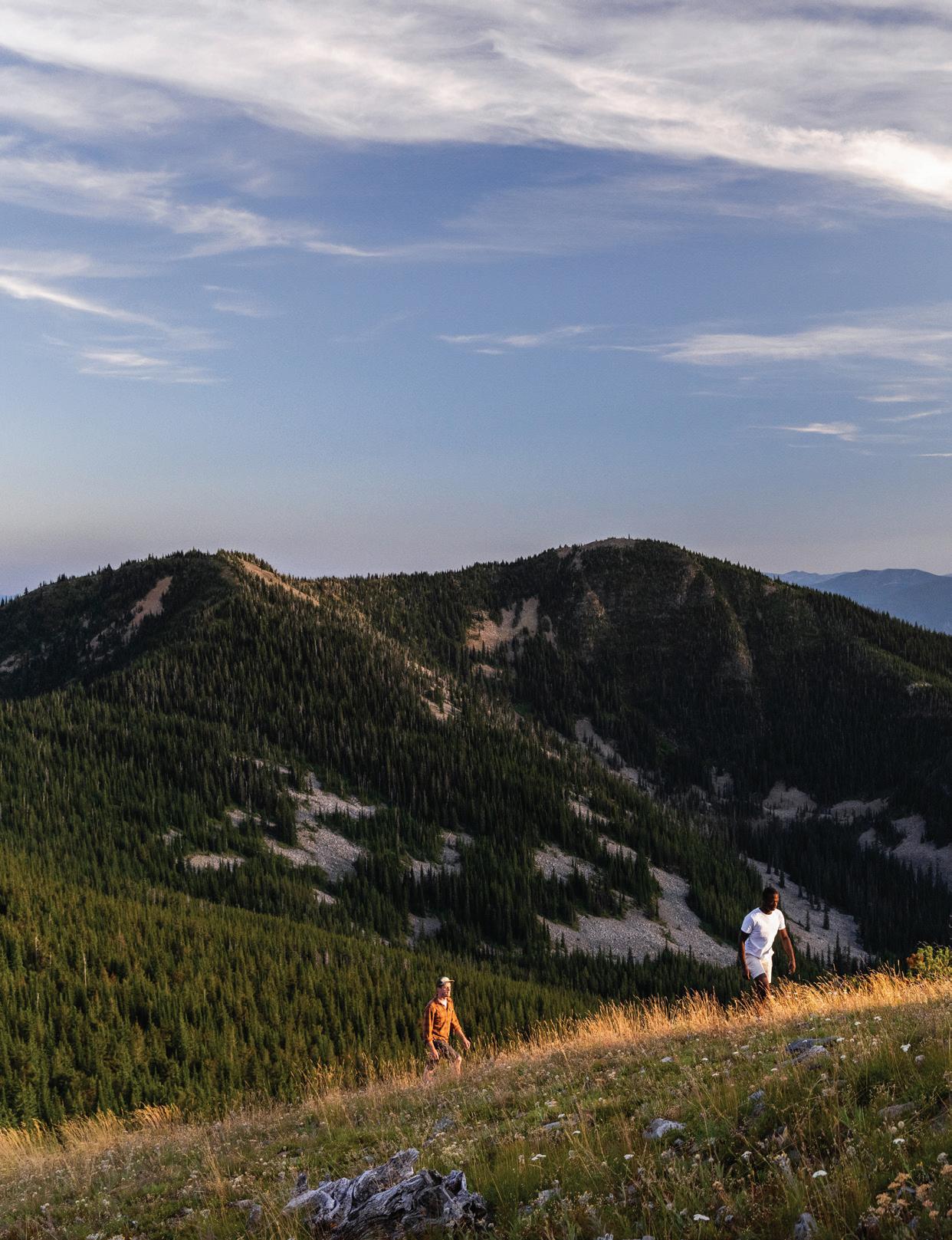
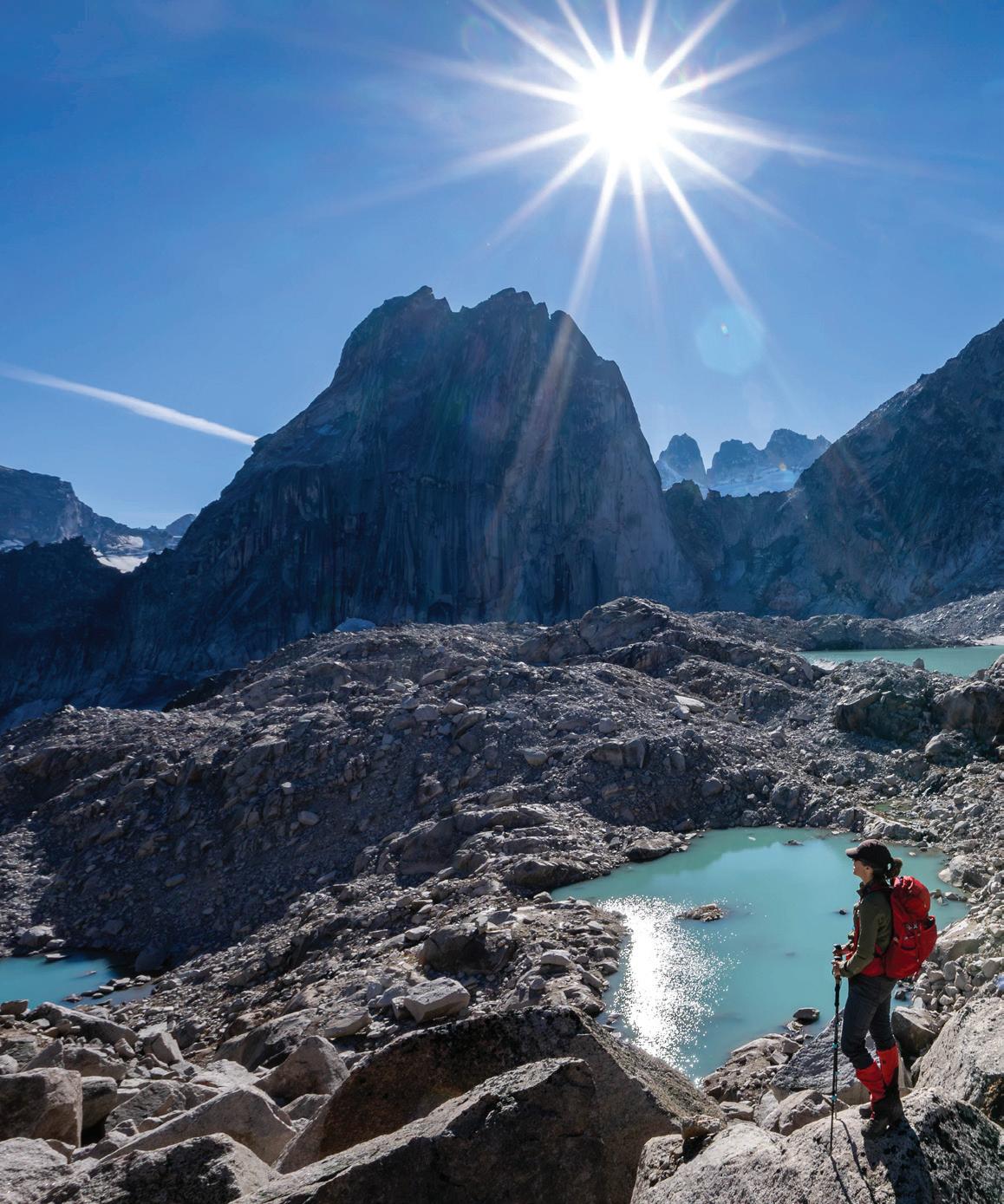
blaze one up — A dazzling sun casts hiker Lena Armstrong, and the towering Howser, Snowpatch, and Bugaboo Spires behind, in dreamy summertime beauty in Bugaboo Provincial Park. The bright minds of sun scientists have illuminated the fact that exposure to sunlight increases the brain’s release of serotonin, a neurotransmitter associated with an increased sense of calm and focus, and elevated moods. — Pat Morrow Photo
~ 1 ~ Hot Hot Spot
When the City of Kimberley set up data loggers in 2008 to measure sunlight hours in preparation for a potential solar array on Fertilizer Hill, science told them what local Ktunaxa people have known forever: the East Kootenay gets a whole lot of natanik, Sun. In fact, Kimberley sees the sun for more than 2,150 hours per year, with nearly 320 days of sunny weather. The sunniest spot in Canada is the Hamlet of Manyberries, Alberta, with over 2,500 sunlit hours, and 350 days with sun.
Juicy Details
The East Kootenay's improbable first apple tree would not be swallowed by distance, probability, nor time.
w: Sarah Stupar
LOCATED on a sunny expanse of land on Aqam — the Ktunaxa community in the Rocky Mountain Trench alongside the St. Mary River — a native plant nursery is working to protect the plants and stories of the Ktunaxa Traditional Territory, and planting seeds for their protection in the future.
The nursery is operated by Nupqu, a Ktunaxa-owned land and resource management company. Nupqu tends to the plants most-often indigenous to ʔamakʔis Ktunaxa, the traditional territory of the Ktunaxa peoples, which includes much of the East Kootenay.
But some of the Nupqu’s efforts focus on plants that came from far away, adding a hidden fold to the region’s historic horticultural fabric. This includes the Newtown Pippin apple.
According to an archived 1872 issue of The Prospector newspaper, the man responsible for bringing
the nowadays ubiquitous apple to this part of the province hailed from Wales, and he would go on to become a legendary East Kootenay pioneer.
“David Griffith brought in this week a sample of apples grown on his place at Wild Horse,” The Prospector editor wrote. “It is a large and handsome specimen of the green Pippin variety, showing the excellent quality of the fruit that can be raised here.”
Fact is, Griffith’s journey to Wild Horse Canyon, 25 kilometres northeast of Cranbrook, was, well… pretty wild.
Born in Swansea, Wales in 1834, Griffith was at the forefront of the California-emigrant wave of the 1850’s gold rush. He’d travelled to North America by ship, sailing from the United Kingdom south around Chile’s Cape Horn, then back up the Pacific to San Francisco.
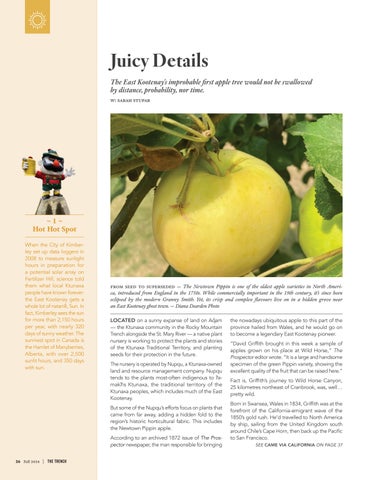
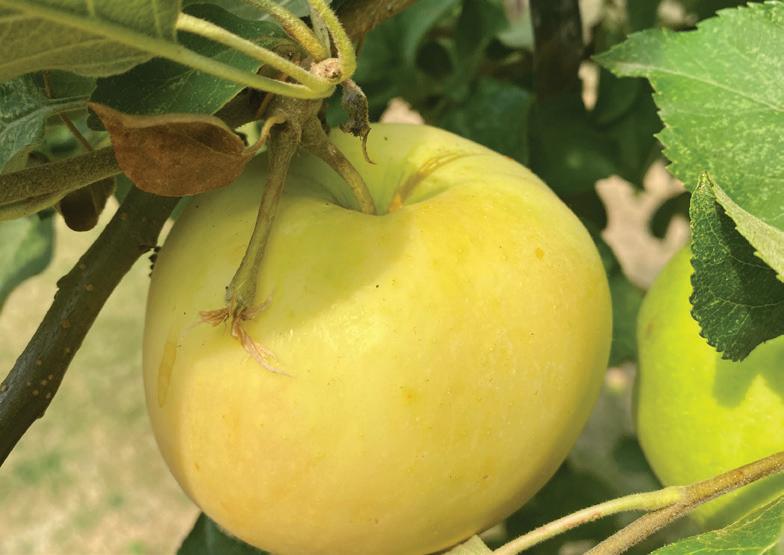
from Seed to SuperSeded — The Newtown Pippin is one of the oldest apple varieties in North America, introduced from England in the 1750s. While commercially important in the 19th century, it’s since been eclipsed by the modern Granny Smith. Yet, its crisp and complex flavours live on in a hidden grove near an East Kootenay ghost town. — Diana Dearden Photo
~ 2 ~
The Hole and Its Hairy Hordes
First Nations have long referred to a triangular pocket of land northwest of Cranbrook and east towards Fort Steele as ‘the Hole in the Sky.’ Consistently sunny even on overcast or rainy days in town, this unique landscape supports a rare pocket desert, complete with cactus, bitterroot, bunchgrass, and other open grassland plants, all within sight of what was an ancient interior temperate rainforest, now a sea of two to three metre cedar stumps up the nearby St. Mary Valley.
Collectively known as the Wycliffe Wildlife Corridor, this is arguably one of the most critical wildlife movement and winter range areas in British Columbia, if not Canada. Thousands of elk, mule and whitetail deer, and even moose overwinter in this zone, and endangered species like badgers, curlews, and historically burrowing owls use this zone of mixed forest and native grasslands, one of the most endangered ecosystems on the planet. Grizzlies, wolves, coyotes, and sandhill cranes are regular visitors, and even wolverine and caribou have been spotted passing through this rare, relatively intact, wild, valley-bottom grassland-forest mosaic between wilderness areas.
CAME VIA CALIFORNIA
CONTINUED FROM PAGE 36
“In 1865 he started the first placer excitement of the Wild Horse having drifted from California into East Kootenay,” said a historical recant in the Cranbrook Townsman. “He was a prominent and picturesque figure…a pioneer long before men, who now consider themselves pioneers, had arrived in the country.”
Over half a century earlier, the Ktunaxa — some of the last Indigenous peoples in North America to make contact with settlers — encountered explorer David Thompson during his 1,600-kilometre journey from Canada’s east to the site of what would become Kootenae House trading post, near present day Invermere.
While Thompson’s trek was stunning, a journey to ʔamakʔis Ktunaxa from the west was equally as formidable, despite being a third the distance.
After the discovery of gold in the interior, James Douglas, then governor of the new colony of British Columbia, was eager to see a land route established from the west coast deep into the southeastern part of the province. This route was named the Dewdney Trail.
Once built, the Dewdney Trail brought people, goods, and animals into ʔamakʔis Ktunaxa. It also brought plants. And, evidently, Welshmen.
In 1864, the discovery of gold in the Wild Horse River inspired the Crown to extend the trail all the way to Fisherville, seven kilometres northeast of the Mounties’ outpost of Fort Steele.
Fisherville became the first permanent settler village in ʔamakʔis Ktunaxa. The pursuit of gold swelled its population to around 5,000 inhabitants,
Once it was built, the Dewdney Trail brought people, goods, and animals, into ʔamakʔis Ktunaxa — and it also brought plants.
many of whom were prospectors. The town bustled with six general stores, four saloons, two butcher shops, a brewery, a post office, and more. Now a ghost town, Fisherville has almost no remaining structures. A solitary riverstone hearth and chimney stands in an overgrown clearing carved into the steep hillside — the homestead built by Griffith and his wife.
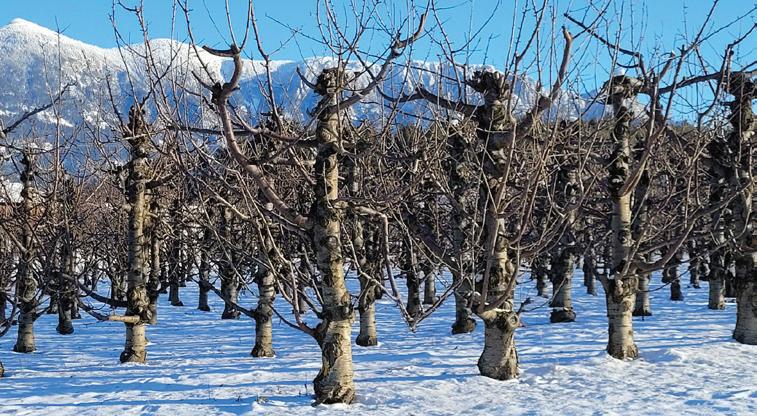
Griffith had lived in Fisherville since its establishment, providing services to miners. In doing so, he planted the East Kootenay’s first fruit orchard — woody and shrunken relics of which continue to grow just a short walk from the remains of the homestead’s hearth, well over a century later.
In 1862, the Catholic fathers at Okanagan Mission started an orchard from apple trees packed in by horse from the Pacific Coast. In 1872, Griffith obtained some trees from the fathers and packed them further along the Dewdney Trail to Fisherville, where he planted and meticulously maintained them for a number of decades. That effort included gruelling, and often daily, growing-season hikes down to the creek and hundreds of steep metres back up, laden with heavy, awkward buckets of water for the orchard.
The apples were Pippins, brought to the New World in the early 1700s and renowned for their size, bulletproof genetics, and rich, complex taste.
Both Thomas Jefferson and George Washington admired the fruit, with Jefferson writing from Paris, “They have no apples here to compare with our Newtown Pippin.” Queen Victoria was once gifted a basket of Pippins and was so enamoured with the fruit that she made special requests to have annual shipments made back to London.
History lover and Kimberley resident Diana Dearden, who grew up just down the road from Fisherville, became fascinated by the stories of these apple trees. A typical apple tree might live to be at most 80 years old, but amazingly, Dearden located some of these trees still standing nearly 152 years later. In the spring of 2021, she partnered with Gerald Puch from Nupqu Native Plant Nursery to graft a series of clippings from the original 1872 trees onto her parents’ apple trees in Fort Steele.
Two years later, only one precious graft survived to bear fruit, but in August 2023, Dearden savoured a bite from her first-ever heritage Pippin apple — from the very same genetic stock that Griffith had grown.
It took three years to grow three apples, which produced a total of eighteen precious seeds with exactly six seeds from each tree. So far, while none of the seed sprouts that were planted have survived, the original successful graft survived the winters and is looking healthy. Puch remains committed to the tree’s future, optimistic more will be planted on ʔamakʔis Ktunaxa.
As for Griffths, he died in 1914, one of the oldest pioneers in the Rocky Mountain Trench.
“During the last few years he has resided quietly at Fort Steele,” wrote the local paper, “and on his farm on the Wild Horse Creek, where the oldest apple trees in British Columbia, fifty years of age, are still bearing fruit.”
“A man who has been identified with the progress and development of the country for the past fifty years, and who passed away at the ripe old age of 85 years.”
CALVIN BEAUCHESNE
Columbia River - Revelstoke
Calvin Beauchesne is running to be your next MLA in the provincial election for Columbia River - Revelstoke. Calvin is an environmental advocate and active community member with a strong background in environmental/sustainability studies. Calvin will also be a strong voice for progressive social policies and economic justice in the province.
Wither & Knot
Creston’s unprecedented soft fruit fiasco.
w: brian lawrence p: KaSha ferguSon
IN MID-JANUARY, 2024, a cold snap decimated this summer’s soft fruit crop in the Creston Valley. And while the ultimate impact is still unclear, one thing is sure: the region’s food security in the immediate future is uncertain.
“Our production is going to be down significantly,” says Tanya Wall, the executive director of Fields Forward, which runs the Kootenay Farms Food Hub. The facility opened in 2021, offering farmers the ability to juice, freeze-dry, and dehydrate their produce, generating value-added sales of $968,146 for around 30 farmers in 2023.
This year’s crop loss, Wall explains, “is forcing us to look at the vegetable world instead of just the fruit world.” The facility will delay most of its production until veggies become ready in late summer.
Peach, apricot, plum, and cherry buds emerged in early winter’s spring-like warmth and sunshine — and then became the first confirmed casualties of the January deep freeze.
Peach, apricot, plum, and cherry buds were among those that had emerged in early winter’s spring-like warmth and sunshine — and then became the first confirmed casualties of the January deep freeze, which saw record-breaking temperatures as low as -27.2° celsius. Yields for blueberry and blackberry crops appear weak, although strawberries may fare a bit better, while the impact on apples won’t be known until mid-summer.
Some crops’ recovery may take a couple of years, and up to five if a tree needs to be replanted. Which poses another challenge, due to the high demand following the cold snap that has nearly exhausted local nursery stock.
In the meantime, to ensure that fruit will be available for day-trippers to Creston this summer, some farmers have discussed purchasing fruit from other markets to have on hand.
Others are trying something new, having planted vegetables or flowers between rows of mostly empty fruit trees. “Everybody’s gotten creative,” says Wall.
When it comes to the wine industry, customers won’t notice much change this year, with vintages from 2022 and 2023 still available. At Baillie-Grohman Estate Winery, a few vines on its 16-acre main block show a hint of potential for a 2024 vintage, with more hope for 2025.
“Right now, we’re training shoots from the bottom, from the roots, to grow up to be our fruiting canes for next year,” explains co-owner Wes Johnson. “If we get good growth, potentially we’ll have a decent crop for next year.”
Future cold-snap effects could be mitigated by adopting practices similar to Nova Scotia’s wine industry, where the next year’s fruiting canes are buried.
“If this is going to become a common occurrence,” Johnson says, “we’ll have to adjust.”
~ 3 ~
Heliotropic Hillsides
The animals, of course, come for the food. Rare native bunchgrass plant communities offer the best, high-quality, year-round food for large mammals. In amongst the grass hide the bulbs and seeds of a floral fireworks show that draws visitors April through June to check out the first tentative light purple, hairy crocuses, then a fuschia sea of shooting stars, and, if conditions are right, the yellow ocean of the balsamroot sunflowers so intense that it seems like some sun god has knocked over the floral paint bucket. Finally, the creamy Mariposa lilies, ominous death camus, and larkspur round out the season. Many of these blooms, particularly the balsamroot, practice heliotropy — tracking the sun across the sky on a daily spin on their stems — so the short-lived flower can focus the sun’s energy like a radar dish, ensuring seeds have the best chance of success.
Dečki LjetaLos Chicos de Verano
{ The Boys of Summer }
For local baseball old boys Roger Tierney and Paul Mrazek, the diamond is forever.
w: Kevin BrooKer
PAUL MRAZEK was always going to be an international kind of guy. Born in Regina 55 years ago to a globe-trotting father, before the age of one he also lived in Calgary, Coquitlam, and Iran. And while his first language was Farsi, his second was undoubtedly baseball, thanks to an older brother who had taken up with some serious American hardballers inside the foreign-worker community.
“We eventually settled in the Lower Mainland where I played Little League,” he recalls. He became a good pitcher and had some great coaches in a time when they weren’t common. “But back then when you reached 17 or 18, there was nowhere left to play. Now there’s a road to college ball, even the majors.”
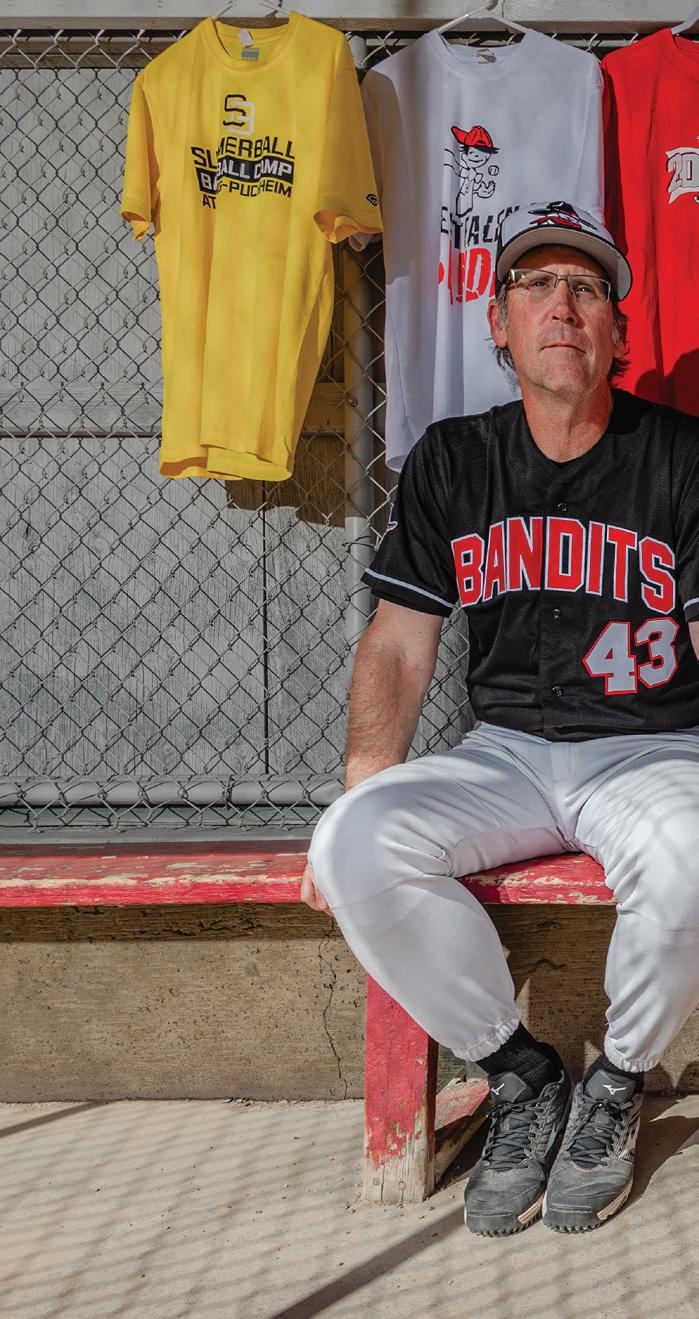
These days, Mrazek does as much as anyone to pave that road. He’s on the diamond seven days a week as the head coach of the Cranbrook Bandits, a two-squad array of youngsters aged 13-19 who mostly play against Montana teams like Libby and Kalispell in American Legion Baseball, a venerable tradition that turns 100 next year.
double play — Paul Mrazek, right, and Roger Tierny, left, won’t hang up their jerseys just yet. The pair respectively cross cultural divides to coach baseball to enthusiastic youth.
— Nicole Leclair Photo
~ 4~
The Dry Gulch Legacy
Presumably hot and dry from the get go, the downright desperate-sounding dispatch of Dry Gulch played a pivotal role in the history of the Columbia Valley. A fella by the name of James L. McKay built a ranch there in 1887. The next year he sold it to the son of a British Navy admiral who’d fought in the French Revolution, and before that squared off against Napoleon. Frederick Whitworth Aylmer would go on to layout the townsite for what was supposed to be called Aylmer, but was misspelt Athelmar, according to numerous newspapers of the day. Athalmer, with its bank, street lights, brothels, and two cops — plus its steamboat landing for journeys to and from Golden — would go on to be more important than Invermere, Windermere, and Wilmer too. But, alas, not for long…
~ 5 ~ Easier Money
That big blazing ball is a boon for business — and examples abound. Take tourism: Lake Koocanusa’s Sunshine Houseboats and Marina takes advantage of all the East Kootenay sun with their popular water park and houseboat rentals. Travel: Can 138,700 passengers be wrong? That’s how many of them landed at the Canadian Rockies International Airport in 2023. Cancellations and delays at YXC are rare compared to other airports in the region (Cancel-gar anyone?), thanks to the airport’s advanced systems and, with the help of year-round sunshine, conditions that allow for landing nearly 100% of the time. Education: You can charge up your solar power know-how with the College of the Rockies’ Solar Photovoltaic Design and Installation course at the College’s Gold Creek Campus. Real estate: Nearly 1,300 residential dwellings sold in April of this year across the Kootenays, and sales were up over 11 percent from the year before. There were 3,400 listings — up 34 percent. Newcomers like it here. Case in point: between 2016 and 2021, Cranbrook’s population increased by 2.3 percent. The average household income increased, too, up 18% from 2016, to $80,000 a year in 2021. Up the Elk Valley, Fernie’s population grew 17 percent from 5,396 in 2016, to its current 6,320. The average household income in Fernie? $121,500.
SMART SLUGGERS CONTINUED FROM PAGE 40
“I’ve been lucky to meet the right people and get good opportunities,” Mrazek says of a coaching journey that began in Richmond, B.C. in 1991 when a neighbour spotted his skills. He told young Paul, “I’m taking you to a coaching clinic. We need you.” That led to a lifetime series of learning stints that traversed baseball hotbeds like Colorado and Phoenix.
Along the way, he spread his knowledge across the Kootenays and beyond — way beyond. Three seasons ago, Mrazek was recruited for his most unusual mission to date: conducting summer camps in Germany, Austria, and Croatia. It’s little known here, but Europe held its first championship in 1954 and the sport has grown steadily ever since, to the point where there are currently 26 countries vying for the continental title. Europeans who have had successful Major League Baseball careers include Didi Gregorius of the Netherlands and Max Kepler, a Berlin-born and developed outfielder with plenty of home-run pop, now in his ninth season with the Minnesota Twins and earning a cool $10 million.
Mrazek notes that there are others knocking at the door, and no wonder. All three countries where he works have professional leagues, and the developmental stages are similar to ours. “It’s very well-managed. They start with T-ball, go on to Little League, and so on,” Mrazek explains. “They have good equipment and some excellent coaches. Some are volunteer dads, but there are also some paid ones. So we work alongside them, sometimes with translators, but it’s amazing—by the time they’re ten, many of these kids speak pretty good English.”
This August, Mrazek will head back to Europe to illuminate players aged five to twenty-five in the ways of the stick and the leather. But in a world dominated by soccer, what kind of European parent signs up a kid for baseball? “Well, they’re like parents here. They want to expose their kids to a wide variety of activities,” Mrazek says. “And Europeans are highly organized about it.”
Mrazek opines that they also just love sport, and give it more attention than we do. "Croatians, for example, are super athletic,” he says. “You drive through Zagreb and you’ll see these incredible sports facilities. They really have it all. Baseball is just one more sport.”
And don’t forget that modern youth everywhere can watch the world’s best on the phone in their pockets. That’s a huge advan-
Although he’s north of 70 years old now, he plays the game at any opportunity. “I have a good arm and I can still hit.”
tage, even if it occasionally steals focus from the fundamentals that Mrazek and his colleagues obsess over, like outfielding, catching, speed, agility, quickness, and conditioning. “Kids don’t watch games as much anymore. They’ll usually just see clips on TikTok, or Blue Jays in 30 on Sportsnet, so all they ever see is bombs and big catches,” says Mrazek.
Back on this side of the Atlantic, Roger Tierney is part Johnny Bench and part Johnny Appleseed when it comes to baseball. Actually, make that Juan Appleseed, since the resident of the Canyon District of Creston has spent much of the past two decades sowing the game in the Mexican state of Nayarit, just north of Puerto Vallarta.
To say Tierney is fond of baseball is an understatement. “I just love having a glove in my hand,” he confesses, and explains that’s been the case ever since his Little League days on the west coast as a talented catcher. And though he’s north of 70 years old now, he plays the game at any opportunity. “I have a good arm and I can still hit.”
In 2014, he hooked up with the Cranbrook Bandits senior squad, alongside Paul Mrazek, in the B.C. championships. The oldest player there, he nevertheless made an impact at both first base and the batter’s box.
Otherwise, it had been coaching and league development that commanded much of Tierney’s baseball energy — first in Kimberley, then other B.C. communities as he moved about during his 35-year career with B.C. Parks.
“Sayulita was never about the sun and the beach.”
Things changed, however, back in 2002 when his sister introduced him to a burgeoning tropical paradise called Sayulita. Now famous as a hipster hotspot for young surfers and yoginis, Tierney explored a different side of what was then a rather sleepy resort town: the local baseball diamond, which happens to sit right in the middle of the community. Glove in hand, Tierney showed up and started building friendships that are now decades-long, spending six months in the town virtually every winter. “For me, Sayulita was never about the sun and the beach,” he says. “It was always about the people.”
And the baseball. Back then there was little development infrastructure, and most of the players were older guys. Tierney soon joined the squad of age 40+ players known as Los Veteranos. “I had so much fun playing with them,” he says. “We faced different teams every weekend, always a double header followed by beer and barbecue.” Many of his teammates were homebuilders; in 2006, Tierney had them craft his own casa, with an attached rental property.
Meanwhile, as Sayulita grew, opportunities for kids getting into trouble were everywhere. Tierney had an idea. He put out a call for youngsters to come play baseball, something they hadn’t been doing. He learned why on day one when 15 would-be Little Leaguers showed up — over half of whom had no glove and no likelihood of getting one.
The only thing to do, Tierney figured, was to reach out to fellow B.C. ballers and gather donations of used gear. It turned out to be more successful than anyone dreamed. “In 2016, we filled hockey bags with over 1,500 pounds of equipment,” he recalls, “which WestJet generously shipped for free.” The bats, balls, and gloves were soon distributed throughout the state, while Tierney and his buddies built an age-grouped organization now known as La Liga Invernal de Nayarit, with teams in 12 cities. Unsurprisingly, the Jaibos of Sayulita — Go Crabs! — are a perennial powerhouse in the league.
Their mentor, whom they call “Royer,” will be checking in with them again this October, glove in hand. “At first I didn’t realize how important it was for the parents,” Tierney explains. “But now when I go back they’re so happy that their kids aren’t hanging out at the beach, getting wrapped up with drugs and all that stuff. It feels pretty good.”
~ 6 ~ Funky Cold Ingenious
Despite all the sun, there is one limiting factor that stunts the normally bright East Kootenay growing season: frost. Our high, dry valleys are perfect collectors for cold air, and the sunniest parts get hard frosts well into June, and reliable -5 mornings even in late August most years. This severely curtails growing potential, unless more sensitive plants like tomatoes, basil, and greens are sheltered in a greenhouse.
But Invermere’s Groundswell Greenhouse has figured out a new way to out smart ol’ Jack Frost, having lit the way for yearround Kootenay gardening. Groundswell reliably produces greens year round, with minimal, if any, added heat. Intense summer heat is pumped below the greenhouse into a sand pit, which is used as a thermal battery, slowly releasing that heat through the winter to offset any cloudy, cold days when the greenhouse might otherwise chill out too much.
~ 7 ~ Natanik Voltaik
Kimberley’s Sun Mine and its 96 tracking photovoltaic panels make it the largest tracking solar array in Western Canada and the largest solar facility in B.C. — and one of the most productive. It was also the first solar array to sell directly to the BC Hydro grid, producing over 1 MW of electricity at peak performance, enough to run 250 homes. Run by Teck and established on land used for a century’s worth of tailings from the Sullivan Mine, a giant fertilizer factory, and a steel smelter, it’s a zone unlikely to support tall trees despite decades of exceptional reclamation efforts. Voila voltage: the perfect spot for a solar array.
Slough Ride
How an Albertan water skiing phenom, turned HVAC king, dredged out his world-class dream.
w: Jeff pew
leader of the laKe — Ron and the coaches he hosts in the Columbia Valley teach youth how to slalom ski: a type of water skiing that requires athletes to navigate a course of six buoys in a zigzag pattern, with the speed of the boat increasing, then the length of the rope decreasing, for each run of the course. — Jeff Pew Photo
“I FOUND THIS PLACE by accident,” says Ron Smith. In 2006, he discovered a tiny 25-acre slough in TaTa Creek, B.C. that would soon host some of the world’s best slalom water skiers.
“A friend was flying from Invermere to Cranbrook to his daughter’s soccer tournament and saw it from the air,” the 68-year-old explains. “When they told me about it, I thought I’d talk to the rancher to see if he’d let me lease it. When I got here, it was for sale.”
Smith, who grew up in Southern Alberta, began water skiing on a nearby pond, eventually competing with an Edmonton club in slalom, trick, and jumps. Before long, he was competing in Florida and performing in ski shows at SeaWorld and Lake of the Ozarks in Missouri.
He later took a years-long pause, stopping skiing to build his thriving Calgary-based heating and air conditioning company. In 2006, business took him to Invermere, when he was hired to install a system at David Thompson Sec-
ondary School — and everything changed.
He pondered if he should begin skiing again. “But, if you’re into slalom skiing, it’s not the best place,” he states. “There are too many boats, so you can only ski first thing in the morning. When the TaTa Creek property came up for sale, I couldn’t resist.”
In 2006, he began clearing brush, dredging the middle of the lake to make it deep enough for skiing late in the season, and began setting up the course. By 2007, they were skiing. “A slalom course hasn’t changed since the ‘50s,” Smith explains, while a train whis-
Whoever skis around the most buoys with the shortest rope wins.”
In the beginning, what became known as Ron’s Ski Lake — known for its calm, warm water — hosted friends from Calgary, Invermere, and Fernie. They’d set up tournaments and camp throughout the weekend. Eventually, parents asked if he’d coach their kids. “You just got the eye,” Andy Mapple, regarded as the world’s best slalom skier, once told him. “You gotta start coaching.” It didn’t take long for Ron’s Ski Lake to become a prized location to ski and coach, hosting world record holders like Karina Nowlan.
The teenagers train all day, then camp on the property. “They cook their meals, have bonfires, and look after themselves. The only thing I tell them is to be on the dock by 8 a.m., ready to ski.”
tled and ambled by, 40 metres from the shore. “Each time you successfully pass through the course, the rope gets shorter.
In 2017, the BC Waterski Association approached Smith and asked if he’d be interested in hosting and coaching U17 de-
velopment camps to promote the sport. Known for his high skill level, passion for the sport, and the fact that he has the only privately-owned lake in B.C. that runs a slalom course, Smith was the perfect fit. “You have to have access to a private lake to get good,” he says. “By 8 o'clock in the morning, there are so many boats on public lakes. You gotta get up at 5:30 to get any good. How many teenagers do you know who want to do that?“
His students ski all day, then camp on his property. “They cook their meals, have bonfires, and look after themselves,” Smith says. “The only thing I tell them is to be on the dock by 8 a.m., ready to ski.” Past students have successfully competed in the Western Canadian Championships.
Retired from the heating and air conditioning business, Smith’s full-time passion is continuing to
develop the lake’s recreational and training capabilities. He’s been approached by developers to subdivide and sell lots, but according to Smith, that’s never going to happen. “It’s my lake,” he said from a chair on his deck looking over the water. “There’s nothing more I want. This is a dream come true.”
~ 8 ~
Power to the people. But profit? Not so much.
According to BC Hydro, approximately 5,000 homes in B.C. have invested in net-metering photovoltaic power generation. In this system, no batteries are required, and your homes’ smart electrical meter calculates how much power your system contributes to the overall grid, which is then deducted from your BC Hydro bill. These savings are in addition to any power that your home uses directly from your roof-top solar system. Provincial and Federal grants and/or tax exemptions are currently available.
Unlike Nova Scotia, Ontario, and Quebec, however, BC Hydro will only purchase excess power from your system at the highly subsidized market rate (.9-.14/kWhr at time of writing, among the cheapest power rates on the planet, compared to guaranteed solar power purchase rates of .39/kWhr in Ontario, making systems with 25-year warranty and up to 40-year lifespan pay for themselves in 8-10 years). B.C.'s rates are far below the actual costs of power generation, including overruns on projects like Site C, greenhouse gas emission costs generated by B.C.’s use of Alberta’s coal-fired energy, ongoing maintenance, management, and environmental issues of our large hydroelectric dams and reservoirs, or BC Hydro’s ongoing monitoring and maintenance of over 900,000 wooden poles supporting 58,000 km of transmission line. This disparity essentially keeps B.C. in the dark ages by removing any incentive for residents to scale up solar power production from residential or business rooftops.
w: dave Quinn
leaving the world in her waKe — Australian Karina Nowlan, crowned world champion in women’s slalom in 2008 and co-world record holder, is one of several world-renowned skiers to visit Ron’s Ski Lake in TaTa Creek. — Photos Courtesy Mat Loyola and Port Stephens Examiner
I. Am. Kimberlian.
Papa Frio, Mama Machine Gun, and Grandmama too. A tome to home, by 17-year-old Willa Honeyman.
In 2010, Tourism Kimberley created the “I am Kimberley” ad campaign by director Kevin Sheppit, featuring wonderfully eccentric Kimberley characters. This included landscapers, monoboard skiers, the beer-swilling town mascot Happy Hans, and parents Kevin Honeyman and Natassja JonesCleve who performed as a guitar-playing and belly-dancing duo under the pseudonym “Gypsy Salami.” This is, in part, the musings of their daughter, Willa Honeyman.
Kimberley
An uneven wooden fence separated our home from Highway 95, arcaded by antique kitchen appliances, carefully-arranged skis, and an array of antlers and thrifted photo frames. Cars surged past between the corkscrew gaps. I sat on dry grass and listened to the clinking chimes of my mother's gold coin skirt as she unrolled patterned rugs onto the lawn. Dad tuned his guitar, periodically humming.
A large camera was set up to capture the eccentric scene. Dad sported thin oval sunglasses and a black T-shirt with torn sleeves. Huddled beside him, mom draped a red scarf over her head. Leaning into the camera, they introduced themselves: “My name is Papa Frio,” dad said in a zany Italian accent. Mom giggled before pulling a serious look to her face. “And I am Mama Machine Gun. And we are Gypsy Salami.” Dad attacked his guitar, his face twisting into someone younger. Mom closed her eyes halfway, arms in the air as she belly danced to the rhythm of his music. I sat on the porch steps, watching.
Grandpa
I grew to know my grandfather from the paintings on the wall: ones mom found in alleyways, thrift stores, and the dump reuse. She gathered all these abandoned men — long bearded and elderly, bull fighters with twisted mustaches, proud men holding bayonets — and hung them above the couch. Over the years, after each one went up, I questioned her about who they were. She would smile then tease, “That's your grandpa.”
When I eventually met my grandfather, I realized how different he looked.
Toronto
Last July, I left for Toronto. I missed the dark cobbled alleyways of my grandmother's co-op, the brown brick apartments strangled by gardens and tropical flowers. I missed the thick air, Greek passion down the boulevard, thin-legged men with laptops and immaculate stubble, women with topknots and lonely eyes, the eerie buzz of the subway.
I wanted to hear her latest neighbourhood gossip: the ever-inflating corner store prices, the hated cat lady on the top floor, the retired showgirl stationed under a willow in the park. We took afternoon walks by lanky townhouses with overweight cats sleeping in windowsills. I missed my grandma's maniacal ways: car windows down, yelling to the hipsters and homeless on Jarvis, banging the steering wheel with both hands, swerving onto sidewalks.
In the eleventh hour before I fly home to Kimberley, she gives me things: half-empty perfume bottles, a wooden bracelet filled with energy, eight pairs of blue and white socks, $300 in cash, and a plastic coat that doesn’t fit. I wrap my great grandmother’s bible — the one she carried down the aisle during her wedding — in a Bubba Gump T-shirt and put it next to the Tibetan meditation bells.
My parents got engaged in a ‘72 Ford two weeks after meeting, my older brother nestled between them as they overlooked
The Old House
Summers, Grandmama would fly across the country with her large black suitcase of candy kabobs and painting supplies. She’d settle in a camper in our backyard, above what we called the outback: stone-scattered teeth bitten into the side of our hill, drooling down to a snake-filled ravine, an old barn, a shattered green van, and a haphazard collection of small broken bikes and lost shoes.
We called our old car Zephera: blue interior with stickers on the windows, the seats lined with cracked leather that pinched our thighs in the summer.
Dad with his guitar: his eyes wide, chest rising under the beating stage lights, melted into some supernatural place. Guitars hung from the walls, vintage turquoise and fulgid green. Amps in every corner, and baskets full of cords.
My mother's olive eyes, a Virgin Mary tattoo on her shoulder, her collection of Russian dolls, the bookshelf in the wall, the polka dot apron hanging in the kitchen.
My parents got engaged in a ‘72 Ford two weeks after meeting, my older brother nestled between them as they overlooked Bull River. Mom hung a rosary from the rearview mirror and kept her cassettes scattered in the front seat.
Bull River. Mom hung a rosary from the rearview mirror and kept her cassettes scattered in the front seat.
I Remember
The cold sun against my back the whisky brush of my grandmother’s fingers a black ear bud in each palm.
Watching my breath cracking frozen pavement like old bones. Sun faces. Train cars. Brown Horses grazing ice-tiled meadows.
Rapid stripes of light in the old car.
Feet planted in the riverbed.
The sun. The cat tails. The patterned quilts on each bed.
Linen PJs and tinseled glass. Cold barns. The fossa of green.
Our bedroom is warmer when the heat goes out.
“The road we’re paving and the barriers we’re breaking are for future generations.”
"NOTHING PERSONAL. IT’S JUST THAT YOU'RE A WOMAN." Kate Braid has certainly heard those words before. In the 1970s, the now-accomplished writer and teacher entered the carpentry industry, with both positive and plenty of negative reception from those around her. Despite the skepticism she faced, she went on to become one of the first qualified women carpenters in British Columbia, and the first woman to teach construction full time at the BC Institute of Technology.
Even though much progress has been made since the 1970s, non-traditional trades for women — such as construction, manufacturing, and transportation — still see only 8.7% representation. These low numbers might be explained by hesitancy of entering a male-dominated industry, and a lack of support for newcomers. Recognizing these challenges, organizations like the BC Center for Women In The Trades (BCCWITT) are working to address the gender gap by providing support, resources, and connections for equity-priority individuals. Through training opportunities, funding initiatives, and government-backed programs, BCCWITT aims to increase the representation of these individuals in trades to 15% by 2030.
Skilled trades play a crucial role in our economy and society. Trades reach almost every aspect of our lives: the homes we live in, the cars we drive, the food we eat. It’s reported that 1 in 5 employed Canadians work in a skilled trade, and the majority of them report high job satisfaction.
For those interested in pursuing a career in the trades but unsure which path to take, College of the Rockies in Cranbrook has been offering a Trades Sampler Program since 2021. Since its inception, enrolment has increased from six to 16 women. Once students have an idea of which trade they want to pursue, they can reach out to BCCWITT for assistance in attaining their goal of becoming a skilled tradesperson.
By leaning on support structures like these, and looking to other women pursuing fulfilling careers in skilled trades, women can be more resourced than ever — and go on to succeed in the industry they choose. The Trench spoke with nine East Kootenay women who have done exactly that.
In her book Journeywoman: Swinging a Hammer in a Man’s World, Braid aptly quoted the great American artist and draftswoman, Georgia O’Keeffe: “I’ve been absolutely terrified every moment of my life — and I’ve never let it keep me from doing a single thing I wanted to do.”
PLAYING WITH FIRE —19-year-old Gabi Evren found her love of welding in high school as a creative outlet, and it sparked a fulfilling career path. — Jenny Bateman Photos
THIS WOMAN'S WORK
Carrying the torch, saw, and shears, sisters are doing it for themselves. Writer and photographer Jenny Bateman rolled up her sleeves alongside nine local ladies making the grade in trades.
MARLO SALANSKI
AGE: 30
TRADE(S): Farrier
At what age did you first pick up a tool out of curiosity? What was it and why were you drawn to it?
I was probably around 15, and had my own horse that had trust issues with other people. I picked up a pair of nippers and a rasp, and my farrier at the time had taught me how to trim my gelding.
What’s the hardest job you’ve had so far?
The hardest part of the job was learning how to deal with my human clients, and taking care of the horses’ needs.
What’s the most interesting or fun part of your job?
I enjoy trying to correct horses’ feet that may have had poor farrier work, or have been left too long in between trims. It’s a slow process, but rewarding.
What advice do you have for women thinking about the trades or making a career change?
It’s empowering to work hard as a woman and excel in a trade. It’s a challenge, but the reward is worth all the blood, sweat, and tears that go into it.
When you’re not hard at work, what hobbies or activities are you doing?
I love riding horses and working cattle, doing pack trips in the mountains, and travelling the world to experience new cultures and cuisines.
"It’s empowering to work hard as a woman and excel in a trade. It’s a challenge, but the reward is worth all the blood, sweat, and tears that go into it."
CAITLYN BIRDSELL
AGE: 34
TRADE(S): Chocolatier / Pastry Chef
What is your favourite tool of the trade and why?
I remember baking chocolate chip cookies with my mom when I was little and loving to get to use the hand mixer. These days, I love using the torch to get the perfect bruleé or to add some heat to get icing to come together.
Who inspires you?
Both my mom and grandma are excellent bakers. I love recreating my grandma's old recipes.
What’s the hardest job you’ve had so far?
I worked in a bakery in Vancouver with a very skilled and very stern chef. There was never quite enough time to make all the orders!
What’s the most interesting job you’ve had so far?
I met my now sister-in-law when I was a teenager, and we dreamed of opening a bakery together one day. Now we're living it! So that's pretty cool.
When you’re not hard at work, what hobbies or activities are you doing?
I love to mountain bike, make art, and drink cocktails on patios.
NATEESHA JOHNSON
AGE: 19
TRADE(S): Carpenter
Why did you choose to pursue this trade? I wanted to build my families' homes, and to build my own home one day.
What is your favourite tool of the trade and why? My skill saw. It’s very handy for any type of project.
Who inspires you?
My grandpa, by teaching me so many skills in life.
What’s the hardest job you’ve had so far? It’s not difficult, but dealing with insulation is very itchy.
When you were in your teens or twenties, did you see yourself working in the trades?
Yes. I had a goal to receive my Red Seal. I’m motivated by doing what I love and being outside.
What advice do you have for women considering the trades or making a career change? Being in the trades makes you feel like a powerful woman. I like the thought of being one of those women who work really hard.
Hay Neighhhhber
When it comes to smart-as distribution, The Trench doesn’t horse around.
Want to reach the region’s tourism market? Pony up and support great local media. Each issue of The Trench is available in-room or online with a growing number of hotels, resorts, and boutique accommodators in the Columbia, Creston, and Elk Valleys.
Want us in the stable with your guests? Drop a line to our distribution jockey — jesse@kootenaymedia.ca — and giddy up. We’ll bring copies of the new issue right to you, for each of your rooms.
KIRSTEN VAN BREEVOORT
AGE: 30
TRADE(S): Refrigeration & Gas Fitting
Why did you choose to pursue this trade?
It was the most diverse trade that allowed me to teach more skill sets in the underdeveloped countries where I volunteered.
Who inspires you?
My whole family. My mom was a home economics teacher; Dad a custom homebuilder; one brother is a welder and fine finishing painter; the other is an industrial electrician and an electrical engineer; my sister is a chef.
What’s the most interesting job you’ve had so far?
Probably going into a private winery in Kelowna that had 24 karat gold tiles in the bathroom.
What advice do you have for women considering the trades or making a career change?
It can be emotionally taxing beyond what you might expect. Find a woman you are inspired by in a trade and ask them to mentor you emotionally and practically through the apprenticeship years. Ask her things like, “Was it a realistic expectation for me to work in that condition?” or, “I didn’t feel safe when this happened, what would you do?”
When you’re not hard at work, what hobbies or activities are you doing?
I love to dance! Lyrical freestyle or ballroom are my current two favourites.
LISA HUTH
AGE: 45
TRADE(S): Welder & Blacksmith
Why did you choose to pursue this trade?
It was a path that wasn’t expected, but that was put in front of me. Once I tried welding, I really enjoyed it and I worked hard to become quite good at it. Blacksmithing was an instant love at the anvil.
At what age did you first pick up a tool out of curiosity? What was it, and why were you drawn to it? My dad used to get us to pull nails out of boards, so I guess the first tool I used was a hammer. He always encouraged my sister and I to use tools and work hard.
When you were in your teens or twenties, did you see yourself working in the trades?
In Grade 10 I took mechanics, and that was the first time I considered skilled trades. But sadly, back then it was never brought up as an option for me. However, I started my own business at 24 years old — and I’ve been really happy with my choice!
What advice do you have for women considering the trades or making a career change?
I think trades are awesome! Reach out and talk to some women in the trade you’re considering. You’ll find that most are very willing to offer help and advice.
When you’re not hard at work, what hobbies or activities are you doing?
I love being outside, so you will often find me in my garden, or on my ATV or snowmobile, enjoying our four seasons with my family.
GABI ERVEN
AGE: 19
TRADE(S): Welding
Why did you choose to pursue this trade?
I first found my love for welding in my high school shop class. I think it appealed to me because I could be creative — and who doesn't like playing with fire?
Who inspires you?
My welding instructor in college taught me a lot, as well as a former foreman at my workplace. I can confidently say I wouldn’t be the welder I am today without them.
What’s the hardest job you’ve had so far?
Although I’m very capable at welding, a big challenge for me at work is that I’m 5'3" — and sometimes there are large pieces of equipment I need help moving.
ROBYN GIESBRECHT
AGE: 30
TRADE(S): Plumbing & Gas Fitting
When you were in your teens, did you see yourself working in the trades?
I always knew I wanted to work in a workforce that was very hands-on, so the trades route came quite naturally.
What advice do you have for women considering the trades or making a career change?
It may sound cliché, but just do it! Your first level of schooling will take less than a year, and the tuition is cheap. The best part is that while you are doing your apprenticeship to become certified, you’re also getting paid.
Why did you choose to pursue this trade?
My father is a plumber and gasfitter and I was working for him as a labourer. He asked me one day if I wanted to get my apprenticeship, and I said sure!
What is your favourite tool of the trade and why?
I own two sets of Knipex pliers that I use on almost every job. They’re tough, and aside from using them on fittings and such, I have even used them on stripped screws. They work fabulously.
What’s the hardest job you’ve had so far?
Replacing polybutylene water lines in a 65-unit retirement village, without help. It wasn’t physically demanding, but there were a lot of them.
What’s the most interesting job you’ve had so far?
I worked at a provincial campground getting the water system set up for the year, and I like replacing furnaces because they’re all different and always have challenges.
What advice do you have for women considering the trades or making a career change?
Do it! You’ll never be out of work. I have always said that I have to be twice as good as a man to be taken half as seriously, unfortunately. However, it’s definitely getting easier.
AMANDA BARRON
AGE: 35
TRADE(S): Carpentry
At what age did you first pick up a tool out of curiosity? What was it, and why were you drawn to it?
I was probably 10 when I took it upon myself to put together a small bookshelf for my room. It was a Phillips screwdriver, and I loved the idea that I could create something with my hands.
What’s the hardest job you’ve had so far?
I started my trades journey as an apprentice pipefitter, and the commercial work in the oilfield was by far the most mentally and physically strenuous job I’ve done thus far.
When you were in your teens or twenties, did you see yourself working in the trades?
In my teens I wanted to be a mechanic, so I always knew I wanted to be in the trades. It just took me a few tries to find the one that fit me best.
What advice do you have for women considering the trades or making a career change?
Don’t give up. There will be a lot of opposition, but the road we’re paving and the barriers we’re breaking down are for future generations. Also, don’t be afraid to be feminine on site. We can be both strong and beautiful!
When you’re not hard at work, what hobbies or activities are you doing?
When I’m not swinging a hammer and crawling through the rafters, I like to write and play music. I’m also a mother of two beautiful girls, and we’re often out riding bikes in the mountains.
SARAH WHITE
AGE: 39
TRADE(S): Barber Stylist
Why did you choose to pursue this trade?
I chose my trade because I always knew I wanted to work for myself, and I love making people feel beautiful. When I was about seven, I started learning how to do my own hair and I always wanted it to look nice — it didn’t matter what I was wearing, as long as my hair looked good!
When you were in your teens or twenties, did you see yourself working in this trade?
The first job I ever had was at age 13 answering phones and booking clients in a salon. I became a licensed stylist at 18, and it was the only career I ever wanted! I have always worked in this industry.
What advice do you have for women considering the trades or making a career change?
Do it! Even if it’s not a full-time career, there is so much value to being able to work with your hands, potentially make your own hours, and even open your own business. The opportunities are endless.
When you’re not hard at work, what hobbies or activities are you doing?
If I’m not behind the chair, you can find me with my family boating at the lake in summer, in the forest during hunting season, or at the Kimberley ski hill in the winter!
"We
can be both strong and beautiful"
The Sole Providers
Talaria Footwear — with locations in both Kimberley and Cranbrook — helps you feel comfortable and supported at work.
You work hard. Your footwear should work harder.
Plenty of us in the East Kootenay work in skilled trades — including more women than ever. If you’re among them, you need shoes that keep you safe and feeling your best — so that you get the most of those big days, and enjoy
range of work-appropriate footwear, including full size runs of womens’ work boots from both Blundstone CSA and, at our Cranbrook location, Red Wing.
Red Wing — an iconic company that’s been an industry leader since its inception in 1905 — handcraft their work boots in the
craftsmanship that goes into each pair ensures their durability — so that you’ll wear them for many years to come.
Our excellent selection of work footwear goes beyond just blue collar: we carry high-quality options for workers across many industries — including
THE CRAFTSMANSHIP THAT GOES INTO EACH PAIR OF THESE SHOES ENSURES THEIR LONGEVITY AND DURABILITY — SO THAT YOU’LL WEAR THEM FOR MANY YEARS TO COME.
a long, flourishing career.
Well-made work footwear provides excellent arch and metatarsal support, which prevents pain and reduces fatigue. The right footwear also defends against impact and compression hazards, improves stability, and prevents falls.
This kind of support and quality is found only in well-made shoes. At Talaria, we’re proud to carry a wide
USA. Blundstone, a classic brand well-loved in the Kootenays, makes a robust steel-toe boot that easily pulls on and off.
The work boots from both these leading-edge companies are tough and dependable, just like the women wearing them. We also have a robust selection of men’s work boots as well, at both our Kimberley and Cranbrook locations. The
healthcare, where safety and comfort matter most.
The friendly and highly knowledgeable staff at Talaria provide every customer with a professional fitting, so that you find the shoe that works best for you.
For locations and hours please visit www.talaria.ca
Emily Starling & Evangeline Leclair both work in the nuclear medicine department at East Kootenay Regional Hospital, where the team uses small amounts of radioactive material to diagnose and treat illnesses. While they both love the technical aspect of their work — which keeps them on their feet during long days — it’s the connection with their patients that brings them the most joy.
“I switched my work boots to Blundstones for the ease of getting them on,” says Jodie Wheeler, an East Kootenay local who’s worked in the pulp and paper industry for 15 years, working her way up to the first female digester operator at her mill. “These boots hold up better than most women’s work boots, and have great cushioning.”
Nicole Leclair Photos
the skin deep
Inside the ink of artist Ellie Rubincam
words and photos: Jeff Pew | vignettes: Ellie Rubincam
attoos, the old-school skin art, have been leaving their mark on us for thousands of years across different corners of the globe. In ancient Egypt, tattoos date back over four thousand years, serving as suspected spiritual rituals and amulets for protection. In Japan, tattoos were all about showcasing one's social status and significant life moments through large-scale motifs based on intricate irezumi designs. The ancient Polynesians turned tattoos into a rite of passage, a cultural journey with the inking process lasting up to an excruciatingly three to four months, demonstrating one’s heritage, social status, and ability to withstand pain.
More recently, 20th-century North American tattoo history was associated with sailors, bikers, and outlaws. There was the stereotypical suntanned arm, beneath a white T-shirt, adorned with a grass-skirted dancer, a woman in tight shorts at a ship’s wheel, and the ubiquitous homage to “Mom.” During the last twenty years, our perception and attitudes around tattoos shifted from symbols of rebellion and defiance to self-expression and personal identity. They became a recognized art form, just as graffiti and tag art became more mainstream. In addition, the visibility of celebrity tattoos played a crucial role in making tattoo culture more fashionable. Celebrities like Drake, David Beckham, and Angelina Jolie flaunted and hyped
their ink, normalizing tattoos for the masses. And finally, tattoo technology got slicker, making the process safer, faster, less painful, and more precise. Today, tattoos tell stories: they're the inked diaries expressing who we are, what we value, and what we've been through.
Since 2016, Kimberley’s Ellie Rubincam has been illustrating and inking our lives’ narratives. She specializes in illustrative tattoos with a focus on fine-line work that flows with the lines of the body. Ellie’s tattooed over a thousand people, and often forms deep connections with her clients.
“When I began tattooing, I thought people came for tattoos because they were looking to have art on their bodies,” she reflects. “Now I believe we get tattoos because we want to honour a transition and potential transformation in our lives. We get them at beginnings and endings, to remember, to re-orient, to choose ourselves again.” Ellie thinks tattooing is a ritual that people subconsciously understand. “The stories that come up in the creation of a tattoo stem from our deep yearnings for connection and acceptance. I love that I have this window that allows me to see people exactly as they are.”
In the following vignettes, Ellie muses on six of her clients’ tattoos and the stories lying beneath their skin.
“I believe we get tattoos because we want to honour a transition and potential transformation in our lives. We get them at beginnings and endings, to remember, to re-orient, to choose ourselves again.”
We immediately bond over a shared love of Arthur Rackham’s illustrations, a Victorian illustrator who drew faeries so fluidly that it seems improbable he never drew them from life. She is a sweet-faced 18 years old, but simultaneously, ageless: she could be 80 as easily as 34 or 8. She lists bands her parents were too young to see in concert. She holds a steady job, pays her own way, and keeps an eye out for her younger brother. It’s been two years since she was last in foster care.
We line the piece first, illuminating a scene pulled together with three of Rackham’s faeries and a gnarled old tree from a different text. The faeries look unconcerned with the world beyond the forest as I add a soft layer of colour over certain sections: a dress becomes tinged with hints of orange, pink, and blue. When it heals, it will be subtle, like the picture is blushing.
At one point, I wonder: how does an eighteenyear-old get this good at forgiving?
After each session, she takes the bus home.
9:30 am: E. comes in the cold. I can tell she’s nervous: it’s been 15 years since her last tattoo. She shows me the faint outline of a peacock feather curving up the side of her stomach. Between then and now, so many chapters: moving towns, the eyes-wide-open decision to have a child after thinking she never would, the dissolution of a partnership.
G.
She says, “I left because I felt like a wilting flower.”
She speaks of her love of foraging and plants, how she hopes her bees have made it through this cold snap. The bumblebee is for her daughter, she tells me, a nickname from when she was born. The wild rose is medicine for the heart.
Before she leaves, she turns to me with something in her hands. “I made this for you,” she says. It’s a deer antler, a few feathers, and a silver chain with charms dangling from the bone. After she leaves, I hold the gift in both hands. I wonder for too long about where it belongs.
PROUD PARTNERS & PINT PROVISIONERS FOR THE TRENCH CLIENTS, QUAFFERS & LOCAL
T.
I’ve been looking forward to this tattoo for months: a girl’s head melting into a birdcage; a couple of the bent bars allowing the kept birds to escape. In the week leading up to the drawing, I become fascinated by how I want to portray her: innocent and vaguely from the ‘60s. I’m unaware of the symbolism of the piece.
I’ve been told I’ll like T. Within minutes of entering the studio, he begins telling the story of his upbringing. He was raised Mormon — yet always knew he was gay — and sent to conversion therapy as a teenager. Fast forward to the present day and things have really worked out for T: the job, the husband, the supportive network of like-minded people. All of it.
The piece begins to take shape. I tattoo the girl’s face, striving to keep her looking naive. On a scale this small, the wrong shade of
grey in your whip shading can change the entire feeling. He tells me about the pressure growing up to constantly minimize the feminine. The bars of the birdcage begin to appear.
When he gets ready to leave, I want him to stay. I want him to promise to tell kids born in families like his about how much better it gets.
“Looking for birth flowers for my four children,” she writes in her email. “Birth flowers among the weeds, because something beautiful and light came from years of darkness.” A. married as a teenager into a community that saw girls primarily as wives.
Then, she left.
We discuss each weed as I draw it on. “Why milkweed?” I ask her.
“Reminds me of growing up on a cattle farm,” she says. “The cows would eat it
and it would change the taste of their milk. Eventually, the pods split open, revealing a fluffy white material called coma that allows the seeds to disperse on the wind.” Her smile wants to be bigger than she lets it. Soon we’re laughing. While still in my chair, she hatches a plan to open her basement to youth leaving her old community for simple meet-ups. It’ll be a way to show these kids that they’ll be okay, offering a place to land, the way a burr comes to land on the softest sweater.
A.
I’ve never met anyone with a rain machine before, or someone who says, “Covid wrecked my tips. With the mask, no one could see my smile.” S. is the best friend you wish you had. She’s getting a thigh piece that curves up her hip, ornate carving in a ram skull surrounded by flowers. It’s for an untamed childhood, her and her sister running barefoot through the fields of her parents’ farm. We talk art, her photography. The tension of showing up for family while keeping the creative spark lit. What do you need to give up? What do you keep for yourself?
I can picture S. as a little girl: no one knew her heart could break so easily because of how she burst into a room. How maybe the most alive people feel more pain because they feel everything more. How she set up a rain machine in her garage, too impatient to wait for the weather to change.
S.
During the tattoo, she updates me on dating. She tells me about the cook who lured her to a different town, then never left the kitchen where she worked. If given the slightest opportunity, she would flirt with your dog.
In my six years of tattooing, I’ve learned that the act of being tattooed has its own unique impact, above and beyond the specific image someone chooses to get. Call it a ritual, call it an act of self-love. C. gets flash pieces the way other people choose between brands of crackers.
We meet each Wednesday as part of a breakfast club at our local diner, so I know about her dad. I know about
the night he grabbed the gun from the case, and how her nephews were sleeping in the guest room. I know that every day she chooses sweetness, makes homemade chocolates for the local chocolate shop, a piece of ginger in this one, another painted with a ribbon of gold: each of them a love note to a stranger in her town.
You can see more of Ellie’s work on Instagram at @coalfeather.
C.
FERNIE
tourismfernie.com/events for details & up-to-date event info
Aug. 3, 4, 31, Sept. 1
MUSIC ON THE MOUNTAIN & TIMBER CHAIR OPEN. Fernie Alpine Resort. skifernie.com
Aug. 7, 14
WEDNESDAY SOCIALS . Station Square. 5:30-9pm. theartsstation.com
Aug. 9, 10
WAPITI MUSIC FESTIVAL. Annex Park. wapitimusicfestival.com
Aug. 10, 11
COLUMBIA BASIN CULTURE TOUR. Multiple locations. wkartscouncil.com/culture-tour
Aug. 18
FORAGING DINNER & OPTIONAL HIKE. Island Lake Lodge. islandlakelodge.com
Aug. 24
FERNIE SHOW N’ SHINE. Fernie City Hall. 11am-3pm. elkvalleycruisers.ca
Aug. 29, Sept. 26, Nov. 1
GALLERY OPENINGS: The Arts Station. 7-9pm. theartsstation.com
4TH ANNUAL LONE WOLF RACE. Elk Valley Nordic Centre. 9am-6pm. stagleaprunning.com
Sept. 28
HIGH ROLLER MTB POKER RIDE. 9am-6pm. fernietrailsalliance.com
No Clownin' Around
Billed as a fusion of Tim Burton and Cirque Du Soleil, The Vampire Circus stops in Cranbrook Saturday, October 26 at Western Financial Place. The spectacle includes acrobatics, comedy, contortionists, jugglers, and yup, clowns. Spooky clowns. Photo Courtesy Vampire Circus.
Oct. 6
FERNIE HALF MARATHON. 10am-1pm. ferniehalfmarathon. com
Oct. 6
IRON MAN & LADY OPEN. Fernie Golf Club. golffernie.com
Oct. 12
5TH ANNUAL THANKSGIVING AT THE BARN. Montane Barn. 12-3pm.
Oct. 14
TOMBSTONE TOURNAMENT. golffernie.com
CRESTON explorecrestonvalley.com/ upcoming-events-calendar for details & up-to-date event info
KIDSFEST. Fairmont Hot Springs Resort. fairmonthotsprings.com
Aug. 30 - Sept. 1
WICKED WOODS MUSIC FESTIVAL. wickedwoods.ca
INVERMERE
Aug. 10
27TH ANNUAL LOOP THE LAKE HALF-MARATHON. Westside Road. 8am start. loopthelake.ca
Sept. 1
COLUMBIA VALLEY GARLIC FESTIVAL. Edible Acres Farm & Winderberry Greenhouses. winderberry.ca
RADIUM
Sept. 20
6TH ANNUAL CV CLASSICS POKER RUN. Columbia Valley. 11am-4pm. radiumhotsprings.com/carshow
Sept. 21
34TH ANNUAL COLUMBIA VALLEY CLASSICS SHOW & SHINE. Springs Course - Radium Golf Group. 10am-4pm. radiumhotsprings. com/carshow
For nearly two decades, Kootenay Media’s various magazines have made it through forest fires, snow storms, a pandemic and even a merger (when our beloved local titles Go Kimberley and Go Cranbrook became…wait for it…Go Cranberley!)
Today, with the support of communities and businesses throughout the Columbia, Creston and Elk Valleys, we’re proud to introduce the next chapter in our collective story.
Welcome to The Trench
Life. Culture. News and views. The Trench reaches a population of 50,000+, landing three times a year in over 150 East Kootenay businesses and more than 400 rooms in hotels, motels and holiday rentals. Online, 2,300 folks follow us on Facebook and 1,200 on Instagram.
Advertise in our next issue. Carry us in your business.
ADVERTISING
darren@kootenaymedia.ca
250.505.9759
alesha@kootenaymedia.ca
250.430.1330
DISTRIBUTION
jesse@kootenaymedia.ca
403.510.4666
STORY + PHOTO CONTRIBUTIONS
britt@kootenaymedia.ca
THE MARKETPLACE
Affordable. Easy to design. And a terrific way to support local media.
The Trench’s Marketplace section is the perfect venue for home town retailers, hospitality hot spots, professional service providers, accommodators, and boutique businesses of all sorts.
The Trench reaches 15,000 readers an issue and then some, throughout your local, tourist and rubber tire market in the Columbia, Elk and Creston Valleys.
We can even design the ad for you, no charge.
Each issue of The Trench is a collectible celebration of local lifestyle and culture, with terrific pick-up appeal.
Need more info about distribution, rate options and story line-ups? Get in touch any time!
darren@kootenaymedia.ca
250.505.9759
alesha@kootenaymedia.ca
250.430.1330
The Peaceful Forest The Peaceful Forest
AromatherapyTreasures
THE PEACEFUL FOREST
Handmade, nature-inspired gemstone jewelry, handpoured candles, & bath products in Golden, BC. Discover our collections at summer & fall markets throughout the Rocky Mountains, local stores or shop online. Elevate your senses with our unique, artisan creations.
thepeacefulforest.ca @thepeacefulforest
LILAC MEDIA DESIGN STUDIO
Elevate your business and brand with leading-edge design and dynamic social media strategies. From logos, to print design, to digital content, our East Kootenay-based studio engages your dream clients and helps the new season of your business bloom. Ready to stand out? Get in touch today!
250.430.1330 hello@lilacmedia.ca @lilac_media
THE LOCAL COFFEEHOUSE
Stop by when you’re in Fairmont for our excellent coffee and tea, delicious and nourishing breakfast and lunch options, and freshly-baked treats. Sit down and relax in our cozy, welcoming atmosphere!
We prioritize sustainability, both in our offerings and packaging, and believe in supporting our community.
4992 Fairmont Frontage Rd., #2 Fairmont Hot Springs 236.525.2001
LV TILE & STONE LTD.
Transform your space with our expert services!
Specializing in stone and brick for exteriors, plus stunning backsplashes, fireplaces, flooring and bathrooms. New builds or renos - we’ve got you covered. Serving the Columbia and Elk Valleys. Quality craftsmanshipContact us today!
403.608.7020
vio_adrien@yahoo.ca
TIMBERS RESORT
A RUSTIC, ALLSEASON DESTINATION IN THE STUNNING COLUMBIA VALLEY
Our collection of seven private, pet-friendly cabins stand above the pristine Columbia Lake, just a short 8-minute drive from Fairmont Hot Springs. Ranging from small and cozy for a quiet getaway, to a deluxe lofted cabin with room for the whole family. Enjoy access to a communal fire pit, on-site playground and horseshoe pit, and plenty of room to play!
You’ll be close to plenty of recreational activities and fantastic restaurants. The shores of beautiful Columbia Lake are just a fiveminute walk down a sandy trail, flanked by the famous Hoodoo rock formations. Escape to the outdoors to unwind and recharge!
5966 Columbia Lake Rd., Fairmont Hot Springs 1-877-646-5890 timbersresort.com
CIRCLE MARKET
Our natural market is wellstocked with supplements, superfoods, eco-friendly household items, and well-made personal products. Restock your favourites at our zero-waste refillery, and nourish yourself at our café with fresh baked goods, excellent espresso, and fresh bowls, wraps, and salads. Find us at Frater Landing in Downtown Invermere.
#102 926 7th Ave., Invermere
250.342.2552 @circleinvermere
SIMPLY KIMBERLEY
Experience mountain living at one of our five luxurious properties at Kimberley Alpine Resort.
We offer charter transportation for groups, golf shuttles, and transport to and from the airport.
Discounted lift tickets? Check. Booked tee time? Check. Your only job? Have fun and create memories. Let us do the rest!
Discover the flavors of Japan and Korea at Sushiwood Fernie! Open daily from 11:30am, enjoy lunch, dinner, or casual dining in the heart of Fernie off Hwy #3. Our extensive menu features sushi, rolls, sashimi, and tataki. Try bento boxes for a quick meal or sushi boats for sharing. Indulge in Korean favorites like Stone Bibimbap, Gal-Bee Korean BBQ, and Soondoobu Jigjae. Enjoy appetizers, yakisoba, donburi, udon, ramen, and a full cocktail bar. Relax in comfortable booths, private tatami rooms, or on our summer patio. Convenient for takeout and close to local hotels.
Discover the future of energy-efficient homes with Kootenay AirSeal. Our expert solutions effortlessly meet BC Building Code air leakage targets, ensuring your home is not only compliant but also comfortable and cost-effective. Achieve Step 5 standards and qualify for up to $20K in grants from Fortis BC, covering expenses like Aeroseal applications. Enjoy reduced energy consumption, improved indoor air quality, and enhanced comfort. Trust Kootenay AirSeal for transformative results in new builds and renovations alike. Step into a smarter, greener tomorrow—because your home deserves the best in efficiency and sustainability.
For three decades, we’ve been prioritizing community and building relationships with growers.
Visit our coffee bar for specialty drinks and sandwiches, Hot Spot Bistro for wood-fired pizza, or Bittersweet: our seasonal ice-cream truck! Our market carries organic produce, wild-caught seafood, sourdough bread, and Okanagan fruits.
1645 Hwy 93/95 Windermere hopkinsharvest.com
MAXWELL ROCKIES REALTY JAN KLIMEK
A Kootenay resident of 50 years, Jan has worked in real estate since 2000. She has extensive knowledge of the Columbia Valley, including its terrain, amenities, opportunities, and more. Whether you’re looking for a place to recreate and retire, or the ideal place to raise your family, Jan is friendly and highly skilled at finding you the perfect home.
250.342.1195 janklimek@shaw.ca JanKlimek.ca
Give It Away Now
I t started out as a socially distanced shindig for boaters and floaters, and over the last four years, ended up being a shoreline spectacle of community spirit.
What’s more, Lake Windermere’s Brett Brett Baltac Boat Concert is in fact captained by two Western Canadian superstars, one familiar with the high seas of big business, the other a pro in the country music industry.
The first bash, in 2020, was rolled out quietly as a way for pandemic-starved peeps to simply hang out. Few but billionaire founder W. Brett Wilson and multi Juno-award winning buddy Brett Kissel knew that the
party was happening until three days before.
“We couldn’t believe our eyes,” Kissel said when interviewed by the Columbia Valley Pioneer. Kissel, who’s teamed up with the likes of country legend Charlie Pride and rapper Nelly, and in 2023 hammered out a four-album series, has seen some surprise crowds — but few like this. By the time the gig started after dinner, hundreds of ski boats and paddle boards had gathered off the shores to hear the country crooner and raise money for the Columbia Valley Foundation’s Community Fund.
And did they ever — $130,000 went towards
programs that support adolescent mental health in the Valley. The photo above was taken August 6, 2023 when the event raised another $100,000.
The challenges of mind, soul, and addiction are a part of Wilson’s life. Once noted by the Globe and Mail as one of Canada’s premier dealmakers for his part in founding the wildly successful FirstEnergy Capital Corp financing and investment firm, Wilson wrote the autobiographical Redefining Success: Still Making Mistakes (Penguin/Random House 2013). The former Dragon’s Den panelist and Nashville Predators co-owner chronicled a painful journey to
“redefine his life, making health and key relationships his first priorities,” while helping others re-evaluate their personal definitions of success.
“Capitalism,” Wilson writes, “works even better when you balance it with non-monetary riches in your personal life.”
And based on the arch Conservative’s penchant for shooting from the hip, things would work even better than better if Ottawa, Alberta, and leaders in his own hometown of Calgary would start rowing the right direction. That being, to the right.
Wilson has garnered a boatload of media time for
his controversial comments, including the suggestion that money be raised to pay B.C. NDP MLAs to cross the floor to bring down the province’s minority government, and another demand that anti-pipeline activists be tried for treason.
Lucky for the left, Wilson and his ilk haven’t made anyone walk the plank. At least not yet. Even luckier for Valley folks, regardless of how they vote, the two Bretts’ big hearts float a benevolent boat, and around it, a port in personal storms that know nothing of profits or politics.
– Darren Davidson
Armadamere — When Alberta business legend W. Brett Wilson and multi Juno-award winning country artist Brett Kissel figured pandemic-ridden folks needed to get out of the cabin, and raise some money for Columbia Valley people in need, locals put their paddles to the mettle. Mat Loyola Photo