News
Providing advice on mental health AWOL patients (including recovery), the Mental Capacity Act and Community Treatment Orders (CTO's) with the help of trainers based in the PPU. If any divisions would like this training please let me know. The training aims to increase officer’s knowledge and awareness of their responsibilities and the responsibilities of partners under the Acts and in line with GMP's policy. As a member of the MHD panel we have also been involved in a number of decisions and we’re often able to highlight risks and get things moving quicker.
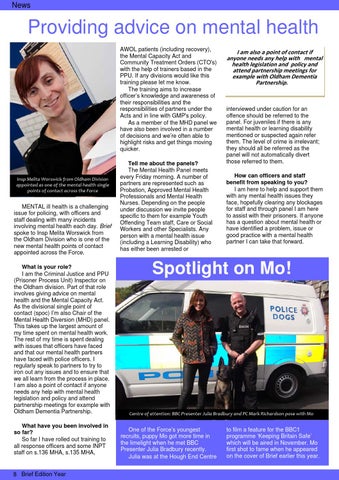
Insp Melita Worswick from Oldham Division appointed as one of the mental health single points of contact across the Force
MENTAL ill health is a challenging issue for policing, with officers and staff dealing with many incidents involving mental health each day. Brief spoke to Insp Melita Worswick from the Oldham Division who is one of the new mental health points of contact appointed across the Force. What is your role? I am the Criminal Justice and PPU (Prisoner Process Unit) Inspector on the Oldham division. Part of that role involves giving advice on mental health and the Mental Capacity Act. As the divisional single point of contact (spoc) I’m also Chair of the Mental Health Diversion (MHD) panel. This takes up the largest amount of my time spent on mental health work. The rest of my time is spent dealing with issues that officers have faced and that our mental health partners have faced with police officers. I regularly speak to partners to try to iron out any issues and to ensure that we all learn from the process in place. I am also a point of contact if anyone needs any help with mental health legislation and policy and attend partnership meetings for example with Oldham Dementia Partnership. What have you been involved in so far? So far I have rolled out training to all response officers and some INPT staff on s.136 MHA, s.135 MHA,
8 Brief Edition Year
Tell me about the panels? The Mental Health Panel meets every Friday morning. A number of partners are represented such as Probation, Approved Mental Health Professionals and Mental Health Nurses. Depending on the people under discussion we invite people specific to them for example Youth Offending Team staff, Care or Social Workers and other Specialists. Any person with a mental health issue (including a Learning Disability) who has either been arrested or
I am also a point of contact if anyone needs any help with mental health legislation and policy and attend partnership meetings for example with Oldham Dementia Partnership. ”
interviewed under caution for an offence should be referred to the panel. For juveniles if there is any mental health or learning disability mentioned or suspected again refer them. The level of crime is irrelevant; they should all be referred as the panel will not automatically divert those referred to them. How can officers and staff benefit from speaking to you? I am here to help and support them with any mental health issues they face, hopefully clearing any blockages for staff and through panel I am here to assist with their prisoners. If anyone has a question about mental health or have identified a problem, issue or good practice with a mental health partner I can take that forward.
Spotlight on Mo!
Centre of attention: BBC Presenter Julia Bradbury and PC Mark Richardson pose with Mo
One of the Force’s youngest recruits, puppy Mo got more time in the limelight when he met BBC Presenter Julia Bradbury recently. Julia was at the Hough End Centre
to film a feature for the BBC1 programme ‘Keeping Britain Safe’ which will be aired in November. Mo first shot to fame when he appeared on the cover of Brief earlier this year.