A SUPPLY CHAIN TURNAROUND
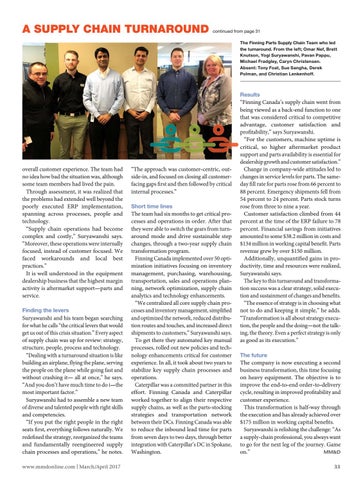
continued from page 31 The Finning Parts Supply Chain Team who led the turnaround. From the left; Omar Nef, Brett Knutson, Yogi Suryawanshi, Pavan Pappu, Michael Fradgley, Caryn Christensen. Absent: Tony Foat, Sue Sangha, Derek Polman, and Christian Lenkenhoff.
Results
overall customer experience. The team had no idea how bad the situation was, although some team members had lived the pain. Through assessment, it was realized that the problems had extended well beyond the poorly executed ERP implementation, spanning across processes, people and technology. “Supply chain operations had become complex and costly,” Suryawanshi says. “Moreover, these operations were internally focused, instead of customer focused. We faced workarounds and local best practices.” It is well understood in the equipment dealership business that the highest margin activity is aftermarket support—parts and service. Finding the levers
Suryawanshi and his team began searching for what he calls “the critical levers that would get us out of this crisis situation.” Every aspect of supply chain was up for review: strategy, structure, people, process and technology. “Dealing with a turnaround situation is like building an airplane, flying the plane, serving the people on the plane while going fast and without crashing it— all at once,” he says. “And you don’t have much time to do i—the most important factor.” Suryawanshi had to assemble a new team of diverse and talented people with right skills and competencies. “If you put the right people in the right seats first, everything follows naturally. We redefined the strategy, reorganized the teams and fundamentally reengineered supply chain processes and operations,” he notes. www.mmdonline.com | March/April 2017
“The approach was customer-centric, outside-in, and focused on closing all customerfacing gaps first and then followed by critical internal processes.” Short time lines
The team had six months to get critical processes and operations in order. After that they were able to switch the gears from turnaround mode and drive sustainable step changes, through a two-year supply chain transformation program. Finning Canada implemented over 50 optimization initiatives focusing on inventory management, purchasing, warehousing, transportation, sales and operations planning, network optimization, supply chain analytics and technology enhancements. “We centralized all core supply chain processes and inventory management, simplified and optimized the network, reduced distribution routes and touches, and increased direct shipments to customers,” Suryawanshi says. To get there they automated key manual processes, rolled out new policies and technology enhancements critical for customer experience. In all, it took about two years to stabilize key supply chain processes and operations. Caterpillar was a committed partner in this effort. Finning Canada and Caterpillar worked together to align their respective supply chains, as well as the parts-stocking strategies and transportation network between their DCs. Finning Canada was able to reduce the inbound lead time for parts from seven days to two days, through better integration with Caterpillar’s DC in Spokane, Washington.
“Finning Canada’s supply chain went from being viewed as a back-end function to one that was considered critical to competitive advantage, customer satisfaction and profitability,” says Suryawanshi. “For the customers, machine uptime is critical, so higher aftermarket product support and parts availability is essential for dealership growth and customer satisfaction.” Change in company-wide attitudes led to changes in service levels for parts. The sameday fill rate for parts rose from 66 percent to 88 percent. Emergency shipments fell from 54 percent to 24 percent. Parts stock turns rose from three to nine a year. Customer satisfaction climbed from 44 percent at the time of the ERP failure to 78 percent. Financial savings from initiatives amounted to some $38.2 million in costs and $134 million in working capital benefit. Parts revenue grew by over $150 million. Additionally, unquantified gains in productivity, time and resources were realized, Suryawanshi says. The key to this turnaround and transformation success was a clear strategy, solid execution and sustainment of changes and benefits. “The essence of strategy is in choosing what not to do and keeping it simple,” he adds. “Transformation is all about strategy execution, the people and the doing—not the talking, the theory. Even a perfect strategy is only as good as its execution.” The future
The company is now executing a second business transformation, this time focusing on heavy equipment. The objective is to improve the end-to-end order-to-delivery cycle, resulting in improved profitability and customer experience. This transformation is half-way through the execution and has already achieved over $175 million in working capital benefits. Suryawanshi is relishing the challenge: “As a supply-chain professional, you always want to go for the next leg of the journey. Game on.” MM&D 33