August 2020
YOUR GLOBAL PARTNER
In this issue:
Thinking tomorrow: Why we need sustainability more than ever and how we can create it • The future of rice processing IN A SO E M B ER F N ABI M
G R AI N O
ST
EB
#1 M
YM
WA S VOTED TRU
S T E D M I LLI N G M A G A
ZI N
Milling and Grain . Volume 131 . Issue 08 . August 2020
IN ND
• Antibiotic reduction in the poultry industry
See our archive and language editions on your mobile!
• Pre-storage silos: How many and what size? Proud supporter of
I LL
GA
• How phytogenics add value for feed producers and integrations
R E C E N T P O LL , M
Volume 131 Issue 8
millingandgrain.com
Solid.
Move up with Brock grain handling. Get your grain where it needs to go every time. Brock grain handling equipment is a step up from the standard. Our drag conveyors have solid welded flange connections for extra durability. Our bucket elevators are welded solid on the inside and outside so moisture doesn’t penetrate the trunking. Our distributors have an inverted cone design that prevents grain dust and moisture from building up. This attention to detail translates to long-lasting equipment that keeps your operation moving. Move up at brockgrain.com
+1 812.886.5500
sales@brockgrain.com
Storage | Handling | Conditioning | Structures
COMMERCIAL BINS
• 48 m Diameter Bins (20321-48262 mt) • Peak Load Rating (6804-45360 kg) • Hopper Bins (3.7 m-14.6 m)
COMMERCIAL DRYERS
• Tower Dryers (23-281 t/h) • QuadraTouch ProTM Controls • Balanced Moisture Content
STEEL BUILDINGS
COMMERCIAL SWEEPS
BUCKET ELEVATORS
COMMERCIAL CONVEYORS
• Auger & Paddle sweeps available • Capacity includes 141-281 t/h • Patented Pivot Point • Industrial Grade Pushers
• Low Impact Head Design • Heavy Gauge Trunking • Patented Squaring Plates • Support Towers
• Industrial Strength • Built To Last • Higher Elemental Resistance • Capacity includes (984-1688 t/h) • Dust-tight and waterproof • Patented hip-style weather-tight cover • Catwalks
Sukup Worl d H eadquart ers - S hef f i e ld , Io w a U SA • w w w.su ku p .co m • in fo @su ku p .co m For service in Europe contact:
Sukup Europe A/S Hedensted, Denmark Tel +45 75 68 53 11 • Fax +45 75 68 54 70 info@sukup-eu.com • www.sukup-eu.com
Pneumatic or Mechanical Ship Loaders & Unloaders Port Equipment - Turnkey Projects
Your Solution starts here ! VIGAN Engineering s.a. Rue de l’Industrie, 16 - 1400 Nivelles - Belgium Tél.: +32 67 89 50 41 • Fax : +32 67 89 50 60 • www.vigan.com • info@vigan.com
Engineered To Suit You AGI EMEA is a leader in design and manufacturing of grain storage and handling equipment. Storage, Conveyors, Elevators, Catwalks, Platforms, Temperature Sensing
For more information on AGI’s full catalog of products and solutions contact emea@aggrowth.com or +39 051 798 107
AGGROWTH.COM | @AgGrowthInl
VOLUME 131 ISSUE 8
August 2020
Perendale Publishers Ltd 7 St George’s Terrace St James’ Square, Cheltenham, Glos, GL50 3PT, United Kingdom Tel: +44 1242 267700 Publisher Roger Gilbert rogerg@perendale.co.uk International Marketing Team Darren Parris darrenp@perendale.co.uk Fred Norwood Tel: +1 405 834 2043 fredn@perendale.com Asia Marketing Team Dante Feng Tel: +886 227930286 dantef@perendale.com Latin America Marketing Team Iván Marquetti Tel: +54 2352 427376 ivanm@perendale.com Pablo Porcel pablop@perendale.com Oceania Marketing Team Peter Parker peterp@perendale.co.uk Nigeria Marketing Team Nathan Nwosu Tel: +234 8132 478092 nathann@perendale.com Egyptian Marketing Team Mohamed Baromh Tel: +20 100 358 3839 mohamedb@perendale.com Turkey, Eurasia and Middle East Marketing Team Mehmet Uğur Gürkaynak Tel: +90 537 3646457 mehmetg@perendale.com Managing Editor Vaughn Entwistle vaughne@perendale.co.uk Features Editor Rebecca Sherratt rebeccas@perendale.co.uk International Editors Dr Roberto Luis Bernardi robertob@perendale.com Professor Wenbin Wu wenbinw@perendale.com Mehmet Ugur Gürkaynak mehmetg@perendale.com Design Manager James Taylor jamest@perendale.co.uk Circulation & Events Tuti Tan tutit@perendale.co.uk Development Manager Antoine Tanguy antoinet@perendale.co.uk
80 - Pre-storage silos ISSUE HIGHLIGHTS
8
NEWS FEATURES
38 Online quality measurement 40 Agriculture in Japan
44 The future of rice processing
48 Extruders for the production of fish feed and petfood
FACES
10-31 50 Phytogenics add value for feed producers 54 Thinking tomorrow
60 Antibiotic reduction in the poultry industry 64 Multi-toxin analysis
118 People news from the global milling industry
PRODUCT FOCUS
36
CASE STUDY
94
66 Choline in animal nutrition
68 Satake in Indonesia 72 Pellet mills
76 Macro and midi ingredient weighing systems
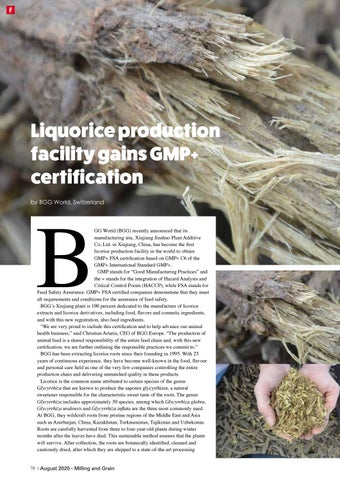
78 GMP+ certification: Liquorice production facility
EVENTS
102 Event listings, reviews and previews
STORAGE
80 Pre-storage silos 84 Can thinking smart beat thinking big?
88 Keep every grain safe with a robot that swims through grain
TRAINING
34 Bühler-KSU Executive Milling
COLUMNS millingandgrain.com ISSN No: 2058-5101 ©Copyright 2019 Perendale Publishers Ltd. All rights reserved. No part of this publication may be reproduced in any form or by any means without prior permission of the copyright owner. More information can be found at www.perendale.com Perendale Publishers Ltd also publish ‘The International Milling Directory’ and ‘The Global Miller’ news service Grain & Feed Milling Technology magazine was rebranded to Milling and Grain in 2015
10 The Global Miller 22 Mildred Cookson
8 GUEST EDITOR Felix Tometten
96 MARKETS John Buckley
116 INTERVIEW Mr Hao Bo
COVER IMAGE: Thinking tomorrow: Why we need sustainability more than ever and how we can create it, by Dr. Eckel - page 54
Despite uncertain times, we continue to innovate We are going through uncertain and insecure times right now. While we soldier on during the COVID-19 pandemic, many companies have been forced to slow down and adjust their working routines in order to accommodate the changes they are facing. The health of workers is a top priority, as should quite rightly be the case; and thus many companies have to resort to having employees work from home or taking on tasks in other, unique and unforeseen ways.
Felix Tometten
At Amandus Kahl, we have been incredibly lucky, however, that we are able to continue working just as efficiently as before. Our teams continue to produce innovative solutions ensuring sustainability and top quality in the feed industry. We can proudly say that we at Kahl are still producing brilliant solutions that we cannot wait to present to our customers. One of these solutions is the Kahl crown expander, which expands compound feed or individual components. This allows expanded products to be produced for all animal species. The aim of the engineers at Amandus Kahl was to design a new expander based on the internationally renowned Kahl annular gap expander, equipped with a shaping device at the outlet as well as a cutting device. An important component of the annular
Session 4
Steam and Conditioning August 5, 2020
gap expander also remains unchanged in the crown expander: The specific mechanical energy input (SME) can be adjusted by means of the moving cone, which is moved into the crown tool by a hydraulic piston. The pressure is approximately 40 bar; the operating temperatures at the expander outlet are between 90 and 160°C. When the product leaves the tool, there is an abrupt drop in pressure, the product expands and some of the water evaporates. With the help of the variable knife drive or different crown shapes, it is possible to influence the structure of the expanded product. The SME control with hydraulically adjustable cone ensures a significant improvement of the flexibility of expansion. Contrary to traditional pelleting, coarse particles remain coarse with the Kahl crown expander. The thick-walled mixing tube is equipped with replaceable liners and a cantilevered shaft provided with proportioning, mixing and kneading elements. Existing Kahl annular gap expanders can easily be modified to crown expanders. The treatment of grain components under pressure at a high temperature and moisture content modifies starch. Pathogenic germs, such as salmonellae or moulds, are eliminated by the treatment in the crown expander. Expanded mixtures increase the press capacity. We at Amandus Kahl have designed and manufactured expanders for several decades and have a high level of expertise in this process technology. Based in Germany, we manufacture machines, individual parts, spare and wear parts exclusively in Germany. Visit our website for more information and an overview of the Kahl machine repertoire. Felix Tometten, Research and Development: Animal Nutrition, Amandus Kahl GmbH, Germany
Session 5
Mixing Operations
August 12, 2020
CORN
How many and what size?
Pre-storage is a set of single or multiple silos which are located in-between grain receiving pits and cleaning sections of a grain storage facility.
Maintaining high quality and increasing profitability with Bühler’s proven technology
PELLET MILLS
YOUR GLOBAL PARTNER
PRE-STORAGE SILOS
Online quality measurement in corn processing
PAGE 38
www.onlinemillingschool.com
PAGE 80
FOOD
STORAGE
FEED
PROCESS
EXTRUSION
Scaling up to boost operational efficiency
The Aquafeed Extrusion Conference
Famsun recently rolled out a 70t/hr pellet mill to help feed producers tackle sustainability challenges.
On July 8-9th, 2020 the fourth edition of the Aqua Feed Extrusion Conference took to the stage, teaching attendees how to optimise their feed processing systems.
PAGE 72
PAGE 104 Annual Subscription Rates Inside UK: UK£100 Outside: US$150/€133 Milling and Grain has a cooperative partnership with COFCOET
More Information www.millingandgrain.com http://gfmt.blogspot.co.uk
Milling
News
The Rongorongo Live Lounge recently hosted Yiannis Christodoulou, Director of Progressus Agrischools in Asia. This interview is an especially exciting one for us, as Mr Christodoulou discusses the new jointinitiative between Progressus Agrischools and Milling and Grain to set up 'The Online Milling School' with 'Credo' as its management team. The Online Milling School is a series of webinars that provide attendees with key information to enhance their skills in relation to all stages of feed prodyctiom. Attendees can update themselves with the latest technologies and machinery innovations for feed plants.Each presentation takes the time to review key milling operations and gain ideas and knowledge that help further improve the feed production process, allowing for learning and development without having to leave your workplace. Short sessions that are spread across a period of several weeks allow attendees to accommodate for busy schedules. The webinars are aimed at feed mill plant owners, mill managers and operators, quality assurance and maintenance staff, nutritionists and feed formulators as well as consultants as feed additive and animal health suppliers.
mymag.info/e/886
July was an especially busy month for the Milling and Grain team, as many of our exciting projects came to fruition. On July 8-9th, we hosted our first ever online rendition of the Aqua Feed Extrusion Conference, an event that we typically hold at VIV Asia on a yearly basis. The event, co-organised by Milling and Grain, VNU Exhibitions and Dr Mian Riaz of Texas A&M University featured ten expert speakers from companies such as Andritz, Clextral, Famsun, CPS, Reynolds Engineering and more, each providing an in-depth analysis of various stages of the extrusion process as well as aqua feed production in general. Topics ranged from managing nutritional wastes to the benefits of both single-screw and twin-screw extrusion and operational excellence in running your feed production facility. Our detailed conference report can be read later in this issue. With the continuing uncertainty surrounding COVID-19, it is clear that digital events are gaining significant popularity, and possibly will even be here to stay once normal exhibitions and conferences are able to resume. We also hosted the very first rendition of the Online Milling School, a joint venture between ourselves and Progressus Agrischools. The Online Milling School, which we now host under the umbrella name Credo, is a set of weekly e-learning experiences for industry members wanting to learn more about each individual stage of the feed milling process. Our first online event specialised in efficient grinding and featured expert speakers Finn Jensen, a consultant who has worked with a variety of feed companies in the past such as Andritz, as well as Malcolm Gresswell, who has over 46 years of experience in the food processing field. The event was also moderated by Jon Ratcliff of Agentis Innovations, as well as Yiannis Christodoulou, Director of Progressus and Roger Gilbert, Publisher of Milling and Grain. The Online Milling School will run on a weekly basis and features a wide variety of topics. Week three on July 29th will cover ‘Batching Operations’, week four on August 5th will explore ‘Steam and Conditioning’, week five on August 12th is concerned with ‘Mixing Operations’, and these continue through until the end of September. Each course is only US $30, or you can gain complete access to the full list of webinars for $330. To find out more please visit: mymag.info/e/875
See more videos from all aspects of the industry at millingandgrain.com/videos
10 | August 2020 - Milling and Grain
gfmt.blogspot.com
THE FASTEST FLUTING MACHINE EVER MADE RETURN SPEED 105 M/MIN FLUTING SPEED 30 M/MIN Fluting Machine FL-300/1500
ADVANTAGES The fastest fluting process
Return speed 105 m/min. Cycle time -38% Less
Conical rolls possibility
Chamfering
Cutting 0 - 30 m/min
Less machine surface -30%
Stationary roll Moving tool
Return speed 105 m/min Cutting
Lower speed in-and-out fluting
Lifetime tool up/ less break out material
V Speed diagram
Adjustable cutting depth during operation
Single - and multitool
Option Steady rest with digital read-out
Option automatic length compensation of the tool
Fast exchange of tools with VDI toolholder
Option integrated OFT Profilometer Balaguer
GLOBAL SOLE DISTRIBUTOR
www.balaguer-rolls.com Facebook
Youtube
Live visual process control with camera
Option remote access with mobile phone or PC
The software which guarantees the shortest and easiest work preparation
Milling News
Biomin warns of high levels of deoxynivalenol in upcoming European corn and wheat harvest
I
nnovative animal nutrition firm Biomin has released the results of statistical analysis revealing that many parts of Europe can expect potentially harmful levels of mycotoxin contamination in the upcoming 2020 corn (maize) and wheat harvest. One major trend identified in the firm’s first-ever forecast of mycotoxin occurrence is that deoxynivalenol, or vomitoxin, has a high probability to exceed a risk threshold level of 150 parts per billion (ppb) in corn in Central, Eastern and Southern Europe, and a similarly high probability to exceed 150 ppb in wheat in Northern Europe. The forecast is based on a proprietary mycotoxin prediction tool that delivers daily assessments of expected mycotoxin levels in corn and wheat harvests. “Our aim with the Biomin Mycotoxin Prediction Tool is to provide an assessment of likely mycotoxin occurrence as accurate as your daily weather forecast,” explained Dr Timothy Jenkins, Development Scientist at Biomin. The Mycotoxin Prediction Tool uses sophisticated algorithms that draw upon 15 factors and the extensive proprietary data set compiled through the Biomin
12 | August 2020 - Milling and Grain
Mycotoxin Survey, the longest running and most comprehensive survey of mycotoxin occurrence in animal feed worldwide. “Weather is the single most important factor in terms of predicting mycotoxin occurrence, and it dominates the reasons for year-to-year fluctuations in mycotoxin patterns we observe in a given region,” stated Dr Timothy Jenkins, Development Scientist at Biomin. The Mycotoxin Prediction Tool can be useful for feed and animal protein industry professionals, including integrators, nutritionists, crop farmers, livestock growers, raw commodity purchasers and quality assurance and control professionals, by offering an early indication of the risk of mycotoxins in crops and feed. “Since 2004, customers have been highly appreciative of the service and insights that the Biomin Mycotoxin Survey represents,” noted Ms Ursula Hofstetter, Head of Global Product Management Mycotoxins at Biomin. “Leveraging our unmatched data set to help customers be better prepared is a logical extension of our commitment to delivering the best mycotoxin risk management anywhere.”
Milling News
4B: Providing for customers with their innovative elevator bolts
A
grain storage facility of a large North American trading company was concerned that the bolts used to secure the overlap splice section of an elevator leg belt were prone to pull through. The nature of an overlap splice generates additional stress on the bolts in many ways. The two layers of belting are subjected to uneven contact force from the drive pulley. This makes the inside belt flex more than the outside belt. Additionally, the weight of the loaded elevator buckets pulls on the splice bolts. The bolts can snap, or the heads can pull through the belt. A compromised belt splice can diminish efficiency and in the worst case, drop a fully loaded belt with buckets down the elevator leg casing and into the boot. The solution was twofold and encompassed using 4B brand Reference 70 elevator bolts. The elevator buckets
De Heus Animal Nutrition boosts growth in Poland with acquisition of Golpasz
O
n July 1st, 2020, De Heus Animal Nutrition signed an agreement for the acquisition of the Polish compound feed company Golpasz (annual production capacity of 500,000 tonnes of compound feed). The acquisition is still subject to approval from the Polish Office of Competition and Consumer Protection (UOKiK). Adam Zaleski, General Manager of De Heus Poland commented, “Both companies perceive many mutual benefits in the new partnership. De Heus and Golpasz have high-quality specialised knowledge in animal nutrition, animal husbandry and livestock farming. These competences
14 | August 2020 - Milling and Grain
normally secured to the belt used 5/16” diameter bolts. 4B Components supplied larger 3/8” diameter bolts for use on the overlap splice. The larger diameter bolts have a greater tensile strength to tolerate the environment of an overlap splice. Secondly, the Reference 70 bolts incorporate a unique oversized oval washer into the bolt head, which covers a large surface area on the belt, therefore spreading the pull-through force over a greater surface area. No other style of elevator bolt is able to cover such a large area of belt.
enable both companies to develop and supply tailor-made (nutritional and business) solutions in line with requirements and demands of their farming customers. “Combining strengths will accelerate further improvement in this area. In addition, Golpasz has gained highly specialised knowledge in the area of turkey nutrition, which is of added value to De Heus. Furthermore, Golpasz will also obtain access to De Heus’ international network and expertise centre, providing Golpasz the opportunity to enrich its knowledge and use it to accelerate product innovation initiatives, among other things” Wiesław llków, General Manager Golpasz, is also looking forward to the future, “Thanks to the combination of De Heus Poland and Golpasz, we will be able to continue development in those segments of the market where
we already operate. We will use our combined knowledge and experience to serve our clients even better, as we know continuous improvement of efficiency is key to success. Both our clients and employees will benefit from the worldwide operating activities of De Heus.” All the necessary documents have been passed to the Polish Office of Competition and Consumer Protection (UOKiK) for approval. Both companies will perform in an unchanged manner until a formal decision has been made by UOKiK.
Milling News
Milling and Grain - August 2020 | 15
Milling News Image 1: Outside view of the Food Application Centre (FAC) in Minneapolis
Andy Sharpe, CEO, Bühler North America
Yannick Gaechter, Director Food Application Centre
Bühler opens new Food Application Centre as collaboration venue for creating the future of food
B
ühler recently opened its new Food Application Centre (FAC) as the crowning moment of Bühler GO! 2020, its virtual networking and engagement event for food industry leaders. At this state-of-the-art centre, Bühler aims to support and drive innovation among its customers, start-ups, academia, and industry partners to create economically viable and sustainable food value chains in North America. The solutions developed there will help feed a growing population of nearly 10 billion people in 2050. “The FAC is a place for learning how to create and process new products, new protein sources, and new ways to strengthen our food supply chains,” says Andy Sharpe, CEO, Bühler North America. Drawing on over 160 years of food processing expertise, the FAC was created to develop new methods of transforming pulses, peas, beans, oats, ancient grains, maize and many other crops into new food solutions such as flours, snacks, pasta, cereals and a myriad of extruded products, including plant-based meat analogues. As a new product and process development venue, the FAC features the latest in raw material processing and handling systems, capable of taking those raw materials through to finished product, ready for packaging, bringing a product from farm to fork, or from bean to burger. “The FAC is a playground for the food industry, built to foster collaboration between food processing companies and other industry organisations, who, working sideby-side with Bühler’s processing experts, can test their business ideas, perfect them, and successfully bring them to market,” says Yannick Gaechter, Bühler’s Food Application Centre Director. Learning and education is at the core of the FAC. Bühler views the new facility as a place for instructing and understanding technology, food processing, food safety, digitalisation, and many other topics. Additionally, the
16 | August 2020 - Milling and Grain
FAC will act as a training ground for food processing companies wanting to educate their operations and maintenance staff on efficient processing and best practices. “The new FAC stands ready to welcome innovative food processors and other interested organisations, to collaborate, create, and perfect new and sustainable food products as we all address the quickly changing demands of consumers’ diets,” said Mr Gaechter. Image 2: Inside view of the FAC. It was created to develop new food solutions such as flours, snacks, pasta cereals and a myriad of extruded products, including plant-based meat analogues
Image 3: The new FAC stands ready to welcome innovative food processors and other interested organisations to collaborate, create and perfect new and sustainable food products
Image 4: The FAC will act as a training ground for food processing companies wanting to educate their operations and maintenance staff on efficient processing and best practices
Christiane Girard receives AFIA-ADSA nutrition research award
T
he American Feed Industry Association (AFIA) has congratulated Christiane Girard, PhD, of Agriculture and Agri-Food Canada, for receiving the 2020 AFIA-American Dairy Science Association (ADSA) Nutrition Research Award. The associations recognised Girard during the virtual ADSA annual meeting earlier this week. Created to honour outstanding research in dairy cattle nutrition, the award recognises an individual who has made a worthy contribution to dairy cattle nutrition research within the 10 years immediately prior to the year of the award. Dr Girard is a research scientist at the Sherbrooke Research and Development Centre, Agriculture and AgriFood Canada. Her work on B vitamins has challenged the generally accepted concept that dairy cows’ vitamin requirements for B vitamins do not have to be taken into account because their synthesis by the rumen microflora is sufficient to prevent deficiency symptoms. Her work has made an outstanding contribution to improving the estimations of supply and requirements of B vitamins. In a perspective of precision farming to optimise metabolic efficiency, meeting dairy cows’ requirements for B vitamins cannot be overlooked. “Dr Girard’s work with B vitamins has clearly led the path and made a tremendous impact on the dairy industry,” said Paul Davis, PhD, AFIA’s Director of Quality, Animal Food Safety and Education. “Her passion and dedication toward improving dairy nutrition made her a great choice for this year’s award.”
YOUR GLOBAL PARTNER
Want more industry news? Get weekly updates from the feed and flour milling industries with our email newsletter!
myMAG.info/e/289
Milling News
Made in Britain, Trusted Worldwide. We are
INS CTOMAT ®
5k
Insect Detector
Discover more www.samplex.co.uk
Milling and Grain - August 2020 | 17
Milling News
Mondi invest €7 million in food packaging facility in Hungary
M
ondi, a leading packaging and paper group, has successfully completed the implementation of a new state-of-theart paper sack converting machine at its Nyíregyháza site in Hungary. The machine, a Windmöller & Hölscher AD 8320/AM 8115, allows the plant to produce a new line of sophisticated paper sacks for food packaging. The site will be capable of producing more than 130 million sacks annually. The Mondi Nyíregyháza plant, which employs more than one hundred people, serves the Hungarian, Romanian, Austrian and Bulgarian
18 | August 2020 - Milling and Grain
market in many industries and sectors. It produces industrial paper sacks (open mouth and valve bags) for applications such as cement, building materials, food-feed-seed, chemicals and pharmaceuticals. Péter Szabó, Managing Director, Mondi Bags Hungária commented, “Our goal is to serve our customers’ needs with excellence, so we focused on increasing the plant’s quality and hygiene standard to be able to produce high-end and sophisticated paper sacks for food. This investment means we are able to enhance our operational efficiency, as well as offering shorter delivery times to our customers. Our
ambition to open this line did not diminish despite the beginning of the health pandemic. Working with revised health and safety measures in place, I am very proud of my team’s determination to execute this project and deliver this complex product portfolio.” Due to this €7 million investment, the entire layout and set-up of the Nyíregyháza plant was re-designed in four months, including the storage area, printer area, warehouse, and ink kitchen to increase operational efficiency and safety. The plant is now in the process of seeking the Hazard Analysis and Critical Control Points (HACCP) certification by the end of this year in order to serve the food, feed and seed industry with sacks that meet their high quality and hygiene standards.
Milling News mission is strongly intertwined with our client’s business development. Introducing this new look, our goal is to provide a clear picture of where we are and where we are heading to. We want to offer to all our stakeholders a straightforward message of what VIV worldwide exactly represents. At the same time, we make sure we keep consistent with the well-known VIV identity,” explained Mr Stutzinger. VIV worldwide will keep its core identity. On the other hand, the rebranding envisions an empowerment of each single platform by providing them with unique and characteristic visual features that make each show easily recognisable. The VIV network consists of hub events and international events. In a very complex business environment, VIV aims at providing a clear and attractive design. “That’s how the VIV MEA logo shapes out from the hosting city skyline; the VIV Europe visual generates from the power of a ‘Dutch’ wind turbine; VIV Asia logo affirms the show’s prestige standing tall with its Asiatic-style stupa; VIV Turkey identifies via an unmistakable Maiden’s Tower; VIV Qingdao logo
VIV Worldwide takes-off with a fresh look
T
he VIV mission to link professionals from feed to food continues and evolves, looking confidently into the future. In the midst of these very dynamic and challenging times, the VIV organisation takes the opportunity to improve its communication scheme. Looking at the encouraging news from the world with business being restored and country borders being gradually reopened after months of uncertainty, VIV is giving its branding and design a compelling new look. Much has happened within the VIV portfolio and organisation in the recent years: events grew in size; market shares shifted amongst world regions, new territories were explored, more initiatives were launched and new partnerships have been established. “During the pandemic peak period, we took the time to consolidate our existing brand architecture” says Heiko M. Stutzinger, Director of VIV worldwide. “The VIV worldwide 杂志广告20200316.pdf 1 20-3-16 下午4:02
September
remarks its solid presence in China via a dynamic version of the Great Wall. Likewise, the lotus national flower defines the ILDEX Vietnam logo identity; while ILDEX Indonesia is represented by the Borobudur national landmark. Poultry Africa logo keeps its focus on the specie element bringing within its new brand-scheme the already established feather chicken visual”, says Elena Geremia, Senior MarCom manager of VIV Worldwide. The VIV Online platform maintains its role as a year-long connection between the show dates and regions, and the logo says exactly this: VIV Online is there for the industry 24/7, non-stop. Finally, all visuals share a common and unique feature: the VIV ‘diamond’ frame-shape, highlighting the ties that each show and platform constitute within a complete and interconnected VIV portfolio and feed to food network. New ways of doing business are developing constantly, not only fuelled by COVID-19 challenges, within the exhibition and animal protein production industry. In a time of changes, VIV works and focuses on continuous improvement.
China
700+
60,000
30,000+
Exhibitors
Exhibition Area
Visitors
M
150+
120+
20+
Y
Media
Delegations
Conferences
C
NEW
NEW
CM
MY
CONCURRENT EVENTS
CY
• VIV International Summit 2020
CMY
K
• The Third Farm and Food Integration Forum
• The Second Global Pig Genetics Summit
• Aquatic China 2020
• International Antibiotic-Free T20 Summit 2020
• International Poultry Innovation Outlook Forum
• VIV Qingdao Dairy Forum • Match-Making
• InnovAction Campaign
• Hosted Buyer Program
• 20th Anniversary Celebration
REGISTER TO VISIT www.vivchina.nl/visit/registration CONTACT US SALES
MARKETING & MEDIA
CONFERENCE & EVENT
BUSINESS DEVELOPMENT
Ms. Sylvia Shan sylvia.shan@vnuexhibitions.com.cn Mob: +86 183 0213 3457
Ms. Kandy Tang kandy.tang@vnuexhibitions.com.cn Mob: +86 135 6416 7785
Ms. Snow Bai snow.bai@vnuexhibitions.com.cn Mob: +86 139 1737 2737
Ms. Isabel Yuan isabel.yuan@vnuexhibitions.com.cn Mob: +86 134 7260 2614 www.vivchina.nl
20 | August 2020 - Milling and Grain
Milling News The roller floor
Messrs John Draper and Sons’ St Leonards Mill
A
by Mildred Cookson, The Mills Archive, UK
Milling journals of the past at The Mills Archive
n item in The Miller (March 3rd, 1913) introduced the Cooper’s auto-Puro plansifter system which had been recently been installed by milling engineer GW Cooper of Romsey, Hampshire at the St Leonards Mills near Hastings. The milling business at St Leonards was started in 1849 by the father of the then head of the firm, when a good windmill was the first step in a successful milling career. The windmill in question was a substantial wooden smock mill, originally at Croft Road Hastings and moved to nearby Silverhill in 1838. It was taken over by William Draper in 1850 and destroyed by fire seventeen years later along with the large stock of wheat and flour. The following year the windmill was rebuilt by John Upfield and for the following 79 years it dominated the skyline of Silverhill remaining in the hands of the Draper family until 1946. The mill was sadly demolished in 1966. John Draper succeeded his father but was too progressive to be satisfied for long with the capacities of a windmill, so in 1887 he built the mills situated close to West St Leonards railway station and installed a roller plant using the latest lines of the time. Always striving for perfection, he several times had his mills remodelled and extended and took on his two sons, Bernard and William Norman, into the partnership with him. The basement of the mill contained the ordinary line shafts for driving the double row of rolls on the floor above, as well as the 22 | August 2020 - Milling and Grain
elevator bottoms. In 1913 a number of the elevators were out of use as the new system had made them redundant. On the first floor were two lines of roller mills; these had not been altered except the feeds to them had been rearranged. The fluting on the brake rolls was a special design by Mr
Advertisement in 1913 for The Cooper Plansfiter System
The Draper father and two sons in 1913
Cooper to suit the requirements of his system. The wheat was treated on a system of three breaks with a special machine which dealt with it prior to it entering the first break rolls. This enabled them to release 67 percent of the stock. The remaining 33 percent, going to the succeeding break, was described as “strikingly broad and un-cut-up bran stock�. The second break rolls left very little to be done by the third and final break. The roller process was divided into three breaks, four reductions and scratch rolls. All the purifiers and centrifugals, with the exception of one of the latter used as a bran finisher, had been removed and replaced by two double plansifters supplied by Mr Cooper. The three breaks were scalped dusted and graded, each on a section of a plansifter. This then meant that the first break stock was sifted, with the overtails going to the second break.
Your partner for industrial process automation Our solutions: Design and engineering Build and installation MCC and PLC panels Software engineering PLC/SDADA MES application Batch Explorer Integration to other software packages Turn Key installations incl. training, service & support
Scan the QR-Code to discover our solutions! www.inteqnion.com
Silverhill windmill being demolished in 1966
Branny semolina was separated and sent to rolls. The lower sieves dressed the semolina, middlings and dunst thoroughly free from break flour and then passed them on to three pairs of 30x10-inch rolls. The second and third break stocks were treated much in the same manner, only that the grading and distribution of the granular materials was varied in accordance with their quality and size. The earlier purifier floor was now quite free from machinery, and had only elevators and spouts passing through. This meant that good falls were obtained from sifter to rolls without the need of worms. Mr Cooper was said to emphasise that the two plansifters were doing the work previously done by 16 reels and centrifugals and they took up very little room. All semolina, middlings were quite free of flour and thoroughly dusted.
Our directory, now in its 28th incarnation, has continued to provide those in the food and feed industries with the best source for contacts from around the globe. Every year, our directory only continues to expand, and new companies are joining all the time. The International Milling Directory reaches a massive group of industry experts and customers, as we regularly distribute copies worldwide at trade shows and various events.
28TH EDITION OUT NOW! www.internationalmilling.com Milling and Grain - August 2020 | 23
Milling News
Silverhill windmill in full working order in the 1930s
The plansifter floor
The plansifters ran without the least vibration and showed the internal brushes were working properly and keeping the meshes of the silk free. The guaranteed capacity of the mill was six sacksper-hour, but it often was turning out six and a half quite easily. The system of rolls and plansifters was thoroughly exhausted and the finish of all spouting in the mill “left nothing to be desired”. Motive power for the mill was provided by a pair of suction gas engines, which ensured a great saving in the energy required.
PCE
St Leonard’s Mills were the fifteenth mill where Mr Cooper had erected his auto-puro system, although previous ones employed centrifugal dressing. They were soon to be followed by others in various parts of the country on this same system.
www.millsarchive.org
si
nce 1963
PELLETING CONSUMABLES EUROPE
For more than 50 years!
YOUR PARTNER FOR TOP QUALITY RING DIES available for all major pellet press brands
Ecological heat treatment
DEBUGGER … the natural pest control method • Guaranteed removal of insects in all stages of development • No chemical substances required • Easy to perform Scan the QR-Code to find your die!
WWW.PCE.EU 24 | August 2020 - Milling and Grain
• Cost-effective and efficient
FrigorTec GmbH • info@frigortec.de • www.frigortec.com
Milling News
New Zealand farmer breaks his own record with amazing wheat crop
A
few years ago, Milling and Grain magazine reported on Eric Watson, a farmer from Ashburton in Canterbury, New Zealand when he set the Guinness World record of for the highest wheat yield with a crop of 16.791 tonnes-perhectare in 2017. Mr Watson has just broken his record, producing a whopping 17.398 tonnes per hectare, much higher than New Zealand’s national average of 12 tonnes per hectare. Mr Watson spoke to Stuff, a local media outlet about his achievement, “While we were thrilled with the record result in 2017, we saw ways in which we could make improvements and achieve an even higher yield. By trying new cultivars, switching to liquid nitrogen and monitoring plant health more regularly we were able to achieve another incredible result. The farm has produced several high-yield wheat crops in recent years and Watson said he is pleased with a year-on-year increase of 100-200 kilograms-per-hectare. So, to beat my last crop by almost 600kg/ha exceeded even my hopes.” The wheat was planted in April 2019 and harvested on February 17th, 2020, the kerrin wheat is likely to be used to feed beef or dairy cattle. Much like for Mr Watson’s previous record, Bayer Crop Science have worked closely with him in achieving these results. According to the Foundation for Arable Research, New Zealand farmers harvest approximately 400,000 tonnes of wheat each year.
YOUR GLOBAL PARTNER
Want more industry news? Get weekly updates from the feed and flour milling industries with our email newsletter!
myMAG.info/e/289 26 | August 2020 - Milling and Grain
CIMBRIA.COM
MUCH MORE THAN FULL-COLOR SORTING
Global leader in the development of electronic sorters, combining the Full-Color RGB and infrared vision systems, to secure healthy and top quality grains, seeds and pulses.
CONVEYING | DRYING | SEED PROCESSING | ELECTRONIC SORTING | STORAGE | TURNKEY | SERVICE
CIMBRIA SRL Via Colombarotto 2 40026 Imola (BO) Italy +39 0542 361423
seainfo@agcocorp.com www.cimbria.com www.seasort.com
The Rex Wailes Collection The Power of the Press: How it changed our landscape (with some help from Rex Wailes) by Mildred Cookson, The Mills Archive Trust, UK I wrote in the June issue of Milling and Grain that Rex on his return from the USA “discovered an article in the Daily Mail on June 17th, 1929 entitled ‘Our Vanishing Windmills: How you can help save them’. This was to change his life and that of many others.” A hundred years ago, Spanish Flu had infected one third of the world’s population and killed 50 million people, more than the recently ended First World War. These two disasters had killed off or incapacitated a disproportionately large number of working-class men. The social impact of this twin cataclysm has been welldocumented from the loss of great poets to the gradual empowerment of women. What can easily be forgotten was the impact on small mills, particularly in rural areas. During the War these, mainly small family businesses, survived with the help of the elderly and the female members of the family and the local community. However, ten years later a lost generation of wouldbe millers and the increasing needs for repairs meant that many traditional mills had ceased working and were vanishing from England’s picturesque landscape. The Daily Mail appeal prompted a national upsurge in interest in windmills and the work of the Society for the Protection of Ancient Buildings (SPAB). Rex’s collection includes his copy of the original appeal and a carbon copy of his letter a fortnight later offering to help the SPAB. Ten years later The Hertfordshire and Essex Observer 28 | August 2020 - Milling and Grain
carried an extensive article praising Rex Wailes’ work. Since 1929, the Society’s newly formed Windmill Section had handled 201 cases, repairing 42 mills under Wailes’ direction and fundamentally changed the public outlook. The plan to protect the windmills of Great Britain had been transformed “from the most forlorn of lost causes” to be regarded as a normal and reasonable undertaking. Generous donations from Messrs Spillers and Joseph Rank were acknowledged as making an enormous difference and the increased help given by Local Authorities was seen as a good sign. The day after this optimistic article appeared, Britain declared war on Germany.
When it Comes to Aquafeed Production Carefully Choose Who You Partner With for Equipment Solutions MAX.
393.31 [9990]
MAX.
391.31 [9939]
15.00 [381]
Ă12.00 [305]
MIN.
29.19 [741] F085 SHIMPO
36.91 [937]
31.19 [792]
MIN.
67.28 [1709] 39.00 [991] 101.44 [2577]
30.38 [772] BIN Inlet
DCC Inlet
End of Head
CYL. Disch.
1.93 [49]
In the aquafeed business, you either 18.00 [457] sink or swim. 1.00 Contact Extru-Tech NPT today at 785-284-2153 or visit us online at www.extru-techinc.com
Extru-Tech Offers Smooth Sailing [6855] 3 _ Purpose Built Aquafeed Equipment Solutions 3 Floating or Sinking Feeds from a _ Single System 3 Advanced Densification _ Technology 199.38 [5064] 3 _ Consistent Sub 1.0mm Feed with No Waste 3 Team of Professional Aquafeed _ 12.56 [319] Equipment Specialists 15.88 [404] 24.59 [625]
03 54
51
06
0
15.00 [381]
269.88
What the Competition Offers
3 _ High Maintenance 3 _ Many Promises 3 _ Limited Capacity
19.16 [487]
64.83 [1647]
108.59 [2759]
30.00 [762]
256T
108.28 [2750]
P.O. Box 8 1.00 NPT [STEAM] 100 Airport Road Sabetha, KS 66534, USA 57.69 Phone: 785-284-215366.50 [1465] [1689] Fax: 53.25 785-284-3143
2.00 NPT [WATER]
2.00 NPT [STEAM]
3/4 NPT
2.00 NPT 80 NORGREN
0
88.00 [2236]
160
extru-techinc@extru-techinc.com www.extru-techinc.com 48.00
MAXUM SIZE 10
[1219]
ET-302.indd 1
102.13 [2594]
52.19 [1325]
2
278.03 7062]
Milling News
[1353]
Milling and Grain - August 2020 29 AM 2/2/18 | 10:01
284.00 [7214]
Milling News
AB Vista publishes ‘An introduction to Fibre Analysis using NIR’
A
B Vista has produced a new reference guide which provides poultry and swine producers with an introduction to the benefits of moving from conventional fibre methods (i.e. crude fibre and NDF) to total dietary fibre analysis using Near Infrared Reflectance (NIR) technology. The guide contains the results of non-starch polysaccharide (NSP) analysis of feedstuff samples from around the world and is being published in conjunction with the launch of a new NSP analysis feature within the AB Vista Feed Quality Service. The NSP analysis service gives nutritionists the ability to analyse the NSP content and its fractions (soluble and insoluble) within customers’ raw materials. AB Vista’s Head of Global Technical, Gilson Gomes said, “We anticipate that the level of interest in the fibre fraction of the diet is likely to increase due to a variety of different factors, some examples include: nutritionists looking to replace soybean meal, consideration for using more local ingredients and the desire to improve gut function through the use of more fibrous ingredients.
“With this in mind, we believe that an improved knowledge of fibre composition is needed in order to effectively employ nutritional strategies which can serve to boost fibre fermentation by the gut microbiota, thereby positively influencing the host metabolism and overall performance. “Traditionally, many nutritionists have given little or no attention to understanding fibre composition and content in monogastric diets. This has led to a misconception among some nutritionists who often consider the fibre content of monogastric diets to be low. Our new NIR analysis service will enable us to analyse the level of NSP and suggest feed strategies for customers to get more from their fibre fraction. “NIR is a well-established method for analysis and quality control of ingredients providing fast and inexpensive analysis. Results of NSP calibrations for feedstuff have shown that it is possible to predict NSPs for a range of feedstuffs.” AB Vista will continue to develop its service offering, with results of lignin being incorporated soon to provide total dietary fibre (NSP + lignin) analysis. The guide illustrates NSP variation in barley, canola meal, corn, soybean meal, sorghum, and wheat. Producers and nutritionists can request a free copy of the guide from their regional AB Vista representative or via the website.
Scan the QR-Code for more information www.almex.nl
EXTRUSION AND EXPANSION TECHNOLOGY YOU CAN TRUST » » » »
Pet Food extrusion (floating) Aquafeed extrusion Animal Feed extrusion Oil seed extraction
» Cereal processing extrusion » Compacting » Pre-conditioning prior to other processes
www.almex.nl 30 | August 2020 - Milling and Grain
WE PROVIDE
COMPLETE SOLUTIONS FOR ALL TYPES OF CEREALS Our quality and reliability expands to 90 types of equipment that we produce and supply from Gaziantep to the World.
We Earned Our Name From Our Work..
• Cleaning • Moisturizing • Grinding • Transport • Packaging • Installation • Electricity and Automation Equipment
asggruptr @degirmenmakina @degirmenmakina
4. Organize Sanayi Bölgesi 83404 Sok. No: 6 Şehitkamil / GAZİANTEP - TÜRKİYE Tel: +90 342 357 01 50 (10 hat) info@degirmen.com
www.degirmen.com Milling and Grain - August 2020 | 31
www.golfettosangati.com info@golfettosangati.com
Mill
TRAINING
The objective of the course is to understand the underlying principle of the milling process and the parameters that can be influenced by either the raw material or the milling system; understanding the challenges of the operating staff; and learning which critical control points to check in order to judge whether an operation is running well.
Bühler-KSU Executive Milling Course topics include raw material (kernel structure, influence of wheat characteristics on yield and mill performance, usage of various types of wheat for different finished products); cleaning systems (special systems for Mycotoxin reduction and top quality
Through hands-on training and classroom discussion at the IGP Institute, participants will learn flour and dough analysis practices and methods and correct interpretation and understanding of the results through this course.
IAOM-KSU Flour and Dough Analysis Experts from the equipment manufacturers and suppliers and Kansas State University faculty will train and educate participants to understand commonly used flour testing equipment and dough testing equipment in the industry today, understand proper testing procedures and methods for the equipment, understand
Milling and Grain magazine, along with Progressus Agrischools, has set up the Online Milling School. It is currently hosting a series of 12 1.5-2-hour sessions discussing various critical aspects of the feed milling operation. Over 400 participants registered for the first free-of-charge introductory session. Subsequent sessions cost US $30/each to attend with a complete course fee of US $330.
Milling and Grain and Agrischools of Asia establish The Online Milling School The ‘Livestock Feed Milling Course’ will roll over so that students can join at any time and still gain 12 Course Credits towards their Certificate of Attendance which will be issued on completion. The Online Milling School is managed by the Credo Team. “This is a key initiative by both Progressus and Perendale to bring learning and knowledge sharing to the factory floor and to the locations of those who might otherwise not have access to a better understanding of processes,” says Roger Gilbert, publisher of Milling and Grain Magazine and CEO of Perendale Publishers Ltd. “Each course will be held on a Wednesday live at 14:00 Bangkok Time (09:00 WET) and repeated in a re-broadcast to reach North and South American students on Fridays at 14:00 CDT. 34 | August 2020 - Milling and Grain
flour production, machine and flow sheet technology, system design and various tempering philosophies, practical in the Hal Ross mill); milling system (description and function of milling machines, basic flow sheet technology, basics in starch damage, practical in Hal Ross mill; break release, adjustment of purifiers and roll stands, sample analysis); finished product handling and storage (batch mixing versus continuous mixing systems, basics in flow quality, product safety and quality control); performance evaluation in a flour mill, factors that influence an investment decision and basics in aspiration. No prior milling experience is required, and the course is primarily aimed at mill owners, directors and managers. The course is US $1900 for IAOM members and $2100 for nonmembers.
how to correctly interpret the results from the finished test, and understand factors that will impact and alter the test results. Topics in the course include Farinograph; Extensograph; Amylograph; AlveoLab; Mixolab; SRC; RVA; falling number; NIR; manual ash; starch damage; PH/TTA; Glutomatic; LECO protein; Rheo F4; DoughLAB; DON/Mycotoxin; GlutoPeak; crumb and spread; baking systems and browning reactions; moisture and blending calculations; practical handson experience with some of the testing equipment in the IGP Institute grain grading lab. No previous theory or experience is required for this course. The course fee is US $975 for IAOM members and $1050 for non-members.
“Course content is developing as we progress and we hope to provide an incentive for those in the feed milling sector to begin a lifetime of learning, starting with an online introduction through the Online Milling School. We wish to work with established milling learning centres and will encourage students to go further over time,” he adds. Milling and Grain has produced a Rongorongo Live interview with its partner Yiannis Christodoulou of Progressus Agrischools which can be found here: myMAG.info/e/886 “We offer individual course sessions, a package for the complete 12-part series and a group package, which can be arranged directly with Credo, the management team of the OMS,” he adds. Whether you’re starting out in feed milling, advancing your understanding of milling processes or refreshing your knowledge based on certain aspects of the milling process to meet ongoing operational requirements, the OMS has something to meet that need. www.onlinemillingschool.com
New generation huller
PRODUCT FOCUS August 2020 In every edition of Milling and Grain, we take a look at the products that will save you time and money in the milling process.
Bühler’s huller MHSA enables a precise and efficient hulling process. With more than 500 installations, the machine has established itself excellently in the market. Since May 2020 a new version of the huller is available. The proven MHSA has been upgraded with mechanical and electronic components of the latest generation. The revised lifting device ensures a homogeneous impact distribution over the entire ring. In addition, an integrated product sensor in the outlet detects product accumulations at an early stage. Both features ensure maximum operating time. The machine concept has become even more flexible with two control variants; integrated in the machine including control panel or in the central control cabinet. The combination of lowmaintenance parts, a lifting device with a fourfold increased load capacity, easy machine access and automatic lubrication reduces maintenance to a minimum. The hulling degree in the processing of oat, spelt, soya and sunflower seeds remains at the usual high level - with minimum breakage. In addition, the huller MHSA is characterised by low energy consumption.
myMAG.info/e/880
WPZ-5/S: Water Polisher Since 1925, Industrias Machina Zaccaria S/A has been manufacturing rice, maize, bean and various cereals processing equipment and exporting to over 60 countries worldwide. The Water Polisher WPZ-5/S attains an excellent superficial finishing of grains in large capacity, with a processing power of up to 12,000 kg/h. The WPZ5/S has a conditioning system which is responsible for homogenising and preparing the product for the polishing chamber. Its main feature is to provide the best finish of superb quality, using the minimal amount of space required. The WPZ-5/S has an innovative smart control system, being able to work with minimum need for human interference and monitoring.
myMAG.info/e/884
Alapala’s Control Mono Sifter (RKEM) The Control Mono Sifter (RKEM) is particularly suitable for flour redressing (rebolt) operation in flour, semolina and maize mills. It is mainly used as a final control sifter before storage or packaging operations. The sifter is available with six, eight, and 10 sieve deck variations for different capacities, while the sifter flow can also be configured specially for any process requirement. The RKEM Control Plansifter has a unique design that combines the simplicity of construction and maintenance, while providing a clean and hygienic operation.
myMAG.info/e/881
Symaga silos
Hammer Mills 670
Over the last few months, Symaga have been working on its new line of indoor silos. These come to satisfy a growing demand for this type of storage requirement, as cost effective solutions for indoor storage. Indoor silos are now available ranging from 3-12.23m in diameter, with the following models available: SBI 4.60, 5.35, 6.10, 6.87, 7.60, 8.40, 9.20, 9.93, 10.7, 11.45 and 12.23. The maximum height of each solution is limited to 10 rings of body sheets, or 11.45m. The development of the new indoor silos comes as a result of Symaga’s Product Development Plan 2020, which highlights the company’s continuous work in R&D to achieve optimised silos and offer the best storage solutions to their customers.
The Anderson Feed Technology Series 670 Hammer Mills are high efficiency size reduction machines resulting from over 100 years of grinding experience. Depending on the screen size and rpm, these hammer mills can grind particles down to 200 microns in size. All Series 670 models can rotate in two directions and are equipped with electro-pneumatically operated valves and cast-iron rupture discs. The Series 670 Hammer Mills feature a solid, all-welded construction and come with a number of state-of-the-art features. A sealed vibratory feeder with permanent magnet ensures a constant and metal free feed to the Hammer Mill. The feeder can be provided with a roll feeder equipped with a destoner and self-cleaning magnet. The feeder also comes with optional frequency controlled vibratory feed to ensure uniform distribution of the raw material over the full width of the grinding chamber. Uniform feed assures consistent discharge of the product from the grinding chamber to achieve a high grinding efficiency.
myMAG.info/e/883 36 | August 2020 - Milling and Grain
myMAG.info/e/882
FOCUS
SPECIAL FOCUS
Goudsmit Magnetics’ Easy cleanflow magnet
Solea Belgium N.V., a Dupont company, recently introduced a new type of magnetic separator in their powder line; the Easy cleanflow magnet from Goudsmit Magnetics of Waalre (NL). This magnet checks soya powder for metal contaminants, such as stainless-steel wear particles. The metal particles get into the product as a result of friction at the dryer drum and are absolutely undesirable. Solea’s design requirements for the magnetic separator were that no operator would be required, and that cleaning of the unit could be performed safely and efficiently. The unit also had to be dust-tight, food-proof and fitted with food-safe EC1935 seals. The magnetic separator placed under the vibrating sieve meets all the requirements and removes minuscule metal particles and weakly magnetic stainless-steel particles as small as 30μm from powders. Solae is a food producer and, among other things, they process a residue of soya powder into an ingredient for the animal feed industry. The residue contains minuscule metal particles approximately 30μm in size and stainless steel wear particles, which the Easy cleanflow magnet removes. Grade 316 stainless steel, in particular, is difficult to extract. This magnet is suitable for large production flows, and its distinguishing characteristic is the very high magnetic flux density of over 12,000 gauss at the contact surface of the bars. The presence of a deflector ensures that the product comes into direct contact with the bars, and the magnet captures no less than 60 percent of the difficult-to-filter grade 316 stainless steel particles. The magnet has a deep magnetic field and is dust-tight to an overpressure of 0.5 bar. It has a simple electric/pneumatic control for user-friendly cleaning. Found in most food processing companies, magnetic separators are important filters for very fine metal separation. They even capture metal particles that a metal detector would miss. Magnetic separators, such as the Easy cleanflow magnet, ensure optimum quality of the end product. They also prevent product recalls and costly damage claims, as well as – in some cases – machine crashes.
www.goudsmitmagnets.com Milling and Grain - August 2020 | 37
F
Online quality measurement in corn processing: Maintaining high quality and increasing profitability with Bühler’s proven technology
N
by Thomas Ziolko, Product Management Milling Solutions, Bühler, Switzerland ear Infrared Spectroscopy has been used in grain milling for many decades, increasing food quality and profitability. Bühler’s NIR Multi Online Analyser (MYRG) provides continuous monitoring and analysis of the key attributes that determine the quality of a wide range of intermediate and final products. The key advantage: the proven technology delivers accurate information without delay and allows for immediate adjustment where necessary thus contributing significantly to a mill’s bottom line. Recently the technology has been adopted by a growing number of corn mills, bringing these benefits to one of the most important crops in the global food industry. In grain processing, timely and accurate quality control can make a significant difference to the bottom line. The characteristics of the raw material determine the price of the end product. As fluctuations can occur at any time in the process flow, spot checking is not a sufficient method to assure quality. For optimal results it is necessary to monitor the flow continuously. Near-infrared spectroscopy (NIR) that utilises the near-infrared range of the electromagnetic spectrum has been reliably in use in the grain processing industry to do this for decades, resulting in significant additional revenues for mill owners. The latest generation of Online Analyser for NIR stands out for providing precise information on product quality in real time through continuous online testing via compact sensors that are easily retrofitted into existing plants. With its ability to measure
38 | August 2020 - Milling and Grain
several product parameters in parallel, the system has been adopted widely by wheat processors. But other grain processors too can benefit greatly from this technology – particularly those in the booming corn processing market.
Corn – not a run-of-the-mill product
Corn has long been an important food crop in many parts of the world. Today, its significance in the food value chain is growing. Since 1960 the global corn harvest has increased by 628 percent from 124 million metric tonnes to 903 million metric tonnes1). With 175 million tonnes currently consumed annually, corn is one of the three most important food crops in the world. It is processed into a wide range of food products the most typical being breakfast cereals, tortillas, extruded snacks and tortilla chips. Corn also plays an increasingly important role in animal feed and energy generation. Corn consumption in Asian countries, such as Indonesia and India, is also on the increase. More than 20 million tonnes are consumed each year in Indonesia, where growth rates have been 70 percent. In India, consumption of corn-based cereals expected to grow at a CAGR of 18 percent by 2020. Global population growth and growing demand for gluten-free diets are likely to support these upward trends in many regions. Hundreds of varieties of corn are grown in different regions of the world. It thrives wherever there are warm and humid conditions. The most important corn varieties are Plata Maize, grown especially in Argentina with round, hard and smaller grains, Yellow Corn, grown mainly in USA and Europe with yellow, semi/hard large grains and White Maize, grown mainly in
F southern Africa with white, hard and large Table 1. A summary of the individual parameters which can be measured for each application grains. Corn Corn Grits Corn flour As the market for this diverse grain grows, Range SEP Range SEP Range SEP there is an increased need for a quality Moisture 7 – 14.5 % 0.3 % 7 – 15 % 0.3 % 7 – 15 % 0.3 % monitoring system that can accurately Protein 5 – 14 %db 0.4 % 5 – 14 %db 0.4 % 5 – 14 %db 0.3 % and quickly detect changes in its various Crude Fat 0.2 – 16 %db 0.3 % 0.2 – 8 %db 0.3 % 0.2 – 16 %db 0.2 % characteristic. Crude Fiber 0.2 – 5 %db 0.3 % 0.2 – 5 %db 0.3 % Corn products have different measurable attributes depending on the variety and final Starch 25 – 80 %db 3% 25 – 80 %db 3% use. For example, the fat content of corn is approximately three-to-four percent, Corn Flaking Grits is <1 percent compared to >20 percent in Germ of the finished product like flaking grits or maize flour as it arrives Flour. The particle size of Brewers Grits ranges between 1,200 in the hopper scale. The direct online control in the mill allows for and 300µm; whereas in Maize Meal it is with less than 355µm. immediate correction of settings in the process should parameters As a result, entirely different production flows are designed with differ from specifications. the finished product in mind. In contrast to wheat processing, the Bühler’s newest generation of NIR spectrometers have been corn milling process diagrams vary much more depending on the proven to achieve a remarkable level of accuracy. Comparison of country or region. the Standard Error of Prediction values (SEPs) achieved by the NIR spectrometers with those from lab methods demonstrate that the system performs well in continuous production. Multiple measuring points The NIR Multi Online Analyser (MYRG) meets all these challenges. In response to varying requirements for different end Summary products different measuring points for Online NIR can be set. With its application in corn processing this industry too is set For corn flour, NIR measurement sensors are placed after cooling, to benefit from the many advantages of a proven Online NIR monitoring moisture, contents of crude fat, crude fibre, polar system designed to respond to its specific requirements – reliably, starch and protein. accurately and cost-effectively. The sensors can be placed at various points in the corn mill. For www.buhlergroup.com raw material, sensors are positioned after pre-cleaning, to measure moisture, contents of crude fat and fibre, polar starch and protein, References and thus ensure optimal storage control and overall quality control. Source: USDA, Foreign Agriculture Service, Production, At the other end of the process, the sensors measure the parameters Supply, and Distribution Database.
Milling and Grain - August 2020 | 39
F
Agriculture in Japan
E
by Rebecca Sherratt, Features Editor, Milling and Grain
astern countries are recognised primarily in the milling industry as key producers of rice, but the market for other food and feed materials in Japan is also growing by an impressive amount year on year. Japan, as well as South Korea, are some of the largest importers of wheat and corn, with Japan importing on average four million tonnes (mt) of wheat per annum. Agriculture currently accounts for 1.2 percent of the country’s economy, a surprisingly low number, largely due to the difficult terrain in Japan that minimises available land resources for farming. Only 12 percent of the land in Japan is cultivable, as much of the land is mountainous, and so imports are heavily relied upon in order to produce sufficient quantities of food for the 126 million people residing in Japan. The situation is also similar for the animal feed sector in Japan. Soybeans, the primary ingredient for animal feed in Japan, are also imported from all over the world. Certain vegetables are often grown in Japan, such as sweet potato, as well as beans and peas through intercropping (the system of growing multiple crops in proximity on the same field), but the demand for imported materials is still a significant one.
Corn
One raw material that Japan imports in especially large amounts is corn (or ‘tōmorokoshi’, in Japanese). In 2011, Japan consumed 15mt of corn, even more than their annual rice consumption. The numbers for imported corn in Japan increases year on year, thanks to its popularity. In 2003, 15mt of corn was imported into 40 | August 2020 - Milling and Grain
the country, which to 16.5mt in 2004. A small decrease happened in the following years, leading to imports of 15.4mt in 2015. Corn has always been a favourite food source in Japan. The vegetable was first brought to the land of the rising sun in 1579 by the Portuguese. At this time corn was only used for animal feed, but human consumption of corn soon saw a rapid increase in the Meiji Period (1868-1912), once animal production began to truly take off with Japan’s increase in meat consumption. By the 1960s, corn became a very popular food throughout the country and sweetcorn is a popular snack in summer.
Rice
Rice is a staple part of the Japanese diet and is used in a variety of dishes. The grain has been farmed in Japan for over 2000 years and is of such importance to the country that, at one point, rice was even used as currency. The most established rice variations in japan include hakumai (white rice), genmai (brown rice), mochigome (glutinous rice) and multigrain rice (also known as sticky rice). All these different products are popular ingredients in producing sake, rice vinegar, mochi, onigiri as well as other dishes such as donburi, kayu and sushi. Rice is cultivated under irrigated conditions and most paddies also house underground drainage systems to allow water to drain into the canals during the off-season. The majority of rice fields are located in terraces and valleys. Toyama, Akita and Niigata are the prefectures which produce the most rice. In 2009, 8.2mt of rice was consumed in Japan, which rose to 8.3mt in 2015. Rice production has also remained steady in Japan. In 2014, Japan harvested 10.5mt of rice. The primary production seasons for rice farming in Japan vary slightly, depending on the region.
F
In central Japan, planting typically occurs in April-May whilst harvesting takes place three months later, from August-October. In Southern Japan, planting takes place at the same time, whereas harvesting occurs between September-November. In Northern Japan planting takes place slightly later, between May-June whilst harvesting occurs August-September.
Wheat
Whilst wheat isn’t as widely imported and eaten when compared to corn and rice, wheat consumption is steadily increasing year on year in Japan. Four main types of wheat are produced in the country: common wheat (for flour production), naked barley (for miso), six-row barley (for barley rice and miso) and two-row barley (for beer and other alcoholic beverages). Hokkaido, Saga and Fukuoka are the key prefectures where wheat production is most concentrated. In 2003, wheat consumption reached 5.9mt, which increased to 7.1mt in 2013. In 2013, wheat imports in Japan reached 6.1mt. Japan, on a smaller scale, also exports wheat. In 2015 Japan exported a total of 270,000t of wheat to outside countries such as Hong Kong. One reason why wheat production has not increased in Japan is that it is cultivated only as a secondary crop.
constitute a significant amount of total farming production in Japan, as soybeans are only used in crop rotation. Production also tends to fluctuate, having seen periods of both growth and decline. Despite this, soybeans are a crucial aspect of the Japanese diet and so large amounts of soybeans are also imported from other countries. The top three prefectures focussing upon soybean production are Hokkaido, Saga and Shiya. In market year 2018/19 Japan’s Ministry of Agriculture, Forestry and Fisheries (MAFF) reported that atotal of 146,600 hectares (ha) were dedicated to soybean planting.
Oilseeds
Rapeseeds are one of the primary oilseeds harvested in Japan, but their production has been subject to increases and decreases in quantity following a lack of sunshine in areas such as Hokkaido. Rapeseed production was expected to reach 4,000mt in 2020. Soybeans are primarily used in the production of miso, soy sauce and tofu. Soybean cultivation, much like wheat, does not Milling and Grain - August 2020 | 43
F
THE FUTURE OF RICE PROCESSING
R
by Rajat Ramesh, Product Manager, Bühler India ice has long been the staple food for more than 50 percent of the world’s population, and the importance of rice in the global food market is undisputed. At the same time, the industry is going through paradigm shifts, especially in terms of technological innovations to improve the quality of rice.
Paddy to rice milling process
The processing of paddy to rice can be understood in terms of processing sections. Principally, there are seven sections in a typical rice mill – cleaning, hulling, whitening, polishing, sorting, grading and packing. During this process, the paddy
Image 2: Automatic Whitener
44 | August 2020 - Milling and Grain
gets converted to white rice in different stages. Like any other manufacturing process, processors need to get the business economics right. This means ensuring the highest level of output while minimising wastage and downtime, so process optimisation is absolutely critical.
Importance of whitening in rice processing
The bigger challenge facing the rice processing industry is how to meet the ever-rising quality standards, and consistency in the product output quality is what customers want. Also known as the heart of the rice mill, the rice whitener almost dictates the quality of the end product and its consistency, and rice processing equipment manufacturers like Bühler are central to this process. Being a pioneer of the rice industry for nearly half a century, Bühler fully understands these rising customer demands and has
Image 3: RiceLinePro Sensor
F Images 4a and 4b: RiceLinePro Sensor with Whiteners and Polishers
Image 1: Rice processing plant
been instrumental in the evolution of the art of rice whitening. Whitening of rice occurs when bran is removed from brown rice to convert into white rice through the abrasive effects of rice kernels rubbing against grinding stones in the rice whitener. The presence of brake bars reduces the speed of the whitening chamber, thus increasing the whitening time and improving whitening efficiency. Historically, the industry has adopted a horizontal design for whiteners but unfortunately this design had shortcomings in terms of lower efficiency. Bühler changed this trend by adopting a vertical, split-stone arrangement. This design meant less broken rice as well as ease of maintenance, and resulted in a machine that was reliable, operator friendly and that minimised downtimes. The second step change was the introduction of the patented shaft-less milling chamber design. This allowed air to pass freely around rice kernels resulting in cooler and cleaner kernels, free from the bran. A further upgrade to this design was the introduction of diamond grinding stones that
‘Can thinking Smart beat thinking Big in Storage?’
SPECIALIST IN THE DESIGN AND C O N S T R U C T I O N O F TA I LO R M A D E S Q U A R E S I LO B U I L D I N G S
Missed our online webinar about storage? Scan the QR-Code to watch the episode
Global feed companies strive to produce and deliver the optimum quality and quantity of product – even in the face of unprecedented supply chain disruption. The feed industry has always relied heavily on storage. Now it’s time to ask: is it working for us when we need it most? Together with our specialists and clients we dove into this issue during our webinar. Scan the QR-Code to watch this latest FeedForward Webazine.
Milling and Grain - August 2020 | 45
F helped increase the lifetime of the stones by almost five times.
Introducing the Automatic Whitener from Bühler
Bühler is now revolutionising the rice whitening process yet again by adopting an automatic whitening technology with its new Automatic DRWC Whitener. This new Automatic Whitener offers an overload protection mechanism with a universal touchscreen machine control that enables easy recipe setting options and higher operational efficiency. In other words, manual machine control has been completely automated, making it a winner in terms of efficiency and user-friendliness, while another key feature is the energy savings achieved through process optimisation. This means yet another step-change in whitening evolution since the automatic whitener enables self-adaptive whitening pressure that improve whitening consistency.
Images 5a and 5b: Output screen of RiceLinePro Sensor
Leading the market through quality
As highlighted before, process optimisation is critical in the rice milling business – it is the winning edge in the industry. At the same time whitening is also the most important part of the processing chain, so the automatic whitener helps in the optimisation of this process and offers a number of significant benefits: Output consistency: The multifunctional control screen provides clear information on operational parameters for precise control. The ampere settings can be varied to achieve the highest level of whiteness at the lowest pressure on grain. This also results in incremental savings in broken rice leading to an overall increase in performance through process optimisation Remote maintenance: With a simple connection to Bühler’s existing automation systems, the automatic whitener also makes remote maintenance possible. This helps in reducing labour costs, which represent a significant portion of the operating costs for processors and is also in line with the Industry 4.0 revolution, making the machine truly future-proof Energy savings: The manufacturing industry needs play its part in sustainability, and the automatic whitener accounts for as much as 10 percent energy savings thanks to its automatic control. Not only does this translate into benefits for the environment but also cost savings for the processors Food safety: End consumers across the globe have realised the vital importance of food safety. With the rise in disposable incomes, there has been a proportional rise in demand for products that are made through genuinely food-safe processes. The design and performance of the automatic whitener are also aligned with these rising food safety requirements.
RiceLinePro Sensor: Quality quantified
As mentioned earlier, consumer preferences are changing and people are looking for higher quality products. While rice processors are constantly faced with the challenge of meeting these rising demands, rice quality remains a very subjective topic and is not easy to define or quantify. It is based on several variables such as the intended application and the market segment, and the current mechanism of rice quality measurement is undoubtedly primitive. This means that there is significant scope for improvement of the measurement process through use of artificial intelligence (AI) and machine learning technology. The other important challenge that needs to be addressed is the 46 | August 2020 - Milling and Grain
fact that the quality of rice needs to be measured during the processing, which calls for real-time (in-line) measurement of quality. Bühler has constantly strived to address the gaps in the market, and the market need identified in terms of in-line rice quality measurement has been fully met by its RiceLinePro sensor. The company’s expertise has enabled it to identify three main parameters that help to measure the quality of rice – shine, smoothness and whiteness. The RiceLinePro can be used as a retrofit solution with existing whiteners and polishers to improve these three main quality parameters. The sensor uses complex machine learning algorithms to simplify the entire measurement process to improve the head rice yield and consistency of the output. The fact that the sensor works in real-time enables operators to take corrective actions in case of any deviations or mismatches between the input settings and the final outputs. This is yet another revolution in the rice processing industry as the RiceLinePro sensor helps create quality benchmarks that simply did not exist before.
Conclusion
In summary, it is important to understand that rice whitening is vital in the entire rice processing chain. Bühler’s new Automatic Whitener helps in establishing a winning edge in the market by offering a host of benefits to rice processors. It is a genuine example of sustainable innovation and helps to contribute not only towards solving global food security issues but also protecting the environment. www.buhlergroup.com/rs
F
Extruders for the production of fish feed and petfood
T
by Amandus Kahl GmbH, Germany
he extruder OEE NG from Amandus Kahl GmbH & Co KG has set about capturing the market for the production of pet food and fish feed of the highest quality. The German machine manufacturer Amandus Kahl has been manufacturing a new extruder for the production of fish feed and pet food since 2019. The extruder OEE 25 NG (New Generation) was introduced onto the market with a screw diameter of 250mm and a resulting capacity of up to 10t/h. The 2020 series will be expanded by two extruders with screw diameters of 200mm and 150mm for smaller production volumes.
The new equipment and technology level of the Kahl Extruder OEE NG
After more than 20 years of experience with extrusion machines, customers now receive a completely new extruder to meet the growing demands in the production of fish feed and pet food. During the design phase, the focus was on producing a user-friendly machine with new performance standards. A double-jointed connection enables a fast tool and knife change. The design was also a focal point - the extruder OEE NG is manufactured with a frame-mounted touch screen to control all relevant operating data, settings and options even during operation. The machine also features the proven Kahl stop bolt technology for successful mixing and venting in the first cylinder section. Special process zones for compaction, cooking and kneading ensure high flexibility and a wide range of adjustment options. The Kahl extruder can also be ideally adapted to changing formulae. 48 | August 2020 - Milling and Grain
Fine control measures, such as the possibility of adjusting the screw speed, adding steam or water to the extruder barrel or individually adjustable heating and cooling jackets have also been taken into account in the design. A comparison of the screw diameters of both Kahl extruders clearly shows an increase in throughput: Thus, a capacity range of 10t/h is achieved in large industrial applications.
The advantages and options of Kahl machines at a glance
The already mentioned fast knife and die change provides high efficiency. Furthermore, the possibility to change the distance between knife and die during operation allows a flexible definition of the desired extrudate size. Amandus Kahl produces the requested machine as a single unit or turnkey extrusion line. In both cases, no expensive additional equipment is required
F
to influence the expansion behaviour. This saves not only investment costs, but also operating costs. Amandus Kahl defines the specific project together with the customer and finds the most suitable solution for a successful production. Apart from the actual extrusion, turnkey extrusion lines include all process steps such as grinding and mixing of the components. Steam conditioning, drying, coating, cooling and packaging are also performed by machines from Amandus Kahl.
point on the commercial market in countless industrial sectors. The high quality is also reflected in every other machine and plant ‘Made in Germany’. In addition to pan grinder mills for energy-efficient wood crushing, cooling and drying plants or expanders in various designs, Amandus Kahl customers can obtain extruders for various industrial sectors such as the food or animal feed sector for different production capacities.
Quality made in Germany - Successful for 140 years
Have you seen the new Amandus Kahl website? It provides a comprehensive overview of the broad machine portfolio and shows in which industries Amandus Kahl machines and plants are already successfully used today. Find out more at www.akahl.de, contact us via the contact form or write an e-mail to info@akahl. de. www.akahl.de
Founded in 1876, Amandus Kahl has been successfully manufacturing machines and plants for conditioning and pelleting of various raw components and product mixtures for more than 140 years. Ever since the company was founded, the pelleting press has been at the centre of production. Thanks to its flat die, it has established itself as a unique selling
How to contact us
very stable, vibration-free and near-silent progress pellet mill
Scan de QR-Code for more information www.ptn.nl
More than 40 years of experience in development, engineering, and production ensures quality and continuity. The partially patented innovations of PTN’S Progress Pellet Mills offer a unique price/ performance ratio.
www.ptn.nl
Milling and Grain - August 2020 | 49
F
How phytogenics add value for feed producers and integrations
P
by Antonia Tacconi, Global Product Line Manager Phytogenics, Biomin
hytogenic feed additives are a mixture of plant-derived material containing active ingredients that can be considered as part of the plant secondary metabolites. These secondary metabolites are, in general, produced by plants in respect to three main mode of actions: firstly, they play an important role for the protection of the plant from both abiotic and biotic stress; secondly, they are needed by the plant to attract different pollinators and, thirdly, they play an important role for the defense of the plant itself. In fact, some of these metabolites can help against herbivores (as, for example, repellants or because they are toxic to the organisms), but also against different microbes (by inhibiting the growth of the microbes or reducing their virulence); and, they are also important for the plant to compete against other plants (by inhibiting germination of adjacent plants or inhibiting the growth of seedlings and so on).
The role of phytogenics in animal nutrition
Phytogenics are known to have a range of biologically active properties beneficial in modern livestock production, including antioxidative, anti-inflammatory, anti-microbial and nutrient 50 50 | |August August2020 2020--Milling Millingand andGrain Grain
absorption-enhancing effects. According to results of the Biomin Phytogenic Feed Additives Survey, we have a clear picture of the reasons that nutritionists, growers, business owners, veterinarians and consultants use or recommend the application of phytogenic feed additives in animal diets. Top reasons for applying phytogenic feed additives: 1. Digestibility enhancement 2. Antimicrobial effects 3. AGP replacement strategy 4. Growth promotion 5. Anti-inflammatory effects 6. Good past experience 7. Better feed conversion ratio 8. Higher feed intake (Source: Biomin Phytogenic Feed Additives Survey)
Commodity vs innovative value proposition
These secondary metabolites can be very versatile in their mode of action and their characteristics can also help to improve and support animal production. The raw materials used for phytogenic feed additives can be bought as commodities. However, the level of active substances in these commodities naturally varies, so it’s important to have strict purchasing and quality control guidelines
F in place to ensure that the supplement delivers the expected results. Simplicity comes at a cost to feed producers. Research has documented the benefits specific combination of active plantbased substances. Scientifically formulated, more complex products typically outperform single ingredients when it comes to encouraging feed intake, supporting gut performance and delivering a return on investment. At Biomin, the fundamental concept when formulating phytogenic feed additives is to consider the interaction between various active compounds and identifying the correct combination to best support feed and animal producers at the specific production phase for each species. This requires an important investment in terms of time, money and other resources into research and development. Only this ensures a better understanding of these dynamics and allows producers of phytogenic feed additives to offer the best and costeffective solutions for the market.
Science-backed approach, proven results
Recently our cutting-edge Digestarom® DC technology received approval as a zootechnical feed additive from the European Commission. This is a major achievement for the company as the results that can be achieved with the product were validated by external bodies and they agreed that the product works and consistently delivers the expected results. The process to get such a registration is quite laborious and long and there are still just a few companies who have been successful with the process. Biomin is the only feed additive producer offering EU authorised solutions for both mycotoxin risk management and phytogenics.
Withstanding feed processing
The Duplex Capsule (DC) technology is extremely important when it comes to the application of some of the most commonly employed phytogenic compounds used in the animal industry: eg oregano oil and its derivative compounds. In fact, one of the characteristics of essential oils is that they are volatile, and hence degrade when exposed to high temperatures. The unique DC encapsulation technology ensures that these volatile compounds are protected during pelletisation, extrusion or expansion.
FE E D AN D B IOFU E L
YOU KNOW YOUR PRODUCT. WE KNOW PRODUCTIVIT Y HOW CAN WE HELP FEED YOUR BUSINESS?
At ANDRITZ, our aim is to give every animal feed miller the optimal combina tion of feed quality, safety, and capa city utilization. Whether you’re looking to achieve a unique nutrient blend, lower operating costs, or achieve complete
feed traceability, we have your needs covered from raw material intake to bulk loading of finished feed. Whatever your ambitions, our marketleading solutions and aftermarket services can help you get there. So put our process knowledge
to work, and let’s talk pro ductivity. Find out how our worldclass solutions can feed the future of your business at andritz.com/ft.
ANDRITZ FEED & BIOFUEL A/S ⁄ Europe, Asia, and South America: andritzfb@andritz.com USA and Canada: andritzfb.us@andritz.com ⁄ andritz.com/ft
Milling and Grain - August 2020 | 51
F Biomin has a long experience in the market
Scours in piglets
At Biomin we have a long history of working with phytogenic feed additives. Our experience dates back more than 30 years and we have been serving the markets with the best available products so far and our products are sold all over the world with great success. We have loyal customers and constantly strive to understand their challenges in animal production to improve and further develop our product concepts.
For example, bacterial diarrhea among neonatal piglets is frequent. A phytogenic feed additive could help reduce the losses related to scours. As the animals are not eating solid feed in this period, the correct application is important. Our solution for such problems is an oral application of a product that combines antibacterial properties of active substances with other compounds that support the immune system and ensure stress relief for the animal.
Understanding production challenges in a key
Sow support
Understanding better animal production and the challenges related to operations all over the world are key to developing the right products. Our experience shows that, although it would be great to have one solution for all species and all phases, it is almost impossible to find a product that can do it all, especially if one wants to be cost-effective. The reason for this is related to the different challenges that an animal undergoes in the different phases of production. Consider, as an example, swine production, where the challenges facing a newborn piglet differ considerably to the challenges faced by a finisher pig or a sow. For this reason, our priority has always been understanding the dynamics of animal production. For a newborn piglet many problems could occur: chilling, failure of colostrum intake, diarrhea, birth defects and crushing. Clearly, some of these problems cannot be solved by a phytogenic feed additive or any other nutritional strategy; these require management solutions. However, certain issues can be addressed by using the correct feed additive at the right time and in the right dosage. M&G_gennaio.pdf
1
11/01/19
14:05
C
M
Y
CM
MY
CY
CMY
K
52 | August 2020 - Milling and Grain
On the other hand, sows have other issues that need to be addressed. Probably the biggest challenge for a sow is to rear healthy and strong piglets without losing too much body condition, so that she returns to serve quickly. Feed intake and nutrient utilisation are probably among the most important aspects that need to be addressed when formulating feed additives for sows. The combination of active substances in phytogenic feed additives that we use at Biomin for sows are designed to ensure energy partitioning as well as gut microbiota stabilisation so that the animal can utilise the nutrients that are fed better and the body condition can be maintained during lactation.
Conclusion
These are just several examples of how Biomin approaches the development of phytogenic feed additives. It is important to make sure that the market is understood and that there is a clear and fluid exchange of information with the customers and producers themselves because only this can guarantee that products available address market needs and satisfy customers’ expectations. www.biomin.com
Winner winner chicken dinner Amino acid handling and fully automated high-precision dosing made easy with AMINOSys®
Precision is no coincidence. Use precisely the resources you need and get consistent results in livestock production. AMINOSys® provides a fully automated process that’s completely scalable and even comes with a satisfaction guarantee from Evonik. Because we’re sure that it’s not only your livestock that will like our advanced, flexible, and scalable handling solution for fully automated high-precision dosing of Evonik amino acids. www.evonik.com/aminosys
F
Thinking tomorrow: Why we need sustainability more than ever and how we can create it
T
by Frederic Ferber and Dr Bernhard Eckel, Vice President, Dr. Eckel Animal Nutrition GmbH & Co. KG, Germany
he world seems to have been turned upside down. Like a wave, the SARSCoV 2 pandemic has been sweeping over the globe and affected farmers, feed and food producers practically everywhere. A lot has been talked, written and said about how to fortify businesses against the effects of the crisis. But what will really work out in the end once we can truly and universally say “it is over”? It is the solution that has been known and been right before, though not generally acknowledged yet, let alone accepted: sustainability. All Member States of the United Nations (UN) adopted the Sustainability Development Goals (SDG) about four years ago: 17 goals were developed to transform the world into a better one by 2030. It’s a historic commitment to reducing poverty and hunger. Food and agriculture are key to achieving all the SDGs. Figure 1: Impact of improved litter quality on chicken production parameters
54 | August 2020 - Milling and Grain
Agriculture also plays a major role in combating climate change. And the SDGs are not only intended for developing countries. Three goals are critical to our industry: Goal 2, Zero Hunger; Goal 3, Good Health and Well-Being; and Goal 12, Responsible Consumption and Production. We all agree with Goal 2: Zero Hunger. This is what we work towards in feed production every day. Goals 3 and 12 are really ambitious for all of us and need our full attention.
Goal 3: Good health and well-being
SDG 3 addresses both humans and animals. Therefore, it also includes animal health. Healthy animals are the foundation for healthy people. And healthy people are the basis for a stable and productive society, not only during or shortly after a pandemic like the one we have been witnessing. But how can feed additives contribute to this discussion? Last year in Asia, in what feels like a different time when travelling was not restricted, I came across
F an advertisement for detoxifying the (human) body that stated: “By removing and eliminating toxin [sic], then feeding the body with healthy nutrients, detoxifying can help protect you from disease and strengthen your ability to maintain optimal health.” If we were to apply this to animal nutrition, we would amend it as follows: “By removing and eliminating toxins, then feeding animals with healthy nutrients, detoxifying can help protect them from disease and strengthen their ability to maintain optimal health, well-being and performance.” And that’s what we’re all about. Let me illustrate our contribution to SDG 3 with two examples. When developing a feed additive based on plant extracts (hops, liquorice and gum arabic), researchers found that litter quality (in various broiler species), dry matter content of faeces (in quail) and footpad lesions (assessed at the slaughterhouse) improved. These constitute huge improvements in terms of animal health and well-being as well as farmers’ profitability (See Figure 1). Better litter quality is also beneficial to farmers; the better air on the farm also affects the farmer. Another interesting approach was that used by pharmacists and veterinarians when developing a product to reduce respiratory disorders in animal production, which accounts for up to 80 percent of calf morbidity and up to 15 percent of pig mortality. A formulation based on saponin, terpene, essential oil, glycyrrhizic acid and other secondary plant ingredients was developed. A Dutch pig farmer applied this product, primarily to reduce medication (used drugs included colistin, amoxicillin, tylosin and doxycycline) and improve overall health. In his historical comparison, he demonstrated that medication consumption and costs were significantly reduced as a consequence (See Figure 2). A significant approach to better wellbeing and health, for both animals and humans.
Figure 2: Impact of the feed additive on medication costs and consumption
The Easy Way to Control Moisture Digital Moisture Sensors for Grain, Rice and Animal Feed
Hydro-Mix HT
High Temperature
• • • • • •
Hydro-Mix XT
Each sensor is a single, self-contained unit incorporating all functionality Easy to install in drying, ducting, conveying or mixing processes
Hydronix Ducting System
Simple ducting installation using the Hydronix System Hydronix digital measurement technology for precise results Wide moisture measurement range Simple to install, calibrate and maintain
enquiries@hydronix.com
www.hydronix.com
Milling and Grain half page horizontal 190 x 132 plus 3mm bleed.indd 1
Milling and Grain - August 2020 | 5512:43:47 01/10/2018
F The growing demand for animal protein has led to intensive breeding and increased stocking densities of pigs, poultry and fish. Antibiotic growth promotors (AGPs) are still in use in many regions. These countries are susceptible to a high percentage of infectious diseases due to a lack of health education, which has in turn led to the emergence and spread of antibiotic resistance. This is a danger to the current health status of societies as well as to their future and we must not tolerate this any longer. Phytogenic additives are the hidden champions of animal nutrition. They stimulate the animal’s immune system, making it more resistant to disease and external environmental factors, while also affecting barn hygiene and climate. The right feed additives prepare the animal to deal with infection. Hence, we are preventing rather than treating. Our goal is to reduce medication use, especially that of antibiotics, to a minimum to prevent the formation of uncontrollable resistance. This promotes both human and animal well-being and health, while remaining profitable for farmers, since these options do not negate their efforts. They are also beneficial to the entire food value chain, because improved animal welfare increases livestock efficiency, thus saving resources, increasing margins and profits, and enabling the development of new markets and access to new customers.
Figure 3: Impact of a phytogenic feed additive on somatic cell counts in dairy cows
Figure 4: Feed production by species in 2018
Goal 12: Responsible consumption and production
With the global population expected to reach 9.8 billion by 2050, rising incomes in many regions, broader economic and climate-related issues affecting food consumption and production, more people will have to be fed with less resources (water, farmland and/or rural labour) in the future. This is reflected in an increased demand for natural resources. Global meat consumption has risen sharply, especially among the younger urban generation: consumption per capita has nearly doubled in the last 50 years, from around 23kg in 1961 to 43kg in 2014. However, cultivated areas for feed have not increased proportionately. The feed industry has developed new technologies to ensure that resources and raw materials are used effectively and that the demand for animal protein can be met. Supplements also help reduce emissions, thus improving nutrient management in regions with intensive animal production. But one third of the food produced will be thrown away or unavailable for consumption, while almost two billion people go hungry. This situation must change dramatically to ensure a better global future. We all can contribute to reducing food loss and waste in order to save food and resources: we have to ensure that less food is thrown away and understand the (high) value of food. Responsible consumption and awareness of what we eat will also help us achieve zero hunger. Another major problem we must acknowledge is the huge amount of food and feed that is no longer available for consumption, mostly due to loss in storage, mistakes in animal production, food contamination and poor food quality. All can be remedied with optimised feeding: feed additives in particular can actively reduce loss in storage due to mycotoxins or humidity, and help ensure good food quality, which implies safe food and improved animal welfare. Safe food and food quality have become unavoidable issues nowadays. Food crises like mad cow disease (BSE), bird flu and the horsemeat scandal have raised awareness of the health risks related to food production and consumption. These issues and the debates around animal welfare, the environmental impact of meat production and the health effects of meat consumption have led to higher expectations for food. 56 | August 2020 - Milling and Grain
Food safety and quality can also be affected by stress, bad feed and other issues. Feed additives can reduce stressrelated behavioural disorders such as tail biting and feather pecking, which are actually among the greatest challenges in animal production, adversely affecting animal welfare due to injury, necrosis and rejection, as well as public opinion of the agricultural and meat industries. Phytogenic additives are a case in point: they can help reduce stress and combat its symptoms, ultimately benefiting meat quality, because only vital and healthy animals are happy and show the best performance. These stress-reducing effects are well known in human medicine. We too frequently experience stress at work and try to reduce it in a number of ways. We sometimes employ traditional remedies, such as essential oils. Tea is also thought to help, as is the occasional glass of wine or beer. We can also use the positive effects of their plant constituents in livestock production. Other food such as dairy products can also be positively influenced by feed additives. Somatic cell count, a major indicator of milk quality, is the most important benchmark for udder health. When the number of somatic cells in milk increases, the prevalence of mastitis—inflammation of the udder tissue and mammary glands due to bacterial infection—rises too. This is a highly painful condition, leading to a loss in milk
F Figure 5: Impact of a phytogenic feed additive on performance in chickens
production for human consumption. It is also the most common and costly disease affecting dairy cows. An impressive trial in Germany showed that cows fed a phytogenic feed additive had a significantly reduced somatic cell count compared to the control group (See Figure 3). Even when the feeding groups were rotated, the somatic cell counts consistently decreased with the feed additive and increased with its removal. Let us imagine that we could use this feed additive and reduce the somatic cell count of all dairy cows. We would increase milk production while keeping the number of cows constant. This would take efficiency to the next level. Milk production is a major source of methane and requires enormous amounts of fresh water. By increasing efficiency, we can save resources and help combat climate change. Achieving more with less should be everyone’s concern. This is what responsible consumption is all about. Animal feed is the first link in the food chain and thus the right starting point for measures that ensure responsible production and consumption. There have been major changes in the types of meat consumed in many regions: more chicken is being consumed. Figure 4 shows the proportion of worldwide feed production by species. Almost half the worldwide feed production is for poultry. A total of 304.6 million metric tons of compound broiler feed was produced in 2018. Therefore, chicken is the fastest growing production species in agriculture worldwide. Chicken protein plays a crucial role in world nutrition: it is the only meat accepted by all creeds and denominations. Even Bill Gates is aware of the importance of chicken—the Bill Gates Foundation wanted to donate chickens to countries in need in an attempt to tackle extreme poverty. The reasoning behind this was that chickens are cheap and easy to care for, and families that keep chickens can either use the birds for their meat (to consume themselves or sell) or as currency. An initial donation of 100,000 chickens was envisaged. Chickens have an outstanding feed conversion rate, converting 1.8kg of feed into 1kg of meat. In contrast, a pig has to eat 3kg and a cow 7kg of feed to produce 1kg of meat. That makes chicken a champion of efficiency. With the help of phytogenic feed additives, it is possible to decrease the feed conversion rate by up to four percent (See Figure 5). Efficiency is key to achieving responsible production while reducing our ecological footprint. Simply changing the production method results in saving a huge amount of resources. As previously mentioned, 304.6 million tonnes of chicken feed were produced in 2018. Oilseed meals, such as those made from
soya, account for 20–30 percent of the poultry diet. Soya is the second largest agricultural driver of deforestation worldwide. In the Brazilian Amazon, the forest is being ploughed to make room for more soya production. The loss of these native habitats will accelerate climate change. Phytogenic feed additives could help reduce deforestation. If all farmers were to use such additives, feed conversion rates would improve by four percent (as demonstrated in Figure 5), saving 12.2 million tonnes of feed and 3.6 million tons of soya.
Sustainability and success: Let’s go for it
We will never achieve the SDGs without adequate and sustained investment in good nutrition. But we have the tools at our hands. Optimised feeding can actively impact all three Goals. Feed additives help improve performance by increasing animal growth, consequently producing more protein to combat hunger. We can have a positive impact on food safety and security by reducing the use of medication. And we can reduce our ecological footprint by improving efficiency. Feed additives help avoid loss of food and feed in storage. By this, we play a vital part in securing the health and stability of our societies, nations and industries. There will always be new challenges and new crises. The best we can—and must—do is to strengthen people and businesses against their impacts. Agriculture is the key industry to achieving the sustainable development goals and finding solutions to secure the future for our world. And feed additives with their contribution to safe feed, sustainable production and healthy food are a substantial part of this solution. www.dr-eckel.de Bernhard Eckel, Vice President Dr. Eckel Animal Nutrition GmbH
Milling and Grain - August 2020 | 59
F
E
Antibiotic reduction in the poultry industry by Rebecca Sherratt, Features Editor, Milling and Grain
arlier in April, Milling and Grain attended Biomin’s webinar ‘Antibiotic Reduction Experiences in the UK Poultry Industry’. This webinar discussed antibiotic stewardship and the gut microbiome was discussed by Dr Daniel Parker, Senior Veterinarian in Slate Hall Veterinary, UK. Dr Parker opened his discussion by first referencing the British Poultry Council (BPC). The BPC was established in 2011 and manages standardisation, trade and policymaking for the UK poultry industry. Dr Parker also addressed the common misconception that the goal of antibiotic stewardship is to use absolutely no antibiotics. The aim of antibiotic stewardship is, in fact, to reduce the risk of antibiotic resistance to “preserve the limited armoury of antibiotics we have available”. Sales of antibiotics in the UK farming sector have seen a decline over the past few years, which Dr Parker expressed as a very positive change for the industry. In 2012, sales of antibiotics for animals exceeded 450 tonnes in the UK, which reduced to less than 250 tonnes by 2017, a rate which continues to drop year-on-year. Overall, antibiotic reduction has been a success story in the UK poultry industry. In the past six years we have seen an 80.2 percent reduction in the total use of antibiotics, with an 82.6 percent decrease in the use of critically important antibiotics in poultry.
Challenges in antibiotic reduction
There are many challenges associated with reducing the use of antibiotics in broilers, and these can be difficult to manage. Dr Parker noted that it becomes increasingly vital that broilers have access to a good environment, quality feed and optimal biosecurity which “in practice, is not as easy to achieve as when put onto paper”. One point that Dr Parker placed great emphasis on was the importance of stricter cleaning measures. High pressure flushing is necessary to reduce the risk of diseases taking hold. The UK government has taken steps to provide farms with incentives to provide safe conditions for their livestock. Renewable Heat Incentives (RHI) reward farmers for adopting green energy systems. The indirect heating provided through traditional green energy systems creates a safer environment for poultry and is proven to decrease risk of coccidiosis and improve gut health. 60 | August 2020 - Milling and Grain
Ensuring optimal broiler health
Clinical studies in 2019 noted that antibiotic use in broilers is linked to two main health issues. 43 percent of antibiotics are used to mitigate issues with chick quality, such as yolk sac infection and septicaemia, whilst 47 percent are used to optimise leg health and prevent issues such as femoral head necrosis and osteomyelitis. Dr Parker noted that clinical coccidiosis is only the tip of the iceberg. It is, in fact, subclinical coccidiosis and the symptoms it raises (reduced weight gain, worsening performance, increased feed conversion ratio (FCR)) that can cause big issues in profitable and healthy broiler production. In a 2005 study by Lotta Waldenstedt on Swedish broilers, costs of coccidiosis prevention and treatment was assessed, which highlighted the significant amount of money that is spent treating symptoms of subclinical coccidiosis. In total, 30 percent of coccidiosis-preventing antibiotics were used for the prevention of coccidiosis prior to occurrance. Only 2.2 percent of antibiotics were used to directly treat symptoms of clinical coccidiosis (mortality and condemnations), whilst an overwhelming 67.8 percent of coccidiosis treatments are directly used in the treatment of subclinical symptoms such as reduced weight gain and increased FCR. Dr Parker explained that the best way to ensure optimal broiler health is for us to gain an improved understanding of the microbiome. Experts can examine the microbiome for biomarkers of better health and productivity within broilers through shotgun metagenomics sequencing (a system that enables researchers to combine and analyse multiple samples to evaluate biological diversity). The variety of microbiota within the microbiome is incredibly complex, which is why we need to undertake further research on the matter. Dr Parker notes that every broiler is different, and research shows that there is also a “great deal of diversity [of microbiota present in the microbiome] as the bird ages”. When asked how to manage and improve intestinal integrity whilst also trying to minimise the use of antibiotics, Dr Parker recommends adopting competitive exclusion, probiotics, prebiotics, essential oils and organic acids. “We need to get a handle on reducing antibiotics and ensure we have quality control throughout the supply chain and in our production system to make sure that we have healthy stock. We need to be ensuring that we have got quality in terms of our feed to ensure we support the microbiome.” www.biomin.net
&
The new Milling Generation is coming
follow us on www.ocrim.com
www.paglierani.com
www.ai-lati.eu aderente a
www.filieraitalia.it
F
Using multi-toxin analysis to overcome challenges in mycotoxin analysis
L
by R-Biopharm, UK
aboratories are typically presented with a wide variety of samples and include solid samples like cereals, which could be classified as an easy matrix. However, they may also consist of more complex samples like animal feed or spice mixtures. A number of samples may also be liquids like fruit juices and sauces. Regardless of the format of the sample, all will contain components other than the analyte of interest and may be a mix of carbohydrates, sugars, fats, salts, proteins and pigments. All of these components can result in what is referred to as sample matrix. The matrix can have a considerable effect on the way the analysis is conducted and the quality of the results obtained; such effects are called matrix effects. In order to obtain good, reliable results consistently the sample matrix should be removed. It is, therefore, necessary to ensure that a suitable sample extraction and clean-up method are employed. The removal of any sample matrix will reduce any issues with: • Blockages within the analytical detection system which can ultimately lead to downtime where no samples are analysed • False positives, as positive samples are normally required to be re-analysed in order to confirm results. This leads to an increase in analysis time and potentially a reduction in overall margin
64 | August 2020 - Milling and Grain
• Any results with high %RSD, which indicate poor accuracy and reproducibility and again would need to be re-analysed • Poor sensitivity. Sensitivity is important to ensure you are complying with legislative levels and to ensure that you are not reporting false negatives. There are several options available to laboratories analysing samples. The first is to use direct injection or dilute and shoot methods. These are typically used prior to LC-MS/MS detection, however, it should be noted that these methods are the most basic form of clean-up and, ultimately, will still result in some matrix effect being observed. These will need to be corrected for by using isotopic labelled standards and potentially also matrix matched standards. Solid phase columns are also typically used prior to LC-MS/MS detection, however, again are considered as a basic form of cleanup and, as a result, are most commonly used for the analysis of simple commodities like certain cereal samples. Alternatively, immunoaffinity clean-up is available. Although traditionally immunoaffinity columns were focused on single toxins, the market is changing and there are now various multitoxin options available which allow you to clean-up any sample type, effectively removing all matrix components. This ultimately means that you have a clean solvent-based eluate and removes the need for the use of isotopic labelled and matrix matched standards, resulting in quicker and more cost-effective analysis. Everyone is facing new challenges on a day to day occurrence and in general labs are facing the same challenges:
F • Time pressure. This may be as a result of increased sample numbers or it may be that more and more samples are having to be analysed for increased numbers of mycotoxins • Again, demands to increase sample throughput may be due to sample numbers or they may be to increase overall turnaround • Staff and general costs may be increasing, therefore, harmonisation of methods could offer some benefits • As more and more samples are having to be analysed for more than one mycotoxin, it makes sense to try and harmonise methods, reducing time spent on extractions and ultimately cost of consumables. The use of multi-mycotoxin immunoaffinity columns present an opportunity to manage these challenges in the laboratory while still maintaining quality results. Typically, the aim for any busy laboratory is to implement as few methods as possible. Therefore, if analysing a wide variety of samples on a daily basis, the best option may be to consider multi-toxin clean-up options. Current legislation also highlights that a multi-toxin approach could be advantageous, and many laboratories are also considering multi-toxin analysis as a way to reduce overhead costs. Mycotoxin regulations are complex, with different limits applied to specific commodities. Figure 1 illustrates a simplistic overview of the key toxins regulated in specific foodstuffs. If you are analysing only nuts, nut products and peanuts on a daily basis, it makes no sense to analyse using a multi-toxin method. However, for dried fruit and spices there are levels for both aflatoxin and ochratoxin, so in this case a multi-method targeted at this combination may be of interest. Cereals present a different situation where the fusarium toxins are regulated along with aflatoxin and ochratoxin. Baby food and animal feed are also regulated for the majority of toxins and as a result a multi-toxin approach could offer many benefits. Immunoaffinity columns can be used for any sample type and offer particular benefits with complex or coloured samples as they are the only form of clean-up that completely removes all co-extractives from the sample, resulting
in clean eluates. In addition, due to the concentration effect, the columns are also particularly suitable for samples like baby food where detection at low legislative levels are required. Multi-toxin analysis can ultimately reduce the time spent at the bench and allows more samples to be analysed on a daily basis, ultimately helping you to achieve many of the challenges encountered. In addition, the use of multi-toxin immunoaffinity columns can reduce costs as there are savings in: • Storage of columns • Transportation of products • Overall waste disposal costs • Consumable costs such as solvents and disposables used • Labour as number of man hours taken to run analysis for numerous toxins is decreased. Typically, immunoaffinity columns are used in official methods like AOAC and CEN methods as they have been successfully used in various collaborative trials where it has been widely demonstrated that consistent, reliable results can be achieved. Essentially, immunoaffinity columns are considered as high-quality products, however, they allow you to meet the increasingly stringent quality standards required. However, it should be noted that not all immunoaffinity columns behave in the same way and performance and results very much depend on the solvent used during extraction, the overall clean-up method and the antibodies used in the immunoaffinity column of choice. The use of a good, reliable immunoaffinity column is vital in ensuring accurate results and can help to reduce the number of samples re-analysed due to poor chromatography and results. R-Biopharm can offer a number of flexible options suit your requirements. We offer a range of innovative products and methodologies that not only improve and optimise your workflow but also allow you to maximise sample throughput. The products allow you to easily analyse for a number of mycotoxins simultaneously from a diverse range of commodities effectively whilst removing all matrix effects resulting in accurate and reliable results every time. https://food.r-biopharm.com
See more content about Mycotoxins FEATURE: Visiting Satake Europe with the North of England Flour Millers Association
mymag.info/e/887 Milling and Grain - August 2020 | 65
Milling News
Choline in animal nutrition: Its role, sources and new approaches
A
by Carlos Lopez, Liptosa, Spain
lthough the first references to choline date from back in the nineteenth century, choline’s role in animal nutrition was not well known until 1930s. In 1850, Theodore Gobley already discovered lecithin, which was followed by the discovery of choline in 1862, when Mr Adolph Strecker heated lecithin from bile, which produced a new nitrogenous chemical. Since then, several researches have established choline to be an essential nutrient, which has four main functions (Zeissel 2006, Garrow 2007, Rajalekshmy 2010): 1. As a required constituent of phospholipids, choline is essential for building and maintaining cell structures, as well as to ensure the normal maturation of the cartilage matrix of the bone and prevent perosis in broilers 2. Choline plays an essential role in regulating fat metabolism in the liver, preventing abnormal accumulation of fat within hepatocytes (fatty liver) by increasing the utilisation of fatty acids in the liver 3. Choline is a precursor of acetyl choline synthesis, which makes possible the transmission of nerve impulses 4. Choline furnishes labile methyl groups for formation of methionine from homocysteine and of creatine from guanidoacetic acid. 5. Also, since choline contains biologically active methyl groups, methionine can serve as a partial alternative to choline. Although, in contrast with most vitamins, choline can be synthetised by most species, this synthesis is often insufficient to satisfy the animal´s needs, making choline an essential component of the diet. Choline is present in several feed ingredients traditionally used for feed formulation – 7374 mg/ kg DM rapeseed meal oil; 2899-3182 mg/kg DM soybean meal oil; 1743 mg/kg DM wheat meal; 1162 mg/kg DM barley; 617 mg/kg DM maize (INRACIRAD-AFZ tables), but little is known about its bioavailability and differences are expected based in crop growth conditions, treatment, season of the year etc. Therefore, to overcome the variation in raw material concentration and the uncertainty of bioavailability, an adequate choline supplementation is required, supplying both the essential and non-essential needs of different animal species. The most common choline source is choline chloride (CC),
66 | August 2020 - Milling and Grain
produced by chemical synthesis, by reaction of methanol and ammonia, which gives rise to trimethylamine (TMA) and subsequent reaction of this with ethylene oxide gives choline. CC is obtained by reacting choline with HCl. Commercially, CC is available in both, liquid and powder form, with differences regarding choline chloride content and equivalent choline activity studied extensively (See Figure 1). However, despite being widely used, chemical choline chloride has some disadvantages: Corrosivity: Liquid choline chloride is very corrosive, requiring special storage, transport and handling procedures. Additionally, choline chloride is highly destructive to vitamins, decreasing its stability in the premixes containing it (Coelho et al. reported Vitamin K retention in six months period was 57 percent lower in a vitamin premix containing CC than in a premix without it, and 50 percent, 40 percent and 37 percent lower retention for Vitamin C, B1 and A respectively) Higroscopicity: Chemical choline chloride is highly hygroscopic, attracting moisture to preparations containing it, which makes uniform mixing difficult, leading into fluidity problems in the final product TMA content: Trimethylamine content should be less than 200-300mg/Kg. Even if within the permitted levels, up to twothirds of the choline can be transformed into TMA during the digestion process, limiting the CC inclusion rate Inclusion rate: Only approximately one-third of the choline is absorbed, requiring a higher inclusion rate in the diet. Considering the problems faced by feed/premix manufacturers due to the above-mentioned disadvantages, new choline sources have emerged in the market as an alternative to the chemical choline chloride. Liptosa, a company specialising in the manufacturing of phytobiotics and nutraceutical solutions have launched recently Natur Colin, a product that serves as an effective replacement Figure 1: Nutritional values Choline chloride % Presentation
75
60
50
50
Liquid
Solid
Solid
Solid Mineral
Excipient
-
Vegetal
Vegetal
Humidity
25
2
2.5
12
Choline equivalent (activity) %
65
52
43
43
Cl %
19
15
12.5
12.5
N%
7.5
6
5
5
Source: FEDNA Figure 2: Dose-equivalences between Choline Chloride 60% and Natur Colin, for various purposes Natur Colin (gr/mt feed) CC 60% (gr/mt feed)
Replacement
Replacement Zootech improvement
300
100
120
600
200
240
1000
333
400
500
600
1500 Rate: 3:1
Rate: 2.5:1
to chemical choline chloride, overcoming its technological disadvantages, and, at the same time, providing a more competitive choline source and a positive effect for zootechnical parameters. Natur Colin is a powdered nutraceutical product based on a selected combination of botanicals and plant extracts as a source of phosphatidyl choline, phospholipids, methyl group donors and other phytogenic compounds which are intimately related with the choline functions. The different active components of Natur Colin work in synergy in order to completely fulfil the choline functions, representing an alternative choline vegetal source, which pays special attention to the activity over the fat metabolism. The use of a vegetal choline source will allow not only an improvement in the zootechnical performance of the animals but also counteracts the disadvantages of chemical CC: • Unlike CC, Natur Colin is not corrosive and it is not destructive towards vitamins present in the feed/premixes, allowing to extend its shelf life and its direct inclusion in vitamin premixes (Tavcar-Kalcher and Vengu reported that the concentration of vitamins in premixes containing CC and stored for 12 months could be up to 88 percent lower than premixes without CC) • Furthermore, Natur Colin solves the hygroscopicity problem related to the use of CC, for markets facing high temperatures and humidity • As mentioned before, just one-third of the choline in CC is absorbed, while the other two-thirds are transformed into TMA, which limits its inclusion rate. Natur Colin shows a much higher safety margin, with no limits in its dosages • Natur Colin, at a low inclusion rate, replaces 100 percent CC, leaving more available space in the feed formula for other ingredients. Various studies have shown that 100gr Natur Colin effectively replace 156gr pure choline (300gr CC 60 percent) with the guarantee to reach at least the same production performance. (See Figure 2) • Higher inclusion rates of Natur Colin (+20%) are also recommended in those cases where we want not just to replace CC, but to also provide extra support to the animals, which will be reflected in improved animal performance, due largely to its activity as regulator of the liver metabolism. In a study conducted at the Service of Pathological Anatomy from the Complutense University in Madrid, livers from a group of 69-weeks old hens fed with CC (Group A) were compared with livers from the same group of hens fed with Natur Colin for the following 12 weeks-until they reached 80 weeks old (Group B- See Figure 3). The histological sections show a diffuse cytoplasm vacuolisation in Group A. However, after 12 weeks of taking Natur Colin, the liver histological section shows a liver with a normal aspect, wherein the cellular damage has been reversed. If it were not for Natur Colin, an irreversible liver degeneration would have had a high chance of occuring. The use of Natur Colin represents an effective and safe alternative to the use of chemical choline chloride, allowing not only a 100 percent replacement which also overcomes technological disadvantages, but at the same time, provides a tool to optimise production performance. www.liptosa.com
F Image 3: Whitepepper accepts
Image 4: Whitepepper rejects
Satake in Indonesia
T
Image 5: Coconut accepts
Image 6: Coconut rejects
by Junya Ishibashi, Vice President, PT. Satake Gobel Indonesia he Republic of Indonesia is the home to the world’s fourth largest population (approximately 270 million people). As its official motto ‘Bhinneka Tunggal Ika’ (Unity in Diversity) states, the country is known for its rich diversity in land, people, and culture. The country consists of over 13,000 islands spread over 5,000km from east to west, which almost matches the width of the Northern American continent. According to the World Economic Forum, the number of languages spoken in the country also exceeds 700, which results in their language diversity being ranked number 2 in the world after Papua New Guinea. The people’s staple food is rice, but the country grows varieties of other commodities such as coffee etc. Satake has been working closely with its distributor, PT. Rutan in Indonesia for decades to provide solutions and services in the country. Also, it has established PT. Satake Gobel Indonesia (SGI) in 2013 to further serve customers in an efficient and
68 | August 2020 - Milling and Grain
timely manner to cover the Indonesian market in line with the country’s economic development. One of the SGI’s core activities is to expand its business in both rice and non-rice businesses with its highly trained service engineers. Another area SGI is currently focusing on is the grain processing industry, an area where optical sorting technology is needed to replace traditional methods of mechanical separation, which cannot give the required speed and accuracy. Here are two main challenges Indonesian processors currently face: Safety: Product contaminated with foreign or unwanted materials Quality: Inconsistent product quality resulting in lower product value The effectiveness of optical sorters, which inspects the optical quality of the product and rejects the defective material by compressed air, has been widely known by many processors. However, there are several obstacles posing challenges to introduce this technology to their facilities. The challenges each producer faces are different from one location to the next. The
F
variety and percentage of unwanted contamination can fluctuate depending on the source of material, and even depending upon the season. To deliver the best support for our customers, SGI has a testing facility in the central city of Surabaya, equipped with an optical sorting machine for testing and demonstration purposes. This facility, combined with its highly skilled engineers, makes it possible for customers to conduct sorting and processing tests using their own samples before making decisions to introduce the technology to their facilities. The sample test also provides systematic evaluations of our customers product process as well as providing solutions tailored to their needs. The optical sorter at SGI’s testing facility is the FMS2000. This model is equipped with the latest tri-chromatic optical sensors, which capable of analysing the slightest colour differences at high resolution. Sometimes, high sensitivity in analysis can work adversely for users in terms of ease of operation, when you want to deliver a fine adjustment against the fluctuating material quality. FMS, however, incorporates highly automated software which replaces major parts of the analysis and sort setting procedures, which otherwise are needed to be performed by the operators. This function, along with the reliable Japanese hardware, FMS is designed to deliver stable and easy operation for many users in Indonesia. Some of the sorting applications SGI has delivered to the customers in the past include:
Coffee (roasted, Robusta & Arabica raw beans)
A quick demonstration of the innovative FMS2000 sorting raw coffee beans. The raw coffee bean is one of the most challenging materials in the industry because of the slight colour differences of the target product. SGI has been supporting many Indonesian exporting coffee bean companies, as well as an Indonesian Government-owned company for export quality coffee beans (See images 1 and 2).
Peppercorn
Indonesia is known as one of the best quality peppercorn producing countries in the world. The industry, especially the exporters, fully utilise Satake’s technology to surpass international quality standard (See images 3 and 4).
Dried coconut
Even with very small material sizes such as grated coconut, FMS delivers higher product quality that increases product sale value (See images 5 and 6). Besides above applications, optical sorter FMS is utilised in many products such as coriander seeds and tree nuts for the domestic market, and crackers
Image 7: FMS 2000
Milling and Grain - August 2020 | 69
F
Image 1: Coffee accepts Image 2: Coffee rejects
for international distribution. These are just a small selection of the sorting applications Satake has successfully delivered in the Indonesian market. FMS improves product quality with precise and efficient sorting, thus delivering higher product value in both Indonesian domestic and overseas markets. In case Indonesian customers have other materials requiring sorting demonstrations, such as almonds, cashews, Edamame beans, pasta, dried noodles, dry snack foods, confectionary, olives, tea, tobacco, seaweed, industrial plastics, bulk solids, dry pet food and kibble, or any other material, SGI will be able to offer full support by utilising the global Satake network, including the Satake head office in Japan and other offices in Asia to perform the necessary tests. In the current situation with COVID-19, SGI will take measures to protect its employees and business partners from the virus,
prevent the spread of the virus in the global communities, and continue to support its customers’ businesses. https://satake-group.com
See more content from Satake FEATURE: Visiting Satake Europe with the North of England Flour Millers Association
mymag.info/e/887 FEATURE: Satake Smart Sensitivity offers new possibilities for optical sorting
mymag.info/e/888
square silo experts
SCE offers industrial steel buildings that include square silos, mostly used in feed & food processing industries. Those square silos take up less space than round silos and allow you to store 27% more.
Thanks to the specific design, you can
assemble our silos in any production unit.
SILO CONSTRUCTION & ENGINEERING Â Belgium HQ +32 51 72 31 28 Asia Sales Office +65 8222 90 96 www.sce.be
70 | August 2020 - Milling and Grain
140 COUNTRIES
BIGGEST STORAGE PROJECTS
35 MILLION M3 BUILT
FLEXIBILITY AND ADAPTIBILITY
New Line of Indoor Silos A Cost-Effective Solution for Indoor Storage
Diameters Ranges from 3m to 12,23 m. Maximum Height of 11,45m.
- YOUR PARTNER FOR STORAGE symaga.com • +34 91 726 43 04 • symaga@symaga.com
F
Pellet mills: Scaling up to boost operational efficiency
F
by Famsun, China
amsun recently rolled out a 70t/hr pellet mill to help feed producers tackle sustainability challenges. To feed the anticipated human population of 9.8 billion by 2050, we need to promote sustainable consumption and responsible production patterns in the global food production system. As a solution-focused processing partner from farm to table, Famsun strives to be forward-thinking and is always considering how to improve production systems through better utilisation of natural resources, for example, by reducing raw material waste and energy losses. Due to proven animal growth and feed efficiency results, the pelleting process has been a very popular processing solution in the feed industry for many decades. However, improving the pelleting line’s yield efficiency is an essential design objective to help feed factories operate more sustainably. The new Famsun K70 Pellet Mill is such a machine using this design principle. The gear driven K70 design boosts capacity while also improving energy efficiency and operational reliability, which seeks to minimise line interruptions that can create substantial raw material waste. This giant machine is a new member of the Famsun K-Series pellet mill family, which includes the K15, K15X, K20, K25, K35, and K50. Since the initial introduction of the first K-Series model
72 | August 2020 - Milling and Grain
in 2014, over 350 units of this gear-driven pellet mill are now in operation around the world. The popularity of this line of pellet mills is a result of its excellent reputation to perform reliably, its ability to control product quality, and for its ease of maintenance. The K70 Pellet Mill (See Table 1) was developed not only by scaling-up the machine’s size from its existing models but also by incorporating the latest innovations and design considerations. By introducing this new unit, the Famsun company can help feed producers become more sustainable and allow them to continue leading the market well into the future.
Geardrive to maximise power utilisation
The gearbox is more compact, efficient, and has a long service life. Famsun gear drive pellet mills are equipped with either a German SEW or an American Rexnord gearbox, ensuring efficient power transmission. The design of the large gearbox ensures stable and trouble-free running with minimal vibration and noise (< 95 decibels). Also, the gears and bearings are designed for a service life of one million hours or more to ensure a long and stable running performance, considerably reducing downtime, maintenance, and operational costs.
Optimised design to boost capacity up to 70 t/h
The K70 drive motor can be as large as 500kW and it uses a ring die of 1,070mm in diameter. The feeding and compression structure were also optimised in this new pellet mill.
PINGLE.
PROFESSIONAL MANUFACTURER OF GRAIN MACHINERY
★ INTEGRATED MILLING SOLUTION PROVIDER ★ ISO 9001:2015 CERTIFIED
Аdd: Zhengding, Shijiazhuang,Hebei,China Tel: +86-311-88268111 Fax: +86-311-88268777 E-mail:pingle@pingle.cn / www.plflourmill.com
F over the world, Famsun researchers have established the principle of adopting Model SZLH1070x370 (K70) CE safety standards and Famsun’s Power, kW 500 principles of ergonomic design into Inner dia. of die, mm 1070 every new product. Factors such as the safety of the equipment and operators Effective width of die, 370 mm and requirements regarding a safe working environment are taken into Drive type Gear-drive consideration in developing the K70 Die holding type Clamp pellet mill. All these details have ensured Roller quantity 2 man and machine safety, thus improving productivity. Capacity, t/h 65~75 For equipment protection, the K70 Gearbox cooling system Yes includes a shear pin, a gearbox oil level monitoring system, and a gearbox Automated tools for smooth Note: Based on pelleting swine feed formula with ring die of 3.8mm die holes and 1:6.5 compression cleaning and de-ironing design that operation ration ensures a very long, reliable, continuous, Famsun provides powerful automation and stable operation. with the K70 to help operators manage Strictly following CE safety standards, this massive machine with ease. The clamp installed ring die and the unique die and roller replacement safety shields are equipped at the observing outlet, air cylinder, gearbox coupling, shear pin disc and a power-off limit switch assist tool make convenient replacement possible. The automatic on the pellet mill access door ensures additional reassurance of roller adjustment system can achieve the target gap quickly total safety. The shields not only prevent dust but also protect the and efficiently. The distinct drive shaft end coupling has ample personal safety of operators. The safety shield at the discharge space to ensure the motor doesn’t need to be disassembled for chute prevents the return of feed mash and steam and stops maintenance. The roll-speed slip detection device also alerts the the operator from reaching the internal part of the hopper. A operator of any potential die blockage risks in advance. safety shield also prevents pieces of broken shear pins from being hurled into the factory. All of this reflects the engineering CE standard details to ensure the safety of man and innovation of the K70 Pellet Mill. machine www.famsungroup.com Over many years of closely collaborating with customers all The new design optimises the working area and linear velocity of the ring die. The optimised power per unit area is between 15-to-25 percent higher than that of regular ring die. Therefore, it has dramatically increased production output. The improved feeding scraper size and angle evenly spread the mash into the compression area between the ring die and press rollers. Thanks to uniform feeding, the pelleting process is more stable, minimising troublerelated downtime, while the pelleted product is of more consistent quality.
Table 1: Performance indexes
Milling and Grain - August 2020 | 75
F
How to improve accuracy on your macro and midi ingredient weighing systems
T
by Benny Simonsen, Working Board Member, Jesma Vejeteknik A/S, Denmark he production of terrestrial and aqua feeds is a typical example of a discontinuous production process that employs a process of batch and semicontinuous operations. The bottle neck in many feed mills is the macro- and midi- dosing cycle. This bottleneck can be avoided by employing a Jesma solution where you, at the same time, also optimise your batching operation as well as the dosing accuracy.
What is included in the typical feed mill?
At the centre of a typical feed mill process, you will find the batching, dosing, weighing and mixing processes. A batching system is typically based on an operating average of approximately 10-12 batches-per-hour, corresponding to between five-to-six minutes per batch. When calculating the total batching time, the emptying of scales and conveying systems need to be included.
The typical feed mill includes one macro, midi, micro and nano scale each (See Figure 1).
Calculating total batching time
• When calculating the total batching time per cycle it is necessary to include the following operations: • Dosing (each ingredient is dosed one by one) • Stability of scale between each dosing • Emptying of scale and transfer of ingredients to next process step • Rest emptying of conveying line* * To avoid cross contamination between different batches and production orders the scale and conveying lines should be cleaned by running the chain conveyors and bucket elevators for some time after the last product has discharged from the hopper scales. As mentioned previously, a typical feed mill batching cycle is between five-to-six minutes and the bottleneck in many feed mills are the macro and midi dosing cycles. To eliminate this bottleneck, Jesma has developed solutions in which the batching operation, as well as, the dosing accuracy can be optimised.
Figure 1: Typical Feed Mill Batching System with post grinding system
Macro Bins
Midi Bins
Single Hopper Macro Scale
Single Hopper Midi Scale
Micro Scale
Grinder Mixer
76 | August 2020 - Milling and Grain
Nano Bins
Micro Bins
Nano Scale
F Figure 2: Double hopper scale
Option one: Replacing the single macro-midi scale with a double hopper scale:
The single hopper macro and midi scale can be replaced by a double hopper scale. The advantage of this solution is that you can run two operations at one time: dosing into the weighing bin (each ingredient dosed one by one) and at the same time empty the bin below the weighing hopper. The time gained by this solution is approximately 40-70 seconds, the equivalent of the time it takes to empty the macro/ midi scale and transfer the batch to the next step. This solution will, in most cases, also improve dosing accuracy.
Option two: Installing small scales on top of the single hopper scale: In some instances, it will be possible to install one or several
Figure 3: Single ingredient weighing scale
smaller scales on the top of a single hopper scale. This allows dosing of more than one ingredient at a time, thereby reducing the dosing time and, at the same time, improving the dosing accuracy of the given ingredient. The time gained in relation to this solution is approximately 10-15 seconds for each small single ingredient scale installed. Other optionss for increasing speed of the batching system could be: • Increasing the size and/or speed of dosing apparatus (dosing screw or similar dosing device) • Increasing the capacity of the conveying lines used for transferring the batch from the scale to the next processing step. The above-mentioned other options will not benefit from an increased weighing accuracy and are, therefore, not considered best practice. https://jesma.com
EFFICIENT DRYING PERFORMANCE CAN DRIVE PROFITABILITY. Wenger Customized Dryers, Audits and Upgrades Are Designed to Match the Task Customization is key to a dryer meeting specific product needs. And Wenger delivers unsurpassed quality in custom convection drying with options at virtually all major decision points – single or multiple pass and stage, a variety of widths, heat sources, and capacities. Additionally, our dryer audit program provides thorough inspection and re-balancing of your current drying process. Upgrade opportunities for existing systems can be true game-changers. Know more about Wenger dryers as the best choice for a new process or for replacing or enhancing older, less efficient dryers. Email us at info@wenger.com today.
PHONE: 785.284.2133 | EMAIL: INFO@WENGER.COM | WENGER.COM USA
|
BELGIUM
|
TAIWAN
|
BRASIL
|
CHINA
Milling and Grain - August 2020 | 77
F
Liquorice production facility gains GMP+ certification
B
by BGG World, Switzerland
GG World (BGG) recently announced that its manufacturing site, Xinjiang Jinshuo Plant Additive Co, Ltd. in Xinjiang, China, has become the first licorice production facility in the world to obtain GMP+ FSA certification based on GMP+ C6 of the GMP+ International Standard GMP+. GMP stands for “Good Manufacturing Practices” and the + stands for the integration of Hazard Analysis and Critical Control Points (HACCP), while FSA stands for Feed Safety Assurance. GMP+ FSA certified companies demonstrate that they meet all requirements and conditions for the assurance of feed safety. BGG’s Xinjiang plant is 100 percent dedicated to the manufacture of licorice extracts and licorice derivatives, including food, flavors and cosmetic ingredients, and with this new registration, also feed ingredients. “We are very proud to include this certification and to help advance our animal health business,” said Christian Artaria, CEO of BGG Europe. “The production of animal feed is a shared responsibility of the entire feed chain and, with this new certification, we are further outlining the responsible practices we commit to.” BGG has been extracting licorice roots since their founding in 1995. With 25 years of continuous experience, they have become well-known in the food, flavour and personal care field as one of the very few companies controlling the entire production chain and delivering unmatched quality in these products. Licorice is the common name attributed to certain species of the genus Glycyrrhiza that are known to produce the saponin glycyrrhizin, a natural sweetener responsible for the characteristic sweet taste of the roots. The genus Glycyrrhiza includes approximately 30 species, among which Glycyrrhiza glabra, Glycyrrhiza uralensis and Glycyrrhiza inflata are the three most commonly used. At BGG, they wildcraft roots from pristine regions of the Middle East and Asia such as Azerbaijan, China, Kazakhstan, Turkmenistan, Tajikistan and Uzbekistan. Roots are carefully harvested from three to four-year-old plants during winter months after the leaves have died. This sustainable method ensures that the plants will survive. After collection, the roots are botanically identified, cleaned and cautiously dried, after which they are shipped to a state-of-the-art processing
78 | August 2020 - Milling and Grain
F facility in Xinjiang. Next, they are quarantined under strictly monitored conditions while different chemical analyses are performed including aflatoxins, ochratoxin and heavy metal screening. Only after passing these strict quality controls are lots released for further processing—any lot failing a single test is rejected. For each product, a specific licorice species is used and the whole production process is controlled. The manufacturing process includes controls on: grinding, extraction (time, temperature and pressure), concentration, purification, drying, packaging and labeling. Finally, only if the active principles and all safety parameters including heavy metals, pesticides, impurities, aflatoxins, residual solvents and microbiological analysis are in compliance with our specifications, the lot is released for sale. BGG’s licorice extracts and derivatives portfolio includes, licorice extracts, deglycyrrhizinated licorice extracts, Licochalcone A based extract, Glabridin at different purities, and Glycyrrhizic acid-based products such as Mono Ammonium Glycyrrhizinate, Enoxolone (18-ß-Glycyrrhetinic Acid), Dipotassium Glycyrrhizinate. www.bggworld.com
The Power of Phytogenics! • Increases feed intake and supports digestibility • Helps to maintain flavor profile across diet changes • Beneficial for all stages of growth and development • No negative side effects or withdrawal periods • Increases profitability
digestarom.biomin.net DIGESTAROM is a registered trademark of BIOMIN Holding GmbH (IR-681524). BIOMIN is a registered trademark of Erber Aktiengesellschaft (IR-509692).
Naturally ahead
Milling and Grain - August 2020 | 79
F
STORAGE
Prestorage silos: How many and what size?
P
by P.K. Bhardwaj, Senior Vice-President & Operations Head, National Collateral Management Services Limited, India re-storage is a set of single or multiple silos which are located in-between grain receiving pits and cleaning section of a grain storage facility. Pre-storage silos bring efficiency to the storage system and make the operation trouble free. However, I have seen many people who get totally confused while deciding on Pre-storage silos. Maximum people get confused concerning the quantity of Pre-storage silos and the capacity of Pre-storage silos.
80 | August 2020 - Milling and Grain
Since there is not much literature readily available concerning Pre-storage silos, I thought to write this article to make decision making quick and easy.
Why do you need pre-storage silos?
First and foremost, pre-storage silos are required to create a buffer in-between the receiving pit and cleaning section. This buffer ensures that the conveying system, as well as the cleaning section, can receive continuous and uniform feed. Conveyors, elevators, cleaners and rotary sieves etc perform at their highest efficiency when the feed is continuous and
STORAGE
uniform. Besides, uniform, and continuous feed also saves a lot of electrical power.
What type of Pre-storage silo is best for me? Hopper bottom or flat bottom?
Preferably, Pre-storage silos should be of the hopper bottom type because hopper bottom silos are self-cleaning and do not require any manual intervention while unloading and cleaning like flat bottom silos typically do. However, in case the receiving material exceeds 2,400 tonnes
(i.e. 1200mt x 2) per day, one can also opt for flat bottom silos to save on capital cost. The only difficulty people face in a flat bottom silo is that 85 percent of its grains are unloaded through gravity but, for the remaining 15 percent, you will need to run a sweep auger and, once the silo is fully empty, you will need to clean it from inside before refilling. These activities are unproductive and time consuming.
How many minimum Pre-storage silos you need?
Ideally there should be at least two Pre-storage silos, so
Increase nutritional value with our innovative split-grinding solution. Optimized feed conversion rate. Improved feed quality. Higher line-capacity.
CAR
BO
HY D
RAT
PR O
T EI
N-R
I CH
R AW
T ER MA
IAL
S
S IAL TER MA W A HR - R IC
E
Split-grinding: Minimum investment. Maximum results. Pre-grinding has a proven advantage over post-grinding when considering the digestive properties of the nutrients, but a pre-grinding set-up requires a high investment. Our newest split-grinding process combines the best of both worlds. So instead of making one grinding batch with all the raw materials, or invest in a pre-grinding set-up, split-grinding enables you to grind separate subbatches of different raw materials, which enhances the nutritional value, increases the quality of the feed, all at a low investment. www.aarsen.com/machines/hammer-mills
Milling and Grain - August 2020 | 81
F
F that the loading and unloading of grain does not happen simultaneously from one silo. While you are loading the first silo with grains, the other silo is in unloading mode. This ensures the ideal, first-in first-out sequence and increases the life of Pre-storage silos. However, due to space constraints, if you have no other option but to go with only one silo then you must go for the hopper bottom silo only. Hopper bottom silos should essentially be interlocked with low level and high-level probes so that the silo is never too full or never too empty, as this may damage the silo.
Which grain quality tests influence Pre-storage silo quantity?
There are certain quality tests that take a longer time as a result of using Pre-storage silos, such as for the detection of insect pests in a grain sample using Berlese apparatus (See Figure 2 on p81). Berlese apparatus are very simple and effective equipment that have the capability to detect even larvae in a grain sample, but it takes approximately six hours to complete the test and get the results. In case you often receive grains from a source prone to infestation and pest detection tests become essential, then you must have at least three pre-storage bins of sufficient capacity; wherein you can keep grains for six hours and, only after test confirmation that grains are not infected, should you transfer grains to the main storage silos. To give an example of how to calculate size of Pre-storage silos required for a facility that receive grains continuously during harvest season at the rate of 100tph, one would use the following system: • Tonnage at which grain is being received = 100tph • Pest detection hours with Berlese apparatus = Six hours • Capacity of additional silos = 100 x 6 = 600mt minimum; You may add 10 percent capacity be to be on the safer side. You must have at least three Pre-storage silos to ensure your operation runs smoothly. One silo would be filling, the second on resting and the third being unloaded as shown Table 1. All the grains that fail the pest detection test either should be fumigated in the Pre-storage silo itself or should be unloaded from the Pre-storage silo and taken to a separate fumigation chamber for fumigation. Infested grains should never be taken into the main storage system as they may infest the conveying system and, thus, all the silos. As much as possible, no infested grain should be taken inside the silo facility. Although three silos are sufficient to do the job, an additional pre-storage silo always helps as then one can decide whether to carry out fumigation in the pre-storage silo itself to avoid infesting the conveying system upstream into the main silo storage section.
How grain varieties influence Pre-storage silos decisions
This topic can be complex as there could be many grain varieties being stored, some of which may not be received in equal quantities. For the sake of simplicity, you should have one Pre-storage silo for each variety of grain, so that each variety can be stored in a different Pre-storage bin. Each of these Pre-storage silos should, essentially, be equipped with a highlevel and low-level probe to ensure minimum wear and tear of silo walls. Sizing of the Pre-storage bin shall be calculated as follows: Suppose there are four varieties of grains named A, B, C & D. • Maximum percentage arrival of each quantity in a day is A=60 82 | August 2020 - Milling and Grain
Table 1: Optimal Pre-storage silo operations Time
Pre-storage silo 1
Pre-storage silo 2
Pre-storage silo 3
08:00-14:00
Filling
Ready for refilling
Unloading
14:00-20:00
Resting
Filling
Ready for refilling
20:00-02:00
Unloading
Resting
Filling
02:00-08:00
Reading for refilling
Unloading
Resting
percent, B=20 percent, C=10, D=10 percent respectively • If maximum quantity of food grain received in a day = 1200mts then: Pre-storage silo A=60 percent of 1200 = 720mt Pre-storage silo B=20 percent of 1200 = 240mt Pre-storage silo C=15 percent of 1200 = 180mt Pre-storage silo D=5 percent of 1200 = 60mt. Approximately 10 percent capacity should be added to each Prestorage bin to arrive at final capacity. Each Pre-storage silo should be unloaded one by one and taken to the main storage silo designated for that variety. However, to handle multiple varieties with ease, the Pre-storage silo unloading rate should be at least one-and-a-half or double the rate of pre-storage silo filling. This means that if you are filling your pre-storage silos at the rate of 100tph then the unloading rate of pre-storage silos should be kept in between 150tph to 200tph. This will ensure that your Pre-storage silos are available for reuse in less time. This also provides operators with additional free time to carry out cleaning after each variety transfer and time to attend to potential minor breakdowns/malfunctions.
How fumigation influences Pre-storage silo decisions
Some operations demand that you must fumigate all the grains that you receive to ensure 100 percent pest-free grains. In such cases, the quantity of pre-storage silos depends on the cycle time of fumigation. The cycle time of fumigation means that the numbers of days required for fumigation to be complete. Fumigation cycle time starts with silo sealing and then achieving the required levels of PPM fumigant gas, followed by releasing all the fumigants to achieve a safe concentration of fumigant gas. This complete process is one full fumigation cycle. Once you know the fumigation cycle time and the number of days required, you can calculate the Pre-storage silos size, as shown in the example below: • Grain receiving rate = 50tph • No. of working hours in a day = 16 hours • Fumigation cycle time = Seven days • Pre-storage silo emptying time = One day ; (Any time less than 24 hours shall also be counted as one day) • No. of Pre-storage silos = Fumigation cycle time + silo emptying time (= 7+1=8 silos) • Size of Pre-storage silo = Grain receiving rate x No. of working hours (= 50tph x 16 hours= 800mt) A selection of Pre-Storage silos, which are designed considering all aspects of your operation as explained above, solves most of your operation-related problems and helps you maintain quality of your grain stock. You must never allow your Prestorage silo section to cause a bottleneck. www.incepco.com
F
STORAGE
Can thinking smart beat thinking big?
T
TSC’S square silos around the world by Vaughn Entwistle, Managing Editor, Milling and Grain op Silo Constructions (TSC) is a Dutch company which supplies and installs silos for both feed and food supply chains. On July 7th, 2020, they hosted a twenty-minute webinar entitled ‘Storage: Can thinking smart beat thinking big?’ The webinar was hosted by Lars Oostveen who explained that storage is a fundamental and necessary part of any food or feed mill.
always been about maximising storage volume for the minimum cost in the feed and food processing industry, recent trends and world events have reinforced the importance of efficient storage. TSC specialises in square silo systems to customers around the world. Their square silo designs provide numerous advantages: modular, integrated, efficient, versatile, hygienic and, of increasing importance in our uncertain times, flexibility. In the case of feed deliveries, the square design’s space efficiency, allowing square units to be concentrated on a small footprint, maximises land use.
Approaches to storage planning
Swiss experience of smooth-sided silos
The webinar provided practical examples of how a thoughtful, reasoned approach to storage design provides a more flexible approach to storage planning and produces more economical and efficient results that also allow for future expansion. The first example involved a case study of a Klaramill, a Dutch veal producer that operates its own feed mill using TSC square silos in its design. Rober-Jan Klaranbeek of Klaramill explains that veal is a premium product and customers expect that feed will likewise include premium ingredients. Customers expect their veal to be a pure white colour. If there is any dust in the feed silo it can affect the colour of the veal and make it less than pure white. Therefore, dust prevention in the feed silo is very important. Preventing dust in the silo requires precision building as Sven Konings, Commercial Manager at TSC, explains, “TSC is very accurate in building silos which provides a good connection between silo walls and floors, as it prevents dust from accumulating on floors.”
The advantages of square silos
The webinar continued by exploring the advantages of square bins versus round silos for both feed and food. While storage has 84 | August 2020 - Milling and Grain
Christian Lütolf, Manager of Firma Lütolf A.G. Switzerland provided another practical example of the advantages of TSC’s modular design utilising square smooth-sided silos. This Swiss company supplies raw materials for the food and feed industry. They began with single concrete silo back in the 1970s. In 1990, they added a silo for grains. In 2020, the company purchased a huge TSC steel silo block with 31 large cells and a number of smaller cells for small batches. The smooth-sided silo block is used for difficult flowing products where output capacity is important. Lütolf explained that he chose to work with TSC for a number of reasons, “Flexibility is important to our business because our different customers have different requirements. We chose to go with TSC because we enjoyed working with them and they offered the best combination of experience, advice, and the best price.”
Contractor’s choose TSC for many reasons
Hans Olssen is an expert who designs storage systems across Sweden and Norway. “The outlet interface must work smoothly with no interruptions,” Olssen explains. “You need to have efficient flow
HYGIENIC FEED KAHL EXPANDER – FOR FEED AND FOOD SAFETY The most efficient hygienic process for all feed types: Feed hydrothermally treated by means of the expander has particularly good flow properties from silo cells and automatic feeders, is free of pathogenic germs thanks to the thermal treatment and is easily soluble in water. Expanded structurized feed is a good alternative to mealy pig feed, pellets or granulated pellets. KAHL expanders are available in different versions and for all typical capacities in feed plants.
AMANDUS KAHL GmbH & Co. KG Dieselstrasse 5–9 · 21465 Reinbek Germany · +49 (0) 40 72 77 10 info@akahl.de · shop.akahl.de · akahl.de
Turner Process Equipment Ltd. Colchester/Great Britain +44 1206 752 017 sales@turnerprocessequipment.co.uk
STORAGE out of the silo. Square silos can be built close together for the most efficient use of land. To decide on how much storage space is required is a key consideration. You must design the flow through the system during the design process. If you don’t plan flow-through you might wind up with you have wrong shape of silo. Or maybe too many small silos. During the planning process we sit down with customers and talk about converter lines inside and out and remind them that they need to plan for the future. Planning can be difficult especially when it’s a brandnew installation.” The sentiment is echoed by TSC’s Sven Konings. “We place a huge emphasis on storage planning with our customers (whether contractors or the mill itself) to ensure they have the right system for their needs with the correct layout, capacity and compatibility with the products being stored.” He adds that because square silos are modular, they provide a flexible solution since they can easily be expanded to provide mill owners with added capacity. This “buffer storage” mitigates against any disruption to the supply chain.
Supply chain disruption
Just how important this ability to flexibly add storage capacity was dramatically demonstrated recently, because of the COVID-19 pandemic. No one in the industry had foreseen a situation where it would be impossible to transport material between EU countries, but that exact scenario played out as borders were closed to prevent the spread of corona virus. Luckily, most places already had sufficient storage, but the prospect of unforeseen border closings in the future caused by coronavirus-like scenarios will likely be a factor when companies plan their storage capacity in the years going forward.
Q&A and final considerations
For the Q & A section of the webinar, the co-presenters were joined by Dennis Tijdink, Area Sales Manager of Ottevanger Milling Engineers for the Russian market. Dennis explained how regional considerations must also be taken into consideration when choosing the type of silo. Square silo blocks intended for countries like Switzerland must take into consideration their unique seismic requirements. Likewise, square silos perform well in extreme weather, such as ice and snow in countries like Russia, must also be taken into consideration. Snow and wind loads must be taken into consideration. During the Q&A, someone asked if silos were only suitable for new installations? The reply was that they can be perfectly added to present installation. And when planning a new installation, it is helpful to try to keep one wall free to allow for future extensions. That concluded the internet webinar, although the Q&A continued on social media with people emailing in their questions. www.tsc-silos.com
Milling and Grain - August 2020 | 87
F
F
STORAGE
Keep every grain safe with a robot that swims through grain
C
by Dr Lorenzo Conti, Crover Ltd, UK
rover Ltd is on a mission to help grain-storekeepers reduce losses and maintain optimum storage conditions. Its product, the “Crover”, is the first and only remote monitoring robotic device that provides real-time data on the temperature and moisture levels throughout the whole grain storage unit while “swimming” through the
grain (See Figure 1). Grain is the second most traded commodity in the world after oil and yet much of its supply chain processes are still dependent on archaic and old methods. In fact, up until now, a grain storage unit is a “black box” – there is no clear picture of what is going on inside. Like a drone’s wings in air, or a boat’s rotor in water, a Crover robot uses our patented method for locomotion in bulk solids to move through solid grains, while building a full map of conditions within the grain storage unit using sensors on its body. Grain-storekeepers will finally be able to enter and “see within” any storage vessel and make proactive decisions to start optimising yield and revenue from every harvest besides #SavingGrains.
Store grain adequately or lose profit!
Cereal grains are the basis of staple food, yet post-harvest losses during long-term 88 | August 2020 - Milling and Grain
storage are exceptionally high, above 20 percent in the UK and worldwide. Pests are to blame, with grain moisture content and temperature being the most significant factors. In developing and designing the Crover robot, we’ve researched and spoken to some of our potential customers so that our Crovers not only address the issue of verifying grain conditions within a storage unit, but they are also being created with the end user in mind. We’re taking into account the entire customer journey, from setting up a Crover to receiving alerts on your phone when conditions aren’t optimal (see Figure 2).
F Unlike current grain monitoring solutions, most of which only measure one variable and have limited reach, Crover’s Phase 1 features and functions can lead to a reduction in spoilage, an increase in efficiency, and saved time as well as lowered overall costs. In Phase 2, Crover has the potential to become an all-in-one solution; additional sensors will be implemented on the Crover robot, to provide real-time measurements of grain volume in stock, insect presence, phosphine concentration, as well as to intervene topically to suboptimal conditions and to hinder the growth of infestations.
What about the environmental benefits?
Beyond the commercial value, this product is expected to have strong social impact while directly contributing to the UN Sustainable Development Goals for 2030: from reducing the global carbon footprint to reducing the need for pesticides, and to improving living conditions through higher food quality and quantity worldwide. According to the Food and Agriculture Organisation (FAO), 4.5 billion people are annually exposed to mycotoxins, which contaminate 25 percent of the world’s food supply. Whereas, the carbon footprint from cereal storage losses amounts to 215 million tonnes CO2-equivalent/year, which is about six percent of global GHG from food waste. Furthermore, one-third of grain produced for food is lost during post-harvest processes such as storing. This is 1.3 billion tonnes of wasted food with a value of US $1 trillion per year.
How does Crover come into the picture?
In one year, one Crover could enable grainstorekeepers to reduce mass and quality losses by >80 percent. This equals a carbon saving of roughly 76t per year where 76t of CO2 equals 32 EU households’ electricity! And by using Crover effectively to reduce grain spoilage, the formation of moulds that lead to dangerous toxins being released will consecutively also be reduced.
Interested in being a beta tester?
Customers such as farmers, brewers, cooperatives, as well as grain merchants, will soon be able to use Crover’s minimum viable product from Phase 1, which will allow for early detection of potential spoilage in wheat and barley, in turn allowing for proactive management to reduce losses and maintain quality. If you’re a potential customer and interested in our solution, reach out to us! We’re looking to recruit beta testers as we are now developing a version of the probing device to be tested and reviewed. You can contact us via email at info@crover. tech www.crover.tech Milling and Grain - August 2020 | 89
®
Behlen Steel
BUILT TO LAST Behlen Grain Systems... Standing the test of time with competitive prices and Customer Service second to none. COMMERCIAL GRAIN BINS Behlen bins range in size from 2,630 to 1,500,000 bushels. These silos feature a unique trapezoidal wall panel design.
COMMERCIAL HOPPER TANKS Behlen hoppers are designed to ensure strength, ease of assembly, and trouble free operation.
GRAIN STORAGE BUILDINGS Behlen buildings are highly efficient, low cost grain storage structures, allowing you to store grain up to 20’ against sidewalls.
R U O Y H T I W P L E H N E L . S H E N B O I T T U LE L O S E G
A R 520 O 5 . 3 T 5 5 . S 0 0 8 GRAIN ehlengrainsystems.com or Call: Visit: b
®
Industry Profile
Cereatech Inc
C
Top quality stainless steel gravity spouting solutions and various accessories for wheat and corn mills
ereatech Inc., has recently completed production of three tonnes-per-hour capacity maize mill machinery and equipment in Zambia which was erected and started up by a South African company. In addition to producing these innovative new solutions, Cereatech have also produced top quality stainless steel gravity spouting solutions and various accessories for wheat and corn mills in various states in the USA such as North Carolina, Pennsylvania, New York, Ohio, Minnesota, Utah and California. Cereatch’s proven quality and brilliant price ensures excellent customer satisfaction that Cereatech is especially proud of. The company also provides solutions for material handling systems, dust collection systems and grain processing machines and equipment. Another upcoming project Cereatch are hard at work on is a complete dust collection system for a rice mill in Puerto Rico. The company’s mission is to be a reliable supplier of processing and handling equipment and accessories for grain processing plants, feed mills, breweries and related dry powder and granule food/nonfood product manufacturers. Granule plastic pneumatic transport systems, corn precleaning and dust collection systems in the Philippines are among recent projects that Cereatech Inc have provided equipment and accessories for. The company also offers quality consumable spare parts for grain processing 92 | August 2020 - Milling and Grain
companies worldwide, ensuring quick delivery and proven quality and price optimisation. Insect larva processing solutions, both pneumatic in-line and free fall versions, are also available and on offer from Cereatech for feed companies. In addition to this, the company offer continuous and batch mixing systems, silos and hoppers, grain processing machines and equipment such as grain separators, scourers, plansifters, control sifters, destoners, bucket elevators, screw conveyors, extraction control scales, dampeners, airlocks, dust collection systems and aspiration ducting. For more information, Cereatech are accessible via their website and eagerly look forward to helping future clients with their food and feed projects. www.cereatech.com
F CASE STUDY
CASE STUDY
Expansion of Technical Centre in Sabetha, USA
E
Wenger Technical Centre expansion on track for 2020 on-time completion
xpansion of the world-renowned Wenger Technical Centre in Sabetha, USA, is keeping pace and hitting construction milestones, even in the face of obstacles created by the COVID-19 pandemic. “The pandemic has not disrupted plans or impeded progress with the upgrade,” says Brend King, Vice President and Technical Centre Director. “We have excellent momentum—construction of the new building is hitting every milestone while the Technical Centre is still fully operational inside.” Work already was well underway on the US $13 million renovation when COVID-19 abruptly forced businesses to shift operations protocols. The new building is being constructed around the old—the modernised, tension fabric structure will completely enclose the existing facade. That original steel structure then will be taken down, revealing capacity that is 40 percent larger and able to fit full-scale, commercial versions of nearly every piece of equipment Wenger manufactures. The new structure is scheduled for completion in July and demolition of the old building will begin in August. While the pandemic did slow progress slightly at the beginning, King says they’ve amended schedules when needed and have been recouping lost time as work moves along. Meanwhile, testing and R&D projects continue inside the building, though protocols have been modified due to COVID-19. Wenger clients depend on the Technical Centre as a low-risk testing environment for new products and processes. “Clients need us to continue functioning so they can meet their objectives, and we are committed to remain open and operational during this unpredictable time,” King says. “Our ingenuity drives us, and with persistence and flexibility we’ve found ways to work around the COVID-19 curveballs and stay open for business.” For the time being, Wenger is unable to allow customers physically in the facility, but the team shares photos and video and provides detailed data sheets to show customers how the extruders 94 | August 2020 - Milling and Grain
and formulations are set up. They also send samples of the end product. “Thankfully, this is temporary,” King says. “Customers have been very understanding and cooperative with these less-than-ideal, but necessary, changes to protocol. We’re tremendously proud and grateful to have earned trust in the industry so that clients are comfortable letting us conduct runs on their behalf,” King says. Justin Moore, Extrusion Coordinator for Companion Animals and Aquafood, and Topher Dohl, Extrusion Coordinator for Human Food and Industrial, have focused on scheduling and communication with customers to keep them apprised and meet everyone’s needs. King says the shuffling of schedules has opened up time to focus on Wenger R&D projects, allowing the team to gather data to validate assumptions and theories. “We’ve made some incremental steps on R&D processes we’ve been working on internally—and we look forward to sharing these exciting innovations.” It also has allowed Wenger to finish internal projects early to leave more time for client projects pushed to a later date. The general contractor PMI Nebraska LLC, along with CL Construction of Lincoln, worked through difficult weather and muddy conditions this winter and spring to keep the project pushing forward. Wenger also is working with Pinnacle Electric, PCI Mechanical, Schenck Process, Scott Equipment and IPS on various aspects of the project. As for COVID-19 precautions, Wenger is following public health expert advice and implementing measures related to social distancing, hand washing, and sanitising high-touch areas. They take temperatures in the morning and limit contact among employees. “Safety is always a top priority at the Technical Centre, pandemic or not; and because many of our processes deal with food products, our standard safety practices match up well with public health guidelines for COVID-19,” King says. “It was easy to build social distancing measures onto the sound health and safety practices we already had in place.”
LOOMING RECORD HARVEST CUTS WHEAT PRICE
by John Buckley
Argentina is the secondlargest area of land in the South American continent and the eighth largest in the world.
Looming harvest pressure has recently pushed leading wheat price indicators towards 10-month lows. The world crop is still seen a record one, around 770m tonnes, and world starting – and carry-out - stocks are also expected to rise to largest ever levels. While EU and Ukrainian crop estimates have been trimmed again in the past month or so, Russian and Indian forecasts have been increasing. Some caution may still be required towards the biggest single component in this season’s jump in world output - an expected 11m tonne rebound in the Australian crop after two years of drought-pinched output. While the weather has promised a much better start for the Australians this year, sowing only recently got underway and the harvest comes towards the latter end of the year. The Northern hemisphere crops will also need the right weather in the run-up to and during harvests, to ensure adequate milling quality wheat. But if the weather stays stable, the markets will continue trading an abundant, even burdensome, supply. The global wheat consumption forecast remains about 18m tonnes under production but, as mentioned in earlier reviews, the resulting, massive global stockpile will not all be available to the market – just over half of it locked away in China (and much of that probably of dubious food quality). On the bellwether CBOT futures market nearby wheat deliveries recently slumped just below US $4.70 per bushel – about $173/tonne – not quite as low as the sub-$4.20s where the market bottomed out in September last year when supply was calculated about 25m tonnes smaller than this season’s. European wheat values broadly followed the US trend but lost less value amid this year’s domestic supply/demand scenario of smaller crop and surging European exports (recently plus 66 percent on-year and well over the five-year average). More recently, both markets have come well off their lows amid some trimming of the top crop estimates and a firmer trend in coarse grains, but that trend may now be stalling. Some of the estimates in the world crop total remain moving targets. Russia had been placed around 77m tonnes versus the disappointing average 72.6m of the previous two seasons. Some local analysts think it can go two-to-four million tonnes higher, if not all the way back to the 2017 peak of 85m. That should allow Russia, usually among cheapest export sellers, to ship a few million tonnes more this season, compensating for a likely decline in exports from Ukraine, where the crop is expected to drop by 2.5/3.0m tonnes to 26.5m due to lower planted area and dry weather. Some local Ukrainian analysts slashed their wheat harvest estimate to 23m, suggesting a bigger hit on exports and less competitive prices going forward. Ukraine may also have a smaller milling wheat component this year However, Kazakhstan is expecting a bigger harvest and could ship out almost two million more. The EU crop leads losses this season, the Commission recently cut its total soft wheat crop forecast by 4.3m to 117.2m tonnes and export potential by 1.5m to 25m tonnes versus last year’s upwardly revised 34m. The French crop has had a tough time with the weather and, given recently low ratings (the worst for nine years), may struggle more than usual to meet quality standards in some export markets. Australia, Russia, Argentina and the North Americans should easily be able to fill the EU gap in a year when world wheat imports may shrink by about two million tonnes (despite more going to China and North Africa). One or two shifts are noted in the breakdown of North American output. In the US, spring wheat area is turning out lower than expected and crop condition ratings have recently declined amid dry weather. Quality hard spring wheats made up about 27 percent of last year’s total US wheat crop. US winter wheat, the largest export component meanwhile remains in worse condition than last year’s but has had some better than expected harvest yield results. And still carrying forward over 28m tonnes of old crop stocks, the US remains in a strong position to exploit any gaps left by other suppliers, provided a strong dollar doesn’t spoil its competitiveness.
96 | August 2020 - Milling and Grain
Canada’s government also lowered its own spring wheat planted area forecast, the largest component of that crop. Yet total Canadian wheat area still rose as durum and winter wheat crop sowings increased. The later planted Canadian spring crop has also faced some dryness issues, especially in key province Saskatchewan although some forecast rain was expected to bring some relief.
signs point to a major shift away from Europe towards Australia, Argentina and Canada with Black Sea suppliers holding their combined share steady. The USDA has left its first US seasonal price forecast for 2020/21 unchanged versus this years’ at $4.60 per bushel (exfarm). CBOT futures point to a modest 5.5 percent gain in wheat value this time next year. Paris futures suggest prices similar to current deliveries. With US and European demand for flour and pasta going through the roof in second quarter 2020 amid covid-wary stockpiling, there was little initial concern this sector would see
Other recent wheat market news Recent Chinese purchases of US wheat continue to feed ideas that the ‘phase one’ trade pact between the two countries will involve much larger wheat sales. USDA recently forecast PRC would raise wheat imports (from all sources) this season to some six million tonnes from last year’s 4.8m. Larger sales are expected to North African countries facing a dry weather hit to their crops but worries persist that corona virus may depress broader food import demand, especially from cash-strapped oil exporting countries. On the bear side, India has a record large crop but lack of adequate storage – a situation that may force the government to adopt a more aggressive, i.e. subsidised export programme – which could depress world wheat prices. Yet that could unleash more import demand to help stabilise the situation. Russia may avoid using export controls (employed last year to protect domestic supplies) for the rest of 2020 but have these at hand if needed for first half 2021. The earlier-harvesting former Soviet countries usually ‘frontload’ their export sales to win … because that’s what we do, too. On every single custom while rival exporters are FILIP cleaner, we monitor every detail throughout the still bringing their crops in. entire manufacturing process. We know that our Wheat has recently drawn proven quality will guarantee effective sieve cleaning some support from a rebound within your plansifters. And that, in turn, will ensure in maize prices, the lower US a high yield from your passages. crop forecasts and hopes that the negative coronavirus impact Efficient. Quality. Cleaning. on overall grain consumption may be easing. But barring some late weather upsets, the overall picture of plenty suggests prices may struggle to rise much for the time being. FILIP GmbH • Müllereibürsten • Anemonenweg 4 • D-33335 Gütersloh Export competition remains Telephone: +49 (0)5241 29330 • Telefax: +49 (0)5241 20321 a key factor for wheat in the SIEVE CLEANERS E-mail: info@filip-gmbh.com • www.filip-gmbh.com new season just begun. Early
Take a closer look!
97 | August 2020 - Milling and Grain
consumption cutbacks - although miller demand (exports too) appeared to have slackened off recently. Some consumption loss might be expected in feed or ethanol sectors, threatened by reduced meat and bio-fuel use although recent anecdotal evidence suggests these sectors might be faring better than hoped. As the main grain in feed/industrial use, corn has been harder hit, but wheat has to respect the coarse grain’s price trend. Corn surplus despite US planting cut The big surprise this month was a far lower than expected official estimate of US planted corn acreage for 2020, some five million acres below the first survey of farmers’ intentions. Despite still leaving the US market in clear surplus, on paper at least, it bounced CBOT prices almost 12 percent higher after a brief spell at six-week lows. After a strong start, US crop ratings are high and weather has been mostly non-threatening, suggesting the crop will still be larger than average, perhaps not far off the previous (2016) peak of 385m tonnes. On present demand pointers, this keeps US supply/demand on course for stock growth in the new 2020/21 season that starts September 1st. The loose outlook was repeated in the US quarterly stocks report, showing these far over trade estimates, so implying a (not unexpected) steep drop in demand compared with the same period last year, mainly due to less corn use in the giant bio-ethanol sector. The USDA has predicted US ethanol production will bounce back next season from 123m to 132m tonnes as the covid factor’s influence on fuel consumption (and competing crude oil value) starts to fade. Not all are convinced while the risk of a covid ‘second wave’ persists but the crude price has staged an impressive recovery in recent weeks. The rally in US corn prices was also helped by new US sales to China, which traders hope will help imports (from all sources) repeat this season’s jump from 4.5m to some seven million tonnes. That might help US exports in total get nearer the official new season forecast of 55m tonnes (plus eight million) again something which not all analysts think is assured as a third successive season of larger than usual Brazilian, Argentine and Ukrainian crops looms (combined around 196m tonnes versus the average 153m of the previous two seasons). Europe itself is expected to produce about 68m tonnes of corn this year versus the previous four-year range of 62/67m. Despite larger imports, the EU’s corn consumption has weakened this season with a shift to record, cheap supplies of wheat. Global corn consumption is expected to rise about 40m tonnes next season, led by the increases above in US offtake and by larger usage in Europe and China. Still relatively low prices should help boost demand. The USDA sees the average US ex-farm price weakening from $3.60 to $3.35/bu (about $132/tonne) while CBOT futures have them about eight percent higher this time next year and Paris futures some four percent up. Ample oilmeals The USDA also surprised the oilseed markets with a smaller
98 | August 2020 - Milling and Grain
4B Designs and Manufactures Components for Bucket Elevators and Conveyors Elevator Buckets
Elevator Bolts
Hazard Monitoring Systems
Belting & Splices
Speed Switches
Conveyor Chain
Belt Misalignment Sensors
With sales and technical support offices in North America, Europe, Asia, Africa, Australia and China along with a worldwide network of distributors, 4B can provide practical solutions for any application no matter the location.
Engineering Solutions Since 1888
Bearing Temperature Sensors
Plug Switches
www.go4b.com/milling
than expected estimate for US 2020 planted arera. Traders had expected a big shift from maize (1.8m acres) but USDA now reckons the increase (versus spring planting intentions) was only some 300,000 extra bean acres. If correct and on trend yields, it points to a 112.5m tonne crop versus last year’s weather reduced 97m and the record 120m plus crops of the previous two years. Brazil came out on top this year with a record 126m tonne crop which the USDA thinks could get to 131m in 2021. Argentina, which eased this year to 50m from 2019’s 55m tonne crop, is expected to edge that up to over 53m in 2021. While global soya output was reduced by 24m tonnes or some 6.5 percent this season, the trend is rising for 2020/21, this summer’s US and autumn/winter’s Latin American weather permitting. USDA underlines the fairly loose outlook with a seasonal US farm price prediction for beans of just $8.50/bu (about $312/ tonne) the same as this season and last with meal holding up slightly better at $300. CBOT forward futures has prices of beans a year hence similar to current nearby positions. As has often been the case, soya, the leading meal provider, will contribute virtually all the growth in the new season’s global supply of oilmeals in total – about nine million tonnes, which should cover the anticipated increase in world oilmeal consumption (led by China, if the USDA forecast is correct). Most of the increase in whole bean exports will be down to the bigger US crop while Argentina, as the leading meal exporter,
will be mainly responsible for growth of shipments in that sector. Global rapeseed meal consumption peaked as far back as 2017 and is likely to remain flat in the year ahead despite expected bigger crops in Canada, Australia and the firmer Soviet countries. European supplies have been crimped by lower crops in recent years and will again be supplemented by big imports from Ukraine, Australia and Canada, probably heavily ‘front-loaded’ as they were last season, to guarantee smooth supply flows. However, sunflowerseed crops and production are expected to repeat last year’s bigger contribution to global supplies. Overall, oilmeal costs should remain restrained by the relative abundance of market leader soya. The US market has drawn support from strong domestic crush based heavily on good meal demand, emboldening the USDA to predict higher usage in 2020/21. Canada’s government forecast canola planted area at 20.77m acres (+160,000) within trade guesses and less than one percent below last year’s figure. The EU crop is seen similar to last year’s 16.5/16.8m tonnes. The EU starts the new season with low stocks but has been restrained by fears of ‘second-wave’ of covid lockdowns continuing to reduce demand for vegetable oils in bio-diesel transport fuels as well as spoiling a hoped-for return in restaurant usage (oil being the primary crush earner and meal the by-product). EU crushers have so far imported 43 percent more rapeseed than last season at 5.78m tonnes.
Our History Gime Tech, based on Hubei Food Processing machinery Works in 1950s, is serving our customers from all over the world by manufacturing a high-quality rice mill machinery. Our Factory Our factory occupy area 40,000 square meters, and also have capacity of 120 tons per day, it is located in Yunmeng city, 80 km far from Wuhan city. Our Product We supply rice mill machine, feed mill machine, cereal processing machine, color sorter, silo, packing machine and related accessory. Our products are used for rice milling, grain processing, corn milling and cereal milling. Our Certificate We are an ISO 9001:2000, CE certificate company, our main goal is that supply high quality and reasonable price products.
Contact us: Gime Tech Park, Zixu Road 270, Yunmeng City, 432508, Hubei Province, China
E: gime@vip.126.com T: +86 13510 372500
www.gimetech.com 101 | August 2020 - Milling and Grain
INDUSTRY EVENTS 2020
August 31-2 ☑ VIV MEA 2020 Abu Dhabi, UAE www.viv.net POSTPONED to 22-24 November 2021
2020
September 2-3 Black Sea Grain 2020 Kyiv, Ukraine www.ukragroconsult.com
14-16 Vietstock 2020 Ho Chi Minh City, Vietnam www.vietstock.org
Vietstock 2020 Expo and Forum, co-located with VietFeed 2020 and VietMeat 2020, continue to provide a one-stop place to all stakeholders in livestock, feed and meat industry who are looking for solutions and services. Established in 2004, Vietstock 2020 which marks its 10th edition, is expected to attract 350 leading exhibitors and more than 13,000 trade visitors and delegates from the feed, livestock and meat from Vietnam and throughout Indochina including Cambodia, Laos, Myanmar, Thailand and beyond.
20-23 GEAPS Exchange 2021 Columbus, Ohio, USA www.geapsexchange.com 25-3 Interpack 2020 Düsseldorf, Germany www.interpack.com 2021
10-12 VIV Asia 2021 Bangkok, Thailand www.vivasia.nl/
14-16 Agritechnica Asia 2020 Bangkok, Thailand www.agritechnica-asia.com
10-13 Mill Tech Istanbul 2021 Istanbul, Turkey www.milltechistanbul.com
21-23 FIGAP 2020 Guadakajara, Mexico www.figap.com Postponed from 21-23 October to 24-26 August 2021 2020
9-12 TUSAF 2020 Antalya, Turkey http://tusaf2020.org
8-10 Livestock Malaysia 2020 Malacca, Malaysia www.livestockmalaysia.com Postponed from 7-9 April 2020 to 24-26 August 2021 15-18 SPACE 2020 http://uk.space.fr CANCELLED, next event taking place 14-17 September, 2021
4-5 JTIC 2020 France www.jtic.eu 5-7 Livestock Taiwan 2020 Taiwan www.livestocktaiwan.com 2020
15-17 AFIA Liquid Feed Symposium 2020 Chicago, Illinois, USA www.afia.org Planned and hosted by AFIA’s Liquid Feed Committee, this is the only event nationwide that focuses on the liquid feed industry, from current issues to growth to education and development. The event has been running for more than 45 years and is designed to educate and promote all segments of the liquid feed industry, including manufacturers, nutritionists, equipment manufacturers, sales and marketing, and additional industry support companies. Typically, the symposium also inducts someone into the Liquid Feed Hall of Fame and administers the Kenny Berg Research and Education fund, which is housed within IFEEDER. 17-19 VIV Qingdao 2020 Qingdao, China www.viv.net 2020
November
17-18 Solids Dortmund 2020 Dortmund, Germany www.easyfairs.com Postponed from 24-25 June to 17-18 March Solids Dortmund brings together 500 exhibitors with over 6,200 trade visitors. The focus is on the exchange of products and technical innovations in the processing industry. The entire valueadded chain of process engineering for powders, granules and bulk solids will be presented on site. Use the trade show duo to obtain personal expert solutions for your specific needs and to invest with the right partner. The show is a must for companies and experts from the bulk materials processing industries and with over 60 lectures by experts on five open stages, the show serves as a hub of knowledge for the industry. 18-20 IDMA and VICTAM EMEA 2021 Istanbul, Turkey www.idmavictam.com
December 9-11 ☑ Ildex Vietnam 2020 Ho Chi Minh City, Vietnam https://www.ildex-vietnam.com Postponed from 18-20 March to 22-24 July
2021
January 6-8 16th ICC Cereal and Bread Congress Christchurch, New Zealand www.icbc2020.icc.or.at 26-28 IPPE Atlanta, Georgia USA www.ippexpo.org
☑
2021
13-16 125th Anniversary IAOM Conference and Expo Little rock, Arkansas, USA www.iaom.info/annualmeeting/
1-2 3rd Agrifood International Congress Port Tarragona, Spain www.agrifoodporttarragona.com
☑ = Meet the Milling and Grain team at this event 102 | August 2020 - Milling and Grain
April 11-13 PIX AMC Gold Coast, Australia www.pixamc.com.au
October
1-3 NAMA Annual Meeting 2020 White Sulphur Springs, USA www.namamillers.org
March
2021
February 9-12 Eurotier 2021 Hanover, Germany www.eurotier.com
2021
June 23-25 Indo Livestock 2020 Jakarta, Indonesia www.indolivestock.com
THE BUSINESS NETWORK LINKING PROFESSIONALS FROM FEED TO FOOD VIV WORLDWIDE FULL EVENTS CALENDAR 2020-2022 VIV QINGDAO 2020
Qingdao China, September 17-19
POULTRY AFRICA 2020
Nairobi, October 14-15
VIV ASIA 2021
Bangkok, March 10-12
VIV MEA 2021
Abu Dhabi, November 22-24
VICTAM AND ANIMAL HEALTH AND NUTRITION ASIA 2022 BY VICTAM & VIV
VIV EUROPE 2022
Bangkok, January 18-20 Utrecht, Amsterdam
30 min, May 31- June 2
PARTNER EVENTS SUPPORTED BY VIV WORLDWIDE Moscow, October
MEAT & POULTRY INDUSTRY RUSSIA 2020 ILDEX VIETNAM 2020
Ho Chi Minh, December 9-11 Istanbul, June 10-12
VIV TURKEY 2021 ILDEX INDONESIA 2021
Jakarta, September 15-17
STAY SAFE & MEET ON VIV ONLINE 24/7, UNTIL WE SHAKE HANDS AGAIN!
WWW.VIV.NET
Online 24/7 knowledge networking from feed to food
DAY ONE Single- or twin-screw extruders for aqua feed?
CONFERENCE Organised by
by Dr Mian Riaz, Texas A&M University Following opening comments by International Aquafeed Publisher Roger Gilbert and VNU’s Business Development Manager Roel Schoenmaker, Dr Mian Riaz gave an extremely useful and thorough introduction to the different benefits of both single-screw and twin-screw extrusion. Whilst single-screw extrusion has typically been the most widely used method of extrusion for the past 30 years, twin-screw extrusion is rapidly gaining popularity within the feed industry. Twin-screw extruders allow for greater flexibility when handling both unique products and parameters, but also carry a weightier price tag. Dr Riaz went on to discuss why users might opt for either single-screw or twin-screw extruders, providing attendees with plenty of information to make the best decision for their own businesses.
Foundations of processing centre design
by Rebecca Sherratt, Features Editor, Milling and Grain On July 8-9th, 2020 the fourth edition of the Aqua Feed Extrusion Conference took to the stage, teaching attendees how to optimise their feed processing systems. The conference was organised through collaboration with International Aquafeed magazine, Dr Mian Riaz of Texas A&M University and VNU Exhibitions. For the very first time, the Aqua Feed Extrusion Conference was hosted online, in response to COVID-19. Despite the change in format, our ten expert speakers gave informative and innovative presentations to 70+ attendees on both days of the event and the conference proved to be a great success for all involved.
by Mr Jonathan Iman, Corporate Project Services Mr Iman returned to the Aqua Feed Extrusion Conference once again to provide more insight into optimising your extrusion project/facility. Proper investments into project planning are vital to a successful extrusion project, he emphasises, but managing a new project on a large scale can prove to be a daunting task, which is where Corporate Project Services (CPS) can help. CPS offer professional services for those looking to establish a plant, providing customers with detailed facility layout drawings, flow diagrams, plant ROI, plant P&ID, Food Safety Programme assistance and a variety of other project management services. Feasibility studies, equipment layout, facility audits and contractor plans are only some of the many features that companies must take into account when establishing new facilities, and CPS can offer comprehensive support throughout every stage of plant production.
Fine grinding for aquatic feed
by Mr Phil Erickson, Reynolds Engineering and Equipment Inc Choosing the optimal grinding equipment for your aqua feed can prove to be a very complicated matter and companies must take careful consideration when selecting the optimal grinding solutions for their feed. Mr Erickson explores how one would measure the volume of their powders, as well as surface area and specific surface, as well as what these terms mean in relation to particle size. Particle size is crucial as particles can clog die orifices and affect abrasion on processing equipment. The radius of a particle also plays a big part in thermo-processes, such as expanding proteins to enhance digestibility. Fine grinding aqua feed results in superior pellet appearance and uniformity, as well as a reduction in pond roughage and improved digestibility. As a result of this, fine grinding has come to gain significant popularity, especially for shrimp, tilapia and larval feed.
Speciality extruded aqua feed bulk density adaptation and control
by Dr Michaël Cheng, Bühler Dr Cheng of Bühler gave an excellent presentation on adaptation of bulk densities in feed to cater feed for specific 104 | August 2020 - Milling and Grain
EVENT ROUND UP
species. Bulk density in feed is a crucial factor to take into account, as it plays a major role in feed mill productivity, product appearance, floating and sinking properties and liquid applicable absorption abilities of external coatings. Adapting your feed densities to suit the specific species you farm can result in great greater profitability and an improved end product. Achieving the ideal bulk density is a result of using the optimal driving force and resisting forces during the extrusion process. High bulk density can be ensured through having a high open area (additional holes) on your extruder die plate, whereas a lower bulk density occurs when a low open area is utilised with minimal holes on the die.
Twin-screw extrusion: The right technology for today’s and tomorrow’s quality aquafeed
by Mr Emmanuel Lavocat, Clextral Clextral’s presentation focussed upon the advantages of twinscrew extrusion and how to best produce quality aquafeed through this method. Mr Lavocat explored the history of Clextral and provided some insight into the company’s two research centres which specialise in twin-screw processing. The demand for aqua feed, Mr Lavocat explains, is increasing dramatically year-on-year. To ensure that we can reliably and sustainably produce more feed for our growing population, we must ensure to use as many available resources as we can, ranging from plant oil, fish oil, as well as protein sources from fish, vegetables and insects. Twin-screw extrusion can help ensure we use resources sustainably by resulting in a higher feed conversion ratio (FCR), better digestibility, high water stability and less water pollution due to reduced fines.
DAY TWO Shrimp feed extrusion
by Peter Sønderskov, Andritz Day two of the Aqua Feed Extrusion Conference began with a presentation from extrusion experts Andritz, who discussed the
intricacies of extrusion processing lines for shrimp feed. Mr Sønderskov explains the standard methods of producing shrimp feed, which involves producing ø2-4mm pellets which are then crumbled into a meal below 250mv. Starch levels should be at a minimum of 10 percent and binders are recommended to increase water stability. For shrimp feed especially, it is crucial that pellets should not disintegrate in the water for at least two hours, as shrimp are especially slow eaters. Small pellets are notoriously difficult to dry, so transporting the pellets from the extruder to the dryer should always be carried out via pneumatic transport, which will also dry the pellets in transport. A control sifter with a screen of 0.9mm holes is also ideal to ensure no larger particles block any holes in the die plate.
New Kahl extruder OEE 15 NG and 25 NG
by Mr Olaf Naehrig, Amandus Kahl Amandus Kahl are well-known in the feed industry for their topquality extruder lines and turnkey projects and in this presentation, Mr Naehrig discusses Amandus Kahl’s two latest extruders, the OEE 15 NG and 25 NG. The OEE NG models are idea for producing sinking fish feed and are available in a variety of models with different capacities up to 10 tonnes-per-hour (tph). The OEE NG models were created with accessibility as a key priority and this is reflected in the many unique features these solutions boast. Special processing sections for cooking, kneading and compaction allow for a wide range of settings and options to be selected, whilst the individually controllable heating and cooling jackets ensure optimal product quality. All size models are available as either individual machines or as part of larger turnkey extrusion lines.
Extrusional operational excellence leadership: Benchmarking and elevating the effectiveness of extrusion processes and programmes
by Mr Ed de Souza, Wenger Manufacturing Mr Ed de Souza’s presentation explored the impact of proper resource management, maintenance and training in an extrusion plant and the effects these systems can have on the final product. Milling and Grain - August 2020 | 105
EVENT ROUND UP Mr De Souza emphasises the importance of training, ensuring that your colleagues have a thorough understanding of the equipment in your facility, process optimisation, problem solving and process understanding. Maintaining a strong operational excellence culture in your facility will not only motivate your colleagues, but also benchmark current practices so the standard of your products always remains optimal. Establishing standard procedures and best practices can be done for every aspect of the facility, ranging from raw material preparation, process training, preventative maintenance, drying and extruder type application, to name but a few, and taking the time to establish these best practices will help your plant run smoothly and maintain its high standards.
Managing nutritional wastes: A challenge in modern aquaculture
by Dr Kabir Chowdhury, Jefo Nutrition Inc Jefo Nutrition Inc gave a fascinating presentation concerning the sustainability of recirculating aquaculture systems (RAS). RAS can sometimes contribute to an increased rate of disease amongst stocked fish, which occurs as a result of high levels of toxins in the water, as well as the presence of anti-nutrients. Toxic amino acids such as mimosine and canavanine can have negative impacts on fish and shrimp and result in diseases such as white spot disease or early mortality syndrome (EMS).
Solutions to these problems include improved feed storage, to control toxins and ensure better water stability. Better digestibility, as a result of better cooking, also leads to an improved FCR and less excess feed polluting the water. Many solutions now exist on the market to help track these markers, such as sensors, sonars and aqua drones which can all help farmers make the most out of their feed and keep their stock healthy.
Aqua feed drying and energy efficiency
by Mr James Laxton, Famsun Bringing the conference to a close was Mr Laxton of Famsun, whose presentation discussed energy optimisation and drying. Micro-pellets can prove difficult to dry, so allowing enough air to pass through the product is essential to minimise the risk of product leakage. Micro-hole bedplates must be able to accommodate pellets as small as 0.6mm. Mr Laxton also discussed optimal parameters for your systems to ensure attainment of ideal moisture levels. In terms of energy optimisation, Mr Laxton emphasises the benefits of using multi-zone dryers where each zone parameter can be set individually to ensure the most efficient use of resources. Process parameter tracking and keeping an accurate and thorough record of all parameters can also be imported to spreadsheets and analysed to see where future savings can also be obtained.
LIQUID ADDITION INTO THE CORE OF THE PELLET With the Wynveen Vacuum Coater
Scan de QRCode for more information
No build-up
Fluid-zone
We engineer, manufacture, build and manage your complete project in the cereal processing industry.
2100 dm3 = 100%
www.wynveen.com
www.ottevanger.com Milling and Grain - August 2020 | 107
EVENT ROUND UP AFIA invites industry newcomers to virtual feed industry institute The American Feed Industry Association (AFIA) has opened registration for its popular biennial Feed Industry Institute (FII), which will be offered in a self-paced, virtual learning environment over a span of a few weeks later this summer. The conference, which kicks off August 17th and runs until September 23rd, brings together industry newcomers to learn the fundamentals of the animal food manufacturing process – from the types of ingredients used to the animals served to federal policies that shape the output of the industry. “The Feed Industry Institute is a great educational forum where people who are new to the livestock feed or pet food industries can learn more about the business of animal food from those who know it best — industry experts,” said Paul Davis, PhD, AFIA’s Director of Quality, Animal Food Safety and Education. “Our goal is that attendees not only understand how to manufacture high-quality animal food, but why doing so is so essential for animal productivity and well-being.” Typically a weeklong conference, the 2020 FII has been revamped into a virtual learning environment in light of current public health concerns and travel restrictions due to the coronavirus pandemic. FII officially opens on August 17th, when attendees will be invited to sign into the online platform and watch nearly 30 lectures at their leisure, from highly acclaimed experts in the field. Attendees must complete the lectures by September 23rd, when AFIA will hold a live webinar with attendees to answer questions, recap the presentations and conduct a graduation ceremony. “At AFIA, we recognise that COVID-19 has changed how we communicate with one another, but it should not be the stumbling block for those new to the industry looking to start their careers off on the right foot,” said Veronica Rovelli, AFIA’s Senior Director of Meetings and Events. “We are committed to meeting people where they are – whether that be physically distanced or career stage – so they can learn the essentials, build their professional networks and put their best foot forward.”
EuroTier postponed to February 2021 To ensure the success of the EuroTier and EnergyDecentral trade fairs, which were scheduled to take place at the exhibition grounds in Hanover from November 17-20th, 2020, The organisers, DLG, are postponing both events until February 9-12th, 2021. DLG have said this was a difficult decision to make, however, the coronavirus pandemic continues to cause international uncertainty. Given these circumstances it has been assumed that it will not be possible to organise EuroTier and EnergyDecentral, both leading international trade fairs, in a form that is appropriate for exhibitors and visitors this year. This decision has been taken in close coordination with the trade fairs’ expert advisory boards. DLG are convinced that EuroTier and EnergyDecentral in 2021 will be the international meeting point that their customers have come to expect. Be there when EuroTier 2021 presents itself once again as one the best global industry events in the trade fair calendar for providing answers and solutions to the current and future challenges of animal production.
27th Annual Practical Short Course on Aquaculture Feed Extrusion, Nutrition and Feed Management As several events continue to be postponed, moved online or cancelled altogether as a result of COVID-19 concerns in the United States, Texas A&M University (TAMU) has announced its 27th Annual Practical Short Course on Aquaculture Feed Extrusion, Nutrition and Feed Management, will be held virtually August 31-September 4th, 2020. This program will cover information on designing new feed mills and selecting conveying, drying, grinding, conditioning and feed mixing equipment. Current practices for preparing full-fat soy meal processing; recycling fisheries by-products, raw material, extrusion of floating, sinking, and high fat feeds; spraying and coating fats, digests and preservatives; use of encapsulated ingredients and preparation of premixes, nutritional requirements of warn water fish and shrimp, feed managements and least cost formulation are reviewed.
108 | August 2020 - Milling and Grain
To register please visit:
myMAG.info/e/885 For more information, programs and application forms, please contact: Mian N Riaz, PhD, CFS Holder of the Professorship in Food Diversity Food Science and Technology Department Texas A&M University Texas, USA
We are now accepting enrolments
for the 2020 flour milling distance learning programme
Elevator buckets 4B Braime +44 113 246 1800 www.go4b.com
To be included into the Market Place, please contact Tuti Tan at tutit@perendale.co.uk
Air products Kaeser Kompressoren +49 9561 6400 www.kaeser.com
Maxi-Lift Inc +1 972 735 8855 www.maxilift.com
Certification
Tapco Inc +1 314 739 9191 www.tapcoinc.com
GMP+ International +31703074120 www.gmpplus.org
Yemtar Feed Mill Machines +90 266 733 8550 www.yemtar.com
Colour sorters
Analysis Romer Labs +43 2272 6153310 www.romerlabs.com
Amino acids Evonik Nutrition & Care GmbH +49 618 1596785 www.evonik.com/animal-nutrition
Bagging systems Imeco +39 0372 496826 www.imeco.org Statec Binder +43 3112 38 5800 www.statec-binder.com TMI +34 973 25 70 98 www.tmipal.com
Bakery improvers ERKAYA +90 312 395 2986 www.erkayagida.com.tr Mühlenchemie GmbH & Co KG +49 4102 202 001 www.muehlenchemie.de
Bulk storage NACHI EUROPE GmbH +90 216 688 4457 www.nachi.com
Bulk storage Bentall Rowlands +44 1724 282828 www.bentallrowlands.com Chief +1 308 237 3186 agri.chiefind.com Lambton Conveyor +1 519 627 8228 www.lambtonconveyor.com Petkus +49 36921 980 www.petkus.com Silo Construction & Engineering +32 51723128 www.sce.be Silos Cordoba +34 957 325 165 www.siloscordoba.com Sukup +1 641 892 4222 www.sukup.com TSC Silos +31 543 473979 www.tsc-silos.com
Cereal and pulse conditioning Vibrafloor +33 3 85 44 06 78 www.vibrafloor.com
Bühler AG +41 71 955 11 11 www.buhlergroup.com
Elevator & conveyor components 4B Braime +44 113 246 1800 www.go4b.com
Gime Tech Company Limited +86 1351037 2500 www.gimetech.com
Henry Simon +44 0161 804 2800 www.henrysimonmilling.com
Petkus +49 36921 980 www.petkus.com
Lambton Conveyor +1 519 627 8228 www.lambtonconveyor.com
Satake +81 82 420 8560 www.satake-group.com
Computer software
Maxi-Lift Inc +1 972 735 8855 www.maxilift.com
Adifo NV +32 50 303 211 www.adifo.com
Petkus +49 36921 980 www.petkus.com
Inteqnion +31 543 49 44 66 www.inteqnion.com
Tapco Inc +1 314 739 9191 www.tapcoinc.com
Coolers & driers Chief +1 308 237 3186 agri.chiefind.com Consergra s.l +34 938 772207 www.consergra.com FrigorTec GmbH +49 7520 91482-0 www.frigortec.com
Yemtar Feed Mill Machines +90 266 733 8550 www.yemtar.com
Enzymes ERKAYA +90 312 395 2986 www.erkayagida.com.tr
Geelen Counterflow +31 475 592315 www.geelencounterflow.com
JEFO +1 450 799 2000 www.jefo.com
Grain technik +91 114608 9500 https://graintechnik.com FAMSUN +86 85828888 www.famsungroup.com Manzoni +55 19 3765 9331 www.manzoni.com.br Petkus +49 36921 980 www.petkus.com
PLP +39 05 23 89 16 29 www.plp-systems.com
Extruders Almex +31 575 572666 www.almex.nl Andritz +45 72 160300 www.andritz.com
Soon Strong Machinery +886 3 9901815 www.soonstrong.com.tw
Extru-Tech Inc. +1 785 284 2153 www.extru-techinc.com
Sukup +1 641 892 4222 www.sukup.com
Manzoni +55 19 3765 9331 www.manzoni.com.br
Wenger Manufacturing +1 785-284-2133 www.wenger.com
Wenger Manufacturing +1 785-284-2133 www.wenger.com
Yemmak +90 266 7338363 www.yemmak.com
Yemmak +90 266 7338363 www.yemmak.com
Yemtar Feed Mill Machines +90 266 733 8550 www.yemtar.com
Yemtar Feed Mill Machines +90 266 733 8550 www.yemtar.com
Feed nutrition Adisseo + 33 1 46 74 70 00 www.adisseo.com Biomin +43 2782 8030 www.biomin.net
Tapco Inc +1 314 739 9191 www.tapcoinc.com Yemtar Feed Mill Machines +90 266 733 8550 www.yemtar.com
Hammermills
Tekpro +44 1692 403403 www.tekpro.com
Loading/un-loading equipment Dinnissen BV +31 77 467 3555 www.dinnissen.nl
Delacon +43 732 6405310 www.delacon.com
Alapala +90 212 465 60 40 www.alapala.com
Golfetto Sangati +39 0422 476 700 www.golfettosangati.com
Evonik Nutrition & Care GmbH +49 618 1596785 www.evonik.com/animal-nutrition
Aybakar AS +90 312 398 0247 www.aybakar.com.tr
Neuero Industrietechnik +49 5422 95030 www.neuero.de
JEFO +1 450 799 2000 www.jefo.com
Bühler AG +41 71 955 11 11 www.buhlergroup.com
Vigan Engineering +32 67 89 50 41 www.vigan.com
Novus +1 314 576 8886 www.novusint.com
Christy Turner Ltd +44 1473 742325 www.christy-turner.com
Nutriad +32 52 40 98 24 www.nutriad.com
Dinnissen BV +31 77 467 3555 www.dinnissen.nl
PHIBRO +1 201 329 7300 www.pahc.com
Ottevanger Milling Engineers +31 79 593 22 21 www.ottevanger.com
Phileo +33 320 14 80 97 www. phileo-lesaffre.com
Feed milling Christy Turner Ltd +44 1473 742325 www.christy-turner.com Dinnissen BV +31 77 467 3555 www.dinnissen.nl Kay Jay Rolls +91 9878 000 859 www.kjrolls.com Ottevanger Milling Engineers +31 79 593 22 21 www.ottevanger.com PLP +39 05 23 89 16 29 www.plp-systems.com Wynveen +31 26 47 90 699 www.wynveen.com Van Aarsen International +31 475 579 444 www.aarsen.com Viteral +90 332 2390 141 www.viteral.com.tr Yemmak +90 266 7338363 www.yemmak.com
Grain handling systems Chief +1 308 237 3186 agri.chiefind.com
Selis +90 222 236 12 33 www.selis.com.tr Soon Strong Machinery +886 3 9901815 www.soonstrong.com.tw Viteral +90 332 2390 141 www.viteral.com.tr Van Aarsen International +31 475 579 444 www.aarsen.com Wynveen +31 26 47 90 699 www.wynveen.com Yemmak +90 266 7338363 www.yemmak.com Yemtar Feed Mill Machines +90 266 733 8550 www.yemtar.com Zheng Chang +86 2164184200 www.zhengchang.com/eng
Laboratory equipment Bastak +90 312 395 67 87 www.bastak.com.tr Brabender +49 203 7788 0 www.brabender.com ERKAYA +90 312 395 2986 www.erkayagida.com.tr
Cimbria A/S +45 96 17 90 00 www.cimbria.com
Gime Tech Company Limited +86 1351037 2500 www.gimetech.com
Lambton Conveyor +1 519 627 8228 www.lambtonconveyor.com
Next Instruments +61 2 9771 5444 www.nextinstruments.net
Petkus +49 36921 980 www.petkus.com
Perten Instruments +46 8 505 80 900 www.perten.com
Sukup Europe +45 75685311 www.sukup-eu.com
Petkus +49 36921 980 www.petkus.com
Mill design & installation Alapala +90 212 465 60 40 www.alapala.com ASG Group (Değirmen Makine) +90 342 357 01 50 www.degirmen.com Bühler AG +41 71 955 11 11 www.buhlergroup.com Christy Turner Ltd +44 1473 742325 www.christy-turner.com Genç Degirmen +90 444 0894 www.gencdegirmen.com.tr Golfetto Sangati +39 0422 476 700 www.golfettosangati.com Henry Simon +44 0161 804 2800 www.henrysimonmilling.com IMAS - Milleral +90 332 2390141 www.milleral.com Ocrim +39 0372 4011 www.ocrim.com Omas +39 049 9330297 www.omasindustries.com Ottevanger Milling Engineers +31 79 593 22 21 www.ottevanger.com Petkus +49 36921 980 www.petkus.com Sangati Berga +85 4008 5000 www.sangatiberga.com.br Satake +81 82 420 8560 www.satake-group.com Selis +90 222 236 12 33 www.selis.com.tr Silo Construction & Engineering +32 51723128 www.sce.be Tanis +90342337222 www.tanis.com.tr Wynveen +31 26 47 90 699 www.wynveen.com
111 | August 2020 - Milling and Grain
Yemtar Feed Mill Machines +90 266 733 8550 www.yemtar.com Zaccaria +55 19 3404 5700 www.zaccaria.com.br
TMI +34 973 25 70 98 www.tmipal.com
Pellet press
Yemtar Feed Mill Machines +90 266 733 8550 www.yemtar.com Zheng Chang +86 2164184200 www.zhengchang.com/eng
Ottevanger Milling Engineers +31 79 593 22 21 www.ottevanger.com Yemmak +90 266 7338363 www.yemmak.com
Fundiciones Balaguer, S.A. +34 965564075 www.balaguer-rolls.com Shandong Jintai Rolls Co., Ltd +86 533 3058815 www.jintai-rolls.jssytm.com
FAWEMA +49 22 63 716 0 www.fawema.com
Palletisers Imeco +39 0372 496826 www.imeco.org Statec Binder +43 3112 38 5800 www.statec-binder.com
112 | August 2020 - Milling and Grain
Christy Turner Ltd +44 1473 742325 www.christy-turner.com Fundiciones Balaguer, S.A. +34 965564075 www.balaguer-rolls.com
Reclaim system Vibrafloor +33 3 85 44 06 78 www.vibrafloor.com
Rolls
Dinnissen BV +31 77 467 3555 www.dinnissen.nl
Yemtar Feed Mill Machines +90 266 733 8550 www.yemtar.com
Roll fluting
Inteqnion +31 543 49 44 66 www.inteqnion.com
Nutriad +32 52 40 98 24 www.nutriad.com
Yemmak +90 266 7338363 www.yemmak.com
Yemtar Feed Mill Machines +90 266 733 8550 www.yemtar.com
Process control
Neogen Corporation +44 1292 525 600 www.neogen.com
TMI +34 973 25 70 98 www.tmipal.com
Tanis +90342337222 www.tanis.com.tr
Plant
Adisseo + 33 1 46 74 70 00 www.adisseo.com
Statec Binder +43 3112 38 5800 www.statec-binder.com
Soon Strong Machinery +886 3 9901815 www.soonstrong.com.tw
Yemmak +90 266 7338363 www.yemmak.com
Mycotoxin management
Imeco +39 0372 496826 www.imeco.org
Selis +90 222 236 12 33 www.selis.com.tr
Yemtar Feed Mill Machines +90 266 733 8550 www.yemtar.com
Hydronix +44 1483 468900 www.hydronix.com
Aybakar AS +90 312 398 0247 www.aybakar.com.tr
Pingle +86 311 88268111 www.plflourmill.com
Viteral +90 332 239 01 41 http://viteral.com.tr
Next Instruments +61 2 9771 5444 www.nextinstruments.net
Packaging
Petkus +49 36921 980 www.petkus.com
Soon Strong Machinery +886 3 9901815 www.soonstrong.com.tw
Brabender +49 203 7788 0 www.brabender.com
Biomin +43 2782 8030 www.biomin.net
Pelleting Technology Netherlands (PTN) +3 73 54 984 72 www.ptn.nl
Pelleting Technology Netherlands (PTN) +3 73 54 984 72 www.ptn.nl
Moisture measurement
Vibrafloor +33 3 85 44 06 78 www.vibrafloor.com
Ocrim +39 0372 4011 www.ocrim.com
Scalling NorthWind +1 785 284 0080 www.northwindts.com
Sifters ASG Group (Değirmen Makine) +90 342 357 01 50 www.degirmen.com
Statec Binder +43 3112 38 5800 www.statec-binder.com
Dinnissen BV +31 77 467 3555 www.dinnissen.nl
Roller mills Alapala +90 212 465 60 40 www.alapala.com
Filip GmbH +49 5241 29330 www.filip-gmbh.com
ASG Group (Değirmen Makine) +90 342 357 01 50 www.degirmen.com
Gazel +90 364 2549630 www.gazelmakina.com
Christy Turner Ltd +44 1473 742325 www.christy-turner.com
Petkus +49 36921 980 www.petkus.com
Genç Degirmen +90 444 0894 www.gencdegirmen.com.tr IMAS - Milleral +90 332 2390141 www.milleral.com Henry Simon +44 0161 804 2800 www.henrysimonmilling.com Kay Jay Rolls +91 9878 000 859 www.kjrolls.com
Selis +90 222 236 12 33 www.selis.com.tr
Silos Behlen Grain Systems +1 900 553 5520 www.behlengrainsystems.com
Bentall Rowlands +44 1724 282828 www.bentallrowlands.com Chief +1 308 237 3186 agri.chiefind.com CSI +90 322 428 3350 www.cukurovasilo.com Lambton Conveyor +1 519 627 8228 www.lambtonconveyor.com MYSILO +90 382 266 2245 www.mysilo.com Obial +90 382 2662120 www.obial.com.tr Petkus +49 36921 980 www.petkus.com
nabim +44 2074 932521 www.nabim.org.uk
TMI +34 973 25 70 98 www.tmipal.com
Ocrim +39 0372 4011 www.ocrim.com
Vibrafloor +33 3 85 44 06 78 www.vibrafloor.com
Yeast products
Vibrators Tanis +90342337222 www.tanis.com.tr
Leiber GmbH +49 5461 93030 www.leibergmbh.de
Vibrafloor +33 3 85 44 06 78 www.vibrafloor.com
Phileo +33 320 14 80 97 www. phileo-lesaffre.com
Weighing equipment Imeco +39 0372 496826 www.imeco.org PLP +39 05 23 89 16 29 www.plp-systems.com
Silo Construction & Engineering +32 51723128 www.sce.be Silos Cordoba +34 957 325 165 www.siloscordoba.com Soon Strong Machinery +886 3 9901815 www.soonstrong.com.tw Sukup +1 641 892 4222 www.sukup.com Symaga +34 91 726 43 04 www.symaga.com Tanis +90342337222 www.tanis.com.tr Top Silo Constructions (TSC) +31 543 473 979 www.tsc-silos.com
Temperature monitoring Inteqnion +31 543 49 44 66 www.inteqnion.com Tanis +90342337222 www.tanis.com.tr
Training BĂźhler AG +41 71 955 11 11 www.buhlergroup.com IAOM +1 913 338 3377 www.iaom.info IFF +495307 92220 www.iff-braunschweig.de
28TH PRINT EDITION
OUT NOW! PERENDALE PUBLISHER'S INTERNATIONAL MILLING DIRECTORY 28 IS NOW ON AVAILABLE. With close to 30 years of publication behind it, the International Milling & Grain Directory (better known as the IMD) is a high-visibility, high-prestige directory for your company to appear in if you are selling products or services to millers. The IMD enjoys a global reach of more than 23,400 readers. New for IMD 28 you will find fascinating articles drawn from our sister publication, Milling and Grain. These articles provide real world examples from each different milling specialty, including interviews with leading industry figures, case studies based on visits to flour mills, feed mills and grain storage and handling manufacturers around the world.
Member news Biomin and ERBER Group provide scientific support with COVID-19 testing in Tulln, Austria
BĂźhler establish their new Food Applications Centre for the future of food
Vortex mass produce face shields and masks for the medical community in the fight against COVID-19
The International Milling Directory is free to join. List your company, products and services today at:
internationalmilling.com
Kansas State University +1 785 532 6161 www.grains.k-state.edu
Milling and Grain - August 2020 | 113
myMAG PRODUCTS AND SERVICES FEATURED IN THIS ISSUE
What is The Market Place The Market Place is a collaboration between Milling and Grain magazine and our sister titles, The International Milling Directory and The Global Miller. The Market Place aims to connect the print and the digital world, bringing more content that will be of interest, as well as direct links to the content that you want to see. Throughout this edition of the magazine you will find QR codes and myMAG links that can link to various content from all three publications. MAG TV MAG TV is Milling and Grain magazine’s video channel. Featuring content about new products, interviews with industry professionals, industry event content and much more
myMAG links myMAG links are shortened hyperlinks that will take you directly to content when typed into a browser
PROFILE
P
Advertised products in this issue
99
4B Braime Elevator Components Ltd
myMAG.info/e/192
6
AGI
myMAG.info/e/195
73
Alapala Makina Gida San. ve Tic. A.S.
myMAG.info/e/568
93
Altinbilek Makina Sanayi
myMAG.info/e/281
86
Amandus Kahl (Germany)
myMAG.info/e/257
51
Andritz (Denmark)
myMAG.info/e/100
30
ALMEX
myMAG.info/e/130
31
ASG GROUP
myMAG.info/e/222
65, 67, 69 Bastak Gida Makine Medikal
mymag.info/e/37
myMAG.info/e/102
23
Inteqnion
myMAG.info/e/190
58
Jiangsu ZhengChang Cereal Oil and Feed Machinery Co.,Ltd
myMAG.info/e/189
61
Lambton Conveyor Ltd
myMAG.info/e/123
109
Nabim
myMAG.info/e/306
26
NorthWind Technical Service
myMAG.info/e/782
19
Obial
myMAG.info/e/128
62
Ocrim
myMAG.info/e/129
107
Ottevanger
myMAG.info/e/130
32
Pavan Group
myMAG.info/e/267 myMAG.info/e/258
91
Behlen Mfg Co
myMAG.info/e/104
79
Biomin Holding GmbH (Austria)
myMAG.info/e/256
74
Pingle Group - Hebei Pingle Flour Machinery Group Co. Ltd.
3
Brock Grain Systems
myMAG.info/e/261
52
PLP Liquid Systems srl
myMAG.info/e/140
120
Buhler (Switzerland)
myMAG.info/e/90
49
PTN
myMAG.info/e/133
41
Cimbria (Denmark)
myMAG.info/e/592
2
Satake (Japan)
myMAG.info/e/304
27
Cimbria (Italy)
myMAG.info/e/592
70
SCE
myMAG.info/e/263
114
COFCOET (Xi'an) International Engineering Co., Ltd
myMAG.info/e/183
83
Selis Makina Endustri VE TICARET LTD. STI.
myMAG.info/e/148
30
Consergra
myMAG.info/e/197
39
Shandong Jintai Rolls Co.,Ltd
myMAG.info/e/8511
47
CSI
myMAG.info/e/112
35
Silos Cordoba
myMAG.info/e/151
21
Degirmencioglu Makina San. Tic. Ltd. Sti
myMAG.info/e/621
4
Sukup Manufacturing
myMAG.info/e/156
75
Dinnissen
myMAG.info/e/316
71
Symaga (Spain)
myMAG.info/e/153
85
Erkaya Laboratory Instruments Co
myMAG.info/e/173
9
Tapco
myMAG.info/e/159
53
Evonik Degussa (Germany)
myMAG.info/e/113
45
TSC
myMAG.info/e/238
29
Extru-Tech Inc
myMAG.info/e/7388
17
TekPro
myMAG.info/e/309
25
FAMSUN
myMAG.info/e/121
100
The Essmueller
myMAG.info/e/161
97
FILIP GmbH
myMAG.info/e/114
81
Van Aarsen International B.V.
myMAG.info/e/162
24
FrigorTec
myMAG.info/e/7288
5
Vigan Engineering
myMAG.info/e/166
Wenger (US)
myMAG.info/e/168
11
Fundiciones Balaguer
myMAG.info/e/305
77
95
Gazel Degirmen Makinalari San. TIC. LTD. STI.
myMAG.info/e/182
107
Wynveen
myMAG.info/e/319
101
Gime Technologies
myMAG.info/e/720
12
Yemmak
myMAG.info/e/170
87
Grain Technik Pvt Ltd
myMAG.info/e/747
15
Yemtar
myMAG.info/e/8488
18
Guttridge
myMAG.info/e/853
13
Yenar Döküm A.S.
myMAG.info/e/171
55
Hydronix
myMAG.info/e/3322
15
Zaccaria
myMAG.info/e/8499
57
Imas
myMAG.info/e/119
Milling and Grain - August 2020 | 115
the interview
Mr Hao Bo, Chairman, Zheng Chang
As one of the world’s leading providers of feed equipment, storage equipment and complete system solutions, Zheng Chang focuses on providing stable and reliable equipment, engineering and services for China’s feed industry, and has made a great contribution to the development of the world feed industry. At the helm of the “century-old store”, Hao Bo, Chairman of Zheng Chang group, has always adhered to the core concepts of focus, innovation, integrity and quality service to continuously enhance the influence of Zheng Chang in the international feed sector.
How did you come to be involved in this industry and work for Zheng Chang? I worked in the Liyang Grain Machinery factory (the predecessor of Zheng Chang group) in 1972, and was recommended by the company to study in Zhenjiang Agricultural Machinery College (now renamed Jiangsu University) in 1977. After my graduation, I began to work as a basic workshop worker, and then stepped up to the post of workshop director, deputy factory director and factory director step-by-step from being a technician. After becoming the director of the factory, I realised that, with the tide of China’s reform and opening up, the continuous improvement of the Chinese people’s living standards will definitely require strong developmental support from the feed industry. I firmly believe that by focussing on the industry and on innovative products, the company can always continue to grow and develop. In 1992, in order to better respond to the entire market and the rapid growth of new customers, we took the initiative to innovate, from a single grain machine enterprise into a newer larger-scale Zheng Chang complete engineering company. On this higher platform, we are constantly attaining new revolutionary breakthroughs in feed solutions and increasing the strength of our scientific research to drive the economy and develop new technologies. In two years, Zheng Chang have evolved to produce tailored solutions for many different sectors including feed processing, turnkey projects, farming and animal husbandry feed and oil and fat chemical solutions. Zheng Chang develop and manufacture high-efficiency aquatic shrimp feed and feed engineering equipment, livestock and poultry feed engineering equipment, complete premix production equipment and domestic advanced material silo production and drying equipment, which has solved the problem of the lack of equipment support for the development of the feed industry.
What do you think makes your company an industry leader in its field?
We always ensure to provide optimal value to customers, and this is the basis of our development. We help customers make good feed and adhere to the mission and culture of the company to help partners achieve long-term success. Quality feed engineering lays a solid foundation for customers to succeed in the market. We have always adhered to the principle of serving customers with integrity and responsibility. Last year, a customer who had cooperated with us for 39 years thanked us and said, “In our 39 years of cooperation with Zheng Chang, the company has never failed us once, and provide quality equipment, engineering and services.” We always insist on continuous product and process innovation. Our annual investment in R&D exceeds six percent of our total annual costs. Zheng Chang’s professional R&D team of nearly 100 people work hard to produce entire feed solutions that pioneer the way forward
116 | August 2020 - Milling and Grain
for the industry and, at the same time, we also carry out extensive industry cooperations. In 1998, we acquired the CPM granulator factory. In 2006, we collaborated with European Fuborg Sealing Technology and other core technologies to achieve the most complete, stable and reliable stand-alone equipment in the industry. We have a professional global service team backed by sales teams all over the world. Zheng Chang can provide impressive delivery times and delivery quality for every customer.
What do you see as a possible challenge that the industry may face over the next five years and how will your company play a part in prevention or solving it?
In the future, the entire feed industry will develop in the direction of being a large-scale enterprise and there are few service providers that can provide large-scale professional projects and, at the same time, provide ample numbers of each product for truly streamlined management of the entire project. Not having ample numbers of machinery can result in high operating costs and weak market competitiveness, all of which have become bottlenecks and challenges for the entire industry. Faced with such challenges, we always insist on being customer-oriented, actively carrying out research on cuttingedge technologies and products, and we always strive to make our technology and products top of the range and stay at the forefront of feed technology for 5-10 years. We have developed a series of large-scale high-end intelligent equipment which have been installed in many large feed mills and solved many problems, helping customers achieve extraordinary results. At the same time, we also constantly upgrade our service systems to make the service of the entire company more professional and more refined. We can confidently state we have become an exceptionally loyal and reliable partner for our customers.
Do you think it is important to see more young people coming into the fold of businesses such as yours? For sure! We recruit hundreds of outstanding young people from all over the world every year. We have recruited a lot of local people in our factory in Brazil. In the future, we will recruit more professional young people in Vietnam, India, and Europe. At the same time, we also welcome more young partners join us and develop together with us.
How do you think food and feed production companies can work together to help create a sustainable food future for the world?
I think our ultimate goal is to improve the quality of human life. In the entire industrial chain, from raw materials to food, we provide many services for feed enterprises and food enterprises, ranging from raw material storage, to the provision of core equipment. As the source of industrial feed
for various animals throughout the world, we understand that high-quality feed must also ensure to be sustainable, safe and healthy feed.
Has COVID-19 affected Zheng Chang in any way, in terms of running your business or working with customers? As a global company, in the face of this epidemic, our international sales have been greatly affected. But we have also adjusted our operations in response to COVID-19. We did our best to ensure the construction progress of many projects does not need to grind to a halt and so things can continue to run smoothly.
In addition, we have strengthened our network services for domestic and foreign customers. At present, we provide our customers with professional services through various forms (network meetings, network training platforms) to help our customers get through the impact of the epidemic.
PEOPLE THE INDUSTRY FACES Hamlet Protein strengthens swine team USA
H
amlet Protein, global leader in the production of soy-based protein ingredients, announced the hiring of Dr Diego Navarro as Swine Nutritionist for USA, Canada and Mexico. Hamlet Protein aims to solidify its leading position in the US, whilst increasing its market presence in Canada and Mexico.
Diego pursued a BS in Agriculture at the University of the Philippines, Los Baños and majored in Animal Sciences with a specialisation in Swine Production. His undergraduate research focused on the effects of porcine peptones on the production performance of weaning pigs. He moved to Illinois in August 2012 to pursue his MS with Dr Hans Stein. “The US swine market is facing challenging times right now, with an uncertain outlook. We believe however in the strong fundamentals of our industry and are committed long term to supplying our goods and services to swine producers in the US in particular and the NCA region in general. We are excited about strengthening the team through the hiring of Diego and which allows us to share his academic insights and professional experience with our customers,” stated Grady Fain, Regional Director NCA.
Michael Larson joins the Triott Group as Director of Sales
I
nteqnion b.v., part of the Triott Group and one of Europe’s leading companies in process control and optimisation for the feed milling and milling industry are proud to announce and welcome Michael Larsen as Director of Sales, with the management responsibility for all sales outside Holland. He will also represent all Triott Group companies in general.
Michael Larsen has 20+ years’ experience in the feed milling industry and worked with Daniit and Norvidan, where he held positions as both Director of Sales and CEO. Michael has both a technical engineering background as well as an economic degree and has been member of the board of directors for several tech-companies.
“I am very excited getting the opportunity to join the Triott group as I have always admired their passion for the feed milling industry and the way they conducted their business. When René contacted me to join the team, I had no hesitations whatsoever and I am looking forward to working with all my knowledgeable colleges at Inteqnion and the companies of the Triott Group. Together we will bring their excellent products to the market in Scandinavian as well as globally” says Michael.
Mike Kuhl embraces UK Area Sales Manager role in Satake
M
ike re-joined Satake from South Africa in order to support the company’s UK client base.
Previous exposure in the UK within Satake’s Service Department gave him the ability to immediately settle into his new role as UK Area Sales Manager. His brief is to liaise with all departments within a mill, from maintenance and production to special projects, fully supported by his team of colleagues based in Bredbury. Mike is currently Chairman of the North of England Flour Millers Association, enjoying playing a small part in nurturing this excellent vessel of the industry. He is bringing enthusiasm and customer focus to an important area of the Satake business.
Peter Kalinovski named Regional Sales Manager of new Flexicon office
F
lexicon (Europe) Ltd have opened an office in Cologne to provide factory-direct engineering services and technical sales support to customers throughout Germany, it was announced by Greg Slack, Vice President Global Sales, Flexicon Corporation.
Peter Kalinovski has been named Regional Sales Manager of the new office. He brings to the position five years of packaging industry experience, a background in business development, sales, customer service and project management, and extensive onsite training at Flexicon’s European headquarters in Kent, England. At Flexicon he is responsible for building relationships with plant engineers, managers and other equipment specifiers in facilities that handle bulk solid materials across the food, pharmaceutical, mineral, plastics and general chemical industries. “Peter has full access to Flexicon’s engineering resources, including details on more than 22,000 installations of Flexicon bulk handling equipment and engineered systems worldwide,” notes Mr Slack.
118 | August 2020 - Milling and Grain
Quantified quality. Optimised yield. RiceLinePro DROA is an industry first sensor that helps deliver consistent quality & increase profits.
Setting new quality Real-time benchmarks machine settings
Incremental savings
www.buhlergroup.com/rs
Innovations for a better world.