F
Technological recommendations when using methionine sources in the feed mill by Marc Perel, Solution Application Manager, Adisseo Methiopedia 2, the technical reference guide for methionine edited by Adisseo at the end of 2018 has a full part dedicated on the application of methionine sources in feed. In this article, we will investigate these technological aspects for an accurate and safe use of methionine sources in feed production. Indeed, liquid and powder methionine products (liquid OH-Methionine, DL-Methionine or L-Methionine) require proper equipment and use in the process. To obtain an optimum feed quality, main process stages need to be managed regarding this methionine addition.
M
ain vigilance points at the feed production when adding methionine sources. Specific equipment is available for the distribution of powder and liquid methionine sources in feed. This addition is performed in the mixer, but the transfer from the storage point till the mixer and the supplementation in the right quantity need to be mastered to achieve the expected quality of the feed. Indeed, methionine products have to be added at the quantity defined by the formulator and this, for every single batch. Three main process steps require a right equipment implementation and settings, and a regular monitoring: storage, dosing and distribution. Safety comes first when speaking about the use of additives or raw material in process. For powder and liquid methionine sources, the safety data sheets have to be accessible easily and quickly in the plant in case of any accident. Before any maintenance intervention, everyone from the plant staff or any external company - maintenance contractor for instance - should be aware of the risks and wear the appropriate PPE (Personal Protective Equipment) such as mask, goggles, plastic gloves, covering suit, etc. During regular control visits, the presence of these PPE, of risks labelling and spill kits will be verified. One will also check the proper functioning of the shower and eye wash station if any, for the liquid installations.
Storage
Powder sources of methionine (L-Methionine or DLMethionine) can also be packed in bags or big-bags, that will be stored inside the warehouse protected from humidity and weather. These forms are directly used by the feed mill or come through the premixes. Liquid OH-Methionine (OH-Met) is packaged in drums or 78 | November 2019 - Milling and Grain
IBCs that can be stored outside to save internal space in the feed mill. The product is also delivered in bulk for a storage in tanks before use. According to the local regulation, a containment pool may be needed.
1
Nozzle
2
Pneumatic electrovalva & test
3
Control amd power panel
4
Nanometer
5
Dosing pump
7
Safety valve
8
Filter
9
Minimum level
10
Non return valve
11
Aspiration set
12
Flexible connection
Preferred tank materials are: - Poly Ester reinforced by fiberglass - PEHD Poly Ethylene High Density - Stainless steel 316L Tanks can be insulated according to the temperature conditions and wind exposure. Heating the product by a coil inside the tank is not preferred, and a double-jacket heating system (thermal oil) at the daily-tank is far better.
Dosing
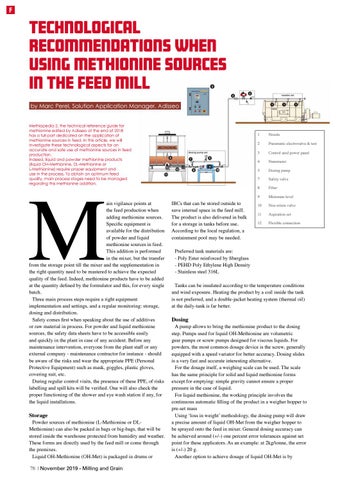
A pump allows to bring the methionine product to the dosing step. Pumps used for liquid OH-Methionine are volumetric gear pumps or screw pumps designed for viscous liquids. For powders, the most common dosage device is the screw, generally equipped with a speed variator for better accuracy. Dosing slides is a very fast and accurate interesting alternative. For the dosage itself, a weighing scale can be used. The scale has the same principle for solid and liquid methionine forms except for emptying: simple gravity cannot ensure a proper pressure in the case of liquid. For liquid methionine, the working principle involves the continuous automatic filling of the product in a weigher hopper to pre-set mass Using ‘loss in weight’ methodology, the dosing pump will draw a precise amount of liquid OH-Met from the weigher hopper to be sprayed onto the feed in mixer. General dosing accuracy can be achieved around (+/-) one percent error tolerances against set point for these applicators. As an example: at 2kg/tonne, the error is (+/-) 20 g. Another option to achieve dosage of liquid OH-Met is by