F
Real-time protein monitoring
The next major tool for precision agriculture
C
by Philip Clancy, Next Instruments, Australia
ereal and oil seed crops including wheat, barley, rice, corn, canola and soybeans make up more than 80 percent of the world’s grain production, i.e., 2,513 million metric tonnes in 2017. It has been forecast that the world will need to increase the production of grains and oilseeds by 30 percent by 2050 in order to feed the nine billion people that will inhabit the planet.
However, there is not an additional amount of arable land to meet this demand. As such farmers, agronomists, agricultural scientists and governments are faced with the challenge of producing 30 percent more through better technology. A major tool available to the agriculture eco system to achieve this task is precision agriculture (PA). The US Department of Agriculture defines of precision agriculture as:“ a management system that is information and technology based, is site specific and uses one or more of the following sources of data: soils, crops, nutrients, pests, moisture, or yield, for optimum profitability, sustainability,
70 | June 2019 - Milling and Grain
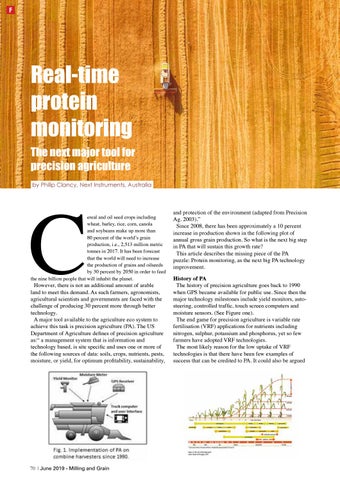
and protection of the environment (adapted from Precision Ag. 2003).� Since 2008, there has been approximately a 10 percent increase in production shown in the following plot of annual gross grain production. So what is the next big step in PA that will sustain this growth rate? This article describes the missing piece of the PA puzzle: Protein monitoring, as the next big PA technology improvement. History of PA The history of precision agriculture goes back to 1990 when GPS became available for public use. Since then the major technology milestones include yield monitors, autosteering, controlled traffic, touch screen computers and moisture sensors. (See Figure one). The end game for precision agriculture is variable rate fertilisation (VRF) applications for nutrients including nitrogen, sulphur, potassium and phosphorus, yet so few farmers have adopted VRF technologies. The most likely reason for the low uptake of VRF technologies is that there have been few examples of success that can be credited to PA. It could also be argued