F
P
Ocrim’s innovative approach by Ocrim’s Technological and Communications departments
roviding routine maintenance in a mill plant while reducing production costs is an issue that those who experience working in a mill are faced with daily. Moreover, the ambition to get ever larger and betterperforming plants, as well as making the most of the economy of scale while continuing to manage one’s everyday life and work practices in a simple way, is one more challenge that has led Ocrim experts to provide solutions that can fully meet these kinds of requests. Nowadays, in many countries of the world, there is indeed a trend towards establishing increasingly higher capacity plants, which can be easily implemented with today’s cutting-edge technologies. A long time ago, talking about mills with a 500-tonne-per-day (tpd) capacity seemed more like a pipe dream. Today, with a view to meeting large production requirements in various areas of the world, Ocrim can design and manufacture 1200 tpd capacity plants. This trend is definitely justified by lower initial capital expenditures (CAPEX), with respect to the same potential being obtained in several sections. As a matter of fact, the cost per
50 | April 2019 - Milling and Grain
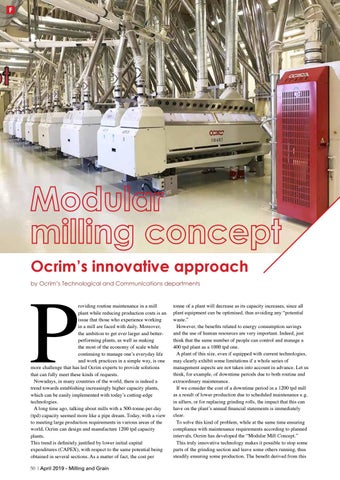
tonne of a plant will decrease as its capacity increases, since all plant equipment can be optimised, thus avoiding any “potential waste.” However, the benefits related to energy consumption savings and the use of human resources are very important. Indeed, just think that the same number of people can control and manage a 400 tpd plant as a 1000 tpd one. A plant of this size, even if equipped with current technologies, may clearly exhibit some limitations if a whole series of management aspects are not taken into account in advance. Let us think, for example, of downtime periods due to both routine and extraordinary maintenance. If we consider the cost of a downtime period in a 1200 tpd mill as a result of lower production due to scheduled maintenance e.g. in sifters, or for replacing grinding rolls, the impact that this can have on the plant’s annual financial statements is immediately clear. To solve this kind of problem, while at the same time ensuring compliance with maintenance requirements according to planned intervals, Ocrim has developed the “Modular Mill Concept.” This truly innovative technology makes it possible to stop some parts of the grinding section and leave some others running, thus steadily ensuring some production. The benefit derived from this