March 2019
YOUR GLOBAL PARTNER
In this issue:
INNOVATION IN CATWALKS AND TOWERS • Grain quality measurement • Fortification - Folic Acid • Pulses - Bridging the protein gap sustainably
Milling and Grain . Volume 130 . Issue 3 . March 2019
• Poland embracing feed safety • Just chicken feed? - Not any more
See our archive and language editions on your mobile!
• IPPE
Event review Proud supporter of
Volume 130
Issue 3
millingandgrain.com
Commercial CD Dryers Custom-designed to your unique needs Efficient, reliable commodity drying throughout the world Easy to install and maintain Globally recognized for customer service and quality products, our team of experienced Dealers and Sta will assist you in determining the system that will suit your needs.
ÂŽ
Grain Storage
Dryers
Material Handling Systems
Catwalk and Tower Systems
Lemanco Bulk Storage Systems
Caldwell Grain Conditioning
Trusted. Tested. True. chief.co.uk
agri.chiefind.com
silos-phenix.com
COMMERCIAL BINS
• 48 m Diameter Bins (20321-48262 mt) • Peak Load Rating (6804-45360 kg) • Hopper Bins (3.7 m-14.6 m)
COMMERCIAL DRYERS
• Tower Dryers (23-281 t/h) • QuadraTouch ProTM Controls • Balanced Moisture Content
STEEL BUILDINGS
COMMERCIAL SWEEPS
BUCKET ELEVATORS
COMMERCIAL CONVEYORS
• Auger & Paddle sweeps available • Capacity includes 141-281 t/h • Patented Pivot Point • Industrial Grade Pushers
• Low Impact Head Design • Heavy Gauge Trunking • Patented Squaring Plates • Support Towers
• Industrial Strength • Built To Last • Higher Elemental Resistance • Capacity includes (984-1688 t/h) • Dust-tight and waterproof • Patented hip-style weather-tight cover • Catwalks
Sukup Worl d H eadquart ers - S hef f i e ld , Io w a U SA • w w w.su ku p .co m • in fo @su ku p .co m For service in Europe contact:
Sukup Europe A/S Hedensted, Denmark Tel +45 75 68 53 11 • Fax +45 75 68 54 70 info@sukup-eu.com • www.sukup-eu.com
Pneumatic or Mechanical Ship Loaders & Unloaders Port Equipment - Turnkey Projects
1968 2018
1350 machines installed in more than 100 countries! VIGAN Engineering s.a. Rue de l’Industrie, 16 - 1400 Nivelles - Belgium Tél.: +32 67 89 50 41 • Fax : +32 67 89 50 60 • www.vigan.com • info@vigan.com
VOLUME 130 ISSUE 3
March 2019
Perendale Publishers Ltd 7 St George’s Terrace St James’ Square, Cheltenham, Glos, GL50 3PT, United Kingdom Tel: +44 1242 267700 Publisher Roger Gilbert rogerg@perendale.co.uk International Marketing Team Darren Parris Tel: +44 1242 267707 darrenp@perendale.co.uk Martha Cornwell Tel: +1 913 2083770 marthac@perendale.com Fred Norwood Tel: +1 405 834 2043 fredn@perendale.com Latin America Marketing Team Iván Marquetti Tel: +54 2352 427376 ivanm@perendale.co.uk New Zealand Marketing Team Peter Parker peterp@perendale.co.uk Nigeria Marketing Team Nathan Nwosu Tel: +234 8132 478092 nathann@perendale.co.uk
49 - SPECIAL FOCUS - Dust control for free-flowing materials
Egyptian Marketing Team Mohamed Baromh Tel: +20 100 358 3839 mohamedb@perendale.com Managing Editor Vaughn Entwistle vaughne@perendale.co.uk Production Editor Rebecca Sherratt rebeccas@perendale.co.uk Features Editor Matt Holmes matth@perendale.co.uk International Editors Dr Roberto˘ Luis Bernardi robertob@perendale.co.uk Professor Wenbin Wu wenbinw@perendale.com Mehmet Ugur Gürkaynak mehmetg@perendale.com Design Manager James Taylor jamest@perendale.co.uk Circulation & Events Tuti Tan tutit@perendale.co.uk Development Manager Antoine Tanguy antoinet@perendale.co.uk ©Copyright 2018 Perendale Publishers Ltd. All rights reserved. No part of this publication may be reproduced in any form or by any means without prior permission of the copyright owner. More information can be found at www.perendale.com Perendale Publishers Ltd also publish ‘The International Milling Directory’ and ‘The Global Miller’ news service
Grain & Feed Milling Technology magazine was rebranded to Milling and Grain in 2015
ISSUE HIGHLIGHTS
2
NEWS FEATURES
50 Service over the course of an entire instrument’s lifetime
54 Altering the mix to meet changing demands in storage and processing facilities
FACES
6-38
58 Hagberg measurement
62 Satake and the Gaba rice market in china 64 Grain quality measurement
68 Renovation for a long-established Russian flour producer
136 People news from the global milling industry
PRODUCT FOCUS
48
CASE STUDY
106
72 Fortification Folic Acid
STORAGE
76 Pulses - Bridging the protein gap sustainably
78 Poland embracing feed safety 82 Just chicken feed? - Not any more
EVENTS
112 Event listings, reviews and previews
86 Innovation in catwalks and towers
92 Operation of modern aeration systems
100 High-performance bagging and palletising systems
TRAINING
46 Introduction to flour milling training
COLUMNS
12 Mildred Cookson 36 Rebecca Sherratt
4 GUEST EDITOR Gustavo Sosa
110 MARKETS Rebecca Sherratt
COVER IMAGE: Innovation in catwalks and towers, the Chief way - See more on page 86
126 INTERVIEW Giles Shih
ISSUE HIGHLIGHTS RICE Satake and the gaba rice market in china
Since 1949, the food industry in China has experienced four stages of transition. During the first stage, the market suffered a shortage of products and the country experienced constant hunger. During the 1980’s, the country began to produce sufficient products, as a result of agricultural policy reform and technology development, and the people were satisfied with the supply of food.
FLOUR
SILOS
Workshop renovation for a long-established Russian FLour producer
Innovation in catwalks and towers
Chelyabinsk Association Soyuzpichsheprom LLC in Russia, founded in 1898, has consistently supported Russian residents and soldiers with its products as far back as the Great October Socialist Revolution and World War II.
Grain spoilage is the result of microorganisms (bacteria, fungi and yeast) using grain nutrients for growth and reproductive processes. Microorganisms can produce heat during growth, which can increase the temperature of stored grain.
PAGE 68
PAGE 86
AERATION SYSTEMS Operation of modern aeration systems
Grain spoilage is the result of microorganisms (bacteria, fungi and yeast) using grain nutrients for growth and reproductive processes. Microorganisms can produce heat during growth, which can increase the temperature of stored grain. The result can be “heat damage” that renders the grain unfit for human consumption or even animal feed.
PAGE 92
PAGE 62
FOOD
STORAGE
FEED
PROCESS
MONITORING
SERVICE
A new, safer and faster solution for Hagberg measurement
Poland embracing feed safety
The world reference in the field of quality control of cereals, flours and their derivatives, CHOPIN Technologies continues to advance its technological leadership with the Amylab FN, a new innovative solution for the detection of sprouted grains and the measurement of the alpha-amylase activity of flours.
PAGE 58
POULTRY HEALTH SERVICE Service over the course of an entire instrument’s lifetime
With its 5-Star Service, Brabender strives to keep downtimes as short as possible and the customers’ operating costs low.
PAGE 50
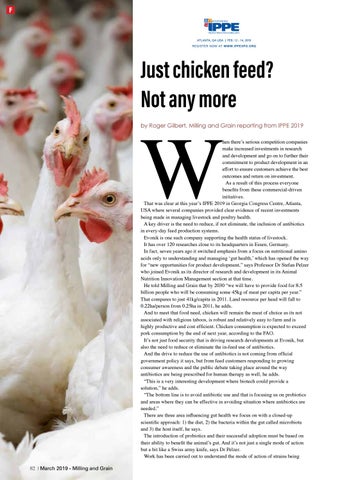
Just chicken feed? Not any more
When there’s serious competition companies make increased investments in research and development and go on to further their commitment to product development in an effort to ensure customers achieve the best outcomes and return on investment.
PAGE 82
Over the past decade, compound feed production in Poland has more than doubled to over 11 million tonnes per year, a development boosted by increased demand for poultry feed and cattle feed. As Poland has taken its place as the largest poultry producing country in the European Union, feed safety has become top of mind.
PAGE 78
Confidence in our grain systems now, durability we can pass on. Brock grain systems and Brock dealers have
handling, conditioning and structures.
been helping grain facilities protect their grain since 1957. It is a relationship built on trust,
BROCK SOLIDÂŽ means you can count on your
commercial-grade quality and long-lasting
grain systems today and for years to come.
results. Bushel after bushel, you can count
Contact your Brock dealer at
on Brock for reliable grain storage,
brocksolid.com/dealers.
Storage | Handling | Conditioning | Structures
+1 574.658.4191 brock@brockgrain.com
Rice in Uruguay - The death of a way of life Rice has been in my family for generations. My great-grandfather came from Germany to the deep south of Brazil (on the border with Uruguay) and became a rice farmer. My late grandfather was once a very rich and powerful farmer, a small millionaire, though he lost everything later. My father was a rice farmer too, but bad investments and bad luck made him lose everything, so he became a salesman of farming machinery. Remember those times when weather insurance and grain futures were science-fiction? They still are in the Third World. I am a mechanical engineer but have worked in my family’s business almost my whole adult life, and specialised in grain bins, conveyors, dryers, and milling machinery. More than half of our clients are rice farmers or millers. As with my family, Uruguay has a deep relation with rice. Production started in 1919, aiming to local consumption. By 1930, it really became relevant in the national industry. By the 50’s, it was one of the main export products. Uruguay developed a unique system of production. It is grown in rotation with pastures for cattle breeding. There is only one harvest per year, and the cycle is two years of rice and three years of pasture. The manure allows the soil to recover many of its nutrients naturally. This is a country where 90 percent of the rice production is exported to over 600 other countries. The quality is flawless, and
2019
the yields are the best. However, this industry is dying. It all started with the businesses with Venezuela. Lured by the sweet money of oil, rice millers got into contracts to supply to the Venezuelan government. The Uruguayan government backed the deal because of ideological proximities. It really sounded like easy money, but there were a variety of problems that soon occurred. Millers soon got into debt just to keep working; farmers weren’t paid and got in debt too. All the millers had to close some facilities, just to survive. Rice is not alone in these problems. The poultry and the milk industry also suffered from similar fates. Even the local giant of the milk industry, CONAPROLE, is looking for a buyer. For the whole company, not the products. Nobody knows who will survive. This is a massacre. Maybe in five or ten years we will be able to rebuild this industry, thanks to the accumulated know-how and the quality of the soils, but right now the future seems bleak. The lesson I hope people will learn from this is to be careful and build healthy business relationships. Money has to be made the hard way, gradually, day after day, and there are no shortcuts. Gustavo Sosa, CEO of Sosa Ingenieria and Chief of Engineering at RONTIL ing.gustavo.sosa@gmail.com
http://bit.ly/grapas19
13 JUNE 2019 COLOGNE, GERMANY A ONE-DAY CONFERENCE FOR MILLERS OF FOOD, FLOUR & RICE ISSN No: 2058-5101
Milling and Grain has a cooperative partnership with COFCOET
Annual Subscription Rates Inside UK: UK£100 Outside: US$150/€133 More Information www.millingandgrain.com http://gfmt.blogspot.co.uk
40 YEARS OF TESTED STRENGTH
One Tapco Nylon Elevator Bucket Supports a 9700 Pound* H1 HUMMER Ambient Temperature: 17 °F (-8 °C)
TAPCO’S CC-XD (Xtreme Duty) gray nylon elevator bucket supports a 9700 lb. H1 Hummer vehicle. Testing confirms that it will support over 20,000 lbs., more than two Hummers!
TAPCO’S CC-XD (Xtreme Duty) blue polyethylene bucket will support 9,000+ lbs.
Tapcoinc.com
TAPCO’S CC-HD (Heavy Duty) blue polyethylene bucket will support 5,000+ lbs.
314.739.9191 / St. Louis, Missouri USA No 814
*4399 kg
Milling
News
Swiss School of Milling visit the FlourWorld Museum for specialist conference
M
ühlenchemie and the directors of the technical college invited budding milling technicians to take part in a specialist conference on the subject of flour treatment and optimised baking. The supporting programme at the FlourWorld Museum in Wittenburg offered the students an opportunity for networking and introduced them to the worldwide cultural history of cereals. The main objective of this annual cooperation between teaching staff is to offer the international mill managers of tomorrow access to leading experts in the field of flour treatment. This year, too, young milling technicians from the winter course of 2018 met at the conference centre of Wittenburg’s FlourWorld Museum to gain the latest insights into the field of flour treatment from Mühlenchemie’s scientific director, Dr Lutz Popper. The agenda included the development of flour maturing agents, the role of enzymes in industrial milling and the rheological objectives of flour treatment. A tour of the FlourWorld Museum also introduced the visitors to the cultural relevance of milling. The central feature of the museum is the “Sackotheque”. With over 3,600 exhibits from 140 countries, it is the world’s largest collection of artistically designed flour sacks. The museum is a project by Mühlenchemie and came about on the initiative of the firm’s founder and managing partner Volkmar Wywiol. For decades, the family business with its headquarters in North Germany has carried out a fruitful exchange of information with many of the mills whose sacks are exhibited. “The visit to the museum is a good opportunity for our students to make contacts with leading food technologists in the field of flour treatment – an important knowledge resource for the managers of tomorrow” said Michael Weber, Director of the Swiss School of Milling. (Find out more information about the FlourWorld Museum in our case study on page 106). 6 | March 2019 - Milling and Grain
In this month’s issue, we have a very intriguing article which provides readers with some fascinating insight into Mühlenchemie’s FlourWorld Museum. The museum serves as a true marvel and provides real insight into the complex history of flour, and where it originated from. Mühlenchemie’s FlourWorld Museum tells the humble story of 10,000 years ago, when man first learnt how to breed new grasses and crops from the seeds of a wild plant. 4,000 years later, the museum tells us of humanity’s discovery of crushing between simple grindstones. Following this, innovations by the Egyptians helped us learn more about fermentation, and the innovations of the Romans that first ground corn on cone mills. Milling machinery and technology has undeniably changed a great deal in the past centuries, and only continues to innovate and improve. Who knows what the future will hold for milling technology? For those who want to see and learn more about milling technology and future innovations, then the GRAPAS Conference, taking place at Victam International this June will prove to be a mustattend affair. The conference, held every year at Victam, is always a resounding success, and specialises in showcasing the latest innovations in flour, rice and pasta technologies. The conference features a variety of technology specialists from international backgrounds, including Marie Haga, Executive Director of the Crop Trust, an international organisation that aims to preserve crops in genebanks, to ensure we still have access to these wonderful crops many years in the future. Ms Haga will be discussing this in more detail at the conference, and it will no doubt be a very interesting and unique speech. George Marriage, President of NABIM, will also be speaking about the evolution of milling technology, and where technology is destined to go in the future. The GRAPAS Conference will also showcase the GRAPAS Innovations Awards, where the best in food technology machinery will be judged, and then the winner of these coveted awards announced by international industry expert judges. The event is proving especially popular this year. For more information please email Rebecca Sherratt at rebeccas@perendale.co.uk
GF
MT
gfmt.blogspot.com
NEW
AVAILABLE NOW
®
HIGH PRECISION MEASUREMENT FOR YOUR MILL New OFT 2.0 allows you to measure by optical vision without roll contact the full fluting profile of your existing rolls. Boost your mill performance by refluting your rolls at the right time. Precision as never seen before
Real time data
Flutes wear %
OFT certificate
Milling News
SternMaid upgrades plant with a new powder blender
A
t the end of 2018, the contract manufacturer SternMaid commissioned a new blending line with a working capacity of 3,000 litres. The line was installed in the newly built Plant Two in Wittenburg, where it permits more efficient processes. The plant is designed for the gentle production of foods and food supplements in powder form such as meal replacers, dietetic products, dry beverage bases or protein mixtures and is equipped with an automatic wash-in-place system (WIP). This investment will enable SternMaid to increase its production capacity by about 10,000 tonnes per annum. With the new blending line, SternMaid will, in future, be able to produce the mixtures needed for filling into customised retail packs such as spiral-wound plastic or fibreboard cans, bags or sachets directly in Plant Two. Since these small-pack lines are in the same building, this will improve the workflows there. As a further option, liquid ingredients can be worked into the mixtures homogeneously in the amount of 0.01-to-60 percent of the formulation with the aid of special nozzles. To enable intensive mixing, the machine is fitted with cutters.
With the WIP system, the line is designed for extremely thorough wet cleaning before a change of product. From the regulatory point of view, the blender falls under SternMaid’s FSSC 22000 certification, the internationally recognised standard for the industrial production of foods. To Mark Riemer, SternMaid’s Commercial Manager, the investment constitutes an important step towards reacting even more flexibly to customers’ requirements, “On the one hand, we have enlarged our capacities in order to respond better to the needs of industry in the field of blending. And, on the other hand, the new blending line will optimise the workflows at our plant. In view of our customers’ ever-increasing quality demands, we decided to instal wash-in-place equipment. That permits the efficient wet cleaning more and more of our customers are asking for.”
COMPLETE FEED MILLS, PLANTS AND MACHINES TURN KEY SOLUTIONS Turn-key feed mills and plants for compound feed, shrimp and fish feed, pet food, premix / concentrate, roughage, straw, green forage.
AMANDUS KAHL GmbH & Co. KG Dieselstrasse 5–9 · 21465 Reinbek Hamburg, Germany +49 (0) 40 72 77 10 info@akahl.de · akahl.de
8 | March 2019 - Milling and Grain
Floods at Turner’s St Peter’s Works, September 1902
British engineering firms: The works of ER & F Turner, including the Carter roller system in the course of manufacture at St Peter’s & Grey Friars Works, Ipswich - Part two Milling journals of the past at The Mills Archive
by Mildred Cookson, The Mills Archive, UK Last month I introduced a series of articles in The Miller and Milling in the 1880s and 1890s that dealt with the British engineering firm ER & F Turner. The story, of course, continued as “ER & F Turner went on, over the following years, to manufacture roller mills of modern design to give years of efficient
trouble-free service”. The next episode in their history, in 1902, was summarised in a headline at the time “The Irony of Fate: Too Much Water and Too Little”. The opposing elements of fire and water caused catastrophes over which the successful firm had no control. An August issue of Milling reported a serious fire that struck just after midnight on the evening of the 16th of that month. The fire at the Grey Friars works in Ipswich was stopped by a wooden partition that was full of wooden patterns. If the fire had reached the shed of the main woodworking shop the damage would have been enormous as it was full of wooden centrifugals, Turners “Vibromotor” rotary scalper and sifter
purifiers and reels, both finished or partly constructed. The shed in the centre of the illustration escaped but, as can be seen, the damage was extensive and ran into thousands of pounds. The principal loss was the paint shop where milling machinery had been stored ready for delivery. The outbreak was distinguished by two features, the violence and rapidity which the flames spread and the difficulties which beset the Fire Brigade as a result of the inadequate supply of water. Ironically, a few weeks later, the same journal was reporting serious flooding at Turner’s other Ipswich site at St Peters, only 200 yards away from the site of the fire. The flooding, due to excessive rain, flooded the works on either side of the road shown in the photograph, to a depth of eight-and-a-half inches. Neither of these catastrophes deterred the owners of this busy firm and work recommenced shortly after both incidents. By December of that year, The Miller was able to report on a visit to both of Turner’s sites. They examined the erecting shop at Grey Friars, with its work in progress on all kinds of machines, centrifugals, chaff and corn mixers, along with all sizes of roll purifiers and inter-elevators. The workshop employed overhead,
The Turner centrifugal flour dressing machine
12 | March 2019 - Milling and Grain
The Turner inter-elevator flour dressing reel
Interior view of middlings roll and break roll fitting and erecting shop
Site of the fire at the Grey Friars Works
Second view of middlings roll and break roll fitting and erecting shop
electrically-driven cranes and bogey tramlines which ran through the buildings, so that both machines and parts could be handled, with the minimum amount of labour. The reporter described how everywhere was filled with the sound of saws and hammers; all was motion and animation and there was a feeling about the whole place which was pleasant to see and hear. The buildings themselves were lofty, well lighted, and everything placed to advantage. Everyone employed there had his special place, making the work go smoothly. The majority had been with the firm for many years, and there were seldom needs to change the workforce.
www.perryofoakley.co.uk sales@perryofoakley.co.uk +44 (0)1404 890300
Since 1947
The UK’s Most Experienced Manufacturer of Materials Drying & Handling Equipment
Capacities of up to 1000tph available - Heavy duty, galvanised construction - Ranges suitable for grain & bulk materials • Continuous Flow Grain Driers • Belt Driers • Chain & Flight Conveyors
• • • •
Belt & Bucket Elevators Belt Conveyors Aspirator Cleaners Levelling Conveyors
• Augers & Screw Conveyors • Ducting & Valves • Twin Trace Conveyors
Call now to discuss your drying & handling needs! Milling and Grain - March 2019 | 13
Milling News
The Turner patent first break roller mill with automatic vibrating feed
Fire damage at the Grey Friars Works
In the roll turning and grooving shop, the journalist encountered a wonderful grooving machine, designed and patented by Mr Pierson Turner. Each machine held two rolls and each roll was operated upon simultaneously by three grooving tools. These were entirely self acting and very accurate. Much material was cut away to make sure that the casting was perfect, and that there were no blow-holes. The firm had a policy always to cut away freely so as to be absolutely certain that their rolls gave satisfaction. On entering the millstone shed it came as somewhat of a shock to discover that the trade had not been long since lost. The group of men who were wrapped up in their work, building and dressing millstones as in the days of the past, showed that Turners were still
doing considerable trade in millstones, both at home and abroad. Several of the illustrations here come from a 1907 catalogue, completing the picture of a busy and successful British engineering firm, successful because of its innovation and high quality standards. The holdings at the Mills Archive mean that I can only provide geographical and historical snapshots. If you would like to know more please email me at mills@millsarchive.org
www.millsarchive.org
Maximize capacity, conditioning, and control. WENGER’S AQUAFLEX XT HIGH CAPACITY EXTRUDER When maximum volume matters, the Wenger AQUAFLEX XT High Capacity Aquafeed Extruder is the choice, processing up to 12,000 kg/hour. Equipped with either our High Shear Conditioner (HSC) or High Intensity Preconditioner (HIP), the AQUAFLEX XT is ideal for aquatic feeds as small as 0.5 mm. Precise control of finished product density delivers either high capacity floating or sinking feeds. Know more about the industry-changing designs and customized options of AQUAFLEX. Email us at info@wenger.com today.
PHONE: 785.284.2133 | EMAIL: INFO@WENGER.COM | WENGER.COM USA
|
BELGIUM
|
TAIWAN
|
BRASIL
|
CHINA
Milling and Grain - March 2019 | 15
Milling News
Fundiciones Balaguer now in the Turkish market with the official name Balaguer Rolls Turkey
S
panish company, Fundiciones Balaguer, which manufactures fluting, sand blasting and grinding machines, rolls for flour and feed mills, as well as cylinders for the chocolate, oilseeds, coffee, malt, feed, paint, soap and salt industries, has now entered into the Turkish market with the name Balaguer Rolls Turkey, by fullfilling the establishment of their legal corporation on October 10th, 2018, in EskiĹ&#x;ehir. Mr Alpaslan UZ, who is the General Manager of the company, informed us that they will start the production in the facility soon, which will have 11,000 m2 indoor area on a 23,300 m2 total area. He added that the first target for the company is to machine the rolls which will be produced in Spain and that, for this purpose, the most modern and highlydeveloped processing plant is now under construction. Mr Aplaslan stated that all the manufacturing processes will be carried out by Balaguer Rolls Turkey after building the foundry has been completed.
Progress Pellet Mill Low maintenance pelleting PTN’s Pellet Mills enable you to press every type of feed in every desired capacity. A long lifespan on the die and rollers, a long lifespan of the main shaft bearings and crucial parts that are easily cleanable are just a small summary of all the maintenance advantages of the PTN Pellet Mills.
Specialist in Pelleting Equipment info@ptn.nl - www.ptn.nl 16 | March 2019 - Milling and Grain
Milling News
The most prized cereal of 2018 exhibits in BIOFACH
T
ritordeum is a Mediterranean cereal that is making headway in the international market thanks to its nutritional, sensory and agronomic properties. Due to these advantages, milling companies, artisans and retailers from Spain, Italy, France, Germany, Switzerland, Turkey, Denmark, Sweden, Belgium and the Netherlands have already introduced a wide range of products made with this cereal. “Tritordeum can be a healthier and sustainable alternative for those who want to offer a better product for the consumer”, explains Agrasys Managing Director Pilar Barceló. Convinced by the combination of benefits offered by Tritordeum, many different artisan bakeries, milling companies and retailers around Europe have already launched a wide range of products made with this cereal: flour, pasta, pearled grain, bread, flakes, pizza, etc. “One of the observations that food professionals usually make are the excellent organoleptic properties that characterise Tritordeum products: sweet flavour, pleasant aroma and an attractive golden colour (due to the high lutein content) that make it unique”, adds Pilar Barceló. Apart from obtaining different recognitions in 2018, this year was successful for the cereal because some large retailers have carried out product launches. The largest Dutch supermarket chain, Albert Heijn, introduced Tritordeum bread in the range Liefde & Passie and it is now available in 720 shops, while Lidl Denmark introduced 1kg bags of organic tritordeum flour -milled by Skærtoft Mølle- in 115 stores. As a crop, Tritordeum is more sustainable and has a better ecological footprint. It is a robust cereal, adapted to the inclemency of climate change. It stands up well to drought and high temperatures. The fact that Tritordeum makes efficient use of water and has good resistance to diseases makes it a more sustainable cereal with reduced environmental impact. The most important areas of cultivation are in the Mediterranean region - mainly in Spain and Italy, but there are also some production fields in France and in Greece- in both conventional and organic production systems. The first organic certificated fields were cultivated five years ago. Since then the development of the cultivated area confirms the commitment of this cereal to organic farming. In comparison to wheat, Tritordeum has high levels of dietary fibre with positive effects on cardiovascular health; 10 times more lutein - an antioxidant involved in eye health that protects the retina from UV light and the effects of aging - and more unsaturated fatty acids like oleic acid, considered a central pillar of the Mediterranean diet. Furthermore, it has more digestible gluten. According to new scientific research, Tritordeum has a significant reduction in gluten proteins associated with food intolerances in comparison with wheat. Although it does contain gluten and thus is not suitable for coeliac disease sufferers, it can be an alternative cereal for those who want to reduce their gluten intake or people with Non-Coeliac Gluten Sensitivity. Milling and Grain - March 2019 | 17
AMINONIR® Advanced – Discover the next generation of NIR
Feeling ground down by NIR? Free up your time with AMINONIR® Advanced, the new service that analyzes unground samples – at the point of delivery. Determine raw material and finished feed content in minutes, to optimize your inventory management and feed specification, and control costs. It’s fast, accurate and covers the largest number of feed ingredients used by the industry. Get started now! animal-nutrition@evonik.com www.aminonir.com
t us a n t i s i Vi sia A VIV gkok Ban
INGREDIENT ANALYSIS
FINISHED FEED ANALYSIS
ALL PARAMETERS FROM ONE SCAN
BEST NUTRITIONAL MATRIX
Milling News
S
Satake start up new product branch - Reach
atake Corporation recently announced the launch of a new product brand named Reach. The product line up consists of semi-assembled rice processing plants in different processing capacities. Its sales promotion begun in March 2019, targeting middle-size processors in Southeast Asia and Africa.
The Reach product is a semi-assembled rice milling plant incorporating receiving, pre-cleaning, husking, milling, optical sorting, and packing stage equipment. It is designed to maximise the installation efficiency versus cost performance by utilising unitised components manufactured in Satake’s Thailand production facility. The result is an astonishing two weeks of installation time, compared to the usual three-to-four months. For regions where they experience two or three harvest times annually, this will allow rice mill owners to start up a production line before the next harvest season. The initial Reach product line comprises of a seven tonne-per-hour rice mill which is best suited for medium size rice milling facilities with 25-to-40 thousand tonne annual capacity. Other capacity mills, three tonne and 14 tonnes per hour, will follow in the near future. Yoshimasa Tomoyasu, General Manager of Satake International’s Business Division, says “by adding the Reach lineup, we can now offer medium capacity rice mills in a very short turnover period. Our new product is perfect for processors to whom the product quality, short installation time, and faster investment return are important.”
Milling and Grain - March 2019 | 19
We apply a smart engineering to reach the smile of the investors and users. Not revolutionary items, but efficient and reliable machines to get high performance plants assuring a very fast payback on investment. 160 years of satisfying operation in every part of the globe are our reference.
Simple becomes easy.. www.ai-lati.eu
Smart & Smile
.. and Smart with us! www.paglierani.com
www.ocrim.com
Milling News
W
Investing in quality ensures greater value for Müllers Mühle
hen buying sorting technology, focusing on its value to improve profitability in the longer term is a wise business strategy – as the success of Müller’s Mühle shows. Müller’s Mühle is part of GoodMills Deutschland GmbH. It is one of Europe’s largest rice refiners and Northern Europe’s largest processor of peas, beans and lentils. At its headquarters, at the inland port of GelsenkirchenSchalke in western Germany, it employs 140 people, has a production capacity of 120,000 tonnes and each year turns over some €60 million. Peas from Europe, beans from Asia and North America and lentils from North America arrive at Müller’s Mühle world-class facility. When sorted, they are sold under Müller’s Mühle’s own brand (it is a leader in rice, preboiled rice and pulses) and various others, with customers ranging from wholesalers and cash and carry businesses through big supermarket chains to professional caterers and kitchens. Founded in 1893, Müller’s Mühle has used Bühler equipment since 1913. More recently, three of its processing lines have been using Sortex technology. As Plant Manager, Tobias Breuer, explains: “When we rebuilt our rice mill in 2010, we successfully trialled and invested
YOUR GLOBAL PARTNER
GO MOBILE!
22 | March 2019 - Milling and Grain
in Sortex optical sorters, because they gave us the highest product quality and yield. “Previously, most complaints were about discoloured product, and while discoloration doesn’t present a foodsafety issue, it’s associated with lower quality. However, the Sortex A not only delivered a far superior sort quality, but complaints about FM (foreign materials) also fell, because the Sortex technology is more accurate when it comes to identifying difficult to detect FM. “The Sortex Z+ improves quality and safety on Müller’s Mühle’s rice line, by removing FM such as glass, sticks and stones, as well as defective product. Bühler Sales Engineer, Johann Högler explains: “The type of defects removed are rotten grains, rice with black tips, greyish rice kernels, etc. Müller’s Mühle can now also tackle mud balls and clumps of bran, thanks to the option they were given by Bühler to retrofit an InGaAs upgrade kit on their Sortex Z+” says Breuer. Making sure that any trace of wheat is removed from lentils and peas is also essential, with many buyers expecting and needing them both to be gluten-free. The Sortex A’s technological capabilities are tested to the maximum, because discoloured product and FM can be almost the same colour as good-quality lentils.
Realize the Hidden Value
Improve sow retention, decrease mortality and improve pigs per sow and piglet growth rate to positively impact your customer’s profitability when you formulate with MINTREX® chelated trace minerals compared to other mineral sources.
Visit www.novusint.com/MINTREX
® NOVUS and MINTREX are trademarks of Novus International, Inc., and are registered in the United States and other countries. ©2019 Novus International, Inc. All rights reserved. 4186_Perendale_FY19
Milling News
Could rapeseed be used as a protein source for human nutrition?
R
apeseed is widely grown for its oil, which is highly rated by cooks across the world. It has the lowest saturated fat of any culinary oil and is a great source of Omega 3,6 and 9. Rapeseed doesn’t just contain oil but high-quality protein too, which contains many essential amino acids. Worldwide, around 1.12 million tons of crude protein are produced annually from rapeseed oil. Although farmers have long used this so-called rapeseed cake as a protein feed for animals, it has not played a role as a protein source in human nutrition so far. Now, scientists at the Technical University of Munich have found the substance which makes rapeseed taste bitter. Identifying it is seen as the first step towards developing rapeseed as a human protein supply. A team led by food chemist Thomas Hofmann has now identified the substance that is pivotal for the bitter taste. According to the Food and Agriculture Organisation of the United Nations (FAO), the demand for food will approximately double by 2050, due to the growing world population. “Bottlenecks are to be expected in this context, particularly in protein supply,” says Thomas Hofmann, who heads the Chair of Food Chemistry and Molecular Sensory Science at the Technical University of Munich (TUM). According to Hofmann, who is also Director of the Leibniz-Institute for Food Systems Biology, it is therefore important to develop new plant protein sources for human nutrition and rapeseed is a good local source. One reason is that the accompanying substances contained in rapeseed strongly impair the taste of the obtained protein isolates. These substances include, for example, very bitter-tasting secondary plant constituents. Hofmann and his team therefore looked into the issue of which bitter substances cause the rapeseed protein’s unpleasant bad taste. The researchers investigated three different protein isolates, using mass spectrometric analysis methods and taste tests. The first isolate was an extract of all the proteins contained in rapeseed meal. The second isolate predominantly contained cruciferin and the third, napin, which are the rapeseed’s two main storage proteins. All three isolates had a protein content of 80-to-90 percent. The cruciferin isolate, in particular, contained a large amount of this bitter substance with 390 milligrams per kilogramme. The rapeseed meal and napin isolate had less than a tenth of the quantity, but still tasted bitter in the sensory test. “Since we now know the cause of the bitter off-taste, it is much easier to develop suitable technological processes or breeding strategies that can be used to produce tasty, protein-rich foods from rapeseed,” said co-author Corinna Dawid, who heads the Phytometabolomics research group at TUM.
24 | March 2019 - Milling and Grain
Milling News
Bühler co-founds Future Food Initiative with ETH Zürich and EPFL
B
ühler has committed to co-found the Future Food Initiative, launched by ETH Zürich and EPFL, together with industrial partners Givaudan and Nestlé. The initiative aims to accelerate the development of healthy food products and more sustainable, plastic-free packaging. Its research lays the ground for secure access to affordable nutrition, addressing global challenges of hunger and malnutrition. The Swiss federal institutes of technology ETH Zürich and EPFL (Ecole polytechnique féderale de Lausanne) have launched Future Food – A Swiss Research Initiative (“Future Food Initiative”) together with partners Givaudan, Nestlé and Bühler. “We are stepping up as an industry to address challenges in the food value chain,” says Stefan Scheiber, CEO of the Bühler Group. “Bühler’s ambition is to create innovative and sustainable solutions, partnering with leading research institutes, industrial partners, and promising start-ups in the world of food.” In the same context, Bühler will officially open its CUBIC innovation campus in spring and will welcome innovation partners, customers, start-ups and academics to benefit from the new facilities. The Future Food Initiative is funded by a donation from the industrial partners with a total amount of 4.1 million Swiss francs. Its overarching goal is to further expand research and education in the area of food and nutrition sciences at the interface of universities and enterprises. The initiative’s objective is to accelerate the development of healthy food products which leverage consumer trends, to intensify the search for solutions for sustainable, plastic-free packaging, and to secure access to affordable nutrition. The Future Food Initiative brings together competences from academic and industrial research in food and nutrition sciences at ETH Zürich and EPFL. “We have launched this initiative to pool our expertise in research and innovation to find innovative approaches for healthy foods and a sustainable supply chain,” says Dr Detlef Günther, Vice President for Research and Corporate Relations at the ETH Zürich. 26 | March 2019 - Milling and Grain
Milling News
F
Gericke says thank you for 125 years of customer’s trust
rom humble beginnings in the year 1894, the company Gericke evolved into a globally positioned and successful provider full of solutions in the bulk goods industry. 1894 in the heart of Zürich Ing, Walter H Gericke founded his machine and mill building factory. He quickly attained an excellent reputation as a specialist and as a reliable supplier of modern, partly-automated, milling plants. He sold roller mills from the prestigious company Seck from Dresden. Innovation was in the foreground in the 40’s, with the construction of pneumatic conveying systems and vibrational dosing units or with steel-band conveyors for chocolate industries. In this period of time, the second generation with Otto and Walter Gericke was already standing at the helm. From the 60’s on, Dr Hermann and Willi Gericke set significant milestones in terms of internationalisation. New technologies remained in the focus, whereby less common types of machines succeeded into the programme through licence agreements with various US companies. Markus Gericke is leading the company, now in its fourth generation. The reliability
and the durability of Gericke machines and installations is legendary. Meanwhile, engineering and the construction have been extended to new locations including Asia, the US and South America. The Gericke Group Management is employing worldwide over 300 employees in 12 different locations. The family business is happy about the decade-long trust which customer’s have given. The executive management and all the employees want to express their gratitude and are excited about new and interesting projects.
Pneumatic conveying systems from Gericke’s brochure 100 years ago
When it Comes to Aquafeed Production Carefully Choose Who You Partner With for Equipment Solutions MAX.
393.31 [9990]
MAX.
391.31 [9939]
15.00 [381]
Ă12.00 [305]
MIN.
29.19 [741] F085 SHIMPO
36.91 [937]
31.19 [792]
MIN.
67.28 [1709] 39.00 [991] 101.44 [2577]
30.38 [772] BIN Inlet
DCC Inlet
1.93 [49]
In the aquafeed business, you either 18.00 [457] sink or swim. 1.00 Contact Extru-Tech NPT today at 785-284-2153 or visit us online at www.extru-techinc.com
Extru-Tech Offers Smooth Sailing [6855] 3 _ Purpose Built Aquafeed Equipment Solutions 3 Floating or Sinking Feeds from a _ Single System 3 Advanced Densification _ Technology 199.38 [5064] 3 _ Consistent Sub 1.0mm Feed with No Waste 3 Team of Professional Aquafeed _ 12.56 [319] Equipment Specialists 15.88 [404] 24.59 [625]
03 54
51
06
0
15.00 [381]
256T
108.28 [2750]
P.O. Box 8 1.00 NPT [STEAM] 100 Airport Road Sabetha, KS 66534, USA 57.69 Phone: 785-284-215366.50 [1465] [1689] Fax: 53.25 785-284-3143
2.00 NPT [WATER]
2.00 NPT [STEAM]
3/4 NPT
2.00 NPT 80 NORGREN
0
88.00 [2236]
160
extru-techinc@extru-techinc.com www.extru-techinc.com 48.00
MAXUM SIZE 10
[1219]
28 | March 2019 - Milling and Grain
ET-302.indd 1
102.13 [2594]
52.19 [1325]
2
278.03 [7062]
End of Head
CYL. Disch.
269.88
What the Competition Offers
3 _ High Maintenance 3 _ Many Promises 3 _ Limited Capacity
19.16 [487]
64.83 [1647]
108.59 [2759]
30.00 [762]
[1353]
2/2/18 10:01 AM
284.00 [7214]
SEFAR NYTALÂŽ. The name you can trust.
F
DA
Headquarters Sefar AG Hinterbissaustrasse 12 9410 Heiden – Switzerland Phone +41 898 57 00 filtration@sefar.com
www.sefar.com
NT
O
LI
A
FO
Since 1830, Sefar is the single-source supplier to millers for all products for sieving, grading, and dust filtration as well as connector sleeves, sieve cleaners and tensioningDequipment. SAFETY
CO MP
GMach launches 500 tonne per day turnkey mill plant in Kenya
Milling News
G
Mach, one of the leaders of Turkish milling technologies, recently delivered a turnkey steel construction mill facility, with a production capacity of 500 tonnes/day in Kenya, using the most advanced technologies for milling. GMach became a solution partner in Kenya for one of the strongest companies in the region and completed the factory in a short period of 18 months. The facility was designed to be equipped with the latest technologies and superior engineering to use the minimum amount of manpower. The facility, which incorporates many technologies such as fully automatic PLC controls, remote management and management information systems, will provide a significant competitive advantage to the company owner. The machines used in this plant are also used in factories around the world. With this plant, GMach, which has already completed turnkey facilities and machinery in the Kenyan region, have added another one of its reference projects in the African region, thus completing a new facility and bringing it into regional production.
X V I I N T E R N AT I O N A L C O N F E R E N C E
APRIL 10-11, 2019 KYIV, UKRAINE
PREMIERE EVENT FOR THE GLOBAL LEADERS OF GRAIN AND OILSEED INDUSTRY
700+ Delegates
500+ Companies
GENERAL SPONSOR
E XC LU S I V E E XC H A N G E S P O N S O R
SPONSORS
REGISTRATION www.blackseagrain.net
50+ Countries
ORGANIZER
SUPPORTED BY
CONTACTS conference@ukragroconsult.org Tel/Fax +38 (044) 220 5242
Milling and Grain - March 2019 | 31
www.golfettosangati.com info@golfettosangati.com
Milling News
Study suggests superdosing phytase can counteract impact of amino acid reductions
S
uperdosing - the practice of using high doses of phytase to target phytate destruction, can serve to recover broiler performance losses associated with reductions in dietary digestible amino acid (dAA) densities. This was the finding of a new research study from Texas A&M University and AB Vista. The study investigated impact on body weight, breast meat yield and feed conversion ratio (FCR) in male Cobb broilers across 44 days. Dr Craig Wyatt, North America Technical Manager from AB Vista explains the rationale behind the experiment: “In an increasingly challenging environment, producers and nutritionists are looking to maximise returns – but any financial gains must naturally be balanced against related performance losses. Reducing dAA density in diets can lower costs – but with this comes losses in yield and body weight. “We formulated this study in order to help establish
whether adding superdoses of phytase could help reduce diet cost – thus enabling producers to reduce digestible amino acid density without impacting key performance markers.” The experimental design involved three levels of AB Vista’s Quantum Blue phytase (500, 1,500, and 3,000 FTU/ kg) and three dietary dAA densities: a control at 100 percent of breeder-recommended levels, and isocaloric diets at 95 percent and 90 percent of control levels respectively. Results confirmed that lower dAA levels resulted in poorer performance, with the two reduced-density diets yielding a 3.1 point FCR increase, and reductions of 78g and 27g across body and breast weight respectively. In contrast, increasing phytase was shown to improve performance: the higher levels of phytase increased body weight at day 18; however, 3,000 FTU/kg was needed to deliver a significant increase on day 44. Similarly, both higher levels of phytase improved FCR in the starter phase; however, 3,000 FTU/kg was needed to decrease FCR in later phases and from day 1 to 44. In the case of breast yield, 1,500 FTU/kg was sufficient to increase yield, compared to the 500 FTU/kg. Dr Wyatt concludes, “The demonstrated link between higher inclusions of phytase and performance improvements in reduced dAA density diets is encouraging for anyone concerned about the impact of restricted dAA levels. We plan to conduct additional studies to investigate specific modes of action, as well as to further explore the interaction between phytase and dAAs.”
Extend your product range with your very own idea of malt flours.
www.schulz-craftmalting.com KASPAR SCHULZ Brauereimaschinenfabrik & Apparatebauanstalt GmbH. Bamberg – Germany
34 | March 2019 - Milling and Grain
Milling News
grapas 2019 by Rebecca Sherratt The GRAPAS
Conference and Innovations Awards are getting ever-closer, and the deadline to apply for the awards is approaching- so apply now! The GRAPAS Innovations Awards are made to the most innovative and economically beneficial equipment, process or service introduced in recent times to the food industry, encompassing all things flour, rice and pasta. Nominations are being called for from all sectors of food milling around the world, to enter their latest products into the Innovations Awards, for a chance to get them recognised in front of thousands of Victam International attendees! You have until March 31st to apply. A variety of key food machinery companies have already registered interest, including Henry Simon, Dinnissen, Bühler, Bastak, CPM Europe, Siwertell, Brabender and many more. If you want your company to get involved with this group of heavilyinfluential food machinery businesses, then enter the GRAPAS Innovations Awards now!
INNOVATIONS AWARDS In recent news, Marie Haga, the Executive Director of the Crop Trust, is confirmed to be speaking at the GRAPAS Conference at Victam International. Marie is a former diplomat and Norwegian politician, who is committed to conserving the world’s crucial crops for food and agriculture in genebanks, forever. Her speech is entitled; ‘With so much rice and wheat in the world, why do we need to conserve them?’ and discusses the work the Crop Trust do, to help preserve crops and ensure that the future of the agriculture industry remains bright. Alongside Ms Haga, we also have George Marriage, President of NABIM confirmed to be speaking, who will discuss the technological innovations of milling in the years to come, and how milling technology has evolved over the years. The GRAPAS Conference is a one-day conference, where applicants of the Innovations awards are given a chance to speak, in front of an audience of industry experts, about why their products are worthy of the awards, to be judged by a panel of international industry experts including Alexandra Kirchner, Director of the IFF Research Institute, Dr Wu Wenbin of the Henan University of Technology, Mildred Cookson of the Mills Archive and Bryan McGee, Mill Consultant. 36 | March 2019 - Milling and Grain
UK exports of flour and mixes at a record level in 2018 – but worries for 2019
U
K Exports of flour and mixes rose to a record level of nearly 370,000 tonnes in 2018, valued at over £230 million. The quantity of exports has risen by 25 percent over the last five years, with value up by 31 percent. This is equivalent to around 450,000 tonnes of wheat. Steady growth is testament to the consistent quality of UK produced flour and mixes, along with product innovation in the sector. However, this success story is under threat, fears Alex Waugh, Director of the National Association of British and Irish Millers (NABIM).
“95 percent of our exports go to EU countries, especially the Republic of Ireland” he says, “if there is not a Brexit deal, from 30th March these will be subject to tariffs of approximately 50 percent of their value. We expect this will have a catastrophic impact on the trade; the businesses which have invested in growing exports; their staff and customers. It must be avoided at all costs.”
AFIA encouraged by USTR’s EU negotiating objectives
T
he American Feed Industry Association (AFIA) is pleased to see the Donald Trump administration include agriculture in its trade negotiating objectives with the EU, but cautions against seeking these objectives in stages, rather than in a single negotiation. “The EU represents the fourth largest export market for animal food with over US $444 million in exports in 2017, but US animal food manufacturers continue to face a number of trade barriers, which prevent their products from actively competing in this important market,” said AFIA’s President and CEO Joel G Newman. “AFIA urges the administration to move forward on an agreement that supports risk-based regulations and removes both tariff and non-tariff barriers, which are stripping US animal food manufacturers of opportunities to compete fairly and openly in the EU market. “We strongly support the Trump administration’s efforts to strengthen the United States’ trading relationship with the EU, address barriers keeping US agricultural products from competing fairly in this important market and urge that this work is done in a single undertaking. We look forward to working with USTR as the process moves forward.”
Milling News
AFIA provides new biosecurity guidance following ASF outbreaks
I
n light of the recent outbreaks of African swine fever (ASF) and other animal diseases, the American Feed Industry Association (AFIA) has been working on a multi-pronged action plan to research sciencebased solutions for mitigating the risks of virus transmission through feed and communicate any new information and recommendations to the industry and producer groups. As part of this effort, AFIA recently announced it has released an updated version of its biosecurity guidelines. “AFIA’s biosecurity guidelines were originally written to help safeguard manufacturing facilities following 9/11, but, were always meant to serve as a ‘living document’ that could be updated based on what we know about new and emerging threats,” said Paul Davis, PhD, AFIA’s Director of Quality, Animal Food Safety and Education. “While some threats aren’t at the back door yet, it doesn’t mean we can leave the door unlocked. Our industry must be vigilant about continually improving its biosecurity programs for the protection of animal and human health.” AFIA has been closely coordinating with
Resource-Full Get an Updated Edition Today Find everything you need for grain, feed and seed at Seedburo Equipment Company. In print or online, we are stocked with inventory to keep your facility running smoothly. Get Seedburo’s latest catalog edition, in hand, on your countertop by requesting a printed copy at: www.seedburo.com or by phone, 800-284-5779.
800-284-5779 | 312-738-3700 | www.seedburo.com | sales@seedburo.com 38 | March 2019 - Milling and Grain
representatives from the pork industry, government and academia for the past several months, to update the biosecurity guidelines based on new information regarding how viruses can potentially spread throughout the feed manufacturing process. The updated guidance provides recommendations for how facilities can better set-up an onsite biosecurity program, more thoroughly evaluate and verify their suppliers, work with their shippers, and train on and communicate best practices to all facility personnel and visitors. Apart from updating the industry’s biosecurity guidelines, AFIA is also working with its public charity, the Institute for Feed Education and Research, on supporting research in this area. One such project is aimed at analysing potential risk mitigation measures and testing the effectiveness of proposed holding times for feed specifically in response to the recent ASF outbreaks. South Dakota State University is leading this research project, which is being co-funded with the Swine Health Information Centre. The project partners should have preliminary results for review later this year.
har�on�ou� coe���tence of technology and nature
www.tan s.com.tr
We are proud to be with you in the journey of harvesting seedlings with our technology and advancing mill solutions that have been advancing for 62 years to add blessings to what they give to the earth.
Mill
Training Professionals within the pet food industry joined Kansas State University’s IGP Institute from January 14–18th, 2019 for the IGP–KSU Pet Food Formulation for Commercial Production Course. In attendance were 20 participants from the US, Canada, Pakistan, India and Guatemala. The participants gained hands-on experience and further education in developing pet food product formulations.
Pet food professionals converge for formulation and production course “Creating pet food formulas from concepts, reverse engineering existing pet foods, and troubleshooting pet food production and quality control compliance issues using formulation software were additional learning outcomes of the training,” says Greg Aldrich, Research Associate Professor in the Department of Grain Sciences and Industry. Topics covered by the course included understanding ingredients, processes and software necessary to create new products; revising existing formulas; performing business and production analysis; gaining an understanding of the raw ingredients used to produce pet foods, their general composition and processing considerations; fundamental principles of companion animal nutrition and dietary
needs (specifically dog and cat); learning the processes involved with producing pet foods, the regulatory constraints regarding claims and requirements, and the transportation and storage factors involved with marketing effective foods for companion animals; and studying the range of formulation tools common to the trade. “I had no prior background in animal food production,” says Caitlin Eilenfeldt, Food Scientist at Riverbend Foods. “The course was well taught and in a friendly atmosphere. I was able to take away a lot from this course and Dr Aldrich made the material very easy to learn.” Throughout the course, individuals participated in the presentations and various demonstrations led by KSU and AIB International faculty and staff. Individuals of the course also gained hands-on experience in the OH Kruse Feed Mill. Dr Aldrich says, “As the industry grows and improves, the Department of Grain Sciences and Industry at K-State is continually striving toward significant research developments and works handin- hand with the goals of the feed and food industry to promote and develop pet food processing.”
You can now purchase the nabim training DVD. Written for and by millers. The videos support workplace professional development.
To order your copy please email training@nabim.org.uk
42 | March 2019 - Milling and Grain
44 | March 2019 - Milling and Grain
Milling and Grain - March 2019 | 45
Mill
Training In some cases, the view of an industry can be beneficial to those who are new to their respected fields. Looking into the entire flour milling process from start to finish, the International Association of Operative Millers (IAOM) and Kansas State University (KSU) partnered to host the IAOM–KSU Introduction to Flour Milling course, January 14–18, 2019.
Introduction to flour milling training The course hosted six participants from California, Illinois, Kentucky, New Jersey, North Dakota and Michigan. This course was taught through a combination of lectures taught by K–State faculty, a visit to the Kansas Wheat Innovation Centre, and hands-on trainings in the Hal Ross Flour Mill and the Shellenberger Hall Baking and Milling Labs. “The course educates professionals working in or with the milling industry of the entire process that goes into milling wheat, starting with wheat selection and ending with baking properties of different quality wheat flours,” says Shawn Thiele, Flour Milling and Grain Processing Curriculum Manager and Interim Associate Director at the IGP Institute. He adds, “The participants were able to receive extensive amounts of hands-on training with milling wheat and baking different products, to help them grasp a better understanding of the value of quality with wheat and flour, and the material taught throughout the lectures.” This course focused on a variety of topics including an overview of the US milling industry; wheat production, supply and demand; wheat classes, uses, and basic wheat chemistry; wheat cleaning and conditioning; the milling process, basic flowsheets, flour functionality, wheat and flour blending; and grade, quality, and mill performance on flour extraction. “I came to this course to learn more about the milling processes,” says Miguel Macias, Lab Technician for Miller Milling. “At first, the math during the classroom portion was challenging; but once we went out to the mill and applied hands-on learning, everything seemed to come together. It just
This course discusses the main causes of fires and smoulders in upright grain silos, as well as ways to prevent and respond to emergencies. It will give attendees the tools to develop emergency action plans and interact with first responders.
GEAPS 546: Fighting grain silo fires and smoulders This course will discuss main causes of fires and smoulders in upright grain silos; examine the causes and characteristics of combustion; examine the hazards of fires, smoulders, and explosions, but also potentially dangerous atmospheres 46 | March 2019 - Milling and Grain
Arlinkson Bautista, participant in the IAOM-KSU Introduction to Flour Milling course, using the Shellenberger Hall Baking Lab facilities to bake using flour from different classes of wheat.
Course participants of the IAOM–KSU Introduction to Flour Milling course utilising the table top milling lab at Shellenberger Hall.
clicked for me. The hands-on aspect made it really fun.” Macias adds he enjoyed being able to use the K-State milling facilities and adjust the equipment. The hands-on aspect of the course helped him connect the in-class lectures to real world application. This course is suited for anyone involved in the milling industry including, but not limited to new mill employees, HR staff, ingredient procurement managers, and feed and flour sales representatives. The next course offering will be July 29–August 2, 2019.
that can be produced; discuss how and when the dangerous atmospheres may occur; consider how not to make conditions worse by ill-informed mitigation efforts; discuss how to develop effective emergency action plans and mitigation plans; discuss the importance of interaction with emergency responders and understand their capacity to deal with silo fires or smoulders. GEAPS 546 is designed for grain and processing facility operators and supervisors, safety professionals, company managers and others interested in improving their knowledge about grain silo fires and how to plan for them. Speakers at the training course include Mark Herrick, Engineering Manager of Cargill, as well as Bob Marlow, Central Region Operations Manager of The Andersons Inc. Registration for this course is open now, and it is running from April 2nd-May 7th.
Munson Abrasion-Resistant Lump Breaker
PRODUCT FOCUS March 2019 In every edition of Milling and Grain, we take a look at the products that will save you time and money in the milling process.
The new RDC-2424-MS De-Clumper Rotary Lump Breaker, from Munson Machinery, breaks chunks of agglomerated abrasive or friable materials that have compacted during storage or shipment, conditioning them for downstream processing or conveying. Material entering the 610mm square inlet is reduced in size by dual rotors with three-point, single-piece, AR-235 abrasionresistant steel breaking heads rotating with minimum clearance above a curved, perforated bedscreen. On-size material exits through 25mm-diameter apertures in the bedscreen. Other bedscreens are available with apertures ranging from 25-64mm in diameter. The compact, low-profile design allows inline placement in restricted spaces between upstream and downstream processing, packaging or bulk storage equipment. With an optional feed hopper and support structure, it can also operate as a stand-alone unit.
www.munsonmachinery.com
Bühler SORTEX A Featuring Bühler’s most sophisticated and versatile sorting capabilities, the innovative SORTEX A range is the first choice for processors with the most challenging sorting applications. Showcasing Bühler’s innovation with new advanced inspection and lighting systems, this state-of-the-art technology has a superior detection of subtle colours and foreign material. The SORTEX A range delivers an extraordinary performance for difficult applications such as reducing toxins from grains, seeds, nuts, coffee and other commodities, as well as providing the finest quality end-product to increase profitability. This SORTEX A range has been designed to meet the highly demanding standards of food safety and quality, and for nonfood industries, to deliver maximum product purity for best value. Designed to suit all capacity requirements, the SORTEX A range is available from one to five modules in three frames sizes.
www.buhlergroup.com
Ocrim SDI/SDX Purifier The Ocrim SDI/SDX Purifier provides perfect stratification and distribution over sieves. 32 patented wing-shaped valves allow independent air control on the entire length of every quarter section of each sieve. The Ocrim SDI/SDX Purifier comes equipped with three levels of sieves, comprising of a light alloy, 500x500mm, with two independent exhaust hoods. The purifier is available in two versions: a painted steel (SDI) and stainless steel (SDX).
www.ocrim.com 48 | March 2019 - Milling and Grain
Zheng Chang SZLH1068 Pellet Mill Zheng Chang’s SZLH1068 Pellet Mill is one of their highestproduction capacity pellet mills, what can process up to 55 tonnes/hour. It can be used for feed particles and health powder feed, thanks to its adopted split driving wheel, air shaft and inner diameter. These are also easily exchangeable and can be swapped out, thanks to a minimal number of parts. The main drive also contains an adopted temperaturemonitoring system, to ensure that the equipment is always running safely. The machine also has an oil circulation cooling lubrication system, to improve cooling and lubrication.
www.zhengchang.com
Automatic Moisture Sensor for Grain Drier Control The Perry Automatic Moisture Sensor is a compact unit that can be installed into a sloped duct run or taken from the bottom of a conveyor and fed back into a duct run, making it a flexible and uncomplicated installation option, suitable for any make of drier. The ideal setup will allow for two moisture reading points, one for wet grain and one for dry, giving you optimum control over your crop, and the optimum price for it. The device is accurate to within 0.5 percent (MC 5% to 18%) and accurate to within one percent (MC 18% to 40%). Automated moisture monitoring means optimum drier operation with reduced labour costs. It can be installed into any make of existing drier or as a standalone system, and able to be fully integrated into the PLC control software for the drier.
www.perryofoakley.co.uk
FOCUS
SPECIAL FOCUS T H White Projects have recently released a vital addition for ports, grain processing or mineral and chemical industries. The patented dust suppression hopper performs brilliantly in environments where dust control is an important part of materials handling. Dust control has always been a major challenge in the commercial handling of powdery, granular or other free- flowing materials. Depending on the material being handled, dust may not just be unpleasant and unsightly, it can cause health issues, environmental hazards and even the dangerous risk of explosions. Many processing, storage and handling plants may think they have little choice other than to try and cope with a dust-polluted atmosphere, but this dust suppression hopper solution, distributed throughout England and Wales by T H White Projects, virtually eliminates dust during transfer processes. The dust suppression hopper, manufactured in New Zealand by DSH Systems Ltd, is an easily-installed loading spout, designed to be mounted immediately beneath an existing feed point. It’s ideal for use where free-flowing products need to be packed, bagged, or loaded into ships, railway wagons, trucks, silos or storage bins. Simple in design, yet highly effective, the dust suppression hopper funnels material through a restricted orifice and cone, causing it to adopt a swirl. As the material exits the nozzle a combination of surface tension, compression and the induced vortex holds it together in a tight, highly controlled stream which contains any dust within the column. The standard version has no internal moving parts and requires
Dust control for free-flowing materials no power, it is simply configured before use, according to the type of material being dealt with. Where several different types of material may need to be out-loaded from the same conveying system there is an advanced model featuring a computerised positional feed control. The two models available can be purchased in a range of 10 sizes and can be made from standard polyethylene, or tougher materials, including steel (mild steel, electro-galvanised, Corten or Hardox), where aggressive or abrasive materials are being handled. 304- grade stainless steel can also be specified for the handling of warm or abrasive materials, and 316-grade stainless steel for food grade handling and corrosive materials. The design of the dust suppression hopper, inspired by the need for safer handling of fertilisers, has proved to be equally effective when handling most other free-flowing granular materials. Goods which are already being widely handled with success include cereals, sugar, salt, pet foods, sand, gravel, limes, minerals, pellets and chemical powders. Applications for the dust suppression hopper are wide and hugely varied. Across the grain processing industry its benefits can be applied at grain storage and handling installations including cooperatives, milling plants, maltings, breweries and distillers. Mineral and chemical plants including mines, quarries and glass works can benefit from far tighter control of potentially hazardous materials. And at ports, where it’s important to control dust drift, while loading ships or transferring goods between ships and rail, road or storage facilities, the benefits are equally rewarding.
www.thwhiteprojects.co.uk Milling and Grain - March 2019 | 49
F
Whether laboratory mill, rheometer, viscometer or extruder: Brabender ensures the operability of its equipment for well over 10 years through the right spare parts
Service over the course of an entire instrument’s lifetime
W
by Brabender, Germany
ith its 5-Star Service, Brabender strives to keep downtimes as short as possible and the customers’ operating costs low. The German lab equipment manufacturer, based in Duisburg, is offering a number of additional benefits in the category of ‘Value-Added Services’. The company’s principle, ‘where quality is measured’, not only fits perfectly to the material testing equipment but also to Brabender’s services. “We deliver more than just devices,” jokes Kai Kunicke, with the humor that is typical for the Ruhr region. With a wink, the Director of International Service at Brabender refers to the extensive service area of the highly traditional company. “With our customer service, we want to be able to guarantee that our customers will get measurably high availability of their Brabender equipment. To this end, we feature various offers and are also developing new ones, partly with our customers.” The Brabender 5-Star Service includes five service areas that are all closely intertwined.
50 | March 2019 - Milling and Grain
Star One: On-site service – Prevention instead of standstill
Inspection, maintenance and repair – Brabender offers these services at its customers’ locations. Kai Kunicke clarifies, “the worst case is when the device won’t work at all, or no longer works flawlessly. This results in a standstill, necessary replacement parts have to be procured and the device must be repaired. "This is why we take the precaution of replacing components when they are close to the end of their lifecycle. Sometimes this depends on the condition, but we also do this according to plan. That is how we avoid or minimise possible downtimes, which might result in significant follow-up costs for the customer. If you make well-considered provisions, you can avoid a standstill.“ After every inspection, maintenance or repair, Brabender service technicians write a detailed maintenance report that can be archived 1:1 in the equipment log, kept for the test equipment management. “We have over 60 partners worldwide, most of whom also have their own service personnel with workshops. All in all, our 5-Star Service spans a tight net across the globe,” says Kai Kunicke.
Star Two: Spare parts – Using devices for the long-term
Brabender has continued to improve the logistics of its replacement part division over the years. “Our customer service represents a replacement part supply
F that goes far beyond the ten years expected on the market. Our customers also get replacement parts for devices that are 20 years old or more,” Kunicke says proudly, for good reason. Customers of the lab equipment specialist can trust in professional consultations, as well as the quick selection and delivery, of the required part. As the central contact point, the employees of the 24/7 service line help with the organisation of original replacement parts and consumables from the start. To expand a device’s range of functions or bring it technically up to date, Brabender offers upgrade kits. “They are a solution for staying operational when suppliers have canceled replacement parts,” Kai Kunicke adds. “With our replacement part service, our customers benefit from the longterm usability of their device and a predictable parts supply over many years.
The Brabender Calibration Kit ensures proper measuring results
Star Three: - Service line – 24/7, always available
To keep the downtimes of devices as short as possible, the customer service can always be reached – 24 hours, seven days a week. If there is a problem, the service line employees get all the gears moving to solve it for the customer quickly and conveniently. As personal representatives, they support customers with the diagnosis and finding a solution, as well as in the selection and procurement of the required original replacement parts and consumables. The employees of the 24/7 line are also involved in the coordination with the Brabender experts in Research and Development and in the organisation of service assignments – whether this is through remote maintenance or personally at the customer’s site. “Of course there is also the option to schedule a guaranteed
response time with us,” Kai Kunicke explains. “This happens as part of a service agreement. It clarifies that we can only implement this if the accessibility is given.“
Star Four: Factory service – Sophisticated rejuvenation
Every device must be overhauled at some point. Then employees of the factory service at Brabender’s service shop repair the defective parts. They use original parts from Brabender,
Wynveen Vacuum Coaters Your partner for process automation solutions
Due to the unique “Tulip body” the Wynveen Vacuum Coater is very hygienic, no residue build-up to the sides walls will occur. The double shaft principle ensures an ideal fluid zone for optimum addition of liquids to the main product.
Our Solutions: Design and engineering Build and installation MCC and PLC panels Software engineering PLC/SDADA MES application Batch Explorer Integration to other software packages Turn Key installations incl. training, service & support
info@inteqnion.com www.inteqnion.com No build-up
Fluid-zone
2100 dm3 = 100%
Download the factsheet at: http://bit.ly/VacuumCoater
info@wynveen.com www.wynveen.com
Milling and Grain - March 2019 | 51
F in this process, to extend the lifespan of the devices while also maintaining their value. “When we complete the services on our premises, the customers won’t have to pay the sometimes significant travel costs of a service technician. Wherever possible, we provide a loaner device so that work can continue without interference during that time,” the Service Manager, Kunicke, says about the Brabender Factory Service. “We’re not just speaking about a repair but also a sophisticated rejuvenation of the devices. If needed, our specialised department will also install new wiring and, if desired, apply a new finish.“ If customers have older devices, for which Brabender no longer has replacement parts in stock, Brabender offers a production according to the original drawings. Kai Kunicke adds, “In the end, we hand the customer an overhauled and operational device with a functionality and measurement ranges that largely meet the specifications of its construction year.” This is extremely invaluable: all the data collected on the device by the customer with measuring methods that have been customised over the years can be used just like before. For measuring devices that are no longer needed, but still functional, Brabender has set up the free sales platform Brabender Marketplace. All you have to do is register. In this way, the company contributes to sustainability.
Star Five – Value-added services
With a series of other benefits, Brabender offers added services that are truly special. Customers who want to go easy on their budgets, and still test the condition of their devices within the defined timeframe, can utilise Brabender’s inspection and maintenance contracts. “A regular check-up ensures constantly correct measurements that are necessary for a flawless, continuous production process,” is how the Brabender Service Director describes the high benefit of the maintenance contracts. “In the end, the customers can then avoid partially significant expenditures for handling complaints, not to mention damage to their reputation and image.“
Individual or standard – Reliability is what counts
Brabender customers can decide, individually, in which scope and how often the maintenance and inspections should take place. “We generally provide solutions that follow the needs of the customers. The smallest service we can offer is an inspection. This can be upgraded to the Standard Preventive Service (SPS). In this process we replace parts, calibrate and perform control measurements. This package, in turn, can be expanded to include emergency responses with the Premium Service (PS), and with a guaranteed replacement device and short response time to the Full Premium Service (FPS).
Brabender Marketplace: Online exchange for used devices
Purchases and sales exclusively of used laboratory-measuring devices made by Brabender and other manufacturers. Buyers can browse all the clearly-arranged offers without obligation and at their leisure. If there is interest, the Marketplace provides the seller’s contact information. There is no commission. The purchase agreement is executed only between the seller and buyer. Sellers use the entry screen on the Marketplace to conventiently set up their device. The sale through the Brabender Marketplace is free, https://bit.ly/2SFwsaF 52 | March 2019 - Milling and Grain
The Brabender Service Star, comprising the areas On-Site Service, Spare Parts, 24/7 Service Line, Factory Service, Value Added Services
“Everything can be combined – exactly as the customer wishes. For new devices, of course, this also includes an extension of the guarantee with an optional warranty extension,” the Service Director explains. In the cycles for preventive maintenance, the Brabender 5-Star Service also shows flexibility: whether on a quarterly, semi-annual or annual basis – in addition to these customary repetitions, agreements with a two-year interval are available. Kai Kunicke knows the benefits: “If you have a maintenance contract, you can specifically plan the costs for each budget year. Many customers often have separate budgets for such expenses. The budget for repairs can then be freed up. “ As part of a maintenance contract, customers can get updates for the Brabender application software. The benefit is obvious: this avoids incompatibilities and the device’s evaluation possibilities are improved. As an add-on for preventive maintenance, the Brabender service team offers emergency responses and remote maintenance. Both can be added to a maintenance contract for a fee.
Calibration Kit – Reference material for food and chemistry
The so-called Brabender Calibration Kit is a special ‘service’. Brabender customers can use it to compare the projected and actual values on their devices by themselves. It consists of reference material, procedural instructions and the measurement result of this material as a reference that was obtained on master machines. They are used only for this material and must always deliver the same results. This means that, anywhere in the world, devices that are tested with this reference material correspond with the master device, the “original meter”. If this is ever not the case, the customer can discuss possible solutions directly with the customer service. From the measurement results, in turn, the Brabender service employees can draw important conclusions about the condition of the device. At the same time they receive a catalog of procedures to return the device to the required condition. Regular checks with the Calibration Kit are possible for various devices in the food and chemical business areas and are easy to perform. It’s worthwhile: if it goes well, the control measurements prevent expensive complaints, unnecessary waste or even damage to the company’s reputation. In the end, Brabender understand the sentence 'We deliver more than just devices' very well. The Brabender 5-Star Service offers comprehensive services, throughout the entire lifecycle of the devices. Even in case of complex problems, the experienced and competent service technicians always strive to help as quickly as possible. This deserves five stars, in the truest sense of the word. Learn more about the Brabender 5-Star Service: https://bit.ly/2QO1sIa www.brabender.com
F
Altering the mix to meet changing demands in storage and processing facilities
T
by Roger Gilbert, Publisher, Milling & Grain
rading conditions for one of Italy’s leading storage and feed equipment companies is changing, with a shift from traditional sales areas of Eastern Europe and North Africa, to the Middle East, Central Africa and South America, in the past four years. “Our brand of storage is a strong area, especially in industrial plants for feed and oil extraction and in grain-handling at ports, with the scope of adding support equipment such as conveyors, elevators and electrical panels,” says Engineer Andrea Nardo, Chief Technical Officer at Mulmix Spa in Italy. Crushing plants for soy and sunflower is particularly suited for this company’s product range and “this is much appreciated by our customers and supports the customer with an entire construction.” The company works, not only in the industrial and storage side of grain and cereal processing, but also in feed and seed processing. On the feed side of the business, revamping existing installations, which have restricted handling equipment of between 100-150 tonnes/hour, are being increased, in order to optimise production flows for today’s businesses, he adds. “There are lots of these facilities in countries, like Romania and the Ukraine, that were built in the 1970s-80s, without good capacity to transfer grain.” Mr Nardo says the move to upgrade production facilities started 10 years ago, with a change in handling conveyors. The company says revamping old concrete silos, for instance, is very common across Europe and in Eastern Europe. “We are increasing the capacity of plants, but also ports and port installations as well.” Future markets are already being explored by the company, and they include, in particular, Asia and the 54 | March 2019 - Milling and Grain
Industry and World Food Programme install emergency grain storage facility for Africa In 2010, the company was invited by the FAO to discuss a World Food Programme for storage facilities in Djibouti in the Horn of Africa and which was put out for tender in 2014. Mulmix successfully tendered for the project and was awarded five years after its first discussion in Rome. The company installed four 24-metre (m) diameter-35m tall silos, with two independent bucket elevators and a double line of Redler chain conveyors, with double loading at 250 tonnes per hour and four bagging lines for delivery to trucks. This is the first cereal storage plant implemented by the United Nations and the first in Djibouti where, until now, all cereals had been imported in bags. The storage plant, which operates 24 hours a day and 365 days per year, acts as a collection and sorting centre for all cereals arriving at the port. Perishable products are temperature controlled. Cereal leaves the facility in 50kg bags and is transported by trucks to countries facing economic difficulties and famine. In addition to the four silos, there are four reception pits, four automated bagging lines with a capacity of 800 bags per hour. There is a logistics centre to co-ordinate shipments and reception of materials and an on-site training facility. The facility has up-to-date and independent mechanical, electrical and software systems and is set up to minimise energy consumption requiring only an 850kW installation to operate the entire facility. This facility, supplied as a turnkey solution by Mulmix, means ships arriving can be unloaded quickly. The facility was inaugurated in September 2017 and is fully functional today. “We are very proud of this project and hope we can work again with WFP in the future,” says Mr Nardo. Founded in 1962 the World Food Programme is the UN’s leading agency in the fight against hunger. Hunger is the main emergency following a crisis and the WFP is reaching some 80 million people. The WFP has 30 ships, 50 aircraft and 5000 trucks in continuous service and all stocked with food to respond to emergencies. A prompt response is essential. Today the WFP and the UN own the first seed and cereal storage plant based in Africa for delivering humanitarian aid.
F Chinese silo and port facility markets. “This will be a strategic region in the future,” adds Mr Nardo.
A different approach
The company’s focus is on providing products suitable for the purpose proposed, its flexibility in meeting a customer’s demands and the quality of its equipment. “It’s not just a matter of supplying machines and silos, for instance. It is the support for the customer to allow him to make the correct choices for new flows and better equipment, to support his overall goal. “Unlike the installations of some 40-50 years ago, today’s installations have access to more electronic systems, and can be accessed by smart phones via the cloud, etc. It is important to include these steps as part of the upgrade, and we can provide the quality that Italian equipment is noted for in these areas. “Our strategy is each time to be the best, to deliver the best and achieve an equilibrium between our products and what the customer wants. This way, we increase our capability with every installation and provide the support needed by the customer. “It’s important to have simple constructions and that require easy maintenance. While our products are tailored to meet the needs of each customer, they are not the same solutions. Every installation is similar, but different in many ways. That’s the challenge we face, based on our strategy to increase our knowledge and do the best in the customer and the market.” Mr Nardo says it is important to give ideas to the customer: “The first goal is to listen to the customer and understand what they want. That’s important. We study with the customer, advise him and supply the solution he is looking for. “As we are making silos and machines that they rely upon, it is important to give the right ideas to the customer, who appreciates
Natalia Ceri and Andrea Nardo from Mulmix
the commitment we are making. This helps us to provide an historical approach, as we have long-standing relationships with our customers, especially in proposing benefits as we go through the planning stages,” he adds. Mulmix is a supplier of tailored and complete storage systems based on three pillars: The first pillar is the appointment within the company of an internal ‘project manager’, who works closely with the company’s onsite ‘Project Manager.’ This has added value to the customer, by having one company responsible for providing the whole project from drawings to supply of materials and machines and at the same time providing any additional consultations. “This way, Mulmix is able to pass on the benefits from a singleflow diagram that allows for the reduction of costs of civil works for example.
BORN TO STAY ALIVE
NEW GENERATION Sc 47
The yeast probiotic reference
HR+
To respond to the increasing technological requirements of feed manufacturers, Phileo developed the new generation Actisaf® Sc 47 HR+, with highest resistance to the main stress factors encountered by the yeast probiotic during pelleting process: COMPRESSION & FRICTION - HEAT - HUMIDITY Compatibility with ACIDS in the feed formula comes as the 4th constraint taken into consideration in this multifactorial approach.
phileo-lesaffre.com
Milling and Grain - March 2019 | 55
F “Our experience and advice on timing and co-ordination can save a significant amount for the customer. We don’t do the project management ourselves, but we can give the correct support to the project, by ensuring that everything above ground is co-ordinated within Mulmix and is carried out in a timely manner.” The second pillar is the access to modern-day technologies. Facilities from the 1970-80s had good technology for that era. However, today’s technology sees differences in the importance of energy consumption, electrical switch boards, frequency converters and energy efficiency which were not priorities in earlier periods. “Today’s constructions are very different from the 1970s-80s and we put today’s technology into these plants,” says Mr Nardo. The final pillar of the company is the focus on environment. Cleaning grain, in order to provide quality grains for storage, is totally different today, than in the past. This includes the type of equipment now installed within a silo. “There is a focus on the prevention of insects and moisture in the stored materials, and we need to be cleaning the product, prior to storage. For example, we now know that insects and moisture are mostly associated with waste materials in the grain and the correct pre-cleaning can avoid problems associated with these aspects. “Ventilation is simple, but dangerous, if moisture build up is allowed to occur. Refrigeration for larger silos is an important aspect that should not be overlooked.” “We want plant operators to manage the whole plant and to build up a total historic picture of the product, through the correct placement and use of sensors inside a silo.” All silos installed by Mulmix have a minimum inclusion of
Mycofix® 5.0
MYCOFI
temperature and level indicator sensors. Ventilation, refrigeration and material cycling, including anti-clogging indicators, discharge speed monitoring and CO2 detectors - for some products - are all essential in today’s silos to prevent defects or problems occurring for stored grains.
A new division
Mulmix Chairman, Nicola Lorenzo Finco, has introduced a new manufacturing division at Mulmix. It is the Maxima HD Division that produces machines that “have a stronger structure and fulfil the high standards demanded in the storage and handling sectors. They can be customised and equipped with different options to meet a ‘tailor-made’ solution for customers.” Maxima provides a range of equipment that the company refers to as ‘heavy duty’, this does not only signify largecapacity equipment, but equipment that has to run 24/7, 365 days a year and where extra metal thickness and/or hardness is required. Anti-wear and heavy-duty components are essential for the HD range of equipment, produced by Mulmix which is branding it Maxima HD. Equipment includes: bucket elevators, belt conveyors, chain conveyors, and unloading shutters. A product the company is particularly proud of and was on display at iPack-IMA in Milan, was its single- and double-beam sweep auger for silo discharge. The unit had been specifically designed to avoid blockages and to discharge a silo at twice the rate of normal sweep augers, due to the ‘double-beam’ construction. “Once again this offer us the opportunity to provide a customer with a complete and integrated solution not available elsewhere.” www.mulmix.it
X
Absolute Protection Powered by science to actively defend against multiple mycotoxins* With 3 combined strategies
ADSORPTION BIOTRANSFORMATION BIOPROTECTION
Genuine for over 50 years!
Grain Cooling
GRANIFRIGOR™ The most natural way of grain preservation
*Authorized by EU Regulations No 1115/2014, 1060/2013, 1016/2013, 2017/913 and 2017/930 for the reduction of contamination with fumonisins, aflatoxins and trichothecenes.
•
Protection against insects & fungi
•
Without chemical treatment
•
Short amortisation period
•
Low energy demand
•
Independent of ambient weather
•
No respiratory losses
mycofix.biomin.net F r i g o r Te c G m b H • i n f o @ f r i g o r t e c . d e • w w w. f r i g o r t e c . c o m
Naturally ahead
56 | March 2019 - Milling and Grain
PINGLE. PROFESSIONAL MANUFACTURER OF GRAIN MACHINERY ★ INTEGRATED MILLING SOLUTION PROVIDER ★ ISO 9001:2015 CERTIFIED
Аdd: Zhengding, Shijiazhuang,Hebei,China Tel: +86-311-88268111 Fax: +86-311-88268777 E-mail:pingle@pingle.cn / www.plflourmill.com
F
A NEW, SAFER AND FASTER SOLUTION FOR HAGBERG MEASUREMENT
T
by CHOPIN Technologies, France
he world reference in the field of quality control of cereals, flours and their derivatives, CHOPIN Technologies continues to advance its technological leadership with the Amylab FN, a new innovative solution for the detection of sprouted grains and the measurement of the alphaamylase activity of flours.
Why monitor wheat alpha-amylase levels?
The first step of a comprehensive wheat quality control program is analysing the composition of the sample. It is especially important to measure the level of alpha-amylase, which plays a very important role during the production of leavened bread. A shortage leads to hard-to-proof and low volume bread, whereas high amylase activity (due to sprouted grains) can lead to sticky dough and low bread volume with a red crust colour. There is an optimum level of alpha-amylase, which depends on the activity of the raw material (wheat, flour…) and the activity of added enzymes. It is therefore important for the industry to know alpha-amylase levels and to detect lots of sprouted grains, as soon as possible. Identification of the presence of sprouted wheat by measurement of alpha-amylase activity, according to two methods: The Hagberg falling number and Testogram In the grains industry, alpha-amylase activity is traditionally assessed by the Hagberg method. It was developed in the early 1960’s to provide a rapid means of determining the α-amylase activity in sprout damaged wheat or rye. It is widely accepted today and is standardised by international organisations, such as the ICC, AACCI, ISO and ASBC. 58 | March 2019 - Milling and Grain
The Amylab FN allows performing the Hagberg test with improved control of test conditions, compared to existing systems. It also adds the capability to have the same information, in a shorter time, using the Testogram mode.
Hagberg method
The Hagberg method measures the amount of time it takes for a stirrer to pass through a starch sample, formed by the gelatinisation of a liquid flour suspension under the effect of its own weight. The shorter the time required for the plunger to fall, indicates higher levels of alpha amylase. The Amylab FN applies the principles of the Hagberg method, while using innovative technologies. This guarantees that users will obtain the same results as with traditional instruments. Total test time depends on amylase activity and varies from 60 to more than 500 seconds (averaging around 200-300 seconds).
Testogram method
The Testogram method is a new, faster protocol. It measures the viscosity of a gel made of flour and water, that is agitated for 90 seconds at a constant temperature of 100°C. High consistency corresponds to low amylase activity (no gel degradation). The instrument displays the consistency curve live during the test. After obtaining this measurement, the Amylab FN applies a prediction model, developed by CHOPIN Technologies on hundreds of samples from all around the world. It accurately predicts the Hagberg falling number. It is, on average, 66 percent faster than the Hagberg method, and is providing more productivity to the user, compared to the falling number method.
Main benefits
No matter which method the operator is choosing to use, the Amylab FN features several additional key innovations that are
F
completely unique to FN instruments. Heating by induction: The Amylab FN has perfect control of heating and avoids water evaporation Reusable test tube: Aluminum tube eliminates the risk of cuts from broken glass, while improving food safety by preventing glass contamination in your products. Bottom removable test tube: A perfect solution to easily remove starch gel from the tube and to ensure complete dryness before starting a new test Large user interface: A seven-inch touchscreen for improved interactions with the device and better result readability Precise results: Test tube dimensions are 100 percent controlled, high performance temperature control (infrared probes), no changing water levels in the water bath (no water), shaking movement precisely controlled High return on investment: Higher throughput (66% faster on average using Testogram mode compared to Hagberg method), long life test tube, fast and easy tube cleaning (removable bottom) M&G_febbraio_NON_MOD_2.pdf 2 20/02/19 22:38
User safety: No boiling water: no projection; no glassware: no breakage.
Technical characteristics
Operator time: 60 seconds for both methods Test time: 90 seconds for Testogram method, 60-500 seconds for Hagberg method Dimensions: L 226 mm x D 466 mm x H 561 mm Weight: 18kg
About CHOPIN Technologies
Headquartered in Villeneuve-la-Garenne, France, the CHOPIN Technologies products focus on compositional and functional analysis in cereals, flours, and their derivatives. CHOPIN Technologies products provide exceptional results and are used across the globe to ensure operational specifications, regulatory compliance and quality standards are met. CHOPIN Technologies has additional offices in Milford, MA, USA and Beijing, China. www.chopin.fr.
C
M
Y
CM
MY
CY
CMY
K
Milling and Grain - March 2019 | 59
Providing you with a bio-secure foundation to protect your investment
A
s the reality of AI, salmonella and other poultry diseases threaten our industry, bio-security is becoming more important than ever before. From primary breeders to the broiler farm, the threat of diseases is no longer an afterthought. Primary breeders have always been on the forefront of bio-security. With locked doors and gates, electric fences and showering in/ out, swabbing, blood testing‌the list goes on, there is always someone thinking, “what more can we do?â€? Many of these biosecurity practices have trickled down to the broiler industry, including designated footwear for each house, to requiring anyone visiting the farm to sign both in and out. But, again, what more can be done? Companies, from primary breeders to the integrator level, have relied on bulk shavings, rice and peanut hulls along with various other materials, for their bedding. These materials are almost always a by-product and can be easily contaminated, since most are stored outside or under pole barns, giving wild birds and other vectors access. Since 2001, Suncoast Pine Shavings has been providing the industry with the most bio-secure shavings produced. We use only locally grown, pure pine for our shavings. We never use by-products, such as wood waste or reclaimed wood. Our shavings are free from
any contaminates and are additive free. Suncoast Pine Shavings’ shavings are screened multiple times to ensure a low dust content, which helps reduce respiratory stress. Our high heat process is superior to kiln drying, resulting in drier, more sanitary, more absorbent, and lighter shaving. Our shavings are never touched by a human hand, from the time logs are loaded into the processing equipment, to the time they reach your farm. Our packaging process results in a highly compressed bale. This means fewer bales needed per install, and more shavings per bale, pallet and truckload. This saves you money per bale, labour cost and your best value per expanded cubic foot. Suncoast quality control personnel check for quality, volume and moisture content every hour. Personnel use foot baths and hand sanitisers. Loading equipment and outbound trailers are sanitised before shipping. Suncoast bagged shavings are perfect for the top dressing or for install, after clean out, in pullet and breeder houses, as well as broiler houses. These shavings may be installed by hand or by a turnkey operation. Turn-key installation of our bio-secure shavings into your poultry houses, in a bio-secure manner, is a unique process in its own. Suncoast Pine Shavings has partnered with Agri-Bedding Group, LLC, a company that specialises in biosecure shavings installation. Depending on your bio-security requirements, shavings can be installed by blowing in or by spreading. Agri-Bedding Group, LLC, transports all required shavings to your farm, and the shavings are unloaded directly into the blower or spreader, ensuring your shavings never touch the ground, until they are inside your poultry house. Suncoast Pine Shavings also specialises in providing a biosecure enrichment environment for your birds. We believe in the five freedoms of animal welfare. We also provide all aspects of animal welfare assistance, including the GAP Initiative customer requirement, through our PAACOcertified Animal Welfare Auditor. We also have a certified PCQI on staff, to help with all your FSMA needs. Not all shavings are the same, and Suncoast Pine Shavings’ manufacturing process ensures our customers that we follow a strict biosecurity programme during every aspect of our manufacturing and distribution. Suncoast’s pine shavings are 100 percent organic (OMRI-listed for organic use) and are packaged in recyclable poly-plastic film. For your farms to be bio-secure it goes full circle and we are only as strong as our weakest link. If you want the best and most secure bio-shavings on the market, choose Suncoast!
Chynette Todd Sales Manager - East Biosecurity, Animal Welfare, Regulatory Specialist PAAC0, CQA, PCQI Agri-Products, Inc SUNCOAST Bedding Cell: 850-363-1414 Other: 931-704-2336 ctodd@suncoastbedding.com Sean Brown Sales Manager Poultry - East Agri-Products, Inc SUNCOAST Bedding Cell: 850-363-8899 Other: 256-436-7161 sbrown@suncoastbedding.com Frank Rust Sales Manager - West Agri-Tex, Inc SUNCOAST Bedding Cell: 940-393-3626 Other: 940-612-1800 frust@agri-tex.com Jason Driskell Agri Bedding Group LLC Cell: 678-201-5071 driskelljason@gmail.com www.suncoastbedding.com
F
Satake and THE GABA rice market in China
S
by Houqing Liu, Manager, Grain Analysis Office, Satake Manufacturing (Suzhou) Co, Ltd, People’s Republic of China
ince 1949, the food industry in China has experienced four stages of transition. During the first stage, the market suffered a shortage of products and the country experienced constant hunger. During the 1980’s, the country began to produce sufficient products, as a result of agricultural policy reform and technology development, and the people were satisfied with the supply of food. The period from the new millennium, until around 2015, is considered as a stage of food selection - consumers being able to select food that matched their desired taste from an abundant variety of products. 2015 onwards saw the start of a stage of functional foods.
Current statistics
For adults born in the first stage, especially the generation born in 1960’s and 70’s, satiety represents happiness since they remember the shortage of food. This is causing an over consumption of energy/fat resulting in a dramatic increase in the incidence of lifestyle disease in that age group. According to the 2015 data from China Food Daily and Guang Hua Best, there are 270 million hypertension sufferers, 92 million diabetics, over 100 million hyperlipemia sufferers, and 70 million obese patients in China. Improvement in lifestyle and oversupply of food cause a continuous increase in chronic disease by over nutrition. Additionally, stress from pollution, work and social life is also considered as one of the major causes of the increase in lifestyle disease. Including potential patients, over 70 percent of the population requires some form of health improvement. The lifestyle disease relates to both national development and economic growth. A study estimates the economic loss, due to production decrease caused by disease, is accumulated to be US $550 billion from 2005 to 2015. Dramatic changes in 62 | March 2019 - Milling and Grain
people’s lifestyle and environment, caused by industrialisation, urbanisation and population aging of the nation, has resulted in a continuous increase in the number of lifestyle disease patients and deaths. It is said that less than three percent of white workers in Chinese major cities are truly healthy. On Baidu, there are 123,449 searches for “diet”, and 25,628 searches for “sleeping improvement”, on a given single day. On the other hand, there are only 640 searches for “health food”, and 151 for “health functional products”. The 2015 statistics published by the Chinese National Health Commission illustrates that only 6.8 percent of the population are knowledgeable in health-related information or are health conscious. This indicates that the Chinese population has started to be more health-conscious but are still looking for a solution to maintain their health. The Chinese National Health Commission predicts that this number will grow to 20 percent by the year 2020. Also, The General Office of the State Council of the People’s Republic of China issued the “Medium-to-Long Term Plan of China for the Prevention and Treatment of Chronic Diseases (2017-2025)” on January 22, 2017. According to the plan, the government will target a 10 percent decrease in the number of chronic diseases, currently 260 million between ages of 30-to70, by 2020, applying effective preventative measures, and an additional 20 percent by 2025, through controlling the disease developing mechanism. The government is well aware of the issue and has started to take major counter measures to prevent it.
Functional food market in China
In general, increasing the number of a health-conscious population has a strong link to the food consumers economic and lifestyle well-being. The health product industry is considered as one of the fastest growing industries. Often the industry’s gross production amount is over 15 percent in advanced countries contrary to China’s five percent, which illustrates the potential room for expansion in China. Also, non-
F medicine health related products are considered as still in their early development stage in China, whose market is estimated to grow to near US $100 billion by 2020, becoming a new driving force of the nation’s economy. It is widely known that once GDP per capita exceeds $3,000 and continues to grow, the market demand towards food product shifts from quantity to quality, followed by safety and eventually, health. In China, GDP per capita exceeded this figure in 2008 (The World Bank data) and is continuing to grow at an astonishing pace. Meanwhile, Chinese disposable income has increased by over 200 percent by 2015. This increase in income, in addition to the population aging, is also an indication of a future increase in a health related product market. In particular, the functional food market is expected to double in size by 2020.
Satake’s role in Chinese functional food industry
All these circumstances indicate that the Chinese food product market will soon, if not yet, start being geared towards a greater focus on the health functional aspects of it. Once that happens, Satake’s time-proven grain processing technology is ready to contribute to this market. One unique technology, which is already well received in the Chinese food product market, is GABA rice processing. This utilises the natural mechanism of the rice grain to increase the amount of GABA (gamma-amino butyric acid) ten-fold, a process that is also known to have many health benefits. Satake’s strategy in the market consists of two aspects. One is to cooperate with Chinese administration and its research institutes to develop a variety of functional foods and ingredients, not only utilising rices but also other grains. Functional
ingredients can be processed into food products such as noodles, drinks, snacks, in addition to rice, suitable to the Chinese food culture and to meet the consumers’ preference. Another is to develop an information network along with the government, producers, and consumers to spread scientific knowledge and health benefits of functional food products. In our next article, Satake’s GABA boosting technology and its mechanism will be illustrated in more detail. www.satake-group.com
Milling and Grain - March 2019 | 63
F
An innovative hand-held device for in-field grain quality measurement
T
The GrainSense app backs up all measurements, the user can access the data anytime from anywhere
by Julia Auzeral, GrainSense, Finland he innovative grain quality measurement device GrainSense revolutionises farming practices and trading grain commodities. Contrary to conventional grain analysers, the GrainSense device is truly hand-held and battery-operated. It is now possible to analyse the quality of grain in a few seconds in the field, when loading or unloading, in the barn and at
the silos. All measurements are saved instantly to a secured cloud database via bluetooth connection through a mobile application. Personal data can be accessed at any time from anywhere with a GrainSense cloud account. The GrainSense hand-held device measures the protein, moisture, oil and carbohydrate contents of grains cereals and other crops. For the first time, farmers, seed producers, and plant breeders will be able to rapidly measure the key parameters of their crops in the field and make decisions that can significantly improve their productivity and profitability. GrainSense allows major improvements to the food supply chain. The GrainSense solution has been developed in close collaboration with individual farmers and farming organisations. The feedback from farmers has confirmed that until now, there have not been suitable tools available to support farm-level decision-making in order to manage and optimise the protein content of crops.
Affordable and durable for farm use, both grain and livestock producers will find great interest in such a product with a payback time that is estimated as less than a year. Farmers generally farm for 40 harvests, 40 chances to “get it right” so to speak. GrainSense helps farmers to get answers to many questions that directly affect the quality, cost, and pricing of their produce and also allows them to assess their individual field performances and farming practices.
Competitive advantages
The GrainSense device: • Eliminates need to mail samples and wait for results • Enables early harvest planning based on crop quality • Enables ”real time” sorting at the grain silos, thereby increases revenue • Saves energy at the dryer with accurate moisture measurements • Optimises operations through more frequent protein/oil measurements • Simplifies inter-farm trading, a growing trend • Enables farmers to buy grains that have optimal protein content for the feed and adjust the animal intake • Gives negotiating power to the farmer when selling because protein, moisture and oil contents are of paramount for fixing most crops prices and premiums • Enables improvement in farming practices, harvest after harvest, based on real data
A measurement in 30 seconds
The hand-held size of the device and the carryon bag make it easy to have the GrainSense device everywhere you go
64 | March 2019 - Milling and Grain
To take a measurement, a reference reading is first taken using an empty sphere for a baseline. Kernels are then loaded onto the glass (60-80 kernels, 3-5gr), and the sample is measured in four seconds. From these two measurements, the absorbance cross section (ACS) of the kernels can be determined. Multivariate calibration algorithms are used to define the protein, moisture, carbohydrates and oil contents. According to the sample size (e.g field size, truck capacity), three measurements or more can be taken and averaged via the app in a couple of minutes. On a year to year basis, NIT lab devices are re-calibrated to adjust for the phenomena known as annual offsets. These annual
#WeCreateSolutions
AUTOMATION FOR
FLOUR
With more than 10 years of experience in the FEED, FLOUR & SILOS sector, serving the Middle-East from OfďŹ ces in Dubai, Jeddah, Riyadh and Khobar, we are the bridge between manufacturers and end users.
We have assisted and advised on both Turn Key Plants and the upgrading of existing plants, installing future proof automation systems that allow for remote support with detailed network diagnostics.
www.asm.net info@asm.net
FEED
SILOS
TRAINING
F offsets are a result of different growing conditions (mainly weather related), observed at the national level. GrainSense provides, via the cloud service, annual calibration updates that are comparable to the national laboratory device.
A new approach in using NIR
GrainSense followed a new approach in developing and realising the GrainSense device design. The technical principle is near-infrared (NIR) spectroscopy in the so-called third overtone wavelength range. The GrainSense app backs up all This technique has been used in laboratory measurements, the user can access the data instruments for years, but GrainSense is anytime from anywhere for better decisionmaking the first to realise such an instrument in a handheld format. Because of the patented sampling technology (grain inside an “integrated sphere”) the light intensity arriving at the detector is several hundred times higher than otherwise possible. This enables the building of a small, battery operated device. The key components of the GrainSense solution are the GrainSense device, mobile application, and cloud-based database.
Accuracy tested by Luke, the Natural Resources Institute Finland
Luke tested the GrainSense device using commercial and noncommercial wheat varieties harvested during 2013 to 2018, and compared to a NIT grain analyser in the Finnish grain network. The White Paper on GrainSense device accuracy can be found on the GrainSense website.
Because everyday day-life decisions affect the efficiency and profitability of the farms • Which fields have higher protein levels? When and where should we start harvesting to attain the highest quality? • How should I store the crop in different silos to avoid spoiling the best quality grain with a lower quality batch? • What is the price I am getting from my crop? Am I getting the right price? Where should I sell my harvest? For feed or to the mill? • Should I sell now or later? • Am I paying the right price for the grains I’m buying? • How much protein am I feeding to my animals to maximise the growth and income? • These are typical, everyday questions that farmers ask themselves that affect greatly the profitability of their operations.
The GrainSense device measures and analyses the sample and interacts with the GrainSense mobile application via Bluetooth. The mobile application connects with the cloud account and downloads calibrations and other settings to the device. It also uploads the measurements results to the database. The cloudbased storage backups the measurement results
distributors in nine countries: Finland, Sweden, Estonia, Latvia, Lithuania, Denmark, Germany, Poland, and Turkey. GrainSense is looking for suitable distributors for the sales on the European market in 2019 and beyond. Please contact company CEO for enquiries.
Contact: Edvard Krogius, CEO: edvard.krogius@grainsense.com http://grainsense.com
Distribution in Europe
In the EU, the GrainSense device is retailed for an international price of € 3,900 (+VAT), which includes the device, a carrying bag, and a measuring cup. It also comes with a one-year warranty. “GrainSense is at least three times less expensive than the closest alternative,” says Edvard Krogius, CEO of GrainSense. “We believe it will pay for itself after one harvest season.” The annual cloud service fee is € 250 euro (around US $300). It includes updates and calibrations, unlimited data storage, and the possibility to share measurement results. Five species are available currently: wheat, barley, oats, rye, and rapeseed. Available species are country specific. Sales started in Finland in May 2018. By spring, the GrainSense device will be sold by local Milling and Grain - March 2019 | 67
F
Workshop renovation for a longestablished Russian FLour producer
C
helyabinsk Association Soyuzpichsheprom LLC in Russia, founded in 1898, has consistently supported Russian residents and soldiers with its products as far back as the Great October Socialist Revolution and World War II. Now, the company has developed into one of the largest grains and oil enterprises in Russia, with four production bases. The company’s main products include vegetable oil, flour, macaroni, rice together with muesli, breakfast cereals, snacks, etc. The company exports products to the CIS, China, the United States, Canada, Germany, Israel and the United Arab Emirates to name just a few. In July 2018, the company carried out the Technical Transformation and Upgrading Project of ‘250 tonnes/day flour production line’ in one of its production bases, which was undertaken by COFCO Engineering and Technology (COFCOET). COFCOET, under COFCO Corporation, is a flour engineering business which involves technical consultation, engineering design, equipment manufacturing and supply, general contracting of complete sets of projects of flour and grain processing. The Technical Transformation and Upgrading Project included process design, equipment manufacturing, cargo transportation, civil engineering transformation and equipment installation and commissioning. It took a total of 180 days to successfully complete the commissioning of process equipment by January 2019 and all indicators have reached the expected requirements. The main features of the project are briefly described as follows: 1. The original workshop was designed for a 92 tonnes/day wheat
68 | March 2019 - Milling and Grain
processing flour production line, with a very limited construction area. In order to increase the processing capacity to 250t/d, five wheat tempering bins were added next to the original workshop and arranged in parallel. At the same time, a passenger-and-freight elevator was also added to reduce the labour intensity of operators. 2. Due to the increase of equipment quantity and weight after technical improvement, not only enough pedestrian paths should be considered but also the original beam-column structure should be kept in the equipment layout. For example, the roller mills were arranged on two floors, with their driving motors installed on the same floor and the materials moved into the chamber after grinding by roller and then exhausted from the chamber directly; the plansifter is hanged by the integral steel beam. With above mentioned design, the load bearing to the original workshop is not affected and the safety and reliability of the equipment in process were ensured. 3. According to the actual features of raw grain and product requirements, with the combination of the existing conditions of the workshop, the production process was specially customised.
Mycofix 5.0 ®
Absolute Protection Powered by science to actively defend against multiple mycotoxins* With 3 combined strategies
ADSORPTION BIOTRANSFORMATION BIOPROTECTION
* Authorized by EU Regulations No 1115/2014, 1060/2013, 1016/2013, 2017/913 and 2017/930 for the reduction of contamination with fumonisins, aflatoxins and trichothecenes.
mycofix.biomin.net
Naturally ahead
MYCOFI
X
F The cleaning sections
In the cleaning section, the process follows: Three-times screening; bran finisher and scourer; twice destoning; four times aspiration separation; three times dampening. This cleaning process is optimised to create favourable conditions for flour milling. In the milling section, 4B7M2S2T6P3Br process is adopted and eight-roller mills were partially used to reduce the screening area and save space. A series of new-type wheat-cleaning and milling equipment were used to ensure the advancement of equipment. 1) The extrusion friction - even striking with each other - between the plates and kernels, the kernels, kernels and the inner wall of barrel were enhanced by a FNSW new-type friction wheat scourer, making the kernel surface more smooth and clean, which removed not only the wheat hair, dust and impurities but also the pollutants on wheat to reduce the ash content and microbial content on the surface of wheat 2) The TQLX-type rotary vibrating screen is a new type of cleaning equipment which combines the different characteristics of vibrating cleaning screen and rotary screen, suitable for the cleaning of particle materials with large capacity. This machine is especially strong and good at cleaning and can be operated and maintained conveniently. Equipped with air separator, it can remove light impurities without dust overflow in negative pressure working statues. 3) A RDW-type colour sorter has been widely used for wheat selection in the cleaning section of wheat processing recently. By removing organic impurities, such as oats, buckwheat, grass seeds, mouldy kernels and injured kernels and the inorganic impurities, such as sand and mud from the raw wheat the flour colour and processing, accuracy is ensured. The quality of final product is improved as well. 4) Besides the original characteristics of the air-controlled roller
mill, the material-contact parts of MMT electroniccontrolled roller mill are all made of stainless steel, leaving no dead space and meeting higher requirements of food hygiene. The convenient and reliable air cylinder knob-locking method is used in the locking mechanism of its roller adjustment wheel, instead of the mechanical handle with retracted screw which is easily stuck. The feeding mechanism is controlled by variable frequency motor, which can adjust the rotating speed of feeding roller according to the flow changes of feeding materials for easy operation. 5) The new type of aluminium alloy sieve frame, which increases the screen area and capacity, is used by FSFG plansifter; the door and the channel of the plansifter are effectively sealed to ensure no crossing or leakage of flour powder; the whole machine is in fully enclosed structure with built-in transmission motor and nice appearance. The perfect process design and the advanced equipment selection lay the foundation for the stable production of the flour workshop. Now the flour is being used in new products produced by the company, such as hand-rolled noodles, grain dry noodles, buckwheat noodles, etc. which are all welcomed in both domestic and overseas markets.
Early rEgistration opEns in January! For more information, contact USRPA staff at: info@usriceproducers.com or + 1 (713) 974-7423 Or visit our website at:
www.RiceMTConvention.com Millng and Grain Ad.indd 1
12/11/2018 11:07:18 AM | 71 Milling and Grain - March 2019
Folic acid Fortification F
A
UK to fortify wheat flour in United Kingdom by Vaughn Entwistle, Managing Editor, Milling & Grain
fter years of consideration and debate, the United Kingdom is now set to require folic acid fortification in wheat flour. The medical profession has long called for the introduction of this form of fortification, saying that it could reduce the incidence of conditions caused by abnormal development of the neural tube, including brain, spine or spinal column birth defects. The two most common NTDs are spina bifida and anencephaly. NTDs form in the first few weeks of pregnancy, often before a woman even knows she is pregnant.
Folic acid fortification
Most flour in the US and Canada has been fortified with folic acid (which is also known as vitamin B9) since the 1990s. The US was the first country to require mandatory folic acid fortification of enriched grain products (bread, cereals, pasta and rice). The regulations were introduced in 1998 and resulted in a 36 percent reduction in NTD (Neural Tube Defects). Because NTDs in Hispanics are 21 percent higher than the rest of the population, the US FDA (Food & Drug Administration) recently announced a mandate to include folic acid fortification of corn masa flour, a staple of Hispanic cuisine. When fortification first began in Canada, neural tube defects – including spina bifada and anencephaly – halved. Fortification mandates in Costa Rica, Chile, and South Africa have yielded similar results.
72 | March 2019 - Milling and Grain
Worldwide adoption
Many post-Soviet countries have also embraced fortification, including Turkmenistan, Kyrgyzstan, and Uzbekistan, with other countries such as Tajikistan and Georgia now moving to also comply. In fact, more than 75 countries worldwide have implemented mandatory folic acid fortification of wheat products and yet, surprisingly, most EU countries (with, now, the UK being the exception) are resisting following this initiative. Australia has joined the list, while New Zealand initially agreed but has since continued debating the issue.
Anti-fortification critics
Of course, there is a degree of opposition to folic acid fortification, as raised by Robert Verkerk of the Alliance for Natural Health International (ANHI). While the organisation concedes the health benefits of folic acid, they claim that folic acid fortification is a double-edged sword. Their concerns centre upon the effects of over-dosing with folic acid, which can lead to increased incidences of cancer. While increased folate in diets, derived by eating leafy green vegetables, legumes and oranges, display the positive advantages of increased folates, the consumption of synthetic forms of folic acids, as created by vitamin companies for use in supplements, may increase cancer risk in those who are already consuming folates. The majority of EU countries have yet to require mandatory folic acid fortification citing that it is unnecessary given the typical European diet.
F
Fortifying UK’s flour with folic acid
I
Minor change with major impact
by Sarah Lynne Zimmerman, Food Fortification Initiative, USA
n October 2018, a United Kingdom news reports announced that the government would consider adding folic acid to wheat flour. While the UK has debated this previously without approving it, observers say this time it is likely to pass. “If this is approved, millers and bakers will hardly notice a difference. On the other hand, consequences for individuals and the healthcare system will be enormous,” said Scott J Montgomery, Director of the Food Fortification Initiative, who previously worked at Cargill for 30 years. In 1940, the United Kingdom became the first country in the world to approve mandatory wheat flour fortification, according to the Global Fortification Data Exchange. Flour fortification has continued and now includes calcium, iron, and the B vitamins niacin and thiamine. In 2013, the UK issued a “Red Tape” challenge to reduce government involvement in private businesses. The health benefits of the added calcium and iron, in particular, caused the flour fortification legislation to remain in place despite this challenge.
Adding folic acid (vitamin B9) to flour will not cause a discernable difference to UK millers because they already have the equipment and procedures to fortify flour. Millers already secure premix with the required nutrients. If the UK requires inclusion of folic acid, millers will simply need to change their premix order then change their packaging to reflect the additional nutrient. The average wheat flour availability in the United Kingdom is 270 grams per person per day, according to the Food and Agriculture Organisation of the United Nations (WHO). At that level, WHO recommends including 1.3 parts folic acid per million parts wheat flour. The premix dosage would remain the same, meaning millers would not need to order higher volumes of premix. The only change for bakers is that they would need to change their nutrition labels to reflect the added folic acid. Folic acid will not affect the sensory or baking properties of flour. Because the millers’ price for premix that includes folic acid will not be substantially higher, bakers will see a miniscule price increase in flour, if any. In contrast, based on experiences in other countries, adding folic
CUTTING-EDGE TECHNOLOGY WITH INNOVATION PRODUCED IN THE HEART OF LATIN AMERICA BEST COST BENEFIT OF THE MARKET
FAST AND PERSONALIZED SERVICE
WORLD LEADING TECHNOLOGY
PROJECTS TAILORED TO THE NEEDS OF THE CLIENT
Milling and Grain - March 2019 | 73
IS 2019 THE YEAR YOU WILL TRANSFORM YOUR MILL MAINTENANCE? Rotaflex cleans more cost effectively than anything else. That’s why millers in more than 60 countries have already joined the Rotaflex Revolution!
Rotaflex Mill Spout Cleaning System • No fumigants • Unrivalled results • No downtime • One-man operation • Used in more than 60 countries • Creates maintenance savings • Easily used by just one operator
ROTAFLEX. ONE SYSTEM THAT WILL TRANSFORM YOUR CLEANING PROCESS FOREVER. Visit: www.rotaflex.com
Email: info@rotaflex.com
Telephone: +44 1268 786999
F
acid to flour would potentially have a huge effect on individuals and healthcare expenses. Folic acid greatly reduces the risk of serious birth defects of the brain and spine. The British Nutrition Foundation recommends daily supplements with 400 micrograms of folic acid for women who might become pregnant and for the first 12 weeks of pregnancy. Yet from 1980 to 2012, Europe saw no decline in these birth defects despite efforts to increase folic acid supplement intake. Brain and spine birth defects occur within 28 days after conception – often before women even know they are pregnant. Many pregnancies are not planned, so these women are not taking prenatal vitamins before conception. Waiting until the pregnancy is confirmed is too late for folic acid supplements to protect against these birth defects. On the other hand, fortifying wheat flour with folic acid adds this essential nutrient to foods people consume daily and does not require them to change their habits. The delivery system is already in place, as bakers distribute foods made with fortified flour throughout the country. Countries ranging from Oman to Canada began fortifying flour with folic acid in 1996. 36 studies from 13 countries compared the prevalence of brain and spine birth defects, before and after large-scale programs, to fortify flour with folic acid. Between one and three milligrams of folic acid were added to each kilogram of wheat flour alone or in combination with maize flour. Most studies found a statistically significant decline in these birth defects. Spina bifida is a common example of the type of birth defect that folic acid can prevent. The severity of spina bifida varies, but it can cause early death or lifelong disability. About 4,500 pregnancies in the European Union are affected by brain or spine birth defects every year, and an estimated 72 percent of the pregnancies are terminated. Children who are born with spina bifida often require multiple surgeries and rehabilitation. Three countries compared the cost of fortifying with folic acid with the cost savings from treating fewer children with spina bifida. Chile calculated one year of costs for people with spina bifida, who were less than 22 years old. The results represent a net savings of 2.3 million international dollars. South Africa estimated the costs of treating infants with spina bifida and reported a net savings of 40.6 million rand. The United States included lifetime costs to care for people with spina bifida, plus the value of the time required for others
to care for the children. The annual net savings was US $603 million. The UK’s National Health Service recommends that adult men and women have 200 micrograms of folic acid a day. Fortifying flour will help people achieve the recommended intake and extend the health benefits of this vitamin beyond women who may become pregnant. For example: Fortifying with folic acid has nearly eliminated anemia from vitamin B9 deficiency among older adults in the United States. Most of the wheat flour, maize flour, and rice in the US is fortified with folic acid In a geriatric healthcare facility in Japan, 28 of 68 residents were deficient in vitamin B9. They were given rice that was fortified with folic acid and, within six months, none of them had this deficiency In Australia, homocysteine levels were significantly reduced among people older than 65 years, after wheat flour was fortified with folic acid. Countries without an established fortification program have start-up costs, but that will not be the case if the United Kingdom requires the addition of folic acid. This vital nutrient could be added to an existing program with very little impact for the private sector but huge benefits for individuals and healthcare expenditures. http://ffinetwork.org
Milling and Grain - March 2019 | 75
F
Pulses
H
Bridging the protein gap sustainably by Alexandra Londoño Baderschneider, Strategic Business Development Manager, Bühler, Switzerland ealthy food is currently the major consumer megatrend. But what exactly do consumers seek in this claim? It encompasses various needs including weight control, enforcing cardiovascular and digestive health or organic and allergen-free products. But also the perceived benefit of protein-rich food has increased in recent years. With good reason: Protein is essential to life. Without this macronutrient - the body cannot function properly. The name protein comes from the Greek word ‘proteos’, which means primary or first place. According to the Food and Agriculture organisation (FAO), proteins make up about 17 percent of the mass of the average person. They are necessary in many ways for our health, especially for growth and for maintenance and repair of the body. This makes it essential for children and adults alike. Proteins are needed to produce metabolic and digestive enzymes and they are a vital component of hormones such as insulin. For all the above reasons, it is highly important to assure protein security. However, considering that by 2050 the projected world population will rise above nine billion people, “traditional” protein from animal sources (meat, fish and dairy products) is not sustainable. Vegetable protein sources need to fill this gap. Pulses are legumes with dry edible seeds. They include lentils, peas, beans and chickpeas. On average, one cup of pulses 76 | March 2019 - Milling and Grain
contains more than twice the protein of one cup of corn or rice. Pulses are gluten free, low in fat and rich in fibre; therefore, helping to improve digestion and prevent heart disease. As pulses have been an essential part of several regions’ diets for centuries, pulses are readily available. Annually, about 80 million tons of pulses are harvested with 65 percent destined to go to food applications. With the growing interest of the food industry in including pulses as ingredients in breads, snacks, beverages and meat products, the amount of food destination is increasing at more than four percent yearly. And this is good because it is sustainable. Pulse crops require low energy to grow and increase soil fertility. There are more than 20 pulses varieties and the processing requirements for all are diverse and complex. Bühler has been able to close the gap in the value chain – helping processors around the world to adopt hygienic, sustainable and profitable methods to process pulses. Bühler provides technology for basic pulses processing from efficient cleaning, sorting, de-hulling, splitting to grinding. Integrated processing solutions such as roasting, extrusion or texturing of protein-rich pulse flours into textured vegetable protein (TVP) products make Bühler the partner of choice for pulse processors around the globe. Pulses will be essential to ensure sustainable protein security. Pioneering processing technology will allow exploiting the opportunities of pulses as a sustainable protein source. And with consumers seeking healthy, convenient and tasty food products, the future of pulses looks very promising. www.buhlergroup.com
F
POLAND EMBRACING FEED SAFETY:
Promising developments in Eastern Europe
O by GMP+, Poland
ver the past decade, compound feed production in Poland has more than doubled to over 11 million tonnes per year, a development boosted by increased demand for poultry feed and cattle feed. As Poland has taken its place as the largest poultry producing country in the European Union, feed safety has become top of mind. Here we gain some insight into a conversation with Magdalena Zgiep-Porzucek (PZZ Wałcz), Tomasz Wertelecki (ETOS), and Johan den Hartog (GMP+ International) about Poland’s progress. Johan den Hartog, Managing Director at GMP+ International, recently came home encouraged after making a trip to Poland. GMP+ International, owner of the world’s largest feed safety assurance scheme, had organised multiple seminars in this Eastern European country over the course of several years. But this time was different. “On this trip, it became clear to me that Poland has really turned the corner: feed safety is becoming top of mind”, Den Hartog wrote afterwards, on his blog at GMP+ International’s website.
Embracing feed safety
“It’s not just the numbers”, Den Hartog emphasises in his office at GMP+ International’s headquarters in Rijswijk, the Netherlands. “I knew the numbers of Poland’s feed sector growth. I knew the number of GMP+ Feed Safety Assurance (FSA) certificates had been skyrocketing for the last few years. What I was really impressed by in Poland, was the dedication of the people we met. “Ten years ago, we could barely find an audience in Poland for our seminars. Now, people drive for hours to meet us and hear about our scheme. I saw a true embrace of feed safety assurance and that was extremely encouraging.” As of 2019, over 2,700 companies in Poland are GMP+ FSA certified, a tenfold increase compared to 2009. Due to this surge, almost 80 percent of the Polish compound feed industry is now certified. 78 | March 2019 - Milling and Grain
F Taking the lead
What changed in those ten years? For starters, more and more clients in Western Europe started asking Polish transport companies to have GMP+ FSA certification. In more recent years, the domestic agri-market (poultry and dairy specifically) has also increasingly been requesting their feed suppliers to become GMP+ FSA certified. “No longer do foreign companies have to make demands, Polish companies themselves are taking the lead”, says Den Hartog. PZZ Wałcz, which has about 230 employees, is one of them. A feed producing company from Piła, in the northwestern region of Poland, PZZ Wałcz has been GMP+ FSA certified since 2016. “Many companies in Poland are interested in GMP+ certification, due to the increased awareness”, says Magdalena Zgiep-Porzucek of PZZ Wałcz. “What also plays an important role are the requirements, in relation to producers and suppliers of feed materials and feed additives”, she adds.
High product standards
In line with the rest of the Polish feed sector, demand for PZZ Wałcz’s products has been growing rapidly. To keep up, the owners and management of the company decided to build a new feed production plant – the biggest in Poland, and the only one having a tower equipped with a six tonnes per hour capacity production line for extrusion. “It will eventually reach a capacity of 18 tonnes per hour”, says Zgiep-Porzucek. The planned total annual production of PZZ Wałcz will be about 320,000 tonnes of feed, 25,000 tonnes of premixes and 25,000
tonnes of extrudate. In order to secure production and maintain a high level of product quality, it is necessary to maintain a high level of control at every stage of the production process. This was further ensured by the implementation of the GMP+ FSA feed safety management system. “The GMP+ system allows us to maintain high production standards”, says Zgiep-Porzucek. “At PZZ Wałcz, we realise that the safety of animal nutrition is, ultimately, the safety of human nutrition. Safe feed leads to safe food.”
HAMEX® HAMMERMILL Hamex® mills distinguish themselves through the very fine grinding of high-fat products. Dinnissen hammermills are designed from experiences in the field, characterised by high efficiency, stability and durability. Our expertise and experience enable us to find the right solution for every situation!
AR
S OF
INNO
VA
TI
YE
www.dinnissen.nl
ON
70
More information
19
48-2018
Milling and Grain - March 2019 | 79
F Quality and responsibility
Another Polish company that works hard to systematically improve its production and distribution processes, with regards to quality, safety and effectiveness, is ETOS from Poznań. ETOS has been GMP+ FSA certified since 2014. Ask Tomasz Wertelecki of ETOS for the ‘why’ and he comes up with a long list of reasons. To name a few: quality and responsibility, customer expectations, better sales, and GMP+ International’s alliance with several other highly-regarded certification schemes. Active in the feedstuffs market since 2003, ETOS is a wellknown player in the production, co-packing and distribution of the feed products. ETOS is also a specialist when it comes to feed additives and mixtures, which has enabled them to gain ground in both domestic and foreign markets, including Belarus, Russia, Ukraine, Hungary, and Spain.
A practical scheme
Wertelecki is “very proud” of the company’s GMP+ FSA certificate. “It is a very practical and transparent scheme”, he says. “It supports the development of companies and gives you a great position in the international feed market. I also appreciate the knowledge transfer GMP+ International is promoting. There is a lot of information made available through their website, online documents and seminars. This made implementing the GMP+ FSA scheme much easier for ETOS.” In 2014, ETOS passed the audit and received the GMP+ FSA certification. Feed safety assurance has been top of mind at the company ever since. “Every single employee at ETOS is very consciously taking its responsibility for quality and safety.”
Trusted suppliers
The company’s business has improved as well. “We have made quick progress in the last few years. The quality and safety assurance within the company has increased because of the GMP+ scheme. And, since we are certified, we only purchase from and sell to other certified – and thus trusted – suppliers and clients.” Both Wertelecki and Zgiep-Porzucek expect further growth of GMP+ certification in their country. “The more feed producers in Poland get certified, the more other companies are obliged to join the GMP+ ranks as well. I can only applaud that development”, says Wertelecki. Zgiep-Porzucek agrees. “I think that, in the not too distant future, almost all suppliers of feed materials, feed additives and feed in Poland will be GMP+ FSA certified. That would be great, because it would be bringing closer our shared goal of safe feed and safe food.”
Development goes on
Besides feed safety assurance, there is also an increased demand for non-GMO feed supply. Therefore, GMP+ International – in collaboration with a Polish expert – developed the GMP+ MI105 GMO Controlled feed standard, which is VLOG proof. Den Hartog says, “It is part of the GMP+ Feed Responsibility Assurance system and easy to combine with GMP+ FSA certification.” The GMP+ GMO Controlled standard was published in 2018. Den Hartog expects that participation of Polish feed companies will increase rapidly in 2019.
Future-proofing your feed production starts with co-creating the perfect fit. Let’s talk new construction. Let’s talk modernization.
Y CIT PA CA
HEALTH SA FET YE NV IRO NM EN DO T SI
VIV Asia at 2019 S t an d H102
.2450 March Bangko 13-15 k , T hail and
All great ideas start with a dialogue. What’s your ambition?
INTAKE
NG
COATING
IN GR
CIENCY EFFI GY ER EN DING
THE PERFECT FIT
We at van Aarsen believe that sharing know-how and co-creation are essential in finding the perfect fit. Whether you are looking to modernize or expand your feed production, want to replace aging machinery with future-proof innovations, or need advice in the planning and setup of a completely new feed mill, Van Aarsen is the knowledge partner for you. Take a look at the customer stories on our website and discover how we realize our customers’ ambitions.
O
EE D
OF
W NE RS HI P
SA FE TY
T OS LC TA TO
G IN OL CO
MI XIN G
FLEXIB ILITY
L
G IN AD O
V isi t u s
IN ION DIT CON
PEL LET ING
G
F
CONTINUITY
www.aarsen.com/customer-stories KALMAR LANTMÄN 2017-12-01, feed Mill 2019 OPTIMIZE190x132_MAG .indd 1 80 Adv. | March - Milling and Grain
25-2-2019 8:49:51
cimbria.com
GROWING INTO THE FUTURE TAKING CARE ADDING VALUE SOLUTIONS FOR HANDLING AND STORAGE OF GRAIN AND SEED Cimbria develops and manufactures an entire range of equipment and solutions for seed processing and grain storage. Thorough technical engineering experience and in-depth product knowledge enable us to supply solutions for cleaning, grading and treatment of various seed and grain products. Special focus is kept on effective sorting and cleaning, gentle handling and storage, crop-purity, safe and dust-free operation and low running costs.
CIMBRIA UNIGRAIN A/S Praestejorden 6 | DK-7700 Thisted Phone: +45 96 17 90 00 E-mail: unigrain@cimbria.com
CONVEYING | DRYING | SEED PROCESSING | ELECTRONIC SORTING | STORAGE | TURNKEY | SERVICE
F
atLanta, ga Usa | FEB. 12 - 14, 2019 R Eg Ist E R n ow at w w w. i p p e x p o.o rg
Just chicken feed? Not any more
Join us for the 2019 IPPE where everything you need to manufacture animal foods is on display. Feed your business needs, and connect with more than 30,000 industry
professionals in feed, meat, poultry and more at one powerhouse of a show in February!
W
by Roger Gilbert, Milling and Grain reporting from IPPE 2019 hen there’s serious competition companies make increased investments in research and development and go on to further their commitment to product development in an effort to ensure customers achieve the best outcomes and return on investment. As a result of this process everyone benefits from these commercial-driven initiatives. That was clear at this year’s IPPE 2019 in Georgia Congress Centre, Atlanta, USA where several companies provided clear evidence of recent investments being made in managing livestock and poultry health. A key driver is the need to reduce, if not eliminate, the inclusion of antibiotics in every-day feed production systems. Evonik is one such company supporting the health status of livestock. It has over 120 researches close to its headquarters in Essen, Germany. In fact, seven years ago it switched emphasis from a focus on nutritional amino acids only to understanding and managing ‘gut health,’ which has opened the way for “new opportunities for product development,” says Professor Dr Stefan Pelzer who joined Evonik as its director of research and development in its Animal Nutrition Innovation Management section at that time. He told Milling and Grain that by 2030 “we will have to provide food for 8.5 billion people who will be consuming some 45kg of meat per capita per year.” That compares to just 41kg/capita in 2011. Land resource per head will fall to 0.22ha/person from 0.25ha in 2011, he adds. And to meet that food need, chicken will remain the meat of choice as its not associated with religious taboos, is robust and relatively easy to farm and is highly productive and cost efficient. Chicken consumption is expected to exceed pork consumption by the end of next year, according to the FAO. It’s not just food security that is driving research developments at Evonik, but also the need to reduce or eliminate the in-feed use of antibiotics. And the drive to reduce the use of antibiotics is not coming from official government policy it says, but from feed customers responding to growing consumer awareness and the public debate taking place around the way antibiotics are being prescribed for human therapy as well, he adds. “This is a very interesting development where biotech could provide a solution,” he adds. “The bottom line is to avoid antibiotic use and that is focusing us on probiotics and areas where they can be effective in avoiding situation where antibiotics are needed.” There are three area influencing gut health we focus on with a closed-up scientific approach: 1) the diet, 2) the bacteria within the gut called microbiota and 3) the host itself, he says. The introduction of probiotics and their successful adoption must be based on their ability to benefit the animal’s gut. And it’s not just a single mode of action but a bit like a Swiss army knife, says Dr Pelzer. Work has been carried out to understand the mode of action of strains being
82 | March 2019 - Milling and Grain
F used by ‘knocking out’ genes, which show an influence on the probiotics effectiveness. The process of product development requires competences in strain discovery, fermentation process development and formulation followed by trials and then product manufacturing. “Innovation has been required in each step through to the trial stage and again in the final application in the field. “Probiotics have to work consistently and this depends on the maintaining quality from batch-to-batch. The situation on the farm is also a challenge as our products have to function under different farming conditions, in different diets and in different flocks. “However, we have closed the gap between the laboratory and the farm. The transfer between the two is improving and chicken gut health is being better managed as a result.”
Introducing Daisy
To this end Dr Pelzer says the company has developed a laboratory-based model that replicates a chicken’s digestive system and is based on a human prototype that uses a series of cascading fermenters. The model is called ‘Daisy’ and allows researchers to test their products before carrying out trials on the chickens themselves. “We can examine the bacteria of the microbiota and the reaction of the bacteria to our probiotics throughout the digestive process. We do not have to sacrifice a bird to get results and almost as importantly we can continue to follow an outcome after samples have been taken.” The model is intended to reflect the interactions between feed, the immune system and the intestinal bacteria and will enable the testing of feed additives such as probiotics, he adds.
Professor Dr Stefan Pelzer
“Today we can answer key questions, where as in the past we still had a ‘black box.’ This gives us an insight to see what is going on beyond sample taking.” ‘Daisy’ was created based on more than 20 years of research at the University of Gent in cooperation with the spin-off company ProDigest BVBA which developed a simulation of the gastrointestinal tract of humans. At Evonik operation began as a laboratory model for poultry studies in mid-2018 after lengthy modifications. “The use of ‘Daisy’ will help to increase the health of the chicken, improve efficiencies and reduce the use of antibiotics in chicken husbandry. “That will make our probiotic an alternative to the antibiotic growth promoters,” says Pelzer. “This is an important point since the World Health Organization sees a link between antibiotic growth promoters for the occurrence of increasingly resistant pathogens in humans that are difficult to fight,” he concludes.
Discover the Benefits of Renewable Energy
Helping Farmers Cut Costs and Grow
www.CoastalSolar.com Milling and Grain - March 2019 | 85
STORAGE
F
INNOVATION IN CATWALKS AND TOWERS, THE CHIEF WAY
F
by Christopher Riggleman, Chief, USA rom humble beginnings to a diverse corporation with a global presence, Chief Industries, Inc has not wasted a moment since it opened for business in 1954. With divisions and subsidiaries representing a diverse array of interests, and a skilled workforce of approximately 1,300, Chief is proud to have celebrated its 60th anniversary, and looks forward to a future of continued growth. Established in 1961, Chief Agri has grown to offer a full line of grain and commodity storage, aeration and material handling products throughout the world. From our mission, to our products, and our brand, we have our finger on the pulse of agricultural in order to provide safe, solid and quality products. The key to creating trusted equipment is change.
Change and the increased need for safety
Changes in farming technology have increased crop yields dramatically. In order to produce quality yields, the size and speed of farm equipment, from harvest to storage, has challenged the agricultural business and technology side to meet the robust demands. Even on the farm level, the change from filling bins with augers, to the use of bucket elevators, has come from the result of both size of the farms, to the ease of operation and safety standpoint of permanent installation of bucket elevators. Along with the equipment, the demand for safety of personnel has increased. The need for easily accessible equipment for personnel is essential in today’s agricultural workforce. Chief is not only aware of the demand for superior standards of safety, but we also work with installers and customers to design tower and catwalk systems that provide ease of installation and operator usage.
How Chief meets these demands via catwalks and towers
Because each customer operation base is unique, we provide a variety of support options. We work closely with our customers to provide a detailed designed system to fit any layout. With a full line of four-column and two-column towers, and a diversity of widths of catwalks, we can help design a system for any application. We offer many accessories and customisable options to meet any application. Tower systems are used either independently to support equipment such as bucket elevators, 86 | March 2019 - Milling and Grain
F cleaners’ distributors or tied in with other structures, such as a catwalk to span equipment from one area of a facility to another. Towers are also used as a means of access for personnel to equipment on a grain facility. They can be designed in a variety of widths, as either four-legged square or rectangle or two legs, that are supported off of a structure such as a grain bin wall. Towers can be equipped with items such as stairs and platforms and be connected to other structures, such as storage or load out tanks. The goal for any project is improved access. This includes items such as unique styles of ‘access bracing’ to allow easier access into a tower, adjustable fully grated internal platforms within the tower; and the ability on any level to provide access for service and operation. Chief offers both wrap around and switchback stair options or a combination of both. Stair access can be limited to authorised personnel with enclosed access section at the base of the stairs. Chief towers are fabricated specially for the design loads being placed on the tower to maximise cost effectiveness. With fully galvanised construction for long lasting quality over painted or powder coated finishes and use bolt together construction to reduce field welding, Chief towers are made to last. Catwalks are used to support equipment such as conveyors and allow personnel access across areas of a facility. Catwalks are supported at either end by a structure such as a tower or a grain bin roof. Loads being placed on a grain bin roof need reviewed as not to over load the peak load. When installing catwalks, several things should be
Milling and Grain - March 2019 | 87
STORAGE
F considered. If the catwalk will be supported by the bin peak, can it support the load of catwalk and equipment? If this is an issue, look at using a catwalk to span over the peak so no load is being placed on the peak. Settlement on new silo installation should also be considered. Bins may settle more than the tower, so adjustments will need to be built into the catwalk at the bin peak or catwalk should be spanned over the bin peak. A cost comparison should be reviewed when spanning larger distances with catwalks, whether the use of an intermediate tower to reduce the span and allow the use of a lighter, more cost-efficient catwalk, versus spanning the entire distance with a heavier catwalk. Future expansion should also be considered. For example, if a catwalk supporting a conveyor to fill a bin is being installed, consideration needs to be given, if a second bin will be installed in the future. Will the catwalk need to be elevated higher to allow future catwalk and conveyor to be placed under it? Good preparation for future expansion will save both time and money and help with a better-quality setup down the road. Chief catwalk systems offer a variety of widths and span capability. Catwalks use a hot-dipped galvanised construction and bolt together construction. Catwalks come in multiple section lengths to meet any application. Chief catwalks have a variety of options to improve safety and ease of operation, such as end and mid-span walk-around systems to be used at the head of conveyors to access the motors and drives or access the catwalk system from areas such as a bin roof. Catwalks come with either 24” (61cm) walkways or full width
walkway surface across with of catwalks depending on individual application needs. With ever-changing agricultural advancements, Chief will continue to innovate in design to maintain their position as an industry leader in the manufacture of robust and cost-efficient towers and catwalks. agri.chiefind.com
ANDRITZ partnership We will go all the way with you
Your partner for Feed & Biofuel Technologies
ANDRITZ Feed & Biofuel A/S Europe, Asia, and South America: andritz-fb@andritz.com USA and Canada: andritz-fb.us@andritz.com
88 | March 2019 - Milling and Grain
ANDRITZ offers a broad ran ge of aftermarket services, which includes service, sup port and followups, repairs and spare and wear parts. ANDRITZ is a global leading supplier of technologies, sys tems and services of advanced industrial equipment for the feeding and fueling feed indu stries. We design and manufac ture all key process equipment as well as offer complete plant solutions.
www.andritz.com/ft
ÂŽ
ÂŽ
GRAIN SYSTEMS
No matter what configuration you are looking for Behlen can design and engineer the facility you need. We offer some of the largest capacities in the industry which means better installed cost per ton!
For more information go to: behlengrainsystems.com or Call: 800.553.5520
Behlen is the GLOBAL solution for all of your grain storage needs. Our equipment is engineered to the highest standards; you can count on it to stand up to the rigors of today’s tough commercial and industrial applications.
ur o y p e e k o t ow h s w o n k n e l Beh ! t u o s t n e m le e e h t d n a n i grain
INNOVATIVE ROOF SYSTEM Behlen puts steel where it counts for outstanding strength and durability.
UNIQUE WALL SYSTEM Behlen flat-sided wall corrugation provides extra strength and a superior weather seal.
behlengrainsystems.com
EAVE TENSION RING Extra Heavy-Duty Tension Pipe provides superior resistance to wind damage.
800.553.5520 ÂŽ
STORAGE
F
OPERATION OF MODERN AERATION SYSTEMS Grain quality is the highest just after harvesting. Providing proper conditions exist, grain can be stored for several years, with little or no detectable loss of quality. Under improper conditions, however, grain can begin to spoil within a few hours.
G
by Daniel Wambeke, SCAFCO Grain Systems Company, USA
rain spoilage is the result of microorganisms (bacteria, fungi and yeast) using grain nutrients for growth and reproductive processes. Microorganisms can produce heat during growth, which can increase the temperature of stored grain. The result can be “heat damage” that renders the grain unfit for human consumption or even animal feed.
Managing grain storage conditions
Successful grain storage requires that grain, and the atmosphere in which it is stored, be maintained under conditions that discourage or prevent the growth of microorganisms that cause spoilage. The major influences on the growth and reproduction of microorganisms in grain include: moisture, temperature, oxygen supply, pH, condition of the grain, storage time, initial infestation and the amount of foreign matter present. Aerating stored grain, whether it is contained in bags, boxes, concrete or steel silos, or flat storage buildings, helps to maintain its quality. Before the principles of aeration were known or aeration equipment developed, the only method available to storage operators was to turn the grain in the storage system, thus providing some contact with fresh, cooling air.
92 | March 2019 - Milling and Grain
This method required additional storage space, machinery and manpower for moving the grain, causing wear and tear on machinery and creating stress cracks and handling damage in the grain itself. This increased the percentage of fine material in the total grain mass. Grain storage aeration systems have four basic functions. These systems: Remove storage odours; Aeration systems will remove undesirable odours from mouldy, sour, or fermented grain. Protect against mould growth. High grain temperatures and moist grain conditions encourage the growth of mould and fungi. Lower grain temperatures, below 21°C, discourage this growth. Fungi growth rates decrease to a minimum from 2° to 5°C. Hinder insect activity. Insects multiply rapidly in grain when the grain temperatures exceed 20°C. In general, insect reproduction is low when grain temperatures are below 15° to 16° C. Low temperatures impede insect movement, feeding and reproduction. However, lowering grain temperatures just 10° C (from maximum levels) can greatly reduce the movement and growth of some types of grain pests (others are affected differently), even if ambient atmospheric conditions do not allow the lowering of grain temperatures to the levels suggested above. If it is possible to lower grain temperatures to 4° - 5° C, the resident insect population in the grain mass may starve and die. If climatic conditions at the storage site offer these kinds of
STORAGE
F temperature possibilities, it may be possible to avoid costly grain fumigation to deter insect infestations. Aeration is not, however, a total substitute for fumigation or good management practices. Resist moisture migration and accumulation. Grain placed into storage at harvest time is usually quite warm. Grain acts as an insulator, meaning that heat dissipates slowly from the interior of the grain mass. In areas with four seasons that include cool fall and winter periods, grain within one to two feet (3000 to 600mm) of the outside wall cools, while grain in the centre of the silo remains at higher harvest temperatures. Cool air in the grain mass near the silo walls moves downward, forcing warm air upward through the centre of the grain mass. Simple psychometrics explains that this warm rising air has more capacity to absorb moisture than cool air. It therefore absorbs moisture from the grain. When warm, moist air rising in the grain mass makes contact with the cool grain surface at the top of the silo and condensation may (depending on temperatures) occur in the same way moisture condenses on the exterior of a glass of ice water. This sometimes causes a crust to form on the top surface of the grain and, if severe enough, can create a small amount of sprouting.
Effects of moisture on grain
Although the moisture migrates slowly, it continues to do so, as long as temperature differences exist in the grain. If allowed to continue for months, or even a few weeks, the accumulated moisture may promote insect activity, microbial growth, and spoilage in the upper layers of stored grain, particularly in large silos. The direction of migration reverses itself when the weather changes from winter to springtime conditions, with potential moisture condensation occurring near the bottom centre of the grain mass. Aeration can control moisture accumulation by creating a uniform grain temperature throughout the grain mass. An effective method is to move small quantities of air (1/10 CFM/ bushel [about 6.25 M3/Hour/metric ton]) through the grain more
or less continuously until temperatures are equalised to within a range of the average ambient air temperatures. In this regard, the goal is to maintain the grain temperature within 4° - 5°C of the average daily ambient air temperature.
Four-seasons operations
Operation of the aeration system in a four-season climate is relatively simple. During harvest, or at the initial filling of the storage in the case of grain just transported to the site, the aeration fan should begin operation as soon as the aeration ducts are completely covered. Aeration should operate continuously for about ten days during this period, with the goal of lowering the grain temperatures to about 15° C. Obviously, this is dependent upon the ambient temperatures available for cooling. In some locations, night-time-only aeration operation may provide the necessary cooling potential. Keep in mind that it will require about 150-to-200 hours of fan operation to lower grain temperatures 2° - 3° C. Use of a temperature monitoring system will provide finite results of the effects of aeration and provide the operator with another management tool in deciding how long to operate the aeration system. During the late fall, when ambient temperatures begin to stay cool, the aeration system should operate for another week, with the goal of lowering the grain temperatures to as low as 4° - 5° C. Although air with ambient temperatures below freezing can be used for aeration, caution is advised to avoid freezing any portion of the grain mass and frosting over of the roof vents, which can lead to roof damage or structural failure. Warming grain in the spring is recommended, in some situations, to avoid moisture migration to the lower centre of the grain mass. To accomplish this, when temperatures begin to stay warm, operate the aeration system for about one week. The goal is to raise grain temperatures to within 2° - 3° C of the average ambient air temperatures. Operation of the aeration system in subtropical climates presents a completely different management philosophy than operation in four-season fall crop conditions. In subtropical climates, the goal is to maintain the lowest possible grain temperatures without increasing the moisture content of the stored grain. In this case, the use of some type of grain temperature monitoring system is indispensable, to provide the operator with timely information from which to make fan operation decisions.
Humidity considerations
Both the moisture content of the grain, and the relative humidity of the surrounding air, affect microbial growth and spoilage. Relative humidity of 100 percent indicates that the air contains all the water it can normally hold at that temperature, whereas a relative humidity 94 | March 2019 - Milling and Grain
F
96 | March 2019 - Milling and Grain
F of zero percent indicates that there is no water in the air—in other words, the air is completely dry. Grain will attempt to establish equilibrium moisture content with the surrounding air. Because grain is hygroscopic, it will exchange moisture with the surrounding air until the vapour pressure of the moisture in the grain and that of the air reach a state of equilibrium. If grain comes to equilibrium, with air maintained at a relatively constant environmental condition, the grain moisture content is referred to as the equilibrium moisture content (EMC) corresponding to the existing air conditions. Grain stored outdoors in constant contact with atmospheric conditions will reach its equilibrium moisture content with the surroundings very quickly. On the other hand, if the grain is surrounded by a relatively limited amount of air (such as occurs in the interstitial space of a grain mass in a storage silo), the air will reach moisture equilibrium with the grain without any significant change in the grain moisture content. The relative humidity of the air, in this situation, is referred to as the equilibrium relative humidity (ERH) corresponding to the existing grain moisture content at the prevailing temperature. All equilibrium moisture properties are a function of temperature; that is, the properties change with changes in temperature.
Effect of ambient conditions on grain drying
Equilibrium moisture properties are specific to each type of grain and are important in developing storage recommendations. Grain will dry when the relative humidity of the air that surrounds it is lower than the equilibrium relative humidity, corresponding to the moisture content of the grain. Alternatively, grain will absorb moisture from the atmosphere if the air
surrounding it has a relative humidity greater than the relative humidity corresponding to moisture content of the grain. Climates with high relative humidity make it necessary to take into account the moisture held in the ambient air when aerating grain to avoid increases in moisture in the grain mass. In these situations, it is not recommended to operate the aeration system during extended rainy periods, or periods of extremely high relative humidity. The relative humidity of ambient air changes on a diurnal (daily) basis. Relative humidity is usually lowest at midday (the hottest part of any day) and highest at night, with the maximum usually occurring just before daybreak. However, since no cooling potential exists during most of the daylight hours, operation of the aeration system is a must at night to take advantage of lower ambient temperatures. Thus, it becomes a juggling act for the storage operator to maintain low grain temperatures without increasing grain moisture contents beyond acceptable storage levels. These moisture contents are generally accepted to be 14 percent for shelled corn, sorghum and paddy rice, and lower for other crops such as wheat and soybeans. A strategy for operating aeration systems in subtropical climates is based on research from the International Grains Program at Kansas State University. Their recommendations are for the following aeration operations: The goal is to keep grain temperatures as low as possible, i.e. within 4 - 5°C of the average ambient temperature Do not aerate stored grain in the middle of the day. Relative humidity is lowest in the middle of the day, but temperatures are highest Late afternoon represents an ideal time for aeration of stored
Modular solutions outputs 3 - 45 ton/h
Type: C30-15-15
» Compound feed production » Pet food » Aqua feed » Cereal processing plants » Soybean processing » Premix / concentrates plants
www.ottevanger.com Milling and Grain - March 2019 | 97
STORAGE
F grain. Ambient air is cooling, and the relative humidity is still low. Plan for starting the fans about 17.00 and operating them until 20.00 Early morning is also a good time to aerate stored grain. Begin fan operation about 5.00 and operate the fans until 8.00 If the grain temperatures are near your pre-determined goals, do not operate the aeration fans. Remember, pumping ambient air into the storage means that the grain will eventually reach the same temperature and relative humidity as the ambient air Check the grain temperatures often, perhaps even daily, to help decide if grain aeration is necessary. Cooling air can be provided to aeration systems using commercially available portable refrigeration units. These units can effectively lower grain temperatures, even in tropical conditions, without risking the addition of moisture to stored grain. Distribution of air to the grain mass is the third component in aeration system design. Computer modelling indicates that air distribution becomes relatively uniform at about 60-to-70 percent of the grain depth in a silo, regardless of the geometry of the floor duct air distribution system. The arrangement of this distribution system, however, affects how much air reaches the grain mass in the lower 30 percent of the silo. Fans can be connected to the aeration ducts either in the pressure mode or the suction mode (positive or negative pressure systems). Either system is acceptable and offers unique advantages. A consideration when choosing between these alternatives is that positive pressure systems add heat to the air that enters the grain mass because of the inefficiency of the fan. This inefficiency results in a temperature increase of up to 1° C. A negative pressure system is preferable if dust control at the
STORE SMART, STORE SQUARE
surface of the grain is a priority. Negative system operation prevents condensation on the silo or building roof as the grain is cooled and allows use of solar heat in the roof when warming the grain. One disadvantage of this system is that, because the bottom layers of the grain are the last to cool, it may be difficult to know when cooling is complete, and any moisture movement in the grain is drawn downward, where moisture or quality problems become harder to detect. Positive pressure systems allow the addition of grain layers on top of the existing grain mass without rewarming or cooling grain. It is also easier to determine when the grain is in proper condition, because the top layer is the last to cool and there is usually personnel access to this level. There is some evidence that positive systems provide better air distribution than negative systems. In either case, it is necessary to provide adequate entry or exit areas for the aeration air. This is usually accomplished in silos by the use of roof vents. The number of roof vents correlates directly with the size of the fan(s). Lack of roof vents, or inadequate numbers of vents, can result in structural failure or roof damage.
Conclusions
Grain aeration systems are an efficient management tool for storage operators. They can be used to maintain and occasionally change the condition of stored grain, regardless of climatic conditions. Aeration systems can prevent the growth of moulds, fungi, and insect populations. Properly designed, equipped and operated, aeration systems are an economical tool that can maintain grain quality and increase profits for the storage operator. www.scafcograin.com
20 years of TSC Silos an interview with Gerrit Koops “The most important innovation occurs in our daily work, from the questions our clients ask us�
http://bit.ly/20yrTSC
www.tsc-silos.com 98 | March 2019 - Milling and Grain
STORAGE
F
SPECIALIST FOR HIGH-PERFORMANCE BAGGING AND PALLETISING SYSTEMS
T
by Stefanie Reifbaeck, Statec Binder, GmbH
he Austrian company Statec Binder is dedicated to providing its customers with perfect solutions for bagging and palletising free-flowing bulk goods. Flexibility is therefore an essential aspect for the company itself and for the development of the machines. With 40 years of experience, Statec Binder is now a technology leader in the area of high-performance open-mouth bagging and has successfully installed more than 1,300 machines worldwide.
Extensive product portfolio
Whether it’s plastic pellets, rice, grain, flour, sugar, animal feed, pet food or fertiliser, the product range offers top-quality customer-focused solutions for any industry. The Principac, Certopac, Acropac and Circupac open mouth bagging systems are designed for polyethylene (PE), woven polypropylene (PP) and paper bags with a filling weight of 5-50kg. The high-performance segment is rounded off by the System-T FFS (form-fill-seal) machine used to produce bags from tubular reel, and the System-F vertical FFS machine for producing bags from flat film. The palletising of bags and boxes of any type is made possible, thanks to the fully automatic Principal high-level palletising system, as well as the Principal-R high-performance robot palletiser. Manual and semi-automatic bagging systems, big bag stations, net weighers and the latest bag closing-systems round
100 | March 2019 - Milling and Grain
off the extensive product portfolio of Statec Binder. The high quality standard of Statec Binder’s machines, which is valued by its customers, is achieved by using only the best components from well-known suppliers, by the extensive use of stainless steel and by ensuring that the machines have a sturdy design.
High-performance bagging carousel for bagging flour and powdered products
The Circupac bagging carousel, developed by the Austrian company, simplifies the filling of flour and powdered products. Up to 1,200 bags can be filled per hour. The reasons for this are, on the one hand, the continuously rotating carousel and the extended filling time through six filling stations. On the other hand, the constant compression of the product by special vibration plates, as well as the fully automatic bag separation, placement, filling and closing, ensure a smooth process and a well-filled bag. The special feature of the machine, however, is the continuously rotating carousel: All components are precisely matched to each other so that the entire process can be carried out, without a startstop system, and a maximum output of up to 1,200 bags per hour can be achieved. The Circupac is ideal for filling prefabricated pillow and gusset bags made of woven PP, PE or paper with a filling weight of 10-50kg. The bagging process itself is still very simple, but effective. Vacuum suction cups pick up the bags one by one from the magazine and transport them to the pick up station. The bag is then moved to the filling spout, opened, placed and fixed in position. In the meantime, the product is dosed and weighed by a Statec Binder high-performance net weigher and poured through an intermediate funnel into the bag fixed on the spout. Then, the carousel moves the bag to the next station and the next filling spout is ready for a new bag. A total of six filling stations can be installed in the carousel. The product is compressed by a vibration plate, while the bag moves continuously, from station to station. At the end of the carousel, the filled bag is gripped by two gripper arms and positioned on the outfeed conveyor. From there the bag is transported into the bag closing unit. Depending on the bag material and type, the filled bags are either sewn, sealed or hotglued.
漀渀 琀栀攀 眀愀礀 琀漀 琀栀攀 昀甀琀甀爀攀
刀☀䐀 吀伀倀 ㈀㔀
圀攀 愀爀攀 愀洀漀渀最 琀栀攀 琀漀瀀 ㈀㔀 挀漀洀瀀愀渀椀攀猀 琀栀愀琀 椀渀瘀攀猀琀 洀漀猀琀 椀渀 刀☀䐀 猀琀甀搀椀攀猀 椀渀 吀甀爀欀攀礀⸀ 圀攀 愀爀攀 琀栀攀 猀攀挀琀漀爀 氀攀愀搀攀爀 椀渀 刀☀䐀 椀渀瘀攀猀琀洀攀渀琀猀⸀
眀眀眀⸀洀椀氀氀攀爀愀氀⸀挀漀洀 、䴀䄀币 䴀愀欀椀渀愀 匀愀渀愀礀椀 䄀⸀币⸀ 㐀⸀ 伀爀最愀渀椀稀攀 匀愀渀愀礀椀 䈀氀最攀猀椀 㐀 㜀⸀ 匀欀⸀ 一漀㨀㠀 㐀㈀㌀ 䬀漀渀礀愀ⴀ 吀ﰀ爀欀椀礀攀 倀 㨀 ⬀㤀 ㌀㌀㈀ ㈀㌀㤀 㐀 䘀 㨀 ⬀㤀 ㌀㌀㈀ ㈀㌀㤀 㐀㐀 眀眀眀⸀洀椀氀氀攀爀愀氀⸀挀漀洀 ⴀ 椀渀昀漀䀀洀椀氀氀攀爀愀氀⸀挀漀洀
STORAGE
F High-performance palletising systems
The two fully automatic high-performance palletisers Principal and Principal-R are able to palletise bags and boxes of any type. As for bagging machines, Statec Binder relies on flexibility in palletising systems. The high-performance Principal high-level palletiser enables stacking of up to 2,400 bags or boxes per hour. The Principal is equipped with an empty pallet magazine and a full pallet transport system, to ensure an efficient process. A bag flattener ensures that the bags are “in shape” for stacking. The functioning of the palletiser is quickly explained: The Principal forms layers from the bags or boxes, fed by a conveyor belt, and places them on a pallet which is lifted by a pallet elevator. After reaching the desired number of layers, the pallet is lowered and automatically transported via a roller conveyor. Flexible layer formations are made possible by a servomotordriven overhead turning device, which turns the bags into the required position. In this way, the bags can be brought into the optimal position, e.g. stitching tabs can point inwards, or barcodes can be read from the outside of the layer. A well-structured layer pattern is guaranteed by the synchronous belt drive of the layer pusher, which enables the exact positioning of the bags or boxes, and the motor-driven front and side pusher, which ensure a stable and rectangular layer. Depending on the required output, the Principal is equipped with a gravity infeed roller conveyor and a double row pusher. Usually, the load plate is coated with Teflon to ensure a smooth movement of the bags and boxes. It is possible to equip the load plate with air nozzles, instead of a Teflon coating, for an even smoother bag movement. Furthermore, an additional layer pressing device from top can be installed. In addition, the Prinicpal can be supplied with a slip sheet dispenser for empty pallets. The high-performance robot palletiser Principal-R stacks up to 1,400 bags or boxes per hour. The multi-articulated arm robot palletising system is always offered as customer-specific solutions with well-known industrial robot manufacturers and Statec Binder know-how. Depending on the desired performance, different robot models are used. The bag gripper is also adapted to the respective application. As standard, articulated robots with four axes and four degrees of freedom and a rotation of up to 360° in the R-axis are used. This robot type is particularly suitable for palletising and depalletising applications, due to its fast and repeatable movement. The operation and selection of the pallet patterns is made easily via a touch screen. The installation variants range from a single to a double up to multiple line arrangement. Like the Principal, the Principal-R is supplied with an empty pallet magazine. Depending on customer requirements, further options such as a slip sheet dispenser for empty pallets can be integrated. A special feature of the Principal-R is that it has been optimised for palletising on so-called sling bags.
High-performance open-mouth bagging machines
Customer requirements vary, which is why different versions are available of the open-mouth bagging machines: for low, medium and high production capacities. To meet special customer requirements, the machines are also available in stainless steel execution. Each machine is designed for bags with a filling weight of 5-50kg. The bagging process is largely identical for the different models. Individual prefabricated pillow or gusset bags made 102 | March 2019 - Milling and Grain
from woven PP, PE or paper are separated from a stack in the magazine, using vacuum suction cups, and transported to the pick-up station. Here the bag is opened by means of a suction bar, inserted onto the filling spout, fixed in position and filled. The filled bag is then gripped and placed on the transport conveyor, from where it is taken to the bag closing machine, which stitches, seals or hot glues the bags depending on their material. Statec Binder’s product portfolio includes two highperformance open-mouth bagging machines. On the one hand there is the Principac – one of the world’s fastest bagging machines at up to 2,000 bags per hour – and on the other hand the Certopac, which is designed to process up to 1,500 bags per hour. The Acropac model was developed by Statec Binder to cater for lower production capacities, and it is suitable for filling up to 600 bags per hour. The models can also be equipped with a dust-proof filling spout and additional vibration devices for compressing products in the bag. This is an essential feature, in particular for bagging powdery products such as flour. Another special characteristic of the high-performance openmouth bagging machines by Statec Binder is that they are also available as a “Combi-Version”. This version allows for both processing of bags from the bag magazine and for the production of bags from tubular reel. www.statec-binder.at
Grain care, our commitment
In Symaga Silos we are passionate about storage and always look forward to the next grain care challenge. Consolidated as one of the main manufacturers of industrial silos, Symaga is currently involved in the biggest storage projects around the world. Our commitment is to offer better, all-technical, global, and tailored services to each project. We account for over 7,000 projects, with more than 28 million m³, in more than 140 countries.
Symaga To Roll Out New Project Department We are improving our technical capacity with a new PROJECT DEPARTMENT, innovating to give tailor-made solutions to every new challenge in grain handling. Our professional team is ready to assist you in your new venture. . New Department made up of Project leaders, focused on - Comprehensive planning with precise timings - Seamless follow-up with a single contact point - Prompt problem-solving
Visit us
VIV ASIA GRAIN TECH INDIA 13 - 15 Mar.,
28 - Bangkok, 30 August, Thailand Hall: 99 Stand: 3534 Bangalore, India Stand: G24
symaga.com • +34 91 726 43 04 • symaga@symaga.com
Industry Profile Rotolok’s Indian facility
Rotolok
R
Exceed customers’ expectations
otolok, based in the UK, provide professional and superior technologies to the bulk handling industry with one key ethos: to exceed all their customers’ expectations. Rotolok’s vast range of equipment which includes Rotary Valves, Diverters, Slide Gates, Telescopic Bulk Loaders and much more, fully serve a variety of industries, not just milling. Rotolok equipment has been utilised in the mining, plastic, food & feed processing, chemical and pharmaceutical industries and their expertise is recognised globally on a daily basis. Rotolok continue to invest, grow and develop into international markets and have increased their global production facilities, with factories in North America, South Africa and India to name a few. There is also the Rotolok Group in the UK, to cover a broader section of the bulk handling industry with several companies, including Solitec Engineering, who also manufacture complimentary equipment to the milling and feeding industries. Rotolok pride themselves on the durability of their equipment, which makes them especially suitable for harsh environments, an essential trait for machinery in the feed industry. They minimise waste, maximise product efficiency and offer a variety of custom specifications for most of their equipment, ensuring that the customer gets exactly what is required for their own needs. Safety is a crucial concern for Rotolok, as reflected by their extensive range of ATEX certified equipment. Rotolok’s Rotary Valves, Offset Rotary Valves, Oddball Rotary Valves and Blowing Seal Valves are rated as Category 1 for use in DSEAR Zones 0 & 20, 1 & 21 and 2 & 22. Currently rated as Category 2 for use in Zones 1 & 21 and 2 & 22 are their Gravity Diverter, Conveying Diverter, Double Flap Valve, Fabricated Slide Gate and Roundhead Valves. The products certified as Category 3, Zones 2 & 22, include but are not limited to: Hygienic Rotary Kleanlok, Plug Diverter, Dust
104 | March 2019 - Milling and Grain
Collector Valve, Butterfly Damper, Slim Slides and Roto Slides. Rotolok can also offer a range of USDA approved Rotary Valves.
Products for the feed industry
Rotolok’s equipment specifically for feed milling can be utilised throughout all aspects of the feed milling process. Their equipment has been used to handle salt, soybean meal, wheat, zinc oxide, gluten, fishmeal and animal feed to name a few. Hygienic Rotary Kleanlok – Rotolok’s Hygienic Rotary Kleanlok is designed for all applications where cleanliness is key. Precision machined stainless steel internals and externals provide a smooth surface with no lodgement points. This design minimises and simplifies the cleaning and polishing process, especially with their new easy release-style valve. Kleanloks are very adaptable with many special versions designed to suit different applications, including: special rotor design, dropout boxes/blowing seal addition and reduced rotor speed. Telescopic Bulk Loader – Rotolok’s Telescopic Bulk Loader boasts an impressive feed rate of up to 250m3/hr, and an available stroke of between 1000-3000mm (40-120 inches). Rotolok’s Telescopic Bulk Loader is comprised of mild steel and stainless steel, with the bellows made up of PVC coated nylon with rigid nylon support rings. Alternative materials are also available, upon request. Drillings are also customisable to enhance each individual customer’s needs. Gravity Diverter – Rotolok Gravity Diverters can be adjusted to precise customer specifications. Features are easily adjustable, such as inlet sizes, divert angles and form. Their Gravity Diverter boasts minimal maintenance, with smooth internals eliminating unnecessary lodgement areas. They are complete with a five port, two-way single solenoid spring return valve, a polyurethane or food quality rubber, and the body and spindle can be made of either mild or stainless steel.
History
Founded by Dan McCauley in 1973, Rotolok began life in an office facility in South-East England. The company soon expanded and relocated to Mid Devon, building their own
Industry Profile
Rotolok Rotary Valve
factory, thus allowing to manufacture all of their equipment. This growth continued into the millennium, when Rotolok moved to their current headquarters in Tiverton, Devon. Their 50,000 square foot premises contain their group sales and administration departments along with all their manufacturing facilities. Rotolok has been operating globally since 1982, when they opened their North American facility. The growth experienced in the UK was reflected in the USA when they moved production in 1993 to a larger location in North Carolina. This move allowed them to keep a larger selection of stock valves and parts onsite for quicker turnaround on orders. Rotolok is continually improving its facilities, both in the UK and abroad, with the latest technology including horizontal CNC machining centres with both six and twelve pallet pre-loading stations. In the past year they have also remodelled their assembly area and increased their range on stock items available in the UK. The latest addition to the Rotolok name is their factory in India. Having supplied valves and equipment to India for a number of years, it made sense to put down roots in the country. In 2013, Rotolok acquired the site in Sri City and in 2015 it opened for production using state of the art technology and CNC machining centres. From their factories in the UK, USA, India, Singapore, South Africa, France and Australia, Rotolok can supply Rotary Valves and other bulk handling equipment anywhere in the world and with the continued investment and development plans will continue to do so for many years to come. www.rotolok.com
Kleanlok Easy Release
Rotolok’s USA facility
Telescopic Bulk Loader
Pneumatic Gravity Diverter
Rotolok HQ, UK
Take a closer look! … because that’s what we do, too. On every single FILIP cleaner, we monitor every detail throughout the entire manufacturing process. We know that our proven quality will guarantee effective sieve cleaning within your plansifters. And that, in turn, will ensure a high yield from your passages.
Efficient. Quality. Cleaning.
FILIP GmbH • Müllereibürsten • Anemonenweg 4 • D-33335 Gütersloh Telephone: +49 (0)5241 29330 • Telefax: +49 (0)5241 20321 E-mail: info@filip-gmbh.com • www.filip-gmbh.com
SIEVE CLEANERS
Milling and Grain - March 2019 | 105
F CASE STUDY
CASE STUDY
Mühlenchemie sets a trend
T
A visit to the FlourWorld Museum by the Swiss School of Milling
he Swiss School of Milling in St. Gallen trains millers and university graduates for posts as technology-oriented managers in the cereal-processing industry. Mühlenchemie and the directors of the technical college invited the budding milling technicians to take part in a specialist conference at the FlourWorld Museum in Wittenburg. The supporting programme of the lectures gave students from Europe, Africa, Asia and America an opportunity to explore the worldwide history and culture of cereals and learn more about their importance for the history of man. In the “Sackotheque”, the world’s biggest collection of artistically designed flour sacks, some of the students were surprised to find exhibits from the mills where they themselves learned the trade. For many years, Mühlenchemie has been conducting research directed towards optimising and standardising flour products.
Flour. Power. Life
When Mühlenchemie’s founder, Volkmar Wywiol, was walking on the beach in Dubai early one morning in 1998, he stumbled over the foundation stone of his Gallery of Flour Sacks. The tide had washed up a sack from his customer Emigrain. It was to become the first of a collection of over 3,600 exhibits from 140 countries around the globe. The background was his interest in regional differences within the worldwide milling industry and the significance attributed to flour to this day in all the corners of the earth. The motifs on the sacks tell of the picturesque traditions, local production methods and popular myths that have grown up around a food vital to man’s existence. In 2008, Wywiol’s informal collection was opened to the public 106 | March 2019 - Milling and Grain
as the “Sackotheque” at the FlourWorld Museum in Wittenburg. The historic District Court building of the town of Wittenburg, that was used by the local primary school until 2004 and opened its doors as a museum in 2008, now houses a permanent exhibition on the cultural history of flour with the title “Flour. Power. Life”. It is no mere coincidence that the modern museum is situated at the production site of SternMaid, the manufacturing unit of the flour improvement specialist from Hamburg, with international operations: attached to the museum and designed as a “forum for cereal science” is a conference centre with seminar and event rooms flooded with daylight. For its partners and customers, Mühlenchemie has created an attractive environment in which the transfer of knowledge and cultural exchange go hand in hand.
Mühlenchemie sets a trend
Every year, the Swiss School of Milling takes the opportunity of combining scientific lectures on flour improvement and flour fortification with tours of the FlourWorld Museum in
Wittenburg. This year, too, young milling technologists from regions around the globe met in Wittenburg to gain the latest insights into the field of flour treatment from Mühlenchemie’s scientific director, Dr Lutz Popper. The agenda of the academic part of the event included the use and further development of flour maturing agents, the role of enzymes in industrial milling and the rheological objectives of flour treatment.
Sacks full of stories
Between the teaching blocks, a tour of the FlourWorld Museum drew the visitors’ attention to the cultural relevance of milling. The participants were especially impressed by the “Sackotheque”, with its artistic exhibits.
Some found sacks from the mills where they themselves had learned their trade, including the sack from Dubai that triggered the collection in 1998. For years, already, Mühlenchemie has taken part in a fruitful exchange of information with the mills at which the students are trained. The upper floor of the museum is devoted to the cultural history of flour. The title “Flour. Power. Life” is a reference to the tremendous advance brought about by the unspectacular food “flour” after the Neolithic Revolution over 10,000 years ago. Flour ensured the survival of the population and served as the basis of every society or state above the level of a tribal community. Although man had collected wild grasses for thousands of years, it was not until this turning point in history
Extruders and Expanders Almex extruders are used for : » Pet Food extrusion » (floating) Aquafeed extrusion » Animal Feed extrusion » Oil seed extraction » Cereal processing extrusion » Compacting » Pre-conditioning prior to other processes
info@almex.nl
www.almex.nl
Milling and Grain - March 2019 | 107
that seeds were sown systematically. The fields now had to be protected against animals and kept free of weeds; settlements were established. The fact that grain could be stored safeguarded the lives of the local families even if a crop failed and enabled larger communities to grow. Big families developed into clans and clans into chiefdoms, that sometimes comprised several thousand people.
Ötzi the Iceman, a silent witness
The most impressive evidence of the early phase of agriculture in Europe is “Ötzi”, a mummy discovered in the Ötztal Alps in 1991. A replica of the Iceman forms the centrepiece of the multimedia FlourWorld exhibition. It was developed in close cooperation with the South Tyrol Museum of Archaeology in Bolzano on the basis of a CAT scan. “Ötzi’s” fur clothing, shoes and copper axe were made according to the original finds. As a silent witness to the ancient history of grain-
growing, he gave the visitors to the exhibition an insight into a time 5,300 years ago, the late Neolithic period. In the remains of his fur coat, two grains of cultivated einkorn were found; einkorn is thought to be the oldest cultivated grain variety of all.
Flour draws us together
A rapt silence fell among the students in what is at present the last room of the exhibition, where a video installation continued the history trail to the role of flour in warravaged Germany during the late 1940s. Film shots showed how the Western allies ensured the survival of Berlin’s population by organising an airlift during the Soviet blockade. Pilots risked their lives to supply the city with vital provisions under the most adverse conditions. The humanitarian commitment of the Western allies went down in history as the “Berlin Airlift” and did much to establish the new transatlantic relations. “The visit to the museum is a good opportunity for our students to make initial contacts with leading food technologists in the field of flour treatment – an important knowledge resource for the managers of tomorrow”, commented Michael Weber, Director of the Swiss School of Milling, summarising the day in Wittenburg. “I could see that our international students were very impressed by the “Sackotheque”, and it became clear to them that international exchange is essential for highquality flour production.”
Outlook
Demeter, the ancient goddess of grain and fertility, watches over Wittenburg’s FlourWorld Museum as a filigree work of art created with 10,000 fine knots in nylon thread. It represents the religious elements of the story of grain, that wind their way like threads through the history of man. In order to present this topic in greater detail, the FlourWorld Museum is planning to enlarge the exhibition in the course of 2019. A further room will soon lead visitors into the realm of the gods. It will give an insight into the diversity of the religious rites performed from the earliest days of mankind to ensure plentiful harvests. www.flourworld.de
108 | March 2019 - Milling and Grain
4B Designs and Manufactures Components for Bucket Elevators and Conveyors Elevator Buckets
Elevator Bolts
Hazard Monitoring Systems
Belting & Splices
Speed Switches
Conveyor Chain
Belt Misalignment Sensors
With sales and technical support offices in North America, Europe, Asia, Africa, Australia and China along with a worldwide network of distributors, 4B can provide practical solutions for any application no matter the location.
Engineering Solutions Since 1888
Bearing Temperature Sensors
Plug Switches
www.go4b.com/milling
WORLD GRAIN AND FEED MARKET REVIEW
by Rebecca Sherratt, Production editor, Milling & Grain
As the weather improves and the worst of winter leaves us, harvests are proving especially bountiful.
The onset of spring As winter begins to wane, pressure is relieving for farmers worldwide, especially US farmers. The Northern Hemisphere in the US remains especially favourable, as the warmer weather helps crops flourish. The same is also gradually taking pace in Europe and across the Black Sea, forecasting positive harvests as the weather improves. Despite this, the current season stocks-to-use ratio of major wheat exporters is at its lowest since 2013-14, at 14.7 percent. Experts say that, in order to improve this statistic, a large level of production will be needed to return to normal stocks.
Brazil and the US Brazilian soybean harvests for 2018/19 are now 36 percent complete, according to statistics by AgRural. Due to dry weather and higher temperatures than expected, the pace of soybean harvests has accelerated. Soybeans are currently 19 percent ahead of the harvest pace for 2017/18, so Brazilian soybeans will be on the market and available for export much sooner than one would expect, based on the average yearly harvest time. This does, however, mean that there is ample supply of soybeans for the current season, and so no shortages are expected to occur. The US-China dispute does, of course, play a huge part in soybean stocks and markets, and the exports of soybeans continue to remain lower than 2017/18, and a cyclical trend of peaks and drops of exports can be seen between the US and Brazil. Experts say that the trade dispute between the US and China will only cause minimal damage to the market, as over the past months the market has managed to recover and accommodate these changes. US stocks are now increasing, and those, in addition to the Brazilian stocks, are ensuring ample quality of soybeans. UK markets lowered The UK wheat markets closed at a much lower rate recently than in previous weeks. Old crop values lost £2.25 per tonne (May-
110 | March 2019 - Milling and Grain
19) whilst newer crops lost £1.05 per tonne (Nov-19). Global exporters have all suffered slight drops, following the fresh US sanctions on Russia cros. The value of the rouble has dropped significantly, and the effect has carried over to fellow global exporters. He UK markets are showing a tendency to follow the French markets, with both lowering in this time of uncertainty. The oilseed market also closed lower these past few weeks, not just in the UK, but in the US and China. In Chicago, soybean futures fell marginally (May-19), whilst old crop Paris rapeseed futures have declined by €8.00 per tonne, due to limited demand and pressured prices, as well as a lack of fresh information. Barley prices have also suffered a discount in the UK, now at its lowest since early August 2018. This is due to a lack of demand as animal feed, barley recently being reported as having decreased in its use as animal feed by an astonishing 13 percent. Despite this, the HMRC showcase that February has been a strong month for maize imports, with season-to-date maize imports being at 1.3 million tonnes, around 300Kt higher than this season in the previous year. EU soft wheat exports forecast a positive increase overall for barley. Exports of EU wheat have increased by 10.1 million tonnes in the week leading up to February 10th. It is estimated, if these statistics continue to flourish, that full season exports of 16.4 million tonnes can be reached. Summarised prices In grain markets this month, prices are as follows: UK feed wheat futures (May-19) closed at £168.15/t, forecasting a decline of £3.75/t. New crop futures (Nov-19) also fell down £2.25/t, to close at £150.15/t Paris wheat futures (May-19) ended the week down €7.75/t, to €196.25/t Chicago wheat futures (May-19) fell $4.61/t compared to previous weeks Chicago maize futures (May-19) closed at $150.69/t, up $0.20/t from previous weeks Paris rapeseed futures (May-19) fell €8.00/t, to close at €364.00/t on Friday Wheat exports In the past year, Argentina grade 2, up-river crops have seen an increase in exports by a remarkable 30 percent, whilst EU rouen has seen an increase of 10 percent. US hard red winter has seen a slight decrease, at minus three percent, but soft red winter has an increase of 12 percent. Other crops, such as maize remain relatively stable with little fluctuations. Barley exports worldwide have seen a six percent increase. Rice, however, is showing some export decreases worldwide. Indian rice has an annual change of 14 percent, whilst Vietnamese rice exports are down by 19 percent.
ABP120 Automatic Bag Placing Bagging Line
Heavy duty design More than 20 bags/minute
Able to handle pp woven bags (w or w/o pe liner), pp laminated, paper, etc. Flat or gusset reforming User friendly operator interface
Industry events 2019 Kuwait International Agro Food Expo APRIL 4-6/04/19 - 9th International Grain Tech Exhibition & Conference 2019 Dhaka, Bangladesh www.limraexpo.com 7-10/04/19 - American Bakers Association (ABA) Convention 2019 Naples, Florida, USA www.americanbakers.org 10-11/04/19 - Kuwait International Agro Food Expo 2019 Mishref, Kuwait WEB: http://www.kuwait-food. com/2019/ 10-11/04/19 - XVI International Conference - Black Sea Grain 2019 Kyiv, Ukraine www.ukragroconsult.com 15-17/04/19 - Global Grain MENA Dubai, UAE www.globalgrainevents.com
O
n April 10-11th 2019, at the Kuwait International Fair, the Kuwait International Agro Food Expo (KIAFE) will be taking place. This is the only expo of its kind in Kuwait and has been made possible thanks to the brilliant success of the first edition of the expo. The event is supported by the Public Authority for Agriculture Affairs and Fish Resources, Kuwait, and seeks to inform attendees on the rich and vibrant agricultural and aquaculture resources
available in Kuwait. The event is ideal for those specialising in farming, poultry, food, feed, technology, food security and food safety. Attendees will secure opportunities to see the latest in agribusiness, as well as keeping informed on the latest trends and innovations in the food industry. Exhibitors will be able to promote their products as well as being provided a thrilling platform in which to reveal their latest products to a mass audience.
Two-hour event
March 13th, 2019 Part of VIV Asia
T
more info:
bit.ly/buildmyfeedmill19
IGC Grains Conference 2019
he International Grains Council are meeting for their latest conference in Congress Centre, London, UK, on 1112th June. The 28th conference of its kind, the IGC Grains Conference will discuss the latest key challenges facing the industry, with a variety of intriguing speakers participating in the event. There will also be several plenary sessions and workshops. Networking will also be
N.1 INTERNATIONAL TRADE SHOW FROM FEED TO FOOD FOR ASIA
heavily emphasised, and there will be plenty of opportunities for industry figures to discuss and exchange news and contacts. Some of the speakers attending include Yulia Koroleva, Jeffret Xu, Sara Menker and JesĂşs Maria Silveyra. On the 10th of June a welcome cocktail reception will also be held, along with a special ceremony to celebrate the 70th anniversary of the Grains Trade Convention.
VIV ASIA 2019 BANGKOK, THAILAND MARCH 13-15
ENGINEERING
supported by organised by
112 | March 2019 - Milling and Grain
WWW.VIV.NET
PROCESSING OF POULTRY AND EGGS, RED MEAT, FISH AND DAIRY PRODUCTS Completing the total Food Chain
sales@kjrolls.com www.kjrolls.com
Advantages of Our Rolls
• Helps to reduce energy costs
• Shorter downtime of the mill
• Longer roll life
• Better toughness & wear resistance
• Less maintenance costs
Materials
• Roll Grinding & Fluting Machine
• Roll Fluting Machines
• Roll Grinding Machine
• Roll Sand Blasting / Frosting Machine
Kay Jay Chill Rolls Pvt Ltd 27 Industrial Area Phase – II, Panchkula – 134 113, India. Tel: +91 9878 000 859 Fax: +91 172 256 8156 Email: sales@kjrolls.com
MANUFACTURER IN GERMANY
Walzen Irle GmbH www.walzenirle.com MANUFACTURER IN INDIA
Irle Kay Jay Rolls Pvt Ltd www.ikjrolls.com
THE INTERNATIONAL EXHIBITION FOR ANIMAL PRODUCTION More than 1.400 exhibitors in 11 halls and 250 booths outdoors.
More than 100.000 trade visitors, including 14.000 international from 121 countries.
An exhibit area of 16 Ha.
100 conferences over 4 days.
Free farm visits program.
Obtain your free pass on : www.space.fr
10 - 13 SEPT. 2019 RENNES - FRANCE +33 2 23 48 28 90 international@space.fr
@SPACERennes 114 | March 2019 - Milling and Grain
#SPACE2019
Industry events
T
Turkish Flour Industrialists Federation Meeting – Şanlıurfa, Göbeklitepe by Mehmet Ugur Gürkaynak, Milling & Grain
he Turkish Flour Industrialists Federation Meeting, organised by Turkey’s Industrialists Federation in Şanlıurfa, Göbeklitepe between the dates 8 – 10th February 2019 with the heading “The Place Where Civilizations Began – Blessing in Wheat - Göbeklitepe” proved to be of great interest and intrigue. The meeting, supported by the representatives of different associations and institutions, held the purpose of sharing important ideas and information about the sector. The Turkish Flour Industrialists Federation President, Eren Günhan Ulusoy, started the affair with his opening speech at the Göbeklitepe Lecture Room. In the area central to the crucial excavation, Mr Ulusoy expressed the importance of the meeting with these words: “This visit showcases TUSAF’s moral debt to wheat, pacta sunt servanda”. TUSAF President Eren Günhan Ulusoy’s words continued as follows: “Turkey is one of the rare sectors which are in the world league championships. Our industrialists are now exporting to more than 160 countries and 90 percent of the world consumes Turkish flour. “Our industrialists, who performed one-third of the world flour trade alone and made it the world’s exporting champion for six years, signed a new world record in 2018 as well by performing exports of 3.5 million tonnes in 2018. In 2019, our target is to generate 3.6 million tonnes of flour and achieve 1.25 million dollars of revenue. Ulusoy continues, “The Turkey seasonal average of 20 - 21 million tonnes of wheat production proves that Turkey is a country that boasts self-sufficiency and remains independent on the outside.” Mr Selahattin Dönmez, President of the Nutrition Education and Research Foundation (BESVAK), who helped organise the meeting, expressed in his speech: ”If we can stand, walk and carry out our daily activities in a comfortable way, we should not forget that we owe this to wheat and we must continue to respect it and ensure it flourishes.” The Association of Milling and Sector Machinery Manufacturers (DESMÜD) President Zeki Demirtaşoğlu, who has been participating with some members to support the
116 | March 2019 - Milling and Grain
organisation, emphasised the success of the Turkish milling sector for six years as an export champion and stated that they exported to many countries of the world as machinery sector. Participants had the opportunity to see Göbeklitepe, the exhibits in the museum and the historical sites in the city also benefited from the important information shared in the conferences and sessions held for two days.
The zero point in history: “Göbeklitepe”
Located 20km away from Şanlıurfa, this temple near the village of Orencik, was discovered when the villager Şavak Yıldız wanted to plow his field and found a piece of stone and brought it to the officials at Şanlıurfa Museum. In 1995, the excavations were initiated for the first time, in cooperation with the German Archaeological Institute and Şanlıurfa Museum Directorate. Göbeklitepe is one of the oldest known religious buildings in the world, dating from the Neolithic
Stone Age, and has architectural remains belonging to ceremonial sites for worship. In order to make excavations in Nevali Çori in Hilvan, the German archaeologist Dr Klaus Schmidt, who came to Şanlıurfa and saw the parts found in the museum in Göbeklitepe, realised that the findings were very important and requested to do a detailed research. The oldest temple ruins were found in the excavations of this temple, dating back 12,000 years. Göbeklitepe received the Temporary List of World Heritage in 2012 by UNESCO and was accepted into the World Heritage List at the 42nd World Heritage Committee Meeting, organised in Bahrain in 2018.
Industry events
What makes Göbeklitepe important is the fact that the first ever history of human wheat cultivation and farming in the history of mankind was discovered here, as highlighted in BBC TV’s “How Art Made the World 2.” The site is 7,500 years older than the temple in Malta, 7,000 years older from Stonehenge in England and 7,500 years older than the Egyptian pyramids. Considering that animals were not considered to be domesticated at that time it would have been very difficult to bring the heavy stones from the rocky areas to the two-tothree kilometre distance to Göbeklitepe temple, using solely manpower.
the cultural accumulations and food culture of different societies ruled here. Turkish Government announced 2019 as “The Year of Göbeklitepe”. With this important announcement, after the decision of TUSAF to do the meeting here, and Göbeklitepe’s effect, Şanlıurfa reached one million tourists in eight months which was normally their target for the end of 2018. Şanlıurfa set the target for 2019 as a two million tourists’ footfall.
Şanlıurfa- A magnificent city on historical tissue
The history of the city dates back 9,000 years. The province is surrounded by the provinces Mardin from the east, Diyarbakır from the North-east, Adıyaman from the north, Gaziantep from the east and the Syrian border from the south. The surface area is 18,765 km2. The city’s economy is based on agriculture and 10 percent of Turkey’s irrigable area belongs to Şanlıurfa. Currently, 30 percent of these lands in Şanlıurfa are irrigable. When Turkey’s largest dam project in the Southeastern Anatolia Project- GAP ‘s- will be completed, 50 percent of the land in this area will belong to the Şanlıurfa province which will be irrigated by this dam. The city, which has a traditional culture, is very common in many places. The city, which has been kneaded by the architectural and cultural structure of the West and the East, has historical monuments dating back thousands of years and
Refurbished Carter Day Dockage Testers FOR SALE! Milling and Grain - March 2019 | 117
30
th
YEARS
A N N IV E R S A R Y
UNIVERSAL RECLAIM SYSTEM
E L P M I S • T R A M S • E F SA FIND THE PERFECT
ing inciple of undermin ls. pr e th on up d se Ba lk materia residual piles of bu e foot of ating action at th A continuous vibr sive layers of product, es a pile abates succ flowing, until complete e fre or ve si he co sidual pile. clearance of the re
SOLUTION BIOMASS
Guaranteed Total Clearance
Pellets • Wood chips • Sawdust Bagass • Coffee grounds
AGROFOOD
Soybean meal • Sugar • Cereals Oil seeds • Flour
INDUSTRIES
Potash • Fly ash • RDF • Plastics
CONTACT US
30 YEARS
WORLDWIDE EXPERIENCE
ISO 9001 : 2015 AB Certification
VIBRAFLOOR
Z.A. 27 rue de la Tuilerie 71640 Dracy-le-Fort / France Phone: +33 (0)3 85 44 06 78 Fax: +33 (0)3 85 44 06 79 E-mail: vibrafloor@vibrafloor.com
w w w . v i b r a f l o o r. c o m
Powe red by innova tio n
F
IPPE
T
Record numbers attend IPPE 2019 housands of people attended the International Production and Processing Expo (IPPE 2019) in Atlanta Georgia, US. This year IPPE expanded the show floor to all three halls (A,B and C) of the impressive Georgia World Congress Centre. Under a glorious blue sky the visitors flocked to the enormous underground car park by the Center in their huge American gas guzzlers. The spectacular was seen as a great success with an updated brand identity which was implemented that boasted a modern feel with bolder, graphic-style lettering in new colours and fonts as well as updated icons to represent the intersection between the poultry, meat and feed industries. The show was remarkably well organised with clear signage throughout the multitude of halls which made up IPPE 2019. The show was staged between February 12-14 which had to be moved from January to accommodate the Super Bowl in Atlanta. The impressive Mercedes Stadium with its awesome eagle sculpture outside proved a huge draw for the crowds. The 2019 International Production & Processing Expo (IPPE) is the largest show on record with approximately 33,000 poultry, meat and feed industry leader attendees from all over the world. In addition, the show had 1,420-plus exhibitors with more than 600,000 square feet of exhibit space. Sponsored by the US Poultry & Egg Association, American Feed Industry Association (AFIA) and the North American Meat Institute, IPPE is the world’s largest annual poultry, meat and
Visitors to IPPE 2019 enjoyed crisp and bright weather as the week progressed The halls and passageways were constantly busy yet offering visitors space and time to consider exhibits
This was the first year Hall A at the Georgia World Congress Centre in Atlanta was dedicated to feed with this gothicstyle entranceway
Bühler Bühler was displaying its MultimpactMax AUMI hammer mill that has been designed to process a wide range of friable and fibrous products to provide a uniform particle size product from fine to course. This machine is noted for its energy saving based on horsepower per tonne processed achieving this from increased action while reducing the need for maintenance due to less wear-andtear on screens, etc. Vibrations from the machine have been virtually eliminated which keeps the powertrain aligned. This hammer mill has an innovative design which means that the hammers can cover the complete width of the rotor to ensure that no ‘dead zones’ exist. It’s also designed to avoid any ‘dead air’ within the unit and allow for a complete clean out. The machine is easily accessible making for quicker maintenance when required and allowing speedy rotational changeovers. www.buhlergroup.com
Milling and Grain - March 2019 | 121
TECHNOLOGY ON DISPLAY
Micro-dosing - Easy Automation Inc Mark Gaalswyk, Chairman and CEO of Easy Automation Inc in the USA established his company in the field of micro-ingredient handling as early as 1986 and has supplied his batching systems to 3000plus customers across the USA and beyond. All bins are stainless steel with mass-flow hoppers to avoid pockets occurring in product flow. The hoppers on display were the larger 9.2 cubic feet and the smaller 4.6 cubic feet. Any number of hoppers can be added to the modular microingredient batching system. The hoppers are serviced with variable-speed discharge screw conveyors that are gearbox driven using UHMW bearings for longevity. Most recently his son, Chris Gaalswyk who is president of the company, has upgraded its computer software and automation systems for powder handing to include aspects of artificial intelligence - this is being developed for the company’s pellet mill control systems. Mr Gaalswyk says his company, now under the guiding hand of his son, is unique in the industry in combining its automation systems controlling carious milling operations all the way through to management and accountancy. https://www.easy-automation.com
Tech Talks The show features small seminar rooms dedicated to technical presentations which were staged throughout each day and attracted passing visitors to learn more about company products and processes. These TechTalks proved popular and were well attended throughout Hammermills- Bliss, RMS and Viteral Turkey’s iMas company promoted it Viteral branded milling equipment for the second time at this year’s IPPE 2019 in Atlanta. Gary Billups (seond left), the North American representative for the company told Milling and Grain that it’s hammer mill on the stand was the largest the company manufacturers. It can range from five tonnes to 30 tonnesper-hour with up to 50 tonnes being achieved on wheat products. Equipped with a 250-course power motor coupled to a direct drive provides great efficiencies he adds. “We have a door panel to make a clear opening for easy cleaning”, screens are readily accessible, hammer changing is straightforward. It even has a sampling point, he adds. “The consumers here recognise that this is a robust machine and a machine for hard jobs. This is the equipment in a plant that is doing the bulk of the work and people will recognise the value of these added features we offer very quickly.” http://www.imas.com.tr/en/brand/viteral/2
Other hammer and roller mills on the show included RMS and Bliss
Apec Apec displayed its micros-batching systems. It’s a company specialising in weighing and batching for the feed industry and manufacturers equipment specifically for each customer’s needs. www.apecusa.com
122 | March 2019 - Milling and Grain
Dies and Rollers Chuck Hoffnagle of Jacobs Corp takes a closer look at the quality of the dies the company has on displace at IPPE 2019. Dies and rolls, along with all the other wear components of feed milling using pellet press, is just one aspect of this company’s feed milling offerings which also includes hammer mills. The Jacobs dies can reduce energy per tonne, run a die at less than full throttle to achieve maximise capacity and achieve what they claim to be the lowest cost per con of pelleted produced in the industry. www.jacobscorp.com=
Famsun Mr Greg Liu, General Manager of Famsun, shows off some of his company’s key feed milling equipment - in miniature. Unable to bring all the equipment the company would like to the IPPE 2019 event, this Chinese manufacturer had exact replicas of coolers, dryers, extruders and other components ‘printed’ in the USA based on the design for life-size units. However, the company did bring its latest gear-drive pellet mill the Famsun SZLH Series which can be powered by 160-250kW motors and an inner diameter of the die from 535-685mm. Capacities can range from 20-40 tonnes per hour depending on the product being pressed. Noted for it features of high yield and low energy consumption it is controlled by fuzzy logic to optimise its operation, removing human factors and achieving the best production parameters. http://en.famsungroup.com
Pelletmills This show would not be the same without the heavy-duty pellet presses and other machinery that transforms and presses mixed rations into hard, serviceable and nutritious pellets for the full range of livestock and fish species. We had Buhler, ZCME, Famsun, Bliss, ESE, Kahl, CPM, Ottevanger, and Vecoplan to name just a few of the companies that displayed this impressive machinery that is vital in modern-day animal feeding practices. Milling and Grain provides a selection of images of pelleting equipment at the IPPE 2019
Tramco Jeff Trudell of Tramco was at IPPE 2019 with a heavy duty conveyor which is geared towards the processing industries. It can move grain en masse and is pictured in the classic Tramco yellow colour. www.tramcoinc.com
Sudenga Sudenga attended IPPE 2019 and displayed this impressive grain truck. The Atlas feed truck is an industry leader for unloading speed with capacities up to 8,500 pounds per minute (averages of 7,000 pounds per minute). https://sudenga.com
Sterling Systems and Controls Sterling Systems and Controls was in attendance as well with Eric Friesen talking to Milling and Grain www.sterlingcontrols.com
Silos SCE is a Belgium-based, family-owned silo company. It manufacturers square silos and is achieving a seven percent growth rate each year with 90 percent of its production going to export in over 60 countries. “We have some 700 projects completed worldwide” says Andy Vanparys, who is one of the co-owners with his two brothers and has been operating the company now for over 10 years. His focus in silo construction is safety, not only for the construction workers who erect them, nor for the operators who maintain them but also in terms of product safety and final food safety. That’s why he was promoting ‘mass flow’ concept for silos on the IPPE 2019 exhibition floor along with colleague Koen Verbrugge. Neither are their ‘bolts’ perturbing into the internal area of the bin, and new internal stiffeners are added to flour and fine product bins. “This creates an environment with not place where the product will stick. This is a basic requirement of any storage facility and therefore there is nearly no waste. “Moisture is the biggest challenge to our customers. Our bins are double walled to eliminate condensation” and ensure the moisture in the product remains equally dispersed and avoid caking, he adds. Mr Vanparys also points to the flexibility in design that is provided by square silos. For example, they can handle bigger capacities in the same area, and up to 350 tonnes on one bin in sizes from fivemetre-square base to 30-metres high. “These bins are so strong they can be easily integrated with other structures in a mill such as a flooring. The construction and maintenance costs kept low with local construction companies being able to erect - which can save up to 20 percent on the cost of installation.” As they are self-learning “which is ideal in the milling industry,” he says the company was promoting its new curved inner walls of the doublewalled silo at IPPE 2019, which are ideal for fine ground materials including flours. “Worker safety is paramount,” he says so if there is no need to get into a bin then safety is improved. A steel grate that needs special tools to remove is fixed under the top manhole cover. “Mass flow with a dry internal environment and self-cleaning bins in our goal.” http://sce.be/en/our-silos
Lambton Lambton attended IPPE 2019. This grain hopper was on display for the Canadian company. http://lambtonconveyor.com
Milling and Grain - March 2019 | 123
animal food industry event of its kind. Founded in 1909, AFIA, based in Arlington, is the world’s largest organisation devoted exclusively to representing the business, legislative and regulatory interests of the US animal food industry and its suppliers. AFIA members manufacture more than 75 percent of the feed and 70 percent of the nongrain ingredients used in the country. AFIA is also recognised as the leader on international industry developments and holds membership in the International Feed Industry Federation (IFIF). “We are thrilled with the excitement and energy displayed by this year’s attendees and exhibitors. The expanded trade show floor and attendee and exhibitor numbers continue to complement IPPE’s comprehensive education sessions, valuable networking opportunities and extensive exhibits showcasing the latest innovative technology, equipment and services for our industries,” said the three organisations. The large trade show floor continued to be the central attraction. Exhibitors displayed the newest technology in equipment, supplies and services used by industry companies in the production and processing of meat, poultry, eggs and animal food products. Numerous companies showcased their new products at IPPE, with all phases of the animal food, meat and poultry industries represented, from live production and processing to further processing and packaging. The comprehensive education program schedule complemented the exhibits by informing industry management about the latest issues affecting the industries. The 2019 line-up included more than 200 hours of education sessions, ranging from meat and poultry labelling, to sow nutrition and health interactions, to wastewater treatment challenges for the poultry and egg industry. Walking around the three exhibit halls the very latest innovations in feed and milling and grain were on display with some of the biggest names in the industry displaying. Various Tech Talks took place throughout the course of the show where the latest developments in feed technology and nutrition were discussed alongside some of the impressive bits of kit from the exhibitors.
124 | March 2019 - Milling and Grain
F
The Easy Way to Control Moisture Digital Moisture Sensors for Grain, Rice and Animal Feed
Hydro-Mix HT
High Temperature
• • • • • •
Hydro-Mix XT
Each sensor is a single, self-contained unit incorporating all functionality Easy to install in drying, ducting, conveying or mixing processes
Hydronix Ducting System
Simple ducting installation using the Hydronix System Hydronix digital measurement technology for precise results Wide moisture measurement range Simple to install, calibrate and maintain
www.hydronix.com
AAT19_Milling & Grain Ad-W200xH148mm_Mar_OL.pdf enquiries@hydronix.com
1 2019/2/15 上午 10:20:00
Milling and Grain half page horizontal 190 x 132 plus 3mm bleed.indd 1
Stand A044 22/02/2019 11:59:39
M
Y
Y
Y
Milling and Grain - March 2019 | 125
Silvia Peris, Uwe Ranft and Laura Munzo
Andrea De Gortari and Jose Ramon Perez
Scott Hine, Vice President of Products & Solutions, and Chief Innovation Officer, welcomes the crowd to the annual Novus Cocktail Party during the International Production and Processing Expo, February 12-14, 2019 in Atlanta, Georgia U.S. Al Zimmerman and Hiroshi Kakio
Novus President and CEO François Fraudeau (center), Howard Simmins and a guest during the event.
David Torres (right)
Cristina Maldonado, Aurora Rabascall and Juan Antonio Mesornero from Novus’ Spain office enjoy appetizers after a big day at IPPE. College students studying agriculture love a good party.
Dr. Juxing Chen with JJ Wang and a guest Yulin Ma (second from right)
Novus’ Elizabeth Davis and WATT’s Mark Novus Graphic Designer Christine Boyd Clements speak animatedly about public takes a moment to step out from behind the relations. camera to visit with a guest.
Justin Jenkins
Ajay Bhoyar and a guest.
The next generation in the field of animal agriculture.
Emmy Koeleman and Antoinette Kwakman (center and right) of Proagrica Media
Mark Heinrich (right) and a guest
Karel Bierman and Sabine Muller
Suncue Company Ltd sales@suncue.com www.suncue.com Tornum AB +46 512 29100 www.tornum.com
To be included into the Market Place, please contact Tom Blacker +44 1242 267700 - tomb@perendale.co.uk
Air products Kaeser Kompressoren +49 9561 6400 www.kaeser.com
R-Biopharm +44 141 945 2924 www.r-biopharm.com
TSC Silos +31 543 473979 www.tsc-silos.com
Cetec Industrie +33 5 53 02 85 00 www.cetec.net Imeco +39 0372 496826 www.imeco.org
Croston Engineering +44 1829 741119 www.croston-engineering.co.uk Lambton Conveyor +1 519 627 8228 www.lambtonconveyor.com Petkus +49 36921 980 www.petkus.com Silo Construction Engineers +32 51723128 www.sce.be
130 | March 2019 - Milling and Grain
VAV +31 71 4023701 www.vav.nl
Petkus +49 36921 980 www.petkus.com
Yemtar Feed Mill Machines +90 266 733 8550 www.yemtar.com
Elevator & Conveyor Components 4B Braime +44 113 246 1800 www.go4b.com J-System info@jsystemllc.com www.jsystemllc.com
Inteqnion +31 543 49 44 66 www.inteqnion.com
Lambton Conveyor +1 519 627 8228 www.lambtonconveyor.com
Coolers & driers A-MECS Corp. +822 20512651 www.a-mecs.kr
Morillon +33 2 41 56 50 14 www.morillonsystems.com
Chief Industries UK Ltd +44 1621 868944 www.chief.co.uk
Bühler AG +41 71 955 11 11 www.buhlergroup.com
Adifo NV +32 50 303 211 www.adifo.com
Bin dischargers
INDUSTRIES UK
Tapco Inc +1 314 739 9191 www.tapcoinc.com
Computer software
Mühlenchemie GmbH & Co KG +49 4102 202 001 www.muehlenchemie.de
Bentall Rowlands +44 1724 282828 www.bentallrowlands.com
Sweet Manufacturing Company +1 937 325 1511 www.sweetmfg.com
A-MECS Corp. +822 20512651 www.a-mecs.kr
Satake +81 82 420 8560 www.satake-group.com
Bakery improvers
Bulk storage
STIF +33 2 41 72 16 80 www.stifnet.com
Colour sorters
Fischbein SA +32 2 555 11 70 www.fischbein.com/eastern
Denis +33 2 37 97 66 11 www.denis.fr
Elevator buckets
GMP+ International +31703074120 www.gmpplus.org
Bag closing
TMI +34 973 25 70 98 www.tmipal.com
Yemtar Feed Mill Machines +90 266 733 8550 www.yemtar.com
Certification
Amino acids Evonik Nutrition & Care GmbH +49 618 1596785 www.evonik.com/animal-nutrition
Yemmak +90 266 7338363 www.yemmak.com
Sukup +1 641 892 4222 www.sukup.com
Analysis
Romer Labs +43 2272 6153310 www.romerlabs.com
Wenger Manufacturing +1 785-284-2133 www.wenger.com
Silos Cordoba +34 957 325 165 www.siloscordoba.com
INDUSTRIES UK
Petkus +49 36921 980 www.petkus.com
Chief Industries UK Ltd +44 1621 868944 www.chief.co.uk
Sweet Manufacturing Company +1 937 325 1511 www.sweetmfg.com
Consergra s.l +34 938 772207 www.consergra.com
Tapco Inc +1 314 739 9191 www.tapcoinc.com
FrigorTec GmbH +49 7520 91482-0 www.frigortec.com
Yemtar Feed Mill Machines +90 266 733 8550 www.yemtar.com
Geelen Counterflow +31 475 592315 www.geelencounterflow.com Famsun (Muyang) +86 514 87848880 www.muyang.com
VAV +31 71 4023701 www.vav.nl
Enzymes
Petkus +49 36921 980 www.petkus.com
AB Vista +44 1672 517 650 www.abvista.com
Sukup +1 641 892 4222 www.sukup.com
JEFO +1 450 799 2000 www.jefo.com
Extruders
Grain handling systems Cargotec Sweden Bulk Handling +46 42 85802 www.cargotec.com
Almex +31 575 572666 www.almex.nl Andritz +45 72 160300 www.andritz.com Extru-Tech Inc. +1 785 284 2153 www.extru-techinc.com Insta-Pro International +1 515 254 1260 www.insta-pro.com Wenger Manufacturing +1 785-284-2133 www.wenger.com Yemmak +90 266 7338363 www.yemmak.com Yemtar Feed Mill Machines +90 266 733 8550 www.yemtar.com
Feed nutrition AB Vista +44 1672 517 650 www.abvista.com Adisseo + 33 1 46 74 70 00 www.adisseo.com Biomin +43 2782 8030 www.biomin.net Delacon +43 732 6405310 www.delacon.com DSM +41 61 815 7777 www.dsm.com
iness, ce is crucial. e in ours.
preservatives and flavouring substances that all share Production returns will follow suit – be it meat, fish,
om for your local contact.
Evonik Nutrition & Care GmbH +49 618 1596785 www.evonik.com/animal-nutrition JEFO +1 450 799 2000 www.jefo.com Novus +1 314 576 8886 www.novusint.com Nutriad +32 52 40 98 24 www.nutriad.com
Feed milling Kay Jay Rolls +91 9878 000 859 www.kjrolls.com Ottevanger Milling Engineers +31 79 593 22 21 www.ottevanger.com Wynveen +31 26 47 90 699 www.wynveen.com Van Aarsen International +31 475 579 444 www.aarsen.com
INDUSTRIES UK
Chief Industries UK Ltd +44 1621 868944 www.chief.co.uk Cimbria A/S +45 96 17 90 00 www.cimbria.com Lambton Conveyor +1 519 627 8228 www.lambtonconveyor.com Petkus +49 36921 980 www.petkus.com Sukup Europe +45 75685311 www.sukup-eu.com Sweet Manufacturing Company +1 937 325 1511 www.sweetmfg.com Tapco Inc +1 314 739 9191 www.tapcoinc.com Yemtar Feed Mill Machines +90 266 733 8550 www.yemtar.com
Hammermills Alapala +90 212 465 60 40 www.alapala.com
CHOPIN Technologies +33 14 1475045 www.chopin.fr ERKAYA +90 312 395 2986 www.erkayagida.com.tr Next Instruments +612 9771 5444 www.nextinstruments.net Perten Instruments +46 8 505 80 900 www.perten.com Petkus +49 36921 980 www.petkus.com
Level measurement BinMaster Level Controls +1 402 434 9102 www.binmaster.com FineTek Co., Ltd +886 2226 96789 www.fine-tek.com
Loading/un-loading equipment Golfetto Sangati +39 0422 476 700 www.golfettosangati.com Neuero Industrietechnik +49 5422 95030 www.neuero.de Vigan Engineering +32 67 89 50 41 www.vigan.com
Mill design & installation
Bühler AG +41 71 955 11 11 www.buhlergroup.com
Alapala +90 212 465 60 40 www.alapala.com
Dinnissen BV +31 77 467 3555 www.dinnissen.nl
Bühler AG +41 71 955 11 11 www.buhlergroup.com
Ottevanger Milling Engineers +31 79 593 22 21 www.ottevanger.com
Genç Degirmen +90 444 0894 www.gencdegirmen.com.tr
Selis +90 222 236 12 33 www.selis.com.tr
Golfetto Sangati +39 0422 476 700 www.golfettosangati.com
Viteral +90 332 2390 141 www.viteral.com.tr
IMAS - Milleral +90 332 2390141 www.milleral.com
Van Aarsen International +31 475 579 444 www.aarsen.com Wynveen +31 26 47 90 699 www.wynveen.com Yemmak +90 266 7338363 www.yemmak.com Yemtar Feed Mill Machines +90 266 733 8550 www.yemtar.com Zheng Chang +86 2164184200 www.zhengchang.com/eng
Laboratory equipment
Ocrim +39 0372 4011 www.ocrim.com Omas +39 049 9330297 www.omasindustries.com Ottevanger Milling Engineers +31 79 593 22 21 www.ottevanger.com Petkus +49 36921 980 www.petkus.com Sangati Berga +85 4008 5000 www.sangatiberga.com.br
Viteral +90 332 2390 141 www.viteral.com.tr
Bastak +90 312 395 67 87 www.bastak.com.tr
Satake +81 82 420 8560 www.satake-group.com
Yemmak +90 266 7338363 www.yemmak.com
Brabender +49 203 7788 0 www.brabender.com
Selis +90 222 236 12 33 www.selis.com.tr
131 | March 2019 - Milling and Grain
Silo Construction Engineers +32 51723128 www.sce.be Tanis +90342337222 www.tanis.com.tr
Yemtar Feed Mill Machines +90 266 733 8550 www.yemtar.com
Palletisers
TMI +34 973 25 70 98 www.tmipal.com
Moisture measurement
ervatives and flavouring substances that all share
CHOPIN Technologies +33 14 1475045 www.chopin.fr
Pelleting Technology Netherlands (PTN) +3 73 54 984 72 www.ptn.nl
Hydronix +44 1483 468900 www.hydronix.com
Viteral +90 332 239 01 41 http://viteral.com.tr
Ocrim +39 0372 4011 www.ocrim.com Pelleting Technology Netherlands (PTN) +3 73 54 984 72 www.ptn.nl
Yemtar Feed Mill Machines +90 266 733 8550 www.yemtar.com
Petkus +49 36921 980 www.petkus.com
Zheng Chang +86 2164184200 www.zhengchang.com/eng
Pingle +86 311 88268111 www.plflourmill.com
Process control
Selis +90 222 236 12 33 www.selis.com.tr
DSL Systems Ltd +44 115 9813700 www.dsl-systems.com
Tanis +90342337222 www.tanis.com.tr
Inteqnion +31 543 49 44 66 www.inteqnion.com
Imeco +39 0372 496826 www.imeco.org Mondi Group +43 1 79013 4917 www.mondigroup.com Peter Marsh Group +44 151 9221971 www.petermarsh.co.uk
132 | March 2019 - Milling and Grain
Kay Jay Rolls +91 9878 000 859 www.kjrolls.com
Plant
FAWEMA +49 22 63 716 0 www.fawema.com
Yemmak +90 266 7338363 www.yemmak.com
Henry Simon +44 0161 804 2800 www.henrysimonmilling.com
Rentokil Pest Control +44 0800 917 1987 www.rentokil.co.uk
Packaging
TMI +34 973 25 70 98 www.tmipal.com
IMAS - Milleral +90 332 2390141 www.milleral.com
Pest control
Next Instruments +612 9771 5444 www.nextinstruments.net
Cetec Industrie +33 5 53 02 85 00 www.cetec.net
Genç Degirmen +90 444 0894 www.gencdegirmen.com.tr
Yemmak +90 266 7338363 www.yemmak.com
or your local contact.
NIR systems
Alapala +90 212 465 60 40 www.alapala.com
Yemtar Feed Mill Machines +90 266 733 8550 www.yemtar.com
Adisseo + 33 1 46 74 70 00 www.adisseo.com
Nutriad +32 52 40 98 24 www.nutriad.com
Roller mills
Pellet Press
Mycotoxin management
duction returns will follow suit – be it meat, fish,
Tanis +90342337222 www.tanis.com.tr
Imeco +39 0372 496826 www.imeco.org
Zaccaria +55 19 3404 5700 www.zaccaria.com.br
Biomin +43 2782 8030 www.biomin.net
Leonhard Breitenbach +49 271 3758 0 www.breitenbach.de
Cetec Industrie +33 5 53 02 85 00 www.cetec.net
Yemtar Feed Mill Machines +90 266 733 8550 www.yemtar.com
ness, e is crucial. e in ours.
Kay Jay Rolls +91 9878 000 859 www.kjrolls.com
A-MECS Corp. +822 20512651 www.a-mecs.kr
Wynveen +31 26 47 90 699 www.wynveen.com
Brabender +49 203 7788 0 www.brabender.com
Fundiciones Balaguer, S.A. +34 965564075 www.balaguer-rolls.com
Ottevanger Milling Engineers +31 79 593 22 21 www.ottevanger.com
Unormak +90 332 2391016 www.unormak.com.tr
Safe Milling +44 844 583 2134 www.safemilling.co.uk
Yemtar Feed Mill Machines +90 266 733 8550 www.yemtar.com
Yemmak +90 266 7338363 www.yemmak.com
Rolls Entil +90 222 237 57 46 www.entil.com.tr
Roll fluting Fundiciones Balaguer, S.A. +34 965564075 www.balaguer-rolls.com Kay Jay Rolls +91 9878 000 859 www.kjrolls.com
Reclaim System
Temperature monitoring Agromatic +41 55 2562100 www.agromatic.com
Vibrafloor +33 3 85 44 06 78 www.vibrafloor.com
Sifters
CHOPIN Technologies +33 14 1475045 www.chopin.fr
Filip GmbH +49 5241 29330 www.filip-gmbh.com
Dol Sensors +45 721 755 55 www.dol-sensors.com
Petkus +49 36921 980 www.petkus.com
Inteqnion +31 543 49 44 66 www.inteqnion.com
Selis +90 222 236 12 33 www.selis.com.tr
Supertech Agroline +45 6481 2000 www.supertechagroline.com
Silos Behlen Grain Systems +1 900 553 5520 www.behlengrainsystems.com Bentall Rowlands +44 1724 282828 www.bentallrowlands.com
Tanis +90342337222 www.tanis.com.tr
Training BĂźhler AG +41 71 955 11 11 www.buhlergroup.com
Chief Industries UK Ltd +44 1621 868944 www.chief.co.uk
IAOM +1 913 338 3377 www.iaom.info
CSI +90 322 428 3350 www.cukurovasilo.com
IFF +495307 92220 www.iff-braunschweig.de
Lambton Conveyor +1 519 627 8228 www.lambtonconveyor.com
Kansas State University +1 785 532 6161 www.grains.k-state.edu
MYSILO +90 382 266 2245 www.mysilo.com
nabim +44 2074 932521 www.nabim.org.uk
Obial +90 382 2662120 www.obial.com.tr Petkus +49 36921 980 www.petkus.com Silo Construction Engineers +32 51723128 www.sce.be Silos Cordoba +34 957 325 165 www.siloscordoba.com Sukup +1 641 892 4222 www.sukup.com Symaga +34 91 726 43 04 www.symaga.com Tanis +90342337222 www.tanis.com.tr Top Silo Constructions (TSC) +31 543 473 979 www.tsc-silos.com
Ocrim +39 0372 4011 www.ocrim.com
Our directory, soon to be in its 27th incarnation, has continued to provide those in the food and feed industries with the best source for contacts from around the globe. Every year, our directory only continues to expand, and new companies are joining all the time. The International Milling Directory reaches a massive group of industry experts and customers, as we regularly distribute copies worldwide at trade shows and various events. Only recently, our team have distributed copies at Vietstock 2018, JTIC and many more events!
Latest updates
27TH EDITION
OUT NOW GET YOUR COPY TODAY! bit.ly/buyIMGD Member news AB Vista launch their new dual-action microbiome activator at IPPE, Atlanta Alapala recently celebrated a successful 2018, with record-breaking performance reports BĂźhler appoint Mark Macus as new Chief Financial Officer, effective September 1st, 2019
Vibrators Tanis +90342337222 www.tanis.com.tr Vibrafloor +33 3 85 44 06 78 www.vibrafloor.com
Weighing equipment Imeco +39 0372 496826 www.imeco.org
Henry Simon recently held a meeting in Istanbul, to discuss their 2019 strategy going forward Ocrim renovate Bogasari Flour Mills with all new milling equipment Lambton Conveyors are confirmed to be speaking at the Build my Feedmill Conference at VIV Asia, on March 13th Satake have recently announced their new global product brandREACH
Mondi Group +43 1 79013 4917 www.mondigroup.com TMI +34 973 25 70 98 www.tmipal.com
Yeast products Leiber GmbH +49 5461 93030 www.leibergmbh.de
The International Milling Directory is free to join. List your company, products and services today at:
internationalmilling.com Milling and Grain - March 2019 | 133
the interview
Giles Shih, CEO and Chairman of BioResource International Inc
Giles Shih and his father founded BioResource International Inc in 1999, a business which rapidly evolved into an international powerhouse for the biotechnology and feed additive industry. Giles also serves on the Board of Directors of the North Carolina Biosciences Organisation and the Board of Directors of the North Carolina Agricultural and Life Science Research Foundation. Upon receiving his undergraduate degree at Cornell University, Giles went on to complete his graduate training at North Carolina State University (MS in Microbiology) and Emory University (PhD in Microbiology and Molecular Genetics), followed by an MBA from the Fuqua School of Business at Duke University.
What brought you into this industry?
BRI was founded in 1999 by the father and son team of Drs Jason Shih and myself, Giles Shih, based on discoveries made while investigating the possibility of converting poultry waste into biogas energy. The first products BRI commercialised focused on enzymes that improve the nutritional digestibility and efficiency of feedstuffs, and BRI’s focus to this day remains on optimising animal nutrition.
Would you say that academia or hands-on training is more or less important for young people coming into the industry?
Both are important. Academia is important for building up technical skills, but hands-on training puts those skills to work in a realistic setting. BRI has continually brought students or recent college graduates into the company through internships or entry-level employment, to experience how a biotechnology company applies science and technology into value generating solutions. We have found these trainees can then apply that training to a variety of industry jobs or even take it back into academia for further education.
Do you think it’s important to see more young people coming into the fold of businesses such as yours?
It is always important to foster the next generation. BRI has a set of core values, one of which is growth. This growth can take many forms, but for BRI it is often exhibited by helping people still early in their careers develop their skills to use in the future, whether those endeavours include research, business, or other applications.
What do you think we could see, in terms of training opportunities, that would help the industry and the people working within it overcome future hurdles?
Working in teams and working cross-functionally are both training opportunities that would help the industry. It is increasingly more important to train people to have different skill sets including technical, marketing, and business skills. As businesses become more globally diverse, it is also important to highlight global awareness, including how to work constructively with individuals who are different from you. It is critical to appreciate differences, while working cohesively as a team, despite those differences.
What do you see as a possible challenge that the agriculture industry may face over the next 5 years and how will your company play a part in prevention or solving it? The largest challenge at hand is finding alternatives to antibiotic growth promoters (AGPs). BRI has developed scientifically proven solutions as alternatives to AGPs. Another challenge in this industry is figuring out how to grow protein sources more sustainably.
134 | March 2019 - Milling and Grain
How do you think companies such as BRI can work together with agriculture companies, to help create a sustainable food future for the world?
BRI is committed to drive innovation in the animal health and nutrition space. Our specially developed enzyme additives can be used in animal feed to help protein producers be more productive, in a way that’s good for animals, people, and the environment.
What makes your company stand out from its competitors? Do you have any projects or plans that we should look out for over the coming year from you and your company?
BRI applies the latest scientific advancements, tools, and techniques to further the animal health and nutrition industry. We developed and help launch the first successful protease feed additive in the market over a decade ago. In addition, we leveraged our strategic relationships and technical knowhow to develop and launch a high-performance xylanase feed additive in half the time and a fraction of the cost of other competitors. In the next year, we will continue to build our pipeline of high-performance feed additives, including next generation enzyme products, as well as novel technology platforms that have the potential to transform the industry.
You launched two products in November. Can you tell us about these products and what sets them apart from others on the market? Phytamax™ is a granulated, thermostable, phytase with a high rate of phytate degradation in feed. It improves amino acid availability and energy utilisation, which leads to optimised animal performance and reduced overall cost for feed.
EnzaPro™ is a unique blend of premium xylanase and multistrain direct-fed microbials (DFMs) that has been specifically designed to help improve animal performance. By including multi-strain DFMs, EnzaPro™ has both prebiotic and probiotic actions to improve performance and support a healthy gut.
What are you most proud of since starting BRI?
We are most proud of the team and the culture we have built at BRI over the years. When it comes down to it, even though we develop innovative animal health and nutrition products, we really are in the people development business. As they say, if we take care of our people, they will take care of our customers and our products! Some of our proudest moments as an organisation are seeing team members grow into new roles and responsibilities within the organisation and really add value to the company.
PEOPLE THE INDUSTRY FACES Lallemand name new President and CEO
L
allemand recently revealed their new President and CEO: Audrey St Onge. She is succeeding Gary Edwards, appointed Senior VP and Special Advisor. Ms St Onge’s previous job role was Senior VicePresident of Operations at the SK Food Group, a role she held since 2017. Before this role, she spent five years with Albertsons/Safeway.
Audrey St Onge
“I am thrilled to join Lallemand, with its storied history, and to be back involved in the bakery industry”, she says. “I am committed to delivering on the businesses strategic objectives and looking forward to working with our employees, to serve our customers in the baking industry.”
Alex Balafoutis new Executive Vice-President of Western Foods
A
lex Balafoutis has been announced as the latest Executive Vice-President for Western Foods, a division of Western Mills. The company deals primarily with gluten-free and allergen-free rice flours, milling and blending for the B2B and B2C segments.
Before taking on this position, Balafoutis spent almost 35 years at PGP International Inc, a division of Associated British Foods. He served as the Vice-President of their rice business sector.
Alex Balafoutis
“We are delighted to have Alex as the latest member of our team,” said Miguel Reyna, President and Chief Executive Officer of Western Foods. “We are in a substantial growth phase for our rice and ancient grain flour business, with the recent opening of our new dedicated gluten-free rice mill in Pine Bluff, Ark.”
Jon Nash new leader for Cargill Protein
J
on Nash has been selected as Cargill’s new leader of their North American branch. Having worked with Cargill since 1998, as an assistant controller, his more than 20 years with the company have seen him flourish and grow to become an integral, indispensable part of the team.
Jon Nash
“Cargill is innovating the future of protein,” said Brian Sikes, Corporate Senior Vice-President for Cargill. “Jon is a results-driven leader. He puts people first, embraces technology and is a forward thinker — his collaborative approach will help continue our growth.”
Lacie Dotterweich joins AFIA
T
he American Feed Industry Association (AFIA) is pleased to announce the addition of Lacie Dotterweich as its Communications Coordinator. Dotterweich is responsible for developing and disseminating content across the social media and web platforms for AFIA and its public charity, the Institute for Feed Education and Research.
Lacie Dotterweich
“Lacie has a dual passion for public policy writing and agriculture and will undoubtedly help the association convey its key messages in an engaging way,” says Victoria Broehm, AFIA’s Director of Communications. “Our communications department has a number of projects in the pipeline to better connect with consumers and influencers, and I know that with Lacie’s experience, she will bring a lot of fresh ideas to the table. We are very excited for her to join the team!”
Aidan Connolly appointed CEO of Cainthus
A Aidan Connolly
idan Connolly, former Chief Innovation Officer at Alltech, has been appointed CEO of Cainthus, an Irish artificial intelligence company, using computer vision to monitor animals. Cainthus’ technology is identifying and memorising individual cows, specifically to understand their feed and water intake and also to track health. Since its inception, Aidan Connolly, often referred to as the fourth founder, saw the transformative potential that Cainthus technology could provide to farmers. Given Connolly’s wealth of experience in scaling companies and commercialising new markets, Cainthus were delighted to have Aidan on their team. “Aidan is a global leader in agriculture. His depth of knowledge in nutrition and digital technology are second to none and his proven ability to grow and scale markets is unparalleled” says David Hunt, cofounder and CSO of Cainthus.
Misty High joins Cargill Protein
M
isty High, former Vice-President and Key Customer Leader at Cargill Protein, has been promoted to Cargill Protein’s food service business leading role. High joined Cargill in 2005, after having previous experience in marketing and advertising. She is originally from Wichita, Kansas, and will be based at Cargill Protein’s new headquarters.
Misty High 136 | March 2019 - Milling and Grain
Produce our, extruded snacks or pasta with pulse processing technology from Bßhler. Each process stage is customized to your plant and commodity. This results in top quality pulse products with high yields. www.buhlergroup.com
Integrated pulse processing solutions. Technology for utmost quality and yield.
Intake, cleaning and grading
Innovations for a better world.
Hulling and splitting
Optical sorting
Milling and extruding