F
Increasing focus on vitamin D in flour fortification — Appreciable vitamin D deficits worldwide
A
by Lena Kampehl, Research & Development, Mühlenchemie. Germany
bout a billion people around the globe suffer from a vitamin D deficiency. Since the two most important sources of vitamin D – sunlight and nutrition – are often unable to ensure an adequate supply, vitaminisation of staple foods has come into the focus of discussion. The milling industry can play a key role in this respect. Premixes with vitamin D are a simple and efficient way of preventing the serious consequences of deficiency in large sections of the population. Five states have already issued mandatory requirements concerning the fortification of flour with vitamin D. A balanced vitamin D level is essential for human health and vitality. Whereas the significance of vitamin D for calcium and bone metabolism has been known for many years, more recent research has revealed that the fat-soluble micronutrient has a much wider range of influence on the body than previously assumed. A vitamin D deficiency is now known to be associated with diabetes, bowel cancer, anaemia, hypertension and multiple sclerosis, for example, as well as rickets and osteoporosis.
type. Risk groups include women and girls who only go outside with their body completely covered, and dark-skinned people whose higher melatonin level in the skin blocks off most of the UVB radiation. The use of sunscreens also has a negative effect on the formation of vitamin D. A further problem is that the ability of the body to synthesise vitamins generally decreases with age. The conventional approaches to preventing vitamin D deficiency have so far failed to improve the situation sufficiently. In many cases, dietary recommendations that include a high consumption of fish, liver, eggs and milk are not feasible in practice. Extensive sunbathing is not to be recommended either, because of the risk of skin cancer. And the use of food supplements as a source of vitamin D is usually confined to a few individuals.
A lack of the “sunshine” vitamin
Only an extremely small proportion of our daily requirement can be covered through our food. Apart from fatty fish, vitamin D is to be found mainly in eggs, offal, milk and dairy products and also in fungi. A much more significant role in the supply of vitamin D is played by sunlight, since the body is itself able to synthesise this vitally important vitamin through the skin with the aid of UVB radiation. However, this synthesis depends on a diversity of factors, for example the time of year and the time of day, the degree of latitude at which we live, the weather, our clothing and our skin 60 | July 2018 - Milling and Grain
Growing awareness of the problem
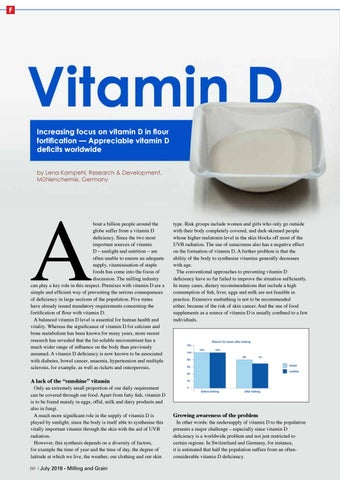
In other words: the undersupply of vitamin D to the population presents a major challenge – especially since vitamin D deficiency is a worldwide problem and not just restricted to certain regions. In Switzerland and Germany, for instance, it is estimated that half the population suffers from an oftenconsiderable vitamin D deficiency.