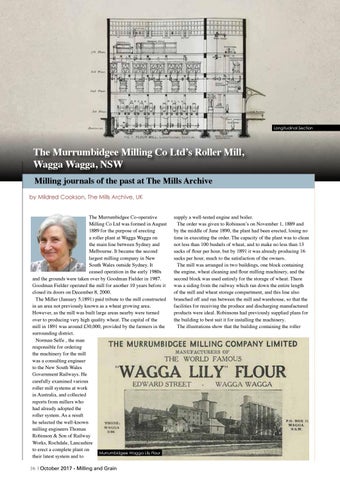
Longitudinal Section
The Murrumbidgee Milling Co Ltd’s Roller Mill, Wagga Wagga, NSW Milling journals of the past at The Mills Archive by Mildred Cookson, The Mills Archive, UK The Murrumbidgee Co-operative Milling Co Ltd was formed in August 1889 for the purpose of erecting a roller plant at Wagga Wagga on the main line between Sydney and Melbourne. It became the second largest milling company in New South Wales outside Sydney. It ceased operation in the early 1980s and the grounds were taken over by Goodman Fielder in 1987. Goodman Fielder operated the mill for another 10 years before it closed its doors on December 8, 2000. The Miller (January 5,1891) paid tribute to the mill constructed in an area not previously known as a wheat growing area. However, as the mill was built large areas nearby were turned over to producing very high quality wheat. The capital of the mill in 1891 was around £30,000, provided by the farmers in the surrounding district. Norman Selfe , the man responsible for ordering the machinery for the mill was a consulting engineer to the New South Wales Government Railways. He carefully examined various roller mill systems at work in Australia, and collected reports from millers who had already adopted the roller system. As a result he selected the well-known milling engineers Thomas Robinson & Son of Railway Works, Rochdale, Lancashire to erect a complete plant on Murrumbidgee Wagga Lily Flour their latest system and to 16 | October 2017 - Milling and Grain
supply a well-tested engine and boiler. The order was given to Robinson’s on November 1, 1889 and by the middle of June 1890, the plant had been erected, losing no time in executing the order. The capacity of the plant was to clean not less than 100 bushels of wheat, and to make no less than 13 sacks of flour per hour, but by 1891 it was already producing 16 sacks per hour, much to the satisfaction of the owners. The mill was arranged in two buildings, one block containing the engine, wheat cleaning and flour milling machinery, and the second block was used entirely for the storage of wheat. There was a siding from the railway which ran down the entire length of the mill and wheat storage compartment, and this line also branched off and ran between the mill and warehouse, so that the facilities for receiving the produce and discharging manufactured products were ideal. Robinsons had previously supplied plans for the building to best suit it for installing the machinery. The illustrations show that the building containing the roller