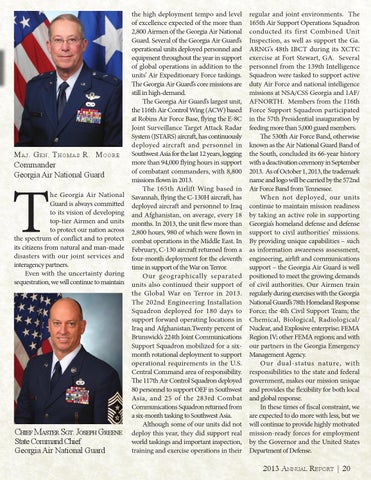
M aj . G en . T homas R. M oore
Commander Georgia Air National Guard
T
he Georgia Air National Guard is always committed to its vision of developing top-tier Airmen and units to protect our nation across the spectrum of conflict and to protect its citizens from natural and man-made disasters with our joint services and interagency partners. Even with the uncertainty during sequestration, we will continue to maintain
Chief Master Sgt. Joseph Greene State Command Chief Georgia Air National Guard
the high deployment tempo and level of excellence expected of the more than 2,800 Airmen of the Georgia Air National Guard. Several of the Georgia Air Guard’s operational units deployed personnel and equipment throughout the year in support of global operations in addition to the units’ Air Expeditionary Force taskings. The Georgia Air Guard’s core missions are still in high-demand. The Georgia Air Guard’s largest unit, the 116th Air Control Wing (ACW) based at Robins Air Force Base, flying the E-8C Joint Surveillance Target Attack Radar System (JSTARS) aircraft, has continuously deployed aircraft and personnel in Southwest Asia for the last 12 years, logging more than 94,000 flying hours in support of combatant commanders, with 8,800 missions flown in 2013. The 165th Airlift Wing based in Savannah, flying the C-130H aircraft, has deployed aircraft and personnel to Iraq and Afghanistan, on average, every 18 months. In 2013, the unit flew more than 2,800 hours, 980 of which were flown in combat operations in the Middle East. In February, C-130 aircraft returned from a four-month deployment for the eleventh time in support of the War on Terror. Our geographically separated units also continued their support of the Global War on Terror in 2013. The 202nd Engineering Installation Squadron deployed for 180 days to support forward operating locations in Iraq and Afghanistan.Twenty percent of Brunswick’s 224th Joint Communications Support Squadron mobilized for a sixmonth rotational deployment to support operational requirements in the U.S. Central Command area of responsibility. The 117th Air Control Squadron deployed 80 personnel to support OEF in Southwest Asia, and 25 of the 283rd Combat Communications Squadron returned from a six-month tasking to Southwest Asia. Although some of our units did not deploy this year, they did support real world taskings and important inspection, training and exercise operations in their
regular and joint environments. The 165th Air Support Operations Squadron conducted its first Combined Unit Inspection, as well as support the Ga. ARNG’s 48th IBCT during its XCTC exercise at Fort Stewart, GA. Several personnel from the 139th Intelligence Squadron were tasked to support active duty Air Force and national intelligence missions at NSA/CSS Georgia and 1AF/ AFNORTH. Members from the 116th Force Support Squadron participated in the 57th Presidential inauguration by feeding more than 5,000 guard members. The 530th Air Force Band, otherwise known as the Air National Guard Band of the South, concluded its 66-year history with a deactivation ceremony in September 2013. As of October 1, 2013, the trademark name and logo will be carried by the 572nd Air Force Band from Tennessee. When not deployed, our units continue to maintain mission readiness by taking an active role in supporting Georgia’s homeland defense and defense support to civil authorities’ missions. By providing unique capabilities – such as information awareness assessment, engineering, airlift and communications support – the Georgia Air Guard is well positioned to meet the growing demands of civil authorities. Our Airmen train regularly during exercises with the Georgia National Guard’s 78th Homeland Response Force; the 4th Civil Support Team; the Chemical, Biological, Radiological/ Nuclear, and Explosive enterprise; FEMA Region IV; other FEMA regions; and with our partners in the Georgia Emergency Management Agency. Our dual-status nature, with responsibilities to the state and federal government, makes our mission unique and provides the flexibility for both local and global response. In these times of fiscal constraint, we are expected to do more with less, but we will continue to provide highly motivated mission-ready forces for employment by the Governor and the United States Department of Defense.
2013 Annual Report | 20