“I KNOW YOU LOVE ME, BUT DO YOU LIKE ME?”: HOW LEAVING
FOR COLLEGE BROUGHT MY MOM AND I CLOSER
By Alex Lalli
WHAT HAPPENED TO GEORGETOWN FOOTBALL?
By Henry Skarecky
THIS NOVEMBER, CAST YOUR BALLOT FOR HARRIS -WALZ
By the Editorial Board
August 30, 2024
8 features
“The door has been opened”: For the first time, half of Georgetown’s chaplaincy directors are women
SYDNEY CARROLL
4 voices
“I know you love me, but do you like me?”: How leaving for college brought my mom and I closer
ALEX LALLI
5 news Students arrested at GW encampment enter into agreements to avoid charges
FRANZISKA WILD
6 sports
What happened to Georgetown
HAILEY WHARRAM
11 leisure
Short n’ Sweet is exactly what pop music needs right now
KOHARU ANDO
Editor-in-Chief ...... Ajani Jones
Managing Editor ...... Connor Martin
internal resources :
Executive Manager for Staff Sabrina Shaffer
Executive Editor for Resources, Diversity, and Inclusion ...... Aminah Malik
Asst. Editor for Resources, Diversity, and Inclusion ...... Imani Liburd
Editor for Sexual Violence Advocacy, Prevention, and Coverage ...... Alison Karki
Service Chair ...... Grace Nuri
Social Chairs ...... Ninabella Arlis, Henry Skarecky Archivist ...... Bradshaw Cate
news :
Executive Editor ...... Franziska Wild Features Editor ...... Katie Doran
12
editorials
This November, cast your ballot for Harris-Walz
EDITORIAL BOARD
14 sports
ANDREW SWANK on the cover
Thank you Wingo’s, Wisemiller’s, and DC Tasty Corner for supporting this issue! 10 leisure Though imperfect, It Ends With Us starts an important conversation
Georgetown football looking to take next step in 2024
BEN JAKABCSIN
15
halftime sports
Washington Spirit friendlies show the global growth of women’s soccer
“...the film finds its power in its ability to start conversations: conversations recalibrated to address why abusers harm as opposed to why their victims stay, and how we can portray DV on screen with even more tact moving forward.”
contact us editor@georgetownvoice.com Leavey 424 Box 571066 Georgetown University 3700 O St. NW Washington, DC 20057
business : General Manager Aashna Nadarajah
support : Associate Editors ...... Rhea Banerjee, Angelena Bougiamas, Eileen Miller, Olivia Pozen, Alexis Tamm
Staff Contributors ...... Meriam Ahmad, Carolina Bomeny, Mia Boykin, Elspeth Campbell, Romita Chattaraj, Ryan Goodwin, Christina Pan, Nicholas Romero, Isabella Stratta, Kami Steffenauer, Nadine Zakheim
The opinions expressed in The Georgetown Voice do not necessarily represent the views of the administration, faculty, or students of Georgetown University, unless specifically stated. Columns, advertisements, cartoons, and opinion pieces do not necessarily reflect the views of the Editorial Board or the General Board of The Georgetown Voice. The university subscribes to the principle of responsible freedom of expression of its student editors. All materials copyright The Georgetown Voice, unless otherwise indicated.
3
An eclectic collection of jokes, puns, doodles, playlists, and news clips from the collective mind of the Voice staf
Dear Voice readers...
We’re Georgetown’s newsmagazine and we want you to join our team!
We welcome new staffers at any time of the year and encourage you to join any and all sections you’re interested in. There is no application: the only qualification needed to join our team is the passion to create content.
To join, go to georgetownvoice.com/recruitment, or email us at thevoice@georgetown.edu.
Come to our info-session at 2 p.m. on Sunday, September 1 in the Leavey Program Room!
No crossword? No problem!
While this issue doesn’t feature a crossword, you can still get your Voice puzzle fix virtually! Check out the new Games tab on our site through the QR code, or at georgetownvoice.com/games.
Tina’s FDOC playlist:
Happy FDOC! Here’s a look at what our design editor has been listening to as the semester gets into full swing— we’re going for morose and mourning, with a hint of yearn.
• “Really Love,” by D’Angelo
• “I Just Died,” by Amerie
• “Terrapin,” by Clairo
• “My Love Mine All Mine,” by Mitski
• “Slow Like Honey,” by Fiona Apple
• “One Wish,” by Ravyn Lenae
• “Skyline To,” by Frank Ocean
“I know you love me, but do you like me?”: How leaving for college brought my mom and I closer
was fine without proceeding to project her emotions onto me. I would have previously attributed this to something I had done, but because of my newfound self-assurance, I found myself wanting to address our relationship directly.
relationship can and will withstand time apart. If anything, it can be necessary in order to come back together with clarity about who you are and where your relationship stands. Ultimately, that was the case for my mom and me; only through separation could we reunite.
Students arrested at GW encampment enter into agreements to avoid charges
BY FRANZISKA WILD
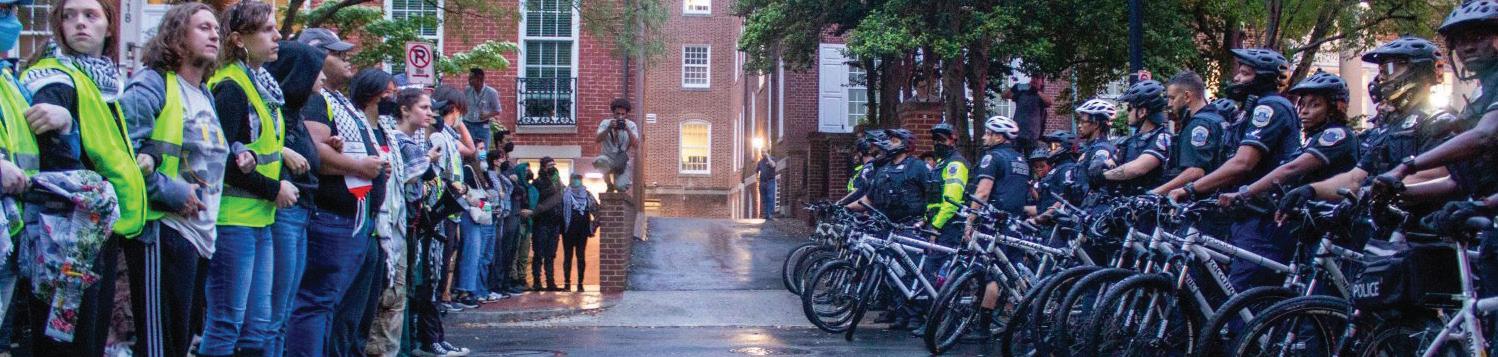
As August concludes, the court cases of the 33 protesters who were arrested in May at the DMV Gaza solidarity encampment in University Yard (U-Yard) at George Washington University (GW) are coming to an end.
At least two protesters have had their charges dropped, one has pled guilty and will be forced to do community service, one was a minor at the time of the arrest and there are no publicly available court records on their case, and the remaining 29 have entered into agreements to avoid charges. These agreements include broad stay away orders from GW’s 43-acre campus, which is woven into the surrounding Foggy Bottom neighborhood. While the stay away orders are frustrating for the seven Georgetown students arrested, they have created stress and uncertainty for the at least seven GW students arrested.
All the Georgetown and GW students were charged with unlawful entry, which in D.C. carries a maximum punishment of a $1,000 fine, a 180-day prison sentence, or both. In order to avoid these punishments, 29 protesters have entered into “stet agreements” with the United States Attorney's Office for D.C. (USAO), according to court records.
These agreements, often used in unlawful entry cases, mean that as long as the arrested students comply with the outlined terms—in this case, a stay away order from GW’s campus and a prohibition on getting arrested again—the charges will be dropped after six months. If students violate the terms of the agreement, their charges could be reinstated, they could be charged with an entirely new crime, they could be held in contempt of court, or a combination of the three.
Miriam Siegel (CAS ’26), who is a member of Jewish Voice for Peace at Georgetown and helped organize the encampment, expressed frustration at the agreement.
“It’s impeding on my life. The stay away order includes GW Hospital — a hospital — and the Foggy Bottom Metro,” she said. “GW is the largest private landowner in D.C. and that’s a lot of land we’re unable to access for six months.”
For the GW students, the stet agreements and stay away orders present an entirely different challenge; many have only been able to receive limited exceptions that allow them to attend class but not much else, whether that is use of the library, visiting a friend in their dorm, or even resting on a bench on GW’s property.
One of the arrested students, who currently attends GW and spoke to the Voice on the condition of anonymity, wondered if she would be able to study in the library or use the Student Health Center this upcoming semester—the answer to both those questions was no.
“I am one of the students that's currently facing a stay away order from the university, and it has been a long few months of essentially begging for action from the university or from the prosecutors to at least clarify their position on giving us the exceptions we need to continue to be students,” she said.
Mark Goldstone, an attorney who represents one of the students, had to undergo multiple rounds of hearings in order to negotiate even simple exceptions like being able to use the dining hall. He told the Voice that the stay away orders are incredibly broad, punitive, and atypical for this kind of nonviolent offense. In his opinion, the stay away order is unnecessary because the students already have a prohibition on illegal conduct or getting rearrested as part of their stet.
“It's just weird. I don't know how else to describe it.”, Goldstone said. “It's unprecedented that a broader, and more intense stay away is required by the prosecution when the complaining witness has no intention of arresting a student walking to the library or going to the dining hall.”
Carl Messineo, an attorney with the Partnership for Civil Justice Fund who also represents one of the arrested GW students, agreed with Goldstein and said that the breadth of the stay away orders is atypical.
“I've been doing this work for 30 years,” he said. “I have never seen such severe restrictions on persons that are charged with nonviolent, peaceful, misdemeanor, protest-related offenses. Most of the time these aren't even prosecuted.”
Prosecutors in court filings acknowledged the nonviolent nature of the protests but stated that when the arrested individuals ignored multiple dispersal orders from MPD, they “demonstrated a proclivity to refusing to comply with both the law and directives from law enforcement.”
GW, which is considered the complaining witness in the case, has said it is D.C. who decides the terms of a stet but maintains it has always supported exceptions for students to be able to attend class, according to a GW spokesperson.
However, Messineo said that GW is attempting to save face by shifting blame on to the USAO.
“GW University, the largest landowner in the District practically, and the United States government are just covering each other's backs. The bottom line is, one or both of these institutions has the authority to say ‘we don't want these stay aways’ or ‘let's bring it down to something appropriate,’ like a stay away from University Yard,” Messineo said. “Either can do it, neither will.”
The GW student who was arrested said the stay away orders seem to be disproportionate, especially since she and other arrested students are only facing low-level disciplinary charges from GW.
“I think a large part of the frustration with this is because the students, myself and the others, they don't have formal academic charges from the university that justify this level of punishment on campus,” she said. At least one student has been temporarily suspended, according to reporting by The Washington Post
Roberts and Messineo both believe that the harshness of the stay away orders is in part due to the nature of the students’ activism—they see it as an attempt to stifle pro-Palestinian speech by GW and the USAO.
“It's absolutely a political motivation,” Messineo said.
The United States Attorney’s Office declined to comment, but in court filings, prosecutors wrote that the stay away orders are intended to be “tailored to the particular criminal conduct Defendants engaged in” when they remained illegally on GW property.
Back at Georgetown, Students for Justice in Palestine (SJP) is gearing up to continue their advocacy with the DMV Students for Justice in Palestine Coalition and on campus, while trying to support their friends as they navigate the stay aways, according to Lukas Soloman (SFS ’26), a board member in SJP. GW has also recently agreed to come back to continue negotiating with students on their terms despite the court battles, according to social media posts by organizers. Soloman sees this development as very encouraging.
“It's a really good sign that the organizing work that GW students have been doing and that the D.C./DMV community at large has been doing has been effective in pressuring George Washington University's administration,” Soloman said. “Obviously, SJP is not going to free Palestine. That's never been anybody's mindset, but we are working in our locale as part of a larger strategy that contributes to the overarching goal of Palestinian liberation.”
Whether Georgetown will have an encampment or similar protests is contingent on how the university administration negotiates with SJP on their demands of financial divestment and academic boycott from Israel, according to Solomon.
“We appreciate the administration's engagement with us thus far. Our resilient organizing has already resulted in John DeGioia calling for an immediate ceasefire in Gaza this past April,” Solomon said. “However, we recognize that a call for a ceasefire is far from enough. It is the stance of Georgetown SJP and also the Jesuits for that matter: words without actions to back them up are insufficient.”
Editor’s Note: Lukas Soloman once served as an editor for the Voice .
photo
What happened to Georgetown football?
BY HENRY SKARECKY
Georgetown football is an anomaly among sports on the Hilltop.
The Hoyas have never won a conference championship in the near quarter-century it has been a member of its conference, the Patriot League. Nor has Georgetown ever made the 24team Division I Football Championship Subdivision (FCS) postseason tournament. Many people don’t even know that Georgetown has a football team. Nowadays, the team never sees much success or fan engagement, despite usually winning a handful of games each season.
A quick search into the history of the Hoyas on the gridiron reveals a rich and colorful team which, at times, was quite successful. The Georgetown football team was consistently ranked in the AP Poll from 1938 to 1940, and even made the Orange Bowl in 1941 where the No. 13 ranked Hoyas lost to No. 9 Mississippi State 14-7.
John Reagan (MSB ‘84) began researching the history of the team in 2003 to digitize its past and fill gaps in its historical record. Twenty years later, his website, hoyafootball.com, documents the schedules and team rosters of Georgetown football going all the way back to 1887.
The product of this research is a complete view on Georgetown, one of the most dynamic teams in the history of college football, and how this team, once ranked in the AP Top 10, was torn down and rebuilt once more.
Beginning of the end
The decline of Georgetown football truly began after World War II, when the Hoya fanbase collapsed due to several factors which, when combined with the rising costs of running the team, made shutting down Hoya football the only possible option.
From 1925 to 1950, Georgetown played their home games at Griffith Stadium, a major league baseball park with a capacity of around 30,000 people located near Howard University.
But Griffith Stadium was also home to George Washington University’s football team, the MLB’s Washington Senators, the NFL team now called the Washington Commanders, as well as Maryland’s football team for a brief period while the Terrapins were rebuilding their stadium in College Park.
Consequently, multiple teams were fighting over the expensive weekend slots at Griffith Stadium. In an effort to save money, Georgetown games moved from the traditional Saturday afternoon to Friday nights, and D.C. didn’t respond well to that.
“Friday night was for going out with family, or there might be a high school event of some kind,” Reagan said. “So attendance began to drop off.”
Attendance wasn’t the only thing that declined as a result of switching to Friday games. Since college football is typically played on Saturdays, D.C. area
newspapers would have game recaps printed in the Sunday paper. Georgetown’s football team, having played a day prior, was literally yesterday’s news, so the papers only mentioned the Hoyas lightly, if at all. As a result, Georgetown football began to evaporate from the public consciousness.
A handful of these fans likely switched their allegiance to other universities, typically larger state schools like Maryland or Virginia. After World War II, the G.I. Bill guaranteed a college education for American soldiers, so college enrollment exploded. While a handful of these veterans did enroll in private
keep athletic costs down. Numerous schools like Stanford, Northwestern, Duke, and Vanderbilt faced high athletic costs and were overshadowed by larger public universities, and yet those programs survived to the modern day and play in some of college football’s most popular conferences.
Despite the many similarities, those schools had two major things that Georgetown lacked: oncampus facilities and passionate rivalries.
All of these schools constructed on-campus stadiums that seated tens of thousands of fans in the
These teams also had fierce rivalries with other schools which guaranteed at least a game or two with a filled stadium every year, even if the team itself wasn’t performing well. For example, every year Stanford plays Cal in the “Big Game,” one of college football’s most historic rivalries which has gifted fans many great moments in the sport, including the famous “Band is on the Field” moment in 1982.
Duke-North Carolina, Northwestern-Illinois, and Vanderbilt-Tennessee are all rivalries with regional interest, each guaranteed to have paying spectators. Even the Ivy League has fierce football rivalry, with Harvard and Yale playing each other annually since 1875.
Georgetown, on the other hand, never scheduled consistent opponents, and as a result, rivalries that could have potentially occupied the minds of students and fans for decades never formed. After World War II, the athletic department regularly scheduled teams like Tulsa, Miami (Fla.),
“These teams had no relevance to somebody in Washington, D.C.,” Reagan said. “We weren’t playing Virginia. We were not playing Temple anymore. We were not playing West Virginia anymore. These seemed to be a haphazard group of schools, so the ties that bind weren’t there.”
Perhaps, if the school had built Cooper Field a hundred years earlier and had developed a passionate rivalry against a nearby state school like Maryland, Virginia, or Virginia Tech, Georgetown could be a football powerhouse today.
Modern football woes
By the 1960s students and alumni, well aware of the past glory of Hoya football, began efforts to bring football back to the Hilltop. A club team was formed in 1964 before the administration, noticing the popularity of the sport, brought the team back to the NCAA ranks in 1970, first as a nonscholarship Division II program before settling in Division III, playing the likes of Catholic University and Gallaudet University.
two decades in the league, however, Georgetown has never won the Patriot League, let alone appeared in the tournament.
Then, in 2010, the Patriot League did the unthinkable: they began to allow scholarships for football, and every team in the league began to offer 60 football scholarships. That is, every team except for one: Georgetown.
“I think at one point I said, ’this is going to end poorly.’ Because we can’t compete,” Reagan said. “A zero scholarship team can’t compete against a 60 scholarship program.”
And yet this massive transition in the rules of Georgetown’s conference surprisingly had little effect on Georgetown’s performance in the league.
“For the most part, what all the Patriot League schools were doing, except for Georgetown, was moving money from the financial aid office to the athletic department,” Reagan said. “The quality of their athletes had not changed considerably, so Georgetown could still compete with them.”
But in 1992, the NCAA decided that colleges must be in the same NCAA division for all sports. Since Georgetown basketball was Division I, the athletic department faced a decision: cut football again, or bring Georgetown football to Division I. They chose the latter, and the Hoyas, alongside 26 other D-III programs, made the move upward to the FCS level of D-I.
They joined the Metro Atlantic Athletic Conference and played alongside teams like Iona, Canisius, Siena, Fairfield, and LaSalle. And the Hoyas were respectable, winning conference titles in 1997 and 1998.
But the Hoyas, like in the 1940s, were once again facing attendance issues, and the athletic department thought the problem had to do with Georgetown’s opponents.
Canisius and Siena weren’t enticing opponents. “They were not peers,” Reagan said. They had no connection to Georgetown. The team turned their eyes to schools which were a better fit both academically and athletically.
They joined the Patriot League in 2001, which brought Georgetown in line with other football-playing Catholic schools in the Northeast like Fordham and Holy Cross. Soon after, Georgetown started playing some Ivy League schools in nonconference play.
“The real pitch that was made by [the football coach at the time], was that we could have an experience in the fall where students and alumni and parents could be on campus for a peer institution,” Reagan said. “But the Ivies don’t look at Georgetown as a peer.”
One advantage of the Patriot League was that the winner of the conference earned an automatic spot in the FCS postseason tournament for a shot at the FCS national championship. After more than
While the athletic ability of Patriot League football players didn’t change much after 2010, Reagan pointed out that the shift cemented the inability for Georgetown football to recruit ‘middle-class’ athletes.
“Georgetown can, admissions-wise, draw kids from the upper income because they want to be there. It can draw kids from the lower income because of need-based financial aid,” Reagan said. But the story for potential recruits in between these groups raises a problem for Georgetown’s football team in the long term.
“If I’ve got to pay $35,000 to go to Georgetown and Lehigh gives me a free ride, for some people Lehigh becomes a really good offer.”
And that brings us to the 2024 season, the Hoyas’ 24th season in the Patriot League, and 14th in which the conference allows football scholarships.
The road ahead will only get tougher for the program. Next year, frequent FCS playoff team and 2008 national champion Richmond Spiders are joining the Patriot League, increasing the total number of teams in the conference to eight and further reducing Georgetown’s chance of being successful in the league.
Another change may be in store for Georgetown football. The administration has shown in the past that it is open to reviving football’s relevance on campus, as long as it never crosses the line of making football a scholarship sport.
Perhaps Georgetown could join the Pioneer League, a non-scholarship league with teams across the country, including Catholic peers like Dayton and Hoya basketball rival Butler. Maybe then the Hoyas could earn a berth in the FCS tournament.
Alas, we are just living in another chapter of the dynamic history of Georgetown football, one that has changed forms numerous times in years past and, given that we now live in the era of NIL and conference realignment, may continue to evolve in the future.
“The door has been opened”: For the frst time, half of Georgetown’s chaplaincy directors are women
BY SYDNEY CARROLL
S
hweta Chaitanya, a brahmacharini in the Hindu dharma and Georgetown’s new director for Dharmic Life, has watched women break glass ceilings—and ancient rules.
In 2016, Chaitanya was in Mumbai, India, studying in an ashram, a Hindu spiritual sanctuary. Despite studying in the ashram, Chaitanya and many other women monastics were unable to enter the ashram’s sanctum because those trained in performing sanctum rituals are often men.
That is, until Chaitanya watched a woman monastic enter the sanctum, during a ritual typically reserved for men, and hold out her hand for a portion of the blessed food. The woman monastic drew attention across the ashram, including from Chaitanya, and made her feel like she wasn’t alone.
“For me, it was a signal. It was like, ‘Okay, people are daring to do this, I’m going to do the same,’” she said.
Now at Georgetown, Chaitanya is daring to break into a new role.
Over the summer, Georgetown Campus Ministry announced the hiring of Rabbi Ilana Zietman as the new director of Jewish Life and Chaitanya as director for Dharmic Life. These women, alongside Reverend Ebony Grisom, who is in her second year as director for Protestant Life, have made history: this is the first time that half of Georgetown’s chaplaincy directors are women. This historic moment also entails uncertainty, as not all denominations of Protestantism, branches of Judaism, or Dharmic traditions allow women to act as faith leaders.
Women involved in religious study have broken many barriers at Georgetown. In 1919, two sisters at the Georgetown Visitation Convent became the first women to earn bachelor’s degrees at Georgetown.
In 1973, Sister Laetitia Blain, R.J.M., became the first woman to serve as a chaplain on campus. Women have since served as chaplains in many capacities across Campus Ministry, but Chaitanya is the first woman to serve as director for Dharmic Life. Zietman and Grisom are the second women to serve in their respective positions.
Beyond serving as official leaders of chaplaincies, women have held important roles within faith traditions at Georgetown for
years, whether as spiritual mentors without official leadership positions or as Campus Ministry staff.
“There is this really interesting tension of, ‘Yay, three women chaplaincy directors,’ and also realizing that there have been lots of women before, and there are still women who are here, who have been functioning as tremendous pastors and leaders and counselors and sojourners,” Grisom, who was at Georgetown for four years as a Protestant Chaplain before becoming director for Protestant Life, said.
This historic year for Campus Ministry comes amid the persistent exclusion of women leaders across a myriad of faiths and religious traditions. The 2019 National Congregations study, which included 5,300 congregations of Christians, Jews, Muslims, Buddhists, Hindus, and other religions, found that while over half of the congregations involved in the study allow women to lead worship, only about 14% are actually led or co-led by a woman, representing an increase of just 3% since 1998.
Georgetown’s women spiritual leaders said they often face an uncomfortable tension between serving as a woman leader and the tenets of their religion. While some religious communities today may celebrate women in leadership, most religious traditions were historically dominated and retold by men.
“Judaism, being a very old religion, is inherently going to be patriarchal at times— you can't avoid it,” Zietman said. “And there are moments where, whether it is in our stories, in our laws, in just community norms, [women] aren’t seen or understood the way we want to be seen and understood—and that’s painful, and that’s hard.”
However, Zietman emphasized that just because women aren’t necessarily mentioned in all the histories or traditions of the Jewish community doesn’t mean that they weren’t there.
“There have always been women in Jewish tradition. They’re there from the beginning,” Zietman said. “There is a whole era of women now lending their voices, their authority, their opinions, to Jewish tradition. Writing commentaries, writing our own new prayers, giving different models of leadership. We’re here now, and it is so inspiring to see that we’ve really recreated Judaism in a lot of ways
with our own perspectives, our own needs, our own voices.”
Although formal rules have evolved, historical customs may still present challenges for women leaders to fully participate in rituals, traditions, and religious acts.
“How this tradition was stewarded over time, through generations, was predominantly males of an elite class,” Chaitanya said, referring to Hinduism. “If we’ve said that we’re ready to ordain women, we’re ready to ordain people of all backgrounds, what does that actually look like when you enter a space that has had a long history of male-centered interpretations of a tradition, male-centered practices and language?”
All three of Georgetown’s women chaplaincy directors lead departments of Campus Ministry that encompass a wide variety of faiths and denominations. Within Jewish Life, Zietman is rabbi for Jews of the Orthodox, Reform, Reconstructionist, and Conservative traditions, as well as many other ethnic and denominational traditions within Judaism. While many Jewish communities do have women who serve as rabbis, there are certain Jewish religious establishments that believe women should not be rabbis.
“Not all Jewish denominations or communities accept the ordination of women. And so how do you serve a community when it’s really diverse and you are one person?” Zietman said. “Rabbi essentially means a teacher at the end of the day. So even if someone is an Orthodox student who practices Judaism in a way that is not as egalitarian as the Judaism I practice, there’s no barrier for me to be their rabbi, as in having that relationship of being a guide, a mentor, an advisor, or a teacher.”
Zietman continued that even though she may not be able to make certain halachic decisions, or judgments pertaining to Jewish law, for some students who follow a different tradition, she can still connect students with another rabbi who can help them in their specific faith.
Grisom and Chaitanya deal with similar challenges. At Georgetown, Protestant Life
encompasses any non-Catholic or nonOrthodox students who practice Christianity. Thus, Grisom is a reverend for students of hundreds of faiths, ranging from the Episcopal Church to the Pentecostal Church and Church of Latter-Day Saints. While she is ordained in the American Baptist church, many other Protestant denominations don’t ordain women.
As director for Dharmic Life, Chaitanya has four separate Dharmic traditions within her ministry: Buddhism, Hinduism, Sikhism, and Jainism. Within those four traditions include many different denominations and traditions, meaning that the students coming to Chaitanya for counseling may have a completely different faith, and also may have never had a woman spiritual leader. Chaitanya acknowledges this, and encourages students to embrace their differences as a way to collectively grow in faith.
“Please don’t see me as a random auntie who’s policing the way that you are exploring and understanding your own religious tradition,” Chaitanya said. “Rather, just see me as someone who wants to walk alongside you in that process.”
Dealing with these differences can still take an emotional toll on religious leaders as they attempt to serve as mentors while also navigating religious differences, Chaitanya acknowledged.
“It’s work to be in these roles that the three of us are in. It’s a lot of work because you’re not just presenting something new, you’re combating a lot of the resistance as well to what you’re presenting,” Chaitanya said.
Grisom has experienced this resistance and has sometimes felt unheard and disrespected, feeling as though she isn’t treated equally to other male chaplains despite her position at Campus Ministry.
“I have had many experiences where people won’t give me the same clerical respect that they give my male colleagues. I would say that this happens at Georgetown frequently. In big ways and small ways, whether in a room with others or just to me individually,” Grisom said. “I am aware of it, but I’m not consumed by it, because I realize that any of the angst around it is not my own.”
Today, some religious leaders don’t always listen to the concerns of women. Chaitanya described at times feeling unheard by her male teachers in her spiritual journey when she would try to explain that certain teachings in the Hindu faith didn’t resonate with her.
“When I have a question and I want to ask my teacher, ‘Hey, I have a question about this, I actually don’t find this relatable, can we rethink this?’” Chaitanya said. “You would think that that conversation will go somewhere. And I’m not saying everybody doesn’t let it go somewhere, but there are people who don’t want to let that conversation happen.”
According to the women, the conversation regarding female religious leadership at Georgetown has been joyful as of late, with Zietman, Grisom, and Chaitanya making university history. The three directors expressed excitement at the statistic—however, they all agreed that their work is far from done.
“I have a couple perspectives here. One is, three women directors, let us celebrate and bring out the fat cow—that’s one,” said Grisom, referring to Luke 15:23, where a fat cow is consumed in celebration of a son’s return home (The Parable of the Lost Son). “Another is lamentation and repentance that it has taken this long, and actions that accompany the celebration and lead to repair.”
Chaitanya celebrates the historic nature of her employment but noted that it highlights the exclusion of women from religious leadership on campus and beyond for years.
“That we have three women on the team now, and in the position of directors, it
is fantastic. It’s awesome. At the same time, you can’t help but think this should have been the case always,” Chaitanya said. “We’re always late to the game. Had it been 20 years ago, had it been 100 years ago, had it been 500 years ago—it’s still late.”
Chaitanya also hopes that they serve as the first women to make up half of the chaplaincy directors, but are far from the last.
“The door has been opened. Now, how do we make sure this door stays open?” Chaitanya said.
Grisom, who is chaplain to many students who have never attended churches led by ordained women, hopes that her students can see her as an example of how they could lead in their own faiths.
“If this is a glimpse for someone, especially a young woman, or a not-young woman, who is wrestling with whether leadership in their faith community is possible, if they can look to us and see and interpret that as an answer, as a yes to their question or an invitation to come and seek. Then praise be to God,” she said.
Zietman is hopeful that students in Jewish Life and beyond can see the presence of her and her colleagues as an invitation—or even reinvitation—to get involved with their faith.
“Being a woman is inevitably part of what it is for me to be a rabbi and a Jewish leader and a mentor, that is the way in which I move through the world,” Zietman said. “And I think that for a lot of students to be able to see part of themselves in me is going to be so important. And being able to feel empowered to be a Jewish leader themselves, and that really matters to me.”
As Rabbi Ilana, Rev. Grisom, and Brachmacharini Shweta make their way through this historic year, they are excited to connect with students, practice their faith, and bring new and exciting events to Campus Ministry.
They’re also ready to face any doubts about their leadership head on—or, as Grisom said, if anyone has complaints or feels she shouldn’t be ordained, “those concerns are best taken up with God.”
Though imperfect, It Ends With Us starts an important conversation
BY HAILEY WHARRAM
Content warning: This article discusses domestic violence.
By now, you’ve probably heard about It Ends With Us (2024) for all the wrong reasons. And that’s a damn shame.
Adapted from Colleen Hoover’s best-selling 2016 novel, It Ends With Us (IEWU) follows Lily Bloom (Blake Lively), a florist who starts dating neurosurgeon Ryle Kincaid (Justin Baldoni) while renovating her new flower shop. Though Ryle appears innocuous and charming at first, he soon begins abusing Lily physically and emotionally. Ryle’s malice distresses Lily deeply, especially since, as seen during the film’s concurrent teenage timeline, she grew up with an abusive father. When Lily reunites with her first love Atlas Corrigan (Brandon Sklenar) whose childhood was similarly unraveled by domestic violence, Ryle’s jealousy only worsens his treatment of the woman he hollowly claims to love.
Since the film’s release on Aug. 9, its marketing (plus rumored cast tensions) has sparked significant controversy.
On one hand, Baldoni, doubling as the film’s director, spent his press circuit spotlighting domestic violence (DV) awareness by platforming No More, an international foundation dedicated to DV advocacy. No More defines DV as “a pattern of behavior used to establish power and control over another person through fear and intimidation” that can be physical, emotional, psychological, or economic in nature. The organization partnered with Wayfarer Studios during the production of IEWU to help ground the film in the lived experiences of DV survivors and to create a comprehensive viewer’s guide outlining healthy and unhealthy relationships, exit strategies for individuals experiencing DV, and mechanisms for supporting survivors.
Meanwhile, Lively’s promotion of IEWU has left much to be desired. When asked how those who resonate with Lily’s story could appropriately contact her,
Lively dismissed the question outright: “Are you asking for like my address, or my phone number, or like my location share?” Additionally, at the film’s premiere, she insisted DV survivors are “so much more than just a survivor or just a victim.” Though likely well-intentioned, sugarcoated comments like these subtly silence survivors by sidestepping the di the sake of preserving public comfort. Worse yet, Lively has used the film to promote her personal brands, including her hair care line Blake Brown and cocktail company Betty Buzz. At one organized by Lively, the Betty Buzz menu included a beverage tastelessly named “Ryle You Wait.”
With ambiguous promotional materials and Lively encouraging theatergoers to “grab your friends and wear your florals,” many newcomers to IEWU com. The novel sparked similar puzzlement, having been categorized as a romance alongside the rest of Hoover’s sizable erotic catalog. Inspired by the abusive relationship between Hoover’s parents, accessible, women-dominated romance genre has helped it reach individuals most vulnerable to experiencing something similar to Lily—while anyone can experience DV, the majority of DV victims are women. In a genre that sometimes paints toxic behaviors as permissible at best and sexy at worst—a trend even present within some of Hoover’s other work—having a story written specifically for romance readers which dissects the harmful patterns permeating the genre can do a lot of good. Yet, this genre precarity can also harm: the novel and film omit trigger warnings, an oversight that has the potential to blindside survivors.
Aside from this disappointing, easily preventable shortcoming, Baldoni’s film is largely an empathetic, realistic, and well-researched depiction of DV. For instance, during Ryle’s first violent outbursts, Baldoni initially obscures Ryle’s deliberate inflictions of harm to powerful effect. Until Lily reexamines their relationship, her injuries masquerade as “just accidents” to herself and the audience alike. By only revealing the truth in retrospect, the film gaslights the viewer with the same strategy abusers often use to manipulate their partners: exploiting their desire to extend the benefit of the doubt.
Baldoni is similarly impressive on the acting front, embedding Ryle with considerable depth that defies the stereotype that abusers are onedimensional people. At times, Ryle is caring—much to our dismay. In making Ryle more than just a
depicted as far too easy. “It scares me because I know that somewhere out there, there is a woman who is experiencing abuse and trying to leave, and for them to see a scene like that and (think), 'Maybe that’s how I confront him. Maybe if I put this in context, he’ll understand'—that could end with them being in physical harm or worse," Weir told TODAY.com.
Despite Baldoni’s best intentions, IEWU is not a flawless depiction of DV—he even acknowledged as much. That being said, the film finds its power in its ability to start conversations—conversations recalibrated to address why abusers harm as opposed to why their victims stay and how we can portray DV on screen with even more tact moving forward. It would be impossible for this story about a single family’s experience to speak to the experience of all survivors—after all, there is no universal experience of DV. Everyone’s story looks different, and therefore to ask IEWU to cover the experiences of all DV survivors and victims is to ask too much of it.
However, the impossibility of universality is precisely why we need more stories about DV: so everyone can find a story that speaks to their own. By holding media such as a high standard of excellence and appreciating its strengths while simultaneously evaluating how it could’ve been better, we are engaging in a dialogue of critical importance.
It’s hard to describe the chokehold that “Espresso” had on this past summer. Viral TikTok audios, Van Leeuwen ice cream collabs, and the widespread colloquial use of “that’s that me espresso” had audiences romanticizing an unabashedly colorful, carefree summer in caffeinated anticipation of Sabrina Carpenter’s sixth studio album, Short n’ Sweet (2024).
As Carpenter’s mainstream popularity grows, she’s become her own brand of pop star. Her recent performance at Outside Lands began with a 1950s-esque introduction, complete with a neon sign and a booming broadcaster voice in the likeness of Corny Collins from Hairspray (2007). Carpenter has become the embodiment of an ultrafeminine, pastel-ridden take on vintage aesthetics, and has
By Koharu Ando
While Carpenter is a pop star at heart, influences from R&B, EDM, folk, funk, and alternative rock trickle into the writing and production on Short n’ Sweet—much like SZA’s SOS (2022) or Ariana Grande’s eternal sunshine (2024). Partially because of this, Short n’ Sweet isn’t the most unique or innovative; on a purely musical level, it lacks the individuality that, say, Cowboy Carter (2024) or Charm (2024) overflow with. But it’s a record that gets better the more you listen to it. After a few listens, it expands from a mere amalgamation of varying sounds to a curated collection of pop songs that are distinct, but still complimentary.
The record opens with classic Carpenterbrand humor: “I leave quite the impression /
the hyperactivity of emails i can’t send. “Good Graces,” sprinkled with ear candy, mimics the computerized sounds of K-pop, and “Lie to Girls” is reminiscent of Lizzy McAlpine’s oeuvre.
Among these moody, dreamy soundscapes, “Coincidence” stands out. The song relies on an acoustic guitar for a lighthearted, percussive accompaniment that contrasts with the earlier tracks. Short n’ Sweet is lush, complex, and grownup, but “Coincidence” shows off an earnest, sweet side of Carpenter’s emotionality that’s similar to
I
n February, the editorial board called both thenpresumptive presidential nominees “morally objectionable”—and this remains the case for the Harris-Walz and Trump-Vance tickets.
According to the Democratic 2024 party platform draft, Vice President Harris's policies will look similar to President Biden’s. Consequently, we strongly disagree with some of her key stances— on Gaza, immigration, and even racial justice—as they fail to promote the value and dignity of all human life. Voting is an individual choice, and many communities rightfully treat those issues as dealbreakers. However, based on a broad policy evaluation of the two candidates and the impact their presidency would have on progressive causes, the editorial board urges voters to cast their ballots for Harris-Walz.
The “uncommitted” movement
The U.S. has continued to provide offensive military aid to Israel almost a year after Israel began its genocide in the Gaza Strip. Many activists, including members of the Uncommitted National Movement, have criticized Harris's unconditional support of Israel under the Biden administration. The movement encouraged voting “uncommitted” during the primary election to pressure Biden to change his stance on Israel and Gaza. Now, it calls on Harris to do the same. Some members of the movement plan to vote for Harris but call for policy change on Gaza, while others have advocated voting for third party candidates like Jill Stein, who has committed to ending Israel’s genocide in Gaza if elected.
Harris has expressed concern over the high number of Palestinian civilian casualties but has not indicated that her foreign policy on Israel would differ substantially from Biden’s. She has called for ending the war in Gaza, meanwhile the Biden administration continues to send billions of dollars of military aid to Israel. Given the horrific suffering in Gaza and the West Bank, we recognize that Harris's support for Israel is justifiably dealbreaking for some voters.
In the aftermath of the DNC’s failure to platform a Palestinian American speaker, the Harris campaign must elevate the voices of Palestinian Americans who are calling for Harris to “help us help you” and show that, as president, she will tangibly—not just rhetorically—differ from the Biden administration.
While Harris and Trump both support a strong U.S. alliance with Israel, their approach to navigating this alliance is notably different. While Harris, in her DNC speech, stressed the Palestinian “right to dignity, security, freedom and self-determination,” Trump has threatened to violently crack down on pro-Palestine protests, continues to support illegal West Bank settlements, and his advisors promised to not place “any handcuffs or limitations” on Israel. He has expressed no concern for Palestinian civilians, instead telling Israel to “finish up” its war.
Undeniably, Harris's and Trump’s rhetoric and policy stances differ in key ways. But voters who care about Palestinian liberation deserve more than a candidate who frames pro-Palestine activism as helping the Trump campaign. When setting an
official policy platform, the Harris campaign should listen to protesters’ demands, support an immediate ceasefire in Gaza, and stop the flow of arms to Israel.
We also urge the Georgetown community to consider the other issues crucial to our generation on the ballot this November.
Project 2025
While Trump’s views on many issues have been erratic, the Heritage Foundation’s far-right Project 2025 platform will inform his administration’s first 100 days in office by providing a roadmap to legislate a Christian nationalist and white supremacist agenda that will erode civil rights, essential government services, and bedrock checks and balances in the U.S. government. It includes plans to slash funding for climate change research and eliminate terms from all laws and federal regulations, including “sexual orientation,” “gender equality,” “abortion,” and “reproductive rights,” which would have devastating impacts on LGBTQ+ communities and pregnant people.
Trump also supports disenfranchisement in other ways. By casting doubts about election integrity, he encouraged Republican state legislatures to enact stricter voting laws; since 2020, 28 states have enacted new voting restrictions, making it harder to vote this year than four years ago. We urge Georgetown students to visit resources like VOTE411 and Can I Vote to see what’s on their ballot, check their voter registration, review their state’s mail-in voting requirements, and request a mail-in ballot.
Climate change and the environment
Trump has historically denied the science behind the global climate emergency, and his administration is known for its rollbacks on fighting the climate crisis, including his decision to withdraw the United States from the Paris Climate Agreement. Under Project 2025, Trump would not only reshape U.S. energy policy and dramatically increase offshore drilling but also jeopardize Biden’s climate legacy by potentially repealing the 2022 Inflation Reduction Act (IRA)—the United States’ largest investment in green energy subsidies.
Harris, on the other hand, has shown that she is seriously committed to addressing the climate crisis as a member of the Biden administration. In 2022, she cast the tiebreaking vote for the IRA, and if elected, she will likely continue to build on this legislation. While smaller, leftleaning climate organizations have refrained from endorsing Harris until she releases a clearer climate policy, we see Harris as a candidate that will lead a continued fight against global climate change.
Healthcare and public health
As president, Trump unsuccessfully attempted to repeal the Affordable Care Act (ACA), which would have eliminated health insurance coverage for millions of Americans. Though he recently said he would no longer seek
to end the ACA, he has proposed lifetime Medicaid caps, which would threaten benefits for millions of low-income recipients. Trump has also refused to address gun violence—the leading cause of premature death in America. He has promised to protect gun rights—even after surviving an assassination attempt—and he blames mental health for civilian shootings, despite the U.S. having the highest gun deaths of any developed nation, including those with a right to bear arms.
Trump has long used harmful anti-trans rhetoric, and as part of his healthcare policy, he seeks to eliminate access to gender-affirming care for transgender people. Project 2025 would allow healthcare professionals to deny gender-affirming care and punish doctors who provide genderaffirming care to minors.
On the other hand, Harris's public health approach emphasizes affordable healthcare access for all Americans. She will continue the Biden
ThiscastNovember, ballot Harris-Walz
BY THE EDITORIAL
administration’s work of empowering Medicare to negotiate drug pricings, forgiving medical debt, and capping the price of insulin. Harris also takes the U.S. gun violence epidemic seriously—as vice president, she oversaw the White House Office of Gun Violence Prevention and has called for the passage of redflag laws, universal background checks, and a ban on assault weapon sales. Amidst an environment of virulent anti-trans legislation, Harris will continue the Biden administration’s strong record of opposing state-level anti-trans policies and mobilizing federal agencies to protect LGBTQ+ rights.
Reproductive freedoms and abortion access
Trump is responsible for appointing the ultraconservative Supreme Court justices who overturned Roe v. Wade, and while he has refused to endorse proposals for a national abortion ban, he openly supports the Dobbs v. Jackson decision.
November,ballotyour for Harris-Walz
EDITORIAL BOARD
Since Dobbs, 22 states have instituted abortion bans and many are attempting to restrict access to birth control. These bans threaten the health and safety of pregnant people and disproportionately impact low-income and Black pregnant people, and the Trump-Vance platform supports leaving these harmful measures in place.
In contrast, since Roe v. Wade was overturned, Harris has played a central role in spotlighting abortion access for the Biden administration. Her policy platform goes beyond Biden’s call to restore Roe v. Wade and proposes legislation that would not only restore abortion access nationally but also limit state restrictions. Protecting reproductive freedoms has earned Harris the support of most pro-choice organizations, and we, in turn, urge you to vote for Harris to strengthen reproductive freedoms.
Racial justice
bipartisan border security bill negotiated under Biden, proclaimed by its drafters as “the most conservative border security bill in four decades.” Executive actions on immigration by the BidenHarris administration have also been similarly harmful to migrants as Trump’s anti-immigrant policies. Thus, if Harris wins the bid for president, she must commit to a new and just policy that genuinely improves the immigration system while protecting migrants.
Autocracy and foreign policy
Trump has been at the center of countless racism controversies. Most recently, he suggested that Harris lied about her ethnicity to voters in an attempt to gain support from Black and South Asian Americans. Not only has Trump made headlines for blatantly racist remarks but also for blatantly racist policies that jeopardize the safety of immigrants and communities of color across the United States.
Harris's policies on racial justice are vague, but under the Biden Administration, she supported key legislation like the American Rescue Plan, which aided Black families disproportionately affected by economic downturn during the pandemic, and the Housing Supply Action Plan, aimed at increasing housing supply and combating trends of gentrification and redlining. Harris has a strong track record of pushing for student debt relief and supports expanding free community college. She has also consistently advocated for subsidizing students attending minority-serving institutions.
Justice reform and immigration
Trump promises that under Project 2025, he will take a “tough on crime” approach by militarizing the police, accelerating mass incarceration and deportations, and expanding the death penalty. These policies would extend his administration’s legacy of militarizing the U.S. southern border and separating thousands of migrant children from their families.
As prosecutor and attorney general, Harris's track record on criminal justice reform is complicated. By taking a law enforcement approach to social issues, she embraced controversial antitruancy laws that overwhelmingly targeted Black families for their children’s school attendance. She has since tried to pivot away from her “tough on crime” and “top cop” past: she’s advocated against the death penalty and pushed for youth diversion programs and police bias training.
On immigration, Harris has not used Trump’s blatantly racist language, but she does support the
Political violence has continued to surge in the U.S. with global ramifications. Trump’s baseless election denialism after losing the 2020 race also resulted in a massive spike in violent threats against election workers nationally, and a bipartisan committee found him the “central cause” of a violent insurrection storming the U.S Capitol to overturn election results on January 6, 2021. Law enforcement in the District is again preparing for post-election violence in 2024.
Continued Republican challenges to election integrity and the chaos of a Trump presidency would be disastrous for U.S. global leadership. It could inflame political extremism in other countries and encourage autocrats abroad to continue to violate basic international norms. By contrast, Harris has promised to support Ukraine’s defense against Putin’s illegal war, continue strengthening global alliances, and challenge China’s human rights violations. We believe she will far more pragmatically manage global issues that directly impact students in the Georgetown community.
Bottom line
Harris and Walz have yet to release their official policy platform. Thus, the policy evaluation above is based on Harris's track record, as well as the Democratic party’s policy platform draft. In many cases, Harris will likely continue policy agendas set by the Biden administration. However, with the election still several months away, Harris also has the opportunity to listen to activists and adopt more progressive and empathetic policies than the Biden administration on issues like the genocide in Gaza, immigration, and justice reform.
As we began by saying, the editorial board strongly disagrees with several of Harris's policy stances. But based on a broad evaluation of her likely policy positions, we agree that she is the clear choice for president. So, this November, make a plan to vote and cast your ballot for Harris-Walz.
The editorial board is the official opinion of The Georgetown Voice. The board’s editorials reflect the majority opinion of the board’s members, who are listed on the masthead. The editorial board strives to provide an independent view on issues pertinent to Georgetown University and the broader D.C. community, based on a set of progressive institutional values including antiracism, trauma-informed reporting, and empathetic and considerate journalism. The editorial board operates independently of the Voice’s newsroom and the General Board.
Georgetown football looking to take next step in 2024
BY BEN JAKABCSIN
I
t’s that time of the year, folks. College football season is just getting started, and unless you’re yards) and other up-and-comers looking to break into the rotation, like fellow sophomore for the Hoyas, finishing the year leading the team in total tackles (68), tied for the lead with Harrell
Washington Spirit friendlies show the global growth of women’s soccer
BY ANDREW SWANK
Audi Field in Washington, D.C. hosted four of the best women’s soccer teams in the world over the past two weekends. The Washington Spirit hosted the exhibition matches to bring some of the best players in the world to D.C., showcasing the growth of women’s soccer in an effort to promote the sustainable, equitable development of the women’s game.
The matches featured two American teams, the Washington Spirit and Kansas City Current of the National Women’s Soccer League (NWSL), and two English teams, Arsenal and Chelsea of the Women’s Super League (WSL). Arsenal and Chelsea are two world-renowned soccer clubs in England that consistently vie for trophies in
All four teams participating in the friendly series boast incredible talent. Six players from the Spirit, six players from Chelsea, three players from the Current, and seven players from Arsenal represented their countries at the 2024 Paris Olympics. The majority of those Olympians are international players, meaning they are playing abroad in the United States or England, highlighting how teams are increasingly looking abroad to find elite players.
Spirit head coach Jonatan Giraldez said he was pleased with the Spirit and NWSL’s recent efforts to attract and develop talent from around the world. “I think the steps that we are making in terms of football, soccer, around the world—I think those are steps that we need,” Giraldez said at the press conference.
attention and the money and resources that come with it. Many players do not earn enough from soccer to support themselves, according to a recent report from FIFPRO, FIFA, and Edith Cowan University. The report shows that although women’s professional soccer leagues have grown in popularity recently, professional opportunities are not available to all players. Many players have to work secondary jobs in addition to their soccer careers, with increased risks of injury or burnout.
The increase in international talent shows the growth of women’s soccer in the United States. The NWSL is on the rise, with more and more of the world’s best players choosing to play for teams in the league.
“It’s very exciting to come and play against a team in the NWSL because, no doubt about it, the growth of the NWSL has been tremendous,
The World Cup and Olympics consistently draw fan engagement and media attention. However, both competitions only involve national teams and only occur every four years. Professional leagues like the NWSL or the USL Super League provide opportunities for far more players and offer seasons every year. To ensure that more players can make a living by playing soccer without relying on secondary jobs or other people to support them, professional leagues like the NWSL and WSL need sustainable support from media deals and consistent fan attendance and engagement.