SC PE Volume 1
Arts & Medicine
ARTS & MEDICINE
SC PE Arts & Medicine Presents
Cover: "Two Hearts" Marielle Mahan, M'2019 Pen and Colored Pencil
Left: "Muse" Christine Papastamelos, M'2019 Pencil
3
SCOPE Vol. 1
Foreword
O
n the back cover of the novel I am reading—Javier Marías’ The Infatuations, translated from Spanish—you can find the following endorsement by the writer W.G. Sebald: “I am greatly impressed by the quality of Marías’ writing….he uses language like an anatomist uses the scalpel to cut away the layers of the flesh in order to lay bare the innermost secrets of that strange species, the human being.” So here is a wonderful introduction to the value of literature, and to the arts in general, the way they open up and grapple with the mysteries of the world. As a bonus, Sebald’s simile reveals what clinical medicine and the arts have in common. Both medicine and the arts seek to make sense, with unfailing precision, of who we are, whether as bodies or souls. How this sense gets made, however, is quite different in art than in science. In a poem “My father’s autopsy,” by English professor David Gewanter, a pathologist takes a pebble from a corpse—aha! he gloats. The cause of death! He puts it back where he finds it. But the poem’s narrator, who is watching his father perform the post mortem, is not interested in dead bodies. He’s interested in human beings. What makes his father so unapproachable? Why is their family dynamic the way it is? What does it say about his relationship with his father when he comes home and retreats ‘inward as a microscope’? While the father seeks refuge in the certainties of scientific measurement, the son grows up grappling with life’s uncertainties. He becomes, no wonder, a poet.
Gewanter’s poem is a parable for us doctors. We too seek refuge in concrete, palpable numbers—whether it’s today’s test score or tomorrow’s lab result. We want surgical fixes, we want well-planned cures. Here’s where the arts come in. They question this limited way of thinking. Life is not so easily reducible. It is confusing, challenging and complex. Even in the microcosm of medical education, where everything is laid out for us—years of courses and subsequent training—and where we enjoy the privilege of consorting with motivated and passionate peers, we face periods of doubt and uncertainty. Veneta Masson, a nurse who is also a poet, relativizes the value of quantitative reductionism by presenting a lab result to her patient this way: Seconds, millimeters--I marvel at their finitude, but this oval, so intricate, so light, might well contain a universe. Is it normal, you ask. Normal's a shell game you seldom win. 1 While science tries to find the ‘normal’ common denominator, the arts are busy anatomizing where things go wrong. These analyses, such as Marías’ stunning dissection of loss and grief, do not yield any answers, at least not in the way a pebble yields a diagnosis in the body of the dead . Instead, they document our living journeys through the unknown to creativity and meaningful connection. They support our gravitation towards beauty, inside and out. Veneta Masson finishes the poem cited above with these words: Take my advice. Enjoy good health not as your due but the blessing it is like Spring, laughter, death. Scope is one outlet for such confrontations and yearnings.
1) Masson V. Full text of "Reference Range" is available at http://www8.georgetown.edu/departments/familymedicine/imh/unit8/Unit8Sec5b.html (accessed December 15, 2016).
4
Dr. Caroline Wellbery, MD Advisor, Arts & Medicine Professor, Department of Family Medicine
Letter from the Editors
ARTS & MEDICINE
W medicine.
hen the idea for Scope was still in its infancy sometime last spring, I don’t think any of us had a fully formed idea about what it would be, what it could maybe become, or that we’d still be cooped up in a library the week after finals, still working on it. In a way, it speaks to a certain element of unpredictability innate in the paths we’ve chosen by pursuing
What follows in these pages is far more than just a representation of our initial hopes and expectations for this publication; it is a subversion in the most pleasing sense. What we mean to say is: none of us expected to receive 50-plus submissions, representing photography, poetry, and various forms of illustration from our equally overworked and sleep-deprived classmates when we first sat down to iron out a general vision. The overwhelming response from our classmates got us thinking about medicine, and about why, based on the pieces you’re about to see and read, they seem to merge so naturally. Before lab results are interpreted, before X-rays and CT scans are ordered, and before diagnoses are finalized, physicians trade primarily in stories. We are told repeatedly throughout our medical education about the importance of getting a good history from our patients, and what is a patient history if not a condensed, formalized, snapshot expression of that patient’s personal narrative? The physician-patient relationship is typically one forged between complete strangers who need to quickly find common ground in order to achieve the best possible outcome for the patient. Conceptualizing medicine in such terms may not seem the most practical or even useful, but we believe it speaks to a shared desire in both the arts and in medicine; that is, the desire to establish human understanding and connection. Amidst the long hours and energy spent, we as students and future doctors are fulfilled by the opportunity to understand another human being and the privilege of the physician-patient bond. Thus, an appreciation or execution of art is not simply a hobby or an escape from our daily studies, but an opportunity to exercise the same personal expression, passion, and recognition of another individual. The accessibility of one’s experiences, thoughts, and sentiments establishes human connectivity between artist and reader or viewer. Art offers an opportunity for personal validation as well as the realization of shared experience. When faced with a work of art, the viewer not only seeks to gain an understanding of the artist's original intent, but he or she also relates to the work from a subjective standpoint, one molded from a unique life experience. Sometimes a work of art can tell us as much about ourselves as it can about its creator. This is the power that is conferred on art; the power to express the individual as the creator, while simultaneously resonating with not just one audience member, but with an astonishingly large pool of individuals. This volume of Scope contains the artistic manifestations of Georgetown medical students. Submissions range from visual art to poetry to short stories, many of which have been contemplatively paired by the editors. Consider the theme of this first volume to be a visual incarnation of the mission of Arts and Medicine. Arts and Medicine celebrates the creative talents of our students and champions the Jesuit concept of magis or “doing more.” We hope that Scope serves as a reminder to our community here at Georgetown of the many diverse ways artistic expression can be fostered, even in such a clinical and scientific profession as medicine. We hope that future classes of multitalented and creative medical students maintain this as a representation of the many facets that comprise a true physician outside of the basic science knowledge we wrestle with on a daily basis. And most of all, we hope you learn something you didn’t know about a classmate, a friend, a mentor, or a student.
-The Editors, Scope Volume 1
Johan Clarke Dylan Conroy Joe Cramer John Guzzi Marielle Mahan Christine Papastamelos Zach Winchester
5
SCOPE Vol. 1
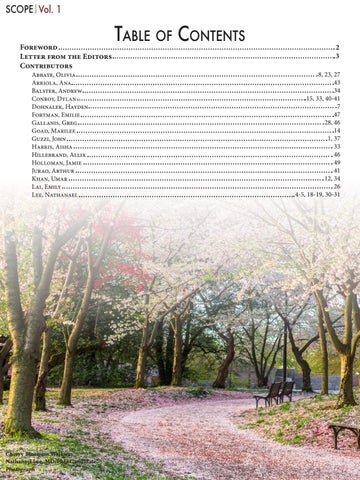
Foreword Letter from the Editors Contributors Abbate, Olivia Arriola, Ana Balster, Andrew Conroy, Dylan Dohnalek, Hayden Fortman, Emilie Gallanis, Greg Goad, Marilee Guzzi, John Harris, Aisha Hillebrand, Allix Holloman, Jamie Jurao, Arthur Khan, Umar Lai, Emily Lee, Nathanael
Cherry Blossoms Walkway Nathanael Lee, MD/PhD Candidate 6 Photograph
Table of Contents
2 3 8, 23, 27 43 34 15, 33, 40-41 7 47 28, 46 14 1, 37 33 46 49 41 12, 34 26 4-5, 18-19, 30-31
ARTS & MEDICINE
Mahan, Marielle Marx, Jeremy McCarthy, Margaret Mehta, Priya Mendelson, Chagai Mikhaiel, JP Papastamelos, Christine Park, Elisse Ryan, Kara Rotter, Juliana Silverman, Lara Stimac, Greg Venkat, Preethi Wallerius, Kate Wijeratne, Rashmi Wikholm, Katherine
I Can't Help Falling in love With You About Us
36-39 10, 17 16, 48-49 43 40 22-25 1, 25, 35 11, 20 28, 42 32 10, 13, 29 14 13 20 42 9, 21, 44-45, 51
50 52
7
SCOPE Vol. 1
HOYA Clinic John Guzzi, M'2019 Photograph 8
What I Couldn't See
ARTS & MEDICINE
Hayden Dohnalek, M'2019
I couldn’t figure out why my patient wasn’t getting better It was quite clear on my charts, actually, that she was getting worse I could see the disappointment in her face when I told her That both her weight and her blood pressure had gone up. I couldn’t see, however, the disappointment on her face when the number on the cash register now told her that she couldn’t feed her family for less than $20 a night Or how she looked when one of her supervisors told her that she could only work 15 hours this week. I couldn’t see her when she saw that the closest produce market that took nutrition assistance was an hour and a half away By car Which I didn’t know she didn’t have. I could see the frustration in her eyes when she told me that she still drank two bottles of wine every night. What I couldn’t see, however, was the confidence she held when she stood up and received her three month chip Three months after I last saw her. Nor could I see the frustration in her eyes as she desperately called her sponsor 15 times But she was unavailable. Nor could I see her cry when she awoke after a night of praying and praying and praying… and then relapsing. I could hear the resignation in my voice when I told her once again her blood sugar was high. I couldn’t, however, hear the pride in her voice as she cheered on her oldest son as he received his high school diploma. Something she never had. I couldn’t hear the anxiety in her voice as she rushed her two youngest children out of the mini-mart And no they couldn’t afford all that candy, and yes they had to go to school right now, because she couldn’t be late to work. So she could make enough money to pay for her medication. Or maybe her daughter’s inhaler instead. I couldn’t figure out why my patient wasn’t getting any better. I performed all the right tests, I prescribed all the right medication I did my best to solve every problem I could see… But maybe what I needed to know I couldn’t see. 9
SCOPE Vol. 1
Child (above) and Portrait (below) Olivia Abbate, M'2018 Pencil
10
ARTS & MEDICINE Swimming Lessons Katherine Wikholm, M'2019 Watercolor
11
SCOPE Vol. 1
Clearer Skies Jeremy Marx, M'2020
Distant sky scrapers - far away Beautiful splendor on display Tall, vast, promising A rainbow’s endless beckoning Touching clouds – height so tall Horizon blocking shadows fall Vain glory filling trust Mirages billowing in the dust Near beauty heart is missed Flowers blooming full in darkness Light births perspective changes Eyes on Him brings into focus Life renewing closer still Hope true ringing ears Wind’s breath touches face Sky scrapers then and now erase
12
Urban Planning Lara Silverman, M'2019 Photograph
ARTS & MEDICINE
Evora Elisse Park, M'2018 Oil on Canvas 13
SCOPE Vol. 1
Waterfall Umar Khan, M'2020 Photograph 14
ARTS & MEDICINE
Woman on Brick Lara Silverman, M'2019 Acrylic on paper
Untitled Preethi Venkat, M'2020 Pen 15
SCOPE Vol. 1
One Way or Another Marilee Goad, M'2019
You see a news story about your hometown after the first snowfall where a CEO held a gun to the head of a plow driver, claiming bad driving merited this brand of assault, later lying, backtracking as police arrive on the scene and arrest him. Only weeks earlier the news cycle played and replayed the story of a little boy shot to death by a cop simply for brandishing a toy gun, no questions asked, no time for explanation or arrest. The local rag discloses that the CEO is white and worth millions: and here it is, a simple phrase underscoring the disparity of treatment: he’s worth millions, in his bank account, and his very life: the police don’t shoot, just talk him down, take him in the backseat of their cruiser, don’t even manhandle him. He’ll of course hire the best defense his net worth can buy, and though the newspaper will deem him crazy and impetuous, they neglect to deploy the same criminal language they save for petty thieves and thugs, a phrase that does not presume innocence but assigns blame based on the way you look and the amount of money your bank account holds, or doesn’t. Later, you tell your kid brother to be more careful on the roads out there, don’t ask for any trouble, don’t get upset, even the smallest transgression could get him shot one way or another.
Yulia
Greg Stimac, M'2020 An original composition, performed on piano. Dedicated to someone who made me appreciate the precious gift of life. Access the recoring via the QR code below.
16
ARTS & MEDICINE
Bridging the Gap Dylan Conroy, M'2019 Photograph 17
SCOPE Vol. 1
Arlington Margaret McCarthy, M'2020 18 Photograph
ARTS & MEDICINE
A Seat at the Table Jeremy Marx, M'2020
An empty chair standing still An empty chair- absence filled They're missing soldiers off to war Fighting enemies ne'er seen before Shielded warriors- many come home Proud of duties they performed Armor off, swords sheathed Now it's time to settle and breathe Yet haunting thoughts come at night Long lost friends fill my mind Look around- yet no one knows The things I've seen and cannot expose Even still most do not understand What it's like to be there and back again To serve so proud, to fight so hard. To have these feelings so un-resolved. Drinking deep calms my mind, drinking longer seals the bind. Is it worth it- life so dear? What will it be like going from here? Thinking longer - I cannot go on, to live this life; I've failed - not won. Dishonoring thoughts fill the void, sadness looms - a devastating noise. At my darkest point, I look and see An empty chair at a table set before me. A voice speaks out: “This place is for you. Well done good man- I've seen all you do. Rest your head, close your eyes I will take care of these lies. You served well- with all your might. You fought hard, with no end in sight. Now you're back, yet the war's not done. But if you so choose you can take your dreams and run. Your service- a sacrifice- is all for your gain. It was not time lost- it was not all in vain. So go out good soldier and fight for your neighbor, Fight for your city, your country, your Savior One day I will call you, but not by your hand. Right now you must trust my demands. I demand your courage to keep moving on. I demand your life to be lived - not to be foregone. I demand your best, your talents, your strength I demand all I have given you, you've never been faint Your friends who are gone- they paid the price Don't trample their sacrifice - don't throw away your life Lift up your head, lift up your mind. See all before you, all the blessings to find. There is hope strong warrior, There is still so much in store. Take your seat at my table And know that you are cherished, admired, loved, and adored.�
19
SCOPE Vol. 1
20
ARTS & MEDICINE
Biding Time Nathanael Lee, MD/PhD Candidate Photograph 21
SCOPE Vol. 1
La Plata Peak Kate Wallerius, M'2020 Photograph
Summer Elisse Park, M'2018 Acrylic on Canvas 22
ARTS & MEDICINE
Mammoth Creek Katherine Wikholm, M'2019 Watercolor
23
SCOPE Vol. 1
Phenomenology and Illness
“I don’t think I am ready for surgery and that sort of recovery as a college student. Would I be able to do physical therapy?”
by J.P. Mikhaiel
I took the latter option, and went back to school in a boot. I was in the boot for almost six months – long enough to earn me the nickname boot boy amongst my friends. I also iced the ankle (admittedly not as consistently as I should have), went to physical therapy, and applied topical analgesics to relieve the pain. None of it worked. I noticed that I was starting to feel pain in my other ankle, the left one, as well. Was this because the boot was causing an unevenness in my gait? There was no way healing should take this long, so I went back to the orthopedic surgeon. I asked him if this was normal, if he had ever seen someone else take this long to heal. He assured me it was, and that maybe I should not wear the boot daily. Rather, I should slowly ‘wean’ myself off it, like I was hooked on some sort of narcotic. So, again, I listened. I began wearing the boot every other day, then every few days, then weekly, etc.
A personal account
“I think
you might meet this criteria, dude,” my friend, who is a second year medical student, texted me. Attached was a picture labeled “Table 6 – Classification criteria for psoriatic arthritis” that looked like it came from one of his textbooks. At the bottom of the table was a note that read I needed greater than or equal to three points. The first two criteria alone, evidence of psoriasis and psoriatic nail dystrophy, would get me the points necessary for the diagnosis. I needed to see a rheumatologist before getting the formal diagnosis, but internet and literature searches revealed most of what I needed to know. While understanding the disease as a complex autoimmune process affected by genetic and environmental factors is challenging, it is even more difficult to make sense of what the disease means – how it will affect my life, my family, my friends. This latter endeavor, understanding the disease experience, is so daunting because it is largely done in solitude. If narrative is imposing structure on reality for the purpose of greater clarity, then what follows is a phenomenological account; it is my attempt at understanding what psoriatic arthritis has meant and will mean for me. Having played basketball throughout my childhood, I was pretty used to ankle injuries, so I did not think much of it when I sprained my right ankle playing pickup basketball during the fall of my junior year at Georgetown. I limped home, iced it, and elevated it like I had done many times in the past. However, this instance seemed particularly insidious, as the pain did not subside after a few days. After limping around for a couple weeks, I went to see an orthopedic surgeon at the insistence of my roommate. “Looks like you have Haglund’s Deformity. It’s a pretty common problem,” he said matter-of-factly. “Actually, a lot of women get it from wearing heels, which is why it also has the name ‘pump bump.’ There’s basically a bone spur that is pushing on your Achilles tendon causing you pain.” “So what do I do?” “We could do a surgery, in which we go in and chip off the bone. The recovery time would be 5 to 6 months, though, and possibly up to a year for full recovery.”
24
“Yes, the alternative is I can prescribe a cast boot for you, as well as physical therapy.”
It was the summer after my junior year at this point, and I
was only wearing the boot intermittently. Still, I was having pain almost daily, and it was in both ankles. The pain had gotten so bad in the ‘non-injured’ ankle that I began to question my sanity. I looked back at pictures of myself when I first got the boot to try to understand which ankle I had even sprained. Can this be from a sprain? How is the pain so bad in both ankles? And worse, was I making all this up?
ARTS & MEDICINE
and isolated myself from those who I would do those activities with. I felt impotent. I was 22, and one of the most basic human activities, walking, felt burdensome and painful for me. It reminded me of my limitations and fragility at a time when most feel impervious and vital. Granted, I write now with the interpretative force that hindsight provides. I could not, at that point, know with certainty how abnormal my experience was because I only had my experience. I specifically remember asking my roommate at the time if he woke up every morning feeling achy and tired. A silly question now, but one I needed answered then to establish whether I was really experiencing something different, or if this was just the effects of growing older. Although he answered he did not feel achy, and was only on the rare occasion tired in the morning, the skeptic in me wasn’t appeased; I still did not believe I had a problem.
The next two years came and went without much resolution. The pain was manageable most days, but very uncomfortable on others. On those tough days, I would limp throughout the day, and subtly wear an ankle brace beneath my jeans. I became self-conscious as I limped around on those bad days. Did anyone notice me limping? What were they thinking? I was embarrassed to explain the situation because I didn’t quite understand it myself. What would I say, that I sprained my right ankle nearly two years ago, the pain was contagious, so that my left ankle caught it As the pain began to migrate to my knees, I convinced myself from my right one, and after all this time, neither healed? that this was controllable, that I could make lifestyle changes to overcome this. I reversed the causality at the time, inferring Without information and explanation, I did what most do – that my lack of exercise had given rise to my pain, and not the I ignored the problem. It was as though I had an implicit as- other way around. I resolutely signed up for a half-marathon sumption that that which is not named is nonexistent, and in the spring of 2016. This was it. I would make myself train, so I avoided the doctor. I began to withdraw from activities get healthier, and rid myself of this lurking pain in my joints. I used to enjoy, like playing basketball and going on hikes,
Elderly Eyes Olivia Abbate, M'2018 Pencil and Charcoal 25
SCOPE Vol. 1 I pushed through the training regimen, which consisted of two shorter runs and one long run every week for the eight weeks prior to the race. At the start of the training I was taking two 200 mg Advil a night to avoid feeling pain while I slept and throughout the next morning. As the training continued, I upped this dose to about four 200 mg Advil every night. I ran the race with my friend who joined me on a whim. After the race, rather than go out and celebrate, we stayed in, as I was feeling particularly lousy. It was at this point that I explained in more depth to my friend the pain I was experiencing, and the chronic Advil I was taking. He rationally convinced me that I was doing myself no favors by avoiding the doctor, and treating this on my own. Deep down, I was scared of going to the doctor. I did not believe many treatment options were available and I still, in a naïve sort of way, thought I could overcome this alone. I could not ignore him, however, when he rightfully pointed out, being a medical school student, that I was trading potential gastric side effects from the Advil for pain management. I was simply swapping one problem for another, and without proper evaluation I could not be sure there wasn’t a better option out there. In the following weeks, I noticed swelling in my left knee and wrist. It was at this point, that my girlfriend, who could no longer stand my delaying, made an appointment for me with a primary care group in DC. I met with a physician assistant at this visit. I explained my pain to him. He palpated the swollen joints, and ordered blood work, as well as provided me with a referral to see a rheumatologist. No diagnosis was made at that time. When the bloodwork came back, I tested negative for rheumatoid factor, which would be yet another point on the checklist for psoriatic arthritis. When I finally saw a rheumatologist, a formal diagnosis was made without much surprise.
Together, we decided that I would take Meloxicam, a prescription anti-inflammatory agent. If the pain progresses, however, I may need to switch to something a bit stronger akin to an immunosuppressant. The prospect of this frightens me, especially as I begin medical school. In addition to a weakened immune response, the side effects of some of these drugs include depression, anxiety, increased risk for suicide, gastric pains, and a slew of other things. While these side effects are most likely rare, I have gained a different perspective on probabilities. Approximately 1-2% of the population is diagnosed with psoriasis, and maybe 30% of those further diagnosed with psoriatic arthritis, so I had about a 0.3-0.6% chance of this disease, but it happened. And with that, it is not a distant call to see that any other number of statistical anomalies can happen as well. In naturalistic terms, the diseased condition is biological dysfunction, but to the patient, they will never experience it as such. The naturalistic terms, and objective nature of the disorder, cannot capture the feelings, thoughts, and identity-transformation that accompany disease. This concept has been described before in many ways. You treat the patient, not the disease. You not only treat the illness, but also the patient’s relation to that illness. And on and on. The concepts are not new, and may even sound banal at this point, but if there is anything these experiences have taught me, it is how philosophy can complement medicine. When my rheumatologist and I decided on which medication I should take, it struck me that I, alone, would be living the consequences of the choice. No doubt he had seen hundreds of cases of people like me prior to my visit and he will probably see hundreds after. His instinct on my treatment plan and prognosis was most likely second nature. To me, however, this was my life; this was everything. It is hard to reconcile our different vantage points without a philosophical, and more precisely, phenomenological, approach. To be a good clinician, one must be a good philosopher, and by that, I mean understand what constitutes a good life for the patient. While science can nurse bodily health, philosophy can nurse psychological and spiritual health.
“We use something called the CASPAR – the classification criteria for psoriatic arthritis,” he explained. “It appears that you meet the criteria for the diagnosis of psoriatic arthritis.” He went on to say how now was the best time to be giv- To avoid the abstract, I believe the astute clinician can use en such a diagnosis, as the research and treatment options philosophy to redefine health as a state in which an individual may reach his/her goals. In this way, the clinician has an were rapidly expanding. expanded toolkit: he/she can work to treat biological dysI wondered if doctors always said this when they gave bad function, but if not always possible, also work to treat the news. I mean, the nature of science is such that the present patient’s goals. In other words, the clinician can treat the will always represent the most progressed state of the field. patient’s telos, to help the patient find fulfillment and meanMaybe a diagnosis twenty, or even thirty, years from now ing in those aspects of life that remain intact. would have been a better time. No doubt the field would be ahead, and I wouldn’t have to be in my twenties and explain Despite carrying this diagnosis for almost four months that I have what everyone considers to be a disorder that now, it is difficult to assess how much of its impact has really sunken in. In many ways, I still believe that I can get comonly affects the elderly. 26
pletely better, and not require any medication. These sorts of degenerative disorders are named such for a reason; they progressively get worse, health declines. Things do not tend to magically regenerate, and for some reason, I still think it can. I still believe that with proper diet and exercise, I can improve my condition, almost like making time go backwards. I assume most people in the early stages of degenerative disorders believe this, and I have not yet made up my mind on whether it’s a healthy or an unhealthy perspective to maintain. It’s probably best to remain agnostic on such matters, and take things slowly. As you would not want to predict 50-year market trends on one month, it’s probably best for me not to project a tough day with some back pain and a lot of sitting as early signs of spondylitis, and a good day as meaning a medication-free life. Still, these thoughts pop into my head all the time. I think this is what people mean when they say living with a chronic condition affects you every day of your life. You feel it and think about it in daily navigations of the world, from bending down and noticing pain to ordering food and reminding yourself that
ARTS & MEDICINE
you are at increased risk for metabolic syndrome. You are forced to reconcile with your limitations often.
I do not mean for this account to sound overly pessimistic, as that view does not reflect my beliefs. I am blessed to have a supportive network of family and friends. Thanks to my girlfriend, I was able to process many of my feelings and thoughts that came with the initial diagnosis. Not everyone is as lucky as I in this regard. I can never really know what will happen with my psoriatic arthritis. Maybe, I will, through diet and exercise, improve so that I will never need medication again. It is also possible, however, that the condition will get worse, and I will find myself experiencing more pain or greater joint degeneration. In the latter case, a phenomenological approach can assist in finding meaning. If the options cannot always be medicinal, then perhaps they can be philosophical, as I aim to find a good life in illness.
Hands Christine Papastamelos, M'2019 Pencil
27
SCOPE Vol. 1
Untitled Emily Lai, M'2020 Ink 28
ARTS & MEDICINE
Woman Portrait Olivia Abbate, M'2018 Pencil and Charcoal
29
SCOPE Vol. 1
Hurting is the Easy Part Kara Ryan, M'2018
Hurting is the easy part. It’s simple, really— just a kind of lazy weakening and wasting away. I mean, it’s painful, sure. It’s the kind of pain you hear yourself bargaining against, making deals with God to end. The kind of pain so consuming that you can’t remember what it feels like when it’s not there. The kind of pain from which even sleep provides no escape— only fewer distractions. But hurting doesn’t take much. You wake up every day, and you feel it. You close your eyes. You hold your breath. You grit your teeth. You will yourself through another morning. Another day. Hurting is something you survive. Healing is something different. Because healing means trying. Healing means facing and forcing yourself, every day, to do a whole list of things you think you can’t— (even if it’s just getting out of bed). Healing is a fight, mounted against new aches in suddenly unfamiliar limbs, against old, familiar fears, and fresh, new doubts that threaten the motivation you so carefully cultivated during the days of hurting. Healing demands patience, testing the sudden and frustrating disconnect
30
between your brain and your body, mocking your persistence, your naive drive, casually interrupting your day with paralyzing irrationalities of what has been and— what could be. A shuffle, where there once was stride and certainty. Fatigue, where there once was force and confidence. Healing means rebuilding. But a body remembers how it was hurt, and to fix it is hard— and it’s ugly. But there come the days, finally— When the endless ache is suddenly bearable. When the twitch of a muscle sustains. When the restless flash of a painful memory dissipates and is pleasantly and quietly forgotten. The days are long, and the pace is carefully slow. But take the time. Allow yourself to feel— to hurt, and to heal.
ARTS & MEDICINE Candles Greg Gallanis, M'2020 Photograph (left)
Black and White Lara Silverman, M'2019 Woodcut 31
SCOPE Vol. 1
32
ARTS & MEDICINE
Nature's Paintbrush Nathanael Lee, MD/PhD Candidate Photograph 33
SCOPE Vol. 1
Imagining Love's Fireworks Juliana Rotter, M'2019 DTI Recreation, Gel Pens and Wire
34
Forgotten
ARTS & MEDICINE
Aisha M. Harris, M'2017
I stopped counting years ago Time became a hindrance to my peace of mind Waiting slowly takes its toll on you Your once “well rested” body becomes exhausted Your mind struggles to keep sane Questioning your priorities You wonder if it’s worth it We just wanted to go somewhere Nothing fancy, a standard place Not our norm but someone else’s So we waited Waited for them to pave the road as a sign of good fortune Wondering when change would no longer be an inconvenience Swallowing frustrations, the taste of deferred dreams lingered Miscalculated hopes unable to fully articulate the exhaustion Static noise To be fearlessly human was impossible Solidarity was few and far between There was no progress worth noting In stale air our steps went unrecognized Our knees buckled Stuck wondering if the grass was greener For the path to somewhere was not welcoming Strange fruit hung like forgotten promises Dangled on outstretched hands of no mercy We prayed Our stumbles blamed on misaligned gaits, skewed by nature versus nurture Accustomed to running, we tried not to stand too long To not overstay our welcome, we wander for safety in unsafe territories Often six degrees from somewhere and two degrees from dying Barely breathing Every generation we ask ourselves, is it still worth it? Still waiting we wonder, are we forgotten? Does it even matter? Do they even care?
Lighthouse Dylan Conroy, M'2019 Photograph
35
SCOPE Vol. 1
Deer Umar Khan, M'2020 Photograph
Gannet Peak Andrew Balster, M'2019 Photograph 36
ARTS & MEDICINE
Cypress Trees (recreation) Christine Papastamelos, M'2019 Oil on Canvas
37
SCOPE Vol. 1
Neck Marielle Mahan, M'2019 Pen and Colored Pencil 38
ARTS & MEDICINE
Lost & Found John Guzzi, M'2019
Who lying in this room is an island? Not meWearing the uniform of my newfound kin: Plastic glove, plastic sock, Rope ring and head wrap. Down this long gray line, we’re all the same. Not themThe white lies shed for this new day, Dodging stains by red meat and left Behind in standard canvas cloth. But they’ll find: No prototype And cuss me for it. That their effort to standardize Every part of me disintegrates. And when they fail, they’ll trace My pieces back to the source. So as my body gives way, Their minds can decide That if all things grow I will go.
Arms Marielle Mahan, M'2019 Pen and Colored Pencil 39
SCOPE Vol. 1
40
Heart Marielle Mahan, M'2019 Digital
ARTS & MEDICINE
Heart Marielle Mahan, M'2019 Digital
41
SCOPE Vol. 1
- Chagai Mendelson, M'2018
42
ARTS & MEDICINE
- Arthur Jurao, M'2019
Lake Sky Dylan Conroy, M'2019 43 Photograph
SCOPE Vol. 1
The doctor Kara Ryan, M'2018
A fragrant sentiment Manners set bedside, Cared for and tended to Wither; or to thrive. The image of fragility In a vase, on a scan, A ‘get well soon,’ ‘we’re thinking of you!’ A ‘we’ve done all we can.’ The nurturing sun - the time Crafting patiently this fine gem, When suddenly, cruel, something - new Impinges upon the stem. First a memory, then a petal, Fading from the frame Plucked away at peak brightness Strength worthy of its claim. Dried in dusty pages, Among proverbs on the shelf, The message - hollowing, empty, ‘Physician, heal thyself.’
Pencil Baby Rashmi Wijeratne, M'2018 Pencil 44
ARTS & MEDICINE
Smiling Mature Seal Ana Arriola, M'2019 Photograph
Navajo Nation Priya Mehta, M'2020 Photograph
45
SCOPE Vol. 1
46
ARTS & MEDICINE
Waiting Katherine Wikholm, M'2019 Watercolor
47
SCOPE Vol. 1
Untitled Allix Hillebrand, M'2019 Mixed Media
Glassflower Greg Gallanis, M'2020 Photograph
48
ARTS & MEDICINE
DC Walking Tour Emilie Fortman, M'2020 Photograph
49
SCOPE Vol. 1
Noank Margaret McCarthy, M'2018 Photograph
50
ARTS & MEDICINE
- Jamie Holloman, M'2017
51
SCOPE Vol. 1
I Can't Help Falling in Love with You W
hen we started the Arts and Medicine program in August, our goal was to use music as a tool to create meaningful experiences for students and the pediatric patients of Georgetown University Medical Center. By the end of our first trip, we knew the program would be a success. That first trip ended with a visit to a nine-year-old girl in the transplant unit, who, for the sake of this story, we will call Amy. Amy left an instant impression on all of the volunteers that day. Full of joy and charisma, she became our director and led us through renditions of her favorite songs: “Let It Go” from the movie “Frozen” and “I Can’t Help Falling in Love with You” by Elvis Presley. After that, no trip was complete without a visit to Amy’s room to play those songs and whatever else was stuck in her head that week. Through music, we became close with Amy and her family and were lucky enough to share in the love and happiness they exuded. Heartbreakingly, Amy recently passed away. The news devastated our volunteers, her providers, and everyone in the hospital that felt a personal connection to Amy (from the cleaning staff to the chaplain). We, like everyone else that came to know her, counted her as a friend. As she once told the Child Life staff, “Those aren’t the medical students; they’re my friends!” She brought out smiles, laughter, and the inner Disney princess in all of us. As soon as we heard the news, Music & Medicine came together to play “I Can’t Help Falling in Love with You” one last time for Amy and her family. The recording process was reflective and healing for our volunteers, and we hope that the song is able to return a fraction of the love that Amy and her family gave to us. Follow the link below, or scan the QR code, to listen to our recording of “I Can't Help Falling in Love with You.” Recording credits Piano: Zach Winchester Guitar: Dylan Conroy, John Guzzi, Joe Serino Violin: Sarah Dermody Vocals: Ana Arriola, Dylan Conroy, Steph Davis, Hayden Dohnalek, Reuben Falola, Clare Goggins, John Guzzi, Twyla Jaymes, Kim Johnson, Ryan Keane, RJ Marchese, Christine Papastamelos, Sarah Schuessler, Maura Thornton, Zach Winchester Arrangement, Recording, and Mixing: John Guzzi
http://www.artsandmedicine.org/news/2016/4/29/i-cant-help-falling-in-love-with-you 52
ARTS & MEDICINE
Sycamore Tree Katherine Wikholm, M'2019 Watercolors
53
SCOPE Vol. 1
About Arts & Medicine
W
e are an organization run by and for Georgetown University medical students with the goal of integrating the arts into student life and medical education at the Georgetown University School of Medicine. We strive to bring the Jesuit concept of magis, or "doing more," to life. We hope to enhance the patient experience through meaningful, therapeutic arts outreach initiatives. We encourage the professional formation of physicians equipped to practice in the cura personalis, or "care of the whole person," tradition. We communicate a medical professional's unique perception of a shared human experience. We celebrate and promote the diversity of creative talent at the Georgetown University School of Medicine and Medical Center. In addition to Scope, our programs include: • Monthly open mic events (Hippocrates Cafe) featuring student and faculty talent • Music & Medicine volunteer trips with the pediatric patients at MedStar Georgetown University Hospital • "Heart of the Harvey" - a night of short plays written by and featuring members of the Georgetown medical community • Student workshops that encourage creativity and reflection centered on everyday encounters • Live music fundraisers • Reflective photo campaigns
John Guzzi Christine Papastamelos Johan Clarke Joe Cramer Hayden Dohnalek
Dylan Conroy Katherine Wikholm Lauren Klingman Marielle Mahan Zach Winchester
artsandmedicine.org 54
ARTS & MEDICINE
Arts & Medicine artsandmedicine.org ©2017 55