8
Gehl – Planning by Doing
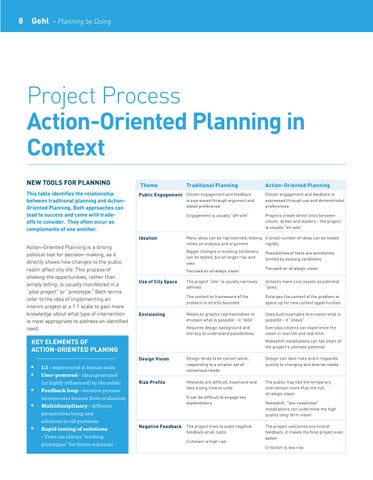
Project Process Action-Oriented Planning in Context NEW TOOLS FOR PLANNING This table identifies the relationship between traditional planning and ActionOriented Planning. Both approaches can lead to success and come with tradeoffs to consider. They often occur as complements of one another.
Theme
Public Engagement Citizen engagement and feedback is expressed through argument and stated preference Engagement is usually “off-site”
Ideation
Action-Oriented Planning is a strong political tool for decision-making, as it directly shows how changes to the public realm affect city life. This process of showing the opportunities, rather than simply telling, is usually manifested in a “pilot project” or “prototype.” Both terms refer to the idea of implementing an interim project at a 1:1 scale to gain more knowledge about what type of intervention is most appropriate to address an identified need.
Traditional Planning
Focused on strategic vision
Envisioning
• • •
1:1 - experienced at human scale. User-powered - ideas generated (or highly influenced) by the public Feedback loop - iterative process incorporates lessons from evaluation Multidisciplinary - different perspectives bring new solutions to old problems Rapid testing of solutions - Tests are always “working prototypes” for future solutions
Projects create direct links between citizen, action and leaders - the project is usually “on-site”
Possibilities of tests are sometimes limited by existing conditions Focused on strategic vision
The project “site” is usually narrowly defined
Unlocks more civic assets as potential “sites”
The context or framework of the problem is strictly bounded
Enlarges the context of the problem or opens up for new context opportunities
Relies on graphic representation to envision what is possible - it “tells”
Uses built examples to envision what is possible - it “shows”
Requires design background and literacy to understand possibilities
Everyday citizens can experience the vision in real life and real time.
KEY ELEMENTS OF ACTION-ORIENTED PLANING
• •
Citizen engagement and feedback is expressed through use and demonstrated preferences
Many ideas can be represented; testing A small number of ideas can be tested relies on analysis and argument rapidly Bigger changes in existing conditions can be tested, but at larger risk and cost
Use of City Space
Action-Oriented Planning
Makeshift installations can fall short of the project’s ultimate potential
Design Vision
Design tends to be conservative, responding to a smaller set of consensus needs
Design can take risks and it responds quickly to changing and diverse needs
Risk Profile
Mistakes are difficult, expensive and take a long time to undo
The public may like the temporary intervention more than the full strategic vision
It can be difficult to engage key stakeholders
Negative Feedback
The project tries to avoid negative feedback at all costs Criticism is high risk
Makeshift, “low-resolution” installations can undermine the high quality long-term vision The project welcomes any kind of feedback; it makes the final project even better Criticism is low risk