downtown CHALLENGES
unbalanced traffic system
office focused downtown
fragile urban culture
challenge
challenge
challenge
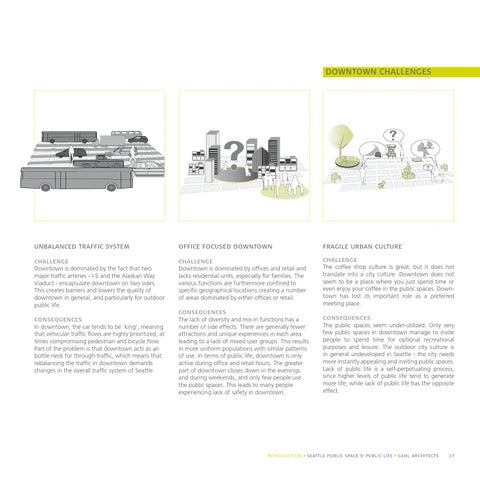
Downtown is dominated by the fact that two major traffic arteries - I-5 and the Alaskan Way Viaduct - encapsulate downtown on two sides. This creates barriers and lowers the quality of downtown in general, and particularly for outdoor public life.
Downtown is dominated by offices and retail and lacks residential units, especially for families. The various functions are furthermore confined to specific geographical locations creating a number of areas dominated by either offices or retail. consequences
consequences
In downtown, the car tends to be ‘king’, meaning that vehicular traffic flows are highly prioritized, at times compromising pedestrian and bicycle flow. Part of the problem is that downtown acts as an bottle neck for through-traffic, which means that rebalancing the traffic in downtown demands changes in the overall traffic system of Seattle.
The lack of diversity and mix in functions has a number of side effects. There are generally fewer attractions and unique experiences in each area leading to a lack of mixed user groups. This results in more uniform populations with similar patterns of use. In terms of public life, downtown is only active during office and retail hours. The greater part of downtown closes down in the evenings and during weekends, and only few people use the public spaces. This leads to many people experiencing lack of safety in downtown.
The coffee shop culture is great, but it does not translate into a city culture. Downtown does not seem to be a place where you just spend time or even enjoy your coffee in the public spaces. Downtown has lost its important role as a preferred meeting place. consequences
The public spaces seem under-utilized. Only very few public spaces in downtown manage to invite people to spend time for optional recreational purposes and leisure. The outdoor city culture is in general undeveloped in Seattle - the city needs more instantly appealing and inviting public spaces. Lack of public life is a self-perpetuating process, since higher levels of public life tend to generate more life, while lack of public life has the opposite effect.
I NTRODUCTION • SEATTLE PUBLIC SPACE & PUBLIC LIFE • GEHL ARCHITECTS
17