ISSUE 01
FALL / WINTER 2026
THE DISPATCH OBJECTS, IDEAS AND THE WORLD THEY SHAPE
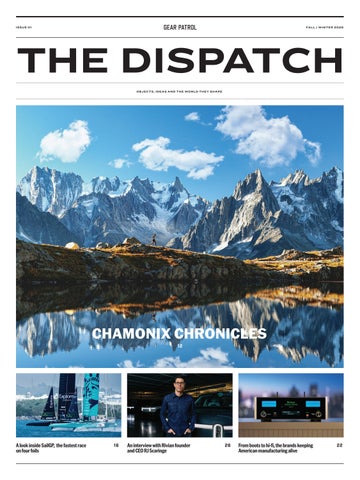
CHAMONIX CHRONICLES 15 MINUTES OF FLIGHT 12
A look inside SailGP, the fastest race on four foils
16
An interview with Rivian founder and CEO RJ Scaringe
26
From boots to hi-fi, the brands keeping American manufacturing alive
22
SCAN TO LEARN MORE
THE DISPATCH
4
LETTER FROM THE FOUNDER
INSIDE THE ISSUE
What Things Tell Us Gear Patrol is launching a newspaper. Yes, an actual newspaper. Ink, paper, folds, deadlines, the whole mildly unreasonable exercise. I like that about it. For all the ways that media has improved, there is something increasingly rare about encountering something you weren’t looking for. Most of what reaches us now has been summoned, recommended or optimized. Print works differently. You pick something up. You turn a page. You find yourself six paragraphs into a story you had no intention of reading. That is part of why we made The Dispatch. It’s also why we are being particular about where you find it. It won’t be everywhere. Instead, we’re putting it in a small number of places where people still have the time and inclination to discover something unexpected: while traveling, staying somewhere remarkable, browsing a good shop or simply sitting long enough to look around. But discovery is only part of the idea. Since 2007, Gear Patrol has lived at the intersection of product and pursuit. We try to understand the object, how it works, why it matters and, just as importantly, what people want to do with it. The Dispatch steps back and looks wider. We’re interested in the world around the object, and the culture it helps shape. How a car changes the way people travel. How a watch becomes something more than a way to tell time. How a piece of outdoor equipment can help create a sport, a community or a new kind of ambition.
Products are rarely just products. At their best, they are evidence of how people want to live. And often, the only way to understand them properly is to go where they live. A workshop in Florence. A factory in New Jersey. A trail high in the Alps. The Dispatch is interested in the places, people and rituals that give objects their meaning, and in what changes when you see them in context. That requires a different kind of attention. Not more things, but better reasons to care about them. Provenance. Place. Design. Utility. Craft. The people behind an idea and the places where it takes hold. It also requires judgment. Some of my favorite people will spend heavily on a watch and keep the same car for a decade. They’ll cross an ocean for a meal, plan a trip around a great road, seek out a workshop that still makes something properly or obsess over a simple tool that costs almost nothing. What connects those decisions isn’t luxury. It’s knowing the difference between expensive and exceptional, and caring enough to make the distinction. That sensibility runs throughout this first issue. We went to Bermuda to experience SailGP from inside one of the fastest and most technically demanding competitions on water. We climbed thousands of feet above Chamonix during a week when the world’s best trail runners descend on a small Alpine town. We spoke with Rivian founder RJ Scaringe about the improbable work of building a new American
automobile company, but also about sneakers, camping, music, fatherhood and the things that shape his own taste. And we looked at the factories, workshops and brands keeping American manufacturing traditions alive. There are also watches, motorcycles, sunglasses, pens, shoes, old cars and other objects worth lingering over. That range is intentional. The Dispatch is a new imprint from Gear Patrol, with its own point of view and its own place in the world. It is less interested in telling you what to buy than in asking what the things around us reveal about culture, ambition and the lives we choose to build. This first issue exists because a small team of editors, writers, photographers, designers and partners believed that idea was worth making physical. I’m grateful to them for the care, judgment and craft they brought to every page. And I’m thankful to you for picking it up, wherever you happened to find it. I hope you discover something you weren’t looking for.
Fisher Island Club The Greenwich Hotel Hotel Jerome, Auberge Collection The Little Nell The Mark Hotel The Mercer The Miami Beach EDITION MOTO The Ned NoMad The Newbury Boston
The Riviera Country Club The Setai, Miami Beach Sharon Heights Golf & Country Club Sherwood Country Club Soho Beach House Soho House New York The Standard, Miami Beach The Surrey, A Corinthia Hotel
Drop me a line at eric@gearpatrol.com. I’d love to know what you think.
06
Material Interests
21
10
There Will Be Oil
Bracelet Battleground
18
24
All Conditions Comeback
The Touring Test
c r e ativ e d i r ec to r
i s s u e co n t r i b u to r s
Chris Chin Alex Frankel @alexfrankel.co Down the Street @dtsdesigns Scott Seiver @adv_6.0
l i c en s i n g
Joe Tornatzky
fo u n d er , c eo
Eric Yang
Stockists Delta Sky Club Lounges American Express Centurion Lounges 1 Hotel South Beach Bel-Air Country Club BIGHORN Golf Club The Bowery Hotel Brentwood Country Club The Carlyle, A Rosewood Hotel Casa Tua Miami Faena Hotel Miami Beach
KIND OF OBSESSED
La Marzocco Officine Fratelli Bambi Espresso Machines With enough resources and enough obsession, even the nicest off-the-shelf objects start to feel a little too off the shelf. La Marzocco’s Officine Fratelli Bambi program offers coffee obsessives a rare and spectacular alternative. The Florence-based workshop creates one-of-one espresso machines around La Marzocco’s proven engineering, working with clients from initial concepts and 3D renderings through fabrication. This goes well beyond choosing a paint color. Artisans create entirely new panels and components by hand, using everything from Carrara marble to Alcantara and precious metals. With bespoke projects requiring at least nine months and prices available only by quotation, this is decidedly grail territory — especially if you factor in a visit to the Tuscan workshop to watch your machine take shape. Then again, that’s rather the point: you can tailor the machine as obsessively as the shot coming out of it.
co fo u n d er , c h i ef co n t en t o f f i c er
Ben Bowers
fo u n d er , c eo
e x ec u tiv e ed ito r
a s s o c i at e ed ito r s
Eric Yang
Jack Seemer
co fo u n d er , c h i ef co n t en t o f f i c er
m a n ag i n g ed ito r
Tucker Bowe Ethan Brehm Hayley Helms Brad Lanphear Sean Tirman Gray Van Dyke
Ben Bowers c fo
Brandon Frank
Steve Mazzucchi ed ito r
Johnny Brayson
v p, b r a n d pa r t n er s h i p s
Michael Bailey s en i o r d i r ec to r , b r a n d pa r t n er s h i p s
Matthew Riccio d i r ec to r , b r a n d ed co n t en t
Brian Smith a s s o c i at e d i r ec to r , c l i en t s erv i c e s
Dominique Gageant p r oj ec t m a n ag er s
Emily Chang Joyee Mok
s en i o r a r t d i r ec to r
Anthony Wyborny d i r ec to r , g r ow t h s t r at egy & d e v elo p m en t
Caitlyn Shaw d i r ec to r o f v i d eo a n d p l at fo r m s
Mykim Dang s en i o r v i d eo co n t en t p r o d u c er
James Tirado
licensing@gearpatrol.com co r r ec ti o n s a n d r ep r i n t s
sayhello@gearpatrol.com s to c k i s t r eq u e s t s
store@gearpatrol.com
Independently Published ISSN 3143-3065 Printed in USA by Tanner Print Co. on sustainable paper © 2026 Gear Patrol, LLC 276 5th Avenue • New York, NY 10001 Main Cover Image: Roberto Moiola / Sysaworld via Getty Images
EARTH 4 PIECE WATCH WINDER WOLF1834.COM
THE DISPATCH
6
Material Interests
A collection of objects worthy of attention this season, including new innovations and overdue refreshes on familiar favorites.
Curation by Jack Seemer
A A
Made In Seasoned Cast Iron Skillet
D
G
E
H
F
I
$129+
Sand-cast in the US, this skillet features walls that are thinner than the base to cut down on weight for one-handed control.
B
Thule Widesky $4,000
The Widesky deploys like any other rooftop tent, opening on a clamshell-style hinge. But inside, you’ll find a unique futon that props up like a sofa.
B
C
Priority Vanth Full Suspension Enduro Race $5,999+
NYC’s belt drive kings continue to push progression with this ambitious MTB’s patent-pending Stillpoint High Pivot Platform, promising unprecedented control, stability and speed.
C
D
The James Brand The Helton $179
The James Brand’s take on a classic SAK packs nine tools, four of which are secured with a proprietary liner lock.
E
Peak Design Travel Backpack 2-in-1 $400
Peak Design’s new magnum opus splits into two independent bags for maximum flexibility in transit.
I
K
McLaren McL 6GT $1,500,000 F
Yeti Rambler Beverage Tub $300
Half bar cart, half cooler, this big, beautiful bucket reframes Yeti’s legendary cooling technology for hosting, not hauling.
McLaren’s McL 6GT concept marks the brand’s first manual supercar since the legendary F1 in 1992.
J
2026 Kawasaki W175 LTD $2,999+ G
Herman Miller Aeron Chair “Jasper” $2,385+
Herman Miller updates its corporate 1990s icon with a lighter base and new palette of WFH-friendly colors, including “Jasper” green.
Is America really ready for an old-school, pint-sized, city-ripping dynamo? Kawasaki certainly thinks so.
K
Adidas Terrex Agravic Speed Ultra Evo
L
L
Red Wing Moc Oxford $400
Red Wing and Malbon rework the Shop Moc Oxford for golf, debuting the former’s first golf shoe in over seven decades.
$500 H
Vacheron Constantin Overseas Dual Time Cardinal Points $41,000
Based on a prototype tested on Mount Everest in 2019, Vacheron’s ultracool sports watch is an unbeatable blend of rugged tool-watch practicality and haute horological excess.
All photos courtesy of respective brands.
Adidas translates its barrier-breaking, twohour marathon shoe into a capable all-mountain racer built for 100 miles or more.
M
Leica SL3-P $6,690
The SL3-P pairs a 44MP BSI full-frame sensor with 8K open-gate video and a hybrid autofocus system spanning 819 phase-detection points.
J
M
THE DISPATCH
8
GUIDE
THE RETRO RUNNER RENAISSANCE by Ethan Brehm Photo by Alex Frankel
B
A
C
F
E
D
Remember those Y2K-era kicks? The ones with the synthetic overlays, metallic color schemes and visible tech? Well, if you didn’t already feel old enough, those hallmarks of the early 2000s are telltale signs that your shoes are “retro.” Take a deep breath: they’re actually trendy in 2026. A few years ago, the return of 2008’s Asics Gel-Kayano 14 helped turn an emerging retro running aesthetic into a mainstream sneaker phenomenon. It’s not just the revival of old favorites, either. Brands from Nike to Mizuno have a penchant for resurrecting unsung models that flew under the radar at the time of their original release but are arriving now for a new generation of sneakerheads and hypebeasts.
A
D
Adidas Adistar Control 5
Saucony ProGrid Ride 1
B
E
Nike Zoom Streak 3
New Balance Abzorb 2000
C
F
Mizuno Wave Prophecy 1
New Balance 1906R
Original Release: 2008 $120
Original Release: 2009 $115
Original Release: 2011 $300
Original Release: 2008 $140
Original Release: 2025 $170
Original Release: 2009 $160
mcintoshlabs.com
THE DISPATCH
10
Bracelet Battleground
Forget movements, dials and C-list ambassadors. Today’s most intriguing watchmakers are racing to build the best bracelets in horology. From quick-release mechanisms to link-removal systems, there’s never been a more exciting time to close a clasp around your wrist.
by Johnny Brayson
Ducati: The Unlikely Centenarian by Gray Van Dyke
A
B
D
A. Zenith’s microadjustable Zenclasp comprises 41 components and took three years to develop. B. The iLink system by Christopher Ward enables a bracelet to be resized without requiring any tools. C. Ming’s Polymesh bridges the gap between strap and bracelet with a 3D-printed titanium construction that drapes like fabric. D. It takes just seconds to swap out a bracelet using the quick-change slider on the Vacheron Constantin Overseas.
All photos courtesy of respective brands.
C
Adjustment Period Rolex brought tool-free microadjustable clasps to a widespread audience with its Glidelock Clasp in 2008. Now the feature is practically standard across the industry. Leading the way is Swiss bracelet manufacturer Brogioli, which produces a ratcheting clasp system, activated by pressing a button on the outside, that can be adjusted on-wrist. IWC, Glashütte Original, A. Lange & Söhne and H. Moser & Cie. all use this clasp. On-wrist adjustability is also a key feature of Zenith’s Zenclasp, a microadjustable folding clasp adjusted by lifting its center section from the back. Tool-free microadjustments aren’t limited to folding clasps, either. Brands such as Vacheron Constantin, Czapek, Girard-Perregaux and others have all created butterfly clasps with hidden microadjustment mechanisms that fit seamlessly into their bracelet designs.
The downside of these systems is that they require proprietary straps and bracelets to work. Thankfully, many watches with the feature include both straps and a bracelet in the box.
Missing Links A microadjustable clasp is nice and all, but you’re still going to need to remove some links from your bracelet for a customized fit. Luckily, brands are finding ways to make the process easier. Many are replacing fussy pin-and-collar systems with screws, while a few have gone even further in the pursuit of convenience. IWC’s bracelet links come out as easily as pressing a button on the back of each link with an included tool (or a toothpick). Easier still are systems separately developed within the past year by Ming and Christopher Ward that allow you to remove links with no tools at all.
Quick Change
Material Gains
The ability to change out your bracelet without the use of any tools has become another feature that’s considered table stakes. The most common application is to replace traditional spring bars with two pins connected to the spring bar that you squeeze together to release. But some luxury brands have come up with convenient button- or slider-activated systems that are more intuitive. Norwegian independent brand Straum has developed a push-button “Coupling” system that works in seconds, while Vacheron’s quick-change slider on its Overseas line is arguably even simpler to use.
Brands are also finding new ways to work material innovations into their bracelets. Ming’s Polymesh bracelet is 3D-printed in Grade 5 titanium without a single screw or pin, even on the buckle. Formex made the world’s first ceramic clasp with a toolless microadjustment system. And Atelier Wen created the first serially produced full-tantalum bracelet, which includes both a microadjustable clasp and a quick-release system.
Ducati may be Italy’s darling motorcycle manufacturer, but the path to 100 years has been anything but straight. Still, the company has outlasted creditors, critics and even some of its corporate parents. Central to Ducati’s perseverance has always been the brand’s willingness and ability to adapt. Brothers Adriano, Bruno and Marcello founded the company in 1926 as a producer of radio components. When Allied bombing decimated their factory during the Second World War, the Ducati name rose from the ashes anew as a motorcycle manufacturer. Even then, the brand was hardly the same exotic performance-bred presence that it is now. Ducati broke into two wheels with the Cucciolo, a clip-on engine for bicycles, before graduating to complete single-cylinder motorcycles. They were humble efforts — small-capacity machines like nothing you’d find in the lineup now. It wasn’t until the 1970s that Ducati became the brand we know today. The debut of the 750 GT brought the trademark L-twin into the fold, while a win at the 1972 Imola 200 proved to other manufacturers the brand could hang with the best on the circuit. Cagiva’s ownership in 1985 only helped to further elevate Ducati in its designs and its performance. From Massimo Tamburini’s legendary 916 to the genre-defining Monster, the brand’s premium positioning within the broader portfolio resulted in hit after hit. Still, Ducati ultimately floundered under its Castiglioni parent’s overextension and mismanagement. It took further stewardship by the Texas Pacific Group and then Investindustrial to make the brand a true commercial success. The launch of World Ducati Week and the Ducati Museum, both in 1998, anchored it among enthusiasts with a community presence, while a MotoGP championship solidified its modern racing program. Furthermore, the launch of models like the Multistrada and the Diavel helped to broaden the brand appeal beyond the core audience. With its acquisition by the Volkswagen Group in 2012, the Borgo Panigale manufacturer gained the backing to really go
big time, and it’s a transition that’s been readily apparent. Nowadays, Ducati conjures the same kind of blazing passion as its compatriots from Italy’s Motor Valley. In light of its owner’s current financial instability, Ducati once again has the potential to change hands. Regardless of who next takes the reins, the brand’s ability to make it to a century bodes well for its capacity to adapt and survive in the years to come.
100 Years 1926
Società Scientifica Radio Brevetti Ducati is founded
1946
Ducati debuts its first engine, the Cucciolo
1949
Ducati’s first complete model arrives as the 60
1954
Company splits into Ducati Meccanica SpA and Ducati Elettrotecnica
1956
Ducati debuts its desmodromic valves on the 125 GP Desmo
1970
The L-twin engine prototype debuts with the 750 GT
1972
Paul Smart wins the Imola 200 aboard a Ducati
1985
Cagiva purchases Ducati from state control
1993
Ducati defines the naked segment with the Monster
1994
Ducati launches the Tamburinidesigned 916
1996
Texas Pacific Group (TPG) assumes majority control
2003
Ducati enters the ADV market with the Multistrada
2005
Investindustrial acquires Ducati
2007
Casey Stoner wins Ducati’s first MotoGP World Championship
2010
Ducati fields its first power cruiser in the Diavel
2012
Volkswagen Group acquires Ducati
2026
Ducati turns 100
Modern parts for timeless machines. PORSCHE CLASSIC GENUINE PARTS With roughly 85,000 Genuine Porsche Classic Parts, you can ensure the correct fitment for your vehicle the first time. For classic parts you can trust, reach out to the nearest Porsche Center to place your next order.
Porsche recommends seat belt usage and observance of all traffic laws at all times. ©2026 Porsche
THE DISPATCH
12
FIELD TEST
Chamonix Chronicles by Hayley Helms Photos by Scott Seiver, Hayley Helms
Snapshots of a week spent spectating the highs and lows of one of the world’s most demanding trail races. CHAMONIX, FRANCE. Ultra-Trail du Mont-Blanc is at an inflection point. Interest in the week-long event, which comprises a series of long races culminating in a single-loop course of about 100 miles through France, Italy and Switzerland, is at an all-time high. So, too, is the strain on Chamonix, the mountain town it calls home. But walking around the picture-perfect town during race week, you wouldn’t know those tensions simmer below the surface. Intensely tall peaks reach their
ragged crowns into a sky so perfectly blue, it’s a surprise Pantone hasn’t trademarked it yet. Intermittent storms make their appearance but do nothing to dampen the spirit of the scene. Below the towering mountains, sitting at 3,396 feet above sea level in a valley carved by the milky-turquoise Arve River, traditional Savoyard chalet architecture diffuses the light further. It stirs something peaceful in your soul, broken only by the thrill of racers returning home. Some triumphant, others hobbling.
Despite the swarm of visitors, the noise stays surprisingly compressed. Crowds fill the picturesque streets, charming restaurants and welcoming hotels, and outside the roar of the finish line, a calmness lingers over Chamonix. Ascend straight out of town by way of the Aiguille du Midi cable cars, which climb to 7,602 feet at Plan de l’Aiguille, and the entire spectacle disappears. All that remains is the purity that inspired the rampage: two feet, clear mountain air and a trail that goes on for as far as the eye can see.
THE DISPATCH
Fall / Winter
13
C
A
B
D
E
A. A vibrant signpost at Plan de l’Aiguille, the middle station of the Aiguille du Midi cable car in Chamonix, which sits at 7,602 feet above sea level. B. Participants in the UTMB trail race must traverse challenging, diverse and sometimes nearly vertical terrain. C. The roar of spectators can be heard across Chamonix. D. The raw emotion of race participants is on full display during the week-long event. E. While some 80,000 spectators vie for a spot to watch the finish line, locals enjoy a homefield advantage.
Leave the Long Lens on the Boat ON OUR R ADAR
Orcas. Small ships. Wild waters. Dive into Norway with the people who know it best.
Norway · Orca Expeditions with Natural World Safaris naturalworldsafaris.com · Photo by Drew Simms
Learn More
PRESENTED BY NATUR AL WORLD SAFARIS
Expedition Brief Every November, vast shoals of herring draw orcas and humpbacks into the waters of northern Norway. Natural World Safaris follows them aboard small expedition ships, from intimate vessels with serious character to some of the most forward-thinking small ships on the water. They become base camp for days spent out on the water. When weather, light and animal behavior align, guests grab their mask and snorkel and transfer to a dinghy and enter the water. Then everything gets quiet. You slip beneath the surface and, suddenly, you’re sharing the water with one of the ocean’s most fascinating and powerful creatures. Back aboard, warm up and keep an eye on the sky. This is Northern Lights country. No two days follow the same route. The whales set the itinerary. Join a small-group departure or let our experts find the right ship for your own private charter.
Specs Where
Northern Norway
When
October – November
Duration
7 days / 6 nights
Ship
M/V Cape Race + select expedition vessels
Group
Small-group departures + private charters
The Draw
Orcas, humpbacks + Northern Lights
THE DISPATCH
16
PHOTO ESSAY
Surface Tension
With boats that exceed 60 miles per hour, SailGP compresses one of sailing’s most technical forms into something closer to flight. by Eric Yang
GREAT SOUND, BERMUDA. The Rolex SailGP Championship is an unusually vibrant sport that unfolds in remarkably picturesque places, which is partly why I chose to photograph the Bermuda Grand Prix in black and white. Without color, the tension in the machines, the weather and the crews cuts through like the threat of lightning. At the heart of the championship is the F50, the 50-foot foiling catamaran every team has to master. Its hulls rise clear of the water and speeds swiftly
reach 60 miles per hour. Years of engineering, training and trust are compressed into sprints lasting roughly 15 minutes. Up close, the apparent grace gives way to spray, noise and unrelenting coordination. When we spoke, SailGP managing director Andy Thompson underscored the stakes: “There are like sixty things that have to go right at the same time just to make a turn.” Meanwhile, Emirates GBR strategist Hannah Mills reinforced the intense pace: “You can’t stop chasing for a second.”
Over the weekend, I moved from SailGP’s technical base to the cockpit of an F50. I also followed a chase boat on the Great Sound, with Olympic champion Eilidh McIntyre calling the race beside me. Moments after Bonds Flying Roos won, I met CEO Tom Slingsby, who co-owns the team with Ryan Reynolds and Hugh Jackman. The frames that follow serve less as a narrative than as a study in tension, exploring the delicate line between chaos and control on the open water.
THE DISPATCH
Fall / Winter
17
A
B
C
ANATOMY OF A RACE A. The fleet of 12 boats gathers speed at the starting line, stacked across the Great Sound like a row of aircraft tails. B. An F50 disappears into its own spray. Foiling can look frictionless from shore; at water level, the violence never entirely subsides. C. Inside SailGP’s technical operation, each F50 becomes a stream of information: 125 sensors processing more than 35,000 data points every second.
D
E
F
D. The U.S. F50, with Anna Weis aboard as grinder, passes through a foreground of spray, rigging and sponsorship. Weis became SailGP’s first full-time female grinder, one of the most physically demanding roles on the boat. E. Olympic champion Eilidh McIntyre, Hannah Mills’s gold-medal partner at Tokyo 2020, calls the racing from our chase boat, translating the tactics and split-second decisions unfolding around us. F. On a private tour of the Explora Journeys Swiss SailGP Team’s F50, I climbed into one of its two cockpits, surrounded by the controls used to steer and fly the boat. G. The Bonds Flying Roos at speed, crew moving across the F50 as human timing and carbon machinery work in concert. H. At the technical base, team staff monitor live telemetry and race feeds as another version of the competition unfolds on screens.
G
H
I
J
I. At full foil, an F50 rises clear of the water. Just as distinctive is the high, almost otherworldly whistle of the foils as it passes. J. Tom Slingsby and members of the Bonds Flying Roos moments after winning Bermuda. Australia defeated Los Gallos and Germany in the final for its second consecutive Grand Prix victory.
Emirates GBR at speed across Bermuda’s Great Sound, where the F50’s foils lift the hulls clear of the water and dramatically reduce drag.
THE DISPATCH
18
REPORT
All Conditions Comeback by Hayley Helms
A
As far as Wall Street is concerned, Nike’s lost its stride. Shares of the world’s largest sportswear brand have fallen almost 80 percent from their peak in 2021. To get back on track, Nike may need to step off it. Since the start of the year, some of the company’s most promising innovations have come by way of its outdoor offshoot, ACG, short for All Conditions Gear. But if 100-mile super shoes, inflatable jackets and shirts that act like air-conditioning sound futuristic, the truth is that the seeds of these innovations go back to the brand’s earliest days.
Rocky Road ACG hasn’t followed the same straight path as Nike’s mainline offerings. Years before Nike introduced a standalone sub-label, its shoes were already finding their way into rugged environments. In 1978, American climbers Rick Ridgeway and John Roskelley wore Nike running shoes on a historic ascent of K2, then sent the models, and plenty of feedback, back to Oregon. The Lava Dome, Magma and Approach followed, laying the groundwork for Nike’s early outdoor push and, in 1989, the birth of All Conditions Gear. ACG wasn’t so much a pivot into the outdoors as a formalization of what happens when a performance brand starts taking the wild seriously. The label’s early years produced products that looked different from anything else on the market. Bold colorways, aggressive silhouettes and footwear built around actual trail and mountain conditions gave ACG a visual personality that pushed outdoor gear into Gorpcore territory, before wearing technical threads and shoes on city streets was truly a thing. By the early 2000s, ACG was a shadow of its previous self. Sneakerheads and vintage aficionados loved it, but, as with much of Nike’s catalog, the tradeoff of performance for lifestyle pushed away the athletes who once gave it an edge.
All photos courtesy of Nike.
B
On the Right Trail Nike announced a formal return for ACG days before the Milan Winter Olympics in early 2026. The label’s recognizable orange triangle logo appeared on the kits of Team USA athletes, including the Therma-FIT Air Milano Jacket, which inflates like a camp mattress to trap the body’s heat. But this wasn’t simply a “popular brand releases retro remakes of old classics” moment. Nike introduced an entirely new structure for the line, organized into distinct categories. One of them is trail running, a category that has grown massively in both participation and competitive visibility. Whether the brand can earn credibility in a space crowded with specialist labels remains to be seen, but the direction is clear with headline-grabbing releases like Radical AirFlow, a sweater-like running top that works like a fan: ACG wants to steal center stage, if not the whole show. The interesting thing about ACG has
C
D
E
“ Since the relaunch, ACG has managed to craft its own visual language and cultural standing outside of Nike. never been simply that Nike makes outdoor gear. The sub-label has proven over its nearly four-decade existence that novelty alone doesn’t guarantee staying power. Since the relaunch, ACG has managed to craft its own visual language and cultural standing outside of Nike. Most of all, it’s delivered performance-first innovations to help put elite athletes onto podiums. Nike still has much to prove if it’s going to reach its peak from even just a few short years ago. But ACG offers a glimmer of hope that the brand can rediscover its winning ways.
A. Radical AirFlow represents a move toward highly specialized performance apparel that still prioritizes a unique design language. B. ACG has its own motto: “Designed, tested, and made on Planet Earth. For outdoor use.” C. Aimed at long-distance trail running and technical terrain, the Zegama Trail combines Nike’s lightweight ZoomX foam with rugged, trail-ready chops. D. With a sharp focus on hiking and trail running, ACG crafts innovative outdoor apparel solutions like the Lava Loft Jacket alongside trail-ready footwear. E. This year, ACG opened its first standalone store in Beijing’s Taikoo Li Sanlitun shopping center.
THE DISPATCH
Fall / Winter
19
GUIDE
WINTER LIGHT by Johnny Brayson Photo by Alex Frankel
Winter demands more from your sunglasses. Opt for a pair with a UV400 rating whenever you’re outside, and consider a few extra features for added protection. Find them in the selections below.
Vuarnet Ice 02
Maui Jim Hiehie
$370+
Vuarnet’s Skilynx mineral lenses were designed for Alpine conditions, blocking sunlight from above and reflections from the snow below. The nylon frames also feature removable side shields for added protection around the sides of your eyes.
$369
Maui Rose lenses are the gold standard for increasing contrast in dull winter landscapes. The polarized SuperThin Glass lenses in this frame reduce glare reflected off snow, easing eye strain for a more comfortable wearing experience.
Serengeti Borrego $500
These lenses are polarized and feature a backside anti-reflective coating to reduce glare from behind. They’re also photochromic, meaning they darken and lighten as conditions change, making them ideal for winter weather.
GUIDE
FOR THE RECORD
Nothing says “happy holidays” quite like a handwritten note. Here are five of the finest options across budgets and styles to help you spread cheer with a personal touch.
by Sean Tirman Photos by Alex Frankel
Pilot G2
Fisher Bullet Space Pen
The James Brand The Kent
Tacray Zirconium Alloy EDC Pen
It’s no accident that this affordable, smooth-writing utensil is one of America’s best-selling pens.
A compact take on NASA’s legendary Astronaut pen, the Bullet writes upside down, in zero gravity and underwater.
This pen boasts a buttery-smooth bolt-action deployment and slender EDC-friendly construction.
It’s practically unheard of for a pen of this material quality and beauty to come in at a price as low as this one.
$2+
$39+
$79+
$129
Montblanc Meisterstück Gold-Coated Fountain Pen $870+
Generations later, this timeless icon is the standard by which all other fountain pens are measured.
THE DISPATCH
20
GUIDE
THE GMT GENERATION by Johnny Brayson Photo by Alex Frankel
In 2026, Rolex did the unthinkable: it discontinued the blue-and-red GMT-Master II “Pepsi,” causing secondary-market prices of the watch to explode. But all is not lost. Recent years have seen an influx of mid-tier luxury sports watches with the GMT-Master II’s signature “traveler” GMT complication, which allows the wearer to independently adjust their local hour hand without interrupting the watch’s timekeeping. Here are five examples worth pursuing, all priced well below $10,000.
Longines Spirit Zulu Time Titanium $4,850
Tudor’s chief rival opts for contemporary materials and styling for its modern pilot’s watch, pairing a 39mm titanium case and bracelet with a ceramic bezel. The L844.4 Calibre movement boasts a three-day power reserve and is equipped with an anti-magnetic silicon balance spring.
Grand Seiko SBGE285 “Mistflake” $8,900
One of Grand Seiko’s sportiest GMTs combines many of the brand’s hallmarks: a Spring Drive movement offering accuracy of ±15 seconds per month, a nature-inspired textured dial and HighIntensity Titanium construction.
Nomos Club Sport Neomatik Worldtimer
Norqain Freedom GMT Enjoy Life Holiday
This innovative take on a traveler’s GMT adds a worldtime function for maximum utility. Activating a pusher jumps the local hour hand while simultaneously rotating the city ring on the dial to match, and a 24-hour subdial keeps track of the time back home.
Although this watch looks dressed for tropical vacations with a mix of bright colors and holiday-specific icons that appear in the date window, behind the fun lies some serious watchmaking: the Kenissi-made manufacture movement is nearly identical to what you’ll find in some Tudor GMTs.
$5,190
$6,490
Tudor Black Bay 58 GMT $5,650
Rolex’s sister brand steps out of its sibling’s shadow with vintage styling that includes a 39mm steel case and a “Coke” aluminum bezel. It has some modern amenities, too, like a microadjustable T-Fit clasp and METAS-certified movement.
THE DISPATCH
Fall / Winter
21
FOUR MODERN CLASSICS YOU CAN DRIVE EVERY DAY by Chris Chin
Feeling new-car fatigue? Find used-car prices baffling? Classics are in, and the cost to keep them on the road is similar to, if not cheaper than, that of many newer vehicles. Assuming you know how to wrench. 01
Mercedes-Benz W126 S-Class (1981 – 1991)
Exceptional build quality and stout reliability make this one of the most sought-after generations of S-Class sedans. The V8s offer the best experience, as they can effortlessly keep up with modern traffic.
02
OPINION
There Will Be Oil
BMW E39 5 Series (1995 – 2004)
by Gray Van Dyke Illustration by Down the Street Designs
Classic cars demand patience, money and mechanical know-how. In return, they offer something increasingly rare on modern roads: an honest connection between man and machine.
Light streams through the blinds. I’m in Gothenburg, Sweden, for a Volvo press event, jet-lagged and desperately trying to sleep. I check my phone to work out the time, only to be greeted by an email from my landlord. A few choice words jolt me out of bed. “OIL STAIN ON DRIVEWAY. MUSTANG MUST BE MOVED.” Over 5,000 miles separate me from the 1967 Ford in question, yet it has managed to make itself a priority before my day has even started. Like a petulant child, it doesn’t recognize that I’m away on a different continent, helpless to do anything productive. No one warns you about the realities of daily driving a classic car. Well, they do. But you have to take the plunge to really appreciate the insanity of diving off the deep end. Everyone takes notice. Parents pull their children closer and neighbors rue every time you leave the garage. If you’re lucky, one day you might even walk out to a note “suggesting” you get a car a little more respectful of the status quo. Planning changes meaning. Whether it’s troubleshooting a fix or waiting on a tow, you learn to live a life with the flexibility of a yogi. Like it or not, your ambitions can and will wait when you drive an older vehicle. Things happen. Often. To that end, you quickly find that time is one of the richest commodities for classic car owners. Even handling routine maintenance is a more involved process, as au-
tomakers used to build vehicles for drivers who were actually responsible enough to perform their pre-flight routines. Not willing to pop the hood? Tired after work and want to skip the oil change? Good luck. There is no “set and forget” mode. Hell, even when the car is working at its
Classics are arbiters. Whether it’s a person in your building, a regular at the gym or even the inevitable procession of tow truck drivers helping you get from place to place, everyone is more open. You’re united by something that’s truly analog in a world separated by screens.
“ You may not be the protagonist of a 1970s action flick, but driving a classic gives you a role in the story. best, there are some things that simply won’t function as you’ve come to expect. The climate control doesn’t defog the glass. Wipers won’t really keep rain away. You discover things most people on the road would be surprised they’re taking for granted. Technology and safety have progressed for a reason. Much as I like the feel of hucking the Mustang around at full tilt, I’m all too aware of the lap belts, lack of airbags and basic safety glass. I’ve joked more than once that I’d wear motorcycle gear if I really knew what was good for me. At the same time, every stop or gas station fill-up is a conversation waiting to happen. You meet new people and have interactions that you might never otherwise get to experience.
Besides, almost all cars are money pits. Regardless of whether they’re four years off the lot or 40, you’ll be stuck covering the cost of consumables. If anything, the user-friendliness of older cars makes them more approachable to the DIYer, so you’ll save some money if you can learn to wrench. Also, when things break, there’s usually a good reason — mechanical failure rather than planned obsolescence. So, at least you’re putting the cash into something tangible rather than spending it on interest resulting from your monthly payments. And who’s to say that the inevitable march of progress really does yield improvement? The tactility of the buttons, the dedication in controls like a
floor-mounted high-beam button. It takes some mental reorganization, but there really are some things that just used to be built better. Ultimately, any perceived flaws or personal frustrations are, if not forgettable, at least easy to forgive: the loose mirror, the snagged headliner, that sticky window crank. They all comprise a familiar backdrop that makes the experience distinct from cars today. You’ll actually develop an emotional bond with your vehicle. You may not be the protagonist of a 1970s action flick, but driving a classic gives you a role in the story. The plot constantly changes, and even a mundane drive can come with a surprise twist that makes the rest of the journey memorable.
Solid build quality and excellent driving dynamics make the E39 5 Series one of BMW’s greatest hits. While the V8-powered M5s and 540s are the most coveted, the six-cylinder models make for the least troublesome daily drivers.
03
Lexus LS400
(1989 – 2000) The LS400 is well-known for its “costno-object” build quality and impeccable reliability. Better yet: parts are still readily available, making the LS400 a very serviceable car when things do go south.
04
Toyota J100 Land Cruiser (1998 – 2007)
Land Cruisers are known for their rugged reliability, and the J100 is an exponential improvement over the previous J80. Introduced in 1998, the first model-year vehicles are now eligible for classic status.
THE DISPATCH
22
MAKE IT IN AMERICA As tariffs drive up everyday costs, the term “Made in USA” is top of mind for many Americans. But the idea goes back to the nation’s earliest days, when colonists turned to homespun goods as a political statement against British imports. Centuries later, as the US celebrates its 250th birthday, it continues to serve as a declaration of pride — not just for shoppers, but for the makers who keep domestic traditions alive.
ALL-AMERICAN SOUND by Tucker Bowe
Schiit Audio
Audeze
When Jason Stoddard and Mike Moffat started Schiit Audio (pronounced “shit”) back in 2010, they did so with a simple premise: to make affordable, great-sounding desktop components. Today, the company offers a wide range of products, from DACs to preamps to phono stages, with entry models starting under $100.
Audeze specializes in headphones with planar magnetic drivers. Compared to mass-market cans, those made by the California company can achieve exceptional fidelity across a wide frequency range.
2010 San Antonio and Corpus Christi, TX
US audio companies were once ubiquitous. But the shift to mass-market production and the rise of affordable overseas brands have turned them into a rare breed. Still, they’re far from extinct. The high-end hi-fi market continues to hum with American-made sound.
2008 Santa Ana, CA
McIntosh
1949 Binghamton, NY McIntosh is a pillar of American hi-fi. The company is well-known for its high-end amplifiers, turntables, speakers and various other separates, all sharing its signature glass front panels and blue watt meters.
Grado Labs Klipsch
1946 Hope, AR
All photos courtesy of respective brands.
Founder Paul W. Klipsch developed the Klipschorn in 1946. The company still makes a modern version (along with the rest of the brand’s Heritage loudspeakers) in Hope, Arkansas. This makes the Klipschorn the longest continuously produced speaker in history.
1953 Brooklyn, NY Grado Labs is a third-generation family-owned hi-fi company, widely recognized for inventing the moving-coil stereo cartridge. However, modern enthusiasts mostly know it because of headphones, which vary in price but all share an unapologetically retro aesthetic.
THE DISPATCH
Fall / Winter
23
CLOSE TO HOME
ONE STEP AHEAD
by Hayley Helms
by Brad Lanphear
Turning a house into a home takes time and a bit of personality. Feeling stuck? Stay local. Each of the following companies manufactures its wares domestically, providing character and depth without looking too far afield.
Much like its great forests, America’s once-vast shoemaking industry has dwindled to a few small pockets. Three in particular — the Great Lakes, Pacific Northwest and Maine — harbor a hardy band of brands fighting to keep local techniques and styles alive.
Best Made Co.
East Fork
Smithey Ironware
Founder Peter Buchanan-Smith reacquired the rights to this beloved brand in 2023. Longtime fans will know items like the splurge-worthy Gerstner chests, while new devotees can start with the more wallet-friendly, yet equally delightful, enamel signage, solid brass dice sets and more.
East Fork makes American-made pottery with a distinctive, unfussy aesthetic. It’s perhaps best known for The Mug, a deceptively simple everyday essential that has become the brand’s flagship piece.
Smithey Ironware’s signature skillet pairs vintage-inspired design with serious everyday performance. The goal is to use it for a lifetime, before handing it down to the next generation to do the same.
2009 New York, NY
2009 Asheville, NC
2015 North Charleston, SC
Red Wing Shoes
Faribault Mill
1905 Red Wing, MN
1865 Faribault, MN
Red Wing exemplifies “old fashioned” American footwear production on a corporate scale. Flagship models like the Classic Moc, Iron Ranger and Beckman (named after the company’s founder) make it one of the most recognizable American footwear brands worldwide.
Faribault Mill has been around since 1865, but it remains something of an insider favorite. Its specialty: exceptionally made wool blankets and throws that bring warmth, texture and lasting quality to bedrooms and living spaces.
CARRY THE TORCH by Jack Seemer
GoRuck
2008 Jacksonville Beach, FL “Overbuilt in the USA” is just one of the many mottos of this veteran-owned bagmaker famous for hard-wearing rucksacks. The company is transparent about the fact that some bags have moved overseas since its founding; however, GoRuck still manufactures the flagship GR1 USA in domestic factories.
Construction quality, repairability and local jobs are just a few of the many reasons to buy your bags domestically. Though some larger brands have international divisions, a select number (and fewer every year) maintain manufacturing on American soil.
ULA Equipment 2001 Logan, UT
Designed, cut and sewn in Utah, ULA’s bags feature technical fabrics like Robic and X-Pac, making them a perennial favorite on EDC forums. The 30L Dragonfly earns particularly high marks for its front-loading design and bevy of pockets.
Lotuff Leather 2012 Providence, RI
With a priority on non-corrected leather, this New England operation cuts around scratches, scars and bite marks when manufacturing bags like the ever-popular No. 12 Weekender, resulting in a catalog that only gets better with age.
Nicks Boots
Easymoc
1964 Spokane Valley, WA
2020 Lewiston, ME
A strong bootmaking tradition grew up in the Pacific Northwest alongside the logging industry over a century ago, led by the likes of Nicks Boots. The brand specializes in made-to-order footwear, allowing for extensive customization of core models using solid brass hardware and a library of American leathers.
Located in the heartland of America’s handsewn moccasin tradition, Easymoc reinvigorated a regional skillset that remains on the brink of disappearing. Propelled by the best-selling Camp Moc, Scout Boot and Rangeley, the brand harmonizes modern business practices with century-old craftsmanship.
Rancourt & Co. 2009 Lewiston, ME
New England was once packed with brands like Rancourt & Co. Now the son and grandson of founder David Rancourt are among the few left in the region. The company produces some of America’s finest camp mocs, boat shoes, loafers and moc boots.
24
THE DISPATCH
GUIDE
The Touring Test This curation of top-notch bikes has a little something for every type of rider with a yen for long-haul adventure. by Steve Mazzucchi
When it comes to fully experiencing America’s bold beauty and vast variety, it’s hard to beat a motorcycle tour. But before you end up hopelessly lost with a sore back and bugs in your teeth, you need a reliable bike that offers suitable comfort, storage and tech, plus enough grunt to leave the semis far behind. Toward that end, here are five highly qualified options, each of which scratches a different itch.
Indian Sport Chief RT $22,499+
A leaner machine from America’s “other big bike brand” overdelivers on looks and long-haul chops. Embracing West Coast custom style, the RT treatment offers moto-style bars on six-inch risers, a two-up high bolster seat and alloy wheels, plus PowerBand Audio, locking saddlebags and adjustable 23-click piggyback shocks, ensuring convenience and comfort as the miles pile up. Making 120 lb-ft of torque, the 1,890cc power plant makes this 714-pound ride feel surprisingly fast and frisky, too.
BMW R 1300 GS $20,395+
Harley-Davidson Street Glide $24,999+
Harley’s coolest touring bike blends compelling power, rideability, tech and looks. The 1,923cc V-twin engine makes a road-ripping 105 horsepower and 130 lbft of torque, as the 26.4-inch laden seat height and rider safety enhancements (ABS, linked braking, traction control and more) help you keep the shiny side up. Meanwhile, the 12.3-inch TFT display eases navigation, 5.25-inch speakers pump up the volume and the iconic batwing fairing splits the wind with inimitable style.
The flagship of BMW’s vaunted Gelände/ Straße line is arguably its most versatile rig, thanks to ample suspension travel (7.5 inches front/7.9 inches rear), hand guards, four ride modes, ABS Pro, dynamic traction control and loads of other trail-ready tech. Even so, the 1,300cc boxer engine’s whopping 145 horsepower and 110 lb-ft of torque, plus optional heated seats, active cruise control and Vario luggage, make long highway miles enjoyable, too.
Honda Gold Wing $25,500+
The middle name is fitting, as this model represents the gold standard for touring motos. In Honda’s lineup for five decades and counting, the Gold Wing just keeps evolving, with recent updates including Apple CarPlay and Android Auto compatibility, an automatically shifting DCT option and 60 liters of saddlebag storage. Underpinning it all is an 1,833cc engine making 125 horsepower and 125 lb-ft of torque, helping this 806-pound beast fly down the highway.
All photos courtesy of respective brands.
Kawasaki Versys 650 LT ABS $10,399+
Sport touring bikes offer a potent mix of lively handling and long-distance promise, and Kawi’s middleweight Versys does so without breaking the bank. The bike boasts LED lighting, a full-color 4.3-inch TFT display, an adjustable windshield and 6.7 inches of ground clearance, plus a 649cc engine making 66 horsepower and 45 lb-ft of torque, all of which keep the approachable 483-pounder capably zipping from city gridlock to wide highways and wilder terrain beyond.
THE DISPATCH
Fall / Winter
25
REPORT
Long Schott
B
A
The New Jersey factory behind the world’s coolest jacket brand. by Brad Lanphear Illustration by Down the Street Designs
UNION, NEW JERSEY. Schott NYC’s about page reads like an all-American success story. Founded in 1913 by Irving and Jack Schott, a pair of first-generation Americans, the brand initially set up shop in the basement of a New York City tenement building. After selling raincoats door-todoor, the brothers expanded into leather and shearling jackets. Schott Bros., as the company was originally called, capitalized on America’s rapid adoption of automobiles, especially motorcycles, during the Roaring Twenties. The iconic Perfecto motorcycle jacket debuted in 1928 featuring its innovative cross-body zipper and belted front. It established the blueprint for the leather motorcycle jacket that continues to be copied today. In 1930, having outgrown its Lower East Side home, the company headed 30 miles south to set down new roots in South Amboy, New Jersey. This new factory saw innovations to the Perfecto line like the D-pocket, ball-and-chain zipper pulls and plaid linings. Like many American businesses, Schott NYC boomed after World War II. During the war, its factory was dedicated entirely to military production, creating sheepskin flight jackets and melton wool peacoats. American servicemen carried these models into civilian use, enshrining them as classic American outerwear. But it was the Perfecto that made the brand infamous during the 1950s. Marlon Brando wore one in The Wild One, and it quickly became a symbol of 1950s youth counterculture. A generation later, Lou Reed solidified its place in rock and roll. Since then, the Perfecto has been the unofficial uniform of Bruce Springsteen, Joan Jett, The Ramones, Guns N’ Roses, The Strokes and countless other musicians and groups. It was inevitably adopted by movie stars like Patrick Swayze and Brad Pitt in the 1980s and 1990s, and proved its gender-neutral swagger as a staple of the “off-duty supermodel” look in the 2010s. While Schott NYC remains overtly proud of its New York City roots, as evidenced by its official name, it has embraced the
Garden State. Today, the brand’s corporate offices, company archives and factory are located in Union, New Jersey. There, Schott NYC manufactures its entire catalog of leather jackets and wool coats. Skilled craftspeople use decades-old patterns and operate a combination of modern and vintage machinery before finishing and inspecting every garment by hand. The shipping department sends products all over the world, including Schott NYC stores in Tokyo and Paris. Every Perfecto motorcycle jacket comes out of the New Jersey factory. The line
C
“ For many, the leather Perfecto jacket sits beside the baseball hat and blue jeans as America’s most iconic contributions to modern fashion.
has evolved substantially over the past 98 years, and available models fluctuate seasonally as new designs are introduced and archival ones revived. The two core models are the 613 “One Star,” which maintains the original asymmetrical silhouette, and the 618, which loses the epaulette star studs and adds signed metal snaps. For many, the leather Perfecto jacket sits beside the baseball hat and blue jeans as America’s most iconic contributions to modern fashion. It takes an unforeseeable confluence of events to establish the type of reputation that the Perfecto has earned: both ubiquitous and unquestionably cool. Like all great American success stories, Schott NYC was a beneficiary of fate. But perhaps the company’s greatest accomplishment is its choice to keep production stateside, in an unassuming warehouse in northern New Jersey.
E
D
F
A. Irving Schott created the first Perfecto leather motorcycle jacket in 1928. Today, Schott NYC sells several variations, such as the 613 and 618. B. Schott NYC manufactures all of its leather jackets, including models like the Cafe Racer, Delivery Jacket and “Duke,” in its New Jersey factory. C. Schott NYC opened its first store under the name Schott Bros. at 96 East Broadway in New York City. The brand’s current flagship store, at 32 Howard Street, is not far away. D. From its factory in Union, New Jersey, Schott NYC ships jackets all over the world. E. After more than a century, Schott NYC remains a family-run business. The current COO, Jason Schott, is the great-grandson of Irving Schott. F. In 1978, Mel Schott received an award from the trade group Leather Industries of America for his design contributions. All photos courtesy of Schott NYC.
THE DISPATCH
26
THE INTERVIEW
RJ Scaringe Founder and CEO of Rivian by Eric Yang Illustration by Down the Street Designs
RJ Scaringe has spent nearly two decades turning an improbable idea into Rivian, one of America’s most closely watched product companies. I’ve always been fascinated by how consequential things get made, and by the people responsible. So when RJ cleared his schedule for The Dispatch, I wanted to skip the usual automotive talking points and ask what sits behind the work: the standards and influences that shape it, and the life he is trying to make room for.
What is one product you use almost every day that you wish you had designed?
Has a piece of gear ever changed how or where you or your family spends time together?
I think the world is a better place because we have lots of great builders developing products. So I would never look at something amazing and think, “I wish I had designed that.” When I come across something really well done, I appreciate the people who made it. With that said, I remember so clearly the feeling I had when I saw an iPhone for the first time. This was now almost 20 years ago, and I still remember exactly where I was and exactly the conversation I had the first time I held one. It really took my breath away. These are the kinds of products I strive to create with Rivian.
I hike a lot with my kids. My oldest son really loves multiday backpacking trips completely on our own where we pack everything we need for several days. A lot of the lightweight camping gear is really beautiful. Big Agnes makes incredible lightweight tents with wonderful execution of the details.
You have an open road and an hour to yourself. What album are you playing from start to finish? I would probably put on Yoke Lore Radio on Spotify.
There are plenty of hyped sneakers, as with cars, but very few that truly endure. Which pair do you consider timeless, and what makes it work? I wear sneakers or hiking shoes every day and definitely have some favorites. I am extremely impressed with the quality and thoughtfulness of On in creating a new brand from scratch that has meaning and purpose. The way they have integrated design and engineering resonates with me.
My kids constantly change how I see products and ideas. What have your sons made you look at differently? I have three boys, and I love how their questions often force me to sharpen my clarity around a product. There is so much noise today. Deeply understanding the intent of a product and the reason behind your decisions is more important than ever.
You have said a Rivian should feel as if one brain makes all the decisions, even though thousands of people do. At that scale, where does coherence come from, and which part of taste cannot be systematized? When you have thousands of people in product development working in parallel on a vehicle, you cannot run every detail through a single person when there are millions of decisions to be made across the development team. If one person made every decision, the entire company would grind to a halt. Coherence is possible by intentionally communicating the objectives
of a product and being super clear around design and engineering feedback.
What product outside transportation have you encountered lately that made you think, “The auto industry should learn from this”? What, specifically, did it get right? Software and electronics. We have made this a core competency at Rivian, which is quite different from most car companies.
One distinction of yours that I’ve always valued, and that we take to heart at Gear Patrol, is describing Rivians as premium rather than luxury because they are meant to be used hard. What makes something feel elevated without becoming precious? A product feeling elevated directly links to the thoughtfulness and effort of the teams developing it. That elevated feeling is the
“
Coherence is possible by intentionally communicating the objectives of a product. result of a lot of sweat and effort around the execution. As a user, you can tell if the developers really cared. A Rivian is designed to be used but still feels special. Our choice of materials and integration of design and function play a key role here.
If your whole family woke up tomorrow with a completely free day, which wins: the mountain bike, music on the hi-fi, surfboard, trail shoes, skis or something unexpected? Skis, for sure! This is something I really enjoy doing with my three boys. But if the season was wrong, I would choose hiking. I love the conversations we have on the trail.
Sporting
PIONEERING A NEW
TRADITION
TYPE 2 Upgrade your wrist ressencewatches.com