Follow our new Instagram


Follow our new Instagram

Adam Price has resigned as leader of Plaid Cymru following a report finding in-party misogyny, harassment, and bullying. Llyr Gruffydd has taken over as interim leader and has announced that he will not stand for election as leader.
Plaid Cymru has faced several months of controversy with allegations of sexual assault made against a senior staff member - as well as Rhys ab Owen being investigated by Standards Commissioner Douglas Bain. Allegations of predominantly gender-based discrimination have plagued the party.
The Prosiect Pawb (Everyone’s Project) report said “inaction over many years, from those with positions of power to challenge bad behaviour has made a bad situation even worse”. MS Cefin Campbell agreed with these findings stating: “For too long... people have known about misconduct in Plaid Cymru, whether it’s misogyny, bullying, sexual harassment or whatever unacceptable behaviour”. He further asserted that the party now needed to change.
Price’s resignation letter stated that he no longer had the “united support” of his colleagues and said that he had wanted to resign in the wake of the report but was persuaded to stay on. However, the announcement’s timing suggests that the meeting of the party’s National Executive Committee (NEC) determined that Price could no longer tangibly stay on as leader. One source from the meeting told the BBC that some members raised the possibility of Adam Price remaining in pos but it was considered untenable given the seriousness of the findings of the review.
Liz Saville Roberts, Westminster Leader for the party, said that Price was encouraged to consider remain-
ing in leadership originally because it was felt that the party needed stability to implement the recommendations which came from the report. However, she told BBC Breakfast that Price had to go because he had become a “distraction”. She ruled herself out of a leadership contest, saying any new leader would have to be an elected member in the Senedd. “I’m an MP in Westminster so that’s done and dusted,” she said.
Interim leader Llyr Gruffydd has ruled himself out of the leadership contest. On being appointed interim leader, Gruffydd said: “I would like to thank Adam on behalf of the Plaid Cymru Senedd group for his vision, commitment, and dedication over the last four years”. Furthermore, in response to the report and alleged misogyny within the party he did say that he believed it was safe for women to join arguing “Obviously no party and no organisation is immune from these wider societal issues,That’s in no way abdicating our responsibility to get our house in order.
“We’re being honest and transparent with people - we’re turning the page.”
A newly arisen issue for the party from the report is the status of its cooperation agreement with Welsh Labour. Welsh First Minister Mark Drakeford has said that discussions about the arrangement will need to be had following “recent developments”.
To read Katherine's full article, turn to page 10
Bannau Brycheiniog National Park has announced that it will be named it’s Welsh name from now on, instead of Breacon Beacons.
The Welsh name dates back to the 16th century with poet John Leland. Although the name was officially established in 1957.
Megan Haf Davies
GolygyddTaf-od
Mae’n ganmlwyddiant y BBC yng Nghymru eleni, a dethlir y digwyddiad hwn gydag arddangosfa arbennig yng nghanol y ddinas, yn Amgueddfa Genedlaethol Cymru.
Ar ôl mynychu’r arddangosfa ym mis Ebrill, cefais fy nhywys ar daith dros y Ganrif, o’r cychwyn cyntaf ym 1923 hyd at heddiw.
Iddarllen erthygl Megan am ei ymweliad, trowch i dudalen 14
The name means Brychan’s Kingdom, which was the 5th or 6th century king from Ireland. Some may say that he was the father of Dwynwen the Welsh saint of love.
This year the park is celebrating it’s 66th birthday and they’ve shared their new plan to tackle main global issues. The main focus is on nature and climate change.
With the new management plan in place this sets the national park on
It’s that season again, where exams, assessments and coursework seem to have all been crammed into that intense two week period. This is the time where getting your life in order is a must. Academic burnout is real, and when there is constant stress and anxiety it can often create a negative mindset and environment which is hard to push away.
To read Shaniece's top tips on how to navigate this stressful period, turn to page 18
a road to reduce carbon emissions and reach net zero by 2035.
Rural campaigners are worried about the sheep as they have introduced a plan to reduce grazing.
The local farmers are being encouraged to farm and use their land in the most eco and climate friendly way
To read Beca's article on the divided opinion, turn to page 5
s the end of the academic years draws to a close, I wanted to reflect on one technology that has had a renaissance this year. That is AI - which has changed from feature buzzword to a completely new beast that has changed the way we approach the internet.
To read Edward's reflections of the technology that dominated the year, turn to page 22.
Gair Rhydd 2022/23 Coordinator
Elaine Morgan
Editor-in-Chief
Beth Alaw Williams
Deputy Editors
Jasmine Jones
Katherine Seymour
Nansi Eccott News
George Symonds
Shivika Singh
Lowri Powell
Luis Atkinson
Beca Dalis Williams
Features
Ruhaab Khalid
Grace Robson
Taf-od
Nansi Eccott
Lowri Davies
Anest Williams
Efa Ceiri
Megan Haf Davies
Millie Stacey
Politics
Katherine Seymour
Francesca Ionescu
Jade Heath
George Gourlay Comment
Clelia Frondaroli
Evan Johnson-Charteris
Frances Marsh
Advice
Megan Shinner
Lucy Matthews
Shaniece O’Keeffe
Review
Alice Moore
Billy Edwards
Haris Hussnain
Science and Technology
Edward Sutton
Aditi Kallanagoudar Girish
Freya Shepherd
Welsh Editor
Malen Meredydd
Sport
Jasmine Jones
Ryan Harris-Jewell
Eloise Martin
Rohan Kakar
Social Media Editors
Emily Smith
Jack Darlington
Haris Hussnain
Copy Editors
Alanya Smith
Alice Fox
Alys Mai Walters
Charlotte Grant
Claudia Titcombe
Efa Prydderch
Elliw Williams
Lois Campbell Lily Barry
Maisie Granger
Katie Bowen
Scarlett Carpenter
Digital Editors
Jasmine Dodd
Jess Amy Margetson
Olivia Dolman
Stephanie Pififfner
Tianna Parsons
Write to the editor
gairrhyddeic@gmail.com
At Gair Rhydd we take seriously our responsibility to maintain the highest possible standards. We may occasionally make mistakes, however if you believe we have fallen below the standards we seek to uphold, please email gairrhyddeic@gmail.com.
You can view our Ethical Policy Statement and Complaints Procedure at cardiffstudentmedia.co.uk/complaints.
Opinions expressed in editorials and opinion pieces are not reflective of Cardiff Student Media, who act as the publisher of Gair Rhydd in legal terms, and should not be considered official communications or the organisation’s stance. Gair Rhydd is a Post Office registered newspaper.
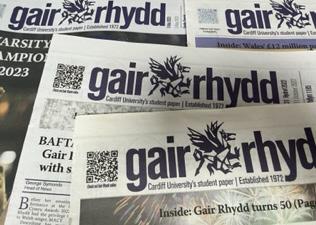
Just like that, another academic year draws to a close, which also means my time as Gair Rhydd’s editor-inchief has come to an end. It feels like both a blink of an eye and a lifetime ago when I was first appointed as editor, excited yet nervous about what the next year would bring.
With eight newspapers and one varsity special, being Gair Rhydd’s editor-in-chief has been an honour.
From celebrating our 50th birthday to reporting from the BAFTA Cymru awards, the team has tried its best to document everything happening in our capital and beyond. I have certainly experienced many firsts, from running around Cardiff to deliver the latest edition to writing my first (and most likely last) sports report. I have learned so much from the entire process and everyone I have met throughout my time with Gair Rhydd.
The last year has been a rollercoaster, in which I’ve no doubt felt every possible emotion. I can’t deny that it’s always been easy trying to balance various deadlines and technical hiccups that always seem to happen at the worst times. However, any stress of the week before instantly melts away once
I hold the latest copy of Gair Rhydd, filled with brilliant articles from students studying courses across the Uni-
versity. A personal highlight must be winning Best Welsh Publication at the SPA Awards and getting recognized for all our hard work over the last year.
I’d like to take this opportunity to give a massive thank you to the amazing editorial team, who I wouldn’t have been able to work without. From heads of sections to our digital and social media teams, Gair Rhydd wouldn’t exist without the collaboration of so many passionate and talented students. The Volunteering, Society, and Media Awards was the perfect evening to come together and celebrate everyone’s achievements from across all student media platforms this year.
I would also like to share my gratitude with our contributors, who week in, and week out fill our pages with thought-provoking articles, highlighting the diverse perspectives and interests of students from across the university. Lastly, thank you to you, our readers. Thank you for picking up a copy of our paper and supporting our work, it really has meant the world.
It’s bittersweet to be passing on the baton, marking the end of an amazing three years at Cardiff University, but I know that the paper will be in the safest hands with the next editor-inchief, Edward Sutton. From contributor to news editor to editor-in-chief, I now look forward to my newest role as a passionate Gair Rhydd reader.
Mae blwyddyn academaidd arall wedi dod i ben, sydd hefyd yn golygu fod fy nghyfnod i fel golygydd Gair Rhydd hefyd wedi dod i ben. Mae’n teimlo fel ddoe ac oes ers i mi dderbyn y rôl, yn gyffroes ond nerfus am beth fuasai’r flwyddyn nesaf yn dod. Gydag wyth papur newydd ac un rhifyn arbennig Varsity, mae wedi bod yn fraint fod yn olygydd Gair Rhydd. O ddathlu ein pen-blwydd yn 50 i ohebu o wobrau BAFTA Cymru, mae’r tîm wedi trio eu gorau i ddogfennu popeth sydd wedi digwydd yn y brif ddinas ac thu-hwnt. Dwi’n sicr wedi cael llawer o brofiadau cyntaf, o redeg o amgylch Caerdydd I ddosbarthu’r rhifyn diweddaraf i ysgrifennu fy erthygl chwaraeon gyntaf (a mwyaf tebygol olaf). Rwyf wedi dysgu gymaint drwy gydol y broses, yn ogystal â phawb rwyf wedi cyfarfod ar y siwrne. Dros y flwyddyn ddiwethaf, credaf fy mod wedi teimlo bob emosiwn bosib. Allai ddim gwadu fod o wastad wedi bod yn hawdd, ceisio cadw at derfynau amser wrth ddelio a phroblemau technegol sydd wastad yn digwydd ar yr amseroedd gwaethaf. Ond, mae straen yr wythnos gynt yn diflannu’n syth pan ddwi’n gafael y rhifyn diweddaraf o Gair Rhydd, wedi ei llenwi gydag erthyglau gwych gan fyfyrwyr yn astudio cyrsiau gwahanol ar draws y brifys-
gol. Roedd cael ein hadnabod am ein gwaith called drwy ennill Papur Gorau Cymru yng ngwobrau’r SPA yn sicr yn uchafbwynt i mi.
Hoffwn gymryd y cyfle yma i ddiolch yn fawr i’r tîm golygyddol arbennig. Fuaswn wedi bod ar goll heb bob un ohonoch. O benaethiaid adrannau i’r timau digidol a chyfryngau cymdeithasol, buasai Gair Rhydd ddim yn bodoli heb gyd-weithio rhwng cymaint o fyfyrwyr talentog ac angerddol. Roedd y noson gwobrwyau gwirfoddoli, cymdeithasau a chyfryngau yn gyfle perffaith i ddod at ein gilydd ac i ddathlu popeth sydd wedi ei gyflawni ar draws holl blatfformau cyfryngau myfyrwyr.
Hoffwn hefyd dangos fy niolchgarwch i’n cyfranwyr, sydd yn ysgrifennu erthyglau meddylgar sydd yn uchel safbwyntiau a diddordebau amrywiol myfyrwyr y brifysgol bob wythnos. Yn olaf, diolch i chi, ein darllenwyr. Diolch am bigo fyny copïau o ein papur a chefnogi ein gwaith. Mae wirioneddol yn golygu’r byd i ni.
Mae’n rhyfedd i roi’r awenau i rewyn arall, gan iddo nodi diwedd fy nhair blynedd fythgofiadwy ym Mhrifysgol Caerdydd. Ond, rwyf yn gwybod fod y papur mewn dwylo diogel gyda’r prif olygydd nesaf, Edward Sutton. O gyfrannwr i olygydd newyddion i brif olygydd, dwi’n edrych ymlaen am fy rôl newydd fel darllenwr brwdfrydig Gair Rhydd.



Millions of phones across the United Kingdom were jolted on April 23rd as a national emergency alert system underwent a rigorous test. At precisely 3 p.m., a deafening siren reverberated through devices utilizing 4G and 5G networks, capturing the attention of smartphone owners throughout the country. While some praised the initiative’s potential to save lives, others expressed concerns about potential drawbacks and invasions of privacy.
The alarm, described as piercing and attention-grabbing, resounded at 3pm on April 23rd, resonating through devices connected to 4G and 5G networks across the nation. Its purpose was to evaluate the efficacy of the newly implemented emergency alert system, designed to notify citizens promptly in the event of a life-threatening emergency in their vicinity.
The need for such an alert system arises from the critical importance of timely information during emergencies. Whether it be devastating floods, raging fires, extreme weather condi-
tions, or acts of terror, being aware of potential dangers can make all the difference in preserving lives. The government’s aim is to equip individuals with the necessary information to respond effectively, safeguarding themselves and their loved ones.
Supporters of the emergency alert system laud its potential to provide crucial notifications during crisis situations. They envision a future where citizens, armed with accurate and timely information, can take appropriate measures to mitigate risks. By harnessing the power of advanced technology, the system aims to utilize 4G and 5G networks to deliver notifications through various means—loud sirens, vibrating devices, or even automated voice messages. However, not everyone is convinced of the system’s merits. Critics argue that the alarm’s intrusive nature and potential for false alarms may cause unnecessary panic. Privacy concerns also loom large, with worries about the government tracking individuals or accessing personal data. Opponents question the need for a system that could potentially invade privacy without providing substantial benefits.
The government emphasizes that the alert system will only be triggered in situations where there is an immediate risk to life, minimizing the likelihood of false alarms. They assert that the system operates without tracking individuals or accessing personal data, reassuring the public about privacy protections.
The test, while an important step forward, encountered some hiccups. Reports surfaced of users receiving the alert a minute or so earlier than scheduled, while others claimed not to have received any notification at all. The government acknowledges these issues and pledges to address and refine the system’s functionality to ensure reliability and wider coverage.
Domestic violence campaigners expressed concerns about the potential risks posed by the alert system, as it may inadvertently reveal the location of secret phones used by individuals at risk. To address these concerns, the government actively engaged with organizations supporting vulnerable women and girls, aiming to minimize any adverse effects caused by the introduction of emergency alerts.
As the test concluded, differing opin-
ions on the emergency alert system persist. Proponents hail it as a lifeline that can save lives during critical situations, while sceptics voice their apprehensions regarding privacy and the potential for false alarms. The road ahead involves fine-tuning the system’s accuracy, reaching all devices consistently, and ensuring compatibility across various networks.

The emergency alert system represents a significant stride toward preparedness and public safety, aligning the UK with other nations that have implemented similar systems worldwide. It signifies the government’s commitment to protecting its citizens and delivering vital information during emergencies. As the system undergoes further largescale testing in the coming days, the hope remains that it will evolve into a robust, reliable, and privacy-conscious tool, ensuring that timely alerts become the cornerstone of a safer future for all.
Dominion Voting System reached a last-minute $787.5 million settlement for its defamation lawsuit against Fox News on the 19th of April 2023.
The voting machine company was suing the news network for $1.6 billion due to defamatory comments tying the company to election fraud over the 2020 presidential election. These claims by Dominion were after the news network had Trump’s associates and Fox News hosts accusing Dominion’s voting machines of rigging the election result in favour of Joe Biden, even though there was no evidence to back their claims.
For Dominion to win the case, they had to prove that the publisher had “actual malice” to harm the company. To do this, text messages and emails from journalists and hosts at Fox News were assembled that showed that many of them knew that the claims were false
Sweeden’s Loreen has won the Eurovision Song Contest 2023 in Liverpool
but continued to air the conspiracy theories. Some of the text messages and emails in question were from Tucker Carlson, who stated in his messages that “Sydney Powell is lying” and that the news channel airing the conspiracy theories was “unbelievably offensive to me. Our viewers are good people, and they believe it”.
These comments made by hosts and journalists were defended by Fox News, stating how Dominion was cherrypicking their argument and using the lawsuit to attack press freedom. Fox believes that they aired both sides of the debate to create a fair story. They continued to protect themselves by stating that Dominion’s claims were going against the first amendment, which states that the media has the absolute right to cover the news. This suggests that Fox would have been protected by the American Constitution.
Even though they continued to defend themselves against the claims made by Dominion, Fox News still settled the lawsuit. The reasoning be-
hind this may be because high profile individuals at Fox News were going to testify in the trial, including Fox Corp chairman Rupert Murdoch.
So, what happened after the settlement? Firstly, John Poulos, co-founder and the chief executive of Dominion Voting Systems, has said that he is not done with the news network until they publicly apologise and take accountability for lying to their audience, as well as damaging their voting machine company. However, these demands are extremely unlikely to occur, as Fox News did not cover the case on their news channel and the settlement means the channel does not need to make an onair apology.
Furthermore, Dominion is continuing to pursue defamation lawsuits against four of Trump’s major allies for their involvement in the spread of conspiracy theories against the company.
The four in question are Sidney Powell, Rudy Giuliani, Mike Lindell and Patrick Byrne. Moreover, the voting machine company is also suing Fox New’s
competitors: One America News and NewsMax, in their pursuit to defend democracy.
Since the settlement, Fox has fired one of their most popular hosts, Tucker Carlson, without notice or explanation. This has led to speculations as to why the news network sacked the presenter. One speculation suggests that the leaked text messages from Carlson that showed how he believed the news network was airing people that were not telling the truth about the election led to his sacking. This suggests the news network is trying to stamp out the story, by eradicating those involved in the lawsuit.
Ministers are considering plans to prevent recently qualified young drivers from giving lifts to friends in attempts to stop peer-pressure car crashes.
As part of a “graduated driving licence,” drivers under the age of 25 may not be allowed to carry any young passengers.
In the first year after receiving their licence, young drivers are legally prohibited from giving lifts. Peer pressureinfluenced crashes are one of the factors that result in collisions involving young drivers.
Only 6% of UK drivers fall into this category, however they are responsible for one in every five serious or fatal accidents.
There are currently no additional regulations for recently qualified drivers like this. However, before receiving their licence, drivers must successfully complete a two-year probationary period during which they are only permitted six points on their licence before having it retracted.
While little has been confirmed for now, opponents of the proposed changes have argued that drivers under the age of 25 are less likely to cause accidents than those over the age of 85, yet similar regulations for licence holders within this age range have not yet been discussed.
The idea emerged in response to a campaign started by a mother whose 18-year-old daughter died in a car accident while riding in the car of a friend who had just passed her driving test four months earlier. The sudden passing of Sharron Huddleston’s daughter Caitlin, alongside her friend Skye, “left a huge, gaping hole” in the family, according to
The Sunday Times, and she is presently seeking to run a campaign to protect other young people.
In May, debates will be held in parliament regarding the future of the Road Traffic New Drivers Act. Roads Minister Richard Holden will consider modifications, and an official statement is anticipated prior to a meeting scheduled on May 16th.
RAC road safety spokesman, Simon Williams believes, “Young people, and especially young men, continue to be massively over-represented in road collision statistics, so introducing restrictions that are gradually reduced over the first few years of driving may be one of the measures needed to bring the dreadful numbers down.”
It has been almost one year since Ben Rogers and Kaitlyn Davies, both 19 years old, perished almost in the South Wales region when the car they were travelling
in slammed into the Northway Petrol station in Bishopston, Swansea, late on Tuesday, May 31, 2022. A 17-year-old boy and 17-year-old girl who were riding in the car with them were sent to hospital for urgent treatment.


Abigail Holly, one of Ben’s closest friends, said that “His family have of course been devastated by the whole ordeal,” further highlighting the lasting effects of these tragic accidents.


Despite the controversy, this practical decision is a hopeful one by restricting young drivers’ rights to ride as passengers for a while after passing their test, could save lives.
What do you make of the announcement? Will this help reduce crashes and help younger drivers? Or are we unfair to young drivers when we stereotype them as careless, speed-loving risk-takers?
Voters will now face an extra hurdle to cast their ballot in elections in Britain, with the introduction of having to produce a valid photo ID. Ministers created this requirement in what they say is an attempt to crack down on allegations of in-person voter fraud.
Critics say these changes will make it harder for some to vote.
There have been 1,386 cases of alleged electoral fraud reported to the police since 2018, according to the Electoral Commission. These led to six police cautions and nine convictions. In the past five years there has been “no evidence of large-scale electoral fraud”, the commission said. Although some Conservative MPs claim the statistics underplay the issue.
After trials in 10 constituencies, photo ID requirements are being rolled out nationally for the first time in the local elections taking place on the 4th of May. Previously, people in the UK could attend a polling station by just giving their address – with

some voters choosing to bring their polling cards.
From October, the ID requirements will apply to all future elections. You do not need to show proof of ID if voting by post.
Some polling stations may have “greeters” outside to remind voters about the changes to voting rules. However, you only need to show your photo ID to staff issuing ballot papers inside.
Only original versions of the photo ID will be accepted and photocopies will not be allowed. But the ID will still be usable even if it is out of date, as long as the voter still resembles their picture and their name matches the one on the electoral roll. If the voter no longer looks like the photo on their ID they will be encouraged to apply for a new free ID document known as a Voter Authority Certificate. The deadline to apply was the 25th April,
which now has passed.
You are able to exchange a paper driving license for a photocard, or apply for a photocard travel pass if you are over 60, disabled or registered blind (or partially sited).
As well as a passport or driving license, other forms of ID include a blue badge, older person’s or disabled person’s bus pass, and any identity card bearing the hologram of proof of age standers scheme. National identity cards issued by a country in the European Economic Area and biometric immigration documents will also be allowed.
The number of voters who are unable to vote due to this new rule will be recorded. Polling station staff have a legal duty to record the number of people who cannot be issued a ballot paper because they could not show valid photo ID.
This number will include the people who are turned away and later return to the polling station with the correct ID.
On the 6th of May 2023, 20.4 million people tuned in to watch the coronation of King Charles III and Queen Camilla. Taking influence from the Anglican service of Holy Communion, the ceremony in Westminster Abbey consisted of “Charles taking an oath, being anointed with holy oil, and receiving the coronation regalia, emphasising his spiritual role and secular responsibilities.
Representatives of the Church of England and the British royal family declared their allegiance to him, and people throughout the Commonwealth realms were invited to do so. Camilla was crowned in a shorter and simpler ceremony.
After the service, members of the royal family travelled to Buckingham Palace in a state procession and appeared on the palace’s rear and front balconies. The service was
altered from past British coronations to represent multiple faiths, cultures, and communities across the United Kingdom, and was shorter than Elizabeth II’s coronation in 1953” (Andrew Michael, Forbes Advisor).
Whilst many enjoyed street parties and celebrations, the coronation was left with ‘Not my King’ protests across the United Kingdom. London’s Metropolitan Police said it made fifty-two arrests during the coronation as the force faces growing scrutiny over its attitude toward anti-monarchy demonstrators.
Republic, Britain’s largest antimonarchy group, told CNN that “police – without providing any reason – arrested organizers of the antimonarchy protest” (Niamh Kennedy, CNN). Many protesters are aiming to abolish the idea of an unelected headof-state in the monarchy.
However, what are the actual duties for the King and Queen? The BBC detailed that the head-of-state for the United Kingdom, and the Commonwealth. “A Head of State is a
person who embodies, or symbolises, a country. In a republic, they may be a President. In a monarchy, they may be a Queen or King. In the UK, the British Monarchy is known as something called a constitutional monarchy. This means that they do not get involved or talk about their opinions on politics. Their powers are more ceremonial and symbolic - the King or Queen cannot make and pass laws, which comes down to the UK Parliament” (BBC News).
The key duty for the British monarch is separated into five roles. Firstly, a ‘daily despatch box’ where daily governmental forms are delivered via a red despatch box.
These documents function as briefings of governmental decisions. Secondly, the Royal Assent, which is the final stage of a bill’s progress in Parliament and requires the monarch’s official approval.
Alongside these governmental authorities, King Charles will now have to have weekly meetings with the Prime Minister, make a speech at
the State Opening of Parliament then lastly, the appointing or dissolving of government at the turn of the Prime Minister.
Whilst the coronation service had a mass viewing of 20.4 million, “The figures are smaller than when an average of 26.5 million viewers tuned in for Queen Elizabeth II’s funeral.
An average of 18.8 million people tuned into watch the Coronation across eleven channels and services, including BBC One, Two, ITV and Sky News.
Channel 4 opted to show film Johnny English Strikes Again instead of the Coronation with an average of 138,000 people preferring to the watch Rowan Atkinson film” (Andre Rhoden-Paul, BBC News). For the first time in 70 years, the United Kingdom and Commonwealth has a new King and Queen. King Charles III and Queen Camilla plan to continue their royal duties.
The highest-ever number of food parcels have been distributed by UK’s biggest food-bank provider, The Trussell Trust, in the past year. The Trussell Trust has distributed nearly three million food parcels, with 1.1 million of them being for children. This is a 37% increase from the previous year.
On average in December, the Trussell Trust distributed food parcels every eight seconds.
According to Emma Revie, the CEO of the Trussell Trust, they have distributed more than one million food parcels for children for the first time, which is a distressing milestone. She added that the level of demand for food aid is even greater than what they witnessed during the initial year of the pandemic, which was thought to be an
unprecedented record. The trust’s annual report reveals that over 750,000 individuals who received assistance had never previously used their food banks.
Last year, the trust delivered emergency food aid and assistance from nearly 1,650 centres across the UK. Demand for their services rose in all parts of the country, particularly in the north-east and east of England, southwest England, and Wales. In Cardiff, Claire Hillard, who had used the food parcels, said, “I’ve got nothing in my fridge, my freezer - they’re all empty. Even my tinned stuff has gone.”
Hillard admitted that there were instances where she was too stubborn to request aid, but now her circumstances have deteriorated to the point where she feels that she has no other option.
“My bills are literally taking up all my money and I’m left with really nothing to buy food,” she explained. Due to her
benefit payment not arriving for several days, she could not provide meals for her children. “This is what’s happening now each month - come the last week and I’ve just got nothing,” she stated. Hillard is concerned that her expenses will continue to rise with each shopping trip and that she will be unable to provide for her two sons.
In the past year, many households have experienced difficulties due to escalating food and energy costs. The CEO of the Trussell Trust highlighted that neither the pandemic nor recent cost-of-living challenges can account for the sustained increase in demand over the past five years. She believes that the root cause is insufficient income and an inadequate social-security system that compels more individuals to rely on food banks. “Food banks were set up to provide short-term support to people in an emergency - they are not a lasting solution to hunger
Bannau Brycheiniog National Park has announced that it will be named it’s Welsh name from now on, instead of Breacon Beacons.
The Welsh name dates back to the 16th century with poet John Leland. Although the name was officially established in 1957.
The name means Brychan’s Kingdom, which was the 5th or 6th century king from Ireland. Some may say that he was the father of Dwynwen the Welsh saint of love.
This year the park is celebrating it’s 66th birthday and they’ve shared their new plan to tackle main global issues. The main focus is on nature and climate change.
With the new management plan in place this sets the national park on a road to reduce carbon emissions and reach net zero by 2035.
Rural campaigners are worried about the sheep as they have introduced a plan to reduce grazing. The local farmers are being encouraged
and poverty,” she emphasized. She argues that people have been deprived of necessities for too long due to socialsecurity payments that fail to cover essential costs, which only aggravates their hardship.
The charity is urging for an increase in the basic level of universal credit to ensure that it can always cover “essential costs.” In response, the Department for Work and Pensions stated that they are dedicated to eliminating poverty and acknowledge the effects of mounting living costs. As proof of their commitment, they have raised benefits by 10.1% and implemented an unprecedented increase in the National Living Wage this month. Furthermore, they claim to be providing the most vulnerable with record levels of direct financial aid, with £1,200 distributed last year and an additional £1,350 allocated in 2023-24.
to farm and use their land in the most eco and climate friendly way.
Rachel Evans, a farmer and Director of Countryside Alliance Wales raised her concerns and noted “less sheep will result in more, unmanaged vegetation which could in turn mean more, dangerous, wildfires”.
Columnist Sean O’Grady wrote in The Independent that the new name is difficult to pronounce and that this does not benefit people outside of Wales. O’Grady compared Brychan to Boris Johnson.
Gwern Gwerfyl, CEO of YesCymru welcomed the decision and also said that the English Press “resort to relentless misinformation and often wilful ignorance”. He also mentioned that this is not a big change as the mountains has been named Y Bannau for centuries.

The CEO of YesCymru also added “My favourite aspect of this in Wales is how welcoming it is, how easily and happily it embraces anyone who wants to be a part of it”.
Rishi Sunak said that he does support the Welsh language but presumes that “most people” will use “Breacons Beacons”.
Pembrokshire National Park have announced that they will not be changing the park’s name and it will continue to use the English and Welsh name.

Grace Robson discusses what Cardiff University did to commeomrate the day.
 Grace Robson Features Editor
On the 8th of March across the globe we celebrated International Women’s Day. A day celebrating the social, economic, cultural and political achievements of all women.
International Women’s Day was first honored in 1911 and continued to grow in popularity until 1975 when the day was marked for the first time by the United Nations. Today, International Women’s Day is celebrated all across the world with marches, speeches, fundraisers, events and more.
This year’s International Women’s Day was celebrat- ed across Cardiff University by a whole host of societies. I spoke to some of these societies to see how they chose to commemorate this tremendously important day.

This year, in collaboration with the current women’s officer, Cardiff University’s feminist society chose to once again host their yearly showcase.
This year’s showcase was in support of Imkaan, a UK-based umbrella women’s organisation who are dedicated to addressing violence against Black and Minoritized women and girls. The night, which was hosted by the feminist society’s committee and Women’s Officer Emily Carr, featured a whole host of remarkable talent. The night started off with a spectacular performance by Cardiff University’s own aerial fitness society and was followed by a reading of powerful poetry by a handful of students. The evening continued with performances from singers, speakers and dancers and concluded with a remarkable performance from Cardiff’s own band, The Poached. The feminist society intends to host another showcase for International Women’s Day in 2024 and encourages you to come along when the time comes.
I spoke to committee member and representative of Cardiff University’s feminist society, Ishani Patwal, about the importance of International Women’s Day and what it means to them. They responded that International Women’s Day “gives us a


chance to celebrate all the incredible individuals who contribute to our community and culture”. When asked why they believed it was so important to host events such as their
The night, which was hosted by the feminist society’s committee and Women’s Officer Emily Carr, featured a whole host of remarkable talent"
I also spoke to Cardiff’s politics netball society, who hosted a charity netball tournament for International Women’s Day, about what the day means to them as a society. They responded that ‘International Women’s Day for us as a sports society is about embracing the amazing women around us and empowering each other and lifting one another up’. The charity netball tournament, which featured
over 20 netball teams, was hosted to raise money for Cardiff’s Women Aid, a charity dedicated to supporting survivors of domestic violence and with the aim to eradicate domestic and sexual violence. A spokesperson for Cardiff’s politics netball society stated that this charity and its aims resonated with them as a mostly female society. They stated that ‘These victims are someone’s mother, daughter, sister,
best-friend or loved one, and this really hits home. It’s vital to fundraise for charities like Cardiff’s Women’s Aid as they do invaluable work helping these women escape from situations which could otherwise prove fatal’.
showcase in celebration of International Women’s Day, they stated that it is because “there is so much work to be done in terms of equality and any excuse to celebrate and publicise all the amazing things we do is so important”. They continued by saying, “it is another chance to help women get the recognition they deserve”. Lastly, I asked whether or not they believe the university as a whole could do better
in the future when it comes to celebrating International Women’s Day. They responded by saying that they believed the university could definitely do better in the future by “putting on more events themselves to celebrate as it would give more of an impression that it was important to the culture of the university as a whole and not just societies like the feminist society”.
Cardiff University’s boob team also chose to commemorate International Women’s Day with a showcase of their own to raise money for the charity that they represent, CoppaFeel. CoppaFeel is a breast health awareness charity that aims to educate and remind young people in the UK to check their chests, something that could save their lives.
“gives us a chance to celebrate all the incredible individuals who contribute to our community and culture”
Cardiff Uni's Feminist Society
Similarly, Cardiff University’s psychology society ran a two-day donation drive and awareness stall for Cardiff Women’s Aid and for Cardiff University’s disclosure response team at the Centre for Student Life. This gave members of the Cardiff community an opportunity to donate vital resources such as clothes and bedding. When asked what International Women’s Day meant to them as a society, a spokesperson for the society responded that “As a committee full of women, International Women’s Day
is a chance to spread awareness for important issues facing us today”. They went on to tell me about why they felt more people should be hosting similar events to raise awareness stating that “We were able to inform many people of the brilliant services that Cardiff Women’s Aid and the disclosure response team provide as well as raising funds”. They continued stating that events like these are so important because they “think it is important to highlight the oppression women have faced within history and
that they still face today, alongside celebrating women’s victories”.
Indeed, while it is important to celebrate the achievements of women on International Women’s Day, it is also vital to acknowledge the struggles that women face on a day-to-day basis. That is why fundraisers such as these are a phenomenal way to celebrate International Women’s Day. They create real action and real change.
Whilst this year was full of celebration across the university to commemorate International Women’s Day, there is always room for even more support, especially from organisations with a greater degree of influence such as the Student’s Union. I spoke to this year’s women’s officer, Emily Carr, about what International Women’s Day means to her and what Cardiff as a university can do to show an even greater degree of support for such an important day. When asked what International Women’s Day means to her, specifically as our current elected women’s officer, her response was that “It is about long term policy change, it’s about long term campaign. It shouldn’t just be one social media post. It is about how we can invest in our students and in our com -
With Emily Carr’s response in mind, I spoke to next year’s Student Union President, Angie Flores, about how she and the Student Union intend to do even better in the years to come. When asked what International Women’s Day means to her, she responded that “For me, International Women’s Day is all about gender equality and human rights. It is an occasion to be grateful for those who paved the way and to celebrate what small and big actions have been achieved throughout. However, it also gives us a platform to discuss the inequalities and struggles faced by individuals worldwide, it reflects how far we still need to go”. When asked how Cardiff’s Student Union could improve their response to International Women’s Day in the future,
Although International Women’s Day is an amazing opportunity for us to celebrate the incredible achievements of individuals globally, it is important to note that women should be celebrated every single day of the year. And, while incredible strides have already been
Angie responded by stating that “As elected SU president, I would like to continue with the support provided by our current elected officer team to our student communities. Regarding International Women’s Day, I have a couple of ideas, but before sharing I would love to hear what our incoming elected officers and our students would like to see”.
For me, International Women’s Day is all about gender equality and human rights"

Angie Flores- next Student Union President

I would like to continue with the support provided by our current elected officer team to our student communities"
munity”.
When asked what needs to be improved upon in the future, Emily responded that “It has been a privilege to be the women’s officer but moving forward as an institution we can’t be throwing out meaningless things and expect that to be job done. I think representation goes further than just an Instagram post or an event. We need to openly critique the way Cardiff University recognises and celebrates marginalized communities and minorities within the student and local community. More has to be done to improve representation. There is still so much foundational change to be made”.

Source:: Cardiff University Students' Union
"I would love to hear what our incoming elected officers and our students would like to see”.
Source: Cardiff University's Students' Union
made towards equality, there is without a doubt still a significant degree more to be done.
For example, companies are more than willing to use the day as a marketing opportunity, with Twitter's gender pay gap bot account replying withhow much less
that company pay their women compared to men.
Especially with 97% of women between the ages of 18-24 being sexually harrased in Britain, it's ovbious that more needs to be done to support women and guarantee their saftey.
Celebrating International Wom -
en’s Day gives us a chance to shine a spotlight on not only how far we’ve come but how much further there is to go.
 George Gourlay Politics Editor
After a seven year stalemate on relations, representatives from Iran and Saudi Arabia have shaken hands on a new effort to establish “neighbourly” relations. Following a four day mediation in China, the two countries agreed to a truce that marks a hopeful, if indefinite, pause to a regional divide.
The deal, confirmed by the Saudi Press Agency on the 10th March, denotes that the two countries will respect state sovereignty by not interfering in each other’s internal affairs.

Trade and security relations are to be re-established as well as the reopening of embassies in Riyadh and Tehran within 2 months.
Both sides have embraced the move toward stability. Iran’s Foreign Minister, Hossein Amir-Abdollahian, notably stated: “The return of normal relations between Iran and Saudi Arabia provides great capacities to the two countries, the region and the Islamic world. The neighbourhood policy, as the key axis of the government’s foreign policy, is strongly moving in the right direction, and the diplomatic apparatus is actively behind the preparation of
more regional steps.”
Relations between the two nuclear powers had been gridlocked since 2016, when Saudi officially ended ties after demonstrators stormed the Kingdom’s embassy in Tehran. The incident was in reaction to Riyadh’s execution of a prominent Shia cleric. Since then, the two have openly pointed the geopolitical finger at one another in numerous instances that have threatened to further destabilise the Gulf region. In 2019, Saudi and its most prominent ally, the United States, accused Iran of involvement in an attack by missiles and drones on its oil facilities.
Arab-Iranian tensions trace back further through a number of proxy conflicts that have found the two on opposing sides of violence across the Middle East - in Syria, Lebanon, Qatar and Bahrain - as well as be-
yond the region with each providing military and support to their respective alliances.
The most notable battleground has been in war-torn Yemen, where the Iranian-supported Houthi insurgents seized control of the capital city, Sana’a, which forced out the Saudi-backed government in 2014. This led to a civil war that has caused the displacement of over 4 million people and a humanitarian crisis perpetuated by Saudi’s airstrikes across the country.
The involvement of China, a previously passive observer to the majority of Middle Eastern politics, as
it is believed that China’s involvement has provided the final guarantee to the Saudi government of a lasting deal with Iran. ”
Relations between the two nuclear powers had been gridlocked since 2016, when Saudi officially ended ties ”
principal peacemaker in the negotiations has come as a curveball to those with an eye on the situation. In 2021, it was the United States that initially encouraged dialogue between Iran and Saudi Arabia, the latter of which has played a key role in perpetuating America’s interests and business in the region. A prominent issue has been the containment of Iran, whose nuclear arsenal has posed as a matter of contention for many US administrations.
Despite a handful of Washingtonsupervised talks between Tehran and Riyadh, it is believed that China’s involvement has provided the final guarantee to the Saudi government of a lasting deal with Iran. America’s Security Council spokesman, John Kirby, has said: “We support any effort to de-escalate tensions in the region. We think it’s in our interests.” However, the involvement of China has arguably hit a nerve, as Kirby hastily added: “This is not about China and I’m not going to characterise here whatever China’s role is.” The US has also implied doubt over its faith in Iran to meet the obligations of the deal.
Labour party as less left-wing and appeal to more voters.
-MPs have passed minimum service legislation
The latest number, for the year to December 2022, will be published next week
-Animal testing licences for makeup banned
Keir Starmer, leader of the Labour Party and official opposition has recently spoken out on radio 4, stating he will no longer be advocating for the removal of university tuition fees, and this will not be a labour campaign aim. However, this was a core part of his 2020 leadership campaign under his promise of “social justice” following the resignation of Jeremy Corbyn after the 2019 General Election.
Starmer is expected to announce this policy change at a speech later this month, announcing the party is “likely to move on from that commitment’.
In 2019 the economic think tank; The Institute of Fiscal Studies, published a report, revealing it could cost the taxpayer £6 billion per university year group, if higher education was funded by public funds.

The elected student committee of the Labour party voted just two months ago, to back free higher education for all students, saying the abandoning of this policy would be classed as a “massive betrayal”. Anger has also been expressed by the leftwing Corbyn supporting group Momentum, echoing similar sentiments of betrayal that will be faced by many young people.



Home Secretary Suella Braverman says she recognises the concern around animal testing.
Although he is no longer pushing for the complete removal of tuition fees, he did add that the current system was “unfair” and didn’t work for either students or lecturers, thus Labour is looking at alternative forms of funding, making it very clear that something needed to change under his leadership. This policy reversal, Starmer argues, is a necessary change due to the current economic situa-
gairrhyddpolitics@gmail.com
tion including the burden on the taxpayer and current interest rates.
The current university tuition system works differently in the various nations of the UK. Scottish students staying in Scotland are eligible for free tuition while home students in Northern Ireland will pay a maximum of £4,630 per year. In England and Wales, however, fees have been capped at £9000 and £9250 respectively. These discrepancies between different regions have led to calls for the scrapping of tuition fees alto-
gether, or severely lowering them, for every student.
Starmer is the first labour leader since Tony Blair not to pledge to lower or scrap university costs when running for prime minister. Ed Miliband suggested lowering costs to £6,000 a year while Jeremy Corbyn firmly pledged that he would advocate for the removal of fees within higher education. It’s therefore a change within the party that Starmer is breaking from this, in a bid to centralise himself, and present the
Such a policy reversal has drawn criticism because this is not the only policy he has been seen to have abandoned. For example, he previously stated he wanted to nationalise energy and water companies but is now firmly set against this, other than his pledge for Great British Energy at the last Labour Party conference. This is a move designed to gain more swing voters, however making himself unpopular in the process, with the suggestion being that many young people and labour supporters left feel upset, ignored, and betrayed.
In a recent Welsh Conservative conference, the prime minister has said that no more powers should be devolved to Wales. He told the conference voters do not want politicians focused on “constitutional tinkering”, accusing Labour of making people in Wales “guinea pigs in a socialist experiment”.
Earlier, the Welsh Conservative Senedd leader, Andrew RT Davies, said Mr Sunak should “not be afraid to say no” to calls from Welsh Labour and Plaid Cymru for further powers.
This was part of an attack on Welsh Labour for their support of the gender recognition reforms in Scotland, including asylum seekers in the basic income pilot, and the roads review which scrapped major road building projects due to environmental concerns.
The LGBTQ+ Action Plan for Wales
mirrors the blocked Scottish Gender Recognition Reform Act which makes it easier for someone to legally change their gender, sparking concerns that it could “trample over women’s rights”. Welsh Conservatives criticised the plan, claiming that LGBTQ+ people “don’t deserve to be used as a political tool by Labour ministers in their bid to secure more powers”.
Wales’ £20m basic income pilot scheme, offering £1600 monthly pay-

ments to 18-year-olds leaving care, includes a small number of unaccompanied asylum seeker children (UASC). The scheme aims to “support their integration” and help “rebuild their lives” by giving them access to “appropriate” Welsh government schemes. Although the Welsh Government denied the involvement of “illegal migrants”, Rishi Sunak said it was unbelievable that ministers wanted to pay them: “we’re stopping the boats, Labour are
paying for them”.
Andrew RT Davies accused Labour of taking money from the Welsh NHS to “fund more politicians” following plans set by Labour and Plaid Cymru to increase the number of Senedd members (MSs) to 96, in order to cope with an increasing workload and to better scrutinise proposed new laws and government ministers. While the Northern Ireland Assembly has 90 members to represent 1.8m people, Wales, with a population of over 3m people, only has 60 MSs. The main objections to the plans are on the grounds of cost after it was estimated in 2020 that 30 extra MSs would amount to £12m a year. Tories have since quit the Senedd reform committee, accusing Labour and Plaid Cymru of undermining the committee’s work with the announcement of the plan.
Before the conference, Rishi Sunak said he will continue to use the Brecon Beacons name, after it was changed to Bannau Brycheiniog to promote area’s culture and heritage, and that he expects “most people” would do the same.
French President Emmanuel Macron’s decision to raise the pension age from 62 to 64 has been met with fierce opposition, triggering strikes and protests across the nation since the announcement in January. Macron’s defence for his controversial policy rides on the belief that the current system is unsustainable, given the changing demographic of the French workforce. In 2000 there were 2.1 workers for each retiree, which decreased to 1.7 in 2020, a figure which is expected to decrease further to 1.2 in 2070. Policy supporters also argue that French pensioners retire earlier than their European neighbours: the state retirement age in the UK is 66 and 67 in Germany and Italy.
The issue of pension reform is not new for France. Former president Jaques Chirac attempted pension reform in 1995 but this proved unsuccessful and faced mass strikes. His successor Nicholas Sarkozy, however, was successful in raising the retirement age from 60 to 62 in 2012, though not without huge backlash. Macron himself also raised the issue of pension reform during his first presidential term in 2019. In a bid to keep the system financially viable, he proposed merging the 42 separate schemes for varying sectors; the response amounted to the largest protests and strikes France had seen since 1968. Due to the outbreak of the coronavirus pandemic in 2020, Macron’s proposals were never implemented.
Guardian commentator Angel -
ique Chrisafis has labelled France’s pension system “the cornerstone of the country’s cherished model of social protection”, which differs greatly from the market-led system in the UK. Instead, those in retirement are funded by the working population who pay high payroll charges, a system which has been labelled “solidarity between the generations”. Sky News have stated that, alongside the nation’s 35-hour working week and favourable unemployment benefits, their low retirement age “has become a staunchly defended “right” in the eyes of the public. This should explain the level of outrage.
Millions of French citizens have been protesting and engaging in strike action throughout 2023, but anger towards the proposals was further exacerbated by the government invoking Article 49.3 in March. Due to concerns that he would not re -

ceive the support of enough lawmakers, Macron used the special constitutional powers of the Article to bypass members of parliament and force the plans through. The article was invoked due to Macron’s precarious position in parliament, his En Marche party lost their absolute majority in the 2022 elections, indicating that there was no guarantee that the changes would go through. MPs triggered a vote of no confidence twice; the first was triggered by 278 MPs, but 287 are needed to succeed.
The second by Marine Le Pen’s farright National Rally, which was also unsuccessful.
At the time of writing, the most recent wave of protests occurred on the 1st May, France’s traditional Labour Day; marching trade unions turned their attention to the controversial pension reform. Though demonstrations were originally
At Prime Minister’s Questions last week, Shadow chancellor Angela Rayner accused the Conservatives of preparing for opposition. This follows the appearance of several high profile conservatives at NatCon, a conference for those on the far right of politics.
The conference was attended by two cabinet ministers: Michael Gove and Suella Braverman. Other high-profile Conservatives joined, such as Jacob Rees-Mogg. This added to the controversy surrounding the conference where cabinet members who attended went ‘off message’ from their cabinet agreed positions.
The radical nature of the conference was highlighted when Braverman appeared to call out academics and policy professionals. She stated that her party should be “sceptical of self-appointed gurus, experts and elites who think they know best what is in the public’s interest, even when that public is quite certain that they need something different from what those experts are proposing”. She also attacked Keir Starmer’s views on gender arguing: “given his (Starmer’s) definition of a woman, we can’t rule him out from running to be Labour’s first female prime minister”.
peaceful, violence eventually erupted on the edges of marches, resulting in 108 police officer injuries and 291 protestors being detained across France. In Paris, police fired teargas, while protestors threw petrol bombs and projectiles. Similar scenes were seen in Lyon and Nantes; cars were set alight, windows were smashed, and police again fired teargas. Interior minister Gérald Darmanin condemned the violence on Twitter, stating that though the “majority of demonstrators were of course peaceful”, police had been met with “extremely violent rioters”, whose objective was to “kill a police officer and steal property”.
Despite these disruptions, which reached equally violent levels throughout February, March, and April, Macron’s government has shown no sign of backing down. This is also in spite of polls indicating that two-thirds of the population support the protests. The moderate CFDT Union (French Democratic Confederation of Labour) have proposed mediation if the pension changes were “put to one side”, but these were rejected by government spokesperson Olivier Véran, who said of the pensions law: “It’s in the past now”. Though Macron’s government is aiming to move on from the pension crisis, outrage has continuously followed the president; recent visits to provincial France have been accompanied by boos and a sustained mood of anger. This indicates that the turmoil within France is highly likely to continue.
At PMQs, Rayner argued that “It’s absolutely amazing that while the Labour party is preparing to govern with a majority, they have started to prepare for opposition”. She illustrated this through Rees-Mogg’s admittal of gerrymandering, saying that he “really let the cat out of the bag” after he appeared to admit that the Conservatives introduced photo ID at elections with the aim of it working in their favour.
There has been an argument made that the NatCon conference is one in which the Conservative factions have been further exposed to a clear divide in Rishi Sunak’s cabinet, looking almost like the divide following a General Election in which members create a new vision for their party. However, following the loss of just over 1000 seats in England’s local elections, there has been a divide between those in the party who blame Sunak’s leadership, and the majority who blame previous leaders Liz Truss and Boris Johnson. It is yet to be seen how this will affect the party at the next General Election.
Citizens headed to polling stations across England on May 4th to vote in the local elections. This was a significant day, not just because it was Rishi Sunak’s first opportunity to see how well he sits with voters, but because it was the first election where people had to show a form of identification to vote. This requirement to show ID to vote in Great Britain was made law by The Elections Act 2022, but why did the government introduce this and what impact did it have on the 2023 Local Elections?
Electoral fraud is when someone attempts to interfere in an election by voting more than once or by pretending to be someone else. A 2014 report found no evidence of this happening in the UK, however, it found that lack of ID at polling stations was an “actual and perceived weakness” of the UK electoral system internationally. This resulted in the commitment to voter ID being placed in the Conservative Party’s manifestos before the 2017 and 2019 elections. This introduction was not without controversy. Opponents argued that cases of electoral fraud were too small to justify the need for ID and instead maintained that the government was trying to make it harder for people to vote. The 2019 general election saw a turnout of 47.5 million people and just 164 cases of electoral fraud. Furthermore, just 0.000057% of all votes cast in the 2019 elections were related to voter impersonation. The Conservative government responded by saying that voter ID would “protect the integrity of our democracy”.
Voter ID has also been controversial because the UK has no free or low-cost ID options. The main forms of ID include a passport which costs £82.50 or a provisional driver’s licence which costs £34. These costs also partly explain why 11 million people possess neither. Nevertheless, voters without ID can apply for a ‘Voter Authority Certificate’ which would allow them to vote; opponents have also criticised this, as it could be difficult for homeless and elderly people to obtain.
This election did see people being turned away due to forgetting their IDs; said people did not return, according to those working at polling stations. There was also an instance where an immunosuppressed woman did not vote as she did not want to remove her face-covering to prove she matched her photo ID. Married women and transgender people also got turned away as their documents did not match their new names. The Prime Minister said that ID checks meant elections would remain a “high-integrity process” while the Election Commission chairman John Pullinger accepted that there were issues with voter ID and that the organisation needed to assess their impact.
Four years ago Prime Minister Theresa May announced the plan to scrap Section 21. So far MPs have not had the opportunity to vote on any legislation regarding the subject. The original bill intended to scrap Section 21 was supposed to be called the Renter’s Reform Bill, and the published white paper outline was criticized for containing too many loopholes.
Section 21 of the Housing Act 1988 “enables private landlords to repossess their properties from assured shorthold tenants without having to establish fault on the part of the tenant”. It is usually referred to as a ‘nofault’ eviction, and it puts tenants in an unstable position, unable to plan for their children’s education, and less likely to secure repairs or challenge rent increases. Landlords can ask tenants to leave with just two months’ notice.
According to the ONS, private rent has increased by 4.6% in England, 4.4% in Wales, and 5.1% in Scotland between March 2022 and March 2023.
London particularly has a much more significant supply/demand imbalance. In 2022, the number of households facing homelessness raised by 6% compared to the year before, up to 290,330. In the same time frame, the number of people facing homeless as a result of a Section 21 notice went up by 50%, to 24,060 households.
The white paper still gives land-
lord eviction powers: one of the options is for the landlord to move into the property themselves, then put it back on the rental market three months later. Otherwise, in-tenancy rent could be raised, forcing tenants to move out.
In Stoke-on-Trent, the Citizens Advice Bureau said 70% of its housing support staff is helping people with

Section 21 eviction cases.
In the West Midlands, the number of landlords planning to cut down on properties they own has almost doubled in a year. 38% want to reduce the number of properties they rent, according to the National Residential Landlords Association. While the MPs are still waiting for a bill to sign, a spokeswoman for the Department for Levelling Up, Housing and Communities said: “We remain absolutely committed to delivering a fairer deal for renters. (…) We will bring forward a Renters Reform Bill in this Parliament, abolishing ‘no-fault evictions.”
Similarly, a Communities Department spokesperson has declared that over three years they are giving councils £1bn through the Homelessness Prevention Grant, “on top of £26bn cost of living support this year”.
While no concrete plans have been published regarding the renters’ reform, the spokesperson has claimed it will “deliver a fairer, more secure, and higher quality private rented sector, reducing the risk of tenants becoming homeless.”
Adam Price has resigned as leader of Plaid Cymru following a report finding in-party misogyny, harassment, and bullying. Llyr Gruffydd has taken over as interim leader and has announced that he will not stand for election as leader.
Plaid Cymru has faced several months of controversy with allegations of sexual assault made against a senior staff member - as well as Rhys ab Owen being investigated by Standards Commissioner Douglas Bain. Allegations of predominantly gender-based discrimination have plagued the party.
The Prosiect Pawb (Everyone’s Project) report said “inaction over many years, from those with positions of power to challenge bad behaviour has made a bad situation even worse”. MS Cefin Campbell agreed with these findings stating:
“For too long... people have known about misconduct in Plaid Cymru, whether it’s misogyny, bullying, sexual harassment or whatever unacceptable behaviour”. He further asserted that the party now needed to change.

Price’s resignation letter stated that he no longer had the “united support” of his colleagues and said that he had wanted to resign in the wake of the report but was per-
Interim leader Llyr Gruffydd has ruled himself out of the leadership contest.”
Plaid has faced allegations of misogony in recent years
Source: Plaid CymruThe Party of Wales(via Flickr)
suaded to stay on. However, the announcement’s timing suggests that the meeting of the party’s National Executive Committee (NEC) determined that Price could no longer tangibly stay on as leader. One source from the meeting told the BBC that some members raised the possibility of Adam Price remaining in pos but it was considered untenable given the seriousness of the findings of the review.
Liz Saville Roberts, Westminster Leader for the party, said that Price was encouraged to consider remaining in leadership originally because it was felt that the party needed stability to implement the recommendations which came from the report. However, she told BBC Breakfast that Price had to go because he had become a “distraction”. She ruled herself out of a leadership contest, saying any new leader would have to be
an elected member in the Senedd.
“I’m an MP in Westminster so that’s done and dusted,” she said.
Interim leader Llyr Gruffydd has ruled himself out of the leadership contest. On being appointed interim leader, Gruffydd said: “I would like to thank Adam on behalf of the Plaid Cymru Senedd group for his vision, commitment, and dedication over the last four years”. Furthermore, in response to the report and alleged misogyny within the party he did say that he believed it was safe for women to join arguing “Obviously no party and no organisation is immune from these wider societal issues,That’s in no way abdicating our responsibility to get our house in order.
“We’re being honest and transparent with people - we’re turning the page.”
A newly arisen issue for the party from the report is the status of its
For too long... people have known about misconduct in Plaid Cymrur”
Cefin Campbell AS
cooperation agreement with Welsh Labour. Welsh First Minister Mark Drakeford has said that discussions about the arrangement will need to be had following “recent developments”. However, former First Minister Carwyn Jones has stated that the agreement was between parties, not individuals. He argued that when he became Leader of Welsh Labour and First Minister, there was a coalition and nothing changed due to new leadership. He said that he would expect nothing to happen in this case.
On Thursday the Welsh government confirmed Labour First Minister Mark Drakeford and Mr Gruffydd had engaged in an “informal” conversation. Also, Drakeford thanked Price “for the constructive way the Welsh government and Plaid Cymru have worked together”.
A new permanent leader will be elected during the summer but no arrangements for the contest have been made at the time of writing - nor has anybody announced that they will run a leadership campaign.
Plaid Cymru has faced several months of controversy with allegations of sexual assault being made against a senior staff member”








u gwylltio yng Nghaerdydd ddechrau mis Mai wedi i flwch post ger tafarn yr Owain
Glyndŵr gael ei ddewis yn un o bedwar yn y Deyrnas Unedig i gael ei ail-beintio er mwyn nodi coroni’r Brenin Siarl. Gwylltio o ddau barth; y rheini a lynodd sticeri YesCymru ar y blwch post ar ei newydd wedd, a gwylltio gan y rheini oedd am dynnu’r sticeri fel arwydd o barch at frenin newydd y DU. Daw’r gwylltio hwn yn gymysg â dicter at eironi lleoliad y blwch post arbennig hwn; o fewn pymtheg troedfedd i dafarn wedi’i enwi ar ôl un o arweinwyr mwyaf nodedig Cymru a frwydrodd am annibyniaeth o undeb y frenhini-
aeth y cafodd Brenin Siarl ei goroni’n ben arni ar y 6ed o Fai. Ymysg y rhai sy’n anfodlon â’r coroni yw nifer o aelodau Cymdeithas Plaid Cymru Prifysgol Caerdydd. Yn eu crysau-T melyn yn datgan ‘nid fy mrenin’, buon nhw’n protestio tu allan i undeb y myfyrwyr ddydd Iau cyn y coroni. Yn ôl Thomas Pugh, aelod brwd o’r gymdeithas, “nid ein brenin ni mo Siarl.” Mae’n debyg y bydd y digwyddiad yn costio miliynau o bunnoedd i’w gynnal, ac mae Thomas yn anghytuno â’r egwyddor hon gan ystyried yr argyfwng costau byw sydd ohoni; “dylid rhoi’r £100,000,000 am y coroni i fanciau bwyd.” Mae ef o’r farn y cafwyd ymateb “hynod gadarnhaol” i’w protest nhw tu allan i’r undeb, wedi sgwrsio â nifer o fyfyrwyr a oedd hefyd o’r gred y dylid “diddymu’r fr-

enhiniaeth.” Mae Thomas am annog myfyrwyr i ymuno â’r gymdeithas trwy wefan yr undeb. Gwelwyd sawl protest arall ar draws y ddinas ddydd Sadwrn y 6ed o Fai hefyd, gyda’r rheini a anghytunai â’r coroni yn gorymdeithio ar hyd stryd y Frenhines. Ond, ar ddiwedd y stryd honno dros furiau’r castell, roedd torf o bobl yn gwylio’r seremoni ar sgrin fawr. Dyma ddau safbwynt cyferbyniol felly a fyddai’n anghytuno dros bresenoldeb y blwch post arbennig tu allan i dafarn yr Owain Glyndŵr, gwir dywysog olaf Cymru yn ôl Thomas. Ar ddiwrnod y coroni, roedd y blwch post hwnnw wedi’i orchuddio unwaith eto gyda sticeri cenedlaetholgar Cymreig. Ar yr un pryd, draw yn Abaty San
Cyhoeddwyd yn nôl ym mis Ebrill mai’r enw Cymraeg ar Barc Cenedlaethol Bannau
Brycheiniog yn unig sydd i’w gael ei ddefnyddio o hyn ymlaen, fel rhan o hybu diwylliant a threftadaeth yr ardal. Wedi ei sefydlu yn 1957, mae
Bannau Brycheiniog yn un o’r tri Parc Cenedlaethol yng Nghymru, ynghyd â Pharc Cenedlaethol Eryri ac Arfordir
Sir Benfro. Mae’r parc yn denu miloedd o ymwelwyr yn flynyddol ac yn adnabyddus am gynnal yr ŵyl boblogaidd, ‘Green Man’. Bellach, ni fydd y term Saesneg ‘Breacon Beacons National Park’ yn cael ei ddefnyddio.

Yn ôl llefarydd ar ran Awdurdod y Parc Cenedlaethol, trafodwyd y mater o ddefnyddio’r enw Cymraeg yn unig am dros ddwy flynedd wrth i’r penderfyniad ddod ar sail “adborth gan banel rhanddeiliad, cynulliad y bobl a phroses ymgyngori ar y brand.”
Daeth hyn yn dilyn cyhoeddiad
gan Awdurdod Parc Cenedlaethol Eryri yn ôl ym mis Tachwedd llynedd yn dweud mai’r enwau Cymraeg yn unig fydd yn cael eu defnyddio ar gyfer Eryri a’r Wyddfa. Er gwaethaf y gefnogaeth gan y Cymry yn dilyn y cyhoeddiad ar wefannau cymdeithasol, roedd sawl, yn cynnwys Prif Weinidog y DU yn anghytuno â’r newid. Awgrymodd Rishi Sunak fod pobl am anwybyddu’r

Steffan, roedd Bryn Terfel yn canu’r geiriau Cymraeg cyntaf erioed i’w hyngan mewn seremoni coroni: diwrnod hanesyddol i’r Gymraeg, a diwrnod dryslyd i nifer o’r Cymry.

ar Barc Bannau Bry-




yr un fath.
Sbardunodd hyn ddicter amlwg ymysg y Cymry ar wefannau cymdeithasol, gyda un yn nodi taw “nid cyfieithiad Cymraeg yw Bannau Brycheiniog. Dyna’r enw Cymraeg ar yr ardal fynyddig hon, ac mae’n hŷn na’r enw Saesneg ac yn wahanol iddo.” Ar y llaw arall fodd bynnag, mae’n amlwg fod eraill yn cytuno â’r hyn oedd gan Prif Weinidog y DU i’w ddweud, gyda rhai yn dadlau fod Cymru yn wlad ddwyieithog a bod hawl i ddefnyddio’r term Saesneg ar Barc Bannau Brycheiniog.
enw Cymraeg ar y Parc. Dywedodd, “When it comes to the Breacon Beacons, the first thing to say is this is an internationally renowned place to visit, it attracts visitors from all around the world.” Dywedodd hefyd fod pobl Prydain yn ‘wirioneddol falch’ o’r Parc Cenedlaethol, cyn ychwanegu ei fod ef am barhau i alw Bannau Brycheiniog yn ôl yr enw Saesneg, gan ddychmygu y bydd y rhan fwyaf o bobl yn gwneud
Bellach, ni fydd y term Saesneg ‘Breacon Beacons National Park’ yn cael ei ddefnyddio.”

ab Owen Edwards a chynhaliwyd yr Eisteddfod yr Urdd gyntaf yng Nghorwen ym 1929. Erbyn heddiw, mae gan yr Urdd dros 55,000 o aelodau ac oddeutu 40,000 yn cystadlu mewn Eisteddfodau Cylch a Rhanbarthol gyda’r gorau yn mynd ymlaen i gynrychioli eu Siroedd yn Eisteddfod Genedlaethol yr Urdd. Mae’r ŵyl, sy’n cael ei chynnal yn flynyddol dros wythnos y Sulgwyn, yn denu tua 90,000 o ymwelwyr yn flynyddol a 15,000 o gystadleuwyr sydd o dan 25 oed.
Merched, Parti Bechgyn, Parti Llefaru, Parti Cerdd Dant a Grŵp Cerdd Dant. Fe brofodd yr Aelwyd gryn lwyddiant yn Eisteddfod yr
Urdd, Sir Ddinbych y llynedd gan gyrraedd y tri uchaf mewn nifer o gystadlaethau a dod i’r brig gyda’r Parti Bechgyn a’r Grŵp Cerdd Dant. Mae’r côr eisoes yn prysur ymarfer at Lanymddyfri.
Mae Annell Dyfri, sy’n wreiddiol o Sir Gaerfyrddin, yn fyfyrwraig ôl-raddedig ar y cwrs Newyddiaduraeth Darlledu ac yn arweinydd yn yr
n o uchafbwyntiau calendr y Cymry ifanc yw Eisteddfod Genedlaethol yr Urdd ac eleni mae’n dychwelyd i Dde Cymru. Dyma fydd yr wythfed tro i’r Eisteddfod ymweld â Sir Gaerfyrddin ond fe’i cyn-
helir yn Llanymddyfri am y tro cyntaf erioed eleni. Yn ôl gwefan yr Eisteddfod, yr ymweliad cyntaf â’r sir oedd ‘yn nhref Caerfyrddin yn 1935 a’r ymweliadau mwyaf diweddar oedd Eisteddfod Sir Gâr yn 2007 ac Eisteddfod Cwm Gwendraeth 1989.’
Sefydlwyd Urdd Gobaith Cymru ym 1922 gan Syr Ifan
Fe fydd Aelwyd y Waun Ddyfal yn cystadlu yn yr Eisteddfod unwaith eto eleni. Mae’r Aelwyd wedi’i rhedeg gan fyfyrwyr i fyfyrwyr ac yn ymarfer yn wythnosol yn Eglwys y Crwys, Caerdydd. Eleni bydd yr Aelwyd yn cystadlu yn y Côr Mawr (dros 40 mewn nifer), Côr Bach (o dan 40 mewn nifer), y Parti
Aelwyd. Dywed:
“Dw i’n un o arweinyddion y côr yn Aelwyd y Waun Ddyfal a dw i’n arwain y côr Mawr (dros 40 o aelodau) yn ogystal â dysgu’r parti cerdd dant ar gyfer yr Eisteddfod eleni. Dw i’n edrych ymlaen at gystadlu yn Sir Gâr, y sir lle cefais fy magu, a dw i’n edrych ymlaen at berfformio gyda’r côr am y
tro olaf eleni. Er bod yr ymarferion yn gallu bod yn hir, dw i’n ffyddiog bydd y corau yn gwneud eu gorau ac yn mwynhau’r profiad o gystadlu yn yr Urdd. Mae’n braf cael criw newydd yn flynyddol yn y côr a dw i’n edrych ymlaen at gystadlu yn Llanymddyfri.” Ifan Beech yw ysgrifennydd pwyllgor Aelwyd y Waun Ddyfal eleni. Meddai: “Rydym ni fel aelwyd yn edrych ymlaen yn fawr at gystadlu yn yr Urdd eleni, ac fel ysgrifennydd, rwyf yn hyderus iawn y byddwn ni fel côr yn gwneud ein gorau glas unwaith eto eleni.
ddol.
Mae’r iaith Gymraeg o hyd yn bwnc llosg, gyda phrotestiadau a gwrthdaro rhwng llywodraethau a’r Cymry.
Mae’r Gymraeg yn iaith Frythoneg, gyda tharddiad Celtaidd Prydeinig a chafodd ei siarad ym Mhrydain cyn goresgyniad y Rhufeiniaid. Roedd un o’r geiriau Cymraeg cyntaf i gael e gofnodi wedi’i arysgrifio tua 700 OC ar garreg fedd yn eglwys Sant Cadfan yn Nhywyn, yn sir hanesyddol Sir Feirionnydd. Fodd bynnag, credir bod y Gymraeg ysgrifenedig cyntaf yn dyddio’n ôl 100 mlynedd arall. Yn y bedwaredd ganrif ar bymtheg, nid oedd y Gymraeg yn rhan o gwricwlwm yr ysgol. Saesneg oedd prif iaith strydoedd, gweithleoedd a chartrefi Cymru. Fodd bynnag, yn yr ugeinfed ganrif, roedd cydnabyddiaeth gynyddol o wahaniaethu yn erbyn y Gymraeg a’i siaradwyr. Gwelwyd hyn yn y modd nad oedd gan ddiffyny-
Gall trydan gyrru Cymru?
Cymru. Hen wlad ein tadau. Gwlad sydd yn sicr, yn annwyl i ni. Gwlad hoffem ei gwarchod, ei chynnal, ei gofalu. Mae’r degawdau diwethaf wedi bod yn dyst i sawl mudiad amgylcheddol, protestiadau ‘Just Stop Oil’, ralis Greta Thunberg a rhaglenni Sir David Attenborough, i enwi rhai.
Mae pob un yn tynnu sylw at ein hamgylchedd, a phwysigrwydd gwarchod ein byd.
Mae llawer o drafodaeth yn dod gyda’r pwnc yma, gan gynnwys cwestiynau am ddyfodol ceir. Beth yw dyfodol ceir? Ai trydan yw’r ffordd ymlaen? Ydy’r syniad yn rhesymol? Mae sawl cwestiwn
ddion yr hawl i ddefnyddio’r Gymraeg yn y llysoedd ond arweiniodd Ddeddf Llysoedd Cymru at dro pedol yn y maes hwn.
Mae’r iaith wedi gweld twf aruthrol ers hynny gyda thua 538,000 o bobl yn nodi eu bod yn gallu siarad Cymraeg, yn ôl cyfrifiad 2021. Mae’r Gymraeg nawr yn iaith sy’n cael ei chofleidio a’i siarad yn gymdeithasol ac yn wleidy-
yn dod, a dwi am archwilio i bosibilrwydd - neu beidio - o Gymru fel cenedl o briffyrdd llawn ceir trydanol.
Mae ceir trydanol yn gwella ansawdd aer, oherwydd lefelau llai o garbon deuocsid yn cael ei yrru allan o’r car, ac o ganlyniad o fudd mawr i’r amgylchedd. Dyma yw’r rheswm pam mae amcan gan Lywodraeth San Steffan i waredu ar werthiant ceir petrol a disel erbyn 2030. Ond mae peryg gan nifer am dynged y batrïau sy’n cael eu defnyddio o fewn y ceir trydanol, a all fod yn fwy gwenwynig na cheir petrol os nad ydynt yn cael eu hailgylchu. Ar gyfartaledd, mae car trydanol yn costio £10,000 yn fwy na char petrol neu ddisel. Ond, rhaid cofio nid oes rhaid talu am betrol, dim ond i wefru’r car. Mae hyn yn gallu lleihau’r gost o yrru, ond gyda’r sefyllfa costau byw, mae gwefru yn broblem i yrwyr ceir trydanol, gan fod costau gwe
fru yn agosáu at gostau petrol. Mae hyn yn anarferol, ond mae’n gwneud y drafodaeth yn ddiddorol iawn.
Yn aml gyda gyrwyr ceir trydanol, nid cost y gwefru sy’n peri problemau, ond y gwefru ei hun.

Yn debyg i’ch ffon symudol, mae rhaid aros i’r car gwefru a llenwi â thrydan. Ar gyfartaledd, mae hyn yn cymryd ychydig llai na 8 awr i wefru o ddim byd i 100% llawn, ond gellid ychwanegu hyd at 100 milltir o fewn 40 munud, yn dibynnu ar y car. Ond y broblem fawr sydd gan sawl gyrrwr o geir trydanol yw dod o hyd i ardal wefru. Gan fod angen aros i wefru, mae’n debygol bydd dim lle ar gael, ac ar hyn o bryd nid oes digon o ardaloedd gwefru yng Nghymru i bawb. Cymru yw’r genedl gyda’r lleiaf o ardaloedd gwefru ym Mhrydain, a gydag ardaloedd gwledig y wlad, mae’n rhaid i yrwyr ceir trydanol trefnu eu teithiau yn ofalus er mwyn atal
Beth wyt ti’n astudio ac o le wyt ti’n dod?

Astudio troseddeg ac yn dod o Llanfair Talhaiarn.
Vodka neu Gin?
Vodka all the way
Beth yw dy farn amhoblogaidd?
Ma gwisgo socs yn gwely yn dderbyniol
Oes gen ti unrhyw arferion
drwg? Dwi o hyd yn iawn
Hoff albwm? 21 gan Adele
Beth wyt ti’n edrych ymlaen at wneud eleni?
Sesho’n maes b
Hoff jôc? What do you call more than one Welshman? … Dai.
Sut wyt ti’n gwella hango -
Yn ogystal â hyn, mae’r iaith nawr i’w gweld ar lwyfan rhyngwladol Netflix. Cyfres Dal y Mellt yw’r cynhyrchiad Cymraeg cyntaf i gael ei ddangos ar y gwasanaeth ffrydio byd-eang.
Mae Cymru’n gwneud ymdrechion parhaus i hybu a chynyddu’r defnydd o’r Gymraeg. Mae newid diweddar wedi gweld Prifysgol Wrecsam yn cynnwys mwy o gynnwys Cymraeg ar fodiwlau o fewn eu graddau. Y radd Therapi Iaith a Lleferydd fydd y cwrs cyntaf yn y brifysgol i gynnig opsiynau astudio dwyieithog o fis Medi ymlaen.
Mae dyfodol yr iaith yn un sy’n ddisglair gydag ymdrechion dyddiol o hyrwyddo’r iaith yn arwain at gynnydd yn nifer y siaradwyr Cymraeg ledled Cymru.
Bydd yr Eisteddfod Genedlaethol yn ymweld â Boduan, ond bydd newid blwyddyn nesaf. Ni fydd pafiliwn ond yn hytrach fe fydd dwy ganolfan lai yn gartref i’r cystadlu a’r prif seremonïau. Yn ogystal â’r lleihad yn nifer y seddi yn y canolfannau hyn, dim ond tri chôr/grŵp fydd yn eu cyrraedd i gystadlu yn y rownd derfynol. Dyma farn rhai o’n myfyrwyr:
Lois Campbell Blwyddyn 3
Cymraeg a Newyddiaduraeth
fod ar goll heb danwydd. Mae’n debygol bod manteision amgylcheddol ceir trydanol yn trechu unrhyw ddadl arall, ond ar hyn o bryd, nid yw Cymru yn barod am y newid. Mae angen system fwy effeithiol er mwyn sicrhau bod car trydanol yn opsiwn rhesymol i bawb. Mae hyn yn cynnwys costau ac argaeledd gwefru. Os ydym am gynnal ein gwlad, rhaid newid, ac mae hyn yn cynnwys y ffordd rydym yn teithio. Mae’n bosib iawn, mai ceir trydanol fydd yr ateb yn y dyfodol, er mwyn sicrhau bod ein gwlad, a’n heniaith, yn parhau.

Ar gyfartaledd, mae car trydanol yn costio £10,000 yn fwy na char petrol neu ddisel”
Pinacl y flwyddyn i nifer o gorau Cymru, a’r rheiny sy’n mwynhau gwledd o ganu corawl yw’r Eisteddfod Genedlaethol. Ond gyda newidiadau diweddar yr Eisteddfod sy’n golygu mai ond 3 o bob cystadleuaeth fydd yn cael ymddangos ar y llwyfan mae hyn, yn fy marn i, yn amharu ar y traddodiad hir o gystadlu corawl sydd gyda ni yng Nghymru. I’r rhan fwyaf o gorau cymunedol, llai cystadleuol, mae’r Eisteddfod yn gyfle i ddangos ffrwyth eu llafur ar y brif lwyfan. Ond gyda’r newidiadau diweddar mae’r elfen gymdeithasol o gystadlu yn diflannu a’n hytrach dwi’n meddwl fod yr Eisteddfod ond yn rhoi cyfle i’r corau proffesiynol, cystadleuol.
Cynwal ap Myrddin Blwyddyn 1 Cymraeg
ver? Paned
Beth oedd y ffilm ddiwethaf i ti wylio? Despicable me
Hoff gân carioci? Someone like you
Pwy yw dy seleb crush? Louis Rees-Zammit

Ble ‘rwyt ti am dreulio’r gwyliau haf?
Yn y gwaith
Mae Côr Meibion Carnguwch yn gôr o ddynion ifanc yn eu 20au/30au sydd wedi codi miloedd o arian at gynnal yr Eisteddfod yn Llŷn ac Eifionydd. Roeddent wedi penderfynu eu bod am gystadlu yn Eisteddfod Boduan gan eu bod nhw’n gôr lleol. Wrth lenwi’r ffurflen gofrestru a darllen y rhestr testunau, doedd dim sôn bod unrhyw beth yn wahanol i’r drefn arferol, gyda’r côr yn edrych ymlaen at gael perfformio ar lwyfan y genedlaethol. Erbyn hyn mae’n annhebygol y bydd Meibion Carnguwch yn cael llwyfan yn sgil y newidiadau diweddaraf, er eu holl ymdrechion i gefnogi’r Eisteddfod a chodi’r holl arian. Mae siom fawr i’w deimlo’n lleol, wrth i Swyddogion yr Eisteddfod ddewis newid y drefn yn ddiarwybod i’r corau a’r pwyllgorau lleol gan golli’r ymddiriedaeth a’r parch hanfodol rhwng y Cymry ar lawr gwlad a’r swyddfa ganolog.
Golygydd Taf-od
Mae’n ganmlwyddiant y BBC yng Nghymru eleni, a dethlir y digwyddiad hwn gydag arddangosfa arbennig yng nghanol y ddinas, yn Amgueddfa Genedlaethol Cymru.
Ar ôl mynychu’r arddangosfa ym mis Ebrill, cefais fy nhywys ar daith dros y Ganrif, o’r cychwyn cyntaf ym 1923 hyd at heddiw. Cefais brofiad amlgyfrwng a ganolbwyntiodd ar ddatgelu hanes cwmni darlledu mwyaf poblogaidd y wlad.
Mae’r arddangosfa ar hyn o bryd yn preswylio yn Amgueddfa Genedlaethol Cymru, Caerdydd. Profwyd i fod yn arddangosfa gynhwysol gyda mynediad am ddim i bob oedran, rhwng y 10fed o Ragfyr 2022 i’r 3ydd o Fedi 2023. Felly mae gennych hen ddigon o amser i brofi a dysgu am hanesion y BBC dros y can mlynedd diwethaf.
Roedd yna liaws o wrthrychau, graffiau, lluniau a fideos i ddenu’ch sylw. Er enghraifft, gallwch weld y “meicroffon cyfweld” a ddefnyddiwyd gan ohebwyr yr Ail Ryfel Byd. Profiad addysgol oedd

Fues i erioed i arddangosfa o’r un fath a’r un hon. Dysgais ystod eang o wybodaeth ac roedd modd gwneud mewn ffyrdd a oedd yn ychwanegu barn y cyhoedd i’r sgwrs.”
Nid adrodd ffeithiau ac ystadegau yn unig y mae’r arddangosfa yn ei wneud, mae hefyd yn dadlau ambell i elfen wleidyddol a chymdeithasol. . Tarddiad: Megan Haf Davies
astudio’r gwrthrychau hyn a sylwi ar y newid sylweddol sydd wedi digwydd ers yr oes honno at offer newyddiadurol technolegol.
Roedd sôn am baratoadau at ohebiad y Coroni yn 1937 sydd, wrth gwrs, yn berthnasol i’r oes sydd ohoni gan ein bod newydd goroni Brenin newydd. Roedd yn agoriad llygaid gweld y trawsnewidiad a fu mewn technoleg ers i ni goroni ein Brenhines ddiwethaf.
Wrth deithio ymhellach drwy’r arddangosfa, gwelwyd trafodaeth ar safle
Golygydd Taf-od
Mae Cystadleuaeth Cân Eurovision wedi bod yn ddigwyddiad blynyddol yn y calendr pop byd-eang ers 1956, a’r flwyddyn yma, cynhaliwyd y gystadleuaeth yn Lerpwl, Lloegr. Loreen o Sweden enillodd y gystadleuaeth am yr eildro, gyda’i hanthem bop esgyn Tattoo.
Beth mae’r gystadleuaeth yn Lerpwl yn golygu i bobl yng Nghymru?
Roedd disgwyliadau bod mwy na 100,000 o ymwelwyr wedi dod i Lerpwl ar gyfer Eurovision, sydd wedi cael effaith economaidd enfawr ac wedi helpu’r rhanbarth i wella ar ôl y pandemig.
Wrth i filoedd fynychu’r digwyddiad, cafodd y gystadleuaeth effaith ar Gymru he-
Y gobaith oedd hyrwyddo gogledd Cymru fel cyrchfan i bobl oedd yn bwriadu mynd i Lerpwl “
Roedd disgwyliadau bod mwy na 100,000 o ymwelwyr wedi dod i Lerpwl ar gyfer Eurovision ”
fyd, gyda busnesau’n dweud bod y bwrlwm yn cael effaith bositif arnynt. Llenwyd bwytai, siopau a nifer o westai yng ngogledd Cymru.
Dywedodd rheolwr un gwesty yn Sir Ddinbych eu bod nhw wedi gweld cynnydd mewn archebion ar ôl hyrwyddo’u hunain fel rhywle i gefnogwyr Eurovision aros.
Roedd nifer yn honni bod y digwyddiad wedi helpu rhoi Cymru ar y map a derbyn sylw haeddiannol. Am y tro cyntaf mae’n rhoi cyfle i ogledd Cymru ddenu ymwelwyr o dramor.
Y gobaith oedd hyrwyddo gogledd Cymru fel cyrchfan i bobl oedd yn bwriadu mynd i Lerpwl - yn ogystal â’i hyrwyddo fel rhan o’r cynnig twristaidd Cymreig.
Fel arfer, Caerdydd sy’n denu ymwelwyr am ei ‘buzz’ fel prifddinas gyda’r gemau rygbi a phêl-droed. Mae’n wych cael digwyddiad mor bwysig ac agos at ogledd Cymru eleni.
I bobl Wcráin, sydd bellach yng Nghymru, mae’r Eurovision yn cynnig cyfnod o obaith. Nid cystadleuaeth yw Eurovision
menywod o fewn y BBC a sut y newidiwyd eu hawliau a’u profiadau law yn llaw. O ‘Andy Pandy’ i ‘Pobol y Cwm’; o ‘Doctor Who’ i ‘Lili Lon’ - does dim dwywaith bod yr arddangosfa yn darparu hanes a ffeithiau at ddant pawb.
Nid adrodd ffeithiau ac ystadegau yn unig y mae’r arddangosfa yn ei wneud, mae hefyd yn dadlau ambell i elfen wleidyddol a chymdeithasol. Mae rhai o’r elfennau hyn yn cynnwys gwyddoniaeth ddiduedd, y bwlch cyflog rhwng y rhywiau a’r ffenomenon ar-lein ‘clickbait’.
Nid yw’r arddangosfa yn amddiffyn tueddiadau’r BBC neu’n ceisio cuddio breintiau’r sefydliad chwaith. Roedd yna bwyslais cynyddol ar duedd y cwmni darlledu, a’r modd y mae pobl yn ei feirniadu ar ambell i achlysur. Gwelwyd dwy ochr i’r ddadl yn gyson ac roedd yna bob amser wybodaeth o safbwyntiau gwahanol. I ychwanegu at hynny, roedd yna gyfle i ddweud eich dweud a chyfrannu at y sgwrs wrth ysgrifennu syniadau ar ‘Post-its’.
Fues i erioed i arddangosfa o’r un fath a’r un hon. Dysgais ystod eang o wybodaeth ac roedd modd gwneud mewn ffyrdd a oedd yn ychwanegu barn y cyhoedd i’r sgwrs. Os hoffech chi ddilyn gyrfa ym myd y cyfryngau, yn hoff o ymhyfrydu mewn diwylliannau hanesyddol, neu hyd yn oed â diddordeb cyffredinol yn y BBC, dyma’r lle i fynd!
Mae’r arddangosfa yn berthnasol i’r BBC a welwn heddiw ac wrth adael roeddwn i’n cwestiynu dyfodol y byd darlledu a’r newidiadau yr ydym yn debygol o’u gweld yn y blynyddoedd nesaf.
Gellid dadlau bod yr arddangosfa bron yn rhy onest, weithiau yn portreadu’r BBC mewn modd gwael a thueddol. Ond, ar yr un pryd mae bod yn agored am yr ochrau negyddol yn atgoffa ni fel cyhoedd i barhau i gwestiynu’r hyn yr ydym yn ei weld ar-lein. Roedd yn ddadl ddiddorol ac addysgol a oedd yn addas i bobl o bob oedran.

iddynt, ond yn hytrach cyfle i hyrwyddo cyfeillgarwch a dod â phobl ynghŷd.
Dywedodd rheolwr un gwesty yn Sir Ddinbych eu bod nhw wedi gweld cynnydd mewn archebion ar ôl hyrwyddo’u hunain fel rhywle i gefnogwyr Eurovision aros.”
Ddydd Mercher aeth 1,500 o bobl i ffair swyddi yn y ganolfan gynadledda drws nesaf i’r Arena ble roedd rowndiau terfynol Eurovision. Bydd Cymru’n teimlo effaith enfawr gyda chyfleoedd i recriwtio a denu gweithwyr a chwsmeriaid i’r wlad o ganlyniad i Eurovision.

Yn y rhifyn yma, mae ein Golygydd Cymraeg, Malen yn trafod y tywydd.

It’s raining
It’s snowing
Mae’n bwrw glaw
‘
Mine boo-roo-gl-ow’
Mae’n bwrw eira
‘
Mine boo-roo-eye-ra ’
It’s windy
Mae’n wyntog
‘Mine win-tog’
It’s cold
Mae’n oer
‘Mine oi-er’
It’s sunny
Mae’n heulog
‘Mine hay -log’


Unless you have been living under a rock, you would have been aware that the coronation of the new king of the United Kingdom and the Commonwealth, King Charles III happened about two weeks ago on May 6th 2023. A truly global event, the one in which we have not seen happen for over 75 years since the late Queen’s coronation in 1952 at the dawn of the age of television. Even here in Cardiff, we saw a variety of celebrations from the ceremony in the castle, the huge drone lights show and even new postboxes in the city centre.
However, what has been a recurring theme alongside the coronation celebrations has been a wave of discontent seeping across the nation. Not only has this been from those opposed to the monarchy in general, but also largely apolitical citizens who are simply against the amount of money that has been spent on an event to crown a 73 year old king. Obviously there is no fault for being the longest heir apparent in British history, however it must be said that estimates
However, what has been a recurring theme alongside the coronation celebrations has been a wave of discontent seeping across the nation’
by the Independent have put the UK government at spending between £50 to £150 million pounds on celebrating the coronation.
This is where the real problem begins as is it right that a country already deeply entrenched in over a decade’s worth of austerity measures, the long standing effects of the Coronavirus pandemic, Brexit and not to even mention the cost of living crisis in turn caused by all three; spends so much on seemingly needless expenses?
On one hand you do have the argument that it is the Royal Family and the coronation is a historically significant event in UK history that requires money to be spent on it. Even looking at the last coronation in post-war Britain, incidentally another time where Britain was slowly getting back on its
feet, the UK government still spent approximately £20 million pounds on celebrations (adjusted for inflation). Therefore, is it really that bad to spend money on a historic event that will increase people’s morale during this trying time?
Well, the problem arises when the King and Queen in their golden carriage, albeit another historical jewel, have to drive over streets with loosely covered potholes on the way to their grandiose ceremony. In addition to homeless people just streets away having to use the newspapers covering this event as bedding to make the cold concrete streets of Britain somewhat more bearable to sleep on. All this whilst councils are choosing to spend thousands each on the coronation and essential services are rotting away with underfunding.
gairrhyddcomment22@gmail.com
Family vloggers have been a Youtube staple for as long as the site has been popular, but it’s only in recent years that the harmful nature of these channels has really come to the attention of viewers. The rise in social media platforms like TikTok has allowed people to gain fame overnight, and with it, a whole new generation of content has arisen. Disturbingly, a large number of parents seem perfectly willing to use their children to gain their five minutes of stardom.
TikTok is notoriously bad when it comes to minor safety. With the minimum sign-up age
Parents posting videos of their toddlers have often been shocked to find that they gain thousands of ‘saves’ with no way of knowing who now has access to that video ”
Overall, the cost of coronation crisis is not really about the coronation itself, instead, it is about the current state of Britain we find ourselves in today. Although I believe that there would be protests regardless of our current economic situation, the coronation has come to epitomise the current widening class divide we are increasingly seeing in Britain. Put simply, if the UK government doesn’t want damning images of homeless people sleeping on the King’s newspaper coverage or the King driving over potholes, they should first go about actually fixing those underlying problems for the people of Britain. As putting a plaster over the wounds of Britain whilst the King is in town is just not fooling anybody.

being easy to bypass and videos being pushed onto feeds randomly - it’s easy to see how a seemingly innocent video could fall into the hands of someone it shouldn’t. Parents posting videos of their toddlers have often been shocked to find that they gain thousands of ‘saves’ with no way of knowing who now has access to that video or where they have shared it. On top of this, considering how simple it is to bypass TikTok’s community guidelines when it comes to content surrounding mental health it’s disturbing to think how easy it would be for a predator to locate a vulnerable target, and this is already something that there are documented cases of.
One of Youtube’s most prominent family channels, the Saccone Joly’s, has frequently come under fire for just how much of their children’s lives have been
Is it right to exploit children in the name of views? (Source: Cottonbro Studios Via Pexels)

shared on the internet. Critics have pointed out that their children were unable to consent to their private lives being used for content and the arguably exploitative nature of the parents earning money by using their children. Furthermore, by publishing a child online, they

are immediately opened up to a world of hate comments and trolling that no amount of screen time restrictions can shield them from. Even if the videos are later deleted, there is no way to prevent re-uploads and discussion forums online will always have opinions to share, often ones
Critics have pointed out that their children were unable to consent to their private lives being used for content”
that aren’t kind.
Due to the explosion in popularity of this kind of content being so recent (it gained widespread attention in the 2010s), it’s simply impossible to know what the long-term mental health effects are of being judged by strangers at such a formative age. This kind of content is unfortunately here to stay, but it’s important to call into question just how ethical it really is.
The release of Lewis Capaldi’s new music video
‘Wish You The Best’ in the last week has brought about emotional reactions, heartfelt support and apparently, a lot of tears amongst the general public. However, a quick scroll through the Youtube comments section suggests that the video also brought about an onslaught of comments which openly recount intense and deeply traumatic life events in the most minute detail.
Whilst the sentiment is deeply moving; the idea of showing gratitude towards an artist or song that has helped someone through what is clearly a very difficult time, it is interesting to see how freely and transparently these details have been provided. This is not even to the artist themselves (as it seems highly improbable that celebrities are sat around reading the youtube comments of their own music videos) but rather the entire online community, where anyone has the ability to read (and have an opinion on) these intimate posts.
It could be suggested that youtube comments do have a sense of anonymity (no real names are required as part of the Youtube ID handle) however this is a phenomenon that has spread
onto every online platform, not just Youtube. On TikTok, people frequently post videos narrating deeply personal (and, at times, slightly embarassing) stories, some of which may appear to be so mortifying that, as stated by comment editor Frances Marsh, ‘you would not be able to torture out of me’. Although these stories can be undeniably funny, what is it truly that possesses people to tell tales of breakups and car crashes, tampons and tax evasion in such an open and expressive manner?
One of these reasons may be linked to ideas of community and the intangibility of the online world. As Faima Baker, a writer
at the Huffington post, suggests, posting things and sharing things online can bring about a sense of a shared connection, where people can relate to, and offer condolences for whatever the commenter (or creator) has decided to post. As seen through the youtube comments underneath Lewis Capaldi’s video, one man’s (seemingly unrelated) tale about his run-in with the police brought about comments of support, and criticism against the current system of police enforcement. Although stopping short of actually confessing to a crime (however that too appears rife in particular youtube comments), this man was able to receive a
On TikTok, people frequently post videos narrating deeply personal (and, at times, slightly embarassing) stories ’
sense of catharsis and connection with others that had shared shockingly similar experiences. Furthermore, in a space where more than 1 billion videos get viewed each day and new ones uploaded countless more times, there is no guarantee that people will see what you post, let alone remember it. Perhaps then, the intangibility of the internet has meant that it has become a vast online diary, where so many voices are lost in the clamour of videos, posts and images which are uploaded everyday, that only a few (truly outrageous) stories really ever have the chance to be told.
Lastly, in an age where every website you go on is tracked, location tagged and stored to be sold onto third parties, perhaps then the idea of privacy altogether is simply overrated. With platforms such as Tiktok, Facebook and Instagram being accused of ‘aggressive data harvesting’, to some it is easier to openly confess to everything rather than being found out
Is the state justified in determining who has the right to life and death? Is a jury of 12 citizens justified? Florida argues yes, recently expanding the crimes that will get you the death penalty to child sex abuse, inciting debates, and questions about the North American justice system.
Florida (a Republican state) passed a bill on the 18th of April allowing the death penalty to be served to convicted child sex abusers when the child is under 12 years old. Whatsmore, breaking from national legislation, the agreement does not have to be unanimous, eight people can now carry the majority. Florida has grappled with state sanctioned execution as recently as 2022 when Nikolas Cruz, perpetrator of the Parkland Shooting, was given life in prison rather than death when three jurors voted against it. Thus, this political decision can be seen to challenge and tackle what many saw as a miscarriage of justice.
Although Judicial executions are normally contentious, the Florida senate passed the bill with bipartisan support from lawmakers and co-sponsors, with only four opponents. Ron DeSantis, governor
of Florida, has vocally supported this bill arguing convicted child sex abusers have repeatedly committed such a crime and will do so again. Historically, DeSantis has supported the death penalty, with this case stating, “the death penalty is the only appropriate punishment when you have situations like that”.
This calls into question the 2008 Supreme Court case; Kennedy V Louisiana, where the court ruled the death warrant couldn’t be served to criminals whose victim did not die. DeSantis has suggested the court could be open to another evaluation drawing upon its conservative placement and its recent judicial activism.
The death penalty in Florida, and 26 other states, does however exemplify a failure in the justice system. The use of judicial execution is discriminatory with the chances of being on death row being placed heavily upon race and class. From the 1970’s half the inmates on death row at any given time have been people of colour, signifying huge judicial omissions and unsolved bias. And race is not the only contingency. Most people on death row have low incomes and are unable to afford extraordinary and successful lawyers leading to their conviction by the court system.
It is equally untrue that the

Almost two decades into her career as pop star extraordinaire and Taylor Swift is still as successful as ever. The star’s talent to write authentic and memorable songs has undoubtedly been the key to her success, sharing her triumphs and heartbreaks with the world. Swift released her most recent album ‘Midnights’ in October of 2022, garnering the most singleday streams of an album on Spotify. Now she is currently touring her ‘Eras Tour’, performing all her albums and previous ‘eras’ across the USA. The tour sold millions of tickets and broke records within minutes of sale. This is all to say that Swift has yet again been propelled into the limelight of public scrutiny. However, not even a month into her tour, it was reported that after a six-year relationship together, she and actor Joe Alwyn had officially separated.
The rumoured news elicited passionate reactions from thousands of fans across the internet: ranging from disbelief, upset and humour. Yet, when the news was confirmed that the two had been driven apart due to their careers and lifestyles, fans also entered a stage of mourning for their idol. But why is this? Is this a new technologically fuelled phenomenon? In which social media familiarises fans to stars, forming a one-sided relationship? Or has this always been the case, à la Beatlemania?
death penalty lowers rates of homicide, states without the penalty do not have larger amounts of killings. This means if using severe punishment to deter criminals, life in prison will be enough to accomplish this. It also costs taxpayers more, trials where state execution is considered, take longer and use up higher amounts of public funds.

Finally, explicit failures in the judicial system have taken place with people dying for a crime they did not commit. Troy Davis was executed in 2011 for a murder he was almost certainly innocent of. His sentencing was based on witnesses with no physical evidence. Seven out of nine testimonies changed and were contradictory with some saying they felt threatened by the police. The presence of wrongful judicially sanctioned deaths highlights the too large holes in a legal system that seeks to protect citizens and expect their trust. This is something that’s difficult when it has the power to do the exact opposite.
These fan perceived familiarities have been labelled ‘parasocial relationships’. In which fans see celebrities as friends, feeling they truly know them. Due to the autobiographical nature of Swift’s song writing, often concerning love, it’s no surprise dedicated fans expressed distress to the split. The issue with these parasocial relationships is the assumption that person and persona are one in the same; do these people truly know the ‘real’ Taylor, as they think they do? Furthermore, avid parasocial audiences encourage invasive tabloid news stories, requiring more content to feed their fictitious friendship.
Swift herself has repeatedly expressed her distaste for speculation surrounding her romances, recently writing about being ‘under scrutiny’ in her song ‘lavender haze’ and stating that ‘my relationships for six years, we’ve had to dodge weird rumours, tabloid stuff and we just ignore it’. And yet her supposed fans began theorising as rumours started circulating. These parasocial relationships are broken because they are founded on familiarity not for the person, but for a carefully curated public persona, vying for your attention and money. Therefore, exploitative for both fans and celebrities alike, profiting only the fame machine.
Dealing with exam stress: a productive day in the life

Shaniece O'Keeffe shares some top tips of how to stay focussed amongst the exam pressure



It’s that season again, where exams, assessments and coursework seem to have all been crammed into that intense two week period. This is the time where getting your life in order is a must. Academic burnout is real, and when there is constant stress and anxiety it can often create a negative mindset and environment which is hard to push away. Staying productive not only with academics but your personal life can be a great way to avoid the unhealthy feelings that come with this busy period. That's not to say that feeling under pressure is always a bad thing, people can strive for this, however recognising what you can cope with is an important tool for any student.
Planning your revision days out the night before can help with unloading any anxieties before bed of what you need to do. Waking up early and with a routine can be a great way to motivate yourself for the day. Starting off by eating a healthy breakfast, something that will give you lots of energy to start your day. Going for a walk or run in the park in the morning can be a nice way to wake yourself up. Getting some
prioritising your health and healthy habits can ease the symptoms that come along during these intense
Source:
fresh air and exercise into your study routine can boost your serotonin levels; putting you in a positive mindset. After you are ready to set off to study make sure your tasks are broken up, this can keep you from getting bored or tired of the same content. You may find that sitting in the library for hours on end isn't actually helping with your revision or productivity. So setting yourself a 3 to 4 hours time limit in
the library can boost your motivation due to being determined to complete your goals in that period. If that's not a big enough study session, changing your environment is a useful way to help restart your goals and motivation. During your evenings, spending time cooking can be a great way to put your mind elsewhere and switch off. Making sure you don't neglect your needs for a healthy lifestyle, putting in extra
Planning your revision days out the night before can help with unloading any anxieties before bed"
effort with your meals is always a positive. Fitting in a 2 hour study session in the evening can be a great time block to get that little bit extra of studying in. Studying in the evening isn't a problem but making sure you allow yourself to wind down is something that should be prioritised. Evenings are to be enjoyed.
The bottom line is, there is no right and wrong way to be productive. But prioritising your health and healthy habits can ease the symptoms that come along during these intense times. Prioritising yourself is a must. Not being afraid to ask for help when you need it and allowing yourself to take breaks in your day is something that you should adopt going into this time of study. Put that extra effort in creating an environment which reflects your mind. Setting up your study space to suit your needs and being comfortable while you do it. Plan a treat for after you are done, creating an event to look forward to can often get you through the tough times.
gairrhyddadvice@gmail.com

Especially in the academic work, there always seems to be a pressure to be chasing a bigger goal. Whether this be by getting a higher assignment mark or working extra hours to get accepted onto a masters course: there is always a need to be chasing something. Even when we graduate and enter the working world, the need to receive the boss’s approval or putting in the extra paperwork to give you the best possible chance at getting the promotion is something that many of us feel that we must do. We must strive to be bigger and better than what we currently are. If we could be doing something better, then why aren’t we already do it? There’s so much pressure on one’s self by applying that statement to your work ethic, and it isn’t healthy to follow in the long run.
However, what if we just focussed on the smaller goals, what if just remaining consistent was okay? I believe consistency is key, and even consistency can help us aim and eventually reach those bigger and better things we aspire to in the long run, but removes the strain we put on our physical and mental health, self-confidence, and work ethic.
In academic terms, setting a good work schedule with regular breaks can keep you motivated and can be much easier to maintain. For example,
you could even treat your university timetable as a 9-5. That way, you’ll be getting a good amount of sleep, you’ll have every evening to yourself, and you’re still putting in about 6 hours of work a day. That seems like a win-win scenario to me! Cramming last minute and spending full 24hr cycles in the library is never a healthy thing to do.
It ruins your sleep schedule, increases the feeling of burn out, and ultimately

decreases the quality of your work. It is never, in any way possible, a productive thing for you to do. However, if you take the first approach to studying, you’ll feel energised from your studies and this consistent productivity will motivate you to return the next day and do the same thing. Then, on the occasions you need to work an extra few hours in the library (it’s okay, it happens to all of us!) you’ll feel en-
ergised to do so and your brain will much likely remain concentrated for those extra few hours. Additionally, the 9-5 method also ensures complete days off studying. Brain breaks are super important. They help you refresh your perspective on your work, and ultimately help you make it better when you return.
By incorporating consistency in your life, you can achieve your bigger,
long-term goals whilst reducing the pressure on yourself, and still enjoying your life. It’s really important to enjoy your life and all the little things in it, especially when we have a big academic or work goal we are aiming for. Taking a walk through your favourite park, holding hands with your partner or laughing to your favourite show with your favourite snacks are such underrated things that can bring us so much joy.
I think being happy with our lives is such an obvious thing that everyone wants, but it’s never something anyone will tell you when they mention their big life goals. However, being happy is definitely at the top of my list, and I want to make sure I keep doing all of those little things that help me stay that way. If we aren’t happy with the little things in our lives, then how can we successfully strive for the bigger things? Focussing on the smaller successes, like getting out for a walk, and ensuring we do something everyday that will make us happy will help us feel more content with where we are currently, so we don’t put so much pressure on ourselves to reach for something else.
Your past self spent such a long time working up to where you are today, so don’t worry the time away. You deserve to be where you are today, so make sure you enjoy the reward for your past hard work. Make sure to enjoy where you are and focus on those bigger stages one small decision at a time.
The pressure of exams: Exams can be overwhelming, but there are ways you can tackle these feelings and stay focussed on your goal.
energiepic.com (via Pexels)The pressure of life goals: Sometimes, just getting through each day and making sure we are happy with our lives is the key to acheiving our big goals. Source: Jill Wellington (via Pexels) Megan Shinner Lucy Matthews Shaniece O'Keeffe

As I grasped my spanking new student ID card in my hand when first arriving at Cardiff University, the end date ‘2023’ winked back at me. It was my university clock, calmly ticking away in the background as I fluttered, wobbled and danced my way through three years of absolute delirium. As I look down at the same (yet slightly battered) card today, it no longer greets me with that youthful wink. Instead, I am met with a tired but knowing smile, one that says: we did it, but hell has it been a journey. I now possess a newfound nervousness nearing the end of my university years. Not the first-year suspenseful kind I had three years ago coming to Cardiff, but the ‘Big Wide World Beckons’ sort as I leave. Pocketing moments and memories across my time here in Cardiff whilst dodging flying VKs along the way, the time has now come where many like myself can sit back and press play on a film showing the gradual transition from student to graduate, forced to reminisce on all that has been learnt along the way.
University stands apart from any other life experience you will go through due to the flurry of hype and expectation that surrounds it prior. Due to constantly being told by those around you before going that the best days of your life await ahead of you, the silence that greets you when entering the real world is deafening. When looking for reassurance that
the party will in fact continue once you possess the label of graduate, you are just met with tax reminders and the inability to go on a walk at 2 am and not be questioned about it. Do not wallow in shock as you feel life stretching ahead of you, for you are now armed with a degree and an opportunity to do all the things you once dreamed of doing, with a new sense of passion. The beauty of university is that it provides you with a jumping-off point to dabble in these opportunities and really hone what you enjoy doing with your time. The real-world beckons but you are now a coloured canvas of interests, hopes and dreams after you left it three years ago a blank one.
Being gifted the free run of a city with some of your closest friends who happen to be residing in the room next door is something no student will ever take for granted again, especially when curled up in a new room in a new city without them, under the same roof. Who wants to battle hangxiety after a particularly questionable night out without the soothing comfort of your close friends nearby? This is something you fear trading in when stepping out into the real world, especially when your parents reminisce on their university years, bringing up names along the way that you have never heard before just for them to tell you that they lost contact. a few years ago. The truth is, University isn’t the only time you have had to part ways with people you hold dearly. Growing up you may have had visions of certain friends reading out
speeches at your weddings just for them to now be another Facebook friend whom you happened to once know. This parting of ways may seem more intimidating and real when everyone leaves university at once, but that’s the whole point. You are all leaving university at once and will all be clinging onto each other during a time when you need each other most. The distance between friendships can encourage you to look back and make you realise how lucky you were to be able to surround yourself with people like that on a daily basis, and the most beautiful lesson you will learn when navigating friendships miles apart after university is that true friends will, and can, grow separately without growing apart. Before coming to university, you may feel intimidated by the metropolitan megalith that looms ahead of you, fearful of it in all its gigantic possibility, but then you leave and realise that the city wasn’t actually that big or intimidating after all. It never got any smaller, you just got to know the people who filled it and that is the same when entering any new place throughout life.
Leaving university doesn’t have to be daunting for a graduating year that has sipped on a stress cocktail since coming to University during a global pandemic that ended on mass striking. Employers lay fearful, awaiting graduates that have built up the resilience of a Cathays rat on bin day after being limited socially during what is meant to be one of the most sociable times of their lives, and have been carved and chiselled into academic
When people ask if I prefer the city or the suburbs, I honestly become a little perplexed. The truth is, I’m from a small-ish town in South Wales, only a short distance a from a city that has it all. Applying for University so close to home seemed a little lacklustre to begin with, but when I ultimately went with my little Welsh heart and stayed close to home instead of making the big move to London, I knew it was a decision I’d come to be so grateful for in the future. Meeting people from all over the UK (and even having a pal from the United States who has come to settle down in little old Wales) has made me feel an overwhelming sense of pride for my country and the city I know so well.
As a kid, my nan and I would catch the bus early morning, leaving plenty of time to explore the city before those long-awaited lighter evenings. As I got older, Cardiff was frequented by my close group of friends, who would all clamber onto the train at our local station eager to spend our Christmas money on the most random of trinkets. Nowadays, it’s weird to me that Cardiff is my home. A city centre that used to be a day trip is now my local shopping centre. It does come in handy, when making plans with new friends, as I have a relatively good idea of what’s where in the area.
weapons after being left to their own devices when degrees turned digital. Honouring all that these life lessons have taught you will give you a set of wings that will come in handy when flying a nest of term time regularity and student loans, instilling a sense of achievement and confidence like no other. There is no need to fear what the outside world may bring when you were forced to reside on the inside and made to re-define the joys of the ‘University experience’.
The universal confusion every graduate will go through is immense. You may be applying to five jobs a day whilst that person who sat behind you in a lecture is pursuing the hobby you used to always hear them discussing with their friends. Having been programmed to compare ourselves with those around us right from a very young age, beginning with when the teacher would put everyone’s test scores on the board for the whole class to see, the habit of comparison works to deter you from seeing the bigger picture. All those in that same class in school may now be graduating with you here today, having all gone through the same highs and lows of university, especially during a pandemic. Find comfort in knowing that adult life is calling you all by your names and that no one is exempt from the same trials and tribulations that will take place along the way.
An introverted, almost Vampiric girl at heart, most of my time is spent indoors. Cardiff was a place to go to shop, and the longest time I experienced the fresh Cardiff air was waiting for over twelve hours in a queue outside Cardiff International Arena. I will admit, however, scenery in this city is truly wonderful, if you know where to look for it. If you just look slightly past Cathays, the urban streets are juxtaposed with the almost-breath-taking Sophia Gardens. It’s honestly a massive place, but one that went under-the-radar for me until I spent hours waiting in a queue last May to see My Chemical Romance. The lawn opposite the City Hall, usually home to Winter Wonderland in the colder months and Pride Cymru mid-summer, is the perfect place to meet friends if you’re like me and enjoy fresh air but with the added option of shade and comfort.
If, however, you’re looking for eateries that maybe go unnoticed compared to bigger chains, I have to recommend a trip to Cardiff Indoor Market – no day out is complete without a piping-hot Welsh cake. A bit basic, but a trip to Brewery Quarter is also worth considering if you have the money to spend on a Five Guys or even just a trip to the pub to watch the Six Nations. Spending-wise, the lower level of Queen’s Arcade is home to Cardiff Creative shop, which sells product such as handmade art, jewellery and all-things-Welsh by an array of small businesses. For a reasonable price, you get a thoughtful and unique gift that holds so much more sentimental value than your bog-standard buy from the high street.
Cardiff is full of hidden gems that are perfectly designed to suit everyone. There’s something in this city that’s made for you, you just have to look carefully.
gairrhyddreview@gmail.com
The highly anticipated Super Mario Bros movie hit cinemas in the UK this month on April 5th. As a huge fan of the original game, I decided to see if the film



Back To The Future: The Musical’ on the West End is another instalment in the series of unusual pairings of popular culture and musical theatre. This hit in London’s Adelphi Theatre came after a long trend of unlikely shows, from Great British Bake Off The Musical, Only Fools And Horses, and Peaky Blinders. Yet, this adaption of an outright classic film pays dividends to its magic.
Seeing the original ‘Back To The Future’ film is paramount in any situation, but this should make an ample introduction. In 1985, the cool-asthey-come Marty McFly is unwittingly slung back to 1955 in a time machine made from a DeLorean sports car. Before he can return, he must persuade the harebrained scientist Doc Emmett Brown to help evade the ultimate high school bully of cinema, Biff, and save his parent’s relationship, thus saving himself from being wiped from history. No matter how many times you’ve seen the film, it’s a thrilling, pace-perfect

story, not a day over forty. With much news made lately of boisterous, tipsy crowds at London musicals, the story is too gripping to want to drop your attention.
There are big shoes for the cast to fill, but they pay homage to the original cinema legends. Ben Joyce is immediately likable as Marty, and Oliver Nicholas is a dead ringer for Marty’s Dad George, sensationally so. It is quite extraordinary that the musical dedicates a song to his introduction as a peeping tom, but it works to capture the endearingly ridiculous features of the original text. The role of Doc Brown must be
lived up to the hype and shared any resemblance.
The film’s run time is 1 hour 32 minutes, making it an easy watch that is packed full of action and adventure. However, as an adult viewer, I would say that the film has pitfalls - the main being that the plot is very basic. It follows the story of

brothers Mario and Luigi, who have recently set up their own plumbing business in New York. They have not received much business and begin to doubt their abilities when they see a breaking news story that there has been a plumbing disaster across the city. Determined to become heroes, Mario and Luigi set off on a life-changing journey to save New York. It is here that we see the influence of the original game, as Mario and Luigi enter a magical pipe that takes them to the Mushroom Kingdom, and on a mission to save Princess Peach from Bowser. Here we are introduced to the well-known characters Toad, Cranky Kong, and Donkey Kong.
To children, this is a plot that is easy to follow and understand. But as an adult, it is lacking in substance, and we are left wanting more than the basic plot of saving a damsel in distress. It would have been more interesting to see the Super Mario Bros take on the different worlds and the challenges within them as opposed to saving the Princess in
the hardest to master. Rather than recreate the unforgettable stylings of Christopher Lloyd, Cory English brings his own zany characterisation, adaptable to any theatrical necessity. The star of the show perhaps is the DeLorean; time travel scenes are pulled off brilliantly with a mix of screens, video, revolving stages, and careful blocking.
The songs from this musical perfectly match the non-musical original. Their feel, playing, and lyrics all very well resemble the decade of the scene portrayed. ‘Pretty Baby’ is one of my favourites, a deliberate tribute to the soulful girl-group
Towards the end of the musical, it becomes most obvious how great an idea it was to adapt Back To The Future into a West End hit. ”
ballad Ten-a-Penny of older days, made even better by Ben Joyce’s evocation of sheer discomfort towards his mother, spinning, whirling, anywhere away from her. All the most quotable lines are in there. Future Mayor of Hill Valley Goldie Wilson steals the show with a rambunctious R&B number, ‘Gotta Start Somewhere’, using his diner mop as a microphone. Show opener ‘It’s Only a Matter Of Time’ even riffs on the famous theme, making the show even more authentic.
Towards the end of the musical, it becomes most obvious how great an idea it was to adapt Back To The Future into a West End hit. It recreates the dramatic gravitas of Earth Angel and Johnny B Goode with aplomb, the best-loved numbers of the original given many expanses to ‘wow’ audiences. All in all, it’s a testament to the original’s qualities of self-belief and determination: if you put your mind to it, you can achieve anything.
New York City. Nonetheless, for the older generations watching the movie, there are many scenes that pay tribute to the original game, as well as the spin-off games. For example, there is a scene based on Mario Kart, where the characters build their own karts and take on the formidable ‘Rainbow Road’. It also pays homage to Super Mario Galaxy through the character Lumalee, who also appeals to an older audience with her brief humorous appearances and dark jokes that children would fail to understand.
My final take on the movie is that if you are an avid Super Mario Bros fan or have played any of the Mario
games, then it is definitely worth a watch. It is a great opportunity for the older generations to reminisce on their childhood, whilst taking younger siblings or children to a film that will be equally as entertaining for them. However, if you have no understanding of the Super Mario Bros then I would suggest giving this a miss. The plot may be too basic and therefore come across as boring and childlike. Overall, the film is decent with a great cast, with Chris Pratt standing out in particular for his humorous take on Mario, as well as Seth Rogen shining through as Diddy Kong.

“To children, this is a plot that is easy to follow and understand but as an adult, it is lacking in substanceTianna Parsons Contributor
This year, I have been getting into a lot of Australian poppunk music. Despite being familiar with Yours Truly and their style of music, ‘Imposter’ was the first Redhook song I’ve listened to. The song is extraordinary unique, based on a bizarre theory about reptilian people that, for some reason, many people believe in. However, it is not really endorsing this belief! Instead, this acts as a metaphor to represent change and deception. The
song is part of their album ‘Postcard From Living Hell’, which in itself sounds really wicked.
The song is based on the feeling of loss and deception: the process that people go through when they realise the person they have known for such a long time was not, in fact, the person they thought they were. They mourn the loss of this person that never really existed. The lizard people metaphor, although funny on the surface, represents the obliviousness to their significant other’s behaviour, which has been purposely concealed from them, as an imposter does. I
think this is something everyone can relate to, whether it is a partner or friend. Hats off to Redhook for managing to turn the most bizarre theory into something that rocks.
In terms of the vocals, The lead singer, Emmy Mack is an amazing singer, and she really rocks this song. The Australian style of pop punk and rock seems to be emerging in the 2020s, and it has that unique sound you will not find anywhere else. The combination with Yours Truly is great, combining multiple talents within the same style and genre.
Overall, ‘Imposter’ is an incred -
Emily Williams Contributor
Despite having made only a few films in his career, Zach Braff has written and directed a rollercoaster of emotion. ‘A Good Person’, an American drama, was released worldwide in cinemas on March 24th, before it comes to Sky Cinema in the UK on April 28th. The film most notably stars Florence Pugh as Allison, Morgan Freeman as Daniel, and Molly Shannon as her mother Diane. The plot centers around the character Allison, who is struggling with an opioid addiction following the aftermath of a deadly car accident that killed both of her passengers: her future sister and brother-in-law. There is little to take from the cinematography of the film, other than the shots that emphasize the message which is the true focus. The film navigates grief, guilt, and heartbreak, and in typical Braff fashion, has heart-wrenching elements of lightness within darkness. When speaking about the inspirations for the film, Braff told GamesRadar that he was influenced by the pandemic, which was a time of ‘a lot of loss’ for him. This element is instrumental to the film as all characters are
connected through their grief, and the plot conspires through this connection. Whilst the narrative stems from a somewhat simple idea - a car crash - it is executed brilliantly through strong character development that engages the audience in sympathy. Every character is affected differently by the accident, and the discovery of understanding creates a new bond between them. It certainly makes sense that Braff was inspired by a period of hardship that both damaged and united the world. To me, the sentiment of the film was to show the value of relationships and the exploration of making difficult choices towards bettering whatever situation unfolds.
Pugh’s magnetic performance is also what makes the film so exemplary in its telling of such compelling, hard-hitting topics. Allison is a character who becomes extremely relatable as the layers of her character become apparent to the audience throughout the film. Her addiction and the struggles she faces closely resemble the catastrophe of the Opioid Crisis and the resounding effect it had on many Americans and their families. Pugh is exceptional in demonstrating the overwhelming vulnerability and guilt she is faced with,
and there is a real emphasis on how much she must push for the help she needs. Her enabling alcoholic mother is a plot device and reminder of the lack of support there is for addiction, especially in this crisis. All characters are flawed, and this creates a sense of reality through the construction of redemption.
Freeman’s character, Daniel, also continues to grapple with the overall message of the conscience of a ‘good person’. Through his experiences and struggles, he and Allison bond and
ible song that will most likely fill up this year’s Spotify Wrapped. I can really appreciate the uniqueness of each style of pop punk across different countries, which makes me love the genre even more. It is a song that a lot of people can relate to, and I enjoy seeing Pop Punk’s shift into deep adult topics, opposing the oldschool style pop punk genre which resonated with our teenage years. I can only hope that the rest of the album is just as memorable.
If you are chronically online like me, you have definitely heard of this infamous quote and plenty about the new A24 film ‘Pearl’. Despite being released in September last year in the US, it did not hit UK screens and cinemas until late March this year. In fact, ‘X’, the sequel to the horror film also directed by Ti West, was released first in the UK. Both films center around female protagonists who believe they are stars, willing to do anything to achieve their dreams, even if this means committing murder. What is there not to love?
coincide to confront their demons. A beautiful element of the film is Daniel’s train set, which he constructs to represent his ideal life. It is a reminder to Allison and the audience to live without regret. The film is deep and captivating and leaves a real impression on those who interpret the message.
Amid the stresses of finishing my degree, I finally got around to reading ‘The Thursday Murder Club’ by Richard Osman – a book that has been at the top of my wish list since it was released in 2020. Osman’s witty banter on popular shows such as ‘Pointless’ and ‘House of Games’ was enough to make his debut novel a promising one, and it is safe to say that I was not disappointed.
‘The Thursday Murder Club’ is a crime fiction novel like no other. In the peaceful retirement village of Cooper’s Chase, pensioners Elizabeth, Joyce, Ron, and Ibrahim pass the time by looking into unsolved
“These characters are not just words on a page, but fully established individuals . “
murder cases in an attempt to crack the age-old mysteries that baffled the police. Life at Cooper’s Chase is fairly unremarkable; the type of life that you would expect in a luxury retirement home. But everything changes when local property developer and ruffian Tony Curran is murdered in cold blood. With the help of PC De Freitas and DCI Hudson, the Thursday Murder Club spring into action to catch the killer haunting the village of Fairhaven. Osman’s novel is a book that does not take itself too seriously. The writing style is casual and light-hearted, often being written from the perspective of the pensioners themselves, and invites the reader not only through the mystery of murder, but also through the intrigue toward the lives of the elderly protagonists themselves. A particular element that I enjoyed was the encompassing sense of Britishness throughout the whole story. One-off references to Joyce’s Waitrose shop or Ron’s stardom in The Sun make the environment of Cooper’s Chase a lot more
recognizable and real. Osman has perfectly captured British mannerisms that make the novel a lot more subtly humorous, despite its serious topic; it reminds me a lot of Edgar Wright’s ‘Hot Fuzz’.
Aside from the witty plotline, I admire how Osman dismantles the existing notions of old age. It is easy to think that a club devoted to octogenarians solving mysteries is an entirely hilarious concept, and although it is to an extent, the way in which Osman gives each character autonomy through heavily detailed backstories and relationships with others makes the novel so much more poignant. The relationship between Joyce and Elizabeth is specifically enjoyable, proving that sisterhood never truly dies with age. The contrast between Elizabeth’s dominance and Joyce’s kindness makes for an unlikely pair of friends, and I like the fact that they are not placed in competition with one another; they are both equally as valuable in solving Tony Curran’s murder, despite their opposing skills. These charac-
Osman’s novel is a book that does not take itself too seriously. The writing style is casual and light-hearted “
ters are not just words on a page, but fully established individuals that prove that there is more to retirement than boredom and old age.
In all, ‘The Thursday Murder Club’ is an enjoyable read for everyone - even those who are not avid book lovers. I was actually recommended the book by both of my parents who, despite their typical interest in serious thrillers, both loved it. With the advent of the announcement of the fourth book in the series, ‘The Last Devil to Die’, I now have renewed motivation to read the next two novels by the time of its release in September 2023.
Mia Goth plays the eponymous protagonist Pearl, who lives on a small farm in Texas during the 20th century Spanish Flu pandemic with her German immigrant parents: a strict mother and an infirm father. She is desperate for a luxurious life as a famous chorus girl, much to her mother’s dismay. However, Pearl has her heart set on escaping her frugal farm life and goes to extreme lengths to leave when an opportunity is presented to her. Goth’s performance in the film has been critically acclaimed, and one must agree with all the praise she has received. She is truly amazing on screen, and despite her disturbing role as a psychotic and obsessive woman, I could only be spellbound by her performance. Moreover, not only did she act as the principal character in Pearl, but she also co-wrote the script with director Ti-West –could she be any more talented?
As an enjoyer of most A24 films (which include Midsommar, Aftersun, and the Academy Awardwinning Everything Everywhere All at Once), I knew not to expect anything remotely stereotypical or basic within the horror genre. In fact, director West openly mocks these tropes at multiple points in the film. One that really stuck out to me was toward the end of the film when Pearl is chasing a character (who will remain unnamed for the sake of spoiling the plot) and they trip and fall, making them an easy catch for her. However, directly after this, there is a scene depicting Pearl brutally chopping this character’s bodily remains and feeding them to a crocodile. Through this, West creates a jarring juxtaposition that highlights the difference between an average horror film and an A24 horror film. This definitely stood out to me, giving me that horrible feeling in my stomach as an audience member.
I am not usually a fan of horror films, but I have high hopes for MaXXXine, the third instalment that is currently in the making, as well as for the trilogy as a whole. If you do decide to go and watch Pearl, my only advice is to be prepared to be disturbed.
center around female protagonists who believe they are stars, willing to do anything to achieve their dreams”

As the end of the academic years draws to a close, I wanted to reflect on one technology that has had a renaissance this year. That is AI - which has changed from feature buzzword to a completely new beast that has changed the way we approach the internet.

Start of the year, websites like Chat GPT seemed like a new buzzword that was floating around Silicone Valley. A new way to search and create from just a few words. The possibilities seemed endless – from simply asking a question to much more complex tasks like generating code. Now at the end of the year, the Large Language Models like Chat GPT, Bing and Google Bard are everywhere and available to us all at the click of a button. The power these new AI tools have are incredible and only getting better. With the ability to create entire essays and articles from just a little prompt, AI has now raised new questions about the nature of work and the necessity of certain jobs in the future.
A significant development came in 2022 when OpenAI introduced Chat GPT-3.5, an even more powerful
version of the language model. Chat GPT-3.5 was developed using a new type of deep learning algorithm called generative adversarial networks. This allowed Chat GPT-3.5 to generate responses that were not only grammatically correct and natural-sounding but also more creative and imaginative.
The development of Chat GPT has not been without its challenges, however. One of the biggest challenges has been ensuring that the language model is not biased in its responses. Bias can occur when the AI algorithm is trained on data that is not representative of the entire population. To address this issue, OpenAI has implemented a

number of measures to ensure that Chat GPT is as unbiased as possible. Now, would it surprise you to know that the last two paragraphs of this article were written by Chat GPT? You might have realised but for some people they would not have blinked twice. The fact it can write such a convincing paragraph is slightly scary as I sit here at my desk trying to do the exact same thing but taking 3x longer. How tech companies are framing these AI models is a way to free us from the mundane and the drudgery of work and allowing us to enjoy more of our day. For people in the creative industry, however, it is an encroachment on
the very soul of their profession.
Pandoras Box of AI is now open and the scary possibilities for disinformation and impersonation is on of the new technology’s dark sides. You might have seen that viral track of AI Drake, but this is just the beginning of a new voice imitating AI. As its always improving with more data, this will only mean more natural sounding voices of not just singers but also politicians. The worry that bad actors might use these voice models to create fake speeches, alongside generated images, opens a whole new challenge to democracies all around the world.
This technology is undoubtably exciting and a leap in technological development that we can all use for ourselves. However, let us hope that this time next year I am not writing about the constant issues created by AI – whether that be political or creative. 2023 is the year of AI but with so much advancement on the horizon –this is looking more like the decade of AI.
 Freya Shepherd

The Chinese Mars Rover, Zhurong has recently discovered traces of salt water flows on the Red Planet.The traces of salt water flows on Mars, suggest that liquid water may still exist on the planet’s surface as the data collected by the rover indicates that these traces date back only 0.4 to 1.4 million years ago, which is fairly recent in astronomical terms.
The information gathered by the spacecraft has proved beyond a doubt that Mars was once a vastly dissimilar planet from the parched red desert we know today. In the remote past, rivers coursed across its surface, and permanent lakes left behind potent traces of sedimentary deposits. However, over time, Mars
underwent an apocalyptic transformation, losing most of its atmosphere and, consequently, its water. Scientists now hypothesise that the remains of the planet’s water can be found in the form of frozen deposits which are primarily concentrated beneath the poles of the planet. This astonishing revelation has opened up new avenues of exploration and investigation into the planet’s intriguing past Simultaneously, climate models suggest that in specific conditions, liquid water may emerge on certain regions of the Martian terrain. However, scientists lacked empirical confirmation of this notion until recently. Nevertheless, this newly acquired data has the potential to compel the scientific community to reassess their stance on the matter.
In fact, in a recent edition of the
journal Science Advances, a group of scientists from the Chinese Academy of Sciences lead by Professor Qin Xiaoguang from the Institute of Geology and Geophysics (IGG) published an article detailing the evidence of water on dune surfaces of Mars with data from the rover providing concrete observational proof of liquid water at low Martian latitudes.
As the rover traversed the Utopia plain, it encountered a number of dunes displaying a crescent-shaped morphology, sculpted by the wind. The dunes were sometimes encrusted with a brilliant crust and a characteristic network of cracks. Spectral analysis of the crust revealed the presence of minerals linked to solar water. Furthermore, in the vicinity of one of these dunes, the rover detected a slender strip-like impression,
measuring over 40 cm in length and 1.5 cm in width.
As per the researchers, these traces discovered by the Zhurong rover were shaped by liquid water that streamed between 0.4 and 1.4 million years ago. Presumably, the water was created by the thawing of frost or snow. This discovery is groundbreaking, as it indicates the potential presence of water and liquid water on Mars even today. This, in turn, has the potential to impact existing estimates of the likelihood of the existence of life on the Red Planet.
“This is important for understanding the evolutionary history of the Martian climate, looking for a habitable environment, and providing key clues for the future search for life,” says Professor Qin.
science@gairrhydd.com
On Friday April 21st, the Supreme Court went ahead and temporarily blocked a lower court ruling that had placed significant restrictions on the abortion drug mifepristone. ‘As a result of the Supreme Court’s stay, mifepristone remains available and approved for safe and effective use while we continue this fight in the courts,’ Biden explained in a statement. ‘The stakes could not be higher for women across America. I will continue to fight political driven attacks on women’s health.’
The Justices granted emergency requests by the justice department and the pill’s manufacturer, Danco Labora-
tories, to prevent a preliminary injunction issued by federal judge, Matthew Kacsmaryk, in Texas. This ruling would drastically limit the availability of the medication as legal action proceeds in a challenge by anti-abortion groups.
Matthew Kacsmaryk first ruled in the lawsuit initiated by a coalition of antiabortion groups to suspend the FDA’s longstanding authorization of mifepristone completely, claiming the agency wrongly approved the drug: a conservative Christian legal group argued that the Food and Drug Administration improperly approved mifepristone more than 23 years ago. Following the Biden administration’s defense in the fifth circuit court of appeals, a divided threejudge panel declared the drug’s approval will stand yet imposed restrictions on the prescription, limiting its use to seven weeks of pregnancy instead of the cur-
rent 10-week limit as well as banning the pill via mail delivery. Responding to this outcome, Biden administration asked the Supreme Court to halt the restrictions imposed and as a result, the access to mifepristone stayed unaltered.

The Biden administration persistently defended the FDA against the charge, emphasizing its rigorous safety reviews of the drug and warned of potential chaos if plaintiffs and judges who are not well versed in scientific and medical arguments start to undermine the agency’s decision-making. Both Biden administration and pharmaceutical suggested that, should the Supreme Court allow the restrictions on access to mifepristone, it will result in chaos.
‘If this decision stands, no medication – from chemotherapy drugs to asthma medicine, to blood pressure pills, to insulin – would be safe from attacks,’ US

Vice-President, Kamala Harris, claims in a statement responding to the appellate decision and following President Biden’s written statement about the danger of giving power to these political and ideological attacks on prescription.
Having the Biden administration ask the Supreme Court to intervene before restrictions fall into place gives increasing political significance in the latest fierce legal battle over reproductive rights in the US. The Supreme Court’s decision comes at a pivotal point in the polarizing divide of the abortion rights case following the overturning of Roe v Wade last year.
This ruling would drastically limit the availability of the medication.”
Source: RawPixel

To mark the end of an exactly 15-year spell in the National League Wrexham secured promotion back into the Football League with a 3-1 win over Boreham Wood in front of 10,000 fans at the Racecourse.
2 Paul Mullin goals following an earlier Elliott Lee goal secured the win for Wrexham after a nervy start which saw the hosts go 1-0 down inside the opening minute of the match. After the match thousands of Wrexham fans ran onto the pitch to celebrate with the players who have turned the club’s fortunes upside down.
Paul Mullin received the Player of the Match award following his brace. The Starman has proved his worth, scoring 97 goals over 2 seasons since being bought in from League Two side Cambridge United in July 2021. This season the forward also took home the Player of the Season award to top it off.

Notts County had proved to be their toughest opponents for the 1 illustrious automatic promotion spot this season having finished just 4 points shy of Wrexham. A last-minute Ben Foster penalty save proved crucial to Wrexham sealing promotion when the two teams went head-to-head in April.
The National League is widely regarded as the hardest league to get out of with only 1 automatic promotion spot followed by fiercely competitive playoffs which have seen Wrexham’s hopes of the Football League end in heartbreak and despair 5 times before. This was a feeling Wrexham did not want again, luckily, they sealed the deal before it got to that stage and they have an exciting season to look forward to next year fresh into League Two.
The North Walian side were watched on by Ryan Reynolds, Rob McElhenny, and ‘Ant-man’ Paul Rudd as they marked the end of a perfect


season for Wrexham who have obtained promotions not just for their men’s team but also for their women’s. Their women’s side beat Britton Ferry a week earlier in Newtown to gain promotion from the Adran North League to the Adran Premier. The promotion will see them become the first women’s team in Wales to turn semiprofessional.
Wrexham’s promotions mark the continuation of exciting things to come at the Racecourse with the building of a new 5500-seat stand due for completion at the start of the 2024-25 season to upgrade the world’s oldest international football stadium. The opportunity has also arisen to host Wales matches again with the FAW planning a return to the ground with a friendly against Gibraltar in October. Not to forget the hugely successful documentary series ‘Welcome to Wrexham’ which has been officially confirmed by
Wrexham’s promotions mark the continuation of exciting things to come at the Racecourse”

Disney to be returning for a second series which will premiere later this year.
The Wrexham project is well underway. Ryan and Rob have thrown the town into worldwide fame, it has become almost impossible to get tickets to games and each week different Hollywood celebrities turn out to watch. With so much momentum behind it begs the question of just how far Wrexham will go?

Andy Murray has won his first title in nearly four years after he beat Tommy Paul in a thrilling final match of the ATP Challenger event in Aix-en-Provence, France.
Murray, 35, started the game a set down, but came out on top against the American to win 2-6 6-1 6-1. It is the three-time Grand Slam champion’s first title since winning in Antwerp in 2019, and his first on clay since 2016 in Rome.
This win also marks Murray’s first title at the second-tier Challenger level since 2005.
“This last year, 18 months, has been a bit of a struggle with my game. But my team have been there supporting me and working with me to try and get better,” said Murray.
His win over Paul also marks his third victory over a top-20 player this year”
Fifth seed Murray took a unique wildcard entry into the tournament allowing him more clay-court match time before the French Open, following first-round exits from Monte Carlo and Madrid earlier in the year.
Murray struggled in the first set in which Paul, the world number 17, won the opening four games, en route to taking the first set. Scotsman Murray soon found his level though at the start of the second set and reeled off five successive games in a row.
Tommy Paul, a semi-finalist at this year’s Australian Open, continued to secure points on the board but Murray levelled the match on his first set point and picked up where he left off in the decider, immediately breaking his opponent’s serve.
The Briton narrowly missed
Victory in Aix-enProvence means Murray will rise to 42 in the world when the rankings” are updated later in May.

out on the opportunity to go 3-0 up by failing to convert two break points in the third set, and later saw another go begging before he finally broke 25-year-old Paul again in what would be the penultimate game, before serving out the match.
Victory in Aix-en-Provence means Murray will rise to 42 in the world when the rankings are updated later in May. This will be his highest world ranking position since 2018.
“We keep going from here.”
His win over Paul also marks his third victory over a top-20 player this year, after beating Matteo Berrettini in the first of his thrilling battles at the Australian Open in January, and Alexander Zverev in Doha in February.
The French Open starts later this month on 28 May with Murray aiming to play in it for only the second time since 2017.
Bouncci has 120 international caps, including in Italy’s Euro 2020 victory
 - Emilia Romagna Grand Prix called off
The race was called offdue to major flooding in the Imola region of Italy
- Emilia Romagna Grand Prix called off
The race was called offdue to major flooding in the Imola region of Italy
In an exhilarating display of talent and unwavering resolve, John Rahm emerged victorious at The Masters, etching his name into the annals of golfing history. With a series of awe-inspiring shots and nerves of steel, Rahm showcased his exceptional skills and clinched the coveted green jacket at Augusta National Golf Club. The Spanish sensation’s triumphant performance captivated fans and solidified his status as one of the game’s premier players. Rahm’s journey to master’s glory was nothing short of extraordinary.
From the very first round, it was evident that he meant business. With his powerful drives, pinpoint accuracy, and remarkable touch on the greens, Rahm surged to the top of the leader board, leaving his competitors trailing in his wake. Each stroke exuded confidence and precision, leaving spectators in awe of his command over the game.
However, Rahm faced fierce competition from a star-studded field of golfing elites. Notable names such as Dustin Johnson, Jordan Spieth, and Justin Thomas posed formidable challenges throughout the tournament, keeping the pressure at an all-time high. But Rahm, undeterred by the competition, embraced the intensity and used it as fuel to propel himself to new heights.
The defining moment of Rahm’s triumph came during the final round, where he demonstrated unparalleled composure and unwavering focus. As the pressure mounted, Rahm’s nerves remained unshaken, showcasing his mental fortitude. He expertly navigated the treacherous Augusta greens, sinking crucial putts with an air of calm confidence that belied his young age.
Rahm’s ability to seize crucial opportunities proved to be the key to
his victory. On the par-5 13th hole, with the tournament hanging in the balance, Rahm executed a breathtaking approach shot that nestled inches away from the hole. The gallery erupted in thunderous applause as the ball settled, granting Rahm an eagle and catapulting him into the lead. It was a pivotal moment that epitomized his brilliance under pressure and sent shockwaves through the golfing world.
The final holes were a display of sheer determination as Rahm expertly navigated the treacherous Augusta landscape. Every shot showcased his remarkable skill and unwavering belief in his abilities. Rahm’s commanding presence on the course was a testament to his years of hard work, dedication, and unwavering pursuit of perfection.
In the end, Rahm’s impressive performance culminated in a triumphant march up the 18th fairway, greeted by thunderous applause from a jubilant crowd. As he donned the iconic green jacket, a symbol of golfing greatness, Rahm basked in the realization of a lifelong dream. His victory at The Masters not only secured his place among the sport’s elite but also cemented his legacy as
a champion of unparalleled calibre.
The triumph of John Rahm at the master’s serves as a testament to the indomitable spirit of athletes who refuse to succumb to pressure and rise to the occasion. His unyielding determination, exceptional skill, and unwavering focus propelled him to victory on one of golf’s grandest stages. Rahm’s name will forever be etched in the rich tapestry of golfing history, serving as an inspiration to aspiring golfers worldwide.
As the golfing world reflects on this captivating tournament, one thing is certain: John Rahm’s victory at The Masters will be remembered as a defining moment, a brilliant chapter in the annals of the sport. The green jacket adorning his shoulders is not only a symbol of his triumph but also a reminder of the countless hours of practice, sacrifices, and unwavering belief that led him to this pinnacle of success.
Rahm’s victory holds special significance for golf enthusiasts worldwide, as it marks a new era of talent and competitiveness in the sport. His dominance on the course serves as a powerful reminder that the game of golf is ever evolving, with a new generation of players ready to make
On April 26th, Cardiff University went head-tohead with Swansea, as Varsity returned to the capital for the first time in four years.
Cardiff ended up winning 39 of Varsity’s events, compared to Swansea’s final tally of 9.
Varsity actually kicked off a week earlier on April 19th. Cardiff secured both of the day’s victories in sailing and the equestrian competition.
Cardiff would also go on to secure a victory the following Friday, from sports like the 100m to the long jump all counting under one athletic event..
In a thrilling match during the Welsh Varsity, Cardiff University Football Club emerged victorious against Swansea with a 2-1 win. The ladies team also won after a tense penalty shoot-out
An excellent, threatening performance saw Cardiff Dragons win their netball match by 61 to 30, retaining the trophy for yet another year.
Discussing the victory, player Ellie Jump said: “I am really proud of the
WE DID IT” The shield is STAYING where it belongs, hear in the capital with our incredible Tim Caerdydd”
girls and how they responded to the intense atmosphere, the crowd were so amazing I couldn’t even hear the girls on the pitch! Overall it was a great team performance and we are buzzing to win the trophy”
The Cardiff Cobras triumphed over Swansea University in a thrilling American Football match that would end on a final score of 18-12. This match was a great showcase of the talent and passion that exists in Welsh university sports.
At Cardiff’s international Pool, The men’s and women’s teams both dominated their matches, showing their skills and stamina in the sport. The men’s team won 30-0, with the women’s team also steaming ahead with a 22-8 win over Swansea.
their mark on history.
In the aftermath of his triumph, accolades poured in from fellow golfers, fans, and pundits alike. Rahm’s peers acknowledged his exceptional skills and applauded his unwavering dedication to the game. Many noted his maturity beyond his years and predicted a bright future filled with further triumphs.
However, it is worth acknowledging the valiant efforts of the runnersup who pushed Rahm to his limits. Their exceptional performances and unwavering resolve added to the excitement and drama of The Masters.
Dustin Johnson’s relentless pursuit of a second consecutive green jacket, Jordan Spieth’s resurrection to form, and Justin Thomas’ consistent brilliance showcased the depth of talent in the field and made for a thrilling tournament.
While Rahm’s victory is cause for celebration, it is important to acknowledge the unpredictable nature of golf and the fleeting nature of success. The Masters is a tournament that has witnessed its fair share of surprises and unexpected outcomes throughout its storied history. This serves as a humbling reminder that in golf, as in life, anything can hap-

Rahm faced fierce competition from a star-studded field of golfing elites.”
pen, and no victory can be taken for granted.
As the golfing world continues to dissect Rahm’s masterful performance at The Masters, fans eagerly anticipate the next chapter in his career. With his prodigious talent, unwavering determination, and newfound major championship success, Rahm stands poised to dominate the sport for years to come. The golfing community eagerly awaits his future endeavours and the prospect of witnessing more magical moments on the course.
In conclusion, John Rahm’s triumph at the master’s stands as a testament to his extraordinary skill, unwavering determination, and ability to rise to the occasion on golf’s grandest stage. His victory will forever be etched in the annals of golfing history, inspiring generations to come. As we celebrate his remarkable achievement, we are reminded of the captivating nature of the sport and the enduring legacy of those who dare to chase their dreams.
The master’s has once again delivered a spectacle for the ages, and John Rahm’s victory will forever be remembered as a defining moment in the tournament’s storied history. The green jacket adorning his shoulders is not just a symbol of his triumph, but a testament to the indomitable spirit of a champion.
Rahm’s victory holds special significance for golf enthusiasts worldwide, as it marks a new era of talent and competitiveness in the sport.
Some upsets included the women’s hockey, with Cardiff missing out in a closely-fought game that ended in penalties. The male team, however, won their match 3-0 at Sport Wales’ astro.
The day closed at both Cardiff Arms Park and at Sophia Gardens Cricket Ground, with the Rugby and Cricket. The women won their rugby game 4612, with Cardiff’s men fighting hard to claim back the coveted Varsity Cup, after narrowly losing out in 2022.
A crowd of 3,000 spectators watched the women’s cricket team storm to victory. It was also a disappointing result for Swansea’s men , who had set a decent total but failed to defend as Cardiff enjoyed a late comeback.
The Varsity Shield was awarded to Olivia Evans, Cardiff’s Vice President Sports and Athletic Union President.
Taking to instagram, Evans said: “WE DID IT” The shield is STAYING where it belongs, hear in the capital with our incredible Tim Caerdydd- anhygoel!”
“We are so proud of your dedication and hard work. Congratulations/ Llongyfarchiadau”
Cardiff would end up winning 39 of Varsity’s events, compared to Swansea’s final tally of 9”