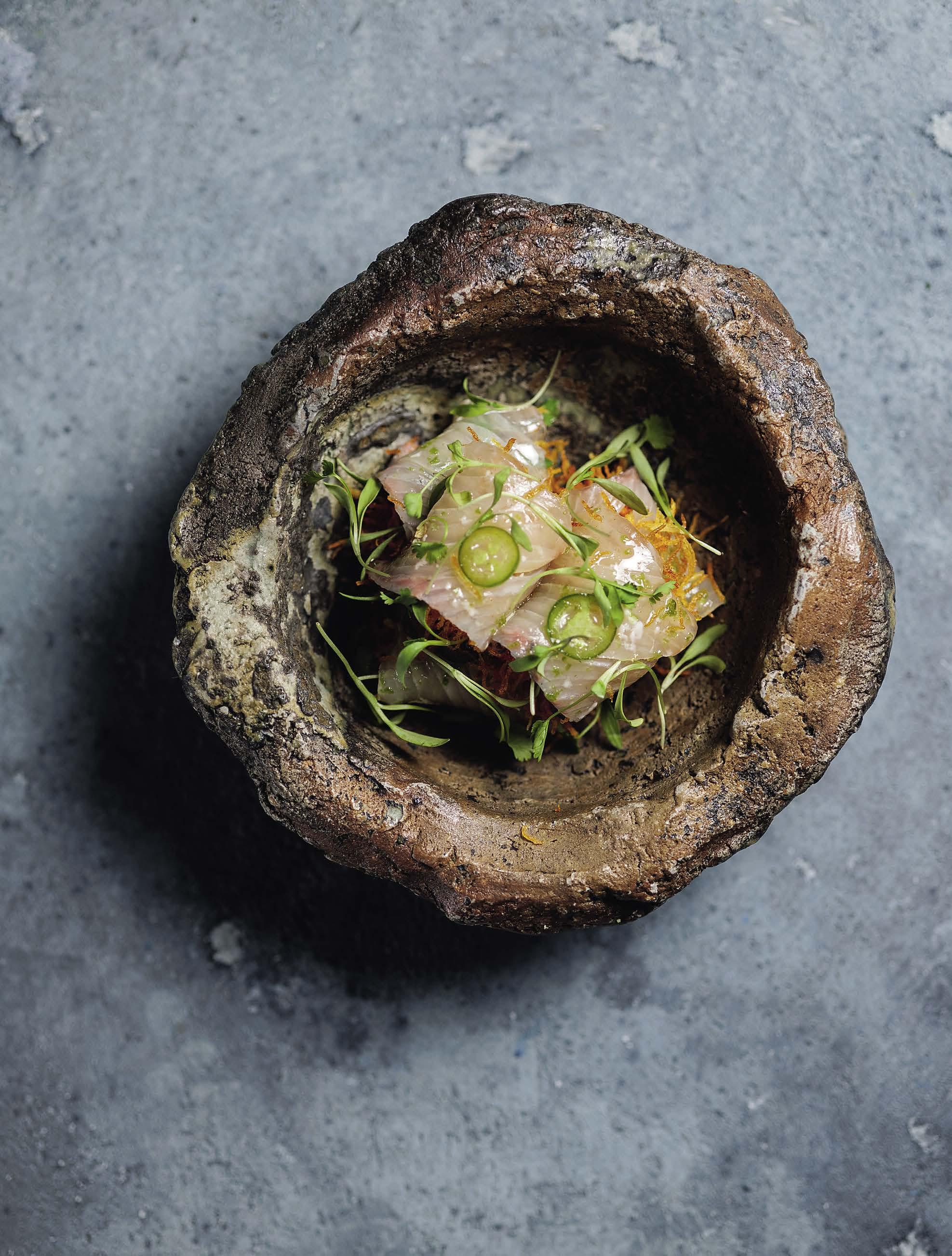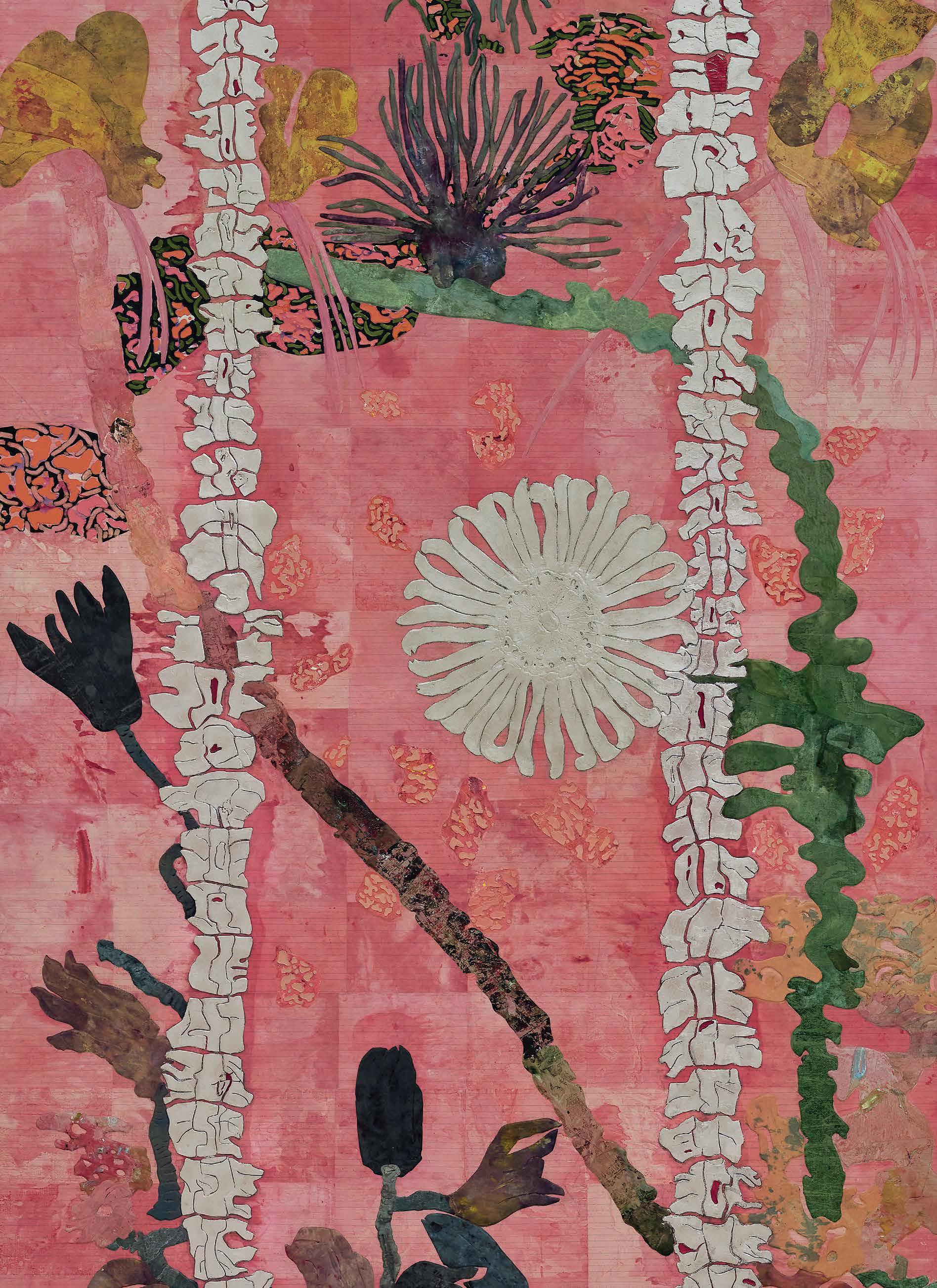
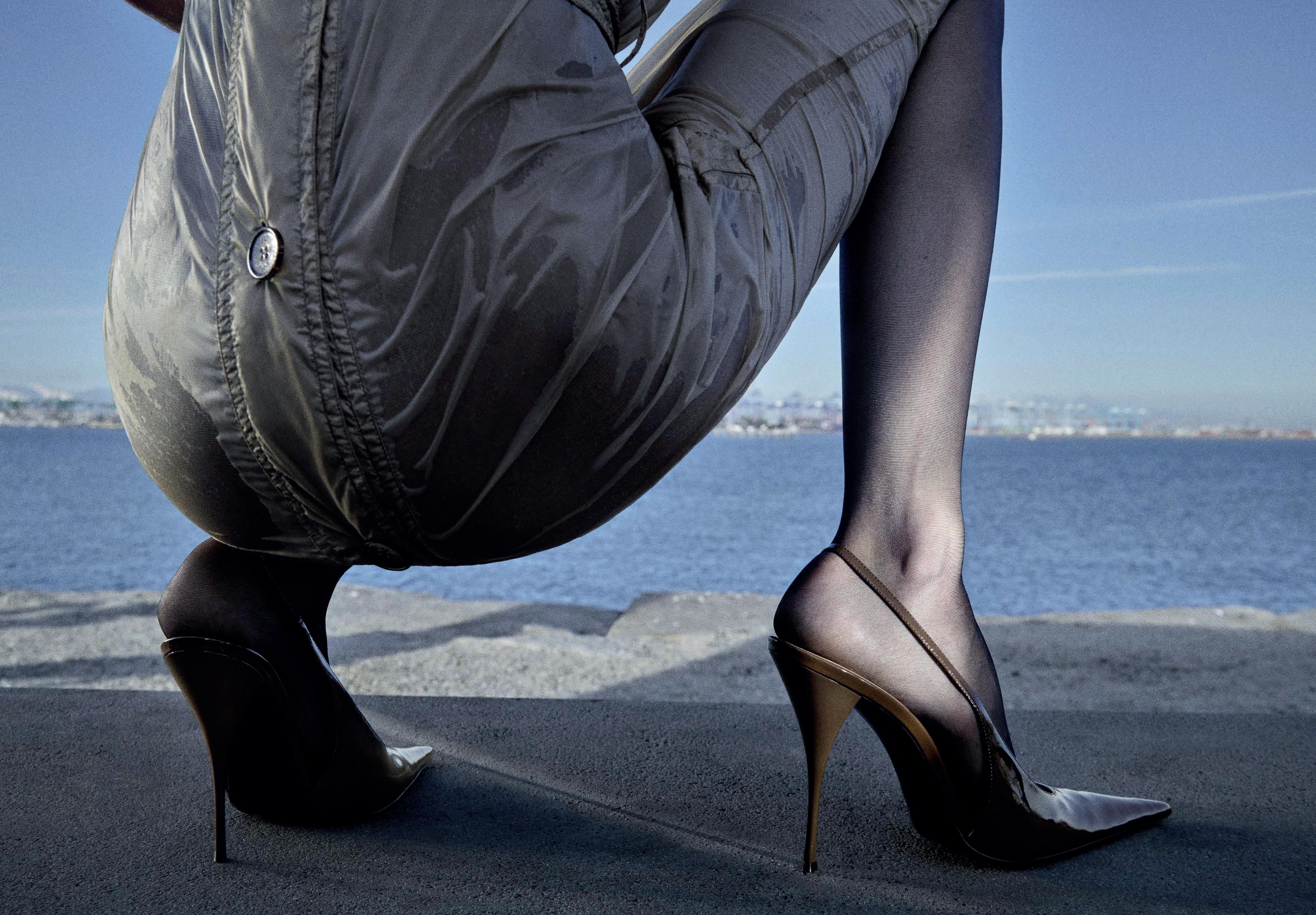
Studio visits, interviews, behind-the-scenes access, and more on gagosian.com/quarterly

Join exhibition curator Donna De Salvo as she discusses her selection of the artist’s rarely seen sculptures, drawings, films, and archival materials in Walter De Maria: The Singular Experience at Gagosian, Le Bourget. Chief among these is Truck Trilogy (2011–17), De Maria’s final sculpture and the centerpiece of the exhibition.
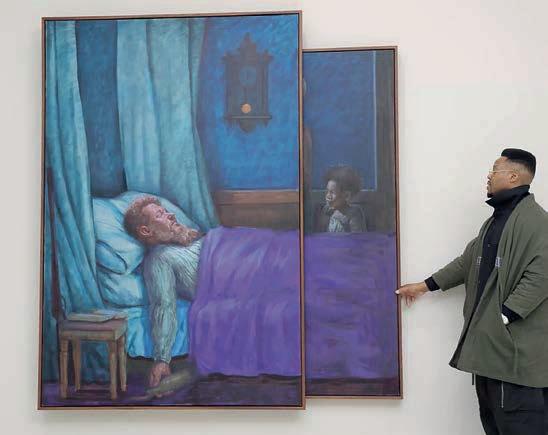
In this video, Titus Kaphar discusses themes of history, representation, and collective memory in his recent paintings and handcarved wood sculptures.
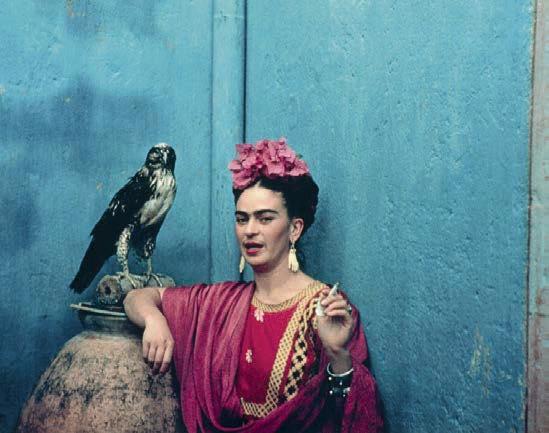
The Quarterly ’s Derek C. Blasberg talks with scholar and curator Mari Carmen Ramírez about her book and the corresponding exhibition at the Museum of Fine Arts, Houston, Frida: The Making of an Icon
Editor-in-chief
Alison McDonald
Managing Editor
Wyatt Allgeier
Editor, Online and Print
Gillian Jakab
Text Editor
David Frankel
Executive Editor
Derek C. Blasberg
Digital and Video
Production Coordinator
Alanis Santiago-Rodriguez
Design Director
Paul Neale
Design Alexander Ecob
Graphic Thought Facility
Website
Wolfram Wiedner Studio
Proofreading
Lindsey Westbrook
Founder Larry Gagosian
Publisher Jorge Garcia
Published by Gagosian Media
For Advertising and Sponsorship Inquiries
Advertising@gagosian.com
Distribution David Renard
Distributed by Magazine Heaven
Distribution Manager Alexandra Samaras
Prepress DL Imaging
Printed by Pureprint Group
Contributors
Derrick Adams
Wyatt Allgeier
Tessa Bachi Haas
Jessica Bell Brown
Derek C. Blasberg
Ronan Bouroullec
Laura Bruni
Andrew Durbin
Mary Gaitskill
Theaster Gates
Sarah Godfrey
Christian House
Ulla Johnson
Erling Kagge
Michèle Lamy
Alyce Mahon
Myles Mellor
Amanda Millet-Sorsa
Jill Mulleady
Enrique Olvera
Helen Oyeyemi
Dominique Païni
Alana Pockros
Daniel Roseberry
Ed Ruscha
Jenny Saville
Janne Sirén
Sebastian Smee
Nancy Spector
Ben Street
Sydney Stutterheim
Carlos Valladares
Stefania Ventra
Adam D. Weinberg
Thanks
Richard Alwyn Fisher
Jin Auh
Lisa Ballard
Costanza Ballardini
Priya Bhatnagar
Michael Cary
Serena Cattaneo Adorno
Michael Chaiken
Claudia Chow
Vittoria Ciaraldi
Janine Cirincione
Emma Cline
Maggie Dubinski
John Elderfield
Raymond Foye
Paatela Fraga
Mark Francis
Ellen Gallagher
Brett Garde
Eleanor Gibson
Lauren Gioia
Sarah Godfrey
Darlina Goldak
Leta Grzan
Jerson Hondall
Ornella Humler
Arthur Jafa
Camilla Johnston
Flavin Judd
Shiori Kawasaki
Léa Khayata
Anselm Kiefer
Chae Kim
Joe Kitchen
Molly Laub
Niamh LaVine
Katie Levine
Lauren Mahony
Pepi Marchetti Franchi
Olivia Mull
Kathy Paciello
Giuseppe Penone
Richard Prince
Stefan Ratibor
Helen Redmond
Robert M. Rubin
Zoë Santa-Olalla
Antwaun Sargent
Abram Scharf
Nicolò Scialanga
Rose Sheehan
Isabel Shorney
Putri Tan
Harry Thorne
Kara Vander Weg
Sofia Velasquez-Soler
Timothée Viale
Andrea Walsh
Millicent Wilner

























The allure of Venice has long sparked creativity. In this issue, Jenny Saville speaks about her engagement with iconic Venetian artists of the past, sharing the inspiration she has drawn from her trips to the floating city, with its stunning architecture, extraordinary collections, and timeless charm. We also reexamine the tragicomic frescoes made by Domenico Tiepolo, uncovering the impact they’ve made on generations of artists up to two hundred years later.
Sebastian Smee kicks off the issue with an essay on Francis Bacon’s time in Paris and how it may have impacted the artist’s late style, which is defined by a confident but restrained palette, a paring back of architectural structures in the compositions, and a morphing of sculptural and human forms. Nancy Spector leads us through her latest project, a presentation at the Fondazione Prada, Venice, that boldly pairs Richard Prince and Arthur Jafa— two artists whose practices differ widely but whose piercing views of American culture disrupt expectations in related ways.
For over fifteen years, Theaster Gates has engaged with the pottery and poetry of David Drake, an enslaved nineteenth-century potter who lived in the American South. Drake’s work is now celebrated as a profound artistic and historical treasure. With his overarching interest in archive-based work and the preservation of African-American histories, Gates has helped to shed light on the masterful skill, resilience, and poetic protest inherent in Drake’s work and on the various ways in which his legacy contains poignant teachings for us today.
Giuseppe Penone has meditated on humanity’s relationship with the natural world over the entire course of his long career, and his latest exhibition, curated at Gagosian by Adam D. Weinberg, continues
that exploration by concentrating on bronze. Weinberg considers the art-historical significance of the medium, its signaling of both permanence and prestige, and its ability to trace the most delicate intricacies of human touch, all qualities manifest in Penone’s work.
In the mid-1990s, Chris Burden, by then an artist with a reputation for challenging boundaries, created Mini Video Circus , a combination of sculpture and performance that explored many of his signature concerns. We rediscover this fascinating project— which repurposed three Citroën vans into a traveling film “circus,” screening footage of California’s environmental disasters in small towns in France—and find out just how shockingly astute it continues to be.
In the world of film, we explore discourse around The Moment , a mockumentary that exposes the perils and absurdities surrounding celebrity, success, and the pressure to stay on top. And we spotlight the legacy of Jean-Luc Godard, who, simply, revolutionized cinema.
We celebrate a novella by Mary Gaitskill that inspired a painting by Jill Mulleady. Ed Ruscha and explorer Erling Kagge discuss humanity’s endless existential desire to pursue new discoveries. The recent publication of a dual biography on the lives of Peter Hujar and Paul Thek provides insights into the many ways in which their creative worlds dovetailed and benefited from each other.
On our cover we feature a new painting by Ellen Gallagher, part of her ongoing Fast-Fish and Loose-Fish series. Inside the issue we publish an excerpt from a recent essay by Sharad Chari—available in full on the Gagosian Quarterly website—that reflects on his time with the artist in her Rotterdam studio.
Alison McDonald, Editor-in-chief

Francis Bacon lived and worked in Paris for a decade starting in the mid-1970s. The city and the art he encountered there provided a profound backdrop for his austere late style, which often brings together smooth, colorful backgrounds, spare architectural signifiers, and sculptural human forms. Here, Sebastian Smee considers three striking paintings from that period, currently on view at Gagosian in Paris.
Adam D. Weinberg discusses Penone’s enduring engagement with bronze.
Artist and designer Ronan Bouroullec, fashion visionary Michèle Lamy, and chef Enrique Olvera reflect on Donald Judd’s work in furniture.
Daniel Roseberry, the creative director of Schiaparelli, speaks with the Quarterly ’s Derek C. Blasberg.
On March 28, a major exhibition of Jenny Saville’s work opened at Ca’ Pesaro–Galleria Internazionale d’Arte Moderna in Venice. Here, the artist speaks with Stefania Ventra about her early trips to the city, the radicality of Titian’s painting, and depicting emotional truth.
Carlos Valladares wades through the discourse around the musician and actress Charli XCX’s mockumentary, guiding us through its myriad references, from the Spice Girls to Andy Warhol.
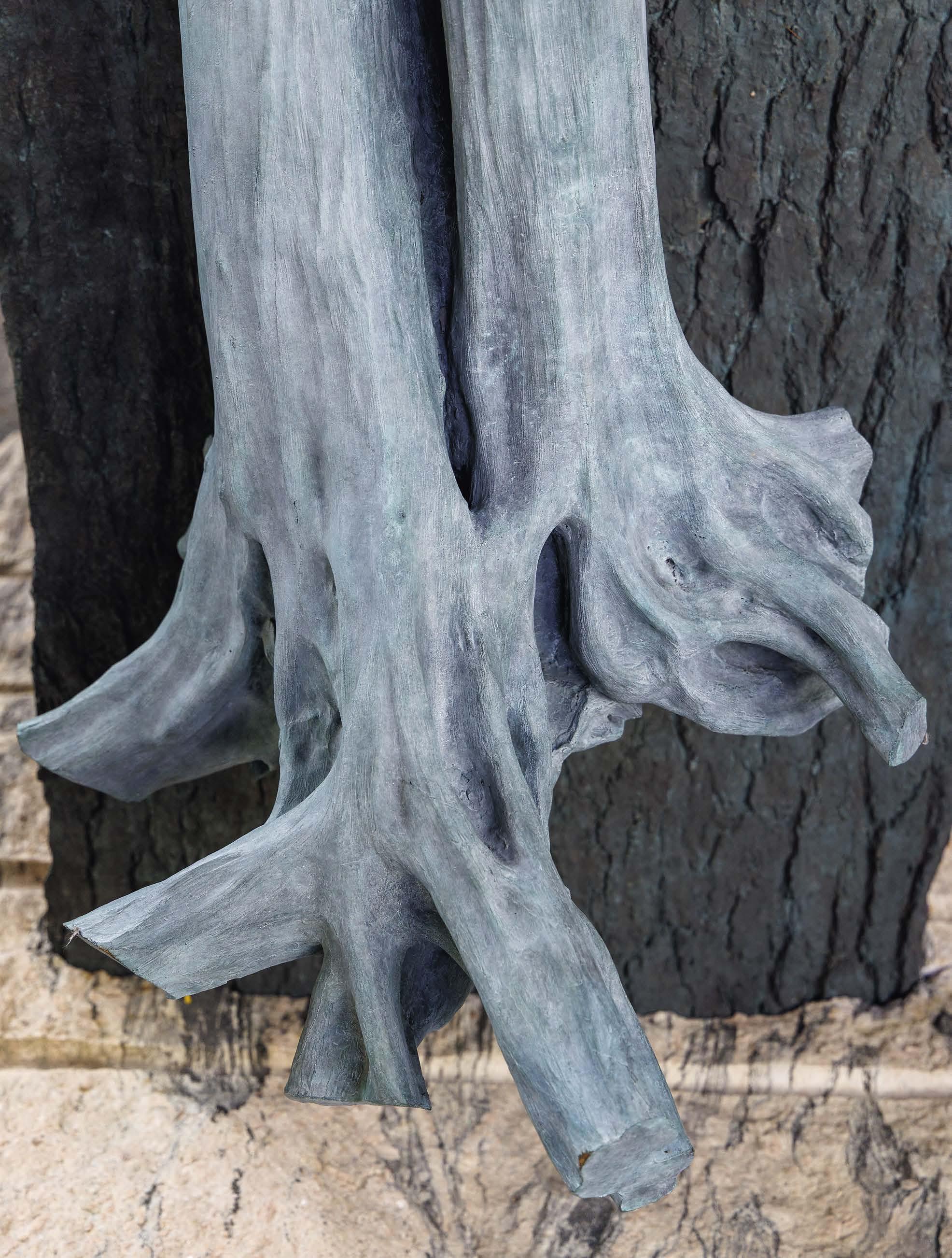
Opposite: Giuseppe Penone, Marsia (Marsyas), 2024 (detail), bronze, granite, and stainless steel, 137 ⅞ × 96 ½ × 53 ⅛ inches (350 × 245 × 135 cm) © Giuseppe Penone/ Artists Rights Society (ARS), New York/ADAGP, Paris. Photo: © Archivio Penone
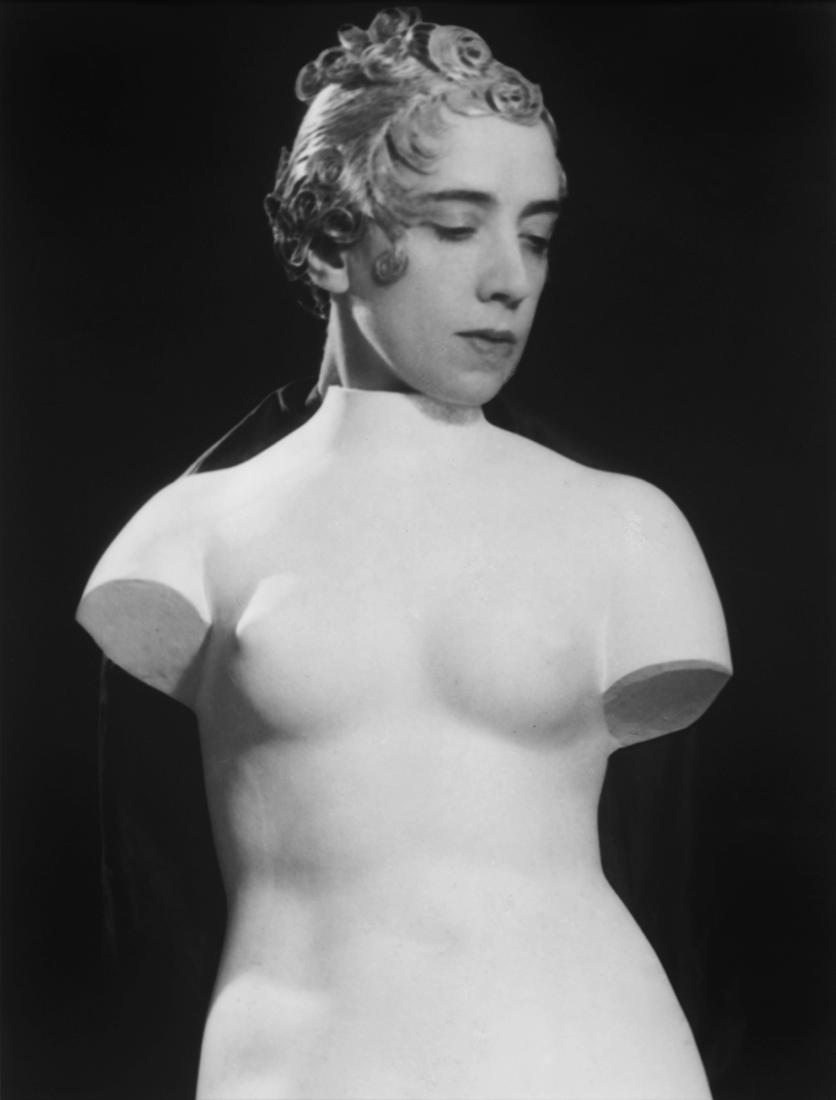
This page: Man Ray, Elsa Schiaparelli , 1933 © 2026 Man Ray 2015 Trust. DACS, London. Photo Collection SFMOMA, The Helen Crocker Russell and William H. and Ethel W. Crocker Family Funds purchase
90
Amanda Millet-Sorsa reflects on Chris Burden’s Mini Video Circus , a work originally exhibited at Le Consortium in Dijon, France, in 1994–95.
On April 16, the Institute of Contemporary Art/Boston opened the first midcareer survey of Derrick Adams’s multidisciplinary practice. Ahead of the opening, Adams met with Tessa Bachi Haas, cocurator of the survey, to discuss the exhibition.
An essay by Dominique Païni from the recently published box set about JeanLuc Godard’s final film.
Nancy Spector speaks about the shared motifs that led her to pair these artists for the first time.
Janne Sirén considers Anselm Kiefer’s new paintings, the subject of an exhibition at Gagosian, New York.
Helen Oyeyemi continues her fourpart story cycle with the second installment, “At the Auspicious Hour.”
Alyce Mahon explores the artist’s engagements and affinities with Surrealism.
A conversation between Theaster Gates and Jessica Bell Brown, with an introduction by Sydney Stutterheim.
Mary Gaitskill and Jill Mulleady discuss the myth of Faust, good and evil in the digital age, and channeling raw matter into art.
Andrew Durbin’s dual biography The Wonderful World That Almost Was: A Life of Peter Hujar and Paul Thek tracks the convergences and divergences in the lives of the two artists. The author met with the Quarterly ’s Wyatt Allgeier to talk about the development of the project.
Following Ed Ruscha’s recent exhibitions in London and Paris, the artist sat down with the author and explorer Erling Kagge to discuss existence.
Laura Bruni writes about a major exhibition celebrating the work of the British sculptor Henry Moore at the Royal Botanic Gardens, Kew, London.
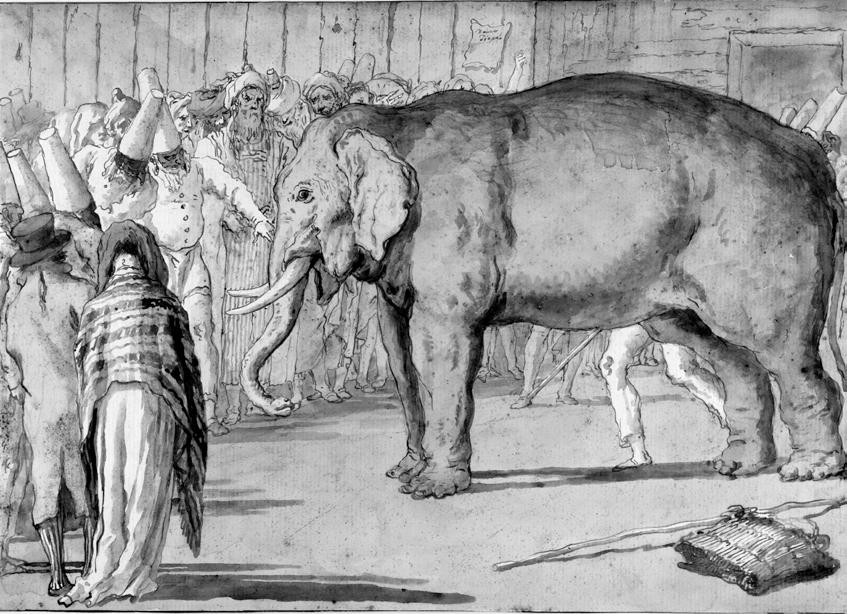
Peering into the dying days of the Republic of Venice, Ben Street finds a pulse in the tragicomic frescoes of Giovanni Domenico Tiepolo.
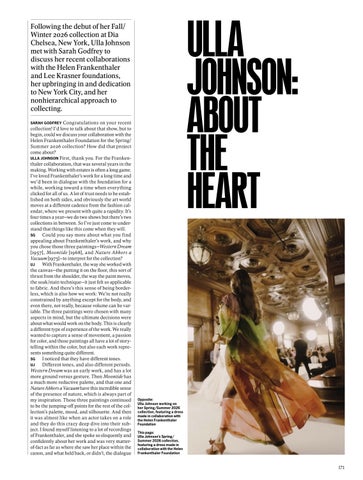
Following the debut of her Fall/ Winter 2026 collection at Dia Chelsea, New York, Ulla Johnson met with Sarah Godfrey to discuss her recent collaborations, her upbringing in and dedication to New York City, and her nonhierarchical approach to collecting.
This month, as part of a growing posthumous appreciation of the feminist writer Elaine Kraf, the Modern Library will bring out her previously unpublished novel Memory House . Here, Alana Pockros explores Kraf’s iterative worlds.
Christian House celebrates the generation-spanning and formally inventive photographs of JacquesHenri Lartigue.
Above: Giovanni Domenico Tiepolo, Pulcinellas with an Elephant , c. 1790–80, pen and brown ink with brown and ochre wash over black chalk on paper, 11 ⅝ × 16 ¼ inches (29.5 × 41.2 cm), Morgan Library & Museum, New York. Photo: Morgan Library & Museum/Art Resource, New York
Andrew Durbin is the author of MacArthur Park (2017), Skyland (2020), and The Wonderful World That Almost Was: A Life of Peter Hujar and Paul Thek (2026). He is the editor-in-chief of Frieze magazine and lives in London. Photo: Suzannah Pettigrew
Carlos Valladares is a writer and critic from Los Angeles. He studied film at Stanford University and began his PhD in History of Art and Film & Media Studies at Yale University in fall 2019. He contributes regularly to Art in America , n+1, and Frieze . He lives in New York. Photo: Jade Sacker
Erling Kagge is a Norwegian explorer and author. He was the first in history to reach the North Pole, the South Pole, and the summit of Mount Everest on foot. He has written nine books on exploration, philosophy, and art collecting. Kagge’s Silence in the Age of Noise (2016) has been translated into forty-two languages. Photo: © Simon Skreddernes
The art historian and curator Laura Bruni currently serves as curator of exhibitions at the Henry Moore Foundation, where she also served as acting senior curator of collections and research between September 2023 and May 2024.
Helen Oyeyemi’s eleven books include the novels Peaces (2021), Parasol against the Axe (2024), and A New New Me (2026) and the shortstory collection What Is Not Yours Is Not Yours (2016). She lives in Prague. Photo: Milan Bureš
Alyce Mahon is Professor of Modern and Contemporary Art History at the University of Cambridge. She is the author of Surrealism and the Politics of Eros, 1938–1968 (2005), Eroticism & Art (2005), The Marquis de Sade and the Avant-Garde (2020), and Dorothea Tanning: A Surrealist World (2026), as well as of numerous essays.

Ulla Johnson founded her eponymous label in New York in 1999, building a global womenswear brand defined by craft, color, and modern femininity. The company operates flagship stores in New York and Los Angeles, with distribution through leading retailers worldwide.
Dr. Janne Sirén joined the Buffalo AKG Art Museum as the Peggy Pierce Elfvin Director in April 2013. He has published widely on modern and contemporary art, including the book The Impressionist Revolution and the Advent of Abstract Art (2016). Sirén is the president of Eschaton— Anselm Kiefer Foundation.

Stefania Ventra is an art historian and Professor of Museology and Art Criticism and Conservation at Ca’ Foscari University of Venice. She has worked at both national and international levels, conducting research on art restoration and the history of art academies.
Christian House worked as a proposals writer at Sotheby’s for a decade before a period as an obituarist for the Telegraph . He now writes on visual arts, literature, and history for such publications as the Financial Times , Canvas , and CNN Style
Ben Street is a freelance art historian and educator based in London. He is the author of How to Enjoy Art (2021) and the awardwinning children’s book How to Be an Art Rebel (2021). His research focuses on illuminating points of contact between historical and contemporary art. Photo: David Owens
In her depictions of the human form, Jenny Saville transcends the boundaries of both classical figuration and modern abstraction. Oil paint, applied in heavy layers, becomes as visceral as flesh itself, each painted mark maintaining a supple, mobile life of its own. As Saville pushes, smears, and scrapes pigment over large-scale canvases, the distinctions between living, breathing bodies and their painted representations begin to collapse.
Photo: Paul Hansen/Getty Images
Ed Ruscha’s deadpan representations of Hollywood logos, stylized gas stations, and landscapes distill the imagery of popular culture into a language of cinematic and typographical codes that are as accessible as they are profound. Ruscha has had over twenty solo exhibitions with Gagosian since his first exhibition with the gallery, in 1993. Photo: Gary Regester

Sebastian Smee is the author of The Art of Rivalry: Four Friendships, Betrayals, and Breakthroughs in Modern Art (2016) and Paris in Ruins: Love, War, and the Birth of Impressionism (2024), as well as several books on Lucian Freud and one on Mark Bradford. He won the Pulitzer Prize for Criticism in 2011 while at the Boston Globe and was art critic at the Washington Post from 2018 to 2026. Photo: Amber Davis Tourlentes

Tessa Bachi Haas is an assistant curator at the ICA/Boston. Her recent projects include Derrick Adams: View Master, the 2025 James and Audrey Foster Prize, Christian Marclay: Doors , and Wu Tsang: Of Whales
Amanda Millet-Sorsa is the executive director of the Chris Burden Estate and the Nancy Rubins Studio. She is based in New York and is a contributing critic for the Brooklyn Rail
Sarah Godfrey joined Gagosian in 2024. As associate artist liaison, she supports exhibitions and special projects for Michael Heizer, Anselm Kiefer, and the Willem de Kooning Foundation. Previously she was assistant curator of works on paper at the Fine Arts Museums of San Francisco and worked in the luxury sector at Christie’s, New York.
Derrick Adams celebrates and expands the dialogue around contemporary Black life and culture through scenes of normalcy and perseverance. He has developed an iconography of joy, leisure, and the pursuit of happiness with a multidisciplinary practice that encompasses paintings, sculptures, collages, performances, videos, and public projects. Adams synthesizes representational imagery with planar Cubist geometry to produce multifaceted figures and faces that address the richness of the Black experience. Born in Baltimore in 1970, Adams lives and works in New York. Photo: Emil Horowitz
Mary Gaitskill is the author of the story collections Bad Behavior (1988), Because They Wanted To (nominated for the 1998 PEN/ Faulkner Award), and Don’t Cry (2009), and of the novels Two Girls, Fat and Thin (1991), Veronica (nominated for the National Book Award in 2005), and The Mare (2015). Her stories and essays have appeared in The New Yorker, Harper’s , Artforum , Granta , and many other journals, as well as in The Best American Short Stories and The O. Henry Prize Stories Photo: © Derek Shapton

Jill Mulleady was born in Montevideo, Uruguay. She is Swiss-Uruguayan and grew up in Argentina; she is now based in Los Angeles and Paris. Mulleady primarily works in painting and often intervenes in the spaces in which she exhibits, staging her paintings with readymades, sculptures, films, and architectural installations.
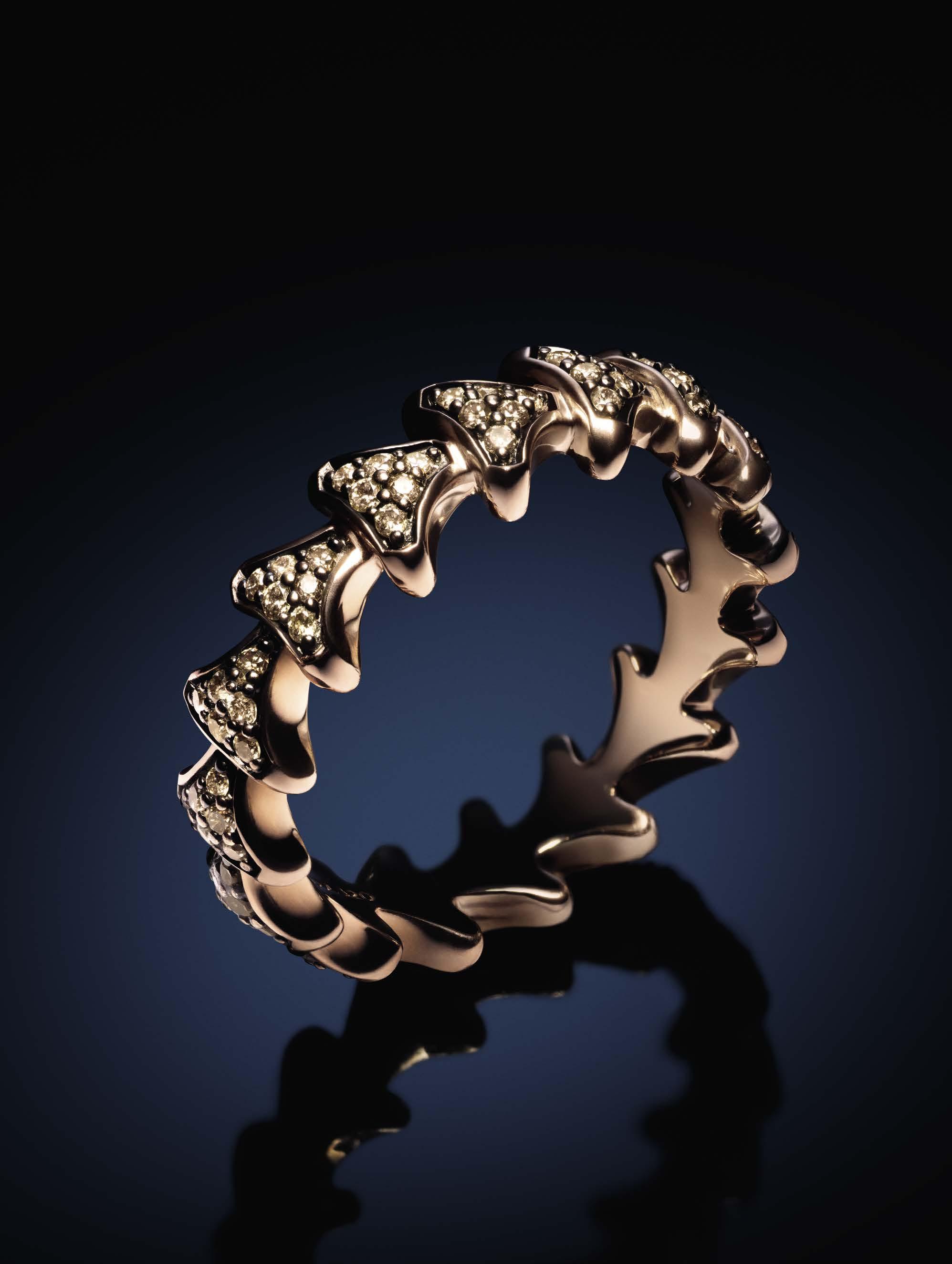
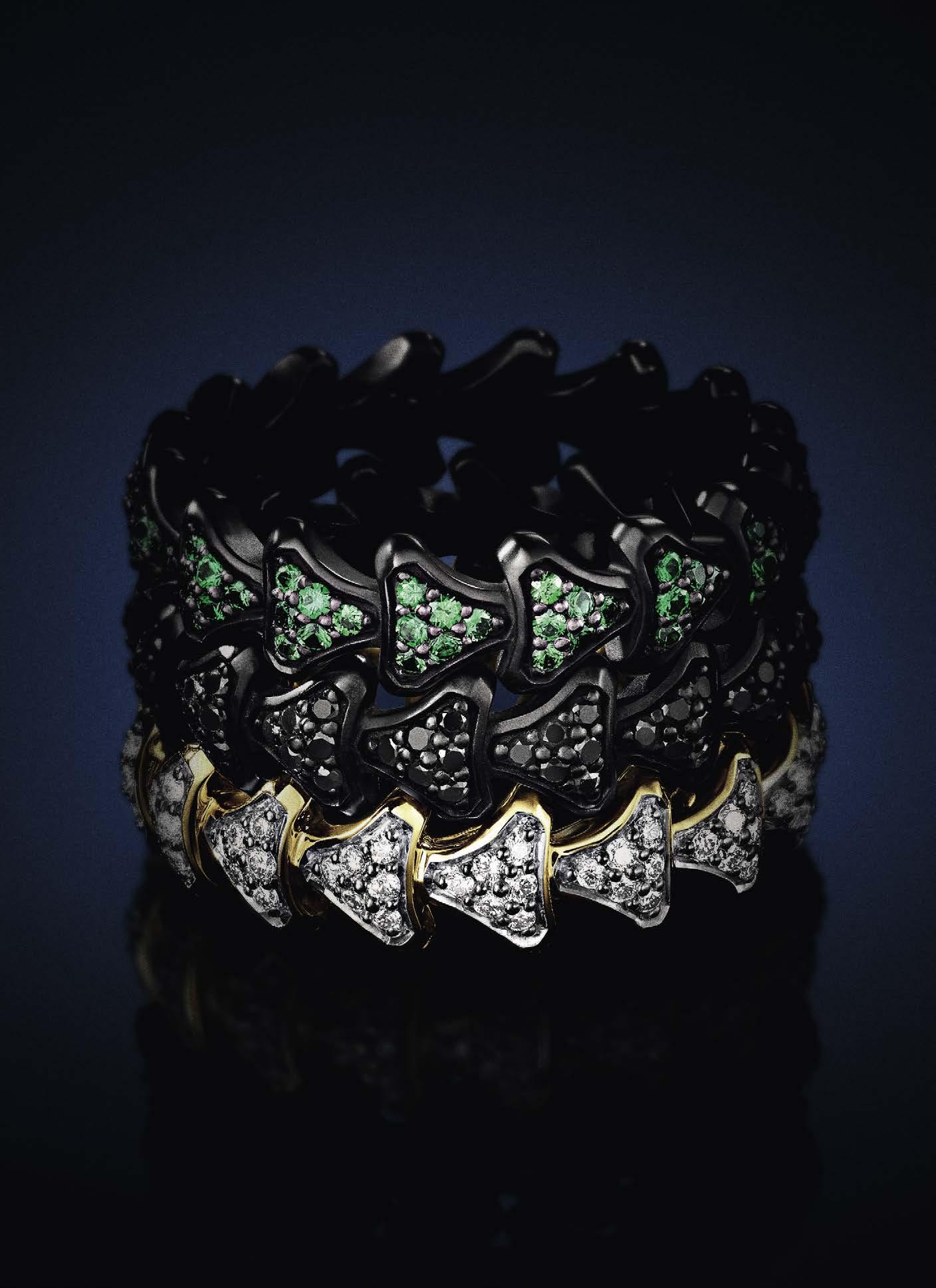
“C
enturies -o ld armor inspires me—links engineered to be strong er togethe r. I ex p lore that cr aftsmanship and tr anslate it into modern adornment.”
— E VA N YURMAN

Myles Mellor has been writing crosswords for Gagosian since 2024. Over a career spanning twentyfive years, he has published in over 1,000 magazines, newspapers, government organizations, and Fortune 500 publications. Photo: Debby Fleming
Alana Pockros is an associate editor at The Nation and a contributing editor at the Cleveland Review of Books . Her essays and criticism have appeared in The New York Times Magazine , The Paris Review, The Point , and elsewhere. She lives in Brooklyn, New York.
Derek C. Blasberg is a writer, fashion editor, and New York Times best-selling author. He has been with Gagosian since 2014 and is the executive editor of the Gagosian Quarterly.
Theaster Gates’s practice traverses an extraordinary range, from collecting to social gathering, architecture, object-making, experimental music and sound, and the ethical and physical reconstruction of civic life. His interdisciplinary fusion of archiving, performance, institution-building, painting, and sculpting is deeply rooted in African-American histories and cultures and revolves around the transformation of objects, edifices, and communities through art and cultural activity. Photo: Chris Strong
Nancy Spector is a curator, writer, and art historian. She is currently organizing Helter Skelter: Arthur Jafa and Richard Prince for the Fondazione Prada, Venice, and Felix Gonzalez-Torres: Sweet Revenge (with cocurator Alejandro Cesarco) for the Reina Sofía, Madrid. She serves as international advisor to the Fondation Louis Vuitton, Paris, and was previously Artistic Director and Chief Curator of the Solomon R. Guggenheim Museum, New York. Photo: Inez & Vinoodh
Ronan Bouroullec is a French artist and designer born in 1971 in Quimper, Brittany. A graduate of the École Nationale Supérieure des Arts Décoratifs, he founded his own studio in 1995. His work blends craftsmanship and industrial production, is characterized by simplicity and sophistication, and spans various fields, including furniture, lighting, interior design, and public-space projects. He has practiced drawing since childhood and it holds a central place in his daily life. He has been the subject of several exhibitions in prestigious international museums and his work is held in major museum collections worldwide. Photo: Marion Berrin

Sydney Stutterheim is a writer, curator, and art historian whose research focuses on postwar and contemporary art. She is the author of Artist, Audience, Accomplice: Ethics and Authorship in Art of the 1970s and 1980s (2024) as well as the recent publication Richard Prince: Early Photography 1977–87 (2025).
Wyatt Allgeier is a writer and editor for Gagosian Quarterly. He lives and works in New York City.
Adam D. Weinberg is the Director Emeritus and an Honorary Trustee of the Whitney Museum of American Art; beginning in 2003, he served for 20 years as the Whitney’s Alice Pratt Brown Director. During his tenure, the museum presented some 300 exhibitions on diverse emerging, mid-career, and senior artists— from Edward Hopper and Georgia O’Keeffe to Frank Stella and Carmen Herrera to Glenn Ligon and Julie Mehretu—as well as nine editions of the Whitney Biennial.
Daniel Roseberry was born in 1985 in Plano, Texas. In 2019, he took on the role of creative director at Maison Schiaparelli, the renowned Parisian couture house. During his tenure at Schiaparelli, Roseberry revived some of the House's most influential codes while paying homage to Elsa Schiaparelli’s celebrated love of Surrealism. At the same time, he subverted many of these codes, contributing to a new aesthetic grammar through the frequent use of gold jewelry and metalwork, upcycled denim, and molded leather and metal breastplates and anatomical parts.
Sharad Chari is a geographer at the University of California, Berkeley, interested in forms of earth-writing in a burning world. His books include Gramsci at Sea (2023) and Apartheid Remains (2024).
Enrique Olvera has constantly celebrated Mexican cuisine since the opening of his restaurant Pujol, Mexico City, in 2000. His work has attracted international attention to the city as a gastronomic destination and he has functioned as a teacher and mentor for countless culinary talents. He and his team are a driving force of creativity in the hospitality business in Mexico and the world.
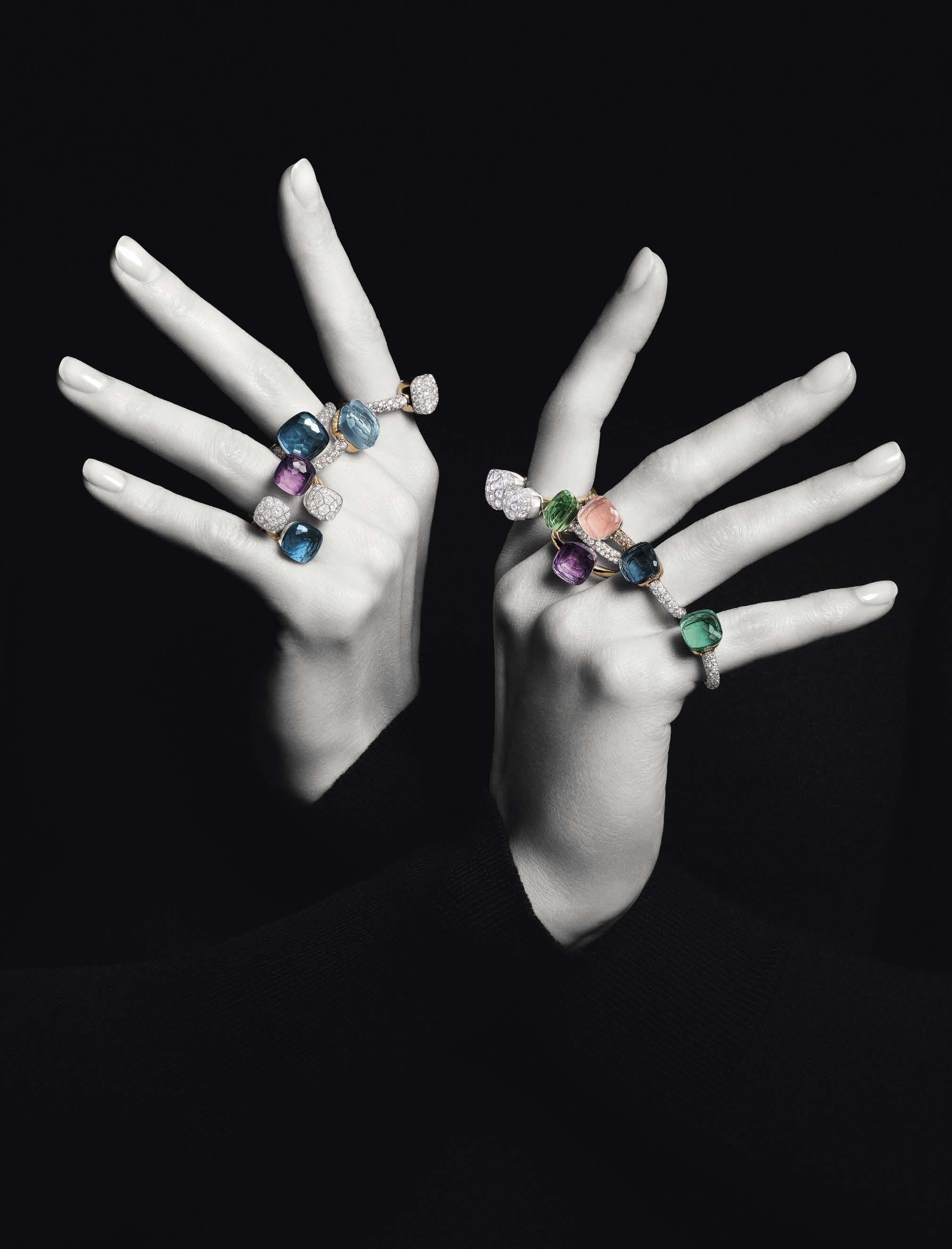
Gagosian Quarterly presents a selection of new releases coming this summer.
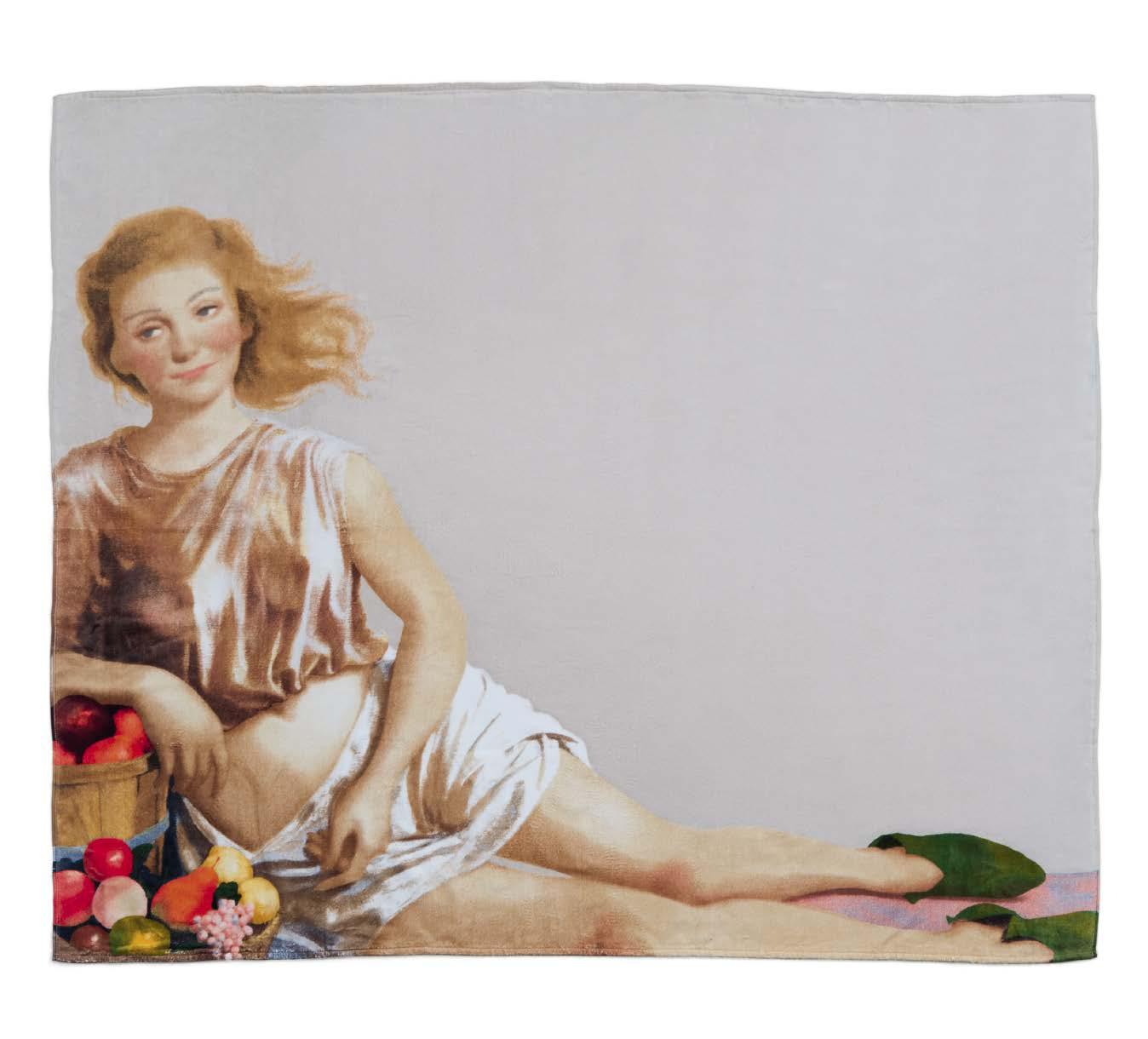
This brushed-cotton beach towel is based on John Currin’s painting Flora (2010), portraying a reclining female figure with baskets of brightly colored fruit. Part of the Works on Whatever (WOW) Project Beach Towel series of artistdesigned functional objects, the towel was produced by Art Production Fund in partnership with Kohler, to benefit the nonprofit’s public art projects. Over the years, other entries in the series have featured images by Karen Kilimnik, Glenn Ligon, Ryan McGinley, James Rosenquist, and Laurie Simmons.
by Art Production Fund in partnership with Kohler


Release the potency of anthocyanins in a new serum with a unique antioxidant performance.

REPLUMPS RETEXTURES REVITALIZES ILLUMINATES


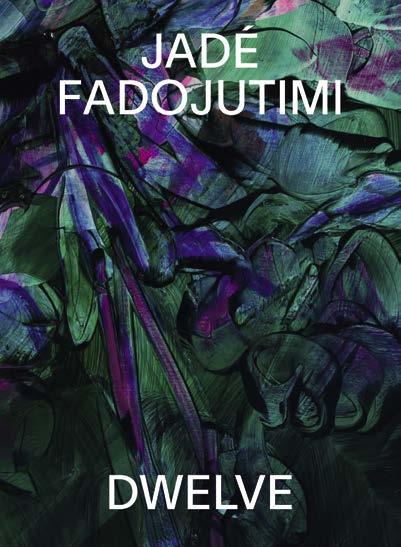
Exhibition catalogue Jadé Fadojutimi’s
DWELVE: A Goosebump in Memory
DWELVE: A Goosebump in Memory is Jadé Fadojutimi’s inaugural publication with Gagosian. Published to follow the London-based painter’s debut exhibition at the gallery, which was on view in New York in 2024–25, the book features an interview between Fadojutimi and composer Jerskin Fendrix, a newly commissioned essay by Harry Thorne, and an introduction by the artist herself.
Left: DWELVE: A Goosebump in Memory (Gagosian, 2026)
Right: Trading Beauty: Art Market Histories from the Altar to the Gallery (Gagosian, 2026)
Below:
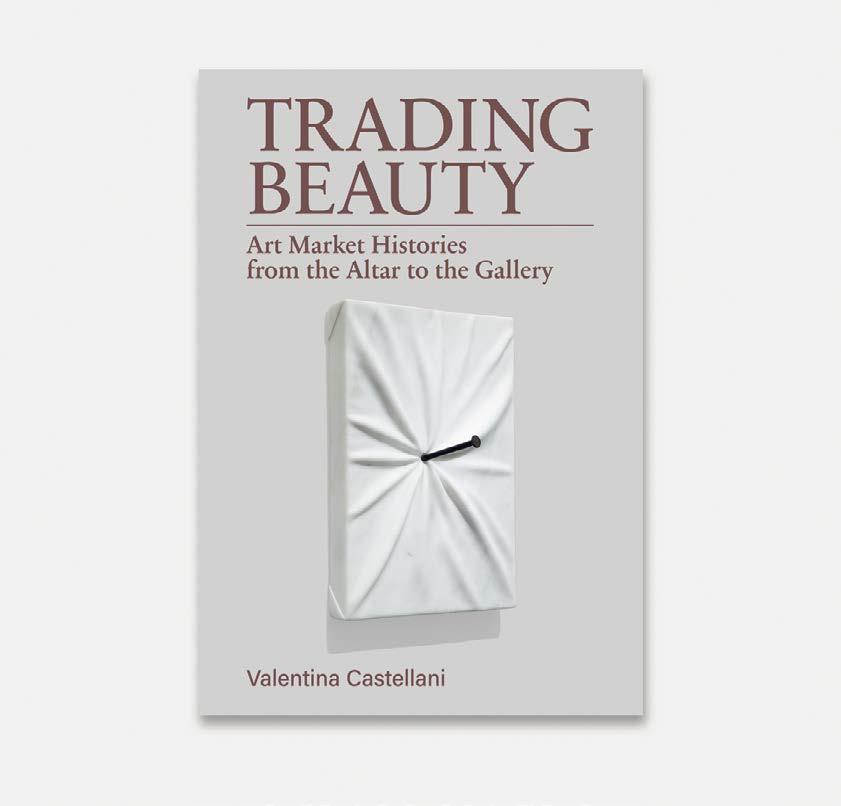
Valentina Castellani’s illustrated survey Trading Beauty: Art Market Histories from the Altar to the Gallery traces the evolution of the Western art market from the medieval era to the present day. The book features a new artwork by Maurizio Cattelan on its cover and a foreword by Massimiliano Gioni, artistic director of the New Museum, New York.
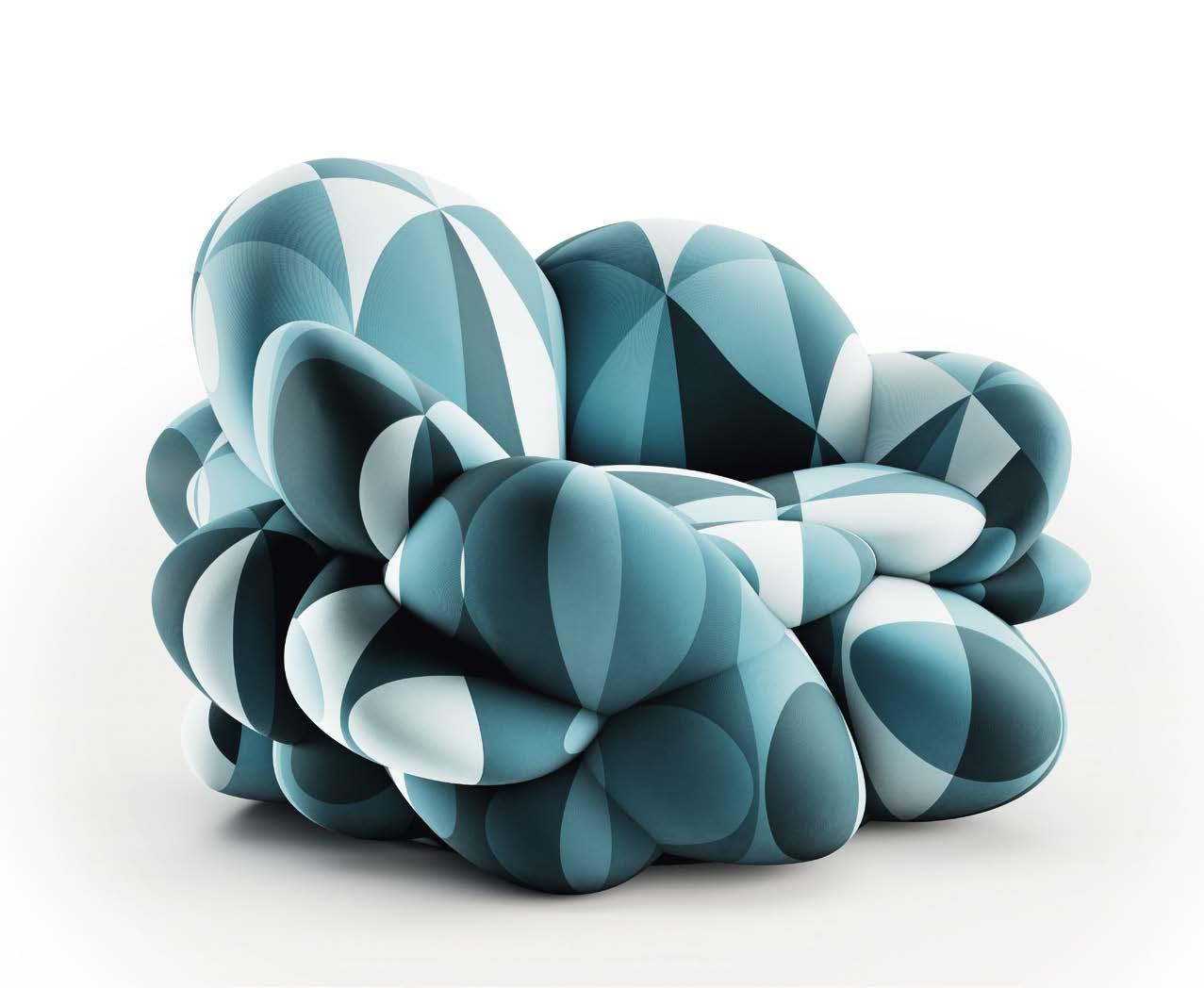
Louis Vuitton’s latest Objets Nomades collection, unveiled at the 2026 Milan Design Week within the historic Palazzo Serbelloni , included a masterful dialogue between Art Deco heritage and contemporary innovation Pictured here is Londonbased Raw Edges’ striking new chair. Alongside these futuristic forms, the collection pa ys tribute to the house’s history through the Pierre Legrain Hommage collection. Highlights include a reissue of Louis Vuitton’s first-ever furniture piece—a lacquered wood dressing table originally designed by Legrain in 1921—and a diverse range of home textiles and art objects inspired by his iconic 1920s bookbindings.


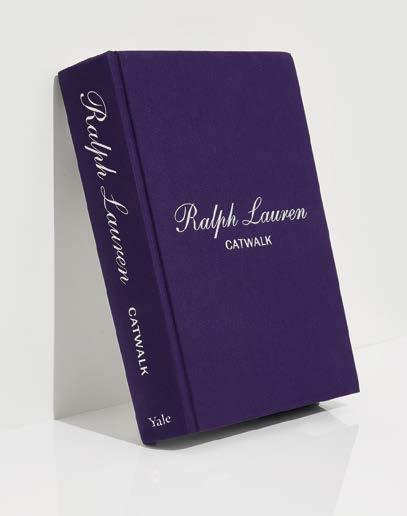
Experience the ultimate evolution of American style with Ralph Lauren Catwalk , a breathtaking visual odyssey that chronicles nearly sixty years of the designer’s pioneering work. This collector’s edition features more than 1,300 original runway photographs, meticulously documenting every era from Lauren’s 1972 womenswear debut to the Fall 2025 collection. As the first US fashion house to join Thames & Hudson’s prestigious Catwalk series, this volume serves as a definitive archive of the house’s aesthetic.

Designed by Lauren Halsey, the sister dreamer embroidered hat commemorates the March 2026 opening of her sculpture park, sister dreamer lauren halsey’s architectural ode to tha surge n splurge of south central los angeles , featuring gardens and extensive public programming by the artist’s nonprofit, Summaeverythang Community Center. Available in three colorways, this limited line of contemporary headwear pays homage to the iconography and visual language found in Halsey’s community.
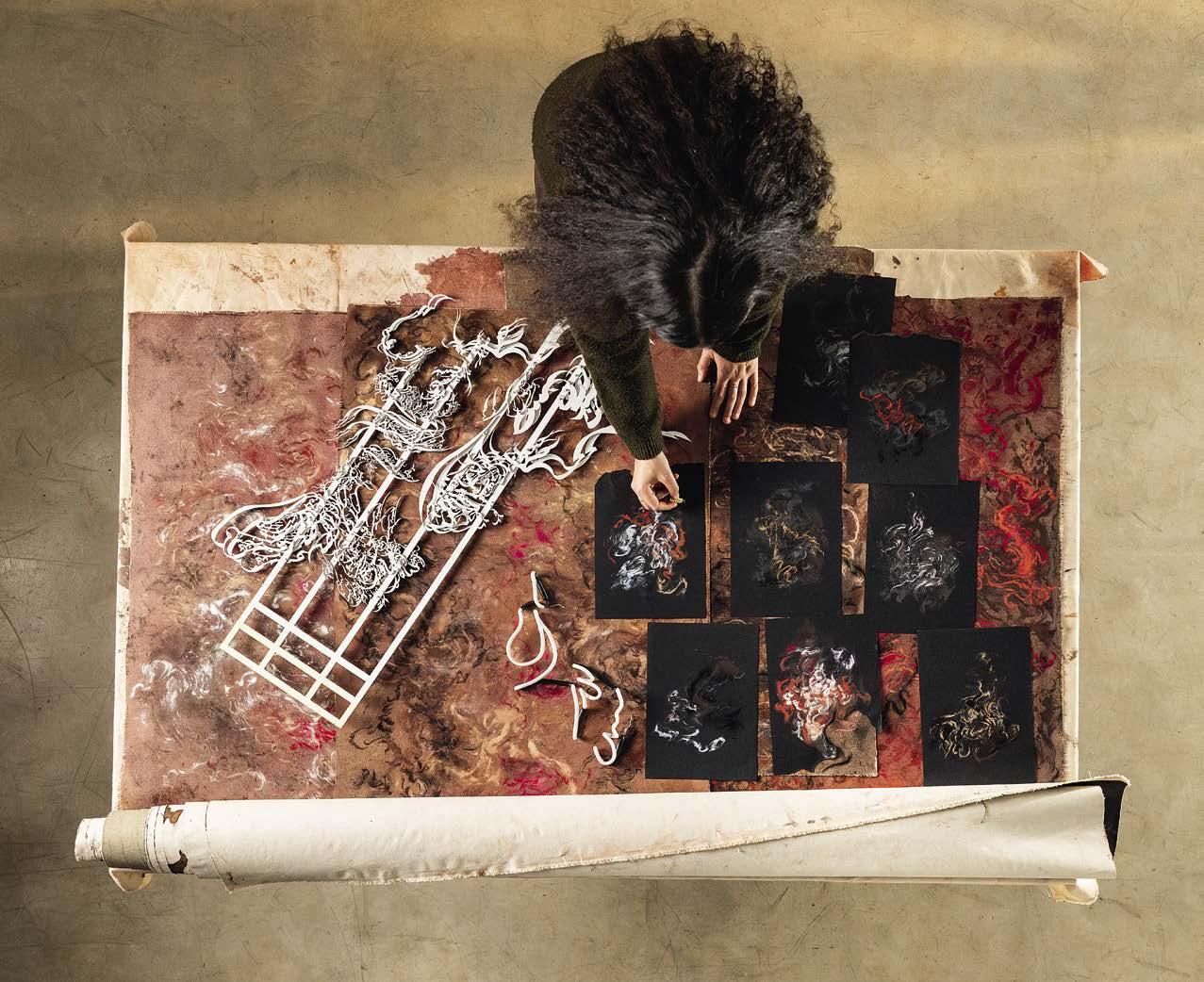
Bvlgari brings its signature Roman splendor to Venice as the exclusive partner of the Biennale Arte 2026, premiering a major new commission by artist Lotus L. Kang in the Bvlgari Pavilion at Spazio Esedra . Kang’s evocative installation uses sensitive photographic films and organic forms to explore the nonlinear beauty of “becoming.” Elsewhere in Venice, Fondazione Bvlgari makes its Biennale debut with a two-person exhibition at the Biblioteca Nazionale Marciana featuring the works of Lara Favaretto and Monia Ben Hamouda. This milestone project continues the foundation’s mission to foster cross-cultural dialogue and preserve artistic heritage through bold contemporary research.
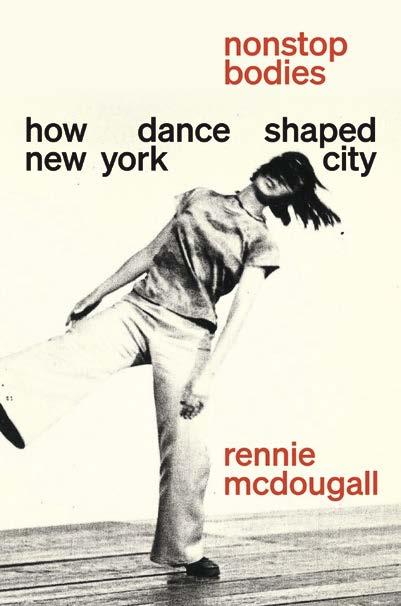
In Nonstop Bodies: How Dance Shaped New York City, Rennie McDougall traces the revolutionary role of dance in the theaters, ballrooms, and nightclubs of twentieth-century New York. From the exuberant endurance of dance marathons during Prohibition to the explosive energy of hip-hop in the South Bronx of the ’70s, dance was both a reflection of New York culture and a backbone of social change.
On the Table
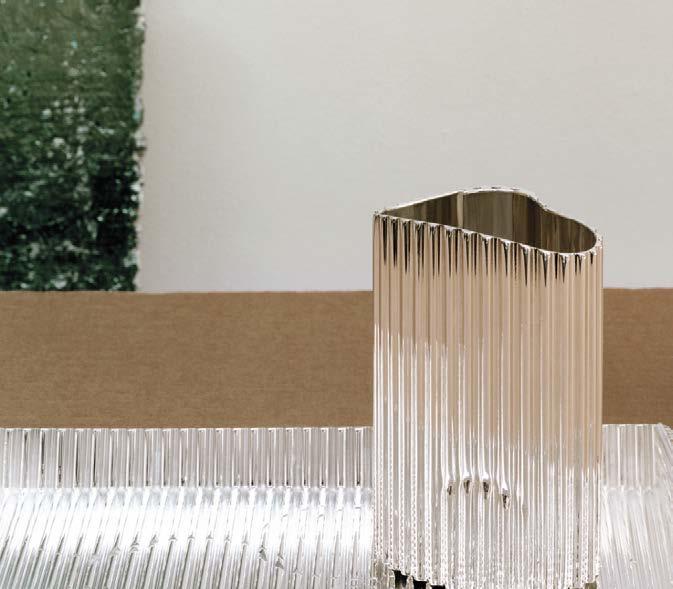
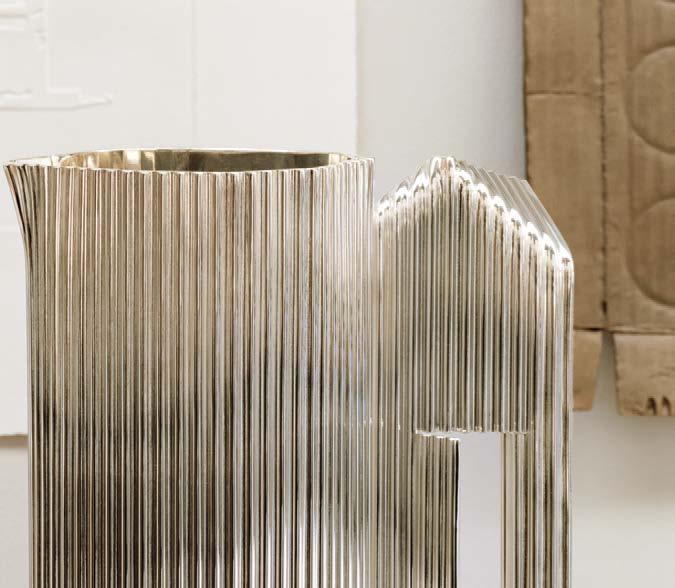
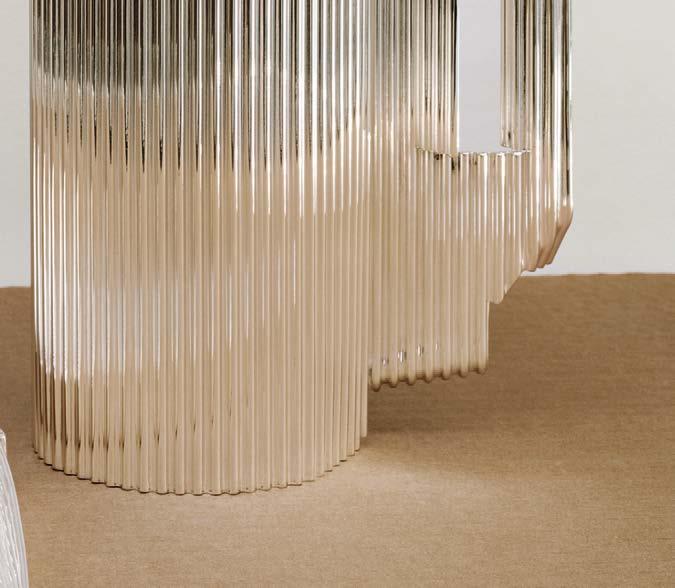
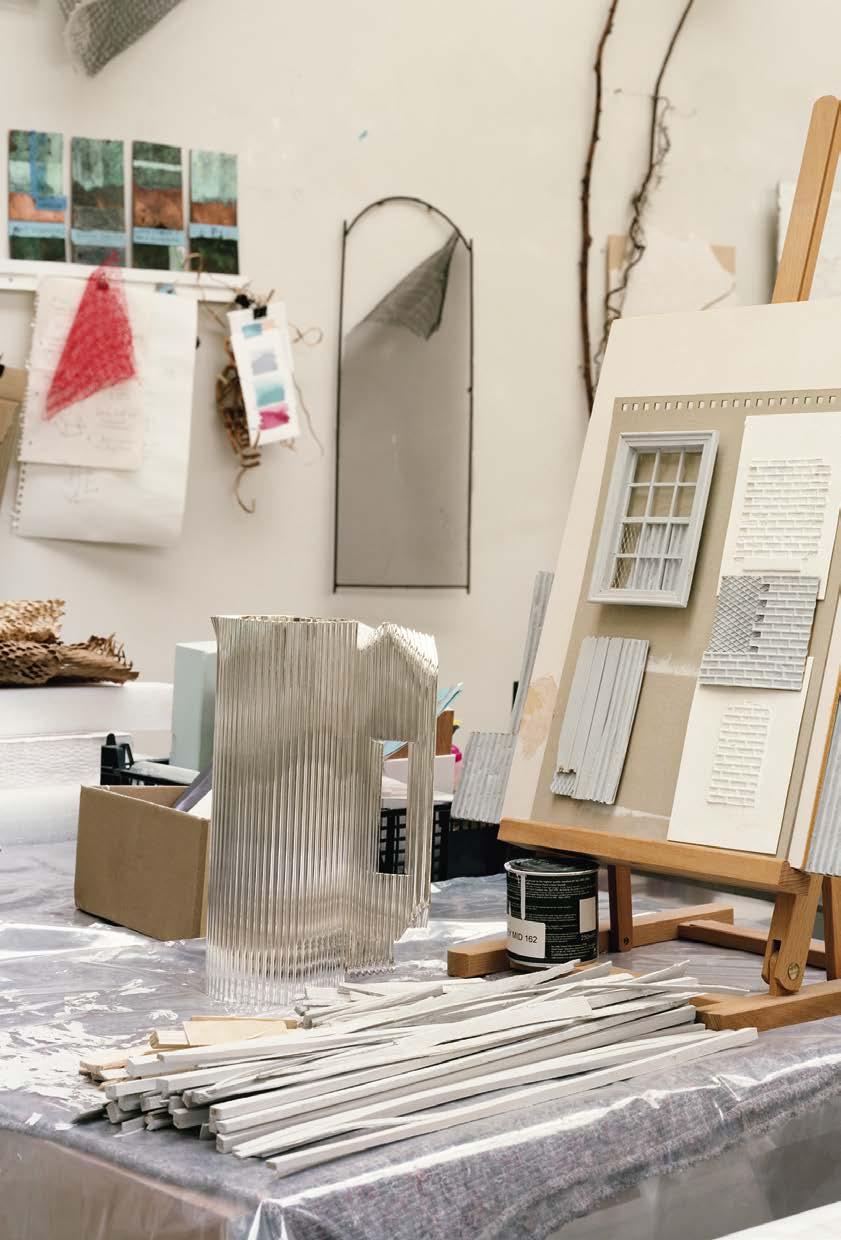
The recently released Silver Set is a functional tableware collection produced by the silversmith Puiforcat in collaboration with artist Rachel Whiteread. The collection consists of a water pitcher, two tumblers, serving trays in two sizes, and a pair of napkin holders. Each piece is manufactured from sterling silver and modeled directly after corrugated-cardboard prototypes shaped by the artist. The Puiforcat workshop utilized a combination of traditional manual techniques and CNC milling to replicate specific textures from the cardboard, including its grooves, creases, and surface stains.
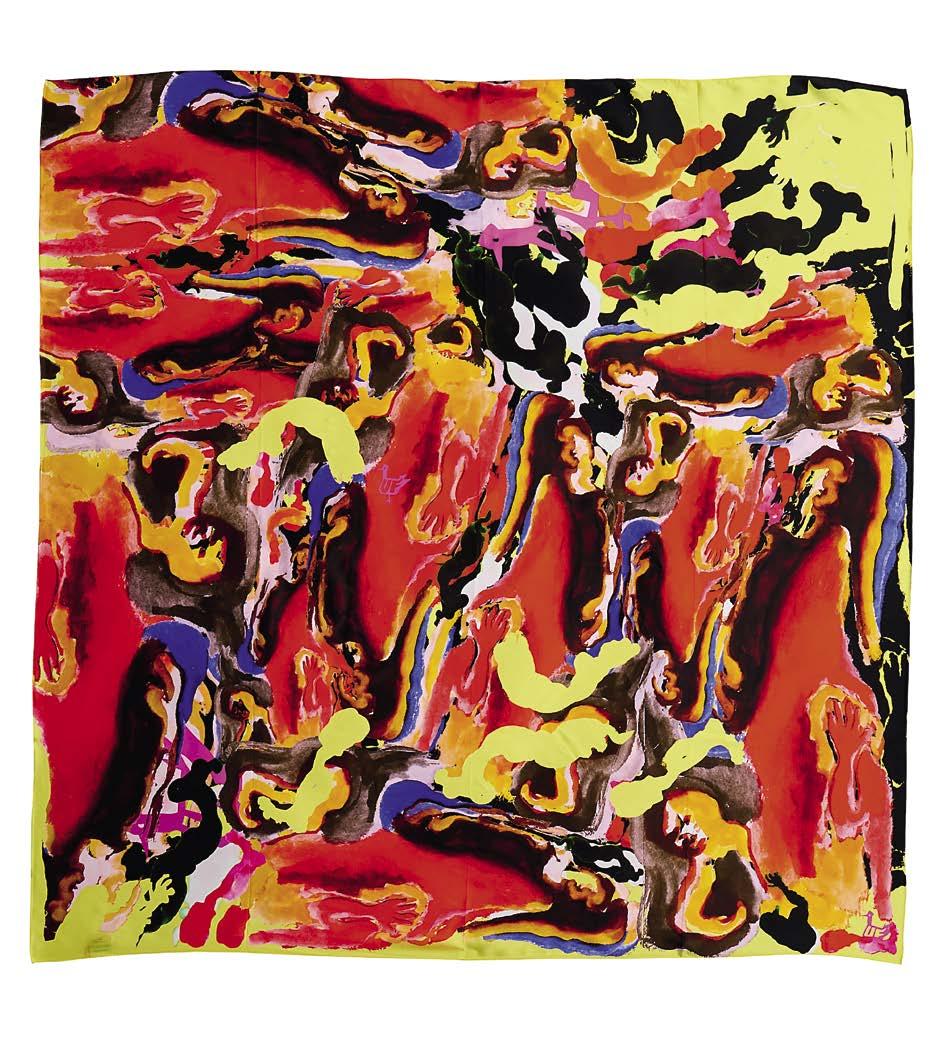
This silk-satin scarf by Urs Fischer is from UF, the artist’s line of objects and wearables, which includes T-shirts, upcycled garments, and domestic items, presented as an extension of his art practice and based on some of his recent works. The design features an allover multicolored painterly pattern made of cartoonlike intertwined limbs, reflecting Fischer’s inventive approach to image making that probes the tension between the material and the digital.
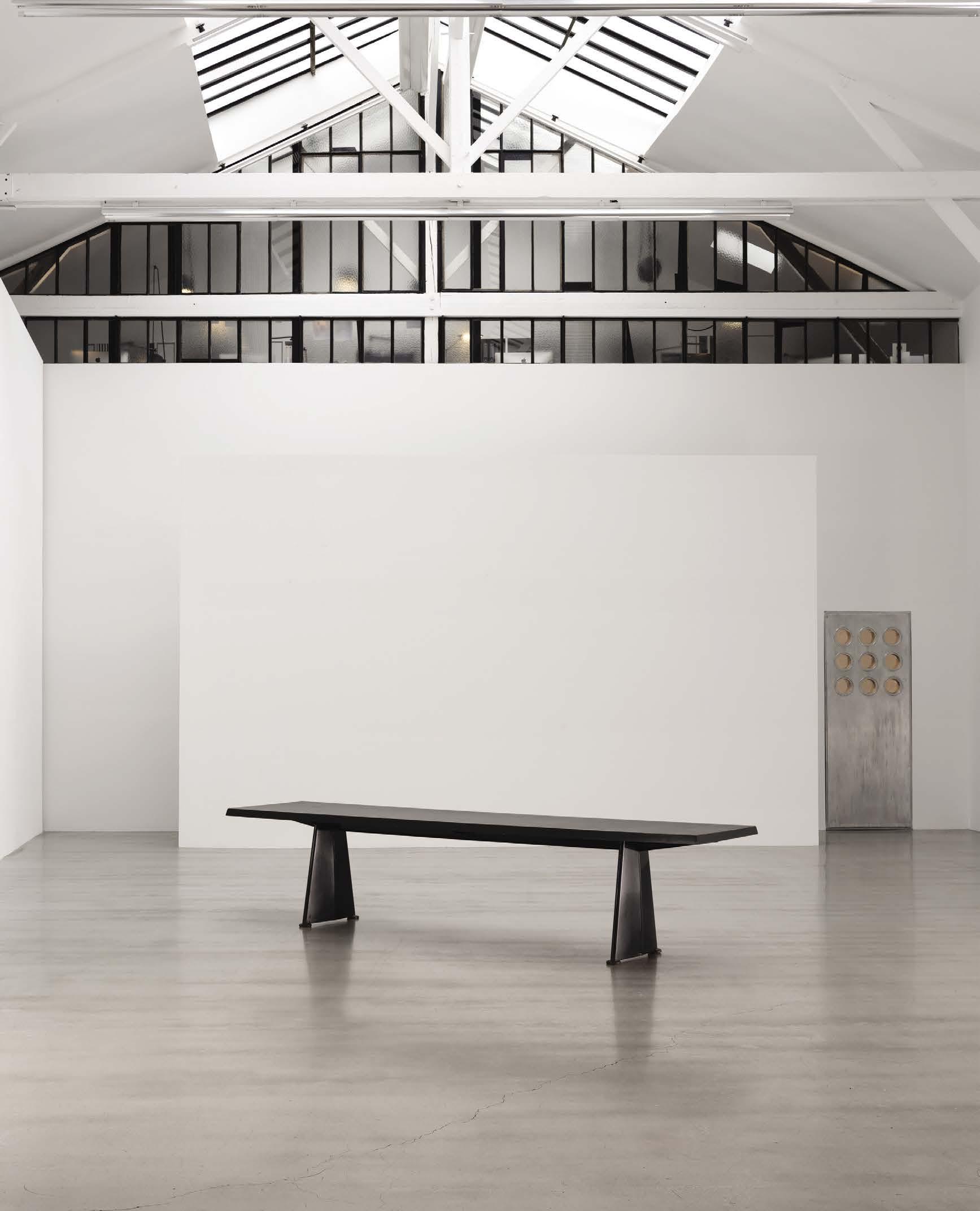
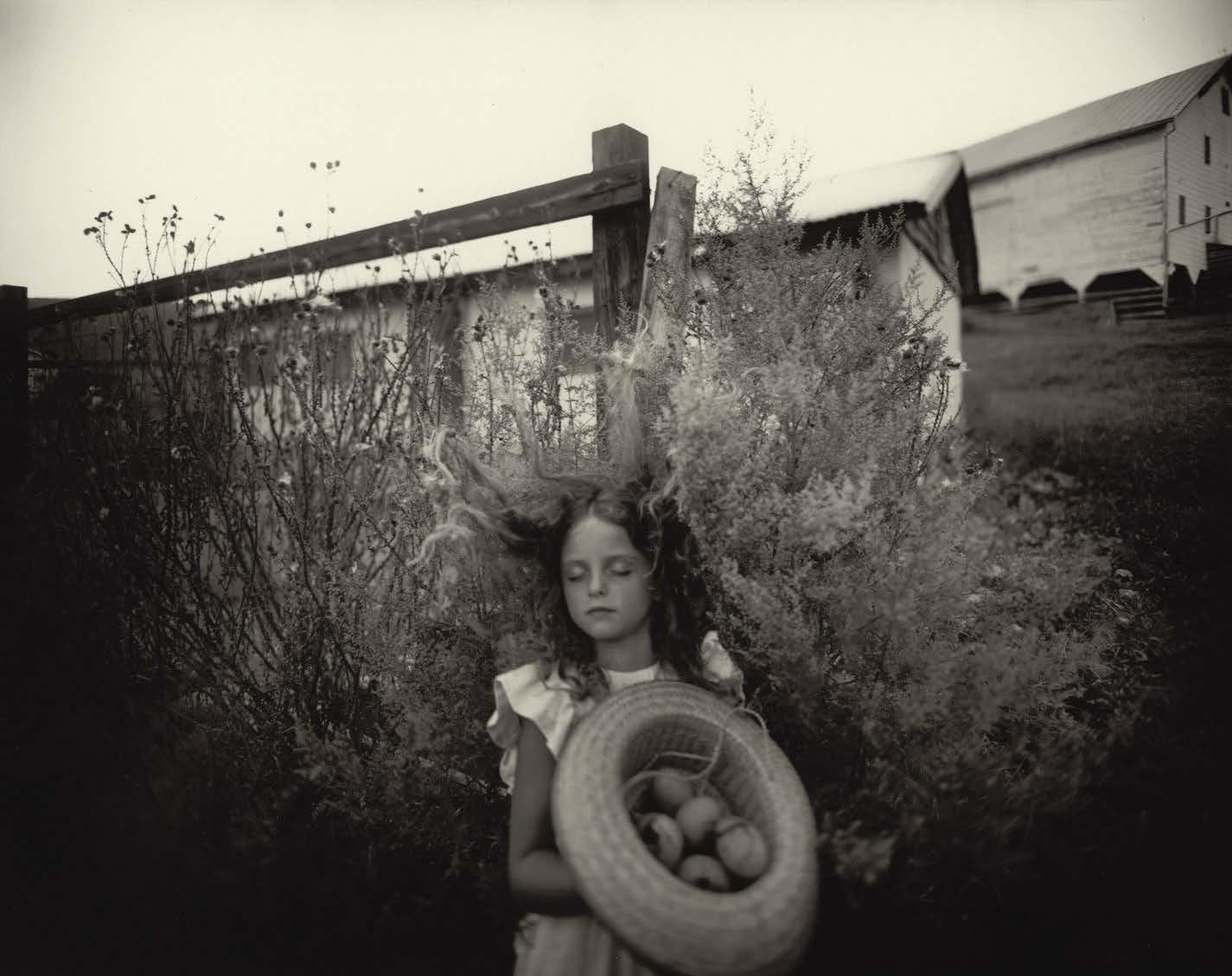
Sally Mann joined novelist Amor Towles in a conversation about her widely celebrated new book, Art Work: On the Creative Life (2025), at an event hosted by the New School and the Strand in New York. Published by Abrams, Art Work is about the challenges and pleasures of the creative process. To read the full interview, visit gagosian.com/quarterly.
AMOR TOWLES Art Work is a very generous book, in that you invite us into your home, into your correspondence with friends. You share your journal entries and give us your thought process behind certain photographs. You are talking not only about art, but about the making of art. It’s funny, too: Right at the beginning, you tell us that after your last book, Hold Still [2015], you spent eight years saying, I will never write another book . But you nevertheless began to accumulate chapter headings for the book that you weren’t going to write. What were the additional things you decided you needed to say?
SALLY MANN All of this writing started with the Massey Lectures that Harvard asked me to deliver in 2011. I was terrified—I thought, I better write something that makes me sound not so stupid, because it’s Harvard after all. Those lectures became the catalyst for Hold Still , which was more formal, more scholarly, than Art Work , which flowed almost effortlessly, conversationally. I know that sounds impossible— writing is never easy—but it really was just a series of anecdotes from my life, strung together. I began writing them down and there I was: down the old rabbit hole. When you start writing, do you just pour yourself into it?
AT Well, I’m a planner. There’s a pouring out, but it is within a constraint I designed in advance.
SM Do you have a whiteboard where you lay out your chapters?
AT I have a long outline. A thirtypage outline.
SM Yeah, not me. Gosh, I wish.
AT The title Art Work is appropriate because the book very much considers art as work, and obviously there’s a play on words there. Did you know at the beginning that that was going to be such an important focus?
SM Well, I knew this much: Art is not always fun. Art is work!
AT You say it right at the beginning: This book is about how to get shit done.
SM It’s all kinds of shit.
AT That’s true. It’s a variety of shit. You quote Emily Dickinson, “Luck is not chance—It’s toil,” and that’s a recurring theme. You demystify the moment of inspiration. Could you talk a little bit about that, about how you think of inspiration versus perspiration, or however you want to put it?
SM Yeah, it’s 99 percent perspiration. I did not employ that aphorism, but I think that’s the gist of the thing. It’s true that some pictures really are exciting, effortless. In those cases, after the shutter clicks, I drop down on my knees in thanksgiving, knowing that if I just don’t screw up the negative, I’ve got
a good picture. But those moments are rare.
AT You talk about, in a variety of cases, the dynamic of you taking a picture and then digging deeper into re-creating, revisiting, and choreographing it. Like the example in your book of the slaughtered duck; you revisited the subjects dozens of times, rearranging the elements of the scene. Was that something you began doing early in your career? Or did you discover it along the way?
SM I’ve been going through early 35mm pictures beginning from when I was seventeen, and yes, I see evidence of the same instinct. They’re often very carefully built.
Art Work: On the Creative Life (Abrams, 2025) Sally Mann’s exhibition Before Words opens at Kutxa Fundazioa, San Sebastián, Spain, on July 17, 2026.
Sharad Chari reflects on a recent visit to Ellen Gallagher’s Rotterdam studio, thinking through the artist’s intertextual interrogation of the oceanic and the ways in which her practice is informed by a wider Black intellectual and artistic world, an abiding interest in Herman Melville’s Moby-Dick , and the imperatives that surround this studio by the Port of Rotterdam. To read the full essay, visit gagosian.com/quarterly.
As we look out the window of the train speeding through the Dutch countryside, Ellen Gallagher muses about a scene in Renata Pinheiro and Sérgio Oliveira’s film Açúcar (2017) in which a ship glides over a field of sugarcane. Turning to me, she remarks that seventeenthcentury Dutch princes flooded these lowlands in watery defense against invasion. “You see, dew becomes a momentary ocean,” she offers, as if in explanation. In the next breath, she describes eels crossing the fields at twilight. “Imagine a cow looking in surprise at eels crossing!” We laugh. Gallagher tells me that she began her series Watery Ecstatic in these nether-lands, in a sea of references.
I am a human geographer, which means I am interested in all kinds of geo-graphia , or earthly and oceanic writing that might respond to our burning planet. I am also an enthusiast of this artist, whom I had traveled to meet in order to understand her oceanic practice, particularly the series Watery Ecstatic (2001–), Ecstatic Draft of Fishes (2019–), and Fast-Fish and Loose-Fish (2023–), in relation to earlier works like the Dew Breaker (2015) pieces exhibited at the 2015 Venice Biennale curated by Okwui Enwezor.
Gallagher’s entire corpus is oceanic; it is characterized by upwellings of matter and form, and by imperatives that return in unpredictable yet insistently creative ways. Her oceanic paintings respond to Édouard Glissant’s salutation drawn from Surrealist poetry—je te salue, vieil Océan! but with Derek Walcott’s patient attention to the “grey vault” for its storied turbulence. 1 There are many stories, influences, citations, paintings, and texts submerged within each piece. Here, I reflect on one day in the company of this singular thinker, to offer preliminary thoughts on what Gallagher sees while submerged,
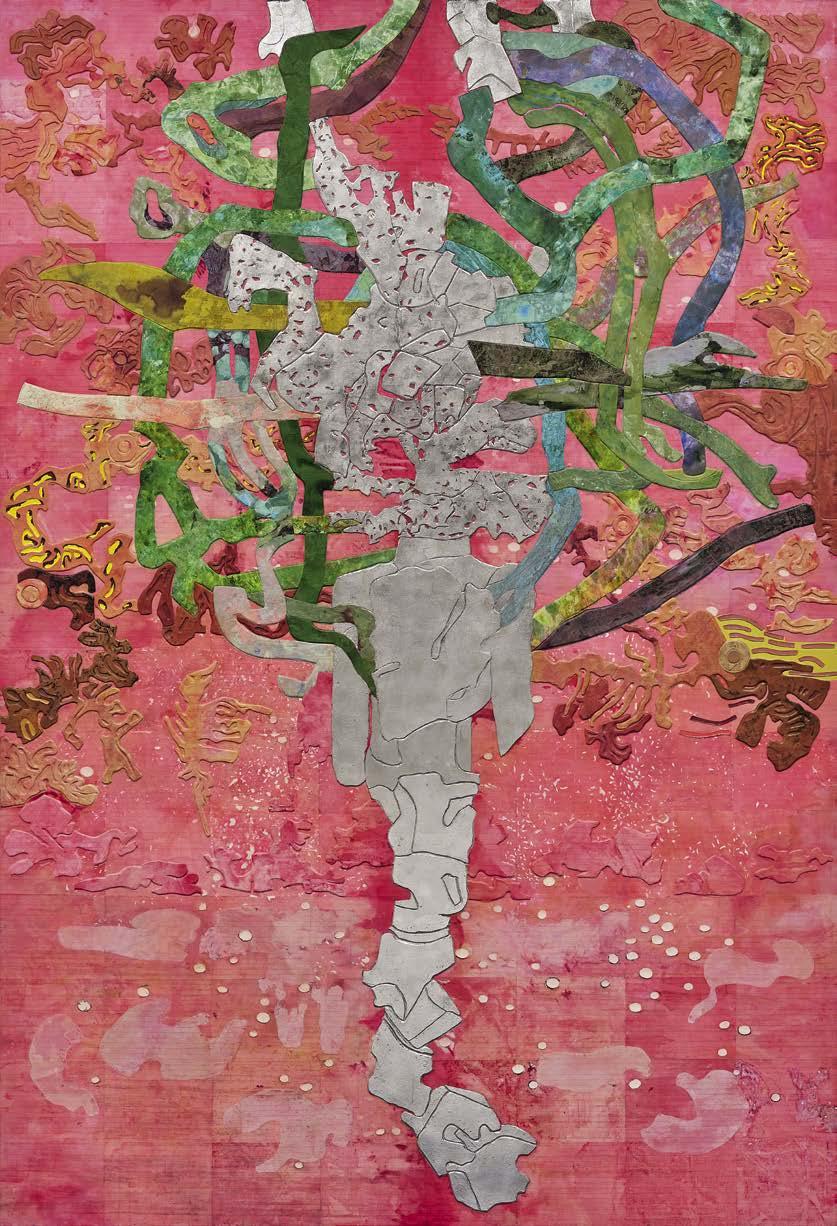
Gallagher, Fast-Fish
as she invites us to descend to the seabed.
We had been speaking at Amsterdam’s Stedelijk Museum in front of her tetraptych Negroes Battling in a Cave (2016), her wry take on Kazimir Malevich’s impossible claim to pure abstraction. We discussed how the selections from the Stedelijk’s collection in this set of rooms, titled “Tomorrow Is Another Day,” were in conversation with the landmark 2016 Pace Gallery exhibition Blackness in Abstraction curated by
Adrienne Edwards. A striking work at the Stedelijk by Julie Mehretu abstracts in transparent form the photography of political turbulence. This piece is encased by a metal sculpture by Nairy Baghramian—a combination that, to paraphrase Gallagher, displays Black queer women working as a crew.
Earlier that morning, we had begun a complex dialogue about artists’ legacies, and why the topic is so important for some, and so fraught for others. Consider Francis Bacon, Gallagher says, and the way his studio was repatriated to Dublin despite his own sense of permanent exile. His reconstructed studio at Hugh Lane includes the swabs of color on a door that Gallagher speculates has inspired so many artists’ spot paintings, but it also shows something about the enduring power and insight of the non-virtuosic brushstroke. Non-virtuosic labor is important to Gallagher, and it returns in her seabed paintings.
I begin with this rush of ideas in conversation, in medias res , as we make our way to the Stedelijk and back to Gallagher’s studio by the Port of Rotterdam, as it conveys something essential about this thinker: her imaginative capacity to transport us to various places, including the bottom of the sea, and her commitment beyond the dictates of the art market to the collective labor necessary to sustain the capacities of others. In other words: Remember your crew!
1. Édouard Glissant, Poetics of Relation (Ann Arbor: University of Michigan Press, 1997), 7; Derek Walcott, “The Sea Is History,” in Selected Poems (New York: Farrar, Straus and Giroux, 2007), reprinted with permission at https://poets. org/poem/sea-history.
This puzzle, written by Myles Mellor, brings together clues from the worlds of art, dance, music,
poetry, film, and beyond.
1 Venetian painter of Venus of Urbino 4 Luxury Italian jewelry house that includes a high-end watch line
Brazilian city known for Carnival
Big hit for Alicia Keys (two words)
Evita s ong “Don’t Cry for Me ”
Louis , known as the Sun King
24 DiCaprio, to fans
25 Alien too good for earth (abbr.)
27 Simon , one of the original American Idol judges
29 Heavenly being featured in Botticelli’s Annunciation
31 Pedicurist’s concern
33 Actors’ union (abbr.)
35 Style of Rockefeller Center
36 The pinball wizard from the Who
37 Venice’s Campanile, for example
38 Therefore
39 Montblanc, e.g.
41 Famous doll played by Margot
Robbie in a hit movie of the same name
43 Venetian island famous for glassmaking and colorful houses
44 Professional golfers’ organization
46 Famous square in Venice (two words)
51 Out together romantically (three words)
55 Morning hours, for short
56 Shoe fasteners
57 a Ca’ Pesaro is the first major exhibition of the artist’s work in Venice (two words)
1 Venetian-school painter who painted The Origin of the Milky Way
2 Monsters in The Hobbit
3 James Patterson’s detective Cross
5 Encouraged strongly
6 The of the land
7 Venice’s romantic transport
8 French king
9 Central part of a church
11 “Havana” singer Camila
16 Brief moment, informally
18 Antiapartheid activist Mandela
20 Loan temporarily
21 Venice masterpiece of Gothic architecture featuring the Bridge of Sighs (two words)
23 Burch, iconic fashion designer known for creating “accessible luxury” and for her advocacy of women entrepreneurs
26 Excessively
28 Alfie star Jude
30 Environmentally friendly prefix
32 She played Hermione in the Harry Potter films, first name
34 Paul Klee’s nationality
37 Golfer’s peg
39 Dancers in , painting by Edgar Degas
40 Wooded area
42 Nutritional guideline, briefly
45 Japanese board game with black and white stones
47 Mahal
48 Madame, for short
49 Managed
50 Mary-Kate to Ashley, informally
52 Entire amount
53 Indian lentil dish
54 Lawrence of Arabia’s initials
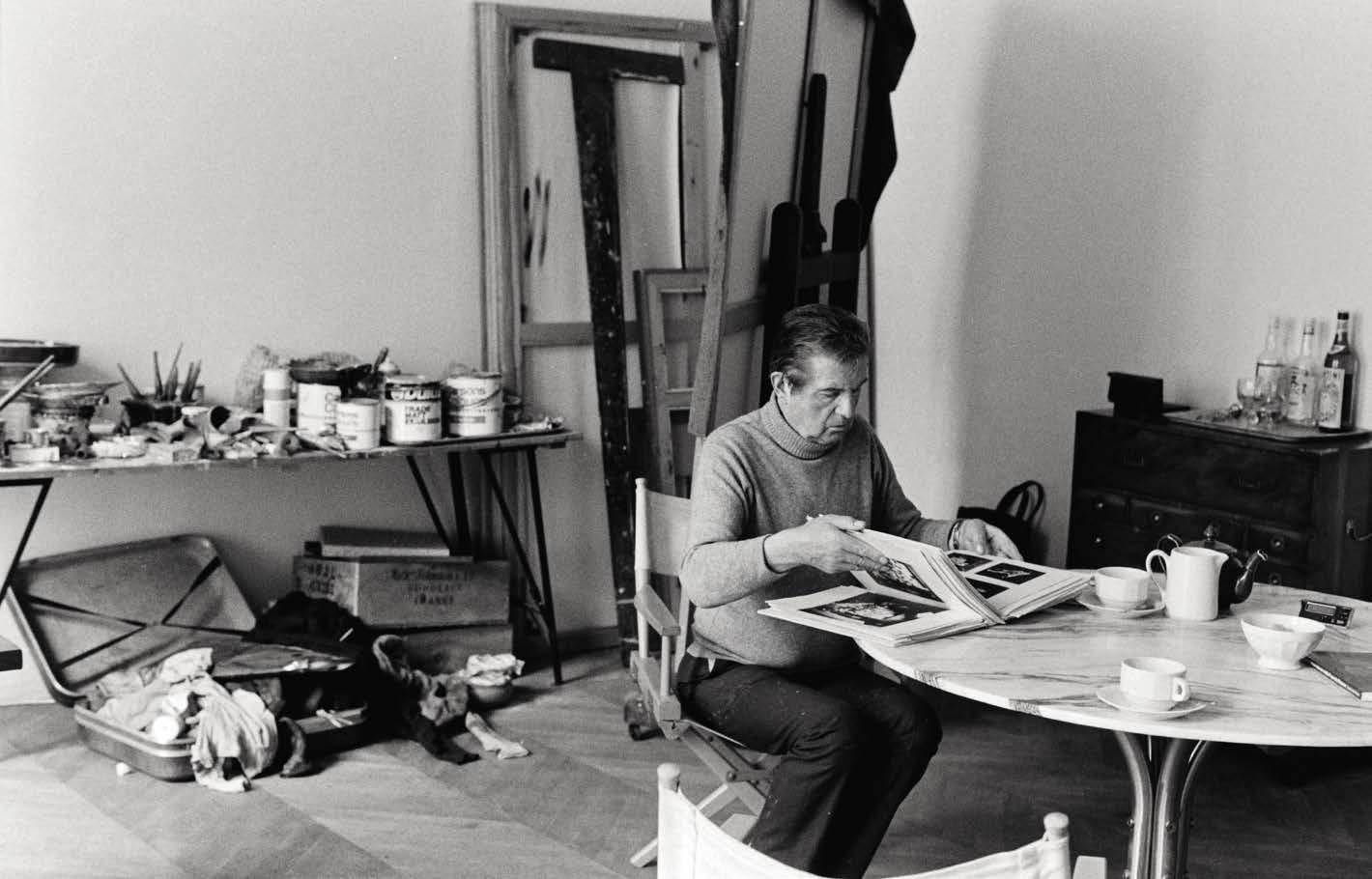
Francis Bacon lived and worked in Paris for a decade starting in the mid-1970s. The city and the art he encountered there provided a profound backdrop for his austere late style, which often brings together smooth, colorful backgrounds, spare architectural signifiers, and sculptural human forms. Here, three striking paintings from that period, currently on view at Gagosian in Paris, are considered by Sebastian Smee.
In 1984, twelve years after Bernardo Bertolucci had used a sequence of Francis Bacon paintings for the opening credits of Last Tango in Paris (1972), Bacon’s show at Galerie MaeghtLelong in the French capital was mobbed by crowds. The excitement was so great that French police had to close off the street. During its run, a wall outside the home of the pop-culture icon Serge Gainsbourg was inscribed with graffiti declaring “only francis bacon is more wonderful than you.”
Bacon was by then nearing the end of his lateflowering romance with Paris. From the summer of 1975, he had occupied a home and studio in the Marais, and for approximately a decade thought of it as his primary abode. Bacon spoke French fluently. He read Honoré de Balzac, Charles Baudelaire, and Jean Racine in the original, admired the twentiethcentury writings of Georges Bataille and Roland Barthes, and kept Marcel Proust by his bedside. He was close friends with Michel Leiris, the mandarin Maoist—a giant of French letters who championed his work—and he was delighted to be the subject of Francis Bacon: Logique de la sensation (1981), an incisive book by the French philosopher Gilles Deleuze. 1
Bacon loved taking the train and night ferry back and forth between London and the Gare du Nord, as Mark Stevens and Annalyn Swan explain in their 2021 biography of the artist, Revelations He loved the cruising scene on the rue SainteAnne, and it pleased him to have easy access, a few blocks away, to the Louvre. He enjoyed, too, the resonances of living in the city Pablo Picasso had made home. The Spaniard had not only “unlocked” images in Bacon, he said, but “also ways of thinking, and even ways of behaving.”2
Back in London, friends were dying. Longstanding relationships were getting too complicated or simply withering. “The atmosphere in Paris was lighter than in London,” explain Stevens and Swann, “and he rarely had to make amends.”3 Life felt simpler, which Bacon seemed to require as he got on with distilling his art, making it more emphatic and essential, carving out a veritable “late style,” with all the power implied by that epithet.
In some ways it seems incredible that Bacon would ever again wish to set foot in Paris. After all, this was the city in which, on October 24, 1971, his lover had been discovered dead in the bathroom of their hotel suite on the same morning that he, Bacon, was to attend a press preview of a landmark retrospective of his work at the Grand Palais. Bacon had had a famously intense and fractious relationship with George Dyer, and the circumstances of his death—sex, alcohol, a drug overdose—were squalid. And yet for many years Bacon made a point of returning not just to Paris but to the same hotel, where he usually requested the same suite he’d stayed in with Dyer.
After Bacon’s Grand Palais show, a friend, the Irish painter Louis le Brocquy, had written to him, effusing that “to me it is here in the Grand Palais—in the great circumstance of Paris—that your gesture is seen finally to assume and assert its universality. . . . You are progressively regarded as central to your time and preeminent in it.”4 Le Brocquy’s use of the word “circumstance” would have lodged in the painter’s mind. Bacon could be in Paris—in the galleries of his own exhibition at the Grand Palais, in the Louvre, or in the finest restaurant—and understand the city as “a great circumstance.” But in Bacon’s conception of life, the hotel
bathroom where Dyer had vomited into the basin was also “a great circumstance.”
A “circumstance,” after all, is simply a situation, an existential condition. And for Bacon, any circumstance was fired with potential. It wasn’t a question of wallowing in depression or morbidity— it was really the opposite. People thought the things he painted were horrific, he noted in a late, filmed interview with David Sylvester, but this was only because he was trying to “give over,” as directly as he possibly could, “the excitement of life.” In making his work “intensely real” for himself, he explained further, “I may bring in very strongly this quality of mortality, because the more violently, the more strongly you feel about life, the more strongly you must be aware of death.”5
When it came to influences, Bacon was voracious. There were almost no images of the human body—and especially the body in motion—that didn’t interest him. The medium didn’t matter. But for all his undersung brilliance as a colorist, he preferred the images he worked from (be they sports photography, reproductions of sculptures and old master paintings, or illustrations in medical textbooks) to be black and white. Reducing them all to the same level (often literally at his feet on the studio floor) made them easier to assimilate.
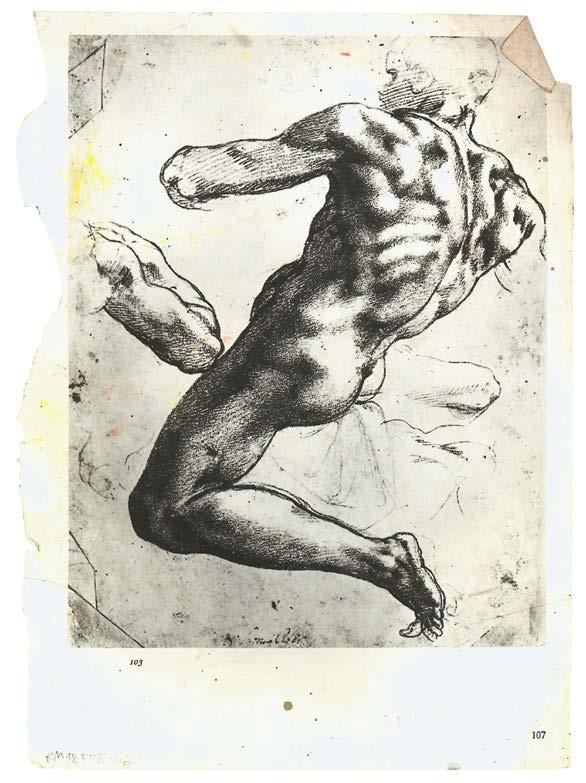
Michelangelo had long been a crucial figure for Bacon, but he became especially important later on. The Florentine was “deeply important in my way of thinking about form,” he told Sylvester.6 What he most admired was the voluptuousness with which Michelangelo handled the male nude—especially in his drawings.
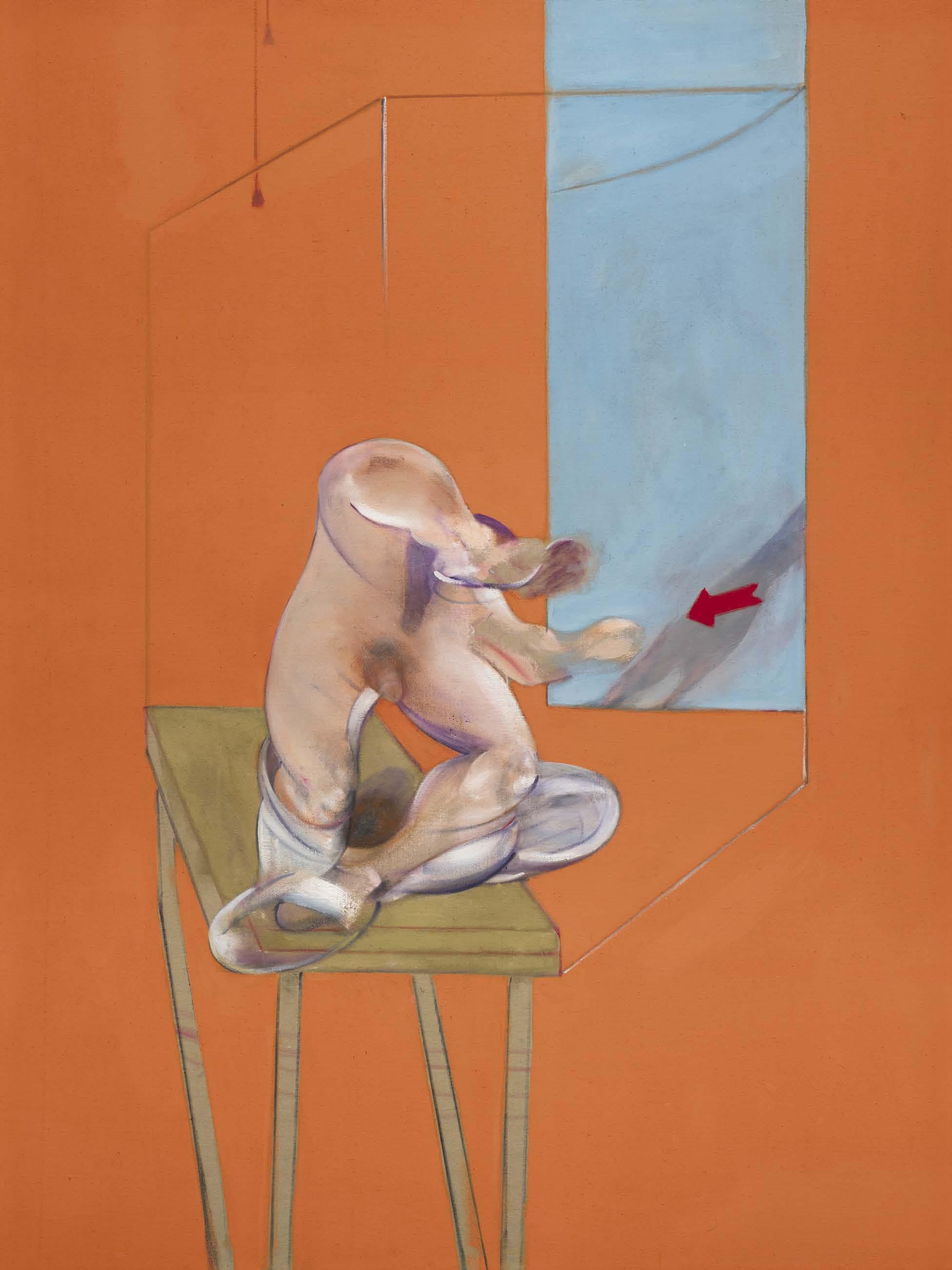
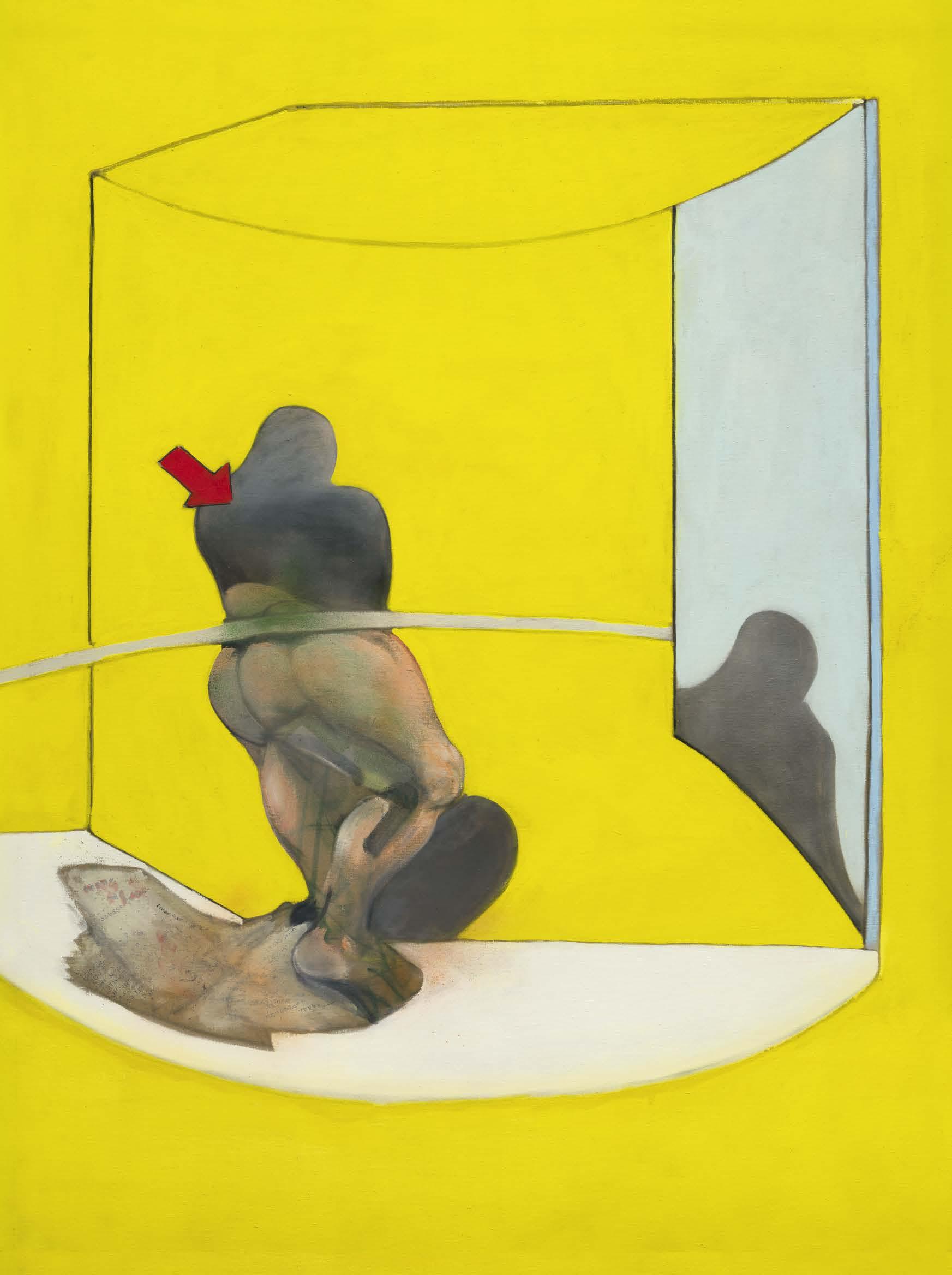
In the first two paintings here—Study from the Human Body—Figure in Movement , an oil painting from 1982, and Study from the Human Body, a painting from 1986 that combines oil paint with pastel, aerosol paint, and dry transfer (for the lettering)— we sense not only voluptuousness but a kind of brute, dynamic power. The figure is intensely muscled, especially around the legs, and coiled with a kind of torque that rhymes with the curving armatures that minimally define the pictorial space, threatening to send everything spinning in an anticlockwise direction. Bacon tended to mix up in his mind the drawings of Michelangelo and another crucial source, the sequential photographs by Eadweard Muybridge of humans and animals in motion. He wanted to combine the positions in Muybridge’s photos with Michelangelo’s ampleness and grandeur of form. And he connected both with his own experiences: “I think of the contours of those bodies that have particularly affected me,” he said, “but then they’re grafted very often onto Muybridge’s bodies.”7
Of the great twentieth-century painters, Bacon much preferred Picasso (his “first and most important father figure,” according to Michael Peppiatt) to his counterpart Henri Matisse. 8 Matisse didn’t, he said, “have the brutality of fact which Picasso had,” and he was guilty of “turning fact into lyricism.”9 And yet Bacon admitted to admiring Matisse’s sculptures, which were in turn deeply influenced by Michelangelo. Matisse was obsessed by the figure of Night (1526–31) from the Medici tombs in Florence, and his series of increasingly abstracted relief sculptures of a woman’s back, with their shifting configurations of clenched muscles suggesting an inscrutable inner tension, were indebted to Michelangelo.
Before even Picasso, Matisse had adopted the principle of “deformation”—distorting the human figure to maximize its expressive potential. And
of course, the voluptuousness Bacon found in Michelangelo was vital for Matisse—notwithstanding that in Bacon and Michelangelo voluptuousness centered on male bodies and in Matisse on females.
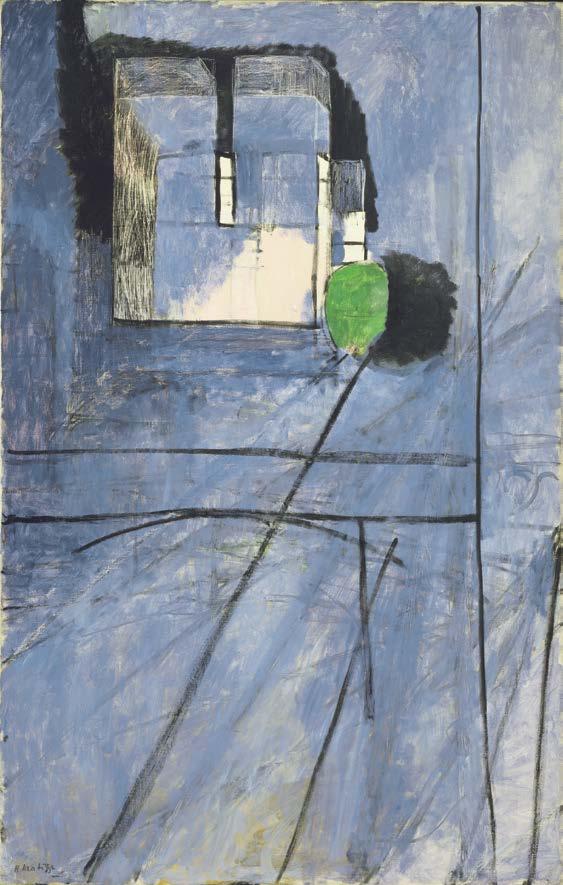
In the three late Bacon paintings here it’s possible to see formal qualities one also finds in Matisse’s 1913–17 period, especially View of Notre Dame (1914) and The Piano Lesson (1916), both in the collection of the Museum of Modern Art, New York. Both share with the Bacon paintings a severe geometry (including an off-center shape in the background suggesting a window or mirror), linear armatures, and near-monochrome color. The simplified, semitheatrical presentations of the human form that distinguish Bacon’s late work also resonate with Matisse’s Painter in His Studio (1916–17), in the collection of the Centre Pompidou, Paris, and Studio Quai St-Michel (1916), in the Phillips Collection, Washington, DC, both of which present a vulnerable body held up for scrutiny, like an actor on a stage or a sculpture on a plinth, yet seen at a slight remove, set deep in the picture’s space or reflected in a mirror.
Of course the differences are also clear. Where Matisse powerfully integrated the depicted reality—persuading the viewer that he not only saw what he painted but was part of the scene himself— Bacon embraced a more distant aesthetic of collage and disjunction. Instead of integrating his figures within the spaces they occupied, he used artificial color—often spray-painted onto the canvas—and pictorial fields stripped of incident to set up stark contrasts between figure and ground. His use of cadmium orange, and less commonly an intense sunflower yellow tinged with red, suggests the influence of Pop artists like Richard Hamilton and Andy Warhol. (After visiting Warhol at the Factory in New York, he came away impressed by the combination of intense, artificial color and macabre subject matter, indifferently treated, in the Car Crash and Electric Chair screen prints.)
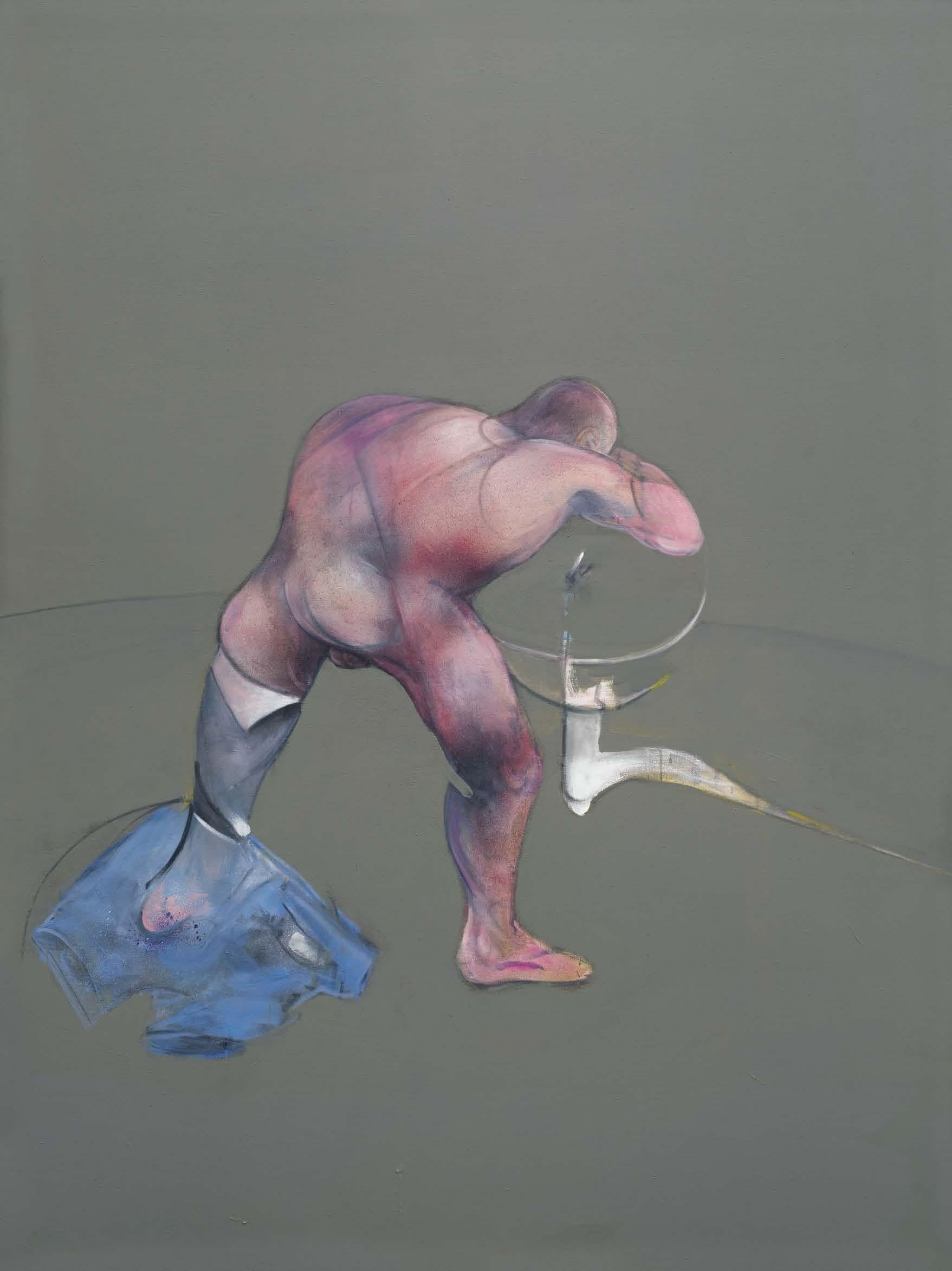
The third and latest painting here, Man at a Washbasin from 1989–90, is also the most radically distilled. No window relieves the gray ground. Completed less than three years before Bacon’s death, it recalls Gustave Caillebotte’s Man at His Bath (1884), held at the Museum of Fine Arts, Boston, a landmark painting of an unidealized
male nude in realistic, everyday circumstances. Caillebotte’s generally static image is given a subtle dynamism by the vigorous rubbing action of the towel and by the white fabric (his nightshirt?) arrayed like a Baconian convulsion on the floorboards. The suggestion of scrotum visible beneath his buttocks is amplified in Bacon’s Man at a Washbasin , which derives from a photograph in Muybridge’s sequence of a man shadowboxing that he’d used several times before. The man’s position over the washbasin suggests he might be vomiting—an extreme, involuntary action, both physical and psychological, which inevitably recalls the death of Dyer.
Bacon had delivered the painting to his gallery in London about twelve months after starting work on it. He later retrieved it, wanting to make changes, mostly aimed at reduction. He painted out the light bulb, the rectangular frame around the figure, and a black circle surrounding the denim shorts at the bottom.
Bacon’s drive toward greater simplicity was not, as critics at the time suggested, a symptom of reduced ambition or the seductions of repeating an established “brand”—any more than was the case with Samuel Beckett’s radically distilled and repetition-dependent dialogues. Instead, Bacon was trying to clear away the unnecessary. The “circumstances” of life and artmaking were always connected in his mind to gambling. In his bid to “deepen the game,” as he framed it, he was trying to distill his best discoveries into something more essential. 10 “You’re more conscious of the fact that nine-tenths of everything is inessential,” he said of aging. “What is called ‘reality’ becomes so much more acute.”11
Increasingly, the paint used for figures in these late works, though richly mottled and complex, is smooth and thinned out. It no longer mattered to Bacon that the paint itself should testify to a great struggle. He hated being mistaken for a surrealist or an expressionist, which may explain why he became obsessed through these final years with the idea that he was reinventing realism. He
decided that realism meant recording appearances along with the sensations those appearances suggested. These sensations might be a particular person’s emanations; their awareness of—or blindness to—their circumstances; both their sexual attractiveness and what could be sensed of their own desires; or their feelings of connection, isolation, anxiety, obliviousness, mortality, and so on. Realism also meant seeing with eyes rinsed of rhetoric. Inherited artistic conventions— including so-called realism—only obscured all the sensations Bacon wished to “capture” or “trap.” And so he played up the strangeness of appearances. The truth, he knew, always comes through a strange door.
“I would like,” he said to Sylvester in 1974, “quite apart from the attempt to do sculpture, to make the painting itself very much more sculptural.”12 Picasso again provided a model of potential here: The Spaniard, if he wasn’t actually sculpting, was always painting and drawing sculptures, and even painting on sculptures. But Bacon also liked the idea of representing his increasingly sculptural figures in paint as fragments , in the manner of Auguste Rodin.
He visited the Musée Rodin in Paris several times, including in the summer of 1986. The museum is in the eighteenth-century Hôtel Biron, once occupied by Rodin, in the grounds of a former convent; Matisse had also used the building as both a studio and a school after moving there at the end of 1907.
Rodin, whose career was all but unthinkable without Michelangelo, loved snatching human figures or parts of figures from earlier contexts and recombining them in new, improvised arrangements that thrived on repetition, doubling, and dissonance. Rodin is so familiar and domesticated today that people glide over the chief characteristics of his work (at least in the context of classical sculpture): its wild gaucheness, its constant intensification of feeling through strategies of disruption, thwarted movement, and psychological “stuckness.”
Opening spread, left: Francis Bacon in his studio, rue de Birague, Paris, 1979. Photo: Edward Quinn © edwardquinn.com
Opening spread, right: Francis Bacon, Study from the Human Body—Figure in Movement , 1982, oil on canvas, 78 × 58 inches (198 × 147.5 cm), CR 82-08 © The Estate of Francis Bacon. All rights reserved. DACS, London/Artists Rights Society, New York 2026. Photo: Annik Wetter
Previous spread, left: Francis Bacon, Study from the Human Body, 1986, oil, pastel, aerosol paint, and dry transfer lettering on canvas, 78 × 58 inches (198 × 147.5 cm), CR 86-03 © The Estate of Francis Bacon. All rights reserved. DACS, London/ Artists Rights Society, New York 2026. Photo: Annik Wetter
Previous spread, right: Torn page from unidentified book with study by Michelangelo for an ignudo for the Sistine Chapel ceiling (1508–12), from Francis Bacon’s studio. Photo: courtesy Dublin City Gallery The Hugh Lane © The Estate
of Francis Bacon. All rights reserved. DACS, London/ Artists Rights Society, New York 2026
This page: Henri Matisse, View of Notre Dame, 1914, oil on canvas, 58 × 37 1⁄8 inches (147.3 × 94.3 cm), The Museum of Modern Art, New York, acquired through the Lillie P. Bliss Bequest (by exchange), and the Henry Ittleson, A. Conger Goodyear, Mr. and Mrs. Robert Sinclair Funds, and the Anna Erickson Levene Bequest given in memory of her husband, Dr. Phoebus Aaron Theodor Levene © 2026 Succession H. Matisse/Artists Rights Society (ARS), New York. Photo: © The Museum of Modern Art/Licensed by SCALA/Art Resource, New York
Opposite: Francis Bacon, Man at a Washbasin , 1989–90, oil and aerosol paint on canvas, 78 × 58 inches (198 × 147.5 cm), CR 90-01 © The Estate of Francis Bacon. All rights reserved. DACS, London/ Artists Rights Society, New York 2026. Photo: Annik Wetter
Bacon loved all this, just as he loved the strangeness of bodies unnaturally compressed or cut off from their upper half, limbs and hips twisting into impossible new shapes. He used shadows and mirrors, too, to create doublings and discontinuities. In this way his late paintings suggest not only the hauntings of mortality but the roles we constantly play and the inevitable oozing out, from the facts of our circumstances, of some insidious leakage. But against the ooze and deformation we associate with Bacon, there is also a suggestion of classicism in his late works, tied to both his simplified compositions and the smoothing over of the tumult of brushwork that characterized his earlier work. But the forms of classicism to which Bacon was drawn—above all the works of the great French neo-classicist Jean-Auguste-Dominique Ingres— tended to appeal to his perversity as well. When Odilon Redon was once pressed about the strange quality of his own pictures, he protested, “But it is Ingres who has made monsters!”13 Picasso heartily agreed—and so did Bacon. Ingres took extraordinary liberties with his sitters’ anatomies, dislocating shoulders here, adding vertebrae there. It’s often assumed that Ingres’s deformations resulted from his wish to subordinate all the elements of his pictures—even the sovereign human body—to the dictates of his Raphaelesque conception of grace and order. But this explanation glides too easily over what most appealed to Picasso (and later to Bacon) about Ingres: the morbid voluptuousness of his bodies; the sense of high-temperature melodrama being plunged into pools of emotional frigidity; and the simmering strangeness of the Frenchman’s amalgam of photographic fidelity to appearances and logically impossible anatomy. Bacon, in his late phase, was attracted to Ingres’s lucidity but also to his desire to evoke a sort of legendary remoteness. Robert Rosenblum likened Ingres’s portrait of Madame Moitessier from 1856, in the National Gallery, London, to “a modern oracle,” an idea that held great appeal for Bacon, who loved Egyptian art and painted sphinxes and furies. But in the end, it was the sheer intensity of Ingres’s portraits that Bacon valued. Turning away from Ingres’s portrait of Monsieur de Norvins from 1811–12 (also in the National Gallery, London), for instance, would be like turning away from someone who has just pulled out a knife. Bacon wanted his own paintings to exert a similar force. In his late work he continually found ways to combine beauty with that same level of urgency.
1. Gilles Deleuze, Francis Bacon: Logique de la sensation , 1981, Eng. trans. as Francis Bacon: The Logic of Sensation , trans. Daniel W. Smith (London and New York: Continuum, 2003).
2. Francis Bacon, quoted in Wilfried Seipel, Barbara Steffen, and Christoph Vitali, Francis Bacon and the Tradition of Art , exh. cat. (Milan: Skira, for the Kunsthistorisches Museum, Vienna, and the Fondation Beyeler, Riehen/Basel, 2003), 352.
3. Mark Stevens and Annalyn Swann, Francis Bacon: Revelations (New York: Alfred A. Knopf, 2020), 575.
4. Louis le Brocquy, quoted in ibid., 524.
5. Bacon, in Michael Blackwood, Francis Bacon and the Brutality of Fact (New York: Michael Blackwood Productions, 1985), color, 58 min.
6. Bacon, quoted in Seipel, Steffen, and Vitali, Francis Bacon , 350.
7. Bacon, quoted in Seipel, Steffen, and Vitali, Francis Bacon , 350.
8. Michael Peppiatt, Francis Bacon: Anatomy of an Enigma (New York: Skyhorse Publishing, 2009), 72.
9. Bacon, quoted in Seipel, Steffen, and Vitali, Francis Bacon , 349.
10. Bacon, in David Sylvester. The Brutality of Fact: Interviews with Francis Bacon (London: Thames & Hudson, 1993), 29.
11. Bacon, quoted in Peppiatt, Anatomy of an Enigma , 377.
12. Bacon, in Sylvester, The Brutality of Fact , 114.
13. Odilon Redon, quoted in Robert Rosenblum, Ingres (New York: Harry N. Abrams, 1990), 21.
BY ADAM D. WEINBERG
Adam D. Weinberg has been working with Giuseppe Penone on an exhibition of the artist’s new sculptures, The Reflection of Bronze , that opened at Gagosian, New York, on April 22. The works explore the character and possibilities of bronze. Here, Weinberg considers Penone’s enduring engagement with the alloy and addresses the conceptual underpinnings of the exhibition’s three-room structure.
Bronze a perpetually imitating material, precious and humble, laden with history that rises from the earth’s burials, from shipwrecks of the sea and speaks to us of stories, myths, feelings, lost religions.
Bronze with a solid, austere, strong appearance, but in reality, fragile, sensitive. Shy, it takes little to wound it and uncover its shining flesh.
Stripped of its dress of dust it attracts our gaze like a demure body unveiled.
Bronze with a warm, enveloping, harmonious sound. Bronze, the first material that unveiled the image of man, mirror of bronze, mirror of man.
—Giuseppe Penone, “Brown, Red, Green, Yellow, Black Bronze,” 2012
How to capture memory, the transient, the ephemeral, the evanescent? How to fix the breath of life, a passing shadow, the flow of time—the consequence of a fleeting thought—in bronze, a material associated with the indestructible, the imperishable?
Bronze: copper + tin + heat. An amalgam, a marriage that is stronger than its constituents. A durable, almost unbreakable substance whose origins extend back some 5,000 years to ancient Asia, Mesopotamia, and Africa. Bronze was first used for weapons and for ritual objects intended to last for eternity. Throughout history, it has been connected to implements of war—spears, daggers, armor, and other weaponry (including in more recent centuries cannons made of gunmetal, a type of bronze)—and to articles of lasting value, including jewelry, ceremonial artifacts, and the coffers in which valuables are stored. Present-day Western associations with the material instinctively and insistently turn to permanence, power, wealth, and victory.
From its inception, bronze was also prized for its unique, adaptable color range and its capacity to record and reify delicate and fugitive qualities. It allowed for a level of finish and precision unavailable with wood and stone. While maces, clubs, torture devices, and instruments of brute force might be fashioned from bronze, so too were sensuous, elegant swords crafted to fine and deadly points. And while ancient coins, beginning in the sixth century bce , were cast from bronze with durability in mind, they were also decorated with intricate symbols and subjects, including fine tracings of faces and figures that are among the most enduring and tender recordings of history. Consider too
the early mirrors produced in the Bronze Age, as well as those of Egyptian and classical cultures, where our ancestors could first contemplate their haunting, transitory reflections, while bronze oil lamps could multiply, heighten, and sanctify the precious, flickering effects of a flame at a time when darkness ruled the night.
These contradictory associations—of the celebration of power and wealth on the one hand and of vulnerability and refinement on the other—have persisted across the centuries and are embodied in monumental bronzes throughout, among them the Artemision Bronze of ancient Greece, the figure of an omnipotent god, either Zeus or Poseidon; the seventeen-foot-high doors of the Baptistery in Florence, produced by Lorenzo Ghiberti in the fifteenth century and bespeaking the power of the Catholic church and the victory of Christianity (the Baptistery may have been built on the foundations of a Roman temple of Mars, god of war); and Rodin’s posthumously cast Gates of Hell (1880–1917), inspired by Dante Alighieri’s description of those gates in the Divine Comedy (c. 1308–21), though lacking his fearsome inscription, “Abandon every hope, who enter here.” Each of these tours de force of metalwork exquisitely captures the living spirit of grand-manner myth and history, religion and allegory.
These associations engendered problems for artists of the later twentieth century. The nineteenth century had seen an explosion of commercial bronze casting to meet popular demands, leading to sculpture that was infinitely reproducible and marketable. A few late-nineteenth- and early-twentieth-century artists found unique, personal ways to use bronze in sensitive, expressive, noncommercial manners, among them Medardo Rosso, whose impressionistic use of bronze emphasized its materiality and ephemeral qualities of tone and luminosity, and Alberto Giacometti, who reinvented bronze as a sculpture not of mass but of space. After World War II, however, many artists, finding themselves facing a crisis of values and the rise of rampant consumerism, rejected expensive materials and the influence of commerce. These artists questioned the fundamental premises of art and representation, focusing instead on the direct, visual, and visceral experience of simplified and essentialized objects.
In the United States in the 1960s, this rebellion took multiple directions, including Minimalism, Post-Minimalism, and Conceptual art. For artists ranging from Donald Judd to Eva Hesse and Sol LeWitt, bronze was definitely not the material
of choice, given its association with wealth and with lofty historical subjects. As Giuseppe Penone has remarked, “There was a Minimalist idea about a cultural reset, beginning again.”1 The Italian counterpart of such directions was Arte Povera (Poor art), its name coined in 1967 by the curator Germano Celant, who saw this work as “committed to contingency, to events, to the nonhistorical, to the present.”2 Whereas Minimalist artists focused on industrial materials, positing a dichotomy between the industrial and the natural, the contemporary and the historical, the Arte Povera artists (somewhat like the Post-Minimalists in the United States) tended to see those realms as a continuum and retained natural and historical materials in their vocabularies.
Right from the beginning of his practice in the 1960s, Penone was interested in the potential of bronze. But he recognized the ethos of the moment, with its embrace of the simplicity, availability, and utility of “poor” materials and its commitment to “the primary necessities of art,” and his earliest involvement with bronze was accordingly tentative.3 His halting but growing engagement with the metal is best exemplified by retracing his steps in the development of Alpi Marittime. Continuerà a crescere tranne che in quel punto (Maritime Alps. It Will Continue to Grow except at That Point , 1968), one of his earliest works. In 1967–68, Penone entered a forest surrounding his ancestral home in Garessio, in the Italian Piedmont, and took the unassuming, simple, yet bold action of selecting a young ash tree and grasping its trunk with his hand, partly surrounding its circumference. In effect he was stating the inseparability of human and nature. He would write, “I feel the flow of the tree around my hand placed against the trunk. The altered sense of time makes what is solid, liquid, and what is liquid, solid.”4 (It is worth noting that he describes the flow of the tree around his hand, not the other way around.) He imagined his hand remaining permanently fixed to the tree and the tree eventually growing to surround, incorporate, and become one with it. Photographs were nonchalantly taken to record this action.
Wanting to realize this work in another incarnation, Penone imagined fashioning a hand and forearm in a material that could remain in place. His first instinct was to cast his own hand in bronze, which he did, but he soon realized that “the hand itself might become a sculptural object [and] I wanted to give the idea of utility instead.”5 (Meaning that he wanted the idea of an object of use, not of the object as visual icon.) Starting
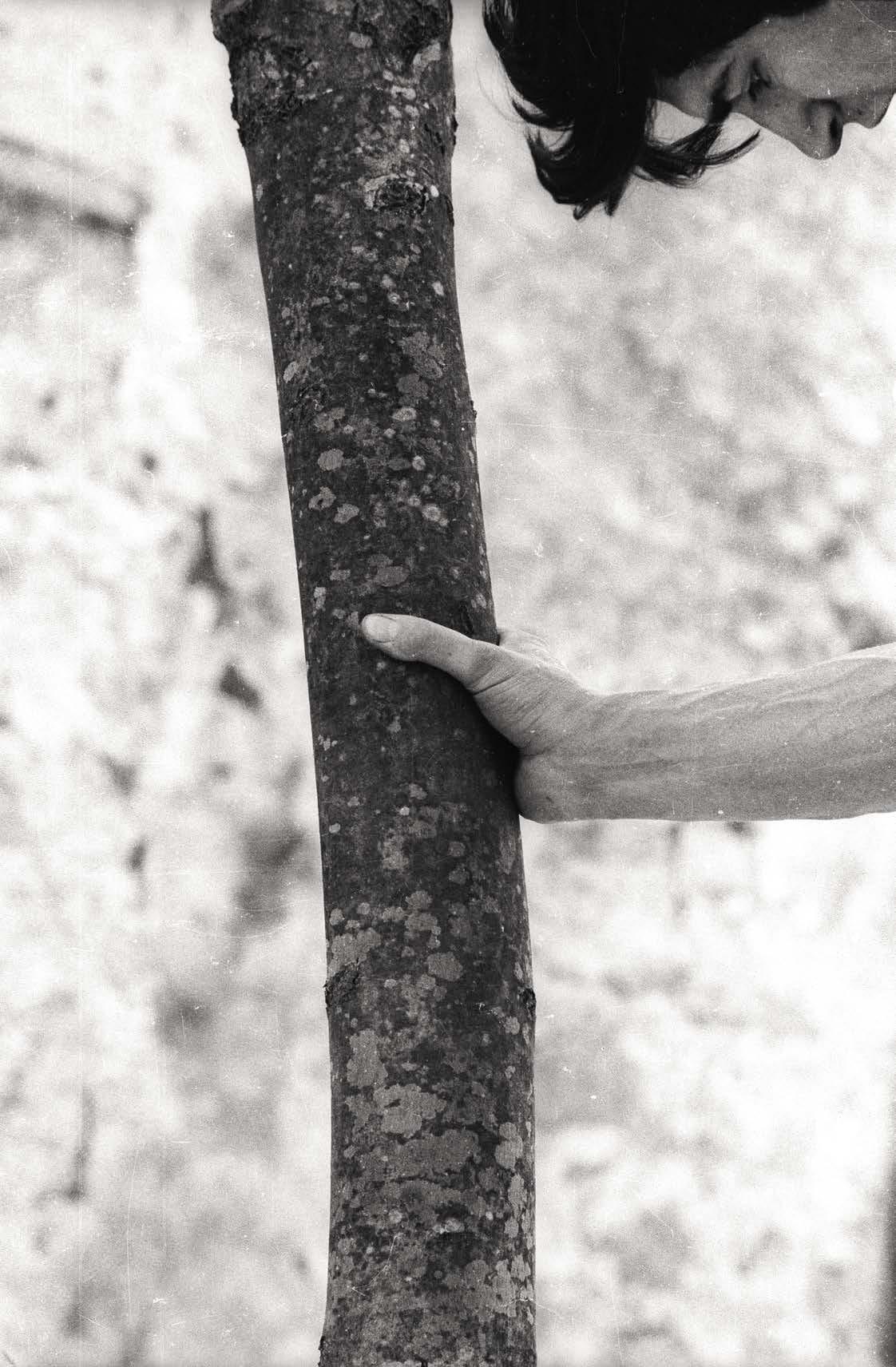
to experiment, he made a hand in iron wire, but was not satisfied with it and finally produced a steel hand that he fixed to the tree. In due course, as the tree grew, it gradually engulfed the hand until, in 1985, it was cut down and joined the collection of the Galleria Civica d’Arte Moderna e Contemporanea di Torino, Turin. 6 All this goes to say that while Penone rejected bronze for Alpi Marittime , it held a fascination for him early on, and that fascination has grown like the tree outside Garessio, engulfing much of his art from the 1980s forward. Commemorating the importance of this earliest encounter with bronze, and his later full-on engagement with the material, is Trattenere 6, 8, 12, 16, 20 anni di crescita (Continuerà a crescere tranne che in quel punto) (To Retain 6, 8, 12, 16, 20 Years of Growth [It Will Continue to Grow except at That Point] ), a reconsideration of that earlier rejection. This touching bronze sculpture literally and figuratively tracks the growth of a tree with a hand around it, in a way that recalls the nineteenth-century motion studies of the photographer Eadweard Muybridge.
Since his first, abandoned engagement with bronze, Penone has gone on to produce dozens upon dozens of bronze sculptures. While a complete account of his nearly fifty-year association with the metal cannot be provided here, a better appreciation of the works in the Gagosian exhibition The Reflection of Bronze demands consideration of his sense of its qualities and potentials. It is further critical to acknowledge that while he is celebrated for his use of and interest in wood, bronze for him is not a more permanent, more marketable substitute for that material. Rather, his use of bronze involves a profound, rich, varied, and lifelong response to enduring artistic questions.
Penone sees bronze as analogous to a living thing such as a plant. For him it reflects the “vegetal gesture of the sculptor.”7 He writes, “Bronze casting is an ancient art which has its roots in an animistic conception of reality. The similarities between bronze and plant-life are astonishing and most assuredly have had great importance in the development of the technique of casting. Even today, rods”—the runners that channel the molten bronze in the casting process—“are used to spread the molten metal in different parts of the mold. Bronze is the ideal material for fossilizing plantlife.”8 When bronze is “born” by casting, the liquid metal pulses through these veinlike rods, enabling the sculpture to grow and develop.
In another analogy, in the lost-wax casting process a skin forms over the “original” model,
which melts during the casting. And as revealed in Penone’s works in wood, the year-by-year growth of a tree involves a skin, the layer added to the trunk each year. Skin is an enduring preoccupation in Penone’s work across media, whether in marble, leather, cloth, paper, or, in the Marsia (Marsyas) installation (2024) in The Reflection of Bronze , for the first time cork. His art is a record of time passing and a reminder that our physical separation from the world is scanty. Moreover, our skin is a means of experiencing and connecting with the world and with others.
As bronze ages, its “skin” changes in color. While metal in contemporary sculpture is commonly seen as antithetical to the natural, for Penone bronze is a living material born from ores of the earth, and the colors that come to life in the patination process are an expression of growth. He has said, “Bronze acquires a color that imitates vegetation very closely. If you put the sculpture outside, it oxidizes in the rain, the sun, and takes on very natural colors, similar to vegetation.”9 When chemicals are applied to give the surface a patina, they don’t form a layer over the material, as the pigments of a painting cover its canvas; rather, the patination emerges through an animate, chemical interaction, the substance physically changes, in what to Penone’s mind is an alchemic process. Oxidation also follows a natural course in the human body, linking object (the sculpture) and subject (the artist); and in considering patination, Penone thinks not only about what the color is but about what it will become.
The Reflection of Bronze focuses on Penone’s most recent encounters with bronze and unfolds in these galleries in three acts.
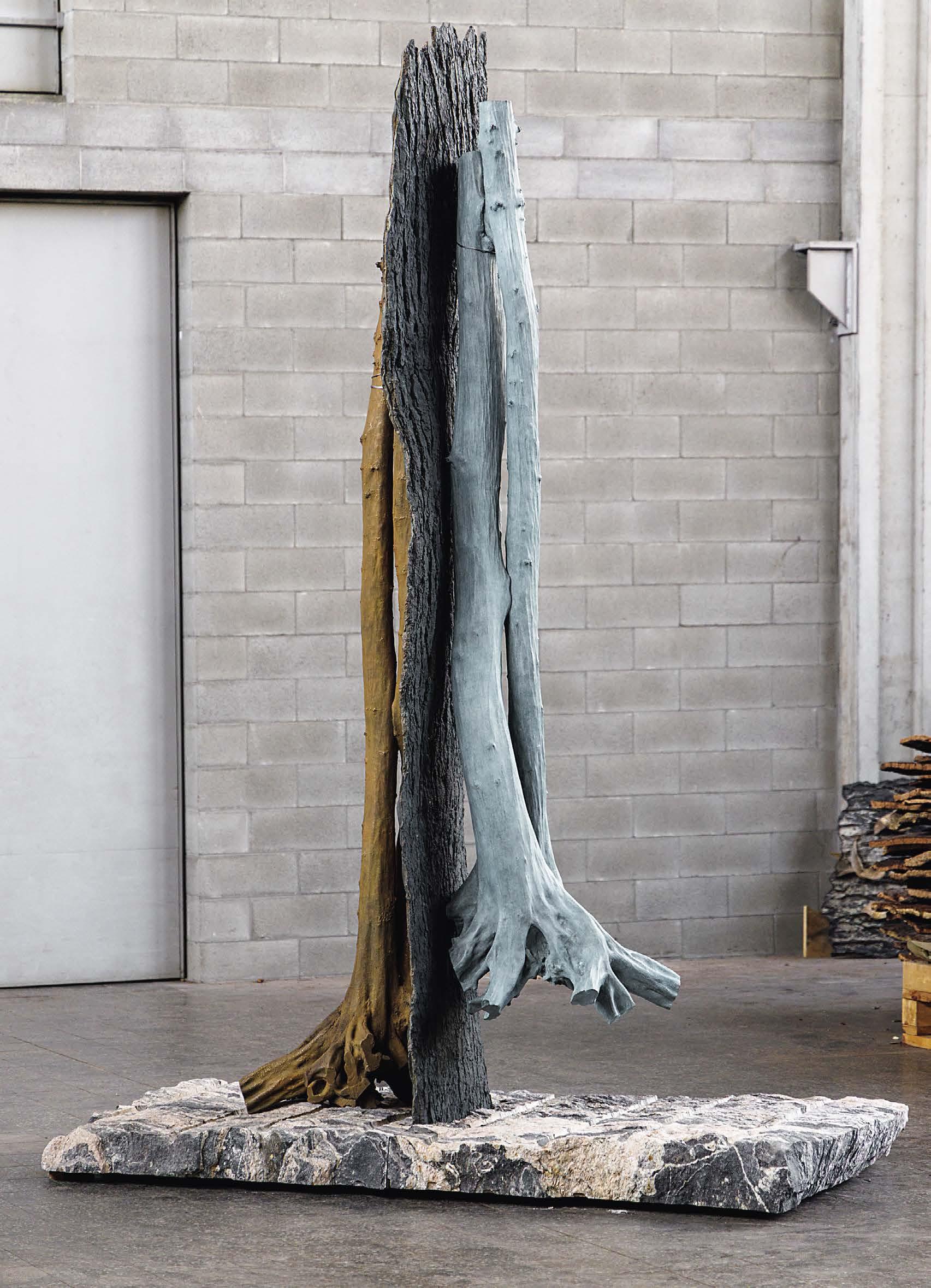
The first room is devoted to the installation Marsia , that title being the Italian name of the satyr Marsyas, protagonist of the well-known, gruesome and graphic Greek myth of competition, hubris, humiliation, and justice. There are various versions of the story: Most broadly, Marsyas, who is recognized for his virtuosity on the aulos, a double reed pipe, dares Apollo, the god of music, to a contest on the instrument; when he loses, his punishment for the audacity of challenging a god is to be flayed alive and have his skin nailed to a pine tree, or, in another version, used as a wine sack. The myth is an enduring subject in art, from the
fifth-century bce bronze by the sculptor Myron, once installed near the Parthenon, now lost, but known through Roman copies in marble, including one in the Louvre, to paintings by artists such as Titian (perhaps the most famous of all) and subsequently Rubens, José de Ribera, Luca Giordano, and others.
Penone loves myths for their expression of the closeness of humans to nature. He has long been fascinated by the myth of Marsyas and the metaphor of flaying, writing on the subject decades ago in his notebooks. 10 In discussing Marsia with him, I learned that a painting of the flaying of Saint Bartholomew has hung in his kitchen for many years.
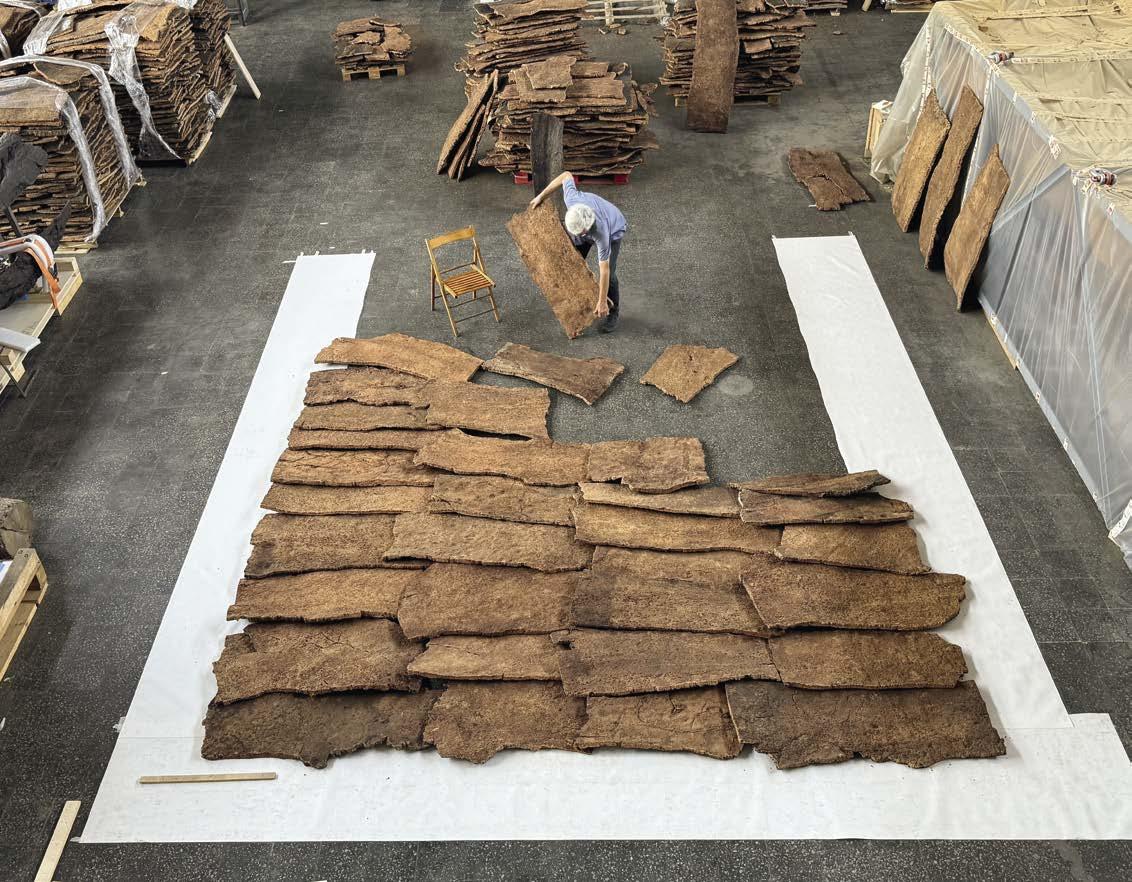
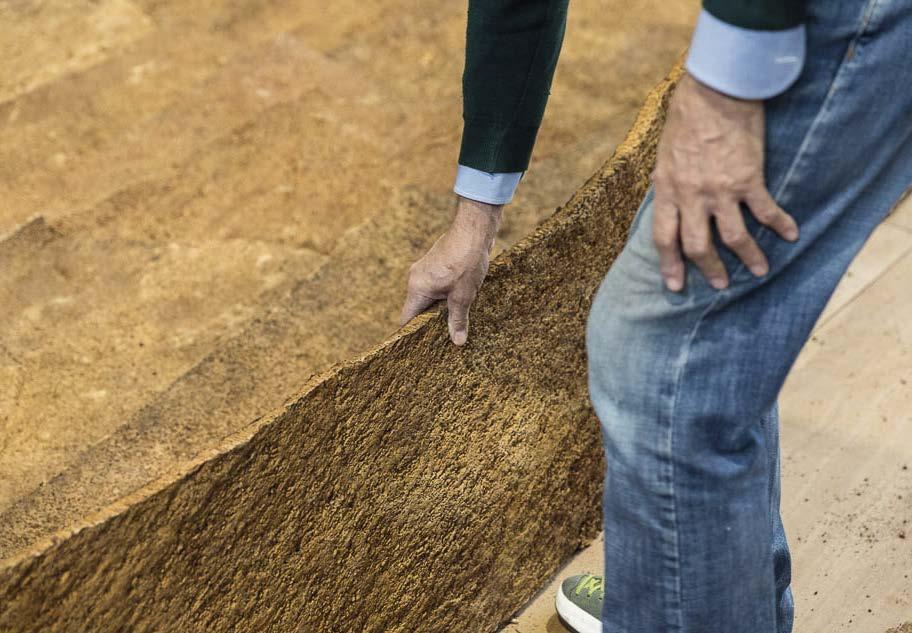
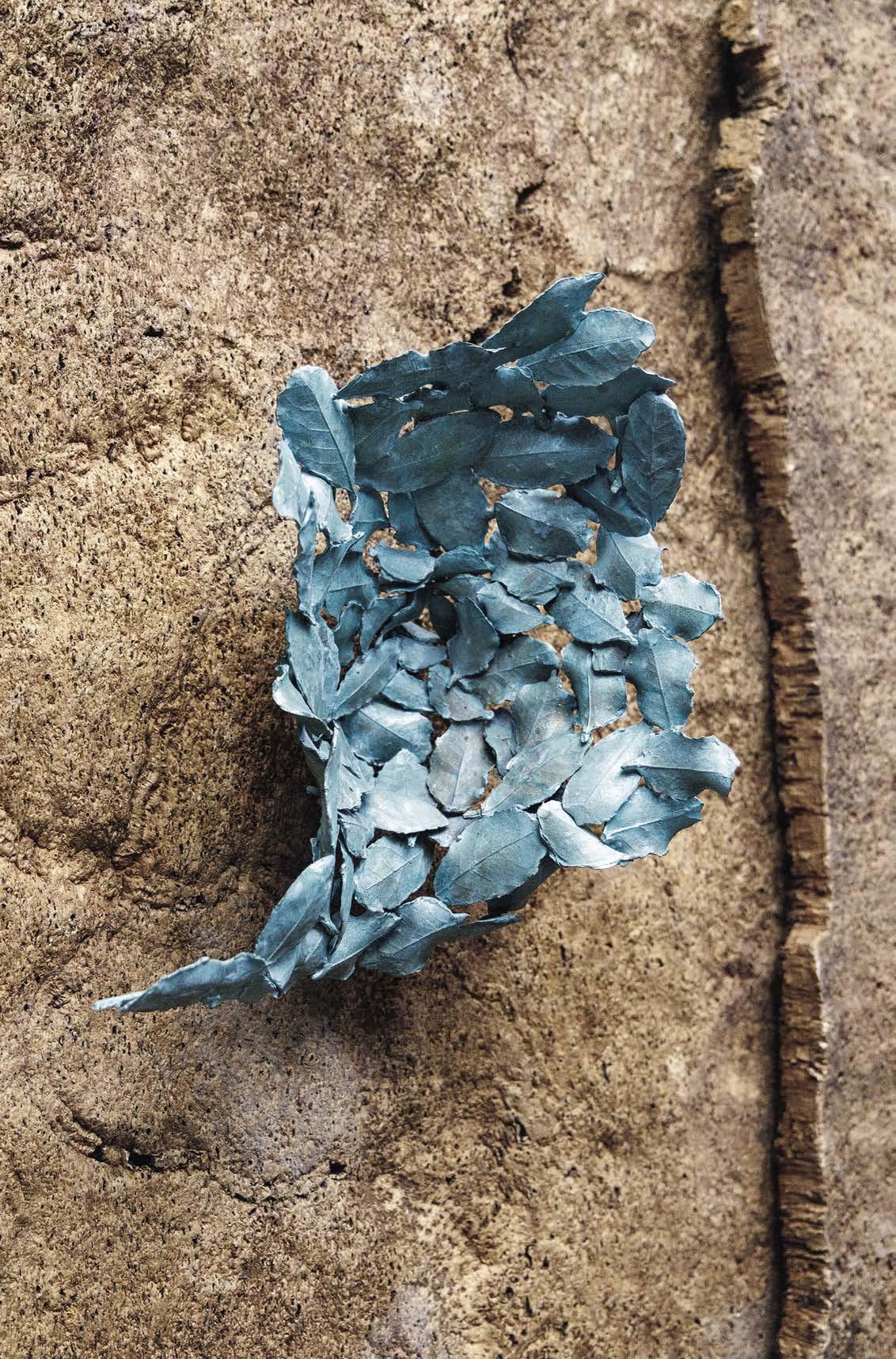
This first gallery in the exhibition comprises several elements: a central sculpture of bronze elements on a granite base; overlapping slabs of raw cork bark that cover the walls virtually floor to ceiling; and, periodically fixed to the bark so as to punctuate the cork-covered walls, pairs of the lower trunks of cast-bronze saplings. Penone has also installed another work here, Pelle di foglie (Skin of Leaves , 2025), a group of abstracted bronze masks cast from acacia leaves, casually interspersed on the cork walls.
The sculpture at the center of this spectacle consists of bronze casts of the same pair of hornbeam saplings, stripped of their bark, given differing patinas, and suspended to either side of a vertical bronze slab cast from a “skin” of bark removed from a mature tree. (The artist chose these saplings as their twisted trunks reminded him of musculature.) One pair of saplings, their patina “natural” brown, rests on the stone base, which is striated with parallel grooves to suggest flowing water. A stainless steel cable connected to the top of this pair straddles the bark slab, which is firmly implanted in the stone, and suspends the other pair of saplings, this pair patinated a luminous teal.
There are infinite readings: Maybe the brown sapling is the tree from which Marsyas, represented by the teal sapling, is helplessly hung? Or do the pairs of trees stand for the competitors in the myth—is Marsia a parable of victor and victim? Or perhaps they suggest Marsyas before his flaying and again after? Balanced around a central fulcrum, might they represent the pair of scales traditionally symbolizing justice? Does the hanging pair of saplings propose an offering to the gods? In any case, the exposed nakedness of the trees, and the midair suspension of one pair, suggest both brutality and pathos.
The cork panels on the walls are themselves the flayed skins of trees that the artist personally selected in Alentejo, Portugal. Enveloping the room, their somber tone and texture heighten the drama at center stage. The smaller pairs of branches hung on the walls, which correlate in color with the saplings in the central sculpture— one of each pair with its bark, the other shorn of it— and the hanging masks serve as witnesses to this tragic event. And we who enter the gallery in effect become passive participants as much as visitors.
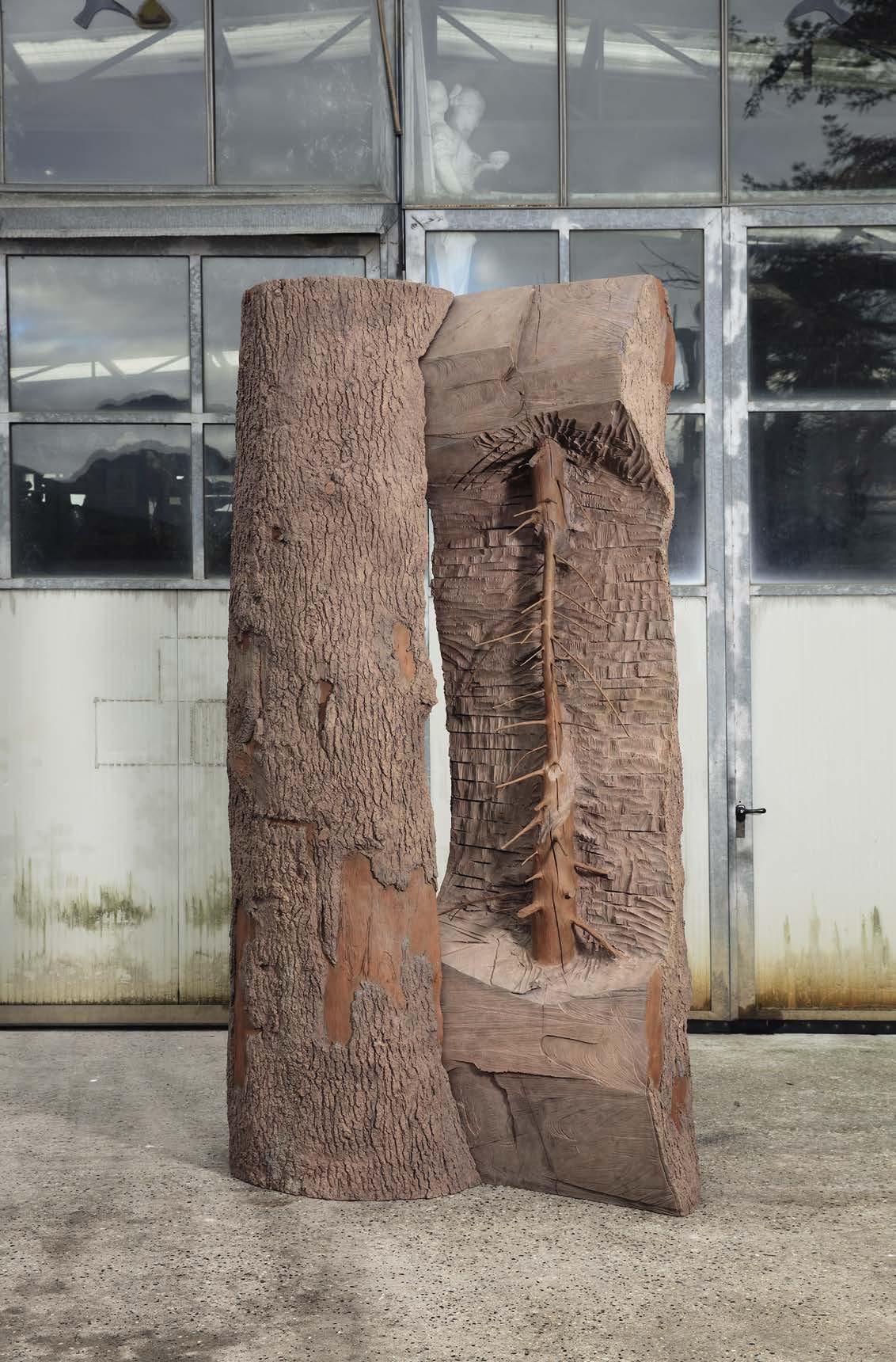
The second and largest of the three galleries contains a group of four bronze trees each titled Clepsydra (Water Clock ), although the artist does not consider them either a sequence or a series— each work is complete unto itself. A clepsydra is an ancient form of clock. The name, deriving from classical Greek, means “water thief”: water was “stolen” as it passed by gravity from a vessel calibrated to track the outflow and so to mark the passage of time. All of Penone’s tree sculptures, no matter the material, are about marking time, and each of the Clepsydra trees is an ode to time’s passage. Like bronze, a water clock harnesses nature by simple technological means—bronze through fire and the clock with water.
All of the four trees, of similar height and girth (roughly ten feet by three), stand vertically and appear in various stages of undress: In each case, areas of wood have been incisively yet intuitively stripped and “stolen” to reveal an inner being. The Clepsydra works—one dating from 2012, three from 2024—recall Michelangelo’s four celebrated, unfinished slave sculptures of c. 1525–30, works of comparable size in which the artist exposed and “freed” the figures from raw blocks of marble. Each Clepsydra serves as a time machine, returning us to origins through contemplation of interiority. Though made of enduring bronze, the works appear mutable; they are not monuments, not destinations, but way stations in a revelatory process, tokens of discovery. Indeed, each marks a transition from corporeal existence to spirit. For Penone, bronze is not just a testimonial object but part of a living quest for continuity: “I am aware that the deep reason behind any human activity is the survival instinct which is present in our body cells, governs our reproduction instinct, and, through the affirmation of our identity in the world, projects
our existence in the future, making it present with the people who will come. Our existence in the future it’s [sic ] the aim, the scope and the necessity of the work. Bronze is a material which guarantees this existence.”11
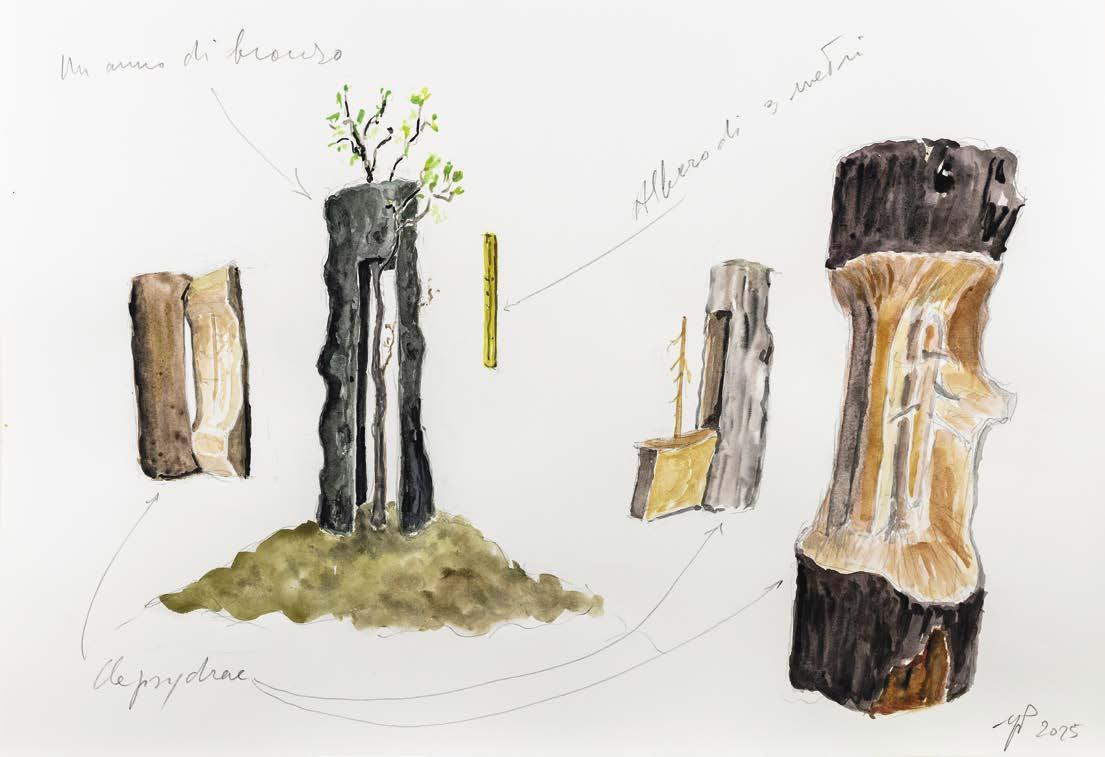
The centerpiece of this room, Un anno di bronzo – Larice ( A Year of Bronze – Larch , 2024), resembles its cousins the Clepsydra in scale and concept but was conceived differently. In this work Penone has hollowed out an enormous larch, creating inside it a magical void. We viewers can visually inhabit this interior space, exquisitely rendered through the artist’s manipulation of the casting process to show his sensuous, personal mark-making. The inside of this massive bronze appears like an enormous molten skin and hosts a living sapling that proposes cyclical rebirth.
The tall, lean Albero di 3 metri (3-Meter Tree , 1995)—the only wood sculpture in the exhibition—is positioned poignantly on the sidelines in this room, like a talisman of lost youth. And the Trattenere begun in 2004, a bronze restatement of his 1968 Alpi Marittime , is displayed in the shadows of this gallery, a historical bridge between Albero di 3 metri and the four Clepsydra
The final act reads as a reflection of both the artist and the viewer, and also constitutes a reflection on the materiality of bronze. This gallery, the smallest of the three, holds a single work, Riflesso del bronzo (The Reflection of Bronze) of 2005, which comprises seven bronze wall panels, each about four feet by two feet six inches—the size of a halflength portrait canvas. The first in the series (reading from right to left in the exhibition) is flawlessly smooth and polished to a highly reflective sheen. The second—cast from the first, using the lost-wax process—captures the artist’s application of wax on the surface of the first, and the casting process has degraded the reflectiveness of the first somewhat, obscuring the viewer’s selfimage. With each subsequent panel, each cast from the one before it, the surface becomes progressively more encrusted, like a scabrous skin, and the shape of the rectangle becomes more
bowed and deformed.
Riflesso del bronzo constitutes a precise essay on bronze—its characteristics, its uses, its history. The sculpture is closer to Minimalism and Conceptual art than the other works in the exhibition but recapitulates the fundamental questions they pose using multiple materials and subjective and narrative associations. Yet these reliefs more pointedly call attention to process and product. Not merely a series of rectangles, Riflesso del bronzo addresses metamorphosis, what happens in the pause, the conceptual space between nature and culture, art and artifact, history and the present, life, death, and regeneration. It is not about material but about existence. As Penone asserts, “All my work is basically a reflection on sculpture, understood not as a choice of material or materials and then an elaboration of forms but as an attempt to understand reality.”12
1. Giuseppe Penone, in Carlos Basualdo, “A Conversation with Giuseppe Penone,” in Basualdo, ed., Giuseppe Penone, The Inner Life of Forms (New York: Gagosian, 2018), 20.
2. Germano Celant, “Arte Povera. Appunti per una guerriglia,” Flash Art, no. 5 (November 1967). This translation from Flash Art ’s reprint of the essay, “In Memory of Germano Celant: Arte povera. Notes on a Guerrilla War,” April 29, 2020, available online at https://flash---art.com/article/germano-celant-artepovera-notes-on-a-guerrilla-war/ (accessed December 3, 2025).
3. Penone, in Basualdo, “A Conversation,” 21.
4. Penone, “I. Maritime Alps,” in Basualdo, ed., The Inner Life , n.p.
5. Penone, in Benjamin H. D. Buchloh, “Interview with Giuseppe Penone,” in Laurent Busine, ed., Giuseppe Penone (Brussels: Mercatorfonds, 2012), 20.
6. The wire hand appears in a set of photographs reproduced in Celant, Art Povera (New York and Washington: Praeger, 1969), 169.
7. Penone, “The Reality of the Tree as Form,” 1980. Archivio Penone. Available online at https://giuseppepenone.com/en/ words/vegetal-gestures (accessed November 23, 2025).
8. Penone, untitled text, 1980, repr. in Ida Gianelli, Sculture di Linfa. 52. Esposizione Internationale d’Arte, la Biennale di Venezia exh. cat. (Milan: Electa, 2007), 230–31.
9. Penone, in Buchloh, “Interview with Giuseppe Penone,” 20. 10. See Salvatore Settis, “Sculpting Time,” in Basualdo, ed., The Inner Life , 152.
11. Penone, email to the author, July 20, 2025.
12. Penone, in Basualdo, “A Conversation,” 37.
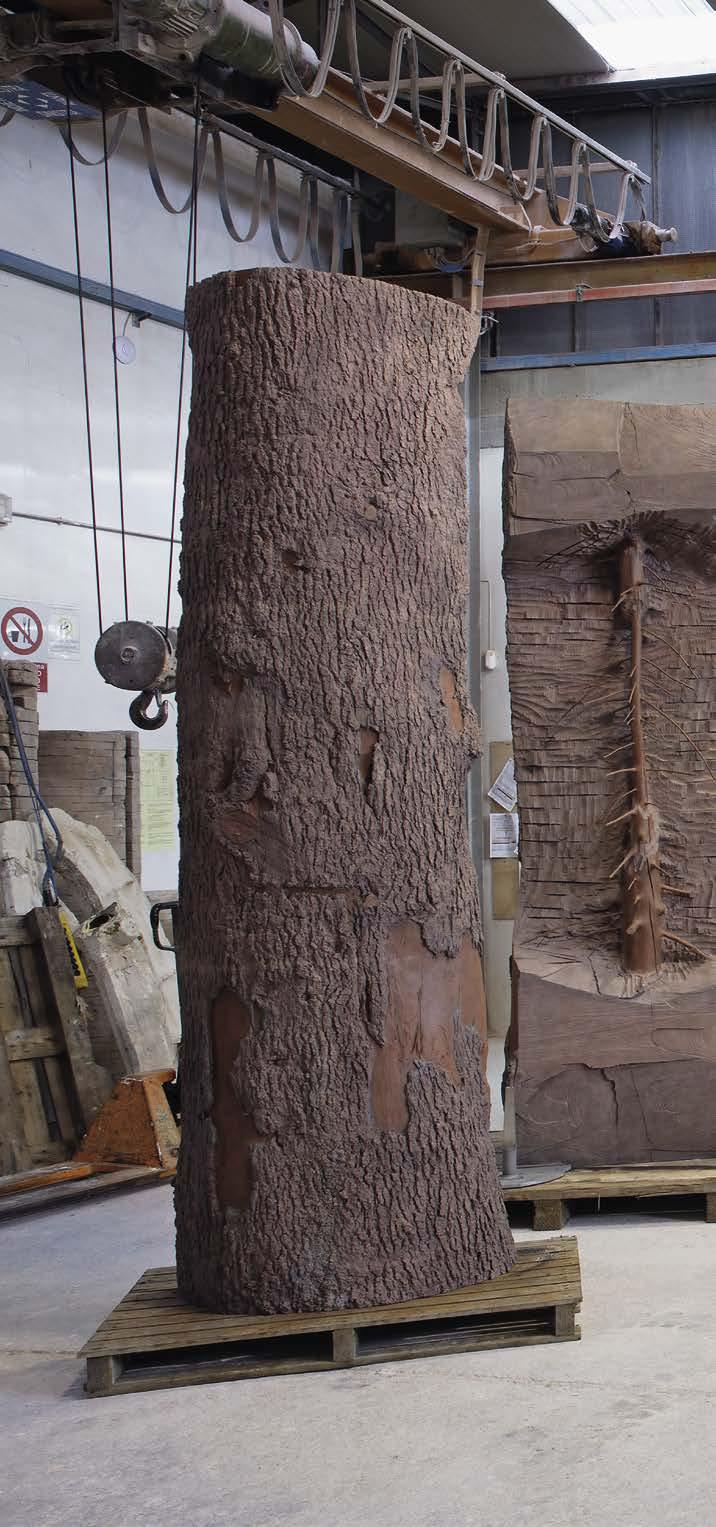
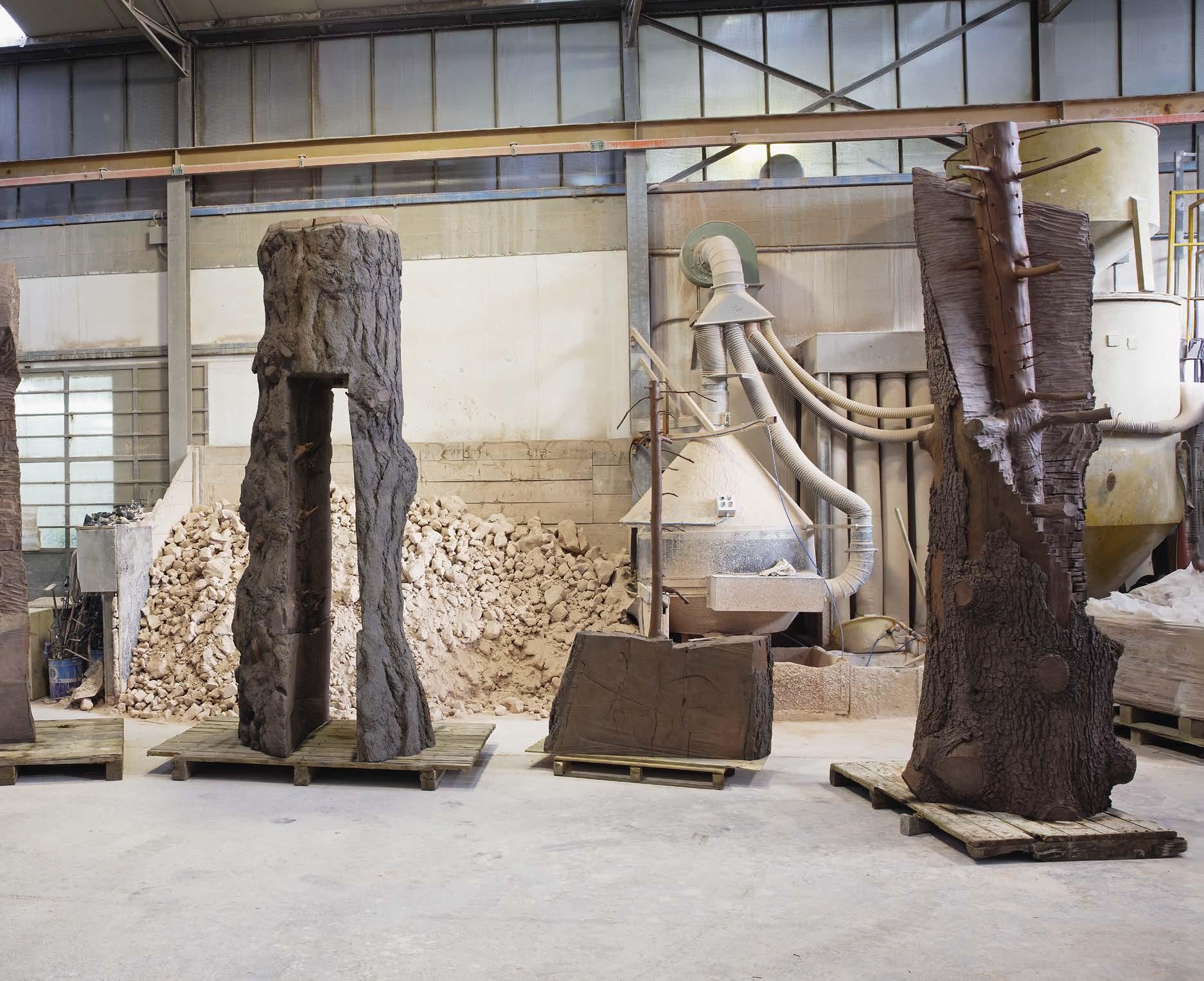
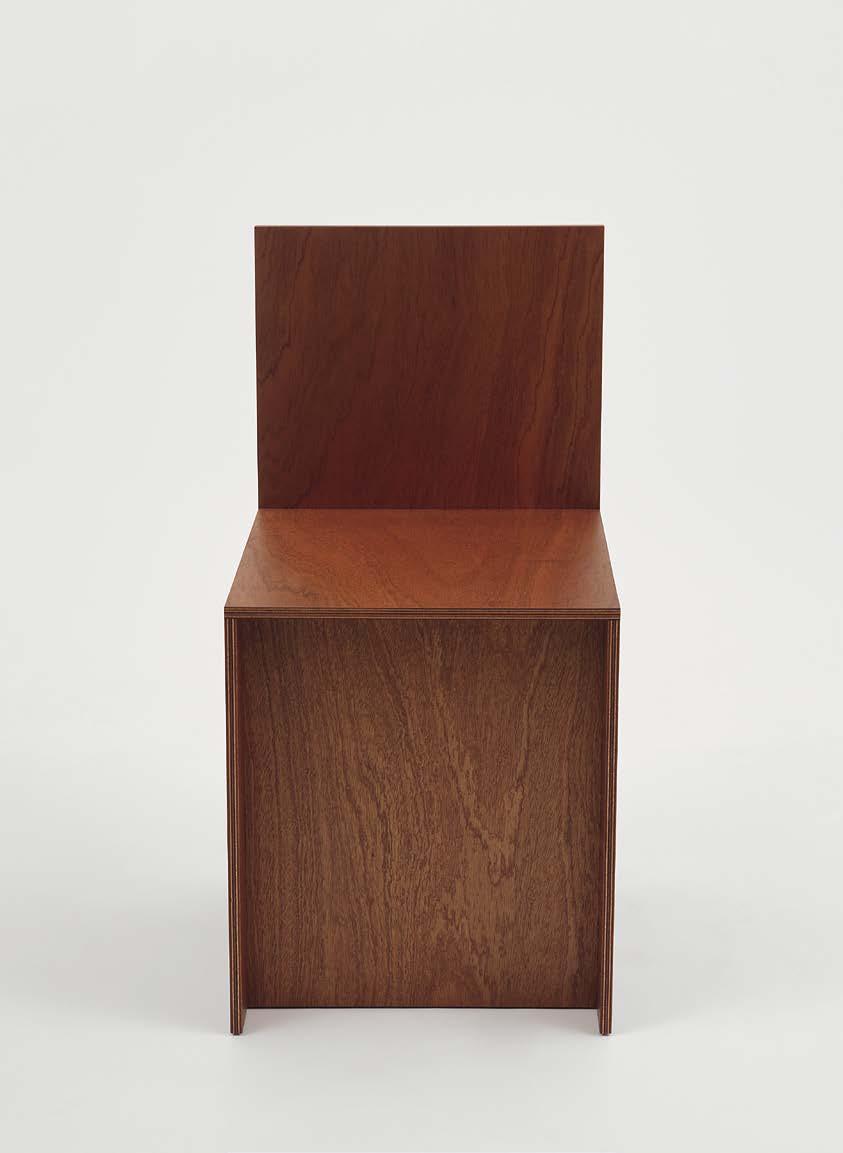

From their respective fields, three international cultural figures—artist and designer Ronan Bouroullec, fashion visionary Michèle Lamy, and chef and restaurateur Enrique Olvera—reflect on Donald Judd’s work in furniture, the subject of recent exhibitions in South Korea and Japan.
Each piece has a clarity of purpose, a purity of line, and an attention to material that feels almost sacred. Sitting in or around his work, you sense the quiet rigor—the way proportions, space, and weight converse with each other. There is no artifice, no attempt to impress, yet it impresses nonetheless, not by grand gestures but by integrity. Judd’s furniture invites presence: to notice, to inhabit, and to respect the space it occupies. For me, as a chef, there is a resonance here with the act of creation—where every element, every ingredient, and every gesture exists in harmony, and where simplicity, when true, is profoundly generous.


More than thirty years ago, when I was in my twenties, I stole a book from a bookshop. I remember this vividly because it was probably the only thing I’ve ever shoplifted. The book was Donald Judd: Räume Spaces (1994), published by Hatje Cantz. At the time I knew nothing about Judd, or Marfa, or Spring Street; I was simply magnetized by the cover image. The book is a repertoire of places, objects, artworks, installations. I think I know every square millimeter of it: the way the baseboards are finished, the pencils on the worktables, the faucet that feeds the bathtub, the quality of the concrete in the outdoor pieces. It’s a world of absolute coherence: the synthetic force of the anodization of the sculptures, the sensual sheen of the paints coating the steel, the roughness of a Mexican rug, a Thonet chair, military-issue cutlery, a horseshoe, Gerrit Rietveld, Dan Flavin, an anonymous piece of Sicilian pottery, a lamp clamped to the edge of a bed in the New York apartment building. For me Judd remains one of the most important references—for his work, of course, but just as much for the richness of the environment that he patiently constructed.
In the early 1970s, Judd began designing furniture for his home at 101 Spring Street in New York. His first design was a wooden bed. As Gilles Deleuze wrote, “The act of creation is an act of resistance, defying the forces that seek to control and define society.” In 1990 Rick Owens Furniture built our Army blanquette bed . . . happy to have followed the master.

Opposite: Donald Judd, Desk 33 in Clear Birch Plywood, designed in 1982 (detail), 30 × 48 × 33 inches (76 × 122 × 84 cm)
This page, from top: Donald Judd, Metal Corner Chair 115 in Copper, designed in 1984, 29 ½ × 19 ¾ × 19 ¾ inches (75 × 50 × 50 cm)
Donald Judd, Single Daybed 32 in Cypress, designed in 1982, 44 × 80 × 45 ½ inches (112 × 203 × 115 cm)
Donald Judd, Desk 33 in Clear Birch Plywood, designed in 1982, 30 × 48 × 33 inches (76 × 122 × 84 cm)
Donald Judd Furniture © Judd Foundation
Photos: Timothy Doyon © Judd Foundation

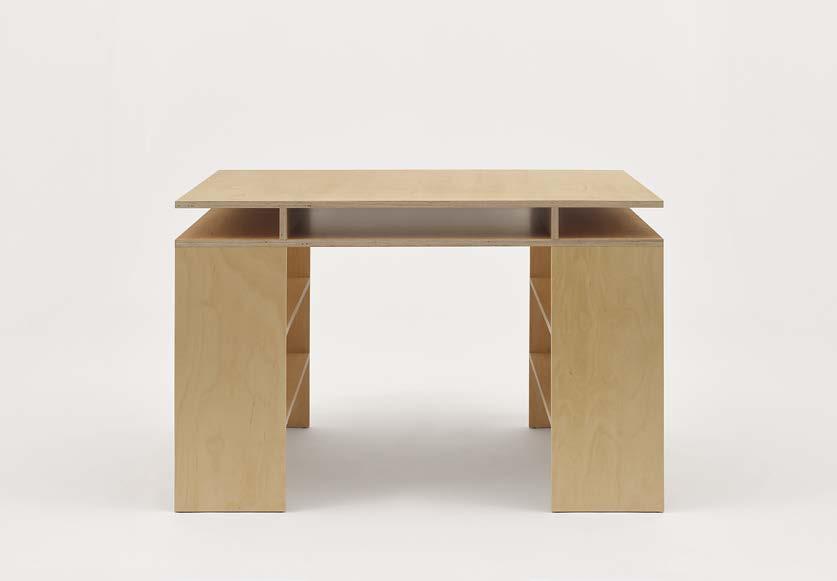
Daniel Roseberry, the creative director of Schiaparelli, met with the Quarterly ’s Derek C. Blasberg at the maison ’s historic headquarters at 21 place Vendôme, Paris, following the Schiaparelli Fall/Winter 2026–27 ready-to-wear show. Since taking the helm in 2019, Roseberry has been credited with advancing the heritage of the house through unpredictable sculptural designs that carry Elsa Schiaparelli’s Surrealist spirit into a new century. The pair discuss the much-anticipated exhibition Schiaparelli: Fashion Becomes Art , now on view at the Victoria & Albert Museum, London, as well as Roseberry’s early exposures to art, his continued dedication to drawing, and the enduring legacy of Elsa Schiaparelli’s daring vision.

Derek C. Blasberg I reread the show notes from your Spring 2026 collection, which were incredibly articulate about how you interpret the relationship between fashion and art. That’s the whole concept of this series, and I admired how you didn’t shy away from the comparison.
Daniel Roseberry Not here. You can’t. It’s so intrinsic to the DNA of this brand. Refresh my memory, what did they say?
DCB For the collection, you were thinking about the concept of art that you can live in, about fashion as a form of expression.
DR Oh yes.
DCB Let’s start at the beginning. As a young boy, were you an arty kid?
DR Completely. Fashion didn’t even enter the chat until I was like thirteen, fourteen, maybe even fifteen. My dad’s side of the family brought the church into the conversation, but my mom, my grandma, and two of my uncles are all artists. Actually my dad’s mom was an artist too. I grew up in a home filled with art, much of it created by the family.
DCB What kind? Oil on canvas? Watercolor?
DR My grandmother on my dad’s side was a sculptor who created pieces for state parks and libraries in Arizona, as well as amazing life-size bronze portraiture. My mom’s mom was a photorealistic watercolor artist based in Bellport[, Long Island]. She became a teacher at Brookhaven and studied with Martha Graham. My uncle is now a world-class ceramist on Long Island.
DCB I didn’t know about any of this, Daniel. I grew up in Missouri, and when I imagined your childhood in Texas, I thought the experience was nearer to mine—I knew you grew up in a religious family, struggled with gay identity, and found freedom when you came to New York. I can relate to all of that, but when I was growing up, I didn’t know a single person who supported themselves financially through creativity or art. You were surrounded by that.
DR What’s interesting, in my case, is the intense frisson between those two worlds. The world of “Art is God-given, art is your destiny, art is to be a good steward of what God has given you and to use your art to transcend.” And then the unspoken deal was implicit celibacy in exchange for God’s gifting you. That’s the way it was discreetly framed when I was growing up. I often felt like, “God’s given you so many gifts, Daniel, but the exchange is that this other part of you, your true self on a sexuality level, had to be sort of abandoned or given back to God.”
DCB That’s a heavy deal.
DR Yes, it was. And it was haunting for decades. Walking away from that deal was probably the hardest thing I’ve ever had to do.
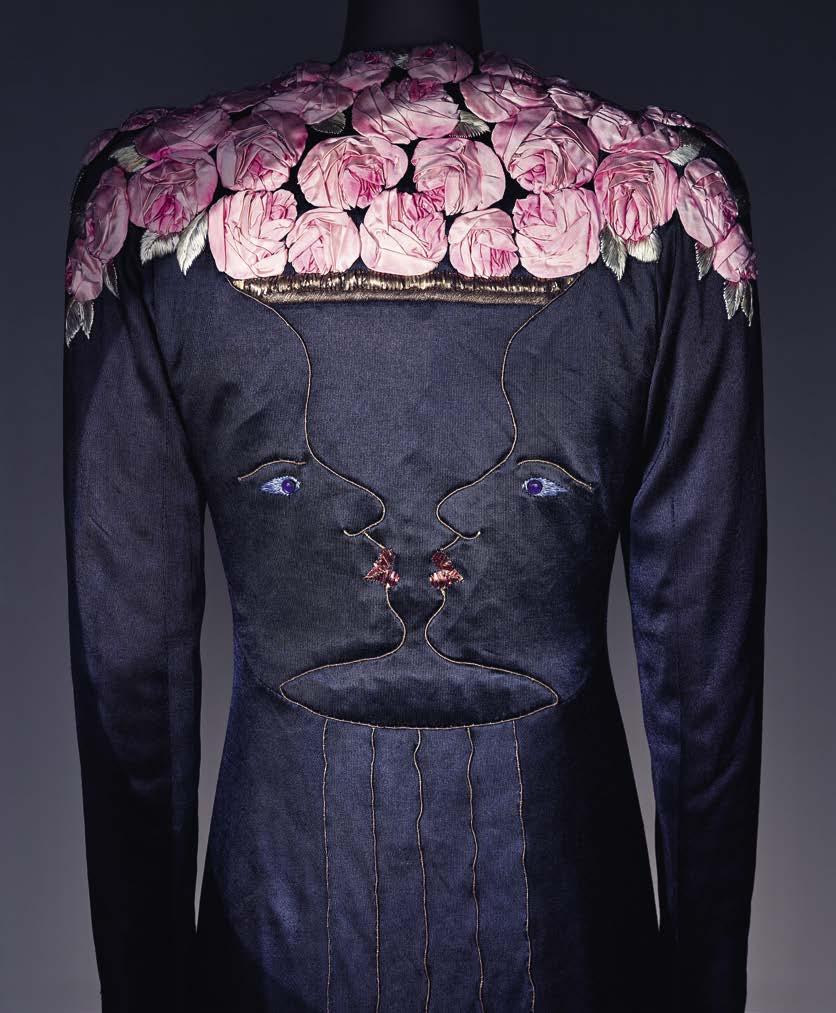
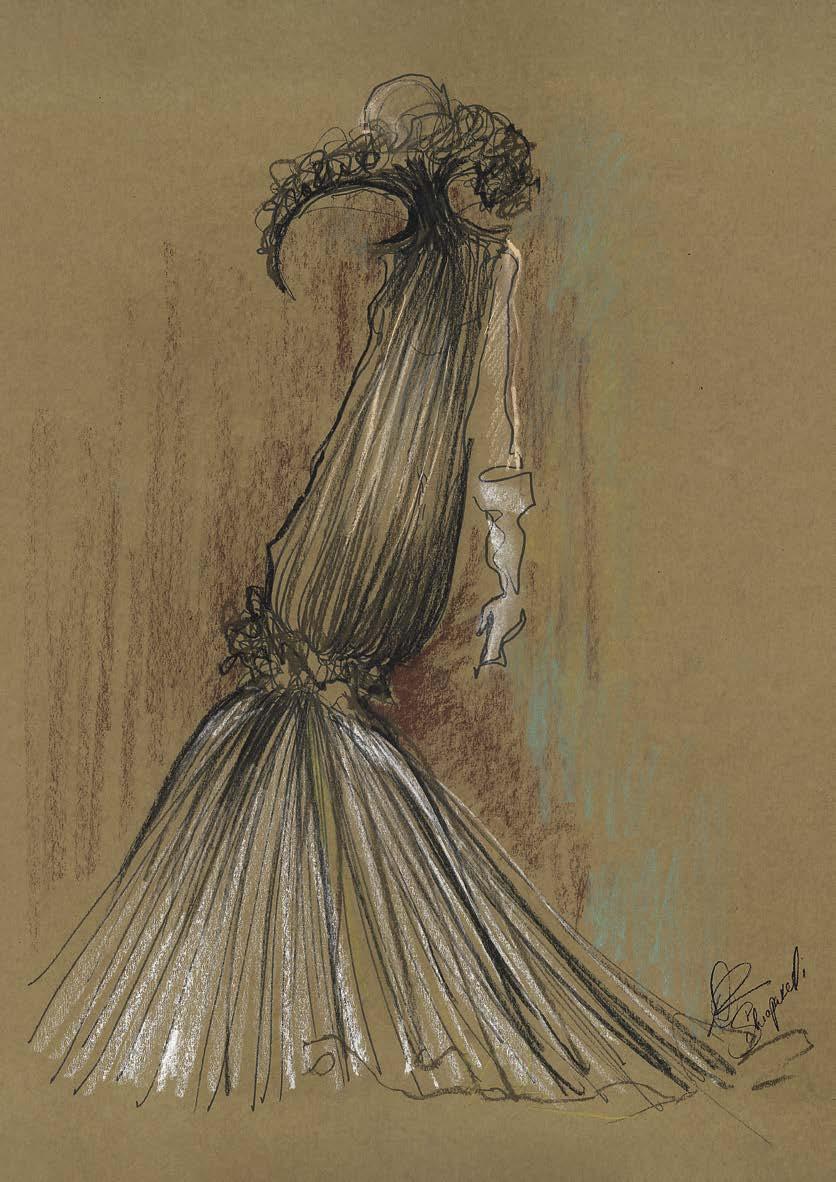
DCB Did you even consider the deal?
DR Absolutely. I almost went into the seminary to be a minister! I went to a seminary in Pennsylvania, I interviewed with the dean, and he took one look at me and—thank God, literally—he said, “You have to go to New York. [Entering this seminary] is not going to work. And you have to chase your dreams.” I’d been a missionary overseas for a year. I was on a track to join the Baptist church, and he was the one who permitted me to change my course. I was having a sort of slow-motion crisis at the time, which he could probably tell. And in this entire process, art had been a part of the ride.
DCB Then you came to New York, and then you discovered fashion.
DR The eureka moment was watching a Style.com documentary on a Michael Kors show.
DCB With Tim Blanks?
DR Yes, a doc on one of Kors’s collections. I still remember every bit of it. It was a biography—growing up on Long Island, the influence of his mother, going to Parsons, doing windows, getting scouted. I felt like, “Okay, this could be me. I can see myself in this.” That’s when my art changed course. Before, I wanted to be a Disney animator, but in that moment it shifted to fashion.
DCB Were you aware that art was playing a part in your life? Not to sound trite, but was it changing you, or rerouting you?
DR It’s always been a little bit of the agony and the ecstasy. It’s been intrinsic to who I am—I was drawing before I could talk. But there were also the moments when it was so commingled with something more complex, and the religion and the church. I’m so grateful to be out of that dialogue.
DCB In the show notes from the Fall/Winter 2026–27 collection you presented last night, you spoke a lot about Elsa as an artist, and about her collaborations with art and artists. For me, the most famous version of that was when she created the lobster dress in partnership with Salvador Dalí [in 1937]. Is that kind of commingling or art-fashion exchange a big part of your process, or how you work currently?
DR It’s amusing to think about, because when I started here, the first question I was asked, which no one asks me anymore, was, “When’s the first collaboration going to be with an artist?”
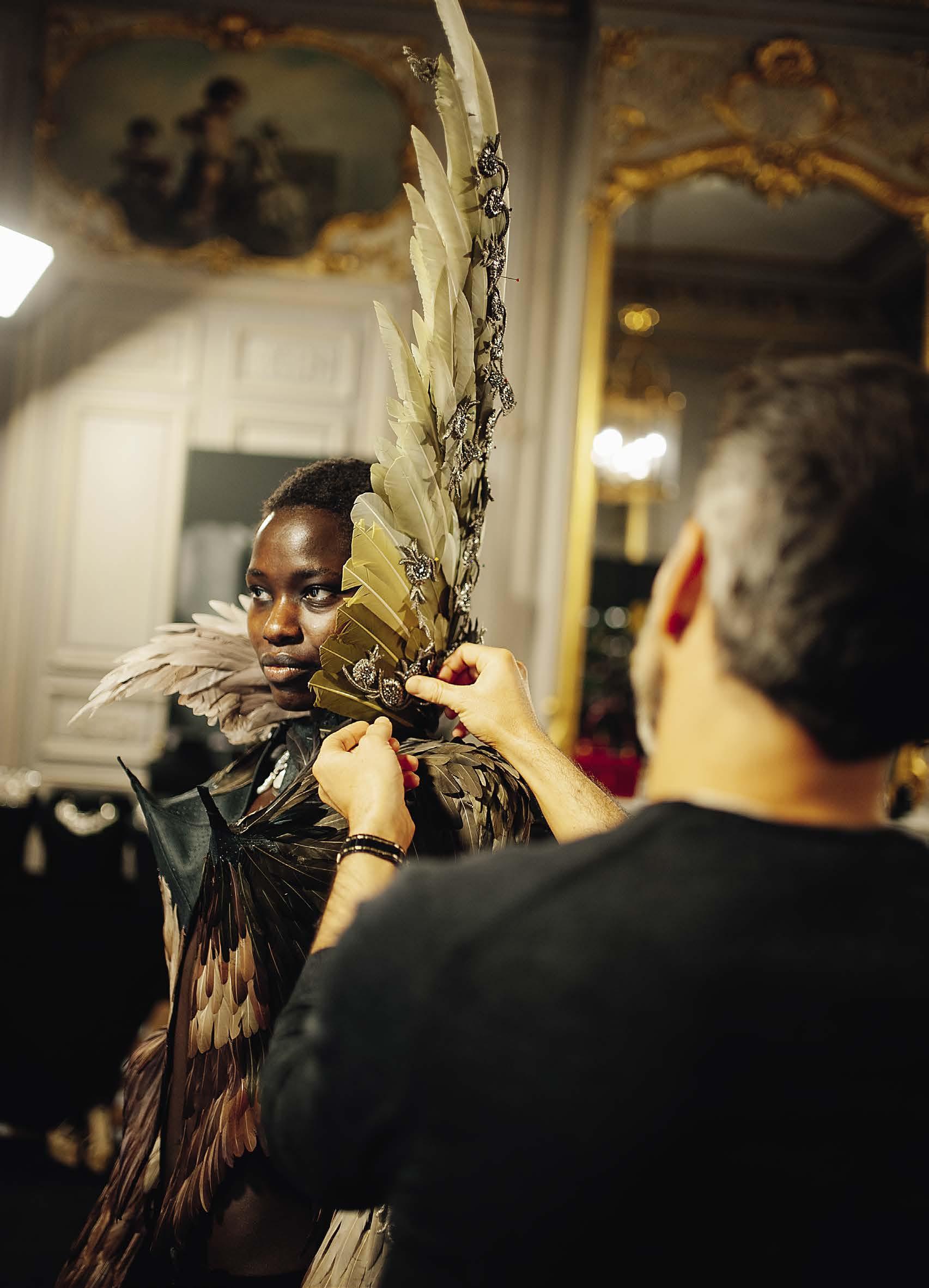
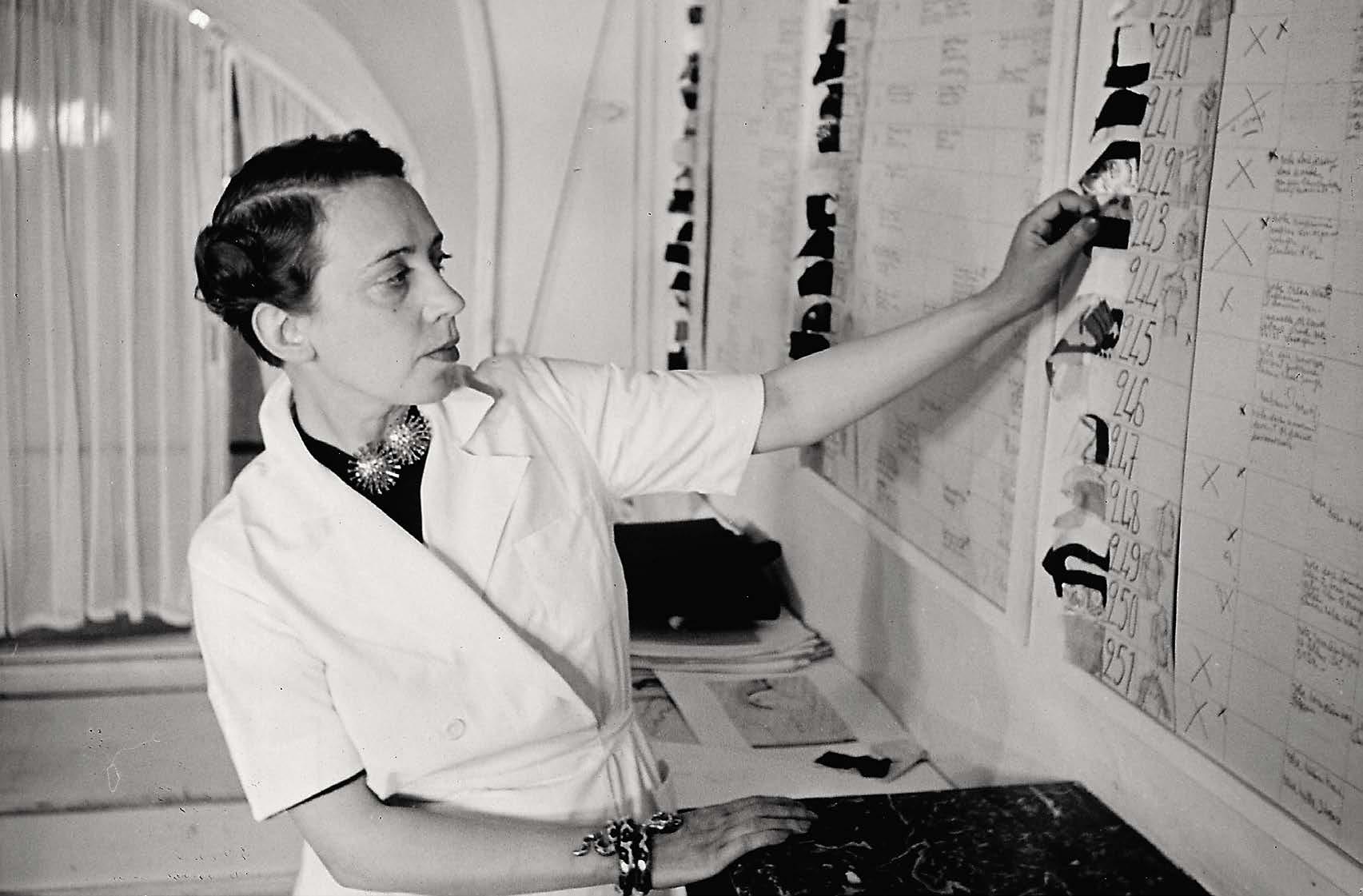
DCB Really?
DR That’s what people wanted to know. Who’s the Schiaparelli woman and when’s the first artist collaboration? I really didn’t like either question. I feel like my medium, if we’re being generous, is the idea that the collaboration is more with pop culture than with contemporary fine artists. What I spend so much time with is music.
DCB Fabulous soundtrack last night. Fantastic.
DR Thank you! That’s such a labor, it’s such an offering to you in the audience, because it’s done explicitly with you in mind. Last season we did David Bowie into Lauryn Hill into Aaliyah, and Bowie narrating Peter and the Wolf Someone came up to me at the end of the show—it was Kylie Jenner—and she said, “I could have stayed in that room all night. I didn’t want it to end.” That’s the highest compliment.
DCB You’ve said that you allow yourself to think that your haute couture collections flirt with the idea of art. One question we ask in all these interviews is, “Do you think fashion can be art, do you think art can be fashion?”
DR There’s this obsession with fashion not being able to be called art, which I think is interesting. In 2022, the Pompidou here in Paris launched a project in which they placed pieces from the Yves Saint Laurent archive among works in the permanent collections of five of France’s most prestigious museums.
DCB I remember that—they put three of YSL’s Mondrian dresses in front of [Piet] Mondrian works, for example.
DR Yes, that one. I spoke to a director at the Pompidou and they told me that museum attendance went up 40 percent. That gave me goosebumps because I understood that the art industry can betray the concept of art a lot, and maybe it even loves to do that, but to say that fashion can’t be art is absurd when you think about the way other artists create their things. Absurd! So, a banana taped on the wall versus a hand-painted jacket with molded-resin beaks? I’m like, “Really? Is this the conversation?”
DCB Which one is not art?
DR Both are! For me, that’s the thing, the both/and. Often I feel that it’s old-fashioned to think that way.
DCB In January the artist Titus Kaphar was opening a show at the Gagosian here in Paris, and your office kindly allowed me to bring him as a guest to your Spring 2026 Couture show the same week. It was incredible to experience everything through his eyes. For example, feathers were a huge part of that collection, and when I see feathers, my mind goes to—will other
designers do feathers? Is this a trend? What kind of feathers are these? I wonder are the feathers exotic, and would it be hard to travel with them? But when we were leaving the show, he turned to me and said, “I loved the feathers. They reminded me of paintbrush strokes.” And it sort of blew my mind. It gave me a whole other perspective on feathers as a material and the garment as a work of art.
DR With everything at Schiaparelli, it’s an unending “A rose is a rose is a rose” kind of invitation to make everything touched by art, to make everything artistic. Whether it’s the heel of a boot in a ready-to-wear collection that looks like a [Claude] Lalanne claw or a feather jacket that will cost six figures at a couture show, there’s a desire, a calling, for us to bring art into the conversation. I was thinking about it this morning: The fact that this house was shuttered after the war meant that there were decades of contamination we didn’t go through, and that Schiaparelli is so pure. Creating here, you still feel like these are museum-bound pieces, the way you see Schiaparelli in an archive at the Metropolitan Museum of Art or whatever.
DCB The concept of fashion as commerce is more removed here than at other brands.
DR Yes. Once you become an eight-, twelve-, eighteen-billion dollar brand, you are by nature putting out an amount of product that has no business in a museum; of course this is a business, and we want to be successful. But I’m also happy to work in a way that keeps it special.
DCB My first introduction to your work was through an artistic lens: We met when you were still working for Thom Browne, but you started your career here during covid, and one of the first things you did was release a video of yourself sketching and drawing in Washington Square Park, shot during lockdown.
DR Oh yes.
DCB Do you still draw and sketch often? Is that still your process?
DR Every day. Every day.
DCB When did you start drawing?
DR According to family legend, when I was nine months old I drew a football. This was before I could talk! I’m told I’d taken a pen out of my dad’s chest pocket, they put me down, and I drew a football.
DCB It was a purse! They only thought it was a football.
DR Yeah, it was an envelope clutch. Ha! I’ve been drawing all the time, and my mom taught me how to draw. And what’s really cool is that my first job was making art for a children’s psychiatrist’s waiting room. The psychiatrist was a member of the church, and he saw my drawings and said, “Please
make art for my waiting room that the kids can look at while they’re waiting to come in and see me.”
DCB What did you draw?
DR I did so many things. I did portraits of big cats, leopards, and lions, and there was a portrait of Audrey Hepburn too.
DCB Your first commission.
DR The first! And I’m still doing it. I’m probably one of the last designers who really draws to design and hands off sketches to be executed. Every couture dress we design, including red-carpet ones, comes from me.
DCB Do you give the sketches to the celebrities who wear the dresses?
DR I will, yeah.
DCB I love that. Of course, Karl Lagerfeld used to send sketches. I remember once going into Chloë Sevigny’s closet, and she had framed sketches from when Alber Elbaz was the designer at Yves Saint Laurent, including the dress he designed for her at the Oscars when she was nominated for Boys Don’t Cry [1999]. It’s so cool to see the sketches because there’s a link to the art and also hand-drawn craft.
DR Totally!
DCB The obvious transition here is the Schiaparelli show at the Victoria & Albert in London, which is up now.
DR The V&A is meant to ask the question, “Can fashion be art, can art be fashion?” But it is also declarative, in the sense that it says Elsa Schiaparelli was the first to really ask the question.
DCB That’s interesting. When this topic of fashion and art comes up, I normally begin with the Ballets Russes inviting Coco Chanel and Pablo Picasso to create costumes and sets, beginning in 1916. But to your point, Picasso didn’t design a Chanel. They worked together, but not to create a collection.
DR That was costumes and sets.
DCB So Elsa was the first.
DR It’s true. And her collaborations were complex designs—her lobster dress was the first time a dress was not just a dress. The dress was messaging something completely at odds with what a dress is about. Same with the Skeleton Dress and her other art-as-fashion creations. Everyone who came after that—I’m talking about Rei Kawakubo, Martin Margiela, Yves
Opposite: Elsa Schiaparelli, Paris, 1938. Photo: Time Life Pictures/Getty Images
This page, right: Schiaparelli Ready-to-Wear Fall/Winter 2026–27. Photo: Kuba Dabrowski
This page, below: Skeleton Dress, designed by Elsa Schiaparelli and Salvador Dalí, 1938, V&A © 2025 Salvador Dalí, DACS. Photo: © Emil Larsson
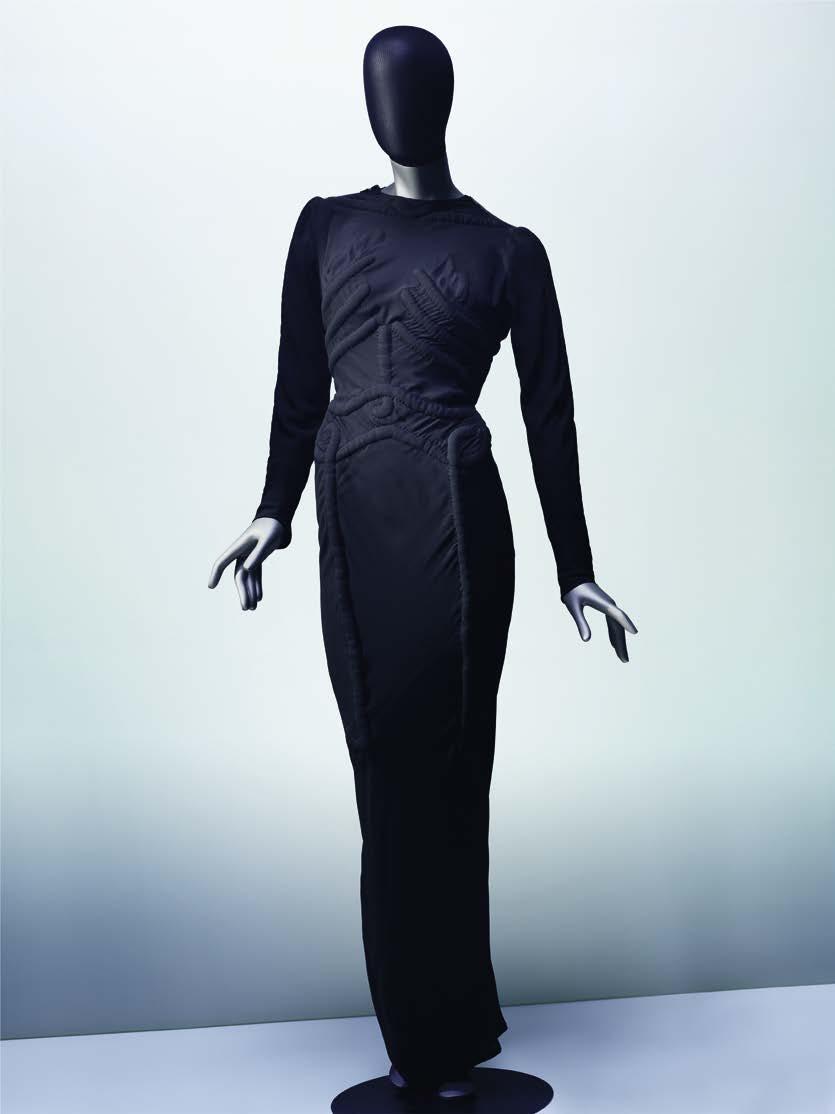
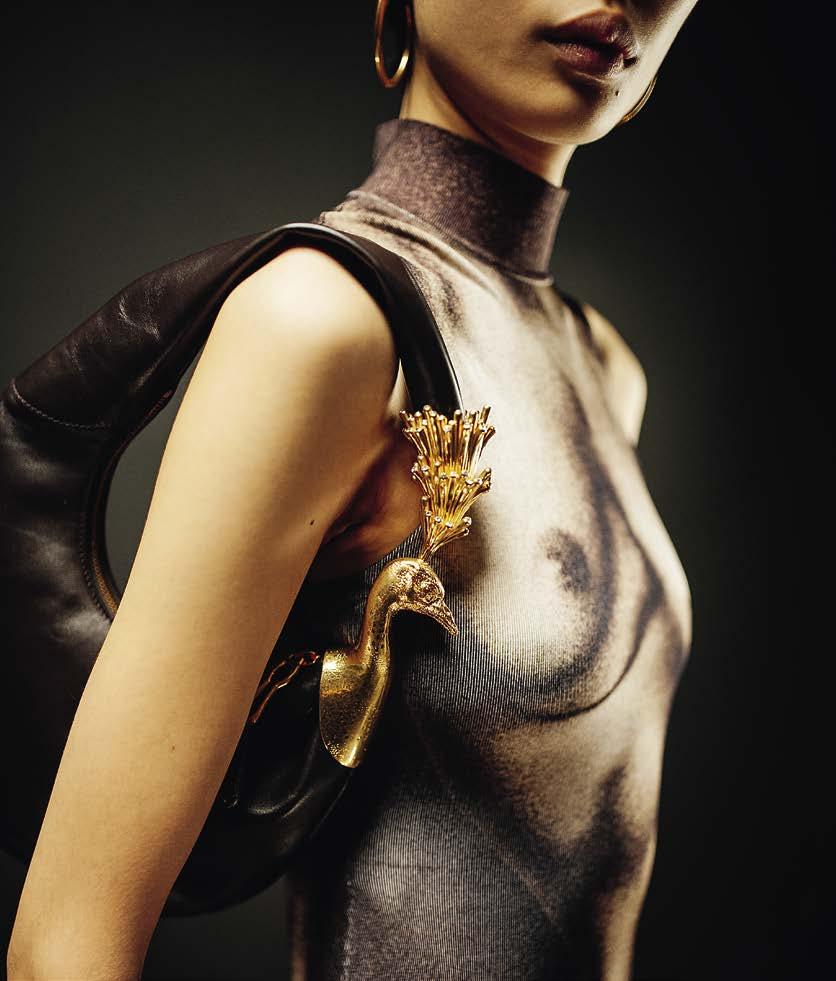
Saint Laurent, anyone who has asked that question—they’re all her children.
To me that’s why she matters so much.
DCB That was her legacy.
DR We hope the exhibition effectively conveys this as a moment. The beauty of a house, and the beauty of the Schiaparelli name, is wrapped up in how seismic the house’s origin was. We’re a small house, but we’re punching so far above our weight because of the legacy.
DCB The exhibition includes designs from both her and you, is that correct?
DR Yes. It’s divided into four sections, and the last one explores her lasting influence and her outsize design legacy.
DCB The garments on display are owned by the museum, or do you have a large archive?
DR We don’t have an archive at all. Schiaparelli doesn’t because Elsa gave it all away.
DCB Really!?
DR Yes! She gave nearly her entire personal archive to the Musée des Arts Décoratifs here in Paris, to the Philadelphia Museum of Art, and to the Metropolitan Museum of Art in New York, which has a lot, too. The exhibition has been called in from all four corners of the globe.
DCB Why would she give her archive away?
DR I don’t know if there was anyone to give it to, and she needed to give it to someone.
DCB Interestingly, she gave it to museums, places that would have treated her designs like works of art.
DR Exactly.
DCB But I met Marisa Berenson, her granddaughter, who would have taken it!
DR I’ve never asked Marisa that question.
DCB What have you asked her?
DR I sometimes wonder what it’s like for her to be the only person who really knew her grandma and to see what’s happening today. Last night she said to me, “She’d be so proud.”
DCB I’d like to think she would be. You’ve been a stellar steward of her legacy.
DR Not too long ago, I found an interview she gave later in her life, when she was in her fifties or sixties. It was when miniskirts and white tights were all the rage, so the mod era of the Swinging ’60s or whatever. And she was not happy. She was saying she didn’t get it. It was interesting to see someone who had been so elastic in her younger years, and so confrontational, sort of like not get it
DCB Suddenly she was rigid. I wonder if that’s why she felt disconnected. DR For me, it served as a reminder to all of us, especially in this industry, to stay young. Stay flexible. It’s to her credit that the language of this brand is more elastic and more flexible—you can bend it to your will.
On March 28, a major exhibition of Jenny Saville’s work opened at Ca’ Pesaro – Galleria Internazionale d’Arte Moderna in Venice, bringing together nearly thirty paintings from the 1990s to the present. The exhibition is curated by Elisabetta Barisoni, head of the museums division at Venice’s Ca’ Pesaro, Museo Fortuny, and head of MUVE in Mestre. Saville’s monumental canvases are set in dialogue with the great Venetian artists of the past, creating a unique encounter between contemporary painting and the city’s artistic heritage. Here, the artist speaks with Stefania Ventra, professor with Ca’ Foscari University of Venice, about her early trips to Venice, the radicality of Titian’s painting, and depicting emotional truth.
STEFANIA VENTRA If we were to envisage a comprehensive catalogue of your works, we would be joined by the many artists from the past who comfortably inhabit your drawings, paintings, and sketches. This was demonstrated in an exemplary manner by your recent exhibition in Florence, which placed your work in dialogue with Michelangelo and Botticelli. Now, for your exhibition at Ca’ Pesaro, there is a new challenge: a consideration of the greats of sixteenth-century Venice and the creation of new works that evoke our local glories.
But let’s go back to the beginning. From 1988 to 1992, you studied at the Glasgow School of Art, which continued to espouse figuration while several other British art schools had moved on to a more conceptual approach. Did the program offer a traditional type of teaching? Were you required to copy casts or works by old masters?
JENNY SAVILLE There were still life rooms at Glasgow. However, many traditions like mandatory drawing from casts or copying the works of old masters had mostly disappeared. There were still casts dotted around college, but not many students used them.
Glasgow School of Art’s dedicated life room in the Mackintosh building was open until 9pm. The daytime was reserved for life painting, and in the evening life-drawing classes took place. You could organize a group of friends and book a model for a prolonged period, usually two weeks, to work on a particular pose.
SV Who decided the pose?
JS Sometimes students, sometimes a professor. As a student you got a main space in one of the painting department studios and then could go and work in the life room as well. The degree course at Glasgow was four years; the first year was a general foundation course where you would try different disciplines, then you applied to the department of your choice: painting, sculpture, environmental art, photography, textiles, and so on. I went into the painting department.
SV On several occasions, you’ve recalled the trips abroad you took with your uncle during your
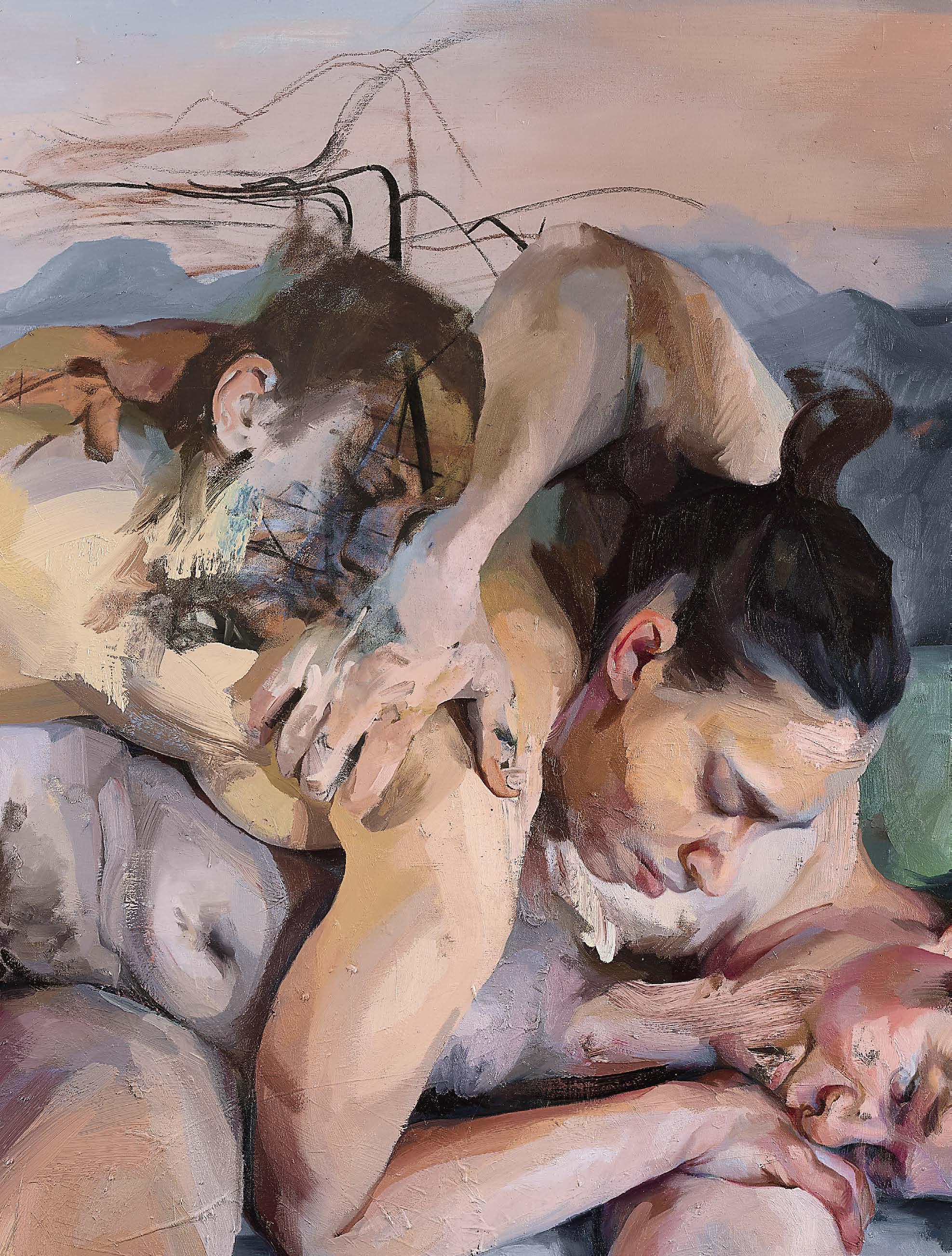
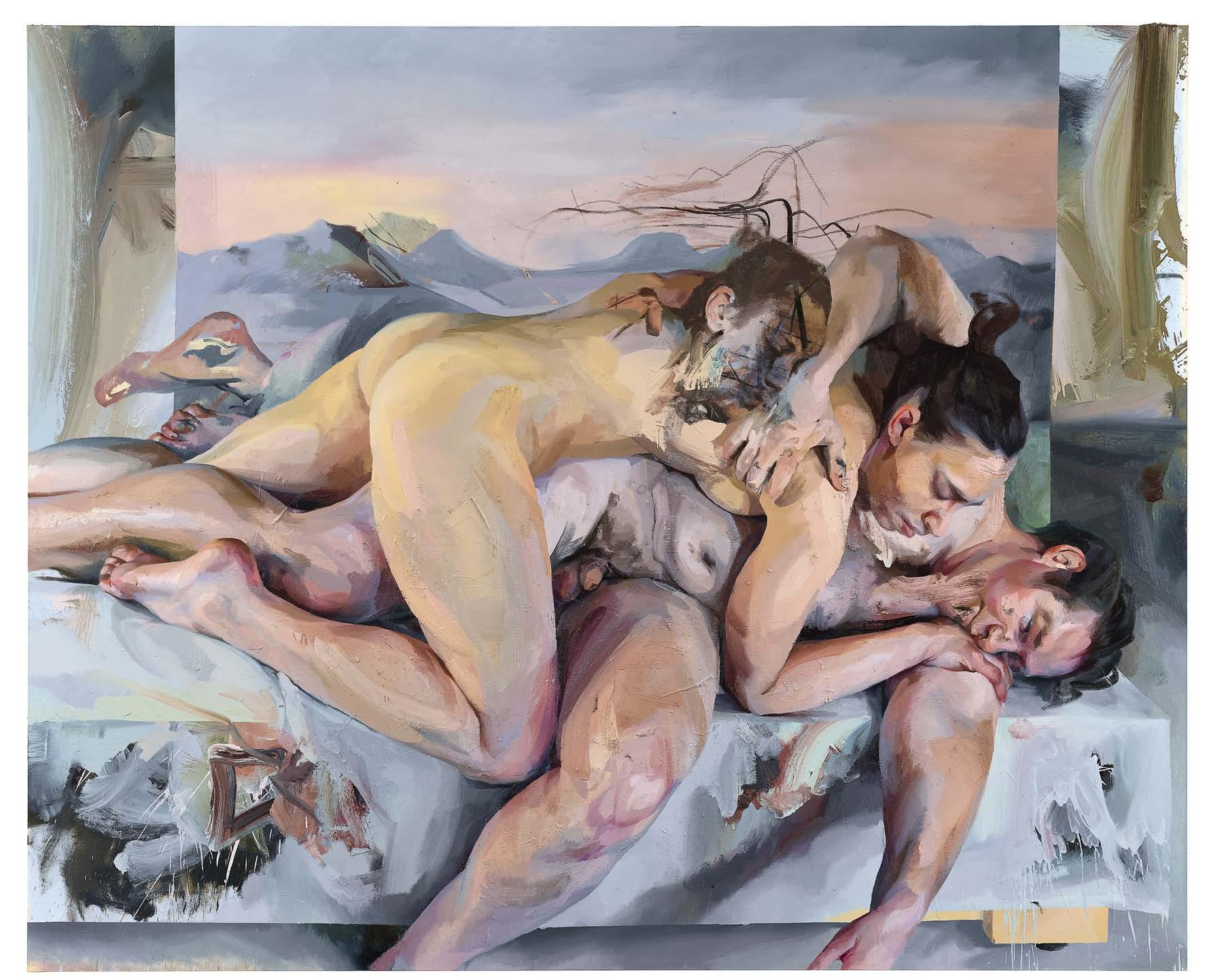
formative years. You had the opportunity to see many towns, including Venice, and many artworks, which left a deep impression on you.
JS We went to Amsterdam, Venice, Florence, the Scrovegni Chapel in Padua, Ferrara, and Mantua. There I remember visiting Palazzo Te, with Giulio Romano’s giants painted on an enormous scale.
In Venice my uncle ran an art and art history summer course which I attended. At 6 am a group of us would go to the Rialto fish market to draw, then there were art history lectures, trips around Venice and the surrounding cities that usually related to the morning’s lecture, and sometimes drawing and painting in the afternoons in places like the Ghetto or Campo Santa Margherita. We’d put big pieces of paper on the floor and observe Venetian life.
SV Did you draw from artworks too or only from life?
JS We drew from the art and life in and around Venice. The first trip was usually to Torcello to see the mosaics, and the course moved chronologically through art history in and around the Veneto.
SV You’ve continued to come here throughout your life, and recently you visited the restoration site of Titian’s Assunta [c. 1515–18] in the Basilica of Santa Maria Gloriosa dei Frari, which was led by Giulio Bono and completed three years ago. All of us who had the opportunity to go up on the scaffolding and
observe at close proximity this great array of figures discovered something new about Titian. What was it for you?
JS There was so much to discover about the painting up close and it was a privilege to visit the restoration Giulio had been working on. Titian’s techniques, such as painting the negative space around fingers to redefine their form—which I’ve also done—were wonderful to see. There were pentimenti from where he chose to move the dynamic of the Madonna’s outstretched arms slightly upward; the rhythm of her red sleeve and blue veil is incredible. From a distance, you can’t see this formal reworking at all, and there are also more nuanced tones within the passages of light. It was like seeing a work by J. M. W. Turner up close, with lemon, blue, and lilac areas that depict some receding putti heads within the yellow/white light.
The halftones throughout the heads and outstretched arms of the apostles in the bottom group of figures were beautifully worked with such rich, tonal depth. The flesh and hair of the putti reflect the color and heat of the blue and red cloth that’s woven throughout the composition. They sit on gray-white clouds, and I liked how he painted their slightly transparent wings and the interchange of pointing hands and overlapping limbs on the left side of the painting. Each area is a mini painting, a rhythmic composition of human and divine behavior.
The drama of the tripartite composition is strengthened using triangular and circular figurative dynamics and through the use of color. Once near, you can see the workings of transitional flesh tones and a soft glow in the half-shadows and reflected light. These two forces—a strong composition and paintwork that’s full of movement—make the painting so utterly magical, with the central Madonna rising in a warm glow and God right at the top observing the earthly action below.
When you compare Titian’s Assunta to the triptych by his teacher Giovanni Bellini next door in the Frari, it makes Titian’s altarpiece look so radical. You could say that Giorgione bridged the gap between Bellini and Titian, but even so there’s quite a painterly shift.
SV Erwin Panofsky, in his famous book dedicated to Titian, devotes a chapter to an analysis of the relationship between him and Ovid. The scholar argues that no artist felt such a deep affinity with the Latin poet since he was, “aware of mankind’s tragic subjection to destiny.”1 Panofsky thinks that Titian is very interested in the tragic, and many scholars believe that a lack of hope is what leads him to destroy form in his late works. What’s your view?
JS Titian articulated the poetics of the tragic in paint. I don’t see him as destroying form—he blurs and interweaves it. He creates psychological narratives—not only through the subject he chooses, but the way he paints. You see this in his later work, like Nymph and Shepherd [c. 1570–75] in the Kunsthistorisches Museum in Vienna, where the painterly surface hums and vibrates. The subject matter is articulated by layering tonal passages, weaving nature together—from sensual flesh to fur, to sky and stag.
There’s no redemption in tragedy; the gods are unrelenting in Ovid’s Metamorphosis if mortals challenge or cross them. It’s the fate of this world, and Titian’s brush articulates that. The paintings are a visual poetic of human nature. They feel embodied in and of nature. This is the capability of painting, and by creating, in some way you resist the tragic and find a way to embody contradictions, especially when dealing with these epic subjects.
SV I also believe it is significant that Titian lived a long life, like Michelangelo, who similarly reached an end marked by profound inner turmoil. This is not the case, for instance, with Raphael, whose early death prevented such developments.
JS It would be interesting to see what Raphael would have made, had he lived a long, productive life. Michelangelo and Titian both created incredible late works. In the former’s crucifixion drawings, the multiple lines around Christ vibrate as they try and fix on his bodily form. They’re some of the most profound drawings made of that last grasp at life. They embody the commitment in Michelangelo’s endeavor. Titian also made interesting late sketches, but it’s in the later paintings that he works best. It’s the outcome of a whole artistic life spent repetitively making marks, and of a high level of sophistication and wisdom ascertained through skill and years of working, combined with failing eyesight and a weaker body. There’s less control but more knowledge. This dichotomy can make late work so interesting. Some artists have that looser wrist and are still pushing—Edgar Degas, Claude Monet, Cy Twombly, Titian, Pablo Picasso—they all had that.
SV We can therefore imagine that the exhibition at Ca’ Pesaro will be strongly influenced by Titian, but what about Tintoretto? Rivers of ink have been
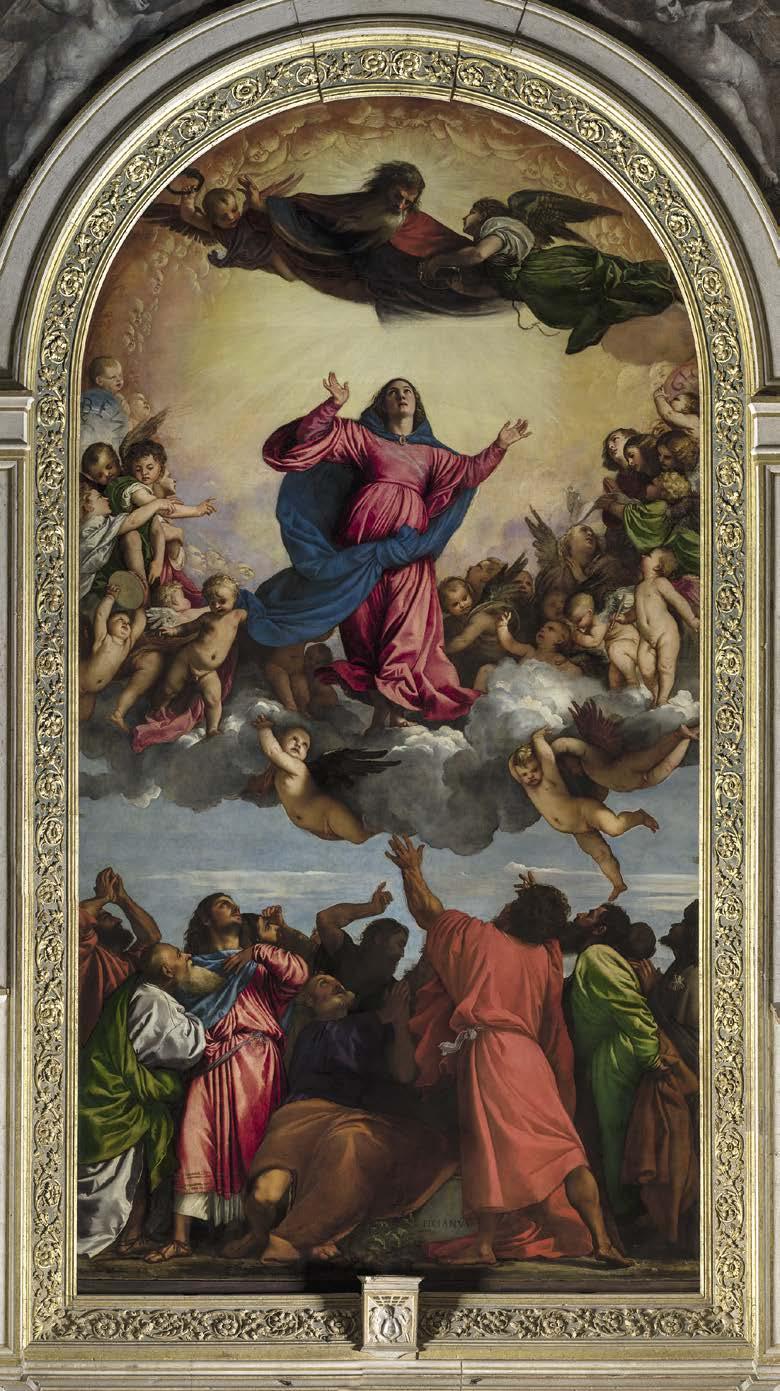
poured into comparing Titian and Tintoretto, highlighting points of contact, differences, rivalries, and peculiarities between the two. From an artist’s point of view, what most distinguishes their work?
JS Titian has an emotional depth, an instinct for painting flesh and compositional rhythm. Tintoretto’s epic works, especially those at the Scuola Grande di San Rocco, are incredible. He’s a great picture maker; you can feel the urgency and excitement he felt creating these grand scenes. But there’s a solemnity and anchored strength in Titian that makes me look for longer. I like the way he builds form in the later paintings. He uses a scumbling technique to augment the surface tension and his marks are interwoven over time, so colors mix optically on the canvas weave. I don’t feel quite the same pathos standing in front of Tintoretto’s work, but that’s just a matter of personal taste.
There’s a tendency to compare within history: Titian or Tintoretto, Michelangelo or Leonardo, Picasso or Henri Matisse, Jasper Johns or Robert Rauschenberg, Helen Frankenthaler or Mark Rothko, and so on. They are all great, but we seem to have an impulse toward comparison. Titian deploys that figurative/abstract interplay where the materiality of the paint and the rhythm of the figures are harmonious. I feel much more connected to Titian.
SV Tintoretto is not on your list?
JS He’s not on that particular list, but he probably should be, along with many others.
SV I want to ask you about your lists: the two lists of past artists that you keep on the walls of your studio. For someone who studies the reception of ancient artists in the modern era, it is truly a dream to find these in a painter’s studio. Carlo Ridolfi, in his seventeenth-century biography The Life of Tintoretto , recounts that the painter had hung a sign on his doorway that read “Tiziano’s color, Michelangelo’s drawing” to remind him of the models to follow and how to follow them. In your lists, among the old masters, we find Michelangelo, Titian, Diego Vel á zquez, and Rembrandt. Then later artists appear: Paul Cézanne, Picasso, Jean-Michel Basquiat, and Willem de Kooning. In one of the two lists, you have also included specific notes. For Michelangelo—and I should point out that he is the first name on both lists—you wrote “bring form out from matter.”
JS “Bring form out from matter” is a phrase I’ve written a few times—it’s what Michelangelo did so successfully in sculptures like Atlas [c. 1525–30]. He carves away to release bodily form, but the remaining rough marble is almost as important as the sculpted, figurative part. I’ve made paintings inspired by this relationship between nature and culture.
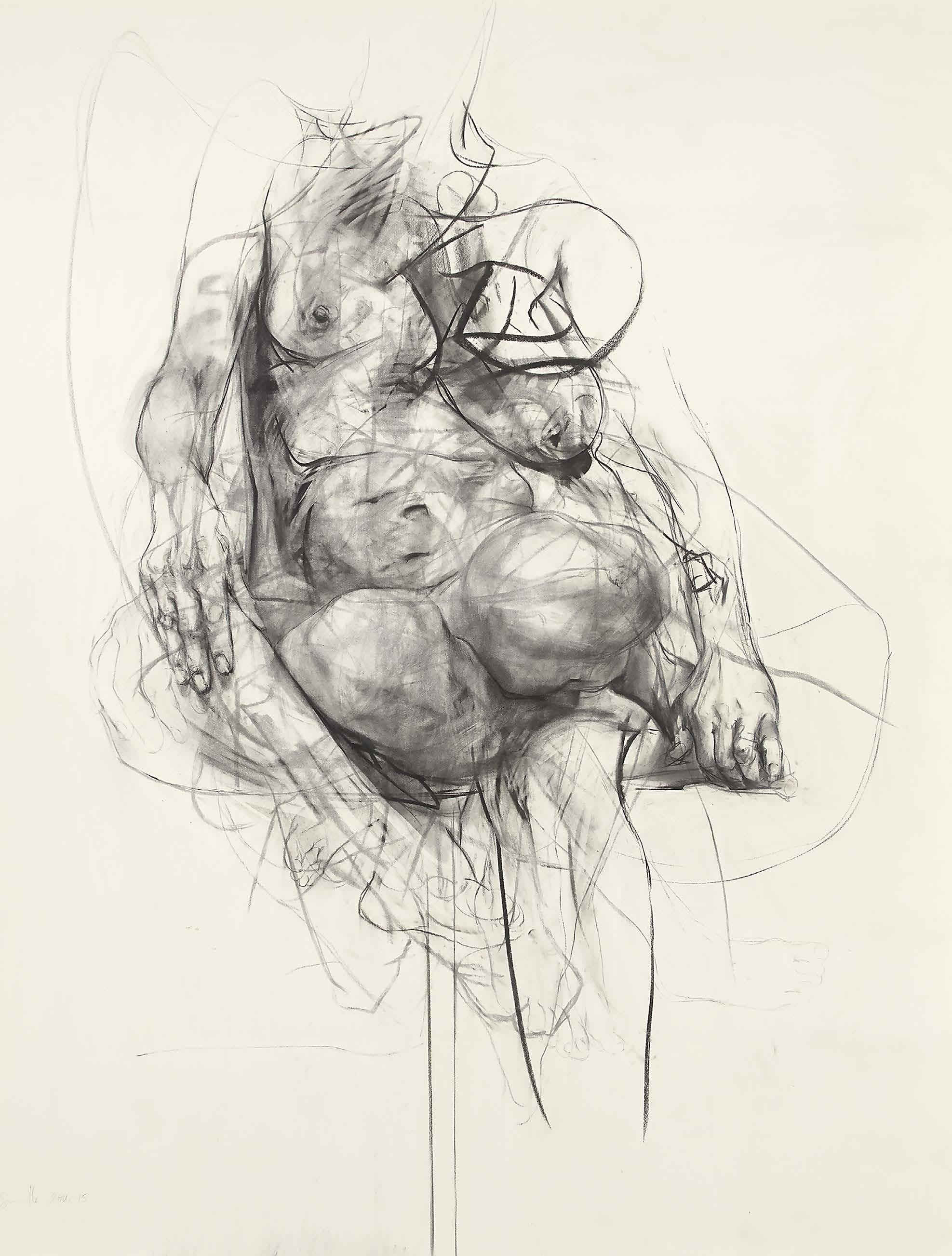
Having these lists of names, evocative words, lines from poetry, as well as imagery, creates an atmosphere that I like working in. These artists are my teammates and heroes—I pass by these names and images as I walk around my studio, and it enriches my environment. It’s the connection to a way of life, an inspiration that crosses time and geographies: de Kooning, Picasso, and Basquiat are not so different from Titian and Tintoretto in terms of an artistic life that’s fully committed.
SV Looking at your works, you seem to be interested above all in artists who loved nature and studied reality. Reality, like the one you can find in Rubens, Rembrandt, or Manet—and in Titian obviously.
JS I’m a painterly painter. Painting figures, portraits, playing, and experimenting—being inventive with the language of painting is what I like to do. Several figurative avenues have developed in my work over the last few decades: single figures, group figure compositions, portraits, and paintings that refer to ancient and religious art. Figure compositions are one of my favorites—where models show intimate moments like the rhythm of interlocking legs or feet, or the way an arm rests on a leg, for example. Those small, human gestures within a picture create an inner narrative and hopefully a sense of humanity.
SV Our conversation has been entirely devoted to the memory of great men because, as we well know, in the modern era, artistic careers were denied women. I would therefore like to move away from Venice and this period, and go back to a much older model that will finally allow us to talk about women. During the Renaissance in Italy, ancient works that were found, generally underground, were always restored in a way that brought them to a state of completeness. There were very few exceptions, the most famous of which is the Belvedere Torso from the first century bce , preserved in the Vatican Museums. Its expressive power was considered untouchable and, precisely because of its fragmented state, it has inspired generations of artists.
Your Muse on Stool (Study) [2015] seems to evoke that pose and contain the same expressive power, but in a female body. It is as if even this most ancient and iconic representation of the male body, of its strength, despite, or rather because of, its mutilation, has been transformed into the feminine in the hands of an artist who focuses much of her poetics on imperfect bodies.
JS Emotional truth in painting or drawing is what I pursue, whatever the types of bodies the models I’ve worked with before might have. Muse on Stool is a charcoal study of a woman’s knees. Sometimes I depict complete bodies and portraits, and other times I’ve used bodily fragments to create whole figures and new body compositions. In a drawing like this one it was all about bringing form out from the paper and making her knees sit right up. There’s a satisfaction in creating threedimensionality and bodily form on a flat surface. It’s a silly endeavor I suppose, but something I get pleasure from—understanding a particular person’s physicality. Looking at complete and fragmented sculptures from antiquity like the Belvedere Torso also helps.
In Muse on Stool , all the focus remains on the body because I didn’t draw in the head. This forced me to put as much humanity in the body as I could because the moment you add the head, that’s where the attention goes. Making women’s bodies look powerful is a thread throughout my work.
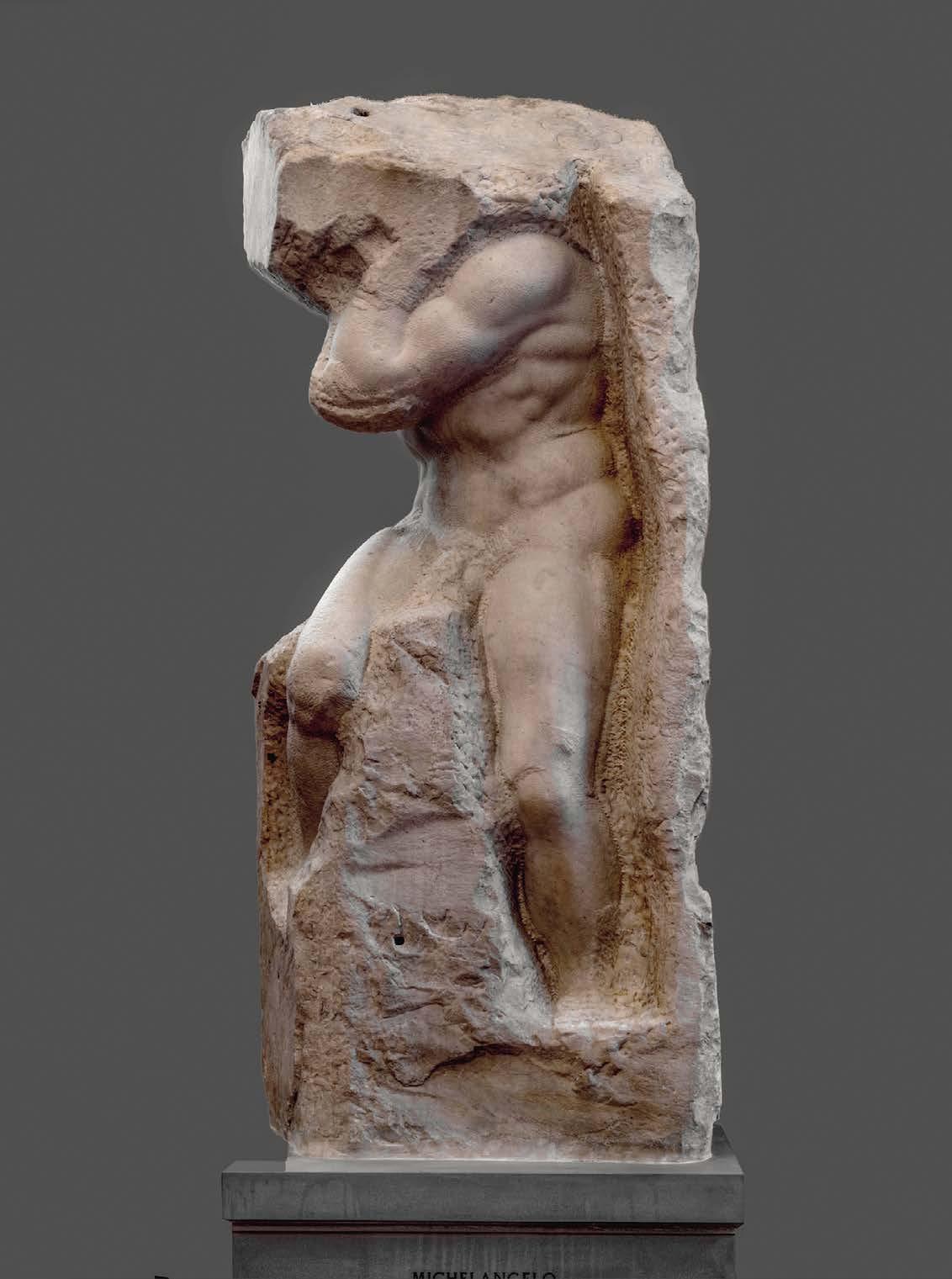
SV Let’s conclude with a wide-ranging observation. We are living in an age that does not have much love for the historical method or much respect for history. So, why should a young artist working today continue to look to the old masters? JS It’s interesting to look at everything, including old masters. They were great at figuration and moving paint around: Titian, Velázquez, Caravaggio, Francisco Goya, Artemisia Gentileschi, Michelangelo . . . there’s a lot of humanity and skill in all these artists. When you consider they are from a small part of the globe in a particular period in history, there’s much to look at to understand our collective civilizations.
A historical sense helps if you want to deal with epic subjects that reverberate through our human story. Understanding the rise and fall of civilizations, political ideologies, religions, and mythology is a foundation. Art from all eras and geographies has informed my work. Ancient fertility goddesses, Japanese printmaking, and Indian sculpture have all been influential over the years. Intuition, a historical sense, and humanity are essential qualities.
1. Erwin Panofsky, Problems in Titian, Mostly Iconographic (New York: New York University Press, 1969), 140.
CARLOS VALLADARES WADES THROUGH THE DISCOURSE AROUND THE MUSICIAN AND ACTRESS CHARLI XCX’S MOCKUMENTARY, GUIDING US THROUGH ITS MYRIAD REFERENCES, FROM THE SPICE GIRLS TO ANDY WARHOL.
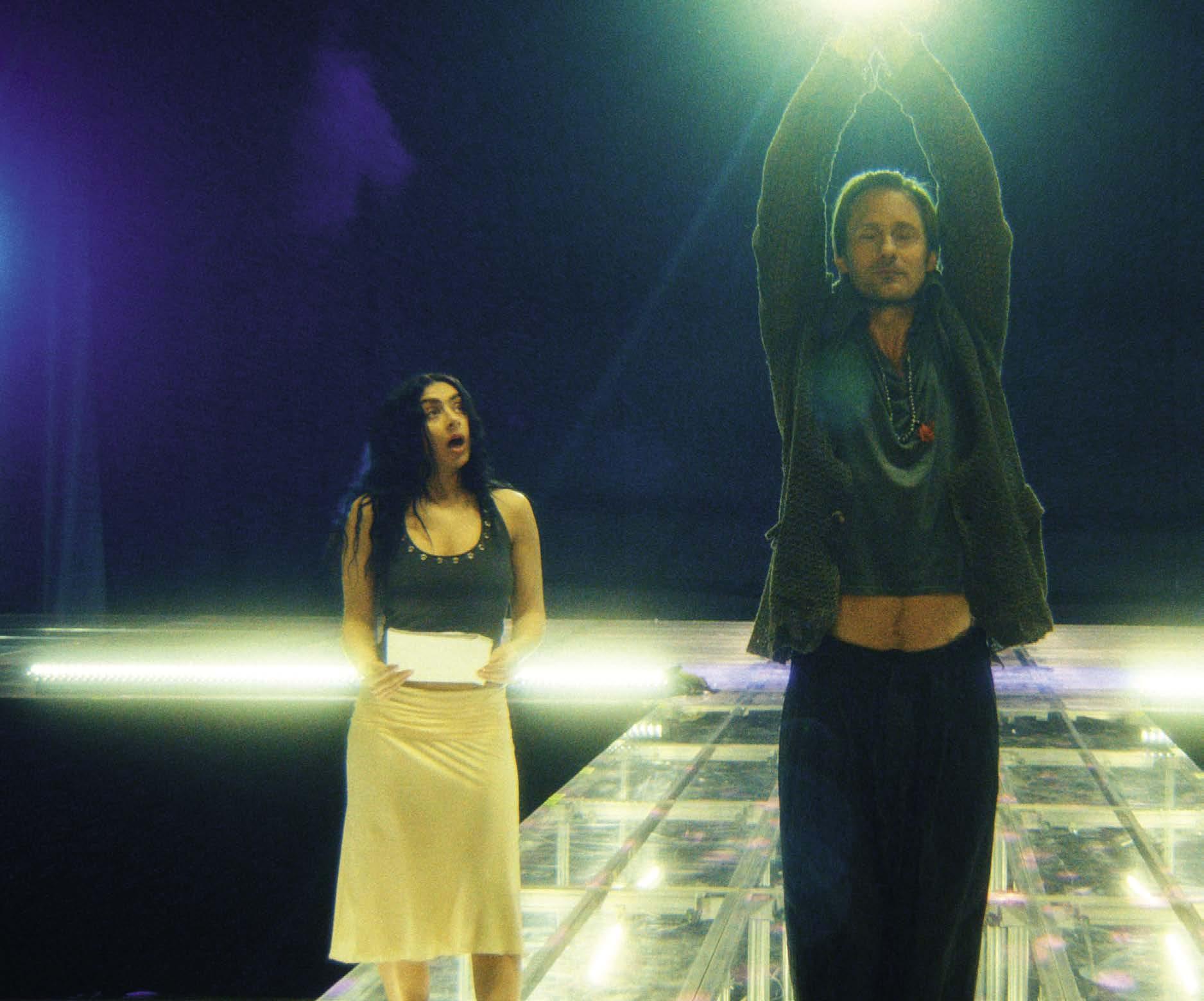
By the time this piece appears, the moment for The Moment will seem to have passed—all the better to gauge its merits. What landscape did Charli XCX’s and Aidan Zamiri’s film enter? A diseased solipsism, patriotically and culturally sanctioned, reigns supreme. Charli XCX has just created the soundtrack for a major box-office success, Wuthering Heights (2026), whose director, Emerald Fennell, has felt the need to clarify that her Hollywood, export-friendly product is ultimately about her own vision of the novel as a fourteenyear-old, not what the magnificent text itself, published in 1847, says about our world and life in 2026. 1 Today, our monuments coalesce in various odd car-crashes of events, juxtaposed for us on the Videodromes inside our pockets. Social media continue to wage a successful war against the idea of person-to-person connection, bombing our collective unconscious with the idea that their endlessly scrolled-down feed tailored to our desires is preferable to encounters with various others: for the frat bro, a woman; for the Westernized white subject, the world of Asia, Africa, and South America; for
Gen Z, the past before 2000; for a Netflix consumer, the unstreamable Looking for Mr. Goodbar (1977). Into this arena enters a fraught, queasy, transitional, and exciting work like The Moment
The opening credits glitch out into a series of strobe-flashed logos, a sarcastic list of the makers and brands that sustain the film-product: A24 , Atlantic Records, Beats, Aperol spritz, sag-aftra as if we were witnessing late millennials strongly misremember the Pop art credits of Jean-Luc Godard films (which were a good thing). And like Godard’s dialectical “documentary” Sympathy for the Devil/One Plus One (1968), on the making of a Rolling Stones song and the unmaking of Western civilization, The Moment pits two disparate strands in mortal combat: “reality” and “artifice,” the raw materials that we shape to make our lives and the myriad micro-interventions outside our control (stupid bosses, credit cards, Discourse™) that upset our own designs. Neither strand wins in The Moment , the struggle climaxing in a profound, petered-out, bitter punch line as our heroine sells out a part of her soul so the other, real part can live in private with friends: “be a 365 partygirl from
the comfort of your own home—now streaming on Amazon Music.” But The Moment is only an opening salvo. Charli XCX’s mockumentary is a riposte and an acknowledgment, of an atypically intelligent sort, by major tastemakers and trendsetters of our sordid times: Not only are we in the shit, but we can recognize why, and who is responsible. Thus we chart an uncertain path forward. Pain is named. Whither?
The Moment follows a fictionalized version of Charli XCX as she rehearses for a massive world tour in support of her landmark Brat album. After critics and audiences have acclaimed the album and its “vibe,” after the entire summer of 2024 has been renamed “Brat Summer,” after her lime-green aesthetic has been memed to death, and after Kamala Harris’s failed US presidential campaign has tried to use Brat (with Charli’s blessing on Twitter/X) as a lame way of engaging young voters, Charli has decided to cancel. That won’t do, say the suits; her record label, Atlantic, has decided to film a concert tour and release it not in cinemas but online, so that “Brat Summer can last forever.” “Forever”: maybe the most horrifying word Charli has ever heard.

She goes along with it, to the delight of the annoying film director Johannes (Alexander Skarsgård) and to the frustration of her best friend and creative consultant Celeste (Hailey Gates). Escapes to Ibiza, attempts to dodge the promotion of a green Brat credit card for Charli’s Gay Stans: None of these alleviate the pressure. Charli must face her own music, a music she’s sick of, as she searches for wider, less green, more cinematic pastures.
Enter The Moment , which rejects the current drive for the smooth-brained consumption of entertainment. It’s a mockumentary fully aware that it will become a period piece, not a Spice World (1997) cash-in nor a reinvention of A Hard Day’s Night (1964) but a scientific observation of a phenomenon in which the ringleader has become a detached observer of her own bacchanalia. Control of her venture has been seized from the OG. It zombies on against her will, garishly, cringefully, bolstered by the age-old suspects: the capitalist cannibalization of a good cultural idea, the baby boomer desire to make a moment last “forever,” the endless thirst for a megabrand that will financially benefit all parties. Distancing herself from an edifice she herself has
carefully built, using bricks culled in art schools and London raves, Charli XCX (Charlotte Emma Aitchison), in the spirit of play, now wants to smash the whole house into smithereens. To accomplish the task, she enlists the help of a range of crafty artists in front of and behind the camera. Zamiri, writer/director, conceived of the music video for “360” in which a war room of It girls (Rachel Sennott, Gabbriette, Julia Fox, Hari Nef, Chloe Cherry, and Chloë Sevigny) discuss, with deadpan seriousness, what the New Girl should look like: “Totally waiter vibes.” “It’s definitely a je ne sais quoi situation.” “It’s about being really hot in like a scary way.” Sean Price Williams, cinematographer, zips and dartingly tracks Charli as if she were the subject of a Maysles Brothers documentary—or perhaps of Yoko Ono and John Lennon’s Rape (1969), in which a woman is relentlessly pursued by the male-coded eye of the camera until she reaches total psychological breakdown (viz., a haunting moment in an Uber in which Charli tearfully removes the runny green makeup and waterlogged studs above and below her eyes—and which, in a bit of movie magic, became the film’s poster image). The dynamic Robert Altman–esque ensemble—an effectively annoyed Rosanna Arquette as the boss lady (“Okay, how do we keep this Braaaat thing going”), an extremely funny Skarsgård as the dopey liberal director-for-hire (“Phones off, guys, this is a sacred space”), and Kylie Jenner’s five-minute cameo in a spa in Ibiza (“The second people are getting sick of you, you have to go like harder. . . . Just do your dance, you know, the fruit!! ”)—all convincingly parade in and out of Charli’s view, reminding her that she might just end up another archaic reference in the archival podcasts of tomorrow. If it feels like we’ve been here before, you are correct. The Moment is Charli’s War of the References. Who’s your favorite? It’s a postmodern settling of jukebox-musical scores. (One of the funniest Moment jokes: But for the first few lines of “360” and half of one of the least-listened-to gems on Brat , “I Might Say Something Stupid,” Charli does not perform a single one of her songs—in a movie ostensibly about her fictionalized life as a major pop star.) The journalists for the loud trades and magazines (Hollywood Reporter, Variety, the New Yorker podcast) think Charli, Zamiri, Williams, and company are trying and failing to do a Christopher Guest
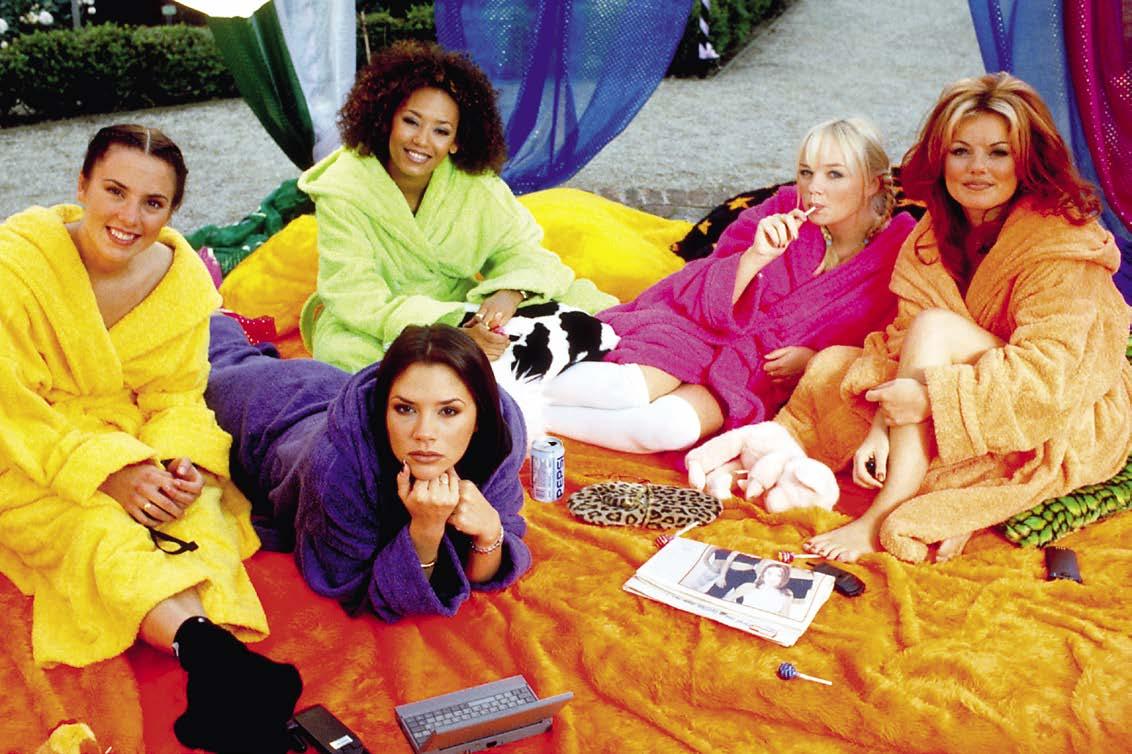
mockumentary, or an updated Madonna: Truth or Dare (1991). (Hint: they are not.) The Letterboxd crowd and the Gay Stans, egged on by Charli, see nothing but the Spice Girls mockumentary Spice World , a cornier and safer movie than The Moment Me, I thought of Godard, Altman’s Player (1992), the TV show Arrested Development (2003–06 plus later installments), and especially Richard Lester’s Hard Day’s Night , which strikes me as the most relevant ancestry. The Moment is in direct dialogue, as was Spice World , with Lester’s zeitgeist-defining masterpiece, famously dubbed “the Citizen Kane of jukebox musicals” by the critic Andrew Sarris. 2 The Beatles were hip and aware of their status: four poor Scousers suddenly catapulted to a level of celebrity and artistic renown not seen since the days of their fellow working-class Englishman Charles Chaplin. They had the ears of gods, cultivating a revolution in their music—but they were also unserious in public, exuding a goofball energy that made them freakishly perfect as movie stars. So it is with Charli, who is not so much unserious as unbothered: She mixes modes as she wishes, and The Moment is the result of someone genuinely, restlessly interested in crossing among media, trying on different hats, experimenting and seeing what comes of it. The suits, naturally, do not like this. They want to be able to pin their talent down to a sound, a brand, a hook. We are encouraged nowadays to morph into a demented brand version of ourselves so that we are easily digested in the online and frightening exchange of zeroes and ones, real and AI flesh. Charli, by contrast, deranges—and she works with people who derange with her. What else can explain her and Williams’s innovative reinvigoration of the now-cliché anxiety crescendos of Safdie Brothers films and their ilk?3 The Moment has a quick-paced, start-stop, elegantly musical, Lesterian rhythm that is leagues away from most of the films being shown in multiplexes today, whether Marvel or Marty Supreme (2025).
Those hectoring critics who call the film hypocritical miss its point entirely; those who think it’s not funny (it was for the audience I was in) try, perhaps too hard, to find the funny in what’s very quietly observed as a bleak, culture-bombed landscape, one that Zamiri and Charli observe with a stellar poker face. Clearly they’re in on the joke: Charli is there and not there, an active persona as
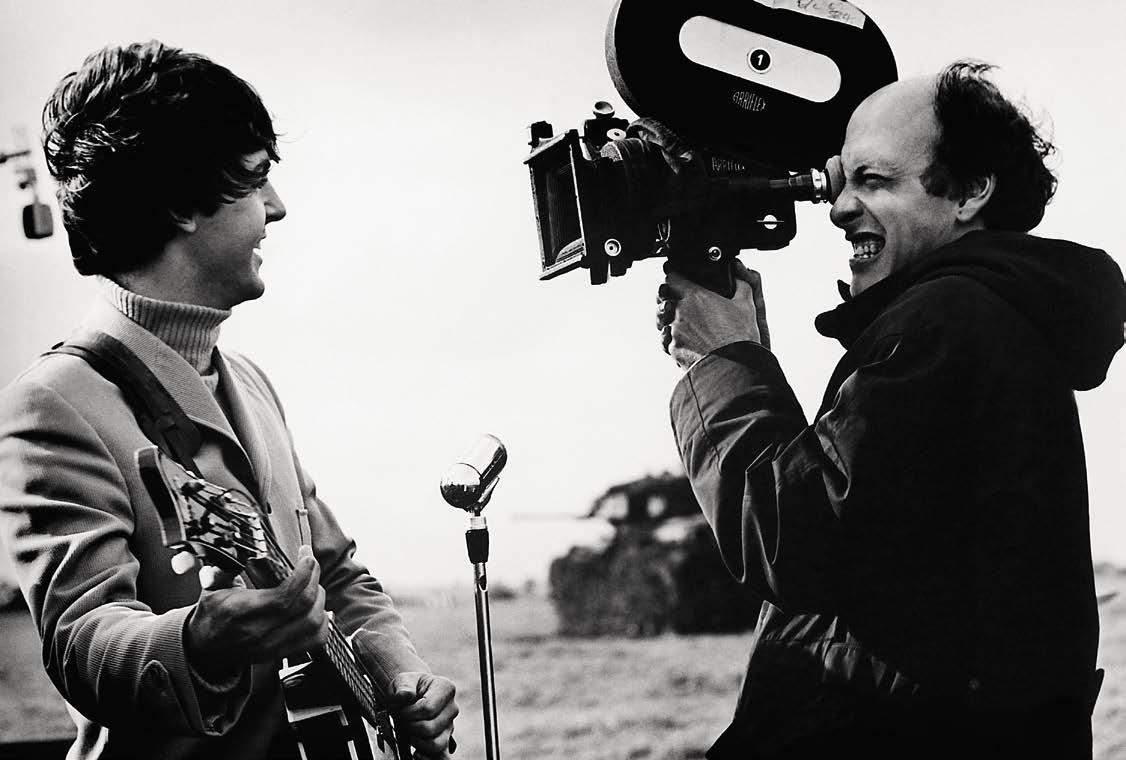
modeled for the cult of the star as Andy Warhol, Monica Vitti, or Timothée Chalamet. 4 The makers of The Moment do not pretend to slice radically into new cultural visions on the level of Callie Hernandez’s and Courtney Stephens’s Invention (2025) or the low-fi films of Hong Sang-soo, nor is The Moment a game-changing subversion of its star’s image in the same league as, off the top of the head, Chantal Goya’s in Godard’s Masculin Feminin (1966), Lennon’s in Lester’s How I Won the War (1967), or Ingrid Bergman’s in Roberto Rossellini’s Stromboli (1950). The tragedy that The Moment is more than aware of is that of stasis: It is caught in a battle of references. Culture has devolved into a collaboration between bullies and mediocrities who together decide life for us all. We are not in control of the narrative.
But certain artists are starting to wake up, however messily, using whatever inadequate language they can muster. 5 They realize that art, politics, poetry, beauty, economics—all these things—are aggressively mixed up. And meanwhile, do you hear the bombs? Does the fire inch closer to your Amazon Fire TV? Do you hear the rioting? The
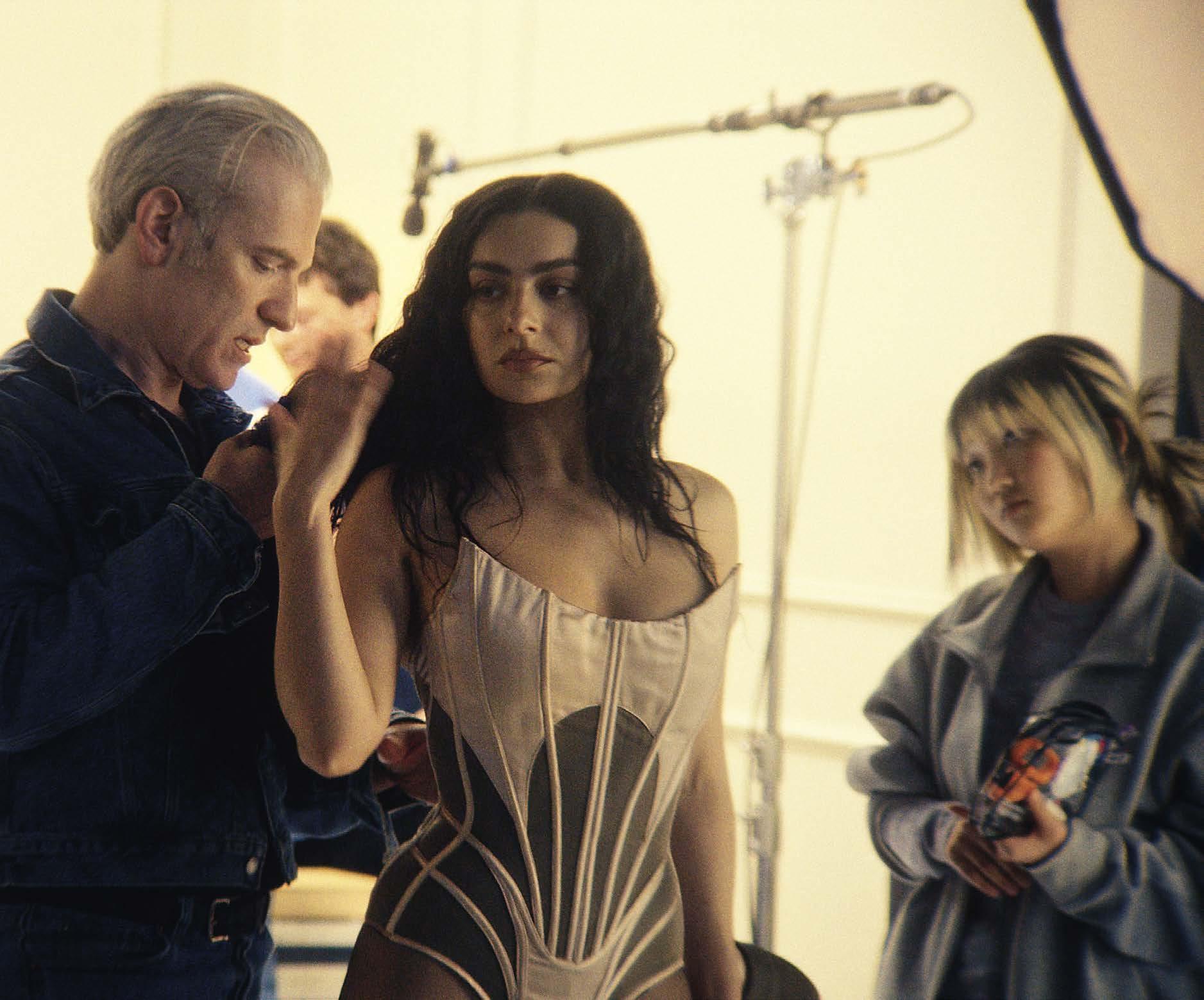
clamor of the people?6 What Charli achieves here compares to Warhol’s Death and Disaster series: She offers her persona as sacrifice to the endless stream of the Image Regime, but does so with a flat, productively ironic, and unsentimental attitude. And as with Warhol, the sacrifice comes with a touch of melancholia, in the wake of disasters such as ambulance crashes, tuna-can poisonings, fake suicides, real sellouts. The once hearthlike comfort of the home has begun to resemble the weird, dank, cloistered feel of the crypt. Indeed, one can, as the film’s final, bitterly Altmanesque text suggests, be a 365 partygirl from the comfort of one’s home. Nightclub, stories, dreams, and nightmares collapse into one space, black hole style.
So, will the revolution be televised? Will we just let it?
1. “I wanted to make something that was the book that I experienced when I was 14. . . . [wanted to] see what it would feel like to fulfil my 14-year-old wish, which is both good and bad.” Emerald Fennell, quoted in Ian Youngs, “‘Primal and sexual’: Wuthering Heights director on bringing Brontë to life,” BBC, September 26, 2025. Available online at www.bbc.com/news/ articles/cly0nnrr48ko (accessed March 1, 2026).
2. Andrew Sarris, “A Hard Day’s Night,” The Village Voice , August
27, 1964.
3. One effect of the Safdie Brothers’ cinematic style—raw, handheld, street-level, driven by abrasive soundscapes, relentless close-ups, and actors incessantly yelling over each other’s words—is a sense of spiral-down despair that produces a near-physical anxiety in the viewer, an effect that has been both celebrated and lambasted. Josh Safdie’s Marty Supreme (2025), directed solo without his brother Benny, continues in the same style. The brothers’ films Heaven Knows What (2014) and Good Time (2017) were shot by Sean Price Williams, cinematographer of The Moment and the subject of an interview with me in the Winter 2025 issue of the Quarterly
4. A thoroughly personal judgment incoming: Charli’s “acting”— her “being”?—in The Moment is, to me, far more interesting and harder to characterize than the entire 150 minutes of Timothée Chalamet puffing his chest and acting an elephantine, garish, winning ass in the bloated Marty Supreme . Both, it is useless to deny, are touchstones of our own moment.
5. I would be remiss not to mention that Charli wrote a muchdebated Substack essay, “The Death of Cool,” clarifying many of her positions. It was recently published in print in A Rabbit’s Foot no. 13 (December 2025): 94–95. The influence of Andy Warhol’s writings—many of them aptly and famously ghostwritten by those in his orbit—are palpable throughout the essay, and many of its ideas are more effectively cinematized in The Moment
6. At the climax of The Moment , wherein Charli at last runs utterly afoul of her US banker patrons, a set of beguiling images are juxtaposed: the burning of a Brat flag, rioters smashing into what looks like the Target near Brooklyn’s Barclays Center, and protests on the street that resemble those for BLM in 2020, or perhaps the Columbia student protests in support of Palestinians in Gaza in 2024. The revolution has arrived, the rebellion cannot be quelled— yet, charming idea!, it is compelled by a Mary Poppins-y run on a bank provoked by a pop star sellout.


Amanda Millet-Sorsa reflects on Chris Burden’s Mini Video Circus , a work originally exhibited at Le Consortium in Dijon, France, in 1994–95. Tracking the work’s inception, exhibition, and movement through France, she makes the case for the enduring relevance of Burden’s work as seen in this charged multimedia piece.
In 1994, as Le Consortium (a contemporary art center in Dijon founded by Xavier Douroux and Franck Gautherot) began to invite significant US artists to make new work for French audiences, it welcomed Chris Burden’s proposal to resuscitate postwar Citroën 2CV vans in an original piece spanning sculpture, video, and sound. Exhibited in France from October 29, 1994, to January 7, 1995, Mini Video Circus comprises three gray 1960s deux chevaux (2CV) Citröen vans aligned in a row, each with a blue tent pitched over the back. In Le Consortium’s former industrial space called l’Usine, once used to bottle cassis liquor, the vans were each outfitted with four monitors looping news footage Burden had recorded from his TV of early-1990s disasters in Southern California: fires, earthquakes, social unrest.
One van was selected to be restored to full driving condition and tour the surrounding countryside every few weeks during the two-month exhibition. It would stop for the day in small town squares so that locals could view these dystopic scenes from the far west, while the other two vans remained in the exhibiting venue, as they were only cosmetically restored. Burden stripped some additional vans down to their bare parts, which were displayed as installations in another gallery at Le Consortium as part of the exhibition. He arranged and organized the multiple doors, motors, and hardware elements with local students from l’École supérieur d’art de Dijon and the Lycée professionnel dijonnais over two weeks prior to the opening of the show. The disassembly of these vans was intended as a gesture to educate the students on simple car mechanics as a means to create skills during a period of high unemployment. If a longer exhibition time had been possible, these parts could have been reassembled by the students, as was initially intended in Burden’s proposal.
The 2CV vans themselves were, for Burden, like Proust’s madeleine: His father had worked for the Rockefeller Foundation’s office in Paris as an engineer, and Burden’s early childhood, from ages three to nine, took place in the postwar French landscape and culture. A product of the era, these small vans— colloquially referred to as fourgonnettes or camionnettes , where fourgon implies a utilitarian covered wagon (or van)—were financially accessible means of light cargo transportation for French workers. As illustrated by a vintage Citroën poster, 2CV vans were employed primarily by artisans, farmers, and small businesses, and were widely appreciated by florists and plumbers alike.
Flaminio Bertoni was the Italian sculptor and automobile designer behind the elegant and iconic
2CV. As France rebuilt after the war, this van model became a lasting symbol of the working class, the backbone of the nation. Because they could adapt readily to different road types and conditions across urban, village, and rural settings, they eventually became the state’s solution to mail circulation and home utility services: painted yellow as the La Poste delivery van, or blue by France’s national gas and electric company, EDF. Approximately a million and a quarter Citroën 2CV fourgonnettes were made in their thirty years of production, which finally ceased in 1980, when they were replaced by a new model, the Acadiane.
Although the original models remained in use well into the late 1980s, particularly in rural areas due to their durability, they were scarcely seen any longer in France in 1994, and today are rare collectibles memorialized in such cult-classic films as Henri-Georges Clouzot’s Les Diaboliques (1955), André Cayatte’s Le glaive et la balance (1963), and Jean Becker’s Un Crime au paradis (2001). The team at Le Consortium assisted Burden’s vision by sourcing the vans from backyards of rural homes, where they were collecting rust or being repurposed as chicken coops. They worked with local
auto restorers to bring Burden’s vision to life. As part of a multi-venue show featuring works related to France (and to each other), Galerie Anne de Villepoix in Paris, Le Collège Frac ChampagneArdenne in Reims, and Frac Languedoc-Roussillon in Montpellier all collaborated to exhibit works by Burden in 1994–95, including Medusa’s Head (1990), The Moonettes (1994), The Spirit of the Grape (1994), Another World (1995), and Pizza City (1994).
After their exhibition in France and their inclusion in Chris Burden: Beyond the Limits at MAK (Museum of Applied Arts) in Vienna in 1996, the three intact vans from Mini Video Circus remained on Burden’s property in Topanga, California, for three decades. A few years before his death, the artist decided to have them restored by Rudy Heilig, a vintage Citroën specialist based in Southern California. Burden’s sudden death in 2015 put the work on hold until the full restoration was begun again right before the covid -19 pandemic, and finally completed in 2025. With the exception of the van with license plate 9533RE21 (36,625 km mileage) having two extra windows in the back, there are no substantive design differences across the vehicles, and they are mainly identifiable by their

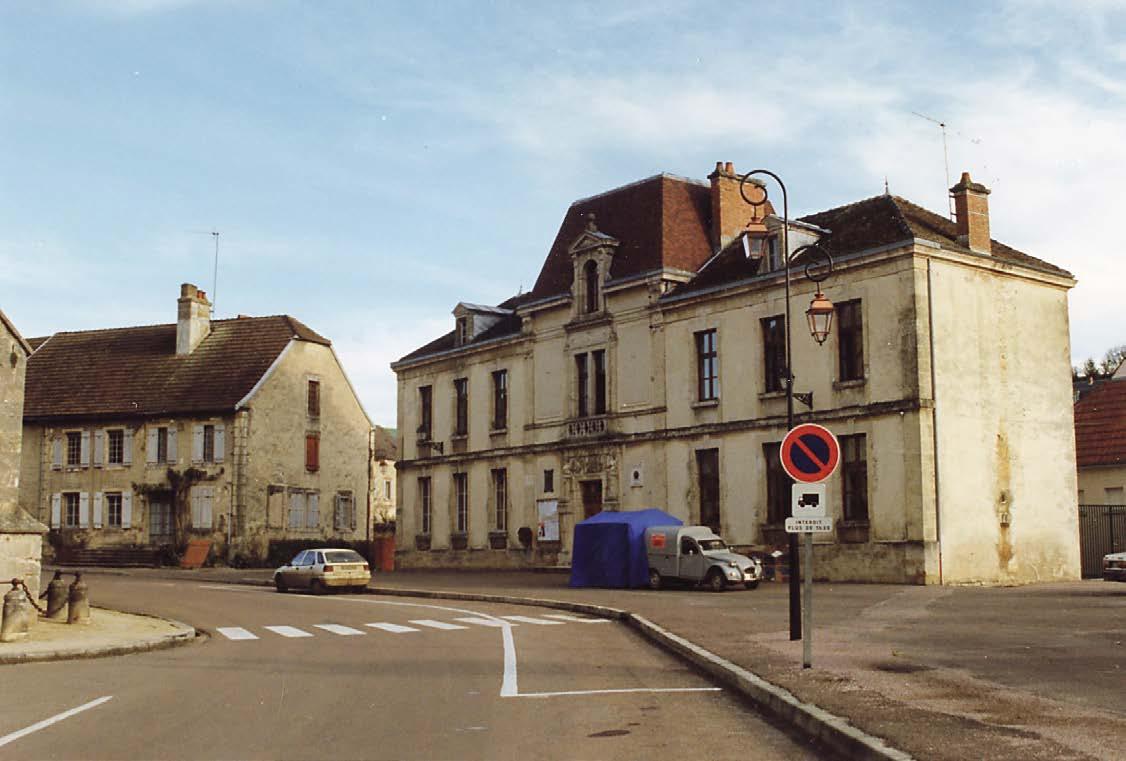
Previous spread: Chris Burden, Mini Video Circus , 1994/2025, 3 Citroën 2CV vans, each equipped with canvas tent, 6 metal folding chairs, 4 media players, and 4 TV monitors, each van: 7 × 20 × 8 ½ feet (2.1 × 6.1 × 2.6 m), installation view, Chris Burden studio, Topanga, California. Photo: Brian
Opposite, from top to bottom: Disassembled 2CV van parts, installed by Chris Burden at Le Consortium in Dijon, France, 1994–95. Photo:
page:
at Le Consortium, Dijon, France, 1994–95. Photo: courtesy Chris Burden Estate
inverted double circumflex (chevron) is the iconic symbol of Citroën, but also suggests the triangular outline of a tent. The easily removable passenger seats emulate beach chairs, and the pointed tents resemble ones for camping: a favorite pastime for French families during les vacances , and also for Californians searching for the sublime in the great outdoors.
The thin fabric of the tent is an illusion of protection against the real destructive powers of nature. Burden himself lived in a tent when he first moved to Topanga Canyon, and he was viscerally familiar with the wilderness. Yet in Mini Video Circus , the tent serves as a unifying roof under which viewers can gather, as if at home watching the news hour. The work alludes to the horror and destruction buried within the sublime: emotions that band people together in space, whether throngs gather to fixate on the freak show of a traveling circus or families huddle together at home around a television screen.
As this caravan of disastrous images toured the idyllic countryside of Burgundy, one can sense the thread of performance carrying on through Burden’s sculptural work. Burden replaced
the everyday utilitarian goods these vans were intended for with new cargo: the constant challenges to power, and the violence, present in the United States. The work presents a combination of video, kinetic, and social sculpture for those curious enough to witness these otherwise-remote realities head-on.
On the upper left-hand TV monitor installed in each van, the newsreel reporter announces that “up to seven thousand acres are burning in Topanga Canyon in a deadly wildfire.” In just twelve minutes, the destruction reaches Malibu, and we hear the voice of the Los Angeles Fire Department in Calabasas as the catastrophe unfolds, broadcasting images of smoke on the Pacific Coast Highway, evacuation orders, abandoned homes, cars backed up for miles. This footage refers to a fire in November 1993 that burned for ten consecutive days. Eighteen thousand acres of Malibu were burned to char, 359 homes lost, and more than seven thousand firefighters summoned for assistance. Burden lived and worked in Topanga Canyon for the last forty years of his life and experienced this devastation firsthand. For many Californians, the threat of wildfire presents an
license plates: 6265QP21 (18,074 km) and 558HY21 (44,296 km).
Much like objects encased as accompanying relics to some of Burden’s earlier performances, these vans no longer have active fuel tanks, batteries, or functional motors. Yet when plugged into an electrical source, all four TV monitors in each van enliven the immobile sculpture with moving image, multilayered sound, and the opportunity to gather and witness. Nam June Paik’s radical and transformative video sculptures and Joseph Beuys’s social sculpture and Ringgespräche (Ring Discussions) come to mind as precursory seeds for Burden’s Mini Video Circus
The vehicle is a motif resurfacing across Burden’s work, harnessing both the inventor’s drive to animate and the power of the circular and forwardmoving wheel. Trans-Fixed (1974) involved Burden crucifying himself on a Volkswagen Beetle, “the car of the people,” while B-Car (1975) conceptualized a functional hybrid car-bicycle. Later, The Flying Steamroller (1996), 1 Ton Crane Truck (2009), and Porsche with Meteorite (2013) continued exploring conjunctions of sculpture, engineered inventions, and performance through the centripetal tension and torque balance of vehicles. In Burden’s constant study of car models, he likely came across the 2CV Citroën designs and admired them for their simple mechanics and easily replicated, detachable bodies.
In Mini Video Circus , each van houses four stacked TV monitors from the 1990s, visible when the trunk’s doors are opened. The footage on view covers the Los Angeles riots following Rodney King’s trial in 1992, the Malibu fires of 1993, and the Northridge earthquake of 1994. Imitating the small-business logos and labels of original 2CV vans, each van bears a red label on one side that reads “émeutes / incendies / tremblements de terre” (riots / fires / earthquakes). The large blue tent serves as protection from the elements and provides shade for viewers, who sit in rows of patio-type folding chairs to communally experience the footage. The installation is portable and can be set up and dismantled in the spirit of a traveling circus. While the monitors are permanently installed, the tent and chairs are easily broken down and fit neatly inside the vans. The
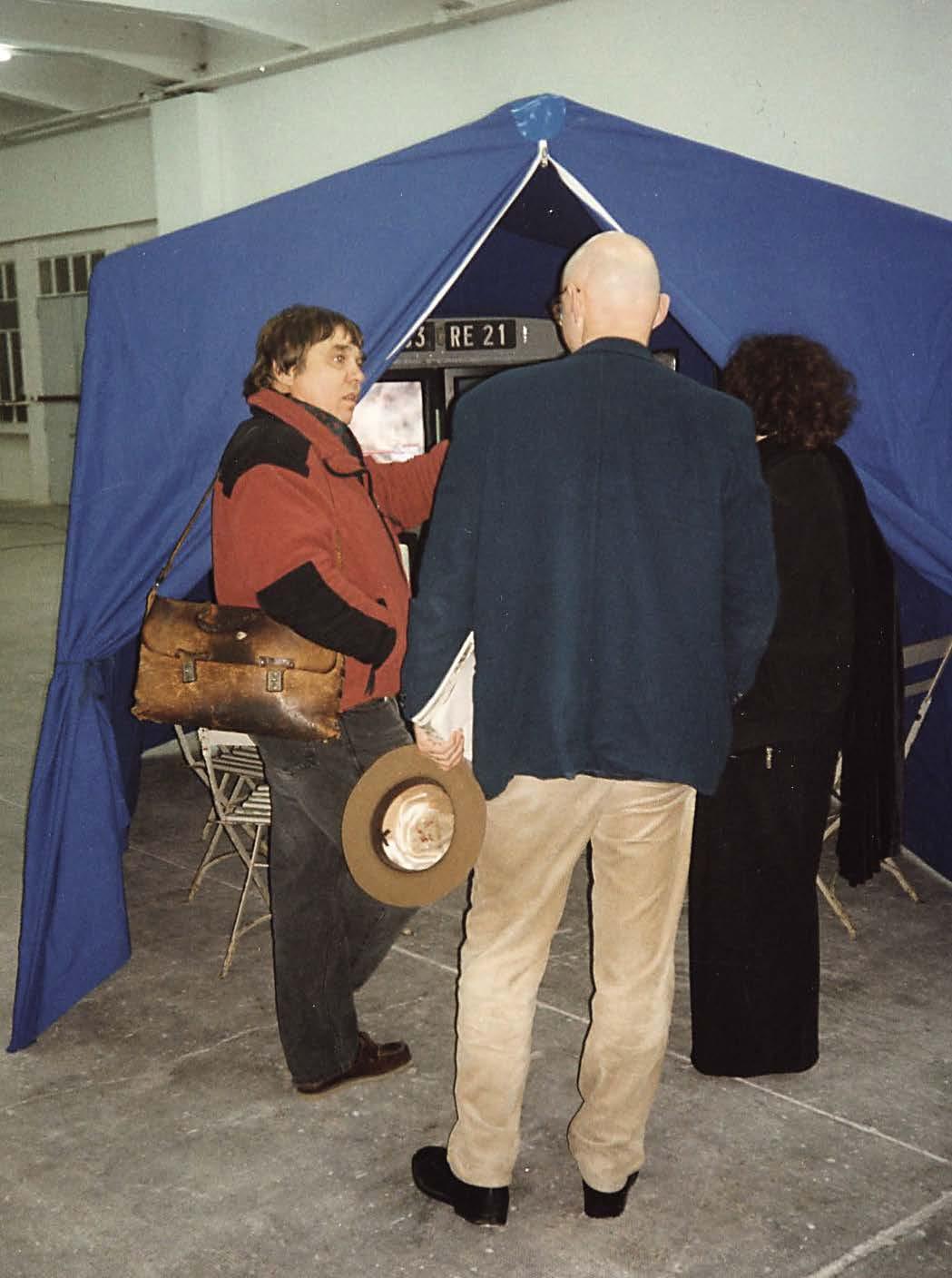
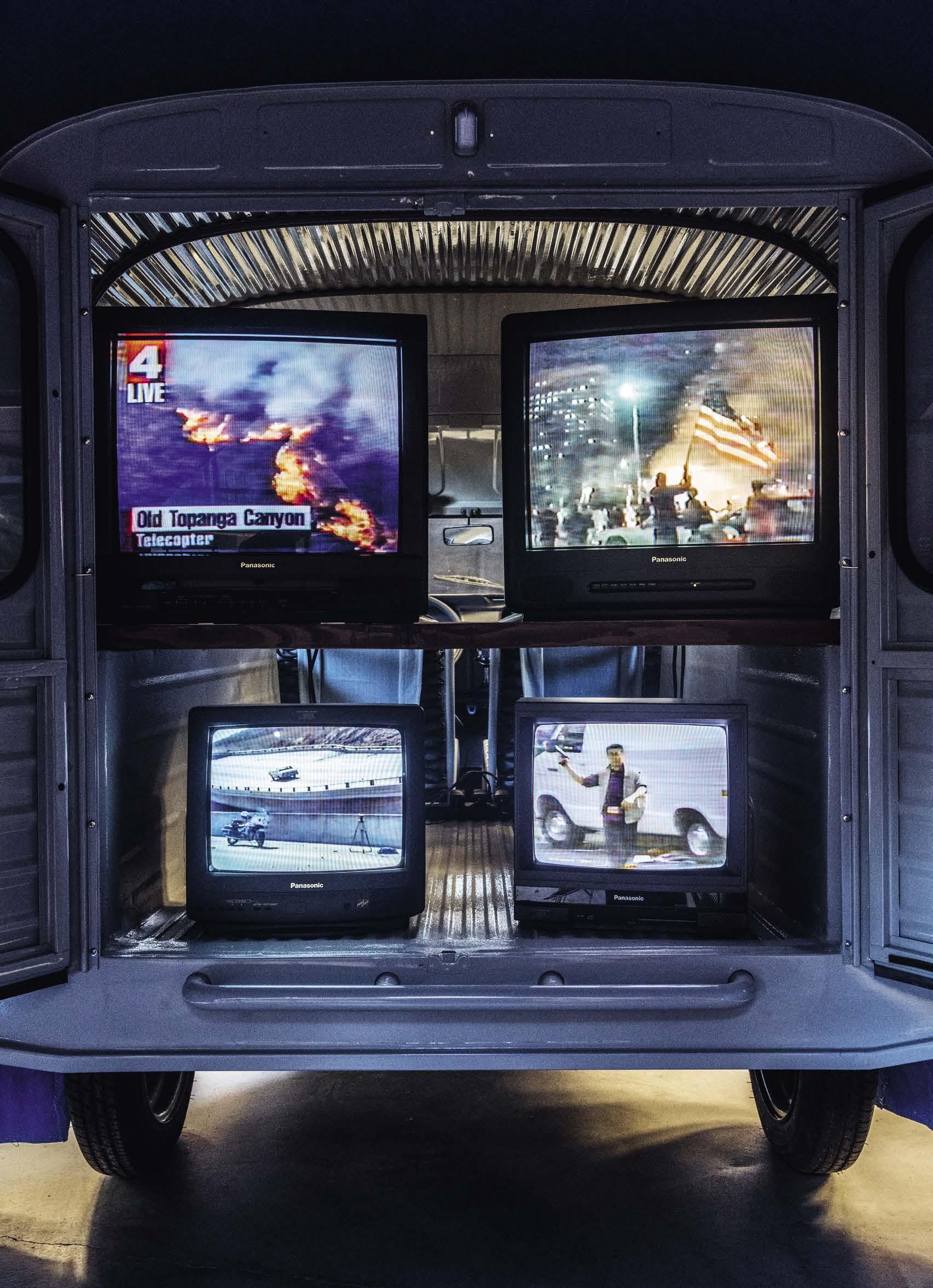
Opposite: Chris Burden, Mini Video Circus , 1994/2025 (detail), 3 Citroën 2CV vans, each equipped with canvas tent, 6 metal folding chairs, 4 media players, and 4 TV monitors, each van: 7 × 20 × 8 ½ feet (2.1 × 6.1 × 2.6 m)
This page, top to bottom: Disassembled 2CV van parts, installed by Chris Burden at Le Consortium in Dijon, France, 1994–95.
Photo: André Morin pour Le Consortium
Chris Burden, Mini Video Circus , 1994/2025 (detail), 3 Citroën 2CV vans, each equipped with canvas tent, 6 metal folding chairs, 4 media players, and 4 TV monitors, each van: 7 × 20 × 8 ½ feet (2.1 × 6.1 × 2.6 m)
Artwork © 2026 licensed by the Chris
eight thousand arrests, two thousand injuries, more than fifty deaths, the resignation of LAPD chief Daryl Gates, and military deployment in response to the civil unrest. The video footage also reckons with the despair of the working class in Los Angeles in light of the riots.
If the California dream of the 1990s amounted to amplified visions of living in Hollywood— glamour, boundless leisure, sunny days and palm trees, promised riches—the social and environmental crises presented in Mini Video Circus depict the far darker realities stirring in the shadow of that dream. This dissonance between image and reality manifested with particular impact in the van that toured small villages in Burgundy, rupturing one-dimensional ideas of “America” for viewers who sat in folding chairs against the picturesque backdrop. Though France has a long history of protests and strikes, these were not common in the 1990s, unlike the more recent confrontations between the Gilets Jaunes groups and the French police, which more closely resemble the social unrest of the LA riots.
Importantly, the prominence of guns in the United States remains singular, and the riot footage in Mini Video Circus highlights how the Second Amendment spawns raw violence domestically. Indeed, the image of the cowboy using the law of the gun as the law of the land is central to American identity, and it brings us full circle to Burden’s seminal performance Shoot (1971), which was ignited by the images of carnage and protests during the Vietnam War. As in his other work, Burden revealed a latent violence calcifying in the bones of American freedom. As we imagine riding through quiet Burgundian towns in a vehicle in search of lost time, California in crisis feels distant and surreal—this sentiment also felt in the reverse. The look of our vehicles and TV screens has evolved in the last thirty years, but Mini Video Circus ’s staying power is enacted by the sediment of a past that remains relevant far into the future. Actual disasters will endure longer than the beloved fourgonnettes that live on in collective memory.
ever-present undercurrent of anxiety. The recent combined Altadena, Eaton, and Palisades fires of January 2025 destroyed more than sixteen thousand homes and businesses and charred approximately fifty thousand acres of land over the course of twenty-seven days. Watching this footage from the 1990s, one can recognize history repeating itself, but with a new urgency due to increasingly drastic climate changes. This segment of footage in Mini Video Circus raises clear questions about the devastation that might be faced another thirty years hence.
Just two months after the 1993 fires, the Northridge earthquake of January 17, 1994, clocked a 6.7 on the Richter scale, leaving more than seventy people dead, thousands injured, and damages in excess of $40 billion, making it the greatest earthquake tragedy to date in US history. The lower left and upper right TV monitors show footage of this devastation, covering power outages that affected thousands, numerous homeless fatalities, seemingly endless traffic jams on major highways, and demolished infrastructure. Burden’s work frequently centers facts and real-life events. Here, the inclusion of news footage proclaims: This is not a dream, nor an invention.
The two other monitors in each van present footage from the LA riots filmed on April 29, 1992, the day the four LAPD officers who assaulted Rodney King following a high-speed car pursuit were acquitted. A bystander had caught the beating on video—a frightening example of police brutality toward unarmed Black men—and the proof of such abuses of power was broadcast worldwide. The generational racism, economic disparities, and inequality faced by the Black community in Los Angeles—compounded by unaddressed daily murders due to gang violence and use of deadly force by the LAPD—manifested as explosive riots. The light sentence of a Korean deli owner who shot fifteen-year-old Latasha Harlins in March 1991 added fuel to the fire, and Korean-owned grocery, liquor, and clothing businesses were targeted in waves of looting and arson. The owners defended their livelihoods with guns in hand, while the LAPD retreated. How to make sense of all this violence? Injustice awakens rage, revenge, obliteration, desperation. The riots resulted in the destruction of 862 buildings, $1 billion in damages,
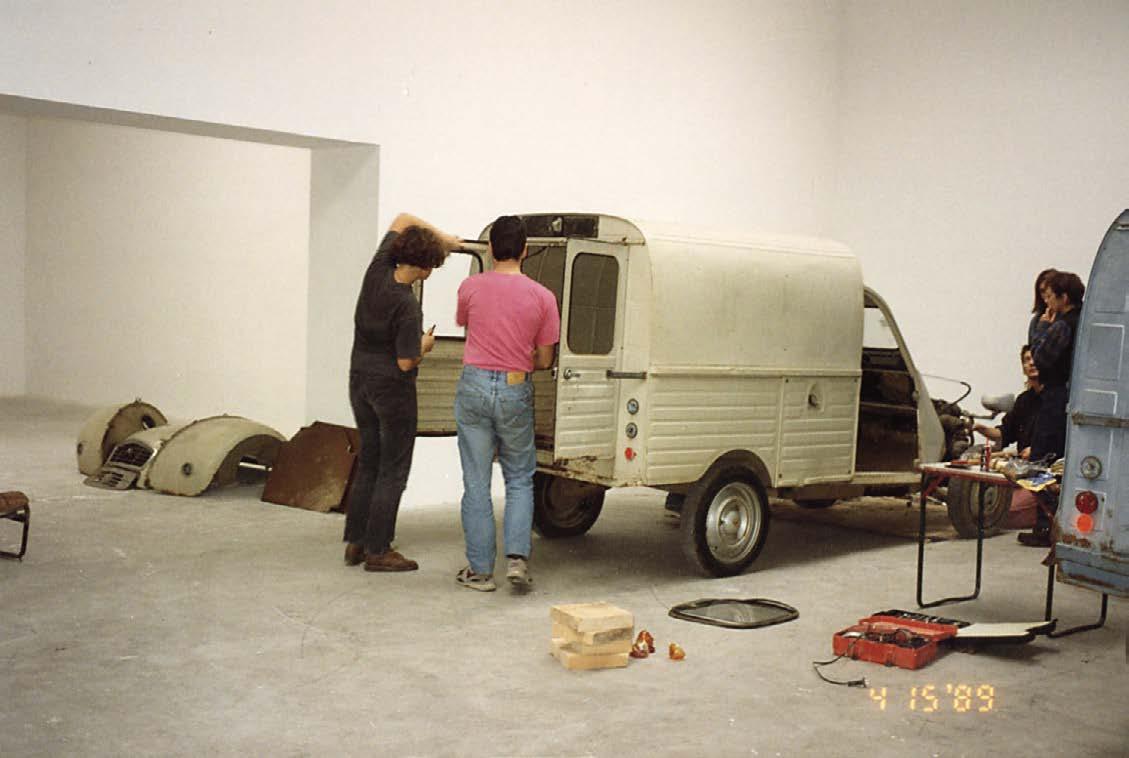

On April 16, the Institute of Contemporary Art/Boston opened the first midcareer survey of Derrick Adams’s multidisciplinary practice. Covering over twenty years of work, the exhibition, titled View Master, brings together the artist’s painting, sculpture, collage, performance, and video, as well as a vibrant new commission created for the museum’s facade. Ahead of the opening, Adams met with Tessa Bachi Haas, cocurator of the survey, to discuss his formative experiences with television, the impact of his work in arts education on his practice, and the importance of taking a more complex, more joyful, and more expansive approach to Black American life and culture.
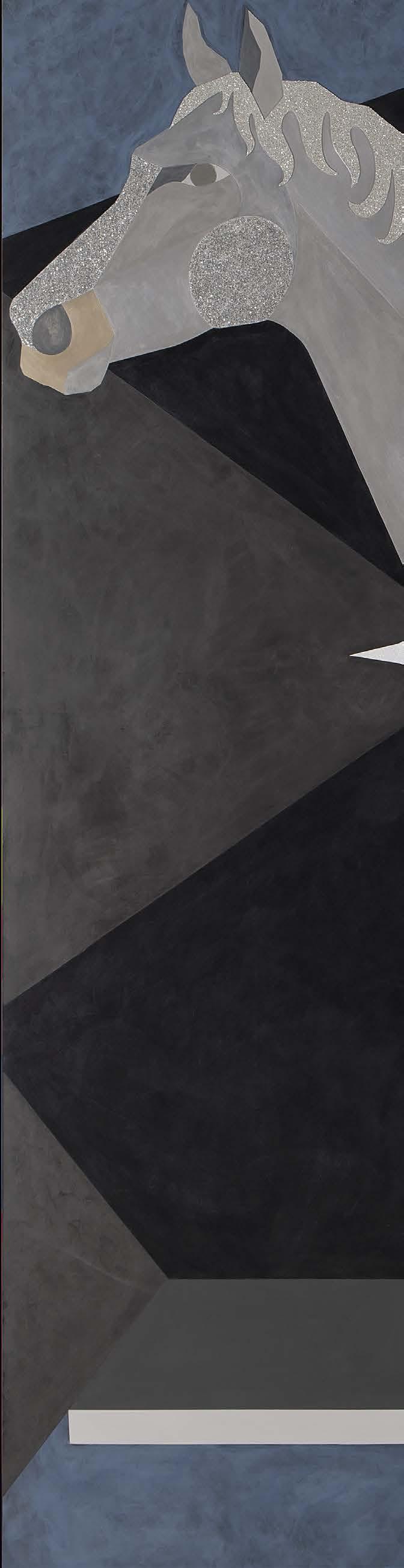
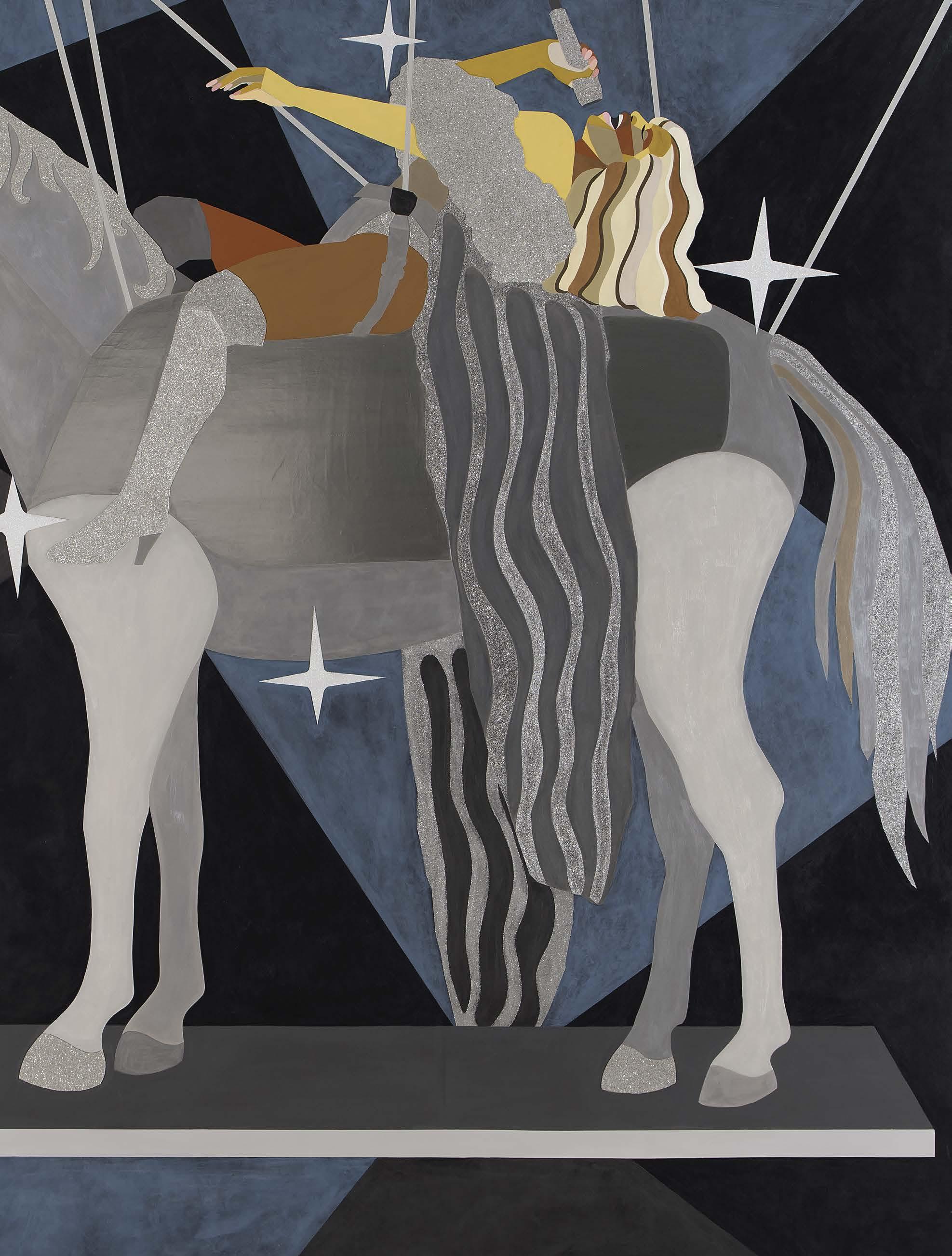
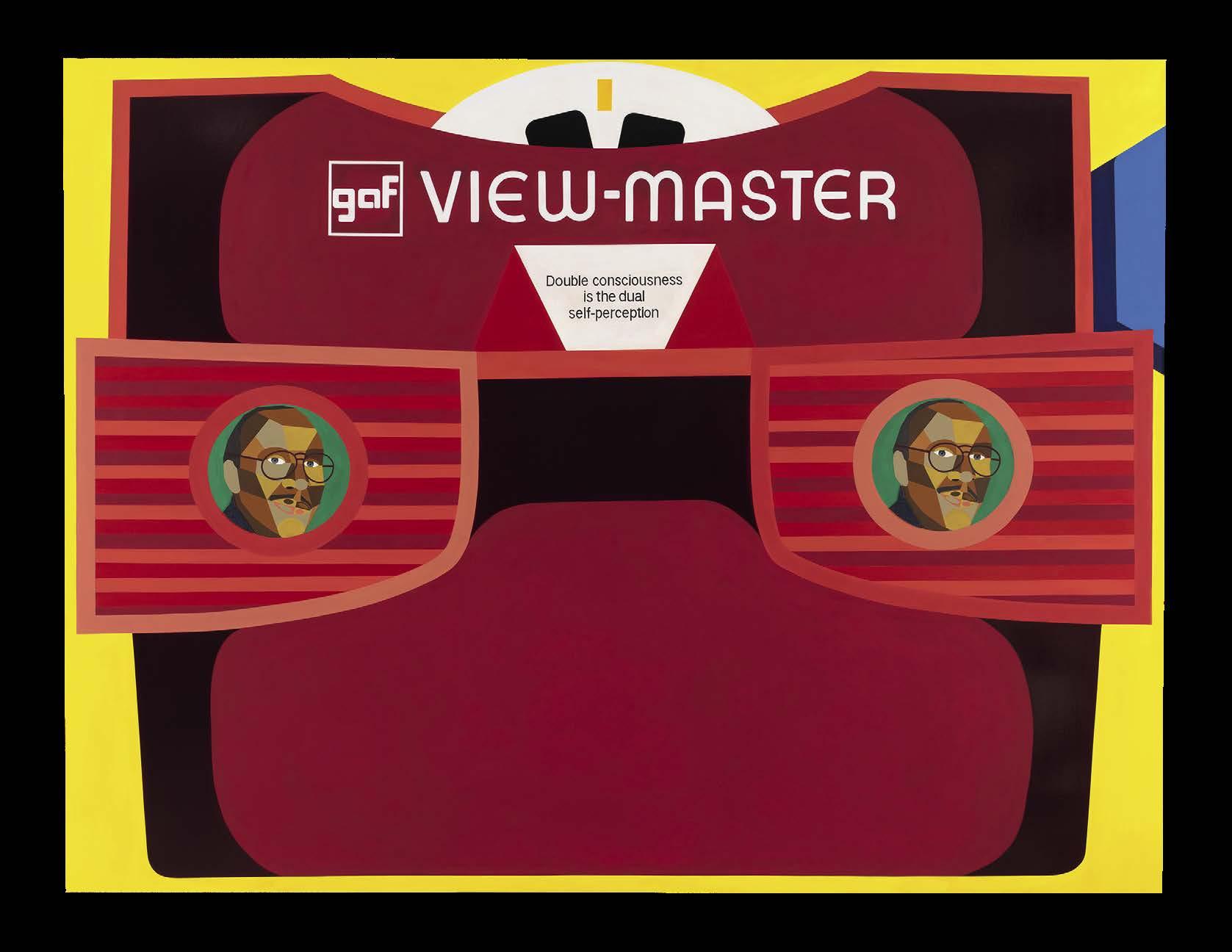
TESSA BACHI HAAS Let’s start with your iconic color bars. We’re wrapping the museum’s facade with them, and the bars will greet visitors before they even enter the building. The pattern repeats throughout the galleries. You’ve said in the past that television was your first classroom, and I’m curious what television taught you that formal education didn’t.
DERRICK ADAMS I only realized later how much of an impact television and media had on me as a younger person. But in my generation, when we talk about our childhood or even about the present, so many different references to TV come up. Outside sports or school, a lot of things that brought people together, at least in my American experience, were rooted in television. Starting from educational programs like Sesame Street or The Electric Company, in the late ’60s, early ’70s, all these educational programs were part of our cultural legacy, and were responsive to and evolved from the civil rights era. The casts were reflective of where the country was going, or of the direction people felt it should go. So as a younger person, the idea of diversity was something I was already introduced to because of television.
But what stuck with me was the imaginative element of these programs, how they introduced important lessons to kids in a very makeshift, grassroots, and theatrical way. They were something I thought about again going through the academic system of art education and art history—looking at Renaissance paintings, looking at modernism,
looking at traditional African sculpture—and I found myself asking, What’s my story as a contemporary Black person? How did I experience these shows, as opposed to someone else looking at the same thing—how did they experience this stuff? I realized what a profound impression they’d left on me—they added to my security and self-confidence, because the participatory practice of those programs enabled me to be vocal and expressive. But I also responded differently from most people I spoke to about them. This became a perfect avenue for critical exploration: Rather than just having fun or being entertained, I was really thinking about the social politics of learning. And how can that be extended as an artist thinking about audience?
TBH These programs taught you pedagogy, they taught you how to teach, and arts education remains a key part of your life. I’m curious how that training shapes the way you’ve approached constructing this exhibition. When I look at our plans for the show, I can really feel this structure and sequencing of ideas. The exhibition tells a story in space, and I feel like we’ve constructed it as this sort of open-ended lesson.
DA All the things I’ve experienced, from creative output to the administration, took shape because of my early education at Pratt [Institute, Brooklyn]. I switched my major there from painting to arts education—I knew I’d be painting forever, so I didn’t think I needed necessarily to be around painters every day. I thought I needed something more substantial, more based on the whys and whats of
an artistic practice. I really wanted to understand what was being taught, and for what reason. How was color addressed? How was formalism demonstrated? How was representation introduced? And going into the schools, I started to see how things were outdated. There were conflicts between what was happening in the real world and what students were exposed to in the classroom. I started going to educational stores as an artist, looking through all the visual materials that teachers would buy for classrooms, and I started using those in my collages.
So I didn’t necessarily think of myself as a teacher. I think of everything I do as happening in the research space. I was really interested in, What is the lesson and why are we teaching that lesson? Those television programs and this educational foundation really helped me understand how people see color, what it means, when to implement it. My practice is built on these questions; I’m not a very spontaneous person when it comes to artmaking. There are moments of spontaneity but I’m also very interested in the construction of ideas. TBH And building on the ideas and realities of representation—we have to talk about that, because it foregrounds much of our own practices. With View Master, for example, we talked early on about working with teen programs at the ICA. That’s something I feel responsibility toward as a curator of color. What are your thoughts regarding responsibility toward a next generation, whether it be modeling sustainability in an artistic practice or
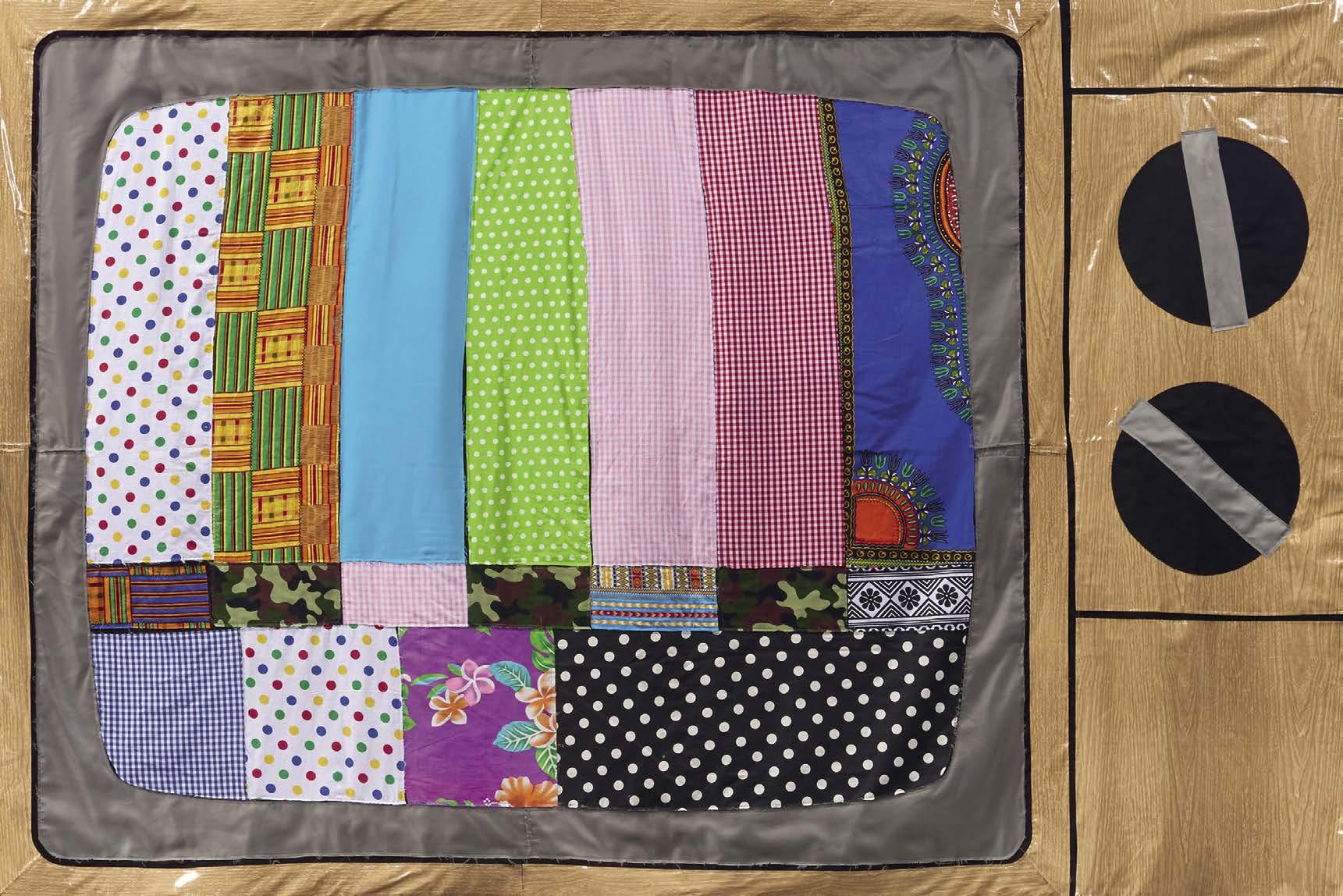
demonstrating multiple ways to build a life in art?
DA It’s more about being a public servant in some ways. And my position creatively is to make it as interesting as possible for people who may or may not have had exposure to the things I’ve been exposed to. It’s really just sharing resources. In the creative field, there are two things happening simultaneously: There’s a creative impulse, but there’s also the administrative part needed to gain access to different spaces.
It’s important how you speak about what you’re doing, how you create entry points for people to understand the value of supporting what you’re doing within a larger ecosystem. Looking back, what you learn from an academic point of view is how to talk about your work in a way that other artists understand—theory and process—and those things have been really important for my development as an artist, but it’s necessary to go beyond that for reaching actual audiences. And I think when people feel a sense of lightness or happiness, or the idea of joy, that’s an entry point, and a way to transport them into a space that I’ve occupied, where I’ve drawn from all the different sources that I feel empowered by. My inspirations are usually things that arise from chance encounters.
TBH When I think of chance encounters, I immediately think of your Style Variation series of mannequins in wigs [2019– ]. We started working on the show almost two years ago, and one of the first works on our earliest checklist was from that series. Since then, I walk around and I see the wig shops
across Boston—and Philly, when I am back there— totally differently.
DA Those stores are a free exhibition! If you’re walking around, you see them and you’re seeing creativity represented, you’re seeing cultural engagement. Importantly, you’re seeing not only the object but also how the object is activated. You see how the object is inserted in the community it serves. You start to see all these different relationships to consumerism and you start thinking about media and where these wigs show up, whether on TV or in the world. Those stores really activate attention in these ways.
So the thing is, with my work, it’s not like I’m creating something that’s never been created; I’m exalting or highlighting or amplifying existing aesthetic elements, basically saying: Look at this. The way I go about reimagining them only heightens the visual impact of what I’m looking at in a way that an audience may not necessarily have thought about before. Now this wigged head is like eight feet tall, monumental, it’s in your face and taking up your view. And that’s how I felt looking at the originals—I felt like they should be bigger. That body of work is not about hair, to be clear, it’s about style. It’s about the influence of urban culture on consumer products and the fact that these objects are inspired by the people who wear them, not the other way around. The reason this wig looks like that is because the audience that they’re trying to gain has already sanctioned this object as cool. The person who made it didn’t make it cool; the person
who will buy it made it cool. The wigs that you see in the street are based on a history of people buying these products, taking them home, styling them themselves. So this whole thing is showing them, “This is what you did; you did this.”
TBH It’s joy, but not in the toxic-positivity sense that everything needs to be happy as a counter to everything that’s horrible. It’s not polemical, it’s about you thoughtfully seeing people in the fullness of their lives. You’ve spoken before about Black visitors leaving museums feeling really heavy and burdened by the repetition of trauma on display—how is View Master constructed to counter this, and to recalibrate what it means to encounter Black life in a museum setting?
DA As a Black artist, you come to the reality that the complexity of who you are and what you experience often won’t be fully realized in exhibition spaces because of the structures in place and where you fit in, or where people feel you fit in. There’s a certain level of vulnerability that comes with inviting a Black artist into your space and allowing them to have a conversation that may empower a Black audience more than a non-Black audience, but that’s what Black people have dealt with. When I was an undergrad at Pratt, we rarely saw any images of Black artists or Asian artists or women artists in our art-history class. We still had to go to the museum, we still had to write the paper, we still had to do the work, we couldn’t say, “Okay, there’re no Black people in this slide, I’m not taking your test.” We had to go through the whole process
Opening spread: Derrick Adams, When the Stars Align , 2026, acrylic, fabric collage, and glitter on panel in artist’s frame, 96 × 96 inches (243.8 × 243.8 cm)
Previous spread, left to right: Derrick Adams, View Master, 2025, acrylic and fabric collage on wood panel, 72 × 96 inches (182.9 × 243.8 cm)
Derrick Adams, Fabrication Station 4, 2016, fabric collage, 72 × 108 inches (182.9 × 276.9 cm)
Opposite: Derrick Adams, Crossroads , 2012, archival pigment print, 44 × 26 inches (111.8 × 66 cm)
This page: Derrick Adams, Tell Me (Groove Theory), 2024, acrylic and spray paint on wood panel in artist’s frame, 60 × 60 inches (152.4 × 152.4 cm)
Artwork © Derrick Adams Studio
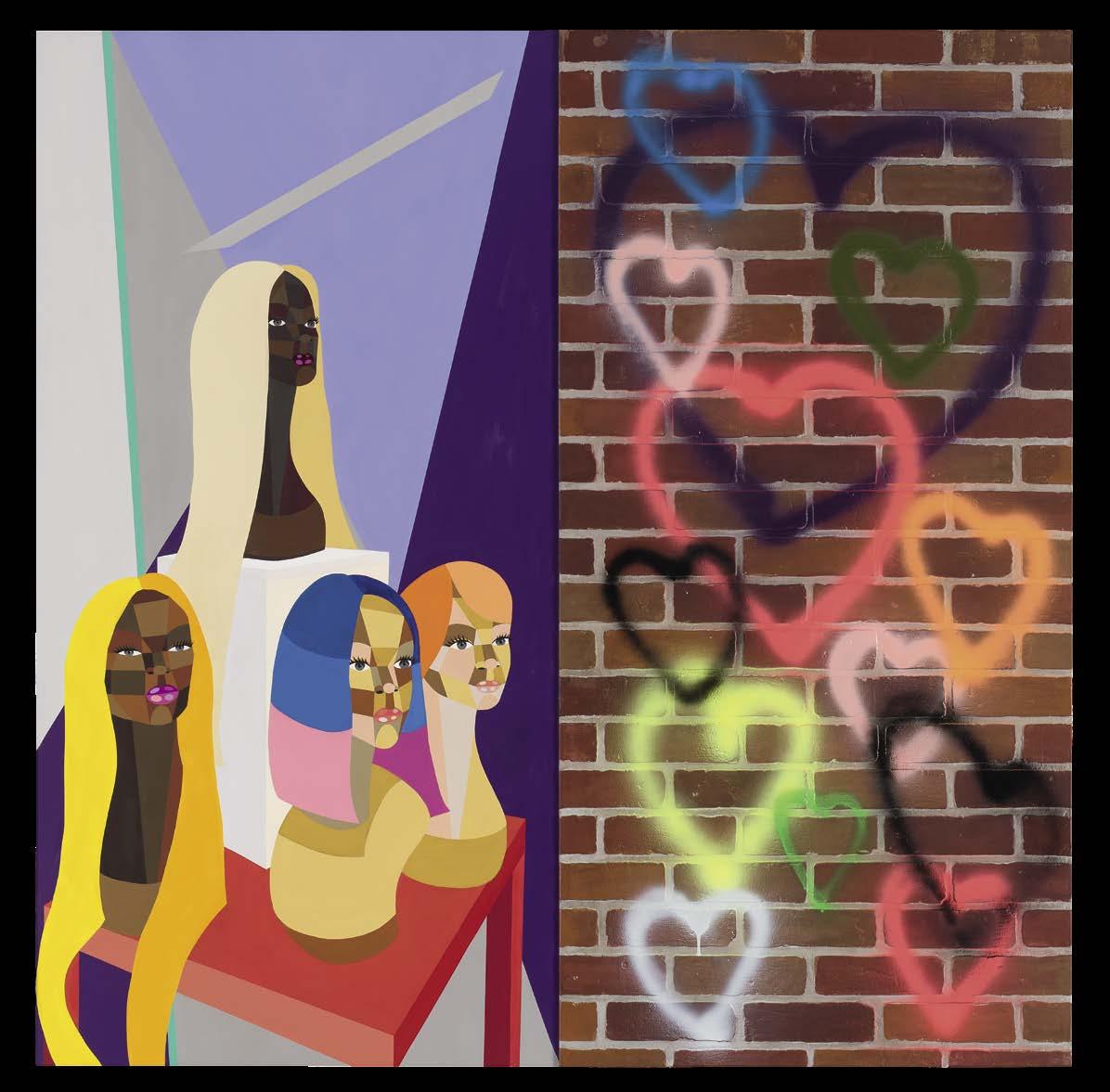
of not feeling included but still paying attention to the assignment and finding some positive aspect of the class. We know that there are other artists in the world, but we’re not seeing them in this particular room. So I think the museums should take on the responsibility of letting artists use their space to present what they want the audience to see, and for other people to deal with feeling either excluded or included. Have people ask those questions: What about this exhibition makes you feel like you’re not seen? Do you think other people may have felt this way before?
And of course there are Black artists interested in highlighting the traumatic history of America and the way Black people have been treated. Those shows find an easier place in most major museums because they’re a retelling of a certain history that people are familiar with. And, to be clear, I don’t think they shouldn’t tell it, but I think the same considerations should be brought to Black artists who don’t want to talk about those things, who want to talk about things in a way similar to, for instance, artists like Alex Katz or David Hockney or Bruce Nauman. There’s work that can be addressed in formal aesthetics that still alludes to identity and representation.
Every artist, regardless of their willingness or their acknowledgment, has a position relative to race and politics—if they want to deny it, they can. There are some artists who have the privilege to say they’re doing a painting about color, or they’re doing a painting about . . . whatever, but as Black artists we don’t really have the freedom to speak in that way about the work. I’m taking a lead in making that a possibility. Because, yes, my work is about Black culture. I’m making work from where I’m standing, which is a Black
person’s body, and even my most conceptual work is based on my perspective, occupying this world in this body—there’s no way to get around it. But I’ve been able to figure out how to address things that will empower me and people like me, rather than echoing things you can read in a newspaper or look at on social media—usually things that aren’t positive when it comes to our experience: either images of us doing something wrong or of something wrong being done to us. That’s a reality, and a lot of my peers address it very well in their work. But I think there’s a time when people, especially Black people, also need to see how they exist outside those narratives, how our lives can be related through the formal execution of different stories, through color, form, scale—through how to make things. The quality of production is something I personally yearn for in the discussions around my work.
TBH We’ve talked about formal and also thematic connections across your long practice, and I’m excited that we’ve come to a relatively open floor plan together, which lets visitors make these connections and which privileges both the formal and the thematic. I’d like to return to the color bars, which are coming to the ICA on a monumental scale. The decision to wrap the building in your color-bar pattern feels significant: It’s extending the work beyond the gallery into the public sphere. Boats driving by on the water will see it. Visitors walking by on the street will see it.
DA For a kid watching television in the ’70s, there were always times when the television program was off and the color bars would come on the screen. This would be before the network stage became public to the audience. I’d always think of the color bars as being this type of curtain, with
things happening on the other side of it. The color bars weren’t really about the ending of a program or the beginning of something, they weren’t a void of any sort but something indicating a different world. In the same way, the color-bar wrap around the museum suggests things going on inside the building. You can’t see it as an audience outside, but the color bar shows a level of activity. Beyond that, I was really interested in the way the color bar is the full color arrangement for what we see calibrated on television later on, the raw materials. The colors we see when we look at skin tones or anything on TV come from this image that’s really simplified, but then it gets transferred to a more complex arrangement. The bars suggest some performative element that is existing but may not be visible to the audience.
TBH The work is always happening and you’re giving us a snapshot of it, a calibration. Whether it’s the good or the ugly, you’re giving us a view and insight into it all. And in that sense, you really are our “view master.”
DA Yeah, exactly. And that’s why I thought it was the most appropriate title for the exhibition because it speaks to the artist’s ability to craft imagery, to craft reality. I remember that a professor I had as an undergrad said that to be an artist is like being a magician, and your job is to create visual experiences that people believe to be true. I’ve never forgotten that. That’s why my work took this direction, because I realized that true visual power means injecting into the future the way you want people to see you even when you’re gone. The hope is that the impact will drive people to understand how complex and dimensional the Black experience is—it’s not this or that, it’s and, and, and, and, and, and, and—
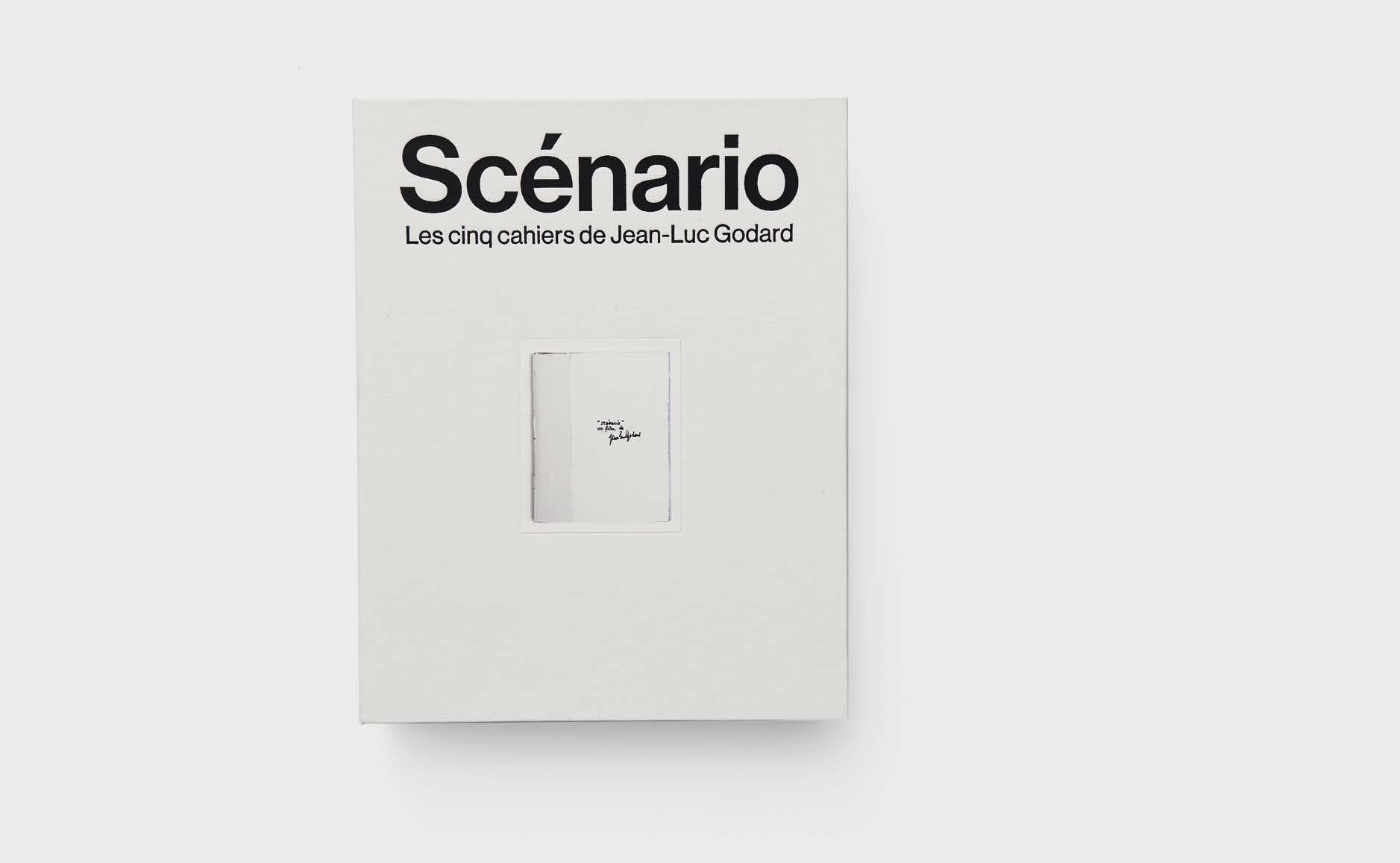
In his final act, Jean-Luc Godard bypassed the heavy machinery of traditional cinema to craft the film Scénarios, a haunting eighteen-minute elegy and farewell to the medium he revolutionized. The project links to five meticulously constructed films de papier (films on paper), notebooks in which the director used collage, acrylic, and Tipp-Ex correction fluid to map his meditations during the last years of his life. To honor this legacy, high-fidelity facsimiles of the notebooks were published last year as a limited-edition box set by Écran noir productions and Le Livre d’Image Éditions in France, in collaboration with Editions RWB. Printed by Milan’s Grafiche Milani, the facsimiles preserve every painterly mark and the physical texture of Godard’s handiwork. This edition also includes a booklet with essays in French and English translation by Jean-Paul Battaggia, Nicole Brenez, and Dominique Païni. To celebrate the film and the publication, we reprint an essay from the box set by Dominique Païni.
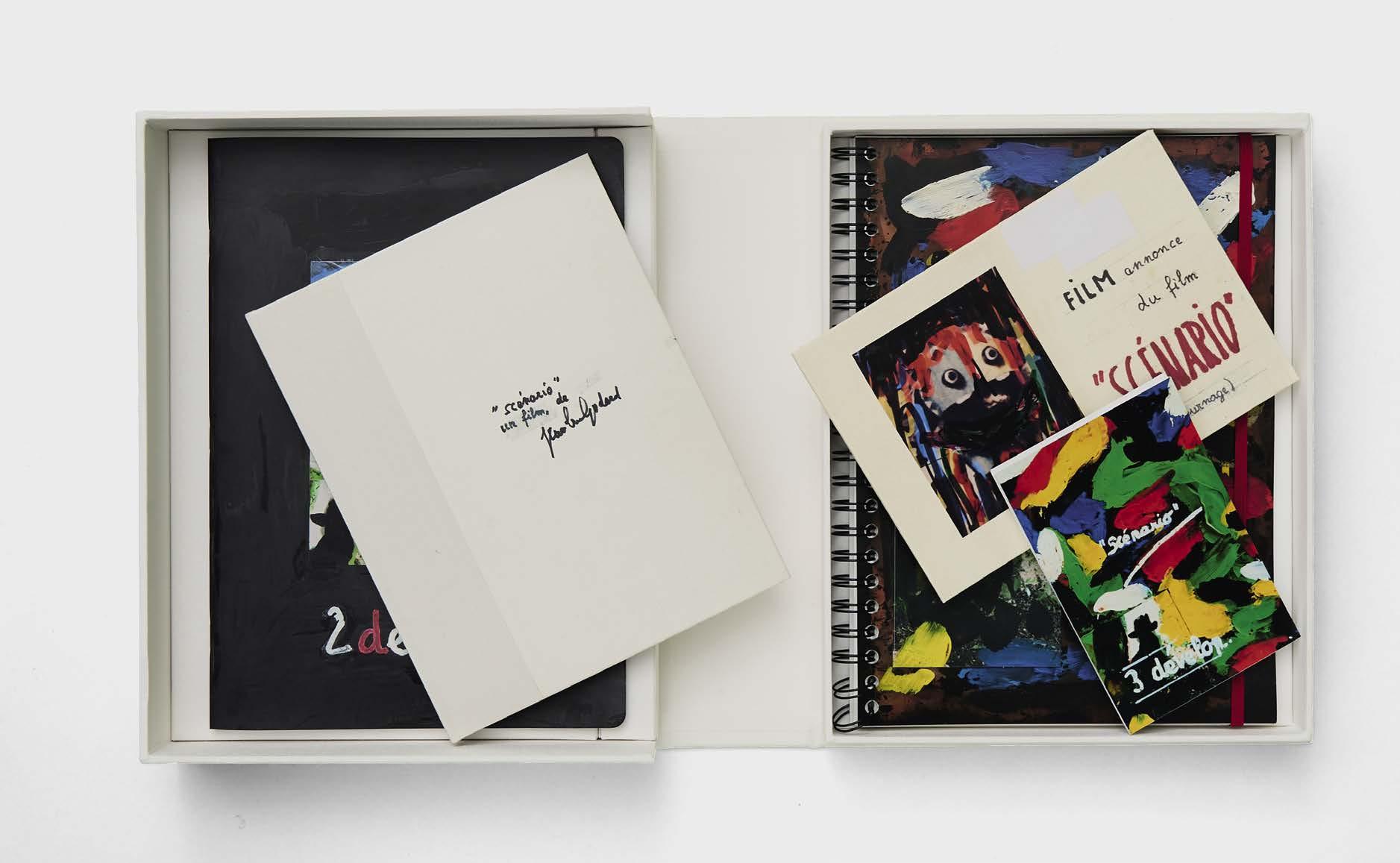
By Dominique Païni
On September 13, 2022, we lost a ninety-one-yearold filmmaker who had set himself two apparently contradictory missions: to make films that demonstrated the specific figurative power of cinema while simultaneously expressing its powerlessness to change what it raged or rose up against or simply lamented. By suggesting that beauty is fatal— “Fatale beauté” (Fatal beauty) is the title of a chapter in his film Histoire(s) du cinéma (1998)—Jean-Luc Godard often sadly reminded us of art’s inability to have an effect on the world, through that effort of which cinema, the heir to Romanticism and modernity, was the final experiment.
Godard expressed his disappointment in more
perspective of the “total work of art.” The maker of Passion (1982) wanted to verify (see) and experiment with (use) the zones of intersection and interaction between all the arts from the position of cinema, whose essential methodological virtue is montage, that “fraternity of metaphors.”
Godard, who always remained vocally faithful to his precocious activity as a critic, considered montage a real organon , an instrument for thought at the service of every art form (“a thought that forms a form that thinks”). He inaugurated illuminating capacities of montage and condemned those uses of it that were muddled and mannerist. It follows that in various disciplines of visual art, many artists of the second half of the twentieth century refer to Godard’s work for the inventive fertility of its audacious comparisons between images and its art
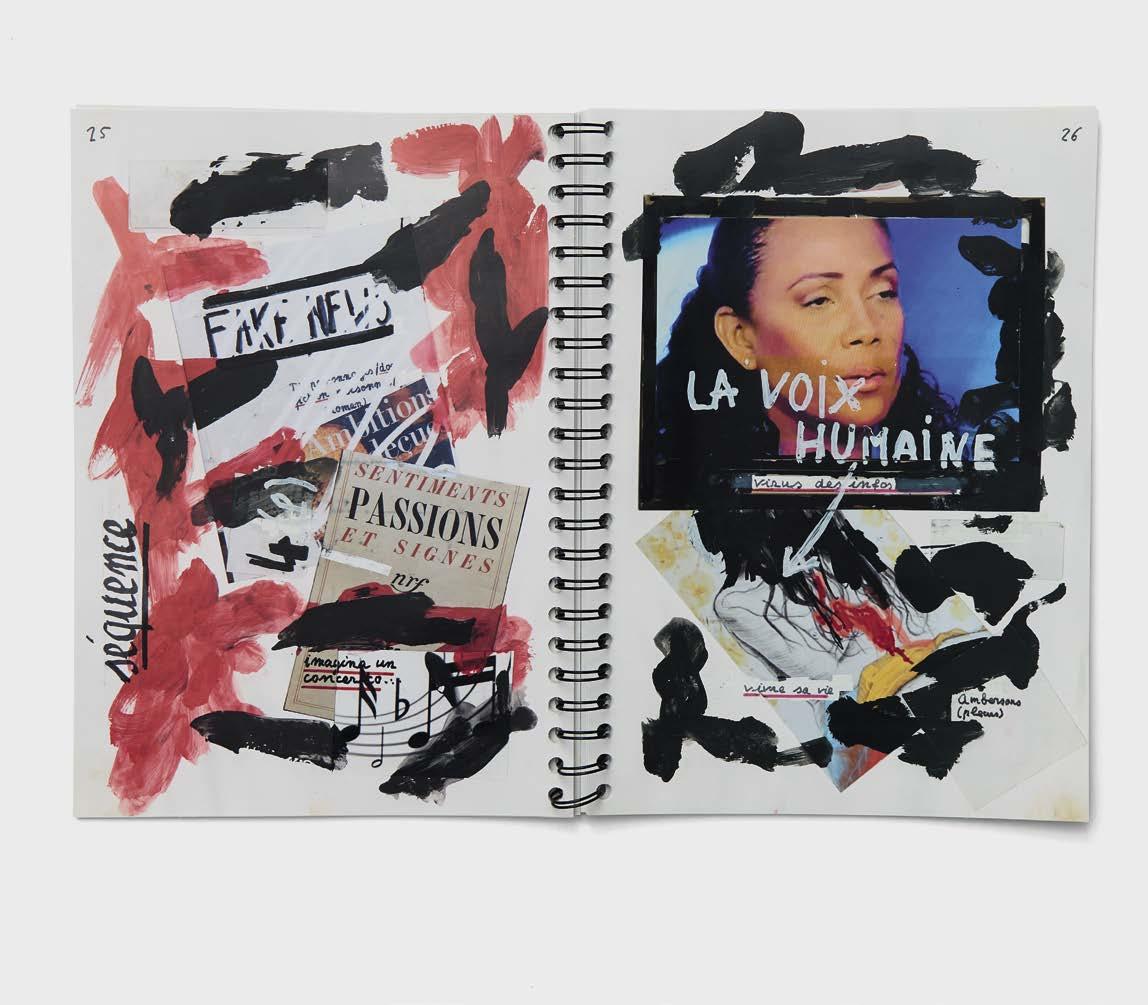
activism, he was less intent on changing the world than on inventing aesthetic and poetic principles to find different ways to bear it. So Pierrot le Fou (1965), beloved by Louis Aragon, singularly blends Baudelaire’s melancholy and Rimbaud’s utopia.
At the end of an unhoped-for period of cinematic innovation in the mid-twentieth century, Godard was the first filmmaker who drew from the premonition of cinema’s forthcoming disappearance and found the desperate opportunity for a final “Wave” that 1960s progressive modesty called “New.” He ultimately admitted that the error made by those who embodied this New Wave was to imagine they were experiencing a beginning when they attended the Cinémathèque française, founded by Henri Langlois. Thirty years later, the tireless cinephile confessed in his great work Histoire(s)
than fifty films—shorts and features, essays and fictions—while simultaneously attempting to find answers to André Bazin’s ontologically resonant question: What is cinema? Surely Godard’s answers came out of the torment shared by most modern artists and put into words by Alberto Giacometti. Obsessed by the duty of resemblance, the painter/ sculptor once asked Jean Genet, “One has to copy what one sees, right?” Then, immediately resigning himself, he added, “And at the same time, one has to make a painting.” Godard too resigned himself; he too had to imagine films while making do with the duty of verisimilitude.
On the other hand, he was in the grip of a constant obsession with recognizing as a self-evident fact the place that the art of film occupied among the other arts. This place, claimed by other filmmakers before him (Abel Gance, Jean Epstein, Luis Buñuel, Orson Welles . . . ), was not related to the synthetic
of the fragment.
An heir to the filmmakers who remained silent (F. W. Murnau and Sergei Eisenstein), to those who eloquently used sound (Jean Renoir and Roberto Rossellini), and to the auteur who ideally achieved the link between the two (Fritz Lang), Godard was torn between the recent past (the history of the twentieth century, of which cinema is the mirror) and the proximity of the future (the illusions of political commitment). With Histoire(s) du cinéma , he dared to carry out an unprecedented mise en abyme: to tell the history of an art whose technical means of cine-photography allow history to be recorded. Often considered an irritable moralist, an authoritarian, a didactic know-it-all, a paradoxical, cruel, but irresistible sparring partner for the media, and an amateur scientist, he denied all professionalism (from within a supposed profession). Though he briefly followed the paths of militant
du cinéma that it was an end . As he passed into the twenty-first century, this lucidity encouraged Godard to conceive works that appeared like final statements, testamentary summations, an orientation begun in 1994 with JLG/JLG, autoportrait de décembre . In fact, far from leaving ordinary funerary messages, Godard used his way of showing and sharing his work to organize his exit from cinema, taking advantage of this retrospective moment to continue to invent, and to always innovate.
Since Histoire(s) du cinéma , the Centre Pompidou exhibition Voyage(s) en utopie, 1946–2006, à la recherche d’un théorème perdu , and the films Goodbye to Language (2014) and The Image Book (2018), some had predicted that like major artists in the history of Western art, Godard would offer a final artistic and philosophical vision and lesson through one final work. The Image Book had already been an exhibited temporal object, as much
literature as film, and was toured like a museum exhibition (Théâtre Vidy-Lausanne, Théâtre Nanterre-Amandiers, Château de Nyon) rather than being shown according to the usual principles of film distribution. This film allowed its maker to take a decisive step toward the cinematic exhibition
Finally, Scénarios is the title Godard chose for a work completed on the eve of his voluntary death. Though projected, the work requires museum picture rails and turns away from the screen of moving shadows. It is a diptych: ADN, éléments fondamentaux (DNA, fundamental elements) and IRM, Odyssêe (MRI, odyssey). DNA is the biological characteristic that constitutes the singularity of a human subject; MRI is the medical imagery that reveals the distress of the weakened body. Between these two poles alluding to genesis and decline, there is
make a film—the computer keyboard replaced the scissors and the editing table, the pixels the celluloid—the maker of The Image Book imagined his films in the pages of his notebooks. One day he confessed, “If a blind man asked me ‘do you have two hands?’ I wouldn’t make sure of it by looking. Yes, I don’t know why I’d go and trust my eyes if I’d come to doubting them. Yes, why wouldn’t it be my eyes that I was checking on by looking to see if I see my two hands?” There were many notebooks, frequently photocopied to circulate among and convince those who had the power to produce his films. These meticulous, precious collages that attempted to return to “a childhood of art” reaped the legacy of the painter he had been and the typographer/designer he had known an exceptional example of in his family. 2 This double plastic influ-
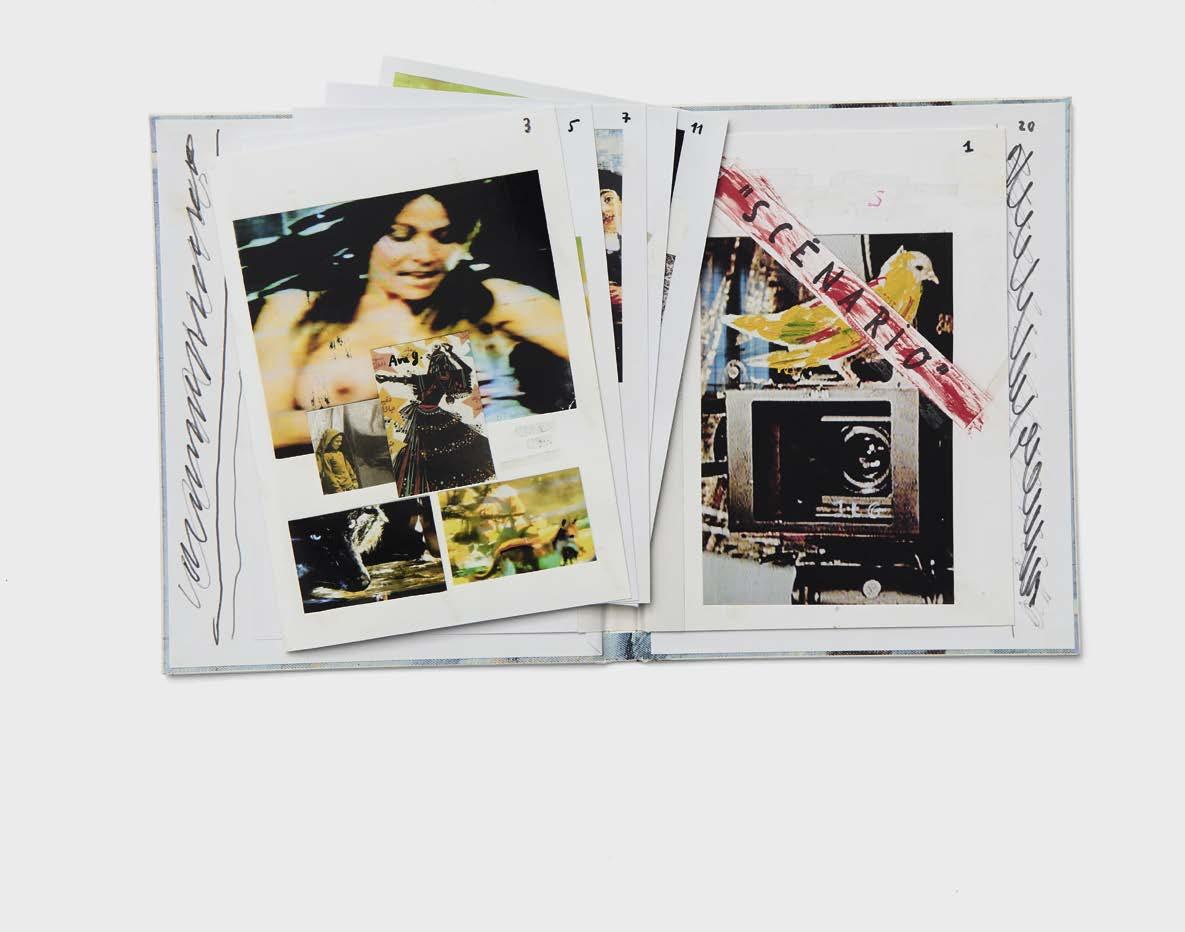
a kind of scenario, a story composed of notes and images mixed together, gathered, and edited into eighteen minutes.
Godard wrote, amassed, and assembled pages from magazines and newspapers, wandered through books and copied things down. His collecting was tireless: Cutting things out and collaging them, he set and classified visual or conceptual affinities in notebooks comparable to those of painters and sculptors and the school notebooks of children. “This is something I know how to do, gluing photos, finding money to buy the photo camera; the scissors, the notebook, renting the table to put the notebook on it, the house to put around the table, and buy the cigar to puff on while I’m doing all that. Not getting sick of laughing at an image of low tide. Starting off in affection and new noises, as Rimbaud more simply put it.”1
As his hands gradually became ineffective to
referred to the “admirable shaking of time” produced by these works. Some of them, he wrote, “suggest the feeling of a birth. And birth is nudity. As if the term were the spawning of something that has not yet seen the time come, as if all of history had to be canceled for there to arise this personal voice through which the unconditioned nature of the first instant is expressed, when the day has just separated from night. An origin recovered, but through erasure, purification.”3 Indeed, a few major works of art left to humankind by artists at the ends of their lives move us through the restlessness of their gesture(s) and the formal decisions for which they no longer fear disgrace. Scénarios belongs to this category of final and definitive works.
Translated from the French by Nicholas Elliott
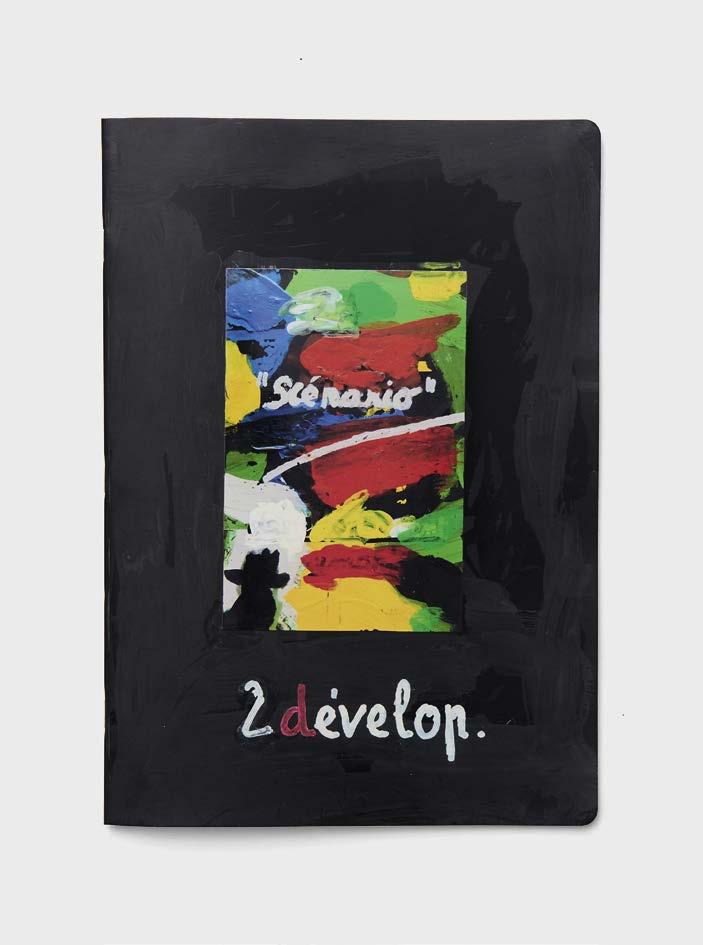
ence gave him the taste for the elegant compositions of his credit sequences and the texts laid over his images. More than mise en scène, Histoire(s) du cinéma was an achievement in mise en page —page layout.
Godard’s collage notebooks, both private journals and laboratories of montage, are the memory of his thought in motion. Scénarios is a goodbye and the ordeal of a funereal and sublime lament that ends with the last self-portrait of the artist Godard, sitting on his bed, half naked. Hiding nothing of the deterioration of his body, he stubbornly copies out a passage from a text by Jean-Paul Sartre (Situations, IV, 1964), a logical and droll apologue about the painter Wols.
To define the teachings of great last works, Gaëtan Picon, a French art historian of the first importance and a friend and scholar/critic of André Malraux (which is not insignificant in this context),
Throughout: Scénario: The five notebooks by Jean-Luc Godard , 2025, published by Le Livre d’Image Éditions, Editions RWB, and Écran noir productions; editorial design: Mitra Farahani, in collaboration with Aurélien Petit; contributors: Helen Bandis, Jean-Paul Battaggia, Sara Battaggia, Nicole Brenez, Nicholas Elliott, Dominique Païni, Robert Rubin, Stéphane Samuel, and Michael Witt. Photos: Mauricio Zelaya
1. Jean-Luc Godard, Le travail et l’amour, collage notebook, 1981, private collection.
Translator’s note: The secondto-last sentence of this quote features a typically Godardian, untranslatable play on words— “Ne pas en avoir marre de ne pas se marrer d’une image de marée basse ”—in which Godard plays on the similarities between the adverb “marre ” (being sick of), the verb “marrer ” (to laugh), and the noun “marée ” (tide).
2. His uncle Maximilien Vox. See Paule Palacios, Vox/JLG. Du plomb au film (Montreuil: Les Éditions de l’Œil, 2024).
3. Gaëtan Picon, Admirable tremblement du temps (Lausanne: Albert Skira, 1970), 29.

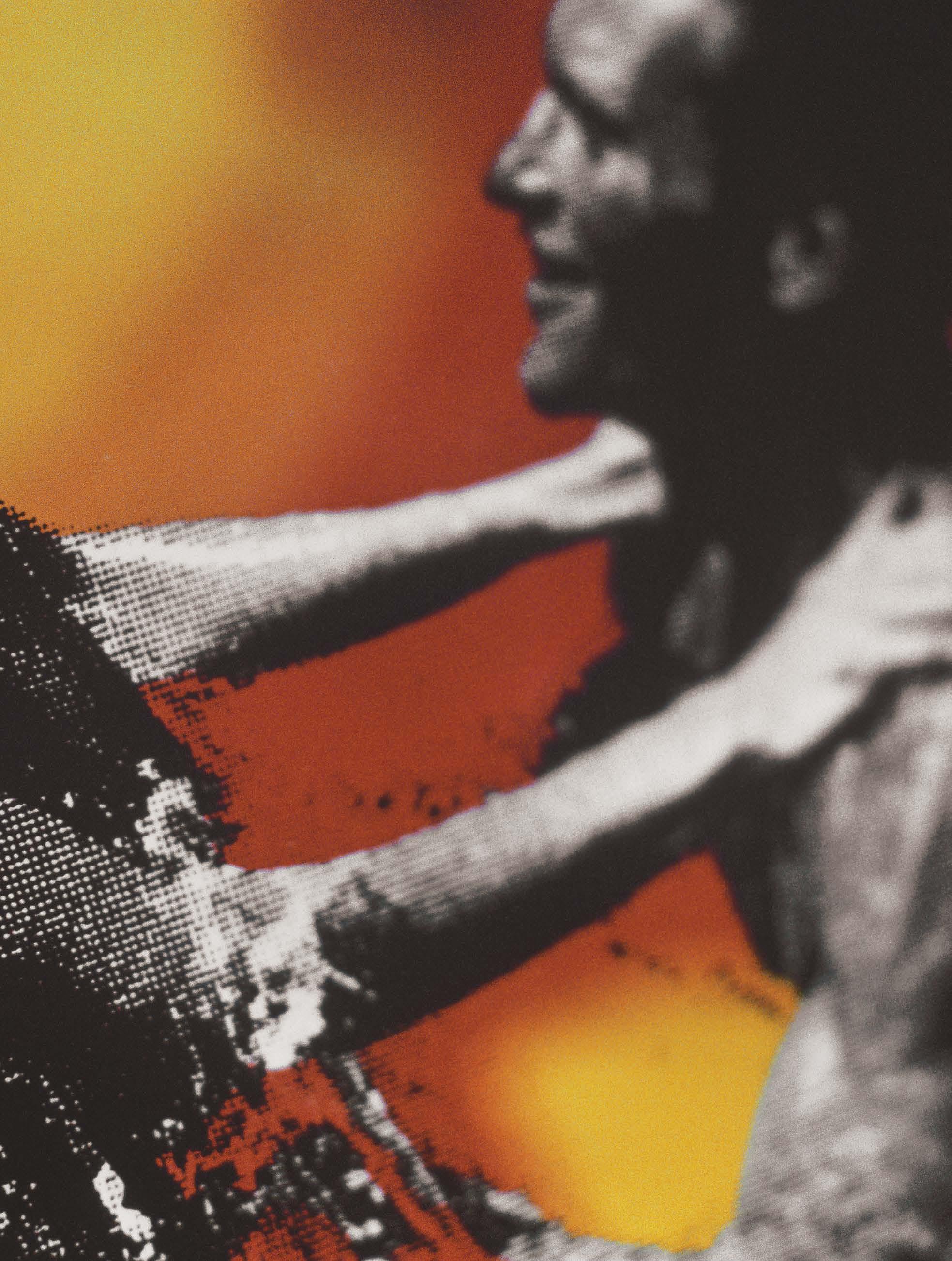
Helter Skelter —an exhibition at the Fondazione Prada’s Venetian venue, Ca’ Corner della Regina—marks the first creative dialogue between two visionaries of American art, Arthur Jafa and Richard Prince. Opening on May 9, 2026, during the Venice Biennale, the show explores the grit, grift, violence, and ingenuity of American culture through more than fifty works, including photography, video, and largescale installations that interrogate themes of race, gender, media, and politics. In the interview below, Nancy Spector, the exhibition’s curator, speaks about the shared motifs—from apocalyptic sunsets to a fascination with “monstrosity”— that led her to pair these artists for the first time.
WYATT ALLGEIER Nancy, how did you embark on curating this exhibition?
NANCY SPECTOR I curated Richard Prince’s retrospective at the Guggenheim [in New York, 2007–08], so I’ve been close with him since, and then I did a studio visit with AJ [Arthur Jafa] about three years ago. I’d never met him, and I was in LA, so I invited myself to his studio. It was late on a Saturday and it ended up being this multiple-hour discussion. He’s incredibly generous with his time and ideas. And it was interesting, because in that initial conversation we kept coming back to Richard. He must have known that I’d worked with Richard because I’m not sure what else would have prompted it. I didn’t understand the connection at first, but in 2024 I saw AJ’s video BG [now called BEN GAZARRA] at Gladstone. In that work he recast the secondary characters from [Martin Scorsese’s film] Taxi Driver [1976], like Harvey Keitel, with Black actors, in an act of appropriation that honors the original intent of the film script. It started me thinking about the character played by Jodie Foster in relation to Richard’s photograph Spiritual America [1983], of a young Brooke Shields. There are shared themes of exploitation and pimping, but more importantly both artists uncover the subconscious of an image. They reveal what’s repressed by recontextualizing it. From there, I decided to read their work together, just for myself.
WA What were some of the motifs that emerged as you went through their work?
NS It was uncanny, all the different motifs they share. In AJ’s video Love Is the Message, The Message Is Death [2016], for instance, the burning sun is featured at least five times; it also shows up in his still photography. That made me think of Richard’s Sunsets [1981–82] and their apocalyptic imagery. Then I looked at the self-portraits in which AJ performs for the camera in the guise of Mary Jones, a nineteenth-century transsexual sex worker.
WA I don’t know these works.
NS They’re large photographic self-portraits, but in the persona of an actual historical figure. Jones was called the “Man Monster,” which is part of the title of one of the works in that series. I was looking at those alongside Richard’s de Kooning paintings [2006–11], depicting intersex figures. Of course these stem from
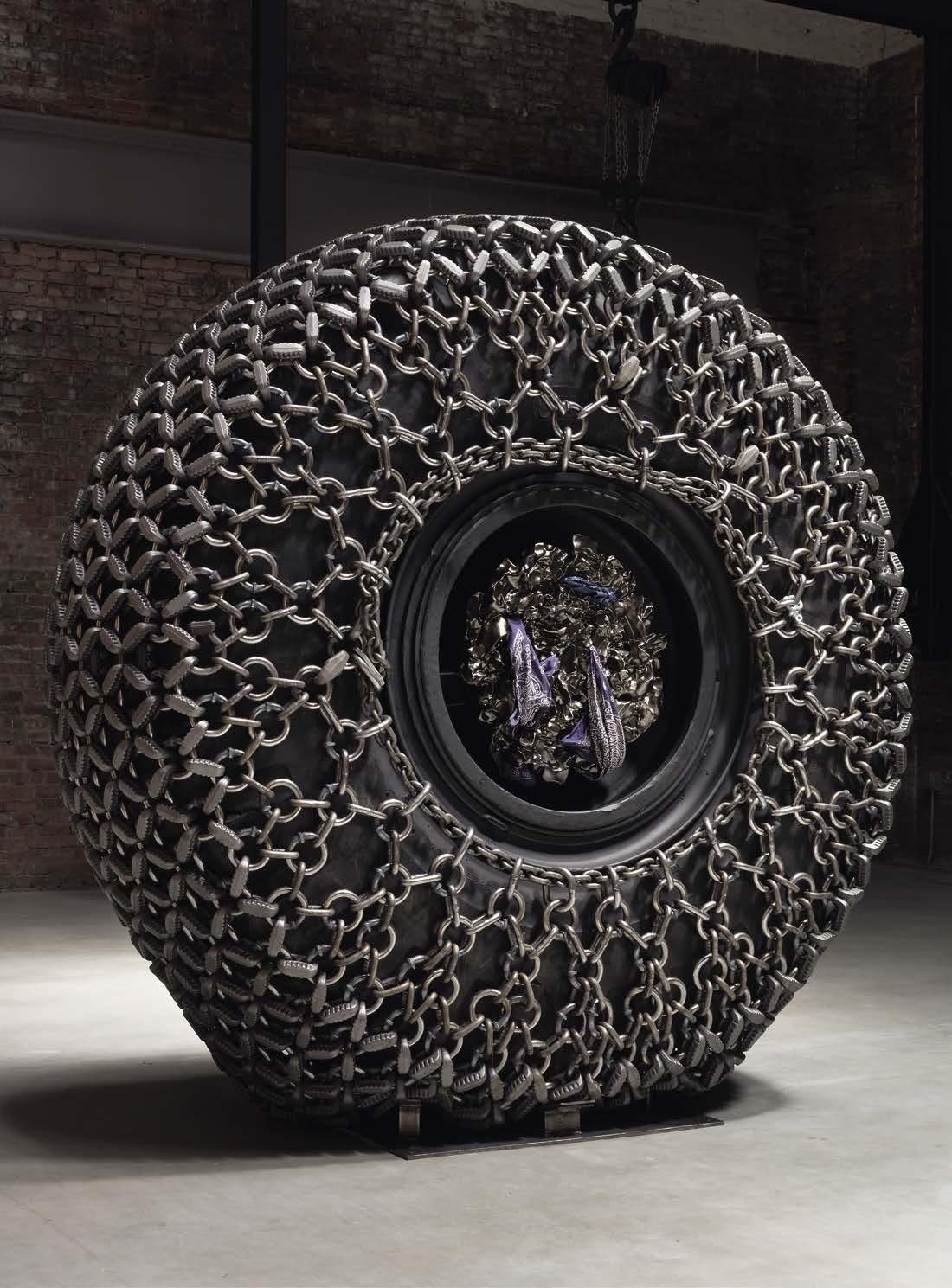
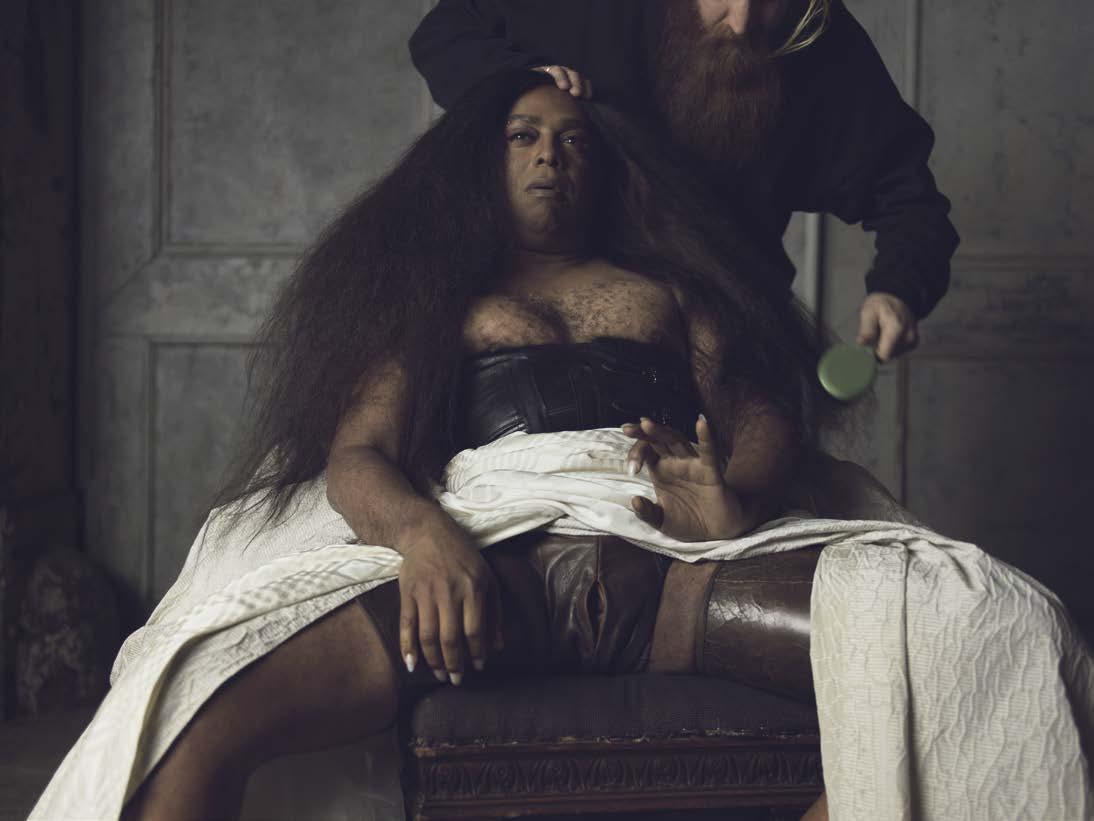
Richard’s engagement with art history more generally, but there’s so much else going on in that work in terms of nonbinary gender representation, questions about “monstrosity,” and the artist’s self-representation through such signs and symbols. Richard’s always talked about ideas of projection and representation, like the Girlfriend photographs [1987–2012] being multidirectional—wanting a girlfriend, wanting to be a girlfriend. There’s a fluidity in both these series, and more overarchingly in their work. The show evolved from there, encompassing a number of juxtapositions and dialogues across discrete bodies of work.
WA Were AJ and Richard involved in the exhibition from the get-go?
NS No, I put things together first and then shared with both artists. They both gave their permission for the exhibition to happen and then engaged in an ongoing dialogue with me and with each other. They didn’t know each other at the time. They’d never met, but they have now.
WA It sounds like it won’t be a chronological exhibition design; you’re working across different bodies of work, different media, different eras. How will the exhibition be organized in the space?
NS The guiding principle for the installation is to show those moments of intersection where the artists’ shared sensibilities, or shared obsessions, or shared concerns come to light and works begin to speak to one another. The show opens on the ground floor with Richard’s Blasting Mats from the Folk Songs series [2018–] and one of AJ’s Big Wheels [2018], with their references to car culture, the whole “on the road” sensibility.
WA Americana.
NS Yes, as well as intimations of monstrosity. The wheels are literally from monster trucks, which destroy other vehicles in car shows, and the Blasting Mats are forged from materials used to contain explosions, and also strung out across highways as matrices to protect from falling rocks.
WA The exhibition title is Helter Skelter. Immediately, before we even enter the show, we’re thinking the Manson Family, American violence, American imperialism. Also a particular time, the 1960s and ’70s. How did you come to that title?
NS The title really came from the artists, well into the process. Yes, of course there’s the Charles Manson reference, which is in both artists’ works: AJ recently
Previous spread, left to right:
Arthur Jafa, Love Is the Message, The Message Is Death , 2016 (detail), video, color and black-and-white, sound, 7 min. 25 sec., The Museum of Contemporary Art, Los Angeles. Purchase with funds provided by the Director’s Council and Arthur Lewis and Hao Nguyen © Arthur Jafa
Richard Prince, Untitled (Sunset), 1981–82 (detail), chromogenic print, 30 × 45 inches (76.2 × 114.3 cm), private collection © Richard Prince
Opposite, from top: Arthur Jafa, Big Wheel II , 2018, chains, rim, hubcap, and tire, 91 × 91 × 37 inches (231.1 × 231.1 × 94 cm), private collection © Arthur Jafa
Arthur Jafa, Man Monster— Duffy, 2018, Epson fine art print face-mounted to Diasec acrylic on aluminum panel, 54 × 72 × 1 inches (137.2 × 182.9 × 2.5 cm), Ignace and Isabelle Vandenabeele – De Bruyn © Arthur Jafa
This page, from top:
Richard Prince, Folk Songs , 2006, steel and rubber, overall: 246 × 66 × 48 inches (624.8 × 167.6 × 121.9 cm), installation view, Gladstone Gallery, New York, private collection © Richard Prince
Richard Prince, Untitled (de Kooning), 2006, acrylic and inkjet on canvas, 83 1⁄8 × 115 inches (211 × 292 cm), Pinault Collection © Richard Prince
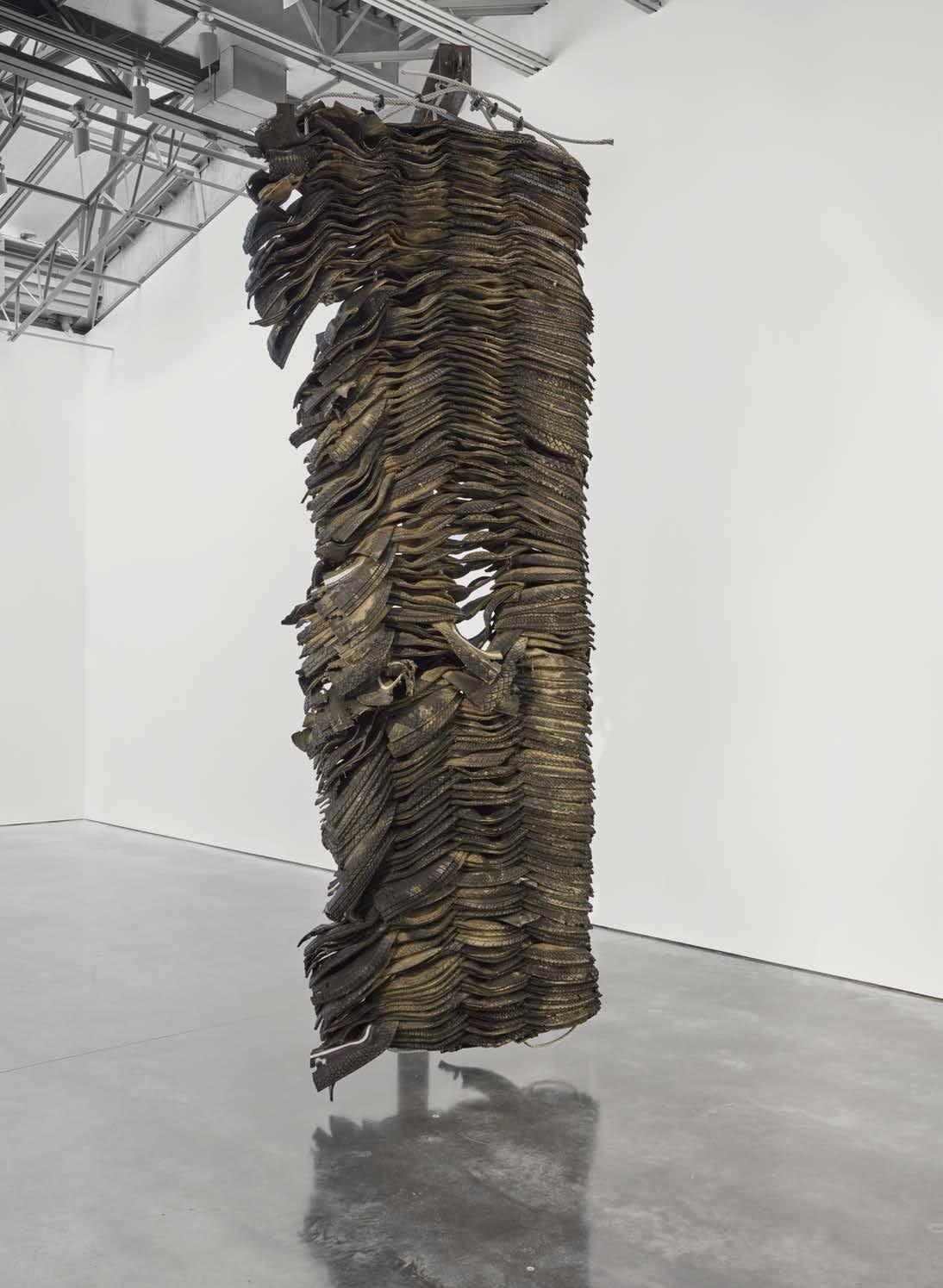
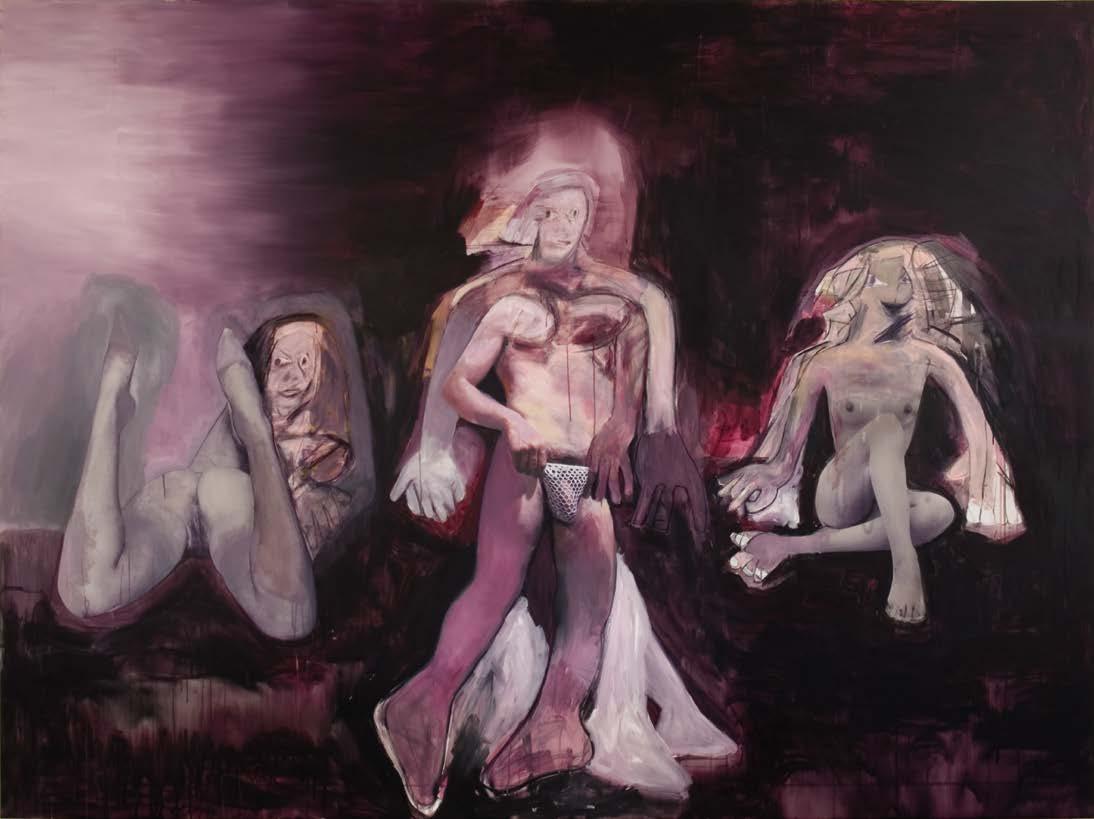
exhibited a painting in London of the Sharon Tate crime scene and there’s a Manson reference in one of Richard’s Joke paintings [1987–]. But there’s a broader reference to 1960s LA, the end of ’60s ideology, Joan Didion, the horrific, racist, apocalyptic ideology that Manson was promoting, and of course the Beatles song.
WA Manson thought the song was instructing him or something.
NS Exactly, but “helter skelter” as a term originates earlier than all of that; it was the name for a British amusement park ride, a tall, spiraling slide. So it refers to a kind of contained, choreographed chaos. It’s also the name of a 1992 exhibition at the Museum of Contemporary Art [MoCA] in Los Angeles that focused on contemporary art made in LA but didn’t include any Black artists. What I love about the title is that it contains all of those multiple references. This is how the whole show operates—it’s complex, layered, and multivalent.
WA It’s like a rhizome, where different connections are forming and unforming.
NS It also grounds the exhibition squarely in American culture.
WA The timing feels apt. The chaos, the aggression, America’s social fabric—these are intense times right now, to put it mildly. What are your thoughts about staging this exhibition in front of an international audience in Venice? Do you have any anxieties about how things might or might not translate?
NS I always have a lot of anxieties [laughter ]. We’ve been working on this show for around three years, so the idea came before Trump was reelected. The exhibition will necessarily take on different valences because of the world that we’re in and the brutal realities of Trump’s America. Both artists’ work is steeped in American culture, in the American vernacular—that’s their source material. I imagine most museums in the United States would likely not present a show like this right now. I wouldn’t say all museums—MoCA’s Monuments show is very brave—but I think it takes a lot of risks in ways that you wouldn’t necessarily see here comfortably. The timing is fortuitous in a way that I would never have envisioned. There’s a lot of critique embedded in the work, but I hope viewers also see that there’s a celebration of American grit and perseverance. The aspects of American culture that are attractive to both artists involve the down and dirty, the downtrodden, the underserved.
WA The repurposing.
NS Yes, that’s another key component. In one of our conversations AJ said to me—and he’s said it to other people before, I went and found it on the Louisiana Museum [of Modern Art] channel because I wanted to make sure I wasn’t mishearing—that he thinks Richard is the Blackest white artist. His point in saying that was about Richard’s use of appropriation: After Marcel Duchamp, Richard is the patron saint of appropriation. And AJ does this as well, but from a very different context. He’s spoken about his relationship as a Black man to theft; it’s a very different ontology because Black people were owned. Property is experienced in a vastly different way. For him to be doing it, the work has a different kind of urgency and criticality—not to say it’s more pertinent, he wasn’t dismissing Richard in any way, but he was indicating where he fit into that strategy.
WA It sounds like there’ll be a wide variety of work: video, sculpture, photography, painting. Richard occasionally includes materials from his own collections—is there any of that?
NS Yes, we’re including Alfred Stieglitz’s Spiritual America , the photograph of a gelded horse from 1923 that Richard had seen at the Metropolitan Museum of Art when he was working on the Brooke Shields photograph in 1983. He’s lending a print of the photo from his own collection. It was the print that had belonged to Georgia O’Keeffe, who lent it to one of the Société Anonyme exhibitions, so it’s got this gorgeous provenance and exhibition history that speak multitudes about Richard as a collector.
WA What else can viewers anticipate seeing in the exhibition?
NS We’re including several of AJ’s videos. The entire mise-en-scène will be unusual in that we’re installing 2D works in rooms where there are videos. AJ’s making three new works for the exhibition, and Richard is also showing some new work, all of which is very exciting. The artists had a lot of free play in the catalogue, so it includes more recent work by each of them with special sequences of imagery. It also features a conversation between them, along with brief texts examining the motifs where their work and their mutual obsessions intersect. These are written by experts in their respective fields: among others, Aria Dean writes on humor, Ashley James writes on identity, the Swedish scholar Martin Lund writes on whiteness, Amy Taubin writes on film, Randy Kennedy writes on car culture, Ashon
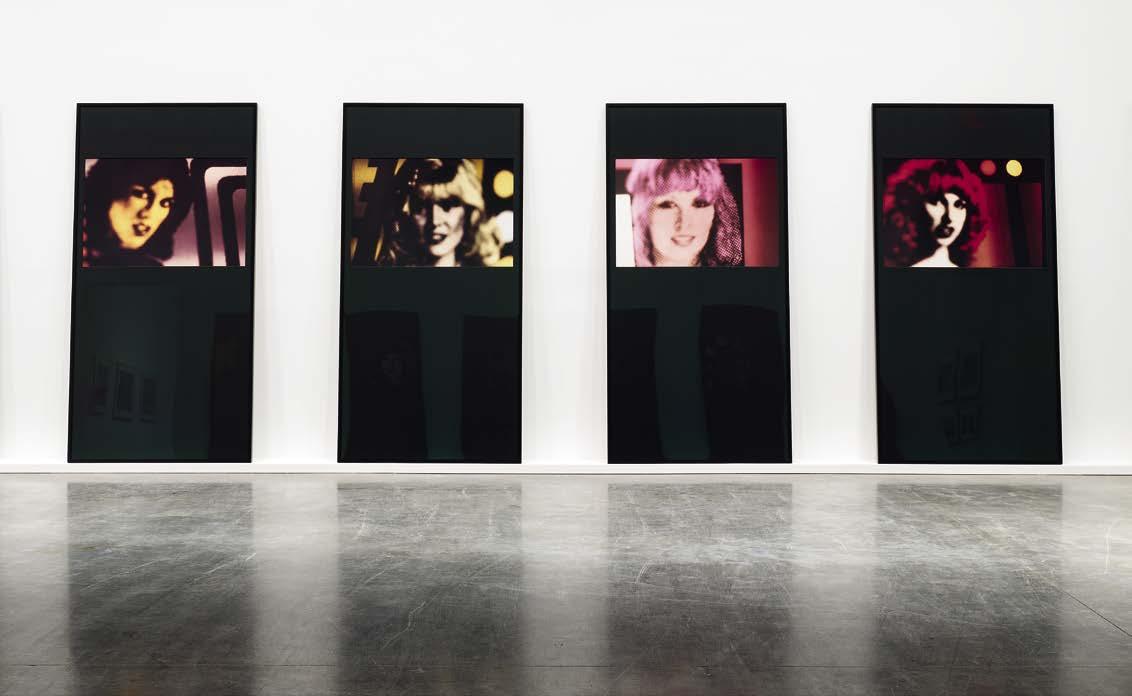
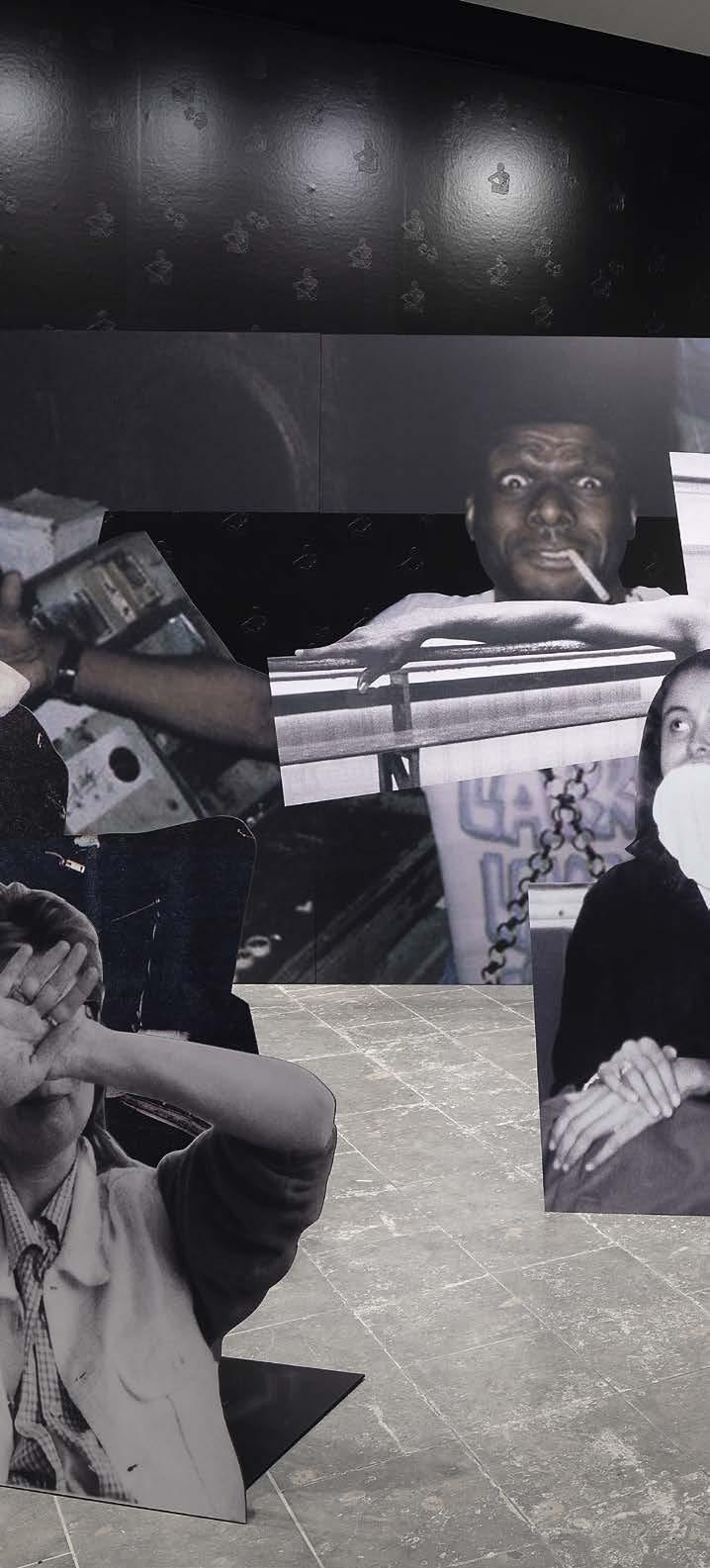
This spread, left to right: Richard Prince, The Entertainers , 1982–83 (detail), chromogenic prints, in frames, each 97 1⁄8 × 49 1⁄8 × 1 ¾ inches (246.7 × 124.8 × 4.4 cm) © Richard Prince
Arthur Jafa, Array, 2020 (detail), 13 color print figures on Dibond, steel plate stand, and wallpaper, dimensions variable, installation view, Louisiana Museum of Modern Art, Humlebæk, Denmark, 2021 © Arthur Jafa
Arthur Jafa, The White Album , 2018, single-channel video, color, sound, 29 min. 55 sec., Moderna Museet, Stockholm © Arthur Jafa
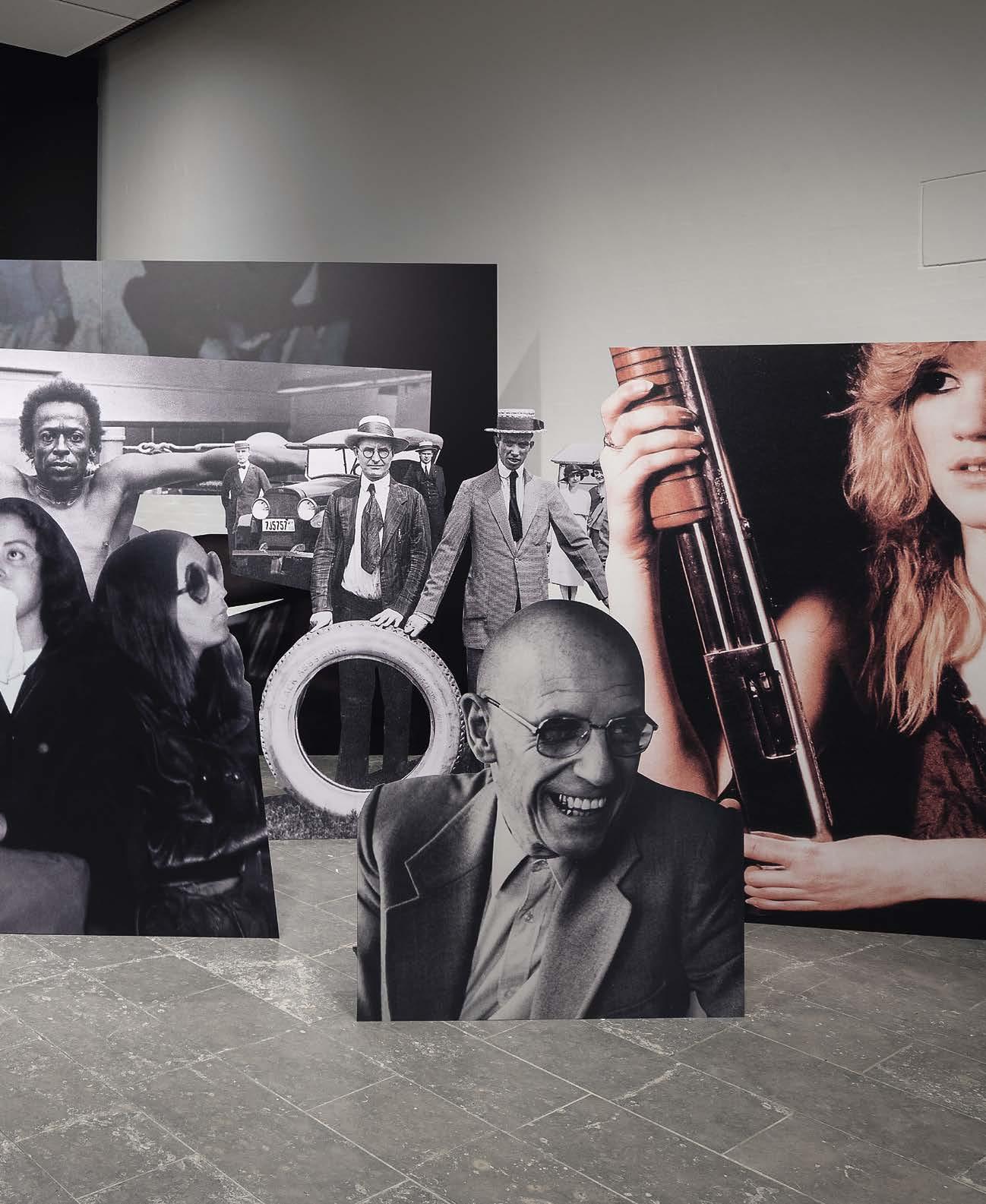

Crawley writes about the Pentecostal church and music, and the science fiction writer Peter Watts writes on dystopia and politics.
WA You touched on this earlier, but could you say more about the artists’ approach to masculinity— how they take it seriously but also joke with it a lot?
NS A section of my own catalogue essay expands on Richard’s de Kooning paintings and AJ’s Man Monster—Duffy [2018], looking at these works and the construction of gender. I think both artists consider the breakdown of binary gender identification as emancipatory, whether they embrace that in their own lives or not. It’s something both of them have played with in their photographic self-portraits. Richard’s self-portrait from 1980, the very early one with the mascara, problematizes notions of masculinity. In the exhibition, this is expanded to consider the White Paintings [1989–95] as a critique of white masculinity specifically—I’d never read those works in the context of race before. They’ll be exhibited with AJ’s video The White Album [2018], which explores the concept of whiteness from a Black perspective.
WA There’s also quite a bit of violence in the work.
NS AJ is clear about embracing the violent, not shying away from it. He’s spoken in many interviews about the fact that he doesn’t work metaphorically. Richard’s engagement with violence is less direct, but the Blasting Mats , for instance, are adjacent to ideas of disaster. AJ has the heavier hand on the scale here, but even Richard’s Sunsets are incredibly dystopic to me.
Richard has been clear in his writings about being impacted by the 1968 student protest movements, which he was a part of. He chose to retreat to the studio as a site of contestation instead of being on the street protesting. So for him the studio was the barricade. AJ, I think, treads a really interesting line, because he chooses things documenting white-supremacist violence that are graphically difficult to look at, and in doing so risks inviting people to overidentify with this gruesome and reprehensible imagery. Viewers may engage with—not always in the right way, unfortunately—that kind of weird attraction to the graphic, or, equally problematic, may see the work as some form of false expiation of guilt. That’s a very provocative gesture. At the same time, though, there’s a lot of humor and play in both artists’ work, you can never pin it down. So I don’t read the work as an indictment of America or of American violence as such, because I think there’s also a celebration of resilience.
WA Of the people. And it’s anti-war.
NS Yes, some of Richard’s work is rooted in protest movements. For AJ, it’s more an engagement with Black history and the inextricable presence of violence enacted against African Americans since the founding of the country. I’ve been pondering Richard’s notion of a spiritual America since I organized his exhibition with that title in 2007. I can’t fully explain it, but I think it’s his code for a country that still has free expression. So much of Richard’s work tests it, probes it, as does AJ’s from a distinct, slightly younger perspective. There are many places in the world where you can’t do what they do, artistically, verbally, publicly. In this way I think the exhibition, while critical, is also very celebratory.
WA I think the show’s going to be a bit of a lightning rod, I have to warn you [laughs ].
NS Yeah, I would like to just install it and leave town [laughter ]. But seriously, I’m glad it’s with the Fondazione Prada. I have enormous respect for the program and their attitude. They aren’t afraid of going deep or being real.
ENTITLED SEAL MY EARS SHUT AND I SHALL HEAR YOU STILL.
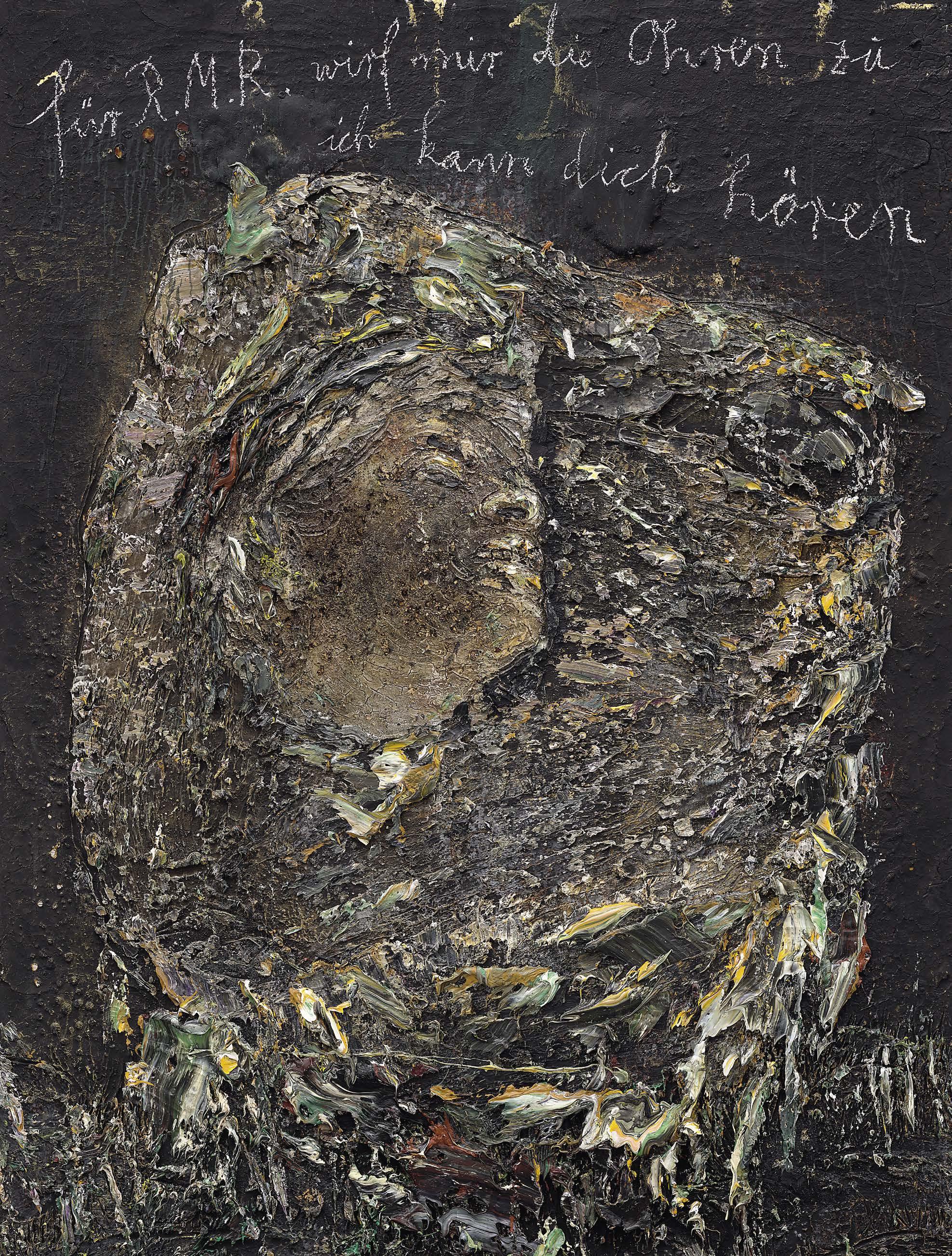
The visible is simply a support for the invisible, the emanation of a divine mystery.
—Anselm Kiefer, Art Will Survive Its Ruins , 2011
Anselm Kiefer is a virtuoso at combining phenomenology and metaphysics, the lenses through which we experience life and make sense of the world. His works converge these epistemological filters into compelling images that evoke realities at once both material and transcendent. With Kiefer’s works we are always confronted both with what our senses receive and transmit—the here-and-nowness of existence—and with what lies beyond human comprehension and the grasp of sensory perception. Perhaps this is why art is Kiefer’s only reality, his vocation and religion. He has made this point repeatedly: “Art is the only reality I can envisage. . . . The real world does not exist for me unless it is through an artwork or a poem categorically distinct from life.”1 The artist, we might say, stands behind a veil: He breathes the same air that you and I breathe but conceptually and metaphysically he exists elsewhere, concealed somewhere behind the shroud of art, but also revealed through it. Kiefer lives in and through art so unconditionally and irrevocably that the poetry of his way of being is difficult for mere mortals to understand. Interpreting his artworks is equally challenging because within them we find seamlessly collaged layers of history, religion, and myth that can’t be peeled apart for the benefit of rational analysis. And yet, despite its impenetrable poetry, Kiefer’s art speaks to people meaningfully, universally, and with a profound human sensibility. In the series of eight paintings presented in his exhibition Seal My Ears Shut and I Shall Hear You Still , Kiefer evokes the weight of history, the
fickleness of human relations, and the emotions that love, longing, and desire can spawn: envy, jealousy, joy, passion, anxiety, vulnerability. These works speak of a timeless need that is both ancient and contemporary, mythic and actual—namely, the human longing for true love, our desire to be with other beings, and the agony we feel in the absence of this meaningful togetherness. These works also speak of women whom history has shunned, discarded, ignored, forgotten, or simply never acknowledged.
Six of the eight works— Claea , Clytie and Leucothoe , Dryope , Electra , Neaera , and Tyche draw their subject matter from ancient Greek myth, while the other two evoke a more personal, perhaps even autobiographical line of thought. The characters featured in the first six are all women, most of them nymphs, and each has a unique story to tell. Kiefer “follows women in his work,” Petra Giloy-Hirtz writes; “they inspire him, and he struggles with them. They are his interlocutors . . . they are friends, kindred spirits.”2 In his own words, “Women are omnipresent in my work.”3
Subject matter aside, in this group of eight large canvases Kiefer conjures a playful tension between representation and abstraction, a prominent tenet in his recent practice. Viewing them as an ensemble, it is fascinating to observe the gradual vanishing of the human figure into the depths of rugged and shimmering surfaces composed of oil and acrylic, shellac, gold leaf, and collaged elements of canvas. The art-historical polarity between representation and abstraction as such, though, is not Kiefer’s focus here; subject matter matters to him, but he also resists the banality of literal descriptiveness, the enemy of all poetry, whether written or painted.
“The most interesting passage in an abstract painting,” he writes, “is the one in which the subject moves towards abstraction. It is that indescribable moment in which the subject, still visible, is on the brink of slipping into abstraction. A moment that sits on an intangible frontier, that expresses the struggle against the representation of nothingness and of nothingness in itself. . . . My theory is this: Art intervenes only where the subject can still be divined, where ‘debate’ still seems open to differences of opinion and conception.”4 The paintings in Seal My Ears Shut and I Shall Hear You Still bear witness to Kiefer’s adherence to his theory.
In Tyche (2024) we encounter the ancient Greek goddess of fortune, chance, providence, and luck, swirling with her back to us toward a circular pit framed by what appear to be boulders. The mythological specificity of this ring of stones, recalling the neolithic stone circles of Northern Europe, is unclear—perhaps a function of my lack of knowledge of ancient myths—but it appears manmade, suggesting some form of interaction between humans and the gods they believe in. Spinning like the wheel of fortune that she symbolizes, Tyche’s centrally positioned figure draws the viewer into the composition, to the very edge of the pit into which she seems to be casting herself with reckless abandon. Kiefer has captured the goddess in mid-action, leading us to wonder about the picture’s narrative intent. The painting’s kinetic energy is accentuated by the disheveled locks of Tyche’s dark hair, silhouetted against a luminous background. What is she up to? What is happening? In the absence of a key to unlock the narrative cipher, as viewers we are compelled to lean on the picture’s formal poetry. The painting pulsates with urgent brushstrokes, and
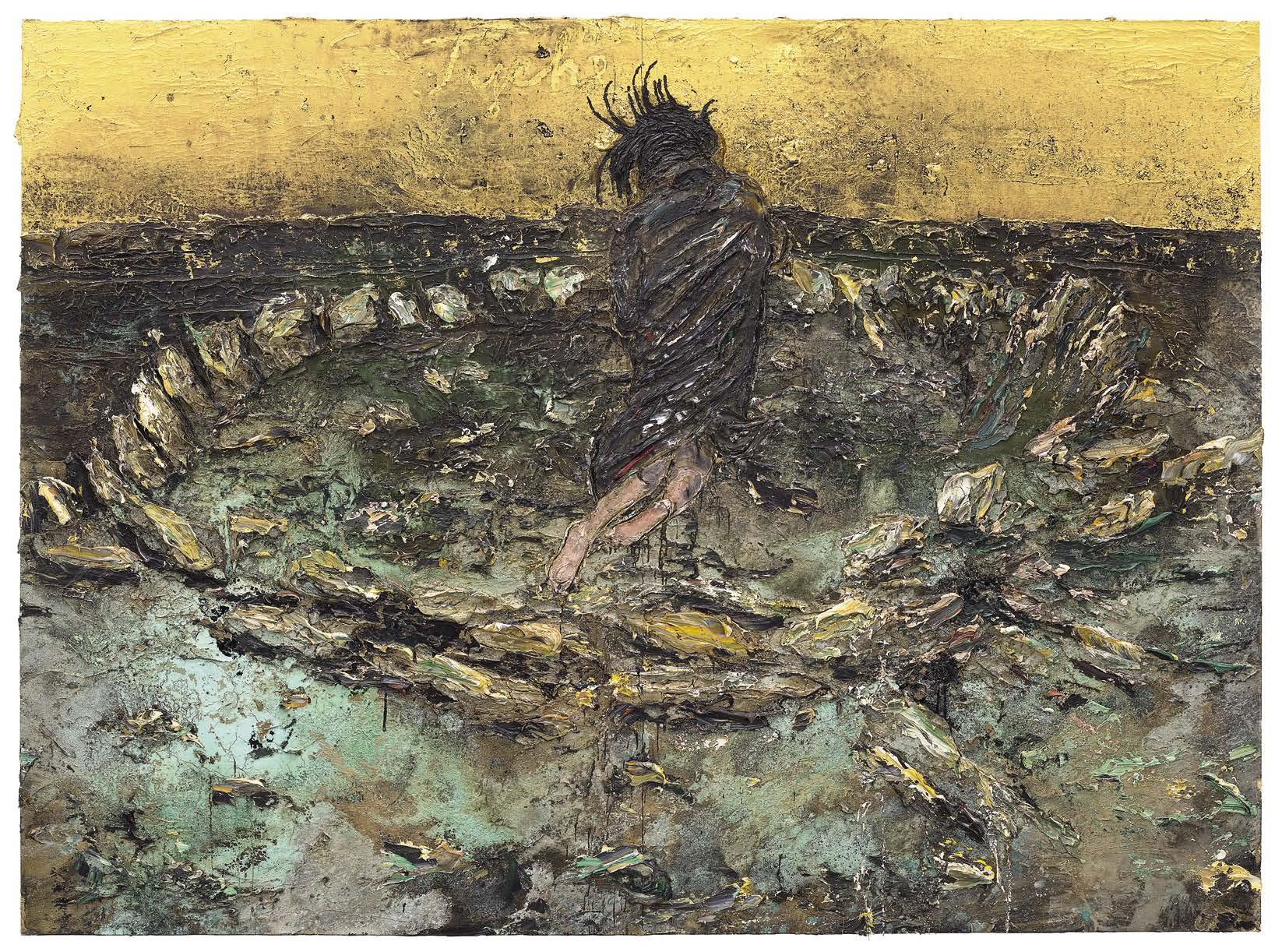
Previous spread:
Anselm Kiefer, Für R.M.R. wirf mir die Ohren zu: ich kann dich hören (For R.M.R. seal my ears shut: I can hear you), 2023–25 (detail), emulsion, oil, acrylic, shellac, gold leaf, sediment of electrolysis, chalk, and collage of canvas on canvas, 110 ¼ × 74 7⁄8 inches (280 × 190 cm)
Opposite:
Anselm Kiefer, Tyche, 2024, emulsion, oil, acrylic, shellac, gold leaf, sediment of electrolysis, charcoal, and collage of canvas on canvas, 110 ¼ × 149 5⁄8 inches (280 × 380 cm)
This page:
Anselm Kiefer, Elektra (Electra), 2025, emulsion, oil, acrylic, shellac, gold leaf, sediment of electrolysis, and collage of canvas on canvas, 110 ¼ × 149 5⁄8 inches (280 × 380 cm)
Following spread, left to right:
Anselm Kiefer, Dryope, 2025, emulsion, oil, acrylic, shellac, gold leaf, sediment of electrolysis, and collage of canvas on canvas, 110 ¼ × 149 5⁄8 inches (280 × 380 cm)
Anselm Kiefer, Naturwirklichkeit und Kunstwahrheit (Natural Reality and Artistic Truth), 2005–25, emulsion, oil, acrylic, shellac, ash, chalk, and charcoal on canvas, 110 ¼ × 185 1⁄8 inches (280 × 470 cm)
Artwork © Anselm Kiefer
Photos: Nina Slavcheva
as the focus of our gaze glides across the canvas, the only respite we are given is the irregular line of the horizon, which divides the canvas into two domains, one serene and timeless (the calm golden sky), the other embodying frenetic earthly action (the world in which the goddess of fortune rolls her dice at humanity’s behest).
We next encounter Claea (2025), its heroine an oread or mountain nymph whose home is a sacred cave on Mount Calathium in Messenia in southern Greece. Nymphs are female nature spirits, typically associated with a specific kind of locale, and their number in Greek mythology is nearly infinite. They are classified into categories based on their habitats, and the most common are naiads (freshwater nymphs), Nereids (sea nymphs), dryads (tree nymphs), and oreads (mountain nymphs). Nymphs are typically described as companions of Artemis, the goddess of hunting, animals, and nature in general. We also find them in the company of gods such as Pan and Dionysus. Various nymphlike deities and female spirits have a long history in Kiefer’s art, and in recent years he has focused increasingly on this Greco-Roman genus. Their presence in his art is a part of a broader epistemological endeavor, a focused effort to move women—perhaps even the feminine life-force—from the shadows of myth and history into the center of both. In Claea , the mountain nymph’s larger-than-life-size portrait emerges in the center of the canvas from within a grotto of thick paint and shellac. She stares intently at the viewer, unapproachable yet vigilant. Her natural mountain habitat, with its flowers and greenery, forms her organic veil. Claea is nature and nature is Claea; the two are one, indivisible prisoners of each other.
The next heroine we encounter is Dryope, whom the Romans called “Fauna.” Depending on which ancient source one consults, she is described as the wife, sister, or daughter of Pan, the god of nature, shepherds and their flocks, as well as of rustic music. Unlike Tyche, who symbolizes fortune, chance, and the unpredictable turns of fate, Dryope has the capacity to foretell the future. In Kiefer’s painting (2025), her visage nestles within a canopy of tree branches that form a mysterious archway above a path, speckled with touches of gold, that recedes into an unknown distance. Only Mother Nature knows where this path leads. As in the depiction of Claea, the landscape shimmers with kinetic energy—observe the expressive brushstrokes accentuated by the sediment of electrolysis—while the painting’s female subject is presented as a stoic, indomitable observer of all that unfolds around her.
In Greek mythology, which Kiefer has spent a lifetime studying, there are multiple nymphs by the name of “Neaera,” and because the artist rarely reveals his specific sources, it is impossible to identify exactly the nymph we encounter in the painting of that title (2025). Could she be one of the 3,000 Oceanids? Or the nymph Neaera who became the mother of Aegle by Zeus? Or the nymph Neaera who had two daughters, Lampetia and Phaethusa, by the sun god Helios? Perhaps her identity doesn’t matter but instead what matters is that Kiefer has chosen to position neglected women of the past center stage of his work, and by extension center stage in the international world of contemporary art. The attention his art commands among museums, galleries, collectors, and publications compels people to consider those we have forgotten or never even heard of. And thus, in his rendering of
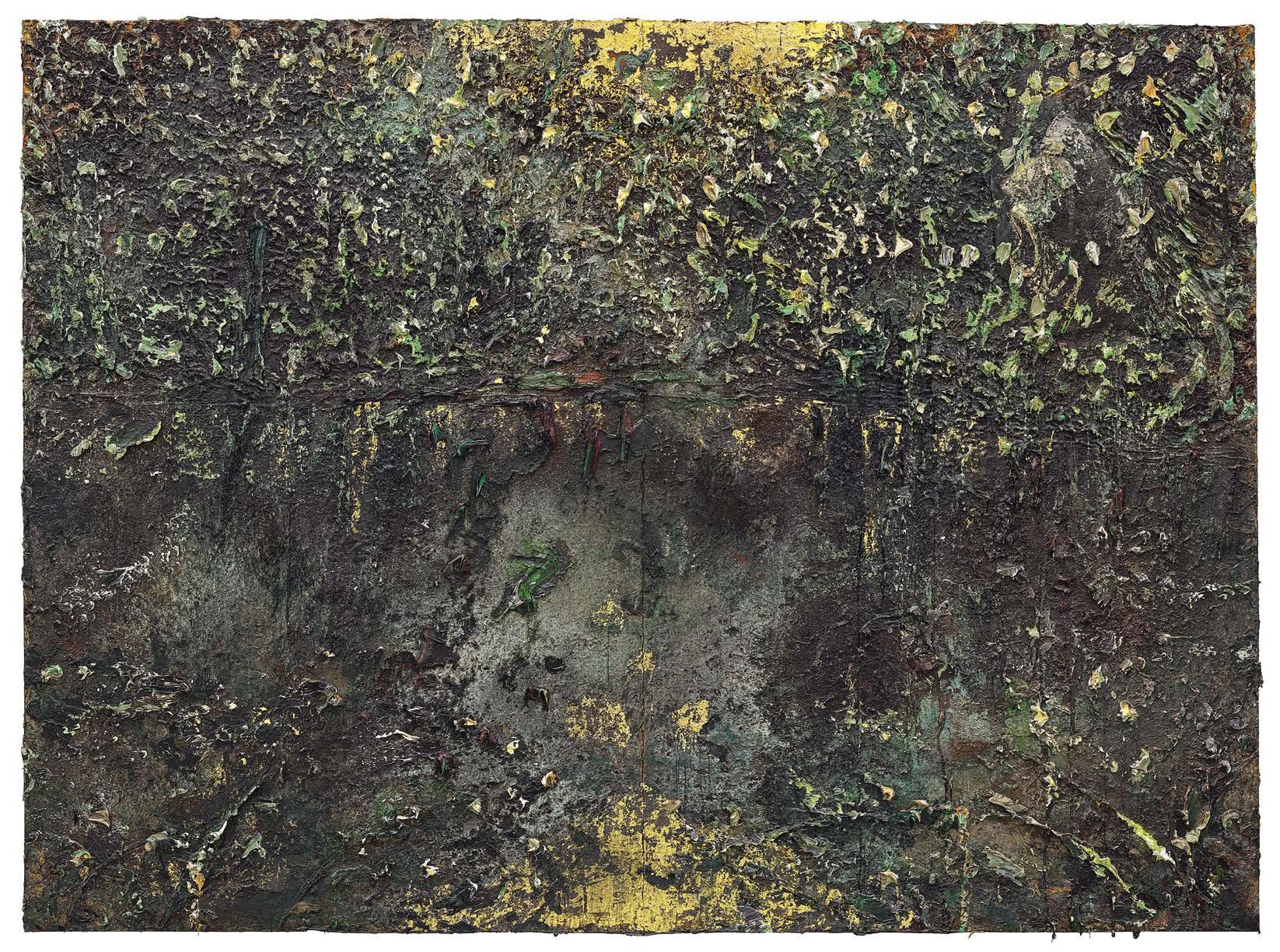
Neaera, we find a neglected nymph of indeterminate identity nestled amid thick vegetation, raising up her arms in a gesture evocative of ecstatic abandon. Her presence in the painting is hard to make out, but Neaera doesn’t seem to care whether we see her or not. This is one of those artworks that, in Kiefer’s words, captures “a moment that sits on an intangible frontier, that expresses the struggle against the representation of nothingness and of nothingness in itself.”5
In two other nymph paintings in this exhibition— Clytie and Leucothoe and Electra (both 2025)—the convergence of figure and ground is all but total. As recounted by Ovid in Metamorphoses (c. 8 ce), the story of Clytie and Leucothoe concerns a love triangle. Leucothoe was a mortal woman, a princess, daughter of Orchamus, a king of Persia. She was either a lover of the sun god Helios or, in Ovid’s telling, was raped by him. Clytie, a nymph (or, in some accounts, sister of Leucothoe), became jealous of the affair and told Orchamus that Leucothoe, an unmarried woman, was no longer a virgin. Enraged, Orchamus buried his daughter alive. Helios then turned Leucothoe’s corpse into a frankincense tree. This is the scene Kiefer depicts. Look carefully, and in the upper left-hand corner of this monumental painting you see Leucothoe’s face, eyes closed, amid the branches and foliage of a frankincense tree.
And finally there is Electra, an Oceanid, or sea nymph, who was the daughter of the Titans Oceanus and Tethys. She married Thaumas, a primordial god who personified the wonders of the sea. Electra was the mother of the Harpies and of Iris, the messenger goddesses symbolized by the rainbow. She and Thaumas were often regarded
as the harbingers of storms, clouds, rain, and other swift atmospheric phenomena. We find her likeness in the upper right-hand corner of Kiefer’s painting, her mouth wide open, suggesting that she can transform the weather in an instant with voice and breath. The suggestion of Electra’s supernatural powers is evoked through impastoed leaves that appear to quiver in a gust of wind that thrusts them from right to left. Below the canopy of vegetation in the painting’s upper register is a body of water upon which we see reflections of the surrounding nature and the golden sky above. In this painting, nature folds upon itself, earth, water, and sky becoming one, indivisible and infinite in a manner conceptually reminiscent of some of Claude Monet’s late waterlily paintings.
Claea, Dryope, Neaera, Clytie, and Electra— these are just some of the localized nature spirits whom Kiefer has painted during the last decade. Around 2015, for example, he made a series of paintings inspired by the Kalevala , the national epic of Finland, in which we encounter Nordic variants of the Greco-Roman nymphs. When a new motif appears in Kiefer’s art, he doesn’t easily abandon it, and for him the cultural, geographic, and temporal distance between an ancient Finnish nature goddess and a Greek one is not as great or as significant as it is to diligent historians. And as it happens, nature spirits—that’s what nymphs are, guardians and custodians of places in the natural world—are ultimately universal beings and we encounter them across a broad range of world cultures, from Norse legends to ancient Greco-Roman mythology, as well as in the faith systems of various Indigenous populations globally. The universality as well as the specificity of the nymph-nature-goddess motif
appeals to Kiefer, amplifying his aspiration to paint into being forgotten or neglected feminine theologies.
Two paintings in the exhibition stand apart from the six goddess and nymph paintings discussed above, differing in subject matter and visual language—a reminder that Kiefer’s art is a visual galaxy composed of a broad array of themes, motifs, and formal approaches. Naturwirklichkeit und Kunstwahrheit (Natural Reality and Artistic Truth , 2005–25) borrows its title from the German art historian Werner Hoffmann’s monograph Caspar David Friedrich. Naturwirklichkeit und Kunstwahrheit , published in German and English in 2000.6 Hoffman’s book explores Friedrich’s extraordinary ability to charge highly precise renderings of landscape in specific atmospheric conditions with spiritual, psychological, and religious connotations. In Kiefer’s painting we observe in the immediate foreground a body of water (the Rhine, but it could be another river as well) and above it an archway formed of branches. Suspended in midair in the middle of the canvas is a large painter’s palette decked with blotches of vibrant paint. Both the palette and the river are recurring motifs in Kiefer’s art—he was born in Donaueschingen, site of the spring that is the source of the Danube—and grew up in Ottersdorf, a small village near the Rhine, which there marks the border between Germany and France.
The contingent river that connects people and places as well as the past, the present, and the future; the natural world that surrounds us and provides our sustenance; and the palette that is both the womb and the tomb of painting—womb, because from the palette a painting is born; tomb, because Kiefer believes that his paintings stop living once
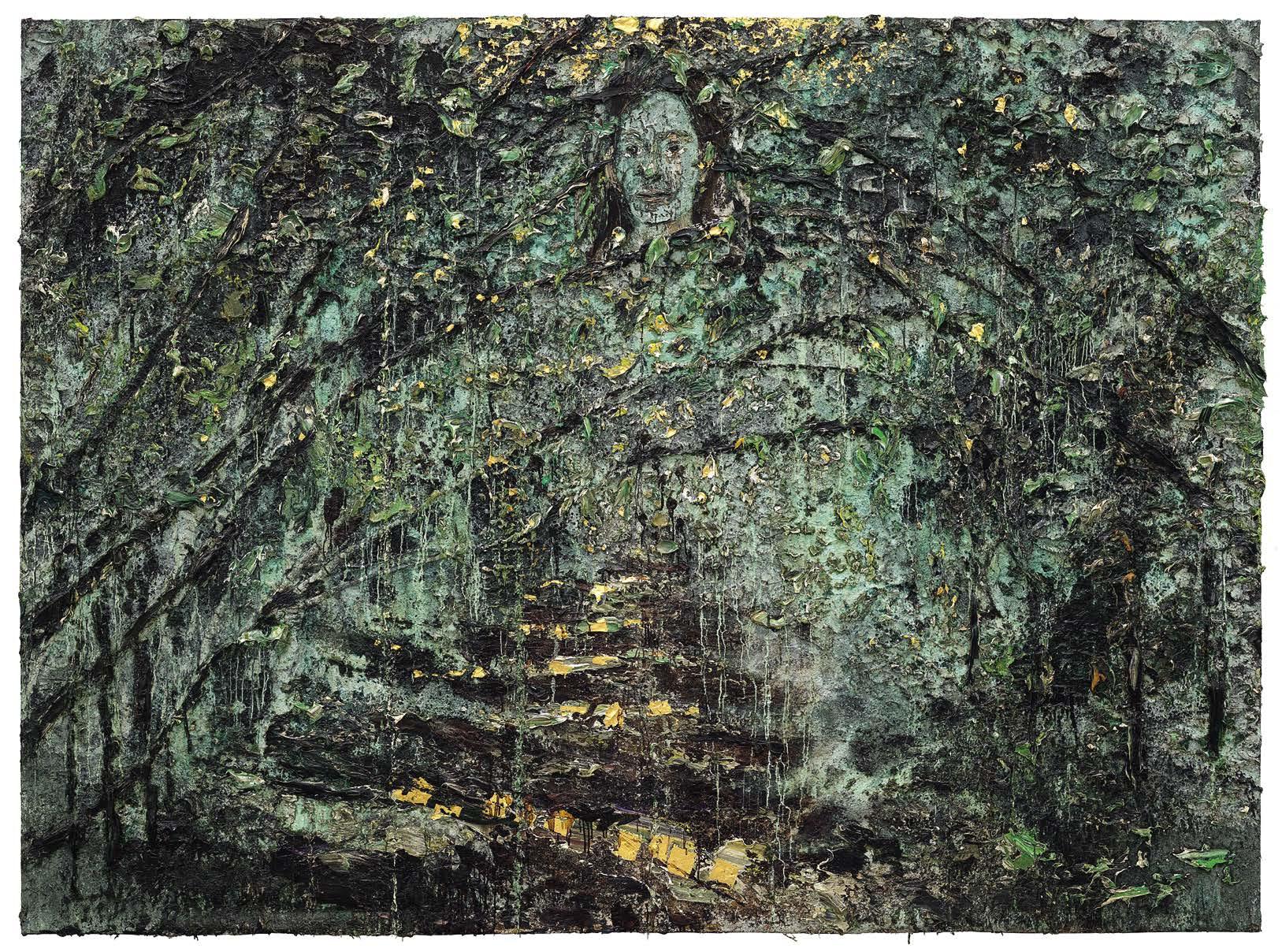
they leave his studio—evoke the painter’s credo: “Art will always outlive its ruins.”7 Natural Reality and Artistic Truth is a painting rich in meaning and autobiographical innuendos, and it evokes themes and motifs that Kiefer has explored and committed himself to since the 1960s. It is also an homage to past painters and philosophers, and a declaration that knowing thyself requires knowing and being with others.
The most cryptic painting in the exhibition is Für R.M.R. wirf mir die Ohren zu: ich kann dich hören (For R.M.R. seal my ears shut: I can hear you , 2023–25). It is dedicated to the poet Rainer Maria Rilke and borrows its title from a line in one of the poems in Rilke’s “Book of Pilgrimage” (1901), the second section of his magisterial Book of Hours , published in 1905:
Put my eyes out: I can see you; seal my ears shut: I can hear you; and without feet I can walk toward you, and without a mouth I can still beseech you. Break my arms off, I will seize you with my heart as with a hand, make my heart stop, and my brain will beat, and if you put a torch to my brain I will bear you on my blood.8
This poem—and more broadly, Rilke’s poetry in general—is the backdrop against which we must approach and see Kiefer’s painting. It depicts a large boulder standing on a nondescript dark field, and against a dim background that could denote the night sky or simply nothingness, a void, an ominous backdrop without clear meaning or substance. From the boulder—perhaps inspired by photographs of rock formations Kiefer took during recent voyages
in the Greek archipelago—protrudes a three-quarter portrait of an unknown woman, whose eyes—or at least the right one, the only one visible—appear closed. The woman seems to wear a wreath of some sort, suggested by colorful strands of thick paint that trace the line of her forehead to where her right ear would be. Specks of yellow and white paint indicate her lips and right eye. The boulder of which the unnamed woman is a part is oversized for the composition, pushing uncomfortably close to the painting’s edges. And yet, within her lithic podium and prison, the woman appears serene. She is one with the rock, like the nymphs we have seen who are one with nature—a divine togetherness.
But what is the connection between Rilke’s poem and Kiefer’s painting? Commentators tend to agree that the poem is the author’s expression of his profound love for his mistress Lou Andreas-Salomé, with whom he made two trips to Russia, first in 1899 and again in 1900. The two met in 1897 and their romantic engagement ended after their second Russian sojourn, evolving over time into a lifelong friendship. In short, one could read Kiefer’s painting as a love letter. There is another avenue of interpretation as well, and one does not discredit the other. Paradoxes abound in Kiefer’s art, and the very concept of meaning in his visual world is almost by default layered, contingent, complex, and often contradictory. This other path of interpretation takes us into contemporary affairs and the politics of war and aggression unfolding around the world. We know that Kiefer is an astute student of both history and politics, and he has often commented on the occasions during the Cold War when the world came close to nuclear annihilation. Today we again bear witness to bellicose rhetoric
and actions emerging from various powerful quarters of the world. At the time of writing, there are wars underway in Ukraine and the Middle East. It might not be outlandish to think that Kiefer’s painting, inscribed with the words “wirf mir die Ohren zu: ich kann dich h ö ren ” (seal my ears shut: I can hear you), is not just a lover’s proclamation but also a painter’s declaration that “we, the people of the world” are not deaf to what is happening around us. Through Kiefer’s art we step into a world in which human time and geological time converge and multiple realities coexist. The meanings of his works can never be pinned down, and interpreting them is fraught with challenges. As Kiefer notes, “Like a snake seized by the tip of its tail, twisting around to try and free itself, art cannot possibly be grasped by words.”9 Acknowledging this relieves the viewer from the pressure of finding finite answers to pictorial puzzles. Coming to terms with the undecipherability of Kiefer’s art also allows us to step wholeheartedly and poetically into an expansive galaxy of nymphs, divinities, lovers, poets, and other beings in which the rules of Cartesian logic don’t apply. Welcome to the free world!
1. Anselm Kiefer, Anselm Kiefer au Collège de France. L’Art Survivra à ses Ruines. Art Will Survive Its Ruins (Paris: Éditions du Regard, 2011), 244, 258.
2. Petra Giloy-Hirtz, Anselm Kiefer: The Women (Munich, London, and New York: Prestel, 2025), 6.
3. Kiefer, quoted in ibid.
4. Kiefer, Art Will Survive Its Ruins , 198–200.
5. Kiefer, Art Will Survive Its Ruins , 199.
6. The English translation of Hoffmann’s book was published under the abbreviated title Caspar David Friedrich , trans. Mary Whittall (London: Thames & Hudson, 2000).
7. Kiefer, Art Will Survive Its Ruins , 190.
8. Rainer Maria Rilke, The Book of Hours , 1905, trans. Edward Snow (New York: W. W. Norton & Company, 2024), 167.
9. Kiefer, Art Will Survive Its Ruins , 186.
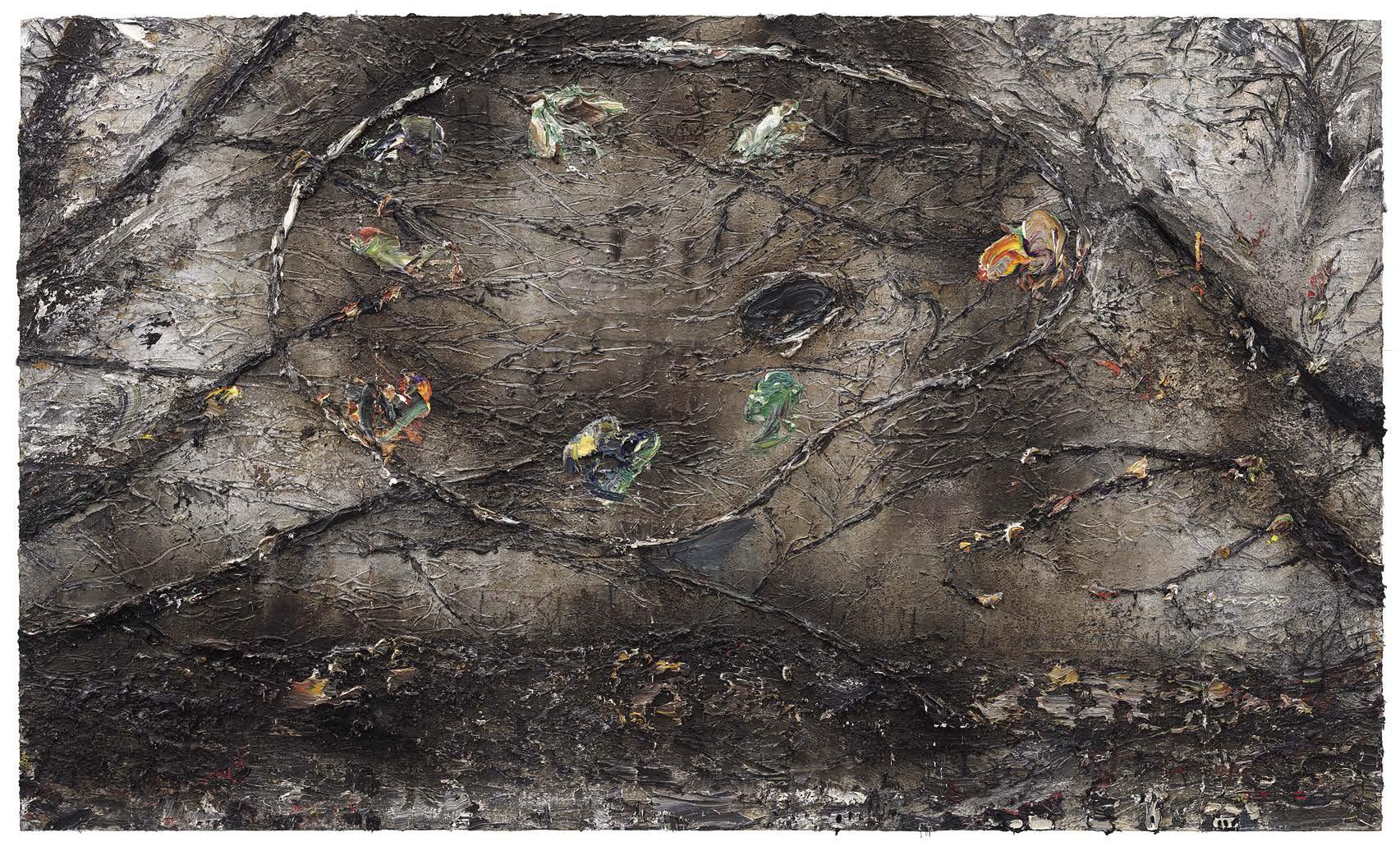



I’ll tell you what the most common wish is: I wish I knew what to wish for.
And you know what? That wouldn’t be a waste of your one wish. Yes, out of an entire lifetime of asking, the quota only allows for one almost impossible gift per person. I understand that this may be disappointing, but it is the best we can do.
Identifying a primary desire would do wonders for the insomniac who can only shut off the sound of mocking laughter by churning his blankets with his fists and feet. As someone who has placed all his faith in systems—in documenting, reporting, confirming that every step of a process is in concordance with regulations—what should the insomniac wish for after many months of legal proceedings conclude with a verdict that the person whose violence took his sleep from him has been found not guilty? The laughter he hears follows the melody of Adele’s Laughing Song from Die Fledermaus (of course it’s Strauss, whose music lives at the critical juncture where jest coincides with seriousness). Ja, sehr komisch—ha, ha, ha ist die Sache—ha, ha, ha, Drum verzeihn Sie—ha, ha, ha, wenn ich lache, ha, ha ha. . . . The main refrain plays as the insomniac breathes in and out, and because of this he’s not far from believing he’s a music-box handle that’s subject to a droll delusion of being a person. Suppose he’s offered his one wish—what’s the wish that resurrects his morale? Being
let in on this joke, or whatever it is? A just outcome for his legal case? A third or fourth request that forgoes sorting his heartsickness into manageable subdivisions and heals him outright?
The debtor who passes her days sending beguiling messages from within the walls of a windowless and skyless compound—how can she find the exact wording of the wish that would raze the very archetype of that place to the ground? What about the actor who’s allowed himself a few years to move on from nonspeaking appearances as a TV extra but finds himself going backward instead— none of the scenes he was standing in the background of makes the final cut. Meanwhile, a number of his fellow extras make nonstop advancements. He doesn’t think that he’s more dedicated or less dedicated than these fellow extras—his main thought is, Well, aren’t we more or less the same? He’s set his heart on acting as his life’s work. . . . This state of affairs has him stumped. Even if our rookie wish-granter, recently formed from temple dust, appears before him and he is convinced that she really can rocket-boost his contribution to cinema, he can sense a catch . . . a big one. Being chosen wouldn’t be a prudent use of his one wish, and the reason is right there, staring out of his blind spot.
Suppose a seventy-something who lives alone with her forty-something son grows to fear the brightness of
his glance. Asking someone to move out because you’re bothered by the look in their eyes is a tricky thing to pull off if the person you’re asking is a lodger, let alone one’s only child. What’s taking place is more than an estrangement, though the two of them spend a lot of their time in close quarters. They’re both on their phones for hours at a time. The mother doesn’t know what her son is doing on his phone: Sometimes he smirks, sometimes he bristles, or sighs. She only knows what she’s doing on her phone: reading and cross-referencing world news articles and half-jokingly messaging emergency plans to a few close friends. More than anything, this lady wonders what to wish for. One wish granted per person barely makes a ripple when you look at each wish as an attempt to outwit each other’s lucky breaks. As you must have guessed already, the floor really is lava, and . . . again, I’m sorry about that. It’s the sort of thing one could be sorry about forever. Why not make a wish anyway? That isn’t all a person does to survive: We submit our applications in all places and on all planes. At the auspicious hour you’re called to interview. Picture the rookie wish-granter as she discovers you reading all this. I bet she’d say something like, “Oh, I’d love to have time to read! How nice that you do . . . I’m happy for you.” This would be said in a tone of voice that leaves you 50 percent sure of her approval and 50 percent sure of her disapproval. The list of things she likes is much longer than the list of things she doesn’t like, but sneaky behavior is near the top of her “dislikes” list. Oh well . . . since she doesn’t know you’re checking up on her in this way, it follows that as long as you keep it to yourself, there’s no way for her to find out and retaliate.
Right now she’s tackling the matter of reasonable wishes that one simply doesn’t want to grant.
For around three hours in total, the rookie wishgranter walks behind the tomcat who sculpted her from a column of dust. They cross narrow streets lined with shrubs. The tomcat seems to be on familiar terms with every spot of shade in the city, and these darknesses draw a veil of scent over the tomcat’s head first and the rookie wish-granter’s next. Even in alleyways that crackle with the scent of roasted offal, the trees can’t hide their attraction to dust. Blossoms of all sizes fall like someone in love, dropping recklessly into the rookie wish-granter’s path. These soft, weighty bundles turn out to be pink, golden, or cream colored when looked at in sunlight. Neem, gardenia, frangipani. The rookie wish-granter already knows them from years of temple offerings. There are few comforts greater than being kissed by trees: ten kisses short as one, and one long as twenty, to borrow words from one poet. And kisses are a better fate than wisdom, to borrow words from another. Hopefully vows sworn by flower petals make up for not receiving any love from the tomcat, who strolls, rests for a bit, stands up in order to menace a few birds, has a standoff with a notably self-confident lizard, settles on the orange linings of certain shadows to clean his paws and whiskers, strolls further. Though he does occasionally look behind him, there’s no correlation between his backward glances and the polite “Hello—excuse me—may I approach?” that the rookie wish-granter utters every mile or so.
In her own mind she’s pursuing a potential mentor in a respectful and appropriate manner. The tomcat
disagrees; the tomcat’s wish is for the genie to go away. She has no choice but to respect this, and yet—perhaps, just perhaps, caught up in his desire for personal freedom, the tomcat doesn’t understand that his wish amounts to abandonment of a minor? You don’t draw a living being out of a column of dust and simply leave without a word of advice or encouragement. It isn’t right.
I’m making it sound as if everybody else in the neighborhood has left so that the rookie wish-granter can follow the tomcat and be courted by trees without distraction. It isn’t like that; there are crowds of people and crowds of worries that go around hand-in-hand with the people they are overwhelming. Twice, the rookie wishgranter gets lost in these crowds; she can’t help stopping and asking the most worried people what they’d like to happen. Deflection after deflection—this is not the right time to ask, and at first glance she seems like far too great an investment, this disheveled woman in an orange robe asking what she can do for you as if that’s the only thing in the world that matters to her. She only adds to the worries of the people she tries to speak to; they dread to think how much assistance she needs. Definitely much more than any of them can manage. There is someone who takes her at her word, though: a long-haired man with half a moustache on the left side of his face and half a beard on the right side of his face. The rookie wish-granter finds this fellow rewarding to look at, but when she tells him he’s quite beautiful, he says, “No. I’m thirsty.” He’s really firm about that fact. He’s standing in a shop doorway pointing to a bottle of fizzy red liquid that’s standing on the pavement. The lid has been unscrewed but there’s no
straw—a strange omission, since everyone knows that a drinking straw is the final touch that makes strawberry Fanta an acceptable offering to ghosts.
“There needs to be a straw here,” says the man who doesn’t want to hear about being beautiful.
The rookie wish-granter hesitates, looking around for the tomcat, relaxing when she spots him apparently napping beneath a café table. There’s something she has to check before she goes to ask for a straw.
“Are you . . . er . . . are you alive?” She isn’t sure why, she just feels like he might be.
The man crosses his arms and says, “Just listen to yourself! You’re beautiful. Are you alive? If you’re going to keep bringing up ridiculous topics, just forget I said anything.”
“Sorry—I only meant to say . . . well. You know who the strawberry Fanta bottles are for, don’t you, sir?”
He turns his back on her and sulks. He’s the only person who’s made a request; she won’t let him down. She goes to show the café owner the bottle of Fanta, the café owner hands her a straw, she puts it in the bottle, and the thirsty man puts an end to his thirst. His moustache and beard fill out on both sides. “That’s more like it!” he says. Since he immediately begins asking for another favor, it’s a relief when the tomcat opens his eyes and stands up. Time to go.
Leaving the entangled streets and alleyways behind, the tomcat and the rookie wish-granter make their way along a main road and the tomcat sits himself down at a bus stop. The rookie wish-granter reasons that bus stops are open to all. There’s no protocol issue with waiting for
the same bus as an irresponsible parent who’s slowly but surely trying to get away from you. She takes a seat beside the tomcat and says, “Hello, sir. I should begin by thanking you . . . ”
An expression of mild concern appears on the tomcat’s face and the rookie wish-granter almost backtracks into some pretense that she was talking to the man sitting on the other side of the tomcat. This is the first time she’s ever seen a cat look as if they’re at a loss as to how to deal with someone. It’s a sharply inhibiting sight. She’s only ever been acquainted with cats who behave as if they know what’s going on even if they haven’t a clue.
Another thought arises to steady her resolve: The tomcat’s expression is just one among the many that stand between her and her genie qualifications. She stands up and bows to the tomcat. The tomcat looks away and heaves something like a sigh. The sigh opens up the twenty million silences of cats to her, and this is what she hears: All right, you’ve thanked me, hopefully that’s enough for you.
“Sorry, sir—I just wanted to ask if there’s anything you’d like to tell me as a father?”
The cat’s silence asks her what she thinks a father is, and why on earth she thinks it has to be him.
According to the rookie wish-granter’s understanding of the matter, a father is somebody you honor on Father’s Day and consider a fount of moral and emotional guidance for the rest of the year. She says as much.
The tomcat’s silence is the equivalent of a Hmmmmm Then the silence alters just enough to communicate that all the tomcat did was craft an image for her to inhabit. He saw that a genie was arriving and his main thought
was, Since it’s come to this, I can try to nip yet another aesthetic nuisance in the bud. He quickly crafted features that created an impression of a person who is approachable, efficient, and difficult to intimidate, discarded the remainder of the dust column, and felt he had seen to it that if she revealed her occupation to anybody she wouldn’t be entirely disbelieved. He stressed that there had been nothing hopeful or tender about his actions. It had all been done to spare his sensibilities in case they ever ran into each other again.
“I see,” says the rookie wish-granter. “So it was all just an impulse? All right. Thanks for letting me know.”
The tomcat’s silence inquires as to what she plans to do next.
“I suppose I’d better find a name to go by. And then I’ll . . . go from there.”
The tomcat is wordlessly relieved to hear this. A helmeted motorcycle-rider pulls up in the bus lane and ignores all the subsequent honking from passing cars and lorries as she prepares a metallic leather backpack for the tomcat to climb into. “Couldn’t you give me a lift first?” the rookie wish-granter asks. There’s no harm in asking. And she wants to make sure she’s the first to depart the scene, not the tomcat. The tomcat is indignant but ultimately prefers waiting a bit longer at the bus stop to prolonging links with a people pleaser.
The tomcat’s chauffeur drops the rookie wishgranter off at a club downtown that’s around the size of a walk-in restaurant freezer. Depending on proficiency levels, dancing is an extremely revealing act. The better you are at it, the more outwardly inscrutable you become,
because then all that can be seen is skill. The rookie wishgranter doesn’t have that problem, so she’s decided to attend a Naming Dance and get a name that suits her in a hurry.
The club’s interior is a marshmallow explosion. Pink lights, twinkling rose-gold podiums, and a raspberrycolored booth where the DJ spins discs alongside three adjudicators with clipboards. There is a fee, but it’s waived when she offers to grant a wish instead. Which makes it obvious that the club owners have seen the likes of her before.
There’s no room for the rookie wish-granter to wait her turn inside, so she stands outside the building counting down from one million with her hands jammed in the pockets of her robe as the wall behind her vibrates. When it’s her turn to be named, the rookie wish-granter jumps onto a podium and her head, hips, and shoulders (I’m only mentioning the most active parts) whomp whomp whomp their way through the lavish aural experience that is “2 of Amerikaz Most Wanted.” Having danced as hard as she can, she falls to her knees. There’s some sort of constriction in her throat and a strange taste in her mouth, as if she’s been licking pennies. Still, she manages to raise her head just in time to see the DJ giving her a thumbs-up as the adjudicators raise their clipboards. Two of them have written the name Mumtaz Fadahunsi and one has written the name Josette Tayebbi. Mumtaz F it is, then.
For the rest of the evening, Mumtaz mops the brows of Naming Dance attendees and serves them water with ice cubes clinking around in it. She watches the dancers, the DJ, and the adjudicators—one of the adjudicators
begins to stand out to her on account of their having a palpable wish—but the information that passes between the DJ, the adjudicators, and the dancers whizzes past Mumtaz. There are some personality traits she’s able to surmise . . . for instance, a person who strongly resists pleasure clearly expresses this through movement, and a person who denies themselves nothing telegraphs that tendency too. But Mumtaz F misses the part where this translates into a first name and surname. It must do, because after pumping their arms in the air and screaming their admiration for the frenzies that take place on the podiums, the adjudicators pick up their pens and write down names without consulting each other.
On occasion all three adjudicators choose different names. The DJ’s vote is the decider. After a little while the DJs and the adjudicators begin to signal that they’re unhappy about the degree of interest Mumtaz is showing in their process, and she doesn’t feel she can afford to spook the adjudicator she wants to have a chat with, the one with the giant mirror-effect sunglasses. So she volunteers to do a couple of circuits of the streets surrounding the club, handing out flyers a member of staff supplies her with. As she hands the flyers over, the member of staff warns Mumtaz that helping out with flyers doesn’t count as wish-granting. Mumtaz nods.
The flyers and their recipients deliver highs and lows. A great many of the flyers are politely accepted and then stuffed into recycling bins with such haste that they flop to the ground and Mumtaz is compelled to pick them up and repeat the deposit. She has pleasant exchanges concerning names, she’s told off for falsely promising reinvention, she’s
asked to respond to in-depth philosophical questions that she doubts would ever have occurred to her otherwise.
Before Mumtaz F can stop herself, she wishes someone good luck with their audition, and then she wishes somebody else good luck with their blind date. There’s an unease that comes with these wishes. Returning to the club seems like a good idea. Maybe that can avert or slow down her line crossing.
The adjudicator with the mirror-effect sunglasses has just finished her shift. She steps out as Mumtaz is about to step in: For a moment it seems as if Mumtaz is holding the door open just for her. The adjudicator thanks Mumtaz for that, Mumtaz thanks the adjudicator for the name Mumtaz Fadahunsi.
“Oh, I was just doing my job,” the adjudicator says. She seems less offended by scrutiny now that the pressure’s off. She stands there on the pavement with a convex likeness of Mumtaz covering each eye. “Are you going to ask how we do it?”
“No . . . I was actually going to ask about your wish.”
“My wish?” The adjudicator puts a hand to her forehead, then pulls a box out of her tote bag. Mumtaz holds the box for her while she pulls out other items: scissors, a couple of big sheets of papyrus, and shiny masking tape with butterflies printed on it. In the alleyway behind the club they wrap the present together—it’s a bit tricky to do this as neatly as the adjudicator would have liked because of the shape of the box. It is a heart-shaped box with eight points. I’d love to draw this for those who may wonder in what way an eight-pointed object can be considered a heart, but even if I could reproduce an image with any accuracy, this is just one of those situations where visuals
don’t help. As they wrap the present, Mumtaz tries to solicit a wish from the adjudicator.
The adjudicator isn’t keen.
“I’m Tiffany, by the way,” she says, pointedly. You asked what I’d wish for before getting any preliminary data. “I don’t think I’d make a good wish.”
“Don’t let that stop you. I could suggest a wish.”
“Oh yes? Let’s have an example.”
“You could wish for world peace.”
Tiffany says, “Ah . . . Mumtaz. I don’t mean to sound impatient here, but as wishes go, that’s got to be one of the worst ones to grant. How do you think the world has ended up with so many dictators? Has world peace ever been anything other than peace according to whoever holds power? Would—”
“OK, OK,” Mumtaz says. “That was just an icebreaker anyway. Now what about your real wish?”
“Oh, that.” Tiffany puts the perfectly wrapped present into Mumtaz’s pocket. “Take it—it’s for you. So, listen up . . . I wish to be a genie as well.”
Mumtaz beams and pats her pocket. “As well as what? A name adjudicator?”
“No, I meant I wish to be a genie as well as you,” Tiffany says. “I don’t want to be a replacement genie or anything like that.”
This isn’t the wish Mumtaz saw, but there’s no use making an issue of it. They shake hands.
“Granted. What now?” Mumtaz asks.
“Now we get my girlfriend to propose to me.”
“That isn’t a two-genie task,” says Mumtaz. “Is it?”
The adjudicator genie adjusts her sunglasses. “I suppose we’ll see,” she says.

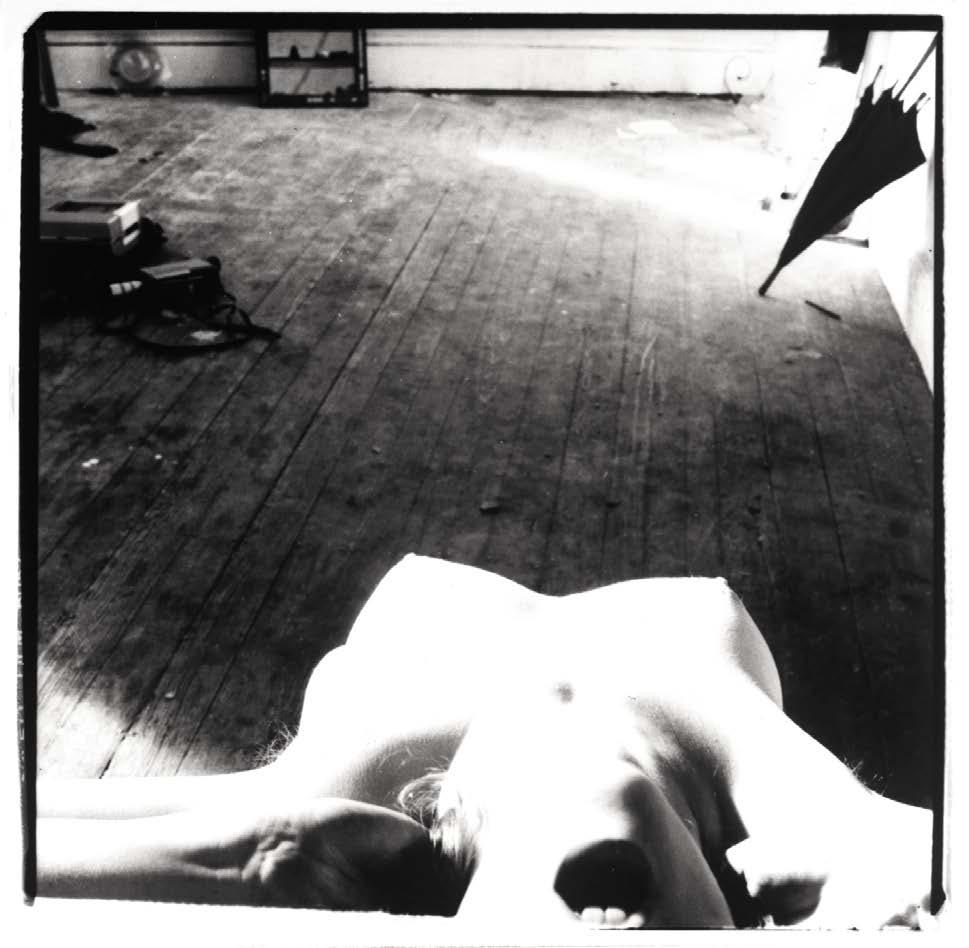
On the occasion of the exhibition Francesca Woodman: Lately I Find a Sliver of Mirror Is Simply to Slice an Eyelid at Gagosian, Rome, Alyce Mahon explores the artist’s engagements and affinities with Surrealism, from the writings of André Breton to the photographs of Hans Bellmer. Mahon focuses on the time Woodman spent in Rome while she was a student at the Rhode Island School of Design.
In her 1975 essay “My First Brush with Infinity,” Francesca Woodman writes of brushing in temporal terms, as unbounded, and in physical terms, in relation to objects including “hairbrushes, shoebrushes, snaggletoothed toothbrushes, brushes for paint.”1 The verb and object “brush” perfectly encapsulates Woodman’s work in this exhibition as her camera lightly touches time and things, uniting diverse mise-en-scènes through a consistently sensual play. In Untitled (c. 1975–78) we find a female nude tumbling out of a closet where the curious motif of a door set ajar adds an erotic frisson—it is neither open nor closed; in Untitled (c. 1979–80) we see an egg delicately held in the palm of one person and in proximity to the raised arm of another, such that the mood of presence and absence is poetically staged across the cupped egg and the concave armpit.
Woodman does not stage commonplace things— whether “careless crockery,” florid wallpaper, or fish and lemons—as dream objects in themselves but as objects that spark the dream. 2 She brings together random objects, animate and inanimate, in a peculiarly surrealist appreciation of how “two different bodies, rubbed one against the other, attain through that spark their supreme unity in fire,” to borrow words from André Breton.3 In his novel Nadja (1928), which Woodman loved, Breton applies this sense of the “rubbed” to people, places, and objects in order to explore the creative tension between the real and the imaginary. He writes, for example, of a woman’s blue glove as the personification of both the fulfillment and the loss of desire: It suggests not only the lady’s hand it could warm but “leaving that hand forever.”4 Breton’s seemingly random use of some fortyfour photographs in Nadja inspired her, and her expressed ambition to create “images as an alternative to everyday life: Places for the viewer to dream in” echoes his aesthetic in the novel. 5 Her eye sought out the unconscious in the conscious world—the essence of surreality. Through compositional approaches and techniques including long exposure and slow shutter speeds, she appreciated and extended how photography could stage “another nature that speaks to the camera [rather] than to the eye: other in the sense that a space informed by human consciousness gives way to a space informed by the unconscious,” as Walter Benjamin described the medium. 6
Many of the works in the Rome exhibition were produced while Woodman was living in that city in 1977–78, as a participant in the Rhode Island School of Design European Honors overseas-study program. Her friendship with the circle around a bookstore called the Libreria Maldoror, run by Giuseppe (Cristiano) Casetti and Paolo Missigoi, and her use of the store as a kind of curiosity cabinet of books, journals, and postcards from which to glean new aesthetic ideas, would prove critical for her engagement with Surrealism. The bookstore’s name was an homage to the poet Isidore Ducasse, who wrote under the name Comte de Lautréamont and whose curious description of the beauty of a young Englishman named Mervyn as “the fortuitous encounter upon a dissecting table of a sewing machine and an umbrella” long intrigued the Surrealists.7 The element of near and possibly violent contact between these two objects—a running sewing machine could break an umbrella if they came in contact—serves as a poetic metaphor for the ways in which pairing can be both pleasurable and painful and is always performative. Woodman’s knowledge of Lautréamont is evident in earlier work, reminding us of her wide reading and of the powerful dialogue between her images and certain texts. In Untitled (c. 1977), her naked torso and open mouth reach back almost orgasmically out of the
picture frame while a prominent and clearly lit black umbrella stands propped against the wall, marking a direct visual line to her breasts. Objects are not owned but are malleable in Woodman’s work, serving to bring the surreal into the lived space, whether it be the studio, an abandoned house, or nature. In this way their usefulness takes on a new understanding: They morph into vessels for novel encounters between strangers or strange things. This again complements Breton’s advice in his text “Crisis of the Object” (1936) that “objects seen in dreams should be manufactured and put into circulation . . . however unusual their appearance might turn out to be,” and, critically, that he hoped this would “entail the depreciation of those objects of often dubiously accepted usefulness which clutter up the so-called real world.”
Food is equally open to Woodman’s sense of surreal play and exchange, and to the way she situates objects in their geographic locale, as if the viewer were a fellow surrealist. In the Fish Calendar photograph series (1977) she uses six fish, three lemons, and her body to enact a symbolic play in which beauty and violence again weave in and out of each other under the wider conceptual challenge of a diaristic exercise concerning a week in March. Within this fixed temporal system, she stages the gradual disrobing of her own body and the skin of the lemons such that the touch of time is palpable; in turn, the silver fish serve as witnesses that both mark the date and extend Woodman’s subversive play with the memento mori tradition. In a letter she notes the burgeoning stench of fish across the week of the exercise, a detail revealing her sense of both dedication and humor.
Two untitled works and Anguilla #2 , all of 1978, see her pairing her body with a further Roman delicacy: a bowl of eels, or capitoni , purchased at a local market. Black and white film allows her camera lens to linger over the tension between crisp and blurred forms (the black and white floor, the white bowl, the coiled black eels), willing the viewer in turn to linger over the touch of the warm and cold, dry and wet surfaces. The composition invokes Surrealist metamorphosis and the mythological figure Mélusine, half woman, half serpent, beloved by the Surrealists as a symbol of the magical within the everyday. 8 In a notebook Woodman sketched a body, eels, and a bowl in three stamp-sized line drawings in pencil. Above, she wrote “Eels, go get eels in the bucket at 7.00. Arrange white plate and lemon,” yet the final photographs rely on lighting, use of close-up, and cropping to go beyond the arrangement of materials and enact an open conceptual play. 9 Woodman’s body blurs in each picture and the eels are systematically staged to defy any pinhole, central view. Together, form and framing defy a controlling optical perspective, favoring instead a gaze best understood as “haptic” where “the eyes themselves function like organs of touch,” as defined by Laura Marks. 10
A page in Woodman’s 1976 notebook includes a sketch titled “my photo with glass.” Viewing this sketch alongside the photograph series that she developed out of it, in which she poses naked in a chair with a pane of glass pressed against her flesh, demonstrates how she repeatedly and attentively pursued this haptic gaze. 11 While she was ostensibly working with the classical subject matter of a female nude in an interior, the glass allowed her to defy the expectation of mimesis, in which art is seen as a window on the world. The hair on her head meets her pubic hair, her navel and stomach are abstracted into a treelike column, and there is a sense that the unruly female body is encasing the glass rather than submitting to it.
Hard Edge and Breast (1976) uses the same location, chair, and glass pane to again refuse stillness or fixity. The edge of the glass plane flattens Woodman’s left
Previous spread: Francesca Woodman, Untitled , c. 1977, lifetime gelatin silver print, 4 7⁄8 × 4 7⁄8 inches (12.2 × 12.4 cm)
Opposite, above: Francesca Woodman, Untitled , 1977, lifetime gelatin silver print, 3 7⁄8 × 3 7⁄8 inches (9.8 × 9.8 cm)
Opposite, below: Francesca Woodman, Untitled , c. 1979–80, lifetime gelatin silver print, 5 5 8 × 5 5⁄8 inches (14.1 × 14.1 cm)
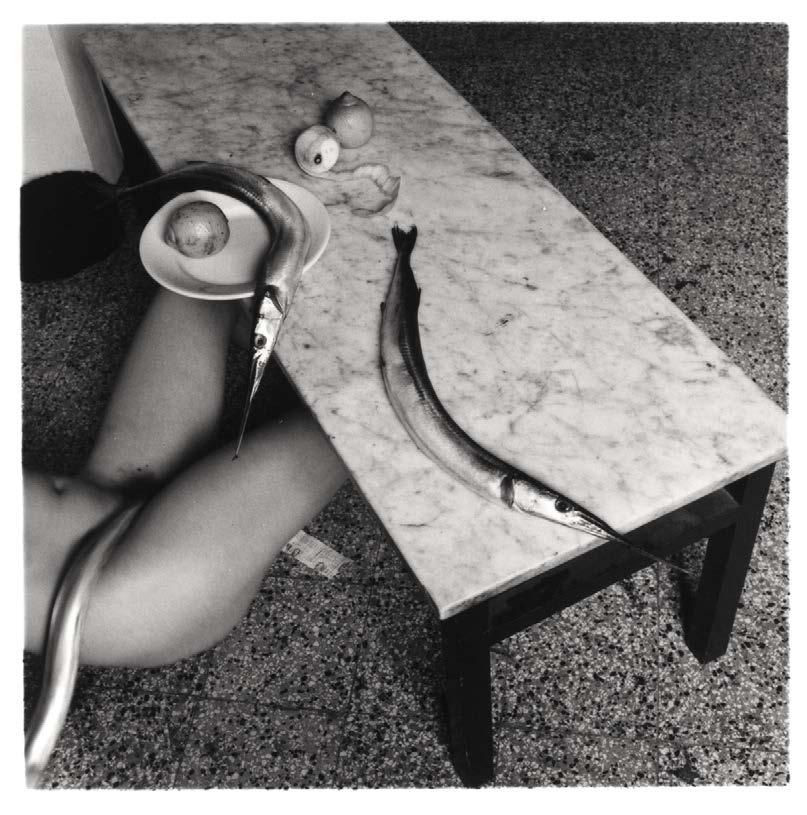
Opposite, above: Francesca Woodman, Untitled , 1979, lifetime gelatin silver print, 3 ¾ × 4 ¾ inches (9.5 × 12 cm)
Opposite, below: Francesca Woodman, Horizontale or Horizontal Legs , 1976, lifetime gelatin silver print, 5 ¼ × 4 7⁄8 inches (13.3 × 12.4 cm)
Artwork © Woodman Family Foundation/Artists Rights Society (ARS), New York
breast, as if it were a specimen under magnification, making a jarring contrast with her pert, relaxed right breast; in this simple but stark way Woodman makes artifice and nature literal. Her use of the glass pane has been compared to Ana Mendieta’s Untitled (Glass on Body Imprints) of 1972, in which Mendieta pressed a pane of glass against her face and naked body in a performance traced in thirty-six slides; but where Mendieta’s work drew attention to the regulation, distortion, and pain of the female body, Woodman’s explores the idea of two states slipping between each other—imprisoned and liberated, hard and soft. 12 As she wrote, “Glass makes a nice definition of space because it delineates a form while revealing what is inside. It is also a cold and somewhat harsh material.”13 If Rosalind Krauss reads this series as a formal exploration of the self “as a medium, a conduit, a plane of passage,” I suggest that the glass must also be appreciated as an erotic conduit, exploring the pleasure of looking as well as of being looked at. 14 Through Woodman’s compositional play with a glass frame within a photographic frame, interior and exterior interpenetrate.
Woodman’s interest in the camera as an extension of the haptic eye is evident in works that precede and follow her time in Rome, but the ancient city undoubtedly encouraged her to draw out the themes of phantasmagoric desire and the sexual dynamics of display. In Horizontale or Horizontal Legs (1976) we see her binding her flesh with tape—probably in homage to Hans Bellmer’s collaborative photographs of his lover Unica Zürn from 1958—but her Roman works take these experiments in new directions. 15 Witness her reference to Max Klinger’s Symbolist etching series Paraphrase ü ber den Fund eines Handschuhs ( Paraphrase on the Finding of a Glove , 1877–78), which she discovered at the Libreria Maldoror, in the photographs she enacted in the historic Bar Fassi with her friend the artist Sabina Mirri and a pair of black leather gloves. The gloves gesture across the photographs as they first cover and then uncover hands, titillatingly suggesting the performative nature of desire in a subtle yet stripteaselike fashion. Where Klinger used the glove as a fetishistic reference to the desired, passive woman, Woodman allows it to return the sexual gaze, activating new, unwritten stories for and by females. In this respect these photographs recall Meret Oppenheim’s Object (1936), in which a dainty teacup, saucer, and spoon are clothed in soft gazelle fur, defying the Freudian conception of fetishism that constructs woman as passive, castrated, and receptacle only. 16 In the public space of the Bar Fassi, Woodman also plays with the common “feminine” object and allows it to take on an anamorphic agency—it becomes its own protagonist. The male flaneur gives way to the female flaneuse, creatively free to wander the streets and café world (the haunt of the avant-garde) in a way impossible for the young Nadja in the late 1920s but perfectly possible for the young Woodman in the late 1970s.
Woodman’s work references the avant-garde with the benefit of the advances of first-wave feminism, when both art historians and women artists focused on representations of the female body as a means either to repress or to assert agency. At the same time, she was adamant that her work was not activist but rooted in the poetic. As she explained in a letter to the Italian photography-magazine editor Alberto Piovani in 1979, “The allusions to sex in my work do not stem from any modern political or feminist concerns but from a more general preoccupation with morals—often in a literary sense.”17 Yet her focus on the still-life object, as well as on woman as still life, allows us to appreciate how her “literary sense” always retains a subversive edge. As Norman Bryson reminds us, “Still life bears all the marks of this double-edged exclusion and nostalgia,
this irresolvable ambivalence which gives to feminine space a power of attraction intense enough to motor the entire development of still life as a genre, yet at the same time apprehends feminine space as alien, as a space which also menaces the masculine subject to the core of his identity as male.”18 Woodman’s work subtly engages with such cultural associations just as her compositions nostalgically echo vestiges of the past. Woodman invites the viewer to move across time, objects, morals, and their literary and visual representation. She knows the particular symbolism involved in the dynamic between space and sexuality around the objects on which she focuses—namely, how the nude as a form of art has a “certain timeless, personal but allegorical quality,” as she wrote in a letter of 1979. 19 Equally in staging the body beside commonplace still-life objects that seem to morph into surrealist ones, and in antique or ruined sites with antiquated or crumbling walls, her camera lens refutes the work of the photograph as document and instead enjoys its painterly potential. Most of all she imbues the medium with a literary quality, uniting what she termed “an allegorical quality” with photography’s potential for “the rough edge.”20 This sense of the roughness, the brushing, of edges holds firm. She wrote of the academic or museum-style display case as “a container to be looked into” in contrast to her own work, which explored the idea of “enclosing” the looker and the looked at. 21 Woodman defies the objectifying vision of strangers in favor of strangers coming together, if only for a moment.
1. Francesca Woodman, “My First Brush with Infinity,” c. 1975. Francesca Woodman Collection, Woodman Family Foundation Archives, New York.
2. Ibid.
3. André Breton, Les Vases communicants , 1932, Eng. trans. as Communicating Vessels , trans. Mary Ann Caws and Geoffrey T. Harris (Lincoln and London: University of Nebraska Press, 1990), 109. 4. Breton, Nadja , 1928, Eng. trans. Richard Howard (London: Penguin Books, 1999), 56.
5. Woodman, draft of application for a Fulbright for graduate study abroad, 1980. Francesca Woodman Collection, Woodman Family Foundation Archives, New York.
6. Walter Benjamin, “Kleine Geschichte der Photographie,” 1931, Eng. trans. as “A Small History of Photography,” in One Way Street and Other Writings , trans. Edmund Jephcott and Kingsley Shorter (London and New York: Verso, 1997), 243.
7. Isidore Ducasse, Les Chants de Maldoror, 1869, Eng. trans. Guy Wernham (New York: New Directions, 1965), 205.
8. Since Breton writes of “the elusive character Melusina” in Nadja , we know that Woodman was familiar with the mythology. Breton, Nadja , 106.
9. Woodman, notebook entry, c. 1978. Francesca Woodman Collection, Woodman Family Foundation Archives, New York.
10. Laura U. Marks, Touch: Sensuous Theory and Multisensory Media (Minneapolis: University of Minnesota Press, 2002), 2.
11. Woodman, notebook entry, 1976. Francesca Woodman Collection, Woodman Family Foundation Archives, New York.
12. See, for example, Helaine Posner, “The Self and the World: Negotiating Boundaries in the Art of Yayoi Kusama, Ana Mendieta, and Francesca Woodman,” in Whitney Chadwick, ed., Mirror Images: Women, Surrealism, and Self-Representation (Cambridge, MA: MIT Press, 1998), 156–71.
13. Woodman, notebook entry, 1976. Francesca Woodman Collection, Woodman Family Foundation Archives, New York.
14. Rosalind Krauss, Bachelors (Cambridge, MA: MIT Press, 1999), 173.
15. Scholars who have made the formal comparison between Woodman’s photographs and Hans Bellmer’s and Unica Zürn’s have overlooked the collaborative nature of the earlier couple’s works, a necessary consideration for a more nuanced reading of Woodman’s engagement with them. See Alyce Mahon, “Hans Bellmer’s Libidinal Politics,” in Raymond Spiteri and Donald LaCoss, eds., Surrealism, Politics and Culture (Aldershot, Hants., and Burlington, VT: Ashgate, 2003), 246–66. For a Bataillean reading of Woodman’s interest in the formless see Isabella Pedicini, Francesca Woodman. The Roman Years: Between Flesh and Film (Rome: Contrasto, 2012), 88–93.
16. On Meret Oppenheim’s engagement with Sigmund Freud see Alyce Mahon, Eroticism and Art (Oxford: Oxford University Press, 2005), 136–38.
17. Woodman, draft correspondence to Alberto Piovani, 1979. Francesca Woodman Collection, Woodman Family Foundation Archives, New York.
18. Norman Bryson, Looking at the Overlooked: Four Essays on Still Life Painting (London: Reaktion Books, 1990), 172–73.
19. Woodman, draft correspondence to Piovani.
20. Ibid.
21. Woodman, notebook entry, 1976. Francesca Woodman Collection, Woodman Family Foundation Archives, New York.
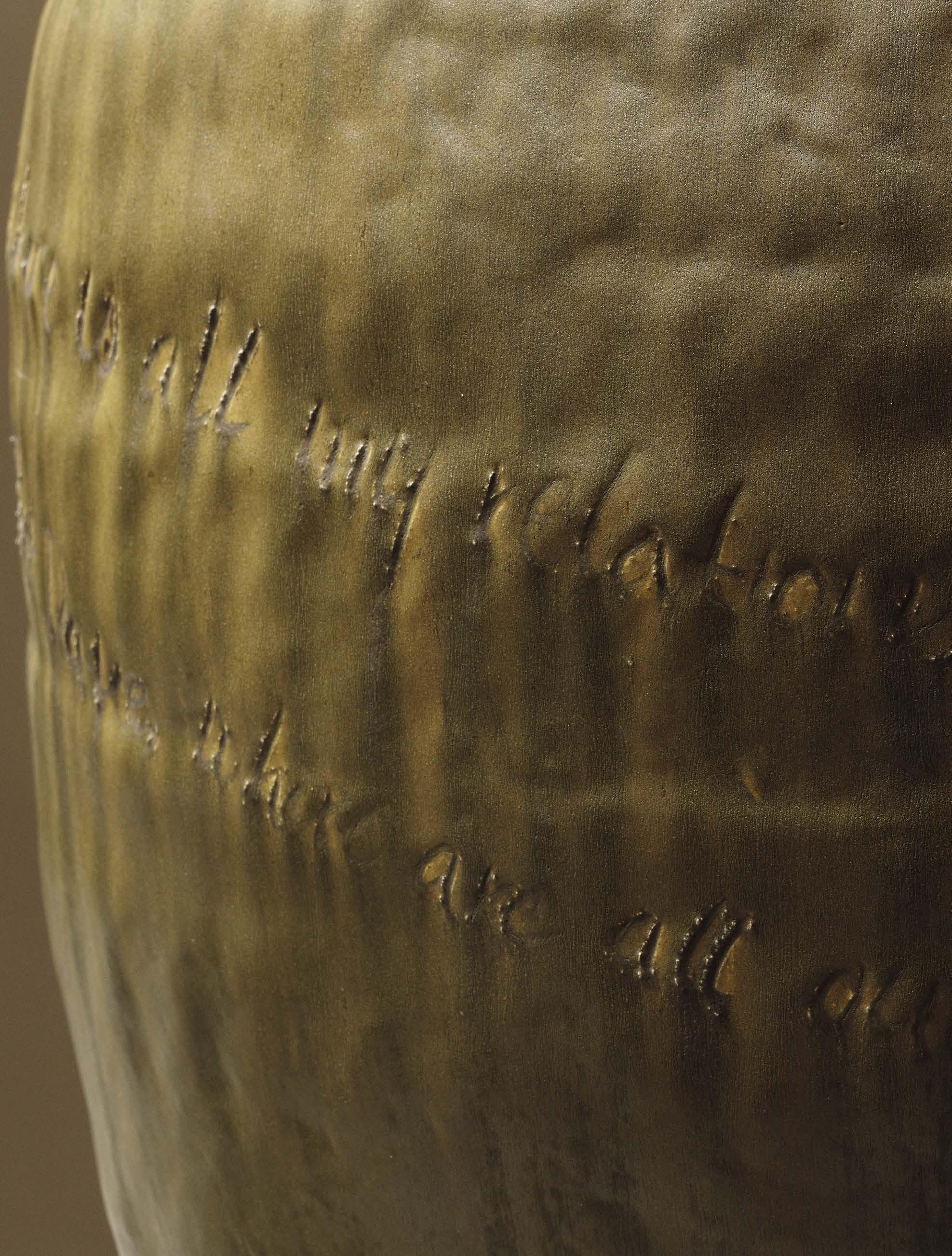
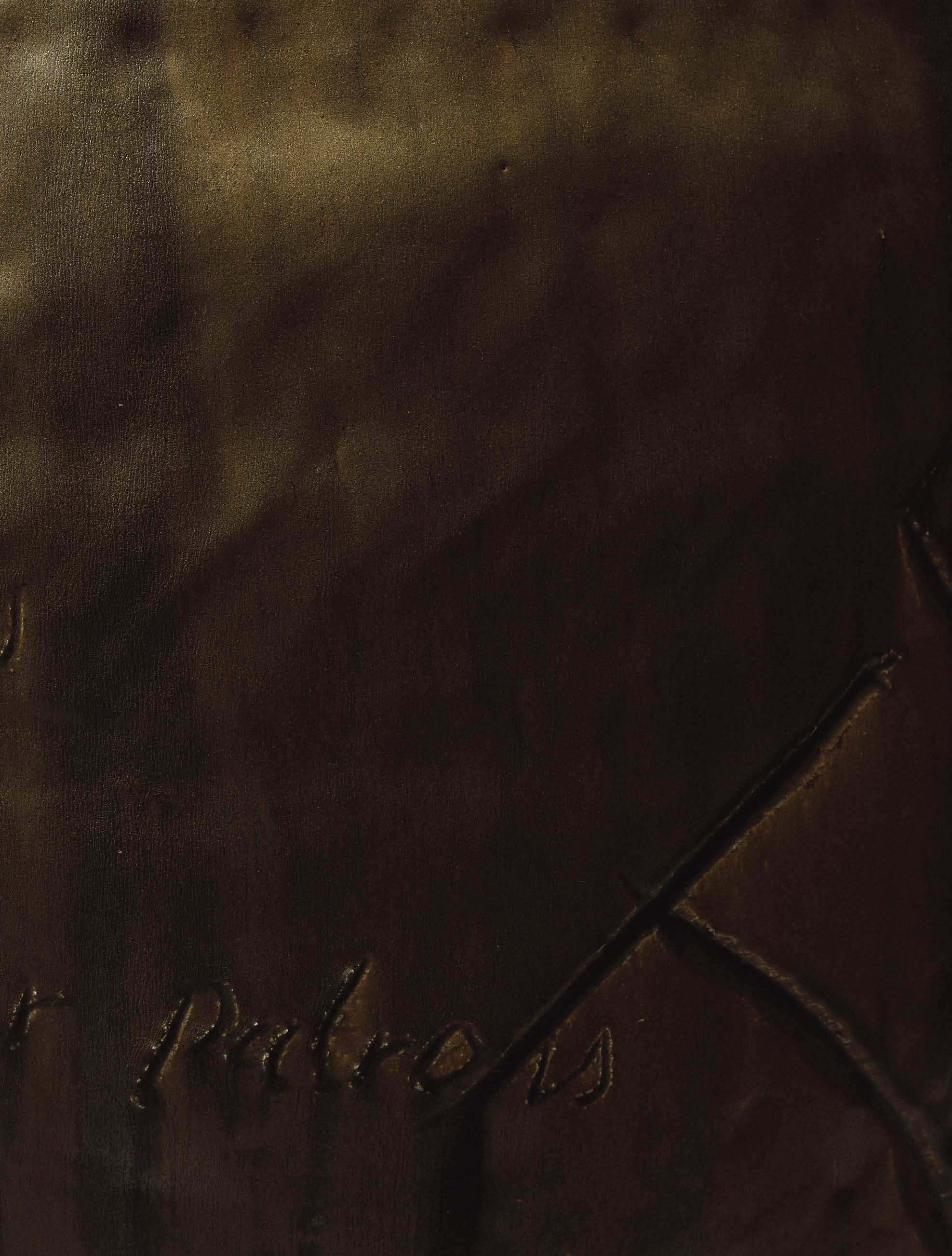
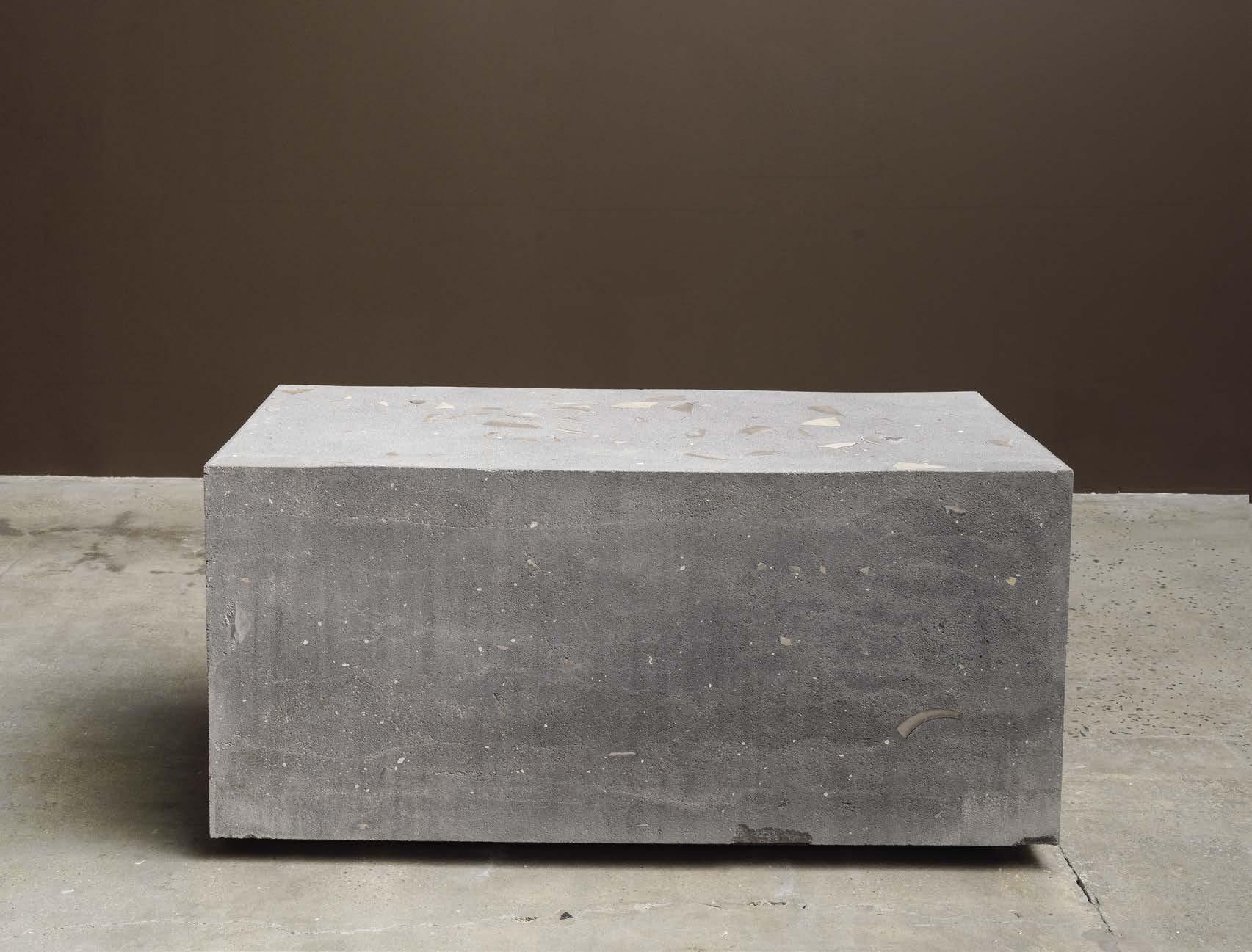
A conversation between Theaster Gates and Jessica Bell Brown, with an introduction by Sydney Stutterheim.
Earth to earth, ashes to ashes, dust to dust. Book of Common Prayer, 1549
Theaster Gates has been thinking about lineage, craft, and guardianship for over twenty years. Across his diverse body of work, which spans from sculptural paintings and pots to land art and socially engaged projects, Gates explores ways of restoring undervalued histories, particularly as they intersect with Black subjectivity. His Civil Tapestries (2011–), for instance, allude to the repressive violence enacted on 1960s civil rights activists by police using high-pressure fire hoses, and incorporate such hoses in elegant, Minimalisminspired compositions. A recent commission for the forthcoming Obama Presidential Center in Chicago expands on Gates’s archive-based work preserving African American history and its cultural representations, as in his vast collection of materials from the Johnson Publishing Company, which produced the influential Ebony and Jet magazines. Yet despite Gates’s fluidity with mediums, his multifaceted artistic career is perhaps best articulated through his work in clay.
The artist’s most recent project, presented this spring at Gagosian’s Park & 75 location, synthesized and developed a set of concerns that have been of utmost importance to him for decades. In Dave: All My Relations he honored the innovative and daring work of David Drake (c. 1801–1874), an enslaved South Carolina potter who defied contemporary laws criminalizing literacy among Black people by making virtuosic monumental pots inscribed with his signature and his original poetic verses. Having discovered Dave’s work in the 1990s, Gates used Gagosian’s exhibition space as a vessel to extend this historical legacy into 2026, achieving the most powerful expression of these ideas to date.
While pursuing a degree in urban planning at Iowa State University in the early 1990s, Gates began studying with the ceramics professor Ingrid Lilligren, who became a lifelong mentor. With her encouragement he traveled to Tokoname, Japan, to attend a pottery workshop in 2004. This first trip to Tokoname led to a twenty-year engagement with the town; subsequent visits deepened his interest in Mingei, a movement begun in the 1920s that embraced the simplicity and elegance of folk craft. This exposure gave Gates a clearer understanding of the possibilities of ceramics as an art form, yet questions remained for him regarding the presence of Black potters in the American craft tradition.
Back in the United States, Gates further pursued this point of inquiry, attempting to uncover a more complete and accurate history of pioneering
ceramicists. With the help of Lilligren, Gates encountered a rare exhibition catalogue for a 1998 show at the McKissick Museum, University of South Carolina, titled “I made this jar...” The Life and Works of the Enslaved African-American Potter, Dave . These findings became the driving force for his next major artistic project: the 2010 exhibition To Speculate Darkly at the Milwaukee Art Museum, which featured one of Dave’s original pots on view alongside Gates’s own artistic work.
Dave quickly became an integral figure in Gates’s practice. Otherwise known as Dave the Potter, Dave lived in the vicinity of Edgefield, South Carolina, a center of ceramic production in the antebellum South. Edgefield was known for its alkaline-glazed stoneware pots, which were used to store food and perishables. The pots were made by enslaved people for use by their owners, but that history was eventually obscured to promulgate white-centered narratives of creative expression and innovation. To exalt this forgotten history Gates created and performed musical hymnals and lectures alongside the display of a loaned vessel by Dave in his 2010 show.
In Dave: All My Relations Gates deepened his previous investigations of Dave’s legacy, placing the two artists’ work into a speculative dialogue. The show centered on three pots, which were placed atop plinths installed in the center of the gallery. As a tribute to the foundational role that Dave had played on his practice, Gates created a custom pedestal comprising pulverized fragments
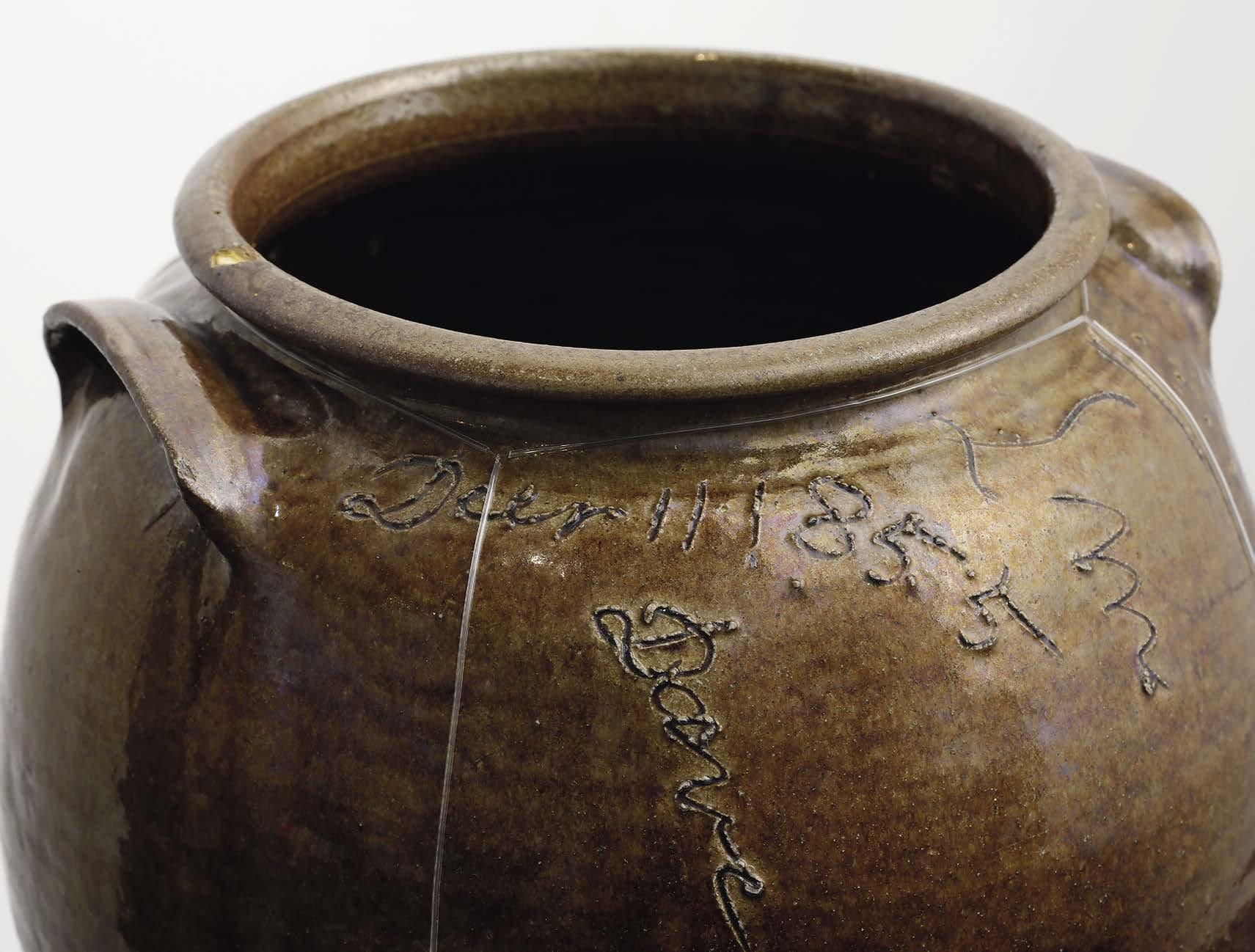
Following spread, left:
Following spread, right: Theaster Gates inside his exhibition Dave: All My Relations , Gagosian, Park & 75, New York, March 26–May 2, 2026. Photo: Maris Hutchinson
of forty-five pots he made and fired in his studio, with clay shards remaining visible amidst the otherwise smooth gray surface. This sculpture served as the base for the display of an original pot by Dave, which Gates has gifted to Dave’s descendants. Gates’s plinth, which assumes a Minimalist sculptural form, quite literally supports Dave’s pot, creating an act of stewardship that is conceptually critical to the artist’s project. A second stoneware vessel by Dave was also on view; in late 2025, it was restituted to Dave’s family by the Museum of Fine Arts Boston. Accompanying these two pots by Dave is a monumental vessel made by Gates, which features a poetic couplet inscribed on its surface in homage to Dave as a creative forefather.
Gates has described the experience of his work as an impartation, citing the biblical idea of the passage of gifts and wisdom between people. This spiritual notion is integral to Gates’s project more broadly, particularly as it intersects with sacrifice and redemption. From his recycling of discarded building materials to his conservation of historical records, Gates sees the reconstitution of materials as a creative action. For him, the marginalized position of clay pottery—traditionally seen as a form of craft rather than a high art—is linked to the traditional experience of the Black subject as creator. By asserting his commitment to this lineage of pottery, Gates aims to reimagine not only the material of his objects but their historical position as well.
—Sydney Stutterheim
JESSICA BELL BROWN Theaster, tell us about the spirit of your forthcoming exhibition with Gagosian and your long-standing connection with David Drake.
THEASTER GATES It’s more like a project than an exhibition—it’s very, very specific. I’ve been thinking about David Drake for the last twenty-plus years. He’s become quite known in the past two decades: He was an enslaved potter who wrote his name on his pots, along with couplets, at a time when it was illegal for enslaved people to be literate. He’s come to represent a kind of mythic hero to me within conceptual and craft traditions in the United States—the earliest Black cat I’ve been able to identify by name and by signature who is directly connected to a set of things that I do, which is make pots.
I put together an exhibition in 2010 called To Speculate Darkly at the Milwaukee Art Museum, in partnership with the Chipstone Foundation and Joyce Foundation, where I looked at Dave’s work and his life as a Black potter, but it was also about making speculations about who I am, who he was, what clay is in this moment. Fast-forward: The curator I worked with in Milwaukee, Ethan Lasser, decided to revisit Dave in partnership with the Metropolitan Museum of Art in New York and the Museum of Fine Arts Boston, in an exhibition called Hear Me Now. While doing that he did a lot of research and a genealogist, April Hynes, identified Dave’s descendants, and over the years he has engaged those descendants as new characters in this project.
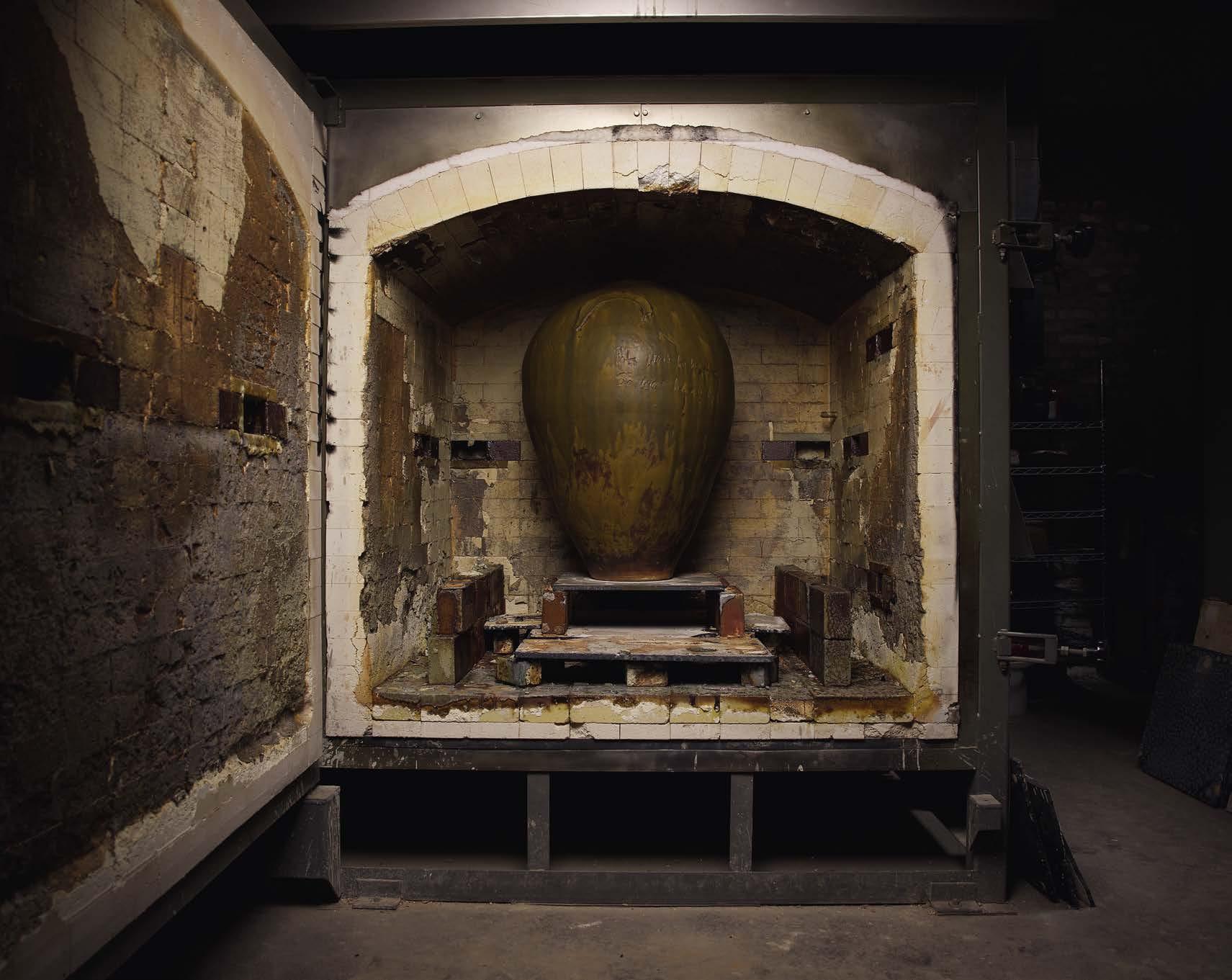
One of the things born from the descendants knowing of their ancestor was that they really wanted to gain access to some of Dave’s vessels and began a kind of reconstitution of those works. And so I got a call saying, “Hey, the descendants of Dave would love to be in touch with you and would love to talk to you about their ancestor and what you’re up to.” We started a very cordial conversation about Dave, which led to this project where I am thinking about my own practice and relationship to his work, as well as the politics of craft, familial lineage, clay as an archive, and the industry of clay in terms of labor and economics. All of those things might come to bear in very simple ways in this project space with Gagosian.
JBB You used the word “lineage,” and perhaps we can think about clay as a way for you to map yourself as an artist within this lineage. Would you say that David Drake is at the center of that?
TG I used to think all the time about the phrase “You choose your family.” There are friends who become family, and then folk who you’re in the trenches with in varying ways. But I think another kind of lineage, which is real in ceramics, is who trained you and who trained them. So I also have my lineage of Ingrid Lilligren and then Paul Soldner, potters two generations ahead of me who I’m connected to. But I think of Dave as one of two mythic historic figures, the other being Yamaguchi, whom we’ll talk about another day. These are two
folks who set me right in terms of building a psychic DNA, an intellectual and haptic sensibility around what it means to be a maker.
There was a period when I was really channeling Dave and trying to make bodies of work as big as his. I was working individually, before studio assistants and that kind of thing, and it was really about the craft. I reached a moment where Dave was communicating back to me through clay and I conjured it in a lot of ways, including the creation of a hymnal. My first hymnal was around this acknowledgment, this celebration.
JBB The 2010 exhibition had a sonic register. Did you write music for this project as well?
TG Oh yeah. There’s a song that goes, [singing ] “Up in the east, out in the west, I’ll be the potter you know best. Up in the east, out in the west, I’ll be the potter you know the best. My name goes here.” And then I went to his couplets: “Go ask Jack, he’ll want his beef, he’ll want his beef.” And then, “The Great and Noble Dave, the Great and Noble Dave, the Great and Noble Dave, the Great and Noble Dave.” It’s such a big cacophony. At the end of the song, we just kept saying, “My name goes here, my name goes here, my name goes here, the great and noble Dave.” We did like fifteen of these anthems and hymns, and it felt like a technique to keep his spirit alive, not unlike the use of hymns in Protestant song or the spirituals of enslaved people. I used those tools of deepening
one’s psychic truth about this historic character through song. I used all of my wiles to realize that. And we built a killer choir, where the sonic became a device for the continuity of legacy. The hymn was my propaganda, my psychic sticky glue that would help us get from not knowing the history of Black craft to being absolutely certain that we’re a part of Black craft.
JBB I like to think of this as an act of veneration, an honoring of the labor and the making, but also as an act of proclaiming a history or a lineage through craft. You’re returning now to some of those earlier provocations around David Drake and your relationship to craft, and to being a potter.
TG My exhibition Black Vessel [2021] at Gagosian in New York and my Basel project Ashen [2022] are where I really focused on these wood-fired ceramic works. You can go back even earlier, to my exhibition The Minor Arts [2017] at the National Gallery in Washington, DC. The reason that show was called The Minor Arts was that I was looking at craft in its entirety in my studio, and textiles, ceramics, coins, tools, silver goods, things that are crafted—within art history each of those categories would be called “the minor arts.” I was interested in the idea that art history has always relegated craft to its own non-majority state, that craft occupied the same positionality that my Black self occupied. And I loved that. I was grappling with the audacity, not only of my own status and its
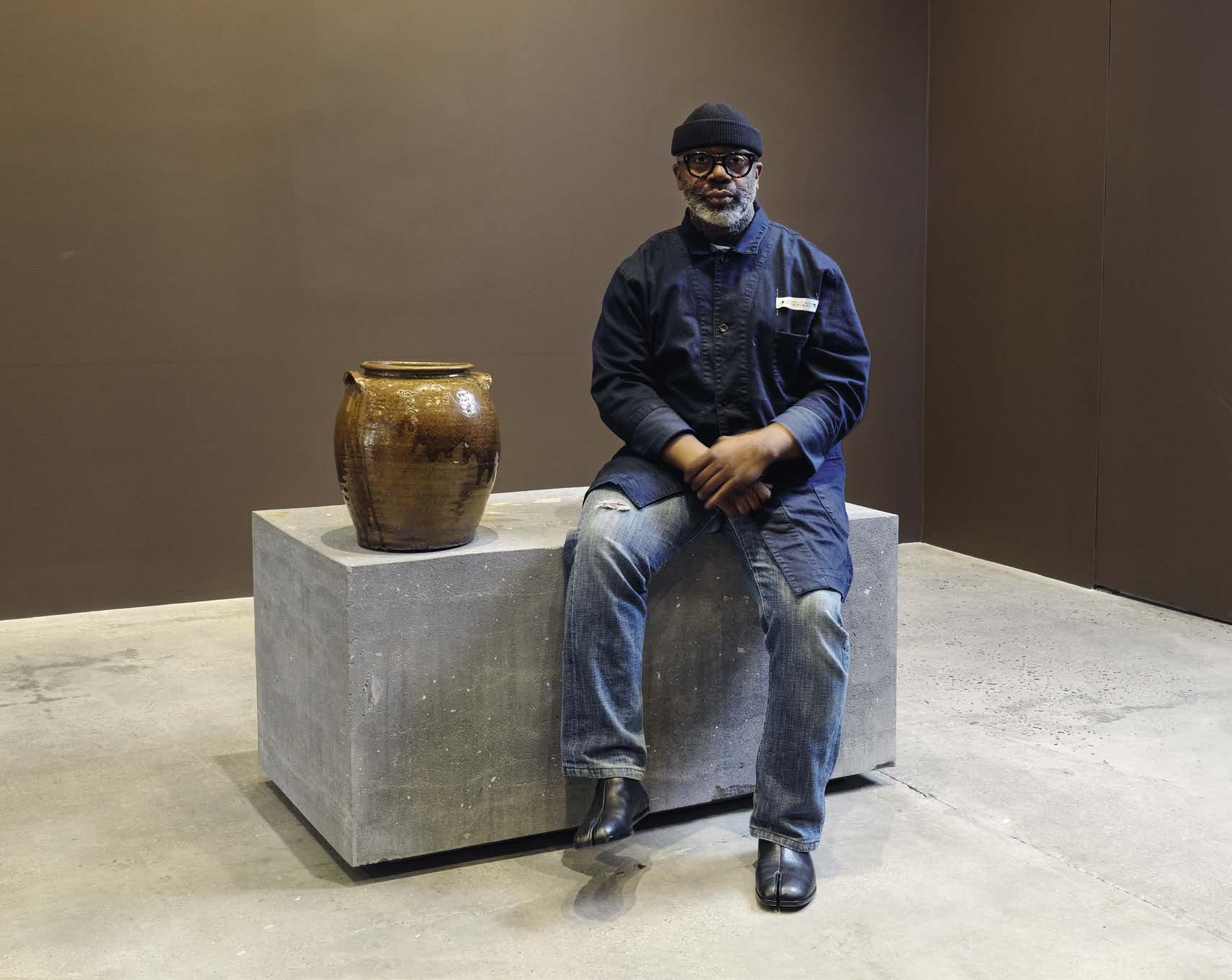
transcendence of the title, but also of crafts’ transcendence of that title.
JBB Zooming out a bit more, I want to focus on histories of Black craft and how they show up, or not, in art history. I’ve been thinking a lot about the Black furniture- and cabinet-maker Thomas Day, and he has led me to reflect on how Black creators are everywhere in US history. Black histories of labor are ingrained in the edifices that we encounter every day. I’m keenly interested in how labor in your work plays out and conditions us to think about the significance of a brick, or a tile, or a roof shingle. I wonder could you tell us about your artistic labor as a gesture of generosity, or even an invitation for us to think about how we map these points?
TG Well, first, I think there was a real intention to make Black labor anonymous, to blur the role our hands played in shaping this country. And that was done through capitalism, which disregards labor and labor’s name and labor’s individual hand as important to the overall project. So let’s say, even when the person’s intention wasn’t racist, there was something about being in a racist structure that removed our names from our labor, our ethnicities from our labor, and that removal ended up being a way of distorting American history, so that we imagine every beautiful mansion ever built was probably built by white people. And it’s easy to erase because the names were often never
recorded. How do you then identify the architects and engineers and those who were ingenious alongside those who made bricks and were itinerant skilled laborers? All of that history is tertiary to the other histories that we remember about Black folk, so when you look at those buildings you don’t imagine Black labor, you imagine white intelligence and white civility. Part of the project of addressing Thomas Day and Dave Drake is giving name to a constellation of makers who built this country, and who, with creativity and ingenuity and also swag, contributed to the aesthetic intention of the times.
JBB To return to your upcoming project in New York, could you say more about what you’ll be presenting?
TG The thing I’m offering at Gagosian is very simple: It’s Dave’s pottery alongside a plinth made from my crushed pots. That’s it. I’ll be the plinth and Dave will be the story. And it’s almost like the space is really a place of transference. I don’t even think of it as an exhibition space.
JBB It’s sounding almost like a benediction.
TG Yeah. Benediction, elegy—a poem of consolation for those who have passed. One of the things potters struggle with is sacrificing and letting go of vessels. You think all your vessels are good; you want to keep everything you’ve made because you’ve invested your time and energy. But when you’re learning, you’re actually not good. My
teacher would say, “Just remake it, just throw it and then rewedge it and then throw it again and rewedge it.” And you would do that over and over, but I’d become really attached. Over the years, I’ve become attached to a lot of vessels that could have been sacrificed. And if I’d moved them along faster, maybe my growth rate could have been faster. In some ways I feel like this thing that I’m doing is, I’m letting go of . . . I’m choosing the sacrifice so that I can be in service to this pot that is absolutely singular, Dave’s.
And it’s difficult to let go of these pots, to go through and say, Okay, we can let go of those twenty, we can let go of these fifty, because when I look at the aggregated set of pots, they represent my time, my resources, my creativity, the creativity of others at the studio, important moments when even if we failed, we learned a lot. I feel, what a great sacrifice to turn all of that into a pulverized powder that can carry the presence of history into the future.
It’s important to say that Dave didn’t need me, I needed Dave. I get to be one of the carriers of his story, so that no matter what’s happening at a federal level or at a local level or at a racial level, the arts and artists will play a role in keeping the Black craft archive alive. Turning a pot into a particulate, which is its origin, is exactly how energy works; the death of the vessel is the life of the plinth, and that’s good. That works. That checks out.
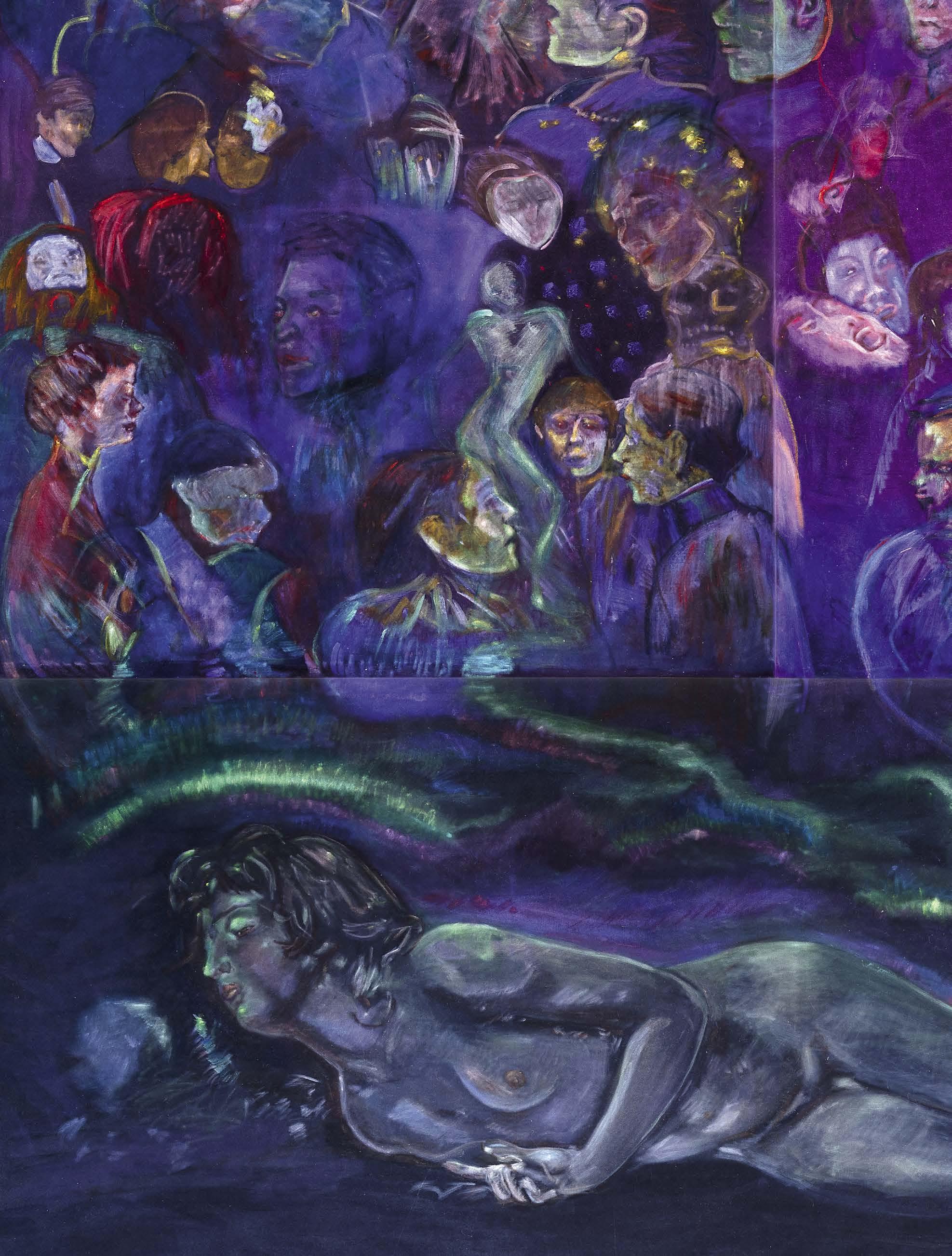
The most recent edition of Picture Books, an imprint organized by Emma Cline and Gagosian, pairs Mary Gaitskill’s novella Stauf: A Tragedy with Jill Mulleady’s painting The Shift . In celebration of this forthcoming publication, Gaitskill and Mulleady discuss the myth of Faust, good and evil in the digital age, and the channeling of raw matter into art.
MARY GAITSKILL I was really surprised and delighted when I first saw your book of paintings Fight-orFlight [Swiss Institute with Lenz Press, 2025]. The first painting, A Fantasy of Transcendence and a Preoccupation with Downfall and Ruin [2019], is a striking image: It shows this large man lying on a sort of island, with many small dramatic stories or images going on behind or under him. He looks tortured, there’s actually a wound in his body, yet he’s very large and has a sense of power about him. The title really got my attention—I thought it was so resonant with the legend of Faust, and with my novella’s interpretation of it, because the character in my story, Tina Stauf, perceives herself in a society on the precipice of downfall and ruin and is feeling her own utter inadequacy in dealing with that. She feels that everything she’s counted on to get her through and to help other people is completely false now. Despite this, she’s got a fevered desire to transcend all that, and to transcend her own limitations in life. So this painting really struck me, because it conjures a bigger social feeling of and preoccupation with ruin.
Another painting farther in the book, Feral [2021], shows a cat dragging a dead bird. It’s such a powerful image of raw instinct and violence that’s not immoral, just amoral. And that’s also very much a part of my story: At one point the character—before she’s even met the devil—is looking at the decaying yard of her parents’ house. Her parents are religious fundamentalists and she’s there to be supportive of her sister, who is undergoing an exorcism ritual that Tina thinks is absurd and twisted. But she’s there. She’s in a state of great emotional upset and is looking out at this yard and just feeling the raw force of life—which she used to believe was infused with love, but now can no longer believe in. She’s accepting that. I don’t know if “acceptance” is the right word, but seeing in these paintings this raw force that’s really beautiful—not just in Feral but in some of your other works too—I find that very powerful. So I was happy that you were going to contribute to this Picture Books collaboration.
JILL MULLEADY What you’re saying totally resonates with the paintings. In the title A Fantasy of Transcendence and a Preoccupation with Downfall and Ruin I see something that relates to your story. It’s also a fiction, but it resonates with different levels of reality that are part of human existence, starting with the myth of Faust but also relating to psychology, and to today’s leaning to make psychology almost a replacement for religion. There’s an existential crisis and a loss of faith, a strong loss of faith, which comes from your protagonist Tina’s rejection of her own family’s religion. As you said, it’s not a moral position but rather an engine for her to find her own truth. It shows the desperation
that comes from not being able to find it in society, in relationships, even though she tries with psychology, which is a more modern way to find meaning. And then when her patient commits suicide, it’s a total failure of finding truth. It’s almost like the second failure, because the first is that she doesn’t share her family’s beliefs or religion; now she doesn’t believe in psychology anymore either, so she tries to find it in love.
It’s in her incapacity to find a real connection that Faust comes in. It’s interesting—your interpretation of Faust is totally different from Goethe’s. The Faust of his poem [1772–1832] comes to rule the world and to be a powerful person; it’s a masculine image. Yours is a woman who just aims to understand why human beings act the way they do. Tina Stauf is searching for something missing, and that’s why the story’s so contemporary and enlightening, because as a society we have a desire for transcendence that goes unmet.
MG Have you read Meghan O’Gieblyn’s book God, Human, Animal, Machine [2021]? She writes about AI. She grew up in a fundamentalist family— like my character—and was a believer into college, and she talks about AI and the obsession with creating a superintelligence, or almost like a demonic intelligence. She connects that very much with the religious impulse, as if that intelligence were almost a perverse version of a new god. That’s not an unusual idea, but O’Gieblyn goes into unusual depth, supported by philosophy and history. She also has a refreshing openness to mystery.
JM I haven’t read it, but I understand the concept. People now open up to AI sometimes more than they open up to humans, because they feel like they can share everything. Then what they’re sharing becomes part of this massive archive of information and it has a capacity that no human has. And here we are. This exchange with AI actually could be a sort of transcendence. To what? We don’t know.
The work I’ve paired with your novella, The Shift [2026], depicts the moment when the body exhales the last breath of life and inhales the first one of death. It’s the shift from one world to the other one. It’s very much related to your contemporary version of Faust. Your character Tina makes a pact with the devil, represented by the character Mephista— it’s funny that she signs an electronic signature. Mephista comes to Earth somehow and proposes the exchange: She will serve Tina during life if Tina will serve Mephista during death. What Tina is doing is finding that ultimate trust in Mephista, because they’re now united forever. It’s almost like a religious marriage.
MG Well, they’re going to have a strange relationship. It’s more like ultimate treachery on the most intimate and cosmic level imaginable. Which I guess could describe religious marriage. About
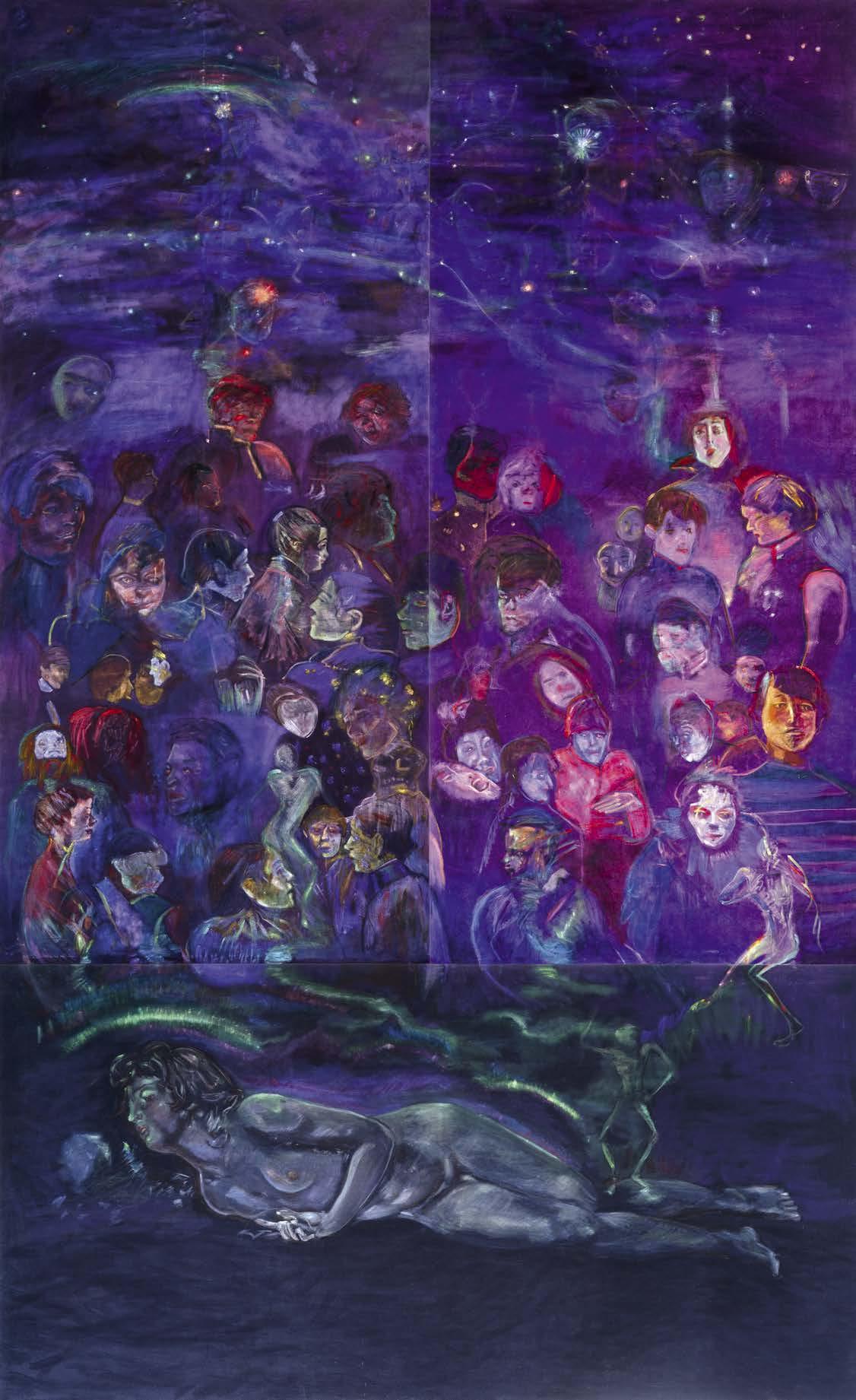
the signature, it’s funny because in Faust they sign in blood, and Mephistopheles says, “Blood is a quite special fluid.” My character Mephista says, “Blood is a very fascinating ink, but this is actually more binding,” and they make the electronic signature. It’s a transcendence of the physical: In the old world, blood is the ultimate because it’s connected to the body, whereas in this contemporary story they’re crossing over into an electronic world, a medium that’s no longer about the earth.
JM Crossing over—being alive and then dying and going to the other side—is something you navigate with this idea of selling your soul in the afterlife; you’re engaging with someone beyond life. One thing we know about death is, we die alone and we don’t know where we’re going or with whom. But here, they’re signing to go to the other side together. Which is almost like a romantic story, because why would you accept that otherwise? Tina is seduced by Mephista. Mephista uses extreme empathy actually; she’s very compassionate, very seductive, and gives Tina the connection she was craving, which are all things related to an idea of love. But the love is transactional, not unconditional: I give you something now and you will give it back to me later. It’s an exchange. But is she doing a terrible thing by looking for transcendence? The question that resonates with me is, Is love a tragedy?
MG It’s an interesting question; I’ve thought about it myself. In [F. W.] Murnau’s film version of Faust [1926], Faust sells his soul because he’s in the middle of a plague and he can’t heal people; he’s frustrated that he can’t help people in the way he would like. There’s a little of that in Goethe’s book also, but not so much. So that’s how the devil seduces Faust originally. He also seduces him with, you know, sexuality and beautiful women, but his offer is, “I can help you do good this way.” And there’s that line—“I am he who, wishing only ill, does only good.” It’s an interesting statement. And yes, both Stauf and Faust are seduced with the idea of doing good, of helping, becoming a better therapist, loving. Love is good; it’s hard to see love as a bad thing, and Mephista is promising Tina love. But it’s a seduction, because it will lead to nothing good. As in the book, Faust tries to do good, but it always ends bad.
And I think the idea is—I mean, it depends on whether you believe in evil or not, but I think evil often presents as something idealistic and wonderful. Fascism presented itself as something wonderful: self-respect, belief, hard work, motherhood, beauty. Almost every bad thing you can think of at first presents itself as something ideal. Then there’s the concept of integration, which, because my character is a therapist, comes up quite a bit in the story. I think about William Blake’s Marriage of Heaven
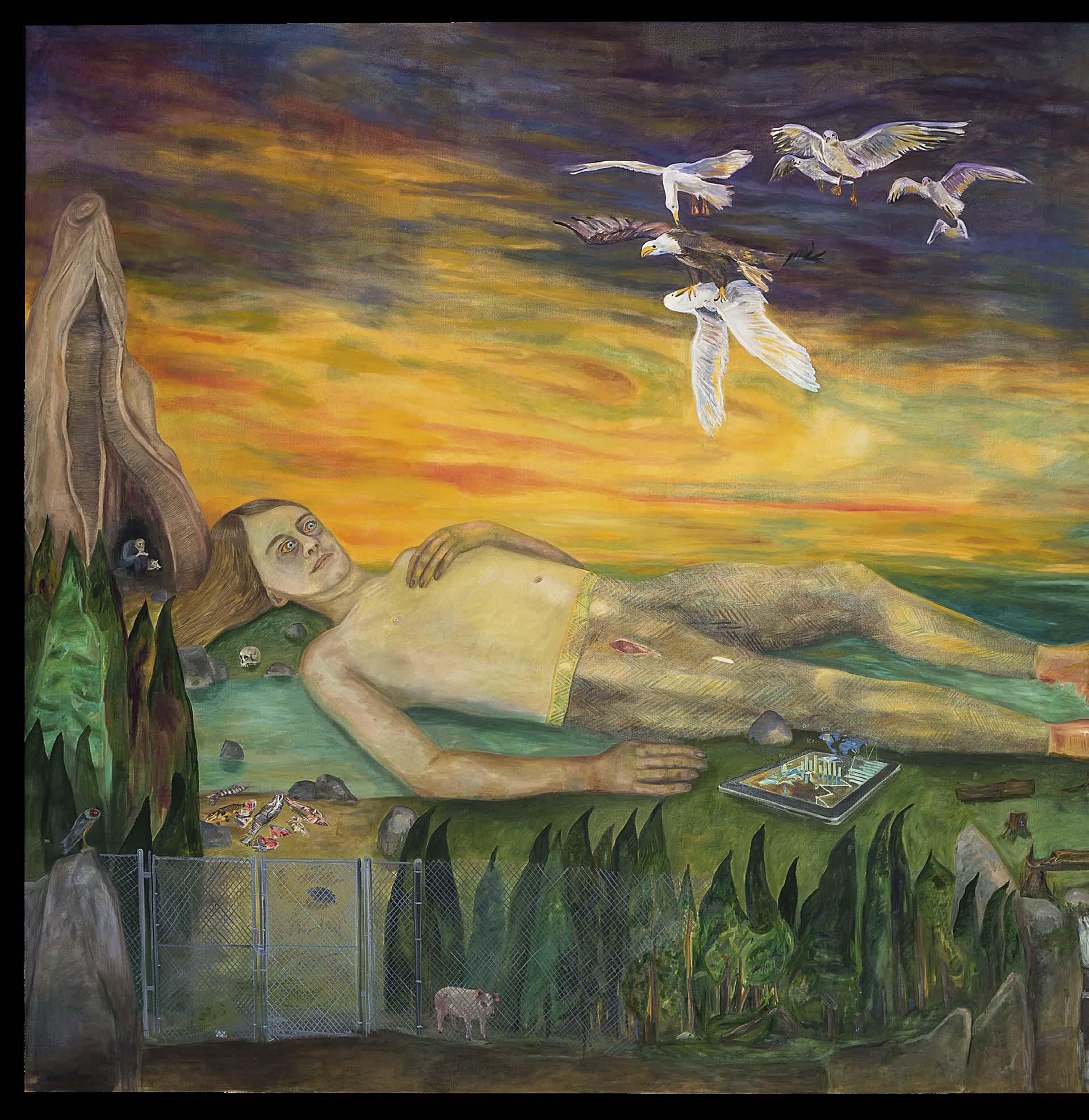
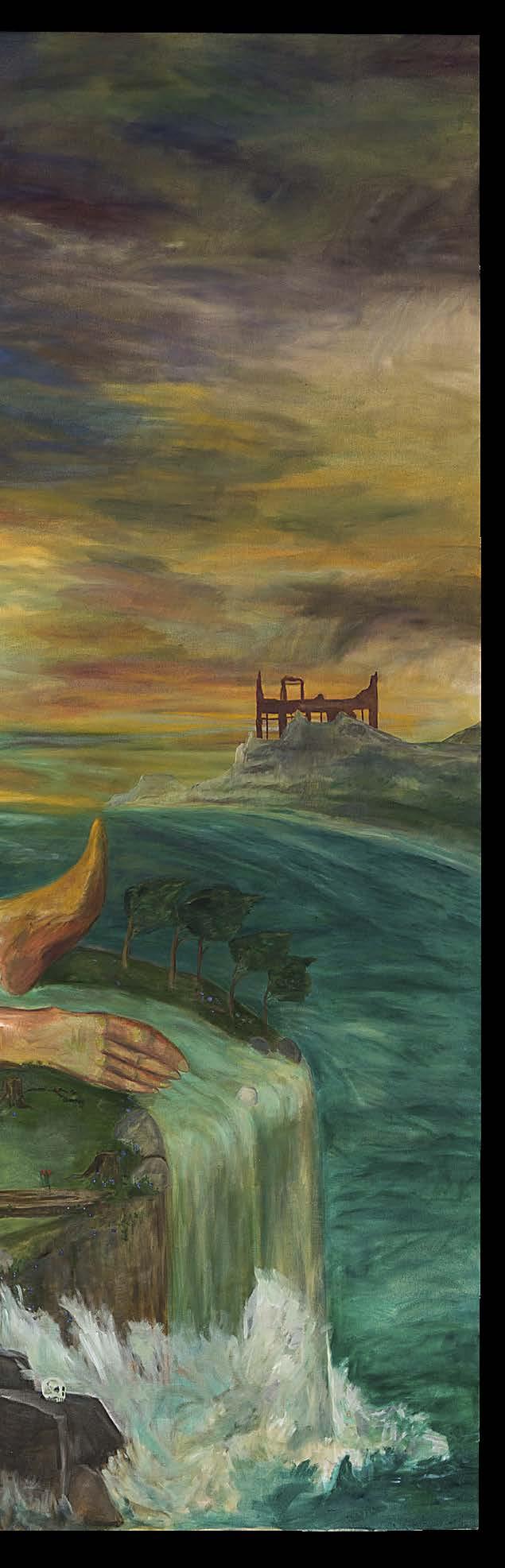
and Hell [1790–93], a beautiful poem: It’s the idea that heaven and hell work together, that there’s always a joining of good and evil, or they blend. I question that, but it’s true that at a certain point, the universe is made of things that are completely outside our comprehension and by human standards would be really evil. You know, animals are tortured and eaten by us. Is that evil? That’s just what we do; animals devour other animals. It’s just a part of what happens. You want to call that evil?
I don’t know.
JM Is evil more about what has no name? Tina rejects the religion of her family, she rejects her training and career in psychology—everything that she knew how to name—and then this entity comes from the other side and she’s offered this deal. The question is, Would you accept a deal with uncertainty? “You don’t know what’s going to happen after your death, but you’re going to have to serve me.” But maybe it’s actually not so bad to serve her?
MG In the story Faust , at least the Goethe version, at the end Faust and Mephisto do become friendly. I mean, they bicker constantly, they’re funny, like Laurel and Hardy: “This is another nice mess you’ve gotten me into.” They have a kind of odd companionship. And the devil—or Mephisto isn’t totally the devil, he’s a minion of the devil, really—is kind of comical. At the end, when he finally swoops in to get Faust, angels appear and they’re like, “No, you can’t have him; we actually kind of like him.” Then they flirt with the devil and torment him with their beauty.
JM That’s what I mean—evil as the fear of the unknown, the fear of what’s different. Tina has courage when she signs the deal, and is it a happy ending somehow?
MG At that point, yes. Goethe’s Faust also has a happy ending.
JM Is it almost like a romanticization of evil?
MG It could be, except I’m not sure—Faust does do some genuinely very bad things by accident.
JM Like what?
MG Well, he destroys the girl he gets involved with. She’s pregnant, she’s cast out of society, she’s arrested.
JM Yes, yes, it’s terrible. With the baby I also remember these images from Murnau’s film.
MG She kills the baby, unwittingly, but yes, it’s bad. And Mephisto actually kills her brother. Her family is destroyed, and then later he destroys the lives of some benevolent old people who helped him and destroys an entire city. So Faust intends to do the right thing, it just never works, which is somehow very familiar.
JM Maybe, at the end of the day, it’s a way to portray the complexity and contradictions of human nature.
MG Yes, and I’m not sure how I’m going to end my story. I’m not sure I’m capable of it, frankly. But I want to write something more. I imagine there’s
already a kind of closeness between Stauf and Mephista, and then at some point in the story’s future she’ll see Mephista’s vulnerability and tragedy and feel for her. Because I do believe in cosmic evil—it would be very hard for me to define it, but I know it when I see it—and there’s always a tragedy about it, something very pitiable.
JM There’s another theme in your novel: healing. Tina is a therapist, and at the core of her every decision there’s the idea of trauma and repair. She tries to heal others but the path becomes traumatic when her patient commits suicide.
MG Yes, and her mentor has died also. She’s not really believing in what she’s doing anymore. And she wants to go for sexual healing; she wants to heal an incel. I don’t know how I’m going to work with that [laughter ].
JM That’s a big challenge. I think Emma Cline’s idea of bringing us together was brilliant, because we’re thinking about similar topics in our works.
MG Yeah, when I see work like yours that has so much depth and resonance with what I’m thinking about, it helps my mind work in a semiconscious way.
JM At the end of the day, for me it’s all about making fiction out of what’s real. Not about the result but about the roles we play in life as a writer or a painter, how we process things to be able to make the work. Which comes first, the egg or the chicken? We’re born and we have a childhood and then we do what we do—you write, I paint—and it’s nurtured by our experiences, but at a certain point you start living for your work, in a way. And that could be a sort of pact with the devil, because it’s something that serves you, or carves a connection with the world, and then you have to serve the work forever somehow, too. And what’s the cost of human connection? To write a book or to make a painting, you have to go through solitude, because you have to spend many hours on your own. I think when we have a more mature practice we know that we go through life in a way that that’s going to serve our art; it changes how we connect with life. I don’t know if you feel something similar?
MG Yes, although I sometimes feel that when my writing works best for me, it does connect with something beyond me, but I can’t make that happen—it happens or it doesn’t. And sometimes it seems very small. I was on psilocybin a couple years ago, a pretty high dose of psilocybin, and I was kind of staggered by what I was feeling. I remember the person I was with said something like, “What about your work?” And it seemed very strange. I said, “That’s just some weird thing that human beings do.” That’s what it seemed like to me. Meanwhile there was this raw matter of life surging all around me. But I think when your work is good, you’re able to at least channel some of the raw matter.
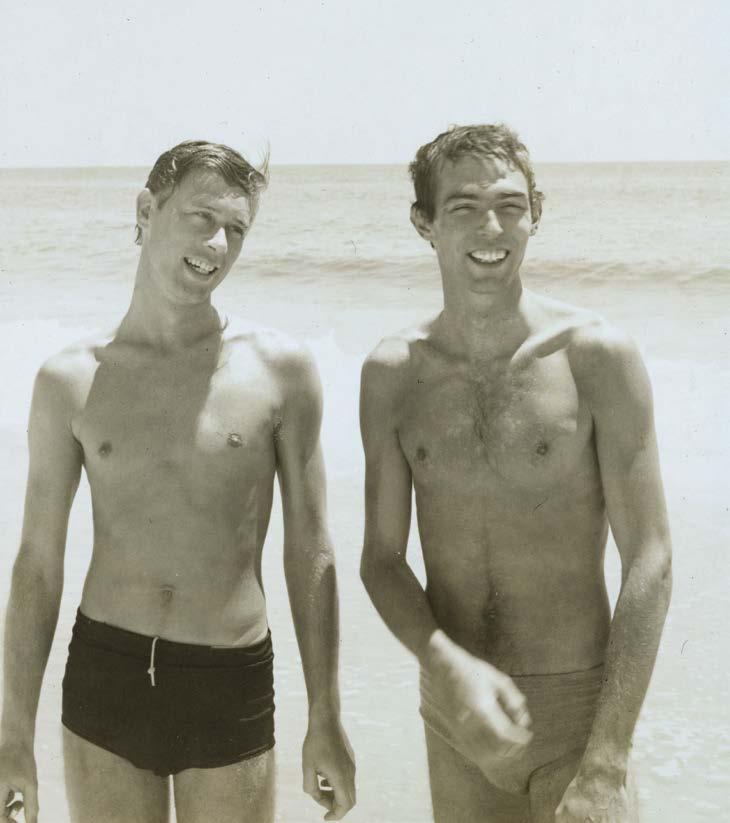
Andrew Durbin’s dual biography The Wonderful World That Almost Was: A Life of Peter Hujar and Paul Thek , published by Farrar, Straus and Giroux this past April, tracks the convergences and divergences in the lives of the two artists, from their first meeting in Coral Cables, Florida, in 1956 through their generative romantic and creative partnership in New York, Italy, Fire Island, and beyond. Ahead of the release, Durbin met with the Quarterly ’s Wyatt Allgeier to speak about the development of the project, the sublime noncompliance of these two artists, and the motifs of love, death, and rebirth that weave through the telling of their story.
WYATT ALLGEIER In your acknowledgments, you say that the book’s origin was a conversation with [the novelist and critic] Lynne Tillman. What about her recollections of meeting Peter Hujar set you on course?
ANDREW DURBIN Well, I first encountered Peter’s work when it appeared on the anohni and the Johnsons album I Am a Bird Now [2005], and while I was familiar with Paul Thek from a high school visit to the Smithsonian, my interest in him was revived through my friendship with the artist Stewart Uoo, who is a big admirer of his work. I started to put them together in my head a little bit, and then in the fall of 2018, when I was living in Berlin, I came across a photograph of Thek with Tennessee Williams, and I was so captivated by it. And I thought, I really don’t know anything about Thek, or about his relationships with anyone, let alone Peter Hujar.
From that photo I started to draft a play, which was not very interesting—I quickly abandoned it. But when I went back to New York, I remember having a conversation with Lynne about Peter. She once spent an evening with him at the Mudd Club, where they just started talking, and she remembered it was one of those moments where everything else drops away and suddenly you’re all alone with this one other person. She was mesmerized by him. It led to so many questions on my part, and she encouraged me to find out more about him.
WA In terms of finding out more, it’s clear throughout the book that you were able to source an incredible amount of primary material—letters, diaries, records, negatives—and gain access to a large group of people who knew Thek and Hujar. You conducted a lot of interviews. How did you go about the research?
AD For the first year, I essentially played telephone. I called up [the photo curator and critic] Vince Aletti in October of 2021, when I knew I was going to write the book, and interviewed him first.
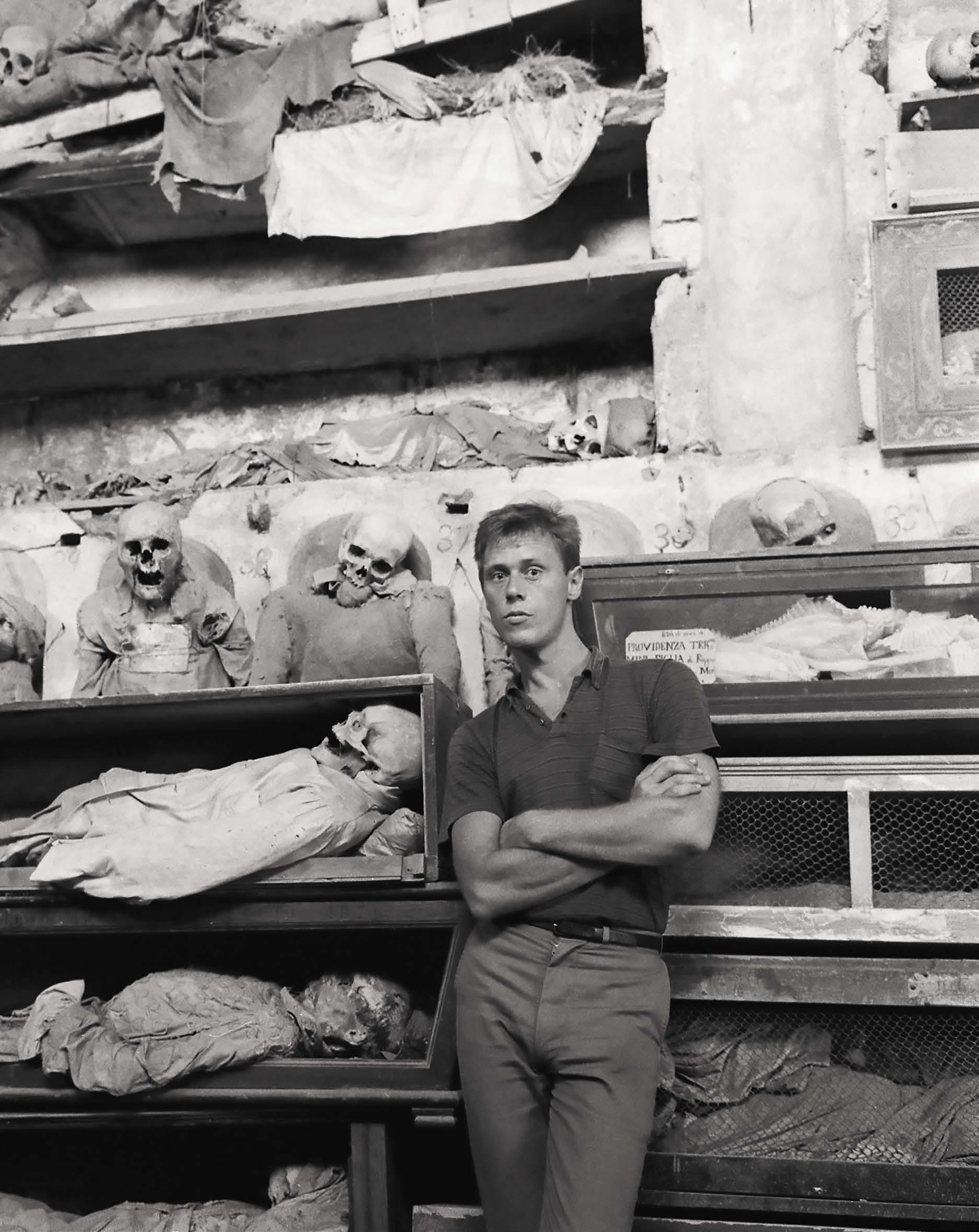
Previous
He recommended I call a few people, then those people recommended others, and so on. A real network developed in that way. On top of that, of course, I contacted the two estates and let them know that I wanted to do this. Very happily, Peter’s estate is very well organized at the Morgan Library [New York]; unlike Thek, he was a fastidious organizer of his own life, so all his letters, his tax returns, everything has been saved.
From there I sat down, categorized the material I’d gathered, and began to create a central timeline, which is the spine of the book. And every time I learned some new fact about the two, whether in conversation or in reading about them or in working in archives, I would add it to this timeline. I tried to approach the book organically. This is my first biography. I read a lot of Janet Malcolm in my twenties— that was my training, which means I was trained to be suspicious of biography.
In terms of the interviews, I was lucky in that virtually everyone—not everyone but virtually everyone—wanted to help. They gave me access to their diaries, they told me their memories, they shared their letters, they put me in touch with anyone they thought might help me out.
WA The book is unique in that it’s a double biography. It’s your first biography, but you chose to tackle two subjects at once! There must have been challenges with that. You’ve balanced these dual narratives beautifully—they each feel properly weighted, taking their own space, with enough intersections and divergences in the men’s lives to keep the whole thing dynamic. It’s a technical feat, and I wondered about how you approached this aspect.
AD That was the biggest challenge. They both led such rich lives. Everyone likes to think they’re leading a rich life, but these two guys really lived: They traveled, they met an incredible number of
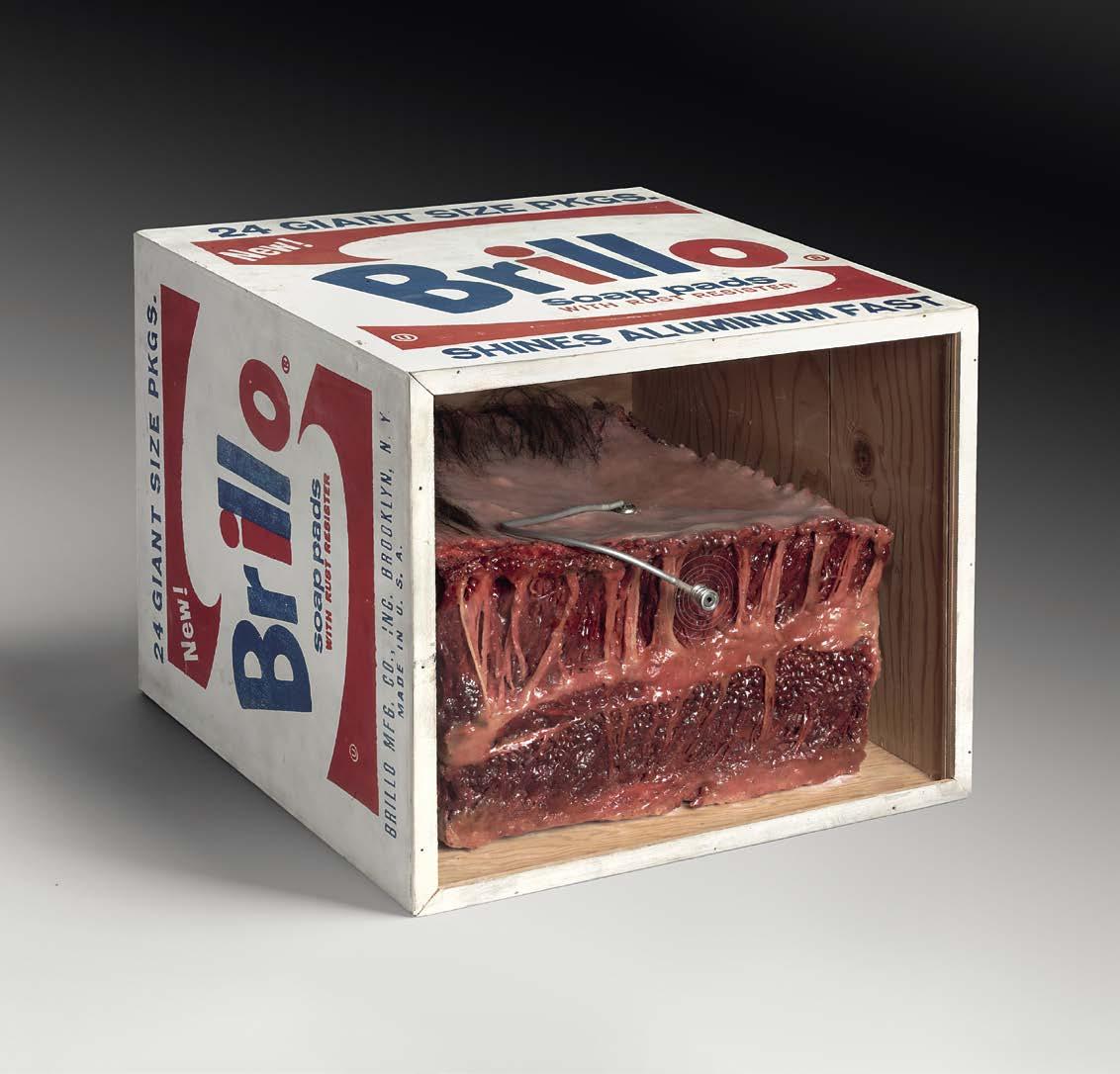
people, they collaborated widely. What I found challenging was how to condense those lives into one book. From the beginning, I wanted the book to be something readers could carry around, something that would feel substantial but still accessible. That meant I had to make choices in terms of what I would leave out. My primary focus was the relationship between Peter and Paul. In that regard, the book became a tennis match where I was hitting a ball back and forth between them. The art was a question of serve.
WA Were there other biographies, or other genres, that you looked to for inspiration? You mentioned Janet Malcolm—
AD I’m a lonely writer. I work in isolation, which you can’t really do with biography—you’re constantly interacting with other people. But I was very careful in reading other biographies; I didn’t want to be too influenced by any one approach. But three come to mind. Reiner Stach’s three-part biography of Franz Kafka [2002–14] is totally perfect. It’s thorough, engaging, thoughtfully written. It has a natural cinematic quality to it without trying to go to places where the facts don’t lead. I think a risk of biography is that you’re tempted to imagine the spaces where you can’t go, because there’s nothing there. That’s a challenge every biographer faces. Stach handles the narrative so exceptionally well. And then Sue Prideaux’s I Am Dynamite! A Life of Friedrich Nietzsche [2018] is another extraordinarily well-written biography. She constructed such a compelling portrait of a complicated figure who suffered hugely. And I thought she handled Nietzsche’s emotional life beautifully. And then finally, Cynthia Carr’s biography of David Wojnarowicz [2012] was key; the way she captures a time and a place is so inspiring.
WA One of the pleasures in reading a biography
is encountering the subject’s wider milieu, learning about these other figures who made up the community, especially those who are lesser known, possibly on the verge of disappearing from any sort of canonical history of a time and place. You’ve done a great job of bringing these characters in, sketching them effectively, and then moving back to the main line of Peter and Paul.
AD I loved thinking about their community. These are two guys who knew a lot of people, and they had a lot of friends in common; there are so many ways to write about their community. But for me what became clear, and what was important to focus on, was the women in their lives. They were both loved and supported by women, and women artists were very important to their work— Ann Wilson, Sheyla Baykal, Linda Rosenkrantz, and many more. So, partly, I wanted to tell their story through the eyes of the women who worked with them and struggled with them and had difficult, but also very loving, relationships with them. Particularly someone like Ann Wilson; she knits the book together.
WA In terms of the key motifs, rebirth is a huge one. Thek’s Tomb [1967] is a concrete version of that, but even early on in his life he changed his name from George to Paul, as you narrate in the book. When did it become clear to you that rebirth would be a main through line? Was that an early realization or did it come later?
AD It evolved naturally. It began to form in my mind relatively early, but only unconsciously. I was working on the scene of Paul in Nantucket, when he changed his name; there were several versions of the chapter and I kept rewriting it. There could have been an entire book devoted to that one summer in Nantucket. But I knew I needed to find a way to shrink the story down to retain the gravity
and meaning of the moment. Eventually I hit upon what would become this recurring idea: The Paul who entered the water always reemerged a different person. These transitions from land to sea, from changing your name, changing place, to changing artistically, led me back to Adam Phillips and his essay “Time Pieces” [2006], in which he imagines a culture that orients itself toward conception rather than death. I’d read that essay many years ago, but when I revisited it, it was so powerful and clear and relevant to what I was trying to do. The essay is such a “Thekian” idea.
WA For a reader, it’s helpful to have that hook to keep coming back to, a question to ponder again and again as we move through the narrative. Do we want to talk about some of the ethical questions involved in writing a biography?
AD There are two central ones that I contended with. First, what do you do with what you don’t know? That was a big question. How do you plug that gap? In one of his books, Edmund Wilson writes an offhand satire of this biographer of a naturalist whose experiences in the woods she wholly invents in purple, cloying prose. I didn’t want to do that, of course, but I was also aware that people would want to know why things were missing, or what was happening in instances where that might have been difficult to say with complete certainty. I had to find this balance between telling a compelling story and telling people that I don’t know something. There’s a line that haunts me from Malcolm’s The Silent Woman [1994], where she says that the readers of a biography never want to read that a biographer has failed to uncover something or to gain access to a crucial archive. They start to lose
trust. But sometimes letters are burned, people disappear, someone refuses to share information; you’re dealing with real people here, after all. And as a writer, I had to think as much about what wasn’t there as about what was .
WA But that’s not to say you shied away from their erotic lives, from their approaches to sex. That’s central in this book, whereas in so many other biographies you can see the author dancing around it, sometimes to comic effect. But there wasn’t a way to write this book without writing about their sex lives, right?
AD Totally. They made work about their sex lives, especially Peter. It’s unavoidable. It’s in the photos; it’s something he’s thinking about—the erotic dimension of photography. He spoke about it. So it’s just like with their depressions and their rages. There’s a lust and a woundedness and a rage that’s in the work itself, and I knew that I had to explain that to the reader. To be clear, there wasn’t any aspect of their lives where I ever thought, Oh, I can’t go there. It’s just that there were things that I knew were beyond the scope of this book. For example, this biography doesn’t begin with their births and continue through childhood into adulthood; it begins when they are in their mid-twenties. I touch on their early lives, of course, but I never wanted to write ab ovo.
WA And then in middle school they did this, and in high school—
AD Exactly, exactly.
WA That decision made it rich—you kept mystery throughout that made me want to keep reading.
AD Retaining some of the mystery of their early lives felt true to childhood itself. We all have these
Below: Peter Hujar, Thek Working on the Tomb Figure, 1967 © 2026 The Peter Hujar Archive/Artists Rights Society (ARS), New York
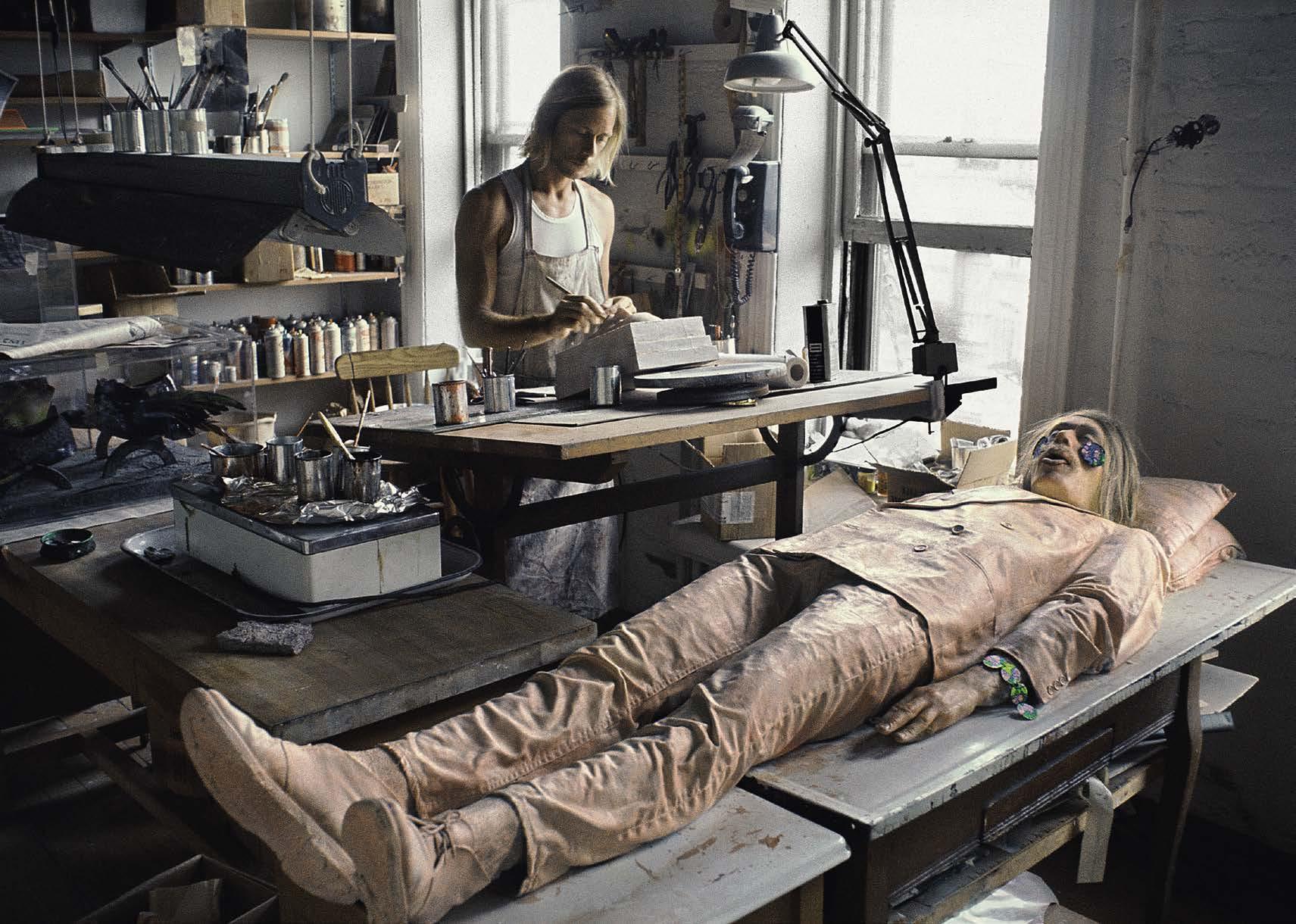
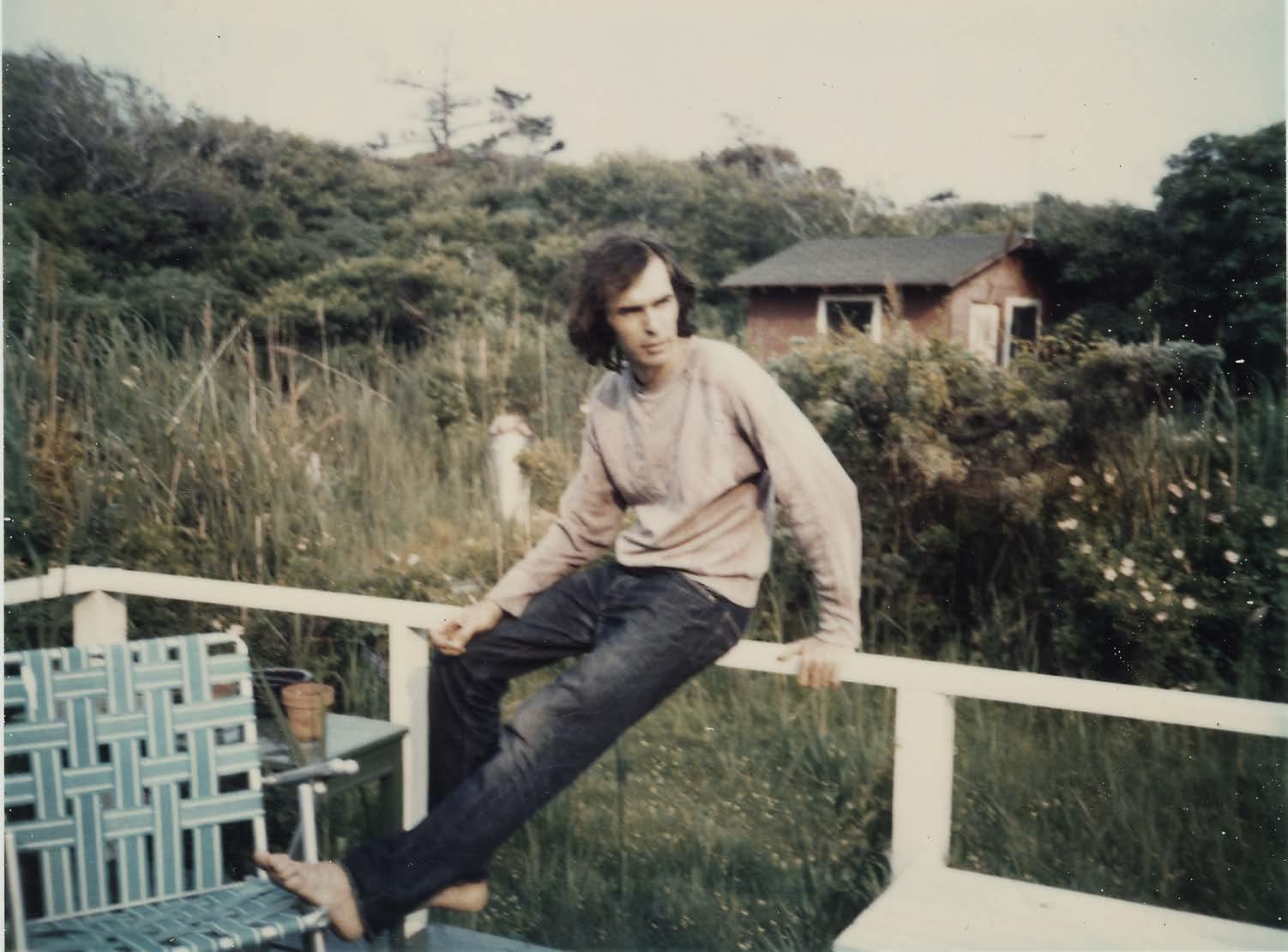
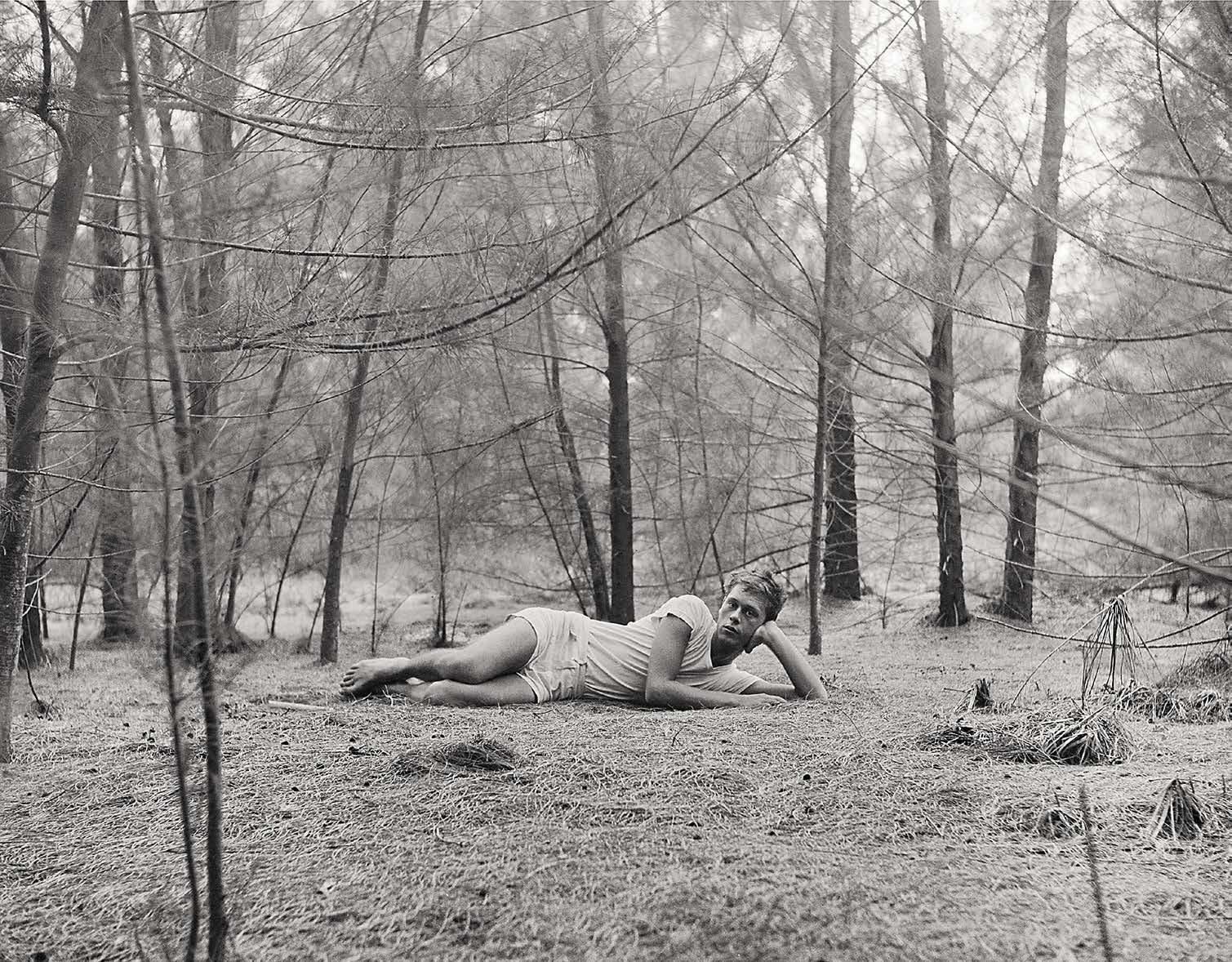
strange figures and scenes from our past that now seem to us disconnected or unclear. There’s a murkiness to the past that I wanted to keep in the book. I didn’t want to have an answer for everything.
WA Another motif in the book is death. But before we speak more generally about that, I have to ask: Did you go to the Capuchin Catacombs [burial catacombs in Palermo, Italy, that Thek and Hujar visited together in 1963]? You write about the place so vividly, bringing this core moment in their lives to a visceral level.
AD For the most part, if either of them went to a place, and if that place still exists, I went there as well. (The only exception was Norway.) I knew that I needed to experience something of those places, whether it was Fire Island, or Casteldaccia, Sicily, where Paul lived for a time, or the catacombs in Palermo.
WA It must have been hard for you, Andrew.
AD I know! When I was writing my first novel, I sent some pages to the poet and novelist Kevin Killian. He was very generous with me; he read everything. At one point he said to me, “I don’t know how anything smells! You’re not conveying the sensuality of experience.” That has driven my writing ever since. So I visited the catacombs with this specific mission: I need to know what that place smells like in order to write about it.
WA Their trip there was transformative for both artists. Hujar’s photos of the bodies there are masterworks in his career, and the place is a clear influence on Thek’s sculptures broadly. You quote him telling the curator Gene Swenson, “I opened [a glass coffin] and picked up what I thought was a piece of paper; it was a piece of dried thigh. I felt strangely relieved and free. It delighted me that bodies could be used to decorate a room, like flowers. We accept
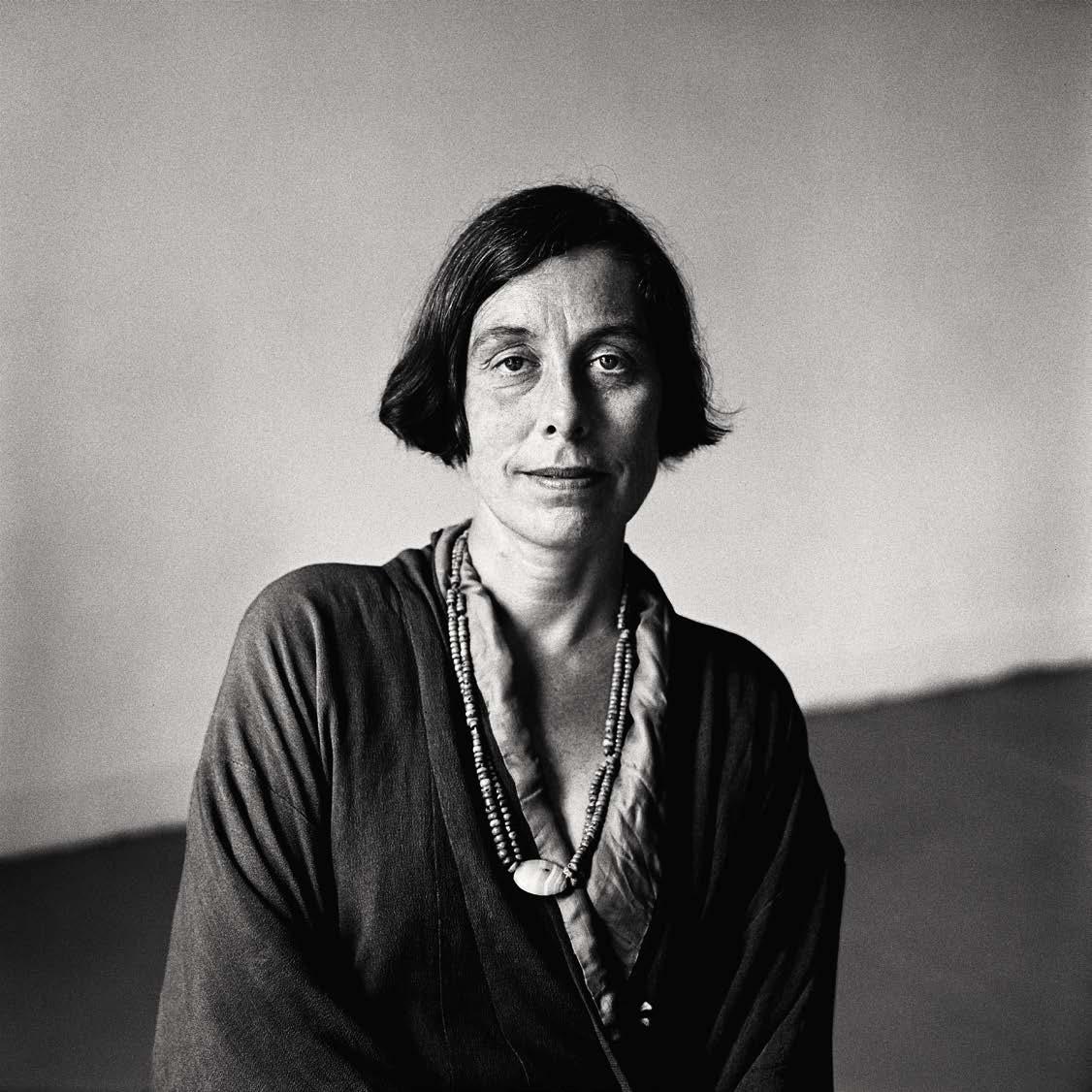
our thingness intellectually, but the emotional acceptance of it can be a joy.” It’s a powerful quote, and I was curious throughout whether this book was also an exercise in working through existential questions that you were already dealing with?
About death, rebirth, love, creation?
AD The book I thought I was writing ended up being very different from the book I wrote—I think that’s true for every project. Often, in writing about artists who died of aids, there’s a certain sanctimonious tone that erases their actual lives; everything is read through the lens of aids , which transforms them into these doomed twilight figures. I wanted to resist that. Which isn’t to say that aids isn’t an important part of the story, only that I didn’t want it to become the story. I needed to write a book about how these guys lived and what it was like to be alive in the 1960s and ’70s. In doing so, I think death— something both of them thought deeply about— emerged differently.
WA You were orbiting a more fully faceted life than just the tragedy. In Thek’s life there’s something—I don’t want to say prophetic , but a lot of the things that he was horrified by, concerned about, had an antagonism toward, are things that have come fully to bear on our lives now: technology and its alienating effects, carnage and the American empire. Was that part of the book for you—a question like, What can we learn about surviving now from these lives in the past?
AD I wrote from my own position in time, of course, but I didn’t want to be constantly taking the reader aside to say, Isn’t this relevant to you now? I knew the resonances with the past would emerge in their own way without me needing to do much other than write the story. Great art is always prophetic. Look at the paintings of Van Gogh; read Van Gogh’s
letters—the most remarkable letters. It always feels like he’s talking about right now. I think that that’s true of Paul and Peter, too. They’re always speaking to us. So I trusted the material. I thought, If I’m true to the material, my readers will find what they need in the book. I hope they take away something about political art, I hope they take away something about love and friendship. But yes, what’s so interesting about Paul is how familiar some of his language is about the ruin brought about by American civilization, his antiwar views. Even into the 1980s, a period I don’t really touch on, he recognized the depravities of industry, the perils of climate destruction. That’s probably why people are attracted to Peter and Paul right now: their artistic integrity and authenticity. They were noncompliant. That’s such a beautiful thing, such a quality, and something we could all learn from now.
WA Definitely. As I read, I kept stopping, saying to myself, “Yikes, I live such a safe, bourgeois life. Should I be more difficult?”
What was the biggest surprise? You were going through Peter’s negatives and seeing what he chose, what he didn’t choose. As you mentioned, you had access to Paul’s diaries. Maybe there was an interest of theirs, or an aspect of their lives, that was totally eclipsed by the more famous artworks they produced?
AD In many ways everything was a surprise. But I would say the tenderness of Peter’s photography, particularly his photos of Oakleyville [on Fire Island], always make me catch my breath. And then for Paul, it’s his writing. His diaries are a remarkable literary achievement. He wrote novels. He wrote memoirs. He wrote poems. Those diaries changed my own writing and how I think about art. They rewrote what I thought was possible.


Following Ed Ruscha’s recent exhibitions in London and Paris, the artist sat down with the author and explorer Erling Kagge to discuss existence.
ED RUSCHA The photo of you at a distance in your book Silence [2016], who took that?
ERLING KAGGE I did. I just clipped the camera on a tripod and put it on the ice. Clicked on ten to twenty seconds and walked away from the camera.
ER You were alone on this trip?
EK To the South Pole, yes. Quite often when people are “alone” on expeditions, they bring a photographer, but I was alone for fifty days and nights. I think my trip was similar to your paintings in the sense that it was very much about silence.
ER The book reminded me of the idea of isolation and being away from people. It had a particularly good message to it—one that nobody really thinks about because they’re so busy. “Gotta do this, gotta do that,” you know? But all of a sudden you have to stop.
EK It may be difficult to stop. Busying oneself becomes a goal in and of itself, even when it has to end up in nothing.
ER There used to be a shop here in London, off Piccadilly Circus, the G. Smith & Sons snuff shop. You could buy anything, snuff or tobacco, and there was a sign out front that said “Everything in the world goes up in smoke, so smoke” [laughter ].
EK Sounds like a painting by Ed Ruscha. So how are you able to get away from the daily stress?
ER I actually embrace it. I move around a lot but I’m not traveling much; I’m usually at my studio and often I’m there alone. It’s a great feeling.
EK Identical to the desert.
ER In the desert there’s no noise and you rarely hear anything. There might be people who live maybe three miles away. So I made this hearing thing out of a big piece of paper. I rolled it up so it’s like a megaphone and I sit there and listen. I can hear dogs bark, and I know there are no dogs nearby but three miles away there are dogs. I can hear them.
EK To me, the opposite of silence is not sound but distractions. The telephone buzzing, cars passing, radio running, someone who wants to speak to you, something you have to do, some confirmation you’re waiting for. The more we’re inundated the more we wish to be distracted. It should be the other way around, but often it isn’t. Even thinking
can be a kind of noise. Silence is about rediscovering, through pausing, the things that bring us joy. Experiencing rather than overthinking. Allowing each moment to be big enough. Not living through other people and other things.
ER I read the newspaper—I have an iPad, but that’s as far as I’ve gotten with digital instruments. Most people are distracted by them, aren’t they? You go to an airport and everybody’s locked in.
EK There’s a new way to greet people: You stretch out your right arm and say, “Do you have a charger?”
To me, all of your paintings are about silence, plus landscape. But these new paintings I think are also about movement. It’s in the language—you move and are being moved, there’s motion and emotion. And there’s something in the paintings that’s about wondering, and I think wondering should be the engine in life. People wonder less and less; if they find themselves wondering at anything, they quickly pull out their smartphones to find the answer. But in these paintings, you cannot. And to me, especially the paintings inspired by [the turnof-the-twentieth-century Danish painter Vilhelm] Hammershøi, they also look like something in love.
ER Something in love?
EK To me a love story is obviously about affection. There’s affection, obsession, but it often has an end, and eventually an emptiness appears. Things become banal, repetitive, boring. You end up saying the same few words that are passed back and forth throughout the house, and somehow those words survive you.
ER I’d never seen an original Hammershøi work, but I saw them in a catalogue and I thought they were very sad, in a way, very plain, plainspoken. But they were striking in the way he appreciated the inside of a room, especially his own. He rearranged in his mind the architecture, the walls, the molding, the wainscoting, and it just affected me in a way. It’s a little trigger that said, Live in his world for a while and see how it is, without imitating him. I could try to paint like him but that would be useless because he had this little private language. But there’s something about the paintings that just stops you, puts the brakes on the modern world.

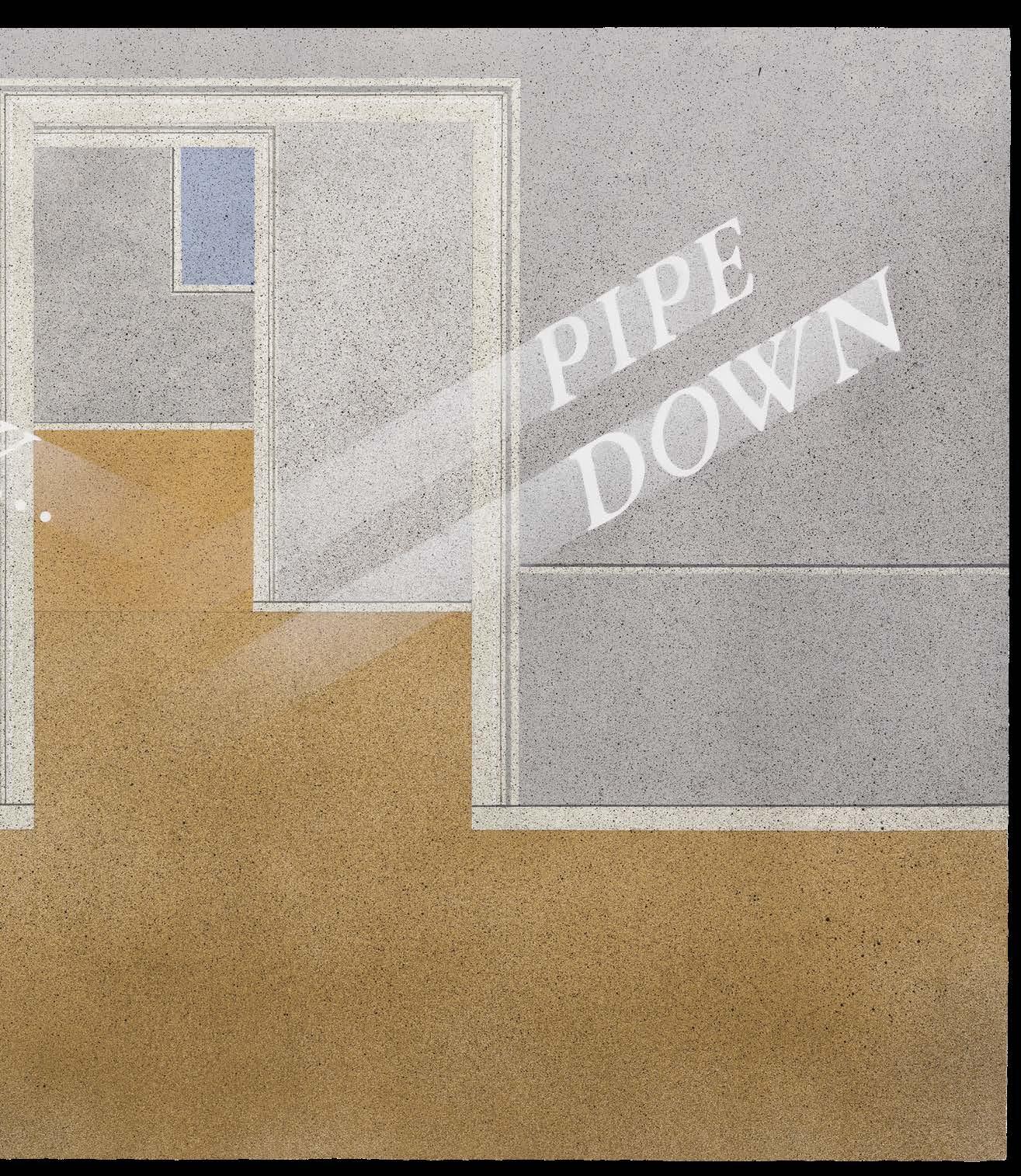
Everything is slow moving. It’s gray and cold. It reminded me of winter scenes, you know? I don’t know much about his life, but I think he went to Paris once and got in with a wild scene and didn’t like it. “I’ll just go back home and live the quiet life” [laughs ].
EK Has an artist from a different century been that inspiring to you before?
ER There are so many periods. I saw these Giotto works and thought, God, he painted the most hideous eyes on people. They’re nasty-looking eyes. I wonder what went on in his mind.
EK Do you want to know [laughs ]?
ER A lot of what you do has to do with the physical. But with all your accomplishments, do you think there’s more to explore, or do you feel like it’s all over?
EK That’s the good news: There’s always more to explore [laughs ].
ER Have you considered outer space?
EK To fly to the moon? I would do it right away. It’s just three days up there, one day on the surface, and three days back again. It’s 360 to 390,000 km. Mars is 56 million km: That’s too far for me. But yes, to me the world remains unexplored. Everything on earth is changing all the time, and you’re changing, so in that sense the world, and everything we see, also art, is new every day. The history of exploration is a history of rediscovery. Almost every time a famous European explorer claimed to have discovered new land, local people were on the beach waving when he arrived.
ER When you go to the North Pole, is there anything that’s been left there by humans?
EK No.
ER No markers or poles or flags or anything like that? Or do they just blow away and die?
EK When you get to the North Pole it looks exactly the same as it did when you were a hundred km or twenty km away from it. There’s no there there. Traditionally people have something to bring back home from an expedition. Even from Antarctica and the moon, you can bring rocks back home. From the North Pole there’s nothing. It’s a place of extremes. Your compass needle always points south. The wind always comes from the
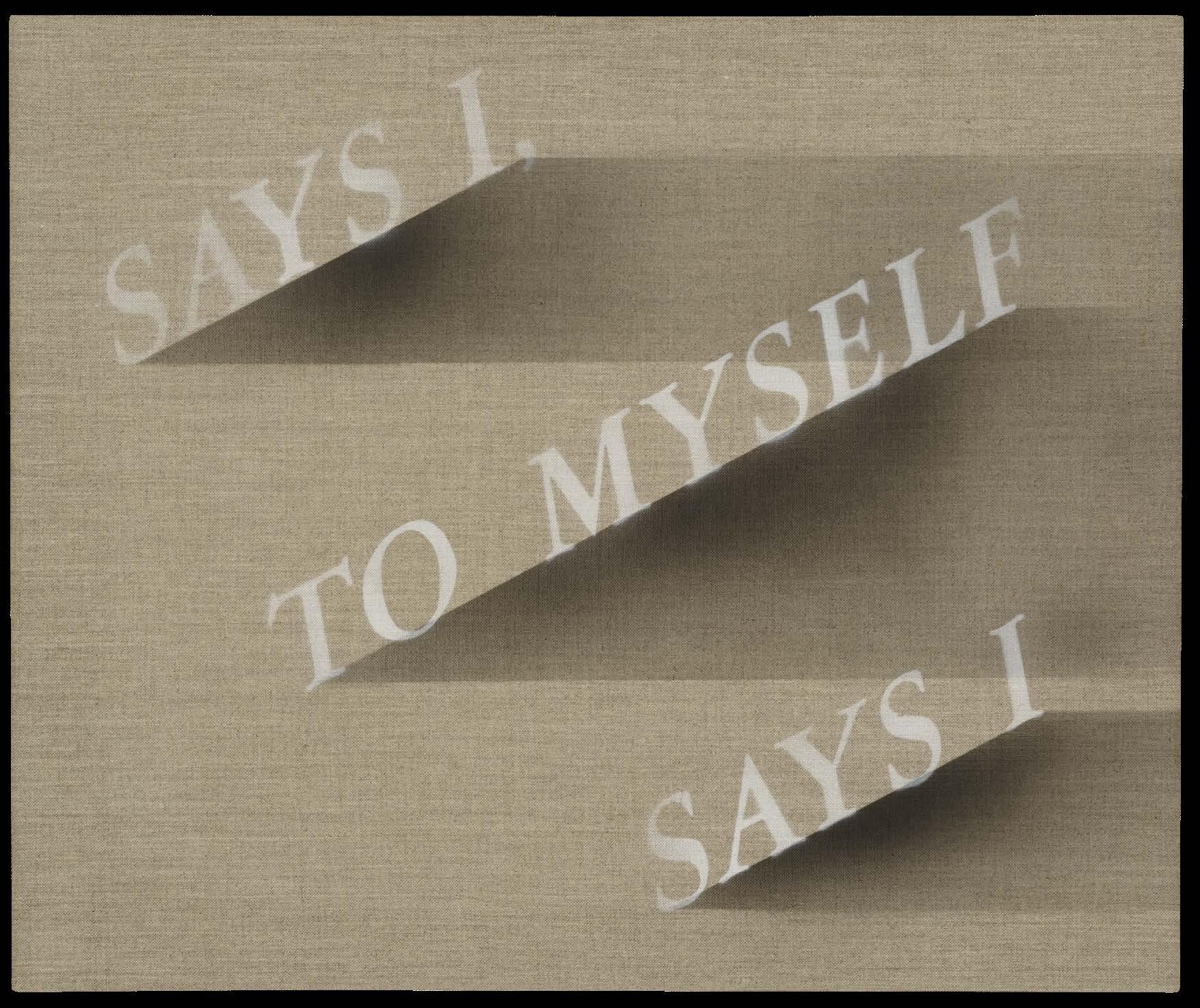
south and blows toward the south. There’s only one sunset and one sunrise each year: The sun sets at the North Pole on September 22, the autumn equinox, and appears again on March 21, the spring equinox. In my experience it’s the most difficult place to get to on Earth. But today, for the first time in 2.7 million years, the ice is melting. So we’re in for some big changes.
ER People don’t seem to realize that, but you read almost everywhere that the ice is melting. And it’s easy to not think about that, I guess.
EK People tend to choose the easiest options in life, which is a mistake. I believe most of us would have better lives if we more often went for the more challenging and difficult alternatives.
ER Do you feel like you want to go back up there?
EK I go back to the Arctic fairly often. It’s about being in nature, just like you heading to the desert as often as you can. One reason the world has so many problems today is that we’ve separated ourselves from nature. We believe we don’t need nature; we’ve conquered nature. People claim to be sad, lonely, and depressed, and of course it gets sad, lonely, and depressing if you believe you can get to know yourself and discover the world by sitting and looking down at a screen. And on a global scale, with climate change, it’s difficult to relate to a world that heats up if you don’t relate to nature.
ER You made it clear that you never know you’re at the North Pole, but I think you’ve referred to the North Pole as our navel.
EK Exactly. Everything turns around the North Pole: the Earth, the whole universe, the stars, the planets.
ER You were so isolated out there, and almost not knowing where you were. I go to the desert a lot. Even though it’s fairly remote, I’m sure Indians have passed through there before, but they never left anything. It looks like it did maybe ten thousand years ago. These are areas not that far from intense civilizations like Los Angeles, but there’s no evidence, so there’s probably a lot right here in civilization that has yet to be discovered.
EK Somehow the biggest mysteries for most of us are in our own backyard, and always have been. In
classic travel accounts, people travel far, far away to get to know themselves and the world, but it’s when they get home that they find answers to the questions they’d been asking themselves. One reason is that the answers are within you, in your inner silence. You see things, experience the world, you’re moving around, being moved, and then you get in touch with your inner silence. And that inner silence is who you are. Noise is about everyone else.
ER Do you have to work toward this inner silence, or do you feel like you’re just there sometimes?
EK Both, in the sense that this silence is inside us all the time, waiting for us to explore it. You can discover your silence in the middle of traffic in Piccadilly Circus, but you have to take a pause, take a break for two minutes. Or, when I walk to the South Pole alone, it could last for fifty days. But this silence can be uncomfortable. As the philosopher Blaise Pascal wrote almost four hundred years ago, all of humanity’s problems stem from our inability to sit in silence in a room alone doing nothing. Instead of doing nothing, we’re doing something, and that’s the beginning of all our problems.
ER And I guess when you do something, you might call it progress.
EK You can call it progress. You can call it anything you like.
ER But maybe there are people among us who can go to a loud party yet still maintain this inner silence.
EK Absolutely. I think sometimes when there’s too much noise in my head or around me, I can turn on some music, close out all the sounds, and then I can find the inner silence. But silence is not about turning your back to the world to live a more egocentric life. It’s the opposite. It’s about getting to know yourself. It’s about understanding other people, seeing the world from a different perspective, loving life.
ER I guess some people have to struggle to make that happen while others are willing to let the next thing that comes across their field of vision control what they do. What do you call that—Zen Buddhism?
EK I think, again, you can call it whatever you like.
ER Call it the fun of life, the distraction of life, or the misery of life.
EK The great thing is that silence expands time and expands space, while noise narrows time and narrows space. If you have a lot of noise in your life, your world becomes more one-dimensional, more predictable, and eventually you feel that life is short. And this is precisely the secret held by all those who relate to silence: Life is prolonged. Silence expands time rather than collapses it.
ER That’s a good theory to follow, because some people struggle to get some moment of rest. I don’t know whether you would call silence a moment of rest.
EK It’s a rest, it’s a break, it’s a pause.
ER Sometimes people look at it like it’s a battle to cut out the outside world, like they have to fight to get that silence. But it sounds like you always know that you’re going to get back to that comfort of silence, or of noninvolvement with the outside world, even if there’s something in you that may want to keep up with the world too.
EK I think you need both.
ER Do both.
EK When looking at your paintings, and great art in general, I start to wonder what kind of experiences are coming together in the work. The artist’s humor, heartbreaks, great times, doubt, desires, losses, pleasure—to different degrees, everything comes into this one piece of art. Obviously I’m unable to understand all of it but I’m happy to try to understand some of it. I really like that it’s a great room for doubt.
ER You have different manifestations of art. There’s an idea in some artists’ minds that you should to try to picture the sublime, and then there are people like the Futurists who come along making noise on purpose. They want to take cymbals and go bang , bang , bang in your life. They want to do it with colors and noise, musical noise, all that abstract stuff. I think the Futurists are a way to describe those people who are going to the opposite side of the serene artist’s mind. They want noise
and they love war. A lot of the Surrealists who went to war were Futurists and a lot of them got killed.
EK They liked the beginning of the war.
ER Maybe not the outcome [laughter ].
EK People quite often tend to enjoy the beginning of a war.
Did you ever consider, with the London paintings, not having any words? When I see these paintings, as I said, I feel it’s partly a love story, but there are also these words that are just hanging in the room: “To myself says I.”
ER I heard my mother say that: “Says I, to myself says I.” I had to search to find out that it’s really an Irish song from the 1920s.
EK Your mother probably heard the song.
ER It’s so funny. But there’s also something theatrical about voices coming from behind a wall, or from behind the inside of a room that has a division in it they call a doorway. It’s like bolts, like metal bolts in a blender: You put that blender on, you can imagine what that sounds like, and that’s what your life as an artist is like. For most people your whole life is like that. Yeses and nos and heres and theres. Everybody’s life is made up of a combination of all these things. It’s like a rattlebag of ideas that work back and forth.
EK Do you find life to be a struggle? Is your life hard?
ER My quick answer is no, life isn’t really a struggle.
EK Someone said life is simple but we make it a struggle.
ER That’s probably true.
EK The whole Johnny Cash thing: “This world is rough. And if a man’s gonna make it, he’s gotta be tough” [laughter ].
ER I’m reading a good book by Werner Herzog. EK Oh, which one?
ER The Future of Truth [2025], it’s a new book, a small book. I went to a birthday party for him a couple of weeks ago, given by Benedikt Taschen, who introduced Werner, saying, “Well, Werner, are you going to say something?” So Werner gets up, but from the first word, bang , there’s a mariachi band in the hallway with trumpets and guitars. It drowned him out. Werner had to sit down.
EK I love his movies, but I think he’d like to be someone else, too.
ER An author?
EK I think quite often successful people would like to be something else. You succeed in one field, but then you’d like to start a restaurant or become a DJ or an author. As Heidegger wrote, “Everyone is the other, no one is themselves.”
ER That in itself is a struggle, isn’t it? Maybe I want to be something else. Well, it’s too late to be a baseball player.
EK I’m a “possiblist,” in the sense that nothing is really impossible, it’s all degrees between 0.1 and 99.9. So for you to become a baseball player is extremely unlikely, but not impossible.
ER Too many people are quick to say, Hey, nothing’s impossible.
EK That’s naïve too. What’s happening after these two shows?
ER I don’t know. I’ve had a thought about making a movie about a guy who gets lost in the desert. I’m just in the beginning stages of that.
EK And his name is Ed Ruscha?
ER Could be. Actually it springs from an old movie made in 1950 or so about the same subject of a guy getting lost in the desert. In my film he gets deliberately left in the desert. He’s got a broken leg.
EK So he can’t follow the others.
ER He can’t follow the others and he can’t really walk and he has to struggle to survive and maybe he looks for water. He doesn’t know too much about how to survive the desert. There are a lot of plants you can chew on and eat to get moisture, and he spots one and it’s jimsonweed, a poisonous weed, so when he eats it he goes through a psychedelic experience.
EK Does he find water?
ER Finally finds water, yeah.
EK Is it going to be like ten minutes or a full movie?
ER Maybe a full movie, I don’t know. It’s the beginning of it.
EK What’s a greater challenge than to make a full movie? It’s again making life more difficult.
ER I’m not disillusioned by anything. I still like
the idea of making tiny works of art, little things and little drawings.
EK I think that’s what really fascinated me the first time I visited your studio. You have this great building, you walk in, three or four people are sitting in the first room. They’re all very nice and friends of yours. And then you walk through the next door and it’s quiet. There you have the archive, an extra room with some personal stuff to the left, and then eventually I get to your studio. There’s a little drawing being made, maybe a painting, maybe not. If you walk through the next door, there’s your garden. Things move really, really slowly.
ER I find myself navigating that, going from this one thing to another, on a daily basis. When you’re self-employed, you have to make life happen.
EK What does it take to become a great artist?
ER A bunch of oddities that don’t fall into place at the right time. To be different is an important fact, an important step to reach. To have your own voice so it doesn’t sound like someone else’s voice. What got you into what you do? When you were fifteen years old did you say, “I’m going to go to the North Pole?”
EK Kind of way before that.
ER Way before that?
EK In the sense that we’re all born explorers. As soon as we leave our mother’s womb, we want more space, more room in which to move. We stretch our arms and legs out in all directions and scream for air. We have a desire to explore the world. As soon as we learn to walk, we walk through the living room and out of the house, then start to wonder what lies between us and the horizon, and soon enough what lies beyond that. We’re on our way to discovering our own North Poles.
ER When you were young, did you ever walk out your back door and think, “I could just keep walking”?
EK Absolutely—and I did. And the more tired you get, the more interesting it becomes, because the threshold for taking in impressions gets lower when you’re tired; you’re not so controlled. I like getting tired. I like getting exhausted.
ER Did you have much of a feeling that you
learned anything from the people before who did the same thing?
EK The answer is definitely yes. The biggest mistake North Pole explorers make is to believe there’s not much to learn from people who went north ahead of you, or from the Inuits. That’s one of the reasons why three out of four who tried to get to the North Pole before the 1890s died. The Inuits, who knew most of the tricks, were considered primitive, people thought there was nothing to learn from them. That’s obviously stupid and sometimes we humans are stupid.
ER I feel like all art comes from other art. You’re a product of all the stuff that went before you, which is a lot of garbage and a lot of valuable stuff. It helps you and nourishes you, like your observation about the people who did this before you. You listened to what you could find out from them.
EK Of course, and the reason you’re successful on an expedition is that you’re curious, work hard with your preparations, have the right gear, a good attitude. What do you think when you hear an artist say, “I have nothing to learn from the past”?
ER I know a lot of artists do that, and a lot of younger artists try to strike out on their own and eliminate art history from their work. They’re so bold, they want to establish some new flag at the North Pole [laughter ]. But it’s also important that you don’t take it too seriously.
EK Don’t take what too seriously? The paintings?
ER The whole subject: living, life and art, adventure, all of that. Treat it lightly and bounce it up and down like a juggler would.
EK Is that something you’ve always done?
ER I don’t set out to do anything on purpose. It just happens to me. I’m a slave to my own choices and I just keep working at them and that keeps me happy. The best part of it is not knowing what’s out there, what’s ahead of us, and that actually is a motivator, don’t you think?
EK I think it’s a motivator. No one knows anything for certain. Absolutely everything can happen, right away. We don’t know the day until the sun has set. What does the Bible say: There’s nothing new under the sun? That’s wrong. Everything is new under the sun.

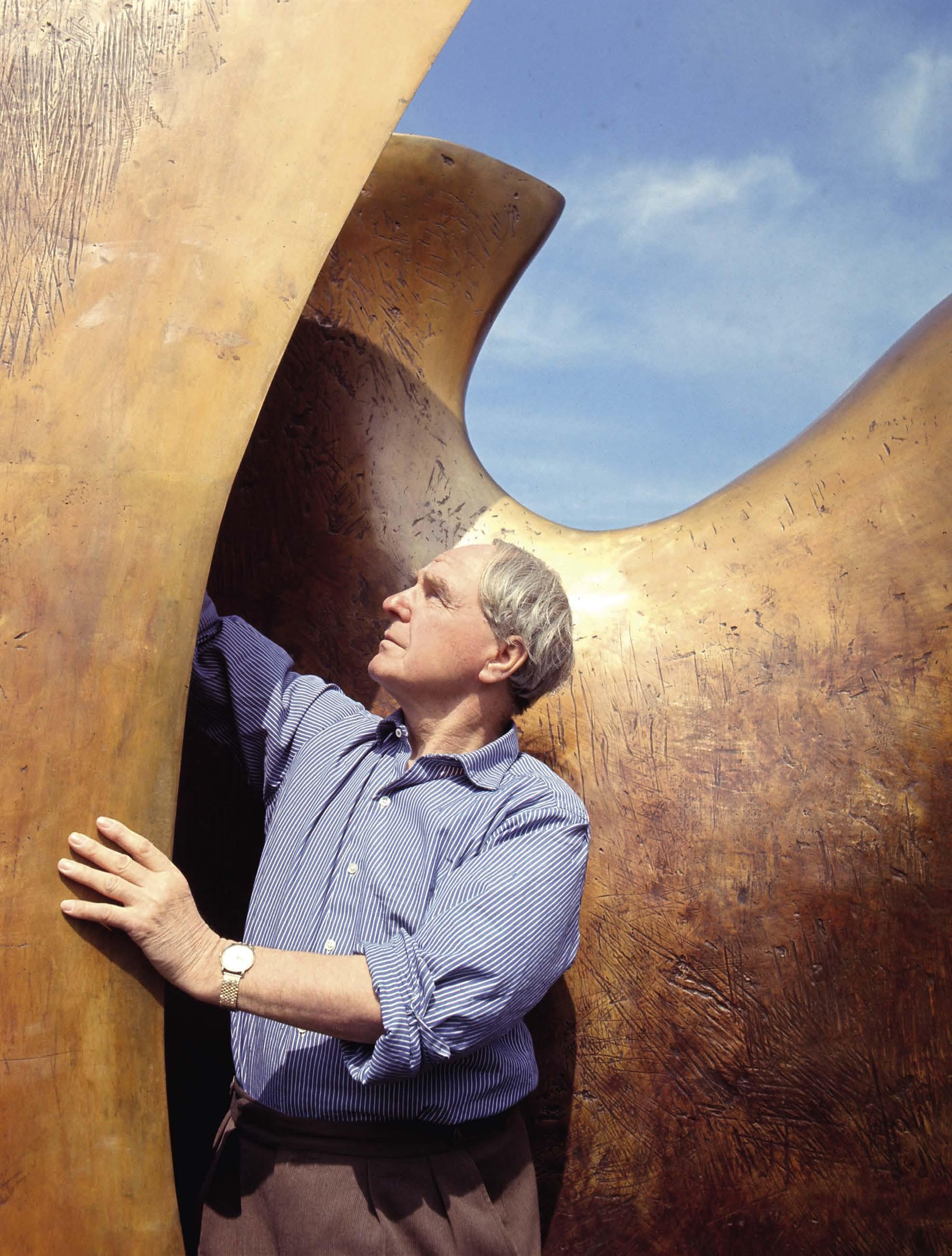
A m � jo � exhibition celeb ��ting the wo �k of the B �itish sculpto � Hen � y Moo � e opened �t the Roy� l Bot � nic G ��dens, Kew, London, in e ��ly M �y, offe �ing visito � s � ��� e oppo � tunity to expe �ience the b � e �dth � nd evolution of the wo �k of one of the twentieth centu � y’s most influenti � l �� tists. O �g� nized in coll � bo ��tion with the Hen � y Moo � e Found �tion, this c �� ee �sp � nning p � esent �tion b �ings togethe � key wo �ks f�om �c �oss six dec �des of Moo � e’s life, t��cing the development of his sculptu �� l l � ngu � ge � nd the endu �ing themes th �t sh � ped his p ��ctice. On view th �ough J � nu �� y 2027 �c �oss the g�ounds of Kew G ��dens � nd the Shi �ley She � wood G � lle � y of Bot � nic � l A� t, the exhibition situ �tes Moo � e’s monument � l fo �ms within the n �tu �� l l � ndsc � pe of Kew. In this ess �y, L � u �� B � uni, one of the exhibition’s cu ��to � s, explo � es some of the ide � s, m �te �i � ls, � nd motiv�tions th �t defined Moo � e’s wo �k, highlighting selected wo �ks in the exhibition while � eflecting on the di � logue between sculptu � e � nd n �tu � e �t the he �� t of his vision.
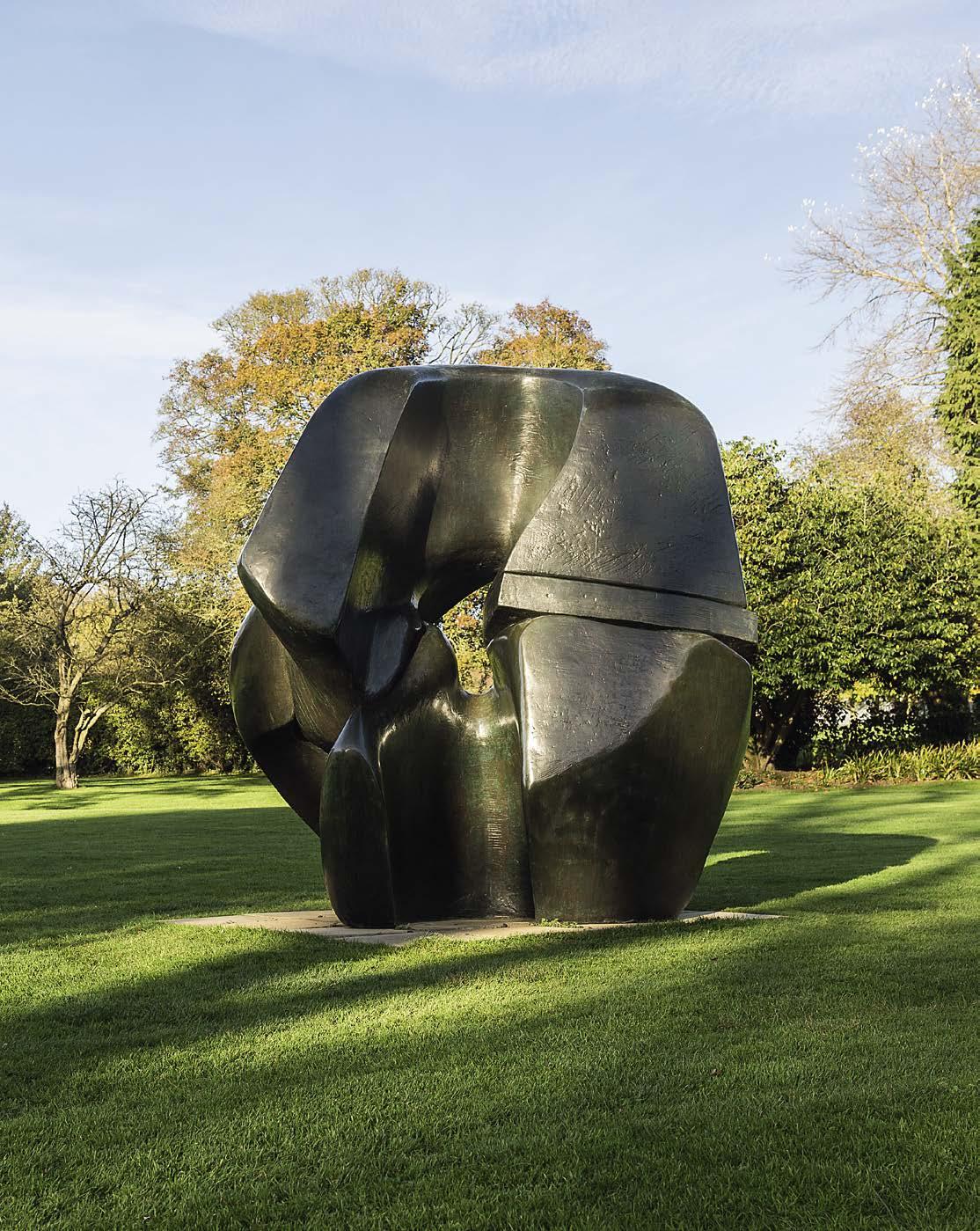
Nature is inexhaustible. Not to look at and use nature in one’s own work is unnatural to me. It’s been enough inspiration for two million years—how could it ever be exhausted?
—Henry Moore, in Moore and John Hedgecoe, My Ideas, Inspiration and Life as an Artist , 1986
This page:
Locking Piece, 1962–63 (cast 1963), bronze, 115 × 114 1 8 × 89 inches (292 × 290 × 226
Opposite, from top:
, 1945, terra-cotta, 3 3 8 × 6 1⁄8 × 3 inches (8.5 × 15.5 × 7.5 cm).
Henry Moore, Composition , 1931, Cumberland alabaster, 14 ¾ × 17 3 8 × 10 5⁄8 inches (37.5 × 44 × 27 cm).
Few forces have shaped artists’ imaginations as powerfully as nature, and for Henry Moore it was an inexhaustible source of ideas. Best known for his monumental bronzes, Moore emerged as one of the most influential sculptors of the twentieth century. Yet his achievement extended far beyond sculpture alone. With tireless creative energy he moved fluidly between carving in stone and wood, bronze casting, drawing, and printmaking, each medium independent and yet enriching the others.
This summer, Kew Gardens—celebrated for its extraordinary botanical collections and home to over 50,000 living plants within its unesco World Heritage landscape—is presenting the largest outdoor exhibition of Moore’s monumental sculptures ever staged. Emphasizing the unprecedented scale of this open-air display, the exhibition marks a significant moment in the public presentation of Moore’s work. Across the gardens at Kew, all of Moore’s central themes are represented: reclining figures, mother and child, internal and external forms, interlocking forms, and the figure in the
landscape. The works also showcase a remarkable diversity of surface treatments, ranging from smooth, polished finishes to richly textured surfaces, and spanning materials and patinas from white fiberglass to deep browns, blacks, and vivid green bronzes.
The works shown include such groundbreaking pieces as Three Piece Sculpture: Vertebrae (1968–69; LH 580, cast 0) and Two Piece Reclining Figure: Cut (1979–81; LH 758, cast 0). 1 Both works echo the abstract multipart sculptures Moore developed in the 1930s. Although the overall effect is highly abstract, the titles and the easy, organic harmonies among the forms point to their natural origins. The shapes were likely inspired by a bone or piece of flint in Moore’s maquette studio, objects that informed many of his works, including Standing Figure: Knife Edge (1961; LH 482). Like vertebrae, the elements share a common underlying structure while remaining subtly distinct. Their arrangement likewise suggests a spine: Massive forms interlock in a rhythmic horizontal sequence.
Moore’s fascination with interlocking forms is explored in several other sculptures in the exhibition, including Locking Piece (1963–64; LH 515). There, the energy concentrates around a central void, while in Three Piece Sculpture: Vertebrae a dynamic force emerges through the lateral interplay of monumental forms. The contrast extends
to the surface: Where Locking Piece has a subtly textured finish, Three Piece Sculpture: Vertebrae is smooth and highly polished, a treatment that heightens the tension and clarity of its forms. One of the most striking works in the show—and one of those most beloved by visitors to Moore’s home in Perry Green, Hertfordshire—is Double Oval (1966; LH 560), a work that powerfully evokes the rhythms and structures of the natural world. While not a direct imitation of any single organic form, the sculpture resonates with the logic of balance and internal tension found in nature. As one moves around and through the sculpture, its openings frame constantly changing views of the surrounding landscape, integrating the work with its environment and echoing the way natural forms both shape and are shaped by the spaces around them.
More than ninety works are displayed indoors in the gardens’ Shirley Sherwood Gallery. Together they illuminate Moore’s creative process and sources of inspiration, while tracing his evolving engagement with natural forms throughout his life. Among the highlights are the so-called Transformation Drawings of the 1930s, which demonstrate how he reimagined found natural objects and reveal the wealth of ideas they generated for his later sculptures. In these works, organic abstractions derived from bones and flints intuitively transform into figures and animals. As he explained, “A sculptor is a person obsessed with the form and the shape of things . . . the growth in a flower; the hard, tense strength, although delicate form of a bone; the strong, solid fleshiness of a beech tree trunk.”2
Ideas for Sculpture: Transformation Drawings (1932; HMF 961 verso) is one of Moore’s rare collages, a medium he used only intermittently throughout his career and most likely only between 1928 and 1933. As Andrew Causey has observed, Moore’s collages are unusual in that they consist of rearrangements of his own drawings: Forms are cut out, juxtaposed, and at times partially superimposed upon one another.3 Not only did Moore avoid incorporating materials made by others but, interestingly, he also relied almost exclusively on a single motif in these works: the reclining figure. In Ideas for Sculpture: Transformation Drawings he appears to be rethinking the possibilities of both sculpture and drawing, exploring the distinctions between them while returning persistently to the motif of the reclining figure.
Reclining Figure (1945; LH 255), a sculpture on this theme, is made in terra-cotta, the medium Moore most often used for his preliminary threedimensional works during the 1930s and early ’40s. His choice of terra-cotta was deliberate rather than incidental: The material carried significant conceptual weight, and its warm hue and fine-grained texture, together with its ability to capture the most subtle surface modeling, made it uniquely responsive. Unlike bronze, terra-cotta preserves the immediacy of touch; unlike stone, it allows for gentle incisions that evoke the suppleness of living flesh. Moore often left finger marks, tool incisions, ridges, and grooves visible, not as imperfections but as vital traces of the contact between artist and material. In this respect his approach parallels that of contemporaries such as Alberto Giacometti, for whom surface irregularity likewise served as a record of sustained physical engagement. The Surrealist affinity for “soft” materials such as clay and plaster also resonates in Moore’s practice, yet he employed these materials within a disciplined formal framework, using them to explore relationships between
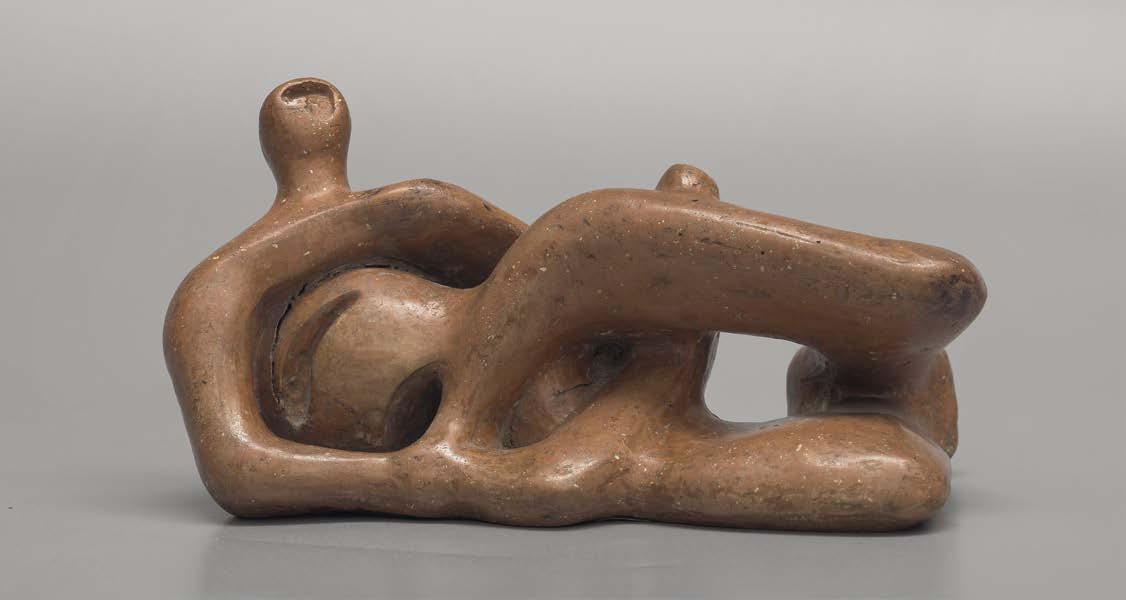
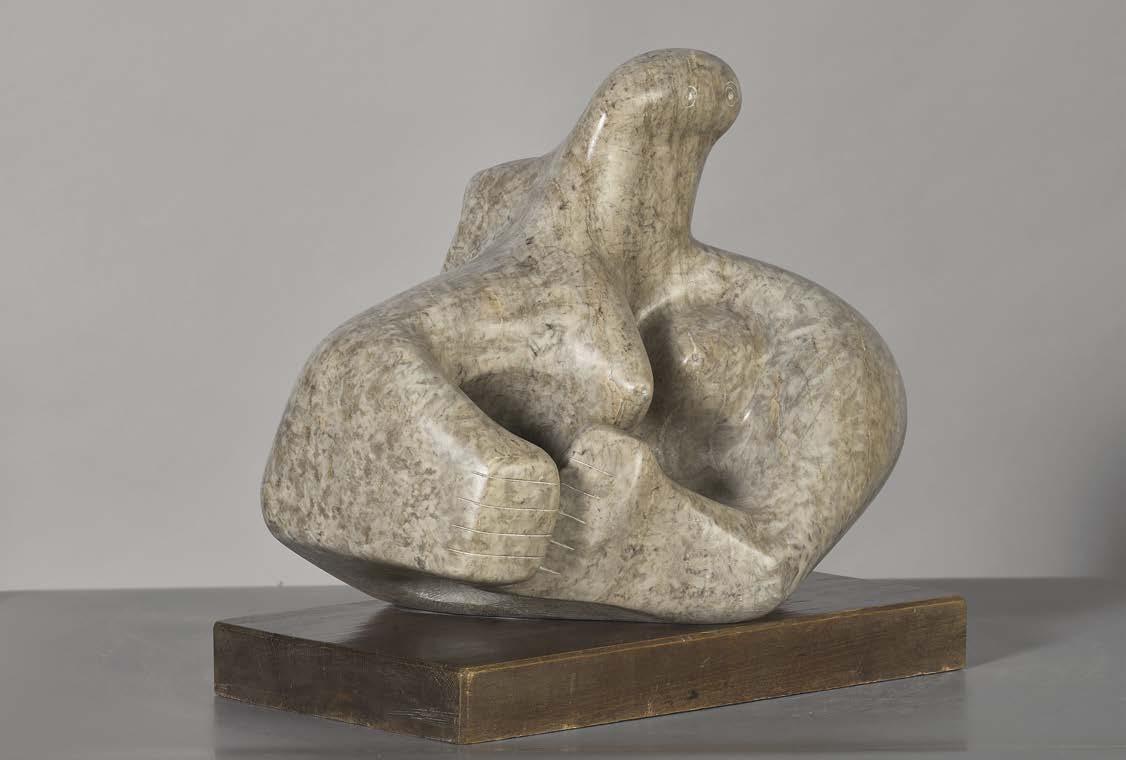
interior and exterior form on an intimate scale.
Conceptually, Reclining Figure of 1945 occupies a fertile threshold between two of Moore’s most enduring subjects: the reclining figure and the mother and child. In this work he draws the human body into closer alignment with the generative processes of the natural world. The sculpture evokes a moment of becoming—the instant before birth, when form is still emerging, enclosed, and protected. Unlike many of his other reclining figures, this piece contains a layered cavity that strongly suggests an intrauterine space. Such anatomical specificity is rare in Moore’s oeuvre, and it reinforces his long-standing engagement with nature’s cycles of growth and renewal. Formally, the work balances abstraction and representation with remarkable assurance, mirroring nature’s own interplay between irregularity and order. The upper body is composed of smooth ovoid volumes reminiscent of river-worn pebbles or weathered bone, their surfaces suggesting gradual natural formation. In contrast, the underside is articulated through sharper lines. The tension between these two visual languages—soft and angular, eroded and structural— creates a dynamic equilibrium. The figure thus appears both shaped by natural forces and actively containing them, suggesting a profound connection between biology and geology, between the maternal body and the elemental processes of the earth itself.
Another work featured in the exhibition, also titled Reclining Figure and also made in 1945 (LH 247), is one of three terra-cotta maquettes that Moore produced in preparation for a Reclining Figure of 1945–46 (LH 263), his fourth major sculpture carved in elmwood. The immediacy and flexibility of clay allowed him to work with speed and instinct, exploring organic rhythms, the sweep of a limb, and the subtle undulation of bone, and then transforming these impressions into new sculptural forms. Moving fluidly between scales, Moore echoed nature’s own processes of growth, in which forms arise, shift, and evolve in continuous variation. The torso curves in a protective gesture, its upward momentum originating in the feet. The broad, forked motif of the legs transitions into a rounded, near-spherical mass beneath the expansive arch of the breasts. Through a dynamic dialogue of solid and void, of ovoid outlines, nested volumes, and flowing contours, Reclining Figure (LH 247) conveys a sense of warmth and immediacy inseparable from the tactile character of terracotta. Here Moore’s enduring themes, the female form and the mother-and-child motif, coalesce in one of his most persistent archetypes, the reclining figure. This timeless configuration would inspire numerous variations throughout his career. Later, in the 1950s and ’60s, Moore executed his maquettes mainly in plaster; the surviving terra-cottas are rare
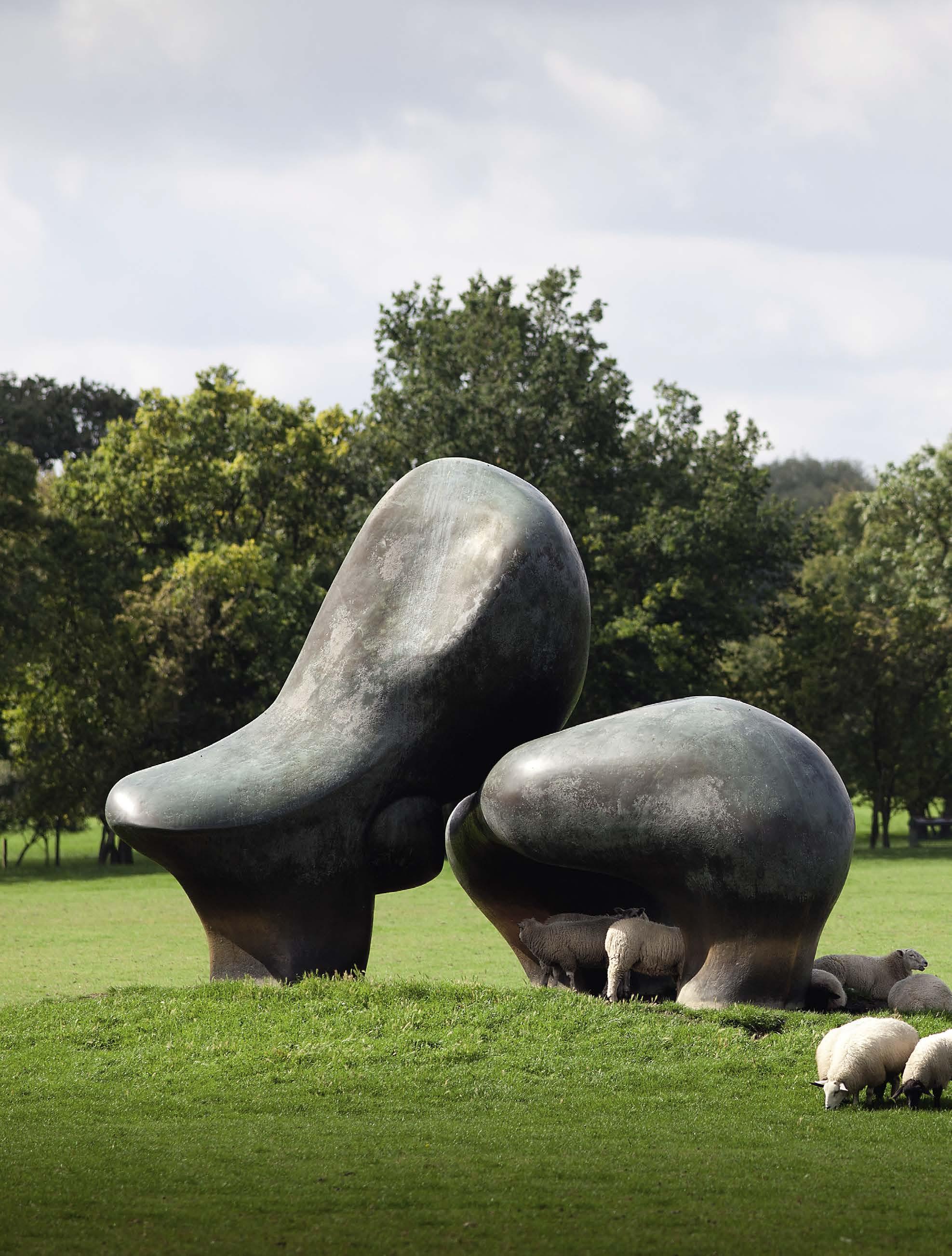

Th �ough � p �ofound eng� gement with o �g� nic fo �ms, m �te �i � ls, � nd n �tu � e’s most endu �ing ��chetypes, Moo � e c � e �ted sculptu � es th �t still spe � k to us � nd � einfo �ce ou � connection to n �tu � e. The Kew exhibition offe � s � ��� e � nd powe � ful oppo � tunity to expe �ience his vision �t its fullest sc � le � nd intensity.
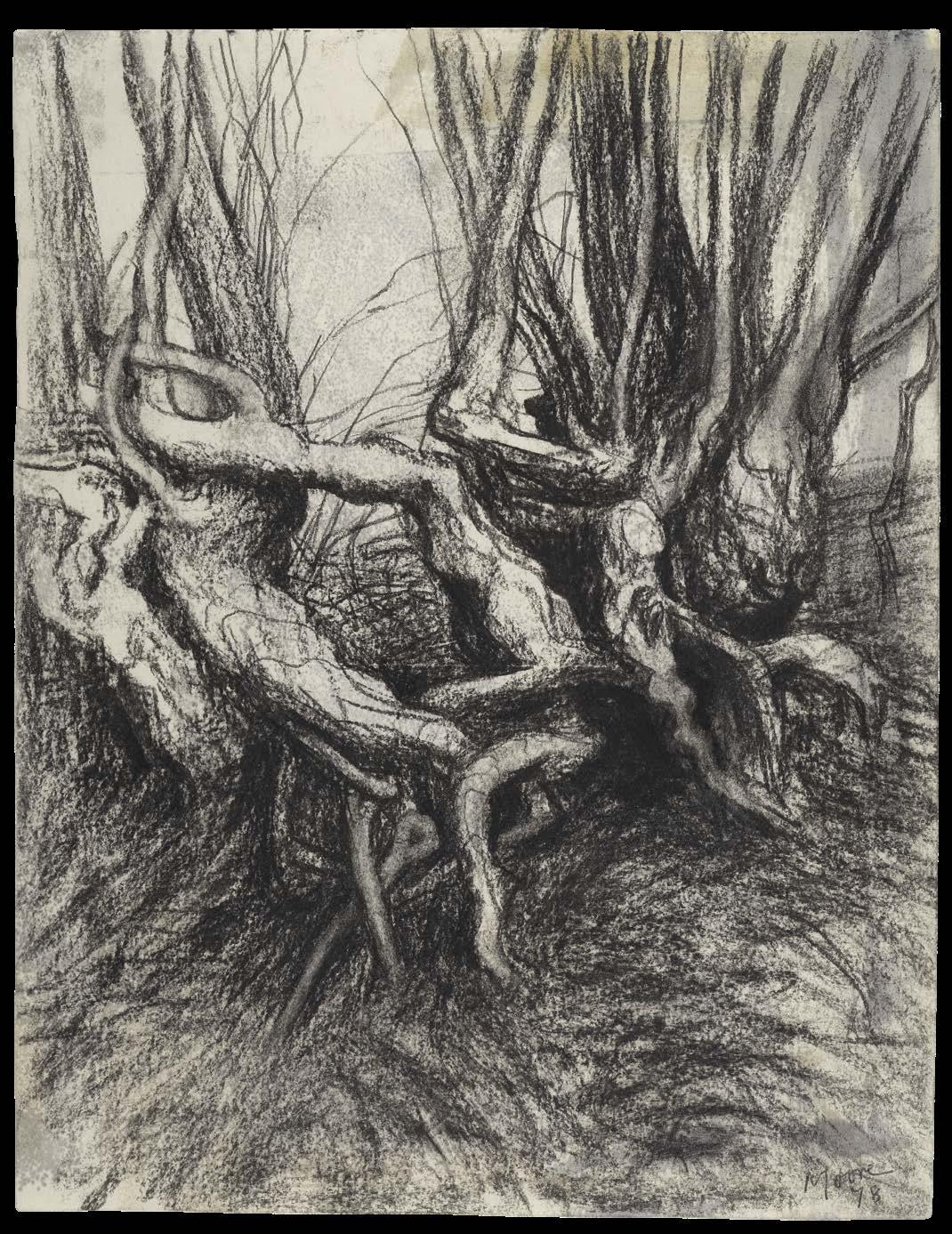
and important, marking a pivotal moment in his development.
From around 1975 onward, Moore immersed himself in the subject of the tree, constantly drawing the trees surrounding him in the gardens of Perry Green, in Hertfordshire, and at Forte dei Marmi, in Italy. He preferred the stark, bare outlines of winter trees, echoes of the human body. To him, the rooted stillness of a tree embodied the stability he sought in sculpture. Fixed firmly in the earth yet reaching outward and upward, trees have a sculptural presence of their own.
As Giovanni Aloi observes in his catalogue essay for the Kew exhibition, “Henry Moore’s Trees and the Groundlessness of Existence,” it is astonishing how much Moore distilled into this sustained series of drawings, works he pursued consistently from the late 1970s until his death in 1986. As Aloi explains, the tree “is a subject that across time has become a staple throughout the history of art. Trees have been backdrops to human vicissitudes, emblems of place, carriers of spiritual and pagan allegories.”4 In Moore’s late drawings, including six published in 1979 as the portfolio Trees , the tree takes a central role. As Aloi goes on,
This mostly overlooked series and its related portfolio belong to the final chapter of the artist’s long career, emerging in the winter of 1977–78 when Moore was approaching eighty. By this time he was an internationally celebrated
sculptor, his name synonymous with monumental reclining figures and public commissions in bronze and stone populating many cities around the globe. Yet in the quiet grounds of his home at Perry Green, a tranquil hamlet in Hertfordshire, only a few miles northeast of London, he turned to an altogether different subject and scale. Most of its inspiration came from the Dane Tree House orchard, its old apple trees stripped bare by the cold season.5
Trees VII (1975; HMF 75[35]) focuses on the intricate, almost sculptural quality of exposed tree roots. The roots twist and knot into one another, forming a dense web of lines that seems both grounded and animated. The gnarled roots give the composition a sense of tension and compression: Rather than seeming stable and anchored, they feel restless—coiling, gripping, and interlocking like muscular forms beneath the surface of the earth. Moore’s emphasis on contour and shadow heightens their physicality, transforming natural growth into something almost anatomical. The roots resemble sinews or veins, evoking the hidden systems that sustain life.
Conversely, Tree and Sky (1981; HMF 81[402]) presents a stark and imposing vision of a tree stripped of foliage. The barren branches reach upward, etched sharply against the open sky. The composition is daunting in its simplicity, with dark, angular limbs set against a lighter, often empty background. The
branches are strikingly sculptural, their contorted forms recalling wrought iron and twisted metal. At the same time, the skeletal quality of the tree lends the image a subtle quality of the memento mori: The limbs resemble bones or outstretched arms. This skeletal association contributes to the work’s unsettling, almost austere mood. The absence of leaves strips the tree to its essential structure, revealing the architecture of growth.
This radical reduction to line and structure invites comparison with Japanese art, particularly the economy of means found in ukiyo-e prints and ink painting.6 The sinuous yet controlled articulation of the branches recalls the linear mastery of Japanese artists such as Utagawa Hiroshige and Katsushika Hokusai, whose depictions of trees often emphasize expressive movement and shape over volumetric modeling; in their prints and drawings, trees are reduced to calligraphic sweeps, each branch defined by a decisive unbroken line. The empty sky in Tree and Sky resonates strongly with the Japanese aesthetic principle of ma , the charged, meaningful interval of emptiness that allows forms to breathe. Moore’s open background is not merely blank space; like the unprinted paper in a woodblock print, it activates the silhouetted form, intensifying its presence. Moore owned several books on Japanese prints, drawings, and sculpture, and while there is no explicit documentation confirming direct inspiration, the visual affinities are compelling: the disciplined line, the prominence of negative space, and the elevation of the tree as an expressive, almost anthropomorphic form.
Branches against the Sky (1982; HMF 82[78]) continues the exploration of arboreal form seen in Tree and Sky but shifts the emphasis toward pattern and spatial interplay. Here, the branches spread outward in a network of intersecting lines, creating a weblike canopy that fragments the sky into irregular shapes. Instead of focusing on the vertical authority of a single trunk, the composition disperses energy across the surface. The sky peeks through gaps in the branches, turning negative space into an active compositional element. The contrast between the dark tracery of the limbs and the lighter sky produces a rhythmic visual movement across the page. Once again there is a sculptural quality, but here it is more linear and calligraphic. The branches become drawn gestures, marks in space that hover between representation and abstraction. While still austere, the mood is slightly less foreboding than in Tree and Sky. The emphasis on intricate pattern softens the severity, letting the viewer experience the branches as both natural phenomenon and formal design.
Old Hedgerow, Gnarled Trunks (1978; HMF 78[2]) draws the viewer into the tangled, muscular gnarling of exposed tree roots. The image presents the tree not as an emblem of nature’s serenity but as a forceful, almost anatomical presence, its sinews thrusting outward, its surfaces marked by strain, growth, and strength. As Aloi observes, “Rather than a curiosity or an unusual mediatic diversion for an artist known to handle heavy materials, Trees reads as a distilled statement of Moore’s lifelong engagement with organic form: the blueprint lying within all his monumental sculptures, rooted in the same fascination with the interplay between structure, growth and the enduring influence of nature upon his creativity.”7
Tucked away in the final gallery is an unassuming work that could easily be overlooked. It is a carved root from Moore’s “library of forms,” now housed in the Bourne Maquette Studio at Perry Green. 8 Moore was an ardent collector of nature’s
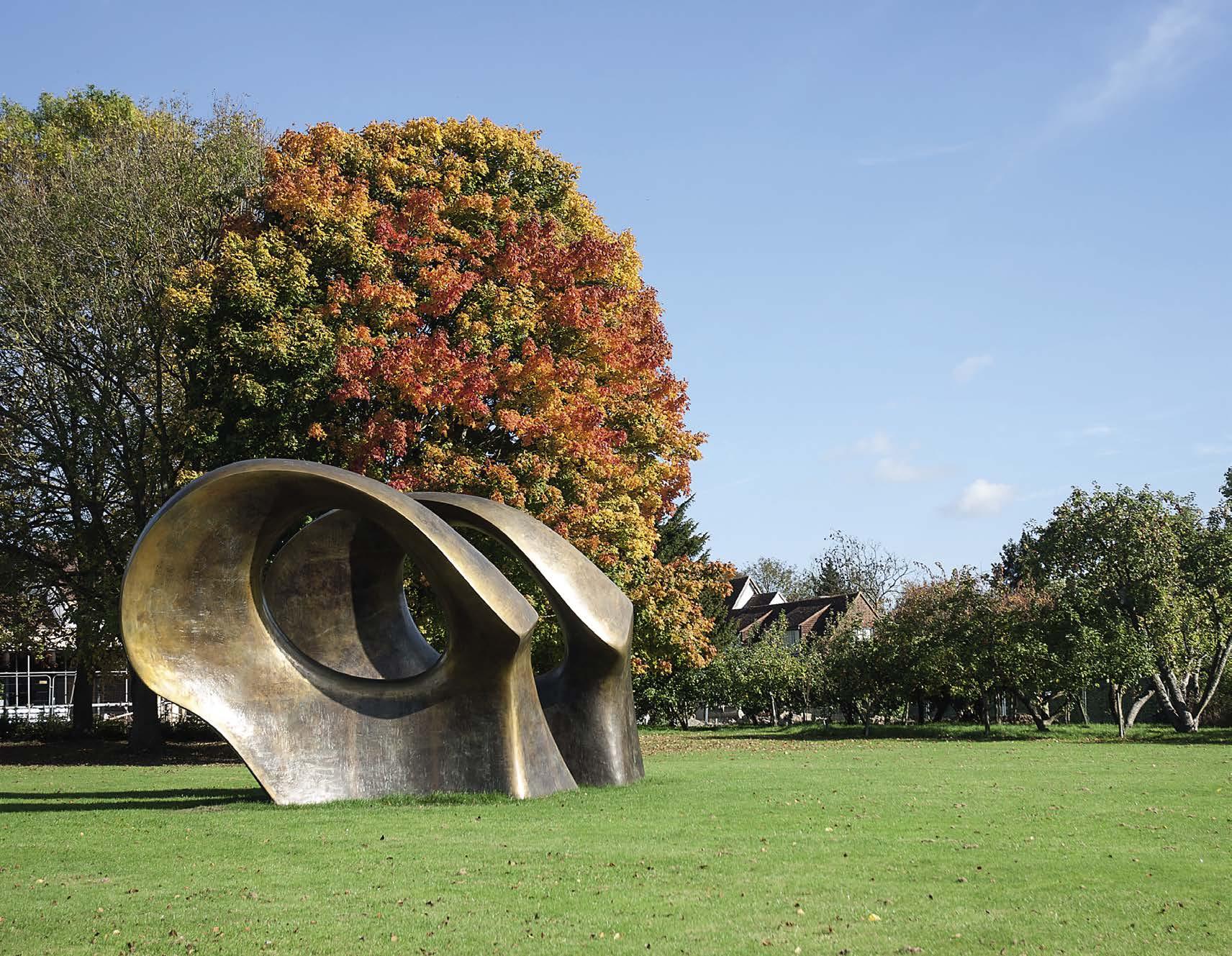
Previous spread: Henry Moore, Sheep Piece, 1971–72, bronze, 224 3⁄8 × 224 3⁄8 × 224 3⁄8 inches (570 × 570 × 570 cm). Photo: Jonty Wilde
Opposite: Henry Moore, Old Hedgerow, Gnarled Trunks , 1978, charcoal and watercolor wash on blotting paper, 11 1⁄8 × 8 ¾ inches (28.3 × 22.2 cm). Photo: Nigel Moore
This page: Henry Moore, Double Oval , 1966, bronze, 145 5⁄8 × 250 × 159 ½ inches (370 × 635 × 405 cm). Photo: Sarah Mercer
debris, the pebbles, shells, bones, and roots that he drew in his Transformation Drawings. Over time, his studio became a remarkable archive of organic discoveries, a private treasury of the shapes underpinning his most monumental works. Most of these objects remained untouched, displayed on shelves and valued in their own right. This root carving is a rare exception: Rather than preserving the fragment exactly as he found it, Moore approached it as he would one of his sculptures, paring back the outer layer of the upper section, refining its bowllike body, and carefully shaping the lower form into a solid cylindrical neck.9
Through a profound engagement with organic forms, materials, and nature’s most enduring archetypes, Moore created sculptures that still speak to us and reinforce our connection to nature. The Kew exhibition offers a rare and powerful opportunity to experience his vision at its fullest scale and intensity. Set within that extraordinary landscape, this landmark show takes on heightened significance. With their preservation and understanding of the natural world, the Royal Botanic Gardens provide more than a backdrop; they offer a living context that amplifies Moore’s artistic philosophy, compellingly revealing the vitality and relevance of his work.
Moore himself articulated the depth of this connection to nature: “The whole of nature—bones, pebbles, shells, clouds, tree trunks, flowers—all is grist to the mill of a sculptor. It all needs to be brought in at one time. People have thought . . . that the human
figure was the only subject, that it ended there; a question of copying. But I believe it’s a question of metamorphosis. We must relate the human figure to animals, to clouds, to the landscape—by bringing them all together. There’s no difference between them all. By using them like metaphors in poetry, you give new meanings to things.”10
1. To help readers identify works of art, this essay uses the Henry Moore Foundation’s catalogue raisonné numbers throughout.
LH refers to Henry Moore: Complete Sculpture (London: Lund Humphries, six volumes, 1944–2003), HMF to Henry Moore: Complete Drawings (Much Hadham: Henry Moore Foundation, in association with Lund Humphries, six vols., 1994–2003).
2. Henry Moore, quoted in Warren Forma, Five British Sculptors: Work and Talk (New York: Grossman, 1964), 59, 63. Repr. in Alan Wilkinson, ed., Henry Moore: Writings and Conversations (Aldershot: Lund Humphries, 2002), 198.
3. Surprisingly little research has been done on this aspect of Moore’s work, with the exception of Andrew Causey, The Drawings of Henry Moore (London: Lund Humphries, 2010), 68–69. Causey also lists HMF 929; see also HMF 930.
4. Giovanni Aloi, “Henry Moore’s Trees and the Groundlessness of Existence,” in Laura Bruni, Henry Moore: Monumental Nature , exh. cat. (London: Kew Publishing, 2026), 104.
5. Ibid.
6. The author wishes to express her deepest gratitude to Suzanne Wilkes, archive collections coordinator at the Henry Moore Foundation, for proposing this connection in discussions of the present work on February 20, 2026, during preparations for the Kew exhibition catalogue.
7. Aloi, “Henry Moore’s Trees,” 108.
8. Moore is often quoted referring to his collection of found objects as a “library of natural forms.” See, e.g., Roger Berthoud, The Life of Henry Moore , 1987 (rev. ed. London: Giles de la Mare, 2003), 409.
9. The author gratefully acknowledges Samet Mor, postdoctoral researcher at the Henry Moore Foundation, for this insightful observation.
10. Moore, quoted in Carlton Lake, “Henry Moore’s World,” Atlantic Monthly, January 1962, 42. Quoted here from Wilkinson, Writings and Conversations , 222.
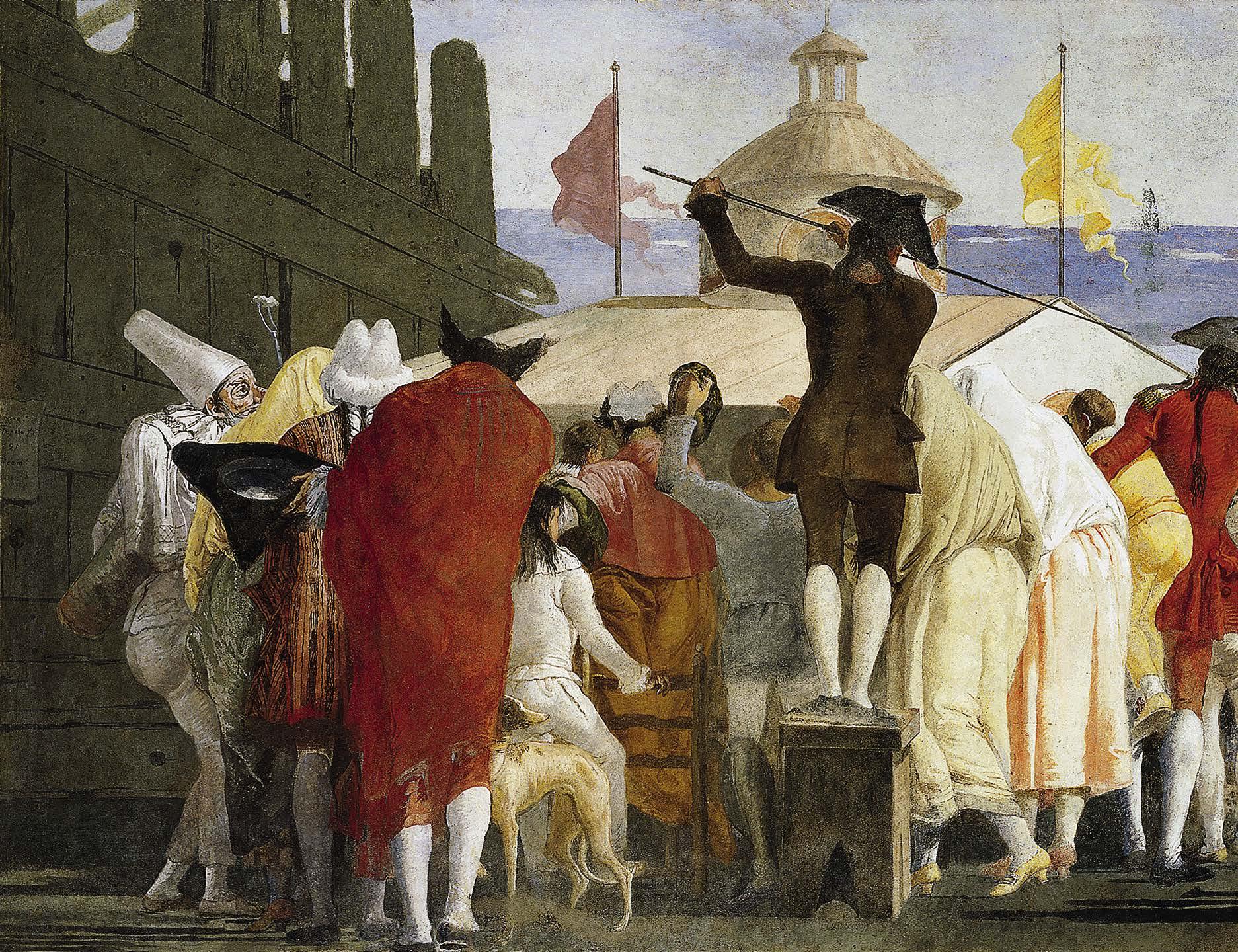
Peering into the dying days of the Republic of Venice, Ben Street finds a pulse in the tragicomic frescoes of Giovanni Domenico Tiepolo, and particularly in Tiepolo’s commedia dell’arte character Pulcinella, that continues to beat in the works of such artists as Paul Cézanne, Philip Guston, and Nicole Eisenman.
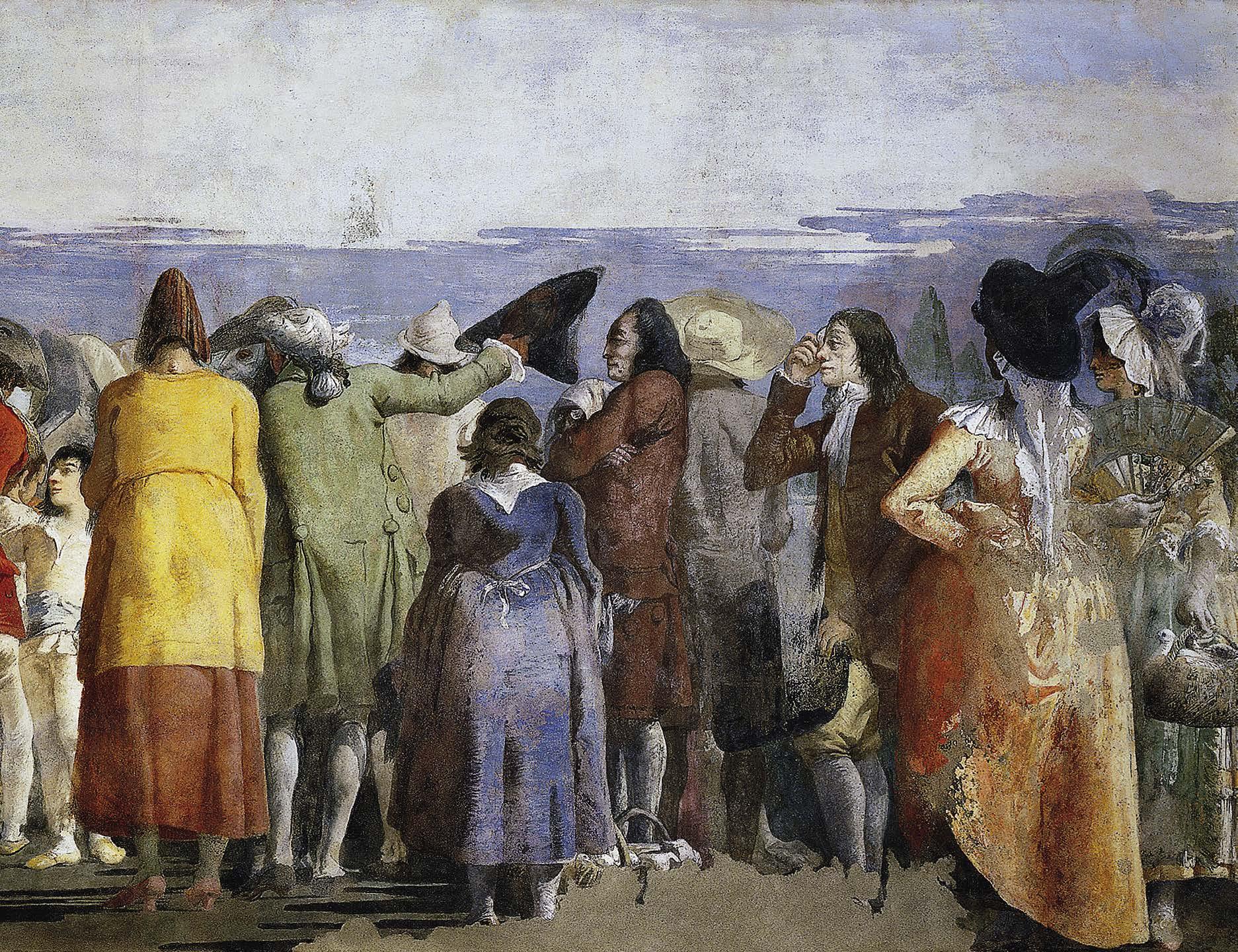
It’s the end of the eighteenth century and it feels like the end of the world. In his villa in the small town of Mirano on the Venetian mainland, Giovanni Domenico Tiepolo, then in his late sixties and with decades of success behind him, is painting a series of frescoes. Unlike his earlier mural commissions for palaces in Vicenza, Bavaria, and Madrid and for the churches of his native Venice, these are made for his eyes alone. He paints what he wants to see, and what he wants to see is above all Pulcinella, the ancient Neapolitan clown of the commedia dell’arte tradition.
Tiepolo’s Pulcinella wears his traditional garb of a beaky mask and towering, conical white hat. He’s a gluttonous, slovenly character with a humped back and a round belly, gorging on gnocchi. He’s also rascally and playful, forever in and out of scrapes. In the semiimprovised commedia performances staged in streets and squares across Europe since the Middle Ages, Pulcinella had been the everyman, the one you root for. Yet here, in Tiepolo’s frescoes, he’s mostly an observer of the action, not a participant in it. Multiple Pulcinellas populate the paintings. They applaud acrobats doing backflips in the street. They gaze at a distant horizon. They watch each other swing on a wobbly-looking rope. They booze and bicker and lounge. But what they mostly do is look. They watch their world end.
Around fifteen miles away from Tiepolo’s rural villa, the thousand-or-so-year-old Venetian Republic is drawing to an ignominious close. In 1797, the year Tiepolo completes his fresco cycle, the city’s grand council unanimously votes for its own abolition. That same year, in a heavy-handed act of political symbolism, Napoleon Bonaparte, the city’s new de facto ruler, has the famous bronze horses from the facade of St. Mark’s Basilica removed and reinstalled atop a new triumphal arch in Paris. (They’re back now.) Napoleon also outlaws performance of both the commedia and the Carnival of Venice, of which the commedia is a part. (The Carnival is back now.) Tiepolo’s frescoes, then, document the dispersal of a city’s vital cultural energy. Yet the end of the Republic of Venice is also the beginning of the Venice we know today, a crumbling stage for a succession of temporary events: weddings, Biennales, festivals, holidays. Tiepolo’s Pulcinellas are looking back, to the distant glories of this impossible city, but they’re looking forward too. What they anticipate is the modern society of spectacle, of which Venice itself might be the quintessential embodiment. After all, what other city so constantly reproduces itself, be that via a watery reflection, a million cheap souvenirs, or the backdrop to a billion selfies?
The largest painting in Tiepolo’s cycle is called
The New World , a title it was given when it and the other frescoes were bought by the Italian state in 1906 and painstakingly removed from their walls in Mirano. In its new home of Ca’ Rezzonico, the museum of eighteenth-century art in Venice, the fresco remains one of the strangest works of art in the city—even in a Biennale year. A wall of turned backs fills its long, wide expanse. Figures crane their necks and adjust their monocles for a better look at . . . something . Within this crowd is the answer: a small domed building bedecked with flags. It’s a magic lantern, known in Venice as a mondo novo (literally “new world”). Its operator raises a flap using a long stick, granting visual access to the interior through a tiny aperture. A man is lifting a little boy in yellow to give him a better look. What he must be seeing inside are illuminated cityscapes, most likely of popular destinations on the Italian peninsula, appearing in the dark as though by magic. They are lit up by candles, doubled by mirrors, and animated by hidden mechanisms. Like Parisian paintings of the following century—think of Manet’s listless bourgeoisie, or Seurat’s workers gazing into nothing—Tiepolo’s painting identifies a principal modern preoccupation: watching. That crowd, jostling to see, is easily transposed into the contemporary world. They’re elbowing their way to the front of the queue to get
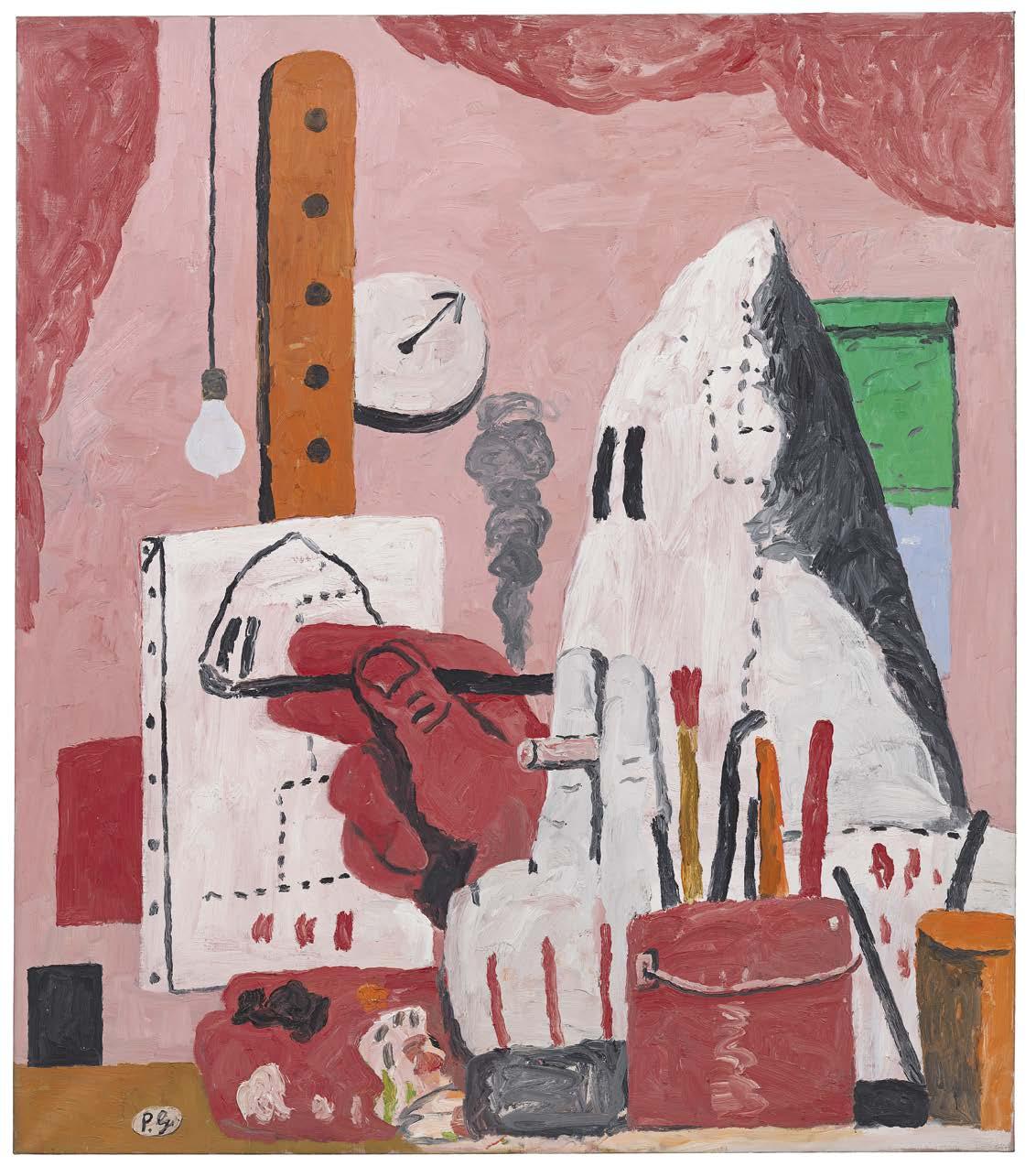
the best view of a passing celebrity. They’re impatiently waiting to get into the Biennale exhibition that everyone’s been raving about. The magic lantern in the painting even resembles a national pavilion in the Venetian Giardini, principal site of the Biennale and always mobbed by crowds during the opening days. Tiepolo’s painting marks a hinge in history. The new world is here.
It’s the end of the 1960s and it feels like the end of the world. Every night, the television shows unedited acts of brutal violence in American cities. Cops are beating protesters with clubs. Blood runs in the street. In his studio in the small town of Woodstock in New York State, the celebrated abstract painter Philip Guston, shaken by what he’s seen, gets to work. In his new paintings and drawings he’s processing these images of violence through a revival of ideas in his earlier work that he’d long since abandoned. Hooded figures, once standing unambiguously for Ku Klux Klansmen, return in altered guise. These new hoods no longer lynch and burn; instead, they stare emptily out of cars idling around the edge of town, they puff stogies and point at each other, they look at paintings or paint them. In their patched and splattered white robes, these figures resemble some ragged amalgam of Klansman, Catholic flagellant, and commedia character. They are, like Tiepolo’s Pulcinellas, emblematic figures of helpless, sardonic, melancholy observation, both a part of and somehow detached from the scenes they watch. Guston’s elongation of the hood’s circular eyeholes into long black slits contributes here, giving them the
goonish affect of the Pulcinella mask. It’s as though they can’t believe what they’re seeing. When Guston some years later described the hoods as self-portraits, he did so in part to frame them as emblems of white supremacy. Yet they are also tokens of cultural marginality, even redundancy, just like the Pulcinellas in Tiepolo’s frescoes. In one of his best-known Klan paintings, The Studio (1969), Guston shows a hood delicately daubing a self-portrait. The sight gag reflects on the absurdity of studio practice in the teeth of a national crisis, a position that brought him genuine pain. The artist’s well-known declaration of selfflagellation—“What kind of a man am I,” he asked, “to adjust a red to a blue” in the face of the political turbulence of the time—is the same kind of question posed by Tiepolo’s clowns. Both Guston’s hoods and Tiepolo’s Pulcinellas watch their own demise from the sidelines with sad eyes. But Guston’s painter is comic, too: He’s a caricature of the self-serious artist, the kind of painter Amy Sillman has sarcastically described as “so earnest, so caring—with a smock, and [his] tongue between [his] teeth, trying so hard.” This ambivalence lies at the core of Pulcinella as a tragicomic character: lovable and devious, appealing and grotesque, hero and fool all at once. It’s Guston’s self-image, and perhaps also Tiepolo’s.
Commedia figures allowed artists of the late nineteenth and early twentieth centuries—that is, artists at work within the accelerated culture of industrial modernity—to stake a position outside the mainstream. The itinerant entertainers
Previous spread: Giovanni Domenico Tiepolo, Mondo Novo (The New World ), 1791, torn fresco, 6 feet 8 ¾ inches × 17 feet 2 ¾ inches (2.1 × 5.3 m), Museo del Settecento Veneziano/ Ca’ Rezzonico, Venice.
Photo: Scala/Art Resource, New York
This page, top: Philip Guston, The Studio, 1969, oil on canvas, 48 × 42 inches (121.9 × 106.7 cm) © The Estate of Philip Guston, courtesy Hauser & Wirth. Photo: Genevieve Hanson
This page, below: Paul Cézanne, Harlequin , 1888–90, oil on canvas, 39 ¾ × 25 5 8 inches (101 × 65 cm), National Gallery of Art, Washington, DC. Photo: Art Resource, New York
Opposite page: Giovanni Domenico Tiepolo, Pulcinella Collapses on the Road , from the series Divertimento per li regazzi (Entertainment for children), c. 1791, pen and brown ink and brush and brown washes, over traces of charcoal, on off-white laid paper, 14 ¼ × 18 ¾ inches (36 × 47.5 cm), Art Institute of Chicago. Photo: Art Institute of Chicago/Art Resource, New York
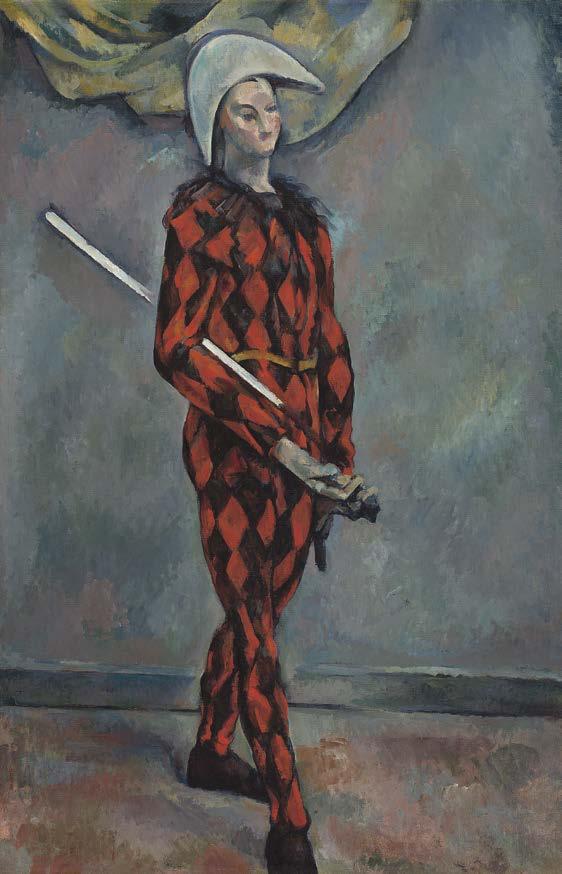
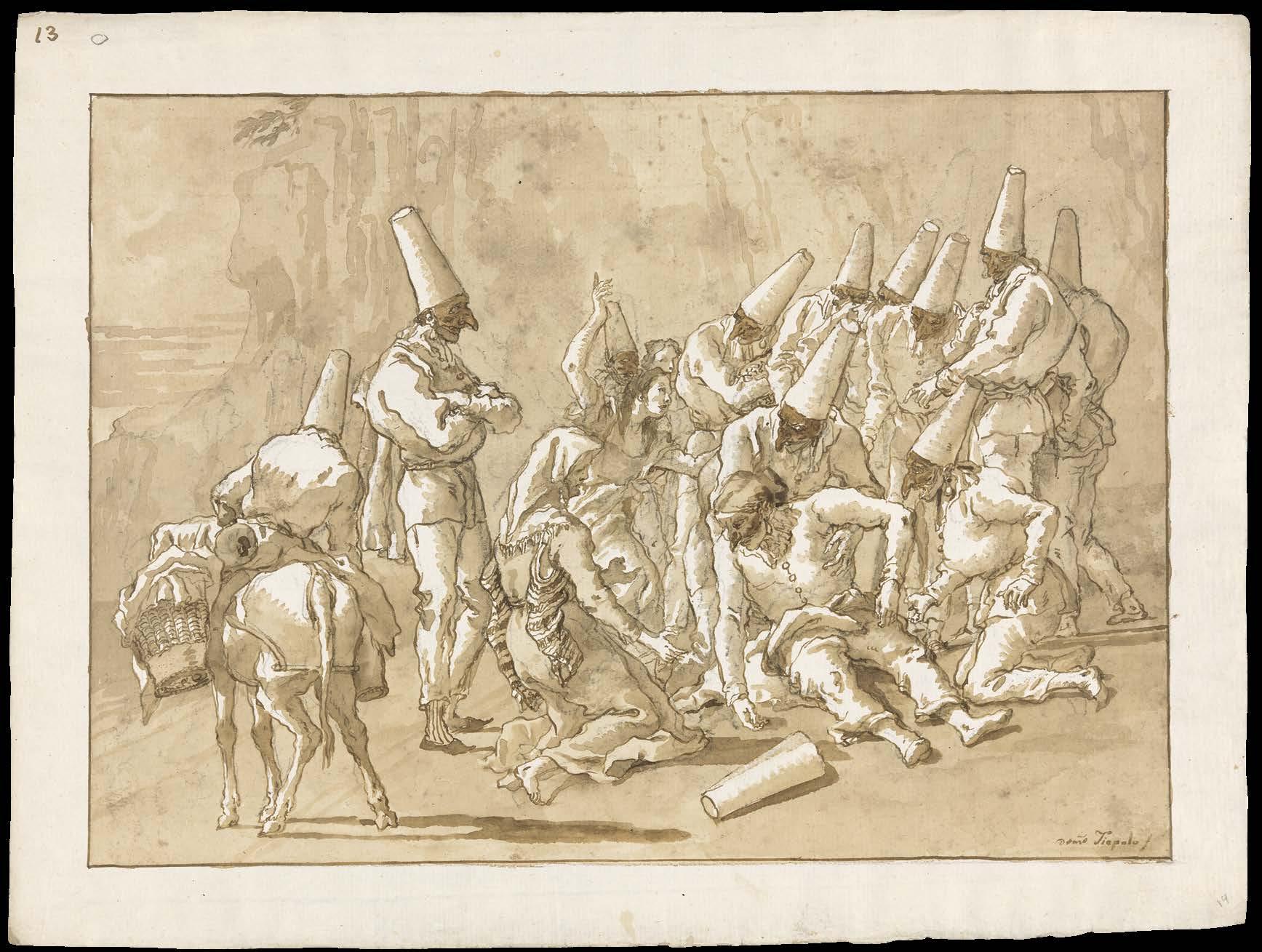
depicted in Pablo Picasso’s 1905 painting Family of Saltimbanques set up camp at the edge of town, just as artists did. In the canvas, the one identifiable commedia figure—in this case Harlequin, in his distinctive diamond-patterned clothing—even takes on the unmistakable features of the young artist. It’s little wonder that Picasso returned many times over his career to this shapeshifting, chameleonic commedia character as an oblique selfportrait. Yet to do so was also to establish a foothold in a tradition encompassing both Domenico Tiepolo and his better-known father, Giambattista, as well as their near contemporaries Antoine Watteau and Francisco Goya. In his 1888–90 painting Harlequin , depicting his son Paul in that costume, Paul Cézanne was likely recuperating this history. Yet he was at the same time making it available for artists who revered him, as Picasso did: granting permission. In his four paintings of the subject, Paul Junior loiters awkwardly in his father’s studio, wearing the harlequin outfit that had been hanging there neglected for months. He has something of the melancholy aspect of Tiepolo’s Pulcinellas from a century earlier: He looks shifty, lost, anxious. This removed quality—this condition of looking on as the world ends—characterizes many of the twentieth century’s reprisals of commedia figures. The return of this strand of imagery in the traumatized years following World War I encapsulates its nature. André Derain’s 1924 painting Harlequin and Pierrot is a case in point: The two figures are shown in a barren landscape, their feet aloft in a dismal dance as they strum their stringless instruments.
The work itself is bare and thinly made. This disavowal of Derain’s own, earlier Fauvist practice, with its loose impasto marks and hot color—a move perhaps comparable to Guston’s about-turn at the tail end of the ’60s—evinces a profound cynicism about modernism’s efficacy in a world gone wrong. It’s a painting made as any Pulcinella would make it: ironic, darkly comic, and heartbroken. It’s a premonition, too, of commedia’s return in later twentiethcentury culture. In the video for David Bowie’s 1980 song “Ashes to Ashes,” codirected by Bowie and David Mallet, the singer wears a commedia costume—Pierrot—as he walks slowly, in a kind of funeral march for his Major Tom character, along the East Sussex shingle. The absurd anachronism of the costume is a suitable accompaniment to lyrics that announce the end of his 1970s phase, a plunge from that peak to “an all-time low.” Here as before, the commedia figure announces a threshold, a fold in time.
In 1797, the same year as the dissolution of the Venetian government and Napoleon’s assumption of power, Tiepolo began a new project using the figure of Pulcinella: a suite of 104 pen-and-wash drawings collectively entitled Divertimento per li ragazzi (Entertainment for children). In the opening image, a humpbacked Pulcinella, holding a rag doll under one arm, stands before a large tomb on which is engraved the series’ title. The image makes clear just what kind of entertainment will be on offer here: an amalgam of the playful and the deathly, the beginning and the end of life. The Divertimento drawings, as befits their medium, are
looser, wilder, and more explicit than the earlier frescoes. Across the series, various Pulcinellas are shot in a firing squad, abducted by an eagle, hanged in a public square; they’re born from huge eggs and die surrounded by weeping doppelgängers. Who is mourning whom is a moot question. The thing about a mask is that anyone can wear it.
Tiepolo’s Divertimento drawings make clear the relationship between the commedia and the carnivalesque: their antipuritanical and anarchic attitude, which for Tiepolo meant deliberately upending the received visual tropes of the culture into which he was born. Their phony resurrections and counterfeit assumptions parody Christian imagery in the irreverent spirit of the pre-Lenten Carnival celebrations. It’s this, I think, that gets at what remains contemporary about Tiepolo’s imagery of commedia characters. The prevalence of the grotesque in contemporary art—from the leering jokers of Cindy Sherman’s Clowns series (2003) to the gooey bodies of Tala Madani’s Shit Moms paintings (2019– ) and Nicole Eisenman’s ungainly figurative sculptures—testifies to the eternal return of the carnivalesque spirit, especially at moments of political crisis or transition. In Eisenman’s sculptural group Procession (2019), a parade of clumsy, farting, flat-footed characters slump through the landscape, lugging flyswatters, flagpoles, and empty cans of tuna. They seem to pick up on and continue the processional energy of Tiepolo’s stumbling buffoons, who stagger their uncertain way across the world, from their past into our present, watching things come to an end.
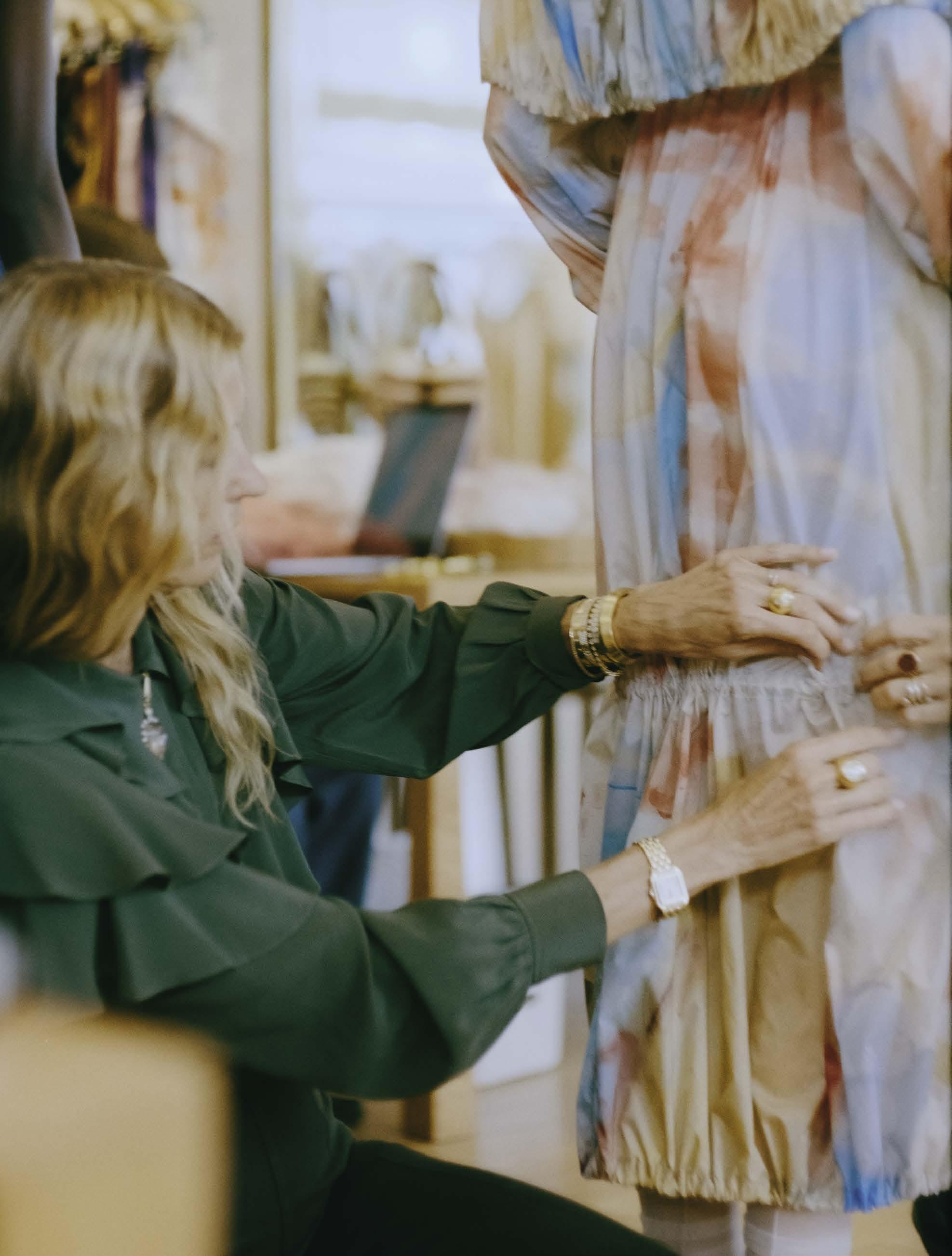
Following the debut of her Fall/ Winter 2026 collection at Dia Chelsea, New York, Ulla Johnson met with Sarah Godfrey to discuss her recent collaborations with the Helen Frankenthaler and Lee Krasner foundations, her upbringing in and dedication to New York City, and her nonhierarchical approach to collecting.
SARAH GODFREY Congratulations on your recent collection! I’d love to talk about that show, but to begin, could we discuss your collaboration with the Helen Frankenthaler Foundation for the Spring/ Summer 2026 collection? How did that project come about?
ULLA JOHNSON First, thank you. For the Frankenthaler collaboration, that was several years in the making. Working with estates is often a long game. I’ve loved Frankenthaler’s work for a long time and we’d been in dialogue with the foundation for a while, working toward a time when everything clicked for all of us. A lot of trust needs to be established on both sides, and obviously the art world moves at a different cadence from the fashion calendar, where we present with quite a rapidity. It’s four times a year—we do two shows but there’s two collections in between. So I’ve just come to understand that things like this come when they will.
SG Could you say more about what you find appealing about Frankenthaler’s work, and why you chose those three paintings—Western Dream [1957], Moontide [1968], and Nature Abhors a Vacuum [1973]—to interpret for the collection?
UJ With Frankenthaler, the way she worked with the canvas—the putting it on the floor, this sort of thrust from the shoulder, the way the paint moves, the soak/stain technique—it just felt so applicable to fabric. And there’s this sense of being borderless, which is also how we work: We’re not really constrained by anything except for the body, and even there, not really, because volume can be variable. The three paintings were chosen with many aspects in mind, but the ultimate decisions were about what would work on the body. This is clearly a different type of experience of the work. We really wanted to capture a sense of movement, a passion for color, and those paintings all have a lot of storytelling within the color, but also each work represents something quite different.
SG I noticed that they have different tones.
UJ Different tones, and also different periods. Western Dream was an early work, and has a lot more ground versus gesture. Then Moontide has a much more reductive palette, and that one and Nature Abhors a Vacuum have this incredible sense of the presence of nature, which is always part of my inspiration. Those three paintings continued to be the jumping-off points for the rest of the collection’s palette, mood, and silhouette. And then it was almost like when an actor takes on a role and they do this crazy deep dive into their subject. I found myself listening to a lot of recordings of Frankenthaler, and she spoke so eloquently and confidently about her work and was very matterof-fact as far as where she saw her place within the canon, and what held back, or didn’t, the dialogue
Opposite: Ulla Johnson working on her Spring/Summer 2026 collection, featuring a dress made in collaboration with the Helen Frankenthaler Foundation
This page: Ulla Johnson’s Spring/ Summer 2026 collection, featuring a dress made in collaboration with the Helen Frankenthaler Foundation
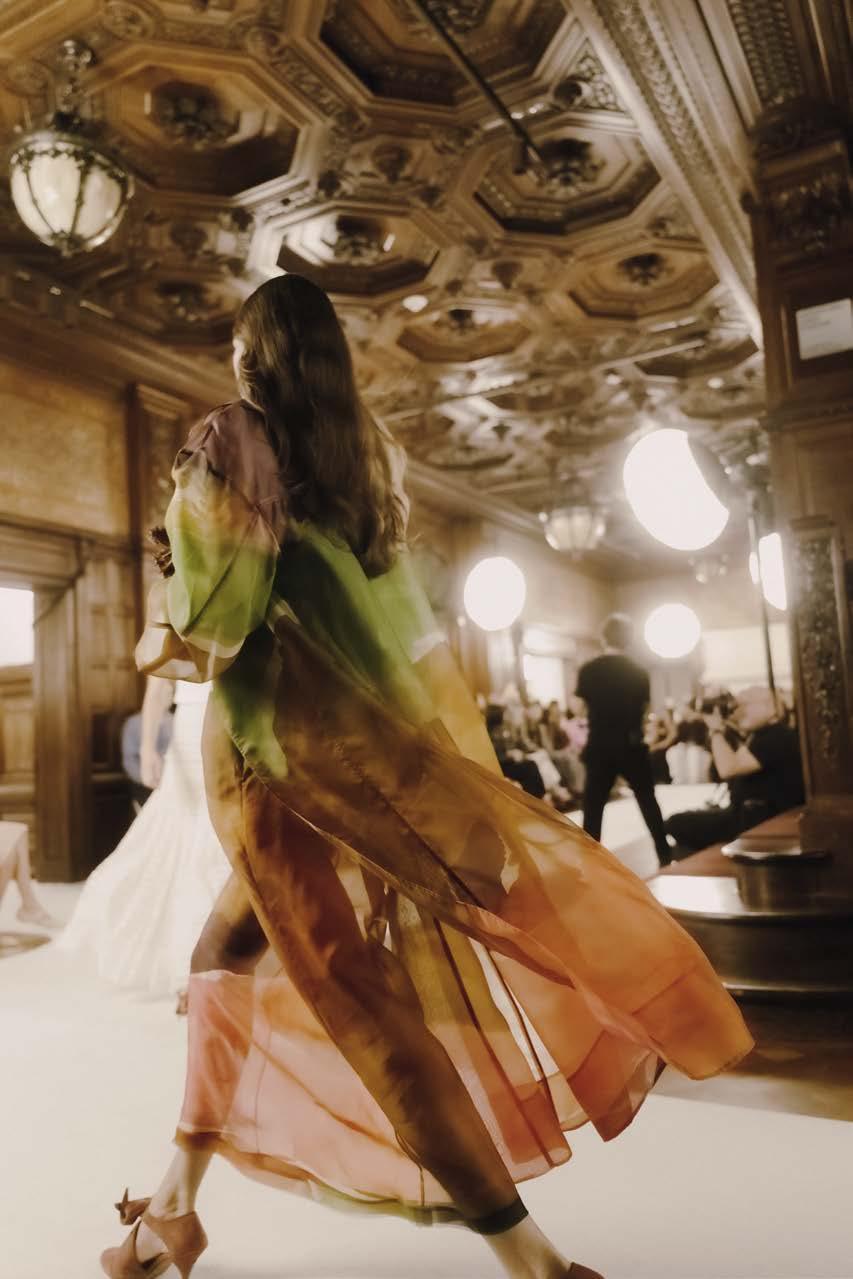
around her work. We used some audio from an interview she did with Charlie Rose, where she spoke about beauty being an incendiary word, and how she aimed to challenge the notion of beauty as something merely pleasant. She reclaimed beauty as something profound, which is something I’m looking to do as well.
SG I’m always interested when designers show in museums. Your most recent show was at Dia Chelsea, and you’ve shown at the Brooklyn Museum—do you think of your venue choices as informing the way the collection is to be interpreted?
UJ At the very heart of it is that being a bornand-bred New Yorker, I’m always trying to shine a light on New York and this city’s cultural institutions. There’s always a lot of conversation about New York Fashion Week and who’s showing, and so on, but I think constantly about bringing it back to things outside that brief five-day period, about bringing people into these institutions that are here year-round. Even with covid, when we couldn’t do in-person shows, we made two movies, one at Lincoln Center and one at the Four Freedoms memorial on Roosevelt Island. And then our first in-person show after covid was at the Brooklyn Botanic Garden. To this day I go there sometimes on my way home. All of these places are part of my story, and I admire the people who are currently building the programs at these institutions. We also did a show at the New York Public Library, so it’s not just art institutions, I should say.
SG What felt significant about the Cooper Hewitt[, Smithsonian Design Museum, New York] for the Spring/Summer 2026 collection?
UJ This moment in particular was important for the brand—there was this idea of homecoming for me in general around this show. That week we also opened a store nearby on Madison Avenue. I grew up on the Upper East Side, not on Madison but in Yorkville. That’s changed a lot—back then it was a very German, Eastern European, more immigrant neighborhood. I had resisted being uptown my entire life; I moved to Brooklyn as soon as I could. So opening on Madison and showing on Fifth Avenue was a really big step.
SG Did you ever visit the Cooper Hewitt growing up? Are there any other early museum experiences that have stuck with you?
UJ My mother was an artist, a painter. She actually wore a million hats—she was an archaeologist by training and then ended up doing restoration, conservation, and painting icons. I was an only child and was getting dragged to museums all the time. When I was very small she worked at the American Museum of Natural History, painting some of the backdrops for the dioramas and also putting together some of the dinosaurs, making molds of missing dinosaur bones for the skeletal mounts. So I grew up in this museum milieu. We saw every show at the Metropolitan Museum of Art and we were at the Cooper all the time. So it felt really special to show in that place. I feel like the Cooper deserves to be celebrated; they have such
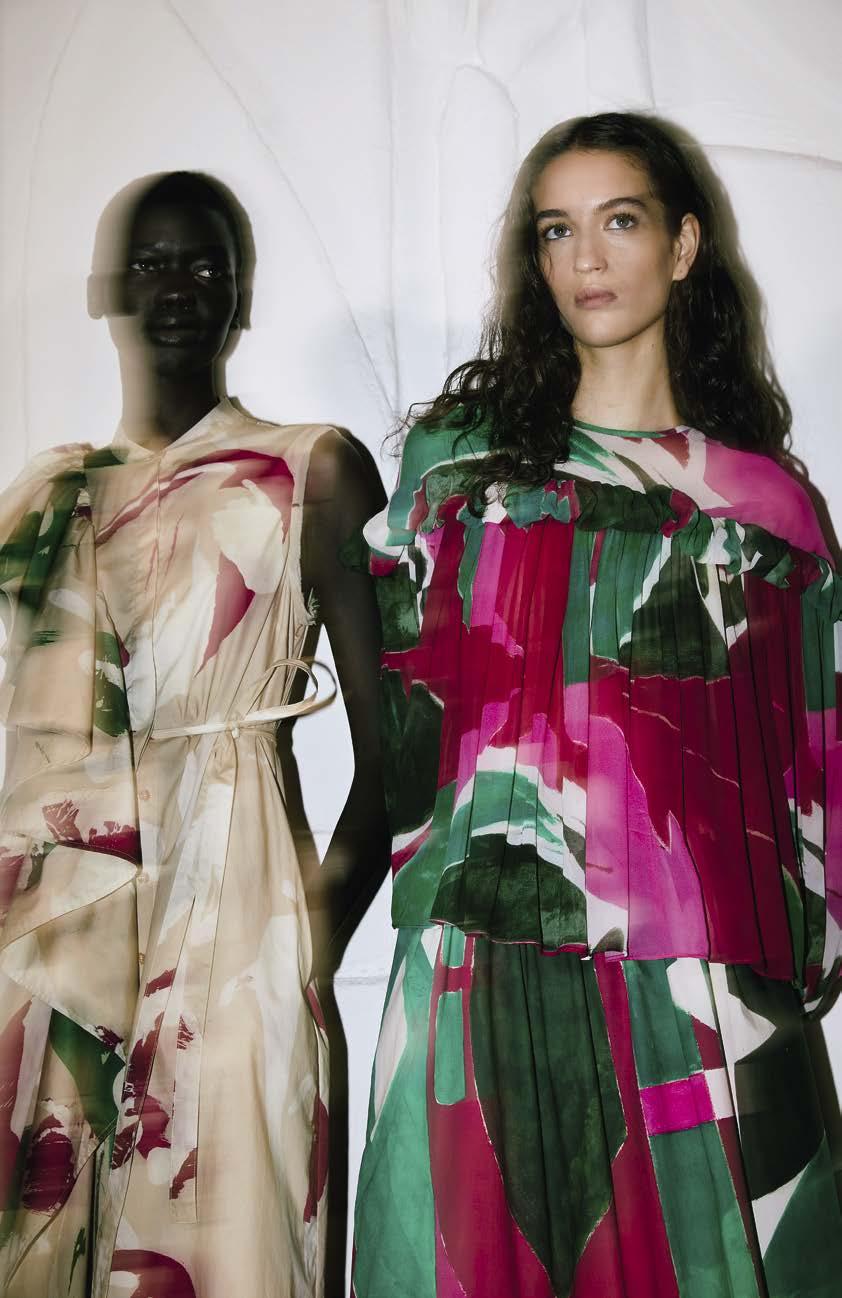
a storied history of exhibiting really interesting design work, and they have a wonderful director, Maria Nicanor, who has some great programming coming up. People don’t know the history of the building being the home of Andrew Carnegie—he spent the last years of his life there giving all of his money away, which I found to be really meaningful. I had my green room in his former office, which was just so special, with handpainting on the walls and every level of fine craftsmanship. We don’t have that many buildings like that in New York.
SG I’d love to hear more about this most recent show, at Dia Chelsea. What informed that choice for this collection?
UJ We were really inspired by color and scent for this collection, so it felt right to do it in this whitebox space. A lot of times I’m drawn to spaces that have a lot of their own character, but it was exciting to have everything stripped away and really let the clothes speak.
SG You mentioned scent. Am I right in thinking that you’ve just launched your first scents?
UJ Yes. Also a long time in the making.
SG What’s it like to transition media and start expressing yourself through this other form entirely?
UJ Firstly, exciting. When starting to think about scent, I kept returning to memory, because they’re so linked for me. I’m working with perfumer Lyn Harris, based in London, who’s so inspiring. I already had an idea of what I wanted one of the scents to evoke, which was this sort of sun-soaked Mediterranean feeling, the sound of cicadas in the pines. It was something that reminded me of my childhood, because we used to vacation in Croatia every summer. There was a particular scent that comes off the heated rocks, off the water, and all of these things that were meaningful to me. There are so many stories we could tell, but we started with a set of three scents.
With the packaging, we ended up doing something very nontraditional and working with two different ceramists, Jane Yang-d’Haene and Jonathan Yamakami, to make hand-built containers for the scents, the candle, and the incense holder. They’re not made from molds, which is unusual; I wanted something that felt amazing in the hand.
SG Do you think of what you do as a designer as a form of artmaking? You work with so many different craftspeople, artists, artisans, et cetera— UJ I think that’s complicated, right? Because a lot of what we consider to be art are things that don’t have a use value per se.
SG And clothing is very functional.
UJ It is. So I never really want that. I don’t really perceive myself in that way. I think what we do is artistic, I hope, but so much of what I do is related to the act of how the woman herself puts it together. I’m certainly influenced by art, and I think the tension between fashion and art has shifted over time. I think there was an aloof attitude in art toward fashion in some ways, and I’m sure that still exists in different forms to this day, but I think some of it has really been exploded lately. That’s very exciting to see, because when different disciplines speak to each other, only good things can come of it.
SG In the past, you’ve mentioned Mary Gabriel’s book Ninth Street Women [2018], and I know you collaborated with the Pollock-Krasner Foundation for your Spring/Summer 2025 collection, bringing the work of Lee Krasner to those pieces. Am I right that Gabriel wrote the show notes for that collection?

UJ Yes. I loved her book. It covered a very exciting time in New York, in art, in women’s history, in general—so much was changing. Yet these women, to varying degrees, lived in the shadows of their husbands. I learned from Katy Hessel’s podcast, Krasner herself really created the art market as we know it now in the way that she valued Jackson Pollock’s works. The price tags attached were really unheard of at the time; she was a very savvy businessperson. But despite all that, it took her a really long time to gain any recognition for her own work. In fact, she couldn’t even attend her own retrospective at the Guggenheim Bilbao[, because it took place posthumously]. I had a real affinity for her also because she was a child of immigrants, a child of New York, a Brooklyn girl. There was so much in her personal story that I found interesting, but it was also this time when women were first able to have a voice in painting. It was so radical, what they did. Frankenthaler came from a very different type of background and had a different type of access, but she still struggled. She struggled with the perception of women’s work relative to their male peers. And to this day, women are not valued to the same extent as their male peers.
SG Every time you look them up, there’s a man in the first sentence. In the intro to their bio: “the wife of so-and-so,” or something like that.
UJ Yes. That they were able to find each other, that they were able to have this type of resilience to continue to present their work even when they weren’t getting celebrated—so much perseverance,
so much confidence. And for me, I built this business with no investor, no family money. It was constructed from nothing. And to do that takes a fair degree of stubbornness, the ability to fail and continue to try and succeed time after time. I’ve been so privileged to be working in this time where I’m not facing some of the roadblocks that they did. And still—
SG There’s always going to be a roadblock. There’s a line of Gabriel’s about your and Krasner’s shared affinities, nature being a key one. And she says, as a result, “A Lee Krasner painting is no longer something we look at, it’s something we live in.”
UJ That was so meaningful to me. Lee herself said that she wanted the work to breathe and come alive. So I thought when we did an installation of fabric panels in the space at the show, where they moved as the models walked by them wearing the garments—this sense of something we live in. How wonderful.
SG Thinking through these cross-cultural conversations, when you started the brand, was that your intention—to create something bigger and have clothing be almost the medium through which that happens?
UJ I would say yes. I mean, it’s evolved a lot over time. I basically started this straight out of school, so it’s had a lot of different lives, as have I. But there was a moment about ten years ago when I was in a position to be going through a great deal of my mother’s collections. I grew up traveling a lot
because my mother was an immigrant and both of my parents were archaeologists, and they both had a great affinity and respect for material culture. So that’s something that I grew up around all the time: artifacts, collections, textiles, folk costumes, Victorian lace, all these beautiful handmade things. I was going through my mother’s archive, which she had meticulously organized, and I very much believe in the emotional weight of objects and of touching all of these things, especially things made by hand. It sounds otherworldly in a way, but I really do believe that it’s not just the hand of the maker, but also, since some of these things are hundreds of years old, it’s all of the people who darned it, who kept it safe, kept it clean. These things are imbued with meaning and feelings. And suddenly I really felt this need to continue this type of work. SG Collaboration seems to be so crucial to all of this. How have you found some of your global partners and collaborators?
UJ I’d been dabbling in handmade techniques but I was producing most of my collection in New York, and our capacity for knitting, embroidery, that type of thing, doesn’t really exist so much in this country anymore, unfortunately. I decided that I wanted to take a trip to Peru, which has an incredible knitting and weaving culture. I went with my daughter to a tiny village outside Arequipa and I ended up meeting all these incredible people, a whole community with a commitment to maintaining and pushing forward the language of their craft. It was really a pivotal moment in my life. When I came back from that trip, I was so committed to going to different regions where craft is still very much alive, and to working with communities to bolster that. I went to India, where an incredible embroidery craft still exists. I went to Kenya to work with brass and glass artisans. This is something that has to be done face-to-face; it’s not a Zoom-based type of dialogue. All of this has been a very rewarding part of the arc of the brand. SG You mentioned going through your mother’s collections. You too collect—what drives that pursuit? What are you drawn to?
UJ Both of my parents collected and made things. My dad also did wood carving. They were constantly making things together. I grew up in a nine-hundred-square-foot apartment, so you can imagine [laughter ]—
SG A cabinet of curiosities.
UJ Yes. There were ceramics, textiles, books, metalwork, shells, and everything was draped in textiles. We lived in Germany for a year and my mother collected all this incredible cut glass. It was like the universe in nine hundred square feet. And again, there was such a reverence for each thing— even amid all of the bounty, everything had its own place and its own story. That has informed my own approach: Wherever I go, I pick things up along the way.
Some of that is by design, for work. Some of it comes back into the language of the work in a very obtuse, circuitous way. And I collect things both humble and fine. I can love a rock as much as I do a painting. I don’t have a hierarchy. I collect baskets from the entire world—I’m basically assembling a basket museum [laughter ]. Ultimately, I think I collect what speaks to me. Often it’s about the story of either my moments with it or the moments that happened before or after. And then collecting art has been an incredible privilege. I hope I’m just a steward for these things before where they go next. At the end of the day, the things I’m drawn to—to me, it’s really about the heart.
As part of a growing posthumous appreciation of the feminist writer Elaine Kraf, her previously unpublished novel Memory House will be released this month by the Modern Library. Here, Alana Pockros explores Kraf’s iterative worlds.
Elaine Kraf’s 1971 novel The House of Madelaine opens as two women are about to open a door. Elaine, our protagonist and a former kindergarten teacher, is accompanying her old friend Florence on a mission to reconnect with Florence’s lover Gerard. Simple enough. But the second the women cross the Rubicon into the house, we realize that the world within its walls is not exactly our own. Florence’s mother is at the doorway, but ignores her daughter’s attempt to introduce her to Elaine. Instead, she immediately asks Elaine to change the water in a pleated paper cup holding four yellow pansies, but when Elaine picks up the cup, she notices the water is perfectly clean. From here things only get more bizarre, as doors appear that weren’t there before, people and furniture morph in size, art historians turn into doctors, and Elaine becomes a sex worker forced to hold a feather between her butt cheeks. As the critic Jamie Hood puts it vividly in her introduction to the 2025 reissue of the novel, one imagines the late, strange-making filmmaker David Lynch would have “had a field day” adapting it for the screen. After reading through all of Kraf’s oeuvre, you’ll find this suggestion hard to stop imagining. As in Lynch’s films, much of what transpires in Kraf’s hallucinatory fiction cannot be explained. It’s both childlike and sultry, analytic and inconsequential. Its focus on female characters who are liberated and free-spirited, or else who desire to be but are trapped in stifling heterosexual relationships, has led many writers, also properly, to describe it as feminist. But considered together, one of its most interesting qualities is the way it iterates and innovates off its own frameworks. Among the many distinct characters we meet with Elaine and Florence in The House of Madelaine is the eponymous Madelaine, who presides over the surreal world of the residence like an oracle, delivering orders and maneuvering its inhabitants around like pieces on a chessboard. Elaine may at first appear to the reader as the victim of a dark ploy, but it turns out she’s only victim to herself: Halfway through the novel, Elaine and Madelaine—Mad(Elaine)— become one, mingling two halves of what perhaps was always a whole.
We see something similar in Kraf’s 1979 novel The Princess of 72nd Street . There, Ellen, a bipolar art-school graduate who lives on Manhattan’s Upper West Side, has a pedestrian, depressing sort of life. But when she is manic, or having “a radiance,” she becomes Princess Esmeralda, a grandiose alter ego who rules over the neighborhood, sleeping with strangers and bounding through Haitian restaurants that play “mediocre jazz.” In both novels, two women are like yin and yang, id and superego, or a pair of concentric circles: distinct, often at odds with one another, but sharing a set of overlapping characteristics. Kraf’s selves, you could say, refract one another as much as her novels do themselves.
It’s this iterative quality in Kraf’s fiction that the writer Meghan Racklin singles out in her review of the writer’s 1977 novel Find Him! : “Kraf’s novels have a chimerical, hall-of-mirrors feeling,” Racklin writes, “as if each book were a draft of the next.” This feeling of reworked drafts could not seem more true than in the relationship between The House of Madelaine and Memory House , the last novel Kraf wrote before she passed away in 2013. Until the Modern Library’s Torchbearers Series published it this May for the very first time, the manuscript lay in a storage space collecting dust. (Though we do not know for sure, Kraf’s daughter believes her mother wrote it in the mid-1990s.) In addition to
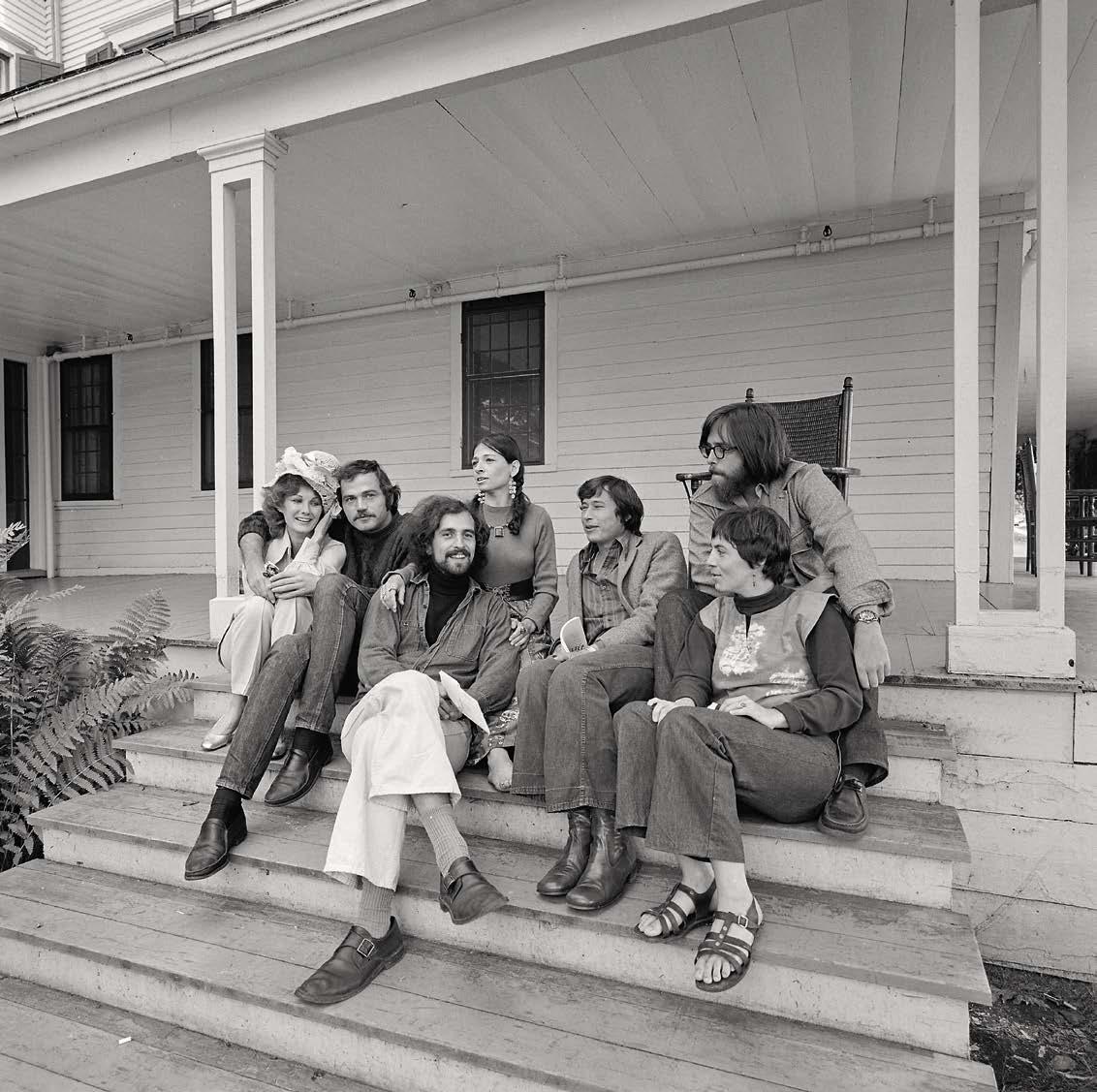
feeling hypnagogic, fantastical, and at times all too eerie, like The House of Madelaine , Memory House too centers on a pair of old girlfriends who navigate their rocky friendship within the confines of a strange residence whose rules seem to be always shifting. Memory House can also at times lack coherence, but if any of Kraf’s “literary nonsense” novels offer a central message for readers to take away, this one may suggest the clearest of them all: namely, that to create art properly, women must interrogate the depths of their psyches, seeking to fully and completely understand themselves—no matter how many selves we have.
If an artist’s residency is a place where creative types go to escape life’s daily distractions, and a psych ward was where mentally ill people once went to cure their psychological ailments, Memory House is something in between. When a limousine driver scoops up the painter and writer Marlane Frack—a play, though not the first, on Kraf’s own name—from her home in Manhattan with that destination in mind, she has as little idea as we do about where she’s going. But the driver, an elderly Japanese film director named Solomon Ito, is holding a copy of her second novel. He recognizes that she is a great writer—or at least was a great writer before she got married and abdicated her art for domestic responsibilities. “Does [Memory House] really exist?” Marlane asks Ito before she hops into his car. “Are there painters, writers, and composers as creatively dead as I am? And why would someone endow an estate to rehabilitate us?” If you read the novel looking for precise answers to these questions, you won’t find them. But you won’t end up caring much either, for once Marlane arrives in her new, delusive utopia, the logistics won’t feel so important.
One of the first, strangest discoveries Marlane has as she navigates Memory House is that although the beachside residence is supposedly a haven for defunct artists—a “great composer,” the former prima ballerina of the “Royal British Ballet Company,” and the “original” Abstract Expressionist painters are among her cohabitants— the house has a “No Creation” rule, which the executor of the estate “embossed in gold.” What, then, is one supposed to do here? For many of the book’s
first chapters, Marlane is trying to find out, meeting and talking to seasoned residents in pursuit of clarity. But as much as they try to explain her mission to her, they know she won’t understand it until she’s in its midst. Until then, they might as well be speaking in tongues. “Our benefactor understood humanity in a profound way,” an Abstract Expressionist’s wife named Minna Chase tells Marlane. “Don’t you see that the one rule we’ve been given . . . speaks for everything he wanted us to accomplish?”
The reader will begin to understand this question before Marlane does. As soon as she is on the road with Ito, she begins to float between two realities: her present moment and her latent, inner monologue. On her way to Memory House, her guilty conscience naturally takes her to what she’s left behind: her husband, Lenny Walsh-Gold, a normal if boring spouse who must be “searching for me this very minute.” Lenny continues to haunt her once she’s arrived at Memory House, rudely punctuating her conversations with new friends: “Marlie, Marlie, wake up babe,” he tells her during a lucid daydream. “You been dreaming. It’s me, Lenny. I always loved you.” Marlane’s old friend Nadia, a poet and longtime resident, tells her that to progress in Memory House she must shed her skin: “You’re losing your identity. We have to give up who we were before.” But eventually we realize that Marlane’s reflections on her past are not distractions from her journey toward self-discovery but simply part of its process.
Nearly every contemporary writer who has written about Kraf’s novels posthumously has compared them to Lewis Carroll’s Alice’s Adventures in Wonderland (1865). While Kraf wrote Memory House in the 1990s, nobody other than Kraf’s daughter has had access to its contents until this year, which is why it’s startling to realize that Kraf herself may have anticipated this comparison. Upon arriving at Memory House, Marlane is frightened, confused, and wonders if she might still be able to turn back. “Lighten up. You’re not Alice in Wonderland anymore, certainly not chronologically,” a composer named Garreth Styne, whom she eventually falls
If any of Kraf’s “literary nonsense” novels offer a central message for readers to take away, this one may suggest the clearest of them all: namely, that to create art properly, women must interrogate the depths of their psyches, seeking to fully and completely understand themselves—no matter how many selves we have.
in love with, tells her, waving a hand in front of her doe eyes. For the rest of the novel he refers to her with Freudian affection as “Alice Phallus.”
Perhaps these direct addresses should not surprise Kraf’s reader. Memory House , like House of Madelaine , abounds with metatextual references to her work and its reputation. In House of Madelaine , when the meddling Madelaine finds Elaine scribbling in her notebooks, she insults her visitor, insisting that “her words are refuse—a collage of floral embroidery.” We see the same kind of selfreference in Memory House , as if Kraf were peeking out from behind the page to address her reader: “This place is stranger than my weirdest novel,” she tells Nadia when she first arrives at Memory House. Kraf also finds every opportunity to comment on the uninviting context in which she was working—the gritty, evolving art and publishing worlds of 1980s and ’90s New York. “There is no justice in the world when it comes to female painters,” Minna Chase exclaims during a particularly tense resident workshop. At an earlier juncture, Marlane recounts a conversation with her literary agent, who insists that the industry will soon pass her by: “The internet, publishing conglomerates, the death of small presses and innovative small bookstores, not to mention the speeding up of intellectual and artistic maturity. Those twenty-fouryear-old writers are monsters.”
The references Memory House makes to struggling female artists, a corporatized publishing industry, and heterodox avant-garde fiction are not for nothing. In fact, they tell us a lot about a woman who was underappreciated in her lifetime and is no longer alive to fill in the blanks. As Hannah Williams wrote in an homage to The Princess of 72nd Street , at the time of her writing, in 2022, the name “Elaine Kraf” pulled up little more in an online search than “a six-line Wikipedia page.” Kraf wrote her many novels while working as a special education teacher and a mother, and the strangeness of her writing often led publishers to reject it, leading her to publish some of it with small independent presses and much of it, like Memory House , nowhere at all. But reading this novel now, with the context we do have about her, may offer us more of a window into her life.
Like Marlane Frack, Elaine Kraf was a painter as well as a writer, though always more of a writer, and was married to a nice Jewish man with a corporate
job. And like Marlane Frack, Elaine Kraf was the daughter of a father who worked in government and admonished her for not taking a more stable career path herself. In the second half of Memory House , Marlane’s nightmare is realized when her presumed-dead father, the judge Lionel Frack, shows up on the beach like a bottled message, announcing that not only did he secretly harbor creative talents during his lifetime but also that he has written a novel better than any of Marlane’s, which he has published under “an assumed name” with “a gigantic advance.” (The portion of his manuscript we eventually get to read is a mishmashed version of The House of Madelaine , pleated paper cups and all, which Marlane accuses him of plagiarizing.)
By the novel’s end, Lionel Frack’s presence proves itself as more than a cruel and arbitrary ruse. After falling into a fever—a rite of passage in Memory House—Marlane visits “Doctor Amazing,” who uses her vulnerable state to extract her darkest, most repressed childhood memories through an associative olfactory exercise. “It is necessary to suffer deeply,” Nadia tells Marlane. “There will be visions. You will hear voices you never expected to hear. Outside, in the world, events get in the way. Creative production takes over. Do you see what happens when creativity is used to cover up memories and feelings?” If rehashing old conversations with Lenny and confronting her father’s punishing specter are all part of Marlane’s psychic path toward a cleansed creative mind, what surfaces during her fever dreams is something of a final wash.
In Memory House , Marlane Frack technically always remains Marlane Frack. She has no alter ego, no witchy evil twin with a curiously, comically similar name. But the embittered, stymied artist we meet at the novel’s opening is not the enlightened, agape woman we know by its end. There were always two realities, the reader realizes: the Marlane who remained married, at home, and “out of the running” as a novelist, and the Marlane who let herself be free and solo to cleanse her mind and make great art. Like the great, quirky artist Elaine Kraf, who according to her adoptive daughter, Milena Kraf Altman, was a woman who “reinvented herself every couple of years,” Marlane, and all of her shape-shifting sisters, always, all this time, had more options.
41 Main Street, East Hampton, NY
Open daily 10am–5pm
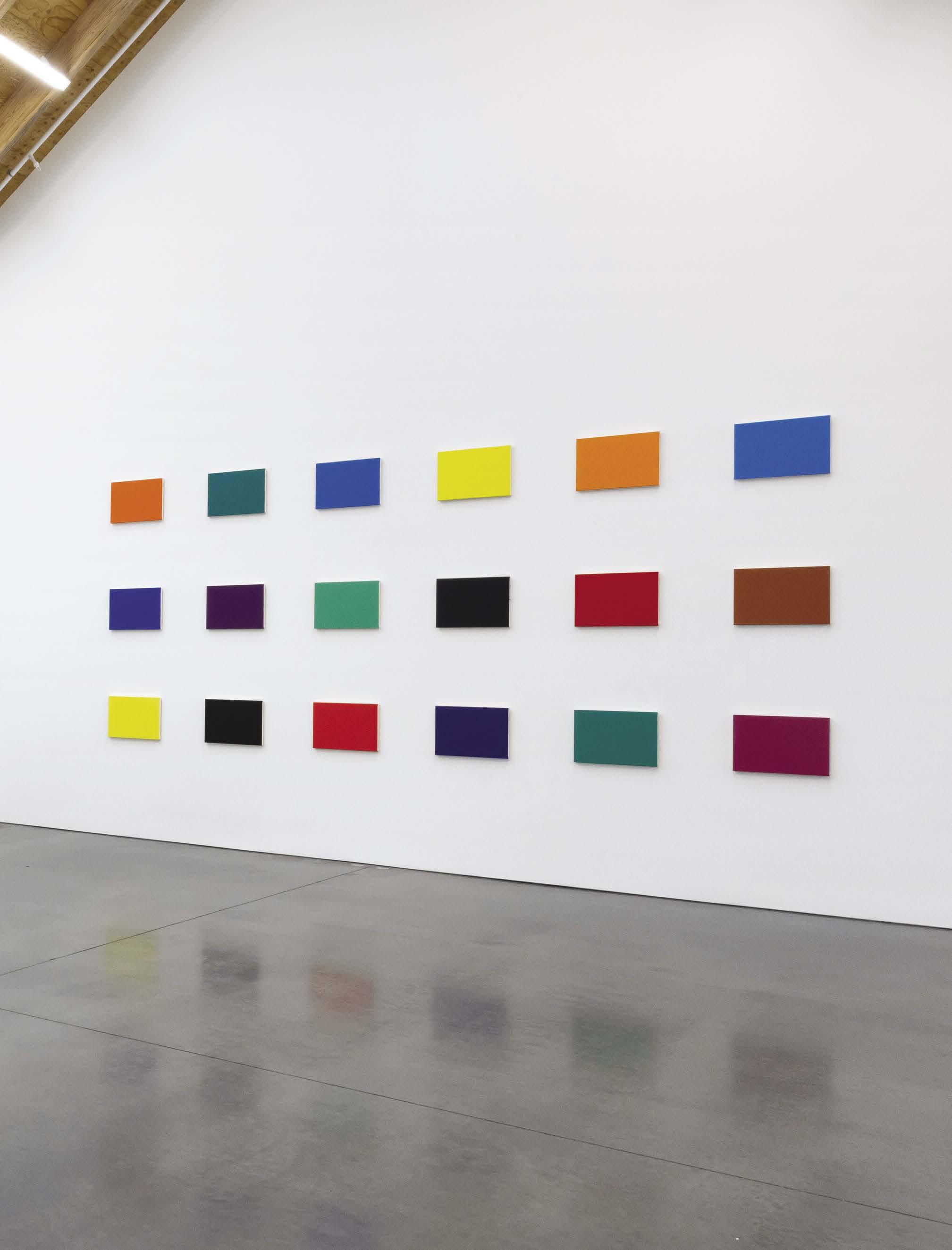
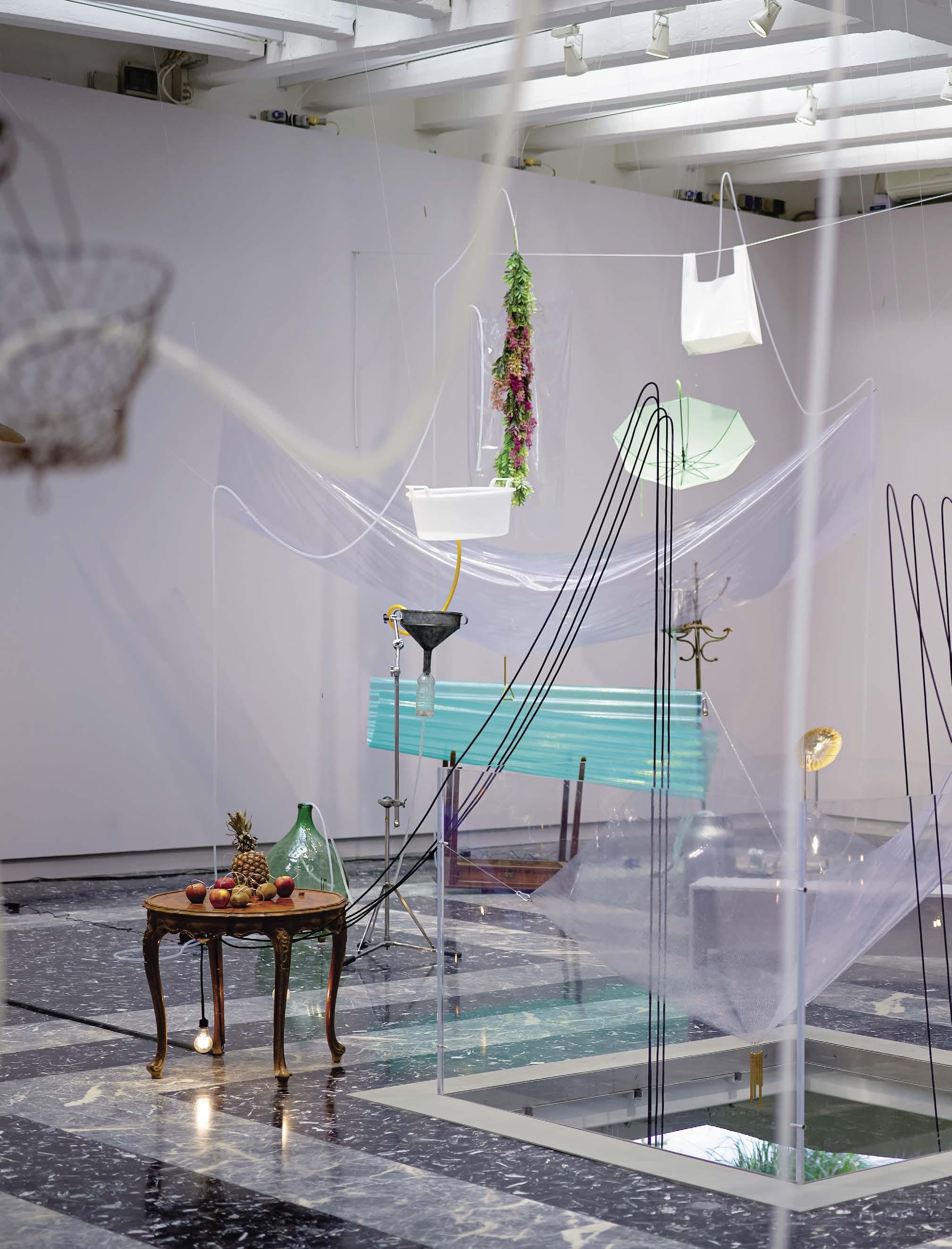
Calder Foundation announces 2026 Calder Prize Laureate
Yuko Mohri

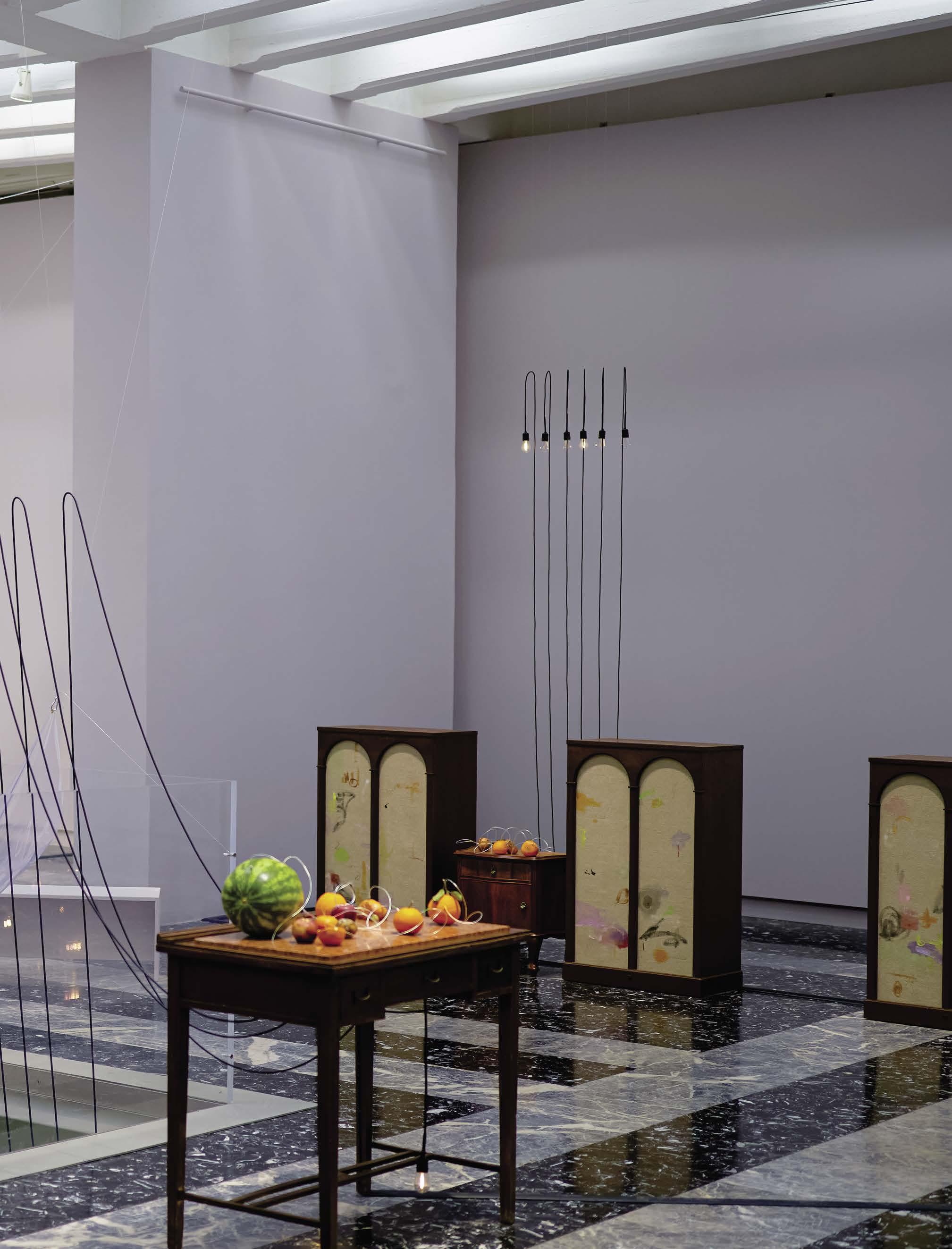
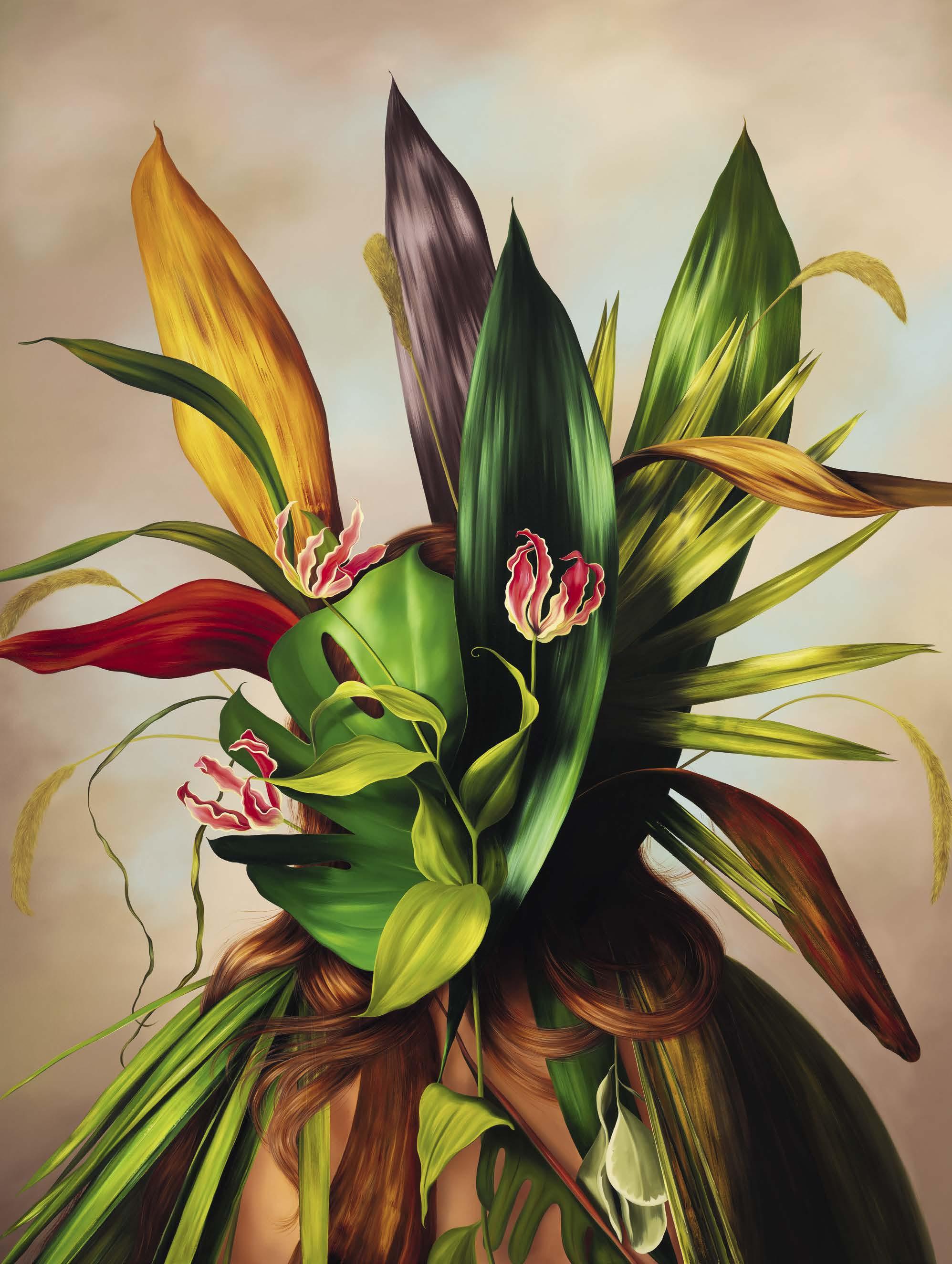
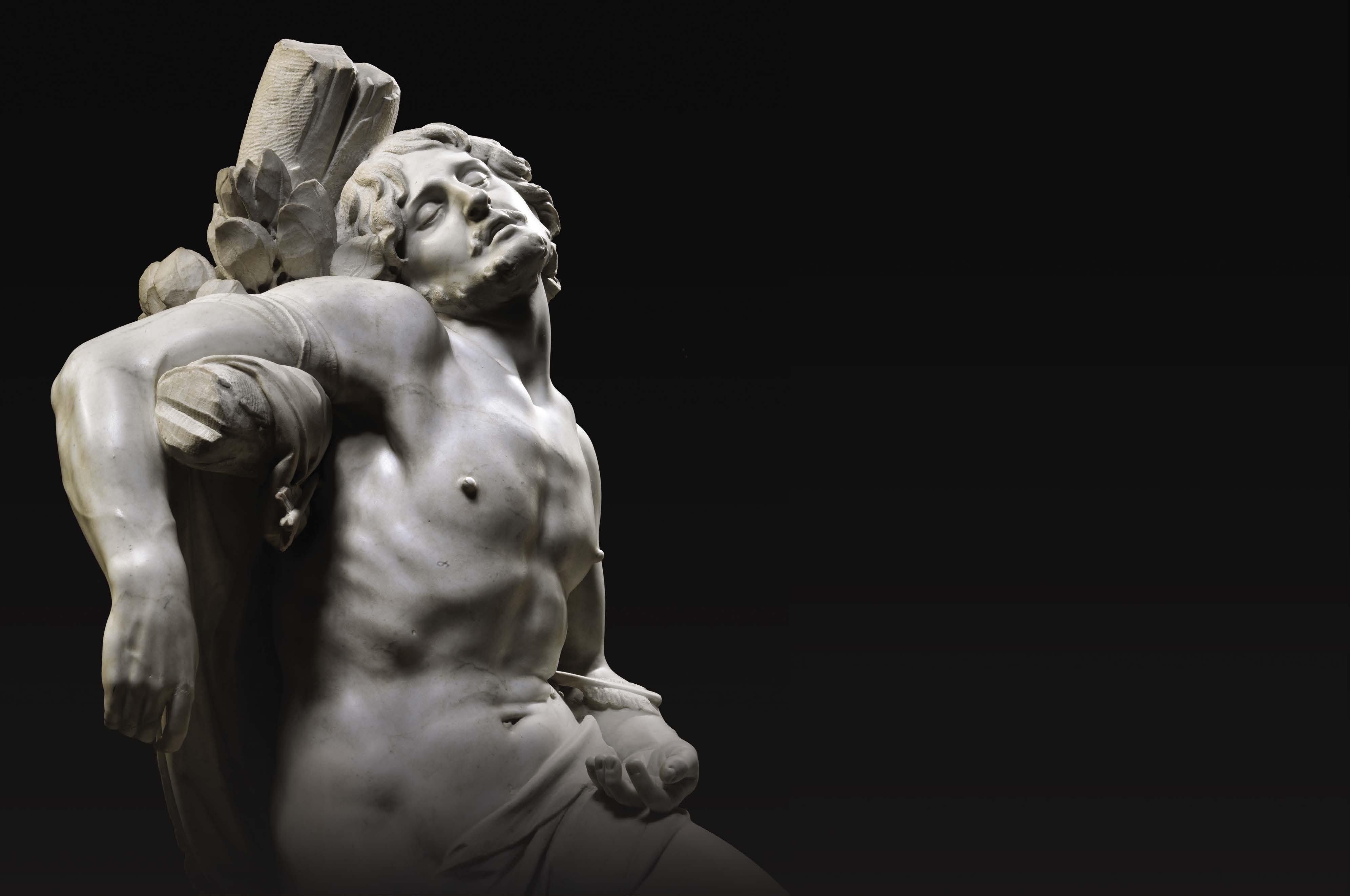
Christian House celebrates the generation-spanning and formally inventive photographs of Jacques-Henri Lartigue.
For the ten-year-old Jacques-Henri Lartigue, even taking a bath was a photo opportunity. This privileged and curious boy took his camera everywhere, from the beaches of Biarritz to the slopes of Saint Moritz. He took it to the car rallies, ice rinks, aerodromes, and ski jumps of fin de siècle France. And in 1904, he set his camera on a board laid across his bathtub, set the aperture and focus, and took a portrait of himself soaking in the suds, his little face emerging out of the water like a frog. His mother released the shutter.
In his youth, Lartigue captured the dawn of the twentieth century as a time of japes and escapades and the innocent pursuit of the new. But for more than fifty years this joyous body of work languished in a bundle of family albums. His story is one of luxury and obscurity, of a buried vision and a late resurrection.
Lartigue was born in 1894, into an haute bourgeoisie bubble. His father, Henri, was a successful banker—and enthusiastic balloonist—who gave his sons a cosseted life of fun, access, and opportunity. “I have plenty of money,” said Henri, “my children should learn how to spend it.” Jacques was given a chunky wooden plate camera when he was seven, and a catalogue of models
followed—Gaumont Block-Notes, Kodak Brownie, Klapp Takyr—each more advanced than the last. The boy was provided with a darkroom, developing chemicals, and a steady stream of subjects drawn from the comings and goings at their hôtel particulier in Paris. Lartigue’s oeuvre strikes an elegiac echo of lost times. When his talent emerged, between the dawn of the twentieth century and the cataclysm of World War I, it was intuitive and largely unseen outside his circle. Lartigue had four pillars of interest: speed, travel, family, and society. Sometimes all four elements overlapped in a single frame. “The subject always finds me,” he noted. “I am only the spectator. I don’t run after it.” With his tennis-player’s eye, he mastered the art of the instantané, the image of action frozen in motion. At his family’s estate in the Auvergne, he took pictures of family members, guests, and servants as they somersaulted into swimming pools, fell off go-karts, and leapt over chairs. When his older brother, Zissou, built a homemade glider, using sheets borrowed from the mansion’s laundry room, Jacques was on hand to capture the moment the wind lifted him off the ground.
Lartigue’s most famous photographs show the world shifting up a
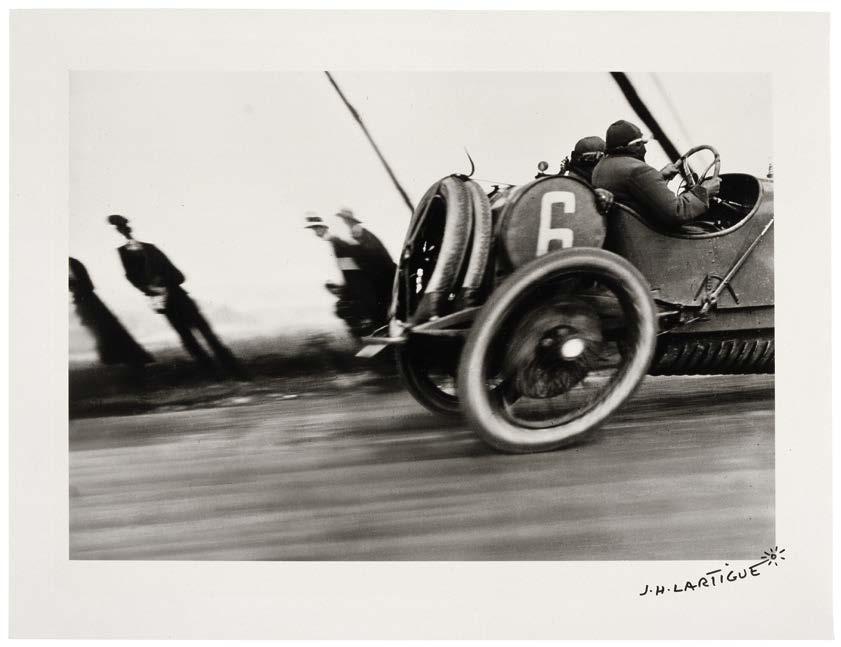
“I want to stop time,” he said. “As a boy I already had a passion for preserving the fleeting images of life.” The good life, that is.
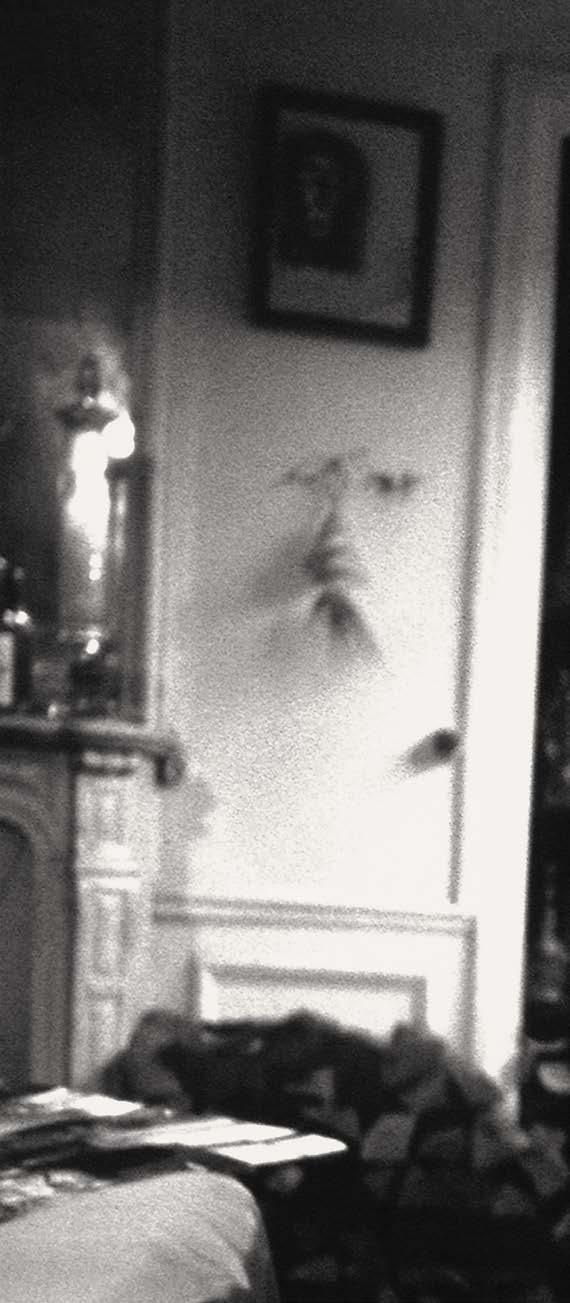
gear. Coming of age in the first decade of the century, he witnessed many of its spectacles: the pioneering flights of Louis Blériot, competitors hurtling down the avenues of Picardy during the French Grand Prix, and the skyhigh drama of the first Coupe Aéronautique Gordon Bennett gas-balloon race. But his work is also interesting for what it doesn’t show. The belle epoque was not belle for everyone: Lartigue’s photographs do not show the colonial subjects who bankrolled
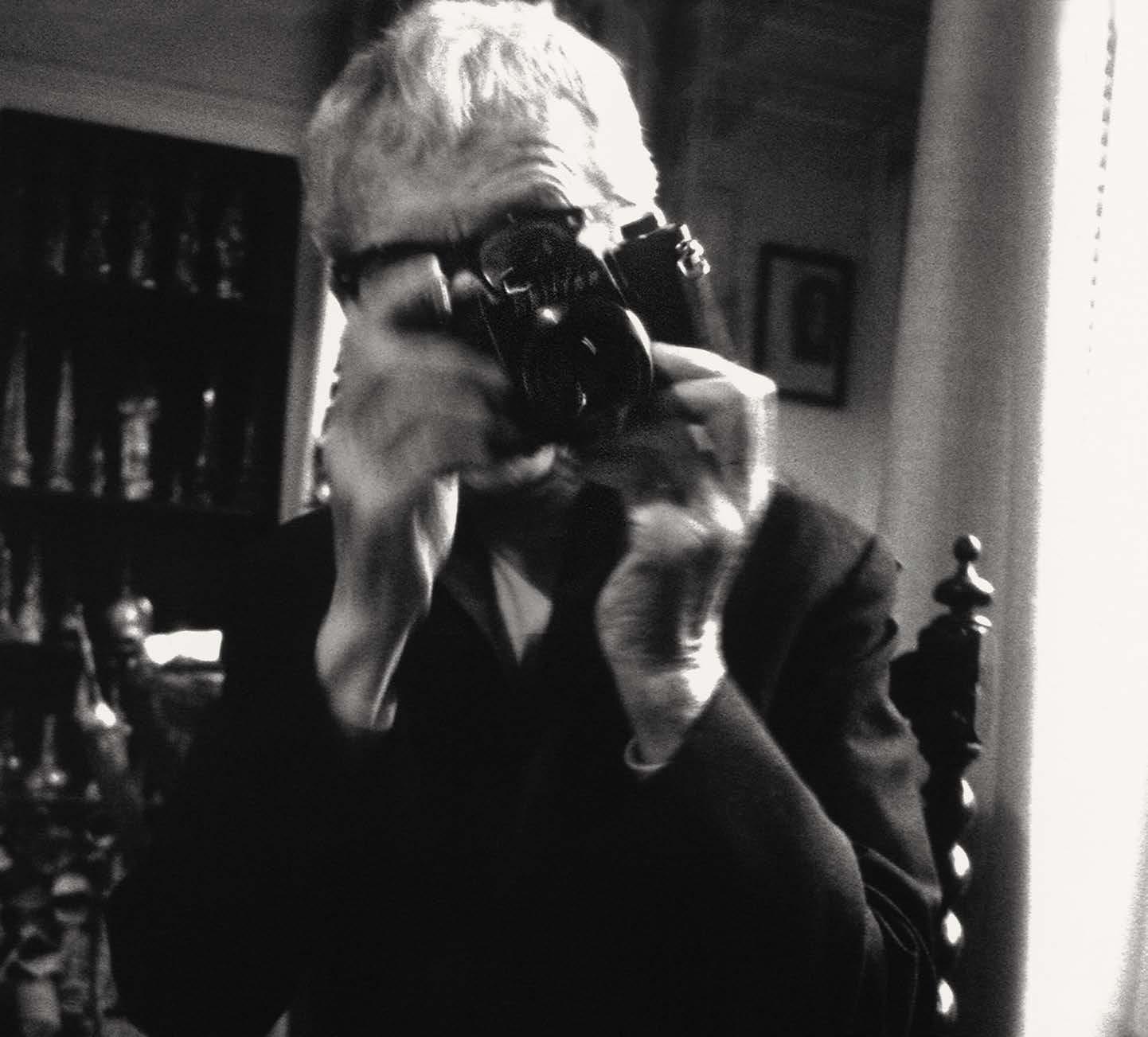
the period’s joie de vivre. This is a photographic microclimate. The Lartigue household included a valet, cook, butler, tutor, and private secretary, all of whom were expected to goof around for the young man’s camera.
Photography has always fallen foul of snobbery—the term “snapshot” hints at the flippant—but Lartigue’s understanding of composition and momentum could rival the Futurists at their easels. “He contrived noth -
ing,” wrote Cecil Beaton of Lartigue. “It is his utter straightforwardness that gives his work an abiding quality.” 1 (No one could spike a compliment quite like Beaton.)
War brought an end to the idyll.
Many of his subjects—aviators, divers, drivers, tobogganists—were destined for the trenches. Lartigue spent the war as a military chauffeur in Paris, but friends and cousins died at the front.
In later life, Lartigue developed a diverse and successful artistic prac-
tice that included writing, commercial illustration for couture houses, and oil painting (he studied at the Académie Julian and exhibited at the Galerie Georges Petit in Paris).
Recognition as a photographer, his great obsession, remained modest, however, although he took set pictures for film directors such as Robert Bresson and François Truffaut, and had pictures disseminated by the Rapho press agency. “He probably decided to become a painter be -
cause at this time the photo-reporter didn’t exist,” Marion Perceval, director of Donation Lartigue, observes of Lartigue’s early days behind the camera. “Becoming a professional photographer meant to have a studio and make traditional portraits.”
It was the Americans who eventually recognized his genius and brought him to an international audience. In 1963 the photography curator John Szarkowski championed him with a solo exhibition at the Museum of Modern Art, New York, and in 1970 the photographer Richard Avedon edited his monograph Diary of a Century. Unearthing Lartigue’s work was “like reading Proust for the first time,” Avedon would recall.2
The discovery of this uniquely talented amateur set a precedent for the unearthing of other obscure figures, such as the Chicago nanny-cumstreet-photographer Vivian Maier. And his fame has only increased in the years since, with the publication of Louise Baring’s excellent survey Lartigue: The Boy and the Belle Époque (2020) and several retrospective shows. This summer sees his mid-century color photographs celebrated in Jacques Henri Lartigue: Life in Colour, at the MK Gallery in Milton Keynes, England.
Lartigue took some 280,000 pictures, starting in the time of Claude Monet and ending in the era of Madonna. He died in 1986, aged ninetytwo. In his dotage, snowy-haired but still impish, he welcomed journalists to his home on the French Riviera, where he recollected the dazzling deeds of a blessed age. “I want to stop time,” he said. “As a boy I already had a passion for preserving the fleeting images of life.” The good life, that is.