Gadfly is supported by & Columbia University Undergraduate Philosophy Department
Editors
Editors-in-Chief
Aharon Dardik & William Freedman
Managing Editor
Eitan Zomberg
Chief Article Editor
Ray Knapick
Chief Interview Editor
Oscar Luckett
Chief Column Editor
Amelia Landis
Social Media Manager
Rose Clubok
Discussion Coordinator
Xavier Stiles
Design Editor
Axel Icazbalceta
Artists
Mim Datta, Vera Pankevich, Olena Teslia
Editors
Article Editors
Tessa Bannink, Yael Bright, Shrina Dong, Nora Estrada, Bohan Gao, Ignacio Hale Brown, Ashling Lee, Katharine Lee, Annie Lind, Mika Nitu, Telvia Perez, Sanaaya Rao, Joseph Said Kwaik, Jayin Sihm, Sebastian Verreli, Iris Wu
Interview Editors
Veronica Agudelo, Chimelu Ani, Camille Duran, Yunah Kwon, Eloise Maybank, Anna Ostlind, Vera Pankevich, Yoav Rafalin, Kaatje Vandenberg, Oscar Wolfe
Columnists
Suzanne Bigelow, Rose Clubok, Griffin Fadelin, Mica Helder-Lindt, Yongjae Kim, Daniel Knorek, Maya Koka, Josephine O’Brien, Manavi Sinha, Hanbo Yang, Fenris Zimmer
Letter from the Editors
Echoes of Loss: Grief, Memory, and the Search for Meaning
Payge Hardy, ed. Tessa Bannink
The Allure of Love Unspoken: What Nietzsche Can Teach Us About Unrequited Love
Bella Bromberg, ed. Yael Bright, Annie Lind Bare
Fatma Omer, ed. Telvia Perez, Joseph Said Kwaik
Patterns of Creation and Consumption: A Conversation with Michelle Rose Joseph Yunah Kwon, ed. Camille Duran
Sailing from Byzantium
Suzanne Bigelow, ed. Mika Nitu
Stranger in a Strange Land: On Non-places and Supermodernity
Yongjae Kim, ed. Ashling Lee
Here I Recollect
Hanbo Yang, ed. Bohan Gao doctor’s office; or the
Keith Peterson, ed. Iris Wu
Letter from
The skeleton the Editors
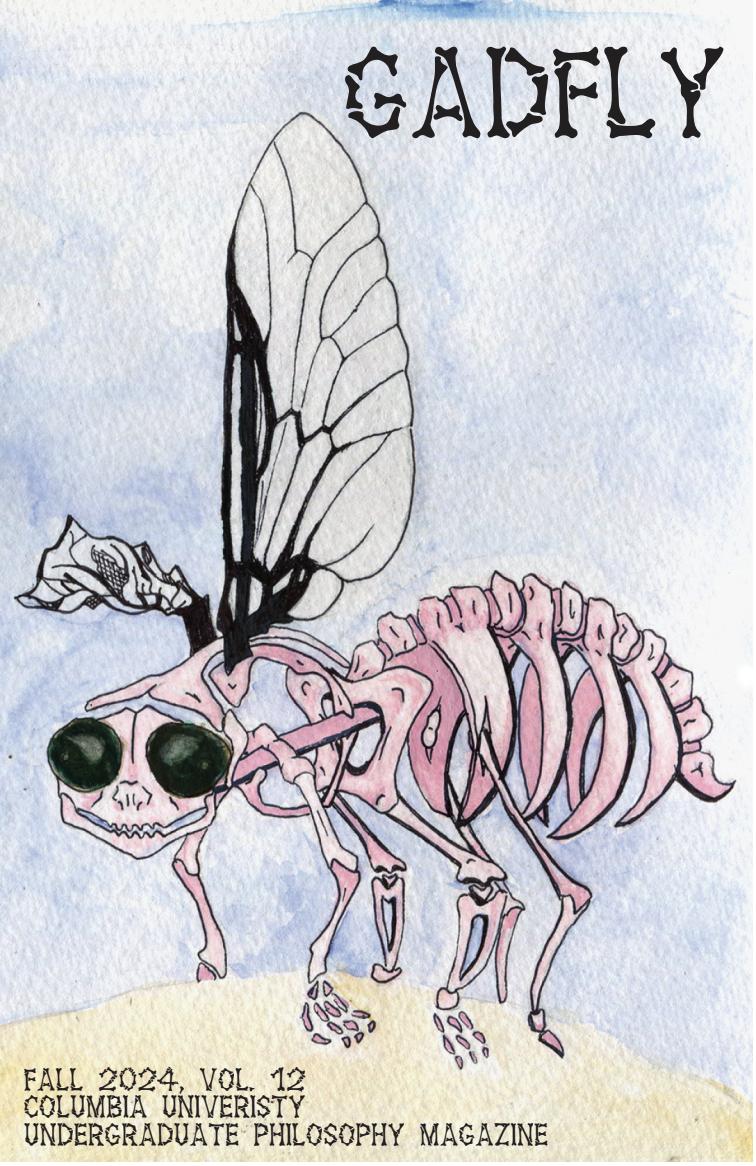
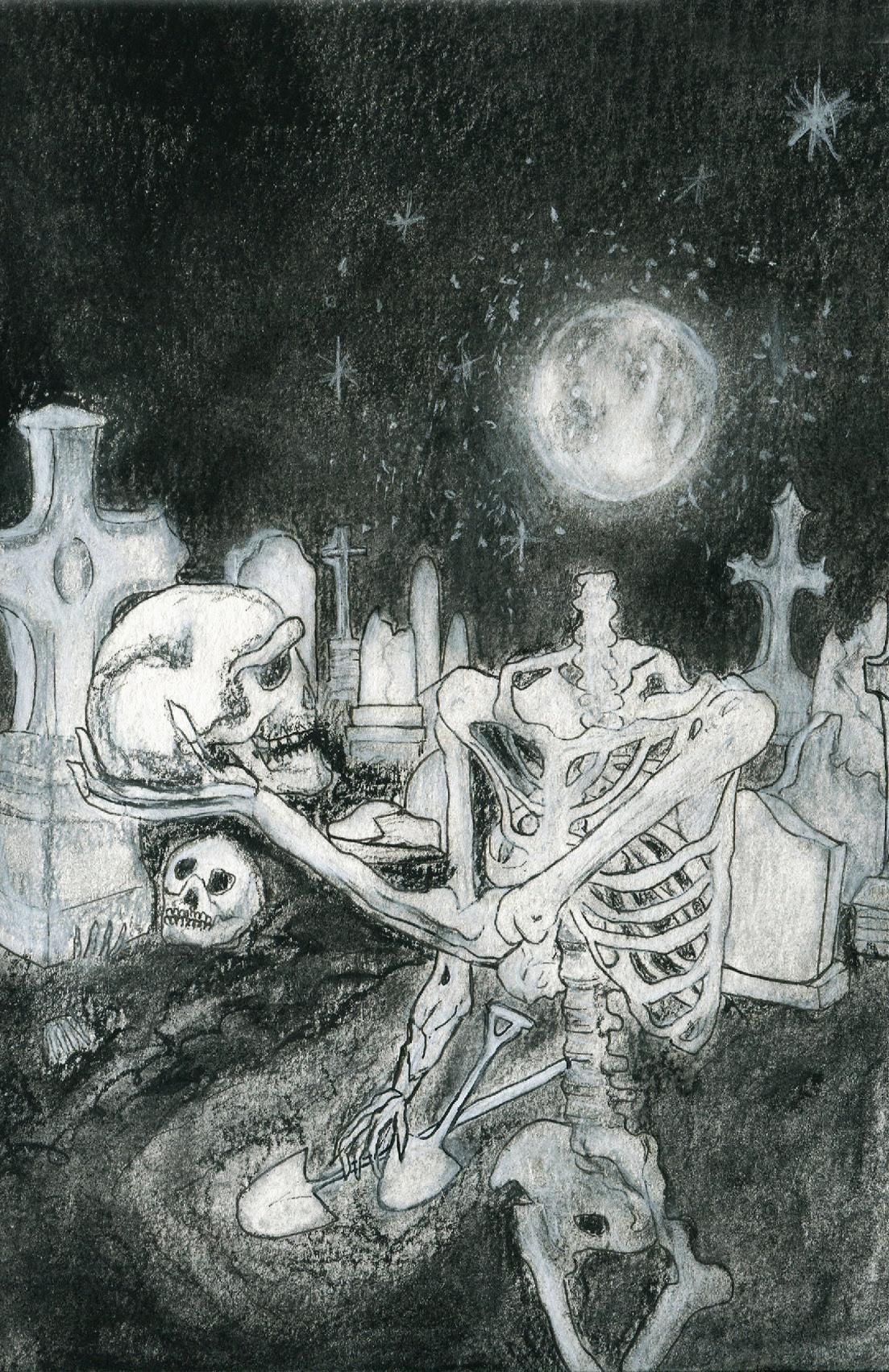
is a paradoxical object. Among all the symbols that represent death, none are as universal as the skeleton. Yet, this symbol of mortality is also the very structure that supports life itself—the literal and physical framework upon which our bodies are built. The irony of the skeleton as a symbol is that it could not be more closely related to life. This association stems largely from the context in which we encounter skeletons: unearthed from graves or tombs. They appear in places where life once was but no longer is, serving as stark reminders of our mortality.
These skeletons serve, through their endurance, as potentially our only window to view the past. When all else has been claimed by the passage of time, the skeleton remains. The skeleton tells an invaluable story about the life lived by the individual, often telling us about what they ate, how they walked, and frequently, how they died. However, observing a skeleton post-mortem, we are presented with merely a singular perspective on a
human life. We see the bones, joints, and physical structure that made that life possible. The view that a skeleton provides us is inherently limited. It tells us nothing of the fullness of the life it once supported. The skeleton withholds from us the complexity of the cultures, ideologies, and communities that were once as important to the body as any physical structure. It tells us nothing about their humor, their emotions, or the millions of the other particulars of human life.
At The Gadfly, we believe Philosophy functions in the same way. When we produce a work of Philosophy, we are, in essence, laying bare a part of who we are, both as individual writers and editors, but also as a community. The works in this edition of the magazine, like everything we produce, distill these complex relationships into structured arguments that serve as a glimpse into our community’s intellectual and creative landscape. They crystalize the intricate web of discussions and ideas that constitute what we are. The Philosophy contained
within the pages of this print edition cannot fully convey the richness and detail of the personal experiences of our Gadfly collective, but it does provide an x-ray of them: a snapshot of one perspective of our lives, at one particular time, informed by these ideas. Like an x-ray, this is not a complete or total picture, nor does it claim to be: yet it provides a uniquely penetrating look into the core of what animates us.
Don’t be fooled into thinking that the lack of totality of this print edition somehow delegitimizes the incredible ideas conveyed within. In fact, it’s within these focused snapshots that profound insights emerge. This magazine begins with one such insight, as Payge Hardy investigates her own relationship to death as she delves into the intricate tapestry of grief and identity following the sudden death of her mother. Through a fusion of intimate narrative and philosophical inquiry, she navigates the raw terrain of mourning, drawing upon Heidegger, Nietzsche, and Simone Weil to unravel how loss can both fracture and forge our sense of self. Unspoken love is a phantom
ache—haunting, yet irresistible. Bella Bromberg examines the bittersweet pull of unrequited love through Nietzsche’s philosophy, revealing how longing sustains the restless human spirit. Drawing on Nietzsche’s notion of the soul’s “skin of vanity” as a superficial covering, Bromberg contrasts it with the unseen yet essential support of the skeleton, which grants us both structure and the capacity to love. Through this contrast, she uncovers the beauty of love in its mystery, hope, and unyielding ache. Bromberg invites us to view unrequited love not as failure but as essential to the restless dance that animates the very skeleton of love itself.
Fatma Omer approaches the skeleton instead through the lens of political structures, analyzing anger as a constitutive element of Canadian patriotism. She analyzes the dual nature of anger as both a force for justice and a tool for maintaining hierarchies. Drawing on Amia Srinivasan’s concept of affective injustice, Omer reveals how the selective validation of emotions exposes fractures within society’s foundational framework, challenging our
understanding of unity and national identity.
In her interview with Michelle Rose Joseph, Yunah Kwon asks us to consider what it means to be an individual and artist within the skeleton of modern capitalism. Their discussion touches on the relationship between the artist and consumer, the role that companies play in shaping commercial trends, and the interaction between individual desire and corporate profit.
Human life is defined by its proximity to death—a tension between the ephemeral body and the longing soul. Suzanne Bigelow explores this tension through an examination of Catholic theology and philosophy, examining how suffering and labor prepare believers for the “artifice of eternity.” Drawing on St. Augustine, Bigelow reflects on how belief in an afterlife reconciles us to earthly pain while demanding self-denial and labor as preparation for eternity. She contrasts this Christian embrace of redemptive suffering with the ancient Greek exaltation of mortal beauty, asking whether we can reconcile a longing for transcendence with a celebration of ephemeral pleasures. By honoring both, Bigelow argues,
we achieve a more nuanced understanding of what it means to live—and die—as humans.
Continuing the structuralist analysis of our society, Yongjae Kim examines the skeleton of modern society through his reflections on a liminal experience in an airport terminal. Kim discusses
Walter Benjamin’s notion of “supermodernity,” lamenting the disappearance of spaces of genuine community and connection in light of the proliferation of “non-places” in the modern world.
Hanbo Yang constructs a story as skeletal as the memories it seeks to unearth, where recollections are brittle as bone and hollowed by time. The narrative strips war down to its bare scaffolding, exposing not its grand battles or political stratagems but the fragile motivations and human connections that remain once ideology is stripped away. Yang’s prose underscores how memory functions not as a complete body but as broken fragments of the past reassembled into a precarious form.
At the extremity of our magazine, Keith Peterson’s poem doctor’s office; or the phantastic gratification of reveal
plunges into the visceral tension between the body’s enigmatic depths and humanity’s desperate hunger to illuminate them. He renders the drama of diagnosis as both revelation and dissection—a moment of triumphal clarity that strips the body bare, reducing it to a fragile map of symptoms and signs. Peterson critiques the frameworks that box illness into patterns, showing how language mediates both the articulation of pain and the pleasure of this revelation. In the end, the poem evokes a haunting stasis: we are forever suspended in the “waiting rooms” of understanding, caught between the hope for new knowledge and the limitations of the systems we rely on.
We recognize that these works, while insightful, are inherently not comprehensive. They cannot capture the full breadth of experiences and perspectives that exist within our community. The cultural contexts, personal narratives, and emotional undertones that influence these
Best,
philosophical positions often remain hidden beneath the surface. However, this is where you, our readers, come into play. We invite you to engage deeply with the content presented, to read between the lines, and to consider the unseen facets that contribute to these philosophical skeletons. These cavities left from converting our own experiences into written works of philosophy are structurally impossible to avoid, and yet, can be seen as virtuous. An incomplete picture provides one with the space to ponder the mysteries of what was left behind, what sits on the cutting room floor, and what could not be put to words at all. These questions ask you to infuse these spaces with your own complexity, your own experiences, to breathe life back into our words. As our reader, we hope you understand yourself to be an active participant in the understanding of our work, and through that participation, animate our skeletal edition of this Gadfly magazine.
Aharon Dardik William Freedman
echoes of loss: grief, memory, and the search for meaning payge hardy, ed. tessa bannink
The past reverberates with her music—a sound that carved beauty into the air like a brushstroke across silence. My mother was not just a virtuoso; she was a visionary, a world-class saxophonist rated second in New Jersey for clarinet. Robin played with Disney, performed across Europe, and once even met the Pope—a testament to both her talent and the boundless reach of her spirit. Her laughter, as full and bright as her music, was an accompaniment to life itself, an assurance that I took as unassailable. But when her life ended suddenly and violently—a suspicious overdose at the age of 52—the symphony of my world halted, and in its place, a deafening silence. In the following twelve weeks, while her death was investigated—I poured myself into dark inquiries like marrow leaching into hollowed bones, filling the empty spaces with questions too heavy to bear but impossible to ignore.
It was a silence I had known since childhood, having never actually heard her play. When her music career didn’t manifest, she turned to another demanding art: cooking. She became a chef, committing herself fully to orchestrate the kitchen, finding the culinary
world might offer the rhythm and passion that music had once provided. Alack, as she became consumed by the demands of that new role, her artistry was quieted. Her saxophone lay untouched, its melodies a subdued rapture. She instead excelled in the kitchen as an exceptional leader and restaurant manager. Still, a part of me holds a quiet hope, a longing that perhaps one day, in another life or realm, I will have the chance to play beside her, to hear her music in the way I never could in this one.
The Greeks might have called this moment aporia—a visceral rupture, a paralysis of understanding. Philosophically, aporia is the fracture that demands resolution, a void where once there was coherence. I was left to contend with this fissure, this existential dislocation, where intellectual constructs crumbled under the weight of raw, unfathomable loss. My mother was not just a figure in my life but the foundation of it, the grounding rhythm in an otherwise unpredictable world.
Her absence revealed a paradox: my identity, shaped by her steady presence, became unmoored in her sudden absence. How could I come
into my “authentic self,” as Heidegger suggests, when the structure of my world was undone? Heidegger’s insistence in Being and Time that mortality clarifies existence feels painfully abstract in the shadow of real grief. Death may illuminate the fragility of life, but it also fractures identity, revealing how much of the self is bound to others.
In my mother’s absence, I found not clarity but fragmentation. The “specter of absence” was no guide to authenticity; it was a haunting force that unraveled the coherence of my being. Heidegger’s Being-towarddeath suggests that mortality is transformative, but the lived experience of grief shows that this transformation is not enlightenment—it is disarray.
In this disarray, Nietzsche’s amor fati became both a challenge and a solace. To embrace fate in all its brutality, as Nietzsche exhorts in Ecce Homo, is not to passively accept suffering but to affirm it as intrinsic to life’s totality. Nietzsche asks us to not merely endure pain but to love it—a radical reframing that forces us to see suffering as part of life’s creative energy.
In practice, this is an ontological challenge, one that requires a recalibration of perspective. For me, grief became the proving ground for amor fati. Could I affirm my mother’s death, not as a cruel detour from life’s beauty but as an integral thread in its tapestry? Nietzsche’s philosophy resists binary thinking: joy and sorrow are not opposites but intertwined aspects of existence. To love one’s fate is to embrace this complexity fully, even when it feels unbearable.
This existential praxis is not a retreat into fatalism. On the contrary, it is an act of creative engagement. My grief became not a weight to be borne but a force to be integrated. To affirm her absence was to honor her presence—to let her death shape me, not diminish me. This reframing did not make the pain less acute, but it imbued it with meaning. Amor fati is not about erasing grief; it is about transforming it into a source of vitality.
Simone Weil’s reflections on affliction deepened my understanding of this transformation. For Weil, suffering is a process of décréation—an unmaking of the self that exposes the rawness of the soul. In Gravity and Grace,
Weil argues that true suffering strips away the ego, leaving behind something raw, almost skeletal—a metaphysical vulnerability that exposes the fragile framework of existence. To grieve, then, is to endure a kind of spiritual crucifixion, where the self is both annihilated and remade. In this state, stripped of the insulating flesh of pride and self-delusion, what remains is the bare, trembling architecture
of the soul. It is here, in this stripped-down essentiality, that suffering lays bare the human condition: not a fortress of autonomy, but a scaffold of need, dependency, and longing for something beyond itself. Like bones exposed to the elements, the ego in suffering becomes weathered and brittle, yet it is precisely in this state of exposure that it holds the potential for transformation.
In the depths of mourning, I felt this rawness acutely. Grief unmade me, dismantling the constructs that had once defined me. Yet in this unmaking, I found a strange clarity—a connection to the essence of existence that felt both terrifying and transcendent. Weil’s notion of suffering as a conduit to grace resonated in these moments, not as a comfort but as a challenge: to endure grief is to confront the raw truth of our interconnectedness, to see the divine in the very act of being.
Weil’s framework illuminated the metaphysical dimensions of my loss. My mother’s death
was not just a personal tragedy; it was a rupture that laid bare the fragility and beauty of life itself. This is not solace—it is a reckoning.
In this reckoning, memory became a bridge between absence and presence. HansGeorg Gadamer’s concept of the fusion of horizons captures this dynamic interplay between past and present. Memory is not a static repository; it is a living dialogue, an evolving narrative that reshapes both our understanding of the past and our engagement with the present.
For me, memory was a form of resistance. Each recollection of my mother—her laughter, her advice, the imagined sound of her saxophone—was an act of reclamation. In Plato’s Meno, the doctrine of anamnesis suggests that learning is an act of remembering truths already known. Similarly, my grief became a process of rediscovery. Each fragment of memory was a piece of her essence, preserved against the erasure of death.
In this sense, memory is not merely psychological; it is metaphysical. It defies mortality by asserting continuity, by weaving the past
into the present in ways that resist finality. My mother’s presence, though transformed, remains active in my life—not as a relic, but as a living force that shapes my identity. Her reverie catalyzes my music today; her tenacity and strength are apparent in how I navigate being a new mother to my own precious daughter. I even feel her spirit conducting me in the kitchen.
The examined life has taught me that grief is not a puzzle to be solved but a mystery to be lived. My mother’s death has left me with no final answers, only a deeper engagement with the questions that define our existence. Yet, in carrying her memory, I also carry the
strength to confront these questions anew. Her music, her love, her cooking, her laughter and light, and even her untimely death are not remnants but living elements within me, threads that connect me to her and to the wider tapestry of human existence.
Her story, like her music, must not be silenced. It is a call to break the stigma that surrounds addiction, to confront the systems that failed her, and to honor her legacy by continuing the search for meaning in a world that so often feels devoid of it. In her absence, I find a presence that compels me forward—a memento mori that reminds me of the beauty and fragility of life itself.
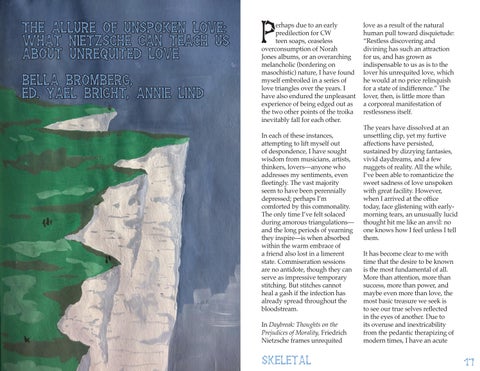
THE ALLURE of unspoken love: what nietzsche can teach us about unrequited love
bella
bromberg, ed. Yael Bright, annie lind
Perhaps due to an early predilection for CW teen soaps, ceaseless overconsumption of Norah Jones albums, or an overarching melancholic (bordering on masochistic) nature, I have found myself embroiled in a series of love triangles over the years. I have also endured the unpleasant experience of being edged out as the two other points of the troika inevitably fall for each other.
In each of these instances, attempting to lift myself out of despondence, I have sought wisdom from musicians, artists, thinkers, lovers—anyone who addresses my sentiments, even fleetingly. The vast majority seem to have been perennially depressed; perhaps I’m comforted by this commonality. The only time I’ve felt solaced during amorous triangulations— and the long periods of yearning they inspire—is when absorbed within the warm embrace of a friend also lost in a limerent state. Commiseration sessions are no antidote, though they can serve as impressive temporary stitching. But stitches cannot heal a gash if the infection has already spread throughout the bloodstream.
love as a result of the natural human pull toward disquietude: “Restless discovering and divining has such an attraction for us, and has grown as indispensable to us as is to the lover his unrequited love, which he would at no price relinquish for a state of indifference.” The lover, then, is little more than a corporeal manifestation of restlessness itself.
The years have dissolved at an unsettling clip, yet my furtive affections have persisted, sustained by dizzying fantasies, vivid daydreams, and a few nuggets of reality. All the while, I’ve been able to romanticize the sweet sadness of love unspoken with great facility. However, when I arrived at the office today, face glistening with earlymorning tears, an unusually lucid thought hit me like an anvil: no one knows how I feel unless I tell them.
In Daybreak: Thoughts on the Prejudices of Morality, Friedrich Nietzsche frames unrequited
It has become clear to me with time that the desire to be known is the most fundamental of all. More than attention, more than success, more than power, and maybe even more than love, the most basic treasure we seek is to see our true selves reflected in the eyes of another. Due to its overuse and inextricability from the pedantic therapizing of modern times, I have an acute
aversion to that bumper-sticker concept of wanting to feel seen. It is simply not enough. Sight seldom advances past the skin. And yet to be known is to be comprehended so deeply and intimately that you feel your very bones are laid bare.
In Human, All Too Human: A Book for Free Spirits, Nietzsche clarifies the relationship between bones and skin as part of a philosophical aphorism. Listing the foodstuff of the human form, he spares no gore. “As the bones, flesh, entrails and blood vessels are enclosed by a skin that renders the aspect of men endurable,” he writes, “so the impulses and passions of the soul are enclosed by vanity: it is the skin of the soul.” Nietzsche emphasizes the superficiality of that outer layer. Vanity, he contends, is the soul’s skin. A person’s genuine substance lies in their skeleton, their plasma, their guts, their flesh. Skin is merely an opaque lacquer—if left unpierced, the true self remains shrouded, inaccessible to any outsider.
His use of the word “flesh” is particularly striking. All too often, the terms “flesh” and “skin” are conflated. But the two are not interchangeable. Flesh: the soft tissue beneath the skin and atop the bones—that which
lies between. Skin: that which grazes the air, that which joins with reality.
Bones, conversely, are confined inside this cloak of flesh, skin, and entrails. They never see the light of day. Nonetheless, the body—and the precious organs housed within—depend upon the scaffolding that they provide. The skeleton’s structure protects the heart, and by extension, our capacity to love.
This idea of the skeletal system being closer to the heart than the epidermis may seem confounding. After all, human attraction, both sexual and emotional, is typically outlined in terms of skin and touch. We know that we desire someone when our hands meet for the first time, then our lips, then the rest of us. But if skin is just vanity, as Nietzsche claims, then is all attraction shallow, simply a misunderstanding? Shouldn’t our bones instead be the drivers of desire?
Perhaps, just like those intimately buried bones, the greatest appeal of love is its element of mystery.
A step further: I’d contend that unrequited love is even more enticing than reciprocal love. With half of the dynamic hidden, there’s double to dream about. And a secret makes for much
more imaginative dreams.
It is not lost on me that each day I conceal my feelings is another day that I prevent myself from being known. Who am I to lament the pains of unrequited love, when I continue to isolate in lovesick stagnation?
In Daybreak, Nietzsche writes that “[t]he drive to knowledge has become too strong for us to be able to want happiness without knowledge or of a strong, firmly rooted delusion; even to imagine such a state of things is painful to us!”
Maybe I’m afraid of exiting my delusion. It may be batty and twisted and silly, but it’s also comforting in its chronicity. The intoxicating quirk of secret love is that it remains pure, untainted. Ache persists, but so does hope. Your heart cannot be broken if you never lay it on the table. But, admittedly, I am breaking my own heart already.
Earlier this year, I sought wisdom from a former Columbia professor: Mark C. Taylor. His words brought relief and offered a new perspective. The truth is, Nietzsche himself bumped up against many of the same complications.
“The only love Nietzsche
knew was unrequited,” Taylor explained. “He was terminally restless and wandered from hotel to hotel until he went mad. And yet, he danced, he danced every night, always alone in a strange room.”
Dancing amid heartbreak. It’s a rather beautiful image, and one I hope to emulate.
“What keeps us going in life and in relationships is that there is always something missing, something lacking,” Taylor told me. “When you think you have everything and everyone figured out, life is over even if you are still living. Keep reading, keep thinking, keep writing, keep desiring. This is the expression of the most profound love.”
bare bones patriotism: unveiling fractures through the lens of anger
fatma omer, ed. telvia perez, joseph said kwaik
When patriotism sheds its comforting façade, what remains is the skeleton that forms the foundation of national identity—revealing motives that can unite or divide. Stripped to its bones, patriotism exposes the structural framework of society, highlighting both its strengths and its fractures. Patriotism, often perceived as a unifying force, rather conceals deepseated fissures within the societal skeleton by selectively validating certain types of anger while suppressing others. At its core, anger—a complex emotion characterized by feelings of frustration, indignation, or hostility—often intertwines with expressions of national identity. However, not all anger is the same. In the context of patriotism, we encounter two distinct types: the anger of marginalized groups seeking justice and the exclusionary anger that aims to maintain existing hierarchies. By examining these divergent forms of anger, we uncover how the selective validation of emotions perpetuates systemic injustices and undermines genuine unity. Ultimately, to transform patriotism into a genuine commitment to inclusion and collective identity, it is essential to
recognize and address these biases within its foundational skeletal structure.
For some, anger becomes a righteous catalyst for change, acting as the marrow within the bones of societal progress. Outrage over systemic injustices prompts society to confront entrenched power structures. Within Canada, this righteousness is embodied in the anger of marginalized communities—Indigenous peoples, immigrants, and other minority groups— whose grievances stem from experiences of oppression. Conversely, there exists an exclusionary anger that seeks to preserve existing hierarchies and resist social change. Often masquerading as patriotic concern, this anger is rooted in racism and xenophobia, fueled by fear of the “other” and a desire to maintain the status quo.
Patriotism, commonly promoted as an inclusive ideal that unites all citizens, shares a complex relationship with these divergent forms of anger. When harnessed under the banner of national pride, exclusionary anger can act as a veneer over the fractures in the nation’s skeletal framework, masking the underlying divisions.
This politicized anger reveals superficial justifications for division in societies that claim to be virtuous even as they marginalize others.
Amia Srinivasan, a philosopher known for her work on anger and justice, introduces the concept of affective injustice to illuminate this conflict between perceived unity and underlying division. By analyzing how society expects marginalized individuals to suppress their legitimate anger to conform with norms favoring the comfort of the majority, Srinivasan, in her 2018 journal article “The Aptness of Anger,” exposes the mechanisms that perpetuate systemic inequities. She defines anger as an emotion that signals moral transgressions and demands accountability. The suppression of marginalized anger not only silences these voices but also maintains the illusion of unity while ignoring deep-seated injustices. Recognizing this affective injustice is crucial for addressing the root causes of division.
In Canada, these dynamics are particularly evident. Exclusionary anger over issues such as immigration, Indigenous rights, and cultural identity often hides behind
the socially acceptable guise of patriotic concern. Fears rooted in racism and colonialism are framed as defenses against perceived threats to national security, cultural cohesion, or economic stability. For example, some people motivated by exclusionary anger advocate for stricter immigration policies, under the belief that strong borders are necessary to protect national interests and preserve cultural identity. This perspective is presented as rational and patriotic, appealing to the desire for societal stability. However, it can mask underlying prejudices and fears of the “other,” perpetuating exclusion, even unintentionally.
This selective validation of anger creates a hierarchy of emotions that sustains inequality, permitting certain voices while silencing others under the guise of unity and civility. The anger of marginalized communities— rooted in experiences of systemic exclusion—is often dismissed as irrational or disruptive. Conversely, the exclusionary anger of majority groups is frequently framed as rational, patriotic, and legitimate because it aligns with perceived existential threats to Canadian society
and civilization. By positioning their concerns as matters of national interest, majority groups justify their anger as necessary for preserving the nation’s backbone, even when it excludes others.
Furthermore, Srinivasan critiques how the pressure to conform anger to norms of civility often enforces compliance with the status quo. She argues that calls for civility can delegitimize the anger of marginalized groups by
forcing them into more socially acceptable, restrained forms of dissent—such as peaceful protests or polite petitions— that are palatable to those in power. This pressure dilutes the intensity of their message and caters to the comfort of the majority, making it easier to ignore their grievances. For instance, when people discuss Indigenous protests against pipeline developments more for their disruptive tactics than for the injustices they highlight, they shift the focus away from
the need for change.
By analyzing this double standard, we uncover how civility becomes a gatekeeping mechanism in the public sphere, restricting full participation to those who adopt an “acceptable” emotional posture—namely, a calm and composed demeanor that does not challenge the majority’s comfort. In Canada, this acceptable emotional posture often involves expressing concerns through formal channels and avoiding displays of anger that could be seen as confrontational. According to Srinivasan, this double standard creates an atmosphere where patriotism is less about shared values and more about preserving social homogeneity under a
superficial veneer of unity.
Anger’s role in political discourse is further complicated by what Srinivasan calls the counterproductivity critique of anger, which posits that expressing anger publicly can harm the very goals it seeks to achieve. In Canadian patriotism, this critique is often used to discourage dissent from marginalized groups, implying they should forgo anger in favor of rational discourse. While exclusionary anger is openly expressed and accepted as a legitimate expression of patriotic concern, the anger of marginalized people is critiqued and deemed counterproductive. This disparity highlights how civility is selectively applied to suppress certain voices while allowing others to dominate the conversation.
Srinivasan challenges this notion by arguing that anger serves purposes beyond protest: it acknowledges moral violations and calls for accountability. By discouraging marginalized anger under the banner of patriotism, societies may preserve systemic inequities while silencing valid dissent. The acceptance of exclusionary anger and the suppression of marginalized
anger reveal fractures within the skeletal framework of patriotism that support existing power structures rather than promoting genuine unity.
This critique also touches upon the historical role of anger as a force for justice. According to American political philosopher Myisha Cherry, in her article “On James Baldwin and Black Rage,” figures like James Baldwin, an African American writer and civil rights activist, emphasized that anger, though uncomfortable, is often the most fitting response to systemic injustice because it confronts the reality of oppression and demands change. Similarly, in Canada, demands for marginalized groups to restrain their anger can obscure the reality of injustice, framing their grievances as disruptions rather than legitimate concerns. As Srinivasan posits, a society that enforces affective conformity undermines not only the expression of grievances but also the moral integrity of its discourse on unity.
By imposing norms of civility, dominant groups not only suppress marginalized anger but also utilize patriotic rhetoric to frame exclusionary anger as acceptable. They present
exclusionary anger as rational and necessary for the protection of national interests such as security, economic stability, or cultural preservation. Patriotism thus becomes a tool for controlling which emotions are deemed appropriate in public discourse, further entrenching power imbalances. This manipulation of patriotic sentiment allows exclusionary anger to flourish under the guise of national interest while silencing calls for justice from marginalized communities.
This tension between patriotism as an inclusive ideal and as a tool for division challenges the authenticity of Canadian unity. How can a nation reconcile its image of inclusivity with actions that marginalize certain groups? The fractures in the structure of Canadian patriotism expose a troubling truth: when exclusionary anger is selectively tolerated while marginalized anger is suppressed, unity is corroded rather than upheld. These fissures become apparent when examining events like the 2022 Freedom Convoy, which began as a protest for bodily autonomy but quickly revealed deeper exclusionary undertones as some participants displayed extremist and racist symbols such as Confederate flags and
swastikas.
To foster a society rooted in authentic solidarity, Canada must mend the fractures within its patriotic skeleton by dismantling the biases that allow exclusionary impulses to thrive. Recognizing that justice for marginalized groups is a national interest is crucial. By acknowledging the legitimacy of marginalized anger and critically examining exclusionary anger disguised as patriotic concern, society can move toward genuine unity. As Srinivasan suggests, allowing space for righteous anger can be a powerful step toward dismantling systemic injustices and fostering true inclusivity.
Ultimately, patriotism must transcend a hollow skeletal structure that conceals fractures within society. It needs to be reconstituted with the bones of inclusivity and the marrow of justice. Srinivasan’s critique of anger as a necessary and precarious force challenges us to assess whether patriotism genuinely seeks to strengthen society or merely serves as an excuse for division. Only by confronting these biases can patriotism evolve from an instrument of division into a genuine commitment to inclusion and collective identity.
Cherry, Myisha. “On James Baldwin and Black Rage.” Critical Philosophy of Race, vol. 10, no. 1, 2022, pp. 1–21. Penn State University Press, doi:10.5325/critphilrace.10.1.0001.
Ferguson, Laura. “‘Freedom Convoy’ Supporter Says Confederate Flag on His Truck a ‘Rebel Sign.’” CTV News, 12 Jan. 2023, https://www.ctvnews.ca/canada/ freedom-convoy-supporter-says-confederate-flag-on-histruck-a-rebel-sign-1.6227288.
Srinivasan, Amia. “The Aptness of Anger.” The Journal of Political Philosophy, vol. 26, no. 2, 2018, pp. 123–144. doi:10.1111/jopp.12130.
Patterns of creation and consumption: a conversation with michelle rose joseph yunah kwon, ed. Camille duran
Michelle Rose Joseph is a writer, strategist, and advisor exploring intersections of design, culture, and business with a focus on the arts and hospitality sectors. She is the creator of Pattern Recognition, an interdisciplinary newsletter examining contemporary trends through a critical lens. Based in Brooklyn, she serves on the board of Chashama, a nonprofit dedicated to repurposing vacant spaces for artists. Michelle holds a degree in Comparative Literature from Princeton University and an MBA from Harvard Business School. Her recent projects include collaborations with emerging creatives to reimagine cultural spaces and experiences.
This interview was conducted by Yunah Kwon and edited for brevity and clarity by Camille Duran.
Gadfly: In your newsletter Pattern Recognition, you argue that creativity arises from identifying patterns and then subverting or re-contextualizing them. In today’s era of constant imitation and variation, what is the “it” factor that makes certain art or trends resonate? How does the desire to recognize and reinvent patterns contribute to this resonance?
Michelle Rose Joseph: At its essence, something that’s creative requires an understanding of the “current” and a perspective on the baseline, whether it’s cultural trends or other mediums that are already in existence. The idea of identifying patterns is at the root of creativity because that’s how you can then subvert them. I think creativity is a
relative concept, so something can take root in a different way based on the time and context surrounding it.
How would you define that context? How does the context change?
If we’re talking about the traditional creative mediums like music or art, the context can mean other works produced contemporaneously, or anything that’s part of the cultural dialogue at the moment. I think it’s also related to the human condition in a way: what are societal factors going on at that time? How are people relating to each other, to work, to art, to the economy? There’s just a broader awareness of where things sit in a cultural moment that defines what resonates with an individual or with the
community or with culture at large at any given time. There’s a relationship between the way that people engage with something that is tied to the broader cultural moment, to use that same term again.
To you, is there a medium of art or industry that speaks to you as one that you can more directly connect with?
Going back to the hospitality space in particular, part of why I love it so much is that I think there are few places or industries that have that convergence of all elements of creativity as well as all elements of business and operations. As someone who identifies as this rare breed of person who is somewhat equally left brained and right brained, I fell in love with the space as something that uniquely activates both sides of thinking. If you’re thinking about opening a hotel, you need to think about the interest rate environment, the cost of development, your materials, your labor and your staffing. But it also includes design and the aesthetic experience and the deepest understanding of human nature and the way that people interact with each other. How are they going to engage when they’re in this space? What are
they going to the hotel for?
There are different trip types, whether it’s a business traveler or otherwise, and I think hotels and other hospitality spaces and restaurants are in the small set of places where so many ideas and people converge, and I feel like that’s really exciting.
It seems that allows you a lot of creative flexibility.
Yeah, it’s allowed me to not have to choose one track. I am interested in a lot of things, and it’s one of the few areas where you can never get bored.
You mentioned your mix of “left brain” and “right brain,” could you elaborate on how you think about those concepts?
The traditional definitions would be that the left brain is more analytical and detail oriented, with the right brain being the more emotional and creative sides of things. I’ve always thought of myself as having this kind of weird set of background and experience. If you were to look at my resume for example, in undergrad I studied Comparative Literature, but I also spent half of my career in traditional finance and investment banking, operating and
investing in startups. I used to think that you had to pick a lane, or that you had to be one type of person. But I think that we tend to compartmentalize because it’s easier to process information if you think in one industry at a time. Even in the inclination to define someone as being left brained and right brained, I think it is just a way that we process information. When you broaden your mindset beyond that, that’s when all the exciting things happen.
In my mind, the reason that I’m good at math and finance but also have a real appreciation for the visual arts is an attention to detail that crosses the barrier between both sides. It’s kind of the same underlying threads across the left brain and right brain, and the broader thread across my newsletter overall is this idea of multidisciplinary
perspectives. By spending time in my career across different disciplines, I’ve been able to draw interesting conclusions between them. I spent several years working in the health tech space, and then had also worked at Reformation briefly, and have a love for the fashion industry, that ended up being the inspiration behind one of my articles about the ways in which the fashion industry reminds me of the US healthcare system. So I think being able to expose yourself to a lot of different things allows for interesting ideas to come up.
This ties back to the hospitality space or community and physical spaces; I had spent some time out in Dubai to launch an incubator for early stage tech startups called Astrolabs, and in thinking about how to set up the space, I was doing research on the development of Pixar. A lot of the premise behind the way that the open coworking floor plan was first developed was around creating an opportunity for creative collisions; for people from different functional areas to just bump into each other. I think that that’s also behind the idea of a multidisciplinary approach and bringing together people
with different ideas, because that’s where interesting things happen.
I’m thinking of Habermas’ notion of the public sphere where private individuals convene as a public to express societal needs distinct from commodity exchange. It seems that the private creative aspects of industries like hospitality increasingly overlap with the market and public realms. Given that even nonprofits and museums operate within a capitalist framework, is there truly a private sphere within the art world anymore?
Broadly speaking, I think it’s all connected. I also work with a nonprofit, and I’ve seen, whether in the creative industries, hospitality space,
or in nonprofits, everything fits within a broader social ecosystem that has certain demands and constraints. I don’t know if commercial viability is the right word, but being able to play within the guardrails is often an essential part of creative works. Sometimes it’s a necessary evil, but there’s a positive way of looking at it too, where some of the most renowned creatives would tell you that restraint is one of the best tools to reinforce creativity.
I think about this from an entrepreneurship lens as well. Startups that have access to limited funding are forced to be resourceful, and that ends up prompting new ideas.
“Necessity is the mother of innovation.” So I think it’s a matter of perspective and also a matter of the fact that there is no clear distinction between the creative world and the commercial world. They all need to reinforce each other.
KASA, one of the startups that I work at full-time right now, has a white label product called Powered by KASA which I’m helping develop. What this product enables us to do is work with brands that are true creatives and are thinking about it from the vision of an experience that they want to
build, while improving their profit margins. By partnering with them, you get what we call a one plus one equals three opportunity, whereby improving the margin profile for these brands they get more flexibility to then think more creatively. So I think some of the foundational elements that may be more quantitative or more commercial, more economically driven, can help reinforce creative elements.
Is there a difference between working in the hospitality industry, where the goal explicitly is to try to make profit off of creativity and trying to gear your products to a market, versus working as a visual artist which seems, at least on its face, more disconnected from market forces? Do consumerism and the market force you to redefine what art means?
Would you consider the hospitality industry a different type of art, or do you see artistic creativity on a gradient?
It’s probably a gradient, though I wouldn’t say that one is art or one is not. I think both visual art and hospitality are in service of an experience for the receiver of that art. There are probably more constraints
on the hospitality space relative to visual art, just because it needs to perpetuate a repetitive nature and it’s more real time than visual arts. I actually had a close friend of mine from business school who ended up falling in love with the hospitality industry and started studying to be a chef because of an incredible dining experience where, having a theater background, she realized that going to the restaurant felt like a performance, but one that had to be done on a recurring basis. I think in many ways, hospitality is the same act of putting on a performance, but a constant performance needed to keep the lights on.
A lot of brands try to predict what the audience is going to want next, but at the same time have huge marketing teams to try and drive that trend themselves. How do you view these kinds of societal and artistic trends?
In some senses, yes, there are a lot of consultants that are paid to be trend forecasters. And those forecasts can often be self-fulfilling in the echo chambers of the social media world that we live in now, where it’s almost impossible to differentiate between a genuine perspective and what
is just being reinforced by an algorithm. I do think, however, there are also more innate ideas that perpetuate a change in the way products are developed. I was reading that Starbucks is going back to introducing the handwritten names on cups, which is a decision that isn’t purely economically driven. Unless you consider the trend factor, it’s not going to be better for their bottom line to have their staff spending the time doing that. But I think in the context of where we’ve gone in the past decade, it’s part of a consumer or customer desire to revert to things that we might have missed or feel like we’ve lost. So that’s an example of something that is less about trend forecasts and more about an innate, human desire that is then being picked up on by a brand as a way to appeal to more consumers, even if on the surface it’s in opposition to the way that they would think about their profit margins.
There seems to be this dual nature of businesses trying to promote themselves in a certain image, but ultimately the goal is to gain more traction. Baudrillard argued that modern consumerism leads to a detachment for reality, where “goods are no longer valued for their utility,
but for signs and symbols they represent, consumption becomes a way of producing meaning in a world dominated by images and simulations.”
I’m wondering if there’s the difference between what businesses are actually giving and what the individual actually wants. Do you think individual desires even exist in this heavily marketing driven world?
I think so, yes. I feel like there are innate elements of human emotion, desires, and some of those have been universal for all of time. I think they get obfuscated the more that you’re surrounded by complexity. We live in a noisier world today than we ever have before, and it’ll probably just get noisier. But I don’t think that that necessarily changes an individual’s innate perspectives and desires and wants. I think it just becomes harder to discern what you really think from what others are projecting, I suppose. You have to take a step back and really think, whether it’s through meditation or traveling or putting yourself in other situations. This also goes back to needing your own taste alongside trends and what curators of culture are recommending. It needs to be self-defined first so that it’s not
so easily swayed by the other noises around you.
It’s hard for me because when I study art in an academic context, it seems like you can separate art as a pure sort of expression, something that’s purely beautiful, but it always exists within society and there’s space for redundancy and repetition but also innovation.
And I think it’s also how someone chooses to respond to it, because I think you can see the restraint as restraint, or restraint as something that drives innovation. So I think it’s a little bit of mentality and context, and the freedom that you have at any given moment to work on something.
The consumer space has gotten to the point where even things like travel guides,
meditation, and yoga are advertised by saying that if you do this you’ll feel better and if you do this you’re going to be more productive. There’s a homogenization of individual experience that I’d love to hear your thoughts on.
I think we all have things that make us uniquely ourselves. The more time that you spend with yourself, identifying what have been the common threads in your own personality over time, the more you are able to identify what makes you uniquely you. And that’s where you also have the most authentic engagement and experience with the people you surround yourself with, and that can produce the most powerful work, whether that’s creative work or professional work. When you think about the careers of some of the greatest artists, greatest entrepreneurs, who have, by objective measures, been successful, most of them, regardless of industry, are driven by pursuing something that they felt was really connected to them. I think it’s harder these days, but I do think there is something there, It’s just harder to stay connected to it.
end goals of certain hotels is to give guests a more personalized experience that’s not just a clean bed and a clean bathroom, but a broader experience that they can completely live in. You’ve called these companies curators of culture, and have written that an average restaurant goer’s experience and the average shoe shopper’s experience become more and more similar in the world of ambitious culture curation. What are your thoughts on collaborations between brands in different fields and the emerging scopes of consumer experiences?
it’s also about broadening the definition of your brand, where a customer can think of you in other moments as well. For those who can do it well, it has a meaningful impact. We saw this happen with the big retail players entering the healthcare space.
You’ve written about how the
I think this will have its own time and place as well, and might just stop when everyone tries to do it. We’re kind of in this phase where every brand wants to be a lifestyle brand, and every brand might want to maximize profits and the accessible market of their customer, that if you are engaged with a customer in a specific product vertical, the way to grow is to expand in an adjacent vertical, connecting with them outside that singular product that you have now and the purchase decision for that product. So there is an element of “how do you cross-sell something else,” but
I think about this with hotel brands who are looking beyond just the moment of trip planning and how do you broaden your audience, but I think it’s more exciting to see it with the smaller brands, where it just rounds out a complete picture of the story and could be l part of the brand, even if it’s not a product line yet. For those who do it well, I think that their ability to do that is a way of showing they’ve really defined their customer and really defined their brand, and know that their target customer is someone who would do all of these things.
It’s fascinating to me that, even as trends attempt to homogenize the public sphere, there’s still that individual desire to be unique, which eventually just gets swept up into another trend.
Within the world of trends, you reach points of saturation and then you start over. Because of the way that the production cycle works, the way that we consume content is just at the most accelerated pace today than it ever has been before. So I think it demands more of creators and of brands, but also of us. In this world of proliferation, of ideas and content, there may be more of a burden or responsibility on us to separate out what we are engaging with because it’s given to us, versus what we engage with intentionally.
sailing from byzantium
suzanna bigelow, ed. MIKA nitu
O sages standing in God’s holy fire
As in the gold mosaic of a wall, Come from the holy fire, perne in a gyre, And be the singing-masters of my soul. Consume my heart away; sick with desire And fastened to a dying animal It knows not what it is; and gather me Into the artifice of eternity.
William Butler Yeats, “Sailing to Byzantium”
Human life is sharply defined by a proximity to death– fear or hatred of death, acceptance of death, death as a respite from suffering. Our bodies, feeble and transitory, are at times disconnected from the soul or essence of our personhood. Our hearts are “fastened to a dying animal.” As our questioning minds and spirits resent the dying body, we dream of the infinite afterlife and it remediates our terror: “Gather me into the artifice of eternity.” This “artifice” allows us to make sense of things. It justifies suffering and dignifies our otherwise-animal existence. Raised Catholic, this afterlife was impressed upon me as a comfort. On Ash Wednesday every year, I walked silently toward the altar, head bowed as the priest rubbed ash on my forehead in the shape of a cross and said, “Remember that you are dust and to dust you will return.” To the non-Catholic, the practice looks morbid,
like a Plath-esque infatuation with death, but to Catholics, the ashes provide comfort. Catholics understand one thing intimately: to live is to suffer. Suffering is easier when you have Heaven waiting for you. In the book of Job, though Job is described as “blameless and upright,” he endures a wild extent of Earthly suffering. The Lord sees his faith and permits Satan to test him. His camels, donkeys, and servants are slaughtered. A house collapses on his children as they dine, killing all three of them. He is spat on by other men, poor and abhorred, and craves death.
Job’s battle, throughout the Bible, is not necessarily against his struggles, but against the idea that this suffering is life’s nature: “Do not mortals have hard service on earth? Are not their days like those of hired laborers? Like a slave longing for the evening shadows, or a hired laborer waiting to be paid, so I have been allotted months of futility, and nights
of misery have been assigned to me”. Job maintains his faith in God, and God raises him up, restoring his fortune. The Catholic interpretation of this redemptive suffering, this ultimate test of faith, is not literal; God will not restore our fortunes and return dead loved ones. Job’s redemption is spiritual, and thus accessible to all humans: if we accept suffering during this test of life, as Job did, then eternal life in Heaven will be ours. For St. Augustine, too, suffering is innate in life and necessary to propel one to Heaven. Augustine viewed the escape of the Israelites from slavery in Egypt and their 40-year-long odyssey across the desert to Canaan as an allegory for our harrowing lives until death ultimately delivers us to the “promised land.” In Sermons, Augustine calls Heaven the “eternal Jerusalem” and contends that “until we get there, the whole of this life is the desert for us, the whole of it a trial and temptation” . With this, Augustine holds that one must dwell entirely on the future life, and seek to forget this life, except in the ways that reflect that cathartic belief in Heaven, the belief that dignifies all suffering:
Consider seriously, how
much we should love eternal life, when this miserable life, that’s got to end anyhow some time, is loved so dearly … So you love this life, do you, in which you struggle, and run around, and bustle about and gasp for breath; and you can scarcely count the things that have to be done in this wretched life: sowing, plowing, planting, sailing, grinding, cooking, weaving. And after all this, your life has got to end anyhow … So learn, brothers and sisters, to seek eternal life, where you will not have to endure these things, but will reign with God forever.
How else could one accept the disappointment of human life? We live for such a short time, and people die, and we must labor, all while grappling with the pain and obscurity that death brings. Surely the concept of Heaven abates this misery and allows us to endure worldly pain.
But of course, pain and misery are subjective. We are not all Job, and ideally, the pain of an average life pales in comparison. Given the relative comfort of the typical
life, the Christian spirit may begin to reach for labor, for if life is without struggle, it can only be indulgent– one is not preparing for the “eternal Jerusalem,” not “sowing, plowing, planting, sailing, grinding, cooking, weaving.”
There is no whetstone against which to sharpen yourself, no pain to carve away at your mortal weakness and get to the crux, the unadulterated spirit. Thus, the artifice of an afterlife does not just attribute all that is painful to the test of life, it also demands that one struggle as a “hired laborer,” dedicating every second to the divine telos of Heaven. This condition is most famously cited by Max Weber in “The Protestant Ethic and the Spirit of Capitalism.” Weber examines the impetus for capitalist progress in Northern Europe,
contending that the Calvinist understanding of profit and material success as signs of God’s favor as well as labor as a means of achieving Heaven was a key element of the emergence of Capitalism. If those who believe in the afterlife produce more or have a stronger “ethic,” then non-believers must labor for entirely different reasons. Their motivations could be survival, preoccupation, or love of this life. Those motivators don’t produce quite the same frenzied dedication to work as the existential, religious motivators. Says Augustine: “It is for love of this world, after all, that people slave away at all their affairs. But as for you, see you slave away at all your good works, not for love of this world but for the sake of the eternal rest that God promises you.” Thus, suffering– or at least labor– may be more than just something that humans do naturally, it signifies effort and productivity toward what awaits after this glorified “trial” of living.
Labor is not the only example of this self-induced suffering. Christians, in an effort to remain sinless, steer away from pleasures that are distinctly of this world. Czech philosopher Jan Patocka observed that “Christianity remains the
greatest, unsurpassed, but also un-thought-through force which enabled humans to struggle against decadence.” This self-control– or selfdeprivation– is another way in which Christians struggle through the desert toward the “eternal Jerusalem.” The psychological effect of belief in an afterlife is not merely therapeutic. In addition to reconciling us to pain, it becomes a putative parent, looming large and watching from the future, warning against indulgence in life. In Catholic school, my teachers always looked toward Heaven with such voraciousness that they were able to avoid decadence with staggering intensity. What at times looked like aspirational selfcontrol could also become a snowballing moralism– too much TV was slothful, getting one’s nails done was vain and self-indulgent, sex was not to be discussed. One begins to hate the flesh, giving over fully to the spirit. In this manner, the artifice of afterlife does more than abate existential doom– it begins to eat away at the enjoyment of living, the reckless, animal pleasures that color human existence into something beautiful and exciting as well as painfully short. Everything builds to
Heaven and we are distracted from, and urged to disavow, this life. Says theologian C.S. Lewis: “Aim at Heaven and you will get Earth thrown in. Aim at Earth and you get neither.” Lewis efficiently distills the strange, buried hatred for “Earth” implicit in Christian ideology. If Heaven is bliss beyond human comprehension, everything else pales in comparison. All that is lovely about Earth is a testament to Heaven; all that is vile and low and unbearable is an innate part of Earth. Human innovation, art, and love are all divinely inspired, God’s handiwork, and the leftover baseness is the real human, weak and mortal. A strange stratification begins, and life is
not one nuanced experience, but a waiting room of two patched-together poles: the allgood and the all-bad.
Maybe other religions seek to balance indulgence and deprivation, differently evaluating what earthly life is. The Ancient Greeks, curiously, believed in a certain jealousy of the gods. In The Iliad, the gods wish to be human; they are aggravated by not having a flesh-and-blood investment in the Trojan War. This offers a different, more accepting view of mortality, one echoed in the film adaptation “Troy:” “I’ll tell you a secret. Something they don’t teach you in your temple. The Gods envy us. They envy us because we’re mortal, because any moment might be our last. Everything is more beautiful because we’re doomed. You will never be lovelier than you are now. We will never be here again.”
Sometimes, it’s just a matter of self-selecting into one exaltation or another. To exalt the human
can be dangerous and often immoral. To exalt God, Heaven, and the imagined perfection of both can lead to pessimism and tends to degrade this life. I used to find solace in the idea of heaven, eternity stretching out before me and making my mistakes feel small. Earthly accomplishments rise and fade, but the objective of heaven lasts beyond death. But as I spent more time with the religious art, music, and architecture that attracted me to these beliefs, I found myself marveling at the human more than the divine inspiration. To believe simply in humans, compared to the complexity of Christianity, is anxiety-inducing and looks oversimplified. My objective has become honoring the dissonance between the“dying animal” and the “heart,” “sick with desire.” This means refusing to reject either, embracing the desire for transcendence and immortality while respecting ephemeral, Earthly pleasures as essential parts of humanity.
stranger in a strange land: on non-places and supermodernity yongjae kim, ed. ashling lee
Some time ago, I found myself in a newly renovated terminal of Incheon Airport, with an early morning to spare before catching a flight to New York City. It was brightly lit, despite the predawn darkness outside, and aside from occasional announcements of each departing flight made in four-or-so different languages, entirely silent. I was looking left and right, observing the faces of people roaming around and lolling on their suitcases as I was. At that moment, I was surrounded by thousands of people, but I wasn’t rooted in any sort of history, commonality, or memory that bound us together.
Sitting in an airport terminal waiting for a flight, driving down the motorway, or wandering through the endless aisles of a large retail supermarket, the modern man is constantly put in contact only with another image of himself. These experiences combine two distinct realities into one—spaces formed in relation to a particular end (transport, transit, commerce, leisure) and the individuals that temporarily occupy these spaces. They are examples of a ‘non-place’; according to the French philosopher Marc Augé,
they are spaces of transience where human beings remain anonymous.
For much of human history, our lives have centered around anthropological places. These are spaces defined by how they foster routes, axes, or paths where human traces intersect.
Imagine a bazaar held in the center of a town; it is a bustling rendezvous point at the heart of a broader community that requires political control, economic purpose, and ritual arrangements to make it work. People assemble to conduct some sort of economic, religious, or political exchange—a merchant may trade with a consumer walking by, a leader may deliver a religious or political speech to the audience before him; there exists a sense of mutual socio-cultural interaction. At least momentarily, distinct individual itineraries are forgotten, while anthropological identities intersect and mingle.
Anthropological places are inseparable from memories. French historian Pierre Nora writes that a place of memory is one in which we see how we have essentially changed, the image of what we are no longer. This is particular to
spaces that do not undergo significant change during our lifetimes—natural settings or old, preserved communities— which secure memories of our bygone past. Whenever people visit these places, they are only made aware of the passage of time and what has changed about themselves. Just as what Proust writes in In Search of Lost Time, one is able to relive a past which is no longer anything more than history. Once these places change, therefore, the memories embedded in them disappear altogether. Anthropological places offer us a vivid reminder that all relations that are inscribed in spaces are inscribed in time.
If an anthropological place can be defined as relational, historical, and concerned with the mingling of identities, then the antithesis would be a nonplace. Just like anthropological places, non-places mediate a large mass of people, but a person entering a non-place becomes no more than what he does or experiences in the particular role of passenger, customer, or driver. There is a general lack of a common contract, and the gathering of people in a non-place cannot be tied to any single commonality. This is indeed an absurd interaction: a person
holds silent dialogues, not with others, but only with the landscape of the non-place, and retrieves his identity only at specific moments in time. He is constantly holding independent roles that do not belong to any coherent play. Unless something dramatic occurs, there is no room for important collective memories or history to be written. Instead, one is trapped in an unending history of the ongoing present.
We may blame ‘supermodernity’ for our experiences of having to empty our consciousness and sense of belonging in our everyday places. According to Marc Augé and Walter Benjamin, supermodernity is a world where machines operate wordlessly, while transit points and temporary abodes are proliferating under inhuman industrial conditions, often in a systematic, generalized, and prosaic fashion. Pluralized social structures based on economic priorities, in particular, have forced the individual to part ways with traditional ways of living, community formation, and identification of the self. In other words, the supermodern society no longer feels the need for anthropological places nor the need for a collective identity
bound by a common history in a common time, through complications of language or local references, because they are inefficient to the workings of a fast-changing economy. Benjamin saw that someone who lives in supermodernity may enjoy experiencing ephemeral, fleeting identities, but they are essentially rooted in homelessness.
Perhaps, the distinction between an anthropological place and a non-place remains ambiguous. Afterall, no one place is strictly archetypical of an anthropological place or a non-place, since each of our
experiences in these spaces are likely to be distinct. And while Michel Foucault may have once categorized the non-place as a heterotopia for lacking any organic and historical society, there is no right or wrong answer to what sort of places we should protect in our fastchanging, super-modern world today.
But we seem to have arrived at a point in time where we are beginning to miss anthropological places. Places and the history written in the soil of these places once offered us a set of references that used to appeal to our natural instincts to form harmony with the memories, cultures, and histories of a greater society. In some anxiety or nostalgia about this paradise lost, we are forced into a constant search for places that are gone, that have surrendered to modernity. And the absence of these places will not easily be filled.
Places are never fully erased, and non-places never totally completed. In anthropology, therefore, we now face a need for something that seems a paradox: an ethnology of solitude.
here i recollect Hanbo Yang, ed. bohan gao 1
I sat in front of the veteran in his house.
Being a journalist, I asked him some standard questions, but he quickly got bored.
So I asked him to discuss whatever topic he liked. Finally and reluctantly, he agreed to talk about the war.
— I feel like there is something to say, he said. But as always, I don’t know where to start.
Why did the war happen? I asked a simple question.
— I don’t know. I also don’t know why I was part of it.
Sometimes people just don’t have choices, I continued.
— In my case, not quite. I chose to be part of it.
To be frank, these answers were unexpected.
— Don’t be surprised, young man. Wars are random. Our motivations are random, too.
What do you mean? I asked.
— See, motivations are important. Motivations allow
you to start, join, and quit things.
— Laura, he continued, was the reason I decided to tell you this story. She is my motivation.
He paused and took a sip of tea. I noticed that his tea cup had a Polish flag on it, so I asked,
You’re still using it, after so many years.
He was gazing at the bottom of the tea cup. With a gentle blow, he took another sip. Only after that he nodded.
— It was a gift. She gave it to me before I returned home.
After the veteran opened up himself about his stories, he kept talking about Laura. Laura, a name he said he could never forget, was one of his “comrades”. This was because they spent a few months in Poland before they occupied the country.
Most importantly, both of them had an American background. Laura was, at the time, an American college student returning to her native land. He, however, was a twentytwo-year-old college graduate, who had a fascination with Europe.
— Like many literary expatriates, Eliot, Pound, you name it! I had no girlfriend, no money, but plenty of wild, exotic dreams. So I decided, why not go on a voyage?
A voyage?
— We stayed on this continent for centuries now, but should we call this place home? For me, I was homesick for Europe as an American.
His voice raised when
talking about Europe. I don’t quite understand where his fascination comes from. He seemed to have lost his mind, joining a world sunken in chaos.
The man took out a map from behind his sofa, and laid the map down on the table between us.
— See, the Atlantic was such a monster. You simply don’t know how many lives were swallowed by this insatiable
creature.
Indeed, I said. I could imagine that he suffered from the ocean, its vastness. In the middle of the ocean, one lost any dependence but was at the mercy of fate.
— But luckily, nothing happened. Because…
Of what? I desperately wanted to know, and was spellbound by his words.
— I was so focused on reaching my destination that I even forgot about the danger along the way. See. if you don’t pay attention to danger, danger sometimes won’t pay attention to you.
What a riddle! What did it mean that it was and wasn’t a challenge? Hey, I said, losing my formality as a journalist, how did you know that danger wouldn’t pay attention to you?
— Because fate made it so. What I wanted so much was to reach my destiny. God probably made me suffer there, not here, on the boring ocean.
Where did fate lead you? I asked with my disbelief in fatalism.
— All the way to the center of the apocalypse. In other words, to this little town fifty miles away from the capital Warsaw. There I saw my fate.
— On the ocean, I still had time to write some poetry. You see, writers who joined the war carried a notebook and a pen with them. They performed their duties to write and these works became Resistance Literature. Danger was a great stimulus of poetic creation, of art creation.
Did you continue? I asked, while he was pulling out a spiral notebook which looked like it was once soaked in water.
— No. Because I couldn’t. I lost my artistic power when I landed. I just couldn’t write. I rather daydreamed.
He flipped through the pages and recited me one:
Oh Farewell, The home of Odysseus. I was not him, But a single man, My Troy wasn’t conquered, And my Helen wasn’t found.
— Immediately upon my arrival, I climbed onto an armored car. It carried me to my destination, the Red Cross Hospital. Along the way, I was feeling the wind. The smell of the soil was also so different from anything I smelt before. I had then already forgotten about America and about the Atlantic.
— You see, sometimes what you remember were things so trivial as the smell. Moreover, I felt I was transported onto a floating world, where everything lost a sense of reality. Memories blended together. When the air raid sirens sounded, I lost track of time. When I arrived it was a midsummer night. When I left, I felt summer had just started all over again. It started over, and over, like a season that never ended.
He put the maps and the notebooks away, and started looking at the window. I looked at the window too. I could barely see anything outside, only something greenish. It was his courtyard for sure.
— In the first few weeks I just crawled at the window. I wanted to know what sound was what. I heard so many sounds: the sirens of the
ambulance, the sirens of air raids, and the chit-chat, the shouting, and the sighs of people.
— I brought a tape of Mazurka. I thought some Polish music like Mazurka would help me feel the national spirit.
And you wanted to, as an American? I said. I thought his job at the Red Cross had little to do with helping either side.
— If you weren’t on any side, you were certainly lying. How could I perform my duty as a Red Cross volunteer, if I didn’t have in mind who I should save?
But you also had to treat the enemies because you had to be neutral, mustn’t you?
He sighed. He said it was impossible, and even more so when Laura was Polish. It was impossible when all who were killed or injured were Polish. It was impossible when he saw the invaders, again and again, day after night.
— We met at the moment where a bomb dropped. She was at the emergency room. I was treating a stubborn patient who didn’t want to leave for shelter. You had all these kinds
of people who didn’t even want to live. That was what happened.
— I was unhappy with a man who ignored my command. I said he had to leave but he said I was an idiot. He said leaving made no sense. I said it was the hospital chief’s command. He didn’t care.
— Then Laura appeared.
I didn’t know what happened to this man and Laura. But whenever her name came up, he always had a…should I say, a proud smile? I have only seen this kind of smile on a father, a father who was proud of his daughter, perhaps.
— She asked the stubborn old man to leave by simply tapping on his shoulder and saying in a calm voice that he had to leave. For God’s sake it worked! I didn’t know anyone with that kind of spell or it was just some genius in personality. I was immediately intrigued, first by her voice, then by her act. It was a voice that didn’t really belong to a place full of chitchat, shouting, and screams.
He said the thought of her offered him comfort, and it did as much to others as it did to him. Working with her was,
he pondered and said, like working with Mozart.
— She quickly became the chief nurse and won everyone’s respect. People repeated phrases she used – those phrases of a nurse, you know. When she stopped by, there was always a kind of hope. We were so desperate for hope. May you draw a sketch of her, maybe? I asked, because I had a motivation to confirm something. He started to draw her. He drew only the faces and the neck, like a head portrait of her. It was surprisingly detailed. I felt this was the right look.
— Perhaps one has an archetype in mind. You probably do, I can tell. All our
comrades did back then. We all knew one and the same Laura and we thought of her exactly the same way.
3— They said the bombing was coming again. Then “Pang!”. I heard a window broken by a bullet. Then a plunge! A scream. More screams. I couldn’t remember which time it was, but that was definitely the most severe bombing. In the hallway, Laura was assisting elderly patients. I was checking if all the doors were locked. The enemies were at our feet; we heard the marches and the sound of the boots above us. In the dimmed shelter room, that stubborn old man punched his fist at the wall, fiercely cursing the enemies. Some children cried but their parents tried to cover their mouths.
— We waited for twenty-four hours. Those hours were like a trial. But for whatever reason, the enemies didn’t come in. They probably knew we were hiding. They probably also knew that they ought not attack the Red Cross, though these rules hardly mattered to them. Laura said he wanted to get out and see if the enemies were gone. I insisted that I go but she didn’t allow me to. She
said that I must stay and keep these people’s mouths shut from a premature relief.
The man in front of me took another sip. He finished his tea and gently put the cup down at the table.
— But she…
Did you mean Laura…I uttered half a sentence, sensing what he wanted to say.
— Laura did come back, initially. She came back with a cup. “Why did you bring back a tea cup?” I asked. She said she got it from the international rescues troop, and there were more of them. She asked us to distribute these cups so that we could at least have some water. And she said we
should prepare ourselves; and that shortly we’d be leaving for somewhere else, all of us. “Where?” I asked. She said she didn’t know. Perhaps somewhere safer. The summer didn’t end, and the weather was still hot. We each carried a cup with some liquid and jumped onto armed carriers. I asked about her parents. She said she may lose them because she was told by the journalists that there was bloodshed in the capital and elsewhere. There was resistance but it didn’t succeed. Her parents were part of the resistance.
— She said she was going to find her parents.
After the man in front of me said these words, I knew what he meant by telling the story. I felt sorry for him. I was sorry that he parted with Laura in a way that neither of them could do anything about.
— I asked her if I wanted to go along with her. She laughed and said that I was just a volunteer there. I wasn’t even a European. It didn’t make sense for me to go. I insisted on going with her; she insisted, if not more strongly, that I must stay where my duties belong.
While listening to him, I lost
my focus. I was lost as if I were this man in front of me. He could do nothing about the situation. He had to live on. He had to return. He had to return with something unknowable, unanswerable. That is, someone else’s fate.
— We held our cups and talked and talked during our final trip together to this little town on the outskirts of Poland. There, I departed the country and my volunteering assignment at the Red Cross paused. Later I was transferred to a duty station in Switzerland, away from the war. I didn’t go back because I wanted to learn about where Laura ended up...
It was weird that human beings could hope for a different ending than the one that was almost certain. They did so in thinking the alternative was somewhat more likely, and believed wholeheartedly that it was all about surviving the chance. I, however, probably already knew the right answer, so I didn’t say a word.
— She told me that she wanted to get back to America, to finish up her degree. And she told me where she studied.
He was pointing at a school name all over his house,
his desktop, his notebooks, his jackets. He was now an emeritus professor at the local university.
— I knew all the places where she could’ve shown up, those places I could be looking for. I bumped around for some years before settling down in this university and decided this was the one, among all possible places. Maybe it was also because I wanted to be back in America again. I haven’t given up on the future, but I just don’t know how long I need to still wait: would it be a year or two, or longer?
After finishing his words, the old veteran walked out, and I followed.
The brightest object was directly above our heads. The sunshine cast onto the American flag, the hills, the little streams, onto the courtyard and the walls. For a moment the sunshine was all over the place.
Waiting – would it be a year or two, or longer than what one’s time on Earth could endure? I thought, while he was leading my way in the front.
We strolled past his courtyard where leaves were falling, like men, to the soils. We went past the little stream and reached the turn of the corner connecting his home with the street to the university.
He must have walked on this alley with a hope of some sort.
Fate did come back to save him eventually. In his time as a professor, he ended up in a different kind of, one might say, contentment.
— See, there are leaves falling everywhere, in the turning of seasons. We all traveled and lived in different times and places. But we didn’t simply live, but passed on something with which seeds sprout and grow.
He looked at me and my cheek tingled.
— During this process, hardly had I found better explanations than…
The old veteran pointed at the soil below our feet, tapped it with one of his shoes, and said, — To call this a home.
doctor’s office; or the phantastic gratification of reveal keith peterson, ed. iris wu
when some thing in some one is found wrong, it can’t help but to show its visage in a mark or an ache. from a throng
of symptoms, one is set in collage, made concrete in the name that it bears. meaning’s line, here to there, seems mirage, filtered through the opaque corporal where, buried deep under skin organs cry of their ills, echoes faint in our air.
how do we reconstruct that which hides from our sight, origins which elude? patterns spoke over time and implied
clustered signs, served dutifully as clue to causes probable. knowledge builds in accumulation, so we knew
for this time what last time had then killed, and we act in anticipation. but see: signs show the world one is illed,
and symptoms the subject’s condition to himself, so limits arise in extent of access and vision.
the ideal circumstances comprise, for the sign’s fullest examining, the mortician’s freedom to cut lines
in skin, break bones apart; so damning to the flesh that body is rendered object, for deconstruction, scanning,
thing to be analyzed. here, tendered as study, fatal cause finds witness finally (now merely remembered).
but curing the living begs quickness,
so the masked must be made visible, extracting discrete parts from fullness, in blood tests or tissues touchable. otherwise, abstracted in picture in x-ray, mri, structural
forms imitating cause in stricture. what allows this image is the tech producing it, the architecture
those knowing can decode by small flecks in the lungs or a disjointed line. with interpretation, we are up to our necks, incessantly swarmed with varied kinds of encoded nudges quite involved when determined what it is we find.
there’s both hints in the self that evolved through time, private histories of people, and those discourses broad that (still) solve
with neatness all the tears in feeble threads between signs and their referents.
the image, cemented in treacle, sometime stopped exploring difference and moved on to an aim of mapping and boxing up the significance of the emergent sign. no grappling with new alternatives may occur when the answer is still happening to redraw patterns all familiar. the game is identification, prescription rested on a pillar stabilized in its repetition, what we think we already know sure. the symptom, held fast in subjection to subjectivity, can be heard only through mediated relay contained in all of the patient’s words
when asked what wrong brings them in today. it has no legs but of the language that supports its apparition’s place
in the processes of its pillage. there are dogs chasing tails chasing dogs each new day, stumbling on a spillage and patching it all up with a cog. and it’s not quite a blame that is found, for it’s instinct suggesting to hog all sense dug from surface like a hound. what is gained, more so than true knowledge of what lies beneath a certain ground, is pleasure at the sight of carnage thus stripped of unknowns, revealed, naked, declawed, and bound to its acreage
in a former fright. so when they bid us farewell, having told what went south, it’s a sigh of relief in the mid
-dle of reconstituting our mouth to our whole, and of filling the hole in the self brought apart by the count of the parts that act rogue. like a sole agent caught in the foreign castle, such difference must be expelled for goals of surviving and shaking hassles from the shoulders which question the be -ing as one. for all that’s rational maintains such distance from what it sees as opposed—fantastical realms plant that some one can hold autonomy
inside of some one else, when they can’t, surely. thus, exorcism is thought hail mary, wailing wife’s final stand.
in search for the answer to what brought such horror to bodies expressing illegible signs, it hoped it fought some displacement from the possessing other being which rots cohesion, leaves guilt assessments for contesting.
such a case may appear when reason has run out of the subject’s speeches so that he cannot tell the season
of his own mind’s prairies or beaches. how can he communicate the pain penetrating that space which teaches
him to say and explain in words plain
what he does feel and what it does mean? now instead it’s this fail that is claimed
as a sign; nevermind what may teem below it, which won’t quell, but resists the ordering imposed by the whole scene.
for to further explore what consists all those mysteries and oddities, one requires a framework less transfixed,
stunned, by interference in disease contorting the language thus produced. and perhaps it would thoroughly please,
to find something that’s new, but induced by the word is near-all that we know, how we know, and why, too. we’re at deuce,
check (not mate), a standoff not yet thrown, and we’re in waiting rooms, shaky hands, chatting up the nurse that called our phones.
we’re in waiting rooms still, in the bland, uncolored space where dream may descend: a new terming, gnostic, ever-planned.
Art Contributors
Cover Vera Pankevich
Echoes of Loss: Grief, Memory, and the Search for Meaning
Mim Datta, Julia Kirby, Ryan Luby
The Allure of Love Unspoken: What Nietzsche Can Teach Us About Unrequited Love
Julia Kirby
Bare Bones Patriotism: Unveiling Fractures Through the Lens of Anger
Julia Kirby, Ryan Luby
Patterns of Creation and Consumption: A Conversation with Michelle Rose Joseph
Ryan Luby
Sailing from Byzantium
Ryan Luby
Stranger in a Strange Land: On Non-places and Supermodernity
Ryan Luby
Here I Recollect
Ryan Luby, Olena Teslia
doctor’s office; or the phantastic gratification of reveal Ryan Luby