Build Your Own Studio for $100K ★ John Lennon Educational Tour Bus ★ Grammy Tech: A New P.A. System March 2024 \\ mixonline.com \\ $6.99
THE NEW HOME OF
MUSIC PRODUCTION • LIVE SOUND • SOUND FOR PICTURE
> Mixing the Mayhem of Travis Scott’s Circus Maximus > Monitor Mixing for PJ Harvey > L-Acoustics and d&b Team Up on Milan AVB
REVIEWED • Focal Trio6 ST6 Monitors • UAD Sound City Studios Plug-in • Mixland Vac Attack • Lauten Audio Snare Mic • Sennheiser HD 490 Pro Plus Headphones
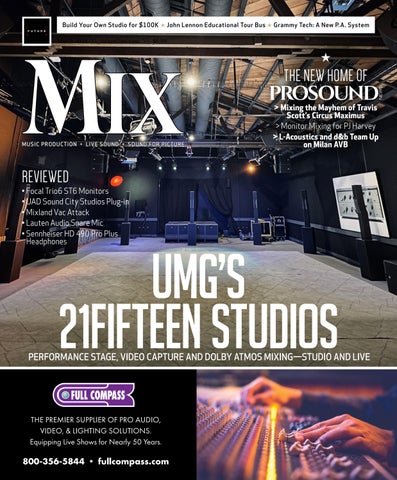
UMG’S 21FIFTEEN STUDIOS
PERFORMANCE STAGE, VIDEO CAPTURE AND DOLBY ATMOS MIXING—STUDIO AND LIVE
FEATURES
PHOTO: Angelo Caputo
16
PHOTO: Kevin Mazur/Getty Images
03.24 Contents
Volume 48, Number 3
22 UMG’s 21fifteen Studios Performance Stage, Video Capture, and Dolby Atmos Mixing—Studio and Live BY STEVE HARVEY
28 Build Your Own Studio for $100,000 Outfitting a Hybrid Personal Studio for Tracking and Mixing BY WES MAEBE
TECHNOLOGY
MUSIC
LIVE SOUND
34 Review: Sennheiser HD
10 Inside The John Lennon
16 Mixing the Mayhem of Travis Scott’s Circus Maximus
490 Pro Plus Headphones BY CLIVE YOUNG
36 Review: Focal
Professional Trio6 ST6 Monitors
Educational Tour Bus BY CLIVE YOUNG
12 Grammy Awards Tech: New P.A. in the House
BY BARRY RUDOLPH
BY STEVE HARVEY
38 Review: UAD Sound
14 News & Notes: BGM
City Studios Plug-in BY MIKE LEVINE
40 Review: Lauten
PRESENTED BY
BY CLIVE YOUNG
20 News & Notes: Mixing Monitors for PJ Harvey;
Coldplay, MIT, WMG on Live Music and Climate Change; L-Acoustics-d&b audiotechnik to Team Up on AVB/Milan
Adds New Cutting Room, Massey Hall Adds New Studio
Audio Snare Mic
Attack Plug-in
BY MICHAEL COOPER
On the Cover: 21fifteen Studios, Santa Monica, designed and built across the alley from the former Interscope Studios, is home to Universal Music Group’s Los Angeles-based music recording/mixing operations—along with video capture/edit and a 13.1.10 Dolby Atmos live performance stage for visiting artists. Photo: Angelo Caputo
DEPARTMENTS 06 From the Editor: Pause. Rewind. Fast-Forward
08 Current: Planetarium Goes Immersive; 2024 Audio Networking Report
42 Open Channel: Stepping Up to the Tipping Point BY CRAIG ANDERTON
18 Mix, Volume 48, Number 3 (ISSN 0164-9957) is published monthly by Future US, Inc., 130 West 42nd Street, 7th Floor, New York, NY 10036. Periodical Postage Paid at New York, NY, and at additional mailing offices. POSTMASTER: Send address changes to Mix, PO Box 8518, Lowell, MA 01853. One-year (12 issues) subscription is $35. Canada is $40. All other international is $50. Printed in the USA. Canadian Post Publications Mail agreement No. 40612608. Canada return address: BleuChip International, P.O. Box 25542, London, ON N6C 6B2.
mixonline.com | M A R C H 2 0 2 4 | M I X
3
PHOTO: Stevie Rae Gibbs
BY BARRY RUDOLPH
41 Review: Mixland Vac
Vol. 48 Number 3
March 2024
mixonline.com FOLLOW US twitter.com/Mix_Magazine facebook/MixMagazine instagram/mixonlineig CONTENT VP/Content Creation Anthony Savona Content Directors Tom Kenny, thomas.kenny@futurenet.com Clive Young, clive.young@futurenet.com Senior Content Producer Steve Harvey, sharvey.prosound@gmail.com Content Manager Anthony Savona, anthony.savona@futurenet.com Technology Editor, Studio Mike Levine, techeditormike@gmail.com Technology Editor, Live Steve La Cerra, stevelacerra@verizon.net Contributors: Craig Anderton, Barbara Schultz, Barry Rudolph, Robyn Flans, Rob Tavaglione, Jennifer Walden, Tamara Starr Production Manager Nicole Schilling Design Directors Lisa McIntosh and Will Shum ADVERTISING SALES Managing Vice President of Sales, B2B Tech Adam Goldstein, adam.goldstein@futurenet.com, 212-378-0465 Janis Crowley, janis.crowley@futurenet.com Debbie Rosenthal, debbie.rosenthal@futurenet.com Zahra Majma, zahra.majma@futurenet.com SUBSCRIBER CUSTOMER SERVICE To subscribe, change your address, or check on your current account status, go to mixonline.com and click on About Us, email futureplc@computerfulfillment.com, call 888-266-5828, or write P.O. Box 8518, Lowell, MA 01853. LICENSING/REPRINTS/PERMISSIONS Mix is available for licensing. Contact the Licensing team to discuss partnership opportunities. Head of Print Licensing: Rachel Shaw, licensing@futurenet.com MANAGEMENT SVP, MD, B2B Amanda Darman-Allen VP, Global Head of Content, B2B Carmel King VP, Global Head of Sales, B2B John Sellazzo Managing VP of Sales, B2B Tech Adam Goldstein VP, Global Head of Strategy & Ops, B2B Allison Markert, VP, Product & Marketing, B2B Scott Lowe Head of Production US & UK Mark Constance Head of Design, B2B Nicole Cobban
MIX SMARTBRIEF
FUTURE US, INC. Future US LLC, 130 West 42nd Street, 7th Floor, New York, NY 10036
THE SMARTER WAY TO STAY ON TOP OF THE PRO AUDIO INDUSTRY
All contents ©2024 Future US, Inc. or published under licence. All rights reserved. No part of this magazine may be used, stored, transmitted or reproduced in any way without the prior written permission of the publisher. Future Publishing Limited (company number 2008885) is registered in England and Wales. Registered office: Quay House, The Ambury, Bath BA1 1UA. All information contained in this publication is for information only and is, as far as we are aware, correct at the time of going to press. Future cannot accept any responsibility for errors or inaccuracies in such information. You are advised to contact manufacturers and retailers directly with regard to the price of products/services referred to in this publication. Apps and websites mentioned in this publication are not under our control. We are not responsible for their contents or any other changes or updates to them. This magazine is fully independent and not affiliated in any way with the companies mentioned herein. If you submit material to us, you warrant that you own the material and/or have the necessary rights/ permissions to supply the material and you automatically grant Future and its licensees a licence to publish your submission in whole or in part in any/all issues and/or editions of publications, in any format published worldwide and on associated websites, social media channels and associated products. Any material you submit is sent at your own risk and, although every care is taken, neither Future nor its employees, agents, subcontractors or licensees shall be liable for loss or damage. We assume all unsolicited material is for publication unless otherwise stated, and reserve the right to edit, amend, adapt all submissions.
You'll receive * A 5x/week snapshot of news from Mix, Pro Sound News and other leading sources. * Summaries of what matters to you, written by expert editors to save you time and keep you informed and prepared.
We are committed to only using magazine paper which is derived from responsibly managed, certified forestry and chlorine-free manufacture. The paper in this magazine was sourced and produced from sustainable managed forests, conforming to strict environmental and socioeconomic standards.
Sign up today at mixonline.com under Newsletter MIX_Ad_SB_House_3Sq_Mar23.indd 4
4/7/23 12:14 PM
Current From the Editor
Pause. Rewind. Fast Forward. I have this one saying that I’ve found myself repeating over the years, in all types of conversations, both professionally and privately: “If you like music and you like technology, it’s a great time to be alive!” I can’t remember what led me to say it the first time, but I do know that I’ve meant it every single time I’ve said it. Because it’s true! We are living in an amazing time! And once in a great while, when I run into a genuine blast from the past, I’m reminded of just how amazing it truly is. A few weeks ago, at a Thursday night dinner following the opening day of NAMM, I was reminded like never before, and it happened in a nanosecond, all because I happened to sit down next to Chas Sandford. Pause. To provide context, we need to go back 24 hours, to the day before NAMM, to get a sense of just how advanced audio technologies are today. On Wednesday at noon, Mix senior writer Steve Harvey and I met at Universal Music Group’s relatively new 21fifteen Studios in Santa Monica. Inside are five state-of-the-art, multipurpose, analogdigital recording studios, a handful of high-octane writer/production rooms, stylish lounges, and a showpiece L-Acoustics 13.1.10 Dolby Atmos Performance Stage, all connected via a Dante backbone, so that all rooms can work directly with all rooms. At some point, our host, Paula Salvatore, got a phone call and mentioned that it was her friend Chas Sandford, and he was in town from Nashville. I thought, “Hmm. I know that name.” Next we head down Colorado Avenue for about a half-mile and turn right on Berkeley to drop in at Apogee Digital, where Betty Bennett was hosting a pre-NAMM party. Out back, composer Stephen Barton and scoring mixer Alan Meyerson were playing back tracks from a recent Jedi videogame on a Genelec near-field 7.1.4 Atmos playback system. In a room further back. Sonos was showing a variety of speakers and soundbars for Atmos at Home. Up front, in the Neve 80 Series-equipped main studio, Bob Clearmountain was playing back Atmos tracks from Bob Marley, the Band, Roxy Music and others. Technologies separated by 40 years working in harmony. Again, amazing! Then there was a quick bus ride down to Anaheim, followed by a full day on the NAMM Show floor. There were immersive systems everywhere, even up on the second floor in the live sound demo rooms. There were headphones for multichannel playback. Software tools. Hardware options. Discussions of AI. Demonstrations of post-capture microphone pattern selection. Remote collaboration tools. Cloud-based processing and storage. Everything was new! Then I went to dinner and sat down in the Wayback Machine.
6
M I X | M A R C H 2 0 2 4 | mi x o n l i n e.co m
Rewind. I’d never met Chas Sandford, but I’d known about him since 1989, when I wrote my very first story at Mix. It was about a new organization called HARP, the Hollywood Association of Recording Professionals, which turned out to be made up mostly of big commercial recording studio owners in the Los Angeles area. They had approached the city, brought in lawyers, filed for proof of permits, riled up neighbors, called for zoning violations and were doing just about everything they could to get this home-based, professional recording studio, Secret Sound, shut down, and its owner, Chas Sandford, slapped with violations and fines. He had what was then a novelty, a home studio. He wasn’t the only one, but he was the target. Home studios were new, and as I would later find out, Chas was way ahead of his time. Fast Forward. After apologizing to Chas on behalf of the industry, we had a wonderful few hours of conversation over drinks and dinner, talking about technology, mutual acquaintances, musical highlights. We raced through the past 35 years of recording history, from his old Fairlight to his flirtation with ADAT and DA-88. From tape storage and playback reels to thumb drives and the cloud. From the genius of the original Euphonix consoles to the stunning capabilities of software synths and virtual instruments. From CD to DAT to SACD to streaming, from 5.1 to 7.1 to Atmos. From the late, great Stephen St. Croix’s 1993 prediction of mixing with goggles and gloves to the recent introduction of Apple Vision Pro. We have seen unbelievable changes, we agreed, and they just keep coming. Today, Chas still has a home studio, though he now resides on a 52-acre spread in Franklin, Tenn., just outside of Nashville. He still has the SSL and one of the Otari 32-tracks, though he also has Pro Tools and remote collaboration software. A few weeks after NAMM, he called me to say that he stopped by 21fifteen Studios on his way back to Nashville to see Paula. And just that day he had ordered a PMC 7.1.4 Atmos monitoring system so that he could “play around with it a bit” and see what he could do with it creatively. After 35 years, his number is in my phone. We can sometimes get so caught up in the here and now, at how amazing the world that we live in actually is, that we forget how fast this all happened. Sitting down next to Chas reminded me of that. And it energized me for the next 35 years to come. We do live in an amazing time!
Tom Kenny, Co-Editor
Current // news & notes
The Laupheim Planetarium is covered with a 7.2 immersive configuration.
Allen & Heath Heads to the Stars These days, immersive audio is everywhere— even in outer space. The movie poster tagline for Alien may say that “In space, no one can hear you scream,” but if you’re sitting in the Laupheim Planetarium outside Ulm, Germany, you not only hear sound while you travel through the heavens, but get it from a 7.2 configuration as well. The Laupheim Planetarium and Observatory gets more than 30,000 visitors every year, all of whom come to check out Zeiss Planetarium, with its immersive full-dome projection system. Last year, the facility made an audio upgrade, setting up nine speakers and two subwoofers in a 7.2 configuration, with an additional two speakers installed at the apex of the dome. As might be expected, the system also needed a tactile interface suitable for use in the dark by the in-house engineers, plus the ability to control the planetarium lighting via the same physical controller. Overseeing the audio mixer upgrade and integration was Dr Max Rößner, a freelance immersive media engineer specializing in planetarium systems. At the heart of the new audio
8
M I X | M A R C H 2 0 2 4 | mi x o n l i n e.co m
upgrade is an Allen & Heath AHM-64 Audio Matrix Processor fitted with a Dante card. The AHM-64’s rear-panel analog outputs are used to feed the nine speakers and two subs, while a DT168 Dante Expander is used to provide localized analog inputs to the system, including wireless mic receivers, media players and other auxiliary sound sources. The planetarium’s main sound source is a PC fitted with a Marian Clara E Dante interface; using Reaper, it is synchronized to the projection system via SMPTE and sends audio over the Dante network to the AHM-64 for routing and control. For control, a pair of IP8 remote controllers are used, each with eight motorized faders, eight OLED screens, and 23 assignable SoftKeys. The controllers are configured so that 10 of the faders are used to handle audio, with the remaining six dedicated to lighting control. “The IP8s integrated seamlessly during programming and commissioning,” said Rößner. “The AHM’s underlying architecture is flexible enough to enable the integration of unconventional functionality, such as lighting control in our case.” “The system was installed very quickly, and
An Allen & Heath AHM-64 Audio Matrix Processor is at the heart of the planetarium system.
it has improved the sound quality significantly,” concludes in-house engineer Alex Gölkel. “It is a great improvement now that all sources can be mixed and used simultaneously with a userfriendly control interface.” ■
Current // news & notes
Audio networking continues to show strong growth, according to the new report.
Report: Audio Networking Continues to Grow
Networked audio continues to grow while video networking lags behind, according to new industry survey
A
udio consultancy RH Consulting has released its annual survey of audio and video networking, Networked Audio Products 2024. The latest edition reveals a significant surge in overall adoption, with a total of 6,013 products from 602 brands. The 2024 edition also covers audio, video and control products, and confirms the growing strength of AES67, Ravenna and ST 2110, and the current dominance of Dante and NDI standards. The report finds that Dante audio networking technology has seen strong growth over the past 12 months, with an 11% expansion in audio products. At 4,131 products, Dante outpaced all other protocols combined, introducing 420 new products and involving 45 manufacturers for the first time. Meanwhile, interoperability standard AES67 reached 4,380 compatible products, supporting various protocols such as Dante, Ravenna, Livewire+, Wheatnet and “raw” AES67. The report suggests that the majority of Dante solutions likely support AES67, indicating a high level of integration in the market. Ravenna, showing steady growth across the year, secured the second-highest increase in audio products with 344 offerings. MILAN and AVB also demonstrated growth, with MILAN-compliant products increasing to 45. In the video-over-IP realm, the market is still maturing compared to networked audio. The report analyzes protocols such as NDI, SDVoE, ST 2110, Dante AV, IPMX and AVB, revealing insights into their adoption and maturity. NDI emerged as the leader in terms of product numbers with a total of 494. ST 2110 experienced growth with 344 encoder and decoder products, while Dante AV, a relative newcomer, tripled its product numbers in 18 months, totaling 62 products. SDVoE, despite a small decline, maintained a significant presence with 364 products. IPMXready products, totaling seven offerings, indicate potential growth upon full protocol release. “A milestone has been reached, with over 6,000 networked AV products on the market and with video-over-IP products numbering more than 1,000,” said Roland Hemming, audio consultant at RH Consulting. “Networked media products are steadily becoming part of everyone’s work; soon it
will be easier to count the remaining analog products.” The report, available for download at rhconsulting.uk., has charted the adoption and evolution of audio networking in the pro audio, AV and broadcast markets since 2013. ■
Music PHOTO: Clive Young/Future
Lead mix engineer Pietro Rossi works on a Dolby Atmos mix inside the John Lennon Educational Tour Bus.
John Lennon Tour Bus Rolls On Since 1998, the John Lennon Educational Tour Bus has helped thousands of students learn about recording, collaboration and their own creativity. By Clive Young
M
obile recording studios are a cornerstone of the recording industry, but few have the style— or inspiring mission—of the John Lennon Educational Tour Bus. For more than a quarter century, the nonprofit Lennon Bus has circled the U.S. and Canada, making stops at high schools and colleges to help students create music. The experience isn’t a simple feelgood photo-op either; it’s an exciting eight-hour day where visitors come aboard to write, perform and produce an original song and music video from scratch. Students come away from the experience not only with content, but also new skills.
10 M I X | M A R C H 2 0 2 4 | mi x o n l i n e.co m
“It’s not just for people who are self-described musicians or creators,” says Brian Rothschild, who co-founded the Bus with Yoko Ono Lennon. “It’s increasingly a way to show young people tools that they can use to demonstrate their knowledge and communicate about almost any kind of topic. It’s been made possible over the years by a collection of great sponsors, and we go to a lot of underserved communities, taking the finest tools that the industry has to offer out to places where maybe they don’t get to see and experience that. It’s meant to inspire.” The first Lennon Bus was built in 1998 as an offshoot of the annual John Lennon Songwriting Contest. While it was originally
just a literal promotional vehicle for that year’s contest, the Bus quickly took on a life of its own. “It garnered a lot of enthusiasm,” admits Rothschild. “I couldn’t imagine taking it apart, and it became my life’s work and passion.” There’s been multiple Lennon Busses since then, along with a European edition that hit the road in 2013, all stocked with top-of-the-line gear provided by sponsors. When visitors climb abord, they immediately step into a control room/lounge that centers around a brand-new Dolby Atmos 7.1.4 mix setup. Continuing through the bus, there’s another studio, which can be sealed off, and further back are an Audio-Technica mic locker,
he recorded with the Colorado Symphony Orchestra, developing Atmos mixes daily with lead mix engineer Pietro Rossi. “That was a very interesting and challenging process,” says Rossi. “Pretty much every single day, we were in a different location, but we managed to edit and mix more than a song a day—the entire album—and get it approved by the artists, so it was challenging but very smooth. When they were done with the show on stage, they would come on the bus to check the mixes and revisions. We also had the chance to record some scratch vocals of some new tracks, so it was a very fruitful 10 days with them.” Technology aboard the bus has kept up with the times, thanks to sponsors and partners like Apple, Avid, Solid State Logic, Apogee, Neutrik, Roland, Universal Audio, Flock Audio, Grace Design, Blackmagic Design and others. There’s also sponsors for things visitors don’t see, such as Battle Born Batteries, which recently installed
The John Lennon Educational Tour Bus has hosted artists from Black Eyed Peas to Machine Gun Kelly over the years.
PHOTO: John Lennon Educational Tour Bus.
Former Lennon Bus engineer Bryce Quig-Hartman shows off the rear studio.
PHOTO: Clive Young/Future
closets for lighting and mic stands, a bathroom and three bunks—necessary as a three-person crew travels in the bus for 10 months each year. The Dolby Atmos mix system was installed last summer by bus partner Westlake Pro in Burbank, Calif., working in tandem with Jeff Sobel, chief technology officer for the Lennon Bus. “We already had a 5.1 Genelec monitor system, so we had 8341As and a sub for that,” says Sobel. “We used Dolby’s DARDT software, put in our room dimensions and monitors, and it said what the SPLs were going to be. One of our biggest constraints was the ceiling height—it’s pretty low, because it’s a bus—so we used Genelec 8328s that we could keep as close to the ceiling as possible to get the right height. Our mix room is also a traffic area where people enter and exit the bus, so we needed the speakers to be in the correct positions, but also still allow ingress and egress.” The result is an Atmos mix rig that is assembled quickly every day: “The 5.1 setup that we started from was permanently affixed—we don’t take those speakers down for travel—but the Atmos height speakers detach. Our partner for that is Triad-Orbit, which makes great quickrelease mounts that are also very sturdy; we installed their mounts in key positions, and the corresponding mounts are on the backs of the Genelec height monitors, so we can pop them into the mounts affixed to the ceiling. Our side-surrounds go on Triad-Orbit stands that we can set up by line of sight, which is a setting we developed when Bryan Pennington [Dolby senior field applications engineer] tuned the system. He confirmed the exact positioning and orientation to those speakers, so we just replicate that each time we set up.” The Atmos system was installed just in time, as the bus took a detour from its usual travels to join up with Wu-Tang Clan’s fall tour. Throughout the journey, Wu-Tang’s RZA worked on A Ballet Through Mud, a new album
Wu-Tang Clan’s RZA (seated) worked with Pietro Rossi (standing) on Atmos mixes in the Lennon Bus throughout the group’s recent tour.
a next-generation, “greener” power solution. “We got rid of 1,500 pounds of old-fashioned batteries and put some solar panels on the roof,” says Rothschild. “Their lithium iron phosphate batteries have completely transformed our power situation.” That power keeps the bus’s equipment running, of course. “The rear studio is where we do most of our tracking,” says Bryce Quig-Hartman, who travelled as a Lennon Bus engineer from 2013 to 2016 and is still connected to the organization. “Both studios are running Mac-based systems through the Apogee Symphony MkII, so we’ve got 16 channels up front, 24 in back, as well as 12 channels of SSL XLogic pres with Variable Harmonic Distortion to add a little bit of color there. For mics, we’ve got the Audio-Technica mic closet, so we have AT4050s, a 4047, a 4060 tube mic, plus we’ve got the Roland RD-2000 for keys, their V Drums, and Gibson guitars and bass.” Hitting the road to work with new students every day isn’t for everyone, but it’s uniquely gratifying, says Quig-Hartman: “It takes a certain type of person. You have to be a good audio engineer, but it’s also a matter of ‘are you able to stay sane being on the road 10 months out of the year?’ Once you become a Lennon Bus engineer, you share a bond with everyone else who’s done it—you’re family at that point and it becomes a part of you, even afterwards. You never leave the bus!” n
mixonline.com | M A R C H 2 0 2 4 | M I X
11
Music // news & notes Behind the Scenes: Grammy Tech New Clair Cohesion P.A. Fills Up Crypto.com Arena By Steve Harvey
T
he Grammy Awards audio production team made a big change this year, switching to a Clair Global Cohesion P.A. system for the first time. Until recently, the proprietary speaker brand was used exclusively by Clair Global, which acquired ATK Audiotek, the Grammy show’s longtime production provider, in late 2021. This year’s production at the 21,000-capacity Crypto.com Arena (formerly named the Staples Center) in downtown Los Angeles included main left-right and side arrays of 56 total Cohesion CO12 boxes—14 per hang—plus six flown CP218 subs per side. Four back-of-house delays of eight CO10 boxes per array and six 300 Level delays of six CO8s each completed the flown complement. A pair of ground-stacked CP218s and a pair of CP6s for front fill at the main stage rounded out the rig. According to Michael Abbott, the Grammy show’s audio producer for the past several decades, when engineers for the artists performing on this year’s telecast were asked what P.A. system they’ve been using on tour, Cohesion was mentioned a lot. “I’m not saying that it’s unanimous,” he says, “but it’s accepted by the mainstream.”
One of the four main Clair Cohesion c¡lusters at Crypto.com Arena, featuring 14 Cohesion CO12 boxes, plus six flown CP218 subs. PHOTO: Courtesy of The Recording Academy/Getty Images. Photograph by Kevin Winter.
For its part, Clair Global claims that Cohesion is “the most-chosen P.A. system by major touring artists.” According to the company, 40 percent of top-grossing touring artists have been using Cohesion systems. ATK’s Jeff Peterson has been designing the Grammy house P.A. setup for many years and is also now FOH production mixer, introducing host and announcers’ mics, video package audio and the like into the mix for the live audience from his DiGiCo Quantum 338 console. “I’ve mixed on Cohesion a couple of times, but I had never designed with it,” says Peterson, who collaborated with Clair Global engineers on this year’s system. “I like the Cohesion prediction software—having the ability to see how the whole system is going to interact is nice. “It’s got the power and intelligibility over distance that I was looking for,” he adds. “The design for this room and show turned out to be almost identical to what we’ve done in the past. That proves the design is valid, regardless of the manufacturer’s speaker.” This was the first time working the Grammy telecast for freelancer Jamie Pollock, the show’s
12 M I X | M A R C H 2 0 2 4 | mi x o n l i n e.co m
PHOTO: Courtesy of The Recording Academy/ Getty Images. Photograph by Kevin Winter.
Leslie Ann Jones, Grammy telecast advisor for house audio and director of music and scoring at Skywalker Sound, left, and FOH music mixer Jamie Pollock at the DiGiCo Quantum 7 console.
FOH music mixer, positioned to Peterson’s right at a DiGiCo Quantum 7 console. Currently touring the world at FOH with Depeche Mode, and with Nine Inch Nails, Peter Gabriel and Jeff Beck also on his CV, Pollock has a sizable list of major broadcast music productions to his credit. “There’s so much to do in such a short period of time,” Pollock says, noting that pages of updates were being delivered to him constantly during the rehearsal days. “You also have to listen to the PL at all times to catch the realtime changes that happen while you are mixing. With touring, you’re in a bubble, doing your daily routine, but with this show, there’s no settling in because things keep moving and it all happens quickly. I’m constantly saving presets, giving myself default starting points, and as I mix one act, I’m always saving parameters and trying to apply them to other segments.” Every facet of the Grammy production is a collaborative affair. Pollock worked with Leslie Ann Jones, Grammy telecast advisor for house audio and director of music and scoring at Skywalker Sound, as well as the performing artists’ touring engineers to get the house mix just right. “What was great about Leslie is that she is also an engineer,” Pollock adds. “She can start talking about a technique to bring out intelligibility in a vocal and I would know instantly where she wanted to go and what needed to be done. Or she’d say, ‘Add a little 2k on the clarinet’—and she would be right. They want the detail, the definition, the little nuances to pop out in the room as well. It’s nice to be able to place the vocal more in the mix like a record over maybe where you need to have it in an arena. It was great having that other set of ears and being able to focus on those finer details.” ■
New Custom Cutting Room Opens at BGM Bernie Grundman Mastering has responded to the ever-growing global demand for vinyl records with the build-out of a second cutting room, dubbed CUT-2, at its seven-room facility in Hollywood, Calif. “Our primary cutting room is equipped to handle any full-service mastering job,” explains mastering engineer Scott Sedillo, “but a good portion of our cutting projects are for albums that have already been equalized and mastered and only require an expert, high-fidelity transfer to lacquer. This second room is streamlined for that purpose.” “This new room is highly simplified so that it’s more straightforward,” owner Bernie Grundman confirms. “It’s the result of all of our experimenting in the first room and is set up to be direct from the signal source right to the
PHOTO: David Goggin
Music // news & notes Pictured in the new CUT-2 vinyl cutting room at Bernie Grundman Mastering in Hollywood are, from left, mastering engineer Chris Bellman, CTO Beno May, and mastering engineers Scott Sedillo, Paul Grundman, Bernie Grundman and Scott Stratton.
cutting system, resulting in the closest to what the master sounds like on the disc.” CUT-2 houses a reconditioned Scully lathe, mounted on a pneumatic table for isolation, with BGM’s custom head suspension. Jacob Horowitz of History of Recorded Sound rebuilt the Haeco SC-2 stereo cutting head, which is fitted with a diamond cutting tool. A Compudisk CD-20 system provides variable pitch and depth for maximizing groove geometry. The new room also features an audiophilegrade preview/program disc-cutting console with only a single, discrete amplifier in the signal path. All analog filters and de-essers can be bypassed, and all connections are direct, with no patchbay. The new room’s Tannoy SGM-10B speakers are driven by modified Yamaha P2002 power amplifiers. All electronics are powered by
custom BGM power supplies. BGM’s in-house-built DAW running WaveLab and Pro Tools is in an adjacent rack, along with an Antelope Audio Trinity word clock resolved with BGM’s custom 10 MHz time base generator. Clients have a choice of Lavry DA-N5 or JCF Audio Latte D/A converters for audio playback. Grundman attributes much of his company’s success to chief technology officer Beno May, with whom he originally worked at A&M Studios before both went independent at BGM. “Without Beno, we wouldn’t be where we are today. It’s the combination of Beno’s technical expertise and my mastering experience—I wouldn’t be able to get the sound and quality that I’m looking for without Beno’s imagination and ability to fabricate the unique tools that we use here.” ■
Massey Hall Adds New Atmos Record/Mix Studio Toronto, Ontario—Renowned 129-year-old Massey Hall. Doug McKendrick, vice president, production concert venue Massey Hall in Toronto recently completed a massive revitalization project, and technology at The Corporation of Massey including the addition of a seven-story tower Hall and Roy Thomson Hall, the not-for-profit housing the new Deane Cameron Recording organization that operates the concert halls, had a short list of requirements for the mixing console. Studio. The new Allied Music Centre building Primarily, the console needed to accommodate expands on the facility’s rehearsal spaces and fast-paced events in Massey Hall, as well as switch talent services, lobby, lounges and public spaces while adding new performance venues, including the 500-capacity TD Music Hall on the fourth floor and the 100-seat 6th Floor Theatre. The recording studio, which opened in September 2023 and is named in honor of Massey Hall’s late CEO, Deane Cameron, is equipped for Dolby Atmos mixing and includes a 64-fader Solid State Logic System T S500 console. The entire Massey Hall’s new Deane facility is wired with fiber, with a Cameron Recording Studio. 10-gig backbone that extends into
14 M I X | M A R C H 2 0 2 4 | mi x o n l i n e.co m
between live shows in the Allied Music Centre’s various venues and studio recording projects. “We needed it to be a digital console and we needed to be able to recall fast,” he says. The studio staff also wanted to be able to work in Dolby Atmos on both recording and live projects in the new studio, which is outfitted with a 9.1.4 ATC monitor speaker system, and the System T’s native immersive audio busing, panning and monitoring capabilities made it appropriate for the new room. “We’re looking to push the envelope in audio as much as we can in all facets,” McKendrick says. “System T was the best choice. The console is really a great, great device.” Veteran producer and engineer Eddie Kramer, who lives in the Toronto area, consulted on the studio project, and recommended the SSL System T, notes McKendrick: “Eddie has been a real friend of the project and a real mentor to me.” ■
Music // news & notes Miking a Piano to Be Played, Scraped and Struck Turin, Italy—Pianist and composer Andrea Manzoni and composer, producer and film director Giorgio Ferrero used an array of Audix microphones to extract otherworldly sounds from an upright piano for their collaboration, Self-Portrait. Manzoni, a composer, producer, pianist and performer who blurs the boundaries between multiple music genres into an emerging “crossover” style, has recorded and collaborated with Andrea Bocelli and Lawrence D. “Butch” Morris and performed around the world. Ferrero is an Italian award-winning composer, director and photographer who runs the multidisciplinary creative studio MYBOSSWAS, where Self-Portrait was recorded. Manzoni’s modern composition called for
Pianist and composer Andrea Manzoni, left, with composer, producer and film director Giorgio Ferrero.
the piano to be played, scraped and struck in unconventional ways. “We played and tortured the studio’s piano in a way that only we could do…because it’s my studio and it’s my piano,” Ferreri says. Those sounds were then fed through vintage processing gear into Ferrero’s DAW, where he filtered, looped and manipulated the performance in real-time to create the finished product. “The Audix microphones were more than essential in translating the layers of sounds and music inherent in the composition,” Ferrero comments. “They enabled us to discover details that we didn’t know we’d find. It’s almost as if they were additional performers on the piece.” A matched pair of SCX25A large-diaphragm
condenser microphones designed for piano miking were placed next to the piano’s felts, a key position for shaping the work’s sound. The remaining microphones could be considered “creatively placed” and led to the unique nature of the recording. A pair of Audix A231 largediaphragm condenser vocal microphones, positioned up high and processed through boutique tube gear, imparted a retro/lo-fi vibe. The PDX720 dynamic lay near Manzoni’s feet and played a crucial role in capturing the percussive side of the composition—from foot taps and stomps to depressions of the piano’s pedals. The ADX60 boundary condenser served as a jack-of-all-trades, while a pair of SCX1 studio condensers placed in an adjacent room provided the ethereal, ambient sound. ■
PHOTO: Kevin Mazur/Getty Images
Live
PRESENTED BY
The massive, arena-length stage on Travis Scott’s Circus Maximus tour is surrounded by 202 Clair Cohesion CO10 loudspeakers, placed above the video screen in stereo-paired hangs.
Mixing the Mayhem of Travis Scott’s Circus Maximus
T
his show is this generation’s punk rock,” says Pooch. We’re backstage underneath the seats of Madison Square Garden, and the veteran FOH engineer is grinning earto-ear. “When we were kids going to punk rock shows, there was that energy of aggression; that’s what this show is for these kids—and the energy in that arena is intense!” The man would know. Ken “Pooch” Van Druten has mixed front of house for everyone from Iron Maiden and Linkin Park to Kiss and Justin Beiber, making him a good fit to mix platinum-seller Travis Scott, whose concerts take place in the space between hip-hop, pop and the heavy stuff. The Circus Maximus tour, supporting Scott’s recent Utopia album, finds
16 M I X | M A R C H 2 0 2 4 | mi x o n l i n e.co m
the rapper and his DJ, Chase B, ruling an arenalength stage that resembles a cartoon feverdream rendition of Easter Island, complete with CyberMotion lifts, copious amounts of pyro and lots more. While the staging may be unorthodox, however, that’s nothing compared to the sound. Carrying audio production from Clair Global, the tour sports a massive in-the-round Cohesion P.A. system that shares ceiling space with an oval-shaped, continuous video screen, extensive lighting and more. The Cohesion system is flown in what amounts to a dozen hangs per side, arranged as stereo pairs, typically with 16 boxes per hang—mainly CO10s, due to weight restrictions. In all, 202 CO10s and 16 CO12s cover the assembled masses, thanks to deep
Travis Scott roars nightly into a Sennheiser Digital 6000 with a MM 435 capsule
PHOTO: Kevin Mazur/Getty Images
By Clive Young.
curves on the hangs that create coverage from the stage lip to the rafters. “You don’t have a lot of distance for the hang to open up,” says system engineer Huntington. “Some of the wrap we do looks extremely drastic—especially since the bottom of the hang actually has to be more of a front fill—but it’s nice that you have the ability to do it.” The hangs—networked via Dante with an analog backup—work in tandem with a jawdropping 66 subs on the arena floor. Ready to rumble (literally), there’s two rows of 33 subwoofers per side, with each row placed along the dasher so that all subs face inwards to sum at the center of the arena floor—which is to say, right on the stage. To avoid sub information cancelling out or creating anomalies, Huntington treats the stage, hangs and rows of subs like two separate stages placed back-to-back down the length of the arena floor. Using this approach, the hangs closest to the center of the row of subs are treated as a zero line for time-alignment, and then blocks of subs within the row are gradually delayed to create an overall arc and avoid cancellation. The result is, well, loud. “Where they sum,” says Pooch, “right on the center of the stage where Travis is, it’s brutal—which he likes.” The 14,000 kids at each sold-out show like it, too, and helping the performers onstage hear themselves above the kids and the P.A. is monitor engineer Justin Hoffmann, who’s looked after Scott’s stage sound for the last nine years. On the Circus Maximus tour, he’s using a DiGiCo Quantum 338 console to create mixes, sending them to the performers’ in-ear monitors. While Scott’s past
PHOTO: Clive Young/Future
tours have carried extensive monitor systems based around floor wedges, sidefills and more, the current production finds the artist, Chase B and guest performers hearing themselves via JH Audio JH16 earpieces on Shure PSM1000 packs. Elsewhere in the RF arrangements, the vocals are captured via Sennheiser Digital 6000 handhelds with MM 435 capsules. Both the mix positions are located backstage, away from the mayhem of the arena floor, so at FOH, Pooch watches the show via remote cameras and hears it through a pair of Clair CP6+ self-powered compact Cohesion loudspeakers, with an additional sub hidden behind his DiGiCo SD12 console. “I’m not using a pair of Genelecs or Tannoys because I want the sonic signature of the box to be the same as what’s happening out there,” he explains. A Waves server is on-hand, providing a selection of favorite plug-ins like the CLA 76, MondoMod, H-Reverb and Scheps Parallel Particles among others, but there’s a bit of PHOTO: Clive Young/Future
The Clair Cohesion hangs typically get a drastic wrap to cover from the stage lip to the rafters.
The audio team that ran away with the circus (l-r): Thomas Huntington (System Engineer); Christian Hines (PA tech); JP Howell (RF tech); Michael Mangan (PA tech); Justin Hoffmann (Monitor Engineer); Marvin Cabrol (Coms); Chris Hazelton (PA tech); Enzo Baffa (Monitor Assistant); Ken ‘Pooch’ Van Druten (FOH Engineer): Martin Lee (PA tech); Steve Hupkowicz (Crew Chief); and Kat Veguilla (PA tech).
A powerful row of 33 Clair Cohesion subs stands at the ready.
outboard gear, too, like a Stove unit from Hendy Amps. “I have it across the mix buss insert; it’s harmonic distortion basically,” says Pooch. “It takes 2k transients and rounds them off so they sound a less digital and more analog. The only other unit is an RND Master Buss Processor that I’m using for its spread feature, where you can take frequencies and spread, push or pull them in the mix. I have it on the vocal group to make it wide in comparison to where the playback is—because when you’re talking about a show that’s a left and right and a vocal, that vocal better be the focus. The marquee outside says ‘Travis Scott,’ and you’d better be able to hear every single thing he’s doing.” If it sounds like there isn’t much in the way of inputs, that’s true, and as Pooch explains, that actually makes the show far more challenging to mix: “You might think, ‘oh, it’s four inputs—set it and forget it and watch the show,’ but it’s not like that at all. If I have 100 inputs and the guitar dies, I have another 98 inputs that I can hang on to until the guitar gets fixed. With this, there’s only a few inputs and it’s not just playback—it’s a DJ performing, doing different filter sweeps, flying different volumes at me, inserting an EQ—and all that is different every time. Chase B is a great DJ, so I need to maintain the artistry of what he’s doing, and that can be a challenge when we have 202 P.A. boxes turned way up and I’m working with something that, say, doesn’t have any information under 200 Hz. You still want that full sound, right? So you wouldn’t think with four inputs that I’d have to turn a bunch of knobs, but it’s constant—and that’s what makes it exciting!” ■
mixonline.com | M A R C H 2 0 2 4 | M I X
17
Live // profile // presented by Mixing Monitors for PJ Harvey London, UK—PJ Harvey recently hit the road supporting her latest album, I Inside the Old Year Dying, working with several of her longtime live sound engineers and UK-based audio provider Skan. Monitor engineer Magali Couturier has been with PJ Harvey for some years now, and has exact expectations from her vendor, including knowing that dedication comes from the top. “I first met [Skan Director] Chris Fitch at Glastonbury in the ’90s, and it was the first time I’d seen a ‘boss’ that was so ‘hands-on.’” In terms of her mix, Couturier defines her work as creating a “delicate balance,” noting, “Polly has a lot of effects that change from song to song, so it can be very complex to mix. It’s not like you make a sound and that works for the whole show; it can go from atmospheric to something very rocky or folky,” she says. “That
balance may change from venue to venue, too, where a small detail may bring a song to life or to sleep. This gig is extremely rewarding as a monitor engineer—you really become a part of the performance and the creative, live process. Working with musicians like those we have in her band is why I do this job. Nobody is doing the things that she and they can do together. It’s art.” Harvey and her band now use Sennheiser 2000 Series IEMs, with Ultimate Ears UE11s, said Couturier: “The 10-piece band used to be on wedges and has now switched to in-ear monitors. The reason for this is that the stage would look better, there wouldn’t be black boxes scattered around and the musicians would be freer to move around,” she explains. “The transition was an interesting journey, given the type of music they play and that none of them had used IEMs before, but thankfully, we made it! Even though
Monitor engineer Magali Couturier oversees a Yamaha PM7 desk at stageside for PJ Harvey.
it’s quite unorthodox; none of them use in-ears in the same way. Polly wants to hear the record, so my aim with her mix is to make it as close to her records as possible.” Monitors for Harvey and Company are mixed on a Yamaha PM7 console with an RPIO Stage Rack: “I think the PM7 is a great-sounding desk. I use everything internally, with the addition of an external pedal board. I don’t get caught up in being overly technical; I like my desk to be intuitive, and to mix with my ears, not my brain.” ■
Coldplay, MIT Team for Live Music Climate Change Report Cambridge, Mass.—Academia and the record business are joining forces environmental footprint and establish a sustainable future for live events. Coldplay, which launched its current Music of the Spheres World Tour— to suggest practical solutions to reduce the environmental impact of live which began in March 2022—with a pledge to cut emissions by 50 percent, music events at every level, from pubs and clubs to stadiums. The Massachusetts Institute of Technology’s Environmental Solutions has also made a world-first commitment to manufacture all physical Initiative (MIT ESI) will conduct a comprehensive study of the live music records for its upcoming 2024 album from recycled plastic bottles. In June industry’s carbon footprint with co-funding and support from Warner 2023, the band reported that it had reduced greenhouse gas emissions from Music Group, Live Nation and Coldplay. The study will kick off with an the tour by 47 percent compared to its A Head Full of Dreams stadium tour, initial research phase, resulting in an Assessment Report of Live Music and which ran from March 2016 through November 2017. For its part, WMG is committed to lowering carbon emissions, reducing waste Climate Change, focused on the UK and U.S. markets, which is anticipated and aligning with global efforts to tackle climate change. The company created a to be completed in July 2024. This report aims to develop a comprehensive assessment of the relationship large-scale release of Coldplay’s “re-vinyl” Music of the Spheres album made of 100 percent recycled vinyl raw materials in 2022. between live music and climate change; WMG will provide its industry observations, identify key areas where the industry encompassing internal data and insights, to and concertgoers can make tangible MIT for the report. improvements to reduce emissions and Fan transportation can be one of the top drive planet-positive outcomes; and contributors to emissions related to live provide a detailed analysis of the latest music. In 2022, Live Nation partnered with developments in green technology and Coldplay and major public transportation sustainable practices. providers to offer fans free or discounted MIT ESI, a climate and environmental rides to incentivize and encourage green academic research and solutions group, travel. This initiative supported a 59% will recommend scientifically informed Coldplay, MIT, Live Nation and Warner Music average increase in public transport actions and policies that can be Group have teamed for a study of the relationship ridership on show days across four U.S. implemented and replicated across the between live music and climate change. cities. ■ entire live music industry to reduce its PHOTO: Stevie Rae Gibbs
18 M I X | M A R C H 2 0 2 4 | mi x o n l i n e.co m
MAY 11 | MUSIC ROW, NASHVILLE Returning to the epicentre of immersive music, Nashville, which boasts the highest concentration of immersive music mix facilities in the country, this all-day event, will once again take place in two parts: During the day, Host Partner Curb Entertainment, along with Columbia Studio A, Quonset Hut, Starstruck Studios, Curb Studio, and Front Stage/ Back Stage Studios, will feature a series of expert panels, project profiles, technology demonstrations, interviews with top engineers and producers, listening sessions, and much more.
NEW! Immersive Live for Clubs, Theaters and HOW will take place along Music Row in conjunction with Mix Nashville: Immersive Music Production II. At night, the event moves to the nearby Berry Hill neighborhood for a party at world-renowned Blackbird Studio, in conjunction with a one-of-a-kind Studio Crawl featuring immersive music Listening Sessions at a number of nearby studios.
Register now at mixmusicproduction.com/nashville Brought to you by
Owned & Operated by
Interested in sponsorship? Contact janis.crowley@futurenet.com
Live // news & notes // presented by Hanoi’s Ho Guom Opera Opens Hanoi, Vietnam—The new Ho Guom Opera in Hanoi, Vietnam, threw open its doors for a soft opening this past July, enchanting audiences with its architecture and amenities, as well as aural environments created by a Meyer Sound Constellation acoustic system spec’d for the venue by international consulting firm Delhom Acoustics. Vietnam’s Ministry of Public Security operates the theater; General Tô Lâm, Vietnam’s Minister of Public Security, pointed out the facility’s importance in the country’s arts community, noting, “We need a place with a good sound field for artists to flourish.” The 900-seat hall in the new performing arts complex is a multi-purpose venue intended for all arts and entertainment genres. In addition to opera in the Eastern and Western traditions, the hall also hosts symphony concerts, Broadway musicals, ballet, jazz and pop concerts, conferences, and film screenings. With Constellation, the spectral envelope of the reverberant field can be fitted to the needs of a given event, with multiple zones allowing tuning of the effect both on stage and in different sections of the auditorium.
Hanoi’s Ho Guom Opera sports a Meyer Sound Constellation acoustic system spec’d by Delhom Acoustics.
The Constellation system onsite has 165 fullrange, self-powered loudspeakers placed on the side walls and overhead in the auditorium, as well as around the stage, with a dedicated D-Mitri DVRAS processor for each of the five reverberant zones. Bass extension for Constellation is provided by 16 small subwoofers, and a total of 57 miniature condenser microphones are deployed throughout the space for ambient acoustical sensing. For amplified events, the venue uses a house system anchored by 24 Leopard compact linear line array loudspeakers, with 12 900LFC low-frequency control elements for bass extension. Fill and delay requirements are met by a contingent of 32 point-source loudspeakers,
with Ultra-X40, UP‑4slim, and Ultra-X20XP deployed as appropriate. Since the Ho Guom Opera opened, it has hosted performances by the Vietnam National Symphony, the Sun Symphony Orchestra, Katy Perry, and Kenny G. General Lâm noted, “With symphony concerts, the instruments have very natural, soft sounds. And with pop music, the P.A. system really gives beautiful sound. We aim for high-quality concert programs, with major orchestras and artists from around the world coming here to perform. When introduced to our theater, major orchestras and artists around the world trust us and are willing to cooperate with us in the future.” ■
Electro-Voice’s ZLX Loudspeaker Hits 1 Million Mark Minneapolis, Minn.—Electro-Voice first introduced its ZLX portable loudspeaker at the NAMM Show in 2013, so it was only fitting that the one-millionth ZLX—which recently rolled off the production line—was brought to this year’s show for a homecoming. Prior to NAMM, executive board members of E-V’s parent company Bosch traveled to Electro-Voice’s ZLX production facility to witness the historic one-millionth speaker being made. While there, they joined members of the production team in signing five ZLX boxes that will be sent to Electro-Voice sites around the world to get additional signatures from the various teams behind the loudspeaker’s success. As might be expected, one of those sites was the E-V demo room at NAMM, where visitors could see the one-millionth ZLX, now emblazoned with signatures of team members from around the globe. Also in the demo room was EV’s latest offering, the Everse 12 battery-powered loudspeaker, launched at the show. ■
20 M I X | M A R C H 2 0 2 4 | mi x o n l i n e.co m
Executives recently signed the 1-millionth Electro-Voice ZLX loudspeaker as it was manufactured.
Live // news & notes // L-Acoustics, d&b to Develop Software Platform New York, N.Y.—L-Acoustics and d&b audiotechnik have been agile competitors for years, each offering a variety of high-end loudspeaker systems and surrounding products for installations, touring and events; each with its own substantial technologies to bring immersive audio into the live sound realm; and each with its own fervid following within the industry. They have something else in common now, too: The competitors have announced they are collaborating to develop a new software platform, Milan Manager, that will debut in June at InfoComm. Intended to address some of the challenges that the companies feel discourage widespread adoption of Milan AVB technology, the Milan Manager platform will focus on aiding the configuration and management of Milan AVB
networks. The software will be brand-agnostic, with no brand logos or mentions involved, in hopes of encouraging its adoption and acceptance within the industry. With that in mind, d&b audiotechnik and L-Acoustics will lead the initial development but plan to actively encourage additional contributors, emphasizing inclusivity and collective industry advancement. Underlining that aspect, the two companies are collaborating with SoundPLAN on the key issue of noise impact. The commitment to develop Milan Manager stems from each company’s own adoption of the Milan AVB open networking technology, and in turn, their involvement in the industry standards group, AVnu Alliance, that created Milan. Amnon Harman, CEO of d&b audiotechnik,
noted, “Our two companies each have individual value propositions for our customers, and we will continue to enjoy healthy competition. However, we are also excited to be cooperating on technical standards that will provide value to our industry. This new form of competing on one side and cooperating on the other side results in higher quality products, faster development times, and better functionality for all of our customers.” Hervé Guillaume, CEO at L-Acoustics Group, added, “This groundbreaking collaboration underscores our shared commitment to advancing technology that improves workflow and delivers a memorable experience that connects artist and audience, and a safe and comfortable experience for crew and neighbors.” ■
on the cover
C
“
ontent is King,” Microsoft co-founder Bill Gates famously wrote in 1996. He was referring to the economic opportunities of the Internet at the time, using the word “content” as a catch-all to cover the multitude of media capable of delivering entertainment and information. Gates got it right, of course—28 years later, we spend hours online every day consuming music, video and the printed word, and companies on the web have prospered as a result. These days, an enterprise such as Universal Music Group, one of the Big Three record label groups and the largest music rights holder in the world, is as concerned with content in general almost as much as the company’s more singular focus: music. UMG has a presence in more than 60 countries and operates studios in a good number of them, but those facilities offer more than just music production. Take 21fifteen Studios in Santa Monica, Calif., as an example. Part of a four-building campus expansion completed just over four years ago, across the street from UMG’s operational headquarters (corporate HQ is in the Netherlands) and across an alley from the former Interscope facilities, 21fifteen Studios houses five music recording studios, a handful of writing and production suites, a couple of video bays, and a large, two-story room known as the Stage, a versatile, tech-forward, creative space—with a lighting truss, live sound console and a 13.1.10 immersive playback system. A PLACE TO CREATE “The Stage is a nickname that has developed over time,” explains Pat Kraus, senior vice president, Recording Studios and Archive Management, Universal Music Group, noting that the name derives more from the space’s similarity to a movie soundstage than to a live performance area, and it has so far served as a kind of sandbox for artists to play in. “We view it as a black box that allows us to do pretty much anything that we need to do to support the creative vision that somebody might have.”
22 M I X | M A R C H 2 0 2 4 | mi x o n l i n e.co m
UMG’s 21fifteen Studios Performance Stage, Video Capture and Dolby Atmos Mixing—Studio and Live By Steve Harvey
“The Stage” at 21fifteen Studios, with its lighting truss and multiple cameras, is set up for an intimate music performance, mixed live for 13.1.10 Dolby Atmos playback.
PHOTO: Angelo Caputo
mixonline.com | M A R C H 2 0 2 4 | M I X
23
Overall, Kraus says, UMG’s vision for its studio facilities worldwide is to provide similar creative spaces for its artist community and the company’s labels. There are similar audio-videoperformance spaces, though in slightly different forms, in Nashville, and at Republic Records in New York City. UMG also recently filed plans for a four-acre-plus, multi-building, mixed-use campus in Nashville’s Berry Hill neighborhood that will include similar black-box spaces, in addition to recording studios, scoring stages and offices, as well as retail, restaurant and other facilities. Meanwhile, the core focus of UMG’s recording studios—music production—has most definitely evolved, according to Roey Hershkovitz, VP, Sound and Picture, UMG Digital Operations. “All of our studios, and certainly our live rooms, have become performance areas. Video capture as part of these performances has become such a natural part of any live room in any number of our studios. We continue to find more and more ways to allow for video capture of performances more seamlessly within our spaces. And we’re continuing to focus on multi-camera live streaming.” The Stage made its debut with a showcase performance by Marsha Ambrosius, an artist on Dr. Dre’s Aftermath imprint. “Everybody made sure that we showed off our best selves, dialing in the P.A.—and we got the thumbs-up from Dre,” Hershkovitz recalls. Almost the entire back wall of the Stage can be folded open to extend the footprint into 21fifteen’s central lounge. “We had nearly 200 people that day. It was just a beautiful, vibey, cocktail lounge setting, with a stage in front for Marsha. It was loud and it was awesome.” “Shoutout to our contractors and our facilities people inside the company,” Kraus adds, “because we put that place together during the pandemic. And a shoutout to the incredible staff engineers. They get in the weeds when they tune the room, and it always sounds fantastic.” When Mario de Arce, VP, Studio Technology, arrived at UMG about five years ago, after stints with Focusrite, Avid and Sony Music Studios in Manhattan, one of his first jobs was to design 21fifteen Studios’ technical infrastructure, which includes a Dante network backbone. There are multimode and single-mode fiber and Cat 6 patchbays in the main machine room, he explains: “Then, all the fiber runs to the machine rooms of each room, where it becomes
24 M I X | M A R C H 2 0 2 4 | mi x o n l i n e.co m
The Studio 1 control room features an API Legacy AXS console and soffited PMC monitors.
copper through a switch. The whole facility is connected, and you can send whatever signal you want wherever you want it to go.” UMG artists keep 21fifteen’s recording studios constantly humming. The largest, Studio One, features an API AXS Legacy console and a large tracking room. An SSL 6000 E Series previously owned by Dr. Dre occupies Studio Two, while Studios Three, Four and Five feature new SSL Origin desks; all four have attached live rooms. All five control rooms are equipped with PMC monitors. DOLBY ATMOS, FROM STUDIO TO STAGE UMG was an early adopter of Atmos Music mixing and distribution, working with Dolby, PMC, Tidal, Amazon, Samsung and others to get hi-res tracks out to listeners as early as 2019. The preparations, however, began a year prior with the conversion of Capitol Studio C, a stereo room with a host of film score mixing clients, to a 7.1.4 Atmos mix studio, designed and built by an in-house team led by Art Kelm, Nathaniel Kunkel and Ceri Thomas, then with Dolby. At the time, it was the only Atmos room in town for music. “Studio C at Capitol was the first,” confirms Paula Salvatore, then VP Studios, Administration & Management at Capitol and now VP Client
Pat Kraus
Paula Salvatore
The Studio 1 live room is the most spacious in the facility.
PHOTO: Hunter Simmons
The famous “Dr. Dre” SSL 6000E Series console was brought over from the former Interscope facilities and now sits in Studio 2 at 21fifteen.
PHOTO: Angelo Caputo
PHOTO: Angelo Caputo
Relations and Studio Marketing, UMG. “That’s where our engineers first started to develop their approach to Atmos mixes. Then Covid hit, and with the studios open only on and off, and with restrictions, the company took the opportunity to start re-mixing the catalog for Atmos. Then Capitol was closed down for earthquake retrofitting, and right away, there was a need for more rooms. Studio 4 at 21fifteen Studios came next, and it was a success. Then The Mail Room across the street. The company has definitely committed itself to immersive music, and it’s great for the artists.” As UMG began to assume a leading role in mixing music for Dolby Atmos, de Arce started outfitting some of the company’s studios beyond 21fifteen. “I’ve helped design and build three Atmos rooms at East Iris in Nashville, two in Santa Monica and two at Republic in New York. I’ve shared my designs, supporting UMG’s studios in Japan, South Africa, Austria, all over the world, so they don’t have to reinvent the wheel. We’re really embedded into the Atmos world.” Studio Four, 21fifteen’s sole Atmos mix room, became so busy that de Arce was asked to build another across the street. The Mail Room, as it’s known, boasts a PMC 11.1.6 monitor setup and a large, custom Avid S6 surface. It has
mixonline.com | M A R C H 2 0 2 4 | M I X
25
PHOTO: Hunter Simmons
The style throughout the facility, worthy of Architectural Digest, is reflected in the main lounge, where the collapsible doors to the far left open up onto the Performance Stage.
since morphed into a dual-duty, mix-for-picture space, with de Arce adding a screen and a second Pro Tools source rig to enable Chris Jenkins, EVP, UMG Digital Studios, and an Oscar, Emmy and BAFTA-winning re-recording mixer, to work on documentaries and other projects. Because only about five people at a time can share the immersive experience in Studio Four, de Arce was tasked with upgrading the Stage for large-format immersive music playback. The Stage now features an L-Acoustics 13.1.10 speaker rig designed in collaboration with Dolby and conforming to its DARDT specifications—just like all his Atmos mix rooms, de Arce notes. A total of 13 paired L-Acoustics Syva and Syva Low cabinets around the walls deliver the LCR and surrounds, with 10 L-Acoustics X12s in the ceiling grid carrying the height information. Four L-Acoustics KS21 subs in the front of the room, with another two on each side wall, support both LFE and bass management. The system’s front end includes a pair of Apple Mac Studio computers running Pro Tools HDX and the Dolby RMU. Avid MTRX II and DirectOut Prodigy.MP interfaces provide signal routing, processing and system tuning, as well as bass management. Signals are routed to the 11 L-Acoustics LA4x amplifiers, which also offer onboard EQ, level and delay via AVB. An Allen
26 M I X | M A R C H 2 0 2 4 | mi x o n l i n e.co m
& Heath dLive desk enables additional inputs— from a live performance setup, for instance—to be introduced into the system. PERFORMANCE AND PRESENTATION “Our engineer, Adam Loeffler, worked tirelessly on the tuning ahead of Dre’s event,” Hershkovitz recalls. “With that Atmos system in there now, we’re always working to get another one-anda-half percent of performance out of it, because every little bit matters.” The first event to make use of the new Dolby Atmos playback rig was Giles Martin’s presentation of his mixes of the Beatles’ Revolver album. A subsequent project combined the facility’s networking with the Stage’s Atmos capabilities. “We had a band, Larry Goldings and a jazz quartet, in Studio One that we were also filming.” Hershkovitz says. “We piped it onto the Stage and performed a live Atmos mix as the band was performing in-studio. That was a fun day, and a nice opportunity to show where we can take things. We have a wide range of engineers who are at different points in their careers. The younger folks hadn’t had an opportunity to participate in something like that, and you could really see how energized and jazzed they were that day.” Further demonstrating the Stage’s potential,
The Stage set up for taping an interview.
PHOTO: Angelo Caputo
The Stage, with risers, is ready for a full band performance.
PHOTO: Angelo Caputo
Mario de Arce
Roey Hershkovitz
Kraus adds, the space has been used for car audio R&D. “We brought a Mercedes in, and together with the Mercedes engineers and some of our creative folks, mixers and producers, analyzed what’s happening to immersive mixes in the car. We gave them feedback, and they figured out how to tweak [the in-car system],” he says. The collaboration between Mercedes-Benz and Apple Music, announced in late 2022, offers native playback of immersive Apple Music Spatial Audio tracks to subscribers without an Apple device—a first—in certain Mercedes models. UMG simultaneously launched “Approved in a Mercedes-Benz,” a new mix approval process. Previously, UMG had built and outfitted a “typical living room,” where creatives and others could listen to immersive music mixes, but the Stage takes that to the next level, Hershkovitz says, providing yet another way to evangelize Dolby Atmos and introduce people to the format: “Somebody can go to Apple Music and curate or AirPlay from their phone—not just to the living room but to this massive soundstage and say, ‘This is the experience.’ There’s a Sonos soundbar in the living room, there’s a MercedesBenz parked outside, so we are really showing folks that, in addition to the headphones in the marketplace, there are so many ways to hear Atmos music.” ■
mixonline.com | M A R C H 2 0 2 4 | M I X
27
BUILD YOUR OW
28 M I X | M A R C H 2 0 2 4 | mi x o n l i n e.co m
WN STUDIO:
2024 EDITION ...in which we handed London/Belgium-based engineer Wes Maebe $100,000 virtual U.S. dollars and asked him to outfit his ideal recording/mixing setup. By Wes Maebe
xur82/ Getty Images
B
uilding your own studio is no mean feat. I have always said that I would not need to have my own studio since there are so many gorgeous tracking rooms across the globe. Of course, music industry budgets have changed over the years, and the projects that allow you to stay in the recording studio to mix don’t come around that often. That’s why a lot of us engineers/producers have setups at home or in private facilities—so that we can mix and sometimes do small overdubs. That was working fine, until Brexit ripped its ugly claws across a lot of our lives in England; I suddenly needed a foot on European soil. The British vote to remove itself from the European Union and the single market has led to massive import and export issues, restrictions on the amount of time you are allowed to spend out of the country, the requirement for travel and work visas, carnets for taking your instruments across borders, etc. Last year, I found a second home in Belgium. Having dual-nationality has allowed me to set up shop on the European mainland, and as it happens, the property I found came with an outbuilding that lends itself to be transformed into a small recording studio. Quite
mixonline.com | M A R C H 2 0 2 4 | M I X
29
serendipitously, I was in the middle of Building My Own Studio when Mix called and asked for a piece called Building Your Own Studio. They’re virtual dollars anyway, so what’s mine is yours. For this piece, I’m going to assume that you have the computer in place and are running your favorite DAW, and most of the wiring, stands, furniture, screens and so on have been brought in from your previous studio. This way, we can focus on supplementing hardware, adding to the microphone collection, upgrading speakers, and maybe grow the plug-in list. QUALITY FROM THE SOURCE Apart from The Player, of course, the microphone is one the most important components in the whole recording environment. As with most topics involving recording, there are wildly varying opinions on what mic to use on which instrument or vocal. Engineers will swear by a certain mic for a specific job, but I’ve always felt that every instrument and vocal is different, and might require its own flavor of signal path. Somebody’s vocal may simply not work with “that classic mic,” and you might stumble across a combination of sound source and microphone you wouldn’t have ever thought of. So, let’s take this opportunity to supplement and expand the mic cupboard. DO YOU WANT TO GO LARGE? I’m going to start with the large-diaphragm models and then work my way through smallcapsules, ribbons and some dynamics. Advanced Audio has been mentioned a few times in previous iterations of Build Your Own
30 M I X | M A R C H 2 0 2 4 | mi x o n l i n e.co m
Studio, and I just keep coming back to these. Every time we do a mic shootout, producers and artists end up picking these over other classics. The CM67 is a big favorite on vocals, strings and acoustics. A big sound for a relatively small price tag. Recently, I’ve been playing a lot with the sE Electronics mics. On several vocal sessions, the sE-Rupert Neve Designs collaboration RNT came out on top. It’s a little steeper in price, though compared with many other “vintage” mics, it is a lot more affordable. It’s such a versatile mic, giving you weight, warmth and clarity at the same time. I suggest the sE T2 in the LDC category; it reminds me of the old silver 414s. With its titanium sputtered capsule, it’s fantastic on fast-attack sources. I’ve used it plenty on bass amps and bottom snares, and it performs really well on strings and acoustics. Speaking of those vintage AKGs, I had the chance to use a whole variety of the Peluso mics at Laughing Tiger in the Bay Area, which led me to try out the P-414. One of my go-to setups on piano is to put a couple of these over the hammers, so let’s put two on our list, which will give us the option to use them for various stereo-miking techniques. To fill up the shelf of large-diaphragm condensers, let’s add two more, from opposite sides of the scale. The Vanguard Audio Labs V13 is a gorgeous-looking and -sounding multipattern mic. It’s one of those I got the chance to test drive and then wished I owned, so it’s going on the list.
Last but not least, the Aston Element. This microphone, with its Ridyon capsule, appeared on my radar when they put the final voicing out to a public vote. It was a bit like voting for the Grammys—but for the sound of a mic. I’ve been using it since, and it has been performing blindingly on guitar cabs. Oh, and it has a purple light! SMALL YET MIGHTY Now that we have the big colors and brushstrokes sorted out, it’s time to look at some smalldiaphragm mics. The sE RN17 is one of my most go-to SDCs. It gets put to use on hi-hats, acoustic guitars, strings, and lately I’ve been putting it close to the floor a few feet from the kick drum. Being a great fan of stereo miking, I’m adding a pair of Schoeps CMC64s. They’re simply amazing on strings and percussion, and I’ve been using them on snares and as overheads, as well. Schoeps has been known historically as a “classical” mic, but it’s time to start thinking out of the box. They rock with the best. Our second pair will be the tube BeesNeez Lulu Fet SDC KM84s. This Australian family business makes stunning microphones, so do check them out. Finally, I’d love the Sennheiser MKH 50/30 P48 duo to join the family. When I started out, my mentor got me to do a lot of classical location recordings, and he made me fall in love with the M/S technique. One of the main combos was this Sennheiser pair. Years later on a studio session, I couldn’t get a particular mic for the snare drum, and the MKH 50 was gathering dust in the mic locker. My assistant said, “Why don’t we use that instead?” What a revelation! One of those happy studio accidents.
RIBBON OF DREAMS No studio is complete without at least a few ribbon mics, and Wes Dooley is king of the ribbons. His AEA R92 is such an all-rounder. Because both sides of the ribbon provide a different character, it’s a bit of a Ribbon Swiss Army Knife for guitar cabs, overheads, brass and even vocals. Another recent discovery has been the Samar ribbons. I got to use the VL37As on various sessions at Rosewood Music on a plethora of amps, drum overheads and piano. I’m also throwing in a couple of sE DM2 TNTs to deal with low output from certain mics, i.e., the ribbons or an SM7B. PUNCH AND DYNAMICS Only one dynamic has made it into this lineup, mainly because I’m presuming that we already own a choice selection of the usual suspects. The sE V Kick is one of those hidden gems. I’ve been using it on all styles, ranging from country rock to death metal. Usually, I’ll have a kick-in, kick-out, and maybe a sub NS-10, but this multi-voice mic has been dominating my kick-mic blend lately, and it won’t break the bank either! Before we move on to preamps and other outboard gear, we definitely need one oddball microphone. Meet the Scope Labs Periscope. This is the ultimate steampunk piece of equipment. The capsule lives in what looks like plumbing pipe, and it contains an inbuilt compressor. There are no controls to be fiddled with, just plug it in and be ready for serious pumping. The Periscope is great for room sound, anything drums, and it really needs you to experiment and throw it at any sound source.
onto tape or into your DAW, so mic preamps are required. Generally, a commercial recording studio will have a medium- to large-format console that has all the pre’s on board; that console may be one of the deciding factors in booking one of these sonic temples. I’ve decided to go a little more hybrid on this setup. A lot of engineers like to work In-the-Box these days, so we’ll put together a selection of preamps that will allow you to mix and match all these various mic flavors and preamp characters. Here we go, straight in the door with a big one. Let me introduce you to Hazelrigg Industries. You may recall a review about the VLC and VNE in Mix about a year ago, and since then, the VNE compressor has not left my side. Believe me, I am working hard to get the VLC back. There’s something purely magical about pairing the preamp/EQ with the compressor and using it as a channel strip. This has been called the “Everything Channel,” and I can wholly agree. Our list will be graced by two full channels, i.e., two VLCs and two VNEs. This package will also serve as a dual-channel strip for mixing and mastering. Useful Arts Audio’s secret (not so secret) sauce is the Color knob. It’s great on everything, especially
on top snare. The SFP-60 will add another two channels of mic pre. Simon Saywood’s Analogue Tube AT-3 is another one of my go-to pre’s. It’s a no-nonsense, clean-yet-warm unit and will sit nicely in our collection. We can’t talk preamps without bringing up the Manley Labs VoxBox. It’s a beast. It provides color and character, and, again, can be used as an insert channel strip when we switch to mix mode. Six mic lines might have been enough in the old days, but not today. In addition to these tube powerhouses, we’ll load a Fredenstein Bento 10S with an Empirical Labs DocDerr 500 channel strip, a Neve 88RLB—because who doesn’t like a bit of Neve—two AEA RPQs to mainly deal with our ribbon mics, the Meris 440, which is really geared toward guitar duties, and a Crane Song Syren. Rounding out the mic pre collection is the SPL Crescendo 8, making it a total mic line count of 20. That might seem a little excessive. but I always think of my drummer pal Neil Felgate, for whom this is just about right to cover his drum kit. I’d like to slot in one more vital component to complete the input section of our setup. People
PREAMPLIFICATION All these beautiful mics need to find their way
mixonline.com | M A R C H 2 0 2 4 | M I X
31
ITEM
QTY.
PRICE
1
895 2799
Large Diaphragm Mics Advanced Audio CM67 sE Electronics RNT
1
sE Electronics T2
1
599
Peluso P-414
2
2198
Vanguard Audio Labs V13
1
1199
Aston Element
1
149
Don’t forget, we have a few more 500 Series slots to fill up. Some of these will be taken up by two Crane Song Insignas in honor of our dear late friend and designer David Hill. Once more, these two tube EQs can be used as single units, but can also be pressed into service for mixing and bus processing, and if you’re like me, it can become part of your parallel-compression chain. The Little Labs VOG most definitely has a place in our lunchbox. Hip-Hop, modern R&B, metal, techno—you name it, low end is extremely important, and the VOG has it by the truckload. We’re leaving one slot blank for future expansion, and hey, let’s give those Cranesongs a little air to breathe.
Small Diaphragm Mics sE Electronics RN17
1
1099
Schoeps CMC64 matched Pair
1
3300
BeesNeez Lulu Fet SDC KM84 Pair
1
845
Sennheiser MKH 50 P48
1
1200
Sennheiser MKH 30 P48
1
1250
AEA R92
1
1099
Samar VL37A
2
2198
Ribbon Mics
Dynamics & Various Mics sE Electronics DM2 TNT
2
278
sE Electronics V Kick
1
209
Scope Labs Periscope
1
460
Mic Preamps and Outboard Hazelrigg Industries VEC
2
15200
Useful Arts Audio SFP-60
1
3499
Analogue Tube AT-3
1
2100
Manley VoxBox
1
5499
SPL Crescendo 8
1
4999
Fredenstein Bento 10S
1
579
Empirical Labs DocDerr 500
1
899
Neve 88RLB
1
790
AEA RPQ 500
2
1398
Meris 440
1
549
Crane Song Syren
1
1249
Crane Song Insigna
2
2598
Little Labs VOG 500
1
490
RJR BAX EQ
1
2299
Rockrupel Comp.Two
1
5399
Empirical Labs EL8X-s Brit Mod Pair
1
3499
Heritage Audio MotorCity EQ
1
1999
Hazelrigg Industries 4DI
1
3400
Little Labs Pepper
1
630 2500
Faders and Monitoring SKNote Etna M8
1
SKnote Etna Q
1
2500
PSI A-23M
2
11310
Ultimate Ears Pro UE Premier
1
3149 299
Software Wholegrain Quartet DynPEQ Native
1
Sonnox Oxford Drum Gate
1
230
Sonnox Elite Bundle
1
1007
Fabfilter Pro-L 2
1
169
Creative extras Analogue Tube Love Bomb
1
1150
Rainger FX Minibar Liquid Analyzer
1
149.99
Rainger FX Drone Rainger
1
299
Ebow
1
99.95
Entertainment Winmau Darts Board
1
158
Bulls Mamba97 M6 25 gr. darts
1
75.75
Total
99948.69
32 M I X | M A R C H 2 0 2 4 | mi x o n l i n e.co m
will be turning up with their production rigs, and keyboards, guitar and bass DI signals are tracked so they can be re-amped, and drummers may run a few triggers. The Hazelrigg 4DI, gives you four channels of sublime vacuum tube thickness. ADAPTABILITY IS KEY Projects come in all shapes and sizes, and sometimes you find yourself in the driver’s seat from mic to master. That’s the reason I’m including quite a few stereo units, which can serve as dual-single channels, but also as mix bus and mastering processors. The Regular John Recording Bax Mastering EQ has to be one of my faves, with its super-high frequencies and Pultec-style operation and sound. Recently, I had the opportunity to master a few records in a beautiful European facility, and one of the boxes there was the Rockrupel Comp. Two. Your eye is immediately drawn to it, and it does not disappoint. Do check out the plug-in version as well! One of the most all-round compressors in the industry must be the Empirical Labs EL8X Distressor; we’re going to take two of those. The last of our 19-inch rack units is going to be the Heritage Audio Motorcity EQ. It’s one of those historic replicas that I haven’t had the chance to play with yet, but is definitely on the “to try” list.
COME TOGETHER, RIGHT NOW This time, no big console, but we’ll still need something to tie all this together and give us some faders under the fingers. Not only does this unit deliver eight stereo channels on 100mm touch-sensitive motorized faders, it also sports total recall and dynamics on each channel. Meet SKnote’s Etna-M. As the Etna is cascadable and expandable, we’ll go ahead and add the Etna-Q in order to turn the fader/dynamics bank into a full channel strip. The Etna Q has 11 motorized pots and a harmonic control for each channel. Of course, we need to be able to monitor all this equipment. Speakers are such a personal thing. If you want a conversation between engineers and producers to kick off, just ask them about their speakers. Studio monitoring is highly subjective and greatly influenced by the acoustics of the room you work in. You might hear a pair of speakers in a studio and think they are great, so you buy a pair for yourself, then find they simply don’t work in the place you work. Always try to test drive new monitors in your environment. The pair that I’m selecting are amazing: The PSI A-23Ms are Swissmade, fully analog and seem to handle less-than-optimal acoustic situations well. As everybody is dabbling in or is simply being forced into mixing immersive, I’m going to spec a set of Ultimate Ears Pro UE Premier IEMs to get us started in the binaural mix game.
THE SOFT TOUCH Earlier, I mentioned that this was going to be a bit more of a hybrid situation, so we do need to look at some software. As I’m sure you are aware, the number of available plug-ins is staggering. I’m selecting just a few key tools that I find myself reaching for most of the time. The Wholegrain Digital Quartet DynPEQ is a surgical life-changer. It excels at sorting out problematic frequencies, but the more I use it, the more I find you can insert it to bring out character in sounds, bringing them to life. The Sonnox Elite bundle provides an incredible amount of processing power; I think I’ll add the Sonnox Oxford Drum Gate to that. Finally, just for those small mastering jobs and to keep label people happy, a Fabfilter Pro-L 2 as the final transparent limiter. LET THE FUN BEGIN! I wouldn’t be me if I didn’t add a few fun bits, a couple of left-field items to keep things lively in here. I’ve been doing a lot of techno, deep house and trance mixing recently, and I always feel that some of these sounds could do with a little
subtle with it, and you can do some serious Tube Damage with it as well. To cap it all off neatly, two Rainger FX pedals that are “out there”—the Drone Rainger, with its dual drones and delay, and the Minibar Liquid Analyzer pedal. Yes, you can pour any liquid in it to alter your sound. Bringing all this pedal madness together is Jonathan Little’s newly re-issued Little Labs Pepper DI/Re-amper.
analog feel, and a good dose of kicking it up the back side. I’ve been reaching more and more for some of the equipment listed above, but also quirky guitar pedals. One big mother of a pedal is Analogue Tube’s Love Bomb. You can be
CHILL TIME It can’t all be work, work, work. It’s important to take regular breaks and give your ears a rest. Sure, we’ve just invested a lot of hard-earned money into the equipment list, but I’ve left a little aside for fun. We’re going to install a Winmau Blade 6 triple-core dartboard and a set of Bulls Mamba 97 M6 25-gram darts. If you really can’t put your instrument down, you should always have an Ebow lying around the studio, it works on more than just guitar. The remaining $51.31 we’ll spend on a few Old Fashioneds to celebrate your new studio. ■
Tech
new products
Sennheiser HD 490 Pro Plus Headphones Specifically designed for producing, mixing or mastering By Clive Young
T
he increased portability of pro audio gear over the years has been a mixed blessing. While it’s great that you can bring top-shelf equipment almost anywhere, getting pro-level results isn’t always a given. Having less-than-ideal surroundings doesn’t mean you have to settle for less-than-ideal audio reproduction, however. That’s where high-end, professional music production headphones come in, allowing you to listen with the accuracy and clarity necessary to get the job done. To be sure, it’s a demanding, rarified corner of the headphone market, and the latest entry into the field is the Sennheiser HD 490 Pro Plus Headphones. While the HD 490s will no doubt appeal to audiophiles and music lovers of all stripes, they are specifically designed as professional open-back reference headphones for use in producing, mixing and mastering. As such, they’re engineered with a focus on accuracy, avoiding resonances and eschewing coloration in order to present your audio in a “what you hear is what you get” fashion. WHAT’S IN THE BOX? There are headphones that come in shiny, ornate packages that make the “unboxing” almost a ceremony—but that doesn’t mesh with Sennheiser’s practical and ecologically aware style. The HD 490 Pro Plus model comes in a simple cardboard box that opens to reveal the headphones’ tough, fabric-covered carrying case. The case unzips in half to reveal the ’phones seated in a customformed lining on one side. The matte black headphones sport a metal headband with a soft, velour pad on its underside that can be removed for cleaning if necessary. All HD 490s ship with a removable 1.8-meter cable attached that terminates with a 1/8-inch plug, enclosed in a ¼-inch adapter. Meanwhile, the removable ear pads on the HD 490s are covered in soft velour and are, to use a technical term, nice and squishy. Meanwhile, the other side of the carrying case features a flapped compartment that holds an illustrated quick-start sheet, safety instructions in a variety of languages, and a license for a free plugin from Sennheiser subsidiary Dear Reality—the DearVR Mix-SE, which uses the company’s spatial audio technology to emulate different virtual world-class mix rooms in your headphones (Nice!). Also in the compartment are accessories that emphasize why the HD 490s are meant for working pros—there’s a second cable,
34 M I X | M A R C H 2 0 2 4 | mi x o n l i n e.co m
a second headband pad and alternate ear pads. That second cable is three meters long, so while the headphones ship with the shorter cable automatically attached because you’ll probably try them out immediately on consumer electronics gear, the second cable is for when you’re actually working and need the flexibility to move further away from your source without getting those HD 490s yanked off your head. When it comes to connecting that cable, the headphones have sockets on both ear cups, so you can swap the connection as needed to keep the cable out of your way while working. Both cables are modern-day straight-styled, but there’s a ¾-inch section near the ear cup plug that is coiled; while it looks like a mini throwback to the coiled cables of the 1970s, it’s actually meant to intercept physical noise from lower parts of the cable that could be caused by it sliding across a surface. EARS TO YOU The alternate ear pads, meanwhile, are different than the velour pair that ship on the headphones—the velour ones are intended to be Production Pads, according to Sennheiser, while the alternates are Mixing Pads. What’s the difference and how will you tell them apart? The Mixing Pads are covered in plain, dark fabric, and Sennheiser has designed them to provide a flat, neutral sound to better ensure you aren’t being misguided by your headphones while you mix. In contrast, the velour Producer Pads are intended to provide a slightly warmer response, according to the company—the idea being that the warmer sound will allow users to focus on the vibe or atmosphere of what’s being created, allowing them to center in on artistic choices, before turning to practical audio decisions later on with the Mixing Pads. Is there a difference between them? Certainly; you can hear the differentiation with as simple a test as placing one of each Pad on the headphones and then snapping your fingers. Since the headphones are open-backed, you can hear your surroundings pretty easily while wearing them, and those snaps are far more crisp on the side with the Mixing Pad; on the other side, some of the bite and resonance gets tamped down by the Production Pads’ velour, shape and padding. Similarly, playing a mono track through them tends to show the Mixing Pad side to be more present and revealed; conversely, for recreational listening, I’d go with using Production Pads more often than not. While the pads are interchangeable, they don’t come off
The “Plus” edition of the Sennheiser HD 490 Pro Headphones come with accessories including a case, second cable, and a second headband cushion.
the headphones easily (which is a good thing); they require a strong yank to pry them loose—strong enough that I was certain I was about to break the headphones before they finally came off. IN USE Open-back headphones have that openness in order to reduce distortion and avoid the resonances that can build up inside a closed-back design. That makes for a clearer audio experience right off the bat, but as a result, they’re really meant for use in a relatively quiet room; while you could theoretically wear them in a public place like an airport, you wouldn’t want to, as they let in much of your surroundings, and at the same time, anyone near you can hear some of your audio. In playing back a number of go-to test tracks, the HD 490 headphones presented a broad soundstage with clear, discernable placement
PRODUCT SUMMARY COMPANY: Sennheiser PRODUCT: HD 490 Pro Plus Headphones WEBSITE: www.sennheiser.com PRICE: $479 PROS: Tailor-made for analytical listening; comfortable for extended use; thoughtful, clever design details. CONS: Removable ear pads require aggressive force to remove.
of sounds within a mix, buoyed by a solid, accurate low end, apparently due to a special low-frequency cylinder employed inside the ear cups. Sennheiser says there are also very light voice coils in use, and that the 38 mm transducers inside the ear cups are placed at angles in order to better reproduce the typical positioning of studio monitors. The result is a listening experience that is pleasant, but which also underlines the fact that these headphones are a tool. With the Mixing Pads on, the sound is extremely clear, bordering on clinical—which is what you want in a mixing situation—while the Producer Pads perceptibly change the listening experience, making the HD 490s noticeably more appropriate for casual listening. ALL IN ALL The Sennheiser HD 490 Pro Plus Headphones come with the additional accessories and run $479 (the non-Plus edition, at $399, comes with both sets of ear pads, the 1.8 cable and dearVR MIX-SE license). Clearly, a great deal of attention to detail went into them, recognizing that experiential aspects—comfort, useful accessories and so on—add a lot to our ability to focus when listening. The lightweight, comfy HD 490s make for an audio experience that you can easily customize to your needs, whether working or listening for pleasure, and pro users will surely find themselves doing a bit of both. n
mixonline.com | M A R C H 2 0 2 4 | M I X
35
Tech // reviews Focal Professional Trio6 ST6 Three-way monitor that’s smooth, musical and focused By Barry Rudolph
D
esigned and made in France, the now-redesigned Focal Trio6 ST6 is a beautiful-looking three-way studio monitor and the latest addition to the company’s ST6 range, which includes the Solo6, the 2.5-way Twin6, and the powered Sub12 subwoofer—all released in 2022. The Trio6 ST6 has an internally braced, black cabinet made from 22 mm (7/8-inch) MDF and comes with dark-red, natural-ash veneered side panels. A single Trio6 monitor measures 53.7H x 29.2L x 36.9D cm and weighs 25 kg, or about 55 pounds. A carefully designed laminar port minimizes chuffing and noise; it is located on the front of the cabinet just below the 20.3 cm (8-inch) woofer. The woofer uses Focal’s patented, composite W-cone design and has a frequency response down to 35 Hz. Directly above it is a 12.7 cm (5-inch) midrange driver that uses a tuned-mass damper to reduce distortion in the 1 to 3 kHz range. A 2.5 cm (1-inch) inverted-dome tweeter made from Beryllium extends the monitor’s frequency range out to 40 kHz with very little beaming directionality. Mostly used in aerospace applications, Beryllium (Be, atomic number 4) is a strong, lightweight metal. A strong wire mesh is used to protect the tweeter. STUDIO AND SETUP I am a freelance engineer/mixer/producer and work in a small room that is approximately 2.89 m (9.5 feet) wide and 5.76 m (18.9 feet) long. The ceiling height is 2.49 m (8.1 feet). My pair of Trio6 ST6 monitors each sit on a set of four Iso-Acoustics Iso-Puck 76 vibration isolators. The Trio6 and Iso-Pucks sit atop 431 mm (17-inch) square pieces of 19 mm (3/4-inch) thick wood planks on top of Sound Anchor speaker stands (Model ADJ2). Through years of experience and experimentation with other professional monitors, I’ve found the optimum distance to the L/R side walls that minimizes speaker boundary interference response (SBIR) is about 0.82 m (32 inches). This distance doesn’t compromise stereo width and imaging. The distance from the front wall is 0.68m (27 inches) measured from the center of the Trio6’s rear panel/heatsink. The monitors are 1.16 m (46 inches) above my
36 M I X | M A R C H 2 0 2 4 | mi x o n l i n e.co m
hardwood floor. The L/R monitors are 1.16 m apart (46 inches) measured from the center of each woofer, completing the front side of an equilateral triangle, with the optimum listening position located at the third point, out front and in the exact center of the room’s width dimension. Both monitors are vertically oriented and “toed-in,” or angled inward slightly toward the listening position. Focal recommends that the midrange/tweeter plate be head height, but for my clients and musicians, who typically stand behind me while listening, I have them slightly higher up. The entire midrange/tweeter plate can be rotated in 90-degree increments for horizontal positioning. (Note: I did not test the Trio6 ST6 in horizontal orientation, as I do not have the room on my stands and, in that position, there would not be enough L/R distance from my side walls to allow for it without creating a greater SBIR issue.)
ELECTRONICS AND REAR PANEL Nearly the entire back metal panel of the Trio6 is used as a heatsink for the three power amplifiers. There are switches for changing the Input sensitivity to either +4 dBu or -10 dBV using the same XLR input connector. The bass and midrange amplifiers are rated at 100 watts RMS each, running Class-G, while the tweeter’s Class-AB amplifier is rated at 50 watts. There is also an Auto Standby enable/ disable switch on the rear panel. Auto Standby will “wake up” the monitors from power-saving sleep mode (front-panel red LED) as soon as audio input is detected. I especially liked that there is a four-position rotary switch for the highpass filter knee (-3 dB starting at 150 Hz). Low frequency modal resonances—extreme peaks and nulls—always present the biggest problems, especially in small rooms. Here there are four choices: flat, 45, 60 and 90 Hz. There are three more pots to adjust (±3 dB) three equalizers for the incoming audio signal. A low-frequency shelving equalizer starts at 250 Hz; the midrange EQ is a low Q peaking type (Q=1) with a center frequency of 160 Hz; and the high frequencies are covered with a shelving equalizer starting at 4.5 kHz. Until I acoustically re-measure my room and/ or add the Sub12 ST6 Subwoofer to make a 2.1 system, for now, I left all these controls in their flat position(s). I certainly like the option to measure my room and carefully adjust these additional controls as required. DUAL FOCUS MODE Focus Mode is a feature in the Solo6 ST6, Twin6 ST6 and now the Trio6 ST6 monitor systems. The Trio6 ST6 is unique in that it has a Dual Focus Mode, making it three monitor systems in one cabinet. Dual Focus Mode offers two different known, “constrained,” frequency ranges for monitoring audio using only highpass filters. These two modes offer a way to check how my music mixes hold up when played on much lower-fidelity systems— smaller speakers or over a streaming service. Focus Mode keeps the imaging and stereo positioning solid, relative to the fixed listening position. This is unlike when using a second set of monitors that have to be placed (physically) either too wide left and right of your mains for an unrealistic stereo width or positioned too close together for a compromised stereo image
and center-channel buildup. Called Focus 1 + 2, the three-way Trio6 ST6 is a full-range system with a frequency range of 35 Hz to 40 kHz (-3 dB). Focus Mode 1 has a 100 Hz to 15 kHz response and uses only the midrange driver, with a separate 100 Hz highpass filter for a one-way system that also shuts down both the tweeter and woofer. Focus mode 2 is specified at 80 Hz to 40 kHz and uses the tweeter and the midrange drivers together as a two-way system, but with a different crossover circuit than the three-way system. and it shuts down the woofer. Which Focus Mode is active is indicated by bi-colored, front-panel LEDs located just under the Power LED. Focus Mode 1 lights green, and Focus Mode 2 lights orange. On the back panel of each speaker are ¼-inch TRS jacks for cables to link any number of Focal monitors and subwoofers (Atmos/immersive systems) together so that they all switch Focus modes at the same time. For this review, Focal supplied a Boss FS-6 dual-footswitch (the proper model to use) and the necessary cabling—these do not come with your purchase, but footswitch wiring is very simple and controls relays inside of the Trio6 ST cabinet; I built my own switch-box for my desktop. LISTENING IN THE STUDIO My studio mix room has extensive acoustic treatment that includes two PSI Audio AVAA C20 Active bass traps sitting on the floor in each front corner, with a stack of conventional bass traps and panels above them going to the ceiling. There are two, thick, absorptive ceiling clouds above the listening position, large absorption panels on the walls left and right of the listening position, as well as both quadratic residue and poly-cylindrical diffusors on the ceiling and also on the rear wall. After Focal’s recommended 40-hour “run-in” period, I had the opportunity to use this pair of Trio6 ST6 monitors for about six weeks, now
using them every day for both my music mixing and my lengthy Grammy voting process of listening and recording each nominee over the course of about five long days. This worked well as a run-in period to acquaint myself with the Trio6 ST6s, playing all kinds of music genres. I found it easy to develop a good relationship with these monitors and soon felt I could trust them. From the first time I listened to them, there is no doubt that the Focal Trio6 monitors sound great! They are smooth and accurately reproduce transients and all frequencies in a musically balanced way. For mixing music professionally, they become excellent “sonic microscopes” that made typical problems—such as phase/polarity anomalies, distortion, stereo imaging, and over-compressed individual tracks—immediately evident, even without soloing them. I later verified the suspected phase/polarity issues (even heard on finished, mastered CDs and vinyl records) using my good old 465B Tektronix lab oscilloscope—but I first heard them clearly on the Trio6 ST6 monitors. I admit I was highly skeptical about the utility of the Focus Modes, but I am now using them as part of my regular process when starting new mixes—it is especially useful for music/songs I didn’t record. Focus Mode 1 (green) is much brighter and a little thinner-sounding, and is useful for hearing full mixes at very low volume, as if played on small speakers. Focus Mode 2 (orange) is full-range except for less bass, as you would hear on small speakers. I use it for equalizing, layering and mixing midrange guitars and keyboard instruments, all (temporarily) panned to the center. I am excited to have these Trio6 ST6 monitors in my studio; they are excellent tools, and with them, I continue to improve my mixing process and achieve better results. I can highly recommend these monitors that look as great as they sound. n
PRODUCT SUMMARY COMPANY: Focal Professional PRODUCT: Focal Trio6 ST6 WEB: www.focal.com PRICE: $3,499 USD each; $6,998 pair. PROS: Professional; well-built and designed; both Focus Modes are very useful. CONS: Nothing so far in six-plus weeks of use.
mixonline.com | M A R C H 2 0 2 4 | M I X
37
Tech // reviews UAD Sound City Studios Plug-in Transform your recordings with the acoustics and mics from an iconic studio By Mike Levine
I
n 2013, Universal Audio released the UAD Ocean Way Studios plug-in, which modeled the acoustics of that venerated facility. It allowed users to “re-mic” tracks inside Studio A or B at Ocean Way, and could also function as a reverb effect. Now, UAD has released a plug-in based on the live room at Sound City Studios, Los Angeles, where artists such as Nirvana, Tom Petty, Queens of the Stone Age, Phoebe Bridgers and Death Cab for Cutie have recorded. Though conceptually similar to the Ocean Way plug-in, it differs significantly. For one thing, CPU power has increased in the decade since, and modeling technology also has improved. Unlike its predecessor, the Sound City Studios plug-in (Mac/Windows) features built-in EQ, dynamics and chamber reverb processors. It’s also a native plug-in (UADx), so it doesn’t require an Apollo interface or UAD Satellite hardware unit. Like UAD Ocean Way Studios, UAD Sound City Studios offers two operating modes: Re-Mic or Reverb. When set to Reverb, the plug-in functions similarly to a standard reverb plug-in. Put it on an aux track with the Mix control fully up, or insert it on a track with the Mix turned down. You can then add the sampled acoustics from Sound City Studios to any source. However, to get the most out of the plug-in, you’ll want to use ReMic mode as much as possible. It allows you to run your audio through virtual versions of Sound City’s vintage mics at various distances from the source, which significantly changes—and usually improves—the sonic signature of the instrument or vocal track. LIVE IN THE ROOM Before choosing and adjusting any virtual mics, you’ll want to select the appropriate Source type. Choices include Drums, Acoustic (guitar, mandolin, piano, etc.), Guitar (electric), Vocal (solo or group), or Ensemble (strings and horns). Alternatively, you can open a relevant preset from the ample included collection. Depending on the setup, the number and placement of the virtual mics differ. You can control mic distance for most mics and switch between cardioid and omni patterns on some. Within each Source category are several options. For example, under Drums, you can choose from three setups: Live, Tight or Corner. Live has the room mics pretty far back. Tight has them up
38 M I X | M A R C H 2 0 2 4 | mi x o n l i n e.co m
By dragging the room mics, you change their distance from the source.
closer, with gobos set up in front and back of the kit. Corner, as you might guess, has the kit set up in the corner of the live room. These preset configurations make for strong starting points for the named instrument types, but feel free to experiment with those designed for other instruments. It can be beneficial. From the main screen (Studio View), you can audition, choose mics, and adjust their levels and distance. Each setup consists of three mic channels—usually one close and two further back in the room. Each channel has two and sometimes three mics to choose from. Some are mono mics, some are stereo pairs, and there’s even one stereo mic. Most mics can be dragged to change their distance from the source. On the guitar setups that feature miked amps, you can toggle the orientation of the mic between on- and off-axis. The Mixer View offers more options for changing distance and modifying the setup. In addition to turning channels on and off, adjusting their levels and panning them, you can reverse polarity, apply high-cut and low-cut filters, swap left and right, and listen in mono. You can also time-align the mics if desired, eliminating the latency that comes with different distances from the source. The virtual mics available are modeled from those in Sound City’s impressive collection, including a 77DX ribbon mic, as well as a C12, C24, C414, U67, KM54, KM84, M160 and a good old SM57. Universal Audio did an excellent job modeling these classics, and each offers an authentic sonic signature. In Re-Mic mode, you can significantly change the sound of a source by switching mics. EQUAL MEASURES At the end of the signal chain are the built-in Master Effects, which you apply to the output of the mixer. With Effects View open, you’ll
see an EQ, a Dynamics processor and a Chamber reverb. You can re-order them by dragging and dropping. In the default position, the first effect is the EQ. It’s a three-band, semi-parametric processor that features a boost/cut knob and several preset frequency options per band. The sounds coming out of the mic channels are usually excellent, but there were occasions where some EQ tweaks helped to polish the results. You can switch off any of the three effects if you don’t need them. That will save CPU, which can be helpful because the plug-in is processorThe GUI with a vocal setup and the Master Effects view open. intensive. Alternatively, you can switch off the room modeling with the Master Bypass button and use the Sound SET ‘EM UP City Studios Plug-in as a multi-effects processor. I tested the Sound City Studios Plug-in on many The Dynamics processor offers 1176LN- sources and was wowed by its ability to reshape style operation, and more. It includes Amount the sonics of the recordings. At first, I tried using and Mix knobs and six switchable modes. The it on almost every track in a mix but discovered 1176LN mode has a 20:1 ratio, and its attack and that it was overkill. Although each track sounded release settings get faster as you turn up the better when soloed, the overall sound lost punch Amount. Bus mode dials in a model of Sound and presence due to excessive ambience. The City’s console bus compressor, which has a 4:1 results were frequently outstanding, however, when I applied the plug-in more judiciously. ratio and gentler processing. For example, on drum recordings—both Several compressor modes—Crush, Gate and Encode—are based on Sound City’s Dolby A301 multitrack and stereo mixes—the sampled noise-reduction system, which Universal Audio acoustics made them sound like they were describes as “a multiband EQ/limiter used and recorded in a large live room with high-end mics. I was astonished by how much fuller and more abused by Sound City Studios’ engineers.” Crush lives up to its name by providing the powerful the drums sounded when I A/B’ed heaviest compression. Gate takes the Crush them with the plug-in on and off. If you want the entire kit to sound like it processing and adds a gate following it. Encode produces a pleasing enhancer effect. An additional was recorded at Sound City, insert the plug-in Air mode was modeled with the lower two bands on a stereo drum bus to apply the processing of the Dolby system turned off, resulting in a high, equally across the kit. That said, I also had good sibilant effect that sounds best with the processor’s results using it only on the snare or applying it in differing amounts to various drums using Mix control turned down significantly. The Dynamics module also offers two Reverb mode. Electric guitar is another instrument that can sidechain-related switches. SC Link toggles between dual-mono and stereo operation. SC be improved significantly through the plug-in. Filter provides two curve choices for modifying If you miked an amp cabinet on the recording, choose one of the “PA” setups, which re-create the signal before it hits the detector. The Chamber reverb offers Long, Medium the effective technique of playing a recorded and Short decay times. It’s equipped with a guitar track through a speaker in the live room Predelay Control, a stereo Width control and and re-miking it. If you have DI guitar tracks and are using the choice of three different mic pairs: KM84, R121 and RE50. Often, you don’t need additional an amp modeler, you can get excellent results reverb, considering how much room sound the substituting the 2x12 or 4x12 cabinet setups in plug-in can provide—but when you do, having the plug-in for your amp sim’s cabinet modeling. Often, on electric guitar, I would use mostly the the Chamber is handy.
close-miked channel with just a bit of the room dialed in. I also tried the plug-in’s vocal settings on lead and group. The Solo vocal setup is unusual because it offers two close-mic channels and one room channel. Adding the characteristics of mics like a C12 or U67 (or even combining two) onto a vocal allowed me to thicken and improve the sound in most cases. One caveat is that the close mics were modeled to be about a foot from the source. As a result, they add some room ambience, which you may not want, depending on the song, the mix and so forth. It’s too bad there’s no way to turn off the ambience to simulate a singer who’s right up on the mic. The Group vocal setup (one close channel and two room channels) yielded excellent results, particularly with the C414 stereo pair selected as the close mic. The piano setup, which has a close channel and two room channels, was also quite effective. Modeled in the corner of the studio, it made acoustic and electric pianos sound richer. I had similar success with horn and string section recordings when starting from the appropriate presets. UAD Sound City Studios Plug-in is a stunning piece of software and modeling, and its ability to transform an ordinary track into something bigger and better makes it a most potent music production tool. n
PRODUCT SUMMARY COMPANY: Universal Audio PRODUCT: UAD Sound City Studios Plug-in WEBSITE: uaudio.com PRICE: $349, also included in Spark subscription. PROS: Impressive-sounding modeled acoustics from Sound City Studios. Re-mic or Reverb modes. Change the distance on most room mics. Large selection of modeled, classic microphones. Three Master Effects—EQ, Dynamics and Chamber reverb. Can turn off room ambience and just use effects. Reorder effects with drag and drop. Mixer offers filters, polarity reversal and other mix-channel options. CONS: One foot back is the closest setting available for vocal mic models.
mixonline.com | M A R C H 2 0 2 4 | M I X
39
Tech // reviews Lauten Audio Snare Mic Versatile, full-range and picks up minimal hi-hat leakage By Barry Rudolph
T
he Lauten Audio Snare Mic is a specially designed FET condenser microphone for snare drums. It has a 32mm-diameter capsule with a cardioid polar pattern and a 20 Hz Requires little to no to 20 kHz response. It has up to 28 dB of off-axis additional EQ sound rejection (when properly positioned) to minimize leakage from the rest of the kit (hi-hat and cymbals), or any extraneous sounds in the studio or on live stages. Snare Mic requires +48-volt phantom power and has a carefully tuned frequency response with ultra-high dynamic range. It is capable of handling up to 135 dB SPL minimum for 0.5% THD. Measuring only 4.2 inches long, the Snare Mic makes many new placement locations possible—even typically impractical placements that a drummer might hit. The included quick start is a pictorial guide with three placement suggestions as starting positions. In all three positions, the mic is aimed at the center of the snare drum but angled in degrees relative to the horizontal plane of the snare drum head when level at 0 degrees. The three mic placements/ angles shown are: 20-30 degrees, 30-40 degrees, and 40-50 degrees. The sound obtained when using the mic placed at those angles is described. Besides exact positioning, part of getting a good snare drum sound includes “shaping” the sound with the built-in lowpass and highpass filters. There are a pair of three-position toggle switches on the mic’s body located just below the windscreen. Switch 1 controls the starting frequency of the highpass filter with Flat, 80 Hz and 140 Hz positions. Switch 2 sets the starting frequency of a lowpass filter to start rolling off with: Flat, 5 kHz and 12 kHz. These are smooth, 6 dB/octave, low-Q filters that sound great. Unlike an outboard or plug-in filter running in your DAW,
MOST IMPRESSIVE FEATURE
40 M I X | M A R C H 2 0 2 4 | mi x o n l i n e.co m
these filters modify the behavior of the mic itself. Various combinations of these two switches actually change the microphone’s sensitivity above and below the cutoff frequency, but without altering the “shape” of the polar pattern. IN THE STUDIO In all studio tests, we set up a small drum kit and just four mics: kick, snare and L/R condenser overheads. The snare drum was a 6.5 x 14-inch Ludwig Black Beauty with Remo Control Sound Coated Heads. I was interested in keeping the drum kit and player consistent so as to focus on the sound of the mic. I also wanted to make sure the close-in Lauten Audio Snare Mic blended well with the other mics for an excellent overall drum sound. My first test used the 20-30 degree angle, and this did “increase crack and top head snap” as described in the guide. Our own “spin” on this starting placement was to set the mic about three inches directly above the rim. Immediately, we got a great sound that usually takes two mics (top and bottom) on the drum. Success! The studio has a Trident 88 console with Lundahl mic input transformers, and only about 5 to 8 dB of mic gain was required, with no pad or EQ. Unless I was going for a particular sound, generally the Snare Mic required little or no additional EQ. I tried switching in/out the filters on the mic while it was connected and up (listening in the headphones) with little or no “pop” heard. This is a full-range microphone, with some of the subsonic energy of the kick drum easily heard. This gives you the option of removing that with HPF, or not. Generally, the 80 Hz or Flat were good starting positions. The guide has the filter settings for the “Bleed Decimator,” which uses both the 140 Hz highpass and 5 kHz lowpass filters. Initially this sounded extreme, but within our four-mic setup, most of the kit’s size, “air” and brightness came from a pair of AKG overhead condensers. I preferred using the 12 kHz position for only slightly closing down the air and brightness of the snare drum. This also improved any leakage from the hi-hat—even from those hi-hat bashers you may encounter. The Lauten Snare Mic is a very versatile microphone capable of capturing all the sound available with good fidelity and minimal hi-hat leakage. It offers many ways to further sculpt the sound. n
Tech // reviews Mixland Vac Attack Limiter plug-in packs a ton of tone By Michael Cooper
T
he name Vac Attack screams “vacuum tubes,” but it’s not the only nod to this plug-in’s nonlinearity; even the UI, which looks like a photo of a well-worn vintage processor, Highly realistic tube UNDER ATTACK! chipped paint and all, promises lavish tone. And tone well it should—inspired by the discontinued Using a hard knee for Vac Attack smoothed levels on a rock lead vocal Inward Connections Vac Rac TSL-4 opto-electronic limiter, Vac Attack’s track nicely, and lightly bumping up the THD control made the male singer sound richer and fatter. Even on vocal tracks that needed no further sound heaps luscious cream on everything it touches. Basic operation is simple: Turn up the rotary Reduction control compression (they’d been leveled enough while recording), I loved boosting Vac Attack’s 10 kHz shelving EQ and THD—the Reduction control set to to add more compression depth, and raise the Gain knob to boost zero to avoid compression—to bless the track with a velvety sheen. makeup gain. (Activating the Gain Link function makes the makeup Hard-knee limiting, low-shelving boost and a generous serving of THD gain automatically compensate for applied gain reduction.) As is typical with opto-electronic compressor/limiters, there are no controls for was just what the doctor ordered to treat a jumpy and somewhat thinadjusting attack and release times; timing is automatic and program- sounding bass guitar track, leveling it and making it sound fat and growly. Nosediving the plug-in’s 10 kHz shelving EQ tamed the clackety-clack of dependent, resulting in compression ratios 3.52:1 and higher. Use fret noises without dulling the instrument’s presence in the mix. the Knee knob to smoothly tame or outright slam your track above Vac Attack also sounded terrific on hard-panned, double-tracked electric threshold, and the Link switch for like effect on both channels of a guitars playing power chords. Parallel compression and added THD stereo instance. A Mix knob delivers parallel compression, and VU-style augmented the inherent wall-of-sound onslaught, while cutting the plug-in’s meters show gain-reduction amounts. low-shelving EQ -7 dB at 52 Hz removed rumble that was masking the bass A generous complement of rotary sidechain-EQ controls influences guitar. how the limiter variously reacts to bass, midrange and treble frequencies. I usually program my own plug-in presets from scratch, but Vac Attack For example, raise the highpass filter’s corner frequency—adjustable from 0 to 450 Hz—to reduce pumping on bass-heavy tracks. To prevent includes a factory preset called JRAY DRUM VIBE that sounds too awesome squashing scintillating cymbal crashes, lower the lowpass filter’s on drum room mics to go unused. The preset employs heavy compression with a very hard knee, but what really makes the preset rock is frequencies frequency—adjustable from 24 kHz down to 750 Hz. You can also home below 271 Hz in the sidechain are substantially rolled off, allowing the kick in more selectively on any frequency from 50 Hz to 10 kHz by adjusting the Freq knob, making the limiter more reactive to your chosen frequency drum to breathe. Post-compression shelving boost at 52 Hz augments the effect, and the THD knob is cranked big-time to put massive hair on the mics. when the associated Gain knob is set higher than its noon position, and I only had to roll off the high end a little (using the plug-in’s highless when it’s set lower. Low- and high-shelving EQ controls—their alternate switch settings shelving EQ) to tame the ear-piercing cymbals on my hard-hitting Southern rock tracks. The end result sounded way more explosive than mysteriously labeled “J” and “E” for internal reasons—let you boost or cut I expected a virtual opto-compressor could. (I below either 52 or 230 Hz and above 4.4 or 10 kHz typically reach for a faster-acting FET limiter in the audio path, after compression. Cranking PRODUCT SUMMARY to slam room mics.) Not only did Vac Attack the THD knob progressively adds harmonic COMPANY: Plugin Alliance rocket the room ambience, the drum kit sounded saturation post-compression, lending girth and PRODUCT: Mixland Vac Attack physically three times bigger. creaminess to your track. WEBSITE: plugin-alliance.com The thing that impressed me the most about Vac Attack lets you link all controls in left and PRICE: $249 Vac Attack—on everything I used it on—was right channels of a stereo instance, toggle between PROS: Sounds astonishingly like high-end the tone it imparted. Mixland did a fantastic A and B workspaces, activate oversampling (up to vacuum-tube hardware. Excellent dynamics job emulating lush tube circuitry with forgiving 16x rate), undo and redo your control tweaks, save control. headroom, allowing you to push tracks hard and recall presets, and adjust the UI’s size from 75 CONS: Nothing significant. without breaking up. Vac Attack is a monster! n to 150 percent.
MOST IMPRESSIVE FEATURE
mixonline.com | M A R C H 2 0 2 4 | M I X
41
Open Channel Stepping Up to the Tipping Point
S
ix years ago, Recording Academy President destined to increase. Before too long, the idea of having special “women Neil Portnow infamously said that women who in engineering” groups may seem as antiquated as separate drinking wanted to be part of the industry needed to “step fountains for people of different races. No one has ever referred to me as up.” Granted, he didn’t say they needed to step up in high a “male engineer.” In the future, I sure as hell hope that engineers will just be…engineers. Or guitar players. Or producers. heels, but the meaning was clear: it’s on them. I’m not naïve enough to think that all the obstacles facing women are Of course, a lot of women had already stepped up. gone. They’re not. But I do believe those obstacles will never again have However, the rest of what Portnow said is not often By Craig the power they had in the past. Sometimes cultural changes take decades. mentioned: Anderton “I think it has to begin with women who have the creativity But sometimes they change in the blink of an eye. Look at the influence in their hearts and souls, who want to be musicians, who want to be engineers, music had in the ’60s. After the Beatles showed up, the culture seemingly who want to be producers, who want to be part of the industry on the executive changed overnight—and never went back to the world of 1950s sitcoms. I’m touching a third rail here, but I don’t think the problem has been men level to step up. Because I think they would be welcome. I don’t have personal experience of those kinds of brick walls that you face, but I think it’s really a not doing enough “empowering” of women. Women can empower just fine. combination. Us as an industry making the welcome mat very obvious, creating The problem is men not getting out of the way. Of course, helpful gestures were appreciated. But women didn’t need men to mentorships, creating opportunities not only for Consider this: No one has put out a welcome mat and “mentor” them to, women but all people who want to be creative and really paying it forward and creating that ever referred to me as a “male for example, become inspired to play guitar. All they needed was to see how much fun Taylor next generation of artists who feel like they can do engineer.” In the future, I sure Swift was having. anything, they can say anything.” Credit him for saying that he didn’t have as hell hope that engineers will IT ON! personal experience of those kinds of brick just be…engineers. Or guitar BRING This in no way diminishes the men who did walls. And I’ll grudgingly give him somewhat players. Or producers. I’m not what they could to make it less difficult for of a pass for being a product of a particular time and mindset. But the rest was perhaps as naïve enough to think that all women to break into the industry. And there were plenty of women who didn’t need help tone deaf as the “step up” comment, because the obstacles facing women from anyone, of any sex, to power through it implied it was up to men to create the opportunities, provide the mentorships because are gone. They’re not. But I do the obstructions thrown in their way. But the process of change was glacially slow. Now, it’s (ahem) we know better, and lay out the welcome believe those obstacles will accelerating. mat (and who owned that mat, anyway?). It never again have the power Will the ascent of women marginalize men? reminded me of the “she’s a good guitar player— No. Politicians to the contrary, life is not a zerofor a girl” mentality, which wrapped patronizing they had in the past. sum game where if there are winners, there judgment in a faux compliment. Fast-forward to 2024, and women dominated the Grammy Awards. Not must be losers. Just ask Luke Combs and Tracy Chapman. Their individual because they had a special welcome mat, but because they made music that successes culminated in an even greater shared success. Again, touching the third rail, I think women and men are wired people wanted to hear. Consider the two biggest cultural events of 2023— the Eras tour, and the Barbie movie. The lesson we can draw from them somewhat differently. Each brings different ideas, backgrounds and cultural isn’t about sex or gender. It’s way simpler: Give people music they want to identities. Neither is inherently better or worse. But the combination can yield a sum that’s greater than the whole of its parts. hear and movies they want to see, and they’ll show up. For a while, people in this industry wondered what would happen when the old white guys died out. Now we know: There will be a next generation AND ELSEWHERE… So, is the “year of the woman” a blip? You wouldn’t think that if you of musicians, engineers and producers where all that matters is results. attended Winter NAMM 2024. Sure, there were the usual old white guys— It’s no longer possible for anyone to deny that women deliver the results. And ultimately, Neil Portnow was right, even if it might have been for as there should be. (Some civilizations even revere elders for their wisdom. Really! I’m not making that up!) But this year’s NAMM, like the Grammys, the wrong reasons: we’re seeing that “next generation of artists who feel showed that the importance and influence of women in this industry is like they can do anything, they can say anything.” Bring it on! ■
42 M I X | M A R C H 2 0 2 4 | mi x o n l i n e.co m