NEW
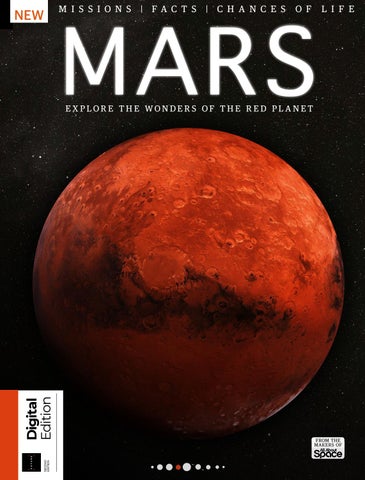
MARS
M I S S I O N S
| FA C T S
| C H A N C E S
O F
L I F E
SECOND EDITION
Digital Edition
EX PLOR E T H E WON DERS OF T H E R ED PL A N ET
FROM THE MAKERS OF
Welcome to the
MARS Book of
When this bookazine first went to press, NASA had deployed the very first instrument from its InSight mission onto the surface of Mars. InSight, a robotic lander, is tasked with examining the interior geology of the Red Planet, looking back in time to tell us how Mars, and by extension the other rocky planets, including our own, formed. The history of Mars is intrinsically bound up with that of Earth – some scientists even think that the original building blocks of life came from there. Meanwhile, the ESA’s Mars Express probe, undeterred by the failure of its Beagle 2 lander back in 2003, recently beamed back some of the clearest images yet of a crater filled with water ice in the northern lowlands of what was once thought to be an arid world. Despite a chequered history of failed spacecraft and the so-called ‘Mars Curse’, the Red Planet is finally being persuaded to give up some of its secrets. Here, we’ll reveal what scientists know so far about the planet that has captured the human imagination for centuries, examine the theories that may help us to understand it further, and explore how, one day, we could make it into another human home.
This bookazine is printed on recycled paper. It’s important that we care about our planet and make a difference where we can, for us and every generation that follows.
MARS Future PLC Richmond House, 33 Richmond Hill, Bournemouth, Dorset, BH2 6EZ
Editorial Editor April Madden Designer Briony Duguid Compiled by Jacqueline Snowden & Lora Barnes Editorial Director Jon White Senior Art Editor Andy Downes All About Space Editorial Editor-in-Chief Gemma Lavender Art Editor Jonathan Wells Senior Art Editor Duncan Crook Advertising Media packs are available on request Commercial Director Clare Dove clare.dove@futurenet.com International Head of Print Licensing Rachel Shaw licensing@futurenet.com Circulation Head of Newstrade Tim Mathers Production Head of Production Mark Constance Production Project Manager Clare Scott Advertising Production Manager Joanne Crosby Digital Editions Controller Jason Hudson Production Managers Keely Miller, Nola Cokely, Vivienne Calvert, Fran Twentyman Management Chief Content Officer Aaron Asadi Commercial Finance Director Dan Jotcham Head of Art & Design Greg Whitaker Printed by William Gibbons, 26 Planetary Road, Willenhall, West Midlands, WV13 3XT
Distributed by Marketforce, 5 Churchill Place, Canary Wharf, London, E14 5HU www.marketforce.co.uk Tel: 0203 787 9001 All About Space Book of Mars Second Edition Š 2020 Future Publishing Limited We are committed to only using magazine paper which is derived from responsibly managed, certified forestry and chlorine-free manufacture. The paper in this magazine was sourced and produced from sustainable managed forests, conforming to strict environmental and socioeconomic standards. The manufacturing paper mill and printer hold full FSC and PEFC certification and accreditation. All contents Š 2020 Future Publishing Limited or published under licence. All rights reserved. No part of this magazine may be used, stored, transmitted or reproduced in any way without the prior written permission of the publisher. Future Publishing Limited (company number 2008885) is registered in England and Wales. Registered office: Quay House, The Ambury, Bath BA1 1UA. All information contained in this publication is for information only and is, as far as we are aware, correct at the time of going to press. Future cannot accept any responsibility for errors or inaccuracies in such information. You are advised to contact manufacturers and retailers directly with regard to the price of products/services referred to in this publication. Apps and websites mentioned in this publication are not under our control. We are not responsible for their contents or any other changes or updates to them. This magazine is fully independent and not affiliated in any way with the companies mentioned herein.
Future plc is a public company quoted on the London Stock Exchange (symbol: FUTR) www.futureplc.com
Chief executive Zillah Byng-Thorne Non-executive chairman Richard Huntingford Chief financial officer Penny Ladkin-Brand Tel +44 (0)1225 442 244
Part of the
bookazine series
Contents 08 All about Mars
78 Martian meteor mountain
20 25 amazing discoveries
80 Surviving on Mars
32 Mars Reconnaissance Orbiter 36 Over 10 years around Mars
88 How did Mars lose its sky? 94 Living in a Mars simulation
44 Explorer's Guide to Mars
98 The fight for Mars
48 15 years of discoveries
106 Destination Mars
56 Living like a Mars rover
116 10 wonders of Mars
60 Exploring Mars
128 Is life from Mars?
72 Curiosity: The first 12 months
136 The hunt for Martian life
6
"Scientists thought Mars was a dead planet. But subsequent missions revealed that there’s much more to it than meets the eye" 7
All about Mars
8
All about Mars
All about‌
MARS Written by Shanna Freeman
The fourth planet from the Sun and the seventh largest, the red and varied landscape of this once Earth-like planet has fascinated humanity since we first viewed it in the night sky. All About Space explores just why this planet holds such allure
9
All about Mars Because it appears red due to the rust on its surface, Mars has long been called The Red Planet. Its ‘bloody’ appearance is also why it was named after the Roman god of war. But that potentially scary appearance hasn’t kept us from wanting to learn more about it. Mars formed about 4.6 billion years ago, along with the other planets in the Solar System. After the initial formation, Mars was bombarded at length by meteors, which caused its heavily cratered appearance. As the planet separated into layers, molten rock in the mantle pushed through the crust, resulting in volcanic activity. The activity released a lot of heat from the core, which led it to cool down very quickly. Atmospheric water likely froze, causing flooding, but the lack of atmospheric pressure meant that water was swirled away by solar winds. Eventually Mars settled down into the dry, dusty planet we’ve been watching since ancient times. We can easily see Mars from Earth without a telescope, and it’s actually easier to see when it’s further away from the Earth in its orbit because our atmosphere gets in the way. We’ve sent lots of probes to the planet, including the recent addition of NASA’s Curiosity rover. So far we’ve discovered that Mars is so much like the Earth, but also so very different. It is a terrestrial planet and has almost identical geographical features and a similar axial tilt (which results in seasons). It also has basically no atmosphere, no liquid water and wildly fluctuating temperatures on the surface. If there are any Martians lurking around, they have to be a hardy group – and so far they’ve eluded detection. Mars is red, but not all red. Although we can see the planet, we can’t actually see any of its features. We do, however, see albedo features, areas of light and dark. While most of the planet is red there are also
bright white areas at the poles, some upland areas, and also in the form of ice clouds. The darker spots are places where the intense wind has removed the ruddy dust to expose basaltic volcanic rock. Mars is the fourth planet from the Sun in the Solar System, right between the Earth and Jupiter. Size-wise it is the second-smallest planet, behind Mercury. Despite all of the Earth comparisons, it’s about half the diameter of Earth, and much less dense. In fact, its mass is about 11 per cent that of Earth’s and its volume is about 15 per cent. But because there are no oceans on Mars, the smaller planet has the same amount of dry land as the Earth does. The planet’s average distance from the Sun is about 228 million kilometres (142 million miles). It takes 687 Earth days to orbit the Sun, but Mars has a very eccentric elliptical orbit. Its eccentricity is 0.09, which is
the second-most eccentric in the Solar System behind Mercury (the Earth has an orbital eccentricity of 0.0167, which is almost a circle). But we believe that Mars once had a much rounder orbit – it has changed due to gravitational influences from the Sun and other planets. Rotation-wise, a Martian day is just a bit longer than an Earth day at 24 hours, 39 minutes and 35 seconds. Mars is also tilted 25.19 degrees, close to the Earth’s axial tilt of 23.44 degrees. That means depending on where the planet is in its orbit around the Sun, different hemispheres will be exposed to more
light – better known as seasons. They aren’t seasons like we know them, which are fairly equal in length on most parts of the surface of Earth. On Mars, spring is seven months long, for example, while winter is only four. The seasons are longer because the year is longer – Mars is further away from the Sun than the Earth – but they vary because of the eccentricity of Mars’ orbit. Mars also has two natural satellites, or moons – Phobos and Deimos. Both are potato-shaped and may have been asteroids that got trapped by Mars' gravitational pull or they could have
“ Because there are no oceans on Mars, it has the same amount of dry land as the Earth does”
An eccentric orbit
Axial tilt
Mars' axial tilt is 25.19 degrees – a lot like Earth’s – so it also has seasons.
Aphelion
Mars' furthest point from the Sun in its orbit is 249 million kilometres (155 million miles).
Perihelion
Mars is closest to the Sun at 206 million km (128 million miles). This variation makes Mars' orbit the second-most eccentric in the Solar System.
Opposition
When the Earth is exactly between Mars and the Sun and the three objects are in a straight line, it’s known as opposition.
The planets in relation to the Sun
All figures = million miles from Sun
Mars lies 228 million km (142 million miles) from the Sun and 225 million km (140 million miles) from Earth
Mars
10
Neptune 2,799
Uranus 1,784
Saturn 888
Jupiter 484
Mars 142
Earth 93
Venus 67
Mercury 36
Fourth planet from the Sun and second-smallest in the Solar System
All about Mars formed from material ejected from Mars during impact. The planet might also have other tiny satellites that have yet to be discovered. Over the years science fiction has often portrayed Mars as a sister planet to Earth and although there are many key differences – the small matter of life, for example – a true understanding can often be reached by making the right comparisons. NASA has referred to Earth as ‘one of the best comparative laboratories’ and the study of Mars can provide scientists with a control set for studying the potential for life beyond our world. As mentioned, the chief of these differences is the size of the planet:
Seasons and tilt
Mars is around half the size of Earth and has just 11 per cent of its mass
Mars is a smaller world with 53 per cent the diameter and just 11 per cent the mass of Earth. The surface gravity on the Red Planet is 38 per cent that of Earth’s, meaning that a human who can jump one metre (3.3 feet) on Earth could jump 2.6 metres (about nine feet) on Mars. As well as the similar land surface area the atmospheric chemistry is relatively similar especially when Earth and Mars are compared to other planets in the Solar System. Both planets have large polar ice caps made primarily of water ice, according to current thinking. Other similarities include a similar tilt in their rotational axis, which causes strong seasonal variability on the planets' surfaces.
Northern winter, southern summer
Northern autumn, southern spring
‘Summer’ on Mars is a relative term – fluctuating temperatures mean a range from -20°C (-4°F) to 30°C (86°F).
Much like Earth, Mars has four seasons that are opposite in the northern and southern hemispheres, but they aren’t of equal length.
Rotational axis 24.9o
55o N
Nearest to Sun
SUN Furthest fr om Sun
50o S
Northern spring, southern autumn
Autumn lasts for about 5.3 months, while spring is seven months long.
Direction of revolution
The moons of Mars Phobos
Phobos is the bigger of Mars' two satellites, and orbits the closest. In fact, it orbits closer to its planet than any other satellite in the Solar System. The distance from the moon to the planet is about 6,000km (3,700 miles) from the surface. Phobos has a radius of about 11km (seven miles) and is irregularly shaped and non-spherical. Its biggest feature is a large impact crater named Stickney, which has a diameter of about 9km (5.6 miles).
Northern summer, southern winter
Summer is six months long and winter is about four months.
Deimos
Deimos is much farther from Mars than Phobos at around 23,400km (14,600 miles) away. It’s also significantly smaller, with a radius of around 6km (four miles), and takes much longer to orbit Mars at 30.4 hours. Deimos, like Phobos, is not at all spherical. It has a very porous surface, and also features large craters relative to its size, with the two largest being Swift and Voltaire. Both craters are believed to be between 1 and 3km (0.6 and 1.9 miles) in diameter.
11
All about Mars
Mars inside and out Its make-up may resemble Earth’s, but Mars is a very different planet Mars is a terrestrial, or rocky, planet – just like Earth. It also has a differentiated internal structure, meaning that there’s an outer crust, a mantle and a core. However, that structure isn’t exactly like the Earth’s. At the centre of the planet, Mars' core is believed to be between around 3,000 and 4,000 kilometres (1,850 and 2,500 miles) in diameter. It’s mostly made up of iron, with nickel and traces of other elements, such as sulphur. Scientists believe that the core is mostly solid but may also contain a fluid layer. There is no magnetic field generated at the core, but Mars may have had a magnetic field in the past. There are currently areas of magnetisation at different places on the planet’s surface. The differentiation process, in which heavier metals such as iron sunk through to the core while Mars was forming, may be responsible for the end of its magnetic field.
Atop the core lies Mars' silicate mantle, which is between 1,300 and 1,800 kilometres (800 and 1,100 miles) thick. Volcanic activity on the planet’s surface originated here, resulting in the huge volcanoes, lava flows and other features that can be found on Mars' surface – however, the most recent volcanic activity likely took place about 2 million years ago. That may not be particularly recent by our standards, but it’s fairly recent when it comes to Mars' history. These were lava flows, however; the volcanoes appear to be extinct. Finally, there’s the crust, which is about 25 to 80 kilometres (16 to 50 miles) thick. It contains oxygen,
“ The solar wind strips away molecules and carries them out into space”
The dead magnetic field Dipole field
Magnetic properties of minerals in the crust show that Mars likely had a dipole field with alternating polarity.
Differentiation
Astronomers believe that the potential source of power for the dynamo – sinking metals as the interior separated – may have also been responsible for its end.
High density core
Mars' now solid core may have once been liquid, with a dynamo powered by the differentiation of the planet’s interior.
12
silicon, iron, calcium and other metals. The high concentrations of iron and oxygen result in rust – iron oxide – which is responsible in part for the red appearance of Mars. At its thickest the crust is more than twice as thick as the Earth’s crust. The surface is covered with regolith in many places – a loose conglomerate of broken rocks, dirt and dust that sits lightly on the surface. There isn’t much atmosphere – the solar wind strips away molecules and carries them out into space. What little atmosphere is left is made up of about 95 per cent carbon dioxide, three per cent nitrogen, two per cent argon with trace gases as well.
All about Mars
A thin atmosphere Upper atmosphere
Upper atmosphere 100km
Also known as the thermosphere, this layer is heated by the Sun. The lack of a magnetic field means that the gases separate out into space.
Middle atmosphere
In the middle atmosphere, the Martian jet stream swirls the surface dust and gives the sky its orange colour.
Middle atmosphere
Lower atmosphere 45km
Lower atmosphere
The atmosphere contains 95 per cent carbon dioxide, three per cent nitrogen, two per cent argon and traces of elements such as methane.
Thin ice clouds 10km
0km
Strong winds sweeping off Mars' polar ice caps, along with atmospheric sublimation of carbon dioxide, help create these thin ice clouds.
Mantle
Mars has a silicate mantle that once had volcanic and tectonic activity, which helped shape the planet.
Core Crust Mantle Core
The core is mostly solid, containing iron and nickel as well as sulphur. It does not generate a magnetic field.
Crust
Mars' crust appears to be thicker than that of Earth’s, especially in areas of prior volcanic activity.
This image, taken by the Viking Orbiter from low orbit, shows the thin layer of Mars' atmosphere – less than one per cent the thickness of Earth’s atmosphere
13
All about Mars
On the surface Mars has a lot of geographical similarities with Earth, but there’s a reason why we haven’t found life there… yet all over. Finally, the crust on the northern hemisphere appears to be much thinner than the southern hemisphere’s. While astronomers aren’t sure of the reasons behind this dichotomy, it involves the three main forces that have influenced the planet’s surface: volcanic activity, tectonics and impacts. Some of the most striking features on Mars' surface are its mountains – which are all inactive volcanoes.
Thanks to the many images sent back from various probes, we know that Mars has a lot of interesting geographical features. The biggest one is that Mars has incredibly different northern and southern hemispheres. Most of the northern hemisphere is lower in elevation than the southern one (up to six kilometres or four miles lower). It also has far fewer impact craters, and is much smoother and uniform
The western edge of the southern hemisphere contains two different areas – the Tharsis bulge and the Elysium volcanic complex – each of which contain several volcanoes. The Tharsis bulge covers about 25 per cent of the planet’s surface and lies seven to ten kilometres (four to six miles) above it. This includes Mons Olympus, a shield volcano that is the largest mountain in the Solar System. Up until a few years
A probe’s-eye view of Mars
ago, scientists were sure that Mars didn’t have plate tectonics like Earth. Then we discovered that there are in fact tectonics at work. Not only do features like steep cliffs and the flat walls of canyons show faults at work, but so do the fact that Mars' volcanoes are concentrated in two different areas. The huge valley system known as the Valles Marineris is the deepest in the Solar System and takes up a quarter of the
Viking 1 landing site
The first spacecraft to land successfully on Mars, Viking 1 landed on 20 July 1976 and stopped operating in April 1980.
Olympus Mons This is the largestknown mountain in the Solar System at almost 22km (14 miles) high.
Pathfinder landing site
The Pathfinder landed on 4 July 1997 and NASA lost communication later that year.
Tharsis Montes
Three giant shield volcanoes at 14.4km (nine miles) high and 450km (280 miles) wide, sit on a bulge that makes them as high as Olympus Mons.
14
Valles Marineris
This valley system is up to 4,000km (2,500 miles) long and around 7km (four miles) deep. It was formed by crust shifting millions of years ago.
All about Mars planet’s circumference. It’s also a plate boundary, with horizontal movement along the plates. With just one known fault as opposed to many on Earth, some believe that Mars' tectonic system is much younger. Impact craters and basins are prevalent in Mars' southern hemisphere. The Hellas basin is the largest of these at 1,800 kilometres (1,100 miles) in diameter. The largest basins are believed to date back to a period of heavy bombardment about 3.8 billion years ago. They show evidence of erosion and also contain a lot of regolith, or soil deposits. The smaller craters are younger, and look a lot like the Moon’s impact craters. Mars has many different types of craters thanks to erosion, deposits and volcanic activity. They also contain ejecta blankets – flows formed in the
soil after an impact melts ice under the planet’s surface. Mars is believed to have ice underneath its surface – and there are also ice caps at the poles, the amount of which changes depending on the seasons. Because Mars has a similar tilt to the Earth, it does have four seasons – they’re just longer and of varied lengths. Temperatures can get as low as minus 143 degrees Celsius (minus 225 degrees Fahrenheit) at the ice caps in the winter. The ice beneath the surface freezes and melts depending on the temperature. The atmospheric pressure on Mars is much lower than the Earth’s, and it’s so thin that there is very little to block the surface from the Sun’s heat. There are ice clouds, probably caused when the wind kicks up dust, while one of the Red Planet’s biggest weather features is dust storms, which can last up to a month.
Despite its thin atmosphere, Mars does have a layer of ice-water clouds, although the blanket lies below the planet’s tallest volcano, Olympus Mons. A wave cloud due to ripples in the atmosphere is also visible
North pole
Mars' north pole contains about a third of the ice found in the Earth’s Greenland ice sheet.
Viking 2 landing site
NASA’s Viking 2 landed here on 3 September 1976 and operated until 11 April 1980.
Hellas Planitia
The largest visible impact crater in the Solar System is around 2,300km (1,400 miles) in diameter and 7.2km (4.4 miles) deep.
Spirit rover landing site South pole
The south pole contains enough ice to cover the surface of the planet in a liquid layer up to 11m (36ft) deep.
NASA’s Spirit rover landed on 4 January 2004 and became stuck in soft soil on 1 May 2009. Communication was lost in 2010 and NASA officially ended the mission in 2011.
15
All about Mars
Olympus Mons
Canyons, craters and deserts Mars is home to some of the largest planetary features in the Solar System
Polar ice caps
Olympus Mons Olympus Mons is the tallest known mountain in the Solar System at 22km (14 miles) high. It’s more than twice the size of Mount Everest and is an extinct volcano. Polar ice caps This polar ice cap on the southern end of Mars grows and wanes each year depending on the season. It is made up of both water ice and dry ice (frozen carbon dioxide). Valles Marineris Valles Marineris is a system of canyons located along the equator of Mars and covers almost 25 per cent of the planet's circumference. It is around 7km (four miles) deep, 200km (124 miles) wide and 4,000km (2,500 miles) long. On Earth, that would be
the distance between New York and Los Angeles. Water erosion Reull Vallis is one of the valleys on Mars that look as if they may have been carved out by water movement. Many of these valleys contain grooves on their floors that may be rich in ice. Sand dunes Regolith – a mix of soil, sand, dust and broken rocks – has drifted into dunes on Mars' surface. We once thought they were stationary, but observations have shown that the dunes actually move due to prevailing winds. Hellas Basin The Hellas Basin is one of the biggest impact craters in the Solar System. At 2,300km (1,400 miles) in diameter, it is wider than the state of Texas.
Valles Marineris
16
www.spaceanswers.com
All about Mars
Mars by numbers
Fantastic figures and surprising statistics about the Red Planet
Water erosion
2,300
km
The diameter of Mars' Hellas Basin is the same as the diameter of Pluto
2
Mars has two known satellites: the moons of Phobos and Deimos
Sand dunes Hellas Basin
14.5
Travelling at a speed of 14.5 miles per second compared to the Earth’s 18.5 miles per second, Mars is slower to orbit the Sun
271 221 years and days
How long it would take you to get to Mars from Earth if you could drive there in a car at 97km/h (60mph)
687 Earth days
A year on Mars is 687 Earth days, while a day on Mars is equivalent to 1.026 Earth days
37.5%
Gravity on Mars as a percentage of Earth’s. If you could visit, you could jump three times as high as you can on our planet www.spaceanswers.com
17
The Phoenix lander studied Mars' landscape, weather and climate cycles in 2008
All about Mars
Exploring Mars
The failure rate in shooting for Mars is high The Soviet Union, not the United States, was the first country to attempt a Mars exploration – but it was unsuccessful. The Mars 1M was just the first of many failed attempts to visit Mars. Since that first attempt in 1960, 43 different spacecraft have tried and only 14 of them completed their missions. Mars 1M had a launch failure, but other probes have been the victims of communication problems, computer malfunctions and even the planet itself. It’s been so difficult to get to Mars that some have dubbed the challenge the “Martian curse”, and one journalist in the United States jokingly said that there must be a “Galactic Ghoul” hindering our exploration efforts. So why has it proved so difficult to get there? It takes a spacecraft about seven months on MSL launches atop a Atlas V rocket on 26 November 2011
average to travel the 225 million kilometres (140 million miles) to Mars. Once it reaches the planet, if the orbiter has a lander then it must successfully separate and have the lander touch down gracefully on the surface. And Mars can be unpredictable. Things like dust storms and soft soil have impeded landers, for example. But we do have to remember that most of total failures were early in our space exploration history. While there have been some memorable recent failures, including the 1999 Mars Climate Orbiter, which was pure human error. In that case, a contractor used imperial units instead of metric, which caused the probe’s rocket to shut down early and send it crashing into the planet. Currently there are three orbiters around Mars: the Mars Odyssey and Mars Reconnaissance Orbiter, both from NASA, and the European Space Agency’s Mars Express. Sadly after 14 years on the surface, the Opportunity rover was announced inactive when it became swept up in a dust storm in June 2018 but, with Curiosity studying the terrain, humaniity continues to explore the red
“ It takes a spacecraft about seven months to travel the 225 million kilometres to Mars”
The 120km (75-mile) wide Hadley Crater as imaged by the ESA’s Mars Express
The Opportunity rover has been on Mars' surface since 2004
Major missions
Mars 1M Oct 1960
These Soviet missions were the first in the quest to explore Mars. Mars 1M No 1 experienced a launch failure on 10 October 1960. Mars 1M No 2 met the same fate.
18
Mariner 4 28 Nov 1964-21 Dec 1967
Mariner 4 performed the first flyby and returned the first colour images of Mars. These were also the first images taken of another planet from deep space.
Mars 2 & 3 19 May 1971-22 Aug 1972
The Soviet-built Mars 2 became the first spacecraft to land – or rather crash – into the surface of the planet. Mars 3 had a soft landing on 2 December 1971.
Viking 1 & 2 20 Aug 1975-13 Nov 1982
Viking 1 landed softly and fully completed its mission. It also held the record for longest Mars mission until the Opportunity rover.
All about Mars
“ Despite the high failure rate, we’ll surely continue to explore the Red Planet”
Cameras
Curiosity’s ‘head’ houses the rover’s ChemCam, Navcams and Mastcams.
Arm
Curiosity’s extendable arm has a microscope, X-ray spectrometer and drill for sample analysis.
SAM
A complex lab known as Sample Analysis at Mars (SAM) allows Curiosity to analyse dirt samples.
Mission Profile Curiosity
Mission dates: 2011–Present Details: Also known as the Mars Science Laboratory (MSL), Curiosity is the most ambitious, most complex and currently the most expensive mission ever launched to Red Planet, Mars. It landed on the fourth world from the Sun's surface on 6 August 2012 and has the ultimate goal of determining whether life ever existed on the planet, and how we might land humans on it. To discover more about the Mars Science Laboratory mission, check out the in-depth features over on pages 60 and 72.
Weight
Curiosity weighs an impressive 900kg (1,980lb), more than twice that of all the other Mars rovers combined.
Wheels
Curiosity’s wheels have a special Morse code track that allows scientists to accurately measure how far the rover has travelled.
Mars Polar Lander 3 Jan 1999-3 Dec 1999
The Mars Polar Lander was meant to perform soil and climatology studies on Mars, but NASA lost communication with it and it’s believed it crashed.
Mars Express Orbiter 2 Jun 2003-present
The ESA’s first planetary mission consisted of the Beagle 2 lander and the Mars Express Orbiter, with the latter still operational today.
Beagle 2 2 Jun 2003-19 Dec 2003
The Beagle 2 lander was lost six days before it was due to enter the Martian atmosphere. Attempts were made to contact it, but these ended in failure.
Opportunity 7 Jul 2003-10 Jun 2018
Opportunity was a rover launched shortly after its twin, Spirit, by NASA. It was still going strong up until 2018, when a dust storm silenced it.
19
25 amazing discoveries
MARS 25 amazing discoveries
It is over 50 years since the first spacecraft flew past Mars and, in that time, we have learnt a huge amount about our mysterious red neighbour Written by Laura Mears
20
A MASSIVE VOLCANO
ITS ANCIENT WATERWAYS
A NEAR-MISS
THE DANGERS OF EXPLORATION
THE MELTING POLAR ICE CAPS
ITS VIOLENT HISTORY
25 amazing discoveries
21
25 amazing discoveries
Astronomer Schiaparelli observed ‘channels’ on Mars
1 Mars looks like a dead planet Since the invention of the telescope in the 1600s, astronomers have been fascinated by the surface of Mars. It is too far away to resolve from the Earth, and the atmospheres of both planets interfere with the passage of light, but they noticed dark and light patches that moved as the year passed, and speculated that they might belong to clouds, seas and even forests. In the 19th century, Italian astronomer Giovanni Schiaparelli described a series of channels that he saw in the surface of the planet, imagining that there might be water on the surface, but a mistranslation of the Italian word ‘canali’ led American scientists, most notably Percival Lowell, to believe that the Red Planet was actually covered in canals, possibly built by an intelligent life form. Hopes of an Earth-like planet were dashed when NASA’s Mariner 4 captured the first ever close-up images of the surface during a flyby in 1965. The 22 stills showed craters, reminiscent of the scarred surface of the Moon, and revealed the planet to be a barren waste covered in red dust and rubble. Measurements taken by the onboard instruments detected no magnetic field, and barely any atmosphere. For years after, scientists thought Mars was a dead planet, whose geological activity stopped billions of years ago. But subsequent missions revealed that there’s much more to Mars than meets the eye.
22
The fine, ferrous dust can be picked up by magnets
2 Martian dust is magnetic The Red Planet owes its distinctive colouration to large amounts of iron, which was detected in high quantities in the soil by the Viking landers in 1976. Its surface is coated in a fine layer of dust, which after billions of years of winds and storms has been ground down to a consistency finer than talcum powder. The Imager for Mars Pathfinder (IMP), attached to the Carl Sagan Memorial Station, which
Mission Profile
Mariner 4
Launched: 28 November 1964 Arrived at Mars: 14 July 1965 Weight: 260.68kg (574.70lb) Number of days on/around Mars (in Martian days and Earth days): 1 day/1 day Current status: Communications terminated in 1967
landed in 1997, used the difference in atmospheric brightness throughout the day to measure the size of the airborne dust particles, revealing that on average, they measure about three microns in diameter: the perfect size to interfere with delicate equipment! In 2004, NASA’s Spirit rover carried permanent magnets to the surface of the planet to probe the dust further, confirming that almost all of the dust
on Mars is magnetic, whether in the air or on the ground. Two angled magnets captured particles from the atmosphere, revealing different oxides of iron; strongly magnetic dark material that is either magnetite or maghemite, plus lighter, less magnetic haematite. The rover also carried a strong magnet near its panoramic camera that repelled the dust, protecting the equipment and ensuring the images remained clear.
25 amazing discoveries
3
It is home to the tallest mountain in the Solar System The first orbiter to visit Mars was NASA’s Mariner 9, tasked with mapping 70 per cent of the planet’s surface. However, when it arrived in 1971, the planet was engulfed in a dust storm that completely obscured the view of the ground below, and the orbiter had to wait for several months for the dust to settle. As the storm subsided, the highest points were revealed first, and four enormous volcanoes started to appear above the sinking clouds. They were large and domed in appearance, and the sides had gentle slopes, reminiscent of the shield volcanoes on Earth. The lava in shield volcanoes is lower in silica than the lava in stratovolcanoes, making it runnier
The biggest mountain we know of is nearly three times taller than Everest
Olympus Mons Everest
Where: Nepal/Tibet Height: 8,848m
Where: Mars Height: 21,229m
Mauna Kea
Where: Hawaii Height: 10,000m (submarine base)
and more liquid. Instead of spraying outwards, as it escapes through the crust it moves in fluid sheets, and the lava flows travel for great distances across the ground. Over time, a gentle slope builds up as layer upon layer of lava are laid down, resulting in a wide, smooth volcano. The tallest of the Martian shield volcanoes is Olympus Mons, measuring 624 kilometres (374 miles) across and extending nearly 26 kilometres (16 miles) above the ground. It easily dwarfs every other peak identified in the Solar System to date. For comparison, the tallest volcano on Earth, Mauna Kea in Hawaii, extends 10,000 metres (32,800 feet) above the floor of the Pacific Ocean.
4
Mars has two satellites
The two moons of Mars are named Phobos and Deimos, after the sons of the Greek god of war, Ares. Phobos has the closest orbit of any known moon, and passes within 6,000 kilometres (3,730 miles) of the surface of the Red Planet, completing a full circle three times every day. They have been photographed close up by several missions, but never visited.
23
25 amazing discoveries
5
Mars used to have lakes and streams
Mars wasn’t always as dusty and desolate as it is today. Maps made of the surface by Mariner 9, the Viking orbiters, and the Mars Global Surveyor reveal networks of valleys across the southern hemisphere, and show evidence of streams running down the sides of the mountains. The most convincing evidence for liquid water on Mars has been provided by NASA’s rovers Spirit, Opportunity and, more recently, Curiosity. Within just a few months
4 billion years ago
of landing in Gale Crater, Curiosity revealed an ancient streambed. On the ground are dunes made from sand and pebbles, too heavy to have been moved by the winds in the thin Martian atmosphere. The pebbles were smooth, like those you might find at the beach, and in the nearby rocks were veins of calcium sulphate, a mineral that would have been dissolved in the water that once flowed there. The rover also came across the site of an ancient lake,
In the earliest history of Mars, the heavy bombardment was battering the inner planets of the Solar System, creating the craters now visible on Mars' southern hemisphere. The planet still had its atmosphere, and liquid water existed on the surface, possibly as a vast ocean that covered the northern hemisphere.
containing clay minerals formed in neutral water and mudstone, made from particles laid down over time. In 2014, Opportunity discovered another fresh water source on Mars, 8,000 kilometres (4,970 miles) away from the Curiosity site and positioned in rocks from the earliest point in Martian history, when the surface was likely to have been more similar to Earth. The rocks in the area are smectite, a clay mineral formed in the presence of pH-neutral water.
3.5 billion years ago
Mars underwent a catastrophic change, and within the space of a few hundred million years, its core cooled, its magnetic field was lost, and over 95% of its atmosphere boiled away, preventing liquid water from existing on the surface. Over the next 3 billion years, volcanic activity periodically melted ice trapped beneath the surface, forming channels and gullies.
Mission Profile Opportunity
Launched: 7 July 2003 Arrived at Mars: 25 January 2004 Weight: 185kg (407.9lb) Mission type: Search for past water activity on Mars Current status: Lost contact 10 June 2018
7
Mars isn’t round
NASA’s Mars Global Surveyor spent three years creating a topographical map of the entire Martian surface. It revealed that the northern hemisphere is low and flat, while the southern hemisphere is high, rugged and cratered, with a huge difference in elevation between the top and bottom of the planet.
24
25 amazing discoveries
6 It was once capable of supporting life The sedimentary rocks laid down over millions of years on the surface of Mars are evidence that liquid water existed for prolonged periods, giving plenty of time for life to have evolved. Following the repeated discovery of water on Mars, NASA switched its focus to searching for signs of life, and the Curiosity rover has been hunting since it landed in 2012. It has drilled into the sedimentary rocks in a location called Yellowknife Bay, revealing that the minerals beneath contain nitrogen, phosphorous, hydrogen, oxygen, carbon, and sulphur – the building blocks of the biological molecules
that make up all life on Earth. On our own planet, microorganisms known as lithoautotrophs (rock eaters) can survive by using inorganic molecules to obtain their energy. As the climate on Mars changed, the liquid water on the surface became trapped in the soil as permafrost, and today nothing can survive on the surface. The planet is bathed in radiation, battered by solar winds, and the atmosphere is painfully thin. However, on Earth bacteria can survive buried deep in Antarctic permafrost. Scientists are hopeful that if there was once life on Mars, traces will remain in the ice.
Present day
The atmosphere on Mars is thin, and the vapour pressure is low. Any water ice reaching the surface instantly sublimes into vapour and escapes. Much of the water that used to cover the planet is trapped beneath the ground as permafrost, and missions are ongoing to determine whether there is liquid water hidden below.
Mission Profile Curiosity
Launched: 26 November 2011 Arrived at Mars: 5 August 2012 Weight: 899kg (1982lb) Mission type: To determine whether Mars could have supported life in the past Current status: Active
25
25 amazing discoveries
8 A day on Mars is 41 minutes longer than a day on Earth
NASA's Gaylon McSmith, current project manager for Mars Odyssey Explorer, which revealed water ice beneath the Martian poles
Mars missions are planned and executed according to Mars time, where a day lasts for 24 hours and 37 minutes (compared to the 23 hours and 56 minutes of an Earth day). Amazingly, this number has been known since 1666, when Giovanni Cassini calculated the spin by watching surface features appear and disappear (he estimated the Martian day length to be 24 hours and 40 minutes).
9 Its gravity is about a third of Earth’s The orbital behaviour of satellites around Mars, both natural and artificial, have revealed that there is 62 per cent less gravity on Mars than there is on Earth. Mars is just half the size of the Earth, and is only around 11 per cent of the mass, dramatically reducing its gravitational pull.
10 A vast canyon opened up as the crust stretched One of the most striking features on the surface of Mars is Valles Marineris, named after the Mariner 9 orbiter that discovered it. The vast canyon stretches across the equator and is over 4,000 kilometres (2,485 miles) in length, seven kilometres (four miles) deep and is thought to have been formed when the planet cracked as it cooled.
26
11 The ground
is filled with water ice One of the major questions surrounding Mars was what had happened to its water. Today, there may be trickles of liquid on the surface but it instantly sublimes into vapour, before escaping the atmosphere into space. However, in the past the planet was covered with lakes, streams and possibly even oceans. Between 2001 and 2002, the Mars Odyssey Explorer looked for hydrogen
12
The core might still be molten
The lack of magnetic field around Mars indicates the core might have solidified, but the Mars Reconnaissance Orbiter revealed evidence of plate tectonics, with features some scientists say are reminiscent of the San Andreas fault in California, where two plates are moving horizontally past each other.
beneath the surface of Mars, evidence that there might be trapped water. The map it returned revealed that beneath the dry carbon dioxide ice at the poles there is a huge quantity of water ice. The radar sounder onboard ESA’s Mars Express orbiter later revealed that there is enough potential water trapped under the Martian poles to cover the entire planet in an ocean 11 metres (36 feet) deep.
“ In the past the planet was covered with lakes, streams and even oceans”
25 amazing discoveries
13 Mars has seasons Seasons represent changes in day length and climate throughout the year, and are dependent upon a planet’s distance to the Sun. If a planet is spinning straight up on its axis the equator always gets the same amount of sunshine every day, but if the planet is tilted the daylight hours vary slightly throughout the year. Earth is tilted on its axis by a little over 23 degrees, and Mars by 25 degrees, and both experience seasonal variations. Mars differs from the Earth in that it has a more elliptical orbit and at certain times of the year is much closer to the Sun. As a result, spring and summer are longer in the northern hemisphere than
they are in the southern, because when the north is tilted towards the Sun on the axis the entire planet is farther away in its orbit and so travels slower. While the northern hemisphere enjoys a long summer, the winters at the southern hemisphere are harsh, and for much of the time the south pole is in complete darkness. The temperature drops so low that carbon dioxide solidifies out of the air, forming a permanent cap of dry ice over the region. NASA's first ever landers to reach the surface of the Red Planet, Viking 1 and Viking 2, showed that atmospheric pressure drops by as much as 25 per cent as the gas freezes in the winter.
At Mars' permanent south pole, winter temperatures plummet as low as -153C (-243F)
15 Its magnetic dynamo is not working
Tharsis Montes, a volcanic region of Mars with three huge volcanos, sits on the crest of the planet's bulge
14 It has shifted on its axis NASA’s Mars Global Surveyor completed a full map of the surface of Mars in 2001, but something didn’t quite match up. The positions of the shorelines where regions of water might have been weren’t level. A team at the University of California, Berkeley showed that the shoreline movement might be down to the change in the spin axis of Mars. The spin axis of Mars is not fixed like Earth’s, but has changed over its lifetime, and crust has moved relative to the axis over a
distance of around 3,000 kilometres (1,864 miles) along the surface in the last 2 to 3 billion years. As planets spin the motion causes them to bulge in the centre, and the group calculated that deformation in the crust would have changed the water level to match the patterns seen in the shorelines. It is even thought that floodwater might have contributed to the tilting of the planet, tipping the planet by 50 degrees, and then tilting it back again by 20 degrees as it dried out.
When Mariner 4 completed its flyby in 1965, it became apparent that something was wrong with Mars' magnetic field, and by 1989, a low-orbiting probe, Phobos 2, sent to Mars by the Soviet Union had revealed that it is 3,000 times weaker than the Earth’s. Earth has a molten iron outer core, which circulates inside the planet, powering an internal magnetic dynamo. It acts like a giant bar magnet, generating magnetic field lines that spring out from the poles and encircle the Earth, deflecting solar winds and helping to protect the atmosphere. On Mars, these field lines are missing and, rather than circling the planet, weak magnetic fields are fixed in specific locations, mainly in the southern hemisphere. Earth’s magnetic field periodically changes direction, and its magnetic history
The direction and strength of the Martian magnetic field as it passes over the crust is written in to the rocks, with alternating bands of magnetic material deposited in opposite directions. NASA’s Mars Global Surveyor found similar striped magnetic field lines in the ground of the southern highlands, indicating that at some point Mars had a functioning dynamo. These stripes are absent from the northern hemisphere, which formed much later in the history of the planet, suggesting the dynamo stopped functioning a few hundred million years after Mars formed.
27
25 amazing discoveries
16
Mars is still losing its atmosphere
The atmospheric pressure on Mars ranges from around five to ten millibars (compared to 1,000 millibars here on Earth). The Red Planet is around 50 per cent smaller in diameter than Earth, and its lower gravity would have allowed the outer layers of the atmosphere to escape early in its life, particularly during energetic asteroid collisions. As the atmosphere started to thin, it would have provided less resistance to incoming asteroids, which would have resulted in even more collisions, beginning a vicious cycle of atmospheric loss. Without a functioning magnetic field, the Red
Planet is also vulnerable to the effects of solar winds. The Mars Express carries an imager capable of detecting the effects of solar winds, and showed that today, charged particles enter the Martian atmosphere, ionising the gases and allowing them to escape into space. NASA’s Mars Atmosphere and Volatile Evolution (MAVEN) orbiter arrived on 21 September 2014, followed a few days later by India’s Mars Orbiter Mission (Mangalyaan), and the two teams are collaborating to discover more about how Mars lost its protective sphere of gas.
Mission Profile Mars Global Surveyor
Launched: 7 November 1996 Arrived at Mars: 12 September 1997 Mission goal: To characterise the surface features and geological processes on Mars Current status: Contact ceased November 2006
Mars Reconnaissance Orbiter
Comet Siding Spring gave Mars a spectacular show as it passed nearby in October 2014
17 It had a near miss with a comet The comet Siding Spring was discovered in January 2013 and in October 2014, it passed within 139,500 kilometres (86,680 miles) of the surface of Mars, just under a third of the distance from the Earth to the Moon. At the time there were two active rovers on the surface of the planet (Opportunity and Curiosity) and five active orbiters. All pointed their cameras in its direction. The dust from the tail of the comet could easily have damaged the orbiting spacecraft, so the active orbiters, Mars Express, Mars Orbiter Mission, Mars Odyssey, Mars Reconnaissance Explorer and MAVEN waited on the opposite side of the planet. The comet passed without incident, and four orbiters managed to take pictures as it went.
28
25 amazing discoveries
18 Dust storms can shroud the entire planet
Upper
As you move up through the Martian atmosphere the pressure drops rapidly and the temperature rises. At altitudes of above around 200km (124mi), the gases begin to tail off into space, with no clear boundary between the atmosphere and the vacuum.
The dust that covers the surface of Mars is as fine as smoke and can float even in the painfully thin atmosphere. The biggest dust storm ever recorded on the Red Planet was seen by Mariner 9 when it arrived in 1971 and, since 1997, the Mars Global Surveyor has been in a polar orbit around Mars, tracking the weather. As the ground heats up in the morning each spring, dust devils begin to form. Energy from the Sun is absorbed by the dust and rocks and in turn starts to heat the gases. They then rise up through the cold air, creating a spinning vortex. NASA says that the atmosphere is so thin that you wouldn’t feel much wind on Mars, but that the fine dust whips through the air, building up static and releasing electrical arcs. As the day cools the storms subside, but the tiny dust particles can fly tens of kilometres into the air. In the low gravity, it takes a long time for them to fall back down to the surface again, with some remaining airborne for months.
Middle
The surface of Mars prior to (top) and during (above) the 2001 global dust storm as captured by Hubble
MAVEN
Mars Orbiter Mission (MOM)
Mission Profile
Mars Express
Launched: 2 June 2003 Arrived at Mars: 25 December 2003 Weight: 113kg (249lb) Mission goal: To image the entire surface of Mars at superhigh resolution Current status: Active
The combined effect of the spin of the planet, and the heating and cooling of the gases and dust in the atmosphere creates jetstreams between the lower and upper layers of the atmosphere. A similar effect can be seen on Earth.
Lower
In the lower atmosphere, dust particles absorb heat from the Sun, warming the air to around -63°C (-82°F). Clouds of water ice and carbon dioxide form in this layer, and dust storms regularly fill the air.
19 Mars has carbon dioxide weather The atmosphere on Mars was first analysed during the Mariner 4 flyby, and has been tested by several orbiters since. The first accurate measurements of its composition were made by the Viking landers, revealing that the thin air is 95.32 per cent carbon dioxide, 2.7 per cent nitrogen, and 1.6 per cent argon. Just 0.13 per cent of the atmosphere is oxygen, and 0.03 per cent is water vapour. In contrast, the atmosphere on Earth is 78 per cent nitrogen, 21 per cent oxygen, and just 0.04 per cent carbon dioxide. The European Space Agency launched its Mars Express orbiter in 2003, and has been monitoring the atmosphere ever since. It has observed carbon dioxide clouds forming around 80 kilometres (50 miles) in the air above the equator, and watched as it freezes down to cap the poles each winter. The orbiter also detected traces of methane gas alongside water vapour, sparking scientific interest in the potential for volcanic activity, or even life, beneath the surface.
29
25 amazing discoveries The surface of Mars has seen more than its fair share of violent outbursts in the last billion years
21
Gas jets spray from the south pole every spring
The Mars Reconnaissance Orbiter, launched in 2001, revealed that as the temperature rises in the spring the dry ice covering the south pole begins to sublime. Pockets of heated gas explode outwards as jets, throwing dust into the air and creating dark spider-shaped marks on the surface of the planet.
20
There has been recent volcanic activity on Mars
The history of Mars is mapped out in the rocks that cover its surface and, using data gathered from orbiters and landers, scientists are beginning to piece together the planet’s past. Over time, conditions on the surface have changed dramatically. The Mariner 4 spacecraft observed some of the planet’s oldest regions, craters made in the southern hemisphere during the heavy
30
bombardment that battered the rocky planets around 4 billion years ago. Although this part of the surface has remained largely unchanged, the rest of the planet has since been remodelled. The northern hemisphere is much less cratered and has been covered with smooth lava plains, and the tops of the shield volcanoes at the equator indicate that they were recently active. Lava flows from the
“ Shield volcanoes at the equator were recently active” volcanoes repeatedly covered up impact craters, and by looking at the calderas at the top of the mountains it is possible to estimate when they last erupted. ESA’s Mars Express has been examining the volcanoes,
and scientists estimate that volcanic activity continued until 100 to 200 million years ago, with evidence of lava flows within the last few million years. It may be that the volcanoes are dormant, not extinct.
25 amazing discoveries
If there is one thing that we have learnt about Mars over the last 50 years of space exploration, it is that travelling to the Red Planet is incredibly difficult. The first flyby in 1965 was the seventh attempt at reaching the planet and, since then, several more orbiters and landers have been lost. In the Nineties, four of NASA’s six missions to the Red Planet failed. In 2003, the European Space Agency lost the Beagle 2 Lander launched alongside the successful Mars Express. And Russia and
China’s joint effort Phobos-Grunt/ Yinghuo-1 was trapped in orbit around Earth in 2011. Those that did reach the Red Planet had problems of their own. Although the Phoenix lander outlasted its three-month mission, its solar panels were eventually destroyed by the weight of many tens of kilograms of dry ice during the winter and, after six years on the surface, a wheel on NASA’s Spirit rover stopped working, causing it to become irrevocably trapped in the Martian sands in 2009.
A robot snake rover attachment for exploring caves, in development by ESA
More recently, NASA’s Curiosity rover experienced unexpectedly quick damage to its aluminium wheels, forcing scientists to drive it in reverse. But despite all these problems, we have learnt a huge amount about Mars and the combined information from both the successes and failures is being assembled and used to inform current and future missions. Using the information we have acquired, NASA intends to take humans to Mars in the 2030s.
23 There are caves on Mars In 2007, the infrared cameras of the Mars Odyssey Orbiter spotted a set of caves on the surface of Mars, dubbed the Seven Sisters. They are located on the side of one of the shield volcanoes, Arsia Mons, and are visible as ‘skylights’, extending tens of metres downwards into lava tubes or sinkholes. Caves on Mars could provide easier access to buried layers of ancient rock without the need for heavy-duty drilling. These sheltered areas might be a good place to search for evidence of past life on the planet.
24 Sunsets are purple on Mars The Viking 1 lander returned the first images of the Martian sunset in the Seventies. The fine red dust particles tint the sky a pinkish colour in the evening, but as the Sun starts to dip below the horizon, blue light is scattered, creating a purplish hue.
25 Mars has ozone layers ESA’s Mars Express orbiter has been circling the planet since 2003, and is equipped with a UV spectrometer called SPICAM. It’s shown that Mars has an ozone layer at an altitude of 30 kilometres (19 miles), another in the northern spring/summer at between 30 to 60 kilometres (19 to 37 miles), and a third above the south pole in winter at around 40 to 60 kilometres (25 to 37 miles).
31
© NASA; Adrian Chesterman; ESA; Science Photo Library; Alamy; ISRO
22 Travelling to Mars is extremely challenging
It will be far trickier to safely send astronauts to Mars than it was to send them to the Moon
Mars Reconnaissance Orbiter (MRO)
USER MANUAL
Mars Reconnaissance Orbiter (MRO) Written by Dominic Reseigh-Lincoln
THE SPECS Launch: 12 August 2005 Launch rocket: Atlas V 401 Target: Mars Operators: NASA and JPL Orbital inclination: 93 degrees Component: Multiple components Arrival at Mars: 10 March 2006 Mission ends: TBC Time spent in orbit: 14 years
6.5m
Apart from its record-breaking main camera, the MRO’s development and build time was far shorter than that of other orbiter programmes
1.7m (average human height)
From the fascination it’s provided for the field of astronomy for centuries, to the secrets it’s yielded since the first Mars mission in 1960, the Red Planet remains an elusive and esoteric point in the night sky. Since the early 1960s, the collective space agencies of the world have launched over 50 missions to the distant world the Romans named after their deity of war, and one of those missions – NASA’s Mars Reconnaissance Orbiter (MRO) – is in its 14th year of ground-breaking study above Mars. Through the lens of its colossal HiRISE camera we have been able to study the Red Planet like never before and it has radically changed our understanding of this awe-inspiring destination. Much like many spacecraft before it (and, no doubt,
those to come after it), the MRO was born out of NASA’s ever evolving mission to study Mars in greater depth. After more than a decade of successful launches, NASA’s long-standing Mars Exploration Program (MEP) decided it needed a powerful camera, designed specifically to study Mars' unusual topography and composition. “The Mars Reconnaissance Orbiter was designed, built and launched with the key purpose of supporting the MEP in multiple ways,” reveals Dr Alfred McEwan, director at the Planetary Research Lab at the University of Arizona and a scientist involved in the MRO programme since its inception. “From the very beginning, we need it to perform the relay of surface assets, perform vital landing site reconnaissance, run important atmospheric studies
“ The MRO has the most capable science instruments at its disposal and a much higher data rate than any other orbiter”
It took seven months for the MRO to reach Mars and enter its intended orbital insertion. This image, one of its first, was beamed back surprisingly fast
The Mars Reconnaissance Orbiter’s launch went off without a hitch, and blasted off onboard NASA’s long-standing rocket of choice, the Atlas V
32
Mars Reconnaissance Orbiter (MRO)
Anatomy of the MRO Boasting the most powerful camera ever sent to deep space, the orbiter has been studying the topography and composition of Mars for over ten years with some fascinating discoveries SHARAD
High Gain Antenna
The MRO’s onboard Shallow Subsurface Radar is there to probe and define the composition of Mars’ polar ice caps.
The High Gain Antenna is the Mars Reconnaissance Orbiter’s main means of maintaining communication with Earth.
Gimbals
Two mechanisms make sure the solar arrays point toward the Sun, and another ensures the High Gain Antenna points toward Earth.
CRISM
A visible and near-infrared tool, the Compact Reconnaissance Imaging Spectrometer for Mars is used to measure the surface mineralogy on Mars.
Electra HiRISE
The largest and most powerful camera ever sent to deep space, the High Resolution Imaging Science Experiment is the MRO’s most important instrument.
Electra is a UHF software-defined radio communications package used for communicating with other craft heading to and operating on Mars.
CTX
The Context Camera works in conjunction with MARCI and HiRISE to create large contextual maps for possible lander sites.
Solar panels
The MRO's only source of power is sunlight. Each panel is approximately 10m2 (107.6ft2) and capable of generating 1,000 watts.
MARCI
The Mars Color Imager is a wideangle, low-resolution camera that can see in five visible and two ultraviolet bands.
MCS
The Mars Climate Sounder is the other spectrometer onboard the MRO and it measures temperature, pressure, dust levels and water vapour.
33
Mars Reconnaissance Orbiter (MRO)
Getting into Martian orbit Journey to Mars
After blasting off from Earth and separating from its Atlas V rocket, the MRO now begins its steady journey into deep space.
Readjusting trajectory
After seven months of travel, the MRO reorientates to align its thrust vector. The craft then fires its engines to reduce its velocity.
for EDL (Entry, Descent and Landing) and Marsbased science.” Even before it launched from Cape Canaveral in 2005, it was already turning heads. Most notably for the hyperactive speed of its development. Most orbiters take around a decade from design to launch, but for the MRO, that turnaround was positively supersonic. “It was approved back in 2001 and was ready for launch in August 2005,” comments Dr McEwan. “This was very fast compared to the development cycles of today’s NASA.” So what makes the MRO so different from the other Mars orbiters the American space agency has launched in the past? The answer lies in the clarity of its images and the data it captures from the planet’s atmosphere and composition. “MRO has the most capable science instruments at its disposal (highest spatial resolution at visible, infrared and radar wavelengths) and a Darkened entrance much higher data rate than any other Due to the trajectory that they orbiter we’ve ever launched,” adds often travel from Earth, some Dr McEwan on the craft’s unique craft begin orbit insertion instruments. “Orbiters provide while they are in eclipse. the global view and landers/ rovers study very tiny areas in great detail, so in that regard they’re quite synergistic in their capabilities.” The main crux of those capabilities lies in its onboard camera – HiRISE. The largest camera ever carried on a deep space mission, this 0.5-metre (1.6-foot)
Adjusting speed
Now entering orbital insertion at an angle of 93 degrees, the MRO begins to slow down via aerobraking and enters a low-altitude orbit.
Phoning home
The MRO begins imaging the surface of Mars almost immediately. These debut images are then sent back to NASA on Earth.
34
Mars Reconnaissance Orbiter (MRO) Using sounders and radars such as CRISM and SHARAD, the MRO has also made a startling discovery – results published in the Science journal in September 2009 showed deposits of polar ice had been exposed to the surface by comet strikes. “Ice exposed (temporarily) by new impact craters was a brand new discovery made by the MRO, and there have been many advances in polar science,” says Dr McEwan. “Another notable milestone is the discovery, by radar, of buried carbon dioxide ice in the south polar cap.” Now 14 years into its lifespan, the MRO’s future is far from grim. In fact, it’s now fully embracing its role as a communications support craft for future missions. It has been supporting the InSight Mars mission, which successfully landed on the Red Planet on 26 November 2018.
Atlas V 401
The MRO launched aboard the smallest member of the Atlas V rocket family. The V 401 is 58.3m (191ft) tall.
Head to head How does NASA’s MRO stand up to the other longstanding orbiter, the 2001 Mars Odyssey? In terms of launch mass, Odyssey clocked in at 725kg (1,598lb), but the MRO is far chunkier at 2,180kg (4,806lb). But, both orbiters are tiny compared to a regular double decker bus’ impressive 11,900kg (26,235lb). Height-wise, the Mars Odyssey is 2.2m (7.2ft), while the MRO is 6.5m (21.3ft) – about one and a half times the height of a double decker bus (4.38m or 14.4ft).
TOP TECH
High Resolution Imaging Science Experiment The MRO’s High Resolution Imaging Science Experiment is a milestone in space-based camera technology. It’s the largest and most powerful camera ever sent into deep space and consists of a 0.5m (1.6ft) aperture reflecting telescope. It cost a whopping $40mn (£27.5mn) and can capture images of Mars’ surface with resolutions of 30cm/pixel (11.8in/pixel). It’s even caught shots of the Curiosity and Opportunity rover missions.
MRO 2,180kg
Mars Odyssey 725kg
Vital statistics 2,000 watts
The amount of electricity needed for the MRO
58.3m The height of the Atlas V rocket
54.6mn km The minimum distance between Mars and Earth
1 Providing some context
In order to know where to point the powerful HiRISE (High Resolution Imaging Science Experiment) camera, the MRO uses the Context Camera to determine the most suitable region. The Shallow Subsurface Radar is used if the presence of underground polar ice caps is also factored in.
2 Capturing the spectrum
In order to correctly capture the likeness of the Martian surface, the MRO uses a spectrometer. One of the craft’s main spectrometers, CRISM, has the power to see 544 near-infrared channels, allowing the MRO map to now include vital mineralogy and surface composition data.
3 Global scale
Before the HiRISE camera is put into action, the onboard Mars Color Imager (MARCI) begins taking wide-angle shots in relatively low resolution. It can take up to 84 images a day, creating a vast map of the Martian surface. The MARCI sees five visible bands and two ultraviolet bands.
It would take five MROs to power a normal home
That’s just over half the size of Big Ben
2,180kg
The weight of the MRO
map the Martian surface HOW TO…
A touch heavier than your average 4x4 car
4 Capture and return
In order to capture high resolution details up to 30cm/pixel (11.8in/pixel), NASA uses the MRO’s HiRISE camera. Pointed at a desired location based on data collected by CRISM and CTX, the super deep-space lens can capture detailed shots of the Martian surface and beam them back to NASA.
equivalent to 1,362 trips around own planet
35
© Adrian Mann; NASA; JPL-Caltech; JHUAPL; University of Arizona; MSSS; Freepik
reflecting telescope is the grandest of three lenses pointed at Mars’ surface (the Context Camera takes images in greyscale and provides context maps for the other cameras, while the low-resolution MARCI – Mars Color Imager – gives daily Martian weather reports). The heart of the MRO’s science mission (which was only meant to last two Earth years from 2006 to 2008) is centred around mapping the planet’s surface to determine ideal landing sites for future NASA landers, and studying the Martian atmosphere and landscape to better understand its composition and the nature of its aqueous deposits. Its trio of aforementioned cameras capture these maps with an incredible clarity, a capability bolstered by its spectrometers CRISM (Compact Reconnaissance Imaging Spectrometer for Mars) and MCS (Mars Climate Sounder). The MCS and the MRO’s Shallow Subsurface Radar (SHARAD) have been helping NASA scientists study another fascinating aspect of Mars – the presence of water in its various aqueous forms, much of which is contained in ice caps buried in the planet’s subsurface.
Over 10 years around Mars
OVER
10AROUND
YEARS
MARS Over a decade ago, NASA’s Mars Reconnaissance Orbiter (MRO) arrived at the Red Planet. We take a look at its biggest discoveries Written by Giles Sparrow
Mission objectives Understand the present climate of Mars Work out the nature of the complex Martian terrain
Search for evidence of aqueous and hydrothermal activity Identify landing sites for future Mars missions Return data from craft on the surface during relay phase 36
Over 10 years around Mars 10 March 2006
Arrival at Mars
The MRO arrives in Martian orbit, initially entering a highly elliptical orbit over the planet’s poles. After initial checks, MRO begins an aerobraking manoeuvre that takes five months to complete, taking advantage of the natural brake provided by friction with the atmosphere to save thruster fuel. By the time the process is complete in early September, MRO’s 112-minute orbit around Mars ranges between 250 to 316 kilometres (155 to 196 miles) above the surface. The science operations are postponed until November to avoid a communications blackout.
13 December 2006
Targeting a layered canyon
7 November 2007
Weather watch
The Mars Color Imager (MARCI) delivers wideangle, lower-resolution images of the surface, allowing MRO to produce daily weather maps for the planet. In late 2007, MARCI captures a developing dust storm (red clouds) on the edge of the retreating north polar ice cap in Utopia Planitia. Northern-hemisphere storms tend to remain local (this one covers 500 kilometres (310 miles) and lasts 24 hours), but those in the southernhemisphere summer can envelope large swathes of the planet and last for weeks or even months.
2008
2007
2006
After months of aerobraking and instrument testing, one of the first targets for MRO’s High Resolution Imaging Science Experiment (HiRISE) camera is an area close to the Martian north pole. Here, frozen carbon dioxide (dry ice) is laid down by winter frosts, carrying with them dust from the atmosphere. As the upper layers of frost evaporate in spring, they leave dust behind, slowly building up a distinctive and complex layered terrain, whose inner structure is exposed around the edges of the canyons and craters.
24 March 2006 The first image
19 February 2008
Capturing an avalanche
From an altitude of 2,489 kilometres (1,547 miles), the MRO takes its first image of the Martian surface, highlighting no smearing or blurring.
When MRO revisits the layered terrain at the north polar cap in the Martian spring, scientists hope to study the way in which carbon dioxide frosts evaporate from underlying sand dunes. It comes as something of a surprise, however, when an image from HiRISE ends up capturing no fewer than four separate avalanches thundering down a layered cliff face more than 700 metres (2,296 feet) tall. Further observations confirm that similar avalanches recur in Martian spring – they are probably triggered when blocks of dust-laden dry ice collapse as frozen carbon dioxide slowly thaws.
24 March 2007
MRO captures the Nili Fossae region
This enhanced colour image, taken by the HiRISE camera in March 2007, shows an area of the Nili Fossae region. The image is part of a series of experiments to examine more than two dozen possible landing sites for NASA’s Curiosity rover.
37
Over 10 years around Mars
27 May 2008
Flight of the Phoenix
Throughout its time of operation at Mars, the MRO has been used in conjunction with several other spacecraft, helping to identify potentially interesting landing sites for rovers, making observations to supplement those from other orbiters, and tracking other missions once they have reached the surface. In 2008, MRO uses its HiRISE to capture one such mission on its final descent to the Martian surface. The Phoenix Lander is shown here at an altitude of about 13 kilometres (eight miles), shortly after its parachute opens.
4 February 2009
Spiders from Mars
One of MRO’s most spectacular discoveries are the curious, organic-looking patterns that develop in spring at the edge of the south polar cap. With a resemblance to trees or spiders, these dark patterns – also known as starbursts – form dark tendrils that spread out across the bright, frost-covered terrain. It is thought they are formed by sublimation – the direct transition of frozen carbon dioxide ice into gas. This happens in pockets beneath the surface and gas finds its way to weak points or fissures where it can break out, often carrying dust with it that falls back to the surface. This dust darkens the ice cap, so it absorbs more sunlight and heats up, which continues the cycle.
27 February 2008
2008
2009
MRO captures sand dunes defrosting
15 October 2008
18 December 2008
MRO spots an unusual impact crater
Missing carbs
The MRO’s HiRISE camera captures a surprise crater on the surface of Mars. Its shape is noncircular, which is quite unusual for an impact crater. The crater also contains a bright patch of ice, despite being surrounded by terrain that has lost the majority of its ice cover.
23 March 2008
Phobos flyby
The MRO team turn the HiRISE camera away from Mars to image its two satellites, Phobos and Deimos, at the highest resolution yet obtained. The larger of the two moons, Phobos, orbits closer to Mars, circling the planet once every seven hours and 40 minutes. Seen in this image from 6,800 kilometres (4,200 miles), the potato-shaped moon’s most prominent feature is a crater called Stickney. The curious grooves that appear to radiate from the crater and run parallel with the moon’s longer axis are thought to be stress fractures, caused as Martian tidal forces push and pull on the satellite.
38
Prior to MRO’s arrival, an important question for researchers was the nature of the water that had clearly run on the planet’s surface in its past. On Earth, water action on rocks converts them into carbonate minerals such as chalk and limestone through weathering, but acidic water tends to dissolve carbonates. The apparent lack of carbonates on Mars has led some to suspect that its ancient waters were acid and hostile to life. In 2008, however, MRO’s mineral imager CRISM finally discovers the first signs of carbonates exposed at the surface (appearing green in this image of the Nili Fossae canyon system).
Over 10 years around Mars
21 February 2009
Martian Moon Deimos in high resolution
The smaller of Mars’ moons, Deimos, is captured by the HiRISE camera onboard the MRO in February 2009. The moon is around 12 kilometres (7.5 miles) across and has a smooth surface, apart from dents created by the most recent impact craters.
14 July 2009
2010
Snapping Victoria Crater at Meridiani Planum
14 July 2009
2 March 2010
Crater Edge in Terra Sirenum
Low-latitude ice
14 July 2009
MRO’s Shallow Subsurface Radar Instrument (SHARAD) emits radar beams that penetrate the upper layers of the surface and send back reflections whose characteristics are altered by the electrical properties of the soil beneath. The presence of water makes the Martian sands electrically conductive and results in a particularly strong signal. In this image from 2010, yellow streaks represent individual radar tracks across the Deuteronilus Mensae region, and blue indicates the location of water ice detected by SHARAD. Deuteronilus Mensae is a region of collapsed canyonlands in the middle latitudes of the northern hemisphere – the ice seems to be buried below a thin layer of surface dust and rocks.
View of Cape Verde from Cape St. Mary in midafternoon, in false colour
39
Over 10 years around Mars
19 May 2010
Craters of ice
The ‘Red Planet’ owes its nickname to the rusty Martian sands that cover its surface – but this HiRISE image in May 2010 reveals just how thin that surface layer really is. A small ten-metre (32.8foot) crater formed here after the area was last photographed in March 2008, and has pierced straight through the red soil to hit an underlying layer of ice, blasting snowy ‘ejecta’ across the surrounding terrain (colours have been processed to highlight the contrast). The crater is at mid-northern latitudes, where MRO observations suggest ice forms a major component of the soil.
13 September 2010 Martian glaciers
25 June 2010
Mars' wet north
Ancient hydrated minerals had already been found in the southern highlands but the northern plains seemed to have a disappointingly dry history. Using the CRISM spectrometer, researchers target several craters and identify multiple signatures from hydrated, claylike minerals (such as those shown here at Lyot Crater). The crater seems to have punctured through the overlying dry soil to expose an ancient layer below, revealing evidence that watery and hospitable conditions were once global, perhaps 4 billion years ago.
40
2011
2010
Shortly after MRO began imaging the surface, scientists began to notice features that were most likely created by glaciers – slow-moving rivers of ice that reshape the landscape as they move from higher altitudes to lower altitudes. In 2010, however, HiRISE captures a glacier that is still very present today – a flow of ice from an elevated mountain valley down to an eroded ‘snout’ on the level plain below. The surface of the glacier is covered in boulders up to three metres (9.8 feet) across that have been carved out of the valley walls. There are thought to be many more glaciers like it across Mars, often hidden beneath the red dust.
20 August 2010
4 August 2011
Mapping the atmosphere
Salt water flows?
MRO’s Mars Climate Sounder (MCS) studies the atmosphere by viewing sections through air above the horizon at a variety of wavelengths. This MCS image shows curtain-like profiles of the atmosphere above the northern hemisphere, based on 13 orbits’ worth of observations. Colour coding indicates different temperatures in the atmosphere ranging from -70º C (-94ºF) in green, to a chilling -150º C (-238ºF) in purple. MCS can also detect water ice clouds, accumulations of water vapour and dust storms.
3 February 2011
Changing dunes
The vast dune sea known as the Vastitas Borealis surrounds the Martian north pole just beneath the polar cap, and was long assumed to be in a state of permanent deep-freeze. However, this set of HiRISE images showing the area across two Martian years (roughly four Earth years) shows substantial erosion has taken place around the rim of a steep-edged dune. The changes are partially due to the seasonal accumulation and evaporation of carbon dioxide frost from the atmosphere, but are also affected by strong winds that shift the Martian sands and quickly wipe away signs of previous landslips.
Comparing images of a southernhemisphere crater called Newton across the Martian seasons, researchers find numerous dark trails forming and extending down the crater wall during spring and summer, before fading away with the onset of winter. These features, known as recurrent slope lineae, only form on the warmest, equatorfacing slopes, and the range of likely temperatures in these regions suggest they are most likely caused by salty water flowing just beneath the surface.
Over 10 years around Mars 6 September 2012
Tracking Curiosity
Prior to the arrival of NASA’s Curiosity rover on Mars in 2012, MRO plays a key role in gathering data about its landing site in Gale Crater. As with Phoenix in 2008, the HiRISE camera tracks the probe during its descent, and it has been used to monitor the rover’s progress intermittently throughout the rest of Curiosity’s mission. The spacecraft’s rockets blow away the red surface dust during the “sky crane” descent stage to the Martian surface, revealing the darker iron-rich rock beneath, which can be seen in the centre of the photograph.
Mars Earth
16 July 2013
A coastal delta?
Scientists have long speculated that the northern plains were once covered in a shallow ocean. In 2013, using HiRISE images of the Aeolis Dorsa region (which sits between the northern and southern hemisphere), researchers create an elevation map and find a series of inverted ridges fanning out as they run downhill – a structure similar to how river deltas flow into Earth’s seas. It’s the strongest evidence yet that the ocean theory is correct.
1 April 2012
2012
2013
Martian dunes covered in frost
16 February 2012
8 November 2013
Twister on the move
Dunes on the rim of an impact basin
The existence of dust devils on the Martian surface had been suspected since the 1970s, but MRO surprises everyone by delivering stunning images of these tornado-like whirlwinds in action. This relatively small-scale dust devil is about 30-metres (98-foot) wide and 800-metres (2,624-foot) high – others can grow much larger. Dust devils scour the Martian surface clear of dust, frequently leaving scribble-like dark trails where they expose the underlying bedrock. They are thought to form in the same way as Earth’s dust devils, when a pocket of warm air is trapped at the surface by overlying cold air and is then finally allowed to rise, creating a spinning updraft.
11 September 2012
This sand dune is known as a barchan, which forms when the wind blows in one direction for long periods of time, causing it to slowly creep across the surface of Mars. This particular dune is located on the western rim of the Hellas impact basin, in the southern hemisphere of the Red Planet.
Winter wonderland
During the southern-hemisphere winter of 2006 to 2007, the MRO uses its Mars Climate Sounder to study cloud formations over the south polar ice cap. In 2012, a team of scientists announce a new analysis of this data, confirming the presence of a huge carbon dioxide snow cloud, some 500 kilometres (310 miles) across, hovering over the south pole. The cloud, made of frozen “dry ice” crystals, would deposit snow on the ground in the right conditions, perhaps explaining how the south pole grows from a small residual ice cap that persists through summer, to an extensive snowcap covering a large amount of the southern hemisphere.
41
Over 10 years around Mars
16 January 2015
The spacecraft locates the Beagle 2 lander
Beagle 2, a lander released by the Mars Express Orbiter on Christmas Day in 2003, is uncovered by MRO with its solar arrays partially deployed on the surface of Mars.
26 February 2014
Icy revelations
17 May 2015
MRO snaps a “Hollywood movie site” Using the HiRISE camera, the Mars Reconnaissance Orbiter snaps the region Acidalia Planitia, which is featured in the bestselling novel and movie, The Martian.
2015
2014
2013
MRO’s high-resolution cameras have discovered many unsuspected features on Mars, including unusual terraced craters like this one. At first glance, its bulls eye structure makes it look as though a second meteorite has struck the exact centre of an earlier crater, but the reality is rather different. Terraced craters form when an impact penetrates through layers of material that have different strengths – in this case, a relatively weak sheet of ice just below the surface has been hollowed out to form the crater’s wide outer walls, while the much tougher rock beneath has only been excavated at the point of impact itself.
19 November 2013
23 March 2015
Spotting a recent impact
The MRO’s continuous watch over Mars gives us the ability to see the rate of changes to the planet’s surface. This goes not just for seasonal processes such as the cycle of the polar caps, or the eruption of dust storms, but also for external factors such as impact cratering. This spectacular crater, which is 30 metres (98 feet) across but surrounded by an extensive pattern of impact debris, or ‘ejecta’, formed after July 2010 and before May 2012, between two imaging passes of MRO’s Context Camera. This more detailed false-colour image from the HiRISE camera uses blue to show where reddish surface dust has been blasted away.
42
The south polar caps of Mars
The orbiter captures Mars’ south polar cap during the summer of Mars Year 32. Although the cap manages to survive each warm summer season, it is constantly changing shape with the sublimation of carbon dioxide.
19 October 2014
Watching a comet flyby
In late 2014, space agencies take precautions with MRO and their other Mars orbiters as the recently discovered Comet Siding Spring makes an unusually close approach to the Red Planet. When the comet was first discovered, it was thought to be on a possible collision course with Mars – with the potential to create a new crater several kilometres or miles across. In the end, however, Siding Spring passes within 140,000 kilometres (86,992 miles) of Mars – about one-third of the distance from the Earth to the Moon.
Over 10 years around Mars 8 June 2015
Glassy debris found
2 September 2015 Mars' lost atmosphere
After MRO’s confirmation of carbonate minerals on Mars in 2008, the hunt was on to discover larger deposits. The weathering process that creates carbonates also locks away carbon dioxide from the atmosphere, and so weathering could have played a significant role in thinning the Martian atmosphere. In 2015, scientists identify the largest carbonate region so far in Nili Fossae – exposed carbonates are coloured green in this composite of CRISM data and a HiRISE image. The presence of large carbonate deposits supports the idea that ancient surface water was amenable to the development of life.
29 March 2017
50,000 orbits completed
In its 50,000 orbits of Mars the MRO took 90,000 images covering around 99% of the planet (as shown in the picture) and it has observed more than 60% of Mars more than once, gathering over 300TB of scientific data.
2017
2016 28 September 2015
20 Nov 2017
Water at last!
Following on from the discovery of ‘recurring slope lineae’ in 2011, evidence for actual water on the surface of Mars remained frustratingly elusive. However many more lineae are subsequently discovered at similar midsouthern latitudes. In 2015 scientists use the CRISM spectrometer to find the next best thing – the distinctive signature of freshly formed hydrated minerals (chemical compounds with water locked into their structure). The minerals are found in association with various lineae, including those in Hale Crater (which is pictured here), and the signals are at their strongest where the lineae are widest and darkest. They are thought to be formed by perchlorate salts, which could act as natural antifreeze and keep water flowing at temperatures as low as -70º C (-94ºF).
Salt water flows interpreted as flowing dry sand
Further research into what was originally believed to have been water on the planet showed evidence that it was more likely to be granular. This hasn't ruled out the possibility of water being on Mars but it could just be limited to hydrated salts, water bound into crystal form which has been studied at other sites.
21 Oct 2016
Schiaparelli's crash site found
The Schiaparelli test lander was a joint mission by the Russian space agency and European Space Agency built to test landing technology for Mars whilst also launching the Trace Gas Orbiter in orbit around the planet. On 19 October 2016 the lander crashed on the surface of the planet, leaving three impact sites. The MRO's Context Camera captured its first image of the impact sites: the lander itself, its heat shield and its parachute along with the back shell.
© NASA; JPL-Caltech; University of Arizona; Hubble; ESA
When meteorites hit a planet, the shock waves heat and compress the surface, often fusing sandy grains together to create glass. Impact glass is common on Earth but is hard to detect on Mars as its spectral signature is indistinct. In 2015, researchers find a way to prove that glass is widespread around many meteorite craters, such as Alga, the glass shown here in green. Impact glass can preserve traces of organic chemistry on Earth, so could assist in the search for life on Mars.
43
Explorer's Guide
Expl rer’s Guide
Mars
Mars is a fascinating place to explore due to its amazing geology and potential for ancient life Mars is the fourth planet from the Sun and the most Earth-like of the Solar System’s other worlds. Following a distinctly elliptical orbit a little way beyond Earth, it is the outermost of the terrestrial planets: beyond it lies the asteroid belt and then the realm of giant planets in the Solar System's outer reaches. But Mars is very different from Earth: its small size, low gravity (about 38 per cent of Earth’s), cold average temperatures of around -60 degrees Celsius (-76 degrees Fahrenheit) and a very thin atmosphere that exerts about one per cent of Earth’s atmospheric pressure, means that liquid water can’t survive for very long on the surface. So the planet today is a cold, dry desert. Nevertheless, large quantities of frozen water are trapped in its icy polar caps and in the upper layers of its red soil, within a permafrost that extends down to mid-latitudes in both hemispheres. Thanks to a tilted axis of rotation, Mars goes through a
How to get there 1. Departing Earth
Any trip to Mars needs to depart around the time of opposition, when both Earth and Mars are roughly lined up on the same side of the Sun and the distance between them is at a minimum.
cycle of seasons similar to Earth’s, as first one pole and then the other receives more sunlight. But astronomers believe that changes to Mars’ orbital characteristics create long-term cycles in the climate – it may have been significantly warmer and wetter in its past and the Red Planet has the potential to be more hospitable again in the future. Much further back in its history there’s evidence that Mars was rich in surface water, with a thicker atmosphere and a vast ocean covering much of its northern hemisphere. Today, the ocean floor survives in the form of vast, relatively smooth lowland plains that dominate the planet’s northern half, while heavily cratered highlands cover the southern hemisphere. It’s even possible that conditions could once have been suitable for the development of ancient microbial life, though so far this remains unproven.
Olympus Mons
Tharsis Rise
3. Arrival at Mars
The crewed spacecraft to Mars would probably be relatively small, with most of the equipment needed to survive and work on the surface placed on the surface months or years before by automated missions.
4. Long stay
By the time the spacecraft arrives, Mars and Earth will be drifting out of alignment and the distance between them increasing, so Martian astronauts would probably plan to stay on the surface for up to two years until the next opposition.
2. Short hop
The average Earth-Mars distance at opposition is 77 million km (48 million mi), though the distance travelled along a smooth transfer orbit could be up to 100 million km (62 million mi), taking about six months with currently feasible technology.
5. Return journey
The crew blast off for home in a spaceship previously landed by a robotic mission, and probably powered by rocket fuel manufactured on Mars using ice from the soil.
44
Explorer's Guide
How big is Mars? With a diameter of 6,779 kilometres (4,212 miles), Mars is slightly more than half the size of Earth: its surface area is 98 per cent of Earth’s dry land.
Northern polar cap
Mars 6,779km (4,212mi) wide
Northern plains
Mars Valles Marineris
Southern highlands
How far is Mars?
The distance to Mars can vary hugely. Even when the planets line up on the same side of the Sun, its elliptical orbit means that it can be anything between 55 and 99 million kilometres (34 to 61 million miles) away.
Earth
340m (1,115ft) apart at their closest
Mars 45
Explorer's Guide
Top sights to see on Mars Despite being a small planet, Mars is home to some supersized geography. Its most famous feature is the towering peak of Olympus Mons, a vast shield volcano with a shallow, dome-like profile some 600 kilometres (373 miles) in diameter, created by the eruption of layers of lava through widespread volcanic fissures over hundreds of millions of years. At its peak, 25 kilometres (16 miles) above the average Martian surface datum (the Martian equivalent of sea level), an overlapping group of pits forms a central caldera up to 80 kilometres (50 miles) across. Olympus Mons is just the most prominent of many volcanoes: to its southeast lies an enormous bulge in the planet’s surface, known as the Tharsis Rise. This vast plateau straddles the Martian
equator at an average of eight kilometres (five miles) above the surface datum and is home to a chain of three volcanic peaks known as Tharsis Montes. Just as impressive is a deep, broad trench that runs from east to west, beginning to the southeast of the Tharsis Rise. This enormous rift, known as the Valles Marineris, is more than 4,000 kilometres (2,485 miles) long, seven kilometres (four miles) deep in places, and consists of parallel trenches with a total span of 200 kilometres (124 miles) or more. Unlike Earth’s far smaller Grand Canyon, the Valles Marineris formed not through erosion by water but instead along an enormous tectonic fault. The northern plains of Mars are a dusty desert coloured by reddish sands rich in iron oxide (the
Ophir Chasma
Ares Vallis
The central regions of the Valles Marineris once suffered a long, slow collapse that created this enormous valley, some 100km (62mi) wide, in the middle of the great rift valley.
Water escaping from beneath the surface of the highland regions in a catastrophic event shaped this landscape on the edge of the northern plains, carving islands that survive billions of years later.
same chemical that forms rust on Earth), but the southern highlands are densely cratered and home to winding valleys where ancient, liquid water once flowed. Close to the Martian poles, the red soil of the highlands bear an unmistakable resemblance to Earth’s glaciers, and recent space probe images suggest this is exactly what they are – slow-moving but unstoppable masses of ice disguised beneath a thin layer of reddish dust. In winter they are often covered by a bright frost of frozen carbon dioxide from the Martian atmosphere, while in summer only the colder ‘residual polar cap’, made largely of water ice, persists, displaying swirling patterns created by the sculpting effect of polar winds over millions of years.
Winding rivers
Sinuous valleys such as Reull Vallis, which runs westward into Hellas Planitia, bear the unmistakable signs that they were formed by water, flowing on the Martian surface over a long period of time.
Olympus Mons
The sheer cliffs around the summit caldera of Olympus Mons plunge vertically downwards for up to 6km (3.7mi).
46
Explorer's Guide
Mars’s orbit
Mars orbits the Sun once every 687 days, at an average distance of 228 million kilometres (142 million miles – just over 1.5 times the Earth-Sun distance). However, its orbit is markedly elliptical, so its distance from the Sun actually varies between around 207 and 249 million kilometres (129 to 155 million miles). The tilt of the planet’s axis means that it is closest to the Sun during southern summer and furthest away during northern winter, exaggerating the effect of these seasons.
Mars
A sunset on Mars, taken by the NASA rover Spirit
Mars orbit
Earth orbit
1 Earth year = 365 days 1 Mars year = 687 Earth days or 669 sols (Martian days) Sun
Earth
780
20°C -153°C
24.1 95.3% 20
The average number of days taken for Earth and Mars Percentage of to return to carbon dioxide in the opposition Martian atmosphere
The planet’s average orbital speed in kilometres per second
Mars has complex weather, with snowfalls of frozen carbon dioxide at polar latitudes each autumn, occasional clouds of both water ice and carbon dioxide, and above all, powerful dust storms that can sometimes engulf the entire planet in an orange haze for months.
24.7 The length of a Martian day in hours 47
© Freepik.com; NASA; NASA/NOAA/GSFC/Suomi NPP/VIIRS/Norman Kuring; ESA
0.107
Mass of Mars compared to Earth
Weather forecast
Estimated top temperature on Mars in Celsius
25.2
Current angle of Mars’s axial tilt in degrees (Earth’s is 23.4)
Mars in numbers
14 years of discoveries
MARS
14 YEARS OF DISCOVERIES
Designed to last 90 days, Opportunity survived for over a decade on Mars. Here we look back on how the record-breaking rover changed the way we see the Red Planet
48
1 Martian solar day (Sol)
=
1.027 Earth days
14 years of discoveries
Opportunity’s objectives
39 Sols
91 Sols
Opportunity from orbit
Opportunity’s journey across Mars has been closely watched and calibrated by the satellites in orbit around the Red Planet. This image from NASA’s Mars Global Surveyor shows some of the tracks of the rover, the craters it was visiting, its back shell and parachute, along with the location of its discarded heat shield. It was taken on 26 April 2004 on Sol 91 from a distance of around 400 kilometres (249 miles).
Search for signs of past liquid water ✔ Determine distribution and composition of Martian rocks ✔ Discover the geological processes which formed the Martian terrain ✔ Validate measurements made by probes orbiting Mars ✔ Search for iron containing minerals that may have been formed in water ✔
Signs of past water
Determine the texture of rocks and soils and what created them ✔ Assess whether Mars’ climate was ever fit for life ✔
0
This is a microscopic image of part of a rock called 'Last Chance'. The view here is around five centimetres (two inches) across and was taken on Opportunity’s 39th Martian day. The texture of the rock has led scientists to believe that water was once present in the area in which it was found – the Meridiani Planum area of Mars, which is close to its equator.
50
100
0 Sols
150
200
191 Sols
Made of World Trade Center metal
Part of Opportunity is made from aluminium debris salvaged from the World Trade Center, which collapsed on 11 September 2001. It was turned into a credit-cardsized sheet of metal, to which a United States flag emblem was added. That metal protects the cables that form part of Opportunity’s drilling mechanism. The same is true of the Spirit rover. The team who built the part worked just six blocks away from the towers in downtown Manhattan.
84 Sols
Martian blueberries
Microscopic analysis of the Martian surface revealed tiny spheres resembling blueberries. Each of the balls you can see here is a few millimetres across. This image was taken near Fram crater in April 2004 on Opportunity’s 84th Sol on Mars and shows how the mineral hematite can come together to form small structures. It has been suggested they were deposited here by liquid water long ago in Mars’ warmer past.
Sand dunes
As Opportunity entered Endurance crater it found dunes on the crater floor. Each of the ridges of sand are less than one metre (3.3 foot) high and are likely caused by the winds that whip across the dry Martian surface. Before approaching the dunes to take the photograph, the rover drivers had to assess the likelihood of Opportunity becoming marooned in the dunes. The image is in false colour and was taken by the PanCam instruments on board the rover.
49
14 years of discoveries
257 Sols
Frost on the Red Planet
Northern Spring/ Southern Autumn
In this position neither hemisphere is directly pointed towards or away from the Sun and so the two hemispheres enjoy spring and autumn respectively 300
324 Sols
Glancing at its impact site
In this image you can see the area where the rover’s heat shield impacted the Martian surface. It was taken on Sol 324, so nearly a year after Opportunity touched down on Mars. The main heat shield is on the left-hand side and is sitting inverted. The circular crater created by the heat shield is 2.8 metres (9.2 foot) wide, but no more than ten centimetres (four inches) deep.
50
Once again, neither pole is angled towards the Sun and so above the equator it is autumn, while below the equator it is springtime
Here the planet’s northern hemisphere is mostly tipped away from the Sun, leading to colder weather and shorter days. The opposite is true in the southern hemisphere
Being further from the Sun than the Earth, temperatures on Mars regularly plummet below freezing. On October 13 2004, 11 minutes after sunrise, NASA scientists noticed that frost had formed on one of the calibration targets for the PanCams. So even near the equator – the location of Opportunity’s landing site – temperatures drop enough for frost to form. No such frost observations were seen on Spirit, Opportunity’s twin rover, which was situated on a different part of the planet.
200
Northern Autumn/ Southern Spring
Northern Winter/Southern Summer
Northern Summer/ Southern Winter
The top half of the planet is now angled in towards the Sun and enjoys long periods of sunlight and warmer weather, while it is largely cold and dark in the south 400
339 Sols
Meteorite find
In January 2005, Opportunity was examining the impact site of its own heat shield when it came across a meteorite on the surface of Mars. It was subsequently named Heat Shield Rock. About the size of a basketball, it was the first meteorite to be discovered on another planet (two others had previously been found on the Moon). Its iron structure meant that the abrasion tool could not be used to scratch it, as it would have been damaged.
14 years of discoveries
491 Sols
1162 Sols
Opportunity learns to drive itself
This view of Opportunity’s tyre tracks was taken after it drove a curved path that was more self-determined than before. Engineers were testing out a piece of software called Field D-star, which helps Opportunity decide for itself how to get to a given destination while avoiding obstacles along the way. It was taken on Sol 1162 and Victoria crater can be seen in the background. For scale, the rocks in the centre foreground are seven to ten centimetres (2.8 to 3.9 inches) tall.
727 Sols
Signs of water at Roosevelt Stuck in Purgatory
During April 2005, Opportunity’s wheels became embedded more than ten centimetres (four inches) down into some soft, sandy material. It took five weeks of planning, testing and expert driving in order to extricate the stricken rover. Due to its hellish effect on Opportunity, this region was dubbed Purgatory Dune. It could nearly have been the rover’s final resting place. Luckily, it was able to escape and has continued to operate for more than a decade after its little mishap.
500
750
Opportunity’s microscope shows a close-up view of a structure known as Roosevelt, found near the edge of Erebus crater. Scientists have hypothesised that the fractures were caused by liquid water moving through the structure. The image is a mosaic of several smaller images all taken on Sol 727. The feature is younger than the surrounding rocks, meaning that liquid water may have been present in the area after the other sedimentary rocks had formed. 1000
1250
1500
1236 Sols
Opportunity weathers its first dust storm In July 2007 both Opportunity and its twin rover Spirit came under severe threat from vicious dust storms whipping across the Martian surface. The rover gets its power from its array of solar panels, but the huge volume of dust brought by the storms blocked out 99 per cent of the available sunlight. Opportunity was effectively put into hibernation for a few days and the amount of contact with the rover was scaled back. Fortunately, the storms moved away and the rover survived intact.
As the dust storm gathered, the amount of daylight available to the Opportunity rover dropped dramatically. These images, taken by the rover’s PanCam, shows how the sky darkened over several weeks
51
14 years of discoveries
2476 Sols
Textures of Santa Maria crater
2117 Sols
Inspecting Marquette Island Rock
From November 2009 to mid-January 2010, Opportunity inspected this basketball-sized rock as NASA experts believed it might have originated deep in the Martian crust and been thrown to its present location by an impact event. The day before, the rover’s abrasion tool had scratched a five-centimetre (twoinch) wide hole in the rock to help scientists learn more about its composition. It is named after an island in northern Michigan, US.
This image from Sol 2476 shows just how different areas of the same crater can appear. In the background of Santa Maria crater the material appears smooth, while it is a lot more jagged in the foreground. The crater is about 90 metres (295 feet) in diameter and the rover was perched close to the rim of the crater on its southeastern edge when this photograph was taken using the navigation cameras (hence why it is black and white).
2000
2500
0-3968 Sols
Opportunity’s marathon Opportunity’s sheer tenacity means it has lasted a lot longer than mission controllers had originally envisaged. In 2015, after more than 11 years exploring Mars, the rover clocked up a total distance of 42.1 kilometres (26.2 miles) – the equivalent of running a marathon. On its journey from Eagle crater to Endeavour crater, it found signs of past water on Mars as well as clues as to the potential habitability of the Red Planet, including its salinity.
1
Eagle crater
Opportunity landed in this 22m (77ft) wide crater, just south of the equator, where it found signs of acidic water in the area's past.
52
2
Endurance crater
Opportunity spent May to December 2004 exploring this crater and found that liquid water was likely once present there.
3
Victoria crater
After 21 months on Mars, Opportunity reached this 730m (2,395ft) wide crater and it explored the crater’s exterior and interior.
14 years of discoveries
3078 Sols
Opportunity loses its memory
Transit of Phobos
On Sol 3078, Opportunity caught Mars’ largest moon Phobos transiting the Sun. Technically it is an annular eclipse – the moon doesn’t block out all the Sun’s light. As the moon has an incredibly rapid orbit around Mars – just 7.6 hours – transits of Phobos only last around 30 seconds. However, they happen very frequently as the moon orbits close to the Martian equator.
Over the years Opportunity has experienced several issues with its computer flash memory – a system which can store data even when the rover is turned off. In March 2015 mission engineers installed a software update, which they hoped would fix the issue. However, the problem recurred. The rover was only designed for a 90-day mission, and more than a decade of Mars exploration continues to take its toll on Opportunity’s memory. Mission controllers must reformat the rover’s memory banks whenever a glitch occurs.
1
3809 Sols
Snaps of a close comet encounter
Back in October 2014, mission scientists pointed Opportunity’s cameras towards the sky and captured this image of the Comet Siding Spring. It was taken about two and half hours before the comet reached its closest point to the Red Planet. However, at that time, the Sun would have risen and made taking the photograph impossible. Some nearby stars, as well as effects of cosmic rays, can be seen alongside the icy denizen from the outer Solar System. 3000
125
Opportunity’s memory: 128MB RAM Modern computer memory: 16GB RAM
1
16
Opportunity’s camera pixels: 1 megapixel An iPhone 7’s camera pixels: 12 megapixels
3500
4
Endeavour crater
This crater has been Opportunity’s home for the last five years.
5km 53
14 years of discoveries
3974 Sols
Spirit of St Louis
This panoramic image from Opportunity shows the elongated crater known as “Spirit of St Louis.” Towards the centre is a spire of rock stretching upwards towards the Martian sky. The crater is 34 metres (112 foot) long and about 24 metres (79 foot) wide. The spire of rock is thought to be between two and three metres (6.6 and 9.8 foot) tall, meaning it sits slightly higher than the rim of the crater. The image was taken in late March 2015, around the time Opportunity was celebrating its 4,000th Martian day. 4000
4332 Sols
5111 Sols
Dust devil spot
Last contact
After climbing up Knudsen Ridge in the Marathon Valley, Opportunity looked back in the direction from which it came and spotted this dust devil spinning across the Martian surface. It was taken by the NavCams on Sol 4332 on the 31 March 2016. It was a pretty rare sight for Opportunity who hasn’t seen as many dust devils as its counterpart Spirit. These events are caused by a rising and rotating column of air, which whips up the dust.
4500
º 32
On 10 June 2018, the final signal from Opportunity was received before it was engulfed by a planet-encircling dust storm. Unable to charge its solar panels properly, the rover entered hibernation two days later. Despite many efforts, NASA were unable to re-establish contact.
5000
Mission ends
After sending over 1,000 signals to Opportunity in the hope of getting a response after the dust storm cleared, NASA declared the mission officially complete on 13 February 2019.
5500
Opportunity by numbers 45.16km
The total distance travelled by the rover during its mission between 2004 and 2018
21 7,5 94
The steepest slope tackled by Opportunity during its visit to the Marathon Valley
5353 Sols
The number of raw images captured by the rover’s suite of cameras during its 14 years of surface activity
6 Number of wheels on the rover, which allow it to trundle across the Martian surface
54
The mass of the rover – a little over the combined mass of two average humans
0.18km/h The rover’s maximum speed. That’s about four-times faster than a snail’s pace
14 years of discoveries
The anatomy of Opportunity The equipment that helped Opportunity (and us) see the Red Planet
NavCam
A pair of black and white cameras mounted on the mast of the rover helped scientists to see the rover’s surroundings and plan out its route across Mars
PanCam
A pair of colour cameras enabled Opportunity to take panoramic images of the Martian surface. The resolution of the cameras was designed to mimic the human eye
High-gain antenna
This antenna could beam information in a particular direction, such as towards the Earth or at one of the flotilla of satellites in orbit around Mars
Low-gain antenna
PanCam calibration target
This antenna could send and receive signals from all directions. Radio waves were sent to and from the rover by the orbiting satellites
A sundial with different coloured corners and engraved with the message: “Two worlds one Sun.” Engineers calibrated the PanCams by adjusting the image until the colours look as they should
Front HazCam
Solar arrays
One of four black and white cameras, these HazCams could see for three to four metres (9.8 to 13.1 foot) around the rover and were used to look for obstacles
© Adrian Mann
In-situ instruments
Four scientific instruments were mounted on this front robotic arm, including a microscope for close-up views of rocks and an abrasion tool for scratching surfaces
© Alamy; Getty Images; NASA; JPL-Caltech; Cornell Univ.; Arizona State Univ.; MSSS; NMMNHS
These solar panels generated up to 140W of power for up to four hours per Martian day. The rover needed 100W to drive. Two rechargeable batteries provided backup power
55
Living like a Mars rover
Living like a Mars rover
All About Space caught up with TED Talk speaker Nagin Cox, the Curiosity rover’s spacecraft engineer, who lives and works on Martian time Interviewed by James Horton Before joining the Jet Propulsion Laboratory (JPL) you served with the US Air Force for six years. Did you always see yourself progressing onto interplanetary space missions? Actually, I did. I have been interested in working for JPL since I was 14, so I’ve always had a bit of a one-track mind. I was very fortunate to have served in the military; they funded all of my education from undergraduate to postgraduate degrees, so I couldn’t have gotten to where I am today without having served. But then there came a point where, for as much fun as I was having in the military, I wanted to switch back to my original goal. I was working in military space operations at the time and I wanted to resume my quest to join JPL. I felt that it would take longer than it did, but I was fortunate enough to join NASA within a year of leaving the Air Force. You’ve had the privilege to work on three of the rovers to have landed on Mars. What stands out to you as the most exciting? The landings are very hard to beat for sheer excitement and nervousness. But separate from the initial landings and driving the rover from the landing platform and onto the surface – as we did during the Mars Exploration Rover (MER) missions – there have been so many. One that I specifically remember is when the project scientist came into the flight operations room and told us that the water on Mars had once been drinkable. That was quite a moment, and we were told that they wanted to share the information with the flight team before it was announced. There are many moments like that, where we hear results as they’re being developed, and then we can start to think about where we’re going to drive to next to investigate the idea further. Overall, as the engineers, our role is to drive the rover and make sure that it’s okay, but we also get to participate daily with the scientists as the story develops. And then of course there are the exciting milestone sols. At first, we thought Spirit and
56
“ There is always a question about the toll it takes on the people on Earth, and the complications that surround it” Opportunity were designed for 90 sols – or optimistically maybe we could get an Earth year of use out of them – but 14 years later we continue to be amazed. And although I don’t work on Opportunity any longer it’s hard to forget your first rover. [Note: since this interview was first published, a dust storm cut communications with the Opportunity rover in June 2018. After many failed attempts to re-establish contact, NASA announced the end of the rover's mission in February 2019.] Had the idea to amend your working hours to Mars time (by coming into work 40 minutes Cox at Mission Control back in August 2012
later every day) been introduced when you joined the rover missions? Why was that decision made? I was on MER from day one, and whether or not to operate on Mars time for each rover, or a lander like Phoenix, is an ongoing discussion. The basic idea is that you can be more efficient with the rover if you work as if you’re actually on Mars [by elongating the Earth day by 40 minutes to accommodate Mars’ slower rotation], rather than operating strictly according to the Earth day. However, there is always a question about the toll it takes on the people on Earth, and the complications that surround it. So we’re constantly
Living like a Mars rover
INTERVIEW BIO Nagin Cox
Nagin Cox is a spacecraft engineer at NASA’s Jet Propulsion Laboratory (JPL) and part of the team responsible for operating the Curiosity Mars rover. She has a master’s degree in Space Operations Systems Engineering and joined JPL in 1993 after six years with US Air Force. She has worked on NASA/JPL’s Galileo mission to Jupiter, the Kepler telescope that's hunting for Earth-like exoplanets and three of the Mars rovers. thinking about whether it’s necessary to do that; we ask whether we’ve learned enough about operating on the Red Planet to either shorten or lengthen the amount of time spent working on Mars time to make it more sustainable. We only have a few data points about this, so it’s a constant conversation about whether we need to operate on Mars time, and for how long. It’s a fascinating conversation that goes on and on; I’m also a member of the Mars 2020 rover team, and Mars time is still an ongoing discussion. What were the main obstacles you and your team faced when trying to operate by Martian time instead of Earth days? Those of us who live in Pasadena [California] and work on the missions have the advantage of remaining at home, but when you’re switching your own body clock to Mars time it’s important to consider the impact it has on your family. For the scientists and engineers coming from other parts of the country and the rest of the world, they have a different set of challenges. They’ll be living in either townhouses or rented apartments with roommates who are also likely on Mars time, so there’s not such a sense of inconveniencing those around you. However, those scientists and engineers are gone for three months or more from their families. But whether living at home with families or away from them, all of us had to face the challenge that the Sun rises above the Earth at a certain time, and you can’t block out everything. The errands and daily activities that you have to do are still there so you have to learn where the 24 hour fueling stations, diners and grocery stores are; but there’s still a lot you can’t do. It’s a challenge to conduct the rest of your Earth life while your work life is on Mars time. Were these changes why you and the other members of your team came to think of yourselves as full-blown ‘Martians’? The thing with calling ourselves Martians and feeling disassociated with others was because we were out of sync. A good parallel is to think about going camping, say when you’re away from
Earth
Rotation period: 24 hours
Mars
Rotation period: 24 hours 40 minutes
On a mission, the teams responsible for the rovers extend their days by 40 minutes to stay in sync with the Red Planet’s rotation
57
Living like a Mars rover
This artist’s concept shows Curiosity using its ChemCam instrument to investigate Mars' rocky surface
“ It felt like exploration in the days of old. We would drive the rover over a hill and wonder what we were going to see”
Nagin outlines the Mars Science Laboratory mission in a presentation at Dryden, Ontario, describing it as the most difficult planetary mission ever attempted
The Mars Science Laboratory operations team members have to meticulously plan Curiosity’s route through the ridges of Mount Sharp
58
civilisation for a week. You immediately become very attuned to nature but grow disconnected with the news and other things. In the same way, when we were coming into work 40 minutes later every day our attention was on work, on Mars. So although we weren’t removed from information about the Earth we were there to do a job, and that job was on Mars. And once our working hours had rotated into the Earth night we grew very disconnected. For those three months, we had to put our Earth lives on hold until the end of Mars time, and so the dissociation eventually just happened. To help your team adapt to Mars time you were given watches that run slightly slower to match the Red Planet’s rotation. Is there anywhere we can get our hands on a Martiantime watch? At the time they were specially made. The first were made for Mars Pathfinder, which was in 1997, and then when I got mine in 2003 for Spirit and Opportunity, they were being made by two local jewellers. At the time they were quite inexpensive; I had two – one for Spirit and one for Opportunity – and they were only $70 (£55) apiece. But now they’re such a speciality item that a mechanical Mars watch is over $400 (£310), however, there are apps for Android and digital watches that can perform the same function.
How instrumental do you feel the findings of the Mars Exploration Rovers have been in our efforts to understand the Red Planet? I think they have been very instrumental in our understanding of Mars as a whole, but they do fit into a larger overall program. Because the rovers are on the surface and we can drive them around, we can bring a different data set than the orbiters. But the orbiters are also key. When we started out, we didn’t have the HiRISE camera on MRO [Mars Reconnaissance Orbiter] with its incredible resolution, and at that point it felt like exploration in the days of old. We would drive the rover over a hill and wonder what we were going to see because the pictures from orbit weren’t at the level of today’s incredible cameras. Now we can get a better sense from orbit of where we’re going and what’s the right path to take, which makes us very efficient. And secondly the orbiters also make discoveries on their own based on their global data set. If you imagine trying to understand Liverpool by just having a car that’s able to drive around, but without a larger picture of the city and Great Britain to go with it, it would be difficult. So the rovers, the orbiters and even the landers – which don’t move around, but give us a picture of what’s going on under the planet’s surface – all go together. For example, every so often you’ll hear people say: “how many times is NASA going to
“ They may be growing lettuce on the ISS, but we don’t have a lot of experience in hydroponics anywhere else” announce water on Mars?” and you can see how, to the general public, it seems like they’ve heard it all before. However, as part of the scientific method, it is reassuring that we continue to find evidence that there was once liquid water on the surface of Mars in the past and that we are able to evolve that story. How has the Curiosity rover mission been progressing on the Martian surface? Well, we’ve made our way through Bagnold Dunes as part of our ascent of Mount Sharp, and for me as someone who has been working on the rover from before we even landed, it’s exceptionally gratifying to see the parts of the mission that take a long time to happen. When we picked the landing site of Gale Crater and saw that there was this remarkable dune field surrounding the base of Mount Sharp, we had to ask ourselves how we were going to get through those dunes. We had to pick a decent crossing location and be aware that it was going to take a considerable portion of the mission to traverse down to a point where we could navigate between the dunes safely to continue our ascent. So it’s been gratifying to have us arrive at a point that we’ve been heading towards for a while now and seeing it as a milestone in our exploration story, which has been a long time coming. What new information will Mars 2020 bring? Each rover builds on the previous so this time we’ll be caching samples taken from the surface of Mars, but we’ll be leaving them there for the next mission to bring back. We’ll also be taking equipment that can help us take the next step in detecting life, which will provide us with the ability to detect different kinds of biosignatures. We have to be patient, given that we’re trying to get samples that are going to come back to the Earth. These are the samples that generations of scientists will be using, the same way that we still use the Moon rocks. Our scientists will want every last bit of information they can get from Mars before selecting a sample, and you can understand that. This is going to be their legacy to future scientists and students all around the world. For me it is very interesting to work on a mission where we in operations have an equal standing in designing the rover for this historic step in gathering samples, which the next rover mission will then come back and get – and that will be the hard mission!
now, but it’s a matter of how many resources the world wants to devote to it. One can invest the time and the resources to send people to Mars, but often the goal is not yet one of colonisation but more likely something similar to the permanent presence we’ve had in Antarctica for 100 years, where we have very small scientific research bases. Now you could brute force your way to Mars using rockets, sending all the needed supplies, assembling in orbit and those sorts of things. But there’s a lot of engineering work that needs to be done in parallel to getting humans ready to send to Mars. For example, on 2020 we have an instrument on the rover called MOXIE (Mars Oxygen In-Situ Resource Utilization Experiment), which is going to be a prototype that can take in Martian atmosphere and pull apart the carbon dioxide to make carbon monoxide and oxygen, and that will be the very first step on that path. I actually worked on that instrument for a while, and the idea is that you could scale up from the Mars 2020 prototype and then eventually you’d be able to send a mission to Mars that can
Living like a Mars rover
land an oxygen production plant on the surface. That could then sit there and make oxygen for a couple of years until the astronauts arrive. So to make Mars sustainable – even in the way that we call our bases in Antarctica sustainable – there is a lot of engineering work that has to be done first. They may be growing lettuce on the International Space Station, but we don’t have a lot of experience in hydroponics anywhere else. Also there’s the idea of going back to the Moon or an asteroid or cis-lunar space as a proving ground before going to Mars. Getting there will also be down to international cooperation, because to go alone just doesn’t seem to make any sense. Finally, your namesake asteroid, 14061 Nagincox, is shooting through the cosmos. How does it feel to have a celestial object named in your honour? I’m still so amazed by it, and it transpired in such a surprising way. I was in Florence, Italy, with the State Department and I was giving a presentation, and in one of those crazy coincidences the discoverers (Ulisse Munari and Maura Tombelli from the Cima Ekar observatory) happened to be at this talk in a library, and afterward they rushed the podium and said: “we’re going to name an asteroid after you!” It was such a tremendous honour that I’m still beyond amazed. And I’m also really glad it’s not an Earth-impacting asteroid!
Described by Cox as one of the most exciting parts of the mission, the Curiosity rover’s landing is facilitated by a sky-crane manoeuvre
You’ve spoken before about the rovers acting as pathfinders for human astronauts to follow. Do you feel that this goal is achievable in the coming decades, given what we now know about Mars? I do think that it’s achievable. It has been achievable to send people to Mars for some time
59
Exploring Mars
60
Exploring Mars
Exploring
Mars
The Mars Science Laboratory is the greatest mission to ever explore another world. It probes the Red Planet’s ferocious past, uncovers its mysterious present and, through the search for life, it may be a precursor to future manned missions Written by Jonathan O’Callaghan The Mars Science Laboratory (MSL), also known as the Curiosity rover, is NASA’s most ambitious robotic mission to date. It's the largest and most sophisticated machine to ever land on another world, and its ultimate objective is driven by the fact that life is thought to have once existed, or perhaps still does, on the Red Planet. Mars has been the subject of numerous missions over the past four decades but Curiosity is set to rove its surface like never before. The rover is huge and complex, with ten different instruments on board that will probe the surface of Mars in unprecedented detail. “It’s our most ambitious robotic mission,” said Michael Meyer, program scientist for the MSL mission and lead scientist for the Mars Exploration Program, when we spoke to him. “This is the most complicated mission we’ve done and it’s designed to last for [at least] a Mars year, so we’re going to take it slow and make sure we don’t break anything in our rush to get data.” Curiosity will be the largest landing vehicle ever to operate outside the confines of Earth, a behemoth of a machine almost 1,000 kilograms (2,200 pounds) in weight and the size of a car. It began to revolutionise our
61
Exploring Mars understanding of Mars when it landed on 6 August 2012. With a multitude of sample analysis instruments, cameras and even a hi-tech laser it is absolutely unmatched in its design. The mission iwas designed to last 686 Earth days, approximately one Martian year. During this time Curiosity carried out some groundbreaking science on the surface in addition to testing out new technologies and methodologies. The rover is somewhat autonomous, possessing the ability to move between two points while avoiding obstacles. However, to do so requires extensive daily input from the ground. “The challenge of [MSL] is that you can’t just program it and collect your data in two weeks to see how it’s going. You actually have to tell it what to do every day. That’s what’s going to pose a real challenge. “One of the things that really makes this mission pretty exciting is that the amount of information that we have about the landing site from our orbital assets is phenomenal,” says Meyer. “We’ve already plotted out likely pathways of where to go, and it’s great to approach it with that sort of prior knowledge because when we find something that’s different it’s a real ‘aha!’ moment.” Curiosity will be the fourth rover to land on Mars, succeeding Sojourner, Spirit and Opportunity, and NASA has made sure to learn from the previous missions to optimise the data returned from this one. “Certainly we have greatly improved operations, and we have a much better sense of the kind of realistic timing for what we can do and what we can ask the rover to do.” Indeed, as previously mentioned, one of Curiosity’s greatest advancements on its predecessors is a greater degree of
Mars mission history
Dozens of robotic spacecraft have made the hazardous journey to the Red Planet since the Sixties, with mixed results… Key: Flyby:Success Success Flyby: Flyby:Failed Failed Flyby: Orbiter:Success Success Orbiter: Orbiter:Failed Failed Orbiter: Lander:Success Success Lander: Lander:Failed Failed Lander:
62
autonomous navigation. “On any of the runs where the rover goes more than 30 metres [100 feet], it can be done autonomously because we’ll have enough data to plot out a good path,” explains Meyer. “If we don’t have enough information [about the topography] the rover can decide if it has an obstacle in the way and avoid it. The big science driver for this mission is not within the landing area, it’s actually going up Mount Sharp, so because of that there’ll be a fair amount of driving to get to the minerals we’re most interested in early on in the mission.” The rover, however, won’t be speeding along the Martian landscape. It will take its time, going very slowly indeed. “To go 100 metres [330 feet] is doable in a day,” says Meyer. “In theory you could maybe go 150 to 200 metres [490 to 650 feet]. Part of that is the wheels don’t roll that fast, and the other part is that after a certain distance it has to stop and reassess its environment.” The Mars Science Laboratory will be landing in an area known as the Gale Crater, a 3.8-billion-year-old crater 154 kilometres (96 miles) in diameter. At its centre is the aforementioned Mount Sharp, towering 5,500 metres (18,000 feet) high. It was one of four candidates for a landing site and ultimately received the nod, but why was it picked? “All four [proposed] landing sites were pretty compelling,” explains Meyer. “All four sites give you evidence of a place that has had water in the past, so they all met our criteria of a place that we think could have been habitable at one point. Any one of them would have been fantastic, but Gale has evidence of water in its past and it has two major minerals that we think are indicative of different periods of time on Mars: clays and sulphates. There’s also
Curiosity dwarfs the other Mars rovers by quite a margin layering there, which we think will give a somewhat ordered history of Mars. Gale has sedimentary deposits that we think traverse a period of time when Mars went from being relatively warm and wet to what it is now: cold and dry.” The most interesting thing about Gale, though, is that it has the possibility of organics or, in other words, past or present signs of alien life. This ties in directly with one of the key goals of Curiosity’s mission, namely discerning whether Mars was or is habitable, a question that no other mission has yet been able to definitively answer. “With any sedimentary deposit you have the potential for preservation of organic material,” says Meyer. “One of the surprises of the Viking probe was actually that they didn’t find organics. You would expect to find some because you get them from meteorites and the like. So the big science revelation [from Viking] was that something’s happening on Mars that destroyed the organics, at least on the surface. So we’re hoping that by going to a place where you have these deposits laid out, that something buried may be preserved.” To find these hidden clues to the Martian past, Curiosity has a variety of hi-tech instruments on
board. These include ChemCam, a laser that will vaporise areas of rock for Curiosity to analyse, and SAM (Sample Analysis at Mars), an instrument suite that will discern the molecular and elemental chemistry of soil samples collected by a drill on Curiosity’s extendable arm. Meyer is fairly confident that Curiosity would be the mission that would find signs of habitability. “We expect to find organics from meteorite impacts, brought in from outer space. We also expect to find organics that were made on the planet, so this is a great lead into that. And then of course the million dollar question is: are there organics made by Martian life?” So, will MSL be able to answer that question? “Definitively, no,” says Meyer, “but there is a possibility, there is always a possibility. Carl Sagan [the American astronomer] said that even a camera is a life-detection instrument. If something hops in front of the camera then you know it’s alive. But the camera was not designed to specifically look for things to hop in front of it. MSL is designed to understand the environment in which it lands.” One of the most fascinating features of this Mars mission, and one that scientists hope might be used in future Mars missions, is the
1960s Mariner 4
NASA’s first ever mission to Mars was this spacecraft, which flew by in 1965 and returned 22 images.
Mars 1M
This Russian spacecraft was dubbed ‘Marsnik’ in the West and was the first to attempt a flyby of the planet, but sadly experienced a launch failure in 1960.
1970s
een
b yet ? not gely e s a l t life h nks lar f some aib t ha icand so i thaGoals l objectives s s, t b act organ logica iding. ly, a p g n era t is h risi rite im o find e o min ur p t rMsarh s, s mete pect g the s plan a by ld ex dyin st thi t M u d e o asst th,ings nabpummfeolrle we wheoaud-ony, sstteurious pa w or nge s bee here lem at m
4 goals of going
a t Isne,of thehestpr lanestphhaere, caknlde this pdrioscbover wh o T O o a ce t atm nd. ill t fou thin sity w surfa s e t o f th to i . Curi no d kin positio com
to Mars
keth?erefore had i l e t a r and it has warme ’s acy lhaivm sphere s r e been a ld atmo o c M uged , o g in m s i t the th or once a to ast Mars d d p n h u e re a ro th Wthought that in atmosphere compater exists underg ist without water. Bs yin the
The Mars Science Laboratory has four primary scientific goals that it will be looking to fulfil in its time on the surface of Mars. While it will perform other research as well, it is these goals that pose the greatest unanswered questions about the Red Planet
e w ex It is etter t c h a ng hether cannot r and w r abrup on of w now it fo k ti a k e a thicke o in w lo . s l forms ity wil e determ rative as life a d to life , Curios now. Th sociate is impe carbon s a e s c a e a b h rf c u the s ents su at could ing elem in elements th a measur rt e c f nce o abunda
ry? histo latile o v a e av h rs a few a s M wa it s at e wh o D lly accepted that Mars is a much different world to wn. Of great It is genera s change is still unkno ago, but what caused thi ain could hundred million years Gale Crater. This mount l be Mount Sharp, in the wil ity ers of rios lay Cu to the t to res ilar inte history, sim ry deposits of Martian riosity Cu rs, Ma on ls have layers of sedimenta soi and ks By studying various roc th. Ear rs. on Ma d see lpte we scu ts deposi l processes that d some of the geologica will be able to understan
Could we mission launch a hum to Mars? an The Sky C rane is th e only cu on the su rr ent la rfac
nding me e of anoth thod that that the S er world, can land a necessit ky Crane 1,000kg (2 y for a m works, Cu the same anned m riosity wil ,200lb) design to is si l o p n av la . By demo e n the way fo d on Mars radiation nstrating to uneart . In addit r h u m a n explore ion, Curio h any pote rs to use sity will a ntial haza lso study rds that m the levels ight face of future ex plorers.
Curiosity will be able to return high-resolution images and video from the surface of Mars thanks to its on-board cameras
1980s
1990s
Viking 1
This NASA mission in 1976 was the first concerted effort to find life on Mars. Efforts were in vain, but it did perform the first successful landing.
Mars 2 & 3
Launched by the USSR in 1971, these two spacecraft consisted of an orbiter and lander, but unfortunately both of the latter lost contact on the surface.
Mars Polar Lander
Beagle 2
This British lander lost contact as it approached Mars in 2003.
2000s
Mars Recon Orbiter
One of the most successful Mars missions to date, NASA’s MRO continues to return images of the planet.
This NASA lander crashed into the surface during its descent in 1999.
Mars Express
This ESA orbiter remains in orbit around Mars. It has been imaging the surface and taking measurements of the planet.
63
Exploring Mars revolutionary Sky Crane concept that will land Curiosity in the Gale Crater. We were keen to find out why this particular design had been picked. “It wasn’t just the desire to have something that looked like a Rube Goldberg device,” explains Meyer. “When it came to Curiosity we wanted to build a system that we could use not only for this mission but also for future missions. We needed to find out how we could get a metric ton to the surface. With Sky Crane, we can do that.” However, as incredible as the Sky Crane concept looks there’s still a significant chance of failure, especially as the whole routine is handled autonomously. “If you just look at statistics, like the percentage success rate of going to Mars, the odds aren’t very good. We’ve been lucky in our US landed missions, we’ve been very successful. We are confident in that we’re well over a probability of 90 per cent for landing but it’s a tough one where one rock can do you in. You can do everything right and be unlucky. That’s kind of why I would prefer to go somewhere else [during the landing] and find out
a couple of days later if we actually made it, so I don’t have to go through all that anxiety!” While Curiosity will probe the Red Planet in an unprecedented manner, it’s not too soon to consider what missions might come next. Of course, human exploration is one of the ultimate goals, but Meyer has some other thoughts on what would be best for the future. While orbiters like NASA’s Mars Reconnaissance Orbiter will continue to play a role, he asserts that landing on Mars is the real driver for future missions. “I really think the science is on the surface. I think what will happen is that we’ll have small rovers with different and more sophisticated instruments, and they might not be quite so ambitious in terms of the number of instruments [like MSL]. The expectation is that we’ll have these things that are smaller and work just as well. And I think we ultimately need to work towards sample return, because there’s so much we can do with a sample when we bring it back to Earth.” But does Meyer think sample return would be best done by
humans or robots? “I think the first time we go and get samples on Mars, we want to do it robotically,” he says. “Part of the reason is you can make a robot a lot cleaner than an astronaut! And there’s also an issue with astronaut safety and that sort of thing. How you actually bring it back can be done robotically or you can have astronauts orbit Mars and pick it up.” There’s little doubt, then, that the Mars Science Laboratory will be set to change Mars exploration completely, increasing our understanding of the past and present and leading the way to future missions to the Red Planet. The mission's successful landing was the first in which a rover was active, transforming from a stowed flight configuration to a landing configuration and using its own suspension during landing. Through this incredible mission we will be able to maybe, finally, discover if the Red Planet ever was or is a truly habitable world. Is this the most ambitious space exploration mission of all time? @spaceanswers #GreatestMission
“You can’t just program it and collect your data in two weeks and see how it’s going. You actually have to tell it what to do every day. That’s what’s going to pose a real challenge” Michael Meyer, lead scientist for NASA’s Mars Exploration Program
Building the Mars Science Laboratory The key steps in the development of this incredible rover 1. Mars heat shield constructed 2. Parts assembled 3: Wheels tested 4: Core of Curiosity assembled 5: Arm tested 6: Obstacle avoidance 7: Further testing 8: Instruments adjusted 9: Vacuum test 10: Sky Crane attached 11: MSL enters capsule 12: MSL readied for final assembly 13: Heat shield and capsule aligned 14: Mars spacecraft sealed 15: Inside the Atlas V payload fairing 16: MSL prepared for enclosure 17: Protective payload fairing sealed 18: MSL prepped for Atlas V 19: Atlas V launches on 26 Nov 2011 20: MSL begins surface operations
How Curiosity measures up The Mars rovers that led the way for Curiosity
Sojourner
Size: 0.63 x 0.48 x 0.28m Weight: 10.5kg The first rover to operate on another planet was this tiny NASA vehicle, the size of just one wheel of Curiosity, which landed on 4 July 1997 near the Martian equator and lasted until 27 September 1997.
64
Spirit
Size: 1.6 x 2.3 x 1.5m Weight: 174kg Spirit, the first of the two Mars Exploration Rovers, landed at the Gusev Crater on 4 January 2004. It operated until May 2009 when it got stuck in soft soil and succumbed to the Martian weather.
Opportunity
Size: 1.6 x 2.3 x 1.5m Weight: 174kg Opportunity landed on 24 January 2004 at Meridiani Planum, three weeks after its sister rover. Until the arrival of Curiosity it is the only vehicle currently operational on the surface of Mars.
Curiosity
Size: 3.0 x 2.8 x 2.1m Weight: 900kg More than twice the weight of all the other Mars rovers combined, the MSL is a monster. Eight years in the making, its hi-tech instruments will probe the fourth planet from the Sun like never before.
XXXX
01
02
05
03
04
07
08
06
10
11
12
09
13
14
15
16
17
18
19
20
65
Exploring Mars
“ Seven minutes of terror” How do you slow a spacecraft down from 13,000mph to zero in just over 400 seconds?
01
Landing spectacularly on 6 August 2012, MSL’s groundbreaking Sky Crane enabled the craft to traverse Mars’s atmosphere before its make-or-break touchdown on the planet‘s surface in a descent which NASA has described as “seven minutes of terror”. A landing mechanism that is as thrilling as it is terrifying, the Sky Crane could revolutionise how we land
on other worlds. Previously, it was thought that air bags would be the only option to land on a planet such as Mars, but now it’s widely believed that future off-Earth landings will use a Sky Crane design to lower vehicles to the surface. Curiosity had a much greater degree of control as it plummeted through the Martian atmosphere than any mission before it. As it descended it jettisoned some weights, putting the centre of mass of the descent capsule off balance and allowing the craft to manoeuvre through the atmosphere.
02
Such is the accuracy of the descent that NASA was able to pinpoint a fairly precise area in which it expected Curiosity to land. The rover was less than 2.4km (1.5 miles) from the centre of this target when it reached the surface of Mars after its 560 million km (350 million mile) journey. The landing culminated with a rocketpowered descent after the parachute phase. One of the benefits of this landing design is that Curiosity was placed straight down onto the surface rather than rolling off a ramped platform like Sojourner, Spirit and Opportunity. This alleviates some of the hazards associated with landing on Mars. The site is now named Bradbury Landing, in honour of American science fiction author Ray Bradbury, who wrote extensively about Mars.
03
1st minute: Dead or alive
Curiosity encounters the Martian atmosphere travelling at 21,000kph (13,000mph), more than 17 times faster than the speed of sound on Earth. The whole landing lasts seven minutes but it takes 14 minutes for Curiosity to communicate with Earth, so when ground control receives word that the rover has hit the atmosphere, it will have been alive or dead on the surface for seven minutes.
66
2nd minute: Into the frying pan
The atmosphere of Mars is 100 times thinner than Earth’s. However, while it is not too thin to slow a spacecraft down completely, it is thick enough to tear an unprotected spacecraft apart. Therefore, as the capsule slams into the atmosphere, its heat shield bears the brunt of a 1,600°C (2,900°F) heat from atmospheric drag, glowing like the surface of the Sun.
3rd minute: Steering through the fire
As MSL makes its way through the atmosphere it is constantly steering itself with reaction thrusters, guiding itself like an aeroplane so that it can land in a precise area. In fact, it can manoeuvre so much that it could even perform an ‘S’ turn in the air.
4th minute: Chute for glory
After exiting the atmosphere the capsule will still be travelling at 1,600kph (1,000mph). To continue the deceleration, the largest and strongest supersonic parachute that has ever been built is deployed, snapping open at an incredible 5gs. Weighing just 100 pounds, it must withstand a force of 29,500kg (65,000 pounds) as it slows down the rover.
Exploring Mars
What could go wrong?
The Mars Polar Lander crashed into Mars’s surface during its descent in 1999
04
Curiosity landed on Mars successfully, despite the so-called Mars Curse, which has seen numerous craft – especially landers – fail at critical moments. So what might have gone wrong? As this is such a precise mission there was so much that could fail. During the intricately choreographed process every single aspect had to work perfectly for the rover’s seven-minute landing procedure to be a success. For example, if the parachute deployed too early it would have been ripped to shreds. If the Sky Crane failed to disconnect it would have pulled the rover back into the sky before coming back to collide with Mars. Or, the mission could have worked flawlessly, but MSL could have accidentally landed on a large rock or loose sand, leaving it stuck on the surface. The problem with landing heavyweight craft on Mars is its atmosphere. Thicker than the Moon's, a craft can't just use retro rockets to land safely, as the manned Apollo missions did. However, the atmosphere is also too thin to rely on deploying parachutes alone (there's not enough atmosphere to allow them to slow heavier craft effectively), and that thinness also presents a severe risk of burning up at entry speed, a risk that heat shields alone can't withstand.
05
06
6th minute: Sky Crane
Eight rockets on the Sky Crane suddenly spring into action, taking the rover off to the side to avoid the parachute overhead. This mechanism must then kill the horizontal and vertical velocity of the spacecraft and head for the planned landing site at the bottom of Gale Crater, right beside the 5.5km (3.4-mile) high Mount Sharp.
5th minute: Cut off point
The parachute slows the craft down to 320kph (200mph), but this is not slow enough to land. The lower heat shield is no longer needed, so this is jettisoned, and then the upper portion of the parachute flies off, leaving the rover and its Sky Crane in freefall.
07
7th minute: Touchdown
The last minute of the mission is the riskiest. At this point the Sky Crane lowers the rover down from a height of 20 metres (65 feet) on four cables that are each 6.4 metres (21 feet) long. Slowly, the rover is touched down on the surface, the cables are released from the rover and the Sky Crane flies off to crash in the distance so that it does not land on the rover. Seven minutes later, ground control receive a signal from the rover confirming it has made it to the surface, and the crux of the mission can begin.
Landing Zone at Gale Crater
67
Exploring Mars
A year on Mars What did Curiosity do once it landed?
After landing, Curiosity entered the first drive phase, when engineers conducted tests on the rover for five days to ensure it was in a “safe state” before moving it for the first time. During the first five days several instruments were deployed and tested, including the High Gain Antenna for communications with Earth and the sampling system. Once this was completed, the rover ran through some further checks before it was ready to move into uncharted Martian terrain for the first time and start exploring. Curiosity had a primary mission time of one Martian year, about 686 Earth days. It was to travel up to 20km (12 miles) from its landing site and is expected to analyse about 70 samples of soil and rock throughout its primary mission. In December 2012, Curiosity's mission was extended indefinitely.
The ChemCam laser will allow Curiosity to examine the composition of rocks and soil on Mars
Autonomous
It can take up to 40 minutes for a signal to be sent to Curiosity and a response received, so planning what the rover will do is of utmost importance. While Curiosity is somewhat autonomous, allowing itself to dodge rocks and other obstacles, it largely relies on input from the ground to carry out a task. This can be a very long process, from several days to weeks.
Curiosity’s technologies
What’s on board the rover? Sample Analysis at Mars
This instrument uses a sophisticated chemical lab to analyse samples from the Martian surface. A robotic arm will pick up samples and place them in the chamber to be investigated.
Cameras
The MastCam will take true colour images at 1,200 x 1,200 pixels and 720p video. Another camera, the Mars Hand Lens Imager (MAHLI), on the end of the robotic arm will be used for microscopic images of rock and soil.
ChemCam
Curiosity‘s ChemCam laser will be able to vaporise rocks from a distance of seven metres (23 feet), allowing Curiosity to study the resultant gas for signs of organics.
Drill
The drill produces a fine powder that can be sampled by one of several instruments on board.
68
Exploring Mars
Mission destination
Curiosity was scheduled to last for 668 Martian sols, which is equivalent to 686 Earth days. At this point it had reached a significant distance up Mount Sharp, but the rover's mission has been extended for as long as it can keep going. Mars is strewn with interesting rocks that could provide clues to its possibly wet past
Mission destination
Mount Sharp
The crux of Curiosity’s mission revolves around the geologically fascinating Mount Sharp. After driving across the flats of Gale Crater, the rover will make its way up the mountain, gleaning insights into Martian history along the way.
Landing Zone
Revised landing zone
NASA was able to revise the landing zone as Curiosity approached, allowing for a more precise ellipse 6km (four miles) wide and 19km (12 miles) long. This shaved months off its journey time to Mount Sharp.
Observations
Studying an interesting rock will be no easy feat. Curiosity will approach the rock, and ground control will then discuss what sort of work they wanted to do on the rock. After debating which instrument to use, the rover would then bring that instrument into contact with the rock (in the case of the arm or the ChemCam laser) and slowly extract a sample to study, but only when the weather permits as otherwise Martian wind could blow away the sample. This whole process can actually take up to a month, so excessive planning must be done in advance.
Original landing zone
As impressive as the Sky Crane is, it isn’t able to perform a completely exact landing. In fact, the target area for Curiosity’s landing was originally 19km (12 miles) wide and 26km (16 miles) long.
“The first time we go and get samples on Mars, we want to do it robotically. Part of it is you can make a robot a lot cleaner than an astronaut” 69
Exploring Mars
Manned missions to Mars When and how will humans land on the Red Planet?
The holy grail for Mars exploration has for many decades been to ultimately land humans on the Red Planet. After the Apollo missions to the Moon in the Sixties and Seventies it was widely believed that Mars was the logical next step, but funding cuts left NASA in Earth orbit despite having a rocket, namely the Saturn V, that would have been capable of taking humans to the surface of Mars. Therefore, for four decades the thought of human exploration of Mars was left by the wayside as a variety of spacecraft and space stations were launched into Earth orbit and beyond.
Now, however, Mars is back on the space-exploration agenda, and getting there could be achievable with some upcoming technologies. For starters, NASA is building its own successor to the Saturn V, known as the Space Launch System (SLS). Capable of carrying over 100,000 kilograms (220,000 pounds) into orbit, the SLS will have the capability to take humans to Mars, and indeed that appears to be NASA’s ultimate goal. It is thought that, in the 2020s, the SLS will launch astronauts in an Orion capsule on trips to the Moon and a near-Earth asteroid. The next step will be to either
land on one of Mars’s moons, Phobos or Deimos, or head straight for the Martian surface by the 2030s. The other rocket that could get us there is SpaceX’s Big Falcon Rocket. The follow-up to the Tesla-launching Falcon Heavy, which the company decided to phase out rather than rate for human travel, it will replace SpaceX's current launch vehicles in the 2020s. By combining several such launches it could be possible to launch a mission to the Red Planet. It’s likely, though, that over the next decade more agencies such as China will announce heavy lift rockets
“ The high-risk scenario is that the first humans to get to Mars are likely to never get home again”
70
capable of taking the giant spacecraft that will be needed to mount a sixmonth journey to Mars. However, while the possibility of humans stepping on another planet will be ever present, it will likely require international, and possibly state and private, collaboration to have any chance of success. And of course, the high-risk scenario that SpaceX CEO Elon Musk has raised is that the first humans to get to Mars are likely to never get home again. Will humans ever be able to land on Mars? @spaceanswers #HumansOnMars
A huge amount of fuel and supplies is needed for a Mars expedition to survive the journey, the time on the surface and to have enough fuel to get back
Exploring Mars
Curiosity takes a selfie at the Big Sky drill site in Gale Crater. The rover's arm is, cleverly, out of shot, although you can see its shadow on the ground
71
Curiosity: The first 12 months
This mosaic of Curiosity, with Mount Sharp in the background, was put together using 55 images taken by the Mars Hand Lens Imager (MAHLI)
72
Curiosity: The first 12 months
Curiosity:
the first 12 months
In August 2012, the most ambitious robotic vehicle ever devised landed on Mars on a mission to probe the Red Planet for signs of past and present habitability. We spoke to the team’s deputy project scientist one year after about Curiosity’s accomplishments at that point, and what they hoped it would be doing in the years that followed Written by Jonathan O’Callaghan On 6 August 2012 the world watched in awe as a rover the size of a car descended to the surface of Mars under a rocket-powered contraption and touched down. Almost a decade in the making, the Mars Science Laboratory (MSL), better known as the Curiosity rover, has been a massive success story for NASA. Never before has such a large and complicated vehicle landed on another world. In just 12 months after Curiosity went operational it made some tentative steps towards achieving its numerous goals, which include
assessing Mars for signs of past and present habitability. NASA was careful to only take baby steps in its first 12 months, but in the following year Curiosity was pushed to the limits as it explored its surroundings and headed towards its ultimate goal, Mount Sharp (a mountain also known as Aeolis Mons), which rises 5.5 kilometres (3.4 miles) above the floor of Gale Crater and has layers of sediments that may hold clues about the Red Planet’s history. “When you land you have this incredible burst of adrenaline,” Dr Joy Crisp, the deputy project scientist
This was one of the first images Curiosity returned from Mars on 6 August 2012, showing the rover’s shadow in the foreground and Mount Sharp towering in the background
for the MSL mission, told All About Space. “But a lot of this first year involved [testing] of more and more [of our] capabilities. We needed to test things out on Mars before we went crazy, but now we are a lot more confident in the rover.” That’s not to belittle any of the accomplishments of Curiosity however. After only a few tentative steps, the rover found evidence of a watery past on Mars and returned stunning high-resolution images from the surface. The first piece of evidence of Mars' wet past that was discovered by Curiosity came from “conglomerate rock with rounded pebbles in it,” Dr Crisp explained. “When we looked at those pebbles and saw how rounded they were, that led the science team to be able to figure out how deep the water had to have been and how fast it was flowing. They were able to determine that those rocks were deposited from a stream.” With groundbreaking discoveries like this already being made, we expect great things from Curiosity in its future as the team became more confident in its abilities. In the year after the rover landed, the MSL team at NASA’s Jet Propulsion Laboratory in California made great strides in their operations to make sure they get the most out of the mission. “We try to come up with better ways to do operations, so we’ve had to make changes along the way to make the whole operations
73
Curiosity: The first 12 months
A year on Mars
19 August 2012 First laser shot
During its first two weeks Curiosity tests several of its instruments, including the firing of its ChemCam laser for the first time on 19 August 2012 on a rock called Coronation (or N165).
6 August 2012 Bradbury landing site
Using the revolutionary Sky Crane mechanism, Curiosity successfully lands on Mars 2.4km (1.5mi) from the centre of its wide target area.
29 August 2012 Driving begins
Curiosity begins its first drive on 29 August to an area called Glenelg about 400m (1,300ft) east of its landing site.
The MSL team at NASA’s Jet Propulsion Laboratory celebrate as Curiosity successfully lands on Mars
74
timeline go faster,” said Dr Crisp. “We started out working on Mars time [one Martian day is 37 minutes longer than an Earth day], taking about 16 or 17 hours preparing the rover’s commands for the next day, and we’ve gotten that down to 11 hours now, so we can work more normal hours.” Considering the complexity of the mission, it’s remarkable that things went so smoothly in the first 12 months, barring one mishap. “It’s performed very well,” agreed Dr Crisp, “but we did have one hiccup where one side of the computer had an issue, so we had to switch to the other side, but overall everything has been functioning okay. It’s a very, very complicated beast and it takes a lot of effort [for] everybody to understand that complexity and be able to plan what the rover should do each day.”
Curiosity: The first 12 months
7 October 2012 First scoop
19 September 2012 First contact
Curiosity uses the Mars Hand Lens Imager (MAHLI) and Alpha Particle X-Ray Spectrometer (APXS) to touch and study a rock, named Jake Matijevic, for the first time.
Curiosity collects its first scoop of Martian soil at a location known as Rocknest to be analysed by the SAM (Sample Analysis at Mars) and CheMin (Chemistry and Mineralogy) instruments.
8 February 2013 First hole drilled
Curiosity uses its drill at the end of its robotic arm for the first time on a patch of flat rock called John Klein, making a hole 2cm (0.8in) deep.
4 April 2013 Curiosity goes quiet
From 4 April to 1 May Curiosity operates autonomously on the Martian surface due to Mars being on the opposite side of the Sun from Earth, making communications difficult.
5 June 2013 Journey to Mount Sharp
NASA announces that Curiosity is getting ready to begin its year-long trip from Glenelg to the base of Mount Sharp, a journey of over 8km (5mi).
3 December 2012 Water discovered
27 September 2012 Streambed found
Images of what appears to be an ancient streambed on Mars are returned by Curiosity. NASA confirms the findings several months later. To Mount Sharp
Evidence of water molecules on Mars, in addition to sulphur and chlorine, is discovered by Curiosity as it performs its first extensive soil analysis.
“ We needed to test things out on Mars before we went crazy, but now we’re a lot more confident in the rover” Dr Joy Crisp, MSL’s deputy project scientist
As mentioned earlier, the primary objective of Curiosity’s mission is to ascend Mount Sharp and study the mountain’s various sedimentary layers. However, as Curiosity’s projected landing site was within an area 19 kilometres by 7 kilometres (12 miles by 4 miles), NASA was unsure where exactly the rover would land. Ultimately it touched down just a few kilometres from the centre of this area, near a region of particular interest known as Glenelg. So, rather
than rushing straight to Mount Sharp, NASA made the decision to explore the flat plain of Gale Crater first, and then take another look at Glenelg on its way back, if possible. “Looking at where we landed from the orbiter images we realised it would make sense to first go over to Glenelg and check out these different rocks that we could see before heading over to Mount Sharp,” explained Dr Crisp. But while the lifetime of the rover was set at a
lowest estimate of two years, “if it’s anything like Spirit and Opportunity this rover may last much longer than two Earth years,” which gives Curiosity plenty of time to study Mount Sharp. In fact, NASA extended the operational lifetime of the mission indefinitely, giving the MSL team funding to continue driving the rover until it stops working, which could be several decades from now. Aside from observing pebbles in an ancient streambed, indicative of
a wet past on Mars, Curiosity also tested out its other instruments to ensure they were working normally ahead of some planned hardcore science for the rover. “We’re looking for past environments that could have been suitable for life,” explained Dr Crisp, “and liquid water is key for life as we know it. So getting over to Yellowknife Bay [a Martian outcrop in the Glenelg area] and drilling into sedimentary rock and discovering abundant clay mineral, which has a lot of bound water in it that can only form in the presence of liquid water, was a major find.” Not all of Curiosity’s instruments had returned data with such a high level of interest at that point, though, but of most importance to Dr Crisp was ensuring that “the instruments were working well.” One
75
Curiosity: The first 12 months
Curiosity in numbers The facts and figures about NASA’s flagship Mars rover
899 kilograms
Mass of the Curiosity rover
$2.5 billion
Total cost of the Mars Science Laboratory mission
14 minutes
55 10 years
An image of the Mars Science Laboratory descending to the Martian surface on 6 August 2012, taken by the Mars Reconnaissance Orbiter
Five key instruments on Curiosity
Time it takes to send a command to Curiosity
Upper estimate of Curiosity’s possible operating lifetime
5
Curiosity is about 5 times larger than its predecessors Spirit and Opportunity
668 76
Number of scientific instruments on board Curiosity
Number of Martian days (sols), or 687 Earth days, the primary mission lasted
SAM
The Sample Analysis at Mars instrument suite studies samples scooped up by Curiosity. The entire suite accounts for more than half of Curiosity’s science payload.
APXS
The Alpha Particle X-Ray Spectrometer (APXS) is used to measure the abundance of particular chemical elements in rocks and soil.
ChemCam
The Chemistry and Camera complex (ChemCam) uses a small laser to vaporise rocks or soil up to 7m (23ft) away and analyses the emitted spectrum of light to determine the target’s characteristics.
Curiosity: The first 12 months of the most important instruments on the Curiosity rover is SAM (Sample Analysis at Mars), a suite of instruments comprising over half of the rover’s scientific payload that can scoop up soil samples and analyse them in an on-board laboratory. “We sent the SAM instrument to look for organic compounds,” said Dr Crisp, “but we knew it was going to be like looking for a needle in a haystack. It’s not easy to find organic compounds preserved in ancient rocks even on Earth, so we didn’t really expect to hit it on the first try.” SAM, however, was expected to be one of Curiosity’s most valuable assets when it comes to studying the sedimentary deposits on Mount Sharp. With the first year behind them, the MSL team were eager to really get the wheels rolling and make use of Curiosity as best they could. According to Dr Crisp, in the next 12 months “we will be driving a lot further than we’ve done so far, heading towards Mount Sharp, so we don’t know what exactly we’ll encounter or what we’ll see from
our cameras on the surface. We can see from orbit that we might want to stop a handful of times on our way to Mount Sharp but we don’t want to get bogged down unless there’s something really amazing that we discover on the way. So [in the next 12 months] we’ll be doing a lot of driving, and if you’ve seen the pictures of Mount Sharp with the layering it looks really fascinating. So I think that will be a magnetic pole for our team to psychologically want to keep going, because as we drive the detail of what we can see in those hills is going to get more and more interesting,” she added. While Curiosity’s predecessors Spirit and Opportunity (neither of which are currently operational) have travelled tens of kilometres on the surface, never before has a rover attempted to scale a mountain on Mars in the way Curiosity did. But, as Dr Crisp explained, the team believes the rover will have no problems making its way to a higher altitude. “The wind should not be a problem,” she said, “and it’ll be interesting
for the meteorological instrument to measure that. The steepness we believe will also be okay, based on studying the 3D models we have from our orbiter data. When we actually get there and see the terrain up close our 3D models will improve and we may have to adjust our routes based on that newer data as well as finding out how much the rover slips on different kinds of rock.” So, with the most exciting part of Curiosity’s mission yet to happen, Dr Crisp highlighted a “combination of new things” that would be of most interest to both scientists and the public alike in the coming year. “I’m hoping that we’re going to see some new rock types and new landforms that tell us about other things that went on in the past on Mars,” she said. And with the public clamouring for more astounding science and incredible imagery from Curiosity, the rover’s mission could only get better and better as the team becomes more confident in their operation of one of the greatest and most ambitious space exploration missions of all time.
The goals Has Curiosity acomplished what it set out to do?
Did it demonstrate the ability to land a large rover on Mars?
Yes. The car-sized Curiosity rover successfully landed in Gale Crater by the foot of Mount Sharp.
Did it reach Mount Sharp?
Yes. On 11 September 2014 the rover arrived at the foot of the mountain. It then proceeded to travel up and collect rock samples.
Did it discover new rock types on Mars?
Yes. After drilling into sedimentary rock and analysing the samples, the rover discovered tridymite, a silica mineral often occuring in volcanic rocks, which wasn't thought to be present on Mars.
Did they determine the climate and geology of its landing area? Did it confirm ancient lakes?
Yes. Over six years the rover, using its Sample Analysis at Mars (SAM), found that Mars has seasonal variations in its levels of methane, higher in warmer weather and seeing a drop in colder periods. It also found evidence in Gale Crater to suggest that billions of years ago Mars was home to lakes.
Mastcam
The main camera on Curiosity is the Mast Camera, or Mastcam for short. It has two camera systems mounted on a mast extending up from the rover itself to take high-resolution images and video.
MAHLI
The Mars Hand Lens Imager at the end of Curiosity’s arm can study objects of interest up close. This is also where the drill is located to bore holes into the Martian surface.
Did it determine the habitability of the planet?
Yes. Curiosity discovered that Mars' radiation levels were much higher than previously thought, beyond NASA's limit for astronauts. For humans to live on the planet, scientists would need to design habitats to accomodate the high radiation levels.
77
Martian meteor mountain
Martian meteor mountain
The Curiosity rover snaps a panoramic view of Mount Sharp and the environment that may have once supported life on Mars Written by Ben Biggs
Dust storms
Mars experiences hurricane-speed winds of up to 160km/h (99.4mph) but because its atmosphere is so thin, this would feel like a gentle breeze. It does stir up the fine Martian dust into huge dust storms, however.
78
Yellowknife Bay
The target area in Gale Crater to the north of Mount Sharp was called Yellowknife Bay (incidentally, also the name of an Arctic town). One reason why it was chosen was because it used to be an old lake bed.
Martian meteor mountain
Aeolis Mons
peaks. This includes several that range from 14 to 18 kilometres (8.7 to 11.2 miles) high and the gigantic Olympus Mons, the tallest mountain in the Solar System, which is over 21 kilometres (14 miles) in height. It was partly because of its relatively puny stature that Mount Sharp remained an unnamed mountain of Mars for 40 years after it was first discovered in the Seventies, until conspicuous mounds of sedimentary deposits were found around the peak and it was chosen as a landing site. Since touching down on Mars' surface, the Curiosity rover – which began exploring the Red Planet in August 2012 – has conducted experiments and soil analysis in this region of the crater, discovering evidence of water and an ancient Martian environment that was once suitable for life.
The mountain in the middle of Gale Crater was unofficially named in 2012 after geologist Robert Sharp, an expert on the geological surfaces of Mars.
Wernecke
A self-portrait of the Curiosity Rover, taken by its Mars Hand Lens Imager (MAHLI) on the same patch of rock it snapped Mount Sharp from
Curiosity holds its Mars Hand Lens Imager and dust-removing brush above a target in the mudstone called ‘Wernecke’, which it later took its first drill sample from.
This panoramic view of Gale Crater looking towards Mount Sharp was taken by Curiosity in January 2013, during the 166th, 168th and 169th Martian sols
© NASA
Aeolis Mons (or Mount Sharp as it’s more commonly known) is the peak at the centre of Mars' Gale Crater, the landing site for NASA’s Curiosity rover. The mountain is 5.5 kilometres (3.4 miles) high, while Gale Crater is 154 kilometres (96 miles) in diameter. Both were formed around 3.8 billion years ago in one of the many meteor impacts that peppered the surface of the Red Planet early in its history. Central mounds are a characteristic feature of many meteor impact sites, created when the rocks at ground zero were highly compressed at the moment the meteor struck and then rebounded upwards shortly afterwards to form the peak. Although Mount Sharp’s height from the crater floor puts it three times as tall as the Grand Canyon is deep, it’s still smaller than several of Earth’s biggest mountains and it’s dwarfed by Mars' tallest
79
Surviving on Mars
SURVIVING ON
MARS Barren, cold and uninhabitable – will mankind be able to make a home out of the Red Planet? Written by Gemma Lavender
Stranded on Mars. That’s the fate that befalls one unfortunate astronaut in Ridley Scott’s film The Martian, based on the novel by Andy Weir. With no way to contact home, he must rely on his skills and the equipment available to stay alive in the face of deadly Martian elements. While the film and book are both works of fiction, it is true that going to Mars will be the most dangerous crewed space mission ever attempted. There are dust storms, radiation, an unbreathable atmosphere, fierce coldness and low gravity to contend with, while the astronauts themselves will have to constantly be in top physical and mental condition in the most challenging of environments.
80
Should anything go wrong, it is an 18-month wait for a new launch back home, and then a further eight months travel time. The first astronauts to step foot on Mars will have to look after themselves. The motto for a future Mars mission might read ‘be prepared’. Knowing that astronauts will be on Mars by themselves for a long time, any mission will require all the equipment they could conceivably need to survive, plus back-ups and spares for when things inevitably break. Carrying all this cargo at once would need a big ship, requiring a large amount of fuel. Instead, the idea is to send as much as possible to Mars ahead of the astronauts in the form of pre-cursor missions, so that supplies and a
Surviving on Mars
81
Surviving on Mars
Our path to Mars
Steadily, and with the right technology, we're hoping to land man on the Red Planet
Relying on Earth Mission length: 6-12 months Time to return to Earth: hours
Humans in orbit Rockets have allowed astronauts to gain access to space via low-Earth orbit.
International Space Station We've managed to master the very basics of getting to Mars on the International Space Station.
power source is waiting for them when they arrive. One of these pre-cursor flights will also act as the astronauts' return vehicle. It will make its own rocket fuel by reacting a small amount of hydrogen that it carries with the plentiful carbon dioxide in the Red Planet’s atmosphere. This chemical reaction produces oxygen that can be used as rocket propellant. So, if anything does go wrong when the astronauts first touch down on Mars, there will be a ship there ready and waiting, guaranteed to be able to bring them home. Their landing craft will also double up as a habitation module, or at least part of one – a place for them to live and work. When the crew is ready to return to Earth, the habitation module is left behind for the next mission to use. An additional habitation module is left behind with each mission, gradually forming the beginnings of a permanent base on Mars.
An advocate of this mission plan is Kevin Nolan, author of the book, Mars: A Cosmic Stepping Stone. He highlights that giving astronauts a decent chance of succeeding and surviving in their mission is going to take patience – rushing to Mars would make the astronauts unlikely to come home again. “If we’re to set people on the surface of Mars then it most likely cannot happen before 2040,” Nolan says. “The notion of placing people on the surface for a required 500-day stay there requires significant resources such as supply missions two years in advance, landing miniature nuclear power
stations on the surface, and providing a facility to manufacture the fuel to be able to return home. All of these are decades away – so this time period is the most likely for actual human missions to the surface.” The dangers of living on Mars are environmental. The atmosphere is 95 per cent carbon dioxide with the remaining five percent being made up of nitrogen and argon, and a measly 0.1 per cent of the atmosphere being oxygen. Contrast that with Earth’s friendly atmosphere, which contains a breathable 21 per cent oxygen and 78 per cent nitrogen.
“ Under such low pressure your blood would boil, so a spacesuit is essential to surviving on Mars”
The Red Planet is an extremely barren place
82
Surviving on Mars
Getting ready for Mars Landing on a foreign body Mission length: 1-12 months Time to return to Earth: days
Humans on asteroids
Mission length: 2-3 years Time to return to Earth: months
Manned exploration of the Red Planet We're aiming to gain planetary independence by landing on Mars, its moons and other deep space destinations.
By visiting an asteroid redirected to lunar orbit, we're hoping to expand our manned space exploration capabilities.
The temperature on Mars varies wildly. In the summer, near the equator, temperatures can actually reach above the freezing point of water, but the air pressure is so low (just 0.6 per cent of Earth’s surface pressure) that water still cannot exist as a liquid, and it wouldn’t feel very warm. In winter, at the poles, the temperature can plummet as low as -125 degrees Celsius (-193 degrees Fahrenheit). So Mars’ atmosphere is not a mixture that you can breathe, and the temperatures mean that you would freeze. Not only that, under such low pressure your blood would boil, meaning a spacesuit is essential to survive on Mars. Specially designed suits are in development that will transform any budding space adventurer into Buzz Lightyear. NASA's new Z-series of spacesuits are prototypes of what men and women may one day wear when they are trudging around the surface of the Red Planet. The key difference between the Z-series and other spacesuits is that they will be designed to make walking easier, which astronauts haven’t really needed to do when floating in space. Even when the Apollo astronauts ventured to the Moon, they only had to put up with an ungainly gait for short excursions onto the surface. When spending 500 days on Mars, the astronauts are going to want to wear something that is practical and flexible, and not as stressful on the human body. The Z-series achieves this by having bearings in the shoulders, waist, upper legs and ankles that allow greater freedom of leg movement and firmer footing. The upper torso of the latest version of the suit - the Z2 – is a hard shell, so if an astronaut tumbles, they are less likely to damage or rip the suit. In Mars’ cold, low pressure, unbreathable air, that would be deadly. The Z-series spacesuits will essentially be life-support systems for the Mars dwellers. Not
Next generation spacesuit
The Z2 spacesuit is specifically designed for roving the Red Planet Moving with ease
Unlike most spacesuits, the Z-series sports a waist bearing, which allows extra mobility when walking as the astronaut swings their hips.
Hard shell
The torso on the Z2 is built out of an impact-resistant hard composite, increasing its durability to protect the astronaut inside.
Docking port
The Z-series of spacesuits are unique in that they feature a docking port on the back that allows the suit to connect with airlocks on vehicles and habitats.
Life support
The advanced Portable Life Support System contains batteries, a carbon dioxide remover, humidity monitors, oxygen and suit pressure controls.
Sure footed
An ankle bearing in the suit’s boots allows the user to step sure-footed over rough terrain.
SPACESUIT DESIGNER
Amy Ross, NASA “The Z-series spacesuit is designed with very good walking capabilities. I participated in the spacesuit field-testing, where we wanted to understand what a suit that we built for the Moon or Mars would be like doing its job, and the only way to do that is to go out and see. How does the subject in the suit do geology for instance? We monitor how well the suit allows them or doesn’t allow them to do that job,
and what features we need to focus on for further development. The strategy we’re taking right now is looking at what the most challenging aspect is. For mobility on Mars, it is being able to walk on the surface. We try to design so that we’re capable of that, so when we have to build a suit for one specific mission, we already have the information and capability to build a spacesuit that’s going to work.”
83
Surviving on Mars
only do they offer protection against the cold and the poisonous atmosphere, they also provide air, water and even food, and monitor the astronaut’s health. Scientists at NASA’s Johnson Space Center are currently working on an advanced Portable Life Support System (PLSS) that will attach to the Z-series suit. The PLSS will control the suit’s pressurisation, as well as remove poisonous carbon dioxide that has been exhaled by the astronaut, which would otherwise build up in the suit’s air recycling system. The importance of a safe spacesuit becomes clear once you look at what would happen should you become exposed to the Martian air. Imagine you are on that first human mission to Mars. You open the airlock, climb down the ladder and put that first booted footprint into the Martian dust. You step out and go for a short walk around the landing site. Unfortunately you have landed close to a gorge. Unaccustomed to the low gravity, you fall in, smashing your helmet’s visor on a rock (in reality, a spacesuit’s visor is extremely tough and would be hard to break). The oxygen in your helmet quickly leaks out and within 15 seconds you lose consciousness from the lack of oxygen. The low pressure causes your blood to boil, making your skin and organs expand. Your body becomes swollen, but your blood does not evaporate – instead as it boils it sheds heat quickly and, in the cold temperatures of Mars, actually freezes. The low pressure and lack of oxygen will kill you in less than a minute. Another scenario is that one of your suit’s air valves might develop a small but deadly leak. You probably won’t hear the air whistling out through the hole, as the thin atmosphere muffles sound, but the PLSS on your back will alert you to the fact that your oxygen and pressure is decreasing, while carbon dioxide leaking in from outside is building up, slowly suffocating you. Fortunately, air valves, tubes and other life support fittings will be standardised not only on the suit, but where possible in the habitat and any vehicles, making repairs relatively simple. A nifty feature of the Z-series suit is that the astronaut enters the suit through a port at the back – that same port can be used to ‘dock’ with vehicles or even habitat buildings and allow safe passage inside from the suit. In many ways, a Mars habitat will be an extension of the life support system of the spacesuit. It will need to keep the astronauts safe and comfortable for 500 or more days without being resupplied, and with only limited repairs possible should damage be incurred. The habitat could be hit by dust storms or even a meteorite fall – as the atmosphere is so thin on Mars, more meteors are able to reach the surface intact than on Earth. As discussed earlier, the habitat is likely to be made from crew modules that landed on the surface during the pre-cursor flights. However, an alternative method would be to print and assemble a habitat on Mars using a 3D printer. NASA has commissioned dozens of plans and designs of habitats in the past for use on both Mars and the Moon. For example, scientists in the Aerospace Engineering Sciences Department at the University of Colorado produced a report on the engineering design of a proposed Mars habitat, highlighting that each life support system needs several layers of redundancy. For example, if the water recycling system or the power generator
84
Living on another world Turning the Red Planet into our home will involve many adaptations and alterations
Greenhouses
Astronauts will be able to grow their own crops in greenhouses, meaning that they could keep feeding themselves indefinitely.
A place to live
Hermetically-sealed habitats that are entered through airlocks will support the astronauts. However, conditions are likely to be cramped, with little privacy.
Surviving on Mars
Hidden danger
The pink sky on Mars looks calm and serene, but with the onset of Martian summer, huge dust storms can blow up that turn the sky dark and cover solar panels.
Phoning home
Talking with mission control or loved ones back home will be difficult for Mars astronauts. Because our two planets are so far away from each other, a signal will take up to 20 minutes to reach from one planet to the other.
MARS EXPERT
Bob Zubrin, Mars Society
“The basic idea is to explore Mars with a ‘travel-light’ philosophy, so rather than building giant spaceships in orbit loaded with all of the food, water, air, fuel and oxygen required for a round-trip mission, we try to make the most important of these on Mars. First you’d send a Mars return vehicle with no one in it. That lands on Mars and reacts a small amount of hydrogen that it brought from Earth with carbon dioxide in the Martian atmosphere to produce a large supply of methane, oxygen rocket propellant and oxidiser. So now you have a fully fuelled Earth-return vehicle sitting on the Martian surface. Then you shoot the crew out to Mars in a habitation module that they use as their house while they are on Mars exploring. Then after 18 months of exploration they get in the Earth-return vehicle and fly back, leaving the habitation module on Mars. Each time you do this you add another habitat to the base and before you know it, you have the first human settlement on another world.”
Return vehicle
Low gravity
The gravity on Mars is just 38 per cent of the gravity on Earth. Astronauts will have to get used to living and working in this low gravity for months on end.
The way home will already be set up on Mars when the astronauts arrive. Early pre-cursor missions will deploy habitats, equipment and a spacecraft to fly the crew home prior to the astronauts’ arrival.
Spacesuit
The astronauts’ space suits are mobile life support systems that keep the wearers alive despite the cold and low pressure on the surface of Mars.
85
Surviving on Mars
Steve Squyres, NASA “Despite having devoted my career to exploring the Solar System with robots, I am a strong advocate of human exploration, particularly on Mars. Humans have an extraordinary ability to function in complex environments, to improvise, and to respond quickly to new discoveries. Robots, in contrast, do best when the environment is simple and well understood, and when the scientific tasks are well defined in advance. The capabilities of humans surpass those of robots in complex environments. And there is no planetary environment where humans can operate in the foreseeable future that is more complex than the Martian surface.”
The Mars Curiosity rover (pictured) along with other spacecraft have allowed us to observe the Red Planet before stepping foot on its soil
86
the chances of the astronauts getting cancer from space radiation. The biggest natural hazard on Mars is the wave of dust storms that blow up every Martian summer. The biggest ones can envelop the entire planet, coating solar panels with dust and concealing the Sun in the sky. Martian dust is made of very small particles, and the wind speeds are not very high in the thin atmosphere. So a habitat is not going to be blown over in a storm, but it is possible that the dust could find its way into the living area or into electronics, causing serious damage. However, the Mars rovers have survived many dust storms; up until Opportunity could take no more from the Martian elements the biggest problem they faced was a loss of power as their solar panels became covered in dust. Fortunately, astronauts can just wipe the panels clean. The biggest obstacle to surviving on Mars may not be the lack of air, or the cold, radiation or planetsized storms. The biggest killer could be loneliness. Even if you not stranded alone like the hero in The Martian, and you are with six to ten other astronauts, you are still 200 million kilometres (124 million miles) from your friends, family and everything you knew on Earth. Your calls to home will take 20 minutes to get there, and then another 20 minutes to be returned. Scientists are attempting to study how long-term exposure and isolation in space affects mental health – the year-long mission of NASA astronaut Scott Kelly on board the International Space Station was part of this research. Spending over two years in a challenging and alien environment will tax even the most mentally strong – unlike a mission to the Moon, you can’t be back home in three days. The initial wave of astronauts who will travel to explore Mars are going to need to be tough, both mentally and physically, and they and their ground teams will need to be extremely well prepared for the challenges that meet them during their extensive mission. However, with scientists and engineers back on Earth supporting the team, years of intensive training to help them, and a knack for ingenuity and adaptation, perhaps it will be possible to survive on Mars after all.
The team behind NASA's Mars Science Laboratory
@ Getty Images; NASA; JPL
MARS MISSION EXPERT
breaks down, a back-up would be available to step in, and there would be a back-up for the back-up too, just in case. A Mars habitat also needs to be capable of providing food. Surprisingly, scientists believe that Martian dirt would be suitable for growing crops in. Dutch scientists have tried this in their laboratory, by making their own ‘Martian dirt’, based on what the Mars rovers and the older Viking missions of the 1970s have taught us about its composition. The 14 species of plant grown in the Martian dirt replica flourished; they germinated, flowered and survived the 50 days that the experiment lasted. Dirt on Mars lacks nitrogen and liquid water, which plants need, but contains many other nutrients that plants can feed from. The introduction of bacteria into the dirt can provide a source of nitrogen, and the humble watering can will supply the water. Future Mars habitats will therefore have a greenhouse section where crops are grown. These will have to be artificially lit, as the daytime Sun on Mars is fainter than it is on Earth. Nevertheless, starvation should not be a problem for the Mars population. Obtaining water should be a simple task too. Mars is a dry world, but there is plenty of water on it, in the form of ice. There are the ice caps at the poles, but there is also subsurface permafrost ice just below the surface, stretching down to the planet’s mid-latitudes. So water could be obtained by melting this ice. Another option is to copy the stranded astronaut in The Martian, who burns hydrazine rocket fuel to release hydrogen, and combines this hydrogen with oxygen produced by his habitat’s ‘oxygenator’, which splits oxygen from Mars’ carbon dioxide atmosphere. A habitat will also act as a shelter against the elements outside. Mars has no global magnetic field and a thin atmosphere, so it cannot deflect solar radiation. The habitat will contain a shielded room to protect from the radiation emitted by solar flares. Unfortunately, the astronauts will need to rely on fate or good luck to protect them from cosmic rays while out and about on Mars – prolonged exposure out in the open will increase
Surviving on Mars A researcher performing simulated 'Martian' surface activities at the Mars Society Desert Research Station in Hanksville, Utah
87
How did Mars lose its sky?
Mars lose its sky? How did
Billions of years ago, Mars had a thick atmosphere. So what happened to it? The MAVEN mission’s top brass explains how they found out where it went and why Written by Ben Biggs
88
How did Mars lose its sky? Today, Mars is a very cold, very dry planet with an atmosphere 100 times thinner than Earth, composed mostly of carbon dioxide. It has some weather, with clouds and winds that speed across the surface, picking up tiny dust particles that quickly bloom into enormous dust storms. It even snows sometimes, as small crystals of frozen carbon dioxide precipitate out of the sky. But it’s a barren planet devoid of any environment that could support life, and it’s been like this for billions of years. However, this hasn’t always been the case. There are a number of theories that support the case for Mars once having a suitable environment for life to form, regardless of whether it did or not. Not least of all, there’s the panspermia theory that Earth was seeded with the components of life by a meteorite of Martian origin. NASA’s Mars Science Laboratory mission has also discovered tangible evidence for an ancient Martian environment, with liquid water flowing on its surface and a thick atmosphere. From the surface of the Red Planet, its Curiosity rover has measured the composition of Martian air as well as pieces of Martian rock that have elements of Mars' ancient atmosphere bound up in them, giving scientists a snapshot of what Mars was like several billion years ago. That’s only half of the story, though. To get a bigger picture of what Mars was really like, NASA recently launched the MAVEN (Mars Atmosphere and Volatile EvolutioN) spacecraft to Mars, to enter Martian orbit in September 2014 and become the first probe to explore the upper atmosphere of the Red Planet. “The reason MAVEN is going to Mars,” project manager Guy Beutelschies tells us, “is that the other missions before it have found that there used to be liquid water on the surface: oceans, rivers, lakes… we can see the outlines of shore lines, found rocks on the surface that only form in the presence of water. So we know there was water on the ground once, but the atmosphere’s too thin t o s u p p o r t water on the surface – it would immediately evaporate,” he continues. “The observations that drive our thinking,” MAVEN’s principal investigator Bruce Jakosky clarifies, “are the presence of geological features that suggest the presence of liquid water on early Mars. Because Mars is farther from the Sun than Earth is and because we think that the Sun was dimmer early in history than it is today, there must have been a thicker atmosphere early in history to make temperatures warmer. Temperatures may have been more ‘Earth-like’ but the atmosphere probably was made up mostly of carbon dioxide – CO2. There may have been clouds, it may have rained or snowed and the sky may even have been blue like ours, but the atmosphere would not have been breathable by humans. “The geological features that indicate that liquid water was present occur on the ancient surfaces, and then stop relatively suddenly. We think that the change from a warmer, wetter environment to the colder, drier one that we see today must
The core structure of the MAVEN spacecraft under inspection by technicians at Lockheed Martin in 2011
Atmosphere comparison
Carbon dioxide 95.32% Nitrogen 2.7%
Nitrogen 78.08% Oxygen 20.95% Argon 0.93% Other 0.04% Ozone layer Cirrus clouds Cumulus clouds
Earth
Argon 1.6% Other 0.38% Middle atmosphere Lower atmosphere Thin ice clouds
Mars 89
How did Mars lose its sky?
The MAVEN cone, complete with protective shield, that topped its Atlas V launch vehicle
have occurred over a period of maybe several hundred million years, and that the transition was essentially complete by around 3.5 billion years ago,” he adds. There’s another mystery, the answer to which is perhaps even more interesting than the truth behind what Mars was really like aeons ago: what happened to its atmosphere? Was it swept off the planet in a cataclysmic event, or did it gradually seep away into space – and how did this happen? Data from the Curiosity rover suggests that Mars hasn’t changed very much in the last few billion years. However, for a relatively short time after its formation 4.5 billion years ago, Mars was host to rivers and liquid bodies of water that were neutral in pH and not too salty for the planet to become home for microbial life. Then, some time around 3.5 billion years ago, about the same time that simplecelled organisms were proliferating on Earth, Mars' atmosphere disappeared and subsequently, its liquid water evaporated or froze as the air pressure and mean temperature plummeted. Any life that might have existed at the time would have perished. “From a science point of view it’s one of the biggest questions,” Beutelschies explains. “We know there was water there but we don’t know how long it was there for… so for people trying to figure out what the history of Mars was, especially if life was there, it’s a pretty big and unanswered question right now. MAVEN being able to answer that question is going to help guide scientific investigation in the future.” At around the same time, the Solar System was still forming during a period known as the Late Heavy Bombardment. It was a dangerous time for all the young planets, as there were an enormous number of bolides flying around and impactors were far more frequent than they are today. According to some theories it’s possible that one, or several of the great impacts evident on Mars could have created a shockwave that blasted the atmosphere off the planet and irrevocably changed the Red Planet's environment. Some scientists believe that Mars' atmosphere never left the planet, and that most of the carbon dioxide that was once in the atmosphere became bound up in the rock of the planet. It was gradually trapped by a chemical reaction with the minerals common in Martian rock, resulting in liquid water being present on the surface as recent as 700 million years ago. That’s not what MAVEN scientists believe, however. “Why do we think that the upper
90
Mars then
Surface
Mars once had a volcanically, very active surface. Features like the Tharsis Bulge and Valles Marineris were formed at a time when the warmer interior resulted in outgassing through the crust and planet-wide volcanism.
Atmosphere
Ancient Mars had a warmer core that had far-reaching, dynamic effects across the Red Planet from the mantle right through the upper levels of the atmosphere, creating a stronger magnetic field.
Magnetosphere
The thick, predominately carbon dioxide atmosphere resulted in a much warmer climate. It was quite possibly wetter, too, and the higher atmospheric pressure allowed for bodies of liquid water and airborne moisture.
atmosphere was important for understanding this climate change?” poses Jakosky. “Two reasons: first, we see little or no evidence for a subsurface storage of the CO2 from an early thick atmosphere; there are no deposits of carbon-bearing minerals, for example, which are large enough to hold that much CO2. Second, there are measurements of isotopes in the Martian atmosphere that show enrichment of the heavier ones, a strong indication that escape to space has been an important process. If escape was important, then it occurred from the top of the
Core
A magnetosphere more similar to Earth’s today was generated by the warmer, active core. It would have protected the Martian atmosphere from a ferocious solar wind many times stronger than it is today. atmosphere and would have involved interactions with the solar wind and other solar energetic drivers. With MAVEN, we’re planning to study the top of the atmosphere and its interactions with the Sun in order to understand how escape occurs.” The theory that gained the most traction, one that the MAVEN scientists eventually proved, is that the atmosphere was very suddenly blown away by a strong wave of solar wind. The Curiosity rover has already shown that multiple isotopes of various elements, including carbon, nitrogen, oxygen and
“ If escape was important, then it occurred from the top of the atmosphere” Bruce Jakosky, MAVEN principal investigator
How did Mars lose its sky?
Mars now
Magnetosphere
A significantly weakened global magnetic field has led to the not-so-gradual erosion of Mars' atmosphere, most of which was stripped away 3.5 billion years ago.
Core
It’s thought that for some reason, the Martian core cooled. Without any core convection, Mars' global magnetic field ebbed away to nothing.
Atmosphere
Today, the thinner atmosphere has resulted in reduced greenhouse warming and much lower temperatures. Some of the remaining gases in Mars' thin atmosphere have either condensed or reacted with rock on the surface.
The power of solar winds
On Earth, a strong magnetosphere deflects the solar wind around our planet because the charged particles flow along its magnetic field lines, reducing its effects to zero. With Mars' almost insignificant magnetic field, however, a powerful solar wind was able to penetrate the upper levels of the atmosphere billions of years ago. This gave the particles in the atmosphere enough energy to achieve escape velocity and leak into space, leaving Mars with a much thinner atmosphere today. Little or no
magnetosphere doesn’t necessarily mean a thinatmosphere planet, though. Venus, for example, not only has a weak magnetic field compared to the Earth but it’s much closer to the Sun than either Mars or Earth. Given Mars' depleted atmosphere, you might assume that Venus would be devoid of any atmosphere altogether, but it’s actually many times thicker than Earth’s atmosphere with dense clouds and intensely hot surface temperatures of more than 462 degrees Celsius (864 degrees Fahrenheit). While the solar wind is gradually stripping the gases in the upper Venusian atmosphere, its dynamic pressure reaches a balance with the extreme pressure of the thicker lower levels, preventing much of the effect of solar wind stripping.
Surface
As a direct result of a colder core, tectonics ground to a near halt and volcanism on Mars became significantly less dynamic. Today, the surface is about as dead as it is red.
The atmosphere of Venus at its surface is incredibly thick and hot despite its proximity to the Sun
91
How did Mars lose its sky?
MAVEN launched successfully from Cape Canaveral on 18 November argon, exist in relatively high concentrations at all levels of the atmosphere – evidence that most of Mars' atmosphere has disappeared. It’s thought that a sudden weakening in Mars' magnetic field resulted in its atmosphere being eroded by a fierce solar wind. “The core is important,” Jakosky says, “because that is the source for creating a global magnetic field. And the presence of a magnetic field can keep the solar wind from hitting the atmosphere and stripping it off. When the magnetic field disappeared 4 billion years ago, that allowed solar wind to strip the planet's atmosphere.” The young Sun blasted Mars with 100 times the radiation it receives now and, with relatively little in the way of magnetosphere to repel the solar
wave, Mars' atmosphere was eroded away relatively quickly. Some of what was left of the atmosphere then reacted with Martian rocks or condensed and froze on the surface. “This is one area where all [MAVEN’s] instruments are playing together to try to answer the questions we’re trying to solve,” says Beutelschies. “We’re looking at different aspects to try to understand the interaction of the solar wind with the atmosphere. What we’re hoping to do is once we’ve taken this data, we can make an atmosphere model of Mars and use these models to go back in time. We can then see when the atmosphere would have been thick enough to support oceans and rivers and lakes on the surface
of Mars, then know how long this water would have existed. Because if it’s a long time, it has ramifications for people interested in answering the question of whether life could have evolved on the Red Planet.” The Mars Science Laboratory mission, if anything, raised as many questions as it has provided answers, giving MAVEN a challenging job on its year-long primary mission. But the timing of the spacecraft’s launch to more or less coincide with the solar maximum was quite deliberate. With the peak of the solar cycle, the Sun is at its most active with sunspots blooming, flares erupting and dynamic solar winds interacting with the atmosphere of Mars. For the scientists on the MAVEN project, it was an opportunity to gather the greatest range of data, as the Sun won’t provide an easier opportunity to study these interactions for several years – that is, until 2024. MAVEN will by no means be able to prove or disprove whether or not life once existed on the Red Planet, but by showing us where the atmosphere went and how, Beutelschies thinks we’re well on the way: “If MAVEN provides us with results that say, ‘we can see that the atmosphere would have been this warm’, ‘this wet’ or ‘supporting liquid on the surface for this geologic amount of time’ that will help answer some of the questions about the viability of life on Mars. Until we get that big 'dinosaur fossil', that’s what will definitely help answer that question.” “We’re getting at questions related to the habitability of Mars by microbes,” explains Jakosky. “But the underlying question is whether there was ever life on Mars. I believe that addressing this question is the next step after MAVEN."
The Mars Atmosphere and Volatile EvolutioN probe SWEA
The Solar Wind Electron Analyzer will measure the power of the solar wind and electrons in the ionosphere.
HGA
MAVEN’s fixed high-gain antenna allows communication with Earth twice weekly for a few hours at a time.
MAG
A magnetometer is a small but important instrument that measures Mars' magnetic fields and contributes to measurement of the solar wind between planets.
The Langmuir Probe and Waves boom measures electron density and temperature in the ionosphere.
Solar arrays
MAVEN’s huge gullwing solar arrays will generate power for its instrument suite.
Payload platform
This triple-instrument platform is responsible for ultraviolet imaging, measuring energetic particles and the composition of the Martian atmosphere.
92
© NASA; Jim Grossman; Lockheed Martin; MAVEN
LPW
TAKE YOUR NIGHT-SKY IMAGERY TO THE NEXT LEVEL Unearth the difference between nebula and nebulae, find out how to shoot the Moon and capture an aurora. Whether you are an astro novice or seasoned space expert, Teach Yourself Astrophotography has something for you.
ON SALE
NOW
Ordering is easy. Go online at:
www.myfavouritemagazines.co.uk Or get it from selected supermarkets & newsagents
Living in a Mars simulation
Living in a Mars simulation
Six candidates spent eight months away from civilisation on the side of the dormant Mauna Kea volcano. Astrobiologist Samuel Payler was one of the six chosen; here he tells All About Space about his 'Red Planet experience' Interviewed by Lee Cavendish What made the simulation Mars-like and what were the objectives for the mission? What did you learn about life as it would be on Mars? HI-SEAS V was an isolation programme that occurred on the side of Mauna Kea [a dormant volcano in Hawaii] to test how we, as humans, would live on Mars. In terms of what made it a Mars-like environment was that we were cut off totally from the outside world. There were only six of us, and that’s all the face-to-face interaction we had for eight months. We also had a Mars-like delay on all communications, meaning there was a 20-minute delay following every email sent. We basically had no access to the wider internet during that time, so we just had that small outlet of email, and with the 20-minute delay it made it a long time to speak to anyone properly. We also ran off solar panels and
had to live off shelf-stable foods. This was anything that lasts for a significant amount of time, things like freeze-dried chicken, air-dried vegetables – sometimes freeze-dried vegetables and fruit. There were other aspects as well, such as we weren’t allowed to use weights for exercise, we had to use exercise bands. The goal of HI-SEAS is to understand what you have to go for in the crew composition to ensure the crew cooperate. So you have to ask questions like, how do you pick your team of astronauts? What [characteristics] do you look for in them? And what will picking certain things result in? Will it result in a team that works better together? This is intended to produce the most cohesive and productive team together for Mars, especially when you spend billions and billions of pounds on getting there. You don’t want the team to fight and not be productive.
© University of Hawai’i; NASA/P. Rawlings, SAIC
“ There were only six of us, and that’s all the face-to-face interaction we had for eight months”
After eight months within the isolated simulation, the HI-SEAS V team can finally enjoy the finer things in life again!
94
Did you have many resupplies for the mission? Yes, we had a resupply every couple of months, and that was just to top up our food or water and other things that we were running low on. So it would normally be a delivery of freeze-dried chicken and other items, but we wouldn’t see anyone in that delivery. The delivery would happen way down the hill and we’d shut up all the windows and everything, so we’d see nothing and hear nothing really. Then we’d go out a few hours later to collect it in our spacesuits, meaning we’d never interact with anyone on the deliveries that happened. What were your responsibilities? I was the science officer on the mission, I was responsible for ensuring that all the experiments we were conducting were running smoothly, and that all the researchers were getting the data they needed from us. There were lots of different experiments occurring, and they were looking at different aspects of the team working together. Other than that we spent a lot of time doing social activities. Sunday was our main day off, we would have half a day off on Saturday and we’d have part of the evenings on weekdays off. We’d spend time doing activities that bonded us together, such as playing board games, and we’d try and have a bit of fun. Mostly we’d try and take our minds off of being stuck in a dome on the side of a volcano. Can you tell us about some of these experiments? I can tell you about some of them vaguely. Some of it we can’t talk about because it’s not published work yet, and they don’t want the other crew knowing exactly what they’ll be doing [on the next simulation, which was in January 2018]. I can talk about some things, such as we had various personal projects – we had things like 3D printing going on. We would see if we could make things with the materials available. If we needed a part of a machine, we could 3D print that part and that sort of stuff. Other people were trying to design a better way of managing the habitat system. Also we mapped the area around us with drones to get a 3D image of it, and use that for some of the geology tasks we were given.
Living in a Mars simulation
NASA’s journey to Mars will be a tricky one, but they plan to do it by 2030, and this simulation is a step in the right direction
INTERVIEW BIO Samuel Payler
Payler is a doctoral candidate at the UK Centre for Astrobiology, University of Edinburgh. His research in astrobiology varies from searching for life in deep subsurface environments to assessing how to achieve high-quality science within the constraints of human flight in space. Payler has been involved in other analogue programmes before, including NASA’s BASALT (Biologic Analog Science Associated with Lava Terrains) programme and MINAR (Mine Analog Research). He was also heavily involved in the formation of BISAL (Boulby International Subsurface Astrobiology Lab), which was the world’s first deep-surface astrobiology laboratory.
95
Living in a Mars simulation The core research was mostly things like playing certain games together. We’d have to try and solve a puzzle together, and they’d [HI-SEAS external researchers] record all of our interactions during this activity, noting things such as how we’re working together as a team to solve that puzzle. They would then look at how this changed over the mission as we were stuck in the dome for longer and longer. Then – not that we did – if the team is starting to hate each other, or start to struggle to do these activities, and lots of things like that. Also, we had monitors on us for most of the day, which monitored our interactions. They could tell if we were arguing, getting along, how close we were together, how often we interacted with each other and that kind of data to try and track any changes in the team over the course of the mission.
© University of Hawai’i
gain to not only ed on 'EVAs' sks us ta as y w og e ol on The dr help with ge t bu e, ag ot inspiring fo ing terrain the surround concerning
96
“ We became really good friends in there, and that’s maybe not what you expect after being there for eight months” We also did a bunch of geology tasks, much like an astronaut crew would on Mars. So we’d have to go out on the 'Martian' surface and basically seek out some interesting things to sample. The science teams on 'Earth' would be directing that, and we had geology tasks set from mission support that would be along the lines of ‘work out which feature this is’ or something like that. So we’d spend a number of EVAs [Extra-Vehicular Activities] and a number of weeks trying to determine what it was, and then write up a big report on it. That made up a good part of our work in there as well; trying to fulfil these geology tasks by working together to understand the problem and deal with it.
It was both. We used the drone for media, so we got a lot of cool footage from it, but we also used it for ‘photogrammetry’. We would fly the drone around, it would take lots of photos and then we would compile those photos to make a 3D model of the thing it was looking at. This is also known as a ‘DEM’, a Digital Elevation Model, which would be of very high resolution, and we used this for some of our geology tasks. It would help us determine the size of a certain object or tell us more about how it was formed. Because you can’t really get that detail from looking at it on the ground or even satellite imagery, so using the drone was a good intermediate between the two.
Drones were used in these 'EVAs' – were these just for a bit of fun or were they used to actually examine something?
How did you originally get involved? I’ve been involved in a number of analogue programmes, and then the opportunity to apply
Living in a Mars simulation
The 'EVAs' were treated as they would be on Mars, with the use of 'spacesuits' and constant communication with the base
The HI-SE AS V team sp simulatio n to test th ent eight months in e psycholo Martian is gical effect the olation s of
for this came up. They [HI-SEAS] did a public open call, I think they ended up with nearly a thousand applicants – I’m not exactly sure how many – they then went through a number of different rounds in the selection process with us. We’d then have to go through psychological tests, interviews and so on, to which they ended up picking us six for the mission. Was the application process a long one? Good few months, I kind of forget how long it was exactly. It probably went on for two or three months, something like that. What was your favourite memory of the mission? We had a lot of fun exploring the lava tubes. Lava tubes are when lava flows down the volcano and solidifies, it’s not like there’s molten lava around the place and we’re fighting for our lives! But when they solidify, they leave particular terrains and environments behind, lava flowing underneath the surface forms a big structure also known as a lava tube. You can go in those and explore them, so we have a lot of cool memories being inside these tubes and not really knowing what’s around the next corner as it’s pitch black and you’re in a spacesuit. So those kinds of memories, the more adventurous memories, were great, but a lot of my favourite memories are just us sat around having a lot of fun as a crew just chatting. It was the small things, because we became really good friends in there, and that’s maybe not what you expect after being there for eight months.
The HI-SEAS V crew finally left the simulation on 17 September 2017 after eight long months of primarily analysing crew dynamics for space exploration missions
Is there anything you’re going to miss in particular about the mission? I’ll miss being on the volcano, and I’ll obviously miss my friends and being in that sort of situation; cut off from the world. It was pretty cool being totally separated from the Earth in a way, but also just being on the volcano was amazing. It is a really
On the move – These 'EVAs' took the team to some fascinating places, including nearby lava tubes
spectacular environment there, it’s really barren, and we had some amazing sunsets. We were also amazingly high up, I think we was at 8,200 feet (2,500 metres). Just by being up there, isolated on the volcano was kind of nice and different. There’s going to be another simulation in January 2018, will you be involved in that one too? No, I will not be involved. They [HI-SEAS programme runners] want to basically start afresh, so we have no interaction with the new crew. We don’t want to mess up that experiment in any way, but we can get involved with the crews and the simulations after I think. But for the next cycle, I’ll have almost no interaction with them. When we are capable of actually putting humans on Mars, would you want to try and be involved? It’s one of those things where, could you really turn it down? But on the other hand, it’s easier to say yes than being actually faced with that challenge ahead of you. You’d probably have to really assess where you are in your life and whether you’d want to risk literally everything. I can’t give you a definite answer, put it that way. However, it would be a hell of an adventure!
97
The fight for Mars
MA
EXCLUSIVE: ELON MUSK AND RICHARD BRAN
THEIR FIGHT F
It’s the battle of the billionaires: two of the private space industry's most exciting companies – SpaceX and Virgin Galactic – go head-to-head and they're proving to be fiercely competitive
98
© NASA; ESA; Virgin Plc Ltd; SpaceX; Adrian Mann
The fight for Mars
ARS FOR SON REVEAL
99
The fight for Mars Branson and Musk are obsessed with space, and they are putting sizeable wedges of cash towards their respective ventures and ambitions. Branson has set up Virgin Galactic with the aim of encouraging passengers to stump up $250,000 for the undoubted pleasure of coasting towards the edge of space in its VSS Unity spacecraft. Musk founded SpaceX, which ultimately plans to populate the Red Planet, allowing anyone who can muster $200,000 the opportunity to embark on the potential one-way trip of a lifetime. Yet it is here where the two men differ, and where their personal space race assumes a separate path – Musk’s sights are set on the Red Planet, while Branson wants it all. “Elon is absolutely fixated on going to Mars, and I think it's his life mission,” Branson says. “I am more interested in how we can use space to benefit the Earth, because the Earth is, in my opinion, extremely beautiful, and needs to be protected.” Like Musk, Branson has expressed interest in colonising the surface of the Red Planet – but he’s willing to share with the CEO of SpaceX. “Mars is a big place. When we colonise Mars, Musk can have the west end, and we’re gonna have the east end,” he laughs. “There’s room for us both.” Speaking on resources for future settlers on Mars, Branson states: “I think there’s plenty of frozen water, and those
There are many similarities between Elon Musk and Richard Branson. For a start, both are serial entrepreneurs: Branson runs the British multinational Virgin Group which has interests in health, entertainment, publishing, travel and motorsport, while Musk is the co-founder of PayPal, the chairman of SolarCity and the chief executive of Tesla. As a consequence, they are both billionaires, and very well-respected ones at that. Musk may only be 47 years old but, as a brilliant engineer with one of the greatest minds of a generation, he is often favourably compared to the equally genius (yet fictitious) Tony Stark of Iron Man fame. Branson is, at 68, 21 years his senior, yet he has proved to be equally worthy superhero in his endeavours. His penchant for balloon travel has seen him get into a few scrapes, but his frequent world-record attempts have seen him become the first man to fly over Mount Everest. Like Musk, however, Branson's current venture is set to take him even further still.
Having delivered cargo to the ISS, the booster lands successfully on the drone ship, Of Course I Still Love You
“ Elon is absolutely fixated on going to Mars, and I think it's his life mission” Richard Branson
Elon Musk VS
Elon Musk
As two of the most successful entrepreneurs in
Net Worth: $20.2 Billion 1983 Early talent
Having taken an interest in computer programming in his earlier years, at the age of 12, Musk used his new-found skills to create a game called Blastar, which he sold to a magazine for $500.
2002-Present Founded SpaceX
Musk founded Space Exploration Technologies in a bid to slash the costs of launching spacecraft. Known as SpaceX, it works with NASA and aims to make travel to Mars affordable.
2004-Present Involvement with Tesla Motors
“Failure is an option here. If things are not failing, you are not innovating enough”
© Gregg DeGuire / Getty Images
100
things, so we’ll share the water.” Musk, for his part, has indeed long argued that we must colonise the Red Planet. Should we seek to stay on Earth forever, he believes, “there will be some eventual extinction event.” A case of do or die, then. Of course, the end of our own planet is unlikely to happen any time soon, which is perhaps why Virgin Galactic is, for the time being at least, more concerned with letting would-be passengers have a bit of fun (as opposed to SpaceX's aim of saving the human race). Branson's company – which was founded in 2004 – sent its first astronauts into what's officially outer space in 2018, and hopes that tourists will be rocketing skywards soon after, realising a dream which has so far been reserved of those hand-picked for their skills by the world's space agencies. Should Branson's estimates come true, then it means the 700 or so people signed up for the ride so far (reportedly including the actors Tom Hanks and Angelina Jolie) will enjoy unbuckling and experiencing several minutes of weightlessness in space sooner rather than later. They will be able to see Earth from a far greater height than any aeroplane could take them and, given that space has only been explored by 560 or so people so far, it would be something of a breakthrough. As Virgin Galactic points out on its website, it is opening space
Having invested heavily in Tesla, Musk became chairman of the board. Today he is CEO and Product Architect, presiding over what promises to be an electric car revolution.
1992-1995 Graduated from university Musk began his studies at Queen's University in Kingston, Ontario, Canada where he spent two years before moving to the University of Pennsylvania. He has two degrees: one in physics and one in economics.
1995-2002 Headed up PayPal
After founding Zip2, which licensed city guide software to newspapers, Musk set up the online banking company X.com. Following a merger it became PayPal, and Musk emerged as CEO.
2016-Present Creates The Boring Company
Believing congestion is best relieved by sending traffic underground, The Boring Company's inexpensive tunnels tie in with Musk's concept of a hyperloop – transporting passengers in pressurised capsules in tubes.
The fight for Mars
SpaceX is working with NASA, having docked their Dragon spacecraft at the International Space Station
VSS Unity, built by The Spaceship Company, made its first free flight in December 2016, piloted by Mark Stucky and Dave Mackay
Virgin Galactic's Spaceport America in New Mexico is the world's first purpose-built commercial spaceport
Richard Branson
the world, they have the impressive CVs to match
Richard Branson Net Worth: $5.1 Billion
1966 Set up a magazine
1970-Present Created Virgin
1986 Smashed a world record
1984-Present Launched Virgin Atlantic
Although Branson struggled with school and dropped out at 16, his entrepreneurial flair was evident early on. In 1968, he launched Student magazine making money by selling advertisements.
Branson crossed the Atlantic in a powerboat for more than three days, but completed the journey two hours faster than the previous record-holder. He has made many other record attempts since.
1993 Received an honorary degree
Having recognised his growing accomplishments, Loughborough University made him an honorary Doctor of Technology. In 2000, he was knighted by Charles, Prince of Wales for his 'services to entrepreneurship.'
© SpaceX; Virgin Group Ltd
to the rest of us (providing we have enough money). Musk is looking to do the same but on different terms: with Virgin you get to come back; with SpaceX, the journey to Mars is likely to be one way. Professor Stephen Hawking was certainly excited about these developments. Branson offered the physicist a place aboard the Virgin Galactic spaceship, giving him the chance to fulfill his “ultimate ambition” of flying. Hawking, who chose the name Unity and whose eye was used as the model for the logo on the side of spacecraft, accepted the offer. “Since that day, I have never changed my mind,” he told All About Space. Sadly he died before he could take it up. Hawking, who shared the same views as Musk, claimed that we must look at colonising a new planet in the next 100 years, or suffer fatal future consequences. That was music to Musk's ears as he sought a band of space-faring pioneers to make the human race multi-planetary. "However, we will not establish self-sustaining colonies in space for at least the next hundred years, so we have to be very careful in this period," warned Hawking. Musk wants to ferry people in a pressurised section of what he used to call the Mars Colonial Transporter but is now referred to as the Big Falcon Rocket, or BFR for short. Eventually, he hopes the journey time to the Red Planet will be just 30 days, but the idea is that the spacecraft would carry tons of cargo and building material and enable the colonisers to produce the necessary infrastructure and home comforts. “We’ll have 450 tons of luggage and all of the unpressurised cargo to build everything from iron foundries, pizza joints, you name it,” he says.
After selling music by mail order, Branson opened his first record shop on Oxford Street in London, calling it Virgin because he was a beginner at business. A record label followed.
Branson became a thorn in British Airways' side when he launched a rival airline, Virgin Atlantic, quickly establishing itself by the decade's end.
2004-Present Launched Virgin Galactic
Not content with launching Virgin Trains in 1997, Branson went a step further and created Virgin Galactic, which aims to open up space travel to anyone able to stump up the cash.
“You don't learn to walk by following rules. You learn by doing and by falling over”
© Ray Tamarra / Getty Imag es
101
The fight for Mars
The Dragon is a reusable spacecraft developed by SpaceX. It's launched by the Falcon 9 rocket
Virgin Orbit vs SpaceX
Keen on conquering space, Branson hasn’t let returning to the lunar surface escape his notice. “Why not have a hotel in space?” he asks. “How fantastic would it be to go and spend a week in a space hotel?” With the two billionaires keeping their eyes locked on space, All About Space asked Musk whether he was thinking bigger than Branson. “He did name his firm Virgin Galactic. That's pretty big,” Musk replied. “It's a bit like your name is Giant and you're actually quite small.” He then added: “Technology is not really his whack you know.” Branson counteracted this claim and said he hoped to prove Musk wrong. He added that his own strength was surrounding himself with brilliant people (and indeed, in 2010, Virgin Galactic secured the services of George Whitesides, NASA's former chief of staff, as its chief executive). He also claimed his technology would eventually be able to transport passengers across the Earth in spaceships, and
Branson and Musk also want to send private satellites into space on behalf of companies and governments • Virgin Galactic began working on the LauncherOne concept in 2007. • LauncherOne has a target price of $10 million per flight. • I t can carry up to 300 kilograms (661 pounds) into Sunsynchronous orbits. • It can also carry up to 500kg (1,100lbs) into a low-Earth orbit. •A fter 16 months of modification work, 747-400 was complete.
from 1 Launching the ground
SpaceX's launches take place straight from the ground, so here we see the Falcon 9 mediumlift launch vehicle – the world's first partially useable launch system – being prepared for take-off.
Virgin Orbit SpaceX 102
2 Beginning its ascent
As the rocket ascends into space, the two stages are separated. The first stage, which incorporates nine Merlin engines, can begin preparing to come back to Earth.
1 Mounting the rocket
3 Releasing the rocket
LauncherOne is then released, at which point it fires the NewtonThree – a single main stage engine – for three minutes. It produces about 327 kilonewtons (73,500 pounds) of thrust.
Virgin Orbit intends to piggyback rockets on Boeing jets; this allows better payload capacity and more flexibility than conventional roacket launches. The LauncherOne rocket is mounted beneath the left wing.
2Taking off
The Boeing 747-400 – nicknamed Cosmic Girl – takes off with its payload and reaches an altitude of approximately 10,668 metres (35,000 feet).
The fight for Mars is 100), Branson wants to do the same by altering mental attitudes. He talks of the Overview Effect, felt by astronauts when they go into space: “Having left the Earth and seen it from thousands of miles away, they gain new perspective on their home planet, and see how tiny the differences are and how great the shared bonds,” he writes. “They return with a profound desire to change the world for the better.” Musk appears to think differently. He feels that humans on Earth will only strive to resolve the problems they have created when they realise the mess they're in is real. In that sense, he isn't overly concerned about shaping minds right now, believing it will happen naturally and in due course. “The
“ He did name his firm Virgin Galactic. It's a bit like your name is Giant and you're actually quite small” Elon Musk
4
Shipping the satellite
Now a single upper-stage engine – the NewtonFour – kicks in. It has 22 kilonewtons (5,000 pounds) of thrust, using RP-1 kerosene and liquid oxygen for fuel. This carries the satellite into orbit.
5 Releasing the payload
After executing multiple burns for around six minutes, LauncherOne deploys the satellite into its orbit. Its job is now done, allowing the two LauncherOne stages to be deorbited and the plane to land at a predetermined airport.
the 4Sending payload into orbit
The payload fairing – the nose cone that protects the spacecraft – separates, followed by the payload itself. The satellite is now in orbit and SpaceX's job is done.
3 Flipping it round
The first stage is flipped by cold-gas thrusters and the engines fire up to alter the trajectory so that it moves towards the landing site. Hypersonic grid fins manipulate the direction of its lift during re-entry.
sustainable energy future, I think, is largely inevitable, but being a space-faring civilisation is definitely not inevitable,” he says. Attempting to save humans, wherever they may end up, is more of a priority than purely trying to make Earth alone better, it seems. Even so, both Musk and Branson are interested in bettering lives through faster transport, which is why they are also locked in a side-battle over hyperloop technology. The brainchild of Musk, hyperloop involves whizzing passengers from A to B on Earth in pressurised capsules. However, while the chief of SpaceX's The Boring Company seeks to build hyperloop tunnels underground, Hyperloop One, in which Branson has invested, prefers tunnels to be overground. Different approaches and different mindsets appear to be at play at every step. Given their interests overlap, the main question is why they haven't sought to work together? That may go back to 2015, when Branson teamed up with Alphabet CEO Larry Page to develop a space-based
• SpaceX began working on Falcon 9 in 2006. • It can launch a payload for a minimum of $62m, according to its website. • Falcon 9 is capable of carrying 8,300 kilograms (18,300lbs) into geostationary transfer orbit. • It can also carry 22,800 kilograms (50,265lbs) to low-Earth orbit. • Falcon 9 made history by delivering the Dragon Spacecraft into orbit to the ISS in 2012.
5Coming back down
The first stage is slowed by the engines while the grid fins steer the lift. The idea is to get it to land safely and vertically on a drone ship so that it can be used again and again.
© Tobias Roetsch; SpaceX
put thousands of small satellites into space: two of the ways Branson says his company's missions will benefit people intent on remaining on this planet. Perhaps more interesting is the notion discussed on Virgin Galactic's website that “space is not only important for the future of transportation, commerce and science; it's also important for the future of imagination.” This is where a line may be drawn between the aims of Virgin Galactic and that of SpaceX in this very modern space race. Whereas Musk wants to save humankind by physically transporting as many as a million people to Mars on a total of 10,000 trips over the course of 40 and 100 years (the capacity of the spacecraft
103
The fight for Mars
“Mars belongs to Elon” How Elon Musk is planning to create a Red Planet colony
Oxygen tank
Separated from the methane is a tank that holds 860 tons of liquid oxygen
1. Build a really big rocket
SpaceX is creating the Big Falcon Rocket (BFR) – a rocket larger than any that have gone before. Weighing a total of 4,400 tons at liftoff, and standing at 106 metres (347ft) tall and nine metres (30ft) in diameter, it will have a liftoff thrust of 5,400 tons. It will also have 31 Raptor engines and be fully reusable, helping to dramatically reduce costs. SpaceX hopes to have it ready for use in the early 2020s.
Fuel tank
The fuel tank will hold 240 tons of methane at the bottom of the spacecraft, just above the engines
Header tanks
This section will hold the landing propellant during transit, ensuring there's enough fuel to get safely to Mars
2 Create a humongous spaceship 3. Get it into space
The BFR will take off vertically, propelled skywards by its 31 engines. When it gets through the Earth's atmosphere, the booster will detach and power back to Earth. The spaceship will then continue on its way, making use of the fuel tank that holds 240 tons of methane and the oxygen tank that holds 860 tons of liquid oxygen. There are six Raptor (two types) engines on the spacecraft itself.
The boosters help the ship to accelerate Once everyone is on board, the ship will get ready for launch
When it gets to Mars, the spaceship's legs will deploy for a vertical landing, but it's fair to say touching down on the surface will be no simple feat. The aim, says Musk, is to make it as safe as landing a commercial plane, so although it will land under the retro-propulsive thrust of two Raptor engines, it could also do it with one if there was an engine failure. Time for the passengers to disembark.
The idea is that the founding Martians will be able to enjoy the spoils of a new galactic city
104
4. Make the long journey A tanker refills the BFR and returns to Earth
SpaceX aims to transport humans to the Red Planet as soon as 2024
5. Ensure a safe landing
At the tip of the BFR is the payload: the section where passengers will stay and where the cargo will be stored. It will have 40 cabins and large common areas along with a galley and a solar storm shelter, plus lots of entertainment: it's a long journey after all. SpaceX says the cabin will be pressurised to a volume of 825m3, which is greater than that of an A380 aeroplane. It's thought 100 people will complete each journey.
Cries of “are we nearly there yet?” are inevitable, because the journey to Mars will take anywhere between three and six months. Solar panels will be deployed during the journey and this will power some of the much-needed entertainment. The views should be spectacular as the Red Planet looms into view.
The BFR will make use of advanced heat-shield technology
6. Get it back to Earth
Since the spaceship is reusable and there is potential that some people may want to come back to Earth, the spacecraft needs to take off from Mars and return. The idea is to use the Red Planet's abundant supply of CO2 and water ice to locally produce CH4 and O2 propellant. Once it arrives on Earth, it will be checked over and placed on a BFR again, ready for the next group of Mars-bound passengers.
The fight for Mars contracts. He is doing so with a new space-centred company called Vox Space, based in southern California. It's aim, according to its website, is to “provide the national security community of the USA and allied nations with the ability to launch services for small satellites bound for low-Earth orbit”. Another spin off, Virgin Orbit, will also launch services for small satellites, but those government contracts are a lucrative business. SpaceX offers rockets capable of carrying 22,680-kilograms (50,000 pounds) to low-Earth orbit, compated to the 181-kilograms (400-pound) capacity of Vox. It is also designing a spacecraft for NASA. While Virgin Galactic and SpaceX are not competing with each other to be the first to Mars, they are going head-to-head in other areas. So, while, SpaceX isn't planning on launching its first mission to Mars before 2022 (a timescale even Musk readily admits is “aspirational”), their other plans should come to fruition sooner. Branson is set to win the personal space race, however, since he is very much on course to be the first of the pair to journey into space. He is certainly keeping himself fit and active so that he can make the journey, even though he admits that the Virgin Galactic project has been one of his greatest challenges. It has already claimed the life of test pilot Michael Alsbury when the first version of the SpaceShipTwo disintegrated over the
Mojave Desert in 2014. Virgin Galactic has since received its operating license from the US Federal Aviation Authority, and Branson is also taking part in centrifuge training, which involves being spun to a high speed in order to simulate the feeling of gravity. His body is prepared for the likely strains of space travel. Musk, on the other hand, is far less likely to be on his spacecraft to Mars in the early stages, although he does want to go eventually. “I'd have to have a really good succession plan [for SpaceX], because the likelihood of death is very high,” he explains. He is understandably worried about not seeing his children grow up and he frets that investors may decide, in his absence, not to continue with the Mars plan. But he has said that he wants to die on Mars: “I can't think of anything more exciting than going out there among the stars,” he smiles. One thing's for sure, though, these are fascinating times for both Musk and Branson, and it's heartening to see that the pair are so passionate about space and it's exploration. The levels of investment in their respective endeavours truly brings them together, and there's no suggestion that a bit of healthy competition is a bad thing. With so many clever scientists and engineers working on the various projects, and two driven bosses, we will inevitable reach new heights. The future is indeed looking bright.
“ I can't think of anything more exciting than going out there among the stars” Elon Musk Hyperloop technology was originally an idea coined by Musk, with Branson investing in the American company Hyperloop One in 2017
© SpaceX
internet that would use inexpensive, low-power satellites for launch by Virgin Galactic. It appears that Branson wanted Musk on board, but “was saddened that Elon didn't consider working with Larry and me.” Instead, SpaceX and Virgin Galactic are charting their own separate paths, and they are both proving to be successful. In October 2017, Virgin Galactic was given a boost thanks to $1 billion in funding from Saudi Arabia, authorised by its new Crown Prince Mohammed bin Salman. “This will enable us to develop the next generation of satellite launches and accelerate our programme for point-to-point supersonic space travel,” Branson says. This is, in some sense, another sub-race, because SpaceX is also hoping its rockets will enable point-topoint Earth travel too. Musk has suggested future passengers could wing their way from New York to Shanghai in as little as 39 minutes at over 18,000 kilometres-per-hour (11,372 miles-per-hour). Branson is also looking to go toe-to-toe with SpaceX in bagging commercial and government
105
Destination Mars
Destination
Mars Written by Gemma Lavender
With private space enterprises and NASA planning manned missions to Mars in the coming years, All About Space discovers how the world’s leading space explorers will take the first humans to the Red Planet 106
Destination Mars It was former Apollo astronaut and second man on the Moon Buzz Aldrin who uttered the words, “Forget the Moon, let’s head to Mars!” This is something that mankind has been working to achieve since the Sixties. Fleets of flyby missions, orbiters, rovers and landers have been sent on one-way missions to shape our understanding of the Red Planet, setting down the groundwork that will one day lead to the moment an astronaut sets foot on Martian soil for the first time. At an average distance of around 225 million kilometres (140 million miles), Mars might not be as close to the Earth as the Moon or Venus, but the ruddy-coloured planet’s potential to provide us with information to sate our appetites for knowledge as well as the opportunity to expand our species to another world, today encourages generations of scientists to overcome this distance with relative ease. However, it was not always this way. The Soviet Union was the first country to launch robotic missions to Mars, with a number of failed launches and probes in the Sixties. By the Seventies, however, they had competition from the Americans. With two countries setting their sights on the Red Planet, the race was well and truly on, but who would get there first? On 19 May 1971, the USSR’s Mars 2 successfully raced through the last of Earth’s atmosphere with the Red Planet in its sights. Russia was in with a good chance of winning this round of the Space Race. With the successful launch of Mars 3 taking place a mere nine days later, this only reaffirmed the Soviets’ confidence. However, on 30 May 1971 NASA released Mariner 9 into the skies above Cape Canaveral, hot on the heels of Mars 2 and Mars 3. It reached Mars by 14 November of the same year, beating the sluggish Mars 2 and 3 by a few weeks. Even so, Mariner 9 had to wait out months of relentless dust storms raging across Mars before it could take any of the 7,329 clear images of the Red Planet that it ultimately beamed back to anxiously waiting scientists on Earth. It saw river beds, craters, canyons, great extinct volcanoes such as Olympus Mons, as well as obvious signs of erosion from water and wind. Following Mariner 9’s successful visit, in 1975 NASA launched the twin Viking missions, each one
combining an orbiter and lander. But that was it until the mid-Nineties. Since then several robots have been sent to Mars, determined to be the first to underpin the principles which will one day allow humans to set foot on the planet’s surface. Satellites have included NASA’s Mars Global Surveyor and Mars Reconnaissance Orbiter, and the ESA’s Mars Express, as well as the successful Phoenix and Pathfinder landers, while the Spirit, Opportunity and Curiosity rovers touched down on Mars to inspect the Martian soil for signs of life and to take a few snaps of their new home. However, as we push for greater feats the rovers don’t seem to be enough. We need something more sophisticated, according to advocate of the manned exploration of Mars and American aerospace engineer, Dr Robert Zubrin of the Mars Society. We need to go to Mars ourselves. “I do favour sending robots to Mars and I am very happy that we’re doing that,” says Zubrin. “They are just the advance scouts and you know, the rovers, I love them, but there’s nothing they can do that we [humans] couldn’t do a thousand times faster.” While the work of
the rovers has provided us with an incredible amount of information, signatures of past life such as fossils could easily be overlooked by the robots. “You could parachute 100 rovers [to Mars] and you would never find a fossil,” Zubrin explains. “Finding fossils involves hiking through lots of terrain, it involves pick and pickaxing work and it
involves diligent work such as carefully splitting open shells to find preserved fossils. This is way beyond the ability of robotic rovers and if you’re talking about whether humans could settle on Mars, then clearly, you have to send humans.” So to Mars humans must go. And in a change of dynamic, agencies and organisations are looking past
The Martian atmosphere makes landing difficult, it’s too thin to provide useful deceleration like Earth's but thick enough to destroy an unprotected spacecraft
The Orion module replaces the now cancelled Constellation Program as our future hopes to send man to Mars
107
Destination Mars unmanned missions and instead are focusing on landing the first man on the Red Planet in a step that makes science fiction a reality. The feat has become a race once again. Zubrin thinks he knows how to win the race to the Red Planet. In the Nineties he developed a daring plan that he called Mars Direct. “The basic idea of the Mars Direct mission is to explore Mars with a travel-light philosophy,” he says. “Rather than building giant spaceships loaded with all of the food, water, air, fuel and oxygen required for a round-trip mission, we try to make the most important of these on Mars.” For example, Zubrin proposes that an unmanned mission go ahead first, carrying with it an Earth-return craft and the ability to make rocket fuel on Mars by reacting hydrogen with the
carbon dioxide in Mars' atmosphere to create the methane and oxygen rocket propellant and oxidiser. “So now you have a fully fuelled Earthreturn vehicle waiting on the Martian surface,” he says. “Then you shoot the crew out to Mars and because the return vehicle is waiting on Mars, they don’t need to fly to Mars on a giant spaceship, they just fly to the Red Planet in a habitation module that lands in the vicinity of the Earthreturn vehicle.” After 18 months on the surface, the astronauts then head home in the Earth-return vehicle, leaving the habitation module on the Red Planet. But then a second manned mission is launched, delivering another habitation module to the surface, and then a third and a fourth. “Before long you have the first human
“ I do favour sending robots to Mars... but they are just the advance scouts” Dr Robert Zubrin
The NDX-1 spacesuit, designed by aerospace engineer Pablo de Leon for possible use on Mars, was able to endure the icy temperatures and battering winds during tests in Antarctica
Manned missions to Mars
.
The leading candidates in the new race to Mars 1. Inspiration Mars
With the intention of sending a man and a woman on what has the makings of a historic mission lasting 501 days, Inspiration Mars intends to safely return its crew to Earth after they fly within 160 kilometres (100 miles) of the Red Planet, using technologies derived from NASA and the International Space Station. The plan is to use the gravitational influence of Mars to slingshot their manned vehicle onto a return course back to Earth. They will not land on Mars. The ship’s inflatable habitat module will be deployed after launch and detached prior to re-entry into our planet’s atmosphere.
2. SpaceX
SpaceX is the world’s first privately held company to send cargo to the International Space Station and now the company’s founder and CEO Elon Musk intends to send a mission to Mars. First will be a sample-return mission called Red Dragon, that will also look for signs of life. Its long-term plans, however, are to send a manned mission to Mars in a modified version of its already built Dragon capsule. The intention is for the capsule to descend through the Martian atmosphere and land on the rocky surface without the need for a parachute. The capsule’s own drag may slow it down enough to allow retro-propulsion thrusters for a controlled enough descent. Eventually SpaceX wants to shuttle 80,000 people to Mars with the intention of colonising the planet.
3. NASA
The National Aeronautics and Space Administration, NASA, is the world leader in Mars exploration. Its most recent development to send humans to Mars in a 2030 timeframe is also currently under review. One possibility is the Orion Multi-Purpose Crew Vehicle that was announced by NASA in 2011. It is hoped that the Orion capsule will be able to carry between two and six astronauts sometime after 2020. It is intended that the 8,900-kilogram (19,600pound) module will be able to return to Martian orbit using methane propellant made from Mars' soil. Image 3 shows the recent Orion drop test where scientists used a mock-up of the Orion crew module to simulate various water-landing scenarios to account for the different velocities, parachute deployments, entry angles, wave heights and wind conditions on Mars.
4. Mars One
Adamant that the technologies to land the first humans on Mars exist, Dutch start-up Mars One aims to spend an estimated $6 billion to initially send four individuals to the Red Planet. They will be tasked with setting up a habitable outpost based on ready-made hardware that will be sent to the planet in advance. After installing their habitat, the members of the first colony outside of Earth will be expected to grow their own food, mine their own water and oxygen, perform research and, of course, explore a whole new planet.
“ SpaceX’s long-term goal is to colonise the Red Planet” History of Mars exploration 1971 Mars 3
This was the first spacecraft to achieve a soft landing on the surface of Mars but a great dust storm caused a communications failure.
108
1976 Viking 1 & 2
The Viking programme returned hi-res images, studied the surface and atmosphere and attempted to search for life on Mars.
1997 Sojourner
Sojourner was the first rover to touch down on Mars. It analysed the atmosphere, climate and make-up of the planet’s rocks and soil.
Destination Mars
01 02
03
04
2004 Opportunity
The Opportunity rover has found Martian meteorites, looked into geological processes and studied surface composition.
2006 Mars Reconnaissance Orbiter (MRO) With a suite of instruments, the MRO continues to analyse Mars' weather and surface conditions.
2012 Curiosity
Curiosity is providing information on the past and present habitability of Mars, as well as taking hi-res images of the landscape.
109
Destination Mars
On the surface of Mars Frosty nights
No oxygen
Mars' atmosphere is a very thin envelope of mostly carbon dioxide gas, and so is not breathable. The first colonists will only be able to go out in spacesuits, but after hundreds or maybe thousands of years it might be possible to terraform the Red Planet to be more like Earth. In the meantime, oxygen can be produced from water-ice or reacting hydrogen with carbon dioxide.
Temperatures on Mars can reach highs of around 20°C (68°F) at noon, at the equator in the Martian summer, and plummet as low as around -153°C (-240°F) at the poles.
A self-supporting colony
Being so far from Earth, Martian explorers will have to be able to support themselves. An inflatable greenhouse could be put up to grow crops, although nobody knows how well plants will grow in the Martian dirt.
Looking for life
Did Mars harbour life at some point in its long history? Is it still home to simple microbial life even today? One of the main scientific goals when going to Mars will be to answer these questions about life on the Red Planet.
Better than robots
Steve Squyres, principal investigator on NASA’s Mars Exploration Rover Mission, has gone on record to say that what the Spirit and Opportunity rovers have accomplished in their nine years (so far) on Mars could have been accomplished by a team of astronauts in a week.
110
Underground water
Water-ice lies just a few metres beneath the surface of Mars down to at least its mid-latitudes, and should be easily accessible.
Weather station
When on Mars, astronauts can study the atmosphere and weather, looking out for huge dust storms that could rapidly engulf the landing site.
Destination Mars Longer days
The length of a Martian solar day, or sol, is 24 hours and 39 minutes. Astronauts will need special Mars watches that factor in this extra 39 minutes.
Landing craft
In Robert Zubrin’s Mars Direct mission, he proposed sending habitation modules to Mars with each new crew, eventually building up to the first settlement on the Red Planet.
settlement on another world,” says Zubrin. “There is nothing in this that is beyond our technology; we can do this.” Other organisations are clamouring to be the first. SpaceX’s Elon Musk has already stated that he intends to go to Mars, while former private astronaut Dennis Tito has launched Inspiration Mars, an organisation that plans to send two humans – a male and female, likely married – on a flyby mission of Mars in 2018. It’s a plan that Zubrin himself pitched to NASA in 1995, but they didn’t take him up on the idea. “Really the key question of whether Tito is going to pull this off is whether he can raise the $2 billion needed,” says Zubrin. “NASA is funded to a level of $18 billion per year. Now $2 billion is nothing to the government but it is a lot in the private world, but really if NASA had the courage of Tito we would have done this when I proposed it to them in 1995.” Dr Gernot Grömer of the University of Innsbruck and head of the MARS2013 project agrees with Zubrin. “This is a truly ambitious plan,” he says. “If you look at their
papers where they describe the mission profile, it is well thought through and written by experts who are very good in their subjects. However, for trajectory reasons they have to keep the 2018 deadline.” (They are now aiming for a 2021 launch window instead). That’s the big problem, says Grömer. Tito is only funding the first three years of that project until the really high financial demand kicks in. “Developing a transportation system which brings people to Mars and back safely is something that will probably take more than the few years left to the 2018 deadline,” added Grömer at the time of interview. “I honestly wish them all the luck, but I am pessimistic that they can really achieve the supertight schedule.” Another proposed privately funded manned mission is that of Mars One, a not-forprofit organisation based in the Netherlands that intends to establish a permanent human settlement on Mars by 2023, by sending astronauts there on a one-way trip. Their plan is to get funding by turning the adventure into a reality
“ The basic idea of the Mars Direct mission is to explore Mars with a travel-light philosophy” Dr Robert Zubrin It's claimed that a team of astronauts working on Mars could achieve more in one week than rovers have over many years
Geology
The rocks and dirt on Mars can tell us lots about the past climate in their local environment. Some of the first Martian astronauts therefore may well be geologists.
111
Destination Mars
“ The first human to walk on Mars is already born” Gernot Grömer, MARS2013 project leader Currently standing as Europe’s largest Mars simulation to date, the month-long ‘Mars’ expedition dubbed MARS2013, which included field tests of two experimental spacesuits, an astronaut injury scenario, tests of autonomous rovers and a cliff-climbing robot, has now been successfully completed – surpassing its very own ambitious objectives. MARS2013 was led by Gernot Grömer. Grömer serves as a board member of the Austrian Space Forum managing a research programme to develop an advanced spacesuit simulator for human Mars expeditions. What did the MARS2013 expedition entail? Between 1 and 28 February 2013, the Austrian Space Forum – in partnership with the Ibn Battuta Center in Marrakesh – conducted an integrated Mars analog field simulation in the northern Sahara near Erfoud, Morocco in the framework of the PolAres research programme. Directed by a Mission Support Center in Austria, a small field crew conducted experiments preparing for future human Mars missions mainly in the fields of engineering, planetary surface operations, astrobiology, geophysics/geology, life sciences and others. We had a truly international team from 23 countries, involving more than 100 researchers and volunteers, including the United Kingdom. What did you learn from the MARS2013 expedition? We had 17 peer-reviewed research experiments and collected a truly large data set which we are now going to analyse in the next 12 months. We are
112
very much looking forward to a science conference in Vienna in May where we will go into the academic discussion. One of the major outcomes was that we have gained a lot of operational experience in conducting human exploration activities on the surface of another world. This ranges from data on instrument behaviour, biomedical data on the exhaust patterns as well as the efficiency of how to do things such as geoscience in a very efficient manner. Do you think humans are ready for a trip to Mars? Yes. It will be the most technically challenging journey our society has ever undertaken, but from the engineering and scientific point of view, we are almost ready. In all our research we haven’t encountered a showstopper that told us ‘no, you can’t go’. This includes hazards such as radiation or human factors but, at the end of the day, I believe we have never been so close to human missions to the Red Planet. What do you think the future holds for the manned exploration of Mars? At the Austrian Space Forum we say that the first human to walk on Mars is already born. I personally believe that this generation is the first one to be able to tackle the question of life in the universe on a promising planetary surface for the first time in-situ. If you read a history book in 200 years from now, the economic crisis might only be a marginal chapter, whereas in the long run, our time will be known as the time where we left the planet to discover new worlds.
NASA is preparing for an unmanned test flight of Orion in 2014
“ Inspiration Mars is a truly ambitious plan. It is well thought through and written by experts who are very good in their subjects” Gernot Grömer TV show. However, Grömer is less convinced by their plans than he is of Inspiration Mars'. “Unlike the team of Dennis Tito, the Mars One team lacks the expertise and knowledge how to approach such super-ambitious programmes,” he says. “Just simply recruiting and maintaining such a large astronaut corps is well beyond their capabilities, not to speak of launchers, habitats, spacesuits etc. Having big players like SpaceX [behind them] certainly helps, but there is no indication these are doing it for free. That means, that even large TV companies won’t be able to afford such a multi-year programme, not to mention the challenge of keeping the public interest going for such a long time.”
Studying the Martian landscape will provide us with clues as to whether it was once habitable
In the meantime, as the various companies look to find the funds to reach the Red Planet, full-blown simulated expeditions to Mars are taking place. For example, isolated for 520 days in a mock-up spacecraft in Moscow, five crewmembers got the full brunt of what it would really be like to be making their way to another planet. The Mars500 project simulated the Earth to Mars shuttle spacecraft journey, the ascent-descent craft and the Martian surface. Delving deep into the psychological and medical effects that long-distance spaceflight would cause, Mars-500 identified possible problems and solutions that cosmonauts were likely to encounter. Subjected to peculiarities such as a lag in communication between
5
Destination Mars
reasons we need to go to Mars
Why getting mankind to the Red Planet is so important
1 Testing technologies for space exploration
A manned mission to the Red Planet will involve state-of-the art technology but Mars also offers the opportunity to test our new spacecraft and instruments to the extreme. While we have not landed any humans on the Martian soil as of yet, every mission that we have and will continue to send in the future will yield important information from their surroundings. This data will serve as a stepping stone, paving the way for human exploration and the technology that will get us to Mars.
5 Understanding Mars' past and present to look into the future
Clearly expanding our knowledge about Mars is very important, especially if we hope to set foot on the Red Planet sometime in the future. Learning from past and current missions has broadened our horizons immeasurably giving us the confidence to start thinking about what to expect when the first crew touches down on the ruddy soil. Important information that we have discovered is that Mars may have supported life in its past – according to the damp soil that Curiosity found recently. Of course, rovers are not as dextrous as humans which means that they have several limitations when it comes to looking for clues. This is another reason why we need to go to Mars.
2 Establishing human life elsewhere At the moment, the only planet that we know of that harbours any complex life is Earth. But what if we humans could exist elsewhere? Mars has the potential, despite its hostile environment, to offer colonisation as an option.
3 Conquering frontiers Despite being the closest planet to us which bears some similarities to Earth, experts have not let the fact that a manned mission to Mars would be difficult escape their notice. However, for the first time in history, a species on Earth has the knowledge and technology to make the journey to another planet possible. Making the journey to Mars and landing on its surface would, indeed, be a challenge of a lifetime.
4 Looking for life
When asked to envision what life might look like on other planets, it is easy to imagine humans or even sub-human beings roaming their world. Another misconception is that for a planet to be habitable it must have exactly the same characteristics as our Earth. A frozen planet harbouring something as small as a single organism surviving comfortably under an icy planetary crust means that world is habitable no matter the differences in comparison to our home. Mars is similar, while it is unable to support humans without the aid of spacesuits and technology, it can provide clues on the conditions for life both under its surface and on other planets in the Solar System and beyond.
113
Destination Mars
Road map to Mars Author of Mars: A Cosmic Stepping Stone, Kevin Nolan speculates on how he thinks Mars exploration will develop in the next seven decades
“A European Union-driven sample return mission by around 2025. Human astronaut programme for Mars will be ramped up by the European Union, the United States of America and potentially China. A manned flyby of Mars will occur before 2030 and will be initiated by Dennis Tito but in co-operation with NASA. By contrast, the Netherlands-driven Mars One project for a one-way mission to Mars is notional, impractical and bears no basis on reality.”
Missions will include NASA’s Mars Atmosphere and Volatile EvolutionN (MAVEN), a planned space exploration mission to send a space probe to orbit Mars as well as ESA’s ExoMars, a new NASA-Mars Science Laboratory type rover. Additionally plans will beand Landers 2010-2019 New Rovers firmed up for an international “Missions sample will include NASA’s Mars Atmosphere return mission. In reality, DennisEvolutioN Tito’s and Volatile (MAVEN), a planned space Inspiration Mars, if itexploration is to actually mission to send a space probe to orbit happen, could not happen before 2025. Mars, as well as ESA’s ExoMars, a new Mars Science
Laboratory-type rover. Additionally, plans will be firmed up for an international sample return mission. In reality, Dennis Tito’s Inspiration Mars, if it is to actually happen, could not happen before 2025.”
‘Mars’ and ‘Earth’, rationing of food and having to live in an enclosed space with others for a long period of time, these Martian explorers were tested to their limits. While several crewmembers experienced problems sleeping, avoided exercise to counteract the effects of space travel and would hide away from their crewmates, Mars-500, which ran between 2007 and 2011 and
admitted three separate crews, proved a success, with most volunteers reportedly being in good physical and psychological condition. However, with simulated missions to the Red Planet far from over, experts want to put potential astronauts through even more thorough tests and training. How would they deal with completing actual scientific experiments and
Deimos mission 2030-2039
“If we stay on course, we could see a human mission to Mars' furthest moon Deimos and serious Chinese human activity at Mars by either flyby or landing on Deimos.”
walking for miles across the tough Martian terrain? For such an occasion there was the aforementioned MARS2013 project, which took place in February 2013. The month-long simulation was initially based at Camp Weyprecht in the Mars-like Moroccan desert, before a three-day excursion collecting rock samples on the way to a second ‘landing site’ called Station Payer
“ The Mars One team lacks the expertise and knowledge how to approach such superambitious programmes” Dr Gernot Grömer 114
2040
2030
2020
2010
2010-2019
First manned fly-by 2020-2029
The Valles Marineris canyons, illustrated here, could be of interest to future Martian explorers
Destination Mars 500 day stay 2040-2059
“If we’re to set people on the surface of Mars then it most likely cannot happen before 2040 (with current forecasts). The notion of placing people on the surface (for a required 500-day stay there) would need significant resources, such as supply missions two years in advance, landing mining nuclear power stations on the surface, return fuel in-situ manufacturing facility. All of these are decades away, so a 20-year interval time period is most likely for actual human missions to land on the surface of Mars.”
2080
2070
“When you consider we’ve been in space for over 50 years and what we’ve done in that time, one can sense the lengths of time needed, the commitment by countries and governments and the readiness of people. These issues, coupled with the extraordinary technology and budgets required, pushes a long-term human presence on Mars well into the second half of this century in my opinion. An en masse migration of people to the surface of Mars will be another entire agenda well into the next century. Of course, these are speculations, and one multibillionaire could propel all of this forward by decades!”
that had been established by four of the ten-member team of analog astronauts. Led by Gernot Grömer, MARS2013 was the biggest Mars simulation ever performed by a European organisation, involving 23 nations and more than 100 scientists. The team performed 17 scientific experiments, as well as field-testing new spacesuit designs and deployable shelters, acting out an astronaut-injury situation and testing cliff-climbing robots. Like Mars-500, a 20-minute ‘time delay’ was included in all communications with ‘Earth’, simulating the wait as radio waves travel at the speed of light from Mars to Earth and then back again. Data
collected from such simulations is important in planning and preparing for the real thing. And when is that ‘real thing’ likely to occur? The Mars enthusiasts at Inspiration Mars, Mars One, the Mars Society and SpaceX would argue that it could happen by the end of the current decade, or the beginning of next. Others, however, are playing it safer, and suggesting 2030 or later as the most likely date for mankind to reach the Red Planet. In the end it will be decided by who can raise the necessary money and have the courage that Zubrin says is essential to make history by being the first to send people to Mars.
115
©NASA; Alamy; ESA/F.Didot; Katja Zanella-Kux;
2060
2050
Long term presence 2060-2079
10 WONDERS 10 wonders of Mars
OF
MARS
First time on Mars? Join us as we tour some of the biggest, strangest and most fascinating wonders the Red Planet has to behold Written by Ben Biggs and Giles Sparrow
116
The edge of the king of supervolcanoes, Olympus Mons
10 wonders of Mars
A giant sandstorm rages at 120km/h (75mph) across Mars' surface
Valles Marineris is over 10km (6mi) deep in places
Ancient floods carved out the impressive Kasei Valles
Tharsis Montes boasts three of the biggest volcanoes in the Solar System
117
10 wonders of Mars
1 Grand Canyon of Mars
Welcome to Valles Marineris – the biggest canyon in the entire Solar System It’s difficult to recount exactly the impact the Grand Canyon has on you on your first visit. It’s pretty overwhelming: at around 29 kilometres (18 miles) at its widest point and nearly two kilometres (1.2 miles) from the plateau to the Colorado River at its deepest, it’s probably the biggest thing anyone could hope to witness in their lives. Yet the entire Grand Canyon would be no more than a mere gully in the biggest canyon in the Solar System. Valles Marineris is unbelievably enormous, spanning over 4,000 kilometres (2,500 miles) in length, with some parts of it 200 kilometres (125 miles) wide and over ten kilometres (six miles) deep. It would stretch across the entire United States if it was on Earth and its size is only exaggerated by the fact that Mars is around half the size of Earth – around 20 per cent of Mars' circumference is taken up by this massive gouge in its surface. The canyon is, naturally, host to a plethora of interesting geological features that offer scientists clues as to its turbulent past. Located just south
118
of Mars' equator, its western end begins with a series of steep, maze-like valleys given the sinister Latin title Noctis Labyrinthus, or ‘the labyrinth of the night’. This region shows typical fault-line activity, with valley-forming depressions known as ‘grabens’. Moving eastwards, Valles Marineris starts to grow in breadth and depth, with twin canyons called the Ius and Tithonium chasmata running parallel to each other, divided by a central ridge. This gives way to three more chasmata and the deepest part of the canyon at 11 kilometres (6.8 miles) from the plains above. These eventually lead to the eastern end: Coprates Chasma, defined by its layered deposits that could originate from landslides or water erosion, Eos and the Ganges chasmata and, finally, where the canyon terminates in the Chryse region, a mere kilometre (0.62 miles) above Valles Marineris' deepest point. Although there’s evidence of a number of processes at work here including water erosion, the scientific community generally agrees today that the volcanic region west of Valles Marineris
played a major role in the formation of this huge rift, with water reshaping and deepening its course. It’s thought that as the Tharsis Montes was pushed up by molten rock to form gigantic volcanoes, the crust split to form fault lines around 3.5 billion years ago, which inevitably widened to form Valles Marineris. Though they share many similarities, this is unlike the Grand Canyon, which was gradually carved out of the surrounding rock millions of years ago by the meandering of the Colorado River and its tributaries. A topographical map, showing the depth of the canyon
10 wonders of Mars
2 Crust failure
1 Tharsis bulge
Approximately 4 billion years ago, the Tharsis bulge begins to form as magma rises under what is today the Thaumasia Plateau region of Mars.
As the magma builds up, the pressure on the crust becomes too great and it begins to fracture and split to the east, giving birth to a young Valles Marineris.
Tharsis Montes
How Valles Marineris formed It’s thought that Valles Marineris is an example of a giant rift valley, similar to Africa’s rift valley system. Its formation is primarily tectonic and consists of three main stages that begins with the Tharsis bulge, a region where Valles Marineris is today that began to uplift as magma rose, as early as 4 billion years ago. The pressure and extra weight of magma led
to parts of the crust forming graben – valleys sunk along fault lines. The crust then began to float on the magma and, pushed to breaking point, splits along the length of Valles Marineris. Finally, tectonic activity, landslides, asteroid impacts and even meltwater could have widened and deepened the long chasm to form Valles Marineris as we see it today.
3 The chasm widens
Millions of years of tectonic and volcanic activity in the area leads to further fracturing and widening of Valles Marineris to its current size today.
This massive canyon was carved out by torrents of water
The two huge Martian valleys are easily spotted from space
Kasei Valles Valles Marin eris
2
Chasm with a violent past Meet Valles Marineris' little brother
If it weren’t for its bigger sibling several hundred kilometres to the south, Kasei Valles would have taken the gong for being the biggest canyon system on Mars, if not the Solar System. As it stands, its 3,000-kilometre (1,900-mile) expanse, three-kilometre (1.8-mile) depth is still more than prominent enough to stand out from the surface to any passing orbiter. It even tops Valles Marineris in places, reaching over 300 kilometres (185 miles) at its widest. Its size isn’t what makes Kasei Valles a wonder of Mars alone though. All 1.5 million square kilometres (nearly 600,000 square miles) of the region were
forged by some of the most violent events in Mars' history. Today, the most potent force Kasei Valles faces is the occasional, turbulent dust storm that, given the thin Martian atmosphere, is hardly about to carve another record-breaking canyon into it any time soon. It was a different story over 3 billion years ago, though: the same raging tectonics that were busy creating Valles Marineris were ripping the
landscape apart further north, bringing groundwater to the surface which combined with ice melted by the volcanoes further west to create furious torrents of mud, forming and shaping the channels of Kasei Valles. The same violent floods failed to completely erode the outcrop of Sacra Mensa but further downstream, they made mincemeat of the southern rim of the 100-kilometre (62-mile) Sharonov crater.
“ The region was forged by some of the most violent events in Mars' history” 119
10 wonders of Mars
3
Super volcano
At some point in the distant future, when commercial space flights have reached the border of the asteroid belt and we can freely explore other planets, Olympus Mons will likely become the number one tourist destination in the Solar System, outside of any wonder on Earth. It holds some impressive titles, including the tallest known peak in the Solar System at 22 kilometres (14 miles) from base to tip and a diameter of around 624 kilometres (374 miles), nearly the same size as France and about the same size as the US state of Arizona. It has a caldera to match its enormous expanse: at around 80 kilometres (50 miles) in diameter, these six collapsed magma chambers form a single crater-like depression that’s easily large enough to comfortably hold one of the biggest cities in the world by area, New York, with plenty of room to spare. And the volume of Olympus Mons is equally huge at around 100 times that of the Hawaiian volcano Mauna Loa, Olympus Mons towers far above the biggest mountain on Earth
120
The tallest peak on Mars and in the Solar System
which is enough to contain the entire Hawaiian archipelago from Hawaii to Kauai, in fact. This is no mere mountain, however. Olympus Mons is a giant volcano, a shield volcano to be precise, the kind that spews lava slowly down its slopes rather than violently erupting magma, smoke and ash kilometres into the sky. As a shield volcano it has a low profile and its sides slope at an average incline of only five per cent. In fact, if you were standing at the top of Olympus Mons and didn’t know it, you probably wouldn’t be aware that you were at the summit of a very high mountain. If you walked to the far edge where the volcano begins to rise, you’d encounter an escarpment, or boundary cliff, an astonishing ten kilometres (six miles) high. That’s higher than the largest volcano on Earth, Hawaii’s own shield volcano Mauna Loa. Olympus Mons’ giant size is no fluke. Low Martian gravity has a part to play in the continuous build-
up of cooling lava on its flanks. But tectonic activity on Mars is extremely limited compared to Earth, too: unlike the Hawaiian islands, for example, which have produced several smaller volcanoes as a result of plate movement over millions of years, Olympus Mons has been sitting in the same spot for a long time, allowing the volcano to continuously erupt and grow to its current size.
Here, you can see the sharp gradient of Olympus Mons’ edge (in blue)
Olympus Mons’ 80km (50mi) wide caldera is actually a combination of six magma chambers that collapsed over multiple eruptions
10 wonders of Mars
How Olympus Mons was created
KEY
The theories on how the biggest volcano in the Solar System formed
Lava Water Fracture Subaqua birth
One theory is that lava flowed underwater, piling up until it reached the surface and then spread out sideways after.
Subaerial birth
In the subaerial theory, the lava piled up and flowed in the air, with water rising later to change the dynamics of the lava flow.
Landslides
Regardless of whether Olympus Mons was partially underwater or not, instability resulted in multiple landslides, reducing its size.
Water drains
As the water drained from the northern lowlands, further landslides shaped Olympus Mons, giving it its distinctive lopsided aureole.
New lava
When the water surrounding Olympus Mons disappeared, fresh lava flow smoothed its previously scarred surface.
4 Volcanic
From north to south, the volcanoes are Ascraeus Mons, Pavonis Mons and Arsia Mons
hot spot
Tharsis Montes is responsible for Mars' most famous features Mariner 9 was the first spacecraft to orbit another planet when it arrived at Mars in November 1971, with the Red Planet engulfed by one of its characteristic dust storms at the time. As the orbiter began to return unprecedented close-ups of the surface of Mars to Earth, NASA could make out three faint but distinctive spots. This was the Tharsis Montes region of Mars and the spots were actually the peaks of three enormous volcanoes, evenly spaced in a northeast-southwest orientation. To the northwest, what had been known as ‘Nix Olympica’ since the 19th century and was suspected to be a mountain, was discovered to
be a massive volcano, and it was subsequently renamed as Olympus Mons after Mariner 9 observed it. Tharsis Montes is the biggest volcanic region on Mars: it’s some 4,000 kilometres (2,500 miles) wide and is home to 12 huge volcanoes up to 100 times bigger than their equivalent on Earth. The Tharsis Montes region is responsible for many of Mars' more interesting wonders. Around 4 billion years ago, rising magma caused what
is now a plateau to rise, forming the Tharsis bulge, a geological feature the size of North America. This led to the formation of Valles Marineris, the Tharsis Montes volcanoes and Alba Mons, a huge volcano with a diameter of roughly 1,500 kilometres (930 miles) but with an extremely low relief that makes it unique on Mars. Olympus Mons is often (understandably) attributed to the area, although it’s actually not part of the plateau.
121
10 wonders of Mars
5 Martian two-face The planet-shattering reason behind Mars’ strange north-south divide Sometimes it’s hard to see the woods for all the trees, as is the case with the strange, nearhemispheric dichotomy of Mars' southern highlands and northern lowlands. The difference between the two hemispheres has been observed for decades now, with investigation by orbiting probes in the late Seventies highlighting the radical contrast between the topography of each region: the south is rugged, volcanic and pock-marked with craters and features the tallest peaks in the Solar System, while the north is a huge plain of unparalleled smoothness, with an altitude typically several kilometres below the lower regions of the south. Up until recently no one really knew why this was, although it was known that this feature was very ancient, almost as old as the planet itself.
A few theories had been postulated as to why the two halves were so different: one was that convection in the mantle caused upwelling in the south and downwelling in the north. The other, originally proposed in 1984, was that the hemispheric dichotomy was the result of a single enormous impact. It was the simplest solution to the mystery that meant the entire northern region, an area 8,500 kilometres (5,300 miles) wide and 10,600 kilometres (6,600 miles) long, was a colossal impact basin. However, that theory quickly got shot down because the borders of the northern hemisphere didn’t fit the expected round shape of an impact crater. However, since the Eighties, several confirmed craters have been discovered with strangely
Mapping the surface of Mars
Olympus Mons
The Mars Global Surveyor was sent to orbit Mars with the expressed goal of doing the job of a terrestrial surveyor, but on an enormous scale. Among its major missions (which included surveying the Martian atmosphere and interior), it was tasked with mapping the entire Martian surface and geology with the aim of providing the foundations of future NASA missions for years to come. Using the Mars Orbiter Laser Altimeter (MOLA) this mission was phenomenally successful, creating a flat, high-resolution map from over 640 million elevation measurements assembled into a global grid with an accuracy that ranged from 13 metres (42 feet) to within two metres (six feet). The map is so accurate and complete that it gives us a better knowledge of Martian topography than some continental areas of Earth. The findings of this survey include the discovery of Mars' full topographic range, which is about one and a half times that of Earth and goes from the deepest trough in the Hellas Impact Crater to 30 kilometres (19 miles) higher at the tallest point of Olympus Mons. The Mars Global Surveyor also gave us a much clearer idea of the dynamics of water on the surface of the Red Planet, with the huge difference in elevation between the northern and southern hemispheres meaning that the lowlands of the north would have drained around three-quarters of the surface of Mars, at an earlier period in Martian history when water could have flowed freely on the surface.
122
The biggest volcano in the Solar System is found just off the western edge of the Tharsis plateau.
Lava tubes
Like many other volcanic features on Mars, the lava tubes of Pavonis Mons are larger and more extensive than their terrestrial counterparts.
Tharsis Montes
This large volcanic region is home to the three supervolcanoes, Pavonis Mons, Arsia Mons and Ascraeus Mons.
elliptical borders, such as the Moon’s South PoleAitken basin. The case for the massive impact theory wasn’t helped by the fact that the Tharsis bulge and its enormous volcanoes formed after this huge crater was created, obscuring the shape of the rim on one side. So it was only after two decades of surface and gravitational field observations by various spacecraft that the unambiguously elliptical impact basin of the northern hemisphere was revealed. Today, although the giant impact theory hasn’t been proved beyond doubt, the evidence weighs heavily in its favour. The Borealis Basin, if it is the result of an ancient impact, will be the largest known crater in the Solar System: covering an area of around 90 million square kilometres (35
Valles Marineris The biggest canyon in the Solar System stretches across nearly a quarter of the Martian globe.
Kasei Valles
Water is likely to have coursed through this giant outflow channel years ago, creating this canyon system.
.
10 wonders of Mars The basin covers much of the northern hemisphere
Borealis Basin
million square miles), it’s larger than the continents of Europe, Australia and Asia combined. That’s nearly four times as big as the next biggest known crater on Mars, Hellas Planitia. The object that created the Borealis Basin must have been terrifyingly massive, around 2,000 kilometres (1,200 miles) in diameter, striking at an angle of 45 degrees to create the elliptical basin. These objects and collisions were relatively common 4 billion years ago, shaping the geography and the orbits of the planets to mould the Solar System as we know it today.
Borealis Basin
Probably the biggest impact crater in the Solar System, but maybe not. Either way, it’s one of Mars' most striking features.
Olympus Mons Tharsis Montes
Martian ‘canals’
These gullies are found all over the planet and have been observed since the 19th century.
km -8
-4
0
4
8 12
Hellas Planitia
This massive impact basin may house glaciers of water ice, buried beneath the dirt at the bottom.
123
10 wonders of Mars
6 Giant dust storms
The enormous clouds of fine red dust that can sometimes grow to engulf the entire planet
The surface of Mars is covered in dust far finer than the sands of any desert on Earth – indeed it’s the iron oxide (rust) content of this dust and the underlying rock that gives the planet its distinctive ruddy colour. From month to month, the gentle Martian winds blow clouds of dust across the landscape, stripping the surface sands away to reveal underlying rock in some places, and accumulating in other places to form spectacular dunes. Normally, these billowing dust storms flare up and die away in a couple of days, but occasionally they can grow in size to the scale of entire continents before subsiding. And every couple of years, around the time of Mars' closest approach to the Sun, they can run out of control to wrap the entire planet in an orange murk that persists for several months. These enormous storms are only possible because of the size of Martian sand – the Red Planet’s thin atmosphere (exerting just one per cent of the Earth’s atmospheric pressure) means that even the strongest winds of around 120 kilometres per hour or 75 miles per hour (equivalent to hurricane force on Earth), would barely be able to shift Earth-sized sand grains. But atmospheric dust grains on Mars, worn down by billions of years of steady erosion, are comparable in size to the particles in cigarette smoke, so that even the gentle winds of the planet’s thin atmosphere can
lift them from the ground. Wind speeds in a typical storm are around 100 kilometres per hour (62 miles per hour), but an astronaut on the surface would barely feel that as a light breeze. Once lofted into the air, dust particles may linger for months. The reasons for this persistence are still uncertain, but it’s possible that weak electromagnetic fields help to repel them from each other and prevent them settling back on the ground. This means that once the dust particles are stirred up, they can move at speeds many times faster than those in dust storms on Earth, and travel much further. As they absorb sunlight and prevent it from reaching the surface, atmospheric temperatures may rise dramatically by up to 30 degrees Celsius (86 degrees Fahrenheit). Awesome though they may appear, the main threat from storms to either current Mars rovers and landers, or future astronauts, comes from the dust they carry within them. As it settles back out of the atmosphere it may coat equipment and solar panels with particles that get into delicate mechanisms and cut down the efficiency of solar panels. Fortunately, NASA engineers have discovered that encounters with the occasional ‘dust devils’ that spiral across the Martian surface can also help remove dust and restore power.
In June 2001, the Hubble Space Telescope captured this crystal-clear image of Mars, highlighting clouds around its north and south poles
“ Dust storms can wrap the entire planet in an orange murk for several months” Three months later, as Mars approached perihelion, a planet-wide dust storm blocked Hubble’s view of everything but the bright polar caps
Storm cycles
The air is so thin on Mars, an astronaut would barely be able to feel this raging storm
124
Major dust storms are typically most common around Martian perihelion (the planet’s closest approach to the Sun). Because the orbit of Mars, unlike that of the Earth, is distinctly elliptical, it receives up to 40 per cent more sunlight around this time, which helps to create strong temperature differences across the planet that in turn generate high winds. Unfortunately for earthbound astronomers, perihelion is also the best time to view Mars, so the Red Planet is frequently engulfed in clouds around the time when it is at its largest and brightest in Earth’s skies. Even space probes are not immune to the problem – in fact Mariner 9, the first space mission to enter orbit around Mars, arrived during a major dust storm in November 1971 and had to wait for about a month until the atmosphere cleared and it was able to send back the first detailed photographs of the Martian surface.
10 wonders of Mars
7
Subterranean lava tubes
A hidden world of caves that could shelter Martian microbes
Rising to about 12 kilometres (7.5 miles) above the surrounding dusty plains, Pavonis Mons is roughly three kilometres (1.9 miles) higher than Everest. However, it has another feature that qualifies as a Martian wonder in its own right. Running down the volcano’s southwest flank are a number of parallel, tadpole-shaped features that look at first like empty riverbeds. Tens of kilometres long, their heads point roughly towards the volcano’s summit, while their tails peter out or merge to form broader depressions. But these valleys are not the work of water erosion. Known as ‘lava tubes’, they form when the surface of a lava flow starts to cool and solidify, but molten rock continues to run below the surface. When the eruption finally comes to an end, the underground river of lava may drain away completely, leaving behind a cavernous subterranean passage. Normally, lava tubes are all but invisible from the surface, but over time, the weight of overlying rock may cause their ceilings to cave in, creating steep-sided valleys like the ones seen on Pavonis Mons. In other places, the surface may just subside to form a string of circular depressions known as a pit chain. When the middle of the depression then collapses inward, the result is a ‘skylight’ opening into the lava tube. When the first astronauts reach Mars, they may head straight for these curious portals. Lava tubes offer natural protection from the harsh surface environment, and are an obvious place to set up a long-term base. And for the same reasons, they are also one of the most promising places to look for simple Martian life.
A skylight – or entrance – to a lava tube on Pavonis Mons
This perspective view of Pavonis Mons from ESA’s Mars Express Orbiter reveals circular pits dotted among the longer, fully collapsed lava tubes
125
10 wonders of Mars
8
Frozen carbon dioxide poles
Mars has two permanent ice caps, but they’re not like Earth’s poles…
The temperature at the Martian equator is probably not as bitter as you might think, pushing the mercury as high as 20 degrees Celsius (68 degrees Fahrenheit) during the summer, with a soil temperature that has been recorded close to a positively beachy 30 degrees Celsius (86 degrees Fahrenheit). It’s a different story at the poles, however: with a desperately thin atmospheric pressure of just 600 pascals to insulate them – a fraction of Earth’s 101,000 pascals – little heat is retained at either end of the Red Planet. Here, temperatures have been known to drop to as low
as a bitterly cold -153 degrees Celsius (-243 degrees Fahrenheit) in the complete darkness of a Martian polar winter. The Martian caps are pretty puny compared to those on Earth. The biggest of the two, the northern ice cap, has an estimated volume of 1.6 million cubic metres (56 million cubic feet), while the Antarctic ice sheet, the biggest on Earth, has a volume of 26.5 million cubic metres (935 million cubic feet). However, the extreme cold at the Martian poles results in over a quarter of Mars' atmosphere freezing into enormous slabs – and
because over 95 per cent of Martian air is carbon dioxide, winter brings a deposition of up to two metres (6.5 feet) of dry ice. When summer comes around, rising temperatures cause the frozen carbon dioxide to sublimate (turn immediately from solid to gas) and return to the atmosphere. The changes in the amount of carbon dioxide in the atmosphere, along with the increasing and receding poles during summer and winter, is so great that the gravitational field of Mars changes with the seasons as a result. Mars also experiences ice ages across a time scale of hundreds of thousands of years, caused by marginal changes in its orbit and axial tilt. Like Earth it’s currently in an interglacial period, but from around 2.1 million to 400,000 years ago, a time when sabre-toothed cats, woolly mammoths and other Pleistocene megafauna roamed Earth, Mars was plunged into an ice age of its own. The increased tilt on its axis heated the poles, evaporating ice into the atmosphere only for it to settle and spread from the 60 degree latitude mark to around 30 degrees north of the Martian equator in both hemispheres.
The Martian north pole (right-hand image) can get even colder than the south (left) in a Martian winter, and reaches temperatures as low as -153°C (-243°F)
Mars during its ice age over 400,000 years ago. The ice caps reached the equivalent latitudes of Mexico in the north and Australia in the south
126
The Martian polar caps are shown in this Hubble image of the Red Planet taken in 2001. A huge dust storm can also be seen at the northern cap
10 wonders of Mars
9
Deep impact
The huge Martian crater that’s visible from Earth Hellas Planitia is a huge crater that was formed in the early days of the Solar System, an era of heavy meteorite bombardment around 4 billion years ago when enormous objects flew around and collided with others on a regular basis. With its bright, reflective floor it’s a spectacular site, even when viewed from Earth. It has a diameter of 2,250 kilometres (1,400 miles) and over nine kilometres (5.6 miles) separate the rim of the crater from its floor. The rims are nearly two kilometres (1.2 miles) high, which puts the floor of the basin seven kilometres (4.3 miles) below what on Mars would correspond with sea-level on Earth. At this depth, the atmospheric pressure at the bottom is nearly double that at the top. Under certain conditions, that’s enough for liquid water to form. There’s evidence to suggest that the gullies around the basin rim were formed by glacial movement as well as explosive boiling of the water into steam. Hellas Planitia would be the biggest crater on Mars, if it wasn’t for the suspected (but still unconfirmed) Borealis Basin in Mars' northern hemisphere.
This massive impact basin can easily be seen from Earth
10 Martian ‘canals’
The features that went on to inspire a century of science fiction In 1877, astronomer Giovanni Schiaparelli observed numerous gullies criss-crossing the surface of Mars, which he described in his native Italian tongue as ‘canali’. For better or for worse, the literal translation of ‘canals’ was made into English and from there, early 20th century academics (including a certain Percival Lowell), flushed with the prominence of a new scientific age, promptly assumed that evidence of an intelligent civilisation was inferred. Fortunately, others were more scientific in their observations, pointing out that the ‘canals’ were caused by an optical illusion in poor-quality telescopes that joined visible features by lines. Spectroscopic analysis showed that atmospheric pressure on Mars was indeed too low for liquid water and that the Red Planet was considerably colder than originally anticipated. Finally, powerful telescopes of the day showed no such lines on Mars, which led to this rather tenuous theory quickly being debunked, although the notion of a Martian civilisation lived on in science fiction for decades. Today, albedo features – the craters and basins like Hellas Planitia that contrast the russet background, as well as dust streaks leading across
mountains and dust storms – can be considered the remains of what were once thought to be the great Martian canal system. Dark lines on the surface were once thought to be canals
Are we Martians? The theory of panspermia, that an asteroid bearing the ‘seeds’ of life impacted the Earth aeons ago, isn’t a new one. But following a major scientific conference in Italy recently, the idea that life on Earth may have originated from Mars, is picking up some serious traction. We don’t know exactly how the building blocks of life came about, the RNA, DNA and amino acids that were brought together to form the prebiotic ‘soup’, but we’re pretty sure that RNA was there first. On Earth, the minerals necessary for creating the RNA template would likely have dissolved in the oceans, but that wouldn’t have been the case in the relatively arid environment of ancient Mars. The theory, outlined by Professor Steven Benner of the Westheimer Institute for Science and Technology, is that these minerals oxidised on Mars, eventually forming RNA. This was then transported to Earth and deposited via one or possibly many meteorites (Martian meteorite strikes are still very common today), conceiving the first life on Earth.
127
Is life from Mars?
Is life from
MARS? Could we all be Martians? We put the theory that life on Earth is of extraterrestrial origin under the microscope Written by Jonathan O’Callaghan
128
Is life from Mars?
129
Is life from Mars? Around 4 billion years ago the chemical constituents of life stewed in a primordial soup on Earth. Gradually, over time, this formed primitive single-celled microbial life, which later evolved into multi-cellular life. Over the next few billion years this life gradually evolved into the species that inhabit the Earth today, from plankton to people. Those first ingredients of life formed on Earth itself, with no external input. That’s the widely accepted theory as to how life on Earth began, but not all are convinced. Some are sure that life on Earth began elsewhere, being transferred to Earth by comets or asteroids, where it gained a foothold and evolved into modern life forms. One theory that has risen to the fore in the last few years is that this life originated on Mars, given credence by the discovery made by NASA’s Curiosity rover that the Red Planet was almost certainly wet, and possibly habitable, long ago in its distant past. It’s a theory that has been met with harsh criticism at worst, and mild trepidation at best. ‘Extraordinary claims require extraordinary evidence,’ is an oft-quoted retort to such theories, but some scientists are convinced that such extraordinary evidence is not beyond our reach. One of the main proponents for life originating on Mars is Professor Steven Benner of the Westheimer Institute of Science and Technology in Gainesville, Florida, USA. Presented at the Goldschmidt Meeting in Florence, Italy earlier this year, Benner described how the early conditions on Mars might have been more suited to the building blocks of life than the young Earth. Life as we know it requires three crucial ingredients, namely RNA, DNA and proteins. RNA, or ribonucleic acid, forms through a difficult process of ‘templating’ atoms on the crystalline surface of minerals. The minerals required for this templating to occur would likely have dissolved in the seas of the young Earth if it was covered in a global ocean, as has been suggested, but they could have more
NASA’s Curiosity rover found evidence of an ancient streambed on Mars, supporting the postulation that the Red Planet was once wet and habitable
130
The ALH84001 meteorite, which some scientists say carried evidence of life from Mars
“ I would certainly give my odds of life originating on Mars as right now about 50:50” Dr David Deamer
easily existed on a drier Mars according to Benner. “I would certainly give my odds of life originating on Mars as right now about 50:50,” explains biochemist Dr David Deamer of the University of California, Santa Cruz, USA. “I think Mars, at one point, based on recent observations, had the kind of conditions that would allow simple replicating systems to appear. The question of whether these
then were delivered to Earth is much more problematic, and it’s a possibility although I don’t think necessarily a plausibility.” Benner’s research is based around the assumption that Earth was once wholly covered in water. This might sound conducive for life but, in fact, it is quite the opposite. Life is dependent upon polymerisation chemistry, which is the
Is life from Mars? Northern hemisphere The northern hemisphere of Mars is at a much lower elevation than the southern hemisphere, leading some scientists to speculate it was once the location for a huge ocean.
Is this what Mars once looked like? Wet and dry
Life would have more easily formed at the boundary of water and land where it could have gone through the wetting and drying process needed to evolve.
Atmosphere
Mars has since lost its atmosphere, but it’s thought it had one billions of years ago that enabled water to remain liquid on the surface.
Volcanic activity
Research suggests that many of the land masses at higher elevation we can see on Mars today were formed by volcanic activity in its past.
Valles Marineris
One of the largest canyons in the Solar System, it is thought that at least part of Valles Marineris was formed by flowing water.
Impact
An impact on Mars could have flung some life-harbouring rocks in the direction of Earth, but would they have survived the journey?
Poles
Evidence for water on Mars remains at the poles, where large quantities of ice are still present in the modern day.
131
Is life from Mars?
5 reasons life might have come from Mars… 1 Earth was too wet
If Earth was indeed once covered in a global ocean, it would not have been able to support the constituents of life as they would probably also require dry land.
2 Mars was once habitable
Evidence suggests that Mars not only had water in its past but also a thicker atmosphere, which would have enabled life to form on its surface.
3 Rare bacteria
Some rare forms of bacteria have magnetite that can be used as a biological compass to follow the magnetic field of Earth. They have also been found in the Martian Allan Hills meteorite.
4 Meteorites reach Earth
We know that meteorites (some from Mars) regularly make it to Earth, even in the modern day and much more so in the past. Could one of these have brought the ingredients for life?
5 Volcanic activity
Mars is thought to have been volcanic in the past, which would have provided land upon which primitive life could form.
process through which simple monomer molecules are reacted together to form complex polymers. In basic terms, life forms through the bonding of simple molecules, such as amino acids and nucleotides, into more complex polymers such as proteins and nucleic acids respectively. For this to happen, however, water molecules need to be pulled from between monomers. If Earth really was once covered in a global ocean, as Benner suggests, then this would have been incredibly unlikely to occur. For monomers to form polymers, there needs to be a wetting and
132
drying environment, something a completely wet Earth could not provide. Benner says that while Earth was covered in a global ocean, Mars was not. The Red Planet instead only had shallow oceans where the minerals essential for the origin of life would have been more likely to occur.
Dr Deamer, however, isn’t so convinced by this aspect of the theory. Our observations of Mars heavily suggest that it would have had volcanic activity that would have caused land to rise up from the oceans, producing large land masses on the Red Planet
“ Many meteorites from Mars have landed on Earth, having undertaken journeys of millions or billions of years”
Is life from Mars?
…and 5 reasons it might have begun on Earth 1 Life could have formed here
Most evidence suggests that Earth had a volcanic beginning just like Mars, which means it would have had land masses upon which life could form.
2 It was habitable
Geology
The rocks and dirt on Mars can tell us lots about the past climate in their local environment. Some of the first Martian astronauts therefore may well be geologists.
Unlike Mars we know for certain that Earth was and still is habitable as we’re still here and there’s evidence for life stretching back to the earliest of days.
3 The distances are extreme
Life travelling from Mars on an asteroid to Earth would have to make a daunting journey of 225 million kilometres (140 million miles), which leads us to…
4 Harmful radiation
The journey from Mars to Earth is fraught with peril, not least from the huge amounts of radiation that would kill any unprotected life attempting to migrate.
5 We’re yet to find extraterrestrial life
Theories of life existing elsewhere, let alone originating there, are pure conjecture. So far there is only one world in the universe we know to have life, and that is Earth.
where life could form. Benner’s assumption is that this same volcanic activity did not occur on Earth 4 billion years ago. “My disagreement arises from his assumption that Earth was covered by a global ocean,” says Dr Deamer. “Mars had volcanic activity without a doubt, but I don’t see any reason why those same volcanic activities would not have occurred on Earth and that volcanoes would have arisen out of the early ocean.” Evidence for this occurring on Earth is apparent due to islands such as Hawaii and Iceland, so Dr Deamer suggests “it’s likely that we had volcanic activity producing land masses
above the global ocean, and this was likely the case on Mars as well.” If this was the case, there’s no reason that life could not have begun on Earth. In fact, Dr Deamer and his team are currently in the process of finalising some groundbreaking research into producing life akin to what might have been on Earth 4 billion years ago. “We’re now at the point where we can put together in the laboratory systems of molecules that have some of the properties of a primitive form of life,” explains Dr Deamer. “We haven’t got that to reproduce yet, but I can see looking just a few years in the
future that the progress is such that we will have a laboratory demonstration of a replicating chemical system that has the properties of life.” Benner’s theory continues that, assuming life did begin on Mars and not Earth, there is then the issue of how this life was transported to our planet. Many meteorites from Mars have landed on Earth, having undertaken journeys of millions or perhaps billions of years, and it is on these meteorites that Benner suggests life could have been transported. One such meteorite, known as Allan Hills (ALH) 84001, is a popular piece of evidence
133
Is life from Mars? In January 2013, scientists on NASA’s Astrobiology Icy Worlds team ran experiments to see if organic molecules could be brewed in a simulated ocean like that found on the young Earth
favoured by proponents of the ‘life from Mars’ theory. The meteorite, which was discovered in Allan Hills, Antarctica in late December 1984, was thought by some to contain microscopic fossils of Martian bacteria. The presence of this fossilised bacteria, however, is the cause of much contention. If true, it would confirm that life really could have begun on Mars and, perhaps, the ingredients for life on Earth could have been transported by an asteroid. The theory is that ALH 84001 was blasted from the surface of Mars around 4 billion years ago before making its journey of 225 million kilometres (140 million miles) to Earth. ”The main deal [with ALH 84001] was that things looked like they might be fossils,” says Dr Deamer, “and that was done using a scanning electron microscope and, sure enough, there’s stuff that looks like it might be fossilised bacteria. However, there are a bunch of minerals that can also look similar to that, and if you’re going to make an extraordinary claim like ‘this is a fossil’, you must have extraordinary supporting
134
“ While true panspermia might seem a bit far-fetched, the possibility of life originating on Mars is one that certainly merits further investigation” evidence. When people looked at all that evidence critically they were not convinced. It was not sufficient to get the jury of peers who are critical and sceptical scientists to agree.” Another problem with the suggestion that life was carried to Earth on an asteroid is the enormous distances mentioned earlier. Space is a harsh environment; outside the protective magnetosphere of Earth, radiation from the Sun and outside the Solar System is deadly to almost all forms of life. Some meteorites are thought to have taken hundreds of millions or billions of years to reach Earth, and for any form of life to survive that long on an asteroid seems somewhat
implausible. Some suggestions that life could reside inside such space rocks is also unlikely, as the relatively small size of asteroids would be unlikely to provide sufficient protection from harmful radiation. This is where another theory of life on Earth being of extraterrestrial origin, true panspermia, has been met with unreserved scepticism. True panspermia is the theory that life did not originate on Earth, but nor did it originate on Mars; proponents of this theory suggest that life began elsewhere in our galaxy, perhaps in another planetary system, before being transferred here.
Is life from Mars? One proponent of this theory is the somewhat controversial astronomer Chandra Wickramasinghe, professor and director of the Buckingham Centre for Astrobiology at the University of Buckingham, UK, whose theories of true panspermia, which he formed alongside the late astronomer Sir Fred Hoyle, have been met with a critical reception. “The total [number of exoplanets] has been reckoned by some NASA scientists at 144 billion Earth-like planets in our Milky Way alone,” explains Wickramasinghe. “If you accept that estimate then the nearest Earth-like planet to us is only three or four light years away, which is sort of spitting distance in cosmic terms. So the position I have maintained is that life on Earth is most unlikely to have originated on Earth.” Wickramasinghe’s view of true panspermia is that all life began at a similar time at the dawn of the universe, spreading between the planets and stars in the process. It’s a contentious theory to say the least; there’s not a lot of evidence to support it. “The whole process of the origin of life occurred
maybe very early in the history of the universe, maybe in the first 100 million years after the Big Bang,” he says. “This was when the universe was compact, much smaller than it is now, and communication between one planetary system and another was more intimate. I think life began not in a puddle on Earth, but in the totality of a planetary puddle that existed at the dawn of the universe. There’s no way that life can be confined to one place, is my conclusion.” Dr Deamer, however, was quick to point out a key problem with true panspermia. “If you look at the distances involved in true panspermia, things getting to us from other solar systems in our galaxy, the mathematics make it virtually inconceivable that anything could travel those distances and stand up to cosmic radiation long enough to make it to Earth,” he explains. “So you’ve really got to look at the maths and the physics of what would be required to get something even from the nearest star about four light years away travelling at way below light velocity to get here. These things would
take billions of years to get here and they’d be exposed to all kinds of ionising radiation in the interim, so it just seems highly implausible that panspermia is going to stand up to that kind of critical analysis.” While true panspermia might seem a bit farfetched for now, the possibility of life originating on Mars is one that certainly merits further investigation. As is the case with theories of this sort, however, Occam’s razor often holds true: the simplest answer, in this case that life began on Earth, is normally correct. “We do know that pieces of Mars get to Earth, we do know that organic compounds were probably on Mars and we do know that [those compounds] could come in a Martian meteorite,” surmises Dr Deamer. “In scientific judgement it’s still at a level of being implausible, but it’s less implausible than true panspermia.” So, are we Martians? It’ll take some extraordinary evidence to prove that we are but maybe, just maybe, that evidence is waiting to be found.
© Jay Wong; NASA/JPL Caltech; Daein Bollard
Could it have held life? Martian soil under the microscope of the Opportunity rover. The larger rocks are about the size of sunflower seeds
135
The hunt for Martian life
136
The hunt for Martian life
THE HUNT FOR
MARTIAN
LIFE STARTS NOW
Now in orbit around the Red Planet, ExoMars provides our best bet for finding signs of life on Mars so far Written by Jonathan O’Callaghan
What will ExoMars do at the Red Planet? How the mission will set the scene for the future
Discover the origin of trace gases in the Martian atmosphere How it will be achieved: Four instruments will study the atmosphere Why we want to achieve it: It could tell us if and where there is life on the surface
Deliver Schiaparelli to the surface
How it will be achieved: The lander was deployed on 16 October 2016 but lost signal Why we want to achieve it: To test landing techniques for the 2020 rover
Provide communications from Mars How it will be achieved: Remaining operational in orbit beyond 2021 Why we want to achieve it: To stay in touch with the rover
137
The hunt for Martian life
Meet the ExoMars team The scientists leading the search for life on Mars
Håkan Svedhem Project Scientist, ExoMars 2016
“The ideal result would be to find methane emissions in the location of the landing site of the ExoMars rover”
Jorge Vago
Project Scientist, ExoMars 2020
“I want us to carry out measurements that tell us with a certain probability that there may have been life on Mars”
For Jorge Vago, the ExoMars mission began when a report dropped on his desk in 1997. “It was from a group of exobiology scientists, who were asked to describe how they would go about searching for life on Mars,” says Vago. Almost two decades later, that ambitious proposal is coming to fruition. Vago is now a project scientist for this pioneering mission, ExoMars, which is already well underway. It is a two-part mission that is going to search for life on Mars like never before. In October 2016 the first part of the mission arrived, an orbiting satellite and an experimental lander. Then, in 2020, a rover will arrive to perform the most extensive search for life on Mars yet. ExoMars can largely be viewed as following in the footsteps of NASA’s Viking landers in the 1970s, the Mars Exploration Rovers Spirit and Opportunity in the 2000s, and Curiosity in 2012. But while those more recent rovers have focused on ascertaining the potential habitability of Mars, ExoMars will be directly searching for signs of life – or, at least, life that may once have existed there. “We are not trying to detect present life, we are going after extinct life, because we think that is
way more probable than life being present on Mars today,” says Vago. The Viking landings in 1976 were the first true search for life on Mars. But, at the time, the technology was limited. Results were inconclusive at best and our knowledge of Mars was in its infancy. Now, armed with data from a variety of landers and rovers, we’re ready to go back and look again. “In essence, we think Mars is more alive than what had been thought until a few years back,” says Vago. “The interest is, was there life on Mars, and if yes, how and when did it appear? The second question is, to what extent are the chemical components of past life on Mars similar to ours? And was there a second genesis, or are we in some way related?” ExoMars has not been without its problems, though. Since the mission was first approved in 2005, it has been chopped and changed numerous times. It was part of ESA’s flagship Aurora Programme, an endeavour to search for life in the Solar System using robotic explorers and humans. Slow progress is being made on the Schiaparelli’s heat shield should have helped it survive the journey through the Martian atmosphere
Don McCoy
ExoMars Project Manager
“A successful mission will pave the way for European participation in extraordinary projects.”
Giacinto Gianfiglio
ExoMars System Engineering Manager
“ExoMars is the first step in the ESA-NASA global cooperation for robotic exploration.”
Peter Schmitz
Spacecraft Operation Manager
“So far, it has been a picture book performance. We’ll go to deep space networks as the craft travels further.“
Thierry Blancquaert
Schiaparelli Manager
“We decided to save fuel and mass by releasing Schiaparelli from a hyperbolic arrival trajectory for a ballistic entry.” The first part of the ExoMars mission launched on 14 March 2016
138
If Mars once had water, did it also have life? The ExoMars mission hopes to find out
The hunt for Martian life
Searching for clues: methane on Mars Space
Destruction of methane
Winds
Conventional methane sources
Photochemical reactions
Gusts of wind should mix methane uniformly throughout the atmosphere, leaving scientists puzzled by observed variations.
Occurs mainly above 60km (37mi) Ultraviolet radiation
Methane
Atmosphere
Ethane
Oxidation
Occurs in Mars’ lower atmosphere
Water
Methane
Meteorites
Meteorite impacts on Mars do not produce enough methane to explain where it all comes from.
Comet impacts
Comets contribute to a very small amount of methane in the atmosphere.
Formaldehyde
Frozen
Electrochemical reactions
Frozen methane in the upper subsurface of Mars from long-extinct microbes could also explain the source.
Driven by dust devils and wind
Hydrogen peroxide
Surface
Methane
Formaldehyde
Dust devil Volcanoes
A lack of active volcanoes today suggests they are not the source of the methane.
Underground Aquifer
Water
Carbon monoxide
Possible methane sources Methane
Microbes
Underwater microbes may combine water with carbon dioxide to produce methane.
Methane clathrate
These 'water cages' could store methane produced by microbes, and gradually release it through cracks in the Martian surface.
Vents
If Mars has a liquid layer underground, there could be hydrothermal vents spewing methane.
Olivine
Water
Hydrogen
Hydrogen
Carbon monoxide
Methane
Deep crust/mantle
“ Previous missions have hinted that there is methane in the atmosphere but ExoMars will get clear evidence of the existence of methane (if it is there) and characterise it” latter goal, but ExoMars is a serious commitment to the former. In its initial form, the mission was to be a single rover and a ground station, launching on a Russian rocket in 2011. But in 2009 NASA became a partner, and an American rocket was instead touted as the launch option alongside a NASA-built orbiter. After some to-ing and fro-ing, NASA pulled out of the ExoMars project in 2012. In 2013, ESA instead partnered with the Russian space agency, Roscosmos, to achieve its goal. It has been a complicated history but, in March 2016, things finally came together. The first part of the ExoMars
mission launched on 14 March 2016 on a Russian Proton rocket from the Baikonur Cosmodrome in Kazakhstan, carrying a demonstration lander and an orbiter. “Life on Mars is a question that has excited and stimulated people’s fantasy for a long time,” Håkan Svedhem, project scientist for this first part of the mission, tells All About Space. “The primary objective of the ExoMars programme is to investigate if there are any signs of past or present life on the Red Planet.” The lander, named Schiaparelli, was ejected from the orbiter three days before it reached Mars on 19
October. It had no propulsion of its own and instead was sent on a collision course with Mars. It entered the Martian atmosphere at 21,000 kilometres (13,000 miles) per hour, using aerobraking manoeuvres and a parachute to slow it down. About one kilometre (0.6 miles) above the ground, thrusters activated to bring the lander to a gentle touchdown in a plain called Meridiani Planum, using a crushable structure to keep its innards safe. Schiaparelli was only designed to last for a few days on the surface, being simply a demonstration of how to land the upcoming rover. ESA’s last attempt to land on the surface was the Britishbuilt Beagle 2, which failed to communicate after touching down in 2003. Sadly, Schiaparelli suffered the same fate. With the failure of the probe, we have sadly lost the data that was to have been harvested by its small science payload called DREAMS (Dust Characterisation, Risk Assessment, and Environment Analyser on the Martian Surface), which was intended to study the environment, wind speed and atmospheric temperature, among
139
The hunt for Martian life other things. On the same day Schiaparelli entered the Martian atmosphere, 19 October 2016, the Trace Gas Orbiter (TGO) that carried it there entered orbit around Mars. The TGO is going to perform one of the most extensive analyses of the Martian atmosphere to date. Specifically, scientists are hoping to learn more about the extremely small amounts of methane in the Martian atmosphere – methane makes up less than one per cent, with it being dominated by carbon dioxide (95.3 per cent) and nitrogen (2.7 per cent), but its presence is a bit of a mystery. “We are specifically interested in methane, a gas that has strong relations to life in the case of Earth,” says Svedhem. “Previous missions have hinted that there is methane in the atmosphere but the results are debated. We will get clear evidence of the existence of methane (if it is there) and characterise it.” Methane does not stick around for long, which means there must be some unknown process on Mars replenishing its stocks in the atmosphere. This could be chemical or geological in nature or, more excitingly, biological – from microbes on or under the surface. From an altitude of 400 kilometres (250 miles), the TGO will monitor seasonal changes in the amount of methane in the atmosphere, alongside other gases. By identifying pockets of methane on Mars, the TGO could identify regions that may potentially harbour life. The TGO will also serve as a relay communications satellite for the rover, and perhaps other future missions too. “Hopefully we will detect methane (and other trace gases) and tie these detections to events and/or locations that we also identify,” says Svedhem. As of December 2019, the TGO has sent back its first image of Mars and it has detected high amounts of radiation, more than scientists originally thought was on the planet. And that brings us nicely to the second part of the mission. The ExoMars rover was initially scheduled to launch in 2018, but in May of 2016 it was delayed to July 2020, meaning it will arrive at Mars in early 2021. Nonetheless, work is continuing unabated, and there are big plans afoot for it. Its preferred landing site has been selected, so where it goes probably won’t be dictated by any discoveries made by the TGO. But the landing site is already of great interest to scientists. It is a site within a region called Oxia Planum, which contains large exposed rocks dating back 3.9 billion years, giving a broad look through Martian history. The rock is also clay-rich, suggesting water once flowed through this region. And, as we all know, water
“ Most people expect life on Mars to exist at depths of maybe 2km (1.2mi), where the pressure of the rocks is sufficient to have liquid water” 140
Touch down on Mars 0 secs
121km • 21,000km/h Schiaparelli enters the atmosphere of Mars.
1 min 12 secs
45km • 19,000km/h The heat shield experiences maximum heating from the atmosphere.
3 mins 21 secs
11km • 1,650km/h Schiaparelli’s parachute deploys.
4 mins 1 secs
7km • 320km/h The front shield separates and the radar is activated.
ExoMars orbiter
FREND
The Fine Resolution Epithermal Neutron Detector (FREND) will look for deposits of water ice on Mars by mapping hydrogen up to 1m (3.3ft) below the surface.
CaSSIS
The Colour and Stereo Surface Imaging System (CaSSIS) will take images of locations on Mars that are found to be sources of trace gases.
NOMAD
NOMAD (Nadir and Occultation for MArs Discovery) uses three spectrometers to identify components of the atmosphere, including methane.
Schiaparelli
The Schiaparelli lander was detached from the TGO on 16 October 2016 but communications were lost before landing.
ACS
The Atmospheric Chemistry Suite (ACS) will, as its name suggests, investigate the chemistry of the Martian atmosphere.
The hunt for Martian life
Schiaparelli lander MetWind
Originally intended to measure the local wind speed and direction.
SIS
Originally intended to measure the transparency of the Martian atmosphere.
MarsTem
Intended to measure the atmospheric temperature close to the surface of Mars.
Retroreflectors Spacecraft in orbit should have been able to fire lasers at these retroreflectors to locate Schiaparelli.
UHF antenna
Originally intended to communicate with the Trace Gas Orbiter.
5 mins 22 secs
1.3km • 270km/h The parachute and the rear cover are jettisoned.
MetMast
Carried several sensors that were part of the DREAMS package (Dust Characterisation, Risk Assessment, and Environment Analyser on the Martian Surface).
5 mins 23 secs
Dreams-H and Dreams-P
Intended to measure the humidity and pressure at the lander’s location on Mars.
MicroARES
The Atmospheric Radiation and Electricity Sensor were to measure the atmospheric electric fields of the planet.
1.1km • 250km/h Schiaparelli’s thrusters turn on and slow down the lander.
5 mins 52 secs
2m • 7km/h The thrusters turn off and the lander free-falls.
5 mins 53 secs 0m • 10km/h Schiaparelli lands, with a crushable structure keeping its instruments safe from harm.
141
The hunt for Martian life
Choosing a landing site for a rover With almost as much land as Earth, how do we know where to touch down?
Mars Pathfinder Mars Pathfinder consisted of a lander and a rover named Sojourner. The mission studied the surface and proved that it is possible to develop faster, better and cheaper spacecraft.
Volcanic
Clays at the Oxia Planum may have been covered by volcanic activity, preserving any biosignatures.
Rocks
Oxia Planum has clay-rich rocks over 3.9bn years old, making it very interesting for research.
Phoenix lander NASA’s Phoenix lander touched down in the polar regions of Mars to study its ice.
ExoMars rover landing site Viking 1 In 1976, Viking 1 became the first spacecraft to land successfully on Mars. It and its twin, Viking 2, hunted for signs of life.
What makes a good landing site?
Oxia Planum This region was announced as the preferred landing site for the ExoMars rover in October 2015.
Opportunity rover NASA’s Opportunity rover, which sadly failed in 2018, landed on the Red Planet on 25 January 2004.
L ow-lying land, so there’s more atmosphere to slow you down R ocks of all ages, from 3.6 billion years ago to now Multiple interesting targets within driving distance A flat area with few slopes or large boulders
is one of the key ingredients for life. Running on solar power, ExoMars will have a suite of nine instruments with which to study its surrounding area. Six independent wheels will enable it to drive slowly on the surface, letting it head to certain points of interest. Among the nine instruments is a panoramic camera, to image the surface of Mars, and an infrared spectrometer to highlight objects for further examination. A more advanced camera will afford high-resolution imagery of rocks and other small objects, while a ground-penetrating radar called WISDOM (Water Ice and Subsurface Deposit Observation On Mars) will look for water underground. The MOMA (Mars Organic Molecule Analyser) instrument, meanwhile, will directly look for biomarkers that hint at the presence of past or present life. The most exciting part of the rover, though, is its drill. NASA’s Curiosity rover is able to bore a hole a few centimetres deep and analyse samples. The drill on ExoMars will go down two metres (6.6 feet), a depth that may contain traces of water – and, more
142
“ We are bringing a new way of extracting organics from the ground, which hasn’t been used on any planetary mission before” Jorge Vago, ExoMars project scientist
hopefully, biosignatures of life. “We are bringing a new way of extracting organics from the ground, which hasn’t been used on any planetary mission before,” says Vago. “It should give us access to better preserved material.” It should be stressed that ExoMars is not being designed to search directly for life. Instead, it is looking for evidence left behind by past life. One such example is stromatolites, structures that can be left behind on rocks by colonies of microbes. We see these on Earth, dating life back to 3.7 billion years ago according to recent evidence. It’s hoped that Mars may have these, too. That’s not to say ExoMars won’t be capable of finding life if it’s there, but it would be a surprise.
Most people expect life on Mars, if it exists, to exist at depths of maybe two kilometres (1.2 miles) where the pressure of the rocks is sufficient to have liquid water. “It would be a shock and a surprise to everybody if we were to find functioning organisms close to the surface,” says Vago. “Having said that, the payload has the potential capability to be able to tell you there are functioning cells, if they happen to be there, but I don’t think they will be.” One complication around this, though, is the planetary protection rules. Under these rules, an explorer must be sufficiently sterilised if it wishes to explore so-called 'special regions' where life could exist. Missions not landing in a special
The hunt for Martian life
Roving the Red Planet Viking 2
Scheduled for launch in 2020, the ExoMars rover will search for signs of past and present life on the Martian surface, as well as characterise the water and general chemistry of the Red Planet.
ExoMars will do this using its suite of analytical instruments, which are dedicated to establishing whether life ever existed – or is in fact still active – on Mars today.
Landing on the Red Planet in 1976, Viking 2 operated for 1316 days. It analysed the Martian soil and hunted for key signs of life.
Curiosity rover Spirit rover NASA’s Spirit rover landed in the Gusev Crater on 4 January 2004, an interesting location that may be revisited by the ExoMars rover.
ESA has been developing the ExoMars rover for more than a decade The ExoMars rover will arrive at the Red Planet in 2021 and will search for signs of past life on Mars
region and not looking for signs of life, like NASA’s Curiosity rover, fall into category 4A. The Viking landers, which did both of those things, fell into 4C, which meant the entire landing system had to be sterilised. ExoMars falls into 4B, which means it can’t target a special region where Earth microorganisms could develop today. But every part of the rover that will come into contact with samples must be sterilised to 4C levels. “The only case in which we could find life that exists today is if we were to land on a place where we don’t think there is life, and then we drill down and happen to find living organisms that nobody thought would be there,” says Vago. Neither the TGO or the rover are likely to tell us whether there is – or was – life on the Red Planet. As Vago notes: “People are sceptical.” But together, the ExoMars mission will paint our best picture yet of what life on Mars could have looked like. If we’re lucky, in five years or so, we may know with greater certainty whether or not we have always been alone in our Solar System.
143
© Ed Crooks; ESA; B. Bethge; Stephane Corvaja; NASA; GSFC; JPL; University of Arizona; Thales Alenia Space, Italy
NASA’s Curiosity rover landed in the Gale Crater on 6 August 2012, which was chosen for its evidence of past water.
SUBSCRIBE AND SAVE UP TO 61% Every issue of your subscription, delivered direct to your door. Print & digital editions available.
NEAT StoRAGE Store up to 13 issues of your magazine subscription in a coordinating slipcase or binder.
myfavouritemagazines.co.uk
Discover great guides & Specials From photography to music and technology to gaming, there’s something for everyone.
A magazine subscription is the perfect gift they’ll love receiving month after month. Choose from over 55 magazines and make great savings off the shop price! Our guides & binders also make great gifts and we have a wide choice of gift vouchers too. No hidden costs
Shipping included in all prices
We deliver to over 100 countries
Secure online payment
CELEBRATING 50 YEARS SINCE NASA TOOK US TO THE MOON
“That’s one small step for a man, one giant leap for mankind...” Discover the missions that paved the way for Apollo 11’s historic journey, the astronauts who followed in Neil Armstrong’s first footsteps, and the brave crews that risked their lives in the name of exploration and space science.
ON SALE
NOW
Ordering is easy. Go online at:
www.myfavouritemagazines.co.uk Or get it from selected supermarkets & newsagents
9000
MARS EX PLOR E T H E WON DERS OF T H E R ED PL A N ET
AMAZING DISCOVERIES
SURVIVAL SKILLS
Explore wonders, from the largest mountain in the Solar System to ancient water courses
Find out what we’ll need to do for astronauts to cope with the Martian environment
WAR FOR THE RED PLANET
IS THERE LIFE ON MARS?
The billionaires battling it out for the future of manned missions to Mars
The search for signs of ancient microbial life in the dust of the Red Planet