Visit us at Booth #634
Feb 10-12 New Orleans
Performance That Stays Long After the Crew Has Gone. Crafco crack sealants work around the clock to guard pavement from water intrusion and structural breakdown. Engineered to perform in all climates, our materials offer the reliability crews trust and the durability agencies rely on. Because long-lasting roads start with smart protection. Learn more at crafco.com
Contract # 050625-CFC
PVM0126_02-5_TOC_BN_BN.indd 2
12/16/25 2:56 PM
TABLE OF CONTENTS
January 2026 | Issue 1, Volume 40
COVER STORY 20 Turning Waste
Into Wealth With Contract Crushing
More asphalt contractors are adding crushing to their operations, and it’s becoming a boom for both profits and production. We visited with Piedmondt Paving to see how their operation has changed the game.
ON THE COVER The Kleeman MC100 EVO mobile crusher can be fully remotely controlled.
FEATURES
DEPARTMENTS
14 Tools For Managing Rising Road Building Construction Costs
6
Pavement preservation techniques offer lower-cost repair solutions that last for decades.
8
24 Why ADA Compliance Is More Important Than Ever For Property Managers How small oversights in striping, signage, and maintenance can turn into costly violations, and how contractors can help clients stay ahead of the curve.
36 Dark-To-Dark: DeHart Asphalt Never Gives Up How a small, family-run shop became one of Arizona’s most trusted names in pavement maintenance.
Editorial 4 Key Insights From The IGNITE Construction Summit 2025
Hot Mix A roundup of the latest news in the industry.
12 The Product Lane The newest asphalt and pavement maintenance products hitting the market.
28 Your Business Matters The science of staying warm: How to keep construction crews safe, warm and productive in cold weather
34 Sweeping Associations NAPSA In challenging economic times, it’s easy to focus on cutting costs. But some investments deliver lasting returns.
WSA The strongest contractors create cultures grounded in safety, security, and continuous improvement, elevating both their teams and the quality of service they deliver.
41 Tailgate Talk Is A CRM Right For You? Here is what you need to know about preparation, training, integration, and whether CRM is the right move for your business.
32 The Owner’s Desk What’s your company culture and why should you care?
IN EVERY ISSUE 25
Pavement Profit Center
40
Classifieds
www.ForConstructionPros.com/Pavement | January 2026 | PAVEMENT MAINTENANCE & RECONSTRUCTION
PVM0126_02-5_TOC_BN_BN.indd 3
3
12/16/25 2:58 PM
R
WHAT’S ONLINE What New Permitting Reforms Could Mean For Road Builders One of the biggest headaches the asphalt and roadbuilding industry faces on a regular basis is permitting, and Washington is inching closer to simplifying the process for everyone.
Sin
For more information visit https://pavemg.com/p9ngh8vo
Nominations Open for Pavement Maintenance & Reconstruction’s 2026 Top Contractor Award
Va co 25 pr
This survey of paving and pavement maintenance contractors helps develop an objective and verifiable listing in each of the five industry segments. Submissions close March 27, 2026.
For more information visit https://pavemg.com/TopContractor26
Mastering Cold Weather Concreting The challenges. The strategies. The best practices. What concrete contractors need to know about placing concrete in cold weather.
For more information visit https://pavemg.com/03b5xdk8
ADVISORY BOARD Vol. 40, No. 1, January 2026
PAVEMENT
Published and copyrighted 2026 by IRONMARKETS. All rights reserved. No part of this publication may be reproduced or transmitted in any form or by any means, electronic or mechanical, including photocopy, recording or any information storage or retrieval system, without written permission from the publisher.
Agua Trucks Inc .................................................................... Wickenburg, AZ, Scott Duscher Asphalt Contractors Inc., Union Grove, WI ............................................... Robert Kordus Asphalt Restoration Technology Systems, Orlando, FL ........................ Connie Lorenz Brahney Paving, Hillsborough, NJ .............................................................. Steven Brahney Eosso Brothers Paving; Hazlet, NJ ...................................................................... Tom Eosso Maul Paving/Concrete/Sealcoating, PLainfield, IL ........................................ Chris Maul
Subscription policy: Individual subscriptions are available without charge in the U.S. only to pavement maintenance contractors, producers and government employees involved in paving or pavement maintenance; dealers, and distributors of pavement maintenance equipment or materials; and others with similar business activities. Complete the subscription form at www.forconstructionpros.com or use your company letterhead giving all the information requested. Publisher reserves the right to reject nonqualified subscribers. One year subscriptions for nonqualified individuals: $35.00 U.S.A., $60.00 Canada and Mexico, and $85.00 all other countries (payable in U.S. funds, drawn on U.S. bank). Single copies available (prepaid only) $10.00 each (U.S., Canada & Mexico), $15.00 each (International). Pavement Maintenance & Reconstruction (ISSN 1098-5875), is published eight times per year: January, February, March, April/May, June/July, August/September, October/ November, December by IRONMARKETS, 201 N. Main St. Ste 350, Fort Atkinson, WI 53538. Periodicals postage paid at Fort Atkinson, WI and additional entry offices. POSTMASTER: Please send change of address to Pavement Pavement, 201 N. Main St. Ste. 350, Fort Atkinson, WI 53538. Printed in the USA.
Parking Lot Maintenance, Lake St. Louis, MO .......................................... Todd Bruening
PAVEMENT MAINTENANCE & RECONSTRUCTION is proudly supported by these associations:
Flat Nickel Management .................................................................................. Michael Nawa
Petra Paving, Hampstead, NH ...................................................................... Chris Tammany Pioneer Paving, Albuquerque, NM................................................................... Don Rooney Roberts Traffic, Hollywood, FL ....................................................................... Lisa Birchfield Show Striping Inc. (SSI), Wisconsin Dells, WI ...................................... Amber Showalter
68
T&N Asphalt Services, Salt Lake City, UT ........................................................ Nick Howell Young Sealcoating Inc, Lynchburg, VA .............................................................Steve Young The Paving Lady............................................................................................... Mauro Comuzzi JMP Excelsior Services ............................................................................... Jim Panzenhagen Sweeping Industry Veteran ..................................................................................Gabe Vitale Wis-Coat Asphalt Maintenance .......................................................................Marvin Joles Clear Choice Sealing ......................................................................................Warren Johnson Jacketta Sweeping Services .........................................................................Debbie Jacketta Royal Pavement Solutions ............................................................................. Kenneth Roy III ASSOCIATION REPRESENTATIVES: Pavement Coatings Technology Council ....................... Brian Riggs, Executive Director
4
wei
PAVEMENT MAINTENANCE & RECONSTRUCTION | January 2026 | www.ForConstructionPros.com/Pavement
PVM0126_02-5_TOC_BN_BN.indd 4
12/16/25 2:56 PM
Weiler P38
RAISING THE STANDARD
Since its introduction, the Weiler P385 has set the standard for commercial pavers. The P385C raises that standard. Increase to 120 hp with the Cat® C3.6 Tier 4F/Stage V engine. Variable speed and reversible conveyors and augers and a 25% increase in tunnel height provide optimal material output.
Modular conveyor drive and sealed chain case increase feeder system reliability and life.
Enhanced heat system performance with direct-drive hydraulic generator and elimination of GFCI breakers.
weilerproducts.com Weiler P385C Ad_Pavement Maintenance.indd 1 PVM0126_02-5_TOC_BN_BN.indd 5
12/12/2025 7:34:47 AM 12/16/25 2:56 PM
EDITORIAL
4
Major Insights From IGNITE 2025
Having FOMO because you missed the IGNITE Construction Summit? Here are the major takeaways from the three day event.
T
he IGNITE Construction Summit will always have an important place in my life, not just as the Editor-in-Chief of Pavement Maintenance, but because it was the first place I started to build Brandon Noel, my own relationships with people in the industry. Editor-In-Chief For the first few months I was in this job, all the relationships with bNoel@iron.markets 234-600-8983 blacktop workers, owners, and everyone in-between, were ones that I inherited. Ones I was and am still very thankful for! But nothing can replace building relationships of your own, and every year I make new ones that become increasingly important to me (shoutout to Kyle from Bart’s Asphalt!). That’s really the whole vibe of IGNITE. It’s not a trade show. There aren’t any booths or pieces of equipment. That’s what PAVE/X is for! No -- IGNITE is for your sales, management, and ownership who want to learn from some of the best in the industry. INSIGHT 1: QUALITY IS NOT ENOUGH On the second day, a tag-team teaching duo of Todd Eichholz (A&A Paving) and Justin Lanham (Alpha Paving) absolutely crushed it! They could have doubled their session length and no one would have been upset, because they were dropping serious “process knowledge” on the audience. The biggest moment for me came when they asked the audience how they plan to stand out against their competition. The room held silent as everyone considered, but Eichholz brought down the hammer. He said, “Quality is not enough,” and went on to explain that doing the highest quality work is the STARTING POINT. What will set you apart is what you start doing beyond that. INSIGHT 2: MAKE YOUR OWN METRICS The first panel was all about scaling, however, the panelists had a diverse set of paths describing how they achieved their growth. They each represented companies at different stages of their development. Dejah Anderson (Anderson Striping) talked about how they had to first figure out what their metrics were to measure their success. They couldn’t use someone else’s, or they’d risk selling themselves far shorter and failing to celebrate the wins they’d had. Short and sweet version? You can’t know your succeeding until you decide what your success looks like. INSIGHT 3: WHEN IT COMES TO RISK, MITIGATION IS THE ONLY DEFENSE Josh Ferguson a partner at the law firm Freeman, Matthis and Gary, did a wonderful presentation on the sorts of litigation that construction contractors frequently face. Ninety percent of contractors will face legal action sometime during their careers, and at a steadily increasing rate AND payout for civil litigation settlements. The best way to mitigate this risk? Documentation, documentation, documentation. INSIGHT 4: SOME THINGS TAKE MORE TIME THAN OTHERS There are always a lot of things that you can be doing to improve your business, your sales, your training, your technology, your machinery, or your company culture. Pick one thing and make it your Q1 target for 2026, and evaluate how the changes are working (or not) at year’s end. And whatever you do, don’t miss out on IGNITE next December! See you on the road!■
6
PAVEMENT EDITORIAL Editor-In-Chief ........................................................... Brandon Noel bnoel@iron.markets
Content Director, Marketing Services ...........Jessica Lombardo jlombardo@iron.markets
Managing Editor ......................................................Allyson Sherrier asherrier@iron.markets
AUDIENCE Audience Development Director ......................... Angela Franks PRODUCTION Senior Production Manager ...................................... Cindy Rusch crusch@iron.markets
Art Director ............................................................... April Van Etten ADVERTISING/SALES Brand Director ........................................................... Amy Schwandt aschwandt@iron.markets
Brand Manager ..................................................... Megan Perleberg mperleberg@iron.markets
Sales Representative .................................................... Sean Dunphy sdunphy@iron.markets
Sales Representative ..................................................... Kris Flitcroft kflitcroft@iron.markets
IRONMARKETS Chief Executive Officer.................................................. Ron Spink Chief Revenue Officer ............................................Amy Schwandt VP, Finance .......................................................................Greta Teter VP, Operations & IT ....................................................Nick Raether VP, Demand Generation & Education ....................... Jim Bagan Brand Director, Construction, OEM & IRONPROS .....................................................Sean Dunphy Content Director ......................................................Marina Mayer Director, Event Content & Programming........ Jess Lombardo CIRCULATION & SUBSCRIPTIONS 201 N. Main St. Ste. 350, Fort Atkinson, WI 53538 afranks@iron.markets
LIST RENTAL Sr. Account Manager ....................................Bart Piccirillo | Data Axle (518) 339 4511 | bart.piccirillo@infogroup.com
REPRINT SERVICES Brand Manager ..................................................... Megan Perleberg mperleberg@iron.markets | (800) 538-5544 Published and copyrighted 2026 by IRONMARKETS. All rights reserved. No part of this publication may be reproduced or transmitted in any form or by any means, electronic or mechanical, including photocopy, recording, or any information storage or retrieval system, without written permission from the publisher.
@PAVEMENTMAGAZINE @PAVEMENTMAGAZINE @PAVEMENTMAGAZINE @PAVEMENTMAINTENANCE
Published by IRONMARKETS 201 N. Main St. Ste 350, Fort Atkinson, WI 53538 (800) 538-5544 • IRON.MARKETS.COM
WWW.FORCONSTRUCTIONPROS.COM/PAVEMENT
PAVEMENT MAINTENANCE & RECONSTRUCTION | January 2026 | www.ForConstructionPros.com/Pavement
PVM0126_06-7_Editor_BN.indd 6
12/16/25 2:57 PM
oel
ets
do
ets
er
ets
ks
ch
ets
en
dt
ets
rg
ets
hy ets
oft ets
nk dt er er an
STOP
hy er do
More than high-quality sealers. We’re your go-to source for it all!
xle
om
rg
44
GemSeal has conveniently located One Stop Shops that carry all of our pavement preservation products along with signs, stencils, tools, safety items, apparel, equipment, and parts.
TS. or al, val er.
• Over 700 industry-specific products
• Nationwide locations
• Door-to-door delivery available
• A trusted name for over 60 years
• Equipment parts and service • Leasing and rental options • Equipment financing available
I 53538
ENT
Booth 101 Feb. 10-12, 2026 New Orleans, LA
Booth C31573 Mar. 3-7, 2026 Las Vegas, NV
gemsealproducts.com • 866-264-8273 Superior Products & Equipment for more than 60 Years Pavement is Our Passion!®
PVM0126_06-7_Editor_BN.indd 7
12/16/25 2:57 PM
A roundup of recent news, moves and events impacting the pavement maintenance industry
Thalle Industries Hires Christopher Campanaro as COO
T
halle Industries, a leading provider of quarry products, hotmix asphalt, concrete and recycled materials, has hired Christopher Campanaro as its new Chief Operating Officer (COO). “Chris brings a wealth of experience and a proven track record of converting strategic vision into operational excellence,” said Thalle President and CEO Glenn Pacchiana. “His leadership and comprehensive understanding of business operations will be invaluable as we continue to grow and evolve. We are confident that his contributions will strengthen our team and help us achieve our long-term goals.” Campanaro will lead cross-functional teams to foster collaboration across operations, sales, accounting, marketing, and human resources. “As I step into this role, my focus is on strengthening the foundation of Thalle Industries. Building the infrastructure that not only sustains our growth but accelerates it,” said Campanaro A key part of his role will be to identify operational challenges and opportunities, recommending solutions and championing initiatives that support the company’s culture. “Chris brings a set of fresh eyes to our operations, and I’m eager to receive his recommendations for taking Thalle Industries to the next level,” said Thalle Industries vice-president Jeff Manganello. Campanaro joins Thalle Industries from Rosco, a global manufacturer of creative solutions, where he served as the Business Unit Director—U.S. He holds a Bachelor of Science in Accounting from Mercy University.
8
C&K Paving Announces the Addition of Tom O’Toole as Regional Sales Director C&K Paving proudly announces the addition of Tom O’Toole as Regional Sales Director. Based in Charlotte, North Carolina, Tom brings over 20 years of paving and construction expertise and more than 13 years of trusted client relationships to his new role. His arrival marks a significant step forward in strengthening the company’s commercial reach, ADA compliance solutions and site evaluation services nationwide. A former military serviceman, Tom launched his post-service career in commercial diving and general contracting before moving into the asphalt and concrete industry. With over two decades of field experience, including 13+ years dedicated to cultivating long-term partnerships, he is widely recognized for his honest, solution-focused consulting style, which is always tailored to client needs. In his role at C&K Paving, Tom oversees commercial projects across the Lower 48 states, with a strong focus on big-box retail and property management sectors. He is committed to expanding the company’s parking lot maintenance services and deepening relationships with existing clients. As a nationwide general contractor and project manager, he offers turnkey support — managing every aspect from site scope and design to construction and final walkthrough. Tom holds advanced certification as a Certified Restaurant Facility Professional (CRFP) from the Restaurant Facility Management Association (RFMA). He is also an ADA Coordinator through the ADA Coordinator Training Certificate Program (ACTCP) offered through the Great Plains ADA Center and the University of Missouri. These certifications equip him with the knowledge and tools needed to help clients interpret and respond to ADA compliance audits and violation notices. He also performs Pavement Condition Index (PCI) assessments—a powerful forecasting tool trusted by NATO and the U.S. military—offering valuable insights for long-term budgeting and property planning. Known for providing unbiased, cost-effective recommendations, Tom prioritizes long-term client success over short-term gain. His approach reflects C&K Paving’s core values of integrity, relationship-building, and doing the right thing for the customer. “We do the right thing on the customer’s behalf, even if it costs us a little. Our values aren’t just statements — they’re actions. That’s what separates us.” — Tom O’Toole, Regional Sales Director, C&K Paving Contractors, Inc.
PAVEMENT MAINTENANCE & RECONSTRUCTION | January 2026 | www.ForConstructionPros.com/Pavement
© 2024 G
PVM0126_08-11_HotMix_BN.indd 8
12/16/25 3:00 PM
691294_A
PORTABLE MARKING REMOVAL Tackle Light Removal Jobs Fast With Graco Grindlazer Standard-Series Scarifiers
««
®
Graco GrindLazer Standard Series scarifiers are great for removing trip hazards and smaller traffic markings. These highly-portable scarifiers pack a ton of capability into a light, compact package that’s easy to load into the back of a truck. This makes them ideal for tackling multiple smaller jobs quickly or working in urban areas with limited parking.
PRODUCT FEATURES: • Highly-portable design for increased mobility • Cut a path up to 8 in wide • Wide variety of cutters and accessories for
job flexibility
: MODELS E L B A L AVAI
• Depth control lever and dial for fine-tuning
your removal
• Adjustable handlebars and vibration-reducing
grips for operator comfort
• Reliable 6.5 HP and 9 HP Honda
®
gasoline engines
•
GrindLazer Standard DC89 G
GrindLazer Standard DC87 G
MADE IN THE USA WITH GLOBAL COMPONENTS
QuickCut PCD Drum ™
LEARN MORE AT GRACO.COM/GRINDLAZER
© 2024 Graco Inc. 3J0362B 3/24 Printed in the U.S.A. Product covered by issued and pending patents, see graco.com/patents
691294_ADP_3J0362B_PavementAd_GrindLazer_DC87_DC89.indd 1 PVM0126_08-11_HotMix_BN.indd 9
3/20/24 4:51 PM 12/17/25 9:10 AM
HOT MIX
DYNAPAC ANNOUNCES PARTNERSHIP WITH ASCENDUM MACHINERY This partnership strengthens Dynapac’s presence in the Southeast, expanding sales and support in North Carolina, South Carolina, and East Tennessee. Ascendum Machinery, with its extensive industry expertise and core values to be ambitious, reliable and client-centric compliments Dynapac standards of excellence in providing solutions that enhance productivity and efficiency. With multiple locations and a strong footprint in the construction industry, Ascendum Machinery is well-positioned to bring Dynapac’s products closer to contractors, municipalities, and infrastructure development projects. “At Ascendum Machinery, we are pleased to partner with Dynapac to better serve our customers by filling specific gaps in our existing product portfolio,” said Grant Adams, CEO at Ascendum Machinery. “This partnership enhances our ability to deliver more targeted solutions in compaction and paving without changing our core focus. It allows us to provide customers with additional options that help improve efficiency and minimize downtime—aligned with our ongoing commitment to maximizing customer productivity.” Dynapac Dealer Sales Manager, Jennifer Bishop, expressed her excitement about the partnership. “It is my personal goal to continue growing Dynapac’s presence in the Southeast, and partnering with Ascendum Machinery is a significant step toward that vision. I take great pride in representing Dynapac, and this collaboration will elevate our ability to share our brand and products. With Ascendum’s expertise and customerfocused approach, both legacy Dynapac users and those new to our brand will have access to the latest innovations and the highest level of support,” said Bishop.
10
BOMAG AMERICAS APPOINTS TOM SCHANZ AS SALES DIRECTOR FOR THE EASTERN DEALER CHANNEL BOMAG Americas, a Fayat Company, announced the appointment of Tom Schanz as the new sales director, dealer channel for the eastern United States. Schanz will collaborate with the U.S. dealer network and BOMAG territory managers to support market awareness, increase product knowledge and expand training, providing more value for customers. Schanz brings nearly 15 years of sales and divisional leadership experience to the BOMAG Americas team. He spent nine years in various sales roles with a leading global construction equipment manufacturer, working with the company’s distribution network and ultimately managing the company’s government sales division. He spent the last four years with another global heavy equipment manufacturer where he led efforts to create, market and grow the company’s government sales program. “Tom’s work history includes a proven record of success in directing sales efforts, working with dealers and growing the businesses he’s been charged with leading,” says Christoph Thiesbrummel, vice president of sales and marketing for BOMAG Americas. “His passion and energy for the industry as well as experience working with sales teams and dealers will help ensure BOMAG customers have the right equipment solution for the application.” Schanz adds, “I love the construction Tom Schanz industry and marvel at how contractors, with the right equipment, can transform an empty site into something tangible and beneficial for the community. It gives you a sense of pride and accomplishment when the project is complete. BOMAG has a well-earned reputation throughout the industry for providing high-quality equipment to help contractors efficiently complete their projects. I look forward to the ability of rolling up my sleeves and helping the team get the job done.” The BOMAG asphalt offering features a full line of paving and rehabilitation solutions, including asphalt distributors, combination distributor/chip spreaders, cold planers, recyclers/stabilizers, commercial and highway-class pavers, and more than 40 heavy tandem and pneumatic tire rollers. For construction and road building projects, BOMAG offers more than 30 Performance and Smart Line smooth and padfoot single drum rollers plus soil compactors. BOMAG’s purpose-built landfill compactor line features an exclusive wheel design that delivers superior compaction results. Exclusive BOMAG technologies like BOMAP, ECONOMIZER, TERRAMETER, TANGO and ASPHALT MANAGER help contractors improve their jobsite efficiency and productivity.
PAVEMENT MAINTENANCE & RECONSTRUCTION | January 2026 | www.ForConstructionPros.com/Pavement
PVM0126_08-11_HotMix_BN.indd 10
12/16/25 3:00 PM
SOFTWARE WITH 30 YEARS OF SUCCESS I Booth 856 at PAVE/X Feb. 10-12, 2026
".:::�
.
....
11
�c
See PROcru in action, get exclusive insights, and chat with industry experts. Explore how you can take your operations to the next level.
Contact Tom Hastings
PVM0126_08-11_HotMix_BN.indd 11
[:::
Tom@procru.com '<..
JOIN US AT PAVE/X I 0 Booth 856
(672)-685-0065 I Follow us
Q_r
@PROcru @
Procru.com
12/16/25 3:00 PM
Get fast, relevant product information in the Buyers Guide at ForConstructionPros.com Skid Steer Center Paver
New Compact Track Loader and RTV-X
ShoulderMaster LLC
Kubota Tractor Corp.
ShoulderMaster LLC announced the launch of the world’s first skid steer center paver. This product is designed for versatile applications like narrow paving projects, utility trenches, and paving asphalt between rail tracks. Its efficient design includes a universal skid steer attachment quick connection, ensuring easy setup and operation. The purpose-placed material minimizes wastage, eliminating the need for hand work, and it requires only a standard flow skid steer, making it accessible to a wide range of users. Key features: • Wireless remote-control system. • Easily transported to various job sites. • Equipped with two built-in cameras for better monitoring and precision. • Hopper capacity of 88 ft3 allows for efficient material handling. • The paver can take material from conventional-size trucks. • Advanced screed functions enable it to pave 0”-4” thickness and 12”-40” width.
Model 700 Pneumatic Roller BASIC Equipment
Cat 325 Excavator Adds Heavy-Duty Configuration
• 7 Wheel design creates greater compaction than conventional 9 Wheel machines in its weight class because weight is dispersed between fewer tires. • Easily towed on a trailer behind a 1/2 ton pick-up when tanks are empty. • Excellent maneuverability on small job sites. • Can be used for base, asphalt, and chip seal rolling.Ideal for parking lots and driveway work. • Simplistic design and construction allows for longer machine life and repair. • All wheels oscillate independently allowing 100% surface contact at all times. • Seams and steel drum roller marks are blended away by the machine’s pneumatic tires creating a more professional looking finished product. • Consistent compaction across work surface helps eliminate potholes from occurring and causing costly warranty repairs.
Caterpillar - Cat
360° View Technology for Virtual Heavy Equipment Inspections
Short-Swing Excavator
Plant & Equipment
The model delivers up to 7% better fuel efficiency than its predecessor, supported by a new electro-hydraulic control system and redesigned main control valve. Electric cooling fans operate only when needed to help reduce fuel use, noise and engine load. The ECR355 offers a 7% increase in lifting capacity and 4% more tractive force, aimed at improving performance in grading, lifting and loading. Volvo’s Active Control system automates boom and bucket movements for faster grading, while Dig Assist and boundary-limit features support 2D and 3D machine control. Service intervals remain among the longest in the category, with 1,000-hour engine oil changes and 3,000-hour hydraulic oil changes. Maintenance points are grouped for easier access, and ground-level service and quick-drain ports are designed to limit downtime. Safety features include Volvo’s Smart View system and radar-based detection.
Plant & Equipment has launched 360° View Technology, enabling buyers to conduct full virtual inspections of heavy machinery and trucks. The tool provides interactive, high-resolution views of a machine’s exterior, interior, and undercarriage, replicating the thoroughness of on-site inspections. Buyers can rotate machines, explore cabins, and check undercarriages for wear or damage, helping reduce uncertainty, travel costs, and inspection expenses. The technology also expands sellers’ reach to international audiences and supports more competitive online auctions. Featured items include Hyundai, JCB, and Caterpillar excavators, Komatsu and Bobcat loaders and Mercedes-Benz Actros trucks. 360° View Technology highlights Plant & Equipment’s push to increase transparency and efficiency in digital equipment trading, allowing buyers to make more informed decisions from anywhere.
12
Kubota Tractor Corporation introduced two new machines: the SVL65-2s compact track loader and the RTV-X LONG BED utility vehicle. The SVL65-2s builds on Kubota’s existing compact track loader platform with upgraded technology and performance features. Powered by a 68.4-horsepower engine, the model includes a 2,100-pound rated operating capacity and optional high-flow hydraulics. Operator upgrades include an LCD monitor with jog dial control, keyless start, Bluetooth connectivity and available heated air-ride seat. New performance features include the Kubota Shockless Ride suspension system, auto-shift functionality for smoother travel, and adjustable track response for customizable control. An Advanced Multifunction Valve allows simultaneous operation of the loader’s key functions. The SVL65-2s will be available in December 2025 through Kubota dealers. Kubota also debuted the RTV-X LONG BED, featuring a six-foot steel cargo bed with a 1,212-pound capacity and a durable Kubota diesel engine.
Caterpillar has introduced a heavy-duty configuration for the Cat 325 Excavator designed to improve stability, control and performance in demanding terrain. The model includes standard 2D grade, lift and payload technologies intended to help operators work more efficiently. A long heavy-duty undercarriage with 203-millimeter track pitch increases stability on uneven ground often found in site prep, land clearing and forestry work. An optional blade can assist with backfilling and helps keep the machine steady on slopes. The excavator uses a 7.5-ton counterweight to enhance balance when paired with attachments such as a blade, variable angle boom, heavy-duty stick, thumbs or a quick coupler. The new setup can be equipped with Reach or Variable Angle Boom fronts and arrives from the factory with a thumb-ready stick and quick coupler circuit.
Volvo Construction Equipment
PAVEMENT MAINTENANCE & RECONSTRUCTION | January 2026 | www.ForConstructionPros.com/Pavement
PVM0126_12-13_ProductLane_BN_BN.indd 12
12/16/25 3:01 PM
It’ It’
Eve Wha
You tech you —b
Cho wor
It’s Not Just the Machine. It’s the Team Behind It.
SOIL COMPACTION
Every machine is built for precision, durability, and operator comfort. What sets us apart is the team behind the steel. HEAVY TANDEM ROLLERS
Your local authorized Dynapac Dealer offers factory-trained technicians, responsive support, and deep industry expertise to keep you moving. We understand your deadlines, terrain, and expectations — because we’re in this with you. Choose Dynapac for a partnership built on trust, expertise, and realworld support.
LIGHT TANDEM ROLLERS
PAVERS & FEEDERS
LIGHT COMPACTION
CONTACT OUR AUTHORIZED DEALERS TO LEARN MORE ABOUT DYNAPAC PRODUCTS, TECHNOLOGIES & THE TEAM BEHIND THEM
PVM0126_12-13_ProductLane_BN_BN.indd 13
12/16/25 3:01 PM
TECHNOLOGY UPDATE
Tools For Managing Rising Road Construction Costs Safety grooving an airport runway in Ottawa, Canada.
Pavement preservation techniques offer lowercost repair solutions that last for decades.
that can come with asphalt overlays. By investing in preservation to address pavement distress early, agencies can defer the need for more expensive and disruptive rehabilitation or replacement projects. They can maximize the value of their existing assets and allocate resources more efficiently across their network. Additionally, using digital tools like the International Grooving and Grinding Association’s (IGGA) fuel and carbon savings calculator can help optimize both financial and environmental outcomes.
scalating costs in highway construction present significant challenges for transportation departments and paving contractors. Today’s shifting regulatory and funding priorities—combined with ongoing labor shortages, supply chain disruptions, inflation and volatile material priceslol—have a substantial influence on project timelines and budgets. To navigate these issues, adopting innovative and efficient strategies is essential for delivering durable and safe infrastructure while maintaining fiscal responsibility. A primary strategy for managing infrastructure budgets is to focus on preservation early in a pavement’s life, rather than complete reconstruction at a later date. Concrete pavement preservation (CPP) is a proven, proactive approach that extends the service life of existing pavements by up to 20 years or more. It maintains roadway performance by improving condition and ride quality, enhancing safety and preserving original design elevations—avoiding drainage and clearance complications
THE CPP TOOLBOX Concrete pavement preservation encompasses a suite of treatment techniques that restore pavements to a high level of serviceability. These methods are less costly than full reconstruction or traditional overlays, providing substantial savings. CPP procedures also are minimally disruptive. Used to target and repair areas of distress within otherwise structurally sound concrete pavement, they are designed to be performed within small work areas and during offpeak hours. Diamond grinding is a cornerstone of CPP. This technique involves removing a thin layer from the pavement surface using closely spaced diamond saw blades. The process eliminates surface irregularities, such as faulting, curling and roughness, to create a smooth, level surface that significantly enhances driver safety and comfort. It can be used for both concrete and asphalt pavements. By restoring a smooth profile, diamond grinding coupled with joint resealing reduces the dynamic loading and impact forces that vehicles exert
IGGA
E
14
on the pavement. This lessens stress on the underlying slab, slowing the rate of deterioration and extending the pavement’s functional life. A smoother surface also improves drainage, which helps prevent water from penetrating the pavement structure and causing further damage. This preventative action is key to avoiding more extensive and costly repairs in the future. Diamond grinding also improves skid resistance and reduces the potential for hydroplaning by creating a macrotexture that facilitates water runoff. The resulting corduroy-like texture provides excellent frictional characteristics. Additionally, the reduction in road noise contributes to a better driving experience and lowers noise pollution in surrounding communities. Safety grooving is another critical CPP technique. This process cuts discrete, longitudinal or transverse channels into the pavement surface to enhance safety in specific locations. Grooving is particularly effective at preventing hydroplaning on curves, bridge decks and areas prone to water accumulation. The grooves act as channels to quickly carry water away from the tire-pavement interface, maintaining firm contact between the vehicle and the road. This technique is a targeted, cost-effective safety enhancement that can dramatically reduce weather-related incidents. It can also be applied to asphalt pavement. Partial depth repair (PDR) is a maintenance technique for deterioration that does not fully extend through a concrete slab. This shallow-depth repair method addresses spalling concrete at joints and cracks as well as localized scaling. Spalling can reduce pavement serviceability and become hazardous to highway users. It can be caused by several factors including late sawing, poor
PAVEMENT MAINTENANCE & RECONSTRUCTION | January 2026 | www.ForConstructionPros.com/Pavement
PVM0126_14-19_TechUpdate_BN.indd 14
12/16/25 3:01 PM
joint design and inadequate A road worker places maintenance. Once initidowel bar assemblies ated, spalls tend to into slots. grow under repeated thermal stresses and horizontal movetraffic loads. The purpose ment or widening. of PDR is to repair Cross-stitching uses surface defects, redeformed tie bars establish joint reservoirs (typically 0.75-inch in IGGA and restore rideability. It diameter) epoxied or grouted replaces unsound concrete in into angled holes drilled through localized areas to discourage further a crack or joint. With slot-stitching, the deterioration and has been proven to bars are grouted into slots cut across the last more than 20 years when properly crack or joint. constructed with quality materials and Full-depth repair (FDR) involves workmanship. With the advent of calremoving and replacing full-slab thickcium sulfoaluminate cements (CSA), ness sections of severely deteriorated curing time for these patches can take pavement. Patch lengths can vary mere hours before opening to traffic. depending on the particular distress Dowel bar retrofit (DBR) is a CPP and are typically a full lane wide. FDR tool that restores load transfer across can be completed on both jointed transverse joints and cracks. It involves and continuously reinforced concrete installing smooth, steel dowel bars to pavement. link adjoining slabs, which prevents difOn jointed pavement, the transverse construction joints at the patch ends are ferential vertical movement of the slabs typically doweled and/or tied to restore at the joints and cracks and prevents the load transfer. For longer patches, dowel formation of faults or step-offs. When bar assemblies are placed at intervals used with other CPP practices like diato match the existing joint pattern. mond grinding, DBR can return a conOn continuously reinforced concrete, crete roadway to a structurally sound, the existing steel pattern in the repair smooth condition that exceeds its origisection is replaced with new steel. The nal smoothness and noise values. repair boundaries are first sawed and To perform DBR, slots parallel to jackhammered to expose approximately the centerline are cut with diamond saw 2 feet of the existing steel to tie the new blades, typically three or four per wheel reinforcement bars. As noted, when path, centered over the transverse joint or constructing a partial depth repair, the crack. Dowel bar assemblies are placed into cleaned slots, which are then backfilled, patched and diamond ground to provide a safe, smooth and quiet surface. Cross-stitching and slot-stitching can be used on longitudinal cracks and unreinforced longitudinal joints that are in reasonably good condition. These methods maintain aggregate interlock and provide added reinforcement by using tie bars to inhibit vertical and
Joint compression sealant installation.
use of CSA will significantly reduce curing time—allowing traffic back on the pavement in hours. Slab stabilization, aka undersealing, involves injecting a flowable material (usually a cementitious grout or urethane) into the voids beneath the pavement. This nondestructive process is most effective on pavements with minimal structural damage and provides both short- and long-term reductions in pavement deflection. The best time to perform this subsurface restoration method is soon after a loss of support becomes evident. Voids can be detected through visual inspections, deflection measurement, ground penetrating radar and core tests. Joint and crack sealing/resealing (for transverse and longitudinal joints and cracks) reduces water penetration, Rut repair techniques are timely and effective for I-80 in California’s Sierra Nevada Mountains. CALTRANS
IGGA
www.ForConstructionPros.com/Pavement | January 2026 | PAVEMENT MAINTENANCE & RECONSTRUCTION
PVM0126_14-19_TechUpdate_BN.indd 15
15
12/16/25 3:01 PM
TECHNOLOGY UPDATE
IGGA
which improves long-term pavement performance. The method involves using a closed-cell foam backer rod and rigorous preparation of a sealant reservoir—a more robust approach than simple joint filling. Uncontrolled water ingress contributes to multiple types of pavement distress including spalling; base or subgrade softening; dowel bar corrosion;
16
Close-up view of diamond grinding pavement surface.
pavement joint blow-ups and/or materials-related distress. In addition to limiting water entry, joint sealing minimizes the intrusion of incompressible materials into the joint reservoir that exert pressure on the pavement. Resealing previously sealed joints is an important step in any CPP project. Wheel rut repair treatments address wear patterns that alter a pavement’s surface profile and drainage characteristics, which can lead to unsafe driving conditions. This CPP method involves careful surface preparation followed by the placement of low-shrink, fast-setting, high-strength repair materials like CSA cement mixes designed to bond effectively with the existing concrete while minimizing traffic
disruptions. Once repairs are completed, the entire surface is diamond ground to ensure a smooth, safe ride. Hydroblasting is an effective CPP technique for bridge deck repairs. The high-pressure waterblasting method removes damaged material from decks, which are susceptible to spalling and deterioration. The damaged material is replaced with high-strength and often fiber-reinforced repair materials. Hydroblasting chips away the deteriorated material to the desired depth without damaging the underlying structure. In many cases, engineers choose to hydroblast the entire bridge deck to ensure a uniform surface across the structure. Spray sealers are designed to penetrate more deeply into the pore structure of concrete, thanks to advancements in chemical technology. Manufacturers report that this enhanced penetration offers improved protection against salt
PAVEMENT MAINTENANCE & RECONSTRUCTION | January 2026 | www.ForConstructionPros.com/Pavement
PVM0126_14-19_TechUpdate_BN.indd 16
12/16/25 3:01 PM
,
e
intrusion and increases the overall durability of the concrete surface. In many cases, the increased durability helps slow the progression of moisture-related deterioration, such as ASR and D-cracking. Some sealants provide additional benefits including surface hardening and mitigation of paste spalling. THE SAVINGS CALCULATOR Digital tools also support more agile project management. For example, real-time supply chain management platforms can track material movement and availability to prevent costly sourcing problems. Similarly, advanced cost-estimation software can capture shifts in labor and material pricing to ensure budgets reflect current market conditions. A notable tool for pavement projects is the IGGA’s Fuel/Carbon Savings Calculator. Pavement smoothness has a
direct impact on vehicle fuel efficiency. Rough roads increase rolling resistance, forcing vehicles to consume more fuel and produce higher emissions. The Fuel/ Carbon Savings Calculator allows agencies to estimate the potential fuel consumption and CO2 emission reductions resulting from a smoother pavement profile. The tool evaluates savings over 10and 20-year periods using factors like traffic data, fuel costs and pre- and postgrind smoothness, and it even accounts for carbon sequestration captured via the pavement’s reopened porosity. Users can input project-specific data to quantify the environmental and economic benefits of CPP methods like diamond grinding. The results provide a powerful justification for preservation projects, demonstrating a clear return on investment through reduced fuel costs for road users and a smaller carbon footprint.
While some market pressures may ease over time, the core drivers of today’s high costs are likely to persist. Cost management will remain a primary concern for agencies and paving contractors. For transportation departments focused on maximizing taxpayer investments, CPP is often three to four times more costeffective than a standard asphalt overlay. By applying preservation treatments at the right time, agencies can significantly reduce the need for major repairs in the future and ensure long-term performance of their concrete assets. Investing in smarter construction and maintenance strategies ensures our highway networks can continue to support economic growth and connect communities for decades to come. ■ Nicholas Davis, Director of Technical Services at the International Grooving & Grinding Association | Director of the Concrete Pavement Preservation
LowBoy 35-100 Ton capacities Horizontal hydraulic cylinders moving a link to allow for 35” of vertical travel with the capability to lift the fully loaded deck at 2500 p.s.i. 5-position adjustable fifth wheel height 1-1/2” apitong deck w/ 20”cm spacing. 12” cast swinging/removable extension brackets w/ double hook-on in 1st position +3/-3 adjustable height control in rear air suspension
For multiple axle frame reinforcement is available on most models Bucket trough in rear center of deck Boom well w/ extra low 1st cross member between the tires in rear section. Dropped center rear light panel. Air ride suspension w/55” axle spacing. 18 lash rings on deck and rear Amber L.E.D. Strobes with Battery back-up 3rd Axle air lift Raising & lowering valve. Multiple models and options available. 1333 South Daysville Road Oregon, Illinois 61061 Sales: 815-732-2116 Sales: sales@etnyre.com Parts/Service: 888-586-1899
www.ForConstructionPros.com/Pavement | January 2026 | PAVEMENT MAINTENANCE & RECONSTRUCTION
PVM0126_14-19_TechUpdate_BN.indd 17
17
12/16/25 3:01 PM
February 10 - February 12, 2026 Ernest N Morial Convention Center | New Orleans, LA
This IMMERSIVE EXPERIENCE is designed to enhance your business through a full three-day schedule.
Er
Our agenda covers fun and engaging networking opportunities, ample time on the show floor to view new products and equipment and over 60+ hours of educational offerings to learn from industry experts. The PAVE/X difference starts with a powerful educational program unlike anything else in the industry. Featuring seven focused tracks—Paving & Compaction, Pavement Preservation, Sweeping, Sealcoating, Technology, Striping, and Business Management—attendees can customize their experience by choosing the sessions that matter most to their goals and needs. Following education, contractors will be able to see equipment in action—and get in on the fun. For the first time ever, we will have a LIVE Roller Rodeo and Striping Competition to give users a chance to learn new equipment and test their skills in an interactive competition with their peers. The live equipment competitions will feature expanded seating, food trucks, and large-screen displays capturing the action in real time, ensuring attendees can fully experience every moment of the competition.
LI
The final leg to the PAVE/X experience is creating meaningful connections. Over the three-day event, there will be ample opportunity for next-level networking that will create and strengthen the relationships that are vital to the success of business owners working to grow. “We saw a distinct need in the market to evolve what an in-person event could mean to the industry. PAVE/X is a reflection of that. As such, the experience significantly differs from other trade shows and conferences that serve paving and pavement maintenance contractors,” says Amy Schwandt, Chief Revenue Officer, IRONMARKETS.
We hope you can join us in New Orleans on February 10-12, 2026 for an immersive trade show environment you won’t want to miss! Brought to You By:
Previously Known as AC Business Media
PVM0126_14-19_TechUpdate_BN.indd 18
12/16/25 3:01 PM
Ernest N Morial Convention Center
New Orleans
Elms Mansion
THE PAVE/X AFTER PARTY
LIVE COMPETITIONS
REGISTER TODAY: PAVEXSHOW.COM PVM0126_14-19_TechUpdate_BN.indd 19
12/16/25 3:01 PM
CONTRACTOR’S CHOICE | By Brandon Noel, Editor-in-Chief
Turning Waste Into Wealth With
CRUSHING Adam Rahn
More asphalt contractors are adding crushing to their operations, and it’s becoming a boom for both profits and production.
F
or many asphalt and pavement maintenance contractors, the piles of leftover millings, broken concrete, and truck washouts that accumulate over a season are seen as waste, a problem to be dealt with, material to be hauled away somewhere. In some areas this waste even comes with its own costs associated with dumping it. But a growing number of forward-thinking contractors are realizing that these “waste” piles can become a profit center. Crushing reclaimed asphalt pavement (RAP) and concrete isn’t just about sustainability. It’s about creating new material streams, cutting disposal costs, and building independence from third-party aggregate suppliers. As
20
several contractors have discovered, adding a crusher to the yard can change a company’s financial picture in surprising ways. A LOCAL PAVER’S CRUSHING SUCCESS In central North Carolina, Piedmont Paving made a move nearly six years ago that seemed risky and out of the ordinary at the time. What began as a side project on a small plot of land is now a full-scale material operation serving both their own needs, as well as other contractors who need materials or are just looking for a place to dispose of their waste. The McGee family were the 2025 Pavement Maintenance& Reconstruction Contractor Of The Year, and making it a point to go down and visit their operations in person was a priority to myself and the magazine. The area where they do their business is a booming region for new construction, and that’s largely where they’ve been hanging their hat since the last economic recession. David McGee, the patriarch and
architect of the Piedmont Paving team started with little more than a drag-box paver and a tri-axle, but pushed through many ups-and-downs to raise his family into the industry. Now, they’re following in his footsteps, all while breaking new ground and doing things that other blacktop maintenance companies are sometimes hesitant to do. What they demonstrated is that, even if you don’t own an asphalt plant, even by itself, crushing can be profitable, efficient, and a game changer for any size paving contractor. Matt McGee of Piedmont Paving said the decision came from seeing value where others saw waste. “My dad, David McGee, and Mark Rountree… always had people asking what we do with those millings. They wanted to buy them,” McGee explained. “They used [the millings] for driveways, paths, and other things, while most people in our industry, are trying to get rid of them.” Rather than giving away RAP to local plants or paying to dispose of concrete, Piedmont decided to start processing it themselves. They had the foresight
PAVEMENT MAINTENANCE & RECONSTRUCTION | January 2026 | www.ForConstructionPros.com/Pavement
PVM0126_20-23_ContChoice_BN.indd 20
12/16/25 3:02 PM
to see how they could disrupt the business-as-usual way most pavement crews deal with their waste, combined with the conditions allotted to them in their area, and decided to turn those conditions into a formula for greater success and greater profits. “We started just feeding ourselves,” McGee said. “Instead of taking it to the asphalt plant, where we don’t get anything for it in return, we ended up acquiring this property, and it’s grown exponentially since we started.” The operation now handles about 5,000 to 6,000 tons at a time. “We don’t charge for it, everybody dumps for free,” McGee said. “If it’s clean asphalt or clean concrete, we’ll take it.” That free dumping policy ensures a steady flow of inbound material. Even in a less dense areas like those of North Carolina, where space doesn’t come at the sorts of premiums it does in urban parts of the country, contractors are still looking for places to get rid of their leftover materials. That includes asphalt RAP, and the extra few yards of concrete that rolls around in the trucks at the end of the day. “We have two concrete companies that come and wash out all their trucks every day, so we’re getting ten, twenty, thirty yards a day of concrete washout,” he added. Each load that comes in becomes fresh inventory. The crushed product, which includes asphalt down to, “fiveeighths minus, by the size of your thumbnail,” McGee said, is sold for driveways, road projects, and even other asphalt plants call them up. “Other contractors will buy the crushed concrete because it’s just as good as stone,” McGee said. “It takes more water to set up, but once you set it, I think it sets up better than stone.” FROM SIDE HUSTLE TO SELFSUSTAINING ENTERPRISE The company’s first customers were other paving plants that needed clean RAP. “We ended up actually selling it
for the first two-or-three years to a paving plant out in the boonies that were having trouble getting RAP,” McGee recalled. “They would send ten trucks on the weekends, and we’d have somebody load them out, and they would buy every single lick of it.” Once the word spread, Piedmont didn’t have to market much. For a while, McGee experimented with Facebook Marketplace. It turned out to be almost too successful, with orders of all sizes coming in faster than they could handle them. “When I tell you I could not keep up with the orders and the messages,” he said, “I had to shut that down.” Today, the operation sells itself, with multiple trucking companies picking up and reselling crushed material. “We just load them and charge them,” McGee said. The company’s investment in crushing equipment also paid off in terms of efficiency. “It’s a German-engineered machine. It’s like a Swiss watch,” McGee said, describing their Kleeman impact crusher. “It’s electrical over hydraulic… there’s a magnet that gets out any metals… and anything that’s too big gets filtered back through on the bottom conveyor to go through one more time to make sure it gets crushed all the way.” All of this runs with a minimal crew. “I only see the two guys here,” Brandon noted in the interview. McGee confirmed, “That runs the whole operation… three days, and they’ll be done crushing this”. Despite the lean setup, the company can’t keep product in stock. “Even that pile right there that’s not crushed yet is already sold,” McGee said. “We can’t keep it in stock.” I saw this for myself when I was on site. In just the span of one hour, a half dozen concrete trucks arrives to washout, and several large mountains
of rap were pulverized efficiently by a two person team. Part of what made it so easy, was the fact that this particular Kleeman crusher was equipped with remote control movement. This enabled the Piedmont team member loading the crusher with an excavator could reposition the crusher as needed, without the need of a third crewman. THE BROADER CASE FOR CRUSHING The experience at Piedmont echoes what equipment manufacturers and producers are seeing across the asphalt industry.
Brandon Noel
Adam Rahn
www.ForConstructionPros.com/Pavement | January 2026 | PAVEMENT MAINTENANCE & RECONSTRUCTION
PVM0126_20-23_ContChoice_BN.indd 21
21
12/16/25 3:02 PM
CONTRACTOR’S CHOICE
Adam Rahn
Daniel Friedman, VP marketing from leading crusher manufacturer Eagle Crusher explained in a Q&A that, “Having on-site crushing capabilities allows asphalt contractors the opportunity to both save money by recycling RAP as well as introduce new revenue streams by accepting RAP from third parties… and, if the business case supports it, charge to accept the materials.” For paving contractors, this can mean transforming waste into wealth. Instead of paying fees or hauling offsite, every ton of crushed asphalt or concrete becomes inventory, usable base material for your own projects, or sellable aggregate. Beyond savings, there’s independence. “Crushing on-site means that your operation isn’t beholden to contract crushing operations or third-party suppliers for your RAP,” Friedman said. That control over supply can be critical when market volatility, trucking shortages, or high aggregate demand
cause prices to spike. For higher-volume operations, the return on investment can come quickly. “Higher-volume asphalt plants can easily see their RAP crushing system investment recouped within a single paving season,” they said. That kind of turnaround is rare for capital equipment, and it speaks to the high demand for RAP and crushed concrete in today’s roadbuilding market. MOBILE, MODULAR, AND MULTI-PURPOSE Another major advantage is the flexibility. While mobile/portable crushing equipment usually isn’t directly tied into a HMA production system, well thought out plant layouts or crushing operations like Piedmont’s can mean minimal effort to feed RAP bins for asphalt production. With that modularity also creates opportunities beyond asphalt. “When an asphalt plant utilizes mobile or portable crushers to process RAP for
their own mix, if there is downtime, the crushers can be sent offsite to crush other materials,” Friedman explained. This can open a new business line and increase revenues. For contractors who already manage milling, trucking, and site prep, this is a logical extension of their capabilities. Crushed material is always in demand. McGee put it plainly, “They just come wash out. It’s just money in the bank”. SUSTAINABILITY THAT PAYS While sustainability goals often drive recycling discussions, the business case is just as strong. Reusing concrete washouts, accepting millings from other contractors, and turning discarded material into a sellable product reduce landfill waste while improving community relations and meeting regulatory expectations. But for most contractors, the math is what seals the deal. Every truckload that used to cost money to dump now generates revenue. Every crushed ton reduces the need to buy virgin aggregate. And every cubic yard of clean material reused on a jobsite shortens haul times, reduces fuel costs, and keeps crews working. As the asphalt and pavement maintenance industries continue to navigate rising material prices and tightening environmental standards, the contractors who crush will be the ones who come out ahead, not just in sustainability reports, but on the balance sheet. ■
Adam Rahn
22
PAVEMENT MAINTENANCE & RECONSTRUCTION | January 2026 | www.ForConstructionPros.com/Pavement
PVM0126_20-23_ContChoice_BN.indd 22
12/16/25 3:02 PM
P"VE/ Booth #501
PVM0126_20-23_ContChoice_BN.indd 23
12/16/25 3:02 PM
ON THE JOB | By Brandon Noel, Editor-in-Chief
Why ADA Compliance Is More Important Than Ever For Property Managers How small oversights in striping, signage, and maintenance can turn into costly violations, and how contractors can help clients stay ahead of the curve.
AdobeStock_ knelson20
W
hen it comes to ADA compliance, most business owners think about ramps, doors, and restrooms—but not the parking lot. Yet the lot is the first point of contact for every visitor. Faded lines, missing signage, or outdated layouts can quietly push a property out of compliance without anyone realizing it. For contractors and facility managers, that can mean fines, lawsuits, or worse—a damaged reputation. We spoke with John Evans, Founder and CEO of EverLine Coatings, about the most common ADA mistakes he sees across North America and how
24
proactive maintenance can turn a compliance risk into a competitive advantage. AWARENESS GAP Q: From your experience, why do so many property owners and facility managers underestimate ADA compliance issues in their parking lots? Evans: “Most property and facility teams genuinely care about accessibility, but the parking lot rarely gets the attention the building interior does. In their world, there are fires to put out every single day, and the lot is often treated like ‘just asphalt’ instead of the front
door to the entire property. Because of that, compliance issues slip quietly over time—lines fade, signs shift, layouts age—and no one notices until a complaint or incident forces the conversation. In my opinion, the intent is there, but without a structured maintenance approach, ADA and accessibility become a ‘future project.’ Someone else might say it’s simply a lack of awareness, but I see it more as competing priorities.” COMMON PITFALLS Q: What are some of the most frequent ADA compliance mistakes you see in striping, signage, or layout—and what
PAVEMENT MAINTENANCE & RECONSTRUCTION | January 2026 | www.ForConstructionPros.com/Pavement
PVM0126_24-27_OnTheJob_BN.indd 24
12/16/25 3:03 PM
PAVEMENT PROFIT CENTER
QUALITY YOU NEED. Service you deserve.
Family-owned and operated since 1975. Trust our industry experts to help you grow your business and optimize your time and efforts. “CUSTOMER FIRST” FOCUS INDUSTRY LEADING INNOVATION PREMIUM PRODUCT QUALITY EXCEPTIONAL CUSTOMER SERVICE
VISIT US AT BOOTH #109
800.543.7077 | neyra.com customerservice@neyra.com PAV E M E N T S E A L E R S
|
S P O R T S S U R FAC I N G
2929_NEY_2025PavementMntAd_December Ad 10-24-2025.indd 1
ADDITIVES & PRIMERS |
M A R K I N G PA I N T
|
|
C R AC K S E A L A N T S & PAT C H I N G
TO O L S , S U P P L I E S & E Q U I P M E N T
10/24/2025 10:20:03 AM
www.ForConstructionPros.com/Pavement | January 2026 | PAVEMENT MAINTENANCE & RECONSTRUCTION
PVM0126_24-27_OnTheJob_BN.indd 25
25
12/16/25 3:03 PM
ON THE JOB
kind of liability or penalties can those lead to? Evans: “The biggest issues we see are the simple ones: stalls that have narrowed over time, missing access aisles, faded markings that are barely visible, or signage that’s too low, too high, or hidden once a vehicle pulls in. On paper, these look like small misses. In reality, they’re the things that make spaces unusable for people who depend on them. The fallout can be fines, complaints, legal pressure, and a hit to the property’s reputation. My take is that it’s less about ‘avoiding a ticket’ and more about how people experience your site. A competing perspective might focus strictly on regulatory exposure—but real-world usability matters far more.”
AdobeStock_ Tada Images
EVOLVING STANDARDS Q: ADA regulations and state accessibility standards are subject to change over time. How have you seen standards change in the industry? Evans: “Standards today are far clearer and more uniform—how many stalls you need, where they should be placed, how wide aisles must be, and how they connect to an accessible route. The bar is simply higher than it was a decade ago. Where many properties fall behind is when they resurface or restripe. They assume they can just ‘paint what was there,’ but once you touch the lot, there’s often an expectation that you bring things up to today’s standard. Older layouts can look fine at a glance, but they don’t match current
26
requirements. Some would argue this is overkill; I look at it as an opportunity to reset things the right way.” REGIONAL CHALLENGES Q: How do climate and regional weather patterns impact paint longevity and compliance risk across different markets? Evans: “Climate is a major variable. Freeze–thaw cycles, snowplows, and salt will chew up lines in northern markets. In hotter climates, UV and heat fade paint quickly. The compliance risk is simple: if markings are only visible part of the year, you’re exposed. This is why our teams don’t take a one-size-fits-all approach. We adjust materials and maintenance schedules based on how the local weather treats pavement. Someone else might argue for standardization across regions, but in practice, local climate wins every time.” MAINTENANCE PLANNING Q: If a facility manager wanted to add ADA compliance to their annual maintenance schedule, what steps or checkpoints would you recommend? Evans: “Keep it simple and make it a routine checkpoint. At least once a year—preferably in the spring—walk the site and review: • Are the stalls and access aisles visible?• Do you still have the right number of spaces for the building’s size and use?• Are the signs straight, readable, and at the proper height?• Is there a clean, direct path to the entrance? Then schedule re-striping, signage fixes, or small asphalt repairs before your busy season. A small planned spend beats a reactive scramble every time. A different view could be to do semi-annual reviews, but I find annual is enough if you stay consistent.” FINANCIAL RISK VS. PREVENTIVE COST Q: Could you describe a situation where a property owner avoided or reduced fines through proactive re-striping or audits?
Evans: “We’ve been involved in quite a few situations where a property wasn’t meeting ADA requirements and the clock was already ticking. The building owner or manager would call us in a bit of a panic—they’d received a notice, they had a short window to fix the issues, and the layout wasn’t up to current standards. In those cases, we had to mobilize quickly, redesign the compliant layout, update the markings and signage, and get everything done within the compliance period. By responding fast and getting the site brought up to standard, those clients avoided fines and kept the issue from escalating. Some people think ADA is something you deal with ‘when you get around to it,’ but these real-world deadlines show how valuable it is to stay ahead of it.” FRANCHISE PERSPECTIVE Q: EverLine operates across multiple states and provinces. What trends or lessons have you observed about how local enforcement or awareness differs across regions? Evans: “Enforcement varies widely. Some regions are on top of it with regular inspections and formal notices. Others operate almost entirely on a complaint-driven basis—nothing happens until someone raises their hand. What we see across all markets is that the most well-run properties never wait for enforcement. They want clarity, predictability, and proactive solutions. That mindset consistently delivers better outcomes. Another view could be that enforcement inconsistency is the real problem— but great operators outperform that inconsistency either way.” DESIGN AND TECHNOLOGY Q: Are there any new materials, coatings, or layout design practices that improve visibility, durability, or compliance for accessible parking spaces? Evans: “For ADA stalls and highrisk zones, we recommend more durable systems—TBL Durables, for example— over standard paint. These areas see
PAVEMENT MAINTENANCE & RECONSTRUCTION | January 2026 | www.ForConstructionPros.com/Pavement
PVM0126_24-27_OnTheJob_BN.indd 26
12/16/25 3:03 PM
more traffic and need markings that stay bright between maintenance cycles. We also use glass beads to add reflectivity, which dramatically improves slip resistance, nighttime and poor-weather visibility. When you combine durable materials with smart layouts and strong contrast, you’re not just maintaining compliance—you’re designing it into the property. Some might say paint is ‘good enough,’ but experience tells a different story.” CUSTOMER EXPERIENCE Q: How do ADA-compliant parking lot markings contribute not just to legal protection but also to a business’s reputation and customer satisfaction? Evans: “A clean, well-marked, accessible lot tells visitors you’ve thought about everyone who needs to use your site. It builds trust. It signals standards.
People notice when accessible spaces are easy to find, easy to use, and located where they should be. When the opposite is true—faded paint, crooked signs, cluttered aisles—it makes the entire property feel like an afterthought. Compliance protects you legally, but it also shapes the customer experience. Another opinion might focus strictly on liability, but the reputational impact is massive.” PROFESSIONAL INSIGHT Q: What advice would you give to contractors or pavement maintenance professionals who want to position themselves as experts in ADA-compliant striping and maintenance? Evans: “Treat accessibility as core to your work, not an add-on service. Learn the standards, ask the right questions on-site, and lead clients through the
‘why,’ not just the ‘what.’ When you show up as the partner who helps reduce their risk and elevate their customer experience, you stop being just the line painting company. You become the go-to expert they rely on year after year. Someone else might chase volume; I’d rather build long-term trust.” CONCLUSION As Evans makes clear, ADA compliance in the parking lot is about more than checking a box—it’s about stewardship. For contractors, it’s a chance to demonstrate expertise and help clients build safer, more welcoming properties. For facility managers, it’s an investment that protects their reputation and bottom line alike. In the end, accessible design starts long before the front door—and the best-run properties know it. ■
THIS NEW
SMALL IS BIG NEWS.
SEE IT LIVE AT BOOTH #525
MID-SIZE SRV-2 DELIVERS FULL-SIZE BENEFITS The new StarJet™ SRV-2 offers superior pavement marking and rubber removal with small-job maneuverability. Its mid-size design features a frontmounted SpinJet® arm for efficient cleaning, excellent cab visibility, and a 40,000 psi NLB pump with HydraFlex™ closed loop hydrostatic drive — providing dry shut-off with less heat and noise. Typical run time is two hours, thanks to high-capacity water and debris tanks. Call us today to learn more!
NLBCORP.COM | (800)441-5059
www.ForConstructionPros.com/Pavement | January 2026 | PAVEMENT MAINTENANCE & RECONSTRUCTION
PVM0126_24-27_OnTheJob_BN.indd 27
© Copyright 2024 NLB Corp. | PSaleSTR_25_002_v1
S RV- 2
27
12/16/25 3:03 PM
YOUR BUSINESS MATTERS RefrigiWear, LLC
E
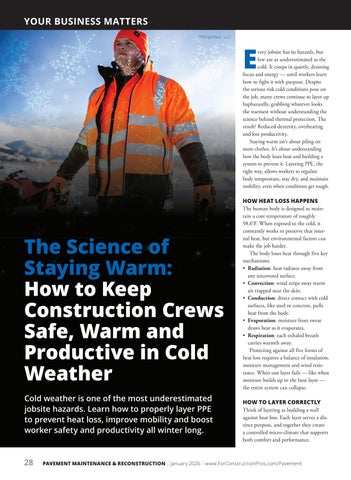
very jobsite has its hazards, but few are as underestimated as the cold. It creeps in quietly, draining focus and energy — until workers learn how to fight it with purpose. Despite the serious risk cold conditions pose on the job, many crews continue to layer up haphazardly, grabbing whatever looks the warmest without understanding the science behind thermal protection. The result? Reduced dexterity, overheating and lost productivity. Staying warm isn’t about piling on more clothes. It’s about understanding how the body loses heat and building a system to prevent it. Layering PPE, the right way, allows workers to regulate body temperature, stay dry, and maintain mobility, even when conditions get tough.
The Science of Staying Warm: How to Keep Construction Crews Safe, Warm and Productive in Cold Weather Cold weather is one of the most underestimated jobsite hazards. Learn how to properly layer PPE to prevent heat loss, improve mobility and boost worker safety and productivity all winter long.
28
HOW HEAT LOSS HAPPENS The human body is designed to maintain a core temperature of roughly 98.6°F. When exposed to the cold, it constantly works to preserve that internal heat, but environmental factors can make the job harder. The body loses heat through five key mechanisms: • Radiation: heat radiates away from any uncovered surface. • Convection: wind strips away warm air trapped near the skin. • Conduction: direct contact with cold surfaces, like steel or concrete, pulls heat from the body. • Evaporation: moisture from sweat draws heat as it evaporates. • Respiration: each exhaled breath carries warmth away. Protecting against all five forms of heat loss requires a balance of insulation, moisture management and wind resistance. When one layer fails — like when moisture builds up in the base layer — the entire system can collapse. HOW TO LAYER CORRECTLY Think of layering as building a wall against heat loss. Each layer serves a distinct purpose, and together they create a controlled micro-climate that supports both comfort and performance.
PAVEMENT MAINTENANCE & RECONSTRUCTION | January 2026 | www.ForConstructionPros.com/Pavement
PVM0126_28-31_YBM_BN.indd 28
12/16/25 3:09 PM
g
PVM0126_28-31_YBM_BN.indd 29
12/17/25 9:12 AM
YOUR BUSINESS MATTERS
The Base Layer The thermal base layer’s job is moisture management. It pulls sweat off the skin before it can chill the body. Avoid cotton, as it soaks up moisture and traps it against the skin. Instead, workers should choose synthetic or wool blends that wick efficiently and dry fast. This layer should fit snugly, but not tightly, allowing full mobility while maintaining skin contact for proper moisture transfer.
more insulation than those performing continuous heavy labor, whose bodies generate more heat.
The Protective Outer Layer
Heat-Trapping Insulation Layer
The outer layer must block wind and repel rain, sleet or snow while still allowing excess body heat to escape. Avoid overly tight or non-breathable shells as they can trap sweat, turning clothing damp from the inside. Features like vent zippers, breathable membranes and adjustable cuffs can drastically improve temperature control.
Once moisture is managed, insulation does the heavy lifting. Its job is to trap warm air close to the body. The key to insulation isn’t thickness — it’s trapped air. Synthetic fibers like down alternatives, fleece or advanced polyester hollow-core insulation create pockets of air that act as thermal buffers. Workers in stop-and-start tasks, like operators or supervisors, need
AVOIDING OVERHEATING Overdressing is one of the most common mistakes in cold-weather workwear — and one of the most dangerous. Instead, workers should: • Start slightly cool. Begin a shift feeling chilled. Body heat will rise within minutes of exertion. • Vent strategically. Unzip collars or
underarm vents during high-activity tasks to release excess heat. • Layer for flexibility. Carry a removable mid-layer or insulated vest for easy adjustments. Employers can also do their part by allowing short breaks for re-layering when conditions change. A small shift in temperature or workload can make a big difference. EXTENDING THE LAYERING Heat is hardest to maintain in the extremities, where blood flow is naturally reduced to preserve core warmth. Layering principles apply here, too.In cold weather, a single pair of work gloves might not cut it. Adding a thin glove liner can wick moisture away from the skin and create an extra layer of warmth without sacrificing grip or dexterity. Workers can adapt to changing temperatures by combining liners with insulated work gloves or swapping shells
INNOVATION IN PRESERVATION
Contract # 050625-CME
Permanent pavement maintenance solutions at the lowest operating costs available in the industry.
Pothole Patching
Crack Sealing
Asphalt Pavement
A permanent paveSeal and protect ment repair in four your pavement steps: Clean, Tack, asset with the safest Fill, Coat and ready and most efficient for traffic. crack sealer.
Emulsion Storage
Prevent premature Reduce material and asphalt joint failures transport costs while before you pave with boosting producthe MA4 melter aptivity with a heated plicator and VRAM. tank.
ME2TM Mastic Melter
250 Gallon Mastic Melter
Midsize mastic melter Ideal for commercial / residential repairs One-touch operation with variable speed control
M4TM Crack Sealer Machine 410 Gallon Crack Sealer
Fastest melt rate in class Lowest load height and quietest operation Average daily production of 8 lane miles or less
Schedule a demo today and discover: QUALITY | PERFORMANCE | EASE OF USE. Learn more at CIMLINE.COM or call 877-841-0848
Experience the Future of Pavement Maintenance with Cimline at PAVE/X and CONEXPO-CON/AGG 2026 BOOTH #723 BOOTH #SV2071
30
PAVEMENT MAINTENANCE & RECONSTRUCTION | January 2026 | www.ForConstructionPros.com/Pavement
PVM0126_28-31_YBM_BN.indd 30
12/16/25 3:09 PM
as the weather changes. For example, a thin, moisture-wicking polyester or wool liner worn under a waterproof work glove protects sweaty, clammy hands without adding unnecessary bulk. This two-part system lets workers maintain hand control without exposing skin or trapping sweat. Delicate skin around the face, ears and neck are particularly susceptible to frostbite. Hard-hat liners, balaclavas and neck gaiters built from breathable fleece or synthetic materials help retain warmth and protect these sensitive areas. Moisture management is just as critical for feet as it is for the rest of the body. Wearing thin wicking socks under thermal wool socks, paired with insulated, waterproof boots, helps prevent both frostbite and trench foot injuries. MATCHING LAYERS TO ACTIVITY AND ENVIRONMENT Not all cold conditions are equal.
Layering systems must adapt to both temperature and activity level. Training workers to read their environment and adjust layers accordingly is one of the simplest and most costeffective safety measures an employer can implement. THE PRODUCTIVITY PAYOFF While warmth is critical for safety, it’s also a major driver of performance. Studies show that cold stress reduces dexterity, slows reaction time, and increases fatigue, all of which heightens the risk for accidents and injuries. Comfort also directly impacts productivity. When workers are properly dressed, they can focus on the task at hand — not on how cold they feel. A well-designed layering system means fewer breaks to warm up, fewer distractions and fewer errors from numb fingers or stiff joints.
A MEASURED APPROACH Layering isn’t just about adding more bulk — it’s about choosing the right materials, fits and features to create synergy between each layer. For PPE buyers, that means prioritizing the following: • Moisture control over bulk • Adjustability over fixed insulation • Breathability over impermeable shells • Fit and mobility to ensure PPE doesn’t compromise safety compliance When the science of heat retention meets practical field experience, workers gain both protection and confidence. A well-layered crew is not only warmer, they’re safer, sharper and more efficient. ■ Leigh Stadelmeier is an OSHA Authorized Construction Trainer and Vice President of Outdoor Sales for RefrigiWear.
TRUSTED BY NATIONAL BRANDS, POWERED BY LOCAL PROS. We connect trusted contractors with high-value, nationwide clients. ✔ Nationwide Opportunities ✔ Local Contractor Network ✔ 24/7 Support ✔ Guaranteed Growth Pipeline BOOTH #135
PARTNER WITH US & GROW YOUR BUSINESS 866-781-5147 info@paveconnect.com
www.ForConstructionPros.com/Pavement | January 2026 | PAVEMENT MAINTENANCE & RECONSTRUCTION
PVM0126_28-31_YBM_BN.indd 31
31
12/16/25 3:09 PM
FROM THE OWNER’S DESK
What’s Your Company Culture And Why Should You Care? Here’s why culture matters in pavement work and how simple actions can transform it.
B
efore I ever sealed a driveway of my own, I worked retail for a major national chain. They were big on talking about how much they valued their employees. They printed it on our vests, had us do morning team exercises, handed out promotional shirts, all the usual corporate stuff. And for a while, I thought it was great. But over time I realized the culture didn’t match the message. Everything they did was surface-level corporate spouting. The truth was that the company didn’t actually care much about the people working there. And once that became clear, all the slogans, t-shirts, and pep talks felt pointless – and worse. I felt like they were taking employees for granted, that we weren’t worth their effort, and that we could be “bought off” by a t-shirt and free coffee and donuts. That experience stuck with me. I promised myself that if I ever had my own business, I would actually mean what we said about valuing people—not just print it on a shirt. I never wanted to be a horrible boss, and I never wanted people who worked for my company to feel like they weren’t valuable. On the contrary, I hoped any employees I might have would feel they were important, that they were an integral part of the company’s success, and that they looked forward to coming to work and working with their coworkers. Once I got into the pavement business, I saw a friend of mine do something that reminded me what genuine culture looks – and feels – like: He had a full kitchen built in his shop so his crews could start their day with a hot breakfast. I remember thinking, Now, that’s smart!
32
Clearly, he wasn’t doing it as a gimmick. It wasn’t like handing out a t-shirt or company cap. He invested his company’s money in a kitchen because he just wanted to take care of his team. And it was clear they appreciated it. It reinforced something I already believed: Our people really do make the difference. And that belief is closely tied to whatever culture your company ends up with. CULTURE MAKES IT BETTER Let’s be honest with ourselves: What we do is hard. Long days, heat, deadlines, equipment issues, pressure, and a season that always feels too short. When work is that demanding, the small things matter more than many owners realize. For my company, culture shows up in simple, practical, easy-to-implement and in some cases obvious ways. It starts with wages, and we are more than competitive in that area. It’s difficult to get employees to feel like part of your company and buy-in to its culture if they don’t feel like they are compensated fairly. We check that box right from the start. We buy pallets of bottled water every spring. We keep a snack table stocked with drinks, protein shakes, jerky -- and even healthy stuff! We ask them what food or beverage they’d like to see on the table -- and we get it for them (Lay’s BBQ chips was last season’s hot item). None of this costs much, especially compared to the morale and culture benefit, and it’s all there for the taking. And it sends a message: “We notice you. We appreciate you. You’re valuable to us. We care.”
Don’t think this is about buying happiness, it’s not. You can’t buy that anyway. And it’s not about preventing employee-related issues that can arise – those things are something every business has to deal with. It’s about creating an environment where people feel respected, recognized, and supported in a physically demanding line of work. CULTURE LOOKS DIFFERENT FOR EVERY COMPANY So, what should you be doing in your company to develop a positive and productive company culture? Well, it varies from company to company, but it depends on the kind if company you want to have. Some owners focus on culture to protect their brand and keep standards high. Others just want people to feel part of the company, to actually enjoy coming to work. You could take either approach or – like us – do both! I think that when employees feel invested, they’ll do their best work and be most productive – which protects out brand and helps keep standards high. Plus, I think if they feel recognized and respected there’s a good chance they’ll be back next season. And here’s the part people forget: Your customers feel your culture too. Crews who are treated well take more pride in their work. They have better attitudes on the jobsite. They problemsolve better. They communicate better. And customers absolutely pick up on that. It shows in the final product, in the interactions, in the overall experience – and in your repeat business and referral rates.
PAVEMENT MAINTENANCE & RECONSTRUCTION | January 2026 | www.ForConstructionPros.com/Pavement
PVM0126_32-33_OwnersDesk_BN.indd 32
12/16/25 3:48 PM
PUT WINTER TO WORK For many of us the season is over; for many other companies work will slow down for a month or two. This is a great time to step back and take a look at your company and evaluate your company culture. Does it reflect your goals? Do team members interact? Do they support one another? Is job quality where you want it to be? How do your customers feel about your team? When I think back to that retail job, I realize I didn’t intentionally set out to “create culture.” I just didn’t want to repeat the disconnect I saw there -- saying people matter while acting like they don’t. But over the years, through simple habits and small decisions, we ended up with a culture built on respect and genuine care. And honestly, I think that’s one of the biggest reasons we’ve been successful. You don’t need a kitchen in your shop – that’s just a great example of an employer going the extra mile. And you don’t need a giant complex or costly program – ours is a great example of how simple and relatively inexpensive a program can be. But your culture isn’t created by doing something or saying something once. Tickets to a sporting event are a nice bonus, but that’s not going to create your culture. Culture is built into the workplace environment and is created by consistent and repeated everyday moments. Culture can be as simple as: • Explaining why instead of just saying “because I said so” • Recognizing good work when you see it • Giving someone an opportunity to step up • Helping your team get through a tough week Or it can be providing everyday breakfasts, snacks, lunch or whatever it is you want to do to create a positive environment and recognize your employees for the work they do. So, use this winter to evaluate your business and determine the kind of
culture you want. Then start small. Pick one thing you can do that shows your team they matter. Because every company has a culture whether you plan and develop it or not. Take the steps to develop the culture
you want to have, that will benefit your employees, your business and your customers.■ Nick Howell, President of T & N Asphalt Services.
www.ForConstructionPros.com/Pavement | January 2026 | PAVEMENT MAINTENANCE & RECONSTRUCTION
PVM0126_32-33_OwnersDesk_BN.indd 33
33
12/16/25 3:48 PM
SWEEPING ASSOCIATIONS
NAPSA
The Power of Connection Through NAPSA In challenging economic times, it’s easy to focus on cutting costs. But some investments deliver lasting returns. Nancy Terry, Executive Director
A
membership in the North American Power Sweeping Association (NAPSA) is one of them—your gateway to industry connections, professional credibility, and valuable opportunities that strengthen both your business and your bottom line. The sweeping industry runs on relationships. Through NAPSA, you join a nationwide community of professionals who share ideas, solve problems, and open doors. • Connect year-round with peers in the Power Sweeping Pros Facebook group. • Build relationships at PaveX with exclusive networking events and
member training. • Enjoy free admission to Sweepers Night Out, a highlight of the year that blends fun, friendship, and professional connection. NAPSA’s network isn’t just about who you know—it’s about who helps you grow. With NAPSA’s leadership in developing the ANSI standard for power sweeping, certification proves your commitment to best practices and professionalism. It strengthens client trust and provides a clear edge in the marketplace. Members receive significant tuition discounts, making advancement even more attainable. NAPSA connects property owners and municipalities with trusted, certified sweeping contractors. When prospects search for qualified professionals, members stand out in the results. NAPSA membership helps you project professionalism and credibility. Members
have access to NAPSA logos and marketing materials, plus discounted digital services through Visual App for website design, SEO, and online marketing. From PaveX education savings (a $500+ value) or Sweeper Summit registration discounts to member-only supplier discounts on leading industry equipment, your membership delivers tangible financial benefits. Invest in your success—and in your network. Joining NAPSA means joining a community of professionals committed to raising the standards of the power sweeping industry.■
The North American Power Sweeping Association (NAPSA) is a nonprofit association made up of 200+ contract sweepers, service providers and sweeping equipment dealers, manufacturers and suppliers. NAPSA is dedicated to providing beneficial support to the membership and enhancing services to the sweeping industry. NAPSA is committed to promoting and educating the power sweeping community while enhancing the environment. For more information on NAPSA membership, please visit www.powersweeping.org or call (888) 757-0130.
WSA
The Role Of Company Culture In Sweeping And Maintenance Operations
34
The strongest contractors create cultures grounded in safety, security, and continuous improvement, elevating both their teams and the quality of service they deliver. Ranger Kidwell-Ross, Executive Director successful parking area and street sweeping operation is defined by more than its fleet or contracts—it’s shaped by the strength of its company culture. Contractors who cultivate an environment grounded in safety, security, and continuous improvement set the stage for long-term success. Safety is the foundation. Sweeping vehicles often operate at night or in active traffic zones, where attentiveness
A
and communication can make all the difference. When a company prioritizes safety as a shared responsibility, employees respond with professionalism and care, reducing risk and enhancing performance across the board. Security—both physical and organizational—reinforces that stability. Protecting equipment, client property, and employee well-being requires clear procedures and consistent training. A secure operation not only prevents loss but fosters trust between management, crews, and customers alike. Continuous education strengthens every layer of this culture. From operator certification and mechanical maintenance to environmental awareness and customer service, ongoing learning helps teams refine their skills and adapt to industry changes. When employees see that their employer
invests in their growth, engagement and retention naturally follow. Ultimately, a well-defined company culture elevates more than internal operations—it raises the standard of service for the entire industry. By leading with integrity, communication, and professional care, sweeping contractors can build companies that are safer, more efficient, and better equipped cfor the challenges of modern pavement maintenance. ■
WSA contributor Ranger Kidwell-Ross has been providing information to the power sweeping industry since 1988. He is editor of WorldSweeper.com, an information resource for power sweeping, as well as founder and executive director of the World Sweeping Association. For more information about WSA visit www.WorldSweepingPros.org or contact Kidwell-Ross at director@worldsweepingpros.org.
!1
INT
PAVEMENT MAINTENANCE & RECONSTRUCTION | January 2026 | www.ForConstructionPros.com/Pavement
PVM0126_34-35_NAPSAWSA_BN.indd 34
I
12/16/25 3:54 PM
POTHOLE PUNISHER
'DotHDLE 'FiiNISHER
Booth #733
I
I
CONTACT US TODAY!
BDD-492-1757 II BID-688-1234 INTER=JONAL WWW.KMINTERNATIONAL.COM !1 Jj
PVM0126_34-35_NAPSAWSA_BN.indd 35
12/16/25 3:54 PM
CONTRACTOR SNAPSHOT | By Brandon Noel, Editor-in-Chief
Dark-To-Dark: DeHart Asphalt Never Gives Up How a small, family-run shop became one of Arizona’s most trusted names in pavement maintenance.
S
ome companies grow because someone saw a market opportunity. Others grow because someone saw a calling. In the case of DeHart Asphalt, the story begins in the late 1970s, when Patricia and Leonard left Michigan for Arizona and carried their trade with them. They launched Western Asphalt in 1980 with Leonard’s father after moving in 1979, beginning what would become a multi-generational journey in pavement maintenance, crack sealing, and sealcoating across the state. What they didn’t know then was that a young man named Robert Bonura (Partner/Manager of DeHart Asphalt) would join the family decades later, helping them carry the DeHart legacy forward. After spending some time with them on the jobsite and in their company yard, I can say that this group has all the goods. They know their community, they know what they’re best at, and they know how their making a difference.
LEARNING THE TRADE IN A TOUGH MARKET Arizona is unlike some states in the asphalt business. There’s no freeze-thaw cycle to battle. Instead, there’s the opposite problem: extreme heat that pushes pavement past its limits. That heat doesn’t just test asphalt. It tests contractors too. The Phoenix metro area is saturated with companies of every size, from private-equity backed rollups with to new little pop ups and even the seasonal teams that come-and-go every winter. To survive here, let alone thrive,
36
KJ Visuals
takes grit and an identity built on something that can’t be bought: a truly personal touch. That’s the space DeHart Asphalt occupies. “We’re small. We’ve got seven people… But we want to keep it that way specifically, because then [we] control the quality,” Robert said. He has sat behind a desk before and knows exactly what he gave up to return to the field. “It almost killed me, but once I got back out in the field, it was great. My body was moving. I was moving. My mind was clear.” This is the mindset that shapes DeHart Asphalt. Not growth for growth’s sake. Not scale at any cost. Just real people showing up to do real work well. That’s a theme across everything that they do. THE WORK ITSELF If you spend enough time with pavement maintenance contractors, you learn that every region has its own quirks, its own challenges, and its own fixes. In Arizona, one of those fixes is mastic. Most property managers know crack seal and they know sealcoat. But mastic is something else entirely. When I asked whether customers struggle to understand it, Robert explained that education is key, but so is honesty. “I don’t want to oversell what it is,” he said.
Mastic has aggregate mixed into the binder, giving it structure that traditional crack sealant doesn’t have. It “self levels,” pours hot, and hardens into a surface strong enough that you won’t sink a high heel in it even when cracks reach four or five inches wide. In a climate where asphalt can reach 120 degrees on a summer day, that can be a big selling point. In a moment of real levity, Robert compared application to the winter Olympic sport of curling. “You just have to be able to control it,” he said, laughing. “It literally will go to where it’s needed, the material just shifts itself.” For DeHart Asphalt, mastic, crack sealing, and sealcoating remain their bread and butter, supported by paving, patching, and striping. On average, the company is 60 percent seal coating and about 40 percent paving. A FAMILY STORY YOU CAN’T INVENT One of the most interesting things about DeHart story is that Robert didn’t grow up in the business. He married into it. He joined the industry...heart first. He met Amanda, Patricia and Leonard’s daughter, the day after Christmas in 2004. By March, he was working full-time for the family. By July, they were married. “For the first
PAVEMENT MAINTENANCE & RECONSTRUCTION | January 2026 | www.ForConstructionPros.com/Pavement
© 2022 Grac
PVM0126_36-39_ContSnap_BN.indd 36
12/16/25 3:55 PM
400044_A
®
A GRACO COMPANY
TACKLE TOUGH REMOVAL JOBS FAST SMITH SPS10 DCS Scarifier
SMITH's SPS10 DCS High-Production Scarifier is ideal for removing tough pavement markings and leveling trip hazards. The SPS10 DCS builds on the proven capability of the SPS10 by adding SMITH's electronic DCS Depth Control System, which allows operators to precisely control their cut depth with the push of a button. ¡ Ideal for removing markings, trip hazards, and inlay grooving ¡ Remove paths up to 10 inches wide ¡ Electronic DCS Depth Control System for precise cut control ¡ Wide variety of cutters available, including PCD shaving drums ¡ Reliable 13HP Honda® Gasoline Engine with electric start
DEPTH
CONTROL
SYSTEM
LEARN MORE AT SMITHMFG.COM/SPS10DCS
MADE IN THE USA WITH GLOBAL COMPONENTS
© 2022 Graco Inc. 3J0334A 12/22 Printed in the U.S.A. Product covered by issued and pending patents, see graco.com/patents
400044_ADP_3J0334A_SPS10_DCS_PavementAd_print-ready.indd 1 PVM0126_36-39_ContSnap_BN.indd 37
1/6/22 4:30 PM 12/16/25 3:55 PM
CONTRACTOR SNAPSHOT
other, dump trucks, pavers, and a preWeiler showing the history of the trade in physical form. And for Robert, this isn’t just a job. It’s part of who he is, who the whole family are. “I left it for a while… But for some reason, I’ve always come back to this,” he said. “This is where I belong.”
Brandon Noel
two years… we worked seven days a week,” he said. “Dark-to-dark.” Two decades later, they’re still here. Their children work with them now too. The yard itself feels like a family home more than a commercial property. DeHart equipment lines the edges, machines organized by category: sealcoat rigs on one side, milling gear on the
38
THE LEGACY AND THE FUTURE The DeHart name has been around since 1995, carried over from time the family spent in Florida. But something remarkable happened before websites and social media were the norm they are today: the family business grew almost entirely by word of mouth. “We just created a website this last year,” Robert said. “And still, we get calls from people who say, ‘You did my parking lot 15 years ago, didn’t realize you were still around.’”
That longevity hinges on reputation, pride, and a kind of personal accountability that’s increasingly rare in an industry that has seen a nation wide shift in how its structured, and how it interacts with the general public. When a project ever falls short, Robert says those are the toughest calls he gets. Not because of ego, but because, “I wasn’t able to give them what they wanted right off the bat.” It’s not the kind of response you get from a larger company. And that brings us to the future. While the broader industry has watched private equity groups buy up contractors across the country, neither of us believes that trend is sustainable. The pendulum will swing back toward smaller, personal, relationship-driven businesses. Robert believes it too. “I think the smaller companies are going to ramp
PAVEMENT MAINTENANCE & RECONSTRUCTION | January 2026 | www.ForConstructionPros.com/Pavement
PVM0126_36-39_ContSnap_BN.indd 38
12/16/25 3:55 PM
back up, because the larger ones lack the personal touch.” For DeHart Asphalt, the mission is simple: keep the legacy alive. “Our goal is just to keep that legacy alive and do it proud,” he said. “When it’s Jacob’s (Robert and Amanda’s son) turn to take over, I think we’ve given him the same, if not better, than what they gave us.” They don’t need to be an $18 or $20 million company. They just need to be what they’ve always been: a family business committed to quality, honesty, and community. A place where people aren’t afraid to go to work the next day. Where employees aren’t numbers. Where customers aren’t accounts. Where the asphalt sticks together as well as the people. That’s the DeHart story, and we’re excited to see where it goes into the future. ■
Brandon Noel
CLASSIFIEDS
www.ForConstructionPros.com/Pavement | January 2026 | PAVEMENT MAINTENANCE & RECONSTRUCTION
PVM0126_36-39_ContSnap_BN.indd 39
39
12/16/25 3:55 PM
CLASSIFIEDS
Graco Billy Goat Marathon Equipment Cimline, Inc. Good Selection of NEW and USED Routers on Hand.
Little Wonder Bomag Fayat Group Smith Manufacturing KASI Infrared by VSS Macropaver
Liberty Supply (800) 397-9907 www.libertysupply.biz
Low Hour Melter Rental Units Available for Purchase.
NEW and USED Crack Fillers and Mastic Melters Available.
Large Supply of Parts on Hand at all Times!
40
PAVEMENT MAINTENANCE & RECONSTRUCTION | January 2026 | www.ForConstructionPros.com/Pavement
PVM0126_40_Classifieds.indd 40
12/16/25 3:55 PM
TAILGATE
TALK
Is A CRM Right For Your Pavement Business? Here is what you need to know about preparation, training, integration, and whether CRM is the right move for your business.
commentator and icon says, “Not so fast.” There is work to be completed before you go live with your software. There are three primary stages, each stage with several executions that should be made to gain the maximum benefits of the software.
customer relationship management, or CRM, is a software that has been around for several years now in the construction industry. Like most software packages, they have improved and expanded over the past twenty-years, providing more options for the contractor. But is CRM right for you? Well, before we decide, let’s explore a bit more about CRM software. What is CRM software? It is a customer relationship focused software that helps a contractor to manage their accounts, hence the acronym CRM. A CRM software most often provides means to track customers, the bids we create and submit, preconstruction or pre-start qualifiers, forecasting of pipeline, WIP, backlog, document creation and exchange, communication with customers, and post-project management of accounts including repeat project opportunities, warranty services, financial history of projects, etc. The opportunities are simply mind-boggling for most contractors. With such fire power seemingly in this product, it might initially look to be a “no brainer” for any contractor to purchase. As a famous college football
THREE STAGES
A
AdobeSt
o ck _
fo t o
ika
A Pre-Implementation & Preparation B. Roll-Out of Software & Continued Coaching C. Post-Implementation & Fine-Tuning The Stages should not be a surprise to any contractor but trust me, if you are clear, transparent, and committed to perform “A.”, you might rethink investing in such a statistical juggernaut. Briefly, A. involves mapping our current processes your company has, how does your lead generation operate, how do you bid, what do you current proposals look like, etc. You will also need to clean up existing data from Excel sheets, Outlook, cell phones, notebooks, etc., anything that will be needed and managed with the new CRM. The Roll-Out consists minimally with configuring of the CRM, customizing fields for your project types (by division), markets, service areas. Clear selling stages that align with your bid cycle and automated reminders for required bid deadlines. You might even set up
tracking “hit rates” and backlog, etc. This stage is also overwhelmed with training, especially your PMs and Estimators, and any individual (including the owner) responsible for Business Development. The Post-Implementation primarily focuses on workflow adjustments, the creation of “dashboards” that track backlog, expenses, priority status, extended projects, “KPI’s” that are being met or not, and a continued need for coaching those struggling to learn the new software. The advantages for integrating, or expanding, a CRM software are many, not the least is having a measurable picture of what your company is doing, how they are doing, and what needs to be more in focus throughout the
www.ForConstructionPros.com/Paveme | January 2026 | PAVEMENT MAINTENANCE & RECONSTRUCTION
PVM0126_41-44_TailgateTalk_BN.indd 41
fab r
41
12/16/25 3:56 PM
TAILGATE
TALK
season. Having such reminders posited to your sales oriented folks when to follow-up, what to followup on, and how to retain your clients for longterm relationships is the strengthen of most CRM software. The list of advantages of CRM is undeniable however, like most good things, there can be some drawbacks and challenges should you go the CRM way. Adapting to a new software is just tough for many. Many estimators and PMs just hate to do more data entry than they have to and if the system isn’t exactly simple, that escalates the challenges. If the CRM doesn’t integrate with your estimating, job costing, and project management software you currently use, it will be challenging for your users to add yet another software tool that requires double entry, killing adoption! Though some CRM providers claim that their package is compatible with your other systems, many, not all, contractors have simply not found this to be the case.
CLASSIFIEDS
Here are a few things to look out for if you are considering purchasing your first CRM package or, expanding your current system. First, the cost ranges greatly between companies, mostly due to the amount of available purposes you may want to purchase. It is tempting to buy more than you need now but this decision may be a large expense that may never be realized. To have more than one software in your office providing duplicated data will become obvious if you are not careful, and the users will more often stick with the one they have danced the longest with. So, is CRM right for you? That’s your decision but I think YES, you need to move toward making CRM part of your company’s efforts to grow and be sustainable. Because CRM is more customer focused, I see many growing contractors who eventually invest in CRM. (Hitting ten to twenty million should draw your consideration to purchase a CRM system.) The time of integration can be an issue for contractors, but I have found that most contractors, who planned on about three to six months of integration, soon realized that this may be more of a twelve to eighteen months journey. It doesn’t have to be, but this will depend greatly on the number of preparations you executed AND that you not only provided initial training but maintained a consultant to be available for users for another six to nine months. If you do this, you will see much better results sooner! If integrated correctly, most CRM products can become a great resource for business development acumen, positively influencing your bid management system, keeping needed forecasts in view regularly, and add to your customer retention strategies, with dates, that can fill in those schedule cracks for customer appreciation, reminders, and references for new jobs. It starts with the owner who must support the integration, but more, drive its use daily, weekly, and involve the developing information in regular weekly meetings, monthly planning meetings, and quarterly strategic meetings and updates. A CRM based company should view CRM as a key new specialty department for their company’s growth, quality, and customer satisfaction. ■
w
Brad Humphrey, The Contractor’s Best Friend
42
Brought
PAVEMENT MAINTENANCE & RECONSTRUCTION | January 2026 | www.ForConstructionPros.com/Pavement
PVM0126_41-44_TailgateTalk_BN.indd 42
12/16/25 3:56 PM
win $100 Just for wearing your CASE or Gorman-Rupp safety vest at
West Hall Booth #W40701
it pays to stand out It’s easy to win BIG. Pick up your free ANSI-approved safety vest from CASE’s or Gorman–Rupp’s booth and wear it during CONEXPO-CON/AGG. Attendees wearing the vests will be selected at random to win $100 CASH! Supplies are limited.
Central Hall Booth #C20306
CONEXPO-CON/AGG
2026 [March 3-7, Las Vegas, NV]
PVM0126_41-44_TailgateTalk_BN.indd 43
BIGSHOW COVERAGE
THE
Brought to you by ForConstructionPros.com and IRONMARKETS. CASE & Gorman-Rupp are the official vest sponsors for this progam
12/16/25 3:56 PM
DISCOVER WHAT’S NEXT
IN PAVEMENT MAINTENANCE
Visit the SEALMASTER BOOTH #101 at the 2026 show in New Orleans to experience the latest innovations in Pavement Maintenance Products and Equipment. BE SURE TO JOIN US FOR THE SEALMASTER AFTER PARTY AT ERNST CAFÉ FOR NETWORKING, FOOD, BEVERAGES, AND LIVE MUSIC.
Join Us! SEALMASTER
AFTER-PART
Y @
Food • Drinks • Live Music FEBRUARY 11, 2026 PVM0126_41-44_TailgateTalk_BN.indd 44
4:00-7:00 PM
600 SOUTH PETERS STREET NEW ORLEANS, LA, 70130 Just Down the Street from Pave/X!
12/16/25 3:56 PM